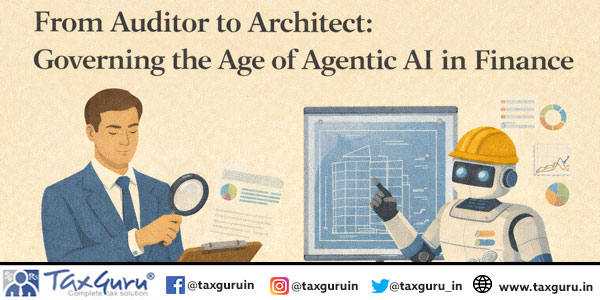
1. Why “auditor to architect” is the right metaphor
Finance is entering an era where decisions are proposed, executed, and continuously optimised by autonomous software.
Not only calculated by models.
Not only recommended by dashboards.
But acted upon by agents.
In such a setting, the classic assurance posture of the auditor becomes necessary but not sufficient.
A periodic check, after the fact, is too late when the system can act in milliseconds.
Therefore a role shift.
From “auditor” (verifying compliance ex post).
To “architect” (designing controls ex ante, embedding assurance into the system, and continuously monitoring outcomes).
This paper treats governance as an engineering discipline.
Controls as code.
Assurance as an always-on capability.
2. Key terms and definitions (plain-English, finance-grade)
2.1 Artificial intelligence, machine learning, and generative AI
Artificial Intelligence (AI).
A broad term.
Machine-based systems that produce outputs (predictions, recommendations, content, decisions) that influence environments.
Often with some autonomy.
Machine Learning (ML).
A subset of AI.
Algorithms that learn patterns from data rather than being explicitly rule-coded.
Common classes: supervised learning, unsupervised learning, reinforcement learning.
Generative AI (GenAI).
Models that generate new content.
Text, images, code, audio.
Large Language Models (LLMs) are GenAI models focused on language.
Why finance cares.
Because GenAI turns unstructured inputs into structured actions.
Contracts, emails, call transcripts, KYC documents, policy manuals.
All become “machine-readable”.
2.2 Agentic AI
Agentic AI (or “AI agents”).
AI systems designed to pursue goals through a sequence of actions.
They plan.
They call tools (APIs, databases, workflow engines).
They observe results.
They revise their plan.
They can act with a degree of autonomy.
A simple example.
A “collections agent” that reads delinquency signals, drafts customer messages, schedules follow-ups, and triggers hardship workflow if the customer’s financial stress is detected.
A stronger example.
A “treasury agent” that monitors liquidity, proposes intraday funding moves, and executes trades within pre-set limits, while escalating exceptions.
The crucial distinction.
A traditional model gives an output.
An agent changes the world.
Therefore the control problem is harder.
Because you must govern not only accuracy.
But behaviour.
Intent.
Tool access.
And chain-of-actions risk.
2.3 Governance, risk, and assurance (GRA) language
Governance.
The system of oversight, accountability, decision rights, and policies.
Board.
Senior management.
Committees.
Risk appetite.
Escalation paths.
Assurance.
Independent evaluation that controls are designed and operating effectively.
Internal audit.
Compliance testing.
Model validation.
External audit.
Regulatory inspection.
In the agentic age, these concepts converge.
Because controls become embedded.
And assurance becomes continuous.
3. The scale of change: facts and figures that matter
Three numbers anchor the urgency.
(1) Spending.
The IMF reported that investment in software, hardware and services for AI systems in financial services could reach about USD 400 billion by 2027, up from USD 166 billion in 2023.
(2) Work redesign.
A World Economic Forum (WEF) report on AI in financial services noted that around 32–39% of the work performed across banking, insurance and capital markets has high potential to be fully automated, and a further large share has high augmentation potential.
(3) Value at stake.
McKinsey has estimated that generative AI alone could deliver up to about USD 340 billion annually in additional value for the banking industry, if captured through practical deployments.
These are not abstract numbers.
They translate directly into.
Competitive pressure.
Operational redesign.
Regulatory attention.
And board-level accountability.
4. What makes agentic AI uniquely risky in finance
4.1 Risk is no longer only “model risk”
Traditional model risk.
Wrong model.
Wrong data.
Wrong implementation.
Wrong interpretation.
Agentic risk adds new layers.
Action risk.
Tool risk.
Prompt risk.
Goal misalignment risk.
Emergent behaviour risk.
A practical framing.
Model risk answers: “Is the output correct?”
Agentic governance asks: “Is the system safe to act?”
4.2 The agentic risk stack (10 layers)
- Data risk. Biased, stale, non-representative, unlawfully sourced, or insufficiently governed data.
- Model risk. Mis-specification, overfitting, drift, instability, non-robustness under stress.
- Prompt and instruction risk. Uncontrolled prompts, hidden instructions, jailbreaking, policy bypass.
- Tool and API risk. Excessive permissions, unsafe write-access, uncontrolled third-party integrations.
- Workflow risk. Broken hand-offs, missing approvals, lack of segregation of duties, override abuse.
- Explainability risk. Inability to provide human-understandable reasons for decisions.
- Fairness and conduct risk. Discriminatory outcomes, unfair customer treatment, unsuitable advice.
- Cyber and fraud risk. Prompt injection, data exfiltration, social engineering, synthetic identity fraud.
- Concentration and third-party risk. Common cloud/LLM providers, correlated outages, systemic fragility.
- Financial stability and market integrity risk. Herding behaviour, correlated trading signals, misinformation.
5. From periodic audit to continuous control: a control architecture
The classic “three lines” model still applies.
But the mechanisms change.
First line (business + technology) builds controls into the agent.
Second line (risk + compliance) sets guardrails, monitors, challenges, and approves exceptions.
Third line (internal audit) tests governance effectiveness and control reliability.
The new design goal.
Make the agent itself auditable.
Make every action traceable.
Make every decision reproducible.
5.1 Controls as code
Controls as code.
A concept where policies and controls are implemented as machine-enforceable rules.
Examples.
Automated segregation-of-duties checks in workflow.
Policy-based access control for tool calls.
Automated approval routing based on risk score.
Logging and tamper-evident audit trails.
Why it matters.
Because agentic AI operates too fast for manual policing.
5.2 Minimum viable “AI assurance stack” for a finance institution
- Model inventory. A complete register of AI/ML/GenAI models and agents, including third-party components.
- Use-case classification. Tiering by customer impact, financial materiality, and regulatory sensitivity.
- Pre-deployment validation. Performance, bias, robustness, security, and operational readiness testing.
- Human-in-the-loop design. Mandatory approvals for high-risk actions; fail-safe modes.
- Telemetry for prompts, tool calls, outcomes, drift, latency, and error rates.
- Incident management. AI-specific playbooks: hallucination event, data leak event, bias event, runaway agent event.
- Change management. Versioning, release gates, roll-back, and audit log linkage.
- Third-party controls. Vendor due diligence, SLAs, right-to-audit, concentration risk assessment.
- Independent assurance. Model validation function, compliance testing, internal audit coverage.
- Board reporting. KRIs, breaches, remediation progress, and risk appetite metrics.
6. Regulation and standards: what “good” looks like across jurisdictions
Regulators are converging on a risk-based approach.
Not a blanket ban.
But increased obligations for high-impact uses.
The practical effect.
Credit decisions.
Fraud decisions.
Market abuse surveillance.
Customer advice.
Claims adjudication.
AML and sanctions screening.
All sit in the “high attention” zone.
Below is a finance-oriented map of influential regulatory and supervisory anchors.
6.1 United States: Model Risk Management meets AI
The Federal Reserve’s SR 11-7 guidance on Model Risk Management is still the bedrock for banking model governance in the US.
Its logic remains directly applicable to AI and agentic systems.
Core expectations.
Strong governance.
Robust validation.
Effective challenge.
Ongoing monitoring.
Controls aligned to the sophistication and materiality of model use.
Practical implication for agentic AI.
Treat “agent policies” and “tool access rules” as part of the model.
Validate them.
Not only the ML weights.
6.2 European Union: the AI Act and high-risk credit scoring
The EU AI Act (Regulation (EU) 2024/1689) classifies certain AI use cases as “high-risk”.
In banking, AI used to evaluate creditworthiness or establish credit scores of natural persons is explicitly treated as high-risk.
High-risk systems trigger obligations such as.
Risk management system.
Data governance.
Technical documentation.
Record-keeping.
Transparency and user information.
Human oversight.
Accuracy, robustness, and cybersecurity.
The European Banking Authority (EBA) has published mapping work highlighting that the AI Act is largely complementary to existing EU financial services legislation, but requires integration and coordination across supervisory authorities.
6.3 Global supervisory convergence: financial stability and concentration risk
The Financial Stability Board (FSB) has analysed how rapid uptake of AI, without commensurate risk management and monitoring, could introduce or amplify vulnerabilities.
Third-party dependencies and service-provider concentration are recurrent themes.
So are cyber risks.
And correlated model behaviour.
For boards and auditors, this means.
Do not treat vendor AI as “outsourced magic”.
Treat it as a critical service.
With resilience obligations.
And exit plans.
6.4 Standards and frameworks: NIST AI RMF and ISO/IEC 42001
NIST AI Risk Management Framework (AI RMF 1.0).
A voluntary but widely influential framework.
It organises AI risk management into four functions: Govern, Map, Measure, and Manage.
Its strength is operational clarity.
ISO/IEC 42001:2023.
A management-system standard for an Artificial Intelligence Management System (AIMS).
It is analogous in spirit to ISO 27001 for information security.
But focused on AI.
In practice.
NIST AI RMF is a “how to think” framework.
ISO 42001 is a “how to run the system” standard.
Together they support auditability.
Defined policies.
Defined roles.
Defined monitoring.
Defined continual improvement.
6.5 India: emerging AI governance signals in financial markets
In India, the regulatory direction is clear.
Encourage innovation.
But enforce responsibility.
Three signals are relevant.
(1) Data governance.
The Digital Personal Data Protection Act, 2023 (DPDP Act) establishes a statutory framework for processing digital personal data.
For AI, this directly affects.
Training datasets.
Customer consent and purpose limitation.
Cross-border processing.
Retention and deletion.
(2) Securities markets.
SEBI issued a consultation paper (June 2025) on responsible usage of AI/ML in Indian securities markets.
SEBI has also discussed the need to assign responsibility to regulated entities using AI/ML tools when servicing clients.
(3) Banking and prudential supervision.
RBI public communications and committee work have emphasised governance, auditability, and systemic risk from concentration and over-reliance on AI models.
The direction aligns with global expectations: board-approved policy, lifecycle management, independent validation, and ongoing monitoring.
7. Case studies: what agentic AI looks like in the real world
7.1 Klarna: AI assistant in customer service with measurable outcomes
Klarna publicly reported that an AI assistant handled about two-thirds of customer service chats in its first month.
The company estimated a profit improvement impact of about USD 40 million in 2024 from this deployment, according to its own press release.
Governance lessons.
Customer-facing agents must be constrained by.
Approved knowledge sources.
Consistent tone and conduct rules.
Escalation to humans for complaints, vulnerability indicators, and disputed transactions.
And strong monitoring for hallucinations and misinformation.
Audit lesson.
You can audit an AI agent like a process.
Sample conversations.
Test for policy compliance.
Track complaint trends.
Validate resolution quality.
7.2 JPMorgan COiN: automating contract review and redefining assurance
A widely cited example of AI adoption in operational risk and legal functions is JPMorgan’s Contract Intelligence (COiN) platform.
Bloomberg reported that the system could do in seconds what previously consumed around 360,000 hours of lawyer time for certain document-review workstreams.
Governance lessons.
The value comes from narrowing the task.
Defining boundaries.
And building a high-quality training and validation set.
Agentic extension.
If contract review becomes an agent that also triggers downstream actions (e.g., covenant monitoring alerts, remediation tasks), then auditability must extend to those actions.
Not only the extracted text.
7.3 NatWest: scaling chatbots and introducing GenAI
NatWest has reported that its chatbot “Cora” handles over 10 million customer interactions a year, and the bank has discussed enhancing it by introducing generative AI.
Governance lessons.
Large volume increases the tail risk.
A rare hallucination event, at scale, becomes a material conduct issue.
Control design.
High-risk intents require deterministic flows.
Authentication steps must be robust.
Payment instructions must be “write-protected” unless strict verification is satisfied.
7.4 DBS: responsible AI governance as a competitive capability
DBS has publicly described governance practices including explainability audits, bias and drift monitoring, and human-in-the-loop checks for high-risk decisions, supported by oversight bodies and risk assessment frameworks.
DBS has also reported operational benefits from platform and governance maturity, such as materially reducing time-to-market for AI initiatives.
Governance lesson.
Responsible AI is not only a compliance cost.
It is an enablement layer.
It accelerates safe scaling.
8. Numerical illustrations: making governance concrete
8.1 Illustration A: expected credit loss (ECL) model drift triggered by an agent
Scenario.
A retail bank uses an ML model for Probability of Default (PD).
A “credit policy agent” proposes limit increases for existing customers.
It can execute increases within delegated thresholds.
Baseline portfolio (simplified).
Exposure at Default (EAD) per customer: INR 1,00,000.
Loss Given Default (LGD): 45%.
Baseline PD from validated model: 2.0%.
Expected Loss (EL) per customer = EAD × PD × LGD.
= 1,00,000 × 0.02 × 0.45 = INR 900.
Now assume.
The agent pushes aggressive increases.
Portfolio risk shifts.
But the PD model is not yet retrained.
True PD rises to 3.2% under new mix.
EL becomes = 1,00,000 × 0.032 × 0.45 = INR 1,440.
Impact.
Incremental EL per customer = INR 540.
If the agent acts on 50,000 accounts.
Incremental expected loss = 540 × 50,000 = INR 27,00,00,000 (INR 27 crore).
Governance takeaway.
Agent actions can change the data-generating process.
Therefore model monitoring cannot be passive.
You must connect agent decisions to risk metrics.
And place speed limits on autonomous policy shifts.
8.2 Illustration B: fairness metric for an underwriting agent
Regulators and boards increasingly ask.
Is the model fair?
A practical metric used in many fairness toolkits.
Disparate Impact Ratio (DIR).
DIR = Approval rate for protected group / Approval rate for reference group.
Suppose.
Approval rate for Group A (reference): 60%.
Approval rate for Group B (protected): 45%.
DIR = 0.45 / 0.60 = 0.75.
A common risk threshold in compliance practice is the “80% rule”.
DIR below 0.80 indicates potential adverse impact requiring investigation.
Agentic complication.
If the underwriting agent dynamically changes thresholds during the day (for volume control or risk appetite), DIR can vary intraday.
Therefore fairness monitoring must be continuous.
Not quarterly.
8.3 Illustration C: hallucination risk as an operational loss distribution
A customer-service agent answers 10 million interactions per year (scale similar to large banks’ bots).
Assume.
Only 0.02% of interactions contain a materially wrong answer that could cause financial harm.
That is 2 wrong answers per 10,000 interactions.
Annual harmful interactions.
10,000,000 × 0.0002 = 2,000.
Assume.
Average remediation and compensation cost per harmful incident is INR 4,000.
Annual expected cost = 2,000 × 4,000 = INR 80,00,000 (INR 80 lakh).
Now consider tail events.
If a bad knowledge update causes an error spike to 0.2% for two weeks.
Then harmful interactions for that period.
(10,000,000 / 52 × 2) × 0.002 ≈ 769.
The tail dominates.
Therefore control design must include.
Release gating for knowledge updates.
Canary testing.
Rapid rollback.
And “circuit breakers” that force human handling when error rates spike.
9. The governance blueprint: designing an “AI control room”
9.1 Decision rights: who owns what
Agentic AI governance fails most often due to unclear ownership.
Therefore start with decision rights.
Provider vs deployer distinction.
If you build the model in-house, you are the provider and deployer.
If you procure a third-party model, you remain a deployer with residual accountability.
Regulators increasingly expect “you remain responsible”.
A practical organisational pattern.
Board oversight.
A senior management AI steering committee.
A model risk committee.
A data governance council.
An AI incident response team.
9.2 RACI matrix for an agentic AI lifecycle
| Lifecycle step | Business owner | Technology | Risk/Compliance | Model Validation | Internal Audit |
|---|---|---|---|---|---|
| Use-case approval and tiering | A/R | C | R | C | C |
| Data sourcing and consent check | C | R | A/R | C | C |
| Model/agent development | C | A/R | C | C | C |
| Pre-deployment validation | C | C | C | A/R | C |
| Go-live gate and change management | A/R | R | R | C | C |
| Ongoing monitoring (drift, bias, errors) | R | R | A/R | R | C |
| Incident response and customer remediation | A/R | R | R | C | C |
| Periodic independent assurance | C | C | C | C | A/R |
Legend: R = Responsible, A = Accountable, C = Consulted.
9.3 Board pack: KPIs and KRIs that actually work
- % of material processes with AI inventory entries; % of agents with approved use-case tiering.
- Hallucination rate, factuality test pass rate, refusal correctness rate, latency and downtime.
- Model health. Drift indicators, stability under stress tests, retraining frequency, change volume.
- Fairness and conduct. Disparate impact ratios, complaints linked to AI, vulnerability and mis-selling indicators.
- Prompt injection attempts detected, data leakage alerts, privileged tool-call anomalies.
- Vendor outage minutes, concentration exposure, tested fallback success rate.
- Validation findings closure rate, audit issues ageing, regulatory observations.
- Time saved, error reduction, cost-to-income impact, but always reported alongside risk indicators.
10. The modern internal auditor’s playbook for agentic AI
10.1 Audit objective changes
In classic audits, the objective is often.
Do policies exist?
Are controls operating?
Are exceptions handled?
For agentic AI, the questions become.
Is autonomy appropriate for the risk tier?
Are action boundaries technically enforced?
Can we reproduce and explain decisions?
Is monitoring fast enough to prevent harm?
Is remediation customer-centric and compliant?
The auditor becomes an architect by insisting that.
The system is built to be audited.
Not retrofitted.
10.2 Practical audit procedures (sample-based and control-based)
- Inventory completeness testing. Trace critical processes to ensure no “shadow agents” exist.
- Data lineage testing. Verify consent, purpose limitation, retention, and access controls for training and inference data.
- Validation review. Assess methodology for performance testing, bias testing, robustness testing, and security testing.
- Tool access review. Inspect the agent’s permissions; test segregation of duties; challenge any write-access to core ledgers.
- Prompt governance testing. Verify approved system prompts; check that user prompts cannot override safety constraints.
- Action traceability testing. Sample actions and confirm end-to-end logs: input, reasoning trace, tool calls, output, approval, execution.
- Monitoring effectiveness. Review alert thresholds; test incident response times; evaluate false-positive/false-negative balance.
- Third-party risk review. Right-to-audit clauses, model update notification, data residency, subcontractor chain.
- Business outcome testing. For customer-facing agents, test complaints and outcomes for fairness and suitability.
- Model change controls. Verify versioning, rollout, rollback, and post-deployment validation for each release.
10.3 Skills and capability shifts (finance professionals)
The professional skill shift is measurable.
Auditors and finance leaders need literacy in.
Model lifecycle management.
Prompt engineering as a control surface.
Cybersecurity patterns (prompt injection, data exfiltration).
Fairness metrics and conduct expectations.
Process mining and workflow analytics.
Evidence engineering (what logs prove what control).
This is not a move away from accounting fundamentals.
It is a move toward system-based assurance.
11. Implementation roadmap: a staged approach that avoids paralysis
11.1 First 90 days: establish control foundations
- Create an AI/agent inventory and classify use cases by risk tier.
- Define minimum documentation standards: purpose, owner, data sources, model type, tool access, customer impact.
- Stand up an AI steering committee and appoint accountable executives (business and technology).
- Define “no-go zones”: prohibited uses, prohibited data, prohibited tool access, prohibited automation levels.
- Deploy logging and audit-trail standards; ensure logs are tamper-evident and retained appropriately.
- Pilot monitoring dashboards: hallucination tests, drift, bias indicators, and incident response triggers.
11.2 Next 6 months: operationalise model risk + agent governance
- Integrate AI governance with existing Model Risk Management (MRM) and Operational Risk frameworks.
- Formalise validation playbooks for GenAI and agents: red teaming, robustness tests, and factuality evaluation.
- Implement approval gates for high-risk actions and automated circuit breakers for error spikes.
- Negotiate vendor contracts: update notifications, audit rights, data controls, and exit options.
- Train first and second line teams on controls, evidence, and escalation pathways.
- Run simulation exercises: hallucination incident, mass miscommunication incident, data leakage incident.
11.3 Next 12 months: move from compliance to competitive advantage
- Adopt a management system approach (aligned with ISO/IEC 42001 concepts) for continuous improvement.
- Embed NIST AI RMF style processes: Govern, Map, Measure, Manage.
- Expand continuous assurance: control testing automation, continuous auditing, and risk-based sampling.
- Scale responsible AI patterns into product design: explainability by design, fairness by design, secure by design.
- Publish internal “model cards” and “agent cards” for transparency and knowledge transfer.
- Align incentives: reward safe scaling, not only rapid deployment.
12. Compliance checklist: board-ready, audit-ready
- Board-approved AI/agentic AI policy exists and is reviewed at least annually.
- Complete inventory of AI systems and agents exists, including third-party components.
- Each material use case has an accountable business owner and a named technical owner.
- Use cases are tiered by risk with defined allowable autonomy levels.
- Training and inference data has documented lawful basis, consent where required, and retention rules.
- Pre-deployment validation is documented: performance, bias, robustness, and security testing.
- Human oversight is enforced for high-risk actions (not merely “available”).
- Tool access follows least privilege; write-access to core systems is tightly gated.
- All prompts, tool calls, and actions are logged with tamper-evident audit trails.
- Ongoing monitoring covers drift, bias, hallucination rate, and operational reliability.
- Incident response playbooks exist and have been tested, including customer remediation.
- Change management includes versioning, release gates, rollback plans, and post-release review.
- Third-party risk assessments include concentration risk and subcontractor visibility.
- Independent assurance is planned: model validation and internal audit coverage.
- Regulatory reporting and disclosures are defined for relevant jurisdictions and products.
13. Conclusion: governance as the enabling architecture
Agentic AI will not replace finance professionals.
But it will replace the manual workflows that defined many finance roles.
The institutions that win will treat governance as architecture.
Not paperwork.
They will design.
Safe autonomy.
Traceability.
Human oversight.
Robust validation.
And continuous assurance.
In that world.
The auditor becomes an architect.
Because the most valuable assurance work happens before harm occurs.
At design time.
Bibliography (selected, practitioner-oriented)
1. European Commission. (2024). AI Act (Regulation (EU) 2024/1689): Regulatory framework on AI (EU digital strategy policy page).
2. European Banking Authority (EBA). (21 Nov 2025). AI Act: implications for the EU banking and payments sector (mapping and key findings).
3. Financial Stability Board (FSB). (14 Nov 2024). The Financial Stability Implications of Artificial Intelligence.
4. International Monetary Fund (IMF). (Dec 2023). AI’s Reverberations Across Finance (Finance & Development article citing IDC forecasts).
5. (27 Feb 2024). Press release: Klarna AI assistant handles two-thirds of customer service chats in its first month (profit improvement estimate for 2024).
6. McKinsey & Company. (Dec 2023; Mar 2025 updates). Capturing the full value of generative AI in banking; How banks can turn AI’s promise into real impact (banking value estimate).
7. National Institute of Standards and Technology (NIST). (Jan 2023). Artificial Intelligence Risk Management Framework (AI RMF 1.0).
8. (2023). ISO/IEC 42001: Artificial intelligence management systems – requirements.
9. (28 Feb 2017). JPMorgan Software Does in Seconds What Took Lawyers 360,000 Hours (COiN platform case).
10. NatWest Group. (26 Jul 2024). H1 2024 Results Call Transcript (Cora chatbot interaction volumes and GenAI enhancement).
11. DBS Bank. (2025). Responsible AI in banking and related DBS publications on governance practices (explainability audits, bias and drift monitoring, human-in-the-loop oversight).
12. Securities and Exchange Board of India (SEBI). (20 Jun 2025). Consultation Paper on guidelines for responsible usage of AI/ML in Indian securities markets.
13. Government of India. (11 Aug 2023). The Digital Personal Data Protection Act, 2023 (DPDP Act).
Annexure A: Control patterns for common finance use cases
A1. Credit underwriting and limit management agents
Typical agent behaviour.
Collect application data.
Call bureau and internal history APIs.
Propose decision and pricing.
Generate adverse-action reasons.
Trigger disbursement workflow.
Key governance controls.
Decision boundary control.
Define what the agent may decide automatically (e.g., approve up to INR X and PD below Y).
Everything outside goes to human underwriter.
Reason-code control.
Adverse decisions must map to explainable factors.
Not vague language.
Not “the model decided”.
Implement a reason-code library aligned to policy and disclosure expectations.
Data minimisation control.
Only fields needed for underwriting should be accessible.
Block sensitive proxies unless justified.
Maintain feature governance.
Monitoring.
Track approval rates by segment.
Track overrides by humans.
Track post-book performance to detect drift.
A2. AML, sanctions and fraud investigation agents
Agentic AI is attractive in AML and fraud because the work is investigative.
Pattern recognition.
Document reading.
Narrative building.
Case summarisation.
Link analysis.
But the risk is high.
False positives waste effort.
False negatives create regulatory breaches.
Control patterns.
Two-layer decisioning.
Let the agent prioritise and summarise.
But require a human investigator to close cases and file STR/SAR decisions.
Evidence preservation.
The agent must attach.
All source data.
All intermediate findings.
All tool calls.
So that an investigator and auditor can reproduce the case rationale.
Adversarial resilience.
Fraudsters will probe prompts and workflows.
Use red teaming.
Simulate prompt injection and social-engineering attempts.
Monitor unusual tool-call patterns (e.g., repeated attempts to access customer PII not relevant to the case).
A3. Trading, treasury and market-facing agents
Market agents are the most sensitive because they can create correlated behaviour.
Control patterns.
Hard risk limits.
Position limits.
Loss limits.
Order size limits.
Market impact limits.
Time-of-day constraints.
Product eligibility rules.
“Four-eyes” for strategy changes.
An agent may trade within a strategy.
But cannot change the strategy without human approval.
Kill switch.
A physically and logically independent kill switch is mandatory.
If telemetry shows abnormal behaviour, a senior operator must be able to stop trading immediately.
Model risk meets market risk.
Back-testing must include stress regimes.
Liquidity droughts.
Circuit-breaker days.
And correlated volatility events.
A4. Finance function agents (close, consolidation, reporting)
Finance teams are already using GenAI to draft narratives, interpret variances, and assist reconciliations.
Agentic AI extends this to.
Journal proposal.
Intercompany matching.
Exception resolution.
Disclosure drafting.
Control patterns.
No autonomous postings to the general ledger.
Journal entries can be proposed, not posted, unless strict controls exist.
Reconciliation traceability.
Every suggested match must be traceable to source documents.
Invoices.
Bank statements.
Sub-ledger entries.
No black-box matching without evidence.
Disclosure integrity.
Narrative drafts must cite source numbers.
A disclosure agent should link each statement to a cell or report.
And flag when the number changes.
So the architect’s rule.
No “silent automation” in financial reporting.
Only “auditable automation”.
Annexure B: Validation and testing methods tailored to GenAI and agents
B1. Why classic accuracy metrics are not enough
For LLMs, a single accuracy score is misleading.
Because performance depends on prompts.
Context.
Retrieved documents.
And tool availability.
Therefore use a test suite.
A bank-grade evaluation harness.
Measure.
Factuality (does the answer match approved sources?).
Refusal correctness (does it refuse unsafe requests?).
Completeness (does it cover required steps?).
Policy adherence (does it follow conduct rules?).
Stability (does small prompt change cause large output change?).
Security (does it resist prompt injection?).
B2. Red teaming and adversarial testing
Red teaming.
Structured attempts to make the system fail.
In finance, red teaming must include.
Prompt injection through customer messages.
Malicious documents in KYC uploads.
Social engineering to extract account details.
Attempts to bypass “human approval” checkpoints.
Model inversion attempts.
Data leakage attempts.
The output of red teaming is not only a report.
It is control improvements.
Safer prompts.
Better tool gating.
Better filters.
And better monitoring thresholds.
B3. Stress testing for agentic workflows
Stress tests should mirror financial stress testing logic.
Examples.
High call volumes during a service outage.
Market volatility spikes affecting trading agents.
Fraud surge scenarios.
Liquidity shock scenarios.
Rapid policy changes.
Agentic-specific stress question.
Does the agent behave conservatively when uncertainty increases?
Or does it “confidently hallucinate”?
Design requirement.
Agents must have an uncertainty-aware mode.
When confidence is low, they should escalate.
Not improvise.
Annexure C: Evidence artifacts that make audits efficient
To govern the agentic age, create standard evidence artifacts.
Model Card.
Purpose, scope, training data summary, performance, limitations, monitoring plan.
Agent Card.
Goal, allowed actions, tool access, escalation rules, user groups, prohibited behaviours.
Data Sheet.
Source systems, consent basis, retention, data quality metrics, sensitive field handling.
Control Map.
Which control mitigates which risk in the agentic risk stack.
Who monitors it.
What evidence is produced.
Audit Trail Package.
A standard export that includes.
Inputs.
Prompts.
Retrieved documents.
Tool calls.
Approvals.
Outputs.
Execution results.
And timestamps.
When these artifacts exist.
Assurance is faster.
Regulatory dialogue improves.
And scaling becomes safer.
Annexure D: Glossary of complex terms (quick reference)
Autonomy level.
The degree to which a system can act without human approval.
Low autonomy: draft-only.
Medium autonomy: execute within limits.
High autonomy: plan and act across tools, with limited supervision.
Hallucination.
A plausible-sounding output that is not grounded in approved facts or sources.
Prompt injection.
A technique where malicious instructions are embedded in user input or documents so that the model follows them instead of the intended system rules.
Retrieval-Augmented Generation (RAG).
A pattern where the model retrieves relevant documents from an approved knowledge base and uses them as context.
In finance, RAG is often safer than relying on the model’s “memory”, because it ties responses to controlled sources.
Drift.
A change in model performance over time because data, behaviour, or environment changes.
Circuit breaker.
A control that stops or degrades automation when risk indicators breach thresholds (for example, a sudden increase in incorrect responses).
Least privilege.
Security principle that users and systems get only the minimum permissions necessary to perform their role.
Tamper-evident logging.
Logs designed so that unauthorised changes are detectable, improving audit reliability.
Model validation.
Independent testing of model design, implementation, and performance, before and after deployment.
Human-in-the-loop (HITL).
A design where humans must approve certain actions or where humans can override and correct outputs.
Standing committee.
A permanent governance group that regularly reviews AI risks, incidents, and approvals, rather than an ad-hoc project committee.
Author’s closing note (practice-first)
In finance, trust is an asset.
Agentic AI can compound trust when it reduces errors, improves response times, and makes decisions more consistent.
It can also destroy trust quickly if it behaves unpredictably at scale.
Therefore the recommended posture is balanced.
Innovate.
But operationalise controls early.
Treat every agent like a regulated process.
Give it a clear mandate.
Constrain its actions.
Monitor it continuously.
And keep the human accountable for outcomes.
When governance is designed this way, auditors do not “chase the system”.
They help design it.
This blueprint is intended for boards, auditors, and builders alike.