Income Tax : Explore recent Supreme Court rulings (2023) on income tax issues. Highlights of key cases, analysis, and implications....
Income Tax : Section 36 – Other Deductions Section 36 of the Indian Income Tax Act, 1961, provides a list of explicit deductions for computin...
Income Tax : The Delhi High Court, has held in CIT vs. Samara India(P) Ltd. (2013) 216 Taxman 93 , following the decision of Supreme Court in T...
Income Tax : In this discussion, we would take up Section 36(1)(iii) of the Income Tax Act, 1961 and analyse the provision therein from all fa...
Income Tax : ection 55 (2)(b) of the Income Tax Act, 1961 provides the option to the assesse to consider the fair market value of capital asset...
Income Tax : Tribunal held that deduction for bad debts is allowable in the year in which the debts are actually written off in the books of ac...
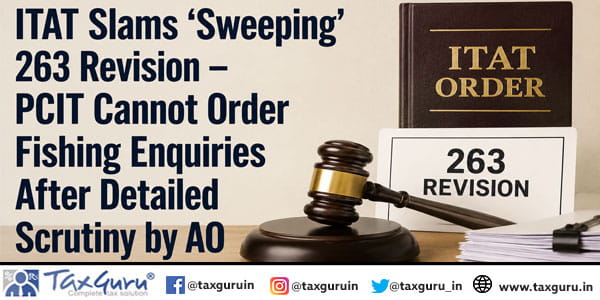
Income Tax : Delhi ITAT held that revision under Section 263 cannot be invoked merely because the PCIT desires deeper investigation after detai...
Income Tax : Consistency over technicalities: ITAT Mumbai allowed actuarial pension provision as an ascertained liability, rejected mechanical ...
Income Tax : ITAT ruled that interest disallowance cannot be made when sufficient interest-free funds are available. The key takeaway is that a...
Income Tax : ITAT Mumbai held that no TDS is liable to be deducted when payment is made for serving food in a restaurant in the normal course o...
The Tribunal held that estimating commission income without corroborative evidence is unsustainable. Audited accounts and consistent interest income showed genuine business activity, leading to deletion of the addition.
ITAT Delhi held that disallowance of bad debts claimed as deduction under section 36(1)(vii) is not justifiable if offered as income in any year. Accordingly, AO directed to verify that amount for which bad debts have claimed u/s 36(1)(vii) were indeed offered as income for the said years.
The issue was whether long-term financing income qualified for deduction despite reclassification of receipts. The Tribunal held the entity eligible, citing statutory changes, past approvals, and consistency across years.
Chennai ITAT set aside the PCIT’s revision order under Section 263, confirming that when the AO adopts a plausible view and conducts proper scrutiny, revision is unwarranted.
The Tribunal held that a bad debt claim involving factual and legal analysis cannot be disallowed during section 143(1) processing. Such issues must be examined through regular assessment proceedings, not summary adjustments.
The Court held that dividend income, bank-deposit interest, and SDF service charges are not derived from long-term finance. Only direct lending profits qualify for the deduction.
Tribunal held that a provision for bad debts need not be routed through the Profit & Loss account in the first eligible year under Section 36(1)(viia). The disallowance was deleted as the audited statements reflected the provision as on 31.03.2007.
ITAT held that ₹1.5 Cr advance for a real estate project, which became irrecoverable, qualifies as a trading loss under section 28. The decision reverses AO and CIT(A) disallowances, allowing the loss as a business expense.
ITAT Ahmedabad held that banks can claim deductions for provisions for bad debts on total income, including capital gains, rejecting the CIT’s restriction to business income.
The Tribunal upheld CIT(A)’s order, confirming deletion of additions related to unexplained creditors, GST, bogus purchases, and purchase differences. Proper reconciliation and supporting documents established genuineness, highlighting the importance of maintaining accurate records.