Finance : Secondary SGB buyers must now pay 12.5% LTCG tax, unlike primary holders. The change reshapes returns and investment strategies in...
Income Tax : Establishes that higher tax burdens on promoters under the new regime require companies to reassess payout strategies. The takeawa...
Finance : The Supreme Court has allowed taxpayers to challenge retrospective amendments validating JAO reassessment actions. It stayed ongoi...
Income Tax : The issue arose from taxing buybacks as dividends, causing higher tax burden and unusable capital losses. The reform restores capi...
Income Tax : The Supreme Court has admitted a case to resolve conflicting interpretations of due dates for PF/ESI contributions. The ruling wil...
Income Tax : The amendments focus on reassessment timelines, electronic communication, and procedural clarity. The changes aim to reduce litiga...
Income Tax : The Government introduced reforms to simplify tax dispute resolution, including broader immunity provisions and expanded scope for...
Income Tax : A focused session breaks down recent Budget amendments affecting NRI taxation. It highlights how changes impact income, investment...
CA, CS, CMA : Budget 2026 prioritises easing compliance, reducing penalties, and cutting litigation rather than raising tax rates. The reforms a...
Custom Duty : New baggage rules and processing regulations are notified, replacing earlier frameworks and aligning customs procedures for passen...
Goods and Services Tax : Discover the key amendments in the Finance (No. 2) Bill, 2024, affecting CGST, IGST, UTGST, and Cess Act, including tax exemptions...
Income Tax : A petition has been filed in the Madras High Court challenging the section 271J of the Income Tax Act inserted vide Finance Act 2...
Income Tax : U/s 250(4), the CIT (A) has the power to direct enquiry and call for evidence from the assessee. Under Rule 46A, the assessee has ...
Income Tax : CBDT updated DIN rules to align with new provisions introduced under the Finance Act, 2026. The circular mandates DIN for most tax...
Income Tax : The Finance Act, 2026 prescribes income-tax rates, surcharge, and cess for the assessment year 2026–27. It establishes the legal...
Excise Duty : The government has withdrawn an earlier central excise exemption notification with effect from 2 February 2026. The rescission is ...
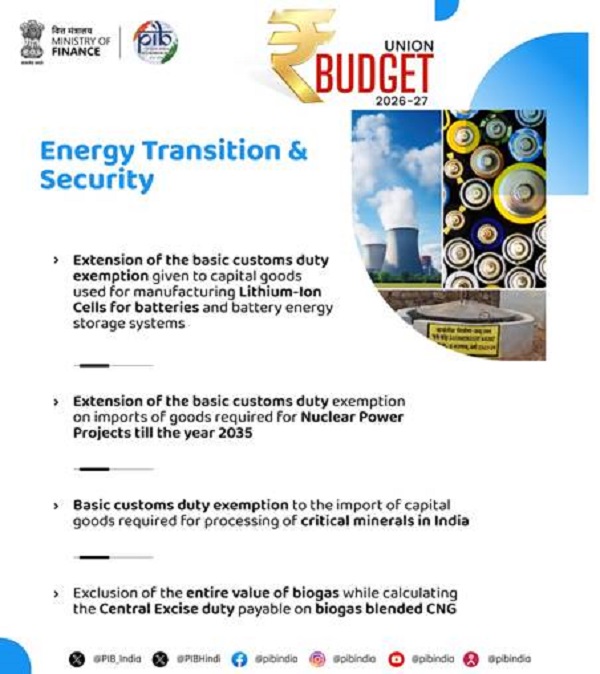
Excise Duty : The government has extended key excise provisions and introduced a specific duty structure for CNG blended with biogas. The key ta...
Excise Duty : The government has reduced the effective National Calamity Contingent Duty on specified tobacco products. The key takeaway is a ca...
The Income-tax Act, 2025 introduces a targeted exemption for foreign companies using notified Indian data centres. The measure removes source and permanent establishment concerns while reinforcing India’s ambition to become a global data and AI hub.
The new tax framework retains existing rates but introduces wide-ranging reforms in MAT, penalties, disclosures, and filing procedures.
The Finance Bill, 2026 proposes sweeping changes to TCS, return filing timelines, penalties, and MAT to simplify compliance and reduce litigation.
The 2026 baggage reforms increase duty-free allowances, permit a laptop separately, and modernise customs procedures, making international travel simpler and more predictable.
he Bill limits block assessments for other persons to the actual year of undisclosed income. The key takeaway is reduced compliance burden where no search was conducted on the taxpayer.
The Finance Bill, 2026 converts key penalties for audit and reporting delays into mandatory fees. The shift aims to reduce disputes by replacing discretionary penalties with predictable, capped charges.
The law now proposes a single consolidated assessment-cum-penalty order for under-reporting of income, reducing multiple proceedings and long-drawn uncertainty for taxpayers.
The Finance Bill, 2026 proposes to disallow interest deductions against dividend and mutual fund income. From April 2026, such income will be taxed on a gross basis.
MAT will become a final tax in the old regime at 14%, replacing the earlier credit-based mechanism. The change simplifies compliance while nudging companies toward the new tax regime.
The Finance Bill, 2026 proposes a comprehensive rationalisation of Tax Collected at Source (TCS) rates under section 394(1) of the Income-tax Act, 2025, with the objective of simplifying compliance and providing relief to taxpayers where feasible. Multiple differential TCS rates are proposed to be aligned to a uniform rate of 2% across several categories.