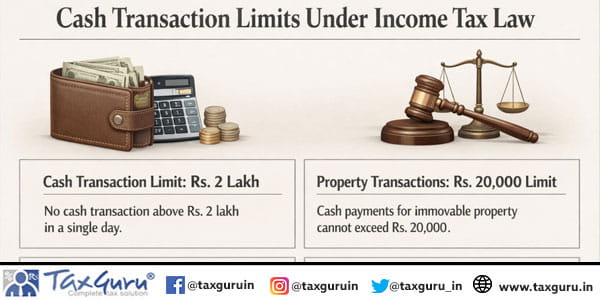
The Income-tax Act prescribes strict rules to regulate cash transactions in order to promote a less-cash economy and curb black money. Under Section 269SS, loans, deposits, or specified sums of ₹20,000 or more cannot be accepted in cash, while Section 269T similarly restricts repayment of such amounts in cash. Section 269ST prohibits receipt of ₹2 lakh or more in cash in a day, per transaction, or for a single event. Businesses with turnover exceeding ₹50 crore must provide prescribed electronic payment facilities under Section 269SU. Additionally, Section 40A(3) disallows deductions for cash expenses exceeding ₹10,000, subject to specified exceptions. Certain exemptions exist for transactions involving government bodies, banks, and specified institutions. Non-compliance attracts stringent penalties, often equal to 100% of the transaction amount or daily fines. The provisions collectively enforce transparency, promote digital payments, and discourage large cash dealings.
Income Tax Department
Ministry of Finance, Government of India
- Mode of Receipts and Payments in Certain Cases
- Key Provisions and Restrictions
- 1. Acceptance of Loans, Deposits, and Specified Sums [Section 269SS]
- 2. Restriction on High-Value Receipts [Section 269ST]
- 3. Mandatory Electronic Payment Facility for Large Businesses [Section 269SU]
- 4. Repayment of Loans, Deposits, or Advances [Section 269T]
- Income-tax Act, 1961
- Section – 269SS
- Section – 269ST
- Section – 269SU
- Section – 269T
- Income-tax Rules, 1962
- Rule – 6ABBA
- Rule – 119AA
- Tutorials
- Prohibited transaction in cash/limit on cash transactions
Mode of Receipts and Payments in Certain Cases
Introduction
To promote a less-cash economy and curb black money, the Income-tax Act restricts cash transactions related to loans, deposits, specified sums, and high-value receipts or payments.
Key Provisions and Restrictions
1. Acceptance of Loans, Deposits, and Specified Sums [Section 269SS]
A person cannot accept a loan, deposit, or specified sum (advance or otherwise for the transfer of immovable property) of Rs. 20,000 or more in cash or other than by an account payee cheque or account payee bank draft, or use of the electronic clearing system through a bank account or other prescribed electronic mode (impermissible mode).
The restriction applies if:
- Amount of loan, deposit, or specified sum received from a depositor is Rs. 20,000 or more in a single transaction; or
- On the date of accepting the new amount, the outstanding balance of previous such sums from the same depositor is Rs. 20,000 or more; or
- Combined total of the new and earlier unpaid amounts from the same depositor is Rs. 20,000 or more.
- For transactions between Primary Agricultural Credit Societies (PACS)/Primary Cooperative Agricultural and Rural Development Banks (PCARD) and its member, cash transaction limits increase from Rs. 20,000 to Rs. 2,00,000.
Exception:
Not applicable if both parties exclusively earn agricultural income.
Not applicable if the loan, deposit, or specified sum is accepted from any of the following:
– Government
– Any banking company, post office savings bank or co-operative bank;
– Any corporation established by a Central, State or Provincial Act;
– Any government company defined under section 2(45) of the Companies Act, 2013; or
– Any other notified institution, association or body or class of institutions, associations or bodies.
2. Restriction on High-Value Receipts [Section 269ST]
A person cannot receive Rs. 2 lakh or more in cash or an impermissible mode:
- From a single person in a day, or
- For a single transaction, or
- For multiple transactions related to a single event or occasion.
Exception:
- Government;
- Any banking company, post office saving bank or co-operative bank;
Receipts notified under S.O. 2065(E), dated 03-07-2017, such as:
- By business correspondents for banks.
- By white label ATM operators.
- By an issuer of prepaid payment instruments.
- By credit card companies receiving bill payments.
- Exempt receipts under Section 10(17A).
– Receipt by any person from any banking company, post office savings bank or co-operative bank. [Notification No. S.O. 1057(E), dated 5-4-2017]
– Any other notified persons, class of persons or receipts; and
— Transactions of the nature referred to in Section 269SS.
3. Mandatory Electronic Payment Facility for Large Businesses [Section 269SU]
Businesses with a turnover exceeding Rs. 50 crore in the immediately preceding previous year must provide facilities for accepting payments via:
- RuPay-powered debit cards.
- UPI (BHIM-UPI).
- UPI QR Code (BHIM-UPI QR Code).
These modes must be available in addition to any other electronic payment facilities provided.
Exception– B2B businesses (no retail customers) are exempt if 95% or more of total receipts (sales, turnover, etc.) are via non-cash modes [Circular No. 12/2020, dated 20-05-2020].
4. Repayment of Loans, Deposits, or Advances [Section 269T]
A person cannot repay a loan, deposit, or advance (for the transfer of immovable property) of Rs. 20,000 or more in cash or other impermissible modes.
The restriction applies if:
- loan/deposit/specified advance with interest is Rs. 20,000 or more; or
- The aggregate amount of loan or deposit held (in own name/jointly) with interest on the repayment date is Rs. 20,000 or more; or
- The aggregate amount of specified advances received (in own name/jointly) with interest on the repayment date is Rs. 20,000 or more.
- For transactions between PACS/PCARD and its member – Cash transaction limits increase from Rs. 20,000 to Rs. 2,00,000.
Exception:
Not applicable if the loan, deposit, or specified advance is repaid to any of the following:
- Government
- Any banking company, post office saving bank or co-operative bank;
- Any corporation established by a Central, State or Provincial Act;
- Any government company defined under section 2(45) of the Companies Act, 2013; or
- Any other notified institution, association or body or class of institutions, associations or bodies.
Consequences of Default
| Section | Transaction Covered | Penalty |
|---|---|---|
| 269SS | Accepting loans/deposits | 100% of loan/deposit [Section 271D] |
| 269ST | Receiving cash for high-value transactions | 100% of the amount received [Section 271DA] |
| 269SU | Providing electronic payment options | Rs. 5,000/day [Section 271DB] |
| 269T | Repaying loans/deposits | 100% of the repaid amount [Section 271E] |
Income-tax Act, 1961
Section – 269SS
CHAPTER XX-B
REQUIREMENT AS TO MODE OF ACCEPTANCE, PAYMENT ORREPAYMENT IN CERTAIN CASES TO COUNTERACT EVASION OF TAX
Mode of taking or accepting certain loans, deposits and specified sum.
269SS. No person shall take or accept from any other person (herein referred to as the depositor), any loan or deposit or any specified sum, otherwise than by an account payee cheque or account payee bank draft or use of electronic clearing system through a bank account or through such other electronic mode as may be prescribed, if,—
(a) the amount of such loan or deposit or specified sum or the aggregate amount of such loan, deposit and specified sum; or
(b) on the date of taking or accepting such loan or deposit or specified sum, any loan or deposit or specified sum taken or accepted earlier by such person from the depositor is remaining unpaid (whether repayment has fallen due or not), the amount or the aggregate amount remaining unpaid; or
(c) the amount or the aggregate amount referred to in clause (a) together with the amount or the aggregate amount referred to in clause (b),
is twenty thousand rupees or more:
Provided that the provisions of this section shall not apply to any loan or deposit or specified sum taken or accepted from, or any loan or deposit or specified sum taken or accepted by,—
(a) the Government;
(b) any banking company, post office savings bank or co-operative bank;
(c) any corporation established by a Central, State or Provincial Act;
(d) any Government company as defined in clause (45)of section 2 of the Companies Act, 2013 (18 of 2013);
(e) such other institution, association or body or class of institutions, associations or bodies which the Central Government may, for reasons to be recorded in writing, notify in this behalf in the Official Gazette:
Provided further that the provisions of this section shall not apply to any loan or deposit or specified sum, where the person from whom the loan or deposit or specified sum is taken or accepted and the person by whom the loan or deposit or specified sum is taken or accepted, are both having agricultural income and neither of them has any income chargeable to tax under this Act:
90[Provided also that the provisions of this section shall have effect, as if for the words “twenty thousand rupees”, the words “two lakh rupees” had been substituted in the case of any deposit or loan where,–
(a) such deposit is accepted by a primary agricultural credit society or a primary co-operative agricultural and rural development bank from its member; or
(b) such loan is taken from a primary agricultural credit society or a primary co-operative agricultural and rural development bank by its member.] —
Explanation.- For the purposes of this section,—
(i) “banking company” means a company to which the provisions of the Banking Regulation Act, 1949 (10 of 1949) applies and includes any bank or banking institution referred to in section 51 of that Act;
91[(ii) “co-operative bank”, “primary agricultural credit society” and “primary co-operative agricultural and rural development bank” shall have the meanings respectively assigned to them in the Explanation to sub-section (4) of section 80P;]
(iii) “loan or deposit” means loan or deposit of money;
(iv) “specified sum” means any sum of money receivable, whether as advance or otherwise, in relation to transfer of an immovable property, whether or not the transfer takes place.
Section – 269ST
Mode of undertaking transactions.
269ST. No person shall receive an amount of two lakh rupees or more—
(a) in aggregate from a person in a day; or
(b) in respect of a single transaction; or
(c) in respect of transactions relating to one event or occasion from a person,
otherwise than by an account payee cheque or an account payee bank draft or use of electronic clearing system through a bank account or through such other electronic mode as may be prescribed:
Provided that the provisions of this section shall not apply to—
(i) any receipt by—
(a) Government;
(b) any banking company, post office savings bank or co-operative bank;
(ii) transactions of the nature referred to in section 269SS;
(iii) such other persons or class of persons or receipts, which the Central Government may, by notification in the Official Gazette, specify.
Explanation.—For the purposes of this section,—
(a) “banking company” shall have the same meaning as assigned to it in clause (i) of the Explanation to section 269SS;
(b) “co-operative bank” shall have the same meaning as assigned to it in clause (ii) of the Explanation to section 269SS.
Section – 269SU
Acceptance of payment through prescribed electronic modes.
269SU. Every person, carrying on business, shall provide facility for accepting payment through prescribed electronic modes, in addition to the facility for other electronic modes, of payment, if any, being provided by such person, if his total sales, turnover or gross receipts, as the case may be, in business exceeds fifty crore rupees during the immediately preceding previous year.
Section – 269T
Mode of repayment of certain loans or deposits.
269T. No branch of a banking company or a co-operative bank and no other company or co-operative society and no firm or other person shall repay any loan or deposit made with it or any specified advance received by it otherwise than by an account payee cheque or account payee bank draft drawn in the name of the person who has made the loan or deposit or paid the specified advance, or by use of electronic clearing system through a bank account or through such other electronic mode as may be prescribed if—
(a) the amount of the loan or deposit or specified advance together with the interest, if any, payable thereon, or
(b) the aggregate amount of the loans or deposits held by such person with the branch of the banking company or co-operative bank or, as the case may be, the other company or co-operative society or the firm, or other person either in his own name or jointly with any other person on the date of such repayment together with the interest, if any, payable on such loans or deposits, or
(c) the aggregate amount of the specified advances received by such person either in his own name or jointly with any other person on the date of such repayment together with the interest, if any, payable on such specified advances,
is twenty thousand rupees or more:
Provided that where the repayment is by a branch of a banking company or co-operative bank, such repayment may also be made by crediting the amount of such loan or deposit to the savings bank account or the current account (if any) with such branch of the person to whom such loan or deposit has to be repaid :
Provided further that nothing contained in this section shall apply to repayment of any loan or deposit or specified advance taken or accepted from—
(i) Government;
(ii) any banking company, post office savings bank or co-operative bank;
(iii) any corporation established by a Central, State or Provincial Act;
(iv) any Government company as defined in section 617 of the Companies Act, 1956 (1 of 1956);
(v) such other institution, association or body or class of institutions, associations or bodies which the Central Government may, for reasons to be recorded
in writing, notify in this behalf in the Official Gazette:
92[Provided also that the provisions of this section shall have effect, as if for the words “twenty thousand rupees”, the words “two lakh rupees” had been substituted in the case of any deposit or loan where,–
(a) such deposit is paid by a primary agricultural credit society or a primary co-operative agricultural and rural development bank to its member; or
(b) such loan is repaid to a primary agricultural credit society or a primary co-operative agricultural and rural development bank by its member.] —
Explanation. -For the purposes of this section,—
(i) “banking company” shall have the meaning assigned to it in clause (i) of the Explanation to section 269SS;
93[(ii) “co-operative bank”, “primary agricultural credit society” and “primary co-operative agricultural and rural development bank” shall have the meanings respectively assigned to them in Explanation to sub-section (4) of section 80P;]
(iii) “loan or deposit” means any loan or deposit of money which is repayable after notice or repayable after a period and, in the case of a person other than a company, includes loan or deposit of any nature;
(iv) “specified advance” means any sum of money in the nature of advance, by whatever name called, in relation to transfer of an immovable property, whether or not the transfer takes place.
90 by Act No. 08 of 2023, w.e.f. 1-4-2023.
91 by Act No. 08 of 2023, w.e.f. 1-4-2023.
92 Ins. by Act No. 08 of 2023, w.e.f. 1-4-2023.
93 Sub., by Act No. 08 of 2023, w.e.f. 1-4-2023.
Income-tax Rules, 1962
Rule – 6ABBA
52 [Other electronic modes.
6ABBA. The following shall be the other electronic modes for the purposes of clause (d) of first proviso to section 13A, clause (f) of sub-section (8) of section 35AD, sub-section (3), sub-section (3A), proviso to sub-section (3A) and sub-section (4) of section 40A, second proviso to clause (1) of section 43, sub-section (4) of section 43CA, proviso to sub-section (1) of section 44AD, second proviso to sub-section (1) of section 50C, second proviso to sub-clause (b) of clause (x) of sub-section (2) of section 56, clause (b) of first proviso of clause (i) of Explanation to section 80JJAA, section 269SS, section 269ST and section 269T, namely:—
(a) Credit Card;
(b) Debit Card;
(c) Net Banking;
(d) IMPS (Immediate Payment Service);
(e) UPI (Unified Payment Interface);
(f) RTGS (Real Time Gross Settlement);
(g) NEFT (National Electronic Funds Transfer), and
(h) BHIM (Bharat Interface for Money) Aadhaar Pay.]
Rule – 119AA
Modes of payment for the purpose of section 269SU.
119AA. Every person, carrying on business, if his total sales, turnover or gross receipts, as the case may be, in business exceeds fifty crore rupees during the immediately preceding previous year shall provide facility for accepting payment through following electronic modes, in addition to the facility for other electronic modes of payment, if any, being provided by such person, namely:—
(i) Debit Card powered by RuPay;
(ii) Unified Payments Interface (UPI) (BHIM-UPI); and
(iii) Unified Payments Interface Quick Response Code (UPI QR Code) (BHIM-UPI QR Code).
Tutorials
Prohibited transaction in cash/limit on cash transactions
Income-tax Act has several provisions that restrict receipt or payment made in cash by a person subject to a certain threshold limit. These restrictions have been introduced to move towards a cashless economy and to reduce the generation and circulation of black money.
Disallowance of cash payments [Section 40A(3)]
Section 40A(3) provides that if the payment or aggregate of payments for an expenditure to a person in a day exceeds Rs. 10,000 and it is made by any mode other than account payee cheque or bank draft or electronic clearing system through a bank account or prescribed electronic modes, no deduction shall be allowed for such expenditure.
However, where payment is made for plying, hiring, or leasing goods carriages, the ceiling of Rs. 35,000 shall be considered instead of Rs. 10,000.
The provision of Section 40A(3) does not apply to payments made by commission agents for goods received by them for sale on a commission or consignment basis because such payment is not an expenditure deductible in computing the taxable income of the commission agent.
However, if the commission agent purchases goods on his own account and not on a commission basis, the requirement of payment in a specified mode applies to such purchases.
Further, where the taxpayer had claimed a deduction in respect of expenditure in any of the earlier years and subsequently makes payment thereof, otherwise than by an account payee cheque or bank draft, in excess of Rs. 10,000, in that situation, the payment so made is deemed to be the business income of the previous year in which payment is made.
Exceptions:
The disallowance does not apply if payment is made in certain circumstances as prescribed in Rule 6DD. These circumstances are prescribed below:
A. Payment to Specified Institutions –
No disallowance shall be made for the payment made in a non-specified mode (i.e., cash, crossed cheque, bearer cheque, etc.) to the following institutions:
(a) RBI or any banking company,
(b) State Bank of India or any of its subsidiary banks,
(c) Co-op. banks or land mortgage bank,
(d) Primary Agricultural Credit Society or Primary Credit Society,
(e) LIC
B. Payment in Legal Tender to the Government
No disallowance shall be made for an expenditure whose payment is required to be made to the Government in legal tender, such as payment of freight charges/booking of wagons to railways, sales tax, excise duty, etc.
C. Payment by Specified Modes
No disallowance shall be made where the payment is made by the following modes:
(a) Letter of credit arrangements through a bank,
(b) Mail or telegraphic transfer through a bank,
(c) Book adjustment from one bank account to another bank account,
(d) Bill of exchange payable only to a bank.
Here bank includes a bank established outside India also.
D. Payment by Book Adjustment
No disallowance shall be made for the payment made by way of adjustment against the amount of any liability incurred by the payee for any goods supplied or services rendered by the assessee to him.
E. Payment for Agriculture or Animal Produce
No disallowance shall be made for payment made to the cultivator, grower, or producer in respect of the following purchases:
(a) Agriculture or forest produce,
(b) Produce of animal husbandry (including, livestock, meat, hides, and skins) or dairy or poultry farming,
(c) Fish or fish products,
(d) Products of horticulture or apiculture (bee-keeping for sale of honey)
The immunity from disallowance under this provision shall be available to the payer if payment for animal husbandry is made to a person who is the producer of these goods. If these goods are purchased from a trader, broker, or any other middleman, this exception shall not available.
F. Payment for Produce of Cottage Industry
No disallowance shall be made where the payment is made to a producer for the purchase of the products manufactured or processed without the aid of power in a cottage industry.
G. Payment in Remote Places
No disallowance shall be made for the cash payment if payment is made in a village or town, to any person who ordinarily resides or carries any business, profession, or vocation, in such village or town which, on the date of such payment, is not served by the bank.
H. Terminal payments to low-paid employees
No disallowance shall be made for any payment made by the employer by way of gratuity, retrenchment compensation, or similar terminal benefits to an employee (or to his heirs) on or in connection with the retirement, retrenchment, resignation, discharge, or death of such employee. Such immunity is allowed if the aggregate of such sum payable to the employee or his heir does not exceed Rs. 50,000.
I. Payment of salary at remote places
If an employee is temporarily posted for 15 days or more in a place other than his normal place of duty or on a ship and he does not maintain any bank account at such place or ship, the salary paid after deducting tax at source under section 192 by the employer to such employee shall not be disallowed.
J. Payment to the agent
Payments made in a non-specified mode shall not be disallowed if it is paid by any person to his agent who is required to make payment in cash for goods or services on his behalf.
K. Payment made by an authorized dealer
Authorized dealers and money changers are normally required to pay cash for purchases of foreign currency or ter’s cheques in the normal course of their business, and no disallowance shall be made for any cash payments made by them.
Authorized dealer or money changer means a person authorised as such to deal in foreign currency or foreign exchange under any law for the time being in force.
L. Purchase of Animal
Any person who buys animals from farmers to slaughter them and to sell their raw meat or carcasses, to meat processing factories, traders, or retail outlets, may be considered a producer of livestock and meat. This exemption shall be available to the payer subject to the fulfilment of following conditions:
a) The person receiving the payment files a declaration that he is a producer of meat;
b) The producer of meat declares that the payment, otherwise than through account payee cheque or bank draft, was made on his insistence; and
c) A veterinary doctor certifies that the person specified in the certificate is a producer of meat and that slaughtering was done under his supervision.
Acceptance of loans, deposits, and specified sum [Section 269SS]
Section 269SS restricts a person (recipient) from taking or accepting any loan or deposit or any specified sum from any other person (depositor), otherwise than by an account payee cheque or account payee bank draft or use of electronic clearing system through a bank account or other prescribed electronic mode (impermissible mode). However, restriction isn’t imposed if the recipient and depositor, both are having agriculture income and neither of them has any income chargeable to tax.
The following transactions are covered under section 269SS:
- Any loan or deposit of money; or
- Any sum of money receivable by way of advance or otherwise in relation to the transfer of immovable property, whether or not the transfer takes place.
The provision shall be attracted if:-
a) The amount (or aggregate) of such loan or deposit or specified sum from a depositor is Rs. 20,000 or more; or
b) On the date of taking or accepting such loan or deposit or specified sum, the amount (or the aggregate) of any loan or deposit or specified sum taken or accepted earlier from the depositor remaining unpaid is Rs. 20,000 or more; or
c) The aggregate of the sum referred to in points (a) and (b) above is Rs. 20,000 or more.
However, if a deposit is accepted by a Primary Agricultural Credit Society (PACS) or a Primary Co-Operative Agricultural and Rural Development Bank (PCARD) from its member or a loan is taken from a PACS or a PCARD by its member, the threshold of Rs. 20,000 shall be enhanced to Rs. 2 lakhs1.
Exceptions – There is no restriction to take or accept any loan or deposit or specified sum from or by any of the following:
- Government;
- Any banking company, post office saving bank, or co-operative bank;
- Any corporation established by a Central, State, or Provincial Act;
- Any government company defined under section 2(45) of the Companies Act, 2013; or
- Any other notified institutions, associations, or body, or class of institutions, associations, or bodies.
Penalty for contravention of the provisions – Where a person takes or accepts any loan or deposit (or specified sum) in cash or in a mode which is in contravention of Section 269SS, he shall be liable for a penalty under Section 271D of a sum equal to the amount of the loan or deposit (or specified sum) so taken or accepted.
Mode of undertaking transactions [Section 269ST]
Section 269ST restricts a person (recipient) from receiving an amount of Rs. 2 lakhs or more otherwise than by an account payee cheque or account payee bank draft or use of an electronic clearing system through a bank account or other prescribed electronic modes.
This provision imposes restrictions in respect of the receipts of Rs. 2 lakhs or more:
a) In aggregate from a person in a day; or
b) In respect of a single transaction; or
For Example, Mr. A has sold goods worth Rs. 2.5 lakhs to Mr. B who has paid in cash as follows:
- Rs. 1.5 lakhs on April 1;
- Rs. 25,000 on May 1; and
- Rs. 75,000 on June 1.
Mr. A would be considered to have not complied with the provisions of Section 269ST the moment he receives the last payment of Rs. 75,000 which eventually makes the total receipt in respect of a transaction exceeding Rs. 200,000.
c) In respect of a transaction relating to one event or occasion from a person – if there are multiple transactions, relating to one event or occasion from a person they would be covered under the restriction.
Where a transaction is covered within the scope of Section 269SS (accepting loan or deposit in impermissible mode) provisions of this section shall not apply.
Exceptions – This provision shall not apply to the receipt by the following persons:
- Government;
- Any banking company, post office saving bank, or co-operative bank; or
- Any other notified persons, class of persons, or receipts.
Further, the provision of this section shall not apply to receipt by any person from any banking company, post office savings bank, or co-operative bank.
Penalty for contravention of the provisions – Where a person receives the amount in contravention of this provision, he shall be liable for a penalty under Section 271DA of a sum equal to the amount of such receipts.
Acceptance of payment through prescribed electronic modes [Section 269SU]
Section 269SU provides that where a person is carrying on a business and his total sales, turnover, or gross receipts during the immediately preceding previous year exceeds Rs. 50 crores, it shall be mandatory for him to provide a facility to accept the payment through the following electronic modes:
a) Debit card powered by RuPay;
b) Unified Payments Interface (UPI) (BHIM-UPI); and
c) Unified Payments Interface Quick Response Code (UPI QR Code) (BHIM-UPI QR Code).
These facilities to accept the payment shall be in addition to the facility for other electronic modes of payment being provided by such person.
The provision of this section shall not apply to a person having only B2B transactions (i.e., no transaction with retail customer/consumer) subject to the condition that at least 95% of the aggregate of all amounts received during the previous year, including the amount received for sales, turnover or gross receipts, is by any mode other than cash.
Penalty for contravention of the provisions – Where a person fails to provide the facility for accepting payment through prescribed electronic modes as required under this provision, he shall be liable for a penalty under Section 271DB of Rs. 5,000 for every day during which such failure continues.
Mode of repayment of certain loans or deposits [Section 269T]
Section 269T restricts a person from repayment of any loan, deposit, or any specified advance received by it otherwise than by an account payee cheque or account payee bank draft (drawn in the name of the person who made the loan, deposit or specified advance) or by use of electronic clearing system through a bank account or other prescribed electronic modes.
Repayment in respect of the following transactions are covered under this provision:
- Any loan or deposit of money which is repayable after notice or repayable after a period and in case of a person other than company it includes loan or deposit of any nature; or
- Any sum of money in the nature of advance in relation to the transfer of immovable property, whether or not the transfer takes place.
Such loan, deposit, or specified sum should be taken or accepted in accordance with provisions of Section 269ST. In case of cash repayment of loan or deposit, the borrower could be penalized under Section 269T and the recipient could be penalized under Section 269ST.
This provision shall be attracted if the value of the covered transaction exceeds the following limit:
a) The amount of such loan or deposit or specified advance together with the interest payable thereon is Rs. 20,000 or more;
b) The aggregate amount of the loans or deposits held either in own name or jointly with any other person on the date of such repayment together with the interest payable on such loans or deposits is Rs. 20,000 or more; or
c) The aggregate amount of the specified advances received by such person either in his own name or jointly with any other person on the date of such repayment together with the interest payable on such specified advances is Rs. 20,000 or more.
However, if a deposit is paid by a Primary Agricultural Credit Society (PACS) or a Primary Co-Operative Agricultural and Rural Development Bank (PCARD) to its member or a loan is repaid to a PACS or a PCARD by its member, the threshold of Rs. 20,000 shall be enhanced to Rs. 2 lakhs2.
Exceptions– There is no restriction on repayment of any loan or deposit or specified advance taken or accepted from any of the following:
- Government;
- Any banking company, post office saving bank, or co-operative bank;
- Any corporation established by a Central, State, or Provincial Act;
- Any government company defined under section 2(45) of the Companies Act, 2013; or
- Any other notified institutions, associations, or body, or class of institutions, associations, or bodies.
Penalty for contravention of the provisions – Where a person repays any loan or deposit (including interest) or specified advance in cash or an impermissible mode in contravention of provisions of Section 269T, he shall be liable for a penalty under 271E of a sum equal to loan or deposit or specified advance so repaid.
Overview of Section 269SS, 269ST , 269SU and 269T :
| Section | Covered Transaction | Threshold Limit | Consequences of Default |
|---|---|---|---|
| 269SS | Taking or accepting any loan or deposit or specified sum | Rs. 20,000 or more | Penalty under Section 271D (100% of loan or deposit so taken or accepted) |
| 269ST | Receipt of any amount | Rs. 2 lakhs or more | Penalty under Section 271DA (100% of the amount so received) |
| 269SU | Facility to be provided for accepting payment through prescribed electronic modes | Total sales/turnover/gross receipts exceed Rs. 50 crore during the immediately preceding previous year | Penalty under Section 271DB (Rs. 5,000 per day during which the default continues). |
| 269T | Repayment of any loan or deposit or specified advance | Rs. 20,000 or more | Penalty under Section 271E (100% of loan or deposit so repaid) |
Here for the above sections including section 40A(3) prescribed electronic modes include-
(a) Credit Card;
(b) Debit Card; (c) Net Banking;
(d) IMPS (Immediate Payment Service);
(e) UPI (Unified Payment Interface);
(f) RTGS (Real Time Gross Settlement);
(g) NEFT (National Electronic Funds Transfer), and
(h) BHIM (Bharat Interface for Money) Aadhaar Pay.
MCQs on the prohibited transaction in cash/limit on cash transactions
Q1. Deduction for expenditure is not allowed under section 40A(3), where the cash payment is made to a person in a day exceeds Rs. ________.
(a) 10,000
(b) 15,000
(c) 20,000
(d) No limit
Correct answer: (a)
Justification for correct answer: If the payment (or aggregate of payments) for an expenditure to a person in a day exceeds Rs. 10,000 and it is made by any mode other than account payee cheque or bank draft or electronic clearing system through a bank account or prescribed electronic modes, no deduction shall be allowed for such expenditure under section 40A(3).
Q2. What is the ceiling limit under section 40A(3) where payment is made for plying, hiring, or leasing goods carriages?
(a) 10,000
(b) 15,000
(c) 20,000
(d) 35,000
Correct Answer: (d)
Justification for correct answer: Where payment is made for plying, hiring, or leasing goods carriages, the ceiling of Rs. 35,000 shall be considered instead of Rs. 10,000.
Q3. Section 40A(3) shall not be applied where payment is made to ________.
(a) RBI
(b) SBI
(c) LIC
(d) All of the above
Correct Answer: (d)
Justification for correct answer: No disallowance shall be made under section 40A(3) for the payment made in a non-specified mode (i.e., cash, crossed cheque, bearer cheque, etc.) to (a) RBI or any banking company, (b) State Bank of India or any of its subsidiary banks, (c) Co-op. banks or land mortgage bank, (d) Primary Agricultural Credit Society or Primary Credit Society, (e) LIC
Q4. Which transactions are covered in the ambit of section 269SS ?
(a) Any loan or deposit of money
(b) Any sum of money receivable by way of advance to the transfer of immovable property
(c) Both (a) and (b)
(d) None of the above
Correct Answer: (c)
Justification for correct answer: The following transactions are covered under the provision of section 269SS – (a) Any loan or deposit of money; or (b) Any sum of money receivable by way of advance or otherwise in relation to the transfer of immovable property, whether or not the transfer takes place.
Q5. What is the penalty for contravention of the provision of Section 269SS?
(a) Rs. 5,000 per day
(b) a sum equal to the amount of the loan or deposit (or specified sum) so taken or accepted
(c) Rs. 1,00,000
(d) None of the above
Correct Answer: (b)
Justification for correct answer: Where a person takes or accepts any loan or deposit (or specified sum) in cash or in a mode which is in contravention of Section 269SS, he shall be liable for a penalty under Section 271D of a sum equal to the amount of the loan or deposit (or specified sum) so taken or accepted.
Q6. Provision of section 269SS is not applied where loan or deposit is taken or accepted from ________.
(a) Government
(b) Any banking company
(c) Co-operative bank
(d) All of the above
Correct Answer: (d)
Justification for correct answer: There is no restriction under section 269SS to take or accept any loan or deposit or specified sum from or by – (a) Government; (b) Any banking company, post office saving bank, or co-operative bank; (c) Any corporation established by a Central, State, or Provincial Act; (d) Any government company defined under section 2(45) of the Companies Act, 2013; or (e) Any other notified institutions, associations, or body, or class of institutions, associations, or bodies.
Q7. Provision of section 269ST imposes restrictions in respect of the receipts of Rs. 2 lakhs or more ________.
(a) In aggregate from a person in a day
(b) In respect of a single transaction
(c) In respect of a transaction relating to one event or occasion from a person
(d) All of the above
Correct Answer: (d)
Justification for correct answer: Provision of section 269ST imposes restrictions in respect of the receipts of Rs. 2 lakhs or more:
- In aggregate from a person in a day; or
- In respect of a single transaction; or
- In respect of a transaction relating to one event or occasion from a person.
Q8. What is the penalty for contravention of the provision of Section 269ST?
(a) Rs. 5,000 per day
(b) a sum equal to the amount of such receipts
(c) Rs. 1,00,000
(d) None of the above
Correct Answer: (b)
Justification for correct answer: Where a person receives the amount in contravention of provision of section 269ST, he shall be liable for a penalty under Section 271DA of a sum equal to the amount of such receipts.
Q9. Which of the following facility to accept the payment is mandatorily required under Section 269SU?
(a) Debit card powered by RuPay
(b) BHIM-UPI
(c) BHIM-UPI-QR Code
(d) All of the above
Correct Answer: (d)
Justification for correct answer: Section 269SU provides that where a person is carrying on a business and his total sales, turnover, or gross receipts during the immediately preceding previous year exceeds Rs. 50 crores, it shall be mandatory for him to provide a facility to accept the payment through the following electronic modes:
- Debit card powered by RuPay;
- Unified Payments Interface (UPI) (BHIM-UPI); and
- Unified Payments Interface Quick Response Code (UPI QR Code) (BHIM-UPI QR Code).
Q10. What is the penalty for contravention of the provision of Section 269SU?
(a) Rs. 5,000 per day
(b) Rs. 50,000
(c) Rs. 1,00,000
(d) None of the above
Correct Answer: (a)
Justification for correct answer: Where a person fails to provide the facility for accepting payment through prescribed electronic modes as required under this section 269SU, he shall be liable for a penalty under Section 271DB of Rs. 5,000 for every day during which such failure continues.
Q11. What is the penalty for contravention of the provision of Section 269T?
(a) Rs. 5,000 per day
(b) a sum equal to loan or deposit so repaid
(c) Rs. 1,00,000
(d) None of the above
Correct Answer: (b)
Justification for correct answer: Where a person repays any loan or deposit (including interest) or specified advance in cash or an impermissible mode in contravention of provisions of Section 269T, he shall be liable for a penalty under 271E of a sum equal to loan or deposit or specified advance so repaid.
Q12. Which of the following is covered under the prescribed electronic modes for Section 40A(3)?
(a) UPI
(b) IMPS
(c) Net-banking
(d) All of the above
Correct Answer: (d)
Justification for correct answer:prescribed electronic modes include – (a) Credit Card; (b) Debit Card; (c) Net Banking; (d) IMPS (Immediate Payment Service); (e) UPI (Unified Payment Interface); (f) RTGS (Real Time Gross Settlement); (g) NEFT (National Electronic Funds Transfer), and (h) BHIM (Bharat Interface for Money) Aadhaar Pay.
1 Inserted by the Finance Act, 2023 with effect from 01.04.2023.
2 Inserted by the Finance Act, 2023 with effect from 01.04.2023.
Frequently Asked Questions (FAQs)
Q1. What are the key cash transaction limits under the Income-tax Act?
Ans. The Income-tax Act restricts various cash transactions, including acceptance and repayment of loans or deposits of ₹20,000 or more under Sections 269SS and 269T, receipt of ₹2 lakh or more in cash under Section 269ST, and cash expenditure exceeding ₹10,000 (₹35,000 for goods carriage payments) under Section 40A(3). Large businesses with turnover exceeding ₹50 crore must also provide specified electronic payment facilities under Section 269SU.
Q2. When does Section 269ST prohibit receipt of cash?
Ans. Section 269ST prohibits receipt of ₹2 lakh or more in cash from a single person in a day, in respect of a single transaction, or for multiple transactions relating to one event or occasion, subject to specified exceptions.
Q3. What is the penalty for violating Sections 269SS, 269ST, 269SU, and 269T?
Ans. Non-compliance attracts stringent penalties. Acceptance or repayment of loans/deposits in violation of Sections 269SS or 269T may attract a penalty equal to 100% of the amount involved. Violation of Section 269ST may also attract a penalty equal to the amount received, while failure to provide prescribed electronic payment facilities under Section 269SU may result in a penalty of ₹5,000 per day.
Q4. Are there any exceptions to the cash transaction restrictions?
Ans. Yes. The Act provides exceptions for certain transactions involving the Government, banking companies, post office savings banks, co-operative banks, specified corporations, notified institutions, and, in some cases, persons exclusively having agricultural income. Special higher thresholds also apply to transactions involving PACS and PCARD with their members.
Q5. Which electronic payment modes are recognized under the Income-tax Rules for these provisions?
Ans. Prescribed electronic modes include Credit Card, Debit Card, Net Banking, IMPS, UPI, RTGS, NEFT, and BHIM Aadhaar Pay. Businesses covered under Section 269SU must additionally provide facilities for RuPay Debit Card, BHIM-UPI, and BHIM-UPI QR Code payments.