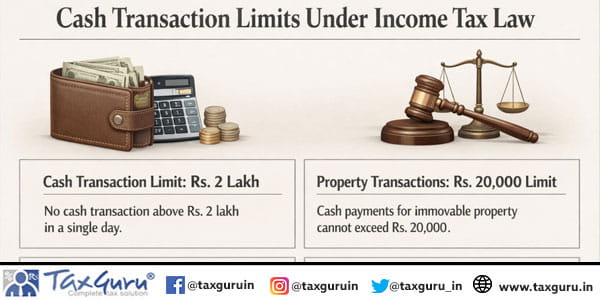
Income Tax : The provisions regulate acceptance, payment, and receipt of cash beyond specified limits. They impose strict penalties to discoura...
Income Tax : Covers the latest cash withdrawal, deposit, and loan limits. Takeaway: exceeding thresholds can trigger TDS, penalties, and blocke...
Income Tax : Summary of income-tax rules on cash limits, including disallowance of cash expenditure, restrictions on loans, deposits, receipts,...
Income Tax : Indian tax law restricts cash transactions to promote digital payments. Limits apply to expense payments (Sec 40A(3): ₹10k/day),...
Income Tax : This report provides a consolidated overview of the critical monetary threshold limits stipulated under various sections of the In...
Income Tax : It is suggested that there should be a positive provision under the I.T. Act that any transaction involving more than Rs.3,00,000/...
Income Tax : The tribunal examined whether penalties could continue when the fresh assessment order did not record satisfaction for initiating ...
Income Tax : ITAT held that cash loans taken for son’s education were bona fide and supported by evidence. Reasonable cause under Section 273...
Income Tax : The ITAT Kolkata held that cash introduced by partners as capital contribution in an LLP does not attract Section 269SS and theref...
Income Tax : The Tribunal held that cash received at the time of executing a registered sale deed does not fall within the definition of “spe...
Income Tax : The ITAT ruled that absence of recorded satisfaction in the assessment order bars initiation of penalty under Section 271E. Superv...
Income Tax : Notification No. 8/2020-Income-Tax- CBDT has notified Other electronic modes by inserting New Income TAx Rule 6ABBA. It also amend...
Income Tax : G.S.R. 841(E).—In the notification of the Government of India, Ministry of Finance, Department of Revenue (Central Board of Dire...
Income Tax : In the Income-tax Rules, 1962, in Appendix II, in Form No. 3CD, for serial number 31 and the entries relating thereto the followin...
Fema / RBI : Section 269SS and 269T of the Income Tax Act, 1961, the requirements under the Income Tax Act, 1961, as amended from time to time,...
The provisions regulate acceptance, payment, and receipt of cash beyond specified limits. They impose strict penalties to discourage large cash transactions.
The tribunal examined whether penalties could continue when the fresh assessment order did not record satisfaction for initiating them. It ruled that absence of such satisfaction makes the penalties invalid in law.
ITAT held that cash loans taken for son’s education were bona fide and supported by evidence. Reasonable cause under Section 273B justified deletion of penalty.
The ITAT Kolkata held that cash introduced by partners as capital contribution in an LLP does not attract Section 269SS and therefore penalty under Section 271D was invalid.
The Tribunal held that cash received at the time of executing a registered sale deed does not fall within the definition of “specified sum” under Section 269SS. Since the provision primarily targets advances in property transactions, penalty under Section 271D was unsustainable.
The ITAT ruled that absence of recorded satisfaction in the assessment order bars initiation of penalty under Section 271E. Supervisory revision cannot substitute the Assessing Officer’s statutory discretion.
Penalties were imposed for cash transactions during the first year of business. The Tribunal found bona fide circumstances and no tax-evasion intent, granting relief under section 273B. The ruling underscores liberal interpretation of reasonable cause.
Applying settled law, the Tribunal held that penalties imposed after expiry of the limitation period are void. Both loan and repayment penalties were deleted across multiple years.
The ruling clarifies that specified sum under section 269SS refers to advances linked to property transfers. Cash received as final consideration at registration cannot trigger penalty under section 271D.
The Tribunal held that Section 68 cannot be invoked unless a sum is found credited in the assessees books. In the absence of any such entry, the addition based on an alleged cash loan was deleted.