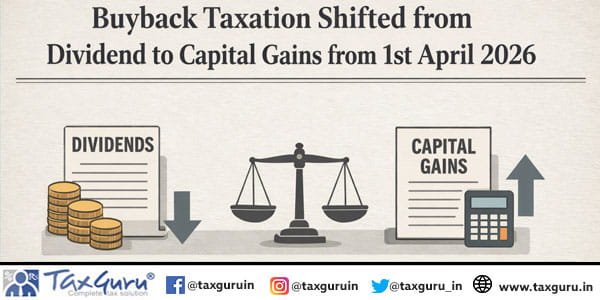
The Finance Bill, 2026 proposes a major rationalisation of the taxation of share buy-backs by shifting the tax treatment of consideration received by shareholders from dividend income to capital gains. Under the existing regime, buy-back proceeds were taxed as dividend, with the cost of acquisition separately recognised as a capital loss. The proposed amendment aligns buy-back taxation with its economic substance by taxing gains under the head “Capital gains.” Recognising the unique influence of promoters in buy-back decisions, the Bill introduces a higher effective tax incidence for promoters, comprising normal capital gains tax plus an additional levy. For promoter individuals and non-corporate promoters, the effective tax burden is intended to be 30%, while for promoter domestic companies it will be 22%. The additional tax ranges from 2% to 10% on short-term gains and 9.5% to 17.5% on long-term gains, depending on promoter status. These changes apply from 1 April 2026 for tax year 2026–27 onwards.
Taxation of buyback of shares
Under the existing provisions of the Income-tax Act, 2025, consideration received by a shareholder on buy-back of shares by a company is treated as dividend income under section 2(40)(f) of the Act and taxed accordingly, while the cost of acquisition of the shares extinguished on buy-back is recognised separately as a capital loss under section 69.
2. It is proposed to rationalise the taxation of share buy-backs by providing that consideration received on buy-back shall be chargeable to tax under the head “Capital gains” instead of being treated as dividend income. Further, having regard to the distinct position and influence of promoters in corporate decision-making, particularly in relation to buy-back transactions, it is proposed that, in the case of promoters, the effective tax liability on gains arising from buy-back shall be thirty per cent, comprising tax payable at the applicable rates together with an additional tax. In case of promoter companies, the effective tax liability will be 22%.
3. These amendments shall take effect from the 1st day of April, 2026, and shall apply in relation to the tax year 2026-27 and subsequent tax years.
[Clauses 27 and 34]
Extract of Relevant Clauses of Finance Bill, 2026
Clause 27 of the Bill seeks to amend section 2 of the Income-tax Act, 2025 relating to definitions of the expressions.
Clause 34 seeks to amend section 69 of the Income-tax Act, 2025 relating to capital gains on purchase by company of its own shares or other specified securities.
It is proposed to substitute sub-section (2) so as to provide that in respect of capital gains referred to in sub-section (1), where the shareholder or holder of other specified securities is a promoter, the aggregate income-tax payable on such capital gains shall be,––
a. the income-tax payable on such capital gains in accordance with the provisions of the Act; and
b. an additional income tax in respect of capital gains specified in column B of the Table below, computed at the rate specified in column C or column D of the said Table;
| Sl. No. | Income | Rate, where the promoter is a domestic company | Rate, where the promoter is other than a domestic company |
|---|---|---|---|
| A | B | C | D |
| 1. | Short-term capital gains referred to in section 196 arising from the transfer of such securities. | 2% | 10% |
| 2. | Long-term capital gains referred to in section 197 or section 198 arising from the transfer of such securities. | 9.5% | 17.5% |
It is further proposed to substitute sub-section (3) so as to provide definitions to certain expressions.
These amendments will take effect from the 1st April, 2026 and will, accordingly, apply in relation to the tax year 2026-2027 and subsequent years.
Extract of Relevant Amendment Proposed by Finance Bill, 2026
27. Amendment of section 2.
In section 2 of the Income-tax Act, 2025 (hereafter in this Part referred of section 2. to as the Income-tax Act),––
(a) for clause (32), the following clause shall be substituted, namely:––
‘(32) “co-operative society” means a co-operative society registered under the Co-operative Societies Act, 1912, or the Multi-State Cooperative Societies Act, 2002, or under any other law in force in any State or Union territory for the registration of co-operative societies;’;
(b) in clause (40),––
(A) sub-clause (f) shall be omitted;
(B) in the first long line below sub-clause (f) as so omitted, for sub-clause (v), the following sub-clause shall be substituted, namely:––
‘(v) any advance or loan between two group entities, where,––
(A) one of the group entities is a “Finance Company” or a “Finance Unit”;
(B) the other group entity to the transaction is located in a country or territory outside India; and
(C) the parent entity or the principal entity of such group is listed on the stock exchange in a country or territory outside India,
for the purposes of items (B) and (C), the country or territory outside India shall be specified by the Central Government, by notification,’;
(b) in the second long line below sub-clause (v), in sub-clause (E), for item (II), the following items shall be substituted, namely:––
‘(II) “group entity” shall have the same meaning as assigned to the expression “group entities” in clause (m) of sub-regulation (1) of regulation 2 of the International Financial Services Authority (Payment Services) Regulations, 2024 made under the International Financial Services Centres Authority Act, 2019;
(III) “parent entity” or “principal entity” in relation to one or more other group entities, shall be an entity of which other group entities are subsidiary and such entity,–
(a) exercises or controls more than one-half of the total voting power either at its own or together with one or more of its subsidiaries; or
(b) controls the composition of the Board of Directors;’.
34. Amendment of section 69.
In section 69 of the Income-tax Act, for sub-sections (2) and (3), the following sub-sections shall be substituted, namely:–
‘(2) In respect of capital gains referred to in sub-section (1), where the shareholder or holder of other specified securities is a promoter, the aggregate income-tax payable on such capital gains shall be––
(a) the income-tax payable on such capital gains in accordance with the provisions of this Act; and
(b) an additional income tax in respect of capital gains specified in column B of the Table below, computed at the rate specified in column C or column D of the said Table.
TABLE
| Sl. No. | Income | Rate, where the promoter is a domestic company | Rate, where the promoter is other than a domestic company |
|---|---|---|---|
| (A) | (B) | (C) | (D) |
| 1. | Short-term capital gains referred to in section 196 arising from the transfer of such securities. | 2% | 10% |
| 2. | Long-term capital gains referred to in section 197 or section 198 arising from the transfer of such securities. | 9.5% | 17.5% |
(3) For the purposes of this section,—
(a) in the case of a company whose shares are listed on a recognised stock exchange in India, ‘promoter’ shall have the same meaning as assigned to it in regulation 2(k) of the Securities and Exchange Board of India (Buy-Back of Securities) Regulations, 2018 made under the Securities and Exchange Board of India Act, 1992; 15 of 1992.
(b) in any other case, “promoter” means,––
(i) a “promoter” as defined in section 2(69) of the Companies Act, 2013; or 18 of 2013.
(ii) a person who holds, directly or indirectly, more than 10% of the shareholding in the company;
(c) “specified securities” shall have the same meaning as assigned to it in Explanation 1 to section 68 of the Companies Act, 2013.’