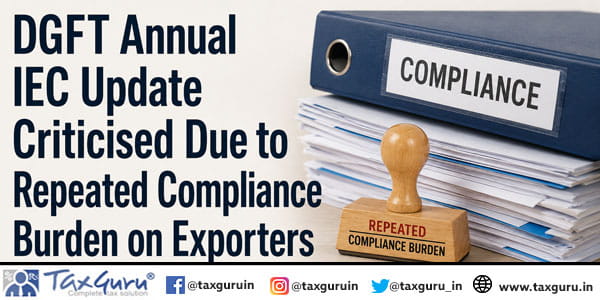
DGFT’S ANNUAL IEC UPDATE: One Million Exporters Penalised to Do What the Government’s Own Databases Already Do
Nearly one million Indian exporters are being compelled to spend money, time, and professional fees re-entering data the Government of India already holds — on a portal that routinely deletes their uploaded documents, freezes mid-session, and charges Rs. 200 when its own failures cause deactivation. This is the DGFT’s mandatory annual IEC updation — and it has no legal or logical justification that withstands scrutiny.
This practice has been inflicted on India’s exporting community every year since February 2021. The author has been in the export trade since 1983 and has personally witnessed the evolution from licence-raj paperwork to the present era of digital governance. What is described below is not conjecture — it is documented, ground-level reality, supported by formal complaints sent to the Cabinet Secretary, Commerce Secretary, Commerce Minister, CVC, and CAG. Not one written acknowledgement has been received.
| FAST FACTS — The True Cost of DGFT’s Annual IEC Updation | |
| IEC holders affected | ~10 lakh (one million) entities annually |
| Compliance window | April 1 – June 30: a 90-day annual rush with no legal basis |
| Reactivation fee | Rs. 200 — charged even when deactivation is portal-caused |
| Estimated annual cost to trade | Rs. 500+ crore (Rs. 500 avg per entity in fees and time) |
| Estimated man-hours lost | 20+ lakh hours/year (2 hrs minimum per entity) |
| Comparative regulators | GST, Income Tax, MCA, Customs: NONE mandate annual re-validation |
| DGFT database quality | Active IECs found without PAN of partners — after five years of ‘annual updation’ |
| DGFT’s response to complaints | Zero written acknowledgements received as of date of publication |
The Deafening Silence of Authority
On June 26, 2025, the author formally wrote — by email — to the Director General of DGFT, the Cabinet Secretary, the Commerce Secretary, the Commerce Minister, and the Central Vigilance Commission, setting out each of the grounds raised in this article and demanding a written, reasoned response. The email was marked Top Urgent and copied to multiple senior officials simultaneously.
| Status as of the date of publication:
Not a single written acknowledgement has been received from any office. When the highest offices of the Government of India choose silence over accountability, the matter ceases to be a policy dispute and becomes a governance failure. |
This silence follows a well-established pattern. When exporters were compelled to purchase Digital Signature Certificates at Rs. 5,000+ apiece — at a time when OTPs were already authenticating every banking and internet transaction in the country — that cost too was absorbed, dismissed as a legitimate cost of doing business, and never refunded or acknowledged. Exporters in India have been conditioned over decades to treat compliance harassment as inevitable. This article is notice that this conditioning has its limits.
The Data Is Already There — So Why This Exercise?
The DGFT has full access to PAN records (CBDT), company director data (MCA/RoC), GST registration details (GSTN), and bank account validation through NPCI. The Business Identification Number (BIN) system has been operational since 2000. There is no data held by an exporter that the Government does not already possess in one or more of its own databases.
| The Inescapable Logic Trap:
If government databases are reliable — annual updation is unnecessary. If they are unreliable — then asking exporters to manually retype the same data into those same systems is equally useless. There is no middle ground. Either way, this policy fails its own stated purpose. |
Furthermore: exporters do not change their office address, bankers, or partners annually. These are stable, structural features of a business that change rarely — if ever — over decades. And when changes do occur, the exporter has every commercial and legal incentive to report them immediately to Customs, GST, NPCI, and their banks — because their own operations depend on it. The assumption underlying mandatory annual updation — that exporters will conceal material changes until reminded — is not merely incorrect. It is an insult to every business that has operated honestly for years.
The correct approach is straightforward: use existing inter-departmental data to identify genuinely inactive IECs, issue targeted Show Cause Notices to those entities alone, and leave active, compliant exporters entirely undisturbed. Burdening one million IEC holders to find a fraction of inactive ones is not policy — it is administrative laziness at the expense of exporters.
Legal Basis and Its Serious Limitations
The requirement derives from DGFT Notification No. 58/2015-2020 dated February 12, 2021, amended in Para 2.05(d) of the Handbook of Procedures (HBP) 2023. Four legal questions remain entirely unanswered:
- Proportionality: Does the FTDR Act empower DGFT to impose a blanket annual burden on all IEC holders — including active, fully compliant exporters — to identify a small number of inactive ones? On settled constitutional principles of proportionality, the answer is plainly no.
- Necessity: When PAN, GST, MCA, and bank records already provide real-time validation, forcing manual annual confirmation of unchanged data has no basis in law or logic.
- Natural Justice: Automatic deactivation without individual prior notice — especially when triggered by portal glitches beyond the exporter’s control — raises serious concerns under Article 14 of the Constitution and the principle of audi alteram partem.
- No Reasoned Order: No published, reasoned order justifies this practice. No other major economic regulator — Customs, GST, Income Tax, MCA — mandates annual re-validation of unchanged data. Silence is not justification; it is the absence of one.
Deactivation of an IEC is not a minor inconvenience. It disrupts live business operations. Reactivation data must be transmitted to ICEGATE and Customs field formations, halting shipments for days or weeks. An institution that deactivates trading licences without individual notice, on an arbitrary calendar cycle, and then charges Rs. 200 to restore them — including when its own portal caused the deactivation — is not facilitating trade. It is obstructing it.
Portal Deficiencies: Digital Governance or Digital Harassment?
The policy’s burden is multiplied manifold by the DGFT portal’s systemic, well-documented failures:
1. Data Persistence Failures
Director and partner details routinely vanish after clicking ‘Save & Next’. Updating one field causes previously saved fields to disappear on revisiting the same window. In 2026, this is not a minor glitch — it is a fundamental failure of system design that forces repeated manual re-entry of the same data.
2. NPCI / Bank Validation Errors
Frequent ‘Name Mismatch’ errors arise even when bank account details are identical to those validated in prior years. The DGFT now demands details of all operative bank accounts — not merely the primary account. This raises a question that has received no answer: for what operational purpose does DGFT need multiple bank account details when it makes no payments to exporters through the IEC portal? The requirement serves no stated regulatory function, imposes disproportionate disclosure burdens on manufacturing units with multiple accounts, and creates unnecessary data security exposure. The portal itself was technically incapable of handling multiple accounts until recently — suggesting the requirement was introduced without adequate technical preparation.
3. Arbitrary Removal of Uploaded Documents
The DGFT removes valid, legally submitted documents — cancelled cheques, address proofs, board resolutions, entity authorisation letters — from its own portal without the exporter’s consent, prior notice, or any audit trail. This is not a technical glitch. It is an accountability failure. Documents once submitted to a government portal cannot be silently deleted and then demanded again, without the institution accepting full responsibility for the disruption.
4. Server Overload and Session Losses
The compressed April–June window creates artificial peak loads, causing session timeouts and failed submissions. Exporters are consequently forced to outsource the process to third parties — increasing cost and, critically, placing sensitive financial and legal documents in the hands of unauthorised intermediaries.
5. The Rs. 200 Reactivation Fee — A Penalty on the Victim
When deactivation is caused by the DGFT’s own portal failures, charging Rs. 200 to restore the IEC is not an administrative fee — it is a penalty imposed on the victim of a government system’s failure. No other trade regulator in India does this. While the amount per entity may seem nominal, its application to lakhs of exporters whose IECs were deactivated through no fault of their own represents an unjustified extraction from the trading community — and a brazen one, given that it is DGFT’s own systems that failed.
| Ground Reality:
Hundreds of formal complaints have been lodged at the highest levels of government since 2021. The DGFT’s response has been silence. Calling a broken, glitch-ridden process a ‘simple online exercise’ does not make it so. |
The Hollow Database: Five Years of ‘Annual Updation’ — With Partners’ PAN Numbers Still Missing
The DGFT’s primary stated justification for annual updation is the maintenance of an accurate, reliable database. The following documented case exposes that claim as hollow.
A partnership firm — an active IEC holder in good standing — was found to have no PAN numbers on record for either partner in the DGFT database. This is not a peripheral data field. PAN is the foundational identifier linking a business entity to the entire apparatus of Indian tax and regulatory compliance. Its absence in the IEC profile means Aadhaar-based digital signing — the very mechanism the DGFT mandates for completing the annual update — is unavailable to the firm.
This firm has been subject to the mandatory annual updation requirement since 2021. Five annual updation cycles have passed. The PAN numbers of both partners remain absent from the database. No action has been taken by DGFT. Annual updation has not corrected this deficiency. It has not even flagged it.
| This single case demolishes the database-accuracy argument:
If five years of mandatory annual updation have failed to populate a field as basic as a partner’s PAN number in an active IEC profile, the exercise has not produced the reliable database it claims to be maintaining. The DGFT’s assurances of a clean, verified database are not supported by its own records. |
The Helpdesk Interaction: A System That Cannot Fix Itself
The firm’s attempt to resolve this through the DGFT’s own helpdesk is instructive. The following is a verbatim record of the helpdesk audit log:
| DGFT Helpdesk Audit Log — Verbatim Record
30/04/2026 Exporter: [Grievance lodged — PAN details of partners missing from IEC profile] 01/05/2026 DGFT: [In Progress — no written response] 01/05/2026 DGFT: PAN details of directors not available in IEC profile. Unable to proceed with Aadhaar sign. 04/05/2026 Exporter: If the PAN number is not available, what is the solution? PAN is verifiable from the PAN database and should be fetched from there. Alternatively, the PAN card can be mailed and DGFT can upload and verify against the database. 04/05/2026 DGFT: We tried reaching you multiple times on [mobile number] but no luck! Request you to share a contact and time to connect for further assistance. 08/05/2026 Exporter: Person handling this matter is in the US. Pacific Time is behind by 11.5 hours. Please give a detailed reply IN WRITING about what is to be done to resolve the issue. 08/05/2026 DGFT: PAN details of directors not available in IEC profile. Unable to proceed with Aadhaar sign or Individual sign-in. |
Three things stand out from this exchange. First, the exporter proposed a perfectly sensible, technically straightforward solution: submit PAN cards, allow DGFT to verify against the CBDT database and update the record. This solution was neither accepted nor rejected in writing — it was ignored.
Second, when the exporter explicitly requested a written response — noting that the responsible person was abroad and asking for communication in writing — the DGFT’s next entry reverted to the same boilerplate non-answer it had already given twice.
Third, and most tellingly: the DGFT helpdesk’s preference for a telephone conversation over a written response is not a matter of communication style. A telephone call leaves no audit trail. A written response constitutes an admission. The preference for the phone is the preference for unaccountability — an institution that knows its system has no solution and is unwilling to say so in writing.
This is the quality of the database that five years of mandatory annual updation has produced. This is the institution demanding that one million exporters validate its records every year. The question of where the responsibility and accountability lie answers itself.
DGFT vs. Every Other Major Regulator: An Unflattering Comparison
The following table makes plain that the DGFT’s approach is not merely imperfect — it is uniquely punitive among all Indian economic regulators:
| Regulator | Annual mandatory update? | Update if nothing changed? | Fee for regulator’s own error? | Auto-deactivation for non-update? |
|---|---|---|---|---|
| DGFT (IEC) | YES — every year | YES | YES — Rs. 200 | YES |
| GST / GSTN | NO | NO — event-based | No such fee | No |
| Income Tax / PAN | NO | NO — event-based | No such fee | No |
| MCA / RoC | NO | NO — event-based | No such fee | No |
| Customs / ICEGATE | NO | NO — event-based | No such fee | No |
Proposed Reforms: Specific, Implementable, and Long Overdue
No legislative change is required. Only administrative will:
1. Update by Exception: Replace mandatory annual confirmation with event-triggered updation. Active IECs with at least one shipping bill or Bill of Entry filed in the preceding 24 months must receive automatic deemed validation. No action required from the exporter.
2. Eliminate No-Fault Reactivation Fees: No fee shall be levied where deactivation resulted from a portal glitch, session timeout, data persistence failure, or any cause not attributable to the exporter’s deliberate omission.
3. Inter-Departmental API Integration: Automatically pull and validate data from MCA (directors/partners/PAN), CBDT (PAN verification), GSTN (GST registration), and NPCI (bank account name matching). This is standard e-governance practice. Its absence in 2026 is inexcusable.
4. Fix the Portal — With Published SLAs: Resolve data persistence failures, NPCI integration errors, document version control, and session stability. Publish transparent Service Level Agreements — 99.5% uptime during the updation window, grievance resolution within 72 hours — and report compliance publicly.
5. Document Accountability: No document uploaded to the DGFT portal may be removed without the exporter’s written consent and a complete, accessible audit trail. Unauthorised removal must trigger automatic reinstatement and a formal explanation.
6. Database Remediation: Conduct an immediate audit of all active IEC profiles for missing PAN data. Populate missing fields directly from the CBDT database. Report the scale of deficiencies publicly. The firm cited above is almost certainly not an isolated case.
7. Stakeholder Consultation: Issue a detailed written response to the points raised in this article. Invite formal submissions from FIEO and Export Promotion Councils. No such consultation has occurred since 2021.
What Exporters Can Do Now
- File a written complaint with FIEO and your Export Promotion Council demanding they take the matter up formally with DGFT at the policy level.
- Lodge a grievance on CPGRAMS (Centralised Public Grievance Redress and Monitoring System) with specific portal failures, dates, and screenshots. Create a paper trail.
- If your IEC was deactivated due to a portal glitch, formally demand a refund of the Rs. 200 fee in writing, citing that the cause was DGFT’s own system failure, not your omission. Preserve all correspondence.
- File an RTI application asking DGFT to cite the specific provision of the FTDR Act or any other law under which annual mandatory updation is required when no changes have occurred. The likely non-response will itself be evidence.
- Write to your Member of Parliament and the Commerce Ministry citing this article and your personal experience.
- Share this article widely. Visibility creates accountability.
Conclusion: The Time for Pretence Is Over
The mandatory annual IEC updation is, in its current form, a policy that burdens the compliant, protects no one, and serves only the administrative convenience of an institution unwilling to use the inter-departmental data resources already available to it. It contradicts the FTDR Act’s mandate to facilitate trade. It conflicts with established constitutional principles. It is operationally executed through a portal that deletes documents, loses saved data, and charges exporters for its own failures. And after five years, it has not even managed to populate a field as basic as a partner’s PAN number in an active IEC profile.
The DGFT has been put on formal notice — repeatedly, and at the highest levels of Government. The response has been silence. That silence will no longer be accepted as a substitute for accountability.
India’s exporters are not seeking to avoid compliance. They are demanding intelligent, efficient, and fair compliance — the kind that reflects a Government genuinely committed to the traders who earn the nation’s foreign exchange. The reforms outlined above require no new law, no new budget, and no new institution. They require only the administrative will to serve the people this system was built to serve.
| Appeal to the Cabinet Secretary, Commerce Secretary, DGFT Director General & Commerce Minister:
A transition to a risk-based, exception-driven, technology-enabled IEC validation system — with immediate database remediation and zero fees for exporters affected by system failures — is urgently required. Further silence or inaction is no longer acceptable. |
*****
Disclaimer: This article represents the personal views, opinions, and analysis of the author based on documented experiences, formal communications, grievance records, and publicly available information. Certain statements reflect criticism of administrative processes and portal functionality in the context of policy discussion and public interest commentary. Nothing contained herein should be construed as an allegation of misconduct against any individual officer or institution unless expressly supported by official records. The publisher and author disclaim liability for actions taken solely on the basis of this article, and readers are encouraged to seek independent professional or legal advice where necessary. All factual claims are based on documented portal failures, formal correspondence with government officials, and direct exporter experience spanning over four decades. Copies of all referenced correspondence, helpdesk transcripts, and audit logs are available on request with the AuthorRajiv Gupta .