1. Introduction :-
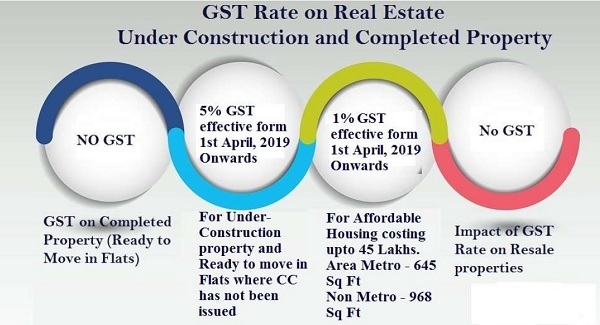
GST on real estate was introduced in 2017 to unify taxation in the property sector, replacing multiple state taxes. It applies primarily to under-construction properties, while completed ones are exempt, affecting gst real estate transactions nationwide.
The regime has evolved, with key changes in 2019 reducing rates to 1% for affordable housing and 5% for others without input tax credit (ITC). In 2025, the GST Council simplified overall slabs to 5% and 18%, with a new 40% for de-merit goods, indirectly benefiting real estate through lower material costs.
This overview sets the stage for understanding gst property tax implications, calculations, and regime comparisons for buyers and investors.
2. Constitutional and Legal Framework :-
Schedule III of the Central Goods and Services Tax Act (CGST Act) excludes sale of land and completed building from the scope of supply. Therefore:
- Sale of land – Not a supply
- Sale of building after Completion Certificate – Not a supply
- Under-construction property – Taxable as supply of service
Para 5(b) of Schedule II treats construction of a complex/building intended for sale (where consideration is received before completion) as supply of service.
3. Exemption from the ambit of the Real Estate (Regulation and Development) Act, 2016 :-
As per section 3(2), the following projects do not require to be registered under the Act.
- Where the area of land proposed to be developed does not exceed five hundred square meters or the number of apartments proposed to be developed does not exceed eight, inclusive of all phases.
- Where the developer (promoter) has received completion certificate for a real estate project prior to commencement of this Act.
For the purpose of renovation or repair or re-development which does not involve marketing, advertising selling or new allotment of any apartment, plot or building, as the case may be, under the real estate project.
4. Valuation Mechanism :-
As per notification provisions:
- One-third of total amount charged is deemed as value of land.
- GST payable on remaining two-thirds.
This deeming fiction applies irrespective of actual land cost.
Judicial challenges have questioned the constitutional validity of the mandatory one-third deduction where land value exceeds such proportion.
5. Input Tax Credit (ITC) Framework (1% / 5%) :-
- ITC is completely restricted.
- Developers must procure at least 80% of inputs and input services from registered suppliers.
- Shortfall attracts tax under Reverse Charge Mechanism (RCM).
- Capital goods from unregistered persons also attract RCM.
6. Works contract services under GST :-
work contract service provided by a contractor to a the developer (promoter) for construction of a real estate project shall be 12% for affordable residential apartments, 18% for residential apartments other than affordable residential apartments and 18% for commercial apartments.
As per section 2(119) of the CGST Act, works contract means a contract for building, construction, fabrication, completion, erection, installation, fitting out, improvement, modification, repair, maintenance, renovation, alteration or commissioning of any immovable property wherein transfer of property in goods (whether as goods or in some other form) is involved in the execution of such contract.
The contractor may charge tax on the works contract service provided by him to a promoter at the concessional rate of 12% under notification No. 11/2017- CTR dated 28.06.2019, S. No.3, entry (va) on the basis of a declaration by the developer (promoter) to the contractor that the project meets the conditions prescribed for concessional rate of GST on works contract service prescribed under the said entry.
| Type of Works Contract | GST Rate | Special Notes |
|---|---|---|
| Standard works contract | 18% | Applies to most construction and repair contracts. |
| Affordable housing projects | 12% | Includes government-approved housing schemes. |
| Government infrastructure projects | 12% or Exempt | Certain projects like roads and dams may be fully exempt or taxed at 12%. |
7. Transfer of Development Rights (TDR), Floor Space Index (FSI) and long-term
Lease of land under GST :-
Before 01.04.2019, or notification issued by the department, the TDR was taxable under forward charge but from 01.04.2019, department came up with the notification No. 4/2019 of central Tax (Rate), which states GST component on supply of TDR/FSI/lease is exempt if the constructed flats are sold before the occupancy certificate or first occupation, and developer pays GST on construction services, but GST is applicable on proportionate TDR value corresponding to unsold flats at the time of occupancy certificate.
This is payable by developer under reverse charge mechanism, for which the applicable Rate of GST will be 18%
Supply of TDR or FSI (floor space index) or long-term lease of land used for the construction of commercial apartments is taxable whether it is booked before completion certificate or first occupation or after completion certificate or first occupation (CC / FO).
GST rate on Transfer of Development Rights (TDR), Floor Space Index (FSI) and long term lease of land.
| Supply of TDR or FSI or long term lease of land used for the construction of affordable residential apartments | 1% on reverse charge (RCM) basis by the developer (promoter) |
| Supply of TDR or FSI or long term lease of land used for the construction of residential apartments other than affordable residential apartments | 5% on reverse charge (RCM) basis by the developer (promoter) |
| Supply of TDR or FSI or long term lease of land used for the construction of commercial apartments | 18% on reverse charge (RCM) basis by the developer(promoter) |
8. Time of Supply and Taxability :-
For construction services:
- GST payable upon receipt of consideration.
- Advances are taxable.
For TDR/FSI:
- Time of supply linked to completion or first occupation.
This creates working capital planning issues for developers.
9. Conclusion :-
The GST regime for real estate developers reflects a policy shift towards simplified rate structure for buyers while increasing compliance responsibility for developers. The interplay of deemed valuation, ITC restriction, and reverse charge provisions necessitates robust internal controls and proactive tax planning.
Given continuing judicial developments, professionals advising real estate developers must adopt a dynamic compliance and litigation strategy to mitigate risk exposure.
******
The author can be contacted at [email protected] His mobile number is +91-8368353016.
DISCLAIMER : This publication serves as a general guide for informational purposes only. The references and content provided are for educational purposes and should not be considered as legal advice.