The Bharatiya Sakshya Adhiniyam, 2023 (BSA), which replaces the Indian Evidence Act, codifies the fundamental principle of burden of proof under Section 104 — the party asserting a fact must prove it (onus probandi). In civil cases, the plaintiff bears the burden, while in criminal cases the prosecution must establish guilt beyond reasonable doubt. Sections 105 and 106 clarify that the burden lies on the party who would fail in absence of evidence and on persons having special knowledge of particular facts. Section 108 places the burden on an accused claiming exceptions. In taxation, however, statutory deviations exist. Under Section 155 of the CGST Act, 2017, the burden to prove eligibility for Input Tax Credit (ITC) lies squarely on the taxpayer. The claimant must substantiate valid invoices, compliance conditions, and supporting records. Thus, while general evidence law follows the asserting-party principle, GST law specifically shifts the onus to the taxpayer in ITC claims.
- 1. General Principle — “He Who Asserts Must Prove”
- 2. Specific Rules Under BSA (Evidence Law)
- √ Section 105 — On Whom Burden Lies
- √ Section 106 — Burden for Particular Facts
- √ Section 108 — Accused’s Exceptions
- 3. Burden of Proof in GST — Section 155 of CGST Act
- 4. Burden vs Standard of Proof
- Burden of Proof
- Standard of Proof
1. General Principle — “He Who Asserts Must Prove”
Under the Bharatiya Sakshya Adhiniyam, 2023 (which has replaced the old Indian Evidence Act), the fundamental principle of burden of proof is codified in Section 104:
“Whoever desires any Court to give judgment as to any legal right or liability dependent on the existence of facts which he asserts, must prove that those facts exist.”
— Section 104, BSA
This reflects the age-old maxim of onus probandi — the party making a claim must substantiate it. Generally:
- In civil cases, the plaintiff bears the burden of proof for their claims.
- In criminal cases, the prosecution must prove guilt beyond reasonable doubt.
- If either party asserts a particular fact, that party must provide evidence for it unless law says otherwise.
2. Specific Rules Under BSA (Evidence Law)
The BSA (replacing the Indian Evidence Act) expands on burden of proof:
√ Section 105 — On Whom Burden Lies
The burden lies on the party who would fail if no evidence were presented by either side — used for situating the burden in a dispute.
√ Section 106 — Burden for Particular Facts
Where a fact is especially within the personal knowledge of someone, that person must prove it.
Example: proving internal business transactions known only to one party.
√ Section 108 — Accused’s Exceptions
If the accused claims an exception (like self-defense), the burden shifts to the accused to substantiate it — otherwise it is presumed absent.
3. Burden of Proof in GST — Section 155 of CGST Act
GST departs from general Evidence Act rules in specific situations.
Under Section 155, CGST Act, 2017:
Where any person claims that he is eligible for input tax credit under this Act, the burden of proving such claim shall lie on such person.
— Section 155, CGST Act
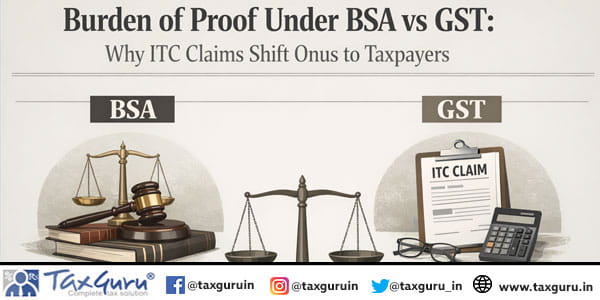
This provision imposes a statutory burden on the taxpayer (the claimant) to prove eligibility for Input Tax Credit (ITC). Unlike general burden principles where the department must first establish a prima facie case, here a taxpayer must substantiate:
- Valid invoices
- Compliance with input tax credit conditions
- Supplier’s compliance history
- Proper accounting and payment evidence
and more — as held by courts, mere invoice production may not suffice to discharge this burden.
So while normally the department must prove an allegation against a taxpayer, in ITC matters the law specifically places the onus on the claimant to establish entitlement.
4. Burden vs Standard of Proof
A subtle but important distinction:
Burden of Proof
Refers to who must prove a fact — for instance, the taxpayer must prove ITC eligibility under Sec 155.
Standard of Proof
Refers to how convincingly the fact must be proved:
- Criminal law: beyond reasonable doubt.
- Civil/tax: preponderance/balance of probabilities or statutory standard.
- Although Evidence Act and BSA speak primarily about burden, standards are context-specific depending on nature of proceedings.
Key Conceptual Takeaways
- General rule: The party asserting a fact must prove it (onus probandi).
- BSA retains and clarifies this principle with sections on particular facts and exceptions.
- GST law creates statutory exceptions — notably Sec 155 placing burden on claimant taxpayers for ITC claims.
- Special provisions like Section 106 (particular knowledge) tailor the application of burden.