India’s Budget 2026 And The Fiscal Architecture of The Digital State: Data Centres, IT Services, And The Global AI Economy
ABSTRACT
India’s Union Budget 2026–27 marks a structural transition from incremental digital policy to a deliberate fiscal architecture designed to position India as a global hub for cloud infrastructure, artificial intelligence (AI), and semiconductor manufacturing. Through longterm tax incentives for data centres, expansion of semiconductor policy, and stability-oriented fiscal design, the Budget attempts to reconcile three competing goals: technological sovereignty, foreign investment attraction, and tax certainty. This article undertakes a doctrinal and policy analysis of these fiscal measures through the lens of classical taxation principles neutrality, certainty, efficiency, and equity while critically examining their implications for India’s income-tax regime, international taxation risks, and digital industrial policy.
I. INTRODUCTION
The Union Budget 2026–27 reflects a deliberate strategic shift toward investment-led growth rooted in digital infrastructure, manufacturing, and global competitiveness. Policy commentary notes that the Budget emphasizes long-term technological capability building, especially in AI, semiconductors, and digital infrastructure.1
At the centre of this transition is a fiscal approach that treats data infrastructure not merely as an IT service but as critical national economic infrastructure. The Budget’s policy orientation aligns taxation policy with technology industrialisation, signalling continuity, predictability, and investor confidence.2 Unlike previous budgets that relied primarily on production-linked incentives (PLI), Budget 2026 employs direct tax policy instruments including long-duration tax holidays and safe-harbour frameworks to reshape cross-border digital investment behaviour. At first glance, a data centre appears deceptively simple a massive building filled with servers, cables, and cooling systems.
Tax law has traditionally treated it exactly that way a structure housing machines. Under the Income-tax Act, 1961, data centres are slotted into existing categories of “building” and “plant and machinery,” attracting standard depreciation under Section 32.
Yet, this legal classification feels increasingly artificial. A modern hyperscale data centre is not a passive warehouse. It actively processes data, enables real-time analytics, supports AI training, and allows firms to monetise information continuously. In economic terms, it functions more like a productive organism than a static asset.
This mismatch between legal form and economic reality creates a structural problem. Depreciation rates designed for factories or office buildings do not reflect the rapid obsolescence of digital infrastructure. Servers become outdated in years, sometimes months. Cooling and power technologies evolve rapidly. When tax law fails to recognise this, it discourages long-term domestic investment and pushes firms to jurisdictions with more responsive capital recovery regimes.
Budget 2026 therefore presents an opportunity perhaps a necessity to rethink how tax law conceptualises digital infrastructure itself.
II. DATA CENTRES AS STRATEGIC INFRASTRUCTURE
Tax Holiday and Income-Tax Implications
A. Long-Term Tax Holiday
A defining fiscal intervention is the grant of a long-term tax holiday for foreign enterprises using India-located data centres to serve global clients.3 The measure is intended to remove uncertainty regarding potential taxation of offshore income attributable to Indian infrastructure.4
Government communication further indicates that the incentive could extend until 2047, signalling an unusually long policy horizon for digital infrastructure.5
From a doctrinal standpoint, this operates analogously to earlier tax-holiday provisions under Chapter III of the Income-tax Act, 1961 (e.g., historically under sections such as 10A/10AA for export-oriented units), though the Budget 2026 proposal targets cloud infrastructure rather than manufacturing exports.
B. Safe Harbour Regime and Transfer Pricing Certainty
Policy commentary also indicates expanded safe-harbour frameworks intended to reduce litigation risk for IT and data centre transactions.6 Safe-harbour rules, rooted in sections 92CB and 92C of the Income-tax Act (transfer pricing), aim to pre-determine acceptable profit margins, thereby lowering disputes regarding arm’s length pricing.
By extending or rationalising safe-harbour treatment, the Budget attempts to reduce administrative cost and enhance tax certainty consistent with Adam Smith’s classical canon that tax liability must be predictable.
C. Equal Tax Treatment for Domestic and Foreign Operators
The government has publicly affirmed equal tax treatment for domestic and foreign data-centre investors.7 This move reduces discrimination risk under international investment norms and supports neutrality between domestic and multinational enterprises.
III. SEMICONDUCTOR AND AI ECOSYSTEM
Budget 2026 strengthens India’s semiconductor and electronics ecosystem through expanded allocations and continuation of the India Semiconductor Mission (ISM) 2.0.8 The Electronics Components Manufacturing Scheme (ECMS) receives enhanced outlay, reinforcing domestic value chains.9 Official statements emphasise that the Budget “lays strong foundation for AI data centres and semiconductor ecosystem.”10
These interventions illustrate a shift from purely services-led growth to technology manufacturing sovereignty, aligning with global supply-chain diversification strategies.
IV. DEPRECIATION, OBSOLESCENCE, AND THE DOCTRINE OF “FUNCTIONAL USE”
Indian tax jurisprudence has long accepted that the nature of an asset must be determined by what it does, not merely what it looks like. The Supreme Court’s reasoning in Scientific Engineering House (P) Ltd. v. CIT established that assets should be classified based on their functional utility in the business.
Applying this doctrine to data centres leads to an unavoidable conclusion: treating them as ordinary buildings is legally unsound. They are closer to integrated technological systems systems whose value lies in computation, speed, and reliability rather than bricks and mortar. A forward-looking Budget 2026 could respond by:
- creating a distinct depreciation block for “digital infrastructure assets,” or
- allowing accelerated depreciation reflecting technological obsolescence.
Such a move would not be a concession; it would be doctrinal consistency. Tax law cannot
insist on economic realism in valuation while clinging to formalism in asset classification.
V. TECHNOLOGY SECTOR RECOGNITION AS A CORE GROWTH ENGINE Policy analysis confirms that the government now explicitly treats AI, semiconductors, digital infrastructure, and data centres as primary drivers of long-term economic expansion.11 Investment-oriented fiscal policy combined with regulatory certainty signals India’s ambition to become a global digital infrastructure hub capable of attracting hyperscale cloud providers.
Data Centres as a National Asset
The projected expansion of India’s data centre capacity is not speculative enthusiasm it is a policy-driven outcome. Data localisation norms, cloud adoption by government departments, fintech expansion, and AI compute requirements are collectively reshaping demand.
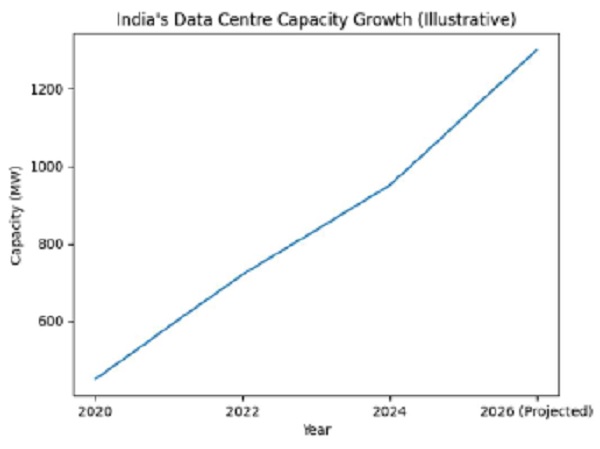
The illustrative growth trajectory captures a deeper story: data centres are becoming national infrastructure, comparable to ports or power grids. Once this is accepted, tax policy must follow suit. Infrastructure is not taxed merely for revenue; it is shaped to achieve strategic goals resilience, sovereignty, and long-term growth.
Failure to recalibrate depreciation and capital incentives risks producing a paradox where India demands data sovereignty but discourages domestic data infrastructure through outdated tax treatment.
IV. ARTIFICIAL INTELLIGENCE AND THE COLLAPSE OF TRADITIONAL TAX
LOGIC
If data centres challenge asset classification, artificial intelligence challenges something far more fundamental: the concept of where income arises.
Traditional tax law rests on two assumptions:
1. Value is created where humans work.
2. Profits are attributable to physical presence.
AI disrupts both. A model trained on Indian data may be deployed on foreign servers, improved by global feedback, and monetised across borders without a single human decision-maker in India. Yet the economic value often originates from Indian users, Indian data, and Indian markets.
This creates a doctrinal crisis. Permanent Establishment rules, designed for factories and offices, struggle to capture algorithmic value creation. Transfer pricing principles assume identifiable functions, assets, and risks assumptions that break down when decision-making is embedded in code.
Budget 2026 cannot solve this alone, but it can signal India’s interpretive stance: economic presence matters more than physical form.
VII. DOCTRINAL ANALYSIS THROUGH PRINCIPLES OF TAXATION
Certainty: The long-term tax holiday directly addresses prior concerns that foreign cloud providers might face future taxation on global income attributable to Indian infrastructure. By clarifying tax exposure, the Budget strengthens the certainty principle.
Neutrality: Equal tax treatment between domestic and foreign data-centre investors advances horizontal equity and investment neutrality.
However, extended exemptions risk distorting competition if domestic upstream suppliers do not receive equivalent incentives.
Efficiency: Safe-harbour expansion reduces compliance and litigation costs, improving administrative efficiency. Yet, prolonged tax holidays may create allocative inefficiency if capital flows disproportionately toward tax-advantaged sectors rather than productivity-driven ones.
Equity: From a distributive justice perspective, generous corporate tax incentives must be balanced against broader revenue needs. Rating agencies have already described the Budget as “tactical” rather than transformative, implying limited redistributive ambition.12
VIII. SIGNIFICANT ECONOMIC PRESENCE AND THE ASSERTION OF SOURCE TAXATION
India has already shown its hand through the concept of “significant economic presence” under Section 9 and through the Equalisation Levy. These measures reflect a broader philosophy: when value is extracted from Indian markets, India’s taxing rights must follow.
In the AI context, this approach becomes even more defensible. Data is not incidental it is the raw material of AI. Where that data is generated, cleaned, and refined should matter for tax attribution. Budget 2026 is likely to deepen this logic, reinforcing source-based taxation even as global consensus remains elusive.
Critics may label this unilateralism. But from another perspective, it is an assertion of digital tax sovereignty a refusal to allow technological complexity to hollow out the tax base.
IX. RISKS AND LIMITATIONS
Revenue Foregone: Extended tax holidays potentially reduce near-term tax revenue, shifting fiscal reliance toward indirect taxes or consumption.
Grid, Environmental, and Infrastructure Stress: Policy commentary emphasises that incentives should be tied to environmental and energy obligations to avoid unsustainable infrastructure expansion.13
Global Minimum Tax Interaction: India’s incentives must eventually align with Pillar Two global minimum tax frameworks, which may limit the effectiveness of long-term exemptions.
X. POLICY RECOMMENDATIONS
For Budget 2026 to succeed as a digital-era fiscal framework, three reforms are essential:
First, statutory recognition of digital assets must replace interpretive patchwork. When courts and tax authorities are forced to stretch old categories, uncertainty follows.
Second, CBDT guidance on AI transfer pricing is urgently needed. Without it, disputes will multiply, chilling investment and overwhelming tribunals.
Third, time-bound incentives must replace open-ended concessions. Technology evolves quickly; tax benefits must do the same.
Conditional Incentives: Link tax benefits to domestic procurement and R&D investment.
Green Infrastructure Compliance: Integrate renewable-energy obligations into “specified data-centre” eligibility.
Balanced Revenue Strategy: Gradually taper exemptions as sector maturity increases.
Domestic Value-Chain Development: Incentivise Indian semiconductor design, fabrication, and component manufacturing.
Transfer-Pricing Stability: Publish detailed safe-harbour margins with periodic review.
XI. CONCLUSION
Budgets speak in numbers, but they think in philosophy. India’s Budget 2026 will reveal whether the State understands digital infrastructure as a peripheral industry or as the backbone of economic power in the 21st century. Data centres and AI are not future concerns. They are present realities shaping sovereignty, privacy, and revenue. Tax law can either chase these changes belatedly or lead with clarity and confidence.
Yet, doctrinal tax analysis reveals inherent tensions between investment promotion and fiscal neutrality. The ultimate success of these measures will depend on whether India converts tax incentives into durable domestic capability rather than merely hosting foreign-owned infrastructure.
If implemented with conditional safeguards and alignment with global tax standards, Budget 2026 may mark the beginning of India’s transition from digital consumer to digital sovereign. If Budget 2026 chooses the latter path, it will not merely fund technology. It will redefine how India governs value itself.
REFERENCES
- KPMG, India Union Budget 2026–27 Highlights (2026).
- Reuters, India Budget Focuses on Accelerating Growth (1 Feb. 2026).
- Reuters, India Gives 20-Year Tax Holiday to Foreign Firms Using Local Data Centres (1 Feb. 2026).
- PIB, Budget 2026–27 Lays Strong Foundation for AI Data Centres and Semiconductor Ecosystem (1 Feb. 2026).
- Economic Times, Cloud Service Companies Get Tax Holiday Until 2047 (2026).
- RSM India, Budget 2026 – Resilience in Uncertainty (2026).
- Economic Times, Equal Tax Treatment for Domestic and Foreign Data Centre Players (2026).
- Scientific Engineering House (P) Ltd. v. Commissioner of Income Tax, (1986) 157 ITR 86 (SC).
- Commissioner of Income Tax v. B.C. Srinivasa Setty, (1981) 128 ITR 294 (SC).
- Formula One World Championship Ltd. v. Commissioner of Income Tax, (2017) 394 ITR 80 (SC).
- EY India, Union Budget 2026–27 Tax Highlights (2026).
- India Gives 20-Year Tax Holiday to Foreign Firms Using Local Data Centres, REUTERS (Feb. 1, 2026).
- Press Information Bureau, Budget 2026–27 Lays Strong Foundation for AI Data Centres and Semiconductor Ecosystem (Feb. 1, 2026).
- Cloud Service Companies Get Tax Holiday Until 2047, ECON. TIMES (2026).
- RSM India, Budget 2026: Resilience in Uncertainty (2026).
- EY India, Union Budget 2026–27 Highlights (2026).
- The Constitution of India, art. 246, 265, Seventh Schedule (Union List, Entry 82).
- Income-tax Act, 1961, §§ 2, 9, 32, 35, 92–92F (India).
- Finance Act, 2020, No. 12 of 2020 (India) (introducing Significant Economic Presence framework amendments).
Notes:-
1 Available at: KPMG, India Union Budget 2026–27 Highlights (2026).
2 Available at: Reuters, India Budget Focuses on Accelerating Growth (1 Feb. 2026).
3 Available at: Reuters, India Gives 20-Year Tax Holiday to Foreign Firms Using Local Data Centres (1 Feb. 2026).
4 Available at: PIB, Budget 2026–27 Lays Strong Foundation for AI Data Centres and Semiconductor Ecosystem (1 Feb. 2026).
5 Available at: Economic Times, Cloud Service Companies Get Tax Holiday Until 2047 (2026).
6 Available at: RSM India, Budget 2026 – Resilience in Uncertainty (2026).
7 Available at: Economic Times, Equal Tax Treatment for Domestic and Foreign Data Centre Players (2026).
8 Available at: EY India, Union Budget 2026–27 Tax Highlights (2026).
9 Available at: RSM India, Budget 2026 – Resilience in Uncertainty (2026).
10 Available at: Press Information Bureau, Budget 2026–27 Lays Strong Foundation for AI Data Centres and Semiconductor Ecosystem (Feb. 1, 2026).
11 Available at: Cloud Service Companies Get Tax Holiday Until 2047, ECON. TIMES (2026).
12 Available at: EY India, Union Budget 2026–27 Highlights (2026).
13 Available at: Economic Times, Cloud Service Companies Get Tax Holiday Until 2047 (2026).