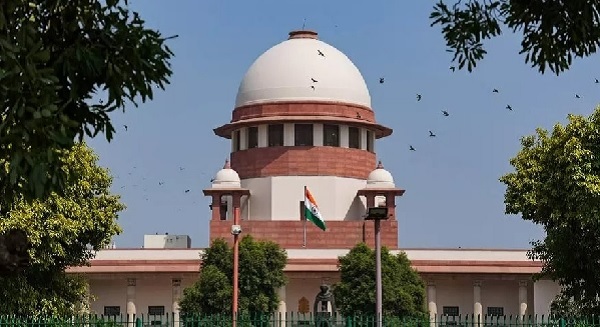
Gurwinder Singh Vs State of Punjab & Another (Supreme Court of India)
Supreme Court held that mere delay in trial pertaining to grave offences cannot be used as a ground to grant bail. Accordingly, bail application of appellant accused under Unlawful Activities (Prevention) Act, 1967 rejected.
Facts- The present appeal impugns the order dated 24.042023 passed by the High Court of Punjab and Haryana at Chandigarh in CRA-D No. 144 of 2022 (O&M) whereby the High Court has upheld the order dated 16.12 2021 passed by the Special Judge, NIA Court, SAS Nagar, Mohali in an application filed u/s. 439 of the Code of Criminal Procedure, 1973 (Cr.P.C) filed by the Appellant herein-Gurwinder Singh along with other co-accused seeking regular bail in NIA Case RC.1 9/2020/NIA/DLI, registered under Sections 124A, 153A, 153B 120-B of the Indian Penal Code, 186 (IPC)Section(s) 17, 18, 19 of the Unlawful Activities (Prevention) Act 1967 (UAP Act) and Sections 25 and 54 of the Arms Act, 1959, which came to be rejected.
Conclusion- Held that the material available on record indicates the involvement of the appellant in furtherance of terrorist activities backed by members of banned terrorist organization involving exchange of large quantum of money through different channels which needs to be deciphered and therefore in such a scenario if the appellant is released on bail there is every likelihood that he will influence the key witnesses of the case which might hamper the process of justice. Therefore, mere delay in trial pertaining to grave offences as one involved in the instant case cannot be used as a ground to grant bail. Hence, the aforesaid argument on the behalf the appellant cannot be accepted.
FULL TEXT OF THE SUPREME COURT JUDGMENT/ORDER
1. Leave granted.
2. The present appeal impugns the order dated 24.042023 passed by the High Court of Punjab and Haryana at Chandigarh in CRA-D No. 144 of 2022 (O&M) whereby the High Court has upheld the order dated 16.12 2021 passed by the Special Judge, NIA Court, SAS Nagar, Mohali in an application filed under Section 439 of the Code of Criminal Procedure, 1973 (Cr.P.C) filed by the Appellant herein-Gurwinder Singh along with other co-accused seeking regular bail in NIA Case RC.1 9/2020/NIA/DLI, registered under Sections 124A, 153A, 153B 120-B of the Indian Penal Code, 186 (IPC)Section(s) 17, 18, 19 of the Unlawful Activities (Prevention) Act 1967 (UAP Act) and Sections 25 and 54 of the Arms Act, 1959, which came to be rejected.
3. The factual matrix relevant to dispose the present petition are summarized as under
3.1 On 19.10.2018, Sh. Varinder Kumar, Inspector, CIA Staff, received secret information that two persons are hanging cloth banners on which “Khalistan Jindabad” and “Khalistan Referendum 2020”, was written, at Pillars Kot Mit Singh Flyover, Amritsar. The Police team apprehended one Sukhraj Singh @ Raju and Malkeet Singh @ Meetu on the spot and a case was registered vide FIR No.152 dated 19.10.2018 under section(s) 124A, 153A, 153B and 120B of IPC against both the arrested accused. During the course of Investigation, entire module of the banned terrorist organization named “Sikh for Justice” was busted and other accused persons involved in the said module namely, Bikramjit Singh @ Vicky, Manjit Singh @ Manga, Jatinder Singh @ Goldy, Harpreet Singh @ Happy, Gurwinder Singh @ Gurpreet Singh @ Gopi-the present Appellant, Harmeet Singh @ Raju, Roofel @ Raful @ Rahul Gill, Sukhmander Singh @ Gopi and Kuldeep Singh @ Kuldip Singh @ Keep were arrested by Punjab Police.
3.2 The investigation was completed and final report was presented on 16.04.2019 before the Trial Court against eleven accused persons under Sections 117, 112, 124A, 153A, 153B, 120-B of IPC, Sections 17, 18, 19 of UAP Act and Section 25 of Arms Act. On further investigation, the police submitted supplementary reports.
3.3 Due to degree of severity in the charges involved, the investigation in the present matter was transferred to the National Investigation Agency (NIA), which took over the investigation of this case as per the directions of Government of India, Ministry of Home Affairs issued vide Order F.No.1 101 1/30/2020/NIA dated 04.04.2020 and registered the original case as RC.1 9/2020/NIA/DLI dated 05.04.2020. 3rd supplementary chargesheet was filed by NIA dated 18.12.2020 and Charges were framed by the Learned Special Judge, NIA Punjab on 09.12.2021.
3.4 The investigation revealed that the accused persons received funds through illegal means sent by members of the banned terrorist organization “Sikhs For Justice”, those funds were channeled through illegal means such as “Hawala” and were sent to be used for furthering separatist ideology of demanding a separate State for Sikhs popularly called “Khalistan”, and to carry out terror activities and other preparatory acts i.e., attempts to procure weapons to spread terror in India in furtherance of such separatist movement. The investigation further revealed the hand of an ISI handler named Javed Khan, to be behind the operations of this module busted by Punjab Police and NIA.

3.5 The prima facie involvement of the present Appellant has cropped up in the disclosure statement of the co-accused Bikramjit Singh @ Vicky (Accused No. 3) recorded on 09.06.2020 while he was in the custody of NIA.
3.6 The said disclosure statement revealed that on 08.07.2018, the Appellant herein-Gurwinder Singh accompanied Bikramjit Singh (Accused No. 3) and Harpreet Singh @Happy (Accused No.7) to Srinagar in a car where they had planned to purchase a pistol. There they met Sandeep Singh @ Sana and further went to a JK-Li Camp in Srinagar. Sandeep Singh entered the Army camp and after half an hour he came out and stated that pistol was not available. Then they came back to Gurudwara Sahib, where Sandeep offered them to purchase RDX instead, but they declined and all three returned back to Punjab, where Bikramjit Singh (Accused No. 3) was dropped off mid-way at Jandialaguru while both, the present Appellant and Harpreet Singh @ Happy, returned back to their village in Punjab.
3.7 The Appellant’s disclosure statement recorded on 12.06.2020 revealed a similar story as that of Bikramjit Singh. The Appellant stated that he and Harpreet Singh were childhood friends. In the 1st week of July 2018, Harpreet proposed to visit Srinagar for Religious Service and asked the Appellant to accompany. The Appellant in his disclosure statement further stated that he initially denied to go with them however later agreed to accompany them when Harpreet Singh continuously insisted him.
3.8 The trial court vide its order dated 16.12.2023 in CIS No.BA/2445/202 1 dismissed the Appellant’s bail application under Section 439 CrPC on the ground that there were reasonable grounds to believe the accusation against the Appellant to be true. The said order was impugned by way of an appeal before the High Court of Punjab and Haryana and meanwhile on 10.04.2023, 4th supplementary charge sheet was filed by NIA along with the List of witnesses and list of documents.
3.9 Vide the Impugned order the High Court rejected the grant of bail to Appellant on the ground of seriousness of the nature of offence and that none of the protected witnesses had been examined.
SUBMISSION ON BEHALF OF THE PARTIES
4. The Learned Senior Counsel, Mr. Colin Gonsalves, appearing on behalf of the Appellant made the following submissions in support of the Appellant’s bail application:
5. Mr. Gonsalves, learned Senior Counsel contended that the Appellant has been denied bail by the Hon’ble High Court and the Ld. Special Judge by relying upon the disclosure statement of Bikramjit Singh alias Vicky and argued that the said disclosure statement cannot be used to implicate the present Appellant.
6. Learned Senior Counsel further raised contentions about the lack of scrutiny of the Appellant’s mobile phone, marked as M-4 to indicate that the phone number did not belong to the Appellant. He argued that the absence of incriminating conversations in the Communication Data Records (CDR) related to the Appellant’s phone supports the case for bail. He further contended that the Appellant has been in custody since the last Five years facing charges of UA Act which is contrary to the law laid down in KA Najeeb v. Union of India.’
7. He further submitted that only 19 out of 106 witnesses have been examined in the last five-year period. He also drew our attention to terror funding chart to demonstrate that the name of the Appellant does not find place in the same. Mr. Gonsalves also questioned the omission of the alleged main conspirator, Nihal Singh, as an accused, emphasizing that the Appellant did not procure any weapons.
8. He further sought our attention to the 4th supplementary chargesheet, aimed at establishing a funding link with ISI, to illustrate the Appellant’s exclusion from relevant documentation. Lastly, he stated that out of Nine protected witnesses that have been examined, eight have not mentioned the name oIAppellant. Hence, he prayed to set aside the impugned order and grant bail to the Appellant.
9. Per contra, Mr. Suryaprakash V. Raju, learned Additional Solicitor General, on behalf of the Respondent, submitted that there is sufficient evidence on record to prove the incriminating role other Appellant and the same is revealed by the statements of Protected witnesses.
10. He further submitted that the Appellant-accused along with co-accused Bikarmjit Singh @ Vicky (Accused No. 3) were involved in the activities of “Sikhs for Justice”, a banded terrorist organisation, whose chief proponent is Gurpatwant Singh Pannu (Accused No . 12) and Bikramjit Singh @ Vicky (Accused No. 3) had asked their known persons to arrange weapons from Kashmir. In furtherance of their activities to procure arms and ammunition, the Appellant-accused along with co-accused Bikarmjit Singh @ Vicky and Harpreet Singh @ Happy (Accused No. 7) had visited
11. He further submitted that Appellant in his voluntary disclosure statement admitted that on gaining knowledge of purpose of visit to Srinagar, he voluntarily continued the journey. In fact the Appellant suggested an alternative to the co-accused and advised them to procure the weapon from Western Uttar Pradesh.
12. Further, he submitted that the provisions of section 43D(5) of Unlawful Activities (Prevention) Act, 1967 are completely applicable in this case and as such the High court has rightly denied bail to the Appellant-accused.
13. He also contended that the case is presently under trial and so far 22 witnesses have been examined. The accused is facing charges of grave nature pertaining to crimes that are not attributable to an individual but members of a terrorist gang operating at the behest of Gurpatwant Singh Pannu (Accused No. 12), a proscribed terrorist. If the Appellant is released on bail, there is every likelihood that he will influence the key witnesses of the case hampering the process of justice. Hence, he prayed that the bail petition should be rejected.
DISCUSSION AND CONCLUSION
14. We have heard the learned counsel on behalf of both the parties and have perused the records of the case The present case involves the charges under the UA Act along with other charges under the IPC and Arms Act therefore, it is apt to consider the bail provision envisaged under section 43D of the UA Act before we delve to analyze the facts
Bail under UAP Act: Section 43D (5)
15. In the course of oral argument, both sides have laid great emphasis on the interpretation of section 43D(5) of the 1967 Act. We will begin our analysis with a discussion on the scope and limitations of bail under Section 43D(5 ) UA Act
We shall extract Section 43D(5) for easy reference:
“Section 43D – Modified application of certain provisions of the Code
(1)…………………..
Notwithstanding anything contained in the Code, no person accused of an offence punishable under Chapters IV and VI of this Act shall, if in custody, be released on bail or on his own bond unless the Public Prosecutor has been given an opportunity of being heard on the application for such release: Provided that such accused person shall not be released on bail or on his own bond if the Court, on a perusal of the case diary or the report made under section 173 of the Code is of the opinion that there are reasonable grounds for believing that the accusation against such person is prima facie true.
The restrictions on granting of bail specified in sub-section (5) is in addition to the restrictions under the Code or any other law for the time being in force on granting of bail.
(7) Notwithstanding anything contained in Sub-sections (5) and (6), no bail shall be granted to a person accused of an offence punishable under this Act, if he is not an Indian citizen and has entered the country unauthorizedly or illegally except in very exceptional circumstances and for reasons to be recorded in writing.”
16. The source of the power to grant bail in respect of non-bailable offences punishable with death or life imprisonment emanates from Section 439 CrPC. It can be noticed that Section 43D(5) of the UA Act modifies the application of the general bail provisions in respect of offences punishable under Chapter IV and Chapter VI of the UA Act
17. A bare reading of Sub-section (5) of Section 43D shows that apart from the fact that Sub-section (5) bars a Special Court from releasing an accused on bail without affording the Public Prosecutor an opportunity of being heard on the application seeking release of an accused on bail, the proviso to Sub-section (5) of Section 43D puts a complete embargo on the powers of the Special Court to release an accused on bail. It lays down that if the Court, ‘An ‘on perusal of the case diary or the report made under Section 173 of the Code of Criminal Procedure’, is of the opinion that there are reasonable grounds for believing that the accusation, against such person, as regards commission of offence or offences under Chapter IV and/or Chapter VI the UAP Act is prima facie true, such accused person shall not be released on bail or on his own bond. It is interesting to note that there is no analogous provision traceable in any other statute to the one found in Section 43D(5 ) of the UA Act In that sense the language of bail limitation adopted therein remains unique to the UAP Act.
18. The conventional idea in bail jurisprudence vis-à-vis ordinary penal offences that the discretion of Courts must tilt in favour of the oft-quoted phrase – ‘bail is the rule, jail is the exception’ – unless circumstances justify otherwise – does not find any place while dealing with bail applications under UA Act The ‘exercise’ of the general power to grant bail under the UA Act is severely restrictive in scope. The form of the words used in proviso to Section 43D (5 )– ‘shall not be released’ in contrast with the form of the words as found in Section 437(1 ) CrPC – ‘may be released’ – suggests the intention of the Legislature to make bail, the exception and jail, the rule.
19. The courts are, therefore, burdened with a sensitive task on hand. In dealing with bail applications under UAP Act, the courts are merely examining if there is justification to reject bail. The ‘justifications’ must be searched from the case diary and the final report submitted before the Special Court. The legislature has prescribed a low, ‘prima facie standard, as a measure of the degree of satisfaction, to be recorded by Court when scrutinising the justifications [materials on record]. This standard can be contrasted with the standard of ‘strong suspicion , which is used by Courts while hearing applications for ‘discharge’ In fact the Supreme Court in Zahoor Ali Watali2 has noticed this difference, where it said:
“In any case, the degree of satisfaction to be recorded by the Court for opining that there are reasonable grounds for believing that the accusation against the accused is prima facie true, is lighter than the degree of satisfaction to be recorded for considering a discharge application or framing of charges in relation to offences under the 1967 Act.”
20. In this background, the test for rejection of bail is quite plain. Bail must be rejected as a ‘rule’, if after hearing the public prosecutor and after perusing the final report or Case Diary the Court arrives at a conclusion that there are reasonable grounds for believing that the accusations are prima facie true. It is only if the test for rejection of bail is not satisfied – that the Courts would proceed to decide the bail application in accordance with the ‘tripod test’ (flight risk, influencing witnesses, tampering with evidence). This position is made clear by Sub-section (6) of Section 43D , which lays down that the restrictions, on granting of bail specified in Sub-section (5), are in addition to the restrictions under the Code of Criminal Procedure or any other law for the time being in force on grant of bail.
21. On a textual reading of Section 43 D(5) UAP Act the inquiry that a bail court must undertake while deciding bail applications under the UA Act can be summarised in the form of a twin-prong test:
1) Whether the test for rejection of the bail is satisfied?
1.1 Examine if, prima facie, the alleged ‘accusations’ make out an offence under Chapter IV or VI of the UAP Act
1.2 Such examination should be limited to case diary and final report submitted under Section 173 CrPC;
2) Whether the accused deserves to be enlarged on bail in light of the general principles relating to grant of bail under Section 439 CrPC (‘tripod test’)?
On a consideration of various factors such as nature of offence, length of punishment (if convicted), age, character, status of accused etc., the Courts must ask itself :
2.1 Whether the accused is a flight risk?
2.2. Whether there is apprehension of the accused tampering with the evidence?
2.3 Whether there is apprehension of accused influencing witnesses?
22. The question of entering the ‘second test’ of the inquiry will not arise if the ‘first test’ is satisfied. And merely because the first test is satisfied, that does not mean however that the accused is automatically entitled to bail. The accused will have to show that he successfully passes the ‘tripod test’
Test for Rejection of Bail: Guidelines as laid down by Supreme Court in Watali’s Case
23. In the previous section, based on a textual reading, we have discussed the broad inquiry which Courts seized of bail applications under Section 43D(5) UA Act r/w Section 439 CrPC must indulge in. Setting out the framework of the law seems rather easy, yet the application of it, presents its own complexities For greater clarity in the application of the test set out above, it would be helpful to seek guidance from binding precedents. In this regard, we need to look no further than Watali’s case which has laid down elaborate guidelines on the approach that Courts must partake in, in their application of the bail limitations under the UA Act On a perusal of paragraphs 23 to 29 and 32, the following 8-point propositions emerge and they are summarised as follow