The article examines the controversy surrounding oral remarks allegedly made by the Chief Justice of India regarding unemployed youth and fake degree holders, which triggered the emergence of the satirical “Cockroach Janata Party” (CJP) as a viral online movement. The authors argue that while the CJI later clarified that his comments targeted fraudulent professionals rather than unemployed youth, the incident exposed deep frustrations among India’s young population, including unemployed graduates, junior advocates, RTI activists, and Gen Z citizens. The article discusses the constitutional distinction between oral observations and binding judicial orders, highlighting the risks of misreporting and misinterpretation in the digital age. It further explores issues such as youth unemployment, judicial backlogs, challenges faced by young lawyers, RTI activism, and the constitutional protection of satire and dissent under free speech jurisprudence. Ultimately, the piece contends that institutional sensitivity, judicial precision, and meaningful structural reforms are essential to restore public confidence and address growing youth disillusionment.
A satirical reckoning with judicial off-the-cuff advice, Gen Z wrath, unemployed Advocates, Law graduates, pending millions of cases, and the weird emergence of a party that nobody asked for but everybody wanted.
“Arise, awake, and stop not till the goal is reached.”
— Swami Vivekananda[1]
Over the decades, India has generated numerous unusual political forms. People hosted parties named after flowers, rivers, gods, and revolutionary figures. On May 16, 2026, people welcomed the newest: the Cockroach Janata Party (CJP), shortened with the universe’s finest irony. Not to be confused with the chief justice’s position, though the error is plausible given that the two were produced by the same organization.
The trigger was as swift as it was spectacular. What began as a satirical online response to a controversial comment by the Chief Justice of India (CJI) quickly grew into one of India’s most significant Gen Z internet movements. The Cockroach Janta Party (CJP), founded just days ago by political strategist Abhijeet Dipke, has garnered millions of followers on social media, surpassing even conventional political parties on Instagram and becoming a digital rallying point for disgruntled young Indians. The movement was sparked by CJI Surya Kant’s remark, during a hearing on fraudulent legal degrees, that unemployed youth were becoming “like cockroaches” and “parasites.” Though the CJI later clarified that his statements were meant for fraudulent professionals rather than the country’s youth, the outcry online was instantaneous. Dipke reacted to the fury almost immediately. On May 16, he founded the Cockroach Janta Party, a satirical political platform that bills itself as the “Voice of the Lazy and Unemployed,” with membership requirements such as being “chronically online,” unemployed, underpaid, overworked, or simply exhausted by the system.
Like many classic Indian dramas, the story begins in a courtroom. On May 15, 2026, the Chief Justice of India (CJI) made oral observations before a Supreme Court bench[2]. The matter at hand included a contempt motion brought by Advocate Sanjay Dubey against the Registrar General of the Delhi High Court over the claimed non-implementation of a Supreme Court decision granting senior advocate designations. During an investigation into fake degree-holders in the legal profession, the CJI stated, “There are already parasites of society who attack the system.” There are young people who are like cockroaches; they cannot find work or advance in their careers. Some individuals pursue careers in media, social media, or RTI activism.
Cockroach Janata Party is a satirical online political movement. It is not mainly known as a traditional registered political party.
It became popular through memes, posts, humour, and protest-style content.
By evening, the internet had completed its primary function. By the next morning, Abhijeet Dipke[3], a 30-year-old Boston University student and former AAP communications specialist, had created a website, written a manifesto, composed an anthem, and opened membership to the Cockroach Janata Party. Within days, more than 80,000 to 1,000,000 Indians had signed on, including opposition MP Mahua Moitra of West Bengal and former cricketer-turned-politician Kirti Azad[4]. A cockroach survives in harsh conditions.
A cockroach survives in harsh conditions. So, the symbol stands for resilience, survival, and not giving up.
“They tried to step on us.
We came back.”
The CJP’s membership criteria were as succinct as the fury that sparked them: jobless “by force, choice, or principle.”
“A satirical party born in a courtroom hallway is the loudest referendum India’s youth has conducted without a ballot box.”
The Clarification That Came Too Late — and Too Early
On May 16, 2026, the CJI released a clarification, expressing his “pain” about how the media had misquoted his oral observations[5]. He noted that his criticism was directed specifically at people who enter professions, particularly the bar, with fraudulent or spurious degrees, rather than the country’s youth. “It is completely false to claim that I criticized our nation’s youth,” the statement said. He emphasised his delight in India’s current and future people resources, describing unemployed youth as “the pillars of a developed India.”
The clarification should be treated seriously and at face value. Oral observations in court, made during the heat of the proceedings, are notoriously prone to selective reporting. When a remark intended to denounce fraudulent degree holders is stripped of its context and the conditional grammar that frames it, it might be taken as a wide indictment of a whole generation. Modern media, particularly short-form, algorithm-driven content, has a financial motive to sensationalize. A ten-second clip can destroy the nuances of an hour’s worth of events. The CJI is not alone in this fate; courts at all levels have had their oral observations stripped, cut, and weaponized.
Legal Context: Oral Observations vs. Judicial Orders
It is a well-established principle of Indian constitutional law that oral observations made during hearings do not constitute binding court pronouncements and cannot be used as the ratio decidendi in any case. They are not formal findings of fact or law, but rather a judge’s tentative reasoning, testing of arguments, or expression of annoyance with a litigant. Unfortunately, the distinction is completely lost in the 24-hour news cycle.
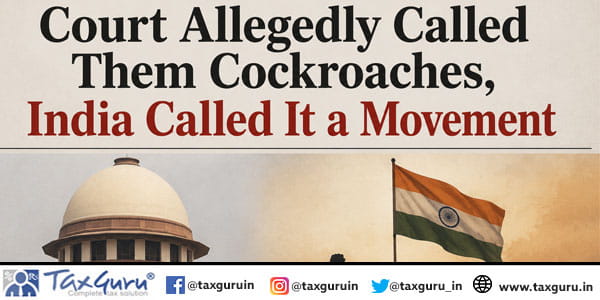
However, constitutional institutions, such as courts, legislatures, and constitutional bodies, are subject to a unique level of caution. The Supreme Court of India is more than just a judicial institution; it is a symbol, a moral anchor, and, for millions of Indians, the last resort in every sense of the word. An oral statement from the presiding judge conveys more weight and risk of distortion. In an era of hyper-partisan media architecture, where sensational framing is algorithmically rewarded, and contextual correction is buried in the scroll, there is ample opportunity for misreporting and misinterpretation. Constitutional institutions must therefore be cautious, not only in their written directives but also in their spoken pronouncements, which can spread further and faster than any judgment.
The Right to Speak, the Right to Sting: Shreya Singhal and Free Expression
Whatever else you can say about the Cockroach Janata Party, it is a kind of protected political satire. It is precisely the kind of expression the Supreme Court envisioned when it issued its landmark decision in Shreya Singhal v. Union of India (2015)[6]. A two-judge bench led by Justices J. Chelameswar and R.F. Nariman overturned Section 66A of the Information Technology Act of 2000, which criminalized “offensive” and “menacing” online conduct. The court distinguished between advocacy, whether vigorous, pointed, or sarcastic, and incitement to unlawful conduct.
Shreya Singhal affirmed that the right to freedom of speech and expression under Article 19(1)(a)[7] of the Constitution includes the right to criticise, lampoon, mock, and dissent—including from institutions of the state. Satire, protest art, and political parody form the very sinew of democratic discourse. Naming oneself after a judicial slur and building a movement around it is, constitutionally speaking, as legitimate as writing an op-ed or holding a placard. The right to freedom of opinion and speech is not conditional on the speaker being employed, credentialled, or polite.
Indeed, the RTI activism that the CJI’s original remark appeared to criticize is constitutionally based. The Right to Information Act of 2005[8], probably one of the most democratizing pieces of legislation that independent India has produced, was created to grant every citizen the right to see government information, obtain copies of papers, and demand accountability from public officials. Its use by unemployed youngsters, social media pundits, and civil society activists is not a problem; it is the Act doing exactly what Parliament intended. RTI has exposed corruption, illegitimate appointments, fraudulent procurement, and administrative wrongdoing that would have otherwise gone unnoticed in file notes. RTI activism is portrayed as a haven for angry parasites, which completely undermines the constitutional design.
Young Advocates: The Invisible Army of the Legal Profession
Before the nation bursts in pity or derision for cockroaches, it is worth asking, “What is the current state of young attorneys in India?” The picture is not flattering to people who regard the Bar as a prominent place.
The Bar Council of India estimates that India has roughly 1.7 million enrolled[9] advocates, the world’s largest number of attorneys. Most make less than ₹10,000 per month throughout their first five years[10] of practice. Many earn nothing at all, relying on the kindness of senior lawyers in whose chambers they work for free, receiving instruction in exchange for their labour. The junior advocate’s world consists of uncredited drafting labour, court appearances with briefs handed over at the last minute, and modest stipends that would not cover a month’s commute in any major metropolis.
The Bar Council of India (BCI) has a constitutional and legislative obligation under the Advocates Act of 1961[11] to govern the profession and protect advocates’ interests. However, young lawyers have long claimed that BCI’s institutional focus is on senior advocates, enrollment fee disputes, and dress code enforcement—rather than genuine welfare schemes, mentorship programs, or minimum stipend standards. In several PILs addressing legal aid and access to justice, the Supreme Court has underlined the vast gap between the Bar’s formal edifice and the actual reality of its youngest members.
The POSH Question: Lawyers Are Not Immune
The Sexual Harassment of Women at Work (Prevention, Prohibition, and Redressal) Act of 2013 (POSH)[12] governs all workplaces, including law chambers, court complexes, and legal aid offices. However, the legal profession has been slow to accept that it is not immune to the problem. Junior advocates, particularly women, working in senior chambers frequently find themselves in a curious grey area: they are not employees in the traditional sense, but they rely entirely on senior advocates for briefs, recommendations, and professional survival. Complaints of harassment, inappropriate behaviour, and professional coercion are often made in whispers rather than in formal complaints since the complainant risks losing not just their employment but also access to the entire professional network on which a legal career is built. The BCI must establish robust internal complaints committees and extend effective POSH protection to junior advocates across all practice settings.
Beyond gender-based harassment, there is the equally significant issue of threats against advocates who work on sensitive cases such as human rights, criminal defence in politically contentious trials, cases involving governmental actors, or environmental lawsuits against large economic interests. Advocates in India, from Manipur to Maharashtra, have experienced intimidation, surveillance, and physical threats. The BCI’s response has been sporadic at best. A systematic legal protection mechanism, like witness protection but extended to court officers who handle such cases, is long overdue.
Unemployment: The Generation That the System Built and Then Abandoned
The Cockroach Janata Party’s viral popularity cannot be understood without first examining the specifics of Gen Z unemployment in India. This is not the unemployment of previous generations—the educated but unskilled, the rural migrants, or the manufacturing workers destroyed by automation. This is credentialed unemployment: young Indians who have completed school, taken competitive exams, enrolled in colleges or professional courses, and graduated with degrees but are still unable to obtain official employment.
India’s graduate unemployment rate is unusually high. According to the Centre for Monitoring Indian Economy (CMIE)[13], young unemployment—defined as the 15-29 age cohort—ranges between 23% and 45% in different states, with urban educated youth faring especially poorly. The problem is structural in nature. Despite good GDP headline numbers, India’s economy has failed to create jobs at the rate required by a demographic dividend that is now on the verge of becoming a demographic calamity. Manufacturing, which has traditionally been the vehicle for developing countries to absorb educated individuals into formal employment, has remained stagnant. India’s manufacturing contribution to GDP has stagnated, and deindustrialization in particular sectors has exacerbated the situation.
West Bengal presents a particularly acute case study. Once the industrial heartland of British India, it has seen decades of political turbulence erode its industrial base. The conflict between the state government and private capital, combined with infrastructural bottlenecks and periodic political violence, has deterred large-scale investment. Young people from West Bengal, some of the most academically accomplished in the country and products of a dense network of schools and universities, find themselves in a labour market that cannot absorb them. Emigration to other states or abroad becomes the only rational choice, draining the region of its brightest. The political instability surrounding the state’s elections, allegations of booth-capturing and electoral coercion, and the culture of party affiliation as a prerequisite for employment in state schemes have further alienated educated youth from formal political engagement, leading them to movements such as the CJP.
| Pending Cases in Indian Courts (2026) | Cases Pending Over 5 Year | Cases Pending in Supreme Court |
|---|---|---|
| 54M+ | 17.2M | 90,897 |
| 1,80,000+
Cases Pending Over 30 Years |
||
Drug addiction, a menace has evolved as a co-existing crisis with unemployment, especially in Punjab, Manipur, and portions of the northeast. The relationship between political patronage networks, drug trafficking, and adolescent unemployment is well established. When formal employment disappears and illegal economies take over, narcotics become a commodity as well as an escape. Young males who are unable to find work become consumers before becoming traders. The state, which has failed them as employers, criminalizes them as addicts, completing a cycle of abandonment rooted in policy failure.
Fifty-Four Million Reasons Justice Is a Luxury (Justice delayed is Justice denied)
No discussion regarding the plight of India’s young lawyers and institutions can overlook the single most devastating structural failing of the Indian state: its judicial backlog. As of early 2026, India’s courts had over 54 million pending cases. The Supreme Court alone has over 91,000 ongoing cases. The high court collectively holds more than 6.3 million. District and subordinate courts—the courts with which most ordinary Indians deal when they approach the legal system—account for the vast majority, nearing 48-50 million cases, or nearly 85% of the total.[14]
Over 180,000 lawsuits have been outstanding for over 30 years. In a figure that should humiliate every administration that has held office in West Bengal, the Calcutta High Court handles 94%[15] of all matters that have been languishing for more than 50 years. In India, the typical judge manages around 2,200 cases at once. The whole court budget for 2026-27 is around $540 million,[16] which is only 0.08% of the total national budget. Justice Pradeep Nandrajog, former Chief Justice of the Bombay and Rajasthan High Courts, has been cited as saying, “We are stressing the judicial organ towards failure; many believe it has already collapsed.”[17]
This is the structure in which young advocates must establish careers. Every additional year of delay means another year in which a brief goes unresolved, a client’s patience runs out, and a young lawyer gets nothing from a matter that has taken years of labour. The backlog is more than just an administrative inconvenience; it is a financial disaster for the junior bar.
The RTI Act: Democratic Tool or “Cockroach” Instrument?
The Right to Information Act of 2005, which was passed unanimously by Parliament following prolonged civil society lobbying, was one of the few revolutionary pieces of legislation of the post-liberalization era. It requires public bodies to deliver information to citizens within 30 days, with penalties for noncompliance and an appeals process for remedy. RTI petitions have uncovered corruption in PDS allocations, phantom workers on government payrolls, inconsistencies in judiciary appointments, and much else that public servants would rather keep hidden. The RTI Act is a social instrument.
RTI activists are disproportionately young, urban, and either unemployed or working in insecure conditions. They use the Act because they have time, they are upset, and they feel accountability is a constitutional right, not a privilege that should be limited. Some RTI applications are frivolous, but many are not. The statutory framework imposes sanctions on those who misuse it. To dismiss RTI activism as a “cockroach” activity is to misunderstand the Act’s purpose, constitutional background, and the people who employ it. Those who use RTI to hold authorities responsible are exercising a fundamental right. Those who enter professions with forged degrees are committing fraud. The two groups have no substantial similarities.
Young Lawyers and the Sabarimala Case: When the Bar Engages with the Constitution
The irony of the CJI’s oral remarks about young lawyers being unproductive is highlighted by the fact that the very same court, led by the same Chief Justice, is currently hearing one of the most consequential constitutional matters of the decade—a matter initiated by young lawyers.
In 2006, the Indian Young Lawyers Association (IYLA) filed a writ petition with the Supreme Court under Article 32 of the Constitution, challenging the constitutionality of Rule 3(b) of the Kerala Hindu Places of Public Worship[18] (Authorisation of Entry) Rules, 1965, which effectively prohibited women aged 10 to 50 from entering the Sabarimala Temple. The petitioners claimed that this restriction infringed the right to equality under Article 14, the right to freedom of religion under Article 25, and women’s dignity under Article 21.[19]
The case culminated in the momentous five-judge Constitution Bench decision in 2018, which concluded by a 4:1 majority that the prohibition was unconstitutional. Review petitions challenging this decision have since been referred to a nine-judge bench—one of the largest constitutional benches assembled by the Supreme Court in recent years—to consider questions of essential religious practices, the scope of judicial review in religious matters, and the constitutional balance between individual rights and group religious autonomy.
Case Reference: Indian Young Lawyers Association v. State of Kerala & Ors.[20]
(Sabarimala Temple Entry Case) – The Indian Young Lawyers Association filed the original public interest litigation in 2006. The entry ban was declared unlawful by a five-judge Constitution Bench (4:1) in 2018. Review petitions were assigned to a nine-judge bench, which is now hearing arguments on temple entry rights, mosque access for women, Parsi women’s religious rights, and Dawoodi Bohra excommunication traditions. The extended bench, chaired by Chief Justice of India Surya Kant, is looking into one of the most complex intersections of gender equality and religious freedom in Indian constitutional history.
During recent hearings in 2026, the nine-judge bench questioned the IYLA’s locus standi—specifically, whether a lawyers’ association had the institutional authority to challenge a religious practice on behalf of devotees and whether the original PIL was based on adequate legal and constitutional research. The bench emphasized that the petition appeared to be based on newspaper reports rather than careful constitutional examination. These are real procedural concerns, and the court is authorized to investigate them.
However, the larger point remains that it was young lawyers—precisely the group being dismissed as unproductive—who brought the Sabarimala case before the Supreme Court, forcing the country to confront a centuries-old exclusion through the language of constitutional rights. Whatever the outcome of the nine-judge bench hearings, the fact that this debate is taking place is due in large part to a young attorneys’ association’s determination to take on a case that no one else would.
The Youth Is Not the Problem. The Youth Is the Unfulfilled Promise.
India is the world’s most populous country and, more importantly, one of its youngest. Over 65 percent[21] of India’s population is under the age of 35. This demographic reality is the foundation of the “demographic dividend” thesis, which holds that a big working-age population, when productively engaged, can drive economic growth in ways that ageing economies cannot. To reap that reward, however, the state must invest in education, skills, healthcare, and job creation on a scale and quality that it has yet to achieve.
India’s youth, notably its Generation Z group, are not distinguished by entitlement or fragility. It is defined as aspiration under restriction. Young Indians are highly networked, digitally literate, democratically aggressive, and constitutionally aware—possibly more so than any previous generation. They know what their rights are. They are aware of the Constitution’s provisions. They understand what a welfare state is supposed to look like. And they are increasingly — and rightfully — outraged that the gap between constitutional promise and administrative reality has not decreased in 75 years of independence.
The Cockroach Janata Party is not a political organisation. It’s a diagnosis. It tells us, in the most humorous terms conceivable, that a generation was promised India but only received a waiting list. The CJP’s fast growth—from a midnight notion to a movement with over a lakh members in a week—demonstrates not the founder’s power but the depth of the frustration it tapped. When Meghnad S., a popular YouTuber[22], described the movement as evidence that “people are looking for alternative political formations, not necessarily political parties, but political experiments that are not traditional,” he was articulating something that political scientists have been warning about for years: institutional trust in India is at an all-time low, and disengaged youth are not apathetic. They’re waiting for something worthwhile to engage with.
“The cockroach, in entomology, is one of the most resilient creatures on earth. It has survived conditions that extinguished more celebrated species. Perhaps, in naming themselves thus, India’s youth have claimed the most accurate metaphor yet.”
Conclusion:
Institutions must be worthy of the Constitution they uphold. There is plenty in the CJI’s clarification that is worth noting. He was referring to fraud, not frustration. He was decrying infiltration by fraudulent degree holders, not insulting India’s young. These distinctions are important, and they should be discussed more widely. The media’s involvement in removing context from oral observations to incite indignation is a fundamental and complex issue in democratic discourse, necessitating industry self-regulation and increased journalistic accountability.
However, constitutional institutions must exercise abundant care and caution when making oral comments because the modern media landscape is fragmented, incentive-driven, and designed to intensify conflict, leaving enough room for misreporting and misinterpretation. A casual analogy used in court might quickly become the founding text of a political movement. The court’s dignity is maintained not merely by contempt jurisdiction but, most importantly, by the care with which its top functionaries exercise their voice. Precision is not only a legal attribute. In the age of social media, it is a constitutional requirement.
Here, the distinction between binding and non-binding court observations is critical. Obiter dicta (Latin for “things said by the way”) are judicial observations that do not constitute the ratio decidendi, the legal concept required to determine the case. Obiter dicta, unlike ratios, are not binding precedent under Article 141 of the Constitution[23]; yet they can be extremely compelling and frequently impact future legal thinking and public opinion. A significant example is Justice K.K. Mathew’s obiter in Kesavananda Bharati v. State of Kerala (1973)[24], in which he described the basic structure concept in a way that, while not necessary for that decision, later became important to Indian constitutional law. When senior judges make casual remarks in open court, those remarks may have moral power and public significance much beyond their legal weight. That is why even non-binding judicial utterances require careful framing: their inevitability to be quoted, amplified, and invoked implies that they can impact public discourse even if they do not regulate future judicial decisions. The BCI must realise that protecting the profession entails putting its youngest members first. Welfare schemes, mandated stipends, operational internal complaints committees under POSH, and protective systems for advocates facing threats are not luxuries. They are the minimum requirements for a working bar.
The administration must understand that 54 million pending cases are more than simply a statistic; they are 54 million denials of justice, 54 million instances of a constitutional promise breached, and 54 million reasons for citizens to lose faith in institutions. Judicial infrastructure investment at 0.08% of the national budget is not a policy; it is an afterthought.
And India’s youth — the cockroaches, parasites, RTI activists, social media critics, unemployed law graduates, and junior advocates earning nothing — demand structural commitment to their future rather than disdain. Swami Vivekananda’s call to arise and awaken was addressed to a generation confronted with an established system that believed in its own supremacy. That generation chose not to be silent. This one uses a cockroach as its insignia. The establishment would do well to comprehend what that decision entails—before discovering what happens when cockroaches, having withstood everything, suddenly decide to bite back.
This is an opinion post and does not reflect the official position of any institution or newspaper. References to judicial procedures and case citations are based on publicly accessible court records and media reporting. The author’s views are his or her own. Nothing in this article provides legal advice.
The views expressed are personal.
Author:
 |
 |
|---|---|
| Co-Author:Abhisikta Nandy, B.A. LL.B. (IPR Hons.), | Author:Advocate Y.Balachander Reddy, LL.M. Intellectual Property Rights, (LL.M. Corporate and Securities Laws), P.G. College of Law, O.U., Basheerbagh. |
Reference:
[1] Adapted from the Katha Upanishad; widely attributed to Vivekananda’s lectures and writings. Complete Works of Swami Vivekananda, Vol. 1.
[2] As reported in multiple news outlets.LiveLaw, Bar and Bench, and The Hindu coverage of Supreme Court proceedings, May 15–16, 2026.
[3] reports in The Indian Express, NDTV, and The Wire, May 16–18, 2026.
[4] CJP official website and press coverage in The Print and Scroll.in, May 2026.
[5] Official statement issued by the Supreme Court Registry; reproduced in LiveLaw and Bar and Bench.
[6] Shreya Singhal v. Union of India (2015) — (2015) 5 SCC 1; Supreme Court of India (Justices J. Chelameswar and R.F. Nariman). Struck down Section 66A of the Information Technology Act, 2000.
[7] Articles 19(1)(a) Constitution of India — Fundamental Rights provisions
[8] Right to Information Act, 2005 — Act No. 22 of 2005, Parliament of India.
[9] BCI Annual Reports and India Justice Report 2022.
[10] Surveys by the Bar Council of India and India Justice Report 2020, 2022.
[11] Advocates Act, 1961 — Act No. 25 of 1961, Parliament of India.
[12] Act No. 14 of 2013, Parliament of India.
[13] CMIE Unemployment Statistics, 2025–2026.
[14] National Judicial Data Grid (NJDG), Supreme Court Annual Report 2025–26, and India Justice Report 2024.
[15] NJDG and Law Commission of India reports.
[16] Union Budget 2026–27, Ministry of Finance, Government of India.
[17] As quoted in The Hindu and LiveLaw; interviews and judicial conference proceedings.
[18] Kerala Hindu Places of Public Worship (Authorisation of Entry) Rules, 1965, Rule 3(b) — Kerala State Gazette.
[19] Articles 14, 19(1)(a), 21, 25, 32, Constitution of India — Fundamental Rights provisions
[20] Indian Young Lawyers Association v. State of Kerala & Ors. (Sabarimala Temple Entry Case) — (2019) 11 SCC 1 (Constitution Bench, 4:1 majority, 2018); review petitions pending before nine-judge bench, 2026.
[21] Census of India 2021 (provisional), UNFPA India, and World Bank demographic data.
[22] YouTube commentary and media interviews, May 2026.
[23] Article 141, Constitution of India — Binding nature of Supreme Court law.
[24] Kesavananda Bharati v. State of Kerala (1973) — (1973) 4 SCC 225; Supreme Court of India (13-judge bench); basic structure doctrine.