The Draft National Deep Tech Startup Policy 2023 released by the Office of the Principal Scientific Adviser outlines a comprehensive framework to strengthen India’s deep tech ecosystem by addressing structural, financial, and regulatory challenges. It emphasizes building a knowledge-driven economy through increased investment in research and development, improved collaboration between academia, industry, and government, and enhanced commercialization of publicly funded research. The policy highlights the importance of intellectual property protection, proposing a unified IP framework, streamlined patent processes, and stronger global IP positioning. It also recognizes the need for robust data-sharing systems, open science platforms, and institutional mechanisms to support innovation, while encouraging entrepreneurial participation among researchers and faculty members to convert scientific advancements into viable business outcomes.
The policy identifies funding gaps as a critical barrier for deep tech startups, particularly due to long gestation periods, high capital requirements, and limited access to patient capital. To address this, it proposes measures such as a dedicated Fund of Funds, long-term grants, pilot testing funds, and technology impact bonds to attract both public and private investment. It also recommends easing regulatory burdens, improving access to credit through tailored financial instruments, and aligning funding with real-world industry needs. Additionally, the policy stresses the importance of shared infrastructure, including access to scientific equipment, testing facilities, and centralized data repositories, to reduce entry barriers and operational costs for startups. These interventions aim to create a sustainable funding and infrastructure ecosystem conducive to deep tech innovation.
Further, the policy focuses on regulatory reforms, talent development, and market access to ensure long-term sustainability of deep tech startups. It proposes regulatory sandboxes, simplified certification processes, and stakeholder consultations to keep pace with emerging technologies. Capacity building is emphasized through skill development programs, mentorship initiatives, and inclusion of entrepreneurs from Tier II and III cities, along with promoting diversity and women participation. The policy also advocates leveraging public procurement as a demand driver, providing startups with market access and validation opportunities. By integrating global best practices and aligning with national priorities such as Atmanirbhar Bharat, the policy aims to position India as a global leader in deep tech innovation, fostering economic growth, technological advancement, and societal impact.
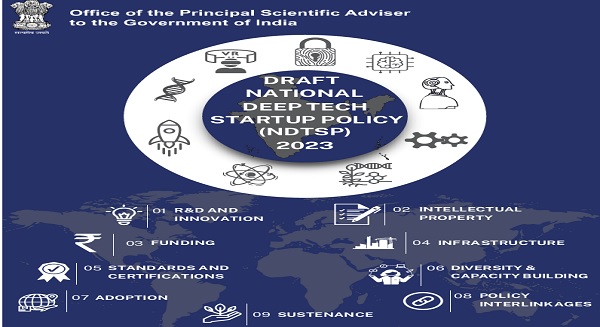
Office of the Principal Scientific Adviser
to the Government of India
Draft National Deep Tech Startup Policy (NDTSP) 2023
Date: 31 July 2023
Executive Summary
The National Deep Tech Startup Policy serves as a comprehensive framework to address the challenges faced by deep tech startups and provide definitive policy interventions to enhance the ecosystem. India’s deep tech Vision encompasses four key pillars: securing India’s economic future, progressing towards a knowledge-driven economy, bolstering national capability and sovereignty through the Atmanirbhar Bharat imperative and encouraging ethical innovation. The policy recognises the evolving nature of the definition for a deep tech startup, based on various attributes such as maturity levels, applicability to different sectors, time frames and geographical boundaries and contextual relevance. To this end, this policy document attempts a definition by non-exhaustively listing a set of commonly used attributes that could be used to design targeted policy interventions. The policy identifies nine key thematic priority areas that require intervention for initialising the creation of a conducive ecosystem.
Nurturing the Research, Development & Innovation ecosystem in the country is one of the overarching priorities to build a stronger foundation for the deep tech startup ecosystem. This policy proposes an increase in Gross Expenditure on R&D to provide renewed impetus to basic R&D, which would expand (a) the emerging science base for deep tech startups and (b) the critical base of trained scientific human resource. It also aims to suitably amend the existing research assessment practices at academic institutes and research labs to enable translation of knowledge outputs into entrepreneurial outcomes. It aims to enhance technology commercialisation through (a) creating seamless partnerships between academic institutions, research labs and industry and (b) platforms and technology commercialisation offices within academic institutes and research labs and providing (c) a set of guidelines for commercialisation of publicly funded research. The policy promotes setting up an Open Science and Data Sharing platform for encouraging collaboration and knowledge sharing among the stakeholders to promote deep tech innovations. It also aims to incentivise faculty members, through suitable amendments in their appraisal and assessment policies, to undertake entrepreneurial risk.
It is critical to strengthen India’s Intellectual Property Rights (IPR) Regime. The policy aims to do this through some key measures, such as establishing a Single Window Platform that enables an Unified IP Framework, customised for deep tech startups; guidelines on creation of Design IPs leading to greater strength in respective technology competencies; guidance on streamlining the patent application process; and unified database from all Higher Education Institutes (HEIs) populated with publication, patent and project information amongst others. The policy intends to build inhouse patent landscaping and FTO analysis capabilities among research institutes for supporting deep tech startups. Further, the policy proposes to strengthen India’s position in global IP related convention, cross border IP protection, providing provisions in Free Trade Agreement (FTA) and establishing a well-defined mechanism for evaluating the suitable amendments in National IPR Policy, that encompasses specific aspects of disruptive digital frontier technologies within the scope of patent eligibility.
Funding is a key driver of a startup’s growth journey, and access to long-term finance is particularly critical for deep tech startups for product development, validation, and scaling. It is essential to Facilitate Targeted Long-term Funding for deep tech startups. The policy builds on existing initiatives and addresses the lacunae in the ecosystem such as fragmented funds, mismatch between gestation period vs market expectation, and payment delays causing working capital issues, amongst others. This policy aims to create a platform to capture lifecycle of government grant payments; direct Corporate Social Responsibility (CSR) funds to science-based research institutions; create a thematically-focused Fund of Funds (FoF) dedicated to deep tech investments; establish a synergized grants framework across Ministries; create a pilot test fund; use of Technology Impact Bonds to invite investment from the general public and philanthropic entities; reducing regulatory compliance burden; technology validation from an expert committee to gauge commercial viability. The policy also aims to provide larger fund quanta per startup to allow deep tech startups to develop their technologies and reach product maturity within a sufficient time frame.
Providing access to shared infrastructure, for a nominal fee wherever necessary, is key to reducing initial capital expenditure for the startups. The policy aims to Enable Shared Infrastructure and Resource Sharing. It is important to increase the uptake of existing infrastructure and equipment through a centralised platform, and provide a single point of contact under Institution Research/Innovation Councils in each institution to better facilitate their access. The policy aims to strengthen the existing efforts to enable startups to create globally-competitive value-added products. To enable deep tech innovations in the strategic sectors, the policy proposes to create a network of standardised, field test and experimentation sites.
Regulations are important in the case of emerging and disruptive technologies, especially to meaningfully structure interactions among the stakeholders. To this end, the policy intends to Create Conducive Regulations, Standards and Certifications. It is imperative to organise regular, multi-stakeholder consultations between regulators, deep tech startups, industry etc, and create regulatory sandboxes to provide a safe environment to test functionality and potential risks; provide subsidies and exemptions in certification and accreditation costs. The policy aims to define the level of involvement of international players in setting standards in India based on sectoral sensitivities and strategic implications. It also intends to create standards for interoperability of subsystems which would facilitate health partnerships among deeptech startups.
It is essential to provide equal opportunity and access to entrepreneurs from Tier II/III cities, towns as well as villages, underrepresented and marginalised communities in the deep tech revolution. To achieve this, the policy aims to Initiate Capacity Building & Attract and Retain Talented Human Resource. The policy insists on expanding skill enhancement grants, and incentivising venture capitalists to invest in female-led deep tech startups. It also proposes mentorship programs and experiential opportunities for entrepreneurs and a tenured exchange program for students. The policy also intends to incentivise firms through regulating diversity reporting, equal pay and opportunity initiatives. In terms of equity in training scientific human resources, the policy promotes introducing specialised courses, bridging industry academia gap through guest lectures, mentorship programs, and fostering collaboration between international and Indian universities, updating master’s curriculum that includes tinkering, deep research or prototype based projects. It encourages graduate students to undertake internships in deep tech startups and creation of programs that focus on specific areas of deep tech. The policy also recognises the lack of domain expertise in government deep tech promotion programs and hence aims to remedy this through appropriate measures to ensure in-house capacity.
The Government of India has been making efforts to enhance public procurement from startups. The policy builds on existing initiatives like relaxation of prior experience and turnover, to Promote Procurement & Adoption of products from Indian deep tech startups. This will be done through interventions such as unbundling of projects; promoting Quality focused procurement for superior technological capabilities in critical areas. It also aims to include a user-led Collaborative Research and Development model for developing Minimum Viable Product (MVP) and an assurance of a Minimum Order Quantity (MOQ) procurement as key methods of enabling iterative development. The policy aims to use public procurement as a signalling mechanism to showcase the functionality of the deep tech products to the market. Noting that startups may not be able to meet large contracts, it intends that subcontracting be used by large firms for subcomponents of projects, to organically include startups in the value chain. Lastly, the current practice of holding open innovation challenges does not necessarily lead to further orders. The policy proposes that the concerned department(s) place a Minimum Order with the winners of such challenges.
The policy aims to Enhance Policy & Program Interlinkages with other existing policies and programs to create a conducive ecosystem for deep tech startups. The policy aims to create an Inter Ministerial Deep Tech Committee which will align objectives, strategies and implementation approaches. It aims to enable Indian deep tech startups to penetrate global markets by inclusion of deep tech startups in free trade agreements and in foreign delegations. The policy intends to mitigate import dependencies and supply chain vulnerabilities for deep tech startups in terms of raw materials such as critical minerals, and intermediary as well as research equipment by systematic mapping and targeted interventions.
Deep tech startups encounter specific challenges in sustaining growth and overcoming the Valley of Death. It is critical to focus on Sustenance of Deep Tech Startups. The policy focuses on addressing key barriers such as funding limitations, resource and infrastructure constraints, and understanding risks associated with frontier technologies. It intervenes through designing funding mechanisms that take failing by design as key principle; funding sensitization programs for startup founders to enable them to diversify their funding; establishing a centralised core mission office, that will undertake activities such as, inter alia, simplifying approval procedures, enabling IP protection, creating awareness in Tier II and II, cities and designing a monitoring mechanism, based on mapping key performance indicators.
| Vision
To drive innovation, economic growth, and societal development through the utilisation of advanced research-based deep tech inventions. To support deep tech startups and secure India’s financial future, progress towards a knowledge-driven economy, and bolster productivity. To unleash the power of technological growth in all sectors, catalyse multiplier effects and create new industries for enhancing India’s capability and global competitiveness. |
A. Introduction
1. Background
1.1. The National Deep Tech Startup Policy serves as a comprehensive framework to address the challenges faced by deep tech startups and provide definitive policy interventions to enhance the ecosystem. Recognizing the significance of deep tech in driving innovation, economic growth, societal development and national security, this policy outlines a vision for the Indian Deep Tech Ecosystem. India’s deep tech vision encompasses four key pillars: securing India’s economic future, progressing towards a knowledge-driven economy, and bolstering national capability, sovereignty through the Atmanirbhar Bharat imperative and encouraging ethical innovation.
1.2. The policy aims to make substantial contributions to India’s GDP by boosting high-tech exports, enhancing economic competitiveness, and fostering self-reliance. It also underscores the positive impact of deep tech in improving the living standards of society, addressing critical areas such as food security, healthcare, water management, energy, transportation, and tackling the challenges of climate change, sustainability, and national security. Recognizing the pivotal role of talent and skills, the policy places emphasis on diversity and inclusion as core tenets of enabling employment opportunities and developing a skilled workforce to support the growth of the deep tech ecosystem.
1.3. Building upon India’s advancements in the information technology and e-commerce sectors, the policy emphasises the imperative of expanding the focus on deep tech in all economic sectors and critical infrastructures. By investing in research and development, India can harness advanced scientific bases to foster technological innovation, create new industries, and enhance productivity and efficiency in existing sectors.
2. Definition and Attributes
2.1. The policy recognises that while the parameters that define a ‘deep tech startup’ remain unchanged, the ‘depth’ at which such parameters are explored in a given context is constantly evolving based on various attributes such as the maturity level of emerging technologies and their applicability in different sectors, time frames and geographical boundaries. Consequently, alongside defining a deep tech startup, it is imperative to frame a contextually relevant understanding of the Indian deep tech startup ecosystem. To understand a deep tech startup, we must first understand what isn’t a deep tech startup, then identify parameters that define a deep tech startup.
2.1.1. A non-deep tech startup typically relies predominantly on the business model as its differentiating factor or moat, rather than science and technology as the underlying competitive edge. It is based on easily producible or replicable technologies without significant advancements.
2.1.2. A deep tech startup involves early-stage technologies based on scientific or engineering advancements, which are yet to be developed for any commercial applications.
2.1.3. A deep tech startup typically produces a solution along an unexplored pathway based on new knowledge within a scientific or engineering discipline or by combining knowledge from multiple disciplines.
2.1.4. The above two factors enable deep tech startups to create and own Intellectual Property (IP), which is its distinguishing parameter from non-deep tech startups.
2.1.5. A deep tech startup carries a large technical or scientific uncertainty and hence presents a large opportunity or risk depending upon whether or not it succeeds.
2.1.6. A deep tech startup is characterised by extended development timelines and requires high capital intensity.
2.2. The level of ‘depth’ the deep tech startups exhibit along each parameter is dependent upon the maturity of the scientific and technological pursuit in the given context. In a context where investments in R&D is high and academic and industry research is advanced, deep tech s that leverage more fundamental research, have wider applications, require longer gestation periods, and sustain through more investments are more feasible and viable. In contrast, when investments in R&D are lower and academic and industry research is incremental, the nature of deep tech is shallower.
2.3. In order to categorise deep tech startups, it is necessary to undertake a thorough examination of the deep tech ecosystem. The policy proposes the establishment of a working group that would be responsible for identifying techno-commercially viable startups, with special emphasis on those that hold strategic significance, and to do so consistently over time. The attributes outlined earlier for identifying a deep tech startup can further be expanded upon. The parameters for identification of deep tech startups can vary based on the technology they are working on (A suggestive parameter to identify Hardware and service deep tech startups can be found in Annexure- I(a)). This would enable the creation of a definitive criterion for determining when a startup meets the qualifications for being classified as “deep tech.” Such a criterion would assist different stakeholders in identifying and supporting deep tech startups more effectively.
3. Current State
3.1. The lack of a standard definition of deep tech led to startups not being classified appropriately. There is an urgent requirement of mapping the Indian deep tech ecosystem. Here is a snapshot of the current deep tech ecosystem of India:
3.1.1. India’s deep tech ecosystem is thriving, characterised by a multitude of startups that are committed to harnessing advanced technologies to create groundbreaking solutions. According to Startup India’s database, there are 10,298 DPIIT-recognized startups classified across various sub-sectors within the larger deep tech space as of May 2023. (A detailed list with sub-sector breakdowns can be found in Annexure- I(b)).
3.1.2. Deep tech startups form a substantial portion of India’s startup ecosystem, underscoring their notable presence and influence within the broader industry.
3.1.3. A majority of deep tech startups operate on a business-to-business (B2B) model [2], indicating their focus on serving enterprise clients and providing technology solutions tailored to specific industry needs.
3.1.4. In the last decade, Indian deep tech startups have experienced remarkable growth, attracting significant funding and a surge in mergers and acquisitions, highlighting their strong potential and appeal to investors and larger companies.
3.1.5. The deep tech startup landscape in India saw the addition of new ventures, bolstering the ecosystem and nurturing a dynamic entrepreneurial culture within the domain of advanced scientific development.
3.2. Overall, this demonstrates the rapid growth and potential of the deep tech industry in India, with a significant number of startups, substantial funding, and a predominant B2B business model. These factors indicate a promising future for Indian deep tech startups, poised to drive innovation and contribute to the country’s technological advancement. However, a broader analysis of the deep tech ecosystem with sector specific study should be conducted to define and standardise so that deep tech startups are being classified appropriately. The survey should also focus on identifying the key challenges faced in each sector. A baseline survey to establish a comprehensive view of the deep tech startup ecosystem in India should be carried out. This baseline survey should be followed with periodic surveys, conducted by third party agencies to evaluate the working of the policy. From a national security perspective, the survey must also include suitable questions that allow an assessment of the level of foreign investment (if any) in the particular entity/startup involved in that deep technology, the country of origin and whether there are any technology sharing agreements with other countries’ entities etc. or use of foreign-registered patents/IPs in any part of the idea. This information would be useful especially when the question of Government support or IP registration arises later on.
3.3. There are several policies and initiatives supporting and addressing various aspects crucial to India’s startup ecosystem. These noteworthy initiatives directed to promotion and sustained growth of startups can be extended to deep tech startups as well. For instance, access to finance is currently being facilitated through initiatives like Biotechnology Innovation Fund AcE – Biotech Ignition Grant – BIG [3] and Startup India Fund of Fund Scheme, BIRAC SEED Fund [4] and Technology Development Fund. Regulatory frameworks and certification schemes such as the RBI’s Regulatory Sandbox exercise and the Certification Scheme for Unmanned Aircraft Systems by the DGCA are notable. Inclusion of entrepreneurs from Tier II/III cities, digital inclusion through initiatives like Digital India BHASHINI [5] and Digital India GENESIS (Gen-Next Support for Innovative Startups) [6], and support for women scientists through schemes and fellowships are prioritised. The National Research Foundation aims to seed, grow and promote Research and Development (R&D) and foster a culture of research and innovation throughout India’s universities, colleges, research institutions, and R&D laboratories. Public procurement relaxations for startups are implemented by the government, exemplified by Kerala’s proactive approach. High Quantum seed funds like NIDHI PRAYAS and iDEX are available for scale up, which are necessary for deep tech startups. The schemes, policies and missions such as Tamil Nadu Technology Hub, TIDE 2.0 Scheme (Technology Incubation and Development of Entrepreneurs), NGIS, SERB-SUPRA grant, National Supercomputing Mission, and the National Education Policy along with several other international initiatives like the Indo-US Joint Working Group on Artificial Intelligence are contributing to the growth of the deep tech startup ecosystem (Details are provided in annexure I(c). Trade and foreign policy initiatives are being leveraged to promote the technology ecosystem, including the establishment of trade and technology councils, bilateral initiatives like iCET, and incorporating technology in free trade agreements. Sectoral policies such as the Indian Space Policy 2023 [7] enables deep tech startups in the space sector through creation of an independent nodal agency like IN-SPACe [8], creating a predictable and enabling regulatory regime, delineating roles of stakeholders with the Government acting as an anchor investor. Along with the policy, SpaceTech Innovation Network (SpIN) – a joint initiative of ISRO and Social Alpha, is a dedicated platform for innovation curation and venture development for the burgeoning space entrepreneurial ecosystem. A public-private collaboration for startups and SMEs in the space industry, this novel partnership aims to work towards identifying and unleashing the market potential of the most promising space tech innovators and entrepreneurs in India. The selected startups and innovators will be able to access infrastructure and resources from both Social Alpha and ISRO. They will be provided active hand holding in critical areas including access to product design, testing and validation infrastructure, intellectual property management, go-to-market strategy, and access to long-term patient capital, among other technical and business inputs. Several state governments have taken initiatives to promote the deep tech ecosystem. Telangana has set up T-Hub, launched six frameworks on emerging technologies and launched Centres of Excellence jointly with industry bodies to execute these frameworks, to provide a conducive ecosystem to enable the growth of deep tech startups.
4. Global Scenario
4.1. Major economies around the world have implemented various strategies to leverage the benefits of deep tech innovations and science-based startups to achieve socio-economic competitiveness by strengthening infrastructure, attracting investments and fostering skills and talent. Some notable approaches are discussed here:
4.1.1. Countries have established dedicated startup campuses as collaborative hubs for deep tech innovation. These campuses attract talent, investors, and universities, fostering growth and advancement.
4.1.2. Countries have launched comprehensive brand campaigns to promote their deep tech ecosystem, showcasing their strengths and unique offerings. This campaign enhances internal credibility and attracts global stakeholders, generating further interest and investment.
4.1.3. For attracting global talent and experienced mentors, countries have implemented international startup residence programs, acting as magnets for individuals who contribute to local deep tech founders’ growth and development, bringing diverse perspectives and expertise.
4.1.4. By attracting superior venture capital investor talent, countries ensure access to necessary funding and support for deep tech startups. Additionally, establishing a secondary market for investments and leveraging pension funds expands private sector growth funding, benefiting deep tech startups and facilitating ecosystem expansion.
4.1.5. Governments also introduce tax incentives and relevant exemptions to encourage deep tech investments, creating a favourable investment climate and stimulating financial support for ventures.
4.1.6. For developing skilled workforce, governments actively scout talent globally, enabling exchanges and collaborations. Dedicated startup ecosystem infrastructure within local universities nurtures deep tech ventures, fostering innovation and competitiveness. Furthermore, comprehensive university programs specialising in deep tech provide tailored education and training, equipping students with the skills and knowledge necessary for success in the industry.
4.2. The global scenario of deep tech ecosystems is witnessing significant growth and development, with various initiatives, programs, and organisations emerging to support and nurture deep tech innovation. UK Catapult, Belgium’s WSL (Wallonia Brussels Startup Launchpad), Germany’s EXIST Program, and Canada’s Innovation Superclusters Initiative are some examples of deep tech ecosystems that highlight the importance of collaboration, sector-specific focus, comprehensive support, funding access, internationalisation support, and entrepreneurship education in deep tech ecosystems (details on programmes in Annexure- I(c)).
4.3. Drawing inspiration from these strategies, India intends to cultivate a thriving deep tech ecosystem, fostering innovation, attracting talent, and facilitating investment.This policy endeavours to elevate India’s standing as a global leader in deep tech, thereby fostering economic expansion and technological progress within the nation.
B. Objectives: Deep Tech Ecosystem Priorities
1. Strengthen the research and innovation ecosystem leading to scientific breakthroughs and technological advancements thereby propelling India’s knowledge-driven economy.
2. Bolster the Indian intellectual property regime and ensure competitiveness for international deep tech startups to establish and operate their entities in India.
3. Facilitate access to diverse sources of capital via specialised funding programs, increased venture capital/angel investments and tailored government financial support avenues.
4. Foster a culture of cutting-edge research in academia that is industry relevant, and has potential to translate into product/ technology leads.
5. Enable infrastructure and resource sharing with academic institutions, R&D laboratories, and large manufacturing corporations for faster product development.
6. Share and create facilities for product prototyping and validation to foster hardware based deep tech startups.
7. Create a conducive regulatory environment for innovation to thrive by using streamlined frameworks, laying out clear regulatory requirements and introducing exemptions and incentives.
8. Attract and retain the finest human capital for superior deep tech innovations keeping equity, diversity, and inclusion as the core tenets.
9. Promote public and private adoption of indigenous deep technologies through favourable procurement rules and innovative adoption mechanisms and tap into global markets for Indian deep tech products.
10. Interlink with the priorities of existing national policies and missions to ensure India’s position in the global deep tech value chain.
11. Solve for India’s local, societal, and business problems and focus on few key sectors aligned with national interest to enable higher investments and make India a global hub in these sectors.
12. Facilitate the sustenance of deep tech startups by helping them overcome the Valley of Death (VoD) phase through targeted solutions addressing funding limitations, resource constraints, limited business knowledge, and risk management.
C. Policy Priorities and Interventions
1. Nurturing Research, Development & Innovation
1.1. Overall investment into R&D activities, including the focused investment into basic and curiosity-driven scientific research, has a significant impact on the deep tech startup ecosystem in terms of (a) generating new know-hows, scientific breakthroughs, and (b) ensuring critical mass of skilled scientific workforce to match the talent demand. Increasing the Gross Expenditure on R&D (GERD), with appropriate share of public and private investment, is a primary policy priority. Additionally, promote participation of private patient capital investment in deep tech research and development, enabling growth of high risk ventures.
1.2. It is essential to calibrate the existing research assessment practices at higher education and research institutions in such a way that it incentivises the researchers, faculty members and students to translate their knowledge outputs to entrepreneurial outcomes as deep-science and deep tech innovations.
1.3. Intellectual Property (IP) and knowledge outputs from premier academic and research institutions are landlocked from the larger ecosystem which hampers the commercialization of available knowledge. This policy aims to (a) facilitate seamless partnerships between academic institutions, research labs, and industry players to bridge the gap between knowledge production and commercialization (b) establishment of collaborative platforms and technology transfer offices within academic and research institutions to encourage technology transfer ensuring deep tech innovations can be shared, commercialised, and integrated into the larger ecosystem. These offices can also support intellectual property protection, licensing agreements, and matchmaking between startups and potential industry partners (c) provide guidelines to strengthen translation and commercialization of public funded research outcome.
1.4. The difficulties in identifying high-potential patents as well as inefficient evaluation and prioritisation of publications and research result in missed commercialization and translation opportunities. To address these issues, this policy proposes the formation of an organisation – The Centre for Deep Tech Translation [CDT] to assess Indian research (publications, patents, etc.) for potential commercialization.
1.5. The challenges in enhancing technology transfer and commercialization include lack of streamlined coordination, difficulty in identifying high-potential intellectual properties (IPs), and limited support for struggling startups with valuable IP assets. The inefficient evaluation and prioritisation of IPs within the university result in missed commercialization opportunities. To address these challenges, this policy recommends implementing a Single Point of Contact (SPOC) model for the Technology Transfer Office (TTO) in universities. The SPOC will (a) evaluate and prioritise IPs with high commercialization potential, (b) foster industry engagements, and (c) support startups struggling to scale or find an exit. This ensures the protection and effective leveraging of valuable IP assets for startup success.
1.6. Access to information on available resources is limited, this policy aims to address the gaps by (a) developing an online repository that provides comprehensive information on global research and innovation grants, funding opportunities, and specialised laboratories (b) establishing dedicated funding schemes to support startups’ participation in international conferences, workshops, and collaborative projects to ensure accessibility for entrepreneurs, researchers, and innovators to leverage international resources and collaborations for their deep tech projects.
1.7. The shift from being data-rich to becoming a data-intelligent destination is essential as deep tech startups play a crucial role in driving data demand. To catalyse innovation in Deep Tech, it is imperative to transform dynamic data repositories, underscoring the significance of data sharing and accessibility throughout the deep tech startup ecosystem. To this end, the policy aims to set up an Open Science & Data Sharing Platform to encourage collaboration and knowledge sharing within the deep tech community. Sharing research data, methodologies, and findings of startups will foster collaboration, transparency, and reproducibility. This can help in developing standardised solutions that are accessible and affordable to a wider audience. Implementing effective mechanisms to facilitate the transfer and commercialization of publicly funded academic research outcomes is essential to strengthen and propel the deep tech startup ecosystem.
1.8. The policy encourages innovation by academic institutions as a key nucleus in driving the deep tech ecosystem. To enable this, this policy aims to encourage entrepreneurship and innovation from faculty members and students. At present, the academic system in the higher education institutes (HEI) of India provides limited incentive for faculty members to translate their knowledge outputs to entrepreneurial outcomes as deep-science and deep tech innovations as patents have little weightage in annual appraisal of a faculty member. Similarly, many HEIs hire Professors of Practice, faculties who have wide industry experience, but their utilisation has been limited. The policy aims to address this and work with concerned stakeholders to create a framework that can be used by HEIs to incentivise such entrepreneurship, by suitably amending their appraisal policies.
2. Strengthening Intellectual Property Regime
The National Intellectual Property Rights (IPR) Policy [9] of 2016, adopted on May 12, 2016, has yielded significant achievements. It has strengthened the institutional framework by transferring the administration of the Copyright Act, 1957, and the Semiconductor Integrated Circuits Layout-Design Act, 2000, to the Department for Promotion of Industry and Internal Trade, enabling synergy and coordination among IP offices and Acts. The merger of the Copyright Board with the Intellectual Property Appellate Board (IPAB) has further streamlined operations. Steps to reduce pendency have resulted in a substantial decrease in patent and trademark applications awaiting examination. Patent and trademark filings have witnessed notable increases. Process re-engineering efforts, such as amending Patent Rules and expediting patent examination have enhanced efficiency. The comprehensive revision of Trademarks Rules in 2017 has further improved the IP regime. The policy has fostered awareness through programs conducted in academic institutions, inclusion of IPR content in the Commerce stream curriculum, and the establishment of Technology and Innovation Support Centres (TISCs). India’s rank in the Global Innovation Index (GII) has significantly improved. Moreover, an IPR Enforcement Toolkit now assists police officials in tackling IP crimes. IPR Cells have been established in universities, and Institution Innovation Councils (IICs) have been set up in Higher Education Institutions (HEIs).
In accordance with the vision document outlined in the National IPR Policy 2016, there is a planned consolidation and integration of all forms of intellectual property (IP), along with relevant statutes and agencies operating within the Indian IP ecosystem. The primary goal of this endeavour is to establish a unified platform that facilitates the creation and effective utilisation of synergies among diverse types of IP, while duly recognizing and addressing the interconnectedness that exists between them. Building upon this direction for intervention, this policy has identified specific challenges and proposes suitable solutions that are pertinent to deep tech startups:
2.1. The deep tech startup ecosystem in India lacks specialised support in terms of filing and obtaining patents for frontier technologies. The intellectual property (IP) regime faces several challenges in this regard including: a) Ensuring the novelty of inventions. b) Managing conflicts related to open-source technologies. c) Ensuring the security of trade secrets. d) Conducting comprehensive prior art searches. e) Navigating international IP laws. f) Risk of intellectual property being lost to foreign entities. These challenges obstruct the effective protection and management of IP rights in the Indian deep tech sector which hinders innovation protection thereby leading to trade secret breaches, and limited IP enforcement. A deep tech centred Single Window Platform should be developed to enable:
2.1.1. Establishment of a Unified IP Framework customised to deep tech startups.
2.1.2. Guidelines on creation of Design IPs centric to deep tech startups increasing India’s strength in respective technology competencies and entrepreneurship.
2.1.3. Guidelines on implementing strong cybersecurity protocols and measures to protect sensitive data.
2.1.4. Implementation of monitoring mechanisms to track access and usage of confidential information, detecting and addressing unauthorised activity promptly.
2.1.5. Provide guidance on streamlining the patent application process for ensuring efficient protection of deep tech startups.
2.1.6. Unified database from all HEIs, populated with publication, patent, and project report information from all departments. The database above will have a user-friendly search engine and interface. The database will be audited every year to generate insights into the intellectual property creation, especially pertaining to deep tech.
2.2. Build in-house capabilities among research institutes for supporting deep tech startups with deep science patent landscaping and Freedom-to-Operate (FTO) analyses for identifying the novelty in these frontier technologies. While the government would spruce up its capabilities, similar efforts are required at the source. The premier institutes should be supported financially to hire (a) Industry standard and industry compensation paid IP Managers, IP Drafters, and IP Lawyers, well versed in deep tech and deep science invention to file patents and (b) Government empanelled national level IP firms to support IP filings and commercialization and understand legal regulations in case of international patent filing.
2.3. The Ministry of Electronics and Information Technology’s Support International Patent Protection in Electronics & IT (SIP-EIT) scheme [10] aids Indian MSMEs and startups in filing international patents, fostering innovation, and acknowledging the significance of global IP. The scheme offers reimbursement of up to Rs. 15 lakhs per invention or 50% of total patent application expenses, whichever is less. Similarly, the BIRAC-PATH (Patenting and Technology Transfer for Harnessing Innovations) [11] scheme is a grant-in-aid program that provides financial assistance to innovators supported by BIRAC to secure their intellectual property (IP) rights. However, to further support deep tech startups, India should pursue strengthening its position in global IP related convention organisations and agenda setting bodies and ensuring cross-border IP protection and include enabling provisions in Free Trade Agreements (FTAs) to extend protection and promotion of Indian IP in global markets. In known cases of cross border IP breach, it is recommended that legal and policy aid should be available at the proposed Single Window Platform since such endeavours would be cost intensive for an inventor in an academic/research institution.
2.4. The current National IPR Policy 2016 does not extensively address the eligibility of “computer programs per se, or algorithms” for patent protection. Most deep tech startups in India rely on advanced digital frontier technologies, which is heavily dependent on algorithms and APIs as the primary source of novelty. To ensure Indian deep tech startup competitiveness in the global market, it is imperative to recognise this uniqueness in the National IPR policy. Therefore, a well-defined mechanism should be established for evaluating the suitable amendments that encompass unique characteristics of digital frontier technologies within the scope of patent eligibility.
2.5. The policy recognises the importance of organisational capacity in implementing and promoting IP generation for deep tech startups. To this end, it aims to bolster the capability by training and awareness on novelty detection, understanding open-source licensing, prior art detection etc. The training should be undertaken for both, IP cells within HEIs and concerned government organisations and departments. The training shall be made available digitally and in physically deliverable formats, in English and regional languages to enhance accessibility.
2.6. In the case of technologies developed for strategic sectors with majority contribution of government funding;
2.6.1. The Government shall have Government Purpose Rights (GPRs) which should be a non-exclusive, non-transferable irrevocable license to use the intellectual property for internal consumption or manufacture. The Government may use this right to manufacture either directly or through sub-contractor. The Government shall be liable to pay license fee/ royalty fee for use of GPRs in intellectual property/technology/product. A royalty up to 2% on each manufactured unit with a cap on total maximum royalty payable will be included in the contract with innovator, if Government or its sub-contractor uses the intellectual property generated for defence manufacturing. The cap on total maximum royalty payable to the innovator shall be decided on a case-to-case basis.
2.6.2. The Government shall have ‘March-In’ rights for all items covered under its GPRs for reasons of national security and other strategic reasons. ‘March-In’ Rights shall include the right to work the patent, either by itself or by another entity on behalf of the Government, in cases where (i) the company/institution fails to work the patent on its own within a specified and reasonable period of time (ii) the effective management and control of the company/institution is taken over by a foreign company without the approval of the Government. The march in rights of the Government shall be subject to the payment of acquisition cost/licence fee/ royalty fee by the Government or the concerned production agency as per the terms stated in preceding paragraph.
3. Facilitating Access to Funding
Funding is a key driver of a startup’s growth journey, and access to finance is particularly relevant for deep tech startups supporting high funding requirements for product development, validation, and scaling. There are various initiatives by the Government that directly or indirectly address the issue of lack of finance to startups. Some of the noteworthy initiatives are the Biotechnology Innovation Fund for AcE (Accelerating Enterprises) [2] and SIDBI Fund of Fund Scheme [12], both of which provide capital to SEBI-registered Alternative Investment Funds (AIFs), who in turn invest money in growing Indian startups through equity and equity-linked instruments. BIRAC SEED Fund [4] that provides Grant-in-aid Assistance to selected BIRAC funded incubators and acts as a bridge between promoters’ investment and Venture/Angel investment. To encourage participation of public/private industries especially MSMEs and Startups to create an ecosystem for development of cutting edge and dual use technologies, Technology Development Fund (TDF) [13] has been established by the Ministry of Defence and is implemented by DRDO. Funding up to INR 50 Cr subject to a maximum of 90% of the total project cost to be covered through provision of grants-in-aid to the industry.
The Credit Guarantee Scheme [14] aims to strengthen the credit delivery system, facilitate flow of credit, and create access to finance for the unserved, under-served and underprivileged as finance flows from conventional lenders to new generation entrepreneurs. There are tax exemptions for investors (VCs/AIFs) earning capital gains if invested in the Fund of Funds scheme and newly formed manufacturing MSMEs. Additionally, profits of eligible DPIIT recognized startups are exempt from income-tax for a block of 3 years out of 10 years since incorporation. Similarly, the CLCSS Scheme which supports financial help to MSMEs to upgrade their technology and implement advanced technological platforms is a key initiative for technology-intensive startups. There is also precedence of matching contribution in the iDEX program wherein the SPARK Grantees are expected to contribute equally in addition to government grants for covering product research and development costs. Additionally, the JanSamarth Portal serves as a one-stop digital platform connecting Credit Linked Government schemes, providing easy access to beneficiaries and stakeholders with the core objective to foster inclusive growth and sector development through streamlined digital processes.
Aligned with the aforementioned objectives, the policy aims to enhance and propel the current programs and initiatives by implementing targeted interventions specifically designed for the deep tech ecosystem.
3.1. In specific instances, the disbursement of government funds tends to be slow, fragmented, and siloed, lacking timely feedback mechanisms. A centralised platform/single window to capture the lifecycle of government grant payments (from disbursal, tracking and feedback) with the aim of streamlining financing and improving transparency should be constituted.
3.2. Research and Development of deep technologies are time and money intensive. Long-term patient grants for selected science-based research institutions that form as sprawling hubs for deep technologies by routing CSR funding can be established. The Government may initiate a Committee to assess and analyse current CSR laws, recommend amendments, and advise on CSR grant disbursement such as contribution to incubators and R&D projects, as specified in item (ix)(a) and contribution to institutes/ organisations, engaged in research and development activity (incl. Department of Science and Technology (DST), as specified under item (ix)(b) of Schedule VII of Companies Act, 2013. The existing CSR programs are usually short term (finishing the grant in the same FY or 2-3 years), or deployment of existing developed technology. The programs are also looking to create impact in quantifiable terms. The CSR fund, if donated to deep technology initiatives, must provide leeway for a) completely blue-sky research b) longer gestation period c) delayed impact. In case of the long-term patient grant, the CSR funding clause may suitably be amended to clearly include eligible premier privately funded institutions, or privately funded institutes of eminence as well.
3.3. There is limited availability of patient and early-stage funding for these startups. In the event of availability of funds, the shorter duration and low quantum of funds remain a challenge. For life sciences related deep tech startups, routine day to day research experiments are dependent on imported chemicals reagents. Even the equipment is very expensive and imported. A dedicated deep tech capital guidance fund should be established wherein the Government., Private LPs, Foreign Investors anchor certain commitment to a new fund/ existing fund in the form of Fund of Fund (FoF) structure. In establishing the FoF, Mother Funds should have the ability to focus Daughter Fund investments on higher-risk Deep Tech (via e.g., Mother Funds’ representation on Daughter Funds’ Investment Committees, etc.). Additionally, the fund tenure should be longer than existing funds to match the extended gestation period of deep tech startups. Deep Tech startups need a large amount of money for prototyping, product testing, and precision manufacturing with their seed capital needs (<=4M) significantly higher than pure software or services startups. The FoFs should aim for convergence with early-stage validation grant programmes (via e.g., mandating percentages of Daughter Fund pipelines that must comprise grant funded startups). FoFs may enable startup scaling by involving Daughter Funds in deep tech startup procurement programs and monitoring investees’ participation. The fund may seek matching funding from corporate networks, government financial institutions, VCs and private equity firms. Additionally, mandating Daughter Funds/Investees to leverage the domestic FoF commitment for deep tech investments would be beneficial. The early-stage funds should be of higher quantum and deployed for longer durations (>10 years). A benchmarking may be done with matured deeptech ecosystems on the quantum of grants provided. The first or early-stage seed funds to the inventors should be grant based, as in the case of international ecosystems such as the EXIST program of Germany. Equity or debt-based seed funds at this stage would dissuade inventors from participating. These grants could be conditional, with clauses such as first right of refusal from the participating LPs or VCs.
3.4. Deep tech startups require investment sustained over extended time periods, calibrated to the development cycle. The Government’s help to provide pre-commercial funding support to Indian deep tech startups to develop technology solutions and business development cases ready for private investment is critical. To boost Indian deep tech startups addressing national priorities, a common grant framework should be established across Government Ministries. Grants at two stages, Proof of Concept (minimum Rs 200 lakhs) and Tested Prototype (minimum Rs 300 lakhs), will support technology validation and market testing. Thematic funds will address vulnerability, with sector-focused initiatives like Defence Technology & Test Centre. This approach draws from successful programs like iDEX, involving the entire Government in an innovation validation ecosystem. It is critical to ensure the Government’s funding support at the pre-commercial stage to Indian deep tech startups. This will enable them to advance their technology and business maturity level for attracting private investments.
3.5. Certain deep tech startups lack sufficient funds for conducting field trials for the government due to the high development costs, resource-intensive nature of trials, and limited financial resources allocated for large-scale testing. They require pilot testing funds to conduct trials and demonstrate the on-ground feasibility of their solutions before entering the market. These funds enable them to refine and customise their technologies, validate their use cases, and attract potential customers and investors by showcasing applicability and potential impact of their innovations. The selection process for this funding may require robust screening before ensuing with the bidding process. Instead of a separate fund, these funds may be conditional, or milestone based, and sanctioned with the first or seed funds. The quantum of such funds can be based on estimations or % of total funds sanctioned initially. Only in cases this sanctioned fund is not sufficient or has been exhausted, inventors may apply for further pilot testing funds.
3.6. As deep tech startups grow, there is an increased working capital requirement for funding everyday operations of the startup, i.e., accounts payable, wages etc. as opposed to investments in tangible assets. There is a need to advocate for greater and more efficient access to credit for these startups. They also face challenges with respect to fulfilling collateral requirements of public/private loans. To address this issue, a Debt Fund in accordance with SEBI (AIF) Regulations, 2012, which enables borrowing or leveraging to fulfil the deep tech startups’ unique operational and working capital needs, backed by CGSS (Credit Guarantee Scheme for Startups), should be duly considered.
3.7. Many banks hesitate funding deep tech ventures due to concerns about nonperforming assets (NPAs) and the uncertainty surrounding the success of these startups. It is essential for public sector banks with a focus on strategic sectors to actively fund deep tech startups through debt financing. It may be proposed that banks design specialised financial products for startups, including alternative loan structures and dedicated investment banking and advisory services. Banks should draw inspiration from successful initiatives like those of the State Bank of India (SBI) in supporting deep tech startups.
3.8. Deep tech startups struggle to demonstrate immediate societal impact or time to market, which affects their funding prospects. Thus, there is a lack of clear market validation indicators such as revenue, profitability and success metrics that hinder ascertaining the impact of VC funding and government grant programs. It is important to note that up to 98% of funding for deep tech startups in India comes from international sources. Certain fiscal incentives such as tax rebates can be explored to attract domestic general partners (GPs) and limited partners (LPs) from the investor community (VCs/Angel Funds) if they allocate a certain percentage of their corpus to deep tech startups. Any such tax reforms and their implementation framework to support startups should involve a comprehensive review of the angel tax regime and ESOP taxation regime in consultation with the Ministry of Finance. This may include designing a revised angel tax regime and re-assessing the ESOP taxation regime to address challenges faced by startups and employees.
3.9. Deep tech startups face significant hurdles in terms of both time and financial investment, as long gestation periods pose major challenges. To address this, a Technology Impact Bond (TIB) Model should be established to attract investments during the development phase of a deep tech solution. Under this model, investors will receive a financial return if the deep tech solution created by the startup achieves success. Eligible investors may include individuals, HUFs (Hindu Undivided Families), trusts, universities, and charitable institutions. Additionally, individual investors who undergo a change in residential status from resident to non-resident will have the option to retain their TIB investment until early redemption or maturity.
3.10. High compliance burden and onerous taxation is leading to startup ‘flipping’ i.e. locating to other countries. The policy aims to reduce compliance burden and improving regulatory ease for domestic transactions by (a) providing an easier merger and acquisition framework with objective criteria such as business continuity purpose of business etc, (b) improving the taxation regime by exploring more efficient methods of granting tax exemptions to startups (increasing the current 3 year DPIIT mandated exemption to 5 years) , and enabling ease of transactions with global markets by (c) improved Exchange Earner’s Foreign Currency (EEFC) Account regulations to reduce transaction cost. In case flipping is inevitable, how the Indian ecosystem can continue to benefit may be explored. In many cases, the investors or the funding sources force the flip to happen. A clear dialogue is required with the investors / VCs about continuing to support startups in India. The grant agreements should address the issue of flipping early on.
3.11. Significant impact of heavy custom duty on imports, is another major challenge faced by deep tech startups which impedes their growth. To alleviate this burden, the policy aims to explore measures such as custom duty exemptions or reduced customs tariffs on imported equipment, machinery, and raw materials that are vital for deep tech startups. This would help minimise costs for startups, particularly those operating in manufacturing or technology-intensive sectors, enabling them to access essential resources at a competitive price.
3.12. Funding provided to deep tech startups may not always reflect user requirements and application imperatives. The policy aims to (a) encourage collaboration between technical agencies and user domain agencies (such as healthcare, transportation, energy, etc.) to align funding opportunities with specific industry needs and priorities. (b) develop joint funding initiatives that require deep tech solutions to address real-world challenges faced by different sectors. The user agencies must provide access to technical infrastructure (as applicable), mentoring, paid pilot assistance, eased out procurement process for the technologies, no embargo on selling it to other customers (with exceptions), if user agencies are eligible for CSR spend, such as PSU, may allocate % of their funds to be spent on funding deep tech research.
3.13. The quantum of funds for deep tech startups should be relevant to the technology being developed and the market that India is targeting within a horizon time. The present quantum of funding and duration of support needs to be increased.
3.14. Technology experts’ commercial validation plays a crucial role in securing funding, but there is a lack of sufficient technical due diligence expertise for evaluating deep tech startups. This lacuna arises because of the complex nature of deep tech startups. The disbursement process of government grants can incorporate a validation component wherein a committee comprising technical experts from industry, academia, research, and development, as well as government entities, assesses the technical viability of deep tech startups. The technology experts selected by the implementing agencies may be validated / vetted by the technical agencies / user agencies providing the funds. Furthermore, the participation of technical experts from HEIs will be incentivised by providing nominal remuneration and/or considering such participation and its outcome in the appraisals of the concerned faculty.
3.15. Sponsored incubation programs and universities should consider increasing the investment ticket sizes for selected startups. Rather than maximising the volume of investments, it is advisable to select fewer startups and provide a higher capital commitment. This will allow deep tech startups to have the resources they need to develop their technologies and reach market-ready maturity.
4. Enabling Infrastructure Access and Resource Sharing
Access to shared scientific infrastructure is key to increasing the viability of deep tech startups. By reducing upfront capital investment, such shared resources reduce the entry barriers for deep tech startups. Multiple schemes in India have aimed to provide this scientific infrastructure and enable shared access. Some of the schemes that have enabled this are mentioned below:
Based on institutional location, scientific infrastructure has been a part of academic institutions, wherein the startups from the institute and outside may get incubated, such as in SID at IISc, NCCRD at IIT-M; at research centres such as NCBS, NCL Venture centre C-CAMP which provide incubation and infrastructure for biotech startups. Technology domain specific efforts such as through provisioning of high compute power by the AIRAWAT computer at C-DAC, Pune. Standalone incubators with cutting edge equipment and infrastructure have also been promoted by State governments such as T-HUB in Hyderabad. Efforts to improve the efficiency of use of existing scientific equipment through I-STEM have shown some positive results. The National Data Sharing and Accessibility Policy 2012 [15] seeks to make data, created through investment by or due to public investment, open to the wider public. The Indian Space Policy 2023 [7] facilitates dissemination of satellite-based remote sensing data, as well as applications based on such data. It is essential to strengthen and synergize these existing efforts in terms of providing seamless access to scientific data and frontier infrastructure.
4.1. Deep Tech startups, conducting R&D on an uncertain and expanding science base, require investment in capital intensive equipment. This can be remedied by providing access to such shared equipment and infrastructure at nominal fee to startups, reducing their business risk. This can be done by (a) establishing Frontier Scientific Infrastructure (FSI), in academic institutions and R&D establishments (b) Such ‘infrastructure’ will be financed through multiple modes, inter alia infrastructure bonds, budgetary allocation, private investment. This infrastructure will need to be upgraded on a regular basis to maintain its continuous advantage. Most premier institutions and universities lack ready, usable space to establish such facilities. To make it truly common and shareable, such infrastructure may be established in advantageous locations, closer to the industry clusters, with shared governance with representatives from academic institutions and industry from that region. This scientific infrastructure will be technology domain specific, such as high compute infrastructure with advanced processors for AI development, fabrication plants for semiconductor startups, rocket and propulsion system test centres, rocket launchpads, tracking and telemetry centres for space tech startups etc.
4.2. Academic institutions already have adequate equipment and scientific infrastructure that is currently underused. These institutions will be incentivised to open up their labs to startups. This will be done by (a) strengthening existing platforms, by bringing out the incentives for both stakeholders- Regular usage will keep the equipment and infrastructure functional while startups will get access to specialised equipment at nominal fee. This nominal fee will be used towards maintenance and repair of such equipment. (b) Every university and departments within them will have a single point of contact under their Institution Innovation Councils (IICs) to better facilitate this leasing of equipment and improving access to scientific infrastructure. Through IICs, established at each institution, all educational institutions may be encouraged to provide a list of equipment funded through government schemes and programs along with its usage charges to a central repository. Subsequently, the institutions must be encouraged to create online booking platforms for such equipment. Special emphasis needs to be provided by creating a sharing network of large infrastructure already created through schemes such as SATHI, SAIF, TIH, CSIR labs amongst others. The shared infrastructure network of a cluster / region / sector may have a utilisation committee and business development professionals to improve its marketability and utilisation.
4.3. Owing to the vast and varied demography, India generates a high volume of data. However, given the potential of data that is available, we do not leverage it to the fullest. Furthermore, startups, due to operational and financial constraints are unable to collect substantial amounts of data themselves. The above factors lead to market concentration. It is imperative that this data, especially from space, agriculture, health, meteorology, and climatology sectors, amongst others be made available to startups for its wider usage. The access mechanism to this data must be supplemented with appropriate data and network safety protocols, especially for data which is considered to be sensitive. This is important as data from space, meteorology etc. may be sensitive and therefore tighter protocols should be implemented to prevent such sensitive data from being transferred and processed outside India without adequate safeguards. The current efforts being made need to be strengthened to enable startups to make value-added products and services by expanding such policies. These policies will be complemented by institutional mechanisms to enable data dissemination to a wider set of stakeholders. Policies and efforts to make necessary (non-sensitive) data available to startups should involve identification of relevant use cases. The process of creating the relevant data sets should involve relevant stakeholders including startups to ensure that the data that is made available is of value to the startups in one or more sectors. Multiple mechanisms will be explored to do this, including data trusts, that will balance privacy of citizens and economic benefits of data as a resource. Student internships through IIC may be created for students to participate in creating, updating, and managing data sets as identified under the scheme.
4.4. To enable deeper interpretation of large datasets and access specialised domain knowledge, it is crucial to provide users with both data access and expertise. Examples include genomics, proteomics, metabolomics, satellite imaging, geospatial data, and clinical imaging. This can be achieved through a fee-for-service model, favouring entrepreneurs and startups. By combining data access and domain expertise with an affordable pricing structure, users can be empowered to leverage comprehensive insights and support innovation in these complex domains.
4.5. For strategic sectors such as defence and security, space, and atomic energy that have specialised applications and narrow operational scenarios, Indian deep tech startups have restricted access to test sites for demonstration and user-linked testing and validation. Access to a network of standardised, field test and experimentation sites must be enabled for deep tech startups to facilitate demonstration, testing, validation in accordance with the end-user followed by the iterative refinement of the product to converge with the adopter’s requirements. IN-SPACe [8] has taken measures to enable such access to infrastructure, including sub-subsystem testing, launch facilities, tracking support etc. to non-government entities, including startups at a reasonable cost.
4.6. Cross-pollination with international deep tech startups will benefit Indian deep tech ecosystem, this policy aims to provide co-working spaces and access to research facilities to facilitate collaboration between domestic and international startups. For example, a clean energy international incubation centre set up by DBT/ BIRAC under Mission Innovation.
4.7. Capital Equipment Procurement – If capital equipment needs to be procured for R&D, the current practice is to insist on the return of the capital asset to the funding agency upon completion of the project. The other current practice is to allow only pro-rata expenditure for the duration of the project, with the rest of the cost being borne by the start up. Enabling the allocation of capital equipment, up to a reasonable limit (e.g., up to 25% of the total project cost), without the aforementioned provisions, would be greatly conducive to the innovation ecosystem. This is especially true for electronic items like computers, servers, and GPU’s which carry a high depreciation rate (50%). This includes testing and manufacturing infrastructure for retention by the private entity for facilitating future work.
5. Creating Conducive Regulations, Standards and Certifications
Regulating technologies is important to reduce costs, increase efficiency and stimulate innovation. This must be carefully carried out while ensuring adherence to fair market transactions, ethical compliances, environmental protection, and maintaining appropriate government oversight. In the case of emerging frontier technologies that are disruptive in nature and constantly evolving, regulatory development must catch up and keep pace with the rapid technology development and scientific breakthroughs.
However, attempting to regulate a technology could lead to barriers in the research and innovation process as well as increase uncertainty and costs of the development. There are several initiatives within the Government of India that have fruitfully demonstrated the regulatory framework development as well as technology systems certification process.
The first such example is the Regulatory Sandbox exercise by the Reserve Bank of India (RBI). Regulatory sandboxes have been successfully designed and implemented by the RBI for the following Financial Technology themes – Retail payments, Cross-border payments, MSME financing and Prevention and Mitigation of Financial Frauds, with the objective of fostering competition, enhancing customer protection, and promoting competition. Several fintech entities are testing their products and services in the RBI regulatory sandboxes [16] that are end-to-end overseen by the FinTech Unit (FTU) constituted by the RBI.
Another example of a developing a comprehensive certification scheme that certifies technological systems as well as authorises testing entities is the ‘Certification Scheme for Unmanned Aircraft Systems’ [17] launched by the DGCA under the Ministry of Civil Aviation, jointly with the Quality Council of India (QCI) on 26th January 2022 that specifies the minimum criteria for UAS type certification and for authorising testing entities. DGCA shall be the authority for the issuance of Type Certificate for the UAS, QCI shall be the Scheme and Certification Mark(s) owner and NABL, a constituent Board of the QCI, shall be responsible for accrediting testing and calibration laboratories to appropriate international standards to support the Scheme.
Like the above examples, the policy aims to augment and advance the existing models and schemes through certain specific interventions for the deep tech ecosystem.
5.1. Technology development often outpaces regulatory development due to the rapid pace of technological innovation and change in the underpinning knowledge base eventually leading to regulatory risk. Regular, routine countrywide participative consultation sessions shall be convened between regulatory agencies, certification bodies, relevant deep tech startups, end-users of the technology as well as researchers and technical experts from academic institutions, incubators, and centres of excellence. This shall enable efficient knowledge sharing, sensitization of overall technology readiness among all stakeholders, potential roadblocks or impediments to the technology development process and identifying a need for intervention or support from any external body, thereby allowing authorities to develop regulations keeping pace with overall sector development.
5.2. Deep tech startups face uncertainty and instability during technology development due to lack of mechanisms for experimentation in order to comply with existing regulatory frameworks. Regulatory sandboxes shall be established across different deep technology domains that would convene startups, end-users, industry, and regulatory experts to test the technology in a controlled environment (bound by a time period and quantity limit) while gathering evidence (both qualitative and quantitative) on functionality and potential risks. To do this, engagement with startups, academia, and industry experts to understand the needs and challenges of these industries and how sandboxes can help them solve underserved and core challenges is key. The policy envisages a review and selection of startups to participate in industry-specific sandboxes based on their potential for impact and the identified needs and challenges of these industries. This would provide deep tech startups with windows of certainty and stability to accelerate innovation development, while helping regulators evolve viable evidence-based frameworks in the medium term.
5.3. Early-stage deep tech startups face issues with expensive certification costs for products (technological entities), people (human resources) and processes (manufacturing and product development) as well as purchasing standards for intermediary components which are vital to obtaining licences for the end product. Subsidies and exemptions in certification and accreditation costs shall be factored in technology development grants given to deep tech startups, either provided in advance or reimbursed subject to a ceiling. A separate pool of funds for obtaining standards and certifications shall be created for non-certified/non-standardized fully functional prototypes. This should be accompanied with relaxations in imposing standards and certifications on early-stage deep tech products which can otherwise impede innovation, product improvisation and small-scale experimental procurement.
5.4. In certain technology areas, foreign manufacturers control and influence standards development due to significant global market dominance. Involvement of international players such as major technology corporations, manufacturers, and other stakeholders in defining certification standards and regulations, shall need to be defined at appropriate levels based on sectoral sensitivities, strategic implications, and other important considerations. Suitable dialogues and engagements between international standard setting bodies and Indian cooperatives and associations shall take place to ensure adoption and expansion of Indian deep tech products to global markets. The expertise and know-how of international players should be fully utilised; however, the ultimate definition or certification of standards and regulations should remain in Indian hands as per Indian law. Testing labs shall need to have NABL and other international certifications to enhance acceptability of Indian products in global markets. Indigenization of import dependent reagents, chemicals, intermediates, components, raw material for both research & development, and manufacturing require attention on priority for India to emerge as self-reliant.
5.5. Oftentimes, there exists ambiguity on process, ownership and requirements between certifying bodies, deep tech startups and end-users at various stages of product development. A centralised, comprehensive documentation catalogue for adhering to and synergizing regulatory requirements and standards at every stage of the technology/product development lifecycle, that shall be open to access for all qualified deep tech startups in India.
5.6. There is a pressing need for interoperability standards for specialised systems that constitute and operate as an integration of multiple subsystems (working on different fundamental technologies). The regulatory agency(s) shall develop standards for interoperability between subsystems on communication protocols, hardware compatibility, data encryption, data transfer and exchange etc.
5.7. Large and distinct datasets of research, observatory and scientific data owned by various government agencies are not available to deep tech startups for building robust models, systems, and products due to lack of regulation in opening access to innovators. The different agencies responsible for generating, owning and managing these datasets should be encouraged to come up with contextual regulatory frameworks that grant deep tech innovators access to the data in an uninterrupted, monitored and secure manner.
6. Attracting Human Resource & Initiate Capacity Building
Inclusion of deep tech entrepreneurs from Tier II/III cities and towns, underrepresented and marginalised communities in the deep tech revolution is essential to create a more sustained national impact. Several initiatives of the Government can be noted in this regard. Digital India BHASHINI [5] is an initiative to enhance digital inclusion by providing Internet access and digital services in native languages, supporting startups, and promoting AI and NLP resources for MSMEs and individual innovators. Additionally, Digital India GENESIS [6] is a national deep tech startup platform aiming to scale up and sustain the tech ecosystem by supporting over 10,000 startups in the next 5 years, particularly from Tier-II and Tier-III cities, fostering inclusive techno-socio-economic development in India.
Women Scientists are an important workforce in the field of science & technology (S&T). According to the CSIR-National Institute of Science Communication and Policy Research (NIScPR) 2022 survey [18], while India produces the highest percentage of women STEM graduates in the world (about 40%), their share in STEM jobs in the country is very low at 14%. It has been observed that due to various socio-economic and cultural factors, they are not getting enough opportunities in startups, academics, and research institutes. Several concerted efforts have been made to give women a strong foothold into the scientific profession. Some of these include Women Scientist Scheme by DST, BioCare by DBT, WInER fellowship scheme of BIRAC, Women only Incubation centres by BIRAC, National Women Bioscientist Award, SERB Women Excellence Award, Women in Science lectures by EMBO, Post Doctoral Fellowship for Women, L’Oréal India For Young Women in Science Scholarships Indo-U.S. Fellowship for Women in STEM and National Post Doctoral Fellowship [19].
For augmenting capacity building efforts, the Ministry of Civil Aviation has set up drone schools for building skills in the drone services segment. In order to facilitate accessibility to mentorship for startups in every part of the country, the Mentorship, Advisory, Assistance, Resilience, and Growth (MAARG) program has been developed and launched under the Startup India Initiative. Startup India also aids in connecting the Indian startup ecosystem to global startup ecosystems through various engagement models. This has been done through international Government to Government partnerships, participation in international forums and hosting of global events. Startup India has launched bridges with over 17 countries that provides a soft-landing platform for startups from the partner nations and aid in promoting cross collaboration. In the case of the space sector, IN-SPACe [8] is in the process of creating a pool of experts, who have retired from ISRO and shall provide technological support to Startups. The National Education Policy (NEP) 2020 recommends adding contemporary subjects like Artificial Intelligence (AI) to the curriculum at relevant stages. NCERT is preparing a new National Curriculum Framework exploring the possibility of introducing an AI course at the secondary level. Meanwhile, CBSE has already introduced AI as a subject in Class IX since the 2019-2020 session and in Class XI since the 2020-2021 session in affiliated schools. Aligned with these objectives, the policy aims to enhance and propel the current programs and initiatives by implementing targeted interventions specifically designed for the deep tech ecosystem.
6.1. Deep tech startups face challenges in attracting, affording, and retaining high-quality talent. The competition for skilled professionals in the deep tech field and brain drain can drive up costs and make it challenging for startups with limited resources to attract and retain top talent. This can be done by creating incentives to retain these professionals (a) skill enhancement grants that cover the cost of training and upskilling for employees in deep tech startups (b) grant matching programs that match a portion of the salary offered by startups to qualified professionals to help bridge the salary gap and making India’s deep tech startup ecosystem more financially attractive for skilled individuals.
6.2. Despite the strong performance and capabilities of female-founded teams, there remains a significant disparity in venture capital funding allocation, with women receiving a disproportionately small share of investment compared to their male counterparts. Government grants should be mandated to invest in women led startups, and VCs should be incentivized that requires 15% of the existing VC funding corpus to be allocated specifically for investments in startups led by women (where at least one woman is a director and/or founder) will be crucial in promoting gender diversity and empowering women entrepreneurs in the deep tech startup ecosystem.
6.3. Domains such as childcare, fertility, nursing, etc. are often underinvested and lack innovation-driven solutions. A dedicated grant program aimed at encouraging innovation in products and services that cater to these domains should be established. While the recipients or beneficiaries of the grant may be of any gender, the primary objective is to generate greater impact within these underinvested sectors.
6.4. Women and entrepreneurs from tier II/III towns and cities have limited access and exposure to world-class research and development labs and institutions, impeding their ability to develop deep tech innovations. Mentorship and experiential opportunities specifically tailored for these individuals should be explored. A tenured exchange program should be conducted where they can experience working in a research lab in a Tier I city, leading academic institutions and pioneering R&D establishments. Comprehensive student internship program for Women / Tier 2 and 3 students, may be encouraged at research institutions, CSIR labs, Centres such as SAIF, SATHI, TIH etc. A reverse immersion may also be explored, where Tier 1 researchers or entrepreneurs may have a tenured exchange program at specialised or premier Tier 2 and Tier 3 institutions. This would also help uncover and bring localised problems to fore. While selecting and evaluating the ideas for seed funding or grant, having a Tier 2 and Tier 3 partnership may be provided extra points while deciding.
6.5. Deep tech founders may face challenges in terms of lack of access to resources, finance, and networking opportunities with key stakeholders in the ecosystem. A common platform can enable a centralised access to these areas that bring together deep tech entrepreneurs, investors, industry experts, and government stakeholders engaged in the deep tech field. These events provide a platform for deep tech startup founders to connect, collaborate, access funding, and forge potential partnerships.
6.6. Awards and recognition are instrumental in shaping inspiration and motivation for deep tech founders. This is particularly relevant for women founders as there is a lack of sufficient recognition and visibility for women in the deep tech field. This lack of acknowledgment can contribute to a lack of role models and inspiration for other women aspiring to enter the deep tech ecosystem. Awards and recognition programs that acknowledge and celebrate the achievements of women in deep tech should be executed on govt websites and social media platforms. These accolades, if emanating from the government, will give credibility and serve as inspiration and motivation for other women who want to get in the deep tech ecosystem.
6.7. There is a lack of transparency and accountability regarding diversity and equal opportunity practices within deep tech startups. This can perpetuate systemic biases and hinder progress towards creating inclusive work environments that promote diversity, equality, and fairness. Diversity reporting, equal opportunity and equal pay initiatives should be actively prioritised and monitored across all deep tech startups.
6.8. There is a severe knowledge gap and information asymmetry between investors and investees. The knowledge gap stems from difficulties that deep tech startups face in pitching their firms to investors as they over focus, they often elaborate on the complex scientific and technical features of their ventures rather than the end applications and business potential. This issue is particularly relevant with founders from Tier II/III cities. Similarly, the information asymmetry emanates from reluctance of deep tech startups to reveal their IP (patents, trade secrets etc.) as there could be a substantial cost to revealing information to their competitors It is proposed to establish an institutional arrangement for adequate mentorship to guide the founders and build internal capacity in securing funding.
6.9. Lack of activities and comprehensive university programs focusing on deep tech widens the talent gap. The policy seeks to (a) design specialised courses and workshops centred around deep tech, covering areas related to specialised VC funding as well. (b) encourage industry experts and practitioners to deliver guest lectures and participate in mentorship programs to bridge the academia-industry gap. (c) create dedicated incubation centres within universities to provide resources, mentorship, and infrastructure to deep tech startups. (d) foster collaborations with top-tier and global universities to encourage knowledge sharing, research partnerships, and student exchange programs, enabling exposure to diverse perspectives and cutting-edge technologies. Support for Tinkering or Prototyping labs may be provided by the government, with focus on projects rather than course credits. Few Incubation Centres of a region may be identified to be Centre of Excellences in specific deep tech areas, with strong collaboration, sharing and common resources. They may be provided infrastructure or seed fund grants.
6.10. Lack of in-house capacity and subject matter expertise in government deep tech promotion programs might hamper the ability to assess commercial viability and potential of the startup. The policy proposes (a) to build necessary in-house capacity in government departments to possess technical knowledge in order to effectively evaluate the commercial potential and feasibility of deep tech startup proposals and (b) the government departments to collaborate with industry experts and academia to provide technical support and guidance during the evaluation process.
6.11. Master’s curriculum in science and technology may include tinkering, deep research, or prototype-based subjects or projects. The industry may be encouraged to provide long term research problems exclusively for master’s students under mentoring of industry professionals and faculty. There may be a fellowship or seed grant scheme exclusively for Masters’ students intending to perform research in deep tech or deep science areas.
6.12. Graduate/ postgraduate students can be encouraged to carry out internships in (six months to one year) deep tech startups. It allows students to gain hands-on experience and work with the latest technologies, which will greatly enhance their understanding and proficiency in these areas and at the same time benefit the deep tech startups.
6.13. Deep tech necessitates increased need for domain and skill specific instruction through introduction of programs/institutions that focus on specific development areas of deep tech . Such schools should be set-up in areas such as AI, robotics, quantum computing, biotech, agritech etc. To develop new technologies and IPs, training, and skilling of the startups in the niche areas will be very effective.
6.14. Streamline the taxation regime on Employee Stock Option Plans (ESOPs) to make it conducive for startups to use ESOPs as a way for retaining high-quality talent. This may be done by aligning the deferment of the time of payment of tax on ESOP with the sale of shares and make it available to employees of more startups.
6.15. The policy notes that cultural notions of success and failure are a key aspect of attracting human capital to deep tech startups. The policy aims to build a culture of innovation by encouraging people to be creative, take risks and inculcate entrepreneurial spirit. It is achieved through celebrating success and learning of different startups and entrepreneurs. Awareness and outreach of impact created by deep tech startups through media campaigns is important to inspire youth of India to be part of the Deep Tech Startup revolution in India.
7. Promoting Procurement & Adoption
Government of India, cognizant of the hurdles that startups face in public procurement has, from time-to-time relaxed eligibility criteria, key relaxations being prior experience and turnover criterions. As per a notification [20] by the Procurement Policy Division under the Dept. of Expenditure, Ministry of Finance, relaxations may be made for startups for prior turnover criteria and prior procurement experience subject to them meeting the technical specifications and quality requirements.
Several State Governments have also been at the forefront of leveraging public procurement as a market for startups. Kerala is one such proactive state who has successfully inducted and implemented the startup direct procurement for Government departments and organisations. This has become rated as one of the best practices in the States Startup Ranking by DPIIT under Public Procurement. The Government of Kerala has issued multiple Government Orders (GO) for establishing the scheme and the same has been successfully implemented. Under Relaxation for Startups in Participating in Public Tenders – Relaxations in Tender Fee, Earnest Money Deposit, Prior Experience and Turnover have been permitted. Government of Kerala has sanctioned permission to government departments to purchase product from startups registered with Kerala Startup Mission directly up to Rs 20 Lakhs exclusive of GST without any tendering process subject to approval by the technical committee constituted as per the GO (Ms) No 19/2017/ITD dt 04.08.2017. Government of Kerala has sanctioned permission for Government Departments, Boards, PSUs, Corporations etc to procure IT products up to a value of Rs 100 Lakhs through a limited tender process i.e limited to startups registered under Kerala Startup Mission.
To enable collaborative R&D and technology co-creation, the Technology Development Acceleration Cell (TDAC) under iDEX, established in the Indian Navy has been a paradigm shift in the way Government organisations engage with technology. The minimum order quantity (MOQ) guarantee enables the startup to develop at scale, with a Minimum Viable Product (MVP) enabling iterative development of the technology. Similar to the TDAC under iDEX, TDF under DRDO also has provisions for Minimum Order Quantity (MOQ).
Aligned with these objectives, the policy aims to enhance and propel the current programs and initiatives by implementing targeted interventions specifically designed for the deep tech ecosystem.
7.1. Deep Tech startups face uncertainties due to long gestation periods and an uncertain market. These contribute to the funding issues. Due to the significant positive multiplier effects of innovation, the Government should take a risk in enabling such technologies. Public procurement amounts to almost 20-22% of GDP. Due to this, Government procurement can act as a first market for products of deep tech startups. This can be done through multiple means such as (a) procurement signalling, minimum mandate to procure from startups, (b) unbundling of project and procurement to include deep tech startups, thereby overcoming challenges associated with execution of large projects (c) capacity building programmes for key decision makers that include promotion of technology and innovation as an important part of government expenditure (d) Improved drafting and publishing of Qualitative Requirements by procuring entities, through collaboration between deep tech entrepreneurs and procuring entity and advanced publishing of use cases by the procuring agency (e) Improved grievance redressal mechanisms shall be considered for enforcement of existing policies regarding exemptions and relaxations for startups, such as relaxing Bid Qualification Criteria (Turnover and Prior Experience) to ensure their adequate implementation (f) Exemption from Advance and Performance based Bank Guarantee for R&D projects and deep tech startups competing with PSU and large corporations (g) Promoting Quality focused procurement for superior technological capabilities that meet requirements in critical areas relating to national security.
7.2. Due focus and dispensation should be given on payments and settlement of invoice within stipulated time, as the delay in settlement directly affects cash flows of fledgling startups. Public procurement in large orders, would put startups against established firms, which would be an unfair competition. Where procurement is sought through startups, larger firms (based on turnover or employee size) should be kept out of consideration. Tender or procurement Request for Proposals (RFP) in case of startups should be simplified and may be separate from either large value procurement or the typical documents that large firms have to furnish. If the startup product or services has successfully completed a pilot or a commercial order with one of the government departments or units, such startups should be given preference or easier procurement terms by other Government Departments and firms.
7.3. Liquidated Damage (LD) Clause – Given the inherent risk associated with deep tech, startups must be exempt from the LD clause and associated penalties and instead an incentivized goal-based approach should be adopted. If LD clauses are to be applied, they should include a strict turnaround time for technical and financial closure on each milestone, which if not adhered to by the Services or sponsoring agency will lead to an automatic extension of the development contract, including manpower costs.
7.4. Bank Guarantees (BG) – As a safeguard, Govt pays 15% or less advance, after which milestone payments are made after the completion of activities of each milestone, against the submission of a Utilisation Certificate. Hence the effective advance paid or the effective risk taken is approximately 15%. The current practice after payment of advance is to take an Advance Payment Bank Guarantee (APBG) against the full amount of advance payment. The advance payment is only paid within 30 days of receiving the Advance BG. For large companies, APBG is available by putting 3-5% of the total amount as an FD. For startups, this FD must be 100%. Most startups are not in any position to raise this kind of capital and hence struggle with payment of APBG. Instead, to enable a level playing field, APBG for startups should be brought at the same net cost as a large company, i.e., upon FD of 5% of the BG amount.
7.5. The linear process of procurement could also be resolved with collaborative Research and Development. Under this, the procuring entity works with a startup/set of startups to develop products that are relevant to their use case. This development is funded by the procuring entity with funding disbursed to the innovator based on technology development milestones and the initial functional product is procured by the user in small numbers for extensive testing and determining scope for improvement which led to the concept of Minimum Viable Product (MVP) and Minimum Order Quantity (MOQ). Under this, the deep tech startup shall develop a product that substantially meets the end user requirements. This method enables the startup to follow through multiple iterations leading to the final product. This flexibility and freedom to err and improve is at the core of R&D, that this policy aims to enable. The procuring entity shall be encouraged to do larger numbers of small MOQ procurements.
7.6. Deep Tech startups often face challenges in validating their products. The doubts regarding their functionality and operational effectiveness impact their future revenue generating abilities. This policy aims to (a) showcase successful case studies and examples of deep tech solutions that have been adopted by government entities and private firms, highlighting their benefits and return on investment. (b) collaborate with industry associations and chambers of commerce to organise events where deep tech entrepreneurs can showcase their solutions and engage potential private adopters. A forum for paid pilots for deep technology should be explored, with incentivization for both public sector firms and government departments to adopt such technology in a controlled manner. This should be done on a nomination basis, instead of a tendering process.
7.7. In cases where substantial public funds have been utilised by R&D labs to develop a technology followed by a fully-functional prototype and post the necessary due diligence and technology transfer to manufacturing/production bodies, adequate provisions in public tenders should be made either to mandate a fixed number of purchases of these indigenously developed variants or allow bidding participation only from eligible ToT holders to limit foreign competition as well as to equip users with public funded, superior technology.
7.8. For large government contracts above a certain ticket size (irrespective of departments), the main contractor shall have a subcontracting plan to include small businesses (SMEs, MSMEs and Startups). This will allow in-house development of subcomponents, an increased integration of Indian small businesses into the global supply chain as well as ensure business viability of the domestic startup ecosystem.
7.9. The policy proposes developing a framework for integrating solutions and products from supported deep tech startups to increase government procurement. This can then be linked to a government procurement marketplace.
7.10. Grand Challenges/Open Innovation Challenges by various government bodies are an important way of finding innovative solutions to pertinent problems. However, these grand challenges/open innovation challenges often do not lead to procurement or a pilot project. The policy aims to create a framework under which the winner of such scouting mechanisms should lead to Minimum Order Quantity (MoQ) from the concerned department.
7.11. Publicly funded grants may not be sufficient to meet the large gap in financing and will need to be complemented from other resources. Further, the long gestation periods may mean that they may meet the medium- and long-term goals of the government. In such a case, a specialised government funding programmes should be considered, to fill in – via financing measures such as loans and loan guarantees to India’s public sector undertaking network or private industry, merger and acquisition – specific gaps in deep tech value chains, in long-gestation deep tech domains not immediately supported by Government procurement (e.g., in domains such as semiconductor supply chains.) The policy aims to intervene to fill in supply chain and industry value network capabilities that startups and industry can use to accelerate product development – products that relate to Government grant / procurement programmes and national priorities.
8. Enhancing Policy & Program Interlinkages
There are several policies that support India’s deep tech startup ecosystem, contributing to its growth and development. These policies need to make their instruments interoperable, to create a set of conducive conditions that enable the Deep Tech Ecosystem for startups. Initiatives such as the Tamil Nadu Technology Hub (iTNT Hub), TIDE 2.0 Scheme, Next Generation Incubation Scheme (NGIS), SERB-SUPRA grant, SERB-FIRE program, NECTAR, National Supercomputing Mission, National Quantum Mission, and the National Education Policy 2020 are playing a crucial role in fostering the growth of deep tech startup ecosystem from different aspects (Details are provided in annexure I(d)). The Indian Space Policy [7], takes a market driven approach and delineates the roles and responsibilities of various stakeholders to enable end to end activities by non-government entities, including startups. These activities are to be authorised by IN-SPACe [8] as a single window agency. The Indian Space Policy [7] provides freedom of innovation to the private sector via authorization for launch operations, spacecraft operations, ground stations and earth observation data dissemination. Trade and Foreign policy are key to promoting the technology ecosystem in a country and the Government has taken steps to leverage them. This has involved raising tariff rates to protect nascent and burgeoning industries, creating a separate division in MEA called New and Emerging Strategic Technologies (NEST), for promotion of international technology cooperation, establishing a Trade and Technology Council with European Union and a whole of Government initiative such as India-US initiative on Critical and Emerging Technologies (iCET), that has involved coordination on incentives and policies, joint challenges, facilitating a connect between innovators and patient capital amongst others. Technology has also been made a key aspect of free trade agreements.
However, India’s experience with some aspects of international cooperation have had a deleterious effect on the domestic ecosystem. A key example of this is the Information Technology Agreement-I that India joined in 1997. Based on an assessment of this, India has decided to opt out of ITA expansion negotiations [21]. The need of the hour is a coordinated, comprehensive push to optimally engage with international partners and multilateral institutions to push the Indian Deep Tech Ecosystem.
8.1. Interlinking various policy and national mission priorities is essential to ensure stakeholder ownership and successful implementation of deeptech startup policy. Deep Tech Startup policy is highly crosscutting in its nature across sectors and scientific disciplines. It is essential to align and make it interoperable with various policies, schemes and missions at city, state, national and international levels. For cultivating an enabling environment for deep tech startups, the following desired outcome can be attained by creating an Inter-Ministerial Deep Tech Committee, enabling a ‘whole of government’ approach:
8.1.1. Aligning objectives, strategies, and implementation approaches will create a comprehensive ecosystem that supports the unique needs of deep tech startups.
8.1.2. Providing holistic support across various dimensions, including funding, infrastructure, regulatory frameworks, talent development, attracting global talents and market access will foster a conducive environment for deep tech startups to thrive and grow. Many startups have struggled with basic compliances such as GST, ESIC, PF etc. Having a pool of legal and compliance mentors and experts may be created in each sector. Startups may be able to access this pool along with the funding provided for scale up or as they reach a certain scale in terms of revenue or customers.
8.1.3. Avoiding duplication, bridging gaps, and creating a cohesive framework will address the diverse needs of deep tech startups comprehensively. Due checks and balances may be kept for avoiding funding many similar ideas or incremental ideas. This would be especially true for large funding amounts, the control of which should be with the government. Deep funding should only be available for a few who pass certain stages of evolution or are on a path to achieve it. The incubators and funding agencies may be directed to do their due diligence before funding.
8.1.4. Facilitating the identification of synergistic opportunities between different sectors, such as defence, manufacturing, healthcare, and agriculture will lead to innovation-driven collaborations, knowledge sharing, and resource pooling.
8.1.5. Streamlining administrative processes, reducing bureaucratic hurdles, and promoting a conducive regulatory environment will allow startups to navigate regulatory complexities and focus their efforts on innovation and market development. Like in the case of a single window for intellectual property rights regime, there may be a single window regulatory approval process that handholds the startups through the entire process, with subsidised or low costs.
8.1.6. Leveraging the strengths of different policies and resources to maximise the impact of the deep tech startup ecosystem will channelise resources, investments, and support to areas that have the most potential for deep tech startup success. A startup found suitable by one of the funding programs, may be preferred for funding from other schemes, without fixing any ceiling for funding support, and through a competitive evaluation process. Funding could also be as per stage, while some schemes may be for seed or initiation stage, other funds could focus exclusively on – (a) testing and validation (through clinical trials or regulatory testing); (b) scaling up prototype development through contract manufacturing (for a wider usage); (c) Exploring foreign markets and meeting their regulatory validations.
8.1.7. Aligning policies with global trends and standards to boost international competitiveness will promote cross-border scientific collaborations, attract foreign direct investments in deep tech startups, and facilitate international technology transfer.
8.1.8. Supporting funding efforts with complementary regulatory reforms.
8.2. India has increased tariff rates on imports to shield the domestic industry and promote indigenous production. The policy aims to balance the commitments of enabling indigenous industries through tariff and non-tariff barriers and requirement of deep tech startups to use the best quality equipment. Keeping in mind the global distribution of value chains, an analytical study should be carried out to gauge the impact of trade barriers on startups and whether a liberal trade regime is more conducive to enabling domestic industry and technology development.
8.3. India’s technology exports face significant hurdles in penetrating global markets. Multiple methods of outreach shall be explored to increase global market access for Indian deep tech startups including (a) specific clauses in Free Trade Agreements, (b) inclusion of startups in foreign delegations (c) multilateral agreements and plurilateral initiatives (d) creation of an Export Promotion Board to create footprint of Indian products in foreign markets.
8.4. In house capacity will be built in the department and ministries that are engaged in science and technology cooperation and negotiations with international partners. This would help in better positioning India’s interest in international fora.
8.5. An international science and technology policy should be formulated in consultation with stakeholders that concern internationalisation of the Indian Deep Tech ecosystem, including various departments and Ministries of the Government. The policy shall be implemented based on contextual engagement with individual partner countries. This policy should systematically manage international cooperation activities, develop an agenda for the expected outcomes from international engagement, create a repository of substantial policies of foreign governments that aim to promote their deep tech ecosystem and any best practices that may be of relevance to India.
8.6. In a globally competitive landscape, this policy aims to position India as an attractive location for establishing deep tech startups. It will be ensured by enabling changes in the domestic regulatory landscape and by providing incentives to foreign deep tech startups such as dedicated initiatives that offer attractive incentives, including funding, mentorship, and networking opportunities, to international deep tech startups and experts interested in relocating and contributing to the local ecosystem. The awareness of these measures shall be raised and disseminated by Indian diplomatic and consular missions abroad.
8.7. New and emerging technologies require critical minerals. Despite having a large reserve of many minerals such as lithium and rare earth minerals, India is largely dependent on imports. The Deep Tech startups require these minerals in the production of these technologies. A mapping exercise shall be carried out to map India’s import dependencies, supply chain vulnerabilities and lay down a roadmap to reduce these by increasing domestic production and strategic engagement with key partner countries.
8.8. In addition to critical minerals, there is a strong need felt for a comprehensive identification of strategic materials that are currently in need as well as material development for futuristic needs. These advanced materials (composites, ceramics, carbon materials etc.) play a vital role in the Defence, Nuclear, Aerospace and Electronic applications. While the focus must be on manufacturing current material requirement and minimise import dependencies, a 10- and 20-year roadmap to create necessary strategic material manufacturing capability shall be developed. Also, an in-depth gap analysis for high performance materials shall be undertaken to identify countries for import reliance and develop indigenization feasibility frameworks. For e.g., High Density Isostatic Graphite and Carbon Fibre Composites are important strategic materials however India is dependent on China and Europe for the supply.
8.9. There are large import dependencies in multiple technology domains (e.g., MEMS, Actuators, Propulsion and Compute platforms for Unmanned Systems) not only in intermediary components but also research equipment. The policy aims to lay out a roadmap, to mitigate these dependencies based on supply chain vulnerabilities, geopolitical risks and economic impact of import dependence. This roadmap should have 5-10-15 year timelines. The policy also aims to link this roadmap with prospective procurement plans of various ministries and funding guidelines of deep tech grants.
9. Sustenance of Deep Tech Startups
Deep tech startups, focused on frontier technologies and digitalization, encounter specific challenges in sustaining growth and overcoming the Valley of Death (VoD). The Valley of Death (VoD) refers to a critical period in a startup’s life cycle where it needs to secure significant funding to grow, but risks failure due to lack of resources or revenue. To address these challenges and successfully navigate the VoD, resolving the following factors is crucial for deep tech startups:
a) Funding limitations: Deep tech startups often struggle with insufficient funds for crucial activities such as technology development and commercialization. This can be due to a decline in seed investments, mismanagement of funds, and improper allocation of resources. Inadequate financial support hampers their progress and ability to bring their innovations to the market, impacting viability.
b) Resource and infrastructure constraints: During the pre-commercialization phase, deep tech startups face challenges in accessing the necessary resources and infrastructure. This includes limited availability of skilled personnel with the right competences, human resources, and suitable facilities. Additionally, establishing successful partnerships with research institutes can be difficult due to conflicting interests and a lack of collaboration mechanisms, hindering the startup’s access to expertise and resources.
c) Business environment understanding: Deep tech innovators often possess strong technical knowledge but may have limited understanding of business operations and market dynamics. This lack of business acumen can lead to underestimating market resistance and assuming instant acceptance of their technology or product. Without a solid understanding of the business environment, startups may struggle to adapt their innovations to meet market needs and effectively commercialise their solutions.
d) Risks associated with frontier technologies: Deep tech startups may face challenges in accurately assessing and managing these risks. This includes both overestimating and underestimating risks, which can have significant consequences for the viability and sustainability of the startup. Factors such as inadequate time for commercialization and business development, bureaucratic delays, poor technology development, institutional pressures, high initial costs, social resistance, and cultural challenges further contribute to the risks faced by deep tech startups.
Aligned with the aforementioned preamble, the policy aims to enhance and propel the current programs and initiatives by implementing targeted interventions specifically designed for the deep tech ecosystem.
9.1. To increase the probability of success of deep tech startups, it is important to correctly identify desired use cases and anticipate initial risks in developing technological solutions and products. Deep tech startup-centric funding programs based on the concept of failing by design should be developed for helping the startups in pivoting and adjusting strategies to evolve during the early stages. There should be processes laid down to establish writing off expenditures in the case where startups have not been successful. Also, a sunset clause should be introduced to differentiate between various phases of technological maturity.
9.2. Deep Tech ventures often require substantial capital investment and have a longer return on investment (ROI) horizon. Therefore, deep tech startup founders often explore various funding avenues, such as government grants, non-dilutive funding programs and strategic investments from corporate venture funds for mitigating the financial risks associated with them. Funding sensitization programs should be set up for training startup founders in diversifying their funding sources.
9.3. Deep Tech requires sustained and focused incentives and financing from R&D through commercialization, i.e., TRL 1 to TRL 10, with a clearly defined success matrix for any rejection at any stage. Depending on the success of the previous round, funds may be provided in stages. The fragmentation of this activity and the re-application processes at different phases of R&D to commercialization are likely to raise the risk of not crossing the VoD.
9.4. Building strong partnerships and collaborations is vital for the sustenance of deep tech startups. These ventures can benefit greatly from strategic investors who not only provide financial backing but also bring industry expertise, networks, and customer access. Strategic investors can act as customers, advisors, and partners, helping deep tech startups to navigate the challenges of prototyping, manufacturing, and scaling their technologies. Deep tech investor meet platform should be set for facilitating meaningful partnerships with strategic investors with deep tech startup founders who can leverage resources and expertise, enhancing their chances of long-term sustainability.
9.5. In order to support the growth and development of deep tech startups and effectively address the challenges they encounter; it is necessary to establish a centralised core mission office that operates with a clearly defined mandate spanning a period of 5-10 years. This mission office should serve as a central hub, located in a single location, dedicated to coordinating and driving the necessary efforts for the success of deep tech startups. To ensure effectiveness and efficiency, the core mission office may propose the establishment of thematic sub-verticals, each with its own specific mandate. These sub-verticals may operate with a significant level of autonomy, enabling them to develop customised plans based on the following factors:
9.5.1. Recognizing the varying funding requirements at different stages of the startup journey, including seed-stage, mid-stage, and late-stage. This aims to ensure that appropriate funding mechanisms are in place to support startups at each phase of their development. A funding cycle of minimum 10 years is necessary for deep tech startups against specified milestones.
9.5.2. Simplifying approval procedures for experimental studies, intellectual property protection, and regulatory exemptions specifically for scientific prototypes or proof-of-concept projects. This may involve reducing bureaucratic hurdles for startups to enable them in navigating through approval processes more efficiently, enabling faster progress and innovation.
9.5.3. Facilitating collaboration and knowledge sharing mechanisms to develop deep tech awareness in tier II and III cities. This may involve creating platforms and networks that allow startups in smaller cities to connect, learn from each other, and access the necessary infrastructure and resources to thrive.
9.5.4. Facilitating and promoting R&D export by defining clear objectives and formulating strategic approaches to establish Indian deep tech startups as global leaders in their respective industries. The policy intends to achieve this by promoting international partnerships, encouraging innovation, and providing the necessary support for startups to compete on a global scale.
9.5.5. Designing a monitoring mechanism by mapping Key Performance Indicators (KPIs) for measuring success of deep tech startups. This may involve tracking number of successful technology commercializations, monitoring the revenue growth of deep tech startups over time, assessing the number of patents and IP registrations secured by deep tech startups, calculating the ROI for both the government’s investment in supporting deep tech startups, etc.
D. Sectoral Dynamics
1. The distinct policy priorities explained above capture the challenges faced by the deep tech startup ecosystem followed by policy interventions, agnostic of the sectors that these deep technologies have applications in. Challenges vary in different intensities from sector to sector and this variability demands varying levels of interventions customised for different sectors (such as requirements of hardware deep tech startups and software deep tech startups are different). Recognizing that each deep tech sector presents unique challenges, the first step is to identify the sector being considered and address its specific risk profiles and opportunities. One-size-fits-all approaches should be avoided, and tailored strategies should be implemented.
2. These could also vary based on certain other factors like end-user led product development, nature of talent pool, intellectual property arising out of different regions, availability of infrastructure etc. that could lead to different weights assigned to each policy priority from sector to sector. As an example, when the demand for technology development is driven by the end-user having complete commitment and ownership, the risk that the deep tech startup working on the technology shall face with respect to early-stage capital investments will be very low.
3. As the stakeholders start to implement the interventions expounded above, they would need to consider the contextual specificities that are unique to each sector or technology domain. The implementation of these interventions shall also witness, in parallel, a more concrete shaping of the deep tech ecosystem along with a clear demarcation and definition of the different sectors and technology areas within deep tech.
E. Methodology: Consultation and Drafting Process
1. The process undertaken for the drafting of the National Deep Tech Startup Policy (NDTSP) was end-user and stakeholder led. Individuals with distinct roles and responsibilities in the deep tech startup ecosystem were consulted for their thoughts on the current state of play, key challenges and priority areas followed by possible interventions and recommendations to address the challenges and progress towards a desired end-state.
2. Thorough consultations were conducted in partnership with technology incubators embedded with leading academic institutions in India who have played a role in fostering the deep tech startup ecosystem of the country. These include T-Hub at IIIT Hyderabad, SINE at IIT Bombay, SID at IISc Bangalore, IHFC at IIT Delhi. These consultations saw participation from diverse deep tech startups at various readiness levels, incubators and accelerators, venture capitalists and private investors, academic experts and research professionals and other stakeholders who act as catalysts in the interplay of various public and private bodies for nurturing a deep tech startup. These sessions focused on the four primary priorities – Funding, Infrastructure, Procurement and Regulations. Inputs received were captured and documented for internal purposes.
3. The following virtual, thematic, focus group discussions were conducted to address certain identified gaps in the ecosystem –
3.1. Defining Deep Tech Startups and Global Best Practices
3.2. GFR, Financing and Procurement
3.3. Partnerships between Industry, Academia, Government and Deep Tech Startups
3.4. Policy Frameworks for the Deep Tech Startup Ecosystem
4. These discussion sessions convened experts from diverse backgrounds to share unique thoughts and ideas based on personal and professional experiences.
5. Additionally, individual virtual consultations with some of the most innovative deep tech startups in India were conducted to understand the challenges and pain-points in detail as well as experiential learnings from a sectoral perspective.
6. The draft policy document v.2.0 was reviewed by members of the National Consortium, Working Group and an identified list of experts. Relevant data as well as policy level inputs from various ministries and agencies were also incorporated into the document. The National Consortium meeting took place on 24 July 2023.
7. The insights derived from all the above consultations, in-house literature review and research inputs contributed to the draft version three (v.3.0) of the policy document dated 31 July 2023.
8. The finalised draft version v.3.0 is circulated for public consultation.
***
Annexure
Annexure I(a)
Definition and Attributes
Suggestive parameters to identify and differentiate between Hardware Deep Tech and Service Deep Tech startups –
A. Hardware Deep Tech startup is a startup with the expressed objective of providing technology solutions requiring R&D > 3 years and Rs 10 Cr. capex (nonR&D investment) before commercialization and which has potential for impacting the economy (Economic IRR > 30%).
B. Service Deep Tech startup is a startup with the expressed objective of providing technology solutions requiring R&D > 1 year and Rs 1 Cr. capex (non-R&D investment) before commercialization and which has potential for impacting the economy (Economic IRR > 30%).
Annexure I(b)
Current State
As per Startup India’s database as in May 2023, categorization of DPIIT recognized startups across various sub-sectors within the larger deep tech space is mentioned below:
| Sub-Sector | Number of Recognised Startups |
|---|---|
| Technology Hardware (including 3D Printing, Semiconductor Manufacturing etc.) | 3175 |
| Enterprise Software (including Cloud, Enterprise Mobility etc.) | 887 |
| Artificial Intelligence (including NLP, ML etc.) | 1650 |
| Internet of Things | 1479 |
| Security Solutions (including Cyber Security) | 1027 |
| Analytics (including Big Data, Data Science etc.) | 664 |
| Robotics (including Robotics Technology & Applications) | 516 |
| AR VR (Augmented & Virtual Reality) | 510 |
| Computer Vision | 235 |
| Nanotechnology | 155 |
| Total | 10,298 |
Annexure I(c)
Global Scenario
A. UK Catapult: The UK Catapult initiative is a network of technology and innovation centres established by the UK government. It aims to drive innovation and economic growth by bringing together businesses, researchers, and academic institutions to collaborate on cutting-edge projects. Key features of the UK Catapult program include:
1. Technology Focus: The initiative focuses on specific technology areas such as advanced manufacturing, digital technologies, energy systems, and transport systems.
2. Industry Collaboration: UK Catapult centres facilitate collaboration between businesses, researchers, and other stakeholders to accelerate the development and commercialization of new technologies.
3. Research and Development Support: The initiative provides access to state-of-the-art facilities, expertise, and funding to support research and development activities, helping companies turn innovative ideas into marketable products and services.
4. Knowledge Transfer: UK Catapult encourages knowledge transfer by connecting businesses with academic institutions and researchers, enabling the exchange of expertise and fostering innovation.
5. Funding Opportunities: The initiative helps businesses access funding for innovation projects, including grants, loans, and investment support, to drive growth and commercialization.
UK Catapult website: https://catapult.org.uk/
B. Belgium’s WSL (Wallonia Brussels Startup Launchpad): The WSL initiative, based in the Wallonia and Brussels regions of Belgium, is designed to support and promote startups in the region. It offers various features and support mechanisms to facilitate the growth of innovative businesses. Some key features of the WSL program include:
1. Incubation Support: WSL provides startup incubation services, including office spaces, mentorship, and access to a network of entrepreneurs and investors.
2. Funding and Investment Support: The initiative helps startups access funding through grants, loans, and venture capital networks, enabling them to secure the necessary financial resources for growth and expansion.
3. Entrepreneurial Training: WSL offers training programs, workshops, and seminars to equip entrepreneurs with the necessary skills and knowledge to launch and manage their startups successfully.
4. Networking Opportunities: The initiative organises networking events, pitch competitions, and industry meetups to connect startups with potential customers, partners, and investors, fostering collaboration and business opportunities.
5. Business Support Services: WSL provides startups with business support services, including legal advice, accounting assistance, and access to specialised expertise, to help them navigate regulatory and operational challenges.
WSL Website: https://www.wsl.be/accueil.php?lang=fr
C. Germany’s EXIST Program: Germany’s EXIST program is a government initiative aimed at fostering entrepreneurship and supporting establishment of innovative startups. The program offers a range of features and resources to facilitate the growth and success of new ventures. Some notable features of the EXIST program include:
1. Startup Grants: EXIST provides grants to early-stage startups to cover their living expenses and fund initial business activities, allowing founders to focus on developing their innovative ideas without financial constraints.
2.University Collaboration: The program encourages collaboration between universities and startups by supporting entrepreneurial initiatives within academic institutions and facilitating the transfer of research and technology into commercial ventures.
3. Mentoring and Coaching: EXIST offers mentoring and coaching services, connecting entrepreneurs with experienced mentors who provide guidance, expertise, and industry insights to help startups navigate challenges and make informed decisions.
4. Training and Workshops: The program provides training programs, workshops, and seminars to enhance entrepreneurial skills, business acumen, and management capabilities of startup founders.
5. Investor Network: EXIST helps startups access a network of investors and venture capitalists, facilitating connections and investment opportunities for sustainable growth and expansion.
6. Follow-up Support: The program provides follow-up support to startups even after the initial funding phase, offering assistance in accessing further funding, market expansion, and scaling operations.
EXIST: https://www.exist.de/EXIST/Redaktion/DE/Dossier/Ueber-Exist/Ueber-EXIST.html
D. Canada’s Innovation Superclusters Initiative: The Government of Canada’s Innovation Superclusters Initiative was established in 2017. By stimulating cooperation and innovation in specific industries through the development of superclusters, the project intended to generate economic growth, create employment, and position Canada as a global innovation leader. A supercluster is a group of enterprises, academic institutions, non-profit organisations, and other stakeholders who collaborate on large-scale, ambitious R&D initiatives. These initiatives are aimed at addressing important issues and opportunities in several areas by harnessing sophisticated technology and experience. The programme aimed to assist superclusters that had the potential to have a substantial economic and innovation effect. The federal government provided funding to the selected superclusters to carry out their programmes and objectives. The five major superclusters were: (a) Ocean Supercluster, (b) SCALE.AI Supercluster, (c) Advanced Manufacturing Supercluster, (d) Digital Technology Supercluster, (e) Protein Industries Supercluster.
The Innovation Superclusters Initiative was part of the Canadian government’s larger innovation strategy, which intended to boost R&D and entrepreneurship across the country. The programme supported public-private collaborations and attempted to tap into the collective capacity of many stakeholders in order to address national and global concerns while capitalising on new economic possibilities.
Innovation Supercluster: https://ised-isde.canada.ca/site/global-innovation-clusters/en
E. US SBIR STTR Program: The Small Business Innovation Research (SBIR) and Small Business Technology Transfer (STTR) programs were established by the US government to promote technological innovation and involve small businesses in federal research and development (R&D). Federal agencies released solicitations outlining research interests and funding opportunities, and small businesses submitted proposals, which were subject to rigorous peer review. Successful applicants received Phase I funding for feasibility studies and proof-of-concept research. Upon completion, they could apply for Phase II funding to further develop and commercialise their innovations. Phase III focused on transitioning technologies to the private sector or other government agencies with non-SBIR/STTR funding. The programs aimed to support small businesses, advance technology, and enhance commercialization prospects. Regular evaluations ensured alignment with changing priorities and effective program outcomes.
SBIR website: https://www.sbir.gov/about
Annexure I(d)
Policy and Programme Linkages
Currently, numerous policies, schemes and initiatives are in place to support the various focus areas within the Indian Deep Tech Startup ecosystem. Here are some examples –
1. Tamil Nadu Technology Hub (iTNT Hub): The Tamil Nadu Technology Hub, located in Chennai, serves as a central hub connecting startups in emerging and deeptech areas with a vast academic network of over 570 engineering colleges. Through collaboration with researchers and industry partners, the hub aims to foster innovation that will shape the future. This public-private partnership, funded by the Government of India and the Government of Tamil Nadu, and supported by the industry, is establishing India’s first deeptech innovation network with global connections.
2. TIDE 2.0 Scheme: The TIDE 2.0 scheme promotes tech entrepreneurship in India by providing financial and technical support to incubators that support ICT startups using emerging technologies. 51 incubators across the country will support ~2000 startups over 5 years, at a total cost of Rs 264 crore.
3. Next Generation Incubation Scheme (NGIS): NGIS is a Ministry of Electronics and Information Technology (MeitY)-funded initiative that supports innovative startups in India. It focuses on software product development and embedded electronics, and it has 12 Tier-II locations across the country.
4. Scientific and Useful Profound Research Advancement (SUPRA): SERB-SUPRA is a research grant for high-quality proposals that challenge existing theories and offer disruptive solutions. It supports transformative research concepts with a high degree of uncertainty, but the potential to produce a lasting impact across disciplines.
5. Fund for Industrial Research Engagement (FIRE): The SERB-FIRE program is a co-funded research initiative between SERB and industry, with equal share. It aims to accelerate research and innovation in India, by creating an ecosystem that supports strong research projects with breakthrough impact on some of the major issues of the country.
6. NECTAR: NECTAR is an autonomous society under DST, Government of India, aims to harness and leverage niche frontier technologies available with central scientific departments and institutions to address the socio-economic challenges of the Northeast region.
7. National Supercomputing Mission (NSM): The National Supercomputing Mission (NSM) is a government-funded initiative launched in 2015 to make India a global leader in supercomputing. The mission aims to provide state-of-the-art supercomputing facilities to scientists and researchers across the country, and to promote the use of supercomputers for research in areas such as climate change, healthcare, and energy.
8. National Quantum Mission (NQM): The NQM is a government-funded initiative launched in 2023 to make India a global leader in quantum technologies. The mission aims to provide state-of-the-art quantum research facilities to scientists and researchers across the country, and to promote the use of quantum technologies for research in areas such as healthcare, energy, and national security.
9. National Education Policy (NEP): The NEP emphasises multidisciplinary education and calls for the creation of a new curriculum that will allow students to study a variety of subjects, such as science, technology, engineering, mathematics, humanities, and arts.
10. International Initiatives-
a. The Indo-US Joint Working Group on Artificial Intelligence: This group was established in 2020 to promote collaboration between the two countries on artificial intelligence (AI). The group has already held several meetings and has identified a number of areas where the two countries can work together, such as developing AI-powered solutions for healthcare, transportation, and energy.
b. The Indo-Israel Deep Tech & Life Sciences Mission: This mission was launched in 2021 to promote collaboration between India and Israel in deep tech and life sciences. The mission has already funded several projects, and it is expected to generate significant economic and social benefits for both countries.
c. The Indo-Japan Deep Tech & Startups Partnership: This partnership was launched in 2022 to promote collaboration between India and Japan in deep tech and startups. The partnership is expected to help startups from both countries to access markets, talent, and funding.
Possible Use-Cases of Policy Linkages
Various Policy linkages shall be created for maximising the utilisation of government policies, schemes, missions at city, state, national and international levels and expanding the deep tech startup ecosystem to tier II and III cities as well. Here are some possible use cases that can be produced by linking these initiatives for strengthening the deep tech startup ecosystem in India-
1. Tamil Nadu Technology Hub (iTNT Hub): This technology hub provides funding, mentorship, and other resources to deep tech startups in the state of Tamil Nadu. The hub’s mission shall be interlinked with other policies, such as the TIDE 2.0 Scheme and the NGIS, which provide additional support to deep tech startups which will lead to expansion of the deep tech ecosystem to tier II and III cities as well.
2. TIDE 2.0 Scheme: This scheme shall be linked with the SERB-SUPRA program to provide funding for high-quality research projects in deep tech. This will help to create a pipeline of new technologies that can be commercialised by startups.
3. SERB-SUPRA: This program shall be linked with the FIRE program to create a co-funded research environment for deep tech projects. This will help to attract industry partners and funding for research projects.
4. NECTAR: This initiative shall be linked with the National Supercomputing Mission to provide access to state-of-the-art supercomputers for deep tech research. This will help to accelerate the development of new technologies.
5. National Supercomputing Mission: This initiative shall be linked with the National Quantum Mission to provide access to state-of-the-art quantum computing facilities for deep tech research. This will help to develop new technologies that can address some of the world’s most pressing challenges.
6. National Education Policy: This policy shall be linked with the Indo-US Joint Working Group on Artificial Intelligence to promote the development of artificial intelligence skills among students. This will help to create a talent pool for deep tech startups.
Table of Acronyms
| # | Abbreviation | Expansion |
|---|---|---|
| 1 | AcE | Accelerating Enterprises |
| 2 | AI | Artificial Intelligence |
| 3 | AIF | Alternative Investment Fund |
| 4 | AIRAWAT | AI Research Analytics and Knowledge Dissemination Platform |
| 5 | API | Application Programming Interface |
| 6 | APBG | Advance Payment Bank Guarantee |
| 7 | B2B | Business to Business |
| 8 | BIRAC | Biotechnology Industry Research Assistance Council |
| 9 | BIRAC SEED Fund | Sustaining Enterprise and Entrepreneurship Development Fund |
| 10 | BIG | Biotech Ignition Grant |
| 11 | BIRAC-PATH | BIRAC-Patenting and Technology Transfer for Harnessing Innovations |
| 12 | CBSE | Central Board of Secondary Education |
| 13 | C-CAMP | Centre for Cellular and Molecular Platforms |
| 14 | C-DAC | Centre for Development of Advanced Computing |
| 15 | CLCSS | Credit Linked Capital Subsidy for Technology Upgradation |
| 16 | CII | Confederation of Indian Industry |
| 17 | CSR | Corporate Social Responsibility |
| 18 | CSIR | Council of Scientific & Industrial Research |
| 19 | Digital India BHASHINI | BHASa INterface for India |
| 20 | Digital India GENESIS | Gen-next Support for Innovative Startups. |
| 21 | DGCA | Directorate General of Civil Aviation |
| 22 | DPIIT | Department for Promotion of Industry and Internal Trade |
| 23 | DST | Department. of Science and Technology |
| 24 | EEFC | Exchange Earner’s Foreign Currency |
| 25 | ESIC | Employees State Insurance Corporation |
| 26 | EMBO | European Molecular Biology Organization |
| 27 | ESOP | Employee Stock Ownership Plan |
| 28 | FOF | Fund of Funds |
| 29 | FTA | Free Trade Agreement |
| 30 | FSI | Frontier Scientific Infrastructure |
| 31 | FTU | Fin-Tech Unit |
| 32 | HEI | Higher Education Institute |
| 33 | HUF | Hindu Undivided Family |
| 34 | GDP | Gross Domestic Product |
| 35 | GERD | Gross Expenditure on Research and Development |
| 36 | GII | Global Innovation Index |
| 37 | GP | General Partner |
| 38 | GST | Goods and Services Tax |
| 39 | HEI | Higher Education Institute |
| 40 | iCET | Initiative on Critical and Emerging Technology |
| 41 | iDEX | Innovations for Defence Excellence |
| 42 | iTNT Hub | i-Tamil Nadu Technology Hub |
| 43 | ITA | Information Technology Agreement of World Trade Organization |
| 44 | IIIT Hyderabad | International Institute of Information Technology, Hyderabad |
| 45 | IITB | Indian Institute of Technology, Bombay |
| 46 | IITD | Indian Institute of Technology, Delhi |
| 47 | IITM | Indian Institute of Technology, Madras |
| 48 | I-STEM | Indian Science Technology and Engineering facilities Map |
| 49 | ISRO | Indian Space Research Organization |
| 50 | IHFC | I-Hub Foundation for Cobotics |
| 51 | IISc | Indian Institute of Science |
| 52 | IP | Intellectual Property |
| 53 | IPAB | Intellectual Property Appellate Board |
| 54 | KPI | Key Performance Indicator |
| 55 | LD | Liquidated Damage |
| 56 | LP | Limited Partner |
| 57 | M&A | Mergers & Acquisitions |
| 58 | MEA | Ministry of External Affairs |
| 59 | MSME | Micro, Small, Medium Enterprises |
| 60 | MEMS | Micro-electromechanical Systems |
| 61 | MeitY | Ministry of Electronics and Information Technology |
| 62 | MOQ | Minimum Order Quantity |
| 63 | MVP | Minimum Viable Product |
| 64 | NABL | National Accreditation Board for Testing and Calibration Laboratories |
| 65 | NASSCOM | National Association of Software and Service Companies |
| 66 | NCBS | National Centre for Biological Sciences |
| 67 | NCCRD | National Centre for Combustion Research and Development |
| 68 | NCL | National Chemical Laboratory |
| 69 | NCERT | National Council of Educational Research and Training |
| 70 | NECTAR | Northeast Centre for Technology Application & Reach |
| 71 | NEST | New and Emerging Strategic Technologies (NEST) division |
| 72 | NEP | National Education Policy |
| 73 | NGIS | Next Generation Incubation Scheme |
| 74 | National IPR Policy | National Intellectual Property Right Policy |
| 75 | NIDHI | National Initiative for Development and Harnessing Innovations |
| 76 | NLP | Natural Language Processing |
| 77 | NIDHI – PRAYAS | NIDHI – Promoting and Accelerating Young and Aspiring technology entrepreneurs |
| 78 | PSU | Public Sector Undertaking |
| 79 | QCI | Quality Council of India |
| 80 | RBI | Reserve Bank of India |
| 81 | ROI | Return on Investment |
| 82 | RFP | Request for Proposal |
| 83 | TIDE 2.0 | Technology Incubation and Development of Entrepreneurs 2.0 |
| 84 | SATHI | Sophisticated Analytical & Technical Help Institutes |
| 85 | SAIF | Sophisticated Analytical Instrument Facilities |
| 86 | SEBI | Securities and Exchange Board of India |
| 87 | SERB | Science and Engineering Research Board |
| 88 | SERB-FIRE Program | SERB- Fund for Industrial Research Engagement |
| 89 | SERB-SUPRA | SERB- Scientific and Useful Profound Research Advancement by Science and Engineering Research Board |
| 90 | SID | Society for Innovation and Development |
| 91 | SINE | Society for Innovation and Entrepreneurship |
| 92 | SIP-EIT | Support International Patent Protection in Electronics & IT |
| 93 | SME | Small and Medium-sized Enterprises |
| 94 | SPARK | Support for Prototype and Research Kickstart |
| 95 | SPOC | Single Point of Contact |
| 96 | STEM | Science, Technology, Engineering, and Mathematics |
| 97 | TDF | Technology Development Fund |
| 98 | TIDE | Technology Incubation and Development of Entrepreneurs |
| 99 | T-Hub | Technology Hub |
| 100 | TTO | Technology Transfer Office |
| 101 | TIB | Technology Impact Bond |
| 102 | TIH | Technology Innovation Hub |
| 103 | TISC | Technology and Innovation Support Centers |
| 104 | UAS | Unmanned Aerial Systems |
| 105 | USD | United States Dollars |
| 106 | VC | Venture Capital |
| 107 | VoD | Valley of Death |
| 108 | WSL | Wallonia Brussels Startup Launchpad |
References
[1] 2023 Startup20 Communiqué Task Forces: Recommendations and Policy Directives.
https://global-uploads.webflow.com/639ecca066f41623b6090b98/64a174f12d4f8e4d8e313c65_Startup20_Communique_2023_India.pdf (accessed on 20 July 2023).
[2] August 2022. India’s DeepTech Startups – Poised for Impact.
https://nasscom.in/knowledge-center/publications/indias-deeptech-startups-poised-impact (accessed on 12 June 2023).
[3] Department of Biotechnology. Biotechnology Industry Research Assistance Council (BIRAC). AcE (Accelerating Enterprises) Fund.
https://birac.nic.in/aceFundNew.php#:~:text=Biotechnology%20Innovation%20Fund%20%2D%20AcE%20 (Accelerating,’%20and%20’growth%20phase‘ (accessed on 12 June 2023).
[4] Department of Biotechnology. Biotechnology Industry Research Assistance Council (BIRAC). Sustainable Entrepreneurship and Enterprise Development Fund. https://birac.nic.in/seedFund.php (accessed on 12 June 2023)
[5] Ministry of Electronics and Information Technology, (MeitY), Government of India. Digital India Bhashini Division (DIBD). https://dic.gov.in/index.php/divisions/bhashini (accessed on 12 June 2023)
[6] Press Information Bureau. Ministry of Electronics & IT. Genesis to become a gateway for Startup support systems and government programmes. 05 July 2022. https://pib.gov.in/PressReleaseIframePage.aspx?PRID=1839435 (accessed on 12 June 2023)
[7] Department of Space. National Space Policy 2023.
https://www.isro.gov.in/media_isro/pdf/IndianSpacePolicy2023.pdf (accessed on 28 July 2023)
[8] Department of Space. Indian National Space Promotion and Authorization Center (IN-SPACe) 2020. https://www.isro.gov.in/IN-SPACe.html
[9] Department for Promotion of Industry and Internal Trade. National IPR Policy 2016. https://dpiit.gov.in/policies-rules-and-acts/policies/national-ipr-policy (accessed on 12 June 2023)
[10] Department of Electronics and Information Technology. SIP Protection in Electronics & IT (SIP-EIT) Scheme http://www.ict-ipr.in/sipeit/SIPEITForm (accessed on 16 June 2023)
[11] Guidelines for BIRAC-PATH (Patenting & technology transfer for harnessing innovations) and BIRAC as a facilitator under sipp (startup intellectual property protection) 2018. https://birac.nic.in/webcontent/Guidelines_for_BIRAC_PATH_and_SIPP_11_07_2018.pdf (accessed on 17 July 2023)
[12] Small Industries Development Bank of India. Fund of Funds. https://www.sidbi.in/sidbi-annual-reports/fund-of-funds.php (accessed on 16 June 2023)
[13] TDF is a scheme of the Ministry of Defence and implemented by DRDO. The scheme aims to provide a major fillip to the defence technology sector by encouraging the industry to innovate on defence technologies, in order to place India on the self-reliance trajectory (https://tdf.drdo.gov.in).In addition to providing the grants-in-aid for the development of indigenous technology, the Scheme also provides the industry with the various benefits like mentoring & monitoring by an integrated project management team.
[14] Credit Guarantee Fund Trust for Micro and Small Enterprises (CGTMSE).
https://www.cgtmse.in/ (accessed on 16 June 2023)
[15] Ministry of Electronics and Information Technology. National Data Sharing and Accessibility Policy 2012
https://data.gov.in/sites/default/files/NDSAP.pdf (accessed on 20 June 2023)
[16] Reserve Bank of India. Draft Enabling Framework for Regulatory Sandbox – https://rbidocs.rbi.org.in/rdocs//PublicationReport/Pdfs/EFRARESADC108A0A98E146479C6D39D36EA5A76A.PDF (accessed on 16 June 2023)
[17] Certification Scheme for Unmanned Aircraft Systems – Ministry of Civil Aviation
https://qcin.org/public/uploads/ck-docs/1643271921.Certification%20Scheme%20for%20Unmanned%20Aircraft%20Systems,%20MoC A%20notification%2026th%20Jan%202022.pdf (accessed on 16 June 2023)
[18] CSIR-National Institute of Science Communication and Policy Research (NIScPR). Women in STEM: A CSIR Survey towards Gender Parity. 2022. https://niscpr.res.in/includes/images/eresources/women-in-STEM.pdf (accessed on 16 June 2023)
[19] Ministry of Science & Technology, Government of India. Department of Science and Technology. Women Scientist Programs. https://dst.gov.in/scientific-programmes/scientific-engineering-research/women-scientists-programs (accessed on 16 June 2023)
[20] OM No. F.20/2/2014-PPD(Pt.) dated 20th September 2016. Relaxation of Norms for Startups Medium Enterprises in Public Procurement regarding Prior Experience – Prior Turnover Criteria https://doe.gov.in/sites/default/files/Relax_Starup20092016_0.pdf (accessed on 22 June 2023)
[21] Ministry of Commerce and Industry. Information Technology Agreement. https://commerce.gov.in/international-trade/india-and-world-trade-organization-wto/information-technology-agreement/ (accessed on 22 June 2023)