Income Tax : Tax authorities initiated scrutiny and proposed addition solely because share acquisition details were not properly disclosed in t...
Income Tax : Tax authorities may examine large or unusual digital transactions that don’t match declared income. Proper documentation and acc...
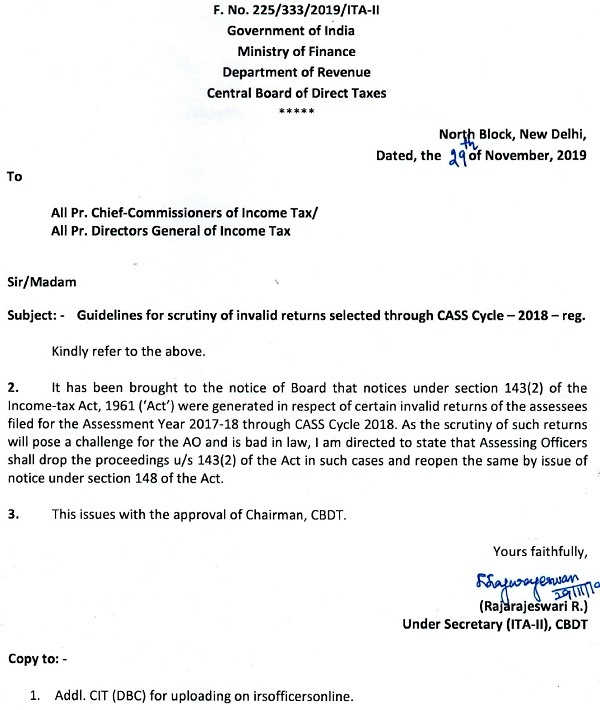
Income Tax : Understand the meaning of a 143(2) notice, why your return may be selected for scrutiny, and the steps required for a faceless ass...
Income Tax : As Income Tax Department initiates scrutiny for Assessment Year (AY) 2024–25, many taxpayers are receiving notices under Section...
Income Tax : Indian tax authorities are scrutinizing high-value financial transactions, including large deposits, property deals, and credit ca...
Income Tax : Association requested CBDT to rationalize CASS 2026 case selection considering the administrative burden caused by implementation ...
Income Tax : Revised Instruction for constitution and functioning of Local Committees to deal with taxpayers’ grievances due to high-pitched ...
Income Tax : Ministry of Finance Income Tax Returns( ITR) scrutiny reduced to 0.25% in AY 2018-19 IT Dept is changing -from just enforcement ...
Income Tax : Start-ups and their investors filing requisite declarations not to be subjected to any scrutiny regarding valuations of share prem...
Income Tax : Income Tax Department has accepted 99.65 per cent of tax returns as it is and has picked only 0.35 per cent cases for detailed scr...
Income Tax : The case examined whether scrutiny selection without meeting CBDT conditions was valid. The ITAT held that failure to satisfy mand...
Income Tax : Chennai ITAT set aside the assessment for exceeding the limited scrutiny scope and disallowing 80P without a spea...
Income Tax : Tribunal held that once a scrutiny assessment under Section 143(3) allows a claim, any earlier disallowance by CPC under Section 1...
Income Tax : Kolkata ITAT rules assessment void after a 143(2) notice failed to specify the type of scrutiny, violating mandatory CBDT instruct...
Income Tax : ITAT Kolkata cancels a Section 144 assessment, ruling that the foundational Section 143(2) notice was invalid for failing to compl...
Income Tax : CBDT outlines parameters for compulsory income tax scrutiny for FY 2025-26, including survey, search & seizure cases, registration...
Income Tax : Understand the guidelines set by the Indian Ministry of Finance for the compulsory selection of returns for complete scrutiny duri...
Income Tax : Government of India issues guidelines for compulsory selection of returns for Complete Scrutiny during FY 2023-24. Find the proced...
Income Tax : Central Board of Direct Taxes (CBDT) released guidelines outlining the parameters and procedures for the compulsory selection of i...
Income Tax : Amendment in Guidelines for compulsory selection of returns for Complete Scrutiny during the Financial Year 2022-23 — procedure ...
Addition made by AO on account of profit allegedly earned by assessee on undisclosed turnover was directly related to the ground on which the case of the assessee was selected for limited scrutiny. Since same being fall-out of the verification made by AO on issue, on which case of assessee was selected for limited scrutiny, there was no merit in contention raised by assessee that addition made by AO was beyond scope of limited scrutiny.
Scrutiny assessment refers to the examination of a return of income by giving an opportunity to the assessee to substantiate the income declared and the expenses, deductions, losses, exemptions, etc. claimed in the return with the help of evidence.
Gain insights into Limited Scrutiny under CASS and its retrospective nature. Understand the reasons behind case selection and the guidelines issued by CBDT.
whether the AO can expand the assessment from ‘Limited Scrutiny’ to ‘Complete Scrutiny’ without following the procedure as laid by the CBDT Circular?
The issue under consideration whether conversion of the case from limited scrutiny to complete scrutiny is justified in law?
Income Tax Scrutiny Assessment demystified: Understand the process, reasons for selection, and how to avoid it. Learn about receiving notices, time limits, and responses. Common reasons for scrutiny include non-disclosure of income, TDS credit mismatch, high-value transactions, and filing defective returns. Discover proactive steps to prevent scrutiny, such as timely filing, accurate reporting, and thorough documentation. Seek expert guidance if needed.
1. What is Scrutiny? Once the assessee files his return of income, irrespective of whether it is filed within the due date or in pursuance to a notice requiring the assessee to file his return, the department can initiate scrutiny proceedings if it has reason to believe that income is escaping assessment, i.e. income is under stated of expenditure is over stated.
Understanding the intricacies of making additions on account of low GP in tax assessments. Learn about the power of the Assessing Officer and burden of proof.
Addition made u/s 69 was liable to be quashed as the order passed by AO would be nullity as he couldn’t convert limited scrutiny into complete scrutiny in absence of requisite approval from the competent authority.
The case is selected for scrutiny by CASS (Computer Aided Scrutiny Selection) for the Assessment Year 2017-18 and the officer sends notice of hearing to the Assessee to attend the office on a particular day with supporting documents such as Books of Account, vouchers, Bank Pass Books etc.