Bank of India Vs Commissioner of Service Tax (CESTAT Kolkata)
The appeal concerned the denial of CENVAT credit, demand of service tax, interest, and penalties against a banking entity providing both taxable and exempted services. The Department alleged that the appellant had not maintained separate accounts for input services used for taxable and exempted services, had wrongly availed credit distributed by its Head Office without proper Input Service Distributor (ISD) registration, and had failed to comply with Rule 6 of the CENVAT Credit Rules, 2004. Based on these allegations, demands of Rs.9,33,806/-, Rs.26,94,914/-, and Rs.6,11,37,297/- were confirmed.
On the first issue regarding excess utilization of CENVAT credit beyond the 20% limit under Rule 6(3)(c) for certain months, the Tribunal found that although the limit was exceeded in specific months, the utilization for the entire financial years remained within the prescribed limit. It held that the rules do not mandate calculation of the 20% limit on a monthly basis. Accordingly, the demand of Rs.9,33,806/- was set aside.
On the second issue concerning denial of credit distributed by the Head Office, the Tribunal observed that the Head Office had obtained ISD registration in 2004 and that the Department had incorrectly treated the date of digital registration in 2008 as the actual registration date. Since the registration existed from 2004, the distribution of credit was held valid. The Tribunal further noted that substantial benefits cannot be denied for procedural lapses. Consequently, the demand of Rs.26,94,914/- was also set aside.
On the third issue relating to demand of Rs.6,11,37,297/- based on non-payment of 8% of the value of exempted services under Rule 6(3), the Tribunal examined whether the appellant had opted for payment under option (i) or proportionate reversal under option (ii). It found that although the appellant had indicated opting for option (i), the details furnished corresponded to option (ii), i.e., proportionate reversal of credit attributable to exempted services. The Tribunal held that a clerical error in indicating the option does not change the substantive intention. It further clarified that exercising option (ii) requires intimation, whereas payment of 8% does not require such option. Accordingly, the demand based on 8% of exempted services was held unsustainable. The Tribunal ruled that the appellant is liable to reverse only the proportionate credit attributable to exempted services along with interest. The matter was remanded to the adjudicating authority solely for quantification of such proportionate reversal.
On the issue of limitation and penalty, the Tribunal found that the entire demand was based on records submitted by the appellant and that there was no suppression of facts or wilful misstatement. Therefore, imposition of penalty was held unwarranted and was set aside.
In conclusion, all major demands were set aside except for proportionate reversal of credit attributable to exempted services, which was upheld in principle and remanded for quantification.
FULL TEXT OF THE CESTAT KOLKATA ORDER
The present appeal has been filed against the Order-in-Original No. 04/Commr/ST/Kol/2011-12 dated 28.06.2011 passed by the Ld. Commissioner of Service Tax, Kendriya Utpad Shulk Bhawan, 3rd Floor, 180, Shantipally, Rajdanga Main Road, Kolkata – 700 107.
2. The facts of the case are that M/s. Bank of India, Kolkata Corporate Banking Branch, Kolkata [hereinafter referred to as the “appellant”] is a Public Sector Bank rendering services under the category of “banking and other financial services” as defined under Section 65(12) of the Finance Act, 1994. The appellant has been rendering both taxable and exempted services and has availed CENVAT Credit in respect of various input services.
3. On the allegation, inter alia, that the appellant had provided taxable as well as exempted services during the material period, but had not maintained separate accounts for receipt, consumption and inventory of common input services meant for use in providing output services and had also not registered under the category of ‘Input Service Distributor’ resulting in irregular availment of CENVAT Credit, a Show Cause Notice dated 05.01.2010 was issued to the appellant, denying CENVAT Credit of Rs.9,33,806/- and Rs.26,94,414/-, proposing recovery thereof and demanding Service Tax of Rs.6,11,37,297/-, along with interest and penalty thereon.
3.1. After due process, the said Notice was adjudicated vide the impugned Order-in-Original dated 28.06.2011 wherein the demands as proposed in the above Show Cause Notice were confirmed, along with interest and penalties.
3.2. Aggrieved by the confirmation of the above demands, along with interest and penalties, the appellant has filed the present appeal.
4. During the course of hearing, the Ld. Chartered Accountant appearing on behalf of the appellant submitted that the demand as confirmed against the appellant in the impugned order can be categorized under the following three categories: –
| Sl. No. |
Nature | Amount (in Rs.) |
|---|---|---|
| 1 | Utilization of CENVAT Credit
without applying the restriction of 20% limit as prescribed in Rule 6(3)(c) of the CENVAT Credit Rules whereas no separate account of Taxable and Exempt service has been maintained for the period |
9,33,806/- |
| 2 | Non-registration under the
category of “Input Service Distributor” and availment of CENVAT Credit on the Input |
26,94,914/- |
| 3 | The Appellant opted for option (i)
of Rule 6(3A) i.e., non- |
6,11,37,297/- |
4.1. In respect of the denial of CENVAT Credit amounting to Rs.9,33,806/- and demand for recovery thereof, as confirmed in the impugned order, the appellant’s submission is that the said demand has been raised on the ground that the appellant has not maintained separate accounts for the said exempted services for the period from February, 2005 to April, 2005. It is submitted by the appellant that they have utilized CENVAT Credit in excess of the restriction of 20% of the Service Tax payable on the taxable output services; however, it is their contention on this score that the Revenue has quantified the said 20% limit on a monthly basis, which is not specified in any of the CENVAT Credit Rules. The appellant submits that if the CENVAT Credit utilized for the Financial Year is taken as a whole, then the whole of the credit utilized by them is well within the restriction of 20% as prescribed under sub-rule 3(c) of Rule 6 of the CENVAT Credit Rules, 2004. In view of the above submission, the appellant argued that the demand of Rs.9,33,806/- as confirmed in the impugned order on account of misutilization of credit in excess of the 20% limit is not sustainable in law.
4.2. As regards the demand of Rs.26,94,914/-confirmed in the impugned order, the appellant has submitted that the said demand has been raised on the ground that the Head Office of the appellant had not registered as ‘Input Service Distributor’ and had passed on the credit without any registration. On this score, the appellant submits that their Head Office had obtained Registration as ‘Input Service Distributor’ in the year 2004 itself; that subsequently, the Head Office had taken registration through digital mode in the year 2008; the Revenue has construed such date of registration through digital format as the actual ‘date of registration’ for the purpose of denying the credit distributed by their headquarters / Head Office as Input Service Distributor (ISD). The appellant has referred to the copy of the Digital Registration Certificate obtained by the Head Office wherein it has been specifically mentioned that the appellant’s Head Office has registered under the category of “Input Service Distributor” in the year 2004 itself. In view of the above, the appellant contends that the demand of Rs.26,94,914/- confirmed against them by denying the credit distributed by their Head Office is not sustainable.
4.3. With regard to the demand of Rs.6,11,37,297/-as confirmed against them in the impugned order, the submission of the appellant is that the said demand has been raised on the ground that the appellant had opted for option (I) of Rule 6(3A) i.e., opted for payment of 8% of the value of exempted services for the Financial Year 2008-2009 due to non-maintenance of separate account for input credit used for taxable and exempt services, but they had not paid the same as opted. In this regard, the submission of the appellant is that they had wrongly mentioned in the letter that they are opting for option (I) of Rule 6(3A) i.e., payment of 8% of the value of exempted services for the Financial Year 2008-2009; that the law requires the appellant to give the option to the jurisdictional officer only if they are opting for option (ii) of the said Rule. There is no need to opt separately for making payment of 8% of the value of exempted services. Thus the submission of the appellant on this issue is that the option exercised by them should be considered as option (ii), i.e., reversal of proportionate CENVAT Credit attributable to exempted services. Accordingly, the appellant submits that the demand of reversal of credit should not exceed the proportionate credit based on the exempt supply made by them. Thus, it is the appellant’s contention on this score that the demand for payment of 8% of the value of exempted services confirmed in the impugned order for the Financial Year 2008-09 is legally not sustainable.
4.4. The appellant has also contested the demands on the ground of limitation. It is their contention that being a PSU – nationalized Bank, the extended period of limitation cannot be invokable as per Section 73(1) of the Finance Act 1994. In this regard, the Appellant submits that the Show Cause Notice was issued without mentioning any valid grounds for invoking the extended period of limitation; that there was confusion over the allowability of credit and reversal requirement by the services provided in this case. It is also submitted that the appellant has not suppressed any facts and that the entire demand has been confirmed on the basis of the records submitted by the appellant. Accordingly, the appellant pleads for setting aside the demand confirmed against them by invoking the extended period provisions. In view of the above submissions, the appellant prays for setting aside the demand confirmed in the impugned order to this extent. On the same ground, the appellant submits that no penalty is imposable on them.
5. The Ld. Authorized Representative of the Revenue reiterated the findings in the impugned order.
6. Heard both sides and perused the appeal records.
7. We observe that the appellant has been rendering services under the category of “banking and other financial services” as defined under Section 65(12) of the Finance Act, 1994. The impugned demands have been raised on various issues. The main allegation of the Revenue is that during the material period, the appellant has provided both taxable and exempted services, but had not maintained separate accounts for receipt, consumption and inventory of common input services meant for use in providing output services. Further, it is alleged that although the appellant had exercised the option (I) available under Rule 6(3) [Rule 6(3A)] of the CENVAT Credit Rules, 2004, they had not paid the amount @8% of the value of exempted services as prescribed under the said Rules. It has also been alleged that the Head Office of the appellant had not registered as “Input Service Distributor” which had resulted in irregular availment of CENVAT Credit on the input service credit distributed by the Head Office. Accordingly, the said demands have been confirmed vide the impugned order. We now proceed to examine the issues involved in order.
Denial of CENVAT Credit of Rs.9,33,806/-:
8. As regards the demand of Rs.9,33,806/-confirmed in the impugned order, we find that the said demand has been raised on the allegation that the appellant has utilized CENVAT Credit in excess of the restriction of 20% of the Service Tax payable on the taxable output services as prescribed under Rule 6(3)(c) of the CENVAT Credit Rules, 2004. We find that the appellant has utilized CENVAT Credit in excess of the said 20% limit as prescribed, for the months of February, 2005 and April, 2005. However, for the Financial Years 2004-05 and 2005-06, as a whole, the appellant have utilized CENVAT Credit well within the said restriction limit of 20% as prescribed under Rule 6(3)(c) of the said Rules. We do not find any Rule in the CENVAT Credit Rules, 2004 prescribing that such restriction is to be calculated on a monthly basis. As the appellant has utilized the credit within the permissible limit for the Financial Years 2004-05 and 2005-06, we are of the view that the appellant has complied with the provisions of Rule 6(3)(c) of the CENVAT Credit Rules. Therefore, we hold that the demand of Rs.9,33,806/- as confirmed in the impugned order is not sustainable and accordingly, the same is set aside.
Denial of CENVAT Credit of Rs.26,94,914/-:
9. mRegarding the denial of CENVAT Credit of Rs.26,94,914/-, we find that the said credit has been distributed by the Head Office of the appellant-bank as an “Input Service Distributor”. The allegation of the Revenue is that the Head Office has taken registration as “Input Service Distributor” in the year 2008 and thus the CENVAT Credit availed on the input service credit distributed by the Head Office from June, 2004 to October, 2007 is irregular and liable to be reversed. In this regard, we find that the Head Office of the appellant had obtained Registration as ‘Input Service Distributor’ in the year 2004 itself. Subsequently, the Head Office had taken registration through digital mode in the year 2008. We find that the Revenue has construed this date of registration through digital format as the actual ‘date of registration’ for the purpose of denying the credit distributed by their headquarters / Head Office as Input Service Distributor (ISD). In support of their claim, the appellant submitted a copy of the Digital Registration Certificate obtained by the Head Office. For ready reference, the copy of the said Certificate is scanned and reproduced below: –
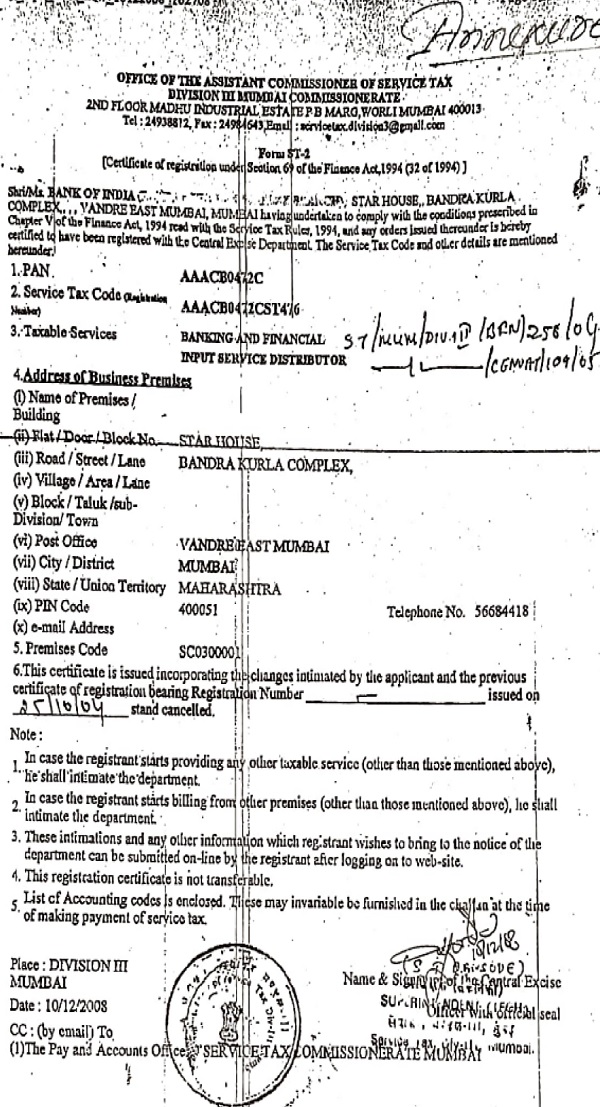
9.1. From the Certificate extracted above, as produced before us, it can be seen that the appellant’s Head Office has been registered under the category of “Input Service Distributor” in the year 2004 itself. We observe that the Department has wrongly construed the date of digital registration as the actual date of registration for raising and confirming the demand. Since the Head Office of the appellant had registered as an Input Service Distributor in the year 2004 itself, we do not find any infirmity in the distribution of credit by the Head Office.
9.2. In any case, it is well settled by various decisions that a substantial benefit cannot be denied merely for not following a procedural requirement. As payment of duty and utilization of service is not in dispute, the denial of CENVAT Credit to this extent is not legally tenable.
9.3. Consequently, the demand confirmed on this count is not sustainable and accordingly, we set aside the said demand.
Demand of Service Tax of Rs.6,11,37,297/-:
10. We find that the above demand of Rs.6,11,37,297/- has been confirmed by demanding Service Tax at the rate of 8% of the value of exempted output services during the Financial Year 2008-09. The appellant has categorically explained that during the Financial Year 2008-09, the total amount of CENVAT Credit availed by them works out to Rs.1,44,07,996/-, out of which the proportionate CENVAT Credit attributable to exempted output services, which is liable to be reversed as per Rule 6(3A) of the said Rules, works out to Rs.99,05,540/-.
The appellant submitted that they are ready to pay this amount along with interest.
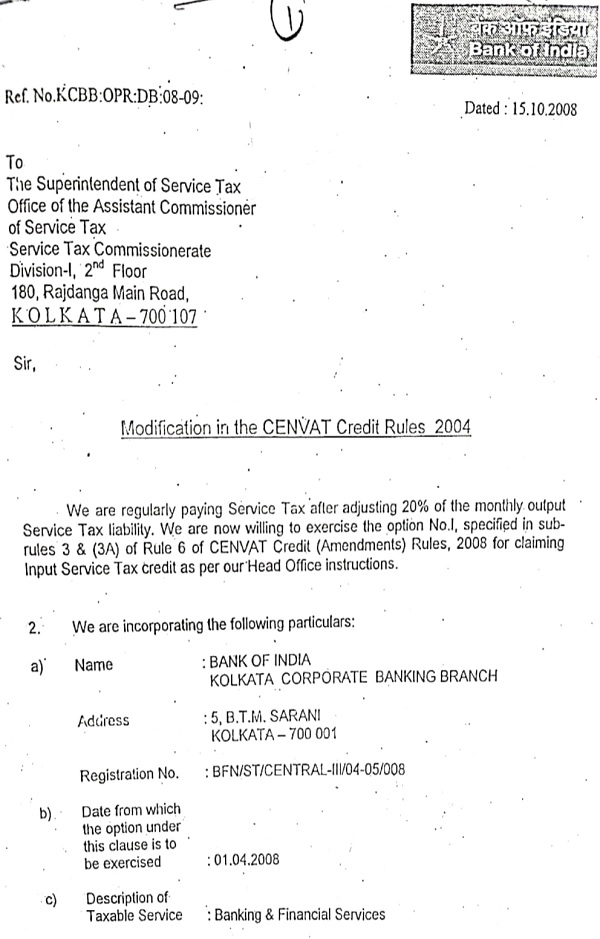
10.1. It is a fact on record that the appellant has not maintained separate accounts for input service credit used for taxable and exempted services. However, the appellant has not paid the said amount of 8% of the value of exempted output services during the Financial Year 2008-09, although they had opted for option (I) (as indicated in the communication dated 15.10.2008) as applicable under Rule 6(3) ibid. In this regard, the submission of the appellant is that they had wrongly mentioned in the letter that they are opting for option (I) of Rule 6(3) & Rule 6(3A) i.e., payment of 8% of the value of exempted services for the Financial Year 2008-2009 and their intention was to avail the option of proportionate reversion of CENVAT Credit attributable to exempted services only.
10.2. We have gone through the relevant provisions of Rule 6(3) of CENVAT Credit rules. Rule 6 of the said Rules was amended w.e.f. 01.04.2008 vide Notification No. 10/2008-C.E.(N.T.) dated 01.03.2008. For ease of reference, sub-rule (3) of Rule 6 of the CENVAT Credit Rules, as amended, is reproduced below: –
“(3) Notwithstanding anything contained in sub-rules (1) and (2), the manufacturer of goods or the provider of output service, opting not to maintain separate accounts, shall follow either of the following options, as applicable to him, namely:-
(i) the manufacturer of goods shall pay an amount equal to ten per cent of value of the exempted goods and the provider of output service shall pay an amount equal to eight per cent of value of the exempted services; or
(ii) the manufacturer of goods or the provider of output service shall pay an amount equivalent to the CENVAT credit attributable to inputs and input services used in, or in relation to, the manufacture of exempted goods or for provision of exempted services subject to the conditions and procedure specified in sub-rule (3A).
Explanation I.- If the manufacturer of goods or the provider of output service, avails any of the option under this sub-rule, he shall exercise such option for all exempted goods manufactured by him or, as the case may be, all exempted services provided by him, and such option shall not be withdrawn during the remaining part of the financial year.
Explanation II.- For removal of doubt, it is hereby clarified that the credit shall not be allowed on inputs and input services used exclusively for the manufacture of exempted goods or provision of exempted service.
10.3. We have gone through the letter submitted by the appellant exercising the option. For ease of reference, the said letter submitted by the appellant is reproduced below:
 –
–
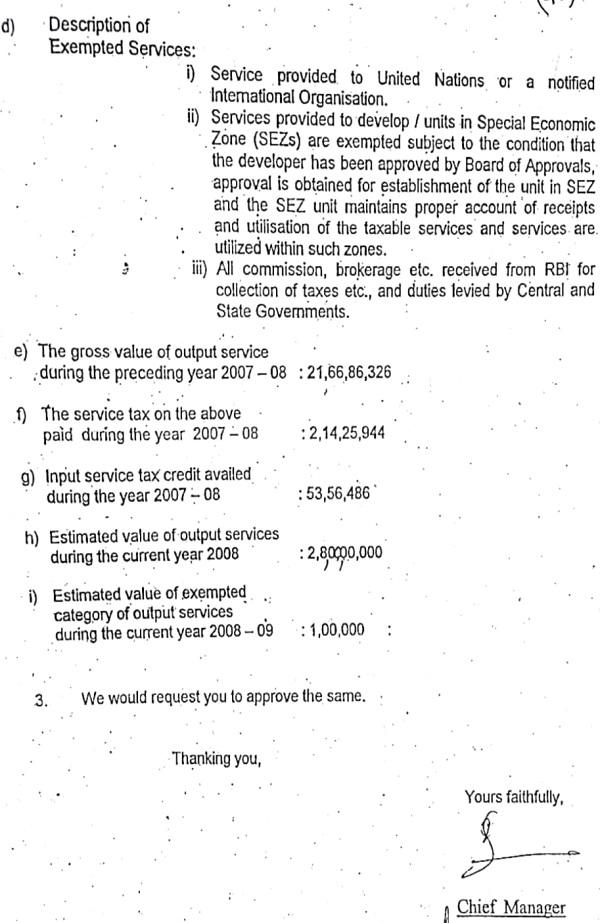 10.4. A perusal of the above letter reveals that the appellant has furnished all the details required for availing the option (ii), i.e., for reversal of proportionate CENVAT Credit attributable to exempted services. We observe that the said Rule requires the appellant to exercise the option to the jurisdictional officer only if they are opting for option (ii) of the said Rule. There is no need to opt separately for making payment of 8% of the value of exempted services. A clerical error on their part would not automatically mean that they are required to avail option (i) alone and not option (ii). Accordingly, we agree with the submission of the appellant that their intention was to avail the option of proportionate reversion of CENVAT Credit attributable to exempted services only. Accordingly, we hold that the demand for payment of 8% of the value of exempted services confirmed in the impugned order for the Financial Year 2008-09 is legally not sustainable. Therefore, we set aside the demand of Rs.6,11,37,297/- confirmed in the impugned order arrived at on the basis of 8% of the value of exempted output services during the Financial Year 2008-09. Thus, we hold that the appellant is liable to reverse the proportionate credit availed by them in connection with the value of exempted services, in terms of option (ii) in sub-rules (3) & (3A) of Rule 6 ibid. The appellant is also liable to pay interest in respect of the proportionate credit liable to be reversed by them.
10.5. Insofar as the appellant’s plea for restriction of the proportionate credit to be reversed in connection with the provision of exempted services to the normal period, it is pertinent to note that clause (ii) of the said Rule is an option exercised on account of the request of the appellant, which is required to be complied with by the appellant. In view thereof, we are of the opinion that the restriction of proportionate credit reversal to the normal period, as prayed for by the appellant, is not applicable to their case.
10.6. We also observe that the appellant has submitted a calculation in respect of the proportionate credit to be reversed by them in this regard. However, such calculation has not been verified. However, we agree with the submission of the appellant that the demand for reversal of credit should not exceed the proportionate credit based on the exempt supply made by them. Therefore, we remand the matter to the adjudicating authority for the limited purpose of quantifying the proportionate credit liable to be reversed by the appellant, along with applicable interest.
11. On the issue of imposition of penalty under Section 78 of the Act read with Rule 15 of the said Rules, we find that the appellant has not suppressed any material facts from the Department in the present case. In fact, the entire demand has been raised on the basis of the accounts and other records submitted by the appellant. The Department has also failed to failed to bring any corroborative evidence on record to indicate wilful mis-statement or suppression of facts on the part of the appellant with the intent to evade tax in this case. Thus, we hold that the imposition of penalty on the appellant is unwarranted in the facts and circumstances of the case and hence, we set aside the penalty imposed on the appellant.
12. In the result, we pass the following order: –
i. We set aside the demand of Rs.9,33,806/- along with interest, as confirmed in the impugned order.
ii. We set aside the demand of Rs.26,94,914/-, along with interest, as confirmed in the impugned order.
iii. We set aside the demand of Rs.6,11,37,297/- confirmed in the impugned order arrived at on the basis of 8% of the value of exempted output services during the Financial Year 2008-09. We hold that the appellant is liable to reverse the proportionate credit attributable to the value of exempted output services in terms of in terms of option (ii) in sub-rules (3) & (3A) of Rule 6 of the CENVAT Credit Rules, along with interest thereon, as applicable. However, the matter is remanded to the adjudicating authority for the limited purpose of quantifying the proportionate credit liable to be reversed by the appellant, along with applicable interest.
iv. The penalty imposed on the appellant vide the impugned order stands set aside.
13. The appeal is disposed of in the above manner.
(Order pronounced in the open court on 13.03.2026)