Sh. Gurbhagat Singh Vs ITO (ITAT Amritsar)
In , the assessee challenged the order passed by the Commissioner of Income Tax (Appeals), NFAC Delhi, arising from reassessment proceedings initiated under sections 147 and 144B of the Income Tax Act. The assessee had originally filed a return declaring nil income. Reassessment proceedings were initiated after information was received that the assessee, along with other co-owners, had sold land situated within the municipal limits of Bathinda on 7 December 2012, with the assessee’s share in the sale consideration amounting to Rs. 41.67 lakh.
The assessee claimed exemption under section 54B on the ground that the land sold was agricultural land and that the sale proceeds were invested in the purchase of two agricultural plots for an aggregate amount of Rs. 96 lakh within the prescribed period. The Assessing Officer accepted that the land fell within municipal limits and therefore constituted a capital asset under section 2(14). However, the exemption under section 54B was denied on the ground that the assessee failed to establish that the land sold had been used for agricultural purposes during the two years immediately preceding the transfer. Although the assessee relied upon copies of Girdawari records issued by the Patwari, the Assessing Officer rejected those records and computed long-term capital gains of Rs. 41.14 lakh.
The Commissioner (Appeals) upheld the disallowance of exemption under section 54B. The appellate authority observed that one of the essential conditions for claiming deduction under section 54B was proof that agricultural activities were carried out on the land by the assessee, parents, or HUF during the two years immediately preceding the sale. According to the Commissioner (Appeals), the assessee failed to provide sufficient documentary evidence to substantiate agricultural operations on the land during the relevant period. The authority further noted that the legislative intent of section 54B was specifically linked to transfer of land used for agricultural purposes. Consequently, the addition arising from withdrawal of the exemption claim was confirmed.
Before the Tribunal, the assessee argued that the Girdawari records clearly showed that the land had been under cultivation from 2007-08 onwards till 2012. The assessee submitted that the records issued by the Patwari demonstrated that agricultural activities had been carried out continuously on the land for more than two years before the sale. It was also contended that the Revenue had accepted similar exemption claims in the cases of other co-owners relating to the same land and same financial year, and therefore denial of exemption in the assessee’s case was inconsistent.
The Departmental Representative opposed the claim by referring to the Girdawari records. It was pointed out that in the records relating to Khasra No. 2296, details regarding cultivation of crops such as cotton and wheat were specifically mentioned in the names of certain co-owners. However, for the assessee’s Khasra No. 2297, the relevant column had been left blank and did not mention any cultivation activity or crops grown on the land. According to the Revenue, this absence of entries showed that the assessee failed to establish actual agricultural use of the land during the required period.
In response, the assessee submitted that the blank portion in the record may have been due to an inadvertent omission by the Patwari and requested verification of the records, particularly those in the regional language.
After considering the rival submissions and the documentary evidence, the Tribunal held that the matter required verification of the authenticity and genuineness of the land records produced by the assessee. In the interest of justice, the Tribunal remanded the matter back to the Commissioner (Appeals) for fresh adjudication after necessary verification of the documentary evidence and after granting the assessee an adequate opportunity of hearing. Accordingly, the appeal was allowed for statistical purposes.
Appellant Represented by Sh. Lakhshay Bansal, CA.
FULL TEXT OF THE ORDER OF ITAT AMRITSAR
This appeal is filed by the assessee against the order of ld. CIT (A), NFAC, Delhi, passed u/s 250 of the Act, 1961 vide order dated 21.03.2025 which has emanated from the order of AO, passed u/s 147 r.w.s. 144B of the Act, vide order dated 28.03.2022.
2. Brief facts emerging from records are that the assessee and has filed his return declaring income at NIL.
2.1 On the basis of information received from ITO/ I & C I, Chandigarh that the assessee has sold land located within the municipal limits of Bhatinda ,on 07th December, 2012, along with five other co-owners, the assessee’s share in the said transaction of sale being Rs.41.67 lakhs, reassessment proceedings has been initiated vide notice u/s 148 of the Act on 30.03.2021 ( as per procedure ) in response to which, the assessee filed his return on 15.07.2021 declaring total income at NIL in respect of which recorded reasons obtained , objections filed and disposed off.
2.2 The assessee has claimed deduction u/s 54B of the Act against the sale of his portion of the land at Bhatinda , on the strength of purchase of two other plots of agricultural land, aggregating to Rs.96 lakhs on 28th December, 2012 and on 2nd January, 2013 , (the purchase being made within two years of sale thereof ), the details of Vasika number and dates of sale and subsequent purchase are duly recorded in the assessment order.
2.3 The AO concluded that the said land sold was capital asset u/s 2(14) of the Act, because the area is comprised within the jurisdiction of a Municipality ignoring the claim of the assessee that the land sold was used for agricultural purpose for the preceding two years before sale, and in support of which he relied upon copies of land records ( girdawari )issued by the Patwari , Patti Mehna, Bhatinda . But the said documentary evidences has not been accepted by the AO due to reasons contained in the assessment order and the assessment has been completed by determining long term capital gain of Rs. 41.14 lakhs, refusing to allow the deduction u/s 54B of the Act.
3. The matter carried in appeal before the ld. first appellate authority has been dismissed by the Ld. CIT (A) by observing as follows:
“5.3.1. The AO found that the assessee does not satisfy all the three conditions provided in Section 548 of the Act and hence deduction claimed by the appellant of Rs.41,14,183/- u/s 548 of the Act was withdrawn. In the course of appellate proceedings, the appellant has submitted that capital gain arises from the sale of urban agricultural land which is situated within the specified limits provided in Section 2(14) of the Act and deduction u/s 548 of the Act is available with respect to the capital gain arising from transfer of such land subject to the fulfilment of conditions specified therein. The appellant further submitted that he satisfies all the conditions prescribed in Section 548 of the Act i.e. the impugned land sold was an agricultural land which was having canal water as the source of irrigation. Further, the land purchased subsequently was also an agricultural land and hence the conditions in Section 54B of the Act are met for claiming deduction. Though the appellant claims that the impugned land sold during the relevant FY and land purchased subsequently, which is claimed as an eligible investment for the purposes of Section 54B of the Act, the appellant is totally silent on the fact regarding agricultural operations in the impugned land during the preceding 2 FYs immediately prior to the date on which the impugned land was transferred. Thus, one of the important conditions for claiming deduction u/s 54B of the Act regarding pursuance of agricultural activities in the impugned land by the assessee or his parents or the HUF is not satisfied. The appellant has not provided any document to substantiate agricultural operations in the impugned land during the preceding 2 years immediately prior to the date of sale of land. The introduction to the Section 54B of the Act states that “capital gain on transfer of land used for agricultural purposes not to be charged in certain cases”. Hence the emphasis of the legislature is very clear from the introduction of the Section 54B of the Act. Based on the above discussion, it is clear that the assessee is not eligible for claiming deduction u/s 548 of the Act and hence I find no infirmity in the action of the AO withdrawing deduction claimed u/s 54B of the Act. The assessed income of Rs 41,14,183/- consequent to withdrawal of claim u/s 548 of the Act is confirmed and the ground of appeal is dismissed.
6. In result appeal filed by the assessee is hereby Dismissed.”
4. Now the assessee is in appeal before the tribunal on the following grounds in Form No. 36 which are reproduced as below:
“1. That the documents submitted in the shape of Girdawri by the appellant, indicating that the land sold was actually used for agricultural purposes in preceding 5 years, is sufficient to become eligible for claiming exemption u/s 54B. Thus, denying such exemption is bad in law.
2. That the Revenue has already accepted the fact that capital gain on sale of urban agricultural land is eligible for exemption u/s 54B in the case of sale of same land by all the co-owners and in the same financial year. Therefore, the Revenue has blown hot & cold by rejecting the exemption in the hands of appellant and is bad-in-law.”
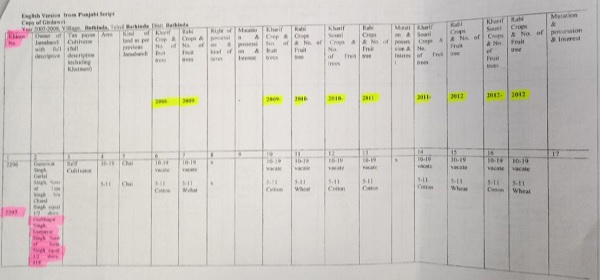
5. In course of hearing before the tribunal, the Ld. AR of the assessee has filed a short paper book containing documentary evidences of land records obtained from the Patwari Patti Mehna, Bathinda, paper book pages 5 to 7 and referring to the said documentary evidences the assessee submitted that the land which has been sold was under cultivation where agricultural activity took place from the year 2007-08 onwards till 2012 and the same is certified by the Patwari which proves that the land was used for agricultural purpose for a period of more than two years before its sale.
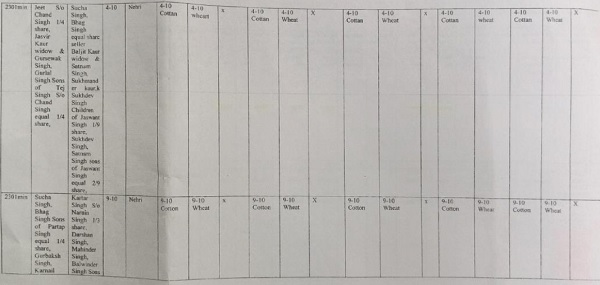
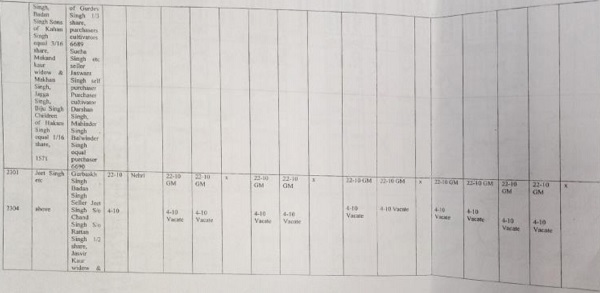
5.1 He further stated that the owners of the said land (the four co-owners) of the said land i) Gursewak Singh, ii) Gurlal Singh, iii) Gurbhagat Singh ( the assessee in this case ) and iv) Gurlove Singh , Jeeta Singh and Jasbir Kaur , the details of which are contained in the Girdwari is reproduced below:
–
–
–
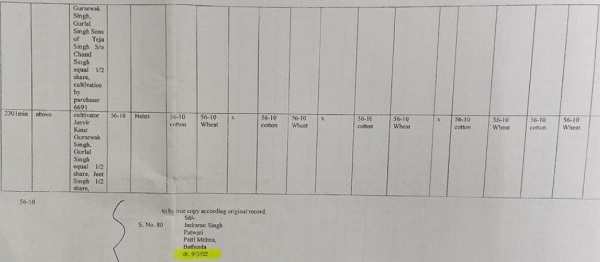
5.2 Referring to the said copy of Girdawari, he submitted that since it is certified by the revenue authorities that agricultural activity took place on such land, which is identified by the “Khasra Number” the earmarked lands were used for agricultural purpose since the year 2008-09 till 2012, and consequently the conditions stipulated by the provisions of the Act is satisfied and the assessee should be allowed the deduction u/s 54B of the Act, as claimed.
6. The Ld. DR relied on the order of the AO and submitted that the khasra
no.2296 which is a part of the same Girdawari record reflects the name of Gursewak Singh, and Gurlal Singh ( co owners )both sons of Teja Singh, which clearly specified ,that the area of land held the description of the land chai where kharif crop is cultivated such as cotton and wheat for the year 2008-09, 2009-10, 2010-11 and 2011-12 but he pointed out that the khasra record of the assessee Mr. Gurbhagat Singh is 2297 and as per the Girdawari and the revenue records, it is not certified whether any cultivation took place on such land and what of the crop that has been grown on such land , because that part has been left blank ( copy of the said blank part is made a part of this order ).
He further submitted that under the circumstances it is not proved by any documentary evidences that the said part of the land sold by the assessee ( Khasra 2297 ) was under actual cultivation and was used for agricultural purposes for the last two years before its sale. He further submitted that wherever crops has been grown it is specifically mentioned against the specific persons name along with respective khasra no, as evident from the revenue records, but in this case of the assessee Mr. Gurbhagat Singh the same has been left totally blank which proves no cultivation took place on the land sold by the assessee and as such, he prays for upholding the order of the ld. CIT(A).
7. Per contra, the ld. AR of the assessee submitted that there must have been some inadvertent error of omission on the part of the patwari as per the girdwari records because as per the records in regional language the same is mentioned. As such, he prayed that the land records submitted may please be verified and thereafter the necessary decision may be taken.
7.1 We have heard the rival submissions and considered the materials and in the interest of justice, we remand back the matter to the files of the ld. CIT(A) to cause necessary verification of this documentary evidences which is produced and after verifying its authenticity and genuineness the matter may be adjudicated on merits after verification of documentary evidences as such, we set aside the matter back to the files of the ld. CIT(A) to allow the assessee a fresh opportunity of being heard to prove his case, with necessary evidences.
8. In the result the appeal of the assessee is allowed for statistical purpose.
Order pronounced on 07.04.2026 under Rule 34(4) of the Income Tax Appellate Tribunal Rules 1963.