
Introduction
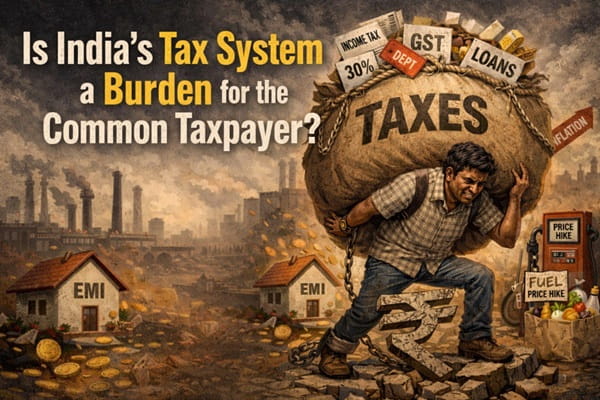
Paying taxes is a civic duty and an essential source of revenue for governments worldwide. In India, millions of individuals and businesses interact with the tax system every year. While taxation plays a central role in economic governance, a commonly voiced concern is that India’s tax system has become too complex for the ordinary taxpayer to navigate confidently.
But is this really true? Does complexity undermine fairness and compliance? Or are reforms making it easier for taxpayers to comply?
This blog examines India’s tax complexity through legal, practical, and socio-economic lenses, using real examples, tax processes, case law, and data to evaluate whether the system serves or burdens the common taxpayer.
UNDERSTANDING TAX COMPLEXITY
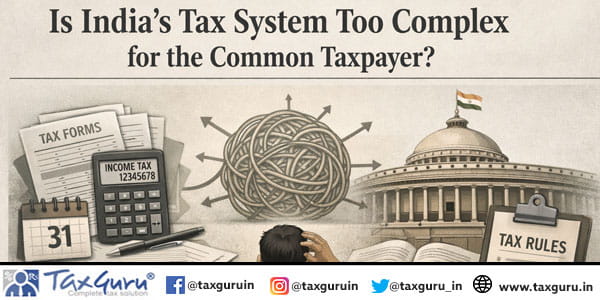
Tax complexity generally refers to the degree to which tax laws are difficult to understand, interpret, and comply with for ordinary taxpayers. It often arises from the excessive length and technical detail of tax statutes, the presence of ambiguous or overlapping provisions, and the requirement to navigate multiple forms and procedural compliances. In addition, frequent changes in tax rules, rates, and compliance mechanisms further add to confusion, even for well-informed and educated individuals. While legal complexity in itself does not necessarily imply unfairness, since detailed provisions may aim to ensure equity and cover diverse economic situations, problems arise when the law becomes inaccessible to the very people it governs. In such cases, taxpayers face uncertainty, increased dependence on professionals, and a higher risk of unintentional non-compliance, thereby turning the tax system into a source of stress rather than a tool of orderly governance.
EVIDENCE OF COMPLEXITY
- Multiple Tax Heads: Under the Income Tax Act, income is taxed under five heads:
- Salaries
- House Property
- Business & Profession
- Capital Gains
- Other Sources
- Frequent Amendments: Tax laws undergo annual amendments through the Union Budget and periodic updates via circulars. For example: changes in tax slabs, new deduction categories, and revised compliance timelines. These frequent changes require taxpayers to stay updated.
- Complex Forms and Processes: Taxpayers must file: ITR (Income Tax Return) depending on income type; TDS (Tax Deducted at Source) returns for employers and businesses; and advance tax. Incomplete or incorrect forms can lead to notices, penalties, and litigation.
REAL-WORLD CHALLENGES FACED BY TAXPAYERS
Lack of Legal Understanding: A salaried taxpayer may struggle to understand the difference between exemptions and deductions, rebate vs. deduction, and the way to report income from multiple sources, as terms like “Gross Total Income” vs. “Total Income” require interpretation.
Penalty for Errors: The tax system imposes penalties for late filing or misreporting. While penalties are meant to enforce compliance, they can seem harsh to unintentional defaulters.
Example: A taxpayer filed the ITR late by a few days and received a notice for penalty under Section 234F of the Income Tax Act, a common experience many taxpayers find disproportionate to the error. It may have an impact, as fear of penalties may encourage over-dependence on professional tax consultants, increasing compliance costs.
LEGAL INSIGHT: AMBIGUITY AND JUDICIAL INTERPRETATION
Ambiguity in tax legislation has long been a source of dispute between taxpayers and the tax administration, often resulting in prolonged litigation. The judiciary has played a crucial role in addressing this challenge by laying down interpretative principles that protect taxpayers from arbitrary application of the law. In CIT v. P. Mohan Ram (2006), the Supreme Court categorically observed that when the language of a taxing provision is ambiguous or capable of more than one interpretation, such ambiguity must be resolved in favour of the taxpayer. This judicial approach reinforces the principle of certainty in taxation and acknowledges that unclear drafting should not operate to the detriment of citizens. The case illustrates how complex and imprecise statutory language can escalate disputes and burden both taxpayers and courts. The very need for such frequent administrative guidance highlights that even tax authorities recognise the interpretational difficulties embedded in the law, underscoring the broader concern that excessive complexity can undermine voluntary compliance and legal clarity.
COGNITIVE BURDEN ON THE COMMON TAXPAYER
Despite significant efforts to modernize India’s tax administration through digital platforms and automated systems, the cognitive burden on the common taxpayer remains substantial. For many individuals, complying with tax obligations is not merely a procedural task but an intellectually demanding exercise. Taxpayers often spend considerable time trying to understand complex return forms, eligibility conditions for deductions, and frequently changing rules. Even routine concepts like distinguishing between taxable income and exempt income or selecting the correct return form can become confusing without technical knowledge.
As a result, a large section of taxpayers relies heavily on tax professionals or chartered accountants, even for relatively simple filings. While professional assistance can ensure accuracy, it also increases the cost of compliance, effectively turning tax payment into an expensive obligation for ordinary earners. Moreover, the language used in tax statutes, rules, and official communications is often highly technical and legalistic, making it inaccessible to those without a background in law or finance. Notices issued by tax authorities, though procedurally standard, can appear intimidating and difficult to interpret, heightening stress and uncertainty. When compliance feels overwhelming, taxpayers may be discouraged from voluntary and timely filing, undermining the principle of self-assessment on which income tax law is based. Additionally, the system tends to favour individuals and businesses that can afford professional tax advice, creating an uneven playing field and raising concerns about equity. In this way, cognitive complexity not only affects individual taxpayers but also challenges the fairness and efficiency of the taxation system itself.
INTERNATIONAL COMPARISONS
To better understand the complexity of India’s tax system, it is useful to compare it with tax regimes in other countries. Different jurisdictions adopt varying approaches depending on their economic structure, administrative capacity, and policy priorities, offering valuable insights into the relationship between simplicity and fairness in taxation.
Flat vs. Progressive Tax Systems: Several countries follow a flat tax system, where a single tax rate is applied uniformly to all taxpayers regardless of income level. These systems are generally easier to administer and understand, as taxpayers face fewer calculations, exemptions, and interpretative challenges. Filing returns in these jurisdictions often involves minimal documentation and direct computations. In contrast, India follows a progressive tax system, where tax rates increase with income levels. While this approach promotes equity by placing a higher burden on those with greater capacity to pay, it also introduces complexity through multiple tax slabs, exemptions, deductions, and special provisions for different categories of taxpayers. Thus, India’s system is socially responsive, but at the cost of increased legal and procedural complexity.
Standard Deduction and Simplification Measures: Many developed countries reduce compliance burdens by offering generous standard deductions, allowing taxpayers to claim a fixed deduction without maintaining extensive records of individual expenses. This significantly simplifies tax filing and reduces disputes over eligibility. Recognizing these benefits, India has also moved toward simplification by introducing a standard deduction for salaried employees, replacing several smaller exemptions. This reform has eased compliance for a large section of taxpayers by reducing paperwork and calculation errors, even though itemized deductions remain available under the traditional regime.
Takeaway: International comparisons reveal that no tax system can simultaneously maximize simplicity and equity without compromise. Flat tax systems prioritize administrative ease but may sacrifice fairness, while progressive systems like India’s aim for social justice at the expense of simplicity.
RECOMMENDATIONS FOR A SIMPLER FUTURE
To reduce the burden of complexity and make the tax system more accessible, a multi-pronged approach is required—one that focuses not only on legal reform but also on education, communication, and technology.
- Plain Language Tax Documents: One of the most effective steps toward simplification would be the use of clear and ordinary language in tax laws, notifications, and official instructions. Tax statutes are often drafted in highly technical and legalistic terms, making them difficult for non-lawyers to understand. Rewriting explanatory materials, guidance notes, and notices in simple, reader-friendly language would empower taxpayers to comprehend their obligations without excessive dependence on professionals, thereby strengthening voluntary compliance.
- Financial Literacy Initiatives: Introducing basic tax education at the school and college levels can play a transformative role in long-term compliance. Familiarizing students with fundamental concepts such as income, deductions, filing returns, and civic responsibility would help demystify taxation from an early age. An informed taxpayer base is more confident, less anxious, and better equipped to engage responsibly with the tax system.
- Enhanced Digital Tools: While digital filing systems already exist, their potential can be further expanded through interactive tax software and AI-based assistants. Step-by-step guidance, real-time error alerts, and simplified explanations tailored to individual taxpayers can significantly reduce confusion and mistakes. Such tools can act as virtual tax guides, particularly benefiting first-time filers and small taxpayers.
- Periodic Simplification Reviews: Finally, the government could institutionalize regular simplification reviews by establishing a dedicated commission or committee. Similar to linguistic or regulatory audits, this body would periodically examine tax provisions, identify redundant or overly complex sections, and recommend simplification without compromising revenue or equity. Continuous review would ensure that tax laws evolve in a manner that remains both effective and citizen-friendly.
CONCLUSION
India’s tax system is detailed and sometimes frightening, especially to common taxpayers who are unfamiliar with legal terminology. However, the complexity reflects efforts to balance equity, economic incentives, and fairness in a diverse society.
Is the system too complex?
• Yes, in its current form for many ordinary taxpayers.
• But complexity also serves goals that simple systems sometimes fail to achieve—like progressive taxation and targeted social incentives.
The challenge for policymakers and administrators is to maintain fairness and nuance while reducing bureaucratic hurdles. For taxpayers, ongoing reforms like e-filing and faceless assessments signal progress. Ultimately, the goal should be a system that is fair, predictable, respectful of citizens’ time and effort, and transparent—a tax system that not only collects revenue but inspires trust.
REFERENCES & CITATIONS
- Income Tax Act, 1961 (India).
- CIT v. P. Mohan Ram (2006) 394 ITR 188 (SC).
- CIT v. Vegetable Products Ltd. (1973) 88 ITR 192 (SC).
- CIT v. Vatika Township (P) Ltd. (2014) 367 ITR 466 (SC).
- CIT v. Reliance Petroproducts (P) Ltd. (2010) 322 ITR 158 (SC).
- CIT v. Calcutta Knitwears (2014) 362 ITR 673 (SC).
- Central Board of Direct Taxes, Circulars, Instructions and Clarifications (Government of India, 2018–2025).
- Ministry of Finance, Government of India, Income Tax E-Filing Portal: User Manuals and Compliance Guidelines.
- Government of India, Report of the Tax Administration Reform Commission (Ministry of Finance, 2014).
- Manupatra (online legal research database, accessed for reported Supreme Court and High Court decisions on income tax law).







