
Doddaballapur Planning Authority Vs ITO (ITAT Bangalore)
ITAT Bangalore held that benefit of exemptions under section 11 and 12 of the Income Tax Act cannot be granted without valid registration u/s. 12A/12AA. Accordingly, exemptions u/s. 11 and 12 denied in absence of valid registration under Income Tax Act.
Facts- The assessee is a Town Planning authority constituted under the special act called The Bangalore Metropolitan Region Development Authority Act, 1985. The assessee filed its return of income for the AY 2019-20 belatedly on 29.11.2020. Thereafter, the said Return of Income was processed by Asst. Director of Income Tax, CPC and an Intimation u/s 143(1) of the Act dated 12.2.2021 was passed wherein the amount of Rs. 5,80,44,590/- deemed to have been applied during the previous year as per clause (2) of explanation to section 11(1) of the Act as claimed by the assessee in the return was denied by the CPC
CIT(A) dismissed the appeal of the assessee. Being aggrieved, the present appeal is filed.
Conclusion- Held that the activities of the Assessee is “the Advancement of any other object of general public utility” which comes under the purview of last limb of “Charitable Purpose” as defined u/s 2(15) of the Act but without valid registration u/s 12AA/12AB of the Act, the benefit of section 11 & 12 cannot be granted. Thus, the assessee is not entitled to claim benefit of exemptions under Sections 11 and 12 of the Act, 1961 in the absence of valid registration under the Income Tax Act.
Held that registration under the I. Tax Act is a precondition and mandatory requirement for the trust/institution to claim benefit of exemption under section 11 and 12 of the Act, the contention of the assessee that the amount collected by the planning authority by virtue of section 18 of the Town planning act being betterment fees amounting to Rs. 5,20,97,935/- & Rejuvenation fees amounting to Rs. 55,10,500/- is covered under section 11(1)(d) of I. Tax Act as capital Receipt cannot be accepted.
FULL TEXT OF THE ORDER OF ITAT BANGALORE
These appeals at the instance of assessee are directed against the orders of ld. Addl/JCIT(A), Panchkula both dated 25.10.2024 vide DIN & Order No. ITBA/APL/S/250/2024-25/1069938421(1) for the assessment year 2019-20 & vide DIN & Order No. ITBA/APL/S/250/2024-25/1069936312(1) for the assessment year 2021-22 passed u/s 250 of the Income Tax Act, 1961 (in short “The Act”).
Since the issue in both these appeals is common, these are clubbed together, heard together and disposed of by this common order for the sake of convenience and brevity.
2. First, we take-up the assessee’s appeal in ITA No. 2115/Bang/2024 for the AY 2019-20 for adjudication. The grounds raised by the assessee in this appeal are as follows:
1. “That on the facts and circumstances of the case the order of the ld. CIT(A) is bad in law.
2. CIT(A) erred in not considering the receipts covered under section 11(1)(d) as income liable for accumulation even it is brought to the notice that there is wrong filing of return of income by the assessee.
3. CIT(A) erred in not considering the specific collections like betterment fees, lake rejuvenation fees are specific collections covered u/s 11(1)(d) of the income tax and treated it as income in general.”
3. Brief facts of the case as stated by the AR of the assessee are that the assessee is a Town Planning authority constituted under the special act called The Bangalore Metropolitan Region Development Authority Act, 1985. Thus, the assessee is an Authority constituted under the act of State Legislature and assessed to ITO (Exemption), Ward-3, Bangalore having PAN-AAALD2630B. The assessee filed its return of income for the AY 2019-20 belatedly on 29.11.2020 declaring the total income of Rs. Nil whereas the due date of filing the return of Income for the Asst. year 2019-20 was 30/09/2019. Thereafter, the said Return of Income was processed by the ld. Asst. Director of Income Tax, CPC and an Intimation u/s 143(1) of the Act dated 12.2.2021 was passed wherein the amount of Rs. 5,80,44,590/- deemed to have been applied during the previous year as per clause (2) of explanation to section 11(1) of the Act as claimed by the assessee in the return was denied by the CPC and added to Income of the assessee by citing the following reason- (Quote )
As per the details furnished in schedule Personal information under “Details of registration or approval under the Income Tax Act”, the trust or institution is registered u/s 12A/12AA and is claiming exemption u/s 11, but the trust or institution has not e-filed Form 9A within the due date, hence exemption claimed in Sr. no. 4iv of Part- B TI “ Amount deemed to have been applied during the previous year as per clause (2) of Explanation to section 11(1)” is not allowed in accordance with the said provisions r/w Rule 17 of Income Tax Rules.
(Unquote)
The CPC accordingly raised a demand of Rs. 2,86,21,342/- for the assessment year 2019-20 while passing intimation U/s 143(1) of the Act.
4. Aggrieved by the intimation dated 12/02/2021 passed by the CPC u/s 143(1) of the Act, the assessee preferred an appeal before the ld. CIT(A) / ADDL./JCIT(A).
5. The ld. ADDL/JCIT(A) Panchkula dismiss the appeal of the assessee on the following grounds/Observations-
(i) It is noted that the appellant is a Charitable Trust and has claimed exemption at Rs.5,80,44,590/- under section 11(1) of the Act and this amount has been disallowed as the appellant assessee failed to file Form 9A within the due date.
(ii) Section 11(1) explicitly mandates the filing of Form 9A for the accumulation of income for the charitable purpose to ensure transparency and accountability in the utilization of fund for charitable activities.
(iii) The failure to file Form 9A as required constitutes a breach of the provisions set out in the I. Tax Act.
(iv) The assessee has not provided sufficient justification for the oversight in filing the form.
(v) The absence of Form 9A has been interpreted as a significant procedural lapse.
(vi) Lastly, the appellant has submitted Form 10AC which shows that registration was valid with effect from assessment year 2022-23 & not for assessment year 2019-20 for which the appellant has filed appeal.
6. Again, aggrieved by the order of the ld. ADDL/JCIT(A) Panchkula dated 25/10/2024, the assessee has filed the present appeal before this Tribunal.
7. Before us, the ld. AR of the assessee CA Sri Dinesh Kumar Joshi vehemently submitted that the ld. ADDL/JCIT(A) erred in not considering the amount collected by the planning authority by virtue of section 18 of the Town planning act being betterment fees amounting to Rs. 5,20,97,935/- & Rejuvenation fees amounting to Rs. 55,10,500/- is covered under section 11(1)(d) of I. Tax Act as capital Receipt. Further the ld. AR of the assessee relied upon the Apex Court verdict in the case of Assistant Commissioner of Income Tax (Exemptions) v. Ahmedabad urban development authority reported in (2022) 449 ITR 1 & (2022) 449 ITR 389 as well as Order of the ITAT, ‘C’ Bench, Bangalore in the case of Magadi Planning Authority in ITA No. 1056, 1352 & 1353 /Bang/2024 dated 22/01/2025.
7.1 Further, the Member secretary of the Assessee has also filed the detailed written submission which is reproduced below for ease of reference & convenience: –
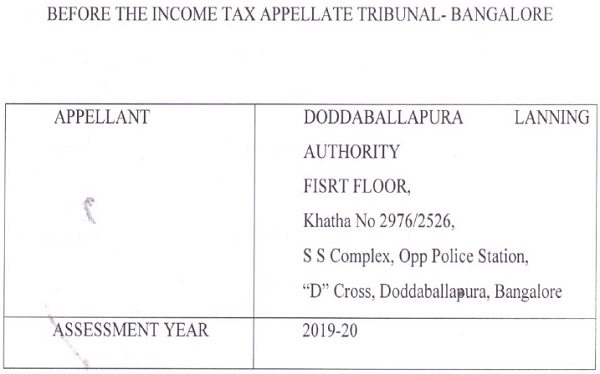
PREAMBLE:
Ours is Town Planning authority established under the special act called The Bangalore Metropolitan region Development Authority act 1985. The act is enacted with the objectives set out in the preamble of the act are “There is no proper coordination among the local bodies like Bangalore Development Authority, Bangalore Water Supply and SeArage Board, Karnataka State Road Transport Corporation, Karnataka Electricity Board. Karnataka Slum Clearance Board, Bangalore City Corporation, etc., in the Bangalore Metropolitan Area. It is necessary to coordinate the activities of these bodies by constituting an authority. There is also an urgent need to step up the Authority in view of the growing problems of unplanned Development, Housing, Water Supply, Transport, etc., Hence this Bill.- ( Published in the Karnataka Gazette (Extraordinary)”
1. INCOME: GENERAL
Income refers to money — cash or cash-equivalents — coming in either for work done, interest or profit from capital invested, or rent from a property or land that is let. When it comes from work it is referred to as either a wage or a salary.
2. INCOME UNDER INCOME TAX ACT
Under section 2(24) income is defined under inclusive definition consists of different sources under inclusive one.
In order to constitute particular receipt as income, it should bestow exclusive enjoyment in the hands of recipient of income. If any Receipt has restrictive enjoyment and utilization then it will lose the character of income in the hands of recipient.
In the present case Finance and accounts are governed by the Section 1 1 of the BMRDA Act which is reproduced below for immediate reference.
3. CHAPTER IV FINANCE, ACCOUNTS AND AUDIT
11. Authority’s Fund. – (1) The Authority shall have a fund called the Bangalore Metropolitan Region Development Authority Fund which shall be operated by such officers as may be authorized by the Authority.
(2) The Authority may accept grants, subventions, contributions, donations and gifts from the Central Government, the State Government, a local authority or any individual or body, whether incorporated or not, for all or any of the purposes of this Act.
(3) The State Government shall, every year, make a grant to the Authority of a sum equivalent to the administrative expenses of the Authority till the Authority is able to meet its administrative expenses out of its own resources.
(4) All moneys received by or on behalf of the Authority by virtue of this Act, and all interests, profits, and other moneys accruing to or borrowed by the Authority, shall be credited to the Fund.
(5) Except as otherwise directed by the State Government, all moneys and receipts specified in the foregoing provisions and forming part of the Fund shall be deposited in any Scheduled Bank as defined in the Reserve Bank of India Act, 1934 or invested in such securities, as may be approved by the State Government.
(6) The Fund, and all other assets vesting in the Authority shall be held and applied by it, subject to the provisions of and for the purposes of this Act.
12. Budget. – The Authority shall prepare, every year, in such form and at such time as may be prescribed, an annual budget estimate in respect of the next financial year showing the estimated receipts and disbursements of the Authority and shall submit a copy thereof to the State Government.
13. Annual report.- The Authority shall, after the end of each year prepare in such form and before such date as may be prescribed, a report of its activities during such year and submit to the State Government and the State Government shall cause a copy of such report to be laid before both Houses of the State Legislature.
4. THE KARNATAKA TOWN AND COUNTRY PLANNING ACT, 1961
68A. Funds of Planning Authority.—(1) Every Planning Authority shall have and maintain a separate fund to which shall be credited,—
(a) all moneys received by the Planning Authority from the State Government by way of grants, loans, advances or otherwise;
(b) all charges or fees received by the Planning Authority under this Act or rules, regulations or bye-laws made there under;
(c) in the case of a Planning Authority constituted under section 4C, such contributions from the Fund or Funds of the local authority or local authorities of the area included in the planning area, as such local authority or local authorities may from time to time be required by the State Government to make to such Planning Authority;
(d) all moneys received by the Planning Authority from any other source.
(2) The Fund shall he applied towards meeting,—
(a) the expenditure incurred in the administration of this Act;
(b) the cost of acquisition of land in the planning area for the purposes of development;
(c) the expenditure for such other purposes as the State Government may direct.
By the order of the Government of Karnataka dated 19/11/2011 the planning authority is allowed to utilize the amount received by it to the extent of 25% towards administrative cost and balance amount to be utilize for the objectives of set out in the bye law of the authority within the jurisdictions.
In respect of water sewerage cess, whole of the amount to be utilized for development of the Tank within the jurisdiction as per the plan approved with prior sanction.
5. FACT OF THE CASE:
Town planning authority is collecting following charges from the public:
1. Betterment charges
2. Lake Conservation fees
3. Application fees, Nakshe and other fees
Each source of receipt has restriction on collection, deposit and utilisation thereof from the Government of Karnataka. The Government is exercising the power to fix the fees/cess/charges. It only regulates the utilisation of the same. The Assessee is only in executive position in the capacity as custodian in implementing the project of civic amenity as set out in the objectives of the constitution of the Land.
Therefore we are of strong view that the amount received the Authority belongs to the Government of Karnataka and utilise according to the prior approval of the Government. Hence it is not income taxable in the hands of assessee.
We are also enclosing here with the sample copy of utilisation circular issued by the government of Karnataka hence the authority does not have any right over the fund. Hence it is not an income taxable in hands of assessee.
At present, consequent to according of approval u/s 12A(1) from A.Y.2022-23 vide Order passed by the Commissioner of Income Tax (Exemptions), Bengaluru, on 15/11/2021, our Trust/Organisation has been treated as a Charitable Institution.
However, it is seen that our Trust/Organisation is in possession of last limb of charity being ‘Advancement of any other object of General Public Utility’.
And also reference has been drawn to section 2(15) as under charitable purpose’ includes relief of the poor, education, yoga, medical relief, preservation of environment (including watersheds, forests and wildlife) and preservation of monuments or places or objects of artistic or historic interest, and the advancement of any other object of general public utility:
Provided that the advancement of any other object of general public utility shall not be a charitable purpose, if it involves the carrying on of any activity in the nature of trade, Commerce or business, or any activity of rendering any service in relation to any trade, Commerce or business, for a cess or fee or any other consideration, or retention, of the Income from such activity, unless —
such activity is undertaken in the course of actual carrying otg of such advancement for any other object of general public utility;
1. The aggregate receipts from such activity or activities during the previous year, do not exceed twenty percent of the total receipts, of the trust of institution undertaking such activity or activities, of that previous year;
Though the 5th limb of charity is ‘Advancement of any other object of General Public Wilily’, but the other conditions for denying the exemptions is reproduced in your notice itself as under:
–if it involves the carrying on of any activity in the nature of trade, Commerce or business, or any activity of rendering any service in relation to any trade, Commerce or business, for a cess or fee or any other consideration, or retention, of the Income from such activity, unless —
such activity is undertaken in the course of actual carrying out of such advancement for any other object of general public utility”
6. WE ARE NOT CARRYING IN ACTIVITY in the nature of trade, Commerce or business, or any activity of rendering any service in relation to any trade, Commerce or business. We are executing authority to collect the fees for approval of layout as plan sanction fees. Betterment charges and utilise the same for providing the civic amenity to the citizens in the locality.
We collect Lake Conservation fees from Lay out developers and utilised for the conservation and maintenance of the lake in the jurisdiction. The moto of the Planning authority is for the proper planning of the area and maintenance of the same.
Authority need to collect the fees as specified by government of Karnataka for the approval the layout Plan and collect the fees as specified and to be utilised for the purpose for which it has been collected. Hence we are of the Strong view that the It is not our income taxable in our Hands.
7. The Receipt of the Planning authority formed under the statute of State or central legislation is not hit by the first proviso of 2(15) r.w.s 13(8) of the income tax act 1961.
This view was upheld in the judgement of the Supreme Court in the case of “Assistant commissioner of Income tax (Exemption)V/S Ahmedabad Urban Development Authority and others” dated 19/10/2022.
Supreme court heard the case and discuss elaborately along with others in relation to these batch of appeals and special leave petitions, the primary question which falls for consideration is the correct interpretation of the proviso to Section 2(15) of the IT Act introduced by amendment w.e.f. 01.04.2009
(b) Summary in relation to statutory authorities/corporations
190. In light of the above discussion, this court is of the opinion that:
(i) The fact that bodies which carry on statutory functions whose income was eligible to be considered for exemption under Section 10(20A) ceased to enjoy that benefit after deletion of that provision w.e.f. 01.04.2003, does not ipso facto preclude their claim for consideration for benefit as GPU category charities, under Section 11 read with Section 2(15) of the Act.
(ii) Statury Corporations, Boards, Authorities, Commissions, etc. (by whatsoever names called) in the housing development, town planning, industrial development sectors are involved in the advancement of objects of general public utility, therefore are entitled to be considered as charities in the GPU categories. 4
(iii) Such statutory corporations, boards, trusts authorities, etc. may be involved in promoting public objects and also in the course of their pursuing their objects, involved or engaged in activities in the nature of trade, commerce or business.
(iv) The determinative tests to consider when determining whether such statutory bodies, boards, authorities, corporations, autonomous or self-governing government sponsored bodies, are GPU category charities:
(a) Does the state or central law, or the memorandum of association, constitution, etc. advance any GPU object, such as development of housing, town planning, development of industrial areas, or regulation of any activity in the general public interest, supply of essential goods or services – such as water supply, sewage service, distributing medicines, of food grains (PDS entities), etc.; •
(b) While carrying on of such activities to achieve such objects (which are to be discerned from the objects and policy of the enactment; or in terms of the controlling instrument, such as memorandum of association etc.), the purpose for which such public GPU charity, is set-up – whether for furthering the development or a charitable object or for carrying on trade, business or commerce or service in relation to such trade, etc.;
(c) Rendition of service or providing any article or goods, by such boards, authority, corporatio t , etc., on cost or nominal mark-up basis would ipso facto not be activities in the nature f business, trade or commerce or service in relation to such business, trade or commerce;
(d) where the controlling instrument, particularly a statute imposes certain responsibilities or duties upon the concerned body, such as fixation of rates on predetermined statutory basis, or based on formulae regulated by law, or rules having the force of law, setting apart amenities for the purposes of development, charging fixed rates towards supply of water, providing sewage services, providing food-grains, medicines, and/or retaining monies in deposits or government securities and drawing interest therefrom or charging lease rent, ground rent, etc., per se, recovery of such charges, fee, interest, etc. cannot be characterized as “fee, cess or other consideration” for engaging in activities in the nature of trade, commerce, or business, or for providing service in relation in relation thereto;
(e) Does the statute or controlling instrument set out the policy or scheme, for how the goods and services are to be distributed; in what proportion the surpluses, or profits, can be permissively garnered; are there are limits within which plots, rates or costs are to be worked out; whether the function in which the body is engaged in, is normally sdmething a government or state is expected to engage in, having regard to provisions of the Constitution and the enacted laws, and the observations of this court in NDMC; whether in case surplus or gains accrue, the corporation, body or authority is permitted to distribute it, and if so, only to the government or state; the extent to which the state or its instrumentalities have control over the corporation or its bodies, and whether it is subject to directions by the concerned government, etc.;
(f) As long as the concerned statutory body, corporation, authority, etc. while actually furthering a GPU object, carries out activities that entail some trade, commerce ‘or business, which generates profit (i.e., amounts that are significantly higher than the cost), ang the quantum of such receipts are within the prescribed limit (20% as mandated by the second proviso to Section 2(15)) — the concerned statutory or government organisations can be characterized as GPU charities. It goes without saying that the other conditions imposed by the seventh proviso to Section 10(23C) and by Section 11 have to necessarily be fulfilled.
(v) As a consequence, it is necessary in each case, having regard to the first proviso and seventeenth proviso (the latter introduced in 2012, w.r.e.f 01.04.2009) to Section 10(23C), that the authority considering granting exemption, takes into account the objects of the enactment or instrument concerned, its underlying policy, and the nature of the functions, and activities, of the entity claiming to be a GPU charity. If in the course of its functioning it collects fees, or any consideration that merely cover its expenditure (including administrative and other costs plus a small proportion for provision) – such amounts are not consideration towards trade, commerce or business, or service in relation thereto. However, amounts which are significantly higher than recovery of costs, have to be treated as receipts from trade, commerce or business. It is for those amounts, that the quantitative limit in proviso (ii) to Section 2(15) applies, and for which separate books of account will have to be maintained under other provisions of the IT Act.
CONCLUSION OF SUPREME COURT:
B . Authorities, corporations, or bodies established by statute:
B.1. The amounts or any money whatsoever charged by a statutory corporation, board or any other body set up by the state government or central governments, for achieving what are essentially ‘public functions/services’ (such as housing, industrial development, supply of water, sewage management, supply of food grain, development and town planning, etc.) may resemble trade, commercial, or business activities. However, since their objects are essential for advancement of public purposestmctions (and are accordingly restrained by way of statutory provisions), such receipts are prima facie to be excluded from the mischief of business or commercial receipts. This is in line with the larger bench judgments of this court in Ramtanu Cooperative Housing Society and NDMC (supra).
8. We reproduced below the Provision of Town Planning authorising the Authority for collection of Service charges for different type of approval
SECTION 18.RECOVERY OF A FEE IN CERTAIN CASES OF PERMISSION FOR CHANGE IN THE USE OF LAND OR BUILDING.-
1 [(1) Where permission for change of land use or development of land or building is granted under section 14A or section 14B or section 15 or section 17 and such change of land use or development is capable of yielding a better income to the owner, the Planning Authority may levy a prescribed fee not exceeding onethird of the estimated increase in the value of the land or building in the prescribed manner for permitting such change of land use or development of land or building]
(1A) Where an application for permission for development of building or land or sanction for sub-division of plot or layout of Private Street is submitted under section 15 or 17 to any Planning Authority, such Planning Authority shall levy and collect an additional prescribed fee for rejuvenation of lakes or tanks, if any, in that local planning area.] 1 ]
(2) Any person aggrieved by the levy of fee under sub-section (1), may within such period as may be prescribed, appeal to the District Court having jurisdiction on the ground that the change or development is not capable of yielding a better income to the owner. TKe decision of the District Court on such appeal shall be final. 1
(3) The State Government may exempt any Board, Authority or body constituted by or under any law and owned or controlled by the State Government or Central Government or an infrastructure Project promoted or implemented by any Company or person and approved by the State Government or Central Government from the payment of fee specified under sub-section (1).
Explanation:- For the purpose of this section and section 18A “Infrastructure Project ” means,-
(a) road, bridge, airport, port, inland water ways and inland ports, rail system or any other public facility of a similar nature as may be notified by the State Government from time to time;
(b) a highway project including housing or other activities being an integral part of that project;
(c) water supply project, irrigation project, sanitation and sewerage system.”
(d) a tourism project with an investment of not less than Rupees one hundred crores as rnay be notified by the State Government from time to time]
9. Therefore the betterment fund collection is falls u/s 11(1)(d) of the income tax act 1961 as specific fund
10. OTHER COLLECTIONS:
SECTION 18A. LEVY AND COLLECTION OF CESS AND SURCHARGE.-
(1) Notwithstanding anything contained in this Act, the Planning Authority may while granting permission for development of land or building levy and collect from the owner such land or building:-
(i) a cess for the purpose of carrying out any water supply scheme;
(ii) a surcharge for the purpose of formation of ring road;
(iii) a cess for the purpose of improving slums; and 86 Town and Country Planning [1963: KAR. ACT II
(iv) a surcharge for the purpose of establishing Mass Rapid Transport System. at such rates but all the above levies together not exceeding one-tenth of the market value of the land or building as may be prescribed. 3 [ 2 [(v) XXX] 2 ] 3
(2) The cess and surcharge levied under sub-section (1) shall be assessed and collected in such manner as may be prescribed.
(3) Any person aggrieved by the levy, assessment and collection of cess or surcharge munder this section may within thirty days from the date of the order appeal to the prescribed authority whose decision shall be final.
(4) The prescribed authority may after giving a reasonable opportunity of being heard to the appellant and the planning Authority pass such order as it deems fit.
(5) The State Government may exempt any Board Authority or Body constituted by or under any law and owned or controlled by the State Government or the Central Government or an infrastructure Projects promoted or implemented by any company or person and approved by the State Government or Central Government from the payment of cess or surcharge leviable under sub-section (1)11 1
11. PRAYER:
We the planning authority collect the fees as prescribed the Government of Karnataka as per the circular attached and allowed to utilise according the guidelines issued by Government [ Copy of Fund utilisation circular is enclosed]
Therefore we are of the view that the amounts collected by the Planning authority are outside the mischief of section Proviso to section 2(15).
a. The amount collected by the Planning authority by virtue of section 18 of the Town Planning act being betterment fees Amounting to Rs 5,20,97,935/- Is covered under 11(1)(d) of income tax act 1961 as capital receipt need to be deleted.
b. The amount collected by the Planning authority by virtue of section 18 of the Town Planning act Being lake Rejuvenation fees amounting to Rs 55,10,500/- Is covered under 11(1)(d) of income tax act 1961 as capital receipt need to be deleted.
We pray for the deletion of the additions made to the total Income in the light of the judgement of Supreme Court in Case mentioned above and allow the exemption u/s 11 of the income tax act 1961.
For Doddaballapur Planning authority
MEMBER SECRETARY
APPALLENT
MEMBER SECRETARY
DODDABALLAPURA PLANNING AUTHORITY
8. The ld. DR Ms. Neha Sahay, on the other hand supported the order of the ld. ADDL/JCIT(A), Panchkula and fervently submitted that the provision of section 11 of the Act is not at all applicable to the assessee as the assessee is not registered u/s 12A/12AB of the Act for the Asst. year 2019-20 & Asst. yea 2021-22 under appeal. Further the ld. DR submitted that in fact the entire gross receipts of the assessee are liable to tax instead of Net Income as computed by the CPC.
9. We have heard the rival submissions & perused the material available on Record. We have also gone through the case laws relied upon by the AR of the assessee. On going through the intimation passed u/s 143(1) of the Act dated 12.2.2021, we take a note of the fact that the ld. Asst. Director of Income Tax, CPC had denied the claim of Rs. 5,80,44,590/- deemed to have been applied during the previous year as per clause (2) of explanation to section 11(1) of the Act on the ground that the assessee had failed to file Form 9A before the due date as per the provisions of the Act read with rule 17 of the Income Tax Rules. We also take a note of the fact that such denial was on the strong credence that the assessee is registered u/s 12A/12AA of the Act since in the Return of Income as per the details furnished in schedule personal information under “Details of registration or approval under the Income Tax Act, the assessee had declared to be registered u/s 12A/12AA of the Act and is claiming exemption u/s 11 of the Act. Before us, the ld. AR of the assessee submitted that the claim of registration in the return was due to the inadvertent mistake on the part of the assessee. Further on going through the order for registration in Form 10AC dated 15/11/2021 submitted before us, we observe that the ld. PCIT/CIT granted the registration under sub clause (i) of clause (ac) of subsection (1) of section 12A of the Act vide Unique Registration No. (URN)- AAALD2630BE20215 effective from AY 2022-23 to AY 2026-27, the copy of which is reproduced below for ease of reference & convenience:-
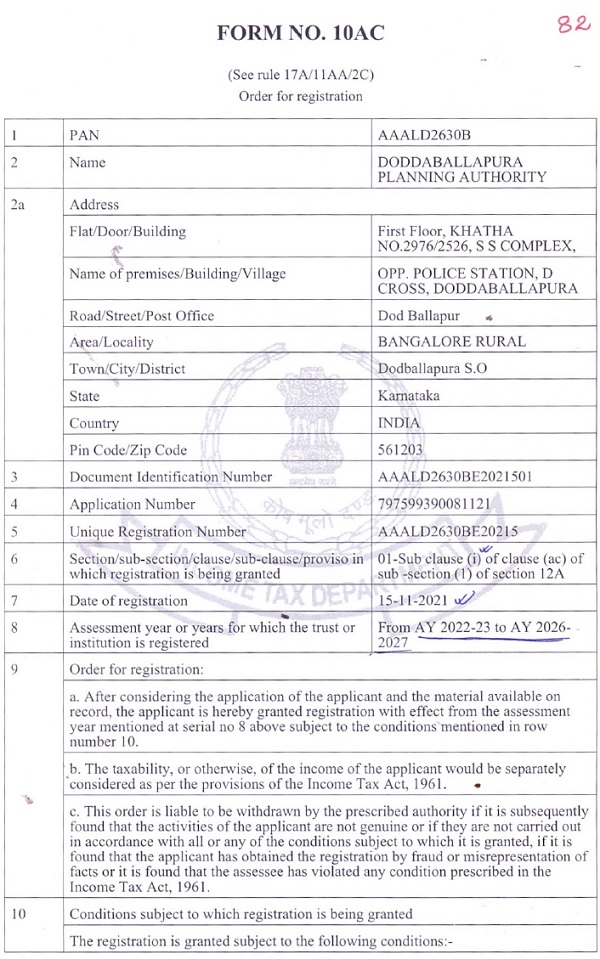
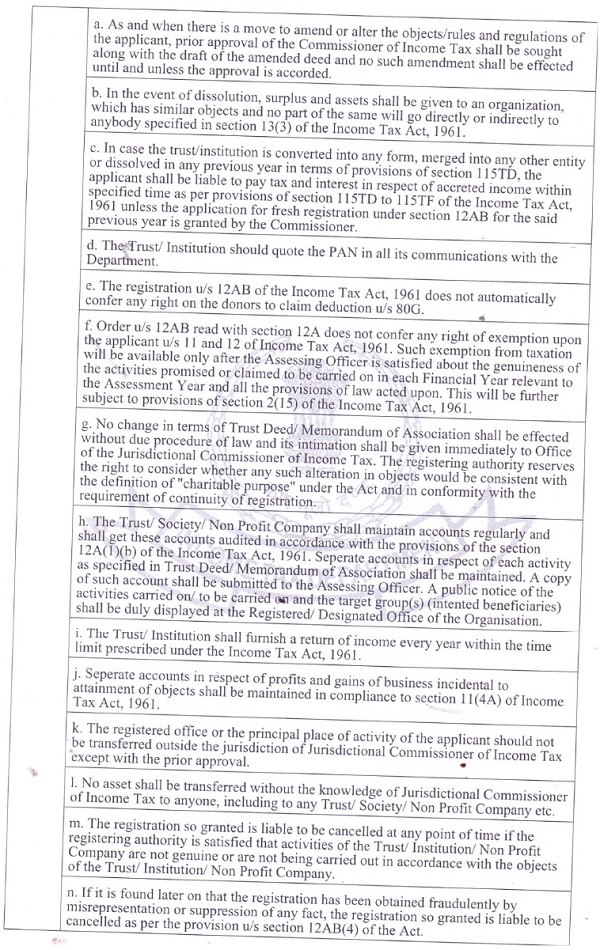
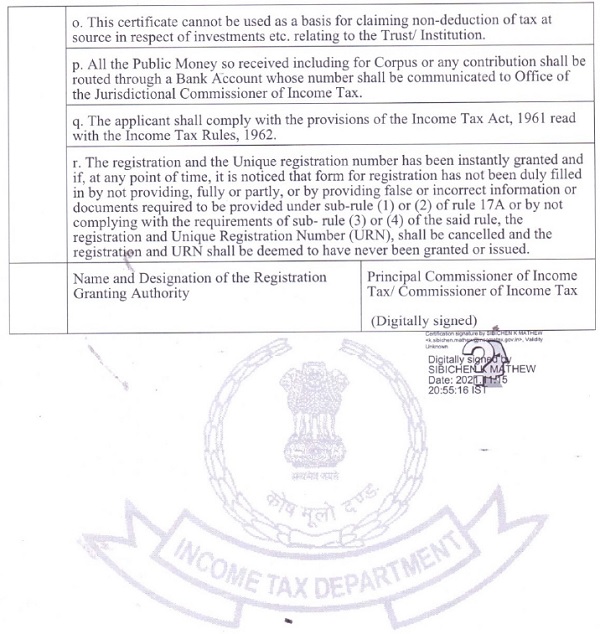
9.1 On going through the above order, we take a note of the fact that the assessee had been granted registration under sub clause (i) of clause (ac) of sub-section (1) of section 12A of the Act i.e. where the trust or institution is already registered u/s 12A [as it stood immediately before its amendment by the Finance (No.2) Act, 1996] or u/s 12AA [as it stood immediately before its amendment by the Taxation and Other Laws (Relaxation and Amendment of certain Provisions) Act,2020 which in our view is not a case of the assessee Trust. In fact, as submitted by the AR of the assessee, the application for registration was originally filed on 21/03/2020 which was rejected by the ld. CIT(E) as incomplete vide order dated 31/03/2021. Thereafter the assessee had again filed the fresh application on 08/11/2021 & accordingly the ld CIT(E) had granted registration vide order dated 15/11/2021. Further, we also take a note of the fact that ld. ADDL/JCIT(A), Panchkula has also observed that the registration was valid with effect from assessment year 2022-23 & not for the assessment year 2019-20 for which the appellant has filed the appeal nevertheless also held that the failure to file Form 9A as required constitutes a breach of the provisions set out in the I. Tax Act. We are of the considered opinion that for the purposes of claiming exemption u/s 11 & 12 of the Act, the assessee must first be registered u/s 12A/12AA/12AB of the Act. Registration under the Income tax Act is a precondition and mandatory requirement for the trust/institution to claim benefit of exemption under section 11 and 12 of the Act. The Hon’ble Supreme Court in the case of U.P. Forest Corporation & Anr. v. Dy. CIT reported in (2008) 297 ITR 1 held that “A conjoint reading of sections 11,12 and 12A makes it clear that registration u/s 12A is a condition precedent for availing benefit under sections 11 and 12 of the Act. Unless and until an institution is registered under section 12A of the Act, it cannot claim the benefit of section 11(1)(a) of the Act.” The relevant Paragraphs are reproduced below for ease of reference & convenience: –
“11. We are of the considered view that for claiming benefit under section 11(1)(a), registration under section 12A is a condition precedent. Section 11 provides for exemption of income which is applied for charitable purposes. Section 12 is in the nature of an Explanation of section 11. Section 12A provides that provisions of sections 11 and 12 shall not apply in relation to income of any trust or institution unless certain conditions are satisfied, one of which is clause (a), the same is reproduced as under: “12A. Conditions as to registration of trusts, etc.—The provisions of section 11 and section 12 shall not apply in relation to the income of any trust or institution unless the following conditions are fulfilled, namely :—
(a)the person in respect of the income has made an application for registration of the trust or institution in the prescribed form and in the prescribed manner to the Chief Commissioner or Commissioner before 1st day of July, 1973, or before the expiry of a period of one year from the date of the creation of the trust or the establishment of the institution, whichever is later :
Provided that the Chief Commissioner or Commissioner may, in his discretion, admit an application for the registration of any trust or institution after the expiry of the period aforesaid;”
12. Application for registration under section 12A has to be made in Form 10A prescribed by Rule 17-A of the Income-tax Rules, 1962 before the expiry of one year from the date of the creation of the trust or the establishment of the institution, whichever is later. The same has to be made by the person in receipt of the income of the trust. Chief Commissioner or Commissioner under proviso to clause (a) of section 12A has been vested with the discretion to admit an application for registration after the expiry of the prescribed period. A conjoint reading of sections 11, 12 and 12A makes it clear that registration under section 12A is a condition precedent for availing benefit under sections 11 and 12 of the Act. Unless and until an institution is registered under section 12A of the Act, it cannot claim the benefit of section 11(1)(a) of the Act. Keeping in view the fact that the appellant-Corporation has not been granted registration under section 12A of the Act, we hold that the appellant is not entitled to claim exemption from payment of tax under sections 11(1)(a) and 12 of the Act.
13. We, accordingly, dismiss the appeals filed by the Corporation without deciding the merits of the dispute.”
9.2 In the present case, the assessee is neither registered u/s 12A/12AA/12AB of the Act for the impugned Asst. year 2019-20 nor for the Asst. year 2021-22 under appeal as can be seen from the order of the registration. We are of the opinion that when the assessee is not registered u/s 12A/12AA/12AB of the Act, then the question of filing Form 9A/ Form 10/ Form 10B/Form 10BB does not arise at all in the case of the assessee. Therefore, to that extent we agree with the contention of the ld. DR that the provision of section 11 & section 12 of the Act is not at all applicable to the assessee as the assessee is not registered u/s 12AA/12AB of the Act for the Asst. year 2019-20 as well as for the Asst. year 2021-22 under appeal. Once the provisions of section 11 of the Act is not applicable to the assessee, then even the claim of the assessee that the amount collected by the planning authority by virtue of section 18 of the Town planning act being betterment fees amounting to Rs. 5,20,97,935/- & Rejuvenation fees amounting to Rs. 55,10,500/- is covered under section 11(1)(d) of I. Tax Act as capital Receipt is also not tenable.
9.3 Before proceeding further it is apposite here to mention that Section 12A of the Act deals with the conditions for applicability of sections 11 and 12 of the Act which are reproduced below for ease of reference & convenience:-
Section 12A in The Income Tax Act, 1961
12A. [Conditions for applicability of sections 11 and 12]
[(1)] The provisions of section 11 and section 12 shall not apply in relation to the income of any trust or institution unless the following conditions are fulfilled, namely:-
(a)the person in receipt of the income has made an application for registration of the trust or institution in the prescribed form and in the prescribed manner to the [* * *] [Principal Commissioner or] Commissioner before the 1st day of July, 1973, or before the expiry of a period of one year from the date of the creation of the trust or the establishment of the institution, [whichever is later and such trust or institution is registered under section 12-AA] :
[Provided that where an application for registration of the trust or institution is made after the expiry of the period aforesaid, the provisions of sections 11 and 12 shall apply in relation to the income of such trust or institution,-
(i) from the date of the creation of the trust or the establishment of the institution if the [* * *][Principal Commissioner or] Commissioner is, for reasons to be recorded in writing, satisfied that the person in receipt of the income was prevented from making the application before the expiry of the period aforesaid for sufficient reasons;
(ii) from the 1st day of the financial year in which the application is made, if the] [* * *] [ Principal Commissioner or ] [Commissioner is not so satisfied:]
[Provided further that the provisions of this clause shall not apply in relation to any application made on or after the 1st day of June, 2007;]
(aa)[ the person in receipt of the income has made an application for registration of the trust or institution on or after the 1st day of June, 2007 in the prescribed form and manner to the [Principal Commissioner or] Commissioner and such trust or institution is registered under section 12AA;]
(ab) the person in receipt of the income has made an application for registration of the trust or institution, in a case where a trust or an institution has been granted registration under section 12AA or has obtained registration at any time under section 12A [as it stood before its amendment by the Finance (No. 2) Act, 1996 (33 of 1996)], and, subsequently, it has adopted or undertaken modifications of the objects which do not conform to the conditions of registration, in the prescribed form and manner, within a period of thirty days from the date of said adoption or modification, to the Principal Commissioner or Commissioner and such trust or institution is registered under section 12AA;
(ac) notwithstanding anything contained in clauses (a) to (ab), the person in receipt of the income has made an application in the prescribed form and manner to the Principal Commissioner or Commissioner, for registration of the trust or institution,—
(i) where the trust or institution is registered under section 12A [as it stood immediately before its amendment by the Finance (No. 2) Act, 1996 (33 of 1996)] or under section 12AA [as it stood immediately before its amendment by the Taxation and Other Laws (Relaxation and Amendment of Certain Provisions) Act, 2020 (38 of 2020)], within three months from the first day of April, 2021;
(ii)where the trust or institution is registered under section 12AB and the period of the said registration is due to expire, at least six months prior to expiry of the said period;
(iii) where the trust or institution has been provisionally registered under section 12AB, at least six months prior to expiry of period of the provisional registration or within six months of commencement of its activities, whichever is earlier;
(iv) where registration of the trust or institution has become inoperative due to the first proviso to sub-section (7) of section 11, at least six months prior to the commencement of the assessment year from which the said registration is sought to be made operative;
(v) where the trust or institution has adopted or undertaken modifications of the objects which do not conform to the conditions of registration, within a period of thirty days from the date of the said adoption or modification;
(vi) in any other case, at least one month prior to the commencement of the previous year relevant to the assessment year from which the said registration is sought, and such trust or institution is registered under section 12AB;]
(b) where the total income of the trust or institution as computed under this Act without giving effect to [the provisions of sections 11 and 12 exceeds the maximum amount which is not chargeable to income-tax in any previous year] the accounts of the trust or institution for that year have been audited by an accountant defined in the Explanation below sub-section (2) of section 288 [before the specified date referred to in section 44AB and the person in receipt of the income furnishes by that date] the report of such audit in the prescribed form duly signed and verified by such accountant and setting forth such particulars, as may be prescribed]
(ba) the person in receipt of the income has furnished the return of income for the previous year in accordance with the provisions of subsection (4A) of section 139, within the time allowed under that section.
(c)[* * *]
[(2) Where an application has been made on or after the 1st day of June, 2007, the provisions of sections 11 and 12 shall apply in relation to the income of such trust or institution from the assessement year immediately following the financial year in which such application is made:]
[Provided that the provisions of sections 11 and 12 shall apply to a trust or institution, where the application is made under—
(a) sub-clause (i) of clause (ac) of sub-section (1), from the assessment year from which such trust or institution was earlier granted registration;
(b) sub-clause (iii) of clause (ac) of sub-section (1), from the first of the assessment year for which it was provisionally registered:
Provided further that where registration has been granted to the trust or institution under section 12AA or section 12AB ], then, the provisions of sections 11 and 12 shall apply in respect of any income derived from property held under trust of any assessment year preceding the aforesaid assessment year, for which assessment proceedings are pending before the Assessing Officer as on the date of such registration and the objects and activities of such trust or institution remain the same for such preceding assessment year:
[Provided also] that no action under section 147 shall be taken by the Assessing Officer in case of such trust or institution for any assessment year preceding the aforesaid assessment year only for non-registration of such trust or institution for the said assessment year:
Provided also that provisions contained in the first and second proviso shall not apply in case of any trust or institution which was refused registration or the registration granted to it was cancelled at any time under [section 12AA or section 12AB ].].”
9.4 On plain reading of section 12A of the Act we take a note of the fact that Section 12A provides for the conditions for applicability of Sections 11 and 12 of the Act. It prescribes three essential conditions which must be satisfied by a charitable/religious trust in order to claim exemption under the aforesaid sections: firstly, that the person in receipt of the income has made an application for registration of the trust or institution in the prescribed form and in the prescribed manner to the Principal Commissioner or Commissioner and such trust is registered under Section 12AA/12AB. Secondly, where the total income of the trust without giving effect to the provisions of section 11 and 12 exceeds the maximum amount which is not chargeable to income tax in any previous year,- (i) the books of account and other documents have been kept and maintained in such form and manner and at such place as may be prescribed, and (ii) the accounts of the trust have been be audited by a chartered accountant and the person in receipt of the income should furnish such audit report in the prescribed form duly signed and verified by the accountant. Thirdly, the person in receipt of income has furnished the return of income in accordance with the provisions of sub-section (4A) of section 139 within the time allowed under subsection (1) or sub-section (4) of that section.
9.5 Now the question arises when the registration granted subsequently whether the exemption applies to the earlier years? Section 12A(2) second proviso which is omitted by the Finance Act, 2023 w.e.f 01-04-2023 but applicable for both the Asst. year 201920 as well as Asst. year 2021-22 provides that where the registration has been granted to the trust or institution under section 12A or section 12AB of the Act, then the provisions of sections 11 and 12 shall apply in respect of any income derived from property held under any trust or any assessment year preceding the aforesaid assessment year, for which assessment proceedings are pending before the Assessing Officer as on the date of such registration and the objects and activities of such trust or institution remain the same for such preceding assessment year. This proviso provides under the following circumstances when the registration is granted, the benefit of exemption under section 11 and 12 applies to earlier assessment year-
1. Income derived from property held under trust where section 11 and 12 applies
2. Assessment proceedings are pending before the AO on the date of such registration
3. The object and activities of such trust or institution remain the same for such preceding assessment years
9.6 Before us, the ld. AR of the assessee categorically stated that object and activities of the assessee trust being the planning Authority does not change from the date of inception to the date of application or even after. Further we are of the opinion that the word ‘assessment’ is used in the Income Tax Act in a number of provisions in a comprehensive sense and includes all proceedings, starting with the filing of the return or issue of notice and ending with determination of the tax payable by the assessee. The expression assessment proceedings as held in case of Auto & Metal Engineers v. Union of India (1998) 229 ITR 399 (SC), comprehend the entire process of assessment starting from the date of filing of returns u/s 139 or issuance of notice under section 142(1) till making of the order of assessment under section 143(3) or section 144 of the Act. The order granting the registration was passed by the ld. PCIT/CIT in Form 10AC on 15/11/2021. The Return of income for the Asst. year 2019-20 was filed on 29/11/2020 & the intimation u/s 143(1) of the Act for the Asst. year 2019-20 was passed on 12/02/2021 i.e. way before the date of granting the registration on 15/11/2021. Further, as on 15/11/2021, the time limit to issue notice u/s 143(2) of the Act for the Asst. year 2019-20 had already expired. Therefore, it cannot be said that any assessment proceedings for the Asst. year 2019-20 is pending as on the date of registration. Similarly, the extended due date for filing the return of Income for the Asst. year 2021-22 itself was 15/03/2022 i.e. way after the date of granting the registration & therefore the question of assessment pending for the Asst. year 2021-22 as on the date of registration does not arise at all. In view of the above discussion as the registration under the I. Tax Act is a precondition and mandatory requirement for the trust/institution to claim benefit of exemption under section 11 and 12 of the Act, the contention of the assessee that the amount collected by the planning authority by virtue of section 18 of the Town planning act being betterment fees amounting to Rs. 5,20,97,935/- & Rejuvenation fees amounting to Rs. 55,10,500/- is covered under section 11(1)(d) of I. Tax Act as capital Receipt cannot be accepted.
9.7 It is an undisputed fact that the activities of the Assessee is “the Advancement of any other object of general public utility” which comes under the purview of last limb of “Charitable Purpose” as defined u/s 2(15) of the Act but without valid registration u/s 12AA/12AB of the Act, the benefit of section 11 & 12 cannot be granted.
9.8 Further, the AR of the assessee relied upon the decision of the coordinate Bench of ITAT in the case of Magadi Planning Authority in ITA No. 1056, 1352 & 1353/Bang/2024 dated 22/01/2025 which in our view is quite distinguishable on the present facts & circumstances of the case. In the case of Magadi Planning Authority the issue was whether the assessee can claim exemption u/s 11 & 12 of the Act, especially when the assessee was involved in activities aimed at advancing general public utility & also engaged in significant commercial activities & consequently the AO invoked section 13(8) of the Act. Further, the verdict of the Hon’ble Apex court in the case of Ahmedabad Urban Development Authority relied upon by the assessee is with regard to the legal position established that the Ahmedabad Urban Development Authority, constituted under the Gujarat Town Planning Act, is engaged in activities of general public utility which are charitable in nature. The mere collection of fees or cess under statutory powers does not negate the charitable status. Therefore, AUDA is entitled to exemption under Sections 11 and 12 of the Income Tax Act, 1961, and the proviso to Section 2(15) does not apply to disqualify it from such exemption which is not in dispute in the present case.
9.9 In conclusion, we dismiss the appeal of the assessee. The assessee is not entitled to claim benefit of exemptions under Sections 11 and 12 of the Act, 1961 in the absence of valid registration under the Income Tax Act. Hence the grounds of appeal raised by the assessee are hereby dismissed.
10. In the result, the appeal of the assessee is hereby dismissed. Coming to ITA No. 2116/Bang/2024 for the A.Y. 2021-22.
11. At the outset, we note that the issues raised by the assessee in its grounds of appeal for the AY 2021-22 are identical to the issue raised by the assessee in ITA No. 2115/Bang/2024 for the assessment year 2019-20 i.e. the ld. ADDL/JCIT(A) erred in not considering the specific collections like betterment fees, lake rejuvenation fees are covered u/s 11(1)(d) of the Act as income liable for accumulation even it is brought to the notice that there is wrong filing of return of income by the assessee.
12. Further, on going through the intimation passed u/s 143(1) of the Act for the Asst. year 2021-22, we also observe that the CPC apart from contending that the Trust or institution has not e-filed Form 9A within the due date had also contended that the trust had also not filed the Audit Report in Form 10B at least one month prior to the due date for furnishing the return u/s 139(1) & hence exemption claimed u/s 11(1)(d) of the Act is not allowable.
13. We have noted the fact that such denial by the CPC was on the strong credence that the assessee is registered u/s 12A/12AA of the Act since in the Return of Income as per the details furnished in schedule personal information under “Details of registration or approval under the Income Tax Act, the assessee had declared to be registered u/s 12A/12AA of the Act and is claiming exemption u/s 11 of the Act. However in ITA No. 2115/Bang/2024 we have already held that as the registration under the I. Tax Act is a precondition and mandatory requirement for the trust/institution to claim benefit of exemption under section 11 and 12 of the Act, the contention of the assessee that the amount collected by the planning authority by virtue of section 18 of the Town planning act being betterment fees & Rejuvenation lake fees is covered under section 11(1)(d) of I. Tax Act as capital Receipt cannot be accepted in the absence of registration for the impugned Asst. year.
14. Therefore, the findings given in ITA No. 2115/Bang/2024 shall also be applicable for the assessment year 2021-22. The appeal of the assessee for the A.Y. 2019-20 has been decided by us vide paragraph No. 9-9.7 of this order against the assessee. Hence, the grounds of appeal filed by the assessee for the Asst. year 202122 is hereby dismiss.
15. In the result appeal of the assessee is hereby dismissed.
16. In the combined result, both the appeals of the assessee for A.Y. 2019-20 & A.Y. 2021-22 are dismissed.
Order pronounced in the open court on 25th June, 2025







