Section 74A of CGST act– Streamlining Tax Recovery and Fair Compliance Bringing Simplicity, Clarity, and Accountability to GST Enforcement
Introduction
Tax laws are like rivers—they flow, shift, and adapt to the landscape of the economy. In India, the Goods and Services Tax (GST) has been a landmark reform, simplifying indirect taxation but also revealing challenges in enforcement and compliance. Over time, the need for a clear, fair, and unified framework to address cases of short payment, erroneous refunds, or wrongful input tax credit (ITC) became apparent. To meet this need, the Finance Act 2024 introduced Section 74A, a provision designed to replace the old dual system of Sections 73 and 74. By combining the rules for fraud and non-fraud cases, Section 74A brings clarity, efficiency, and predictability to tax administration. Effective from 1 November 2024, this section embodies India’s move toward streamlined, time-bound, and transparent GST enforcement.
Applicability and Scope
Section 74A applies from FY 2024-25 onwards, while cases prior to this continue under Sections 73 and 74. It covers all instances where tax has not been properly discharged, refunds claimed erroneously, or ITC wrongly availed/utilized. This ensures taxpayers follow a consistent procedure, eliminating ambiguity. The section also covers errors under the composition scheme, such as exceeding thresholds or claiming ineligible ITC, and allows re-determination when appellate authorities modify previous orders.
Purpose Behind Section 74A
The government introduced Section 74A to make GST enforcement simpler, fairer, and uniform. By merging the frameworks for fraud and non-fraud cases, it removes procedural confusion. SCNs must be issued within 42 months, and orders passed within 12 months, extendable by six months. Taxpayers get a 60-day window to voluntarily pay tax and interest to avail reduced or nil penalty, double the earlier 30 days. Redetermination of penalties is allowed if fraud is later unproven, balancing government revenue protection with fairness to taxpayers.
Key Features
Section 74A’s features make compliance predictable. Replacing the older dual system of Sections 73 and 74, it creates a single, unified framework to handle all cases of short payment, non-payment, erroneous refunds, or wrongful input tax credit, whether arising from inadvertent errors or deliberate fraud. Applicable from Financial Year 2024-25, the section provides a threshold of ₹1,000, below which no notice is required, thereby reducing administrative burden for minor discrepancies. One of its most notable features is the clear timeline for action: a show cause notice must be issued within 42 months, and the adjudication order passed within 12 months, extendable by six months if justified. Penalties are proportionate to the nature of the default, ranging from 10% of the tax due in non-fraud cases or 10000 whichever is higher to 100% in cases of fraud, suppression, or wilful misstatement. The section also encourages voluntary compliance by allowing taxpayers to pay the tax and interest within 60 days of notice to avail a reduced or nil penalty. Additionally, Section 74A provides for redetermination of penalties if appellate or judicial authorities find that fraud was not established. Overall, it strikes a delicate balance between taxpayer fairness and revenue protection, making GST enforcement more efficient, predictable, and just.
Process Flow under Section 74A
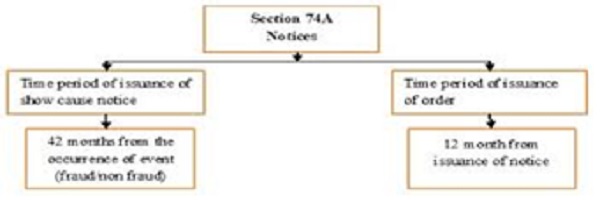
The process is straightforward. Discrepancies are detected via audit, scrutiny, or self-reporting. A show-cause notice (SCN) is issued within 42 months Taxpayers can pay tax + interest within 60 days to reduce penalties. If not paid, the officer adjudicates within 12 months (extendable by six months). Penalties depend on fraud determination. Re-determination or appeals are allowed if higher authorities modify the order.
Discrepancy Detected (Short Payment / Non-Payment / Wrong Refund / Wrong ITC)
→ Show Cause Notice (SCN) Issued (Within 42 months)
→ Taxpayer Pays Tax + Interest Within 60 Days
→ Case Closed (Reduced / Nil Penalty)
→ Taxpayer Does NOT Pay Tax + Interest
→ Adjudication by Officer (Order within 12 months, Extendable 6 months)
→ Penalty Imposed
(Non-Fraud: 10% of tax or ₹10,000, Fraud / Suppression: Up to 100% of tax)
→ Appeal / Re-determination
(If higher authority modifies order)
Situations Covered under Section 74A
Section 74A applies to multiple practical scenarios. Tax not paid or short paid due to under-reporting of turnover or invoices is covered. Erroneous refunds, such as duplicate export claims, fall within scope. Wrongful ITC availment , like claiming credit on personal expenses, is included and further utilization of the same. Wrongful collection of tax, as in the case of exempt composition dealers collecting GST, is addressed. Fraud, suppression, or wilful misstatement, such as issuing fake invoices, attracts higher penalties. Errors under the composition scheme and cases modified by appellate authorities are also included, making Section 74A comprehensive and practical.
Deemed Notice
Section 74A(3) of the GST law empowers the Proper Officer to issue a statement for additional tax periods not covered in the original notice issued under Section 74A(1), where similar defaults such as fraud, suppression, or wilful misstatement are involved. This provision avoids the need for issuing multiple separate notices for recurring issues across different periods.
Under Section 74A(4), such a statement shall be treated as a deemed notice, provided the grounds of default are identical to those mentioned in the original notice. However, this deeming fiction applies only when the nature of allegations remains the same; if the grounds differ, a fresh notice would be necessary to ensure compliance with principles of natural justice.
Practical Implications for Tax payers, Tax Authorities and tax professionals
Taxpayers: Section 74A has streamlined GST enforcement, providing clarity, fairness, and predictability for all stakeholders. For taxpayers, it offers a 60-day window to pay tax and interest voluntarily, reducing or avoiding penalties, while minor demands below ₹1,000 are exempted. Genuine mistakes are distinguished from fraudulent actions, giving taxpayers a fair chance to comply.
For tax authorities, the unified framework replaces the older Sections 73 and 74, simplifying adjudication. Standardized timelines—SCNs issued within 42 months and orders within 12 months (extendable by six months)—enhance efficiency and help officers prioritize significant cases. The clearly defined penalty structure ensures proportional enforcement.
Tax professionals play a key role in reviewing GST returns, ITC claims, and refunds, advising clients on early settlement benefits to avoid heavy penalties. Overall, Section 74A fosters voluntary compliance, accountability, and revenue protection, balancing fairness for taxpayers with effective enforcement by authorities.
Illustrative Example
A manufacturer claims ITC on canteen expenses (blocked credits). During a 2025 audit, the discrepancy is identified. A SCN is issued within 42 months. If the manufacturer pays tax and interest within 60 days, the penalty is waived, and the case is closed. If fraudulent invoices were involved, penalties could reach 100% of tax due. This demonstrates how Section 74A balances enforcement with fairness, providing relief for honest errors and strict action against deliberate violations.
Conclusion
Section 74A is more than an amendment—it represents a reform in tax philosophy. By unifying procedures, standardizing timelines, and encouraging early voluntary compliance, it embodies responsive and accountable governance. Taxpayers gain clarity and a chance to rectify errors, while authorities achieve streamlined enforcement and consistency. Ultimately, Section 74A ensures the scales of justice and compliance are balanced, fostering a GST system that is both fair and effective.
*****
Name: Deepika | Email ID: [email protected]