India’s Bold Slash in Excise Duty on Petrol and Diesel: Another Masterstroke of Governance Amid the Fire of War
In an era, where uncertainty is prevailing and where global crises have their own way of arriving without warning and departing without mercy, the Indian government’s decision on March 27, 2026 to dramatically slash excise duty on petrol and diesel stands as one of the most timely, well-calibrated, and citizen-centric policy interventions of recent memory. With the West Asia war raging since February 28, pitting the US-Israel axis against Iran, and with rising tensions surrounding the Strait of Hormuz, the jugular vein of the world’s oil supply, thrown into one of its worst disruptions in modern history, unlike other nations, India chose not to panic, not to hoard, and not to abandon its people. Instead, it acted.
The Storm That Arrived from the Gulf
The scale of the crisis India faces cannot be overstated. The West Asia conflict has set global energy markets ablaze. Brent crude, which had been trading in the low $70s just weeks ago, has surged past $107 per barrel, with credible market scenarios placing it anywhere between $130 and $156 in a prolonged disruption scenario. For Asian nations, especially India, which imports over 85% of its crude oil requirements, this is not an abstract geopolitical event. It is a direct assault on the cost of living of 1.4 billion people.
At the heart of the crisis lies the Strait of Hormuz, the narrow maritime passage between the Persian Gulf and the Gulf of Oman. Roughly 20 to 25 per cent of global oil supply passes through this chokepoint. For India, the stakes are even higher, because approximately 50 per cent of the country’s crude oil imports and nearly 60 per cent of its LNG transit through this single, contested waterway. When ships began being stranded, when Iranian drones, sea mines and missiles made the passage treacherous, and when insurance rates for vessels attempting the route skyrocketed, India’s energy security entered genuinely uncharted territory.
The Cut That Counts: What the Government Did
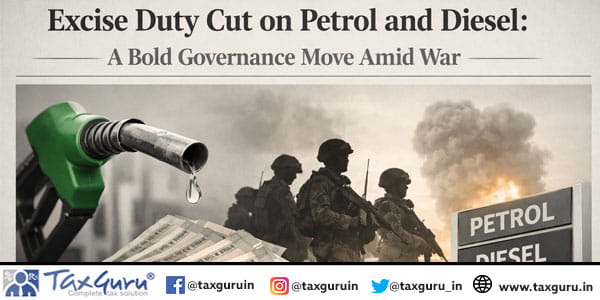
On the morning of March 27, the Central Government announced a sharp and decisive reduction in excise duty on motor fuels. Petrol duty was slashed to ₹3 per litre from ₹13 per litre, resulting into a cut of ₹10. Diesel was reduced from ₹10 to nil, effectively zeroing out the central excise component entirely. In real terms at the pump, this translates to a reduction of approximately ₹8.69 per litre on petrol and ₹7.05 per litre on diesel after accounting for state-level VAT and other levies. State-owned oil marketing companies, like Indian Oil Corporation Limited, Bharat Petroleum Corporation Limited and Hindustan Petroleum Corporation Limited, passed on the cuts despite operating under severely squeezed margins, an act of institutional responsibility that deserves acknowledgement. Alongside the duty cut, a direct cash subsidy was announced for LPG beneficiaries under the Pradhan Mantri Ujjwala Yojana, and the Finance Ministry urged state governments to mirror the central relief by reducing local VAT and sales tax on fuel.
This is not the first time the government has wielded the excise instrument to shield consumers. In November 2021 and May 2022, during the post-pandemic crude surge, excise was cut by ₹13 per litre on petrol and ₹16 per litre on diesel which was then fully passed on to consumers. That precedent of interventionist fiscal responsibility was maintained with even greater urgency this time, given that the current crisis is both more acute and more geopolitically complex.
Why This Decision Should be considered Prudent & Country First?
A. Protecting the Common Citizen First
India’s working and middle classes run on diesel and petrol, quite literally. The truckers, auto-rickshaw drivers, delivery workers, and daily commuters who form the circulatory system of the Indian economy are the most immediate beneficiaries of fuel. Any unchecked pass-through of international crude price spikes would have directly inflated the cost of every commodity that moves by road, be it groceries, vegetables, medicines, construction materials, and consumer goods. By cutting excise duty, the government has built a fiscal firewall between the war in West Asia and the kitchen table of the Indian households, hospitals, construction sites, etc.
B. Keeping Inflation from Spiralling
Fuel is not merely a consumer product. It is an input cost for virtually every sector of the economy. When diesel prices rise, freight costs rise. When freight costs rise, food prices rise. When food prices rise, headline inflation rises, the Reserve Bank of India is forced to tighten monetary policy, and economic growth slows. The government’s pre-emptive use of the excise instrument is, therefore, not just social relief, it is macroeconomic surgery. By absorbing the shock at the fiscal level rather than allowing it to radiate through the price system, the government has protected the trajectory of India’s GDP, which cannot afford to be derailed by an external conflict it did not start and cannot unilaterally resolve.
C. Sustaining Businesses and Supply Chains
The impact on the business community, particularly MSMEs and the logistics sector, would have been catastrophic without intervention. India’s vast network of transporters and freight operators runs on very thin margins even in normal times. A drastic increase in diesel input costs which is very much in consonance with the surge in global crude, would have eventually triggered a wave of cost pass-throughs, price renegotiations, contract defaults, and in the worst cases, business closures. The excise cut, together with the enhanced Diesel Rebate mechanisms available in comparable economies, provides breathing room for these operators to continue functioning, continue employing, and continue moving India’s goods.
D. Preventing Panic and Social Disorder
Crisis management is as much about perception as it is about policy. When fuel shortages are feared, even if unwarranted, normal citizens like us rush to fill tanks, causing artificial shortages that then become real. It was recently noticed in Ahmedabad city as well, where for 1-2 days partially artificial shortages were observed. India’s state-owned oil companies moved quickly with IOCL declaring that its outlets were “well-stocked and fully operational,” BPCL calling reports of shortages “completely unfounded,” and HPCL reaffirming stable supplies across the country. The excise cut, announced simultaneously, sent an unambiguous signal to the market that the government is in control, the supply is secure, and there is no reason to panic-buy. This combination of price relief and reassurance is precisely the calibrated response that a mature democracy demands from its elected government in a moment of crisis.
The Diplomatic Front: India Plays the Long Game
The excise cut would be a hollow response if it were India’s only response to the crisis. What makes the government’s strategy truly impressive is how it has simultaneously worked the diplomatic corridors to secure the very supply chains that are under threat.
Prime Minister Narendra Modi addressed both Houses of Parliament with unusual directness, acknowledging that the “situation has become difficult in the Strait of Hormuz” and declaring attacks on commercial shipping as “unacceptable.” He confirmed that he had personally conducted multiple rounds of telephonic conversations with global leaders since these hostilities began which includes a high-level call with US President Donald Trump on March 24, during which both leaders stressed that the Strait of Hormuz must remain “open, secure, and accessible.” India also made clear that it is actively in contact with Iran and various West Asian partners to ensure safe passage of Indian-flagged vessels. The results have been tangible as dozens of vessels carrying crude oil and LPG which includes the Pine Gas and Jag Vasant carrying over 92,000 tonnes of LPG which had successfully navigated the Strait through Indian diplomatic intervention.
The diplomatic breakthrough was underscored on March 25 when Iran’s Foreign Minister Abbas Araghchi announced that passage through the Strait of Hormuz would be permitted for “friendly nations,” explicitly listing India among them alongside China, Russia, Iraq, and Pakistan. This was no accident, but it was the outcome of weeks of quiet, persistent, and effective diplomacy by New Delhi, leveraging its unique position as a nation that has long maintained civilizational ties with Iran while also deepening its strategic partnership with the United States.
India’s approach which is to diversify crude oil imports from 27 to 41 source countries over the past decade, expanding strategic petroleum reserves, prioritising LPG for domestic consumption while curtailing industrial use, and ordering refineries to boost domestic LPG production, reflects a government that has been managing its energy security with strategic foresight, not just reactive firefighting.
The Critics’ Corner: A Fair Assessment
No policy intervention is beyond scrutiny. Critics have rightly noted that the excise cut will impose a significant revenue cost on the Central Government’s fiscal arithmetic, potentially pressuring the fiscal deficit target. The Finance Ministry’s nudge to states to reduce VAT further adds complexity, since state fiscal positions vary widely. There are also long-term concerns about the signal that repeated excise cuts send to energy transition advocates the fact that every rupee absorbed by the government in subsidising fossil fuels is, in a sense, a rupee not directed toward renewable energy infrastructure.
These are legitimate considerations. But they must be weighed against the alternative, i.e. whether allowing a wartime commodity shock which was caused by a conflict India neither provoked nor controls — to immiserate tens of millions of citizens overnight. The government has chosen people over fiscal orthodoxy in the short run, with the reasonable expectation that a stabilisation of the West Asia situation, combined with India’s ongoing energy diversification, will allow the excise arithmetic to be recalibrated in the medium term.
A Moment That Defines Responsive Governance
History will remember the West Asia war of 2026 as one of the defining disruptions of the mid-21st century. How governments responded that is, whether with paralysis, populism, or principled pragmatism will determine which countries emerged stronger. India’s response, combining immediate fiscal relief for its citizens through the excise duty cut, active diplomatic engagement to secure its energy supply chains, and clear public communication to prevent panic, represents exactly the kind of responsive, multi-dimensional governance that the moment demanded.
The excise duty slash is not a perfect solution. No single instrument ever is & will be. But it is the right solution, the one that puts India’s citizens, its businesses, and its economic stability first, while the government simultaneously works every lever available to restore normalcy at the source. In a world on fire, that is what good governance looks like.
*****
Disclaimer: This article is an opinion piece based on publicly available information as of March 27, 2026. The views expressed reflect an analysis of government policy in the context of the current geopolitical situation.