Case Law Details
Synchronise Scientific Glass Works Pvt. Ltd. Vs Martina Bio Genics Private Limited (NCLT Kolkata)
Conclusion: Section 7 insolvency application filed by State Bank of India (SBI) was admitted against Martina Bio Genics Private Limited and held that pending winding-up proceedings could not override the objective of corporate revival under the Insolvency and Bankruptcy Code, 2016 (IBC).
Held: The Corporate Debtor Martina Bio Genics had availed credit facilities from the Applicant State Bank of India, the said credit facilities had been reviewed, renewed and enhanced from time to time. Pursuant to such sanction, the Corporate Debtor had also executed security documents to secure the Loan sanctioned. The corporate debtor allegedly failed to comply with the repayment obligations which resulted in classification of the account as a Non-Performing Asset (NPA). The bank also issued notices under Sections 13(2) and 13(4) of the SARFAESI Act after the borrower defaulted on its repayment commitments. However, prior to the insolvency proceedings, winding-up petitions had been filed against the company before the Calcutta High Court under the Companies Act, 1956. High Court had passed winding-up orders and appointed the Official Liquidator. However, subsequent proceedings revealed that the Official Liquidator remained only in symbolic possession of the company’s assets and had not undertaken any effective steps for sale or realisation of assets. Arguing for admission of the petition, SBI argued that the principal objective of the IBC was revival and continuation of the corporate debtor rather than liquidation. It further submitted that winding-up proceedings may be transferred and treated as insolvency proceedings where no irreversible liquidation steps had been taken. It was held that Adjudicating Authority found that Applicant–Financial Creditor had successfully established the existence of a financial debt and the occurrence of default well beyond the statutory threshold prescribed under Section 4 of the Insolvency and Bankruptcy Code, 2016. The documentary evidence placed on record, including the sanction letters, loan documents, demand notices issued under the SARFAESI Act, 2002, and the material demonstrating continued non-payment by the Corporate Debtor, conclusively establish the debt and default. Further, upon a conjoint reading of Section 434 of the Companies Act, 2013, particularly the fifth proviso thereto, Rule 5 of the Companies (Transfer of Pending Proceedings) Rules, 2016, and the law laid down by the Hon’ble Supreme Court in Forech India Ltd. v. Edelweiss Assets Reconstruction Co. Ltd., it was evident that this Adjudicating Authority was fully empowered to entertain and adjudicate the transferred winding-up proceedings as an application under Section 7 of the IBC. The legislative intent underlying the transfer provisions was to ensure that viable corporate debtors were dealt with under the comprehensive insolvency framework established by the Code rather than through parallel winding-up proceedings. Consequently, continuation of the winding-up proceedings before the Company Court would not advance the objective of value maximisation or resolution envisaged under the IBC. On the contrary, commencement of the Corporate Insolvency Resolution Process would serve the interests of all stakeholders by providing an opportunity for resolution of the Corporate Debtor as a going concern. Applying the principles laid down by the Hon’ble Supreme Court in Innoventive Industries Ltd. v. ICICI Bank Ltd., once the Adjudicating Authority is satisfied regarding the existence of a financial debt and the occurrence of default, admission of the application under Section 7 follows as a necessary consequence. No legal or factual impediment has been demonstrated which would warrant rejection of the application. Accordingly, the application under Section 7 of the Insolvency and Bankruptcy Code, 2016 was admitted; Corporate Insolvency Resolution Process is initiated against the Corporate Debtor; moratorium under Section 14 of the Code is declared; and the Interim Resolution Professional is appointed to undertake the CIRP in accordance with law. The Official Liquidator attached to the Hon’ble High Court at Calcutta stands discharged and is directed to hand over all records, assets and possession of the Corporate Debtor to the Interim Resolution Professional forthwith.
1. I.A. (Companies Act) No. 76/2025
1.1 This I.A. is filed by the applicant claiming following relief-
a. This Hon’ble Tribunal may be pleased to initiate Corporate Insolvency Resolution Process under the Insolvency and Bankruptcy Code, 2016 of M/s. Martina Bio Genics Pvt ltd;
b. This Hon’ble Tribunal may be pleased to appoint Mr. Surya Kanta Satapathy having IBBI/IPA-001/IPP00598/2017-2018/11050 as the Interim Resolution Professional of the Corporate Debtor/ M/s. Martina Bio Genics Pvt ltd;
c. The Official Liquidator, High Court Calcutta be discharged as liquidator of Martina Bio Genics Private Limited and be directed to make over all documents, records and handover possession of all the movable and immovable properties of the Corporate Debtor to the incoming Interim Resolution Professional.
d. The provision for making compliant of Insolvency and Bankruptcy Code in TP No.26 of 2023 be dispensed with;
e. Such further Order/Orders and/or direction/directions be passed as this Honble Tribunal may deem fit and proper;
2. Background of the case-:
2.1 The Corporate Debtor has availed credit facilities from the Applicant State Bank of India, the said credit facilities have been reviewed, renewed and enhanced from time to time and lastly on 04.02.2014. Pursuant to such sanction, the Corporate Debtor had also executed security documents to secure the Loan sanctioned.
2.2 Subsequently, the Corporate Debtor undertook to strictly adhere to the Terms & Conditions of the sanction as entered into by and between the Applicant and the Corporate Debtor respectively. The Corporate Debtor therein was mandated to repay the loan at an agreed interest rate or as per the RBI/ Bank’s Directives from time to time, according to the stipulated Terms and Conditions as envisaged in the sanction. Further under the sanctions the Corporate Debtor was mandated to repay the sum, but the Corporate Debtor has failed and/or neglected to make repayments of the principal debt and interest thereon in accordance with the Terms and Conditions as enshrined in the sanctions and thereby committed breach of the said sanctions extended by both the Assignor Banks respectively.
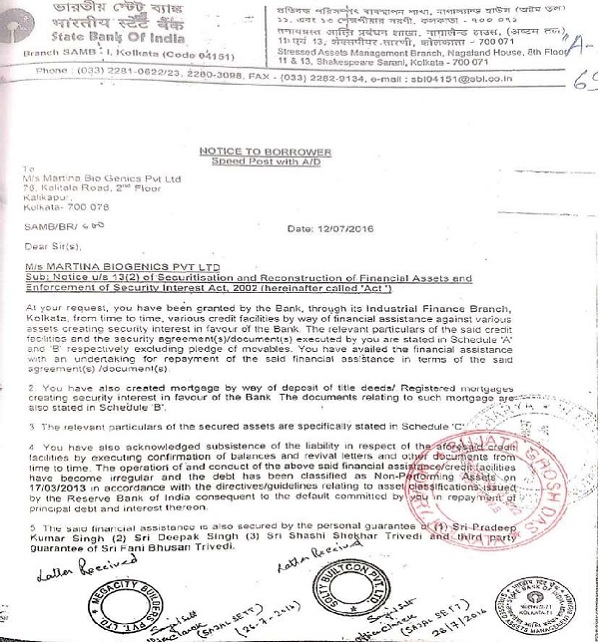
2.3 By reason of the failure and/or inability of the said company to repay the said credit facilities the account of the Company was classified as N.P.A on 28.03.2015 by the Applicant and the date of default is 28.12.2014. It is pertinent to note that in terms of the loan agreement, the State Bank of India and/or its Authorized Officer on or about 12.07.2016 issued a notice1 to the said Company and its guarantors under Section 13(2) of the SARFAESI Act 2002 indicating the dates on which the accounts of the said company had become NPA with each of the said banks. The Applicant had also thereafter, issued Notice under Section 13(4)(a) of SARFAESI Act 2002.
2.4 On the facts and circumstances more fully and particularly stated therein one Synchronise Scientific Glass Works Private Limited being the Petitioning Creditor had instituted Company Petition No 347 of 2015 against the Corporate Debtor under the Provisions of Section 433, 434 and 439 of the Companies Act, 1956 before the Hon’ble High Court of Calcutta praying inter alia that the Corporate Debtor be wound up. That another Petitioning Creditor being Manish Kumar Jajodia had also instituted Company Petition No 49 of 2016 against the Corporate Debtor under the Provisions of Section 433, 434 and 439 of the Companies Act, 1956 before the Hon’ble High Court of Calcutta praying inter alia that the Corporate Debtor be wound up.
2.5 Thereafter, the said C.P 49 of 2016 was admitted vide Order dated 10.03.2016 and C.P 347 of 2015 was admitted vide Order dated 04.01.2016 and the direction2 to wind up was passed by Order dated 26.09.2016 in CP No. 347 of 2015 and order dated 21.11.2016 in CP No. 49 of 2016.
3. Facts of the Case-:
3.1 Thereafter, the matters were heard by the Hon’ble High Court at Calcutta on 20.04.2017 and 12.09.2017. By the order dated 04.01.2017, the Official Liquidator was directed not to take possession of the assets and effects of the company (In Liquidation) provided the Corporate Debtor paid certain sums of money to the Petitioning Creditor and the Supporting creditor. By order dated 20.04.2017, the Corporate Debtor submitted that it is framing a payment schedule for payment of dues. The Official Liquidator was directed to continue to be in symbolic possession of the assets and the CD may carry its operations under the Official Liquidator. Thereafter, the corporate debtor committed default. By subsequent Order dated 12.09.2017 the Official Liquidator was directed to immediately ensure that security guards are employed to protect the assets of the CD. After several hearings, the respondent company has been able to formulate a payment schedule for payment of all petitioning creditors by instalment The Hon’ble High Court further clarified that this order3 would not prevent the company from making further payment to creditors in this intervening period.
3.2 That thereafter by an order dated 26.09.2022, the Hon’ble High Court at Calcutta, upon an application by the Applicant herein holding that the Hon’ble Court had no jurisdiction to entertain the matter directed that the said CP No. 347 of 2015 along with all connected applications to be transferred4 to this Learned Tribunal.
3.3 Its appears that the records the said C.P No. 347 of 2015 have been transferred to this Learned Tribunal and the same have been registered as TP/26(KB)2023. Such registration has been made on 30.03.2023. The said TP/26(KB)2023 appeared in the cause list of this Hon’ble Tribunal from time to time. It is pertinent to note that on 26.04.2023 when the said matter had appeared in the cause list of this Tribunal and was taken up for the first time, this Tribunal was pleased to direct the Registry to issue notice to the other Respondents by way of speed post and by email and file tracking information on record.
3.4 That on 29.09.2023 the learned advocate for the Official liquidator sought two weeks time to file status report.
3.5 The CD in the present case, was directed multiple times by the Hon’ble High Court to clear its dues and has failed to do the same. The 13(2) Notice issued by the Applicant also indicated the loan of the Respondent Company has been declared as NPA on 17.03.2013. As such, the debt and default stands established. Further, since the application has been filed by State Bank of India in respect of loan dues, the Applicant shall be deemed to be a ‘financial creditor’ within the meaning of section 5(7) of the Code and the instant petition shall be treated as a petition under section 7 of the Code. It may be noted that the account was restructured and NPA date backdated to 17.03.2013 which is the date of implementation of the plan, from the actual date of default which is on 28.03.2015 on account of failure of restructuring.
3.6 That the Official Liquidator has not taken any steps and/or actions to the extent the applicant is aware, the Factory Unit of the company/Corporate Debtor being Land situated within the local limits of Rajpur Sonarpur Municipality, West Bengal is still under the physical possession of the erstwhile directors as per Direction of the Hon’ble High Court and the same shall be evinced by the status report5 dated 17.10.2023 of the Official Liquidator, High Court at Calcutta.
3.7 Furthermore, the Applicant has conducted valuation of the properties of the Company and a valuation report has been prepared on 20.04.2023.
3.8 In complete dereliction and breach of its duties the official liquidator has failed and/or neglected to take appropriate steps to sell of the assets and properties of the said company (in liquidation). Having regard to the complete inaction of the official liquidator in the matter since the year 2016 it is just, proper and necessary that Corporate Insolvency Resolution Process of the Corporate Debtor is initiated.
3.9 That by dint of such Order passed by the Hon’ble High Court at Calcutta dated 26.09.2022 the Applicant is making this application before this Tribunal inter alia, seeking to initiate the Corporate Insolvency Resolution Process of the Corporate Debtor.
3.10 It is humbly submitted herein that the primary focus of the IBC, 2016 is to ensure revival and continuation of the corporate debtor by protecting the corporate debtor from its own management and from a corporate death by liquidation. The Code is thus a beneficial legislation which puts the corporate debtor back on its feet, not being a mere recovery legislation for creditors.
3.11 It is further submitted herein that it is not the case that once a winding up petition is admitted, the winding up petition should trump any attempt at revival of the company through a Section 7 or Section 9 petition under the IBC. The use of the term “nothing irreversible in judgement passed by the Apex Court in the case of Action Ispat and Power Pvt. Ltd. v. Shyam Metalics and Energy Ltd., 2020 SCC OnLine SC 1025 inevitable and unambiguously connotes that the intent to transfer a winding up petition to the NCLT is to resuscitate the Corporate Debtor as long as no irreversible step has been taken by the Official Liquidator as there exists all and/or every hope to bring the Corporate Debtor back on its feet and reinvigorate the Corporate Debtor.
3.12 Furthermore, in the judgement of A Navinchandra Steels Pvt Ltd -vs- SREI Equipment Finance Limited & Ors has been observed by the Hon’ble Apex Court that, given the object of the IBC as delineated in the judgement of Swiss Ribbons (P) Ltd. v. Union of India, (2019) 4 SCC 17, it is clear that the IBC is a special statute dealing with revival of companies that are in the red, winding up only being resorted to in case all attempts of revival fail.
3.13 It is pertinent to mention herein that the proceedings for winding up of a company are actually proceedings in rem to which the entire body of creditors is a party. The proceeding might have been initiated by one or more creditors, but by a deeming fiction the petition is treated as a joint petition. Therefore, apropos the same, the Applicant Bank intends to make this instant application before this Hon’ble Tribunal under Section 60(5) of the Insolvency and Bankruptcy Code, 2016 read with Rule 11 of the National Company Law Tribunal Rules, 2016 in T.P. No 26 of 2023.
3.14 The present claim of the Applicant against the Corporate Debtor is Rs. 178,05,45,766.81/-as on December 2024 which is within the stipulated threshold limit. Furthermore, as far as the applicant is aware, the applicant bank is the highest stake holder and only secured creditors and as such proposes the name of Mr. Surya Kanta Satapathy having IBBI Registration No. IBBI/IPA-001/IP-P00598/2017-2018/11050 to act as the Interim Resolution Professional (IRP) of the Corporate Debtor in terms of the Insolvency and Bankruptcy Code 2016. The said Mr.Surya Kanta Satapathy has given his consent in writing. A copy of the statement of accounts duly certified by the Financial Creditor under the Information Technology Act, 2000 and the Bankers Book of Evidence Act 1891 and the Form 2 of the Insolvency and Bankruptcy (Application to Adjudicating Authority) Rules, 2016 along with the authorization for assignment and certificate of registration is annexed6 herewith.
4. Findings & Analysis-:
4.1 We have gone through the case file carefully and perused the pleadings of the parties and documents placed on record by the parties and heard the arguments put forth by learned Counsels for the parties; and after hearing the learned counsels for the parties, we shall now proceed to consider the present petition on its merits, specifically within the ambit of points involved in the instant application.
4.2 To address the matter of transferring winding up proceedings to this Adjudicating Authority, it is pertinent to commence with a comprehensive examination of Section 434 of the Companies Act, 2013, with specific emphasis on its fifth proviso. The verbatim text of Section 434 is provided below for reference:
“434. Transfer of certain pending proceedings:— (1) On such date as may be notified by the Central Government in this behalf,–
(a) all matters, proceedings or cases pending before the Board of Company Law Administration (herein in this Section referred to as the Company Law Board) constituted Under Sub-section (1) of Section 10E of the Companies Act, 1956, immediately before such date shall stand transferred to the Tribunal and the Tribunal shall dispose of such matters, proceedings or cases in accordance with the provisions of this Act;
(b) any person aggrieved by any decision or order of the Company Law Board made before such date may file an appeal to the High Court within sixty days from the date of communication of the decision or order of the Company Law Board to him on any question of law arising out of such order: Provided that the High Court may if it is satisfied that the Appellant was prevented by sufficient cause from filing an appeal within the said period, allow it to be filed within a further period not exceeding sixty days; and
(c) all proceedings under the Companies Act, 1956, including proceedings relating to arbitration, compromise, arrangements and reconstruction and winding up of companies, pending immediately before such date before any District Court or High Court, shall stand transferred to the Tribunal and the Tribunal may proceed to deal with such proceedings from the stage before their transfer: Provided that only such proceedings relating to the winding up of companies shall be transferred to the Tribunal that are at a stage as may be prescribed by the Central Government: Provided further that only such proceedings relating to cases other than winding up, for which orders for allowing or otherwise of the proceedings are not reserved by the High Courts shall be transferred to the Tribunal: Provided also that—
(d) all proceedings under the Companies Act, 1956 other than the cases relating to winding up of companies that are reserved for orders for allowing or otherwise such proceedings; or
(e) the proceedings relating to winding up of companies which have not been transferred from the High Courts; shall be dealt with in accordance with provisions of the Companies Act, 1956 and the Companies (Court) Rules, 1959:]
Provided also that proceedings relating to cases of voluntary winding up of a company where notice of the resolution by advertisement has been given Under Sub-section (1) of Section 485 of the Companies Act, 1956 but the company has not been dissolved before the 1st April, 2017 shall continue to be dealt with in accordance with provisions of the Companies Act, 1956 and the Companies (Court) Rules, 1959:
Provided further that any party or parties to any proceedings relating to the winding up of companies pending before any Court immediately before the commencement of the Insolvency and Bankruptcy Code (Amendment) Ordinance, 2018, may file an application for transfer of such proceedings and the Court may by order transfer such proceedings to the Tribunal and the proceedings so transferred shall be dealt with by the Tribunal as an application for initiation of corporate insolvency resolution process under the Insolvency and Bankruptcy Code, 2016 (31 of 2016).
(2) The Central Government may make Rules consistent with the provisions of this Act to ensure timely transfer of all matters, proceedings or cases pending before the Company Law Board or the courts, to the Tribunal under this section.”
4.3 Further, it is relevant to refer to Rule 5 of the Companies (Transfer of Pending Proceedings) Rules, 2016, which is reproduced hereinafter:
“5. Transfer of pending proceedings of Winding up on the ground of inability to pay debts.—
(1) All petitions relating to winding up under clause (e) of Section 433 of the Act on the ground of inability to pay its debts pending before a High Court, and where the petition has not been served on the respondent under Rule 26 of the Companies (Court) Rules, 1959 shall be transferred to the Bench of the Tribunal established under sub-section (4) of Section 419 of the Companies Act, 2013 exercising territorial jurisdiction and such petitions shall be treated as applications under Sections 7, 8 or 9 of the Code, as the case may be, and dealt with in accordance with Part II of the Code:
Provided that the petitioner shall submit all information, other than information forming part of the records transferred in accordance with Rule 7, required for admission of the petition under Sections 7, 8 or 9 of the Code, as the case may be, including details of the proposed insolvency professional to the Tribunal upto 15th day of July, 2017, failing which the petition shall stand abated:
Provided further that any party or parties to the petition shall, after the 15th day of July, 2017, be eligible to file fresh applications under Sections 7 or 8 or 9 of the Code, as the case may be, in accordance with the provisions of the Code:
Provided also that where a petition relating to winding up of a company is not transferred to the Tribunal under this Rule and remains in the High Court and where there is another petition under clause (e) of Section 433 of the Act for winding up against the same company pending as on 15th December, 2016, such other petition shall not be transferred to the Tribunal, even if the petition has not been served on the respondent.”
4.4 Further, we refer to the decision rendered by the Hon’ble Supreme Court in the matter of Forech India Ltd. vs. Edelweiss Assets Reconstruction Co. Ltd.7 wherein the Apex Court has held as follows:
“The resultant position in law is that, as a first step, when the Code was enacted, only winding up petitions, where no notice under Rule 26 of the Companies (Court) Rules was served, were to be transferred to the NCLT and treated as petitions under the Code. However, on working of the Code, the Government realized those parallel proceedings in the High Courts as well as before the adjudicating authority in the Code would stultify the objective sought to be achieved by the Code, which is to resuscitate the corporate debtors who are in the red.
In accordance with this objective, the Rules kept being amended, until finally Section 434 was itself substituted in 2018, in which a proviso was added by which even in winding up petitions where notice has been served and which are pending in the High Courts, any person could apply for transfer of such petitions to the NCLT under the Code, which would then have to be transferred by the High Court to the adjudicating authority and treated as an insolvency petition under the Code.” (Para 17)
4.5 Notice dated 12/07/2016 issued under Section 13(2) SARFAESI Act, 2002 by the Applicant Bank-:
4.6 For dealing with the amount of default we have to refer to the Commercial Advances Sanction of Credit Facilities letter issued by SBI dated 04/02/2014-:
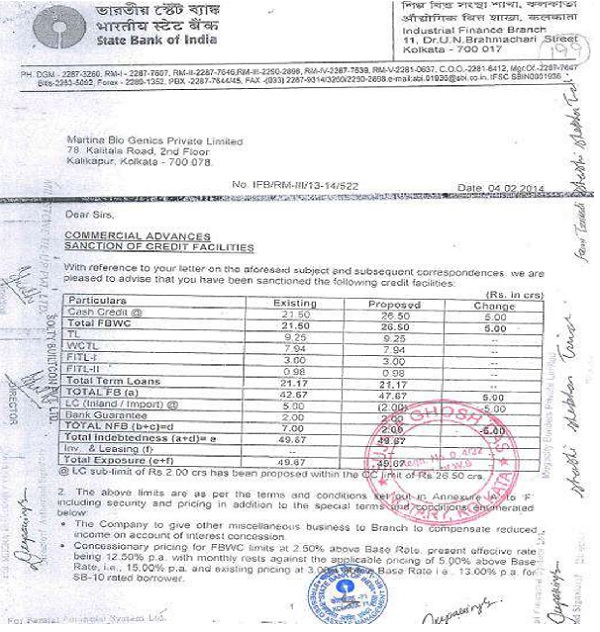
4.7 The sanction facility has following conditions-:
“The Bank reserves the absolute right to cancel the limits unconditionally without prior notice:
-
- . In case the limits / part of the limits are not utilized, 24 (either fully or partially),
- . In case of deterioration in the loan accounts in any manner whatsoever, And /or
- In case of non-compliance of terms and conditions of sanction. Annexure-E In case of LC / BG devolvement / invocation, extant instructions to be followed as per Annexure-E.”
4.8 Reading clauses Of sanction letter and credit facility granted, the resultant default amount and unpaid interest. manifestly exceeds the Rs. 1 crore threshold prescribed under Section 4(1) of the IBC for initiating CIRP via Section 7.
4.9 Status Report of the Official Liquidator, High Court, Calcutta dated 31st October, 2023-:
“4. Sale of assets/properties
a. No steps for sale of the assets of the company (In Liquidation) can be initiated because this office is only in symbolic possession, thereof. Moreover, on breach of the approved payment schedule by the contributories, the Hon’ble Court by an order dated 12th September, 2017, was pleased to direct, inter alia, the Official Liquidator to deploy minimum number of security guards to protect the assets as well as the interest of the creditors and the payment of security expenses, thereof, to be made by the contributories.”
4.10 Further, the Hon’ble Supreme Court in the case of Innoventive Industries Limited v. ICICI Bank Limited, where it has discussed extensively the scope of the Adjudicating Authority under section 7 of the IBC is limited to assessing the records provided by the financial creditor to satisfy itself that the default has occurred.
“28. When it comes to a financial creditor triggering the process, Section 7 becomes relevant. Under the explanation to Section 7(1), a default is in respect of a financial debt owed to any financial creditor of the corporate debtor – it need not be a debt owed to the applicant financial creditor. Under Section 7(2), an application is to be made under sub-section (1) in such form and manner as is prescribed, which takes us to the Insolvency and Bankruptcy (Application to Adjudicating Authority) Rules, 2016. Under Rule 4, the application is made by a financial creditor in Form 1 accompanied by documents and records required therein. Form 1 is a detailed form in 5 parts, which requires particulars of the applicant in Part I, particulars of the corporate debtor in Part II, particulars of the proposed interim resolution professional in part III, particulars of the financial debt in part IV and documents, records and evidence of default in part V. Under Rule 4(3), the applicant is to dispatch a copy of the application filed with the adjudicating authority by registered post or speed post to the registered office of the corporate debtor. The speed, within which the adjudicating authority is to ascertain the existence of a default from the records of the information utility or on the basis of evidence furnished by the financial creditor, is important. This it must do within 14 days of the receipt of the application. It is at the stage of Section 7(5), where the adjudicating authority is to be satisfied that a default has occurred, that the corporate debtor is entitled to point out that a default has not occurred in the sense that the “debt”, which may also include a disputed claim, is not due. A debt may not be due if it is not payable in law or in fact. The moment the adjudicating authority is satisfied that a default has occurred, the application must be admitted unless it is incomplete, in which case it may give notice to the applicant to rectify the defect within 7 days of receipt of a notice from the adjudicating authority. Under sub-section (7), the adjudicating authority shall then communicate the order passed to the financial creditor and corporate debtor within 7 days of admission or rejection of such application, as the case may be.”
“30. On the other hand, as we have seen, in the case of a corporate debtor who commits a default of a financial debt, the adjudicating authority has merely to see the records of the information utility or other evidence produced by the financial creditor to satisfy itself that a default has occurred. It is of no matter that the debt is disputed so long as the debt is “due” i.e. payable unless interdicted by some law or has not yet become due in the sense that it is payable at some future date. It is only when this is proved to the satisfaction of the adjudicating authority that the adjudicating authority may reject an application and not otherwise.”
4.11 In terms of the foregoing discussion, we ALLOW the petition bearing I.A. (Companies Act) No. 76/2025 filed under Section 7 of the I&B Code, and accordingly, we order the initiation of Corporate Insolvency Resolution Process (CIR Process) in respect 20 of the Corporate Debtor by the following Orders:
i. The Petition filed by State Bank of India (Financial Creditors), under Rule 11 of the National Company Law Tribunal Rules, 2016 is hereby ADMITTED for initiating the Corporate Insolvency Resolution Process in respect of MARTINA BIO GENICS PRIVATE LIMITED (Corporate Debtor).
ii. As a consequence of this Petition being admitted in terms of Section 7 of the I&B Code, moratorium as envisaged under the provisions of Section 14(1) of the Code, shall follow in relation to the Respondent/(CD) as per clauses (a) to (d) of Section 14(1) of the Code. However, during the pendency of the moratorium period, terms of Section 14(2) to 14(3) of the Code shall come into force.
iii. Moratorium under Section 14 of the Insolvency & Bankruptcy Code, 2016, prohibits the following, as:
a. The institution of suits or continuation of pending suits or proceedings against the Corporate Debtor including execution of any judgment decree or order in any court of law, Tribunal, arbitration panel or other authority:
b. Transferring, encumbering, alienating or disposing of by the Corporate Debtor any of its asset or any legal right or beneficial interest therein;
c. Any action to foreclose, recover or enforce any security interest created by the Corporate Debtor in respect of its property including any action under the Securitization and Reconstruction of Financial Assets and Enforcement of Security Interest Act, 2002 (54 of 2002);
d. The recovery of any property by an owner or lessor where such property is occupied by or in possession of the Corporate Debtor
[Explanation.–For the purposes of this sub-section, it is hereby clarified that notwithstanding anything contained in any other law for the time being in force, a license, permit, registration, quota, concession, clearances or a similar grant or right given by the Central Government, State Government, local authority, sectoral regulator or any other authority constituted under any other law for the time being in force, shall not be suspended or terminated on the grounds of insolvency, subject to the condition that there is no default in payment of current dues arising for the use or continuation of the license, permit, registration, quota, concession, clearances or a similar grant or right during the moratorium period;]
iv. The supply of essential goods or services to the corporate debtor as may be specified shall not be terminated or suspended or interrupted during the moratorium period.
v. The provisions of sub-section (1) of the Section 14 shall not apply to such transactions as may be notified by the Central Government in consultation with any financial sector regulator.
vi. The Applicant has proposed the name of Jitendra Lohia, having Registration No. IBBI/IPA-001/P00170/2017-18/10339 (Email: jitulohia@knjainco.com, as the “IRP”. We have perused that there is a written communication and consent of IRP in Form 2, annexed at pages 8-12 to the supplementary affidavit dated 07.02.2026, as per the requirement of Rule 9(1) of the Insolvency and Bankruptcy (Application to Adjudicating Authority) Rules, 2016. In addition, further necessary disclosures have been made by “Mr. Jitendra Lohia” as per the requirement of the IBBI Regulations. Accordingly, he satisfies the requirement of Section 7(3)(b) of the code. Hence, we appoint “Mr. Jitendra Lohia” as the Interim Resolution Professional (IRP) of the Corporate Debtor to carry out the functions as per the I&B Code subject to submission of a valid Authorisation of Assignment in terms of regulation 7A of the Insolvency and Bankruptcy Board of India (Insolvency Professional) Regulations, 2016. The fee payable to IRP or the RP, as the case may be, shall be compliant with such Regulations, Circulars and Directions as may be issued by the Insolvency & Bankruptcy Board of India (IBBI). The IRP shall carry out her functions as contemplated by sections 15, 17, 18, 19, 20 and 21 of the I&B Code.
vii. In pursuance of Section 13 (2) of the Code, we direct the IRP or the RP, as the case shall cause a public announcement immediately with regard to the admission of this application under Section 7 of the Code and call for the submission of claims under Section 15 of the Code. The public announcement referred to in Clause (b) of sub-section (1) of Section 15 of the Insolvency & Bankruptcy Code, 2016, shall be made immediately. The expression immediately means within three days as clarified by Explanation to Regulation 6 (1) of the IBBI (Insolvency Resolution Process for Corporate Persons) Regulations, 2016.
a. During the CIR Process period, the management of affairs of the Corporate Debtor shall vest in the IRP or the RP, as the case may be, in terms of Section 17 of the I&B Code. The officers and managers of the Corporate Debtor shall provide all documents in their possession and furnish every information in their knowledge to the IRP within one week from the date of receipt of this Order, in default of which coercive steps will follow. There shall be no future opportunities in this regard.
b. The Interim Resolution Professional is also free to take police assistance to take full charge of the Corporate Debtor, its assets and its documents without any delay, and this Court hereby directs the concerned Police Authorities and/or the Officer-in-Charge of Local Police Station(s) to render all assistance as may be required by the Interim Resolution Professional in this regard.
c. The IRP or the RP, as the case may be, shall submit to this Adjudicating Authority periodical report with regard to the progress of the CIR Process in respect of the Corporate Debtor.
d. The Financial Creditors shall be liable to pay to IRP a sum of Rs. 3,00,000/- (Rupees Three Lakh Only) as payment to meet the cost of CIRP arising out of issuing public notice for inviting claims and running the CIRP, as per Regulation 33(3) of the IBBI (Insolvency Resolution Process for Corporate Persons) Regulations, 2016, which amount shall be adjusted at the time of final payment. The expenses relating to the CIRP are subject to the approval of the Committee of Creditors (CoC).
e. In terms of sections 7(5) and 7(7) of the Code, the Registry of this Adjudicating Authority is hereby directed to communicate this Order to the Financial Creditor, the Corporate Debtor and the Interim Resolution Professional by Speed Post and through email immediately, and in any case, not later than two days from the date of this Order.
f. Additionally, the Registry of this Adjudicating Authority shall serve a copy of this Order upon the Insolvency and Bankruptcy Board of India (IBBI) for their record and also upon the Registrar of Companies (RoC), to whom the company is registered with, by all available means for updating the Master Data of the Corporate Debtor. The said Registrar of Companies shall send a compliance report in this regard to the Registry of this Court within seven days from the date of receipt of a copy of this order.
g. The Resolution Professional shall conduct CIRP in a time-bound manner as per Regulation 40A of IBBI (Insolvency Resolution Process for Corporate Persons) Regulation, 2016.
h. The IRP/RP shall be liable to submit the periodical report including the minutes of the CoC of the Corporate Debtor, with regard to the progress of the CIR Process in respect of the Corporate Debtor to this Adjudicating Authority from time to time.
i. The order of moratorium shall cease to have effect as per Section 14(4) of the I&B Code.
4.12 Accordingly, the Interlocutory Application being I.A. (Companies Act) No. 76/2025, stands allowed and is hereby disposed of.
4.13 We direct the Official Liquidator, High Court Calcutta be discharged as liquidator of Martina Bio Genics Private Limited and be directed to make over all documents, records and handover possession of all the movable and immovable properties of the Corporate Debtor to the incoming Interim Resolution Professional.
4.14 The Registry is directed to supply a copy of this order to the RoC, West Bengal, IBBI and the Official Liquidator, High Court at Calcutta.
4.15 Certified copies of this order, if applied for with the Registry of this Adjudicating Authority, be supplied to the parties upon compliance with all requisite formalities.
4.16 Post the Transfer Petition on 30.06.2026 for filing the Periodical Progress Report by the IRP/RP as appointed herein.
Order dated the 22nd day of May, 2026.
Notes:
1 Copies of the said notice issued under section 13(2) of the SARFAESI Act is marked Annexure “A-3”
2 Copies of the said Order dated 04.01.2016 and 26.09.2016 in CP No. 347 of 2015 and orders dated 10.03.2016 and 21.11.2016 in CP No. 49 of 2016 are collectively marked as Annexure “A-4”.
3 Copies of all orders passed by the Hon’ble High Court at Calcutta in CP 49 of 2016 and CP 347 of 2015 are collectively marked as Annexure “A-5”.
4 A copy of the said order dated 26.09.2022 passed by the Hon’ble High Court at Calcutta directing the transfer of CP No. 347 of 2015 is marked as Annexure ” A-6″
5 annexed herewith and marked as Annexure “A-9”
6 marked as Annexure “A-11″ & “A-12”
7 (22.01.2019 – SC): MANU/SC/0080/2019

Author Bio