Income Tax : CBDT has identified search, survey, and reassessment cases for compulsory scrutiny in FY 2026-27. The guidelines highlight the Dep...
Income Tax : Scrutiny assessment which is mainly governed by Section 143 of IT Act is in-depth process used by tax officers to ensure accuracy ...
Goods and Services Tax : Explore challenges faced by taxpayers during GST return scrutiny for FY 2017-18. Learn about recent instructions from Delhi GST de...
Income Tax : Unravel the intricacies of Income Tax Department scrutiny with insights into notices, reasons triggering scrutiny, and types of sc...
Goods and Services Tax : Understand the process of scrutiny of GST returns and its importance in tax administration. Learn how it ensures compliance with t...
Goods and Services Tax : CBIC rolls out Automated Return Scrutiny Module for GST returns in ACES-GST backend application for Central Tax Officers During th...
Goods and Services Tax : Haryana GST Returns Scrutiny Manual standardize and streamline the procedural aspect with regards to the scrutiny of GST returns ...
Income Tax : Income Tax Department has accepted 99.65 per cent of tax returns as it is and has picked only 0.35 per cent cases for detailed scr...
Income Tax : Paperless assessment/ e-mail based assessment on a pilot basis was commenced in the financial year 2015-16 in non-corporate charge...
Income Tax : Taking another step in this direction, Central Board of Direct Taxes (CBDT) has issued instructions to the assessing officers to b...
Income Tax : The case examined whether scrutiny selection without meeting CBDT conditions was valid. The ITAT held that failure to satisfy mand...
Income Tax : Kolkata ITAT rules assessment void after a 143(2) notice failed to specify the type of scrutiny, violating mandatory CBDT instruct...
Income Tax : Patna HC upholds income tax scrutiny against Patna Smart City Limited, rejecting claims of violation of guidelines and natural jus...
Income Tax : ITAT Kolkata held that enquiring on issues other than limited scrutiny issue, before conversion of limited scrutiny to complete sc...
Income Tax : Sagar Uttam Murhe Vs DCIT (ITAT Pune) Case law (2020) 120 com 187 CIT vs. Padmavati (Mad) (HC) holds that such an assessment could...
Income Tax : The CBDT has identified specific categories of taxpayers whose returns will be compulsorily selected for complete scrutiny during ...
Income Tax : Understand the guidelines set by the Indian Ministry of Finance for the compulsory selection of returns for complete scrutiny duri...
Income Tax : Government of India issues guidelines for compulsory selection of returns for Complete Scrutiny during FY 2023-24. Find the proced...
Goods and Services Tax : Standard Operating Procedure for the scrutiny of GST returns by the Government of India for the financial year 2019-20 onwards....
Income Tax : Central Board of Direct Taxes (CBDT) released guidelines outlining the parameters and procedures for the compulsory selection of i...
If the A.O. has taken up the issue of determining fair market value of the property in question as on 01/4/1981 without converting the limited scrutiny to comprehensive scrutiny by taking the prior approval of the competent authority then the said order passed by the A.O. will be nullity as beyond his jurisdiction.
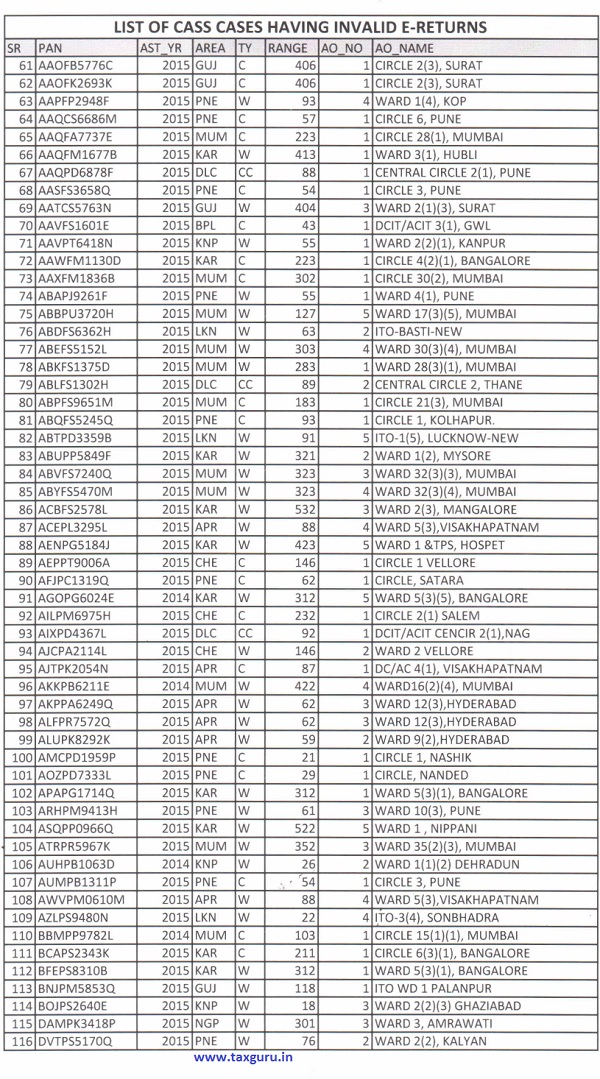
It has been brought to the notice of Board that notices under section 143(2) of the Income-tax Act, 1961 (‘Act’) were generated in respect of certain invalid returns of the assessees filed for the Assessment Year 2017-18 through CASS Cycle 2018. As the scrutiny of such returns will pose a challenge for the AO and is bad in law, I am directed to state that Assessing Officers shall drop the proceedings u/s 143(2) of the Act in such cases and reopen the same by issue of notice under section 148 of the Act.
In this regard, board has issued an instruction related to the verification checklist in the cash deposit cases during the demonetization period for providing the assistance to the AOs for verification of cash deposits and framing of assessment in the demonetisation related cases.
In view of the large number of pendency, there is a possibility of problems arising in computation and calculation of tax by system. In view of the large number of pendency, there is a possibility of bulk of the pending assessments being completed around the end of the time barring period. As you are aware, the computation and tax calculation process can be complex in certain cases which may cause delay in completion of accounting in the system.
Jurisdiction of the Assessing Officer while making assessments in Limited Scrutiny cases, by initiating inquiries on new issues has to comply with mandatory requirements of the relevant CBDT Instructions dated 09.2014, 29.12.2015 and 14.07.2016, i.e. the approval of the PCIT.
The CBDT on 12th September 2019, notified the much talked about e-assessment procedure vide Notification no. 61/2019. The stakes were high, as it was expected to reduce the red-tapism in the country, during an assessment proceeding. This notification was quickly followed up by another notification vide 62/2019, giving effect to the Income Tax E-Assessment Scheme, […]
Shri Vijay Kumar Vs ITO (ITAT Chandigarh) The main contention of the Ld. Counsel for the assessee is that the Assessing Officer while making the impugned additions has exceeded his jurisdiction. That the case of the assessee was selected for limited scrutiny issue i.e. regarding security transaction. The Assessing Officer could not find any reason […]
[Notification No. 62/2019 For giving effect to the E-assessment Scheme, 2019 the Central Government hereby makes the following directions
The assessment under E-assessment Scheme, 2019 shall be made as per the following procedure, namely (i) the National e-Assessment Centre shall serve a notice on the assessee under sub-section (2) of section 143, specifying the issues for selection of his case for assessment;
The parameters for manual selection of returns for Complete Scrutiny during financial year 2019- 20 are as under.- (i) Cases involving addition in an earlier assessment year(s) on a recurring issue of law or fact:- (a) exceeding Rs. 25 lakhs in eight metro charges at Ahmedabad, Bengaluru, Chennai, Delhi, Hyderabad, Kolkata, Mumbai and Pune while at other charges, quantum of addition should exceed Rs. 10 lakhs; (b) exceeding Rs. 10 crore in transfer pricing cases.