AI in GST: A Powerful Tool in Weak Hands – Why Taxpayers Are Not Ready to Be Judged by Algorithms
The GST regime was launched with the promise of a modern, digital tax system that would reduce human interface, improve transparency, and make life easier for honest taxpayers. Instead, for a large section of small and medium businesses, GST has meant struggling with a fragile portal, endless reconciliations between GSTR‑1, GSTR‑3B, GSTR‑2A/2B and GSTR‑9, and receiving mechanically generated notices that do not reflect the commercial reality of their businesses.
Into this already shaky system, the tax administration is now trying to introduce a new layer: Artificial Intelligence (AI) and advanced data analytics. The government and many commentators project AI as a “magic solution” for improving compliance, detecting fraud and speeding up assessments. But when the basic technological and institutional infrastructure is still unstable, the aggressive use of AI in GST can easily become a threat to taxpayer rights rather than a support for fair tax administration.
This article examines how AI is being positioned in GST administration, why it is risky in the current environment of portal glitches and poor data quality, and how blind reliance on AI‑generated reports by officers can create huge fake or exaggerated liabilities for taxpayers. It also touches upon how courts have already started expressing concern where AI‑generated orders are passed without proper application of mind.
How AI Is Being Introduced into GST Administration
AI in tax administration is being used mainly in three broad ways: risk profiling, pattern detection and process automation.
- Tax officers are being given risk scores and red‑flag lists based on algorithmic analysis of GST returns, e‑way bill data, e‑invoices, bank information and other databases.
- Complex patterns of supplies, ITC claims and turnover fluctuations are being mined to identify “suspected” fake invoices, circular trading and shell entities.
- Automated systems generate discrepancy reports when there are mismatches between GSTR‑1 and GSTR‑3B, or between GSTR‑3B and GSTR‑2A/2B, or between annual returns like GSTR‑9/9C and monthly returns.
For example, data analytics engines are now routinely used to compare invoice‑wise data in GSTR‑1 with summary figures in GSTR‑3B and to flag differences for further action. Similarly, large‑scale analytical tools are deployed to track chains of ITC from supplier to recipient and to detect possible fake invoicing rings.
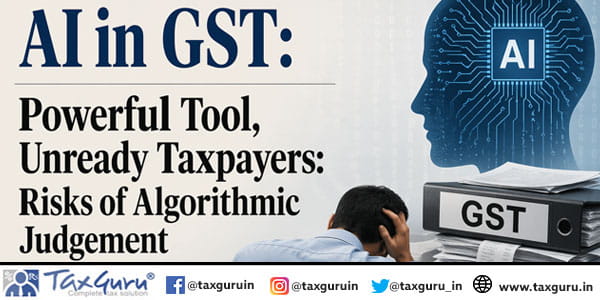
On paper, this looks impressive. However, such systems are only as good as the data they receive and the human judgment with which their outputs are interpreted. When the underlying GST portal itself is full of technical glitches, inconsistent reports and connectivity issues, giving more power to machines without fixing the basics first is a dangerous experiment.
Existing GST Portal Problems That AI Will Amplify
Even without AI, taxpayers and professionals have been struggling with multiple structural and technical problems in the GST ecosystem since 2017. These include:
- Frequent mismatch between GSTR‑1 and GSTR‑3B leading to notices and unnecessary litigation.
- Differences between GSTR‑2A/2B and GSTR‑3B because suppliers have not filed or have wrongly filed their returns, even though the recipient has paid full tax to the supplier.
- Non‑existent or fake dealers appearing in the supply chain due to misuse of registration, which later leads to denial of ITC for genuine buyers.
- GST portal reports that differ from downloaded Excel files or cannot be generated for longer periods, creating doubts about which data is legally reliable.
- Long delays, repeated logouts, limited session time and poor usability, particularly for small taxpayers in areas with weak internet access.
Articles and field reports have documented dozens of technical glitches on the GSTN, including inconsistent GSTR‑2A reports, inability to view more than a certain number of invoices, and long waiting time even to download one’s own data. These are not mere “IT problems”; they directly affect the computation of tax, interest and penalty.
When such a fragile system is used as the raw material for AI models, the algorithm will faithfully amplify every error and inconsistency present in the data. AI does not have common sense; if the portal shows a mismatch or a missing supplier, the machine will treat it as potential evasion unless it is specifically trained and instructed to do otherwise.
The Risk of “Automated Tax Terrorism”
There is increasing literature, both in India and globally, on the danger of AI‑driven “tax terrorism” where opaque algorithms flag taxpayers as risky without clear reasons. In the GST context, this risk is particularly serious for honest taxpayers who are already struggling with compliance due to technical issues.
Some examples of how this can play out:
- A minor typo or classification mistake between GSTR‑1 and GSTR‑3B can lead to a large AI‑generated “short payment” alert, followed by notices and blocking of ITC for the taxpayer and their customers.
- If a supplier fails to file or files a wrong GSTR‑1, the recipient’s ITC may be treated as suspicious by the system, even though the transaction is genuine and tax has actually been paid to the government.
- Sudden growth in turnover for a previously small taxpayer, which may be due to a new contract or normal business expansion, can be misread as a sign of fake invoicing or circular trading.
Policy and academic discussions have already noted that fragmented legacy systems, poor data quality and lack of integration across GSTN, banking and other databases can lead to false positives and false negatives in AI‑driven risk flagging. AI models are often “black boxes” – even administrators cannot clearly explain why a particular taxpayer was flagged. This lack of transparency makes it difficult for the taxpayer to defend themselves and for appellate authorities to meaningfully review such decisions.
In other words, AI can become a new form of arbitrariness, hidden behind the respectability of technology. The fear is that what began as a tool to catch large‑scale fraud can gradually degenerate into a factory of automated, inflated demands against small, genuine businesses.
Officers Depending on AI Instead of Applying Mind
A disturbing trend in tax administration is the growing dependence of officers on system‑generated reports and pre‑filled orders. Field experience and commentary suggest that in many cases officers treat analytical outputs as final truth, without cross‑checking facts with the taxpayer or considering alternative explanations.
There are already judicial decisions where High Courts have expressed concern about orders that appear to have been generated or heavily drafted using AI or template‑based tools, without real application of mind to the specific facts of the case. In one reported matter, the court cautioned that use of AI must not erode fair decision‑making, reminding the department that statutory power cannot be outsourced to a machine or to a pre‑fabricated software output.
This has serious implications in GST where even a small error in classification, rate or turnover can translate into huge demands with interest and penalty. When an officer simply copies a system‑generated discrepancy table into a show cause notice or order, the human responsibility of weighing evidence, considering submissions and exercising discretion is effectively abdicated.
No algorithm, however advanced, can replace a quasi‑judicial mind. A notice or order that is entirely based on machine‑generated difference statements, without dealing with the taxpayer’s reconciliation and explanations, violates basic principles of natural justice. Yet this is exactly what may happen when over‑burdened officers are encouraged or compelled to rely on AI‑driven risk reports to meet targets.
Courts’ Growing Discomfort with AI‑Generated Drafts
The judiciary is not blind to this new reality. Some High Courts have started flagging concerns about tax and other government orders that appear to be drafted using AI tools or standardised templates which do not reflect application of mind.
In a reported tax case, a High Court criticised the revenue authorities for passing an order which seemed to be mechanically prepared with the assistance of an AI‑based drafting tool, without independently examining the merits of the assessee’s case. The court warned that while technology may assist in routine tasks, the core adjudicatory function requires human judgment and cannot be delegated to algorithms.
Similarly, professional bodies have also cautioned advocates and tax practitioners against blindly using AI for drafting pleadings and written submissions, particularly when the tools can “hallucinate” case law or misquote statutory provisions. In several instances worldwide, courts have admonished lawyers for filing AI‑generated briefs containing non‑existent case citations, and Indian courts have taken note of this international trend while advising bar members to exercise caution.
These developments underline a simple truth: in law, credibility comes from reasoning, not from attractive formatting or the use of fashionable technology.
AI Needs Clean Data and Strong Institutions – GST Has Neither
From a technical viewpoint, AI systems are highly sensitive to the quality, completeness and consistency of data. If the training data or the live input data is noisy, incomplete or biased, the outputs will also be unreliable.
Independent studies and professional surveys on AI in tax compliance have repeatedly emphasised:
- Poor and inconsistent data quality is one of the biggest barriers to effective AI implementation in taxation.
- Legacy systems and fragmented databases make it difficult to create accurate 360‑degree profiles of taxpayers, leading to wrong risk scores.
- Technical capacity constraints within the department limit the ability of officers to understand and critically evaluate AI outputs.
In the GST context, these risks are multiplied because the GSTN itself still suffers from major technical and design defects, as documented by practitioners over the years. When even basic things like reliable annual reports, stable login sessions and consistent invoices‑wise data are not ensured, plugging AI on top of this infrastructure is like putting a high‑speed engine on a broken chassis.
AI is also not a neutral technology. The way models are designed, the parameters chosen, the thresholds for flagging risk, and the targets given to officers all influence how “strict” or “lenient” the system behaves. If the institutional culture is target‑driven and suspicious of taxpayers, AI will be tuned and used in a manner that maximises detection of supposed evasion, even at the cost of harassing genuine businesses.
The Human Cost: Taxpayers as Data Victims
Behind every automated notice, mismatch alert or ITC blockage is a real business – often a small firm or family‑run enterprise – that must spend time and money to defend itself. For many taxpayers, especially in semi‑urban and rural areas, internet connectivity itself is unreliable and the GST portal feels like a hostile, unpredictable environment.
When such taxpayers are confronted with AI‑driven notices that rely on complex analytics and cross‑database matching, they are at a severe disadvantage. They rarely have access to the kind of advanced tools that the department uses, and must rely on their accountants or consultants to manually reconcile and respond.
At the same time, many appeals arising from initial GST years are still pending due to late constitution of tribunals, procedural uncertainties and technical disputes. Taxpayers have been living under provisional liabilities, blocked credits and unresolved show cause notices for years. Adding a new layer of AI‑based risk scoring now, without first cleaning up old data and giving closure to earlier disputes, is fundamentally unfair.
The danger is that the taxpayer becomes a perpetual data subject – always under algorithmic surveillance, always one mismatch away from a notice, but never receiving final clarity and closure.
AI Should Assist, Not Replace, Human Judgment
None of this means that AI has no role in GST. Properly designed and responsibly used, AI can genuinely help both tax administration and taxpayers by automating routine reconciliations, highlighting obvious errors and improving service delivery. For example:
- AI‑based tools used by professionals can automatically download and reconcile GSTR‑1, GSTR‑2A/2B and GSTR‑3B data, saving time and reducing manual errors.
- Pattern‑detection systems can help identify large‑scale fake invoicing networks that no human officer could spot manually from millions of invoices.
- Virtual assistants and chatbots can provide instant answers to basic procedural queries and guide small taxpayers step‑by‑step through return filing.
However, these benefits will materialise only if certain non‑negotiable safeguards are put in place:
- Data used by AI systems must be clean, consistent and verifiable, with clear responsibility for correcting portal errors.
- Algorithms and risk models must be transparent and explainable, at least to the extent of allowing taxpayers to understand why they were flagged and how to contest it.
- Officers must be trained to treat AI outputs as inputs, not as final truths; they must still apply their mind and record independent reasons in notices and orders.
- Automated notices and system‑generated discrepancy reports should not directly create enforceable demands without an opportunity for hearing and human review.
Without these safeguards, the introduction of AI into GST administration will not modernise the system; it will only mechanise injustice.
Conclusion
The GST system in India is still in a state of technological and institutional flux. Core issues such as portal instability, incorrect reports, mismatches between returns, poor integration with other databases, and long‑pending disputes remain unresolved even years after implementation. In this environment, aggressive deployment of AI and advanced analytics by the department is not a sign of maturity; it is a risky shortcut.
Artificial Intelligence, by its nature, amplifies whatever it is fed. If it is fed clean data and guided by a culture of fairness, it can help catch serious evasion while reducing the burden on honest taxpayers. But if it is built on top of a glitch‑ridden portal, inconsistent data and a target‑driven mindset, it will amplify errors, mistrust and harassment.
Taxpayers who have already suffered from technical glitches, wrongful notices, mismatches and delayed adjudication should not be made experimental subjects in an AI‑driven tax laboratory. Before talking about AI as the future of GST, the administration must first fix the present: stabilise the portal, clean the data, strengthen appellate forums, and rebuild trust. Only then can AI genuinely assist human officers, instead of silently replacing their judgment and turning tax compliance into a battle against invisible algorithms.