
Courts: All High Courts
Read latest High Court judgments and orders on Income Tax, GST, Customs, Company Law and other taxation, corporate, commercial and regulatory matters.

Form SVLDRS 3 quashed and directed to consider declaration under litigation category

Section 96 Overrides Income Tax for Post-2014 Land Acquisitions

Successive bail application with no change in circumstances is liable to be dismissed
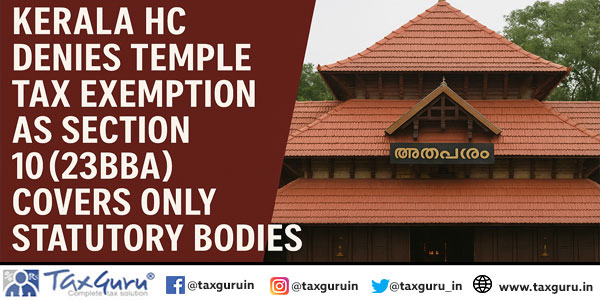
Kerala HC Denies Temple Tax Exemption as Section 10(23BBA) Covers Only Statutory Bodies
DDT Must Follow DTAA Limits Because Dividend Is Shareholder Income: Bombay HC
Delhi HC Set Aside Customs Order for Failure to Prove Service by Speed-Post
Parts Replaced Under Warranty Taxable under CST Act: Allahabad HC
Petition Dismissed as Pre-SCN Step Irrelevant in Complex Alleged ITC Fraud

Public information & unrelated third-party data not justifies Section 153C SCN: Gujarat HC

Madras HC Restores GST Appeals Subject to 25% Pre-Deposit
ITR Filing Delay Due to Illness Must Be Considered: Delhi HC Aside Order
Re-Export Allowed Since Gold Was Brought for Medical Treatment Needs
Delhi HC rejects Writ as Ownership of Gold Claimed by Multiple Parties
C-Forms Cannot Be Refused for Omission in Revised Returns: Delhi HC
All High Courts brings together judgments and orders of High Courts across India published on TaxGuru. The archive covers Income Tax, GST, Customs, Company Law, Corporate Law, insolvency, commercial laws and other taxation and regulatory matters. Readers can research important questions of law, constitutional challenges, writ petitions, statutory appeals and other proceedings decided by different High Courts. Chartered Accountants, advocates, tax professionals, businesses and legal researchers can use this consolidated archive to follow High Court jurisprudence across India. Separate High Court categories are available for court-specific judgments and orders.

