
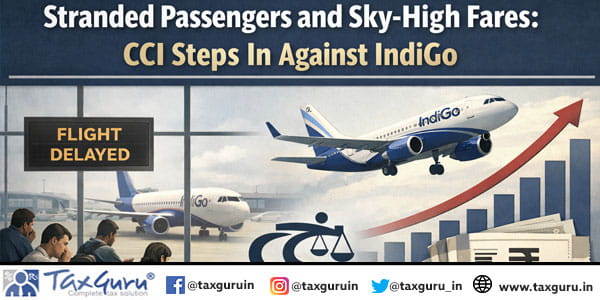
Overall 4,500 flights were cancelled by Indigo during December of 2025 due to an operational meltdown, thousands of passengers were left stranded at the airports throughout India. Indigo notified DGCA that disruptions were caused by minor technical issues, changes in winter schedule, increased traffic and implementation of Phase II regulations of Flight Duty Time Limitation (FDTL). The requirements of FDTL also resulted in longer pilot rest periods and stricter night flying limits.
However, the DGCA investigation, which was conducted on January 17, discovered that the disruptions were caused by over-optimized operations, lack of regulatory readiness and deficits in the software support system were also noted. According to the investigation, the airline’s improper implementation of FDTL regulations and inadequate planning caused widespread delays and flight cancellations. After which, DGCA fined the airline ₹22 crore and directed to take corrective measure
These failures deeply impacted passengers, leading one of them to raise his grievance.
The informant stated that on 4 December 2025, his return flight from Delhi to Bengaluru with IndiGo, booked for ₹7,173, was cancelled just a few hours before departure without any alternative being offered. He was therefore compelled to make his own travel arrangements and soon realised that fares on the same route particularly on IndiGo flight had risen sharply, while only a few seats were available on other airlines. In the absence of any reasonably priced option, he waited for two days and eventually returned to Bengaluru on another IndiGo flight, paying a higher fare of ₹17,000. He alleged that this amounted to abuse of dominance under Section 4 of the Competition Act.
The Commission noticed that IndiGo had cancelled nearly 2,507 flights affecting more than 3 lakh passengers in India, many of whom were left stranded on the airport without any alternatives. In response to these mass disruptions, the Ministry of Civil Aviation had imposed a fine of ₹22.20 crore on the airline.
The primary issues that arose were : Firstly, Whether the CCI or the DGCA have the jurisdiction to investigate the matter? Secondly, whether the lack of alternatives and surge in flight tickets amounts to abuse of dominance?
JURISDICTION- IndiGo contested the competence of CCI’s jurisdiction over the matter, arguing that the matter fell entirely within the scope of the Bharatiya Vayuyan Adhiniyam, 2024 and the Aircraft Rules, 1937, administered by the Directorate General of Civil Aviation (DGCA). They contended that flight cancellations and surge in prices of flight fare lie within the authority of DGCA leaving no scope of intervention by the CCI
But CCI rejected IndiGo’s objection, stating that the existence of sector-specific regulation does not, by itself, preclude the application of Competition law. In this regard, the Commission relied on the Bharti Airtel Ltd. v. CCI, one of the landmark cases, where the Supreme Court ruled that regulatory oversight and competition law enforcement operate in distinct but complementary domains.
The CCI observed that while the Directorate General of Civil Aviation (DGCA) has the power and duty towards regulating licensing, safety standards, and other operational aspects of civil aviation, it does not ingrain competition law issues such as delineation of market, evaluation of dominance, or examination of abuse in the market.
Subsequently, the DGCA informed the Commission that it does not possess economic regulatory authority over airfare tariffs and that airlines are free to determine their own tariffs, subject only to transparency under Rule 135 of the Aircraft Rules, 1937. Taking note of the same, the Commission ruled that merely using the terms “excessive” or “predatory” in the statute does not by itself have jurisdiction of competition law. Rule 135(4) cannot be equivalent to the authority that competition law holds for determining abuse of dominance. Therefore the commission held that reliance on Rule 135(4) to exclude the CCI’s jurisdiction was misplaced.
DELINEATION OF MARKET – DGCA provided data relying on which, the Commission noted that IndiGo holds around 60–63% share of the domestic passenger market. It also observed that more than 330 domestic routes were operated solely by IndiGo and it was a major airline to have profited during the period of crisis. Cumulatively, these factors prove that IndiGo’s enjoys a strong and well-established position in the domestic aviation market.
Two crucial observations were made –
Firstly, given the dominant position of IndiGo, the large-scale cancellation of flights and surge in airfare resulted in passengers having no alternative but to book tickets of IndiGo itself, which created a lock-in effect for the consumer. Commission noted that this prima facie violated 4(2)(a)(i) of the Competition Act.
Secondly, By reducing its scheduled capacity and cancelling thousands of flights IndiGo effectively withheld its services from the market. This resulted in scarcity, consumer access to airplanes during high demand and limited competition in the market, which in turn violated Section 4(2)(b)(i) of the Act which prohibits restriction on the provision of services.
ORDER- The Commission concluded that there exists a prima facie case that IndiGo holds a dominant position in the domestic aviation market and directed the Director General (DG) to conduct investigation within 90 days time period and submit a detailed report to the Commission. Additionally CCI also clarified that its observations were only preliminary and did not constitute a final determination of the case.
ANALYSIS
The order passed by the CCI is welcomed as a strong censure particularly in the view of its observation that “The harm is no longer confined to this route versus that route; rather, the conduct constrains the overall ability of consumers to use domestic air travel as a mode of transport,” This underscores the far-reaching impact of IndiGo’s conduct on the Indian aviation market and consumer welfare.
Instead of labelling the widespread flight cancellations and surge in flight fare as a commercial practice the Commission should ought to assess the increased responsibility that dominant firms have as a market leader. IndiGo is a dominant player in the market of domestic aviation holding around 60-66% of the market share, being dominant is not per se illegal but abusing the dominant position is illegal.
In this context the Commission should take a different approach apart from casting liability under Section 4, by imposing it with higher and stricter standards as the market leader. The concept of Special Responsibility should be used. It is a very well known concept in EU’s competition law and Indian competition law has selectively adopted it under section 4 of the act in limited circumstances. Under this doctrine a dominant firm has extra responsibility for being market leader and they are under scrutiny, even when they lack demonstrable competitive harm.
By imposing this on IndiGo the Commission will prove that dominance is not for commercial advantage but it also corresponds to ethical duties that the market leader carries to safeguard other players and the interest of consumers.
When discussing consumer welfare it is evident that there was a disagreement on the jurisdictional aspect of CCI, but consumers who got their flights cancelled and were stranded in the airports with no alternative options left also brings up a significant concern under the Consumer Protection law. As Section 2(11) of the Act attracts liability under deficiency of services. Additionally, the unaddressed issue was also the absence of effective redressal mechanism for all the aggravated consumers. Therefore beyond the jurisdictional debate there lies the consumer centric approach that needs to be urgently addressed as a need to prioritizing passengers safety and rights.
Ultimately, it is also the responsibility of the government to exercise caution and ensure that incentives are aimed solely at improving services and expanding options for consumers. Any concessions beyond this may strengthen market concentration in the airline sector and push the industry towards a duopoly, ultimately placing consumers at a disadvantage.
The IndiGo episode reminds us that strong government rules, fair competition, and meaningful consumer protection are essential if India’s aviation sector is to truly work in the interest of the public.






Good article.