The Standard Operating Procedure (SOP) on Passing of Board Resolutions by Circulation outlines the framework under Section 175 of the Companies Act, 2013 and Secretarial Standard-1 (SS-1) for obtaining Board approval without convening a physical meeting. It clarifies that resolutions by circulation are intended for urgent matters where immediate approval is necessary and holding a Board meeting is impractical. Such resolutions carry the same legal validity as those passed at a duly convened Board meeting, provided they are approved by a majority of eligible directors. The SOP specifies matters that should ordinarily not be approved by circulation, including financial statements, borrowings, investments, mergers, acquisitions, appointment or removal of key managerial personnel, and other strategic decisions requiring detailed deliberation. Directors must respond within seven days, interested directors must abstain from voting, and one-third of directors can require that the matter be placed before a Board meeting. Every resolution passed by circulation must be noted in the subsequent Board meeting minutes.
STANDARD OPERATING PROCEDURE (SOP): PASSING OF BOARD RESOLUTIONS BY CIRCULATION
1. Objective
This SOP provides guidance to Directors regarding the procedure for approval of business matters by circulation in accordance with Section 175 of the Companies Act, 2013 and Secretarial Standard–1 (SS-1).
2. Purpose
A Resolution by Circulation is an alternative mechanism available to the Board for obtaining approval on urgent business matters where it is not practical to convene a Board Meeting.
A resolution duly passed by circulation has the same legal effect as a resolution passed at a duly convened Board Meeting.
3. When Resolution by Circulation May Be Used
A matter may be considered by circulation where:
- Immediate approval is required;
- The matter does not warrant detailed deliberation at a Board Meeting;
- Convening a Board Meeting is not practical within the required timeline; and
- The Chairman, or in his absence the Managing Director, or any non-interested Director authorised for the purpose, considers circulation appropriate.
4. Matters Generally Not Recommended for Approval by Circulation
The following matters should ordinarily be placed before the Board at a Meeting:
- Approval of Financial Statements and Board’s Report;
- Appointment of Internal Auditor or Secretarial Auditor;
- Borrowing of money;
- Investment of Company funds;
- Granting loans, guarantees or securities;
- Issue of securities or debentures;
- Buy-back of securities;
- Approval of merger, amalgamation or reconstruction;
- Diversification of business;
- Acquisition or takeover of another company;
- Appointment or removal of Key Managerial Personnel;
- Material Related Party Transactions requiring Board consideration; and
- Any matter requiring substantial discussion or strategic deliberation.
Illustrative list of items of business which shall not be passed by circulation and shall be placed before the Board at its Meeting (as provided by Secretarial Standard–1 (SS-1))
General Business Items
- Noting Minutes of Meetings of Audit Committee and other Committees.
- Approving financial statements and the Board’s Report.
- Considering the Compliance Certificate to ensure compliance with the provisions of all the laws applicable to the company.
- Specifying list of laws applicable specifically to the company.
- Appointment of Secretarial Auditors and Internal Auditors.
Specific Items
- Borrowing money otherwise than by issue of debentures.
- Investing the funds of the company.
- Granting loans or giving guarantee or providing security in respect of loans.
- Making political contributions.
- Making calls on shareholders in respect of money unpaid on their shares.
- Approving Remuneration of Managing Director, Whole-time Director and Manager.
- Appointment or Removal of Key Managerial Personnel.
- Appointment of a person as a Managing Director / Manager in more than one company.
- Appointment of Director(s) in casual vacancy subject to the provisions in the Articles of the company. To be subsequently approved in the immediate next general meeting.
- According sanction for related party transactions which are not in the ordinary course of business or which are not on arm’s length basis.
- Sale of subsidiaries.
- Purchase and Sale of material tangible/intangible assets not in the ordinary course of business.
- Approve Payment to Director for loss of office.
- Items arising out of separate Meeting of the Independent Directors if so decided by the Independent Directors.
Corporate Actions
- Authorise Buy Back of Securities.
- Issue of securities, including debentures, whether in or outside India.
- Approving amalgamation, merger or reconstruction.
- Diversify the business.
- Takeover another company or acquiring controlling or substantial stake in another company.
Additional list of items in case of listed companies
- Approving Annual operating plans and budgets.
- Capital budgets and any updates.
- Information on remuneration of Key Managerial Personnel.
- Show cause, demand, prosecution notices and penalty notices which are materially important.
- Fatal or serious accidents, dangerous occurrences, any material effluent or pollution problems.
- Any material default in financial obligations to and by the company, or substantial non-payment for goods sold by the company.
- Any issue, which involves possible public or product liability claims of substantial nature, including any judgement or order which, may have passed strictures on the conduct of the company or taken an adverse view regarding another enterprise that can have negative implications on the company.
- Details of any joint venture or collaboration agreement.
- Transactions that involve substantial payment towards goodwill, brand equity, or intellectual property.
- Significant labour problems and their proposed solutions. Any significant development in Human Resources/ Industrial Relations front like signing of wage agreement, implementation of Voluntary Retirement Scheme etc.
- Quarterly details of foreign exchange exposures and the steps taken by management to limit the risks of adverse exchange rate movement, if material.
- Non-compliance of any regulatory, statutory or listing requirements and shareholder services such as non-payment of dividend, delay in share transfer etc.
5. Authority
The Chairman of the Board, or in his absence the Managing Director, or in their absence any Director other than an Interested Director, shall decide whether the approval of the Board for a particular matter should be obtained by means of a Resolution by Circulation.
6. Right to Seek Board Discussion
Where not less than one-third of the total number of Directors for the time being require that a matter proposed by circulation be considered at a Board Meeting, the Resolution shall not be passed by circulation and shall instead be placed before the Board for consideration and decision at a duly convened Meeting.
7. Time Limit for Response
Directors shall be given a period not exceeding seven days from the date of circulation of the draft Resolution to communicate their assent or dissent.
Where the draft Resolution is sent by Speed Post, Registered Post or Courier, an additional two days shall be added for service.
8. Approval Requirement
A Resolution by Circulation shall be deemed to have been passed when it is approved by a majority of the Directors entitled to vote on the Resolution.
Interested Directors shall not be entitled to vote on the Resolution.
9. Mode of Approval
Directors may signify their assent or dissent by:
- Signing the Resolution and returning the same to the Company; or
- Communicating their approval or disapproval through e-mail or any other recognised electronic means.
10. Effective Date
A Resolution passed by Circulation shall become effective on:
- The date on which the required majority approval is received; or
- Such other date as may be specified in the Resolution.
11. Recording and Noting
Every Resolution passed by Circulation shall:
- Carry a serial number;
- Be appropriately recorded by the Company Secretary or authorised officer; and
- Be noted at the next Meeting of the Board and recorded in the Minutes of such Meeting.
12. Responsibilities of Directors
Directors are expected to:
- Review all circulated documents carefully;
- Seek clarification wherever necessary;
- Respond within the stipulated timeline;
- Promptly disclose any conflict of interest; and
- Request consideration of the matter at a Board Meeting where detailed deliberation is considered necessary.
13. Date of Assent or Dissent
A Director shall append the date while signifying assent or dissent to a Resolution.
Where the date is not mentioned by the Director, the date on which the signed Resolution is received by the Company shall be deemed to be the date of signing.
14. Presumption in Case of Non-Response
If a Director does not communicate assent or dissent on or before the last date specified for response, it shall be presumed that the Director has abstained from voting on the Resolution.
Such non-response shall neither be treated as approval nor as rejection of the Resolution.
15. Interested Directors
A Director shall be regarded as interested in a contract or arrangement entered into or proposed to be entered into by the Company:
- with a body corporate, if such Director, either individually or together with other Directors, holds more than two percent of the paid-up share capital of that body corporate or is its promoter, manager or Chief Executive Officer; or
- with a firm or other entity, if such Director is a partner, owner or member, as the case may be, of such firm or entity.
An Interested Director shall disclose his or her interest and shall abstain from voting on the concerned Resolution.
PROCEDURE FOR PASSING A RESOLUTION BY CIRCULATION
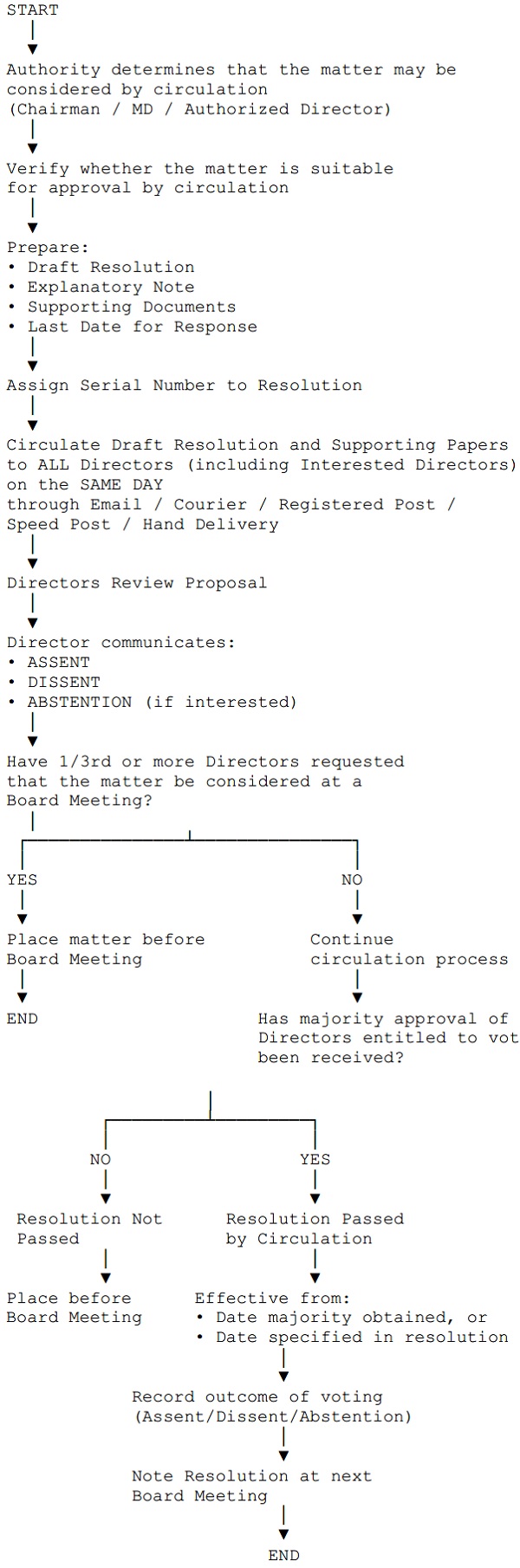
Key Timelines:
- Directors should normally be given not more than 7 days to respond.
- If sent by Speed Post / Registered Post / Courier, additional 2 days may be considered for service.
- A Director who has not responded by the last date shall be deemed to have abstained.
- If an Interested Director’s interest has not been disclosed earlier, it must be disclosed before the last date of response and such Director shall abstain from voting.
Final Outcome:
Resolution by Circulation
↓
Same legal validity as a Resolution passed at a duly convened Board Meeting
↓
Must be noted at the next Board Meeting and recorded in the Minutes.