Fake Income Tax Notice on WhatsApp: Taxpayers Warned Against Fraudulent Messages Claiming Penalty Proceedings
Advisory: Beware of Fake Income Tax Notices on WhatsApp
Introduction
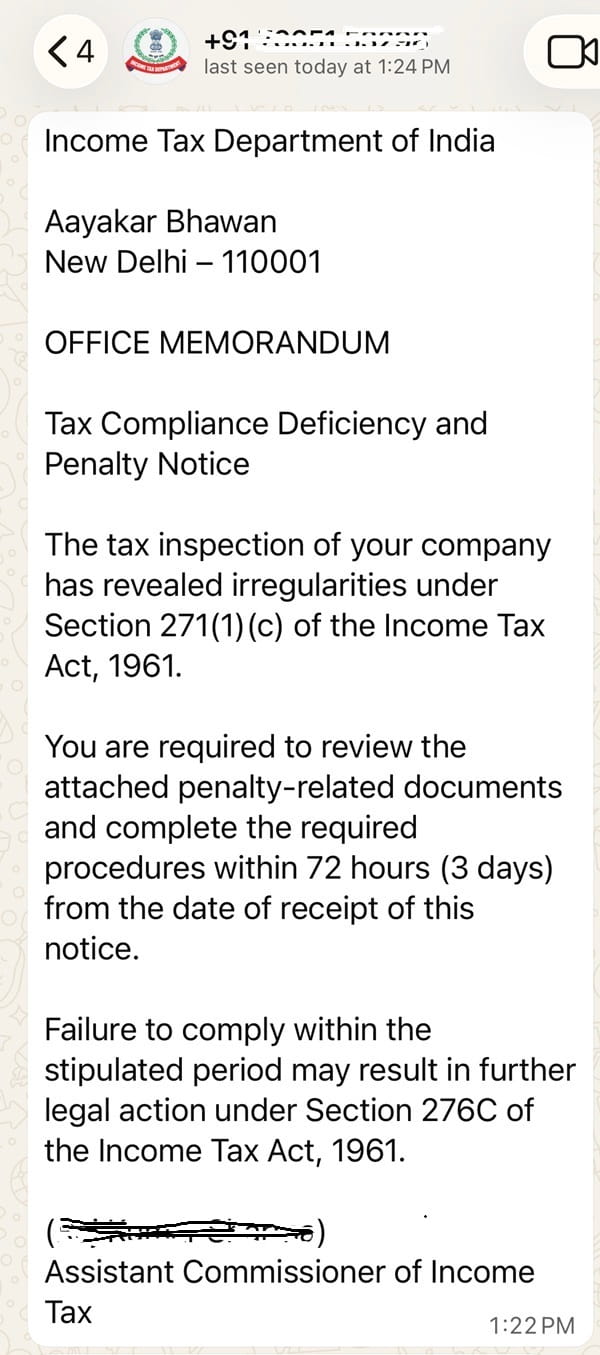
A fake WhatsApp message impersonating the Income Tax Department is being circulated to taxpayers across India. The message falsely claims that a tax inspection has revealed irregularities and threatens legal action unless the recipient reviews attached documents and complies within 72 hours.
Taxpayers should exercise extreme caution. The Income Tax Department does not serve statutory notices through WhatsApp. Such messages are part of phishing and malware campaigns designed to steal sensitive information or compromise devices.
Text of the Fraudulent WhatsApp Message
The fake message reads as follows:
Income Tax Department of India
Aayakar Bhawan
New Delhi – 110001
OFFICE MEMORANDUM
Tax Compliance Deficiency and Penalty Notice
The tax inspection of your company has revealed irregularities under Section 271(1)(c) of the Income Tax Act, 1961.
You are required to review the attached penalty-related documents and complete the required procedures within 72 hours (3 days) from the date of receipt of this notice.
Failure to comply within the stipulated period may result in further legal action under Section 276C of the Income Tax Act, 1961.
(*** ***** *****)
Assistant Commissioner of Income Tax
Why This Message is Fake
Several red flags clearly indicate that this message is fraudulent:
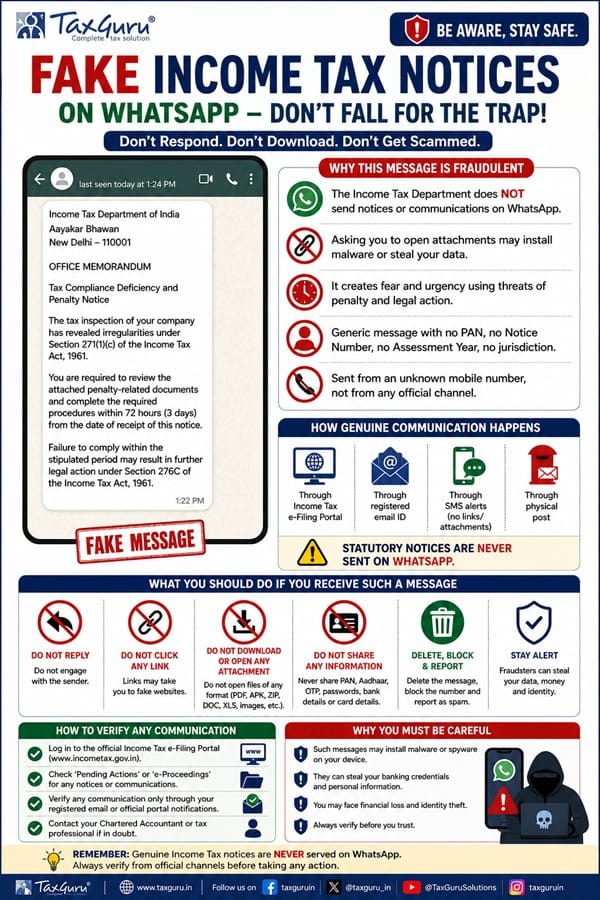
1. Income Tax Department Does Not Send Notices Through WhatsApp
The Income Tax Department communicates with taxpayers through official channels such as:
- The Income Tax e-Filing Portal
- Registered email address of the taxpayer
- SMS alerts (generally without attachments)
- Physical notices wherever applicable
Statutory notices, penalty proceedings, assessment orders, and summons are not served through WhatsApp.
2. Suspicious Request to Open Attachments
The message instructs recipients to review “attached penalty-related documents.”
This is a common phishing technique.
Attachments may contain:
- Malware
- Spyware
- Ransomware
- Credential-stealing software
These files may appear as:
- APK
- ZIP
- DOC/DOCX
- XLS/XLSX
- Images
- Other executable formats
Downloading or opening such files may compromise your device.
3. Creates Artificial Urgency
The fraudsters deliberately use language such as:
- “within 72 hours”
- “legal action”
- “penalty”
- “inspection revealed irregularities”
The objective is to panic taxpayers into acting without verifying authenticity.
4. Generic and Unverified Details
The message:
- does not mention PAN,
- does not contain any Document Identification Number (DIN),
- does not specify assessment year,
- does not provide notice number,
- does not identify the jurisdictional Assessing Officer,
- is sent from an ordinary mobile number instead of an official communication channel.
These are strong indicators of fraud.
How Genuine Income Tax Notices Are Issued
Taxpayers should remember that official communications are generally available through the Income Tax Department’s e-Filing Portal.
Official communications typically contain:
- DIN (Document Identification Number), where applicable
- PAN of the taxpayer
- Assessment Year
- Relevant statutory provision
- Jurisdiction details
- Notice number
- Official digital records available on the e-Filing portal
Whenever in doubt, taxpayers should verify whether the communication is reflected in their account on the Income Tax e-Filing portal.
What You Should Do if You Receive Such a WhatsApp Message
If you receive such a message:
✔ Do Not Reply
Avoid engaging with the sender.
✔ Do Not Click Any Link
Links may redirect to fake websites designed to steal credentials.
✔ Do Not Download Any Attachment
Do not open files of any format including:
- APK
- ZIP
- DOC/DOCX
- XLS/XLSX
- Images
- Any other attachment
✔ Do Not Share Sensitive Information
Never disclose:
- PAN
- Aadhaar
- OTP
- Passwords
- Bank account details
- Debit/Credit card information
✔ Delete and Report
Mark the WhatsApp number as Spam and Block the sender.
How to Verify Any Income Tax Communication
Before taking any action:
- Log in to the Income Tax e-Filing Portal.
- Check Pending Actions, e-Proceedings, or other communication sections.
- Verify any notice through official records.
- Contact your Chartered Accountant or tax professional if you have any doubts.
Common Characteristics of Tax Scams
Fraudsters frequently use:
- Government logos
- Official-sounding designations
- Legal provisions of the Income-tax Act
- Threats of prosecution
- Tight deadlines
- Urgent payment demands
- Download links
- Attachments
These are intended to create fear and bypass rational verification.
Stay Vigilant Against Cyber Fraud
Government impersonation scams have become increasingly sophisticated. Fraudsters exploit the credibility of government institutions to trick taxpayers into downloading malicious files or revealing confidential information.
Remember:
- The Income Tax Department does not serve notices through WhatsApp.
- Never download attachments received through unsolicited WhatsApp messages claiming to be from the Department.
- Always verify communications through official government channels before taking any action.
Conclusion
The WhatsApp message reproduced above is a classic example of a phishing attempt masquerading as an Income Tax notice. Taxpayers should ignore such messages, refrain from downloading any attachments, and verify all tax-related communications only through the official Income Tax e-Filing portal or other authorized channels.
Awareness is the first line of defence against cyber fraud. Always verify before you trust.