
Fake Income Tax Penalty Notice Sent from QQ Email ID: Taxpayers Warned Against Phishing Scam
Introduction
A fraudulent email masquerading as an official communication from the Income Tax Department is currently being circulated among taxpayers. The email falsely claims that tax irregularities have been detected under the Income-tax Act, 1961, threatens prosecution if action is not taken within 72 hours, and asks recipients to download and submit documents through a link.
Several glaring red flags establish that this is not a genuine communication from the Income Tax Department. Taxpayers are advised not to click any links, download attachments, or respond to such emails.
- Text of the Fake Email
- Major Red Flags That Expose the Fraud
- 1. Sent from a QQ Mail Account
- 2. Uses a Gmail Address of the Alleged Officer
- 3. The Message Was Flagged as Spam
- 4. Fake Demand to Download Documents
- 5. Artificial Deadline of 72 Hours
- 6. Threat of Criminal Prosecution
- 7. No DIN (Document Identification Number)
- 8. Generic Communication
- How Does the Income Tax Department Actually Communicate?
- What Should You Do If You Receive Such an Email?
- How to Identify Fake Income Tax Emails
- TaxGuru's Advisory
- Conclusion
Text of the Fake Email
The fraudulent email contains the following message:
No. TAX/PEN/2026-142
Government of India
Ministry of Finance
Income Tax Department
Enforcement DivisionOFFICE MEMORANDUM
Subject: Tax Compliance Deficiency and Penalty Notice
During the tax inspection of your company, irregularities have been found under Section 271(1)(c) of the Income-tax Act, 1961.
You are required to submit the prescribed documents within 72 hours from receipt of this notice.
Required Documents List
Download documents from the link below.
Failure to comply within the stipulated period shall invite legal action under Section 276C of the Income-tax Act.
(Raj Kumar Sharma)
Assistant Commissioner of Income Tax
Email: [email protected]
Copy to: Director (Systems), CBDT, for uploading on Income Tax Department Website.
Major Red Flags That Expose the Fraud
1. Sent from a QQ Mail Account
Perhaps the biggest giveaway is the sender’s email address:
Income Tax Department [email protected]
The Income Tax Department never issues notices from a qq.com email address.
QQ Mail is a free email service operated by Tencent in China and has no connection whatsoever with the Government of India.
Official communications are issued only through government domains such as:
- @incometax.gov.in
- @gov.in
- Other officially notified government domains.
A communication received from @qq.com, @gmail.com, @yahoo.com, or any other free email provider should immediately raise suspicion.
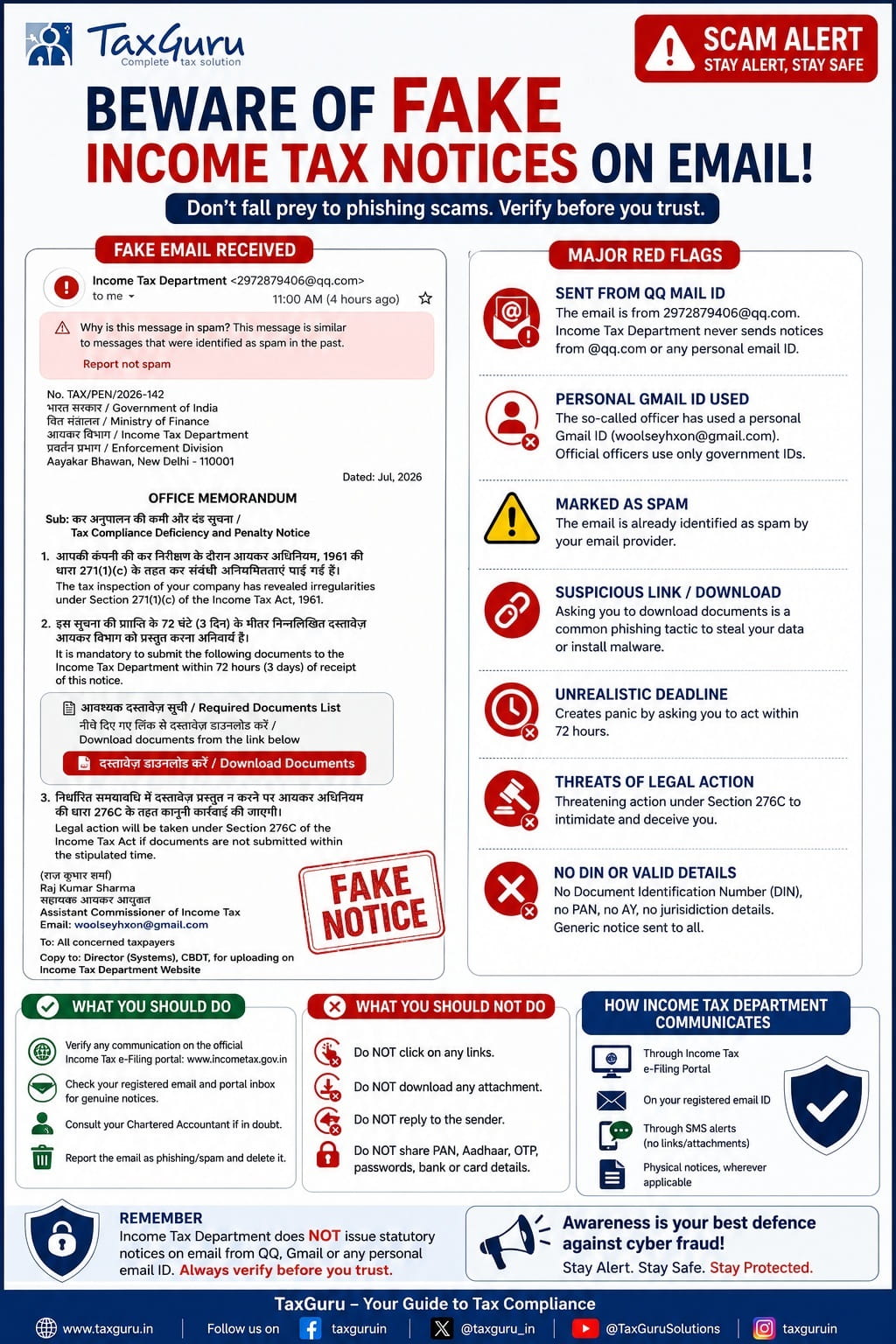
2. Uses a Gmail Address of the Alleged Officer
The email bears the signature:
Email: [email protected]
No Assistant Commissioner of Income Tax communicates official notices through a personal Gmail account.
Government officers use official government email addresses.
This single fact is sufficient to conclude that the email is fake.
3. The Message Was Flagged as Spam
The email itself carries the warning:
“Why is this message in spam? This message is similar to messages that were identified as spam in the past.”
Modern email providers employ sophisticated spam detection systems that identify phishing campaigns based on sender reputation, message patterns, and malicious links.
Such warnings should never be ignored.
4. Fake Demand to Download Documents
The email directs recipients to:
Download documents from the link below
This is a classic phishing tactic.
The downloaded file may contain:
- Malware
- Spyware
- Ransomware
- Credential-stealing software
- Remote access tools
The objective is usually to compromise the recipient’s device or steal confidential information.
5. Artificial Deadline of 72 Hours
Fraudsters frequently create panic by imposing unrealistic deadlines.
In this email:
Submit documents within 72 hours
The intention is to pressure recipients into acting without verifying authenticity.
6. Threat of Criminal Prosecution
The email threatens action under:
Section 276C
The inclusion of statutory provisions is intended to make the email appear authentic.
However, genuine prosecution proceedings under the Income-tax Act follow a prescribed legal process and are not initiated through such emails.
7. No DIN (Document Identification Number)
CBDT has mandated the use of a Document Identification Number (DIN) for most official communications.
The alleged notice contains no verifiable DIN that can be authenticated on the Income Tax portal.
8. Generic Communication
The email lacks several particulars normally found in genuine notices, such as:
- PAN of the taxpayer
- Assessment Year
- Financial Year
- Jurisdiction details
- Proper notice reference
- Name of Assessing Officer with official contact details
- Official digital authentication
How Does the Income Tax Department Actually Communicate?
Official communications are generally made through:
- The Income Tax e-Filing Portal
- Registered email address of the taxpayer
- SMS alerts (without malicious download links)
- Physical notices, wherever applicable
The Department does not send statutory notices requiring taxpayers to download documents through suspicious links or personal email accounts.
What Should You Do If You Receive Such an Email?
If you receive a similar email:
❌ Do NOT click any link.
❌ Do NOT download any attachment.
❌ Do NOT reply to the sender.
❌ Do NOT share:
- PAN
- Aadhaar
- OTP
- Passwords
- Bank details
- Debit/Credit card information
✔ Verify your tax account directly on the official Income Tax e-Filing portal.
✔ Consult your Chartered Accountant if you are unsure.
✔ Mark the email as phishing/spam and delete it.
How to Identify Fake Income Tax Emails
Be cautious if you notice any of the following:
- Email from @gmail.com, @qq.com, or other free email providers.
- Threats of arrest, prosecution, or penalties within a short timeframe.
- Requests to download files or click unfamiliar links.
- Poor formatting, inconsistent language, or unofficial contact details.
- Absence of verifiable official identifiers such as DIN and jurisdiction details.
TaxGuru’s Advisory
Taxpayers should remember:
- The Income Tax Department does not issue statutory notices from QQ Mail, Gmail, or other personal email services.
- Never click on links or download files received through unsolicited emails claiming to be from tax authorities.
- Always verify any tax-related communication through the official Income Tax e-Filing portal before taking any action.
Cybercriminals frequently impersonate government departments to create fear and urgency. A few moments spent verifying a communication can prevent significant financial loss and identity theft.
Conclusion
The email reproduced above bears every hallmark of a phishing scam—from the use of a QQ Mail sender address and a personal Gmail ID, to the demand for downloading documents within 72 hours and threats of prosecution under the Income-tax Act. Taxpayers should ignore such emails, refrain from interacting with any links or attachments, and verify all communications only through official government channels.
Stay alert. Verify before you trust. Awareness is your strongest defence against cyber fraud.








I got message on whatsapp and it had a zip file titled ITD>zip attached to it. Of course I did not open the zip attachment suspecting the language of the whatsapp message itself as it had all the errors mentioned above in your article. The name of signer and the whatsapp name were different. Whatsapp name displayed was Prince Patel and Rajkumar Sharma was the name mentioned as signer.