India’s Crypto Tax Net: Navigating the 30% Tax, 1% TDS, and New GST Levy
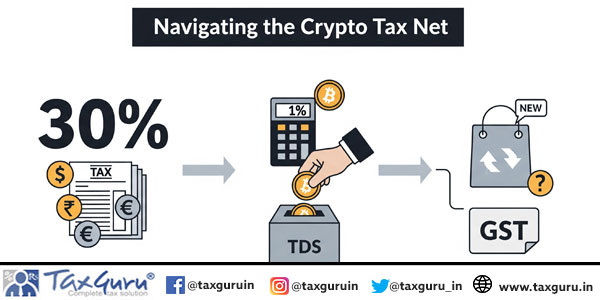
India has solidified its stance on the taxation of cryptocurrencies, establishing a stringent framework that treats them as a distinct asset class. Recent amendments and notifications have further tightened compliance, leaving no room for ambiguity. Investors and traders must now navigate a multi-layered tax structure that includes a high flat tax on profits, mandatory tax deduction at source, and a newly clarified GST levy on service fees.
The Core Income Tax Framework
The Finance Act of 2022 formally brought cryptocurrencies and other Virtual Digital Assets (VDAs), such as Non-Fungible Tokens (NFTs), into the tax fold.
Flat 30% Tax on Gains: Under Section 115BBH of the Income Tax Act, any income from the transfer of VDAs is taxed at a flat rate of 30%, plus applicable surcharge and cess. This rate applies universally, regardless of the taxpayer’s income slab or the holding period of the asset.
No Deductions or Set-offs: The calculation of gains is straightforward: Sale Price minus the Cost of Acquisition. No other deductions are permitted. Crucially, losses from VDA transactions cannot be set off against any other income (like salary or capital gains from other assets) and cannot be carried forward to future years.
1% TDS on Transactions: To ensure transparency and track all transactions, Section 194S mandates a 1% Tax Deducted at Source (TDS) on the transfer of VDAs. This TDS is applicable if the total transaction value exceeds ₹50,000 in a financial year for specified individuals (e.g., those without business income) and ₹10,000 for others.
If trading on an Indian exchange, the exchange is responsible for deducting and remitting the TDS.
- For peer-to-peer (P2P) or international exchange transactions, the buyer is obligated to deduct the TDS.
The GST Angle: An 18% Levy on Services
A significant recent development has been the clarification on the applicability of the Goods and Services Tax (GST) on cryptocurrency services.
Effective from July 7, 2025, a GST of 18% is levied on the service fees charged by cryptocurrency exchanges and platforms to Indian users. This move aligns crypto platforms with the obligations of other online service providers.
Services covered by the 18% GST include :
- Trading fees (spot, margin, and derivatives)
- Withdrawal and deposit fees
- Staking service fees
- Fiat transaction fees
- OTC and other platform-related charges
This means that for every service a crypto platform provides, it must charge and remit GST, adding to the cost for the end-user.
Stricter Compliance: Key Amendments from Budget 2025
The Union Budget 2025 has introduced further measures to tighten the regulatory grip and ensure comprehensive reporting.
Undeclared Crypto as “Undisclosed Income”: A major amendment proposes that any unreported VDA holdings or gains discovered during a tax search will be treated as “undisclosed income”. This can attract a much higher tax rate of 60% under the block assessment framework, plus penalties.
Search and Seizure Provisions: For the first time, VDAs are now explicitly included under the search and seizure provisions of tax laws, empowering authorities to investigate unreported crypto assets.
- Mandatory Transaction Reporting: A new Section 285BAA has been introduced, which will mandate taxpayers to furnish detailed reports of their crypto transactions, enhancing transparency.
- Filing and Reporting for Taxpayers
To comply with these regulations, taxpayers must:
- Use the dedicated “Schedule VDA” in the Income Tax Return (ITR) forms (ITR-2 or ITR-3) to report all crypto income.
- Ensure timely TDS compliance, as failure to do so can attract significant penalties, including a penalty equal to the tax not deducted and even imprisonment for willful evasion.
- For the Indian crypto investor, the message from the government is clear: the era of ambiguity is over. The regulatory environment demands meticulous record-keeping, accurate reporting, and compliance with a robust tax framework that addresses income tax and GST.