Introduction
With the rapid growth of digital banking, online payments, and cryptocurrency transactions, financial frauds have increased significantly. One of the most common methods used by fraudsters to conceal the trail of illegally obtained money is through the use of “Money Mules.”
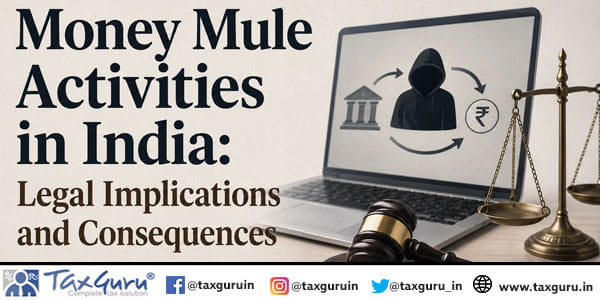
A money mule is an individual or entity that transfers, receives, or moves funds on behalf of another person, often unknowingly assisting criminals in laundering proceeds of crime. While some individuals knowingly participate for financial gain, many are deceived through fake job offers, investment schemes, online relationships, or commission-based payment arrangements.
What is a Money Mule?
A money mule is a person who:
- Receives money into their bank account from an unknown source.
- Transfers the money to another account, wallet, or person.
- Withdraws cash and hands it over to another individual.
- Allows their bank account, UPI ID, or digital wallet to be used by third parties.
The objective of criminals is to create multiple layers of transactions, making it difficult for law enforcement agencies to trace the original source of illegal funds.
Common Methods of Recruitment
Money mules are often recruited through:
1. Fake work-from-home jobs.
2. Online dating and romance scams.
3. Social media advertisements promising easy income.
4. Commission-based money transfer offers.
5. Cryptocurrency investment schemes.
6. Requests to lend bank accounts or UPI IDs for temporary use.
Legal Consequences Under Indian Laws
1. Prevention of Money Laundering Act, 2002 (PMLA)
Money mule activities may amount to assisting in the process of laundering proceeds of crime.
Relevant Provision
Section 3 – Offence of Money Laundering
Any person directly or indirectly involved in activities connected with proceeds of crime, including concealment, possession, acquisition, use, or projecting such proceeds as untainted property, may be prosecuted.
Punishment
- Rigorous imprisonment from 3 years up to 7 years.
- Up to 10 years where the predicate offence relates to narcotic drugs.
- Fine as prescribed by law.
- Attachment and confiscation of assets.
2. Bharatiya Nyaya Sanhita, 2023 (BNS)
Money mule activities may attract various offences under the BNS, including:
Cheating
Where the mule knowingly assists fraudsters in deceiving victims.
Criminal Conspiracy
Participation in a scheme designed to facilitate illegal financial transactions.
Dishonest Misappropriation
Retention or handling of funds known to be obtained through illegal means.
Punishment varies depending upon the nature and gravity of the offence and may include imprisonment and fines.
3. Information Technology Act, 2000
Where electronic systems, internet banking, UPI platforms, or digital wallets are used in fraudulent transactions:
Relevant Provisions
- Identity theft.
- Cheating by personation using computer resources.
- Unauthorized access and cyber fraud-related offences.
Punishments may include:
- Imprisonment.
- Monetary penalties.
- Compensation to affected parties.
4. Reserve Bank of India (RBI) Regulations
Banks are required to comply with Know Your Customer (KYC) and Anti-Money Laundering (AML) guidelines.
Consequences for account holders involved in mule activities include:
- Freezing of bank accounts.
- Reporting of suspicious transactions.
- Closure of accounts.
- Inclusion in monitoring databases.
- Investigation by law enforcement agencies.
5. Income Tax Act, 1961
Unexplained credits appearing in a mule’s bank account may be treated as unexplained income.
Consequences may include:
- Tax demands.
- Interest liability.
- Penalties.
- Prosecution in serious cases.
6. Foreign Exchange Management Act, 1999 (FEMA)
If funds are transferred outside India or received from foreign sources without proper authorization, violations of FEMA may arise.
Consequences include:
- Monetary penalties.
- Investigation by enforcement authorities.
- Restrictions on foreign exchange transactions.
Consequences for Individuals
A person involved in money mule activities may face:
- Arrest and criminal prosecution.
- Freezing of bank accounts.
- Attachment of assets.
- Adverse credit history.
- Difficulty obtaining loans and financial services.
- Employment-related repercussions.
- Long-term reputational damage.
Importantly, claiming ignorance may not always provide protection if circumstances indicate negligence or deliberate participation.
Red Flags and Warning Signs
Individuals should be cautious if:
- Offered easy money for transferring funds.
- Asked to use personal bank accounts for business transactions.
- Requested to receive and forward money for strangers.
- Promised commissions for simple financial transfers.
- Asked to share banking credentials, debit cards, or UPI access.
Preventive Measures
1. Never allow others to use your bank account.
2. Do not share banking credentials or OTPs.
3. Verify employment opportunities thoroughly.
4. Report suspicious requests immediately to your bank.
5. Maintain records of all financial transactions.
6. Cooperate with authorities if contacted regarding suspicious activity.
Conclusion
Money mule activities are a significant component of modern financial crime and money laundering schemes. Whether participation is intentional or due to deception, the legal and financial consequences can be severe. Individuals must exercise caution while dealing with financial transactions involving unknown persons and should strictly comply with banking and regulatory requirements. Awareness and vigilance remain the strongest defenses against becoming involved in money mule operations.