In Re Storia Foods and Beverages Private Limited (CCPA Delhi)
CCPA Imposes ₹1 Lakh Penalty for Misleading ‘100%’ and Health Claims on Beverage Products; ‘100% Juice’ Claims Held Misleading as Product Composition Did Not Match Representation; CCPA Rejects Defence That FSS Compliance Automatically Validates Advertising Claims; Health Benefit Claims Without Product-Specific Scientific Evidence Held Misleading by CCPA; CCPA Holds Disclaimers Cannot Correct Misleading Front-of-Pack ‘100%’ Claims; Consumer Authority Finds Misleading Product Composition Claims, Orders Immediate Corrective Action; CCPA Rules ‘Natural’ and ‘100%’ Claims Misleading for Reconstituted Beverage Products.
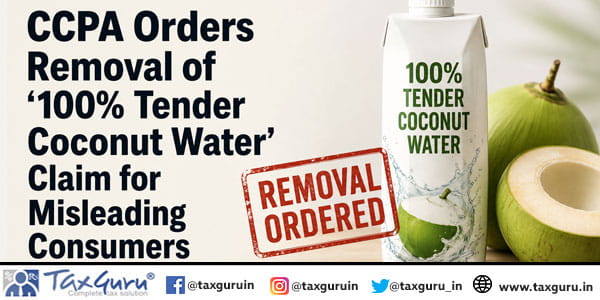
The Central Consumer Protection Authority (CCPA) initiated suo motu proceedings against Storia Foods and Beverages Private Limited regarding advertisements and representations made on its official website, product packaging, and e-commerce platforms for its Tender Coconut Water and fruit juice products. The proceedings concerned claims including “100% Tender Coconut Water,” “100% Natural Tender Coconut Water,” “100% Juice,” and health-related representations such as “Combats Virus,” “Improves Metabolism,” “Kills Fatigue,” and “Rehydrates the Body Faster than Water.”
The CCPA observed that the ingredient declarations differed from the prominent claims. The coconut water product was declared as “Water and Coconut Water Concentrate (9.6%) (Equivalent to 100% Coconut Water) (Reconstituted),” while the fruit juice variants predominantly contained water along with fruit pulp or concentrate ranging from 4% to 16%, apple juice concentrate, and water. The Authority also noted that the health claims were made without product-specific scientific substantiation.
In response to the Show Cause Notice, the company contended that its products complied with the Food Safety and Standards (FSS) framework. It submitted that the coconut water was a reconstituted product permitted under the applicable regulations, the ingredient declarations accurately reflected the composition, and the health claims were supported by published scientific literature. It further stated that the “Combats Virus” claim had been removed and that the “100% Juice” products contained declarations stating “(Equivalent to 100% Fruit Juice) (Reconstituted).”
The CCPA found that these explanations did not resolve the concerns. It held that the cited FSS regulations did not authorize the use of “100% Tender Coconut Water” for a reconstituted product and that compliance with the FSS framework did not determine whether an advertisement was misleading under the Consumer Protection Act, 2019. It further held that back-of-pack disclosures could not cure or qualify prominent front-of-pack claims, as disclaimers cannot correct a misleading representation.
The Authority also rejected the use of the term “Natural”. It observed that the product contained Class II Preservative INS 202, which was inconsistent with the conditions relied upon for making a “natural” claim. According to the CCPA, an ordinary consumer would understand the expressions “100% Tender Coconut Water” and “100% Natural Tender Coconut Water” to mean a product consisting entirely of natural tender coconut water without concentration, preservatives, or reconstitution, making the claims misleading.
Regarding the fruit juice variants, the CCPA held that the claim “100% Juice” created a misleading impression of the products’ composition. It observed that products labelled as Pomegranate and Mixed Fruit contained Apple Juice Concentrate in equal or greater proportion than the named fruit ingredient in certain variants. The Authority held that these representations falsely described the products and were likely to mislead consumers regarding their composition.
The CCPA further held that the health claims lacked adequate substantiation. It found that the company had relied on general scientific literature relating to coconut water rather than studies conducted on its own products. The Authority also noted that the material relied upon did not substantiate the specific claims made. It rejected the company’s submission that the “Combats Virus” claim had already been discontinued, observing that the claim continued to appear on the company’s official website in September 2024. Accordingly, it held that the claims “Combats Virus,” “Improves Metabolism,” “Kills Fatigue,” and “Rehydrates the Body Faster than Water” violated the Consumer Protection Act.
The CCPA concluded that the company had falsely described the composition of its coconut water and fruit juice products, made unsubstantiated health claims, engaged in misleading advertisements and unfair trade practices, and compromised consumers’ right to be informed. It also observed that the challenged claims continued to appear on digital platforms even after corrective steps had been claimed by the company.
Accordingly, the CCPA directed the company to:
- Immediately discontinue the claims “100% Tender Coconut Water” and “100% Natural Tender Coconut Water” on its website, packaging, and e-commerce listings.
- Immediately discontinue the claim “100% Juice” for the Pomegranate, Mixed Fruit, Mango, and Guava Chilli variants on its website and e-commerce listings.
- Immediately discontinue the claims “Combats Virus,” “Improves Metabolism,” “Kills Fatigue,” and “Rehydrates the Body Faster than Water,” and refrain from making future health or therapeutic claims unless supported by product-specific scientific substantiation.
- Pay a penalty of ₹1,00,000 within 15 days of receipt of the order.
- Submit a compliance report within 15 days confirming compliance with the directions.
FULL TEXT OF THE JUDGMENT/ORDER OF CENTRAL CONSUMER PROTECTION AUTHORITY
1. This is a suo-motu case taken up by the Central Consumer Protection Authority (hereinafter “CCPA”) against M/s Storia Foods and Beverages Private Limited (hereinafter “the opposite party” or “Storia”) with respect to advertisements and representations published on its official website (shop.storiafoods.com), on the packaging of its products, and on third-party e-commerce platforms including Amazon, Flipkart, BigBasket, Blinkit, JioMart and Zepto, in relation to the following products:
i. Storia 100% Tender Coconut Water;
ii. 100% Natural Tender Coconut Water;
iii. Storia 100% Juice-Pomegranate;
iv. Storia–100% Juice- Mixed Fruit;
v. Storia 100% Juice -Mango; and
vi. Storia 100% Juice – Guava Chilli (Annexure-1)
2. The CCPA is established under Section 10 of the Consumer Protection Act, 2019 (hereinafter “the Act”) to regulate matters relating to violation of consumer rights, unfair trade practices, and false or misleading advertisements that are prejudicial to the interests of consumers as a class. Section 18 read with Section 9 of the Act empowers the CCPA to ensure transparency, accuracy and full disclosure in advertisements, and to protect the right of consumers to be informed so as to enable them to make informed choices. Section 18(1) further obligates the CCPA to ensure that no person engages in the publication of a false or misleading advertisement and to prevent unfair trade practices.
3. On preliminary examination, the CCPA observed that the opposite party prominently advertised its coconut water product as “100% Tender Coconut Water” and “100% Natural Tender Coconut Water” on its official website, on the front of the product packaging, and across the e-commerce platforms referred to above, while the ingredient declaration on the product label disclosed the composition as “Water and Coconut Water Concentrate (9.6%) (Equivalent to 100% Coconut Water)(Reconstituted)”. Similarly, the opposite party advertised its Pomegranate, Mixed Fruit, Mango and Guava Chilli variants as “100% Juice”, although the respective ingredient panels disclosed compositions consisting predominantly of water together with fruit pulp/concentrate ranging between 4% and 16%, with the remainder being apple juice concentrate and water.
4. The CCPA further observed that the opposite party’s promotional material for the coconut water product attributed the following health and therapeutic benefits to the product, without any product-specific scientific substantiation placed on record at that stage:
i. “Combats Virus”;
ii. “Improves Metabolism”;
iii. “Kills Fatigue”; and
iv. “Rehydrates the Body Faster than Water”.
5. As per the Guidelines for Prevention of Misleading Advertisements and Endorsements for Misleading Advertisements, 2022 (hereinafter “the 2022 Guidelines”), Clause 4 mandates that any claim made in an advertisement must be truthful and must not mislead consumers by exaggerating the accuracy, scientific validity, practical usefulness, capability or performance of the product. Clause 11 requires that any disclaimer in an advertisement be presented in a manner that is clear, prominent and legible to a normally-sighted person reading the advertisement once, from a reasonable distance and at a reasonable speed, and in the same language and font as the principal claim. Clause 12 places a duty on service providers and advertisers to ensure that no advertisement contains a statement or visual presentation which, directly or by implication or exaggeration, is likely to mislead consumers about the product advertised.
6. Section 2(28) of the Act defines “misleading advertisement”, in relation to any product or service, as an advertisement which (i) falsely describes such product or service; (ii) gives a false guarantee to, or is likely to mislead the consumer as to the nature, substance, quantity or quality of such product or service; (iii) conveys an express or implied representation which, if made by the manufacturer, seller or service provider, would constitute an unfair trade practice; or (iv) deliberately conceals important information. Section 2(47) defines “unfair trade practice” to include, inter alia, falsely representing that goods are of a particular standard, quality, grade or composition. Section 2(9) confers upon consumers the right to be informed about the quality, quantity, potency, purity, standard and price of goods, so as to protect them against unfair trade practices.
7. Accordingly, the CCPA issued a Show Cause Notice dated 18.11.2024 to the opposite party, calling upon it to furnish a response as to why action under the Act should not be taken against it for violation of consumer rights, misleading advertisement and unfair trade practice in respect of the products and claims referred in abovementioned paragraphs.
8. The opposite party submitted its reply dated 07.01.2025, in response to the Reminder Notice dated 23.12.2024 and the original Show Cause Notice dated 18.11.2024, wherein it inter alia submitted as follows:
i. On “100% Tender Coconut Water” – the product is reconstituted coconut water restored to single strength in accordance with Regulation 2.3.6 of the Food Safety and Standards (Food Products Standards and Food Additives) Regulations, 2011 (hereinafter “the FSS Standards Regulations”); the ingredient declaration “Water and Coconut Water Concentrate (9.6%) (Equivalent to 100% Coconut Water) (Reconstituted)” complies with Regulation 5(1) (a) and 5(1) (b) of the Food Safety and Standards (Labelling and Display) Regulations, 2020 (hereinafter “the FSS Labelling and Display Regulations”) regarding display of the product name.
ii. On the health claims on coconut water, the opposite party set out, claim-wise, the scientific basis relied upon:- “Kills Fatigue” was attributed to coconut water’s “antithrombotic properties” and its ability to “improve blood flow by preventing blood clot formation” and to “reduce oxidative stress”, for which the opposite party relied upon an excerpt from “An Overview on Coconut Water: As A Multipurpose Nutrition” (Tuyekar et al., International Journal of Pharmaceutical Sciences Review and Research, 2021), stating that coconut water “had the lowest AEAC (L-ascorbic acid equivalent antioxidant capacity): 11.5mg and 0.7mg per 100g of ascorbic acid”; – “Improves Metabolism” was attributed to the potassium content and “bioactive enzymes” in coconut water, said to support digestion, nutrient absorption and fluid balance, for which the opposite party relied upon an excerpt from the same article recording that “Coconut water contains vitamin C, which is an essential dietary antioxidant… hyper metabolism leads to an increase in reactive oxygen species (or free radicals)”; -“Rehydrates Faster” was attributed to the “isotonic” electrolyte profile of coconut water, said to closely resemble human plasma, for which the Company relied upon “Coconut Water as a Rehydration Fluid” (Kuberski et al., New Zealand Medical Journal, 1979); – “Combats Virus” -the opposite party confirmed that this claim had already been removed from the product’s labelling since December 2023.
iii. On the four “100% Juice” variants, the Company furnished the updated ingredient declarations for each, every one bearing the qualifying words “(Equivalent to 100% Fruit Juice) (Reconstituted)”:- Pomegranate: “Water, Pomegranate Juice Concentrate (4%), Apple Juice Concentrate (12%) (Equivalent to 100% Fruit Juice) (Reconstituted)”; – Mango: “Water, Fruit Juice (Mango Pulp (16%), Apple Concentrate (12.5%)) (Equivalent to 100% Fruit Juice) (Reconstituted)”; – Guava Chilli: “Water, [Guava Pulp 16% & Apple Concentrate 12.5%]…Chilli Powder, Black Pepper Powder… (Equivalent to 100% Fruit Juice) (Reconstituted)”; – Mixed Fruit: “Water, Mixed Fruit Juice Concentrate (10%), Apple Concentrate (9%), Mango Pulp (4%)… (Equivalent to 100% Fruit Juice) (Reconstituted)”.
iv. The opposite party submitted that, read together with these ingredient declarations, the respective product names accurately conveyed the products’ true composition, that none of the claims were misleading or deceptive, and that the Notices ought to be withdrawn as “the issue identified by your good offices has been resolved in its entirety.”
9. On examination of the said reply, the CCPA noted that, as on the date of the reply itself (07.01.2025) – which was after the extended compliance deadline of 31.12.2024 fixed by FSSAI’s own Second Order in respect of “100% Fruit Juice” claims- the opposite party had not yet removed the impugned claims and was merely “in the process” of doing so. The CCPA further noted, on the basis of a purchase made from Blinkit that the product “Storia 100% Tender Coconut Water” continued to be advertised and sold under the impugned claim notwithstanding the issuance of the Show Cause Notice.
10. CCPA further finds, on a prima facie basis, that the opposite party’s regulatory defense is misconceived and does not withstand scrutiny. Regulation 2.3.6 of the FSS Product Standards Regulations, on which the opposite party primarily relies, governs Thermally Processed Fruit Juices and has no application to coconut water, which is not a fruit juice extracted by mechanical process from the flesh of a fruit. Even in respect of the fruit juice variants, Regulation 2.3.6 permits reconstitution only for the purpose of restoring a concentrate to the essential composition and quality factors of the original juice it does not confer any right to describe the resulting product as ”100% Juice” on the front of pack. Similarly, Regulations 5(1) (a) and 5(1) (b) of the FSS Labelling Regulations, which require the name of a food to reflect its true nature, afford no support to the opposite party, no FSSAI standard authorizes the name “100% Tender Coconut Water” for a reconstituted product, and a product whose primary declared ingredient is water cannot truthfully claim to be “100%” of any natural substance. The CCPA further notes that Regulation 4(3) of the FSS Labelling Regulations independently prohibits any description of a pre-packaged food that is false, misleading or deceptive or likely to create an erroneous impression as to its character a prohibition that the prominent front-of-pack claims in question prima facie violate.
11. The CCPA also finds, on a prima facie basis, that the back-of-pack disclosures “(Equivalent to 100% Coconut Water) (Reconstituted)” and “(Equivalent to 100% Fruit Juice) (Reconstituted)” do not cure the misleading nature of the front-of-pack claims. Clause 11 of the 2022 Guidelines expressly provides that a disclaimer shall not contradict the material claim made in the advertisement, shall not attempt to hide material information the omission of which is likely to make the advertisement deceptive, and shall not attempt to correct a misleading claim. A technical parenthetical buried in the ingredient panel in disproportionately small font does precisely what Clause 11 forbids- it attempts to qualify and correct a front-of-pack claim that is inherently misleading, while being presented in a manner that is wholly incommensurate in prominence with the claim it seeks to qualify. Further, in the case of the fruit juice variants, the ingredient declarations themselves reveal that Apple Juice Concentrate is present in equal or greater proportion than the so-called characterizing fruit in at least two variants, a fact that the qualifying disclaimer does not address and that separately misleads the consumer as to the identity and composition of the product.
12. On the basis of the foregoing examination, the CCPA formed the view that a prima facie case of misleading advertisement within the meaning of Section 2(28), unfair trade practice within the meaning of Section 2(47), and violation of the consumer’s right to information under Section 2(9) of the Act was made out against the opposite party in respect of all 5 products under consideration, and the matter was accordingly referred to the Director General (Investigation) for detailed investigation vide letter dated 20.01.2025.
13. The Director General (Investigation) in its investigation report dated 12.05.2026 submitted the following:
i. Company manufactures and advertises its product under the label “100% Natural Coconut Water.” Such representation is misleading, as the term “100%” implies that the product consists entirely of pure coconut water without any alteration. However, the ingredient composition reveals that the product contains Water and Coconut Water Concentrate (9.6%) (Equivalent to 100% Coconut Water) (Reconstituted), which is inconsistent with the claim being made.
ii. The company has contended that under the Food Safety and Standards (Advertising and Claims) Regulations, the term “natural” may be used in accordance with prescribed conditions, and that such conditions extend to products reconstituted. However, the use of the qualifier “100%” in conjunction with the term “natural” introduces ambiguity and misleads consumers into believing that the product is wholly unprocessed and in its original form.
iii. Additionally, the company has included a disclosure on the packaging stating that the product is “reconstituted” and “equivalent to 100% natural juice.” However, this information is presented in extremely small font, rendering it ineffective for an average consumer. Merely including this statement does not absolve the company’s liability, as the manner of disclosure is inadequate and fails to effectively inform consumers.
iv. It was further observed that, pursuant to the FSSAI order, the company was permitted to use leftover packaging bearing “100%” only for products manufactured on or before 31st March 2024 and sell them until the end of their shelf life. However, the investigation indicates that such products were sold until October 2025, beyond the permissible timeline, reflecting non-compliance with FSSAI regulations.
v. The claims made by the company are misleading, as they attribute unsubstantiated health and therapeutic benefits to the product. The company has failed to provide any independent scientific studies or clinical trial data conducted specifically on its own product to substantiate such claims and instead relies on publicly available articles, data, and research.
vi. Notably, the product “Storia 100% Coconut Water” remained available for sale as of 31st October 2025, despite the company’s claim that such labelling had been discontinued. This conduct constitutes a violation of FSSAI regulations and reflects continued noncompliance.
vii. It was observed that the company is marketing its sugarcane juice product with the claim “100% sugarcane” till date which is in violation of prevailing FSSAI directions prohibiting the use of “100% fruit juice” claims. The continued use of such terminology in packaging and promotional material reflects disregard for regulatory guidance.
viii. Storia Foods & Beverages Private Limited is in violation of Sections 2(28) and 2(47) of the Consumer Protection Act, 2019, as its claims such as “100% tender coconut water,” “100% juice,” “Combats virus,” “Improves metabolism,” “Kills fatigue,” “Rehydrates the body faster than water” are misleading and deceptive in relation to the actual composition of its products. Such representations create a false impression of absolute purity and quality, thereby constituting misleading advertisement and unfair trade practice.
ix. The company is further in violation of Section 2(9) of the Consumer Protection Act, 2019, as these misrepresentations compromises consumers’ right to be informed. By failing to clearly and effectively disclose the true nature of the product, the company hinders consumers from making informed and rational purchasing decisions.
x. The company has also violated Guideline 4 and Guideline 12 of the Guidelines for Prevention of Misleading Advertisements and Endorsements for Misleading Advertisements, 2022, as its advertisements contain exaggerated and misleading claims that fail to truthfully represent the nature and composition of the products.
xi. In view of the above, as per the investigation conducted, a case relating to the violations under the Consumer Protection Act, 2019 and abovementioned statutes stands established.
14. The Investigation Report submitted by DG (Investigation) was shared with the opposite party vide letter dated 21.05.2026 to furnish its comments and the opposite party was directed to appear fora hearing. The hearing was scheduled for 04.06.2026. The opposite party did not appear on the said date.
15. Thereafter, vide email dated 04.06.2026, the CCPA informed the opposite party that no authorized representative of the opposite party had appeared on the scheduled date and time of hearing. In the interest of natural justice, CCPA decided to grant the opposite party a further opportunity to appear and furnish its comments/submissions on the DG Investigation Report. Accordingly, the matter was rescheduled for hearing on 11.06.2026, and the opposite party was directed to appear on the said date and submit its comments on the DG Investigation Report along with any supporting documents, if any.
16. Pursuant thereto, the CCPA received a response from the opposite party on 11.06.2026, wherein it made the following submissions:-
i. Requesting that its non-appearance be condoned and that the response be taken on record.
ii. Reiterated its commitment to compliance with the Food Safety and Standards Act, 2006 and the regulations framed thereunder (hereinafter collectively “the FSS framework”).
iii. The “100% Tender Coconut Water” claim is consistent with Regulation 2.3.6 of the FSS Standards Regulations, which recognizes concentration and subsequent reconstitution to single strength as a valid manufacturing process for fruit juices, including coconut water; a product so reconstituted is treated by the regulatory framework as equivalent to fruit juice obtained directly from the fruit.
iv. The use of the term “natural” is consistent with Regulation 9(2) read with Schedule V of the Food Safety and Standards (Advertising and Claims) Regulations, 2018 (hereinafter “the FSS Advertising and Claims Regulations”), since no foreign substances, synthetic additives or chemical agents are added at any stage, and concentration/reconstitution are permitted processes under Schedule V.
v. The “(Reconstituted)” declaration on the label complies with the minimum font-size requirements prescribed under Regulation 6(3) of the FSS Labelling and Display Regulations, and the Investigation Report’s characterisation of the font as “extremely small” is not anchored to any specific regulatory benchmark.
vi. FSSAI, vide its approval letter dated 10.01.2025 (the “FSSAI Extension Letter”), permitted the Company to utilise pre-printed packaging bearing the “100%” claim for products manufactured on or before 31.03.2025, and further permitted such products to remain in the market until expiry of their shelf life (six months); accordingly, the presence of such products in the market in October 2025 is consistent with, and not in violation of, the FSSAI Extension Letter.
vii. The health-related claims on coconut water were supported by peer-reviewed literature on the generally recognised properties of coconut water; the “Combats Virus” claim had in any event been voluntarily discontinued in December 2023, and the remaining claims were removed from labels and promotional material “last year” as a matter of prudence.
viii. With respect to Finding G of the Investigation Report (concerning the Company’s sugarcane juice product bearing the claim “100% Sugarcane”), the Company submitted: (a) that this finding travels beyond the scope of the Show Cause Notice dated 18.11.2024 and the subsequent investigation communications, both of which were confined to the coconut water product and the four fruit juice variants, and that no opportunity was afforded to the Company to address any allegation concerning the sugarcane juice product, in violation of the principles of natural justice; (b) that, without prejudice to the foregoing, Sugarcane Juice is manufactured as a single-ingredient juice directly from freshly pressed sugarcane, without addition of water or any reconstitution process, and that, taken together with the lemon juice and the “nature identical flavouring substances- lemon & mint” declared on its label, the product is, in the Company’s submission, in fact 100% juice; (c) that the permissibility and interpretation of “100°/0” claims in relation to single-ingredient juices is presently sub judice before the Hon’ble Delhi High Court in Dabur India Limited v. Union of India [W.P.(C) 3735/2025]; and (d) that the sugarcane juice product is not presently being sold or offered for sale through the Company’s website, any e-commerce platform, or any other active retail channel, as demonstrated by screenshots of the Company’s website annexed as Annexure B to the Response.
ix. Paragraph 4(g) of the 2022 Guidelines recognizes that compliance with sector-specific law, such as the FSS framework, is a relevant consideration in assessing whether an advertisement is misleading under Section 2(28) of the Act, and the Company’s compliance with the FSS framework ought to be given due weight on this account.
17. A hearing was scheduled on 11.06.2026 during which Mr. Harsh Hiroo Gursahani, Legal Counsel and Mr. Balasubrahmanyam Bandaru – Head, Research & Development appeared on behalf of the opposite party and made the following submissions:
i. That the Investigation Report conflates two distinct products manufactured by it:
a. “Storia 100% Coconut Water” – a non-reconstituted, single-ingredient coconut water packed directly at source without any preservative, marketed in tetra-pack format and depicted in the screenshot at page 10 of the Investigation Report; and
b. “Storia 100% Tender Coconut Water” (subsequently renamed “Storia Tender Coconut Water”)- the reconstituted product comprising “Water and Coconut Water Concentrate (9.6%)” which is the subject matter of the present proceedings, and which declares the additive INS 202 (a permitted Class II preservative) in its ingredient list.
ii. The opposite party reiterated that it had removed the “100%” claim from the labelling of “Storia 100% Tender Coconut Water” from October 2024 onward, pursuant to FSSAI’s directions, and had obtained FSSAI’s permission to exhaust pre-printed packaging bearing the “100%” claim for products manufactured on or before 31.03.2025, such products being permitted to remain on sale until expiry of their shelf life, stated at the hearing to be nine months.
iii. With respect to the continued display of the “100%” claim on the Zepto platform as observed during the hearing, the opposite party submitted that Zepto operates as an inventory-based e-commerce platform which independently creates and maintains its own product-listing artwork upon purchasing stock from the opposite party, that the opposite party had informed such platforms of the revised artwork, and that the physical product currently supplied to consumers does not bear the impugned claims.
iv. The opposite party offered to place on record its communications with e-commerce platforms in this regard.
v. When shown the screenshot at Annexure-1 to the Show Cause Notice (captured 23.09.2024), depicting the claim “Combats Viruses” on the opposite party’s official website, the representatives of the opposite party reiterated, without addressing the discrepancy or furnishing any documentary clarification, that this and the other health-related claims had been removed “in 2023, early 2024”, including from “online advertisements, banners, whatsoever.
18. During the hearing on 11.06.2026, the CCPA granted the opposite party a period of one week to file any additional written submissions it may wish to place on record, and informed the opposite party that the CCPA would thereafter proceed to pass its final order in the matter.
19. It may be mentioned that Section- 2(28) of the Act defines “misleading advertisement” in relation to any product or service means an advertisement, which—
i. falsely describes such product or service; or
ii. gives a false guarantee to, or is likely to mislead the consumers as to the nature, substance, quantity or quality of such product or service; or
iii. conveys an express or implied representation which, if made by the manufacturer or seller or service provider thereof, would constitute an unfair trade practice; or
iv. deliberately conceals important information.
20. On the “100% Tender Coconut Water”/”100% Natural” claim – the product marketed and advertised by the opposite party as “100% Tender Coconut Water” and “100% Natural Tender Coconut Water” is, as per its own ingredient declaration, composed of “Water and Coconut Water Concentrate (9.6%)… (Reconstituted)”. The opposite party’s defense is that Regulation 2.3.6 of the FSS Standards Regulations recognizes reconstitution as a permitted manufacturing process, and that a product reconstituted to single strength is treated, as equivalent to fruit juice obtained directly from the fruit.
21. Section 100 of the Consumer Protection Act, 2019 provides that “the provisions of this Act shall be in addition to and not in derogation of the provisions of any other law for the time being in force.” The effect of this provision is that the jurisdiction of the CCPA under Sections 10, 18 and 21 of the Act, and the standards prescribed under Section 2(28), Section 2(47) and the 2022 Guidelines, operate independently of, and cumulatively with, the regulatory framework administered by FSSAI under the FSS Act. Compliance with FSS framework does not, by itself, answer the distinct question that arises under the Consumer Protection Act, 2019 namely, whether the advertisement, viewed from the perspective of an ordinary consumer, creates a false or misleading impression as to the nature, composition or quality of the product.
22. Paragraph 4(g) of the 2022 Guidelines, relied upon by the opposite party, does not displace this position. Paragraph 4(g) identifies compliance with sector-specific law as “a relevant consideration” in the overall assessment of whether an advertisement is misleading; it does not convert such compliance into a safe harbour or a complete defence. To read Paragraph 4(g) as the opposite party suggests would render the CCPA’s independent jurisdiction under the Act futile in respect of every advertised food product, a result plainly at odds with Section 100 of the Act and with the legislative scheme establishing the CCPA as a distinct consumer-protection regulator. Accordingly, each of the opposite party’s submissions grounded in FSS compliance is examined below on its own merits, but none of them is treated as conclusive of the question arising under the Act.
23. The opposite party’s contention that its product is permitted to be marketed as “100% Tender Coconut Water” by virtue of Regulation 2.3.6 of the FSS Product Standards Regulations is rejected for the following reasons.
i. Regulation 2.3.6 of the FSS Product Standards Regulations governs “Thermally Processed Fruit Juices” and sets out compositional and quality standards for unfermented fruit juices that have been processed by heat. The standard enumerates specific fruit juices to which it applies, namely Apple Juice, Orange Juice, Grape Fruit Juice, Lemon Juice, Lime Juice, Grape Juice, Pineapple Juice, Black Currant, Mango, Guava, and other fruit juices of single or multiple species.
ii. Coconut water does not find mention anywhere in Regulation 2.3.6. Even if, for the sake of argument, Regulation 2.3.6 were held to apply to coconut water, the provision does not confer upon a manufacturer the right to describe a reconstituted product as “100%” of the original natural product.
iii. What Regulation 2.3.6 permits is the process of concentrating juice and later reconstituting it with water- it does not address product nomenclature at all, still less does it permit a manufacturer to suppress the reconstituted nature of the product and present it as undiluted natural produce. In fact, the regulation’s own table lists “Orange Juice (reconstituted from concentrate)” and “Pineapple Juice (reconstituted from concentrate)” as entries distinct from freshly expressed juice, thereby signaling that reconstituted products must be identified as such, not presented under a “100%” natural claim. The opposite party’s argument conflates the permissibility of the reconstitution process with a non-existent permission to make unqualified “100%” claims on the label two entirely distinct matters.
24. The opposite party has further contended that its labelling is compliant with Regulations 5(1) (a) and 5(1) (b) of the FSS Labelling Regulations. This contention is equally misconceived.
i. Regulation 5(1) of the FSS Labelling Regulations requires that every package of food carry, on the front of pack, the name of the food so as to indicate the “true nature” of the food contained therein. Regulation 5(1)(a) prescribes that where a food is specified by a compositional standard under the FSS Regulations that establishes its identity, the name provided therein shall be used. As established in paragraph above, no such compositional standard exists for coconut water under the FSS Product Standards Regulations that authorizes the name “100% Tender Coconut Water” for a reconstituted product. Regulation 5(1) (a) therefore does not assist the opposite party.
ii. Regulation 5(1) (b) provides that in the absence of a prescribed name, either a common or usual name, or an accompanying description of the “true nature” of the food, shall be used. A product whose declared composition is Water and Coconut Water Concentrate (9.6%), reconstituted to single strength, cannot truthfully claim “100% Tender Coconut Water” as its common or usual name, for that expression conveys to an ordinary consumer that the product is entirely and directly derived from fresh tender coconuts which it manifestly is not. The ingredient panel itself discloses that the primary ingredient, listed first in descending order of composition, is water not coconut water. A name that affirmatively declares “100%” of a natural product, when the product is in substance a water-based reconstitution of a small proportion of concentrate, is not a description of true nature; it is a description calculated to conceal true nature.
iii. Furthermore, Regulation 4(3) of the FSS Labelling Regulations categorically provides that “Pre-packaged food shall not be described or presented on any label or in any labelling in a manner that is false, misleading or deceptive or is likely to create an erroneous impression regarding its character in any respect.” The prominent display of “100% Tender Coconut Water” on the front of pack, in circumstances where the product is reconstituted from 9.6% coconut water concentrate, constitutes precisely the kind of impression regarding the character of the product that this provision prohibits.
25. The CCPA also rejects the argument that the disclosure in the ingredient list-“(Equivalent to 100% Coconut Water) (Reconstituted)”- cures the misleading nature of the front-of-pack claim. Clause 11(1) (a) of the 2022 Guidelines provides that a disclaimer shall not contradict the material claim made in the advertisement or change the dictionary meaning of the words used in the claim as received or perceived by a consumer. Clause 11(1) (b) provides that a disclaimer shall not attempt to hide material information with respect to any claim made in the advertisement, the omission or absence of which is likely to make the advertisement deceptive. Clause 11(1) (c) provides, most categorically, that a disclaimer shall not attempt to correct a misleading claim made in an advertisement. The ingredient declaration “(Equivalent to 100% Coconut Water) (Reconstituted)” does precisely what Clause 11 forbids: it attempts, through a back-of-pack technical parenthetical, to correct and qualify a front-of-pack claim that is inherently misleading, while simultaneously contradicting the dictionary meaning of “100% Tender Coconut Water” as understood by an ordinary consumer. A disclaimer that seeks to undo what the principal claim has already communicated to the consumer is not a cure.
26. The CCPA is unable to accept the opposite party’s submission that the use of the term “natural” is justified under Regulation 9(2) read with Schedule V of the FSS Advertising and Claims Regulations. While Schedule V permits the use of the term “natural” in respect of foods subjected to certain specified processes, such permission is expressly subject to the condition that nothing has been added to the food and that the product is free from added chemicals and preservatives. In the present case, the opposite party itself admitted during the hearing that the product contains Class II Preservative INS 202, which is also declared on the ingredient panel. The presence of an added preservative is inconsistent with the conditions prescribed under Schedule V for making a “natural” claim. Therefore, irrespective of whether concentration and reconstitution are recognized manufacturing processes under the FSS framework, the addition of INS 202 takes the product outside the scope of foods that may legitimately be represented as “natural”.
27. It is also relevant to note that the regulatory equivalence between a reconstituted product and the corresponding natural product, discussed at paragraph above, does not extend to every constituent of the product without qualification. While minerals and electrolytes including potassium, sodium, magnesium and calcium are comparatively heat-stable and are generally retained through the process of thermal concentration and subsequent reconstitution, published literature records that heat-sensitive micronutrients, and in particular Vitamin C (ascorbic acid), which is recognized as one of the most heat-labile of all vitamins, are substantially degraded by the thermal processes involved in producing a fruit or vegetable juice concentrate, with reported losses during thermal processing ranging from approximately 10% to over 90% depending on the method and conditions employed. Review literature on the processing of coconut water similarly records that thermal concentration and reconstitution can result in degradation of heat-sensitive nutrients and loss of volatile flavour compounds, as compared to coconut water that has not been subjected to such processing.
28. The CCPA does not doubt that reconstitution, as a manufacturing process, may be permissible under the FSS Standards Regulations, and nothing in this Order should be read as a finding to the contrary. The question before the CCPA, however, is not whether the manufacturing process is permissible, but whether the representation “100% Tender Coconut Water” / “100% Natural Tender Coconut Water” displayed in large, bold lettering as the principal product name on the front of the packaging, on banners on the opposite party’s website, and as the headline product title on every e-commerce listing examined is likely to mislead the ordinary consumer as to the nature and composition of the product, within the meaning of Section 2(28) (i) and (ii) of the Act.
29. An ordinary consumer encountering the words “100% Tender Coconut Water” or “100% Natural Tender Coconut Water” as the principal descriptor of the product would reasonably understand the product to consist entirely of tender coconut water in its natural form, without any process of concentration, preservatives and re-dilution. The impression created by the words “100%” and “Natural” read together words which, to the ordinary consumer, connote an absence of any manufacturing process between the coconut and the bottle. The representation therefore falsely describes the product within the meaning of Section 2(28) (i), and will mislead the consumer as to the nature and substance of the product within the meaning of Section 2(28) (ii), regardless of whether the underlying manufacturing process is permitted under the FSS Standards Regulations.
30. The opposite party submits that the “(Reconstituted)” declaration on the label complies with the minimum font-size requirements prescribed under Regulation 6(3) of the FSS Labelling and Display Regulations, and that the Investigation Report’s characterization of the font as “extremely small” is not anchored to any specific regulatory benchmark. This submission, even if accepted at face value, does not assist the opposite party. Regulation 6(3) prescribes a minimum font size for the purposes of food labelling generally; it does not purport to prescribe the standard by which an advertisement is to be assessed under Section 2(28) of the Act or Clause 11 of the 2022 Guidelines.
31. On the material placed on record, the principal claim – “100% NATURAL TENDER COCONUT WATER” / “100% TENDER COCONUT WATER” – is displayed in large, bold capital lettering occupying a substantial portion of the front of the package, the Company’s website banner, and the product title on every e-commerce platform examined. The qualifying word “(Reconstituted)”, by contrast, appears only within the ingredient declaration on the rear of the package, in a font size disproportionately smaller than, and in a location entirely separate from, the principal claim. This glaring disparity in prominence and placement is, by itself, evidence of the misleading character of the advertisement. Whether or not the font size of the word “(Reconstituted)” independently satisfies Regulation 6(3) of the FSS Labelling and Display Regulations is a question that arises under the FSS framework and does not answer the distinct question arising under Consumer Protection Act, 2019.
32. The Authority now turns to the opposite party’s claim of “100% Juice” made in respect of its Pomegranate, Mixed Fruit, Mango, and Guava Chilli variants. The preliminary examination of the Authority revealed that while these products are advertised and packaged as “100% Juice,” the ingredient declarations on the respective products disclose compositions consisting predominantly of water, together with fruit pulp or concentrate ranging between 4% and 16%, with the remainder comprising apple juice concentrate and water. The Authority finds that this representation constitutes a misleading advertisement and an unfair trade practice for the following reasons.
i. The term “100% Juice” carries a specific and well-understood meaning for an ordinary consumer- it represents a product that is entirely and directly derived from fruit, with no added water, sugar, or other ingredients. This understanding is reinforced by the regulatory framework itself: Regulation 2.3.6 draws a distinction between “freshly expressed” juice and juice “reconstituted from concentrate,” and the FSS Product Standards Regulations separately classify fruit nectars (Regulation 2.3.9) and fruit beverages or fruit drinks (Regulation 2.3.10) as distinct categories with lower minimum fruit content requirements.
When a consumer purchases a product labelled “100% Juice,” they are entitled to understand that they are purchasing a product from the highest tier of this regulatory hierarchy -one that is entirely fruit-derived. A product containing as little as 4% fruit pulp or concentrate dissolved in water does not belong to that category by any measure.
33. A further infirmity arises from the product names themselves, when considered against the ingredient declarations set out at paragraphs above. The variant marketed and sold under the name “100% Juice- Pomegranate” contains Pomegranate Juice Concentrate at only 4%, as against Apple Juice Concentrate at 12% that is, the quantity of Apple Juice Concentrate in this product is three times the quantity of the pomegranate-derived ingredient after which the product is named and which is depicted on its packaging. A comparable pattern is observed in the “Mixed Fruit” variant, where Apple Concentrate (9%) is present in a quantity exceeding that of Mango Pulp (4%), one of the named fruit components of that variant. In each of these cases, the product name and packaging convey to the consumer that the product’s identity and characterizing flavor are derived from the named fruit, when in fact a different fruit concentrate — apple – is present in equal or greater quantity. The CCPA accordingly finds that the use of the names “Pomegranate” and “Mixed Fruit” for products in which Apple Juice Concentrate is present in equal or greater proportion than the fruit ingredient so named falsely describes the products and is likely to mislead the consumer as to their true composition, within the meaning of Section 2(28) (i) and (ii) of the Act.
34. The opposite party submits that FSSAI’s Extension Letter dated 10.01.2025 permitted it to utilize pre-printed packaging bearing the “100%” claim for products manufactured on or before 31.03.2025, and to sell such products until expiry of their shelf life (approximately six to nine months), and that the presence of the product in the market in October 2025 is therefore consistent with, and not in breach of, FSSAI’s directions.
35. The CCPA does not, for the purposes of the present proceedings, find it necessary to determine whether the continued availability of physically packagedstock in October 2025 was or was not within the terms of the FSSAI Extension Letter, as that is a matter falling squarely within FSSAI’s own regulatory domain. What is material for the purposes of the Act is that the impugned claim “100% Natural Tender Coconut Water” continued to be displayed, during the same period, on the opposite party’s own website (shop.storiafoods.com) and on its listings on Amazon, Flipkart, BigBasket, Blinkit, JioMart and Zepto. These are advertisements within the meaning of Section 2(1) of the Consumer Protection Act, 2019 within the opposite party’s exclusive control. The FSSAI Extension Letter, addressing as it does the exhaustion of physical packaging inventory, furnishes no explanation and the opposite party has offered none for the continued display of the impugned claim on digital platforms, where no comparable inventory constraint exists and where the claim could have been corrected with immediate effect.
36. The opposite party submits that the claims “Kills Fatigue”, “Improves Metabolism”, “Rehydrates the Body Faster than Water” and (until December 2023) “Combats Virus” were supported by published, peer-reviewed scientific literature on the general properties of coconut water.
37. Guideline 4 of the 2022 Guidelines requires that any claim in an advertisement be truthful and not mislead consumers by exaggerating the scientific validity, capability or performance of the product, and Guideline 12 requires that no advertisement contain a representation likely to mislead consumers about the product advertised. Reliance on generalised literature concerning the properties of coconut water as a category does not substantiate a specific representation that this product – Storia’s branded coconut water – confers the stated benefits. This is particularly so in respect of the claim “Combats Virus”, which is in the nature of a therapeutic or quasi-medical claim and, as such, calls for a materially higher degree of product-specific substantiation than a claim regarding hydration or electrolyte content. The opposite party has, at no stage of these proceedings, placed on record any study, trial or test conducted on its own product to substantiate any of the four claims.
38. With specific reference to the claim “Combats Virus”, the opposite party’s submission that this claim “has already been removed from the Product’s labelling… since December 2023” is contradicted by the material already on the CCPA’s own record. The preliminary inquiry conducted by the CCPA, on the basis of which the Show Cause Notice dated 18.11.2024 was issued, included a screenshot of the opposite party’s official website (shop.storiafoods.com/coconut-water-range), captured on 23.09.2024 and annexed to the Show Cause Notice as Annexure-1, which depicts the heading “BENEFITS OF COCONUT WATER” followed by the representations “COMBATS VIRUSES”, “IMPROVES METABOLISM”, “KILLS FATIGUE” and “REHYDRATES THE BODY FASTER THAN WATER” displayed prominently on the product page. This screenshot forming part of the very notice to which the opposite party was responding establishes that the claim “Combats Virus(es)” was live on the opposite party’s official website as late as September 2024, i.e., approximately nine months after the date on which the opposite party claims to have removed it. Neither the opposite party’s reply dated 07.01.2025 nor its Response dated 11.06.2026 addresses, explains, or reconciles this discrepancy with the CCPA’s own contemporaneous record. In these circumstances, the CCPA does not accept the opposite party’s submission that the claim “Combats Virus” was discontinued prior to the institution of these proceedings.
39. A claim of this nature, attributing to the product an antiviral or immunological benefit, is a quasi-medical claim of considerable potential consequence to consumers particularly given that the products in question are consumed inter alia by children and its continued display on the opposite party’s website without any scientific substantiation whatsoever constitutes violation of Section 2(28) (ii) of the Act.
40. Even the scientific literature relied upon by the opposite party in support of the remaining three claims does not, on a fair reading, establish those claims as advertised.
41. In respect of “Rehydrates the Body Faster than Water”, the opposite party relies upon Kuberski et al., “Coconut Water as a Rehydration Fluid” (New Zealand Medical Journal, 1979). That study, conducted during a cholera epidemic in the Gilbert Islands, found that coconut water, when compared with oral rehydration fluids known to be effective in cholera, was “relatively deficient in sodium, chloride and bicarbonate”, and expressly suggested that “the addition of table salt to the coconut water is suggested to compensate for the sodium and chloride deficiency.” Far from establishing that the product rehydrates the body faster than plain water, the very study relied upon by the opposite party records that coconut water, without such supplementation, is electrolyte-deficient relative to established rehydration standards. Reliance on this study in support of an unqualified claim that the product “Rehydrates the Body Faster than Water” is, on the opposite party’s own evidence, unsustainable.
42. In respect of “Kills Fatigue”, the opposite party’s reply attributes the claim to the product’s “antithrombotic properties” and its capacity to “improve blood flow by preventing blood clot formation” and thereby “reduce oxidative stress”. The excerpt extracted from Tuyekar et al. (2021) and relied upon for this claim, however, records only the antioxidant capacity (AEAC) values of coconut water – “11.5mg and 0.7mg per 100g of ascorbic acid” and contains no reference whatsoever to antithrombotic activity, blood flow, or clot formation. The narrative justification advanced by the opposite party for this claim is accordingly not borne out by the very passage cited in its support.
43. In respect of “Improves Metabolism”, the excerpt relied upon merely records the general proposition that coconut water contains vitamin C, an antioxidant, and that “hyper metabolism leads to an increase in reactive oxygen species (or free radicals)” – a generalized statement about human metabolic biochemistry, and not a finding, study, or even an assertion that consumption of the impugned product improves a consumer’s metabolism.
44. The opposite party cannot, on the one hand, invoke the permissibility of thermal concentration and reconstitution under Regulation 2.3.6 of the FSS Standards Regulations to justify the description “100% Natural Tender Coconut Water” (paragraph 25 above), and, on the other hand, rely upon the Vitamin C content of unprocessed coconut water to justify the claim “Improves Metabolism” on the resulting concentrated-and-reconstituted product, without addressing the effect of that very process on the nutrient said to underpin the claim. No such submission has been made by the opposite party at any stage of these proceedings, and the claim “Improves Metabolism” accordingly suffers from this additional infirmity, over and above the infirmity recorded at paragraph above.
45. The foregoing analysis shows that, even taking the opposite party’s submissions and the literature annexed thereto entirely at face value, the claims “Kills Fatigue”, “Improves Metabolism” and “Rehydrates the Body Faster than Water” are not substantiated by the very material relied upon and, in the case of the rehydration claim, the cited material runs contrary to it. The claim “Combats Virus” stands on an even weaker footing: it was, contrary to the opposite party’s submission, still being displayed on the opposite party’s official website as of September 2024 without scientific substantiation of any kind whether general or product-specific. The CCPA accordingly finds that all four claims “Combats Virus”, “Improves Metabolism”, “Kills Fatigue” and “Rehydrates the Body Faster than Water” violate section 2(28)(ii) of the Act.
46. In view of the foregoing, the CCPA finds that the opposite party, through its advertisements on its official website, on product packaging, and across e-commerce platforms including Amazon, Flipkart, BigBasket, Blinkit, JioMart and Zepto:
i. falsely described, and created a misleading impression as to the composition of, its coconut water product through the unqualified claims “100% Tender Coconut Water” and “100% Natural Tender Coconut Water”, in violation of Section 2(28) of the Act;
ii. made the claims “Combats Virus”, “Improves Metabolism”, “Kills Fatigue” and “Rehydrates the Body Faster than Water” without adequate scientific substantiation, in violation of the Act, the claim “Combats Virus” being, as found in paragraph above, still in use as late as September 2024 contrary to the opposite party’s representation, and remaining to date wholly unsubstantiated, as found in paragraph above; and
iii. created a misleading impression as to the composition of its Pomegranate, Mixed Fruit, Mango and Guava Chilli variants through the prominent claim “100% Juice”, as against the disproportionately less prominent qualifying disclosure “(Equivalent to 100% Fruit Juice)(Reconstituted)”, in violation of Section 2(28) (i) and (ii) of the Act and, through the use of the names “Pomegranate” and “Mixed Fruit” for variants in which Apple Juice Concentrate is present in equal or greater proportion than the named fruit ingredient itself, in violation of Section 2(28) (i) of the Act.
47. The CCPA further finds that the foregoing representations falsely conveyed that the products in question were of a particular standard, quality and composition, in violation of Section 2(47) of the Act, and compromised the consumer’s right to be accurately informed about the quality, purity, standard and composition of the products, in violation of Section 2(9) of the Act. The opposite party’s compliance, whether complete or partial, with the FSS framework does not, by virtue of Section 100 of the Act, derogate from or displace the foregoing findings.
48. The CCPA is empowered under Section 21 of the Act to issue directions to discontinue or modify a misleading advertisement and, where necessary, to impose a penalty which may extend to ten lakh rupees for the first contravention and fifty lakh rupees for every subsequent contravention. Section 21(7) of the Act requires the CCPA, in determining the quantum of penalty, to have regard to (a) the population and area impacted by the contravention; (b) the frequency and duration of the contravention; and (c) the vulnerability of the class of persons likely to be affected.
49. In the present case, the impugned advertisements were disseminated through the opposite party’s own website and through six of the largest e-commerce platforms operating in India, giving the impugned claims pan-India reach, and the claims in question were displayed for several months even after the issuance of the Show Cause Notice. The CCPA has also had regard to the fact that products manufactured after 31.03.2025 have been transitioned to labels describing the product as “Coconut Water (Reconstituted)”, reflecting a measure of corrective action on the labelling front. During the hearing on 11.06.2026, the CCPA drew the attention of the opposite party’s representatives to a live screen-share demonstration in which the product “Storia 100% Tender Coconut Water” was shown to be actively listed and available for purchase on the Zepto platform, with the claims “100% Tender Coconut Water” and “Combats Viruses” prominently displayed, notwithstanding the opposite party’s submission that such claims had been discontinued. (Annexure- 2)
50. In view of the above, under Sections 20 and 21 read with Section 10 of the Consumer Protection Act, 2019, the CCPA hereby issues the following directions:
i. The opposite party shall, with immediate effect, discontinue the use of the claims “100% Tender Coconut Water” and “100% Natural Tender Coconut Water” on its website, product packaging and all e-commerce listings.
ii. The opposite party shall, with immediate effect, discontinue the use of the claim “100% Juice” on its Pomegranate, Mixed Fruit, Mango and Guava Chilli variants on its website and all e-commerce listings.
iii. The opposite party shall, with immediate effect, discontinue the claims “Combats Virus”, “Improves Metabolism”, “Kills Fatigue” and “Rehydrates the Body Faster than Water” on its website, product packaging and all e-commerce listings, and shall not, in future advertisements, attribute any health or therapeutic benefit to its products unless such claim is supported by scientific substantiation specific to the product so advertised.
iv. The opposite party shall pay a penalty of X1,00,000 (Rupees One Lakh only) within 15 days of receipt of this Order.
v. The opposite party shall submit a compliance report in respect of directions (i) to (iv) above within 15 days of receipt of this Order.