‘Mother’, ‘Father’ Of All Deals And More: The 9 Free Trade Agreements India Signed With 38 Nations And It’s impact on the Banking Sector
ABSTRACT
India has signed nine Free Trade Agreements (FTAs) with 38 countries from 2022 to early 2026. These FTAs allow Indian businesses priority access to almost two-thirds of total trade. These FTAs include trade agreements with the UAE, Australia, Mauritius, EFTA countries (Switzerland, Norway, Iceland, and Liechtenstein), the UK, Oman, New Zealand, the European Union (the ‘mother of all deals’), and the USA (the ‘father of all deals’). In this paper we will see QDthe impact of FTAs on Indian banking sector with the available data on government website and other sources include books, research paper, articles etc. From FTAs, opportunities are there in trade finance, foreign exchange services, cross-border banking, foreign direct investment facilitation, and digital payments. The India-EU deal signed on January 2026 is important as it allows UPI-linked cross-border payments, parity of treatment of Indian banks in EU countries, and liberalisation of bank branch access. However, there are also some problems related with FTAs, such as low utilisation of FTAs by exporters, compliances, and credit risks from NPAs of export sector industries. It has been analysed that the Indian banking sector is at a critical stage and needs institutional adaptation to ensure financial sector growth.
Keywords: Free Trade Agreement, Banking Sector, Trade Finance, India-EU FTA, Foreign Exchange
I. INTRODUCTION
India has always been cautious in signing free trade agreements. For many years, the country was indecisive that pursuing free trade agreements might adversely impact the economy. However, the scene today is different. India has signed nine free trade agreements with 38 countries between 2022 and the beginning of 2026, which is a great achievement, as the Commerce and Industry Minister, Piyush Goyal, said India was negotiating the agreements from a “position of strength”.
Speaking at the Global Economic Cooperation (GEC) 2026 event in Mumbai on February 18, 2026, Minister Piyush Goyal described it in simple terms: “India has signed nine agreements between 2022 and now, within four years. These agreements were in a position of strength, with an objective of creating a win-win situation for both sides”. The agreements, he said, allows India preferential market access to nearly two-thirds of global trade, which means that India’s farmers, fishermen, craftsmen, and MSMEs now have the opportunity to sell their products in some of the richest markets in the world at zero or low duty.
The important agreements are the India-EU FTA signed on January 27, 2026, the “mother of all deals”, and the India-US Interim Framework of February 2026, the “father of all deals”.2 There were seven agreements signed before these: Mauritius (2021), UAE (2022), Australia (2022), EFTA/Switzerland group (2024; effective October 2025), UK (July 2025), Oman (December 2025), and New Zealand (December 2025).
Most of the debate on these FTAs has focused on issues such as the reduction of tariffs for exporters of goods and the opening up of markets for sectors such as textiles, pharmaceuticals, and gems, little attention has been given to the banking sector. Yet the banking sector is at the core of the manner in which the benefits of these FTAs percolate down to the real sector of the economy. Each and every export transaction needs to be financed through the banking sector. Each and every new foreign investment needs to be converted into rupees through the banking sector. Each and every Indian professional working abroad under the provisions of any of these FTAs needs to remit money back home through the banking sector. It is therefore essential to understand the impact of these nine FTAs on the banking sector of the Indian economy.
This paper attempts to explain what FTAs mean for banking sector in India in layman language. Section II of the paper provides a background on the nine FTAs. Section III of the paper explains the provisions of some of the FTAs that are related to banking and financial services. Section IV of the paper analyses the impact of FTAs on banking. Section V of the paper discusses the challenges. Section VI of the paper concludes with a forward look.
II. BACKGROUND
A Free Trade Agreement or FTA, agreement between two or more countries where they agree to trade goods and services with each other without any or with reduced levels of tariffs or import tax, and sometimes also to cooperate areas of investments, IPR, and services such as banking and finance. India’s FTAs have different names or Key labels such as CEPA or Comprehensive Economic Partnership Agreement, CETA or Comprehensive Economic and Trade Agreement, ECTA or Economic Cooperation and Trade Agreement, TEPA or Trade and Economic Partnership Agreement.
Together, these nine agreements consist of 38 countries. As per PIB (Press Information Bureau), as stated by Minister Goyal at GEC 2026 (February 18, 2026), these nine agreements together account for almost two-thirds of the total trade in the world. “From the ‘Fragile Five’ economies to the world’s fourth largest economy”: India’s rise to economic power is a story of confidence and clarity in trade agreements.
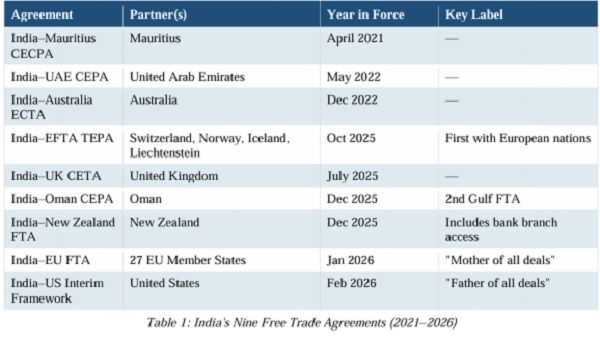
Figure 1: India’s Nine Free Trade Agreements (2022–2026)
The Government has been careful to protect crucial areas in these FTAs. From official PIB releases and Ministry of Commerce statements, sectors like the dairy sector, genetically modified foods, rice, wheat, and agricultural commodities have been protected against import competition. India’s export-oriented industries like textiles, leather products, footwear, gems and jewellery, pharmaceuticals, and IT services have been provided with access to global markets.
III. LITERATURE REVIEW
As there is not much literature on the impact of FTAs on the banking sector, and many agreements have been signed just one or two months ago, this study is based on publications issued by Ministries and an analysis of agreements obtained from official government websites.
A. The India-EU Financial Services Annex (January 2026)
The India-EU FTA’s Financial Services Annex was signed on 6th of January, 2026 (the full FTA was announced on the 27th of January, 2026). The annex on financial services is the most detailed, India has ever agreed to in any trade agreement, and its implications for Indian banks are considerable. As per the reporting done by India Briefing on January 29, 2026, the services trade between India and the EU recorded a figure of USD 83 billion in 2024, while financial services contributed USD 700 million to India’s exports to the EU and USD 600 million to EU’s exports to India. The Financial Services Annex provides a framework that is beyond WTO’s commitment and covers five key areas:
Payment Systems and UPI: The annex fosters cooperation to advance innovation and ensure the safety of cross-border electronic payments. This is directly relevant to India’s Unified Payments Interface (UPI), as it creates opportunities for Indian payment service providers to enter the European market and remittances to the Indian diaspora in EU countries.
Parity of Treatment for Indian Banks: The annex provides a guarantee of the same treatment for Indian financial institutions such as banks, insurance companies, and financial service providers as that of the domestic institutions of the EU in the markets of the EU. As the PIB FAQ on the India-EU FTA explains, it prevents arbitrary treatment in credit assessment situations.
Bank Branch Liberalisation: The commitments made by India include the liberalisation of the bank branch licensing system, which will allow up to 15 new EU bank branches over a period of four years, compared to the previous GATS limit of 12. This is a mutually beneficial aspect, as the same opportunity is available for Indian banks too.
Fintech Cooperation: The agreement establishes India’s most advanced international framework for fintech cooperation, which provides structured pathways for Indian fintech companies to work with their European counterparts in areas such as digital lending, insurance technology, and payments.
Regulatory Cooperation: The annex provides a framework for banking regulation dialogue between the Indian and EU governments, which would minimize the chances of incompatible regulatory changes that might hamper financial services trade. Significantly, the provisional version of the India-EU FTA (released on February 27, 2026), by the Department of Commerce at commerce.gov.in, also covers the issue of the free movement of payments and transfers on the current account with well-crafted safeguard provisions for a monetary crisis situation.
B. India-UAE CEPA
The India-UAE CEPA, came into effect on 1st May 2022, was India’s first FTA with a West Asian country and has had the most measurable impact on banks among all nine agreements. The figures that we have seen on PIB were huge. The merchandise trade between the two countries has nearly doubled to USD 83.7 billion in 2023-24 from USD 43.3 billion in FY 2020-21. In FY 2024-25, the trade value exceeded USD 100 billion, marking a 19.6 percent increase.
The more trade, the more trade finance will be needed. Banks handling letters of credit, export packing credits, bills discounting, and bank guarantees for trade between India and the UAE had increased trade volumes since May 2022. In addition, in July 2023, India and the UAE agreed on a settlement mechanism for trade, where trade had settled in Indian Rupees (INR) and UAE Dirhams (AED), instead of the US Dollar (USD). In the Elets BFSI (October 2024), “The Reserve Bank of India is quite optimistic about the growth in the settlement of trade in Rupees. The RBI has encouraged the banks to allow their clients to settle their trade between India and UAE either in Rupee or Dirham instead of the US Dollar. This will not only reduce the overall cost for the trader, who currently pays around 2% in the form of transactional costs for exporting goods to the UAE, but also create a new product segment for the Indian banks.”
C. India-EFTA TEPA
The India-EFTA Trade and Economic Partnership Agreement, signed in March 2024 and is effect from October 2025, is unique in the history of India’s trade agreements for one reason: it is the first FTA with a binding commitment on investment. The EFTA countries – Switzerland, Norway, Iceland, and Liechtenstein – have agreed to invest USD 100 billion in India over 15 years and also generate one million direct jobs. This commitment is not merely aspirational; it is binding.
As confirmed in the PIB press release of March 2026 (“Crafted in India, Delivered Globally: Exports Powered by Trade Agreements”), the EFTA agreement provides for improved access for Indian pharmaceutical and engineering products and is underpinned by these robust investment commitments. From a banking point of view, USD 100 billion of foreign direct investment into huge opportunities for banking services such as loan syndication, currency exchange, and escrow and custody services for foreign investment into the country.
D. India-New Zealand FTA
The recently signed India-New Zealand FTA in December 2025 has two provisions of direct interest to the banking sector. Firstly, the agreement permits up to 15 bank branches of New Zealand banks to establish themselves in India over the next four years and vice versa. Secondly, the agreement commits the two nations to collaborate in domestic payments interoperability, which would means the UPI and the New Zealand real-time payment system being linked to facilitate direct cross-border remittances. In a press report carried by the Deccan Herald in March 2026, it is stated that currently, only two Indian banks have a presence in New Zealand.
E. India-UK CETA
The signed India-UK CETA in July 2025 provides for the exemption of short-term Indian workers in the UK from social security contribution payments. Indian IT professionals and consultants working for UK-based clients will not be required to contribute to social security contribution payments for up to three years. This provides a boost to the remittable income of Indian IT professionals working in the UK and also boosts banking products such as NRE/FCNR accounts and remittance products.
IV. RESEARCH PROBLEM
Despite India’s conclusion of nine FTAs with 38 countries between 2022 and 2026, the banking industry’s implications are still not thoroughly analysed. Though there are discussions around in terms of tariff concessions and access for the export of products like textiles, pharmaceuticals, and gems and jewellery, the banking industry, which forms the backbone of all export activities, investments, and remittances, is still not being analysed properly. This paper tries to fill in the gap by analysing the direct and indirect implications of FTAs on the banking industry in India.
V. OBJECTIVES
The objectives of this study include an analysis of the impact of India’s nine Free Trade Agreements concluded in 2022 and early 2026 on India’s banking sector. The objectives includes:
- Analysis of provisions in India’s Free Trade Agreements the impact India’s banking sector, in relation to India’s FTAs with the EU in terms of its Financial Services Annex, India’s FTA with UAE in terms of its CEPA, and India’s FTA with EFTA in terms of its TEPA.
- Analysis of the impact of India’s nine FTAs on India’s banking sector in relation to trade finance, foreign exchange and treasury operations, cross-border banking operations, MSME export credit, remittances, and digital payments.
- Analysis of the impact of India’s nine FTAs on India’s banking sector in relation to institutional mechanisms in GIFT City IFSC and its Rupee-Dirham system.
- Analysis of the impact of India’s nine FTAs on India’s banking sector in relation to major challenges facing Indian banks in terms of capturing trade liberalisation opportunities.
VI. RESEARCH QUESTIONS
How do the nine Free Trade Agreements signed between 2022 and 2026 impact the structure, operations, and growth prospects of the banking sector in India?
This central research question is further broken into the following sub-questions:
- What provisions of the FTAs do banking and financial services in India regulate or get impacted by?
- What are the prospects and obligations presented to banks in India by the India-EU Financial Services Annex?
- What are some of the structural hurdles that banks in India have to overcome to benefit from the FTAs, including low FTA utilization, MSME credit risk, currency volatility, and regulatory hurdles?
VII. SCOPE AND LIMITATIONS
The scope of the paper is on the Free Trade Agreements signed by India between 2021 and early 2026, with focus on those FTAs that specifically mentions provisions related to banking and financial services, namely, the India-EU FTA, the India-UAE CEPA, the India-EFTA TEPA, the India-New Zealand FTA, and the India-UK CETA. The paper does not cover FTAs that are still under negotiation and is limited to the Indian banking sector only, with no reference to other financial sectors except where they are mentioned in the context of FTA provisions.
Regarding the limitations, it is necessary to mention that the research is heavily dependent on secondary sources, including government press releases, reports, and analyses by practitioners, since actual data on the banking sector, particularly by FTA corridor, is not yet publicly available. In addition, it is to be noted that while the results of some of the FTAs, including the India-EU FTA and the India-US Interim Framework, have been concluded just recently, i.e., in January-February 2026, their actual impact on the banking sector is yet to be empirically quantified, and hence the research is heavily dependent on projections. Further, the provisional version of the India-EU FTA has been taken from government website, as the actual ratified version is not yet available.
VIII. RESEARCH METHODOLOGY
This paper has used doctrinal research methodology. Data has been taken from official government publications including Press Information Bureau (PIB) releases, Ministry of Commerce and Industry statements, and the Department of Commerce portal (commerce.gov.in). Also data includes reports from RBI, IFSCA, news articles from sources such as India Briefing, DD News, Deccan Herald, Elets BFSI, and academic literature on FTAs and banking.
IX. ANALYSIS / MAIN CONTENT
A. Trade Finance: The Most Direct Impact
Free Trade Agreements (FTAs) have a direct impact on the demand for banking services because of trade finance. When duties are lowered, exports are higher, and there is an immediate need for financial services. This includes pre-shipment credit for production of goods, post-shipment credit for handling the lag in receiving payments, letters of credit for bank guarantees of payment, and export credit insurance. An illustrative case is the recently signed India-UAE Comprehensive Economic Partnership Agreement, which saw India’s exports to the UAE grow from USD 28 billion to USD 31.3 billion in a year—a rise of 11.8%, which is much higher than the overall growth in exports. The increase in Preferential Certificates of Origin from 415 to over 54,000 in 11 months indicates a strong increase in FTA-based trade activities, and each of these transactions results in a demand for banking products.
A similar but larger impact is also expected from the India-EU Free Trade Agreement, considering that the EU is already India’s largest trading partner. The agreement provides for access without duties on over 70% of the total tariff lines, which account for more than 90% of the export value, especially in the textile, leather, and gems segments of the economy, which are heavily dependent on MSME finance. Furthermore, India’s agri-food exports, valued at over USD 55 billion annually, also need strong post-shipment finance and credit guarantees for these exports to expand to new markets of the FTAs. Initiatives such as the Export Promotion Mission are also helpful for exporters, thereby indirectly contributing to the availability of credit and business for banks.
B. Foreign Exchange and Treasury Services
FTAs greatly enhance the scope of banks in the foreign exchange and treasury functions, as every international transaction, whether for export or for investments in another country, passes through the banking system in a foreign currency. With the presence of various FTAs involving various currencies such as the Euro, Pound, Dollar, and others, banks have to effectively handle the flow of such currencies and also provide facilities such as forward and options to protect the exporter from exchange rate risks. A major example is the Comprehensive Economic Partnership Agreement signed between India and the UAE, which established a Rupee-Dirham settlement system facilitated by the Reserve Bank of India. This is not to replace the Dollar, but to reduce costs and to develop a new market for INR and AED, thereby generating new channels of revenue for the banks.15 On the other hand, the India-US Interim Trade Framework is also highly dependent on the Dollar, and though it increases the volume of trade and reduces tariffs, it increases the flow of Dollars to India, which again needs to be processed by the banks.
C. Cross-Border Banking and Financial Services
FTAs are no longer limited to the trade of goods but are actually influencing the banking sector by liberalising the entry of financial institutions into foreign markets. Another significant change is being brought by the India-EU Free Trade Agreement. It has structured bank branch liberalisation provisions that not only allow EU banks to expand their presence in India but also grant access to Indian banks in Europe. Currently, the situation is clear. There are only a handful of Indian banks that operate in Europe—State Bank of India, Bank of Baroda, and Bank of India. In contrast, there are many more European banks operating in India. However, the India-EU Free Trade Agreement has made provisions for Indian banks to operate branches in financial hubs such as Paris and Frankfurt. This would enable them to directly service exporters of the countries covered by the FTA. Currently, Indian banks are not able to do so.
Similarly, the India-New Zealand Free Trade Agreement has provisions for mutual expansion of banks. It means that Indian banks can increase their presence in New Zealand, where they are currently operating at a low scale. In other words, FTAs are making Indian banks think globally or perish. In other words, either they expand globally and compete, or they get outplayed by foreign banks that are gaining deeper access to the Indian market.
D. GIFT City IFSC: The FTA Banking Hub
India is trying to consolidate its FTA-driven financial activities through GIFT City, making it the primary location for international banking and capital flows. It operates under the International Financial Services Centres Authority and has a separate regulatory environment, including tax holidays, multiple currencies, and easier compliances, making it highly efficient compared to conventional banking systems. Changes have been made under the Foreign Exchange Management Act, allowing overseas branches of Indian banks to open INR accounts for non-residents, thus providing easier settlement options without relying on expensive systems of correspondent banking. This is not just a technical fix; it’s a strategic move by India to ensure all FTA-driven trade finance and investment flows are channeled through one location, namely GIFT City. When massive flows are expected from FTAs with regions like the EU, UK, Australia, and EFTA countries, GIFT City is being built as a default location for all clearings and processing, implying that if Indian banks do not establish themselves here, they will be losing a significant part of the future international banking market.
E. Export Credit and MSME Banking
MSME is the focal point of the Indian strategy for FTA, and the truth is, unless and until the credit reaches the MSME sector, there is no way they can benefit. This is also the bottleneck in the entire system, as despite the fact that the export sector is dominated by the MSME sector to the tune of 40% of the total export, the fact remains that most of them cannot get finance due to poor balance sheets and the absence of a credit profile. However, the government is trying to resolve the issue through various measures such as the Export Promotion Mission, which, in association with the DGFT and export promotion councils, is trying to establish a pipeline for the MSME sector to benefit from the FTA. This is expected to directly increase the demand for banking services such as pre-shipment finance, packing credit, and loans facilitated by the Export Credit Guarantee Corporation of India. In addition to this, the recently signed India-EFTA Trade and Economic Partnership Agreement, which promises an investment of 100 billion dollars, is expected to increase demand in the supply chain as the MSME sector is expected to supply to the big companies. However, unless and until the banking sector is able to increase the availability of credit, the so-called benefits of the agreement will remain on paper, and the MSME sector is bound to suffer.
F. Remittances and NRI Banking
The ease in the movement of professionals due to FTAs will result in an increased number of Indians working outside the country, thus positively affecting remittances received in India. The India-UK Comprehensive Economic and Trade Agreement, India-EU Free Trade Agreement, and other such FTAs will create new opportunities for Indian workers, thus positively affecting remittances received through banking channels such as NRE/FCNR accounts and digital modes such as the Unified Payments Interface. However, unless banks improve their NRI services, the opportunity will be taken over by fintech players.
G. Digital Payments and FinTech
The most forward-thinking impact of the FTAs on the banking sector in India is in the digital payments space. The UPI platform in India processed over 17 billion transactions in a single month in 2025. This is one of the most advanced platforms in the world in the real-time payment space. The India-EU Financial Services Annex includes cooperation in the space of cross-border electronic payments and payment system interoperability. This creates a potential for the UPI platform to expand to the European Union. The India-New Zealand FTA includes cooperation in fast payment systems. This means Indian FinTech and payment service providers are not constrained to the domestic market anymore and have the regulatory framework for international expansion.
X. CHALLENGES
A. Low FTA Utilisation by Exporters
Studies have repeatedly confirmed that the overall utilisation of FTA preferences by Indian exporters has been low, averaging between a minimum of 5% and a maximum of 25%. Unless exporters are able to use FTA benefits, e.g., by being aware of how to secure Certificates of Origin or comply with Rules of Origin, the increase in export volumes, and hence trade finance demand, will not be realised on the scale expected by banks. Banks must launch awareness programs for their exporter clients on how best to comply with FTA regulations.
B. Credit Risk of MSME Export Finance
An expansion of export finance to small businesses also entails credit risk. When an MSME avails itself of a bank loan to service an export order and the export order gets cancelled, delayed, or rejected due to quality issues, it may not have the capacity to repay the loan. This risk exists in industries vulnerable to non-tariff barriers like quality standards, labelling requirements, and sanitary regulations in the EU, UK, and Australia. Banks must also build robust underwriting criteria for export-oriented MSME finance.
C. Exchange Rate Volatility
The rapid increase in India’s trade with many currency pairs poses a significant threat to the banking system. If the Indian Rupee rises sharply against the Euro or Pound Sterling, the competitiveness of Indian exporters would be affected negatively, potentially impacting their ability to service their loans. Therefore, banks require sophisticated treasury management systems and adequate hedging options for their clients.
D. Regulatory Compliance Across Multiple Jurisdictions
As Indian banks expand their footprint in different countries in accordance with the provisions of the FTA agreement — opening new branches in the EU countries, expanding operations in New Zealand, and increasing their footprint in the GIFT city — they need to comply with the regulations of different regulators such as the European Central Bank, the UK’s Financial Conduct Authority, the Reserve Bank of New Zealand, and their own Reserve Bank of India and IFSCA.
E. Infrastructure for Trade Finance Documentation
There is a need for infrastructure to handle the increased volume of trade finance transactions, which include letters of credit, certificates of origin, customs documents, and FTA-specific compliance certificates. Currently, many smaller public sector banks rely on paper-based trade finance processes, which will not scale well with the growth in exports driven by the FTA. The digitalisation of trade finance, through platforms connected with the DGFT online portal and the National Single Window System, is required.
XI. CONCLUSION
The nine FTAs signed between 2022 and 2026 by India represent a watershed moment in the country’s trade policy and mark a decisive shift towards aggressive trade liberalisation, making India a major economic player in the global economy, with the India-EU Free Trade Agreement and the India-UAE Comprehensive Economic Partnership Agreement symbolising this change. For the banking sector, these FTAs represent not only a change in trade policy but also serve as direct growth drivers for the sector as trade finance grows, foreign exchange transactions rise, banking sector expansion into international trade is facilitated, and digital payments such as the Unified Payments Interface make their mark on the global stage. While issues such as low utilisation of FTAs, MSME credit risks, and forex risks exist, these are issues to be addressed through active adaptation and investment in specialised infrastructure to cater to these FTAs and utilising platforms such as GIFT City. The bottom line is clear: only banks that are proactive and strategically adapt to these opportunities will be able to capture the benefits of these trade agreements and trade liberalisation, while others will be forced to look on as one of the greatest opportunities in India’s economic history slips by.
*****
BIBLIOGRAPHY
A. Statutes and Regulations
- Foreign Exchange Management Act 1999 (FEMA) as amended to allow INR accounts for non-residents at GIFT City IFSC
- Export Credit Guarantee Corporation of India Act 1957
- International Financial Services Centres Authority Act 2019
B. Government Reports and Official Sources
1. PIB, ‘Speech by Minister Piyush Goyal at GEC 2026’ (PIB, 18 February 2026)
https://www.pib.gov.in/PressReleasePage.aspx?PRID=2230033accessed 30 March 2026
2. PIB, ‘India-EU FTA Concluded’ (PIB, 27 January 2026)
https://www.pib.gov.in/PressReleasePage.aspx?PRID=2219065accessed 30 March 2026
3. PIB, ‘FAQs on India-EU FTA’ (PIB, 2026)
https://www.pib.gov.in/PressReleasePage.aspx?PRID=2220413accessed 30 March 2026
4. PIB, ‘India-UAE CEPA Third Anniversary Statement’ (PIB, February 2025)
https://www.pib.gov.in/PressReleaseIframePage.aspx?PRID=2104450accessed 30 March 2026
5. PIB, ‘India-UAE CEPA First Anniversary: Commerce Secretary Statement’ (PIB, May 2023)
https://www.pib.gov.in/PressReleasePage.aspx?PRID=1921222accessed 30 March 2026
6. PIB, ‘Crafted in India, Delivered Globally: Exports Powered by Trade Agreements’ (PIB, March 2026)
https://www.pib.gov.in/PressReleasePage.aspx?PRID=2206194accessed 30 March 2026
7. PIB, ‘AAHAR 2026 Inauguration Speech by Minister Goyal’ (PIB, 11 March 2026)
https://pib.gov.in/PressReleasePage.aspx?PRID=2238600accessed 30 March 2026
8. Ministry of Commerce, ‘Text of India-EU FTA (Provisional)’ (Department of Commerce, 27 February 2026)
https://www.commerce.gov.in/international-trade/trade-agreements/text-of-india-eu-fta/accessed 30 March 2026
9. DD News, ‘India-UAE Hold Third CEPA Joint Committee Meeting, Bilateral Trade Exceeds USD 100 Billion’ (DD News, 2025)
https://ddnews.gov.in/en/india-uae-hold-third-cepa-joint-committee-meeting-bilateral-trade-exceeds-100-billion/accessed 30 March 2026
C. Journal Articles and Published Reports
10. India Briefing, ‘India-EU Financial Services Annex: Banking and Fintech Market Access’ (India Briefing, 29 January 2026)
https://www.india-briefing.com/news/india-eu-financial-services-fta-market-access-banking-fintech-42153.htmlaccessed 30 March 2026
11. India Briefing, ‘India FTA Tracker 2026’ (India Briefing, 2026)
https://www.india-briefing.com/news/india-fta-tracker-2026-updates-42864.html/accessed 30 March 2026
12. India Briefing, ‘India FDI Outlook 2026’ (India Briefing, 2026)
https://www.india-briefing.com/news/india-fdi-outlook-2026-41381.html/accessed 30 March 2026
13. Euronews, ‘EU-India FTA Explained: Why It Matters for Growth and Jobs’ (Euronews, 27 January 2026)
https://www.euronews.com/business/2026/01/27/euindia-free-trade-deal-explained-why-it-matters-for-growth-and-jobsaccessed 30 March 2026
14. BusinessToday, ‘India, EU Release Provisional Text of FTA with 20 Chapters’ (BusinessToday, 28 February 2026)
https://www.businesstoday.in/latest/economy/story/india-eu-release-provisional-text-of-fta-with-20-chapters-518410-2026-02-28accessed 30 March 2026
15. Elets BFSI, ‘Rupee-Dirham Deal: A New Era in India-UAE Trade Relations’ (Elets BFSI, October 2024)
https://bfsi.eletsonline.com/rupee-dirham-deal-a-new-era-in-india-uae-trade-relations/accessed 30 March 2026
16. IMPRI India, ‘India-UAE CEPA 2022: Unlocking New Horizons for MSME Exports’ (IMPRI, 2025)
https://www.impriindia.com/insights/policy-update/india-uae-msme-exports/accessed 30 March 2026
17. Alvarez & Marsal, ‘Alert on the India-European Union Free Trade Agreement’ (Alvarez & Marsal, 29 January 2026)
https://www.alvarezandmarsal.com/insights/alert-on-the-india-european-union-free-trade-agreementaccessed 30 March 2026
18. EY India, ‘How Will the UK-India FTA Redefine Economic Ties Between the Two Nations’ (EY, 2025)
https://www.ey.com/en_in/insights/tax/how-will-the-uk-india-fta-redefine-economic-ties-between-the-two-nationsaccessed 30 March 2026
19. India Shipping News, ‘India Has Concluded Nine FTAs Covering 38 Nations: Piyush Goyal’ (India Shipping News, 26 February 2026)
https://indiashippingnews.com/india-has-concluded-nine-free-trade-agreements-covering-38-nations-piyush-goyal/accessed 30 March 2026
20. Wikipedia, ‘India-European Union Free Trade Agreement’ (Wikipedia, 2026)
https://en.wikipedia.org/wiki/India%E2%80%93European_Union_Free_Trade_Agreementaccessed 30 March 2026
D. Websites and Newspaper Sources
- The Wire, ‘AAHAR 2026 Inauguration Coverage’ (The Wire, 11 March 2026)
- Big News Network (ANI), ‘Minister Goyal on FTAs and Global Trade’ (ANI, 25 March 2026)
- NewKerala, ‘Goyal Calls FTAs Game Changer’ (NewKerala, February 2026)
- Deccan Herald, ‘India-New Zealand FTA: Banking, Insurance, and Digital Payments’ (Deccan Herald, March 2026)
***
Author: Naitik Katiyar | BA.LLB, Semester-6 (2023-28) | Gujarat National Law University, Silvassa Campus DNHDD (India)