Tax Deducted at Source (TDS) is a mechanism to ensure a steady inflow of revenue to the Government by requiring the payer of specified incomes to deduct tax at prescribed rates before making payments and deposit it within stipulated timelines. It applies to various payments such as salaries, interest, dividends, rent, professional fees, and winnings. TDS amounts are rounded to the nearest multiple of Rs. 10. If TDS is not deducted, the taxpayer must directly pay the tax. Where the deductor bears the tax, income is grossed up. The deducted TDS is treated as income of the recipient, with certain exceptions. Deductees may apply for lower or nil deduction certificates and can claim credit for TDS in their returns. Deductors must obtain a TAN, deposit TDS, file statements, and issue certificates. Failure to comply results in being treated as an assessee-in-default with interest, penalties, and other consequences. TDS rates vary depending on the nature of payment, recipient status, and PAN/Aadhaar compliance. Certain entities like government bodies, RBI, and specified institutions are exempt.
Income Tax Department
Ministry of Finance, Government of India
Tax Deducted at Source (TDS)
Introduction
Tax Deducted at Source (TDS) is a mechanism introduced to ensure a steady inflow of revenue to the Government. It mandates the payer of specified incomes to deduct tax at prescribed rates before making payments and deposit the same to the Central Government within the stipulated time.
Scope of TDS
- Payments Covered:TDS applies to various payments, including salaries, interest, dividends, rent, professional fees, winnings from lotteries or games, etc.
- Rounding Off:TDS amounts are rounded to the nearest multiple of Rs. 10.
- Direct Tax Payment by Assessee:If TDS is not deducted, the taxpayer must directly pay the due tax.
- Grossing Up of Income:When the deductor bears the tax liability, the net amount is increased to compute TDS.
TDS Compliance & Provisions
- Deemed Income:The deducted TDS is deemed as the income of the recipient, except in cases such as employer-paid tax on perquisites and tax deducted on large cash withdrawals.
- Lower/Nil Deduction:A deductee can apply for a certificate permitting a lower or nil TDS deduction if eligible.
- TDS Credit:The deductee is entitled to claim credit for the deducted TDS in their income tax return.
- TAN Requirement:Persons responsible for TDS must obtain a Tax Deduction and Collection Account Number (TAN), except in specific cases.
Duties & Consequences of Non-Compliance
- Obligations of Deductor:The deductor must deposit the TDS to the government and file TDS statements within the prescribed timelines.
- Failure to Deduct or Deposit TDS:Non-compliance results in the deductor being treated as an “assessee-in-default,” with penal consequences.
- TDS Certificates:The deductor must issue a TDS certificate to the deductee, detailing the amount deducted and deposited.
TDS Rates & Exemptions
- Applicability:TDS rates vary based on the type of payment, the recipient’s status (resident/non-resident), and compliance with PAN/Aadhaar provisions.
- Exemptions:Certain payments to government entities, RBI, NPS Trust, offshore banking units, and specified institutions are exempt from TDS.
TDS from Salary
Introduction
Every employer responsible for paying salary must deduct tax at source under section 192 if the salary income exceeds the basic exemption limit. TDS is deducted at the time of salary payment and is based on the estimated tax liability of the employee.
Key Provisions
- Applicability:TDS applies to all employers, including individuals, firms, companies, and government bodies. It is deducted from both resident and non-resident employees.
- Rate of Deduction:Tax is deducted based on the applicable slab rates, considering exemptions and deductions declared by the employee. If PAN is not provided, TDS is deducted at 20% or the applicable rate, whichever is higher.
- TDS on Non-Monetary Perquisites:Employers may pay tax on perquisites instead of deducting TDS, which is then treated as TDS on behalf of the employee.
Computation of TDS
- Estimated Taxable Salary = Salary + Other Income – House Property Loss – Deductions under Chapter VI-A
- TDS Liability = Estimated Tax – TDS/TCS from Other Sources – Section 89Relief
- Employee Disclosures:Employees may declare additional income, TDS/TCS, and house property losses to their employer for accurate TDS computation.
Special Cases
- Multiple Employers:Employees working with multiple employers can provide Form 12B to one employer for consolidated TDS deduction.
- Job Change:Employees can declare previous employer salary details to their new employer to ensure proper TDS calculation.
- TDS on ESOPs:In eligible start-ups, TDS on Employee Stock Option Plans (ESOPs) is deferred until 48 months from the end of the assessment year of allotment, or date of resignation, or date of share sale.
TDS Compliance & Filing
- Deposit:TDS is deposited using Challan ITNS 281 within 7 days from the end of the deduction month, except for March deductions, which are due by April 30. Government offices depositing TDS without a challan must deposit the TDS on the same day on which the tax was deducted.
- TDS Statements:Employers must file Form 24Q quarterly. Government offices depositing TDS without a challan must file Form 24G monthly.
- TDS Certificate:Form 16 must be provided to employees by June 15 of the following year.
Non-Compliance & Penalties
- Failure to Deduct/Deposit TDS:The employer is treated as an “assessee-in-default” and is liable for interest and penalties under Section 201.
- Late Filing of TDS Statements: A fee of Rs. 200 per day applies under Section 234E, along with penalties under Sections 271H and 272A.
- Failure to Issue Form 16:Liable for a penalty under Section 272A.
TDS on Withdrawal from Employees’ Provident Fund (EPF) Scheme
Introduction
Tax is deducted at source (TDS) under section 192A on withdrawals from the Employees’ Provident Fund (EPF) if the employee has not completed five years of continuous service. TDS is deducted at 10% if the withdrawal amount exceeds Rs. 50,000.
Applicability of TDS
- Deductor:The trustee of the EPF scheme or any authorized person making the payment.
- Deductee:Any employee whose EPF withdrawal is taxable.
Exemptions from TDS
No TDS is deducted in the following cases:
- Continuous Service of 5 Years:If the employee has completed five years of service (including previous employer service, if transferred).
- Termination Beyond Employee’s Control:If the termination is due to ill health, employer shutdown, or other uncontrollable reasons.
- Transfer of EPF Balance:When the EPF balance is transferred to a recognized provident fund of the new employer.
- Investment in Notified Pension Schemes:If the EPF balance is transferred to a pension scheme under Section 80CCD.
TDS Rates
- General rate:10% if PAN is furnished.
- If PAN is not provided:TDS is deducted at the rate prescribed under Section 206AA, i.e. 20%.
- For non-residents:TDS is increased by applicable surcharge and cess.
Time of Deduction
- TDS is deducted only at the time of payment.
Compliance Requirements
- Nil Deduction Certificate:Assessee may submit a declaration under Section 197A for nil deduction.
- Deposit of TDS:TDS must be deposited with the government within seven days of the end of the deduction month (April 30 for March deductions). Government offices depositing TDS without a challan must deposit the TDS on the same day on which the tax was deducted.
- TDS Statements:The deductor must file a quarterly TDS statement in Form 26Q.
- TDS Certificate:Form 16A must be issued to the deductee within 15 days of the TDS return due date.
Penalties for Non-Compliance
- Failure to Deduct/Deposit TDS:Liable for interest under Section 201 and penalty under Section 271C.
- Late Filing of TDS Statements:Fee of Rs. 200 per day (limited to TDS amount) under Section 234E, with additional penalties under Sections 271H and 272A.
- Failure to Issue TDS Certificates:Subject to penalties under Section 272A.
TDS on Interest on Securities
Introduction
Tax is deducted at source (TDS) at 10% under section 193 on interest payable on securities to a resident individual. The deduction is made at the time of credit or payment, whichever is earlier.
Applicability of TDS
- Deductor:Any person responsible for paying interest on securities.
- Deductee:A resident recipient of interest. If the recipient is a non-resident, TDS is deducted under Section 195.
- Time of Deduction:TDS is deducted at the time of credit or payment, including credit to a “Suspense Account.”
- Threshold:Tax is deducted if the amount of interest is more than Rs. 10,000 for a single payment or in the aggregate in a financial year.
TDS Rates
- Standard Rate:10% without surcharge or cess.
- Non-furnishing of PAN:TDS is deducted at the rate prescribed under Section 206AA, i.e. 20%.
Exemptions from TDS
TDS is not deducted in the following cases:
- Certain Government Securities:National Development Bonds, 7-Year National Savings Certificates, and other notified securities.
- Defence and Gold Bonds:Specific Defence Bonds and Gold Bonds (subject to declaration and threshold conditions).
- Interest to Insurance Companies:LIC, GIC, and other notified insurers.
- Interest on Debentures:Interest on Widely held company’s debentures payable to an individual or HUF up to Rs. 10,000, paid by account payee cheque.
- Interest Payable to Business Trusts:No TDS on interest payable by special purpose vehicles to business trusts.
- Interest to Certain Tax-Exempt Entities:Government undertakings, mutual funds, and entities benefiting the armed forces.
Compliance Requirements
- Nil or Lower TDS Deduction Certificate:The recipient may apply under Section 197 for a lower TDS rate or submit a self-declaration under Section 197A.
- TDS Deposit:TDS must be deposited within seven days from the end of the deduction month, except for March, which is due by April 30. Government offices depositing TDS without a challan must deposit the TDS on the same day on which the tax was deducted.
- TDS Statements:Quarterly TDS statements must be filed using Form 26Q.
- TDS Certificate:Form 16A must be issued within 15 days from the due date of the TDS return.
Penalties for Non-Compliance
- Failure to Deduct/Deposit TDS:Liable for interest under Section 201 and penalty under Section 271C.
- Late Filing of TDS Statements:Fee of Rs. 200 per day under Section 234E, plus penalties under Sections 271H and 272A.
- Failure to Issue TDS Certificates:Subject to penalties under Section 272A.
TDS on Dividend
Introduction
Every Indian company making payments of dividends is required to deduct tax at source (TDS) under Section 194 at the rate of 10%. The deduction applies at the time of distribution or payment of dividends.
Scope of TDS on Dividends
- Deductor:Any Indian company or a company making arrangements for dividend declaration and payment in India.
- Deductee:A resident shareholder. For non-resident shareholders, TDS is deducted under Section 195.
- Threshold Limit:TDS is deducted if the total dividend paid to an individual shareholder (other than in cash) exceeds Rs. 10,000 in a financial year. No threshold applies to other payees.
- Timing of Deduction:TDS is deducted at the time of payment. In the case of deemed dividends, TDS is deducted at the time of distribution or payment.
TDS Rates
- Standard Rate:10% (without surcharge or cess).
- If PAN is Not Provided:TDS is deducted at the rate under Section 206AA.
Exemptions from TDS
TDS is not deducted in the following cases:
- Dividend to Small Individual Shareholders:No TDS if the dividend does not exceed Rs. 10,000 in a financial year and is paid in non-cash mode.
- Dividend to Specified Insurance Companies:Exempt for LIC, GIC, and other notified insurers.
- Dividend to Business Trusts:No TDS on dividends paid by a Special Purpose Vehicle (SPV) to a business trust.
- Dividend in IFSC Units (Aircraft Leasing Business):Exemption applies if both payer and payee IFSC units are engaged in aircraft leasing, subject to declaration in Form No. 1. [Notification No. 52/2023, dated 20-07-2023]
- Dividend to Specified IFSC Units:Exemption applies to finance companies, finance units, and broker-dealers in IFSC, subject to declaration in Form No. 1. [Notification No. 28/2024, dated 07-03-2024]
- Dividend to Notified Persons:The government may notify entities entitled to receive dividends without TDS.
Compliance Requirements
- Nil or Lower Deduction Certificate:The recipient may apply under Section 197 for lower TDS or submit a self-declaration under Section 197A.
- TDS Deposit:TDS must be deposited within seven days from the end of the deduction month, except for March, which is due by April 30. Government offices depositing TDS without a challan must deposit the TDS on the same day on which the tax was deducted.
- TDS Statements:Quarterly TDS statements must be filed using Form 26Q.
- TDS Certificate:Form 16A must be issued within 15 days from the due date of the TDS return.
Penalties for Non-Compliance
- Failure to Deduct/Deposit TDS:Liable for interest under Section 201 and penalty under Section 271C.
- Late Filing of TDS Statements:Fee of Rs. 200 per day under Section 234E, plus penalties under Sections 271H and 272A.
- Failure to Issue TDS Certificates:Subject to penalties under Section 272A.
TDS on Interest (Other than Interest on Securities)
Introduction
Tax is deducted at source (TDS) at 10% under section 194A on interest (excluding interest on securities) paid or payable to a resident individual if the payer is:
- A person other than an individual or HUF, or
- An individual or HUF whose turnover exceeds Rs. 1 crore (business) or Rs. 50 lakh (profession) in the preceding financial year.
- TDS is deducted at the time of credit or payment, whichever is earlier.
Applicability of TDS
- Deductor:Any person making interest payments, except certain individuals and HUFs below the turnover threshold.
- Deductee:A resident payee. For non-residents, TDS is deducted under Section 195.
- Threshold Limits:TDS applies only if interest exceeds specified limits:
o Rs. 1,00,000 (Senior Citizens) / Rs. 50,000 (Others) – Banks, Co-operative Banks, and Post Office deposits.
o Rs. 10,000 – Other cases.
- Timing of Deduction:TDS is deducted at credit or payment, including when credited to a suspense account.
TDS Rates
- Standard Rate:10% (without surcharge or cess).
- If PAN is Not Provided:TDS is deducted at the rate under Section 206AA.
Exemptions from TDS
TDS is not deducted in the following cases:
- Bank Deposits:Interest on savings and non-time deposits in banks and co-operative banks.
- Interest to Government Entities:Payments to RBI, LIC, UTI, notified mutual funds, and specified corporations.
- Post Office Deposits:National Savings Certificates, Kisan Vikas Patra, and other notified schemes.
- Partners in a Firm:No TDS on interest paid by a firm to its partners.
- Scheduled Tribe Members:Interest payments by specified banks to Scheduled Tribe members (subject to conditions). [Notification No. 110/2021, dated 17-09-2021]
- Accident Compensation:No TDS on tribunal-awarded interest up to Rs. 50,000.
- Zero Coupon Bonds:No TDS on interest from notified zero-coupon bonds.
- Business Trusts:No TDS on interest paid by special purpose vehicles to business trusts.
- Interest in case of specified IFSC Units:Exempt subject to declaration in Form No. 1. [Notification No. 28/2024, dated 07-03-2024, and Notification No. 67/2025, dated 20-06-2025]
Compliance Requirements
- Nil or Lower Deduction Certificate:The recipient may apply under Section 197 for lower TDS or submit a self-declaration under Section 197A.
- TDS Deposit:TDS must be deposited within seven days from the end of the deduction month, except for March, which is due by April 30. Government offices depositing TDS without a challan must deposit the TDS on the same day on which the tax was deducted.
- TDS Statements:Quarterly TDS statements must be filed using Form 26Q.
- TDS Certificate:Form 16A must be issued within 15 days from the due date of the TDS return.
Penalties for Non-Compliance
- Failure to Deduct/Deposit TDS:Liable for interest under Section 201 and penalty under Section 271C.
- Late Filing of TDS Statements:Fee of Rs. 200 per day under Section 234E, plus penalties under Sections 271H and 272A.
- Failure to Issue TDS Certificates:Subject to penalties under Section 272A.
TDS on Winnings from Lottery, Crossword Puzzles, and Other Games
Introduction
Tax is deducted at source (TDS) at 30% under section 194B on winnings from lotteries, crossword puzzles, card games, gambling, betting, or other games (excluding online games). TDS is deducted at the time of payment.
Applicability of TDS
- Deductor:Any person making payments for winnings from lotteries, crossword puzzles, or similar activities.
- Deductee:Any resident or non-resident recipient.
- Threshold Limit:Tax is required to be deducted only if the amount of winning is more than Rs. 10,000 in respect of a single transaction.
- Timing of Deduction:TDS is deducted at the time of payment. If winnings are paid in instalments, TDS is deducted on each instalment.
TDS Rates
- Standard Rate:30% (without surcharge or cess for residents).
- For Non-Residents:The rate is increased by the applicable surcharge and cess.
- If Winnings Are in Kind:The winner must pay applicable taxes before receiving the prize.
Compliance Requirements
- Nil or Lower Deduction Certificate:Not available for TDS on winnings.
- TDS Deposit:TDS must be deposited within seven days from the end of the deduction month, except for March, which is due by April 30. Government offices depositing TDS without a challan must deposit the TDS on the same day on which the tax was deducted.
- TDS Statements:Quarterly TDS statements must be filed using Form 26Q.
- TDS Certificate:Form 16A must be issued within 15 days from the due date of the TDS return.
Penalties for Non-Compliance
- Failure to Deduct/Deposit TDS:Liable for interest under Section 201 and penalty under Section 271C.
- Late Filing of TDS Statements:Fee of Rs. 200 per day under Section 234E, plus penalties under Sections 271H and 272A.
- Failure to Issue TDS Certificates:Subject to penalties under Section 272A.
TDS on Winnings from Online Games
Introduction
Tax is deducted at source (TDS) at 30% under Section 194BA on net winnings from online games. TDS is deducted at the time of withdrawal or at the end of the financial year, whichever is earlier. The calculation of net winnings is prescribed under Rule 133.
Applicability of TDS
- Deductor:Any person, including an online gaming intermediary, responsible for making payments from online gaming winnings.
- Deductee:Any resident or non-resident winner.
- Timing of Deduction:
o At the time of withdrawal of winnings.
o If no withdrawal is made, TDS is deducted on net winnings at the end of the financial year.
Computation of Net Winnings
TDS is deducted on net winnings, calculated as:
- At the time of first withdrawal:Net winnings = Amount withdrawn – (Opening balance + Non-taxable deposits).
- At the time of subsequent withdrawal:Net winnings = Aggregate of amount withdrawn – (Opening balance + Non-taxable deposits + Net winnings considered in earlier withdrawals, if tax is deducted).
- At the end of the year:Net winnings = (Withdrawals + Closing balance) – (Opening balance + Non-taxable deposits + Taxed winnings).
- For multiple user accounts:Winnings across all accounts under one gaming platform are aggregated.
- Rewards and Bonuses:If withdrawable, they are included in taxable winnings; otherwise, they are excluded.
TDS Rates
- Standard Rate:30% (without surcharge or cess for residents).
- For Non-Residents:Increased by applicable surcharge and cess.
- If PAN is not provided:TDS is deducted at 30%.
- Exemption for Small Withdrawals:No TDS if net winnings in a month are ≤ Rs. 100, but tax is deducted later if the threshold is exceeded [Circular No. 5, dated 22-05-2023].
TDS on Winnings in Kind
- Winnings in kind or partly in cash require tax payment before release.
- If the winner does not pay, the gaming platform may deduct and deposit the tax.
Compliance Requirements
- Nil or Lower Deduction Certificate:Not available.
- TDS Deposit:TDS must be deposited within seven days from the end of the deduction month, except for March, which is due by April 30. Government offices depositing TDS without a challan must deposit the TDS on the same day on which the tax was deducted.
- TDS Statements:Quarterly TDS statements must be filed using Form 26Q.
- TDS Certificate:Form 16A must be issued within 15 days from the due date of the TDS return.
Penalties for Non-Compliance
- Failure to Deduct/Deposit TDS:Liable for interest under Section 201 and penalty under Section 271C.
- Late Filing of TDS Statements:Fee of Rs. 200 per day under Section 234E, plus penalties under Sections 271H and 272A.
- Failure to Issue TDS Certificates:Subject to penalties under Section 272A.
TDS on Winnings from Horse Races
Introduction
Tax is deducted at source (TDS) at 30% under section 194BB on winnings from horse races (excluding online games). TDS is deducted at the time of payment.
Applicability of TDS
- Deductor:A book-maker or a licensee authorized by the government to conduct horse racing or betting at a racecourse.
- Deductee:Any resident or non-resident recipient.
- Threshold Limit:Tax is required to be deducted only if the amount of winning is more than 10,000 in respect of a single transaction.
- Timing of Deduction:TDS is deducted at the time of payment.
TDS Rates
- Standard Rate:30% (without surcharge or cess for residents).
- For Non-Residents:The rate is increased by the applicable surcharge and cess.
Compliance Requirements
- Nil or Lower Deduction Certificate:Not available for TDS on winnings.
- TDS Deposit:TDS must be deposited within seven days from the end of the deduction month, except for March, which is due by April 30. Government offices depositing TDS without a challan must deposit the TDS on the same day on which the tax was deducted.
- TDS Statements:Quarterly TDS statements must be filed using Form 26Q.
- TDS Certificate:Form 16A must be issued within 15 days from the due date of the TDS return.
Penalties for Non-Compliance
- Failure to Deduct/Deposit TDS:Liable for interest under Section 201 and penalty under Section 271C.
- Late Filing of TDS Statements:Fee of Rs. 200 per day under Section 234E, plus penalties under Sections 271H and 272A.
- Failure to Issue TDS Certificates:Subject to penalties under Section 272A.
TDS on Payment to Contractors
Introduction
Tax is deducted at source (TDS) under section 194C on payments made to resident contractors for carrying out any work, including the supply of labour. The applicable TDS rate is 1% or 2%, depending on the recipient. TDS is deducted at the time of credit or payment, whichever is earlier.
Applicability of TDS
- Deductor:Any specified person making payments under a contract. This includes the government, local authorities, companies, co-operative societies, firms, trusts, universities, and individuals or HUFs with business turnover exceeding Rs. 1 crore or professional receipts exceeding Rs. 50 lakh in the preceding financial year.
- Deductee:Any resident contractor. Non-residents are subject to TDS under Section 195.
- Types of Payments Covered:Payments for work contracts, labour supply, advertising, broadcasting, carriage of goods (excluding railways), catering, and specific manufacturing contracts.
TDS Rates
- 1%– If the payment is made to an individual or HUF.
- 2%– If the payment is made to any other entity.
- If PAN is not provided:TDS is deducted at the rate prescribed under Section 206AA.
Threshold Limits
TDS is applicable only if:
- A single payment exceeds Rs. 30,000, or
- The total payments to a contractor exceed Rs. 1,00,000 in a financial year.
Time of Deduction
TDS is deducted at the time of credit or payment, whichever is earlier, even if the amount is credited to a suspense account.
Exemptions from TDS
No TDS is required in the following cases:
- Payments to the government, RBI, or certain tax-exempt corporations.
- Payments made for personal purposes by individuals or HUFs.
- Payments by advertising agencies to print/electronic media. [Circular No. 715, dated 08-08-1995]
- Payments to travel agents for ticket bookings. [Circular No. 715, dated 08-08-1995]
- Payments for routine restaurant services. [Circular No. 715, dated 08-08-1995]
- Payments to recruitment agencies (subject to Section 194J). [Circular No. 715, dated 08-08-1995]
- Payments for the supply of goods if the material cost is separately mentioned in the invoice.
- Payments to transporters owning up to 10 goods carriages (declaration and PAN required).
Compliance Requirements
- Nil or Lower Deduction Certificate:The recipient may apply under Section 197 for lower or nil TDS.
- TDS Deposit:TDS must be deposited within seven days from the end of the deduction month, except for March, which is due by April 30. Government offices depositing TDS without a challan must deposit the TDS on the same day on which the tax was deducted.
- TDS Statements:Quarterly TDS statements must be filed using Form 26Q.
- TDS Certificate:Form 16A must be issued within 15 days from the due date of the TDS return.
Penalties for Non-Compliance
- Failure to Deduct/Deposit TDS:Liable for interest under Section 201 and penalty under Section 271C.
- Late Filing of TDS Statements:Fee of Rs. 200 per day under Section 234E, plus penalties under Sections 271H and 272A.
- Failure to Issue TDS Certificates:Subject to penalties under Section 272A.
TDS on Insurance Commission
Introduction
Tax must be deducted on payments made as insurance commission to residents under Section 194D of the Income-tax Act. The applicable TDS rate is 5% for
individuals, firms, etc. and 10% for domestic companies.
Applicability
TDS applies to any person (individual, firm, company, etc.) making payments for soliciting, procuring, continuing, renewing, or reviving insurance policies.
If the payment is made to a non-resident, TDS is deducted under Section 195.
Rate of TDS
- Resident individuals & firms: 5%
- Domestic companies: 10%
- No surcharge or cess is applicable.
Time of Deduction
TDS must be deducted at the time of credit or payment of the insurance commission, whichever is earlier, even if credited to a suspense account.
Threshold Limit
No TDS is required if the total insurance commission paid during a financial year does not exceed Rs. 20,000.
TDS Calculation
TDS is deducted on the gross commission credited before adjusting for any previous excess payments, as clarified by CBDT Circular No. 277, dated 21-071980.
Exemptions from TDS
1. IFSC Insurance Intermediary Offices – No TDS is required on payments to specified IFSC units, subject to conditions in Notification No. 28/2024, dated 07-03-2024.
2. Government & Certain Entities – No TDS applies on payments to the government, RBI, mutual funds, or tax-exempt statutory corporations (Section 196).
Compliance Requirements
- Lower/Nil Deduction Certificate: Deductees may apply for nil or lower TDS certificates under Sections 197 & 197A.
- TDS Deposit: Deducted tax must be deposited via Challan ITNS 281 within 7 days of the end of the month (except for March, where the due date is 30th April). Government offices depositing TDS without a challan must deposit the TDS on the same day on which the tax was deducted.
- TDS Returns: The deductor must file Form 26Q quarterly.
- TDS Certificate: Form 16A must be issued within 15 days of filing TDS returns. Consequences of Non-Compliance
- Failure to deduct/deposit TDS – Interest under Section 201, penalty under Section 271C (up to the TDS amount), and prosecution under Section 276B.
- Failure to file TDS returns – Late fee of Rs. 200 per day under Section 234E and penalty under Section 271H.
- Failure to issue TDS certificates – Penalty under Section 272A.
TDS on Life Insurance Policy Payments
Introduction
Tax Deducted at Source (TDS) must be deducted on payments made under a life insurance policy to residents under Section 194DA. The TDS rate is 2% on the income component within the payment amount. TDS applies only if the gross payout (including bonus) is Rs. 1 lakh or more in a financial year.
Applicability
- Deductor – Any person making payments under a life insurance policy.
- Deductee – Resident recipients of insurance proceeds. Payments to non-residents are subject to TDS under Section 195.
Rate of TDS
- Flat 2% on the income component.
- Higher TDS rates apply under Section 206AA if PAN is not provided.
Time of Deduction
TDS is deducted at the time of payment.
Threshold Limit
No TDS is required if the total payout (including bonus) in a financial year is less than Rs. 1 lakh.
Compliance Requirements
- Lower/Nil Deduction Certificate: Deductees may file Form 15G/15H for nil TDS under Section 197A (not Section 197).
- TDS Deposit: Deducted tax must be deposited via Challan ITNS 281 within 7 days of the month-end (except for March, due by 30th April).
Government offices depositing TDS without a challan must deposit the TDS on the same day on which the tax was deducted.
- TDS Returns: The deductor must file Form 26Q quarterly.
- TDS Certificate: Form 16A must be issued within 15 days of filing TDS returns.
Consequences of Non-Compliance - Failure to deduct/deposit TDS – Interest under Section 201, penalty under Section 271C, and prosecution under Section 276B.
- Failure to file TDS returns – Late fee of Rs. 200 per day under Section 234E and penalty under Section 271H.
- Failure to issue TDS certificates – Penalty under Section 272A.
TDS on Payments to Non-Resident Sports Persons
Introduction
Tax Deducted at Source (TDS) must be deducted on payments made to non-resident sports persons, entertainers, or sports associations under Section 194E.
The applicable TDS rate is 20% plus surcharge and cess.
Applicability
- Deductor – Any person making specified payments to a non-resident sports person, entertainer, or sports association.
- Deductee – Non-resident individuals (sports persons, athletes, entertainers) and non-resident sports associations.
Types of Payments Covered
- Payments for participation in any game or sport in India (excluding online games or specified games).
- Payments for advertisements.
- Payments for articles on sports published in newspapers, magazines, or journals.
- Payments to non-resident sports associations for games played in India.
- Payments to non-resident entertainers for performances in India.
Rate of TDS
- Flat 20% plus applicable surcharge and cess.
- Higher TDS rates apply under Sections 206AA if PAN is not provided
Time of Deduction
- TDS is deducted at the time of payment or credit, whichever is earlier, even if credited to a suspense account.
Compliance Requirements
- Lower/Nil Deduction Certificate: Not available under Section 194E.
- TDS Deposit: Deducted tax must be deposited via Challan ITNS 281 within 7 days of the end of the month (except for March, due by 30th April).
Government offices depositing TDS without a challan must deposit the TDS on the same day on which the tax was deducted.
- TDS Returns: The deductor must file Form 27Q quarterly.
- TDS Certificate: Form 16A must be issued within 15 days of filing TDS returns.
Consequences of Non-Compliance - Failure to deduct/deposit TDS – Interest under Section 201, penalty under Section 271C, and prosecution under Section 276B.
- Failure to file TDS returns – Late fee of Rs. 200 per day under Section 234E and penalty under Section 271H.
- Failure to issue TDS certificates – Penalty under Section 272A.
TDS on Payments Under National Savings Scheme
Introduction
Tax Deducted at Source (TDS) must be deducted on payments under the National Savings Scheme (NSS) under Section 194EE. The applicable TDS rate is
10% on the total amount (principal + interest).
Applicability
- Deductor – Any person making payments under NSS.
- Deductee – Both residents and non-residents receiving NSS payouts.
Rate of TDS
- Flat 10% (plus surcharge & cess for non-residents).
- Higher TDS rates apply under Section 206AA if PAN is not provided
Time of Deduction
- TDS is deducted at the time of payment.
Exemptions from TDS
- Payments below Rs. 2,500 – No TDS if the total payout in a financial year is less than Rs. 2,500.
- Payments to legal heirs – No TDS on NSS payouts to heirs of the deceased.
- Payment for withdrawal on or after 04-04-2025 – No TDS on NSS withdrawals (principal for which deduction u/s 80CCA was allowed and interest thereon) made by an individual on or after 4 April 2025. [Notification No. 27/2025, dated 04-04-2025]
- Payments to Government & Specified Entities – No TDS on payments to Government, RBI, mutual funds, or tax-exempt corporations (Section 196). Compliance Requirements
- Lower/Nil Deduction Certificate: Not available under Section 194EE.
- TDS Deposit: Deducted tax must be deposited via Challan ITNS 281 within 7 days of the end of the month (except for March, due by 30th April).
Government offices depositing TDS without a challan must deposit the TDS on the same day on which the tax was deducted.
- TDS Returns: The deductor must file Form 26Q quarterly.
- TDS Certificate: Form 16A must be issued within 15 days of filing TDS returns.
Consequences of Non-Compliance - Failure to deduct/deposit TDS – Interest under Section 201, penalty under Section 271C, and prosecution under Section 276B.
- Failure to file TDS returns – Late fee of Rs. 200 per day under Section 234E and penalty under Section 271H.
- Failure to issue TDS certificates – Penalty under Section 272A.
TDS on Commission from Sale of Lottery Tickets
Introduction
Tax must be deducted at source (TDS) at 2% under section 194G on commission or remuneration paid for stocking, distributing, purchasing, or selling lottery tickets if the amount exceeds Rs. 20,000 in a financial year.
Key Provisions
- Deductor: Any person making such commission payments.
- Deductee: Any person engaged in the lottery business.
- Rate of TDS: 2% (cess and surcharge applied in case of non-resident), in case of non-furnishing of PAN, tax rate specified under Section 206AA.
- Threshold: Deduction applies only if commission exceeds Rs. 20,000 annually.
- Time of Deduction: At the time of credit or payment, whichever is earlier, including when credited to a suspense account. Compliance Requirements
- Lower/Nil Deduction Certificate: Deductees can apply for a lower TDS certificate under Section 197, but cannot file a self-declaration under Section 197A.
- Deposit of TDS: Must be deposited using Challan ITNS 281 within 7 days of the end of the month of deduction (by 30th April for March deductions).
Government offices depositing TDS without a challan must deposit the TDS on the same day on which the tax was deducted.
- TDS Statement Filing: Quarterly submission in Form 26Q.
- TDS Certificate: Form 16A to be issued within 15 days from the due date of TDS statement filing.
Consequences of Non-Compliance - Failure to Deduct or Deposit: Liable for interest under Section 201, penalty under Section 271C (equal to the undeducted amount), and possible prosecution under Section 276B.
- Failure to Furnish TDS Statement: Liable for a fee of Rs. 200 per day (limited to TDS amount) under Section 234E and penalties under Sections 271H and 272A.
- Failure to Issue TDS Certificate: Liable for penalty under Section 272A.
TDS on Commission and Brokerage
TDS on Commission and Brokerage
Introduction
TDS under Section 194H is applicable at a rate of 2% on commission or brokerage (excluding insurance commission) if the amount exceeds Rs. 20,000 in a financial year.
Key Provisions
Deductor:
- Any person making such payments, except individuals and HUFs.
- Individuals and HUFs must deduct TDS if their business turnover exceeds Rs. 1 crore or professional receipts exceed Rs. 50 lakh in the preceding financial year.
- Deductee: TDS applies only if the recipient is a resident. For non-residents, tax is deducted under Section 195.
- Rate of TDS: 2%.
- Higher rates apply under Section 206AA if PAN is not provided.
- Time of Deduction: At the time of payment or credit, whichever is earlier, including when credited to a suspense account. Exemptions from TDS
- Payments by BSNL/MTNL: No TDS on commissions paid to public call office franchisees.
- Turnover Commission to Banks: No TDS on commissions paid by RBI to banks for tax collection/refund issuance. [Circular No. 6/2003, dated September 3, 2003]
- Advertising Agency Fees: No TDS on payments by media companies to agencies for ad bookings. [Circular No. 5/2016, dated February 29, 2016]
- Government Payments: No TDS on payments to the government, RBI, mutual funds, or tax-exempt corporations.
- Payment to specified IFSC units: Certain commissions and brokerage payments to specified IFSC entities are exempt, subject to Form 1 compliance. [Notification No. 28/2024, dated 07-03-2024, and Notification No. 67/2025, dated 20-06-2025]
Compliance Requirements
- Lower/Nil Deduction Certificate: Available under Section 197; self-declarations under Section 197A are not permitted.
Deposit of TDS:
- Payment through Challan ITNS 281 within 7 days from the end of the deduction month.
- For March deductions, deposit by 30th April.
- Government offices depositing TDS without a challan must deposit the TDS on the same day on which the tax was deducted.
- TDS Statement Filing: Quarterly submission in Form 26Q.
- TDS Certificate: Form 16A to be issued within 15 days from the due date of TDS statement filing.
Consequences of Non-Compliance - Failure to Deduct or Deposit: Liable for interest under Section 201, penalty under Section 271C (up to the undeducted amount), and prosecution under Section 276B.
- Failure to File TDS Statement: Liable for a Rs. 200 per day penalty (limited to TDS amount) under Section 234E and additional penalties under Sections 271H and 272A.
- Failure to Issue TDS Certificate: Liable for penalties under Section 272A.
TDS on Rent
TDS on Rent
Introduction
Any person, including a specified individual and an HUF, paying rent to a resident person in respect of plant, machinery, land, building or furniture shall deduct tax therefrom. The tax shall be deducted if the rent paid or payable exceeds Rs. 50,000 per month or part of the month.
Key Provisions
Deductor:
- Any person making rent payments, except individuals and HUFs.
- Individuals and HUFs must deduct TDS if their business turnover exceeds Rs. 1 crore or professional receipts exceed Rs. 50 lakh in the preceding financial year.
- Deductee: Only applicable to residents; for non-residents, TDS applies under Section 195.
TDS Rates:
- 2% on rent for plant, machinery, or equipment.
- 10% on rent for land, buildings (including factories), furniture, or fittings.
- Higher rates apply under Section 206AA if PAN is not provided.
- Threshold: Tax shall be deducted if the amount of rent paid or payable exceeds Rs. 50,000 per month or part of the month
- Time of Deduction: At the time of credit or payment, whichever is earlier, including when credited to a suspense account.
Exemptions from TDS
- Payments to the Government, RBI, Mutual Funds, and Tax-Exempt Corporations: No TDS required.
- Specific Exemptions:
- Tirumala Tirupati Devasthanams Rent Payments: Exempt from TDS. [Notification No. 2911(e), dated 9-9-2016]
- Payments to Armed Forces Funds: No TDS if the fund is exempt under Section 10(23AA). [Circular No. 735, dated January 30, 1996]
- Reimbursement of Hotel Rent to Employees: No TDS if the employee makes the payment directly and claims reimbursement. [Circular No. 5/2002, dated July 30, 2002]
- Cinema Hall Revenue Sharing: Not considered rent; hence, no TDS is required. [Circular No. 736, dated February 13, 1996]
- Payment to a Business Trust: No TDS required.
- Lease Rent for Aircraft or Ships to IFSC Units: Exempt if the recipient files Form 1 under Section 80LA. [Notification No. 65, dated June 16, 2022, and Notification No. 57, dated 01-08-2023]
- Payment to the specified IFSC units: No TDS on rent for data centres to a Recognised Stock Exchange, subject to fulfilment of specified conditions. [Notification No. 67/2025, dated 20-06-2025]
- GST Component on Rent: TDS is not deducted on the GST portion if separately mentioned in the invoice. [Circular No. 23/2017, dated July 19, 2017]
Compliance Requirements
- Lower/Nil Deduction Certificate: Available under Section 197A (self-declaration) or Section 197 (application to the Assessing Officer).
Deposit of TDS:
- Payable using Challan ITNS 281 within 7 days from the month-end.
- For March deductions, deposit by 30th April.
- Government offices depositing TDS without a challan must deposit the TDS on the same day on which the tax was deducted.
- TDS Statement Filing: Quarterly submission in Form 26Q.
- TDS Certificate: Form 16A to be issued within 15 days from the due date of TDS statement filing.
Consequences of Non-Compliance
- Failure to Deduct or Deposit: Liable for interest under Section 201, penalty under Section 271C, and prosecution under Section 276B.
- Failure to File TDS Statement: Liable for a Rs. 200 per day penalty (limited to TDS amount) under Section 234E and additional penalties under Sections 271H and 272A.
Failure to Issue TDS Certificate: Liable for penalties under Section 272A.
TDS on Purchase of Immovable Property
TDS on Purchase of Immovable Property
Introduction
When a buyer purchases an immovable property (other than rural agricultural land) from a resident seller, tax must be deducted under Section 194-IA at 1% of the sale consideration or the stamp duty value, whichever is higher. TDS applies only if the property value is Rs. 50 lakh or more.
Key Provisions
- Deductor: Any buyer responsible for paying the sale consideration.
- Deductee: The seller must be a resident of India. If the seller is a non-resident, TDS is applicable under Section 195.
- Threshold: TDS applies if the sale consideration or stamp duty value is Rs. 50 lakh or more.
Consideration Basis:
- The threshold applies to the total property value, not individual payments by multiple buyers or sellers.
- If multiple buyers purchase a property jointly, TDS must be deducted based on the total value and apportioned accordingly.
- Rate of TDS:
- 1% of the higher of sale consideration or stamp duty value.
- If PAN is not provided, a higher rate under Section 206AA applies.
Time of Deduction
TDS must be deducted at the time of payment or credit of consideration, whichever is earlier.
Exemption from TDS
- No TDS on payment to Govt., RBI, Mutual Fund or any exempt Corporation.
- No TDS on payment to ‘Air India Limited’ by ‘Air India Holding Limited’ under a plan approved by the Central Government. [Notification No. 106/2021, dated 10-09-2021]
Compliance Requirements
- TAN Not Required: Buyers can use their PAN instead of obtaining a TAN.
- Deposit of TDS:
- The deducted tax must be deposited using Form 26QB within 30 days from the end of the month in which TDS was deducted.
- TDS Statement Filing: Form 26QB must be submitted electronically.
- TDS Certificate: Form 16B must be issued within 15 days from the due date of the TDS return.
Penalties for Non-Compliance
- Failure to Deduct/Deposit TDS: Liable for interest under Section 201 and penalty under Section 271C.
- Late Filing of TDS Statements: Fee of Rs. 200 per day under Section 234E, plus penalties under Sections 271H and 272A.
- Failure to Issue TDS Certificates: Subject to penalties under Section 272A.
TDS on Rent Paid by Certain Individuals or HUFs
Introduction
As per section 194-IB, individuals and HUFs whose gross receipts or turnover in the preceding financial year do not exceed Rs. 1 crore (for business) or Rs. 50 lakh (for profession) must deduct TDS at 2% on rent payments exceeding Rs. 50,000 per month or part thereof.
Key Provisions
- Deductor:
- Applies to individuals and HUFs, even if they are not engaged in business or profession.
- Deductee:
- The recipient of rent must be a resident of India.
- For payments to non-residents, TDS is applicable under Section 195.
- Threshold:
- TDS is required if the monthly rent exceeds Rs. 50,000 per month or part of the month.
- Rate of TDS:
- 2%
- If PAN is not provided, a higher rate under Section 206AA applies, but TDS cannot exceed the rent for the last month of the year or tenancy, as the case may be.
Time of Deduction
- If tenancy continues till year-end: TDS is deducted at the time of payment or credit of rent for the last month of the financial year, whichever happens earlier.
- If the property is vacated early: TDS is deducted at the time of payment or credit of rent for the last month of tenancy, whichever happens earlier.
Exemptions from TDS
- No TDS on payments to the Government, RBI, Mutual Funds, or tax-exempt corporations under Section 196.
Compliance Requirements
- TAN Not Required: Buyers can use their PAN instead of obtaining a TAN.
- Deposit of TDS: The deducted tax must be deposited using Form 26QC within 30 days from the end of the month in which TDS was deducted.
- TDS Statement Filing: Form 26QC must be submitted electronically.
- TDS Certificate: Form 16C must be issued within 15 days from the due date of Form 26QC filing.
Penalties for Non-Compliance
- Failure to Deduct/Deposit TDS: Liable for interest under Section 201 and penalty under Section 271C.
- Late Filing of TDS Statements: Fee of Rs. 200 per day under Section 234E, plus penalties under Sections 271H and 272A.
- Failure to Issue TDS Certificates: Subject to penalties under Section 272A.
TDS on Payment under Joint Development Agreement
Introduction
Tax must be deducted under section 194-IC at 10% on payments made to a resident individual or HUF under a Joint Development Agreement (JDA) for the
transfer of immovable property.
Key Provisions
- Deductor: Any person making payments under a JDA.
- Deductee: The recipient must be a resident individual or HUF.
- Meaning of JDA: A registered agreement where a landowner allows another person to develop a real estate project on his land in exchange for a share in the new project, with or without additional monetary consideration.
- Rate of TDS:
- 10% on the amount paid or payable.
- If PAN is not provided, higher rates under Section 206AA apply.
- Time of Deduction: At the time of credit or payment, whichever is earlier.
Exemptions from TDS
- Consideration Paid in Kind: If the consideration is entirely in kind, no TDS is required.
Compliance Requirements
- Deposit of TDS:
- Payable via Challan ITNS 281 within 7 days from the end of the month of deduction.
- For March deductions, deposit by 30th April.
- Government offices depositing TDS without a challan must deposit the TDS on the same day on which the tax was deducted.
- TDS Statement Filing: Quarterly submission in Form 26Q.
- TDS Certificate: Form 16A must be issued within 15 days from the due date of TDS statement filing.
Consequences of Non-Compliance- Failure to Deduct or Deposit TDS:
- Liable for interest under Section 201.
- Penalty under Section 271C, up to the non-deducted amount.
- Prosecution under Section 276B.
- Failure to Furnish TDS Statement:
- Liable for a penalty of Rs. 200 per day (limited to the TDS amount) under Section 234E.
- Additional penalties under Sections 271H and 272A.
- Failure to Issue TDS Certificate: Liable for a penalty under Section 272A.
TDS on Royalty and Fees for Technical Services
Introduction
As per section 194J, TDS must be deducted on payments made to residents for royalty, fees for technical or professional services, director’s fees, and non- compete fees.
Key Provisions
- Deductor:
- Any person other than an individual or HUF.
- Individuals or HUFs must deduct TDS if their turnover in the preceding financial year exceeds Rs. 1 crore (business) or Rs. 50 lakh (profession).
- Deductee: TDS applies only if the recipient is a resident. For non-residents, tax is deducted under Section 195.
- Threshold:
- TDS applies if the total payment in a financial year exceeds Rs. 50,000 for each category (royalty, professional/technical services, etc.).
- No threshold for director’s fees—TDS is deducted even if the amount is below Rs. 50,000.
Rate of TDS:
- 2% – Fees for technical services, royalty for sale/distribution/exhibition of cinematographic films.
- 2% – If the payee is engaged in the business of operating of call centre only
- 10% – Other royalties, fees for professional services, non-compete fees, and director’s fees.
- Higher rates apply if PAN is not provided (Section 206AA)
- Time of Deduction: At the time of payment or credit, whichever is earlier, including when credited to a suspense account.
Exemptions from TDS
- Government, RBI, and Tax-Exempt Entities: No TDS as per Section 196.
- GST Component: TDS is deducted on the amount excluding GST, if shown separately in the invoice. [Circular No. 23/2017, dated July 19, 2017]
- Personal Payments: TDS is not required on professional fees paid by individuals or HUFs for personal purposes.
- Foreign Payments: No TDS if a foreign company pays fees to an Indian professional without a business connection in India. [Circular No. 726, dated October 18, 1995]
- IFSC Units: Specified payments to IFSC entities are exempt, subject to Form 1 compliance. [Notification No. 28/2024, dated 07-03-2024, and Notification No. 67/2025, dated 20-06-2025]
Compliance Requirements
- Lower/Nil Deduction Certificate: Can be obtained under Section 197 but not through a self-declaration under Section 197A.
- Deposit of TDS:
- Payable via Challan ITNS 281 within 7 days from the end of the deduction month.
- For March deductions, deposit by 30th April.
- Government offices depositing TDS without a challan must deposit the TDS on the same day on which the tax was deducted.
- TDS Statement Filing: Quarterly submission in Form 26Q.
- TDS Certificate: Form 16A must be issued within 15 days from the due date of TDS statement filing.
Consequences of Non-Compliance
- Failure to Deduct or Deposit TDS:
- Liable for interest under Section 201.
- Penalty under Section 271C, up to the non-deducted amount.
- Prosecution under Section 276B.
- Failure to Furnish TDS Statement:
- Liable for a penalty of Rs. 200 per day (limited to the TDS amount) under Section 234E.
- Additional penalties under Sections 271H and 272A.
Failure to Issue TDS Certificate: Liable for a penalty under Section 272A.
TDS on Income from Units (Resident)
Introduction
Tax must be deducted at 10% under section 194K on income paid to a resident from units of mutual funds or specified companies, provided the income exceeds Rs. 10,000 in a financial year.
Key Provisions
- Deductor: Any person making payments related to:
- Units of a mutual fund under Section 10(23D).
- Units from the administrator of a specified undertaking.
- Units from a specified company.
- Deductee: Only applicable if the recipient is a resident; for non-residents, tax is deducted under Section 196A.
- Threshold: TDS applies only if income exceeds Rs. 10,000 in a financial year.
- Rate of TDS:
- 10%
- Higher rates apply if PAN is not provided (Section 206AA).
- Amount Subject to TDS: Only dividend income is considered; capital gains are not subject to TDS under this section.
- Time of Deduction: At the time of credit or payment, whichever is earlier, including when credited to a suspense account. Exemptions from TDS
- Payments to the Government, RBI, Mutual Funds, or Tax-Exempt Corporations: No TDS by virtue of section 196. Compliance Requirements
- Lower/Nil Deduction Certificate: Available under Section 197 (application to the Assessing Officer) or through a self-declaration under Section 197A.
- Deposit of TDS:
- Payable via Challan ITNS 281 within 7 days from the end of the deduction month.
- For March deductions, deposit by 30th April.
- Government offices depositing TDS without a challan must deposit the TDS on the same day on which the tax was deducted.
- TDS Statement Filing: Quarterly submission in Form 26Q.
- TDS Certificate: Form 16A must be issued within 15 days from the due date of TDS statement filing.
Consequences of Non-Compliance
- Failure to Deduct or Deposit TDS:
- Liable for interest under Section 201.
- Penalty under Section 271C, up to the non-deducted amount.
- Prosecution under Section 276B.
- Failure to Furnish TDS Statement:
- Liable for a penalty of Rs. 200 per day (limited to the TDS amount) under Section 234E.
- Additional penalties under Sections 271H and 272A.
- Failure to Issue TDS Certificate: Liable for a penalty under Section 272A.
TDS on Compulsory Acquisition of Immovable Property
Introduction
TDS must be deducted under section 194LA at 10% on compensation or enhanced compensation paid to a resident for the compulsory acquisition of immovable property (other than agricultural land).
Key Provisions
- Deductor: Any person making compensation payments for compulsory acquisition.
- Deductee: Only applicable if the recipient is a resident; for non-residents, tax is deducted under Section 195.
- Threshold: No TDS is required if the total compensation in a financial year is Rs. 5,00,000 or less.
- Rate of TDS:
- 10% on compensation payments.
- Higher rates apply if PAN is not provided (Section 206AA).
- Time of Deduction: TDS must be deducted at the time of payment of compensation or enhanced compensation.
Exemptions from TDS
- Agricultural Land:
- No TDS applies if the land acquired is agricultural land (whether urban or rural).
Land Acquisition Act:
-
- No TDS applies if compensation is exempt under Section 96 of the Right to Fair Compensation and Transparency in Land Acquisition Act, 2013.
- Government and Exempt Entities:
- No TDS applies on payments made to Government, RBI, Mutual Funds, or tax-exempt corporations (Section 196).
Compliance Requirements
- Lower/Nil Deduction Certificate: Available under Section 197, but not through self-declaration under Section 197A.
- Deposit of TDS:
- Payable via Challan ITNS 281 within 7 days from the end of the deduction month.
- For March deductions, deposit by 30th April.
- Government offices depositing TDS without a challan must deposit the TDS on the same day on which the tax was deducted.
- TDS Statement Filing: Quarterly submission in Form 26Q.
- TDS Certificate: Form 16A must be issued within 15 days from the due date of TDS statement filing.
Consequences of Non-Compliance
- Failure to Deduct or Deposit TDS:
- Interest liability under Section 201.
- Penalty under Section 271C (up to the undeducted amount).
- Prosecution under Section 276B.
- Failure to Furnish TDS Statement:
- Penalty of Rs. 200 per day (limited to TDS amount) under Section 234E.
- Additional penalties under Sections 271H and 272A.
- Failure to Issue TDS Certificate: Liable for penalty under Section 272A.
TDS on Interest from Infrastructure Debt Fund
Introduction
TDS must be deducted under section 194LB at 5% (plus surcharge and cess) on interest payments made by Infrastructure Debt Funds (IDFs) to non-
residents, including foreign companies.
Key Provisions
- Deductor: The Infrastructure Debt Fund is making interest payments.
- Deductee: TDS applies only if the recipient is a non-resident or a foreign company.
- Threshold: No minimum threshold—TDS is applicable on all interest payments.
- Rate of TDS:
- 5% plus applicable surcharge and cess.
- Higher rates apply if PAN is not provided (Section 206AA).
- Time of Deduction: At the time of credit or payment, whichever is earlier.
Compliance Requirements - Lower/Nil Deduction Certificate: Not available under Section 197 or 197A.
- Deposit of TDS:
- Payable via Challan ITNS 281 within 7 days from the end of the deduction month.
- For March deductions, deposit by 30th April.
- Government offices depositing TDS without a challan must deposit the TDS on the same day on which the tax was deducted.
- TDS Statement Filing: Quarterly submission in Form 27Q.
- TDS Certificate: Form 16A must be issued within 15 days from the due date of TDS statement filing.
Consequences of Non-Compliance
- Failure to Deduct or Deposit TDS:
- Interest liability under Section 201.
- Penalty under Section 271C (up to the non-deducted amount).
- Prosecution under Section 276B.
- Failure to Furnish TDS Statement:
- Penalty of Rs. 200 per day (limited to TDS amount) under Section 234E.
- Additional penalties under Sections 271H and 272A.
- Failure to Issue TDS Certificate: Liable for penalty under Section 272A.
TDS on Income Distributed by Business Trusts
Introduction
As per section 194LBA, business trusts, such as Real Estate Investment Trusts (REITs) and Infrastructure Investment Trusts (InVITs), must deduct TDS on
specified income distributed to unit holders, regardless of their residential status.
Key Provisions
- Deductor: The business trust making distributions.
- Deductee: All unit holders (both residents and non-residents).
- Income Subject to TDS:
- Interest received from a Special Purpose Vehicle (SPV).
- Dividend received from an SPV (if the SPV has opted for a concessional tax regime under Section 115BAA).
- Rental income earned directly by a REIT from real estate assets.
- Rate of TDS:
- For Residents: 10% on distributed income.
- For Non-Residents:
- 5% on interest from SPV.
- 10% on dividends from SPV.
- 30% (non-resident individuals) / 35% (foreign companies) on rental income from real estate.
- Surcharge and cess apply to non-residents.
- Higher rates apply if PAN is not provided (Section 206AA).
- Time of Deduction: At the time of credit or payment, whichever is earlier.
Exemptions from TDS - Government, RBI, and Tax-Exempt Entities: No TDS by virtue of section 196.
- If the distributed sum is taxable in the hands of the unit holder under Section 56(2)(xii).
Compliance Requirements
- Lower/Nil Deduction Certificate:
- Available under Section 197
- Not available through self-declaration under Section 197A.
- Deposit of TDS:
- Payable via Challan ITNS 281 within 7 days from the end of the deduction month.
- For March deductions, deposit by 30th April.
- Government offices depositing TDS without a challan must deposit the TDS on the same day on which the tax was deducted.
- TDS Statement Filing:
- Form 26Q for residents.
- Form 27Q for non-residents.
- TDS Certificate: Form 16A must be issued within 15 days from the due date of TDS statement filing.
Consequences of Non-Compliance
- Failure to Deduct or Deposit TDS:
- Interest liability under Section 201.
- Penalty under Section 271C (up to the non-deducted amount).
- Prosecution under Section 276B.
- Failure to Furnish TDS Statement:
- Penalty of Rs. 200 per day (limited to TDS amount) under Section 234E.
- Additional penalties under Sections 271H and 272A.
- Failure to Issue TDS Certificate: Liable for penalty under Section 272A.
TDS on Income Distributed by Investment Funds
Introduction
Investment funds must deduct TDS under section 194LBB on income (other than business profits) distributed to unit holders, regardless of their residential status.
Key Provisions
- Deductor: The Investment Fund making the distribution.
- Deductee: All unit holders (both residents and non-residents).
- Rate of TDS:
- For Residents: 10% on distributed income.
- For Non-Residents:
- 20% on dividend income.
- Other income: Tax is deducted at rates in force (as per the Finance Act or applicable DTAA).
- For non-residents, cess and surcharge shall apply.
- Higher rates apply if PAN is not provided (Section 206AA).
- Time of Deduction: At the time of credit or payment, whichever is earlier.
Exemptions from TDS
- Government, RBI, and Tax-Exempt Entities: No TDS by virtue of section 196.
- If income is exempt in the hands of the recipient
Compliance Requirements - Lower/Nil Deduction Certificate: Available under Section 197 but not through self-declaration under Section 197A.
- Deposit of TDS:
- Payable via Challan ITNS 281 within 7 days from the end of the deduction month.
- For March deductions, deposit by 30th April.
- Government offices depositing TDS without a challan must deposit the TDS on the same day on which the tax was deducted.
- TDS Statement Filing:
- Form 26Q for residents.
- Form 27Q for non-residents.
- TDS Certificate: Form 16A must be issued within 15 days from the due date of TDS statement filing.
Consequences of Non-Compliance - Failure to Deduct or Deposit TDS:
- Interest liability under Section 201.
- Penalty under Section 271C (up to the non-deducted amount).
- Prosecution under Section 276B.
- Failure to Furnish TDS Statement:
- Penalty of Rs. 200 per day (limited to TDS amount) under Section 234E.
- Additional penalties under Sections 271H and 272A.
- Failure to Issue TDS Certificate: Liable for penalty under Section 272A.
TDS on Income from Investment in Securitization Trust
Introduction
TDS must be deducted under section 194LBC on income paid to investors in a Securitization Trust, regardless of their residential status.
Key Provisions
- Deductor: Any person making payments related to investments in a Securitization Trust.
- Deductee: All investors (both residents and non-residents).
- Rate of TDS:
- For Residents:
- 10%
- For Non-Residents:
- 20% on dividend income.
- Other income: Tax deducted at rates in force (as per the Finance Act or applicable DTAA).
- Higher rates apply if PAN is not provided (Section 206AA)
- Time of Deduction: At the time of credit or payment, whichever is earlier.
- Exemptions from TDS
- Government, RBI, and Tax-Exempt Entities: No TDS by virtue of Section 196.
Compliance Requirements
- Lower/Nil Deduction Certificate: Available under Section 197, but not through self-declaration under Section 197A.
- Deposit of TDS:
- Payable via Challan ITNS 281 within 7 days from the end of the deduction month.
- For March deductions, deposit by 30th April.
- Government offices depositing TDS without a challan must deposit the TDS on the same day on which the tax was deducted.
- TDS Statement Filing:
- Form 26Q for residents.
- Form 27Q for non-residents.
- TDS Certificate: Form 16A must be issued within 15 days from the due date of TDS statement filing.
Consequences of Non-Compliance - Failure to Deduct or Deposit TDS:
- Interest liability under Section 201.
- Penalty under Section 271C (up to the non-deducted amount).
- Prosecution under Section 276B.
- Failure to Furnish TDS Statement:
- Penalty of Rs. 200 per day (limited to TDS amount) under Section 234E.
- Additional penalties under Sections 271H and 272A.
- Failure to Issue TDS Certificate: Liable for penalty under Section 272A.
TDS on Interest Paid on Foreign Borrowings
Introduction
As per section 194LC, Indian companies and business trusts must deduct TDS on interest paid to non-residents or foreign companies for specified foreign borrowings, including long-term infrastructure bonds and rupee-denominated bonds.
Key Provisions
- Deductor: Any Indian company or business trust making interest payments in respect of foreign borrowings.
- Deductee: Non-residents or foreign companies receiving interest payments.
- Time of Deduction: TDS is deducted at the time of payment or credit, whichever is earlier.
Rate of TDS- 5% on general foreign borrowings.
- 4% for bonds listed in an IFSC (between 01-04-2020 and 30-06-2023).
- 9% for bonds listed in an IFSC (on or after 01-07-2023).
- Concessional TDS rates apply only if interest on such securities does not exceed the Central Government-approved rate based on the loan/bond terms.
[Circular No. 7/ 2012, dated September 21, 2012]
- Higher rates apply if PAN is not provided (Section 206AA), except for long-term infrastructure bonds, where the concessional rate still applies.
- Exemptions from TDS
- Interest on rupee-denominated bonds issued between 17-09-2018 and 31-03-2019 is exempt.
Compliance Requirements
- Lower/Nil Deduction Certificate: Not available under Section 197.
- Deposit of TDS:
- Payable via Challan ITNS 281 within 7 days from the end of the deduction month.
-
- For March deductions, deposit by 30th April.
- Government offices depositing TDS without a challan must deposit the TDS on the same day on which the tax was deducted.
- TDS Statement Filing: Quarterly submission in Form 27Q.
- TDS Certificate: Form 16A must be issued within 15 days from the due date of TDS statement filing.
Consequences of Non-Compliance
- Failure to Deduct or Deposit TDS:
- Interest liability under Section 201.
- Penalty under Section 271C (up to the non-deducted amount).
- Prosecution under Section 276B.
- Failure to Furnish TDS Statement:
- 200 per day penalty under Section 234E (limited to TDS amount).
- Additional penalties under Sections 271H and 272A.
- Failure to Issue TDS Certificate: Penalty under Section 272A.
TDS on Payments to Contractors or Professionals by Certain Individuals or HUFs
Introduction
As per section 194M, individuals and HUFs who are not liable to deduct tax under Sections 194C, 194H, or 194J must deduct TDS at 2% on payments to contractors, commission agents, brokers, or professionals if the total amount exceeds Rs. 50 lakh in a financial year.
Key Provisions
- Deductor:
- Individuals or HUFs whose previous year’s turnover does not exceed Rs. 1 crore (business) or Rs. 50 lakh (profession).
- Individuals or HUFs making payments for personal purposes.
- Deductee: The recipient must be a resident. For non-residents, TDS is deducted under Section 195.
- Threshold: TDS applies only if aggregate payments exceed Rs. 50 lakh in a financial year.
- Rate of TDS:
- 2%
- Higher rates apply if PAN is not provided (Section 206AA).
- Time of Deduction: At the time of credit or payment, whichever is earlier.
Types of Payments Covered - Contractual Payments: Includes labour supply, job work, advertising, catering, transportation, and broadcasting or telecasting.
- Commission (excluding insurance commission) or Brokerage.
- Professional Services.
Exemptions from TDS
- Government, RBI, and Tax-Exempt Entities: No TDS by virtue of section 196.
- Payments Below Rs. 50 Lakh: No TDS if the total amount in a financial year does not exceed Rs. 50 lakh.
Compliance Requirements - TAN Not Required: Deductors can use their PAN instead of obtaining a TAN.
- Lower/Nil Deduction Certificate: Available under Section 197, but not through self-declaration under Section 197A.
- Deposit of TDS:
- Payable within 30 days from the end of the month in which TDS was deducted.
- TDS Statement Filing: Form 26QD must be filed electronically.
- TDS Certificate: Form 16D must be issued within 15 days from the due date of Form 26QD filing.
Consequences of Non-Compliance
- Failure to Deduct or Deposit TDS:
- Interest liability under Section 201.
- Penalty under Section 271C (up to the non-deducted amount).
- Prosecution under Section 276B.
- Failure to Furnish TDS Statement:
- 200 per day penalty under Section 234E (limited to TDS amount).
- Additional penalties under Sections 271H and 272A.
Failure to Issue TDS Certificate: Penalty under Section 272A
TDS on Cash Withdrawals
TDS on Cash Withdrawals
Introduction
Banks, co-operative banks, and post offices must deduct TDS under section 194N on cash withdrawals exceeding specified limits from accounts maintained by the recipient. The TDS rate is 2% or 5%, as applicable.
Key Provisions
- Deductor: Any bank, co-operative bank, or post office making cash payments above the threshold limit.
- Deductee: Applies to all recipients, whether resident or non-resident.
- Time of Deduction: At the time of payment of the cash withdrawal.
Rate of TDS and Threshold Limits
| Category | Threshold | TDS Rate |
|---|---|---|
| If the return of income is filed | Exceeds Rs. 1 crore (Rs. 3 crore for co-operative societies) | 2% |
| If the return of income is NOT filed for the 3 preceding years | Exceeds Rs. 20 lakh but up to Rs. 1 crore (Rs. 3 crore for co-operative societies) | 2% |
| Exceeds Rs. 1 crore (Rs. 3 crore for co-operative societies) | 5% |
- If PAN is not provided, TDS is deducted at 20% under Section 206AA.
- For non-residents and foreign companies, surcharge and cess apply to TDS.
Exemptions from TDS
- Payments to the Government, banks, co-operative banks, and post offices.
- Business correspondents and white-label ATM operators under RBI guidelines.
- Specified entities notified by the Central Government, including:
- ATM cash replenishment agencies subject to the fulfilment of specified conditions. [Notification No. 68/2019, Dated 18-9-2019]
- Agricultural Produce Market Committee (APMC) agents and traders, subject to the fulfilment of specified conditions. [Notification No. 70/2019, Dated 20-9-2019]
- Authorised dealers and Full-Fledged Money changers, subject to the fulfilment of specified conditions. [Notification No. 80/2019, Dated 15-102019]
- Foreign diplomatic missions, UN agencies, and consulates. [Notification No. 123/2024, Dated 28-11-2024]
Compliance Requirements
- Lower/Nil Deduction Certificate: Not available under Section 197.
- Deposit of TDS:
- Challan ITNS 281 within 7 days from the end of the deduction month.
- For March deductions, deposit by 30th April.
- Government offices depositing TDS without a challan must deposit the TDS on the same day on which the tax was deducted.
- TDS Statement Filing: Quarterly submission in Form 26Q.
- TDS Certificate: Form 16A must be issued within 15 days from the due date of TDS statement filing.
Consequences of Non-Compliance - Failure to Deduct or Deposit TDS:
- Interest liability under Section 201.
- Penalty under Section 271C (up to the non-deducted amount).
- Prosecution under Section 276B.
- Failure to Furnish TDS Statement:
-
- 200 per day penalty under Section 234E (limited to TDS amount).
- Additional penalties under Sections 271H and 272A.
- Failure to Issue TDS Certificate: Penalty under Section 272A.
TDS on Payments by E-commerce Operators
Introduction
E-commerce operators must deduct TDS at a rate of 0.1% under Section 194-O on payments made to e-commerce participants who sell goods or provide
services through their platforms.
Key Provisions
- Deductor: E-commerce operators managing digital platforms for buying and selling goods/services.
- Deductee: Resident e-commerce participants.
- Time of Deduction: At the time of credit or payment, whichever is earlier.
- Threshold: No threshold—TDS applies to all transactions, except:
- If the participant is an individual/HUF, and
- Annual sales do not exceed Rs. 5 lakh, and
- PAN/Aadhaar is provided to the e-commerce operator.
Rate of TDS
- 1%
- Higher rates apply if PAN is not provided (Section 206AA)
CBDT Guidelines
The CBDT has issued guidelines, vide Circular No. 20/2023, dated 28-12-2023, to address various difficulties and clarify several doubts.
Compliance Requirements
- Lower/Nil Deduction Certificate: Available under Section 197, but not through self-declaration under Section 197A.
- Deposit of TDS:
- Challan ITNS 281 within 7 days from the end of the deduction month.
- For March deductions, deposit by 30th April.
- Government offices depositing TDS without a challan must deposit the TDS on the same day on which the tax was deducted.
- TDS Statement Filing: Quarterly submission in Form 26Q.
- TDS Certificate: Form 16A must be issued within 15 days from the due date of TDS statement filing.
Consequences of Non-Compliance
- Failure to Deduct or Deposit TDS:
- Interest liability under Section 201.
- Penalty under Section 271C (up to the non-deducted amount).
- Prosecution under Section 276B.
- Failure to Furnish TDS Statement:
- 200 per day penalty under Section 234E (limited to TDS amount).
- Additional penalties under Sections 271H and 272A.
- Failure to Issue TDS Certificate: Penalty under Section 272A.
TDS on Pension and Interest Income of Senior Citizens
Introduction
Section 194P provides that specified banks must deduct TDS on pension and interest income of senior citizens aged 75 years or more. If tax is deducted under this provision, the senior citizen is not required to file an income tax return.
Key Provisions
- Deductor: Scheduled banks appointed as agents of the RBI.
- Deductee: Resident senior citizens (aged 75 or above) receiving:
-
- Pension income, and
- Interest from accounts in the same bank.
Conditions for TDS Deduction
-
- The senior citizen’s income should consist only of pension and interest.
- Interest must be earned from accounts in the same bank.
- The senior citizen must submit a declaration (Form 12BBA) to the bank.
Rate of TDS
- Tax is deducted at the rates in force, considering:
- Deductions under Chapter VI-A.
- Rebate under section 87A.
- If no tax is due, the bank will not deduct TDS.
Compliance Requirements
- Deposit of TDS:
- Challan ITNS 281 within 7 days from the end of the deduction month.
- For March deductions, deposit by 30th April.
- Government offices depositing TDS without a challan must deposit the TDS on the same day on which the tax was deducted.
- TDS Statement Filing: Quarterly submission in Form 24Q.
- TDS Certificate: Form 16 must be issued by 15th June of the following financial year. Consequences of Non-Compliance
- Failure to Deduct or Deposit TDS:
- Interest liability under Section 201.
- Penalty under Section 271C (up to the non-deducted amount).
- Prosecution under Section 276B.
- Failure to Furnish TDS Statement:
- 200 per day penalty under Section 234E (limited to TDS amount).
- Additional penalties under Sections 271H and 272A.
- Failure to Issue TDS Certificate: Penalty under Section 272A.
TDS on Purchase of Goods
Introduction
TDS must be deducted under section 194Q at 0.1% on payments made to a resident seller for the purchase of goods if the buyer’s turnover exceeds Rs. 10 crore in the preceding financial year and the total purchase value exceeds Rs. 50 lakh in a financial year.
Key Provisions
- Deductor:
- A buyer engaged in business with turnover exceeding Rs. 10 crore in the previous financial year immediately preceding the financial year in which such goods are purchased.
- Deductee:
- A resident seller receiving payment for goods.
- Threshold:
- TDS applies only to purchases exceeding Rs. 50 lakh in a financial year.
- Time of Deduction:
- At the time of credit or payment, whichever is earlier.
Rate of TDS
- 1% on purchase value exceeding Rs. 50 lakh.
- Higher rates apply if PAN is not provided (Section 206AA) CBDT Guidelines
The CBDT has issued guidelines, vide Circular No. 13 of 2021, dated 30-06-2021 and Circular No. 20 of 2021, dated 25-11-2021, to address various difficulties and clarify several doubts.
Exemptions from TDS
- Transactions with the Government: No TDS if the seller is the Central or State Government. [[Circular No. 20/2021, dated 25-11-2021]
- International Financial Services Centre (IFSC) Units: No TDS on purchases from IFSC units engaged in aircraft or ship leasing. [Notification No. 3/2025, dated 02-01-2025]
Compliance Requirements
- Lower/Nil Deduction Certificate:
- Available under Section 197 (w.e.f. 01-10-2024).
- Self-declaration under Section 197A is not allowed.
- Deposit of TDS:
- Challan ITNS 281 within 7 days from the end of the deduction month.
- For March deductions, deposit by 30th April.
- Government offices depositing TDS without a challan must deposit the TDS on the same day on which the tax was deducted.
- TDS Statement Filing: Quarterly submission in Form 26Q.
- TDS Certificate: Form 16A must be issued within 15 days from the due date of TDS statement filing.
Consequences of Non-Compliance
- Failure to Deduct or Deposit TDS:
- Interest liability under Section 201.
- Penalty under Section 271C (up to the non-deducted amount).
- Prosecution under Section 276B.
- Failure to Furnish TDS Statement:
- 200 per day penalty under Section 234E (limited to TDS amount).
- Additional penalties under Sections 271H and 272A.
- Failure to Issue TDS Certificate: Penalty under Section 272A.
TDS on Benefit or Perquisite from Business or Profession
Introduction
Section 194R provides that TDS must be deducted at 10% on any benefit or perquisite provided to a resident in relation to business or profession. The tax must be deducted before providing the benefit or perquisite.
Key Provisions
- Deductor: Any person (resident or non-resident) providing a benefit or perquisite related to business or profession.
- These provisions are not applicable to individuals and HUFs with turnover below Rs. 1 crore (business) or Rs. 50 lakh (profession) in the previous year.
- Deductee: Resident persons receiving benefits or perquisites related to their business or profession.
- Exemptions:
- Threshold: TDS applies only if the total benefit/perquisite exceeds Rs. 20,000 in a financial year.
- Time of Deduction: Before providing the benefit or perquisite.
Rate of TDS
- 10% on the value of the benefit or perquisite.
- Higher rates apply if PAN is not provided (Section 206AA)
Valuation of Benefit/Perquisite
- Fair Market Value (FMV), unless:
- The benefit is purchased (then the purchase price applies).
- The benefit is manufactured (then the selling price applies).
Special Cases
- If benefit is given in kind:
- The recipient must pay the TDS amount in advance or
- The provider must gross up the value and pay the TDS.
CBDT Guidelines
The CBDT has issued guidelines, vide Circular No. 12, dated 16-06-2022 and Circular No. 18, dated 13-09-2022, to address various difficulties and clarify several doubts.
Compliance Requirements
- Lower/Nil Deduction Certificate: Not available under Section 197.
Deposit of TDS:
-
- Challan ITNS 281 within 7 days from the end of the deduction month.
- For March deductions, deposit by 30th April.
- Government offices depositing TDS without a challan must deposit the TDS on the same day on which the tax was deducted.
- TDS Statement Filing: Quarterly submission in Form 26Q.
- TDS Certificate: Form 16A must be issued within 15 days from the due date of TDS statement filing.
Consequences of Non-Compliance
- Failure to Deduct or Deposit TDS:
- Interest liability under Section 201.
- Penalty under Section 271C (up to the non-deducted amount).
- Prosecution under Section 276B.
- Failure to Furnish TDS Statement:
- 200 per day penalty under Section 234E (limited to TDS amount).
- Additional penalties under Sections 271H and 272A.
- Failure to Issue TDS Certificate: Penalty under Section 272A.
TDS on Payment for Transfer of Virtual Digital Assets (VDAs)
Introduction
As per Section 194S, TDS must be deducted at a rate of 1% on payments made to a resident for the transfer of Virtual Digital Assets (VDAs).
Key Provisions
- Deductor:
- Any person (resident or non-resident) making payment for the transfer of VDAs.
- In over-the-counter (OTC) transactions, the buyer must deduct TDS.
- If VDAs are transferred via exchange platforms, the exchange is responsible for deducting TDS if it processes payments.
- Deductee:
- Any resident individual or entity receiving consideration for VDA transfers.
- Threshold for TDS Applicability:
- 50,000 (if the payer is an individual/HUF with a business turnover below Rs. 1 crore or professional receipts below Rs. 50 lakh or not having any business/profession income). [Specified Person]
-
- 10,000 (for all other payers).
- Time of Deduction:
- At the time of payment or credit, whichever is earlier.
- For intraday VDA trades, TDS is deducted each time a transaction is squared off.
Rate of TDS
- 1% of the consideration paid for VDA transfer.
- Higher rates apply if PAN is not provided (20% under Section 206AA)
Special Cases
- Exchange of VDAs:
- If VDAs are exchanged (e.g., Bitcoin for Ethereum), both parties are liable to deduct TDS.
- Before exchanging VDAs, each party must ensure that the other has paid the TDS.
- Consideration in Kind:
- Before releasing consideration for transfer of VDA, the payer must ensure TDS on such consideration is duly paid.
CBDT Guidelines
The CBDT has issued guidelines, vide Circular No. 13, dated 22-06-2022 and Circular No. 14, dated 28-06-2022, to address various difficulties and clarify several doubts.
Compliance Requirements
- TAN Not Required:
- Individuals and HUFs (specified persons) can deduct TDS using their PAN instead of obtaining a TAN.
- Deposit of TDS:
- Specified persons: Form 26QE within 30 days from the end of the month of deduction.
- Others: Challan ITNS 281 within 7 days from the end of the deduction month (by 30th April for March deductions).
- TDS Statement Filing:
- Specified persons: File Form 26QE.
- Others: Quarterly filing in Form 26Q.
- TDS Certificate:
- Specified persons: Form 16E within 15 days of Form 26QE filing.
- Others: Form 16A within 15 days of Form 26Q filing.
Consequences of Non-Compliance
- Failure to Deduct or Deposit TDS:
- Interest liability under Section 201.
- Penalty under Section 271C (up to the non-deducted amount).
- Prosecution under Section 276B.
- Failure to Furnish TDS Statement:
- 200 per day penalty under Section 234E (limited to TDS amount).
- Additional penalties under Sections 271H and 272A.
- Failure to Issue TDS Certificate: Penalty under Section 272A.
TDS on Salary, Remuneration, Interest, Bonus, or Commission Paid by Firms to Partners
TDS on Salary, Remuneration, Interest, Bonus, or Commission Paid by Firms to Partners
Introduction
Section 194T provides that partnership firms and LLPs must deduct TDS at 10% on salary, remuneration, interest, bonus, or commission paid to their partners.
Key Provisions
- Deductor: Any partnership firm or LLP making payments to partners.
- Deductee: A partner of the firm.
- Nature of Payments Covered:
Salary, remuneration, commission, bonus, and interest.
- Time of Deduction: At the time of credit or payment, whichever is earlier.
Rate of TDS
- 10% of the payment amount.
- Higher rates apply if PAN is not provided (20% under Section 206AA).
- For non-resident partners, surcharge and cess apply.
Exemptions from TDS
- No TDS if the total payments to a partner do not exceed ₹20,000 in a financial year.
Compliance Requirements
- Lower/Nil Deduction Certificate: Not available under Section 197.
Deposit of TDS:
- Challan ITNS 281 within 7 days from the end of the deduction month.
- For March deductions, deposit by 30th April.
TDS Statement Filing: Quarterly submission in Form 26Q.
TDS Certificate:
- Form 16A must be issued within 15 days from the due date of TDS statement filing. Consequences of Non-Compliance
Failure to Deduct or Deposit TDS:
- Interest liability under Section 201.
- Penalty under Section 271C (up to the non-deducted amount).
- Prosecution under Section 276B.
Failure to Furnish TDS Statement:
- Rs. 200 per day penalty under Section 234E (limited to TDS amount).
- Additional penalties under Sections 271H and 272A.
Failure to Issue TDS Certificate: Penalty under Section 272A.
TDS on Payments to Non-Residents
Introduction
As per section 195, tax must be deducted at source (TDS) on interest or any other sum paid to a non-resident (excluding salary) at the rates prescribed by the Finance Act.
Key Provisions
- Deductor: Any resident or non-resident making payments to a non-resident or foreign company.
- Deductee: Non-residents or foreign companies receiving income chargeable to tax in India.
- Time of Deduction: At the time of credit or payment, whichever is earlier.
Rate of TDS
- Rates are prescribed under the Finance Act and vary by income type:
- 20% – Interest, royalty, fees for technical services.
- 5% – Long-term capital gains (for specified cases).
- 10%/20% – Dividends
- 20% – Short-term capital gains (for specified cases)
- 30% – Any other income (35% for foreign companies).
- Rates shall be further increased by the applicable Surcharge and Cess.
- Higher rates apply if PAN is not provided (Section 206AA).
- If a DTAA (Double Taxation Avoidance Agreement) exists, tax is deducted at the lower of the DTAA rate or the Finance Act rate.
Exemptions from TDS
- Income not chargeable to tax in India under the Income-tax Act or DTAA.
- Payments already covered under other TDS provisions (e.g., Sections 192, 194LB, 194LC, etc.).
- Interest on External Commercial Borrowings (ECB) / Loans to IFSC units, subject to filing of Form 1. [Notification No. 28/2024, dated 07-03-2024]
Compliance Requirements
- Lower/Nil Deduction Certificate:
-
- Non-residents may apply for a nil TDS certificate in Form 15C or 15D .
- Payers can seek determination of taxable income in Form 15E.
- Deposit of TDS:
- Challan ITNS 281 within 7 days from the end of the deduction month.
- For March deductions, deposit by 30th April.
- TDS Statement Filing: Quarterly submission in Form 27Q.
- TDS Certificate: Form 16A must be issued within 15 days of TDS statement filing.
- Intimation to Government:
- Form 15CA / Form 15CB must be submitted for payments to non-residents.
Consequences of Non-Compliance - Failure to Deduct or Deposit TDS:
- Interest liability under Section 201.
- Penalty under Section 271C (up to the non-deducted amount).
- Prosecution under Section 276B.
- Failure to Furnish TDS Statement:
- 200 per day penalty under Section 234E (limited to TDS amount).
- Additional penalties under Sections 271H and 272A.
- Failure to Issue TDS Certificate: Penalty under Section 272A.
Refund of TDS deducted under Section 195
Introduction
A deductor may claim a refund of TDS deducted under Section 195 on any income (other than interest) by filing an application under Section 239A before
the Assessing Officer if no tax was required to be deducted on such income.
Eligibility for Refund under Section 239A
The following conditions must be met:
- The tax should be deducted on any income (except interest) under Section 195.
- The deductor should bear the tax liability under a written agreement or arrangement.
- The tax must have been paid to the Government.
- The deductor claims that no tax was required to be deducted.
- The refund application is filed with the AO within 30 days from the date of tax payment.
Refund Process Under Section 239A
- The application for refund must be filed in Form 29D within 30 days of the tax payment.
- The Assessing Officer (AO) may conduct an inquiry and must pass an order within six months from the end of the month in which the application is received.
- If the refund is rejected, the deductor may file an appeal before the Commissioner (Appeals).
Interest on Refund
- If a refund is granted, interest is payable under Section 244A from the date of tax payment [Circular No. 11/2016, dated 26-04-2016].
Refund under CBDT Circulars (Other Cases) [Circular No. 7/2007, dated October 23, 2007 and Circular No. 7/2011, dated September 27, 2011]
If the case is not covered under Section 239A, refund claims can be made as per CBDT Circulars in cases such as:
- Full cancellation of contract (if no remittance is made).
- Partial cancellation of contract (if no payment is made for the non-executed part).
- Exemption is provided to the remittance by any law or Government notification (after tax was deducted).
- Order by appellate authority, reducing tax liability.
- Excess deduction due to DTAA applicability or mistaken duplicate deductions.
- Time Limit for Refund Application
- Within two years from the end of the financial year in which TDS was deducted.
- Filing Undertaking for Refund
- Refund is granted only if no TDS certificate has been issued to the non-resident.
- If a TDS certificate was issued, the deductor must either retrieve it or indemnify the Income-tax Department.
No TDS on Payments to Specified Institutions
Introduction
No TDS is required on interest, dividends, or other income payable to specified entities, including the Government, RBI, Mutual Funds, and other tax-
exempt bodies.
Key Provisions
- Deductor: Any person making payments of interest, dividends, or other income.
- Deductee: The following entities are exempt from TDS:
- The Government
- The Reserve Bank of India (RBI)
- Corporations established under a Central Act that are exempt from income tax.
- Mutual Funds specified under Section 10(23D).
- Exemption Conditions:
- The exemption from TDS in respect of interest or dividend applies only if the income is from shares or securities owned by the exempt entities or in which they have full beneficial interest.
Exemption for Statutory Bodies under Section 10
The CBDT vide Circular No. 18/2017, dated 29-05-2017, clarified that no TDS is required on payments to entities whose income is unconditionally exempt under Section 10 and who are not required to file income tax returns under Section 139. Entities exempt from TDS include:
- Local authority [Section 10(20)]
- Regimental Fund or Non-public Fund established by the Armed Forces of the Union [Section 10(23AA)]
- Fund set up by the LIC or by any other insurer [Section 10(23AAB)]
- Authority established for development of Khadi or Village Industries (whether known as Khadi and Village Industries Board or by any other name) [Section 10(23BB)]
- Body or authority constituted or appointed by or under any Central, State or Provincial Act [Section 10(23BBA)]
- SAARC Fund for Regional Projects set up by Colombo Declaration [Section 10(23BBC)]
- Insurance Regulatory and Development Authority [Section 10(23BBE)]
- Central Electricity Regulatory Commission [Section 10(23BBG)]
- Prasar Bharti [Section 10(23BBE)]
- Prime Minister’s National Relief Fund [Section 10(23C)(i)]
- Prime Minister’s Fund for promotion of Folk Art [Section 10(23C)(i)]
- Prime Minister’s Aid to Students Fund [Section 10(23C)(iii)]
- National Foundation for Communal Harmony [Section 10(23C)(iiia)]
- Swatch Bharat Kosh [Section 10(23C)(iiiaa)]
- Clean Ganga Fund [Section 10(23C)(iiiaaa)]
- Provident fund to which the PF Act, 1925 [Section 10(25)(i)]
- Recognised provident fund [Section 10(25)(ii)]
- Approved superannuation funds [Section 10(25)(iii)]
- Approved Gratuity Fund [Section 10(25)(iv)]
- Other Funds [Section 10(25)(v)]
- Employees’ State Insurance Fund [Section 10(25A)]
- Agricultural Produce Marketing Committee [Section 10(26AAB)]
- Corporations established for promoting interests of members of Scheduled Castes or Scheduled Tribes or backward classes [Section 10(26B)]
- Corporations established for promoting interests of members of minority community [Section 10(26BB)]
- Corporations established for the welfare and economic upliftment of ex-servicemen being the citizens of India [Section 10(26BBB)]
- New Pension System Trust [Section 10(44)]
TDS on Income from Units (Non-Resident)
Introduction
Section 196A provides that TDS must be deducted at 20% on income paid to a non-resident or foreign company from units of mutual funds or a specified company.
Key Provisions
- Deductor: Any person making payments related to:
- Units of a mutual fund specified under Section 10(23D).
- Units from a specified company referred to in Section 10(35).
- Deductee: Non-resident individuals, HUFs, or foreign companies, etc.
- Time of Deduction: At the time of credit or payment, whichever is earlier.
Rate of TDS
- 20% plus applicable surcharge and cess.
- If covered under a DTAA, TDS is deducted at 20% or the DTAA rate, whichever is lower, provided the recipient submits a Tax Residency Certificate (TRC).
- Higher rates apply if PAN is not provided (Section 206AA)
Exemptions from TDS
- No TDS if income is payable from Unit Trust of India (UTI) to:
- Non-Resident Indians (NRIs) or Non-Resident HUFs.
- Where units were purchased using funds from an NRE account or remitted in foreign currency as per FEMA regulations.
Compliance Requirements
- Lower/Nil Deduction Certificate: Not available under Section 197.
- Deposit of TDS:
- Challan ITNS 281 within 7 days from the end of the deduction month.
- For March deductions, deposit by 30th April.
- Government offices depositing TDS without a challan must deposit the TDS on the same day on which the tax was deducted.
- TDS Statement Filing: Quarterly submission in Form 27Q.
- TDS Certificate: Form 16A must be issued within 15 days from the due date of TDS statement filing.
Consequences of Non-Compliance
- Failure to Deduct or Deposit TDS:
- Interest liability under Section 201.
- Penalty under Section 271C (up to the non-deducted amount).
- Prosecution under Section 276B.
- Failure to Furnish TDS Statement:
- 200 per day penalty under Section 234E (limited to TDS amount).
-
- Additional penalties under Sections 271H and 272A.
- Failure to Issue TDS Certificate: Penalty under Section 272A.
TDS on Income from Units Purchased in Foreign Currency
Introduction
Section 196B provides that TDS must be deducted on income from units purchased in foreign currency or long-term capital gains from their transfer when paid to an offshore fund.
Key Provisions
- Deductor: Any person making payments for:
- Income from units purchased in foreign currency.
- Long-term capital gains (LTCG) on transfer of such units.
- Deductee: Offshore funds investing in India through public sector banks, financial institutions, or specified mutual funds, with arrangements approved by SEBI.
- Time of Deduction: At the time of credit or payment, whichever is earlier.
- Threshold Limit: No minimum exemption limit—TDS applies irrespective of the amount.
Rate of TDS
-
- 5% on long-term capital gains
- 10% on any other income from units.
- Cess and Surcharge shall be applied.
- Higher rates apply if PAN is not provided (Section 206AA)
Compliance Requirements
- Lower/Nil Deduction Certificate: Not available under Section 197.
- Deposit of TDS:
- Challan ITNS 281 within 7 days from the end of the deduction month.
- For March deductions, deposit by 30th April.
- Government offices depositing TDS without a challan must deposit the TDS on the same day on which the tax was deducted.
- TDS Statement Filing: Quarterly submission in Form 27Q.
- TDS Certificate: Form 16A must be issued within 15 days from the due date of TDS statement filing.
Consequences of Non-Compliance - Failure to Deduct or Deposit TDS:
- Interest liability under Section 201.
- Penalty under Section 271C (up to the non-deducted amount).
- Prosecution under Section 276B.
- Failure to Furnish TDS Statement:
- 200 per day penalty under Section 234E (limited to TDS amount).
- Additional penalties under Sections 271H and 272A.
- Failure to Issue TDS Certificate: Penalty under Section 272A.
TDS on Income from Bonds or GDRs
Introduction
TDS must be deducted under section 196C on interest, dividends, and long-term capital gains paid to non-residents for Bonds or Global Depository Receipts (GDRs) purchased in foreign currency.
Key Provisions
- Deductor: Any person making payments related to:
- Interest or dividend on Bonds or GDRs.
- Long-term capital gains (LTCG) from transfer of such Bonds or GDRs.
- Deductee: Any non-resident person or foreign company receiving such income.
- Time of Deduction: At the time of credit or payment, whichever is earlier.
Rate of TDS
- 5% on long-term capital gains
- 10% on interest or dividends from Bonds or GDRs.
- Cess and Surcharge shall be applied.
- Higher rates apply if PAN is not provided (Section 206AA).
Compliance Requirements
- Lower/Nil Deduction Certificate: Not available under Section 197.
- Deposit of TDS:
- Challan ITNS 281 within 7 days from the end of the deduction month.
- For March deductions, deposit by 30th April.
- Government offices depositing TDS without a challan must deposit the TDS on the same day on which the tax was deducted.
- TDS Statement Filing: Quarterly submission in Form 27Q.
- TDS Certificate: Form 16A must be issued within 15 days from the due date of TDS statement filing.
Consequences of Non-Compliance
- Failure to Deduct or Deposit TDS:
- Interest liability under Section 201.
- Penalty under Section 271C (up to the undeducted amount).
- Prosecution under Section 276B.
- Failure to Furnish TDS Statement:
- 200 per day penalty under Section 234E (limited to TDS amount).
- Additional penalties under Sections 271H and 272A.
- Failure to Issue TDS Certificate: Penalty under Section 272A.
TDS on Income Payable to Foreign Portfolio Investors (FPIs) or Specified Funds
Introduction
TDS must be deducted under section 196D on income from securities (excluding interest on rupee-denominated bonds, government securities, or municipal debt securities) payable to Foreign Portfolio Investors (FPIs) or Specified Funds.
Key Provisions
- Deductor: Any person making payments related to:
- Income from securities held by FPIs.
- Income payable to Specified Funds under Section 10(4D).
- Deductee:
- FPIs (earlier FIIs) under Section 115AD.
- Specified Funds under Section 10(4D).
- Time of Deduction: At the time of credit or payment, whichever is earlier.
Rate of TDS - For FPIs: 20% plus applicable surcharge and cess.
- If covered under DTAA, TDS is deducted at 20% or the DTAA rate, whichever is lower, provided the recipient submits a Tax Residency Certificate (TRC).
- For Specified Funds: 10%.
- Higher rates apply if PAN is not provided (Section 206AA)
Exemptions from TDS
No TDS is required on:
- Capital gains from the transfer of securities by FPIs (covered under Section 115AD).
- Income from units purchased in foreign currency (covered under Section 115AB).
- Exempt income of Specified Funds (under Section 10(4D)).
- Interest on Rupee Denominated Bonds, Government Securities, or Municipal Debt Securities (covered under Section 194LD).
Compliance Requirements
- Lower/Nil Deduction Certificate: Not available under Section 197.
- Deposit of TDS:
- Challan ITNS 281 within 7 days from the end of the deduction month.
- For March deductions, deposit by 30th April.
- Government offices depositing TDS without a challan must deposit the TDS on the same day on which the tax was deducted.
- TDS Statement Filing: Quarterly submission in Form 27Q.
- TDS Certificate: Form 16A must be issued within 15 days from the due date of TDS statement filing.
Consequences of Non-Compliance - Failure to Deduct or Deposit TDS:
- Interest liability under Section 201.
- Penalty under Section 271C (up to the undeducted amount).
- Prosecution under Section 276B.
- Failure to Furnish TDS Statement:
- 200 per day penalty under Section 234E (limited to TDS amount).
- Additional penalties under Sections 271H and 272A.
- Failure to Issue TDS Certificate: Penalty under Section 272A.
Certificate for Lower Deduction of Tax
Certificate for Lower Deduction of Tax
Introduction
An assessee can apply to the Assessing Officer for a certificate permitting nil or lower tax deduction at source (TDS) if their estimated tax liability justifies a lower rate.
Eligible Applicants
Any person, including residents, non-residents, individuals, firms, and companies, can apply for this certificate. In some cases, a self-declaration under Section 197A may be submitted instead.
Applicable Income Categories
A certificate can be obtained for the following income types:
- Salaries (Section 192)
- Interest (Sections 193 & 194)
- Dividends (Section 194)
- Payments to Contractors (Section 194C)
- Commission & Brokerage (Sections 194D, 194G, 194H)
- Rent (Section 194-I)
- Professional & Technical Fees (Section 194J)
- Income from Units, Business Trusts, Investment & Securitization Trusts (Sections 194K, 194LBA, 194LBB, 194LBC)
- Compensation on Compulsory Property Acquisition (Section 194LA)
- Payment to contractor or professional by the specified individual or HUF (Section 194M)
- Payments by E-commerce Operators & for Purchase of Goods (Sections 194-O, 194Q)
- Payments to Non-residents (Section 195)
Application Process
- Application can be filed online in Form 13 with a Digital Signature or Electronic Verification Code.
- PAN is mandatory; without PAN, tax is deducted at higher rates as per Section 206AA.
- Individuals can use Aadhaar in place of PAN, subject to conditions.
Evaluation Criteria
Before issuing the certificate, the Assessing Officer assesses:
- Tax liability based on current and past four years’ income.
- Existing tax liability.
- Advance tax, TDS, and TCS already paid.
Special Provisions for Charitable Trusts & Institutions – Applicants such as trusts, research associations, and educational institutions must:
- File all due tax returns.
- Hold valid approval under the Income-tax Act.
Issuance & Validity of Certificate
- Issued directly to the deductor or to the applicant if the number of tax deductors exceeds 100 persons.
- Valid for the specified period unless cancelled earlier by the Assessing Officer.
- Only applies to the deductor mentioned in the certificate.
Prior Approval Requirements
For tax reductions exceeding:
- 50 lakhs (Delhi, Mumbai, Chennai, Kolkata, Bangalore, Hyderabad, Ahmedabad, Pune).
- 10 lakhs (other locations),
Prior approval from the Commissioner of Income-tax (TDS) is required.
Non-Deduction of Tax
Introduction
Tax is not required to be deducted on certain payments if either the payer is a specified institution or the recipient submits a self-declaration for nil TDS. Eligible recipients must file Form 15H (for senior citizens) or Form 15G (for others).
Eligibility for Filing a Declaration:
A declaration can be filed for the following provisions if:
1. The recipient’s income does not exceed the basic exemption limit.
2. Tax on his total estimated income is nil.
- Resident Individuals (Non-Senior Citizens)
- Dividend (Section 194)
- National Savings Scheme (Section 194EE)
- Other Non-Corporate Taxpayers
- Provident Fund Payments (Section 192A)
- Interest on Securities (Section 193)
- Interest (Other than Securities) (Section 194A)
- Insurance Commission (Section 194D)
- Life Insurance Payments (Section 194DA)
- Rent (Section 194-I)
- Income from Units (Section 194K)
- Resident Senior Citizens (60+ Years)
A declaration can be filed for the following provisions if the tax on the estimated total income after considering the rebate under section 87A is nil:
- Provident Fund Payments (Section 192A)
- Interest on Securities (Section 193)
- Dividend (Section 194)
- Interest (Other than Securities) (Section 194A)
- Insurance Commission (Section 194D)
- Life Insurance Payments (Section 194DA)
- Deposit under NSS (Section 194EE)
- Rent (Section 194-I)
- Income from Units (Section 194K)
Submission Process
- Forms 15G/15H are submitted in duplicate to the payer (in paper or electronically).
- PAN/Aadhaar must be provided.
- The payer issues a Unique Identification Number (UIN) and reports it quarterly to the Income-tax Department under his DSC within 15 days from the end of the first, second and third quarters; 30 days from the end of the fourth quarter.
- Payer must report transactions covered by Form 15G/15H in the quarterly TDS return, even if no TDS is deducted.
- When the estimated income of the payee changes, he needs to file a new Form No. 15G/15H. [Notification No. 6/2017, dated May 30, 2017]
Record Retention
Declarations must be retained for a period of 7 years for verification by tax authorities.
Specified Payments Exempt from TDS
Government-Notified Exemptions:
- Payments to the National Pension System (NPS) Trust.
- Interest payment by Offshore Banking Units to non-resident or not-ordinarily resident.
- Interest payment by IFSC banking units to non-resident or not-ordinarily resident. [Circular No.26/2016 Dated 4-7-2016]
- Certain bank commission or charges (e.g., bank guarantee commission, credit card commissions, etc.) to a prescribed Indian bank or any Payment System Company authorised by RBI. [Notification No. SO 2143(E), dated 17-6-2016]
- Payments for software acquisition, provided certain conditions are satisfied. [Notification S.O. 1323(E), dated 13-6-2012]
- Dividend payments between IFSC aircraft leasing units (subject to Form 1 declaration). [Notification No. 52/2023, dated 20-07-2023]
- Specified payments to IFSC entities (e.g., interest, brokerage, commission, etc.). [Notification No. 65/2022, dated June 16, 2022, Notification No. 28/2024, dated 07-03-2024, Notification No. 3/2025, dated 02-01-2025, and Notification No. 67/2025, dated 20-06-2025]
- Payments to Credit Guarantee Fund Trust for Micro and Small Enterprises, National Credit Guarantee Trustee Company Limited, Credit Guarantee Fund as referred to in Section 10(46B). [Notification No. 128/2024, dated 18-12-2024, Notification No. 1/2025, dated 02-01-2025, and Notification No. 2/2025, dated 02-01-2025]
- No TDS u/s 194EE on NSS withdrawals (principal on which deduction u/s 80CCA was allowed + interest thereon) made by an individual on or after 4-Apr-2025. [Notification No. 27/2025, dated 04-04-2025]
- Certain investment fund incomes other than business income. [Notification No. 51/2015/SO 1703(E), dated 25-6-2015]
- Securitization trust income from securitization activities. [Notification SO 2185(E), dated 23-6-2016]
- Payments to Tirumala Tirupati Devasthanams (interest, rent). [Notification No. 2911(E), dated 9-9-2016]
- Payments to Air India Limited for property transfers to Air India Assets Holding Limited under a Government plan. [Notification No. 106/2021, dated 10-09-2021]
- Payment received by the International Crops Research Institute for the Semi-Arid Tropics (ICRISAT) is subject to the specified conditions. [Notification F. No. 275/27/2025-IT(B), dated 18-07-2025]
Credit for Tax Deducted at Source (TDS)
Introduction
Credit for tax deducted at source (TDS) is available to the person from whose income the tax has been deducted. However, credit is allowed only if the deductor deposits the tax with the Central Government.
Eligibility for TDS Credit
- General Rule
TDS credit is granted to the person whose income is subject to deduction, provided the tax is deposited with the government.
- Cash Withdrawals (Section 194N)
For tax deducted under Section 194N (cash withdrawals), credit is available to the person from whose account the deduction was made.
- Non-Monetary Perquisites
If an employer pays tax on perquisites provided to an employee, the employee is eligible for TDS credit.
- Income Taxable in Another Person’s Hands
When the deducted tax relates to income assessable in another person’s hands, the deductee must file a declaration with the deductor. If not, the other person can still claim credit while reporting the corresponding income in his ITR.
Timing of TDS Credit
- TDS credit is allowed in the assessment year in which the income is assessable.
- If the income is spread over multiple years, the credit is proportionately allocated.
- Exception: Tax deducted under Section 194N is allowed in the year of deduction.
Verification of TDS Credit
- TDS, TCS, advance tax, and self-assessment tax details are available in the taxpayer’s Annual Information Statement (AIS) and Form 26AS.
- If TDS is missing, it may indicate that the deductor has either not deposited the tax or not filed the TDS statement.
- Obtaining a TDS certificate from the deductor helps resolve discrepancies.
Duties of a Person Deducting Tax at Source (TDS)
Introduction
A person responsible for deducting tax at source must deposit the tax with the Central Government, file TDS statements, and issue TDS certificates to the deductee within the prescribed timelines.
Deposit of TDS
- The deductor must deposit the TDS on or before the due date.
- Failure to deposit TDS results in the deductor being treated as an assessee-in-default, attracting interest, penalty, and prosecution.
Filing of TDS Statements
- The deductor must submit a TDS statement in the prescribed form to the Income-tax Department within the specified time limits.
- For Government deductors, if TDS is deposited without a challan, the Pay and Accounts Officer, Treasury Officer, or Cheque Drawing Officer is responsible for filing the statement.
- Correction Statements:
- Errors in TDS statements can be rectified by filing a correction statement.
- From April 1, 2025, corrections are allowed only within 6 years from the end of the relevant financial year. Previously, no time limit was prescribed.
Issuance of TDS Certificates
- The deductor must issue a TDS certificate to the deductee, detailing the tax deducted, the rate of deduction, and other prescribed particulars.
Due Dates for Deposit of TDS
Introduction
Tax deducted at source (TDS) must be deposited with the Central Government within the prescribed due dates.
Due Dates for Government Deductors
Without Challan: Deposit tax on the same day it is deducted.
With Challan (ITNS 281): Deposit tax by the 7th of the following month.
Due Dates for Other Deductors
For TDS deducted from April to February: Deposit by 7th of the following month.
For TDS deducted in March: Deposit by 30th April.
Specific TDS Deposit Timelines
| Nature of Deduction | Form for Deposit | Due Date |
|---|---|---|
| Immovable Property (Sec 194-IA) | Form 26QB | Within 30 days from the month-end |
| Rent by Individual/HUF (Sec 194-IB) | Form 26QC | Within 30 days from the month-end |
| Payments to Contractors/Professionals (Sec 194M) | Form 26QD | Within 30 days from the month-end |
| Virtual Digital Assets (Sec 194S) by Specified Person | Form 26QE | Within 30 days from the month-end |
Quarterly TDS Payment (Applicable in Special Cases)
The Assessing Officer may allow quarterly TDS payment for salaries, interest, insurance commission, and brokerage.
For Q1–Q3: Deposit by the 7th of the following quarter.
For Q4: Deposit by 30th April.
Mode of TDS Payment
Corporate and tax audit cases: Electronic payments (net banking/debit card).
Other deductors: Deposit via RBI, SBI, or authorised banks.
Consequences of Non-Payment
Failure to deposit TDS results in: Interest & penalties and prosecution under Section 276B.
Filing of TDS Return
Introduction
Any person responsible for deducting tax at source (TDS) must file a quarterly statement in the prescribed format by the due date. However, for TDS
deducted under Sections 194-IA, 194-IB, 194M, and 194S (for specified persons), the statement is filed monthly.
Forms for Filing TDS Returns
- Form 24Q – For salary income (Sections 192 and 194P).
- Form 26Q – For TDS on payments to residents (Sections 192A to 194T, excluding 194P).
- Form 27Q – For TDS on payments to non-residents (Sections 192A to 196D, excluding 194P).
- Form 26QB – For TDS on immovable property purchase (Section 194-IA).
- Form 26QC – For TDS on rent payments by individuals/HUFs (Section 194-IB).
- Form 26QD – For TDS on payments to contractors/professionals (Section 194M).
- Form 26QE – For TDS on virtual digital asset transactions by specified persons (Section 194S).
- Form 26QF – For TDS on virtual digital assets through an Exchange.
- Form 24G – For Government deductors depositing TDS without a challan.
Due Dates for Filing TDS Returns
| Quarter | Period | Due Date |
|---|---|---|
| Q1 | April – June | 31st July |
| Q2 | July – September | 31st October |
| Q3 | October – December | 31st January |
| Q4 | January – March | 31st May |
Monthly Filing (Within 30 Days from Month-End) for:
- Form 26QB (Section 194-IA)
- Form 26QC (Section 194-IB)
- Form 26QD (Section 194M)
- Form 26QE (Section 194S for specified persons)
Due date for Form 24G:
- For march month – on or before April 30
- For other months – on or before 15 days from the end of the relevant month.
Filing Process
TDS returns can be filed:
1. In Paper Form (only for eligible deductors).
2. Electronically under Digital Signature.
3. Electronically with Form 27A verification or verification through EVC.
4. For Forms 26QB, 26QC, 26QD, 26QE – Electronically only.
Government offices, companies, tax audit cases, and deductors with 20 or more deductees are required to file electronically.
Required Details in TDS Return
- TAN and PAN details.
- Challan details (BSR code, date, and serial number).
- Salary breakup (if applicable).
- Lower/Nil deduction details under Sections 197/197A.
- Exemptions under Section 10 (e.g., trusts, political parties).
Processing of TDS Returns
The Income-tax Department processes TDS statements to check for errors, interest liability, and defaults. Adjustments may be made for:
- Arithmetical errors.
- Incorrect claims.
- Interest for late deduction/payment.
- Late filing fees under Section 234E (Rs. 200/day).
TDS Correction Statements
- From 01-04-2025, a correction statement cannot be filed after 6 years from the due date of the original statement. Earlier there was no time limit.
Penalty for Defaults
- Late filing fees under Section 234E (Rs. 200 per day, up to the TDS amount).
- Penalty under Section 271H for failure to file or filing incorrect returns.
TDS Certificate
Introduction
A person deducting tax at source (TDS) must issue a TDS certificate to the deductee, specifying the tax amount, rate, and other prescribed details. The certificate is generated from the TRACES portal after processing the TDS statement.
Types of TDS Certificates
1. Form 16 – Issued by the employer for TDS on salary (Section 192) or by banks for TDS on senior citizens’ total income (Section 194P). It consists of:
- Part A – TDS details.
- Part B – Salary, perquisites, deductions, and rebates.
- If the salary exceeds Rs. 1,50,000, perquisites must be separately detailed in Form 12BA.
2. Form 16A – Issued for TDS on non-salary payments under Sections 192A to 196D, except Sections 192, 194-IA, 194-IB, 194M, 194P, and 194S (for specified persons).
3. Form 16B – Issued for TDS on immovable property transactions (Section 194-IA).
4. Form 16C – Issued for TDS on rent by individuals/HUFs (Section 194-IB).
5. Form 16D – Issued for TDS on contractor/professional payments by individuals/HUFs (Section 194M).
6. Form 16E – Issued for TDS on virtual digital assets (Section 194S, for specified persons).
Duplicate TDS Certificate
A duplicate certificate may be issued upon request, marked as “Duplicate.”
Due Dates for Issuing TDS Certificates
| Form | TDS Section | Due Date |
|---|---|---|
| Form 16 | Section 192, 194P | 15th June (next FY) |
| Form 16A | Sections 192A to 196D | 15 days after the due date for Form 26Q/27Q filing |
| Form 16B | Section 194-IA | 15 days from the due date of furnishing Form 26QB |
| Form 16C | Section 194-IB | 15 days from the due date of furnishing Form 26QC |
| Form 16D | Section 194M | 15 days from the due date of furnishing Form 26QD |
| Form 16E | Section 194S (for specified persons) | 15 days from the due date of furnishing Form 26QE |
Penalty for Non-Issuance
Failure to issue a TDS certificate attracts a penalty under Section 272A.
Requirement to Furnish PAN for TDS
Introduction
Any person receiving income subject to tax deduction at source (TDS) must furnish his Permanent Account Number (PAN) to the deductor. Failure to provide PAN results in higher TDS rates.
TDS Deduction Rates When PAN Is Not Furnished
- General Rule (Section 206AA): TDS is deducted at the highest of the following:
- Rate specified under the relevant provision of the Income-tax Act.
- Rate in force.
- 20%.
- E-commerce Participants (Section 194-O): Higher of specified rate, rate in force, or 5%.
- Buyers deducting TDS (Section 194Q): Higher of specified rate, rate in force, or 5%.
Exemptions for Non-Residents from PAN Requirement
Non-residents are not required to furnish PAN for TDS on:
1. Interest on long-term bonds (Section 194LC).
2. Interest, royalty, FTS, dividends, or capital asset transfers ( Rule 37BC), subject to the furnishing of specified information.
3. Income from Alternative Investment Funds (AIFs) in IFSCs ( Rule 114AAB), subject to the fulfilment of specified conditions.
4. Securities transactions under Section 47(viiab) in IFSCs, subject to the fulfilment of specified conditions.
Use of Aadhaar Instead of PAN
- Individuals can furnish Aadhaar in place of PAN under Section 139A(5E).
- If Aadhaar is provided instead of PAN, higher TDS under Section 206AA should not apply.
Consequences of an Inoperative PAN
From 1st July 2023, if PAN is not linked with Aadhaar, it becomes inoperative, leading to:
- Higher TDS rates subject to certain exceptions. [Circular No. 06/2024, dated 23-04-2024, Circular No. 08/2024, dated 05-08-2024, and Circular No. 09/2025, dated 21-07-2025]
- Inability to obtain nil or lower TDS certificates or file nil TDS declaration.
- No eligibility for tax refunds.
- No interest on refunds for non-operative period.
Tax Deduction and Collection Account Number (TAN)
Introduction
Every person responsible for deducting or collecting tax at source must obtain a Tax Deduction and Collection Account Number (TAN) within the prescribed time.
Application Process
- Application for TAN must be made in Form 49B.
- It can be filed electronically or manually with the Income-tax Department.
Time Limit for TAN Application
TAN must be obtained within 1 month from the end of the month in which tax was deducted or collected.
Mandatory Quoting of TAN
Once allotted, TAN must be quoted in:
- TDS/TCS payment challans.
- TDS/TCS returns (statements).
- TDS/TCS certificates.
- All prescribed documents related to such transactions.
Exceptions Where TAN is Not Required
1. Purchase of Immovable Property (Section 194-IA)
- Deductor must file Form 26QB using PAN or Aadhaar instead of TAN.
2. Rent Payments by Individuals/HUFs (Section 194-IB)
- Deductor must file Form 26QC using PAN or Aadhaar.
3. Payments to Contractors/Professionals (Section 194M)
- Deductor must file Form 26QD using PAN or Aadhaar.
4. Virtual Digital Assets (Section 194S – Specified Persons)
- Deductor must file Form 26QE using PAN or Aadhaar.
Consequences of Failure to Deduct or Pay TDS
Introduction
If any person fails to deduct TDS or deducts but does not deposit it with the Government, they are deemed an assessee-in-default and are subject to interest,
penalties, prosecution, and disallowance of expenses.
When Is a Deductor Deemed to Be in Default?
1. Failure to deduct TDS.
2. Failure to deposit TDS after deduction.
3. Failure to deposit tax on non-monetary perquisites (paid by an employer).
When is a deductor not considered in default?
- If the payee (resident or non-resident) has paid the tax and reported the income in their ITR. The deductor must obtain a Certificate of Chartered
Accountant (Form 26A).
Time limit for passing the order of assessee-in-default
- The Assessing Officer (AO) must pass an order within:
- 6 years from the financial year-end in which payment was made/credited; or
- 2 years from the financial year-end in which a correction statement was furnished, whichever is later.
Interest on TDS Default
| Default Type | Interest Rate | Calculation Period |
|---|---|---|
| Failure to deduct TDS | 1% per month | From the due date of deduction to the actual deduction date |
| Failure to deposit TDS | 1.5% per month | From the deduction date to the actual deposit date |
Additional Consequences
1. Charge on Assets – Unpaid TDS becomes a charge on the deductor’s assets.
2. Penalty & Prosecution –
- Penalty under Section 271C for failure to deduct TDS.
- Prosecution under Sections 276B & 278A for failure to deposit TDS.
- Reasonable cause defence available under Section 278AA.
- If deemed in default u/s 201, the person is liable to a penalty u/s 221 as directed by the AO.
3. Disallowance of Expense –
- Business expenses disallowed under Section 40 while calculating business income.
- Other expenses disallowed under Section 58 while calculating income from other sources.
Quarterly Return by Banks to Report Interest Payments
Introduction
Banks and certain financial institutions must file quarterly returns to report interest payments (other than on securities) made to resident individuals where
TDS is not deducted.
Who Must File Quarterly Returns?
1. Banks and Co-operative Banks
- If interest (other than on securities) paid to a resident individual does not exceed Rs. 40,000 in a financial year.
2. Public Companies Providing Long-Term Housing Finance
- If interest paid on deposits does not exceed Rs. 5,000 in a financial year.
Due Dates & Forms
- The return must be filed in Form 26QAA within:
- 1 month from the end of Q1, Q2, and Q3.
- By June 30 for Q4.
Electronic Filing & Correction Statements
- Return to be filed electronically.
- Correction statements can now be filed to rectify errors, update, or delete information.
Penalty for Default
- 500 per day of delay under Section 272A.
Intimation to the Department about Payment to Non-Resident
Introduction
Any person making a payment to a non-resident must furnish information in Form 15CA and, in certain cases, obtain a certificate in Form 15CB from a
Chartered Accountant.
Form 15CA – Details of Foreign Payments
| Scenario | Form 15CA Part to be Filed | Additional Requirement |
|---|---|---|
| Payment is chargeable to tax & ≤ 5 lakh | Part A | No additional certificate required |
| Payment is chargeable to tax & > 5 lakh (with AO’s nil/lower TDS order) | Part B | AO order under Section 195(2) or 195(3) |
| Payment is chargeable to tax & > 5 lakh (without AO order) | Part C | Form 15CB (CA Certificate) Required |
| Payment is not chargeable to tax | Part D | No additional certificate required |
Exemptions from Filing Form 15CA
No reporting required if:
- Payment is made by an individual and does not require RBI approval under FEMA.
- Payment is made by IFSC units referred to in Section 80LA(1A).
- Payments include foreign investments, imports, travel, personal remittances, embassy expenses, etc.
Form 15CB – CA Certification
- Required when payment is chargeable to tax and exceeds 5 lakh.
- Must be obtained before filing Part C of Form 15CA.
Quarterly Reporting by Banks & IFSC Units
| Form | Entity Required to File | Due Date |
|---|---|---|
| Form 15CC | Authorised Dealers | Within 15 days from quarter-end |
| Form 15CD | IFSC Units making payments to non-Within residents | 15 days from quarter-end |
Income-tax Rules, 1962
Rule – 1
INCOME-TAX RULES, 1962
[NOTIFICATION NO. S.O. 969, DATED 26-3-1962]
In exercise of the powers conferred by section 295 of the Income-tax Act, 1961 (43 of 1961) and rule 15 of Part A, rule 11 of Part B and rule 9 of Part C of the Fourth Schedule to that Act, the Central Board of Revenue hereby makes the following rules, namely :—
PART I
PRELIMINARY
Short title and commencement.
1. (1) These rules may be called the Income-tax Rules, 1962.
(2) They shall come into force on the 1st day of April, 1962.
Rule – 2
Definitions.
2. (1) In these rules, unless the context otherwise requires,—
a. “Act” means the Income-tax Act, 1961 (43 of 1961);
b. authorised bank” means any bank as may be appointed by the Reserve Bank of India as its agent under the provisions of sub-section (1) of section 45 of the Reserve Bank of India Act, 1934 (2 of 1934);
c. “Chapter”, “section” and “Schedule” means respectively Chapter and section of, and Schedule to, the Act.
(2) All references to “Forms” in these rules shall be construed as references to the forms set out in Appendix II hereto.
- Rule – 2A
- Rule – 2B
- Rule – 2BA
- Rule – 2BB
- Rule – 2BBA
- Rule – 2BBB
- Rule – 2BC
- Rule – 2C
- Rule – 2DB
- Rule – 2DC
- E-payment of direct taxes
- Interest Payable by the taxpayer under the Income-tax Act
- Interest on excess refund granted to the taxpayer
- Minimum Alternate Tax and Alternate Minimum Tax
- Tax free incomes
- Income from house property
- Tax Treatment of Cash Credits
- Tax benefits due to life insurance policy, health insurance policy and expenditure on medical treatment
- Tax deducted at source from interest and from fees for professional services/technical services/royalty
- Tax deduction account number
- Interest for delay in payment of TDS/TCS and for non-payment of tax demanded
- Penalty for concealment of income in respect of specified domestic transaction
Rule – 2A
PART II
DETERMINATION OF INCOME
A.—Salaries
Limits for the purposes of section 10(I3A).
2A. The amount which is not to be included in the total income of an assessee in respect of the special allowance referred to in clause (13A) of section 10 shall be—
(a) the actual amount of such allowance received by the assessee in respect of the relevant period; or
(b) the amount by which the expenditure actually incurred by the assessee in payment of rent in respect of residential accommodation occupied by him exceeds one-tenth of the amount of salary due to the assessee in respect of the relevant period; or
(c) an amount equal to—
i. where such accommodation is situate at Bombay, Calcutta, Delhi or Madras, one-half of the amount of salary due to the assessee in respect of the relevant period; and
ii. where such accommodation is situate at any other place, two-fifth of the amount of salary due to the assessee in respect of the relevant period,
(d) [***]
whichever is the least.
Explanation.—In this rule-
(i) “salary” shall have the meaning assigned to it in clause (h) of rule 2 of Part A of the Fourth Schedule;
(ii) “relevant period” means the period during which the said accommodation was occupied by the assessee during the previous year.
(iii) [***]
Rule – 2B
Conditions for the purpose of section 10(5).
2B. (1) The amount exempted under clause (5) of section 10 in respect of the value of travel concession or assistance received by or due to the individual from his employer or former employer for himself and his family, in connection with his proceeding,—
(a) on leave to any place in India;
(b) to any place in India after retirement from service or after the termination of his service
shall be the amount actually incurred on the performance of such travel subject to the following conditions, namely :—
(i) where the journey is performed on or after the 1st day of October, 1997, by air, an amount not exceeding the air economy fare of the national carrier by the shortest route to the place of destination;
(ii) where places of origin of journey and destination are connected by rail and the journey is performed on or after the 1st day of October, 1997, by any mode of transport other than by air, an amount not exceeding the air-conditioned first class rail fare by the shortest route to the place of destination; and
(iii) where the places of origin of journey and destination or part thereof are not connected by rail and the journey is performed on or after the 1st day of October, 1997, between such places, the amount eligible for exemption shall be :—
(A) where a recognised public transport system exists, an amount not exceeding the 1st class or deluxe class fare, as the case may be, on such transport by the shortest route to the place of destination; and
(B) where no recognised public transport system exists, an amount equivalent to the air-conditioned first class rail fare, for the distance of the journey by the shortest route, as if the journey had been performed by rail.
1[(1A) For the assessment year beginning on the 1st day of April, 2021, where the individual referred to in sub-rule (1) avails any cash allowance from his employer in lieu of any travel concession or assistance, the amount exempted under the second proviso to clause (5) of section 10 shall be the amount, not exceeding thirty-six thousand rupees per person, for the individual and the member of his family, or one-third of the specified expenditure, whichever is less, subject to fulfilment of the following conditions, namely:—
(i) the individual has exercised an option to avail exemption under the second proviso of clause (5) of section 10, in lieu of the exemption under clause (5) of section 10 in respect of one unutilised journey during the block of four calendar years commencing from the calendar year 2018;
(ii) the payment in respect of the specified expenditure is made by the individual or any member of his family to a registered person during the specified period;
(iii) the payment in respect of the specified expenditure is made by an account payee cheque drawn on a bank or account payee bank draft, or use of electronic clearing system through a bank account or through such other electronic mode as prescribed under rule 6ABBA; and
(iv) the individual obtains a tax invoice in respect of specified expenditure from the registered person referred to in clause (ii).
Explanation 1.—For the purpose of this sub-rule,—
(i) ‘tax invoice’ means an invoice issued by the registered person under section 31 of the Central Goods and Services Tax Act, 2017 (12 of 2017);
(ii) ‘registered person’ shall have the meaning assigned to it in clause (94) of section 2 of the Central Goods and Services Tax Act, 2017 (12 of 2017);
(iii) ‘specified expenditure’ means expenditure incurred by an individual or a member of his family during specified period on goods or services, which are liable to tax at an aggregate rate of twelve per cent or above under various Goods and Services Tax (GST) laws and goods are purchased or services procured from GST registered vendors or service providers;
(iv) ‘specified period’ means the period commencing from the 12th day of October, 2020 and ending on the 31st day of March, 2021.
Explanation 2.—For the removal of doubt, it is hereby clarified that if the amount received by or due to an individual, as per the terms of his employment, from his employer in relation to himself and member of his family, in connection with the specified expenditure is in excess of the thirty six thousand rupees per person, for the individual and the member of his family, the exemption under this sub-rule would be restricted to thirty-six thousand rupees per person, for the individual and the member of his family, or one-third of the specified expenditure, whichever is less.
Explanation 3.—It is hereby clarified that the clarification issued by the Department of Expenditure, Ministry of Finance, vide OM F. No. 12(2)/2020-EII (A) dated 12th October, 2020 and any subsequent clarifications, if any, issued in this regard shall apply mutatis mutandis to the exemption under this sub-rule.
(1B) Where an exemption under the second proviso to clause (5) of section 10 is claimed and allowed, sub-rule (2) shall have effect as if for the words “two journeys”, the words “one journey” has been substituted.]
(2) The exemption referred to in sub-rule (1) shall be available to an individual in respect of two journeys performed in a block of four calendar years commencing from the calendar year 1986 :
Provided that nothing contained in this sub-rule shall apply to the benefit already availed of by the assessee in respect of any number of journeys performed before the 1st day of April, 1989 except to the extent that the journey or journeys so performed shall be taken into account for computing the limit of two journeys specified in this sub-rule.
(3) Where such travel concession or assistance is not availed of by the individual during any such block of four calendar years, an amount in respect of the value of the travel concession or assistance, if any, first availed of by the individual during first calendar year of the immediately succeeding block of four calendar years shall be eligible for exemption.
Explanation.— The amount in respect of the value of the travel concession or assistance referred to in this sub-rule shall not be taken into account in deter-mining the eligibility of the amount in respect of the value of the travel concession or assistance in relation to the number of journeys under sub-rule (2).
(4) The exemption referred to in sub-rule (1) shall not be available to more than two surviving children of an individual after 1st October, 1998 :
Provided that this sub-rule shall not apply in respect of children born before 1st October, 1998, and also in case of multiple births after one child.
*******
Rule – 2BA
Guidelines for the purposes of section 10(10C).
2BA. The amount received by an employee of—
(i) a public sector company; or
(ii) any other company; or
(iii) an authority established under a Central, State or Provincial Act; or
(iv) a local authority; or
(v) a co-operative society; or
(vi) a University established or incorporated by or under a Central, State or Provincial Act and an institution declared to be a University under section 3 of the University Grants Commission Act, 1956 (3 of 1956); or
(vii) an Indian Institute of Technology within the meaning of clause (g) of section 3 of the Institutes of Technology Act, 1961 (59 of 1961); or
(viia) an institution, having importance throughout India or in any State or States, as the Central Government may, by notification in the Official Gazette, specify in this behalf; or
(viii) such institute of management as the Central Government may, by notification in the Official Gazette, specify in this behalf, at the time of his voluntary retirement or voluntary separation shall be exempt under clause (10C) of section 10 only if the scheme of voluntary retirement framed by the aforesaid company or authority or co-operative society or University or institute, as the case may be or if the scheme of voluntary separation framed by a public sector company, is in accordance with the following requirements, namely :—
(i) it applies to an employee who has completed 10 years of service or completed 40 years of age;
(ii) it applies to all employees (by whatever name called) including workers and executives of a company or of an authority or of a co-operative society, as the case may be, excepting directors of a company or of a co-operative society;
(iii) the scheme of voluntary retirement or voluntary separation has been drawn to result in overall reduction in the existing strength of the employees;
(iv) the vacancy caused by the voluntary retirement or voluntary separation is not to be filled up;
(v) the retiring employee of a company shall not be employed in another company or concern belonging to the same management;
(vi) the amount receivable on account of voluntary retirement or voluntary separation of the employee does not exceed the amount equivalent to three months’ salary for each completed year of service or salary at the time of retirement multiplied by the balance months of service left before the date of his retirement on superannuation
Provided that requirement of (i) above would not be applicable in case of amount received by an employee of a public sector company under the scheme of voluntary separation framed by such public sector company.
Explanation.—In this rule, the expression “salary” shall have the same meaning as is assigned to it in clause (h) of rule 2 of Part A of the Fourth Schedule.
********
Rule – 2BB
Prescribed allowances for the purposes of clause (14) of section 10.
2BB. (1) For the purposes of sub-clause (i) of clause (14) of section 10, prescribed allowances, by whatever name called, shall be the following, namely :—
(a) any allowance granted to meet the cost of travel on tour or on transfer;
(b) any allowance, whether granted on tour or for the period of journey in connection with transfer, to meet the ordinary daily charges incurred by an employee on account of absence from his normal place of duty;
(c) any allowance granted to meet the expenditure incurred on conveyance in performance of duties of an office or employment of profit :
Provided that free conveyance is not provided by the employer;
(d) any allowance granted to meet the expenditure incurred on a helper where such helper is engaged for the performance of the duties of an office or employment of profit;
(e) any allowance granted for encouraging the academic, research and training pursuits in educational and research institutions;
(f) any allowance granted to meet the expenditure incurred on the purchase or maintenance of uniform for wear during the performance of the duties of an office or employment of profit.
Explanation.—For the purpose of clause (a), “allowance granted to meet the cost of travel on transfer” includes any sum paid in connection with transfer, packing and transportation of personal effects on such transfer.
(2) For the purposes of sub-clause (ii) of clause (14) of section 10, the prescribed allowances, by whatever name called, and the extent thereof shall be the following, namely :—
| Sl. No. | Name of allowance | Place at which allowance is exempt | Extent to which allowance is exempt |
|---|---|---|---|
| (1) | (2) | (3) | (4) |
| 1 | Any Special Compensatory Allowance in the nature of Special Compensatory (Hilly Areas) Allowance or High Altitude Allowance or Uncongenial Climate Allowance or Snow Bound Area Allowance or Avalanche Allowance | I. (a) Manipur Mollan/RH-2365.
(b) Arunachal Pradesh (i) Kameng; (ii) North Eastern Arunachal Pradesh where heights are 9,000 ft. and above; (iii) Areas east or west of Siang and Subansiri sectors (c) Sikkim (i) Area North-NE-East of line Chhaten LR 0105, Launchung LR 1902, pt. 4326 LW 1790, pt. 4549 LW 1479, pt. 3601 LW 1471 to mile 13 LW 1367 to Berluk LW 2253. (ii) All other areas at 9,000 ft. and above. (d) Uttar Pradesh Areas of Harsil, Mana and Malari Sub-divisions and other areas of heights at 9,000 ft. and above. (e) Himachal Pradesh (i) All areas at 9,000 ft. and above ahead of line joining Puhkaja-kunzomla towards the bower. (ii) Area ahead of line joining Karchham and Shigrila to—wards the bower. (iii) All areas in Kalpa, Spiti, Lahaul and Tisa. (f) Jammu and Kashmir (i) All areas from NR 396950 to NR 350850, NR 370790, NR 311776 North of Shaikhra Village, North of Pindi Village to NR 240800. (ii) Areas of Doda, Sank and other posts located in areas at a height of 9,000 ft. and above. (iii) North of line Kud-Dudu and Bastt-garh, Bilwar, Batote and Patnitop. (iv) All areas ahead of Zojila served by Road Srinagar-Zojila-Leh in Leh District. (v) Gulmarg – All areas forward of line joining Anita Linyan 3309 – Kaunrali – 2407. (vi) Uri South – All areas forward of Kaunrali – Kandi 1810 Kustam 1505 – Sebasantra 1006 Changez 0507 – Jak 19904 Keekar 9704 Jamun 9607 Neeta 9508. (vii) BAAZ Kaiyan Bowl – All areas forward of Dulurja 9712-BAAZ 0317 – Shamsher 0416 including New Shamsher 0615 – Zorawar 1017 – Malaugan Base 1027 – Radha 0836 to Nastachun Pass 9847. (viii) Tangdhar – All areas west of Nastachun Pass Tangdhar Bowl and on Shamshabari Range and forward of it. (ix) Karan and Machhal sub-sectors – All areas along the line Pharkiangali 0869 to Z Gali 4376 and forward of Sham-Sabari Range. (x) Panzgam, Tregay and Drumful. II. Siachen area of Jammu and Kashmir III. All places located at a height of 1,000 metros or more above the sea level, other than places specified at (I) and (II) above. |
Rs. 800 per month
Rs. 7,000 per month Rs. 300 per month |
| 2. | Any Special Compensatory Allowance in the nature of Border Area Allowance, Remote Locality Allowance or Difficult Area Allowance or Disturbed Area Allowance | I. (a) Little Andaman, Nicobar Rs. 1,300 per and Narcondum Islands;
(b) North and Middle Andamans; (c) Throughout Lakshadweep and Minicoy Islands; (d) All places on or north of the following demarcation line: Point 14600 (2881) to Sala MS 2686-Matau MS 6777 – Sakong MT 1379-BamongKhonawa MO 2803 – Nyapin MO 7525 – River Khru to its junction with the river Kamla MP – 2226 – Taliha – Yapuik MK 7410 – Gshong MK 9749 – Yinki Yong NF 4324-Damoroh MF 6208 – Ahinkolin NF 8811 – Kronli MG 2407 – Hanli NM 4096 – Gurongon NM 4592-Loon NM 7579 – Mayuliang NM 0169-Chawah NM 9943 – Kamphu NM 1125 – Point 6490 (NM 1493) Vijayanagar NSA 486; (e) Following areas in Himachal Pradesh : (i) Pangi Tehsil of Chamba District; (ii) Following Panchayats and villages of Bharmour Tehsil of Chamba District : (A) Panchayat : Badgaun, Bajol, Deol Kugti Nayagam and Tundah. (B) Villages : Ghatu of Gram Panchayat Jagat Kanarsi of Gram Panchayat, Cauhata. (iii) Lahaul and Spiti District; (iv) Kinnaur district: (A) Asrang, Chitkul and Hango Kuno Charang Panchayats; (B) 15/20 Area comprising the Gram Panchayats of Chhota Khamba, Nathpa and Rupi; (C) Pooh Sub-Division excluding the Panchayat Areas specified above. (v) 15/20 Area of Rampur Tehsil comprising of Panchayats of Koot, Labana-Sadana, Sarpara and Chandi Branda of Shimla District. (vi) 15/20 Area of Nirmand Tehsil, comprising the Gram Panchayats of Kharga, Kushwar and Sarga of Kullu District. (f) Chimptuipui District of Mizoram and areas beyond 25 km. from Lunglei town in Lunglei District of Mizoram. (g) Following areas in Jammu and Kashmir: (i) Niabat Bani, Lohi, Malhar and Macchodi of Kathua District; (ii) Dudu Basantgarh Lander Bhamag Illaqa, Thakrakote and Nagote of Udhampur District; (iii) All areas in Tehsil Mahore except those specified at III(f )(i)below in Udhampur District; (iv) Illaqas of Padder and Niabat Nowgaon in Kishtwar Tehsil of Doda District; (v) Leh District; (vi) Entire Gurez – Niabat, Tangdhar Sub-Division and Keran Illaqa of Baramulla District. (h) Following areas of Uttar Pradesh :— (i) Chamoli District; (ii) Pithoragarh District; (iii) Uttarkashi District. (i) Throughout Sikkim State. Rs. 1,300 per month II. Installations in the Continent Shelf of India and the Exclusive Economic Zone of India. III. (a) Throughout Arunachal Pradesh other than areas covered by those specified at I(d) above. (b) Throughout Nagaland State. (c) South Andaman (including Port Blair). (d) Throughout Lunglei District (excluding areas beyond 25 km. from Lunglei town) of Mizoram. (e) Dharmanagar, Kailasahar, Amarpur and Khowai in Tripura. (f) Following areas in Jammu and Kashmir : (i) Areas up to Goel from Kamban side and areas upto Arnas from Keasi side in Tehsil Mahore of Udhampur District; (ii) Matchill in Baramulla District. (g) Following areas in Himachal Pradesh : (i) Bharmour Tehsil, excluding Panchayats and villages covered by those specified at I(e)(ii) above of Chamba District; (ii) Chhota Bhangal and Bara Bhangal area of Kangra District; (iii) Kinnaur District other than areas specified at I(e)(iv); (iv) Dodra – Kawar Tehsil, Gram Panchayats of Darkali in Rampur, Kashapath Tehsil and Munish, Ghori Chaibis of Pargana Sarahan of Shimla District. IV. (a) Throughout Aizawal District of Mizoram; (b) Throughout Tripura except areas those specified at III(e); (c) Throughout Manipur; (d) Following areas of Himachal Pradesh : (i) Jhandru Panchayat in Bhatiyat Tehsil, Churah Tehsil, Dalhousie Town (including Banikhet proper) of Chamba District; (ii) Outer Seraj (excluding Village of Jakat Khana and Burow in Nirmand Tehsil of Kullu District); (iii) Following areas of Mandi District : (A) Chhuhar Valley (Jogindernagar Tehsil); (B) Bagram, Chhatri, Choudhary, Garagushain, Gatos, Gharials, Janjehli, Jaryar, Johar Kalhani Kalwan, Kholanal, Loth, Silibagi, Somachan, Thachdhar, Tachi and Thana Panchayats of Thunag Tehsil; (C) Binga, Kamlah, Saklana, Tanyar and Tarakholah, Panchayats of Dharampur Block; (D) Baridhara, Bagram, Gopalpur, Kholo, Mahog, Mehudi, Manj, Pekhi, Sainj, Sarahan and Teban, Panchayats of Karsog Tehsil; (E) Bohi, Batwara, Dhanyara, Paura-Kothi, Seri and Shoja, Panchayats of Sundernagar Tehsil. (iv) Following areas and offices of Kangra District: (A) Dharamshala town and Women’s ITI; Dari, Mechanical Workshop, Ramnagar; Child Welfare and Town Country Planning Offices, Sakoh; CRSF Office at lower Sakoh; Kangra Milk Supply Scheme, Shamnagar; Tea Factory, Dari; Forest Corporation Office, Shamnagar; Tea Factory, Dari; Settlement Office, Shamnagar and Binwa Project, Shamnagar. Offices located outside the Municipal limit of Dharamshala town but included in Dharamshala town for purposes of eligibility to special Compensatory (Remote Locality) Allowance; (B) Palampur town, including HPKVV Campus at Palampur and H.P. Krishi Vishvavidyalaya Campus; Cattle Development Office/ Jersy Farm, Banuri; Sericulture Office/Indo-German Agriculture Workshop/HPPWD Division, Bundla; Electrical Sub-Division, Lohna; D.P.O. Corporation, Bundla and Electrical HPSEE Division, Ghuggar offices located outside the Municipal limits of Palampur town but included in Palampur town for the purpose of above allowance; (v) Chopal Tehsil; Ghoris, Panjgaon, Patsnu, Naubis and Teen Koti of Pargana Sarahan; Deothi Gram Panchayat of Taklesh Area; Pargana Barabis; Kasba Rampur and Ghori Nog of Pargana Rampur of Rampur Tehsil of Shimla District and Shimla Town and its suburbs (Dhalli, Jatog, Kasumpti, Mashobra, Taradevi and Tutu); (vi) Panchayats of Bani, Bakhali (Pachhad Tehsil), Bharog Bheneri (Paonata Tehsil), Birla (Nahan Tehsil), Dibber (Pachhad Tehsil) of Thanan Kasoga (Nahan Tehsil) in Sirmour District and Transgiri Tract of Sirmour District; (vii) Mangal Panchayat of Solan District; (e) Following areas in Jammu and Kashmir : (i) Areas in Poonch and Rajouri Districts excluding the towns of Poonch and Rajouri and Sunderbani and other Urban areas in the two districts; (f) Following areas in Jammu and Kashmir : Areas not included in I(g), III(f) and IV(e) above, but which are within a distance of 8 km. from the line of actual control or at places which may be declared as qualifying for Border Allowance from time to time by the State Government for their own staff. Rs. 750 per month V. Jog Falls in Shimoga District in Karnataka. VI. (a) Throughout the State of Himachal Pradesh other than areas covered by those specified in I(e), III(g) and IV(d) (b) Throughout the State of Assam and Meghalaya |
RRs. 1,300 per months. 1,300 per month
Rs. 1,100 per Rs. 1,050 per |
| 3 | Special Compensatory (Tribal Areas/Schedule Areas/Agency Areas) Allowance | (a) Madhya Pradesh
(b) Tamil Nadu (c) Uttar Pradesh (d) Karnataka (e) Tripura (f) Assam (g) West Bengal (h) Bihar (i) Orissa |
Rs. 200 per month. |
| 4 | Any allowance granted to an employee working in any transport system to meet his personal expenditure during his duty performed in the course of running of such transport from one place to another place, provided that such employee is not in receipt of daily allowance | Whole of India | 70 per cent of such allowance up to a maximum of Rs.
10,000 per month. |
| 5 | Children Education Allowance | Whole of India | Rs. 100 per month per child up to a maximum of two children. |
| 6 | Any allowance granted to an employee to meet the hostel expenditure on his child | Whole of India | Rs. 300 per month per child up to a maximum of two children. |
| 7 | Compensatory Field Area Allowance | (a) Following areas in Arunachal Pradesh :—
(i) Tirap and Changeling Districts; (ii) All areas North of line joining point 4448 in LZ 4179-Nukme Dong MS 3272-Sepla MT 2969-Palin MO 9213-Daporijo NR 5841-Along NL 1273-Hunli NM 3196- Tidding Tuwi MT 6369-Hayuliang NN 0170-Tawaken MT 8136-Champai Bun NM 8814, all inclusive. (b) Throughout Manipur and Nagaland. (c) Following areas in Sikkim :— All areas North and North East of line joining Phalut LV 4750-Gezing LV 7059-Mangkha LV 6160-Penlang La LW 0666-Rangli LW 1448-BP 1 in LW 2453 on Indo-Bhutan Border, all inclusive. (d) Following areas in Himachal Pradesh : All areas East of line joining Umasila NV 3951-Udaipur NY 8663-Manikaran SB 2300-Pir Parbati Pass TA 1459-Taranda TA 2335-Barasua Pass TA 8801, all inclusive. (e) Following areas in Uttar Pradesh :— All areas North and North-East of line joining Barasua Pass Gangnani TG 1362-Govind Ghat TG 0937-Tapovan TH 1822-Musiari TN 8982-Relagad TO 2466, all inclusive. (f) Following areas in Jammu and Kashmir :— (i) Areas North and East of line joining Zojila MU 3036-Baralachala NE 6672 along the Great Himalayan Range, all inclusive; (ii) All areas West of line joining point 1556 in NR 5470-Gulmarg MT 3105-Naushara MY 3105-Ringapat MT 2133-Handwara MT 2043-Laingyal MT 2339-Point 8405 in NG 4565-North of line joining point 8403-Bunakut MT 5453-Razan NN 2239- Zojila, all inclusive; (iii) All areas West of line joining tip of Chicken Neck RD 7073-Canal junction RD 6364-Mawa Brahmana RD 6183-Chauki RD 6393-Road junction RD 6499- Baramgala MY 3854-Point 1556 in NR 5470, allinclusive. |
Rs. 2,600 per month. |
| 8 | Compensatory Modified Field Area Allowance | a) Following areas in Punjab and Rajasthan :—
Areas West of line joining Jessai, Barmer, Jaisalmer, Pokhran, Udasar, Mahajan Ranges, Suratgarh, Lalgarh, Jattan, Abohar, Govindgarh, Fazilka, Jandiala Guru, Moga, Dholewal,Deas, Bir Sarangwal, Hussainiwala, Dera Baba Nanak, Aliasing pulge upto the international border, all inclusive. (b) Following area in Haryana :— Satrod (Hissar). (c) Following areas in Himachal Pradesh :— (i) Cachar and North Cachar Districts of Assam including Silchar; (ii) All areas of Arunachal Pradesh and Assam North of river Brahmaputra except Tejpur- Misamari and Field Areas. (e) Throughout Mizoram and Tripura. (f) Following areas in Sikkim and West Bengal :— (g) Following areas in Uttar Pradesh :— i) Areas West of line joining Pattan, Baramulla, Kupwara, Drugmula, Panges, Mankes,Buniyar, Pantha Chowk, Khanabal, Anantnag, Khundru and Khru up to the existing High altitude line, all inclusive; (ii) Areas West of line joining – BP-19, Brahmanadi- Bari, Jindra, Dhansal, Katra, Sanjhi Chatt, Batote, Patnitop, Ramban and Banihal up to the existing High altitude line, all inclusive. |
Rs. 1,000 per month |
| 9 | Any special allowance in the nature of counter-insurgency allowance granted to the members of armed forces operating in areas away from their permanent locations | Any special allowance in the nature of counter-insurgency allowance granted to the members of armed forces operating in areas away from their permanent locations | Rs. 3,900 per month. |
| 10 | [***] 1a | [Rs. 3,200 per month]3 | |
| 11 | Transport allowance granted to an employee, who is blind [or deaf and dumb]or orthopedically handicapped with disability of lower extremities, to meet his expenditure for the purpose of commuting between the place of his residence and the place of his duty | Whole of India | Rs. 800 per month. |
| 12 | Underground allowance granted to an employee who is working in uncongenial, unnatural climate in underground mines | Whole of India | Rs. 1,060 per month. |
| 13 | Any special allowance in the nature of high altitude(uncongenial climate) allowance granted to the member of the armed forces operating in high-altitude areas | (a) For altitude of 9,000 to 15,000 feet
(b) For altitude above 15,000 feet |
Rs. 1,600 per month. |
| 14 | Any special allowance granted to the members of the armed forces in the nature of special compensatory highly active field area allowance | Whole of India | Rs. 4,200 per month. |
| 15 | Any special allowance granted to the member of the armed forces in the nature of Island (duty)allowance | Andaman & Nicobar and Lakshadweep Group of Islands | Rs. 3,250 per month: |
Provided further that any assessee claiming exemption in respect of the allowance mentioned at serial number 9 shall not be entitled to the exemption in respect of disturbed area allowance referred to at serial number 2.
4[(3) Notwithstanding anything contained in sub-rules (1) and (2), an employee, being an assessee,—
(i) who has exercised option under sub-section (5) of section 115BAC; or
(ii) whose income is chargeable to tax under sub-section (1A) of section 115BAC, shall be entitled to exemption only in respect of the allowances mentioned in sub-clauses (a) to (c) of sub-rule (1) and at serial No. 11 of the Table below sub rule (2) to the extent and subject to the conditions, if any, specified therein.]
Notes:
21a. Omitted by the IT (Third Amdt.) Rules, 2018, w.e.f. 1-4-2019 and shall apply to the assessment year 2019-2020 and subsequent assessment years.
2. Inserted by the IT (Thirteenth Amdt.) Rules, 2015, w.e.f. 23-9-2015.
3. Substituted for “Rs. 1,600 per month” by the IT (Sixth Amd.) Rules, 2015, w.e.f. 1-4-2015.
4. Substituted by the IT (Tenth Amd.) Rules, 2023, w.e.f. 21-6-2023.
Rule – 2BBA
Circumstances and conditions for the purposes of clause (19) of section 10.
2BBA. (1) For the purposes of clause (19) of section 10, the circumstances of death of a member of the armed forces (including para-military forces) of the Union in the course of operational duties shall be the following, namely :—
i. acts of violence or kidnapping or attacks by terrorists or anti-social elements;
ii. action against extremists or anti-social elements;
iii. enemy action in international war;
iv. action during deployment with a peace keeping mission abroad;
v. border skirmishes;
vi. laying or clearance of mines including enemy mines as also mine sweeping operations;
vii. explosions of mines while laying operationally oriented mine-fields or lifting or negotiation mine-fields laid by the enemy or own forces in operational areas near international borders or the line of control;
viii. in the aid of civil power in dealing with natural calamities and rescue operations;
ix. in the aid of civil power in quelling agitation or riots or revolts by demonstrators.
(2) It shall be certified by the Head of the Department where the deceased member of the armed forces (including para-military forces) last served, or the service headquarters, as the case may be, that the death of such member has occurred in the course of operational duties in circumstances mentioned in sub- rule (1).
Rule – 2BBB
5[Percentage of Government Grant for considering university, hospital, etc., as substantially financed by the Government for the purposes of clause (23C) of section 10.
2BBB. For the purposes of sub-clauses (iiiab) and (iiiac) of clause (23C) of section 10, any university or other educational institution, hospital or other institution referred therein, shall be considered as being substantially financed by the Government for any previous year, if the Government grant to such university or other educational institution, hospital or other institution exceeds fifty per cent of the total receipts including any voluntary contributions, of such university or other educational institution, hospital or other institution, as the case may be, during the relevant previous year.]
Rule – 2BC
Amount of annual receipts for the purposes of sub-clauses (iiiad) and (iiiae) of clause (23C) of section 10.
2BC. (1) For the purposes of sub-clause (iiiad) of clause (23C) of section 10, the amount of annual receipts on or after the 1st day of April, 1998, of any university or other educational institution, existing solely for educational purposes and not for purposes of profit, shall be one crore rupees.
(2) For the purposes of sub-clause (iiiae) of clause (23C) of section 10, the amount of annual receipts on or after the 1st day of April, 1998, of any hospital or other institution for the reception and treatment of persons suffering from illness or mental defectiveness or for the reception and treatment of persons during convalescence or of persons requiring medical attention or rehabilitation, existing solely for philanthropic purposes and not for purposes of profit, shall be one crore rupees.
Rule – 2C
6[Application for the purpose of grant of approval of a fund or trust or institution or university or any hospital or other medical institution under clause (i) or clause (ii) or clause (iii) or dause (iv) of first proviso to clause (23C) of section 10.
2C. (1) An application under dause (i) or clause (ii) or clause (iii) or clause (iv) of first proviso to clause (23C) of section 10 for the grant of approval of a fund or trust or institution, or university or other educational institution or any hospital or other medical institution (hereinafter referred to as ‘the applicant’) shall be made in the following Form, namely:—
(i) Form No. 10A in case of application under 7[clause (1) or sub-clause (A) of] dause (iv) of first proviso to clause (23C) of section 10 to the Principal Commissioner or Commissioner authorised by the Board; or
(ii) Form No. 10AB in case of application under clause (ii) or 81clause (tii) or sub-clause (B) of clause (iv)] of first proviso to clause (23C) of section 10 to the Principal Commissioner or Commissioner under the said proviso.
(2) The application under sub-rule (1) shall be accompanied by the following documents, as required by Form No. 10A or 10AB, as the case may be, namely:
a. where the applicant is created or established, under an instrument, self-certified copy of such instrument creating or establishing the applicant;
b. where the applicant is created or established, otherwise than under an instrument, self-certified copy of the document evidencing the creation or establishment of the applicant;
c. self-certified copy of registration with Registrar of Companies or Registrar of Firms and Societies or Registrar of Public Trusts, as the case may be;
d. self-certified copy of registration under Foreign Contribution (Regulation) Act, 2010 (42 of 2010), if the applicant is registered under such Act;
e. self-certified copy of existing order granting approval under clause (23C) of section 10;
f. self-certified copy of order of rejection of application for grant of approval under dause (23C) of section 10, if any;
g. where the applicant has been in existence during any year or years prior to the financial year in which the application for registration is made, self-certified copies of the annual accounts of the applicant relating to such prior year or years (not being more than three years immediately preceding the year in which the said application is made) for which such accounts have been made up;
h. where a business undertaking is held by the applicant as per the provisions of sub-section (4) of section 11 and the applicant has been in existence during any year or years prior to the financial year in which the application for registration is made, self-certified copies of the annual accounts of such business undertaking relating to such prior year or years (not being more than three years immediately preceding the year in which the said application is made) for which such accounts have been made up and self-certified copy of the report of audit as per the provisions of section 44AB for such period;
i. where the income of the applicant includes profits and gains of business as per the provisions of sub-section (4A) of section 11 and the applicant has been in existence during any year or years prior to the financial year in which the application for registration is made, self-certified copies of the annual accounts of such business relating to such prior year or years (not being more than three years immediately preceding the year in which the said application is made) for which such accounts have been made up and self-certified copy of the report of audit as per the provisions of section 44AB for such period;
j. note on the activities of the applicant.
(3) Form No. 10A or 10AB, as the case may be, shall be furnished electronically,—
(i) under digital signature, if the return of income is required to be furnished under digital signature;
(ii) through electronic verification code in a case not covered under clause (i).
(4) Form No. 10A or 10AB, as the case may be, shall be verified by the person who is authorised to verify the return of income under section 140, as applicable to the applicant.
(5) On receipt of an application in Form No. 10A, the Principal Commissioner or Commissioner, authorised by the Board shall pass an order in writing granting approval under clause (i) or (iii) of the second proviso read with the ninth proviso to clause (23C) of section 10 in Form No. 10AC and issue a sixteen digit alphanumeric Unique Registration Number (URN) to the applicants making application as per clause (i) of sub-rule (1).
(6) If, at any point of time, it is noticed that Form No. 10A has not been duly filled in by not providing, fully or partly, or by providing false or incorrect information or documents required to be provided under sub-rule (1) or (2) or by not complying with the requirements of sub-rule (3) or (4), the Principal Commissioner or Commissioner, as referred to in sub-rule (5) after giving an opportunity of being heard, may cancel the approval granted in Form No. 10AC and Unique Registration Number (URN) issued under sub-rule (5), and such approval in Form No. 10AC or such Unique Registration Number (URN) shall be deemed to have never been granted or issued.
(7) In case of an application made under dause (iv) of first proviso to clause (23C) of Isection 10 as it stood immediately before its amendment by the Finance Act, 20233 during previous year beginning on 1st day of April, 2021, the provisional approval shall be effective from the assessment year beginning on 1st day of April, 2022.
(8) In case of an application made in Form No. 10AB under clause (ii) of sub-rule (1), the order of approval or rejection or cancellation under second proviso read with the ninth proviso to clause (23C) of section 10 shall be in Form No. LOAD and in case if the approval is granted, sixteen digit alphanumeric number Unique Registration Number (URN) shall be issued, by the Principal Commissioner or Commissioner referred to in second proviso to clause (23C) of section 10.
(9) The Principal Director General of Income-tax (Systems) or the Director General of Income-tax (Systems), as the case may be, shall:
(i) lay down the form, data structure, standards and procedure of:
(a) furnishing and verification of Form No. 10A or 10AB, as the case may be;
(b) passing the order under second proviso to clause (23C) of section 10;
(ii) be responsible for formulating and implementing appropriate security, archival and retrieval policies in relation to the form so furnished or the order so passed.
Notes
6 Substituted by the IT (Sixth Amdt.) Rules, 2021, w.e.f. 1-4-2021.
7 Substituted for “clause (i) or” by the IT (Eleventh Amdt.) Rules, 2023, w.e.f. 1-10-2023.
8 Substituted for “clause (Hi)” by the IT (Eleventh Amdt.) Rules, 2023, w.e.f. 1-10-2023.
9 Substituted for “section 10” by the IT (Eleventh Amdt.) Rules, 2023, w.e.f. 1-10-2023.
Rule – 2DB
10[Other conditions to be satisfied by the pension fund.
2DB. For the purposes of clause (23FE) of section 10, the pension fund shall be required to satisfy the following other conditions, namely:—
(i) it is regulated under the law of a foreign country including the laws made by any of its political constituents being a province, State or local body, by whatever name called, under which it is created or established, as the case may be;
(ii) it is responsible for administering or investing the assets for meeting the statutory obligations and defined contributions of one or more funds or plans established for providing retirement, social security, employment, disability, death benefits or any similar compensation to the participants or beneficiaries of such funds or plans, as the case may be:
11[Provided that the condition in clause (ii) shall be deemed to have been satisfied with respect to assets being administered or invested, if the following conditions are satisfied; namely:—
(a) value of such assets is not more than ten per cent of the total value of the assets administered or invested by such fund;
(b) such assets are wholly owned directly or indirectly by the Government of a foreign country; and
(c) such assets vests in the Government of such foreign country upon dissolution;
(iii) the earnings and assets of the pension fund are used only for meeting statutory obligations and defined contributions for participants or bene-ficiaries of funds or plans referred to in clause (ii) and no portion of the earnings or assets of the pension fund inures any benefit to any other private person:
12[Provided that the provisions of clause (iii) shall not apply to any payment made to creditors or depositors for loan taken or borrowing for the purposes other than for making investment in India:]
11[Provided further that the provisions of clause (iii) shall not apply to earning from the assets referred to in the proviso of clause (ii), if the said earning are credited either to the account of the Government of that foreign country or to any other account designated by such Government so that no portion of the earnings inures any benefit to any private person;]
(iv) 13[***]
(v) it shall intimate the details in respect of each investment made by it in India during the quarter within one month from the end of the quarter in Form No. 10BBB;
(vi) it shall file return of income on or before the due date specified under sub-section (1) of section 139 and furnish along with such return a certificate in Form No. 10BBC in respect of compliance to the provisions of clause (23FE) of section 10, during the financial year, from an accountant as defined in the Explanation below sub-section (2) of section 288.
14[Explanation.—For the purposes of this rule, “loan and borrowing” shall have the same meaning as assigned to it in sub-clause (b) of clause (ii) of Explanation 2 to clause (23FE) of section 10.]
Notes:
10 Rules 2DB and 2DC inserted by the IT (Twentieth Amdt.) Rules, 2020, w.e.f. 17-8-2020.
11 Inserted by the IT (Eleventh Amdt.) Rules, 2021, w.e.f. 26-4-2021.
12 Inserted by the IT (Tenth Amdt.) Rules, 2021, w.e.f. 15-4-2021.
13 Omitted by the IT (Tenth Amdt.) Rules, 2021, w.e.f. 15-4-2021.
14 Inserted by the IT (Tenth Amdt.) Rules, 2021, w.e.f. 15-4-2021
Rule – 2DC
Guidelines for notification under clause (23FE) of section 10.
2DC. (1) For the purposes of notification under sub-clause (iv) of clause (c) of [Explanation 1] to the clause (23FE) of section 10, the pension fund shall make an application in Form No. 10BBA enclosing therewith relevant documents and evidence, to the,—
(i) Member (Legislation), Central Board of Direct Taxes, Department of Revenue, Ministry of Finance, North Block, New Delhi during the financial year 2020-2021;
(ii) Member, Central Board of Direct Taxes, Department of Revenue, Ministry of Finance, North Block, New Delhi having supervision and control over the work of Foreign Tax and Tax Research Division during the other financial years.
(2) The Principal Director General of Income-tax (Systems) or the Director General of Income-tax (Systems), as the case may be, shall lay down the data structure, standards and procedure of furnishing and verification of Form No. 10BBB and Form No. 10BBC, and shall be responsible for formulating and implementing appropriate security, archival and retrieval policies in relation to the said forms so furnished under this sub-rule.]
Note:
15 Substituted for “Explanation” by the IT (Tenth Amdt.) Rules, 2021, w.e.f. 15-4-2021.
Rule – 2DAA
1[Conditions for the Venture Capital Fund for the clause (23FB) of section 10.
2DAA.For the purposes of sub-item (iv) of item (II) of sub-clause (A) of clause (b) of Explanation to clause (23FB) of section 10, the Venture Capital Fund as referred to in sub-regulation (2) of regulation 18 of the International Financial Services Centres Authority (Fund Management) Regulations, 2022 shall be construed as Category I Alternative Investment Fund regulated under the International Financial Services Centres Authority (Fund Management) Regulations, 2022 made under the International Financial Services Centres Authority Act, 2019 (50 of 2019).]
Rule – 2DB
10[Other conditions to be satisfied by the pension fund.
2DB. For the purposes of clause (23FE) of section 10, the pension fund shall be required to satisfy the following other conditions, namely:—
i. it is regulated under the law of a foreign country including the laws made by any of its political constituents being a province, State or local body, by whatever name called, under which it is created or established, as the case may be;
ii. it is responsible for administering or investing the assets for meeting the statutory obligations and defined contributions of one or more funds or plans established for providing retirement, social security, employment, disability, death benefits or any similar compensation to the participants or beneficiaries of such funds or plans, as the case may be:
11[Provided that the condition in clause (ii) shall be deemed to have been satisfied with respect to assets being administered or invested, if the following conditions are satisfied; namely:—
a. value of such assets is not more than ten per cent of the total value of the assets administered or invested by such fund;
b. such assets are wholly owned directly or indirectly by the Government of a foreign country; and
c. such assets vests in the Government of such foreign country upon dissolution;]
iii. the earnings and assets of the pension fund are used only for meeting statutory obligations and defined contributions for participants or bene-ficiaries of funds or plans referred to in clause (ii) and no portion of the earnings or assets of the pension fund inures any benefit to any other private person:
12[Provided that the provisions of clause (iii) shall not apply to any payment made to creditors or depositors for loan taken or borrowing for the purposes other than for making investment in India:]
11[Provided further that the provisions of clause (iii) shall not apply to earning from the assets referred to in the proviso of clause (ii), if the said earning are credited either to the account of the Government of that foreign country or to any other account designated by such Government so that no portion of the earnings inures any benefit to any private person;]
iv. 13[***]
v. it shall intimate the details in respect of each investment made by it in India during the quarter within one month from the end of the quarter in Form No. 10BBB;
vi. it shall file return of income on or before the due date specified under sub-section (1) of section 139 and furnish along with such return a certificate in Form No. 10BBC in respect of compliance to the provisions of clause (23FE) of section 10, during the financial year, from an accountant as defined in the Explanation below sub-section (2) of section 288.
vii. 14[Explanation.—For the purposes of this rule, “loan and borrowing” shall have the same meaning as assigned to it in sub-clause (b) of clause (ii) of Explanation 2 to clause (23FE) of section 10.]
Rule – 2DC
Guidelines for notification under clause (23FE) of section 10.
2DC. (1) For the purposes of notification under sub-clause (iv) of clause (c) of 15[Explanation 1] to the clause (23FE) of section 10, the pension fund shall make an application in Form No. 10BBA enclosing therewith relevant documents and evidence, to the,—
i. Member (Legislation), Central Board of Direct Taxes, Department of Revenue, Ministry of Finance, North Block, New Delhi during the financial year 2020-2021;
ii. Member, Central Board of Direct Taxes, Department of Revenue, Ministry of Finance, North Block, New Delhi having supervision and control over the work of Foreign Tax and Tax Research Division during the other financial years.
(2) The Principal Director General of Income-tax (Systems) or the Director General of Income-tax (Systems), as the case may be, shall lay down the data structure, standards and procedure of furnishing and verification of Form No. 10BBB and Form No. 10BBC, and shall be responsible for formulating and implementing appropriate security, archival and retrieval policies in relation to the said forms so furnished under this sub-rule.]
Rule – 2DD
17[Computation of exempt income of specified fund for the purposes of clause (23FF) of section 10.
2DD. (1) For the purpose of clause (23FF) of section 10, income of the nature of capital gains, arising or received by a specified fund, which is attributable to units held by non-resident (not being a permanent establishment of a non-resident in India) in such specified fund shall be computed as under:—
i. where the specified fund files Form No. 10-II in accordance with sub-rule (2), the income exempt under clause (23FF) of section 10 = [A×B/C], where,—
A = income of the nature of capital gains, arising or received by a specified fund, which is on account of transfer of shares of a company resident in India, by the specified fund and where such shares were received by the specified fund, being resultant fund, in relocation from the original fund, or from its wholly owned special purpose vehicle, and where such capital gains would not be chargeable to tax if the relocation had not taken place;
B = aggregate of daily ‘assets under management’ of the specified fund which are held by non-resident unit holders (not being the permanent establishment of a non-resident in India), from the date of acquisition of the share of a company resident in India by the specified fund to the date of transfer of such share;
C = aggregate of daily total ‘assets under management’ of the specified fund, from the date of acquisition of the share of a company resident in India by the specified fund to the date of transfer of such share;
ii. where no Form No. 10-II is filed by the specified fund, the exempt income shall be NIL.
(2) The specified fund shall furnish an annual statement of exempt income in Form No. 10-II electronically under digital signature on or before the due date, which is duly verified in the manner indicated therein.
(3) It shall get the annual statement, referred to in sub-rule (2), certified by an accountant before the specified date and such accountant shall furnish by that date the certificate in Form No. 10-IJ electronically under digital signature, which is duly verified in the manner indicated therein.
(4) The Principal Director General of Income-tax (Systems) or the Director General of Income-tax (Systems), as the case may be, shall specify the procedure for filing of the Form Nos. 10-II and 10-IJ and shall also be responsible for evolving and implementing appropriate security, archival and retrieval policies in relation to the statements so furnished under this rule.
Explanation.—For the purposes of this rule, the expressions,—
(a) “assets under management” means the closing balance of the value of assets or investments of the specified fund as on a particular date;
(b) “due date” shall have the meaning assigned to it in the Explanation 2 below sub-section (1) of section 139;
(c) “original fund” , “relocation” and “resultant fund” shall have the meanings respectively assigned to them in the Explanation to clause (viiac) and clause (viiad) of section 47;
(d) “permanent establishment” shall have the meaning assigned to it in clause (iiia) of section 92F;
(e) “securities” shall have the meaning assigned to it in clause (bb) of the Explanation to clause (4D) of section 10;
(f) “specified date” in relation to the certification of the annual statement in Form 10-II, means the date one month prior to the due date;
(g) “specified fund” shall have the meaning assigned to it in sub-clause (i) of clause (c) of the Explanation to clause (4D) of section 10; and
(h) “unit” shall have the meaning assigned to it in clause (f) of the Explanation to clause (4D) of section 10.]
Rule – 2DCA
[Computation of minimum investment and exempt income for the purposes of clause (23FE) of section 10 of the Act.
2DCA. (1) For the purposes of clause (23FE) of section 10 of the Act, the percentages referred to in item (c), item (d) and item (e) of sub-clause (iii), and the exempt income referred to in the fourth, fifth and sixth provisos shall be calculated in accordance with this rule.
(2) The percentage referred to in item (c) of sub-clause (iii) of clause (23FE) of section 10 of the Act shall be calculated in the following manner, namely: —
(A+C+D) × 100
B
Where, —
A = Aggregate of eligible investments, appearing in the balance sheet of the Alternative Investment Fund as on the last date of all the financial years starting from the financial year 2021-22 and ending on the financial year immediately preceding the relevant previous year, made in one or more of the company or enterprise or entity referred to in item (b) of sub-clause (iii) of clause (23FE) of section 10 of the Act or in an Infrastructure Investment Trust referred to in sub-clause (i) of clause (13A) of section 2 of the Act;
B = Aggregate of eligible investments appearing in the balance sheet of the Alternative Investment Fund as on the last date of all the financial years starting from the financial year 2021-22 and ending on the financial year immediately preceding the relevant previous year;
C = Aggregate of eligible investments, appearing in the balance sheet of the Alternative Investment Fund as on the last date of all the financial years starting from the financial year 2021-22 and ending on the financial year immediately preceding the relevant previous year, made in one or more domestic companies referred to in item (d) of sub-clause (iii) of clause (23FE) of section 10 of the Act, multiplied by the percentage for those domestic company or companies determined in accordance with sub-rule (3); and
D = Aggregate of eligible investments appearing in the balance sheet of the Alternative Investment Fund as on the last date of all the financial years starting from the financial year 2021-22 and ending on the financial year immediately preceding the relevant previous year, made in one or more non-banking financial companies referred to in item (e) of sub-clause (iii) of clause (23FE) of section 10 of the Act, multiplied by the percentage for those non-banking financial company or companies determined in accordance with sub-rule (4):
Provided that in the case of financial year 2021-22 being the relevant previous year, the amounts A, B, C and D shall be calculated using the aggregate of eligible investments, appearing in the balance sheet of the financial year 2021-22 as on the 31st day of March, 2022:
Provided further that in a case where the relevant previous year is the year in which the first investment is made by the Alternative Investment Fund, the above amounts shall be calculated using the aggregate of eligible investments, appearing in its balance sheet of the relevant previous year as on the last date of that year:
Provided also that the amounts A, C and D shall also include eligible investments which may not be includible in these amounts as on the date of calculation but would have been included if the calculation was carried out anytime within three months after the date of receipt of such eligible investments by the Alternative Investment Fund:
Provided also that for the financial year [2031-32] being the relevant previous year and for subsequent relevant previous years, the percentage referred to in item (c) of sub-clause (iii) of clause (23FE) of section 10 of the Act shall be deemed to have been satisfied if the same is satisfied for the financial year [2030-31] being the relevant previous year.
(3) The percentage referred to in item (d) of sub-clause (iii) of clause (23FE) of section 10 of the Act shall be calculated in the following manner, namely: —
E
× 100
F
Where, —
E = Aggregate of eligible investments, appearing in the balance sheet of the domestic company as on the last date of all the financial years starting from the financial year 2021-22 and ending on the financial year immediately preceding the relevant previous year, made in one or more of the company or enterprise or entity referred to in item (b) of sub-clause (iii) of clause (23FE) of section 10 of the Act; and
F= Aggregate of eligible investments appearing in the balance sheet of the domestic company as on the last date of all the financial years starting from the financial year 2021-22 and ending on the financial year immediately preceding the relevant previous year:
Provided that in the case of financial year 2021-22 being the relevant previous year, the above amounts shall be calculated using the aggregate of eligible investments, appearing in the balance sheet of the financial year 2021-22 as on 31st March, 2022:
Provided further that in a case where the relevant previous year is the year in which the first investment is made by the domestic company, the above amounts shall be calculated using the aggregate of eligible investments, appearing in its balance sheet of the relevant previous year as on the last date of that year:
Provided also that the amount E shall also include eligible investments which may not be includible in these amounts as on the date of calculation but would have been included if the calculation was carried out anytime within three months after the date of receipt of such eligible investments by the domestic company:
Provided also that for the financial year [2031-32] being the relevant previous year and for subsequent relevant previous years, the percentage referred to in item (d) of sub-clause (iii) of clause (23FE) of section 10 of the Act shall be deemed to have been satisfied if the same is satisfied for the financial year [2030-31] being the relevant previous year.
(4) The percentage referred to in item (e) of sub-clause (iii) of clause (23FE) of section 10 of the Act shall be calculated in the following manner, namely: —
G
× 100
H
Where,—
G = Aggregate of eligible lending, appearing in the balance sheet of the non-banking financial company as on the last date of all the financial years starting from the financial year 2021-22 and ending with the financial year immediately preceding the relevant previous year, made to one or more of the company or enterprise or entity referred to in item (b) of sub-clause (iii) of clause (23FE) of section 10 of the Act; and
H = Aggregate of eligible lending appearing in the balance sheet of the non-banking financial company as on the last date of all the financial years starting from the financial year 2021-22 and ending on the financial year immediately preceding the relevant previous year:
Provided that in the case of financial year 2021-22 being the relevant previous year, the above amounts shall be calculated using the aggregate of eligible lending appearing in the balance sheet of the financial year 2021-22 as on 31st March 2022:
Provided further that in a case where the relevant previous year is the year in which the first debt or loan is extended by the non-banking financial company, the above amounts shall be calculated using the aggregate of eligible lending appearing in its balance sheet of the relevant previous year as on the last date of that year:
Provided also that for the financial year [2031-32] being the relevant previous year and for subsequent relevant previous years, the percentage referred to in 1a
item (e) of sub-clause (iii) of clause (23FE) of section 10 of the Act shall be deemed to have been satisfied if the same is satisfied for the financial year
[2030-31] being the relevant previous year.
(5) For the purposes of the fourth proviso to sub-clause (iii) of clause (23FE) of section 10 of the Act, the income accrued or arisen or attributed to, or received by, the specified person, who is a unit holder of an Alternative Investment Fund, out of investment made in that fund, shall be chargeable to income-tax in the same manner as if it were the income accrued or arisen or attributed to, or received by, such person had the investment made by such investment fund been made directly by him and the calculation of exempt income of the specified person arising from the investment in such fund during the relevant previous year shall be made in the following manner, namely: —
I + J + K + L
Where,—
I = Income accrued or arisen or attributed or received during the relevant previous year from the eligible investments made by the Alternative Investment Fund in companies or enterprises or entities referred to in item (b) of sub-clause (iii) of clause (23FE) of section 10 of the Act, out of any investment made by the specified person on or after the date of notification of the specified person under the said clause, computed in accordance with the provisions of the Act;
J = Income accrued or arisen or attributed or received during the relevant previous year, computed in accordance with the provisions of the Act, from the investments made by the Alternative Investment Fund in one or more domestic companies, referred to in item (d) of sub-clause (iii) of clause (23FE) of section 10 of the Act, out of any investment made by the specified person multiplied by N and divided by O, where N and O shall have the value assigned to them in sub-rule (6) for each of such domestic company;
K = Income accrued or arisen or attributed or received during the relevant previous year, computed in accordance with the provisions of the Act, from the investments made by the Alternative Investment Fund in one or more non-banking financial companies, referred to in item (e) of sub-clause (iii) of clause (23FE) of section 10 of the Act, out of any investment made by the specified person multiplied by Q and divided by R, where Q and R shall have the value assigned to them in sub-rule (7) for each such non-banking financial company; and
L = Income accrued or arisen or attributed or received during the relevant previous year from the eligible investments made by the Alternative Investment Fund in Infrastructure Investment Trusts referred to in sub-clause (i) of clause (13A) of section 2 of the Act, out of any investment made by the specified person on or after the date of notification of the specified person under the said clause, computed in accordance with the provisions of the Act.
(6) For the purposes of fifth proviso to sub-clause (iii) of clause (23FE) of section 10 of the Act, the exempt income during the relevant previous year shall be calculated in the following manner, namely: —
M
× N
O
Where, —
M = Income accrued or arisen or attributed or received during the relevant previous year from the investment made by the specified person in one or more domestic companies referred to in item (d) of sub-clause (iii) of clause (23FE) of section 10 of the Act, computed in accordance with the provisions of the Act;
N = Aggregate of eligible investments, appearing in the balance sheet of the domestic company as on the last date of the previous year immediately preceding the relevant previous year (last date of the relevant previous year if eligible investment has been made during the relevant previous year for the first time), made by domestic company in one or more of the company or enterprise or entity referred to in item (b) of sub-clause (iii) of clause (23FE) of section 10 of the Act, out of investment made by the specified person on or after the date of notification of the specified person under the said clause; and
O = Aggregate of investments, appearing in the balance sheet of the domestic company as on the last date of the previous year immediately preceding the relevant previous year (last date of the relevant previous year if eligible investment has been made during the relevant previous year for the first time), out of any investment made by the specified person.
(7) For the purposes of sixth proviso to sub-clause (iii) of clause (23FE) of section 10 of the Act, the exempt income during the relevant previous year shall be calculated in the following manner, namely: —
P
× Q
R
Where, —
P = Income accrued or arisen or attributed or received during the relevant previous year from the investment made by the specified person in one or more non-banking financial companies referred to in item (e) of sub-clause (iii) of clause (23FE) of section 10 of the Act, computed in accordance with the provisions of the Act;
Q = Aggregate of eligible lending appearing in the balance sheet of the non-banking financial company as on the last date of the previous year immediately preceding the relevant previous year (last date of the relevant previous year if eligible lending has been made during the relevant previous year for the first time) made by non-banking financial company to one or more of the company or enterprise or entity referred to in item (b) of sub-clause (iii) of clause (23FE) of section 10 of the Act, out of any investment made by the specified person on or after the date of notification of the specified person under the said clause; and
R = Aggregate of lending appearing in the balance sheet of the non-banking financial company as on the last date of the previous year immediately preceding the relevant previous year (last date of the relevant previous year if eligible lending has been made during the relevant previous year for the first time) out of any investment made by the specified person.
8. Every Alternative Investment Fund, domestic company and non-banking finance company, which has received funds from any specified person, either directly or through Alternative Investment Fund, shall furnish the details of funds received from specified persons in Form No. 10BBD for each previous year during which such funds or any part thereof remains invested in such Alternative Investment Fund, domestic company and non-banking finance company.
9. Form No. 10BBD shall be furnished electronically either under digital signature or through electronic verification code and shall be verified by the person who is authorized to verify the return of income of such Alternative Investment Fund, domestic company and non-banking finance company under section 140 of the Act.
10. Form No. 10BBD shall be furnished on or before the due date referred to in the Explanation 2 to sub-section (1) of section 139 of the Act for the assessment year relevant to the previous year in which the eligible investments have been first received from the specified person and all subsequent previous years till the eligible investment received from the specified person is returned.
11. The Principal Director General of Income-tax (Systems) or the Director General of Income-tax (Systems), as the case may be, shall —
i. specify the procedure, formats and standards for ensuring secure capture and transmission of the data in Form No. 10BBD; and
ii. specify the procedure, format, data structure, standards and manner of generation of electronic verification code, referred to in sub-rule (9), for verification of the person furnishing the said Form; and
iii. be responsible for evolving and implementing appropriate security, archival and retrieval policies in relation to the Form No. 10BBD so furnished.
Explanation 1.—For the purposes of this rule, the expressions —
a. “alternative investment fund” means Category-I or Category-II Alternative Investment Fund referred to in item (c) of sub-clause (iii) of clause (23FE) of section 10 of the Act;
b. “balance sheet” means the balance sheet (including the notes annexed thereto and forming part of the accounts) drawn up as on 31st day of March of the relevant financial year which gives a true and fair view of the state of affairs, complies with applicable accounting standards and has been audited by the auditor of the relevant Alternative Investment Fund or respective companies, in accordance with the provisions of sub-regulation (5) of regulation 20 of Securities and Exchange Board of India (Alternative Investment Fund) Regulations, 2012 or section 139 of the Companies Act, 2013, as the case may be;
c. “domestic company” means a company referred to in item (d) of sub-clause (iii) of clause (23FE) of section 10 of the Act;
d. “eligible investment” means an investment which has been made by an Alternative Investment Fund or domestic company, as the case may be, on or after the 1st day of April, 2020 but on or before the 31st day of March, [2030];
e. “eligible lending” means lending made by a non-banking financial company on or after the 1st day of April, 2020 but on or before the 31st day of March, [2030];
f. “investment” shall mean movable and immovable assets including current and non-current investments, loans and advances and cash and cash equivalents;
g. “non-banking financial company” means a company referred to in item (e) of sub-clause (iii) of clause (23FE) of section 10 of the Act;
h. “relevant previous year” means the previous year for which the income exempt under clause (23FE) of section 10 of the Act is to be calculated:
Provided that for the purposes of fourth proviso of sub-rule (2), fourth proviso of sub-rule (3) and third proviso of sub-rule (4), the previous year 1b[2030-31] shall be considered to be relevant previous year even if exempt income under clause (23FE) of section 10 of the Act is not required to be calculated for that year; and
i. “specified person” means a person referred to in Explanation 1 to clause (23FE) of section 10 of the Act.]
16. Inserted by the IT (Thirteenth Amdt.) Rules, 2022, w.e.f. 6-5-2022.
Substituted for “2025-26” by the IT (Twenty-Fifth Amdt.) Rules, 2025, w.e.f. 1-9-2025.
Substituted for “2024-25” by the IT (Twenty-Fifth Amdt.) Rules, 2025, w.e.f. 1-9-2025.
1c. Substituted for ‘2024’ by the IT (Twenty-Fifth Amdt.) Rules, 2025, w.e.f. 1-9-2025.
Guidelines for approval under clause (23G) of section 10.
2E. (1) An application for approval shall be made on or after the 1st day of June, 1998 in Form No. 56E by an enterprise to the Central Government.
(2) Every application for approval made under sub-rule (1) shall be accompanied by the following documents, namely :—
a. a copy of certificate of incorporation under the Companies Act, 1956 (1 of 1956) or a copy of the document evidencing the constitution of the enterprise and its legal status;
b. a copy of the project report or agreement in respect of the eligible business duly approved by the Central Government or any State Government or any local authority or any other statutory body, as the case may be;
c. balance sheets and profit and loss accounts for the three previous years immediately preceding the previous year in which the application has been made and also for the relevant part of the previous year in which the application has been made :
Provided that an application made under sub-rule (1) may be accompanied by the balance sheets and profit and loss accounts for less than three previous years where an enterprise has been formed at any time during the three previous years immediately preceding the previous year in which the application has been made and also for the relevant part of the previous year in which the application has been made.
(3) The Central Government shall approve an enterprise for the purposes of clause (23G) of section 10, if such enterprise is wholly engaged in the eligible business.
(4) The Central Government may, before approving an enterprise, call for such documents (including audited annual accounts) or information from the enterprise, as it thinks necessary in order to satisfy itself that such enterprise is wholly engaged in the eligible business and that Government may also make such enquiries as it may deem necessary in this behalf.
(5) The Central Government shall pass an order in writing while granting approval or refusing approval to the enterprise : Provided that no order refusing the approval shall be passed unless an opportunity of being heard has been given to the enterprise.
(6) Every enterprise approved under sub-rule (5) shall maintain books of account and get such books audited by an accountant, as defined in Explanation to sub-section (2) of section 288 and furnish the report of such audit duly signed and verified by such accountant to the Chief Commissioner of Income-tax under whose jurisdiction it is assessed, before the due date of filing of the return under sub-section (1) of section 139.
(7) Where the enterprise,—
a. ceases to carry on the eligible business; or
b. fails to maintain books of account and get such accounts audited by an accountant as required by sub-rule (6); or
c. fails to furnish the audit report as required by sub-rule (6), the Chief Commissioner of Income-tax shall, after making such enquiries as he may deem necessary, furnish a report on the circumstances referred to in
clauses (a), (b) and (c) to the Central Government, within six months from the due date of filing of return under sub-section (1) of section 139.
(8) The Central Government, on being satisfied that any or all of the circumstances referred to in clauses (a), (b) and (c) of sub-rule (7) exist, shall withdraw the approval granted under sub-rule (5) :
Provided that no order withdrawing the approval shall be passed unless an opportunity of being heard has been given to the enterprise. Explanation.— For the purposes of this rule,—
a. the expression “enterprise” means any enterprise wholly engaged in the eligible business;
b. the expression “eligible business” means the business referred to in sub-section (4) of section 80-IA or a housing project referred to in sub-section (10) of section 80-IB and which fulfils the conditions specified in the said sub-sections or a hotel project or a hospital project as defined in clauses (g) and (h) of Explanation 1 to clause (23G) of section 10.
Rule – 2F
[Guidelines for setting up an Infrastructure Debt Fund for the purpose of exemption under clause (47) of section 10.
2F.[ (1) The Infrastructure Debt Fund shall be set up as a Non-Banking Financial Company conforming to and satisfying the conditions laid down in the regulatory framework provided by the Reserve Bank of India.
(2) The funds of the Infrastructure Debt Fund shall be invested only in,—
a. post commencement operation date infrastructure projects which have completed at least one year of satisfactory commercial operations; or
b. toll-operate-transfer projects as the direct lender.]
[(3) The Infrastructure Debt Fund shall,—
i. issue rupee denominated bonds or foreign currency bonds in accordance with the directions of Reserve Bank of India and the relevant regulations under the Foreign Exchange Management (Transfer or Issue of Security by a Person Resident outside India) Regulations, 2000, as amended from time to time;
ii. issue zero coupon bonds in accordance with rule 8B; or
iii. raise funds through loan route under external commercial borrowings.
(4) The terms and conditions of, ─
a. a bond issued by the Infrastructure Debt Fund,–
(a) under clause (i) of sub-rule (3) shall be in accordance with the directions of the Reserve Bank of India and the regulations referred to in the said clause;
(ii) under clause (ii) of sub-rule (3) shall be in accordance with rule 8B; or
b. external commercial borrowings by the Infrastructure Debt Fund, under clause (iii) of sub-rule (3) shall be in accordance with the directions of the Foreign Exchange Department of the Reserve Bank of India.]
(5) In case of an investor in the aforesaid bond being a non-resident, the original or initial maturity of bond, at time of first investment by such non-resident investor, shall not be less than a period of five years.
20a[(5A) In case of external commercial borrowings by the Infrastructure Debt Fund, the tenor shall not be less than a period of five years and such borrowings shall not be sourced from foreign branches of Indian banks.]
(6) The investment made by the Infrastructure Debt Fund in an individual project or project belonging to a group at any time, shall not exceed twenty per cent of the corpus of the fund.
20b[(7) No investment shall be made by the Infrastructure Debt Fund in any project where its specified shareholder or the associated enterprise or the group of such specified shareholder has a substantial interest.]
8. The Infrastructure Debt Fund shall file its return of income as required by sub-section (4C) of section 139 on or before the due date.
9. In case the Infrastructure Debt Fund does not fulfil any of the conditions provided in this rule or directions of the Reserve Bank of India, all provisions of the Act shall apply as if it is not an Infrastructure Debt Fund referred to in clause (47) of section 10 of the Act.
Explanation.—For the purpose of this rule,—
(i) ” [associated] enterprise” shall have the same meaning as assigned to it in section 92A of the Act;
(ii) “concern” shall have the same meaning as in clause (a) of Explanation 3 of sub-section (22) of section 2 of the Act;
(iii) “concessionaire”, “tripartite agreement” and “project authority” respectively shall have the same meaning as assigned to them in the Infrastructure Debt Fund – Non-Banking Financial Companies (Reserve Bank) Directions, 2011;
(iv) “corpus” means the total funds of the Infrastructure Debt Fund raised for the purpose of investment;
(v) “group” means a group as defined in clause (mm) of section 2 of Securities and Exchange Board of India (Mutual Funds) Regulations, 1996;
(vi) a person shall be deemed to have substantial interest in—
a. a company if he is the beneficial owner (including beneficial ownership held by one or more of his relatives, in case the person is an individual) of shares (not being the shares entitled to a fixed rate of dividend whether with or without a right to participate in profits) holding not less than 10 per cent of the voting power; or
b. a concern other than a company if he is, at any time during the previous year, beneficially entitled to not less than 20 per cent of the income of such concern;
(vii) “relative”, in relation to an individual, means—
a. spouse of the individual;
b. brother or sister of the individual;
c. brother or sister of the spouse of the individual;
d. brother or sister of either of the parents of the individual;
e. any lineal ascendant or descendant of the individual;
f. any lineal ascendant or descendant of the spouse of the individual;
g. spouse of the persons referred to in sub-clauses (b) to (f); or
h. any lineal descendant of a brother or sister of either the individual or of the spouse of the individual;
21[(viii) “specified shareholder” means a non-banking financial company, or a bank, or any other person holding, directly or indirectly, shares carrying not less than thirty per cent of the voting power in Infrastructure Debt Fund.]
18. Substituted by the IT (Third Amdt.) Rules, 2025, w.e.f. 7-2-2025. Prior to their substitution, sub-rules (1) and (2) as amended by the IT (Seventeenth Amdt.) Rules, 2015, w.r.e.f. 14-5-2015, read as under:
“(1) The Infrastructure Debt Fund shall be set up as a Non-Banking Financial Company conforming to and satisfying the conditions provided by the Reserve Bank of India in the Infrastructure-Debt Fund – Non-Banking Financial Companies (Reserve Bank) Directions, 2011, vide notification No. DNBS.233/CGM (US)-2011, dated the 21st November, 2011 as amended vide notification No. DNBR.020/CGM (CDS) – 2015, dated the 14th May, 2015.
(2) The funds of the Infrastructure Debt Fund shall be invested only in Post Commencement Operation Date Infrastructure Projects which have completed at least one year of satisfactory commercial operations that are—
i. Public Private Partnership Projects and are a party to tripartite agreement with the concessionaire and the project authority for ensuring compulsory buy out and termination payment;
ii. Non-Public Private Partnership Projects and Public Private Partnership Projects without a project authority, in sectors where there is no project authority.”
19. Substituted by the IT (Third Amdt.) Rules, 2025, w.e.f. 7-2-2025. Prior to their substitution, sub-rules (3) and (4) as amended by the Income-tax (Eighth Amendment) Rules, 2022, w.e.f. 6-4-2022. read as under:
“(3) The Infrastructure Debt Fund shall issue,-
i. rupee denominated bonds or foreign currency bonds in accordance with the directions of Reserve Bank of India and the relevant regulations under the Foreign Exchange Management (Transfer or Issue of Security by a Person Resident outside India) Regulations, 2000, as amended from time to time; or
ii. zero coupon bonds in accordance with rule 8B.
(4) The terms and conditions of a bond issued by the Infrastructure Debt Fund, ─
i. under clause (i) of sub-rule (3) shall be in accordance with the directions of the Reserve Bank of India and the regulations referred to in the said clause; or
ii. under clause (ii) of sub-rule (3) shall be in accordance with rule 8B.”
20. Omitted by the IT (Seventh Amdt.) Rules, 2019, w.e.f. 16-9-2019. Prior to its omission, proviso read as under :
“Provided that the investment made by a non-resident investor in such bonds shall be subject to a lock in period of not less than three years, but the non-resident investor may transfer the bond to another non-resident investor within such lock in period.”
20a. Inserted by the IT (Third Amdt.) Rules, 2025, w.e.f. 7-2-2025.
20c. Substituted by the IT (Third Amdt.) Rules, 2025, w.e.f. 7-2-2025. Prior to its substitution, sub-rules (7) read as under:
“(7) No investment shall be made by the Infrastructure Debt Fund in any project where its sponsor or the associate enterprise or the group of such sponsor has a substantial interest.”
20c. Substituted for “associate” by the IT (Third Amdt.) Rules, 2025, w.e.f. 7-2-2025.
21. Substituted by the IT (Third Amdt.) Rules, 2025, w.e.f. 7-2-2025. Prior to its substitution, clause (viii) read as under:
‘(viii) “sponsor” means a non-banking financial company, or a bank which is allowed to act as sponsor of Infrastructure Debt Fund in accordance with the directions of Reserve Bank of India.’
Rule – 3
Valuation of perquisites.
3. For the purpose of computing the income chargeable under the head “Salaries”, the value of perquisites provided by the employer directly or indirectly to the assessee (hereinafter referred to as employee) or to any member of his household by reason of his employment shall be determined in accordance with the following sub-rules, namely:—
21[(1) The value of residential accommodation provided by the employer, for the purpose of sub-clauses (i) and (ii) of sub-section (2) of section 17, during the previous year shall be determined on the basis provided in the Table I given below:
TABLE I
| Sl. No. | Circumstances | Where accommodation is unfurnished | Where accommodation is furnished | ||||||||||||
| (1) | (2) | (3) | (4) | ||||||||||||
| (1) | Where the accommodation is provided by the Central Government or any State Government to the employees either holding office or post in connection with the affairs of the Union or of such State. | License fee determined by the Central Government or any State Government in respect of accommodation in accordance with the rules framed by such Government as reduced by the rent actually paid by the employee. | The value of perquisite as determined under column (3) and increased by 10% per annum of the cost of furniture (including television sets, radio sets, refrigerators, other household appliances, air-conditioning plant or equipment) or if such furniture is hired from a third party, the actual hire charges payable for the same as reduced by any charges paid or payable for the same by the employee during the previous year. | ||||||||||||
| (2) | Where the accommodation is provided by any other employer and—
|
|
The value of perquisite as determined under column (3) and increased by 10% per annum of the cost of furniture (including television sets, radio sets, refrigerators, other household appliances, air-conditioning plant or equipment or other similar appliances or gadgets) or if such furniture is hired from a third party, by the actual hire charges payable for the same as reduced by any charges paid or payable for the same by the employee during the previous year. | ||||||||||||
|
Actual amount of lease rental paid or payable by the employer or 10% of salary, whichever is lower, as reduced by the rent, if any, actually paid by the employee. | The value of perquisite as determined under column (3) and increased by 10% per annum of the cost of furniture (including television sets, radio sets, refrigerator’s, other household appliances, air-conditioning plant or equipment or other similar appliances or gadgets) or if such furniture is hired from a third party, by the actual hire charges payable for the same as reduced by any charges paid or payable for the same by the employee during the previous year. | |||||||||||||
| (3) | Where the accommodation is provided by the employer specified in serial number (1) or (2) in a hotel (except where the employee is provided such accommodation for a period not exceeding in aggregate fifteen days on his transfer from one place to another). | Not applicable. | 24% of salary paid or payable for the previous year or the actual charges paid or payable to such hotel, which is lower, for the period during which such accommodation is provided as reduced by the rent, if any, actually paid or payable by the employee: |
Provided that nothing contained in this sub-rule shall apply to any accommodation temporarily provided to an employee working at a mining site or an on-shore oil exploration site or a project execution site, or a dam site or a power generation site or an off-shore site—
(i) which, having plinth area not exceeding 1000 square feet, is located not less than eight kilometres away from the local limits of any municipality or a cantonment board; or
(ii) which is located in a remote are
Provided further that where on account of his transfer from one place to another, the employee is provided with accommodation at the new place of posting while retaining the accommodation at the other place, the value of perquisite shall be determined with reference to only one such accommodation which has the lower value with reference to the Table above for a period not exceeding ninety days and thereafter the value of perquisite shall be charged for both such accommodations in accordance with the Table:
Provided also that where the accommodation is owned 22[or taken on lease or rent] by the employer and the same accommodation is continued to be provided to the same employee for more than one previous year, the amount calculated in accordance with Sl. No. 2(a) or 2(b) shall not exceed the amount so calculated for the first previous year, as multiplied by the amount which is a ratio of the Cost Inflation Index for the previous year for which the amount is calculated and the Cost Inflation Index for the previous year in which the accommodation was initially provided to the employee.
Explanation 1.—For the purposes of this sub-rule, where the accommodation is provided by the Central Government or any State Government to an employee who is serving on deputation with any body or undertaking under the control of such Government,—
(i) the employer of such an employee shall be deemed to be that body or undertaking where the employee is serving on deputation; and
(ii) the value of perquisite of such an accommodation shall be the amount calculated in accordance with Sl. No. (2)(a) of Table I, as if the accommodation is owned by the employer.
Explanation 2.—For the purposes of third proviso,—
(i) “Cost Inflation Index” means the index notified by the Central Government in Official Gazette under clause (v) of Explanation to section 48;
(ii) “first previous year” means the previous year 2023-2024, or the previous year in which the accommodation was provided to the employee, whichever is later.]
(2)(A) The value of perquisite by way of use of motor car to an employee by an employer shall be determined in accordance with the following Table, namely:—
TABLE II
VALUE OF PERQUISITE PER CALENDAR MONTH
| Sl. No. | Circumstances | Where cubic capacity of engine does not exceed 1.6 liters | Where cubic capacity of engine exceeds 1.6 liters |
|---|---|---|---|
| (1) | (2) | (3) | (4) |
| (1) | Where the motor car is owned or hired by the employer and—
(a) is used wholly and exclusively in the performance of his official duties; (b) is used exclusively for the private or personal purposes of the employee or any member of his household and the running and maintenance expenses are met or reimbursed by the employer. (c) is used partly in the performance of duties and partly for private or personal purposes of his own or any member of his household and — (i) the expenses on maintenance and running are met or reimbursed by the employer; (ii) the expenses on running and maintenance for private or personal use are fully met by the assessee. |
No value: Provided that the documents specified in clause (B) of this sub-rule are maintained by the employer.
Actual amount of expenditure incurred by the employer on the running and maintenance of motor car during the relevant previous year including remuneration, if any, paid by the employer to the chauffeur as increased by the amount representing normal wear and tear of the motor car and as reduced by any amount charged from the employee for such use. Rs. 1,800 (plus Rs. 900, if chauffeur is also provided to run the motor car) Rs. 600 (plus Rs. 900, if chauffeur is also provided by the employer to run the motor car) |
No value: Provided that the documents specified in clause (B) of this sub-rule are maintained by the employer.
Actual amount of expenditure incurred by the employer on the running and maintenance of motor car during the relevant previous year including remuneration, if any, paid by the employer to the chauffeur as increased by the amount representing normal wear and tear of the motor car and as reduced by an amount charged from the employee for such use. Rs. 2,400 (plus Rs. 900, if chauffeur is also provided to run the motor car) Rs. 900 (plus Rs. 900, if chauffeur is also provided to run the motor car) |
| (2) | Where the employee owns a motor car but the actual running and maintenance charges (including remuneration of the chauffeur, if any) are met or reimbursed to him by the employer and—
(i) such reimbursement is for the use of the vehicle wholly and exclusively for official purposes; (ii) such reimbursement is for the use of the vehicle partly for official purposes and partly for personal or private purposes of the employee or any member of his household. |
No value: Provided that the documents specified in clause (B) of this sub-rule are maintained by the employer.
Subject to the provisions of clause (B) of this sub rule, the actual amount of expenditure incurred by the employer as reduced by the amount specified in Sl. No. (1)(c)(i) above. |
No value: Provided that the documents specified in clause (B) of this sub-rule are maintained by the employer.
Subject to the provisions of clause (B) of this sub rule, the actual amount of expenditure incurred by the employer as reduced by the amount specified in Sl. No. (1)(c)(i) above. |
| (3) | Where the employee owns any other automotive conveyance but the actual running and maintenance charges are met or reimbursed to him by the employer and
(i)such reimbursement is for the use of the vehicle wholly and exclusively for official purposes; (ii) such reimbursement is for the use of vehicle partly for official purposes and partly for personal or private purposes of the employee. |
No value : Provided that the documents specified in clause (B) of this sub-rule are maintained by the employer.
Subject to the provisions of clause (B) of this sub rule, the actual amount of expenditure incurred by the employer as reduced by the amount of Rs. 900. |
Not applicable : |
Provided that where one or more motor-cars are owned or hired by the employer and the employee or any member of his household are allowed the use of such motor-car or all of any of such motor-cars (otherwise than wholly and exclusively in the performance of his duties), the value of perquisite shall be the amount calculated in respect of one car in accordance with Sl. No. (1)(c)(i) of Table II as if the employee had been provided one motor-car for use partly in the performance of his duties and partly for his private or personal purposes and the amount calculated in respect of the other car or cars in accordance with Sl. No. (1)(b) of Table II as if he had been provided with such car exclusively for his private or personal purposes.
(B) Where the employer or the employee claims that the motor-car is used wholly and exclusively in the performance of official duty or that the actual expenses on the running and maintenance of the motor-car owned by the employee for official purposes is more than the amounts deductible in Sl. No. 2(ii) or 3(ii) of Table II, he may claim a higher amount attributable to such official use and the value of perquisite in such a case shall be the actual amount of charges met or reimbursed by the employer as reduced by such higher amount attributable to official use of the vehicle provided that the following conditions are fulfilled :—
(a) the employer has maintained complete details of journey undertaken for official purpose which may include date of journey, destination, mileage, and the amount of expenditure incurred thereon;
(b) the employer gives a certificate to the effect that the expenditure was incurred wholly and exclusively for the performance of official duties.
Explanation.—For the purposes of this sub-rule, the normal wear and tear of a motor-car shall be taken at 10 per cent per annum of the actual cost of the motor-car or cars.
(3) The value of benefit to the employee or any member of his household resulting from the provision by the employer of services of a sweeper, a gardener, a watchman or a personal attendant, shall be the actual cost to the employer. The actual cost in such a case shall be the total amount of salary paid or payable by the employer or any other person on his behalf for such services as reduced by any amount paid by the employee for such services.
(4) The value of the benefit to the employee resulting from the supply of gas, electric energy or water for his household consumption shall be determined as the sum equal to the amount paid on that account by the employer to the agency supplying the gas, electric energy or water. Where such supply is made from resources owned by the employer, without purchasing them from any other outside agency, the value of perquisite would be the manufacturing cost per unit incurred by the employer. Where the employee is paying any amount in respect of such services, the amount so paid shall be deducted from the value so arrived at.
(5) The value of benefit to the employee resulting from the provision of free or concessional educational facilities for any member of his household shall be determined as the sum equal to the amount of expenditure incurred by the employer in that behalf or where the educational institution is itself maintained and owned by the employer or where free educational facilities for such member of employees’ household are allowed in any other educational institution by reason of his being in employment of that employer, the value of the perquisite to the employee shall be determined with reference to the cost of such education in a similar institution in or near the locality. Where any amount is paid or recovered from the employee on that account, the value of benefit shall be reduced by the amount so paid or recovered :
Provided that where the educational institution itself is maintained and owned by the employer and free educational facilities are provided to the children of the employee or where such free educational facilities are provided in any institution by reason of his being in employment of that employer, nothing contained in this sub-rule shall apply if the cost of such education or the value of such benefit per child does not exceed one thousand rupees per month.
(6) The value of any benefit or amenity resulting from the provision by an employer who is engaged in the carriage of passengers or goods, to any employee or to any member of his household for personal or private journey free of cost or at concessional fare, in any conveyance owned, leased or made available by any other arrangement by such employer for the purpose of transport of passengers or goods shall be taken to be the value at which such benefit or amenity is offered by such employer to the public as reduced by the amount, if any, paid by or recovered from the employee for such benefit or amenity :
Provided that nothing contained in this sub-rule shall apply to the employees of an airline or the railways.
(7) In terms of provisions contained in sub-clause (viii) of clause (2) of section 17, the following other benefits or amenities and value thereof shall be determined in the manner provided hereunder:
(i) The value of the benefit to the assessee resulting from the provision of interest-free or concessional loan for any purpose made available to the employee or any member of his household during the relevant previous year by the employer or any person on his behalf shall be determined as the sum equal to the interest computed at the rate charged per annum by the State Bank of India, constituted under the State Bank of India Act, 1955 (23 of 1955), as on the 1st day of the relevant previous year in respect of loans for the same purpose advanced by it on the maximum outstanding monthly balance as reduced by the interest, if any, actually paid by him or any such member of his household:
Provided that no value would be charged if such loans are made available for medical treatment in respect of diseases specified in rule 3A of these Rules or where the amount of loans are petty not exceeding in the aggregate twenty thousand rupees:
Provided further that where the benefit relates to the loans made available for medical treatment referred to above, the exemption so provided shall not apply to so much of the loan as has been reimbursed to the employee under any medical insurance scheme.
(ii) The value of travelling, touring, accommodation and any other expenses paid for or borne or reimbursed by the employer for any holiday availed of by the employee or any member of his household, other than concession or assistance referred to in rule 2B of these rules, shall be determined as the sum equal to the amount of the expenditure incurred by such employer in that behalf. Where such facility is maintained by the employer, and is not available uniformly to all employees, the value of benefit shall be taken to be the value at which such facilities are offered by other agencies to the public. Where the employee is on official tour and the expenses are incurred in respect of any member of his household accompanying him, the amount of expenditure so incurred shall also be a fringe benefit or amenity:
Provided that where any official tour is extended as a vacation, the value of such fringe benefit shall be limited to the expenses incurred in relation to such extended period of stay or vacation. The amount so determined shall be reduced by the amount, if any, paid or recovered from the employee for such benefit or amenity.
(iii) The value of free food and non-alcoholic beverages provided by the employer to an employee shall be the amount of expenditure incurred by such employer. The amount so determined shall be reduced by the amount, if any, paid or recovered from the employee for such benefit or amenity:
Provided that nothing contained in this clause shall apply to free food and non-alcoholic beverages provided by such employer during working hours at office or business premises or through paid vouchers which are not transferable and usable only at eating joints, to the extent the value thereof in either case does not exceed fifty rupees per meal or to tea or snacks provided during working hours or to free food and non-alcoholic beverages during working hours provided in a remote area or an off-shore installation:
23[Provided further that the provisions of the first proviso in respect of free food and non-alcoholic beverage provided by the employer through paid voucher shall not apply to an employee, being an assessee, who has exercised an option under sub-section (5) of section 115BAC or whose income is chargeable to tax under sub-section (1A) of section 115BAC.]
(iv) The value of any gift, or voucher, or token in lieu of which such gift may be received by the employee or by member of his household on ceremonial occasions or otherwise from the employer shall be determined as the sum equal to the amount of such gift:
Provided that where the value of such gift, voucher or token, as the case may be, is below five thousand rupees in the aggregate during the previous year, the value of perquisite shall be taken as “nil“.
(v) The amount of expenses including membership fees and annual fees incurred by the employee or any member of his household, which is charged to a credit card (including any add-on-card) provided by the employer, or otherwise, paid for or reimbursed by such employer shall be taken to be the value of perquisite chargeable to tax as reduced by the amount, if any paid or recovered from the employee for such benefit or amenity:
Provided that there shall be no value of such benefit where expenses are incurred wholly and exclusively for official purposes and the following conditions are fulfilled:—
(a) complete details in respect of such expenditure are maintained by the employer which may, inter alia, include the date of expenditure and the nature of expenditure;
(b) the employer gives a certificate for such expenditure to the effect that the same was incurred wholly and exclusively for the performance of official duties.
(vi) (A) The value of benefit to the employee resulting from the payment or reimbursement by the employer of any expenditure incurred (including the amount of annual or periodical fee) in a club by him or by a member of his household shall be determined to be the actual amount of expenditure incurred or reimbursed by such employer on that account. The amount so determined shall be reduced by the amount, if any paid or recovered from the employee for such benefit or amenity:
Provided that where the employer has obtained corporate membership of the club and the facility is enjoyed by the employee or any member of his household, the value of perquisite shall not include the initial fee paid for acquiring such corporate membership.
(B) Nothing contained in this clause shall apply if such expenditure is incurred wholly and exclusively for business purposes and the following conditions are fulfilled:—
(a) complete details in respect of such expenditure are maintained by the employer which may, inter alia, include the date of expenditure, the nature of expenditure and its business expediency;
(b) the employer gives a certificate for such expenditure to the effect that the same was incurred wholly and exclusively for the performance of official duties.
(C) Nothing contained in this clause shall apply for use of health club, sports and similar facilities provided uniformly to all employees by the employer.
(vii) The value of benefit to the employee resulting from the use by the employee or any member of his household of any movable asset (other than assets already specified in this rule and other than laptops and computers) belonging to the employer or hired by him shall be determined at 10 per cent per annum of the actual cost of such asset or the amount of rent or charge paid or payable by the employer, as the case may be, as reduced by the amount, if any, paid or recovered from the employee for such use.
Provided that in the case of computers and electronic items, the normal wear and tear would be calculated at the rate of 50 per cent and in the case of motor cars at the rate of 20 per cent by the reducing balance method.
(viii) The value of any other benefit or amenity, service, right or privilege provided by the employer shall be determined on the basis of cost to the employer under an arm’s length transaction as reduced by the employee’s contribution, if any :
Provided that nothing contained in this clause shall apply to the expenses on telephones including a mobile phone actually incurred on behalf of the employee by the employer.
(8)(i) For the purposes of sub-clause (vi) of clause (2) of section 17, the fair market value of any specified security or sweat equity share, being an equity share in a company, on the date on which the option is exercised by the employee, shall be determined in accordance with the provisions of clause (ii) or clause (iii).
(ii) In a case where, on the date of the exercising of the option, the share in the company is listed on a recognized stock exchange, the fair market value shall be the average of the opening price and closing price of the share on that date on the said stock exchange :
Provided that where, on the date of exercising of the option, the share is listed on more than one recognized stock exchanges, the fair market value shall be the average of opening price and closing price of the share on the recognised stock exchange which records the highest volume of trading in the share :
Provided further that where, on the date of exercising of the option, there is no trading in the share on any recognized stock exchange, the fair market value shall be—
(a) the closing price of the share on any recognised stock exchange on a date closest to the date of exercising of the option and immediately preceding such date; or
(b) the closing price of the share on a recognised stock exchange, which records the highest volume of trading in such share, if the closing price, as on the date closest to the date of exercising of the option and immediately preceding such date, is recorded on more than one recognized stock exchange.
(iii) In a case where, on the date of exercising of the option, the share in the company is not listed on a recognised stock exchange, the fair market value shall be such value of the share in the company as determined by a merchant banker on the specified date.
(iv) For the purpose of this sub-rule,—
(a) “closing price” of a share on a recognised stock exchange on a date shall be the price of the last settlement on such date on such stock exchange :
Provided that where the stock exchange quotes both “buy” and “sell” prices, the closing price shall be the “sell” price of the last settlement;
(b) “merchant banker” means category I merchant banker registered with Securities and Exchange Board of India established under section 3 of the Securities and Exchange Board of India Act, 1992 (15 of 1992);
(c) “opening price” of a share on a recognised stock exchange on a date shall be the price of the first settlement on such date on such stock exchange :
Provided that where the stock exchange quotes both “buy” and “sell” prices, the opening price shall be the “sell” price of the first settlement;
(d) “recognised stock exchange” shall have the same meaning assigned to it in clause (f) of section 2 of the Securities Contracts (Regulation) Act, 1956 (42 of 1956);
(e) “specified date” means,—
(i) the date of exercising of the option; or
(ii) any date earlier than the date of the exercising of the option, not being a date which is more than 180 days earlier than the date of the exercising.
(9) For the purposes of sub-clause (vi) of clause (2) of section 17, the fair market value of any specified security, not being an equity share in a company, on the date on which the option is exercised by the employee, shall be such value as determined by a merchant banker on the specified date.
Explanation.—For the purposes of this sub-rule, “merchant banker” and “specified date” shall have the meanings assigned to them in sub-clause (b) and sub-clause (e) respectively of clause (iv) of sub-rule (8).
(10) This rule shall come into force with effect from the 1st day of April, 2009.
Explanation.—For the purposes of this rule—
(i) “accommodation” includes a house, flat, farm house or part thereof, or accommodation in a hotel, motel, service apartment, guest house, caravan, mobile home, ship or other floating structure;
(ii) “entertainment” includes hospitality of any kind and also, expenditure on business gifts other than free samples of the employers own product with the aim of advertising to the general public;
(iii) “hotel” includes licensed accommodation in the nature of motel, service apartment or guest house;
(iv) “member of household” shall include—
(a) spouse(s),
(b) children and their spouses,
(c) parents, and
(d) servants and dependents;
24(v) “remote area”, for purposes of proviso to sub-rule (1) means any area other than an area which is located—
(a) within the local limits of ; or
(b) within a distance, measured aerially, of 30 kilometers from the local limits of, any municipality or a cantonment board having a population of 1,00,000 or more based on the 2011 census;]
(vi) “salary” includes the pay, allowances, bonus or commission payable monthly or otherwise or any monetary payment, by whatever name called from one or more employers, as the case may be, but does not include the following, namely:—
(a) dearness allowance or dearness pay unless it enters into the computation of superannuation or retirement benefits of the employee concerned;
(b) employer’s contribution to the provident fund account of the employee;
(c) allowances which are exempted from payment of tax;
(d) the value of perquisites specified in clause (2) of section 17 of the Income-tax Act;
(e) any payment or expenditure specifically excluded under proviso to sub-clause (iii) of clause (2) or proviso to clause (2) of section 17;
(f) lump-sum payments received at the time of termination of service or superannuation or voluntary retirement, like gratuity, severance pay, leave encashment, voluntary retrenchment benefits, commutation of pension and similar payments;
(vii) “maximum outstanding monthly balance” means the aggregate outstanding balance for each loan as on the last day of each month.
Notes:
21. Substituted by the IT (Eighteenth Amdt.) Rules, 2023, w.e.f. 1-9-2023 (as corrected by Corrigendum G.S.R. 636(E), dated 29-8-2023).
22.Inserted by Corrigendum G.S.R. 636(E), dated 29-8-2023.
23.Substituted by the IT (Tenth Amdt.) Rules, 2023, w.e.f. 21-6-2023.
24. Substituted by the IT (Eighteenth Amdt.) Rules, 2023, w.e.f. 1-9-2023.
*************
Rule – 3B
25[Annual accretion referred to in the sub-clause (viia) of clause (2) of section 17 of the Act.
3B. For the purposes of sub-clause (viia) of clause (2) of section 17 of the Act, annual accretion by way of interest, dividend or any other amount of similar nature during the previous year (hereinafter in this rule referred to as the current previous year) to balance to the credit of the fund or scheme referred to in sub-clause (vii) of clause (2) of section 17 of the Act shall be the amount or aggregate of amounts computed in accordance with the following formula, namely:—
TP = (PC/2) × R + (PC1 + TP1) × R
Where,
TP = Taxable perquisite under sub-clause (viia) of clause (2) of section 17 of the Act for the current previous year;
TP1 = Aggregate of taxable perquisite under sub-clause (viia) of clause (2) of section 17 of the Act for the previous year or years commencing on or after 1st day of April, 2020 other than the current previous year (See Note);
PC = Amount or aggregate of amounts of principal contribution made by the employer in excess of Rs. 7.5 lakhs to the specified fund or scheme during the previous year;
PC1 = Amount or aggregate of amounts of principal contribution made by the employer in excess of Rs. 7.5 lakhs to the specified fund or scheme for the previous year or years commencing on or after 1st day of April, 2020 other than the current previous year (See Note);
R = I/ Favg ;
I = Amount or aggregate of amounts of income accrued during the current previous year in the specified fund or scheme account;
Favg = (Amount or aggregate of amounts of balance to the credit of the specified fund or scheme on the first day of the current previous year + Amount or aggregate of amounts of balance to the credit of the specified fund or scheme on the last day of the current previous year)/2.
Explanation.—For the purposes of this rule, “specified fund or scheme” shall mean a fund or scheme referred to in sub-clause (vii) of clause (2) of section 17 of the Act.
Note: Where the amount or aggregate of amounts of TP1 and PC1 exceeds the amount or aggregate of amounts of balance to the credit of the specified fund or scheme on the first day of the current previous year, then the amount in excess of the amount or aggregate of amounts of the said balance shall be ignored for the purpose of computing the amount or aggregate of amounts of TP1 and PC1.]
TP = (PC/2) × R + (PC1 + TP1) × R
Where,
TP = Taxable perquisite under sub-clause (viia) of clause (2) of section 17 of the Act for the current previous year;
TP1 = Aggregate of taxable perquisite under sub-clause (viia) of clause (2) of section 17 of the Act for the previous year or years commencing on or after 1st day of April, 2020 other than the current previous year (See Note);
PC = Amount or aggregate of amounts of principal contribution made by the employer in excess of Rs. 7.5 lakhs to the specified fund or scheme during the previous year;
PC1 = Amount or aggregate of amounts of principal contribution made by the employer in excess of Rs. 7.5 lakhs to the specified fund or scheme for the previous year or years commencing on or after 1st day of April, 2020 other than the current previous year (See Note);
R = I/ Favg ;
I = Amount or aggregate of amounts of income accrued during the current previous year in the specified fund or scheme account;
Favg = (Amount or aggregate of amounts of balance to the credit of the specified fund or scheme on the first day of the current previous year + Amount or aggregate of amounts of balance to the credit of the specified fund or scheme on the last day of the current previous year)/2.
Explanation.—For the purposes of this rule, “specified fund or scheme” shall mean a fund or scheme referred to in sub-clause (vii) of clause (2) of section 17 of the Act.
Note: Where the amount or aggregate of amounts of TP1 and PC1 exceeds the amount or aggregate of amounts of balance to the credit of the specified fund or scheme on the first day of the current previous year, then the amount in excess of the amount or aggregate of amounts of the said balance shall be ignored for the purpose of computing the amount or aggregate of amounts of TP1 and PC1.]
Note:
25.Inserted by the IT (First Amdt.) Rules, 2021, w.e.f. 1-4-2021.
Rule – 3C
1[Salary income for the purposes of item (c) of sub-clause (iii) of clause (2) of section 17 of the Act.
3C.For the purposes of item (c) of sub-clause (iii) of clause (2) of section 17 of the Act, the prescribed income under the head “Salaries” shall be four lakh rupees.]
Rule – 3D
1[Gross total income for the purposes of clause (vi) of Proviso to clause (2) of section 17 of the Act.
3D. For the purposes of clause (vi) of Proviso to clause (2) of section 17 of the Act, the prescribed gross total income shall be eight lakh rupees.]
Rule – 4
B.—Income from house property
Unrealised rent.
4. For the purposes of the Explanation below sub-section (1) of section 23, the amount of rent which the owner cannot realise shall be equal to the amount of rent payable but not paid by a tenant of the assessee and so proved to be lost and irrecoverable where,—
a. the tenancy is bona fide;
b. the defaulting tenant has vacated, or steps have been taken to compel him to vacate the property;
c. the defaulting tenant is not in occupation of any other property of the assessee;
d. the assessee has taken all reasonable steps to institute legal proceedings for the recovery of the unpaid rent or satisfies the Assessing Officer that legal proceedings would be useless.
Rule – 5
C. Profits and gains of business or profession
Depredation.
5. (1) Subject to the provisions of sub-rule (2), the allowance under clause (ii) of sub-section (1) of section 32 in respect of depreciation of any block of assets shall be calculated at the percentages specified in the second column of the Table in Appendix I to these rules on the written down value of such block of assets as are used for the purposes of the business or profession of the assessee at any time during the previous year :
26[Provided that the allowance under clause (ii) of sub-section (1) of section 32 in respect of depreciation of any block of assets shall not exceed forty per cent of the written down value of such block of assets in case of —
(i) a domestic company which has exercised option under sub-section (4) of section 115EiA, or under sub-section (5) of section 115BAA, or under sub- section (7) of section 115BAB; or
(ii) an individual or a Hindu undivided family which has exercised option under sub-section (5) of section 115BAC; or
(iia) an individual or a Hindu undivided family, or an association of persons (other than a co-operative society) or a body of individuals, whether incorporated or not, or an artificial juridical person referred to in sub-clause (vii) of clause (31) of section 2 whose income is chargeable to tax under sub-section (IA) of section 115BAC; or
(iii) a co-operative society resident in India which has exercised option under sub-section (5) of section 115BAD; or
(iv) a co-operative society resident in India which has exercised option under sub-section (5) of section 115BAE:1
27[Provided further that, for the purposes of section 115BAA, if the following conditions are satisfied, namely:-
i. option under sub-section (5) thereof is exercised for a previous year relevant to the assessment year beginning on the 1st day of April, 2020;
ii. there is a depreciation allowance, in respect of a block of asset, from any earlier assessment year or allowance of unabsorbed depreciation deemed so under section 72A, which is attributable to the provisions in clause (iia) of sub-section (1) of section 32; and
iii. such depreciation or allowance for unabsorbed depreciation is not allowed to be set off under clause (ii) or clause (iii) of sub-section (2) thereof, the written down value of the block of asset as on the 1st day of April, 2019 shall be increased by such depreciation or allowance for unabsorbed depreciation not allowed to be set off:
Provided also that, 281for the purposes of section 115BAC Ins it stood immediately before its amendment by the Finance Act, 20231] and section 115BAD, if the following conditions are satisfied, namely:-
i. the option under sub-section (5) of the respective section is exercised for a previous year relevant to the assessment year beginning on the 1st day of April, 2021;
ii. there is a depreciation allowance, in respect of a block of asset, from any earlier assessment year which is attributable to the provisions in clause (iia) of sub-section (1) of section 32; and
iii. such depreciation is not allowed to be set off under sub-clause (a) of clause (ii) of sub-section (2) of section 115BAC or clause (ii) of sub-section (2) of section 115BAD, the written down value of the block of asset as on the 1st day of April, 2020 shall be increased by such depreciation not allowed to be set off:]
29[Provided also that, where income is chargeable to tax under sub-section (IA) of section 115BAC, the written down value of the block of asset as on the 1st day of April, 2023 shall be increased by such depreciation which is attributable to clause (tia) of sub-section (1) of section 32 and which is not allowed to be set off under sub-clause (a) of clause (ti) of sub-section (2) of section 115BAC if both the following conditions are satisfied, namely:-
(i) the assessee has not exercised option under sub-section (5) for any previous year relevant to the assessment year beginning on or before the 1st day of April, 2023; and
(ii) there is a depreciation allowance in respect of a block of assets which has not been given full effect to prior to the assessment year beginning on the 1st day of April, 2024, and is attributable to the provisions of clause (tia) of sub-section (1) of section 321
(1A) The allowance under clause (i) of sub-section (1) of section 32 of the Act in respect of depreciation of assets acquired on or after 1st day of April, 1997 shall be calculated at the percentage specified in the second column of the Table in Appendix IA of these rules on the actual cost thereof to the assessee as are used for the purposes of the business of the assessee at any time during the previous year :
Provided that the aggregate depreciation allowed in respect of any asset for different assessment years shall not exceed the actual cost of the said asset : Provided further that the undertaking specified in clause (i) of sub-section (1) of section 32 of the Act may, instead of the depreciation specified in Appendix IA, at its option, be allowed depreciation under sub-rule (1) read with Appendix I, if such option is exercised before the due date for furnishing the return of income under sub-section (1) of section 139 of the Act,
a. for the assessment year 1998-99, in the case of an undertaking which began to generate power prior to 1st day of April, 1997; and
b. for the assessment year relevant to the previous year in which it begins to generate power, in case of any other undertaking :
Provided also that any such option once exercised shall be final and shall apply to all the subsequent assessment years.
(2) Where any new machinery or plant is installed during the previous year relevant to the assessment year commencing on or after the 1st day of April, 1988, for the purposes of business of manufacture or production of any article or thing and such article or thing—
a. is manufactured or produced by using any technology (including any process) or other know-how developed in, or
b. is an article or thing invented in,
a laboratory owned or financed by the Government or a laboratory owned by a public sector company or a University or an institution recognised in this behalf by the Secretary, Department of Scientific and Industrial Research, Government of India, such plant or machinery shall be treated as a part of block of assets qualifying for depreciation at the rate of 40 per cent of written down value, if the following conditions are fulfilled, namely :-
i. the right to use such technology (including any process) or other know- how or to manufacture or produce such article or thing has been acquired from the owner of such laboratory or any person deriving title from such owner;
ii. the return furnished by the assessee for his income, or the income of any other person in respect of which he is assessable, for any previous year in which the said machinery or plant is acquired, shall be accompanied by a certificate from the Secretary Department of Scientific and Industrial Research, Government of India, to the effect that such article or thing is manufactured or produced by using such technology (including any process) or other know-how developed in such laboratory or is an article or thing invented in such laboratory ; and
iii. the machinery or plant is not used for the purpose of business of manufacture or production of any article or thing specified in the list in the Eleventh Schedule to the Act.
Explanation.—For the purposes of this sub-rule,—
(a) “laboratory financed by the Government” means a laboratory owned by any body [including a society registered under the Societies Registration Act, 1860 (21 of 1860), and financed wholly or mainly by the Government ;
(b) “public sector company” means any corporation established by or under any Central, State or Provincial Act or a Government company as defined in section 617 of the Companies Act, 1956 (1 of 1956); and
(c) “University” means a University established or incorporated by or under a Central, State or Provincial Act and includes an institution declared under section 3 of the University Grants Commission Act, 1956 (3 of 1956), to be a University for the purposes of that Act.
Notes:
26 Substituted by the IT (Tenth Amdt.) Rules, 2023, w.e.f. 21-6-2023.
27 Inserted by the IT (Twenty-second Amdt.) Rules, 2020, w.e.f. 1-10-2020.
28 Substituted for “for the purposes of section 115BAC” by the IT (Tenth Amdt.) Rules, 2023, w.e.f. 21-6-2023.
29 Inserted by the IT (Tenth Amdt.) Rules, 2023, w.e.f. 21-6-2023.
Rule – 5A
Form of report by an accountant for claiming deduction under section 32(1)(iia).
5A. [Omitted by the IT (Twenty-first Amdt.) Rules, 2021, w.e.f. 29-7-2021 (see rule 130).]
Rule – 5AA
Prescribed authority for investment allowance.
5AA. For the purposes of sub-section (2B) of section 32A, the “prescribed authority” shall be the Secretary, Department of Scientific and Industrial Research, Government of India.
Rule – 5AB
Report of audit of accounts to be furnished under section 32AB(5).
5AB. [Omitted by the IT (Twenty-first Amdt.) Rules, 2021, w.e.f. 29-7-2021 (see rule 130)].
Rule – 5AC
Report of audit of accounts to be furnished under section 33AB(2).
5AC. The report of audit of the accounts of an assessee, which is required to be furnished under sub-section (2) of section 33AB shall be in Form No. 3AC.
Rule – 5AD
Report of audit of accounts to be furnished under section 33ABA(2).
5AD. The report of audit of the accounts of an assessee, which is required to be furnished under sub-section (2) of section 33ABA, shall be in Form No. 3AD.
Rule – 5B
Development rebate.
5B. The deduction to be allowed by way of development rebate in respect of any ship or machinery or plant referred to in sub-section (1A) of section 33 shall be a sum equivalent to—
a. in the case of any such ship—
i. where the ship is acquired by the assessee at any time before the expiry of seven years from the date she was built, thirty per cent of the actual cost of the ship to the assessee ; and
ii. in any other case, twenty per cent of the actual cost of the ship to the assessee ;
b. in the case of any such machinery or plant installed after the 31st day of March, 1964—
ii. where it is installed before the 1st day of April, 1966, for the purposes of business of mining coal, twenty per cent of the actual cost of the machinery or plant to the assessee ; and
iii. in any other case, ten per cent of the actual cost of the machinery or plant to the assessee.
Explanation.—In this rule, “actual cost” shall have the meaning assigned to it in clause (1) of section 43.
Rule – 5C
Guidelines, form and manner in respect of approval under clause (ii) and clause (iii) of sub-section (1) of section 35.
5C. (1) An application for approval,—
(i) under clause (ii) or clause (iii) of sub-section (1) of section 35 by a research association in 30[Form No. 3CF];
(ii) under clause (ii) or clause (iii) of sub-section (1) of section 35 by a university, college or other institution in 31[Form No. 3CF],
shall be made, at any time during the financial year immediately preceding the assessment year from which the approval is sought, to the Commissioner of Income-tax or the Director of Income-tax having jurisdiction over the applicant.
32[(1A) Form No. 3CF shall be furnished electronically, —
(i) under digital signature, if the return of income is required to be furnished under digital signature;
(ii) through electronic verification code in a case not covered under clause (i).
(1B) Form No. 3CF shall be verified by the person who is authorised to verify the return of income under section 140, as applicable to the applicant.
(1C) The Principal Director General of Income-tax (Systems) or the Director General of Income-tax (Systems), as the case may be, shall:
(i) lay down the form, data structure, standards and procedure of furnishing and verification of Form No. 3CF;
(ii) be responsible for formulating and implementing appropriate security, archival and retrieval policies in relation to the said application made.]
(2) Annexure to the application in Form No. 33[3CF] shall be filled out if the association claims exemption under clause (21) of section 10 of the Income-tax Act.
(3) The applicant shall send a copy of the application in Form No. 34[3CF] to Member (IT), Central Board of Direct Taxes accompanied by the acknowledgement receipt as evidence of having furnished the application form in duplicate in the office of the Commissioner of Income-tax or the Director of Income-tax having jurisdiction over the case.
(4) The period of one year, as specified in the fourth proviso to sub-section (1) of section 35, before the expiry of which approval is to be granted or the application is to be rejected by the Central Government shall be reckoned from the end of the month in which the application form from the applicant for approval is received in the office of Member (IT), Central Board of Direct Taxes.
(5) If any defect is noticed in the application in Form No. 35[3CF] or if any relevant document is not attached thereto, the Commissioner of Income-tax or, as the case may be, the Director of Income-tax shall serve a deficiency letter on the applicant before the expiry of one month from the date of receipt of the application form in his office.
(6) The applicant shall remove the deficiency within a period of fifteen days from the date of service of the deficiency letter or within such further period which, on an application made in this behalf may be extended, so however, that the total period for removal of deficiency does not exceed thirty days, and if the applicant fails to remove the deficiency within the period of thirty days so allowed, the Commissioner of Income-tax or, as the case may be, the Director of Income-tax shall send his recommendation for treating the application as invalid to the Member (IT), Central Board of Direct Taxes.
(7) The Central Government, if satisfied, may pass an order treating the application as invalid.
(8) If the application form is complete in all respects, the Commissioner of Income-tax or, as the case may be, the Director of Income-tax, may make such inquiry as he may consider necessary regarding the genuineness of the activity of the association or university or college or other institution and send his recommendation to the Member (IT) for grant of approval or rejection of the application before the expiry of the period of three months to be reckoned from the end of the month in which the application form was received in his office.
(9) The Central Government may before granting approval under clause (ii) or clause (iii) shall call for such documents or information from the applicant as it may consider necessary and may get any inquiry made for verification of the genuineness of the activity of the applicant.
(10) The Central Government may, under sub-section (1) of section 35, issue the notification to be published in the Official Gazette granting approval to the association or university or college or other institution or for reasons to be recorded in writing reject the application.
(11) The Central Government may withdraw the approval granted under clause (ii) or clause (iii) of sub-section (1) of section 35 if it is satisfied that the research association or university or college or other institution has ceased its activities or its activities are not genuine or are not being carried out in accordance with all or any of the conditions under rule 5D or rule 5E.
(12) No order treating the application as invalid or rejecting the application or withdrawing the approval, shall be passed without giving a reasonable opportunity of being heard to the research association or university or college or other institution.
(13) A copy of the order invalidating or rejecting the application or withdrawing the approval shall be communicated to the applicant, the Assessing Officer and the Commissioner of Income-tax or, as the case may be, the Director of Income-tax.
Notes:
30 Substituted for “duplicate in Form No. 3CF-I” by the IT (Sixth Amdt.) Rules, 2021, w.e.f. 1-4-2021.
31 Substituted for “duplicate in Form No. 3CF-II” by the IT (Sixth Amdt.) Rules, 2021, w.e.f. 1-4-2021.
32 Inserted by the IT (Sixth Amdt.) Rules, 2021, w.e.f. 1-4-2021.
33 Substituted for “3CF-I” by the IT (Sixth Amdt.) Rules, 2021, w.e.f. 1-4-2021.
34 Substituted for “3CF-I or, as the case may be, Form No. 3CF-II” by the IT (Sixth Amdt.) Rules, 2021, w.e.f. 1-4-2021. Income Tax Department Ministry of Finance, Government of India
35 Substituted for “3CF-I or Form No. 3CF-II” by the IT (Sixth Amdt.) Rules, 2021, w.e.f. 1-4-2021
Rule – 5CA
36[Intimation under fifth proviso to sub-section (1) of section 35.
5CA. (1) An intimation under fifth proviso to sub-section (1) of section 35 by a research association, university, college or other institution referred to in clause (ii) or clause (iii) or the company referred to in clause (iia) of said sub-section (hereinafter referred to as ‘the applicant’) shall be made in Form No.10A to the Principal Commissioner or Commissioner authorised by the Board.
(2) The application under sub-rule (1) shall be accompanied by the following documents, as required by Form No.10A, namely:—
(a) where the applicant is created or established under an instrument, self-certified copy of the instrument;
(b) where the applicant created or established otherwise than under an instrument, self-certified copy of the document evidencing the creation or establishment of the applicant;
(c) self-certified copy of registration with Registrar of Companies or Registrar of Firms and Societies or Registrar of Public Trusts or other registration document, as the case may be;
(d) self-certified copy of registration under Foreign Contribution (Regulation) Act, 2010 (42 of 2010), if the applicant is registered under such Act;
(e) self-certified copy of existing Notification granting approval under section 35.
(3) Form No. 10A shall be furnished electronically, —
(i) under digital signature, if the return of income is required to be furnished under digital signature;
(ii) through electronic verification code in a case not covered under clause (i).
(4) Form No. 10A shall be verified by the person who is authorised to verify the return of income under section 140, as applicable to the applicant.
(5) On receipt of an application in Form No. 10A, the Principal Commissioner or Commissioner, authorised by the Board shall issue a sixteen digit alphanumeric Unique Registration Number (URN) to the applicants making application as per sub-rule (1).
(6) If, at any point of time, it is noticed that Form No.10A has not been duly filled in by not providing, fully or partly, or by providing false or incorrect information or documents required to be provided under sub-rule (1) or (2) or by not complying with the requirements of sub-rule (3) or (4), the Principal Commissioner or Commissioner, after giving an opportunity of being heard, may cancel the Unique Registration Number (URN) issued under sub-rule (5) and such Unique Registration Number (URN) shall be deemed to have never been issued.
(7) The Principal Director General of Income-tax (Systems) or the Director General of Income-tax (Systems), as the case may be, shall:
(i) lay down the data structure, standards and procedure of furnishing and verification of Form No. 10A; and
(ii) be responsible for formulating and implementing appropriate security, archival and retrieval policies in relation to the said form so furnished.]
Note:
36 Inserted by the IT (Sixth Amdt.) Rules, 2021, w.e.f. 1-4-2021
Rule – 5D
Conditions subject to which approval is to be granted to a research association under clause (ii) or clause (iii) of sub-section (1) of section 35.
5D. (1) The sole object of the applicant research association shall be to undertake scientific research or research in social science or statistical research, as the case may be.
(2) The applicant research association shall carry on the research activity by itself.
(3) The research association seeking approval under clause (ii) or clause (iii) of sub-section (1) of section 35 shall maintain books of account and get such books audited by an accountant as defined in the Explanation to sub-section (2) of section 288 and furnish the report of such audit duly signed and verified by such accountant to the Commissioner of Income-tax or the Director of Income-tax having jurisdiction over the case, by the due date of furnishing the return of income under sub-section (1) of section 139.
(4) The research association shall maintain a separate statement of donations received and amount applied for scientific research or research in social science or statistical research and a copy of such statement duly certified by the auditor shall accompany the report of audit referred to in sub-rule (3).
(5) The research association shall, by the due date of furnishing the return of income under sub-section (1) of section 139, furnish a statement to the Commissioner of Income-tax or Director of Income-tax containing—
(i) a detailed note on the research work undertaken by it during the previous year;
(ii) a summary of research articles published in national or international journals during the year;
(iii) any patent or other similar rights applied for or registered during the year;
(iv) programme of research projects to be undertaken during the forthcoming year and the financial allocation for such programme.
(6) If the Commissioner of Income-tax or the Director of Income-tax is satisfied that the research association,—
(a) is not maintaining books of account, or
(b) has failed to furnish its audit report, or
(c) has not furnished its statement of the sums received and the sums applied for scientific research or research in social science or statistical research or a statement referred to in sub-rule (5), or
(d) has ceased to carry on its research activities, or its activities are not genuine, or
(e) is not fulfilling the conditions subject to which approval was granted to it,
he may after making appropriate enquiries furnish a report on the circumstances referred to in clauses (a) to (e) above to the Central Government within six months from the date of furnishing the return of income under sub-section (1) of section 139.
Rule – 5E
Conditions subject to which approval is to be granted to a University, College or other Institution under clause (ii) and clause (iii) of sub-section (1) of section 35.
5E. (1) The sum paid to a university, college or other institution shall be used for scientific research and research in social science or statistical research.
(2) The applicant university, college or other institution shall carry out scientific research, research in social science or statistical research through its faculty members or its enrolled students.
(3) A university or college or other institution approved under clause (ii) or clause (iii) of sub-section (1) of section 35 shall maintain separate books of account in respect of the sums received by it for scientific research or, as the case may be, for research in social science or statistical research, reflect therein the amount used for carrying out research, get such books of account audited by an accountant, as defined in the Explanation to sub-section (2) of section 288 and furnish the report of such audit duly signed and verified by such accountant to the Commissioner of Income-tax or the Director of Income-tax having jurisdiction over the case, by the due date of furnishing the return of income under sub-section (1) of section 139.
(4) The university or college or other institution shall maintain a separate statement of donations received and the amount used for research and a copy of such statement duly certified by the auditor shall accompany the report of audit referred to in sub-rule (3).
(4A) The university, college or other institution shall, by the due date of furnishing the return of income under sub-section (1) of section 139, furnish a statement to the Commissioner of Income-tax or Director of Income-tax containing—
(i) a detailed note on the research work undertaken by it during the previous year;
(ii) a summary of research articles published in national or international journals during the year;
(iii) any patent or other similar rights applied for or registered during the year;
(iv) programme of research projects to be undertaken during the forthcoming year and the financial allocation for such programme.
(5) If the Commissioner of Income-tax or the Director of Income-tax is satisfied that the university or college or other institution,—
(a) is not maintaining separate books of account for research activities, or
(b) has failed to furnish its audit report, or
(c) has not furnished its statement of the sums received and the sums used for research or a statement referred to in sub-rule (4A), or
(d) has ceased to carry on its research activities, or its activities are not genuine, or
(e) is not fulfilling the conditions subject to which approval was granted to it,
he may after making appropriate enquiries furnish a report on the circumstances referred to in clauses (a) to (e) above to the Central Government within six months from the date of furnishing the return of income under section 139(1).
Rule – 5F
Prescribed authority, guidelines, form, manner and conditions for approval under clause (iia) of sub-section (1) of section 35.
5F. (1) For the purposes of clause (Ha) of sub-section (1) of section 35, the prescribed authority shall be the Chief Commissioner of Income-tax having jurisdiction over the applicant.
(2) Guidelines, form and manner in respect of approval under clause (Ha) of sub-section (1) of section 35 shall be as under :—
(a) An application for approval under clause (Ha) of sub-section (1) of section 35 by a company shall be made in 37[Form No. 3CF], to the Commissioner of Income-tax having jurisdiction over the applicant, at any time during the financial year immediately preceding the assessment year from which the approval is sought.
38[(aa) Form No. 3CF shall be furnished electronically, —
(i) under digital signature, if the return of income is required to be furnished under digital signature;
(ii) through electronic verification code in a case not covered under clause (i).
(ab) Form No. 3CF shall be verified by the person who is authorised to verify the return of income under section 140, as applicable to the applicant.
(ac) The Principal Director General of Income-tax (Systems) or the Director General of Income-tax (Systems), as the case may be, shall:
(i) lay down the form, data structure, standards and procedure of furnishing and verification of Form No. 3CF;
(ii) be responsible for formulating and implementing appropriate security, archival and retrieval policies in relation to the said application made.]
(b) The applicant shall send a copy of the application in Form No. 39[3CF] to the prescribed authority, accompanied by the acknowledgement receipt as evidence of having furnished the application form in duplicate in the Office of the Commissioner of Income-tax having jurisdiction over the case.
(c) Every notification under clause (Ha) of sub-section (1) of section 35 shall be issued or an order rejecting the application shall be passed within a period of twelve months from the end of the month in which the application was received in the Office of the Chief Commissioner of Income-tax.
(d) If any defect is noticed in the application in Form No. 39[3CF] or if any relevant document is not attached thereto, the Commissioner of Income-tax shall serve a deficiency letter on the applicant before the expiry of one month from the date of receipt of the application form in his office.
(e) The applicant shall remove the deficiency within a period of fifteen days from the date of service of the deficiency letter or within such further period which, on an application made in this behalf may be extended, so however, that the total period for removal of deficiency does not exceed thirty days, and if the applicant fails to remove the deficiency within the period of thirty days so allowed, the Commissioner of Income-tax shall send his recommendation to the Chief Commissioner of Income-tax for treating the application as invalid.
(f) The Chief Commissioner of Income-tax may, after examining the re-commendations referred to in clause (e), pass an order that the application is invalid.
(g) If the application form is complete in all respects, the Commissioner of Income-tax may, make such inquiry as he may consider necessary regarding the genuineness of the activity of the company and send his recommendation to the Chief Commissioner of Income-tax for grant of approval or rejection of the application before the expiry of the period of three months to be reckoned from the end of the month in which the application form was received in his office.
(h) The Chief Commissioner of Income-tax may, before granting approval under clause (Ha) of sub-section (1) of section 35, call for such documents or information from the applicant as it considers necessary and may get any inquiry made for verification of the genuineness of the activity of the applicant.
(i) The Chief Commissioner of Income-tax may, under sub-section (1) of section 35, issue the notification to be published in the Official Gazette granting approval to the company or for reasons to be recorded in writing reject the application.
(j) The Chief Commissioner of Income-tax may withdraw the approval granted under clause (Ha) of sub-section (1) of section 35 if he is satisfied that the company has ceased to carry on its activities or its activities are not genuine or are not being carried on in accordance with all or any of the conditions under this rule :
Provided that no order treating the application as invalid or rejecting the application or withdrawing the approval shall be passed without giving a reasonable opportunity of being heard to the company.
(k) A copy of the order invalidating or rejecting the application or withdrawing the approval shall be communicated to the applicant, the Assessing Officer and the Commissioner of Income-tax.
(3) Approval to a company under clause (Ha) of sub-section (1) of section 35 shall be subject to the following conditions, namely :—
(a) The sum paid to the company shall be used for scientific research.
(b) The applicant company shall carry on scientific research through its own employees using its own assets.
(c) A company approved under clause (Ha) of sub-section (1) of section 35 shall maintain separate books of account in respect of the sums received by it for scientific research, reflect therein the amount used for carrying on research, get such books of account audited by an accountant, and furnish the report of such audit duly signed and verified by such accountant to the Commissioner of Income-tax having jurisdiction over the case, by the due date of furnishing the return of income under sub-section (1) of section 139.
Explanation.—For the purpose of this clause “accountant” shall have the same meaning as assigned to it in Explanation to sub-section (2) of section 288 of the Act.
(d) The company shall maintain a separate statement of donations received and the amount used for research and a copy of such statement duly certified by the auditor shall accompany the report of audit referred to in sub-rule (3).
(e) Subsequent to approval, the company shall, every year, by the due date of furnishing the return of income under sub-section (1) of section 139, furnish a statement to the Commissioner of Income-tax containing the following information, namely :—
(i) a detailed note on the research work undertaken by it during the previous year;
(ii) a summary of research articles published in national or international journals during the year;
(iii) any patents or other similar rights applied for or registered during the year;
(iv) programme of research projects to be undertaken during the forthcoming year and the financial allocation for such subjects.
(f) If the Commissioner of Income-tax is satisfied that the company,—
(i) is not maintaining separate books of account for research activities; or
(ii) has failed to furnish its audit report; or
(iii) has not furnished its statement of the sums received and the sums used for research, or a statement referred to in sub-clause (e); or
(iv) has ceased to carry on its research activities, or its activities are not genuine; or
(v) is not fulfilling the conditions subject to which approval was granted to it,
he may after making appropriate enquiries, furnish a report on the circumstances referred to in sub-clauses (i) to (v) to the jurisdictional Chief Commissioner of Income-tax within six months from the date of furnishing the return of income under sub-section (1) of section 139.
Notes:
37 Substituted for “duplicate in Form No. 3CF-III” by the IT (Sixth Amdt.) Rules, 2021, w.e.f. 1-4-2021.
38 Clauses (aa) to (ac) inserted by the IT (Sixth Amdt.) Rules, 2021, w.e.f. 1-4-2021.
39 Substituted for “3CF-III” by the IT (Sixth Amdt.) Rules, 2021, w.e.f. 1-4-2021.
Rule – 5G
40[Option form for taxation of income from patent under section 115BBF.
5G. (1) For the purposes of exercising the option for taxation of income by way of royalty in respect of a patent developed and registered in India, by an eligible assessee under section 115BBF, the eligible assessee shall furnish Form No. 3CFA duly verified in the manner indicated therein, and the same shall be furnished by the eligible assessee in the following manner, namely:—
i. electronically under digital signature; or
ii. electronically through electronic verification code.
(2) The form referred in sub-rule (1) shall be complete in all respects and furnished on or before the due date specified in Explanation 2 below sub-section (1) of section 139 for furnishing the return of income for the relevant assessment year, in case the option is exercised for that assessment year.
(3) The Director General of Income-tax (Systems) shall specify the procedures, formats and standards for the purposes for ensuring secure capture and transmission of data and shall also be responsible for evolving and implementing appropriate security, archival and retrieval policies in relation to furnishing and verification of the Form referred in sub-rule (1).]
Rule – 6
Prescribed authority for expenditure on scientific research.
6. (1) For the purposes of clause (i) of sub-section (1) and sub-section (2A) of section 35, the prescribed authority shall be the Director General (Income-tax Exemptions) in concurrence with the Secretary, Department of Scientific and Industrial Research, Government of India.
(1A) For the purposes of sub-section (2AA) of section 35, the prescribed authority shall be—
a. in the case of a National Laboratory or a University or an Indian Institute of Technology, the head of the National Laboratory or the University or the Indian Institute of Technology, as the case may be; and
b. in the case of a specified person, the Principal Scientific Adviser to the Government of India.
(1B) For the purposes of sub-section (2AB) of section 35, the prescribed authority shall be the Secretary, Department of Scientific and Industrial Research.
(2)[***]
(3) The application for obtaining approval under sub-section (2AA) of section 35 shall be made by a sponsor in Form No. 3CG.
Explanation.—For the purposes of this rule “sponsor” means a person who makes an application in Form No. 3CG.
(4) The application required to be furnished by a company under sub-section (2AB) of section 35 shall be in Form No. 3CK.
(5) The head of the National Laboratory or the University or the Indian Institute of Technology or the Principal Scientific Adviser to the Government of India shall, if he is satisfied that it is feasible to carry out the scientific research programme then, subject to other conditions prescribed in this rule and section 35(2AA) of the Act, pass an order in writing in Form No. 3CH :
Provided that a reasonable opportunity of being heard shall be granted to the sponsor before rejecting an application :
Provided further that an order under this rule shall be passed within two months of the receipt of the application under sub-rule (1A) :
Provided also that the Principal Scientific Adviser to the Government of India may authorise an officer who is not below the rank of a Deputy Secretary to issue such order, after the scientific research programme has been approved by him.
(5A) The prescribed authority shall, if he is satisfied that the conditions provided in this rule and in sub-section (2AB) of section 35 of the Act are fulfilled, pass an order in writing in Form No. 3CM:
Provided that a reasonable opportunity of being heard shall be granted to the company before rejecting an application.
(6) The National Laboratory, University, Indian Institute of Technology or specified person shall issue a receipt of payment for carrying out an approved programme of scientific research under sub-section (2AA) in Form No. 3CI.
(7) Approval of a programme under sub-section (2AA) shall be subject to the following conditions :—
a. The programme should not relate purely to market research, sales promotion, quality control, testing, commercial production, style changes, routine data collection or activities of a like nature;
b. The prescribed authority shall submit its report to the 41[Principal Chief Commissioner of Income-tax or Chief Commissioner of Income-tax or Principal Director General of Income-tax or Director General of Income-tax having jurisdiction over the sponsor] in Form No. 3CJ within a period of three months from the date of granting approval to the programme:
Provided that the officer authorised by the prescribed authority, being the Principal Scientific Adviser to the Government of India, under sub-rule (5) shall submit such report to the 41[Principal Chief Commissioner of Income-tax or Chief Commissioner of Income-tax or Principal Director General of Income-tax or Director General of Income-tax having jurisdiction over the sponsor];
c. The sponsor and the National Laboratory, University, Indian Institute of Technology or specified person, as the case may be, shall submit to the 42[Principal Chief Commissioner of Income-tax or Chief Commissioner of Income-tax or Principal Director General of Income-tax or Director General of Income-tax having jurisdiction over the sponsor] a yearly statement showing progress of implementation of the approved programme and actuals of expenditure incurred thereon;
d. The prescribed authority shall not extend the duration of the programme or approve any escalation in costs;
e. The National Laboratory, University, Indian Institute of Technology or specified person, as the case may be, shall maintain a separate account for each approved programme ; which shall be audited annually and a copy thereof shall be furnished to the 42[Principal Chief Commissioner of Income-tax or Chief Commissioner of Income-tax or Principal Director General of Income-tax or Director General of Income-tax having jurisdiction over the sponsor] by 31st day of October of each succeeding year;
f. Assets acquired by the prescribed authority for executing the approved programme shall not be disposed of without the approval of the 42[Principal Chief Commissioner of Income-tax or Chief Commissioner of Income-tax or Principal Director General of Income-tax or Director General of Income- tax having jurisdiction over the sponsor];
g. On completion of the approved programme, a completion certificate along with a copy of the report on the research activities carried out and salient features of the result obtained and its further application for commercial exploitation shall be jointly submitted by the sponsor and the National Laboratory, University, Indian Institute of Technology or specified person to the 42[Principal Chief Commissioner of Income-tax or Chief Commissioner of Income-tax or Principal Director General of Income-tax or Director General of Income-tax having jurisdiction over the sponsor];
h. A copy of the audited statement of accounts for the approved programme shall be submitted by the Head of the National Laboratory, University or Indian Institute of Technology or the Principal Scientific Adviser to the Government of India to the 42[Principal Chief Commissioner of Income-tax or Chief Commissioner of Income-tax or Principal Director General of Income-tax or Director General of Income-tax having jurisdiction over the sponsor] within six months of the completion of the programme.
(7A) Approval of expenditure incurred on in-house research and development facility by a company under sub-section (2AB) of section 35 shall be subject to the following conditions, namely :—
(a) The facility should not relate purely to market research, sales promotion, quality control, testing, commercial production, style changes, routine data collection or activities of a like nature;
43[(b) The prescribed authority shall furnish electronically its report,—
i. in relation to the approval of in-house research and development facility in Part A of Form No. 3CL;
ii. quantifying the expenditure incurred on in-house research and development facility by the company during the previous year and eligible for weighted deduction under sub-section (2AB) of section 35 of the Act in Part B of Form No. 3CL;
(ba) The report in Form No. 3CL referred to in clause (b) shall be furnished electronically by the prescribed authority to the Principal Chief Commissioner of Income-tax or Chief Commissioner of Income-tax or Principal Director General of Income-tax or Director General of Income-tax having jurisdiction over such company within one hundred and twenty days,—
i. of the grant of the approval, in a case referred to in sub-clause (i) of clause (b);
ii. of the submission of the audit report, in a case referred to in sub-clause (ii) of clause (b);]
(c) The company shall maintain a separate account for each approved facility; which shall be audited annually and 44[a report of audit in Form No. 3CLA shall be furnished electronically to the Secretary, Department of Scientific and Industrial Research on or before the due date specified in Explanation 2 to sub-section (1) of section 139 of the Act for furnishing the return of income, for each succeeding year].
Explanation.— For the purposes of this sub-rule the expression “audited” means the audit of accounts by an accountant, as defined in the Explanation below sub-section (2) of section 288 of the Income-tax Act, 1961;
(d) Assets acquired in respect of development of scientific research and development facility shall not be disposed of without the approval of the Secretary, Department of Scientific and Industrial Research.
45[(8) For the purposes of this rule, the Principal Director General of Income-tax (Systems) shall specify the procedures, formats and standards for ensuring secure capture and transmission of data, and shall also be responsible for the day-to-day administration in relation to furnishing the information in the manner so specified.]
Notes:
41 Substituted for “Director General (Income-tax Exemptions)” by the IT (Tenth Amdt.) Rules, 2016, w.e.f. 1-7-2016.
42 Substituted for “Director General (Income-tax Exemptions)” by the IT (Tenth Amdt.) Rules, 2016, w.e.f. 1-7-2016.
43 Substituted by the IT (Tenth Amdt.) Rules, 2016, w.e.f. 1-7-2016.
44 Substituted for “a copy thereof shall be furnished to the Secretary, Department of Scientific and Industrial Research by 31st day of October of each succeeding year” by the IT (Tenth Amdt.) Rules, 2016, w.e.f. 1-7-2016.
45 Inserted by the IT (Tenth Amdt.) Rules, 2016, w.e.f. 1-7-2016.
Rule – 6A
46[Expenditure for obtaining right to use spectrum for telecommunication services.
6A. (1) For the purpose of section 35ABA, the term “payment has actually been made” shall mean,—
(i) where an assessee has opted and been allowed by the Department of Telecommunications, Government of India to make full upfront payment of spectrum fee, the actual payment of expenditure irrespective of the previous year in which the liability for the expenditure was incurred according to the method of accounting regularly employed by the assessee;
(ii) where an assessee has opted and been allowed by the Department of Telecommunications, Government of India to make deferred payment, the amount which would have been payable by the assessee had he opted for full upfront payment of spectrum fee irrespective of the previous year in which the liability for the expenditure was incurred according to the method of accounting regularly employed by the assessee.
(2) In case of deferred payment referred to in clause (b) of sub-rule (1), where there is failure by the assessee to comply with any of the conditions specified by the scheme of the Department of Telecommunications, Government of India and Department of Telecommunications terminates the allotment or assignment of spectrum, the Assessing Officer shall, in exercise of power vested in him under sub-section (3) of section 35ABA shall re-compute the total income of the assessee for the previous year in which the deduction has been claimed and granted to him by deeming that,—
(i) the total amount of spectrum fee paid up to the date of termination is the amount of “payment actually been made”;
(ii) the spectrum was in force up to the date of its termination for the purpose of computing “relevant previous year”.]
Note:
46 Inserted by the IT (Twenty-fourth Amdt.) Rules, 2016, w.e.f. 4-10-2016.
Rule – 6AA
Prescribed activities for export markets development allowance.
6AA. [Omitted by the IT (Thirty-second Amdt.) Rules, 1999, w.e.f. 19-11-1999.]
Rule – 6AAA
Prescribed authority for the purposes of sections 35CC and 35CCA.
6AAA. For the purposes of section 35CC and section 35CCA,—
i. the “prescribed authority” to approve the programme of rural development referred to in sub-section (1) of section 35CC and in clause (a) of sub-section (1) of section 35CCA shall be the Committee consisting of the following, namely :—
a. The Chief Commissioner or Commissioner of Income-tax who exercises jurisdiction over the State or, as the case may be, the Union territory in which the programme of rural development is to be carried out—Chairman;
b. An officer not below the rank of a Secretary to the Government of the State or, as the case may be, the Union territory in which the programme of rural development is to be carried out—Member;
ii. the “prescribed authority” to approve an association or institution referred to in clause (a) or clause (b) of sub-section (1) of section 35CCA shall be the Committee consisting of the following, namely :—
a. The Chief Commissioner or Commissioner of Income-tax, who exercises jurisdiction over the State or, as the case may be, the Union territory in which the principal office of the association or institution is situated—Chairman;
b. An officer not below the rank of a Secretary to the Government of the State or, as the case may be, the Union territory in which the principal office of the association or institution is situated—Member :
Provided that where in a case whether falling under clause (i) or clause (ii) two or more Commissioners exercise jurisdiction over the State or, as the case may be, the Union territory, the Board may, by notification in the Official Gazette, empower the Chief Commissioner or Commissioner specified in this behalf to be the Chairman of the Committee.
Explanation.—In this rule, “programme of rural development” shall have the meaning assigned to it in the Explanation to sub-section (1) of section 35CC of the Income-tax Act.
Rule – 6AAB
Statement of expenditure for claiming deduction under section 35CC.
6AAB. [Omitted by the IT (Thirty-second Amdt.) Rules, 1999, w.e.f. 19-11-1999.]
Rule – 6AAC
Prescribed authority for the purposes of section 35CCB.
6AAC. For the purposes of section 35CCB, the “prescribed authority” shall be the Secretary, Department of Environment, Government of India.
Rule – 6AAD
[Guidelines for approval of agricultural extension project under section 35CCC.
6AAD. (1) The agricultural extension project shall be considered for notification if it fulfils all of the following conditions, namely :—
i. the project shall be undertaken by an assessee for training, education and guidance of farmers;
ii. the project shall have prior approval of the Ministry of Agriculture, Government of India; and
iii. an expenditure (not being expenditure in the nature of cost of any land or building) exceeding the amount of twenty-five lakh rupees is expected to be
incurred for the project.
(2) Before undertaking any agricultural extension project, an assessee shall make an application in Form No. 3C-O to the Member (IT), Central Board of Direct Taxes for notification of such project under sub-section (1) of section 35CCC.
(3) The application referred to in sub-rule (2) shall be accompanied by the following, namely :—
a. a detailed note on the agricultural extension project to be undertaken by the assessee;
b. details of the expenditure expected to be incurred on the project and expected date of completion of the project; and
c. a letter approving the project and specifying the amount of expenditure expected to be incurred on the project from the Ministry of Agriculture,
Government of India.
(4) Where any defect is noticed in the application referred to in sub-rule (2) or a relevant document is not attached thereto, the Central Board of Direct Taxes shall, before the expiry of one month from the date of receipt of the application in its office, intimate the defect to the applicant for its rectification.
(5) The applicant shall remove the defect within a period of fifteen days from the date of such intimation or within such further period as may be extended by the Central Board of Direct Taxes, on an application made in this behalf by the applicant, so however, that the total period for removal of defect does not exceed thirty days, and if the applicant fails to remove the defect within such period as allowed, the Central Board of Direct Taxes shall pass an order treating the application as invalid.
(6) If the application form is complete in all respects, the Central Board of Direct Taxes shall, within a period of one month from the end of the month in which it receives the application form complete in all respects, issue under sub-section (1) of section 35CCC, a notification in Form No. 3CP to be published in Official Gazette specifying the agricultural extension project, subject to the conditions mentioned in rule 6AAE or such other conditions, as it may deem fit, to be effective for such period not exceeding three assessment years.
(7) The assessee, may, at least two months before the expiry of the effective period of the notification issued under sub-rule (6), make an application to the Central Board of Direct Taxes for notification of such project for a further period.
(8) The Central Board of Direct Taxes shall, after receiving the application under sub-rule (7), call for a report from the Commissioner of Income-tax or the Director of Income-tax, as the case may be, having jurisdiction over the case regarding the activities of the agricultural extension project during the period of notification and fulfilment of conditions mentioned in rule 6AAE and any other conditions subject to which the agricultural extension project was notified under sub-rule (6).
(9) On being satisfied with the report received under sub-rule (8) on the agricultural extension project, the Central Board of Direct Taxes may, within a period of three months from the end of the month in which it receives application referred to in sub-rule (7), notify the said project for a further period not exceeding three assessment years.
(10) A copy of the notification issued under sub-rule (6) or, as the case may be, under sub-rule (9) shall be sent to the applicant, the Ministry of Agriculture, Government of India, the Commissioner of Income-tax or the Director of Income-tax, as the case may be, the Department of Agriculture of the concerned State and the Agricultural Technology Management Agency of the concerned District.
(11) The Central Board of Direct Taxes may, on being satisfied that the assessee has ceased its activities, or that its activities are not genuine or that its activities are not being carried out in accordance with all or any of the relevant provisions of the Act or this rule or rule 6AAE, or its activities are not being carried out in accordance with all or any of the conditions subject to which the notification was issued, pass an order for rescission of the notification issued under sub-rule (6) or sub-rule (9).
(12) Before any order is passed treating the application as invalid or rejecting it or rescinding the notification, an opportunity of being heard in the matter shall be given to the assessee.
(13) A copy of the order invalidating or rejecting the application or rescinding the notification shall be sent to the applicant, the Ministry of Agriculture, Government of India, the Commissioner of Income-tax or the Director of Income-tax, as the case may be, the Department of Agriculture of the concerned State and Agricultural Technology Management Agency of the concerned district.]
Notes:
47. Substituted by the IT (Third Amdt.) Rules, 2014, w.e.f. 21-3-2014.
Rule – 6AAE
Conditions subject to which an agricultural extension project is to be notified under section 35CCC.
6AAE. (1) The assessee undertaking agricultural extension project shall maintain separate books of account of the agricultural extension project notified under sub-section (1) of section 35CCC, and get such books of account audited by an accountant as defined in the Explanation below sub-section (2) of section 288.
(2) The audit report referred to in sub-rule (1) shall include the comments of the auditor on the true and fair view of the books of account maintained for agricultural extension project, the genuineness of the activities of the agricultural extension project and fulfilment of the conditions specified in the relevant provisions of the Act or the rules or the conditions mentioned in the [notification issued under sub-rule (6) or sub-rule (9) of rule 6AAD].
(3) The assessee shall not accept an amount exceeding the amount as approved in the notification from the beneficiary under the eligible agricultural extension project for training, education, guidance or any material distributed for the purposes of such training, education or guidance.
(4) The assessee shall not get any direct or indirect benefit from the notified agricultural extension project except the deduction of the eligible expenditure in accordance with the provisions of section 35CCC of the Act, rule 6AAD and this rule.
(5) All expenses (not being expenditure in the nature of cost of any land or buil-ding), as reduced by the amount received from beneficiary, if any, incurred wholly and exclusively for undertaking an eligible agricultural extension project shall be eligible for deduction under section 35CCC :
Provided that any expenditure incurred on the agricultural extension project which is reimbursed or reimbursable to the assessee by any person, whether directly or indirectly, shall not be eligible for deduction under section 35CCC.
(6) The assessee shall, on or before the due date of furnishing the return of income under sub-section (1) of section 139, furnish the following to the Commissioner of Income-tax or the Director of Income-tax, as the case may be, namely:—
a. the audited statement of accounts of the agricultural extension projects for the previous year along with the audit report and amount of deduction claimed under sub-section (1) of section 35CCC;
b. a note on the agricultural extension project undertaken by it during the previous year and the programme of agricultural extension project to be undertaken during the current year and the financial allocation for such programme; and
c. a certificate from the Ministry of Agriculture, Government of India, regarding the genuineness of the agricultural extension project undertaken by the assessee during the previous year.
(7) If the Commissioner of Income-tax or the Director of Income-tax, as the case may be, is satisfied that the,—
a. assessee has not maintained separate books of account for the agricultural extension project or has not got such books of account audited by an accountant in accordance with sub-rule (1);
b. assessee has not furnished the documents referred to in sub-rule (6);
c. assessee has ceased to carry out activities of agricultural extension project;
d. activities of agricultural extension project of the assessee are not genuine; or
e. activities of the agricultural extension project are not being carried out in accordance with the relevant provisions of the Act or the rules or the conditions subject to which the notification was issued, he may, after making appropriate inquires, furnish a report on the circumstances referred to in clauses (a) to (e) to the CBDT [for appropriate action as per the provisions of sub-rule (11) of rule 6AAD].
Notes:
48. Substituted for “notification issued under sub-rule (10) or sub-rule (11) of rule 6AAD” by the IT (Third Amdt.) Rules, 2014, w.e.f. 21-3-2014.
49. Substituted for “for appropriate action as per the provisions of sub-rule (13) of rule 6AAD” by the IT (Third Amdt.) Rules, 2014, w.e.f. 21-3-2014.
Rule – 6AAF
Guidelines for approval of skill development project under section 35CCD.
6AAF. (1) A skill development project shall be considered for notification if it is undertaken by an eligible company and the project is undertaken in separate facilities in a training institute.
(2) The eligible company, before undertaking any skill development project, shall make an application for notification of such project under sub-section (1) of section 35CCD, in duplicate, in Form No. 3CQ, to the National Skill Development Agency (hereinafter referred to as the NSDA).
(3) The eligible company shall also send a copy of the application in Form No. 3CQ to the Commissioner of Income-tax or the Director of Income-tax, as the case may be, having jurisdiction over the case, accompanied by the acknowledgement receipt as evidence of having furnished the application form in duplicate to the NSDA.
(4) The application shall be accompanied by the following, namely :—
(a) detailed note on the skill development project to be undertaken by the eligible company;
(b) details of the expenditure expected to be incurred on the project and expected date of completion of the project; and
(c) a letter of concurrence from the training institute in which the skill development project is to be undertaken.
(5) If any defect is noticed in the application referred to in sub-rule (2) or if any relevant document is not attached thereto, the NSDA shall, before the expiry of one month from the date of receipt of the application in its office, intimate the defect to the applicant for its rectification.
(6) The applicant shall remove the defect within a period of fifteen days from the date of such intimation or within such further period as, on an application made in this behalf, may be extended by the NSDA, so however, that the total period for removal of the defect does not exceed thirty days, and if the applicant fails to remove the defect within such period so allowed, the NSDA shall send its recommendation for treating the application as invalid to the CBDT.
(7) On receipt of recommendation of the NSDA under sub-rule (6), the CBDT, if satisfied, may pass an order treating the application as invalid.
(8) If the application form is complete in all respects, the NSDA may make such inquiry or call for such documents from the eligible company or the training institute as it may consider necessary for satisfying itself regarding the genuineness of the current and proposed activity of the applicant and send its recommendation to the CBDT for grant of approval or rejection of the application before the expiry of the period of two months to be reckoned from the end of the month in which the application form complete in all respects was received in its office.
(9) The Commissioner of Income-tax or the Director of Income-tax, as the case may be, having jurisdiction over the case shall send his recommendation to the NSDA for grant of approval or rejection of the application, after considering the compliance of the applicant with the various provisions of Income-tax Act, 1961 and Wealth-tax Act, 1957, before the expiry of the period of one month to be reckoned from the end of the month in which the copy of the application was received in his office.
(10) If the NSDA recommends the grant of approval under sub-rule (8), the CBDT shall, within a period of fifteen days from the end of the month in which it receives the report from the NSDA, under sub-section (1) of section 35CCD, issue a notification in Form No. 3CR to be published in the Official Gazette specifying the skill development project subject to conditions mentioned in rule 6AAG or such other conditions, as it may deem fit, to be effective for such period not exceeding three assessment years and if the NSDA recommends the rejection of the application under sub-rule (8), the CBDT shall pass an order rejecting the application.
(11) If the CBDT is satisfied with the activities of the skill development project during the period of notification, it may notify the said project for a further period in consultation with the NSDA.
(12) A copy of the notification issued under sub-rule (10) or sub-rule (11) shall be sent to the applicant, the NSDA, the training institute and the Commissioner of Income-tax or the Director of Income-tax, as the case may be, having jurisdiction over the case.
(13) The CBDT may rescind the notification issued under sub-rule (10) or sub-rule (11) at any time, if it is satisfied that the eligible company or the training institute, as the case may be, has ceased its activities or its activities are not genuine or the activities of the skill development project are not being carried out in accordance with all or any of the relevant provisions of the Act or this rule or rule 6AAG or the conditions subject to which the notification was issued.
(14) An order rescinding the notification shall not be passed unless the applicant has been given an opportunity of being heard in the matter.
(15) A copy of any order invalidating or rejecting the application or rescinding the notification shall be sent to the applicant, the training institute, the NSDA and the Commissioner of Income-tax or the Director of Income-tax, as the case may be, having jurisdiction over the case.
Rule – 6AAG
Conditions subject to which a skill development project is to be notified under section 35CCD.
6AAG. (1) The company undertaking skill development project shall maintain separate books of account of the skill development project notified under sub-section (1) of section 35CCD, and get such books of account audited by an accountant as defined in the Explanation below sub-section (2) of section 288.
(2) The audit report referred to in sub-rule (1) shall include the comments of the auditor on the true and fair view of the books of account maintained for skill development project, the genuineness of the activities of the skill development project and fulfilment of the conditions specified in the relevant provisions of the Act or the rules or the conditions mentioned in the notification issued under sub-rule (10) or sub-rule (11) of rule 6AAF.
(3) A skill development project in respect of existing employees of the company shall not be eligible for notification under sub-section (1) of section 35CCD, where the training of such employees commences after six months of their recruitment.
(4) All expenses (not being expenditure in the nature of cost of any land or building), incurred wholly and exclusively for undertaking a notified skill development project shall be eligible for deduction under section 35CCD :
Provided that any expenditure incurred on the skill development project which is reimbursed or reimbursable to the company by any person, whether directly or indirectly, shall not be eligible for deduction under section 35CCD.
(5) The company shall, on or before the due date of furnishing the return of income under sub-section (1) of section 139, furnish the audited statement of accounts of the skill development project for the previous year along with the audit report and amount of deduction claimed under sub-section (1) of section 35CCD to the Commissioner of Income-tax or the Director of Income-tax, as the case may be.
(6) If the Commissioner of Income-tax or the Director of Income-tax, as the case may be, is satisfied that the,—
(a) company has not maintained separate books of account for the skill development project or has not got such books of account audited by an accountant in accordance with sub-rule (1);
(b) company has not furnished the documents referred to in sub-rule (5);
(c) company has ceased to carry out activities of skill development project;
(d) activities of skill development project of the company are not genuine; or
(e) activities of the skill development project of the company are not being carried out in accordance with the relevant provisions of the Act or the rules or the conditions subject to which the notification was issued,
he shall, after making appropriate inquiries, furnish a report on the circumstances referred to in clauses (a) to (e) to the CBDT for appropriate action under sub-rule (13) of rule 6AAF.
(7) If the NSDA is not satisfied about the genuineness of the activities of the notified skill development project, the NSDA shall send its recommendation to the CBDT for appropriate action under sub-rule (13) of rule 6AAF.
Rule – 6AAH
Meaning of expressions used in rule 6AAF and rule 6AAG. 6AAH. For the purposes of rule 6AAF and rule 6AAG—
(i) “Eligible company” means a company, which is—
(a) engaged in the business of manufacture or production of any article or thing, not being an article or thing mentioned at serial number 1 and serial number 2 of the list of articles or things specified in the Eleventh Schedule; or
(b) engaged in providing services mentioned in column (2) of the Table below:
TABLE
S.No. |
Particulars |
|---|---|
(1) |
(2) |
1. |
Accounting services |
2. |
Architect services |
3. |
Automobile repair or maintenance |
4. |
Banking, insurance and financial services including ATM installation, maintenance and operations or banking correspondents or insurance agents |
5. |
Beauty and cosmetology, including hair styling or manicurists or pedicurists |
6. |
Cable operators or Direct To Home (DTH) services |
7. |
Cargo Handling and stevedoring services |
8. |
Construction including painting or woodwork or plumbing or flooring or electrical wiring or installation or maintenance of lifts |
9. |
Courier services |
10. |
Design services including fashion or gems and jewellery or apparel or industrial designing |
11. |
Event management |
12. |
Facilities management, housekeeping, cleaning services |
13. |
Fire and safety services |
14. |
Food processing or preservation services, including post harvesting and post farm-gate skills |
15. |
Health and Wellness services including spa or nutritionists or weight management or health instructors or yoga or gym trainers |
16. |
Home decor services, landscaping |
17. |
Hospital and Healthcare services, such as Lab technicians, nursing and other paramedical staff |
18. |
Hospitality, including culinary skills or catering services |
19. |
Logistics and Transportation by any mode, including by air, sea, road, rail or pipelines, and related services such as driving or operation of heavy machinery equipment, forwarding agents, packers and movers |
20. |
Market research services |
21. |
Media or film or advertising |
22. |
Mining and extraction of mineral resources, including hydrocarbons |
23. |
Packaging and Warehousing, including both ambient temperature storage and cold storage, operation of Internal Container Depots and Container Freight Stations |
24. |
Port and maritime services such as dredging, piloting, tug boat operations, shipbuilding, ship scrapping, bunkering |
25. |
Power Sector Services, including those required for erection or installation or maintenance of equipment or towers, etc. in generation, transmission or distribution sector projects |
26. |
Private Security, including guards, supervisors, installation and maintenance of security equipment etc. |
27. |
Refrigeration and air-conditioning |
28. |
Repair and maintenance services, including Installation and servicing of household goods or white goods |
29. |
Retail marketing, including shop floor assistants or merchandisers |
30. |
Telecom services, including erection and maintenance of towers |
31. |
Travel and tourism, including guides or ticketing or sales or cab drives |
50[(ii) “Training institute” means a training institute,—
a. set up by the Central Government or a State Government or a local authority;
b. affiliated to the National Council for Vocational Training or a State Council for Vocational Training;
c. affiliated to, or approved by, or empanelled by, the National Skill Development Agency;
d. affiliated to, or approved by, or empanelled by, the Central Government and certified by the National Council for Vocational Training as having training standards equivalent to training institutes affiliated to the National Council for Vocational Training; or
e. affiliated to, or approved by or empanelled by, the State Government and certified by the National Council for Vocational Training or a State Council for Vocational Training as having training standards equivalent to training institutes affiliated to the National Council for Vocational Training or, as the case may be, the State Council for Vocational Training.]
(iii) “National Council for Vocational Training” means the National Council for Training in Vocational Trades established by the resolution of the Government of India in the Ministry of Labour (Directorate General of Resettlement and Employment) No. TR/E.P.-24/56, dated the 21st August, 1956 and re-named as the National Council for Vocational Training by the resolution of the Government of India in the Ministry of Labour (Directorate General of Employment and Training) No. DGET/12/21/80-TC, dated the 30th September, 1981.
(iv) “State Council for Vocational Training” means a State Council for Training in Vocational Trades established by the State Government.
51[(v) “National Skill Development Agency” means the agency constituted by the Government of India vide notification No. 14/27/2012-EC, dated the 6th June, 2013.]
Notes:
50 Substituted by the IT (Second Amdt.) Rules, 2014, w.e.f. 20-3-2014.
51 Inserted by the IT (Second Amdt.) Rules, 2014, w.e.f. 20-3-2014.
Rule – 6AB
Form of audit report for claiming deductions under sections 35D and 35E.
6AB. The report of audit of the accounts of an assessee, other than a company or a co-operative society, which is required to be furnished under sub-section (4) of section 35D or sub-section (6) of section 35E shall be in Form No. 3AE.
Rule – 6ABA
Computation of aggregate average advances for the purposes of clause (viia) of sub-section (1) of section 36.
6ABA. For the purposes of clause (viia) of sub-section (1) of section 36, the aggregate average advances made by the rural branches of a scheduled bank shall be computed in the following manner, namely :—
(a) the amounts of advances made by each rural branch as outstanding at the end of the last day of each month comprised in the previous year shall be aggregated separately;
(b) the sum so arrived at in the case of each such branch shall be divided by the number of months for which the outstanding advances have been taken into account for the purposes of clause (a);
(c) the aggregate of the sums so arrived at in respect of each of the rural branches shall be the aggregate average advances made by the rural branches of the scheduled bank.
Explanation.—In this rule, “rural branch” and “scheduled bank” shall have the meanings assigned to them in the Explanation to clause (viia) of sub-section (1) of section 36.
Rule – 6ABAA
Infrastructure facility under clause (g) of the Explanation to clause (viii) of sub-section (1) of section 36.
6ABAA. The conditions to be fulfilled by a public facility to be eligible to be notified as an infrastructure facility in accordance with the provisions of clause (g) of the Explanation to clause (viii) of sub-section (1) of section 36 shall be the following, namely :—
(a) it is owned by a company registered in India or by a consortium of such companies or by an authority or a board or a corporation or any other body established or constituted under any Central or State Act;
(b) it has entered into an agreement with the Central Government or a State Government or a local authority or any other statutory body for (i) developing or (ii) operating and maintaining or (iii) developing, operating and maintaining a new infrastructure facility similar in nature to an infrastructure facility referred to in the Explanation to clause (i) of sub-section (4) of section 80-IA;
(c) it has started or starts operating and maintaining such infrastructure facility on or after the 1st day of April, 1995.
Rule – 6ABBA
52[Other electronic modes.
6ABBA. The following shall be the other electronic modes for the purposes of clause (d) of first proviso to section 13A, clause (f) of sub-section (8) of section 35AD, sub-section (3), sub-section (3A), proviso to sub-section (3A) and sub-section (4) of section 40A, second proviso to clause (1) of section 43, sub-section (4) of section 43CA, proviso to sub-section (1) of section 44AD, second proviso to sub-section (1) of section 50C, second proviso to sub-clause (b) of clause (x) of sub-section (2) of section 56, clause (b) of first proviso of clause (i) of Explanation to section 80JJAA, section 269SS, section 269ST and section 269T, namely:—
(a) Credit Card;
(b) Debit Card;
(c) Net Banking;
(d) IMPS (Immediate Payment Service);
(e) UPI (Unified Payment Interface);
(f) RTGS (Real Time Gross Settlement);
(g) NEFT (National Electronic Funds Transfer), and
(h) BHIM (Bharat Interface for Money) Aadhaar Pay.]
Note:
52 Inserted by the IT (Third Amdt.) Rules, 2020, w.r.e.f. 1-9-2019.
Rule – 6ABBB
53[Form of statement to be furnished regarding preliminary expenses incurred under section 35D.
6ABBB. (1) The statement containing particulars of expenditure required to be furnished under proviso to clause (a) of sub-section (2) of section 35D by the assessee shall be in Form No. 3AF for each previous year.
(2) Form No. 3AF shall be furnished one month prior to the due date for furnishing the return of income as specified under sub-section (1) of section 139.
(3) Form No. 3AF shall be furnished to the Principal Director General of Income-tax (Systems) or the Director General of Income-tax (Systems), as the case may be, or any person authorised by the Principal Director General of Income-tax (Systems) or Director General of Income-tax (Systems).
(4) Form No. 3AF, shall be furnished electronically,—
(i) under digital signature, if the return of income is required to be furnished under digital signature;
(ii) through electronic verification code in a case not covered under clause (i).
(5) The Principal Director General of Income-tax (Systems) or Director General of Income-tax (Systems), as the case may be, shall specify the procedures for furnishing Form No. 3AF and shall also be responsible for formulating and evolving appropriate security, archival and retrieval policies in relation to the form so furnished.
(6) The Principal Director General of Income-tax (Systems) or Director General of Income-tax (Systems), as the case may be, or any person authorised by the Principal Director General of Income-tax (Systems) or Director General of Income-tax (Systems) shall forward Form No. 3AF to the Assessing Officer.]
Note:
53 Inserted by the IT (Fourteenth Amdt.) Rules, 2023, w.e.f. 1-4-2024
Rule – 6AC
Limits and conditions for allowance of expenditure in certain cases.
6AC. [Omitted by the IT (Thirty-second Amdt.) Rules, 1999, w.e.f. 19-11-1999.]
Rule – 6B
Expenditure on advertisement.
6B. [Omitted by the IT (Thirty-second Amdt.) Rules, 1999, w.e.f. 19-11-1999.]
Rule – 6C
Expenditure on residential accommodation including guest houses.
6C. [Omitted by the IT (Amdt.) Rules, 1973, w.r.e.f. 1-4-1972. Original rule 6C was inserted by the IT (Third Amdt.) Rules, 1965 and later omitted by the IT (Fourth Amdt.) Rules, 1965. It was again inserted by the IT (Second Amdt.) Rules, 1966.]
Rule – 6D
Expenditure in connection with travelling, etc.
6D. [Omitted by the IT (Thirty-second Amdt.) Rules, 1999, w.e.f. 19-11-1999.]
Rule – 6DD
54[Cases and circumstances in which a payment or aggregate of payments exceeding ten thousand rupees may be made to a person in a day, otherwise than by an account payee cheque drawn on a bank or account payee bank draft or use of electronic clearing system through a bank account or through such other electronic mode as prescribed in rule 6ABBA.]
6DD. No disallowance under sub-section (3) of section 40A shall be made and no payment shall be deemed to be the profits and gains of business or profession under sub-section (3A) of section 40A where a payment or aggregate of payments made to a person in a day, otherwise than by an account payee cheque drawn on a bank or 55[account payee bank draft or use of electronic clearing system through a bank account or through such other electronic mode as prescribed under rule 6ABBA, exceeds ten thousand rupees] in the cases and circumstances specified hereunder, namely :—
a. where the payment is made to—
i. the Reserve Bank of India or any banking company as defined in clause (c) of section 5 of the Banking Regulation Act, 1949 (10 of 1949);
ii. the State Bank of India or any subsidiary bank as defined in section 2 of the State Bank of India (Subsidiary Banks) Act, 1959 (38 of 1959);
iii. any co-operative bank or land mortgage bank;
iv. any primary agricultural credit society or any primary credit society as defined under section 56 of the Banking Regulation Act, 1949 (10 of 1949);
v. the Life Insurance Corporation of India established under section 3 of the Life Insurance Corporation Act, 1956 (31 of 1956);
b. where the payment is made to the Government and, under the rules framed by it, such payment is required to be made in legal tender;
c. where the payment is made by—
i. any letter of credit arrangements through a bank;
ii. a mail or telegraphic transfer through a bank;
iii. a book adjustment from any account in a bank to any other account in that or any other bank;
iv. a bill of exchange made payable only to a bank;
v. to vii 56-57[***]
Explanation.—For the purposes of this clause and clause (g), the term “bank” means any bank, banking company or society referred to in sub-clauses (i) to (iv) of clause (a) and includes any bank [not being a banking company as defined in clause (c) of section 5 of the Banking Regulation Act, 1949 (10 of 1949), whether incorporated or not, which is established outside India;
d. where the payment is made by way of adjustment against the amount of any liability incurred by the payee for any goods supplied or services rendered by the assessee to such payee;
e. where the payment is made for the purchase of—
i. agricultural or forest produce; or
ii. the produce of animal husbandry (including livestock, meat, hides and skins) or dairy or poultry farming; or
iii. fish or fish products; or
iv. the products of horticulture or apiculture,
to the cultivator, grower or producer of such articles, produce or products;
f. where the payment is made for the purchase of the products manufactured or processed without the aid of power in a cottage industry, to the producer of such products;
g. where the payment is made in a village or town, which on the date of such payment is not served by any bank, to any person who ordinarily resides, or is carrying on any business, profession or vocation, in any such village or town;
h. where any payment is made to an employee of the assessee or the heir of any such employee, on or in connection with the retirement, retrenchment, resignation, discharge or death of such employee, on account of gratuity, retrenchment compensation or similar terminal benefit and the aggregate of such sums payable to the employee or his heir does not exceed fifty thousand rupees;
i. where the payment is made by an assessee by way of salary to his employee after deducting the income-tax from salary in accordance with the provisions of section 192 of the Act, and when such employee—
(i) is temporarily posted for a continuous period of fifteen days or more in a place other than his normal place of duty or on a ship; and
(ii) does not maintain any account in any bank at such place or ship;
j. 58[***]
k. where the payment is made by any person to his agent who is required to make payment in cash for goods or services on behalf of such person;
l. where the payment is made by an authorised dealer or a money changer against purchase of foreign currency or travellers cheques in the normal course of his business.
Explanation.—For the purposes of this clause, the expressions “authorised dealer” or “money changer” means a person authorised as an authorised dealer or a money changer to deal in foreign currency or foreign exchange under any law for the time being in force.]
Notes:
54 Substituted for “Cases and circumstances in which a payment or aggregate of payments exceeding twenty thousand rupees may be made to a person in a day, otherwise than by an account payee cheque drawn on a bank or account payee bank draft.” by the IT (Third Amdt.) Rules, 2020, w.e.f. 29-1-2020.
55 Substituted for “account payee bank draft, exceeds twenty thousand rupees” by the IT (Third Amdt.) Rules, 2020, w.e.f. 29-1-2020. 56-57. Omitted by the IT (Third Amdt.) Rules, 2020, w.e.f. 29-1-2020.
56 Omitted by the IT (Third Amdt.) Rules, 2020, w.e.f. 29-1-2020.
Income Tax Forms
Form No. : 1
1[Appendix IV
FORM NO. 1
[See rule 11UE (1)]
Undertaking under sub-rule (1) of rule 11UE of the Income-tax Rules, 1962
To,
Principal Commissioner/Commission
………………….. ………………………. ……………………
Sir/Madam,
I …………………………………….. (name in block letters) son/daughter of …………………………………………. designation ………………………………….. and nationality …………………………………. and related passport number………………………………….. (hereinafter referred to as “signatory”) having Permanent Account Number/Aadhaar Number (see Note 1) …………………………………………………………………. on behalf of ………………………………………… (name of the declarant) having Permanent Account Number/Aadhaar number/Tax Deduction Account Number (see Note 2) ……………………………………….. and being duly authorised and competent to represent the declarant in this regard pursuant to Board Resolution and legal authorisation (see Note 3), as the case may be ,hereby declare as follows:
a. That specified orders have been passed or made in respect of income accruing or arising through or from the transfer of an asset or a capital asset situate in India in consequence of the transfer of a share or interest in a company or entity registered or incorporated outside India made before the 28th day of May, 2012 and particulars of such specified orders are provided in Part A of the Annexure.
b. The declarant has (strike off the options that are not applicable),
i. not filed any appeal or application or petition or proceeding before any Income-tax authority or Authority for Advance Rulings constituted under section 245-O of the Act or the Board for Advance Rulings constituted under section 245-OB or Income-tax Settlement Commission constituted under section 245B or the Interim Board for Settlement constituted under section 245AA or any tribunal or court against the relevant orders, and hereby undertakes that it shall not file any appeal, application, petition or proceeding in future against the relevant order or orders. Particulars of such relevant order or orders are provided in Part B of the Annexure;
ii. filed one or more appeals or applications or petitions or proceeding before any Income-tax authority or Authority for Advance Rulings constituted under section 245-O of the Act or the Board for Advance Rulings under section 245-OB or Income-tax Settlement Commission constituted under section 245B or the Interim Board for Settlement constituted under section 245AA or any tribunal or court against the relevant orders and has irrevocably withdrawn, on a with prejudice basis, all such appeals or applications or petitions or proceeding and evidence thereof is furnished herewith and hereby undertakes that it shall not file any appeal, application, petition or proceeding in future against the relevant order or orders. Particulars of such appeals or applications or petitions or proceeding filed and irrevocably withdrawn with prejudice by the declarant, are provided in Part C of the Annexure;
iii. filed one or more appeals or applications or petitions or proceeding before any Income-tax authority or Authority for Advance Rulings constituted under section 245-O of the Act or the Board for Advance Rulings under section 245-OB or Income-tax Settlement Commission constituted under section 245B or the Interim Board for Settlement constituted under section 245AA or any tribunal or court against the relevant order or orders and all the appeals or applications or petitions or proceeding filed by the declarant have been disposed of and no further appeal or application or petition or proceeding has been filed by the declarant and evidence thereof is furnished herewith and hereby undertake that it shall not file any appeal, application, petition or proceeding in future against the relevant order or orders. Particulars of such appeals or applications or petitions or proceeding filed and disposed of, are provided in Part C of the Annexure;
iv. filed appeals or applications or petitions or proceeding before any Income-tax authority or Authority for Advance Rulings constituted under section 245-O of the Act or the Board for Advance Rulings under section 245-OB or Income-tax Settlement Commission constituted under section 245B or the Interim Board for Settlement constituted under section 245AA or any tribunal or court against the relevant orders and one or more of such appeals or applications or petitions or proceeding are pending as on the date of this undertaking and hereby undertakes to irrevocably withdraw, terminate and discontinue any and all such appeals or applications or petitions or proceeding that are pending as on the date of signing this undertaking, on a with prejudice basis, in accordance with clause (e) below. The declarant further undertakes that it shall not file any such appeal, application, petition or proceeding in future against the relevant order or orders. Particulars of such pending appeals or applications or petitions or proceeding filed by the declarant and their status as on the date of this undertaking, are provided in Part D of the Annexure;
c. The declarant has (strike off the options that are not applicable),
i. not initiated any proceeding for arbitration, conciliation or mediation, and no notice has been given thereof under any law for the time being in force or under any agreement entered into by India with any other country or territory outside India, whether for protection of investment or otherwise against the relevant orders, and hereby undertakes that it shall not initiate any such arbitration, conciliation or mediation in future. Particulars of such relevant order or orders are provided in Part B of the Annexure;
ii. initiated proceeding for arbitration, conciliation or mediation, or notices thereof has been given, under any law for the time being in force or under any agreement entered into by India with any other country or territory outside India, whether for protection of investment or otherwise against the relevant order or orders and has irrevocably, on a with prejudice basis, withdrawn any such proceeding for arbitration, conciliation or mediation, and notices given thereof and evidence thereof is furnished herewith. The declarant hereby undertakes that it shall not reopen in future any such proceeding or initiate or file any such arbitration, conciliation or mediation in future arising out of or in connection with the relevant order or orders. Particulars of such proceeding for arbitration, conciliation or mediation and notices given thereof, initiated and irrevocably withdrawn with prejudice by the declarant, are provided in Part E of the Annexure;
iii. initiated proceeding for arbitration, conciliation or mediation, or notices thereof has been given, under any law for the time being in force or under any agreement entered into by India with any other country or territory outside India, whether for protection of investment or otherwise against the relevant order or orders and all the arbitration, conciliation or mediation filed by the declarant have been disposed of and no further proceeding has been initiated by the declarant and evidence thereof is furnished herewith. The declarant hereby undertakes that it shall not reopen in future any such proceeding or initiate or file any such arbitration, conciliation or mediation in future arising out of or in connection with the relevant order or orders. Particulars of such proceeding for arbitration, conciliation or mediation and notices given thereof, initiated and disposed of, are provided in Part E of the Annexure;
iv. initiated proceeding for arbitration, conciliation or mediation, or notices thereof has been given, under any law for the time being in force or under any agreement entered into by India with any other country or territory outside India, whether for protection of investment or otherwise against the relevant order or orders and one or more of such proceeding or notices are pending on the date of undertaking and hereby undertakes to irrevocably withdraw, terminate and discontinue any and all such proceeding or notices for arbitration, conciliation or mediation that are pending as on the date of signing this undertaking, on a with prejudice basis, in accordance with clause (e) below. Particulars of such pending proceeding and notices filed by the declarant are provided in Part F of the Annexure. The declarant hereby further undertakes that it shall not initiate any such arbitration, conciliation or mediation in future arising out of or in connection with the relevant order or orders;
v. received or got any awards, orders, judgments or any other reliefs issued in favour of the declarant, arising out of or in any way relating to the imposition of tax, interest and penalty based on the relevant order or orders, under any agreement entered into by India with any other country or territory outside India, whether for protection of investment or otherwise and hereby undertakes to irrevocably waive any right to seek or pursue any claim or costs or declaratory relief in relation to or arising out of such awards, orders or judgments or any other relief that may have been ordered, issued or passed against India and any Indian affiliate, whether it is in proceeding initiated by the declarant or by India and any Indian affiliate. The declarant also undertakes to irrevocably waive any right to seek or pursue any claim for costs or relief in respect of any proceeding initiated by the Republic of India to set aside such award, order or judgment or any other relief issued in favour of the declarant. The declarant hereby undertakes that it shall not initiate or file any such arbitration, conciliation or mediation in future. Particulars of such awards, orders, judgment or any other relief are provided in Part G of the Annexure;
.d. The declarant has (strike off the options that are not applicable),
i. not initiated any proceeding to enforce or pursue attachments in connection with any awards, orders, judgments, any other relief that may have been ordered, issued or passed by any tribunal or court or other judicial, quasi-judicial or administrative authority in relation to the said arbitration, conciliation or mediation proceeding in favour of the declarant as referred in clause (c) of this undertaking either against the Republic of India and any Indian affiliate, and hereby undertakes that it shall not initiate any such proceeding in future. Particulars of such award, order or judgment are provided in Part B of the Annexure;
ii. initiated proceeding to enforce or pursue attachments in connection with any awards, orders, judgments or any other relief that may have been ordered, issued or passed by any tribunal or court or other judicial, quasi-judicial or administrative authority in relation to the said arbitration, conciliation or mediation proceeding in favour of the declarant, as referred to in clause (c) of this undertaking against the Republic of India and any Indian affiliate. The declarant has irrevocably and with prejudice withdrawn or discontinued any such proceeding and hereby undertakes that it shall not reopen any such proceeding in future or file or initiate fresh proceeding to enforce or pursue attachments and evidence thereof is furnished herewith. Particulars of such proceeding, initiated and withdrawn or discontinued by the declarant, are provided in Part H of the Annexure;
iii. initiated proceeding to enforce or pursue attachments in connection with any awards, orders, judgments or any other relief that may have been ordered, issued or passed by any tribunal or court or other judicial, quasi-judicial or administrative authority in relation to the said arbitration, conciliation or mediation proceeding in favour of the declarant, as referred to in clause (c) of this undertaking against the Republic of India and any Indian affiliate. All such proceeding filed by the declarant have been disposed of and no further proceeding has been filed by the declarant and evidence is herewith furnished and hereby undertakes that it shall not reopen any such proceeding in future or file or initiate fresh proceeding to enforce or pursue attachments. Particulars of such proceeding, initiated and disposed of, are provided in Part H of the Annexure;
iv. initiated proceeding to enforce or pursue attachments in connection with any awards, orders, judgments, or any other relief that may have been ordered, issued or passed by any tribunal or court or other judicial, quasi-judicial or administrative authority in relation to the said arbitration, conciliation or mediation proceeding in favour of the declarant as referred to in clause (c) of this undertaking, either against the Republic of India and any Indian affiliate and one or more of such proceeding are pending on the date of undertaking and, the declarant has obtained one or more orders from any court or other authority which remain outstanding against India and any Indian Affiliate. The declarant hereby undertakes that it shall not file in future any such proceeding to enforce or pursue attachments regarding any awards, orders, judgments, or any other relief that may have been ordered , issued or passed by any tribunal or court or other judicial, quasi-judicial or administrative authority in relation to the said arbitration, conciliation or mediation proceeding in favour of the declarant as referenced in clause (c) of this undertaking or to enforce the orders from any court or other authority which remain outstanding against Republic of India and any Indian Affiliate. The declarant further undertakes to fully cooperate with the Republic of India or any Indian affiliate which is subject to such outstanding order, in order to set-aside or otherwise nullify any such outstanding order, and irrevocably and with prejudice waives any rights or remedies arising from such outstanding order. Particulars of such proceeding are provided in Part I of the Annexure. The declarant also undertakes to irrevocably withdraw, terminate and discontinue with prejudice any and all such proceeding to enforce or pursue attachments in accordance with clause (e).
e. The declarant hereby undertakes as follows:
i. to irrevocably and with prejudice withdraw, discontinue, terminate and take all necessary steps to irrevocably and with prejudice close the pending proceeding referred in sub-clause (iv) of clause (b), sub-clause (iv) of clause (c), sub-clause (v) of clause (c) and sub-clause (iv) of clause (d) of this undertaking, as well as any other pending proceeding against India or Indian affiliates relating to the relevant order or orders and not referenced in clauses (b), (c) and (d) above, and not to pursue in any way and by any means in future the pending proceeding as referenced in clauses (b), (c), and (d) above, and any other pending proceeding relating to the relevant order or orders not referred in the above clauses and any other fresh proceeding relating to the relevant order or orders. In so acting, declarant shall act in accordance with this undertaking and in full cooperation with the Republic of India;
ii. to irrevocably terminate, release, discharge, and forever irrevocably waive any right, whether direct or indirect, and any claims, demands, liens, actions, suits, causes of action, obligations, controversies, debts, costs, attorneys’ fees, court’s fees, expenses, damages, judgments, orders, declaratory reliefs and liabilities of whatever kind or nature at law, in equity, or otherwise, whether now known or unknown previously (or in future discovered), suspected or unsuspected, and whether or not concealed or hidden, which have existed or may have existed, or do exist or which hereafter can, shall or may exist , in relation to any award, order, judgment, or any other relief as referred in clauses (b), (c) and (d) of this undertaking, against the Republic of India and all Indian affiliates, ordered, issued or passed in connection with the relevant order or orders, whether it is in proceeding initiated by the declarant or by Republic of India and any Indian Affiliate. The declarant further undertakes to fully cooperate with the Republic of India or any Indian affiliate which is subject to any outstanding order referenced in clause (d), in order to set-aside or otherwise nullify any such outstanding order, and irrevocably and with prejudice waives any rights or remedies arising from such outstanding order. For the avoidance of doubt, the declarant’s irrevocable waiver includes irrevocable waiver of any right provided by any existing ex parte, provisional, or other kind of court order permitting enforcement or attachment against the Republic of India and any Indian affiliate, in furtherance of any award, order judgment, or any other relief that may have been ordered or issued or passed by any arbitral tribunal as referred in clauses (b), (c) and (d) above. For further avoidance of doubt, the declarant also undertakes to irrevocably waive any right to seek or pursue any claim for costs in respect of any proceeding initiated by Republic of India and any Indian affiliate to set aside such award, order or judgement ordered, issued or passed in favour of the declarant. Such irrevocable waiver includes, but is not limited to, any right under any relevant ex parte order;
iii. to irrevocably waive any right to seek or pursue any claim for costs in respect of any proceeding initiated by the Republic of India to set aside such award, order or judgment, or any other relief issued in favour of the declarant.
f. The declarant specifically represents that all Parts of the Annexure as described in this undertaking are full and complete to the best of its knowledge.
g. The declarant hereby undertakes to irrevocably terminate, release, discharge and forever irrevocably waive any right, whether direct or indirect, and any remedies, claims, demands, liens, actions, suits, causes of action, obligations, controversies, debts, costs, attorneys’ fees, court’s fees, expenses, damages, judgments, orders, compensation, and liabilities of whatever kind or nature at law, in equity, or otherwise, whether now known or unknown, suspected or unsuspected, and whether or not concealed or hidden, which have existed or may have existed, or do exist or which hereafter can, shall or may exist, based on pursuit of any remedy or any and all claims, demands, damages, judgments, awards, costs, expenses, compensation or liabilities of any kind (whether asserted or unasserted) in relation to any facts, events, or omissions occurring from the beginning of time to the date of this undertaking and thereafter in future in relation to taxation of said income or relevant order or orders, or any related award, judgment or court order, which may otherwise be available to the declarant under any law for the time being in force, in equity, under any statute or under any agreement entered into by Republic of India with any country or territory outside Republic of India, whether for protection of investment or otherwise , whether it is in proceeding initiated by the declarant or by Republic of India and any Indian affiliate. For the avoidance of doubt, the declarant’s above waiver includes an irrevocable waiver of any claim against India and any Indian Affiliate to costs incurred or interest accrued in relation to the relevant order or orders, or any related ongoing or completed litigation, arbitration, conciliation or mediation. Moreover, for the avoidance of any doubt, the declarant hereby undertakes (for itself and on behalf of all related parties) to forgo any reliance on any right under any award, judgment, or court order pertaining to the relevant order or orders or under the relevant order or orders.
h. The declarant further represents that as of the date of this undertaking, it has not transferred any of its claims under any award, judgment, or court order pertaining to the relevant order or orders or under the relevant order or orders, or granted any rights, to third parties, and further undertakes to not transfer any of its claims to third parties after entering this undertaking. Where any such claim or right is transferred, the declarant confirms that it has provided the particulars of all the interested parties in Part L, and the undertakings from each of such interested parties is attached with this undertaking in accordance with Part M of the Annexure.
i. In the event that, notwithstanding the foregoing, any person asserts, brings, files or maintains any claim against the Republic of India or Indian affiliates (hereinafter collectively referred to as “releasees”) at any time on or after the date of furnishing this undertaking, the declarant shall indemnify, defend and hold harmless such releases from and against any and all costs, expenses (including attorney’s fees and court’s fees), interest, damages, and liabilities of any nature arising out of or in any way relating to the assertion or, bringing, filing or maintaining of such claim. The declarant specifically represents that, to the best of its knowledge, after—
i. the execution of this undertaking;
ii. the execution of any separate related undertaking by any other party in connection with the relevant order or orders; and
iii. irrevocable withdrawal of all pending proceeding as outlined in this undertaking, no other claim regarding the said relevant order or orders referenced above, or any related award, judgment, or court order, shall remain outstanding against the Republic of India or any Indian affiliates. To avoid any doubt, the declarant’s indemnity of releasees under this clause shall include any claim brought by any third party alleging that it has obtained the declarant’s claims under an award, judgment or court order or the relevant order or orders. An indemnity bond to this effect is attached in Part N of the undertaking.
j. For the removal of any doubt, the declarant fully assumes the risk through the indemnity in clause (i) of any omission or mistake with respect to securing releasees against any related claim by any person. If the declarant fails to obtain any release from such person, the declarant warrants that it will indemnify the Republic of India or any Indian affiliates from any defense costs, court costs, and damages. An indemnity bond to the effect of clauses (i) and (j) is annexed to the undertaking.
k. The declarant further undertakes to refrain from facilitating, procuring, encouraging or otherwise assisting any person (including but not limited to any related party or interested party) from bringing any proceeding or claims of any kind referred to in the above clauses, or any proceeding or claim of any kind related to any relevant order or orders referred to above (whether in respect of tax, interest or penalty). The declarant shall notify by a public notice or press release, at any time before furnishing intimation in Form No. 3 where this Form is required to be furnished under rule 11UF and before furnishing this undertaking in other cases, that by signing this undertaking any claims arising out of or relating to the relevant order or orders or any related award, judgment or court order, no longer subsist. Such public notice or press release shall include, among other things, confirmation that,—
i. the declarant (and its related parties) forever irrevocably forgo any reliance on any right and provisions under any award, judgment or court order pertaining to the relevant order or orders or under the relevant order or orders;
ii. the declarant has provided this undertaking, which includes a complete release of the Republic of India and any Indian Affiliates with respect to any award, judgment or court order pertaining to the relevant order or orders or under the relevant order or orders, and with respect to any claim pertaining to the relevant order or orders;
iii. the undertaking also includes an indemnity against any claims brought against the Republic of India or any India affiliate, including by related parties or interested parties, contrary to the release; and
iv. the declarant confirms it will treat any such award, judgment or court order as null and void and without legal effect to the same extent as if it had been set aside by a competent court and will not take any action or initiate any proceeding or bring any claim based on that.
l. The declarant confirms that the undertakings given herein are intended to be enforceable by the Republic of India, including so as to secure the irrevocable waiver, withdrawal or discontinuance (as appropriate) of all the proceeding and claims referred to in any of the clauses of this undertaking.
m. The declarant represents and warrants that:
i. it has full legal power and authority to execute and deliver this undertaking (including but not limited to the issuance of the indemnity described in clauses (i) and (j)under applicable law;
ii. the execution, delivery and performance of this undertaking (including but not limited to the issuance of the indemnity described in clauses (i) and (j) has been duly authorised by all necessary corporate action, including but not limited to any board resolution or similar authorisation under applicable law (see Note 3);
iii. this undertaking constitutes the legal, valid and binding obligation of the declarant, enforceable against the declarant in accordance with its terms;
iv. such authorisations described in the above sub-clauses (i), (ii) and (iii) are effective under applicable law, and to this end, letters from local counsel in the relevant jurisdictions are attached to this undertaking which confirm the legality of such authorisations under applicable law.
n. The declarant confirms that by submitting the present undertaking, it fulfills the conditions specified in the Explanation below the sixth proviso to Explanation 5 to clause (i) of sub-section (1) of section 9.
o. The details of the bank account in which the refund may be credited are provided in Part J of the Annexure.
p. The details of all the interested parties are provided in Part K and Part L of the Annexure. The undertaking in Part M of the Annexure by each of such persons is attached with this undertaking. The declarant represents and warrants that:
i. all such undertakings have been executed and delivered by the person who has full legal power and authority to execute and deliver such undertakings;
ii. the execution, delivery and performance of this undertaking has been duly authorised by all necessary corporate action; and
iii. this undertaking constitutes the legal, valid and binding obligation of the declarant, enforceable against such person in accordance with its terms. Such separate, related undertakings may take the same form as this undertaking.
q. The declarant is or is not covered under sub-rule (6) of rule 11UF and in case if the declarant is not covered under said sub-rule all the conditions provided under sub-rule (2) of rule 11UE have been fulfilled.
r. This undertaking is governed by relevant Indian law and any dispute with respect to this undertaking shall be subject to Indian laws and be decided in accordance with the procedures specified in the Act under the exclusive jurisdiction of the relevant income-tax authorities, tribunals or courts in Republic of India, as the case may be, which are empowered to decide disputes under the Act.
I also confirm that I am aware of all the consequences and implications of this undertaking.
Place:…………………………………
Signature:………………………………….
Date: …………………………………………………………………………………………………………………………….
Attachments
1. The Board Resolution or legal authorisation, as the case may be, as referred to in clause (m) of the undertaking
2. An indemnity bond to the effect of clause (i) and clause (j) of the undertaking attached in Part N of the undertaking.
3. Copy of the public notice referred to in clause (k) of the undertaking, where Form No. 3 is not required to be furnished under sub-rule (6) of rule 11UF.
4. Attachments as required in different parts of the Annexure to this undertaking.
Notes
1. This information is required to be furnished where the Permanent Account Number or Aadhaar Number of the signatory is available.
2. Company Identification Number and Taxpayer Identification Number are to be provided where Permanent Account Number or Aadhaar Number or Tax Deduction Account Number of the declarant are not available.
3. The Board Resolution or legal authorisation, as referred to in clause (m) of the undertaking shall, among other things:
a. record the signatory’s power and authority to give the undertaking on behalf of the declarant; and
b. record the declarant’s power and authority to indemnify defend and hold harmless the Republic of India and the Indian affiliates in accordance with clause (i) of the undertaking.
VERIFICATION
Verified that the contents of this undertaking are true to the best of my knowledge and belief. No part of the undertaking is false and nothing has been concealed or misstated therein.
Verified at________________ place_______________ on this the_________ day________________ of ______ month_______________ , year .
Place: ……………………
Date:……………………..
Signature…………………………
Annexure
Part A– Particulars of the relevant order or orders:
Sl. No. |
Assessment Year or Financial year |
Income-tax Authority passing the order |
Details of the
|
Taxes or
|
Interest |
Total
|
Relief,
|
Demand
|
Pending demand or refund due as on date |
Details of the attachments made by any Income-tax Authority |
|
Section
|
Date of order |
||||||||||
(1) |
(2) |
(3) |
(4) |
(5) |
(6) |
(7) |
(8) |
(9) |
(10) |
(11) |
(12) |
Part B– Particulars of the relevant order or orders covered by sub-clause (i) of clauses (b), (c) and (d) of the undertaking:
| Sl. No. | Sl. No. in Part A where the relevant order is mentioned | No appeal or application or petition or proceeding before any Income-tax authority or Authority for Advance Rulings constituted under section 245-O of the Act or the Board for Advance Rulings under section 245-OB or Income-tax Settlement Commission constituted under section 245B or the Interim Board for Settlement constituted under section 245AA or any tribunal or court has been filed(refer clause (b)(i) of the undertaking). |
No proceeding has been initiated for arbitration, conciliation or mediation, and no notice has been given thereof under any law for the time being in force or under any agreement entered into by India with any other country or territory outside India, whether for protection of investment or otherwise (refer clause (c)(i) of the undertaking). |
No proceeding initiated to enforce or pursue attachments in connection with any award, order or judgment, any other relief that may have been ordered or issued or passed by any tribunal or court or other judicial or administrative authority in relation to the said arbitration, conciliation or mediation proceeding in favour of the declarant against the Republic of India and Indian affiliates (refer clause (d)(i) of the undertaking). |
| (1) | (2) | (3) | (4) | (5) |
| Applicable or Not applicable | Applicable or Not applicable | Applicable or Not applicable |
Part C: Particulars of the appeals or applications or petitions or proceeding under sub-clauses (ii) and (iii) of clause (b) of the undertaking:
| Sl. No. | Sl. No. in Part A where the relevant order is mentioned | Nature of appeals or applications or petitions or proceeding | Income-tax authority or Authority for Advance Rulings constituted under section 245-O of the Act or the Board for Advance Rulings under section 245-OB or Income-tax Settlement Commission constituted under section 245B or the Interim Board for Settlement constituted under section 245AA or any tribunal or court before whom such appeals or applications or petitions or proceeding has been filed |
Date of filing the appeals or applications or petitions or proceeding | Date of disposing of or withdrawal such appeals or applications or petitions or proceeding (Please attach a copy of order by the Income-tax authority or Authority for Advance Rulings constituted under section 245-O of the Act or the Board for Advance Rulings under section 245-OB or Income-tax Settlement Commission constituted under section 245B or the Interim Board for Settlement constituted under section 245AA or any tribunal or court accepting the withdrawal or disposing of) |
| (1) | (2) | (3) | (4) | (5) | (6) |
Part D – Particulars of the appeals or applications or petitions or proceeding under sub-clause (iv) of clauses (b) of the undertaking:
| Sl. No. | Sl. No. in Part A where the relevant order is mentioned | Nature of appeals or applications or petitions or proceeding | Income-tax authority or Authority for Advance Rulings constituted under section 245-O of the Act or the Board for Advance Rulings under section 245-OB or Income-tax Settlement Commission constituted under section 245B or the Interim Board for Settlement constituted under section 245AA or any tribunal or court before whom such appeals or applications or petitions or proceeding has been filed | Date of filing the appeals or applications or petitions or proceeding |
| (1) | (2) | (3) | (4) | (5) |
Part E – Particulars of the proceeding for arbitration, conciliation or mediation, or notices under sub-clause (ii) and (iii) of clause (c) of the undertaking:
Sr. No. |
Sl. No in Part A where the
|
Nature of proceeding for arbitration,
|
Particulars (including the name of the country) where such proceeding for
|
Date of initiating the proceeding for arbitration, conciliation or
|
Name of the agreement entered into
|
Status of the proceeding for arbitration,
|
Date of disposing of or withdrawal of such proceeding
|
(1) |
(2) |
(3) |
(4) |
(5) |
(6) |
(7) |
(8) |
Part F – Particulars of the proceeding for arbitration, conciliation or mediation, or notices under sub-clause (iv) of clause (c) of the undertaking:
| Sl. No. | Sl. No in Part A where the relevant order is mentioned | Nature of proceeding for arbitration, conciliation or mediation, or notices thereof with case number or Notice given | Particulars (including the name of the country where such proceeding for arbitration, conciliation or mediation are pending or notices thereof have been issued) | Date of initiating the proceeding for arbitration, conciliation or mediation/issue of notice | Name of the agreement entered into by India under which proceeding for arbitration, conciliation or mediation are pending | Status of the proceeding for arbitration, conciliation or mediation |
| (1) | (2) | (3) | (4) | (5) | (6) | (7) |
Part G – Particulars of the award, order or judgment or any other relief under sub-clause (v) of clause (c) of the undertaking:
| Sl. No. | Sl. No. in Part A where the relevant order is mentioned |
Nature of such award, order or judgment or any other relief |
Particulars (including the name of the country) where proceeding related to such award, order, judgment or any other relief were held |
Date of such award, order, judgment or any other relief along with reference number |
Status of the award, order, judgment or any other relief |
| (1) | (2) | (3) | (4) | (5) | (6) |
Part H – Particulars of the proceeding to enforce any award, order or judgment or any other relief under sub-clauses (ii) and (iii) of clause (d) of the undertaking:
Sl. No. |
Sl. No. in Part A where the relevant order is mentioned |
Nature of proceeding to enforce such award, order or judgment or any other relief |
Particulars (including the name of the country where such proceeding to enforce any award, order or judgment or any other relief are taking place) |
Date of filing proceeding to enforce any award, order or judgment or any other relief |
Nature of such award, order or judgment or any other relief (Attach copy thereof) |
Status of the proceeding to enforce such award, order or judgment or any other relief |
Date of disposing of or withdrawal of proceeding to enforce such award, order or judgment or any other relief (Please attach a copy of evidence of such disposing of/withdrawal, including order of the Court or other judicial authority) |
(1) |
(2) |
(3) |
(4) |
(5) |
(6) |
(7) |
(8) |
Part I – Particulars of the proceeding to enforce any award, order or judgment or any other relief under sub-clause (iv) of clause (d) of the undertaking:
| Sl. No. | Sl. No in Part A where the relevant order is mentioned | Nature of proceeding to enforce such award, order or judgment or any other relief | Particulars (including the name of the country where such proceeding to enforce any award, order or judgment or any other relief are taking place) | Date of filing proceeding to enforce any award, order or judgment or any other relief | Nature of such award, order or judgment or any other relief (Attach copy thereof) | Status of the proceeding to enforce such award, order or judgment or any other relief |
| (1) | (2) | (3) | (4) | (5) | (6) | (7) |
Part J – Details of bank account in Republic of India to which the refund is to be remitted
| Sl. No. | Bank Name and Address | Account Number and other required details for remittance |
| (1) | (2) | (3) |
Part K– Details of all the companies or entities in the entire chain of holding of the declarant till the ultimate holding company or entity of the declarant:
| Sl. No. |
Name of holding company |
Percentage of the ownership by such holding company in the declarant as on the date of undertaking |
If the ownership in the declarant is not held directly by such holding company, the chain of ownership with the names of all the companies in the chain of ownership |
| (1) | (2) | (3) | (4) |
Part L- Details of all the interested parties other than the interested parties covered under Part K
| Sl. No. |
Name of such persons whose interest may be affected directly or indirectly by this undertaking |
Nature of interest of such person | Amount of interest of such person (Rs), if available |
| (1) | (2) | (3) | (4) |
PART M Undertaking by person(s) declared in Part K and Part L of the Undertaking
To,
Principal Commissioner/Commissioner
……………….. ……………………… ………….
Sir/Madam,
I………………….. (name in block letters) son/daughter of…………………………………………….. designation ……………….. .and nationality …………………………. .and related passport number……………………………… (hereinafter referred to as “signatory”) having Permanent Account Number/Aadhaar Number (see Note 1) ………………………………. on behalf of …………………………………. . (name of the interested party) having Permanent Account Number/Aadhaar number/Tax Deduction Account Number (see Note 2) …………………………………………. . and being duly authorised and competent to represent the interested party in this regard pursuant to Board Resolution and legal authorisation (see Note 3), as the case may be , hereby declare as follows:
(a) The particulars of specified orders that have been passed or made in respect of income accruing or arising through or from the transfer of an asset or a capital asset situate in India in consequence of the transfer of a share or interest in a company or entity registered or incorporated outside Republic of India made before the 28th day of May, 2012 in the case of declarant and the nature of interest of the interested party in such specified orders are provided in Part MA of the Annexure.
(b) The interested party has (strike off options that are not applicable):
i. not filed any appeal or application or petition or proceeding before any Income-tax authority or Authority for Advance Rulings constituted under section 245-O of the Act or the Board for Advance Rulings under section 245-OB or Income-tax Settlement Commission constituted under section 245B or the Interim Board for Settlement constituted under section 245AA or any tribunal or court against the relevant order or orders, and hereby undertakes that it shall not file any appeal, application, petition or proceeding in future against the relevant order or orders. Particulars of such relevant order or orders are provided in Part MB of the Annexure;
ii. filed one or more appeals or applications or petitions or proceeding before any Income-tax authority or Authority for Advance Rulings constituted under section 245-O of the Act or the Board for Advance Rulings under section 245-OB or Income-tax Settlement Commission constituted under section 245B or the Interim Board for Settlement constituted under section 245AA or any tribunal or court against the relevant order or orders and has irrevocably, on a with prejudice basis, withdrawn all such appeals or applications or petitions or proceeding or such appeals or applications or petitions or proceeding have been disposed at any time before the date of filing Form No. 1, and hereby undertake that it shall not file any appeal, application, petition or proceeding in future against the relevant order or orders. Particulars of such appeals or applications or petitions or proceeding filed and irrevocably withdrawn with prejudice by the interested party, are provided in Part MC of the Annexure.
iii. filed one or more appeals or applications or petitions or proceeding before any Income-tax authority or Authority for Advance Rulings constituted under section 245-O of the Act or the Board for Advance Rulings under section 245-OB or Income-tax Settlement Commission constituted under section 245B or the Interim Board for Settlement constituted under section 245AA or any tribunal or court against the relevant order or orders and all the appeals or applications or petitions or proceeding filed by the interested party have been disposed of and no further appeal or application or petition or proceeding has been filed by the interested party and evidence thereof is furnished herewith and hereby undertake that it shall not file any appeal, application, petition or proceeding in future against the relevant order or orders. Particulars of such appeals or applications or petitions or proceeding filed and disposed of, are provided in Part MC of the Annexure.
iv. filed appeals or applications or petitions or proceeding before any Income-tax authority or Authority for Advance Rulings constituted under section 245-O of the Act or the Board for Advance Rulings under section 245-OB or Income-tax Settlement Commission constituted under section 245B or the Interim Board for Settlement constituted under section 245AA or any tribunal or court against the relevant order or orders and one or more of such appeals or applications or petitions or proceeding are pending as on the date of this undertaking and hereby undertakes to irrevocably withdraw, terminate and discontinue any and all such appeals or applications or petitions or proceeding that are pending as on the date of signing this undertaking, on a with prejudice basis, in accordance with clause (e) below. The interested party further undertakes that it shall not file any such appeal, application, petition or proceeding in future against the relevant order or orders. Particulars of such pending appeals or applications or petitions or proceeding filed by the interested party and their status as on the date of this undertaking, are provided in Part D of the Annexure. Particulars of any appeals or applications or petitions or proceeding as described in this clause (b) which are not covered by the sub-clauses (i) and (ii) are also provided in Part MD of the Annexure.
(c) The interested party has (strike off options that are not applicable):
i. not initiated any proceeding for arbitration, conciliation or mediation, and no notice has been given thereof under any law for the time being in force or under any agreement entered into by Republic of India with any other country or territory outside India, whether for protection of investment or otherwise against the relevant order or orders, and hereby undertakes that it shall not initiate any such arbitration, conciliation or mediation in future. Particulars of such relevant order or orders are provided in Part MB of the Annexure;
ii. initiated proceeding for arbitration, conciliation or mediation, or notices thereof has been given, under any law for the time being in force or under any agreement entered into by India with any other country or territory outside India, whether for protection of investment or otherwise against the relevant order or orders and has irrevocably, on a with prejudice basis, withdrawn any such proceeding for arbitration, conciliation or mediation, and notices given thereof. The interested party hereby undertakes that it shall not reopen in future any such proceeding or initiate or file any such arbitration, conciliation or mediation in future arising out of or in connection with the relevant order or orders. Particulars of such proceeding for arbitration, conciliation or mediation and notices given thereof, initiated and irrevocably withdrawn with prejudice by the interested party, are provided in Part ME of the Annexure.
iii. initiated proceeding for arbitration, conciliation or mediation, or notices thereof has been given, under any law for the time being in force or under any agreement entered into by Republic of India with any other country or territory outside India, whether for protection of investment or otherwise against the relevant order or orders and all the arbitration, conciliation or mediation filed by the interested party have been disposed of and no further proceeding has been initiated by the interested party and evidence thereof is furnished herewith. The interested party hereby undertakes that it shall not reopen in future any such proceeding or initiate or file any such arbitration, conciliation or mediation in future arising out of or in connection with the relevant order or orders. Particulars of such proceeding for arbitration, conciliation or mediation and notices given thereof, initiated and disposed of, are provided in Part ME of the Annexure.
iv. has initiated proceeding for arbitration, conciliation or mediation, or notices thereof has been given, under any law for the time being in force or under any agreement entered into by Republic of India with any other country or territory outside Republic of India, whether for protection of investment or otherwise against the relevant order or orders and one or more of such proceeding or notices are pending on the date of undertaking and hereby undertakes to irrevocably withdraw, terminate and discontinue any and all such proceeding or notices for arbitration, conciliation or mediation that are pending as on the date of signing this undertaking, on a with prejudice basis, in accordance with clause (e). Particulars of such pending proceeding and notices filed by the interested party are provided in Part F of the Annexure. The interested party hereby further undertakes that it shall not initiate any such arbitration, conciliation or mediation in future arising out of or in connection with the relevant order or orders. Particulars of any proceeding for arbitration, conciliation or mediation, or notices thereof, which are not covered by the sub-clause (i) and sub- clause (ii), are also provided in Part MF of the Annexure.
v. received or got any awards, orders, judgements or any other reliefs issued in favour of the interested party, arising out of or in any way relating to the imposition of tax, interest and penalty based on the relevant order or orders, under any agreement entered into by India with any other country or territory outside India, whether for protection of investment or otherwise and hereby undertakes to irrevocably waive any right to seek or pursue any claim or costs or declaratory relief in relation to or arising out of such awards, orders or judgments or any other relief that may have been ordered, issued or passed against India and any Indian affiliate, whether it is in proceeding initiated by the interested party or by India and any Indian affiliate. The interested party also undertakes to irrevocably waive any right to seek or pursue any claim for costs in respect of any proceeding initiated by the Republic to set aside such award, order or judgment issued in favour of the interested party. The interested party hereby undertakes that it shall not initiate or file any such arbitration, conciliation or mediation in future. Particulars of such awards, orders, judgment or any other relief are provided in Part MG of the Annexure.
(d) The interested party has (strike off options that are not applicable):
i. not initiated any proceeding to enforce or pursue attachments in connection with any awards, orders, judgments, or any other relief that may have been ordered, issued or passed by any tribunal or court or other judicial, quasi-judicial or administrative authority in relation to the said arbitration, conciliation or mediation proceeding in favour of the interested party as referred in clause (c) of this undertaking either against the Republic of India and any Indian affiliate, and hereby undertakes that it shall not initiate any such proceeding in future. Particulars of such award, order or judgment are provided in Part MB of the Annexure.
ii. initiated proceeding to enforce or pursue attachments in connection with any awards, orders, judgements or any other relief that may have been ordered, issued or passed by any tribunal or court or other judicial, quasi-judicial or administrative authority in relation to the said arbitration, conciliation or mediation proceeding in favour of the interested party, as referred to in clause (c) of this undertaking against the Republic of India and any Indian affiliate. The interested party has irrevocably and with prejudice withdrawn or discontinued any such proceeding and hereby undertakes that it shall not reopen any such proceeding in future or file fresh proceeding to enforce or pursue attachments. Particulars of such proceeding, initiated and withdrawn or discontinued by the interested party, are provided in Part MH of the Annexure.
iii. initiated proceeding to enforce or pursue attachments in connection with any awards, orders, judgements or any other relief that may have been ordered, issued or passed by any tribunal or court or other judicial, quasi-judicial or administrative authority in relation to the said arbitration, conciliation or mediation proceeding in favour of the interested party, as referred to in clause (c) of this undertaking against the Republic of India and any Indian affiliate. All such proceeding filed by the interested party have been disposed of and no further proceeding has been filed by the interested party and evidence is herewith furnished and hereby undertakes that it shall not reopen any such proceeding in future or file or initiate fresh proceeding to enforce or pursue attachments. Particulars of such proceeding, initiated and disposed of, are provided in Part MH of the Annexure.
iv. initiated proceeding to enforce or pursue attachments in respect of any awards, orders, judgments, or any other relief that may have been ordered, issued or passed by any tribunal or court or other judicial, quasi-judicial or administrative authority in relation to the said arbitration, conciliation or mediation proceeding in favour of the interested party as referred to in clause (c) of this undertaking, either against the Republic of India and any Indian affiliate and one or more of such proceeding are pending on the date of undertaking and, interested party has obtained one or more orders from any court or other authority which remain outstanding against India and any Indian affiliate. The interested party hereby undertakes that it shall not file in future any such proceeding to enforce or pursue attachments regarding any awards, orders, judgments, or any other relief that may have been ordered , issued or passed by any tribunal or court or other judicial, quasi-judicial or administrative authority in relation to the said arbitration, conciliation or mediation proceeding in favour of the interested party as referenced in clause (c) of this undertaking or to enforce the orders from any court or other authority which remain outstanding against India and any Indian affiliate. The interested party further undertakes to fully cooperate with the Republic of India or any Indian affiliate which is subject to such outstanding order, in order to set-aside or otherwise nullify any such outstanding order, and irrevocably and with prejudice waives any rights or remedies arising from such outstanding order. Particulars of such proceeding, are provided in Part MI of the Annexure. Particulars of any such proceeding, to enforce or pursue attachments in connection with any awards, orders, judgments, or any other relief, which are not covered by the sub-clauses (i) and (ii), are also provided in Part MI of the Annexure. The interested party also undertakes to irrevocably withdraw, terminate and discontinue with prejudice any and all such proceeding to enforce or pursue attachments in accordance with clause (e) below.
(e) The interested party hereby undertakes as follows: –
i. to irrevocably and with prejudice withdraw, discontinue, terminate and take all necessary steps to irrevocably and with prejudice close the pending proceeding referred in sub-clause (iv) of clause (b), sub-clause (iv) of clause (c), sub-clause (v) of clause (c) and sub-clause (iv) of clause (d) of this undertaking, as well as any other pending proceeding against Republic of India or Indian affiliates relating to the relevant order or orders and not referenced in clauses (b), (c) and (d) above, and not to pursue in any way and by any means in future the pending proceeding as referenced in clauses (b), (c) and (d) and any other pending proceeding relating to the relevant order or orders not referred in the above clauses and any other fresh proceeding relating to the relevant order or orders. In so acting, interested party shall act in accordance with this undertaking and in full cooperation with the Republic of India.
ii. to irrevocably terminate, release, discharge, and forever irrevocably waive any right, whether direct or indirect, and any claims, demands, liens, actions, suits, causes of action, obligations, controversies, debts, costs, attorneys’ fees, court’s fees, expenses, damages, judgments, orders, declaratory reliefs, and liabilities of whatever kind or nature at law, in equity, or otherwise, whether now known or unknown previously (or in future discovered), suspected or unsuspected, and whether or not concealed or hidden, which have existed or may have existed, or do exist or which hereafter can, shall or may exist , in relation to any award, order, judgment, or any other relief as referred in clauses (b), (c) and (d) of this undertaking, against the Republic of India and all Indian affiliates, ordered, issued or passed in connection with the relevant order or orders, whether it is in proceeding initiated by the interested party or by India and any Indian affiliate. For the avoidance of doubt, the interested party’s irrevocable waiver includes irrevocable waiver of any right provided by any existing ex parte, provisional, or other kind of court order permitting enforcement or attachment against the Republic of India and any Indian affiliate, in furtherance of any award, order, judgment, or any other relief that may have been ordered or issued or passed by any arbitral tribunal as referred in clauses (b), (c) and (d). The interested party further undertakes to fully cooperate with the Republic of India or any Indian affiliate which is subject to any outstanding order referenced in clause (d), in order to set aside or otherwise nullify any such outstanding order, and irrevocably and with prejudice waives any rights or remedies arising from such outstanding order. For further avoidance of doubt, the interested party also undertakes to irrevocably waive any right to seek or pursue any claim for costs in respect of any proceeding initiated by Republic of India and any Indian Affiliate to set aside such award, order or judgment ordered, issued or passed in favour of the interested party. Such irrevocable waiver includes, but is not limited to, any right under any relevant ex parte order.
iii. to irrevocably waive any right to seek or pursue any claim for costs in respect of any proceeding initiated by the Republic of India to set aside such award, order or judgment, or any other relief issued in favour of the interested party.
(f) The interested party specifically represents that all Parts of the Annexure as described in this undertaking are full and complete to the best of its knowledge.
(g) The interested party hereby undertakes to irrevocably terminate, release, discharge, and forever irrevocably waive any right, whether direct or indirect, and any remedies, claims, demands, liens, actions, suits, causes of action, obligations, controversies, debts, costs, attorneys’ fees, court’s fees, expenses, damages, judgments, orders, compensation and liabilities of whatever kind or nature at law, in equity, or otherwise, whether now known or unknown, suspected or unsuspected, and whether or not concealed or hidden, which have existed or may have existed, or do exist or which hereafter can, shall or may exist, based on pursuit of any remedy or any and all claims, demands, damages, judgments, awards, costs, expenses, compensation or liabilities of any kind (whether asserted or unasserted) in relation to any facts, events, or omissions occurring from the beginning of time to the date of this undertaking and thereafter in future in relation to taxation of said income or relevant order or orders, or any related award, judgment or court order, which may otherwise be available to the interested party under any law for the time being in force, in equity, under any statute or under any agreement entered into by India with any country or territory outside India, whether for protection of investment or otherwise , whether it is in proceeding initiated by the interested party or by India and any Indian affiliate. For the avoidance of doubt, the interested party’s above waiver includes an irrevocable waiver of any claim against India and any Indian affiliate to costs incurred or interest accrued in relation to the relevant order or orders, or any related ongoing or completed litigation, arbitration, conciliation or mediation. Moreover, for the avoidance of any doubt, the interested party hereby undertakes to forgo any reliance on any right under any award, judgment, or court order pertaining to the relevant order or orders or under the relevant order or orders.
(h) The interested party further represents that as of the date of this undertaking, it has not transferred any of its claims under any award, judgment, or court order pertaining to the relevant order or orders or under the relevant order or orders, or granted any rights, to third parties, and further undertakes to not transfer any of its claims to third parties after entering this undertaking.
(i) In the event that, notwithstanding the foregoing, any person asserts, brings , files or maintains any claim against the Republic of India or Indian affiliates (hereinafter collectively referred to as “releasees”)at any time on or after the date of furnishing this undertaking, the interested party shall indemnify, defend and hold harmless such releasee from and against any and all costs, expenses (including attorneys’ fees and court’s fees), interest, damages, and liabilities of any nature arising out of or in any way relating to the assertion or, bringing, filing or maintaining of such claim. The interested party specifically represents that, to the best of its knowledge, after
i. the execution of this undertaking;
ii. the execution of any separate related undertaking by any other party in connection with the relevant order or orders; and
iii. irrevocable withdrawal of all pending proceeding as outlined in this undertaking.
no other claim regarding the said relevant order or orders referenced above, or any related award, judgment, or court order, shall remain outstanding against the Republic of India or any Indian affiliate. To avoid any doubt, the interested party’s indemnity of releases shall include any claim brought by any third party alleging that it has obtained the interested party’s claims under an award, judgment or court order or the relevant order or orders. An indemnity bond to this effect is attached in Part N of the undertaking.
(j) For the avoidance of any doubt, the interested party fully assumes the risk through the indemnity in clause (i) of any omission or mistake with respect to securing releases against any related claim by any person. If the interested party fails to obtain any release from such person, the interested party warrants that it will indemnify the Republic of India or any Indian affiliates from any defense costs, court costs, and damages. An indemnity bond to the effect of clauses (i) and (j) is annexed to the undertaking.
(k) The interested party further undertakes to refrain from facilitating, procuring, encouraging or otherwise assisting any party (including but not limited to any related party) from bringing any proceeding or claims of any kind referred to in the above clauses, or any proceeding or claim of any kind related to any relevant order or orders referred to above (whether in respect of tax, interest or penalty). The interested party shall notify by a public notice or press release, at any time before furnishing intimation in Form No. 3 where Form No. 3 is required to be furnished under rule 11UF and before furnishing this undertaking in other cases, that by signing this undertaking any claims arising out of or relating to the relevant order or orders or any related award, judgment or court order, no longer subsist. Such public notice shall include, among other things, confirmation that,-
i. the interested party forever irrevocably forgoes any reliance on any right and provisions under any award, judgment, or court order pertaining to the relevant order or orders or under the relevant order or orders;
ii. the interested party has provided this undertaking, which includes a complete release of the Republic of India and any Indian Affiliate with respect to any award, judgment, or court order pertaining to the relevant order or orders or under the relevant order or orders, and with respect to any claim pertaining to the relevant order or orders;
iii. the undertaking also includes an indemnity against any claims brought against the Republic of India or any India affiliate contrary to the release; and
iv. the interested party confirms it will treat any such award, judgment, or court order as null and void and without legal effect to the same extent as if it had been set aside by a competent court and will not take any action or initiate any proceeding or bring any claim based on that.
(l) The interested party confirms that the undertakings given herein are intended to be enforceable by the Republic of India, including so as to secure the irrevocable waiver, withdrawal or discontinuance (as appropriate) of all the proceeding and claims referred to in any of the clauses of this undertaking.
(m) The interested party represents and warrants that:
i. it has full legal power and authority to execute and deliver this undertaking (including but not limited to the issuance of the indemnity described in clauses (i) and (j) under applicable law;
ii. the execution, delivery and performance of this undertaking (including but not limited to the issuance of the indemnity described in clauses (i) and (j) has been duly authorised by all necessary corporate action, including but not limited to any board resolution or similar authorisation under applicable law (see Note 3);
iii. this undertaking constitutes the legal, valid and binding obligation of the interested party, enforceable against the interested party in accordance with its terms;
iv. such authorisations described in the above sub-clauses (i), (ii) and (iii) are effective under applicable law, and to this end, letters from local counsel in the relevant jurisdictions are attached to this undertaking which confirm the legality of such authorisations under applicable law; and
(n) This undertaking is governed by relevant Indian law and any dispute with respect to this undertaking shall be subject to Indian laws and be decided in accordance with the procedures specified in the Act under the exclusive jurisdiction of the relevant Income-tax authorities, tribunals or courts in India, as the case may be, which are empowered to decide disputes under the Act.
I also confirm that, I am aware of all the consequences and implications of this undertaking.
Place: ……………….. .
Date: ……………………….. .
Signature………………………………………….
Attachments
1. The Board Resolution and legal authorisation, as referred to in clause (m) of Part M.
2. An indemnity bond to the effect of clauses (i) and (j) of Part M in Part N of the undertaking in Form No. 1;
3. Copy of the public notice referred to in clause (k) of Part M, where Form No. 3 is not required to be furnished under sub-rule (6) of rule 11UF.
4. Attachments as required in different parts of the Annexure to Part M of this undertaking
Note:
1. This information is required to be furnished where the Permanent Account Number or Aadhaar Number of the signatory is available.
2. Company Identification Number and Taxpayer Identification Number are to be provided where Permanent Account Number/Aadhaar Number or Tax Deduction Account Number of the interested party are not available.
3. The Board Resolution or legal authorisation, as referred to in clause (m) of the undertaking shall, among other things:
a. record the Signatory’s power and authority to give the undertaking on behalf of the interested party; and
b. record the interested party’s power and authority to indemnify defend and hold harmless the Republic of India and the Indian affiliates in accordance with clause (i) of the undertaking.
VERIFICATION
Verified that the contents of this undertaking are true to the best of my knowledge and belief. No part of the undertaking is false and nothing has been concealed or misstated therein.
Verified at ___________place_________ on this the ___day ____of ___month ______ ,_year ________ .
Place: ……………..
Date: ……………….
Signature…………….
Annexure
Part MA– Particulars of the relevant order or orders:
| Sl. No. |
Assessment Year or Financial year | Income-tax Authority passing the order |
Details of the order under consideration | Nature of interest of the interested party | |
| Section and sub-section of the Income-tax Act, 1961 | Date of order |
||||
| (1) | (2) | (3) | (4) | (5) | (6) |
Part MB– Particulars of the relevant order or orders covered by sub-clause (i) of clauses (b), (c) and (d) of the undertaking:
| Sl. No. | Sl. No. in Part MA where the relevant order is mentioned | No appeal or application or petition or proceeding before any Income-tax authority or Authority for Advance Rulings constituted under section 245-O of the Act or the Board for Advance Rulings under section 245-OB or Income-tax Settlement Commission constituted under section 245B or the Interim Board for Settlement constituted under section 245AA or any tribunal or court has been filed(refer clause (b)(i) of the undertaking). |
No proceeding has been initiated for arbitration, conciliation or mediation, and no notice has been given thereof under any law for the time being in force or under any agreement entered into by India with any other country or territory outside India, whether for protection of investment or otherwise (refer clause (c)(i) of the undertaking). |
No proceeding initiated to enforce or pursue attachments in connection with any award, order or judgment, any other relief that may have been ordered or issued or passed by any tribunal or court or other judicial or administrative authority in relation to the said arbitration, conciliation or mediation proceeding in favour of the interested party against the Republic of India and Indian affiliates (refer clause (d)(i) of the undertaking). |
| (1) | (2) | (3) | (4) | (6) |
| Applicable or Not applicable | Applicable or Not applicable | Applicable or Not applicable |
Part MC – Particulars of the appeals or applications or petitions or proceeding under sub-clauses (ii) and (iii) of clause (b) of the undertaking:
| Sl. No. | Sl. No. in Part MA where the relevant order is mentioned | Nature of appeals or applications or petitions or proceeding | Income-tax authority or Authority for Advance Rulings constituted under section 245-O of the Act or the Board for Advance Rulings under section 245-OB or Income-tax Settlement Commission constituted under section 245B or the Interim Board for Settlement constituted under section 245AA or any tribunal or court before whom such appeals or applications or petitions or proceeding has been filed | Date of filing the appeals or applications or petitions or proceeding | Date of disposing of or withdrawal of such appeals or applications or petitions or proceeding (Please attach a copy of order by the Income-tax authority or Authority for Advance Rulings constituted under section 245-O of the Act or the Board for Advance Rulings under section 245-OB or Income-tax Settlement Commission constituted under section 245B or the Interim Board for Settlement constituted under section 245AA or any tribunal or court accepting the withdrawal or disposing of) |
| (1) | (2) | (3) | (4) | (5) | (6) |
Part MD – Particulars of the appeals or applications or petitions or proceeding under sub-clause (iv) of clause (b) of the undertaking:
| Sl. No. | Sl. No. in Part MA where the relevant order is mentioned | Nature of appeals or applications or petitions or proceeding | Income-tax authority or Authority for Advance Rulings constituted under section 245-O of the Act or the Board for Advance Rulings under section 245-OB or Income-tax Settlement Commission constituted under section 245B or the Interim Board for Settlement constituted under section 245AA or any tribunal or court before whom such appeals or applications or petitions or proceeding has been filed | Date of filing the appeals or applications or petitions or proceeding |
| (1) | (2) | (3) | (4) | (5) |
Part ME – Particulars of the proceeding for arbitration, conciliation or mediation, or notices under sub-clauses (ii) and (iii) of clause (c) of the undertaking:
Sl. No. |
Sl. No. in Part MA where the relevant order is mentioned |
Nature of proceeding for arbitration, conciliation or mediation, or notices thereof with case number or Notice given |
Particulars (including the name of the country where such proceeding for arbitration, conciliation or mediation are pending or notices thereof have been issued) |
Date of initiating the proceeding for arbitration, conciliation or mediation/issue of notice |
Name of the agreement entered into by India under which the proceeding for arbitration, conciliation or mediation are pending |
Status of the proceeding for arbitration, conciliation or mediation |
Date of disposing of or withdrawal of such proceeding for arbitration, conciliation or mediation, or notices (Please attach evidence of such disposing or withdrawal, including order of the Tribunal or court or other judicial or quasi-judicial or administrative authority) |
(1) |
(2) |
(3) |
(4) |
(5) |
(6) |
(7) |
(8) |
Part MF – Particulars of the proceeding for arbitration, conciliation or mediation, or notices under sub-clause (iv) of clause (c) of the undertaking:
Sl. No. |
Sl. No. in Part MA where the relevant order is mentioned |
Nature of proceeding for arbitration, conciliation or mediation, or notices thereof with case number or Notice given |
Particulars (including the name of the country where such proceeding for arbitration, conciliation or mediation are pending or notices thereof have been issued) |
Date of initiating the proceeding for arbitration, conciliation or mediation/issue of notice |
Name of the agreement entered into by India under which the proceeding for arbitration, conciliation or mediation are pending |
Status of the proceeding for arbitration, conciliation or mediation |
(1) |
(2) |
(3) |
(4) |
(5) |
(6) |
(7) |
Part MG – Particulars of the award, order or judgment or any other relief under sub-clause (v) of clause (c) of the undertaking:
| Sl. No. | Sl. No. in Part MA where the relevant order is mentioned | Nature of such award, order or judgment or any other relief |
Particulars (Including the name of the country) where proceeding related to such award, order, judgment or any other relief were held |
Date of such award, order, judgment or any other relief along with reference number |
Status of the award, order, judgment or any other relief |
| (1) | (2) | (3) | (4) | (5) | (6) |
Part MH – Particulars of the proceeding to enforce any award, order or judgment or any other relief under sub-clauses (ii) and (iii) of clause (d) of the undertaking:
Sl. No. |
Sl. No. in Part MA where the relevant order is mentioned |
Nature of proceeding to enforce such award, order or judgment or any other relief |
Particulars (including the name of the country where such proceeding to enforce any award, order or judgment or any other relief are taking place) |
Date of filing proceeding to enforce any award, order or judgment or any other relief |
Nature of such award, order or judgment or any other relief (Attach copy thereof) |
Status of the proceeding to enforce such award, order or judgment or any other relief |
Date of disposing of or withdrawal of proceeding to enforce such award, order or judgment or any other relief (Please attach a copy of evidence of such disposing of/withdrawal, including order of the Court or other judicial authority) |
(1) |
(2) |
(3) |
(4) |
(5) |
(6) |
(7) |
(8) |
Part MI – Particulars of the proceeding under sub-clause (iv) of clause (d) of the undertaking:
| Sl. No. | Sl. No. in Part MA where the relevant order is mentioned | Nature of proceeding to enforce such award, order or judgment or any other relief | Particulars (including the name of the country where such proceeding to enforce any award, order or judgment or any other relief are taking place) | Date of filing proceeding to enforce any award, order or judgment or any other relief | Nature of such award, order or judgment or any other relief (Attach copy thereof) | Status of the proceeding to enforce such award, order or judgment or any other relief |
| (1) | (2) | (3) | (4) | (5) | (6) | (7) |
Part N
INDEMNITY BOND
This Indemnity Bond (“Bond”) is made on this………….. day of……….. , 2021 by………….. (name in block letters) son/daughter of………………….. designation and nationality……………………… and related passport number…………….. (hereinafter referred to as “Signatory”) having Permanent Account Number/Aadhaar Number/Tax Deduction Account Number (See Note 1)………………. on behalf of……………. (name of the declarant or interested party, as the case may be) having Permanent Account Number/Aadhaar number/Tax Deduction Account Number………………………… (See Note 2) and being duly authorised and competent to represent the declarant or interested party, as the case may be, in this regard pursuant to Board Resolution or legal authorisation (See Note 3), of the FIRST PART.
And
The Republic of India and any Indian affiliate (hereinafter collectively referred to as “releases”) of the OTHER PART WHEREAS:
A. The Income-tax Rules, 1962 have been amended and the Income-tax (31st Amendment) Rules, 2021 have come into force from the date of their publication in the Official Gazette.
B. The declarant or interested party, as the case may be, has filed an undertaking under sub-rule (1) of rule 11UE of the Income -tax Rules, 1962, to which this indemnity bond is annexed. Any defined terms not defined herein shall have the same meaning as the definitions given under rule 11UE and the undertaking.
C. Pursuant to the above, the declarant or interested party, as the case may be, has agreed to indemnify, defend and hold harmless the Republic of India and Indian affiliates from and against any and all costs, expenses (including attorney fees and court fees), interest, damages, and liabilities of any nature arising out of or in any way relating to the assertion or, bringing, filing or maintaining of any claim at any time after the date of furnishing the undertaking in Form No. 1 by any person, related to any relevant order or orders, or in relation to any award, order, judgment, or any other relief, or to any dispute underlying the award, and the declarant or interested party, as the case may be, has agreed to furnish an indemnity bond to this effect, such that the declarant or interested party, as the case may be, fully assumes the risk of any omission or mistake with respect to identification and procurement of authorisations and undertakings from any related parties or interested parties as provided in the undertaking, and securing the Republic of India and Indian affiliates from any claim related to any relevant order or orders, or in relation to any award, order, judgment, or any other relief or to the dispute underlying the award against the Republic of India or Indian affiliates in connection with the relevant order or orders.
D. Accordingly the declarant or interested party, as the case may be, is executing this Indemnity Bond in favour of the Republic of India on the terms appearing hereunder.
NOW THIS INDEMINTY BOND WITNESSETH AS FOLLOWS:
1. In the event that any person or entity asserts, brings, files or maintains any claim against any releasee at any time on or after the date of furnishing this undertaking, related to any relevant order or orders, or in relation to any award, order, judgment, or any other relief, or to any dispute underlying the award, against the Republic of India or Indian affiliates in connection with the relevant order or orders, the declarant or interested party, as the case may be, shall indemnify, defend and hold harmless such releases from and against any and all costs, expenses (including attorney fees and court fees), interest, damages, and liabilities of any nature arising out of or in any way relating to the assertion or, bringing, filing or maintaining of such claim.
2. The declarant or interested party, as the case may be, specifically represents that, to the best of
its knowledge, after—
i. the execution of this undertaking;
ii. the execution of any separate related undertaking by any other party in connection with the relevant order or orders; and
iii. withdrawal of all pending proceeding as outlined in this undertaking,
that no other claim regarding the said relevant order or orders referenced above, or any related award, judgment, or court order, or any aspect of the dispute underlying the award shall remain outstanding against the Republic of India or other release.
Explanation I.-For the removal of any doubt, the declarant’s or interested party’s indemnity of releases under this clause shall include any claim brought by any third party alleging that it has obtained declarant’s or interested party’s, as the case may be, claims under an award, judgment or court order or the relevant order or orders.
Explanation II.- the declarant or interested party, as the case may be, fully assumes the risk through this indemnity of any omission or mistake with respect to securing releases against any related claim by any person. If the declarant or interested party, as the case may be, fails to obtain any release from such person, the declarant or interested party, as the case may be, indemnifies through this document the releases from any defense costs, court costs, and damages.
3. This Indemnity Bond shall be governed by the relevant laws of India and the Delhi High Court
shall have sole jurisdiction to entertain and try any dispute or difference arising out of or in connection with the terms of this Bond.
IN WITNESS WHEREOF the undersigned herein has signed and set his hands on this ………………. day of………… , 2021.
For and on behalf of the declarant or interested party, as the case may be,
Name and address of Witness
Signature of the Witness
1.
2.
Place:
Date:
Notes
1. This information is required to be furnished where the Permanent Account Number or Aadhaar Number of the signatory is available.
2. Company Identification Number and Taxpayer Identification Number are to be provided where Permanent Account Number or Aadhaar Number or Tax Deduction Account Number of the declarant or interested party, as the case may be, are not available.
3. The Board Resolution or legal authorisation, as referred to in clause (m) of the undertaking shall, among other things:
(a) record the signatory’s power and authority to give the undertaking on behalf of the declarant or interested party, as the case may be; and
(b) record the declarant or interested party’s power and authority, as the case may be, to indemnify defend and hold harmless the Republic of India and the Indian affiliates in accordance with clause (i) of the undertaking).]
Note:
1.Inserted by the Income-tax (Thirty-first Amendment) Rules, 2021, w.e.f. 1-10-2021.
*******
Form No. : 2
1[FORM NO. 2
[See rule 11UF]
Form for Certificate Under sub-rule (2) of rule 11UF
<Name of the declarant>
Address of the declarant
Sir/Madam
1. The……………………… (name of the declarant) (hereinafter referred to as the declarant) with Permanent Account Number/Aadhaar number/Tax Deduction Account Number/Company Identification Number and Taxpayer Identification Number……….. has filed an undertaking in Form No. 1 dated………. under sub-rule (1) of the rule 11UE of the rules.
2. Pursuant to the undertaking filed by the declarant in Form No. 1 under sub-rule (1) of rule 11UE, the provisions of fifth proviso to Explanation 5 to clause (i) of sub-section (1) of section 9 of the Act shall be applicable to the orders mentioned below, subject to the fulfilment of the conditions specified in said proviso read with relevant rules and fulfilment of the undertakings by the declarant in Form No. 1:
TABLE
Sl. No. |
Sl. No. of the Table in Part A of Form No. 1 where the relevant order is mentioned |
Assessment
|
Income-tax Authority passing the order |
Details of the
|
Taxes or
|
Interest |
Total demand |
Relief, provided in any appeal proceeding, if any |
Demand recovered from the declarant |
Pending demand or refund due as on date |
Details of
|
|
Section
|
Date
|
|||||||||||
(1) |
(2) |
(3) |
(4) |
(5) |
(6) |
(7) |
(8) |
(9) |
(10) |
(11) |
(12) |
(13) |
3. Demand recovered, as per the column (11) of the Table above, shall be refunded to the declarant, subject to the conditions under sub-rule (2) of the rule 11UE and the provisions of the Act, without any interest as per the provisions of the sixth proviso to Explanation 5 to clause (i) of sub-section (1) of section 9 of the Act, attachments, if any, the details whereof are provided in column (13) of the Table, shall be revoked and appeals or applications or petitions or proceeding, if any, filed by any income-tax authority or any other person representing the Republic of India with respect to the specified orders, as per column (2) of the Table, shall be withdrawn or intimation shall be sent to the concerned person, on the issue of Form No. 4, as per the procedure provided in sub-rule (16) of rule 11UF. Further, no interest under section 244A of the Act will be payable to the declarant as per the provisions of sixth proviso to Explanation 5 to clause (i) of sub-section (1) of section 9 of the Act.
Certificate No…….
Place…..
Date………..
………………………….
(Principal Commissioner/Commissioner of Income-tax) ]
Note:
1.Inserted by the Income-tax (Thirty-first Amendment) Rules, 2021, w.e.f. 1-10-2021.
********
Form No. : 2A
FORM NO. 2A [Omitted by the IT (Tenth Amdt.) Rules, 2001, w.e.f. 2-7-2001. Earlier, existing Form No. 2A was inserted by the IT (Third Amdt.) Rules, 1994, w.e.f. 1-6-1994; substituted by the IT (Fourth Amdt.) Rules, 1995, w.e.f. 1-6-1995; amended by the IT (Fourth Amdt.) Rules, 1998, w.e.f. 1-4- 1998 and later on substituted by the IT (Fifth Amdt.) Rules, 2000, w.e.f. 11-5-2000.]
*******
Form No. : 2B
FORM NO. 2B [Omitted by the IT (Twenty-first Amdt.) Rules, 2021, w.e.f. 29-7-2021 (see rule 130). Earlier, Form No. 2B was inserted by the IT (Sixteenth Amdt.) Rules, 1995, w.e.f. 23-8-1995; amended by the IT (Eighth Amdt.) Rules, 1999, w.e.f. 18-5-1999, IT (Sixth Amdt.) Rules, 2000, w.e.f. 11-5-2000 and later on substituted by the IT (Fifteenth Amdt.) Rules, 2001, w.e.f. 27-7-2001.]
********
Form No. : 2C
FORM NO. 2C [Omitted by the IT (Twenty-first Amdt.) Rules, 2021, w.e.f. 29-7-2021 (see rule 130). Earlier, Form No. 2C was inserted by the IT (Eighth Amdt.) Rules, 1997, w.e.f. 27-6-1997; substituted by the IT (Eleventh Amdt.) Rules, 1998, w.e.f. 25-8-1998; amended by the IT (Seventh Amdt.) Rules, 2000, w.e.f. 11-5-2000 and IT (Eighteenth Amdt.) Rules, 2002, w.e.f. 29-7-2002 and later on substituted IT (Sixteenth Amdt.) Rules, 2001, w.e.f. 27-7-2001.]
*******
Form No. : 2E
FORM NO. 2E [Omitted by the IT (Twenty-first Amdt.) Rules, 2021, w.e.f. 29-7-2021 (see rule 130). Earlier, Form No. 2E was inserted by the IT (Sixth Amdt.) Rules, 2003, w.e.f. 14-5-2003 and later on amended by the IT (Ninth Amdt.) Rules, 2004, w.e.f. 14-7-2004 and IT (Sixteenth Amdt.) Rules, 2005, w.e.f. 20-6-2005.
********
Form No. : 3
1[FORM NO. 3
[See rule 11UF]
Intimation for Withdrawal under sub-rule (3) of rule 11UF of the Income- tax Rules, 1962
To,
The Principal Commissioner/Commissioner
………………………………………. ……………………………….
Sir/Madam,
I……………… (name in block letters) son/daughter of ………………… designation ……………..and nationality ………………..and related passport number………………. (hereinafter referred to as “signatory”) having Permanent Account Number/Aadhaar Number ………………………(see Note 1) on behalf of …………………….. (name of the declarant) having Permanent Account Number/Aadhaar number/Tax Deduction Account Number (see Note 2) ……………………………….. and being duly authorised and competent to represent the declarant in this regard pursuant to Board Resolution and legal authorisation (see Note 3), as the case may be, hereby confirm that the declarant has received an order in Form No. 2 dated________
Pursuant thereto, I confirm that the pending appeals or applications or petitions, arbitration, conciliation, mediation, claims or other proceeding, if any, as referred in Part D, Part F, Part G, Part I and Part M of the undertaking in Form No. 1 dated…… have been irrevocably, on a with prejudice basis, withdrawn or discontinued and are not being pursued. The evidence of action taken in this regard are enclosed herewith.
Place…………….
Date……………..
………………..
Signature/Verification
Attachments
1. Attach the Board Resolution or legal authorisation, as the case may be, as referred to in clause (m) of the undertaking.
2. Attach the evidence of action taken as referred above.
VERIFICATION
Verified that the contents of this intimation are true to the best of my knowledge and belief. No part of the intimation is false and nothing has been concealed or misstated therein.
Verified at……place………. on this the ……. day …………. of…. month……….,…year………..
Place: ……………..
Date: ……………..
Signature
………………………………..
Notes
1. This information is required to be furnished where the Permanent Account Number or Aadhaar Number of the signatory is available.
2. Company Identification Number and Taxpayer Identification Number are to be provided where Permanent Account Number or Aadhaar Number or Tax Deduction Account Number of the interested party are not available.
3. The Board Resolution or legal authorisation, as referred to in clause (m) of the undertaking and such Board resolution or legal authorisation shall, among other things:
(a) record the signatory’s power and authority to give the undertaking on behalf of the interested party; and
(b) record the interested party’s power and authority to indemnify defend and hold harmless the Republic of India and the Indian affiliates in accordance with clause (i) of the undertaking.]
Note:
1.Inserted by the Income-tax (Thirty-first Amendment) Rules, 2021, w.e.f. 1-10-2021.
*********
Form No. : 3AA
FORM NO. 3AA [Omitted by the IT (Twenty-first Amdt.) Rules, 2021, w.e.f. 29-7-2021 (see rule 130). Earlier, Form No. 3AA was inserted by the IT (Fourteenth Amdt.) Rules, 2002, w.e.f. 1-4-2003 and later on amended by the IT (Fifteenth Amdt.) Rules, 2004, w.e.f. 1-4-2005.]
*********
Form No. : 3AAA
FORM NO. 3AAA [Omitted by the IT (Twenty-first Amdt.) Rules, 2021, w.e.f. 29-7-2021 (see rule 130). Earlier, Form No. 3AAA was inserted by the IT (Sixth Amdt.) Rules, 1986, w.e.f. 1-4-1987 and later on amended by the IT (Ninth Amdt.) Rules, 1987 and IT (Fourteenth Amdt.) Rules, 2002, w.e.f. 1-4-2003.]
********
Form No. : 3AB
FORM NO. 3AB [Omitted by the IT (Thirty-second Amdt.) Rules, 1999, w.e.f. 19-11-1999. Earlier, Form No. 3AB was inserted by the IT (Amdt.) Rules, 1978 and amended by the IT (Sixth Amdt.) Rules, 1986, w.e.f. 1-4-1987.]
*********
Tax Reference Tables
Items reportable in the Tax Audit Report
Disclaimer:
The contents of this document are for information purposes only. This aims to enable public to have a quick and an easy access to information and do not purport to be legal documents.
Viewers are advised to verify the content from Government Acts/Rules/Notifications etc.
Items reportable in the Tax Audit Report
Taxpayers are required to maintain books of accounts and get them audited if their gross turnover or receipts during the previous year exceed the prescribed threshold limit. The requirement to keep the books of accounts is specified under Section 44AA, and to get them audited is mentioned in Section 44AB of the Income-tax Act. The purpose of a tax audit is to ensure that the taxpayer maintains proper books of account and complies with the provisions of the Income-tax Act.
The audit report under Section 44AB shall be furnished electronically at the e-filing portal in Form No. 3CA/3CB-3CD.The tax audit report has to be furnished in the forms prescribed below:
Category of Taxpayer |
Form for Audit Report |
Annexure to Audit Report |
If the books of account of the assessee are required to be audited under any other law |
Form 3CA |
Form 3CD |
In any other case |
Form 3CB |
Form 3CD |
Form No. 3CA/3CB is a format of audit report, whereas Form 3CD is a Statement of particulars required to be furnished under Section 44AB of the Income-tax Act.
The disclosure and reporting in various clauses of Form 3CD are to be done as under:
Clauses |
Description |
|---|---|
Clause 1 |
Clause 1 of Form No. 3CD requires the tax auditor to state the name of the assessee. |
Clause 2 |
Clause 2 of Form No. 3CD requires the tax auditor to state the address of the assessee. |
Clause 3 |
Clause 3 of Form No. 3CD requires the tax auditor to state the PAN or Aadhaar Number of the assessee. |
Clause 4 |
Clause 4 of Form No. 3CD requires the tax auditor to state• Whether the assessee is liable to pay indirect tax like excise duty, service tax, sales tax, goods and services tax, customs duty, etc.• If yes, please furnish the registration number or GST number, or any other identification number allotted for the same. |
Clause 5 |
The tax auditor is to state the “status” of the assessee against clause 5. Status here means status in accordance with the definition of ‘person’ in section 2(31) of the Act. (i.e. Individual / HUF / Firm / LLP / Company / Trust / AOP/BOI / Local Authority / Artificial Juridical Person / Co-operative Society / Co-operative Bank) |
Clause 6 |
The tax auditor is to state the “Previous year” against clause 6. |
Clause 7 |
The tax auditor is to state the “Assessment Year” against clause 7. |
Clause 8 |
Clause 8 requires the tax auditor to indicate the relevant clause of section 44AB under which the audit has been conducted. |
Clause 8A |
Clause 8A requires the tax auditor to indicate whether the assessee has opted for taxation under Section 115BA / 115BAA / 115BAB / 115BAC / 115BAD/115BAE |
Clause 9 |
Clause 9 applies only to firms, LLPs, Association of Persons (AOPs), and Body of Individuals (BOIs). The requirements of clause 9 are as under:Clause 9(a) – Names of partners/members of firm/LLP/AOP/BOI and their Profit Sharing RatioClause 9(b) – Changes in partners/members or their Profit Sharing Ratio |
Clause 10 |
Clause 10 is applicable to all assessees covered under tax audit. The requirement of clause 10 is as under:Clause 10(a) – Nature of business or professionClause 10(b) – Clause 10(b) is applicable and question in clause 10(b) is to be answered as “Yes” only if
|
Clause 11 |
Clause 11(a) – Whether books of account are prescribed under section 44AA, if yes, list of books so prescribed.Clause 11(b) – List of books of account maintained and the address at which the books of account are kept. (In case books of account are maintained in a computer system, mention the books of account generated by such computer system. If the books of account are not kept at one location, please furnish the addresses of locations along with the details of books of account maintained at each location.)Clause 11(c) – List of books of account and nature of relevant documents examined.Clause 11(a) will apply only in respect of the assessees for whom books of account have been prescribed under section 44AA. However, Clause 11(b) and 11(c) shall apply to all assessees, whether or not they are assessees for whom books of account have been prescribed under section 44AA. |
Clause 12 |
The following are the requirements of clause 12 :
|
Clause 13 |
Clause 13(a) – Method of accounting employed in the previous year.Clause 13(b) – Whether there had been any change in the method of accounting employed vis-a-vis the method employed in the immediately preceding previous year.Clause 13(c) – If the answer to (b) above is in the affirmative, give details of such change, and the effect thereof on the profit or loss.Clause 13(d) – Whether any adjustment is required to be made to the profits or loss for complying with the provisions of income computation and disclosure standards notified under section 145(2).Clause 13(e) – If the answer to (d) above is in the affirmative, give details of such adjustments.Clause 13(f) – Disclosure as per ICDS.Clauses 13(a) to (c) apply to all assessees. However, Clauses 13(d) to (f) apply only to assessees following the mercantile system of accounting as the ICDSs under section 145(2) apply only to assessees following the mercantile system of accounting. |
Clause 14 |
Clause 14(a) requires the tax auditor to state the method of valuation of closing stock in the previous year.Clause 14(b) is applicable in case of deviation from the method of valuation prescribed under Section 145A and the effect thereof on the profit or loss. |
Clause 15 |
Particulars of capital asset converted into stock-in-trade has to be reported against this clause. (i.e. Description of capital asset, Date of acquisition, Cost of acquisition, and Amount) |
Clause 16 |
Clause 16 requires the tax auditor to report the items covered by sub-clauses (a) to (e) which have not been credited to the profit and loss account. The tax auditor is required to report under this clause only those items that can be found from a scrutiny of the books and other information made available for a tax audit. The tax auditor has no obligation to report those items which are outside the books of account and which cannot be found by normal audit procedures.Clause 16(a) requires the tax auditor to report items falling within the scope of section 28 which have not been credited to the profit and loss account.Clause 16(b) refers to refunds, proforma credits, and drawbacks of excise duty, customs duty, sales tax, VAT, service tax, GST, and other indirect taxes.Clause 16(c) requires the tax auditor to report ‘escalation claims’ not credited to the profit and loss account.Clause 16(d) requires the tax auditor to report ‘any other income’ not credited to the profit and loss account.Clause 16(e) requires the tax auditor to report capital receipts not credited to the profit and loss account.Here, sub-clauses (b) and (c) will not apply to an assessee following the cash basis of accounting. However, Other sub-clauses of clause 16 – sub-clauses (a), (d), and (e) will apply irrespective of the method of accounting followed by the assessee. |
Clause 17 |
Reporting obligations under clause 17 apply when the following conditions are satisfied:
|
Clause 18 |
Clause 18 requires particulars of depreciation allowable as per the Income-tax Act, 1961 in respect of each asset or block of assets, as the case may be, in the following form:-(a) Description of asset/block of assets.(b) Rate of depreciation.(c) Actual cost of written down value, as the case may be.(ca) Adjustment made to the written down value under –(i) under the proviso to section 115BAA(3) (for assessment year 2020-21 only);(ii) under the first proviso to section 115BAC(3) or the proviso to section 115BAD(3) (for assessment year 2021-22 only);(iii) under the second proviso to section 115BAC(3) (for assessment year 2024-25 only).(cb) Adjustment made to the written down value of Intangible asset due to excluding the value of goodwill of a business or profession.(cc) Adjusted written-down value.(d) Additions/deductions during the year with dates; in the case of any addition of an asset, date put to use; including adjustments on account of –
(e) Depreciation allowable.(f) Written down value at the end of the year. |
Clause 19 |
Clause 19 required particulars of the amount debited to the profit and loss account and the amount admissible as per the provisions of the Income-tax Act, 1961 under Section 33AB, 33ABA, 35(1)(i), 35(1)(ii), 35(1)(iia), 35(1)(iii), 35(1)(iv), 35(2AA), 35(2AB), 35ABA, 35ABB, 35AD, 35CCA, 35CCC, 35CCD, 35D, 35DD, 35DDA, 35E, any other relevant section. |
Clause 20 |
Clause 20(a) – Any sum paid to an employee as bonus or commission for services rendered, where such sum was otherwise payable to him as profits or dividend. [Section 36(1)(ii)]Clause 20(b) – Details of contributions received from employees for various funds as referred to in section 36(1)(va). |
Clause 21 |
Clause 21(a) – This clause requires details of the amount debited to the profit and loss account, being in the nature of capital expenditure, personal expenditure, advertisement expenditure, etc.Clause 21(b) – Clause 21(b) sets out a format to present information of inadmissible expenses under clause (a) of section 40 sub-clause-wise.Clause 21(c) – Amounts debited to profit and loss account being, interest, salary bonus, commission, or remuneration inadmissible under section 40(b)/40(ba) and computation thereof. This clause applies only to partnership firms/Limited Liability Partnerships (LLPs)/AOPs/BOIs.Clause 21(d) –
Clause 21(e) – This clause requires reporting of “provision for payment of gratuity not allowable under section 40A(7)”. This clause is relevant only in the context of assessees following mercantile system of accounting.Clause 21(f) – Clause 21(f) requires reporting of amounts covered by section 40A(9).Clause 21(g) – This clause requires reporting particulars of contingent liabilities.Clause 21(h) – Clause 21(h) requires reporting of “amount of deduction inadmissible in terms of section 14A on respect of expenditure incurred in relation to total income which does not form part of total income”. This clause applies to all assessees who have taxable income as well as exempt income.Clause 21(i) – clause 21(i) requires reporting of amounts inadmissible in terms of proviso to section 36(1)(iii). |
Clause 22 |
Clause 22 requires particulars of the amount of interest inadmissible under Section 23 of the Micro, Small and Medium Enterprises Development (MSMED) Act, 2006 or total amount payable to micro or small enterprises under Section 15 of the MSMED Act during the previous year, along with a break-up of the amount paid within the prescribed time and the amount not paid within such time and disallowed for the year. |
Clause 23 |
Clause 23 requires particulars of payments made to persons specified under 40A(2)(b) (i.e. Name, PAN, Relation, Nature of transaction, and Amount) |
Clause 24 |
Clause 24 requires particulars of amounts deemed to be profits and gains under Section 32AC, 32AD, 33AB, 33ABA, or 33AC. |
Clause 25 |
Clause 25 requires particulars of amounts deemed to be profits and gains under Section 41 and computation thereof. (i.e. Name of person, Amount of income, Section, Description of transaction, and Computation if any) |
Clause 26 |
Clause 26 requires disclosures of sums incurred and paid which are referred to in clauses (a) to (g) [except clause (da) of section 43B(1)].Clause 26(i)(A) – Information required In respect of any sum referred to in section 43B, the liability for which pre-existed on the first day of the previous year but was not allowable in the assessment of any preceding previous year and (for clauses other than clause (h) of section 43B) was paid during the year, or not paid during the year.Clause 26(i)(B) – Information required In respect of any sum referred to in clauses (a),(b),(c),(d),(e),(f), or (g) of section 43B, the liability for which was incurred in the previous year and was paid on or before the due date for furnishing the return of income of the previous year under section 139(1), or not paid on or before the aforesaid date.Clause 26(i)(A) and Clause 26(i)(B) are relevant only for assessees following the mercantile system of accounting. |
Clause 27 |
Clause 27(a) – Amount of Central Value Added Tax Credits/Input Tax Credit(ITC) availed of or utilized during the previous year and its treatment in profit and loss account and treatment of outstanding Central Value Added Tax Credit/Input Tax Credit(ITC) in accounts. Clause 27(a) will apply to all assessees registered under GST/Central Excise.Clause 27(b) – Particulars of income or expenditure of the prior period credited or debited to the profit and loss account. Clause 27(b) dealing with prior period items applies only to assessees following the mercantile system of accounting. |
Clause 29A |
Clause 29A pertains to the amount received and forfeited which is taxable u/s 56(2)(ix). |
Clause 29B |
Clause 29B pertains to gifts/deemed gifts received which are taxable u/s 56(2)(x). Therefore, reporting in respect of clause 29B which pertains to ‘income from other sources’ is required only to the extent entries in relation to such income are made in books of business or profession. Tax auditor is not liable to report in respect of income covered by clause 29B if no entries in relation to that are made in books of business or profession.The reporting requirement is whether any amount is to be included as income chargeable under the head ‘Income from other sources’. If the answer is ‘yes’, the details to be furnished are (i) Nature of income and (ii) Amount. |
Clause 30 |
Clause 30 requires particulars of any amount borrowed on hundi or any amount due thereon (including interest on the amount borrowed) repaid, otherwise than through an account payee cheque. [Section 69D] |
Clause 30A |
Clause 30A requires particulars about whether the primary adjustment to transfer price, as referred to in sub-section (1) of section 92CE, has been made during the previous year. |
Clause 30B |
Clause 30B requires particulars about whether the assessee has incurred expenditure during the previous year by way of interest or of similar nature exceeding one crore rupees as referred to in sub-section (1) of section 94B. |
Clause 30C |
Clause 30C requires the tax auditor to report any impermissible avoidance arrangement (IAA) entered into by the assessee (auditee). Tax Auditor is required to report under clause 30C only if the following 4 ingredients are cumulatively satisfied:
Such arrangement for tax avoidance which is impermissible (Impermissible Avoidance Arrangement or IAA) has been ‘entered into’ or ‘carried out’ by the assessee |
Clause 31 |
Clause 31(a) deals with the acceptance of loan or deposit in an amount exceeding the limit specified in section 269SS (i.e. Rs. 20,000). Clause 31(a) is not applicable in respect of the following assessees :
Clause 31(b) deals with the receipt of a specified sum i.e. money receivable as advance or otherwise in relation to the transfer of immovable property whether or not the transfer takes place.Clause 31(ba) requires reporting of particulars of each receipt in an amount exceeding the limit specified in section 269ST, in aggregate from a person in a day or in respect of a single transaction or on respect of transactions relating to one event or occasion from a person, during the previous year, where such receipt is otherwise than by a cheque or a bank draft or use of ECS through a bank account.Clause 31(bb) requires reporting of particulars of each receipt in an amount exceeding the limit specified in section 269ST as above received by a cheque or bank draft not being an account payee cheque or an account payee bank draft.Clause 31(bc) requires reporting of particulars of each payment made in an amount exceeding the limit in section 269ST, otherwise than by an account payee cheque or account payee bank draft or use of ECS, during the previous year.Clause 31(bd) requires particulars of each payment exceeding the limit specified in section 269ST, made by a cheque or bank draft, not being an account payee cheque or an account payee bank draft, during the previous year.Clause 31(c) pertains to the repayment of loans/deposits/specified advances in an amount exceeding the specified limit of Section 269T.Clause 31(d) pertains to the repayment of loans/deposits/specified advances which satisfies the following conditions :i. Repayment is made during the previous yearii. Repayment is made in an amount exceeding the limit in section 269T (i.e. Rs. 20,000)iii. Mode of repayment is immaterial – it does not matter whether the mode of repayment is section 269T compliant or not.iv. Such loans/deposits/advances repaid were received in contravention of section 269SS in the previous year i.e. these were received otherwise than by specified non-cash modes.Clause 31(e) pertains to the repayment of loans/deposits/specified advances by cheque or bank draft not crossed at all or crossed without the addition of words “account payee” and which satisfy conditions (i) to (iii) above.(Particulars at (c), (d), and (e) need not be given in the case of a repayment of any loan or deposit or any specified advance taken or accepted from the Government, Government company, banking company, or a corporation established by the Central, State or Provincial Act)”.Note: The relevant code indicating the nature of the amount/receipt/repayment is also required to be specified, where applicable. |
Clause 32 |
Clause 32(a) requires particulars of brought forward loss or depreciation allowance.Clause 32(b) requires the tax auditor to state whether a change in shareholding of the company has taken place in the previous year due to which the losses incurred prior to the previous year cannot be allowed to be carried forward in terms of section 79.Clause 32(c) requires the tax auditor to state whether the assessee has incurred any speculation loss referred to in section 73 during the previous year, if yes, then the tax auditor is required to furnish the details of the same against clause 32(c).Clause 32(d) requires the tax auditor to report whether the assessee has incurred any loss referred to in section 73A in respect of any specified business in the previous year. If so, the tax auditor shall furnish details of the same.Clause 32(e) requires the tax auditor to state whether the company is deemed to be carrying on a speculation business as referred to in Explanation to Section 73. If yes, the tax auditor should furnish the details of speculation loss if any incurred during the previous year against clause 32(e). |
Clause 33 |
Clause 33 prescribes a tabular format for reporting admissible deductions section-wise. Clause 33 casts a duty on the tax auditor to verify whether the assessee fulfils the conditions if any specified under the relevant provisions of the Income-tax Act, 1961 or Income-tax Rules, 1962, or any other guidelines, circular, etc., issued in this behalf. |
Clause 34 |
Clause 34(a) requires the tax auditor to state whether the assessee is required to deduct or collect tax at source, if yes, then the tax auditor is required to furnish the details of the same against clause 34(a).Clause 34(b) requires the tax auditor to state whether the assessee is required to furnish the statement of tax deducted or tax collected, if yes, then the tax auditor is required to furnish the details of the same against clause 34(b).Clause 34(c) requires the tax auditor to state Whether the assessee is liable to pay interest under section 201(1A) or section 206C(7), if yes, then the tax auditor is required to furnish the details of the same against clause 34(c). |
Clause 35 |
Clause 35(a) requires the quantitative details of principal items of goods traded, in case of trading concern.Clause 35(b) requires the quantitative details of the principal items of raw materials, finished products, and by-products, in case of manufacturing concern. |
Clause 36 |
This clause is redundant with effect from the assessment year 2021-22 as the Finance Act, 2020 has abolished DDT. |
Clause 36A |
Clause 36A requires the tax auditor to state whether the assessee has received any amount on the nature of dividend as referred to in sub-clause (e) of clause (22) of section 2, if yes, then the tax auditor is required to furnish the details of the same. |
Clause 36B |
Clause 36B requires the assessee to state whether any amount has been received for buyback of shares as referred to in sub-clause (f) of clause (22) of section 2, and if yes, to furnish the amount received and the cost of acquisition of the shares bought back. |
Clause 37 |
Clause 37 requires the tax auditor to state whether any cost audit was carried out, if yes, give the details, if any, of disqualification or disagreement on any matter/item/value/quantity as may be reported/identified by the cost auditor. |
Clause 38 |
Clause 38 requires the tax auditor to state whether any audit was conducted under the Central Excise Act, 1944, if yes, give the details, if any, of disqualification or disagreement on any matter/ item/ value/ quantity as may be reported/identified by the auditor. |
Clause 39 |
Clause 39 requires the tax auditor to state whether any audit was conducted under section 72A of the Finance Act, 1994 in relation to the valuation of taxable services, if yes, give the details, if any, of disqualification or disagreement on any matter/item/value/quantity as may be reported/identified by the auditor. |
Clause 40 |
Clause 40 requires the details regarding total turnover, gross profit/turnover, net profit/turnover, stock-in-trade/turnover, and material consumed/finished goods produced for the previous year and the preceding previous year. The details required to be furnished for principal items of goods traded or manufactured or services rendered. |
Clause 41 |
Clause 41 requires the details of demand raised or refund issued during the previous year under any tax laws other than the Income-tax Act, 1961 and Wealth-tax Act, 1957 along with details of relevant proceedings. |
Clause 42 |
Clause 42(a) requires the tax auditor to state whether the assessee is required to furnish a statement in Form No. 61 or Form No. 61A or Form No. 61B. If yes, then the status of furnishing the forms by the due date, whether forms contain all details required to be reported, list of required details not included in forms are to be reported in clause 42(b) in Tabular Format. |
Clause 43 |
Clause 43 requires the tax auditor to state whether the assessee or its parent entity or alternate reporting entity is liable to furnish the report as referred to in sub-section (2) of section 286, if yes, then the tax auditor is required to furnish the details of the same. |
Clause 44 |
Clause 44 of Form 3CD seeks details of the total expenditure incurred during the year. The break-up needs to be given for the expenditure in respect of entities registered under GST and relating to entities not registered under GST. |
Rectification, Assessment, and Appeal
Disclaimer:
The contents of this document are for information purposes only. This aims to enable public to have a quick and an easy access to information and do not purport to be legal documents.
Viewers are advised to verify the content from Government Acts/Rules/Notifications etc.
Rectification, Assessment, and Appeal
Rectification of Mistake – If there is any mistake in the order passed by the Income-tax authorities, the said authority can rectify such mistake under section 154. The power to rectify the mistake may be exercised by the authority concerned on his own initiative or when the mistake is brought to his notice by the assessee concerned.
| RECTIFICATION OF MISTAKE [SECTION 154] | |
| Which order can be rectified? | If any mistake is apparent from the record, the Income-tax authority can rectify such mistake. The Income-tax authority can rectify the mistakes which are apparent in the following orders:
(a) Any order passed by it; (b) Intimation issued after processing of Income-tax return; (c) Intimation issued after processing of statement of Tax Deducted or Tax Collected at source. The Income-tax authority cannot rectify that part of his order, which has been considered and decided in any proceeding by way of appeal or revision. However, a mistake in the order, which was not the subject matter of appeal or revision, can be rectified by the authority which has passed that order. |
| Who can rectify the mistake? | The power to rectify the mistake may be exercised by the authority concerned on his own initiative. The authority can exercise this power if mistake has been brought to his notice by the assessee or deductor or collector.
If there is a mistake in an order passed by the Joint Commissioner (Appeals) or Commissioner (Appeals), the Joint Commissioner (Appeals) or Commissioner (Appeals) can rectify the mistake if it has been brought to his notice by the assessee or deductor or collector or the Assessing Officer. Further, if there is a mistake in an order passed by the Appellate Tribunal, the Tribunal can rectify the mistake if it has been brought to his notice by the assessee or the Assessing Officer. |
| Time limit for rectification of order | Order passed by Assessing Officer or CIT (Appeals) or JCIT (Appeals)
An order of rectification is required to be passed within a period of 4 years from the end of the financial year in which the order (sought to be rectified) was passed. However, where an application for rectification is made by the assessee, deductor, or collector, the income tax authority is required to pass an order rectifying the mistake within a period of 6 months from the end of the month in which the application is received by it. Order passed by ITAT Where rectification is to be made by the Appellate Tribunal, it shall be made within a period of 6 months from the end of the month in which such order was passed. The rectification can be made when the mistake was brought to its notice by the assessee or the Assessing Officer. Where such rectification is prejudicial to the assessee, he shall be provided an opportunity of being heard. Order passed by TPO for determination of ALP Where Transfer Pricing Officer has passed an order, under Section 92CA, determining the Arm’s Length Price in relation to an International Transaction or specified transaction and it contains a mistake apparent from the record, the Assessing officer is required to rectify the order to correct such mistake. Such rectification can be made any time within 4 years from the end of the previous year in which the order of Transfer Pricing Officer was passed. Failure to comply with conditions of Section 35ABA Where an assessee was allowed deduction for expenditure incurred on the acquisition of any right to use spectrum for telecommunication services under Section 35ABA, but subsequently he failed to comply with the provisions of this section, the Assessing Officer shall rectify the assessment order to disallow the deduction. Such rectification can be made any time within 4 years from the end of the previous year in which failure takes place. Increase in book profit due to APA or Secondary Adjustment Where the book profit of the assessee has increased due to an advance pricing agreement or secondary adjustment, the Assessing Officer shall, on an application made by the assessee in this behalf, re-compute the book profit of the past years and tax payable thereon. Consequently, the Assessing Officer needs to amend the assessment order within 4 years from the end of the financial year in which such application is received by him. Foreign Co. fails to comply with conditions of Section 115JH Section 115JH provides that where a foreign company has been treated as resident in India in the relevant previous year, and it has not been a resident in India in any of earlier previous years, certain provisions as notified by the Central Government shall apply with exceptions, modifications, and adaptations. However, if the assessee subsequently fails to comply with any of the prescribed conditions, the Assessing Officer shall re-compute the total income of the assessee for the said previous year and make the necessary amendment in the assessment order. Such amendment can be made within 4 years from the end of the previous year in which such failure takes place. Foreign Co. fails to comply with conditions of Section 115JG Section 115JG provides that where a foreign company is engaged in the banking business in India through its branch situated in India and such branch is converted into a subsidiary company (an Indian company) then certain provisions as notified by the Central Government shall apply with exceptions, modifications and adaptations. However, if the assessee subsequently fails to comply with any of the prescribed conditions, the Assessing Officer shall re-compute the total income of the assessee for the said previous year and make the necessary amendment in the assessment order. Such amendment can be made within 4 years from the end of the previous year in which failure takes place. |
| Appeal against rectification order | Assessee aggrieved by a rectification order passed by the competent authority having the effect of enhancing assessment or reducing refund or order refusing to allow claim made by the assessee can prefer an appeal before CIT(A) or JCIT(A) or make an application for revision. However, the appeal cannot be preferred against an assessment order passed on the invocation of GAAR.
However, the appeal shall be filed with the Income Tax Appellate Tribunal (ITAT): (a) Where rectification order is passed by the Commissioner (Appeals); (b) Where rectification order is passed by the Joint Commissioner (Appeals); (c) Where rectification order is passed against assessment orders which were passed by the assessing officer in pursuance of the directions of the Dispute Resolution Penal; or (d) Where rectification order is passed against assessment orders which were passed by the assessing officer to invoke the provisions of GAAR. |
Assessment of Income – Every taxpayer has to furnish the details of his income to the Income-tax Department. These details are to be furnished by filing his return of income. Once the return of income is filed by the taxpayer, the next step is the processing of the return of income by the Income Tax Department. The Income Tax Department examines the return of income for its correctness. The process of examining the return of income by the Income Tax department is called as “Assessment”.
The assessment also includes re-assessment under section 147/148 and best judgment assessment under section 144. Under the Income-tax Law, there are four major assessments as given below:
- Assessment under section 143(1), i.e., Summary assessment.
- Assessment under section 143(3), i.e., Scrutiny assessment.
- Assessment under section 144, i.e., Best judgment assessment.
- Assessment under section 147, i.e., Income escaping assessment.
| SUMMARY ASSESSMENT [SECTIONS 143(1)] | |
| What is summary assessment? | Summary Assessment is a preliminary assessment on the basis of return submitted by the assessee. It is completed without calling the assessee and without passing a regular assessment order. |
| Scope of summary assessment | The summary assessment (also known as ‘Intimation’) is done through computerized processing at Centralized Processing Centre, Bengaluru. In this, all Income-tax returns filed under section 139 or in response to a notice under section 142(1) are processed to verify and fix the arithmetical errors, apparent errors, tax calculation, and tax payments. At this stage, no verification of the income is undertaken.
However, if a return can’t be processed by CPC for any reason, Commissioner shall transmit such return to the Jurisdictional Assessing Officer for processing. Income-tax return is processed to compute total income or loss after making the following adjustments: However, if a return can’t be processed by CPC for any reason, Commissioner shall transmit such return to the Jurisdictional Assessing Officer for processing. 1. Any arithmetical error in the return 2. An incorrect claim apparent from any information in the return 3. Any such inconsistency in the return, with respect to the information in the return of any preceding previous year, as may be prescribed [effective from 01-04-2025] 4. Disallowance of loss claimed if return of the previous year for which set-off of loss is claimed was furnished beyond the due date 5. Disallowance of expenditure or increase in income indicated in the audit report but not considered in computing the total income in the return; 6. Disallowance of deduction claimed under Section 10AA or Chapter VI-A under the heading “C-Deductions in respect of certain in comes”, if the return of income is furnished beyond the specified due date. Meaning of ‘Incorrect Claim’ ‘An incorrect claim apparent from any information in the return’ means a claim. On the basis of an entry in the Income-tax return: (a) Which is in consistent with an other entry of the same or some other item in such return (b) In respect of which, information required to be furnished to substantiate such claim, has not been furnished (c) In respect of a deduction, where such deduction exceeds specified statutory limit which may have been expressed as monetary amount or percentage or ratio or fraction. |
| Re-computation of tax after adjustments | The CPC is required to process the return to ascertain if any tax or interest is due from the assessee or refund is due to him. It is determined after rectifying the arithmetical error or incorrect claim in the Income-tax return. Thus, the tax and interest, if any, shall be re-computed on the basis of the adjusted income.
Before making any adjustment, an opportunity shall be provided to the assesses to explain and rectify the same within 30 days from the date of issue of such intimation. The response to such adjustment has to be submitted through the e-filing account of the assessee without any need to visit the income tax department. The response so received from the assessee shall be considered before making such adjustments. In case no response is received within such time, the adjustment of the amount indicated in the intimation is to be made. |
| Issue of intimation to the assessee | If any tax or interest is found due from the assessee, the CPC is required to send an intimation to the assessee. Intimation shall be made in writing or electronic mode. The intimation sent to him is deemed to be a ‘Notice of Demand’. The assesses is required to pay such tax within 30 days from the date of receipt of intimation failing which he is treated as an assessee-in-default. Consequently, recovery proceedings can be started against him. Where any refund is found due to the assessee on the basis of the return, the CPC is required to grant the same to the assessee and send an intimation to him. |
| Time limit for issue of intimation | If any sum is found due from the assessee or any sum is found due to the assessee, the CPC is required to send an intimation to him within 9 months from the end of the financial year in which the return is furnished. However, the intimation may not be issued, and acknowledgement of the return shall be deemed to be the intimation, if no sum is payable by, or refundable to, the assessee, and where no adjustment has been made. |
| Appeal against intimation | Assessee aggrieved by adjustments made under intimation can prefer an appeal before CIT(A) or make an application for revision. |
–
| SCRUTINY ASSESSMNET [Section 143(3)] | |
| What is scrutiny assessment? | Scrutiny Assessment is a detailed examination of the Income-tax return submitted by the assessee. All Income-tax returns are first examined at Centralized Processing Centre, Bengaluru which is called ‘Summary Assessment’. Thereafter, a certain percentage of tax returns are selected every year for scrutiny assessment, wherein the department verifies the correctness and completeness of income, deductions claimed, tax liability, etc. This assessment is done by passing an assessment order. |
| Type of scrutiny assessment | The scrutiny assessment can be either limited scrutiny or complete scrutiny. The CBDT introduced the concept of ‘Limited Scrutiny’ to limit the scope of income tax scrutiny. In such cases, the notices shall contain the issues identified for examination and the same shall be communicated to the assessee. The enquiry shall remain confined only to the specific reasons/ issues for which the case has been picked up for scrutiny. These cases shall be completed expeditiously in a limited number of hearings. |
| Manner of conducting scrutiny assessment | Section 144B has made it mandatory to conduct the scrutiny assessment under Section 143, the best judgment assessment under Section 144, and the re-assessment under Section 147 in a faceless manner. Such faceless assessment shall be made in respect of those territorial areas, or persons or class of persons, or incomes or class of incomes, or cases or class of cases, as may be prescribed by the Board. Therefore, the assessment of the total income or loss of the assessee under Section 143(3) shall be conducted in a faceless manner. All scrutiny assessments, other than those covered under Section 144B, shall be conducted electronically. |
| Time limit for issue of notice | To carry out an assessment under section 143(3), the Assessing Officer shall serve a notice on the taxpayer in accordance with provisions of section 143(2) within a period of 3 months from the end of the financial year in which the return is filed. |
| Deemed validity of notice served | Section 292BB provides that even an improper notice shall be deemed to be valid and served on the assessee if:
(a) The assessee has appeared in any proceeding or co-operated in any inquiry relating to an assessment or reassessment, and (b) He has not objected to the improper service of notice before the completion of the assessment or reassessment. In such cases, the assessee shall be precluded from taking any objection in any proceeding or inquiry under this Act that the notice was: (a) not served upon him; (b) not served upon him in time; (c) served upon him in an improper manner. |
| Time limit for completion of scrutiny assessment | The time limit for making an assessment under Section 143(3) is 12 months from the end of the assessment year in which the income was first assessable [Applicable for the assessment year 2022-23 and onwards]
Note: • If reference is made to TPO, the period available for assessment shall be extended by 12 months. • If the return has been furnished under section 139(8A), the order of assessment shall be passed within 12 months from the end of the financial year in which such return was furnished. |
| Appeal against assessment order | Assessee aggrieved by assessment order passed for scrutiny assessment can prefer an appeal before CIT(A) or make an application for revision.
However, the appeal against an order passed in pursuance of directions of the Dispute Resolution Panel or an assessment order passed on the invocation of GAAR can be filed before ITAT. |
| Grievance against high-pitched scrutiny assessment | Assessee aggrieved by high-pitched and unreasonable additions made by the assessing officer can prefer to file a grievance before the Local Committee. The Local Committees are constituted by the CBDT in each Principal CCIT region to quickly resolve such grievances. |
–
| BEST JUDGMENT ASSESSMENT [SECTION 144] | |
| What is Best Judgment Assessment? | Best Judgment Assessment means the estimation of the taxable income of an assessee by the Assessing Officer on the basis of available information and resources. This assessment takes place if the assessee does not cooperate in assessment proceedings or if correct profit cannot be calculated on the basis of books of accounts maintained by the assessee.
The Best Judgment Assessment can be classified into the following two categories: (a) Compulsory Best Judgment Assessment (b) Discretionary Best Judgment Assessment |
| What is compulsory Best Judgment Assessment? | The Assessing Officer is bound to make an assessment to the best of his judgment in the following specified cases.
In case of failure to file a valid return The Assessing Officer shall make Best Judgment Assessments in the following cases: (a) The assessee failed to file the Income-tax return on or before the due date; (b) The assessee failed to file the belated return; (c) The assessee failed to file an updated return; (d) If the Assessing Officer issues a notice under Section 142 to the assessee to file the Income-tax return but he failed to file it in response to such notice. In case of failure to produce evidence If any person, after having filed a return, fails to comply with the notice issued under section 143(2) requiring his presence or production of evidence and documents, the Assessing Officer is required to make an assessment to the best of his judgment. In case of failure to get the special audit or inventory valued If any person fails to comply with the direction issued under Section 142(2A) requiring him to get his accounts audited or inventory valued, the Assessing Officer is required to make an assessment to the best of his judgment. In case of a defective return Where an assessee fails to rectify the defects within the time allowed for same, he can apply to Assessing Officer for condonation of delay in removing the defects. If such condonation is allowed and the assessee has removed the defects, the return filed by him will be treated as a valid return. |
| What is Discretionary Best Judgment Assessment? | If Assessing Officer is not satisfied about the correctness or completeness of the accounts of the assessee or where no method of accounting or Accounting Standards have been regularly employed by the assessee, the Assessing Officer may make the assessment to the best of his judgment. |
| Time limit for completion of Best Judgment Assessment | The time limit for making an assessment under Section 144 is 12 months from the end of the assessment year in which the income was first assessable [Applicable for the assessment year 2022-23 and onwards]
Note: • If reference is made to TPO, the period available for assessment shall be extended by 12 months. • If the return has been furnished under section 139(8A), the order of assessment shall be passed within 12 months from the end of the financial year in which such return was furnished. |
| Appeal against Best Judgment Assessment | Assessee aggrieved by the assessment order passed under this provision can prefer an appeal before CIT(A) or make an application for revision.
|
–
INCOME ESCAPING ASSESSMENT [SECTION 147] |
|||||||||||
When can AO make re-assessment? |
The Assessing Officer can make the re-assessment of an income escaping assessment if the following conditions are satisfied:(a) Any income chargeable to tax has escaped assessment for any assessment year; and(b) The assessing officer follows the provisions of Sections 148 to 153.If the above conditions are satisfied, the assessing officer can assess or reassess such income or recompute the loss or the depreciation allowance or any other allowance or deduction for such assessment year. It is imperative to note that for the purpose of assessment or reassessment or re-computation under this section, the Assessing Officer can assess or reassess all those incomes which have escaped assessment and which come to his notice subsequently in the course of such proceeding notwithstanding that the procedure prescribed in Section 148A was not followed before issuing such notice for such income. |
||||||||||
When is an income deemed to have escaped assessment? |
The Assessing Officer can initiate the proceedings if he has the information which suggests that some income has escaped the assessment. Sub-section (3) of Section 148 define the situation in which an assessing officer shall be deemed to have the information which suggests that the income chargeable to tax has escaped the assessment. The notice under Section 148 can be issued by the Assessing Officer after following the procedure laid down in Section 148A. If during such process, the assessing officer concludes that the information in possession does not justify such proceedings, he may pass an order that it is not a fit case for assessment under Section 147.In other words, the assessing officer can do the re-assessment under Section 147 only if there is an income which has escaped assessment and which has been enquired in the manner laid down in Section 148A. If the Assessing Officer concludes, on the basis of his enquiry and the reply submitted by the assessee, that there is an income which has escaped assessment, he can initiate the proceedings under Section 148 and complete it under Section 147.When an information suggests that income has escaped assessment?The following information shall be deemed to be suggesting that the income chargeable to tax has escaped assessment:
Any information which requires action in consequence of the order of a Tribunal or a Court.Any information in the case of assessee emanating from survey conducted under section 133A, other than under sub-section (2A) of the section 133A, on or after 01-09-2024. |
||||||||||
Notice to file return of income |
Before issuing a notice under Section 148, the Assessing Officer shall conduct enquiries, if required, and provide an opportunity of being heard to the assessee. After considering his reply, the Assessing Officer shall decide, after passing an order, whether it is a fit case for the issue of notice under Section 148 and serve a copy of such order along with such notice on the assessee.The aforesaid procedure does not apply in case of an assessee where the Assessing Officer has received information under the scheme notified under section 135A (Faceless Collection of Information).To make an assessment or reassessment or re-computation in Section 147, a notice is required to be issued to the assessee under Section 148 requiring him to furnish a return of his income or the income of any other person in respect of which he is assessable under this Act. The assessee shall be required to furnish the return of income within such period as specified in the notice. Such period shall not exceed 3 months from the end of the month in which such notice is issued. Such return shall be furnished in the prescribed form and verified in the prescribed manner and setting forth such other particulars as may be prescribed.Where the return is furnished beyond the prescribed period such return shall not be deemed to be a return under Section 139. |
||||||||||
When can a notice be issued? |
The notice can be issued only if the Assessing Officer has the information which suggests that the income chargeable to tax has escaped assessment in the case of the assessee for the relevant assessment year. Further, prior approval of the specified authority is also required to be obtained before issuing such notice by the Assessing Officer. Specified authority shall be the Additional Commissioner or the Additional Director or the Joint Commissioner or the Joint Director, as the case may be. |
||||||||||
Time limit to issue notice |
The notice should be issued by the Assessing Officer within the following time limit: (effective from 01-09-2024)
|
||||||||||
Course of Action for Assessee |
Co-operate with the Assessing OfficerOn receipt of notice under section 148A for conducting the enquiries by the Assessing Officer, the assessee should co-operate in the proceedings and file his replies which shall be important factors in deciding whether it is a fit case for the issue of notice under section 148 or not.File Income-tax returnThe assessee can file a fresh return of income wherein he can declare his true income. The income may be more than what he had already declared in the original return or it may be the same.Participate in the Assessment ProceedingsThe assessee should submit his response to the notices issued during the course of Assessment. If the Assessing Officer passes any adverse order, the assessee can go in appeal against the order of assessment. |
||||||||||
Time limit for completion of assessment |
The reassessment under Section 147 must be completed within 12 months from the end of the financial year in which notice was served. |
||||||||||
Re-assessment proceedings to be dropped |
Where an assessment has been reopened, the assessee (if he has not preferred an appeal or applied for revision) can claim that the re-assessment proceedings shall be dropped if he shows that:(a) He had been assessed on an amount, which is not lower than what he would be rightly liable for, even if income alleged to have escaped assessment had been taken into account;(b) The assessment or computation had been properly made. |
||||||||||
Deemed validity of notice served |
Section 292BB of the Income-tax Act provides that even an improper notice shall be deemed to be valid and served on the assessee if:(a) the assessee has appeared in any proceeding or co-operated in any inquiry relating to an assessment or reassessment, and(b) he has not objected to the improper service of notice before the completion of the assessment or reassessment.In such cases, the assessee shall be precluded from taking any objection in any proceeding or inquiry under this Act that the notice was:(a) not served upon him;(b) not served upon him in time;(a) (c) served upon him in an improper manner. |
||||||||||
Appeal against assessment order |
Assessee aggrieved by reassessment order passed under Section 147 can prefer an appeal before CIT(A) or make an application for revision. If the order is passed by an Assessing Officer (below the rank of Joint Commissioner), an assessee can file an appeal before JCIT (A).However, the appeal against an order passed in pursuance of directions of the Dispute Resolution Panel or an assessment order passed on the invocation of GAAR can be filed before ITAT. |
||||||||||
Appeals under Income-tax law – An appeal is a process by which a person (assessee or revenue) aggrieved by an order passed by the tax authority or judicial authority, as the case may be, can challenge it before the higher judicial authorities. The party challenging such order is known as the appellant, and the other party is known as the respondent.
APPEAL TO JCIT(A) OR CIT(A) [SECTION 246 OR 246A] |
|||||||||||
Who can file an appeal? |
Any assessee aggrieved by the orders passed by an Assessing Officer (below the rank of Joint Commissioner) can prefer an appeal against such order before the Joint Commissioner of Income Tax (Appeals). Further, the proviso to Section 246(1) provides that no appeal shall be filed before the JCIT(A) if an appealable order is passed by or with the prior approval of an income-tax authority above the rank of Deputy Commissioner.The Joint Commissioner of Income-tax (Appeals) and Commissioner of Income-tax (Appeals) is the first appellate authority. The taxpayer aggrieved by an assessment order, order imposing a penalty, or any other order, can file an appeal before the CIT(A) having jurisdiction over him. |
||||||||||
Order against which appeal can be filedbefore the JCIT(A) |
Section 246 specifies the orders against which an appeal can be filed before the Joint Commissioner of Income-tax (Appeals). The list of major orders against which an appeal can be preferred before the Joint Commissioner of Income-tax (Appeals) is given below:(a) An intimation issued under Section 143(1) where the assessee objects to the making of adjustment.(b) any order of assessment passed under Section 143(3) or best judgment assessment order passed under Section 144 where-• the assessee objects to the amount of income assessed or• the amount of tax determined or• amount of loss computed or• status under which he is assessed, i.e., individual, HUF, and so on;(c) An order of assessment, reassessment, or recomputation under Section 147;(d) An order being an intimation under Section 200A(1), i.e., processing of TDS statement;(e) An order being an intimation under Section 206CB(1), i.e., processing of TCS statement;(f) An order being an intimation under Section 206C(6A) treating a collector of TCS as assessee-in-default;(g) An order under Section 201 treating a deductor as an assessee in default;(h) An order imposing a penalty under Chapter XXI;(i) A rectification under Section 154 or Section 155 amending any of the orders mentioned above. |
||||||||||
Order against which appeal can be filed before the CIT(A) |
Section 246A specifies the orders against which an appeal can be filed before the Commissioner of Income-tax (Appeals). The list of major orders against which an appeal can be preferred before the Commissioner of Income-tax (Appeals) is given below:(a) Order passed against the taxpayer in a case where the taxpayer denies the liability to be assessed under Income Tax Act.(b) Intimation issued under section 143(1)(1B) where adjustments have been made in income offered to tax in the return of income.(c) Intimation issued under section 200A(1) where adjustments are made in the filed statement.(d) Assessment order passed under section 143(3) except in case of an order passed in pursuance of directions of the Dispute Resolution Panel(e) An assessment order passed under section 144.(f) Order of Assessment, Re-assessment, or Re-computation passed after reopening the assessment under section 147 except an order passed in pursuance of directions of the Dispute Resolution Panel(g) An order referred to in section 150.(h) An order of assessment or reassessment passed under section 153A or under section 158BC in case of search/seizure.(i) Order made under section 92CD(3).(j) Rectification order passed under section 154 or under section 155.(k) Order passed under section 163 treating the taxpayer as an agent of non-resident.(l) Order passed under section 170(2)/(3) assessing the successor of the business in respect of income earned by the predecessor.(m) Order passed under section 171 recording the finding about the partition of a Hindu Undivided Family.(n) Order passed by Joint Commissioner under section 115VP(3) refusing approval to opt for tonnage-tax scheme to qualifying shipping companies.(o) Order passed under section 201(1)/206C(6A) deeming the person responsible for deduction of tax at source as assessee-in-default due to failure to deduct tax at source or to collect tax at source or to pay the same to the credit of the Government.(p) Order determining refund passed under section 237.(q) Order imposing penalty under section(s) 221/271/271A/271AAA/271F/271FB/272A/272AA/272B/272BB/275(2)/158BFA(2)/271B/271BB/271C/271CA/271D/271E/271AAB.(r) Order imposing a penalty under Chapter XXI.(s) Order passed by the AO under section 239A(t) Order passed under section 158BC(1)(c) in respect of search initiated under section 132, or books of account, other documents or any assets requisitioned under section 132A, on or after 01-09-2024. |
||||||||||
Time limit for filing appeal |
As per Section 249(2), an appeal should be presented within 30 days of the following date:(a) Where the appeal relates to any assessment or penalty, the date of service of notice of demand relating to the assessment or penalty.(b) In any other case, the date on which intimation of the order sought to be appealed against is served. |
||||||||||
Document to be submitted |
• Form No. 35 (including the statement of facts and grounds of Appeal)• One certified copy of the order, appealed against• Notice of demand in original• Copy of challans of fees and the details of the challan (i.e., BSR code, date of payment of fee, serial number, and amount of fee). |
||||||||||
Fees for filing appeal |
The fees for filing the appeal before the Joint Commissioner of Income-tax (Appeals) or Commissioner of Income-tax (Appeals) are as follows:
|
||||||||||
Time limit for disposal of the appeal |
Where it is possible, the JCIT(A) or CIT(A) shall dispose off the appeal within a period of 1 year from the end of the financial year in which the appeal is filed. The order should be issued within 15 days of the last hearing. |
||||||||||
–
APPEALTO ITAT [SECTION 253] |
|||||||||||||||||||
Introduction |
Income Tax Appellate Tribunal (ITAT) is the second appellate authority under the Income-tax Act. Any appeal against an order of the Joint Commissioner of Income-tax (Appeals) or Commissioner of Income-tax (Appeals) lies with the ITAT. An order passed by the appellate tribunal shall be final unless a question of law arises out of such order. |
||||||||||||||||||
Order against which appeal can be filed by the taxpayer |
An assessee can prefer an appeal with the ITAT against the following orders:(a) Order passed by the JCIT(A) or CIT(A) under Section 250 in an appeal filed by the assessee;(b) Rectification order passed by the JCIT(A) or CIT(A) under Section 154;(c) Penalty order passed by the JCIT(A) or CIT(A) under Section 270A for under-reporting or misreporting of income;(d) Penalty order passed by the JCIT(A) or CIT(A) under Section 271A on failure to keep, maintain, or retain books of account, documents, etc., as required under Section 44AA;(e) Penalty order passed by the CIT(A) under Section 271AAB for undisclosed income unearthed during the search proceedings;(f) Penalty order passed by the JCIT(A) or CIT(A) under Section 271AAC for unexplained incomes;(g) Penalty order passed by the JCIT(A) or CIT(A) under Section 271AAD for false or omission of entry;(h) Penalty order passed by the JCIT(A) or CIT(A) under Section 271J for furnishing inaccurate information in a report or a certificate; or(i) Penalty order passed by the CIT(A) under Section 272A on failure to co-operate with Income-tax authorities or on failure to file TDS Statement or TCS Statement.(j) An order passed by the assessing officer under Section 115VZC excluding any company from the tonnage taxation Scheme;(k) Following orders passed by the Principal Commissioner or Commissioner:• Order under Section 12AA or Section 12AB;• Refusing to register the trust or institution under Section 80G;• Revisionary order under Section 263;• Penalty order under Section 270A for under-reporting or misreporting of income;• Penalty order under Section 272A on failure to co-operate with Income-tax authorities or on failure to file TDS Statement or TCS Statement;• Rectification order under section 154 to amend any of the above orders.(l) Following orders passed by the specified income-tax authorities (PCCIT, CCIT, PDGIT, DGIT, PDIT, or DIT):• Revisionary order under Section 263;• Penalty order under Section 272A on failure to co-operate with Income-tax authorities or on failure to file TDS Statement or TCS Statement ;• Rectification order under section 154 to amend any of the above orders.(m) An order passed by the Principal Commissioner or Commissioner under sub-clauses (iv), (v), (vi), or (via) of Section 10(23C).(n) Following assessment orders passed under the direction of DRP:• Scrutiny assessment under Section 143(3);• Income escaping assessment under Section 147;• Assessment in case of search and requisition under Section 153A;• Assessment of other person under Section 153C; or• Rectification order under Section 154 in respect of the above referred-to orders.(o) Following assessment orders passed by the assessing officer after obtaining approval of the Principal Commissioner or Commissioner under Section 144BA to invoke the provisions of GAAR:• Scrutiny assessment under Section 143(3);• Income escaping assessment under Section 147;• Assessment in case of search and requisition under Section 153A;• Assessment of other person under Section 153C; or• Rectification order under Section 154 or Section 155 in respect of the above referred-to orders. |
||||||||||||||||||
Order against which appeal can be filed by the PCIT or CIT |
If the Principal Commissioner of Income-Tax or Commissioner of Income-Tax objects to the order passed by the Joint Commissioner of Income-tax (Appeals) or the Commissioner of Income-Tax (Appeals) under section 154 or section 250, then he may direct the Assessing Officer to make an appeal to the ITAT against the orders of the Joint Commissioner of Income-tax (Appeals) or the Commissioner of Income-Tax (Appeals). This is called as departmental appeal, i.e., the Income-Tax department moving to ITAT against the order of the Joint Commissioner of Income-tax (Appeals) or Commissioner of Income-Tax (Appeals).The departmental appeal shall be allowed only in cases where the tax effect involved in the appeal exceeds Rs. 50,00,000. However, in specific circumstances, the adverse judgments can be contested on the merits by the department, even if the tax effect is less than the prescribed monetary limits.“Tax effect” means the difference between the tax on the total income assessed and the tax that would have been chargeable had such total income been reduced by the amount of income in respect of the issues against which the appeal is intended to be filed. However, the tax will not include any interest thereon, except where the chargeability of interest itself is in dispute. In case the chargeability of interest is the issue under dispute, the amount of interest shall be the tax effect.In cases where returned loss is reduced or assessed as income, the tax effect would include a notional tax on disputed additions. In the case of penalty orders, the tax effect will mean the quantum of penalty deleted or reduced in the order to be appealed against. |
||||||||||||||||||
Time limit for filing appeal |
Appeal to ITAT is to be filed within a period of 60 days from the date on [within 2 months from the end of the month in (from 01-10-2024] which the order sought to be appealed against is communicated to the taxpayer or the Principal Commissioner of Income-Tax or Commissioner of Income-Tax (as the case may be).On receipt of the notice that an appeal has been filed before the Tribunal, the assessing officer or the assessee may file a memorandum of cross objection in Form 36A within 30 days of the receipt of the notice. |
||||||||||||||||||
Document to be submitted |
• Form No. 36 – in triplicate.• Order appealed against – 2 copies (including one certified copy).• Order of Assessing Officer – 2 copies• Grounds of appeal before first appellate authority – 2 copies.• Statement of facts filed before first appellate authority – 2 copies.• In case of an appeal against the penalty order – 2 copies of the relevant assessment order.• In case of an appeal against an order under section 143(3), read with section 144A – 2 copies of the directions of the Joint Commissioner under section 144A.• In case of an appeal against the order under section 143, read with section 147 – 2 copies of the original assessment order, if any.• Copy of challan for payment of the fee. |
||||||||||||||||||
Fees for filing appeal |
The fees for filing the appeal before the Joint Commissioner of Income-tax (Appeals) or Commissioner of Income-tax (Appeals) are as follows:
|
||||||||||||||||||
Time limit for disposal of the appeal |
Where it is possible, the ITAT shall dispose off the appeal within a period of 4 years from the end of the financial year in which the appeal is filed. |
||||||||||||||||||
–
APPEAL TO HIGH COURT [SECTION 260A] |
|
Introduction |
High Court is the third appellate authority in the Income-tax Act. Appeal against an order passed by the Appellate Tribunal order lies with the High Court. |
Order against which appeal can be filed |
The appeal can be filed if the High Court is satisfied that the case involves a substantial question of law. The Principal Chief Commissioner or Chief Commissioner or Principal Commissioner or Commissioner of Income-tax or an assessee aggrieved by an order passed by the Appellate Tribunal may file an appeal before the High Court.The departmental appeal shall be allowed only in cases where the tax effect involved in the appeal exceeds Rs. 1,00,00,000. However, in specific circumstances, the adverse judgments can be contested on the merits by the department, even if the tax effect is less than the prescribed monetary limits.“Tax effect” means the difference between the tax on the total income assessed and the tax that would have been chargeable had such total income been reduced by the amount of income in respect of the issues against which the appeal is intended to be filed. However, the tax will not include any interest thereon, except where the chargeability of interest itself is in dispute. In case the chargeability of interest is the issue under dispute, the amount of interest shall be the tax effect.In cases where returned loss is reduced or assessed as income, the tax effect would include a notional tax on disputed additions. In the case of penalty orders, the tax effect will mean the quantum of penalty deleted or reduced in the order to be appealed against. |
Time limit for filing appeal |
Appeal to the High Court is to be filed within a period of 120 days from the date on which the order against which the appeal is being filed is received by the taxpayer or the PCCIT or CCIT or PCIT or CIT (as the case may be).The appeal to the High Court shall be filed in the form of a Memorandum of Appeal precisely stating therein the substantial question of law involving the appeal. |
Fees for filing appeal |
The fee for filing the appeal to the High Court shall be such fee as may be specified in the relevant law relating to Court fees for filing of appeals to the High Court. |
–
APPEAL TO SUPREME COURT [SECTION 261] |
|
Introduction |
The Supreme Court is the fourth and last appellate authority under the Income-tax Act. |
Order against which appeal can be filed |
Appeal against the order of the High Court lies with the Supreme Court. However, no appeal can be filed before the Supreme Court unless the High Court certifies the case fit for filing an appeal to the Supreme Court.The departmental appeal shall be allowed only in cases where the tax effect involved in the appeal exceeds Rs. 2,00,00,000. However, in specific circumstances, the adverse judgments can be contested on the merits by the department, even if the tax effect is less than the prescribed monetary limits.“Tax effect” means the difference between the tax on the total income assessed and the tax that would have been chargeable had such total income been reduced by the amount of income in respect of the issues against which the appeal is intended to be filed. However, the tax will not include any interest thereon, except where the chargeability of interest itself is in dispute. In case the chargeability of interest is the issue under dispute, the amount of interest shall be the tax effect.In cases where returned loss is reduced or assessed as income, the tax effect would include a notional tax on disputed additions. In the case of penalty orders, the tax effect will mean the quantum of penalty deleted or reduced in the order to be appealed against. |
Time limit for filing appeal |
No time limit has been prescribed for filing an appeal to the Supreme Court. |
Time limit for issuing different income-tax notices and completion of the assessment
Disclaimer:
The contents of this document are for information purposes only. This aims to enable public to have a quick and an easy access to information and do not purport to be legal documents.
Viewers are advised to verify the content from Government Acts/Rules/Notifications etc.
Time limit for issuing different income-tax notices and completion of the assessment
| Section | Nature of Assessment | Time Limit | |
|---|---|---|---|
| To serve/ issue notice | For completion of the Assessment | ||
| Section 143(1) | Summary Assessment | – | Within 9 months from the end of the financial year in which the return is furnished |
| Section 143(3) | Scrutiny Assessment | Notice to be served within 3 months from the end of the financial year in which return is furnished | Within 12 months1 from the end of the Assessment Year in which income was first assessable* |
| Section 144 | Best Judgment Assessment | – | Within 12 months2 from the end of the Assessment Year in which income was first assessable* |
| Section 147 | Re-assessment |
• Section 148 notice to be issued within 3 years and 3 months or within 5 years and 3 months from the end of the relevant assessment year in which income has escaped assessment • Section 148A notice to be issued within 3 years or within 5 years from the end of the relevant assessment year in which income has escaped assessment |
Within 12 months from the end of the financial year in which notice for re-assessment was served |
| – | Fresh Assessment | – | Within 12 months from the end of the financial year in which the order was received or passed |
| – | Giving effect to appeal results | – | Within 3 months from the end of the month in which the order was received or passed |
| – | For giving effect to any finding or direction | – | Within 12 months from the end of the month in which such order is received or passed |
| – | For the assessment of partners if the assessment is made on the firm | – | Within 12 months from the end of the month in which assessment order is passed in case of the firm |
* For the purpose of completion of assessment in case of an updated return, the time limit of 12 months shall be counted from the end of the financial year in which the updated return is furnished3.
Notes:
1. The time limit has been increased from 9 months to 12 months bythe Finance Act, 2023 with effect 01-04-2023.
2. The time limit has been increased from 9 months to 12 months bythe Finance Act, 2023 with effect 01-04-2023.
3. Inserted by the Finance Act, 2022, w.e.f. Assessment Year 2022-23. Further, the time limit has been increased from 9 months to 12 months bythe Finance Act, 2023 with effect 01-04-2023
Provisions applicable to business entities
Disclaimer:
The contents of this document are for information purposes only. This aims to enable public to have a quick and an easy access to information and do not purport to be legal documents.
Viewers are advised to verify the content from Government Acts/Rules/Notifications etc.
Provisions applicable to business entities
Income-tax Act contains provisions for the computation of income from five different sources and income from business and profession is one of them. Part D of Chapter IV of the Income-tax Act, 1961 contains provisions for the computation of profits and gains of business or profession. It is also popularly called as PGBP.
When an assessee carries on any business or profession, the income arising from such business or profession shall be calculated and taxed under the head ‘Profit and gains from Business or Profession’. The business income shall be computed in accordance with the method of accounting regularly followed by the assessee. For the computation of business income, a taxpayer can follow either mercantile system of accounting orcash basis of accounting.
Chargeability:
The following incomes are chargeable to tax under the head Profit and Gains from Business or Profession:
| S. No. | Section | Particulars |
|---|---|---|
| 1. | 28(i) | Profit and gains from any business or profession carried on by the assessee at any time during the previous year |
| 2. | 28(ii) | Any compensation or other payment due to or received by any specified person |
| 3. | 28(iii) | Income derived by a trade, professional or similar association from specific services performed for its members |
| 4. | 28(iiia) | Profit on sale of a license granted under the Imports (Control) Order 1955, made under the Import Export Control Act, 1947 |
| 5. | 28(iiib) | Cash assistance (by whatever name called) received or receivable by any person against exports under any scheme of the Government of India |
| 6. | 28(iiic) | Any duty of Customs or Excise repaid or repayable as drawback to any person against exports under the Customs and Central Excise Duties Drawback Rules, 1971. |
| 7. | 28(iiid) | Profit on transfer of Duty Entitlement Pass Book Scheme, under Section 5 of Foreign Trade (Development and Regulation) Act, 1992 |
| 8. | 28(iiie) | Profit on transfer of Duty-Free Replenishment Certificate, under Section 5 of Foreign Trade (Development and Regulation) Act 1992 |
| 9. | 28(iv) | Value of any benefits or perquisites arising from a business or the exercise of a profession. |
| 10. | 28(v) | Interest, salary, bonus, commission, or remuneration due to or received by a partner from partnership firm |
| 11. | 28(va) | a) Any sum received or receivable for not carrying out any activity in relation to any business or profession; or
b) Any sum received or receivable for not sharing any know-how, patent, copyright, trademark, licence, franchise, or any other business or commercial right or information or technique likely to assist in the manufacture of goods or provision of services. |
| 12. | 28(vi) | Any sum received under a Key man Insurance policy including the sum of bonus on such policy |
| 12A. | 28(via) | Any profit or gains arising from conversion of inventory into capital asset. |
| 13. | 28(vii) | Any sum received ( or receivable) in cash or in kind, on account of any capital assets (other than land or goodwill or financial instrument) being demolished, destroyed, discarded or transferred, if the whole of the expenditure on such capital assets has been allowed as a deduction under section 35AD |
| 14. | Explanation 2 to Section 28 | Income from speculative transactions. However, it shall be deemed to be distinct and separate from any other business. |
| 14A. | Explanation 3 to Section 28 | Income from letting out of a residential house shall be chargeable to tax under the head ‘Income from house property’ |
| 15. | 41(1) | • Remission or cessation of liability in respect of any loss, expenditure, or trading liability incurred by the taxpayers
• Recovery of trading liability by the successor which was allowed to the predecessor shall be chargeable to tax in the hands of the successor. Succession could be due to amalgamation or demerger or succession of a firm succeeded by another firm or company, etc. • Any liability which is unilaterally written off by the taxpayer from the books of accounts shall be deemed as remission or cessation of such liability and shall be chargeable to tax. |
| 16. | 41(2) | Depreciable asset in case of power generating units, is sold, discarded, demolished or destroyed, the amount by which sale consideration and/ or insurance compensation together with scrap value exceeds its WDV shall be chargeable to tax. |
| 17. | 41(3) | Where any capital asset used in scientific research is sold without having been used for other purposes and the sale proceeds together with the amount of deduction allowed under section 35 exceed the amount of the capital expenditure, such surplus or the amount of deduction allowed, whichever is less, is chargeable to tax as business income in the year in which the sale took place. |
| 18. | 41(4) | Where bad debts have been allowed as deduction under Section 36(1)(vii) in earlier years, any recovery of same shall be chargeable to tax. |
| 19. | 41(4A) | Amount withdrawn from special reserves created and maintained under Section 36(1)(viii) shall be chargeable as income in the previous year in which the amount is withdrawn. |
| 20. | 41(5) | Loss of a discontinued business or profession could be adjusted from the deemed business income as referred to in section 41(1), 41(3), (4) or (4A) without any time limit. |
| 20A. | 43AA | Any foreign exchange gain or loss arising in respect of specified foreign currency transactions shall be treated as income or loss. Such gain or loss shall be computed in accordance with notified ICDS [subject to Section 43A] |
| 21. | 43CA | Where consideration for transfer of land or building or both as stock-in-trade is less than the stamp duty value, the value so adopted shall be deemed to be the full value of consideration for the purpose of computing income under this head.
However, no such adjustment is required to be made if value adopted for stamp duty purposes does not exceed 110% of the sale consideration. Note: To boost the demand in the real-estate sector and to enable the real-estate developers to sell their unsold inventory at a lower rate, the safe harbour limit is increased from existing 10% to 20% in case of transfer of residential property during the period from 12-11-2020 to 30-06-2021 by way of the first-time allotment to any person. Further, the consideration received or accruing as a result of such transfer should not exceed Rs. 2 crores. |
| 22. | 43CB | The profits and gains arising from construction contract or a contract for providing service is to be determined on the basis of percentage completion method, in accordance with the notified ICDS.
In case of contract for providing services with duration of not more than 90 days, the profits and gains shall be determined on basis of project completion method. While as in case of contract for providing services with indeterminate number of acts over a specified period of time shall be determined on basis of straight line method. |
| 23. | 43D | In the case of following assessees, income by way of interest on the prescribed bad or doubtful debts is chargeable to tax in the year of receipt or in the year of credit of such income in the profit and loss account, whichever is earlier:
(a) A public financial institution; (b) A scheduled bank; (c) A co-operative bank other than a primary agricultural credit society or a primary co-operative agricultural and rural development bank; (d) A state financial corporation; (e) A state Industrial investment corporation; (f) Such class of non-banking financial companies as notified by Govt. |
| 24 | — | Assistance in the form of a subsidy or grant or cash incentive or duty drawback or waiver or concession or reimbursement (by whatever name called) by the Central Govt. or State Govt. or any authority or body or agency to the assessee would be included in definition of income as referred to in Section 2(24). However, in the following cases subsidy or grant shall not be treated as income:
i) The subsidy or grant or reimbursement which is taken into account for determination of the actual cost of the asset in accordance with the provisions of Explanation 10 to clause (1) of Section 43; ii) The subsidy or grant by the Central Government for the purpose of the corpus of a trust or institution established by the Central Government or a State Government, as the case may be. |
Deductions under Sections 30 to 37
Amount deductible, while computing, Profits and Gains of Business or Profession are:-
| Section | Nature of expenditure | Quantum of deduction | Assessee |
|---|---|---|---|
| 30 | Rent, rates, taxes, repairs (excluding capital expenditure) and insurance for premises | Actual expenditure incurred excluding capital expenditure | All assessee |
| 31 | Repairs (excluding capital expenditure) and insurance of machinery, plant and furniture | Actual expenditure incurred excluding capital expenditure | All assessee |
| 32(1)(i) | Depreciation on
i) buildings, machinery, plant or furniture, being tangible assets; ii) know-how, patents, copyrights, trademarks, licenses, franchises, or any other business or commercial rights of similar nature not being goodwill of business or profession, being intangible assets |
Allowed at prescribed percentage on Straight Line Method for each asset
Provided that where an asset is acquired by the assessee during the previous year and is put to use for a period of less than one hundred and eighty days in that previous year, the deduction in respect of such asset shall be restricted to fifty per cent of the amount calculated at the percentage prescribed for an asset. |
Assessees engaged in business of generation or generation and distribution of power
Note: Taxpayers engaged in the business of generation or generation and distribution of power shall have the option to claim depreciation either on basis of straight line basis method or written down value method on each block of asset. |
| 32(1)(ii) | Depreciation on
i) buildings, machinery, plant or furniture, being tangible assets; ii) know-how, patents, copyrights, trademarks, licenses, franchises, or any other business or commercial rights of similar nature not being goodwill of business or profession, being intangible assets |
Allowed at prescribed percentage on WDV method for each block of asset
Provided that where an asset is acquired by the assessee during the previous year and is put to use for a period of less than one hundred and eighty days in that previous year, the deduction in respect of such asset shall be restricted to fifty per cent of the amount calculated at the percentage prescribed for an asset. |
All assessees |
| 32(1)(iia) | Additional depreciation on new plant and machinery (other than ships, aircraft, office appliances, second hand plant or machinery, etc.).
(subject to certain conditions) |
Additional depreciation shall be available @20 % of the actual cost of new plant and machinery.
Provided that where an asset is acquired by the assessee during the previous year and is put to use for a period of less than one hundred and eighty days in that previous year, then deduction of additional depreciation would be restricted to 50% in the year of acquisition and balance 50% would be allowed in the next year |
All assessee engaged in
– manufacture or production of any article or thing; or – generation, transmission or distribution of power (if taxpayer is not claiming depreciation on basis of straight line method) |
| Proviso to Section 32(1)(iia) | Additional depreciation on new plant and machinery (other than ships, aircraft,office appliances, second hand plant or machinery, etc.))
(Subject to certain conditions) |
Additional depreciation shall be available @35 % of the actual cost of new plant and machinery.
Provided that where an asset is acquired by the assessee during the previous year and is put to use for a period of less than one hundred and eighty days in that previous year, then deduction of additional depreciation would be restricted to 50% of actual cost in the year of acquisition and balance 50% would be allowed in the next year Note: 1. Manufacturing unit should be set-up on or after 1st day of April, 2015. 2. New plant and machinery acquired and installed during the period beginning on the 1st day of April, 2015 and ending before the 1st day of April, 2020 |
All assessees- where an assessee sets up an undertaking or enterprise for production or manufacture of any article or thing in any notified backward area in state of the state of Andhra Pradesh, Bihar, Telangana or West Bengal. |
| 32AC | Deduction under section 32AC is available if actual cost of new plant and machinery acquired and installed by a manufacturing company during the previous year exceeds Rs. 25/100 Crores, as the case may be.(Subject to certain conditions) | 15% of actual cost of new asset | Company engaged in business or manufacturing or production of any article or thing |
| 32AD | Investment allowance for investment in new plant and machinery if manufacturing unit is set-up in the notified backward area in the state of Andhra Pradesh, Bihar, Telangana or West Bengal(Subject to certain conditions) | Investment allowance shall be available @15 % of the actual cost of new plant and machinery in the year of installation of new asset.
Note:- 1) New asset should be acquired and installed during the period beginning on the 1st day of April, 2015 and ending before the 1st day of April, 2020. 2) Manufacturing unit should be set-up on or after 1st day of April, 2015. 3) Deduction shall be allowed under Section 32AD in addition to deduction available under Section 32AC if assessee fulfils the specified conditions |
All assessee who acquired new plant and machinery for the purpose of setting-up manufacturing unit in the notified backward area in the state of Andhra Pradesh, Bihar, Telangana or West Bengal |
| 33AB | Amount deposited in Tea/Coffee/Rubber Development Account by assessee engaged in business of growing and manufacturing tea/Coffee/Rubber in India | Deduction shall be lower of following:
a) Amount deposited in account with National Bank for Agricultural and Rural Development (NABARD) or in Deposit Account of Tea Board, Coffee Board or Rubber Board in accordance with approved scheme; or b) 40% of profits from such business before making any deduction under section 33AB and before adjusting any brought forward loss. (Subject to certain conditions) |
All assessee engaged in business of growing and manufacturing tea/Coffee/Rubber |
| 33ABA | Amount deposited in Special Account with SBI/Site Restoration Account by assessee carrying on business of prospecting for, or extraction or production of, petroleum or natural gas or both in India | Deduction shall be lower of following:
a) Amount deposited in Special Account with SBI/Site Restoration Account; or b) 20% of profits from such business before making any deduction under section 33ABA and before adjusting any brought forward loss. (Subject to certain conditions) |
All assessee engaged in business of prospecting for, or extraction or production of, petroleum or natural gas or both in India |
| 35(1)(i) | Revenue expenditure on scientific research pertaining to business of assessee is allowed as deduction (Subject to certain conditions). | Entire amount incurred on scientific research is allowed as deduction.
Expenditure on scientific research within 3 years before commencement of business (in the nature of purchase of materials and salary of employees other than perquisite) is allowed as deduction in the year of commencement of business to the extent certified by prescribed authority. |
All assessee |
| 35(1)(ii) | Contribution to approved research association, university, college or other institution to be used for scientific research shall be allowed as deduction (Subject to certain conditions) | 100% of sum paid to such association, university, college, or other institution is allowed as deduction. | All assessee |
| 35(1)(iia) | Contribution to an approved company registered in India to be used for the purpose of scientific research is allowed as deduction (Subject to certain conditions) | 100% of sum paid to the company is allowed as deduction | All assessee |
| 35(1)(iii) | Contribution to approved research association, university, college or other institution with objects of undertaking statistical research or research in social sciences shall be allowed as deduction (Subject to certain conditions) | 100% of sum paid to such association, university, college, or other institution is allowed as deduction | All assessee |
| 35(1)(iv) read with 35(2) | Capital expenditure incurred during the year on scientific research relating to the business carried on by the assessee is allowed as deduction (Subject to certain conditions) | Entire capital expenditure incurred on scientific research is allowed as deduction.
Capital expenditure incurred within 3 years before commencement of business is allowed as deduction in the year of commencement of business. Note: i. Capital expenditure excludes land and any interest in land; ii. No depreciation shall be allowed on such assets. |
All assessee |
| 35(2AA) | Payment to a National Laboratory or University or an Indian Institute of Technology or a specified person is allowed as deduction.
The payment should be made with the specified direction that the sum shall be used in a scientific research undertaken under an approved programme. |
100% of payment is allowed as deduction (Subject to certain conditions). | All assessee |
| 35(2AB) | Any expenditure incurred by a company on scientific research (including capital expenditure other than on land and building) on in-house scientific research and development facilities as approved by the prescribed authorities shall be allowed as deduction (Subject to certain conditions).
Expenditure on scientific research in relation to Drug and Pharmaceuticals shall include expenses incurred on clinical trials, obtaining approvals from authorities and for filing an application for patent. |
100% of expenditure so incurred shall be allowed as deduction.
Note: i. Company should enter into an agreement with the prescribed authority for co-operation in such research and development and fulfils conditions with regard to maintenance of accounts and audit thereof and furnishing of reports in such manner as may be prescribed. |
Company engaged in business of bio-technology or in any business of manufacturing or production of eligible articles or things |
| 35ABA | Capital expenditure incurred and actually paid for acquiring any right to use spectrum for telecommunication services shall be allowed as deduction over the useful life of the spectrum. | Deduction will be available in equal installments starting from the year in which actual payment is made and ending in the year in which spectrum comes to an end.
Note: If spectrum fee is actually paid before the commencement of business, the deduction will be available from the year in which business is commenced. |
All assessee engaged in telecommunication services |
| 35ABB | Capital expenditure incurred for acquiring any license or right to operate telecommunication services shall be allowed as deduction over the term of the license. | Deduction would be allowed in equal installments starting from the year in which such payment has been made and ending in the year in which license comes to an end. | All assessee engaged in telecommunication services |
| 35AC | Expenditure by way of payment of any sum to a public sector company/local authority/approved association or institution for carrying out any eligible scheme or project (Subject to certain conditions). | Actual payment made to prescribed entities. However, a company can also claim deduction for expenditure incurred by it directly on eligible projects.
Note:- No deduction in any A.Y. commencing on or after the 1st day of April, 2018 |
All assessee. However, deduction for direct expenditure is allowed only to a company |
| 35AD | Deduction in respect of `expenditure on specified businesses, as under:
a) Setting up and operating a cold chain facility b) Setting up and operating a warehousing facility for storage of agricultural produce c) Building and operating, anywhere in India, a hospital with at least 100 beds for patients d) Developing and building a housing project under a notified scheme for affordable housing e) Production of fertilizer in India (Subject to certain conditions) |
150% of capital expenditure incurred for the purpose of business is allowed as deduction provided the specified business has commenced its operation on or after 01-04-2012.
100% of capital expenditure will be allowed to be deducted from the assessment year 2018-19 onwards Note: If such specified businesses commence operations on or before 31-03-2012 but after prescribed dates, deduction shall be limited to 100% of capital expenditure. Note: No deduction of any capital expenditure above Rs 10,000 shall be allowed if it is incurred in cash. |
All assessee |
| 35AD | Deduction in respect of expenditure on specified businesses, as under:
a) Laying and operating a cross-country natural gas or crude or petroleum oil pipeline network for distribution, including storage facilities being an integral part of such network; b) Building and operating, anywhere in India, a hotel of two-star or above category; c) Developing and building a housing project under a scheme for slum redevelopment or rehabilitation d) Setting up and operating an inland container depot or a container freight station e) Bee-keeping and production of honey and beeswax f) Setting up and operating a warehousing facility for storage of sugar g) Laying and operating a slurry pipeline for the transportation of iron ore h) Setting up and operating a semi-conductor wafer fabrication manufacturing unit i) Developing or maintaining and operating, or developing, maintaining and operating a new infrastructure facility (Subject to certain conditions) |
100% of capital expenditure incurred for the purpose of business is allowed as deduction provided specified businesses commence operations on or after the prescribed dates.
Note: No deduction of any capital expenditure above Rs 10,000 shall be allowed if the payment for such expenditure is made otherwise than by an account payee cheque/draft or ECS or through prescribed electronic mode of payment. |
All assessee
Note: Such deduction is available to Indian company in case of following business, namely;- i) Business of laying and operating a cross-country natural gas or crude or petroleum oil pipeline network ii) Developing or maintaining and operating or developing, maintaining and operating a new infrastructure facility. |
| 35CCA | Payment to following Funds are allowed as deduction:
a) National Fund for Rural Development; and b) Notified National Urban Poverty Eradication Fund |
Actual payment to specified funds | All assessee |
| 35CCC | Expenditure (not being cost of land/building) incurred on notified agricultural extension project for the purpose of training, educating and guiding the farmers shall be allowed as deduction, provided the expenditure to be incurred is expected to be more than Rs. 25 lakhs (Subject to certain conditions). | 100% of the expenditure (Subject to certain conditions) | All assessee |
| 35CCD | Expenditure incurred by a company (not being expenditure in the nature of cost of any land or building) on any notified skill development project is allowed as deduction (Subject to certain conditions). | 100% of the expenditure (Subject to certain conditions)
Note: (i) No deduction shall be allowed to a company engaged in manufacturing alcoholic spirits or tobacco products. |
Company engaged in manufacturing of any article or providing specified services |
| 35D | An Indian company can amortize certain preliminary expenses (up to maximum of 5% of cost of the project or capital employed, whichever is more) (Subject to certain conditions and nature of expenditures) | Qualifying preliminary expenditure is allowable in each of 5 successive years beginning with the previous year in which the extension of undertaking is completed or the new unit commences production or operation. | Indian Company |
| 35D | Non-corporate taxpayers can amortize certain preliminary expenses (up to maximum of 5% of cost of the project) (Subject to certain conditions and nature of expenditures) | Qualifying preliminary expenditure is allowable in each of 5 successive years beginning with the previous year in which the extension of undertaking is completed or the new unit commences production or operation. | Resident Non-corporate assessees |
| 35DD | Expenditure incurred after 31-3-1999 in respect of amalgamation or demerger can be amortized by an Indian Company | Expenditure is allowed as deduction in five equal installments in 5 previous years starting with the year in which amalgamation or demerger took place. | Indian Company |
| 35DDA | Expenditure incurred under Voluntary Retirement Scheme is allowed as deduction. | Each payment under VRS is allowed as deduction in five equal installments in 5 previous years. | All assessee |
| 35E | Qualifying expenditure incurred by resident persons on prospecting for the minerals or on the development of mine or other natural deposit of such minerals shall be allowed as deduction (Subject to certain conditions). | Eligible expenditure is allowed as deduction in ten equal installments in 10 previous years. | Resident persons |
| 36(1)(i) | Insurance premium covering risk of damage or destruction of stocks/stores | Actual expenditure incurred | All assessee |
| 36(1)(ia) | Insurance premium covering life of cattle owned by a member of co-operative society engaged in supplying milk to federal milk co-operative society | Actual expenditure incurred | All assessee |
| 36(1)(ib) | Medical insurance premium paid by any mode other than cash, to insure employee’s health under (a) scheme framed by GIC of India and approved by Central Government; or (b) scheme framed by any other insurer and approved by IRDA | Actual expenditure incurred | All assessee |
| 36(1)(ii) | Bonus or commission paid to employees which would not have been payable as profit or dividend if it had not been paid as bonus or commission | Actual expenditure incurred | All assessee |
| 36(1)(iii) | Interest on borrowed capital (Subject to certain conditions) | Interest paid in respect of capital borrowed for the purposes of the business or profession shall be allowed as deduction. However, if capital is borrowed for acquiring an asset, then interest for any period beginning from the date on which capital was borrowed till the date on which asset was first put to use, shall not be allowed as deduction. | All assessee |
| 36(1)(iiia) | Discount on Zero Coupon Bonds (Subject to certain conditions) | Pro-rata amount of discount on zero coupon bonds shall be allowed as deduction over the life of such bond | Specified Assessee |
| 36(1)(iv) | Employer’s contributions to recognized provident fund and approved superannuation fund [subject to certain limits and conditions] | Actual expenditure incurred | All assessee |
| 36(1)(iva) | Any sum paid by assessee-employer by way of contribution towards a pension scheme, as referred to in section 80CCD, on account of an employee. | Actual expenditure not exceeding 14% of the salary* of the employee
*Salary = Basic Pay + Dearness Allowance (to the extent it forms part of retirement benefits)+ turnover based commission |
All assessee- Employer |
| 36(1)(v) | Employer’s contribution towards approved gratuity fund created exclusively for the benefit of employees under an irrevocable trust shall be allowed as deduction (Subject to certain conditions). | Actual expenditure not exceeding 8.33% of salary of each employee | All assessee- Employer |
| 36(1)(va) | Deposit of employee’s contributions in their respective provident fund or superannuation fund or any fund set up under Employees’ State Insurance Act, 1948 | Actual amount received if credited to the employee’s account in relevant fund on or before due date specified under relevant Act | All assessee – Employer |
| 36(1)(vi) | Allowance in respect of animals which have died or become permanently useless (Subject to certain conditions) | Actual cost of acquisition of such animals less realization on sale of carcasses of animals | All assessee |
| 36(1)(vii) | Bad debts which have been written off as irrecoverable (Subject to certain conditions) | Actual bad debts which have been written off from books of accounts
Note:- However, if amount of debt or part thereof has been taken into account in computing the income of assessee on basis of income computation and disclosure standards notified under Section 145(2) without recording the same in accounts then, such debt shall be allowed in the previous year in which such debt or part thereof becomes irrecoverable. It shall be deemed that such debt or part thereof has been written off as irrecoverable in the accounts. |
All assessee |
| 36(1)(viia) | Deductions for provision for bad and doubtful debts created by certain banks, financial institutions and non-banking financial company (Subject to certain conditions).
Note Deduction in respect of bad debts actually written off under section 36(1)(vii) shall be limited to that amount of bad debts which exceed the provision for bad and doubtful debts created under section 36(1)(viia). |
Deductions for provision for bad and doubtful debts shall be limited to following:
(a) In case of scheduled and non-scheduled banks: Sum not exceeding aggregate of 8.5% of total income (before any deductions under this provision and Chapter VI-A) and 10% of aggregate average advances made by rural branches of such bank; (b) In case of Financial Institutions: Up to 5% of total income before any deductions under this provision and Chapter VI-A; and (c) In case of foreign banks: Up to 5% of total income before any deductions under this provision and Chapter VI-A (d) In case of non-banking financial company: Up to 5% of total income before any deduction under this provision and chapter VI-A |
Banks, Public Financial Institutions, Non-banking financial company, State Financial Corporation, State Industrial Investment Corporations |
| 36(1)(viii) | Deduction under this provisions is allowed to following entities in respect of amount transferred to special reserve account:
a) Financial Corporation which is engaged in providing long-term finance for industrial or agricultural development or development of infrastructure facility in India; or b) Public company registered in India with the main object of carrying on the business of providing long-term finance for construction or purchase of residential houses in India. [Subject to certain conditions] |
Deduction shall be allowed to the extent of lower of following:
a) Amounts transferred to special reserve account b) 20% of profits derived from eligible business c) 200% of paid-up capital and general reserve (on last day of previous year) minus balance in special reserve account (on first day of previous year) |
Specified financial corporations or public company |
| 36(1)(ix) | Expenditure incurred by a company on promotion of family planning amongst employees is allowed as deduction | 1) Entire revenue expenditure is allowed as deduction
2) Capital expenditure shall be allowed as deduction in five equal installment in five years |
Company |
| 36(1)(xii) | Any expenditure incurred by a notified corporation or body corporate constituted or established by a Central, State or Provincial Act, for the objects and purposes authorized by the respective Act is allowed as deduction | Actual expenditure incurred (not being in the nature of capital expenditure) | Notified corporations |
| 36(1)(xiv) | Contribution to Credit Guarantee Trust Fund for micro and small industries is allowed as deduction | Actual expenditure incurred | Public Financial Institutions |
| 36(1)(xv) | Securities Transaction Tax paid | Actual expenditure incurred if corresponding income is included as income under the head profits and gains of business or profession | All assessee |
| 36(1)(xvi) | Amount equal to commodities transaction tax paid by an assessee in respect of taxable commodities transactions entered into in the course of his business during the previous year is allowed as deduction | Actual expenditure incurred if corresponding income is included as income under the head profits and gains of business or profession | All assessee |
| 36(1)(xvii) | Amount of expenditure incurred by a co-operative society engaged in the business of manufacture of sugar for purchase of sugarcane. | Deduction would be allowed the extent of lower of following:
a) Actual purchase price of sugarcane, or b) Price of sugarcane fixed or approved by the Government |
Co-operative society engaged in the business of manufacture of sugar |
| 36(1)(xviii) | Marked to market loss or other unexpected loss as computed in accordance with notified ICDS | Actual losses incurred | All assessee |
| 37(1) | Any other expenditure [not being personal or capital expenditure and expenditure mentioned in sections 30 to 36] laid out wholly and exclusively for purposes of business or profession
Note: (1) Expenditure incurred to provide perquisite, in whatever form to any person, irrespective of whether the recipient is engaged in any business or profession, where the acceptance of such benefit or perquisite is a violation of any rule, law or regulation, which governs the recipient, shall be deemed to have not been incurred for business or profession and accordingly, the deduction for the same shall not be available. (2) The expenditure, whether constituting an offence as per the prevailing laws in India or outside India, or prohibited by any law in force – whether in India or outside India, or to settle proceedings initiated in relation to contravention under such law as may be notified by the Central Govt,. shall not be eligible for deduction under section 37(1). |
Actual expenditure incurred | All assessee |
| 37(2B) | Expenditure on advertisement in any souvenir, brochure etc. published by a political party shall not be allowed as deduction | Not Allowed | All assessee |
Amount expressly disallowed under the Act
| Section | Description |
|---|---|
| 40(a)(i) | Any sum (other than salary) payable outside India or to a non-resident, which is chargeable to tax in India in the hands of the recipient, shall not be allowed to be deducted if it was paid without deduction of tax at source or if tax was deducted but not deposited with the Central Government till the due date of filing of return.
Where deductor has failed to deduct the tax and he is not deemed to be an assessee in default under first proviso to section 201(1), then it shall be deemed that the deductor has deducted and paid the tax on the date on which the payee has furnished his return of Income. However, if tax is deducted or deposited in subsequent year, as the case may be, the expenditure shall be allowed as deduction in that year. |
| 40(a)(ia) | Any sum payable to a resident, which is subject to deduction of tax at source, would attract 30% disallowance if it was paid without deduction of tax at source or if tax was deducted but not deposited with the Central Government till the due date of filing of return.
However, where in respect of any such sum, tax is deducted or deposited in subsequent year, as the case may be, the expenditure so disallowed shall be allowed as deduction in that year. Where deductor has failed to deduct the tax and he is not deemed to be an assessee in default under first proviso to section 201(1), then it shall be deemed that the deductor has deducted and paid the tax on the date on which the payee has furnished his return of Income. |
| 40(a)(ib) | Any sum paid or payable to a non-resident which is subject to a deduction of Equalisation levy would attract disallowance if such sum was paid without deduction of such levy or if it was deducted but not deposited with the Central Government till the due date of filing of return.
However, where in respect of any such sum, Equalisation levy is deducted or deposited in subsequent year, as the case may be, the expenditure so disallowed shall be allowed as deduction in that year. Note: This provision has been inserted by the Finance Act, 2016, w.e.f. 1-6-2016 |
| 40(a)(ii) | Any sum paid on account of any rate or tax levied on the profits and gains of business or profession is not deductible
Note: Tax shall include ‘surcharge or cess’. |
| 40(a)(iia) | Wealth-tax or any other tax of similar nature shall not be deductible |
| 40(a)(iib) | Amount paid by way of royalty, license fee, service fee, privilege fee, service charge or any other fee or charge, by whatever name called, which is levied exclusively on (or any amount appropriated) a State Government undertaking by the State Government shall not be deductible. |
| 40(a)(iii) | Salaries payable outside India, or in India to a non-resident, on which tax has not been paid/deducted at source is not deductible. |
| 40(a)(iv) | Payments to provident fund or other funds for employees’ benefit shall not be deductible if no effective arrangements have been made to ensure deduction of at source from payments made from such funds to employees which shall be chargeable to tax as ‘salaries’. |
| 40(a)(v) | Tax paid by the employer on non-monetary perquisites provided to employees is not deductible if the tax so paid is not taxable in the hands of employees by virtue of Section 10(10CC). |
| 40(b) | Following sum paid by a partnership firm to its partners shall not be allowed to be deducted:
1) Salary, bonus, commission or remuneration paid to non-working partners; 2) Remuneration or interest paid to the partners is not in accordance with the terms of the partnership deed; 3) Remuneration or interest to partners is in accordance with the terms of the partnership deed but relates to any period prior to the date of the deed; 4) Interest to partners is in accordance with the terms of the partnership deed but exceeds 12% per annum; 5) Remuneration to partners is in accordance with the terms of the partnership deed but exceeds the following permissible limit: a) On first Rs. 6 Lakhs of book profit or in case of loss – Rs. 3,00,000 or 90% of book profit, whichever is more; b) On the balance of the book profit – 60% of book profit |
| 40(ba) | Interest, salary, bonus, commission or remuneration paid by Association of Persons or Body of Individuals to its members shall not be allowed as deduction (Subject to certain conditions). |
| 40A(2) | Any payment to related parties (relatives, directors, partner, member of HUF/AOP, person who has substantial interest in business of the taxpayer, etc.) in respect of any expenditure shall be disallowed to the extent such expenditure is considered excessive or unreasonable by the Assessing Officer having regard to its fair market value. |
| 40A(3)/(3A) | An expenditure, which is otherwise deductible under any provision of the Act, shall be disallowed if payment thereof has been made otherwise than by account payee cheque/bank draft or use of electronic clearing system through a bank account or through other prescribed electronic mode of payment and it exceeds Rs. 10,000 (Rs. 35,000 in case of payment made for plying, hiring or leasing goods carriages) in a day (Subject to certain conditions and exceptions). |
| 40A(7) | Provision for payment of gratuity to employees, other than a provision for contribution to approved gratuity fund, shall not be allowed as deduction (Subject to specified conditions).
Gratuity actually paid (or payable) during the year and contribution to approved gratuity fund is allowed as deduction. |
| 40A(9) | Any sum paid as an employer for setting up or as contribution to any fund, trust, company, AOP, BOI, Society or other institution (other than recognized provident fund, approved superannuation fund, approved gratuity fund or pension scheme referred to in section 80CCD) shall not be allowed as deduction if such contribution or payment is not required by any law. |
| 40A(13) | No deduction shall be allowed in respect of marked to market loss or other unexpected loss except as allowable under section 36(1)(xviii). |
Expenses deductible on actual payment basis
The following expenses shall be allowed as deduction if such expenditure are actually paid on or before the due date of filing of return of income:-
| Section | Particulars |
|---|---|
| 43B(a) | Any Tax, Duty, Cess or Fees under any Law |
| 43B(b) | Any contribution to Provident Fund/Superannuation Fund/Gratuity Fund/Welfare Fund |
| 43B(c) | Bonus or Commission paid to employees which would not have been payable as profit or dividend |
| 43B(d) | Interest on Loan or Borrowings from Public Financial Institutions/State Financial Institutions etc. |
| 43B(da) | Interest on loan from such class of NBFC as may be notified by the Central Government |
| 43B(e) | Interest on loan or advance from bank |
| 43B(f) | Payment of Leave Encashment |
| 43B(g) | Sum payable to the Indian Railways for the use of railway assets |
| 43B(h) | Sum payable to a micro or small enterprise beyond the time limit specified in Section 15 of the MSMED Act, 2006. (Note 2) |
Note: 1. No deduction shall be allowed under section 43B if any interest has been converted into a debenture or any other instrument by which liability to pay interest is deferred to a future date.
2. Payment made to micro or small enterprise beyond the time limit shall be allowed as deduction only on actual payment.
Other provisions
| Section | Particulars | Provision |
|---|---|---|
| 42 | Special allowance in case of business of prospecting etc. for mineral oil (including petroleum and natural gas) in relation to which the Central Government has entered into an agreement with the taxpayer for the association or participation (Subject to certain conditions). | Following deductions shall be allowed as deductions:
a) Any infructuous exploration expenditure b) Expenditure on drilling or exploration activities or services, etc. c) Allowance in relation to depletion of mineral oil, etc. |
| 43A | Special provisions consequential to changes in rate of exchange of Currency (Subject to certain conditions). | Any increase or decrease in the liability incurred in foreign currency (to acquire a capital asset) pursuant to fluctuation in the foreign exchange rates shall be adjusted with the actual cost of such asset only on actual payment of the liability. |
| 43C | Acquisition of any asset (except stock-in-trade) by the taxpayer in the scheme of amalgamation or by way of gift, will etc. | Cost of acquisition of any asset (except stock-in-trade) acquired by the taxpayer in the scheme of amalgamation or by way of gift, will etc. from the transferor (who sold it as stock-in-trade) shall be the cost of acquisition in the hands of transferor as increased by cost of any improvement made |
Provisions applicable to Non-Resident/Foreign Company
| Section | Particulars | Limit of exemption or Computation of income/deduction | Available to |
|---|---|---|---|
| 44B read with 172 | Income from shipping business shall be computed on presumptive basis (Subject to certain conditions). | 7.5% of specified sum shall be deemed to be the presumptive income | Non-resident engaged in shipping business |
| 44BB | Income of a non-resident engaged in the business of providing services or facilities in connection with, or supplying plant and machinery on hire used, or to be used, in the prospecting for, or extraction or production of, mineral oils shall be computed on presumptive basis (Subject to certain conditions). | 10% of specified sum shall be deemed to be the presumptive income | Non-resident engaged in activities connected with exploration of mineral oils |
| 44BBA | Income of a non-resident engaged in the business of operation of aircraft shall be computed on presumptive basis (Subject to certain conditions). | 5% of specified sum shall be deemed to be the presumptive income | Non-resident engaged in the business of operating of aircraft |
| 44BBB | Income of a foreign company engaged in the business of civil construction or the business of erection of plant or machinery or testing or commissioning thereof, in connection with turnkey power projects shall be computed on presumptive basis (Subject to certain conditions). | 10% of specified sum shall be deemed to be the presumptive income | Foreign Company |
| 44BBC | Presumptive taxation scheme for the business of operation of cruise ships by non-residents | 20% of the specified amounts shall be deemed to be the presumptive income.` | Non-resident |
| 44BBD | Presumptive tax scheme fornon-residents providing services or technology to a resident company in India to set up an electronics manufacturing facility or manufacture/produce electronic goods. | 25% of the total amount paid or payable to the non-resident for such services or technology would be deemed presumptive income | Non-resident |
| 44C | Deduction for Head office Expenditure (Subject to certain conditions and limits) | Deduction for head-office expenditure shall be limited to lower of following:
a) 5% of adjusted total income* b) Head office exp. as attributable to business or profession of taxpayer in India * In case adjusted total income of the assessee is a loss, adjusted total income shall be substituted by average adjusted total income ** Adjusted total income or average adjusted total income shall be computed after prescribed adjustments i.e. unabsorbed depreciations, carry forward losses, etc. |
Non-resident |
| 44DA | Deduction of expenditure from royalty and FTS received under an agreement made after 31-03-2003 which is effectively connected to the PE of non-resident in India (Subject to certain conditions) | Expenditure incurred wholly and exclusively for the business of PE or fixed place of profession in India shall be allowed as deduction. | Non-resident |
Accounts and Audit
| Section | Particulars | Threshold |
|---|---|---|
| 44AA | Compulsory maintenance of prescribed books of account – Specified Profession
(Subject to certain conditions and circumstances) |
Persons carrying on specified profession and their gross receipts exceed Rs. 1,50,000 in all the three years immediately preceding the previous year |
| 44AA | Compulsory maintenance of books of account – Other business or profession
(Subject to certain conditions and circumstances) |
1) If total sales, turnover or gross receipts exceeds Rs. 25,00,000 in any one of the three years immediately preceding the previous year; or
2) If income from business or profession exceeds Rs. 2,50,000 in any one of the three years immediately preceding the previous year |
| 44AB | Compulsory Audit of books of accounts (Subject to certain conditions and circumstances) | 1) If total sales, turnover or gross receipts exceeds Rs. 1 Crore in any previous year, in case of business;
Threshold limit of Rs. 1 crore shall be increased to Rs. 10 crore in case where the cash receipt and payment made during the year does not exceed 5% of total receipt or payment the business; or 2) If gross receipts exceeds Rs. 50 Lakhs in any previous year, in case of profession. Note: The provision of this section is not applicable to the person, who declares profits and gains in accordance with presumptive taxation Scheme under Section 44AD/44ADA. |
Presumptive Taxation
| Section | Nature of business | Presumptive income |
|---|---|---|
| 44AD | Income from eligible business can be computed on presumptive basis if turnover of such business does not exceed two crore rupees.
Note: If the amount of cash received during the previous year does not exceed 5% of the total turnover or gross receipt of such year then the threshold limit for total turnover or gross receipt shall be taken as Rs. 3,00,00,000 instead of Rs. 2,00,00,000. Note: If an assessee opts out of the presumptive taxation scheme, after a specified period, he cannot choose to revert back to the presumptive taxation scheme for a period of five assessment years thereafter. [section 44AD(4)] (Subject to conditions) |
Presumptive income of eligible business shall be 8% of gross receipt or total turnover.
Note: Presumptive income shall be calculated at rate of 6% in respect of total turnover or gross receipts which is received by an account payee cheque or draft or use of electronic clearing system or through any other electronic mode as may be prescribed. |
| 44ADA | Income from eligible profession u/s 44AA(1) can be computed on presumptive basis if the total gross receipts from such profession do not exceed fifty lakh rupees in a previous year.
Note:If the amount of cash received during the previous year does not exceed 5% of the total gross receipt of such year then the threshold limit for total gross receipt shall be taken as Rs. 75,00,000 instead of Rs. 50,00,000. (Subject to conditions) |
Presumptive income of such profession shall be 50% of total gross receipt. |
| 44AE | Presumptive income from business of plying, hiring or leasing of goods carriage if assessee does not own more than 10 goods carriage. | For Heavy Goods Vehicle:
Rs. 1,000 per ton of gross vehicle weight for every month or part of a month during which the heavy goods vehicle is owned by assessee. For Other Goods Vehicle: Rs. 7,500 for every month or part of a month during which the goods carriage is owned by assessee. Note: ‘Heavy goods vehicle’ means goods carriage vehicle the gross vehicle weight of which exceeds 12,000 kilograms. |
Deductions available under Chapter VI-A
| Section | Nature of deduction | Who can claim |
|---|---|---|
| 80C | ■ Life insurance premium for policy :
– in case of individual, on life of assessee, assessee’s spouse and any child of assessee – in case of HUF, on life of any member of the HUF ■ Sum paid under a contract for a deferred annuity : – in case of individual, on life of the individual, individual’s spouse and any child of the individual (however, contract should not contain an option to receive cash payment in lieu of annuity) – in case of HUF, on life of any member of the HUF ■ Sum deducted from salary payable to Government servant for securing deferred annuity or making provision for his wife/children [qualifying amount limited to 20% of salary] ■ Contributions by an individual made under Employees’ Provident Fund Scheme ■ Contribution to Public Provident Fund Account in the name of: – in case of individual, such individual or his spouse or any child of such individual – in case of HUF, any member of HUF ■ Contribution by an employee to a recognised provident fund ■ Contribution by an employee to an approved superannuation fund ■ Subscription to any notified security or notified deposit scheme of the Central Government. For this purpose, SukanyaSamriddhi Account Scheme has been notified vide Notification No. 9/2015, dated 21.01.2015. Any sum deposited during the year in SukanyaSamriddhi Account by an individual would be eligible for deduction. ■ Amount can be deposited by an individual or in the name of girl child of an individual or in the name of the girl child for whom such an individual is the legal guardian. ■ Subscription to notified savings certificates [National Savings Certificates (VIII Issue)] ■ Contribution for participation in unit-linked Insurance Plan of UTI : – in case of an individual, in the name of the individual, his spouse or any child of such individual – in case of a HUF, in the name of any member thereof ■ Contribution to notified unit-linked insurance plan of LIC Mutual Fund [Dhanaraksha 1989] – in the case of an individual, in the name of the individual, his spouse or any child of such individual – in the case of a HUF, in the name of any member thereof ■ Subscription to notified deposit scheme or notified pension fund set up by National Housing Bank [Home Loan Account Scheme/National Housing Banks (Tax Saving) Term Deposit Scheme, 2008] ■ Tuition fees (excluding development fees, donations, etc.) paid by an individual to any university, college, school or other educational institution situated in India, for full time education of any 2 of his/her children ■ Certain payments for purchase/construction of residential house property ■ Subscription to notified schemes of (a) public sector companies engaged in providing long-term finance for purchase/construction of houses in India for residential purposes/(b) authority constituted under any law for satisfying need for housing accommodation or for planning, development or improvement of cities, towns and villages, or for both ■ Sum paid towards notified annuity plan of LIC (New Jeevan Dhara/New Jeevan Dhara-I/New Jeevan Akshay/New Jeevan Akshay-I/New Jeevan Akshay-II/JeewanAkshay-III plan of LIC) or other insurer ■ Subscription to any units of any notified [u/s 10(23D)] Mutual Fund or the UTI (Equity Linked Saving Scheme, 2005) ■ Contribution by an individual to any pension fund set up by any mutual fund which is referred to in section 10(23D) or by the UTI (UTI Retirement Benefit Pension Fund) ■ Subscription to equity shares or debentures forming part of any approved eligible issue of capital made by a public company or public financial institutions ■ Subscription to any units of any approved mutual fund referred to in section 10(23D), provided amount of subscription to such units is subscribed only in ‘eligible issue of capital’ referred to above. ■ Term deposits for a fixed period of not less than 5 years with a scheduled bank, and which is in accordance with a scheme11 framed and notified. ■ Subscription to notified bonds issued by the NABARD. ■ Deposit in an account under the Senior Citizen Savings Scheme Rules, 2004 (subject to certain conditions) ■ 5-year term deposit in an account under the Post Office Time Deposit Rules, 1981 (subject to certain conditions) ■ Contribution to specified account of the pension scheme referred to in 80CCD, in case of central Government employee. |
Individual/HUF |
Notes:
1. Deduction is limited to whole of the amount paid or deposited subject to a maximum of Rs. 1,50,000. This maximum limit of Rs. 1,50,000 is the aggregate of the deduction that may be claimed under section 80C, 80CCCand 80CCD.
2. The sums paid or deposited need not be out of income chargeable to tax of the previous year. Amount may be paid or deposited any time during the previous year, but the deduction shall be available on so much of the aggregate of sums as do not exceed the total income chargeable to tax during the previous year.
3. Life Insurance premium is part of gross qualifying amount for the purpose of deduction under section 80C. Payment of premium which is in excess of 10 per cent (if policy is issued on or after 1-4-2013, 15% in case of insurance on life of person with disability referred to in section 80Uor suffering from disease or ailment specified in section 80DDB/ rule 11DD) of actual capital sum assured shall not be included in gross qualifying amount. The value of any premiums agreed to be returned or of any benefit by way of bonus or otherwise, over and above the sum actually assured, which is to be or may be received under the policy by any person, shall not be taken into account for the purpose of calculating the actual capital sum assured.
The limit of 10 per cent will be applicable only in the case of policies issued on or after 1-4-2012. In respect of policies issued prior to 1-4-2012, the old limit of 20 per cent of actual sum assured will be applicable.
With effect from 1-4-2013, ‘actual capital sum assured’ in relation to a life insurance policy shall mean the minimum amount assured under the policy on happening of the insured event at any time during the term of the policy, not taking into account—
(i) the value of any premium agreed to be returned; or
(ii) any benefit by way of bonus or otherwise over and above the sum actually assured, which is to be or may be received under the policy by any person.
4. Where, in any previous year, an assessee—
(i) terminates his contract of insurance, by notice to that effect or where the contract ceases to be in force by reason of failure to pay any premium, by not reviving contract of insurance,—
(a) in case of any single premium policy, within two years after the date of commencement of insurance; or
(b) in any other case, before premiums have been paid for two years; or
(ii) terminates his participation in any unit-linked insurance plan (ULIP), by notice to that effect or where he ceases to participate by reason of failure to pay any contribution, by not reviving his participation, before contributions in respect of such participation have been paid for five years; or
(iii) transfers the house property before the expiry of five years from the end of the financial year in which possession of such property is obtained by him, or receives back, whether by way of refund or otherwise, any sum specified in that clause, then,—
(a) no deduction shall be allowed to the assessee with reference to any of such sums, paid in such previous year; and
(b) the aggregate amount of the deductions of income so allowed in respect of the previous year or years preceding such previous year, shall be deemed to be the income of the assessee of such previous year and shall be liable to tax in the assessment year relevant to such previous year.
If any equity shares or debentures, with reference to the cost of which a deduction is allowed, are sold or otherwise transferred by the assessee to any person at any time within a period of three years from the date of their acquisition, the aggregate amount of the deductions of income so allowed in respect of such equity shares or debentures in the previous year or years preceding the previous year in which such sale or transfer has taken place shall be deemed to be the income of the assessee of such previous year and shall be liable to tax in the assessment year relevant to such previous year.
A person shall be treated as having acquired any shares or debentures on the date on which his name is entered in relation to those shares or debentures in the register of members or of debenture-holders, as the case may be, of the public company.
5. If any amount, including interest accrued thereon, is withdrawn by the assessee from his deposit account made under (a) Senior Citizen Saving Scheme or (b) Post Office Time Deposit Rules, before the expiry of the period of five years from the date of its deposit, the amount so withdrawn shall be deemed to be the income of the assessee of the previous year in which the amount is withdrawn and shall be liable to tax in the assessment year relevant to such previous year.
The amount liable to tax shall not include the following amounts, namely:—
(i) any amount of interest, relating to deposits referred to above, which has been included in the total income of the assessee of the previous year or years preceding such previous year; and
(ii) any amount received by the nominee or legal heir of the assessee, on the death of such assessee, other than interest, if any, accrued thereon, which was not included in the total income of the assessee for the previous year or years preceding such previous year.
| Section | Nature of deduction | Who can claim |
|---|---|---|
| (1) | (2) | (3) |
| 80CCC | Contributions to certain pension funds of LIC or any other insurer (up to Rs. 1,50,000) (subject to certain conditions) (See Note 1 and 2) | Individual |
| 80CCD(See Note 2) | Contribution to pension scheme notified by Central Government up to 10% of salary (subject to certain conditions and limits)(See Note 3)
Contribution made by employer shall also be allowed as deduction under 80CCD(2) while computing total income of the employee. However, amount of deduction could not exceed 14% of salary where contribution is made by central/state government and 10%* of salary, where contribution is made by any other employee. *14% in case income of assessee is chargeable to tax under section 115BAC Note: Amount deposited in the minor’s account is also allowed as deduction. The deduction is allowed to the parent subject to a maximum limit of Rs 50,000. |
Individual |
| 80CCF | Amount up to Rs. 20,000, paid or deposited, during the previous years relevant to assessment year 2011-12 or 2012-13, as subscription to notified long-term infrastructure bonds | Individual/HUF |
| 80D(See Note 4) | Amount paid (in any mode other than cash) by an individual or HUF to LIC or other insurer to effect or keep in force an insurance on the health of specified person. An individual can also make payment to the Central Government health scheme and/or on account of preventive health check-up (subject to limit)
■ specified person means: – In case of Individual – self, spouse, dependent children or parents – In case of HUF – Any member thereof ■ Deduction for preventive health check-up shall not exceed in aggregate Rs. 5,000. ■ Payment on account of preventive health check-up may be made in cash. |
Individual/HUF |
| 80DD | Deduction of Rs. 75,000 (Rs. 1,25,000 in case of severe disability) to a resident individual/HUF where (a) any expenditure has been incurred for the medical treatment (including nursing), training and rehabilitation of a dependant, being a person with disability [as defined under Persons with Disabilities (Equal Opportunities, Protection of Rights and Full Participation) Act, 1995] (w.e.f. assessment year 2005-06 including autism, cerebral palsy and multiple disability as referred to in National Trust for Welfare of Persons with Autism, Cerebral Palsy, Mental Retardation & Multiple Disabilities Act, 1999), or (b) any amount is paid or deposited under an approved scheme framed in this behalf by the LIC or any other insurer or the Administrator or the specified company for the maintenance of a dependent, being a person with disability (subject to certain conditions) | Resident Individual/HUF |
| 80DDB | Expenses actually paid for medical treatment of specified diseases and ailments subject to certain conditions(See Note 5) | Resident Individual/HUF |
| 80E | Amount paid out of income chargeable to tax by way of payment of interest on loan taken from financial institution/approved charitable institution for pursuing higher education (subject to certain conditions) (maximum period : 8 years) (See Note 6) | Individual |
| 80EE | Interest payable on loan taken by an individual from any financial institution for the purpose of acquisition of a residential house property subject to certain condition. (Maximum deduction 50,000) | Individual |
| 80EEA | Interest payable on loan taken by an individual, who is not eligible to claim deduction under 80EE, from any financial institution for the purpose of acquisition of a residential house property subject to certain condition. (Maximum deduction 1,50,000) | Individual |
| 80EEB | Interest payable on loan taken by an individual from any financial institution for the purpose of purchase of an electric vehicle subject to certain condition. (Maximum deduction 1,50,000) | Individual |
| 80G | Donations to certain approved funds, trusts, charitable institutions/donations for renovation or repairs of notified temples, etc. [amount of deduction is 50 per cent of net qualifying amount]. 100 per cent of qualifying donations to National Defence Fund, Prime Minister’s National Relief Fund, Prime Minister’s Citizen Assistance and Relief in Emergency Situations Fund (PM CARES FUND) Prime Minister’s Armenia Earthquake Relief Fund, Africa (Public Contributions – India) Fund, National Children’s Fund (from 1-4-2014), Government or approved association for promoting family planning, universities and approved educational institutions of national eminence, National Foundation for Communal Harmony, Chief Minister’s Earthquake Relief Fund (Maharashtra), ZilaSakshartaSamitis, National or State Blood Transfusion Council, Fund set up by State Government to provide medical relief to the poor, Army Central Welfare Fund, Indian Naval Benevolent Fund and Air Force Central Welfare Fund, Andhra Pradesh Chief Minister’s Cyclone Relief Fund, National Illness Assistance Fund, Chief Minister’s Relief Fund or the Lt. Governor’s Relief Fund in respect of any State or Union Territory, National Sports Fund to be set up by Central Govt., National Cultural Fund, Fund for Technology Development and Application, Indian Olympic Association, etc., fund set up by State Government of Gujarat exclusively for providing relief to victims of earthquake in Gujarat, National Trust for Welfare of Persons with Autism, Cerebral palsy, Mental retardation and Multiple Disabilities, and sums paid between 26-1-2001 and 30-9-2001 to any eligible trust, institution or fund for providing relief to Gujarat earthquake victims, the Swachh Bharat Kosh and the Clean Ganga Fund (from assessment year 2015-16) and National Fund for Control of Drug Abuse (from assessment year 2016-17) [subject to certain conditions and limits](See Note 7) | All assessees |
| 80GG | Rent paid in excess of 10% of total income for furnished/unfurnished residential accommodation (subject to maximum of Rs. 5,000 p.m. or 25% of total income, whichever is less) (subject to certain conditions) | Individuals not receiving any house rent allowance |
| 80GGB | Sum contributed to any political party/electoral trust(See Note 8) | Indian company |
| 80GGC | Sum contributed to any political party/electoral trust (See Note 8) | All assessees, other than local authority and artificial juridical person wholly or partly funded by Government |
| For certain incomes | ||
| 80-IA
|
Profits and gains from industrial undertakings engaged in infrastructure facility, telecommunication services, industrial park, development of Special Economic Zone, power undertakings, etc. (subject to certain conditions and limits)
No deduction under this section shall be available to an enterprise which starts the development or operation and maintenance of the infrastructure facility on or after the 1st day of April, 2017. |
All assessees
|
| 80-IAB | Profits and gains derived by undertaking/enterprise from business of developing a Special Economic Zone notified on or after 1-4-2005 (subject to certain conditions and limits)
No deduction under this section shall be available to an assessee, being a developer, where the development of Special Economic Zone begins on or after the 1st day of April, 2017. |
Assessee being Developer of SEZ
|
| 80-IAC | Profit and gains derived by an eligible start-up from specified business on or after 1-4-2017 (subject to certain conditions)(See Note 9) | Company and LLP |
| 80-IB | Profits and gains from industrial undertakings, cold storage plant, hotel, scientific research & development, mineral oil concern, housing projects, cold chain facility, multiplex theatres, convention centres, ships, etc. (subject to certain conditions and limits) | All assessees
No deduction shall be available to an enterprise which commence the business activity on or after 1-4-2017. |
| 80-IBA | Profits and gains derived by assessee from the business of developing and building affordable housing projects. (subject to certain conditions) | All assessees |
| 80-IC | Profits and gains derived by an undertaking or an enterprise in special category States (Himachal Pradesh, Uttaranchal, Arunachal Pradesh, Assam, Manipur, Meghalaya, Mizoram, Nagaland and Tripura) (subject to certain limits, time limits and conditions),
(a) which has begun or begins to manufacture or produce any article or thing, not being any article or thing specified in the Thirteenth Schedule, or which manufactures or produces any article or thing, not being any article or thing specified in the Thirteenth Schedule and undertakes substantial expansion during the specified period. (b) which has begun or begins to manufacture or produce any article or thing specified in the Fourteenth Schedule or commences any operation specified in that Schedule, or which manufactures or produces any article or thing, specified in the Fourteenth Schedule or commences any operation specified in that Schedule and undertakes substantial expansion during the specified period |
All assessees |
| 80-ID | Profits and gains from business of hotels and convention centres in specified areas (subject to certain conditions). | All assessees |
| 80-IE | Deduction in respect of certain undertakings in North Eastern States. | All assessees |
| 80JJA | Entire income from business of collecting and processing or treating of bio-degradable waste for generating power, or producing bio-fertilizers, bio-pesticides or other biological agents or for producing bio-gas, making pellets or briquettes for fuel or organic manure (for 5 consecutive assessment years) | All assessees |
| 80JJAA
|
Deduction of 30% of additional employee cost in respect of employment of new employees.
Additional employee cost means total emoluments paid or payable to additional employees employed during the previous year. Deduction shall be allowed for first three Assessment Years including the Assessment Year relevant to previous year in which such employment is provided. (Subject to certain other condition) |
Assessee to whom section 44AB applies
|
| 80LA | Certain incomes of Scheduled banks/banks incorporated outside India having Offshore Banking Units in a Special Economic Zone/Units of International Financial Services Centre (subject to certain conditions and limits) | Scheduled Banks/banks incorporated outside India/Units of International Financial Services Centre |
| 80M | Inter-corporate dividend shall be allowed to be reduced from total income of company receiving the dividend if same is further distributed to shareholders one month prior to the due date of filing of return. | Domestic Company |
| 80P | Specified incomes [subject to varying limits specified in sub-section (2)] | Co-operative societies |
| 80QQB | Royalty income of author of certain specified category of books (up to Rs. 3,00,000) (subject to certain conditions) | Resident Individual – Author |
| 80RRB | Royalty on patents up to Rs. 3,00,000 in the case of a resident individual who is a patentee and is in receipt of income by way of royalty in respect of a patent registered on or after 1-4-2003 (subject to certain conditions). | Resident individuals |
| 80TTA | Interest on deposits in savings bank accounts (up to Rs. 10,000 per year) | Individuals/HUFs (except Senior Citizen) |
| 80TTB | Interest on deposit in saving account or fixed deposit (uptoRs. 50,000 per year) | Senior citizen |
| 80U | Deduction of Rs. 75,000 to a resident individual who, at any time during the previous year, is certified by the medical authority to be a person with disability [as defined under Persons with Disabilities (Equal Opportunities, Protection of Rights and Full Participation) Act, 1995] [w.e.f. assessment year 2005-06 including autism, cerebral palsy, and multiple disabilities as defined under National Trust for Welfare of Persons with Autism, Cerebral Palsy, Mental Retardation & Multiple Disabilities Act, 1999] [in the case of a person with severe disability, allowable deduction is Rs. 1,25,000] (subject to certain conditions). | Resident individuals |
Note:
1. Where deduction is claimed under this section, deduction in relation to same amount cannot be claimed under section 80C.
2. section 80CCE provides that the aggregate amount of deductions under section 80C, section 80CCC and section 80CCD(1) shall not, in any case, exceed Rs. 1,50,000
With effect from assessment year 2015-16, amended sub-section (1) has clarified that a non-government employee can claim deduction under section 80CCD even if his date of joining is prior to January 1, 2004.
3. With effect from the assessment year 2012-13 section 80CCEis amended so as to provide that contribution made by the Central Government or any other employer to a pension scheme under sub-section (2) of section 80CCD shall not be included in the limit of deduction of Rs. 1,50,000 provided under section 80CCE.
With effect from assessment year 2016-17, sub-section (1A) of section 80CCD which laid down maximum deduction limit of Rs. 1,00,000 (under sub-section (1)) has been deleted.
Further, a new sub-section (1B) is inserted to provide for additional deduction to the extent of Rs. 50,000. The additional deduction is not subject to ceiling limit of Rs. 1,50,000 as provided under section 80CCE.
However, it is to be noted that addition deduction of Rs. 50,000 shall not be allowed in respect of contribution which is considered for deduction under section 80CCD(1), i.e., within limit of 10% of salary/gross total income
Any payment from NPS to an employee because of closure or his opting out of the pension scheme is chargeable to tax. However, with effect from the assessment year 2017-18, the whole amount received by the nominee from NPS on death of the assessee shall be exempt from tax.
4. Section 80D is amended by the Finance Act, 2018. From assessment year 2019-20 onwards the deduction under Section 80D will be available as per the limit specified below:
| Individual | HUF | |
|---|---|---|
| For self, spouse and dependent children : Rs. 25,000 (Rs. 50,000 if person insured is a senior citizen*); | Premium up to Rs. 25,000 (Rs. 50,000 if member insured is a senior citizen) paid to insure any member of the family. | |
| For parents of the assessee : (Additional) Rs. 25,000 (Rs. 50,000 if person insured is a senior citizen) | NA | |
| Medical expenditure if no amount is paid in respect of health insurance-Rs.50,000 (only in case of senior citizen) | Medical expenditure if no amount is paid in respect of health insurance-Rs.50,000 (only in case of senior citizen) | |
| Aggregate amount of deduction cannot exceed Rs.1,00,000 in any case | Aggregate amount of deduction cannot exceed Rs.50,000 in any case. |
*’Senior citizen’ means an individual resident in India who is of the age of sixty years or more at any time during the relevant previous year.
5. Maximum deduction is Rs. 40,000 (Rs. 1,00,000 where expenditure is incurred for a senior citizen [w.e.f assessment year 2019-20])
With effect from assessment year 2016-17, the taxpayer shall be required to obtain a prescription from a specialist doctor (not necessarily from a doctor working in a Government hospital) for availing this deduction.
6. Scope of ‘higher education’ is enlarged with effect from assessment year 2010-11 to cover any course of study pursued after passing the Senior Secondary Examination or its equivalent from any school, Board or university recognised by the Central Government or State Government or local authority or by any other authority authorized by the Central Government or State Government or local authority to do so.
With effect from 1-4-2010 the scope of expression ‘relative’ has also been enlarged to cover the student for whom the taxpayer is the legal guardian.
7. With effect from 1-4-2013 no deduction shall be allowed in respect of donation of any sum exceeding two thousand rupees unless such sum is paid by any mode other than cash.
8. With effect from 1-4-2014 deduction will not be allowed if sum is contributed in cash.
9. With effect from Assessment Year 2018-19:
i. ‘Eligible business’ means a business carried out by an eligible start up engaged in innovation, development or improvement of products or processes or services or a scalable business model with a high potential of employment generation or wealth creation.
ii. “Eligible start-up” means a company or a limited liability partnership engaged in eligible business which fulfils the following conditions, namely:
-
- it is incorporated on or after the 1st day of April, 2016 but before the 1st day of April, 2030
- the total turnover of its business does not exceed 100 crore rupees in the previous years in which deduction is claimed; and
- it holds a certificate of eligible business from the Inter-Ministerial Board of Certification as notified in the Official Gazette by the Central Government.
Tax rates for last 10 years
Disclaimer:
The contents of this document are for information purposes only. This aims to enable public to have a quick and an easy access to information and do not purport to be legal documents.
Viewers are advised to verify the content from Government Acts/Rules/Notifications etc.
Tax rates for last 10 years
➢ Income-tax Rates for Individuals and HUFs
➢ Income-tax Rates for Firms (Including LLPS)
➢ Income-tax Rates for AOP/BOI/AJP
➢ Income-tax Rates for Companies
➢ Income-tax Rates for Co-Operative Societies
Various exemptions available from capital gains
Disclaimer:
The contents of this document are for information purposes only. This aims to enable public to have a quick and an easy access to information and do not purport to be legal documents.
Viewers are advised to verify the content from Government Acts/Rules/Notifications etc.
Various exemptions available in respect of Capital Gains
Particulars |
Section 54 |
Section 54B |
Section 54D |
Section 54EC |
Section 54EE |
Section 54F |
Section 54G |
Section 54GA |
Section 54GB |
|---|---|---|---|---|---|---|---|---|---|
Eligible Assessee |
Individuals and Hindu Undivided Family (HUFs) |
Individuals and Hindu Undivided Family (HUFs) |
Any assessee |
Any assessee |
Any assessee |
Individuals and Hindu Undivided Family (HUFs) |
Any assessee |
Any assessee |
Individuals and Hindu Undivided Family (HUFs) |
Qualifying Asset |
Residential House Property |
Agricultural land |
Land or building forming part of an Industrial undertaking transferred by way of compulsory acquisition |
Land or building or both |
Any Capital Asset |
Any Capital Asset other than residential house property |
Plant, machinery, land, or building, or any right in land or building used for the purpose of an industrial undertaking situated in an urban area |
Plant, machinery, land, or building, or any right in land or building used for the purpose of an industrial undertaking situated in an urban area |
Residential property (i.e. a house or plot of land) |
Nature of Capital Gains |
Long Term Capital Gains (LTCG) |
Long or Short Term Capital Gains (LTCG/STCG) |
Long or Short Term Capital Gains (LTCG/STCG) |
Long Term Capital Gains (LTCG) |
• Long Term Capital Gains (LTCG) |
Long Term Capital Gains (LTCG) |
Long or Short Term Capital Gains (LTCG/STCG) |
Long or Short Term Capital Gains (LTCG/STCG) |
Long Term Capital Gains (LTCG) |
Investment in new Property |
Residential House Property in India |
Agricultural land |
Land or building for the purposes of shifting or re-establishing the undertaking or setting up another industrial undertaking |
• National Highway Authority of India (NHAI Bonds)• Rural Electrification Corporation Limited (REC Bonds)• Any other bond notified by the Central Government |
Units of Notified Fund |
Residential house property located in India |
New plant or machinery, purchase or construct a building, shift the original asset in to a non-urban area |
New plant or machinery, purchase or construct a building, shift the original asset in SEZ |
equity shares of an ‘eligible company’ or ‘eligible start-up’However, the eligible company buy new asset within 1 year after the date of subscription of shares. |
Maximum amount of exemption allowed |
lower of:• Amount of long-term capital gains or• Amount invested in new house property and deposited in capital gain account scheme[Note 1] |
lower of:• Amount of capital gains; or• Amount of investment in new agricultural land[including the amount deposited in Capital Gains Account Scheme] |
lower of:• Amount of capital gains; or• Amount of investment in new land or building [including the amount deposited in Capital Gains Account Scheme] |
lower of:• The amount of long-term capital gains; or• The amount invested in specified bonds; or• Rs. 50,00,000 |
lower of:• Amount of long-term capital gains;• Amount invested in specified assets; or• Rs. 50,00,000 |
If net consideration is invested in new house property – the entire capital gain will be exempt from taxation.If partial consideration is invested in new house property – the exemption will be granted in proportion to the amount invested.[Note 1] |
lower of:• Amount of capital gains; or• Aggregate of amount invested in new assets, expenses on transfer or establishment and amount deposited in capital gain account scheme |
lower of:• Amount of capital gains; or• Aggregate of amount invested in new assets, expenses on transfer or establishment and amount deposited in deposit scheme |
Amount of capital gain |
Time Limit for making investment in new Property |
• Purchase: 1 year before or 2 years after the date of transfer• Construction: within 3 years from the date of transfer |
within 2 years after the date of transfer of original asset |
within a period of 3 years after the date of compulsory acquisition |
within 6 months of the transfer of the land, building, or both |
within 6 months of the transfer of the long term capital asset |
• Purchase: 1 year before or 2 years after the date of transfer• Construction: within 3 years from the date of transfer |
within 1 year before or 3 years after the date of transfer |
within 1 year before or 3 years after the date of transfer |
Before the due date for furnishing of income-tax return. |
Time limit to deposit in Capital Gains Account Scheme (CGAS) |
On or before the due date of filing the return of income |
On or before the due date of filing the return of income |
On or before the due date of filing the return of income |
– |
– |
On or before the due date of filing the return of income |
On or before the due date of filing the return of income |
On or before the due date of filing the return of income |
– |
Withdrawal of Exemption |
• Amount deposited in CGAS not utilised in the prescribed time;• Transfer of new house within 3 years |
• Amount deposited in CGAS not utilised in the prescribed time;• Transfer of new agricultural land within 3 years |
• Amount deposited in CGAS not utilised in the prescribed time;• Transfer of new land or building within 3 Years |
• Transfer of bonds within 5 years; or• Conversion of bonds within 5 Years |
• Transfer of new asset within 3 years; or• Conversion of bonds into money within 3 Years |
• Acquisition of Second House;• Amount deposited in CGAS not utilised in the prescribed time;• Transfer of new house within 3 Years |
• Amount deposited in CGAS not utilised in the prescribed time;• Transfer of new asset within 3 years |
• Amount deposited in CGAS not utilised in the prescribed time;• Transfer of new asset within 3 years |
• Shares of the eligible company sold by the assessee;• New Asset sold by the eligible company;• Amount deposited by eligible company in CGAS not utilised in the prescribed time; |
* The Central Government has notified bonds redeemable after five years and issued on or after 1st day of April, 2025 by ‘Housing and Urban Development Corporation Limited (HUDCO)’ as ‘long-term specified asset’ for section 54EC.[Notification no. 31/2025, dated 07-04-2025]
Note 1: Cost of new assetcannot exceed Rs. 10 crore. Further, if no investment is made by assessee in new asset and sum is deposited in capital gain account scheme, the maximum amount shall be taken into consideration is Rs. 10 crore for the purpose of exemption. (Applicable from Assessment Year 2024-25).
List of ICDS and its reconciliations with Accounting Standards
Disclaimer:
The contents of this document are for information purposes only. This aims to enable public to have a quick and an easy access to information and do not purport to be legal documents.
Viewers are advised to verify the content from Government Acts/Rules/Notifications etc.
List of ICDS and its reconciliations with Accounting Standards
ICDS stands for Income Computation and Disclosure Standards. It is issued by the Central Government in the exercise of the powers conferred by Section 145(2) of the Income-tax Act, 1961 to bring uniformity in the accounting policies and provisions of the Income-tax Act and to reduce litigations. The following are the notified ICDS:
1. ICDS I: Accounting Policies
2. ICDS II: Valuation of inventories
3. ICDS III: Construction contracts
4. ICDS IV: Revenue Recognition
5. ICDS V: Tangible fixed assets
6. ICDS VI: The effects of change in Foreign exchange rates
7. ICDS VII: Government Grants
8. ICDS VIII: Securities
9. ICDS IX: Borrowing costs
10. ICDS X: Provisions, Contingent Liabilities, and Contingent Assets
ICDS is applicable only for the computation of taxable income and not for the maintenance of books of account.
Every assessee earning income taxable under the head ‘Profit and gains from business or profession’ or ‘Income from other sources’ or both is required to compute taxable income in accordance with notified ICDS. However, the ICDS shall be followed only if the assessee is maintaining accounts as per the ‘Mercantile system’ of accounting.
ICDS are used for the purpose of computation of income only and an assessee is not required to maintain books of accounts as per these standards.Thus, to make adjustments as per ICDS, the assessee is required to prepare the reconciliation statement,which contains key differences between AS and ICDS and can be used to transition from book profits as per AS to profits and gains as per ICDS, which is enumerated below:
Reconciliation of AS and ICDS-II
For reconciliation of profit
Profit of business, as per books of account, shall be adjusted in the following manner so as to comply with the provisions of this ICDS:
| Particulars | Amount |
|---|---|
| Profit before tax as per AS financials | xxx |
| Add: Amount to be added back in the P&L account | |
| 1. Difference in value of inventories, where the assessee is a partnership firm or AOP or BOI under dissolution (if NRV of inventory is more than its cost) | xxx |
| Net profit/loss before tax as per ICDS | xxx |
Reconciliation of AS and ICDS-III
Reconciliation of profit
Profit of business, as per books of account, shall be adjusted in following manner so as to comply with the provisions of this ICDS:
| Particulars | Amount |
|---|---|
| Profit before tax as per AS Financials | xxx |
| Add: Amount to be added back in P&L account (if deduction is claimed in books of account) | |
| 1. Expected losses recognised if total contract cost is likely to exceed total contract revenue | xxx |
| 2. Costs recognised as per AS 7 if such revenue was other than Percentage of completion method | xxx |
| 3. Costs recognised as per AS 7 if the percentage of completion was more than 25%, if outcome of the contract can’t be estimated reliably | xxx |
| 4. Revenue as per ICDS when percentage of completion was more than 25%, if outcome of the contract can’t be estimated reliably | xxx |
| 5. Revenue as per ICDS when percentage of completion was not following in books of accounts | xxx |
| Less: Amount to be deducted from P&L account | |
| 1. Proportionate loss as per POCM if total contract costs is likely to exceed total contract revenue | (xxx) |
| 2. Revenue recognised as per AS 7 if such revenue was other than Percentage of completion method | (xxx) |
| 3. Revenue recognised as per AS 7 if the percentage of completion was more than 25%, if outcome of the contract can’t be estimated reliably | (xxx) |
| 4. Costs as per ICDS when percentage of completion was more than 25%, if outcome of the contract can’t be estimated reliably | (xxx) |
| 5. Cost as per ICDS when percentage of completion was not following in books of accounts | (xxx) |
| Net Profit/loss before tax as per ICDS | xxx |
Reconciliation of AS and ICDS-IV
Reconciliation of profit
Profit of business, as per books of account, shall be adjusted in following manner so as to comply with the provisions of this ICDS:
| Particulars | Amount |
|---|---|
| Profit before tax as per AS financials | xxx |
| Add: Income taxable (if not credit to P&L account)/Expenses not allowable | |
| 1. Expenses deducted from dividend in accordance with accounting principles | xxx |
| 2. Deemed Dividend as specified under Section 2(22)(a) to Section 2(22)(e) | xxx |
| 3. Amount of revenue not recognized in current year as assessee followed service completion method for his books of account | xxx |
| 4. Interest on income-tax refund accrued in earlier year but received in current year* | xxx |
| 5. Interest on compensation or enhanced compensation taxable in accordance with Section 145A(1)* | xxx |
| Less: Income not taxable (if already credited to P&L account)/Expenses allowable | |
| 1. Expenses allowed to be deducted from dividend income under Section 57 | (xxx) |
| 2. Excess revenue recognized in current year as assessee followed service completion method for his books of account | (xxx) |
| 3. Interest on income-tax refund accrued in current year but received in subsequent year* | (xxx) |
| 4. Interest on compensation or enhanced compensation included in taxable income on accrual basis* | (xxx) |
| Net profit/loss before tax as per ICDS | xxx |
* Generally, industry’s practice is to book such interest only when it is received. So, this item may not be a reconciling item in some of the cases.
Reconciliation of AS and ICDS-V
For reconciliation of profit
Profit of business, as per books of account, shall be adjusted in following manner so as to comply with the provisions of this ICDS:
| Particulars | Amount |
|---|---|
| Profit before tax as per AS or Ind AS Financials | xxx |
| Add: Amount to be added back in P&L account (if deduction is claimed in books of account) | |
| 1. Amount of Stand-by equipments and servicing equipments (which are expensed off) | xxx |
| 2. Amount of expensed off machinery spares which can be used only in connection with an item of tangible fixed asset and their use is expected to be irregular | xxx |
| 3. Amount of interest expense for the period recognised in statement of profit and loss due to deferral in payment of fixed assets beyond normal credit terms (refer example) | xxx |
| 4. Provision for impairment of asset | xxx |
| 5. Loss due to change in rate of exchange of currency (subject to Section 43A) | xxx |
| 6. Loss on sale of fixed assets | xxx |
| 7. Depreciation as per books of accounts | xxx |
| 8. Amount of abnormal cost of wasted material, labour, or other resources incurred in self-constructing an asset which are excluded from cost of asset | xxx |
| 9. Revaluation loss, if any | xxx |
| 10. Interest portion on the provision for decommissioning, restoration and other liabilities | xxx |
| 11. Previous inspection costs expensed off in P&L, if any [Only if inspection costs should be capitalised as per AS] | xxx |
| 12. Amount of replaced component de-recognized in AS financials | xxx |
| Less: Amount to be deducted from P&L account | |
| 1. Reversal of provision for impairment of asset | (xxx) |
| 2. Gain due to change in rate of exchange of currency, if credited in statement of profit and loss (subject to Section 43A) | (xxx) |
| 3. Gain from sale of fixed assets | (xxx) |
| 4. Depreciation as per Income-tax Act | (xxx) |
| 5. Amount incurred on account of dismantling and removing the item and restoring the site, when incurred | (xxx) |
| 6. Revaluation gain, if any | (xxx) |
| Net profit/Loss before tax as per ICDS V | xxx |
For reconciliation of block of asset
To calculate depreciation on a block of asset, the assessee is required to calculate the WDV of such block of asset as per provisions of Income-tax Act, which shall be calculated in the following manner:
| Particular | Block of asset |
|---|---|
| Opening gross block as per AS Financials | xxx |
| Add: Amount to be added in block of asset (if these are not capitalized in books of account prepared as per AS-10 or Ind AS 16) | |
| 1. Amount of Stand-by equipment and servicing equipment | xxx |
| 2. Spare parts which can be used only in connection with an item of tangible fixed asset whose use is expected to be irregular | xxx |
| 3. Amount of total interest component due to deferral in payment of fixed assets beyond normal credit terms | xxx |
| 4. Loss due to change in rate of exchange of currency (calculated as per Section 43A) | xxx |
| 5. Amount of abnormal cost of wasted material, labour, or other resources incurred in self-constructing an asset excluded from the cost of the asset | xxx |
| 6. Revaluation loss, if any | xxx |
| 7. WDV of asset retired from active use in books of account | xxx |
| 8. Amount of replaced component de-recognized in AS financials | xxx |
| Less: Amount to be deducted from block of asset | |
| 1. Gain due to change in rate of exchange of currency, if credited in statement of profit and loss (calculated as per Section 43A) | (xxx) |
| 2. Sale proceeds of assets (to the extent of WDV of net block) | (xxx) |
| 3. Revaluation gain, if any | (xxx) |
| 4. Present value of decommissioning, restoration and other liabilities capitalised as per AS. | (xxx) |
| 5. Previous inspections costs to be expensed off in P&L, if any [Only if inspection costs capitalised as per AS] | (xxx) |
| Closing block of asset | xxx |
Reconciliation of AS and ICDS-VI
For reconciliation of profit
Profit of business, as per books of account, shall be adjusted in following manner so as to comply with the provisions of this ICDS:
| Particulars | Amount |
|---|---|
| Profit as per AS financials | xxx |
| Add: Items to be added | |
| 1. Exchange loss arising on foreign currency monetary items that relates to acquisition of depreciable and non-depreciable assets | xxx |
| 2. Amortization of ‘Foreign Currency Monetary Item Translation Difference Account’ (FCMITDA) | xxx |
| 3. Exchange loss on restatement of non-monetary items | xxx |
| 4. Converted business income as per ICDS | xxx |
| 5. Converted income subject to TDS as per ICDS | xxx |
| 6. Marked-to-market loss on forward exchange contracts for trading or speculation purpose | xxx |
| 7. Written-off premium on forward exchange contract for trading or speculation or hedging purpose as per ICDS | xxx |
| 8. Change in fair value of or exchange difference arising from forward exchange contract for hedging purpose | xxx |
| Less: Items to be deducted | |
| 1. Exchange gain arising on foreign currency monetary items that relates to acquisition of depreciable and non-depreciable assets | (xxx) |
| 2. Amortization of FCMITDA | (xxx) |
| 3. Exchange gain on restatement of non-monetary items | (xxx) |
| 4. Converted business income as per AS | (xxx) |
| 5. Converted interest on securities as per AS | (xxx) |
| 6. Converted other income as per AS | (xxx) |
| 7. Converted income subject to TDS as per AS | (xxx) |
| 8. Marked-to-market gain on forward exchange contracts for trading or speculation purpose | (xxx) |
| 9. Written-off discount on forward exchange contract for trading or speculation or hedging purpose as per ICDS | (xxx) |
| 10. Change in fair value of exchange difference arising from forward exchange contract for hedging purpose | (xxx) |
| Profit as per Income-tax Act | xxx |
For reconciliation of block of asset
To calculate depreciation on a block of asset, the assessee is required to calculate the WDV of such block of asset as per provisions of Income-tax Act, which shall be calculated in the following manner:
| Particulars | Block of asset |
|---|---|
| Opening gross block as per AS financials | xxx |
| Add: Amount to be added in block of asset (if not capitalized in accounting books as per AS-11) | |
| 1. Loss due to change in rate of exchange of currency (calculated as per Section 43A) | xxx |
| 2. Exchange gain arising from long-term foreign currency monetary items as they relate to acquisition of depreciable asset, if capitalized under AS | xxx |
| Less: Amount to be deducted from block of asset (if not reduced in accounting books as per AS-11) | |
| 1. Gain due to change in rate of exchange of currency (calculated as per Section 43A) | (xxx) |
| 2. Exchange loss arising from long-term foreign currency monetary items as they relate to acquisition of depreciable asset, if capitalized under AS | (xxx) |
| Closing block of asset | xxx |
Reconciliation of AS and ICDS-VII
For reconciliation of profit
Profit of business, as per books of account, shall be adjusted in following manner so as to comply with the provisions of this ICDS:
| Particulars | Amount |
|---|---|
| Profit before tax as per AS Financials | xxx |
| Add: Income taxable (but not credited to P&L account) | |
| 1. Government grant received but not recognised as income due to principles of AS 12 (conditions of grants not yet fulfilled) | xxx |
| 2. Depreciation as per books of accounts | xxx |
| 3. Refund of grant pertaining to depreciable asset, if it has been claimed as expense following ‘Income Approach’ allowed by AS | xxx |
| Less: Income not taxable (if credited to P&L account) | |
| 1. Government grant taxed in earlier year on receipt basis but it is recognised as income in current year (conditions of grants fulfilled in current year) | (xxx) |
| 2. Grant pertaining to depreciable asset recognized as income following ‘Income Approach’ allowed by AS | (xxx) |
| 3. Depreciation as per Income-tax Act, 1961 | (xxx) |
| 4. Expense to be recognized for grant refund against non-depreciable asset, if such grant was initially recognized under capital reserve | (xxx) |
| Net profit/Loss before tax as per ICDS | xxx |
For reconciliation of block of asset
To calculate depreciation on a block of asset, the assessee is required to calculate the WDV of such block of asset as per provisions of Income-tax Act, which shall be calculated in the following manner:
| Particulars | Amount |
|---|---|
| Additions in gross block as per AS Financials | xxx |
| Add: Amount to be added back in block of asset (if these are not capitalized in books of account prepared as per Accounting Standard-10) | xxx |
| 1. Refund of grant pertaining to depreciable asset, if it has been claimed as expense following ‘Income Approach’ allowed by AS | |
| Less: Amount to be deducted | (xxx) |
| 1. Government grant received for depreciable asset but not recognized in books of account due to principles of AS 12 (conditions of grants not yet fulfilled) | |
| 2. Government grant received for depreciable asset but recognised as income due to ‘Income Approach’ allowed under AS 12 | (xxx) |
| Additions in block of asset for Income-tax | xxx |
Reconciliation of AS and ICDS-VIII
For reconciliation of profit
Profit of business, as per books of account, shall be adjusted in the following manner to so as to comply with the provisions of this ICDS:
| Particulars | Amount |
|---|---|
| Net profit/loss as per AS financials | xxx |
| Add: Expenses disallowed/Income taxable | |
| 1. Mark to market loss arising from restatement of closing listed securities (security wise) as per AS | xxx |
| 2. Mark to market gain (reversal of previously recognized loss) arising from restatement of closing listed securities (category wise) as per ICDS | xxx |
| 3. Reinstatement loss arising from restatement of closing unlisted securities as per AS | xxx |
| 4. Profit arising from sale of securities computed in accordance with ICDS | xxx |
| 5. Loss arising from sale of securities computed in accordance with AS | xxx |
| 6. Loss on exchange of securities in accordance with AS principles | xxx |
| 7. Gain on exchange of securities in accordance with ICDS principles | xxx |
| Less: Expenses allowable/Deductible | |
| 1. Mark to market loss arising from restatement of closing listed securities (category wise) as per ICDS | (xxx) |
| 2. Mark to market gain (reversal of previously recognized loss) arising from restatement of closing listed securities (security wise) as per AS | (xxx) |
| 3. Reinstatement gain arising from restatement of closing unlisted securities as per AS | (xxx) |
| 4. Profit arising from sale of securities computed in accordance with AS | (xxx) |
| 5. Loss arising from sale of securities computed in accordance with ICDS | (xxx) |
| 6. Loss on exchange of securities in accordance with ICDS principles | (xxx) |
| 7. Gain on exchange of securities in accordance with AS principles | (xxx) |
| Net profit/loss before tax as per ICDS | xxx |
For reconciliation of securities value
| Particulars | Value as per AS | ICDS | AS vis a vis ICDS |
|---|---|---|---|
| Securities acquired in cash | At cost | At cost | No Change |
| Securities acquired by issue of security | At fair value of security issued | At fair value of security acquired | Change |
| Securities acquired by way of exchange | At fair value of securities given up | At fair value of securities acquired | Change |
| Securities acquired by issue of any other asset | Fair value of asset issued or Fair value of security acquired, whichever value is more clearly evident | Fair value of security acquired | Change |
| Listed Securities | Listed securities are individually (not category wise) valued at cost or NRV whichever is less | Listed securities are category wise valued (not individually) valued at cost or NRV whichever is less | Change |
| Unlisted securities | Cost or NRV, whichever is less | Cost only. | Change |
Reconciliation of AS and ICDS-IX
For reconciliation of profit
Profit of business, as per books of account, shall be adjusted in following manner to so as to comply with the provisions of this ICDS:
| Particulars | Amount |
|---|---|
| Profit/(loss) before tax as per AS financials | xxx |
| Add: Expenses to be added back in P&L account (if deduction is claimed in books of account) | |
| 1. Borrowings costs incurred between date an asset was available for use and date asset was put to use | xxx |
| 2. Borrowing costs incurred during the suspended period | xxx |
| 3. Foreign exchange differences if adjusted for interest cost to be capitalised as per AS. | xxx |
| Less: Amount to be reduced | |
| 1. Foreign exchange differences if adjusted for interest cost to be capitalised as per AS accounting principles. | (xxx) |
| Net profit/(loss) before tax as per ICDS | xxx |
For reconciliation of block of asset
To calculate depreciation on a block of asset, the assessee is required to calculate the WDV of such block of asset as per provisions of Income-tax Act, which shall be calculated in the following manner:
| Particulars | Block of asset |
|---|---|
| Cost of asset acquired during the financial year (as per AS accounting books) | xxx |
| Add: Amount to be added | |
| 1. Borrowing costs incurred during the suspended period | xxx |
| 2. Borrowings costs incurred between date an asset was available for use and date asset was put to use. | xxx |
| 3. Foreign exchange gain reduced from cost of asset on accrual basis (as per AS). | xxx |
| 4. Foreign exchange loss to be capitalized on payment basis (Section 43A). | xxx |
| Less: Amount to be reduced | |
| 1. Foreign exchange gain to be reduced from cost of asset on payment basis (as per Sec. 43A) | (xxx) |
| 2. Foreign exchange loss capitalized on accrual basis (as per AS) | (xxx) |
| Closing block of asset | xxx |
Reconciliation of AS and ICDS-X
| Particulars | Amount |
|---|---|
| Profit before tax as per AS financials | xxx |
| Add: Expenses disallowed/Income taxable | |
| (a) Provision made in books where there is no reasonable certainty of outflow of economic benefits for settling the related liability | xxx |
| (b) Provision and interest on provision which are recognised till the time actual expense is incurred | xxx |
| Less: Expenses allowable | |
| (a) Actual expense incurred for which provision was created | (xxx) |
| Net profit/loss before tax as per ICDS | xxx |
Important definitions under Income-tax Act, 1961
Disclaimer:
The contents of this document are for information purposes only. This aims to enable public to have a quick and an easy access to information and do not purport to be legal documents.
Viewers are advised to verify the content from Government Acts/Rules/Notifications etc.
Important definition under Income-tax Act, 1961
| Advance tax | The scheme of advance tax requires every assessee to estimate his current income, and if tax liability on such estimated income exceeds the specified limit, the assessee is required to pay the estimated tax in instalments during the financial year itself. |
| Assessee | Assessee means a person liable for payment of taxes or any other sum of money under the Income-tax Act. It also includes the person for whom any proceeding has been initiated under the Income-tax Act. The term ‘assessee’ also includes ‘deemed assessee’ and ‘assessee-in-default’. |
| Assessment Year | Assessment Year means the period of twelve months commencing on the 1st day of April every year. |
| Previous Year | Previous Year means the financial year immediately preceding the assessment year. In the case of a business or profession newly set up or a source of income newly coming into existence in a financial year, the previous year shall be the period beginning with the date of setting up of the business or profession or the date on which the source of income newly comes into existence and ending with the said financial year. |
| Return of income | Return of income is the format in which the assessee furnishes information related to his total income and tax payable. It is a declaration of income by the assessee in the prescribed format. |
| Assessment | The process of examining the return of income by the Income-tax department is called assessment. |
| Penalty | Penalty is a punitive action imposed by the tax authorities for non-compliance with the provisions of the Income-tax Act. The penalty may be levied for various reasons, including failure to pay taxes, failure to maintain books of account, etc. |
| Prosecution | Prosecution is legal action against a taxpayer who has committed an offence under the Income-tax Act. The Income-tax Act specifies various offences, such as failure to file tax returns, failure to pay taxes, providing false information, etc. |
| Agriculture Income | Agricultural income refers to income earned by a person from agricultural land situated in India. |
| Assessing Officer | “Assessing Officer” means the Assistant Commissioner or Deputy Commissioner or Assistant Director or Deputy Director or the Income-tax Officer who is vested with the relevant jurisdiction by virtue of directions or orders issued under section 120(1)/(2) or any other provision of the Income-tax Act. Also includes the Additional Commissioner or Additional Director or Joint Commissioner or Joint Director who is directed under Section 120(4)(b) to exercise or perform all or any of the powers and functions conferred on, or assigned to, an Assessing Officer under the Income-tax Act. |
| Books of Accounts | “Books or Books of Account” includes ledgers, day-books, cash books, account-books and other books, whether kept in the written form or in electronic form or in digital form or as print-outs of data stored in such electronic form or in digital form or in a floppy, disc, tape or any other form of electro-magnetic data storage device. |
| Form 26AS | Form 26AS is a tax statement of an assessee which contains a complete record of tax deducted at source (TDS), tax collected at source (TCS), advance tax paid, self-assessment tax paid, and any other tax payment made by the taxpayer. It also contains details of demands and refunds of the taxpayer, pending and completing proceedings, information relating to specified financial transactions, etc. |
| Tax Deducted at Source | In the mechanism of deduction of tax source, a payer of income or a sum is required to deduct tax from certain payments at the prescribed rates and deposit it to the credit of the Central Government within the prescribed time. |
| Tax Collected at Source | In the mechanism of collection of tax source,the seller is required to collect tax in specified transactions from the buyer or licensee or lessee, etc.at the prescribed rates and deposit it to the credit of the Central Government within the prescribed time. |
| Annual Information System | Annual Information Statement (AIS) is a statement that provides complete information about a taxpayer for a particular financial year. It contains information about taxpayers’ incomes, financial transactions, tax details, income-tax proceedings, etc. |
| Self-assessment tax | ‘Self-Assessment’ means calculation of total income and tax liability thereon by the assessee himself. It is paid after 31stMarch but before filing of return of income. |
| TDS Certificates | TDS certificate is certificate issued by the person who is required to deduct tax at source. TDS certificate specifies the rate of TDS, TDS amount and such other particulars as may be prescribed related to taxpayer. |
| Tax Deduction and Collection Number (TAN) | Tax Deduction & Collection Account Number (TAN) is a 10-digit alpha-numeric number to be obtained by all persons who are responsible for deducting or collecting tax. |
| Permanent Account Number (PAN) | The Permanent Account Number (PAN) is a ten-digit alpha-numeric number, issued for the purpose of identification of a taxpayer. PAN has to be mentioned in all communications with the Income-tax Dept. and in specified financial transactions exceeding the prescribed threshold limit. |
| Appeal | Appeal is a process by which a person (assessee or revenue) aggrieved by an order passed by the authorities can challenge it before the judicial authorities. |
| Double Taxation Avoidance Agreement (DTAA) | Double Taxation Avoidance Agreements (DTAA) is an agreement entered into by the Central Government with the foreign countries or specified territory for granting relief, avoidance of double taxation, exchange of information for preventing evasion or avoidance of tax or for recovery of tax. |
| Senior Citizen | ‘Senior citizen’ means an individual whose age is 60 years or more at any time during the relevant previous year but less than 80 years on the last day of the previous year. |
| Super-senior Citizen | ‘Super senior citizen’ means an individual whose age is 80 years or more at any time during the relevant previous year. |
| Revised Return | A return filed to rectify the error or omissions in the original return is treated as revised return. |
| Belated Return | A return of income filed after the expiry of due date is called belated return of income. |
| Rectification | Rectification is a process of correcting errors or mistakes in the order passed by the Income-tax authorities. The power to rectify the mistake may be exercised by the authority concerned on his own initiative or when mistake is brought to his notice by the assessee concerned. |
| Deductor | A deductor is a person who is required to deduct tax at source as mandated by the various provisions of the Income-tax Act. |
| Deductee | A deductee is a person from whom tax is being deducted in accordance with the provisions of the Income-tax Act. |
|
Capital Asset |
The term ‘capital asset’ means: (a) Property of any kind, held by an assessee, whether or not connected with his business or profession; (b) Any securities held by a FIIwhich has invested in such securities in accordance with the SEBI Regulations; (c) Any securities held by a Category I or Category II AIF which has invested in such securities in accordance with the SEBI or IFSC Regulations; (d) Any unit linked insurance policy to which exemption under Section 10(10D) does not apply |
| Dividend | Dividend is an appropriation of net profit that an entity pays out to its shareholders. |
| Interest | The term interest means interest payable in any manner in respect of any moneys borrowed or debt incurred (including a deposit, claim or other similar right or obligation) and includes any service fee or other charge in respect of the moneys borrowed or debt incurred or in respect of any credit facility which has not been utilised. |
| Legal Representative | Legal representative has the meaning assigned to it in clause (11) of Section 2 of the Code of Civil Procedure, 1908. |
| Maximum Marginal Rate (MMR) | The Maximum Marginal Rate (MMR) is the rate of income tax (including surcharge and health & education cess) for the highest slab of income applicable to an individual, AOP or BOI. |
| Person | Person includes an individual, a Hindu undivided family, a company, a firm, an association of persons or a body of individuals, whether incorporated or not, a local authority, and every artificial juridical person, not falling within any of the preceding sub-clauses. |
| Relative | Relative, in relation to an individual, means the husband, wife, brother or sister or any lineal ascendant or descendant of that individual. |
| Resident | “Resident” means a person who is resident in India within the meaning of Section 6 of the Income-tax Act.. |
| Non-Resident | A person is said to be a non-resident if he is not a resident in India as per Section 6 of the Income-tax Act. |
| Income Tax | Income tax in India is governed by Entry 82 of the Union List of the Seventh Schedule to the Constitution of India, empowering the Central Government to tax the income. Income-tax law consists of Income-tax Act, 1961, Income-tax Rules 1962, circulars and notifications issued by the CBDT, annual Finance Acts, and judicial pronouncements by the Supreme Court, High Courts and Income-tax Appellate Tribunals. |
| Total Income | The total income of a person shall include all income which is received or is deemed to be received in India or which accrues or arises or is deemed to accrue or arise in India to the assessee in a particular year. Further, income accruing or arising outside India shall also be included in the total income but only in case of a person resident in India. However, if the person is not ordinarily resident in India, income accruing or arising outside India shall be included in the total income only if it is derived from a business controlled in or a profession set up in India. |
| Speculative Transaction | Speculative transaction means a transaction in which a contract for the purchase or sale of any commodity including stock and shares is periodically or ultimately settled otherwise than through actual delivery or transfer of the commodity or scrips. |
| Set off of Losses | Set off of losses refers to the practice of adjusting losses incurred from one source of income against profits earned in another source of income. |
| Carry forward of losses | Carry forward of losses means carrying forward losses from current financial to next financial year in order toadjustthem from future profits. |
| Liable to tax | Liable to tax, in relation to a person and with reference to a country, means that there is an income-tax liability on such person under the law of that country for the time being in force and shall include a person who has subsequently been exempted from such liability under the law of that country. |
| Statement of Financial Transaction | Statement of Financial Transaction (SFT) is a reporting mechanism wherein specified entities are required to provide information about material financial transactions entered into by certain person to the Income-tax Dept. |
| Cost of Acquisition | The cost of acquisition in respect to a capital asset refers to the cost incurred in acquiring such capital asset. It shall be computed as per Section 55(2) of the Income-tax Act. |
| Income Tax Return | Income tax return is a form through which the particulars of income earned by a person in a financial year and taxes paid on such income are communicated to the income tax department. Different forms of return of income are prescribed for filing of returns for different status and nature of income. These forms can be downloadedfrom https://www.incometax.gov.in/iec/foportal/ |
| Updated Return | An updated return is a return of income furnished under Section 139(8A). It can be furnished within 48 months from the end of the relevant assessment year. |
| Board | Board means the Central Board of Direct Taxes (CBDT) constituted under the Central Boards of Revenue Act, 1963. |
| Foreign Tax Credit | Foreign Tax Credit (FTC) is a mechanism that allows taxpayers to claim credit for taxes paid in a foreign country against their tax liability in India. |
Residential Status in India/Residence in India for the purpose of the Income-tax Act
Disclaimer:
The contents of this document are for information purposes only. This aims to enable public to have a quick and an easy access to information and do not purport to be legal documents.
Viewers are advised to verify the content from Government Acts/Rules/Notifications etc.
Residence in India for the purpose of the Income-tax Act
The income-tax liability of an assessee is calculated on basis of his total Income. What is to be included in total income of assessee is greatly influenced by his residential status in India.
An assessee can be categorized as a resident in India or a non-resident in India during the previous year. Further, if the assessee is an individual or a HUF and he is resident in India, his residential status is further sub-classified as a resident and ordinarily resident or resident but not ordinarily resident.
The residential status of a person is categorised into the following categories:
Individual |
When treated as a resident? |
When treated as a resident but not ordinarily resident? |
|---|---|---|
Indian Citizen visiting India having income* < Rs. 15 lakhs |
If his period of stay in India during the current year is 182 days or more |
• If the period of stay in India is 729 days or less in past 7 years; or• such individual is a non-resident in 9 out of 10 preceding years. |
Indian Citizen visiting India having income*> Rs. 15 lakhs |
If his period of stay in India during the current year is 182 days or more |
• If the period of stay in India is 729 days or less in past 7 years; or• such individual is a non-resident in 9 out of 10 preceding years. |
If the period of stay in India is 120 days or more but less than 182 days in current year and 365 days or more in last 4 years |
Always deemed to bea not-ordinary resident |
|
If such individual is not liable to tax in any other country due to his domicile or residence or any other criteria of similar nature |
Always deemed to be a not-ordinary resident |
|
Person of Indian Origin visiting Indiahaving income*< Rs. 15 lakhs |
If his period of stay in India during the current year is 182 days or more |
• If the period of stay in India is 729 days or less in past 7 years; or• such individual is a non-resident in 9 out of 10 preceding years. |
Person of Indian Origin visiting India having income*> Rs. 15 lakhs |
(a) If his period of stay in India during the current year is 182 days or more |
• If the period of stay in India is 729 days or less in past 7 years; or• such individual is a non-resident in 9 out of 10 preceding years. |
(b) If the period of stay in India is 120 days or more but less than 182 days in current year and 365 days or more in last 4 years |
Always deemed to be a not-ordinary resident |
|
Indian Citizen, having Income*< Rs. 15 lakhs,leaving India:(a) As a member of the crew of an Indian ship; or(b) For the purposes of employment outside India. |
If his period of stay in India during the current year is 182 days or more |
If the period of stay in India is 729 days or less in past 7 years; orsuch individual is a non-resident in 9 out of 10 preceding years. |
Indian Citizen, having income* > 15 lakhs, leaving India:(a) As a member of the crew of an Indian ship; or(b) For the purposes of employment outside India. |
If his period of stay in India during the current year is 182 days or more |
• If the period of stay in India is 729 days or less in past 7 years; or• If such individual is non-resident in 9 out of 10 preceding years. |
If such individual is not liable to tax in any other country due to his domicile or residence or any other criteria of similar nature |
Always deemed as not-ordinary resident |
|
Any other Individual |
(a) If his period of stay in India during the current year is 182 days or more; or(b) If his period of stay in India is 60 days or more but less than 182 days in the current year and 365 days or more in the last 4 years. |
If the period of stay in India is 729 days or less in past 7 years; or such individual is a non-resident in 9 out of 10 preceding years. |
Note 1: An individual is consideredas a non-resident in India if any of the conditions required to be fulfilled to become a resident are not satisfied.Note 2: Any other Indian citizen (not covered above) having Income*more than Rs. 15 lakhs shall be deemed as a resident, if he is not liable to tax in any other country due to his domicile or residence or any other criteria of similar nature.*Income means total income, other than the income from foreign sources. |
||
–
Person other than an Individual |
Resident |
Non-Resident |
|---|---|---|
HUF |
If control and management of HUF are in India.A resident HUF is further classified into ‘Resident but not Ordinarily Resident’ if:a) The period of stay of Karta in India is 729 days or less in last 7 years; orb) Karta is ‘non-resident’ in 9 out of 10 preceding years. |
If control and management of HUF is situated wholly outside India |
Indian Co. |
Always treated as a resident in India |
– |
Foreign Co. |
If the Place of Effective Management (POEM) of Foreign Co. is in India |
If the Place of Effective Management (POEM) of Foreign Co. is outside India |
Firm/Association of Persons (AOP)/ Body of Individuals (BOI) etc. |
If control and management of the assessee is situated in India |
If control and management of the assessee is situated wholly outside India |
Compounding of Offences under the Income-tax Act, 1961
Disclaimer:
The contents of this document are for information purposes only. This aims to enable public to have a quick and an easy access to information and do not purport to be legal documents.
Viewers are advised to verify the content from Government Acts/Rules/Notifications etc.
Compounding of offence under the Income-tax Act, 1961
Compounding of offence is a process whereby the person/entity committing default files an application to the competent authority accepting that it has committed an offence and so that same should be compounded.
The Finance Minister in her Budget Speech 2024 made an announcement to simplify and rationalize the compounding procedure. Consequently, the CBDT has issued new guidelines [Letter F. No. 285/08/2014-IT(Inv. V)/163, dated 17-10-2024] for compounding of offences superseding all existing guidelines.
The new guidelines on compounding of offences, effective from 17-10-2024, will apply to all applications filed thereafter or pending disposal. For pending cases where charges were determined but not fully paid, charges will be recalculated if lower under the new guidelines. However, if higher charges under the old guidelines were already paid, no refund or adjustment will be allowed.
Re-filing of the rejected compounding application
Application for compounding can be filed again, in case application under earlier guidelines was rejected only on account of curable defects such as-
-
a) non-payment of outstanding tax, interest, penalty, or any other sum related to the offence,
-
b) filing of the application in the incorrect proforma,
-
c) mention of incorrect assessment year/financial year or section under which the offence has been committed,
-
d) non-payment or short payment of compounding charges,
-
e) non-submission of an undertaking regarding withdrawal of appeals, etc.
If more than one application was rejected under the previous Guidelines, one Consolidated Compounding Application may be filed for all such previous applications under the new guidelines.
Credit for the payment already made shall be given against the compounding charges to be paid under these new Guidelines. Further, it is clarified that those applications which were rejected in the past on merits by the Competent Authority shall not be reconsidered, under this provision.
Note:
-
Prosecutions under IPC (or Bhartiya Nyay Sanhita 2023) cannot be compounded as per Income-tax Act guidelines but may be withdrawn under IPC provisions.
-
If prosecution is launched under both Acts on the same facts and is compounded under the Income-tax Act, the authority shall initiate withdrawal under IPC or Bhartiya Nyay Sanhita 2023.
-
Compounding applications are generally accepted if guideline conditions are met. However, compounding is not a right. The authority may reject it in exceptional cases with recorded reasons, such as habitual offences or serious gravity based on facts.
Eligibility Requirements for Compounding
An offence can be considered for compounding subject to the fulfilment of the following conditions:
(1) Filing of application
The compounding application must be filed to the Jurisdictional Principal Chief Commissioner/Chief Commissioner or Principal Director General/Director General in the format given in Annexure-I, as an affidavit on Rs. 100 stamp paper.
It may be filed for offences relating to a single financial year (for taxpayers), a quarter (for deductors), or multiple periods (as a Consolidated Application).
In case of offences by a Company or HUF, the application can be filed by the main accused (Company/HUF) and/or co-accused under Sections 278B/278C (e.g., director, manager, etc.), either jointly or separately. The Competent Authority may compound the offence of both main and co-accused if compounding charges are paid by any of them.
If a company’s liability ceases under Section 32A of IBC, prosecution may still continue against co-accused. In such cases, either the co-accused or the company can file the compounding application and pay the charges.
The application can be filed by the assessee at any time after the offence, regardless of whether it has come to the Department’s notice. If a prosecution complaint is already filed in court, the application must be filed within 12 months from the end of the month of such filing.
If filed after 12 months, compounding is still allowed, but charges will be 1.5 times the normal rate.
Thus, the compounding charges shall depend upon the time of filing of compounding application as under:
Time of filing of compounding application |
Compounding charges |
|---|---|
Within 12 months |
Normal compounding charges |
Beyond 12 months |
1.5 times of normal compounding charges |
(2) Payment of compounding application fee
The applicant is required to pay a non-refundable fee of Rs. 25,000 per application, or Rs. 50,000 for a consolidated application. This fee may be adjusted against the final compounding charges.
The fee also applies to applications earlier rejected under old guidelines but now revived under the new ones. However, no fee is required for applications pending as of 17-10-2024 and filed under the previous guidelines.
(3) Payment of outstanding dues
The applicant is required to pay all outstanding tax, interest, penalty, and related dues for the offence(s) before filing the compounding application.
If any dues are found pending, the department will notify the applicant. The application will be treated as valid only if the demand is paid within 30 days of such intimation or within the extended period (not exceeding 3 months) granted by the Competent Authority.
(4) Undertaking to pay compounding charges
The person shall undertake to pay the compounding charges, determined and communicated by the Principal Chief Commissioner or Chief Commissioner or Principal Director-General or Director-General concerned, within the prescribed time limit.
-
What are the compounding charges for different offences?
The person is required to pay the following compounding charges for offences under various sections of the Income-tax Act:
The person is required to pay the following compounding charges for offences under various sections of the Income-tax Act:
Section |
Offence |
Compounding charge |
|---|---|---|
275A |
Contravention of authority’s order to not deal with the goods that could not be seized |
10% of the highest of total income declared or assessed, in the last 7 financial years including year of search, subject to a minimum of Rs. 5 crore. |
275B |
Failure to provide access to books of account and other documents to the authorized officer during the search and seizure |
10% of the highest of total income declared or assessed, in the last 7 financial years including year of search, subject to a minimum of Rs. 5 crore. |
276 |
Removing, concealing, transferring or delivering property to thwart tax recovery |
75% of the outstanding tax or the recovery amount sought to be thwarted through the removal/concealment/transfer/delivery of property, whichever is lower. |
276A[1] |
If a liquidator:(a) does not intimate the tax authorities about his appointment;(b) parts with the assets of the company without prior approval or without setting aside the amount of tax demand(Prior to 01.04.2023) |
Rs. 10,000 for each such offence.However, the Competent Authority may determine compounding charge having regard to the nature and magnitude of the offence, loss of revenue directly or indirectly attributable to such offence, subject to levy of minimum compounding charges. |
276AA |
Failure to comply with the provisions of section 269AB or section 269I(Prior to 01.10.1986) |
|
276AB |
Failure to comply with the provisions of sections 269UC, 269UE and 269UL(Prior to 01.04.2022) |
|
276B |
Failure to pay tax deducted at source (TDS) or failure to pay dividend distribution tax or failure to pay or ensure payment of tax on winning in kind under Section 194B or failure to ensure payment of tax on winnings from online games in kind under Section 194BA or failure to ensure payment of tax on benefit or perquisite provided in kind under Section 194R or failure to ensure payment of tax under Section 194S where the consideration for transfer of VDA is in kind[2] |
1.5 % per month or part of a month of the amount of tax in default for the default period.Note:(a) The period of default shall be calculated from the date of deduction to the date of deposit of TDS, as is done in respect of calculating interest under section 201(1A)(ii).(b) The compounding charge shall not exceed the TDS amount in default. |
276BB |
Failure to pay the tax collected at source (TCS) |
1.5 % per month or part of a month of the amount of tax in default for the default period.Note:(a) The period of default shall be calculated from the date of collection to the date of deposit of TCS, as is done in respect of calculating interest under section 206C(7).(b) The compounding charge shall not exceed the TCS amount in default. |
276C(1) |
Wilful attempt to evade any tax, penalty or interest chargeable or imposable under this Act or under-reporting of income |
125% of tax amount sought to be evaded or tax on under-reported income, as the case may be. |
276C(2) |
Wilful attempt to evade payment of any tax, penalty or interest chargeable or imposable under this Act |
1.5% per month or part of the month of the amount of tax, interest and penalty, the payment of which was sought to be evaded for the period of default.Notes:(a) The period of default is calculated from the day after the due date of payment until the actual payment date.(b) Any period where a stay on demand is granted by the Income Tax Authority, Appellate Tribunal, or Court shall be excluded when calculating the default period.(c) The compounding charge shall not exceed the amount of tax, interest, and penalty that was attempted to be evaded.(d) For compounding under sections 276C(1) and 276C(2) for the same issue and year, only the charges under section 276C(1) will apply. |
276CC |
Failure to furnish the return of income either under Section 139(1) or in pursuance to a notice issued by the Income-tax authorities |
In case of default in filing of return pursuant to search or survey action:• 30% of the amount of tax sought to be evaded or the amount of tax on under-reported income, as the case may be, subject to a minimum of Rs. 10 lakh.In other cases• 15% of the amount of tax sought to be evaded or the amount of tax on under-reported income subject to a minimum of Rs. 5 lakh.Note: For compounding under sections 276C(1) and 276CC for the same issue and year, only the charges under section 276C(1) will apply. |
276CCC |
Failure to furnish return of total income in response to a notice issued by assessing officer in search or requisition cases as per Section 158BC |
30% of the amount of tax sought to be evaded or the amount of tax on under-reported income, as the case may be, subject to a minimum of Rs. 10 lakh.Note: For compounding under sections 276C(1) and 276CCC for the same issue and year, only the charges under section 276C(1) will apply. |
276D |
Failure to produce books of accounts or documents before the assessing officer or fails to get his accounts audited or inventory valued under Section 142(2A) |
10% of returned income or assessed income of the assessment year pertaining to the offence, whichever is higher, subject to a minimum of Rs. 5 lakh. |
276DD |
Failure to comply with the provisions of section 269SS(Prior to 01.10.1989) |
10% of the amount of any loan or deposit in contravention of the provisions of Section 269SS. |
276E |
Failure to comply with the provisions of section 269T(Prior to 01.10.1989) |
10% of the amount of deposit repaid in contravention of the provisions of Section 269T. |
277 |
Making a false statement in any verification or delivers an account or statement which is false |
50% of the amount of tax, which would have been evaded due to offence committed |
277A |
Making or causing to make a false statement or entry in books of account or document |
100% of the amount of tax or interest or penalty evaded on account of such false entry or statement |
278 |
Abets or induces another person to make and deliver an account or a statement which he believes to be false or to evade any tax or interest or penalty chargeable or imposable under the act |
50% of the amount of tax, which would have been evaded or which is willfully attempted to be evaded, due to offence committedNotes:(a) If same set of facts and circumstances attract prosecution u/s 277 as well as section 278, the compounding charge shall only be calculated by treating them as single offence.(b) If same set of facts and circumstances attract prosecution u/s 277 or 278, in addition to another offence, no separate compounding charge shall be charged for offence u/s 277 or 278. |
Notes:
-
To calculate compounding charges, ‘tax’ means to the tax amount, including surcharge and cess, as applicable. However, interest is excluded from the ‘tax’ when computing the Compounding Charge.
-
The Compounding charges shall be increased by 50% of sum computed if the application is made beyond 12 months from the end of the month in which the prosecution complaint is filed.
-
Any application for compounding an offence under sections 276B/276BB for a specific TAN must include all defaults related to that TAN for the relevant period. To assess the quantum of TDS/TCS defaults, the total non-payment of TDS/TCS for a quarter will be calculated by aggregating the defaults from all statements filed by the TDS deductor or TCS collector for that quarter.
-
The compounding charges mentioned above apply to the ‘first’ compounding application or a consolidated application for each offence disclosed by a person. Compounding applications filed under previous guidelines, whether pending, rejected, or compounded, will be treated as the “first” compounding application under the new guidelines.
-
Any subsequent applications will be considered as second, third, fourth, etc. If new offences are included in subsequent applications, charges will follow as specified above. However, for repeat offences in the subsequent application, compounding charges will be as follows:
Offences |
Compounding Charges |
|---|---|
1st Offence |
Compounding charges as specified above |
2nd Offence |
1.2 times of the compounding charges |
3rd Offence |
1.4 times of the compounding charges |
4th Offence |
1.6 times of the compounding charges |
Subsequent Offences |
Continue increasing by 0.2 times per offence |
The Compounding charges shall be increased by 50% of sum computed if the application is made beyond 12 months from the end of the month in which the prosecution complaint is filed. |
|
-
What if compounding charges were determined under earlier guidelines?
For applications pending as on 17-10-2024, if charges were determined under the old guidelines but not fully paid, they will be recalculated under the new Guidelines if the revised charges are lower. However, if the earlier, higher charges have already been paid, no refund or adjustment will be allowed.
(5) Undertaking to withdraw appeal
The person shall undertake to withdraw appeals related to the offence sought to be compounded. If an appeal contains mixed grounds, the undertaking should cover only those grounds related to the compounding offence.
(6) Revival of defective application
An application that does not meet the eligibility conditions or contains curable defects will be treated as defective and not processed further. Defects include:
-
Non-payment of tax, interest, penalty, or other dues related to the offence;
-
Incorrect proforma;
-
Wrong financial year, assessment year, or section cited.
Such an application may be revived without extra compounding charges if the defects are rectified within one month from the date of intimation. If not cured in time, the application will be returned, and any fresh filing will be treated as a new application with applicable charges.
(7) Offences compoundable with the approval of higher authority
The Competent Authority, in the following cases, may compound only with the approval of Chairman, CBDT.
(a) In case of an offence for which the applicant has been convicted with imprisonment for two years or more, with or without fine, by a court of law;
(b) In case of an offence which is related to another offence under any other law for which he has been convicted with imprisonment for two years or more with or without fine, by a court of law;
(c) If the applicant, as per information available on the basis of an investigation conducted by any Central or State Agency, has been found to be involved, in any manner, in anti-national or terrorist activity. In such cases, the Competent Authority shall consult with relevant Agency and seek inputs regarding the said activity and its implications, for the purpose of deciding it as a deserving case and incorporate them while seeking approval;
(d) In the case of an applicant, being a person other than the main accused, where it is proved that the applicant facilitated tax evasion through mechanisms such as use of entities for laundering of money, generation of bogus invoices of sale/purchase without actual business, by providing accommodation entries or in any other manner, as prescribed in section 277A of the Act;
(e) If the offence is directly related to an offence under the following Acts:
-
the Black Money (Undisclosed Foreign Income and Assets) and Imposition of Tax Act, 2015; or
-
Prohibition of Benami Property Transactions Act, 1988;
(f) In case of an offence under section 275A and/or 275B of the Act.
For more, refer: Circular no. 285/08/2014-IT(INV. V)/163, Dated 17-10-2024
Determination of Tax in certain special cases
Disclaimer:
The contents of this document are for information purposes only. This aims to enable public to have a quick and an easy access to information and do not purport to be legal documents.
Viewers are advised to verify the content from Government Acts/Rules/Notifications etc.
Determination of tax in certain special cases
Particulars |
Section 111A |
Section 112A |
Section 115A |
Section 115AB |
Section 115AC |
Section 115AD |
|---|---|---|---|---|---|---|
Eligible Assessee |
Any Assessee |
Any Assessee |
Non-Resident and Foreign Company |
Overseas financial organization (Offshore Fund) |
Non-Resident |
Foreign Portfolio Investor and Specified Funds |
Securities covered |
• Equity shares• Units of equity-oriented mutual fund• Units of business trust |
• Equity shares• Units of equity-oriented mutual fund• Units of business trust |
– |
Units of a mutual fund purchased in foreign currency. |
• Foreign Currency Convertible Bonds (FCCBs)• Foreign Currency Exchangeable Bonds (FCEB)• Global Depository Receipts (GDRs) of an Indian company or Public Sector Undertaking (PSU) |
All securities other than units covered under Section 115AB. Specified securities include:• Equity shares• Units of equity-oriented mutual fund• Units of business trust |
Tax Rate on Income from covered securities |
– |
– |
• 10% to 20% on dividend income, as the case may be• 4% to 20% on Interest Income, as the case may be• 20% on Royalty• 20% on Fees for Technical Services |
10% |
• 10% on Interest Income• 10% on Dividend Income |
5% / 20% – FPI10% – Specified Funds |
Tax rate on long-term capital gains |
– |
• 12.5%Note: The tax shall be calculated on capital gains exceeding Rs. 1.25 lakh. |
– |
• 12.5% |
• 12.5% |
12.5% on long-term capital gains referred to in section 112ANote: The tax shall be calculated on capital gains exceeding Rs. 1.25 lakh.• 10%, in any other case |
Tax rate on short-term capital gains |
• 20% |
– |
– |
– |
– |
20% on short-term capital gains referred to in section 111A• 30%, in any other case |
Admissibility of deduction under Chapter VI-A |
No |
No |
No, except under Section 80LA to a unit in IFSC and from royalty, and fees for technical services |
No |
No |
No |
Adjustment of basic exemption limit |
Available to resident individuals and resident HUF only |
Available to resident individuals and resident HUF only |
No |
No |
No |
No |
Cost Inflation Index
Disclaimer:
The contents of this document are for information purposes only. This aims to enable public to have a quick and an easy access to information and do not purport to be legal documents.
Viewers are advised to verify the content from Government Acts/Rules/Notifications etc
NOTIFIED COST INFLATION INDEX UNDER SECTION 48, EXPLANATION (V)
As per Notification 70/2025, dated 01-07-2025, the following table should be used for the Cost Inflation Index :-
| Sl. No. | Financial Year | Cost Inflation Index |
| (1) | (2) | (3) |
| 1 | 2001-02 | 100 |
| 2 | 2002-03 | 105 |
| 3 | 2003-04 | 109 |
| 4 | 2004-05 | 113 |
| 5 | 2005-06 | 117 |
| 6 | 2006-07 | 122 |
| 7 | 2007-08 | 129 |
| 8 | 2008-09 | 137 |
| 9 | 2009-10 | 148 |
| 10 | 2010-11 | 167 |
| 11 | 2011-12 | 184 |
| 12 | 2012-13 | 200 |
| 13 | 2013-14 | 220 |
| 14 | 2014-15 | 240 |
| 15 | 2015-16 | 254 |
| 16 | 2016-17 | 264 |
| 17 | 2017-18 | 272 |
| 18 | 2018-19 | 280 |
| 19 | 2019-20 | 289 |
| 20 | 2020-21 | 301 |
| 21 | 2021-22 | 317 |
| 22 | 2022-23 | 331 |
| 23 | 2023-24 | 348 |
| 24 | 2024-25 | 363 |
| 25 | 2025-26 | 376 |
Tax Rates
Disclaimer:
The contents of this document are for information purposes only. This aims to enable public to have a quick and an easy access to information and do not purport to be legal documents.
Viewers are advised to verify the content from Government Acts/Rules/Notifications etc.
Tax Rates
1. In case of an Individual (resident or non-resident) or HUF or Association of Person or Body of Individual or any other artificial juridical person
Individuals |
||
(Other than resident senior and super senior citizen) |
||
Net Income Range |
Rate of Income-tax |
|
Assessment Year 2026-27 |
Assessment Year 2025-26 |
|
Up to Rs. 2,50,000 |
– |
– |
Rs. 2,50,000 to Rs. 5,00,000 |
5% |
5% |
Rs. 5,00,000 to Rs. 10,00,000 |
20% |
20% |
Above Rs. 10,00,000 |
30% |
30% |
Resident Senior Citizen |
||
(who is 60 years or more but less than 80 years at any time during the previous year) |
||
Net Income Range |
Rate of Income-tax |
|
Assessment Year 2026-27 |
Assessment Year 2025-26 |
|
Up to Rs. 3,00,000 |
– |
– |
Rs. 3,00,000 to Rs. 5,00,000 |
5% |
5% |
Rs. 5,00,000 to Rs. 10,00,000 |
20% |
20% |
Above Rs. 10,00,000 |
30% |
30% |
Resident Super Senior Citizen |
||
(who is 80 years or more at any time during the previous year) |
||
Net Income Range |
Rate of Income-tax |
|
Assessment Year 2026-27 |
Assessment Year 2025-26 |
|
Up to Rs. 5,00,000 |
– |
– |
Rs. 5,00,000 to Rs. 10,00,000 |
20% |
20% |
Above Rs. 10,00,000 |
30% |
30% |
Hindu Undivided Family (Including AOP, BOI and Artificial Juridical Person) |
||
Net Income Range |
Rate of Income-tax |
|
Assessment Year 2025-26 |
Assessment Year 2024-25 |
|
Up to Rs. 2,50,000 |
– |
– |
Rs. 2,50,000 to Rs. 5,00,000 |
5% |
5% |
Rs. 5,00,000 to Rs. 10,00,000 |
20% |
20% |
Above Rs. 10,00,000 |
30% |
30% |
Add:
a. Surcharge : Surcharge is levied on the amount of income-tax at following rates if total income of an assessee exceeds specified limits:-
Rate of Surcharge |
|||
Range of Income |
|||
Rs. 50 Lakhs to Rs. 1 Crore |
Rs. 1 Crore to Rs. 2 Crores |
Rs. 2 Crores to Rs. 5 Crores |
above Rs. 5 crore |
10% |
15% |
25% |
37% |
Note:
(1) The enhanced surcharge of 25% & 37%, as the case may be, is not levied, on dividend income or income chargeable to tax under sections 111A, 112, 112A and 115AD(1)(b). Hence, the maximum rate of surcharge on tax payable on such incomes shall be 15%.
(2) The surcharge rate for AOP with all members as a company, shall be capped at 15%.
(3) The surcharge rate is nil if the total income of a ‘specified fund’ as referred to in section 10(4D) includes any income in respect of securities as given under section 115AD(1)(a).
Marginal relief is available from surcharge in following manner-
i. in case where net income exceeds Rs. 50 lakh but doesn’t exceed Rs. 1 Crore, the amount payable as income tax and surcharge shall not exceed the total amount payable as income tax on total income of Rs 50 Lakh by more than the amount of income that exceeds Rs 50 Lakhs.
ii. in case where net income exceeds Rs. 1 crore but doesn’t exceed Rs. 2 crore, marginal relief shall be available from surcharge in such a manner that the amount payable as income tax and surcharge shall not exceed the total amount payable as income-tax on total income of Rs. 1 crore by more than the amount of income that exceeds Rs. 1 crore.
iii. in case where net income exceeds Rs. 2 crores but doesn’t exceed Rs. 5 crores, marginal relief shall be available from surcharge in such a manner that the amount payable as income tax and surcharge shall not exceed the total amount payable as income-tax on total income of Rs. 2 crores by more than the amount of income that exceeds Rs. 2 crores.
iv. in case where net income exceeds Rs. 5 crores, marginal relief shall be available from surcharge in such a manner that the amount payable as income tax and surcharge shall not exceed the total amount payable as income-tax on total income of Rs. 5 crores by more than the amount of income that exceeds Rs. 5 crores.
b. Health and Education Cess : Health and Education Cess is levied at the rate of 4% on the amount of income-tax plus surcharge.
Notes:
(1) The Health and Education Cess is nil if the total income of a ‘specified fund’ as referred to section 10(4D) includes any income in respect of securities as given under section 115AD(1)(a).
(2) A resident individual (whose net income does not exceed Rs. 5,00,000) can avail rebate under section 87A. It is deductible from income-tax before calculating education cess. The amount of rebate is 100 per cent of income-tax or Rs. 12,500, whichever is less.
Alternate Minimum Tax (AMT)
An individual is liable to pay Alternate Minimum Tax where tax payable by him, on his total income computed as per normal provisions of the Act, is less than 18.5% of ‘adjusted total income’. In such a case the ‘adjusted total income’ is taken as income of such individual and he shall be liable to pay tax at the rate of 18.5% of such ‘adjusted total income’.
However, AMT is levied at the rate of 9% (plus surcharge and cess as applicable) in case of an assessee other than a company, being a unit of an International Financial Services Centre and deriving its income solely in convertible foreign exchange.
1.1. Special tax Rate for Individual, HUF, AOP, BOI or AJP
The Finance Act 2020 inserted Section 115BAC, with effect from the assessment year 2021-22, to provide for an alternative regime providing for lower tax rates in the case of an individual or a Hindu undivided family (HUF). The Finance Act, 2023 extends the scope of this regime to AOP, BOI, and AJP as well and makes it a default tax regime. However, an assessee has to forego various exemptions and deductions for claiming the benefit of reduced tax rates under this regime.
The tax rates under the this regime are as under:
For Assessment Year 2025-26:
Net Income Range |
Tax rate |
|---|---|
Upto Rs. 3,00,000 |
Nil |
From Rs. 3,00,001 to Rs. 7,00,000 |
5% |
From Rs. 7,00,001 to Rs.10,00,000 |
10% |
From Rs. 10,00,001 to Rs. 12,00,000 |
15% |
From Rs. 12,00,001 to Rs. 15,00,000 |
20% |
Above Rs. 15,00,000 |
30% |
For Assessment Year 2026-27:
Net Income Range |
Tax rate |
|---|---|
Upto Rs. 4,00,000 |
Nil |
From Rs. 4,00,001 to Rs. 8,00,000 |
5% |
From Rs. 8,00,001 to Rs. 12,00,000 |
10% |
From Rs. 12,00,001 to Rs. 16,00,000 |
15% |
From Rs. 16,00,001 to Rs. 20,00,000 |
20% |
From Rs. 20,00,001 to Rs. 24,00,000 |
25% |
Above Rs. 24,00,000 |
30% |
Add:
a. Surcharge : Surcharge is levied on the amount of income-tax at following rates if total income of an assessee exceeds specified limits:-
Range of Income |
|||
Rs. 50 Lakhs to Rs. 1 Crore |
Rs. 1 Crore to Rs. 2 Crores |
Rs. 2 crores to Rs. 5 crores |
Exceeding Rs. 5 Crores |
10% |
15% |
25% |
37% |
Note: The enhanced surcharge of 25% is not levied, on income by way of dividend or from income chargeable to tax under sections 111A, 112, 112A and 115AD(1)(b). Hence, the maximum rate of surcharge on tax payable on such incomes shall be 15%. Also, the surcharge rate for AOP with all members as a company, shall be capped at 15%.
Further, the surcharge rate is nil if the total income of a ‘specified fund’ as referred to in section 10(4D) includes any income in respect of securities as given under section 115AD(1)(a) .
However, marginal relief is available from surcharge in following manner-
i. in case where net income exceeds Rs. 50 lakh but doesn’t exceed Rs. 1 Crore, the amount payable as income tax and surcharge shall not exceed the total amount payable as income tax on total income of Rs 50 Lakh by more than the amount of income that exceeds Rs 50 Lakhs.
ii. in case where net income exceeds Rs. 1 crore but doesn’t exceed Rs. 2 crore, marginal relief shall be available from surcharge in such a manner that the amount payable as income tax and surcharge shall not exceed the total amount payable as income-tax on total income of Rs. 1 crore by more than the amount of income that exceeds Rs. 1 crore.
iii. in case where net income exceeds Rs. 2 crores, marginal relief shall be available from surcharge in such a manner that the amount payable as income tax and surcharge shall not exceed the total amount payable as income-tax on total income of Rs. 2 crores by more than the amount of income that exceeds Rs. 2 crores.
b. Health and Education Cess : Health and Education Cess is levied at the rate of 4% on the amount of income-tax plus surcharge. However, The Health and Education Cess is nil if the total income of a ‘specified fund’ as referred to section 10(4D) includes any income in respect of securities as given under section 115AD(1)(a).
Notes:
(a) A maximum rebate of Rs. 25,000 is allowed under section 87A, if the total income of a resident individual, who is opting for the new tax scheme under Section 115BAC(1A), is up to Rs. 7,00,000 [Applicable for AY 2025-26].
(b) A maximum rebate of Rs. 60,000 is allowed under section 87A, if the total income of a resident individual, who is opting for the new tax scheme under Section 115BAC(1A), is up to Rs. 12,00,000 [Applicable from AY 2026-27].
Note: The total rebate under section 87A shall not exceed the amount of income tax payable as per the rates provided in section 115BAC(1A) [effective from AY 2026-27]
(c) Further, if the total income of the resident individual chargeable to tax section 115BAC(1A) exceeds Rs. 7 or 12 lakhs and the tax payable on such income exceeds the difference between the total income and Rs. 7 or 12 lakhs he can claim a rebate with marginal relief to the extent of the difference between the tax payable on such total income and the amount of income by which it exceeds Rs. 7 or 12 lakhs.
(c) If an assessee has opted for new tax regime, the provisions of AMT shall not be applicable.
2. Partnership Firm
A partnership firm (including LLP) is taxable at 30%.
Add:
(a) Surcharge : The amount of income-tax shall be increased by a surcharge at the rate of 12% of such tax, where total income exceeds one crore rupees. However, the surcharge shall be subject to marginal relief (where income exceeds one crore rupees, the total amount payable as income-tax and surcharge shall not exceed total amount payable as income-tax on total income of one crore rupees by more than the amount of income that exceeds one crore rupees).
(b) Health and Education Cess : The amount of income-tax and the applicable surcharge, shall be further increased by health and education cess calculated at the rate of four percent of such income-tax and surcharge
Alternate Minimum Tax (AMT)
A partnership firm is liable to pay Alternative Minimum Tax where tax payable by it, on total income computed as per normal provisions of the Act, is less than 18.5% of ‘adjusted total income’. In such a case the ‘adjusted total income’ is taken as the income of the firm and it shall be liable to pay tax at the rate of 18.5% of such ‘adjusted total income’.
However, AMT is levied at the rate of 9% (plus surcharge and cess as applicable) in case of an assessee other than a company, being a unit of an International Financial Services Centre and deriving its income solely in convertible foreign exchange.
3. Local Authority
A local authority is taxable at 30%.
Add:
(a) Surcharge : The amount of income-tax shall be increased by a surcharge at the rate of 12% of such tax, where total income exceeds one crore rupees. However, the surcharge shall be subject to marginal relief (where income exceeds one crore rupees, the total amount payable as income-tax and surcharge shall not exceed total amount payable as income-tax on total income of one crore rupees by more than the amount of income that exceeds one crore rupees).
(b) Health and Education Cess : The amount of income-tax and the applicable surcharge, shall be further increased by health and education cess calculated at the rate of four percent of such income-tax and surcharge.
Alternate Minimum Tax (AMT)
A Local Authority is liable to pay Alternative Minimum Tax where tax payable by it, on total income computed as per normal provisions of the Act, is less than 18.5% of ‘adjusted total income’. In such a case the ‘adjusted total income’ is taken as the income of the firm and it shall be liable to pay tax at the rate of 18.5% of such ‘adjusted total income’.
However, AMT is levied at the rate of 9% (plus surcharge and cess as applicable) in case of a company, being a unit of an International Financial Services Centre and deriving its income solely in convertible foreign exchange.
4. Domestic Company
Income-tax rates applicable in case of domestic companies for assessment years 2026-27 and 2025-26 are as follows:
Domestic Company |
||
|---|---|---|
Assessment Year 2026-27 |
Assessment Year 2025-26 |
|
♦ Where its total turnover or gross receipt during the previous year 2022-23 does not exceed Rs. 400 crore |
NA |
25% |
♦ Where its total turnover or gross receipt during the previous year 2023-24 does not exceed Rs. 400 crore |
25% |
NA |
♦ Any other domestic company |
30% |
30% |
Add:
(a) Surcharge : The amount of income-tax shall be increased by a surcharge at the rate of 7% of such tax, where total income exceeds one crore rupees but not exceeding ten crore rupees and at the rate of 12% of such tax, where total income exceeds ten crore rupees. The surcharge shall be subject to marginal relief, which shall be as under:
(i) Where income exceeds Rs. 1 crore but not exceeding Rs. 10 crore, the total amount payable as income-tax and surcharge shall not exceed total amount payable as income-tax on total income of Rs. 1 crore by more than the amount of income that exceeds Rs. 1 crore.
(ii) Where income exceeds Rs. 10 crore, the total amount payable as income-tax and surcharge shall not exceed total amount payable as income-tax on total income of Rs. 10 crore by more than the amount of income that exceeds Rs. 10 crore
(b) Health and Education Cess : The amount of income-tax and the applicable surcharge, shall be further increased by health and education cess calculated at the rate of four percent of such income-tax and surcharge.
Minimum Alternate Tax (MAT)
A domestic company is liable to pay Minimum Alternate Tax where tax payable by it, on total income computed as per normal provisions of the Act, is less than 15% of ‘book profit’. In such a case the ‘book profit’ is taken as the income of the company and it shall be liable to pay tax at the rate of 15% of such ‘book profit’.
However, MAT is levied at the rate of 9% (plus surcharge and cess as applicable) in case of a company, being a unit of an International Financial Services Centre and deriving its income solely in convertible foreign exchange.
4.1. Special Tax rates applicable to a domestic company
The special Income-tax rates applicable in case of domestic companies are as follows:
Domestic Company |
|
♦ Where it opted for section 115BA |
25% |
♦ Where it opted for Section 115BAA |
22% |
♦ Where it opted for Section 115BAB |
15% |
Surcharge : The rate of surcharge in case of a company opting for taxability under Section 115BAA or Section 115BAB shall be flat 10% irrespective of amount of total income.
Health and Education Cess: The amount of income-tax and the applicable surcharge, shall be further increased by health and education cess calculated at the rate of four percent of such income-tax and surcharge.
MAT : The domestic company who has opted for special taxation regime under Section 115BAA & 115BAB is exempted from provision of MAT. However, no exemption is available in case where section 115BA has been opted.
5. Foreign Company
Assessment Year 2025-26 and 2026-27
Nature of Income |
Tax Rate |
|---|---|
Royalty received from Government or an Indian concern in pursuance of an agreement made with the Indian concern after March 31, 1961, but before April 1, 1976, or fees for rendering technical services in pursuance of an agreement made after February 29, 1964 but before April 1, 1976 and where such agreement has, in either case, been approved by the Central Government |
50% |
Any other income |
35% |
Add:
(a) Surcharge: The amount of income-tax shall be increased by a surcharge at the rate of 2% of such tax, where total income exceeds one crore rupees but not exceeding ten crore rupees and at the rate of 5% of such tax, where total income exceeds ten crore rupees. However, the surcharge shall be subject to marginal relief, which shall be as under:
(i) Where income exceeds one crore rupees but not exceeding ten crore rupees, the total amount payable as income-tax and surcharge shall not exceed total amount payable as income-tax on total income of one crore rupees by more than the amount of income that exceeds one crore rupees.
(ii) Where income exceeds ten crore rupees, the total amount payable as income-tax and surcharge shall not exceed total amount payable as income-tax on total income of ten crore rupees by more than the amount of income that exceeds ten crore rupees.
(b) Health and Education Cess : The amount of income-tax and the applicable surcharge, shall be further increased by health and education cess calculated at the rate of four percent of such income-tax and surcharge.
Minimum Alternate Tax (MAT)
A foreign company is liable to pay Minimum Alternate Tax where tax payable by it, on total income computed as per normal provisions of the Act, is less than 15% of ‘book profit’. In such a case the ‘book profit’ is taken as the income of the company and it shall be liable to pay tax at the rate of 15% of such ‘book profit’.
However, the provisions of MAT do not apply in case of foreign companies if it does not have permanent establishment (PE) in India or opts for presumptive taxation scheme of Section 44B, Section 44BB, Section 44BBA or Section 44BBB.
6. Co-operative Society
Assessment Years 2025-26 and 2026-27
Taxable income |
Tax Rate |
|---|---|
Up to Rs. 10,000 |
10% |
Rs. 10,000 to Rs. 20,000 |
20% |
Above Rs. 20,000 |
30% |
Add:
(a) (a) Surcharge: The amount of income-tax shall be increased by a surcharge at the rate of 7% of such tax, where total income exceeds one crore rupees but not exceeding ten crore rupees and at the rate of 12% of such tax, where total income exceeds ten crore rupees. However, the surcharge shall be subject to marginal relief, which shall be as under:
(i) Where income exceeds one crore rupees but not exceeding ten crore rupees, the total amount payable as income-tax and surcharge shall not exceed total amount payable as income-tax on total income of one crore rupees by more than the amount of income that exceeds one crore rupees.
(ii) Where income exceeds ten crore rupees, the total amount payable as income-tax and surcharge shall not exceed total amount payable as income-tax on total income of ten crore rupees by more than the amount of income that exceeds ten crore rupees.
(b) Health and Education Cess: The amount of income-tax and the applicable surcharge, shall be further increased by health and education cess calculated at the rate of four percent of such income-tax and surcharge.
Note:
(a) A co-op. society is liable to pay Alternate Minimum Tax where tax payable by it, on total income computed as per normal provisions of the Act, is less than 15% of ‘adjusted total income’. In such a case the ‘adjusted total income’ is taken as the income of co-op. society and it shall be liable to pay tax at the rate of 15% of such ‘adjusted total income’.
(b) If the assessee is a unit located in an International Financial Services Centre and derives its income solely in convertible foreign exchange, the rate of AMT will be 9%.
6.1. Alternative Tax regime for Co-operative societies
Income-tax Act allows a co-operative society to choose from the following alternative taxation regime subject to fulfilment of prescribed conditions:
Section |
Conditions |
Tax rate |
|---|---|---|
Section 115BAE |
• The co-operative society is set up and registered on or after 01-04-2023;• It is engaged in manufacture or production of any article or thing;• It commences manufacturing on or before 31-03-2024 ; and• It does not claim specified exemption, incentive or deduction. |
15% (Income from manufacturing activities) |
Section 115BAD |
If co-operative society does not claim specified exemption, incentive or deduction |
22% |
Add:
(a) Surcharge: The surcharge is levied at a rate of 10% on the amount of income-tax irrespective of the total income of such co-operative society.
(b) Health & Education Cess: The amount of income-tax and the applicable surcharge, shall be further increased by health and education cess calculated at the rate of 4% of such income-tax and surcharge.
Note:
(a) If a co-operative society has exercised the option of Section 115BAD or Section 115BAE, the provisions of AMT shall not be applicable. Further, the provisions regarding computation and carry forward of AMT credit shall also be not applicable.
TDS Rates
Disclaimer:
The contents of this document are for information purposes only. This aims to enable public to have a quick and an easy access to information and do not purport to be legal documents.
Viewers are advised to verify the content from Government Acts/Rules/Notifications etc.
Rates for tax deduction at source*
[For Assessment year 2026-27]
Particulars |
TDS Rates (in %) |
|---|---|
1. In the case of a person other than a company |
|
1.1 where the person is resident in India- |
|
Section 192: Payment of salary |
Normal Slab Rate |
Section 192A: Payment of accumulated balance of provident fund which is taxable in the hands of an employee. |
10 |
Section 193: Interest on securities |
|
a) any debentures or securities for money issued by or on behalf of any local authority or a corporation established by a Central, State or Provincial Act; |
10 |
b) any debentures issued by a company where such debentures are listed on a recognised stock exchange in accordance with the Securities Contracts (Regulation) Act, 1956 (42 of 1956) and any rules made thereunder; |
10 |
c) any security of the Central or State Government;[i.e. 8% Savings (Taxable) Bonds, 2003 and 7.75% Saving (Taxable) Bonds, 2018, Floating Rate Savings Bonds, 2020 (Taxable) or any other notified security] |
10 |
d) interest on any other security |
10 |
Section 194: Income by way of dividend |
10 |
Section 194A: Income by way of interest other than “Interest on securities” |
10 |
Section 194B: Income by way of winnings from lotteries, crossword puzzles, card games and other games of any sort, or from gambling or betting of any form or nature whatsoever. |
30 |
Section 194BA: Income by way of winnings from any online game |
30 |
Section 194BB: Income by way of winnings from horse races |
30 |
Section 194C: Payment to contractor/sub-contractor |
|
a) HUF/Individuals |
1 |
b) Others |
2 |
Section 194D: Insurance commission |
5 |
Section 194DA: Payment in respect of life insurance policy |
2 |
Section 194EE: Payment in respect of deposit under National Savings scheme |
10 |
Section 194F: Payment on account of repurchase of unit by Mutual Fund or Unit Trust of IndiaNote: The provisions of this section are not applicable with effect from 01-10-2024 |
20 |
Section 194G: Commission, etc., on sale of lottery tickets |
2 |
Section 194H: Commission or brokerage |
2 |
Section 194-I: Rent |
|
a) Plant & Machinery |
2 |
b) Land or building or furniture or fitting |
10 |
Section 194-IA: Payment on transfer of certain immovable property other than agricultural land |
1 |
Section 194-IB: Payment of rent by individual or HUF not liable to tax audit |
2 |
Section 194-IC: Payment of monetary consideration under Joint Development Agreements |
10 |
Section 194J: Fees for professional or technical services:i) sum paid or payable towards fees for technical servicesii) sum paid or payable towards royalty in the nature of consideration for sale, distribution or exhibition of cinematographic films;iii) Any other sumNote: With effect from June 1, 2017 the rate of TDS would be 2% in case of payee engaged in business of operation of call center. |
2210 |
Section 194K: Income in respect of units payable to resident person |
10 |
Section 194LA: Payment of compensation on acquisition of certain immovable property |
10 |
Section 194LBA(1): Business trust shall deduct tax while distributing, any interest received or receivable by it from a SPV or any income received from renting or leasing or letting out any real estate asset owned directly by it, to its unit holders. |
10 |
Section 194LBB: Investment fund paying an income to a unit holder [other than income which is exempt under Section 10(23FBB)] |
10 |
Section 194LBC: Income in respect of investment made in a securitisation trust (specified in Explanation of section 115TCA) |
10 |
Section 194M: Payment of commission (not being insurance commission), brokerage, contractual fee, professional fee to a resident person by an Individual or a HUF who are not liable to deduct TDS under section 194C, 194H, or 194J.Tax shall be deducted under Section 194M with effect from 1/09/2019 when aggregate of sum credited or paid during a financial year exceeds Rs. 50 lakh. |
2 |
Section 194N: Cash withdrawal during the previous year from one or more account maintained by a person with a banking company, co-operative society engaged in business of banking or a post office:i) in excess of Rs. 1 crore#ii) in excess of Rs. 20 lakhs** for those persons who have not filed return of income (ITR) for three previous years immediately preceding the previous year in which cash is withdrawn, and the due date for filing ITR under section 139(1) has expired. The deduction of tax under this situation shall be at the rate of:a) 2% from the amount withdrawn in cash if the aggregate of the amount of withdrawal exceeds Rs. 20 lakhs during the previous year; orb) 5% from the amount withdrawn in cash if the aggregate of the amount of withdrawal exceeds Rs. 1 crore during the previous year.# The threshold limit of Rs. 1 crore is increased to Rs. 3 croresif the withdrawal of cash is made by co-operative society. |
22/5 |
Section 194-O: Payment or credit of amount by the e-commerce operator to e-commerce participant |
0.1 |
Section 194P: Deduction of tax by specified bank in case of senior citizen having age of 75 or more |
Tax on total income as per rate in force |
Section 194Q: Payment for purchase of goods of the aggregate value exceeding Rs. 50 lakhsNote: TDS is deductible on sum exceeding Rs. 50 lakhs |
0.1 |
Section 194R: Deduction of tax in case any benefit or perquisite is provided and aggregate value of such benefit/perquisite exceeds Rs. 20,000Note: Benefit or perquisite should be arising from business or the exercise of a profession by such resident. |
10 |
Section 194S: Payment on transfer of Virtual Digital AssetNote: No tax shall be deducted under this provision in the following circumstance:• If the consideration is payable by any person (other than a specified person) and its aggregate value does not exceed Rs. 10,000 during the financial year.• if the consideration is payable by a specified person and its aggregate value does not exceed Rs. 50,000 during the financial year.Specified person means:(a) An individual or a HUF, whose total sales, gross receipts or turnover does not exceed Rs. 1 crore in case of business or Rs. 50 lakhs in case of a profession, during the financial year immediately preceding the financial year in which virtual digital asset is transferred;(b) An individual or a HUF who does not have any income under the head profits and gains of business or profession. |
1 |
Section 194T: Payments of any sum in the nature of salary, remuneration, commission, bonus or interest to a partner of the firm.Note:(1) This provision is effective from 01-04-2025(2) No deduction if aggregate of such sum paid/payable does not exceed Rs. 20,000 during the financial year. |
10 |
Any Other Income |
10 |
1.2 where the person is not resident in India*- |
|
Section 192: Payment of Salary |
Normal Slab Rate |
Section 192A: Payment of accumulated balance of provident fund which is taxable in the hands of an employee. |
10 |
Section 194B: Income by way of winnings from lotteries, crossword puzzles, card games and other games of any sort or from gambling or betting of any form or nature whatsoever. |
30 |
Section 194BA: Income by way of winnings from any online game |
30 |
Section 194BB: Income by way of winnings from horse races |
30 |
Section 194E: Payment to non-resident sportsmen/sports association |
20 |
Section 194EE: Payment in respect of deposits under National Savings Scheme |
10 |
Section 194F: Payment on account of repurchase of unit by Mutual Fund or Unit Trust of IndiaNote: The provisions of this section are not applicable with effect from 01-10-2024 |
20 |
Section 194G: Commission, etc., on sale of lottery tickets |
2 |
Section 194LB: Payment of interest on infrastructure debt fund |
5 |
Sec. 194LBA(2): Payment of the nature referred to in Section 10(23FC)(a) |
5 |
Section 194LBA(2): Payment of the nature referred to in Section 10(23FC)(b) |
10 |
Section 194LBA(3): Payment of the nature referred to in section 10(23FCA) by business trust to unit holders |
30 |
Section 194LBB: Investment fund paying an income to a unit holder [other than income which is exempt under Section 10(23FBB)]. |
30 |
Section 194LBC: Income in respect of investment made in a securitisation trust (specified in Explanation of section115TCA) |
30 |
Section 194LC: Payment of interest by an Indian Company or a business trust in respect of money borrowed in foreign currency under a loan agreement or by way of issue of long-term bonds (including long-term infrastructure bond) |
5 or 4* or 9*** In case where interest is payable in respect of Long-term Bond or Rupee Denominated Bond listed on recognised stock exchange located in IFSC** Where money borrowed from a source outside India by issuing a long-term bond or rupee-denominated bond on or after 01-04-2023, which is listed only on a recognised stock exchange located in an IFSC |
Section 194LD: Payment of interest on rupee denominated bond of an Indian Company or Government securities to a Foreign Institutional Investor or a Qualified Foreign Investor |
5 |
Section 194N: Cash withdrawal during the previous year from one or more account maintained by a person with a banking company, co-operative society engaged in business of banking or a post office:i) in excess of Rs. 1 croreii) in excess of Rs. 20 lakhs** for those persons who have not filed return of income (ITR) for three previous years immediately preceding the previous year in which cash is withdrawn, and the due date for filing ITR under section 139(1) has expired. The deduction of tax under this situation shall be at the rate of:a) 2% from the amount withdrawn in cash if the aggregate of the amount of withdrawal exceeds Rs. 20 lakhs during the previous year; orb) 5% from the amount withdrawn in cash if the aggregate of the amount of withdrawal exceeds Rs. 1 crore during the previous year. |
22/5 |
Section 194T: Payments of any sum in the nature of salary, remuneration, commission, bonus or interest to a partner of the firm.Note:(1) This provision is effective from 01-04-2025(2) No deduction if aggregate of such sum paid/payable does not exceed Rs. 20,000 during the financial year. |
10 |
Section 195: Payment of any other sum to a Non-resident |
|
a) Income in respect of investment made by a Non-resident Indian Citizen |
20 |
b) Income by way of long-term capital gains referred to in Section 115E in case of a Non-resident Indian Citizen, |
12.5 |
c) Income by way of long-term capital gains referred to in sub-clause (iii) of clause (c) of sub-Section (1) of Section 112 |
12.5 |
d) Income by way of long-term capital gains as referred to in Section 112A exceeding Rs. 1,25,000 |
12.5 |
e) Income by way of short-term capital gains referred to in Section 111A |
20 |
f) Any other income by way of long-term capital gains [not being long-term capital gains referred to in sections 10(33), 10(36)]: |
12.5 |
g) Income by way of dividend from a unit in International Financial Services Centre |
10 |
h) Income by way of dividend [Other than (g)] |
20 |
i) Income by way of interest payable by Government or an Indian concern on moneys borrowed or debt incurred by Government or the Indian concern in foreign currency (not being income by way of interest referred to in Section 194LB or Section 194LC) |
20 |
j) Income by way of royalty payable by Government or an Indian concern in pursuance of an agreement made by it with the Government or the Indian concern where such royalty is in consideration for the transfer of all or any rights (including the granting of a licence) in respect of copyright in any book on a subject referred to in the first proviso to sub-section (1A) of Section 115A of the Income-tax Act, to the Indian concern, or in respect of any computer software referred to in the second proviso to sub-section (1A) of Section 115A of the Income-tax Act, to a person resident in India |
20 |
k) Income by way of royalty [not being royalty of the nature referred to point h) above] payable by Government or an Indian concern in pursuance of an agreement made by it with the Government or the Indian concern and where such agreement is with an Indian concern, the agreement is approved by the Central Government or where it relates to a matter included in the industrial policy, for the time being in force, of the Government of India, the agreement is in accordance with that policy |
20 |
l) Income by way of fees for technical services payable by Government or an Indian concern in pursuance of an agreement made by it with the Government or the Indian concern and where such agreement is with an Indian concern, the agreement is approved by the Central Government or where it relates to a matter included in the industrial policy, for the time being in force, of the Government of India, the agreement is in accordance with that policy |
20 |
m) Any other income |
30 |
Section 196A: Income in respect of units of non-resident |
20 |
Section 196B: Income from units referred to in section 115AB(1)(i) |
10 |
Section 196B: Long-term capital gain on transfer of units referred to in section 115AB, |
12.5 |
Section 196C: Income by way of interest or dividends in respect of bonds or GDR referred to in section 115AC |
10 |
Section 196C: Long-term capital gain arising from transfer of bonds or GDR referred to in section 115AC |
12.5 |
Section 196D: Income of foreign Institutional Investors from securities (not being dividend or capital gain arising from such securities)Note: Tax shall be deducted at the rate provided under DTAA if same is lower than the existing TDS rate of 20%. |
20 |
Section 196D(1A): Income in respect of securities referred to in section 115AD(1)(a) payable to specified fund [referred to in clause (c) of Explanation to section 10(4D)]Note: Since recipient of income is a specified fund, surcharge & health and education cess shall be nil. |
10 |
2. In the case of a company- |
|
2.1 where the company is a domestic company- |
|
Section 193: Interest on securities |
|
a) any debentures or securities for money issued by or on behalf of any local authority or a corporation established by a Central, State or Provincial Act; |
10 |
b) any debentures issued by a company where such debentures are listed on a recognised stock exchange in accordance with the Securities Contracts (Regulation) Act, 1956 (42 of 1956) and any rules made thereunder; |
10 |
c) any security of the Central or State Government;[i.e. 8% Saving (Taxable) Bonds, 2003 and 7.75% Saving (Taxable) Bonds, 2018, Floating Rate Savings Bonds, 2020 (Taxable) or any other notified security] |
10 |
d) interest on any other security |
10 |
Section 194: Dividend |
10 |
Section 194A: Income by way of interest other than “Interest on securities” |
10 |
Section 194B: Income by way of winnings from lotteries, crossword puzzles, card games and other games of any sort or from gambling or betting of any form or nature whatsoever. |
30 |
Section 194BA: Income by way of winnings from any online game |
30 |
Section 194BB: Income by way of winnings from horse races |
30 |
Section 194C: Payment to contractor/sub-contractor |
|
a) HUF/Individuals |
1 |
b) Others |
2 |
Section 194D: Insurance commission |
10 |
Section 194DA: Payment in respect of life insurance policyw.e.f. 1/9/2019, the tax shall be deducted on the amount of income comprised in insurance pay-out |
2 |
Section 194EE: Payment in respect of deposit under National Savings scheme |
10 |
Section 194F: Payment on account of repurchase of unit by Mutual Fund or Unit Trust of IndiaNote: The provisions of this section are not applicable with effect from 01-10-2024 |
20 |
Section 194G: Commission, etc., on sale of lottery tickets |
2 |
Section 194H: Commission or brokerage |
2 |
Section 194-I: Rent |
|
a) Plant & Machinery |
2 |
b) Land or building or furniture or fitting |
10 |
Section 194-IA:Payment on transfer of certain immovable property other than agricultural land |
1 |
Section 194-IC:Payment of monetary consideration under Joint Development Agreements |
10 |
Section 194J: Fees for professional or technical services:iv) sum paid or payable towards fees for technical servicesv) sum paid or payable towards royalty in the nature of consideration for sale, distribution or exhibition of cinematographic films;vi) Any other sumNote: With effect from June 1, 2017 the rate of TDS would be 2% in case of payee engaged in business of operation of call center. |
2210 |
Section 194K : Income in respect of units payable to resident person |
10 |
Section 194LA: Payment of compensation on acquisition of certain immovable property |
10 |
Section 194LBA(1): Business trust shall deduct tax while distributing, any interest received or receivable by it from a SPV or any income received from renting or leasing or letting out any real estate asset owned directly by it, to its unit holders. |
10 |
Section 194LBB: Investment fund paying an income to a unit holder [other than income which is exempt under Section 10(23FBB)] . |
10 |
Section 194LBC: Income in respect of investment made in a securitisation trust (specified in Explanation of section115TCA) |
10 |
Section 194M: Payment of commission (not being insurance commission), brokerage, contractual fee, professional fee to a resident person by an Individual or a HUF who are not liable to deduct TDS under section 194C, 194H, or 194J.Tax shall be deducted under Section 194M with effect from 1/09/2019 when aggregate of sum credited or paid during a financial year exceeds Rs. 50 lakh. |
2 |
Section 194N: Cash withdrawal during the previous year from one or more account maintained by a person with a banking company, co-operative society engaged in business of banking or a post office:iii) in excess of Rs. 1 croreiv) in excess of Rs. 20 lakhs** for those persons who have not filed return of income (ITR) for three previous years immediately preceding the previous year in which cash is withdrawn, and the due date for filing ITR under section 139(1) has expired. The deduction of tax under this situation shall be at the rate of:a) 2% from the amount withdrawn in cash if the aggregate of the amount of withdrawal exceeds Rs. 20 lakhs but not exceeding Rs. 1 crore during the previous year; orb) 5% from the amount withdrawn in cash if the aggregate of the amount of withdrawal exceeds Rs. 1 crore during the previous year. |
22/5 |
Section 194-O: Payment or credit of amount by the e-commerce operator to e-commerce participant |
0.1 |
Section 194P: Deduction of tax by specified bank in case of senior citizen having age of 75 or more |
Tax on total income as per rate in force |
Section 194Q: Payment to resident for purchase of goods of the aggregate value exceeding Rs. 50 lakhsNote: TDS is deductible on sum exceeding Rs. 50 lakhs |
0.1 |
Section 194R: Deduction of tax in case any benefit or perquisite is provided and aggregate value of such benefit/perquisite exceeds Rs. 20,000Note: Benefit or perquisite should be arising from business or the exercise of a profession by such resident. |
10 |
Section 194S: Payment on transfer of Virtual Digital AssetNote: No tax shall be deducted under this provision in the following circumstance:• If the consideration is payable by any person (other than a specified person) and its aggregate value does not exceed Rs. 10,000 during the financial year.• if the consideration is payable by a specified person and its aggregate value does not exceed Rs. 50,000 during the financial year.Specified person means:(a) An individual or a HUF, whose total sales, gross receipts or turnover does not exceed Rs. 1 crore in case of business or Rs. 50 lakhs in case of a profession, during the financial year immediately preceding the financial year in which virtual digital asset is transferred;(b) An individual or a HUF who does not have any income under the head profits and gains of business or profession. |
1 |
Any Other Income |
10 |
2.2 where the company is not a domestic company*- |
|
Section 194B: Income by way of winnings from lotteries, crossword puzzles, card games and other games of any sort or from gambling or betting of any form or nature whatsoever. |
30 |
Section 194BA: Income by way of winnings from any online game |
30 |
Section 194BB: Income by way of winnings from horse races |
30 |
Section 194E: Payment to non-resident sports association |
20 |
Section 194G: Commission, etc., on sale of lottery tickets |
2 |
Section 194LB: Payment of interest on infrastructure debt fund |
5 |
Section 194LBA(2): – Payment of the nature referred to in Section 10(23FC)(a) |
5 |
Section 194LBA(2): Payment of the nature referred to in Section 10(23FC)(b) |
10 |
Section 194LBA(3): Business trust shall deduct tax while distributing any income received from renting or leasing or letting out any real estate asset owned directly by it to its unit holders. |
35 |
Section 194LBB: Investment fund paying an income to a unit holder [other than income which is exempt under Section 10(23FBB)]. |
35 |
Section 194LBC: Income in respect of investment made in a securitisation trust (specified in Explanation of section115TCA) |
35 |
Section 194LC: Payment of interest by an Indian Company or a business trust in respect of money borrowed in foreign currency under a loan agreement or by way of issue of long-term bonds (including long-term infrastructure bond) |
5 or 4* or 9*** In case where interest is payable in respect of Long-term Bond or Rupee Denominated Bond listed on recognised stock exchange located in IFSC** Where money borrowed from a source outside India by issuing a long-term bond or rupee-denominated bond on or after 01-04-2023, which is listed only on a recognised stock exchange located in an IFSC; |
Section 194LD:Payment of interest on rupee denominated bond of an Indian Company or Government securities to a Foreign Institutional Investor or a Qualified Foreign Investor |
5 |
Section 195: Payment of any other sum |
|
a) Income by way of long-term capital gains referred to in sub-clause (iii) of clause (c) of sub-Section (1) of Section 112 |
12.5 |
b) Income by way of long-term capital gains as referred to in Section 112A exceeding Rs. 1,25,000 |
12.5 |
c) Income by way of short-term capital gains referred to in Section 111A |
20 |
f) Any other income by way of long-term capital gains [not being long-term capital gains referred to in sections 10(33), 10(36) and 112A] |
12.5 |
d) Income by way of dividend from a unit in International Financial Services Centre |
10 |
e) Income by way of dividend [Other than (d)] |
20 |
f) Income by way of interest payable by Government or an Indian concern on moneys borrowed or debt incurred by Government or the Indian concern in foreign currency (not being income by way of interest referred to in Section 194LB or Section 194LC) |
20 |
g) Income by way of royalty payable by Government or an Indian concern in pursuance of an agreement made by it with the Government or the Indian concern after the 31st day of March, 1976 where such royalty is in consideration for the transfer of all or any rights (including the granting of a licence) in respect of copyright in any book on a subject referred to in the first proviso to sub-section (1A) of Section 115A of the Income-tax Act, to the Indian concern, or in respect of any computer software referred to in the second proviso to sub-section (1A) of Section 115A of the Income-tax Act, to a person resident in India |
20 |
h) Income by way of royalty [not being royalty of the nature referred to in point f) above] payable by Government or an Indian concern in pursuance of an agreement made by it with the Government or the Indian concern and where such agreement is with an Indian concern, the agreement is approved by the Central Government or where it relates to a matter included in the industrial policy, for the time being in force, of the Government of India, the agreement is in accordance with that policy— |
|
A. where the agreement is made after the 31st day of March, 1961 but before the 1st day of April, 1976 |
50 |
B. where the agreement is made after the 31st day of March, 1976 |
20 |
i) Income by way of fees for technical services payable by Government or an Indian concern in pursuance of an agreement made by it with the Government or the Indian concern and where such agreement is with an Indian concern, the agreement is approved by the Central Government or where it relates to a matter included in the industrial policy, for the time being in force, of the Government of India, the agreement is in accordance with that policy— |
|
A. where the agreement is made after the 29th day of February, 1964 but before the 1st day of April, 1976 |
50 |
B. where the agreement is made after the 31st day of March, 1976 |
20 |
j) Any other income |
35 |
Section 196A: Income in respect of units of non-resident |
20 |
Section 196B: Income from units referred to in section 115AB(1)(i) |
10 |
Section 196B: Long-term capital gain on transfer of units referred to in section 115AB |
12.5 |
Section 196C: Income by way of interest or dividends in respect of bonds or GDR referred to in section 115AC |
10 |
Section 196C: Long-term capital gain arising from transfer of bonds or GDR referred to in section 115AC |
12.5 |
Section 196D(1): Income of foreign Institutional Investors from securities (not being dividend or capital gain arising from such securities)Note: Tax shall be deducted at the rate provided under DTAA if same is lower than the existing TDS rate of 20%. |
20 |
Section 196D(1A): Income in respect of securities referred to in section 115AD(1)(a) payable to specified fund [referred to in clause (c) of Explanation to section 10(4D)]Note: Since recipient of income is a specified fund, surcharge & health and education cess shall be nil. |
10 |
* The rate of TDS shall be increased by applicable surcharge and Health & Education cess.
Withholding Tax Rates
Disclaimer:
The contents of this document are for information purposes only. This aims to enable public to have a quick and an easy access to information and do not purport to be legal documents.
Viewers are advised to verify the content from Government Acts/Rules/Notifications etc.
Withholding tax rates*
Country |
Dividend |
Interest |
Royalty |
Fee for Technical Services |
|---|---|---|---|---|
Albania |
10% |
10% |
10% |
10% |
Armenia |
10% |
10% |
10% |
10% |
Australia |
15% |
15% |
10%/15% |
No separate provision |
Austria |
10% |
10% |
10% |
10% |
Bangladesh |
a) 10% (if at least 10% of the capital of the company paying the dividend is held by the recipient company);b) 15% in all other cases |
10% |
10% |
No separate provision |
Belarus |
a) 10%, if paid to a company holding 25% shares;b) 15%, in all other cases |
10% |
15% |
15% |
Belgium |
15% |
15% (10% if loan is granted by a bank) |
10% |
10% |
Bhutan |
10% |
10% |
10% |
10% |
Botswana |
a) 7.5%, if shareholder is a company and holds at least 25% shares in the investee-company;b) 10%, in all other cases |
10% |
10% |
10% |
Brazil |
15% |
15% |
a) 25% for use of trademark;b) 15% for others |
No separate provision |
Bulgaria |
15% |
15% |
a) 15% of royalty relating to literary, artistic, scientific works other than films or tapes used for radio or television broadcasting;b) 20%, in other cases |
20% |
Canada |
a) 15%, if at least 10% of the voting powers in the company, paying the dividends, is controlled by the recipient company;b) 25%, in other cases |
15% |
10%-20% |
10%-20% |
China |
10% |
10% |
10% |
10% |
Columbia |
5% |
10% |
10% |
10% |
Croatia |
a) 5% (if at least 10% of the capital of the company paying the dividend is held by the recipient company);b) 15% in all other cases |
10% |
10% |
10% |
Cyprus |
10% |
10% |
10% |
10% |
Czech Republic |
10% |
10% |
10% |
10% |
Denmark |
a) 15%, if at least 25% of the shares of the company paying the dividend is held by the recipient company;b) 25%, in other cases |
a) 10% if loan is granted by bank;b) 15% for others |
20% |
20% |
Estonia |
10% |
10% |
10% |
10% |
Ethiopia |
7.5% |
10% |
10% |
10% |
Finland |
10% |
10% |
10% |
10% |
Fiji |
5% |
10% |
10% |
10% |
France |
10% |
10% |
10% |
10% |
Georgia |
10% |
10% |
10% |
10% |
Germany |
10% |
10% |
10% |
10% |
Greece |
20% |
20% |
10% |
No separate provision |
Hongkong |
5% |
10% |
10% |
10% |
Hungary |
10% |
10% |
10% |
10% |
Indonesia |
10% |
10% |
10% |
10% |
Iceland |
10% |
10% |
10% |
10% |
Iran |
10% |
10% |
10% |
10% |
Ireland |
10% |
10% |
10% |
10% |
Israel |
10% |
10% |
10% |
10% |
Italy |
a) 15% if at least 10% of the shares of the company paying dividend is beneficially owned by the recipient company;b) 25% in other cases |
15% |
20% |
20% |
Japan |
10% |
10% |
10% |
10% |
Jordan |
10% |
10% |
20% |
20% |
Kazakhstan |
10% |
10% |
10% |
10% |
Kenya |
10% |
10% |
10% |
10% |
Korea |
15% |
10% |
10% |
10% |
Kuwait |
10% |
10% |
10% |
10% |
Kyrgyz Republic |
10% |
10% |
15% |
15% |
Libyan Arab Jamahiriya |
10% |
20% |
20% |
No separate provision |
Latvia |
10% |
10% |
10% |
10% |
Lithuania |
a) 5%, if the beneficial owner is a company (other than a partnership) which holds directly at least 10 per cent of the capital of the company paying the dividends.b) 15%, in other cases |
10% |
10% |
10% |
Luxembourg |
10% |
10% |
10% |
10% |
Malaysia |
5% |
10% |
10% |
10% |
Malta |
10% |
10% |
10% |
10% |
Mongolia |
15% |
15% |
15% |
15% |
Mauritius |
a) 5%, if at least 10% of the capital of the company paying the dividend is held by the recipient company;b) 15%, in other cases |
7.5 |
15% |
10% |
Montenegro |
(a) 5% if the beneficial owner is a company (other than a partnership) which holds directly at least 25 per cent of the capital of the company paying the dividends;(b) 15% in other cases |
10% |
10% |
10% |
Myanmar |
5% |
10% |
10% |
No separate provision |
Morocco |
10% |
10% |
10% |
10% |
Mozambique |
7.5% |
10% |
10% |
No separate provision |
Macedonia |
10% |
10% |
10% |
10% |
Namibia |
10% |
10% |
10% |
10% |
Nepal |
(a) 5% if the beneficial owner is a company which owns at least 10 per cent of the shares of the company paying the dividends;(b) 15% in all other cases. |
10% |
15% |
No separate provision |
Netherlands |
10% |
10% |
10% |
10% |
New Zealand |
15% |
10% |
10% |
10% |
Norway |
10% |
10% |
10% |
10% |
Oman |
a) 10%, if at least 10% of shares are held by the recipient company;b) 12.5%, in other cases |
10% |
15% |
15% |
Philippines |
a) 15%, if at least 10% of the shares of the company paying the dividend is held by the recipient company;b) 20%, in other cases |
a) 10%, if interest is received by a financial institution or insurance company;b) 15% in other cases |
15% if it is payable in pursuance of any collaboration agreement approved by the Government of India |
No separate provision |
Poland |
15% |
15% |
22.5% |
22.5% |
Portuguese Republic |
10%/15% |
10% |
10% |
10% |
Qatar |
a) 5% if the beneficial owner is a company which owns at least ten per cent of the shares of the company paying the dividend; andb) 10% in all other cases. |
10% |
10% |
10% |
Romania |
10% |
10% |
10% |
10% |
Russian Federation |
10% |
10% |
10% |
10% |
Saudi Arabia |
5% |
10% |
10% |
No separate provision |
Serbia |
a) 5%, if recipient is company and holds 25% shares;b) 15%, in any other case |
10% |
10% |
10% |
Singapore |
a) 10%, if at least 25% of the shares of the company paying the dividend is held by the recipient company;b) 15%, in other cases |
a) 10%, if loan is granted by a bank or similar institute including an insurance company;b) 15%, in all other cases |
10% |
10% |
Slovenia |
a) 5% if the beneficial owner is a company which owns at least ten per cent of the shares of the company paying the dividend; andb) 15% in all other cases. |
10% |
10% |
10% |
South Africa |
10% |
10% |
10% |
10% |
Spain |
15% |
15% |
10% |
10% |
Sri Lanka |
7.5% |
10% |
10% |
10% |
Sudan |
10% |
10% |
10% |
10% |
Sweden |
10% |
10% |
10% |
10% |
Swiss Confederation |
10% |
10% |
10% |
10% |
Syrian Arab Republic |
a) 5%, if at least 10% of the shares of the company paying the dividend is held by the recipient company;b) 10%, in other cases |
10% |
10% |
No separate provision |
Taipei |
12.5% |
10% |
10% |
10% |
Tajikistan |
a) 5%, if at least 25% of the shares of the company paying the dividend is held by the recipient company;b) 10%, in other cases |
10% |
10% |
No separate provision |
Tanzania |
10% (5% if shareholder is a company and holds 25% shares) |
10% |
10% |
No separate provision |
Thailand |
10% |
10% |
10% |
No separate provision |
Trinidad and Tobago |
10% |
10% |
10% |
10% |
Turkey |
15% |
a) 10% if loan is granted by a bank, etc.;b) 15% in other cases |
15% |
15% |
Turkmenistan |
10% |
10% |
10% |
10% |
Uganda |
10% |
10% |
10% |
10% |
Ukraine |
a) 10%, if at least 25% of the shares of the company paying the dividend is held by the recipient company;b) 15%, in other cases |
10% |
10% |
10% |
United Arab Emirates |
10% |
a) 5% if loan is granted by a bank/similar financial institute;b) 12.5%, in other cases |
10% |
No separate provision |
United Arab Republic (EGPT) |
10%/20% [Note 1] |
20%[Note 1] |
20%[Note 1] |
No separate provision |
United Mexican States |
10% |
10% |
10% |
10% |
United Kingdom |
15%/10%(Note 4) |
a) 10%, if interest is paid to a bank;b) 15%, in other cases |
10%/15% |
10%/15% |
United States |
a) 15%, if at least 10% of the voting stock of the company paying the dividend is held by the recipient company;b) 25% in other cases |
a) 10% if loan is granted by a bank/similar institute including insurance company;b) 15% for others |
10%/15% |
10%/15% |
Uruguay |
5% |
10% |
10% |
10% |
Uzbekistan |
10% |
10% |
10% |
10% |
Vietnam |
10% |
10% |
10% |
10% |
Zambia |
a) 5%, if at least 25% of the shares of the company paying the dividend is held by a recipient company for a period of at least 6 months prior to the date of payment of the dividend;b) 15% in other cases |
10% |
10% |
10% |
Note 1. Articles 11, 12 and 13 of the India-UAR (Egypt) treaty don’t provide withholding tax rates in respect of dividend, interest and royalty payments. Thus, the tax shall be withheld as per rates applicable under the Income-tax Act 1961.
Tax Rates – DTAA v. Income-tax Act
Disclaimer:
The contents of this document are for information purposes only. This aims to enable public to have a quick and an easy access to information and do not purport to be legal documents.
Viewers are advised to verify the content from Government Acts/Rules/Notifications etc.
Tax rates as per IT Act vis a vis Tax Treaties
Country |
Dividend |
Interest |
Royalty |
Fee for Technical Services |
||||
|---|---|---|---|---|---|---|---|---|
|
|
Tax Treaty |
I-T Act (Note 1) |
Tax Treaty |
I-T Act(Note 2) |
Tax Treaty |
I-T Act (Note 3) |
Tax Treaty |
I-T Act(Note 3) |
Albania |
10% |
20%/10% |
10% |
20%/10%/5% |
10% |
20% |
10% |
20% |
Armenia |
10% |
20%/10% |
10% |
20%/10%/5% |
10% |
20% |
10% |
20% |
Australia |
15% |
20%/10% |
15% |
20%/10%/5% |
10%/15% |
20% |
No separate provision |
20% |
Austria |
10% |
20%/10% |
10% |
20%/10%/5% |
10% |
20% |
10% |
20% |
Bangladesh |
a) 10% (if at least 10% of the capital of the company paying the dividend is held by the recipient company);b) 15% in all other cases |
20%/10% |
10% |
20%/10%/5% |
10% |
20% |
No separate provision |
20% |
Belarus |
a) 10%, if paid to a company holding 25% shares;b) 15%, in all other cases |
20%/10% |
10% |
20%/10%/5% |
15% |
20% |
15% |
20% |
Belgium |
15% |
20%/10% |
15% (10% if loan is if granted by a bank) |
20%/10%/5% |
10% |
20% |
10% |
20% |
Bhutan |
10% |
20%/10% |
10% |
20%/10%/5% |
10% |
20% |
10% |
20% |
Botswana |
a) 7.5%, if shareholder is a company and holds at least 25% shares in the investee-company;b) 10%, in all other cases |
20%/10% |
10% |
20%/10%/5% |
10% |
20% |
10% |
20% |
Brazil |
15% |
20%/10% |
15% |
20%/10%/5% |
25% for use of trademark; 15% for others |
20% |
No separate provision |
20% |
Bulgaria |
15% |
20%/10% |
15% |
20%/10%/5% |
15% of royalty relating to literary, artistic, scientific works other than films or tapes used for radio or television broadcasting; 20% in other cases |
20% |
20% |
20% |
Canada |
a) 15%, if at least 10% of the voting powers in the company, paying the dividends, is controlled by the recipient company;b) 25%, in other cases |
20%/10% |
15% |
20%/10%/5% |
10%-20% |
20% |
10%-20% |
20% |
China |
10% |
20%/10% |
10% |
20%/10%/5% |
10% |
20% |
10% |
20% |
Colombia |
5% |
20%/10% |
10% |
20%/10%/5% |
10% |
20% |
10% |
20% |
Croatia |
a) 5% (if at least 10% of the capital of the company paying the dividend is held by the recipient company);b) 15% in all other cases |
20%/10% |
10% |
20%/10%/5% |
10% |
20% |
10% |
20% |
Cyprus |
10% |
20%/10% |
10% |
20%/10%/5% |
10% |
20% |
10% |
20% |
Czech Republic [Note8] |
10% |
20%/10% |
10% |
20%/10%/5% |
10% |
20% |
10% |
20% |
Denmark |
a) 15%, if at least 25% of the shares of the company paying the dividend is held by the recipient company;b) 25%, in other cases |
20%/10% |
a) 10% if loan is granted by bank;b) 15% for others |
20%/10%/5% |
20% |
20% |
20% |
20% |
Estonia |
10% |
20%/10% |
10% |
20%/10%/5% |
10% |
20% |
10% |
20% |
Ethiopia |
7.5% |
20%/10% |
10% |
20%/10%/5% |
10% |
20% |
10% |
20% |
Finland |
10% |
20%/10% |
10% |
20%/10%/5% |
10% |
20% |
10% |
20% |
Fiji |
5% |
20%/10%` |
10% |
20%/10%/5% |
10% |
20% |
10% |
20% |
France |
10% |
20%/10% |
10% |
20%/10%/5% |
10% |
20% |
10% |
20% |
Georgia |
10% |
20%/10% |
10% |
20%/10%/5% |
10% |
20% |
10% |
20% |
Germany |
10% |
20%/10% |
10% |
20%/10%/5% |
10% |
20% |
10% |
20% |
Greece |
20% |
20%/10% |
20% |
20%/10%/5% |
10% |
20% |
No separate provision |
20% |
Hongkong |
5% |
20%/10% |
10% |
20%/10%/5% |
10% |
20% |
10% |
20% |
Hungary |
10% |
20%/10% |
10% |
20%/10%/5% |
10% |
20% |
10% |
20% |
Indonesia |
10% |
20%/10% |
10% |
20%/10%/5% |
10% |
20% |
10% |
20% |
Iceland |
10% |
20%/10% |
10% |
20%/10%/5% |
10% |
20% |
10% |
20% |
Ireland |
10% |
20%/10% |
10% |
20%/10%/5% |
10% |
20% |
10% |
20% |
Iran |
10% |
20%/10% |
10% |
20%/10%/5% |
10% |
20% |
10% |
20% |
Israel |
10% |
20%/10% |
10% |
20%/10%/5% |
10% |
20% |
10% |
20% |
Italy |
a) 15% if at least 10% of the shares of the company paying dividend is beneficially owned by the recipient company;b) 25% in other cases |
20%/10% |
15% |
20%/10%/5% |
20% |
20% |
20% |
20% |
Japan |
10% |
20%/10% |
10% |
20%/10%/5% |
10% |
20% |
10% |
20% |
Jordan |
10% |
20%/10% |
10% |
20%/10%/5% |
20% |
20% |
20% |
20% |
Kazakhstan |
10% |
20%/10% |
10% |
20%/10%/5% |
10% |
20% |
10% |
20% |
Kenya |
10% |
20%/10% |
10% |
20%/10%/5% |
10% |
20% |
10% |
20% |
Korea |
15% |
20%/10% |
10% |
20%/10%/5% |
10% |
20% |
10% |
20% |
Kuwait |
10% |
20%/10% |
10% |
20%/10%/5% |
10% |
20% |
10% |
20% |
Kyrgyz Republic |
10% |
20%/10% |
10% |
20%/10%/5% |
15% |
10% |
15% |
20% |
Libyan Arab Jamahiriya |
10% 20% |
20%/10% |
20% |
20%/10%/5% |
20% |
20% |
No separate provision |
20% |
Latvia |
10% |
20%/10% |
10% |
20%/10%/5% |
10% |
20% |
10% |
20% |
Lithuania |
a) 5%, if the beneficial owner is a company (other than a partnership) which holds directly at least 10 per cent of the capital of the company paying the dividends.b) 15%, in other cases |
20%/10% |
10% |
20%/10%/5% |
10% |
20% |
10% |
20% |
Luxembourg |
10% |
20%/10% |
10% |
20%/10%/5% |
10% |
20% |
10% |
20% |
Malaysia |
5% |
20%/10% |
10% |
20%/10%/5% |
10% |
20% |
10% |
20% |
Malta |
10% |
20%/10% |
10% |
20%/10%/5% |
10% |
20% |
10% |
20% |
Mongolia |
15% |
20%/10% |
15% |
20%/10%/5% |
15% |
20% |
15% |
20% |
Mauritius |
a) 5%, if at least 10% of the capital of the company paying the dividend is held by the recipient company;b) 15%, in other cases |
20%/10% |
7.5% |
20%/10%/5% |
15% |
20% |
10% |
20% |
Montenegro |
(a ) 5% if the beneficial owner is a company (other than a partnership) which holds directly at least 25 per cent of the capital of the company paying the dividends;(b ) 15% in other cases |
20%/10% |
10% |
20%/10%/5% |
10% |
20% |
10% |
20% |
Myanmar |
5% |
20%/10% |
10% |
20%/10%/5% |
10% |
20% |
No separate provision |
20% |
Morocco |
10% |
20%/10% |
10% |
20%/10%/5% |
10% |
20% |
10% |
20% |
Mozambique |
7.5% |
20%/10% |
10% |
20%/10%/5% |
10% |
20% |
No separate provision |
20% |
Macedonia |
10% |
20%/10% |
10% |
20%/10%/5% |
10% |
20% |
10% |
20% |
Namibia |
10% |
20%/10% |
10% |
20%/10%/5% |
10% |
20% |
10% |
20% |
Nepal |
(a) 5% if the beneficial owner is a company which owns at least 10 per cent of the shares of the company paying the dividends;(b) 15% in all other cases. |
20%/10% |
10% |
20%/10%/5% |
15% |
20% |
No separate provision |
20% |
Netherlands |
10% |
20%/10% |
10% |
20%/10%/5% |
10% |
20% |
10% |
20% |
New Zealand |
15% |
20%/10% |
10% |
20%/10%/5% |
10% |
20% |
10% |
20% |
Norway |
10% |
20%/10% |
10% |
20%/10%/5% |
10% |
20% |
10% |
20% |
Oman |
a) 10%, if at least 10% of shares are held by the recipient company;b) 12.5%, in other cases |
20%/10% |
10% |
20%/10%/5% |
15% |
20% |
15% |
20% |
Philippines |
a) 15%, if at least 10% of the shares of the company paying the dividend is held by the recipient company;b) 20%, in other cases |
20%/10% |
a) 10%, if interest is received by a financial institution or insurance company;b) 15% in other cases |
20%/10%/5% |
15% if it is payable in pursuance of any collaboration agreement approved by the Government of India |
20% |
No separate provision |
20% |
Poland |
10% |
20%/10% |
10% |
20%/10%/5% |
22.5% |
20% |
22.5% |
10% |
Portuguese Republic |
10%***/15% |
20%/10% |
10% |
20%/10%/5% |
10% |
20% |
10% |
20% |
Qatar |
a) 5% if the beneficial owner is a company which owns at least ten per cent of the shares of the company paying the dividend; andb) 10% in all other cases. |
20%/10% |
10% |
20%/10%/5% |
10% |
20% |
10% |
20% |
Romania |
10% |
20%/10% |
10% |
20%/10%/5% |
10% |
20% |
10% |
20% |
Russian Federation |
10% |
20%/10% |
10% |
20%/10%/5% |
10% |
20% |
10% |
20% |
Saudi Arabia |
5% |
20%/10% |
10% |
20%/10%/5% |
10% |
20% |
No separate provision |
20% |
Serbia |
a) 5%, if recipient is company and holds 25% shares;b) 15%, in any other case |
20%/10% |
10% |
20%/10%/5% |
10% |
20% |
10% |
20% |
Singapore |
a) 10%, if at least 25% of the shares of the company paying the dividend is held by the recipient company;b) 15%, in other cases |
20%/10% |
a) 10%, if loan is granted by a bank or similar institute including an insurance company;b) 15%, in all other cases |
20%/10%/5% |
10% |
20% |
10% |
20% |
Slovenia |
a) 5% if the beneficial owner is a company which owns at least ten per cent of the shares of the company paying the dividend; andb)15% in all other cases |
20%/10% |
10% |
20%/10%/5% |
10% |
20% |
10% |
20% |
South Africa |
10% |
20%/10% |
10% |
20%/10%/5% |
10% |
20% |
10% |
20% |
Spain |
15% |
20%/10% |
15% |
20%/10%/5% |
10% |
20% |
10% |
20% |
Sri Lanka |
7.5% |
20%/10% |
10% |
20%/10%/5% |
10% |
20% |
10% |
20% |
Sudan |
10% |
20%/10% |
10% |
20%/10%/5% |
10% |
20% |
10% |
20% |
Sweden |
10% |
20%/10% |
10% |
20%/10%/5% |
10% |
20% |
10% |
20% |
Swiss |
10% |
20%/10% |
10% |
20%/10%/5% |
10% |
20% |
10% |
20% |
Syrian Arab Republic |
a) 5%, if at least 10% of the shares of the company paying the dividend is held by the recipient company;b) 10%, in other cases |
20%/10% |
10% |
20%/10%/5% |
10% |
20% |
No separate provision |
20% |
Taipei |
12.5% |
20%/10% |
10% |
20%/10%/5% |
10% |
20% |
10% |
20% |
Tajikistan |
a) 5%, if at least 25% of the shares of the company paying the dividend is held by the recipient company;b) 10%, in other cases |
20%/10% |
10% |
20%/10%/5% |
10% |
20% |
No separate provision |
20% |
Tanzania |
10% (5% if shareholder is a company and holds 25% shares) |
20%/10% |
10% |
20%/10%/5% |
10% |
20% |
No separate provision |
20% |
Thailand |
10% |
20%/10% |
10% |
20%/10%/5% |
10% |
20% |
No separate provision |
20% |
Trinidad and Tobago |
10% |
20%/10% |
10% |
20%/10%/5% |
10% |
20% |
10% |
20% |
Turkey |
15% |
20%/10% |
a) 10% if loan is granted by a bank, etc.;b) 15% in other cases |
20%/10%/5% |
15% |
20% |
15% |
20% |
Turkmenistan |
10% |
20%/10% |
10% |
20%/10%/5% |
10% |
20% |
10% |
20% |
Uganda |
10% |
20%/10% |
10% |
20%/10%/5% |
10% |
20% |
10% |
20% |
Ukraine |
a) 10%, if at least 25% of the shares of the company paying the dividend is held by the recipient company;b) 15%, in other cases |
20%/10% |
10% |
20%/10%/5% |
10% |
20% |
10% |
20% |
United Arab Emirates |
10% |
20%/10% |
a) 5% if loan is granted by a bank/similar financial institute;b) 12.5%, in other cases |
20%/10%/5% |
10% |
20% |
No separate provision |
20% |
United Arab Republic (EGPT) |
10%/20% [Note 4] |
20%/10% |
20% [Note 4] |
20%/10%/5% |
20% [Note 4] |
20% |
No separate provision |
20% |
United Mexican States |
10% |
20%/10% |
10% |
20%/10%/5% |
10% |
20% |
10% |
20% |
United Kingdom |
(a) 15% o where dividends are paid out of income (including gains) derived directly or indirectly from immovable property within the meaning of Article 6 by an investment vehicle which distributes most of this income annually and whose income from such immovable property is exempted from tax(b ) 10% in all other case(Note 5) |
20%/10% |
a) 10%, if interest is paid to a bank;b) 15%, in other cases |
20%/10%/5% |
10%/15% |
20% |
10%/15% |
20% |
United States |
a) 15%, if at least 10% of the voting stock of the company paying the dividend is held by the recipient company;b) 25% in other cases |
20%/10% |
a) 10% if loan is granted by a bank/similar institute including insurance company;b) 15% for others |
20%/10%/5% |
10%/15% |
20% |
10%/15% |
20% |
Uruguay |
5% |
20%/10% |
10% |
20%/10%/5% |
10% |
20% |
10% |
20% |
Uzbekistan |
10% |
20%/10% |
10% |
20%/10%/5% |
10% |
20% |
10% |
20% |
Vietnam |
10% |
20%/10% |
10% |
20%/10%/5% |
10% |
20% |
10% |
20% |
Zambia |
a) 5%, if at least 25% of the shares of the company paying the dividend is held by a recipient company for a period of at least 6 months prior to the date of payment of the dividend;b) 15% in other cases |
20%/10% |
10% |
20%/10%/5% |
10% |
20% |
10% |
20% |
Notes:
1) Dividend:
-
a) Rate of tax shall be 10% on income from Global Depository Receipts under Section 115AC(1)(b) of Income-tax Act, 1961.
-
b) Rate of tax shall be 20% under Section 115A on dividend received by a foreign company or a non-resident non-corporate assessee. However, rate of tax shall be 10% on dividend received from a unit in an IFSC as referred to in section 80LA(1A).
-
c) Rate of tax shall be 20% under Section 115AD on dividend received by a Foreign institutional investor.
2) Interest
-
a) Rate of tax shall be 20% under Section 115A on interest received by a foreign company or a non-resident non-corporate assessee from Government or an Indian concern on moneys borrowed or debt incurred by Government or the Indian concern in foreign currency.
-
b) Rate of tax shall be 10% under Section 115AC on income from bonds of an Indian company issued in accordance with such scheme as the Central Government may, by notification in the Official Gazette, specify in this behalf, or on bonds of a public sector company sold by the Government, and purchased by non-resident in foreign currency
-
c) Rate of tax shall be 5% in following cases:
(i) Interest received from an infrastructure debt fund as referred to in section 10(47)
(ii) Interest received from an Indian company specified in section 194LC.
(iii) Interest of the nature and extent referred to in section 194LD (applicable from the assessment year 2014-15).
(iv) Distributed income being interest referred to in section 194LBA(2) (section 194LBA is inserted by the Finance (No. 2) Act, 2014 w.e.f. 01-10-2014)
-
Royalties and fees for technical services would be taxable in the country of source at the rates prescribed for different categories of royalties and fees for technical services. These rates shall be subject to various conditions and nature of services/royalty for which payment is made. For detailed conditions refer to relevant Double Taxation Avoidance Agreements.
From Assessment Year 2017-18, any income of a person resident in India by way of royalty in respect of a patent developed and registered in India shall be taxable at the rate of 10% as per section 115BBF,
-
Articles 11, 12 and 13 of the India-UAR (Egypt) treaty don’t provide withholding tax rates in respect of dividend, interest and royalty payments. Thus, the tax shall be withheld as per rates applicable under the Income-tax Act 1961.
International Businesses – Sections to be remembered
Disclaimer:
The contents of this document are for information purposes only. This aims to enable public to have a quick and an easy access to information and do not purport to be legal documents.
Viewers are advised to verify the content from Government Acts/Rules/Notifications etc.
RELEVANT PROVISIONS OF INCOME-TAX ACT TO BE COMPLIED WITH BY NON-RESIDENTS PLANNING TO SET UP BUSINESS IN INDIA; AND RESIDENTS DEALING WITH NON-RESIDENTS
S. No. |
Section |
Particulars |
|---|---|---|
1. |
2 |
Definitions |
2. |
4 |
Charge of income-tax. |
3. |
5 |
Scope of total income. |
4. |
6 |
Residence in India. |
5. |
7 |
Income deemed to be received in India |
6. |
9 |
Income deemed to accrue or arise in India. |
7. |
9A |
Certain activities not to constitute business connection in India |
8. |
10 |
Incomes not included in total income |
9. |
28 |
Profits and gains of business or profession |
10. |
40(a)(i) |
Amounts not deductible in case of TDS default |
11. |
40(a)(iii) |
Salary payable outside India or to a non-resident not deductible in case of TDS default |
12. |
44B |
Special provision for computing profits and gains of shipping business in the case of non-residents |
13. |
44BB |
Special provision for computing profits and gains in connection with the business of exploration, etc., of mineral oils. |
14. |
44BBA |
Special provision for computing profits and gains of the business of operation of aircraft in the case of non-residents. |
15. |
44BBB |
Special provision for computing profits and gains of foreign companies engaged in the business of civil construction, etc., in certain turnkey power projects. |
15A. |
44BBC |
Special provision for computing profit and gains of business of operation of cruise ships in case of non-residents |
15B. |
44BBD |
Special provision for computing profits and gains of non residents engaged in business of providing services or technology for setting up an electronics manufacturing facility or in connection with manufacturing or producing electronic goods, article or thing in India. |
16. |
44C |
Deduction of head office expenditure in the case of non-residents |
17. |
44D |
Special provisions for computing income by way of royalties, etc., in the case of foreign companies. |
18. |
44DA |
Special provision for computing income by way of royalties, etc., in case of non-residents. |
19. |
45 |
Capital gains |
20. |
47 |
Transactions not regarded as transfer |
21. |
48 |
Mode of computation |
22. |
49 |
Cost with reference to certain modes of acquisition |
22A. |
80EEB |
Deduction in respect of purchase of electric vehicle |
22B. |
80-IAC |
Special provision in respect of specified business |
22C. |
80LA |
Deductions in respect of certain incomes of Offshore Banking Units and International Financial Services Centre. |
23. |
90 |
Agreement with foreign countries or specified territories |
24. |
90A |
Adoption by Central Government of agreement between specified associations for double taxation relief. |
25. |
91 |
Countries with which no agreement exists. |
26. |
92 |
Computation of income from international transaction having regard to arm’s length price. |
27. |
92A |
Meaning of associated enterprise. |
28. |
92B |
Meaning of international transaction. |
29. |
92BA |
Meaning of specified domestic transaction. |
30. |
92C |
Computation of arm’s length price |
31. |
92CA |
Reference to Transfer Pricing Officer. |
32. |
92CB |
Power of Board to make safe harbour rules. |
33. |
92CC |
Advance pricing agreement. |
34. |
92CD |
Effect to advance pricing agreement. |
34A. |
92CE |
Secondary adjustment |
35. |
92D |
Maintenance and keeping of information and document by persons entering into an international transaction [or specified domestic transaction] |
36. |
92E |
Report from an accountant to be furnished by persons entering into international transaction [or specified domestic transaction]. |
37. |
92F |
Definitions of certain terms relevant to computation of arm’s length price, etc. |
38. |
93 |
Avoidance of income-tax by transactions resulting in transfer of income to non-residents. |
39. |
94 |
Avoidance of tax by certain transactions in securities. |
40. |
94A |
Special measures in respect of transactions with persons located in notified jurisdictional area. |
40A. |
94B |
Limitation on interest deduction |
41. |
95 |
Applicability of General Anti-Avoidance Rule. |
42. |
96 |
Impermissible avoidance arrangement. |
43. |
97 |
Arrangement to lack commercial substance |
44. |
98 |
Consequences of impermissible avoidance arrangement. |
45. |
99 |
Treatment of connected person and accommodating party. |
46. |
100 |
Application of this Chapter. |
47. |
101 |
Framing of guidelines. |
48. |
102 |
Definitions. |
49. |
111A |
Tax on short term capital gain in certain cases |
50. |
112 |
Tax on long term capital gains |
50A |
112A |
Tax on long-term capital gains in certain cases |
51. |
115A |
Tax on dividends, royalty and technical service fees in the case of foreign companies. |
52. |
115AB |
Tax on income from units purchased in foreign currency or capital gains arising from their transfer |
53. |
115AC |
Tax on income from bonds or Global Depository Receipts purchased in foreign currency or capital gains arising from their transfer. |
54. |
115ACA |
Tax on income from Global Depository Receipts purchased in foreign currency or capital gains arising from their transfer |
55. |
115AD |
Tax on income of Foreign Institutional Investors from securities or capital gains arising from their transfer |
56. |
115BBA |
Tax on non-resident sportsmen or sports associations. |
57. |
115BBD |
Tax on certain dividends received from foreign companies |
57A. |
115BBJ |
Tax on winning from online games |
58. |
115C |
Definitions relating to chapter on ‘Special provisions relating to certain incomes of non-resident’ |
59. |
115D |
Special provision for computation of total income of non-residents. |
60. |
115E |
Tax on investment income and long-term capital gains |
61. |
115F |
Capital gains on transfer of foreign exchange assets not to be charged in certain cases. |
62. |
115G |
Return of income not to be filed in certain cases. |
63. |
115H |
Benefit under Chapter to be available in certain cases even after the assessee becomes resident. |
64. |
115-I |
Chapter on ‘Special provisions relating to certain incomes of non-resident’ not to apply if the assessee so chooses. |
65. |
115JAA |
Special provision relating to Minimum Alternate Tax (MAT) Credit |
66. |
115JB |
Special provisions relating to payment of Minimum Alternate Tax (MAT) by certain companies |
67. |
115JC |
Special provisions relating to payment of Alternate Minimum Tax (AMT) by certain persons other than a company |
68. |
115JD |
Tax credit for Alternate Minimum Tax (AMT) |
69. |
115JE |
Application of other provisions of Act to a person liable to pay Alternate Minimum Tax (AMT) |
70. |
115JEE |
Application of provisions relating to Alternate Minimum Tax (AMT) to certain persons |
71. |
115JF |
Interpretation of certain terms referred to in chapter relating to Alternate Minimum Tax (AMT) |
72. |
115JG |
Conversion of an Indian branch of foreign company into subsidiary Indian company |
72A |
115JH |
Special provisions relating to foreign company said to be resident in India |
72B |
115TCA |
Tax on income from securitisation trusts |
73. |
115U |
Special provisions relating to tax on income received from venture capital companies and venture capital funds |
74. |
115UA |
Special provisions relating to Business Trust |
75. |
115UB |
Special provisions relating to tax on income of investment funds and income received from such funds |
76. |
139 |
Return of income |
77. |
139A |
Permanent account number |
78. |
140 |
Return by whom to be signed |
79. |
140A |
Self-assessment |
80. |
160 |
Representative assessee |
81. |
161 |
Liability of representative assessee |
82. |
162 |
Right of representative assessee to recover taxes paid |
83. |
163 |
Who may be regarded as agent |
84. |
166 |
Direct assessment or recovery not barred |
85. |
167 |
Remedies against property in cases of representative assessee |
86. |
172 |
Shipping business of non-residents. |
87. |
173 |
Recovery of tax in respect of non-resident from his assets |
88. |
174 |
Assessment of persons leaving India. |
89. |
192 |
Payment of Salary |
90. |
192A |
Payment of taxable accumulated balance of provident fund to an employee |
91. |
194B |
Income by way of winnings from lotteries, crossword puzzles, card games and other games of any sort |
91A. |
194BA |
Winning from online games |
92. |
194BB |
Income by way of winnings from horse races |
93. |
194E |
Payments to non-resident sportsmen or sports associations. |
94. |
194G |
Commission, etc., on the sale of lottery tickets |
94A. |
194-IB |
Payment of rent by certain individuals or Hindu undivided families. |
94B. |
194-IC |
Payment under specified agreement |
94C. |
194K |
Income in respect of units |
95. |
194LB |
Payment of interest on infrastructure debt fund |
96. |
194LBA |
Certain income distributed by a business trust to its unit holder |
97. |
194LBB |
Income in respect of units of investment fund |
97A |
194LBC |
Income in respect of investment in securitisation trust |
98. |
194LC |
Payment of interest by an Indian Company or a business trust in respect of money borrowed in foreign currency under a loan agreement or by way of issue of long-term bonds (including long-term infrastructure bond) |
99. |
194LD |
Payment of interest on rupee denominated bond of an Indian Company or Government securities to a Foreign Institutional Investor or a Qualified Foreign Investor |
99A. |
194M |
Payment of certain sums by certain individuals or Hindu Undivided Families |
99B. |
194-O |
Payment of certain sums by e-commerce operator to e-commerce participant |
100. |
195 |
Payment of any other sums to a non-resident or to a foreign company |
101. |
195A |
Income payable “net of tax” |
102. |
196B |
Income from units (including long-term capital gain on transfer of such units) to an offshore fund |
103. |
196C |
Income from foreign currency bonds or shares of Indian company. |
104. |
196D |
Income of Foreign Institutional Investors from securities. |
105. |
197 |
Certificate of deduction at lower rate |
106. |
199 |
Credit for tax deducted |
107. |
200 |
Duty of person deducting tax |
108. |
201 |
Consequences of failure to deduct or pay |
109. |
204 |
Meaning of person responsible for paying |
110. |
205 |
Bar against direct demand on assessee |
111. |
206AA |
Requirement to furnish Permanent Account Number |
112. |
207 |
Liability for payment of advance tax |
113. |
208 |
Conditions of liability to pay advance tax |
114. |
209 |
Computation of advance tax |
115. |
210 |
Payment of advance tax by the assessee of his own accord or in pursuance of order of Assessing Officer |
116. |
211 |
Instalment of advance tax and due taxes |
117. |
218 |
When assessee deemed to be in default |
118. |
219 |
Credit for advance tax |
119. |
220 |
When tax payable and when assessee deemed in default |
120. |
221 |
Penalty payable when tax in default |
121. |
222 |
Certificate to tax recovery officer |
122. |
226 |
Other modes of recovery |
123. |
228A |
Recovery of tax in pursuance of agreements with foreign countries. |
124. |
230 |
Tax clearance certificate |
125. |
234A |
Interest for default in furnishing return of income |
126. |
234B |
Interest for default in payment of advance tax |
127. |
234C |
Interest for deferment of advance tax |
128. |
245N |
Provisions relating to advance rulings- Definitions. |
129. |
245-O |
Authority for Advance Rulings. |
129A. |
245-OB |
Board for Advance Rulings. |
130. |
245P |
Vacancies, etc., not to invalidate proceedings. |
131. |
245Q |
Application for advance ruling. |
132. |
245R |
Procedure on receipt of application. |
133. |
245RR |
Appellate authority not to proceed in certain cases. |
134. |
245S |
Applicability of advance ruling. |
135. |
245T |
Advance ruling to be void in certain circumstances |
136. |
245U |
Powers of the Authority. |
137. |
245V |
Procedure of Authority |
138. |
271BA |
Penalty for failure to furnish report under section 92E. |
139. |
271C |
Penalty for failure to deduct tax at source |
140. |
271FAB |
Penalty for failure to furnish statement or information or document by an eligible investment fund |
141. |
271G |
Penalty for failure to furnish information or document under section 92D |
142. |
271GA |
Penalty for failure to furnish information or document under section 285A |
142A |
271GB |
Penalty for failure to furnish report or for furnishing inaccurate report in respect of international group as per section 286 |
142B |
271GC |
Penalty for failure to submit statement of having a liaison office under section 285 |
143. |
271-I |
Penalty for failure furnish information or furnish inaccurate information under Section 195 |
144. |
285 |
Submission of statement by a non-resident having liaison office |
145. |
285A |
Furnishing or information or documents by an Indian concern, through or in which the Indian assets are held by the foreign company or the entity, in certain cases |
146 |
285BAA |
Obligation to furnish information on transaction of crypto-asset. |
147 |
286 |
Furnishing of report in respect of international group |
Individual and HUF – Benefits allowable
Disclaimer:
The contents of this document are for information purposes only. This aims to enable public to have a quick and an easy access to information and do not purport to be legal documents.
Viewers are advised to verify the content from Government Acts/Rules/Notifications etc.
2.i Benefits available only to Individuals & HUFs*
A. Tax Rates and Relief |
[AY 2026-27] |
–
S.N. |
Particulars |
Benefits |
Available to |
|---|---|---|---|
1. |
Maximum amount of income which is not chargeable to Income-tax |
Rs. 2,50,000 |
Individual/HUF |
2. |
Maximum amount of income which is not chargeable to Income-tax in the hands of a resident senior citizen,who is at least 60 Years of age at any time during the previous year but less than 80 Years of age on the last day of the previous year |
Rs. 3,00,000 |
Resident Senior Citizen |
3. |
Maximum amount of income which is not chargeable to Income-tax in the hands of a resident super senior citizenwho is at least 80 Years of age at any time during the previous year |
Rs. 5,00,000 |
Resident Super Senior Citizen |
4. |
Rebate to resident individual whose total income does not exceed Rs. 5,00,000 [Section 87A] |
Tax payable but subject to maximum of Rs. 12,500 |
Resident Individual |
5. |
Rebate to resident individual whose total income is chargeable to tax under section 115BAC(1A) and total income does not exceed Rs. 12,00,000 [Section 87A] |
Tax payable but subject to maximum of Rs. 60,000Note: The total rebate under section 87A shall not exceed the amount of income tax payable as per the rates provided in section 115BAC(1A) [effective from AY 2026-27] |
Resident Individual |
6. |
HUF is assessed to tax as a separate entity |
HUF is treated as a person distinct from Individual members or Karta. |
HUF |
7. |
Concessional tax regime under section 115BAC |
Option for payment of taxes at reduced rates(subject to certain conditions) |
Individuals and HUF |
B. Income Exempt from Tax
S.N. |
Section |
Particulars |
Limit of exemption |
Available to |
|---|---|---|---|---|
1. |
10(2) |
Amount received by individual member from HUF. [Subject to the provisions of Section 64(2)] |
Entire amount |
Individual, being a member of an HUF |
2. |
10(2A) |
Share of profit received by partners from a partnership firm. |
Entire amount |
Partners in a partnership firm |
3. |
10(4)(ii) |
Interest on money standing to the credit in a Non-resident (External) account in India. |
Entire amount |
Person resident outside India (under FEMA Act) and person who has been permitted to maintain said account by RBI |
4. |
10(4B) |
Interest on notified savings certificates issued before 01-06-2002 by the Central Government and subscribed to in convertible foreign exchange. |
Entire Amount |
Individual, being a citizen of India or a person of Indian Origin, who is a non resident. |
5. |
10(5) |
Leave travel concession or assistance received by an employee (Subject to certain conditions and limited to amount actually spent)Notes:• The amount should be received by employee from his employer or former employer for leave to any place in India during term of service or after retirement/termination;• Exemption shall be available for amount incurred in respect of fare for going anywhere in India by employee along with his family. The family means — her/his spouse and children, parents, brothers and sisters only when they are wholly or mainly dependent on the assessee.• The exemption can be availed for two journeys in a block of 4 calendar years.• Exemption shall be available for journey performed by a shortest route and by prescribed mode of transportations in prescribed situations. |
Limited to amount actually spent and subject to maximum limits as specified |
Individual – Salaried Employee |
6. |
10(6)(ii) |
Remuneration received by Foreign Diplomats/Consulate and their staff (Subject to conditions) |
Entire Amount |
Individual (not being a citizen of India) |
7. |
10(6)(vi) |
Remuneration received by non-Indian citizen as employee of a foreign enterprise for services rendered in India, if:a) Foreign enterprise is not engaged in any trade or business in Indiab) His stay in India does not exceed in aggregate a period of 90 days in such previous yearc) Such remuneration is not liable to deducted from the income of employer chargeable under this Act |
Entire Amount |
Individual – Salaried Employee (not being a citizen of India) |
8. |
10(6)(viii) |
Salary received by a non-resident, for services rendered in connection with his employment on a foreign ship if his total stay in India does not exceed 90 days in the previous year. |
Entire Amount |
Non-resident Individual – Salaried Employee (not being a citizen of India) |
9. |
10(6)(xi) |
Remuneration received by an Individual, who is not a citizen of India, as an employee of the Government of a foreign state during his stay in India in connection with his training in any Government Office/Statutory Undertaking, etc. |
Entire Amount |
Individual – Salaried Employee (not being a citizen of India) |
10. |
10(7) |
Foreign allowances or perquisites paid or allowed by Government to its employees posted outside India |
Entire Amount |
Individual- Salaried Employee (being a citizen of India) |
11. |
10(8) |
Foreign income and remuneration received from Foreign Government in connection with any co-operative technical assistance programme and projects in accordance with agreement entered into by Central Government and Foreign Government (Subject to certain conditions).Note: Provisions of this section are applicable w.e.f. Assessment Year 2023-24 |
Entire Amount |
Individual |
12. |
10(8A) |
Foreign income and remuneration received by consultant (agreement relating to his engagement must be approved) out of funds made available to an international organization (agency) under a technical assistance grant agreement between that agency and the Government of a foreign State (Subject to certain conditions).Note: Provisions of this section are applicable w.e.f. Assessment Year 2023-24 |
Entire Amount |
Individual, being a:a) A non-resident engaged by the agency for rendering technical services in India;b) Non-Indian citizen; orc) Indian citizen who is not ordinarily resident in India |
13. |
10(8B) |
Foreign income and remuneration received by an employee off the consultant as referred to in Section 10(8A) (contract of service must be approved by the prescribed authority before commencement of service).Note: Provisions of this section are applicable w.e.f. Assessment Year 2023-24 |
Entire Amount |
Individual, being a:a) Non-Indian citizen; orb) Indian citizen who is not ordinarily resident in India |
14. |
10(9) |
Income of any member of family of any individual [referred to in section 10(8), 10(8A) or 10(8B)] which accrues or arises outside India and is not deemed to accrue or arise in India and which is subject to tax in that foreign countryNote: Provisions of this section are applicable w.e.f. Assessment Year 2023-24 |
Entire Amount |
Individual |
15. |
10(10) |
Death-cum-Retirement Gratuity received by:(i) Government employees |
Entire Amount |
Individual – Salaried Employee |
(ii) Other employees who are covered under Gratuity Act, 1972 |
Least of following amount is exempt from tax:1. (*15/26) X Last drawn salary** X completed year of service or part thereof in excess of 6 months.2. Rs. 20,00,000#3. Gratuity actually received.*7 days in case of employee of seasonal establishment.** Salary = Last drawn salary including DA but excluding any bonus, commission, HRA, overtime and any other allowance, benefits or perquisite |
|||
(iii) Other employees who are not covered under Gratuity Act, 1972 |
Least of following amount is exempt from tax:1. 1/2 X Average Salary* X Completed years of service2. Rs. 20,00,0003. Gratuity actually received.*Average salary = Average Salary of last 10 months immediately preceding the month of retirement**Salary = Basic Pay + Dearness Allowance (to the extent it forms part of retirement benefits)+ turnover based commission |
|||
16. |
10(10A) |
Commuted value of pension received by:a) Government employee |
Entire Amount |
Individual – Salaried Employee |
b) Other employees |
1. 1/3rd of full value of commuted pension, if gratuity is received by the employee2. 1/2 of full value of commuted pension, if gratuity is not received by the employee |
|||
18. |
10(10AA) |
Encashment of unutilized earned leave at the time of retirement by:a) Government employee; |
Entire Amount |
Individual – Salaried Employee |
b) Other employees |
Least of the following shall be exempt from tax:a) Amount actually receivedb) Unutilized earned leave* X Average monthly salaryc) 10 months Average Salary**d) Rs. 25,00,000*While computing unutilized earned leave, earned leave entitlements cannot exceed 30 days for each year of service rendered to the current employer**Average salary = Average Salary*** of last 10 months immediately preceding the retirement***Salary = Basic Pay + Dearness Allowance (to the extent it forms part of retirement benefits)+ turnover based commission |
|||
19. |
10(10B) |
Retrenchment Compensation received by a workman under the Industrial Dispute Act, 1947. (Subject to certain conditions) |
Least of the following shall be exempt from tax:a) An amount calculated as per section 25F(b) of the Industrial Disputes Act, 1947;b) Rs. 5,00,000; orc) Amount actually received. |
Individual – Salaried Workmen |
20. |
10(10BC) |
Compensation received for any disaster from Government/ Local Authority (Subject to certain conditions) |
Entire amount except for the amount allowed as deduction under this Act on account of loss caused by such disaster. |
Individual or his Legal heir |
21. |
10(10C) |
Amount received on Voluntary Retirement or Voluntary Separation (Subject to certain conditions). |
Least of the following is exempt from tax:1) Actual amount received as per the guidelines i.e. least of the followinga) 3 months salary for each completed year of servicesb) Salary at the time of retirement X No. of months of services left for retirement; or2) Rs. 5,00,000 |
Individual – Salaried Employee |
22. |
10(10CC) |
Tax paid by the employer on perquisites (not provided for by way of monetary payments) given to employee |
Entire Amount |
Individual – Salaried Employee |
23. |
10(10D) |
Any sum received under a Life Insurance Policy including bonus (excluding Keyman Insurance Policy) (Subject to certain conditions) |
Entire Amount |
Any Assessee |
24. |
10(11) |
Payment from Public Provident Fund or Statutory Provident Fund |
Exempt Subject to certain conditions |
Individual and HUF |
24A. |
10(11A) |
Any payment from an account, opened in accordance with the Sukanya Samriddhi Account Rules, 2014 |
Entire amount (including interest accrued on the deposit made in such account) shall be exempt from tax |
Individual (who deposited the amount in accordance with Sukanya Samriddhi Account Rules, 2014) |
25. |
10(12) |
Accumulated balance payable to employee participating in recognized PF (subject to certain conditions). |
To the extent provided in Rule 8 of Part A of the Fourth Schedule of the Income-Tax Act. |
Individual – Salaried Employee |
25A |
10(12A) |
Sum received from the National Pension System Trust by an assessee on account of closure or opting out of the pension scheme referred to in section 80CCD. |
Exempt up to 60% of amount due at the time of closure or opting out of the scheme. |
Assessee |
25B |
10(12B) |
Partial withdrawal from National Pension System Trust (section 80CCD) |
Exempt up to 25% of amount of contributions made by the employee |
Employee |
25C |
10(12BA) |
Partial withdrawal from National Pension System Trust (section 80CCD |
Exempt up to 25% of amount of contributions made by the parent or guardian of a minor |
Parent or Guardian of a minor |
26. |
10(13) |
Payment from Approved Superannuation Fund on death or retirement of employee, etc. (Subject to certain conditions)W.e.f assessment year 2017-18, any amount transferred from superannuation fund to the notified pension scheme referred to in Section 80CCD shall also be exempt from tax. |
Exempt subject to certain limits |
Individual – Salaried Employee |
27. |
10(13A) |
House Rent Allowance |
Least of the following is exempt from tax:(i) 50% of salary* for metro cities** and 40% of salary for other cities(ii) Actual HRA received(iii) Excess of rent paid over 10% of salary** Salary = Aggregate of basic salary, DA (to the extent it forms part of retirement benefits) and turnover based commission** Delhi, Mumbai, Kolkata, Chennai |
Individual – Salaried Employee |
28. |
10(14) |
Prescribed allowances for performance of official duties. |
To the extent allowance actually incurred for the performance of official duties. |
Individual – Salaried Employee |
29. |
10(15)(iib) |
Interest on Notified Capital Investment Bonds notified prior to 01-06-2002. |
Interest Amount |
Individual and HUF |
10(15)(iic) |
Interest on notified Relief Bonds. |
Interest Amount |
Individual and HUF |
|
10(15)(iid) |
Interest on notified bonds (notified prior to 01-06-2002) purchased in foreign exchange (subject to certain conditions) |
Interest Amount |
Individual, being a:a) NRI or nominee or survivor of NRI;b) Individual to whom bonds have been gifted by NRI. |
|
10(15)(iv)(fa) |
Interest payable by scheduled bank on deposits in foreign currency where acceptance of such deposits by the bank is duly approved by RBI. |
Interest Amount |
a) Non-residentb) Individual or HUF being a resident but not ordinary resident |
|
10(15)(iv)(i) |
Interest received from Government on deposits in notified scheme out of moneys due on account of retirement. |
Interest Amount |
Individual, being an employee of Central and State Government or Public Sector Company. |
|
10(15)(viii) |
Interest on deposits made on or after 01.04.2005 is an offshore banking unit referred to in Section 2(u) of the Special Economic Zones Act, 2005. |
Interest Amount |
Person who is a non-resident or not ordinarily resident. |
|
30. |
10(16) |
Scholarships granted to meet the cost of education. |
Entire Amount |
Individual |
31. |
10(17)(i) |
Daily Allowances received by members of Parliament. |
Entire Amount |
Individual – Member of Parliament or State Legislature or any Committee thereof. |
10(17)(ii) |
Any Allowance received by MP under Member of Parliament (Constituency Allowance) Rules, 1986. |
Entire Amount |
Individual – Member of Parliament |
|
10(17)(iii) |
Any Constituency Allowance received. |
Entire Amount |
Individual – Member of State Legislature |
|
32. |
10(18) |
Pension received by an individual who has won specified/notified gallantry awards and family pension received by any family member of such individual |
Entire Amount |
Individual – Central or State Government Employees or his family member |
33. |
10(19) |
Family pension received by the widow, children or nominated heirs of a member of the armed forces (including paramilitary forces) where death of such member has occurred in the course of operational duties (subject to prescribed conditions and circumstances) |
Entire Amount |
Individual – Widow or children or nominated heirs of members of the armed forces. |
34. |
10(19A) |
Notional annual value of any one palace occupied by former Ruler. |
Entire amount |
Individual |
34A |
10(23FBB) |
Any income received by a unit holder from an investment fund [being of the same nature as income chargeable under the head PGBP] |
That proportion of distributed income which is of the same nature as income chargeable under the head PGBP. |
Unit holder of an investment fund specified under Section 115UB |
34B |
10(23FD) |
Any income received by a unit holder from business trust, not being that proportion of the income of business trust which is in the nature of:a) interest received or receivable from a SPV; orb) any income from renting or leasing or letting out any real estate asset owned directly by such business trust (REIT) |
Any income (except interest received from a SPV or any rental income) distributed by business trust to its unit holders |
Unit holder of a business trust. |
35. |
10(26) |
Specified income of a member of Specified Scheduled Tribes residing in Specified Areas. |
Entire Amount |
Individual being a member of Scheduled Tribe |
36. |
10(26AAA) |
Income from any source in the State of Sikkim or income by way of dividend or interest on securities (Subject to certain conditions). |
Entire Amount |
Individual, being a Sikkimese (other than Sikkimese Woman who, after 31-03-2008, marries non-Sikkimese) |
37. |
10(32) |
Income of minor child clubbed under Section 64(1A) with parent’s income. |
Rs. 1,500 per child or Income of Minor, whichever is lower |
Individual |
38. |
10(37) |
Capital gains arising on compulsory acquisition of urban agriculture land, if:a) Compensation is received after 31-03-2004; andb) Agriculture land was used by taxpayer or his parents for agricultural purpose during last two years(Subject to certain conditions) |
Entire Amount of capital gains |
Individual and HUF |
38A |
10(37A) |
Capital Gains arising on transfer of land under Land Pooling Scheme under the Andhra Pradesh Capital City Land Pooling Scheme (Formulation and Implementation) Rules, 2015. |
Entire amount of capital gains |
Individual and HUF |
39. |
10(43) |
Amount received by an Individual as a loan under reverse mortgage scheme referred to in Section 47(xvi) |
Entire Amount |
Individual |
*For detailed conditions refer Income Tax Act, 1961
# The Govt. has increased amount of gratuity payable to an employee under the payment of Gratuity Act, 1972, from Rs. 10 lakh to Rs. 20 lakh vide Notification No. 50/420(E), dated 29-3-2018
C. Deductions allowable from Taxable Income to Individual/ HUF
S.N. |
Section |
Particulars |
Limit of exemption |
Available to |
|---|---|---|---|---|
I. Deduction from Salaries |
||||
1. |
16(ia) |
Standard Deduction |
In case of normal tax regime• Rs. 50,000 or the amount of the salary whichever is fessIn case of new tax regime under section 115BAC(1A)(ii)• Rs. 75,000 or the amount of the salary whichever is fess |
Individual – Salaried Employee & Pensioners |
2. |
16 (ii) |
Entertainment Allowance |
Least of the following is exempt from tax:a) Rs 5,000b) 1/5th of salary (excluding any allowance, benefits or other perquisite)c) Actual entertainment allowance received |
Individual – Government Employee & Pensioners |
3. |
16 (iii) |
Employment Tax/Professional Tax. |
Amount actually paid during the year |
Individual – Salaried Employee |
4. |
– |
Lump-sum payment made gratuitously or by way of compensation or otherwise to widow or other legal heirs of an employee who dies while still in active service [Circular No. 573, dated 21-08-1990] |
Enter amount paid in lump-sum |
Individual – Widow or other legal heirs of employee. |
5. |
– |
Ex-gratia payment to a person (or legal heirs) by Central or State Government, Local Authority or Public Sector Undertaking consequent upon injury to the person or death of family member while on duty [Circular No. 776, dated 08-06-1999] |
Enter amount paid as ex-gratia |
Individual or legal heirs. |
6. |
89 |
Any portion of salary received in arrears or in advance or profit received in lieu of salary [Subject to certain conditions and circumstances] |
Relief to the extent computed in accordance with Section 89 |
Individual – Salaried Employee |
7. |
89A |
Relief from taxation in income from retirement benefit account maintained in a notified country |
Relief to the extent computed in accordance with Rule 21AAA |
Individual |
8. |
Allowances (Subject to certain conditions and circumstances) |
Various allowances allowed to an employee are exempt from to tax up to certain limit*.* Refer the document of ‘Allowance available for different category of taxpayers’ |
Individual – Salaried Employee |
|
II. Income from Business and Profession |
||||
1. |
44AD |
Computation of income from eligible business on presumptive basis under Section 44AD provided turnover of eligible business does not exceed Rs. 2 crore (Subject to certain conditions).Note:(1) If an assessee opts out of the presumptive taxation scheme, after a specified period, he cannot choose to revert back to the presumptive taxation scheme for a period of five assessment years thereafter. [Section 44AD(4)](2) The turnover limit of Rs. 2 crores shall be increased to Rs. 3 crores if the amount or aggregate of the amount of cash received during the previous year does not exceed 5% of the total turnover or gross receipts of such year. The receipts through the mode of cheque or a bank draft which is not an account payee, shall be considered a receipt in cash. |
Presumptive income of eligible business shall be 8 % of gross receipt or total turnover.Note: Presumptive income shall be calculated at rate of 6% in respect of total turnover or gross receipts which is received by an account payee cheque or draft or use of electronic clearing system or any other electronic mode as may be notified. |
Resident Individual, Resident HUF or Resident Partnership Firm (Other than LLP) |
2. |
44ADA |
Computation of income from specified profession on presumptive basis if the total gross receipts from such profession do not exceed fifty lakh rupees in a previous year.Note: if the amount of cash received during the previous year does not exceed 5% of the total gross receipt of such year then the threshold limit for total gross receipt shall be taken as Rs. 75 lakh instead of Rs. 50 lakh. The receipts through the mode of cheque or a bank draft which is not an account payee, shall be considered a receipt in cash for this purpose. |
Presumptive income of such profession shall be 50% of total gross receipt. |
Resident Assessee being individual or partnership firm (other than LLP) |
III. Deductions from Capital Gains |
||||
1. |
54 |
Investment of long-term capital gains, arising from sale of residential house or land appurtenant thereto, in purchase/construction of one/two new residential house (Subject to certain conditions and limits).Note:With effect from Assessment Year 2020-21, a taxpayer has an option to make investment in two residential house properties in India. This option can be exercised by the taxpayer only once in his lifetime provided the amount of long-term capital gain does not exceed Rs. 2 crores. |
Amount invested new house/houses or capital gain, whichever is lower. |
Individual and HUF |
2. |
54B |
Investment of capital gains, arising from transfer of land used for agricultural purposes by an individual or his parents or a HUF, in other agricultural land (Subject to certain conditions and limits). |
Amount invested in agricultural land or capital gains, whichever is lower. |
Individual and HUF |
3. |
54F |
Investment of long-term capital gains, arising from transfer of any long term asset other than a residential house property, in one new residential house property, provided that on the date of transfer the assessee should not own more than one residential house property (Subject to certain conditions and limits). |
Amount invested in one new asset X capital gains/Net Consideration |
Individual and HUF |
4. |
54GB |
Investment of long-term capital gains arising from transfer of long-term capital asset, being a residential property, for subscribing the equity shares of an eligible company and such company has, within one year from the date of subscription, utilized this amount for purchase of specified new asset (subject to certain conditions and limits).Note:1. W.e.f. April 1, 2017, eligible start-up is also included in definition of eligible company.2. Provisions of this section shall not apply to any transfer of residential property made after March 31, 2017. However, in case of an investment in eligible start-up, the residential property can be transferred up to March 31, 2021. |
Amount invested in new asset by eligible Co. X Capital gains/Net Consideration |
Individual and HUF |
IV. Deductions from Income from Other Sources |
||||
1. |
56(2)(x) |
Any sum of money or immovable property or movable property received on or after April 1, 2017 without consideration or for inadequate consideration*** from a relative or member of HUF (subject to certain conditions and circumstances).Note :1. In case of immovable property, ‘inadequate consideration’ shall mean difference between stamp duty value and actual consideration, if it exceeds Rs. 50,000 or amount equal to 10% of consideration, whichever is higher.2. Any sum of money received by an individual, from any person, in respect of any expenditure actually incurred by him on his medical treatment or treatment of any member of his family in respect of any illness related to COVID-19, shall not be considered as income of such person. (subject to certain conditions)3. Any sum of money received by family member of a person who died due to COVID-19, the money so received shall not be considered as income of the family member where such money is received from the employer of deceased person. Where the money is received from any other person or persons, the exemption amount shall be limited to Rs. 10 lakh in aggregate. (subject to certain conditions |
The whole amount received from specified relatives or in specified circumstances shall not be included in taxable income. |
Any person |
V. General-Deductions related to certain payments |
||||
1. |
80C |
1. Life insurance premium for policy:a) in case of individual, on life of assessee, assessee’s spouse and any child of assesseeb) in case of HUF, on life of any member of the HUF2. Sum paid under a contract for a deferred annuity:a) in case of individual, on life of the individual, individual’s spouse and any child of the individual (however, contract should not contain an option to receive cash payment in lieu of annuity)b) in case of HUF, on life of any member of the HUF3. Sum deducted from salary payable to Government servant for securing deferred annuity or making provision for his wife/children [qualifying amount limited to 20% of salary]4. Contributions by an individual made under Employees’ Provident Fund Scheme5. Contribution to Public Provident Fund Account in the name of:a) in case of individual, such individual or his spouse or any child of such individualb) in case of HUF, in the name of any member there of6. Contribution by an employee to a recognized provident fund7. Contribution by an employee to an approved superannuation fund8. Subscription to any notified security or notified deposit scheme of the Central Government.For this purpose, Sukanya Samriddhi Account Scheme has been notified vide Notification No. 9/2015, dated 21/1/2015. Any sum deposited during the year in Sukanya Samriddhi Account by an individual would be eligible for deduction.Amount can be deposited by an individual in the name of her girl child or any girl child for whom such an individual is the legal guardian.9. Subscription to notified savings certificates [National Savings Certificates (VIII Issue)]10. Contribution for participation in unit-linked Insurance Plan of UTI:a) in case of an individual, in the name of the individual, his spouse or any child of such individualb) in case of a HUF, in the name of any member thereof11. Contribution to notified unit-linked insurance plan of LIC Mutual Fund:a) in the case of an individual, in the name of the individual, his spouse or any child of such individualb) in the case of a HUF, in the name of any member thereof12. Subscription to notified deposit scheme or notified pension fund set up by National Housing Bank [Home Loan Account Scheme/National Housing Banks (Tax Saving) Term Deposit Scheme, 2008]13. Tuition fees (excluding development fees, donations, etc.) paid by an individual to any university, college, school or other educational institution situated in India, for full time education of any 2 of his/her children14. Certain payments for purchase/construction of residential house property15. Subscription to notified schemes of (a) public sector companies engaged in providing long-term finance for purchase/construction of houses in India for residential purposes/(b) authority constituted under any law for satisfying need for housing accommodation or for planning, development or improvement of cities, towns and villages, or for both16. Sum paid towards notified annuity plan of LIC or other insurer17. Subscription to any units of any notified [u/s 10(23D)] Mutual Fund or the UTI (Equity Linked Saving Scheme, 2005)18. Contribution by an individual to any pension fund set up by any mutual fund which is referred to in section 10(23D) or by the UTI (UTI Retirement Benefit Pension Fund)19. Subscription to equity shares or debentures forming part of any approved eligible issue of capital made by a public company or public financial institutions20. Subscription to any units of any approved mutual fund referred to in section 10(23D), provided amount of subscription to such units is subscribed only in ‘eligible issue of capital’ referred to above.21. Term deposits for a fixed period of not less than 5 years with a scheduled bank, and which is in accordance with a scheme framed and notified.22. Subscription to notified bonds issued by the NABARD.23. Deposit in an account under the Senior Citizen Savings Scheme Rules, 2004 (subject to certain conditions)24. 5-year term deposit in an account under the Post Office Time Deposit Rules, 1981 (subject to certain conditions)25. Contribution to Tier-II NPS account by central Government’s employees. |
Up to 1,50,000 (Subject to overall limit of Rs. 1,50,000 under Section 80C, 80CCC and 80CCD(1)) |
Individual and HUF |
2. |
80CCC |
Contribution to certain specified Pension Funds of LIC/other insurer (Subject to certain conditions). |
Up to 1,50,000 (Subject to overall limit of Rs. 1,50,000 under Section 80C, 80CCC and 80CCD) |
Individual |
3. |
80CCD |
Contribution to Pension Scheme (NPS) notified by the Central Government (Subject to certain conditions).Note:-1. Deduction under section 80CCD(2) on account of contribution made by the employer to a pension scheme is not subject to ceiling limit of Rs. 1,50,000 as provided under section 80CCE.2. Addition deduction of Rs. 50,000 shall not be allowed in respect of contribution which is considered for deduction under section 80CCD(1), i.e., limit of 10% of salary/gross total income3. Any payment from NPS to an assessee because of closure or his opting out of the pension scheme is exempt to the extent of 60%. However, with effect from the assessment year 2017-18, the whole amount received by the nominee from NPS on death of the assessee shall be exempt from tax.4. Any partial withdrawal from NPS shall be exempt to the extent of 25% of amount of contributions made by the employee.5. Any partial withdrawal from NPS shall be exempt to the extent of 25% of amount of contributions made by the parent or guardian of minor. |
Amount contributed to pension scheme or 10% of salary/gross total income*, whichever is less (subject to ceiling limit of Rs. 1,50,000 as provided under Section 80CCE) shall be allowed as deduction under section 80CCD(1).Additional deduction to the extent of Rs. 50,000 shall also be available to the assessee under section 80CCD(1B). The additional deduction is not subject to ceiling limit of Rs. 1,50,000 as provided under Section 80CCE.Note: The benefit of additional deduction ofupto Rs. 50,000 under section 80CCD(1B) is also availableto sum deposited to the account of minor by parent or guardian (effective from AY 2026-27)Contribution made by employer shall also be allowed as deduction under section 80CCD(2) while computing total income of the employee. However, amount of deduction could not exceed 14% of salary in case of central/state Govt. employees and 10%** in any other employees.*10% of salary in case of employees otherwise 20% of gross total income.**14% in case income of assessee is chargeable to tax under section 115BAC |
Individual |
4. |
80CCG |
Amount invested by specified resident individuals in listed shares or listed units in accordance with notified scheme for a lock-in period of 3 years (Subject to certain conditions).Note: No deduction shall be allowed under this Section from Assessment Year 2018-19. However, an assessee who has claimed deduction under this Section earlier shall be allowed deduction till assessment year 2019-20. |
Deduction of 50% of total investment subject to maximum of Rs. 25,000 is allowed for 3 consecutive assessment years, beginning with the assessment year relevant to the previous year in which the listed shares or list units of equity oriented funds are first acquired |
Specified Resident Individual |
5. |
80D |
Amount paid (in any mode other than cash) by an individual or HUF to LIC or other insurer to effect or keep in force an insurance on the health of specified person*. An individual can also make payment to the Central Government health scheme and/or on account of preventive health check-up.* specified person means:– In case of Individual – self, spouse, dependent children or parents– In case of HUF – Any member thereofNote:1. Deduction for preventive health check-up shall not exceed in aggregate Rs. 5,000.2. Payment on account of preventive health check-up may be made in cash.3. Within overall limit, deduction shall also be allowed up to Rs. 50,000 towards medical expenditure incurred on the health of specified person provided such person is a senior citizen and no amount has been paid to effect or to keep in force an insurance on the health of such person.4. ‘Senior citizen’ means an individual resident in India who is of the age of sixty years or more at any time during the relevant previous year. |
In case of Individual, amount paid:a) For self, spouse and dependent children: Up to Rs. 25,000 (Rs. 50,000 if specified person is a senior citizen)b) For parents: additional deduction of Rs. 25,000 shall be allowed (Rs. 50,000 if parent is a senior citizen)In case of HUF, up to Rs. 25,000 (Rs. 50,000 if specified person is a senior citizen). |
Individual/HUF |
6. |
80DD |
a) Any expenditure incurred for the medical treatment (including nursing), training and rehabilitation of a dependent, being a person with disabilityb) Any amount paid or deposited under an approved scheme framed in this behalf by the LIC or any other insurer or the Administrator or the specified company for the maintenance of a dependent, being a person with disability(Subject to certain conditions). |
Rs. 75,000 (Rs. 1,25,000 in case of severe disability)Note:“dependant” means—(i) in the case of an individual, the spouse, children, parents, brothers and sisters of the individual or any of them;(ii) in the case of a HUF, any member thereof,dependant wholly or mainly on such individual or Hindu undivided family for his support and maintenance, and who has not claimed any deduction under section 80U in computing his total income for the assessment year relating to the previous year. |
Resident Individual and HUF |
7. |
80DDB |
Expenses actually paid for medical treatment of specified diseases and ailments for:a) In case of Individual: Assessee himself or wholly dependent spouse, children, parents, brothers and sistersb) In case of HUF: Any member of the family who is wholly dependent upon the family(Subject to certain conditions). |
Up to Rs. 40,000 (Rs. 100,000 in case of senior citizen)With effect from assessment year 2016-17, the prescription for medical treatment may be obtained from any specialist doctor not necessarily from a doctor working in Government hospital only. |
Resident Individual and HUF |
8. |
80E |
Amount paid out of income chargeable to tax by way of payment of interest on loan taken from financial institution/approved charitable institution for pursuing higher education (Subject to certain conditions). |
The amount of interest paid during initial year and 7 immediately succeeding assessment years (or until the above interest is paid in full). |
Individual |
9. |
80EE |
Interest payable on loan taken up to Rs. 35 lakhs by taxpayer from any financial institution, sanctioned during the FY 2016-17, for the purpose of acquisition of a residential house property whose value doesn’t exceed Rs. 50 lakhs.Note:1. On the date of sanction of loan, taxpayer should not own any other residential house property. |
Deduction of up to Rs. 50,000 towards interest on loan. |
Individual |
9A. |
80EEA |
Interest payable on loan taken by an individual, who is not eligible to claim deduction under section 80EE, from any financial institution during the period beginning from 01/04/2019 ending on 31/03/2022 for the purpose of acquisition of a residential house property whose stamp duty value doesn’t exceed Rs. 45 lakhs |
Deduction of up to Rs. 1,50,000 towards interest on loan |
Individual |
9B. |
80EEB |
Interest payable on loan taken by an individual from any financial institution during the period beginning from 01/04/2019 and ending on 31/03/2023 to purchase an electric vehicle. |
Deduction of up to Rs. 1,50,000 towards interest on loan |
Individual |
10. |
80GG |
Rent paid for furnished/unfurnished residential accommodation (Subject to certain conditions) |
Least of the following shall be exempt from tax:a) Rent paid in excess of 10% of total income*;b) 25% of the Total Income; orc) Rs. 5,000 per month.Total Income = Gross total income minus long term capital gains, short-term capital gains under section 111A, deductions under sections 80C to 80U (other than 80GG) and income under section 115A |
Individual not receiving HRA |
11. |
80QQB |
Royalty income of authors of certain specified category of books other than text books |
Least of the following shall be exempt from tax:a) In case of Lump sum payment – Amount of royalty income subject to maximum of Rs. 3,00,000b) In other cases — amount of such income subject to maximum of 15% of value of books sold during the previous year. |
Resident Individual — Authors |
12. |
80RRB |
Royalty in respect of patents registered on or after 01.04.2003 (subject to certain conditions) |
100% of royalty subject to maximum of Rs. 3,00,000 |
Resident Individual-Patentee |
13. |
80TTA |
Interest on deposits in saving account with a banking company, a post office, co-operative society engaged in banking business, etc. (Subject to certain conditions) |
100% of amount of such income subject to maximum of Rs. 10,000 |
Individual and HUF (Other than Resident Senior Citizen) |
14. |
80TTB |
Interest on deposits with a banking company, a post office, co-operative society engaged in banking business, etc. (Subject to certain conditions) |
100% of the amount of such income subject to the maximum amount of Rs. 50,000 |
Any senior citizen |
15. |
80U |
A resident individual who, at any time during the previous year, is certified by the medical authority to be a person with disability [as defined under Persons with Disabilities (Equal Opportunities, Protection of Rights and Full Participation) Act, 1995] |
Rs. 75,000 (Rs. 1,25,000 in case of severe disability) |
Resident Individual |
D. Tax Deducted at Source and Advance Tax
S.N. |
Section |
Particulars |
Nature of exemption |
Available to |
|---|---|---|---|---|
1. |
194C |
Lower rate of TDS under Section 194C in case of payments to a contractor or sub-contractorTax is required to be deducted only if sum paid exceeds Rs. 30,000 or aggregate of sum paid during the financial year exceeds Rs. 1,00,000. |
Deduction of tax at source at 1% if recipient is an Individual or HUF |
Individual or HUF |
1A. |
193 |
No TDS from interest paid on 4.25% National Defence Bonds, 1972, 4.25% National Defence Loan, 1968, or 4.75% National Defence Loan, 1972, Government Securities [Other than 8% Savings (Taxable) Bonds, 2003 and 7.75% Saving (Taxable) Bonds, 2018, Floating Rate Savings Bonds, 2020 (Taxable) or any other notified security] |
No TDS from interest |
Resident Individual |
1B. |
193 |
No TDS from interest paid on securities |
No TDS if the amount of interest does not exceed Rs. 10,000 for a single payment or in the aggregate in a financial year |
Resident assessee |
2. |
193 |
No TDS from interest paid on debentures issued by a company in which public are substantially interested. Provided interest is paid by account payee cheque. |
No TDS if interest during the financial year does not exceed Rs. 10,000 |
Resident Individual or HUF |
2A. |
194 |
No TDS from dividend paid by any mode other than cash to resident persons. |
No TDS if amount paid or payable during the financial year does not exceed Rs. 10,000. |
Resident Individual |
2B |
194A |
No TDS from interest paid or payable on time deposit:a) Up to Rs. 1,00,000 in case of resident senior citizenb) Up to Rs. 50,000 in case of other assesse |
If payer is a banking company, co-operative bank or post office |
Resident Individual or HUF |
2C. |
194-O |
No TDS from payment to participants of e-commerce |
No TDS if amount paid or payable during the financial year does not exceed Rs. 5 Lakhs |
Resident Individual or HUF |
2D. |
194Q |
No TDS from payment made to resident seller |
If amount paid or payable to resident seller for purchase of goods during the Financial Year if aggregate value of goods doesn’t exceed Rs. 50 lakhs |
Resident Individual or HUF |
2E. |
194R |
No TDS in case any benefit or perquisite is provided to a resident |
If aggregate value of benefit/perquisite provided during the Financial Year doesn’t exceed Rs. 20,000 |
Resident Individual or HUF |
2F. |
194S |
No TDS from payment on transfer of Virtual Digital Asset |
No tax shall be deducted under this provision in the following circumstance:• If the consideration is payable by any person (other than a specified person) and its aggregate value does not exceed Rs. 10,000 during the financial year.• If the consideration is payable by a specified person and its aggregate value does not exceed Rs. 50,000 during the financial year.Specified person means:a) An individual or a HUF, whose total sales, gross receipts or turnover does not exceed Rs. 1 crore in case of business or Rs. 50 lakhs in case of a profession, during the financial year immediately preceding the financial year in which virtual digital asset is transferred;b) An individual or a HUF who does not have any income under the head profits and gains of business or profession. |
Resident Individual or HUF |
2G. |
194T |
No TDS on payment made to partners of firms |
If sum or aggregate of sum paid/payable during the Financial Year doesn’t exceed Rs. 20,000 |
Individual |
2G. |
– |
No TDS from payment made to seller |
No TDS if amount paid or payable to resident seller for purchase of goods during the Financial Year if aggregate value of goods doesn’t exceed Rs. 50 lakhs |
Resident individual or HUF |
3. |
– |
No obligation to deduct tax at source under Section 194A, 194C, 194H, 194-I and 194J if an Individual or HUF carries on a business or profession and total sales, turnover or gross receipts from such business or profession does not exceed, Rs. 1 crore in case of business and Rs. 50 lakhs in case of profession, during the financial year immediately preceding the financial year in which sum is to be credited or paid. |
Not liable to deduct tax at source |
Individual or HUF |
4. |
197A(1) |
No deduction of tax shall be made under Sections 194 and 194EE, if resident individual furnishes to the payer a written declaration in prescribed form that tax on his estimated total income of the previous year will be nil. |
No tax shall be deducted from specified payments if the sum paid does not exceed the maximum amount which is not chargeable to tax |
Resident Individual |
5. |
197A(1C) |
No deduction of tax shall be made under section 192A, 193, 194, 194A, 194D, 194DA, 194EE, 194-I and 194K if resident senior citizen furnishes to the payer a written declaration in prescribed form that tax on his estimated total income of the previous year will be nil. |
No tax shall be deducted from specified payments |
Resident Individual — Senior Citizen and Super Senior Citizen |
6. |
207(2) |
Exemption from payment of advance tax by a resident senior citizen or resident super senior citizen not having any income from business or profession(who is at least 60 Years of age at any time during the previous year) |
Not liable to pay advance tax |
Resident Senior Citizen and Resident Super Senior Citizen |
7. |
44AD |
Assessee who has opted for presumptive taxation scheme under Section 44AD |
No need to pay advance tax in installments. Assessee can pay whole amount in one installment on or before 15th March of the financial year |
Resident individual, Resident HUF or Resident Partnership Firm (Other than LLP) |
8. |
44ADA |
Assessee who has opted for presumptive taxation scheme under section 44ADA |
No need to pay advance tax in installments. Assessee can pay whole amount in one installment on or before 15th March of the financial year |
Resident assessee being individual or partnership firm (other than LLP) who is engaged in a profession referred to in section 44AA(1) |
E. Exemption from return filing
S.N. |
Section |
Particulars |
Nature of exemption |
Available to |
|---|---|---|---|---|
1. |
194P |
A senior citizen is not liable to furnish the return of income for the previous year in which tax has been deducted under section 194P |
No requirement to file return of income by senior citizen if:c) His total income consists only income in the nature of pension and interest received or receivable from any account maintained with deductor (such bank); andd) Tax on such income is deducted by deductor on the basis of rates in force. |
Resident Senior citizens (whose age is 75 years or more) |
Employees – Benefits allowable
Disclaimer:
The contents of this document are for information purposes only. This aims to enable public to have a quick and an easy access to information and do not purport to be legal documents.
Viewers are advised to verify the content from Government Acts/Rules/Notifications etc.
List of benefits available to Salaried Persons*
[AY 2026-27]
S. N. |
Section |
Particulars |
Benefits |
|---|---|---|---|
A. |
Allowances |
||
1. |
10(13A) |
House Rent Allowance (Sec. 10(13A) & Rule 2A) |
Least of the following is exempt:a) Actual HRA Receivedb) 40% of Salary (50%, if house situated in Mumbai, Calcutta, Delhi or Madras)c) Rent paid minus 10% of salary* Salary= Basic + DA (if part of retirement benefit) + Turnover based CommissionNote:i. Fully Taxable, if HRA is received by an employee who is living in his own house or if he does not pay any rentii. It is mandatory for employee to report PAN of the landlord to the employer if rent paid is more than Rs. 1,00,000 [Circular No. 08 /2013 dated 10th October, 2013]. |
2. |
10(14) |
Children Education Allowance |
Up to Rs. 100 per month per child up to a maximum of 2 children is exempt |
3. |
10(14) |
Hostel Expenditure Allowance |
Up to Rs. 300 per month per child up to a maximum of 2 children is exempt |
4. |
10(14) |
Transport Allowance granted to an employee to meet expenditure for the purpose of commuting between place of residence and place of duty |
Rs. 3,200 per month granted to an employee, who is blind or deaf and dumb or orthopedically handicapped with disability of lower extremities |
5. |
Sec. 10(14) |
Transport Allowance to an employee working in any transport business to meet his personal expenditure during his duty performed in the course of running of such transport from one place to another place provided employee is not in receipt of daily allowance. |
Amount of exemption shall be lower of following:a) 70% of such allowance; orb) Rs. 10,000 per month. |
6. |
10(14) |
Conveyance Allowance granted to meet the expenditure on conveyance in performance of duties of an office |
Exempt to the extent of expenditure incurred |
7. |
10(14) |
Any Allowance granted to meet the cost of travel on tour or on transfer |
Exempt to the extent of expenditure incurred |
8. |
10(14) |
Daily Allowance to meet the ordinary daily charges incurred by an employee on account of absence from his normal place of duty |
Exempt to the extent of expenditure incurred |
9. |
10(14) |
Helper/Assistant Allowance |
Exempt to the extent of expenditure incurred |
10. |
10(14) |
Research Allowance granted for encouraging the academic research and other professional pursuits |
Exempt to the extent of expenditure incurred |
11. |
10(14) |
Uniform Allowance |
Exempt to the extent of expenditure incurred |
12. |
10(7) |
Foreign allowances or perquisites paid or allowed by Government to its employees (an Indian citizen) posted outside India |
Fully Exempt |
13. |
– |
Allowances to Judges of High Court/Supreme Court (Subject to certain conditions) |
Fully Exempt. |
14. |
10(45) |
Following allowances and perquisites given to serving Chairman/Member of UPSC is exempt from tax:a) Value of rent free official residenceb) Value of conveyance facilities including transport allowancec) Sumptuary allowanced) Leave travel concession |
Fully Exempt |
15. |
– |
Allowances paid by the UNO to its employees |
Fully Exempt |
16. |
10(45) |
Allowances to Retired Chairman/Members of UPSC (Subject to certain conditions) |
Exempt subject to maximum of Rs.14,000 per month for defraying services of an orderly and for secretarial assistant on contract basis.The value of residential telephone free of cost and the number of free calls to the extent of 1500 per month shall be exempt. |
17. |
Sec. 10(14) |
Special compensatory Allowance (Hilly Areas) (Subject to certain conditions and locations) |
Amount exempt from tax varies from Rs. 300 per month to Rs. 7,000 per month. |
18. |
Sec. 10(14) |
Border area allowances, Remote Locality allowance or Disturbed Area allowance or Difficult Area Allowance (Subject to certain conditions and locations) |
Amount exempt from tax varies from Rs. 200 per month to Rs. 1,300 per month. |
19. |
Sec. 10(14) |
Tribal area allowance given in (a) Madhya Pradesh (b) Tamil Nadu (c) Uttar Pradesh (d) Karnataka (e) Tripura (f) Assam (g) West Bengal (h) Bihar (i) Odisha |
Rs. 200 per month |
20. |
Sec. 10(14) |
Compensatory Field Area Allowance. If this exemption is taken, employee cannot claim any exemption in respect of border area allowance (Subject to certain conditions and locations) |
Rs. 2,600 per month |
21. |
Sec. 10(14) |
Compensatory Modified Area Allowance. If this exemption is taken, employee cannot claim any exemption in respect of border area allowance (Subject to certain conditions and locations) |
Rs. 1,000 per month |
22. |
Sec. 10(14) |
Counter Insurgency Allowance granted to members of Armed Forces operating in areas away from their permanent locations. If this exemption is taken, employee cannot claim any exemption in respect of border area allowance (Subject to certain conditions and locations) |
Rs. 3,900 per month |
23. |
Sec. 10(14) |
Underground Allowance is granted to employees working in uncongenial, unnatural climate in underground mines |
Up to Rs. 800 per month |
24. |
Sec. 10(14) |
High Altitude Allowance is granted to armed forces operating in high altitude areas (Subject to certain conditions and locations) |
a) Up to Rs. 1,060 per month (for altitude of 9,000 to 15,000 feet)b) Up to Rs. 1,600 per month (for altitude above 15,000 feet) |
25. |
Sec. 10(14) |
Highly active field area allowance granted to members of armed forces (Subject to certain conditions and locations) |
Up to Rs. 4,200 per month |
26. |
Sec. 10(14) |
Island Duty Allowance granted to members of armed forces in Andaman and Nicobar and Lakshadweep group of Island (Subject to certain conditions and locations) |
Up to Rs. 3,250 per month |
B. |
Perquisites |
||
1. |
17(2)(i)/(ii)read withRule 3(1) |
Rent free unfurnished accommodation provided to Central and State Government employees |
License Fees determined in accordance with rules framed by Government for allotment of houses shall be deemed to be the taxable value of perquisites. |
2. |
17(2)(i)/(ii)read withRule 3(1) |
Unfurnished rent free accommodation provided to other employees |
Taxable value of perquisitesA. If House Property is owned by the employer:i. 10% of salary, if population of city where accommodation is provided exceeds 40 lakhs as per 2011 censusii. 7.5% of salary, if population of city where accommodation provided exceeds 15 lakhs but does not exceed 40 lakhs as per 2011 censusiii. 5% of salary, if accommodation is provided in any other cityB. If House Property is taken on lease or rent by the employer, the perquisite value shall be :i. Lease rent paid or payable by the employer or 10% of the salary, whichever is lower*Salary includes:a) Basic Payb) Dearness Allowance (only to the extent it forms part of retirement benefit salary)c) Bonusd) Commissione) All other allowances (only taxable portion)f) Any monetary payment which is chargeable to taxBut does not includei. Value of any perquisite [under section 17(2)]ii. Employer’s contribution to PFiii. Benefits received at the time of retirement like gratuity, pension etc.C. If same accommodation is provided for more than one year, the perquisite value shall be lower of the following:(a) Perquisite value computed as per the above rules; or(b) First year’s perquisite value as adjusted by the Cost Inflation Index (CII).Note:1) Rent free accommodation is not chargeable to tax if provided to an employee working at mining site or an on-shore oil exploration site, etc.,—(i) which is being of temporary nature (subject to conditions)(ii) which is located in remote area.2) Rent free accommodation if provided to High Court or Supreme Court Judges, Union Ministers, Leader of Opposition in Parliament, an official in Parliament and Serving Chairman and members of UPSC is Tax Free Perquisites.3) The value so determined shall be reduced by the amount of rent, if any, paid by the employee.4) If employee is transferred and retain property at both the places, the taxable value of perquisites for initial period of 90 days shall be determined with reference to only one accommodation (at the option of the assessee). The other one will be tax free. However after 90 days, taxable value of perquisites shall be charged with reference to both the accommodations. |
3. |
17(2)(i)/(ii)read withRule 3(1) |
Rent free furnished accommodation |
Taxable value of perquisitesa) Find out taxable value of perquisite assuming accommodation to be provided to the employee is unfurnishedb) Add: 10% of original cost of furniture and fixtures (if these are owned by the employer) or actual higher charges paid or payable (if these are taken on rent by the employer).Note: The value so determined shall be reduced by the amount of rent, if any, paid by the employee |
4. |
17(2)(i)/(ii)read withRule 3(1) |
A furnished accommodation in a Hotel |
Taxable value of perquisitesValue of perquisite shall be lower of following:a) Actual charges paid or payable by the employer to such hotelb) 24% of salaryNote: Hotel accommodation will not be chargeable to tax if :a) It is provided for a total period not exceeding in aggregate 15 days in the financial year; andb) Such accommodation in hotel is provided on employee’s transfer from one place to another place. |
5. |
17(2)(iv) |
Any sum paid by employer in respect of any obligation of an employee |
Fully Taxable |
5A. |
17(2)(vii) |
Contribution made to the account of the assessee by the employer––(a) in a recognised provident fund;(b) in the scheme referred to in section 80CCD(1); and(c) in an approved superannuation fund |
To the extent it exceeds Rs. 7,50,000 |
5B. |
17(2)(iv) |
Any annual accretion by way of interest, dividend or any other amount of similar nature during the previous year to the balance at the credit of the fund or scheme |
To the extent it relates to the employer’s contribution which is included in total income |
5C. |
17(2)(viii)read with Rule 3(2) |
Motor Car / Other Conveyance |
Taxable value of perquisites (See Note 1 below) |
6. |
17(2)(viii)read with Rule 3(3) |
Services of a domestic servant including sweeper, gardener, watchmen or personal attendant(Taxable in case of specified employee only [See Note 4]) |
Taxable value of perquisite shall be salary paid or payable by the employer for such services less any amount recovered from the employee. |
7. |
17(2)(viii)read with Rule 3(4) |
Supply of gas, electricity or water for household purposes |
Taxable value of perquisites:1. Manufacturing cost per unit incurred by the employer., if provided from resources owned by the employer;2. Amount paid by the employer, if purchased by the employer from outside agencyNote:i. Any amount recovered from the employee shall be deducted from the taxable value of perquisite.ii. Taxable in case of specified employees only [See note 4] |
8. |
17(2)(viii)read with Rule 3(5) |
Education Facilities |
Taxable value of perquisites (See Note 2 below) |
9. |
17(2)(viii)read with Rule 3(6) |
Transport facilities provided by the employer engaged in carriage of passenger or goods (except Airlines or Railways)(Taxable in case of specified employee only [See Note 4]) |
Value at which services are offered by the employer to the public less amount recovered from the employee shall be a taxable perquisite |
10. |
17(2)(v) |
Amount payable by the employer to effect an insurance on life of employee or to effect a contract for an annuity |
Fully Taxable |
11. |
17(2)(vi) read with Rule 3(8)/3(9) |
ESOP/ Sweat Equity Shares |
Taxable value of perquisitesFair Market value of shares or securities on the date of exercise of option by the assessee less amount recovered from the employee in respect of such shares shall be the taxable value of perquisites.Fair Market Value shall be determined as follows:a) In case of listed Shares: Average of opening and closing price as on date of exercise of option (Subject to certain conditions and circumstances)b) In case of unlisted shares/ security other than equity shares: Value determined by a Merchant Banker as on date of exercise of option or an earlier date, not being a date which is more than 180 days earlier than the date of exercise of the option.Note:The Finance Act, 2020 has deferred the taxation of perquisite in case of start-ups from date of allotment to the earliest of the following three dates:1. Expiry of 48 months from the end of the relevant assessment year;2. Sale of such shares by the employees;3. Date on which employee ceases to be employee of the start-up.The eligible start-up shall accordingly, be required to deposit tax with the government within 14 days of the happening of any of the above events (whichever is earlier). However, 17(2)(vi) has not been amended, thus the income shall be computed in the year in which shares are allotted but tax shall be paid in subsequent year. |
12. |
17(2)(vii) |
Employer’s contribution towards:a) recognised provided fundb) NPS (Section 80CCD(1))c) Approved Superannuation fund |
Taxable in the hands of employee to the extent such contribution exceed Rs.7,50,000 |
13. |
17(2)(viii) read with Rule 3(7)(i) |
Interest free loan or Loan at concessional rate of interest |
Interest free loan or loan at concessional rate of interest given by an employer to the employee (or any member of his household) is a perquisite chargeable to tax in the hands of all employees on following basis:1. Find out the ‘maximum outstanding monthly balance’ (i.e. the aggregate outstanding balance for each loan as on the last day of each month);2. Find out rate of interest charged by the SBI as on the first day of relevant previous year in respect of loan for the same purpose advanced by it;3. Calculate interest for each month of the previous year on the outstanding amount (mentioned in point 1) at the rate of interest (given in point 2)4. Interest actually recovered, if any, from employee5. The balance amount (point 3-point 4) is taxable value of perquisiteNothing is taxable if:a) Loan in aggregate does not exceed Rs 20,000b) Loan is provided for treatment of specified diseases ( Rule 3A) like neurological diseases, Cancer, AIDS, Chronic renal failure, Hemophilia (specified diseases). However, exemption is not applicable to so much of the loan as has been reimbursed to the employee under any medical insurance scheme. |
14. |
17(2)(viii) read with Rule 3(7)(ii) |
Facility of travelling, touring and accommodation availed of by the employee or any member of his household for any holiday |
a) Perquisite value taxable in the hands of employee shall be expenditure incurred by the employer less amount recovered from employee.b) Where such facility is maintained by the employer, and is not available uniformly to all employees, the value of benefit shall be taken to be the value at which such facilities are offered by other agencies to the public less amount recovered from employee. |
15. |
17(2)(viii) read with Rule 3(7)(iii) |
Free food and beverages provided to the employee |
1) Fully Taxable: Free meals in excess of Rs. 50 per meal less amount paid by the employee shall be a taxable perquisite2) Exempt from tax: Following free meals shall be exempt from taxa) Food and non-alcoholic beverages provided during working hours in remote area or in an offshore installation;b) Tea, Coffee or Non-Alcoholic beverages and Snacks during working hours are tax free perquisites;c) Food in office premises or through non-transferable paid vouchers usable only at eating joints provided by an employer is not taxable, if cost to the employer is Rs. 50(or less) per meal. |
16. |
17(2)(viii) read with Rule 3(7)(iv) |
Gift or Voucher or Coupon on ceremonial occasions or otherwise provided to the employee |
a) Gifts in cash or convertible into money (like gift cheque) are fully taxableb) Gift in kind up to Rs.5,000 in aggregate per annum would be exempt, beyond which it would be taxable. |
17. |
17(2)(viii) read with Rule 3(7)(v) |
Credit Card |
a) Expenditure incurred by the employer in respect of credit card used by the employee or any member of his household less amount recovered from the employee is a taxable perquisiteb) Expenses incurred for official purposes shall not be a taxable perquisite provided complete details in respect of such expenditure are maintained by the employer |
18. |
17(2)(viii) read with Rule 3(7)(vi) |
Free Recreation/ Club Facilities |
a) Expenditure incurred by the employer towards annual or periodical fee etc. (excluding initial fee to acquire corporate membership) less amount recovered from the employee is a taxable perquisiteb) Expenses incurred on club facilities for the official purposes are exempt from tax.c) Use of health club, sports and similar facilities provided uniformly to all employees shall be exempt from tax. |
19. |
17(2)(viii) read with Rule 3(7)(vii) |
Use of movable assets of the employer by the employee is a taxable perquisite |
Taxable value of perquisitesa) Use of Laptops and Computers: Nilb) Movable asset other than Laptops, computers and Motor Car*: 10% of original cost of the asset (if asset is owned by the employer) or actual higher charges incurred by the employer (if asset is taken on rent) less amount recovered from employee.*See Note 1 for computation of perquisite value in case of use of the Motor Car |
20. |
17(2)(viii) read with Rule 3(7)(viii) |
Transfer of movable assets by an employer to its employee |
Taxable value of perquisitesa) Computers, Laptop and Electronics items: Actual cost of asset less depreciation at 50% (using reducing balance method) for each completed year of usage by employer less amount recovered from the employeeb) Motor Car: Actual cost of asset less depreciation at 20% (using reducing balance method) for each completed year of usage by employer less amount recovered from the employeec) Other movable assets: Actual cost of asset less depreciation at 10% (on SLM basis) for each completed year of usage by employer less amount recovered from the employee. |
21. |
17(2)(viii) read with Rule 3(7)(ix) |
Any other benefit or amenity extended by employer to employee |
Taxable value of perquisite shall be computed on the basis of cost to the employer (under an arm’s length transaction) less amount recovered from the employee.However expenses on telephones including a mobile phone incurred by the employer on behalf of employee shall not be treated as taxable perquisite. |
22. |
10(10CC) |
Tax paid by the employer on perquisites (not provided for by way of monetary payments) given to employee |
Fully exempt |
23. |
10(5) |
Leave Travel Concession or Assistance (LTC/LTA), extended by an employer to an employee for going anywhere in India along with his family**Family includes spouse, children and dependent brother/sister/parents. However, family doesn’t include more than 2 children of an Individual born on or after 01-10-1998. |
The exemption shall be limited to fare for going anywhere in India along with family twice in a block of four years:i. Exemption limit where journey is performed by Air – Air fare of economy class in the National Carrier by the shortest route or the amount spent, whichever is lessii. Exemption limit where journey is performed by Rail – Air-conditioned first class rail fare by the shortest route or the amount spent, whichever is lessiii. Exemption limit if places of origin of journey and destination are connected by rail but the journey is performed by any other mode of transport – Air-conditioned first class rail fare by the shortest route or the amount spent, whichever is lessiv. Exemption limit where the places of origin of journey and destination are not connected by rail:a. Where a recognized public transport system exists – First Class or deluxe class fare by the shortest route or the amount spent, whichever is lessb. Where no recognized public transport system exists – Air conditioned first class rail fare by shortest route or the amount spent, whichever is lessNotes:i. Two journeys in a block of 4 calendar years is exemptii. Taxable only in case of Specified Employees [See note 4] |
24. |
Proviso to section 17(2) |
Medical facilities in India |
1) Expense incurred or reimbursed by the employer for the medical treatment of the employee or his family (spouse and children, dependent – parents, brothers and sisters) in any of the following hospital is not chargeable to tax in the hands of the employee:a) Hospital maintained by the employer.b) Hospital maintained by the Government or Local Authority or any other hospital approved by Central Governmentc) Hospital approved by the Chief Commissioner having regard to the prescribed guidelines for treatment of the prescribed diseases.2) Medical insurance premium paid or reimbursed by the employer is not chargeable to tax. |
25. |
Proviso to section 17(2) |
Medical facilities outside India |
Any expenditure incurred or reimbursed by the employer for medical treatment of the employee or his family member outside India is exempt to the extent of following (subject to certain condition):a) Expenses on medical treatment – exempt to the extent permitted by RBI.b) Expenses on stay abroad for patient and one attendant – exempt to the extent permitted by RBI.c) Cost on travel of the employee or any family or one attendant – exempt, if Gross Total Income (before including the travel expenditure) of the employee, does not exceed such amount as may be prescribed. |
26. |
Proviso to section 17(2) |
Medical facility or reimbursement for COVID-19 treatment |
Any sum paid by the employer in respect of any expenditure actually incurred by the employee on his medical treatment or treatment of any member of his family in respect of any illness relating to Covid-19, shall not be taxable as perquisite in the hands of the employee. However, this benefit shall be allowed subject to certain conditions as may be notified by the Government in this behalf. [applicable w.e.f. Assessment Year 2020-21] |
C. |
Deduction from salary |
||
1. |
16(ia) |
Standard Deduction |
In case of normal tax regime• Rs. 50,000 or the amount of salary, whichever is lowerIn case of new tax regime under section 115BAC(1A)(ii)• Rs. 75,000 or the amount of salary, whichever is lower |
2. |
16 (ii) |
Entertainment Allowance received by the Government employees (Fully taxable in case of other employees) |
Least of the following is deductible :a) Rs 5,000b) 1/5th of salary (excluding any allowance, benefits or other perquisite)c) Actual entertainment allowance received |
3. |
16(iii) |
Employment Tax/Professional Tax. |
Amount actually paid during the year is deductible. However, if professional tax is paid by the employer on behalf of its employee than it is first included in the salary of the employee as a perquisite and then same amount is allowed as deduction. |
D. |
Retirement Benefits |
||
a) Leave Encashment |
|||
1. |
10(10AA) |
Encashment of unutilized earned leave at the time of retirement of Government employees |
Fully Exempt |
2. |
10(10AA) |
Encashment of unutilized earned leave at the time of retirement of other employees (not being a Government employee) |
Least of the following shall be exempt from tax:a) Amount actually receivedb) Unutilized earned leave* X Average monthly salaryc) 10 months Average Salary**d) Rs. 25,00,000*While computing unutilized earned leave, earned leave entitlements cannot exceed 30 days for each year of service rendered to the current employer**Average salary = Average Salary*** of last 10 months immediately preceding the retirement***Salary = Basic Pay + Dearness Allowance (to the extent it forms part of retirement benefits)+ turnover based commission |
b) Retrenchment Compensation |
|||
1. |
10(10B) |
Retrenchment Compensation received by a workman under the Industrial Dispute Act, 1947 (Subject to certain conditions). |
Least of the following shall be exempt from tax:a) an amount calculated as per section 25F(b) of the Industrial Disputes Act, 1947;b) Rs. 5,00,000; orc) Amount actually receivedNote:i. Relief under Section 89(1) is availableii. 15 days average pay for each completed year of continuous service or any part thereof in excess of 6 months is to be adopted under section 25F(b) of the Industrial Disputes Act, 1947. |
c) Gratuity |
|||
1. |
10(10)(i) |
Gratuity received by Government Employees (Other than employees of statutory corporations) |
Fully Exempt |
2. |
10(10)(ii) |
Death -cum-Retirement Gratuity received by other employees who are covered under Gratuity Act, 1972 (other than Government employee) (Subject to certain conditions). |
Least of following amount is exempt from tax:1. (*15/26) X Last drawn salary** X completed year of service or part thereof in excess of 6 months.2. Rs. 20,00,0003. Gratuity actually received.*7 days in case of employee of seasonal establishment.** Salary = Last drawn salary including DA but excluding any bonus, commission, HRA, overtime and any other allowance, benefits or perquisite |
3. |
10(10)(iii) |
Death -cum-Retirement Gratuity received by other employees who are not covered under Gratuity Act, 1972 (other than Government employee) (Subject to certain conditions). |
Least of following amount is exempt from tax:1. Half month’s Average Salary* X Completed years of service2. Rs. 20,00,0003. Gratuity actually received.*Average salary = Average Salary of last 10 months immediately preceding the month of retirement** Salary = Basic Pay + Dearness Allowance (to the extent it forms part of retirement benefits)+ turnover based commission |
d) Pension |
|||
1. |
– |
Pension received from United Nation Organization by the employee of his family members |
Fully Exempt |
2. |
10(10A)(i) |
Commuted Pension received by an employee Central Government, State Government, Local Authority Employees and Statutory Corporation |
Fully Exempt |
3. |
10(10A)(ii) |
Commuted Pension received by other employees who also receive gratuity |
1/3 of full value of commuted pension will be exempt from tax |
4. |
10(10A)(iii) |
Commuted Pension received by other employees who do not receive any gratuity |
1/2 of full value of commuted pension will be exempt from tax |
5. |
10(19) |
Family Pension received by the family members of Armed Forces |
Fully Exempt |
6. |
57(iia) |
Family pension received by family members in any other case |
In case of normal tax regime:• 33.33% of Family Pension subject to maximum of Rs. 15,000In case of new tax regime under section 115BAC(1A)(ii)• 33.33% of Family Pension subject to maximum of Rs. 25,000 |
e) Voluntary Retirement |
|||
1. |
10(10C) |
Amount received on Voluntary Retirement or Voluntary Separation (Subject to certain conditions) |
Least of the following is exempt from tax:1) Actual amount received as per the guidelines i.e. least of the followinga) 3 months salary for each completed year of servicesb) Salary at the time of retirement X No. of months of services left for retirement; or2) Rs. 5,00,000 |
f) Provident Fund |
|||
1. |
– |
Employee’s Provident Fund |
For taxability of contribution made to various employee’s provident fund and interest arising thereon see Note 3. |
g) National Pension System (NPS) |
|||
1. |
10(12A)/10(12B) |
National Pension System |
Any payment from the National Pension System Trust to an assessee on closure of his account or on his opting out of the pension scheme referred to in section 80CCD, to the extent it does not exceed 60% of the total amount payable to him at the time of such closure or his opting out of the scheme.Note: Partial withdrawal from the NPS shall be exempt to the extent of 25% of amount of contributions made by the employee. |
2. |
10(12BA) |
National Pension System |
Partial withdrawal from the NPS shall be exempt to the extent of 25% of amount of contributions made by the parent or guardian of a minor. |
E. |
Arrear of Salary and relief under section 89(1) |
||
1. |
15 |
Arrear of salary and advance salary |
Taxable in the year of receipt. However relief under section 89 is available |
2. |
89 |
Relief under Section 89 |
If an individual receives any portion of his salary in arrears or in advance or receives profits in lieu of salary, he can claim relief as per provisions of section 89 read with rule 21A |
3. |
89A |
Relief under Section 89A |
Relief from taxation in income from retirement benefit account maintained in a notified country in accordance with rule 21AAA |
F. |
Other Benefits |
||
1. |
– |
Lump-sum payment made gratuitously or by way of compensation or otherwise to widow or other legal heirs of an employee who dies while still in active service [Circular No. 573, dated 21-08-1990] |
Fully Exempt in the hands of widow or other legal heirs of employee |
2. |
– |
Ex-gratia payment to a person (or legal heirs) by Central or State Government, Local Authority or Public Sector Undertaking consequent upon injury to the person or death of family member while on duty [Circular No. 776, dated 08-06-1999] |
Fully Exempt in the hands of individual or legal heirs |
3. |
– |
Salary received from United Nation Organization [Circular No. 293, dated 10-02-1981] |
Fully Exempt |
4. |
10(6)(ii) |
Salary received by foreign national as an officials of an embassy, high commission, legation, consulate or trade representation of a foreign state |
Fully Exempt if corresponding official in that foreign country enjoys a similar exemption |
5. |
10(6)(vi) |
Remuneration received by non-resident foreign citizen as an employee of a foreign enterprise for services rendered in India, if:a) Foreign enterprise is not engaged in any trade or business in Indiab) His stay in India does not exceed in aggregate a period of 90 days in such previous yearc) Such remuneration is not liable to deducted from the income of employer chargeable under this Act |
Fully exempt |
6. |
10(6)(viii) |
Salary received by a non-resident foreign national for services rendered in connection with his employment on a foreign ship if his total stay in India does not exceed 90 days in the previous year. |
Fully exempt |
7. |
– |
Salary and allowances received by a teacher /professor from SAARC member state (Subject to certain conditions). |
Fully Exempt |
Notes:
1. Motor Car (taxable only in case of specified employees [See note 4]) except when car owned by the employee is used by him or members of his household wholly for personal purposes and for which reimbursement is made by the employer)
S. No. |
Circumstances |
Engine Capacity upto 1600 cc (value of perquisite ) |
Engine Capacity above 1600 cc (value of perquisite) |
|---|---|---|---|
1 |
Motor Car is owned or hired by the employer |
||
1.1 |
Where maintenances and running expenses including remuneration of the chauffeur are met or reimbursed by the employer. |
||
1.1-A |
If car is used wholly and exclusively in the performance of official duties. |
Fully exempt subject to maintenance of specified documents |
Fully exempt subject to maintenance of specified documents |
1.1-B |
If car is used exclusively for the personal purposes of the employee or any member of his household. |
Actual amount of expenditure incurred by the employer on the running and maintenance of motor car including remuneration paid by the employer to the chauffeur and increased by the amount representing normal wear and tear of the motor car at 10% p.a. of the cost of vehicle less any amount charged from the employee for such use is taxable |
|
1.1-C |
The motor car is used partly in the performance of duties and partly for personal purposes of the employee or any member of his household. |
Rs. 1,800 per month (plus Rs. 900 per month, if chauffeur is also provided to run the motor car) |
Rs. 2,400 per month (plus Rs. 900 per month, if chauffeur is also provided to run the motor car) |
Nothing is deductible in respect of any amount recovered from the employee. |
|||
1.2 |
Where maintenances and running expenses are met by the employee. |
||
1.2-A |
If car is used wholly and exclusively in the performance of official duties. |
Not a perquisite, hence, not taxable |
Not a perquisite, hence, not taxable |
1.2-B |
If car is used exclusively for the personal purposes of the employee or any member of his household |
Expenditure incurred by the employer (i.e. hire charges, if car is on rent or normal wear and tear at 10% of actual cost of the car) plus salary of chauffeur if paid or payable by the employer minus amount recovered from the employee. |
|
1.2-C |
The motor car is used partly in the performance of duties and partly for personal purposes of the employee or any member of his household |
Rs. 600 per month (plus Rs. 900 per month, if chauffeur is also provided to run the motor car) |
Rs. 900 per month (plus Rs. 900 per month, if chauffeur is also provided to run the motor car) |
Nothing is deductible in respect of any amount recovered from the employee. |
|||
2 |
Motor Car is owned by the employee |
||
2.1 |
Where maintenances and running expenses including remuneration of the chauffeur are met or reimbursed by the employer. |
||
2.1-A |
The reimbursement is for the use of the vehicle wholly and exclusively for official purposes |
Fully exempt subject to maintenance of specified documents |
Fully exempt subject to maintenance of specified documents |
2.1-B |
The reimbursement is for the use of the vehicle exclusively for the personal purposes of the employee or any member of his household |
Actual expenditure incurred by the employer minus amount recovered from the employee |
|
2.1-C |
The reimbursement is for the use of the vehicle partly for official purposes and partly for personal purposes of the employee or any member of his household. |
Actual expenditure incurred by the employer minus Rs. 1800 per month and Rs. 900 per month if chauffer is also provided minus amount recovered from employee. |
Actual expenditure incurred by the employer minus Rs. 2400 per month and Rs. 900 per month if chauffer is also provided minus amount recovered from employee. |
3 |
Where the employee owns any other automotive conveyance and actual running and maintenance charges are met or reimbursed by the employer |
||
3.1 |
Reimbursement for the use of the vehicle wholly and exclusively for official purposes; |
Fully exempt subject to maintenance of specified documents |
Fully exempt subject to maintenance of specified documents |
3.2 |
Reimbursement for the use of vehicle partly for official purposes and partly for personal purposes of the employee. |
Actual expenditure incurred by the employer minus Rs. 900 per month minus amount recovered from employee |
Not Applicable |
2. Educational Facilities
Taxable only in the hands of specified employees [See note 4]
Facility extended to |
Value of perquisite |
|
|---|---|---|
Provided in the school owned by the employer |
Provided in any other school |
|
Children |
Cost of such education in similar school less Rs. 1,000 per month per child (irrespective of numbers of children) less amount recovered from employee |
Amount incurred less amount recovered from employee (an exemption of Rs. 1,000 per month per child is allowed) |
Other family member |
Cost of such education in similar school less amount recovered from employee |
Cost of such education incurred |
2.1 Other Educational Facilities
Particulars |
Taxable Value of Perquisites |
|---|---|
Reimbursement of school fees of children or family member of employees |
Fully taxable |
Free educational facilities/ training of employees |
Fully exempt |
3. Employees Provident Fund
Tax treatment in respect of contributions made to and payment from various provident funds are summarized in the table given below:
Particulars |
Statutory provident fund |
Recognized provident fund |
Unrecognized provident fund |
Public provident fund |
|---|---|---|---|---|
Employers contibution to provident fund |
Fully Exempt |
Exempt only to the extent of 12% of salary* |
Fully Exempt |
– |
Deduction under section 80C on employees contribution |
Available |
Available |
Not Available |
Available |
Interest credited to provident fund
|
Fully Exempt |
Exempt only to the extent rate of interest does not exceed 9.5% |
Fully Exempt |
|
Payment received at the time of retirement or termination of service |
Fully Exempt |
Fully Exempt (Subject to certain conditions and circumstances) |
Fully Taxable (except employee’s contribution) |
Fully Exempt |
* Salary = Basic Pay + Dearness Allowance (to the extent it forms part of retirement benefits) + turnover based commission
Payment from recognized provident fund shall be exempt in the hands of employees in following circumstances:
a) If employee has rendered continue service with his employer (including previous employer, when PF account is transferred to current employer) for a period of 5 years or more
b) If employee has been terminated because of certain reasons which are beyond his control (ill health, discontinuation of business of employer, etc.)
Note:
No exemption shall be available for the interest income accrued during the previous year in the recognised and statutory provident fund to the extent it relates to the contribution made by the employees over Rs. 2,50,000 in the previous year.
However, if an employee is contributing to the fund but there is no contribution to such fund by the employer, then the interest income accrued during the previous year shall be taxable to the extent it relates to the contribution made by the employee to that fund in excess of Rs. 5,00,000 in a financial year.
4. Specified Employee
The following employees are deemed as specified employees:
1) A director-employee
2) An employee who has substantial interest (i.e. beneficial owner of equity shares carrying 20% or more voting power) in the employer-company
3) An employee whose monetary income* under the salary exceeds such amount as may be prescribed.
*Monetary Income means Income chargeable under the salary but excluding perquisite value of all non-monetary perquisites
Withholding Tax Rates
Disclaimer:
The contents of this document are for information purposes only. This aims to enable public to have a quick and an easy access to information and do not purport to be legal documents.
Viewers are advised to verify the content from Government Acts/Rules/Notifications etc.
Withholding tax rates*
|
Country |
Dividend |
Interest |
Royalty |
Fee for Technical Services |
|---|---|---|---|---|
|
Albania |
10% |
10% |
10% |
10% |
|
Armenia |
10% |
10% |
10% |
10% |
|
Australia |
15% |
15% |
10%/15% |
No separate provision |
|
Austria |
10% |
10% |
10% |
10% |
|
Bangladesh |
a) 10% (if at least 10% of the capital of the company paying the dividend is held by the recipient company); b) 15% in all other cases |
10% |
10% |
No separate provision |
|
Belarus |
a) 10%, if paid to a company holding 25% shares; b) 15%, in all other cases |
10% |
15% |
15% |
|
Belgium |
15% |
15% (10% if loan is granted by a bank) |
10% |
10% |
| Bhutan | 10% | 10% | 10% | 10% |
|
Botswana |
a) 7.5%, if shareholder is a company and holds at least 25% shares in the investee-company; b) 10%, in all other cases |
10% |
10% |
10% |
|
Brazil |
15% |
15% |
a) 25% for use of trademark; b) 15% for others |
No separate provision |
|
Bulgaria |
15% |
15% |
a) 15% of royalty relating to literary, artistic, scientific works other than films or tapes used for radio or television broadcasting; b) 20%, in other cases |
20% |
|
Canada |
a) 15%, if at least 10% of the voting powers in the company, paying the dividends, is controlled by the recipient company; b) 25%, in other cases |
15% |
10%-20% |
10%-20% |
|
China |
10% |
10% |
10% |
10% |
| Columbia | 5% | 10% | 10% | 10% |
| Croatia | a) 5% (if at least 10% of the capital of the company paying the dividend is held by the recipient company);
b) 15% in all other cases |
10% | 10% | 10% |
|
Cyprus |
10% |
10% |
10% |
10% |
|
Czech Republic |
10% |
10% |
10% |
10% |
|
Denmark |
a) 15%, if at least 25% of the shares of the company paying the dividend is held by the recipient company; b) 25%, in other cases |
a) 10% if loan is granted by bank; b) 15% for others |
20% |
20% |
|
Estonia |
10% |
10% |
10% |
10% |
|
Ethiopia |
7.5% |
10% |
10% |
10% |
|
Finland |
10% |
10% |
10% |
10% |
|
Fiji |
5% |
10% |
10% |
10% |
|
France |
10% |
10% |
10% |
10% |
|
Georgia |
10% |
10% |
10% |
10% |
|
Germany |
10% |
10% |
10% |
10% |
|
Greece |
20% |
20% |
10% |
No separate provision |
| Hongkong |
5% |
10% |
10% |
10% |
|
Hungary |
10% |
10% |
10% |
10% |
|
Indonesia |
10% |
10% |
10% |
10% |
|
Iceland |
10% |
10% |
10% |
10% |
|
Iran |
10% |
10% |
10% |
10% |
|
Ireland |
10% |
10% |
10% |
10% |
|
Israel |
10% |
10% |
10% |
10% |
|
Italy |
a) 15% if at least 10% of the shares of the company paying dividend is beneficially owned by the recipient company; b) 25% in other cases |
15% |
20% |
20% |
|
Japan |
10% |
10% |
10% |
10% |
|
Jordan |
10% |
10% |
20% |
20% |
|
Kazakhstan |
10% |
10% |
10% |
10% |
|
Kenya |
10% |
10% |
10% |
10% |
|
Korea |
15% |
10% |
10% |
10% |
|
Kuwait |
10% |
10% |
10% |
10% |
|
Kyrgyz Republic |
10% |
10% |
15% |
15% |
|
Libyan Arab Jamahiriya |
10% |
20% |
20% |
No separate provision |
|
Latvia |
10% |
10% |
10% |
10% |
|
Lithuania |
a) 5%, if the beneficial owner is a company (other than a partnership) which holds directly at least 10 per cent of the capital of the company paying the dividends. b) 15%, in other cases |
10% |
10% |
10% |
|
Luxembourg |
10% |
10% |
10% |
10% |
|
Malaysia |
5% |
10% |
10% |
10% |
|
Malta |
10% |
10% |
10% |
10% |
|
Mongolia |
15% |
15% |
15% |
15% |
|
Mauritius |
a) 5%, if at least 10% of the capital of the company paying the dividend is held by the recipient company; b) 15%, in other cases |
7.5 |
15% |
10% |
|
Montenegro |
(a) 5% if the beneficial owner is a company (other than a partnership) which holds directly at least 25 per cent of the capital of the company paying the dividends; (b) 15% in other cases |
10% |
10% |
10% |
|
Myanmar |
5% |
10% |
10% |
No separate provision |
|
Morocco |
10% |
10% |
10% |
10% |
|
Mozambique |
7.5% |
10% |
10% |
No separate provision |
| Macedonia | 10% | 10% | 10% | 10% |
|
Namibia |
10% |
10% |
10% |
10% |
|
Nepal |
(a) 5% if the beneficial owner is a company which owns at least 10 per cent of the shares of the company paying the dividends; (b) 15% in all other cases. |
10% |
15% |
No separate provision |
|
Netherlands |
10% |
10% |
10% |
10% |
|
New Zealand |
15% |
10% |
10% |
10% |
|
Norway |
10% |
10% |
10% |
10% |
|
Oman |
a) 10%, if at least 10% of shares are held by the recipient company; b) 12.5%, in other cases |
10% |
15% |
15% |
|
Philippines |
a) 15%, if at least 10% of the shares of the company paying the dividend is held by the recipient company; b) 20%, in other cases |
a) 10%, if interest is received by a financial institution or insurance company; b) 15% in other cases |
15% if it is payable in pursuance of any collaboration agreement approved by the Government of India |
No separate provision |
|
Poland |
15% |
15% |
22.5% |
22.5% |
|
Portuguese Republic |
10%/15% |
10% |
10% |
10% |
|
Qatar |
a) 5% if the beneficial owner is a company which owns at least ten per cent of the shares of the company paying the dividend; and b) 10% in all other cases. |
10% |
10% |
10% |
|
Romania |
10% |
10% |
10% |
10% |
|
Russian Federation |
10% |
10% |
10% |
10% |
|
Saudi Arabia |
5% |
10% |
10% |
No separate provision |
|
Serbia |
a) 5%, if recipient is company and holds 25% shares; b) 15%, in any other case |
10% |
10% |
10% |
|
Singapore |
a) 10%, if at least 25% of the shares of the company paying the dividend is held by the recipient company; b) 15%, in other cases |
a) 10%, if loan is granted by a bank or similar institute including an insurance company; b) 15%, in all other cases |
10% |
10% |
|
Slovenia |
a) 5% if the beneficial owner is a company which owns at least ten per cent of the shares of the company paying the dividend; and b) 15% in all other cases. |
10% |
10% |
10% |
|
South Africa |
10% |
10% |
10% |
10% |
|
Spain |
15% |
15% |
10% | 10% |
|
Sri Lanka |
7.5% |
10% |
10% |
10% |
|
Sudan |
10% |
10% |
10% |
10% |
|
Sweden |
10% |
10% |
10% |
10% |
|
Swiss Confederation |
10% |
10% |
10% |
10% |
|
Syrian Arab Republic |
a) 5%, if at least 10% of the shares of the company paying the dividend is held by the recipient company; b) 10%, in other cases |
10% |
10% |
No separate provision |
|
Taipei |
12.5% |
10% |
10% |
10% |
|
Tajikistan |
a) 5%, if at least 25% of the shares of the company paying the dividend is held by the recipient company; b) 10%, in other cases |
10% |
10% |
No separate provision |
|
Tanzania |
10% (5% if shareholder is a company and holds 25% shares) |
10% |
10% |
No separate provision |
|
Thailand |
10% |
10% |
10% |
No separate provision |
|
Trinidad and Tobago |
10% |
10% |
10% |
10% |
|
Turkey |
15% |
a) 10% if loan is granted by a bank, etc.; b) 15% in other cases |
15% |
15% |
|
Turkmenistan |
10% |
10% |
10% |
10% |
|
Uganda |
10% |
10% |
10% |
10% |
|
Ukraine |
a) 10%, if at least 25% of the shares of the company paying the dividend is held by the recipient company; b) 15%, in other cases |
10% |
10% |
10% |
|
United Arab Emirates |
10% |
a) 5% if loan is granted by a bank/similar financial institute; b) 12.5%, in other cases |
10% |
No separate provision |
| United Arab Republic (EGPT) | 10%/20% [Note 1] | 20%[Note 1] | 20%[Note 1] | No separate provision |
|
United Mexican States |
10% |
10% |
10% |
10% |
|
United Kingdom |
15%/10% (Note 4)
|
a) 10%, if interest is paid to a bank; b) 15%, in other cases |
10%/15% |
10%/15% |
|
United States |
a) 15%, if at least 10% of the voting stock of the company paying the dividend is held by the recipient company; b) 25% in other cases |
a) 10% if loan is granted by a bank/similar institute including insurance company; b) 15% for others |
10%/15% |
10%/15% |
|
Uruguay |
5% |
10% |
10% |
10% |
|
Uzbekistan |
10% |
10% |
10% |
10% |
|
Vietnam |
10% |
10% |
10% |
10% |
|
Zambia |
a) 5%, if at least 25% of the shares of the company paying the dividend is held by a recipient company for a period of at least 6 months prior to the date of payment of the dividend; b) 15% in other cases |
10% |
10% |
10% |
Note 1. Articles 11, 12 and 13 of the India-UAR (Egypt) treaty don’t provide withholding tax rates in respect of dividend, interest and royalty payments. Thus, the tax shall be withheld as per rates applicable under the Income-tax Act 1961.
Tax Rates – DTAA v. Income-tax Act\
Disclaimer:
The contents of this document are for information purposes only. This aims to enable public to have a quick and an easy access to information and do not purport to be legal documents.
Viewers are advised to verify the content from Government Acts/Rules/Notifications etc.
Tax rates as per IT Act vis a vis Tax Treaties
|
Country |
Dividend |
Interest
|
Royalty
|
Fee for Technical Services
|
||||
|---|---|---|---|---|---|---|---|---|
|
|
Tax Treaty |
I-T Act (Note 1) |
Tax Treaty |
I-T Act (Note 2) |
Tax Treaty |
I-T Act (Note 3) |
Tax Treaty |
I-T Act (Note 3) |
|
Albania |
10% |
20%/10% |
10% |
20%/10%/5% |
10% |
20% |
10% |
20% |
|
Armenia |
10% |
20%/10% |
10% |
20%/10%/5% |
10% |
20% |
10% |
20% |
|
Australia |
15% |
20%/10% |
15% |
20%/10%/5% |
10%/15% |
20% |
No separate provision |
20% |
|
Austria |
10% |
20%/10% |
10% |
20%/10%/5% |
10% |
20% |
10% |
20% |
|
Bangladesh |
a) 10% (if at least 10% of the capital of the company paying the dividend is held by the recipient company); b) 15% in all other cases |
20%/10% |
10% |
20%/10%/5% |
10% |
20% |
No separate provision |
20% |
|
Belarus |
a) 10%, if paid to a company holding 25% shares; b) 15%, in all other cases |
20%/10% |
10% |
20%/10%/5% |
15% |
20% |
15% |
20% |
|
Belgium |
15% |
20%/10% |
15% (10% if loan is if granted by a bank) |
20%/10%/5% |
10% |
20% |
10% |
20% |
|
Bhutan |
10% |
20%/10% |
10% |
20%/10%/5% |
10% |
20% |
10% |
20% |
|
Botswana |
a) 7.5%, if shareholder is a company and holds at least 25% shares in the investee-company; b) 10%, in all other cases |
20%/10% |
10% |
20%/10%/5% |
10% |
20% |
10% |
20% |
|
Brazil |
15% |
20%/10% |
15% |
20%/10%/5% |
25% for use of trademark; 15% for others |
20% |
No separate provision |
20% |
|
Bulgaria |
15% |
20%/10% |
15% |
20%/10%/5% |
15% of royalty relating to literary, artistic, scientific works other than films or tapes used for radio or television broadcasting; 20% in other cases |
20% |
20% |
20% |
|
Canada |
a) 15%, if at least 10% of the voting powers in the company, paying the dividends, is controlled by the recipient company; b) 25%, in other cases |
20%/10% |
15% |
20%/10%/5% |
10%-20% |
20% |
10%-20% |
20% |
|
China |
10% |
20%/10% |
10% |
20%/10%/5% |
10% |
20% |
10% |
20% |
|
Colombia |
5% |
20%/10% |
10% |
20%/10%/5% |
10% |
20% |
10% |
20% |
|
Croatia |
a) 5% (if at least 10% of the capital of the company paying the dividend is held by the recipient company); b) 15% in all other cases |
20%/10% |
10% |
20%/10%/5% |
10% |
20% |
10% |
20% |
|
Cyprus |
10% |
20%/10% |
10% |
20%/10%/5% |
10% |
20% |
10% |
20% |
|
Czech Republic [Note8] |
10% |
20%/10% |
10% |
20%/10%/5% |
10% |
20% |
10% |
20% |
|
Denmark |
a) 15%, if at least 25% of the shares of the company paying the dividend is held by the recipient company; b) 25%, in other cases |
20%/10% |
a) 10% if loan is granted by bank; b) 15% for others |
20%/10%/5% |
20% |
20% |
20% |
20% |
|
Estonia |
10% |
20%/10% |
10% |
20%/10%/5% |
10% |
20% |
10% |
20% |
|
Ethiopia |
7.5% |
20%/10% |
10% |
20%/10%/5% |
10% |
20% |
10% |
20% |
|
Finland |
10% |
20%/10% |
10% |
20%/10%/5% |
10% |
20% |
10% |
20% |
|
Fiji |
5% |
20%/10%` |
10% |
20%/10%/5% |
10% |
20% |
10% |
20% |
|
France |
10% |
20%/10% |
10% |
20%/10%/5% |
10% |
20% |
10% |
20% |
|
Georgia |
10% |
20%/10% |
10% |
20%/10%/5% |
10% |
20% |
10% |
20% |
|
Germany |
10% |
20%/10% |
10% |
20%/10%/5% |
10% |
20% |
10% |
20% |
|
Greece |
20% |
20%/10% |
20% |
20%/10%/5% |
10% |
20% |
No separate provision |
20% |
|
Hongkong |
5% |
20%/10% |
10% |
20%/10%/5% |
10% |
20% |
10% |
20% |
|
Hungary |
10% |
20%/10% |
10% |
20%/10%/5% |
10% |
20% |
10% |
20% |
|
Indonesia |
10% |
20%/10% |
10% |
20%/10%/5% |
10% |
20% |
10% |
20% |
|
Iceland |
10% |
20%/10% |
10% |
20%/10%/5% |
10% |
20% |
10% |
20% |
|
Ireland |
10% |
20%/10% |
10% |
20%/10%/5% |
10% |
20% |
10% |
20% |
|
Iran |
10% |
20%/10% |
10% |
20%/10%/5% |
10% |
20% |
10% |
20% |
|
Israel |
10% |
20%/10% |
10% |
20%/10%/5% |
10% |
20% |
10% |
20% |
|
Italy |
a) 15% if at least 10% of the shares of the company paying dividend is beneficially owned by the recipient company; b) 25% in other cases |
20%/10% |
15% |
20%/10%/5% |
20% |
20% |
20% |
20% |
|
Japan |
10% |
20%/10% |
10% |
20%/10%/5% |
10% |
20% |
10% |
20% |
|
Jordan |
10% |
20%/10% |
10% |
20%/10%/5% |
20% |
20% |
20% |
20% |
|
Kazakhstan |
10% |
20%/10% |
10% |
20%/10%/5% |
10% |
20% |
10% |
20% |
|
Kenya |
10% |
20%/10% |
10% |
20%/10%/5% |
10% |
20% |
10% |
20% |
|
Korea |
15% |
20%/10% |
10% |
20%/10%/5% |
10% |
20% |
10% |
20% |
|
Kuwait |
10% |
20%/10% |
10% |
20%/10%/5% |
10% |
20% |
10% |
20% |
|
Kyrgyz Republic |
10% |
20%/10% |
10% |
20%/10%/5% |
15% |
10% |
15% |
20% |
|
Libyan Arab Jamahiriya |
10% 20% |
20%/10% |
20% |
20%/10%/5% |
20% |
20% |
No separate provision |
20% |
|
Latvia |
10% |
20%/10% |
10% |
20%/10%/5% |
10% |
20% |
10% |
20% |
|
Lithuania |
a) 5%, if the beneficial owner is a company (other than a partnership) which holds directly at least 10 per cent of the capital of the company paying the dividends. b) 15%, in other cases |
20%/10% |
10% |
20%/10%/5% |
10% |
20% |
10% |
20% |
|
Luxembourg |
10% |
20%/10% |
10% |
20%/10%/5% |
10% |
20% |
10% |
20% |
|
Malaysia |
5% |
20%/10% |
10% |
20%/10%/5% |
10% |
20% |
10% |
20% |
|
Malta |
10% |
20%/10% |
10% |
20%/10%/5% |
10% |
20% |
10% |
20% |
|
Mongolia |
15% |
20%/10% |
15% |
20%/10%/5% |
15% |
20% |
15% |
20% |
|
Mauritius |
a) 5%, if at least 10% of the capital of the company paying the dividend is held by the recipient company; b) 15%, in other cases |
20%/10% |
7.5% |
20%/10%/5% |
15% |
20% |
10% |
20% |
|
Montenegro |
(a ) 5% if the beneficial owner is a company (other than a partnership) which holds directly at least 25 per cent of the capital of the company paying the dividends; (b ) 15% in other cases |
20%/10% |
10% |
20%/10%/5% |
10% |
20% |
10% |
20% |
|
Myanmar |
5% |
20%/10% |
10% |
20%/10%/5% |
10% |
20% |
No separate provision |
20% |
|
Morocco |
10% |
20%/10% |
10% |
20%/10%/5% |
10% |
20% |
10% |
20% |
|
Mozambique |
7.5% |
20%/10% |
10% |
20%/10%/5% |
10% |
20% |
No separate provision |
20% |
| Macedonia | 10% | 20%/10% | 10% | 20%/10%/5% | 10% | 20% | 10% | 20% |
|
Namibia |
10% |
20%/10% |
10% |
20%/10%/5% |
10% |
20% |
10% |
20% |
|
Nepal |
(a) 5% if the beneficial owner is a company which owns at least 10 per cent of the shares of the company paying the dividends; (b) 15% in all other cases. |
20%/10% |
10% |
20%/10%/5% |
15% |
20% |
No separate provision |
20% |
|
Netherlands |
10% |
20%/10% |
10% |
20%/10%/5% |
10% |
20% |
10% |
20% |
|
New Zealand |
15% |
20%/10% |
10% |
20%/10%/5% |
10% |
20% |
10% |
20% |
|
Norway |
10% |
20%/10% |
10% |
20%/10%/5% |
10% |
20% |
10% |
20% |
|
Oman |
a) 10%, if at least 10% of shares are held by the recipient company; b) 12.5%, in other cases |
20%/10% |
10% |
20%/10%/5% |
15% |
20% |
15% |
20% |
|
Philippines |
a) 15%, if at least 10% of the shares of the company paying the dividend is held by the recipient company; b) 20%, in other cases |
20%/10% |
a) 10%, if interest is received by a financial institution or insurance company; b) 15% in other cases |
20%/10%/5% |
15% if it is payable in pursuance of any collaboration agreement approved by the Government of India |
20% |
No separate provision |
20% |
|
Poland |
10% |
20%/10% |
10% |
20%/10%/5% |
22.5% |
20% |
22.5% |
10% |
|
Portuguese Republic |
10%***/15% |
20%/10% |
10% |
20%/10%/5% |
10% |
20% |
10% |
20% |
|
Qatar |
a) 5% if the beneficial owner is a company which owns at least ten per cent of the shares of the company paying the dividend; and b) 10% in all other cases. |
20%/10% |
10% |
20%/10%/5% |
10% |
20% |
10% |
20% |
|
Romania |
10% |
20%/10% |
10% |
20%/10%/5% |
10% |
20% |
10% |
20% |
|
Russian Federation |
10% |
20%/10% |
10% |
20%/10%/5% |
10% |
20% |
10% |
20% |
|
Saudi Arabia |
5% |
20%/10% |
10% |
20%/10%/5% |
10% |
20% |
No separate provision |
20% |
|
Serbia |
a) 5%, if recipient is company and holds 25% shares; b) 15%, in any other case |
20%/10% |
10% |
20%/10%/5% |
10% |
20% |
10% |
20% |
|
Singapore |
a) 10%, if at least 25% of the shares of the company paying the dividend is held by the recipient company; b) 15%, in other cases |
20%/10% |
a) 10%, if loan is granted by a bank or similar institute including an insurance company; b) 15%, in all other cases |
20%/10%/5% |
10% |
20% |
10% |
20% |
|
Slovenia |
a) 5% if the beneficial owner is a company which owns at least ten per cent of the shares of the company paying the dividend; and b)15% in all other cases |
20%/10% |
10% |
20%/10%/5% |
10% |
20% |
10% |
20% |
|
South Africa |
10% |
20%/10% |
10% |
20%/10%/5% |
10% |
20% |
10% |
20% |
|
Spain |
15% |
20%/10% |
15% |
20%/10%/5% |
10% |
20% |
10% |
20% |
|
Sri Lanka |
7.5% |
20%/10% |
10% |
20%/10%/5% |
10% |
20% |
10% |
20% |
|
Sudan |
10% |
20%/10% |
10% |
20%/10%/5% |
10% |
20% |
10% |
20% |
|
Sweden |
10% |
20%/10% |
10% |
20%/10%/5% |
10% |
20% |
10% |
20% |
|
Swiss |
10% |
20%/10% |
10% |
20%/10%/5% |
10% |
20% |
10% |
20% |
|
Syrian Arab Republic |
a) 5%, if at least 10% of the shares of the company paying the dividend is held by the recipient company; b) 10%, in other cases |
20%/10% |
10% |
20%/10%/5% |
10% |
20% |
No separate provision |
20% |
|
Taipei |
12.5% |
20%/10% |
10% |
20%/10%/5% |
10% |
20% |
10% |
20% |
|
Tajikistan |
a) 5%, if at least 25% of the shares of the company paying the dividend is held by the recipient company; b) 10%, in other cases |
20%/10% |
10% |
20%/10%/5% |
10% |
20% |
No separate provision |
20% |
|
Tanzania |
10% (5% if shareholder is a company and holds 25% shares) |
20%/10% |
10% |
20%/10%/5% |
10% |
20% |
No separate provision |
20% |
|
Thailand |
10% |
20%/10% |
10% |
20%/10%/5% |
10% |
20% |
No separate provision |
20% |
|
Trinidad and Tobago |
10% |
20%/10% |
10% |
20%/10%/5% |
10% |
20% |
10% |
20% |
|
Turkey |
15% |
20%/10% |
a) 10% if loan is granted by a bank, etc.; b) 15% in other cases
|
20%/10%/5% |
15% |
20% |
15% |
20% |
|
Turkmenistan |
10% |
20%/10% |
10% |
20%/10%/5% |
10% |
20% |
10% |
20% |
|
Uganda |
10% |
20%/10% |
10% |
20%/10%/5% |
10% |
20% |
10% |
20% |
|
Ukraine |
a) 10%, if at least 25% of the shares of the company paying the dividend is held by the recipient company; b) 15%, in other cases |
20%/10% |
10% |
20%/10%/5% |
10% |
20% |
10% |
20% |
|
United Arab Emirates |
10% |
20%/10% |
a) 5% if loan is granted by a bank/similar financial institute; b) 12.5%, in other cases |
20%/10%/5% |
10% |
20% |
No separate provision |
20% |
| United Arab Republic (EGPT) | 10%/20% [Note 4] | 20%/10% | 20% [Note 4] | 20%/10%/5% | 20% [Note 4] | 20% | No separate provision | 20% |
|
United Mexican States |
10% |
20%/10% |
10% |
20%/10%/5% |
10% |
20% |
10% |
20% |
|
United Kingdom |
(a) 15% o where dividends are paid out of income (including gains) derived directly or indirectly from immovable property within the meaning of Article 6 by an investment vehicle which distributes most of this income annually and whose income from such immovable property is exempted from tax (b ) 10% in all other case (Note 5) |
20%/10% |
a) 10%, if interest is paid to a bank; b) 15%, in other cases |
20%/10%/5% |
10%/15% |
20% |
10%/15% |
20% |
|
United States |
a) 15%, if at least 10% of the voting stock of the company paying the dividend is held by the recipient company; b) 25% in other cases |
20%/10% |
a) 10% if loan is granted by a bank/similar institute including insurance company; b) 15% for others |
20%/10%/5% |
10%/15% |
20% |
10%/15% |
20% |
|
Uruguay |
5% |
20%/10% |
10% |
20%/10%/5% |
10% |
20% |
10% |
20% |
|
Uzbekistan |
10% |
20%/10% |
10% |
20%/10%/5% |
10% |
20% |
10% |
20% |
|
Vietnam |
10% |
20%/10% |
10% |
20%/10%/5% |
10% |
20% |
10% |
20% |
|
Zambia |
a) 5%, if at least 25% of the shares of the company paying the dividend is held by a recipient company for a period of at least 6 months prior to the date of payment of the dividend; b) 15% in other cases |
20%/10% |
10% |
20%/10%/5% |
10% |
20% |
10% |
20% |
Notes:
1) Dividend:
a) Rate of tax shall be 10% on income from Global Depository Receipts under Section 115AC(1)(b) of Income-tax Act, 1961.
b) Rate of tax shall be 20% under Section 115A on dividend received by a foreign company or a non-resident non-corporate assessee. However, rate of tax shall be 10% on dividend received from a unit in an IFSC as referred to in section 80LA(1A).
c) Rate of tax shall be 20% under Section 115AD on dividend received by a Foreign institutional investor.
2) Interest
a) Rate of tax shall be 20% under Section 115A on interest received by a foreign company or a non-resident non-corporate assessee from Government or an Indian concern on moneys borrowed or debt incurred by Government or the Indian concern in foreign currency.
b) Rate of tax shall be 10% under Section 115AC on income from bonds of an Indian company issued in accordance with such scheme as the Central Government may, by notification in the Official Gazette, specify in this behalf, or on bonds of a public sector company sold by the Government, and purchased by non-resident in foreign currency
c) Rate of tax shall be 5% in following cases:
(i) Interest received from an infrastructure debt fund as referred to in section 10(47)
(ii) Interest received from an Indian company specified in section 194LC.
(iii) Interest of the nature and extent referred to in section 194LD (applicable from the assessment year 2014-15).
(iv) Distributed income being interest referred to in section 194LBA(2) (section 194LBA is inserted by the Finance (No. 2) Act, 2014 w.e.f. 01-10-2014)
3. Royalties and fees for technical services would be taxable in the country of source at the rates prescribed for different categories of royalties and fees for technical services. These rates shall be subject to various conditions and nature of services/royalty for which payment is made. For detailed conditions refer to relevant Double Taxation Avoidance Agreements.
From Assessment Year 2017-18, any income of a person resident in India by way of royalty in respect of a patent developed and registered in India shall be taxable at the rate of 10% as per section 115BBF,
4. Articles 11, 12 and 13 of the India-UAR (Egypt) treaty don’t provide withholding tax rates in respect of dividend, interest and royalty payments. Thus, the tax shall be withheld as per rates applicable under the Income-tax Act 1961.
Individual and HUF – Benefits allowable
Disclaimer:
The contents of this document are for information purposes only. This aims to enable public to have a quick and an easy access to information and do not purport to be legal documents.
Viewers are advised to verify the content from Government Acts/Rules/Notifications etc.
2.i Benefits available only to Individuals & HUFs*
| A. Tax Rates and Relief | [AY 2026-27] |
|
S.N. |
Particulars |
Benefits |
Available to |
|---|---|---|---|
|
1. |
Maximum amount of income which is not chargeable to Income-tax |
Rs. 2,50,000 |
Individual/HUF |
|
2. |
Maximum amount of income which is not chargeable to Income-tax in the hands of a resident senior citizen, who is at least 60 Years of age at any time during the previous year but less than 80 Years of age on the last day of the previous year |
Rs. 3,00,000 |
Resident Senior Citizen |
|
3. |
Maximum amount of income which is not chargeable to Income-tax in the hands of a resident super senior citizen who is at least 80 Years of age at any time during the previous year |
Rs. 5,00,000 |
Resident Super Senior Citizen |
|
4. |
Rebate to resident individual whose total income does not exceed Rs. 5,00,000 [Section 87A] |
Tax payable but subject to maximum of Rs. 12,500 |
Resident Individual |
| 5. | Rebate to resident individual whose total income is chargeable to tax under section 115BAC(1A) and total income does not exceed Rs. 12,00,000 [Section 87A] | Tax payable but subject to maximum of Rs. 60,000 Note: The total rebate under section 87A shall not exceed the amount of income tax payable as per the rates provided in section 115BAC(1A) [effective from AY 2026-27] |
Resident Individual |
|
6. |
HUF is assessed to tax as a separate entity |
HUF is treated as a person distinct from Individual members or Karta. |
HUF |
|
7. |
Concessional tax regime under section 115BAC |
Option for payment of taxes at reduced rates (subject to certain conditions) |
Individuals and HUF |
B. Income Exempt from Tax
|
S.N. |
Section |
Particulars |
Limit of exemption |
Available to |
|---|---|---|---|---|
|
1. |
Amount received by individual member from HUF. [Subject to the provisions of Section 64(2)] |
Entire amount |
Individual, being a member of an HUF |
|
|
2. |
Share of profit received by partners from a partnership firm. |
Entire amount |
Partners in a partnership firm |
|
|
3. |
Interest on money standing to the credit in a Non-resident (External) account in India. |
Entire amount |
Person resident outside India (under FEMA Act) and person who has been permitted to maintain said account by RBI |
|
|
4. |
Interest on notified savings certificates issued before 01-06-2002 by the Central Government and subscribed to in convertible foreign exchange. |
Entire Amount |
Individual, being a citizen of India or a person of Indian Origin, who is a non resident. |
|
|
5. |
Leave travel concession or assistance received by an employee (Subject to certain conditions and limited to amount actually spent) Notes: • The amount should be received by employee from his employer or former employer for leave to any place in India during term of service or after retirement/termination; • Exemption shall be available for amount incurred in respect of fare for going anywhere in India by employee along with his family. The family means — her/his spouse and children, parents, brothers and sisters only when they are wholly or mainly dependent on the assessee. • The exemption can be availed for two journeys in a block of 4 calendar years. • Exemption shall be available for journey performed by a shortest route and by prescribed mode of transportations in prescribed situations. |
Limited to amount actually spent and subject to maximum limits as specified |
Individual – Salaried Employee |
|
|
6. |
Remuneration received by Foreign Diplomats/Consulate and their staff (Subject to conditions) |
Entire Amount |
Individual (not being a citizen of India) |
|
|
7. |
Remuneration received by non-Indian citizen as employee of a foreign enterprise for services rendered in India, if: a) Foreign enterprise is not engaged in any trade or business in India b) His stay in India does not exceed in aggregate a period of 90 days in such previous year c) Such remuneration is not liable to deducted from the income of employer chargeable under this Act |
Entire Amount |
Individual – Salaried Employee (not being a citizen of India) |
|
|
8. |
Salary received by a non-resident, for services rendered in connection with his employment on a foreign ship if his total stay in India does not exceed 90 days in the previous year. |
Entire Amount |
Non-resident Individual – Salaried Employee (not being a citizen of India) |
|
|
9. |
Remuneration received by an Individual, who is not a citizen of India, as an employee of the Government of a foreign state during his stay in India in connection with his training in any Government Office/Statutory Undertaking, etc. |
Entire Amount |
Individual – Salaried Employee (not being a citizen of India) |
|
|
10. |
Foreign allowances or perquisites paid or allowed by Government to its employees posted outside India |
Entire Amount |
Individual- Salaried Employee (being a citizen of India) |
|
|
11. |
Foreign income and remuneration received from Foreign Government in connection with any co-operative technical assistance programme and projects in accordance with agreement entered into by Central Government and Foreign Government (Subject to certain conditions). Note: Provisions of this section are applicable w.e.f. Assessment Year 2023-24 |
Entire Amount |
Individual |
|
|
12. |
Foreign income and remuneration received by consultant (agreement relating to his engagement must be approved) out of funds made available to an international organization (agency) under a technical assistance grant agreement between that agency and the Government of a foreign State (Subject to certain conditions). Note: Provisions of this section are applicable w.e.f. Assessment Year 2023-24 |
Entire Amount |
Individual, being a: a) A non-resident engaged by the agency for rendering technical services in India; b) Non-Indian citizen; or c) Indian citizen who is not ordinarily resident in India |
|
|
13. |
Foreign income and remuneration received by an employee off the consultant as referred to in Section 10(8A) (contract of service must be approved by the prescribed authority before commencement of service). Note: Provisions of this section are applicable w.e.f. Assessment Year 2023-24 |
Entire Amount |
Individual, being a: a) Non-Indian citizen; or b) Indian citizen who is not ordinarily resident in India |
|
|
14. |
Income of any member of family of any individual [referred to in section 10(8), 10(8A) or 10(8B)] which accrues or arises outside India and is not deemed to accrue or arise in India and which is subject to tax in that foreign country Note: Provisions of this section are applicable w.e.f. Assessment Year 2023-24 |
Entire Amount |
Individual |
|
|
15. |
Death-cum-Retirement Gratuity received by: (i) Government employees |
Entire Amount |
Individual – Salaried Employee |
|
|
(ii) Other employees who are covered under Gratuity Act, 1972 |
Least of following amount is exempt from tax: 1. (*15/26) X Last drawn salary** X completed year of service or part thereof in excess of 6 months. 2. Rs. 20,00,000# 3. Gratuity actually received. *7 days in case of employee of seasonal establishment. ** Salary = Last drawn salary including DA but excluding any bonus, commission, HRA, overtime and any other allowance, benefits or perquisite |
|||
|
(iii) Other employees who are not covered under Gratuity Act, 1972 |
Least of following amount is exempt from tax: 1. 1/2 X Average Salary* X Completed years of service 2. Rs. 20,00,000 3. Gratuity actually received. *Average salary = Average Salary of last 10 months immediately preceding the month of retirement **Salary = Basic Pay + Dearness Allowance (to the extent it forms part of retirement benefits)+ turnover based commission |
|||
|
16. |
Commuted value of pension received by: a) Government employee |
Entire Amount |
Individual – Salaried Employee |
|
|
b) Other employees |
1. 1/3rd of full value of commuted pension, if gratuity is received by the employee 2. 1/2 of full value of commuted pension, if gratuity is not received by the employee |
|||
|
18. |
Encashment of unutilized earned leave at the time of retirement by: a) Government employee; |
Entire Amount |
Individual – Salaried Employee |
|
|
b) Other employees |
Least of the following shall be exempt from tax: a) Amount actually received b) Unutilized earned leave* X Average monthly salary c) 10 months Average Salary** d) Rs. 25,00,000 *While computing unutilized earned leave, earned leave entitlements cannot exceed 30 days for each year of service rendered to the current employer **Average salary = Average Salary*** of last 10 months immediately preceding the retirement ***Salary = Basic Pay + Dearness Allowance (to the extent it forms part of retirement benefits)+ turnover based commission |
|||
|
19. |
Retrenchment Compensation received by a workman under the Industrial Dispute Act, 1947. (Subject to certain conditions) |
Least of the following shall be exempt from tax: a) An amount calculated as per section 25F(b) of the Industrial Disputes Act, 1947; b) Rs. 5,00,000; or c) Amount actually received. |
Individual – Salaried Workmen |
|
|
20. |
Compensation received for any disaster from Government/ Local Authority (Subject to certain conditions) |
Entire amount except for the amount allowed as deduction under this Act on account of loss caused by such disaster. |
Individual or his Legal heir |
|
|
21. |
Amount received on Voluntary Retirement or Voluntary Separation (Subject to certain conditions). |
Least of the following is exempt from tax: 1) Actual amount received as per the guidelines i.e. least of the following a) 3 months salary for each completed year of services b) Salary at the time of retirement X No. of months of services left for retirement; or 2) Rs. 5,00,000 |
Individual – Salaried Employee |
|
|
22. |
Tax paid by the employer on perquisites (not provided for by way of monetary payments) given to employee |
Entire Amount |
Individual – Salaried Employee |
|
|
23. |
Any sum received under a Life Insurance Policy including bonus (excluding Keyman Insurance Policy) (Subject to certain conditions) |
Entire Amount |
Any Assessee |
|
|
24. |
Payment from Public Provident Fund or Statutory Provident Fund |
Exempt Subject to certain conditions |
Individual and HUF |
|
| 24A. | 10(11A) | Any payment from an account, opened in accordance with the Sukanya Samriddhi Account Rules, 2014 | Entire amount (including interest accrued on the deposit made in such account) shall be exempt from tax | Individual (who deposited the amount in accordance with Sukanya Samriddhi Account Rules, 2014) |
|
25. |
Accumulated balance payable to employee participating in recognized PF (subject to certain conditions). |
To the extent provided in Rule 8 of Part A of the Fourth Schedule of the Income-Tax Act. |
Individual – Salaried Employee |
|
| 25A | 10(12A) | Sum received from the National Pension System Trust by an assessee on account of closure or opting out of the pension scheme referred to in section 80CCD. | Exempt up to 60% of amount due at the time of closure or opting out of the scheme. | Assessee |
| 25B | 10(12B) | Partial withdrawal from National Pension System Trust (section 80CCD) | Exempt up to 25% of amount of contributions made by the employee | Employee |
| 25C | 10(12BA) | Partial withdrawal from National Pension System Trust (section 80CCD | Exempt up to 25% of amount of contributions made by the parent or guardian of a minor | Parent or Guardian of a minor |
|
26. |
Payment from Approved Superannuation Fund on death or retirement of employee, etc. (Subject to certain conditions) W.e.f assessment year 2017-18, any amount transferred from superannuation fund to the notified pension scheme referred to in Section 80CCD shall also be exempt from tax. |
Exempt subject to certain limits |
Individual – Salaried Employee |
|
|
27. |
House Rent Allowance |
Least of the following is exempt from tax: (i) 50% of salary* for metro cities** and 40% of salary for other cities (ii) Actual HRA received (iii) Excess of rent paid over 10% of salary* * Salary = Aggregate of basic salary, DA (to the extent it forms part of retirement benefits) and turnover based commission ** Delhi, Mumbai, Kolkata, Chennai |
Individual – Salaried Employee |
|
|
28. |
Prescribed allowances for performance of official duties. |
To the extent allowance actually incurred for the performance of official duties. |
Individual – Salaried Employee |
|
|
29. |
Interest on Notified Capital Investment Bonds notified prior to 01-06-2002. |
Interest Amount |
Individual and HUF |
|
|
Interest on notified Relief Bonds. |
Interest Amount |
Individual and HUF |
||
|
Interest on notified bonds (notified prior to 01-06-2002) purchased in foreign exchange (subject to certain conditions) |
Interest Amount |
Individual, being a: a) NRI or nominee or survivor of NRI; b) Individual to whom bonds have been gifted by NRI. |
||
|
Interest payable by scheduled bank on deposits in foreign currency where acceptance of such deposits by the bank is duly approved by RBI. |
Interest Amount |
a) Non-resident b) Individual or HUF being a resident but not ordinary resident |
||
|
Interest received from Government on deposits in notified scheme out of moneys due on account of retirement. |
Interest Amount |
Individual, being an employee of Central and State Government or Public Sector Company. |
||
|
Interest on deposits made on or after 01.04.2005 is an offshore banking unit referred to in Section 2(u) of the Special Economic Zones Act, 2005. |
Interest Amount |
Person who is a non-resident or not ordinarily resident. |
||
|
30. |
Scholarships granted to meet the cost of education. |
Entire Amount |
Individual |
|
|
31. |
Daily Allowances received by members of Parliament. |
Entire Amount |
Individual – Member of Parliament or State Legislature or any Committee thereof. |
|
|
Any Allowance received by MP under Member of Parliament (Constituency Allowance) Rules, 1986. |
Entire Amount |
Individual – Member of Parliament |
||
|
Any Constituency Allowance received. |
Entire Amount |
Individual – Member of State Legislature |
||
|
32. |
Pension received by an individual who has won specified/notified gallantry awards and family pension received by any family member of such individual |
Entire Amount |
Individual – Central or State Government Employees or his family member |
|
|
33. |
Family pension received by the widow, children or nominated heirs of a member of the armed forces (including paramilitary forces) where death of such member has occurred in the course of operational duties (subject to prescribed conditions and circumstances) |
Entire Amount |
Individual – Widow or children or nominated heirs of members of the armed forces. |
|
|
34. |
Notional annual value of any one palace occupied by former Ruler. |
Entire amount |
Individual |
|
|
34A |
Any income received by a unit holder from an investment fund [being of the same nature as income chargeable under the head PGBP] |
That proportion of distributed income which is of the same nature as income chargeable under the head PGBP. |
Unit holder of an investment fund specified under Section 115UB |
|
|
34B |
Any income received by a unit holder from business trust, not being that proportion of the income of business trust which is in the nature of: a) interest received or receivable from a SPV; or b) any income from renting or leasing or letting out any real estate asset owned directly by such business trust (REIT) |
Any income (except interest received from a SPV or any rental income) distributed by business trust to its unit holders |
Unit holder of a business trust. |
|
|
35. |
Specified income of a member of Specified Scheduled Tribes residing in Specified Areas. |
Entire Amount |
Individual being a member of Scheduled Tribe |
|
|
36. |
Income from any source in the State of Sikkim or income by way of dividend or interest on securities (Subject to certain conditions). |
Entire Amount |
Individual, being a Sikkimese (other than Sikkimese Woman who, after 31-03-2008, marries non-Sikkimese) |
|
|
37. |
Income of minor child clubbed under Section 64(1A) with parent’s income. |
Rs. 1,500 per child or Income of Minor, whichever is lower |
Individual |
|
|
38. |
Capital gains arising on compulsory acquisition of urban agriculture land, if: a) Compensation is received after 31-03-2004; and b) Agriculture land was used by taxpayer or his parents for agricultural purpose during last two years (Subject to certain conditions) |
Entire Amount of capital gains |
Individual and HUF |
|
| 38A | 10(37A) | Capital Gains arising on transfer of land under Land Pooling Scheme under the Andhra Pradesh Capital City Land Pooling Scheme (Formulation and Implementation) Rules, 2015. | Entire amount of capital gains | Individual and HUF |
|
39. |
Amount received by an Individual as a loan under reverse mortgage scheme referred to in Section 47(xvi) |
Entire Amount |
Individual |
*For detailed conditions refer Income Tax Act, 1961
# The Govt. has increased amount of gratuity payable to an employee under the payment of Gratuity Act, 1972, from Rs. 10 lakh to Rs. 20 lakh vide Notification No. 50/420(E), dated 29-3-2018
C. Deductions allowable from Taxable Income to Individual/ HUF
|
S.N. |
Section |
Particulars |
Limit of exemption |
Available to |
|---|---|---|---|---|
|
I. Deduction from Salaries |
||||
| 1. | 16(ia) | Standard Deduction |
In case of normal tax regime • Rs. 50,000 or the amount of the salary whichever is fess In case of new tax regime under section 115BAC(1A)(ii) • Rs. 75,000 or the amount of the salary whichever is fess |
Individual – Salaried Employee & Pensioners |
|
2. |
Entertainment Allowance |
Least of the following is exempt from tax: a) Rs 5,000 b) 1/5th of salary (excluding any allowance, benefits or other perquisite) c) Actual entertainment allowance received |
Individual – Government Employee & Pensioners |
|
|
3. |
Employment Tax/Professional Tax. |
Amount actually paid during the year |
Individual – Salaried Employee |
|
|
4. |
– |
Lump-sum payment made gratuitously or by way of compensation or otherwise to widow or other legal heirs of an employee who dies while still in active service [Circular No. 573, dated 21-08-1990] |
Enter amount paid in lump-sum |
Individual – Widow or other legal heirs of employee. |
|
5. |
– |
Ex-gratia payment to a person (or legal heirs) by Central or State Government, Local Authority or Public Sector Undertaking consequent upon injury to the person or death of family member while on duty [Circular No. 776, dated 08-06-1999] |
Enter amount paid as ex-gratia |
Individual or legal heirs. |
|
6. |
Any portion of salary received in arrears or in advance or profit received in lieu of salary [Subject to certain conditions and circumstances] |
Relief to the extent computed in accordance with Section 89 |
Individual – Salaried Employee |
|
|
7. |
Relief from taxation in income from retirement benefit account maintained in a notified country |
Relief to the extent computed in accordance with Rule 21AAA |
Individual |
|
|
8. |
Allowances (Subject to certain conditions and circumstances) |
Various allowances allowed to an employee are exempt from to tax up to certain limit*. * Refer the document of ‘Allowance available for different category of taxpayers’ |
Individual – Salaried Employee |
|
|
II. Income from Business and Profession |
||||
|
1. |
Computation of income from eligible business on presumptive basis under Section 44AD provided turnover of eligible business does not exceed Rs. 2 crore (Subject to certain conditions). Note: (1) If an assessee opts out of the presumptive taxation scheme, after a specified period, he cannot choose to revert back to the presumptive taxation scheme for a period of five assessment years thereafter. [Section 44AD(4)] (2) The turnover limit of Rs. 2 crores shall be increased to Rs. 3 crores if the amount or aggregate of the amount of cash received during the previous year does not exceed 5% of the total turnover or gross receipts of such year. The receipts through the mode of cheque or a bank draft which is not an account payee, shall be considered a receipt in cash. |
Presumptive income of eligible business shall be 8 % of gross receipt or total turnover. Note: Presumptive income shall be calculated at rate of 6% in respect of total turnover or gross receipts which is received by an account payee cheque or draft or use of electronic clearing system or any other electronic mode as may be notified. |
Resident Individual, Resident HUF or Resident Partnership Firm (Other than LLP) |
|
| 2. | 44ADA |
Computation of income from specified profession on presumptive basis if the total gross receipts from such profession do not exceed fifty lakh rupees in a previous year. Note: if the amount of cash received during the previous year does not exceed 5% of the total gross receipt of such year then the threshold limit for total gross receipt shall be taken as Rs. 75 lakh instead of Rs. 50 lakh. The receipts through the mode of cheque or a bank draft which is not an account payee, shall be considered a receipt in cash for this purpose. |
Presumptive income of such profession shall be 50% of total gross receipt. | Resident Assessee being individual or partnership firm (other than LLP) |
|
III. Deductions from Capital Gains |
||||
|
1. |
Investment of long-term capital gains, arising from sale of residential house or land appurtenant thereto, in purchase/construction of one/two new residential house (Subject to certain conditions and limits). Note: With effect from Assessment Year 2020-21, a taxpayer has an option to make investment in two residential house properties in India. This option can be exercised by the taxpayer only once in his lifetime provided the amount of long-term capital gain does not exceed Rs. 2 crores. |
Amount invested new house/houses or capital gain, whichever is lower. |
Individual and HUF |
|
|
2. |
Investment of capital gains, arising from transfer of land used for agricultural purposes by an individual or his parents or a HUF, in other agricultural land (Subject to certain conditions and limits). |
Amount invested in agricultural land or capital gains, whichever is lower. |
Individual and HUF |
|
|
3. |
Investment of long-term capital gains, arising from transfer of any long term asset other than a residential house property, in one new residential house property, provided that on the date of transfer the assessee should not own more than one residential house property (Subject to certain conditions and limits). |
Amount invested in one new asset X capital gains/Net Consideration |
Individual and HUF |
|
|
4. |
Investment of long-term capital gains arising from transfer of long-term capital asset, being a residential property, for subscribing the equity shares of an eligible company and such company has, within one year from the date of subscription, utilized this amount for purchase of specified new asset (subject to certain conditions and limits). Note: 1. W.e.f. April 1, 2017, eligible start-up is also included in definition of eligible company. 2. Provisions of this section shall not apply to any transfer of residential property made after March 31, 2017. However, in case of an investment in eligible start-up, the residential property can be transferred up to March 31, 2021. |
Amount invested in new asset by eligible Co. X Capital gains/Net Consideration |
Individual and HUF |
|
|
IV. Deductions from Income from Other Sources |
||||
|
1. |
Any sum of money or immovable property or movable property received on or after April 1, 2017 without consideration or for inadequate consideration*** from a relative or member of HUF (subject to certain conditions and circumstances). Note : 1. In case of immovable property, ‘inadequate consideration’ shall mean difference between stamp duty value and actual consideration, if it exceeds Rs. 50,000 or amount equal to 10% of consideration, whichever is higher. 2. Any sum of money received by an individual, from any person, in respect of any expenditure actually incurred by him on his medical treatment or treatment of any member of his family in respect of any illness related to COVID-19, shall not be considered as income of such person. (subject to certain conditions) 3. Any sum of money received by family member of a person who died due to COVID-19, the money so received shall not be considered as income of the family member where such money is received from the employer of deceased person. Where the money is received from any other person or persons, the exemption amount shall be limited to Rs. 10 lakh in aggregate. (subject to certain conditions |
The whole amount received from specified relatives or in specified circumstances shall not be included in taxable income. |
Any person |
|
|
V. General-Deductions related to certain payments |
||||
|
1. |
1. Life insurance premium for policy: a) in case of individual, on life of assessee, assessee’s spouse and any child of assessee b) in case of HUF, on life of any member of the HUF 2. Sum paid under a contract for a deferred annuity: a) in case of individual, on life of the individual, individual’s spouse and any child of the individual (however, contract should not contain an option to receive cash payment in lieu of annuity) b) in case of HUF, on life of any member of the HUF 3. Sum deducted from salary payable to Government servant for securing deferred annuity or making provision for his wife/children [qualifying amount limited to 20% of salary] 4. Contributions by an individual made under Employees’ Provident Fund Scheme 5. Contribution to Public Provident Fund Account in the name of: a) in case of individual, such individual or his spouse or any child of such individual b) in case of HUF, in the name of any member there of 6. Contribution by an employee to a recognized provident fund 7. Contribution by an employee to an approved superannuation fund 8. Subscription to any notified security or notified deposit scheme of the Central Government. For this purpose, Sukanya Samriddhi Account Scheme has been notified vide Notification No. 9/2015, dated 21/1/2015. Any sum deposited during the year in Sukanya Samriddhi Account by an individual would be eligible for deduction. Amount can be deposited by an individual in the name of her girl child or any girl child for whom such an individual is the legal guardian. 9. Subscription to notified savings certificates [National Savings Certificates (VIII Issue)] 10. Contribution for participation in unit-linked Insurance Plan of UTI: a) in case of an individual, in the name of the individual, his spouse or any child of such individual b) in case of a HUF, in the name of any member thereof 11. Contribution to notified unit-linked insurance plan of LIC Mutual Fund: a) in the case of an individual, in the name of the individual, his spouse or any child of such individual b) in the case of a HUF, in the name of any member thereof 12. Subscription to notified deposit scheme or notified pension fund set up by National Housing Bank [Home Loan Account Scheme/National Housing Banks (Tax Saving) Term Deposit Scheme, 2008] 13. Tuition fees (excluding development fees, donations, etc.) paid by an individual to any university, college, school or other educational institution situated in India, for full time education of any 2 of his/her children 14. Certain payments for purchase/construction of residential house property 15. Subscription to notified schemes of (a) public sector companies engaged in providing long-term finance for purchase/construction of houses in India for residential purposes/(b) authority constituted under any law for satisfying need for housing accommodation or for planning, development or improvement of cities, towns and villages, or for both 16. Sum paid towards notified annuity plan of LIC or other insurer 17. Subscription to any units of any notified [u/s 10(23D)] Mutual Fund or the UTI (Equity Linked Saving Scheme, 2005) 18. Contribution by an individual to any pension fund set up by any mutual fund which is referred to in section 10(23D) or by the UTI (UTI Retirement Benefit Pension Fund) 19. Subscription to equity shares or debentures forming part of any approved eligible issue of capital made by a public company or public financial institutions 20. Subscription to any units of any approved mutual fund referred to in section 10(23D), provided amount of subscription to such units is subscribed only in ‘eligible issue of capital’ referred to above. 21. Term deposits for a fixed period of not less than 5 years with a scheduled bank, and which is in accordance with a scheme framed and notified. 22. Subscription to notified bonds issued by the NABARD. 23. Deposit in an account under the Senior Citizen Savings Scheme Rules, 2004 (subject to certain conditions) 24. 5-year term deposit in an account under the Post Office Time Deposit Rules, 1981 (subject to certain conditions) 25. Contribution to Tier-II NPS account by central Government’s employees. |
Up to 1,50,000 (Subject to overall limit of Rs. 1,50,000 under Section 80C, 80CCC and 80CCD(1)) |
Individual and HUF |
|
|
2. |
Contribution to certain specified Pension Funds of LIC/other insurer (Subject to certain conditions). |
Up to 1,50,000 (Subject to overall limit of Rs. 1,50,000 under Section 80C, 80CCC and 80CCD) |
Individual |
|
|
3. |
Contribution to Pension Scheme (NPS) notified by the Central Government (Subject to certain conditions). Note:- 1. Deduction under section 80CCD(2) on account of contribution made by the employer to a pension scheme is not subject to ceiling limit of Rs. 1,50,000 as provided under section 80CCE. 2. Addition deduction of Rs. 50,000 shall not be allowed in respect of contribution which is considered for deduction under section 80CCD(1), i.e., limit of 10% of salary/gross total income 3. Any payment from NPS to an assessee because of closure or his opting out of the pension scheme is exempt to the extent of 60%. However, with effect from the assessment year 2017-18, the whole amount received by the nominee from NPS on death of the assessee shall be exempt from tax. 4. Any partial withdrawal from NPS shall be exempt to the extent of 25% of amount of contributions made by the employee. 5. Any partial withdrawal from NPS shall be exempt to the extent of 25% of amount of contributions made by the parent or guardian of minor. |
Amount contributed to pension scheme or 10% of salary/gross total income*, whichever is less (subject to ceiling limit of Rs. 1,50,000 as provided under Section 80CCE) shall be allowed as deduction under section 80CCD(1). Additional deduction to the extent of Rs. 50,000 shall also be available to the assessee under section 80CCD(1B). The additional deduction is not subject to ceiling limit of Rs. 1,50,000 as provided under Section 80CCE. Note: The benefit of additional deduction ofupto Rs. 50,000 under section 80CCD(1B) is also availableto sum deposited to the account of minor by parent or guardian (effective from AY 2026-27) Contribution made by employer shall also be allowed as deduction under section 80CCD(2) while computing total income of the employee. However, amount of deduction could not exceed 14% of salary in case of central/state Govt. employees and 10%** in any other employees. *10% of salary in case of employees otherwise 20% of gross total income. **14% in case income of assessee is chargeable to tax under section 115BAC |
Individual |
|
|
4. |
Amount invested by specified resident individuals in listed shares or listed units in accordance with notified scheme for a lock-in period of 3 years (Subject to certain conditions). Note: No deduction shall be allowed under this Section from Assessment Year 2018-19. However, an assessee who has claimed deduction under this Section earlier shall be allowed deduction till assessment year 2019-20. |
Deduction of 50% of total investment subject to maximum of Rs. 25,000 is allowed for 3 consecutive assessment years, beginning with the assessment year relevant to the previous year in which the listed shares or list units of equity oriented funds are first acquired |
Specified Resident Individual |
|
|
5. |
Amount paid (in any mode other than cash) by an individual or HUF to LIC or other insurer to effect or keep in force an insurance on the health of specified person*. An individual can also make payment to the Central Government health scheme and/or on account of preventive health check-up. * specified person means: – In case of Individual – self, spouse, dependent children or parents – In case of HUF – Any member thereof Note: 1. Deduction for preventive health check-up shall not exceed in aggregate Rs. 5,000. 2. Payment on account of preventive health check-up may be made in cash. 3. Within overall limit, deduction shall also be allowed up to Rs. 50,000 towards medical expenditure incurred on the health of specified person provided such person is a senior citizen and no amount has been paid to effect or to keep in force an insurance on the health of such person. 4. ‘Senior citizen’ means an individual resident in India who is of the age of sixty years or more at any time during the relevant previous year. |
In case of Individual, amount paid: a) For self, spouse and dependent children: Up to Rs. 25,000 (Rs. 50,000 if specified person is a senior citizen) b) For parents: additional deduction of Rs. 25,000 shall be allowed (Rs. 50,000 if parent is a senior citizen) In case of HUF, up to Rs. 25,000 (Rs. 50,000 if specified person is a senior citizen). |
Individual/HUF |
|
|
6. |
a) Any expenditure incurred for the medical treatment (including nursing), training and rehabilitation of a dependent, being a person with disability b) Any amount paid or deposited under an approved scheme framed in this behalf by the LIC or any other insurer or the Administrator or the specified company for the maintenance of a dependent, being a person with disability (Subject to certain conditions). |
Rs. 75,000 (Rs. 1,25,000 in case of severe disability) Note: “dependant” means— (i) in the case of an individual, the spouse, children, parents, brothers and sisters of the individual or any of them; (ii) in the case of a HUF, any member thereof, dependant wholly or mainly on such individual or Hindu undivided family for his support and maintenance, and who has not claimed any deduction under section 80U in computing his total income for the assessment year relating to the previous year. |
Resident Individual and HUF |
|
|
7. |
Expenses actually paid for medical treatment of specified diseases and ailments for: a) In case of Individual: Assessee himself or wholly dependent spouse, children, parents, brothers and sisters b) In case of HUF: Any member of the family who is wholly dependent upon the family (Subject to certain conditions). |
Up to Rs. 40,000 (Rs. 100,000 in case of senior citizen) With effect from assessment year 2016-17, the prescription for medical treatment may be obtained from any specialist doctor not necessarily from a doctor working in Government hospital only. |
Resident Individual and HUF |
|
|
8. |
Amount paid out of income chargeable to tax by way of payment of interest on loan taken from financial institution/approved charitable institution for pursuing higher education (Subject to certain conditions). |
The amount of interest paid during initial year and 7 immediately succeeding assessment years (or until the above interest is paid in full). |
Individual |
|
|
9. |
Interest payable on loan taken up to Rs. 35 lakhs by taxpayer from any financial institution, sanctioned during the FY 2016-17, for the purpose of acquisition of a residential house property whose value doesn’t exceed Rs. 50 lakhs. Note: 1. On the date of sanction of loan, taxpayer should not own any other residential house property. |
Deduction of up to Rs. 50,000 towards interest on loan. |
Individual |
|
|
9A. |
Interest payable on loan taken by an individual, who is not eligible to claim deduction under section 80EE, from any financial institution during the period beginning from 01/04/2019 ending on 31/03/2022 for the purpose of acquisition of a residential house property whose stamp duty value doesn’t exceed Rs. 45 lakhs |
Deduction of up to Rs. 1,50,000 towards interest on loan |
Individual |
|
|
9B. |
Interest payable on loan taken by an individual from any financial institution during the period beginning from 01/04/2019 and ending on 31/03/2023 to purchase an electric vehicle. |
Deduction of up to Rs. 1,50,000 towards interest on loan |
Individual |
|
|
10. |
Rent paid for furnished/unfurnished residential accommodation (Subject to certain conditions) |
Least of the following shall be exempt from tax: a) Rent paid in excess of 10% of total income*; b) 25% of the Total Income; or c) Rs. 5,000 per month. Total Income = Gross total income minus long term capital gains, short-term capital gains under section 111A, deductions under sections 80C to 80U (other than 80GG) and income under section 115A |
Individual not receiving HRA |
|
|
11. |
Royalty income of authors of certain specified category of books other than text books |
Least of the following shall be exempt from tax: a) In case of Lump sum payment – Amount of royalty income subject to maximum of Rs. 3,00,000 b) In other cases — amount of such income subject to maximum of 15% of value of books sold during the previous year. |
Resident Individual — Authors |
|
|
12. |
Royalty in respect of patents registered on or after 01.04.2003 (subject to certain conditions) |
100% of royalty subject to maximum of Rs. 3,00,000 |
Resident Individual-Patentee |
|
|
13. |
Interest on deposits in saving account with a banking company, a post office, co-operative society engaged in banking business, etc. (Subject to certain conditions) |
100% of amount of such income subject to maximum of Rs. 10,000 |
Individual and HUF (Other than Resident Senior Citizen) |
|
| 14. | 80TTB | Interest on deposits with a banking company, a post office, co-operative society engaged in banking business, etc. (Subject to certain conditions) | 100% of the amount of such income subject to the maximum amount of Rs. 50,000 | Any senior citizen |
|
15. |
A resident individual who, at any time during the previous year, is certified by the medical authority to be a person with disability [as defined under Persons with Disabilities (Equal Opportunities, Protection of Rights and Full Participation) Act, 1995] |
Rs. 75,000 (Rs. 1,25,000 in case of severe disability) |
Resident Individual |
|
D. Tax Deducted at Source and Advance Tax
|
S.N. |
Section |
Particulars |
Nature of exemption |
Available to |
|---|---|---|---|---|
|
1. |
Lower rate of TDS under Section 194C in case of payments to a contractor or sub-contractor Tax is required to be deducted only if sum paid exceeds Rs. 30,000 or aggregate of sum paid during the financial year exceeds Rs. 1,00,000. |
Deduction of tax at source at 1% if recipient is an Individual or HUF |
Individual or HUF |
|
| 1A. | 193 | No TDS from interest paid on 4.25% National Defence Bonds, 1972, 4.25% National Defence Loan, 1968, or 4.75% National Defence Loan, 1972, Government Securities [Other than 8% Savings (Taxable) Bonds, 2003 and 7.75% Saving (Taxable) Bonds, 2018, Floating Rate Savings Bonds, 2020 (Taxable) or any other notified security] | No TDS from interest | Resident Individual |
| 1B. | 193 | No TDS from interest paid on securities | No TDS if the amount of interest does not exceed Rs. 10,000 for a single payment or in the aggregate in a financial year | Resident assessee |
| 2. | 193 | No TDS from interest paid on debentures issued by a company in which public are substantially interested. Provided interest is paid by account payee cheque. | No TDS if interest during the financial year does not exceed Rs. 10,000 | Resident Individual or HUF |
| 2A. | 194 | No TDS from dividend paid by any mode other than cash to resident persons. | No TDS if amount paid or payable during the financial year does not exceed Rs. 10,000. | Resident Individual |
| 2B | 194A |
No TDS from interest paid or payable on time deposit: a) Up to Rs. 1,00,000 in case of resident senior citizen b) Up to Rs. 50,000 in case of other assesse |
If payer is a banking company, co-operative bank or post office | Resident Individual or HUF |
| 2C. | 194-O | No TDS from payment to participants of e-commerce | No TDS if amount paid or payable during the financial year does not exceed Rs. 5 Lakhs | Resident Individual or HUF |
| 2D. | 194Q | No TDS from payment made to resident seller | If amount paid or payable to resident seller for purchase of goods during the Financial Year if aggregate value of goods doesn’t exceed Rs. 50 lakhs | Resident Individual or HUF |
| 2E. | 194R | No TDS in case any benefit or perquisite is provided to a resident | If aggregate value of benefit/perquisite provided during the Financial Year doesn’t exceed Rs. 20,000 | Resident Individual or HUF |
| 2F. | 194S | No TDS from payment on transfer of Virtual Digital Asset | No tax shall be deducted under this provision in the following circumstance:
• If the consideration is payable by any person (other than a specified person) and its aggregate value does not exceed Rs. 10,000 during the financial year. • If the consideration is payable by a specified person and its aggregate value does not exceed Rs. 50,000 during the financial year. Specified person means: a) An individual or a HUF, whose total sales, gross receipts or turnover does not exceed Rs. 1 crore in case of business or Rs. 50 lakhs in case of a profession, during the financial year immediately preceding the financial year in which virtual digital asset is transferred; b) An individual or a HUF who does not have any income under the head profits and gains of business or profession. |
Resident Individual or HUF |
| 2G. | 194T | No TDS on payment made to partners of firms | If sum or aggregate of sum paid/payable during the Financial Year doesn’t exceed Rs. 20,000 | Individual |
| 2G. | – | No TDS from payment made to seller | No TDS if amount paid or payable to resident seller for purchase of goods during the Financial Year if aggregate value of goods doesn’t exceed Rs. 50 lakhs | Resident individual or HUF |
|
3. |
– |
No obligation to deduct tax at source under Section 194A, 194C, 194H, 194-I and 194J if an Individual or HUF carries on a business or profession and total sales, turnover or gross receipts from such business or profession does not exceed, Rs. 1 crore in case of business and Rs. 50 lakhs in case of profession, during the financial year immediately preceding the financial year in which sum is to be credited or paid. |
Not liable to deduct tax at source |
Individual or HUF |
|
4. |
No deduction of tax shall be made under Sections 194 and 194EE, if resident individual furnishes to the payer a written declaration in prescribed form that tax on his estimated total income of the previous year will be nil. |
No tax shall be deducted from specified payments if the sum paid does not exceed the maximum amount which is not chargeable to tax |
Resident Individual |
|
|
5. |
No deduction of tax shall be made under section 192A, 193, 194, 194A, 194D, 194DA, 194EE, 194-I and 194K if resident senior citizen furnishes to the payer a written declaration in prescribed form that tax on his estimated total income of the previous year will be nil. |
No tax shall be deducted from specified payments |
Resident Individual — Senior Citizen and Super Senior Citizen |
|
|
6. |
Exemption from payment of advance tax by a resident senior citizen or resident super senior citizen not having any income from business or profession (who is at least 60 Years of age at any time during the previous year) |
Not liable to pay advance tax |
Resident Senior Citizen and Resident Super Senior Citizen |
|
|
7. |
Assessee who has opted for presumptive taxation scheme under Section 44AD |
No need to pay advance tax in installments. Assessee can pay whole amount in one installment on or before 15th March of the financial year |
Resident individual, Resident HUF or Resident Partnership Firm (Other than LLP) |
|
| 8. | 44ADA | Assessee who has opted for presumptive taxation scheme under section 44ADA | No need to pay advance tax in installments. Assessee can pay whole amount in one installment on or before 15th March of the financial year | Resident assessee being individual or partnership firm (other than LLP) who is engaged in a profession referred to in section 44AA(1) |
E. Exemption from return filing
|
S.N. |
Section |
Particulars |
Nature of exemption |
Available to |
|---|---|---|---|---|
|
1. |
A senior citizen is not liable to furnish the return of income for the previous year in which tax has been deducted under section 194P |
No requirement to file return of income by senior citizen if: c) His total income consists only income in the nature of pension and interest received or receivable from any account maintained with deductor (such bank); and d) Tax on such income is deducted by deductor on the basis of rates in force. |
Resident Senior citizens (whose age is 75 years or more) |
Small Businessmen – Benefits allowable
Disclaimer:
The contents of this document are for information purposes only. This aims to enable public to have a quick and an easy access to information and do not purport to be legal documents.
Viewers are advised to verify the content from Government Acts/Rules/Notifications etc.
2.f List of benefits available to Small Businessmen*
[AY 2026-27]
|
S.N. |
Particulars |
Section |
Benefits/Deductions allowed |
|---|---|---|---|
|
A. |
Presumptive Taxation Scheme |
||
|
1. |
Computation of income from eligible business on presumptive basis under Section 44AD (Subject to certain conditions). |
• Presumptive income of eligible business shall be 8 % of gross receipt or total turnover (if turnover or gross receipts of eligible business does not exceed Rs. 2 crore). • Presumptive income shall be calculated at rate of 6% in respect of total turnover or gross receipts which is received by an account payee cheque or draft or use of electronic clearing system or through such other electronic mode as may be prescribed. Note:If the amount of cash received during the previous year does not exceed 5% of the total turnover or gross receipt of such year then the threshold limit for total turnover shall be taken as Rs. 3 crore instead of Rs. 2 crore. The receipts through the mode of cheque or a bank draft which is not an account payee, shall be considered a receipt in cash for this purpose. |
|
|
2. |
Computation of income from profession on presumptive basis under Section 44ADA (Subject to certain conditions). |
Presumptive income of profession shall be 50% of gross receipt (if gross receipt of assessee does not exceed Rs. 50 lakh). Note: if the amount of cash received during the previous year does not exceed 5% of the total gross receipt of such year then the threshold limit for total gross receipt shall be taken as Rs. 75,00,000 instead of Rs. 50,00,000. The receipts through the mode of cheque or a bank draft which is not an account payee, shall be considered a receipt in cash for this purpose. |
|
|
3. |
Presumptive income from business of plying, hiring or leasing of goods carriage if assessee does not own more than 10 goods carriage. |
For Heavy Goods Vehicle: Rs. 1,000 per ton of gross vehicle weight for every month or part of a month during which the heavy goods vehicle is owned by assessee For Other Goods Vehicle: Rs. 7,500 for every month or part of a month during which the goods carriage is owned by assessee Note: ‘Heavy goods vehicle’ means goods carriage vehicle the gross vehicle weight of which exceeds 12,000 kilograms. |
|
|
B. |
Deductions from business profits |
||
|
1. |
Rent, rates, taxes, repairs (excluding capital expenditure) and insurance for premises |
Actual expenditure incurred excluding capital expenditure |
|
|
2. |
Repairs (excluding capital expenditure) and insurance of machinery, plant and furniture |
Actual expenditure incurred excluding capital expenditure |
|
|
3. |
Depreciation shall be allowed in respect of following assets: i. Tangible Assets (buildings, machinery, plant or furniture); ii. Intangible Assets (know-how, patents, copyrights, trademarks, licenses, franchises, or any other business or commercial rights of similar nature not being goodwill of business or profession). |
Depreciation shall be allowed, to taxpayers engaged in business of generation or generation and distribution of power, at prescribed percentage on actual cost of an asset However, if asset is acquired and put to use for less than 180 days during the previous year, the deduction shall be restricted to 50% of depreciation computed above. Note: Taxpayers engaged in the business of generation or generation and distribution of power shall have the option to claim depreciation either on basis of straight line basis method or written down value method on each block of asset. |
|
|
4. |
Depreciation shall be allowed in respect of following assets: i. Tangible Assets (buildings, machinery, plant or furniture); ii. Intangible Assets (know-how, patents, copyrights, trademarks, licenses, franchises, or any other business or commercial rights of similar nature not being goodwill of business or profession). |
Depreciation shall be allowed to all taxpayer (except as referred to above) at prescribed percentage on written down value of each block of asset (as per WDV method). However, if asset is acquired and put to use for less than 180 days during the previous year, the deduction shall be restricted to 50% of depreciation computed above. |
|
|
5. |
Additional depreciation shall be allowed to the following assessees in respect of new plant and machinery [other than ships, aircraft, office appliances, second hand plant or machinery, etc.]: a) manufacture or production of any article or thing; or b) generation, transmission or distribution of power (if taxpayer is not claiming depreciation on basis of straight line method) |
Additional depreciation to be allowed at 20 % of actual cost of new plant and machinery. However, if an asset is acquired and put to use for less than 180 days during the previous year, 50% of additional depreciation shall be allowed in year of acquisition and balance 50% would be allowed in the next year. |
|
|
6. |
Additional depreciation shall be allowed on new plant and machinery (other than ships, aircraft, vehicle, office appliances, second hand plant or machinery, etc.) shall be allowed subject to certain conditions. Such additional depreciation to be allowed to all taxpayers which set up an undertaking or enterprise for production or manufacture of any article or thing in any notified backward area in the state of Andhra Pradesh, Bihar, Telangana or West Bengal. Note: 1. Manufacturing unit should be set-up on or after April 1, 2015. 2. New plant and machinery should be acquired and installed on or after April 1, 2015 but before April 1, 2020. |
Proviso to Section 32(1)(iia) |
Additional depreciation to be allowed at 35 % of actual cost of new plant and machinery. However, if an asset is acquired and put to use for less than one 180 days during the previous year, 50% of additional depreciation shall be allowed in year of acquisition and balance 50% in next year. |
|
7. |
Investment allowance shall be allowed to a company engaged in business or manufacturing or production of any article or thing (Subject to certain conditions). |
Investment allowance shall be allowed at 15% of actual cost of new asset acquired and installed. |
|
|
8. |
Investment allowance shall be allowed to all taxpayers who acquire new plant and machinery for purpose of setting-up manufacturing unit in notified backward areas in the State of Andhra Pradesh, Bihar, Telangana or West Bengal. Note: 1. New asset should be acquired and installed on or after April 1, 2015 but before April 1, 2020. 2. Manufacturing unit should be set-up on or after April 1, 2015. 3. Deduction shall be allowed under Section 32AD in addition to deduction under Section 32AC if assessee fulfils the specified conditions. |
Investment allowance shall be allowed at 15% of actual cost of investment made in new plant and machinery (other than ships, aircraft, vehicle, office appliances, second hand plant or machinery, etc.) |
|
|
9. |
Insurance premium covering risk of damage or destruction of stocks/stores |
Actual expenditure incurred |
|
|
10. |
Insurance premium covering life of cattle owned by a member of co-operative society engaged in supplying milk to federal milk co-operative society |
Actual expenditure incurred |
|
|
11. |
Medical insurance premium paid by any mode other than cash, to insure employee’s health under (a) scheme framed by GIC of India and approved by Central Government; or (b) scheme framed by any other insurer and approved by IRDA |
Actual expenditure incurred |
|
|
12. |
Bonus or commission paid to employees which would not have been payable as profit or dividend if it had not been paid as bonus or commission |
Actual expenditure incurred |
|
|
13. |
Interest paid in respect of capital borrowed for the purposes of the business or profession. |
Actual amount of interest incurred. Note: If sum is borrowed for acquiring a capital asset, interest thereon pertaining to the period before asset is first put to use shall not be allowed as deduction. |
|
|
14. |
Employer’s contributions to recognized provident fund and approved superannuation fund [subject to certain limits and conditions] |
Actual expenditure incurred |
|
|
15. |
Any sum paid by assessee-employer by way of contribution towards a pension scheme, as referred to in section 80CCD, on account of an employee to the extent it does not exceed 10 per cent of the employee’s salary in the previous year. |
Actual expenditure incurred subject to the limit of 14 per cent of the employee’s salary* *Salary = Basic Pay + Dearness Allowance (to the extent it forms part of retirement benefits)+ turnover based commission |
|
|
16. |
Contributions to approved gratuity fund (Subject to certain limits and conditions) |
Actual expenditure incurred |
|
|
17. |
Employer’s contribution to wards approved gratuity fund created exclusively for the benefit of employees under an irrevocable trust shall be allowed as deduction (subject to certain conditions) |
Actual expenditure incurred not exceeding 8.33% of salary of each employee |
|
|
18. |
Allowance in respect of animals which have died or become permanently useless (Subject to certain conditions) |
Actual cost of acquisition of such animals less realization on sale of carcasses of animals |
|
|
19. |
Bad debts which have been written off as irrecoverable in books of accounts. (Subject to certain conditions) Note: W.e.f. assessment year 2016-17, bad-debts shall be allowed as deduction even if they are not written-off from books of accounts. Such deduction shall be allowed if amount of debt or part thereof has been taken into account in computing income on the basis of Income Computation and Disclosure Standards notified under section 145(2) without recording the same in the accounts. |
Actual bad debts which have been written off from books of accounts |
|
|
20. |
Securities Transaction Tax paid |
Actual expenditure incurred if corresponding income is included as income under the head profits and gains of business or profession |
|
|
21. |
Amount equal to commodities transaction tax paid by an assessee in respect of taxable commodities transactions entered into in the course of his business during the previous year is allowed as deduction |
Actual expenditure incurred if corresponding income is included as income under the head profits and gains of business or profession |
|
|
22. |
Amount of expenditure incurred by a co-operative society (engaged in business of manufacture of sugar) for purchase of sugarcane. |
Deduction would be allowed the extent of lower of following: a) Actual purchase price of sugarcane, or b) Price of sugarcane fixed or approved by the Government |
|
| 23. | Marked to market loss or other expected loss as computed in accordance with the ICDS notified under section 145(2) | 36(1)(xviii) | Marked to Market loss or Expected Loss |
|
24. |
Any other expenditure [not being personal or capital expenditure and expenditure mentioned in sections 30 to 36] laid out wholly and exclusively for purposes of business or profession |
Actual expenditure incurred |
|
|
25. |
Interest, salary, bonus, commission or remuneration paid to partners (subject to certain conditions and limits) |
a) Interest, in accordance with terms of partnership deed but not exceeding simple interest at 12 per annum b) Remuneration to working partners: ■ If book profit is negative: Rs. 3,00,000 ■ If book profit is positive: (i) Rs. 3,00,000 or 90% of book profit, whichever is more, on first Rs. 6 lakhs of book profit (ii) 60% of balance book profit |
|
|
C. |
Maintenance of books of accounts and audit thereof |
||
|
1. |
Compulsory maintenance of prescribed books of account – Specified Profession (Subject to certain conditions and circumstances) |
Persons carrying on specified profession |
|
|
2. |
Compulsory maintenance of books of account – Other business or profession (Subject to certain conditions and circumstances) |
1) If the total sales, turnover or gross receipts exceeds Rs 10,00,000 in any one of the three years immediately preceding the previous year; or 2) If the income from business or profession exceeds Rs 1,20,000 in any one of the three years immediately preceding the previous year. Note: Individuals or HUFs shall be required to maintain books of account only when either their gross turnover/gross receipts exceed Rs 2,50,0000 or their income from business or profession exceed Rs 2,50,000. |
|
|
3. |
Compulsory Audit of books of accounts (Subject to certain conditions and circumstances) |
1) If total sales, turnover or gross receipts exceeds Rs. 1 Crore in any previous year, in case of business; or 2) If gross receipts exceeds Rs. 50 Lakhs in any previous year, in case of profession. Note: a) This section is not applicable to the person, who opts for presumptive taxation Scheme under Section 44AD/44ADA. b) Threshold limit of Rs. 1 crore shall be increased to Rs. 10 crore in case where the cash receipt and payment made during the year does not exceed 5% of total receipt or payment the business |
|
|
D. |
Exemptions and Deductions |
||
|
1. |
Amount received by individual member from HUF. [Subject to the provisions of Section 64(2)] |
Entire amount is exempt from tax |
|
|
2. |
Share of profit received by partners from a partnership firm. |
Entire amount is exempt from tax |
|
|
3. |
Any sum of money or immovable property or movable property received on or after April 1, 2017 without consideration or for inadequate consideration*** from a relative or member of HUF (subject to certain conditions and circumstances). Note: Any sum of money or immovable property or movable property received on or after April 1, 2017 without consideration or for inadequate consideration*** from a relative or member of HUF (subject to certain conditions and circumstances). Note: 1. In case of immovable property, ‘inadequate consideration’ shall mean difference between stamp duty value and actual consideration, if it exceeds Rs. 50,000 or amount equal to 10% of consideration, whichever is higher. 2. Any sum of money received by an individual, from any person, in respect of any expenditure actually incurred by him on his medical treatment or treatment of any member of his family in respect of any illness related to COVID-19, shall not be considered as income of such person. (subject to certain conditions) 3. Any sum of money received by family member of a person who died due to COVID-19, the money so received shall not be considered as income of the family member where such money is received from the employer of deceased person. Where the money is received from any other person or persons, the exemption amount shall be limited to Rs. 10 lakh in aggregate. (subject to certain conditions) |
The whole amount received from specified relatives or in specified circumstances shall not be included in taxable income. |
|
|
4. |
Rent paid for furnished/unfurnished residential accommodation (Subject to certain conditions) |
Least of the following shall be exempt from tax: a) Rent paid in excess of 10% of total income*; b) 25% of the Total Income; or c) Rs. 5,000 per month. Total Income = Gross total income minus long term capital gains, short term capital gains under section 111A, deductions under sections 80C to 80U (other than 80GG) and income under section 115A |
|
|
5. |
Deduction in respect of employment of new employees. |
Deduction shall be allowed at 30% of additional employee cost paid for first three Assessment years. Note: “Additional employee cost” means total emoluments paid or payable to additional employees employed during the previous year. Provided that in case of existing business, the additional employee cost shall be nil if – (a) There is no increase in the number of employees from the total number of employees employed as on the last day of the preceding year ; (b) Emoluments are paid otherwise than by an account payee cheque or account payee bank draft or by use of electronic clearing system through bank account or through such electronic mode as may be prescribed. (Subject to other conditions) |
|
| 6. |
Deduction in respect of eligible start-up (subject to certain conditions) Note: 1. Eligible start-up means a company or a limited liability partnership, incorporated on or after 1/4/2016 but before 1/4/2030, whose total turnover doesn’t exceed Rs. 100 crores in the previous year in which deduction is claimed by that start-up and it holds a certificate from Inter-Ministerial Board of Certification. 2. The deduction is available for any 3 consecutive assessment years out of 10 years beginning from the year in which the eligible start-up is incorporated. |
80- IAC | Deduction of 100% of the profit and gains derived by an eligible start-up from a business involving innovation, development, deployment or commercialization of new products, process or services driven by technology or intellectual property rights. |
| 7. | Deductions in respect of profits and gains arising from housing projects | 80-IBA | Deduction of 100% of the profits and gains derived by assessee from the business of developing and building affordable housing projects. |
|
E. |
Tax Deducted at Source and Advance Tax |
||
|
1. |
Lower rate of TDS under Section 194C in case of payments to a contractor or sub-contractor (Subject to certain conditions) Tax is required to be deducted only if sum paid exceeds Rs. 30,000 or aggregate of sum paid during the financial year exceeds 75,000 (Rs. 100,000 from 01.06.2016). |
Deduction of tax at source at 1% if recipient is an Individual or HUF |
|
| 2. | No TDS from sum paid or payable to contractor who is in the business of plying, hiring or leasing goods carriage and owns ten or less goods carriages at any time during the previous year | 194C | No TDS if such contractor owns ten or less goods carriages and furnishes a dedication to that effect after alongwith PAN |
|
3. |
No TDS from interest paid on debentures issued by a company in which public are substantially interested. Provided interest is paid by account payee cheque to an individual and HUF. |
No TDS if interest during the financial year does not exceed Rs. 5,000 |
|
| 3A. | No TDS from interest paid on securities | 193 | No TDS if the amount of interest does not exceed Rs. 10,000 for a single payment or in the aggregate in a financial year |
| 3B. | No TDS from interest on 8% Saving (Taxable) Bonds 2003, 7.75% Savings (Taxable) Bonds, 2018, Floating Rate Savings Bonds, 2020 (Taxable) or any other notified security paid to a resident persons | If amount paid or payable during the financial year does not exceed Rs. 10,000 | |
|
3C. |
No TDS from dividend paid by any mode other than cash to resident persons. |
No TDS if amount paid or payable during the financial year does not exceed Rs. 10,000. |
|
|
4. |
No obligation to deduct tax at source under Section 194A, 194C, 194H, 194-I and 194J if an Individual or HUF carries on a business or profession and total sales, turnover or gross receipts from such business or profession does not exceed, Rs. 1 crore in case of business and Rs. 50 lakhs in case of profession, during the financial year immediately preceding the financial year in which sum is to be credited or paid. |
– |
Not liable to deduct tax at source |
|
4A. |
No TDS from payment to participants of e-commerce |
If amount paid or payable to resident Individual or HUF during the financial year does not exceed Rs. 5 Lakhs |
|
|
4B. |
No obligation to deduct tax by an Individual* or HUF* responsible for paying any sum to any resident for carrying out any work (including supply of labour for carrying out any work) in pursuance of a contract, by way of commission (not being insurance commission referred to in section 194D) or brokerage or by way of fees for professional services. * Other than those who are required to deduct income-tax as per the provisions of section 194C, section 194H, or section 194J |
No tax shall be deducted from specified payments if the aggregate of sum paid or credited during the year doesn’t exceed Rs. 50 lakhs |
|
|
4C. |
No obligation to file return of income by a senior citizen (whose age is 75 years or more) if: a) His total income consists only income in the nature of pension and interest received or receivable from any account maintained with deductor (such bank); and a) Tax on such income is deducted by deductor on the basis of rates in force. |
No obligation to file return of income |
|
|
4D. |
No TDS if amount paid or payable to resident seller for purchase of goods during the Financial Year if aggregate value of goods doesn’t exceed Rs. 50 lakhs |
No TDS from payment made to resident seller |
|
|
4E. |
No TDS if aggregate value of benefit/perquisite provided during the Financial Year doesn’t exceed Rs. 20,000 |
No TDS in case any benefit or perquisite is provided to a resident |
|
|
4F. |
No tax shall be deducted under this provision in the following circumstance: • If the consideration is payable by any person (other than a specified person) and its aggregate value does not exceed Rs. 10,000 during the financial year. • If the consideration is payable by a specified person and its aggregate value does not exceed Rs. 50,000 during the financial year Specified person means: (a) An individual or a HUF, whose total sales, gross receipts or turnover does not exceed Rs. 1 crore in case of business or Rs. 50 lakhs in case of a profession, during the financial year immediately preceding the financial year in which virtual digital asset is transferred; (b) An individual or a HUF who does not have any income under the head profits and gains of business or profession |
No TDS from payment on transfer of Virtual Digital Asset |
|
| 4G. | No TDS on payment made to partners of Firms | 194T | If amount or aggregate of amount paid/ payable during the financial year does not exceed Rs. 20,000. |
|
5. |
No deduction of tax shall be made under Sections 194 and 194EE, if resident individual furnishes to the payer a written declaration in prescribed form that tax on his estimated total income of the previous year will be nil. |
No tax shall be deducted from specified payments if the sum paid does not exceed the maximum amount which is not chargeable to tax |
|
|
6. |
No deduction of tax shall be made under sections 192A, 193, 194, 194A, 194D, 194DA, 194EE, 194-I and 194K if resident senior citizen furnishes to the payer a written declaration in prescribed form that tax on his estimated total income of the previous year will be nil. |
No tax shall be deducted from specified payments |
|
|
7. |
Exemption from payment of advance tax by a resident senior citizen or resident super senior citizen not having any income from business or profession (who is at least 60 Years of age at any time during the previous year) |
Not liable to pay advance tax |
|
|
8. |
No need to pay advance tax in installments by assessee who has opted for presumptive taxation scheme under Section 44AD or 44ADA |
Whole amount of advance tax can be paid in one installment on or before 15th March of the financial year |
|
|
9. |
Liability for payment of advance tax |
Taxpayer is liable to advance tax only if his advance tax liability is Rs. 10,000 or more |
|
|
F. |
Basic exemption limits |
||
|
1. |
Maximum amount of income which is not chargeable to Income-tax |
Rs. 2,50,000 |
Individual/HUF taxpayer |
| 1A. | Maximum amount of income which is not chargeable to Income-tax in case of person whose total income is chargeable to tax under section 115BAC | Rs. 4,00,000 | Individual, HUF/ AOP/ BOI/ Artificial Juridical Person |
|
2. |
Maximum amount of income which is not chargeable to Income-tax in the hands of a resident senior citizen (who is at least 60 Years of age at any time during the previous year but less than 80 Years of age on the last day of the previous year) |
Rs. 3,00,000 |
Resident Senior Citizen |
|
3. |
Maximum amount of income which is not chargeable to Income-tax in the hands of a resident super senior citizen (who is at least 80 Years of age at any time during the previous year) |
Rs. 5,00,000 |
Resident Super Senior Citizen |
|
4. |
Rebate to resident individual whose total income does not exceed Rs. 5,00,000 [Section 87A] |
Tax payable subject to maximum of rebate Rs. 12,500 |
Resident Individual |
| 4A. | Rebate to resident individual whose total income chargeable to tax under section 115BAC(1A) does not exceed Rs. 12,00,000 [Section 87A] | Tax payable subject to maximum of rebate Rs. 60,000 Note: The total rebate under section 87A shall not exceed the amount of income tax payable as per the rates provided in section 115BAC(1A) [effective from AY 2026-27] |
Resident Individual |
|
5. |
HUF is assessed to tax as a separate entity |
HUF is treated as a person distinct from Individual members or Karta. |
HUF |
|
6. |
Concessional tax regime under section 115BAC |
Option for payment of taxes at reduced rates (subject to certain conditions) |
Individual, HUF/AOP/ BOI/Artificial Juridical Person |
| G. | Concessional tax rate for domestic company and co-operative society | ||
| 1. |
Concessional rate of tax for domestic company if – (i) Such company has been set-up and registered on or after March 1, 2016; and (ii) It is engaged in business of manufacturing or production of any article or thing (Subject to certain other conditions) |
115BA | Income shall, at the option of such company, be computed at concessional tax rate of 25%. |
| 2. | Concessional rate of tax for domestic company, if total turnover or gross receipt in the previous year 2023-24 does not exceed Rs. 400 Crores. | First Schedule of Finance Act, 2025 | Rate of income tax shall be 25% of total income. |
| 3. | Concessional rate of tax for domestic company if total income of the company is computed without providing for specified deductions or exemptions | 115BAA | Rate of income tax shall be 22% of total income. |
| 4. | Concessional rate of tax for domestic manufacturing company if:
a) Such Co. incorporated on or after 01-10-2019; b) It should commence the manufacturing or production of an article or thing on or after 01-10-2019 but before 31-03-2024; c) It must be engaged in the business of manufacture or production of any article or thing and research in relation to, or distribution of, such article or thing manufactured or produced by it; or generation of electricity; d) The total income of the company is computed without providing for specified deductions or exemptions (Subject to certain other conditions) |
115BAB | Rate of income tax shall be 15% of total income. |
| 5. | Concessional rate of tax for resident co-operative society if total income of the company is computed without providing for specified deductions or exemptions | 115BAD | Rate of income tax shall be 22% of total income. |
| 6. | Concessional rate of tax for resident co-operative societies engaged in the manufacturing or production of an article or thing if total income of the company is computed without providing for specified deductions or exemptions | 115BAE | Rate of income tax shall be 15% of total income. |
H. Exemption from e-filing of return of income
Form Assessment year 2019-20, every taxpayer has to file Income-tax return electronically except a super senior c
citizen (i.e., an Individual whose age is 80 years or above at any time during the previous year 2018-19) who furnish the return in ITR-1 or ITR-4
Resident – Benefits allowable
Disclaimer:
The contents of this document are for information purposes only. This aims to enable public to have a quick and an easy access to information and do not purport to be legal documents.
Viewers are advised to verify the content from Government Acts/Rules/Notifications etc.
Allowances available to armed forces [Section 10(14) r.w.r. 2BB]
Personnel of the Armed forces is allowed various allowances for working in risky, uncongenial, and difficult situations. These allowances are generally fixed and don’t depend on the actual expenditure incurred by the personnel. The Income-tax Act allows a full exemption for these allowances up to a certain limit, which is explained below.
| S. No. | Section | Particulars | Exemption limit | Exemption available to |
|---|---|---|---|---|
| 1. | Section 10(14) | Special Compensatory Allowance (Hilly Areas) (Subject to certain conditions and locations) | Varies from Rs. 300 per month to Rs. 7,000 per month. | Individual – Salaried employee |
| 2. | Section 10(14) | Border Area Allowance, or Remote Locality Allowance, or Disturbed Area Allowance, or Difficult Area Allowance (Subject to certain conditions and locations) | Varies from Rs. 200 per month to Rs. 1,300 per month. | Individual – Salaried employee |
| 3. | Section 10(14) | Tribal Area or Special Compensatory or Scheduled Area or Agency Area Allowance (Subject to certain locations) | Up to Rs. 200 per month | Individual – Salaried employee |
| 4. | Section 10(14) | Compensatory Field Area Allowance. (Subject to certain conditions and locations) | Up to Rs. 2,600 per month | Individual – Salaried employee |
| 5. | Section 10(14) | Compensatory Modified Field Area Allowance. (Subject to certain conditions and locations) | Up to Rs. 1,000 per month | Individual – Salaried employee |
| 6. | Section 10(14) | Counter Insurgency Allowance granted to the members of armed forces operating in areas away from their permanent locations. | Up to Rs. 3,900 per month | Individual – Members of the Armed Forces |
| 7. | Section 10(14) | Underground Allowance granted to employees working in uncongenial, unnatural climates in underground mines | Up to Rs. 800 per month | Individual – Salaried employee |
| 8. | Section 10(14) | High Altitude Allowance granted to the armed forces operating in high altitude areas | a) Up to Rs. 1,060 per month (for an altitude of 9,000 to 15,000 feet) b) Up to Rs. 1,600 per month (for an altitude above 15,000 feet) |
Individual – Members of the Armed Forces |
| 9. | Section 10(14) | Special Compensatory Highly Active Field Area Allowance granted to members of the armed forces | Up to Rs. 4,200 per month | Individual – Members of the Armed Forces |
| 10. | Section 10(14) | Island Duty Allowance granted to members of the armed forces in Andaman and Nicobar and Lakshadweep group of Island | Up to Rs. 3,250 per month | Individual – Members of the Armed Forces |
Senior Citizen/ Super Senior Citizen – Benefits allowable
Disclaimer:
The contents of this document are for information purposes only. This aims to enable public to have a quick and an easy access to information and do not purport to be legal documents.
Viewers are advised to verify the content from Government Acts/Rules/Notifications etc.
Benefits allowed to a Senior Citizen/ Super Senior Citizen
Meaning of Senior Citizen and Super Senior Citizen
‘Senior citizen’ means a resident individual whose age is 60 years or more at any time during the relevant previous year but less than 80 years on the last day of the previous year.
‘Super senior citizen’ means a resident individual whose age is 80 years or more at any time during the relevant previous year.
The Income-tax Act allows the following benefits to them:
| Section | Particular | Provision |
|---|---|---|
| 80D | Deduction in respect of health insurance premium | In this section, a senior citizen can avail of the following deduction:
Health Insurance Premium Any amount paid for the medical insurance premium through any mode other than cash for the self, spouse, and their dependent children is allowed as a deduction up to Rs. 50,000. Further, a deduction of up to Rs. 50,000 is also allowed if a premium is paid for the insurance premium taken for parents. Preventive Health Check-Up Any amount paid through cash or other than cash for the preventive health check-up for self, spouse, dependent children, or parents is allowed as a deduction up to Rs. 5,000. Medical Expenditure Any amount paid through any mode other than cash for medical expenditure for self, spouse, dependent children, and parents is allowed as a deduction of up to Rs. 50,000 if the following conditions are satisfied: • The person for whom the expenditure is incurred is a senior citizen; and • No medical insurance policy has been taken for such person. Note: Section 80D allows for a maximum deduction of Rs. 1,00,000 for senior citizens. This deduction is split into Rs. 50,000 for the individual and their family members, and another Rs. 50,000 for their parents. |
| 80DDB | Deduction for Medical treatment of specified disease | A senior citizen can claim deduction under this section if he incurred expenditure on the medical treatment of a prescribed disease or ailment (as specified in Rule 11DD) for himself or any dependent being spouse, children, parents, brother and sister of senior citizen or any of them
The maximum amount of deduction is Rs. 1,00,000 or the actual amount incurred, whichever is lower. Note: Where any amount has been received by the assessee under an insurance policy or reimbursed by an employer, deduction under this provision shall be reduced by the amount received from such insurer or employer. |
| 80TTB | Deduction in respect of interest on deposits | A senior citizen can claim a deduction of up to Rs. 50,000 for interest earned from any deposits (including fixed deposits) from a banking company, cooperative society engaged in the banking business, or post office. |
| Section 139 read with Rule 12 | Filing of return of income in paper form | A super senior citizen is allowed to file the return of income in paper form provided he furnishes the return in ITR 1 (Sahaj) and ITR 4 (Sugam). |
| 194A | TDS from Interest – Other than Interest on Securities | No TDS is required from interest (other than on interest on securities) paid by a banking company, post office, or cooperative bank on time deposits if interest paid/payable to a senior citizen doesn’t exceed Rs. 1,00,000. |
| 194P | TDS from Pension and Interest Income of specified Senior Citizen | A resident individual is not required to file an income tax return where tax has been deducted under section 194P. The tax is required to be deducted under section 194P if the following conditions are satisfied:
• Individual age should be 75 years or more at any time during the previous year; • The individual has only pension and interest income; • Interest should be received and receivable from a specified bank account; • Pension income should be received in the same bank; • Such individual furnishes a declaration in Form No. 12BBA to the bank containing particulars related to pension income; and Such specified bank has to compute total income after giving the effect of the deduction allowed under Chapter VI-A, rebate under Section 87A, and deduct tax therefrom based on slab rates applicable on such person. The rate shall be further increased by Surcharge and Health & Education Cess. |
| 207 | Advance tax | A resident senior citizen who does not have any income from a business or profession is not liable to pay advance tax even if his estimated tax liability for the financial year is Rs. 10,000 or more. |
Gold and Silver rates
Disclaimer:
The contents of this document are for information purposes only. This aims to enable public to have a quick and an easy access to information and do not purport to be legal documents.
Viewers are advised to verify the content from Government Acts/Rules/Notifications etc.
| verify the content from Government Acts/Rules/Notifications etc. |
Gold and silver rates for the current year, last ten assessment years and on April 1, 1981/2001
| Assessment year/ valuation date | Gold rates1 (995 standard 24 carats) (per 10 gms.) | Silver rates (9,9960 touch) (per 1 kg.) | Assessment year/ valuation date | Gold rates1 (995 standard 24 carats) (per 10 gms.) | Silver rates (9,9960 touch) (per 1kg.) |
| Rs. | Rs. | Rs. | Rs. | ||
| 1-4-1981 | 1,670 | 2,715 | Asst. Yr. 2011-12 | ||
| 31-3-2011 | 20,775 | 56,900 | |||
| Asst. Yr. 2012-13 | |||||
| 31-3-2012 | 28,040 | 56,290 | |||
| Asst. Yr. 2013-14 | |||||
| 31-3-2013 | 29,610 | 54,030 | |||
| Asst. Yr. 2014-15 | |||||
| 31-3-2014 | 28,470 | 43,070 | |||
| Asst. Yr. 2008-09 | Asst. Yr. 2015-16 | ||||
| 31-3-2008 | 12,125 | 23,625 | 31-3-2015 | 26,245 | 37,825 |
| Asst. Yr. 2009-10 | Asst. Yr. 2016-17 | ||||
| 31-3-2009 | 15,105 | 22,165 | 31-3-2016 | 28,340 | 36,990 |
| Asst. Yr. 2010-11 | Asst. Yr. 2017-18 | ||||
| 31-3-2010 | 16,320 | 27,255 | 31-3-2017 | 28,950 | 42,000 |
| Asst. Yr. 2018-19 | |||||
| 31-3-2018 | 30,680 | 38,355 | |||
| Asst. Yr. 2019-20 | |||||
| 31-3-2019 | 31,640 | 37,245 | |||
| Asst. Yr. 2020-21 | |||||
| 31-3-2020 | 43,000 | 39,200 | |||
| Asst. Yr. 2021-22 | |||||
| 31-3-2021 | 44,013 | 62,862 | |||
| Asst. Yr. 2022-23 | |||||
| 31-3-2022 | 51,278 | 66,990 | |||
| Asst. Yr. 2023-24 | |||||
| 31-03-2023 | 59,512 | 71,582 | |||
| Asst. Yr. 2024-25 | |||||
| 31-03-2024 | 66,983 | 74,127 | |||
| Asst. Yr. 2025-26 | |||||
| 31-03-2025 | 88,807 | 1,00,892 |
Notes :
1. Value of gold contained in gold ornaments should be reduced by 14 to 20 per cent of ruling rates of standard gold, as per the practice prevalent in the bullion market and the amount of reduction has to be worked out in the following manner :
| Plain gold bangles and ornaments made of solid gold | Other gold ornaments | |
| Difference in value between 24 carats of standard gold and 22 carats of gold ornaments (gold ornaments are generally made of 22 carats of gold) | 8.33% | 8.33% |
| Soldering made of copper, silver, etc., used in making ornaments | 2.5% to 5% | 8.33% |
| Shortage of gold in melting, mint charges payable to Government, expenditure on freight, insurance, etc., of sending gold ornaments to approved mint for conversion into standard gold bars | 1.25% | 1.25% |
| Margin of profit of the dealer when ornaments are sold in market | 2% | 2% |
| Total reduction | 14.08% to 16.58% | 19.91% |
2. Silverwares, utensils, etc., is liable for wealth-tax.
3. Conversion table:
| 10 grams | = | 0.857 tola | 1 tola | = | 11.664 grams |
| 1 kilogram | = | 85.734 tolas | 10 tolas | = | 116.638 grams |
Brief on budget
Disclaimer:
The contents of this document are for information purposes only. This aims to enable public to have a quick and an easy access to information and do not purport to be legal documents.
Viewers are advised to verify the content from Government Acts/Rules/Notifications etc.
ome of the key changes introduced in the Union Budget 2025-26 related to income tax are as follows:
| S. no. | Section | Amendment |
|---|---|---|
| Personal Tax Rates | ||
| 1. | Section 115BAC | For the Assessment Year 2026-27, the tax rates and income slabs have been changed. The new tax rates shall be as follows:
• Income up to Rs. 4,00,000 will be exempt from tax. • For income ranging from Rs. 4,00,001 to Rs. 8,00,000, a 5% tax rate will apply. • Income between Rs. 8,00,001 and Rs. 12,00,000 will be taxed at 10%. • Income from Rs. 12,00,001 to Rs. 16,00,000 will attract a 15% tax rate. • A 20% rate will apply to income between Rs. 16,00,001 and Rs. 20,00,000. • Income falling in the range of Rs. 20,00,001 to Rs. 24,00,000 will be taxed at 25%, • Income exceeding Rs. 24,00,000 will be taxed at 30%. |
| 2. | Section 87A | • The income threshold for claiming a tax rebate under Section 87A for resident individuals taxable under the new regime of Section 115BAC has been increased from Rs. 7 lakhs to Rs. 12 lakhs, and the maximum rebate amount has been increased from Rs. 25,000 to Rs. 60,000.
• Where resident individuals opt for the new tax regime of Section 115BAC, the incomes chargeable to tax at special rates (for example, capital gains taxable under Section 111A, Section 112, etc.) shall be excluded from calculating the Section 87A rebate. |
TDS/TCS Rates
| 3. | Section 194LBC | The TDS rate under Section 194LBC on income payable by a securitisation trust to a resident investor is reduced from 25%/30% to 10%. |
| 4. | Section 193 | The threshold for TDS on interest on securities has been set at Rs. 10,000, while the limit for interest on debentures payable to resident individuals/HUFs by public companies has been increased from Rs.5,000 to Rs.10,000. |
| 5. | Section 194 | The threshold for TDS on dividend has been increased from Rs. 5,000 to Rs. 10,000. |
| 6. | Section 194A | The TDS threshold for interest (other than on securities) has been increased from Rs. 50,000 to Rs. 1,00,000 for senior citizens, from Rs. 40,000 to Rs. 50,000 for others when paid by a bank, cooperative society, or post office, and from Rs. 5,000 to Rs. 10,000 in other cases. |
| 7. | Section 194B | The TDS threshold for winnings from lotteries, crossword puzzles, gambling, betting, etc. (excluding online games) has been revised from an aggregate exceeding Rs. 10,000 in a financial year to Rs. 10,000 per single transaction. |
| 8. | Section 194BB | The TDS threshold for winnings from horse race has been revised from an aggregate exceeding Rs. 10,000 in a financial year to Rs. 10,000 per single transaction. |
| 9. | Section 194D | The TDS threshold for insurance commission has been increased from Rs. 15,000 to Rs. 20,000. |
| 10. | Section 194G | The TDS threshold for commission and other payments on sale of lottery tickets has been increased from Rs. 15,000 to Rs. 20,000. |
| 11. | Section 194H | The TDS threshold for Commission and Brokerage has been increased from Rs. 15,000 to Rs. 20,000. |
| 12. | Section 194-I | The TDS threshold for rent has been revised from Rs. 2,40,000 during the financial year to Rs. 50,000 per month or part of the month. |
| 13. | Section 194J | The TDS threshold for royalty and fees for professional or technical services has been increased from Rs. 30,000 to Rs. 50,000. |
| 14. | Section 194K | The TDS threshold for income in respect of units of mutual fund has been increased from Rs. 5,000 to Rs. 10,000. |
| 15. | Section 194LA | The TDS threshold for compensation on account of compulsory acquisition of an immovable property (other than agriculture land) has been increased from Rs. 2,50,000 to Rs. 5,00,000. |
| 16. | Section 194Q | The reference of Section 206C(1H) is omitted from section 194Q as TCS provisions under section 206C(1H) has been withdrawn |
| 16. | Section 206C(1H) | TCS provisions under section 206C(1H) on the sale of goods have been withdrawn with effect from 01-04-2025. |
| 17. | Section 206AB | Section 206AB, which provides for the deduction of tax at higher rates if the payee fails to furnish his return of income for a specified period, is omitted. Consequently, its reference in Section 194S has also been omitted. |
| 18. | Section 206CCA | Section 206CCA, which provides for the collection of tax at higher rates if the payee fails to furnish his return of income for a specified period, is omitted. |
| 19. | Section 206C | • The definition of ‘Forest Produce’ has been introduced under Section 206C(1). It shall have the same meaning as defined in any State Act or the Indian Forest Act 1927.
• Amendments have been made to section 206C(1) to provide that only such other forest produce (not being timber or tendu leaves) which is obtained under forest lease will be covered under TCS. • TCS rate for: (i) timber or any other forest produce (not being tendu leaves) obtained under a forest lease or (ii) timber not obtained under a forest lease, is reduced from 2.5% to 2% • The threshold limit prescribed under Section 206C(1G) for collection of tax at source by authorised dealer from remittance made under Liberalised Remittance Scheme (LRS) & seller of an overseas tour program package is increased from Rs 7 lakhs to Rs. 10 lakhs. • It is provided that the authorised dealer shall not collect TCS under Section 206C(1G) on remittances in foreign currency from an education loan obtained under Section 80E(3)(b). |
| Salary and House Property Income | ||
| 21. | Section 17 | Section 17(2) provides a list of perquisites to be included in employees’ salary income. It includes the value of any benefit (such as gas, electricity, water, etc.) granted or provided free of cost
or at the concessional rate by the employer to an employee whose salary income as a monetary benefit exceeds Rs 50,000. Further, expenditure incurred by the employer for travel abroad on medical treatment of the employee or his family member is regarded as a perquisites if the gross total income of the employee exceeds Rs 2 lakhs. The limits of Rs 2 lakhs and Rs 50 thousand were introduced in 1993 and 2001, respectively. To adjust these limits to reflect changes in the standard of living and economic conditions, the Finance Act 2025 empowers the CBDT to notify the limit in this regard. |
| 22. | Section 23 | Section 23 has been amended to provide that the annual value of up to two house properties shall be nil if the owner occupies the house for his own residence or cannot occupy it for any reason subject to the condition that no rental income is received on these house properties. |
| Income- tax Return | ||
| 23. | Section 139 and Section 140B | The time limit for filing an updated income-tax return is extended from 24 months to 48 months from the end of the relevant assessment year. The additional tax payable on such updated returns is 25% of the aggregate of additional tax and interest if filed within 12 months, 50% if filed between 12 and 24 months, 60% if filed between 24 and 36 months, and 70% if filed between 36 and 48 months. |
| Capital Gains | ||
| 24. | Section 10(10D) | ULIPs are now treated as capital assets in all cases where exemption under Section 10(10D) is not available, following the removal of the specific reference to the 4th and 5th provisos in Section 2(14)(c). Accordingly, income from such ULIPs will be taxed as capital gains under Section 45(1B). |
| 26. | Section 115AD | Section 115AD is amended to provide that income tax on long-term capital gains from the transfer of securities (other than units referred to in Section 115AB) not referred to in Section 112A, if included in the total income, shall be calculated at a rate of 12.5% |
| 27. | Section 2(14) | Section 2(14) has been amended to clarify that securities held by investment funds under Section 115UB, if invested as per SEBI or IFSCA regulations, shall be treated as capital assets. Accordingly, income from their transfer will be taxed as capital gains. |
| Deductions | ||
| 28. | Section 80CCD | The NPS Vatsalya Scheme allows parents to open NPS accounts for their minor children. The Finance Act 2025 extends Section 80CCD benefits to such contributions, allowing a deduction up to Rs. 50,000 under Section 80CCD(1B). This limit includes contributions to both the parent’s and minor’s accounts. Withdrawals are taxable, except in case of the minor’s death. Partial withdrawals (up to 25%) for education, treatment, or disability are exempt under Section 10(12BA). |
| 29. | Section 80-IAC | Section 80-IAC allows eligible start-ups to claim a 100% deduction on profits for any three consecutive years out of ten from incorporation. The incorporation deadline for claiming this benefit has been extended from 01-04-2025 to 01-04-2030. |
| Taxation of Non-residents | ||
| 30. | Section 9 | Section 9 is amended to clarify that transactions by non-residents solely for purchasing goods in India for export will not constitute a significant economic presence. |
| 31. | Section 10(23FE) | The investment deadline for foreign Sovereign Wealth Funds, Pension Funds, and the Abu Dhabi Investment Authority to claim exemption under Section 10(23FE) has been extended from 31-03-2025 to 31-03-2030. Further, such investments will remain exempt even if gains are treated as short-term under Section 50AA. |
| 32. | Section 44BBD | A new presumptive tax scheme under Section 44BBD introduced for non-residents providing services or technology for setting up or manufacturing electronics in India. 25% of the total payment is deemed as income, and provisions of sections 44DA and 115A will not apply to such income. |
| 33. | Section 115VP(4) | The benefits of the tonnage tax scheme have been extended to Inland Vessels registered under the Inland Vessels Act of 2021. Further, the time limit for the Joint Commissioner to pass an order under Section 115VP(4) has been increased to three months from the end of the quarter in which a qualifying company makes an application to opt for a tonnage tax scheme. |
| IFSC | ||
| 34. | Section 10(10D) | The cap on the premium for life insurance policies has been removed if the life insurance policies are issued by IFSC-based insurers. |
| 35. | Section 10(4H) | Capital gains from the transfer of equity shares in a domestic company, which is an IFSC unit, by a non-resident or IFSC unit are exempt from tax under Section 10(4H). This exemption applies if the
transferor and the domestic company are primarily engaged in aircraft leasing. The scope of this exemption is extended to include cases where both entities are engaged in the ship leasing business. |
| 36. | Section 10(34B) | The dividend income of an IFSC unit primarily engaged in the ship leasing business is exempt from tax under Section 10(34B) if the company paying the dividend is also an IFSC unit engaged in the ship leasing business. |
| 37. | Section 10(4D) | Retail funds and Exchange-Traded Funds (ETFs) located in an IFSC are included under the definition of specified funds for tax exemption under Section 10(4D), provided they meet certain conditions. These funds are classified as resultant funds under Section 47(viiad), ensuring that the relocation of foreign investment funds to such IFSC-based funds is treated as a tax-neutral transaction |
| 38. | Section 10(4E) | The exemption under section 10(4E) is extended to the distribution of income on Over-the-Counter (OTC) derivatives if such contracts are entered into by a non-resident with either Overseas Banking
Units or Foreign Portfolio Investors (FPIs) operating in an IFSC. |
| 39. | Section 9A | • Only direct participation by Indian residents will be considered for the 5% threshold limit.
• This condition must be met as of 1st April and 1st October of the previous year. If not met on these dates, the condition will still be deemed satisfied if fulfilled within 4 months of the respective date. • An offshore fund will be deemed an eligible investment fund under Section 9A if it meets specified conditions. The Government may relax these conditions if the fund manager is located in an IFSC and commenced operations on or before March 31, 2024. The deadline for the commencement of operations by the fund manager has now been extended to March 31, 2030 |
| Block Assessment | ||
| 40 | Section 158B | Section 158B(b), which defines “undisclosed income” under the block assessment scheme, has been amended to include virtual digital assets. |
| 41 | Section 158BA | • Section 158BA(4) is amended to replace “pending” with “required to be made,” effective from 01-02-2025.
• The Finance Act 2025 aligns sub-sections (2)/(3) with sub-sections (5) by adding the words “recomputation”, “reference”, or “order” in sub-sections (5) of Section 158BA. Thus, all actions and proceedings abated can now be revived if the block assessment proceedings are annulled. |
| 43 | Section 158BB | • Section 158BB, as substituted by the Finance Act 2025, provides a new methodology to compute the undisclosed income for the block assessment with retrospective effect from 01-09-2024 by inserting sub-section (1A), substituting sub-sections (1), (3) and (5), amending sub-section (2) and omitting subsection (6).
• A new clause (d) has been inserted in Section 158BB(1A) by the Finance Act 2025 to provide that the income of certain assesses shall be considered disclosed income where return filing for them is not mandatory, and the tax is deducted from such income. |
| 44 | Section 158BC | The Finance Act 2025 inserts a fifth proviso to Section 158BC(1)(a) to enable the extension in the time allowed to file the return by a further period of 30 days if the certain conditions are fulfilled. |
| 45 | Section 158BE | • The Finance Act 2025 changes the time limit for completing the block assessment to twelve months from the end of the quarter in which the last authorization for search or requisition was executed
• A second proviso to Section 158BE(1) is inserted to give an extension in the limitation period to complete the block assessment where such an extension of 30 days is given. • A similar second proviso has been inserted into Section 158BE(3) to extend the limitation period for the completion of block assessment in the case of other person. |
| 46 | Section 158BI | The Finance Act 2025 omitted Section 158BI with retrospective effect from 01-09-2024. Section 158BI provided that the provisions of Chapter XIV-B do not apply to searches initiated or requisitions made before 01-09-2024. |
| Business trust | ||
| 47 | Section 115UA | Section 115UA of the ITA grants a pass-through status to business trusts for interest income, dividend income received by it from a special purpose vehicle (in the case of both REITs and InvITs), and rental income (for REITs). The total income of a business trust is charged to tax at the maximum marginal rate, subject to the provisions of Sections 111A and 112.
Section 115UA is amended to include a reference to Section 112A. Following this amendment, the total income of a business trust will be taxed at the maximum marginal rate, subject to the provisions of Sections 111A, 112, and 112A. As a result of this amendment, long-term capital gains (LTCG) from the sale of specified securities will not be taxable for a business trust if the aggregate capital gain during the year does not exceed Rs. 1,25,000. If the capital gain exceeds Rs. 1,25,000, the excess will be taxed at a rate of 12.5% |
| Charitable & Religious Trusts | ||
| 48 | Section 12AB | • The registration period under Section 12AB is extended from 5 to 10 years for smaller charitable trusts or institutions with total income (before exemption) not exceeding Rs. 5 crore in each of the two preceding years.
• This extended validity does not apply to trusts or institutions applying for registration for the first time, whether before or after commencing activities. • Explanation to Section 12AB(4) is amended to clarify that an incomplete application for the registration of a trust or institution shall not be considered a specified violation for the purpose of cancellation by the PCIT/CIT |
| 49 | Section 13 | The Finance Act 2025 has amended Section 13(3) to provide that a person is to be treated as a substantial contributor under Section 13(3)(b) if his contribution during the previous year exceeds Rs. 1 lakh or his total contribution during the lifetime of the trust up to the end of previous year exceeds Rs. 10 lakhs. The relatives of substantial contributors shall no longer be treated as specified persons for the purposes of Section 13(3). Further, any concern in which a substantial contributor has a substantial interest shall no longer be included in the category of specified persons under Section 13(3) |
| Transfer Pricing | ||
| 50 | Section 92CA | The Finance Act 2025 introduced provisions to carry out TP analysis over a block of three years: the financial year in question (the first year) and two consecutive years immediately following (later years).
The provisions apply from AY 2026-27 and subsequent AYs.. |
| Crypto Assets | ||
| 51 | Section 285BAA | A new section is introduced regarding the obligation to file information on crypto assets. The prescribed reporting entity would be required to furnish information regarding transactions in crypto assets. |
| Penalties and Prosecutions | ||
| Section 276BB | No prosecution will be instituted against the collector for failing to pay tax to the credit of the central government if the payment is made at any time on or before the time limit prescribed for filing
quarterly statements. |
|
| 52 | Section 271AAB | Section 271AAB will not apply to searches initiated on or after 01-09-2024. |
| 54 | Section 270AA | The time limit for passing an order under Section 270AA(4) to grant immunity from imposition of penalty or prosecution has been increased to three months from the end of the month in which the Assessing officer receives the application for immunity |
| 55 | Section 275 | Section 275 has been substituted to provide a new time limit for passing orders, imposing the penalty. It is provided that no penalty order shall be passed after six months from the end of the quarter in which any of the specified events occur. |
| Other Amendments | ||
| 59 | Sections 72A and 72AA | Sections 72A and 72AA are amended to limit the carried forward loss of a predecessor entity to be offset by the successor entity for a maximum of eight assessment years. Eight assessment years are the years succeeding the assessment year for which such loss was first computed for the original predecessor entity, wherein the original predecessor entity is the predecessor entity in respect of the first amalgamation or first business reorganisation, as the case maybe |
| 60 | Section 132 | • Section 132(8) is amended to provide that the time limit for obtaining approval for retention is one month from the end of the quarter in which the assessment, reassessment, or recomputation order was made
• The word ‘authorisation’ is replaced with ‘authorisations’ in Explanation 1 to Section 132 to align with other provisions of the Act. |
| 63 | Chapter-VIII of the Finance Act 2016 | The Finance Act 2025 amended Chapter-VIII of the Finance Act 2016 and the Income-tax Act to
withdraw the equalisation levy from 01-04-2025 entirely |
| 64 | Section 143 | A new sub-clause (iia) into Section 143(1)(a) to allow an adjustment during the processing of ITR. The newly inserted sub-clause provides for adjustment towards any inconsistency in return, as may be prescribed, with respect to the information in the return of any preceding previous year |
Allowances allowable to tax payer
.b Allowances available to different categories of Tax payers
[AY 2026-27]
| S. No. | Section | Particulars | Limit of exemption | Exemption available to | |||||
|---|---|---|---|---|---|---|---|---|---|
| A. Under the head Salaries | |||||||||
| 1. | 10(7) | Any allowance or perquisite paid or allowed by Government to its employees posted outside India | Entire Amount | Individual- Salaried Employee (being a citizen of India) | |||||
| 2. | – | Allowances to Judges of High Court/Supreme Court | Exempt, subject to certain conditions. | Individual – Judges of High Court/Supreme Court | |||||
| 3. | – | Salary and allowances received by a teacher /professor from SAARC member state (Subject to certain conditions). | Fully Exempt | Individual – Teacher from SAARC member State | |||||
| 4. | 16 (ii) | Entertainment Allowance received by the Government employees (Fully taxable in case of other employees) | Least of the following is exempt from tax:
a) Rs 5,000 b) 1/5th of salary (excluding any allowance, benefits or other perquisite) c) Actual entertainment allowance received |
Individual – Government Employee | |||||
| 5. | 10(13A) | House Rent Allowance (Sec. 10(13A) & Rule 2A) | Least of the following is exempt:
a) Actual HRA Received b) 40% of Salary (50%, if house situated in Mumbai, Calcutta, Delhi or Madras) c) Rent paid minus 10% of salary * Salary= Basic + DA (if part of retirement benefit) + Turnover based Commission Note: i. Fully Taxable, if HRA is received by an employee who is living in his own house or if he does not pay any rent ii. It is mandatory for employee to report PAN of the landlord to the employer if rent paid is more than Rs. 1,00,000 [Circular No. 08 /2013 dated 10th October, 2013]. |
Individual – Salaried employee | |||||
| 6. | 10(14) | Children Education Allowance | Up to Rs. 100 per month per child up to a maximum of 2 children is exempt | Individual – Salaried employee | |||||
| 7. | 10(14) | Hostel Expenditure Allowance | Up to Rs. 300 per month per child up to a maximum of 2 children is exempt | Individual – Salaried employee | |||||
| 8. | 10(14) | Transport Allowance granted to an employee to meet expenditure for the purpose of commuting between place of residence and place of duty | Rs. 3,200 per month granted to an employee, who is blind or deaf and dumb or orthopedically handicapped with disability of lower extremities | Individual – Salaried Employee | |||||
| 9. | Sec. 10(14) | Allowance granted to an employee working in any transport business to meet his personal expenditure during his duty performed in the course of running of such transport from one place to another place provided employee is not in receipt of daily allowance. | Amount of exemption shall be lower of following:
a) 70% of such allowance; or b) Rs. 10,000 per month. |
Individual – Salaried employee | |||||
| 10. | 10(14) | Conveyance Allowance granted to meet the expenditure on conveyance in performance of duties of an office | Exempt to the extent of expenditure incurred for official purposes | Individual – Salaried employee | |||||
| 11. | 10(14) | Any Allowance to meet the cost of travel on tour or on transfer | Exempt to the extent of expenditure incurred for official purposes | Individual – Salaried employee | |||||
| 12. | 10(14) | Daily Allowance to meet the ordinary daily charges incurred by an employee on account of absence from his normal place of duty | Exempt to the extent of expenditure incurred for official purposes | Individual – Salaried employee | |||||
| 13. | 10(14) | Helper/Assistant Allowance | Exempt to the extent of expenditure incurred for official purposes | Individual – Salaried employee | |||||
| 14. | 10(14) | Research Allowance granted for encouraging the academic research and other professional pursuits | Exempt to the extent of expenditure incurred for official purposes | Individual – Salaried employee | |||||
| 15. | 10(14) | Uniform Allowance | Exempt to the extent of expenditure incurred for official purposes | Individual – Salaried employee | |||||
| 16. | Sec. 10(14) | Special compensatory Allowance (Hilly Areas) (Subject to certain conditions and locations) | Amount exempt from tax varies from Rs. 300 per month to Rs. 7,000 per month. | Individual – Salaried employee | |||||
| 17. | Sec. 10(14) read with Rule 2BB | Border area allowance Remote Locality or allowance or Disturbed Area allowance or Difficult Area Allowance (Subject to certain conditions and locations) | Amount exempt from tax varies from Rs. 200 per month to Rs. 1,300 per month. | Individual – Salaried employee | |||||
| 18. | Sec. 10(14) | Tribal area allowance in (a) Madhya Pradesh (b) Tamil Nadu (c) Uttar Pradesh (d) Karnataka (e) Tripura (f) Assam (g) West Bengal (h) Bihar (i) Odisha | Up to Rs. 200 per month | Individual – Salaried employee | |||||
| 19. | Sec. 10(14) | Compensatory Field Area Allowance. If this exemption is taken, employee cannot claim any exemption in respect of border area allowance (Subject to certain conditions and locations) | Up to Rs. 2,600 per month | Individual – Salaried employee | |||||
| 20. | Sec. 10(14) | Compensatory Modified Area Allowance. If this exemption is taken, employee cannot claim any exemption in respect of border area allowance (Subject to certain conditions and locations) | Up to Rs. 1,000 per month | Individual – Salaried employee | |||||
| 21. | Sec. 10(14) | Counter Insurgency Allowance if this exemption is taken, employee cannot claim any exemption in respect of border area allowance (Subject to certain conditions and locations) | Up to Rs. 3,900 per month | Individual – Members of Armed Forces | |||||
| 22. | Sec. 10(14) | Underground Allowance is granted to employees working in uncongenial, unnatural climate in underground mines | Up to Rs. 800 per month | Individual – Salaried employee | |||||
| 23. | Sec. 10(14) | High Altitude Allowance is granted to armed forces operating in high altitude areas (Subject to certain conditions and locations) | a) Up to Rs. 1,060 per month (for altitude of 9,000 to 15,000 feet)
b) Up to Rs. 1,600 per month (for altitude above 15,000 feet) |
Individual – Members of Armed Forces | |||||
| 24. | Sec. 10(14) | Highly active field area allowance is granted to members of armed forces (Subject to certain conditions and locations) | Up to Rs. 4,200 per month | Individual – Members of Armed Forces | |||||
| 25. | Sec. 10(14) | Island Duty Allowance is granted to members of armed forces in Andaman and Nicobar and Lakshadweep group of Island (Subject to certain conditions and locations) | Up to Rs. 3,250 per month | Individual – Members of Armed Forces | |||||
| 26. | – | City Compensatory Allowance | Fully Taxable | Individual – Salaried employee | |||||
| 27. | – | Fixed Medical Allowance | Fully Taxable | Individual – Salaried employee | |||||
| 28. | – | Tiffin/Lunch/Dinner/Refreshment Allowance | Fully Taxable | Individual – Salaried employee | |||||
| 29. | – | Servant Allowance | Fully Taxable | Individual – Salaried employee | |||||
| 30. | – | Dearness Allowance | Fully Taxable | Individual – Salaried employee | |||||
| 31. | – | Project Allowance | Fully Taxable | Individual – Salaried employee | |||||
| 32. | – | Overtime Allowance | Fully Taxable | Individual – Salaried employee | |||||
| 33. | – | Telephone Allowance | Fully Taxable | Individual – Salaried employee | |||||
| 34. | – | Holiday Allowance | Fully Taxable | Individual – Salaried employee | |||||
| 35. | – | Any Other Cash Allowance | Fully Taxable | Individual – Salaried employee | |||||
| 36. | 16(ia) | Standard Deduction | Under regular tax regime:
• Rs. 50,000 or the amount of salary, whichever is lower Under Alternative Tax Regime [Section 115BAC(1A)(ii)) • Rs. 75,000 or the amount of salary, whichever is lower |
Individual – Salaried Employee & Pensioners | |||||
| B. Under the head Income from house property | |||||||||
| 1. | First proviso to section 23(1) | Municipal tax levied by local authority and borne by owner in respect of house property | Amount actually paid during the relevant previous year | All assessee | |||||
| 1A. | 23(5) | No Notional income for house property held as stock-in-trade | Any building and land appurtenant thereto held as stock-in-trade which is not let during the whole or any part of the previous year.
Annual value of such property for the period upto two year from the end of the financial year in which the certificate of completion of construction of the property is obtained from the competent authority, shall be taken to be Nil. |
All assessee | |||||
| 2. | 24(a) | Standard Deduction | 30% of the Annual Value (Gross Annual Value- Municipal Taxes) | All assessee | |||||
| 3. | 24(b) | Interest incurred on borrowed capital | Interest on borrowed capital is allowed as deduction from income from house property as under:
a) Up to Rs. 2,00,000 (if amount is borrowed for construction/acquisition of self-occupied house property on or after 01-04-1999), subject to certain other conditions b) Up to Rs. 30,000 (if amount is borrowed for reconstruction, repair or renewals of self-occupied house property) c) Actual amount of interest paid or payable during the year (in case of let-out property) d) Pre-construction period interest is allowed in 5 equal annual installments (Subject to certain conditions) Note: With effect from Assessment Year 2020-21, deduction for interest paid or payable on borrowed capital shall be allowed in respect of two self-occupied house properties. However, the aggregate amount of deduction under this provision shall remain same i.e., Rs. 30,000 or Rs. 2,00,000, as the case may be. |
All assessee | |||||
| 4. | Section 25A | Standard Deduction from arrears of rent or unrealized rent received subsequently | 30% of arrears of rent or unrealized rent. | All assessee | |||||
| C. Under the head Profits and gains from business or profession | |||||||||
| 1. | 32(1) | Depreciation in respect of:
i) Tangible assets (buildings, machinery, plant or furniture); ii) Intangible Assets (know-how, patents, copyrights, trademarks, licenses, franchises, or any other business or commercial rights of similar nature not being goodwill of business or profession) |
Depreciation shall be allowed at prescribed percentage on actual cost of an asset.
However, if asset is acquired and put to use for less than 180 days during the previous year, the deduction shall be restricted to 50% of depreciation computed above. |
Taxpayer engaged in business of generation or generation and distribution of power.
Note: Taxpayer engaged in business of generation or generation and distribution of power have the option to claim depreciation either on straight line basis or written down value basis. |
|||||
| 2. | 32(1) | Depreciation in respect of:
i) Tangible assets (buildings, machinery, plant or furniture); ii) Intangible Assets (know-how, patents, copyrights, trademarks, licenses, franchises, or any other business or commercial rights of similar nature not being goodwill of business or profession) |
Depreciation shall be allowed at prescribed percentage on written down value of each block of asset (as per WDV method).
However, if asset is acquired and put to use for less than 180 days during the previous year, the deduction shall be restricted to 50% of depreciation computed above. |
All assessees | |||||
| 3. | 32(1)(iia) | Additional depreciation on new plant and machinery (other than ships, aircraft, office appliances, second hand plant or machinery, etc.) shall be allowed subject to certain conditions. | Additional depreciation to be allowed at 20 % of actual cost of new plant and machinery.
However, if an asset is acquired and put to use for less than 180 days during the previous year, 50% of additional depreciation shall be allowed in year of acquisition and balance 50% would be allowed in the next year. |
All taxpayers engaged in:
a) manufacture or production of any article or thing; or b) generation or transmission or distribution of power (if taxpayer not claiming depreciation on basis of straight line method) |
|||||
| 4. | Proviso to Section 32(1)(iia) | Additional depreciation on new plant and machinery (other than ships, aircraft, vehicle, office appliances, second hand plant or machinery, etc.) shall be allowed subject to certain conditions. | Additional depreciation to be allowed at 35 % of actual cost of new plant and machinery.
However, if an asset is acquired and put to use for less than one 180 days during the previous year, 50% of additional depreciation shall be allowed in year of acquisition and balance 50% in next year. |
All taxpayers which set up an undertaking or enterprise for production or manufacture of any article or thing in any notified backward area in the state of Andhra Pradesh, Bihar, Telangana or West Bengal.
Note: 1. Manufacturing unit should be set-up on or after April 1, 2015. 2. New plant and machinery should be acquired and installed on or after April 1, 2015 but before April 1, 2020. |
|||||
| 5. | 32AC | Deduction under section 32AC is available if actual cost of new plant and machinery acquired and installed by a manufacturing company after 31-3-2013 but before 1-4-2015 exceeds Rs. 25/100 Crores, as the case may be.(Subject to certain conditions) | 15% of actual cost of new asset acquired and installed | Company engaged in business or manufacturing or production of any article or thing | |||||
| 6. | 32AD | Investment allowance for investment in new plant and machinery (other than ships, aircraft, vehicle, office appliances, second hand plant or machinery, etc.) if manufacturing unit is set-up in notified backward area in the State of Andhra Pradesh, Bihar, Telangana or West Bengal
(subject to certain conditions) |
Investment allowance to be allowed at 15 % of actual cost of new plant and machinery in the year in which such asset is installed. | All taxpayers who acquire new plant and machinery for purpose of setting-up manufacturing unit in notified backward areas in the State of Andhra Pradesh, Bihar, Telangana or West Bengal
Note: 1) New asset should be acquired and installed on or after April 1, 2015 but before April 1, 2020. 2) Manufacturing unit should be set-up on or after April 1, 2015. 3) Deduction shall be allowed under Section 32AD in addition to deduction under Section 32AC if assessee fulfils the specified conditions. |
|||||
| 7. | 33AB | Amount deposited in Tea/Coffee/Rubber Development Account by assessee engaged in business of growing and manufacturing tea/Coffee/Rubber in India | Deduction shall be lower of following:
a) Amount deposited in account with National Bank for Agricultural and Rural Development (NABARD) or in Deposit Account of Tea Board, Coffee Board or Rubber Board in accordance with approved scheme; or b) 40% of profits from such business before making any deduction under section 33AB and before adjusting any brought forward loss. (Subject to certain conditions) |
All assessee engaged in business of growing and manufacturing tea/Coffee/Rubber | |||||
| 8. | 33ABA | Amount deposited in Special Account with SBI/Site Restoration Account by assessee carrying on business of prospecting for, or extraction or production of, petroleum or natural gas or both in India | Deduction shall be lower of following:
a) Amount deposited in Special Account with SBI/Site Restoration Account; or b) 20% of profits from such business before making any deduction under 33ABA and before adjusting any brought forward loss. (Subject to certain conditions) |
All assessee engaged in business of prospecting for, or extraction or production of, petroleum or natural gas or both in India | |||||
| 9. | 35(1)(i) | Revenue expenditure on scientific research pertaining to business of assessee is allowed as deduction (Subject to certain conditions). | Entire amount incurred on scientific research is allowed as deduction.
Expenditure on scientific research within 3 years before commencement of business (in the nature of purchase of materials and salary of employees other than perquisite) is allowed as deduction in the year of commencement of business to the extent certified by prescribed authority. |
All assessee | |||||
| 10. | 35(1)(ii) | Contribution to approved research association, university, college or other institution to be used for scientific research shall be allowed as deduction (Subject to certain conditions) | 100% of sum paid to such association, university, college, or other institution is allowed as deduction. | All assessee | |||||
| 11. | 35(1)(iia) | Contribution to an approved company registered in India to be used for the purpose of scientific research is allowed as deduction (Subject to certain conditions) | 100% of sum paid to the company is allowed as deduction | All assessee | |||||
| 12. | 35(1)(iii) | Contribution to approved research association, university, college or other institution with objects of undertaking statistical research or research in social sciences shall be allowed as deduction (Subject to certain conditions) | 100% of sum paid to such association, university, college, or other institution is allowed as deduction
|
All assessee | |||||
| 13. | 35(1)(iv) read with 35(2) | Capital expenditure incurred during the year on scientific research relating to the business carried on by the assessee is allowed as deduction (Subject to certain conditions) | Entire capital expenditure incurred on scientific research is allowed as deduction.
Capital expenditure incurred within 3 years before commencement of business is allowed as deduction in the year of commencement of business. Note: i. Capital expenditure excludes land and any interest in land; ii. No depreciation shall be allowed on such assets. |
All assessee | |||||
| 14. | 35(2AA) | Payment to a National Laboratory or University or an Indian Institute of Technology or a specified person is allowed as deduction.
The payment should be made with the specified direction that the sum shall be used in a scientific research undertaken under an approved programme. |
100% of payment is allowed as deduction (Subject to certain conditions). | All assessee | |||||
| 15. | 35(2AB) | Any expenditure incurred by a company on scientific research (including capital expenditure other than on land and building) on in-house scientific research and development facilities as approved by the prescribed authorities shall be allowed as deduction (Subject to certain conditions).
Expenditure on scientific research in relation to Drug and Pharmaceuticals shall include expenses incurred on clinical trials, obtaining approvals from authorities and for filing an application for patent. |
100% of expenditure so incurred shall be as deduction.
Note: i. Deduction shall be allowed if company enters into an agreement with the prescribed authority for co-operation in such research and development and fulfils conditions with regard to maintenance of accounts and audit thereof and furnishing of reports in such manner as may be prescribed. |
Company engaged in business of bio-technology or in any business of manufacturing or production of eligible articles or things | |||||
| 16. | 35AD | Deduction in respect of expenditure on specified businesses, as under:
a) Setting up and operating a cold chain facility b) Setting up and operating a warehousing facility for storage of agricultural produce c) Building and operating, anywhere in India, a hospital with at least 100 beds for patients d) Developing and building a housing project under a notified scheme for affordable housing e) Production of fertilizer in India (Subject to certain conditions) |
100% of capital expenditure incurred for the purpose of business is allowed as deduction
Note: No deduction of any capital expenditure above Rs 10,000 shall be allowed where such expenditure is incurred in cash. |
All assessee | |||||
| 17. | 35AD | Deduction in respect of expenditure on specified businesses, as under:
a) Laying and operating a cross-country natural gas or crude or petroleum oil pipeline network for distribution, including storage facilities being an integral part of such network; b) Building and operating, anywhere in India, a hotel of two-star or above category; c) Developing and building a housing project under a scheme for slum redevelopment or rehabilitation d) Setting up and operating an inland container depot or a container freight station e) Bee-keeping and production of honey and beeswax f) Setting up and operating a warehousing facility for storage of sugar g) Laying and operating a slurry pipeline for the transportation of iron ore h) Setting up and operating a semi-conductor wafer fabrication manufacturing unit i) Developing or maintaining and operating or developing , maintaining and operating a new infrastructure facility (Subject to certain conditions) |
100% of capital expenditure incurred for the purpose of business is allowed as deduction provided specified businesses commence operations on or after the prescribed dates. | All assessee
Note: Such deduction is available to Indian company in case of following business, namely;- (i) Business of laying and operating a cross-country natural gas or crude or petroleum oil pipeline network (ii) Developing or maintaining and operating or developing, maintaining and operating a new infrastructure facility. No deduction of any capital expenditure shall be allowed in respect of which cash payment is made above Rs. 10,000.
|
|||||
| 18. | 35CCC | Expenditure (not being cost of land/building) incurred on notified agricultural extension project for the purpose of training, educating and guiding the farmers shall be allowed as deduction, provided the expenditure to be incurred is expected to be more than Rs. 25 lakhs (Subject to certain conditions). | 100% of the expenditure (Subject to certain conditions) | All assessee | |||||
| 19. | 35CCD | Expenditure incurred by a company (not being expenditure in the nature of cost of any land or building) on any notified skill development project is allowed as deduction (Subject to certain conditions). | 100% of the expenditure (Subject to certain conditions)
Note: (i) No deduction shall be allowed to a company engaged in manufacturing alcoholic spirits or tobacco products. |
Company engaged in manufacturing of any article or providing specified services | |||||
| D. Under the head Capital Gain | |||||||||
| Particulars | Section 54 | Section 54B | Section 54D | Section 54EC | Section 54EE | Section 54F | Section 54G | Section 54GA | Section 54GB |
| Eligible taxpayer | Individual and HUF | Individual and HUF | Any person | Any person | Any Person | Individual and HUF | Any person | Any person | Individual and HUF |
| Capital gains eligible for exemption | Long-term | Short-term or Long-term | Short-term or Long-term | Long-term | Long-term | Long-term | Short-term or Long-term | Short-term or Long-term | Long-term |
| Capital gains arising from transfer of | Residential House property | Agriculture land used by taxpayer or by his parents or HUF for agriculture purposes in last 2 years before its transfer | Compulsory acquisition of land or building forming part of industrial undertaking (which was used for industrial purposes for at least 2 years before its acquisition). | Long-term capital asset (being Land or Building or both) | Any long-term capital asset | Any long term asset (other than a residential house property) provided on date of transfer taxpayer does not own more than one residential house property (except the new house) | Land, building, plant or machinery, in order to shift industrial undertaking from urban area to rural area. | Land, building, plant or machinery, in order to shift industrial undertaking from urban area to SEZ. | Residential property (house or a plot of land)
Note: Provisions of this section shall not apply to any transfer of residential property made after March 31, 2017. However, in case of an investment in eligible start-up, the residential property can be transferred up to March 31, 2022. |
| Assets to be acquired for exemption | One residential house property
Or Two residential house properties Note: With effect from Assessment Year 2020-21, a taxpayer has an option to make investment in two residential house properties in India. This option can be exercised by the taxpayer only once in his lifetime provided the amount of long-term capital gain does not exceed Rs. 2 crores. |
Agricultural land (may be in urban area or rural area) | Land or building for shifting or reestablishing said industrial undertaking | Bond of NHAI or REC, etc.
Note: The Central Government has notified bonds redeemable after five years and issued on or after 1st day of April, 2025 by ‘Housing and Urban Development Corporation Limited (HUDCO)’ as ‘long-term specified asset’ for Section 54EC. [Notification no. 31/2025, dated 07-04-2025] |
Units of such fund as may be notified by Central Government to finance start-ups | One residential house property | Land, building, plant or machinery, in order to shift industrial undertaking to rural area. | Land, building, plant or machinery, in order to shift industrial undertaking to SEZ. | Subscription in equity shares of an eligible company.
Note: 1. W.e.f. April 1, 2017, eligible start-up is also included in definition of eligible company. 2. The eligible company should utilize the amount of subscription for purchase of new assets (i.e., plant and machinery except vehicle, office appliances, computer or computer software etc.). However, In the case of eligible startup, the new asset shall include computers or computer software. |
| Time limit for acquiring the new assets | Purchase: within 1 year before or 2 years after date of transfer
Construction: within 3 years after date of transfer |
Within 2 years after date of transfer | Within 3 years from date of receipt of compensation | Within 6 months from date of transfer | Within 6 months after the date of transfer of original asset | Purchase: within 1 year before or within 2 years after date of transfer
Construction: within 3 years after date of transfer |
within 1 year before or 3 years after date of transfer | Within 1 year before or within 3 years after date of transfer | Investment by the assessee – Before due date for furnishing of return under Sec. 139(1).
Investment by the company – within 1 year from date of subscription. |
| Exemption Amount | Investment in new assets or capital gain, whichever is lower
Note: if the cost of new asset exceeds Rs. 10 crore, the excess amount shall be ignored and Rs. 10 crore shall be taken into consideration |
Investment in agricultural land or capital gain, whichever is lower | Investment in new assets or capital gain, whichever is lower | Investment in new assets or capital gains, whichever is lower, however, subject to Rs. 50 lakhs in a financial year. | Investment in new assets or capital gains, whichever is lower, however, subject to Rs. 50 lakhs. | Investment in new assets X capital gain/net consideration
Note: if the cost of new asset exceeds Rs. 10 crore, the excess amount shall be ignored and Rs. 10 crore shall be taken into consideration |
Investment in new assets or capital gain, whichever is lower | Investment in new assets or capital gain, whichever is lower | Investment in new assets X capital gain/net consideration |
| Withdrawal of exemption | If new asset is transferred within 3 years of its acquisition | If new asset is transferred within 3 years of its acquisition | If new asset is transferred within 3 years of its acquisition | If new asset is transferred or it is converted into money or a loan is taken on its security
within 5 years of its acquisition |
If new asset is transferred within a period of 3 years from the date of its acquisition.
Note: Where assessee takes loans or advance on security of such specified asset, he shall be deemed to have transferred such asset on the date on which such loan or advance is taken. |
a) If new asset is transferred within 3 years of acquisition,
b) if another residential house is purchased within 2 years of transfer of original asset; c) if another house is constructed within 3 years of transfer of original asset |
If new asset is transferred within 3 years of acquisition | If new asset is transferred within 3 years of acquisition | If equity shares in company or new asset acquired by company is sold or transferred within a period of 5 years from date of acquisition.
Note: w.e.f. Assessment Year 2020-21, the restriction on the transfer of new asset is reduced to 3 years in case of computer or computer software. |
| Deposit in Capital gains deposit scheme before due date under Sec. 139(1) | Yes | Yes | Yes | No | No | Yes | Yes | Yes | Yes |
Capital Gain Account Scheme 1988
a) The scheme is open to all taxpayers, who wish to claim exemption underSections 54,54B, 54D, 54F, 54G or 54GB.
b) If taxpayer could not invest the capital gains to acquire new asset before due date of furnishing of return, the capital gains can be deposited before due date for furnishing of return of income in deposit account in any branch of a nationalized bank in accordance with Capital Gain Account Scheme 1988.
c)e.f. Assessment Year 2024-25, if the capital gains deposited in the Capital Gains Scheme Account (CGSA) exceedRs. 10 crores, the excess amount shall not be taken into account while computing capital gain exemption under section 54.
d)e.f. Assessment Year 2024-25, where the net consideration deposited in the CGSA exceedsRs. 10 crores, the excess amount shall not be taken into account while computing capital gain exemption under section 54F
| E. Under the head Income from other sources | ||||
| 1. | 56(2)(vii) | Any sum of money or immovable property or movable property received without consideration or for inadequate consideration from a relative or member of HUF (subject to certain conditions and circumstances) [on or after 01-10-2009 but before 01-04-2017] | The whole amount received from specified relatives or in specified circumstances shall not be included in taxable income. | Individual and HUF |
| 1A. | 56(2)(x) | Any sum of money or immovable property or movable property received without consideration of for inadequate consideration*** from any person. [on or after 01-04-2017]
*** in case of immovable property, ‘inadequate consideration’ shall mean difference between stamp duty value and actual consideration, if it exceeds Rs. 50,000 or amount equal to 10% of consideration, whichever is higher. Note: (1) Any sum of money received by an individual, from any person, in respect of any expenditure actually incurred by him on his medical treatment or treatment of any member of his family in respect of any illness related to COVID-19, shall not be considered as income of such person. (subject to certain conditions) (2) Any sum of money received by family member of a person who died due to COVID-19, the money so received shall not be considered as income of the family member where such money is received from the employer of deceased person. Where the money is received from any other person or persons, the exemption amount shall be limited to Rs. 10 lakh in aggregate. (subject to certain conditions) |
The whole amount received from specified relatives or in specified circumstances shall not be included in taxable income. | Any person |
| 2. | 57(iia) | Standard Deduction for family pension | Under regular tax regime:
• 33.33% of Family Pension subject to maximum of Rs. 15,000 Under Alternative Tax Regime [Section 115BAC(1A)(ii) • 33.33% of Family Pension subject to maximum of Rs. 25,000 |
Individual |
Limitation periods
Disclaimer:
The contents of this document are for information purposes only. This aims to enable public to have a quick and an easy access to information and do not purport to be legal documents.
Viewers are advised to verify the content from Government Acts/Rules/Notifications etc.
PERIODS OF LIMITATION *
[AY 2026-27]
| Section | Nature of compliance | Limitation of time |
|---|---|---|
| (1) | (2) | (3) |
| 2(48) | Filing application for getting zero coupon bonds notified. | 3 months before the date of issue of bonds (but not earlier than 24 months immediately before the first day of the financial year in which bonds are to be issued) |
| 2(48) | Submission of chartered accountant’s certificate in respect of zero coupon bonds specifying the amount invested in each year. | Within 2 months from the end of each financial year. |
| 9(1) | Electronically submission of information in Form No. 49D pertaining to any transfer of the share of, or interest in, a foreign company/entity. | Within 90 days from the end of the financial year in which any such transfer takes place (within 90 days of the transaction where the transaction has the effect of directly or indirectly transferring the rights of management in relation to Indian concern) |
| 10(21) | Furnishing (by a research association) a statement to accumulate/set apart income for future application by uploading Form No. 10 | Before the expiry of time allowed for submission of return of income under section 139(1) |
| 9A(5) | Section 9A provides that fund management activity carried out by an eligible offshore investment fund through an eligible fund manager acting on behalf of such fund shall not constitute business connection in India (subject to certain conditions). | Within 90 days from the end of the financial year |
| The provision requires that eligible investment fund shall furnish a statement, in respect of its activities in a financial year, in the prescribed form containing information relating to fulfilment of specified conditions and such other information or documents as may be prescribed. | ||
| 9A | Uploading Form no. 3CEK with digital signature pertaining to eligible investment trust | Within 90 days from the end of the previous year |
| 9A | Submitting report from a Chartered Accountant in Form no. 3CEJ relating to ALP in respect to the remuneration paid by an eligible investment fund to the Fund Manager | On or before the due date of submission of return of income under section 139(1) |
| 10(23C) | Making an application for grant of approval by entities referred to in section 10(23C)(iv)/(v)/(vi)/(via): | |
| If entity is approved on or before 31-03-2021 | On or before 30-06-2024 | |
| If entity is approved and the period of such approval is due to expire | At least 6 months prior to expiry of said approval but before 01-10-2024 | |
| Where such entity has been provisionally approved | At least 6 months prior to expiry of the period of the provisional approval; or within 6 months of the commencement of its activities, whichever is earlier but before 01-10-2024. | |
| Any other case (applicable from 01-10-2023) where activities of such entity have not commenced | At least 1 month prior to commencement of the previous year relevant to the assessment year from which said approval is sought but before 01-10-2024 | |
| Any other case (applicable from 01-10-2023) where activities of such entity have commenced and no income (or part) has been excluded on account of applicability of section 10(23C) or section 11 for any previous year ending on or before the date of such application | At any time after the commencement of activities but before 01-10-2024 | |
| Passing of order by CIT or PCIT: | ||
| If entity is approved on or before 31-03- 2021 | Within 3 months from end of the month in which application is received | |
| If entity is approved and the period of such approval is due to expire | Within 6 months from the end of the month in which application is received | |
| Where such entity has been provisionally approved | Within 6 months from the end of the month in which application is received | |
| Any other case (applicable from 01-10-2023) where activities of such entity have not commenced | Within 1 month from the end of the month in which application is received | |
| Any other case (applicable from 01-10-2023) where activities of such entity have commenced and no income (or part) has been excluded on account of applicability of section 10(23C) or section 11 for any previous year ending on or before the date of such application | Within 6 months from the end of the month in which application is received | |
| 10(23C) | Getting accounts audited and uploading audit report in Form no. 10BB | One month prior to the due date of furnishing return of income under section 139(1). Circular No. 6/2023, dated 24-5-2023, provides that it can be filed upto due date of ITR. |
| Uploading Form 10 – Exercising option available under Explanation 3(a) to third proviso to Section 10(23C) | 2 months prior to the due date specified under section 139(1). | |
| 10A | Audit report certifying the deduction claimed under section 10A | Before the specified date referred to in section 44AB |
| Furnishing declaration by assessee in respect of industrial undertaking in any free trade zone for not availing tax holiday under section 10A | Before due date for furnishing return of income under section 139(1) | |
| 10B(8) | Furnishing declaration by assessee in respect of 100 per cent export-oriented undertaking for not availing tax holiday under section 10B | Before due date for furnishing return of income under section 139(1) |
| 11(1), Explanation | Exercising option available under Explanation to section 11(1) by uploading Form No. 9A | 2 months prior to the due date specified under section 139(1). Circular No. 6/2023, dated 24-5-2023, provides that it can be filed upto due date of ITR. |
| 11(2) | Furnishing a statement to accumulate/set apart income for future application by uploading Form No. 10 | 2 months prior to the due date specified under section 139(1). Circular No. 6/2023, dated 24-5-2023, provides that it can be filed upto due date of ITR. |
| 12A | Making an application for registration to claim exemption under section 11/12: | |
| Trust or institution is registered under section 12A/12AA on or before 31-03- 2021 | On or before 30-06-2024 | |
| Trust or institution is registered under section 12AB and period of said registration is due to expire | At least 6 months prior to expiry of said period | |
| Trust or institution has been provisionally
registered under section 12AB |
Earlier of the following:
• At least 6 months prior to expiry of the period of the provisional registration; or Within 6 months of commencement of its activities. |
|
| Trust or institution has become inoperative due to first proviso to section 11(7) | At least 6 months prior to commencement of the assessment from which said registration is sought to be made operative | |
| Trust or institution has adopted or undertaken modifications of the objects which do not conform to conditions of registration | Within a period of 30 days from date of said adoption or modification | |
| In any other case (applicable from 01-10-2023) where activities of the trust/institution have not commenced | At least 1 month prior to commencement of the previous year relevant to assessment year from which the said registration is sought | |
| In any other case (applicable from 01-10-2023) where activities of the trust/institution have commenced and no income (or part) has been excluded on account of applicability of Section 10(23C) or Section 11/12 for any previous year ending on or before the date of such application | At any time after the commencement of its activities | |
| 12A | Getting accounts audited and uploading audit report in Form no. 10B/10BB | One month prior to the due date of furnishing return of income under section 139(1). |
| 12AB | Passing of order by CIT or PCIT | |
| Trust or institution is registered under section 12A/12AA on or before 31-03-2021 | Within 3 months calculated from end of month in which application is received | |
| Trust or institution is registered under section 12AB and period of said registration is due to expire | Within 6 months calculated from the end of quarter in which application is received | |
| Trust or institution has been provisionally registered under section 12AB | Within 6 months calculated from the end of quarter in which application is received | |
| Trust or institution has become inoperative due to first proviso to section 11(7) | Within 6 months calculated from the end of quarter in which application is received | |
| Trust or institution has adopted or undertaken modifications of the objects which do not conform to conditions of Registration | Within 6 months calculated from the end of quarter in which application is received | |
| In any other case (applicable from 01-10-2023) where activities of the trust/institution have not commenced | Within 1 month calculated from end of month in which application is received | |
| In any other case (applicable from 01-10-2023) where activities of the trust/institution have commenced and no income (or part) has been excluded on account of applicability of Section 10(23C) or Section 11/12 for any previous year ending on or before the date of such application | Within 6 months calculated from the end of quarter in which application is received | |
| Section 33AB | Getting accounts audited and furnishing of audit report | One month prior to the due date of furnishing return of income under section 139(1). |
| Section 33ABA | Getting accounts audited and furnishing of audit report | One month prior to the due date of furnishing return of income under section 139(1). |
| 35 | Order accepting/rejecting application made under first proviso to section 35(1) for grant of approval under section 35(1)(ii)/(iii) | Within 12 months from end of month in which such application was received |
| 35(2AA) | Filing annual audited accounts for each approved programme by the National Laboratory, etc. | October 31 each year |
| Submitting copy of audited statement of accounts for approved programmes | Within 6 months of completion | |
| Passing order by the prescribed authority in Form 3CH | Within 2 months from receipt of application | |
| 35(2AB) | Electronically furnishing report by prescribed authority in relation to in-house research facility in Part A of Form No. 3CL | Within 120 days of grant of approval |
| Submitting copy of audited accounts in Form No. 3CLA to the Secretary, Department of Scientific and Industrial Research | On or before due date of submission of return of income | |
| Electronically furnishing report by prescribed authority quantifying the expenditure incurred on in-house research and eligible for weighted deduction in Part B of Form No. 3CL | Within 120 days of submission of audit report | |
| 35ABA(3) | Withdrawing deduction claimed and granted to the assessee under section 35ABA, if subsequently there is a failure to comply with the provisions specified in said section | Within 4 years from the end of the previous year in which the failure to comply with the conditions referred to in section 35ABA takes place |
| 35D | Getting accounts audited and uploading of audit report in Form no. 3AE | One month prior to the due date of furnishing return of income under section 139(1) |
| 35E | Getting accounts audited and uploading of audit report in Form no. 3AE | One month prior to the due date of furnishing return of income under section 139(1) |
| 43(5) | Submitting monthly statement in Form no. 3BB by Stock Exchange in respect of transactions in which client codes have been modified after registering in the system | Within 15 days from the last day of each month |
| 44AB | Getting accounts audited by accountant and furnishing report | One month prior to due date for furnishing the return of income under section 139(1) |
| 44DA | Section 44DA Audit report to certify the income computed by way of royalties provisions of section 44DA | One month prior to due date of furnishing the return of income under section 139(1) |
| 45(4) | Furnishing the details of amount attributed to capital asse remaining with the specified entity by uploading Form no. 5C | On or before the due date of submission of return of income |
| 50B | Audit report to certify the income computed by way of royalties provisions of section 44DA | One month prior to due date of furnishing the return of income under section 139(1) |
| 80G(5) | Making an application for approval under Section 80G(5) | |
| Re-approval of entity approved on or before 31-03-2021 | On or before 30-06-2024 | |
| Renewal of approval if the entity is approved under the new approval scheme and the period of such approval is due to expire | At least 6 months prior to expiry of such Approval | |
| Conversion of provisional approval to regular approval | Earlier of the following:
At least 6 months prior to expiry of the period of the provisional approval; or Within 6 months of commencement of its activities. |
|
| Provisional approval(applicable from 01-10-2023) where activities of such entity have not commenced | At least 1 month prior to commencement of the previous year relevant to the assessment year from which said approval is sought | |
| Direct regular approval where activities of such entity have commenced | At any time after the commencement of its activities | |
| Passing of order by CIT or PCIT: | ||
| Re-approval of entity approved on or before 31-03-2021 | Within 3 months calculated from end of month in which application is received | |
| Renewal of approval if the entity is approved under the new approval scheme and the period of such approval is due to expire | Within 6 months calculated from the end of quarter in which application is received | |
| Conversion of provisional approval to regular approval | Within 6 months calculated from the end of quarter in which application is received | |
| Provisional approval(applicable from 01-10-2023) where activities of such entity have not commenced | Within 1 month calculated from end of month in which application is received | |
| Direct regular approval (applicable from 01-10-2023) where activities of such entity have commenced | Within 6 months calculated from the end of quarter in which application is received | |
| Section 80G(5) | Furnishing statement of donations in Form no. 10BD or certificate of donation in Form no. 10BE | On or before May 31 immediately following the financial year in which donation is received by the entity. |
| Section 80JJAA | Furnishing of report in Form no. 10DA to claim deduction | One month prior to due date of furnishing the return of income under section 139(1) |
| 80QQB | Receiving or bringing into India in convertible foreign exchange, income by way of royalty or copyright fees, earned outside India | Within 6 months from end of previous year or such extended period as the Competent Authority may allow in this behalf |
| 80RRB | Receiving or bringing into India in convertible foreign exchange, income by way of royalty on patents, earned outside India | Within 6 months from end of previous year or such extended period as the Competent Authority may allow in this behalf |
| Section 90/90A/91 | Furnishing Form no. 67 and certificate or statement referred to in Rule 128 with respect to Foreign Tax Credit | Return filed under section 139(1) or section 139(4):
• On or before the end of the relevant Assessment Year Return filed under section 139(1) or section 139(8A): • On or before the date of filing updated return of income |
| 92CA(3A) | Passing of order u/s 92CA(3) by Transfer Pricing Officer | At least sixty days before the period of limitation referred to in section 153 or section 153B, as the case may be, for making the order of assessment or reassessment or recomputation, or fresh assessment, expires. |
| Note: | ||
| If time available with TPO for making an order is less than sixty days, after excluding the time
– for which assessment proceedings are stayed or – taken for receipt of information from foreign jurisdiction, then such remaining period shall be extended to 60 days. [Inserted by the Finance Act, 2016 w.e.f 1-6-2016] |
||
| 92CD(1) | Submission of modified return in accordance with and limited to advance pricing agreement | Within 3 months from the end of the month in which advance price agreement was entered |
| 92CD(5)(a) | Passing order under section 92CD(3) in respect of modified return (applicable from July 1,2012) | Within 1 year from the end of the financial year in which modified return is furnished |
| 92D | Furnishing information/documents required by revenue authorities | Within a period of 10 days from the date of receipt of a notice issued in this regard, and such period may be extended by a further period not exceeding 30 days |
| 92E | Furnishing report of accountant | 31st October of relevant assessment year |
| 115BA | Option to opt for concessional tax rate of 25% by certain domestic companies | On or before due date of furnishing first return of income under section 139(1) |
| 115BAA | Option to opt for concessional tax rate of 22% by certain domestic companies | On or before due date of furnishing return of income under section 139(1) |
| 115BAB | Option to opt for concessional tax rate of 15% by new manufacturing domestic companies | On or before due date of furnishing first return of income under section 139(1) |
| 115BAC(6) | Option to opt for old tax regime by an individual, HUF, AOP, BOI, Artificial Judicial Person | On or before due date of furnishing return of income under section 139(1) |
| 115BAD | Option to opt for concessional tax rate of 22% by resident co-operative societies | On or before due date of furnishing return of income under section 139(1) |
| 115BAE | Option to opt for concessional tax rate of 15% by new manufacturing resident co-operative society | On or before due date of furnishing first return of income under section 139(1) |
| 115BBF(3) | Exercising option for taxation of royalty income in respect of patent developed and registered in India for any previous year in accordance with the provisions of section 115BBF(1) | On or before the due date of submission of return of income under section 139(1) |
| 115JB(4) | Obtaining a certificate from a chartered accountant in Form No. 29B pertaining to computation of book profit in the case of a company | Before the specified date referred to in Section 44AB |
| 115JC(3) | Obtaining a certificate from a chartered accountant in a prescribed form pertaining to computation of alternate minimum tax and adjusted total income in the case of a limited liability partnership | Before the specified date referred to in Section 44AB |
| 115JG(3)(iii) | Recomputing income to withdraw the benefit, exemption or relief claimed under section 115JG(1) in case of failure to comply with the conditions of RBI scheme or notification of the Government (applicable from the assessment year 2013-14) | Within 4 years from the end of the previous year in which failure to comply with condition takes place |
| 115R(3) | Deposit of tax on distributed income of UTI/Mutual Fund | Within 14 days from the date of distribution or payment of income, whichever is earlier |
| 115TA(2) | Deposit of tax to credit of Government in case of income distributed by securitization trust | Within 14 days from date of distribution or payment of such income, whichever is earlier |
| 115TCA(4) | Furnishing statement to PCIT/CIT of income paid or credited by a securitisation trust in Form No. 64E | November 30 immediately after the end of the financial year |
| 115TCA(4) | Furnishing statement to investors of income distributed by a securitisation trust in Form No. 64F | June 30 immediately after the end of the financial year |
| 115TD(1) | Transfer of all assets in case of dissolution of a charitable trust to another charitable trust to avoid tax on accreted income | Within 12 months from the end of the month in which dissolution takes place (applicable from June 1, 2016) |
| 115TD(5) | Payment of tax on accreted income | Within 14 days from the date of merger or the date on which the order cancelling the registration is received or the date on which the order rejecting application for fresh registration is received, etc. (applicable from June 1, 2016) |
| 115U(2) | Person responsible for making payment of income on behalf of venture capital company/fund and venture capital company/fund to furnish to person receiving such income and to prescribed income-tax authority, statement in prescribed form and verified in prescribed manner, giving details of nature of income paid or credited during the previous year and such other relevant details as may be prescribed | 30th November of financial year following previous year during which such income is paid or credited |
| 115UA | Any person responsible for making payment of income distributed on behalf of a business trust to a unit holder shall furnish a statement to the principal Commissioner of Income-tax or Commissioner of Income-tax in Form No. 64A , giving details of income distributed during the year. | On or before 30th November of financial year following the year following which such income is distributed |
| Any person responsible for making payment of income distributed on behalf of a business trust to a unit holder shall furnish a statement to this effect to the unit holder in Form No. 64B. | On or before 30th June of financial year following the year during which such income is distributed | |
| 115UB(7) | Furnishing of statement in Form no. 64C of income distributed by an investment fund to its unit holders | 30th day of June of the financial year following the previous year during which the income is paid or credited |
| Furnishing of statement of income by an investment fund in Form no. 64D to the Principal Commissioner or the Commissioner of Income-tax | 15th day of June of the financial year following the previous year during which the income is paid or credited | |
| 115VP | Opting for Tonnage Tax System (TTS) | |
| – Existing qualifying company | Between 1-10-2004 and 31-12-2004 | |
| – Company incorporated after 1-1-2005 and being a qualifying company | Within 3 months of incorporation | |
| – Existing company which becomes a qualifying company after 1-1-2005 | Within 3 months of it becoming a qualifying company | |
| – a unit of an IFSC, who has availed of deduction under Section 80LA | Within three months from the date deduction under Section 80LA ceases | |
| 115VP(4) | Joint Commissioner passing order under sub-section (4) of section 115VP | Within three month from end of quarter in which application under section 115VP(1) was received |
| 115VR | Renewal of tonnage tax scheme | Within one year from the end of the previous year in which the option ceases to have effect |
| 115VY | Opting for tonnage tax scheme by amalgamated company | Within 3 months from the date of the approval of amalgamation |
| 115VW | Furnishing of report in Form no. 66 pertaining to tonnage tax | One month prior to due date of furnishing the return of income under section 139(1) |
| 115WD(1)2 | Filing return of fringe benefits | |
| – by company/person whose accounts are to be audited | On or before 30th September of relevant assessment year | |
| – by other employers | On or before 31st July of relevant assessment year | |
| 115WE(1)2 | Sending intimation u/s 115WE(1) | Before expiry of 1 year from end of financial year in which return is made |
| 115WE(2)2 | Notice for scrutiny assessment | Before the expiry of 6 months from the end of financial year in which return is furnished |
| 124(3) | Challenging Assessing Officer’s jurisdiction | Where a return is made under section 139(1), before expiry of 1 month from the date on which a notice under section 142(1) or 143(2) is served or before the completion of assessment, whichever is earlier |
| Where no return is made before the expiry of time allowed by notice under section 142(1) or under section 148 for making the return or under section 144 for showing cause why best judgment assessment should not be made, whichever is earlier | ||
| 131(3) | Retention of impounded books or documents by Assessing Officer/Assistant Director without obtaining approval of Chief Commissioner/Director General/Commissioner/Director/Principal Chief Commissioner/Principal Director General/Principal Commissioner/Principal Director | Not more than 15 days (exclusive of holidays) |
| 132(8) | Retaining books of account or other documents seized under section 132(1) or 132(1A) by authorised officer without approval of Chief Commissioner/Commissioner/Director General or Director/Principal Chief Commissioner/Principal Director General/Principal Commissioner/Principal Director | 1 months from the end of the quarter in which the order of assessment or reassessment or recomputation is made under section 143(3) orsection 144 section 147orsection 153Aor section 158BC(c) |
| 132(8A) | Period for which order passed under section 132(3) to remain in force | 60 days from date of order |
| 132(9A) | Handing over of books, etc., to ITO having jurisdiction | 60 days from date on which last of authorisations for search was executed |
| 132(9B) | Provisional attachment of property for protecting interest of revenue | Within 60 days from the date on which the last of the authorisations for search was executed (applicable from April 1, 2017) |
| 132(9C) | Expiry of provisional attachment order made under section 132(9B) | After the expiry of 6 months from the date of such order (applicable from April 1, 2017) |
| 132(9D) | Making a reference to valuation officer to estimate fair market value of property | Within 60 days from the date on which the last of the authorisations for search was executed (applicable from April 1, 2017) |
| 132B(1), second proviso | Release of assets seized after recovery of existing liability | Within 120 days from date on which last of the authorisations/requisitions under section 132/132A was executed |
| 132B(1), first proviso | Making application to Assessing Officer for release of asset explaining nature and source of acquisition of asset | Within 30 days from end of the month in which asset was seized |
| 133A(3) | Retention by income-tax authority of impounded books of account, documents without approval of Chief Commissioner/Director General/Principal Chief Commissioner/Principal Director General | Not more than 15 days (exclusive of holidays) |
| 139(1) | (a) Filing of return by any company other than covered in (c) below | October 31st of the assessment year |
| (b) Filing return of income by any non-corporate assessee other than covered in (c) below : | ||
| (i) in the case where accounts are to be audited or where accounts of the firm in which assessee is a working partner are required to be audited or the spouse of such partner if the provisions of section 5A applies | October 31st of relevant assessment year | |
| (ii) in other cases | July 31 of relevant assessment year | |
| (c) Filing of return where an assessee (corporate/non-corporate including partners of the firm) is required to furnish a report in Form No. 3CEB under section 92E | November 30 of the assessment year | |
| 139(3) | Filing of return of loss | Within the time allowed under section 139(1) |
| 139(4) | Filing belated return of income | Any time before 3 months prior to end of the relevant assessment year or before completion of assessment, whichever is earlier. |
| 139(4A) | Filing return by every person receiving income in respect of which he is assessable as a representative assessee from property held under trust/legal obligation wholly or partly for charitable or religious purposes, etc., if total income exceeds maximum amount not chargeable to tax | Within time allowed under section 139(1) |
| 139(4B) | Filing of return by every political party by its chief executive officer | Within time allowed under section 139(1) |
| 139(4C) | Filing of return by every:
(a) Research association as referred to in section 10(21); (b) News agency as referred to in section 10(22B); (c) Association or institution as referred to in section 10(23A); (d) Institutions as referred to in section 10(23B); (e) Fund/institution/trust/university/other educational institution/medical institution as referred to in sub-clause (iiiad), (iiiae), (iv), (v), (vi) or (via) of section 10(23C)3; (f) Trade union/association referred to in sub-clause (a) or (b) of section 10(24), (g) Body/trust/authority as referred to in section 10(46); (h) Infrastructure debt fund as referred to in section 10(47) (i) Mutual Fund as referred to in section 10(23D) (j) Securitisation trust as referred to in section 10(23DA) (k) Venture capital company or venture capital fund as referred to in section 10(23FB) if total income without giving effect to the provisions of section 10 exceeds the maximum amount not chargeable to tax. |
Within time allowed under section 139(1) |
| 139(4D) | Filing return by every university, college or other institution referred to in section 35(1)(ii) and 35(1)(iii) which is not required to furnish return of income or loss under any other provisions | Within time allowed under section 139(1) |
| 139(4E) | Every business trust, which is not required to furnish return of income or loss under any other provisions of section 139(1), shall furnish its return of income. | Within time allowed under section 139(1) |
| 139(4F)4 | An investment fund as referred to in section 115UB, which is not required to furnish return of income or loss under any other provisions of section 139(1), shall furnish its return of income. | Within time allowed under section 139(1) |
| 139(5) | Filing revised return | Any time before 3 months prior to the end of the relevant assessment year or before the completion of assessment, whichever is earlier |
| 139(8A) | Furnishing updated return | Within 48 months from the end of the relevant assessment year. |
| 139(9) | Rectifying defect in return of income | Within 15 days from date of intimation by Assessing Officer or extended time |
| 139A | Filing application for allotment of permanent account number | See rule 114(3) |
| 139A read with Rule 114AAB | Furnishing quarterly statement of information received by specified fund under rule 114AAB | Within 15 days from the end of each quarter |
| 139A read with Rule 114D | Uploading half yearly statement in Form No. 61 containing particulars of declarations received in Form No. 60 during half year ending on September 30 and March 31 | Within 1 month from the half year ending on September 30 and March 31 |
| 139A read with Rule 114AAB | Furnishing quarterly statement by specified fund/ stock broker pertaining to non-residents exempted by Rule 114AAB from operation of section 139A (i.e. having a PAN) in Form No. 49BA | Within 15 days from the end of each quarter |
| 140A(1) | (i) Payment of income-tax on self-assessment | Before furnishing return of income |
| (ii) Payment of interest and fee on tax due for filing belated return or default or delay in payment of advance tax | Before furnishing return of income | |
| 142A(6) | Sending report by the Valuation Officer to the Assessing Officer | Within 6 months from the end of the month in which a reference is made by the Assessing Officer under section 142A(1) |
| 143(1) | Sending intimation under section 143(1) | Before expiry of 9 months from end of financial year in which return is made [Ma4] |
| 143(1)(a), second proviso | Sending objection in response to intimation for adjustments under section 143(1)(a) | Within 30 days of issue of such intimation (Applicable w.e.f. Assessment year 2017-18) |
| 143(2)(ii) | Serving notice in case of understatement of income or under payment of tax for hearing for regular assessment/limited scrutiny assessment | Before expiry of 3 months from end of financial year in which return is furnished |
| 144BA(2) | Furnishing objection by assessee to notice of invoking GAAR provisions by Principal Commissioner/Commissioner (applicable from 1-4-2018) | Within such period (but not exceeding 60 days) as specified in the notice |
| 144BA(13) | Issuing direction by Approving Penal under section 144BA(6) in respect of the declaration of an agreement as an impermissible avoidance arrangement under Chapter X-A (applicable from 1-4-2018) | Within 6 months from the end of the month in which the reference under section 144BA(4) was received from the Principal Commissioner/Commissioner |
| 144C(2) | Filing of response by eligible assessee by (a) acceptance of variations to Assessing Officer, or (b) filing his objections, if any, to such variation with the Dispute Resolution Panel and the Assessing Officer | Within 30 days of receipt by assessee of draft order |
| 144C(4) | Passing of assessment order under section 144C(3) | Within one month from end of month in which acceptance is received or period of filing objections under section 144C(2) expires |
| 144C(12) | Issue of directions under section 144C(5) | Within 9 months from end of month in which draft order is forwarded to eligible assessee |
| 144C(13) | Completion of assessment on receipt of directions issued under section 144C(5) | Within one month from end of month in which such direction is received |
| 148 | Requiring an assessee to furnish a return of income where income has escaped assessment | Within 3 months from the end of the month in which notice is issued under section 147 Note: this period may be extended by AO |
| 148A | Furnishing of reply in response to show cause notice issued | Not less than 7 days but not exceeding 30 days from date of issue of notice |
| Passing order by AO whether or not it is a fir case to issue notice under 148 | Within 1 month from end of the month in which the reply referred to in section 148A(c) is received by AO. If no reply is furnished, such order can be passed within 2 months from end of month in which time or extended time allowed to furnish a reply as per section 148A(b) expires. |
|
| 149(1) (applicable from 01-04-2024 till 31-08-2024 |
Issuing notice under section 148 : | |
| If the escaped assessment amounts to or likely to amounts to — | ||
| (i) less than Rs. 50,00,000 | Within 3 years from end of relevant assessment year | |
| (ii) Rs. 50,00,000 or more | Within 10 years from end of relevant assessment year | |
| 149(1) (applicable from 01-09-2024) |
Issuing notice under section 148 : | |
| If the escaped assessment amounts to or likely to amounts to — | ||
| (i) less than Rs. 50,00,000 | Within 3 years and 3 months from end of relevant assessment year | |
| (ii) Rs. 50,00,000 or more | Within 5 years and 3 months from end of relevant assessment year | |
| 149(2) (applicable from 01-09-2024) |
Issuing notice under section 148A : | |
| If the escaped assessment amounts to or likely to amounts to — | ||
| (i) less than Rs. 50,00,000 | Within 3 years from end of relevant assessment year | |
| (ii) Rs. 50,00,000 or more | Within 5 years from end of relevant assessment year | |
| 150 | Issuing notice under section 148 for assessment/reassessment/recomputation pursuant to any finding or direction in an order passed : | No time limit |
| (i) by any authority in any proceeding under Income-tax Act in appeal/reference/revision | ||
| (ii) by a court in any proceeding under any other law | ||
| 153(1) | Passing assessment order under section 143 or 144 | a) Within 21 months from end of the assessment year in which income was first assessable. [Applicable for assessment year 2017-18 or before]
b) Within 18 months from end of the assessment year in which income was first assessable. [Applicable for assessment year 2018-19] c) Within 12 months from end of the assessment year in which income was first assessable. [Applicable for assessment year 2019-20] d) Within 18 months from end of the assessment year in which income was first assessable [Applicable for assessment year 2020-21] e) Within 9 months from end of the assessment year in which income was first assessable. [Applicable for assessment year 2021-22] f) Within 12 months from end of the assessment year in which income was first assessable. [Applicable for assessment year 2022-23 and onwards] Note: • If reference is made to TPO, the period available for assessment shall be ex-tended by 12 months. • Where an assessment or reassessment is pending on the date of initiation of search under section 132 or making of requisition under section 132A, the period available for completion of assessment or reassessmentshall be ex-tended by 12 months.( applicable from 01.04.2023) • If return has been furnished under section 139(8A), the order of assessment shall be passed within 12 months [Ma5] from the end of financial year in which such return was furnished. |
| 153(1B) | Passing order under section 143/144 if return of income is furnished in consequence of an order under section 119(2)(b) | Within 12 months from the end of the Financial Year in which return is furnished. |
| 153(2) | Making assessment/reassessment, etc., under section 147 | a) Within 9 months from end of the financial year in which notice under section 148 was served. [if notice is served before 01-04-2019]
b) Within 12 months from end of the financial year in which notice under section 148 was served. [if notice is served on or after 01-04-2019] Note: If reference is made to TPO, the period available for reassessment shall be extended by 12 months. • Where an assessment or reassessment is pending on the date of initiation of search under section 132 or making of requisition under section 132A, the period available for completion of assessment or reassessmentshall be ex-tended by 12 months.( applicable from 01.04.2023) |
| 153(3) | An order of fresh assessment (or fresh order under section 92CA) in pursuance of order under section 254, 263 or 264 setting aside or cancelling assessment (or an order under section 92CA) | a) Within 9 months from end of the financial year in which order under section 254 is received by
– Principal Chief Commissioner or – Chief Commissioner or – Principal Commissioner or – Commissioner or, – as the case may be an order under section 263/ 264 is passed by Principal Commissioner or Commissioner b) Within 12 months from the end of the financial year in which order under section 254 is received or order under section 263 or 264 is passed by the authority. [if order is passed on or after financial year 2019-20] Note: If reference is made to TPO, the period available for assessment shall be extended by 12 months. • Where an assessment or reassessment is pending on the date of initiation of search under section 132 or making of requisition under section 132A, the period available for completion of assessment or reassessmentshall be ex-tended by 12 months.( applicable from 01.04.2023) |
| 153(5) | Giving effect to an order [under Section 250/254/260/262/263/264] by AO or TPO wholly or partly, otherwise than by making a fresh assessment or reassessment (or order under section 92CA) | Within a period of 3 months from the end of the month in which order is received by
– Principal Chief Commissioner or – Chief Commissioner or – Principal Commissioner or – Commissioner, – As the case may be the order under section 263/ 264 is passed by the Principal Commissioner or Commissioner Note: 1) If it is not possible to give effect to such order within the aforesaid period, the Principal Commissioner or Commissioner may allow an additional period of 6 months to AO. 2) If verification on any issue was required by way of submission of any document or where an opportunity of being heard is to be provided to assessee. Then order shall be made within the time specified in 153(3) [Inserted by Finance Act 2017, w.e.f. 1.6.2017] 2) If verification on any issue was required by way of submission of any document or where an opportunity of being heard is to be provided to assessee. Then order shall be made within the time specified in 153(3) [Inserted by Finance Act 2017, w.e.f. 1.6.2017] |
| Section 153(5A) | Modification by the AO of an order of assessment/reassessment in conformity with TPO’s order giving effect to an order/direction under 263/92CA | Within 2 months from the end of the month in which such order of TPO is received by the AO |
| 153(6)(i) | An order of assessment, reassessment or recomputation on assessee or any person in consequence of or to give effect to any finding or direction contained in
– An order under Section 250/254/260/262/263/264 or – An order of any court in a proceedings otherwise than by way of appeal or reference |
Within 12 months from the end of the month in which such order is received or passed by the Principal Chief Commissioner or Chief Commissioner [Ma 6] Principal Commissioner or Commissioner, as the case may be |
| 153(6)(ii) | An order of assessment on a partner of the firm in consequence of an assessment made on the firm under section 147. | Within 12 months from the end of the month in which the assessment order in case of firm is passed. |
| Third proviso to 153(9), | Passing of assessment orderin case of abatement of proceedings before Settlement Commission under section 245HA | Minimum 1 year (after excluding time under section 245HA(4)); deemed extensionupto 1 years if limitation period is less than 1 year. |
| Fourth proviso to Section 153(9) | Passing of assessment or reassessment order where assessee exercise option to withdraw pending application before Settlement Commission under section 245M | One year after the exclusion of the period under section 245M(5) and where such period of limitation is less than one year, it shall be deemed to have been extended to one year |
| 153B | Passing assessment order under section 153A(not applicable if search is initiated under section 132 or requisition is made under section 132A on or after 1st April, 2021) | a) Within a period of 21 months from end of the financial year in which the last of the authorizations for search/requisition under section 132/132A was executed.
This period cannot be less than 9 months from the end of the financial year in which books of account, etc., are handed over under section 153C to the concerned Assessing Officer. (if search conducted in the financial year 2017-18 or before) b) Within a period of 18 months from end of the financial year in which the last of the authorizations for search/requisition under section 132/132A was executed. This period cannot be less than 12 months from the end of the financial year in which books of account, etc., are handed over under section 153C to the concerned Assessing Officer. (if search conducted in the financial year 2018-19) c) Within a period of 12 months from end of the financial year in which the last of the authorizations for search/requisition under section 132/132A was executed. This period cannot be less than 12 months from the end of the financial year in which books of account, etc., are handed over under section 153C to the concerned Assessing Officer. (if search conducted in the financial year 2019-20 and 2020-21) Note: For the assessment year 2021-22, assessment can be made on or before September 30, 2022.[Ma7] |
| Passing of assessment order where a proceeding before the Settlement Commission abates under section 245HA | One year after the exclusion of the period under section 245HA(4) and where such period of limitation is less than one year, it shall be deemed to have been extended to one year | |
| Passing of assessment, reassessment or recomputation order where assessee exercise option to withdraw pending application before Settlement Commission under section 245M | One year after the exclusion of the period under section 245M(5) and where such period of limitation is less than one year, it shall be deemed to have been extended to one year | |
| 154 | Rectifying any mistake apparent from record by income-tax authority referred to in section 116 to— | Within 4 years from end of financial year in which order sought to be amended is passed, or within 6 months from the end of the month in which the application is received by the income-tax authority, whichever is earlier |
| (i) amend any order passed by it | ||
| (ii) amend any intimation or deemed intimation under section 143(1) | ||
| (iii) amend any intimation under section 200A(1)
(iv) amend any intimation under section 206CB(1), i.e., intimation regarding processing of TCS statement. |
||
| 155(1)/(2) | Amending assessment order of partner of firm or member of AOP/BOI for inclusion of correct share from firm/AOP/BOI | Within 4 years from end of financial year in which final order is passed in case of firm/AOP/BOI |
| 155(1A) | Amending assessment order of partner for adjusting income from firm to the extent not deductible under section 40(b) | Within 4 years from end of financial year in which final order was passed in case of the firm |
| 155(4) | Recomputing total income for succeeding year(s) in respect of loss or depreciation recomputed under section 147 | Within 4 years from end of financial year in which order under section 147 is passed |
| 155(4A) | Withdrawing investment allowance allowed under section 32A if— | |
| (a) asset is sold/transferred within 8 years from end of previous year in which it was acquired | Within 4 years from end of previous year in which sale/transfer took place | |
| (b) investment allowance reserve is not utilised for acquiring new asset within 10 years of end of previous year in which asset was acquired | Within 4 years from end of said 10 years | |
| (c) reserve is misutilised before expiry of 10 years of end of previous year in which asset was acquired | Within 4 years from end of previous year in which amount is so misutilised | |
| 155(5) | Withdrawing development rebate under section 33 if asset is sold within 8 years or reserve is misutilized | Within 4 years from end of previous year in which sale took place or reserve is so misutilized |
| 155(5A) | Withdrawing development allowance under section 33A if within 8 years land is sold or reserve is misutilised | Within 4 years from end of previous year in which sale took place or reserve is so misutilised |
| 155(5B) | Recomputing total income where weighted deduction in respect of expenditure on scientific research under section 35(2B) is deemed to have been wrongly allowed | Within 4 years from end of previous year in which period allowed for completion of scientific research programme has expired |
| 155(7) | Recomputing distributable income and additional tax liability under section 104 | Within 4 years from end of financial year in which final order was passed |
| 155(7B) | Recomputing deemed capital gains under section 47A | Within 4 years from end of previous year in which capital asset is converted into stock-in-trade or in which parent company/holding company ceases to have 100 per cent shareholding in subsidiary company |
| 155(10A) | Amending order of assessment so as to exclude unadjusted amount of capital gain on long-term capital asset not chargeable under section 54E(1) | Within 4 years from end of financial year in which original assessment is made |
| 155(11) | Amending order of assessment to exclude capital gain not chargeable under section 54H | Within 4 years from end of previous year in which compensation was received |
| 155(11A) | Amending order of assessment so as to allow deduction under section 10A, 10AA [Ma8] 10B or 10BA in respect of income received in or brought into India | Within 4 years from end of previous year in which such income is received in, or brought into, India |
| 155(13) | Amending order of assessment so as to allow deduction u/s 80HHB, 80HHC, 80HHD, 80HHE, 80-O, 80R, 80RR or 80RRA in respect of convertible foreign exchange earnings not brought into India initially but received or brought into India subsequently | Within 4 years from the end of the previous year in which such income is so received in, or brought into India |
| 155(14) | Amending order of assessment/intimation under section 143(1) to give credit for tax deducted/collected not given earlier on ground that tax deduction/collection certificate was not filed with return | Relevant tax deduction/collection certificate should be produced before Assessing Officer within 2 years from the end of assessment year in which income is assessable. |
| 155(14A) | Amending assessment order or intimation or deemed intimation so as to give foreign tax credit under section 90/90A/91 (earlier it was not given because the quantum of foreign tax was disputed) | Within 6 months from the end of the month in which dispute is settled (applicable from the April 1, 2018) |
| 155(15) | Amending order of assessment so as to compute capital gain by taking the full value of consideration to be the value adopted/assessed by stamp duty authorities (section 50C) as revised in appeal/revision/reference | Within 4 years from the end of the previous year in which the order revising the value was passed in that appeal/revision/reference |
| 155(16) | Amending order of assessment so as to compute capital gain on compulsory acquisition, etc., by taking the full value of consideration to be the compensation/consideration as reduced by any court, tribunal or other authority | Within 4 years from the end of the previous year in which order reducing compensation was passed |
| 155(17) | Amending order of assessment so as to withdraw deduction under section 80RRB allowed earlier where by a subsequent order of the Controller/High Court the patent is revoked or the name of the assessee is excluded from the patents register as patentee in respect of that patent | Within 4 years from the end of the previous year in which order of Controller/High Court was passed |
| 155(19) | Re-computing the total income of a co-operative society (engaged in the business of manufacture of sugar) for the previous year 2014-15 (or any earlier year) to allow deduction of expenditure (which was initially disallowed) incurred at a price which is equal to or less than the price fixed/approved by the Govt. for that year | On or before March 31, 2027 |
| 155(20) | Submitting application by an assessee who has reported income on accrual basis but tax is deducted and paid by the deductor in later financial year | Within 2 years from the end of the financial year in which such tax was deducted (applicable from 01.10.2023) |
| Amending order of assessment/intimation in the aforesaid case to allow credit of tax deducted at source in the relevant assessment year | Within 4 years from the end of the financial year in which tax has been deducted (applicable from 01.10.2023) | |
| 155(21) | Recomputation of total income for carrying out multi-year arm’s length price determination for the two consecutive previous years immediately following the previous year for which arm’s length price is determined. | Within 3 months from the end of the month in which the assessment is completed in the case of the assessee for such previous year.
If assessment / intimation of such two consecutive previous years is not made, then recomputation shall be made within 3 months from the end of the month in which assessment / intimation of such two consecutive previous years is made Applicable from 01.04.26 |
| 156 | Payment of tax on perquisite of the nature specified in section 17(2)(v) [i.e., ESOP allotted/transferred by an employer, being eligible start-up (sec. 80-IAC)] | Within 14 days – a. after the expiry of 48 months from the end of the relevant assessment year, or b. from the date of the sale of such specified security or sweat equity share by the employee; or c. from the date of the employee ceasing to be the employee of the employer who allotted or transferred him such specified security or sweat equity share, whichever is the earliest (applicable from the assessment year 2021-22) |
| 158AA(1) (w.e.f. 01.06.2015) | Direction by Principal Commissioner or Commissioner to assessing officer to make an application to the ITAT if any question of law arising in the case of an assessee for any assessment year is identical with a question of law arising in his case for another assessment year which is pending before the Supreme Court. | Within 60 days from the date of receipt of order of the Commissioner (Appeals). |
| 158AA(4) (w.e.f. 01.06.2015) | Direction by Principal Commissioner or Commissioner to Assessing officer to file an appeal to ITAT if order of CIT(A) is not in conformity with order of the Supreme Court which decided on the question of law in the other case in favour of revenue | Within 60 days from the date of communication of order of the Supreme Court |
| Section 158AB(2) | Making an application to the Appellate Tribunal/jurisdiction High Court | Within 120 days from the date of receipt of order of the commissioner (appeals)/ Appellate Tribunal |
| Section 158AB(5) (w.e.f. 01.06.2015) | Filing appeal to the Tribunal/jurisdictional High Court | Within 60 days to the Tribunal (or 120 days to the High Court ) from the date on which the order of the High Court/ Supreme Court (in the other case) is communicated to the Principal Commissioner/Commissioner. |
| 158BE(1)4 | Passing order under section 158BC | Within 12 months from the end of the quarter in which the last of the authorisation for search was executed. Note: The limitation period shall be 24 months if reference is made to Transfer Pricing Officer. |
| 158BE(3) | Passing order of block assessment in the cases of other person | Within 12 months from the end of the quarter in which the notice under section 158BC in pursuance of section 158BD was issued to such other person. Note: The limitation period shall be 24 months if reference is made to Transfer Pricing Officer. |
| 158BFA(3)(C)4 | Passing order imposing penalty under section 158BFA(2) | Before the expiry of the Financial Year in which the proceedings, in the course of which action for the imposition of penalty has been initiated are completed or before the end of 6 months from the end of the Financial Year in which the order of the CIT(A)/ITAT is received by the PCIT/CIT, whichever expires later. |
| Section 158BFA(3)(d) | Passing order imposing penalty where the assessee is subject matter of section 263 revision | Within 6 months from the end of the Financial Year in which revision order is passed |
| 158BFA(3)(e) | Passing order imposing penalty in any other case | Before the expiry of the Financial Year in which the proceedings in the course of which the notice for the imposition of penalty has been issued are completed or 6 months from the end of the Financial Year in which the notice for imposition of penalty is issued whichever expires later |
| 160(1), Explanation 1 | Filing declaration by trustee(s) for converting ‘oral trust’ into ‘trust declared by a duly executed instrument in writing’ | Within 3 months from date of declaration of ‘oral trust’ |
| Section 170A | Furnishing modified return in the case of business reorganization where prior to the order of High court/ Tribunal /Adjudicating authority, a return of income was furnished by successor under section 139 | Within 6 months from the end of the month in which said order of High court/Tribunal/Adjudicating authority is issued |
| 172(3) | Return of full amount paid or payable to non-resident owner or charterer of ship towards passenger fares, freight, etc., to be furnished by master of ship to Assessing Officer | Before departure of ship from any port in India, or within 30 days thereafter if permitted by Assessing Officer |
| 172(4A) | Passing order, assessing income and determining tax payable thereon under section 172(4). | Within 9 months from end of financial year in which return under section 172(3) is furnished (by 31-12-2008 where return is furnished before 1-4-2007) |
| 172(7) | Submission of claim by owner or charterer of ship that assessment be made and tax payable by him be determined in accordance with other provisions of the Act | Before expiry of assessment year relevant to previous year in which ship has departed from Indian port |
| 176(3) | Giving notice of discontinuance of business/profession to Assessing Officer | Within 15 days of discontinuance |
| 178(1) | Giving notice of appointment as liquidator to Assessing Officer | Within 30 days of appointment |
| 178(2) | Notifying liquidator as to amount of tax payable by company | Within 3 months from date on which Assessing Officer receives notice of appointment of liquidator |
| 184 | Filing certified copy of partnership deed | Along with return of income of the firm |
| 191(2) | Payment of income-tax directly by assessee under section 191(1) on perquisite of the nature specified in section 17(2)(vi) [i.e., ESOP allotted/transferred by an employer, being eligible start-up (sec. 80-IAC)] | Within 14 days – a. after the expiry of 48 months from the end of the relevant assessment year, or b. from the date of the sale of such specified security or sweat equity share by the employee; or c. from the date of the employee ceasing to be the employee of the employer who allotted or transferred him such specified security or sweat equity share, whichever is the earliest (applicable from the assessment year 2021-22) |
| 192(1C) | Deducting/paying tax under section 192(1)/(1A) by an employer, being eligible start-up [sec. 80-IAC], on perquisite of the nature specified in section 17(2)(vi) (i.e., ESOP allotted/transferred by the employer) | Within 14 days – a. after the expiry of 48 months from the end of the relevant assessment year, or b. from the date of the sale of such specified security or sweat equity share by the employee; or c. from the date of the employee ceasing to be the employee of the employer who allotted or transferred him such specified security or sweat equity share, whichever is the earliest (applicable from the assessment year 2021-22) |
| 192 | Filing return of deduction of tax from contributions paid by the trustees of an approved superannuation fund | Within 2 months from end of financial year |
| 197A(2) | Uploading of declaration received by Deductor in Form No. 15G/15H from deductee on the e-filing site (www.incometaxindiaefiling.gov.in) | 15 days from the end of first, second and third quarter 30 days from the end of fourth quarter. |
| 200(1) | Paying tax deducted at source under sections 192 to 196D | Within time limit as prescribed under rule 30 |
| 200(2A) | In case of an office of the Government, where TDS has been paid to the credit of the Central Government without the production of a challan, the Pay and Accounts Officer, etc., shall deliver or cause to be delivered to the prescribed income-tax authority, or to the person authorised by such authority, a statement in such form, verified in such manner, setting forth such particulars as may be prescribed. | Within such time as may be prescribed. |
| 200(3) | Preparation and filing of prescribed statements of tax deducted for periods ending on June 30, September 30, December 31 and March 31 | On or before 31st July, 31st October, 31st January of the financial year in respect of quarter ending 30th June, 30th September and 31st December respectively and in respect of quarter ending 31st March, on or before 31st May of the financial year immediately following the financial year in which deduction is made |
| 200(3) | Furnishing of challan-cum-statement in respect to deduction of tax at source under sections 194-IA, 194-IB, 194M or 194S | Within thirty days from end of month in which deduction is made |
| 200(3), second proviso | Filing of correction statement of TDS | Within 6 years from the end of the Financial Year in which TDS statement is required to be furnished (applicable with effect from 01-04-2025) |
| 200A | Intimation under section 200A(1) | Within one year from end of financial year in which statement is filed |
| 201(3) | Order deeming a person to be an assessee in default for failure to deduct whole or any part of tax from a person resident in India Note: w.e.f. 01-04-2025, this provision shall be applicable to non-resident also. |
Within 7 years (within 6 years from 01-04-2025) from the end of the financial year in which payment is made or credit is given or 2 years from the end of the financial year in which the correction statement is delivered, whichever is later. |
| 203 | Issuance of certificate of tax deducted at source | Form No. 16 : By 15th June of the financial year immediately following the financial year in which income was paid and tax deducted. |
| Form No. 16A: On or before 15th August, 15th November, 15th February of the financial year in respect of quarters ending 30th June, 30th September & 31st December respectively of the financial year. For quarter ending 31st March, on or before 15th June of the financial year immediately following the financial year in which deduction is made | ||
| Form No. 16B (Section 194-IA) : Within 15 days from the due date for furnishing challan cum statement in Form No. 26QB (i.e. within 30 days from the end of month in which deduction is made) | ||
| Form No. 16C (Section 194-IB): Within 15 days from the due date for furnishing challan cum statement in Form No. 26QC (i.e. within 30 days from the end of month in which deduction is made) | ||
| Form No. 16D (Section 194M): Within 15 days from the due date for furnishing challan cum statement in Form No. 26QD (i.e. within 30 days from the end of month in which deduction is made) | ||
| 203A | Payer to apply to Assessing Officer for allotment of Tax Deduction and Collection Account Number | Within one month from the end of the month in which tax was deducted or collected, as the case may be |
| 206(4) | Rectifying defect in return filed under section 206(2) | Within 15 days from the date of intimation of the defect by Assessing Officer or extended time |
| 206A(1) | Furnishing of prescribed statement in respect of payment of interest to residents without TDS by banking company, co-operative society or public company referred to in proviso to section 194A(3)(i) | On or before 31st July, 31st October, 31st January and 30th June following res-pective quarter of financial year |
| 206C(3) | Payment of tax collected from the respective buyers of specified goods under section 206C(1) to the credit of Central Government or as the Board directs | Within time limit as prescribed in rule |
| 206C(3) (proviso) | Preparation and filing of prescribed statements of tax collected for periods ending on June 30, September 30, December 31 and March 31 | On or before 15th July, 15th October, 15th January in respect of first three quarters of the financial year. In respect of quarter ending 31st March, on or before 15th May of the financial year immediately following the financial year in which collection is made (Form No. 27EQ) |
| 206C(3A) | In case of an office of the Government, where TCS has been paid to the credit of the Central Government without the production of a challan, the Pay and Accounts Officer, etc., shall deliver or cause to be delivered to the prescribed income-tax authority, or to the person authorised by such authority, a statement in such form, verified in such manner, setting forth such particulars as may be prescribed. | Within such time as may be prescribed. |
| 206C(3B), second proviso | Submission of correction statement of TCS | Within 6 years from the end of the financial year in which TCS statement is required to be furnished. Note: Applicable with effect from 01-04-2025. |
| 206C(5) | Person collecting tax under section 206C(1) from respective buyers to give them a certificate in Form No. 27D about the amount and rate of tax collected, etc. | On or before 30th July, 30th October, 30th January of the financial year in respect of the quarter ending 30th June, 30th September and 31st December of the financial year. For quarter ending 31st March, on or before 30th May of the financial year immediately following the financial year in which collection is made |
| 206C(5D) | Rectifying defect in return filed | Within 15 days from the date of intimation of the defect by Assessing Officer or extended time |
| 206C(7A) | Passing an order to treat a person a assessee-in-default | Within 6 years from the end of FY in which tax was collectable; or2 years from the end of FY in which the TCS correction statement is filed, whichever is late. Note: Applicable with effect from 01-04-2025. |
| 206CB (effective from 1/6/2015) | Intimation under section 206CB(1), i.e., intimation regarding processing of TCS statement | Within 1 year from end of financial year in which statement is filed. |
| 211(1) | Payment of advance tax in specified installments: | |
| (a) In case of all the assessees (other than the eligible assessees as referred to in section 44AD): | ||
| (i) At least 15 per cent | On or before 15th June | |
| (ii) At least 45 per cent | On or before 15th September | |
| (iii) At least 75 per cent | On or before 15th December | |
| (iv) At least 100 per cent | On or before 15th March | |
| (b) In case of eligible assessee as referred to in section 44AD and section 44ADA: | ||
| 100 per cent | On or before 15th March | |
| Note: Any advance tax paid on or before 31st day of March shall also be treated as paid during the same financial year. | ||
| [Inserted by the Finance Act, 2016 w.e.f. 1-6-2016] | ||
| 211(2) | Payment of the appropriate part or whole amount of advance tax as demanded under section 210(3) and (4) after the due dates of instalment | On or before each date specified in section 211(1) falling after date of service of demand notice |
| 220(1) | Payment of amount other than advance tax in response to notice under section 156 | Within 30 days of service of demand notice or within date extended on request or within shorter period, specified in revenue’s interest |
| 220(2A) | Under accepting/rejecting the application of assessee for waiver of interest payable under 220(2) | Within 12 months from the end of the month in which the application is received [Applicable from 01-06-2016] |
| 239(A)(1) | Filing application by deductor before the AO for refund of tax deducted at source under section 195. | Within 30 days from the payment of TDS to the central government (w.e.f. 1st April 2022) |
| Section 239A(4) | Passing order pertaining to the application by the AO | Within 6 months from the end of the month in which the application is received by the AO (w.e.f. 1st April 2022) |
| 245(2) | Withholding refund of earlier years if assessment or reassessment of subsequent year is pending with Dept. | Up to not more than 60 days from the date on which assessment or reassessment of subsequent year is made |
| 245C(1) | Application for settlement of case to Settlement Commission | At any stage during the pendency of a case before the Assessing Officer |
| 245C(1E) | Application for settlement before Settlement Commission under sub-section (1) where books of account, documents, etc., have been seized | Not before 120 days of seizure |
| 245D(1) | Rejecting/allowing the application for settlement | Within 7 days, notice shall be issued to the applicant to justify admission of his application; within 14 days from the receipt of application, the order pertaining to rejecting/allowing the application shall be made |
| 245D(2B) | Calling report by the Settlement Commission from Principal Commissioner/Commissioner | Within 30 days from the date of receipt of application |
| 245D(2B) | Submission of report by the Principal Commissioner/Commissioner to Settlement Commission | Within 30 days from the date of communication from the Settlement Commission |
| 245D(2C) | Declaring application as invalid by the Settlement Commission | Within 15 days from the date of receipt of report from the Principal Commissioner/Commissioner |
| 245D(3) | Furnishing a report by the Principal Commissioner/Commissioner to the Settlement Commission in the matters covered by the application | Within 90 days from the date of receipt of communication from the Settlement Commission |
| 245D(4A) | Passing order of settlement | Within 18 months from the end of the month in which the application was made, if application is made on or after 1-6-2010 |
| 245D(6B) | Passing of order by the Settlement Commission to amend an order passed by it in order to rectify any mistake apparent from records. | a) Within 6 months from end of the month in which order was passed; or
b) Within 6 months from end of the month in which an application for rectification has been made by the Principal Commissioner or the Commissioner or the applicant, as the case may be. No application for rectification shall be made by the Principal Commissioner or the Commissioner or the applicant after the expiry of 6 months from the end of the month in which an order is passed by the Settlement Commission |
| 245D(7) | Completion of proceedings where settlement becomes void as provided in section 245D(6) | Within 2 years from the end of the financial year in which the settlement becomes void |
| 245E, proviso | Reopening of completed proceedings by Settlement Commission if an application is made before 1-6-2007 | Reopening of proceeding is not possible where period between end of assessment year to which proceeding relates and the date of application for settlement under section 245C exceeds 9 years |
| 245M | Withdrawal of pending application filed before Income tax Settlement Commission | Within 3 months from date of commencement of Finance Act, 2021 |
| 245MA readwith Rule 4 of E-DISPUTE RESOLUTION SCHEME, 2022 | Submitting a proof of withdrawal of appeal filed under section 246A or withdrawal of application before the Dispute Resolution panel (if any) to the Dispute Resolution Committee or convey that there is no aforesaid proceeding pending in his case | Within 30 days of receipt of communication that the application is admitted by Dispute Resolution Committee. |
| Section 245MA(2A) | Passing order by the AO in conformity with the direction contained in the order of dispute resolution Committee | Within 1 month from the end of the month in which the order of Dispute Resolution Committee is received by the AO |
| 245Q(3) | Withdrawing application for advance ruling | Within 30 days from date of application |
| 245R(6) | Pronouncement of advance ruling by authority | Within 6 months of receipt of application |
| 245W(1) | Filing appeal by applicant or Commissioner to the High Court against the ruling or order of Board of Advance Ruling | Within 60 days from the date of the communication of ruling or order of Board of Advance Ruling ( it may be extended for a period upto 30 days by the High Court) |
| 249(2)/(3) | Filing appeal to Joint Commissioner (Appeals)/Commissioner (Appeals)— | |
| (a) relating to tax deducted at source under section 195(1) | Within 30 days from date of payment of tax or within extended time | |
| (b) relating to any assessment/ penalty | Within 30 days from date of service of demand notice or within extended time | |
| (c) in any other case | Within 30 days from date of communication of order or within extended time | |
| 250(6A) | Disposal of appeal by Commissioner (Appeals) | One year from end of financial year in which appeal is filed (where it is possible) |
| 253(3) | Filing appeal to Tribunal | Upto 30-09-2024
Within 60 days from date on which order sought to be appealed against is communicated or within extended time With effect from 01-10-2024 Within 2 months from the end of the month in which order sought to be appealed against is communicated or within extended time |
| 253(4)/(5) | Filing memo of cross-objections to Tribunal | Within 30 days of receipt of notice of filing appeal or within extended time |
| 254(2) | Rectification of apparent mistake by Tribunal | Within 6 months from the end of the month in which the order was passed |
| [Inserted by the Finance Act, 2016 w.e.f. 1-6-2016] | ||
| 254(2A) | Disposal of appeal by Appellate Tribunal filed under sub-section (1)/(2) of section 253 | 4 years from end of financial year in which appeal is filed (where it is possible). |
| Where an order of stay is made in proceedings relating to appeal filed under section 253(1), Tribunal shall dispose of appeal within 180 days from date of such order or within extended time not exceeding 365 days including original period of 180 days, failing which stay order shall stand vacated; this will be so even if delay in disposing of the appeal is not attributable to assessee. | ||
| 256(1) | (i) Filing application to Tribunal requiring it to refer to High Court any question of law | Within 60 days of service of Tribunal’s order under section 254 or within extended period not exceeding 30 days |
| (ii) Drawing up statement of case and referring it to High Court by Tribunal | Within 120 days of receipt of application | |
| 256(2) | Filing application to High Court if Tribunal refuses to state case | Within 6 months from date of service of notice of refusal to state case |
| 256(3) | Application by assessee for claiming refund of fee after Tribunal’s refusal to state case | Within 30 days from date of receipt of refusal notice |
| 260A | Filing appeal to High Court against order of Tribunal | Within 120 days of date of communication of order5 |
| 263(2) | Revising orders prejudicial to revenue by Principal Chief Commissioner or Chief Commissioner or Principal Commissioner or Commissioner | Within 2 years from end of financial year in which order sought to be revised was passed |
| 263(3) | Revision by Principal Chief Commissioner or Chief Commissioner or Principal Commissioner or Commissioner of orders passed pursuant to any finding or direction by Tribunal, National Tax Tribunal, High Court or Supreme Court | No time limit |
| 264(2) | Revision of orders by Principal Chief Commissioner or Chief Commissioner or Principal Commissioner or Commissioner on his own motion (not prejudicial to assessee) | Within 1 year of order sought to be revised |
| 264(3) | Filing revision petition to Principal Chief Commissioner or Chief Commissioner or Principal Commissioner or Commissioner (order not to be prejudicial to assessee) | Within 1 year from date of communication of order sought to be revised or date of his knowledge in respect thereof or within extended time |
| 264(6) | Passing order on revision application made by assessee on or after 1-10-1998 | Within 1 year from the end of the financial year in which application is made |
| 270AA(2) | Application to the Assessing Officer to grant immunity for imposition of penalty under section 270A and initiation of proceedings under section 270A section 276C/276CC | Within one month from the end of the month in which such order is received (applicable from April 1, 2017) |
| 270AA(4) | Passing an order by the Assessing Officer granting immunity from passing of penalty, etc., under 270AA(3) | Within three month ( prior to April 01, 2025, one month) from the end of the month in which application under section 270AA(1) is received (applicable from April 1, 2017) |
| 271GB(4)(b) | Failure to inform the prescribed authority and furnish correct report to avoid penalty under section 271GB(4) | Within 15 days of discovery of inaccuracy (applicable from the assessment year 2017-18) |
| 273A(4A) | Passing order under 273A(4) accepting/rejecting assessee’s application (in full or part) to reduce or waive penalty | Within 12 months from the end of the month in which such application is received by Principal CIT/CIT (such order can be passed on or before May 31, 2017 in case of application pending as on June 1, 2016) |
| 273AA(3A) | Passing order by Principal CIT/CIT accepting/rejecting assessee’s application (in full or part) to grant immunity from penalty | Within 12 months from the end of the month in which such application is received by Principal CIT/CIT (such order can be passed on or before May 31, 2017 in case of application pending as on June 1, 2016) |
| 275(1) | Imposing penalties under Chapter XXI : | |
| (a) where the assessment or other order is not the subject matter of an appeal under Section 246, 246A, or 253. | Within 6 months from the end of the quarter in whichproceedingis completed. | |
| (b) if the assessment or other order is the subject matter of revision under Section 263 or 264. | Within 6 months from the end of the quarter in which proceeding revision order is passed. | |
| (c) where the assessment or other order is the subject matter of an appeal under Section 246 or 246A and no further appeal has been filed under Section 253. | Within 6 months from the end of quarter in which Jurisdictional Principal Commissioner or Commissioner received appeal order under Section 246 or 246A. | |
| (d) where the assessment or other order is the subject matter of an appeal under Section 253. | Within 6 months from the end of quarter in which Jurisdictional Principal Commissioner or Commissioner received appeal order under Section 253. | |
| (e) in any other case. | Within 6 months from the end of quarter in whichpenalty notice is issued. | |
| 275(3) | Imposing or enhancing or reducing or cancelling penalty or dropping the proceedings forpenalty imposition under section 275(2) | Within 6 months from the end of the quarter in which the order passed under Section 246/246A/ 253/ 260A/ 261 is received by the jurisdictional PCIT/CIT, or the order of revision under section 263/264 is passed (applicable from April 1,2025) |
| 281B(2) | Provisional attachment of assets of assessee | Attachment shall cease to have effect after expiry of six months (extendable upto 2 years or 60 days after date of order of assessment or reassessment, whichever is later) from date of order |
| 281B(4) | Submitting report by Valuation Officer to determine fair value of property provisionally attached by AO.
[Inserted by the Finance Act, 2016 w.e.f. 1-6-2016] |
Within a period of 30 days from the date of receipt of such reference |
| 281B(5) | An order revoking the provisional attachment of property on furnishing of Bank Guarantee.
(subject to conditions) [Inserted by the Finance Act, 2016 w.e.f. 1-6-2016] |
– Within 45 days from the date of receipt of the bank guarantee, where a reference to the Valuation Officer has been made or
– Within 15 days from the date of receipt of bank guarantee in any other case. |
| 281B(7) | Invoking Bank Guarantee by AO if the assessee fails to renew the guarantee or fails to furnish a new Guarantee
[Inserted by the Finance Act, 2016 w.e.f. 1-6-2016] |
15 days before the expiry of the Guarantee. |
| 285 | Preparation and delivery of statement in prescribed form containing prescribed particulars by non-resident having liaison office in India set up in accordance with guidelines issued by RBI under FEMA, 1999 | Within 60 days from end of the financial year |
| 285A | Section 285A provides for reporting by an Indian concern if following two conditions are satisfied:
a) Shares or interest in a foreign company or entity derive substantial value, directly or indirectly, from assets located in India; and b) Such foreign company or entity holds such assets in India through or in such Indian concern. In this case, the Indian entity shall furnish information relating to the off-shore transaction having the effect of directly or indirectly modifying its ownership structure or control, to the prescribed income-tax authority in such manner, as may be prescribed. |
Within such time as may be prescribed. |
| 285B | Furnishing of statement by film producers | Within 60 days from end of financial year [Ma9] |
| 285BA6 | Filing of Statement of financial transaction | On or before 31st May immediately following financial year in which transaction is registered or recorded |
| 285BA(4)6 | Rectifying defect in return filed under section 285BA as required by prescribed income-tax authority | Within 30 days (or such extended time as may be allowed on application) from date of intimation of defect |
| 285BA(5)6 | Furnishing of return under section 285BA in response to notice from prescribed income-tax authority by person who has failed to furnish return within time | Within period not exceeding 30 days from date of service of notice. |
| 286(2) | Furnishing a report for every reporting accounting year by a parent entity or the alternate reporting entity, resident in India, to prescribed authority in respect of the international group of which it is a constituent | Within 12 months from the end of said reporting accounting year |
| 286(4) | Furnishing a report for a constituent entity of an international group (resident in India) [other than an entity covered under section 286(2)] for a reporting accounting year, if the parent entity is not obliged to file a report under section 286(2) or the parent entity is resident of a country with which India does not have an agreement providing for exchange of the report, etc. | Within 12 months from the end of the reporting accounting year [where, however, the parent entity of the constituent entity is resident of a country (where, there has been a “systematic failure” of the country), the period for submission of report shall be 6 months from the end of the month in which systematic failure has been intimated] |
| 286(6) | Producing information/document to the prescribed authority for the purpose of determining accuracy of report furnished by any reporting entity | Within 30 days of receipt of notice (prescribed authority on an application made by reporting entity may extend the period of 30 days by further period not exceeding 30 days)(applicable from the assessment year 2017-18) |
| Securities Transaction Tax [Finance (No. 2) Act, 2004] | ||
| 101 | Filing of return by recognised stock exchange or mutual fund | On or before June 30 after the end of financial year |
| 102 | Making assessment | Within 2 years from the end of relevant financial year |
| 103 | Rectification of mistake | Within one year from the end of the financial year in which the order sought to be amended was passed |
| 110 | Filing appeal to Commissioner (Appeals) | Within 30 days from the date of receipt of order of the AO |
| 111 | Filing appeal to Tribunal | Within 60 days from the date on which the order sought to be appealed is communicated. |
| Rule 18 of Appellate Tribunal Rules | Filing of paper book | At least a day before the date of hearing of the appeal along with the proof of service of a copy of the same on the other side at least a week before |
| Schedule II Part I, Rule 3 | Execution of certificate drawn up | Not before 15 days after date of service of notice under rule 2 |
| Schedule II Part I, Rule 14 | Filing of application by officer holding the sale relating to recovery from defaulting purchasers | Within 15 days from date of resale |
| Schedule II Part II, Rule 25(5) | Attachment of growing crop which does not admit of being stored | Not less than 20 days before it is likely to be fit to be cut or gathered |
| Schedule II Part II, Rule 40 | Sale of movable property (other than property, subject to speedy and natural decay and property in relation to which expense of keeping it in custody is likely to exceed its value) | Not before 15 days from date on which copy of sale proclamation was affixed in TRO’s office |
| Schedule II Part III, Rule 55 | Sale of immovable property without written consent of defaulter | Not until expiry of 30 days from date on which proclamation of sale has been affixed on the property or in the office of the TRO, whichever is later |
| Schedule II Part III, Rule 57 | Payment of full amount of purchase money on sale of immovable property | Within 15 days from date of sale |
| Schedule II Part III, Rule 60 | Application to set aside sale of immovable property on deposit of specified sum | Within 30 days from date of sale |
| Schedule II Part III, Rule 61 | Application to set aside sale of immovable property on ground of non-service of notice or irregularity | Within 30 days from date of sale |
| Schedule II Part III, Rule 62 | Application for setting aside sale on ground that defaulter had no saleable interest | Within 30 days from date of sale |
| Schedule II Part III, Rule 68B | Sale of immovable property | Within 7 years from end of financial year in which order giving rise to demand, etc., has become conclusive. |
| In case of re-sale, period shall be extended by one year. Further, the CBDT may further extend the period of 7 years for another period of 3 years. | ||
| Schedule IV Part A, Rule 13 | Appeal by employer against order of Principal Chief Commissioner/ Principal Commissioner/Chief Commissioner or Commissioner refusing to recognise or withdrawing recognition from a provident fund | Within 60 days of such order |
| Schedule IV Part B, Rule 8 | Appeal by employer against order of Principal Chief Commissioner/ Principal Commissioner/Chief Commissioner or Commissioner refusing to approve or withdrawing approval granted to a superannuation fund | Within 60 days of such order |
| Schedule IV Part C, Rule 8 | Appeal by employer against order of Principal Chief Commissioner/ Principal Commissioner/Chief Commissioner or Commissioner refusing to approve or withdrawing approval granted to a gratuity fund | Within 60 days of such order |
1 Omitted with effect from assessment year 2015-16.
2. Fringe Benefit Tax is not leviable from assessment year 2010-11.
3. With effect from assessment year 2016-17, university, educational institutes or hospitals as referred to in section 10(23C)(iiiab) and (iiiac) shall also file return of income if its total income before exemption under Section 10 exceeds the maximum amount which is not chargeable to tax.
4. Provisions of Chapter XIV-B shall not apply where search is initiated, etc., after 31-5-2003.
5. High Court can admit an appeal after the expiry of the said period of one hundred and twenty days if it is satisfied that there was sufficient cause for not filing the appeal within the said period.
5. With effect from assessment year 2015-16 a new section 285BA has been substituted which provides for the furnishing of statement of financial transaction or reportable account within such time and in the form and manner, as may be prescribed.
The time prescribed for rectifying a defect in the return filed as required by the prescribed income-tax authority is 30 days from such intimation or such extended time as may be allowed.
Where a person who is required to furnish a statement under the new section has not furnished it, the prescribed income-tax authority may serve upon the person a notice requiring him to furnish the statement within 30 days from the date of service of the notice. Any inaccuracy in the statement so furnished has to be informed to the income-tax authority within 10 days and the correct information furnished in the prescribed manner.
Penalties
Disclaimer:
The contents of this document are for information purposes only. This aims to enable public to have a quick and an easy access to information and do not purport to be legal documents.
Viewers are advised to verify the content from Government Acts/Rules/Notifications etc.
PENALTIES
[AY 2026-27]
| Section | Nature of default | Penalty leviable |
|---|---|---|
| (1) | (2) | (3) |
| 140A(3) | Failure to pay wholly or partly— | Such amount as Assessing Officer may impose but not exceeding tax in arrears |
| (a) self-assessment tax/fringe benefit tax, or | ||
| (b) interest, and fee, or | ||
| (c) both | ||
| under section 140A(1) | ||
| 158BFA(2) | Determination of undisclosed income of block period | 50 per cent of tax leviable in respect of undisclosed income |
| 221(1) | Default in making payment of tax | Such amount as Assessing Officer may impose but not exceeding amount of tax in arrears |
| 234E | Failure to file statement within time prescribed in section 200(3) or in proviso to section 206C(3) | Rs. 200 for every day during which failure continues but not exceeding tax deductible/collectible |
| 234F | Default in furnishing return of income within time as prescribed under section 139(1) | Rs. 5,000 if return is furnished after due date specified under section 139(1). However if the total income of the person does not exceed Rs. 5 lakhs then Rs. 1,000 shall be the late filing fees. |
| 234G | Fee for default in submission of statement/certificate prescribed under section 35/Section 80G | Rs. 200 per day |
| 234H | Fee for default in intimating the Aadhaar Number | a) Rs. 500, if such intimation is made between 01-04-2022 and 30-06-2022; and
Rs. 1,000, in all other cases. |
| 270A(1) | Under-reporting and misreporting of income | A sum equal to 50% of the amount of tax payable on under-reported income.
However, if under-reported income is in consequence of any misreporting thereof by any person, the penalty shall be equal to 200% of the amount of tax payable on under-reported income |
| 271A | Failure to keep, maintain, or retain books of account, documents, etc., as required under section 44AA | Rs. 25,000 |
| 271AA(1) | (1) Failure to keep and maintain information and documents required by section 92D(1) or 92D(2) | 2% of value of each international transaction/or specified domestic transaction entered into |
| (2) Failure to report such transaction | ||
| (3) Maintaining or furnishing incorrect information or document | ||
| 271AA(2) | Failure to furnish information and document as required under Section 92D(4) | Rs. 5,00,000/- |
| 271AAA | Where search has been initiated before 1-7-2012 and undisclosed income found | 10% of undisclosed income |
| 271AAB(1) | Where search has been initiated on or after 1-7-2012 but before 15-12-2016 and undisclosed income found | (a) 10% of undisclosed income of the specified previous year if assessee admits the undisclosed income; substantiates the manner in which it was derived; and on or before the specified date pays the tax, together with interest thereon and furnishes the return of income for the specified previous year declaring such undisclosed income |
| (b) 20% of undisclosed income of the specified previous year if assessee does not admit the undisclosed income, and on or before the specified date declare such income in the return of income furnished for the specified previous year and pays the tax, together with interest thereon; | ||
| (c) 60% of undisclosed income of the specified previous year if it is not covered by (a) or (b) above | ||
| 271AAB(1A) | Where search has been initiated on or after 15-12-2016 but before 01-09-2024 and undisclosed income found | (a) 30% of undisclosed income of the specified previous year if assessee admits the undisclosed income; substantiates the manner in which it was derived; and on or before the specified date pays the tax, together with interest thereon and furnishes the return of income for the specified previous year declaring such undisclosed income
(b) 60% of undisclosed income of the specified previous year in any other case. |
| 271AAC | Income determined by Assessing Officer includes any income referred to in section 68, section 69, section 69A, section 69B, section 69C or section 69D for any previous year. [if such income is not included by assessee in his return or tax in accordance with section 115BBE has not been paid] | 10% of tax payable under section 115BBE. |
| 271AAD | Penalty, if during any proceedings under the Act, it is found that in the books of accounts maintained by assessee, there is:
a) A false entry; or b) Any entry relevant for computation of total income of such person has been omitted to evade tax liability. |
100% of such false entries or omitted entry |
| 271AAE | Penalty for violation of the provisions of 21st proviso to section 10(23C) or section 13(1)(c) pertaining to passing of unreasonable benefits to trustees or specified person | (a) For the first violation: to the extent of income applied by the institution for the benefit of any interested party referred to in section 13(3);
(b) For any violation in subsequent years: twice the amount of such income so applied (“double penalty”). |
| 271B | Failure to get accounts audited or furnish a report of audit as required under section 44AB | One-half per cent of total sales, turnover or gross receipts, etc., or Rs. 1,50,000, which-ever is less |
| 271BA | Failure to furnish a report from an accountant as required by section 92E | Rs. 1,00,000 |
| 271C | Failure to deduct tax at source, wholly or partly, under sections 192 to 196D (Chapter XVII-B), second proviso to section 194B, or failure to pay or ensure payment of tax as required by section 115-O(2), first proviso to section 194R(1), proviso to section 194S(1) or section 194BA(2) . | Amount equal to tax not deducted or paid |
| 271CA | Failure to collect tax at source as required under Chapter XVII-BB | Amount equal to tax not collected |
| 271D | Taking or accepting any loan or deposit or specified sum in contravention of the provisions of Section 269SS.
“Specified sum” means any sum of money receivable, whether as advance or otherwise, in relation to transfer of an immovable property, whether or not the transfer takes place. |
Amount equal to loan or deposit or specified sum so taken or accepted |
| 271DA | Receipt of an amount of Rs. 2 lakh or more in contravention of provisions of Section 269ST. | Amount equal to such receipt |
| 271DB | Failure to provide facility for accepting payment through prescribed electronic modes of payment as referred to in section 269SU | Rs. 5,000 rupees for every day of default |
| 271E | Repayment of any loan or deposit or specified advance otherwise than in accordance with provision of Section 269T.
“Specified advance” means any sum of money in the nature of advance, by whatever name called, in relation to transfer of an immovable property, whether or not transfer takes place. |
Amount equal to loan or deposit or specified advance so repaid |
| 271FA1 | Failure to furnish an annual information return as required under section 285BA(1)2 | Rs. 500 per day of default |
| Failure to furnish annual information return within the period specified in notice u/s 285BA(5) Rs. 1,000 per day of default | Rs. 1,000 per day of default | |
| 271FAA1 | Failure to furnish a statement under section 285BA or failure to furnish a correction statement within the specified period or failure to comply with the due diligence requirement | Rs. 50,000 |
| Furnishing of inaccurate information by reporting financial institution and such inaccuracy is due to false or inaccurate information submitted by the holder of reportable accounts | Rs, 5,000 for every inaccurate reportable account | |
| 271FAB | Section 9A provides that fund management activity carried out by an eligible offshore investment fund through an eligible fund manager acting on behalf of such fund shall not constitute business connection in India (subject to certain conditions).
The provision requires that eligible investment fund shall furnish within 90 days from the end of the financial year a statement, in respect of its activities in a financial year, in the prescribed form containing information relating to fulfilment of specified conditions and such other information or documents as may be prescribed. Penalty to be levied if investment fund failed to comply with the requirement. |
Rs. 5,00,000 |
| 271G3 | Failure to furnish any information or document as required by section 92D(3) | 2% of the value of the international transaction/specified domestic transaction for each failure |
| 271GA | Section 285A provides for reporting by an Indian concern if following two conditions are satisfied:
a) Shares or interest in a foreign company or entity derive substantial value, directly or indirectly, from assets located in India; and b) Such foreign company or entity holds such assets in India through or in such Indian concern. In this case, the Indian entity shall furnish the prescribed information for the purpose of determination of any income accruing or arising in India under Section 9(1)(i). In case of any failure, the Indian concern shall be liable to pay penalty. |
Penalty shall be:
a) a sum equal to 2% of value of transaction in respect of which such failure has taken place, if such transaction had effect of, directly or indirectly, transferring right of management or control in relation to the Indian concern; b) a sum of Rs. 5,00,00 in any other case. |
| 271GB(1) | Failure to furnish report under section 286(2) | Rs. 5,000 per day upto 30 days and Rs. 15,000 per day beyond 30 days |
| 271GB(2) | Failure to produce the information and documents within the period allowed under section 271GB(6) | Rs. 5,000 for every day during which the failure continues. |
| 271GB(3) | Failure to furnish report or failure to produce information/documents under section 286 even after serving order under section 271GB(1) or 271GB(2) | Rs. 50,000 for every day for which such failure continues beginning from the date of serving such order. |
| 271GB(4) | Failure to inform about inaccuracy in report furnish under section 286(2) | Rs. 5,00,000 |
| Or furnishing of inaccurate information or document in response to notice issued under section 286(6). | ||
| 271GC | Failure to submit statement under section 285 by a non-resident having liaison office in India (applicable with effect from April 1, 2025) | Rs. 1,000 per day of failure, up to 3 months; or Rs. 1,00,000 in any other case |
| 271H4 | Failure to deliver/cause to be delivered a statement within the time prescribed in section 200(3) or the proviso to section 206C(3), or furnishes incorrect information in the statement | W.e.f. 1-10-2014 Assessing Officer may direct payment of penalty. Penalty shall not be less than Rs. 10,000 but may extend to Rs. 1,00,000 |
| 271K4 | Penalty of default in submission of statement/certificate prescribed under section 35/Section 80G | Rs. 10,000 to Rs. 1 lakh |
| 271-I | As per section 195(6) of the Act, any person responsible for paying to a non-resident or to a foreign company, any sum (whether or not chargeable to tax), shall furnish the information relating to such payment in Form No. 15CA and 15CB. Penalty shall be levied in case of any failure. | Rs. 1,00,000 |
| 271J | Furnishing of incorrect information in any report or certificate by an accountant or a merchant banker or a registered valuer | Rs. 10,000 for each incorrect report or certificate |
| 272A(1) | Refusal or failure to : | Rs. 10,000 for each failure/default |
| (a) answer questions | ||
| (b) sign statement | ||
| (c) attend to give evidence or produce books of account, etc., in compliance with summons under section 131(1) | ||
| (d) comply with notices u/s 142(1)/143(2) or failure to comply with direction issued u/s 142(2A). | ||
| 272A(2) | Failure to : | |
| (a) furnish requisite information in respect of securities as required under section 94(6) ; | Rs. 500 for every day during which the failure continues (In respect of penalty for failure, in relation to a declaration mentioned in section 197A, a certificate as required by section 203 and returns u/ss 206 and 206C and statements under Section 200(2A) or section 200(3) or proviso to section 206C(3) or section 206C(3A), penalty shall not exceed amount of tax deductible or collectible) | |
| (b) give notice of discontinuance of business or profession as required under section 176(3) ; | ||
| (c) furnish in due time returns, statements or certificates, deliver declaration, allow inspection, etc., under sections 133, 134, 139(4A), 139(4C), 192(2C), 197A, 203, 206, 206C, 206C(1A) and 285B; | ||
| (d) deduct and pay tax under section 226(2) | ||
| (e) file a copy of the prescribed statement within the time specified in section 200(3) or the proviso to section 206C(3) (up to 1-7-2012) | ||
| (f) file the prescribed statement within the time specified in section 206A(1)
(g) Failure to deliver or cause to be delivered a statement under Section 200(2A) or Section 206C(3A) within prescribed time. With effect from June 1, 2015, it is mandatory for an office of the Government, paying TDS or TCS, as the case may be, without production of a challan, to deliver a statement in the prescribed form and manner to the prescribed authority. |
||
| 272AA(1) | Failure to comply with section 133B | Not exceeding Rs. 1,000 |
| 272B | Failure to comply with provisions relating to PAN or Aadhar as referred to in section 139A/139A(5)(c)/(5A)/(5C) | Rs. 10,000 for each default |
| 272BB(1) | Failure to comply with section 203A | Rs. 10,000 for each failure/default |
| 272BB(1A) | Quoting false tax deduction account number/tax collection account number/tax deduction and collection account number in challans/certificates/statements/documents referred to in section 203A(2) | Rs. 10,000 |
Note : No penalty is imposable for any failure under sections 271(1)(b), 271A, 271AA, 271B, 271BA, 271BB, 271C, 271CA, 271D, 271E, 271F, 271FA, 271FAB, 271FB, 271G, 271GA, 271GB, 271H, 271-I, 272A(1)(c) or (d), 272A(2), 272AA(1), 272B, 272BB(1), 272BB(1A), 272BBB(1), 273(1)(b), 273(2)(b) and 273(2)(c) if the person or assessee proves that there was reasonable cause for such failure (section 273B).
Section 273AA provides that a person may make application to the Principal Commissioner/Commissioner for granting immunity from penalty, if (a) he has made an application for settlement under section 245C and the proceedings for settlement have abated; and (b) penalty proceeding have been initiated under this Act. The application shall not be made after the imposition of penalty after abatement.
1. With effect from assessment year 2015-16 “annual information return” has been changed to “statement of financial transaction or reportable account” and word “return” has been changed to “statement”.
2. With effect from assessment year 2015-16 a new section 271FAAhas been inserted to provide for a penalty of Rs. 50,000 for furnishing inaccurate statement of financial transaction or reportable account in certain cases.
3. With effect from 1-10-2014 TPO can also levy penalty.
4. Section 271Has amended with effect from 1-10-2014 provides that penalty shall be levied by Assessing Officer.
Penalties and Prosecutions
Disclaimer:
The contents of this document are for information purposes only. This aims to enable public to have a quick and an easy access to information and do not purport to be legal documents.
Viewers are advised to verify the content from Government Acts/Rules/Notifications etc.
PENALTIES & PROSECUTION
[AY 2026-27]
| Section | Nature of default | Penalty leviable |
|---|---|---|
| (1) | (2) | (3) |
| 140A(3) | Failure to pay wholly or partly— | Such amount as Assessing Officer may impose but not exceeding tax in arrears |
|
(a) self-assessment tax, or |
||
|
(b) interest and fee, or |
||
|
(c) both |
||
| under section 140A(1) | ||
| 158BFA(2) | Determination of undisclosed income of block period | 50 per cent of tax leviable in respect of undisclosed income |
| 221(1) | Default in making payment of tax | Such amount as Assessing Officer may impose but not exceeding amount of tax in arrears |
| 234E | Failure to file statement within time prescribed in section 200(3) or in proviso to section 206C(3) | Rs. 200 for every day during which failure continues but not exceeding tax deductible/collectible |
| 234F | Default in furnishing return of income within time prescribed in section 139(1) | Rs. 5,000 if return is furnished after due date specified under section 139(1). However if the total income of the person does not exceed Rs. 5 lakhs then Rs. 1,000 shall be the late filing fees. |
| 234G | Fee for default in submission of statement/certificate prescribed under section 35/ Section 80G | Rs. 200 per day |
| 234H | Fee for default in intimating the Aadhaar Number |
a) Rs. 500, if such intimation is made between 01-04-2022 and 30-06-2022; and b) Rs. 1,000, in all other cases. |
| 270A(1) | Under-reporting and misreporting of income |
A sum equal to 50% of the amount of tax payable on under-reported income. However, if under-reported income is in consequence of any misreporting thereof by any person, the penalty shall be equal to 200% of the amount of tax payable on under-reported income |
| 271A | Failure to keep, maintain, or retain books of account, documents, etc., as required under section 44AA | Rs. 25,000 |
| 271AA(1) |
(1) Failure to keep and maintain information and documents required by section 92D(1) or 92D(2) |
2% of value of each international transaction/or specified domestic transaction entered into |
|
(2) Failure to report such transaction |
||
|
(3) Maintaining or furnishing incorrect information or document |
||
| 271AA(2) | Failure to furnish information and document as required under Section 92D(4) | Rs. 5,00,000/- |
| 271AAA | Where search has been initiated before 1-7-2012 and undisclosed income found | 10% of undisclosed income |
| 271AAB(1) | Where search has been initiated on or after 1-7-2012 but before 15-12-2016 and undisclosed income found | (a) 10% of undisclosed income of the specified previous year if assessee admits the undisclosed income; substantiates the manner in which it was derived; and on or before the specified date pays the tax, together with interest thereon and furnishes the return of income for the specified previous year declaring such undisclosed income |
| (b) 20% of undisclosed income of the specified previous year if assessee does not admit the undisclosed income, and on or before the specified date declare such income in the return of income furnished for the specified previous year and pays the tax, together with interest thereon; | ||
| (c) 60% of undisclosed income of the specified previous year if it is not covered by (a) or (b) above | ||
| 271AAB(1A) | Where search has been initiated on or after 15-12-2016 but before 01-09-2024 and undisclosed income found |
(a) 30% of undisclosed income of the specified previous year if assessee admits the undisclosed income; substantiates the manner in which it was derived; and on or before the specified date pays the tax, together with interest thereon and furnishes the return of income for the specified previous year declaring such undisclosed income (b) 60% of undisclosed income of the specified previous year in any other case. |
| 271AAC | Income determined by Assessing Officer or the Commissioner (Appeals) includes any income referred to in section 68, section 69, section 69A, section 69B, section 69C or section 69D for any previous year. [if such income is not included by assessee in his return or tax in accordance with section 115BBE has not been paid] | 10% of tax payable under section 115BBE. |
| 271AAD | Penalty, if during any proceedings under the Act, it is found that in the books of accounts maintained by assessee, there is:
a) A false entry; or b) Any entry relevant for computation of total income of such person has been omitted to evade tax liability. |
100% of such false entries or omitted entry. |
| 271AAE | Penalty for violation of the provisions of 21st proviso to section 10(23C) or section 13(1)(c) pertaining to passing of unreasonable benefits to trustees or specified person |
(a) For the first violation: to the extent of income applied by the institution for the benefit of any interested party referred to in section 13(3); (b) For any violation in subsequent years: twice the amount of such income so applied (“double penalty”). |
| 271B | Failure to get accounts audited or furnish a report of audit as required under section 44AB | One-half per cent of total sales, turnover or gross receipts, etc., or Rs. 1,50,000, which-ever is less |
| 271BA | Failure to furnish a report from an accountant as required by section 92E | Rs. 1,00,000 |
| 271C | Failure to deduct tax at source, wholly or partly, under sections 192 to 196D (Chapter XVII-B) or failure to pay wholly or partly tax u/s 115-O(2) or proviso to section 194B, or failure to pay or ensure payment of tax as required by 115-O(2), first proviso to section 194R(1), proviso to section 194S(1) or section 194BA(2). | Amount equal to tax not deducted or paid |
| 271CA | Failure to collect tax at source as required under Chapter XVII-BB | Amount equal to tax not collected |
| 271D |
Taking or accepting any loan or deposit or specified sum in contravention of the provisions of Section 269SS. “Specified sum” means any sum of money receivable, whether as advance or otherwise, in relation to transfer of an immovable property, whether or not the transfer takes place. |
Amount equal to loan or deposit or specified sum so taken or accepted |
| 271DA | Receiving an amount of Rs. 2 lakh or more from a person in a day [section 269ST] | Amount equal to such receipt |
| 271DB | Failure to provide facility for accepting payment through prescribed electronic modes of payment as referred to in section 269SU | Rs. 5,000 rupees for every day of default |
| 271E |
Repayment of any loan or deposit or specified advance otherwise than in accordance with provision of Section 269T. “Specified advance” means any sum of money in the nature of advance, by whatever name called, in relation to transfer of an immovable property, whether or not transfer takes place. |
Amount equal to loan or deposit or specified advance so repaid |
| 271FA1 | Failure to furnish an annual information return as required under section 285BA(1)2 | Rs. 500 per day of default |
| Failure to furnish annual information return within the period specified in notice u/s 285BA(5) | Rs. 1,000 per day of default | |
| 271FAA | Failure to furnish a statement under section 285BA or failure to furnish a correction statement within the specified period or failure to comply with the due diligence requirement | Rs. 50,000 |
| Furnishing of inaccurate information by reporting financial institution and such inaccuracy is due to false or inaccurate information submitted by the holder of reportable accounts | Rs, 5,000 for every inaccurate reportable account | |
|
271FAB |
Section 9A provides that fund management activity carried out by an eligible offshore investment fund through an eligible fund manager acting on behalf of such fund shall not constitute business connection in India (subject to certain conditions). The provision requires that eligible investment fund shall furnish within 90 days from the end of the financial year a statement, in respect of its activities in a financial year, in the prescribed form containing information relating to fulfilment of specified conditions and such other information or documents as may be prescribed. Penalty to be levied if investment fund failed to comply with the requirement. |
Rs. 5,00,000 |
| 271G3 | Failure to furnish any information or document as required by section 92D(3) | 2% of the value of the international transaction/specified domestic transaction for each failure |
|
Section 285A provides for reporting by an Indian concern if following two conditions are satisfied: a) Shares or interest in a foreign company or entity derive substantial value, directly or indirectly, from assets located in India; and b) Such foreign company or entity holds such assets in India through or in such Indian concern. In this case, the Indian entity shall furnish the prescribed information for the purpose of determination of any income accruing or arising in India under Section 9(1)(i). In case of any failure, the Indian concern shall be liable to pay penalty. |
Penalty shall be: a) a sum equal to 2% of value of transaction in respect of which such failure has taken place, if such transaction had effect of, directly or indirectly, transferring right of management or control in relation to the Indian concern; b) a sum of Rs. 5,00,00 in any other case. |
|
| 271GB(1) | Failure to furnish report under section 286(2) | Rs. 5,000 per day upto 30 days and Rs. 15,000 per day beyond 30 days |
| 271GB(2) | Failure to produce the information and documents within the period allowed under section 271GB(6) | Rs. 5,000 for every day during which the failure continues. |
| 271GB(3) | Failure to furnish report or failure to produce information/documents under section 286 even after serving order under section 271GB(1) or 271GB(2) | Rs. 50,000 for every day for which such failure continues beginning from the date of serving such order. |
| 271GB(4) |
Failure to inform about inaccuracy in report furnish under section 286(2) Or furnishing of inaccurate information or document in response to notice issued under section 286(6). |
Rs. 5,00,000 |
| 271GC | Failure to submit statement under section 285 by a non-resident having liaison office in India (applicable with effect from April 1, 2025) | Rs. 1,000 per day of failure, up to 3 months; or Rs. 1,00,000 in any other case |
| 271H4 | Failure to deliver/cause to be delivered a statement within the time prescribed in section 200(3) or the proviso to section 206C(3), or furnishes incorrect information in the statement | W.e.f. 1-10-2014 Assessing Officer may direct payment of penalty. Penalty shall not be less than Rs. 10,000 but may extend to Rs. 1,00,000 |
|
Penalty of default in submission of statement/certificate prescribed under section 35/Section 80G |
Rs. 10,000 to Rs. 1 lakh |
|
|
As per section 195(6) of the Act, any person responsible for paying to a non-resident or to a foreign company, any sum (whether or not chargeable to tax), shall furnish the information relating to such payment in Form 15CA and 15CB. Penalty shall be levied in case of any failure. |
Rs. 1,00,000 |
|
| 271J | Furnished incorrect information in any report or certificate by an accountant or a merchant banker or a registered valuer | Rs. 10,000 for each incorrect report or certificate |
| 272A(1) | Refusal or failure to : | Rs. 10,000 for each failure/default |
|
(a) answer questions |
||
|
(b) sign statement |
||
|
(c) attend to give evidence or produce books of account, etc., in compliance with summons under section 131(1) |
||
|
(d) comply with notice u/s 142(1), 143(2) or failure to comply with direction issued u/s 142(2A). |
||
| 272A(2) | Failure to : | |
|
(a) furnish requisite information in respect of securities as required under section 94(6) ; |
Rs. 500 for every day during which the failure continues. (In respect of penalty for failure, in relation to a declaration mentioned in section 197A, a certificate as required by section 203 and returns u/ss 206 and 206C and statements under Section 200(2A) or section 200(3) or proviso to section 206C(3) or section 206C(3A), penalty shall not exceed amount of tax deductible or collectible) | |
|
(b) give notice of discontinuance of business or profession as required under section 176(3) ; |
||
|
(c) furnish in due time returns, statements or certificates, deliver de-claration, allow inspection, etc., under sections 133, 134, 139(4A), 139(4C), 192(2C), 197A, 203, 206, 206C, 206C(1A) and 285B; |
||
|
(d) deduct and pay tax under section 226(2) |
||
|
(e) file a copy of the prescribed statement within the time specified in section 200(3) or the proviso to section 206C(3) (up to 1-7-2012) |
||
|
(f) file the prescribed statement within the time specified in section 206A(1) |
||
|
(g) Failure to deliver or cause to be delivered a statement under Section 200(2A) or Section 206C(3A) within prescribed time. With effect from June 1, 2015, it is mandatory for an office of the Government, paying TDS or TCS, as the case may be, without production of a challan, to deliver a statement in the prescribed form and manner to the prescribed authority. |
||
| 272AA(1) | Failure to comply with section 133B | Not exceeding Rs. 1,000 |
| 272B | Failure to comply with provisions relating to PAN or Aadhaar as referred to in section 139A/139A(5)(c)/(5A)/(5C) | Rs. 10,000 for each default |
| 272BB(1) | Failure to comply with section 203A | Rs. 10,000 for each failure/default |
| 272BB(1A) | Quoting false tax deduction account number/tax collection account number/tax deduction and collection account number in challans/certificates/statements/documents referred to in section 203A(2) | Rs. 10,000 |
Note : No penalty is imposable for any failure under sections 271(1)(b), 271A, 271AA, 271B, 271BA, 271BB, 271C, 271CA, 271D, 271E, 271F, 271FA, 271FAB, 271FB, 271G, 271GA, 271GB, 271H, 271-I, 272A(1)(c) or (d), 272A(2), 272AA(1), 272B, 272BB(1), 272BB(1A), 272BBB(1), 273(1)(b), 273(2)(b) and 273(2)(c) if the person or assessee proves that there was reasonable cause for such failure (section 273B).
Section 273AA provides that a person may make application to the Principal Commissioner/Commissioner for granting immunity from penalty, if (a) he has made an application for settlement under section 245C and the proceedings for settlement have abated; and (b) penalty proceeding have been initiated under this Act. The application shall not be made after the imposition of penalty after abatement.
OFFENCES AND PROSECUTIONS
| Section | Nature of default | Punishment (rigorous imprisonment) | Fine |
|---|---|---|---|
| (1) | (2) | (3) | (4) |
| 275A | Contravention of order made under section 132(1) (Second Proviso) or 132(3) in case of search and seizure | Up to 2 years | No limit |
| 275B | Failure to afford necessary facility to authorised officer to inspect books of account or other documents as required under section 132(1)(iib) | Up to 2 years | No limit |
| 276 | Removal, concealment, transfer or delivery of property to thwart tax recovery | Up to 2 years | No limit |
| 276A | Failure to comply with provisions of section 178(1) and (3) re : company in liquidation | 6 months to 2 years | — |
| 276B | Failure to pay to credit of Central Government (i) tax deducted at source under Chapter XVII-B (non-cognizable offence under section 279A), or proviso to section 194B, or failure to pay or ensure payment of tax as required by section 115O(2), first proviso to section 194R(1), proviso to section 194S(1) or section 194BA(2). Note: The provision of this section shall not apply if payment in respect to TDS has been made to the credit of the Central Government at any time on or before the time prescribed for filing the TDS statement in respect to such payment. (applicable w.e.f 01-10-2024) |
3 months to 7 years | No limit |
| 276BB | Failure to pay the tax collected under the provisions of section 206C Note: The provision of this section shall not apply if payment in respect to TCS has been made to the credit of the Central Government at any time on or before the time prescribed for filing the TCS statement in respect to such payment. (applicable w.e.f 01-04-2025) |
3 months to 7 years | No limit |
| 276C(1) | Wilful attempt to evade tax, penalty or interest or under-reporting of Income (non-cognizable offence under section 279A)— | ||
|
(a) where tax sought to be evaded exceeds Rs. 1 lakh (Rs. 25 lakh w.e.f. 1-7-2012) |
6 months to 7 years | No limit | |
|
(b) in other cases |
3 months to 3 years (2 years w.e.f. 1-7-2012) | No limit | |
| 276C(2) | Wilful attempt to evade payment of any tax, penalty or interest (non-cognizable offence under section 279A) | 3 months to 3 years (2 years w.e.f. 1-7-2012) | No limit |
| 276CC | Wilful failure to furnish returns of fringe benefits under section 115WD/115WH or return of income under section 139(1) or under section 139(8A) or in response to notice under section 142(1)(i) or section 148 or section 153A (non-cognizable offence under section 279A)— | ||
|
(a) where tax sought to be evaded exceeds Rs. 1 lakh (Rs. 25 lakh w.e.f. 1-7-2012) |
6 months to 7 years | No limit | |
|
(b) in other cases Note : *** A person shall not be liable to be prosecuted under this section if he furnishes the return before expiry of assessment year or the tax payable by such person, not being a company, as reduced by the advance tax self-assessment tax paid before expiry of the assessment year, TDS and TCS, does not exceed Rs. 10,000. |
3 months to 3 years (2 years w.e.f. 1-7-2012) | No limit | |
| 276CCC | Wilful failure to furnish in due time return of total income required to be furnished by notice u/s 158BC(1)(a) | 3 months to 3 years | No limit |
| 276D6 | Wilful failure to produce accounts and documents under section 142(1) or to comply with a notice under section 142(2A) | Up to 1 year | 7Rs. 4 to Rs. 10 for every day of default |
| 277 | False statement in verification or delivery of false account, etc. (non-cognizable offence under section 279A) | ||
|
(a) where tax sought to be evaded exceeds Rs. 1 lakh (Rs. 25 lakh w.e.f. 1-7-2012) |
6 months to 7 years | No limit | |
|
(b) in other cases |
3 months to 3 years (2 years w.e.f. 1-7-2012) | No limit | |
| 277A | Falsification of books of account or document, etc., to enable any other person to evade any tax, penalty or interest chargeable/leviable under the Act | 3 months to 3 years (2 years w.e.f. 1-7-2012) | No limit |
| 278 | Abetment of false return, account, statement or declaration relating to any income or fringe benefits chargeable to tax (non-cognizable offence under section 279A) | ||
|
(a) where tax, penalty or interest sought to be evaded exceeds Rs. 1 lakh (Rs. 25 lakh w.e.f. 1-7-2012) |
6 months to 7 years | No limit | |
|
(b) in other cases |
3 months to 3 years (2 years w.e.f. 1-7-2012) | No limit | |
| 278A | Second and subsequent offences under sections 276B, 276BB, 276C(1), 276CC, 276DD, 276E, 277 or 278 | 6 months to 7 years | No limit |
| 280(1) | Disclosure of particulars by public servants in contravention of section 138(2) [Prosecution to be instituted with previous sanction of Central Government under section 280(2)] | Up to 6 months (simple/rigorous) | No limit |
Notes :
1. No person is punishable for any failure under section 276A, 276AB or 276B if he proves that there was reasonable cause for such failure (vide section 278AA).
2. (a) Prosecution for offences under section 275A, section 275B, section 276, section 276A, section 276B, section 276BB, section 276C, section 276CC, section 276D, section 277, section 277A and section 278 to be instituted with previous sanction of Principal Director General/Principal Chief Commissioner/Principal Commissioner/Director General/Chief Commissioner/Commissioner, except where prosecution is at the instance of the Commissioner (Appeals) or the appropriate authority (vide section 279).
(b) The offences under Chapter XXII can be compounded (either before or after the institution of proceedings) by Principal Director General/Director General or Principal Chief Commissioner/Chief Commissioner.
3. Where an offence under this Act has been committed by a person, being a company, and the punishment for such offence is imprisonment and fine, then, such company shall be punished with fine and every person, referred to in sub-section (1) of section 278B, or the director, manager, secretary or other officer of the company referred to in sub-section (2) of section 278B shall be liable to be proceeded against and punished in accordance with the provisions of this Act.
4. With effect from 1-4-2008 under section 278AB a person may apply to the Principal Commissioner/Commissioner for granting immunity from prosecution, if he has applied for settlement under section 245C and the proceedings have abated under section 245HA. The application shall not be made after institution of prosecution proceedings after abatement.
Notes:
1. With effect from assessment year 2015-16 “annual information return” has been changed to “statement of financial transaction or reportable account” and word “return” has been changed to “statement”.
2. With effect from assessment year 2015-16 a new section 271FAA has been inserted to provide for a penalty of Rs. 50,000 for furnishing inaccurate statement of financial transaction or reportable account in certain cases.
3. With effect from 1-10-2014 TPO can also levy penalty.
4. Section 271H as amended with effect from 1-10-2014 provides that penalty shall be levied by Assessing Officer.
5. Non-operative with effect from 1-7-2002.
6. With effect from October 1, 2014, if a person wilfully fails to produce accounts and documents as stated or wilfully fails to comply with the direction given, he shall be punishable with rigorous imprisonment for a term which may extend to one year and with fine (quantum of fine has not been specified).
7. No limit w.e.f. 1-10-2014.
Why Should I pay tax
The citizens of India are required to pay Income tax as well as other taxes as per law.
- Some people raise the question ‘Why should I pay tax? They argue: I have to pay for my food, for my house, for my travel, for my medical treatment, for owning a vehicle not only cost of vehicle but also vehicle tax and what not. Even on many roads, one has to pay toll tax! They also say that if we compare with countries like USA and UK, the people get social security as also medical facilities virtually without any cost. But India does not offer such facilities.
- What does the Government do for citizens :
It is true that India does not offer social security and free medical facilities as being provided in some developed countries. But we need to ponder over the issue with a larger canvass. We need to appreciate that the Government has to discharge a number of responsibilities, which include Health care through Government hospitals (usually they offer service without any cost), Education (In Municipal and Government schools the fee is negligible). The Government also provides cooking gas at concessional rate or gives subsidy. Of course the major expenditure of Government has to be incurred on National Defence, Infrastructure Developments etc. Taxes are used by the government for carrying out various welfare schemes including employment programmes. There are Lakhs of employees in various departments and the administrative cost has to be borne by the Government. Though the judicial process involves delay, yet the Salaries, perks of Judges, Magistrates and judicial staff has also to be paid by the Government. Thus on considering these various duties of the Government, we need to appreciate that we must pay tax as per law. We have to act like a responsible citizen.
- Why tax considered as burden and not a price we pay for civilisation :
A tax payer in general feels that taxes are a burden and it is human tendency to avoid payment of tax or at least minimising the tax liability. In earlier years the tax rates were also exorbitant. Prior to Eighties, the rate of Income-tax was as much as 97.75 per cent inclusive of surcharge. But now the scenario is fast changing. Though the tax rates have been lowered, but still our country lacks desired tax culture like developed nations. It has been said by Justice Homes of the US Supreme Court that “Taxes are the price for civilisation”. It is time tax is no longer considered as burden but a price for civilization.
- Let us join hands to develop tax culture:
- a) It is an admitted fact that in India, we lack a tax culture. Despite considerable efforts for widening the tax base, still the number of taxpayersin our country, is about 81.8 million people (https://pib.gov.in/PressReleaseIframePage.aspx?PRID=1992182#:~:text=The%20Income%2Dtax%20Department%20has,2022.) which is 64 per cent of the over 145 crore population, which is too small for our country. In contrast, in the U.S., more than 50 per cent of the household pays taxes. There are many reasons for this. Part of it has to do with the fact that many Indians do not earn enough annual income to even qualify to pay income tax, but a larger factor has to do with lack of tax culture, as also India’s huge rural and underground economies.
- b) A taxpayer feels that the tax system in our country is ludicrously complicated, confounding, contradictory, wracked by inefficiency, incompetence and to some extent corruption. However, in contrast with the highest rate of 97.75 per cent income tax (including surcharge)in seventies, now Indians earning upto Rs. 2.5 Lakhs annually (which cover the overwhelming majority of the country) are exempt for paying any income tax. Those earning between Rs. 2.5 Lakhs and 5 Lakhs are subject to 5 per cent tax; those earning between 5 Lakhs and 10 lakhs rupees, 20 percent tax; and those above 10 lakhs, a 30 percent rate. Further you are not required to any Income-tax if your total income doesn’t exceed Rs. 5,00,000. This is done by providing tax rebate of upto Rs. 12,500 in case of small taxpayers earning income upto Rs. 5,00,000.
The Govt. has also introduced new optional tax regime for Individual, HUF, AOP, BOI, and AJPwherein no tax is payable on income upto Rs. 4 Lakhs annually. Those between Rs. 4 Lakhs and 8 Lakhs are subject to 5 per cent tax; those earning between 8 Lakhs and 12 lakhs rupees, 10 percent tax; those earning between 12 Lakhs and 16 lakhs rupees, 15 percent tax; those earning between 16 Lakhs and 20 lakhs rupees, 20 percent tax; those earning between 20 Lakhs and 24 lakhs rupees, 25 percent tax; and those above 24 lakhs, a 30 percent rate. Here also tax rebate of upto Rs. 60,000 is provided if taxpayers earning income upto Rs. 12,00,000.
- c) For sure, potential for tax collection is much higher than what we achieve at present but that is possible if we take adequate and sustained efforts for developing tax culture and also take sincere steps for minimizing harassment of tax-payers as well as develop sense of accountability to ensure hassle –free service, just and fair dealing with the taxpayers. The government provisional figure for tax collection (net) was Rs 19.58 lakh crore for the financial year 2023-24.
- d) The department has already started to focus on non-filers and stop-filersin order to enhance the tax base. We should aim at achieving a tax regulation regimen in India which can match the best in the world. According to the Credit Suisse Global Wealth Report 2024, India now has about 8,68,000 millionaires the same is also expected to increase to 10,61,000 by 2028.
- The reasons for apathy of the government and the taxpayers towards the tax payment and development of tax culture are:-
- a) Most people feel that tax is a burdenand should be avoided.
- b) Taxpayers feel that they are being treated harshly and the punitive provisions in the tax lawsare applied ruthlessly against them. Hence, it is better to be away from the tax department and the number of non-filers of tax returns is increasing.
- c) A proper tax culture can develop only when taxpayers and tax collectors discharge their obligations equally well.
- d) Many taxpayers become defiant, demotivated and disillusioned because of wrong notions held by tax collectorsabout their powers, the desire to pass on their part of work to taxpayers, indifference towards them and an attitude that assessees are out to manipulate figures and evade taxes. Such notions strike at the roots of a healthy tax culture.
- Changing behaviour of taxpayers :
The present realities of taxpayers’ behaviour are increasing tendency for payment of lawful tax. Particularly the young businessmen’s trend is to pay proper tax, which is a welcome sign. Analytical study of grievance about work culture and sense of fair play on part of the IT authorities will further help.
- Role of professionals :
What is really needed on the part of the tax professionals also is to advice their clients on the present tax scenario which is much liberal than earlier decades. They may play a vital role in educating the taxpayers as to why they should pay right amount of tax.
- Students are the future of the nation:
We should even inculcate among students as to how important it is to pay right amount of tax for the development of nation. They are the future of the nation.
- Those having taxable income:
Those having taxable income should certainly declare the income, pay income tax and furnish the Income tax return within prescribed time. The default or delay in fulfilling one’s obligation may result in levy of interest and penalty. Even in some cases of tax evasion and other serious lapses the authorities may launch prosecution against erring people. The department may carry out Survey. It has also an Investigation wing, which is empowered to carry out search and seizure operations. Therefore one needs to be very careful.
- Conclusion :
Let us take a pledge to help in developing tax culture and help to create a positive public opinion. We need to shun the apathy of some taxpayers who are averse to payment of the taxes.
Meaning of relatives
Disclaimer:
The contents of this document are for information purposes only. This aims to enable public to have a quick and an easy access to information and do not purport to be legal documents.
Viewers are advised to verify the content from Government Acts/Rules/Notifications etc.
Meaning of relatives under Income-tax Act, 1961
| Section | Provision | A person included in relative |
|---|---|---|
| Section 2(41) | Section 2 defines the various important words used under multiple provisions of the Income-tax Act, 1961. | Relative in relation to an individual means the husband, wife, brother or sister, or any lineal ascendant or descendent of that individual. |
| Section 13 | Section 13 specifies the circumstances under which the exemption under Section 11 and Section 12 would not be available to trust. These circumstances include the creation of a trust for a particular religious community or caste, application of income for the benefit of the interested person, investment of funds in impermissible mode, etc.
One of the circumstances is -An organisation may lose its exemptions under Section 11 and Section 12 if part of the income is used or applied for the benefit of an interested person, then only such part of the income shall not be considered for the exemption to the trust or institution. Here, “interested person” means – (a) The author of the trust or the founder of the institution; (b) Any person whose total contribution to the trust or institution, during the relevant previous year exceeds Rs. 1 lakh, or, in aggregate up to the end of the relevant previous year exceeds Rs. 10 lakh, as the case may be; (c) Where the author, founder, or substantial contributor is a HUF, a member of the HUF; (d) Any trustee of the trust or manager of the institution; (e) Any relative of such author, founder, member, trustee, or manager as aforesaid; and (f) Any concern in which any of the persons referred to above [except (b)] has a substantial interest. |
Relative in relation to an individual for the purpose of section 13 means:
(a) Spouse of the individual; (b) Brother or sister (and their spouses) of the individual; (c) Brother or sister (and their spouses) of the spouse of the individual; (d) Any lineal ascendant or descendant (and their spouses) of the individual; (e) Any lineal ascendant or descendant (and their spouses) of the spouse of the individual; (f) Any lineal descendant of a brother or sister of either the individual or of the spouse of the individual. |
| Section 56(2)(x) | Section 56(2)(x) is applicable when any person receives from any person any benefit whose value exceeds Rs. 50,000.
Deemed income arises under this provision where any person receives gifts or acquires an immovable property or specified moveable assets without consideration or for inadequate consideration. The deemed income under this provision arises from the following transactions: (a) A sum of money received without consideration; (b) An immovable property received without consideration; (c) An immovable property received for inadequate consideration; (d) A specified movable property received without consideration; and (e) A specified movable property received for inadequate consideration. Note: This provision is not applicable if any sum of money or property is received from any relative |
Relative for the purpose of Section 56(2)(x) means:
I. In the case of an individual— a) spouse of the individual; b) brother or sister of the individual; c) brother or sister of the spouse of the individual; d) brother or sister of either of the parents of the individual; e) any lineal ascendant or descendant of the individual; f) any lineal ascendant or descendant of the spouse of the individual; g) spouse of the person referred to in items (b) to (f). II. In the case of a HUF – every member of such HUF. |
| Section 64 | Section 64 contains provisions for clubbing of income of another person with the income of the taxpayer.
The clubbing provisions have been introduced to stop taxpayers from diverting a part of their income to relatives to reduce the tax burden. Section 64(1)(ii) provides that if an individual has a substantial interest in a concern, any income by way of salary, commission, fees, or any other form of remuneration paid to the spouse of the said individual from that concern is included in the total income of such individual. However, clubbing provisions don’t apply if the remuneration payable to the spouse is attributable to his or her technical or professional qualifications. In this situation, such remuneration is assessable as the personal income, of the earning spouse. Meaning of Substantial Interest: Where remuneration is payable by a company – an individual is deemed to have a substantial interest in such company if its equity share capital carrying not less than 20% of voting power is, at any time during the previous year, owned beneficially by such individual either alone or with one or more of his/her relatives. Where remuneration is payable by a non-corporate entity –an individual is deemed to have a substantial interest therein if he/she, either by self or with one or more relatives, is entitled in the aggregate, at any time during the previous year, to not less than 20% of the profits of such concern. |
Relative for the purpose of section 64 means husband, wife, brother, sister, or any lineal ascendant or descendant of an individual. |
| Section 80E | An individual is allowed to claim a deduction under Section 80E in respect of interest paid on an education loan taken for the higher education of himself or his relative. The deduction is available for 8 assessment years commencing from the assessment year in which the assessee starts paying the interest on a loan. | Relative in relation to an individual, means the spouse and children of that individual or the student for whom the individual is the legal guardian. |
| Section 288 | As per Section 288, any assessee who is entitled or required to attend before any income-tax authority or the Appellate Tribunal in connection with any proceeding may attend by an authorised representative. | For the purposes of Section 288, “relative” in relation to an individual, means—
(a) spouse of the individual; (b) brother or sister of the individual; (c) brother or sister of the spouse of the individual; (d) any lineal ascendant or descendant of the individual; (e) any lineal ascendant or descendant of the spouse of the individual; (f) spouse of a person referred to in clause (b), clause (c), clause (d), or clause (e); (g) any lineal descendant of a brother or sister of either the individual or the spouse of the individual. |
Tax Tutorials
Tax Tutorials
Tax treatment on compulsory acquisition of land
| Disclaimer:
The contents of this document are for information purposes only. This aims to enable public to have a quick and an easy access to information and do not purport to be legal documents. Viewers are advised to verify the content from Government Acts/Rules/Notifications etc. |
Tax treatment on compulsory acquisition of land
Capital gains on compulsory acquisition of immovable property [Section 45(5)]
The capital gains arising from the compulsory acquisition of immovable property shall be taxable in the following previous year:
(a) Where the government acquires a capital asset under any law or where consideration for transfer of the capital asset is determined or approved by the government or RBI, the capital gains shall be chargeable to tax in the previous year in which initial compensation (or part thereof) is received.
(b) Where any amount of compensation is to be received in pursuance of an interim order of a Court or Tribunal, it is chargeable to tax in the previous year in which the final order of such Court or Tribunal is made.
(c) When the owner of the capital asset is not satisfied with the amount of compensation, he can approach the judicial authorities to enhance it. When compensation is enhanced, the capital gains computed originally shall not be re-computed. The capital gains shall be computed separately for the enhanced compensation part only, and it shall be taxable on a receipt basis.Where due to the death of the original transferor or for any other reason, enhanced compensation is received by any other person, the recipient of such compensation is taxable on such capital gain.
Computation of period of holding
The period of holding of the asset transferred shall be counted from the date of purchase or acquisition till the date of compulsory acquisition of the capital asset. In the subsequent computation of capital gain in respect of enhanced compensation, the nature of capital gain is determined with reference to the first computation.
Computation of full value of consideration
The compensation received or receivable by the assessee in respect of the compulsory acquisition of capital assets will be treated as the full value of consideration for the purpose of computing the capital gains in respect of original compensation.
Similarly, the enhanced compensation received by the assessee in respect of the compulsory acquisition of capital asset will be treated as sales consideration for the purpose of computing the capital gains in respect of enhanced compensation.
Where compensation is reduced subsequently by any Court, Tribunal, or other authority, the assessed capital gain of that year is re-computed with reference to the reduced compensation, taking it as the full value of consideration.
Computation of cost of acquisition/improvement
The cost of acquisition/improvement of the capital asset transferred by way of compulsory acquisition shall be computed as per general provisions. Where compensation is received in installments, the cost of acquisition is allowed to be deducted in full in the year in which the first installment is received.
For computing capital gain from enhanced compensation, the cost of acquisition and cost of improvement is taken nil.
Computation of exemptions
Certain exemptions can be claimed under Sections 54 to 54GB from the capital gains arising from the transfer of a capital asset by way of compulsory acquisition subject to the fulfilment of certain conditions.
TDS in case of compulsory acquisition of immovable property [Section 194LA]
Section 194LA provides that where any immovable property, other than agricultural land, is compulsorily acquired under any law in force, the person responsible for paying any sum to a resident by way of compensation or enhanced compensation is required to deduct tax. The tax shall be deducted at the rate of 10% from the compensation paid or payable.
Who is required to deduct tax under this section?
Any person responsible for making payment of consideration or enhanced consideration on account of compulsory acquisition of immovable property shall be required to deduct tax at source. The tax shall be deducted at the time of payment of compensation or enhanced compensation.
Who is a deductee?
Tax is required to be deducted under this provision only if the sum is paid or payable to a person who is resident in India.
Rate of TDS and Threshold limit
Tax is required to be deducted at the rate of 10% from the compensation paid or payable to the resident person.
If the deductee does not furnish PAN, the tax shall be deducted at the rate of 20% as per Section 206AA, or if the deductee has not furnished a return of income for a specified period, the payer shall deduct tax at the rate of 20% as per the Section 206AB.
Where both the provision of Section 206AA and Section 206AB are applicable, the tax shall be deducted at the rates provided in Section 206AA or Section 206AB, whichever is higher.
Note: The provisions of Section 206AB are omitted w.e.f. 01-04-2025.
There is no requirement to deduct tax if the amount of compensation or aggregate of compensation paid or payable during the financial year does not exceed Rs. 5,00,000. [Rs. 2,50,000 upto 31-03-2025]
Exemption from TDS
The tax shall not be deducted under Section 194LA in the following circumstances:
- If the amount of compensation is exempt from Income-tax under Section 96of the Right to Fair Compensation and Transparency in Land Acquisition, Rehabilitation and Resettlement Act, 2013.
- If the sum is payable to the Govt., RBI, Mutual Fund, or any Corporation established under the Act which is exempt from tax.
Certificate for lower or nil deduction
Where the estimated tax liability of an assessee justifies nil or lower deduction of tax, he can apply to the assessing officer for the issue of nil or lower deduction certificate under Section 197.
How to deposit TDS?
Tax deducted under this provision is required to be deposited to the credit of the Central Government through Challan ITNS 281 within 7 days from the end of the month in which the tax was deducted. However, the tax deducted during the month of March shall be deposited by 30th April of the next financial year.
Filing of TDS statement
The person responsible for the deduction of tax at source under this provision is required to file a statement of tax deducted at source in Form 26Q quarterly.
TDS Certificate
The deductor shall issue a TDS certificate to the assessee in Form No. 16A within 15 days from the due date of furnishing of the TDS statement.
Consequences for failure to deduct or deposit tax
Where any person responsible for deducting tax at source fails to deduct tax or after deducting fails to deposit the same, he shall be treated as assessee-in-default. In that case, interest under section 201 will be applicable.
Penalty and Prosecution
Failure to comply with the provisions of deduction of tax at source under this provision may result in penalties and prosecution as per the following provisions:
(a) If a person fails to deduct tax at source, he shall be liable for payment of penalty under Section 271C;
(b) If a person deducts tax but fails to deposit the same to the credit of the Central Government, he shall be liable for the penalty under Section 221 and prosecution under Section 276B. However, the prosecution shall not be initiated if payment in respect to TDS has been made to the credit of the Central Government at any time on or before the time prescribed for filing the TDS statement in respect to such payment.
Consequences for failure to furnish TDS Statement
Where any person fails to furnish a TDS statement, Section 234E shall be applicable, wherein the deductor is liable to pay fees at the rate of Rs. 200 per day during which such default continues. However, such fees should not exceed the amount of TDS.
Moreover, he shall be liable for penalties under Sections 271H of Rs. 10,000 which can be extended to Rs. 100,000, and Section 272A of Rs. 500 for every day during which failure continues.
Consequences for failure to issue TDS Certificates
Where any person responsible for issuing TDS certificates fails to issue such certificates, a penalty under Section 272A shall be applicable of Rs. 500 for every day during which failure continues.
Interest on compensation or enhanced compensation [Section 56(2)(viii)]
Income received by way of interest on compensation or enhanced compensation is taxable under the head Income from Other Sources. A deduction of 50% of such interest income shall be allowed under Section 57.
Further, in view of Section 145B, such interest shall be taxable in the previous year in which it is received. The interest on compensation or enhanced compensation shall be chargeable to tax only if the original or enhanced compensation is taxable. Thus, if compensation is exempt from tax, the interest payable on such compensation shall also be exempt from tax.
Capital gains in case of compulsory acquisition of urban agricultural land [Section 10(37)]
An individual or Hindu Undivided Family (HUF) can claim exemption in respect of capital gain arising on transfer by way of compulsory acquisition of agricultural land situated in an urban area, provided compensation is received on or after April 1, 2004. This exemption is available if the land was used by the assessee (or by his parents in the case of an individual) for agricultural purpose for a period of 2 years immediately preceding the date of its transfer.
MCQs on Tax treatment on compulsory acquisition of land
Q1. Where a capital asset is acquired by the government under any law, the capital gains shall be chargeable to tax in the previous year in which the ________________.
(a) Capital asset is compulsorily acquired
(b) Initial compensation (or part thereof) is received
(c) Final compensation is received
(d) Compensation amount is finalised by the government
Correct Answer – (b)
Explanation: Where a capital asset is acquired by the government under any law or where consideration for transfer of the capital asset is determined or approved by the government or RBI, the capital gains shall be chargeable to tax in the previous year in which initial compensation (or part thereof) is received.
Q2. Where any amount of compensation is to be received in pursuance of an interim order of a Court or Tribunal, it is chargeable to tax in the previous year in which the ________.
(a) Interim order of such Court or Tribunal is made
(b) Interim compensation is received
(c) Final order of such Court or Tribunal is made
(d) Final compensation is received
Correct Answer – (c)
Explanation: If any amount of compensation is to be received in pursuance of an interim order of a Court or Tribunal, it is chargeable to tax in the previous year in which the final order of such Court or Tribunal is made.
Q3. The period of holding of the asset transferred by way of compulsory acquisition shall be counted from the date of purchase or acquisition till the date of ________.
(a) Compulsory acquisition of the capital asset
(b) Receipt of initial compensation (or part thereof)
(c) Receipt of final compensation
(d) None of the above
Correct Answer: (a)
Explanation: The period of holding of the asset transferred by way of compulsory acquisition shall be counted from the date of purchase or acquisition till the date of compulsory acquisition of the capital asset.
Q4. Where compensation is received in installments, the cost of acquisition is allowed to be deducted in full in the year ________.
(a) in which asset is compulsorily acquired
(b) in which the first installment is received
(c) in which the last installment is received
(d) None of the above
Correct Answer: (b)
Explanation: Where compensation is received in installments, the cost of acquisition is allowed to be deducted in full in the year in which the first installment is received.
Q5. Tax in case of compulsory acquisition of an immovable property (other than agricultural land) is deducted under ________.
(a) Section 194-IC
(b) Section 194-IA
(c) Section 194LA
(d) Section 194LC
Correct Answer: (c)
Explanation: Section 194LA provides that where any immovable property, other than agricultural land, is compulsorily acquired under any law in force, the person responsible for paying any sum to a resident by way of compensation or enhanced compensation is required to deduct tax.
Q6. What is the tax rate for deduction of tax under Section 194LA?
(a) 1%
(b) 5%
(c) 10
(d) 20%
Correct Answer: (c)
Explanation: Section 194LA provides that where any immovable property, other than agricultural land, is compulsorily acquired under any law in force, the person responsible for paying any sum to a resident by way of compensation or enhanced compensation is required to deduct tax. The tax shall be deducted at the rate of 10% from the compensation paid or payable.
Q7. Tax under Section 194LA is not required to be deducted if the amount of compensation or aggregate of compensation paid or payable during the financial year does not exceed _________.
(a) Rs. 1,00,000
(b) Rs. 2,50,000
(c) Rs. 10,00,000
(d) Rs. 50,00,000
Correct Answer: (d)
Explanation: There is no requirement to deduct tax under Section 194LA if the amount of compensation or aggregate of compensation paid or payable during the financial year does not exceed Rs. 5,00,000.
Q8. What is the amount of deduction allowed under Section 57 against the income received by way of interest on compensation or enhanced compensation?
(a) No deduction is allowed
(b) 20% of such interest income
(c) 50% of such interest income
(d) Actual expenses incurred in earning such interest income
Correct Answer: (c)
Explanation: Income received by way of interest on compensation or enhanced compensation is taxable under the head Income from Other Sources. A deduction of 50% of such interest income shall be allowed under Section 57.
Q9. An individual or Hindu Undivided Family (HUF) can claim an exemption in respect of capital gain arising on transfer by way of compulsory acquisition of agricultural land situated in an urban area if the land was ___________ immediately preceding the date of its transfer.
(a) used for any purpose for a period of 2 years
(b) used for agricultural purpose for a period of 2 years
(c) acquired and used for 5 years
(d) None of the above
Correct Answer: (b)
Explanation: An individual or Hindu Undivided Family (HUF) can claim an exemption under section 10(37) in respect of capital gain arising on transfer by way of compulsory acquisition of agricultural land situated in an urban area provided compensation is received on or after April 1, 2004. This exemption is available if the land was used by the taxpayer (or by his parents in the case of an individual) for agricultural purpose for a period of 2 years immediately preceding the date of its transfer.
Deductions/Allowances allowed to a salaried employee
| Disclaimer:
The contents of this document are for information purposes only. This aims to enable public to have a quick and an easy access to information and do not purport to be legal documents. Viewers are advised to verify the content from Government Acts/Rules/Notifications etc. |
Deductions/Allowances allowed to a salaried employee
‘Salary’ is the first head of income. The income taxable under this head shall be calculated on the due basis or the receipt basis, whichever occurs earlier. Taxable salary shall include taxable allowances, perquisites, retirement benefits, and profit in lieu of salary. Certain deductions are also allowed from salary income.
Taxability of Allowances
Allowances are additional components of salary that are regularly given to the employees to meet the expenditure for particular purposes. Allowances are generally fixed irrespective of actual expenditure and are taxable. Under the Act, it is taxable under Section 15 on a due or accrual basis, irrespective of whether it is paid in addition to or in lieu of salary. However, some exemptions are allowed by the Income-tax Act.
Types of Allowances
In accordance with the term of employment or condition of the workplace or statutory requirement, an employer may provide various allowances to the employees. An allowance is assumed to be taxable under the head ‘Salary’ unless it is specifically exempted from tax, fully or partly. The treatment of popular allowances shall be in accordance with the following provision.
Fully Taxable Allowances
| Allowance | Description |
|---|---|
| Dearness Allowance | Dearness Allowance is provided to an employee to compensate for the effect of rising prices and inflation. |
| Overtime Allowance | Allowance given to employees for working overtime. |
| City Compensatory Allowance | City Compensatory Allowance is paid by employers to their employees to compensate them for the high cost of living in metro cities. |
| Transport Allowance to employee other than blind/ deaf and dumb/ orthopedically handicapped employee | Transport allowance granted to an employee to meet his expenditure for the purpose of commuting between the place of his residence and the place of his duty is fully taxable. However, in the case of blind/deaf and dumb/ orthopedically handicapped employees, an exemption of up to Rs. 3,200 per month is provided. |
| Medical Allowance, Tiffin Allowance, and Servant Allowance are also taxable under Section 15. |
Partially Taxable Allowances
| Description | Exemption |
|---|---|
| House Rent Allowance is paid by the employers to the employees to meet the cost of rented house taken by them. [Section 10(13A)] (See Note) | Minimum of the following three amounts:
|
| Transport Allowance granted to an employee working in any transport system to meet his personal expenditure during the performance of his duties for going from one place to another, provided he does not receive the daily allowance, | Lower of 70% of such transport allowance or Rs. 10,000 per month. |
| Children Education Allowance – Granted to meet the tuition fees of a maximum of two children. | Up to Rs. 100 per month per child for a maximum of 2 children |
| Hostel Allowance – Granted to meet the Hostel expenditure of a maximum of two children | Up to Rs. 300 per month per child for a maximum of 2 Children. |
Office Duty Allowances
|
These allowances are exempt to the extent of a minimum of actual allowance received or actual amount spent for the purpose of duties of employment. |
| Special Compensatory Allowance (Hilly Areas) (Subject to certain conditions and locations) | Varies from Rs. 300 per month to Rs. 7,000 per month. |
| Border Area Allowance, or Remote Locality Allowance, or Disturbed Area Allowance, or Difficult Area Allowance (Subject to certain conditions and locations) | Varies from Rs. 200 per month to Rs. 1,300 per month. |
| Tribal Area or Special Compensatory or Scheduled Area or Agency Area Allowance (Subject to certain locations) | Up to Rs. 200 per month |
| Compensatory Field Area Allowance. (Subject to certain conditions and locations) | Up to Rs. 2,600 per month |
| Compensatory Modified Field Area Allowance. (Subject to certain conditions and locations) | Up to Rs. 1,000 per month |
| Counter Insurgency Allowance granted to the members of armed forces operating in areas away from their permanent locations. | Up to Rs. 3,900 per month |
| Underground Allowance granted to employees working in uncongenial, unnatural climates in underground mines | Up to Rs. 800 per month |
| High Altitude Allowance granted to the armed forces operating in high-altitude areas | a) Up to Rs. 1,060 per month (for an altitude of 9,000 to 15,000 feet)
b) Up to Rs. 1,600 per month (for an altitude above 15,000 feet) |
| Special Compensatory Highly Active Field Area Allowance granted to members of the armed forces | Up to Rs. 4,200 per month |
| Island Duty Allowance granted to members of the armed forces in Andaman and Nicobar and Lakshadweep group of Island | Up to Rs. 3,250 per month |
Note: House Rent Allowance
The exemption for House Rent Allowance (‘HRA’) shall be allowed if the residential accommodation occupied by the employee is not owned by him and he actually pays rent in respect of such residential accommodation. Thus, no exemption is allowed if the employee stays in an accommodation owned by him or where he does not pay any rent in respect of the accommodation.
‘Salary’ for this purpose shall be the aggregate of basic salary, dearness allowance (if it forms part of salary for retirement benefits), and commission paid to the employee.
The exemption is allowed only for the period during which the rented house is occupied by the employee and not for any period after or before that. If rental expenditure is less than 10% of salary, no exemption shall be allowed to the employee for the HRA.
Deductions from Salary [Section 16]
Income-tax Act allows three deductions from the salary income, i.e., Standard Deduction, Deduction for Entertainment Allowance, and Deduction for Professional Tax. Standard Deduction is allowed to every employee whose income is taxable under the head salary. In contrast, the other two deductions are allowed subject to certain conditions.
Standard Deduction
This deduction is available to all employees drawing salary income, including retired employees drawing pension income. The Standard Deduction is absolute and unconditional, and the employee does not require to furnish any supporting evidence to claim this deduction. The deduction is the same for all employees with a ceiling of Rs. 50,000, irrespective of the salary drawn. However, with effect from 01-04-2025, the Finance (No. 2) Act, 2024 increased the amount of standard deduction from the existing Rs. 50,000 to Rs. 75,000 in a case where the assessee-employee computes the income tax under the new (default) tax regime prescribed under Section 115BAC(1A)(ii). Accordingly, this will apply to assessment year 2025-26.
Entertainment Allowance
The entertainment allowance received by an employee is a taxable allowance. If such entertainment allowance is received by a Government employee, a deduction is allowed to him while computing the taxable income under the head salary. However, no deduction is allowed under this provision to a taxpayer who is not an employee of any Central or State Government.
The amount of deduction allowable to the Govt. employee for the Entertainment Allowance shall be lower of the following:
- Actual amount of entertainment allowance received during the previous year
- 20% of salary exclusive of any allowance, benefit, or other perquisites
- Rs. 5,000
Professional tax
Professional tax paid by the employee, by way of deduction from his salary, is allowed as a deduction from the taxable salary income. Even if paid in advance, the professional tax paid during the year is deductible from the salary income.
If the employer pays the professional tax out of his pocket, without deducting it from the employee’s salary, then it shall be first included in the employee’s income as a perquisite. After that, a deduction on such professional tax is allowed from gross salary.
Deduction allowed to salaried employee [Chapter VI-A]
| Section 80C
Common investments or expenditures for which the deduction under Section 80C is allowed are as under: 1. Payment for life insurance premium 2. Sum paid under a contract for a deferred annuity 3. Contributions to the Employees’ or Recognised Provident Fund 4. Contribution to Public Provident Fund Account 5. Contribution to an approved superannuation fund 6. Subscription to any notified security or notified deposit scheme (Sukanya Samrudhi Account Scheme) 7. Subscription to notified savings certificates 8. Contribution to notified unit-linked insurance plan 9. Tuition fees for the full-time education of any 2 children 10. Certain payments for the purchase/construction of residential house property 11. Notified annuity plan of LIC or other insurers 12. Investment in Equity Linked Saving Scheme 13. Term deposits for a fixed period of not less than 5 years with a scheduled bank 14. Deposit in Senior Citizen Savings Scheme 15. Contribution to Tier-II NPS account by central government’s employees. |
Up to 1,50,000 (Subject to overall limit of Rs. 1,50,000 under Section 80C, 80CCC and 80CCD(1)) |
| Section 80CCC
Contribution to certain specified Pension Funds of LIC/other insurers (Subject to certain conditions). |
Up to 1,50,000 (Subject to overall limit of Rs. 1,50,000 under Section 80C, 80CCC and 80CCD ) |
| Section 80CCD
Contribution to New Pension Scheme (NPS) notified by the Central Government (Subject to certain conditions). |
Amount contributed to a pension scheme or 10% or 14%, as the case may be, of salary/gross total income*, whichever is less (subject to ceiling limit of Rs. 1,50,000 as provided under Section 80CCE) shall be allowed as deduction under section 80CCD(1).
Additional deduction to the extent of Rs. 50,000 shall also be available to the assessee under section 80CCD(1B). The additional deduction is not subject to a ceiling limit of Rs. 1,50,000 as provided under Section 80CCE. Contribution made by the employer shall also be allowed as a deduction under section 80CCD(2) while computing the total income of the employee. However, the amount of deduction could not exceed 14% of the salary in case of central/state Govt. employees and 10% or 14%, as the case may be, in any other employees. *10% of salary in case of employees otherwise 20% of gross total income. Note: The benefit of additional deduction of upto Rs. 50,000 under section 80CCD(1B) is also available to sum deposited to the account of minor by parent or guardian (effective from AY 2026-27) |
| Section 80CCH
Amount paid/deposited in Agniveer Corpus Fund by the assessee and contribution made by Central Government to such fund |
Whole of the amount paid/deposited |
| Section 80D
Amount paid (in any mode other than cash) to LIC or other insurers to effect or keep in force an insurance on the health of a specified person (self, spouse, dependent children or parents). An individual can also make payment to the Central Government health scheme and/or on account of preventive health check-up. Note:
|
For self, spouse, and dependent children: Up to Rs. 25,000 (Rs. 50,000 if specified person is a senior citizen)
For parents: additional deduction of Rs. 25,000 shall be allowed (Rs. 50,000 if the parent is a senior citizen) |
| Section 80DD
(a) Any expenditure incurred for the medical treatment (including nursing), training, and rehabilitation of a dependent, being a person with disability (b) Any amount paid or deposited under an approved scheme framed in this behalf by the LIC or any other insurer or the Administrator or the specified company for the maintenance of a dependent, being a person with disability (Subject to certain conditions). |
Rs. 75,000 (Rs. 1,25,000 in case of severe disability)
Note: Dependant of individual means the spouse, children, parents, brothers and sisters of the individual or any of them. |
| Section 80DDB
Expenses actually paid for medical treatment of specified diseases and ailments for the assessee himself or wholly dependent spouse, children, parents, brothers and sisters (Subject to certain conditions). |
Up to Rs. 40,000 (Rs. 100,000 in case of senior citizen) |
| Section 80E
Amount paid out of income chargeable to tax by way of payment of interest on loan taken from financial institution/approved charitable institution for pursuing higher education (Subject to certain conditions). |
The amount of interest paid during the initial year and 7 immediately succeeding assessment years (or until the above interest is paid in full). |
| Section 80EE
Interest payable on a loan taken up to Rs. 35 lakhs by the taxpayer from any financial institution, sanctioned during the FY 2016-17, for the purpose of acquisition of a residential house property whose value does not exceed Rs. 50 lakhs. Note: On the date of sanction of loan, the taxpayer should not own any other residential house property. |
Deduction of up to Rs. 50,000 towards interest on loan. |
| Section 80EEA
Interest payable on a loan taken by an individual, who is not eligible to claim deduction under section 80EE, from any financial institution during the period beginning from 01-04-2019 ending on 31-03-2022 for the purpose of acquisition of a residential house property whose stamp duty value does not exceed Rs. 45 lakhs. |
Deduction of up to Rs. 1,50,000 towards interest on loan |
| Section 80EEB
Interest payable on a loan taken by an individual from any financial institution during the period beginning from 01-04-2019 and ending on 31/03/2023 to purchase an electric vehicle. |
Deduction of up to Rs. 1,50,000 towards interest on loan |
| Section 80G
Donation to specified institutions or funds Note: No deduction shall be allowed in respect of donation in cash over Rs. 2,000. |
50% to 100% of donation made |
| Section 80GG
Rent paid for furnished/unfurnished residential accommodation (Subject to certain conditions) |
Minimum of the following shall be allowed as deduction:
(a) Rent paid in excess of 10% of total income; (b) 25% of the Total Income; or (c) Rs. 5,000 per month. Total Income = Gross total income minus long-term capital gains, short-term capital gains under section 111A, deductions under sections 80C to 80U (other than 80GG ) and income under Section 115A |
| Section 80GGA
Donation for scientific research or rural development Note: No deduction shall be allowed in respect of cash contribution over Rs. 2,000. |
100% of the donation made |
| Section 80GGC
Donation to a political party or an electoral trust Note: The amount contributed in cash shall not be eligible for deduction. |
100% of the donation made |
| Section 80TTA
Interest on deposits in saving account with a banking company, a post office, a co-operative society engaged in banking business, etc. (Subject to certain conditions) |
100% of the amount of such income subject to maximum of Rs. 10,000 |
| Section 80TTB
Interest on deposits with a banking company, a post office, a co-operative society engaged in banking business, etc. (Subject to certain conditions) |
100% of the amount of such income subject to the maximum amount of Rs. 50,000 |
| Section 80U
A resident individual who, at any time during the previous year, is certified by the medical authority to be a person with disability |
Rs. 75,000 (Rs. 1,25,000 in case of severe disability) |
MCQs on Deductions/Allowances allowed to salaried employees
Q1. Transport allowance granted to an employee (except who is blind or deaf and dumb or orthopedically handicapped with disability of lower extremities) to meet his expenditure for the purpose of commuting between the place of his residence and the place of his duty is _________.
(a) Fully Taxable
(b) Exempt up to Rs. 3,200 per month
(c) Exempt up to Rs. 1,600 per month
(d) None of the above
Correct answer: (a)
Explanation: Transport allowance granted to an employee to meet his expenditure for the purpose of commuting between the place of his residence and the place of his duty is fully taxable. However, in the case of blind/deaf and dumb/ orthopedically handicapped employees, an exemption of up to Rs. 3,200 per month is provided.
Q2. Medical allowance granted by an employer to the employee is fully taxable.
(a) True
(b) False
Correct answer: (a)
Explanation: Medical Allowance, Tiffin Allowance, and Servant Allowance granted by an employer to the employee is fully taxable.
Q3. House Rent Allowance paid by the employers to the employees is exempt up to _________.
(a) HRA Actually Received
(b) Actual house rent paid minus 10% of salary
(c) 50% of the salary (if the residence is in Delhi, Mumbai, Kolkata, or Chennai), otherwise 40% of the salary
(d) Lower of (a), (b) and (c)
Correct answer: (d)
Explanation: House Rent Allowance paid by the employers to the employees is exempt up to the minimum of the following amounts:
- HRA Actually Received
- Actual house rent paid minus 10% of salary
- 50% of salary (if the residence is in Delhi, Mumbai, Kolkata, or Chennai), otherwise 40% of salary.
Q4. Transport Allowance granted to an employee working in any transport system to meet his personal expenditure during the performance of his duties for going from one place to another is exempt up to _________.
(a) 70% of such transport allowance
(b) Rs. 10,000 per month
(c) Lower of (a) or (b)
(d) Higher of (a) or (b)
Correct answer: (c)
Explanation: Transport Allowance granted to an employee working in any transport system to meet his personal expenditure during the performance of his duties for going from one place to another, provided he does not receive the daily allowance and is exempt up to Lower of 70% of such transport allowance or Rs. 10,000 per month.
Q5. Which of the following allowances are exempt to the extent of a minimum of actual allowance received or actual amount spent for the purpose of duties of employment?
(a) Travelling allowance
(b) Research allowance
(c) Uniform allowance
(d) All of the above
Correct answer: (d)
Explanation: Office Duty Allowances are exempt to the extent of a minimum of actual allowance received or actual amount spent for the purpose of duties of employment. This includes Travelling allowance, Conveyance allowance, Daily allowance, Helper allowance, Research allowance and Uniform allowance.
Q6. The entertainment allowance received by an employee (other than a government employee) is exempt up to ______.
(a) Actual amount of entertainment allowance received
(b) 20% of salary exclusive of any allowance, benefit, or other perquisite
(c) Rs. 5,000
(d) None of the above
Correct answer: (d)
Explanation: The entertainment allowance received by an employee is a taxable allowance. If such entertainment allowance is received by a Government employee, a deduction is allowed to him while computing the taxable income under the head salary. The amount of deduction allowable to the Govt. employee for the Entertainment Allowance shall be lower of the following:
- Actual amount of entertainment allowance received during the previous year
- 20% of salary exclusive of any allowance, benefit, or other perquisite
- Rs. 5,000
Q7. Which of the following payments are covered for the deduction under Section 80C?
(a) Life insurance premium
(b) Contribution to Public Provident Fund Account
(c) Tuition fees
(d) All of the above
Correct answer: (d)
Explanation: Deduction under Section 80C can be claimed for all of the above-mentioned payments including Life insurance premium, Contribution to Public Provident Fund Account, and Tuition fees (excluding development fees, donations, etc.) paid by an individual to any university, college, school, or other educational institution situated in India, for the full-time education of any 2 of his/her children.
Q8. What is the maximum amount allowed under Section 80D for the payment made by an individual for the health insurance premium of the parents (senior citizen)?
(a) Rs. 25,000
(b) Rs. 50,000
(c) Rs. 1,00,000
(d) Rs. 5,000
Correct answer: (b)
Explanation: An individual can claim a maximum deduction of Rs. 50,000 under section 80D where payment is made in respect of medical insurance premium on the health of his parents (if the parent is a senior citizen) otherwise Rs. 25,000 shall be allowed as deduction.
Computation of Tax for Individual
| Disclaimer:
The contents of this document are for information purposes only. This aims to enable public to have a quick and an easy access to information and do not purport to be legal documents. Viewers are advised to verify the content from Government Acts/Rules/Notifications etc. |
Computation of Tax for Individual
The income taxable in the hands of an individual and tax liability thereon shall be computed according to his residential status. The income taxable under the Income-tax Act is computed under the five heads of income, and tax thereon is computed as per the tax slab rates applicable for that previous year.
Determination of residential status
Income-tax liability of an individual is calculated on the basis of his ‘Total Income’. His residential status in India influences the income to be included in the taxable income. An individual can be categorised into the following residential status during the previous year:
(a) Resident in India
(b) Resident but Not-ordinarily Resident
(c) Non-Resident in India
An individual, who is a resident in India, is liable to pay tax in India on his global income. On the other hand, a non-resident person is liable to pay tax in India only on that income which accrues or arises or is deemed to accrue or arise in India, and income received or deemed to be received in India. However, if the income of an individual is taxable in India and outside India, then he can claim a foreign tax credit in respect of such income.
Computation of income
Income tax is levied on the total income of an individual. Thus, the first step is to compute the total income. The total income of an assessee is computed in the following steps:
Calculate income under 5 heads
In Income-tax Act, the income is computed in the following 5 heads of income:
(a) Salary
(b) House Property
(c) Profits and gains from business or profession
(d) Capital Gain
(e) Income from Other Sources.
Clubbing of income of any other person
An individual is generally taxed in respect of his own income, but in respect of certain income, the Income-tax Act clubs the income of other persons in an individual’s income. Hence, an individual has to add another person’s income to his own income if clubbing provisions apply in his case.
Set off and carry forward of losses
Where an individual has incurred losses under any head of income, then he is allowed to make the following adjustments subject to relevant provisions relating to set-off and carry forward of losses:
(a) Intra-head adjustment to set-off of losses from one source of income against income from another source taxable under the same head of income.
(b) Inter-head adjustment to set-off of losses from one head of income against income taxable under another head of income.
If losses cannot be set off in the same year due to inadequacy of eligible profits, then certain losses are carried forward to the next assessment year.
Allowability of deductions under Chapter VI-A
The aggregate of income so computed as per aforesaid steps is called ‘Gross Total Income (GTI)’, out of which various deductions are allowed to a taxpayer on account of investments and savings made by him.
Determining total income
The balance income after allowing the deductions is called ‘Total Income’. The total income is bifurcated into 2 parts – Normal Income and Special Income. The normal income of a taxpayer is charged to tax as per applicable tax rates, and special income is charged to tax at special rates.
Computation of tax
To calculate an individual’s tax liability, income shall be first apportioned into normal income and special income. The bifurcation is done as normal income is taxable at applicable slab rates. However, where an individual opts for New Tax Regime as provided under Section 115BAC, the tax on normal income shall be charged at the rates provided under the said section. Whereas special income is taxed at special rates as prescribed under the Act.
An individual is liable to pay tax on normal income only if it exceeds the maximum exemption limit.
Applicability of AMT
Every assessee (other than a company) is subject to Alternative Minimum Tax (‘AMT’) if he has claimed any of the following deductions:
(a) Deduction under any provision (other than Section 80P) included in Chapter VI-A under the heading ‘C- Deduction in respect of certain income’; or
(b) Deduction under Section 10AA; or
(c) Deduction under Section 35AD.
The alternative minimum tax is payable by the individual if the adjusted total income exceeds Rs. 20 lakhs and the tax payable by him on his total income (computed as per normal provisions of the Act) is less than 18.5% (or 9% in case of a unit in IFSC) of ‘adjusted total income’.
| Computation of tax liability on total income | Amount |
| AMT liability | |
| Tax payable on deemed total income computed as per AMT provisions | xxx |
| Add: Surcharge | xxx |
| AMT after surcharge | xxx |
| Add: Health and Education Cess | xxx |
| Total tax payable as per AMT provisions (A) | xxx |
| Normal tax liability | |
| Tax on income at normal rates Tax on income at special rates |
xxx xxx |
| Tax on Total Income Less: Rebate under Section 87A |
xxx (xxx) |
| Tax payable after rebate Add: Surcharge |
xxx xxx |
| Tax payable after surcharge Add: Health and Education Cess |
xxx xxx |
| Total tax payable as per normal provisions (B) | xxx |
| Gross tax payable [Higher of AMT liability (A) or Normal tax liability (B)] | xxx |
| Less: Tax-deferred on perquisite value of ESOPs issued by eligible start-ups | (xxx) |
| Gross tax payable (after excluding tax-deferred on perquisite value of ESOPs issued by eligible start-ups)
Less: – AMT Credit – Relief under Section 89 – Foreign tax credit under Section 90, 90A or 91 |
xxx
(xxx) (xxx) (xxx) |
| Net tax liability
Add: – Interest under Section 234A, 234B, 234C – Fees for late filing of return under section 234F |
xxx
xxx xxx |
| Aggregate tax liability
Less: Taxes Paid – TDS deducted – TCS collected – Advance tax paid – Self-Assessment Tax |
xxx
(xxx) (xxx) (xxx) (xxx) |
| Total tax payable/ refundable | xxx |
Tax Rates for Individual
Normal Tax Rates (Old tax regime)
The normal tax rates are prescribed every year under the First Schedule of the Finance Act. The tax rates in the case of an individual have been enumerated in the below table:
| Net income range | Resident Super Senior Citizen | Resident Senior Citizen | Any other Individual |
|---|---|---|---|
| Up to Rs. 2,50,000 | Nil | Nil | Nil |
| Rs. 2,50,001- Rs. 3,00,000 | Nil | Nil | 5% |
| Rs. 3,00,001- Rs. 5,00,000 | Nil | 5% | 5% |
| Rs. 5,00,001- Rs. 10,00,000 | 20% | 20% | 20% |
| Above Rs. 10,00,000 | 30% | 30% | 30% |
‘Super senior citizen’ means an individual whose age is 80 years or more at any time during the relevant previous year.
‘Senior citizen’ means an individual whose age is 60 years or more at any time during the relevant previous year but less than 80 years on the last day of the previous year.
Normal Tax Rates (New tax regime)
Section 115BAC provides a new tax regime for individuals, which has reduced tax slabs. However, to avail of the benefit of this tax regime, the assessee has to forgo specified exemptions and deductions.
If an eligible assessee opts for this regime, the income shall be taxable at the following rate:
🞄For assessment year 2025-26
| Total Income (Rs) | Rate |
|---|---|
| Upto 3,00,000 | Nil |
| From 3,00,001 to 7,00,000 | 5% |
| From 7,00,001 to 10,00,000 | 10% |
| From 10,00,001 to 12,00,000 | 15% |
| From 12,00,001 to 15,00,000 | 20% |
| Above 15,00,000 | 30% |
🞄For the assessment year 2026-27
| Total Income (Rs) | Rate |
|---|---|
| Upto 4,00,000 | Nil |
| From 4,00,001 to 8,00,000 | 5% |
| From 8,00,001 to 12,00,000 | 10% |
| From 12,00,001 to 16,00,000 | 15% |
| From 16,00,001 to 20,00,000 | 20% |
| From 20,00,001 to 24,00,000 | 25% |
| Above 24,00,000 | 30% |
The assessee opting for payment of taxes under Section 115BAC is required to satisfy the following conditions:
(a) Total income of the assessee has to be computed without claiming the following specified exemptions and deductions;
-
-
- Leave Travel concession [Section 10(5)];
- House Rent Allowance [Section 10(13A)];
- Official and personal allowances (other than those as may be prescribed) [Section 10(14)];
- Allowances to MPs/MLAs [Section 10(17)];
- Exemption for income of minor [Section 10(32)];
- Deduction for units established in Special Economic Zones (SEZ) [Section 10AA];
- Entertainment Allowance [Section 16(ii)];
- Professional Tax [Section 16(iii)];
- Interest on housing loan (In case of property referred under section 23(2) i.e. self-occupied house property) [Section 24(b)];
- Additional depreciation in respect of new plant and machinery [Section 32(1)(iia)];
- Deduction for investment in new plant and machinery in notified backward areas [Section 32AD];
- 🞄Deduction in respect of tea, coffee, or rubber business [Section 33AB];
- Deduction in respect of business consisting of prospecting or extraction or production of petroleum or natural gas in India [Section 33ABA];
- Deduction for donation made to approved scientific research association, university, college, or other institutes for doing scientific research which may or may not be related to business [Section 35(1)(ii)];
- Deduction for payment made to an Indian company for doing scientific research which may or may not be related to business [Section 35(1)(iia)];
- Deduction for donation made to a university, college, or other institution for doing research in social science or statistical research [Section 35(1)(iii)];
- Deduction for donation made for or expenditure on scientific research [Section 35(2AA)];
- Deduction in respect of capital expenditure incurred in respect of certain specified businesses, i.e., cold chain facility, warehousing facility, etc. [Section 35AD];
- Deduction for expenditure on agriculture extension project [Section 35CCC]; and
- Deduction under Sections 80C to 80U other than specified under Section 80JJAA, Section 80CCD(2), Section 80CCH(2), and Section 80LA(1A) [Chapter VI-A].
-
(b) Total income of the assessee has to be computed without set-off of losses or depreciation carried forward from earlier years if such loss or depreciation is attributable to any of the specified exemptions and deductions;
(c) Total income of the assessee has to be computed without set-off of any loss under the head “Income from house property” with any other head of income;
(d) Total income of the assessee has to be calculated after claiming depreciation in the prescribed manner; and
(e) Total income of the assessee has to be computed without claiming any exemptions or deductions for allowances or perquisites provided under any other law for the time being in force.
Special Tax Rates
Income-tax Act prescribes the following special tax rates in respect of certain income:
| Section | Assessee | Particulars | Tax Rate |
|---|---|---|---|
| Section 111A | Any Person | Short-term capital gains arising from the transfer of equity shares or units of an equity-oriented mutual fund or units of business trust if the transfer of such capital asset is chargeable to Securities Transaction Tax (STT) | 15% (if the asset is transferred before 23-07-2024) or 20% (if the asset is transferred on or after 23-07-2024) |
| Section 112 | Any person | Long-term capital gains arising from the transfer of listed securities (other than a unit) or zero-coupon bonds without giving effect to the benefit of indexation. | 10% (if the asset is transferred before 23-07-2024) or 12.5% (if the asset is transferred on or after 23-07-2024) |
| Non-resident | Long-term capital gains arising from the transfer of unlisted shares or shares of closely held companies without giving effect to the benefit of indexation and currency translation. | 10% (if the asset is transferred before 23-07-2024) or 12.5% (if the asset is transferred on or after 23-07-2024) | |
| Any Person | Any other long-term capital gains | 20% (if the asset is transferred before 23-07-2024) or 12.5% (if the asset is transferred on or after 23-07-2024) | |
| Section 112A | Any Person | Long-term capital gains, in excess of Rs. 1.25 lakhs, arising from the transfer of equity shares, units of an equity-oriented mutual fund, or units of business trust if the transfer of such capital asset is chargeable to Securities Transaction Tax (STT) | 10% (if the asset is transferred before 23-07-2024) or 12.5% (if the asset is transferred on or after 23-07-2024) |
| Section 115A | Non-resident | Interest received from Government or an Indian concern on monies borrowed or debt incurred by such Government or the Indian concern in foreign currency | 20% |
| Non-resident | Interest received from notified Infrastructure Debt Fund as referred to in Section 10(47) | 5% | |
| Non-resident | Interest received from an Indian Co. or business trust as specified in Section 194LC, i.e., interest in respect of monies borrowed by them in foreign currency or long-term infrastructure bonds or rupee-denominated bonds. | 🞄Interest payable in respect of long-term bond or rupee-denominated bonds listed on a recognised stock exchange in IFSC- 4% if bonds are issued before 01-07-2023 and 9% if bonds are issued on or after 01-07-2023;
🞄In any other case- 5% |
|
| Non-resident | Interest on rupee-denominated bonds of an Indian Co. or Government Securities or municipal debt securities as referred to in Section 194LD | 5% | |
| Non-resident | Interest income distributed by business trust to its unit holders as referred to in Section 194LBA. | 5% | |
| Non-resident | Dividend income | 10% if the dividend is received from a unit in an IFSC otherwise 20% | |
| Non-resident | Income received in respect of units of specified Mutual Funds or of UTI purchased in foreign currency | 20% | |
| Non-resident | Income by way of royalty or fees for technical services received from Indian concern or Government in pursuance of an approved agreement made after 31-3-1976. However, the benefit shall not be available if royalty or fees for technical services is connected with the assessee’s Permanent Establishment (PE) in India. | 20% | |
| Section 115AC | Non-resident | Long-term capital gains arising from the transfer of Bonds or GDRs of an Indian Company or Public sector company (PSU) purchased in foreign currency | 10% (if the asset is transferred before 23-07-2024) or 12.5% (if the asset is transferred on or after 23-07-2024) |
| Non-resident | Interest on bonds of an Indian Company or Public Sector Company (PSU) purchased in foreign currency | 10% | |
| Non-resident | Dividend on GDRs of an Indian Company or Public Sector Company (PSU) purchased in foreign currency | 10% | |
| Section 115ACA | Resident Individual | Long-term capital gains arising from the transfer of GDRs issued by an Indian company, engaged in specified knowledge-based industry or service, to its employees if such GDRs are purchased in foreign currency and capital gain is computed without taking benefit of foreign exchange fluctuation and indexation. | 10% (if the asset is transferred before 23-07-2024) or 12.5% (if the asset is transferred on or after 23-07-2024) |
| Resident Individual | Dividend on GDRSs issued by an Indian company, engaged in a specified knowledge-based industry or service, to its employees if such GDRs are purchased in foreign currency | 10% | |
| Section 115AD | Foreign Institutional Investors | Short-term capital gains arising from the transfer of equity shares or units of an equity-oriented mutual fund or units of business trust as covered under Section 111A | 15% (if the asset is transferred before 23-07-2024) or 20% (if the asset is transferred on or after 23-07-2024) |
| Short-term capital gains arising from the transfer of any other securities | 30% | ||
| Long-term capital gains in excess of Rs. 1.25 lakh arising from the transfer of equity shares or units of an equity-oriented mutual fund or units of business trust as covered under Section 112A | 10% (if the asset is transferred before 23-07-2024) or 12.5% (if the asset is transferred on or after 23-07-2024) | ||
| Long-term capital gains arising from the transfer of other securities provided capital gain is computed without taking benefit of foreign exchange fluctuation and indexation. | 10% (if the asset is transferred before 23-07-2024) or 12.5% (if the asset is transferred on or after 23-07-2024) | ||
| Foreign Institutional Investor | Interest on rupee-denominated bonds of an Indian Company or Government Securities or municipal debt securities. | 5% | |
| Foreign Institutional Investor | Interest income from other securities | 20% | |
| Foreign Institutional investor | Dividend income from securities (other than dividend from units of specified mutual fund or units of UTI purchased in foreign currency) | 20% | |
| Foreign Institutional investor | Income from securities (other than income from units of specified mutual fund or units of UTI purchased in foreign currency) | 20% | |
| Section 115B | Assessee engaged in the life insurance business | Profit and gains of life insurance business | 12.5% |
| Section 115BB | Any person | Income by way of winnings from lotteries, crossword puzzles, races including horse races, card games, and other games of any sort, or gambling or betting of any form or nature whatsoever (other than winnings from online games). | 30% |
| Section 115BBA | Non-resident sportsman (foreign citizen) | Income of a sportsman:
a) from participation in any game in India; b) advertisement; or c) from the contribution of articles relating to any game or sport in India in newspapers, magazines, or journals |
20% |
| Non-resident entertainer (foreign citizen) | Income of an entertainer from performance in India | 20% | |
| Section 115BBC | Any person | Anonymous donation | 30% |
| Section 115BBE | Any person | Undisclosed income as referred to in Sections 68, 69, 69A, 69B, 69C, and 69D | 60% |
| Section 115BBF | Resident person | Income by way of royalty in respect of a patent developed and registered in India | 10% |
| Section 115BBG | Any person | Any income by way of transfer of carbon credits | 10% |
| Section 115BBH | Any Person | Income from the transfer of any Virtual Digital Asset (VDA) | 30% |
| Section 115BBJ | Any Person | Income by way of winnings from Online Games | 30% |
| Section 115E | Non-resident Indian | Long-term capital gains arising from the transfer of specified assets purchased in foreign currency | 10% (if the asset is transferred before 23-07-2024) or 12.5% (if the asset is transferred on or after 23-07-2024) |
| Non-resident Indian | Income from specified asset purchased in foreign currency | 20% |
Rebate under Section 87A
🞄In the case of a resident individual, a rebate of up to Rs. 12,500 is allowed under Section 87A from the amount of tax if the total income of such individual does not exceed Rs. 500,000.
🞄A maximum rebate of Rs. 25,000 is allowed under section 87A from the amount of income tax on total income, which is chargeable to tax under section 115BAC(1A) . However, this rebate is allowed if the total income of assessee chargeable to tax under section 115BAC(1A) is up to Rs. 7,00,000. [Applicable for AY 2025-26]
🞄A maximum rebate of Rs. 60,000 is allowed under Section 87A from the amount of income tax on total income, which is chargeable to tax under section 115BAC(1A). However, this rebate is allowed if the total income of assessee chargeable to tax under section 115BAC(1A) is up to Rs. 7,00,000. [Applicable from AY 2026-27]
Further, if the total income chargeable to tax under section 115BAC(1A) exceeds Rs. 7,00,000/12,00,000 and the tax payable on such income exceeds the difference between the total income and Rs. 7,00,000/12,00,000 he can claim a rebate with marginal relief to the extent of the difference between the tax payable on such total income and the amount by which it exceeds Rs. 7,00,000/12,00,000.
Rate of Surcharge
In respect of an individual, the rate of surcharge shall be as under:
| Nature of Income | Range of Total Income | ||||
|---|---|---|---|---|---|
| Up to Rs. 50 lakhs | More than Rs. 50 lakhs but up to Rs. 1 crore | More than Rs. 1 crore but up to Rs. 2 crores | More than Rs. 2 crores but up to Rs. 5 crores | More than Rs. 5 crores | |
| Short-term capital gain covered under Section 111A or Section 115AD | Nil | 10% | 15% | 15% | 15% |
| Long-term capital gain covered under Section 112A or Section 115AD or Section 112 | Nil | 10% | 15% | 15% | 15% |
| Dividend income (not being dividend income chargeable to tax at a special rate under sections 115A, 115AB , 115AC , 115ACA ) | Nil | 10% | 15% | 15% | 15% |
| Unexplained income chargeable to tax under Section 115BBE | 25% | 25% | 25% | 25% | 25% |
| Any other income (if opted for the old tax regime) | Nil | 10% | 15% | 25% | 37% |
| Any other income (if opted for the new tax regime of Section 115BAC) | Nil | 10% | 15% | 25% | 25% |
Health and Education Cess
Every person is liable to pay health and education cess at the rate of 4% on the amount of income tax plus surcharge.
MCQs on Computation of tax for individual
Q1. A non-resident person is liable to pay tax in India on __________.
(a) Global Income
(b) Income which accrues or arises or deemed to accrue or arise in India
(c) Income received or deemed to be received in India
(d) Both (b) and (c)
Correct answer: (d)
Explanation: An individual, who is resident in India, is liable to pay tax in India on his global income. On the other hand, a non-resident person is liable to pay tax in India only on that income which accrues or arises or is deemed to accrue or arise in India, and income received or deemed to be received in India.
Q2. In the case of an individual, Alternate Minimum Tax (AMT) is payable at the rate of _______.
(a) 18.5%
(b) 15%
(c) 10%
(d) 25%
Correct answer: (a)
Explanation: The alternative minimum tax is payable by the individual if the adjusted total income exceeds Rs. 20 lakhs and the tax payable by him on his total income (computed as per normal provisions of the Act) is less than 18.5% (or 9% in case of a unit in IFSC) of ‘adjusted total income’.
Q3. The Basic exemption limit for a resident Super Senior citizen is ________ if he opts out from the default tax regime under section 115BAC(6).
(a) Rs. 2,50,000
(b) Rs. 3,00,000
(c) Rs. 5,00,000
(d) None of the above
Correct answer: (c)
Explanation: The Basic exemption limit for a resident super senior citizen is Rs. 5,00,000, for a resident senior citizen is Rs. 3,00,000, and for any other individual is Rs. 2,50,000.
Q4. The Basic exemption limit for a resident Super Senior citizen is ________ for the assessment year 2026-27. (in case the assessee opts for taxation under section 115BAC).
(a) Rs. 2,50,000
(b) Rs. 4,00,000
(c) Rs. 5,00,000
(d) None of the above
Correct answer: (b)
Explanation: For A.Y. 2026-27, the basic exemption limit under Section 115BAC is Rs. 4,00,000, irrespective of the classification of the individual.
Q5. Short-term capital gains arising from the transfer of equity shares, chargeable to Securities Transaction Tax (STT), are taxable at the rate of ______.
(a) 10%
(b) 15%
(c) 30%
(d) Slab rate
Correct answer: (b)
Explanation: Short-term capital gains arising from the transfer of equity shares or units of an equity-oriented mutual fund or units of business trust, if the transfer of such capital asset is chargeable to Securities Transaction Tax (STT) is taxable at the rate of 15% (if the asset is transferred before 23-07-2024) or 20% (if the asset is transferred on or after 23-07-2024).
Q6. A person having income by way of winnings from lotteries, or crossword puzzles, is taxable at the rate of _____.
(a) 20%
(b) 15%
(c) 30%
(d) Slab rate
Correct answer: (c)
Explanation: Income by way of winnings from lotteries, crossword puzzles, races including horse races, card games, and other games of any sort, or gambling or betting of any form or nature whatsoever (other than winnings from online games) is taxed at the rate of 30%.
Q7. Which of the following deduction are allowed to an individual if he opts for the new tax regime of Section 115BAC?
(a) Section 80C
(b) Section 80D
(c) Section 80CCD(2)
(d) Section 80G
Correct answer: (c)
Explanation: If an individual has opted for new tax regime of Section 115BAC, the total income of such individual has to be computed without claiming the deductions under Sections 80C to 80U other than specified under Section 80JJAA, Section 80CCD(2), Section 80CCH(2), and Section 80LA(1A).
Q8. Whether set-off of losses under the head “Income from house property” with any other income is allowed to an individual if he opted for the tax regime of Section 115BAC?
(a) Yes
(b) No
Correct answer: (b)
Explanation: If an individual has opted default tax regime of Section 115BAC, the total income of the assessee has to be computed without set-off of any loss under the head “Income from house property” with any other head of income.
Taxability of Retirement Benefits
| Disclaimer:
The contents of this document are for information purposes only. This aims to enable public to have a quick and an easy access to information and do not purport to be legal documents. Viewers are advised to verify the content from Government Acts/Rules/Notifications etc. |
Taxability of Retirement Benefits
Retirement benefits play a crucial role in providing financial security to employees in their post-retirement years. In India, employers provide various retirement benefits to employees. The most common retirement benefits offered by employers in India include the Employee Provident Fund (EPF) and the National Pension System (NPS), both of which are savings schemes that allow employees to accumulate a portion of their salary, along with a matching contribution from their employer. Additionally, employees are entitled to receive gratuity, a lump sum payment made as a token of appreciation for their service, and leave encashment on their retirement. If an employee is eligible for a pension, he may also receive the commuted pension. If an employee is voluntarily retired or retrenched, he may be entitled to voluntary retirement compensation or retrenchment compensation. The taxability of these retirement benefits under the Income-tax Act is as follows:
Gratuity
An employer is liable to pay gratuity to an employee who has completed 5 years of continuous services and his employment with the employer terminates due to retirement, resignation, or superannuation. However, in case of death or disablement of the employee, the employer is liable to pay the gratuity even if the employee does not complete 5 years of service. The taxability of gratuity shall be as under:
| Particulars | Taxability |
|---|---|
| Gratuity received during service | Fully Taxable |
| Gratuity received at the time of retirement | |
| Gratuity received by Government Employees (Other than employees of statutory corporations) | Fully Exempt |
| Death -cum-Retirement gratuity received by other employees who are covered under Gratuity Act, 1972 (other than Government employees) (Subject to certain conditions). | Least of the following amount is exempt from tax:
1. (*15/26) X Last drawn salary** X completed year of service or part thereof in excess of 6 months. 2. Rs. 20,00,000 3. Gratuity actually received. *7 days in case of an employee of a seasonal establishment. ** Salary = Last drawn salary including DA but excluding any bonus, commission, HRA, overtime, and any other allowance, benefits, or perquisite |
| Death -cum-Retirement gratuity received by other employees who are not covered under Gratuity Act, 1972 (other than Government employees) (Subject to certain conditions). | Least of the following amount is exempt from tax:
1. Half month’s Average Salary* X Completed years of service 2. Rs. 20,00,000 3. Gratuity actually received. *Average salary = Average Salary of the last 10 months immediately preceding the month of retirement ** Salary = Basic Pay + Dearness Allowance (to the extent it forms part of retirement benefits)+ turnover-based commission |
Pension
Pension is a payment made by the employer after the retirement/death of the employee as a reward for past services. There are two kinds of pension:-
(a) Commuted Pension – Commutation of pension means immediate payment of the lump-sum amount to an employee in lieu of surrender of a portion of the monthly pension.
(b) Uncommuted Pension – When the pension is paid on a periodical basis, it is called an uncommuted Pension.
The tax treatment of pension shall be as under:
| Particulars | Taxability |
|---|---|
| Uncommuted Pension | Fully Taxable. However, disability pension payable to disabled armed forces personnel shall be exempt from tax. |
| Family Pension | 33.33% of Family Pension subject to a maximum of Rs. 15,000 shall be exempt from tax. However, the family pension received by the family members of the armed forces shall be fully exempt from tax. |
| Commuted pension received by an employee of the Central Government, State Government, Local Authority, and Statutory Corporation | Fully Exempt |
| Commuted pension received by other employees who also receive gratuity | 1/3 of the full value of commuted pension will be exempt from tax |
| Commuted pension received by other employees who do not receive any gratuity | 1/2 of the full value of commuted pension will be exempt from tax |
Leave Encashment Salary
Every entity provides leaves to the employees, which can be availed of by them in emergency situations or for vacations. If these leaves are not availed of by them, they may lapse or are encashed at the year-end or are carried forward to next year, as per the service rules of the employer. The accumulated leaves standing to the credit of an employee may be availed of by the employee during the tenure of employment or may be encashed at the time of retirement or resignation. When leaves are surrendered in lieu of monetary consideration, it is known as ‘leave encashment’. The taxability of leave encashment shall be as under:
| Particulars | Taxability |
|---|---|
| Received during the period of service | Fully Taxable |
| Received on dealt of the employee | Fully Exempt |
| Received on retirement, whether on superannuation or otherwise | |
| Encashment of unutilized earned leave at the time of retirement of Government employees | Fully Exempt |
| Encashment of unutilized earned leave at the time of retirement of other employees (not being a Government employee) | Least of the following shall be exempt from tax:
a) Amount actually received b) Unutilized earned leave* X Average monthly salary c) 10 months Average Salary** d) Rs. 25,00,000 *While computing unutilized earned leave, earned leave entitlements cannot exceed 30 days for each year of service rendered to the current employer **Average salary = Average Salary*** of the last 10 months immediately preceding the retirement ***Salary = Basic Pay + Dearness Allowance (to the extent it forms part of retirement benefits)+ turnover-based commission |
Voluntary Retirement Scheme
Voluntary retirement is an early retirement option given by an employer to its employees to take retirement before the decided age of retirement. To ensure social security for the retiring employees, employers provide ‘voluntary retirement compensation’ to its employees. Such compensation is taxable in the hands of the employees as profit in lieu of salary. However, exemption under Section 10(10C) is allowed to the extent of lower of the following:
(a) Compensation received; or
(b) Rs. 500,000.
The exemption is allowed subject to the following conditions:-
(a) The voluntary retirement compensation is paid by the specified category of employer.
(b) The scheme should be drawn to result in an overall reduction in the existing strength of the employees.
(c) The employee has completed 10 years of service or completed 40 years of age. (This condition is not applicable in the case of employees of a Public Sector Company).
(d) The vacancy caused by the voluntary retirement is not re-filled by any other new hiring. Moreover, the retiring employee must not be employed in any other company or concern of the same management.
(e) The employee has not availed of any tax exemption in respect of voluntary retirement compensation in the past.
(f) The amount of compensation does not exceed 3 months’ salary for each completed year of service or salary for the remaining period of employment left before such retirement. ‘Salary’ for this purpose shall be the total of last drawn basic salary, dearness allowance (if forms part of salary for computing retirement benefits), and commission paid to the employee.
(g) The scheme should apply to all employees, including workers and executives of a concern excluding directors of a company or a co-operative society.
(h) Employee should not claim relief under Section 89 in respect of such compensation.
Retrenchment Compensation
Retrenchment Compensation received by a workman under the Industrial Dispute Act, 1947, or any other law for termination of his employment is exempt from tax up to Rs. 5,00,000. The taxability of retrenchment compensation is as follows:
| Particulars | Taxability |
|---|---|
| Payment of compensation under a Scheme approved by the Central Government | Fully Exempt |
| Payment of compensation on the closure of the undertaking due to the losses | Lower of the following is exempt:
(a) Rs. 5,00,000. (b) Retrenchment compensation actually received. (c) Average wage * 15/26 * completed year of continuous service or any part thereof in excess of 6 months. |
| Payment of compensation on the closure of the undertaking for any other reason beyond the control of the employer | Lower of the following is exempt:
(a) Rs. 5,00,000. (b) Retrenchment compensation actually received. (c) Average wage of three months. |
Provident Fund
Employee’s Provident Fund (EPF) is a retirement benefit scheme that’s available to salaried employees. Contribution in EPF is made both by the employee and the employer. The contribution, earning, and withdrawals from the EPF account are exempt from tax except in certain circumstances.
Tax treatment in respect of contributions made to and payments from various provident funds are summarized in the table given below:
| Treatment of | Recognised Provident Fund (RPF) | Statutory Provident Fund (SPF) | Unrecognised Provident Fund (UPF) |
|---|---|---|---|
| Employer’s Contribution | Contribution up to 12% of basic salary + DA is exempt from tax. However, it shall be taxable in the following two scenarios:
(a) Any contribution above 12%; (b) Any contribution above Rs. 7,50,0001. |
– | Not Taxable |
| Employee’s Contribution | Eligible for deduction under Section 80C | Eligible for deduction under Section 80C | Not eligible for deduction under Section 80C |
| Interest earned on PF | Exempt from tax. However, it shall be taxable in the following two scenarios:
(a) Interest above the notified rate; (b) Interest relating to the employee’s contribution above Rs. 5 lakh, in case no contribution is made by employer; (c) Interest relating to the employee’s contribution above Rs. 2.5 lakh, in case employer has also contributed to the fund. |
Exempt from tax. However, it shall be taxable in the following scenarios:
(a) Interest relating to the employee’s contribution above Rs. 5 lakh, in case no contribution is made by employer; (b) Interest relating to the employee’s contribution above Rs. 2.5 lakh, in case employer has also contributed to the fund. |
Not taxable at the time of accrual |
| Withdrawal after 5 years | Exempt from tax | Exempt from tax | Aggregate of the following shall be taxable:
(a) Employer’s contribution; (b) Interest on employer’s contribution; and (c) Interest on employee’s contribution |
| Withdrawal before 5 years | Total income is computed as if the fund is not recognised from the beginning. | Exempt | Aggregate of the following shall be taxable:
(a) Employer’s contribution; (b) Interest on employer’s contribution; and (c) Interest on employee’s contribution |
National Pension System (NPS)
National Pension System (NPS) is a retirement savings scheme administered and regulated by Pension Fund Regulatory and Development Authority (PFRDA). Under the NPS, individual savings are pooled into a pension fund which is invested by PFRDA regulated professional fund managers as per the approved investment guidelines into the diversified portfolios comprising of government bonds, bills, corporate debentures and shares. These contributions would grow and accumulate over the years, depending on the returns earned on the investment made.
The tax treatment of the contribution made to the NPS, accumulation of return and the amount withdrawn from the NPS is as follows:
| Particulars | Taxability |
|---|---|
| Contribution to NPS | |
| (a) Employees’ contribution to NPS | The deduction is allowed up to 10% of salary plus additional deduction of Rs. 50,000. |
| (b) Employers’ contribution to NPS* | The deduction is allowed up to:
■ 14% of salary in case of Central Government or State Government employees; ■ 10%* of salary in case of other employees. * 14% if the total income of employee is chargeable to tax under section 115BAC(1A), i.e., new tax regime Note: The benefit of additional deduction of upto Rs. 50,000 under section 80CCD(1B) is also available to sum deposited to the account of minor by parent or guardian (effective from AY 2026-27) |
| (c) Any other person not being an employee | The deduction is allowed up to 20% of gross total income plus additional deduction of Rs. 50,000. |
| Accumulation | |
| Yearly return on the corpus amount | Tax-free |
| Withdrawal | |
| (a) Partial withdrawal | In subscriber is an employee, exempt to the extent of 25% of the contribution made by the employee to the NPS.
Note: Any partial withdrawal from NPS shall be exempt to the extent of 25% of amount of contributions made by the parent or guardian of minor. |
| (b) Final withdrawal at the time of closure of account or opting out of the scheme | Exempt up to 60% of the total corpus available in the NPS account of the subscriber. |
| (c) Amount received by the nominee on death of subscriber | Fully exempt |
| Pension Income | |
| Pension received out of NPS or annuity | Fully Taxable |
MCQs on Taxability of retirement benefits
Q1. An employer is liable to pay gratuity to an employee who has completed ________ and his employment with the employer terminates due to retirement, resignation, or superannuation.
(a) 5 years of continuous service
(b) 2 years of continuous service
(c) 1 year of continuous service
(d) 10 years of continuous service
Correct answer – (a)
Explanation: An employer is liable to pay gratuity to an employee who has completed 5 years of continuous services and his employment with the employer terminates due to retirement, resignation, or superannuation.
Q2. Gratuity received by an employee during his service is ________.
(a) Fully taxable
(b) Fully exempt
(c) Exempt to the extent of Rs. 10 lakhs
(d) Exempt to the extent of Rs. 20 lakhs
Correct answer – (a)
Explanation: Gratuity received by an employee during his service is fully taxable.
Q3. When the pension is paid on a periodic basis, it is called ________.
(a) Commuted pension
(b) Uncommuted pension
Correct answer – (b)
Explanation: When the pension is paid on a periodical basis, it is called an uncommuted Pension.
Q4. Commuted pension received by an employee of the Local Authority is fully exempt.
(a) True
(b) False
Correct answer – (a)
Explanation: Commuted pension received by an employee of the Central Government, State Government, Local Authority, and Statutory Corporation is fully exempt.
Q5. Leave encashment received on the death of the employee is fully taxable.
(a) True
(b) False
Correct answer – (b)
Explanation: Leave encashment received on the death of the employee is fully exempt.
Q6. What is the maximum amount allowed as exempt under section 10(10C) in respect of voluntary retirement compensation?
(a) Compensation received
(b) Rs. 5,00,000
(c) Lowed of (a) and (b)
(d) Higher of (a) and (b)
Correct answer – (c)
Explanation: Exemption under Section 10(10C) is allowed to the extent of lower of the following:
(a) Compensation received; or
(b) Rs. 500,000.
Q7. What is the maximum amount allowed as exempt in respect of retrenchment compensation received on the closure of undertaking due to the losses?
(a) Retrenchment compensation received
(b) Rs. 5,00,000
(c) Average wage * 15/26 * completed year of continuous service or any part thereof in excess of 6 months.
(d) Lowed of (a), (b), and (c)
Correct answer – (d)
Explanation: Lower of the following is exempt where retrenchment compensation received by the employee on the closure of the undertaking due to the losses:
(a) Rs. 5,00,000.
(b) Retrenchment compensation actually received.
(c) Average wage * 15/26 * completed year of continuous service or any part thereof in excess of 6 months.
Q8. Whether employee’s contribution to the Unrecognised Provident Fund is allowed as a deduction under Section 80C?
(a) Yes
(b) No
Correct answer – (b)
Explanation: Employee’s contribution to the Unrecognised Provident Fund (UPF) is not allowed as a deduction under Section 80C.
Q9. Pension received out of annuity is ________.
(a) Fully taxable
(b) Fully exempt
(c) Partially taxable and partially exempt
Correct answer – (a)
Explanation: Pension received out of NPS or annuity is fully taxable.
Note:
1.The excess contribution shall be taxable only if the aggregate amount of contribution made by the employer to the account of employee in a Recognised Provident Fund, National Pension Scheme and Superannuation Fund exceeds Rs. 7,50,000. In this situation, the excess amount so contributed is taxable as perquisite in the hands of employee.
Taxability of income of charitable or religious trusts
| Disclaimer:
The contents of this document are for information purposes only. This aims to enable public to have a quick and an easy access to information and do not purport to be legal documents. Viewers are advised to verify the content from Government Acts/Rules/Notifications etc. |
Taxability of income of charitable or religious trusts
A charitable and religious trust is taxable in accordance with the provisions of Section 11 to Section 13. Section 11 provides for exemption in respect of income derived from property held under trust for charitable or religious purposes to the extent to which such income is applied or accumulated during the previous year for such purposes. The exemption is allowed on fulfilment of conditions specified in Section 11, Section 12, Section 12A, Section 12AA/12AB, and Section 13 of the Income-tax Act.
Meaning of ‘Charitable Purpose’
Section 2(15) of the Income-tax Act provides an inclusive definition of ‘charitable purpose’. It includes the following:
(a) Relief of the Poor;
(b) Education;
(c) Yoga;
(d) Medical Relief;
(e) Preservation of the environment (including watersheds, forests, and wildlife);
(f) Preservation of monuments or places or objects of artistic or historic interest; and
(g) Advancement of any other object of general public utility.
The advancement of any other object of general public utility shall not be a charitable purpose if it involves the carrying on of any activity in the nature of trade, commerce or business (or any activity of rendering any service in relation to any trade, commerce or business) for a cess or fee or any other consideration.
This exception, however, does not apply if such activity is undertaken in the course of the actual carrying out of such advancement of any other object of general public utility and the aggregate receipts from such activity during the previous year, do not exceed 20% of the total receipts of such trust during that previous year.
Registration of Trust
The income of a trust shall not be exempt under Section 11 unless it has obtained registration under Section 12AA/12AB. The person in receipt of the income is required to make an application for registration of trust in the prescribed form. The process of registration up to 31-03-2021 is governed by Section 12AA. A new Section 12AB has been inserted with effect from 01-04-2021 which lays down the new process to obtain registration and the period for which such registration shall be granted.
The registration of trusts or institutions shall be required in the following circumstances:
Trust registered under old Section 12A/12AA
The trusts or institutions that had been granted perpetual registration before 01-04-2021 are required to make an application for re-registration under the new scheme of registration under Section 12AB. The registration obtained under Section 12AB shall remain valid for a period of 5 years.
A trust/institution has to make an online application in Form 10A for registration within 3 months from the date on which the provision comes into force. The due date for filing an application for registration has been extended multiple times, and the latest due date is 30-06-2024.
The order of registration shall be passed by the Commissioner within 3 months from the end of the month in which the application for registration is received.
Renewal of Registration
Trusts or institutions are registered under Section 12AB for a period of 5 years. Where the existing registration is due to expire, the trust or institution shall apply for renewal of registration at least six months prior to the completion of the 5 years.
Note: For trusts or institutions whose total income before exemption does not exceed Rs.5 crores in each of the two previous years preceding the year of application, the validity of registration shall be 10 years.
The Finance (No. 2) Act 2024 has amended Section 10(23C) and Section 12A to shift the approval-based category of exemption under Section 10(23C) to registration-based exemption under Section 12AB. Therefore, the trusts or institutions previously approved under Section 10(23C) (iv), (v), (vi), or (via) whose registration is due for renewal on or after 01-10-2024 are now eligible to apply for registration under Section 12A, subject to similar conditions.
The Commissioner is required to pass an order granting the registration or refusing to grant the registration within 6 months from the end of the month in which the application for registration was received. W.e.f. 01-10-2024, the order has to be passed within six months from the end of the quarter in which the application was received rather than six months from the end of the month in which the application was received.
Conversion of provisional registration into regular registration
The trust or institution provisionally registered under Section 12AB shall be required to convert such provisional registration into normal registration by filing an application in Form 10AB at least 6 months before the expiry of the period of the provisional registration or within 6 months of commencement of its activities, whichever is earlier.
After the amendment by the Finance (No. 2) Act 2024, the trusts or institutions provisionally approved under Section 10(23C) (iv), (v), (vi), or (via) whose registration is due for conversion on or after 01-10-2024, are now eligible to apply for registration under Section 12A, subject to similar conditions.
The Commissioner is required to pass an order granting the registration or refusing to grant the registration within 6 months from the end of the month in which the application for registration was received. W.e.f. 01-10-2024, the order has to be passed within six months from the end of the quarter in which the application was received rather than six months from the end of the month in which the application was received.
Registration of trust whose registration has become inoperative
The registration under Section 12AB shall become inoperative if approval is obtained under Section 10(23C) or the institution is notified under Section 10(23EA), 10(23EC), 10(23ED) or Section 10(46) or Section 10(46A) or, the 1st day of April of the previous year relevant to the assessment year for which the exemption is claimed under Section 10 (46B). Thus, if the registration becomes inoperative, the trust or institution will not be entitled to claim an exemption under Section 11 or 12.
The trust or institution, whose registration has become inoperative may apply to get its registration again operative under Section 12AB. The application for registration in such cases shall be made at least 6 months before the assessment year from which the said registration is sought to be made operative. Once the registration becomes operative, the trust or institution will not be entitled to claim an exemption under Section 10(23C)/10(23EA)/10(23EC)/10(23ED)/10(46)/10(46A)/10(46B).
The Commissioner is required to pass an order granting the registration or refusing to grant the registration within 6 months from the end of the month in which the application for registration was received. W.e.f. 01-10-2024, the order has to be passed within six months from the end of the quarter in which the application was received rather than six months from the end of the month in which the application was received.
Registration in conformity with the modified objects
If the trust or institution has adopted or undertaken modifications of the objects which do not conform to the conditions of registration, then such trusts or institutions are required to make an application for fresh registration under this provision. Application for fresh registration in such cases is required to be made within 30 days from the date of adoption or modification of objects of such trust or institution.
The Commissioner is required to pass an order granting the registration or refusing to grant the registration within 6 months from the end of the month in which the application for registration was received. W.e.f. 01-10-2024, the order has to be passed within six months from the end of the quarter in which the application was received rather than six months from the end of the month in which the application was received.
Provisional registration
(a) until 30-09-2023
The new trusts or institutions applying on or before 30-09-2023 for registration under Section 12AB must make the application for provisional registration even if such trusts or institutions have commenced the activities. Subsequently, such trusts or institutions have to convert their provisional registration into regular registration.
The application for provisional registration shall be filed in Form 10A at least 1 month before the commencement of the previous year relevant to the assessment year from which the registration is sought. Such provisional registration shall be valid for a period of 3 years. The trust or institution shall subsequently file an application for conversion of provisional registration into regular registration in Form 10AB at least 6 months before the expiry of the provisional registration period or within 6 months of the commencement of its activities, whichever is earlier.
(b) on or after 01-10-2023
The new trust or institution applying on or after 01-10-2023 shall file an application for provisional registration only if it has not commenced its activities. The trust or institution need not apply for provisional registration if it has commenced activities.
The application for provisional registration shall be filed at least 1 month before the commencement of the previous year relevant to the assessment year from which the registration is sought. Such provisional registration shall be valid for a period of 3 years. The trust or institution shall subsequently file an application for conversion of provisional registration into regular registration at least 6 months before the expiry of the provisional registration period or within 6 months of the commencement of its activities, whichever is earlier.
The order of registration shall be passed by the Commissioner within one month from the end of the month in which the application for registration was received.
Direct regular registration
Until 30-09-2023, the trust or institution has to apply for two registrations (provisional and regular) simultaneously, even if it has commenced the activities. However, on or after 01-10-2023, a trust or institution can apply directly for regular registration if it has already commenced the activities without applying for provisional registration.
The trusts or institutions satisfying the following two conditions can apply directly for regular registration:
(a) A trust/institution that has already commenced its activities.
(b) No income or part thereof of the said trust or institution has been excluded from the total income on account of applicability of Section 10(23C)(iv)/(v)/(vi)/(via), or Section 11 or Section 12, for any previous year ending on or before the date of such application, at any time after the commencement of such activities.
The Commissioner is required to pass an order granting the registration or refusing to grant the registration within 6 months from the end of the month in which the application for registration was received. W.e.f. 01-10-2024, the order has to be passed within six months from the end of the quarter in which the application was received rather than six months from the end of the month in which the application was received.
Condonation of Delay in Filing Registration Application
The Finance (No. 2) Act, 2024, inserted a proviso to Section 12A(a)(ac) w.e.f. 01-10-2024, to provide that, where the application is filed beyond the time allowed in sub-clauses (i) to (vi), the Principal Commissioner or Commissioner may, if he considers that there is a reasonable cause for delay in filing the application, condone such delay and such application shall be deemed to have been filed within time.
Period for which income is exempt
The exemption to a trust is generally available from the assessment year relevant to the previous year in which the application for registration is made. Hence, once the registration is granted, the exemption under Sections 11 and 12 shall be available from the assessment year immediately following the financial year in which the application is made.
In other words, the exemption shall be available prospectively from the following previous years:
(a) If the trust or institution has applied for the provisional registration at least one month before the subsequent previous year, the exemption shall be available for that subsequent previous year for which the provisional registration has been granted, provided the provisional registration has been converted into a normal registration within the prescribed time limit;
(b) If the trust or institution has applied directly for the normal registration, the exemption shall be available from the previous year in which the application for normal registration has been filed, and the registration has been granted.
Maintenance of Books of Account
To avail the exemption under Section 11 and Section 12, it is mandatory for a trust to keep and maintain books of account and other documents in such form and manner and at such place, as may be provided. This provision applies only if the total income of the charitable trust, without giving effect to the provisions of Sections 11 and 12, exceeds the maximum amount which is not chargeable to income tax in the previous year. The books of account and other documents shall be kept and maintained for a period of 10 years from the end of the relevant assessment year.
Rule 17AA prescribes the books and other documents to be kept and maintained by entities approved under Section 10(23C) or registered under Section 12AB. The books of account and other documents may be kept in the following forms:
(a) Written;
(b) Electronic form;
(c) Digital form;
(d) Print-outs of data stored in electronic or digital form; or
(e) Any other form of electromagnetic data storage device.
Audit of Accounts
Further, to avail the exemption under Section 11 and Section 12, it is mandatory for a trust to get its books of accounts audited. The books of accounts are required to be audited where the total income of the trust before exemption under section 11 and 12 exceeds the maximum amount not chargeable to tax. The accounts of the trust for that year should be audited by a Chartered Accountant. The audit report has to be furnished in Form 10B or Form 10BB at least one month prior to the due date of submission of the return of income.
Filing of return of income
The entities registered under Section 12AB are required to file the return of income under Section 139(4A) if the total income without giving effect to the provisions of Sections 11 and 12 exceeds the maximum amount which is not chargeable to Income-tax.
The exemption shall be available only if the return of income is filed within the time allowed to file the original return of income under Section 139(1) or the belated return of income under Section 139(4). Therefore, it means that the trusts or institutions cannot claim the exemption by filing an updated return of income under Section 139(8A).
Accumulation of Income
An organisation can accumulate 15 per cent of its income indefinitely. In other words, up to 15% of income can be transferred to the corpus every year. Income accumulated or set apart in excess of 15% of the income where such accumulation is not allowed under any specific provisions of the Act shall be taxable under Section 115BBI. The exemption is allowed to a trust for the income accumulated in excess of 15% subject to fulfilment of certain conditions. This exemption, however, shall be withdrawn if such conditions are not complied with by the assessee.
As per Section 11(2), if a trust is not able to apply 85 per cent of its income in a particular year, it can accumulate the shortfall to be used for religious or charitable purposes within the next 5 years. This accumulation is allowed if the assessing officer is informed about the purpose of the accumulation and the period for which the income is being accumulated. The information is to be furnished in Form 10 at least two months prior to the due date specified under Section 139(1) for furnishing the return of income for the previous year.
Even if a charitable institution is not able to utilise 85% of its income for charitable or religious purposes in India, it shall be deemed to be applied for such purposes in the situations described below. Such deemed application of income shall be considered when the institution furnishes the details electronically in Form 9A at least two months prior to the due date specified under Section 139(1) for furnishing the return of income for the previous year.
(a) Where income has not been received in the previous year;
(b) Where income could not be applied due to other reasons.
CBDT Circular No. 6/2023, dated 24-5-2023, clarified that the benefit of deemed application and accumulation shall be available even if Forms 9A and 10 are submitted on or before the due date for filing the return under Section 139(1).
Taxation of income accumulated u/s 11(2)
The circumstances in which the exemption for the accumulated amount under section 11(2) shall be withdrawn and the year in which such amount shall be taxable have been mentioned below:
(a) If the amount is applied for purposes other than religious or charitable or ceases to be accumulated or set apart for application to religious or charitable purposes. It shall be deemed to be the income of the previous year in which it is so applied or ceases to be so accumulated or set apart.
(b) If it ceases to remain invested in the statutory form of investment specified under Section 11(5). It shall be deemed to be the income of such person of the previous year in which it ceases to remain so invested or deposited.
(c) If it is not utilised for the purpose for which it is so accumulated within the allowed period of 5 years. It shall be deemed to be the income of such person of the previous year being the last previous year of the period, for which the income is accumulated or set apart but not utilised for the purpose for which it is so accumulated or set apart.
(d) It is credited or paid to any other trust or institution registered under Section 12AA/12AB or any other fund, institution, trust, hospital, university or other educational institution, or hospital or any other medical institution referred under Section 10(23C)(iv), (v), (vi) and (via). It shall be deemed to be the income of such person of the previous year in which it is credited or paid to such trust, or institution.
The deemed income arising in the above circumstances shall be taxable under Section 115BBI.
Utilisation of income accumulated u/s 11(2)
The amount so accumulated by the trust shall be utilised for the charitable and religious purposes for which it has been created. Until its utilisation, the amount shall be invested in the statutory forms as specified in Section 11(5). Any use of the accumulated funds for any other purpose or if it is not utilised at all, the exemption allowed in the year of accumulation shall be withdrawn.
Where it is beyond the control of the assessee trust or institution to spend the income for which it was accumulated, the Assessing Officer may allow the trust to apply the income so accumulated for any other religious or charitable purposes provided such other purposes are in conformity with the objects of the trust. In such cases, the exemption, granted to the assessee, cannot be withdrawn and the provisions of Section 11(2) will continue to apply.
Statutory form of investment or deposit [Section 11(5) and Rule 17C]
The fund shall be invested or deposited in the following permissible modes:
(a) Immovable property;
(b) Investment in Government Savings Certificates;
(c) Deposit in any Post Office Savings Bank Account;
(d) Deposit in any account with any scheduled bank or a cooperative bank (including a cooperative land mortgage bank or cooperative land development bank);
(e) Investment in units of UTI;
(f) Investment in Central Government or State Government Securities;
(g) Investment in debentures of any corporate body, the principal whereof and the interest whereon are guaranteed by the Central or a State Government;
(h) Investment or deposit in any public sector company. It is to be noted that if the company ceases to a public sector company subsequent to investment or deposit, the investment in shares will be considered as valid for 3 years from the date the company ceases to be a public sector company. Any other investment or deposit will be considered valid until the company repays them.
(i) Investment or deposits in any bonds issued by a financial corporation engaged in providing long-term funds for industrial development in India, if the corporation is eligible for deduction under Section 36(1)(vii);
(j) Investment or Deposits in any bonds issued by any public sector company carrying on the business of providing long-term finance for construction or purchase of houses in India for residential purposes, provided the company is eligible to claim deduction under Section 36(1)(viii);
(k) Deposits with a public sector company or investment in any bonds issued by a public sector company providing long-term finance for urban infrastructure in India.
(l) Deposits with IDBI;
(m) Investment in the units issued under any scheme of mutual fund;
(n) Investment in any transfer of deposit to the Public Account of India;
(o) Deposits with authority constituted in India under any law for the purpose of dealing with and satisfying the need for housing accommodation or for the purpose of planning, development or improvement of cities, towns and villages, or for both;
(p) Investment by way of acquiring equity shares of a depository as defined in section 2(1)(e) of the Depositories Act, 1996;
(q) Investment in certain securities by a recognised stock exchange;
(r) Investment by way of acquiring equity shares of an incubatee by an incubator;
(s) Investment by way of acquiring shares of National Skill Development Corporation;
(t) Investment in debt instruments issued by any infrastructure finance company registered with the RBI;
(u) Investment in ‘stock certificate’ as defined in paragraph 2(c) of the Sovereign Gold Bonds Scheme, 2015;
(v) Investment made by a person authorised under section 4 of the Payment and Settlement Systems Act, 2007 in the equity share capital or bonds or debentures of a company:
■ Which is engaged in operations of retail payments system or digital payments settlement or similar activities in India and abroad and is approved by the RBI for this purpose; and
■ In which at least 25% of equity shares are held by the National Payments Corporation of India.
(w) Investment made by a person authorised under section 4 of the Payment and Settlement Systems Act, 2007 in the equity share capital or bonds or debentures of Open Network for Digital Commerce Ltd, being a company incorporated under section 7(2) read with section 8(1) of the Companies Act, 2013, for participating in network-based open protocol models which enable digital commerce and inter-operable digital payments in India.
(x) Investment by way of acquiring units of POWERGRID Infrastructure Investment Trust.
Corpus Donation
Any voluntary contributions received by a trust or an institution, created wholly for charitable or religious purposes, with a specified direction (corpus donations) that they shall form part of the corpus of the trust or institution shall not be included in the total income. The corpus donation shall be invested or deposited in one or more of the forms or modes specified in Section 11(5) maintained specifically for such corpus.
Thus, the corpus donation received by an organisation will not be treated as exempt income if it is not invested or deposited in one or more of the forms or modes specified in Section 11(5) maintained specifically for such corpus.
Voluntary contribution for renovation and repair of religious institutions
Where the property held under a trust or institution includes any temple, mosque, gurdwara, church or other place notified under Section 80G(2)(b), any sum received by such trust or institution as a voluntary contribution for renovation or repair of such temple, mosque, etc., may, at its option, be treated as forming part of the corpus of the trust or the institution.
The option can be exercised subject to the fulfilment of the following conditions:
(a) The trust or institution applies such corpus only for the purpose for which the contribution was made;
(b) Such corpus is not utilised for making contributions or donations to any person;
(c) The corpus is maintained in a manner that is separately identifiable; and
(d) The corpus is invested or deposited in the forms specified in Section 11(5).
If the above conditions are violated, the amount of exempt corpus donation shall be deemed to be the income of the institution of the previous year during which the violation took place.
Anonymous Donation
‘Anonymous Donation’ means any voluntary contribution where the person receiving such contribution does not maintain a record of the identity of the donor indicating his name, address, and such other particulars as may be prescribed. The anonymous donations are taxable in the hands of specified trusts (except a religious trust) and institutions only if it exceeds higher of the following limit:
(a) Rs. 1 lakh; or
(b) 5% of total donation received.
The tax shall be levied only on the amount which exceeds higher of the above-referred limit. Anonymous donations are chargeable to tax at the rate of 30% (plus Surcharge and Health & Education Cess).
The exemptions under section 11 are not available to the taxable portion of anonymous donations and they are to be taxed as per the provisions of Section 115BBC. The taxable anonymous donations shall not be subject to 85% application for charitable purposes. However, exempted portions of anonymous donations shall be subject to 85% application for charitable purposes.
Merger of Trust
The Finance (No. 2) Act 2024 inserted a new Section 12AC to facilitate the merger of charitable trusts under the exemption regimes of Sections 10(23C) and 12AB with other trusts or institutions having similar objectives without the imposition of exit tax provisions.
If any trust or institution registered under Section 12AB or approved under sub-clauses (iv), (v), (vi), or (via) of Section 10(23C) merges with another trust or institution, the provisions of Chapter XII-EB shall not apply, provided the following conditions are met:
(a) The other trust or institution has the same or similar objects as the other trust or institution;
(b) The other trust or institution is registered under Section 12AA or Section 12AB or approved under sub-clauses (iv), (v), (vi), or (via) of Section 10(23C);
(c) The merger complies with conditions that may be prescribed by rules.
Taxability of Accreted Income
Income-tax Act provides for the levy of tax on accreted income of a specified person. Such tax is levied to ensure that the benefit conferred to a charitable trust over the years by way of tax exemption is not misused by converting it into a non-charitable organization. The tax on accreted income is levied in the following circumstances:
(a) If a trust is converted into any form which is not eligible for registration under Section 12AA or Section 12AB or approval under sub-clause (iv)/(v)/(vi)/(via) of Section 10(23C);
(b) If a trust is merged with an entity which is not having similar objectives and is not registered under Section 12AA or Section 12AB or approved under sub-clause (iv)/(v)/(vi)/(via) of Section 10(23C);
(c) In case of dissolution, the trust fails to transfer all its assets to any other trust or institution registered under Section 12AA or Section 12AB or approved under sub-clause (iv)/(v)/(vi)/(via) of Section 10(23C) within 12 months from the end of the month in which the dissolution takes place.
When is a specified trust or institution deemed to be converted?
A specified trust or institution shall be deemed to have been converted into any form not eligible for registration under Section 12AA or Section 12AB or approval under Section 10(23C) in the following cases:
(a) If registration granted to it under Section 12AA or Section 12AB or approval under Section 10(23C) has been cancelled; or
(b) If the specified person has modified its objects which do not conform to the conditions of registration or approval and it:
■ has not applied for fresh registration under Section 12AA or Section 12AB or approval under Section 10(23C);
■ has filed an application for fresh registration under Section 12AA or Section 12AB or approval under Section 10(23C), but the said application has been rejected.
(c) If any trust or institution fails to make an application under Section 10(23C) or Section 12A(1)(ac) for:
■ Re-registration/re-approval;
■ Conversion of provisional registration/approval to regular registration/approval;
■ Renewal of registration/approval within the specified period.
Calculation of accreted income
Accreted income shall be the amount of aggregate fair market value (FMV) of the total assets of the specified trust or institution as reduced by the total liability as on the specified date. The specified date shall be the following:
a. the date of the order cancelling the registration under Section 12AAor Section 12AB, or approval under Section 10(23C) as the case may be;
b. the date of adoption or modification of any object;
c. the last date for making an application for registration or approval expires;
d. the date of merger with an entity which is not having similar objectives and is not registered under Section 12AAor Section 12AB or approved under Section 10(23C);
e. the date of dissolution where the specified trust or institution fails to transfer all its assets to any other registered trust or institution.
Payment of Tax
The tax on accreted income shall be levied at the maximum marginal tax rate and this tax is in addition to income-tax chargeable in the hands of a specified person. The specified trust or institution shall be liable to pay the tax on accreted income to the credit of the Central Government within 14 days from the specified date.
If the specified trust or institution fails to pay the tax on the accreted income within the specified time, simple interest at the rate of 1% for every month or part thereof on the amount of such tax shall be charged for the period beginning on the date immediately after the last date on which such tax was payable and ending with the date on which the tax is actually paid.
Specified income under Section 115BBI
Exemption under Section 11 is available to a trust in respect to the income applied for charitable or religious purposes in India. If the income is applied for purposes other than religious or charitable purposes, it shall be taxable under Section 115BBI. Section 115BBI provides a special rate to tax the following specified income of a specified charitable institution:
(a) Income accumulated or set apart in excess of 15% of the income where such accumulation is not allowed under any specific provisions of the Act;
(b) Deemed income as referred to in Section 11(1B) [option is exercised but the income is not applied in the year of receipt or immediately following the year of receipt or accrual];
(c) If accumulated income is applied for purposes other than religious or charitable purposes or ceases to be accumulated or set apart for application to religious or charitable purposes;
(d) If the amount is applied for purposes other than the objects of the institution approved under Section 10(23C)(iv), (v), (vi) and (via) or ceases to be accumulated or set apart for application thereto;
(e) If accumulated income ceases to remain invested in the statutory form of investment specified under Section 11(5);
(f) If it is not utilised for the purpose for which it is so accumulated within the allowed period of 5 years;
(g) If accumulated income is credited or paid to any other trust or institution registered under Section 12AA/12AB or approved under Section 10(23C)(iv), (v), (vi) and (via);
(h) any income which is not exempt under Section 10(23C) on account of investment in impermissible mode as referred to in Section 11(5);
(i) any income which is not exempt under Section 11/12 on account of investment in impermissible mode as referred to in Section 11(5);
(j) any income which is not exempt under Section 10(23C) on account of its application for the benefit of any interested person;
(k) any income which is not exempt under Section 11/12 on account of its application for the benefit of any interested person;
(l) any income which is not excluded from total income due to its application towards charitable purposes outside India.
The aggregate of the specified income shall be charged to tax at the rate of 30% plus applicable surcharge and cess. Other income (not being a specified income) shall be taxed as per the tax rates applicable to the entity and the nature of income, as the case may be.
Cancellation of registration
The registration can be cancelled by the Principal Commissioner (PCIT) or Commissioner (CIT). The cancellation order, or an order refusing to cancel the registration, shall be passed before the expiry of 6 months. Such period of 6 months shall be calculated from the end of the quarter in which the first notice is issued by the PCIT or CIT calling for any document, information, or making any inquiry. The registration can be cancelled in any of the following situations:
PCIT/CIT notices the occurrence of the specified violation
The cancellation proceedings can be initiated if the PCIT/CIT has noticed the occurrence of a specified violation, and the violation need not be noticed only upon assessment. If the CIT independently concludes that there has been a specified violation, he can suo moto take cognizance of such violation even before the assessment by the Assessing Officer. The following shall be considered as ‘Specified Violation’:
(a) If any income derived from a property held under trust, wholly or in part, has been applied other than for the objects of the trust or institution.
(b) If the trust or institution has income from profits and gains of business which is not incidental to the attainment of its objectives.
(c) If separate books of account are not maintained by the trust or institution in respect of the business, which is incidental to the attainment of its objectives.
(d) If the trust or institution has applied any part of its income from the property held under a trust for private religious purposes, which does not enure for the benefit of the public.
(e) If the trust or institution established for charitable purposes has applied any part of its income for the benefit of any particular religious community or caste.
(f) If any activity being carried out by the trust or institution is not genuine or is not being carried out in accordance with the conditions subject to which it was registered.
(g) If the trust or institution has not complied with the requirement of any other law for the time being in force as is material to achieve its objects, and the order, direction, or decree, by whatever name called, holding that such non-compliance has occurred, has either not been disputed or has attained finality.
(h) If the application referred to in Section 12A(1)(ac) contains false or incorrect information. Hence, the PCIT/CIT can also initiate the cancellation proceedings if the registration application filed by the trust or institution contains false or incorrect information.
Reference is received from AO
If the Assessing Officer is satisfied about the specified violation committed and the PCIT or CIT has received a reference from him for any previous year under the second proviso to Section 143(3).
Selection of case with Risk Management Strategy
Cancellation proceedings can be initiated if the case is selected in accordance with Risk Management Strategy formulated from time to time.
Consequences of cancellation of registration
The following consequences may arise on the cancellation of the registration of a trust:
(a) The exemption under Sections 11 and 12 would not be available;
(b) The income will be computed under the normal provisions of the Act;
(c) Any donation or aid to an individual will be regarded as his income taxable under Section 56(2)(x) if it exceeds the threshold limit of Rs. 50,000;
(d) The approval granted under Section 80G may be cancelled;
(e) Levy of accreted tax under Section 115TD.
Withdrawal of exemption
The exemption to a charitable or religious organisation will be withdrawn if any of the provisions of Section 13 are violated, even if other conditions of Sections 11, Section 12, and Section 12A are complied with. Thus, incomes which are otherwise exempt will not be exempted if the provisions of Section 13 are contravened. An organisation, under the following circumstances, may lose its exemptions under Section 11 and Section 12:
(a) The exemption under Section 11 and Section 12 shall not be available if any part of the income from the property held under a trust for private religious purposes does not enure for the benefit of the public.
(b) If a charitable trust or institution is created for the benefit of any particular religious community or caste, no part of the income applied to such purposes is exempt from tax.
(c) If part of the income is used or applied for the benefit of an interested person, then only such part of the income shall not be considered for the exemption to the trust or institution. The exemption for the balance income shall not be withdrawn just because a part of the income is applied for the benefit of the interested person.
The following persons are categorised as ‘interested person’:
(a) The author of the trust or the founder of the institution;
(b) Any person who has made a total contribution up to the end of the relevant previous year of an amount exceeding Rs.1 lakh or his total contribution during the lifetime of the trust up to the end of previous year exceeds Rs.10 lakhs
(c) Where the author, founder or substantial contributor is a HUF, a member of the HUF;
(d) Any trustee of the trust or manager of the institution;
(e) Any relative of such author, founder, member, trustee or manager as aforesaid; and
(f) Any concern in which any of the persons referred to above [except (b)] has a substantial interest.
Meaning of Relative
Relative in relation to an individual means:
✓ Spouse of the individual;
✓ Brother or sister (and their spouses) of the individual;
✓ Brother or sister (and their spouses) of the spouse of the individual;
✓ Any lineal ascendant or descendant (and their spouses) of the individual;
✓ Any lineal ascendant or descendant (and their spouses) of the spouse of the individual;
✓ Any lineal descendant of a brother or sister of either the individual or of the spouse of the individual.
Meaning of Substantial Interest
A person is deemed to have a substantial interest in concern if he (or along with ‘interested persons’ as mentioned above) at any time during the previous year:
✓ Holds at least 20% of equity share capital, in case of a company; or
✓ Entitled to at least 20% of profits in the case of any other concern.
When is an Interested Person deemed to be benefited?
The income or the property of the trust shall be deemed to have been applied for the benefit of an interested person in the following cases.
- Loan without adequate interest or security
- Use of property without adequate rent
- Excess payment of salary
- Inadequate remuneration for services rendered
- Excess payment for purchases of any share, security or other property
- Inadequate consideration for sales of any share, security or other property
- Diversion of income or property where the aggregate value exceeds Rs. 1,000
- Investment in concern in which an interested person has a substantial interest
(d) If funds are deposited or invested in impermissible mode, then only income to the extent of such deposit or investment shall not be considered for the exemption. The exemption for the balance income shall not be withdrawn just because funds are deposited or invested in an impermissible mode.
(e) The exemptions under Section 11 and Section 12 shall not be available in respect of the anonymous donations taxable as per the provisions of Section 115BBC.
(f) The exemptions under Section 11 and Section 12 shall not be available if the trust violates the proviso to Section 2(15). In other words, the exemption shall be withdrawn if a trust is engaged in business activity and the aggregate receipts from such activity during the previous year exceed 20% of the total receipts.
(g) The exemption shall not be available for the amount accumulated under section 11(2) if the Form 10 and Income-tax return for the corresponding financial year are not submitted within the due date prescribed under Section 139(1).
Computation of Income under special circumstances
In the following situations, the income chargeable to tax shall be computed after allowing a deduction for expenditure incurred for the objects of the institution:
(a) where the provision of section 13(8) is applicable
(b) the institution has not obtained the audit report [section 12A(1)(b)(ii)]
(c) the institution has not maintained books of account in the prescribed form [section 12A(1)(b)(i)]
(d) the institution has not furnished the return of income within the time allowed under section 139(4A) [section 12A(1)(ba)]
Income to be computed after deduction of expenditure
The income chargeable to tax due to withdrawal of exemption shall be computed after allowing a deduction for expenditure (other than capital expenditure) incurred in India for the objects of the institution. The deduction is allowable subject to the satisfaction of the following conditions:
(a) The expenditure is not from the amount of corpus donations credited in the books of account up to the end of the financial year immediately preceding the relevant previous year;
(b) The expenditure is not from any loan or borrowing;
(c) Depreciation shall not be allowed in respect of an asset whose full cost has been claimed as an application of income;
(d) The expenditure is not in the form of contribution or donation to any person.
No deduction is to be allowed of certain expenditure
The income shall be computed without deduction of the following expenditures:
(a) No deduction shall be allowed for the capital expenditure;
(b) Disallowance shall be made under Section 40(a)(ia) for the default made in deduction of tax;
(c) Disallowance shall be made Section 40A(3)/40A(3A) for the payment made in cash;
(d) No deduction shall be allowed for the expenditure not incurred in India.
It should be noted that the disallowance made of the above expenditure or allowance shall not be allowed as a deduction to the assessee under any other provision. Further, if any loss arises due to such expenditure, no set-off shall be allowed for such losses.
MCQs on Taxability of charitable or religious trusts
Q1. Which of the following purposes are covered in the definition of charitable purpose?
(a) Education
(b) Yoga
(c) Medical Relief
(d) All of the above
Correct answer – (d)
Explanation: Section 2(15) of the Income-tax Act provides an inclusive definition of ‘charitable purpose’. It includes the following:
(a)Relief of the Poor;
(b)Education;
(c)Yoga;
(d)Medical Relief;
(e)Preservation of the environment (including watersheds, forests, and wildlife);
(f)Preservation of monuments or places or objects of artistic or historic interest; and
(g)Advancement of any other object of general public utility.
Q2. Where the existing registration under Section 12AB is due to expire, the trust or institution shall apply for renewal of registration at least ________ prior to the completion of the 5 years.
(a) 6 months
(b) 3 months
(c) 1 month
(d) 15 days
Correct answer – (a)
Explanation: Trusts or institutions are registered under Section 12AB for a period of 5 years. Where the existing registration is due to expire, the trust or institution shall apply for renewal of registration at least six months prior to the completion of the 5 years. For trusts or institutions whose total income before exemption does not exceed Rs.5 crores in each of the two previous years preceding the year of application, the validity of registration shall be 10 years.
Q3. What is the time limit to convert provisional registration into normal registration where the trust or institution is provisionally registered under section 12AB?
(a) At least 6 months before the expiry of the period of the provisional registration
(b) Within 6 months of the commencement of its activities
(c) Earlier of (a) and (b)
(d) None of the above
Correct answer – (c)
Explanation: The trust or institution provisionally registered under Section 12AB shall be required to convert such provisional registration into normal registration by filing an application in Form 10AB at least 6 months before the expiry of the period of the provisional registration or within 6 months of commencement of its activities, whichever is earlier.
Q4. The exemption under sections 11 and 12 shall be available only if the return of income is filed within the time allowed to file the return of income under ________.
(a) Section 139(1)
(b) Section 139(4)
(c) Either (a) or (b)
(d) Section 139(8A)
Correct answer – (c)
The exemption under sections 11 and 12 shall be available only if the return of income is filed within the time allowed to file the original return of income under Section 139(1) or the belated return of income under Section 139(4).
Q.5. Which of the following are the statutory form of investment or deposit specified under section 11(5)?
(a) Immovable property
(b) Investment in Government Savings Certificates
(c) Deposit in any Post Office Saving Bank Account
(d) All of the above
Correct answer – (d)
Explanation: Immovable property, Investment in Government Savings Certificates, and Deposit in any Post Office Savings Bank Account all are covered in the list of statutory forms of investment or deposit specified under Section 11(5).
Q6. The anonymous donations are taxable in the hands of specified trusts (except a religious trust) and institutions only if it exceeds ________.
(a) Rs. 1 lakh
(b) 5% of the total donation received
(c) Higher of (a) and (b)
(d) Lower of (a) and (b)
Correct answer – (c)
Explanation: The anonymous donations are taxable in the hands of specified trusts (except a religious trust) and institutions only if it exceeds higher of the following limit:
(a)Rs. 1 lakh; or
(b)5% of total donation received.
Q7. What are the consequences of cancellation of the registration of a trust?
(a) Exemption under sections 11 and 12 would not be available
(b) Income will be computed under the normal provision of the Act
(c) Approval granted under section 80G may be cancelled
(d) All of the above
Correct answer – (d)
Explanation: The following consequences may arise on the cancellation of the registration of a trust:
(a)The exemption under Sections 11 and 12 would not be available;
(b)The income will be computed under the normal provisions of the Act;
(c)Any donation or aid to an individual will be regarded as his income taxable under Section 56(2)(x) if it exceeds the threshold limit of Rs. 50,000;
(d)The approval granted under Section 80G may be cancelled;
(e)Levy of accreted tax under Section 115TD.
Q8. Which of the following persons can be categorised as interested person?
(a) Author of the trust
(b) Any trustee of the trust
(c) Any relative of such author or trustee
(d) All of the above
Correct answer – (d)
Explanation: The following persons are categorised as ‘interested person’:
(a)The author of the trust or the founder of the institution;
(b) Any person who has made a total contribution up to the end of the relevant previous year of an amount exceeding Rs.1 lakh or his total contribution during the lifetime of the trust up to the end of previous year exceeds Rs.10 lakhs.
(c) Where the author, founder or substantial contributor is a HUF, a member of the HUF;
(d) Any trustee of the trust or manager of the institution;
(e)Any relative of such author, founder, member, trustee or manager as aforesaid; and
(f)Any concern in which any of the persons referred to above [except (b)] has a substantial interest.
Q9. In which cases, an Interested Person deemed to be benefited?
(a) Loan given without adequate interest or security
(b) Excess payment of salary
(c) Inadequate remuneration for service rendered
(d) All of the above
Correct answer – (d)
Explanation: The income or the property of the trust shall be deemed to have been applied for the benefit of an interested person in the following cases.
- Loan without adequate interest or security
- Use of property without adequate rent
- Excess payment of salary
- Inadequate remuneration for services rendered
- Excess payment for purchases of any share, security or other property
- Inadequate consideration for sales of any share, security or other property
- Diversion of income or property where the aggregate value exceeds Rs. 1,000
- Investment in concern in which an interested person has a substantial interest
Tax Treatment of Hindu Undivided Families
| Disclaimer:
The contents of this document are for information purposes only. This aims to enable public to have a quick and an easy access to information and do not purport to be legal documents. Viewers are advised to verify the content from Government Acts/Rules/Notifications etc. |
Tax Treatment of Hindu Undivided Families
The income taxable in the hands of a HUF and tax liability thereon shall be computed according to its residential status. The income taxable in the hands of an HUF is computed under four heads of income and tax thereon shall be computed as per the tax rates applicable for that previous year. The normal income of HUF is taxable as per slab rates provided under the Finance Act or under the new tax regime under Section 115BAC.
For the purpose of ascertaining tax liability of an HUF, the process can be divided into three broad steps – Determining the residential status, Computation of total income and Computation of tax.
Determination of residential status
The residential status of a HUF depends upon its place of control and management and the residential status of its Karta during the previous year. A HUF can be categorized into the following residential status during the previous year:
a) Resident in India
b) Non-Resident in India
A resident HUF is further sub-classified into the following status:
a) Resident and Ordinarily Resident
b) Resident but Not-ordinarily Resident
A resident HUF is considered as ordinarily resident in India if the following two conditions are satisfied:
- Karta has been a resident in India for 2 or more years out of 10 years preceding the previous year; and
- Karta has been in India for 730 days or more during the period of 7 years preceding the previous year.
If any of the above two conditions is not satisfied, the HUF shall be deemed as a resident but not ordinarily resident in India.
A HUF, which is resident in India, is liable to pay tax in India on its global income. On the other hand, a non-resident HUF is liable to pay tax in India only on those income which accrues or arises or deemed to accrue or arise in India and income received or deemed to be received in India.
However, if the income of an HUF is taxable in India as well as outside India then it can claim foreign tax credit in respect of such income.
Computation of income
Income tax is levied on the total income of a HUF. Thus, it is important to first compute the total income. The total income of a HUF is computed in the following steps:
Calculate income under 4 heads
In Income-tax Act, the income of a HUF is computed in the following 4 heads of income:
(a) House Property
(b) Profits and gains from business or profession
(c) Capital Gain
(d) Income from Other Sources.
Clubbing of income of any other person
A HUF is generally taxed in respect of his own income but in respect of certain income, the Income-tax Act clubs the income of other persons in HUF’s income. Hence, a HUF has to add the income of another person with his own income if clubbing provisions apply in its case.
Set off and carry forward of losses
If a HUF has incurred losses under any head of income then it is allowed to make the following adjustments subject to relevant provisions relating to set-off and carry forward of losses:
(a) Intra-head adjustment, i.e., set-off of losses from one source of income against income from another source taxable under the same head of income.
(b) Inter-head adjustment, i.e., set-off of losses from one head of income against income taxable under another head of income.
If losses cannot be set off in the same year due to inadequacy of eligible profits, then such losses are carried forward to the next assessment year.
Allowability of deductions under Chapter VI-A
The aggregate of income so computed as per aforesaid steps is called ‘Gross Total Income (GTI)’ out of which various deductions are allowed to a taxpayer on account of investments and savings made by it.
Determining total income
The balance income after allowing the deductions is called ‘Total Income’. The total income is bifurcated into 2 parts – Normal Income and Special Income. The normal income of a taxpayer is charged to tax as per applicable tax rates or as per New Tax Regime of Section 115BAC. Whereas, special income is charged to tax at special rates.
Aggregation of agricultural income for rate purposes
The agricultural income is exempt from tax under Section 10(1) but it is included in the total income for rate purpose. The object of aggregating the net agricultural income with non-agricultural income is to tax the non-agricultural income at higher rates.
Computation of tax
For the purpose of calculating the tax liability of a HUF, income shall be first apportioned into normal income and special income. The bifurcation is done as normal income is taxable at applicable slab rates. However, where a HUF opts for New Tax Regime as provided under Section 115BAC1, the tax on normal income shall be charged at the rates as provided under the said section. Whereas special income is taxed at special rates as prescribed under the Act.
A HUF is liable to pay tax on normal income only if it exceeds the maximum exemption limit.
Applicability of AMT
Every assessee (other than a company) is subject to Alternative Minimum Tax (‘AMT’) if he has claimed any of the following deductions:
(a) Deduction under any provision (other than Section 80P) included in Chapter VI-A under the heading ‘C- Deduction in respect of certain income’; or
(b) Deduction under Section 10AA; or
(c) Deduction under Section 35AD.
The alternative minimum tax is payable by the HUF if the adjusted total income exceeds Rs. 20 lakhs and the tax payable by it on its total income (computed as per normal provisions of the Act) is less than 18.5% (or 9% in case of a unit in IFSC) of ‘adjusted total income’.
| Computation of tax liability on total income | Amount |
| AMT liability | |
| Tax payable on deemed total income computed as per AMT provisions | xxx |
| Add: Surcharge | xxx |
| AMT after surcharge | xxx |
| Add: Health and Education Cess | xxx |
| Total tax payable as per AMT provisions (A) | xxx |
| Normal tax liability | |
| Tax on income at normal rates Tax on income at special rates |
xxx xxx |
| Tax on total income Add: Surcharge |
xxx xxx |
| Tax payable after surcharge Add: Health and Education Cess |
xxx xxx |
| Total tax payable as per normal provisions (B) | xxx |
| Gross tax payable [Higher of AMT liability (A) or Normal tax liability (B)]
Less: – AMT Credit – Foreign tax credit under Section 90, 90A or 91 |
xxx
(xxx) (xxx) |
| Net tax liability
Add: – Interest under Section 234A, 234B, 234C – Fees for late filing of return under section 234F |
xxx
xxx xxx |
| Aggregate tax liability
Less: Taxes Paid – TDS deducted – TCS collected – Advance tax paid – Self-Assessment Tax |
xxx
(xxx) (xxx) (xxx) (xxx) |
| Total tax payable/ refundable | xxx |
Tax Rates for HUF
Tax Rates (Normal tax regime)
The normal tax rates are prescribed every year under the First Schedule of the Finance Act. The tax rates in the case of a HUF have been enumerated in the below table:
| Total Income (Rs) | Rate |
|---|---|
| Up to Rs. 2,50,000 | Nil |
| Rs. 2,50,001- Rs. 5,00,000 | 5% |
| Rs. 5,00,001- Rs. 10,00,000 | 20% |
| Above Rs. 10,00,000 | 30% |
Tax Rates (New tax regime)
Section 115BAC provides for a new tax regime for HUFs. This provision provides an altogether new tax slab wherein the tax rates have been significantly reduced. However, to avail of the benefit of this tax regime, the assessee has to forgo specified exemptions and deductions.
From the Assessment Year 2024-25, the default tax regime will be the new tax regime. If a HUF does not want to pay tax according to the new tax regime, it will have to explicitly opt out of it and choose to be taxed under the old tax regime.
From the Assessment year 2025-26, the income shall be taxable at the following rate under new tax regime:
| Total Income (Rs) | Rate |
|---|---|
| Upto 3,00,000 | Nil |
| From 3,00,001 to 7,00,000 | 5% |
| From 7,00,001 to 10,00,000 | 10% |
| From 10,00,001 to 12,00,000 | 15% |
| From 12,00,001 to 15,00,000 | 20% |
| Above 15,00,000 | 30% |
From the Assessment year 2026-27, the income shall be taxable at the following rate under new tax regime:
| Total Income (Rs) | Rate |
|---|---|
| Upto 4,00,000 | Nil |
| From 4,00,001 to 8,00,000 | 5% |
| From 8,00,001 to 12,00,000 | 10% |
| From 12,00,001 to 16,00,000 | 15% |
| From 16,00,001 to 20,00,000 | 20% |
| From 20,00,001 to 24,00,000 | 25% |
| Above 24,00,000 | 30% |
Rate of Surcharge
In respect of a HUF, the rate of surcharge shall be as under:
| Nature of Income | Range of Total Income | ||||
| Up to Rs. 50 lakhs | More than Rs. 50 lakhs but up to Rs. 1 crore | More than Rs. 1 crore but up to Rs. 2 crores | More than Rs. 2 crores but up to Rs. 5 crores | More than Rs. 5 crores | |
| Short-term capital gain covered under Section 111A or Section 115AD | Nil | 10% | 15% | 15% | 15% |
| Long-term capital gain covered under Section 112A or Section 115AD or Section 112 | Nil | 10% | 15% | 15% | 15% |
| Dividend income (not being dividend income chargeable to tax at a special rate under sections 115A, 115AB, 115AC, 115ACA) | Nil | 10% | 15% | 15% | 15% |
| Unexplained income chargeable to tax under Section 115BBE | 25% | 25% | 25% | 25% | 25% |
| Any other income (if opted for the normal tax regime) | Nil | 10% | 15% | 25% | 37% |
| Any other income (if opted for the new tax regime of Section 115BAC) | Nil | 10% | 15% | 25% | 25% |
Health and Education Cess
Every person is liable to pay health and education cess at the rate of 4% on the amount of income tax plus surcharge.
Computation of tax in case of partition of HUF
A Joint Hindu Family consists of all persons lineally descended from a common ancestor and includes their wives and unmarried daughters. There can be no limit to the number of members a HUF may consist of. Only a complete partition of HUF is recognized under the law. HUF partition can be claimed by coparceners only. Income in respect of the post-partition period is taxed as the individual income of the concerned member.
Partition during the previous year
The income of the joint family in respect of the pre-partition period is assessed in the status of HUF. Such assessment shall be made as if no partition has taken place. Further, the deductions and exemptions available to the HUF are to be allowed from such income and tax shall be levied at the rate applicable to the HUF. Each member or group of members is jointly and severally liable for the tax assessed on such income. This liability is in addition to any tax for which he may be separately liable.
Income in respect of the post-partition period is taxed as the individual income of the concerned member. All the provisions applicable to an individual such as rebate, relief and tax rates, etc. will apply to such income.
Partition after the expiry of previous year
Where the partition of the HUF took place after the expiry of the previous year, total income shall be assessed as if no partition has taken place. The deductions and exemptions available to the HUF are to be allowed from such income and tax shall be levied at the rate applicable to the HUF.
Determination of liability of members in case of complete partition
The tax payable in respect of the pre-partition income is to be apportioned between the members in accordance with the portion of the joint family property allotted to them on the partition. Thus, it is to be allocated among the members in the same proportion as the value of the property allotted bears to the total value of the property. The apportionment is not made on the basis of the income-yielding capacity of the different portions of the property allotted.
Determination of liability of members in case of partial partition
Partial partition means a partition which is partial as regards the person constituting the HUF, the properties belonging to the HUF, or both. The partial partition has been derecognised after 31-12-1978.
MCQs on Tax treatment of HUF
Q1. The alternative minimum tax (AMT) is payable by the HUF if the adjusted total income exceeds__________.
(a) Rs. 10 Lakhs
(b) Rs. 20 lakhs
(c) Rs. 50 lakhs
(d) Rs. 25 lakhs
Correct answer: (b)
Explanation: The alternative minimum tax is payable by the HUF if the adjusted total income exceeds Rs. 20 lakhs and the tax payable by it on total income (computed as per normal provisions of the Act) is less than 18.5% (or 9% in case of a unit in IFSC) of ‘adjusted total income’.
Q2. A Joint Hindu Family consists of all persons lineally descended from a common ancestor and includes their wives but excludes unmarried daughters.
(a) True
(b) False
Correct answer: (b)
Explanation: A Joint Hindu Family consists of all persons lineally descended from a common ancestor and includes their wives and unmarried daughters.
Q3. HUF partition can be claimed by coparceners only.
(a) True
(b) False
Correct answer: (a)
Explanation: HUF partition can be claimed by coparceners only.
Q4. In case of partition during the previous year, the income of the joint family in respect of the pre-partition period is assessed in the status of_____.
(a) Individual
(b) HUF
Correct answer: (b)
Explanation: In the case of partition during the previous year, the income of the joint family in respect of the pre-partition period is assessed in the status of HUF.
Q5. A HUF, which is non-resident in India is liable to pay tax in India only on those income ________.
(a) Which accrues or arises in India
(b) Which deemed to accrue or arise in India
(c) Which received or deemed to be received in India
(d) All of the above
Correct answer – (d)
Explanation: A HUF, which is resident in India, is liable to pay tax in India on its global income. On the other hand, a non-resident HUF is liable to pay tax in India only on those income which accrues or arises or deemed to accrue or arise in India and income received or deemed to be received in India.
Note:
1The Finance Act, 2023 made this a default tax regime from the Assessment Year 2024-25.
Special Regimes for Taxation of Individuals, HUF, AOP, BOI, AJP, Companies, and Co-operative Societies
| Disclaimer:
The contents of this document are for information purposes only. This aims to enable public to have a quick and an easy access to information and do not purport to be legal documents. Viewers are advised to verify the content from Government Acts/Rules/Notifications etc. |
Special Regimes for Taxation of Individuals, HUF, AOP, BOI, AJP, Companies, and Co-operative Societies
Certain assessees are allowed to opt for a lower tax rate regime subject to the fulfilment of certain conditions. These alternate tax regimes offer a lower tax rate, but certain deductions and exemptions have to be given up by the assessee. The following alternative tax regimes are available to an assessee:
(a) Section 115BA for domestic companies;
(b) Section 115BAA for domestic companies;
(c) Section 115BAB for domestic companies;
(d) Section 115BAC for Individuals, HUFs, AOP, BOI, or AJP;
(e) Section 115BAD for resident co-operative societies; and
(f) Section 115BAE for resident co-operative societies engaged in manufacturing
Special Tax Regimes for Domestic Companies
A domestic company is allowed to opt for any lower tax rate regimes subject to the fulfilment of certain conditions. The tax rates under these regimes vary from 15% to 25%. The rates of the surcharge shall also depend on the regime opted by the eligible domestic company. A domestic company can be taxable under any of the following tax regimes:
(a) Section 115BA
(b) Section 115BAA
(c) Section 115BAB
Conditions to be satisfied
(a) For Section 115BA
The following conditions should be satisfied in order to avail the benefit of a lower tax rate under this provision:
-
-
- The domestic company has been set up and registered on or after 01-03-2016;
- The company is not engaged in any business other than the business of manufacture or production of any article or thing and research in relation to, or distribution of, such article or thing manufactured or produced by it;
- Total income of the company has been computed without claiming specified exemptions and deductions*;
- Total income of the company has been computed without set-off of losses carried forward from earlier years if such loss is attributable to any of the specified exemptions and deductions; and
- Total income of the company is calculated after claiming depreciation in the prescribed manner.
-
(b) For Section 115BAA
The following conditions should be satisfied in order to avail the benefit of a lower tax rate under this provision:
-
-
- Total income of the company has been computed without claiming specified exemptions and deductions;
- Total income of the company has been computed without set-off of losses or additional depreciation carried forward from earlier years if such loss or depreciation is attributable to any of the specified exemptions and deductions; and
- Total income of the company is calculated after claiming depreciation in the prescribed manner.
-
(c) For Section 115BAB
The following conditions should be satisfied in order to avail the benefit of a lower tax rate under this provision:
-
-
- The domestic company should be set up and registered on or after 01-10-2019;
- The company is not engaged in any business other than the business of manufacture or production of any article or thing and research in relation to, or distribution of, such article or thing manufactured or produced by it. Further, the company should commence manufacturing on or before 31-03-2024.
-
It is to be noted that the business of manufacture or production of any article or thing shall include the business of generation of electricity but it shall not include the following businesses:
✓ development of computer software in any form or in any media;
✓ mining;
✓ conversion of marble blocks or similar items into slabs;
✓ bottling of gas into cylinder;
✓ printing of books or production of cinematograph film; or
✓ Any other notified business;
-
- The company must not be formed by splitting up or reconstruction of an existing business. However, this condition is not applicable in case of an undertaking formed as a result of re-establishment, reconstruction, or revival in accordance with the provisions of Section 33B;
- The company does not use any machinery or plant previously used for any purpose. However, there are two exceptions:
i. Any plant or machinery which was used outside India shall not be treated as old machinery or plant if the following conditions are satisfied:
✓ Before the date of installation by the assessee, such machinery or plant was not used in India;
✓ Such machinery or plant has been imported from any country outside India; and
✓ No deduction on account of depreciation has been allowed or allowable in respect of such machinery or plant before the date of installation by the assessee.
ii. The condition of not using the old machinery or plant shall be deemed to have been complied with if the value of old plant and machinery does not exceed 20% of the total value of plant and machinery;
-
-
-
-
- The company does not use any building which was previously used as a hotel or a convention center in respect of which deduction under Section 80-IDhas been claimed and allowed;
- Total income of the company has been computed without claiming specified exemptions and deductions;
- Total income of the company has been computed without set-off of losses or additional depreciation carried forward from earlier years if such loss or depreciation is attributable to any of the specified exemptions and deductions; and
- Total income of the company is calculated after claiming depreciation in the prescribed manner.
-
-
-
Tax Rates
For Section 115BA – Section 115BA allows a domestic company to pay income tax at the rate of 25%). The special income shall be taxable at the special rates specified in respective provisions of the Act.
For Section 115BAA – Section 115BAA allows a domestic company to pay income tax at the rate of 22%. The special income shall be taxable at the special rates specified in respective provisions of the Act.
For Section 115BAB –The applicable tax rates in the case of a domestic company opting for section 115BAB are as follows:
| Income | Tax Rates |
|---|---|
| Income from manufacturing activities | 15% |
| Income from non-manufacturing activities* | 22% |
| Short-term capital gain from transfer of depreciable assets | 15% |
| Short-term capital gain from transfer of non-depreciable assets | 22% |
| Excess profit derived due to arranged affairs | 30% |
| Special Incomes | Special tax rates |
| * No deduction or allowance in respect of any expenditure or allowance shall be allowed in computing such income. | |
Rate of surcharge and health and education cess
The tax calculated on the total income shall be further increased by the surcharge at the following rates:
| Company | Range of Total Income† | ||
| Rs. 1 crore or less | Above Rs. 1 crore but up to Rs. 10 crore | Above Rs. 10 crore | |
| Domestic Company opting for section 115BA | Nil | 7% | 12% |
| Domestic Company opting for section 115BAA | 10% | 10% | 10% |
| Domestic Company opting for section 115BAB | 10% | 10% | 10% |
Further, the amount of income tax and the surcharge shall be increased by health and education cess calculated at the rate of 4% of such income tax and surcharge.
Time limit to opt for the scheme
For Section 115BA – The eligible domestic company has to exercise the option on or before the due date for furnishing the first of the returns of income, which the company is required to furnish under the Act.
For Section 115BAA – The eligible domestic company has to exercise the option on or before the due date for furnishing the returns of income, which the company is required to furnish under the Act.
For Section 115BAB – The eligible domestic company has to exercise the option on or before the due date for furnishing the first of the returns of income, which the company is required to furnish under the Act.
Form to be filed to opt for the scheme
For Section 115BA – This option should be exercised by electronically furnishing Form No. 10-IB.
For Section 115BAA – This option should be exercised by electronically furnishing Form No. 10-IC.
For Section 115BAB – This option should be exercised by electronically furnishing Form No. 10-ID.
Withdrawal from the scheme
For Section 115BA – Once the option has been exercised for any previous year, it cannot be subsequently withdrawn for the same or any other previous year. However, the domestic company can switch from this regime to the special tax regime of Section 115BAA.
For Section 115BAA – Once the option has been exercised for any previous year, it cannot be subsequently withdrawn for the same or any other previous year.
For Section 115BAB – Once the option has been exercised for any previous year, it cannot be subsequently withdrawn for the same or any other previous year.
Consequences of not computing total income as per the regime
For Section 115BAA – Where a domestic company after opting for this regime does not compute its total income in accordance with the provisions thereof in any previous year, the option for this regime shall become invalid for that previous year as well as subsequent years.
Thus, once a domestic company fails to compute its total income in accordance with the provisions of this regime, it shall never be able to opt for this regime again. In such cases, the company’s total income shall be computed as if the option had not been exercised for the relevant previous year and subsequent years.
For Section 115BAB – Where a domestic company after opting for this regime does not comply with conditions of this regime in any previous year, the option for this regime shall become invalid for that previous year as well as subsequent years. In such cases, the company’s total income shall be computed as if the option had not been exercised for the relevant previous year and subsequent years.
Thus, once a domestic company fails to comply with the conditions of this regime, it shall never be able to opt for this regime again. However, in such a situation, the domestic company can switch to Section 115BAA.
Applicability of MAT
For Section 115BA – If a domestic company has exercised the option of Section 115BA, the provisions of Minimum Alternate Tax (MAT) shall be applicable.
For Section 115BAA – If a domestic company has exercised the option of Section 115BAA, the provisions of MAT shall not be applicable.
For Section 115BAB – If a domestic company has exercised the option of Section 115BAB, the provisions of MAT shall not be applicable.
Specified exemptions and deductions
The option to pay tax at lower rates shall be available only if the total income of a domestic company is computed without claiming the following exemptions or deductions:
| Exemptions/Deductions |
| Deduction for units established in Special Economic Zones (SEZ) [Section 10AA] |
| Additional depreciation in respect of new plant and machinery [Section 32(1)(iia)] |
| Deduction for investment in new plant and machinery in notified backward areas [Section 32AD] |
| Deduction in respect of tea, coffee, or rubber business [Section 33AB] |
| Deduction in respect of business consisting of prospecting or extraction or production of petroleum or natural gas in India [Section 33ABA] |
| Deduction for donation made to approved scientific research association, university college, or other institutes for doing scientific research which may or may not be related to business [Section 35(1)(ii)] |
| Deduction for payment made to an Indian company for doing scientific research which may or may not be related to business [Section 35(1)(iia)] |
| Deduction for donation made to university, college, or other institution for doing research in social science or statistical research [Section 35(1)(iii)] |
| Deduction for donation made to National Laboratory or IITs, etc. for doing scientific research which may or may not be related to business [Section 35(2AA)] |
| Deduction for capital expenditure (excluding the cost of land and building) on the scientific research relating to the business of bio-technology or manufacturing any article or thing [Section 35(2AB)] |
| Deduction in respect of capital expenditure incurred in respect of certain specified businesses, i.e., cold chain facility, warehousing facility, etc. [Section 35AD] |
| Deduction for expenditure on agriculture extension project [Section 35CCC] |
| Deduction for expenditure on skill development project [Section 35CCD] |
| Deduction in respect of certain incomes other than specified under Section 80JJAA or Section 80LA(1A)* or Section 80M** [Chapter VI-A] |
* An eligible assessee being a Unit of an IFSC can claim a deduction under section 80LA(1A).
** Domestic company opting for Section 115BAA or Section 115BAB can claim a deduction under Section 80M.
Special Tax Regimes for Individual, HUF, AOP, BOI or AJP
Section 115BAC allows an individual, HUF, AOP (other than a co-operative society), BOI, or AJP to pay income tax at lower tax rates (plus surcharge and cess) provided the total income is computed without claiming specified exemptions or deductions. The special income shall be taxable at the special rates specified in respective provisions of the Act.
The Finance Act, 2023 makes it a default tax regime. If an assessee does not want to pay tax according to the new tax regime, he will have to explicitly opt out of it and choose to be taxed under the old tax regime in a prescribed manner.
Conditions to be satisfied
The following conditions should be satisfied in order to avail the benefit of a lower tax rate under this provision:
- Total income of the assessee has been computed without claiming specified exemptions and deductions;
- Total income of the assessee has been computed without set-off of losses or depreciation carried forward from earlier years if such loss or depreciation is attributable to any of the specified exemptions and deductions;
- Total income of the assessee has to be computed without set-off of any loss under the head ‘Income from house property’ with any other head of income;
- Total income of the assessee is calculated after claiming depreciation in the prescribed manner; and
- Total income of the assessee has to be computed without claiming any exemptions or deductions for allowances or perquisites provided under any other law for the time being in force.
Tax Rates
- For the assessment year 2025-26, the income shall be taxable at the following rate:
| Total Income (Rs) | Rate |
|---|---|
| Upto 3,00,000 | Nil |
| From 3,00,001 to 7,00,000 | 5% |
| From 7,00,001 to 10,00,000 | 10% |
| From 10,00,001 to 12,00,000 | 15% |
| From 12,00,001 to 15,00,000 | 20% |
| Above 15,00,000 | 30% |
| A maximum rebate of Rs. 25,000 is allowed under section 87A from the amount of income tax on total income, which is chargeable to tax under section 115BAC(1A). However, this rebate is allowed if the total income of assessee chargeable to tax under section 115BAC(1A) is up to Rs. 7,00,000.
Further, if the total income chargeable to tax under section 115BAC(1A) exceeds Rs. 7,00,000 and the tax payable on such income exceeds the difference between the total income and Rs. 7,00,000, he can claim a rebate with marginal relief to the extent of the difference between the tax payable on such total income and the amount by which it exceeds Rs. 7,00,000 Further, under the new tax regime, the Surcharge and Health & Education Cess rates will be the same as those applicable under the normal tax regime, with one exception. If the total income of an assessee exceeds Rs. 5 crores, the surcharge rate will be 25% instead of 37%. |
|
- For the assessment year 2026-27, the income shall be taxable at the following rate:
| Total Income (Rs) | Rate |
|---|---|
| Upto 4,00,000 | Nil |
| From 4,00,001 to 8,00,000 | 5% |
| From 8,00,001 to 12,00,000 | 10% |
| From 12,00,001 to 16,00,000 | 15% |
| From 16,00,001 to 20,00,000 | 20% |
| From 20,00,001 to 24,00,000 | 25% |
| Above 24,00,000 | 30% |
| A maximum rebate of Rs. 60,000 is allowed under section 87A from the amount of income tax on total income, which is chargeable to tax under section 115BAC(1A). However, this rebate is allowed if the total income of assessee chargeable to tax under section 115BAC(1A) is up to Rs. 12,00,000.
Note: The total rebate under section 87A shall not exceed the amount of income tax payable as per the rates provided in section 115BAC(1A) [effective from AY 2026-27] Further, if the total income chargeable to tax under section 115BAC(1A) exceeds Rs. 12,00,000 and the tax payable on such income exceeds the difference between the total income and Rs. 12,00,000, he can claim a rebate with marginal relief to the extent of the difference between the tax payable on such total income and the amount by which it exceeds Rs. 12,00,000 Further, under the new tax regime, the Surcharge and Health & Education Cess rates will be the same as those applicable under the normal tax regime, with one exception. If the total income of an assessee exceeds Rs. 5 crores, the surcharge rate will be 25% instead of 37%. |
|
Rate of surcharge
The rate of surcharge for the Assessment Year 2025-26 and 2026-27shall be as under:
| Nature of Income | Range of Total Income | |||
| Up to Rs. 50 lakhs | More than Rs. 50 lakhs but up to Rs. 1 crore | More than Rs. 1 crore but up to Rs. 2 crores | More than Rs. 2 crores | |
| Short-term capital gain covered under Section 111A or Section 115AD | Nil | 10% | 15% | 15% |
| Long-term capital gain covered under Section 112A or Section 115AD or Section 112 | Nil | 10% | 15% | 15% |
| Dividend income (not being dividend income chargeable to tax at a special rate under sections 115A, 115AB, 115AC, 115ACA) | Nil | 10% | 15% | 15% |
| Unexplained income chargeable to tax under Section 115BBE | 25% | 25% | 25% | 25% |
| Any other income** | Nil | 10% | 15% | 25% |
* The Finance Act, 2022 has put a cap on the rate of surcharge to 15% in case of an AOP consisting of only companies as its members. The rate of surcharge in case of such AOP shall be as follows:
– 10% where total income exceeds Rs. 50 lakh but does not exceed Rs. 1 crore;
– 15% where total income exceeds Rs. 1 crore.
Further, the amount of income tax and the surcharge shall be increased by health and education cess calculated at the rate of 4% of such income tax and surcharge.
Time limit to opt for the scheme
If an assessee having income (other than income from a business or profession) wants to opt for the old tax regime for a relevant year, he can do so while filing his return of income for the relevant assessment year under Section 139(1).
However, an assessee having income from a business or profession can also opt out of the new tax regime and switch to the old tax regime for a relevant year. However, he has to exercise this option in a prescribed manner on or before the due date for filing the return of income under Section 139(1) for such year. Further, once the option of the old tax regime is exercised by him, it shall apply for the year in which the option is exercised and for the subsequent assessment year.
Applicability of AMT
If an eligible assessee has exercised the option of Section 115BAC, the provisions of AMT under Section 115JC shall not be applicable.
Specified exemptions and deductions
The option to pay tax at lower rates shall be available only if the total income of an eligible assessee is computed without claiming the following exemptions or deductions:
| Exemptions/Deductions |
| Leave Travel concession [Section 10(5)] |
| House Rent Allowance [Section 10(13A)] |
| Official and personal allowances (other than those as may be prescribed) [Section 10(14)] |
| Allowances to MPs/MLAs [Section 10(17)] |
| Exemption for income of minor [Section 10(32)] |
| Deduction for units established in Special Economic Zones (SEZ) [Section 10AA] |
| Entertainment Allowance [Section 16(ii)] |
| Professional Tax [Section 16(iii)] |
| Interest on housing loan (In case of self-occupied house property) [Section 24(b)] |
| Additional depreciation in respect of new plant and machinery [Section 32(1)(iia)] |
| Deduction for investment in new plant and machinery in notified backward areas [Section 32AD] |
| Deduction in respect of tea, coffee, or rubber business [Section 33AB] |
| Deduction in respect of business consisting of prospecting or extraction or production of petroleum or natural gas in India [Section 33ABA] |
| Deduction for donation made to approved scientific research association, university college, or other institutes for doing scientific research which may or may not be related to business [Section 35(1)(ii)] |
| Deduction for payment made to an Indian company for doing scientific research which may or may not be related to business [Section 35(1)(iia)] |
| Deduction for donation made to university, college, or other institution for doing research in social science or statistical research [Section 35(1)(iii)] |
| Deduction for donation made to National Laboratory or IITs, etc. for doing scientific research which may or may not be related to business [Section 35(2AA)] |
| Deduction in respect of capital expenditure incurred in respect of certain specified businesses, i.e., cold chain facility, warehousing facility, etc. [Section 35AD] |
| Deduction for expenditure on agriculture extension project [Section 35CCC] |
| Deduction in respect of certain incomes other than specified under Section 80CCD(2)*, Section 80CCH(2)*, Section 80JJAA, or Section 80LA(1A)** [Chapter VI-A] |
* An eligible assessee opting for Section 115BAC can claim a deduction under Section 80CCD(2) and 80CCH(2).
** An eligible assessee being a Unit of an IFSC can claim a deduction under section 80LA(1A).
Special Tax Regimes for Co-operative society
A resident co-operative society is allowed to opt for any lower tax rate regimes subject to the fulfilment of certain conditions. The tax rates under these regimes vary from 15% to 22%. A resident co-operative society can be taxable under any of the following tax regimes:
(a) Section 115BAD
(b) Section 115BAE
Conditions to be satisfied
(a) For Section 115BAD
The following conditions should be satisfied in order to avail the benefit of a lower tax rate under this provision:
- Total income of the co-operative society has been computed without claiming specified exemptions and deductions;
- Total income of the co-operative society has been computed without set-off of losses or depreciation carried forward from earlier years if such loss or depreciation is attributable to any of the specified exemptions and deductions; and
- Total income of the co-operative society is calculated after claiming depreciation in the prescribed manner.
(d) For Section 115BAE
The following conditions should be satisfied in order to avail the benefit of a lower tax rate under this provision:
- The assessee is a resident co-operative society and registered under the Co-operative Societies Act, 1912, or in any State Co-operative Societies Act;
- The co-operative society should be set up and registered on or after 01-04-2023;
- The co-operative society is not engaged in any business other than the business of manufacture or production of any article or thing and research in relation to, or distribution of, such article or thing manufactured or produced by it. Further, the co-operative society should commence manufacturing or production of an article or thing on or before 31-03-2024.
It is to be noted that the business of manufacture or production of any article or thing shall include the business of generation of electricity but it shall not include the following businesses:
✓ development of computer software in any form or in any media;
✓ mining;
✓ conversion of marble blocks or similar items into slabs;
✓ bottling of gas into cylinder;
✓ printing of books or production of cinematograph film; or
✓ Any other notified business;
-
- The co-operative society must not be formed by splitting up or reconstruction of an existing business;
- The co-operative society must not use any machinery or plant previously used for any purpose. However, there are two exceptions:
i. Any plant or machinery which was used outside India by any other person shall not be treated as old machinery or plant if the following conditions are satisfied:
✓ Before the date of installation by the assessee, such machinery or plant was not used in India;
✓ Such machinery or plant has been imported from any country outside India; and
✓ No deduction on account of depreciation has been allowed or allowable in respect of such machinery or plant before the date of installation by the assessee.
ii. The condition of not using the old machinery or plant shall be deemed to have been complied with if the value of old plant and machinery does not exceed 20% of the total value of plant and machinery;
-
-
-
- Total income of the co-operative society has been computed without claiming specified exemptions and deductions;
- Total income of the co-operative society has been computed without set-off of losses or depreciation carried forward from earlier years if such loss or depreciation is attributable to any of the specified exemptions and deductions; and
- Total income of the co-operative society is calculated after claiming depreciation in the prescribed manner.
-
-
Tax Rates
For Section 115BAD – Section 115BAD allows a co-operative society to pay income tax at the rate of 22% (plus 10% surcharge and 4% cess). The special income shall be taxable at the special rates specified in respective provisions of the Act.
For Section 115BAE –The applicable tax rates in the case of resident co-operative society opting for section 115BAE are as follows:
| Income | Tax Rates |
|---|---|
| Income from manufacturing activities | 15% |
| Income from non-manufacturing activities* | 22% |
| Short-term capital gain from transfer of depreciable assets | 15% |
| Short-term capital gain from transfer of non-depreciable assets | 22% |
| Excess profit derived due to arranged affairs (See Note) | 30% |
| Special Incomes | Special tax rates |
| * No deduction or allowance in respect of any expenditure or allowance shall be allowed in computing such income. | |
The tax calculated on the total income shall be further increased by the surcharge at the rate of 10% of the tax on total income. Further, the amount of income tax and the surcharge shall be increased by health and education cess calculated at the rate of 4% of such income tax and surcharge. The special income shall be taxable at the special rates specified in respective provisions of the Act.
Time limit to opt for the scheme
For Section 115BAD – The eligible co-operative society has to exercise the option on or before the due date for furnishing the returns of income, which it is required to furnish under the Act. This option should be exercised by electronically furnishing Form No. 10-IF.
For Section 115BAE – The eligible co-operative society has to exercise the option in the prescribed manner on or before the due date for furnishing the first returns of income under Section 139(1) for any previous year relevant to the assessment year commencing on or after 01-04-2024.
Withdrawal from the scheme
For Section 115BAD – Once the option has been exercised for any previous year, it cannot be subsequently withdrawn for the same or any other previous year.
For Section 115BAE – Once such an option is exercised, it shall apply to subsequent assessment years and cannot be subsequently withdrawn for the same or any other previous year.
Consequences of not complying with the conditions of the regime
For Section 115BAD – Where a co-operative society fails to satisfy the conditions specified under this section in any previous year, the option for this regime shall become invalid for that previous year as well as subsequent years. In such cases, the co-operative society’s total income shall be computed as if the option had not been exercised for the relevant previous year and subsequent years.
For Section 115BAE – Where a co-operative society after opting for this regime does not comply with conditions of this regime in any previous year, the option for this regime shall become invalid for that previous year as well as subsequent years. In such cases, the co-operative society’s total income shall be computed as if the option had not been exercised for the relevant previous year and subsequent years.
Applicability of AMT
If a co-operative society has exercised the option of Section 115BAD or Section 115BAE, the provisions of Alternate Minimum Tax (AMT) shall not be applicable.
Specified exemptions and deductions
The option to pay tax at lower rates shall be available only if the total income of an eligible co-operative society is computed without claiming the following exemptions or deductions:
| Exemptions/Deductions | 115BAD | 115BAE |
|---|---|---|
| Deduction for units established in Special Economic Zones (SEZ) [Section 10AA] | ✓ | ✓ |
| Additional depreciation in respect of new plant and machinery [Section 32(1)(iia)] | ✓ | ✓ |
| Deduction for investment in new plant and machinery in notified backward areas [Section 32AD] | ✓ | – |
| Deduction in respect of tea, coffee, or rubber business [Section 33AB] | ✓ | ✓ |
| Deduction in respect of business consisting of prospecting or extraction or production of petroleum or natural gas in India [Section 33ABA] | ✓ | ✓ |
| Deduction for donation made to approved scientific research association, university college, or other institutes for doing scientific research which may or may not be related to business [Section 35(1)(ii)] | ✓ | ✓ |
| Deduction for payment made to an Indian company for doing scientific research which may or may not be related to business [Section 35(1)(iia)] | ✓ | ✓ |
| Deduction for donation made to university, college, or other institution for doing research in social science or statistical research [Section 35(1)(iii)] | ✓ | ✓ |
| Deduction for donation made to National Laboratory or IITs, etc. for doing scientific research which may or may not be related to business [Section 35(2AA)] | ✓ | ✓ |
| Deduction in respect of capital expenditure incurred in respect of certain specified businesses, i.e., cold chain facility, warehousing facility, etc. [Section 35AD] | ✓ | ✓ |
| Deduction for expenditure on agriculture extension project [Section 35CCC] | ✓ | ✓ |
| Deduction in respect of certain incomes other than specified under Section 80JJAA or Section 80LA(1A)* [Chapter VI-A] | ✓ | ✓ |
* An eligible assessee being a Unit of an IFSC can claim a deduction under section 80LA(1A).
MCQs on Special regimes for taxation
Q1. Special tax regime under section 115BA can be availed by a domestic company set up or registered on or after __________.
(a) 01-03-2017
(b) 01-07-2016
(c) 01-04-2016
(d) 01-03-2016
Correct answer: (d)
Explanation: Special tax regime under section 115BA can be availed by a domestic company set up and registered on or after 01-03-2016.
Q2. The domestic company is required to pay tax at the rate of __________ if it opted Section 115BAA.
(a) 25%
(b) 15%
(c) 22%
(d) 20%
Correct answer: (c)
Explanation: Under section 115BAA, the domestic company is required to pay tax at the rate of 22%. However, the special income shall be taxable at the special rates specified in respective provisions of the Act.
Q3. What will be the rate of surcharge under section 115BA, if the total income is above Rs. 1 crore but less than Rs. 10 crores?
(a) 7%
(b) 10%
(c) 12%
(d) 15%
Correct answer: (a)
Explanation: Domestic Company opting for section 115BA is liable to pay surcharge at the rate of 7% if the total income is above Rs. 1 crore but up to Rs. 10 crores and 12% if the total income exceeds Rs. 10 crores.
Q4. What will be the rate of surcharge under section 115BAB, if the total income exceeds Rs. 10 crores?
(a) 7%
(b) 10%
(c) 12%
(d) 15%
Correct answer: (b)
Explanation: Domestic Company opting for section 115BAB is liable to surcharge at the rate of 10% irrespective of the total income.
Q5. The eligible domestic company has to exercise the option for opting special tax regime under section 115BAB ___________________, which the company is required to furnish under the Act.
(a) on or before the due date for furnishing the first of the returns of income
(b) on or before the due date for furnishing the returns of income
(c) at any time during the year
(d) None of the above
Correct answer: (a)
Explanation: For section 115BAB, the eligible domestic company has to exercise the option on or before the due date for furnishing the first of the returns of income, which the company is required to furnish under the Act.
Q6. For opting special tax regime under Section 115BAA,the option should be exercised by electronically furnishing _________-.
(a) Form No. 10-IA
(b) Form No. 10-IB
(c) Form No. 10-IC
(d) Form No. 10-ID
Correct answer: (c)
Explanation: The option to opt for section 115BAA should be exercised by electronically furnishing Form No. 10-IC.
Q7. Special Tax Regime under section 115BAC is not applicable to which of the following persons?
(a) Association of Persons
(b) Body of Individuals
(c) Co-operative Society
(d)Artificial Juridical Person
Correct answer: (c)
Explanation: Section 115BAC allows an individual, HUF, AOP (other than a co-operative society), BOI, or AJP to pay income tax at lower tax rates (plus surcharge and cess) provided the total income is computed without claiming specified exemptions or deductions.
Q8. Under section 115BAE, the resident co-operative society is required to pay tax at the rate of __________ on income from manufacturing activities.
(a) 25%
(b) 15%
(c) 22%
(d) 20%
Correct answer: (b)
Explanation: Under section 115BAE, the resident co-operative society is required to pay tax at the rate of 15% on income from manufacturing activities.
Q9. In which of the following sections, alternate minimum tax (AMT) is applicable?
(a) Section 115BAC
(b) Section 115BAD
(c) Section 115BAE
(d) None of the above
Correct answer: (d)
Explanation: If an eligible assessee has exercised the option of Section 115BAC, the provisions of AMT under Section 115JC shall not be applicable. Further, if a co-operative society has exercised the option of Section 115BAD or Section 115BAE, the provisions of Alternate Minimum Tax (AMT) shall not be applicable.
Q10 For the assessment year 2025-26, the new tax regime of Section 115BAC is a default tax regime.
(a) True
(b) False
Correct answer: (a)
Explanation: The Finance Act, 2023 makes the new tax regime of Section 115BAC a default tax regime from the assessment year 2024-25. If an assessee does not want to pay tax according to the new tax regime, he will have to explicitly opt out of it and choose to be taxed under the old tax regime in a prescribed manner.
TDS on benefit or perquisite arising from business or profession
Disclaimer:
The contents of this document are for information purposes only. This aims to enable public to have a quick and an easy access to information and do not purport to be legal documents.
Viewers are advised to verify the content from Government Acts/Rules/Notifications etc.
TDS on benefit or perquisite arising from business or profession
Section 194R provides that person responsible for providing to a resident, any benefit or perquisite, arising from business or exercise of a profession by such resident, shall ensure that, before providing such benefit or perquisite, tax is deducted from the value of such benefit or perquisite. The tax shall be deducted at the rate of 10% of the value of such benefit or perquisite. This provision is applicable with effect from 01-07-2022.
Deductor
Any person responsible for providing any benefit or perquisite, whether convertible into money or not, is required to ensure that the tax required to be deducted has been deducted in respect of such benefit or perquisite under Section 194R. The deductor can be a resident or a non-resident person. The tax shall be deducted before providing benefit or perquisite to the resident person.
For this purpose, the expression ‘person responsible for providing’ means the person providing such benefit or perquisite, or in the case of a company, the company itself, including the principal officer thereof.
However, this provision shall not apply to an individual or a HUF whose total sales, gross receipts, or turnover does not exceed Rs. 1 crore in the case of business or Rs. 50 lakhs in the case of the profession during the financial year immediately preceding the financial year in which such benefit or perquisite, as the case may be, is provided by such person.
Deductee
Tax is required to be deducted under this provision if the benefit or perquisite is provided to a resident person and it is arising from business or the exercise of a profession by such resident.
Rate of TDS and Threshold limit
Tax is required to be deducted at the rate of 10% of the value or aggregate of the value of benefit or perquisite. The rate shall not be further increased by Surcharge and Health & Education Cess.
If the deductee does not furnish PAN, the tax shall be deducted at the rate of 20% as per Section 206AA or if the deductee has not furnished a return of income for a specified period, the payer shall deduct tax at the rate of 20% as per the Section 206AB.
Where both the provision of Section 206AA and Section 206AB are applicable, that is, the deductee has neither furnished his PAN to the deductor nor has he furnished his return of income for the specified period, the tax shall be deducted at the rates provided in section 206AA or section 206AB, whichever is higher.
Note: the provisions of section 206AB are omitted w.e.f. 01-04-2025.
The tax shall be deducted under this provision if the value or aggregate of the value of the benefit or perquisite provided or likely to be provided during the financial year exceeds Rs. 20,000. In such a situation, the tax will be deducted on the entire value of the benefit or perquisite and not merely the excess of Rs. 20,000.
TDS where benefit or perquisite is provided in kind
The first proviso to section 194R(1) provides that where the benefit or perquisite is wholly in kind or partly in cash and partly in kind but such part in cash is not sufficient to meet the liability of deduction of tax in respect of the whole of such benefit or perquisite, the person responsible for providing such benefit or perquisite shall, before releasing the benefit or perquisite, ensure that tax required to be deducted has been paid in respect of the benefit or perquisite.
Where the payee himself pays tax, the tax would be required to be paid in the form of advance tax. The tax deductor may rely on a declaration and the copy of the advance tax payment challan provided by the recipient confirming that the tax required to be deducted on the benefit/perquisite has been deposited. This would be then required to be reported in the TDS return along with the challan number.
Valuation of benefit or perquisite for TDS
The valuation would be based on the fair market value of the benefit or perquisite except in the following cases:—
(a) The benefit/perquisite provider has purchased the benefit/perquisite before providing it to the recipient. In that case, the purchase price shall be the value for such benefit/perquisite.
(b) The benefit/perquisite provider manufactures such items given as benefit/perquisite, then the price that it charges to its customers for such items shall be the value for such benefit/perquisite.
Guidelines on Section 194R
The CBDT is empowered to issue guidelines for removing the difficulties arising in giving effect to the provisions of this section. Each such guideline shall be laid before each house of parliament and it shall be binding on the Income-tax authorities and the person providing the benefit or perquisite, i.e., deductor.
In the exercise of this power, the CBDT has issued Circular No. 12, dated 16-06-2022, and Circular No. 18, dated 13-09-2022 for the following guidelines:
Whether Section 194R apply only `when benefit or perquisite is taxable under Section 28(iv)?
The deductor is not required to check whether the amount of benefit or perquisite that he is providing would be taxable in the hands of the recipient under Section 28(iv) of the Act.
Whether Section 194R apply only when benefit or perquisite is taxable in the hands of the recipient?
Section 194R casts an obligation on the person responsible for providing any benefit or perquisite to a resident, to deduct tax at source @10%. There is no further requirement to check whether the amount is taxable in the hands of the recipient or under which section it is taxable.
Whether section 194R apply where the benefit or perquisite is provided in the form of capital asset?
It has been held by the various courts that benefits or perquisites shall be taxable in the hands of the recipient even if they are in the nature of the capital asset. The asset given as benefit or perquisite may be a capital asset in a general sense of the term like car, land, etc. but in the hands of the recipient it is benefit or perquisite, and, accordingly, section 194R shall also apply in such cases.
Whether the recipient can claim depreciation on an asset received as a benefit?
If a person receives an asset as a gift and uses such asset in his business or profession then he will be allowed to claim depreciation on such asset if the following conditions are satisfied:
(a) Provider of such gift or benefit deduct tax or ensures payment of tax under Section 194R;
(b) Recipient includes this gift or benefit as his income in the income-tax return.
(c) The amount of benefit shown as income on the income-tax return would be deemed as the “actual cost” of the asset.
(d) Recipient fulfills the other conditions for claiming depreciation.
Whether section 194R apply in case of settlement or waiver of loan by banks or financial institutions?
Waiver or settlement of a loan by banks or financial institutions may be an income for the borrower. However, requiring banks or financial institutions to deduct tax under Section 194R on such transactions would put an extra cost on them because they would be required to bear the burden of tax in addition to taking a haircut. Hence, to remove the difficulty, it is clarified that the following banks or financial institutions would not be required to deduct tax under section 194R on one-time loan settlement with borrowers or waiver of loan:
(a) Public Financial Institution;
(b) Scheduled Bank;
(c) Cooperative Bank (other than a primary agricultural credit society);
(d) Primary Co-operative Agricultural and Rural Development Bank;
(e) State Financial Corporation or an institution notified under State Financial Corporation Act;
(f) State Industrial Investment Corporation being a Government Company, engaged in the business of providing long-term finance for industrial projects;
(g) Deposit-taking NBFC;
(h) Systemically Important Non-deposit taking NBFC;
(i) Public company engaged in providing long-term finance for the construction or purchase of houses in India for residential purpose and which is registered in accordance with the guidelines/direction issued by the National Housing Bank;
(j) Asset Reconstruction Companies.
It is to be noted that the relaxation from deduction of tax is provided only to the aforesaid banks or institutions. Thus, if the loan is waived or settled by any other lender then he would be required to deduct tax under Section 194R.
Further, the taxability of settlement or waiver of a loan in the hands of the borrower would be governed by the relevant provisions of the Act even if the lender is not required to deduct tax under Section 194R.
Whether sales discounts, cash discounts, and rebates are benefit or perquisite?
Sales discounts, cash discounts, or rebates allowed to customers from the listed retail price represent a lesser realization of the sale price itself. To that extent, the purchase price of customers is also reduced.
Logically these are also benefits though related to sales/purchases. Since TDS under section 194R of the Act is applicable on all forms of benefit/perquisite, tax is required to be deducted. However, it is seen that subjecting these to tax deduction would put sellers in difficulty. To remove such difficulty it is clarified that no tax is required to be deducted under section 194R of the Act on sales discounts, cash discounts, and rebates allowed to customers.
However, at the same time, it is clarified in the Circular that this relaxation should not be extended to other benefits provided by the seller in connection with its sale.
To illustrate, the following are some of the examples of benefits or perquisites on which tax is required to be deducted under section 194R (the list is not exhaustive):
(a) When a person gives Free Samples.
(b) When a person gives incentives (other than discount, or rebate) in the form of cash or kind such as car, TV, computers, gold coin, mobile phone, etc.
(c) When a person sponsors a trip for the recipient and his/her relatives upon achieving certain targets.
(d) When a person provides free ticket for an event.
(e) When a person gives medicine samples free to medical practitioners.
Whether section 194R apply on supplying of free goods under promotional schemes like ‘buy more get more’?
Where free items from the stock of the seller are being offered with the purchase of some items, it is clarified that Section 194R shall not apply in such a case.
For instance, if the seller offers 2 items free with the purchase of 10 items. In substance, the seller is actually selling and the buyer is buying the 12 items at a price of 10 items. Thus, the seller and buyer record the transaction at the same value. In such a situation, there could be difficulty in applying the section 194R provision. Hence, to remove the difficulty it is clarified that on the above facts, no tax is required to be deducted.
Whether section 194R apply if instead of providing the benefit or perquisite directly to an entity, it is provided to the owner, director, or employee thereof?
It is clarified that where the benefit or perquisite is used by the owner, director, or employee of the recipient entity or their relatives who in their individual capacity may not be carrying on business or exercising a profession, the tax shall be required to be deducted in the name of recipient entity since the usage by owner/director/employee or relatives thereof is by virtue of their relation with the recipient entity and in substance, the benefit or perquisite has been provided to the recipient entity.
To illustrate, the free medicine sample may be provided by a company to a doctor who is an employee of a hospital. The TDS under section 194R is required to be deducted by the company in the hands of the hospital as the benefit/perquisite is provided to the doctor on account of him being an employee of the hospital. Thus, in substance, the benefit/perquisite is provided to the hospital.
The hospital may subsequently treat this benefit/perquisite as the perquisite given to its employees (if the person who used it is his employee) under Section 17 and deduct tax under Section 192. In such a case it would be first taxable in the hands of the hospital and then allowed as a deduction as salary expenditure. Thus, ultimately the amount would get taxed in the hands of the employee and not in the hands of the hospital. The hospital can get the credit of tax deducted under section 194R by furnishing its return of income.
Similarly, if the doctor is not an employee of the hospital but rather working as a consultant in the hospital. In this case, the benefit or perquisite provider may deduct tax under section 194R with the hospital as a recipient, and then the hospital may again deduct tax under section 194R for providing the same benefit or perquisite to the consultant doctor. To remove the difficulty, as an alternative, the original benefit or perquisite provider may directly deduct tax under section 194R of the Act in the case of the consultant doctor as a recipient.
Here, it is to be noted that the threshold limit of Rs. 20,000 shall be required to be seen with respect to the recipient entity. For instance, if a pharmaceutical company provides benefits of worth Rs. 5000 to 10 doctors working as an employee in a hospital. The value of benefit would be seen with respect to the hospital and not the doctors. Thus, the aggregate value of the benefit provided in this case is Rs. 50,000, and, accordingly, the tax shall be required to be deducted.
Whether section 194R apply where the benefit or perquisite is provided to a Government entity?
The provision of section 194R shall not apply if the benefit or perquisite is being provided to a Government entity, like a Government hospital, not carrying on business or profession.
Whether the amount of GST be included in the value of benefit or perquisite for TDS under section 194R?
The CBDT has clarified that GST will not be included for the purposes of valuation of benefit/perquisite for TDS under section 194R.
If an entity provides its product to social media influencers for publicity, will it be treated as a benefit or perquisite?
It is clarified that if the social media influencer returned the product like Car, Mobile, Outfit, Cosmetics, etc. to the entity after using it for rendering his services, i.e., social media influence, then it will not be treated as a benefit or perquisite for the purposes of section 194R. However, if the product is retained by the social media influencer then it will be in the nature of benefit/perquisite, and tax is required to be deducted accordingly under section 194R.
Whether reimbursement of out of pocket expenses would attract TDS under section 194R?
It is clarified that if the expenditure in respect of which the reimbursement is made is invoiced in the name of the person who is making the reimbursement then it shall not be treated as benefit or perquisite for the purpose of section 194R.
However, if the invoice is not in the name of the person making the reimbursement, then it shall be treated as a benefit or perquisite for the recipient, and, accordingly, tax shall be deducted under section 194R.
It is also clarified that even if the reimbursement is made on a cost-to-cost basis as per the terms of the agreement, it would attract TDS under section 194R if the expenditure in respect of which reimbursement is made is not invoiced in the name of the person making the reimbursement.
Whether reimbursement made to ‘pure agent’ would attract TDS under section 194R?
It is clarified that reimbursement made to a ‘pure agent’ would not be treated as a benefit/perquisite for the purpose of section 194R if the following conditions are satisfied:
(a) Pure agent makes payment to the third party on authorization by the principal;
(b) Amount of reimbursement is separately indicated in the invoice issued by the pure agent to the principal; and
Pure agent procures supplies from the third party in addition to the services he supplies on his own account.
Meaning of Pure Agent
“Pure agent” means a person who
(a) enters into a contractual agreement with the recipient of supply to act as his pure agent to incur expenditure or costs in the course of the supply of goods or services or both;
(b) neither intends to hold nor holds any title to the goods or services or both, so procured or provided as a pure agent of the recipient of supply;
(c) does not use for his own interest such goods or services so procured; and
(d) receives only the actual amount incurred to procure such goods or services in addition to the amount received for supply he provides on his own account.
Whether reimbursement would attract TDS under section 194R if it forms part of the consideration?
As per Circular No. 715, dated 08-08-1995, deduction of tax at source under Section 194C and Section 194J is made out of the gross amount of the bill including reimbursements. Thus, considering this fact, it is clarified that if the reimbursement forms part of the consideration in the bill on which tax is deducted under the relevant provisions of the Act (other than section 194R) then there will not be further liability for tax deduction under section 194R.
Whether expenditure pertaining to dealer or business conference be considered as benefit or perquisite for the purposes of section 194R?
It is clarified that the expenditure pertaining to deafer/business conference would not be considered as benefit or perquisite for the purposes of section 194R in a case where a dealer/business conference is held with the prime object to educate dealers/customers about any of the following or similar aspects:
- new product being launched
- discussion as to how the product is better than others
- obtaining orders from dealers/customers
- teaching sales techniques to dealers/customers
- addressing queries of the dealers/customers
- reconciliation of accounts with dealers/customers.
It is not necessary that all dealers are required to be invited in a conference for the expenses to be not considered as a benefit or perquisite. However, such conference must not be in the nature of incentives/benefits to select dealers/customers who have achieved particular targets. Further, in the following cases, the expenditure would be considered as benefit or perquisite for the purposes of section 194R:
(a) Expense attributable to leisure trip or leisure component, even if it is incidental to the dealer/business conference.
(b) Expenditure incurred for family members accompanying the person attending the dealer/business conference.
(c) Expenditure on participants of dealer/business conference for days which are on account of prior stay or overstay beyond the dates of such conference. However, a day immediately prior to the actual start date of the conference and a day immediately following the actual end date of the conference would not be considered as overstay.
Will section 194R apply if expenditure on dealer or business conference cannot be allocated to a particular dealer?
Where expenditure pertaining to dealer or business conference is treated as a benefit or perquisite for the participants, i.e., dealers, the benefit/perquisite provider is required to deduct tax under section 194R. Non-compliance with the provisions of section 194R would not only result in disallowance of such expense under Section 40(a)(ia) but may also result in treating the benefit/perquisite provider as assessee-in-default under Section 201.
To deduct tax under section 194R in respect of expenditures pertaining to dealer or business conferences, it is required to allocate such expenses to participating dealers. However, a dealer or business conference is a group activity. Thus, the allocation of expenses to each dealer may not be possible. Considering this fact, it is clarified that in such a situation, the benefit/perquisite provider may opt to not to claim the expenses, representing benefit or perquisite to dealers. If the benefit/perquisite provider decides to opt so, he will not be required to deduct tax under section 194R on such benefit/perquisite and therefore he will not be treated as assessee-in-default under Section 201.
Whether section 194R apply where the benefit or perquisite is provided by Embassy/High Commissions?
The provision of section 194R shall not apply if the benefit or perquisite is provided by the following:
(a) an organization in the scope of The United Nations (Privileges and Immunity Act) 1947;
(b) an international organization whose income is exempt under a specific Act of Parliament (such as the Asian Development Bank Act, 1966);
(c) an embassy;
(d) a High Commission;
(e) legation;
(f) commission;
(g) consulate;
(h) trade representation of a foreign state.
Whether section 194R apply on the issuance of bonus shares or right shares by a company?
It is clarified that tax under section 194R shall not be required to be deducted on the issuance of bonus shares or right shares by a company in which the public are substantially interested if bonus shares are issued or right shares are offered to all shareholders by such company.
Whether recipient can escape from tax liability if the provider of benefit or perquisite is not required to deduct tax under section 194R?
It is clarified that guidelines providing relaxation from deduction of tax under section 194R shall not impact the taxability of income in the hands of the recipient.
How to deposit TDS?
Tax deducted under this provision is required to be deposited to the credit of the Central Government through Challan ITNS 281 within 7 days from the end of the month in which the tax was deducted. However, the tax deducted during the month of March shall be deposited by 30th April of the next financial year.
Filing of TDS statement
The person responsible for the deduction of tax at source under this provision is required to file a statement of tax deducted at source in Form 26Q quarterly.
TDS Certificate
The deductor shall issue a TDS certificate to the assessee in Form No. 16A within 15 days from the due date of furnishing of the TDS statement.
Consequences for failure to deduct or deposit tax
Where any person responsible for deducting tax at source fails to deduct tax or after deducting fails to deposit the same, he shall be treated as assessee-in-default. In that case, interest under section 201 will be applicable.
If the deductor fails to deduct TDS, interest at the rate of 1% per month or part of the month shall be applicable, till such failure continues. Interest shall be calculated from the date when such tax was required to be deducted till the date such tax is actually deducted.
Further, if the deductor after having deducted the tax, fails to deposit the same to the credit of the Central Government, interest at the rate of 1.5% per month or part thereof shall be applicable till such failure continues. The interest computation shall commence from the date on which the tax was deducted and end with the date when such tax was deposited to the government.
Penalty and Prosecution
Failure to comply with the provisions of deduction of tax at source under this provision may result in penalties and prosecution as per the following provisions:
(a) If a person fails to deduct tax at source, he shall be liable for payment of penalty under Section 271C;
(b) If a person fails to ensure payment of tax, he shall be liable for payment of penalty under Section 271C and prosecution under Section 276B;
(c) If a person deducts tax but fails to deposit the same to the credit of the Central Government, he shall be liable for the penalty under Section 221 and prosecution under Section 276B.
However, no person shall be punishable under Section 276B if he proves that there was reasonable cause for the failure. Further, a person can also file an application for compounding of offence.
Consequences for failure to furnish TDS Statement?
Where any person fails to furnish a TDS statement, section 234E shall be applicable, wherein the deductor is liable to pay fees at the rate of Rs. 200 per day during such default continues. However, such fees should not exceed the amount of TDS.
Moreover, he shall be liable for penalties under sections 271H of Rs. 10,000 which can be extended to Rs. 100,000, and 272A of Rs. 500 for every day during which failure continues.
Consequences for failure to issue TDS Certificates
Where any person, responsible for issuing TDS Certificates, fails to issue such certificates, a penalty under section 272A shall be applicable of Rs. 500 for every day during which failure continues.
MCQs on TDS on benefit or perquisite arising from business or profession
Q1. The tax under section 194R shall be deducted if the value or aggregate of the value of the benefit or perquisite provided or likely to be provided during the financial year of goods purchased from the seller in the previous year exceeds ________.
(a) Rs. 20,000
(b) Rs. 10,000
(c) Rs. 50,000
(d) Rs. 5,000
Correct answer – (a)
Explanation: The tax shall be deducted under section 194R if the value or aggregate of the value of the benefit or perquisite provided or likely to be provided during the financial year exceeds Rs. 20,000.
Q2. What is the tax rate for the deduction of tax under section 194R?
(a) 5%
(b) 10%
(c) 1%
(d) 0.1%
Correct answer – (b)
Explanation: The tax shall be deducted under section 194Rat the rate of 10% of the value of benefit or perquisite.
Q3. Whether section 194R apply only when benefit or perquisite is taxable in the hands of the recipient?
(a) Yes
(b) No
Correct answer – (b)
Explanation: section 194R casts an obligation on the person responsible for providing any benefit or perquisite to a resident, to deduct tax at source @10%. There is no further requirement to check whether the amount is taxable in the hands of the recipient or under which section it is taxable.
Q4. Which of the following TDS return is required to be furnished if tax is deducted under section 194R?
(a) 26Q
(b) 27Q
(c) 24Q
(d) 26QD
Correct answer – (a)
Explanation: The person responsible for the deduction of tax at source under section 194R is required to file a statement of tax deducted at source in Form 26Q quarterly.
Q5. Tax deducted under section 194R is required to be deposited to the credit of the Central Government through Challan ________.
(a) ITNS 280
(b) ITNS 281
(c) ITNS 285
(d) ITNS 283
Correct answer – (b)
Explanation: Tax deducted under section 194R is required to be deposited to the credit of the Central Government through Challan ITNS 281 within 7 days from the end of the month in which the tax was deducted. However, the tax deducted during the month of March shall be deposited by 30th April of the next financial year.
Q6. Which form is required to be issued as a TDS certificate if tax is deducted under section 194R?
(a) 16A
(b) 16B
(c) 16C
(d) 16D
Correct answer – (a)
Explanation: The deductor shall issue a TDS certificate to the assessee in Form No. 16A within 15 days from the due date of furnishing of the TDS statement.
TDS on payment for the transfer of Virtual Digital Assets (VDAs)
| Disclaimer:
The contents of this document are for information purposes only. This aims to enable public to have a quick and an easy access to information and do not purport to be legal documents. Viewers are advised to verify the content from Government Acts/Rules/Notifications etc. |
TDS on payment for the transfer of Virtual Digital Assets (VDAs)
Section 194S provides that any person who is responsible for paying to any resident any sum by way of consideration for the transfer of a virtual digital asset shall deduct tax from such sum. The tax shall be deducted at the rate of 1% of such sum.
Deductor
Any person responsible for paying to any resident person any sum by way of consideration for the transfer of a virtual digital asset is required to deduct tax at source under Section 194S. The person responsible for the deduction of tax under different circumstances shall be as follows:
(a) Where the buyer and seller of virtual digital asset know each other in an over-the-counter (OTC) deal, the buyer shall deduct tax at source.
(b) In case of exchange of VDAs, both payer and payee may be liable to deduct tax at source as the transfer of VDA happens from both sides.
(c) Where VDAs are transferred through an Exchange and payment to the seller is made directly by the exchange, In such cases, the exchange shall be liable to deduct tax at source.
(d) Where VDAs are transferred through an Exchange but the payment is made to the seller through a broker. In such case, both the Exchange and the broker shall be liable to deduct tax at source. However, if there is a written agreement between the Exchange and the broker that the broker shall be deducting tax on such payment, then such broker alone may deduct the tax.
(e) Where VDA being transferred is owned by the exchange itself, the primary responsibility to deduct tax shall be of the buyer or his broker. However, as an alternative, the Exchange may enter into a written agreement with the buyer or his broker that in regard to all such transactions the Exchange would be paying the tax on or before the due date for that quarter.
(f) Where one VDA is exchanged with another VDA through an Exchange, the primary responsibility to deduct tax is of though buyer and the seller. But, as an alternative, the Exchange may deduct tax based on a written contractual agreement with the buyer and the seller.
(g) Where the payment for the transfer of VDA is made through payment gateways, the payment gateway will not be required to deduct tax if the tax has been deducted by the person required to make deduction under this provision.
Deductee
Tax is required to be deducted if the consideration is paid or payable to a resident person. If the recipient of the consideration is a non-resident, the tax may be deductible under Section 195.
Rate of TDS
Tax is required to be deducted at the rate of 1% of the consideration. The rate shall not be further increased by Surcharge and Health & Education Cess.
If the deductee does not furnish PAN, the tax shall be deducted at the rate of 20% as per Section 206AA or if the deductee has not furnished a return of income for a specified period, the payer shall deduct tax at the rate of 1% (if the payer is a specified person) or 5% (if the payer is not a specified person) as per the Section 206AB.
Note: The provisions of Section 206AB are omitted w.e.f. 01-04-2025
Meaning of specified person
The following payers are the specified persons for the purpose of this provision:
a) An individual or a HUF, whose total sales, gross receipts, or turnover does not exceed Rs. 1 crore in case of business or Rs. 50 lakhs in case of a profession, during the financial year immediately preceding the financial year in which virtual digital asset is transferred;
b) An individual or a HUF who does not have any income under the head profits and gains of business or profession.
A specified person is not required to apply or obtain a Tax Deduction or Collection Account Number (TAN) for deducting tax under this provision. Thus, he shall be required to quote his PAN in challan and TDS statement.
Time of tax deduction
The tax shall be deducted at the time of payment by any mode or at the time of credit of such sum to the account of the resident, whichever is earlier. Where a person does intra-day trading in crypto currencies, the tax shall be deducted every time a transaction is squared-off.
Threshold limit
No tax shall be deducted under this provision if the aggregate consideration payable by any person during the financial year does not exceed Rs. 10,000 (Rs. 50,000 if consideration is payable by a specified person).
The tax required to be withheld under this provision shall be on the “net” consideration after excluding GST/charges levied by the deductor for rendering service.
TDS where consideration is in kind
Where the consideration for transfer of VDA is wholly in kind or partly in cash and partly in kind but the part in cash is not sufficient to meet the liability of deduction of tax in respect of the whole of such transfer. In such cases, the payer shall ensure that the tax required to be deducted has been paid before releasing the consideration.
The CBDT has clarified that where the payee (i.e., seller) himself pays tax, the tax would be required to be paid in the form of advance tax. The tax deductor may rely on a declaration along with a copy of the advance tax payment challan provided by the seller confirming that the tax required to be deducted on the consideration received for the transfer of virtual digital asset has been deposited. This would be then required to be reported in the TDS return along with the challan number.
TDS where the transaction is through an exchange
Where VDAs are transferred through an Exchange, the buyer would be crediting or making payment to the Exchange (either directly or through a broker). The Exchange then would be required to credit or make payment to the owner of VDA (either directly or through a broker). Since there can be multiple players involved in a transaction taking place through an Exchange, there is a possibility of tax deduction requirement under section 194S at multiple stages. To remove the difficulty that may arise while deducting tax under this provision in such cases, the CBDT provides as follows:
TDS where the broker is not involved
Tax may be deducted only by the Exchange on crediting or making payment to the seller of VDA.
It is to be noted that where the broker himself owns the VDA, he will be regarded as the seller of VDA, and, accordingly, the consideration paid or payable by the Exchange to the broker shall be subject to deduction of tax under this provision.
TDS where the broker is involved
Where the payment between Exchange and the seller is through a broker (and the broker is not the seller), the responsibility to deduct tax under this provision shall be on both the Exchange and the broker.
However, if there is a written agreement between the Exchange and the broker that broker shall be deducting tax on such payment, then broker alone may deduct the tax. In such a case, the Exchange would be required to furnish a quarterly statement in Form No. 26QF for all such transactions of the quarter on or before the due date.
In this case, the exchange shall be required to report the details of the broker (name, address, PAN, and TAN) and the details of the transaction (date, value of VDA, number of VDA, and total consideration paid/credited for transfer of VDA) in Form 26QF.
TDS where VDA is owned by the exchange itself
Where VDA being transferred is owned by the exchange itself, the primary responsibility to deduct tax shall be of the buyer or his broker.
However, as an alternative, the Exchange may enter into a written agreement with the buyer or his broker that in regard to all such transactions the Exchange would be paying the tax on or before the due date for that quarter. In such a case, the Exchange shall be required to fulfill the following conditions:
(a) It shall furnish a quarterly statement in Form 26QF for all such transactions of the quarter on or before the due date. The exchange shall be required to report details of the broker or buyer (name, address, PAN), details of the transaction (date, value of VDA, number of VDA, total consideration), and details of tax paid (date of tax payment, BSR code of bank, amount paid, serial number of challan) in Form 26QF; and
(b) It shall furnish its income tax return and all these transactions must be included in such return.
TDS where one VDA is exchanged with another through exchange
Where one VDA is exchanged with another VDA through an Exchange, the primary responsibility to deduct tax is of though buyer and the seller. But, as an alternative, the Exchange may deduct tax based on a written contractual agreement with the buyer and the seller.
If such an alternative is exercised, the exchange would be required to deduct tax for both legs of the transactions (i.e., on behalf of both parties) and pay it to the Government. The exchange would be required to report it in Form 26Q as tax deducted on both legs of the transaction.
In this case, it is possible that the tax amount deducted by the Exchange is also in kind (by withholding a portion of VDAs). Thus, tax deducted in the form of VDAs will be required to be converted into cash before it can be deposited with the Government. In this regard, Circular No. 13, dated 22-06-2022 has prescribed the following mechanism which is required to be adopted by the Exchanges:
(a) If the VDAs (towards tax deducted) are not primary (Primary VDAs are those VDAs which can be easily converted into INR like BT, ETH, USDT, USDC, etc.), then the Exchange shall immediately execute a market order for converting these non-primary VDAs into primary VDAs.
(b) If the VDAs (towards tax deducted) are primary, then the Exchange shall not convert these primary VDAs into INR immediately but will wait for the closure of the day.
(c) On the closure of the day at 00:00 hrs, all Primary VDAs, including those converted from non-primary VDAs (towards tax deduction) shall be converted into INR.
(d) The Exchange shall execute the order to convert Primary VDA into INR based on the open buy orders in the market.
(e) The Exchange liquidating the VDA shall be prohibited to be a buyer for these VDAs.
(f) Time stamps of the timing of orders to be maintained for the transactions executed in step (a).
(g) Price and quantity data for every matched trade in Step 4 shall be maintained by the Exchange and shall be available for verification.
(h) Customer will be issued a contract note over email which will include the amount of tax withheld in kind under Section 194S and the amount of INR realized from such tax withheld.
(i) The amount of INR realized by following the above procedure shall be deposited in the Government Account by the due date of deposit of TDS.
(j) No tax to be further deducted on converting the tax withheld in kind in the form of VDA into INR or from one VDA to another VDA and then into INR.
Overriding effect of Section 194S
Where a transaction is subject to TDS under Section 194S and any other section like 194-O, tax shall be deducted under Section 194S. However, where the payer deducts tax under Section 194S, it shall not absolve the payee from deduction of tax under relevant provisions.
For example, if an architect receives Bitcoin from his client as consideration for services, then the architect shall be liable to deduct tax under Section 194S as he is giving the consideration in the form of architecture services to the client transferring the VDA and, on the other side, the client may also be liable to deduct tax under section 194J as he is making payment in form of VDA for services provided by the architect.
Deposit of TDS
By specified person – Tax deducted under this provision is required to be deposited to the credit of the Central Government through Form 26QE within 30 days from the last day of the month in which the tax has been deducted.
By others – Tax deducted under this provision is required to be deposited to the credit of the Central Government through Challan ITNS 281 within 7 days from the end of the month in which the tax was deducted. However, the tax deducted during the month of March shall be deposited by 30th April of the next financial year.
Filing of TDS statement
By specified person – Where the person responsible for the deduction of tax at source under this provision is a specified person, he is required to file a challan-cum-statement in Form 26QE.
By others – Where the person responsible for the deduction of tax at source under this provision is not a specified person, he is required to file a statement of tax deducted at source in Form 26Q quarterly.
TDS Certificate
By specified person – The deductor (specified person) shall issue a TDS certificate to the assessee in Form No. 16E within 15 days from the due date of furnishing of the challan-cum-statement in Form No. 26QE.
By others – The deductor (other than a specified person) shall issue a TDS certificate to the assessee in Form No. 16A within 15 days from the due date of furnishing of the TDS statement.
Consequences for failure to deduct or deposit tax
Where any person responsible for deducting tax at source fails to deduct tax or after deducting fails to deposit the same, he shall be treated as assessee-in-default. In that case, interest under section 201 will be applicable.
If the deductor fails to deduct TDS, interest at the rate of 1% per month or part of the month shall be applicable, till such failure continues. Interest shall be calculated from the date when such tax was required to be deducted till the date such tax is actually deducted.
Further, if the deductor after having deducted the tax, fails to deposit the same to the credit of the Central Government, interest at the rate of 1.5% per month or part thereof shall be applicable till such failure continues. The interest computation shall commence from the date on which the tax was deducted and end with the date when such tax was deposited to the government.
Penalty and Prosecution
Failure to comply with the provisions of deduction of tax at source under this provision may result in penalties and prosecution as per the following provisions:
a) If a person fails to deduct tax at source, he shall be liable for payment of penalty under Section 271C;
b) If a person fails to ensure payment of tax, he shall be liable for payment of penalty under Section 271Cand prosecution under Section 276B;
c) If a person deducts tax but fails to deposit the same to the credit of the Central Government, he shall be liable for the penalty under Section 221and prosecution under Section 276B.
However, no person shall be punishable under Section 276B if he proves that there was reasonable cause for the failure. Further, a person can also file an application for compounding of offence.
Consequences for failure to furnish TDS Statement
Where any person fails to furnish a TDS statement, section 234E shall be applicable, wherein the deductor is liable to pay fees at the rate of Rs. 200 per day during such default continues. However, such fees should not exceed the amount of TDS.
Moreover, he shall be liable for penalties under sections 271H of Rs. 10,000 which can be extended to Rs. 100,000, and 272A of Rs. 500 for every day during which failure continues.
Consequences for failure to issue TDS Certificates
Where any person, responsible for issuing TDS Certificates, fails to issue such certificates, a penalty under section 272A shall be applicable of Rs. 500 for every day during which failure continues.
MCQs on TDS on payment for the transfer of virtual digital assets (VDAs)
Q1. The tax under section 194S shall be deducted if the aggregate consideration payable by any person (other than a specified person) during the financial year exceeds ________.
(a) Rs. 20,000
(b) Rs. 10,000
(c) Rs. 50,000
(d) Rs. 5,000
Correct answer – (b)
Explanation: The tax shall be deducted under section 194S if the aggregate consideration payable by any person during the financial year exceeds Rs. 10,000 (Rs. 50,000 if consideration is payable by a specified person).
Q2. What is the tax rate for the deduction of tax under section 194S?
(a) 5%
(b) 10%
(c) 1%
(d) 0.1%
Correct answer – (c)
Explanation: The tax shall be deducted under section 194S at the rate of 1% of the consideration.
Q3. Who is responsible for the deduction of tax under section 194Swhere the buyer and seller of VDA know each other in an over-the-counter (OTC) deal?
(a) Buyer
(b) Seller
Correct answer – (a)
Explanation: Where the buyer and seller of virtual digital asset know each other in an over-the-counter (OTC) deal, the buyer shall deduct tax at source under section 194S.
Q4. Who is responsible for the deduction of tax under section 194S where VDAs are transferred through an Exchange and payment to the seller is made directly by the exchange?
(a) Buyer
(b) Seller
(c) Exchange
Correct answer – (c)
Explanation: Where VDAs are transferred through an Exchange and payment to the seller is made directly by the exchange, In such cases, the exchange shall be liable to deduct tax at source under section 194S.
Q5. Which of the following TDS return is required to be furnished if tax is deducted by the specified person under section 194S?
(a) 26Q
(b) 27Q
(c) 24Q
(d) 26QE
Correct answer – (d)
Explanation: Where the person responsible for the deduction of tax at source under this provision is a specified person, he is required to file a challan-cum-statement in Form 26QE.
Q6. Tax deducted under section 194Sby a specified person is required to be deposited to the credit of the Central Government through Form 26QE within ________ from the last day of the month in which the tax has been deducted.
(a) 15 days
(b) 7 days
(c) 30 days
(d) None of the above
Correct answer – (c)
Explanation: Tax deducted under section 194S by a specified person is required to be deposited to the credit of the Central Government through Form 26QE within 30 days from the last day of the month in which the tax has been deducted.
Q7. Which form is required to be issued as a TDS certificate if tax is deducted by a specified person under section 194S?
(a) 16E
(b) 16B
(c) 16C
(d) 16D
Correct answer – (a)
Explanation: The deductor (specified person) shall issue a TDS certificate to the assessee in Form No. 16E within 15 days from the due date of furnishing of the challan-cum-statement in Form No. 26QE.
TDS on Purchase of Goods
Disclaimer:
The contents of this document are for information purposes only. This aims to enable public to have a quick and an easy access to information and do not purport to be legal documents.
Viewers are advised to verify the content from Government Acts/Rules/Notifications etc.
TDS on Purchase of Goods
Section 194Q provides that every buyer who is responsible for paying any sum to any resident seller for the purchase of any goods is required to deduct tax at source. The tax shall be deducted if the aggregate value of goods purchased from the seller in the previous year exceeds Rs. 50 lakh. The tax shall be deducted at the rate of 0.1% of the sum exceeding Rs. 50 lakh.
Deductor
Any person, being a buyer, is required to deduct tax at source under this provision if the following conditions are satisfied:
- He is carrying on a business;
- He is paying any sum to a resident person for the purchase of any goods;
- Total sales, gross receipts or turnover from the business exceeds Rs. 10 crores during the financial year immediately preceding the financial year in which such goods are purchased; and
- Goods are purchased from the seller for a value or aggregate of value exceeding Rs. 50 lakhs in any previous year.
Exception
The following persons are not considered as a buyer for the purpose of this provision:
(a) ‘Air India Assets Holding Limited’ shall not be considered as ‘buyer’ in case of transfer of goods by ‘Air India Limited’ under a plan approved by the Central Government (Notification No. 107/2021, dated 10-09-2021)
(b) A Government department that is not carrying out any business or commercial activity.
Deductee
Tax is required to be deducted if the amount is paid or payable to a resident person being a seller. However, the following persons are not considered as a seller:
(a) any department of Central Government or State Government (Circular No. 20/2021, dated 25-11-2021);
(b) a person who is exempt from income tax under the Income-tax Act or any other Act passed by the Parliament. However, this exemption is not available if only part of the income is exempt from tax (Circular No. 13 of 2021, dated 30-06-2021).
Rate of TDS and threshold limit
Tax is required to be deducted if goods are purchased for a value or aggregate of value exceeding Rs. 50 lakhs in any previous year. Tax is required to be deducted at the rate of 0.1% of the purchase value exceeding Rs. 50 lakhs. The rate shall not be further increased by Surcharge and Health & Education Cess.
If the deductee does not furnish his PAN to the deductor, the tax shall be deducted at the rate of 5% under Section 206AA or if such deductee has not furnished the return of income for a specified period, the tax shall be deducted at the rate of 5% under Section 206AB.
Where both the provision of Section 206AA and Section 206AB are applicable, that is, the deductee has neither furnished his PAN to the deductor nor has he furnished his return of income for the specified period, the tax shall be deducted at the rates provided in section 206AA or section 206AB, whichever is higher.
Note: the provisions of section 206AB are omitted w.e.f. 01-04-2025.
Time of deduction
Tax is required to be deducted at the time of credit of such sum to the account of the seller or at the time of payment thereof by any mode, whichever is earlier. Thus, the provisions of this section shall even apply to the advance payment made by the buyer to the seller.
Exemption from TDS
No tax is required to be deducted in the following cases:
(a) A non-resident buyer is not required to deduct tax if the purchase of goods is not effectively connected with the permanent establishment in India. For this purpose, “permanent establishment” shall include a fixed place of business through which the business of the enterprise is wholly or partly carried on.
(b) No tax is required to be deducted during the year of incorporation of a business.
(c) Transactions in securities (and commodities) which are traded through recognised stock exchanges or cleared and settled by the recognised clearing corporation, including recognised stock exchanges or recognised clearing corporations located in International Financial Service Centre (IFSC).
TDS where goods are sold through an e-commerce platform
An e-commerce operator responsible for payment to a resident person selling goods or services through its platform is required to deduct tax at source under Section 194-O. If a transaction is covered both under Section 194-O and Section 194Q, the tax is required to be deducted under Section 194-O and not under Section 194Q. Thus, the e-commerce operator shall have the first obligation to deduct the tax. If he does so, the buyer will not have any obligation to deduct the tax under Section 194Q.
However, if the e-commerce operator makes a default, the liability to deduct the tax gets shifted to the buyer.
TDS under Section 194Q v.TCS under Section 206C(1H)
A seller who receives any amount as consideration for the sale of any goods is required to collect tax from the buyer as per Section 206C(1H). If a transaction is covered both under Section 194Q and Section 206C(1H), the buyer shall have the first obligation to deduct the tax. If he does so, the seller will not have any obligation to collect the tax under Section 206C(1H).
However, if, for any reason, the tax has been collected by the seller under Section 206C(1H), before the buyer could deduct tax under Section 194Q on the same transaction, such transaction would not be subjected to tax deduction again by the buyer.
Note: the provisions of section 206C(1H) are not applicable w.e.f. 01-04-2025. Thus, provisions of section 194Q apply to the sale of goods.
TDS applicability where an exemption from TCS is available under section 206C(1A)
Where an exemption is available from the collection of tax as per section 206C(1A), the seller shall not collect tax from the buyer either under section 206C(1) or under section 206C(1H). However, the buyer could be liable to deduct tax under section 194Q in such cases if the conditions specified therein are satisfied.
TDS in case of purchase return
The CBDT has clarified that where the seller has refunded the money against the purchase return, the tax deducted may be adjusted against the next purchase against the same seller. However, where the purchase return is replaced by the goods, no adjustment is required.
Adjustment for GST and other State levies & taxes
Tax under this provision shall be deducted on the amount credited without including GST & other non-GST levies such as VAT, Sales Tax, Excise Duty, CST, etc. if the following conditions are satisfied:
(a) Tax is deducted at the time of credit of the amount in the account of the seller; and
(b) The component of GST and non-GST levies comprised in the amount payable to the seller is indicated separately as per the terms of the agreement or contract between the buyer and the seller.
However, if the tax is deducted on payment basis because the payment is earlier than the credit, the tax would be deducted on the whole amount as it is not possible to identify the payment with GST component or non-GST levies component to be invoiced in future.
Deposit of TDS
Tax deducted under this provision is required to be deposited to the credit of the Central Government through Challan ITNS 281 within 7 days from the end of the month in which tax was deducted.
However, the tax deducted during the month of March shall be deposited by 30th April of the next financial year.
Filing of TDS statement
The person responsible for the deduction of tax at source under this provision is required to file a statement of tax deducted at source in Form 26Q quarterly.
TDS Certificate
The deductor shall issue a TDS certificate to the assessee in Form No. 16A within 15 days from the due date of furnishing of the TDS statement.
Consequences for failure to deduct or deposit tax
Where any person responsible for deducting tax at source fails to deduct tax or after deducting fails to deposit the same, he shall be treated as assessee-in-default. In that case, interest under section 201 will be applicable.
If the deductor fails to deduct TDS, interest at the rate of 1% per month or part of the month shall be applicable, till such failure continues. Interest shall be calculated from the date when such tax was required to be deducted till the date such tax is actually deducted.
Further, if the deductor after having deducted the tax, fails to deposit the same to the credit of the Central Government, interest at the rate of 1.5% per month or part thereof shall be applicable till such failure continues. The interest computation shall commence from the date on which the tax was deducted and end with the date when such tax was deposited to the government.
Penalty and Prosecution
Failure to comply with the provisions of deduction of tax at source under this provision may result in penalties and prosecution as per the following provisions:
a) If a person fails to deduct tax at source, he shall be liable for payment of penalty under Section 271C;
b) If a person deducts tax but fails to deposit the same to the credit of the Central Government, he shall be liable for the penalty under Section 221 and prosecution under Section 276B.
However, no person shall be punishable under Section 276B if he proves that there was reasonable cause for the failure. Further, a person can also file an application for compounding of offence.
Consequences for failure to furnish TDS Statement
Where any person fails to furnish a TDS statement, section 234E shall be applicable, wherein the deductor is liable to pay fees at the rate of Rs. 200 per day during such default continues. However, such fees should not exceed the amount of TDS.
Moreover, he shall be liable for penalties under sections 271H of Rs. 10,000 which can be extended to Rs. 100,000, and 272A of Rs. 500 for every day during which failure continues.
Consequences for failure to issue TDS Certificates
Where any person, responsible for issuing TDS Certificates, fails to issue such certificates, a penalty under section 272A shall be applicable of Rs. 500 for every day during which failure continues.
MCQs on TDS on purchase of goods
Q1. The tax under section 194Q shall be deducted if the aggregate value of goods purchased from the seller in the previous year exceeds ________.
(a) Rs. 50 lakhs
(b) Rs. 1 crore
(c) Rs. 10 crores
(d) Rs. 2 crores
Correct answer – (a)
Explanation: The tax shall be deducted under section 194Q if the aggregate value of goods purchased from the seller in the previous year exceeds Rs. 50 lakh.
Q2. What is the tax rate for the deduction of tax under section 194Q?
(a) 5%
(b) 10%
(c) 1%
(d) 0.1%
Correct answer – (d)
Explanation: The tax shall be deducted under section 194Q at the rate of 0.1% of the sum exceeding Rs. 50 lakh.
Q3. Tax is required to be deducted at the time of ________.
(a) Credit of such sum to the account of the seller
(b) Payment thereof by any mode
(c) Earlier of (a) and (b)
(d) Later of (a) and (b)
Correct answer – (c)
Explanation: Tax is required to be deducted under section 194Q at the time of credit of such sum to the account of the seller or at the time of payment thereof by any mode, whichever is earlier.
Q4. Which of the following TDS return is required to be furnished if tax is deducted under section 194Q?
(a) 26Q
(b) 27Q
(c) 24Q
(d) 26QD
Correct answer – (a)
Explanation: The person responsible for the deduction of tax at source under section 194Q is required to file a statement of tax deducted at source in Form 26Q quarterly.
Q5. Tax deducted under section 194Q is required to be deposited to the credit of the Central Government through Challan ________.
(a) ITNS 280
(b) ITNS 281
(c) ITNS 285
(d) ITNS 283
Correct answer – (b)
Explanation: Tax deducted under section 194Q is required to be deposited to the credit of the Central Government through Challan ITNS 281 within 7 days from the end of the month in which tax was deducted.
However, the tax deducted during the month of March shall be deposited by 30th April of the next financial year.
Q6. Which form is required to be issued as a TDS certificate if tax is deducted under section 194Q?
(a) 16A
(b) 16B
(c) 16C
(d) 16D
Correct answer – (a)
Explanation: The deductor shall issue a TDS certificate to the assessee in Form No. 16A within 15 days from the due date of furnishing of the TDS statement.
TDS on Rent by Certain Individual or HUF
| Disclaimer:
The contents of this document are for information purposes only. This aims to enable public to have a quick and an easy access to information and do not purport to be legal documents. Viewers are advised to verify the content from Government Acts/Rules/Notifications etc. |
TDS on Rent by Certain Individual or HUF
Section 194-IB provides that every Individual and HUF, whose turnover or gross receipt from business or profession doesn’t exceed Rs. 1 crore in case of business and Rs. 50 lakhs in case of a profession in the immediately preceding financial year, shall deduct tax from the payment of rent for use of any land or building or both. The tax shall be deducted at the rate of 2% if the rent paid or payable exceeds Rs. 50,000 per month or part of the month.
Deductor
Every Individual or HUF shall be required to deduct tax at source under this provision if his gross receipts or turnover in the financial year immediately preceding the financial year, in which rent is paid or credited, does not exceed Rs. 1 crore in the case of business and Rs. 50 lakhs in case of a profession.
The tax shall be deducted under this provision even if the individual is not engaged in any business or profession and he is just earning salary or any other income.
Further, there is no requirement to apply or obtain Tax Deduction or Collection Account Number (TAN) for deducting tax under this section. Hence, a deductor can use his PAN in place of TAN.
Rent means any payment under any lease, sub-lease, tenancy, or any other agreement or arrangement for use of any land or building or both.
Deductee
Tax is required to be deducted only if the rent is paid or payable to a person who is resident in India. The tax shall be deducted under Section 195 if the sum is payable to a non-resident.
Time of Deduction
If tenancy subsists till the last month of the year
The tax shall be deducted at the time of payment or credit of rent to the account of the payee for the last month of the financial year, whichever happens earlier.
If the property is vacated during the year
If the property is vacated during the year, tax shall be deducted at the time of payment or credit of rent to the account of the payee for the last month of tenancy, whichever happens earlier.
Rate of TDS and threshold limit
The tax shall be deducted at the rate of 2% if the amount of rent exceeds Rs. 50,000 for a month or part of the month during the financial year.
The rate shall not be further increased by Surcharge and Health & Education Cess. If the deductee does not furnish his PAN to the deductor, the tax shall be deducted at the rate of 20% under Section 206AA. In such a case, the amount of TDS cannot exceed the amount of rent payable for the last month of the year or the last month of the tenancy, as the case may be.
Exemption from TDS
No tax is required to be deducted from any sum paid or payable to the following:
a) The Government
b) The Reserve Bank of India
c) Corporation established by or under a Central Act which is, under any law for the time being in force, exempt from income tax on its income
d) Mutual Fund specified under Section 10(23D);or
Deposit of TDS
Tax deducted under this provision is required to be deposited to the credit of the Central Government through Form 26QC within 30 days from the last day of the month in which the tax was deducted.
Filing of TDS statement
The person responsible for the deduction of tax at source under this provision is required to furnish a challan-cum-statement in Form 26QC electronically.
TDS Certificate
The deductor shall issue a TDS certificate to the assessee in Form No. 16C within 15 days from the due date of furnishing of the TDS statement.
Consequences for failure to deduct or deposit tax
Where any person responsible for deducting tax at source fails to deduct tax or after deducting fails to deposit the same, he shall be treated as assessee-in-default. In that case, interest under section 201 will be applicable.
If the deductor fails to deduct TDS, interest at the rate of 1% per month or part of the month shall be applicable, till such failure continues. Interest shall be calculated from the date when such tax was required to be deducted till the date such tax is actually deducted.
Further, if the deductor after having deducted the tax, fails to deposit the same to the credit of the Central Government, interest at the rate of 1.5% per month or part thereof shall be applicable till such failure continues. The interest computation shall commence from the date on which the tax was deducted and end with the date when such tax was deposited to the government.
Penalty and Prosecution
Failure to comply with the provisions of deduction of tax at source under this provision may result in penalties and prosecution as per the following provisions:
(a) If a person fails to deduct tax at source, he shall be liable for payment of penalty under Section 271C ;
(b) If a person deducts tax but fails to deposit the same to the credit of the Central Government, he shall be liable for the penalty under Section 221 and prosecution under Section 276B.
However, no person shall be punishable under Section 276B if he proves that there was reasonable cause for the failure. Further, a person can also file an application for compounding of offence.
Consequences for failure to furnish TDS Statement
Where any person fails to furnish a TDS statement, section 234E shall be applicable, wherein the deductor is liable to pay fees at the rate of Rs. 200 per day during such default continues. However, such fees should not exceed the amount of TDS.
Moreover, he shall be liable for penalties under sections 271H of Rs. 10,000 which can be extended to Rs. 100,000, and 272A of Rs. 500 for every day during which failure continues.
Consequences for failure to issue TDS Certificates
Where any person, responsible for issuing TDS Certificates, fails to issue such certificates, a penalty under section 272A shall be applicable of Rs. 500 for every day during which failure continues.
MCQs on TDS from sum paid to buy an immovable property
Q1. The tax under section 194-IB shall be deducted if the rent paid or payable exceeds ________ per month or part of the month.
(a) Rs. 50,000
(b) Rs. 40,000
(c) Rs. 20,000
(d) Rs. 15,000
Correct answer – (a)
Explanation: The tax under section 194-IB shall be deducted if the rent paid or payable exceeds Rs. 50,000 per month or part of the month.
Q2. What is the tax rate for the deduction of tax under section 194-IB?
(a) 2%
(b) 10%
(c) 1%
(d) 0.1%
Correct answer – (a)
Explanation: The tax shall be deducted at the rate of 2% under section 194-IB if the rent paid or payable exceeds Rs. 50,000 per month or part of the month.
Q3. TAN is not required for the tax deduction under section 194-IB.
(a) True
(b) False
Correct answer – (a)
Explanation: There is no requirement to apply or obtain a Tax Deduction or Collection Account Number (TAN) for deducting tax under section 194-IB. Hence, a deductor can use his PAN in place of TAN.
Q4. Which of the following TDS return is required to be furnished if tax is deducted under section 194-IB?
(a) 26Q
(b) 26QB
(c) 27Q
(d) 26QC
Correct answer – (d)
Explanation: The person responsible for the deduction of tax at source under section 194-IB is required to furnish a challan-cum-statement in Form 26QC electronically.
Q5. Tax deducted under section 194-IB is required to be deposited to the credit of the Central Government through Form 26QC within ________ from the last day of the month in which the tax was deducted.
(a) 15 days
(b) 30 days
(c) 7 days
(d) 10 days
Correct answer – (b)
Explanation: Tax deducted under section 194-IB is required to be deposited to the credit of the Central Government through Form 26QC within 30 days from the last day of the month in which the tax was deducted.
Q6. Which form is required to be issued as a TDS certificate if tax is deducted under section 194-IB?
(a) 16A
(b) 16B
(c) 16C
(d) 16D
Correct answer – (c)
Explanation: The deductor shall issue a TDS certificate to the assessee in Form No. 16C within 15 days from the due date of furnishing of the TDS statement.
TDS from sum paid to buy an Immovable Property
| Disclaimer:
The contents of this document are for information purposes only. This aims to enable public to have a quick and an easy access to information and do not purport to be legal documents. Viewers are advised to verify the content from Government Acts/Rules/Notifications etc. |
TDS from sum paid to buy an Immovable Property
Section 194-IA provides that any person buying an immovable property (other than rural agricultural land) from a resident seller shall deduct tax at the rate of 1% from the sales consideration or the stamp duty value of such property, whichever is higher. The tax shall be deducted if the amount of sales consideration or stamp duty value is Rs. 50 lakhs or more.
Deductor
Any person (buyer) who is responsible for making payment of sales consideration in respect of purchasing an immovable property (other than rural agriculture land) shall deduct tax under this provision. The tax is deducted at the time of payment or at the time of credit of consideration, whichever is earlier.
There is no requirement to apply or obtain Tax Deduction or Collection Account Number (TAN) for deducting tax under this section. Hence, a deductor can use his PAN in place of TAN.
Deductee
The seller of immovable property shall be the deductee under this provision. However, the tax shall be required to be deducted under this section only if the seller is resident in India. If the seller is a non-resident in India, the tax shall be deducted under Section 195.
Rate of TDS and threshold limit
The tax shall be deducted at the rate of 1% of sales consideration or stamp duty value, whichever is higher if the amount of consideration or the stamp duty value of the immovable property is Rs. 50 lakhs or more.
The rate shall not be further increased by Surcharge and Health & Education Cess. If the deductee does not furnish his PAN to the deductor, the tax shall be deducted at the rate of 20% under Section 206AA.
Note: If there is more than one transferor or transferee in respect of any immovable property, then the consideration shall be the aggregate of the amounts paid or payable by all the transferees to the transferor or all the transferors for the transfer of such immovable property. (w.e.f. 01-10-2024)
Meaning of Sales Consideration
Sale consideration shall include all charges which are incidental to the transfer of such immovable property, such as club membership fee, car parking fee, electricity or water facility fee, maintenance fee, advance fee, or any other charges of similar nature.
Meaning of Stamp Duty Value
“Stamp duty value” means the value adopted or assessed or assessable by any authority of the Central Government or a State Government for the purpose of payment of stamp duty in respect of the immovable property.
Exemption from TDS
No tax is required to be deducted from any sum paid or payable to the following:
a) The Government
b) The Reserve Bank of India
c) Corporation established by or under a Central Act which is, under any law for the time being in force, exempt from income tax on its income
d) Mutual Fund specified under Section 10(23D);or
e) Payment made to ‘Air India Limited’ for the transfer of immovable property to ‘Air India Holding Limited’ under a plan approved by the Central Government.
Further, if the immovable property is transferred by way of compulsory acquisition. The tax, in this case, shall be deducted under Section 194LA from the amount of compensation or enhanced compensation paid or payable on the compulsory acquisition of immovable property.
Deposit of TDS
Tax deducted under this provision is required to be deposited to the credit of the Central Government through Form 26QB within 30 days from the last day of the month in which the tax was deducted.
Filing of TDS statement
The person responsible for the deduction of tax at source under this provision is required to furnish a challan-cum-statement in Form 26QB electronically.
TDS Certificate
The deductor shall issue a TDS certificate to the assessee in Form No. 16B within 15 days from the due date of furnishing of the TDS statement.
Consequences for failure to deduct or deposit tax
Where any person responsible for deducting tax at source fails to deduct tax or after deducting fails to deposit the same, he shall be treated as assessee-in-default. In that case, interest under section 201 will be applicable.
If the deductor fails to deduct TDS, interest at the rate of 1% per month or part of the month shall be applicable, till such failure continues. Interest shall be calculated from the date when such tax was required to be deducted till the date such tax is actually deducted.
Further, if the deductor after having deducted the tax, fails to deposit the same to the credit of the Central Government, interest at the rate of 1.5% per month or part thereof shall be applicable till such failure continues. The interest computation shall commence from the date on which the tax was deducted and end with the date when such tax was deposited to the government.
Penalty and Prosecution for not deducting or depositing TDS
Failure to comply with the provisions of deduction of tax at source under this provision may result in penalties and prosecution as per the following provisions:
(a) If a person fails to deduct tax at source, he shall be liable for payment of penalty under Section 271C ;
(b) If a person deducts tax but fails to deposit the same to the credit of the Central Government, he shall be liable for the penalty under Section 221 and prosecution under Section 276B.
However, no person shall be punishable under Section 276B if he proves that there was reasonable cause for the failure. Further, a person can also file an application for compounding of offence.
Consequences for failure to furnish TDS Statement
Where any person fails to furnish a TDS statement, section 234E shall be applicable, wherein the deductor is liable to pay fees at the rate of Rs. 200 per day during such default continues. However, such fees should not exceed the amount of TDS.
Moreover, he shall be liable for penalties under sections 271H of Rs. 10,000 which can be extended to Rs. 100,000, and 272A of Rs. 500 for every day during which failure continues.
Consequences for failure to issue TDS Certificates
Where any person, responsible for issuing TDS Certificates, fails to issue such certificates, a penalty under section 272A shall be applicable of Rs. 500 for every day during which failure continues.
MCQs on TDS from sum paid to buy an immovable property
Q1. The tax under section 194-IA shall be deducted if the amount of sales consideration or stamp duty value is ________.
(a) Rs. 50 lakhs or more
(b) Rs. 40 lakhs or more
(c) Rs. 1 crore or more
(d) Up to Rs. 50 lakhs
Correct answer – (a)
Explanation: The tax under section 194-IA shall be deducted if the amount of consideration or the stamp duty value of the immovable property is Rs. 50 lakhs or more.
Q2. What is the tax rate for the deduction of tax under section 194-IA?
(a) 5%
(b) 10%
(c) 1%
(d) 0.1%
Correct answer – (c)
Explanation: The tax under section 194-IA shall be deducted at the rate of 1% if the amount of consideration or the stamp duty value of the immovable property is Rs. 50 lakhs or more.
Q3. Tax under section 194-IA is deductible at the rate of 1% if the ________ is Rs. 50 lakhs or more.
(a) Sales Consideration
(b) Stamp Duty Value of such property
(c) Higher of (a) or (b)
(d) Lower of (a) or (b)
Correct answer – (c)
Explanation: The tax under section 194-IA shall be deducted at the rate of 1% of sales consideration or stamp duty value, whichever is higher if the amount of consideration or the stamp duty value of the immovable property is Rs. 50 lakhs or more.
Q4. TAN is not required for the tax deduction under section 194-IA.
(a) True
(b) False
Correct answer – (a)
Explanation: There is no requirement to apply or obtain a Tax Deduction or Collection Account Number (TAN) for deducting tax under section 194-IA. Hence, a deductor can use his PAN in place of TAN.
Q5. Which of the following TDS return is required to be furnished if tax is deducted under section 194-IA?
(a) 26Q
(b) 26QB
(c) 27Q
(d) 24Q
Correct answer – (b)
Explanation: The person responsible for the deduction of tax at source under section 194-IA is required to furnish a challan-cum-statement in Form 26QB electronically.
Q6. Tax deducted under section 194-IA is required to be deposited to the credit of the Central Government through Form 26QB within ________ from the last day of the month in which the tax was deducted.
(a) 15 days
(b) 30 days
(c) 7 days
(d) 10 days
Correct answer – (b)
Explanation: Tax deducted under section 194-IA is required to be deposited to the credit of the Central Government through Form 26QB within 30 days from the last day of the month in which the tax was deducted.
Q7. Which form is required to be issued as a TDS certificate if tax is deducted under section 194-IA?
(a) 16A
(b)16B
(c) 16C
(d)16D
Correct answer – (b)
Explanation: The deductor shall issue a TDS certificate to the assessee in Form No. 16B within 15 days from the due date of furnishing of the TDS statement.
Taxability of excess consideration received on shares issued at a premium
| Disclaimer:
The contents of this document are for information purposes only. This aims to enable public to have a quick and an easy access to information and do not purport to be legal documents. Viewers are advised to verify the content from Government Acts/Rules/Notifications etc. |
Taxability of excess consideration received on shares issued at a premium (Not Applicable w.e.f. AY 2025-26)
- Any excess premium received by a company is chargeable to tax under the head income from other sources if the following conditions are satisfied:
(a) Shares (equity or preference shares) are issued by a closely held company;
(b) The consideration for the issue of shares is received from any person (resident or non-resident);
(c) The consideration received for the issue of shares exceeds the face value and fair market value of shares.
- If the above conditions are satisfied, the consideration received exceeding the fair market value of the share shall be taxable in the hands of the issuer company.
- A closely held company is a company in which the public is not substantially interested.
- In the following cases, this provision shall not apply:
(a) The consideration is received by a Venture Capital Undertaking from a Venture Capital Company, Venture Capital Fund, Category-I or Category-II Alternative Investment Fund (AIF); or
(b) The company is an eligible start-up fulfilling conditions as prescribed in Notification No. GSR 127 (E) [F.NO.5 (4)/2018-SI], Dated 19-2-2019.
Exemption to a start-up company
- A start-up recognised by DPIIT gets immunity from the provisions of Section 56(2)(viib)if it fulfils the conditions specified below.
- The aggregate amount of paid-up share capital and share premium of the start-up, after the issue or proposed issue of shares, should not exceed Rs. 25 crores. While calculating this threshold limit, the issue of shares to the following persons shall not be included:
(a) A non-resident person;
(b) Venture Capital Company;
(c) Venture Capital Fund; and
(d) A company whose shares are frequently traded within the meaning of SEBI (Substantial Acquisition of Shares and Takeovers) Regulations, 2011 and whose net worth exceeds Rs. 100 crore or turnover exceeds Rs. 250 crores for the financial year preceding the year in which shares are issued.
- The eligible start-up should not invest in any of the following assets for a period of 7 years from the end of the latest financial year in which the shares are issued at a premium:
(a) Land or building, being a residential house, other than that used for the purposes of renting or held as stock-in-trade in the ordinary course of business;
(b) Land or building, not being a residential house, other than that occupied by the start-up for its business or renting purposes or held as stock-in-trade in the ordinary course of business;
(c) Loans and advances if the start-up is not engaged in the ordinary business of lending money;
(d) Capital contributions to any other entity;
(e) Shares and securities;
(f) Motor vehicle, aircraft, yacht or any other mode of transport, if the cost of such an asset exceeds Rs. 10 lakhs other than that held by the Start-up for the purpose of plying, hiring, leasing or as stock-in-trade in the ordinary course of business;
(g) Jewellery held otherwise than as stock in trade; and
(h) Archaeological collections, drawings, paintings, sculptures, any work of art or bullion.
- To claim this exemption, the start-up has to file a declaration in Form 2 with the DPIIT along with the details of the company.
- The DPIIT shall forward the self-declaration form to the CBDT for approval. On successful submission of a self-declaration form, the start-up can issue the shares. The CBDT, thereafter, shall assess the application, and it can either accept it or reject it after giving it an opportunity of being heard.
- In case of failure to comply with these conditions, the consideration received from the issue of shares as exceeding the fair market value of such shares shall be deemed to be the income of the company chargeable to tax for the previous year in which such failure takes place.
- When the exemption is withdrawn, it shall be deemed that the company has underreported the income as a consequence of the misreporting, and a penalty shall be levied as per Section 270A.
Computation of the fair market value
- The fair market value of the shares shall be the higherof the following:
(a) Value determined in accordance with the book value method or DCF method prescribed in Rule 11UA; or
(b) Value substantiated by the company to the satisfaction of the Assessing Officer, based on the value of its assets, including intangible assets being goodwill, know-how, patents, copyrights, trademarks, licences, franchises or any other business or commercial rights of similar nature on the date of issue of shares.
- The Discounted Cash Flow (DCF) methodology expresses the present value of a business as a function of its future cash earnings capacity. In this method, future cash flows of a business are discounted at an appropriate discount rate on a going concern assumption.
- The book value of the unquoted equity shares shall be determined in accordance with the following formula:
| Book Value of Assets (less) Book Value of Liabilities | X | Paid-up value of equity shares |
| Total paid-up value of equity share |
- The book value of assets shall not include the following:
(a) Amount of prepaid taxes, as reduced by the amount of Income-tax refund claimed;
(b) Any amount shown in the balance sheet as an asset, including the unamortised amount of deferred expenditure, which does not represent the value of any asset;
- The book value of assets in the balance sheet shall be determined as per the following:
(a) The price which the jewellery and artistic work would fetch if sold in the open market on the basis of the valuation report obtained from a registered valuer;
(b) The value of shares and securities as determined in the manner provided in this Rule 11UA;
(c) The value adopted or assessed or assessable by any authority of the Government for the purpose of payment of stamp duty in respect of the immovable property.
- The book value of liabilities shall not include the following:
(a) Paid up capital in respect of equity shares;
(b) Amount set aside for payment of dividends on preference shares and equity shares if such dividends have not been declared (before the date of transfer) at a general body meeting of the company;
(c) Reserves and surplus (even if the resulting figure is negative) other than those set apart towards depreciation;
(d) Excess provision for tax (including deferred tax liability);
(e) Provisions for unascertained liabilities;
(f) Contingent Liabilities.
- For the purposes of determination of the fair market value of unquoted shares for Section 56(2)(viib), the balance sheet of the closely held company shall mean the balance sheet (including the notes annexed thereto and forming part of the accounts) as drawn up on the valuation date which has been audited by the auditor of the company appointed under the law relating to companies in force. Where the balance sheet on the valuation date is not drawn up, the balance sheet drawn up as on a date immediately preceding the valuation date, which has been approved and adopted in the annual general meeting of the shareholders of the company.
- The fair market value of unquoted shares and securities (other than equity shares) in a company shall be estimated to be the price it would fetch if sold in the open market on the valuation date, and the assessee may obtain a report from a merchant banker or an accountant in respect of such valuation.
MCQs on Taxability of excess consideration received on shares issued at a premium
Q1. Any excess premium received on the issuance of shares is chargeable to tax under the head income from other sources if such shares are issued by a ________.
(a) Public Company
(b) Private Company
(c) Closely held company
(d) Every company
Correct answer: (c)
Explanation: Any excess premium received by a company is chargeable to tax under the head income from other sources if the Shares (equity or preference shares) are issued by a closely held company.
Q2. Any excess premium received on the issue of shares is chargeable to tax if the consideration for such shares is received from a_____________.
(a) Resident Individual
(b) Non-resident Individual
(c) Domestic Company
(d) All of the above
Correct answer: (d)
Explanation: Any excess premium received by a company is chargeable to tax under the head income from other sources if the consideration for the issue of shares is received from any person (resident or non-resident);
Q3. In which of the following cases, provisions of section 56(2)(viib) are not applicable?
(a) Where the company is an eligible start-up
(b) Where consideration received by a Venture Capital Undertaking from a Venture Capital Company
(c) Where consideration received by a Venture Capital Undertaking from a Category-I or Category-II AIF
(d) All of the above
Correct answer: (d)
Explanation: Section 56(2)(viib) shall not apply where:
(a) The consideration is received by a Venture Capital Undertaking from a Venture Capital Company, Venture Capital Fund, Category-I or Category-II Alternative Investment Fund (AIF); or
(b) The company is an eligible start-up fulfilling conditions as prescribed in Notification No. GSR 127 (E) [F.NO.5 (4)/2018-SI], Dated 19-2-2019.
Q4. The aggregate amount of paid-up share capital and share premium of the eligible start-up, after the issue or proposed issue of shares, should not exceed________.
(a) Rs. 10 crores
(b) Rs. 25 crores
(c) Rs. 50 crores
(d) Rs. 100 crores
Correct answer: (b)
Explanation: The aggregate amount of paid-up share capital and share premium of the start-up, after the issue or proposed issue of shares, should not exceed Rs. 25 crores.
Q5. To claim the exemption under section 56(2)(viib), the eligible start-up has to file a declaration in ________with the DPIIT along with the details of the company.
(a) Form 1
(b) Form 2
(c) Form 3
(d) Form 4
Correct answer: (b)
Explanation: To claim the exemption under section 56(2)(viib), the start-up has to file a declaration in Form 2 with the DPIIT along with the details of the company.
Q6. The Discounted Cash Flow (DCF) methodology expresses the _________ of a business as a function of its future cash earnings capacity.
(a) Present Value
(b) Book Value
(c) Either (a) or (b)
(d) None of the above
Correct answer: (a)
Explanation: The Discounted Cash Flow (DCF) methodology expresses the present value of a business as a function of its future cash earnings capacity. In this method, future cash flows of a business are discounted at an appropriate discount rate on a going concern assumption.
Calculation of relief under Sections 89 & 89A
| Disclaimer:
The contents of this document are for information purposes only. This aims to enable public to have a quick and an easy access to information and do not purport to be legal documents. Viewers are advised to verify the content from Government Acts/Rules/Notifications etc. |
Calculation of relief under Sections 89 & 89A
Relief under Sections 89
- Section 89provides relief from the increased tax burden resulting from receiving arrears of salary relating to earlier years or receiving an advance salary, which shall fall due in succeeding previous years. This relief allows the employee to be placed in the same situation as he would have been if such salary had been taxed on an accrual basis instead of being taxed on a receipt basis.
- Relief under Section 89is allowed to an employee if he is liable to pay tax in respect of the following during the financial year:
(a) Salary received in arrears or in advance
(b) Arrears of family pension
(c) Premature withdrawal from a PF account
(d) Gratuity
(e) Commuted value of pension
(f) Compensation on termination of employment
- The employee should claim relief in the return of income for the year in which the lump sum payment is received. To do this, the employee must furnish Form No. 10E before filing his Income-tax return.
Relief in case of receipt of advance salary or arrears of salary
- An employee can claim Section 89relief if, during the year, he is liable to pay tax in respect of the following receipts:
(a) Advance Salary
(b) Arrears of salary
(c) Family Pension
(d) Withdrawal from a PF account before completing 5 years of service
- The relief in respect of receipts enumerated above shall be calculated in the following steps.
Step 1: Calculate tax on the total income of the current year, including the above receipts
Step 2: Calculate tax on the total income of the current year, excluding the above receipts
Step 3: Calculate tax on the total income of the year to which the above receipts relate after excluding these receipts
Step 4: Calculate tax on the total income of the year to which the above receipts relate after including these receipts
Step 5: Calculate the difference between (Step 1 minus Step 2) and (Step 4 minus Step 3)
If the result of the calculation in Step 5 is positive, the excess amount is allowed as a relief. If the result of Step 5 is negative, no relief shall be allowed to the employee.
Relief in case of receipt of gratuity
- Relief from gratuity is allowed only if the employee has completed 5 years of service.
- If the gratuity received by the employee is eligible for tax exemption, no relief is admissible for such an exempted portion of the gratuity. Only the taxable portion of gratuity which is included in gross salary income, is eligible for relief.
- Where the gratuity is payable in respect of past service of 15 years or more, the relief from gratuity shall be calculated in the following steps:
Step 1: Calculate the average rate of tax on the total income of the current year, including gratuity
Step 2: Calculate tax on gratuity at the average rate of tax as computed in Step 1
Step 3: Calculate the average rate of tax of the previous 3 years after adding 1/3rd of the gratuity amount in the income of all these 3 previous years
Step 4: Calculate the average of average tax rates of the last 3 years as computed in Step 3
Step 5: Calculate tax on gratuity at the average rate of tax as computed in Step 4
Step 6: Calculate the difference between Step 2 and Step 5.
If the result of the calculation in Step 6 is positive, the excess amount is allowed as a relief. If the result of Step 6 is negative, no relief shall be allowed to the employee.
- Where the gratuity is payable in respect of past service of 5 years or more but less than 15 years, the relief shall be calculated in a similar manner as for a term of 15 years or more.
- However, instead of computing the average of average rates of the preceding 3 years, the average of average rates of the preceding 2 years is computed (Step 4) by adding one-half of the gratuity to the income of each of the preceding 2 years (Step 3).
Relief in case of receipt of compensation on termination of employment
- If an employee receives compensation due to termination of his employment after continuous service of 3 years or more and where the unexpired portion of his term of employment is also not less than 3 years, the relief is calculated in the same manner as if the gratuity was paid to the employee in respect of service rendered for 15 years or more.
- If an employee claims relief Section 89in respect of voluntary retirement compensation, no other exemption shall be allowed to him. An employee can claim either an exemption up to Rs. 5,00,000 in respect of voluntary retirement compensation or relief under Section 89, but not both.
Relief in case of receipt of pension
- Relief in respect of commutation of pension is computed in the same manner as if the gratuity was paid to the employee in respect of service rendered for a period of 15 years or more.
Calculation of relief under Section 89A
- Section 89Aof the Income Tax Act provides an option to a resident individual to defer the payment of tax on the income earned from foreign retirement benefits accounts from the year of accrual to the year of withdrawal.
- An individual can claim relief under Section 89Aif they meet the following conditions:
(a) He is a resident of India in the year in which relief is claimed;
(b) He has opened a specified retirement benefits account in a notified country (see the Notifications Tab for the notified countries);
(c) He was a non-resident in India and a resident in that country while opening such an account; and
(d) The income from such retirement benefits account is not taxable on an accrual basis but is taxed by such country at the time of withdrawal or redemption.
- The income from the specified retirement benefits account shall be taxed in the manner and year prescribed in Rule 21AAA. The rule provides an option to the resident individual to include income from the specified retirement benefits account in his total income in the assessment year in which such income is taxed at the time of withdrawal (or redemption) in the notified country.
- It should be noted that the individual can pay tax on such income in the year of accrual or defer it to the year in which it is taxed in the respective country on withdrawal. Further, such an option can be exercised only for the income accrued on or after 01-04-2021 in the specified account.
- The specified person can exercise the option by filing Form No. 10EE electronically on or before the due date for furnishing of return of income. Once this option is exercised, it will apply to all subsequent previous years and cannot be withdrawn.
- If the specified person exercises the option, his total income for the previous year in which the specified income is taxable shall not include the following income:
(a) Income which has already been included in the total income of any earlier previous year during which such income accrued and tax thereon has been paid; or
(b) Income which was not taxable in India in the previous year during which such income accrued due to the residential status of such person, being a non-resident or resident but not ordinarily resident, or the applicability of DTAA, if any.
- Where an income is not included in the total income of the specified person, the tax paid on such income outside India, if any, shall be ignored from the computation of foreign tax credit.
- If the specified person becomes a non-resident after exercising the option, then it shall be deemed that he has never exercised it. In that case, the income accrued in the specified account between the following period shall be taxable in his hand:
(a) Starting from the previous year in which such an option was exercised
(b) Ending in the previous year immediately preceding the previous year, during which the specified person becomes non-resident.
- Further, the tax shall be paid on such income on or before the due date for furnishing the return of income for the year in which the specified person has become a non-resident.
MCQs on Calculation of relief under Sections 89 & 89A
Q1. Relief under Section 89 is allowed to an employee if he is liable to pay tax in respect of which of the following incomes during the financial year?
(a) Arrears of family pension
(b) Gratuity
(c) Commuted value of pension
(d) All of the above
Correct answer: (d)
Explanation: Relief under Section 89 is allowed to an employee if he is liable to pay tax in respect of Salary received in arrears or in advance, Arrears of family pension, Premature withdrawal from a PF account, Gratuity, Commuted value of pension, and Compensation on termination of employment during the financial year.
Q2. To claim relief under Section 89, the employee must furnish _______ before filing his Income-tax return.
(a) Form No. 10E
(b) Form No. 10F
(c) Form No. 10AB
(d) Form No. 10AA
Correct answer: (a)
Explanation: The employee should claim relief in the return of income for the year in which the lump sum payment is received. To do this, the employee must furnish Form No. 10E before filing his Income-tax return.
Q3. Relief from gratuity is allowed only if the employee has completed ___________ of service.
(a) 2 years
(b) 3 years
(c) 4 years
(d) 5 years
Correct answer: (d)
Explanation: Relief from gratuity is allowed only if the employee has completed 5 years of service.
Q4. Relief under section 89A can be claimed by ___________.
(a) A person resident in India
(b) Any person
(c) A non-resident
(d) All of the above
Correct answer: (a)
Explanation: Section 89A of the Income Tax Act provides an option to a resident individual to defer the payment of tax on the income earned from foreign retirement benefits accounts from the year of accrual to the year of withdrawal.
Q5. To claim relief under Section 89A, the specified person must furnish _______ before filing his Income-tax return.
(a) Form No. 10E
(b) Form No. 10F
(c) Form No. 10EE
(d) Form No. 10AA
Correct answer: (c)
Explanation: The specified person can claim relief under section 89A by filing Form No. 10EE electronically on or before the due date for furnishing of return of income.
Disclaimer:
The contents of this document are for information purposes only. This aims to enable public to have a quick and an easy access to information and do not purport to be legal documents.
Viewers are advised to verify the content from Government Acts/Rules/Notifications etc.
Joint Development Agreements (JDA)
Disclaimer:
The contents of this document are for information purposes only. This aims to enable public to have a quick and an easy access to information and do not purport to be legal documents.
Viewers are advised to verify the content from Government Acts/Rules/Notifications etc.
Joint Development Agreements (JDA)
Taxability under Section 45(5A)
- Taxability of Joint Development Agreements (JDA)
If an individual or HUF enters into a joint development agreement (JDA) with a builder or joint developer, it shall be deemed that the capital asset is transferred during the year in which the certificate of completion for the whole or part of the project is issued by the competent authority.
- Meaning of Joint Development Agreement
Joint Development Agreement means a registered agreement in which a person owning land or building agrees to allow another person to develop a real estate project on such land or building, in consideration of a share in such project, whether with or without payment of part of the consideration in cash or by a cheque or draft or by any other mode.
- Meaning of Competent Authority
Competent authority means the authority empowered to approve the building plan by or under any law for the time being in force.
- Calculation of Capital Gains
The capital gains shall be computed in the following manner:
| Particulars | Amount |
|---|---|
| Full value of consideration | Xxx |
| Less: | |
| Cost of acquisition/Indexed cost of acquisition* | (xxx) |
| Cost of improvement/Indexed cost of improvement* | (xxx) |
| Expenditure in connection with the transfer | (xxx) |
| Less: | |
| Exemption under Section 54 to Section 54GB | (xxx) |
| Short-term/Long-term capital gains | xxx |
*** Indexation benefit shall not be available in respect of the long-term capital assets transferred on or after 23-07-2024. However, a grandfathering is allowed for land or building in case of resident individual/HUF. As per the grandfathering provision, resident individuals and resident HUFs can still apply indexation on land or building acquired before 23-07-2024.
- How to calculate the full value of consideration?
In JDA, the land-owner may get monetary or non-monetary consideration from the developer for contributing his land to the project. Monetary consideration can be a share in the sale consideration of the project, and non-monetary consideration means a specified share in the developed estate.
In this case, the aggregate of money consideration received by the owner of immovable property and the stamp duty value of the property in respect of the owner’s share in the developed project on the date of issuing of the certificate of completion by the competent authority shall be deemed to be the full value of the consideration received or receivable by the owner as a result of the transfer of such immovable property.
- Meaning of Stamp Duty Value
Stamp Duty Value means the value adopted or assessed or assessable by any authority of the Government for the purpose of payment of stamp duty in respect of immovable property, being land or building or both.
- Cost of Acquisition
For the computation of the capital gains from the joint development agreement, the cost of acquisition and indexed cost of acquisition of the land or building covered by the JDA shall be computed as per general provisions.
The cost of acquisition of share in the developed project in the hands of the land-owner shall be the amount which is deemed as the full value of consideration for the purpose of computing capital gains under this provision.
- Period of holding
The period of holding shall be counted from the date of purchase or acquisition till the date immediately preceding the date on which the certificate of completion is issued by the competent authority.
However, if the owner of land or building transfers his share in the project to any other person on or before the date of issue of the certificate of completion, the capital gains shall be computed as per general provisions of the Act without taking into account the above special provisions, and it shall be deemed to be the income of the previous year in which such transfer takes place.
Deduction of Tax [Section 194-IC]
- Who is a deductor?
Any person responsible for paying any sum by way of consideration under a Joint Development Agreement shall deduct tax therefrom. The tax is deducted at the time of payment or at the time of credit of the sum to the account of the deductee, whichever is earlier.
- Who is the deductee?
The tax shall be deducted if the payment is made to a resident individual or HUF.
- Rate of TDS
The tax shall be deducted at the flat rate of 10%. The tax shall be deducted at 20% if Section 206AA or Section 206AB apply.
Note: the provisions of section 206AB are omitted w.e.f. 01-04-2025.
MCQs on Joint development agreements (JDA)
Q1. If an individual or HUF enters into a joint development agreement (JDA) with a builder or joint developer, it shall be deemed that the capital asset is transferred during the year in which the ___________.
(a) certificate of occupancy of the project is issued by the competent authority
(b) certificate of completion for the whole or part of the project is issued by the competent authority
(c) possession of the asset is transferred to the buyer
(d) sale deed is executed in favour of the buyer
Correct answer: (b)
Explanation: If an individual or HUF enters into a joint development agreement (JDA) with a builder or joint developer, it shall be deemed that the capital asset is transferred during the year in which the certificate of completion for the whole or part of the project is issued by the competent authority.
Q2. Full Value of Consideration in Joint Development Agreement includes-
(a) monetary consideration
(b) Non-monetary consideration
(c) Both (a) and (b)
(d) None of the above
Correct answer: (c)
Explanation: In JDA, the land-owner may get monetary or non-monetary consideration from the developer for contributing his land to the project. Monetary consideration can be a share in the sale consideration of the project, and non-monetary consideration means a specified share in the developed estate.
Q3. Full Value of Consideration in Joint Development Agreement with respect to non-monetary consideration means
(a) Fair Market value of the owner’s share in the developed project
(b) Stamp Duty Value of the owner’s share in the developed project on the date of issue of completion certificate
(c) Stamp Duty Value of the owner’s share in the developed project on the date of possession of such share
(d) None of the above
Correct answer: (b)
Explanation: In the case of JDA, the aggregate of money consideration received by the owner of immovable property and the stamp duty value of the property in respect of the owner’s share in the developed project on the date of issuing of the certificate of completion by the competent authority shall be deemed to be the full value of the consideration received or receivable by the owner as a result of the transfer of such immovable property.
Q4. The period of holding shall be counted from the date of purchase or acquisition till the date _____________.
(a) immediately preceding the date on which the certificate of completion is issued
(b) of agreement in which the owner agrees to allow another person to develop a real estate project
(c) of sale of such developed real estate project
(d) None of the above
Correct answer: (a)
Explanation: The period of holding shall be counted from the date of purchase or acquisition till the date immediately preceding the date on which the certificate of completion is issued by the competent authority.
Q5. Tax under section 194-IC is deducted for paying any sum by way of consideration under a Joint Development Agreement when the deductee is ________.
(a) Resident Individual
(b) Resident HUF
(c) Both (a) and (b)
(d) Any assessee
Correct answer: (c)
Explanation: Any person responsible for paying any sum by way of consideration under a Joint Development Agreement shall deduct tax therefrom. The tax shall be deducted if the payment is made to a resident individual or HUF.
Q6. Tax under section 194-IC is deducted at the rate of ________.
(a) 5%
(b) 10%
(c) 1%
(d) 20%
Correct answer: (b)
Explanation: The tax under section 194-IC shall be deducted at the flat rate of 10%.
Exemptions from Capital Gains
| Disclaimer:
The contents of this document are for information purposes only. This aims to enable public to have a quick and an easy access to information and do not purport to be legal documents. Viewers are advised to verify the content from Government Acts/Rules/Notifications etc. |
Exemptions from Capital Gains
The Income-tax Act allows exemption from capital gains tax if the amount of capital gains or sale consideration, as the case may be, is further invested in specified new assets. These exemptions are provided as per the following sections:
(a) Section 54: Exemption from the capital gains arising from the transfer of residential house property and investment in new house property.
(b) Section 54B: Exemption from the capital gains arising from transferring land used for agricultural purposes and investing in new agricultural land.
(c) Section 54D: Exemption from the capital gains arising from the compulsory acquisition of land and building, forming part of the industrial undertaking and investing in land or building for setting up or shifting of the industrial undertaking.
(d) Section 54EC: Exemption from the capital gains arising from the transfer of land or building or both and investing in specified bonds
(e) Section 54EE: Exemption from the capital gains arising from the transfer of any long-term capital asset and investing in specified assets
(f) Section 54F: Exemption from the capital gains arising from the transfer of a long-term capital asset other than a house property and investing in a residential house property
(g) Section 54G: Exemption from the capital gains arising from the transfer of assets on shifting of industrial undertaking from the urban area to a non-urban area
(h) Section 54GA: Exemption from the capital gains arising from the transfer of assets on shifting of industrial undertaking from the urban area to any SEZ
(i) Section 54GB: Exemption from the capital gains arising from the transfer of residential property and investing in eligible companies or eligible start-ups.
Exemption under Section 54
- The exemption under Section 54 is allowed only if the capital gain arises from the transfer of a long-term capital asset being a residential house property or land appurtenant thereto whose income is taxable under the head of ‘income from house property’. Exemption under this section can be claimed only by an Individual or HUF.
- Here, long-term capital asset means an immovable property (land or building or both), held for more than 24 months immediately preceding the date of transfer.
- The exemption under this section can be claimed if the amount is invested for the purchase or construction of a residential house property. However, the exemption is allowed only if such new house property is situated in India.
- Exemption under Section 54 is allowed only for investment in one house property. However, the exemption can be claimed for the purchase or construction of 2 house properties if the amount of long-term capital gains does not exceed Rs. 2 crores. This option can be availed once in a lifetime, i.e. once this option is claimed, it cannot be further availed for the same or any succeeding financial years.
- The maximum amount of exemption under Section 54 will be lower of the following:
a) Amount of long-term capital gains; or
b) Rs. 10 crores;
c) Aggregate of the amount invested in new house property and the amount deposited in the capital gain account scheme.
- To claim an exemption under Section 54, the taxpayer should purchase another house within one year before or two years after the date of transfer of the old house or should construct another house within three years from the date of transfer.
- Accounts opened under Capital Gains Accounts Scheme are special-purpose accounts opened with an authorised bank. If the assessee could not utilise the capital gains to purchase or construct a residential house by the due date of filing the return of income, he may deposit the amount in such account to claim the exemption from capital gains.
- The amount deposited in the Capital Gains Account Scheme has to be utilised within the specified period for the purchase/construction of the residential house.
- The exemption claimed by the assessee under Section 54 can be withdrawn in the following circumstances:
(a) Where the amount deposited is not utilised for purchasing a residential house property within 2 years or constructing a house property within 3 years from the date of transfer, the unutilised deposit in the account is deemed to be long-term capital gains in the year in which the prescribed time limit expires.
(b) Where the new house is transferred before 3 years from the date of its purchase/completion of construction, then at the time of computation of capital gain arising on transfer of the new house, the amount of capital gain claimed as exempt under Section 54 will be deducted from the cost of acquisition of the new house.
Exemption under Section 54B
- Section 54Bprovides the exemption from short-term and long-term capital gains arising from the transfer of agricultural land.
- Only Individuals and HUFs are eligible to claim an exemption under this section.
- The exemption shall be allowed if the agricultural land was used for agricultural purposes for at least 2 years before the date of transfer by the assessee, his parents, or HUF.
- The exemption can be availed if the capital gain is invested in purchasing new agricultural land within the prescribed time limit.
- Exemption under Section 54B will be lower of the following:
(a) Amount of capital gains arising on the transfer of agricultural land; or
(b) Investment in new agricultural land [including the amount deposited in Capital Gains Deposit Account Scheme]
- To claim the exemption under this section, the assessee needs to purchase the agricultural land within 2 years after the date of transfer of the original asset.
- If, till the date of filing the return of income, the capital gain is not utilised for the purchase of another agricultural land, then the exemption can be availed by depositing the unutilised amount in Capital Gains Deposit Account Scheme.
- The new land can be purchased by withdrawing the amount from the said account within the specified time limit of 2 years.
- The exemption claimed by the assessee under Section 54B can be withdrawn in the following circumstances:
- a) Where the new agricultural land is transferred before 3 years from the date of its purchase, then at the time of computation of capital gain arising on transfer of the new agricultural land, the amount of capital gain claimed as exempt under Section 54B will be deducted from the cost of acquisition of the new house.
- b) Where the amount deposited in the capital gains scheme account is not utilised to purchase agricultural land within 2 years after the date of transfer, the unutilised deposit is deemed to be a long-term capital gain of the relevant previous year in which the time-limit of 2 years expires.
Exemption under Section 54D
- Section 54Dallows exemption from the short-term and long-term capital gains arising from the compulsory acquisition of land or building which forms a part of an industrial undertaking. Such land or building should be used by the assessee for the business of the industrial undertaking for 2 years before the date of compulsory acquisition.
- The exemption is allowed if the assessee purchases any other land or building or any right in any other land or building or constructs any other building for the purposes of shifting or re-establishing the undertaking or setting up another industrial undertaking.
- This exemption is available to all assessees.
- Exemption under Section 54Dwill be lower of the following:
(a) Amount of capital gains arising from transfer of land or building; or
(b) Investment in new land or building [including the amount deposited in Capital Gains Account Scheme]
- The assessee has to purchase a new asset within 3 years after the date of compulsory acquisition of the undertaking.
- Where the capital gain is not utilised for purchasing any land or building or any right in any other land or building for construction of any building till the date of filing the return of income, then the exemption can be availed by depositing the unutilised amount in Capital Gains Deposit Account Scheme.
- The new land or building can be purchased or constructed by withdrawing the amount from the said account within the specified time limit of 3 years.
- The exemption claimed by the assessee under Section 54Dcan be withdrawn in the following circumstances:
a) Where the new land or building is sold within a period of 3 years from the date of its purchase/construction, then at the time of computation of capital gain arising fromthe transfer of the new land or building, the amount of exemption claim under this section will be deducted from the cost of acquisition of such land or building.
b) Where the amount deposited in the Capital Gains Account Scheme in respect of which the taxpayer has claimed exemption is not utilised within the specified period for the purchase or construction of another land or building, then the unutilised amount will be taxed as income of the previous year in which the specified period of 3 years expires.
Exemption under Section 54EC
- Section 54EC allows an exemption from the capital gains arising from the transfer of a long-term capital asset, being land or buildings, or both.
- This exemption is available to all assesses.
- The exemption is allowed if the assessee makes an investment in the bonds issued by the following entities:
(a) National Highway Authority of India (NHAI Bonds)
(b) Rural Electrification Corporation Limited (REC Bonds)
(c) Any other bond notified by the Central Government
- The amount of exemption will be the lower of the following:
(a) The amount of capital gains;
(b) The amount invested in specified bonds; or
(c) Rs. 50,00,000.
- The investment should be made within six months from the date of the transfer of the land, building, or both.
- The exemption claimed by the assessee under Section 54EC can be withdrawn in the following circumstances:
- a) Where the bonds are transferred within five years, the previously exempted amount of capital gains from the transfer of the original asset will be subject to tax as a long-term capital gain in the previous year in which the bonds are transferred.
- b) Where the bonds are converted into cash within five years of their acquisition, the previously exempted amount of capital gains will be subject to tax as a long-term capital gain in the previous year in which the bonds are converted into cash.
Note: The Central Board of Direct Taxes has notified the bonds redeemable after 5 years issued by Housing and Urban Development Corporation Limited (HUDCO) as a “long-term specified asset” for the purposes of Section 54EC. [Notification no. 31/2025, dated 07-04-2025]
Exemption under Section 54EE
- Section 54EE provides an exemption from the capital gains arising from the transfer of any long-term capital asset if the assessee uses the proceeds to purchase long-term assets as specified by the government to fund start-ups.
- This exemption is available to all assesses.
- The amount of exemption will be the lower of the following:
(a) Amount of long-term capital gains;
(b) Amount invested in specified assets; or
(c) Rs. 50,00,000
- Investment in long-term specified assets during the financial year in which the original asset is transferred and in the subsequent financial year should not exceed Rs. 50 lakhs.
- The investment should be made within 6 months from the date of the transfer of the long-term capital asset.
- The exemption claimed by the assessee under Section 54EE can be withdrawn in the following circumstances:
- a) Where the long-term specified assets are transferred within 3 years, the exempted amount of capital gain arising from the transfer of the original asset is chargeable to tax as long-term capital gain in the previous year in which bonds are transferred.
- b) If long-term specified assets are converted into money within 3 years from the date of its acquisition, the exempted amount of capital gain is chargeable to tax as long-term capital gain in the previous year in which such assets are converted into money.
Exemption under Section 54F
- Section 54F provides an exemption for the capital gains arising from the transfer of a long-term capital asset (other than a residential house property) if the net sale consideration is invested in one residential house property in India within the prescribed time limit.
- The exemption is available only to individuals and Hindu Undivided Families (HUFs).
- To claim an exemption under Section 54F, the taxpayer should purchase another house within 1 year before or 2 years after the date of transfer of the old house or construct another house within 3 years from the date of transfer.
- If the assessee could not utilise the sale consideration to purchase or construct a residential house by the due date of filing the return of income, he may deposit the amount in such account to claim the exemption from capital gains.
- The amount deposited in the Capital Gains Account Scheme has to be utilised within the specified period for the purchase/construction of the residential house.
- The exemption allowed under Section 54 Fshall be calculated as follows:
A x B/C
A = Investment in the residential house plus the amount deposited in the capital gain account scheme. The total amount of investment cannot exceed Rs. 10 crores.
B = Long-term Capital Gains
C = Net consideration from the transfer of the original asset
- The exemption may be denied if the assessee already owns more than one residential house on the date of transfer of the original asset, other than the house acquired within one year before the date of transfer.
- The exemption claimed by the assessee under Section 54F can be withdrawn in the following circumstances:
a) Where the assessee purchases a residential house, other than the new house, within 2 years after the date of transfer of the original asset or constructs a residential house, other than the new house, within 3 years after the date of transfer of original asset and the income from such house is chargeable to tax under the head Income from House Property, the exempted long-term capital gain becomes taxable in such previous year.
b) Where the amount deposited in the capital gain account scheme is not utilised to purchase a residential house within 2 years after the date of transfer or to construct a residential house within 3 years of the date of transfer, the unutilised deposit shall be deemed to be a long-term capital gain of the relevant previous year in which the time-limit of 3 years expires.
- c) Where the new house so purchased or constructed is transferred within 3 years of its purchase/construction, the exempted capital gain becomes chargeable to tax as long-term capital gain in the relevant previous year in which the transfer takes place.
Exemption under Section 54G
- Section 54G provides an exemption from long-term or short-term capital gains arising from the transfer of assets in the course of shifting an industrial undertaking from an urban area to a non-urban area.
- The exemption is available if a capital asset, such as plant, machinery, land, or building, or any right in land or building used for the purpose of an industrial undertaking situated in an urban area, is transferred as part of the shifting of the industrial undertaking to any area other than an urban area.
- To claim this exemption, the capital gain arising from the transfer of the original asset should be used to purchase a new plant or machinery, purchase or construct a building, shift the original asset and its establishment, or incur expenses for other purposes as specified in a scheme framed by the Central Government for this purpose.
- The exemption is available to all assesses.
- An “urban area” is any area within the limits of a municipal corporation or municipality that the Central Government declares as an urban area for the purposes of Section 54G.
- The capital gain must be used for the specified purposes within 1 year before or 3 years after the date of transfer. Capital gain that has not been utilised on or before the due date of furnishing the return of income for the specified purposes should be deposited in a bank under the capital gain account scheme on or before the due date of furnishing the return of income.
- The amount of exemption will be the lower of the following:
(a) Amount of capital gains; or
(b) Aggregate of the amount invested in new assets, expenses on transfer or establishment, and the amount deposited in the capital gain account scheme.
- The exemption claimed by the assessee under this provision can be withdrawn in the following circumstances:
a) Where the new asset or any rights in it are sold within 3 years of its purchase or construction, the cost of the new asset will be reduced by the amount of capital gain previously exempted. The classification of the capital gain from the sale of the new asset into a long-term or short-term will be determined based on the length of time it was held.
b) Where the funds deposited in a capital gains account scheme are not used for the specified purposes within 3 years after the date of transfer, the unspent deposit will be considered as capital gain in the relevant previous year in which the 3-year time period expires. The nature of capital gain will be the same as the original gain.
Exemption under Section 54GA
- Section 54GA provides an exemption from the long-term or short-term capital gains arising from the transfer of assets in the course of shifting an industrial undertaking from an urban area to a Special Economic Zone (SEZ).
- The exemption is available if a capital asset, such as plant, machinery, land, or building, or any right in land or building used for the purpose of an industrial undertaking situated in an urban area, is transferred as part of the shifting of the industrial undertaking to a Special Economic Zone.
- To claim this exemption, the capital gain arising from the transfer of the original asset should be used to purchase a new plant or machinery, purchase or construct a building, shift the original asset and its establishment, or incur expenses for other purposes as specified in a scheme framed by the Central Government for this purpose.
- The exemption is available to all assesses.
- The capital gain must be used for the specified purposes within 1 year before or 3 years after the date of transfer. Any capital gain that has not been utilised before the due date of submitting the income tax return for the intended purposes should be deposited into a capital gains account at a bank before the due date for submitting the income tax return.
- The amount of exemption will be the lower of the following:
(a) Amount of capital gains; or
(b) Aggregate of the amount invested in new assets, expenses on transfer or establishment, and the amount deposited in a deposit scheme.
- The exemption claimed by the assessee under this provision can be withdrawn in the following circumstances:
(a) Where the new asset or any rights in it are sold within 3 years of its purchase or construction, the cost of the new asset will be reduced by the amount of capital gain previously exempted. The classification of the capital gain from the sale of the new asset into long-term or short-term will be determined based on the length of time it was held.
(b) Where the funds deposited in a capital gains account scheme are not used for the specified purposes within 3 years after the date of transfer, the unspent deposit will be considered as capital gain in the relevant previous year in which the 3-year time period expires. The nature of capital gain will be the same as the original gain.
Exemption under Section 54GB
- Section 54GB provides an exemption from the capital gain earned from selling a long-term capital asset being residential property (a house or plot of land).
- This exemption can be availed if the assessee invests the net consideration in equity shares of an eligible company and such a company uses this investment to buy a new plant and machinery.
- This exemption is available only to an ‘Individual’ or a ‘Hindu Undivided Family’.
- The exemption is available only if the original asset is transferred between April 1, 2012, and March 31, 2017. However, if the investment is to be made in an eligible start-up, the original asset can be transferred up to March 31, 2022.
- An eligible company means a company incorporated in India on or after April 1 of the previous year in which capital gains arise and engaged in the business of manufacture of any article or thing or in an eligible business. Further, the transferor (assessee) of residential property has more than 25% share capital or voting right of such company, and the company is either an SME under the MSME Act, 2006, or an eligible start-up.
- ‘Eligible Start-up’ means a company engaged in eligible business and satisfies the following conditions:
(a) It is incorporated between April 1, 2016, and March 31, 2025;
(b) The total turnover of its business does not exceed Rs. 100 crores in the previous year relevant to the assessment year for which deduction under sub-section 80-IAC(1) is claimed; and
(c) It has been certified as a start-up by the Inter-Ministerial Board of Certification, notified by the Central Government.
- The assessee should utilise the amount of net consideration from the original asset for the purchase of equity shares of an eligible company or eligible start-up before the due date for furnishing of income-tax return.
- The eligible company should utilise the amount for the purchase of new assets within 1 year from the date of subscription of equity shares by the assessee.
- Where the company does not utilise the amount to purchase a new asset before the due date of furnishing of return of income by the transferor (assessee), it shall be deposited by the company in the capital gain account scheme.
- The exemption shall be calculated as follows:
A x B/C
A = Investment in the new asset by the eligible company
B = Capital gains
C = Net Sales Consideration
- The exemption claimed by the assessee under this provision can be withdrawn in the following circumstances:
a) Where the individual or HUF sells or otherwise disposes of the equity shares in the eligible company within 5 years from the date of purchase, the earlier granted exemption or proportionate exemption on the capital gain will be considered as long-term capital gain and will be subject to tax in the year of sale or transfer.
b) Where the new asset, such as plant or machinery, is sold or transferred by the eligible start-up company within 5 years (3 years in case of computer or computer software) from the date of acquisition, the previous exemption given on the capital gains invested in the company will be considered as a long-term capital gain and subject to taxation in the year in which the asset is sold or transferred.
c) Where the eligible company fails to use the funds deposited in the capital gains scheme account to acquire new assets within one year of subscribing to equity shares, the earlier granted exemption (or proportionate exemption) will be considered as a long-term capital gain of the assessee for the financial year in which the one-year time limit expires.
MCQs on Exemptions from capital gains
Q1. Exemption under Section 54 is allowed from _____________.
(a) Long-term capital gains
(b) Short-term capital gains
(c) Both (a) and (b)
(d) None of the above
Correct answer: (a)
Explanation: The exemption under Section 54 is allowed only if the capital gain arises from the transfer of a long-term capital asset being a residential house property or land appurtenant thereto whose income is taxable under the head of ‘income from house property’.
Q2. Exemption under Section 54 can be claimed by _____________.
(a) Individual or HUF
(b) Eligible Start-ups
(c) All assessees
(d) None of the above
Correct answer: (a)
Explanation: Exemption under Section 54 can be claimed only by an Individual or HUF.
Q3. Exemption under Section 54B is allowed from _____________ arising from the transfer of agricultural land.
(a) Long-term capital gains
(b) Short-term capital gains
(c) Both (a) and (b)
(d) None of the above
Correct answer: (c)
Explanation: Section 54B provides the exemption from short-term and long-term capital gains arising from the transfer of agricultural land.
Q4. Exemption under Section 54B is allowed only if the assessee purchases the agricultural land within _____________ after the date of transfer of the original asset.
(a) 1 year
(b) 2 years
(c) 3 years
(d) 5 years
Correct answer: (b)
Explanation: To claim the exemption under Section 54B, the assessee needs to purchase the agricultural land within 2 years after the date of transfer of the original asset.
Q5. Exemption under section 54D is allowed only if the assessee purchases ________ for the purposes of shifting or re-establishing the undertaking or setting up another industrial undertaking.
(a) Other land or building
(b) Right in any other land or building
(c) Constructs any other building
(d) All of the above
Correct answer: (d)
Explanation: Exemption under section 54D is allowed if the assessee purchases any other land or building or any right in any other land or building or constructs any other building for the purposes of shifting or re-establishing the undertaking or setting up another industrial undertaking.
Q6. Exemption under Section 54EC is limited to a maximum of ________.
(a) Rs. 10 crores
(b) Rs. 50 lakhs
(c) Rs. 2 Crores
(d) Rs. 5 crores
Correct answer: (b)
Explanation: Exemption under Section 54EC will be the lower of the following:
(a) The amount of capital gains;
(b) The amount invested in specified bonds; or
(c) Rs. 50,00,000.
Q7. Exemption under section 54GA can be withdrawn if ______.
(a) the new asset or any rights in it are sold within 3 years of its purchase or construction
(b) the funds deposited in a capital gains account scheme are not used for the specified purposes within 3 years after the date of transfer
(c) Either (a) or (b)
(d) None of the above
Correct answer: (c)
Explanation: The exemption claimed by the assessee under this provision can be withdrawn in the following circumstances:
(a) Where the new asset or any rights in it are sold within 3 years of its purchase or construction, the cost of the new asset will be reduced by the amount of capital gain previously exempted. The classification of the capital gain from the sale of the new asset into long-term or short-term will be determined based on the length of time it was held.
(b) Where the funds deposited in a capital gains account scheme are not used for the specified purposes within 3 years after the date of transfer, the unspent deposit will be considered as capital gain in the relevant previous year in which the 3-year time period expires. The nature of capital gain will be the same as the original gain.
Q8. Which of the following is true in relation to Section 54GB?
(a) The exemption is available only if the original asset is transferred between April 1, 2012, and March 31, 2019. However, if the investment is to be made in an eligible start-up, the original asset can be transferred up to March 31, 2022.
(b) This exemption can be availed if the assessee invests the capital gains in equity shares of an eligible company and such a company uses this investment to buy a new plant and machinery.
(c) This exemption is available only to an ‘Individual’ or a ‘Hindu Undivided Family’
(d) None of the above
Correct answer: (c)
Explanation: Exemption under section GB is available only to an ‘Individual’ or a ‘Hindu Undivided Family’. Further, this exemption is available only if the original asset is transferred between April 1, 2012, and March 31, 2017. However, if the investment is to be made in an eligible start-up, the original asset can be transferred up to March 31, 2022. This exemption can be availed if the assessee invests the net consideration in equity shares of an eligible company and such a company uses this investment to buy a new plant and machinery.
Double Taxation Relief
Disclaimer:
The contents of this document are for information purposes only. This aims to enable public to have a quick and an easy access to information and do not purport to be legal documents.
Viewers are advised to verify the content from Government Acts/Rules/Notifications etc.
Double Taxation Relief
Where a person resident in India earns income which is also taxable in a foreign country, he may be liable to pay tax on such income in India as well. This results in a double taxation of the same income. To avoid such double taxation, the assessee can claim credit for the taxes paid outside India as Foreign Tax Credit (FTC).
Where an assessee has paid taxes in a country or specified territory with which India has entered into a Double Taxation Avoidance Agreement (DTAA), the relief in respect of such taxes shall be allowed in accordance with the provision of Section 90 and Section 90A. This relief is allowed under a bilateral treaty.
Unilateral relief is allowed in respect of taxes paid in the country or specified territory with which no DTAA exists. Such relief is allowed under Section 91.
Where the Central Government has entered into a DTAA with the government of any foreign country, then in relation to the assessee to whom such agreement applies, the provisions of the Income-tax Act shall apply only to the extent they are more beneficial to that assessee. In other words, if the provisions of the DTAAs are more beneficial to such assessee, such beneficial provisions supersede the provisions of the Income-tax Act and vice-versa.
Further, any term used in DTAA shall have the meaning as assigned to it under that agreement. However, if such a term is not defined in the DTAA, it shall be assigned the meaning as follows:
(a) Where such term is defined in the Act it shall have the meaning as assigned to it under Act and any explanation given by the government;
(b) Where such term is not defined in the Act unless the context otherwise requires, it shall have the same meaning as given by the notification issued by the Central Government. The meaning so assigned should not be inconsistent with the provision of the Act or the agreement. Such term shall be deemed to have effect from the date on which said agreement came into force.
Generally, a double taxation avoidance agreement includes the following articles:
Article 1: Personal Scope
Article 2: Taxes Covered
Article 3: General Definitions
Article 4: Resident
Article 5: Permanent Establishment
Article 6: Income from Immovable Property
Article 7: Business Profits
Article 8: Shipping and Air Transport
Article 9: Associated Enterprises
Article 10: Dividends
Article 11: Interest
Article 12: Royalties and Fees for Technical Services
Article 13: Capital Gains
Article 14: Independent Personal Services
Article 15: Dependent Personal Services
Article 16: Directors’ Fees
Article 17: Artistes and Sportspersons
Article 18: Non-Government Pensions
Article 19: Government Service
Article 20: Teachers, Students, and Trainees
Article 21: Other Income
Article 22: Capital
Article 23: Relief from Double Taxation
Article 24: Non-Discrimination
Article 25: Mutual Agreement Procedure
Article 26: Exchange of Information
Article 27: Diplomatic and Consular Privileges
Article 28: Entry into Force
Article 29: Termination
Document to be furnished to claim the benefit of DTAA
A non-resident to whom a DTAA applies shall be entitled to claim any relief under such DTAA only if he obtains a Tax Residency Certificate (TRC) of his being a resident of any foreign country from the government (tax authorities) of such country. Further, he shall be required to furnish some additional information in Form No. 10F electronically.
A resident person can make an application in Form No. 10FA to the assessing officer to obtain a Tax Residency Certificate to claim relief under a DTAA entered into with the source country. The tax residency certificate to a resident person is provided in Form No. 10FB.
In which year credit for foreign tax is allowed?
A resident shall be allowed to claim credit of the foreign tax paid by him in the foreign country in the year in which income earned in the foreign country (on which tax has been paid) is offered to tax or assessed to tax in India.
If the income to which such credit relates is offered to tax in more than one year, credit for the same shall be allowed in the proportion in which such income is offered to tax or assessed to tax in India in those years.
How much amount can be claimed as a foreign tax credit?
India generally follows the Ordinary Credit method to allow relief for the taxes paid in the foreign country (source state). In this method, the credit to be allowed shall be lower of the tax attributable in India to such income taxed in the foreign country and the taxes paid on such income in that country. If the amount of foreign tax exceeds the amount of tax payable as per the provisions of the DTAA, such excess shall be ignored while calculating the foreign tax credit.
The relief shall be allowed against the amount of income tax, surcharge, and cess payable under the Act except against any sum payable by way of interest, fee, and penalty.
However, no credit shall be allowed in respect of tax paid outside India which is disputed in any manner by the assessee.
What is the conversion rate to be taken to convert the foreign tax?
The amount of foreign tax credit shall be computed by converting the currency of foreign tax at the telegraphic transfer buying rate on the last date of the month immediately preceding the month in which such tax has been paid or deducted.
‘Telegraphic Transfer Buying Rate’ in relation to foreign currency means the rate or rates of exchange adopted by the SBI for buying such currency, having regard to the guidelines specified by RBI from time to time for buying such currency, where such currency is made available to that bank through a telegraphic transfer.
Documents required to claim the foreign tax credit
The assessee needs to furnish the following documents to claim the credit of foreign tax:
(a) A statement specifying income offered to tax in the foreign country for the previous year and foreign tax which has been deducted or paid on such income in Form No. 67;
(b) A certificate or statement specifying the nature of income and the amount of tax deducted therefrom or paid by the assessee from the tax authority of the foreign country or the person responsible for the deduction of such tax. It should be signed by the assessee and accompanied by the following:
-
- An acknowledgement of online payment or bank counterfoil or challan for payment of tax, where the payment has been made by the assessee;
- Proof of deduction, where tax has been deducted.
Countries with which no agreement exists [Section 91]
Where a resident person pays taxes in respect of the income accrued or arisen outside India, in any country with which no DTAA exists, unilateral relief on such doubly taxed income shall be allowed against income tax payable in India.
Relief under this provision shall be allowed, by way of deduction from the income-tax, at the following rates:
- Where rates are different in both countries – the Indian rate of tax or the rate of tax of the respective country, whichever is the lower.
- Where rates are the same in both countries – the Indian rate of tax
Meaning of Indian rate of tax
Indian rate of tax shall be determined in accordance with the following formulae:
| Indian rate of tax = | Indian income tax after relief under this provision but before relief under Section 90 and Section 90A |
| Total Income |
Meaning of the rate of tax of the foreign country
The rate of tax of foreign country shall be determined in accordance with the following formulae:
| Rate of tax of the foreign country = | Income tax and super-tax paid in that country after deduction of all relief except relief in respect of double taxation |
| Total income assessed in that country |
Meaning of “Income-tax”
Term Income-tax in relation to any country includes any excess profit tax or business profit tax charged on the profits by the government of any part of that country or local authority in that country.
How to file Form 67 ?
All assesses who are required to furnish a return of income electronically are required to prepare and submit Form No. 67 electronically.
What is the time limit to submit Form 67 with relevant documents?
Assessee is required to furnish Form 67 with relevant documents electronically on or before the end of the assessment year relevant to the previous year in which the income has been offered to tax or assessed to tax in India.
However, where an updated return has been furnished by the assessee under Section 139(8A), the documents (relating to income included in the updated return) shall be furnished on or before the date of filing of such an updated return.
Steps to file Form 67
Step 1: Visit https://www.incometax.gov.in/iec/foportal and log in to the e-Filing portal using your user ID and password.
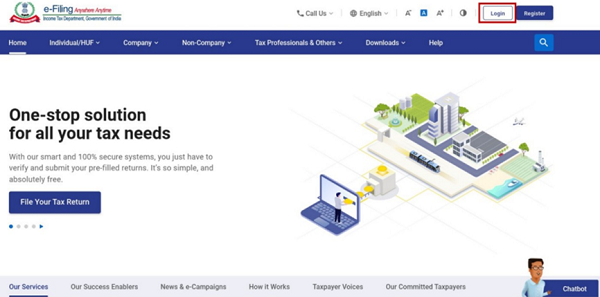
Step 2: On your Dashboard, click ‘e-File > Income Tax Forms > File Income Tax Forms’.
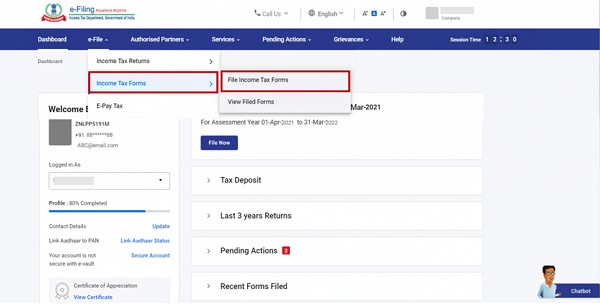
Step 3: On the File Income Tax Forms page, select Form 67 . Alternatively, enter Form 67 in the search box to find the form.
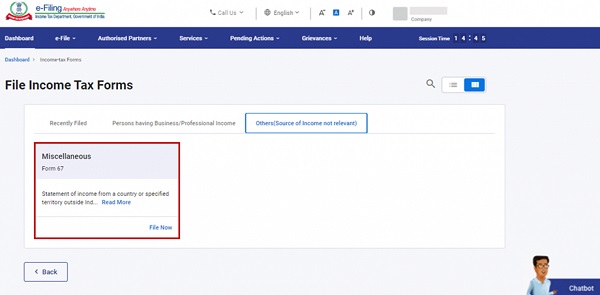 Step 4: On the Form 67 page, select the relevant Assessment Year (A.Y.) and click ‘Continue‘.
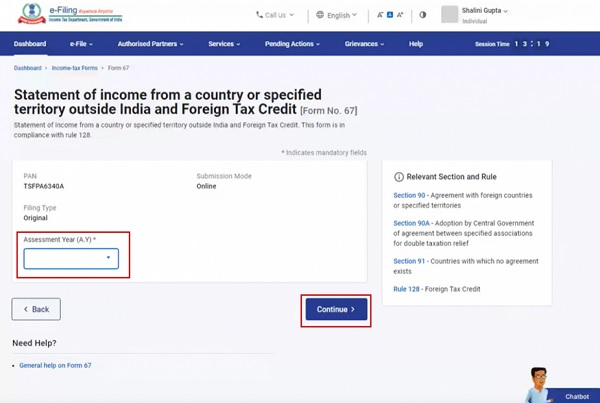 Step 5: On the Instruction page, click ‘Let’s Get Started’.
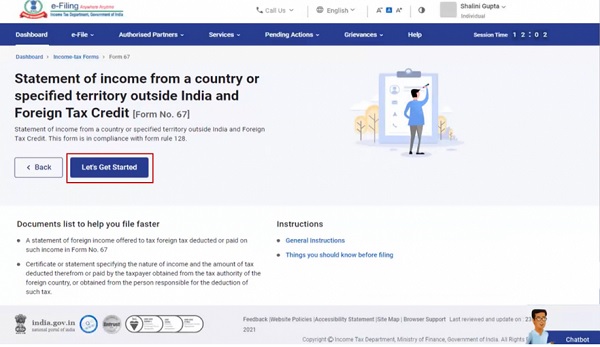
Step 6: On click of Let’s Get Started, Form 67 is displayed. Fill in all the required details and attach the required documents. It has the following 4 sections:
(a) Part A
Part A of the form entails basic information such as your Name, PAN, Address, and Assessment Year. Further, the taxpayer is required to provide details of his income from foreign countries and foreign tax credit claimed in respect thereof.
_
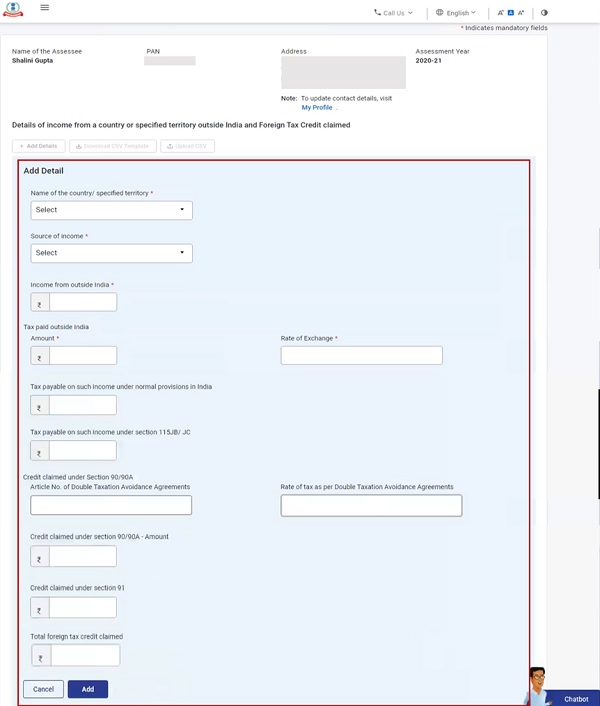
(b) Part-B
Under Part B, the taxpayer shall be required to specify if any refund of the foreign tax credit has been claimed in any prior accounting year as a result of carry backsword of losses. Further, if credit has been claimed in respect of foreign tax which is under dispute, the taxpayer shall be required to specify the same.
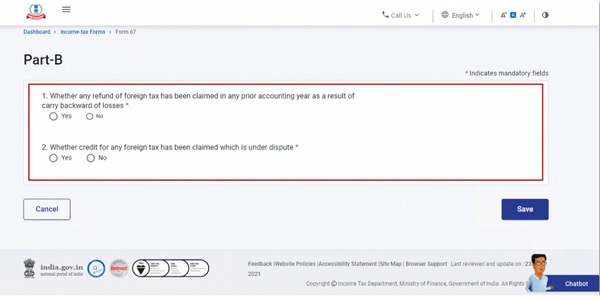
(c) Verification
On this page, the taxpayer is required to provide a self-declaration that all the information provided in the form is correct and complete.
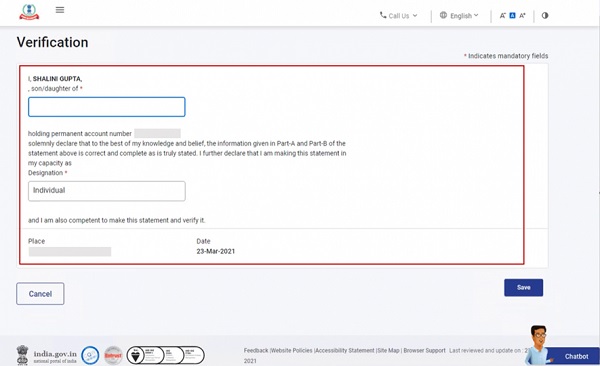
(d) Attachments
The last section of Form 67 is ‘Attachments’, where you need to attach a copy of the certificate or statement and proof of payment/deduction of foreign tax.
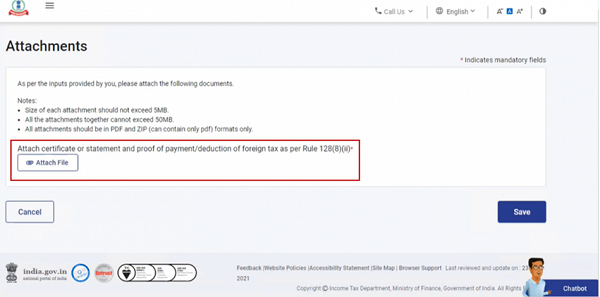
Step 7: After filling required details, preview the details and click on ‘Proceed to e-Verify.
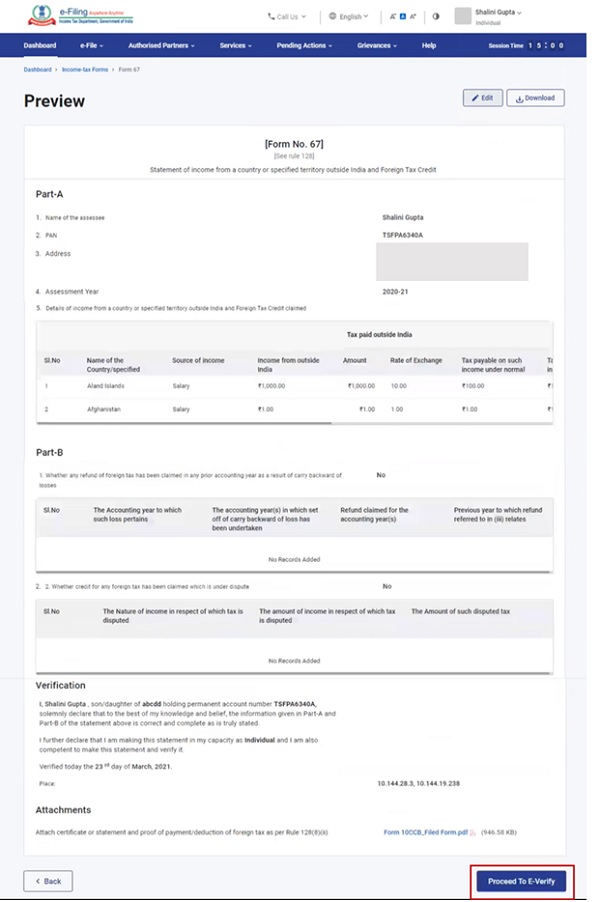
Step 8: Click ‘Yes’ to submit.
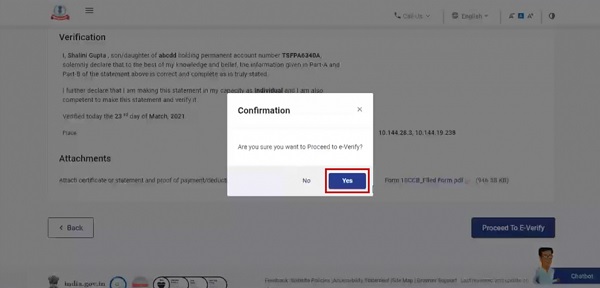
Step 9: On clicking Yes, you will be taken to the e-Verify page. After successful e-Verification, a success message is displayed along with a Transaction ID and Acknowledgement Number. Please keep a note of the Transaction ID and Acknowledgement for future reference. You will also receive a confirmation message on the email ID registered on the e-Filing portal.
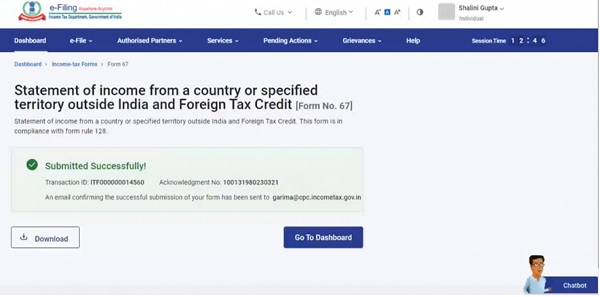
MCQs on Double taxation relief
Q1. Where an assessee has paid taxes in a country or specified territory with which India has entered into a Double Taxation Avoidance Agreement (DTAA), the relief in respect of such taxes shall be allowed in accordance with the provision of __________.
(a) Section 90
(b) Section 90A
(c) Either (a) or (b)
(d) None of the above
Correct answer: (c)
Explanation: Where an assessee has paid taxes in a country or specified territory with which India has entered into a Double Taxation Avoidance Agreement (DTAA), the relief in respect of such taxes shall be allowed in accordance with the provision of Section 90 and Section 90A. This relief is allowed under a bilateral treaty.
Q2. Unilateral relief is allowed under _________ in respect of taxes paid in the country or specified territory with which no DTAA exists.
(a) Section 90
(b) Section 90A
(c) Section 91
(d) None of the above
Correct answer: (c)
Explanation: Unilateral relief is allowed in respect of taxes paid in the country or specified territory with which no DTAA exists. Such relief is allowed under Section 91
Q3. Where the Central Government has entered into a DTAA with the government of any foreign country, then in relation to the assessee to whom such agreement applies _____________.
(a) The provisions of the Income-tax Act shall apply
(b) The provisions of DTAA shall apply
(c) the provisions of the Income-tax Act shall apply only to the extent they are more beneficial to that assessee
(d) None of the above
Correct answer: (c)
Explanation: Where the Central Government has entered into a DTAA with the government of any foreign country, then in relation to the assessee to whom such agreement applies, the provisions of the Income-tax Act shall apply only to the extent they are more beneficial to that assessee.
Q4. A non-resident, to whom a DTAA applies, shall be entitled to claim any relief under such DTAA only if he obtains a __________ of his being a resident of any foreign country from the government of such country.
(a) Tax Residency Certificate (TRC)
(b) Taxpayer Identification Number (TIN)
(c) Both (a) and (b)
(d) None of the above
Correct answer: (a)
Explanation: A non-resident, to whom a DTAA applies, shall be entitled to claim any relief under such DTAA only if he obtains a Tax Residency Certificate (TRC) of his being a resident of any foreign country from the government of such country. Further, he shall be required to furnish some additional information in Form No. 10F electronically.
Q5. A resident person can make an application in ________ to the assessing officer to obtain a Tax Residency Certificate.
(a) Form No. 10F
(b) Form No. 10FA
(c) Form No. 10FB
(d) Form No. 10
Correct answer: (b)
Explanation: A resident person can make an application in Form No. 10FA to the assessing officer to obtain a Tax Residency Certificate to claim relief under a DTAA entered into with the source country.
Q6. In which year, a resident shall be allowed to claim credit of the foreign tax paid by him in the foreign country?
(a) The year in which income earned in foreign country is offered to tax or assessed to tax in India
(b) The year in which income earned in foreign country is received in India
(c) Earlier of (a) or (b)
(d) None of the above
Correct answer: (a)
Explanation: A resident shall be allowed to claim credit of the foreign tax paid by him in the foreign country in the year in which income earned in a foreign country (on which tax has been paid) is offered to tax or assessed to tax in India.
Q7. How much amount can be claimed as foreign tax credit?
(a) The tax payable on such income under the Income-tax Act
(b) Foreign tax paid
(c) Higher of (a) or (b)
(d) Lower of (a) or (b)
Correct answer: (d)
Explanation: The credit shall be lower of the tax payable on such income under the Income-tax Act and foreign tax paid on such income. If the amount of foreign tax exceeds the amount of tax payable as per the provisions of the DTAA, such excess shall be ignored while calculating the foreign tax credit.
Q8. The amount of foreign tax credit shall be computed by converting the currency of foreign tax at the telegraphic transfer buying rate ___________.
(a) on the last date of the month immediately preceding the month in which such tax has been paid or deducted
(b) on the last date of the month in which such tax has been paid or deducted
(c) on 31st March of the relevant year
(d) None of the above
Correct answer: (a)
Explanation: The amount of foreign tax credit shall be computed by converting the currency of foreign tax at the telegraphic transfer buying rate on the last date of the month immediately preceding the month in which such tax has been paid or deducted.
Q9. Which of the following documents are required to be furnished by the assessee to claim the credit of foreign tax?
(a) Form No. 67
(b) A certificate or statement, specifying the nature of income and the amount of tax deducted therefrom
(c) Both (a) and (b)
(d) None of the above
Correct answer: (c)
Explanation: The assessee needs to furnish the following documents to claim the credit of foreign tax:
(A) A statement specifying income offered to tax in the foreign country for the previous year and foreign tax which has been deducted or paid on such income in Form No. 67;
(B) A certificate or statement specifying the nature of income and the amount of tax deducted therefrom or paid by the assessee obtained from the tax authority of the foreign country or the person responsible for the deduction of such tax. It should be signed by the assessee and accompanied by:
-
- An acknowledgement of online payment or bank counterfoil or challan for payment of tax, where the payment has been made by the assessee;
- Proof of deduction, where tax has been deducted.
Q9. Where a resident person pays taxes in respect of the income accrued or arisen outside India, in any country with which no DTAA exists, relief shall be allowed as per the Indian rate of tax if rates are different in both countries.
(a) True
(b) False
Correct answer: (b)
Explanation: Where a resident person pays taxes in respect of the income accrued or arisen outside India, in any country with which no DTAA exists, relief shall be allowed, by way of deduction from the income-tax, at the following rates:
- Where rates are different in both countries – the Indian rate of tax or the rate of tax of the respective country, whichever is the lower.
- Where rates are the same in both countries – the Indian rate of tax
Deferred tax assets and liability
| Disclaimer:
The contents of this document are for information purposes only. This aims to enable public to have a quick and an easy access to information and do not purport to be legal documents. Viewers are advised to verify the content from Government Acts/Rules/Notifications etc. |
Deferred tax assets and liability
Every year, an entity is required to determine the amount of taxable income and tax thereon in accordance with provisions of the Income-tax Act, 1961. Such taxes on income are accounted for in the financial statements that include current tax, deferred tax asset, and deferred tax liability in respect of an accounting period.
Meaning of Current Tax
The current tax is the amount of income tax determined in accordance with the provision of the Income-tax Act, 1961. First of all, an entity assesses its taxable income for a period and then applies applicable tax rates to such income to determine current tax.
Meaning of Deferred Tax
Deferred tax arises when there is a difference between taxable income and accounting income (the amount of net profit before tax in the statement of profit or loss of an entity for a period). Such a mismatch arises due to the differences between accounting and taxation provisions. One of the primary examples of such difference between both provisions is depreciation debited to the statement of profit or loss and depreciation allowed under the provisions of the Income-tax Act.
Deferred Tax Asset
A Deferred Tax Asset is an item of the balance sheet that ultimately either reduces the income tax liability of an entity for future periods or results in a refund of an already paid amount of income tax. It arises when there are differences in tax and accounting rules or there is a carryover of depreciation or tax losses.
Two main reasons exist for such differences between taxable income and accounting income. Firstly, there are certain items of revenue and expenses in the statement of profit or loss, which are treaty differently for tax purposes according to the Income-tax Act, 1961. Secondly, the amount of certain items of revenue or expenses in the statement of profit or loss is recognised at a lower or higher amount for the computation of taxable income.
The differences between taxable income and accounting income can be classified into permanent differences and timing differences
Permanent differences are those differences between taxable income and accounting income which originate in one period and do not reverse subsequently. Permanent differences are ignored in the accounting of deferred tax assets.
Timing differences are those differences between taxable income and accounting income for a period that originate in one period and are capable of reversal in one or more subsequent periods. Timing differences arise because the period in which some items of revenue and expenses are included in taxable income does not coincide with the period in which such items of revenue and expenses are included or considered in arriving at accounting income.
Deferred tax asset is recognised only on timing differences which are expected to result in an income tax refund or reduction in income tax liability in future periods in which it will reverse.
Examples of timing and permanent differences:
| Timing Differences | Permanent differences |
|---|---|
| Depreciation | Expenses paid in cash above Rs. 10,000 |
| Receipts taxable on a cash basis but not received during the year | Provision for doubtful debts(in case of an entity not being a bank, NBFC or financial institution) |
| Carried forward losses | Provision for unascertained liability |
| Unabsorbed depreciation | Capital expenditure |
| Preliminary expenses | Personal expenditure |
| Expenses specified in Section 43B, the payment of which is made after the due date for filing the income-tax return, for example, bonus, gratuity contribution, interest on borrowing from banks, etc. |
Deferred Tax Liability
Deferred Tax Liability is an item of the balance sheet that increases the income tax liability of an entity or decreases the amount of tax refund in future periods. It arises when there are differences between the provisions of income tax and accounting rules. Such as, for accounting income, depreciation is charged using useful lives of fixed assets specified under the Companies Act, 2013, but for taxable income, depreciation is allowed based on depreciation rates as specified under the Income-tax Act.
The differences between taxable and accounting income can be classified into permanent differences and timing differences (as discussed above). The deferred tax liability is recognised only on timing differences which are expected to increase the income tax liability of an entity in future periods in which it shall be reversed.
Measurement of the deferred tax asset/liability
In normal cases
Deferred tax asset/liability is measured using enacted or substantially enacted tax rates and tax provisions applicable for the relevant timing differences at the date of measurement.
The tax rates and tax provisions which have been notified by the government in its Official Gazette till the balance sheet date are considered as enacted or substantially enacted. However, certain announcements of tax rates and tax provisions by the government in the Finance Budget may have the substantive effect of actual enactment even before notification. In these circumstances, deferred tax asset/liability is measured using such announced tax rates and tax provisions.
Where MAT is applicable
The Income-tax Act, 1961 states that a company is required to pay a minimum tax amount as computed in accordance with the provision of Section 115JB. Such tax is known as minimum alternate tax, and where an entity is required to pay it for any period, it is treated as the current tax for that period.
Where a company pays minimum alternate tax under Section 115JB for any period, the deferred tax asset/liability on timing differences arising during the period is measured using the applicable regular tax rates and not the specified tax rate under Section 115JB of the Income-tax Act, 1961.
Further, in a case where an entity expects that the timing differences arising in the current period would reverse in a period in which it may pay minimum alternate tax under Section 115JB, the deferred tax asset/liability on timing differences arising during the current period is measured using the applicable regular tax rates and not the specified tax rate under Section 115JB of the Income-tax Act, 1961.
Where slab rate is applicable
The Income-tax Act, 1961 has specified income tax slab rates for certain classes of taxpayers, like for individuals. In this case, the deferred tax asset/liability is measured using average rates computed on the basis of applicable slab rates. Tax amounts calculated using separately specified rates should not be considered for the computation of average rates, like a tax on the long-term capital gain which is calculated at the rate of 12.5%/20% (as the case may be).
For example, a taxpayer whose status is individual for taxation purposes has computed its taxable income at Rs. 7,50,000 after claiming all applicable exemptions and deductions under the Income-tax Act. There is a timing difference of Rs. 50,000 between taxable income and accounting income which will be allowed as a deduction/taxable in future periods as per the Act. In this case, the income tax amount as per the slab applicable for FY 2024-25 will be Rs. 62,500 [(2,50,000 * 5%) + (2,50,000 * 20%)]. Hence, the average rate would be 8.33% (62,500/7,50,000*100). Accordingly, deferred tax asset/liability would be measured by applying 8.33% to Rs. 50,000. (Assuming the taxpayer chooses to opt out of the default tax regime under section 115BAC )
Offset of deferred tax asset with deferred tax liability
An entity may offset the amount of deferred tax asset with a deferred tax liability if:
(a) the entity has a legally enforceable right to set off current tax assets against current tax liabilities;
(b) intends to settle the asset and the liability on a net basis; and
(c) the deferred tax assets and liabilities relate to taxes on income levied by the same governing taxation laws, i.e. the Income-tax Act, 1961.
MCQs on Deferred tax assets and liability
Q1. Deferred Tax Asset is an item of the balance sheet that ultimately ___________.
(a) Reduces the income tax liability of an entity for future periods
(b) Results in a refund of an already paid amount of income tax
(c) Either (a) or (b)
(d) None of the above
Correct answer: (c)
Explanation: Deferred Tax Asset is an item of the balance sheet that either reduces the income tax liability of an entity for future periods or results in a refund of taxes already paid.
Q2. Permanent differences are those differences between taxable and accounting income which originate in one period and are capable or expected to be reversed in one or more future periods.
(a) True
(b) False
Correct answer: (b)
Explanation: Permanent differences are those differences between taxable income and accounting income which originate in one period and do not reverse in any future period at the time of computation of taxable income.
Timing differences are those differences between taxable income and accounting income for a period which originate in one period and are capable or expected to be reversed in one or more future periods.
Q3. Deferred tax asset is recognised only on _________which are expected to result in an income tax refund or reduction in income tax liability in future periods in which it will reverse.
(a) Timing differences
(b) Permanent differences
(c) Both (a) and (b)
(d) None of the above
Correct answer: (a)
Explanation: Deferred tax asset is recognised only on timing differences which are expected to result in an income tax refund or reduction in income tax liability in future periods in which it will reverse.
Q4. Which of the following is the Timing Difference?
(a) Depreciation
(b) Preliminary expenses
(c) Carried forward losses
(d) All of the above
Correct answer: (d)
Explanation: These are examples of the timing differences because the assessee can claim the benefit of these items in future.
Q5. Which of the following is a Permanent Difference for a trading entity?
(a) Provision for doubtful debts
(b) Bonus paid after the return filing due date
(c) Leave encashment, paid after return filing due date
(d) All of the above
Correct answer: (a)
Explanation: The provision for bad and doubtful debts is allowed under Section 36(1)(vii)/(via) only to the eligible assessee, being a bank, NBFC or financial institution.
Q6. Deferred Tax Liability is an item of the balance sheet that___________.
(a) increases the income tax liability of an entity
(b) decreases the amount of refundable tax in future periods
(c) Either (a) or (b)
(d) None of the above
Correct answer: (c)
Explanation: Deferred Tax Liability is an item of the balance sheet that increases the income tax liability of an entity or decreases the amount of refundable tax in future periods.
Q7. Minimum Alternate Tax (MAT) paid by a company in accordance with the provisions of Section 115JB is considered as _________.
(a) Current Tax
(b) Deferred Tax Asset
(c) Deferred Tax Liability
(d) None of the above
Correct answer: (a)
Explanation: The Income-tax Act, 1961 states that a company is required to pay a minimum tax amount as computed in accordance with the provision of Section 115JB. Such tax is known as minimum alternate tax, and where an entity is required to pay it for any period then it is treated as current tax for that period.
Q8. Where MAT is applicable, the deferred tax asset/liability is calculated by applying ____________.
(a) Regular tax rates
(b) Rates mentioned in Section 115JB
(c) Either (a) or (b)
(d) None of the above
Correct answer: (a)
Explanation: Where a company pays minimum alternate tax under Section 115JB for any period, the deferred tax asset/liability on timing differences arising during the period is measured using the applicable regular tax rates and not the specified tax rate under Section 115JB of the Income-tax Act, 1961.
Faceless Scheme
| Disclaimer:
The contents of this document are for information purposes only. This aims to enable public to have a quick and an easy access to information and do not purport to be legal documents. Viewers are advised to verify the content from Government Acts/Rules/Notifications etc. |
Faceless Scheme
The Central Government has undertaken a number of measures to make the processes under the Income Tax Act, electronic, by eliminating the person-to-person interface between the taxpayer and the Department to the extent technologically feasible, and provide for optimal utilisation of resources and a team-based assessment with dynamic jurisdiction. A series of futuristic reforms have been introduced in the domain of Direct Tax administration for the benefit of taxpayers and the economy. This started with faceless assessment in electronic mode involving no human interface between taxpayers and tax officials. The faceless procedures are being introduced in a phased manner in the Income Tax Act, 1961.
Faceless Assessments
The assessments under Section 144B of the Income-tax Act, 1961 are more popularly referred to as the ‘Faceless Assessments’ or the ‘Jurisdiction-less Assessments’. Let us understand why these assessments are being referred so.
(a) Faceless assessments: These assessments are being referred to as ‘Faceless’ simply because the assessee will not get to see the face of his/her assessing officer. In other words, the assessee will not be able to know who will conduct his/her assessments. The faceless assessments completely eliminate the physical interface between the assessee and the assessing authority and instead involves the electronic interface right from the selection of the cases for the scrutiny purpose with the help of an ‘automated allocation system’ involving an algorithm for randomised allocation of cases, by using suitable technological tools, including artificial intelligence and machine learning, with a view to optimising the use of resources, and the conduct of assessments exclusively in electronic mode via the ‘e-Proceedings’ utility of the e-Filing portal of Income-tax department’s website, and finally the review and examination of the assessment orders using ‘automated examination tool’ involving therein an algorithm for standardised examination of draft assessment orders, by using suitable technological tools, including artificial intelligence and machine learning, with a view to reducing the scope of discretion.
(b) Jurisdiction-less assessments: These assessments are referred to as ‘Jurisdiction-less’ because these are conducted by a Team/Group of Expert Income Tax Officers at multiple-level units, viz. National Faceless Assessment Centre (NaFAC), Assessment Unit, Verification Unit, Technical Unit, and Review Unit, and are not conducted by an individual jurisdictional assessing officer. The cases shall be assigned by NaFAC to an assessment unit based on an ‘automated allocation system’ involving an algorithm for the randomised allocation of cases, by using suitable technological tools, including artificial intelligence and machine learning.
Step-by-step guide to ‘Faceless Assessment Proceedings’ under Section 144B
Step 1: Visit the ‘e-filing portal’:
The assessee is required to visit the ‘e-filing portal’ from the link: https://www.incometax.gov.in/iec/foportal
Step 2: Log into the account
Click on the ‘login ‘button located on the top right side of the screen. On the next screen, fill in the ‘user id’, which is the ‘PAN’, and click ‘Continue’. Then enter the ‘password’ and click ‘continue’ to complete the login.
Step 3: Go to the ‘e-Proceedings’ tab:
After login, go to ‘Pending Actions > e-Proceedings’. The assessee is redirected to a new page of ‘View e-Proceedings related to’, which displays all the ‘assessment notices’ under Section 143(1)(a)/143(2)/147/139(9)/270A, for different assessment years, which the assessee might have received.
Step 4: View the Assessment/Re-assessment Notices
To view the regular assessment proceeding details under Section 143(3), click ‘Assessment Proceedings under Section 143(3)/147 ‘View Notices’.
Step 5: Select the Notice to Respond
In the sub-window of ‘Assessment Proceedings u/s 143(3)/147’, the assessee can see all the notices, say under Section 143(2) or 142(1), issued for that particular assessment year.
This sub-window provides three tabs (i) View Response; (ii) Notice/Letter Pdf, and (iii) Seek/View Adjournment.
In order to access the relevant notice, click the ‘Notice/Letter Pdf’ tab. The assessee can seek adjournment by clicking “Seek Adjournment”, after providing the reason for seeking an adjournment.
Step 6: Download the Assessment Notice
To download the notice, go to ‘Pending Actions > e-Proceedings > View Notices > Detailed Notices’. Click on the ‘Download’ tab at the bottom of the page to download the assessment notice.
After downloading the assessment notice, the assessee can view the scrutiny notice sent by the AO containing the following details:
- PAN of the Assessee
- Address of the Assessee
- Section under which Notice has been issued
- Assessment Year
- Notice No.
- Date of issuing Notice
- Purpose for sending the Notice
- Questionnaire, if the notice is issued under section 142(1).
Under the faceless regime under Section 144B, the notices under Section 143(2) of the Act are not issued by the jurisdictional Assessing Officer but by the National Faceless Assessment Centre (NaFAC).
Step 7: File ‘e-Response’ to Notice under Section 143(2)
For the purpose of filing/furnishing a ‘reply’ in response to a notice under section 143(2), click on the tab ‘Submit Response’ tab,
Step 8: Tips for filing responses
(a) Partial responses: If the assessee is submitting a response on a piecemeal basis, he needs to choose ‘response type’ as ‘partial’.
(b) Full response: If the submissions have been made on a piecemeal basis, then there would be multiple ‘partial responses’. After submitting the ‘last partial response’, update the ‘Response type’ to ‘Full Response’. If the assessee wants to file just one response to the scrutiny notice, then opt for ‘Full Response’ in ‘response type’.
(c) Multiple Responses: The assessee can submit ‘multiple responses‘ to any single scrutiny notice.
(d) Brief remark to response: The assessee may also furnish a brief ‘remark’ to its response under the tab ‘Add Written Response/Remarks‘. The remark cannot exceed 4,000 characters.
(e) Uploading of supporting documents: The assessee may attach the supporting documents as ‘attachments’ to substantiate his response/submission by choosing different specified categories of attachments mentioned in the dropdown list. The assessee can attach scanned documents in .pdf, .xls, .xlsx, and .csv format. If the supporting document is not in the specified format, choose ‘Others’ from the dropdown list for attaching such documents. A maximum of 10 attachments/files can be uploaded, with each attachment not exceeding 5 MB. If the limit is exhausted, the assessee can opt for a ‘partial response’ to upload the remaining attachments.
(f) Name of attachments: Ensure that the names of the two attachments are not the same and should not exceed 100 characters. Only two special characters, hyphen ‘-‘ and underscore ‘_’,are permitted in the attachments’ name. If the name of the attachment is not as per the guidelines, it will result in an error in uploading the entire submission.
(g) Window closure: The facility to submit a response gets auto-closed seven days before the time-barring date of the regular assessment. If there is no time barring date, the AO can close the e-submission if the final order or decision is being prepared. Once the assessment proceeding is closed or completed in ITBA, there will be no e-submission allowed from the assessee.
Step 9: Calling of further information, documents, or evidence from the assessee by way of issue of notice under Section 142(1) by the Assessment Unit through NaFAC
The Assessment Unit to which the case has been assigned by the NaFAC may make a request to the NaFAC to obtain such further information, documents, or evidence from the assessee or any other person, as it may specify.
Where a request for obtaining further information, documents, or evidence from the assessee or any other person has been made by the Assessment Unit, the NaFAC issues appropriate notice or requisition under Section 142(1) to the assessee or any other person for obtaining the information, documents or evidence requisitioned by the Assessment Unit.
Step 10: View and retrieve the scrutiny questionnaire under Section 142(1) and file ‘e-Response’
The initiation of the assessment proceedings by the issue of scrutiny notice under Section 143(2) is proceeded further by issuing a scrutiny questionnaire under Section 142(1) of the Act.
The assessee can access the notice under Section 142(1) by clicking the ‘Notice/Letter Pdf’ tab. The assessee can download the pdf file of such notice by clicking the ‘Download’ tab.
The assessee is required to file his ‘e-responses’ and attach the supporting records and documents in the same manner as in filing of his ‘e-response’ to notice under Section 143(2) as discussed above.
Step 11: View ‘e-Responses’
After submitting the ‘e-responses’, if the assessee wishes to view the responses filed, he can view them by clicking the link of ‘View Response’.
Step 12: Download ‘e-Responses/Submissions’ along with supporting attachments
The assessee may download all the filed submissions along with the corresponding attachments by clicking the links under the tab ‘Attachment’.
Step 13: Preparation of Income or Loss Determination Proposal by Assessment Unit
The assessment unit, after taking into account all the relevant material available on the record, and the replies furnished electronically by the assessee, prepare in writing an Income or Loss Determination Proposal, either accepting the returned income of the assessee or modifying the returned income of the assessee, as the case may be, and send a copy of such proposal to the NaFAC.
Step 14: Examination of the Income or Loss Determination Proposal by NaFAC& Issue of a Show Cause Notice to the Assessee
The NaFAC examines the Income or Loss Determination Proposal in accordance with the risk management strategy specified by the Board, including by way of an automated examination tool, whereupon it may decide to:
(a) finalise the assessment as per the draft order prepared on the basis of such Income or Loss Determination Proposal and serve a copy of such order and notice for initiating penalty proceedings, if any, to the assessee, along with the demand notice, specifying the sum payable by, or refund of any amount due to, the assessee on the basis of such assessment; or
(b) The NaFAC shall provide an opportunity to the assessee, in case a modification is proposed, by serving a notice calling upon him to show cause as to why the assessment should not be completed as per the Income or Loss Determination Proposal /draft order; or
(c) Assign the Income or Loss Determination Proposal to a Review Unit, through an automated allocation system, for conducting a review of such proposal.
Step 15: Filing of ‘e-Response’ by the assessee to the show-cause notice
The assessee is required to file his ‘e-response’ to such show-cause notice and upload the relevant supporting records and documents as attachments in the same manner as discussed above.
Step 16: Passing of the final assessment order by NaFAC
The NaFAC forwards the ‘e-Responses’ of the assessee to the show cause notice to the Assessment Unit, which in turn, after taking due cognizance of all the e-responses of the assessee, passes the revised draft assessment order. If the assessee so requires, the NaFAC shall provide the assessee with the opportunity of personal hearing via video telephony.
The assessment unit, after taking cognizance of the inputs from such personal hearing as provided to it by NaFAC, again passes the final assessment order, which is uploaded by NaFAC in the registered ‘e-Filing’ account of the assessee within the time barring limitation period of completion of assessments under Section 143(3) of the Act. The assessment order can be seen and downloaded by clicking the ” Download Closure Order” button in the main window by clicking on the icon “For Your Information”, under the ‘e-proceedings’ tab.
Step 17: Transferring all assessment records to Jurisdictional AO
The NaFAC transfers the final assessment order, and all the assessment records to the file of jurisdictional AO for imposing the penalty, and recovery of outstanding income tax demand, if any.
Faceless Appeals
An appellant can file his/her appeal before Commissioner (Appeals) through his/her registered e-filing account, on the e-filing portal of the Income-tax Department. However, the appellate proceeding that followed after the filing of the appeal electronically in Form 35, was neither electronic nor faceless.
In order to ensure that the reforms initiated by the Central Government to eliminate human interface in the assessment proceedings reach the next level of appellate proceedings, the Finance Act, 2020 has inserted new sub-sections (6A), (6B), and (6C) in Section 250 of the Income Tax Act, to provide for the following:
- Empowering the Central Government to notify an e-appeal scheme for the disposal of appeals so as to impart greater efficiency, transparency, and accountability.
- Eliminating the interface between the Commissioner (Appeals) and the appellant in the course of appellate proceedings to the extent technologically feasible.
- Optimising utilisation of the resources through economies of scale and functional specialisation.
- Introducing an appellate system with dynamic jurisdiction in which appeals shall be disposed of by one or more Commissioner (Appeals).
The CBDT, in exercise of the powers conferred by sub-section (6B) of Section 250 of the Income Tax Act, has notified the ‘Faceless Appeal Scheme, 2020’, vide Gazetted Notification F.No. S.O. 3296 (E), dated 25-9-2020.
Under this Faceless Appeals Scheme, 2020, all Income Tax appeals before the first appellate authority i.e., the CIT (Appeals), shall be finalised in a faceless manner under the faceless ecosystem with the exception of appeals relating to serious frauds, major tax evasion, sensitive and search matters, international taxation and black money. All the pending and new appeals of the taxpayers before the CIT(Appeals) w.e.f. 25-9-2020 shall be adjudicated and disposed of by the dynamic jurisdiction and not by the jurisdictional CIT(Appeals).
Subsequently, the Faceless Appeal Scheme, 2020, was re-nomenclature as the Faceless Appeal (Amendment) Scheme, 2021 vide Notification No. S.O. 1438(E.) dated 31-3-2021 and the reference to the National e-Assessment Centre in the faceless appeal scheme was substituted by “the National Faceless Assessment Centre.”
In this first version of the faceless appeal scheme, the appellant was not having any by-default right of personal hearing through video conferencing and this right was subject to the discretion of the Chief Commissioner or the Director General, in charge of the Regional Faceless Appeal Centre, who may approve such request of the appellant for personal hearing through video conferencing, if the case falls within the ambit of notified circumstances.
Under the amended Faceless Appeal Scheme, 2021, a by-default right of personal hearing through video conferencing has been vested in the appellant. It has been mandated that the appellant may request for a personal hearing through video conferencing, and on receipt of such a request of the appellant, the respective Commissioner (Appeals), in the Appeal Unit shall grant such personal hearing to the appellant through video conferencing.
Further, the role of the Regional Faceless Appeal Centre, as provided in the earlier Faceless Appeal Scheme, 2020, has been done away with, and the National Faceless Appeal Centre shall assign the appeal, for disposal, directly, to a Commissioner (Appeals) of a specific appeal unit, through an automated allocation system.
Under the faceless appeals, everything from e-allocation of appeal, e-communication of notice/questionnaire, e-verification/e-enquiry, e-hearing, and e-communication of the appellate order shall be online, dispensing with the need for any physical interface between the appellant and the CIT (Appeal). There shall be no physical interface between the taxpayers or their counsels and the CIT (Appeal).
Step-by-Step guide to file e-Appeal in online Form 35
Step 1: Visit the ‘e-filing portal’:
The assessee is required to visit the ‘e-filing portal’ from the link: https://www.incometax.gov.in/iec/foportal
Step 2: Log into the account
Click on the ‘login’ button located on the top right side of the screen. On the next screen, fill in the ‘user id’, which is the ‘PAN’, and click ‘Continue’. Then enter the ‘password’ and click ‘continue’ to complete the login.
Step 3: Accessing electronic Appeal Form 35:
After login, go to ‘e-File >Income Tax Forms’. The appellant is directed to a new window consisting of various Forms. The appellant needs to select Appeals (Form 35) to proceed further.
Step 4: Electronic Filing of Appeal Form 35
Click the link of ‘File Now’. The appellant is directed to a new window containing details like PAN No., Submission Mode as Online, Filing Type, and Assessment Year. The appellant needs to select the applicable assessment year, for which the electronic appeal Form 35 needs to be filed, from the dropdown list
After selecting the relevant assessment year, the appellant is directed to a new window containing a reference to the list of documents required for the e-filing of appeal and the instructions for facilitating faster and smoother e-filing of appeal. In order to proceed further, the appellant needs to click “Let’s Get Started”.
Step 5: Select whether the appeal is to be filed for an order with DIN or for an order without DIN
After clicking the ‘Let’s Get Started’, the appellant is directed to the next screen, which contains the following two options:
(a) File an Appeal for an order without DIN
(b) File an Appeal for an order with DIN (order issued after 1st October 2019)
The appellant needs to fill the ‘Document Identification Number (DIN No.)’, of the Assessment /Re-assessment/Intimation Order for which the appeal is to be filed. Usually, the DIN No. comes automatically in the drop-down list for orders passed on or after 01-10-2019. In case the respective DIN No. is not available in the drop-down, the appellant needs to choose Option 1 of ‘Filing Appeal Without DIN’, and enter the DIN manually under the field ‘Order Number/DIN’.
After filling the DIN No., the appellant is required to select the relevant ‘Section and Sub-section’ of the Income Tax Act, under which the appealable order has been passed, from the drop-down.
After filling in the relevant section and sub-section, the appellant needs to fill in the ‘Date of Order’ and ‘Date of Service of Order’.
Currently, all orders are electronically uploaded to the registered e-filing account of the assessee, so the date of order and the date of service of the order are the same.
After filling all these details, click on the “Continue” tab to proceed further.
Step 6: Provide details in Seven Specified Columns
After clicking the ‘Continue’ tab, the appellant is directed to a new window containing seven columns as under:
(a) Basic Information;
(b) Order against which appeal is filed;
(c) Pending Appeal;
(d) Appeal Details;
(e) Details of Taxes paid;
(f) Statement of Facts, Grounds of Appeal, and additional evidence; and
(g) Appeal filing details.
The appellant needs to provide the relevant details in each one of these seven columns by clicking on the link ‘Provide details’.
(1) Basic Details: The appellant needs to fill the basic information like name, address, mobile number, email address, and TAN (if available). The appellant also has to decide whether notices/communication may be sent on email or not. The appellant needs to click the ‘save’ tab to proceed.
(2) Order against which appeal is filed: The appellant needs to fill the details of the assessment/re-assessment or the intimation order against which the appeal is to be filed like year type/block period. Details of Assessment Year, DIN No., Section and Sub-section No., Order No., Date of Order, and Date of Service of Order get auto-populated. The appellant needs to fill the designation of the Income-tax Authority, passing the order appealed against. Click the ‘Save’ tab to proceed further.
(3) Pending Appeal: The appellant needs to fill in whether other appeal is pending in relation to any other assessment year with any Commissioner (Appeals). If yes, the appellant needs to fill the details of such appeal.
(4) Appeal Details: The appellant needs to fill the appeal details like section and sub-section, under which appeal is preferred, and if the appeal relates to any assessment or penalty.
(5) Details of Taxes Paid: The appellant needs to fill in the details of taxes paid.
(6) Statement of Facts, Grounds of Appeal, and Additional Evidence: This is the most important section of the electronic filing of Form 35 with the Commissioner (Appeals). In this section, the appellant is required to submit a statement of facts not exceeding 10,000 characters, and a list of documentary evidence relied upon. The appellant may also furnish additional evidence as per Rule 46A of the Income Tax Rules by enclosing them as attachments in the ‘Add Details’ tab. The appellant also needs to fill in the grounds of appeal, by clicking the ‘Add Details’ tab under the ‘Grounds of Appeal’ field.
After filing the ‘Grounds of Appeal’ field, the appellant is directed to a new window, requiring him to fill in the requisite details in three sub-columns:
(a) Relevant Section of Income Tax Act, under which the addition/disallowance has been made;
(b) Describing the ‘Issue’, in 2,000 characters; and
(c) ‘Ground of Appeal’ in 4,000 characters.
The appellant can add as many grounds of appeal as he requires, and he needs to fill in the above details for each such ground of appeal.
(7) Appeal Filing Details: The appellant is required to fill in details like whether there is any delay in appeal filing. Section 249(2) mandates the filing of an appeal before the Commissioner (Appeals) within 30 days after receiving the assessment/re-assessment/penalty/intimation order against which the appeal is to be filed.
If there is a delay in filing an appeal beyond the stipulated period of thirty days, then the assessee needs to fill in the condonation request and the reason for such delay. Sub-section (3) of Section 249 of the Income-tax Act provides that the Commissioner (Appeals) may condone the delay in filing of appeal by the appellant if such cause is a genuine and reasonable/sufficient one.
The appellant further needs to fill in the details like Challan Serial No., BSR No., Date of Payment, etc., of the Appeal Fee.
Step 7: Upload supporting records & documents as attachments
After filling in the required details, the assessee is directed to a new window of ‘Attachments’, wherein the assessee is required to attach the undermentioned documents, along with the Appeal Form 35:
(a) Copy of Order/Intimation Appealed against (compulsory enclosure);
(b) Copy of Notice of Demand (compulsory enclosure);
(c) Documentary evidence in support of Appeal Submission;
(d) Documentary evidence as additional evidence, if the assessee, so opts.
Important Points: (i) Size of each attachment should not exceed 5MB; (ii) All attachments together cannot exceed 50MB; and (iii) All attachments should be in PDF or ZIP (containing PDF only) formats only.
Step 8: Fill the verification form
After uploading all required attachments, the appellant is directed to a new window, ‘Form of Verification’. The appellant needs to fill in this brief form and click on the ‘Save’ button, to proceed further.
Step 9: Preview the Online Appeal
The appellant can ‘Preview’ the filled Electronic Appeal Form 35, in order to rectify any mistakes, if any.
Step 10: e-Verification & Uploading of Online Appeal
On the Preview page, the appellant needs to verify the details and click ‘Proceed to e-Verify’.
Faceless Penalty Scheme, 2021
With the advent of the Faceless Assessment Scheme, 2019 and to ensure that the reforms initiated by the department to eliminate human interface, it was imperative to launch a Faceless Penalty Scheme along the lines of the Faceless Assessment Scheme, 2019.
Therefore, the Finance Act 2020 has inserted an enabling provision in the form of a new sub-section (2A) in Section 274 of the Act so as to provide that the Central Government may notify an e-scheme for the purposes of imposing penalty so as to impart greater efficiency, transparency, and accountability by:
(a) eliminating the interface between the Assessing Officer and the appellant in the course of proceedings to the extent technologically feasible;
(b) optimising utilisation of the resources through economies of scale and functional specialisation;
(c) introducing a mechanism for imposing of the penalty with dynamic jurisdiction in which the penalty shall be imposed by one or more income-tax authorities.
Launch of Faceless Penalty Scheme, 2021
In exercise of the powers conferred by sub-section (2A) of Section 274 of the Income-tax Act, 1961, the Central Government has notified the Faceless Penalty Scheme 2021, vide Notification No. S.O. 117 (E), dated 12-01-2021, and for the purposes of giving effect to the Faceless Penalty Scheme, 2021, the Central Government vide Notification No. S.O. 118 (E), dated 12-01-2021, has issued Directions for implementing the Faceless Penalty Scheme, 2021.
Scope of faceless penalty scheme
This scheme provides that the penalty shall be imposed in respect of specified territorial areas or persons or class of persons or income or class of income or cases or class of cases or penalties or class of penalties. In this respect, vide Order F. NO. 187/4/2021-ITA-I, dated 20-1-2021, Order F. NO. 187/4/2021-ITA-1, dated 26-2-2021, and Order F. NO. 187/4/2021-ITA-1, dated 10-3-2022, the CBDT has notified the following, which shall be outside the purview of this scheme:
(a) Penalty proceedings in cases assigned to Central Charges;
(b) Penalty proceedings in cases assigned to International Tax Charges;
(c) Penalty proceedings arising in TDS charges;
(d) Penalty proceedings arising/pending in the Investigation Wing, the Directorate of I&CI, erstwhile DG (Risk-Assessment), or by any prescribed authority for the purpose of specified penalties;
(e) Penalty proceedings arising out of any statute other than the Income-tax Act;
(f) All the penalties imposable by the officers of the level of Commissioner/Director/Commissioner (Appeals/Appeal Unit) and above. It shall be disposed of by the respective officer; and
(g) Penalty proceedings in cases where pendency could not be created on ITBA because of technical reasons or cases not having a PAN, as the case may be.
Further, the CBDT has clarified that all the penalties imposable under the Income-tax Act (other than the exclusion provided above) by the officers of the rank of Additional CIT/JCIT and below shall remain with the National Faceless Assessment Centre.
e-Rectification of Mistakes under Section 154
Step-by-Step Guide for e-Filing of Rectification Request
Currently, the assessee can electronically file his rectification request only in respect of Intimation Orders passed by CPC under Section 143(1) or 154, and the online facility for filing of rectification requests under Section 154, in respect of orders passed by AO under Section 143(3)/147/144, is not available. In such cases, the assessee is required to submit his rectification request manually before the jurisdiction AO.
Step 1: Visit the ‘e-filing portal’:
The assessee is required to visit the ‘e-filing portal’ from the link: https://www.incometax.gov.in/iec/foportal
Step 2: Log into the account
Click on the ‘login’ button located on the top right side of the screen. On the next screen, fill in the ‘user id’, which is the ‘PAN’, and click ‘Continue’. Then enter the ‘password’ and click ‘continue’ to complete the login.
Step 3: Select ‘Rectification’ type
Click on the icon, ‘Services>Rectification’.
Step 4: Raisea request for rectification
The assessee is directed to a new window, wherein he needs to select the relevant assessment year for which he needs to file the rectification request from the drop-down and click on the ‘continue’ tab to proceed.
Step 5: Select the ‘Request Type’
The assessee is directed to a new window, ‘Select the Request Type’.
Three types of requests are specified for raising the rectification request:
(1) Reprocess the Return: Select this option if the assessee has furnished true and correct particulars in the Return of Income and CPC has not considered the same during processing;
(2) Return Data Correction (Offline):Select this option if there is a need to make necessary corrections in the data. The assessee needs to re-enter all the entries in the schedules. All the correct entries and the remaining entries mentioned in the ITR filed earlier are to be entered. The assessee needs to make necessary corrections in the data. While doing corrections, the assessee is not supposed to declare any new source of income or claim additional deductions.
(3) Tax Credit Mismatch Correction: Use this option if the assessee needs to correct details in TDS/TCS/IT challans of the processed Return of Income. The assessee needs to re-enter all the entries in the schedules. All the corrected entries and other entries mentioned in the ITR filed earlier are to be entered. The assessee needs to make the necessary corrections in the data. While doing corrections, the assessee is not supposed to claim credits which are not part of the processed return or the Form 26AS statement.
A) Type 1 Request: Reprocess the Return
In raising the ‘Reprocess the Return’ type of rectification request, the assessee is simply required to click on the ‘arrow’ on the right side and confirm the submission of such type of rectification request. After submission, the assessee is provided with an acknowledgment receipt number (ARN) of such rectification request by CPC.
B) Type 2 Request: Return Data Correction
In raising this rectification request, the assessee is required to give the reason for raising such a rectification request in the column provided for this purpose in not more than 4,000 characters.
Thus, in the column- ‘Rectification Reason’, the assessee needs to mention this fact as shown below, with a character limit of not more than 4,000 characters.
Further, the assessee is required to upload the JSON file of the revised return being filed by it, as stated above, and click on the ‘submit’ button to file its rectification request. After submission, the assessee is provided with an acknowledgment receipt number (ARN) of such rectification request by CPC.
C) Type 3 Request ‘Tax Credit Mismatch Correction’
The assessee needs to select the relevant type from the two available options:
- Details of Tax Deducted at Source on Income as per Form 16A:The assessee needs to tick the particular deductor for which correction needs to be made and submit the rectification request. After submission, the assessee is provided with an acknowledgment receipt number (ARN) of such rectification request by CPC.
- Details of Tax Deducted at Source on Income as per Form 16B/16C/16D, issued by Deductor: The assessee needs to tick the particular deductor for which correction needs to be made and submit the rectification request. After submission, the assessee is provided with an acknowledgment receipt number (ARN) of such rectification request by CPC.
e-Filing of Response to Outstanding Demand
Step-by-Step guide for e-filing of response
Step 1: Visit the ‘e-filing portal’:
The assessee is required to visit the ‘e-filing portal’ from the link: https://www.incometax.gov.in/iec/foportal
Step 2: Log into the account
Click on the ‘login’ button located on the top right side of the screen. On the next screen, fill in the ‘user id’, which is the ‘PAN’, and click ‘Continue’. Then enter the ‘password’ and click ‘continue’ to complete the login.
Step 3: Select ‘Response to Outstanding Demand’
Select the ‘Pending Actions>Response to Outstanding Demand’ tab to proceed.
Step 4: Select the options for response
The assessee is directed to a new window containing the assessment year-wise details of the outstanding demand of the assessee. The assessee needs to select the relevant assessment year for which he needs to file the response. The assessee is provided with three buttons on the right side:
(1) Pay Now: If the assessee agrees with the demand, he can pay the said demand by clicking on the ‘Pay Now’ button.
(2) Download: The assessee can see the demand order/intimation by clicking the ‘Download’ button.
(3) Submit Response: For submitting the response to the outstanding demand for the selected assessment year, the assessee needs to click on the ‘Submit Response’ button to proceed.
Step 5: Select the response option
If the assessee chooses ‘Submit Response’, and agrees with the demand, he needs to choose the ‘Demand is correct’ option and pay the due tax. If he disagrees with the demand, then he is required to select the ‘Disagree with demand (Either in Full or Part) option.
Step 6: Provide reason for disagreement
The assessee is required to select the reason for disagreement with demand from the available options in the drop-down.
If the reason for the disagreement is not covered by any of the available options in the drop-down, then the assessee may choose ‘Others’. After choosing this option, the assessee is directed to a new window, wherein he is required to enter the amount of outstanding demand, for which he is in disagreement on account of the said reason. The assessee is also required to provide the remarks and details of such reason for disagreement in not more than 2,000 characters. After providing the same, the assessee is required to click the ‘save button’ to submit his response to such disagreement with the outstanding demand.
Taxpayer Information Summary (TIS)
| Disclaimer:
The contents of this document are for information purposes only. This aims to enable public to have a quick and an easy access to information and do not purport to be legal documents. Viewers are advised to verify the content from Government Acts/Rules/Notifications etc. |
Taxpayer Information Summary (TIS)
Annual Information Statement (AIS) is a statement that provides complete information about a taxpayer for a particular financial year. Taxpayer Information Summary (TIS) is a category-wise taxpayer summary of such information.
AIS-TIS contains information about taxpayers’ incomes, financial transactions, tax details, income-tax proceedings, etc.
An assessee can access AIS/TIS information by logging into his income-tax e-filing account or through the mobile app “AIS for Taxpayer”. If he feels that the information furnished in AIS is incorrect, duplicated, or relates to any other person, etc., he can submit his feedback thereon.
Steps to access TIS information online
Step 1: Log in to the Income-tax e-filing website at https://www.incometax.gov.in/
If you are a new user, you will be required to first register on the e-filing portal.
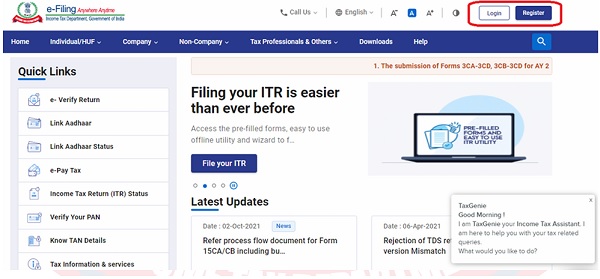
Step 2: After login, click on Services > Annual Information Statement (AIS)
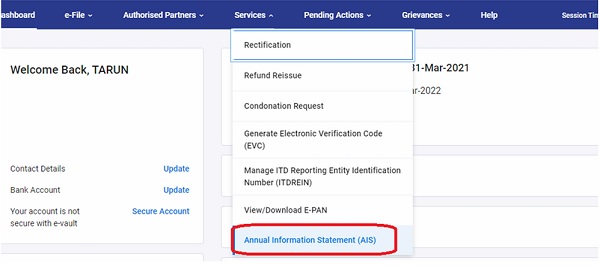
Step 3: A message shall appear that will prompt you to click on ‘proceed’ to redirect to the AIS homepage.
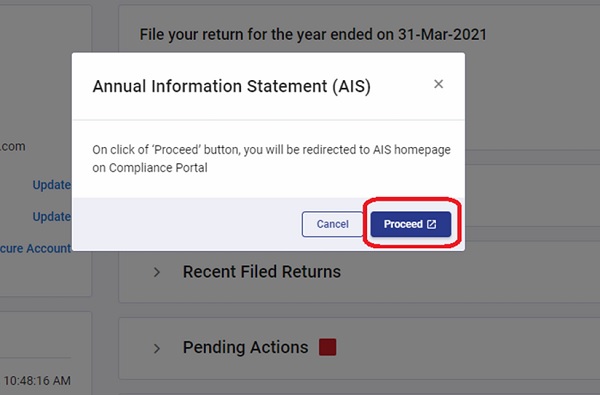
Step 4: The next screen provides key instructions relating to Annual Information Statement (AIS) and Taxpayer Information Summary (TIS). TIS displays the information available in AIS category-wise. It shows the original value as well as the revised value (i.e., the value processed after the taxpayer’s feedback). The revised values in TIS are used for prefilling of return.
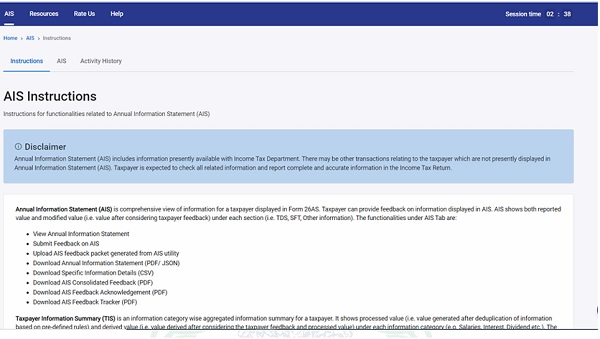 Step 5: Click on the next tab of ‘AIS’. On the redirected screen, two tiles shall appear – Taxpayer Information Summary (TIS) and Annual Information Statement (AIS). Select the relevant financial year from the drop-down and click on the TIS tile to view the information.
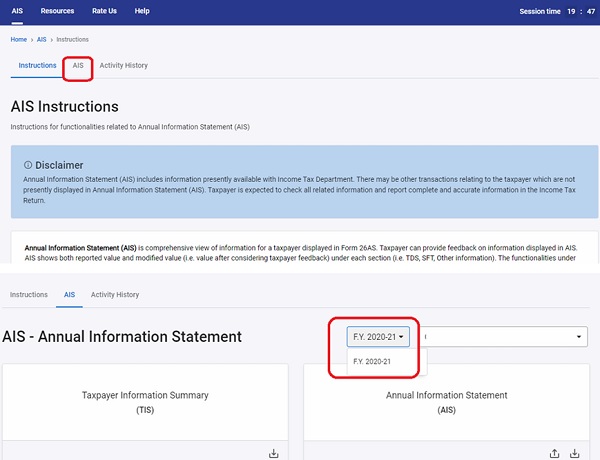
Step 6: On the next screen, the information available in TIS is displayed.
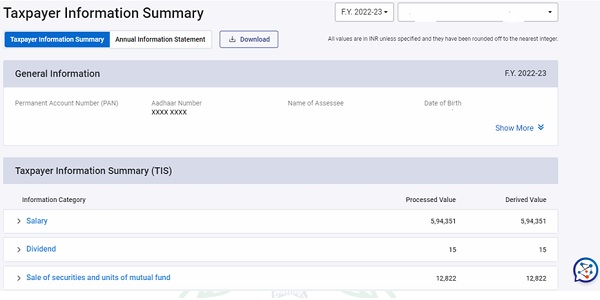
Higher deduction of tax at source in certain cases (section 206AA and Section 206AB)
| Disclaimer:
The contents of this document are for information purposes only. This aims to enable public to have a quick and an easy access to information and do not purport to be legal documents. Viewers are advised to verify the content from Government Acts/Rules/Notifications etc. |
Higher deduction of tax at source in certain cases (section 206AA and Section 206AB)
Introduction
Where any person is entitled to receive any income on which tax is deductible at source, he is required to furnish his PAN to the deductor. In case the PAN is not furnished, the tax shall be deducted at a higher rate under section 206AA. Similarly, where any person fails to furnish his return of income for a specified period and tax deducted/collected during that period exceeds the specified limit, the deductor shall deduct the tax at a higher rate under section 206AB.
Note: The provisions of section 206AB are omitted w.e.f. 01-04-2025.
Section 206AA – Non-furnishing of PAN
It is mandatory for the deductee to furnish his PAN to the deductor to enable him to deduct tax at source. As per Section 206AA, if the recipient fails to furnish his PAN to the deductor then tax shall be deducted at the higher of the following rates:
(a) At the rate specified in the relevant provision
(b) At the rate or rates in force
(c) At the rate of 20%
However, where tax is required to be deducted by an e-commerce operator under section 194-O or by a buyer under section 194Q and the e-commerce participant or the seller has not furnished his PAN, the rate shall be taken 5% instead of 20% for point (c).
Exemption to certain non-resident
Where the deductee is a non-resident, the provision of section 206AA shall not be applicable in certain transactions:
– On interest on bonds – This provision shall not be applicable in respect of interest paid or payable on long-term bonds including infrastructure bonds where tax is required to be deducted under section 194LC;
– On specified income – By virtue of Rule 37BC, a deductee, being a non-resident person (including a foreign company), is not required to furnish his PAN to the deductor if he receives the following income:
(a) Interest
(b) Royalty
(c) Fees for technical services
(d) Dividend
(e) Payments for transfer of any capital asset.
However, the deductee is required to furnish certain details and documents to the deductor.
– On income from units of specified AIF – By virtue of Rule 37BC read with Rule 114AAB, a non-resident, not being a company, or a foreign company shall not be required to obtain and quote PAN if certain conditions are satisfied.
– On transfer of specified securities – As per Rule 114AAB, a non-resident, being an Eligible Foreign Investor (EFI), shall not be required to obtain and quote PAN if certain conditions are satisfied.
section 206AB – Non-filers of income-tax return
(This provision is omitted w.e.f. 01-04-2025)
This provision shall apply, and the tax shall be deductible at the higher rates prescribed under this provision if the following conditions are satisfied:
a) Deductee has not filed the return of income for the assessment year relevant to the previous year immediately preceding the financial year in which tax is required to be deducted;
b) The due date to file the return of income of such assessment year, as prescribed under Section 139(1), has expired; and
c) The aggregate amount of tax deducted and collected at source is Rs. 50,000 or more in the said previous year.
Such deductee liable for a higher TDS rate is referred to as a ‘specified person’.
Sum or income liable for a higher rate of TDS
Tax is required to be deducted at higher rates in respect of every sum or income or amount from which tax is deductible under any provision of Chapter XVII-B except the sum or income or amount on which tax is deductible under any of the following provisions:
- Section 192: TDS on Salary;
- Section 192A: TDS on withdrawal from EPF;
- Section 194B: TDS on winning from lotteries, crossword puzzles, gambling, betting, etc.
- Section 194BA1: TDS on winning from online games
- Section 194BB: TDS on winning from horse race;
- Section 194-IA: TDS from payment of consideration to buy an Immovable Property other than rural agricultural land;
- Section 194-IB: TDS from payment of rent by certain Individuals or HUF;
- Section 194LBC: TDS on income in respect of investment in Securitization Trust;
- Section 194M: TDS from payment to the contractor, commission agent, broker, or professional by certain Individuals or HUF;
- Section 194N: TDS on cash withdrawal; and
- Section 194S: Payment on transfer of Virtual Digital Asset (if the payer is a specified person)
Further, the tax shall not be deducted at higher rates under this provision if such sum (or income or amount) is paid (or payable or credited) to a non-resident who does not have a permanent establishment (PE) in India or to a person who is not required to furnish the return of income for the specified period and is notified by the Central Government. Here, PE includes a fixed place of business through which the business of the enterprise is carried on, whether wholly or partly.
All other payments shall be subject to the test of section 206AB even if they are not considered as income in the hands of the assessee.
Rate of TDS
Where tax is required to be deducted under this provision, the tax shall be deducted at the higher of the following rates:
a) Twice the rate specified in the relevant provision;
b) Twice the rate or rates in force; or
c) 5%.
The provisions of section 206AB override all other provisions of the Income-tax Act. It will apply even if the assessee has a lower or nil TDS certificate or he has filed a declaration under Section 197A for non-deduction of tax. However, this provision will be attracted only if the tax is otherwise deductible under Chapter XVII-B.
How to check the return filing status of the deductee?
The Department has issued a new functionality “Compliance Check for Sections 206AB & 206CCA” on https://report.insight.gov.in to check the IT Return filing status of the deductee. The tax deductor can feed the single PAN or multiple PANs of the deductee and get a response from the functionality if such a deductee is a specified person.
section 206AA v. section 206AB
Where both the provisions of section 206AA and section 206AB are applicable, that is, the deductee has neither furnished his PAN to the deductor nor furnished his return of income for the specified periods, the tax shall be deducted at the rates provided in section 206AA or section 206AB, whichever is higher.
A comparison between section 206AA and 206AB has been enumerated in the below table:
| Basis of distinction | section 206AA | section 206AB |
|---|---|---|
| Applicability |
a) When a deductee fails to furnish his PAN; or b) When the declaration given by application u/s 197A(1)/(1A)/(1C) becomes invalid; or c) When PAN provided is invalid; or d) When PAN doesn’t belong to the deductee |
When a deductee fails to furnish a return for the specified period and the aggregate amount of tax deducted or collected during such specified period exceeds the specified limit |
| Rate for deduction | Higher of:
• Rate specified in the relevant provision; • Rate or rates in force; or • 20%. |
Higher of:
• Twice the rate specified in the relevant provision; • Twice the rate or rates in force; • 5%. |
| Exception | In respect of the following income received by a non-resident (or a foreign company):
(a) Interest on bonds referred under section 194LC; (b) Specified payments as referred under Rule 37BC; (c) Income in respect of investment in Category I or Category II AIFs as referred under Rule 114AAB; and (d) Income from transfer of specified securities by a non-resident being an EFI as referred under Rule 114AAB. |
In respect of sum/income on which tax is required to be deducted under any of the following provisions:
(a) Section 192 (b) Section 192A (c) Section 194B (d) Section 194BA (e) Section 194BB (f) Section 194-IA (g) Section 194-IB (h) Section 194LBC (i) Section 194M (j) Section 194N (k) Section 194S Further, this provision does not apply if the non-resident is not having any PE in India or a person is not required to file return of income of the specified period and is notified by the Central Government. |
| Special tax rates | 5% tax rate to apply if the tax is deductible under section 194-O and section 194Q. |
MCQs on section 206AA and section 206AB
Q1. If a person fails to furnish PAN to the deductor while receiving any income on which tax is liable to be deducted, the tax shall be deducted under ________.
(a) section 206AA
(b) section 206AB
(c) Section 206CC
(d) Section 206CCA
Correct answer: (a)
Justification of the correct answer: Where any person is entitled to receive any income on which tax is deductible at source, he is required to furnish his PAN to the deductor. In case the PAN is not furnished, the tax shall be deducted as per the rate prescribed under section 206AA.
Q2. As per section 206AA, if the recipient fails to furnish his PAN to the deductor then tax shall be deducted at the ________ of the rates prescribed in the section.
(a) Rate specified in the relevant provision
(b) Rate or rates in force
(c) 20%
(d) Higher of (a), (b), and (c)
Correct answer: (d)
Justification of the correct answer: As per section 206AA, if the recipient fails to furnish his PAN to the deductor then tax shall be deducted at the higher of the following rates:
(a) At the rate specified in the relevant provision
(b) At the rate or rates in force
(c) At the rate of 20%
Q3. If any person fails to furnish his return of income for a specified period and tax deducted/collected during that period exceeds the specified limit, the deductor shall deduct the tax ______________.
(a) Twice the rate specified in the relevant provision
(b) Twice the rate or rates in force
(c) 5%
(d) Higher of (a), (b), and (c)
Correct answer: (d)
Justification of the correct answer: Where tax is required to be deducted under section 206AB, the tax shall be deducted at the higher of the following rates:
a) Twice the rate specified in the relevant provision;
b) Twice the rate or rates in force; or
c) 5%.
Q4. section 206AB shall apply and the tax shall be deductible at the higher rates prescribed under this provision if _____
a) Deductee has not filed the return of income for the assessment year relevant to the previous year immediately preceding the financial year in which tax is required to be deducted;
b) The due date to file the return of income of such assessment year, as prescribed under Section 139(1), has expired; and
c) The aggregate amount of tax deducted and collected at source is Rs. 50,000 or more in the said previous year.
d) All of the above
Correct answer: (d)
Justification of the correct answer: This provision shall apply, and the tax shall be deductible at the higher rates prescribed under this provision if the following conditions are satisfied:
a) Deductee has not filed the return of income for the assessment year relevant to the previous year immediately preceding the financial year in which tax is required to be deducted;
b) The due date to file the return of income of such assessment year, as prescribed under Section 139(1), has expired; and
c) The aggregate amount of tax deducted and collected at source is Rs. 50,000 or more in the said previous year.
Q5. section 206AB is applicable where payment is made for the income liable to tax deduction under _________.
(a) Section 194J
(b) Section 192
(c) Section 194B
(d) Section 194-IA
Correct answer: (a)
Justification of the correct answer: Tax is required to be deducted at higher rates in respect of every sum or income or amount from which tax is deductible under any provision of Chapter XVII-B except the sum or income or amount on which tax is deductible under certain provisions including section 192, 194B and 194-IA.
Note:
1.Inserted with effect from 01-04-2023 by the Finance Act, 2023.
Equalisation Levy
| Disclaimer:
The contents of this document are for information purposes only. This aims to enable public to have a quick and an easy access to information and do not purport to be legal documents. Viewers are advised to verify the content from Government Acts/Rules/Notifications etc. |
Equalisation Levy
[The provisions of Equalisation Levy are not applicable w.e.f. AY 2026-27]
Introduction
The Equalisation Levy was introduced by the Finance Act, 2016 on online advertisement services, provision for digital advertising space, or any other facility or service for the purpose of online advertisement only. The Finance Act, 2020, has extended the scope of this levy to e-commerce supply and services made/provided/facilitated on or after 01-04-2020.
However, the Finance (No.2) Act, 2024 has inserted a sunset clause and provided that equalization levy shall not apply to consideration received or receivable for e-commerce supply or services on or after 01-08-2024.
Transactions Subject to Equalisation Levy
The Equalisation levy is charged in respect of the following:
(a) Sum received or receivable by a non-resident for online advertisement services
Equalisation levy is charged at the rate of 6% from the consideration paid or payable for the services in the nature of online advertisement, provision for digital advertising space, any other facility or service for the purpose of online advertisement.
(b) Sum received or receivable for e-commerce supply of goods or services made or facilitated on or after 01-04-2020 but before 01-08-2024
Equalisation levy is charged at the rate of 2% from the consideration received or receivable for the e-commerce supply or services made or facilitated on or after 01-04-2020 by an e-commerce operator.
The Central Government may also specify any other service on which such levy shall be chargeable. Any income which is chargeable to equalization levy is exempt from income-tax under Section 10(50).
However, where consideration received or receivable is in the nature of royalty or fees for technical services (FTS), no equalisation levy shall be charged if the following conditions are satisfied:
(a) The consideration received or receivable is taxable as royalty or fees for technical services in India; and
(b) Such taxability arises under the Income-tax Act read with the DTAA notified by the Central Government under Section 90 or Section 90A.
Equalisation Levy on Online advertisement services
When a non-resident provides services in the nature of online advertisement, provision for digital advertising space, any other facility or service for the purpose of online advertisement (prescribed services), a tax in form of equalisation levy shall be deductible by the recipient of service on the consideration paid for such service.
The Equalisation levy shall be deductible by recipient of service being a resident of India carrying on business or profession or a non-resident having a Permanent Establishment (PE) in India. PE includes a fixed place of business through which the business of enterprise is carried on, whether partially or wholly.
Equalisation levy shall not be charged in the following scenarios:
(a) If non-resident has a PE in India – Equalisation levy shall not be charged if the non-resident providing the services has a PE in India and the service is effectively connected with such PE.
(b) Consideration is less than threshold limit – Equalisation levy shall not be charged if the aggregate amount of consideration received or receivable by the non-resident from the recipient of specified services in a previous year does not exceed Rs. 1 lakh.
(c) Service is not received for business or profession – Equalisation levy shall not be charged where such service is received for personal use and not for the purpose of any business or profession.
Equalisation Levy on E-commerce supply of goods or services
When an e-commerce operator makes, provides or facilitates any e-commerce supply or services on or after 01-04-2020 but before 01-08-2024, Equalisation levy shall be payable by the e-commerce operator on the consideration received or receivable for such supply or service.
Meaning of e-commerce operator: ‘E-commerce Operator’ means a non-resident who owns, operates or manages digital or electronic facility or platform for the online sale of goods or online provision of services or both.
Meaning of e-commerce supply or services: E-commerce supply or services means:
(a) Online sale of goods owned by the e-commerce operator;
(b) Online provision of services provided by the e-commerce operator;
(c) Online sale of goods or provision of services or both, facilitated by the e-commerce operator; or
(d) Any combination of above activities
Online sale of goods and online provision of services shall include one or more of the following online services:
(a) Acceptance of offer for sale;
(b) Placing of purchase order;
(c) Acceptance of purchase order;
(d) Payment of consideration; or
(e) Supply of goods or provision of services, partly or wholly
Thus, even if the buyer sends the purchase order by email, it will be treated as an online sale of goods. As the said definition is inclusive, it cannot be restricted to the activities so prescribed. It may include all other activities if they are undertaken online.
When Equalisation levy shall be charged?
Equalisation levy shall be charged when e-commerce supply or services made or provided or facilitated to the following persons:
(a) A person who is resident in India;
(b) A person who buys such goods or services or both using internet protocol address located in India;
(c) A non-resident person in the following circumstances:
-
- Sale of advertisement which targets a customer who is resident in India or a customer who accesses the advertisement through internet protocol address located in India; and
- Sale of data collected from a person who is resident in India or from a person who uses internet protocol address located in India.
Equalisation levy shall not be charged in the following circumstances-
(a) Online advertisement service covered under section 165
If nature of a transaction is such that the Equalisation levy can be charged both under Section 165 (from sum received or receivable from online advertisement services) and Section 165A (from the online sale of goods and services), it shall be charged under Section 165.
(b) Consideration is less than threshold limit
Equalisation levy shall not be charged if the aggregate of the sale, turnover or gross receipts of the e-commerce operator from the e-commerce supply or services made or provided or facilitated to the persons is less than Rs. 2 crores during the previous year.
(c) E-commerce operator has a PE in India
Equalisation levy shall not be charged if the e-commerce operator has a PE in India and the supply or service is effectively connected with such PE.
(d) Goods are owned or services are provided by a resident or non-resident having PE in India
Equalisation levy shall not be charged if ‘consideration received or receivable’ is attributable to the following transactions:
-
-
- Sale of goods which are owned by a person resident in India or Permanent Establishment (PE) of a non-resident person in India if such sale is effectively connected with such PE; and
- Provision of services which are provided by a person resident in India or PE of a non-resident person in India if such provision of services is effectively connected with such PE.
-
Accordingly, no Equalisation levy will be charged on the consideration received or receivable by an e-commerce operator from such transaction.
Calculation of Consideration
The consideration received or receivable from e-commerce supply or services shall include:
(a) Consideration for sale of goods irrespective of whether the e-commerce operator owns the goods; and
(b) Consideration for provision of services irrespective of whether service is provided or facilitated by the e-commerce operator.
However, the consideration received or receivable from e-commerce supply or services shall not include the consideration for:
(a) Sale of goods which are owned by a person resident in India or Permanent Establishment (PE) of a non-resident person in India if such sale is effectively connected with such PE; and
(b) Provision of services which are provided by a person resident in India or PE of a non-resident person in India if such provision of services is effectively connected with such PE.
Due date to deposit Equalisation Levy
The amount deducted as Equalisation levy shall be paid to the credit of Central Government on or before the 7th day of the month immediately following the month in which such levy was deducted. However, where Equalisation levy has charged on e-commerce supply of goods or services, the amount of Equalisation levy shall be paid to the credit of Central Government on or before the following dates:
| Period | Due date |
|---|---|
| April 1st – June 30th | 7th July |
| July 1st – September 30th | 7th October |
| October 1st – December 31st | 7th January |
| January 1st – March 31st | 31st March |
Amount of Equalisation levy shall be paid in Challan No. ITNS 285.
Consequences for non-deduction
An assessee who fails to deduct the levy shall himself be liable for such payment. Further, if an assessee fails to deduct the Equalisation levy or after deduction fails to deposit the same on or before the due date of furnishing return of income, amount paid for such services shall be disallowed under Section 40(a)(ib).
However, if Equalisation levy is deducted and deposited in the subsequent year, the aforesaid consideration shall be allowed as a deduction in computing the income of the previous year in which such levy has been paid.
Penalty
Where an assessee fails to deduct Equalisation levy or part thereof, he shall be liable for payment of penalty for an amount equal to the amount of levy which he failed to deduct.
Consequences of late payment
Interest – Where an assessee or e-commerce operator fails to deposit the Equalisation levy by the due date, he shall be liable for payment of simple interest at the rate of 1% of such levy for every month or part of the month during which such failure continues.
Penalty – Where an assessee fails to deposit the amount deducted as equalization levy to the credit of Central Government by the due date, he shall be liable for payment of penalty at the rate of Rs. 1,000 per day during which such default continues. However, amount of penalty shall not exceed the amount which he failed to pay.
Where an e-commerce operator fails to pay whole or any part of the Equalisation levy, he shall be liable for payment of penalty of an amount equals to the amount of Equalisation levy he failed to pay.
Statement of Equalisation Levy
Every assessee or e-commerce operator who has deducted Equalisation levy is required to prepare and deliver or cause to deliver a statement of Equalisation levy in Form 1. Such statement is required to be filed with the Assessing Officer or to any other authority or agency authorised by the Board in this behalf. Such form can be furnished in the following manner:
(a) Electronically under digital signature; or
(b) Electronically through EVC (Electronic Verification Code).
Statement of Equalisation levy is required to be furnished on or before 30th June of the financial year immediately following the financial year in which Equalisation levy is chargeable.
Belated or Revised return
Any assessee or e-commerce operator who has not furnished statement by the due date, he can furnish such statement at any time before the expiry of 2 years from the end of the financial year in which such prescribed service was provided or such e-commerce supply or service was made or provided or facilitated.
Further if assessee or e-commerce operator notices any omissions or wrong particulars in the statement, he may furnish a revised statement at any time before the expiry of 2 years from the end of the financial year in which such prescribed service was provided or such supply or services was made or provided or facilitated.
Notice for furnishing statement
Where an assessee or e-commerce operator fails to furnish statement of Equalisation levy by the due date, the Assessing Officer may serve a notice requiring him to furnish such statement. Such statement is required to be furnished within 30 days from the date of service of notice.
Where an assessee or e-commerce operator fails to furnish statement even after issue of notice by the Assessing Officer, such person shall be liable for payment of penalty at the rate of Rs. 100 per day during which such default continues.
MCQs on Equalisation Levy
Q1. Equalisation levy shall be charged with respect to which of the following transactions?
(a) Online Advertisement services
(b) Royalty income taxable in India
(c) Fees for Technical Services (FTS) taxable in India
(d) All of the above
Correct Answer: (a)
Justification of the correct answer: The Equalisation Levy was introduced by the Finance Act, 2016 on online advertisement services, provision for digital advertising space, or any other facility or service for the purpose of online advertisement only. Further, the scope of this levy was extended to e-commerce supply and services made/provided/facilitated on or after 01-04-2020 but before 01-08-2024. However, the Equalisation levy shall not be charged in respect of the income taxable as royalty or FTS in India.
Q2. The levy is charged in respect of the sum received or receivable by a non-resident for online advertisement services at the rate of __________.
(a) 2%
(b) 6%
(c) 10%
(d) None of the above
Correct answer: (b)
Justification of the correct answer: Equalisation levy is charged at the rate of 6% from the consideration paid or payable for the services in the nature of online advertisement, provision for digital advertising space, any other facility or service for the purpose of online advertisement.
Q3. The levy is charged in respect of the sum received or receivable for e-commerce supply of goods or services made or facilitated at the rate of ______.
(a) 2%
(b) 6%
(c) 10%
(d) None of the above
Correct answer: (a)
Justification of the correct answer: Equalisation levy is charged at the rate of 2% from the consideration received or receivable for the e-commerce supply or services made or facilitated on or after 01-04-2020 but before 01-08-2024 by an e-commerce operator.
Q4. The Equalisation levy shall be deducted by recipient of service being ________.
(a) a resident of India carrying on business or profession
(b) non-resident having a Permanent Establishment (PE) in India
(c) either (a) or (b)
(d) None of the above
Correct answer: (c)
Justification of the correct answer: The Equalisation levy shall be deducted by recipient of service being a resident of India carrying on business or profession or a non-resident having a Permanent Establishment (PE) in India. PE includes a fixed place of business through which the business of enterprise is carried on, whether partially or wholly.
Q5. Equalisation levy shall not be charged in which of the following cases?
(a) If the non-resident providing the services has a PE in India and the service is effectively connected with such PE.
(b) If the aggregate amount of consideration received or receivable by the non-resident from the recipient of specified services in a previous year does not exceed Rs. 1 lakh.
(c) Where such service is received for personal use and not for the purpose of any business or profession.
(d) All of the above
Correct answer: (d)
Justification of the correct answer: Equalisation levy shall not be charged in the following scenarios-
(a) If non-resident has a PE in India – Equalisation levy shall not be charged if the non-resident providing the services has a PE in India and the service is effectively connected with such PE.
(b) Consideration is less than threshold limit – Equalisation levy shall not be charged if the aggregate amount of consideration received or receivable by the non-resident from the recipient of specified services in a previous year does not exceed Rs. 1 lakh.
(c) Service is not received for business or profession – Equalisation levy shall not be charged where such service is received for personal use and not for the purpose of any business or profession.
Q6. E-commerce Operator’ means a non-resident who
(a) owns digital or electronic facility or platform for the online sale of goods or online provision of services or both.
(b) operates digital or electronic facility or platform for the online sale of goods or online provision of services or both
(c) manages digital or electronic facility or platform for the online sale of goods or online provision of services or both
(d) All of the above
Correct answer: (d)
Justification of the correct answer: ‘E-commerce Operator’ means a non-resident who owns, operates or manages digital or electronic facility or platform for the online sale of goods or online provision of services or both.
Q7. E-commerce supply or services means:
(a) Online sale of goods owned by the e-commerce operator;
(b) Online provision of services provided by the e-commerce operator;
(c) Online sale of goods or provision of services or both, facilitated by the e-commerce operator;
(d) All of the above
Correct answer: (d)
Justification of the correct answer: E-commerce supply or services means:
(a) Online sale of goods owned by the e-commerce operator;
(b) Online provision of services provided by the e-commerce operator;
(c) Online sale of goods or provision of services or both, facilitated by the e-commerce operator; or
(d) Any combination of above activities
Q8. Equalisation levy shall be charged when e-commerce supply or services made or provided or facilitated to which of the following persons?
(a) A person who is resident in India;
(b) A person who buys such goods or services or both using internet protocol address located in India;
(c) A non-resident person in case of sale of advertisement which targets a customer who is resident in India or a customer who accesses the advertisement through internet protocol address located in India and sale of data collected from a person who is resident in India or from a person who uses internet protocol address located in India.
(d) All of the above
Correct answer: (d)
Justification of the correct answer: Equalisation levy shall be charged when e-commerce supply or services made or provided or facilitated to the following persons:
(a) A person who is resident in India;
(b) A person who buys such goods or services or both using internet protocol address located in India;
(c) A non-resident person in the following circumstances:
-
- Sale of advertisement which targets a customer who is resident in India or a customer who accesses the advertisement through internet protocol address located in India; and
- Sale of data collected from a person who is resident in India or from a person who uses internet protocol address located in India.
Q9. The consideration received or receivable from e-commerce supply or services shall include:
(a) Consideration for sale of goods irrespective of whether the e-commerce operator owns the goods;
(b) Consideration for provision of services irrespective of whether service is provided or facilitated by the e-commerce operator.
(c) Both (a) and (b)
(d) None of the above
Correct answer: (c)
Justification of the correct answer: The consideration received or receivable from e-commerce supply or services shall include:
a. Consideration for sale of goods irrespective of whether the e-commerce operator owns the goods; and
b. Consideration for provision of services irrespective of whether service is provided or facilitated by the e-commerce operator.
Q10. The consideration received or receivable from e-commerce supply or services shall not include the consideration for:
(a) Sale of goods which are owned by a person resident in India or Permanent Establishment (PE) of a non-resident person in India if such sale is effectively connected with such PE;
(b) Provision of services which are provided by a person resident in India or PE of a non-resident person in India if such provision of services is effectively connected with such PE.
(c) Both (a) and (b)
(d) None of the above
Correct answer: (c)
Justification of the correct answer: The consideration received or receivable from e-commerce supply or services shall not include the consideration for:
(a) Sale of goods which are owned by a person resident in India or Permanent Establishment (PE) of a non-resident person in India if such sale is effectively connected with such PE; and
(b) Provision of services which are provided by a person resident in India or PE of a non-resident person in India if such provision of services is effectively connected with such PE.
Q11. The amount deducted as Equalisation levy shall be paid to the credit of Central Government ____________
(a) Monthly basis
(b) Quarterly basis where Equalisation levy has charged on e-commerce supply of goods or services
(c) Both (a) and (b)
(d) None of the above
Correct answer: (c)
Justification of the correct answer: The amount deducted as Equalisation levy shall be paid to the credit of Central Government on or before the 7th day of the month immediately following the month in which such levy was deducted. However, where Equalisation levy has charged on e-commerce supply of goods or services, the amount of Equalisation levy shall be paid to the credit of Central Government on or before the following dates:
| Period | Due date |
|---|---|
| April 1st – June 30th | 7th July |
| July 1st – September 30th | 7th October |
| October 1st – December 31st | 7th January |
| January 1st – March 31st | 31st March |
Q12. Amount of Equalisation levy shall be deposited to the credit of Central Government through_______.
(a) Challan No. ITNS 285
(b) Challan No. ITNS 280
(c) Challan No. ITNS 281
(d) None of the above
Correct answer: (a)
Justification of the correct answer: Amount of Equalisation levy shall be paid in Challan No. ITNS 285.
Q13. The statement of Equalisation levy is required to be filed in __________.
(a) Form 1
(b) Form 2
(c) Form 3
(d) None of the above
Correct answer: (a)
Justification of the correct answer: Every assessee or e-commerce operator who has deducted equalisation levy is required to prepare and deliver or cause to deliver a statement of Equalisation levy in Form 1.
Q14. The statement of Equalisation levy is required to be filed on __________.
(a) 30th June
(b) 31st May
(c) 30th September
(d) 30th April
Correct answer: (a)
Justification of the correct answer: Statement of Equalisation levy is required to be furnished on or before 30th June of the financial year immediately following the financial year in which Equalisation levy is chargeable.
No deduction of tax in certain cases
| Disclaimer:
The contents of this document are for information purposes only. This aims to enable public to have a quick and an easy access to information and do not purport to be legal documents. Viewers are advised to verify the content from Government Acts/Rules/Notifications etc. |
No deduction of tax in certain cases
Introduction
In certain cases, tax may not be required to be deducted from payments if either payer is a specified institute or the recipient files a self-declaration in Form 15H (if the recipient is a senior citizen) or Form 15G (for other individuals) for no deduction of tax.
When declaration can be filed?
A self-declaration for non-deduction of tax can be filed by eligible individuals in Form 15G or Form 15H for eligible income. The declaration must be filed again if the estimated income of the payee changes.
In case of Resident non-senior citizen
A resident individual can file a declaration for non-deduction of tax under Section 194 for ‘Dividend’ and under Section 194EE for ‘National Saving Scheme’, if his income (in respect of which he is eligible to file a declaration) does not exceed the maximum exemption limit and tax on his estimated total income for the financial year is nil.
In case of Non-corporate taxpayers
Non-corporate taxpayers (other than a company or a firm) can file a declaration for non-deduction of tax under the following provisions if their income (in respect of which it is eligible to file a declaration) does not exceed the maximum exemption limit and tax on their estimated total income for the financial year is nil:
- Section 192A:TDS from payment of the accumulated balance due to an employee
- Section 193:TDS from Interest on Securities
- Section 194A:TDS from Interest other than Interest on Securities
- Section 194D:TDS from Insurance Commission
- Section 194DA:TDS from payment in respect of life insurance policy
- Section 194-I:TDS from Rent
- Section 194K:TDS from income in respect of units (Resident)
In case of Resident senior citizens
Resident senior citizen (whose age is 60 years or above) can file a declaration for non-deduction of tax under the following provisions if the tax on his estimated total income is nil for the financial year after considering the rebate under section 87A :
- Section 192A:TDS from payment of accumulated balance due to an employee
- Section 193:TDS from Interest on Securities
- Section 194:TDS from Dividend
- Section 194A:TDS from Interest other than Interest on Securities
- Section 194D:TDS from Insurance Commission
- Section 194DA:TDS from payment in respect of life insurance policy
- Section 194EE:TDS from payment in respect of deposits under National Saving Scheme
- Section 194-I:TDS from Rent
- Section 194K:TDS from income in respect of units (Resident)
How to submit the declaration?
The declaration can be submitted in writing to the payer in duplicate in Form 15H for senior citizens and Form 15G for other persons. The declaration can be submitted in paper format or electronically after verification. Once the declaration and PAN are provided to the payer, the tax will not be deducted at the source.
Intimation to Department
The payer of income is required to allot a Unique Identification Number (UIN) to all declarations (paper/electronic) filed by the payee. The payer of income is also required to digitize all paper declarations. The UIN consists of three fields, which are as follows:
a) Sequence number: This is a 10 Alphanumeric Number which starts with an alphabet followed by 9 digits. In the case of Form 15G, the alphabet shall be ‘G’ and in the case of Form 15H, it shall be ‘H’. For example, G000000001 or H000000001.
b) Financial year for which declaration is being furnished
c) TAN of the payer.
The electronic and digitized declarations shall be uploaded by the payer on a quarterly basis on the e-filing site (https://www.incometax.gov.in/iec/foportal/) under his digital signature within:
(a) 15 days from the end of the first, second, and third quarter
(b) 30 days from the end of the fourth quarter.
Apart from uploading declarations in Form No.15G/15H, the payer shall have to include the details of transactions, in respect of which Form 15G/15H has been received, in the quarterly TDS Statement even if no tax is deducted during the quarter. The payer shall quote ‘Sequence Number’ (Field ‘a’ of UIN) in the quarterly TDS statement against the transaction covered under Form No. 15G/15H declaration.
The payer will be responsible for reconciliation of the allotted UINs vis-a-vis reported UINs to the Income-tax department through reporting in quarterly TDS statements as well as through uploading of declarations on a quarterly basis.
Retention of Declaration for 7 Years
An income-tax authority may require the person responsible for payment to make available the declaration for the purposes of verification or any proceeding under the Act before the end of 7 years from the end of the financial year in which the declaration in Form No. 15G/15H has been received. This means that the person responsible for payment must keep the declaration for 7 years from the end of the financial year in which the declaration was received.
MCQs on No deduction of tax in certain cases
Q1. Tax may not be required to be deducted from payments if the recipient files a self-declaration in ____________ for no deduction of tax.
(a) Form 15H (if the recipient is a senior citizen)
(b) Form 15G (for other individuals)
(c) Either (a) or (b)
(d) None of the above
Correct Answer: (c)
Justification of correct answer: Tax may not be required to be deducted from payments if either payer is a specified institute or the recipient files a self-declaration in Form 15H (if the recipient is a senior citizen) or Form 15G (for other individuals) for no deduction of tax.
Q2. A resident individual can file a declaration in Form 15G/15H if ____________.
(a) The income does not exceed the maximum exemption limit
(b) Tax on the estimated total income for the financial year is nil
(c) Both (a) and (b)
(d) None of the above
Correct Answer: (c)
Justification of correct answer: A resident individual can file a declaration for non-deduction of tax under Section 194 for ‘Dividend’ and under Section 194EE for ‘National Saving Scheme’, if his income (in respect of which he is eligible to file a declaration) does not exceed the maximum exemption limit and tax on his estimated total income for the financial year is nil.
Q3. Non-corporate taxpayers (other than a company or a firm) cannot file a declaration for non-deduction of tax for incomes liable to tax deduction under__________.
(a) Section 192A
(b) Section 193
(c) Section 194A
(d) Section 194J
Correct Answer: (d)
Justification of correct answer: Non-corporate taxpayers (other than a company or a firm) can file a declaration for non-deduction of tax under Sections 192A, 193 , and 194A , if their income (in respect of which it is eligible to file a declaration) does not exceed the maximum exemption limit and tax on their estimated total income for the financial year is nil.
Q4. Unique Identification Number (UIN) consists of the following ____.
(a) Sequence Number
(b) Financial year for which declaration is being furnished
(c) TAN of the payer
(d) All of the above
Correct Answer: (d)
Justification of correct answer: The payer of income is required to allot a Unique Identification Number (UIN) to all declarations (paper/electronic) filed by the payee. The payer of income is also required to digitize all paper declarations. The UIN consists of three fields, which are as follows:
a) Sequence number: This is a 10 Alphanumeric Number which starts with an alphabet followed by 9 digits. In the case of Form 15G, the alphabet shall be ‘G’ and in the case of Form 15H, it shall be ‘H’. For example, G000000001 or H000000001.
b) Financial year for which declaration is being furnished
c) TAN of the payer.
Q5. The electronic and digitized declarations shall be uploaded by the payer on a ________ basis on the e-filing site under his digital signature.
(a) Quarterly
(b) Half-yearly
(c) Yearly
(d) Any of the above
Correct Answer: (a)
Justification of the Correct Answer: The electronic and digitized declarations shall be uploaded by the payer on a quarterly basis on the e-filing site (https://www.incometax.gov.in/iec/foportal/) under his digital signature within:
(a) 15 days from the end of the first, second, and third quarter
(b) 30 days from the end of the fourth quarter.
Q6. The person responsible for payment must keep the declaration for _____ from the end of the financial year in which the declaration was received.
(a) 7 years
(b) 5 years
(c) 8 years
(d) Not required to preserve the declaration
Correct Answer: (a)
Justification of the Correct Answer: An income-tax authority may require the person responsible for payment to make available the declaration for the purposes of verification or any proceeding under the Act before the end of 7 years from the end of the financial year in which the declaration in Form No. 15G/15H has been received. This means that the person responsible for payment must keep the declaration for 7 years from the end of the financial year in which the declaration was received.
Certificate of lower/no deduction of tax at source
| Disclaimer:
The contents of this document are for information purposes only. This aims to enable public to have a quick and an easy access to information and do not purport to be legal documents. Viewers are advised to verify the content from Government Acts/Rules/Notifications etc. |
Certificate of lower/no deduction of tax at source
Introduction
An assessee can apply to the Assessing Officer to issue a nil or lower TDS certificate. Such certificate is issued if the estimated tax liability of the assessee justifies no deduction of tax or deduction of tax at a lower rate.
Who can apply for certificate?
The application to obtain the Nil or Lower TDS certificate can be filed by any person, i.e., resident, non-resident, individual, firm, domestic company, foreign company, etc.
Which incomes are eligible for no deduction /lower deduction certificate?
The assessee can apply to obtain this certificate in respect of the following incomes only:
- TDS from Salaries (Section 192)
- TDS from Interest on Securities (Section 193)
- TDS from Dividend (Section 194)
- TDS from Interest other than Interest on Securities (Section 194A)
- TDS from Payment to Contractors (Section 194C)
- TDS from Insurance Commission (Section 194D)
- TDS from commission on sale of lottery tickets (Section 194G)
- TDS from Commission or brokerage (Section 194H)
- TDS from Rent (Section 194-I)
- TDS from Fees for professionals or technical services (Section 194J)
- TDS from income in respect of units (Resident) (Section 194K)
- TDS from payment of compensation on compulsory acquisition of an immovable property (Section 194LA)
- TDS from Income Distributed by Business Trust1(Section 194LBA)
- TDS from Income in respect of units of Investment Fund (Section 194LBB)
- TDS from Income in respect of investment in Securitization Trust (Section 194LBC)
- TDS from the payment made to a contractor or a professional by certain individuals or Hindu undivided family (Section 194M)
- TDS from the payment made to e-commerce participants (194-O)
- TDS from payment of certain sum for purchase of goods (Section 194Q) [applicable w.e.f 01-10-2024]
- TDS from payment of any other income to a Non-Resident (Section 195)
How to apply for this certificate?
The application for the issue of a Nil or Lower TDS certificate can be filed in Form No. 13. Such form can be filed online under Digital Signature or through Electronic Verification Code. PAN is mandatory to apply for this certificate. If the assessee doesn’t have PAN, he cannot apply to the Assessing Officer to issue such certificate.
Issue of certificate
The certificate for lower or nil deduction of tax shall be issued directly to the person responsible for deducting the tax, with advice to the person who made the application for issue of such certificate.
However, if the number of persons responsible for deducting the tax is likely to exceed 100 and the details of such persons are not available with the person making such application, the certificate may be issued to the applicant authorizing him to receive income after deduction of tax at a lower rate.
The certificate shall remain valid for such period as may be mentioned in that unless it is cancelled by the Assessing Officer before the expiry of that period.
Steps to file Form 13
Step 1: Visit the traces portal https://contents.tdscpc.gov.in/ and ‘Login’
Step 2: Login as a ‘Taxpayer’
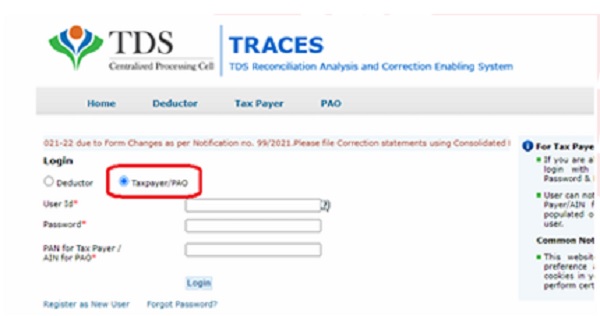
Step 3: On the next page, go to ‘Statement/Forms>Request for Form 13 ‘ from the dropdown menu.
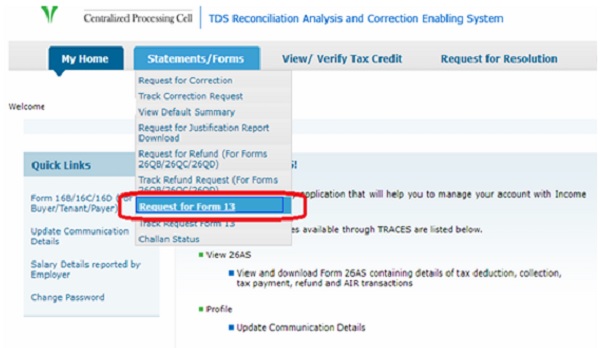
Step 4: On the next screen, select your residential status to proceed.
Step 5: Read the checklist and click ‘Proceed’
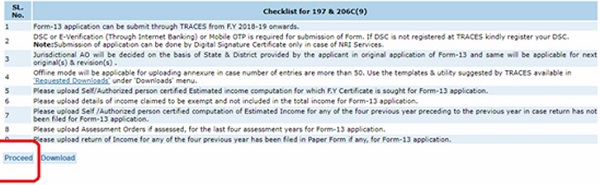
Step 6: Select the relevant option from the dropdown of ‘Request Type‘ and ‘Financial Year‘ and click ‘Proceed’
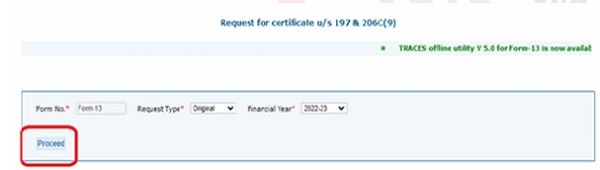
Step 7: The request number will be generated
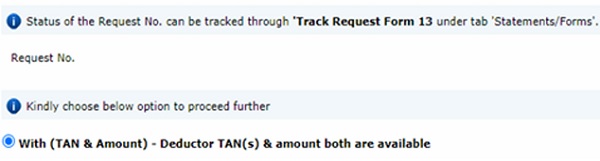
Step 8: Select the number of entries for which nil or lower TDS certificate is required.
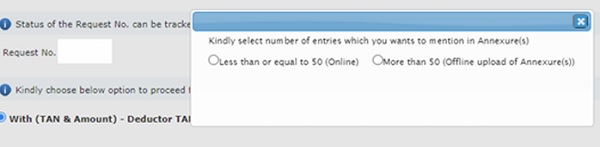
Step 9: Furnish the following details:
Point (i) to (v): Status, Residential Status, PAN, Email ID, and Mobile number shall be auto-filled. You need to select the state and district from the dropdown menu. Jurisdictional AO will be automatically assigned based on the State and District selected by the applicant.
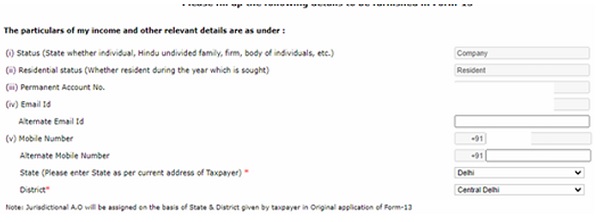
Point (vi): Details of existing liability under the Income-tax Act has to be provided:

Point (vii) to Point (xi): Enter the estimated total income, total tax, details of income claimed to be exempt, and details of payment of advance tax and tax already deducted/collected.
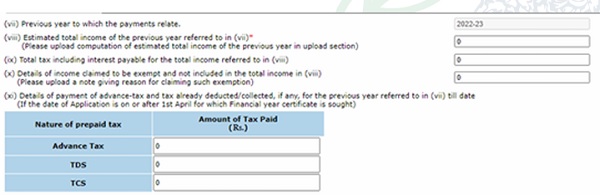
Point (xii):Select the declaration for exemption under Section 10, Section 11 or Section 12 for certain entities covered under Rule 28AB or not.

Step 10: Click ‘Save and Proceed‘
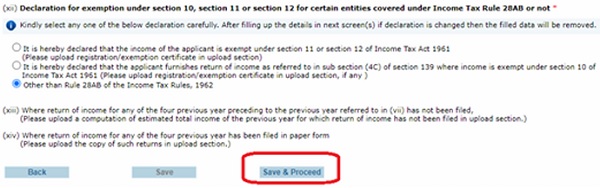
Step 11: Select the type of ‘Annexure‘ from the dropdown and click ‘Proceed’
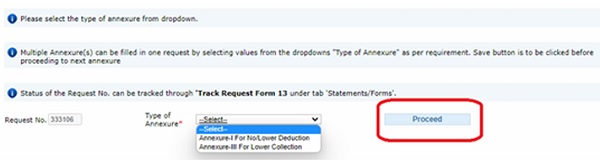
Step 12: Fill the details in the ‘Annexure-I (No/Lower Deduction)‘ and click on ‘Save & Proceed’
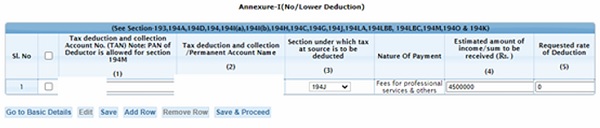
Step 13: Upload the required document by clicking ‘Browse‘. It is also mandatory to fill the template of estimated income.
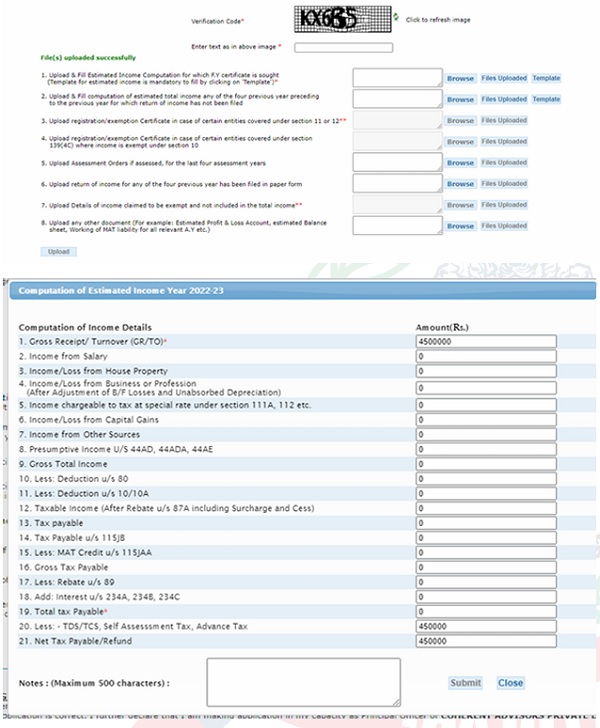
Step 14: Fill the declaration and click ‘preview and submit’
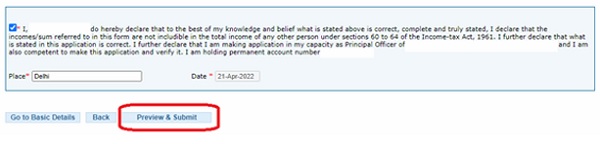
Step 15: Filled ‘ Form 13 ‘ will be displayed. If you want to edit the details, click on the ‘back button’ of the browser to go back to the previous screen. Else, proceed to ‘Submit’ the form.

Step 16: Validate the form using the suitable option and proceed to submit the form.
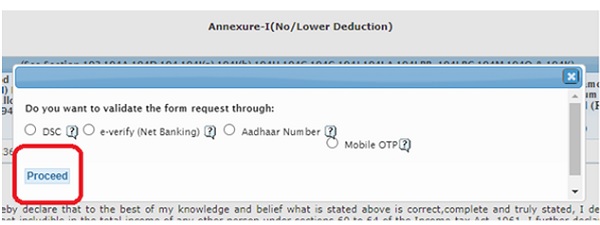
MCQs on Certificate of lower/no deduction of tax at source
Q1. An assessee can apply to the Assessing Officer to issue a nil or lower TDS certificate if the estimated tax liability of the assessee justifies ___________.
(a) no deduction of tax
(b) deduction of tax at a lower rate
(c) Either (a) or (b)
(d) None of the above
Correct answer: (c)
Justification of the correct answer: An assessee can apply to the Assessing Officer to issue a nil or lower TDS certificate. Such certificate is issued if the estimated tax liability of the assessee justifies no deduction of tax or deduction of tax at a lower rate.
Q2. The application to obtain the Nil or Lower TDS certificate can be filed only by a resident person.
(a) True
(b) False
Correct answer: (b)
Justification of the correct answer: The application to obtain the Nil or Lower TDS certificate can be filed by any person, i.e., resident, non-resident, individual, firm, domestic company, foreign company, etc.
Q3. The assessee can apply to obtain this certificate for which of the following incomes?
(a) Rental income where tax is deductible under 194-I
(b) Rental income where tax is deductible under Section 194-IB
(c) Lottery income where tax is deductible under section 194B
(d) Withdrawal from Employee’s Provident Fund where tax is deductible under
(d) Withdrawal from Employee’s Provident Fund where tax is deductible under section 192A
Correct answer: (a)
Justification of the correct answer: The assessee can apply to obtain this certificate in respect of the rental income where tax is deductible under Section 194-I and not for rental income where tax is deductible under 194-IB, lottery income where tax is deductible under section 194B or withdrawal from employee’s provident fund where tax is deductible under
(d) Withdrawal from Employee’s Provident Fund where tax is deductible under section 192A
Q4. The application for the issue of a Nil or Lower TDS certificate can be filed in _______.
(a) Form 64
(b) Form 13
(c) Form 61A
(d) Form 10-IA
Correct answer: (b)
Justification of the correct answer: The application for the issue of a Nil or Lower TDS certificate can be filed in Form No. 13
Q5. The certificate shall remain valid for __________.
(a) 1 year
(b) 5 years
(c) As mentioned by the Assessing Officer in the certificate
(d) None of the above
Correct answer: (c)
Justification of the correct answer: The certificate shall remain valid for such period as may be mentioned in that unless it is cancelled by the Assessing Officer before the expiry of that period.
Note:
1.Inserted by the Finance Act, 2023 with effect from 01.04.2023.
Taxability of perquisite in the form of rent-free accommodation or accommodation provided at a concessional rate
| Disclaimer:
The contents of this document are for information purposes only. This aims to enable public to have a quick and an easy access to information and do not purport to be legal documents. Viewers are advised to verify the content from Government Acts/Rules/Notifications etc. |
Taxability of perquisite in the form of rent-free accommodation or accommodation provided at a concessional rate
Introduction
When an employer provides residential accommodation free of cost or at a reduced rate to their employees, the value of this benefit is considered taxable as a perquisite in the hands of the employee. This benefit provided by an employer is taxable irrespective of whether the residential house is owned by the employer or it is taken on rent.
The Finance Act 2023 has rationalized the provisions related to the valuation of residential accommodation provided to employees.
The provisions related to rent-free accommodation or accommodation at a concessional rate provided by the employer to its employee are discussed in this tutorial.
What is rent-free accommodation?
When an employer provides a residential accommodation free of rent or at concessional rent to his employees, the value of this benefit is taxable as a perquisite. Here, ‘Accommodation’ includes a house, flat, farmhouse, accommodation in a hotel, motel, service apartment, guest house, caravan, mobile home, ship, or other floating structure.
How to calculate the value of perquisite?
The taxable value of the perquisite will depend on factors such as whether the accommodation is furnished or unfurnished, whether it is owned by the employer or taken on rent, etc. The taxable value will be reduced by the amount of rent recovered from the employee.
Calculation of perquisite in case of Government employees
If the accommodation is provided by the Central or State Government to the employees, the taxable value will be the license fees as determined by the Government in accordance with service rules.
However, for furnished accommodation, the value of the perquisite will be increased by 10% of the furniture cost. If the furniture is taken on hire by the employer, the value of the perquisite will be increased by the actual hire charges instead of 10% of the original cost of the furniture.
Calculation of perquisite in case of non-Government employees
In the case of owned unfurnished accommodation – The taxable value will depend on the population density of the city in which the accommodation is provided. If the accommodation is unfurnished and owned by the employer, the value of the perquisite shall be:
| Population of City (Note) | Perquisite Value | |
|---|---|---|
| Before 01-09-2023 | On or after 01-09-2023 | |
| Up to 10,00,000 | 7.5% of Salary | 5% of Salary |
| 10,00,001 to 15,00,000 | 10% of Salary | 5% of Salary |
| 15,00,001 to 25,00,000 | 10% of Salary | 7.5% of Salary |
| 25,00,001 to 40,00,000 | 15% of Salary | 7.5% of salary |
| Above 40,00,000 | 15% of Salary | 10% of Salary |
Note: Up to 31-08-2023, the population shall be checked as per the 2001 census, and From 01-09-2023, the population shall be checked as per the 2011 census.
For the application of the relevant percentage as specified above, salary should be taken for the period during which the employee occupied the said accommodation during the previous year.
In the case of leased or rented unfurnished accommodation – If the employer takes an unfurnished property on lease or rent and provides it to the employee, the taxable value shall be the lower of 10% of the salary (15% of salary up to 31-08-2023) or the actual rent paid by the employer.
In case of same accommodation is provided for more than one year – Where the same accommodation is continued to be provided to the same employee for more than one year, the valuation in subsequent years will not exceed the first year’s valuation adjusted by the Cost Inflation Index.
In this context, the “first year” means the financial year 2023-2024, or the financial year in which the accommodation was provided to the employee, whichever is later.
Thus, the perquisite value of rent-free accommodation in the subsequent year shall be lower of the following:
(a) Perquisite value computed as per the above rules; or
(b) First year’s perquisite value as adjusted by the Cost Inflation Index (CII).
The adjusted first year’s perquisite value shall be computed as per the following formula:
| Adjusted first year’s perquisite value | = | First year’s perquisite value | × | CII of the subsequent year |
| CII of the first year |
In the case of furnished accommodation – If the employer provides fully or partly furnished accommodation to the employee, the taxable value is calculated in the following steps:
Step 1: Compute the value of perquisite assuming the accommodation is unfurnished (as explained above)
Step 2: Add 10% p.a. of the original cost of all furniture, house appliances, gadgets, etc., owned by the employer and provided to the employee. However, if the furniture is taken on hire, the value of the perquisite shall be increased by the actual hire charges instead of 10% of the original cost of the furniture.
Calculation of perquisite in case accommodation is provided in a hotel
If an employer (Government or non-Government) provides hotel accommodation to an employee on his posting to another place, it will not be considered taxable if the employee’s stay in the hotel is up to 15 days during the year.
However, if the stay exceeds 15 days, the taxable value for additional days shall be lower of 24% of the salary for such period or actual charges incurred by the employer on such stay.
If the employer pays charges separately for lunch, dinner, laundry, etc. then those shall be taxed separately. But if there is a composite tariff for accommodation, then lunch, dinner, and laundry charges shall be taxed here under ‘rent-free accommodation’.
If the guest house in which the stay is provided is owned by the employer, the taxable value shall be computed assuming that it is an unfurnished or furnished accommodation (as explained above), as the case may be, provided to the employee.
What is the meaning of salary?
Salary shall be taken on a ‘due basis’ in respect of the period for which accommodation is occupied. Thus, if the salary is received in advance, it should be excluded. Where salary is due but not received, it should be included. This applies to all allowances, bonus, and commission also.
Salary for this purpose shall be an aggregate of basic salary, dearness allowance, bonus, commission, fees, taxable allowances, leave salary encashment, and any other taxable monetary payment.
However, exempt allowances, perquisites, employer’s contribution to PF, and retirement benefits shall not be included in salary. Tax paid by the employer on behalf of the employee is a perquisite and, therefore, not includible in “salary” for the purpose of computing the perquisite value of the rent-free house.
What if the house is not actually occupied?
If an accommodation has been placed at the disposal of the employee, he should be deemed to have enjoyed the perquisite, even if he is not in the physical occupation of the accommodation. [Instruction No. 1146, dated January 27, 1978]
When is rent-free accommodation not taxable?
If the house is at a remote location – Rent-free accommodation provided to an employee working at a mining site, an onshore oil exploration site, a project execution site, a dam site, a power generation site, or an offshore site shall not be taxable in the following situations:
a) The size of the house is not more than 1000 sq. feet (111.11 square yards) [800 sq. feet (88.89 square yards) up to 31-08-2023] and it is situated at least 8 km away from the local limit of a municipality or cantonment board.
b) The accommodation is provided in a remote area which is at least 30 km(40 km up to 31-08-2023) away from a town, the population of which is less than 1,00,000 (20,000 up to 31-08-2023) as per the latest published all-India census.
If the house is allocated to Judges – Rent-free official residence provided to a Judge of a High Court or a Judge of the Supreme Court is exempt from tax.
A similar exemption is extended to an officer of Parliament, a Union Minister, a Leader of Opposition in Parliament, and serving Chairman/members of UPSC.
Is there any relaxation on the transfer of job?
If an employee is provided with accommodation at a new place of posting and also allowed to retain the accommodation at the place of their previous posting, the taxable value shall be determined with reference to only one such accommodation which has the lower value for a period not exceeding 90 days.
After 90 days, the taxable value of both such accommodations shall be added to the salary income of the employee.
MCQs on Taxability of perquisite in the form of rent-free accommodation or accommodation provided at a concessional rate
Q1. When an employer provides residential accommodation ___________ to their employees, the value of this benefit is considered taxable as a perquisite in the hands of the employee.
(a) free of cost
(b) at a reduced rate
(c) Market Value
(d) Both (a) and (b)
Correct answer: (d)
Justification of the correct answer: When an employer provides residential accommodation free of cost or at a reduced rate to their employees, the value of this benefit is considered taxable as a perquisite in the hands of the employee.
Q2. For the calculation perquisite for rent-free accommodation or concessional rate accommodation, the accommodation includes_______.
(a) A house or flat
(b) A farmhouse, guest house, or service apartment
(c) accommodation in a hotel, motel, mobile home, ship
(d) All of the above
Correct answer: (d)
Justification of the correct answer: ‘Accommodation’ includes a house, flat, farmhouse, accommodation in a hotel, motel, service apartment, guest house, caravan, mobile home, ship, or other floating structure.
Q3. From 01-09-2023, Mr. A, an employee of ABC Ltd. was provided with a rent-free unfurnished accommodation owned by ABC Ltd. The taxable value of the rent-free accommodation will be _______ if the accommodation is located in a city having a population between 15 lakhs and 25 lakhs.
(a) 15% of the salary
(b) 10% of the salary
(c) 7.5% of the salary
(d) Market Value
Correct answer: (c)
Justification of the correct answer: The taxable value will depend on the population density of the city in which the accommodation is provided. If the accommodation is unfurnished and owned by the employer, the value of the perquisite shall be 7.5% of salary, if accommodation is provided in a city whose population is between 15 lakhs and 25 lakhs as per the 2011 census.
Q4. Mr. A, an employee of ABC Ltd. was provided with a rent-free unfurnished accommodation from 01-10-2023 which is taken on rent by ABC Ltd. The taxable value of the rent-free accommodation will be _______ if the accommodation is located in a city having a population between 10 lakhs and 15 lakhs.
(a) 5% of the salary
(b) 10% of the salary
(c) Actual rent paid by the employer
(d) Lower of (a) or (c)
Correct answer: (d)
Justification of the correct answer: If the employer takes an unfurnished property on lease or rent and provides it to the employee, the taxable value shall be the lower of 5% of the salary or the actual rent paid by the employer.
Q5. If the Central or State Government provides the accommodation to the employees, the taxable value of perquisite will be_______.
(a) 15% of the salary
(b) 10% of the salary
(c) Actual rent paid by the employer
(d) License fees as determined by the Government in accordance with service rules
Correct answer: (d)
Justification of the correct answer: If the Central or State Government provides the accommodation to the employees, the taxable value will be the license fees as determined by the Government in accordance with service rules.
Q6. ABC Ltd. provides hotel accommodation facility to Mr. P on his posting to another place for 14 days. How much amount will be taxed in the hands of Mr. P?
(a) 24% of salary
(b) Actual charges paid by the employer
(c) Lower of (a) or (b)
(d) Not taxable
Correct answer: (d)
Justification of the correct answer: If an employer (Government or non-Government) provides hotel accommodation to an employee on his posting to another place, it will not be considered taxable if the employee’s stay in the hotel is up to 15 days during the year.
However, if the stay exceeds 15 days, the taxable value for additional days shall be lower of 24% of the salary for such period or actual charges incurred by the employer on such stay.
Q7. Salary received in advance during the period for which accommodation is occupied shall be considered while computing taxable rent-free accommodation.
(a) Yes
(b) No
Correct answer: (b)
Justification of the correct answer: Salary shall be taken on a ‘due basis’ in respect of the period for which accommodation is occupied. Thus, if the salary is received in advance, it should be excluded. Where salary is due but not received, it should be included. This applies to all allowances, bonus, and commission also.
Q8. If the accommodation is provided to the Judge of a High Court or Supreme Court, the taxable value will be_______.
(a) 15% of salary
(b) 10% of salary
(c) License fees as determined by the Government in accordance with service rules
(d) Not taxable
Correct answer: (d)
Justification of the correct answer: Rent-free official residence provided to a Judge of a High Court or a Judge of the Supreme Court is exempt from tax. A similar exemption is extended to an officer of Parliament, a Union Minister, a Leader of Opposition in Parliament, and serving Chairman/members of UPSC.
Taxability of perquisite in the form of concessional or interest-free loan
| Disclaimer:
The contents of this document are for information purposes only. This aims to enable public to have a quick and an easy access to information and do not purport to be legal documents. Viewers are advised to verify the content from Government Acts/Rules/Notifications etc. |
Taxability of perquisite in the form of concessional or interest-free loan
Introduction
Where an employer provides an interest-free or concessional loan to an employee or any member of their household, the value of such loan facility is taxable as a perquisite under section 17.
When does a perquisite arise?
A perquisite arises when employers extend a loan facility to their employees for personal purposes such as education, medical treatment, marriage, etc.These loans are generally free or at a concessional rate of interest and are recovered from the salary of employees by way of deductions from salary over a period of time.
Employees taking interest-free loans or loans at concessional rates from the employer are at advantage over employees who obtain loans from the banks at market rates. Thus, to avoid any discrimination, the value of such interest-free loans or concessional loans is taxable as perquisite in the hands of employees.
The taxability shall arise if the loan is taken by the employee himself orany member of his household. Member of household includes—
(a) Spouse,
(b) Children and their spouses,
(c) Parents, and
(d) Servants and dependants.
How to calculate the value of the perquisite?
The taxable value in the hands of the employee shall be calculated as follows:
Step 1: Calculate the outstanding balance of each loan taken from the employer as of the last day of each month.
Step 2: Calculate interest on the amount computed in Step 1 at the rate of interest declared by the State Bank of India on the first day of the relevant financial year in respect of similar loans.
Step 3: Reduce the interest computed in Step 2 by any interest recovered from the employee.
Step 4: The resulting figure shall be the taxable perquisite.
When interest-free loans or concessional loans aren’t taxable as perquisites?
Loan up to Rs. 20,000
Interest-free loans or concessional rate loans taken from the employer up to Rs. 20,000 are not taxable in the hands of employees as perquisite. If the original loan was above the threshold limit but subsequently it is reduced below 20,000, it shall not be considered a petty loan. The interest on such a loan, even if it falls below 20,000, shall be calculated in accordance with the method prescribed above.
If an employee receives more than one loan (with each loan amount of less than 20,000), the aggregate of all loans should be considered to decide if it’s a petty loan or taxable. If an employee takes a loan in multiple trenches which in the aggregate exceeds 20,000, the entire amount shall be considered for computation of tax.
Loan for medical treatment
Any loan taken as interest-free or at a concessional rate from the employer for the medical treatment of diseases specified in approved hospitals is not taxable as perquisite.
However, this exemption will not be available in respect of loan that has been reimbursed to the employee by an insurance company under any medical insurance scheme.
Where medical insurance reimbursement is received, the taxable value shall be calculated on the amount reimbursed by the Insurance co. but not repaid against the outstanding loan. The value of the perquisite shall be calculated from the date of reimbursement.
For example, if an employee takes a loan of Rs. 2 lakhs for medical treatment, but later gets insurance money of Rs. 50,000 in respect of such treatment, the exemption will be available only in respect of Rs. 1.5 lacs. The taxable value will be computed at the prescribed rates for the balance amount of Rs. 50,000.
List of specified diseases for the purpose of medical treatment are:
a) Cancer
b) Tuberculosis
c) AIDS
d) Disease or ailment of the heart, blood, lymph glands, bone marrow, respiratory system, central nervous system, urinary system, liver, gall bladder, digestive system, endocrine glands or the skin, requiring surgical operation;
e) Ailment or disease of the eye, ear, nose or throat, requiring surgical operation
f) Fracture in any part of the skeletal system or dislocation of vertebrae requiring surgical operation or orthopedic treatment
g) Gynaecological or obstetric ailment or disease requiring surgical operation, caesarean operation or laperoscopic intervention
h) Ailment or disease of the organs mentioned at (d), requiring medical treatment in a hospital for at least three continuous days
i) Gynaecological or obstetric ailment or disease requiring medical treatment in a hospital for at least three continuous days
j) Burn injuries requiring medical treatment in a hospital for at least three continuous days
k) Mental disorder – neurotic or psychotic – requiring medical treatment in a hospital for at least three continuous days;
l) Drug addiction requiring medical treatment in a hospital for at least seven continuous days;
m) Anaphylectic shocks including insulin shocks, drug reactions and other allergic manifestations requiring medical treatment in a hospital for at least three continuous days.
MCQs on Taxability of perquisite in the form of a concessional or interest-free loan
Q1. Mr. A, an employee of ABC Ltd. obtains an interest-free loan of Rs. 19,000 for the renovation of his house from ABC Ltd. Whether the interest on such loan will be taxable in the hands of Mr. A?
(a) Yes, as the loan is obtained interest-free from the employer
(b) No, as the loan amount is less than Rs. 20,000
(c) No, as the loan is taken for the renovation of his house
(d) None of the above
Correct answer: (b)
Justification for the correct answer: Where an employer provides an interest-free or concessional loan to an employee or any member of their household, the value of such loan facility is taxable as a perquisite. However, loans up to Rs. 20,000 and loans for medical treatment are exempt from tax.
Q2. Mr. X, an employee of XYZ Ltd. obtains a loan at a concessional rate of Rs. 55,000 for the medical treatment of his wife for the treatment of cancer from XYZ Ltd. Whether the loan obtained is taxable in the hands of Mr. X?
(a) Yes, as the loan is obtained from the employer
(b) Yes, as the loan amount exceeds Rs. 20,000
(c) No, as the loan is taken for the treatment of a specified disease
(d) None of the above
Correct answer: (c)
Justification for the correct answer: Where an employer provides an interest-free or concessional loan to an employee or any member of their household, the value of such loan facility is taxable as a perquisite. However, loans up to Rs. 20,000 and loans for medical treatment of disease specified under Rule 3A are exempt from tax.
Q3: Any interest-free or concessional Loan taken by an employee from the employer is taxable _________ if the loan amount exceeds the specified limit.
(a) Under the head Salaries as “perquisites”
(b) Under the head House property
(c) Under the head Other Sources
(d) Under the head Capital Gains
Correct answer: (a)
Justification for the correct answer: Where an employer provides an interest-free or concessional loan to an employee or any member of their household, the value of such loan facility is taxable as a perquisite.
Q4. Where an employer provides an interest-free or concessional loan to an employee or any member of their household, the value of such loan facility is taxable as a perquisite. Who is considered “any member of their household”?
(a) Spouse and children
(b) Spouse of their children
(c) Parents and Dependents
(d) All of the above
Correct answer: (d)
Justification for the correct answer: The taxability shall arise if the loan is taken by the employee himself or his spouse, his children and their spouse, his parents or his servants and dependents.
Q5. While computing the value of perquisite, rate of interest declared by the __________ on the __________in respect of similar loans shall be taken.
(a) State Bank of India, first day of the relevant financial year
(b) State Bank of India, last day of the relevant financial year
(c) State Bank of India, first day of the month in which loan was taken
(d) State Bank of India, last day of the month in which loan was taken
Correct answer: (a)
Justification for the correct answer: While computing the value of perquisite, rate of interest declared by the State Bank of India on the first day of the relevant financial year in respect of similar loans shall be taken.
Q6. Mr. P took a loan of Rs. 5,00,000 from his employer for treatment of a specified disease of his daughter. However, Rs. 1,00,000 was reimbursed by the insurance company to Mr. P. The taxable value for the purpose of computing perquisite will be ________.
(a) 5,00,000
(b) 1,00,000
(c) 4,00,000
(d) None of the above
Correct answer: (c)
Justification for the correct answer: Any loan taken as interest-free or at a concessional rate from the employer for the medical treatment of specified diseases (i.e., cancer, tuberculosis, AIDS, etc.) in approved hospitals is not taxable as perquisite.
However, this exemption will not be available in respect of a loan that has been reimbursed to the employee by an insurance company under any medical insurance scheme.
Maintenance of Books of Accounts
| Disclaimer:
The contents of this document are for information purposes only. This aims to enable public to have a quick and an easy access to information and do not purport to be legal documents. Viewers are advised to verify the content from Government Acts/Rules/Notifications etc. |
Maintenance of Books of Accounts
Introduction
Section 44AA of the Income-tax Act mandates the maintenance of books of account by certain persons engaged in specified professions and businesses. It provides for the preparation and maintenance of books of account by a person if his income or gross turnover or receipts, as the case may be, exceeds the prescribed threshold limit.
Who is required to maintain books of accounts?
An assessee is required to maintain books of accounts if their income or gross turnover/receipts during the specified period exceeds the prescribed threshold limit specified in the income tax laws. Section 44AA specified the threshold limit as per the nature of business or profession which is given below:
(a) Specified Professions
(b) Non-Specified Professions
(c) Business eligible for presumptive taxation scheme under Section 44AD, 44AE , 44BB , or 44BBB
(d) Other Business
Specified Professions
Specified professionals are required to maintain their books of accounts irrespective of their gross receipts and income except where a presumptive taxation scheme under Section 44ADA is opted.
Specified professionals include any person engaged in Legal, Medical, Engineering, Architectural, Technical Consultancy, Interior decoration, Film artist, Authorized Representative, Accountancy Profession, Company secretary, or Information Technology.
Non-Specified Professions
Non-specified professionals are required to maintain books of account if the income from their profession or gross receipts of such profession exceeds the threshold given below:
a) For individual or HUF: if the income from such profession exceeds Rs. 2,50,000 or Gross receipts exceeds Rs. 25 lakhs, in any of the 3 years immediately preceding the previous year.
b) For others: if the income from such profession exceeds Rs. 1,20,000 or Gross receipts exceed Rs. 10 lakhs, in any of the 3 years immediately preceding the previous year.
Business eligible for presumptive taxation scheme under Section 44AD, 44AE , 44BB , or 44BBB
A Business entity opting for presumptive tax scheme under section 44AD, 44AE , 44BB , or 44BBB is required to maintain books of account in accordance with following norms:
a) Businesses eligible for presumptive tax scheme under section 44AD
-
- For resident individuals or HUFs – if the income of the assessee exceeds the maximum exemption limit and he has opted for the presumptive scheme in any of the last 5 previous years but does not opt for the same in the current year.
- For resident partnership firm – The taxpayer has opted for the scheme in any of the last 5 previous years but does not opt for the same in the current year.
b) Businesses eligible for presumptive tax scheme under Section 44AE-if the taxpayer (engaged in plying, hiring, or leasing goods carriage) claims that the profits are lower than the deemed profits.
c) Businesses eligible for Presumptive Tax Scheme under Section 44BB-if the taxpayer (non-resident assessee engaged in the exploration of mineral oil) claims that the profits are lower than the deemed profits.
d) Businesses eligible for Presumptive Tax Scheme under Section 44BBB-if the taxpayer (a foreign company engaged in civil construction) claims that the profits are lower than the deemed profits.
Other Business
A Business entity is required to maintain books of account if income from business or gross turnover of such business exceeds the threshold given below:
a) For individual or HUF: if the income from such business exceeds Rs. 2,50,000 or Gross turnover exceeds Rs. 25 lakhs, in any of the 3 years immediately preceding the previous year.
b) For others: if the income from such business exceeds Rs. 1,20,000 or Gross turnover exceeds Rs. 10 lakhs, in any of the 3 years immediately preceding the previous year.
Note: Where a business or profession has been set up during the previous year, the threshold limit of income or gross turnover/receipts of the current year shall be considered.
Which books of accounts are required to be maintained?
Rule 2F of the Income-tax Rules prescribes the following books of accounts to be maintained under section 44AA :
1. For specified professions other than company secretary and information technology (where gross receipts exceed Rs. 1,50,000 in any of the 3 years immediately preceding the previous year) –
a) Cash book
b) Journal, if books of accounts are maintained according to the mercantile system of accounting
c) Ledgers
d) Carbon copies of bills and carbon copies or counterfoil of receipts issued by the assessee of value exceeding Rs. 25 (must be machine numbered or serially numbered)
e) Original bills issued to the assessee and receipts in respect of the expenditures incurred by him.
f) Signed vouchers, if bills and receipts are not issued and the amount of expenditure does not exceed Rs. 50 if the cash book does not contain adequate particulars in respect of these expenditures.
However, for medical professions, the following additional books are required to be maintained:
– Daily case register in Form 3C
– Inventory under broad heads of stock of drugs, medicines, and other consumable accessories used for the purpose of profession, as on the first and last day of the previous year.
2. For specified professions (in every other case), and non-specified professions & businesses where gross receipts exceed Rs. 1,50,000 in any of the 3 years immediately preceding the previous year –
Such books of account which may enable the Assessing Officer to compute the taxable income.
Other Provisions
Where books of account and other documents should be kept and maintained?
Books of account and other documents should be kept and maintained by the person at the place where he is carrying on the profession or, where the profession is carried on at more than one place, at the principal place of his profession.
However, where the person keeps and maintains separate books of account in respect of each place where the profession is carried on, such books of account and other documents may be kept and maintained at the respective places at which the profession is carried on.
Period of maintenance
Books of account and documents should be kept and maintained for a period of 6 years from the end of the relevant assessment year.
However, if the assessment in relation to any assessment year has been reopened under Section 147 within the prescribed period, all the books of account and other documents which were kept and maintained at the time of reopening of the assessment should be kept and maintained until the assessment so reopened has been completed.
Penalty for non-compliance
If an assessee fails to maintain or retain books of account and other documents for the specified period in accordance with this provision, a penalty may be imposed under Section 271A of Rs. 25,000.
MCQs on Maintenance of Books of Accounts
Q1. Section 44AA specified the threshold limit for maintenance of books of accounts for which of the following taxpayers?
(a) Specified Professions
(b) Non-Specified Professions
(c) Business
(d) All of the above
Correct answer: (d)
Justification of correct answer: Section 44AA specified the threshold limit as per the nature of business or profession which is given below:
1. Specified Professions
2. Non-Specified Professions
3. Business eligible for presumptive taxation scheme under Section 44AD, 44AE, 44BB, or 44BBB
4. Other Business
Q2. Which of the following persons are required to maintain books of accounts irrespective of the gross receipts and income except where a presumptive taxation scheme under Section 44ADA is opted?
(a) Specified Professions
(b) Non-Specified Professions
(c) Business eligible for presumptive taxation scheme under Section 44AD, 44AE , 44BB , or 44BBB
(d) All of the above
Correct answer: (a)
Justification of correct answer: Specified professionals are required to maintain their books of accounts irrespective of their gross receipts and income except where a presumptive taxation scheme under Section 44ADA is opted.
Specified professionals include any person engaged in Legal, Medical, Engineering, Architectural, Technical Consultancy, Interior decoration, Film artist, Authorized Representative, Accountancy Profession, Company secretary, or Information Technology.
Q3. Non-specified professionals (Individuals) are required to maintain books of account if the income from their profession or gross receipts of such profession exceeds ________.
(a) Income exceeds Rs. 2,50,000 or Gross receipts exceeds Rs. 25 lakhs, in any of the 3 years immediately preceding the previous year
(b) Income exceeds Rs. 1,20,000 or Gross receipts exceed Rs. 10 lakhs, in any of the 3 years immediately preceding the previous year
(c) either (a) or (b)
(d) None of the above
Correct answer: (a)
Justification of correct answer: Non-specified professionals are required to maintain books of account if the income from their profession or gross receipts of such profession exceeds the threshold given below:
(a) For individual or HUF: if the income from such profession exceeds Rs. 2,50,000 or Gross receipts exceeds Rs. 25 lakhs, in any of the 3 years immediately preceding the previous year.
(b) For others: if the income from such profession exceeds Rs. 1,20,000 or Gross receipts exceed Rs. 10 lakhs, in any of the 3 years immediately preceding the previous year.
Q4. Resident Individual eligible for presumptive tax scheme under section 44AD is required to maintain books of account if the income of the assessee exceeds the maximum exemption limit and he has opted for the presumptive scheme in any of the last 5 previous years but does not opt for the same in the current year.
(a) True
(b) False
Correct answer: (a)
Justification of correct answer: Resident Individual or HUFs eligible for presumptive tax scheme under section 44AD is required to maintain books of account if the income of the assessee exceeds the maximum exemption limit and he has opted for the presumptive scheme in any of the last 5 previous years but does not opt for the same in the current year.
Q5. Resident Individual eligible for presumptive tax scheme under Section 44AE is required to maintain books of account if the income of the assessee exceeds the maximum exemption limit and he has opted for the presumptive scheme in any of the last 5 previous years but does not opt for the same in the current year.
(a) True
(b) False
Correct answer: (b)
Justification of correct answer: Businesses eligible for presumptive tax scheme under Section 44AE are required to maintain books of accounts if the taxpayer (engaged in plying, hiring, or leasing goods carriage) claims that the profits are lower than the deemed profits.
Q6: ABC Ltd. engaged in the business of manufacturing paper is required to maintain books of accounts if _________.
(a) Income from business exceeds Rs. 2,50,000 or Gross turnover exceeds Rs. 25 lakhs, in any of the 3 years immediately preceding the previous year.
(b) Income from such business exceeds Rs. 1,20,000 or Gross turnover exceeds Rs. 10 lakhs, in any of the 3 years immediately preceding the previous year.
(c) Either (a) or (b)
(d) None of the above
Correct answer: (b)
Justification of correct answer: A Business entity is required to maintain books of account if the income from such business exceeds Rs. 1,20,000 or Gross turnover exceeds Rs. 10 lakhs, in any of the 3 years immediately preceding the previous year.
Comment on the incorrect answer: An individual or HUF is required to maintain books of account if the income from such business exceeds Rs. 2,50,000 or Gross turnover exceeds Rs. 25 lakhs, in any of the 3 years immediately preceding the previous year.
Q7. Books of account and documents should be kept and maintained for a period of _________ from the end of the relevant assessment year.
(a) 6 years
(b) 7 years
(c) 5 years
(d) No Limit
Correct answer: (a)
Justification of correct answer: Books of account and documents should be kept and maintained for a period of 6 years from the end of the relevant assessment year.
Q8. What is the penalty if an assessee fails to maintain or retain books of account and other documents for the specified period in accordance with this provision?
(a) 10,000
(b) 25,000
(c) 1,00,000
(d) No Penalty
Correct answer: (b)
Justification of correct answer: If an assessee fails to maintain or retain books of account and other documents for the specified period in accordance with this provision, a penalty may be imposed under Section 271A of Rs. 25,000.
Deduction of tax in case of Specified Senior Citizen
| Disclaimer:
The contents of this document are for information purposes only. This aims to enable public to have a quick and an easy access to information and do not purport to be legal documents. Viewers are advised to verify the content from Government Acts/Rules/Notifications etc. |
Deduction of tax in case of Specified Senior Citizen
A senior citizen (whose age is 75 years or more) will not be required to file his return of income if his income includes only pension income and interest income from any account maintained with specified bank and such specified bank computed the total income and deduct tax from it.
Who is required to deduct tax under section 194P?
Every specified bank is responsible for deducing tax at source in accordance with section 194P. The bank shall be liable to –
a) Compute the total income of a specified senior citizen for the relevant assessment year after giving effect to the deduction under Chapter VI-A and rebate under Section 87A;and
b) Deduct income tax on the total income on the basis of the rates in force.
Here ‘Specified Bank’ means a banking company which is a scheduled bank and has been appointed as agent of RBI under Section 45 of the RBI Act, 1934.
Who is eligible for section 194P relief?
Tax is required to be deducted only if the recipient is a resident senior citizen whose age is 75 years or more at any time during the previous year.
Conditions for deduction of tax under section 194P
Tax is required to be deducted under this provision only if the following conditions are satisfied:
a) The income of the deductee includes only pension and interest income;
b) The interest is received or receivable from any account maintained by the deductee in such specified bank;
c) The pension income is received in the same bank; and
d) The senior citizen furnishes a declaration in Form No. 12BBA to the bank containing particulars related to pension income.
The effect of the deduction allowable under Chapter VI-A shall be given based on the evidence furnished by the senior citizen during the previous year. The specified bank is also required to maintain the declaration and the evidence furnished by the senior citizen.
Threshold limit for tax deduction
No threshold limit has been prescribed for the deduction of tax at source. The tax shall be deducted if any tax is payable on the total income (aggregate of pension and interest income after deduction under Chapter VI-A and rebate under Section 87A) of the deductee.
Rate of TDS
The tax shall be deducted at the rates in force. The rate shall be further increased by Surcharge and Health & Education Cess.
The provisions of Section 194P override all other provisions of Chapter XVII-B. Thus, if any tax is also deductible under any other Section (say, Section 194A from interest payable by a bank on the time deposits), the bank shall deduct the tax under this provision only.
For example, if a specified senior citizen earns a pension income of Rs. 2,00,000 and interest income of Rs. 3,00,000 from the fixed deposit during the year, the bank shall not deduct any tax from the interest payable during the year as tax payable on his total income shall be nil after claiming rebate under Section 87A. The bank shall not be required to deduct the tax from the interest payable even if it exceeds the threshold limit of Rs. 50,000 specified in Section 194A.
Tax deducted under this provision is required to be deposited to the credit of the Central Government through Challan ITNS 281 within 7 days from the end of the month in which tax was deducted.
However, the tax deducted during the month of March shall be deposited by 30th April of the next financial year.
Exemption from filing return of Income (ITR)
Where tax has been deducted under section 194P, specified senior citizen shall not be liable to file his return of income for the assessment year relevant to the previous year in which tax has been deducted.
Penalty and Prosecution
Failure to comply with the provisions of deduction of tax at source under this provision may result in penalties and prosecution as per the following provisions:
a) If a person fails to deduct tax at source, he shall be liable for payment of penalty under Section 271C;
b) If a person deducts tax but fails to deposit the same to the credit of the Central Government, he shall be liable for the penalty under Section 221and prosecution under Section 276B.
However, no person shall be punishable under Section 276B if he proves that there was reasonable cause for the failure. Further, a person can also file an application for compounding of offence.
MCQs on deduction of tax in case of Specified Senior Citizen
Q1. Deduction under section 194P is applicable in the case of a senior citizen whose age is _________.
(a) 60 years or more
(b) 80 years or more
(c) 75 years or more
(d) None of the above
Correct Answer: (c)
Justification of the correct answer: A specified bank is responsible to compute the total income and deduct tax from it under section 194P if the account holder is a senior citizen (whose age is 75 years or more) and his income includes only pension income and interest income from any account maintained with such bank.
Q2. Senior citizens having only ___________ are eligible for section 194P.
(a) Pension income and interest income
(b) Pension income and Income from one-house property
(c) Interest income
(d) Pension income
Correct Answer: (a)
Justification of the correct answer: A specified bank is responsible to compute the total income and deduct tax from it under section 194P if the account holder is a senior citizen (whose age is 75 years or more) and his income includes only pension income and interest income from any account maintained with such bank.
Q3. Mr. A, a non-resident whose age is 72 years, has only pension income from a specified bank. Is he eligible under section 194P?
(a) Yes, as he has only pension income
(b) No, as he is less than 75 years
(c) No, as he is a non-resident
(d) Both (b) and (c)
Correct Answer: (d)
Justification of the correct answer: Tax is required to be deducted under this provision only if the recipient is a resident senior citizen whose age is 75 years or more at any time during the previous year.
Q4: As per section 194P, the deductee is required to furnish a declaration in ________ to the bank containing particulars related to pension income.
(a) Form No. 12BBA electronically
(b) Form No. 12BBA in paper form
(c) Form No. 12BBA electronically or in paper form
(d) No declaration is required
Correct Answer: (b)
Justification of the correct answer: The deductee furnishes a declaration in Form No. 12BBA in paper form to the bank containing particulars related to pension income.
Q5: Where any person responsible for deducting tax fails to deduct tax or after deduction, fails to deposit the same to the credit of the Central Government, the deductor shall be liable for _______.
(a) Penalty under section 271C
(b) Prosecution under section 276B
(c) Both (a) and (b)
(d) None of the above
Correct Answer: (c)
Justification of the correct answer: Penalty under section 271C shall be applicable, where any person responsible for deducting tax fails to deduct tax or after deduction, fails to deposit the same to the credit of the Central Government. However, such penalty shall not exceed the amount of tax liable to be deducted or deposited, as the case may be.
Further, the deductor shall be liable for prosecution under section 276B for a term that shall not be less than 3 months but may extend to 7 years and with a fine.
Q7. While computing the total income of specified senior citizen whether deduction under Chapter VI-A and rebate under section 87A is to be considered by the specified bank?
(a) Yes
(b) No
(c) Maybe
(d) None of the above
Correct Answer: (a)
Justification of the correct answer: The specified bank shall be liable to compute the total income of a specified senior citizen for the relevant assessment year after giving effect to the deduction under Chapter VI-A and rebate under Section 87A.
Q8. What is the tax rate for the deduction of tax under section 194P?
(a) 10%
(b) 20%
(c) Rate in force
(d) 5%
Correct Answer: (c)
Justification of the correct answer: The specified bank shall be liable to compute the total income of a specified senior citizen for the relevant assessment year after giving effect to the deduction under Chapter VI-A and rebate under Section 87A and deduct income tax on the total income so computed on the basis of the rates in force.
TDS on Cash Withdrawals
| Disclaimer:
The contents of this document are for information purposes only. This aims to enable public to have a quick and an easy access to information and do not purport to be legal documents. Viewers are advised to verify the content from Government Acts/Rules/Notifications etc. |
TDS on cash withdrawals
Section 194N provides that every banking company, cooperative bank, or post office shall be required to deduct tax at source from any sum paid in cash from one or more accounts maintained by the recipient. The tax shall be deducted at the rate of 2% or 5% as the case may be.
Who is required to deduct tax under this section?
Every banking company (including any bank or banking institution), co-operative bank, or a post-office, which is responsible for payment of cash to a person, from one or more accounts maintained by him, shall be required to deduct tax under this provision. The tax shall be deducted at the time of payment.
Who is a deductee?
Tax is required to be deducted in all cases, whether the deductee is a resident or non-resident.
Rate of TDS and threshold limit
If no default is made in the filing of the return
Tax is required to be deducted at the rate of 2% of the sum if the aggregate of the amount withdrawn exceeds Rs. 1 crore (Rs. 3 crores where the recipient is a co-operative society1).The rate shall not be further increased by Surcharge and Health & Education Cess if the sum is payable to a resident person. The rate of TDS shall be increased by the applicable surcharge and health & education cess if the payee is a non-resident person or a foreign company. If the deductee does not furnish his PAN to the deductor, the tax shall be deducted at the rate of 20% under Section 206AA.
If a person defaults in the filing of a return
If a person has not filed a return of income for all of the three assessment years immediately preceding the previous year in which cash is withdrawn, and the due date for filing the return under section 139(1) has expired, the tax shall be deducted at the rates specified:
a) At the rate of 2% of the sum, if the aggregate of the amount withdrawn exceeds Rs. 20 lakhs during the previous year but does not exceed Rs. 1 crore(Rs. 3 crores where the recipient is a co-operative society2);
b) At the rate of 5% of the sum, if the aggregate of the amount withdrawn exceeds Rs. 1 crore (Rs. 3 crores where the recipient is a co-operative society3)during the previous year.
How to check the return filing status?
The Department has provided a utility of “ITR Filing Compliance Check” on https://report.insight.gov.in which will be available to Scheduled Commercial Banks (SCBs) to check the IT Return filing status in bulk mode on the basis of the PAN of the deductee.
Exemption from TDS
No tax is required to be deducted from any sum paid or payable to the following:
a) The Government
b) Any banking company or a co-operative bank or a post office
c) Any business correspondent of a banking company or a co-operative bank in accordance with the RBI guidelines
d) Any white-label automated teller machine (ATM) operator of a banking company or a co-operative bank in accordance with the RBI Authorisation; or
e) Any person specified by the Central Government. Further, Central Government is empowered to specify the reduced rate for the deduction of tax under this provision.
How to deposit TDS?
Tax deducted under this provision is required to be deposited to the credit of the Central Government through Challan ITNS 281 within 7 days from the end of the month in which tax was deducted.
However, the tax deducted during the month of March shall be deposited by 30th April of the next financial year.
Filing of TDS statement
The person responsible for the deduction of tax at source under this provision is required to file a statement of tax deducted at source in Form 26Q quarterly.
TDS Certificate
The deductor shall issue a TDS certificate to the assessee in Form No. 16A within 15 days from the due date of furnishing of the TDS statement.
Consequences for failure to deduct or deposit tax
Where any person responsible for deducting tax at source fails to deduct tax or after deducting fails to deposit the same, he shall be treated as assessee-in-default. In that case, interest under section 201 will be applicable.
If the deductor fails to deduct TDS, interest at the rate of 1% per month or part of the month shall be applicable, till such failure continues. Interest shall be calculated from the date when such tax was required to be deducted till the date such tax is actually deducted.
Further, if the deductor after having deducted the tax, fails to deposit the same to the credit of the Central Government, interest at the rate of 1.5% per month or part thereof shall be applicable till such failure continues. The interest computation shall commence from the date on which the tax was deducted and end with the date when such tax was deposited to the government.
Penalty and Prosecution
Failure to comply with the provisions of deduction of tax at source under this provision may result in penalties and prosecution as per the following provisions:
a) If a person fails to deduct tax at source, he shall be liable for payment of penalty under Section 271C;
b) If a person deducts tax but fails to deposit the same to the credit of the Central Government, he shall be liable for the penalty under Section 221and prosecution under Section 276B.
However, no person shall be punishable under Section 276B if he proves that there was reasonable cause for the failure. Further, a person can also file an application for compounding of offence.
Consequences for failure to furnish TDS Statement?
Where any person fails to furnish a TDS statement, section 234E shall be applicable, wherein the deductor is liable to pay fees at the rate of Rs. 200 per day during such default continues. However, such fees should not exceed the amount of TDS.
Moreover, he shall be liable for penalties under sections 271H of Rs. 10,000 which can be extended to Rs. 100,000, and 272A of Rs. 500 for every day during which failure continues.
Consequences for failure to issue TDS Certificates
Where any person, responsible for issuing TDS Certificates, fails to issue such certificates, a penalty under section 272A shall be applicable of Rs. 500 for every day during which failure continues.
MCQs on Payment of Certain amounts in Cash
Q1. Tax under section 194N is required to be deducted by _________.
(a) Banking Company
(b) Co-operative bank
(c) Post-office
(d) All of the above
Correct answer: (d)
Justification of the correct answer: Every banking company (including any bank or banking institution), co-operative bank, or a post-office, which is responsible for payment of cash to a person, from one or more accounts maintained by him, shall be required to deduct tax under Section 194N.
Q2. Tax is required to be deducted in case where the deductee is a non-resident.
(a) True
(b) False
Correct answer: (a)
Justification of the correct answer: Tax is required to be deducted in all cases whether the deductee is a resident or non-resident.
Q3: What is the threshold limit to deduct tax under section 194N, where no default is made in the filing of the return by the deductee who is an individual?
(a) Rs. 1 crore
(b) Rs. 20 lakhs
(c) Rs. 50 lakhs
(d) No limit
Correct answer: (a)
Justification of the correct answer: Where no default is made in the filing of the return i.e., deductee has filed its return of income timely, tax is required to be deducted if the aggregate of the amount withdrawn exceeds Rs. 1 crore(Rs. 3 crores where the recipient is a co-operative society).
Q4: No tax under section 194N is required to be deducted if cash withdrawal is made by _________.
(a) Any banking company or a co-operative bank or a post office
(b) Any white-label automated teller machine (ATM) operator of a banking company or a co-operative bank in accordance with the RBI Authorisation
(c) The Government
(d) All of the above
Correct answer: (d)
Justification of the correct answer: No tax is required to be deducted from any sum paid or payable to the following:
a) The Government
b) Any banking company or a co-operative bank or a post office
c) Any business correspondent of a banking company or a co-operative bank in accordance with the RBI guidelines
d) Any white-label automated teller machine (ATM) operator of a banking company or a co-operative bank in accordance with the RBI Authorisation; or
e) Any person specified by the Central Government. Further, Central Government is empowered to specify the reduced rate for the deduction of tax under this provision.
Q5: Tax deducted under this provision is required to be deposited to the credit of the Central Government through _________.
(a) Challan ITNS 281
(b) Challan ITNS 280
(c) Challan ITNS 283
(d) None of the above
Correct answer: (a)
Justification of the correct answer: Tax deducted under this provision is required to be deposited to the credit of the Central Government through Challan ITNS 281 within 7 days from the end of the month in which tax was deducted. However, the tax deducted during the month of March shall be deposited by 30th April of the next financial year.
Q6: The person responsible for the deduction of tax at source under this provision is required to file a statement of tax deducted at source in __________.
(a) Form 26Q
(b) Form 24Q
(c) Form 27Q
(d) None of the above
Correct answer: (a)
Justification of the correct answer: The person responsible for the deduction of tax at source under this provision is required to file a statement of tax deducted at source in Form 26Q quarterly.
Updated Return of Income
1.Amendment made by the Finance Act, 2023 with effect from 01.04.2023.
2.Amendment made by the Finance Act, 2023 with effect from 01.04.2023.
3.Amendment made by the Finance Act, 2023 with effect from 01.04.2023.
Updated Return of Income
| Disclaimer:
The contents of this document are for information purposes only. This aims to enable public to have a quick and an easy access to information and do not purport to be legal documents. Viewers are advised to verify the content from Government Acts/Rules/Notifications etc. |
Updated Return of Income
An updated return is a return of income that can be filed by a taxpayer within 48 months from the end of the relevant assessment year, even if he has not previously filed a return for that year. An amount equal to 25% or 50% as additional tax is required to be paid with such updated return.[Section 139(8A), Section 140B, Rule 12AC]
Note: The Finance Act 2025 has increased the timelines to file updated returns from 24 months to 48 months effective from Assessment Year 2026-27.
What is an updated return?
An updated return is a type of tax return that allows taxpayers to file their returns with more time. It is intended to encourage voluntary tax compliance.
An updated return can be filed by any person, except in certain circumstances, regardless of whether they have previously filed an original, belated, or revised return for the relevant assessment year.
The filing of an updated return is optional for the taxpayer.
When can an updated return be filed?
An updated return may be filed by any person in any case, except under certain circumstances.
A person may file an updated return of his income or the income of any other person in respect of which he is assessable under the Income-tax Act, such as in a representative capacity or in case of clubbing of income.
A person can file an updated return even if he has furnished a return of loss under section 139(3) earlier for the relevant assessment year, but the updated return should not be a return of loss.
The time limit for filing of updated return
The time limit provided for filing an updated return is 48 months from the end of the relevant assessment year.
In the financial year 2025-26, a person can file an updated return for AY 2024-25, 2023-24, 2022-23, 2021-22.
Form for filing an updated return
An updated return shall be filed in the relevant ITR Form as applicable to the taxpayer. The taxpayer will be required to fill the Schedule ‘Part A Gen_139(8A)’ and Schedule ‘Part B ATI’ of the relevant form to file an updated return.
Manner of furnishing of an updated return
An updated return shall be filed electronically under Digital Signature Certificate (DSC) in case of the following taxpayers: (a) Company (b) Political Party (c) Any person whose accounts are required to be audited under Section 44AB of the Income-tax Act except person filing return in ITR-7.
For other taxpayers, the updated return shall be filed electronically either under Digital Signature Certificate or under Electronic Verification Code (EVC).
Reporting in ITR while filing an updated return
When a person is filing an updated return, he is required to provide certain details in the relevant ITR forms. These forms include Schedule ‘Part A Gen_139(8A)’ and ‘Part B ATI’. The details that need to be provided include:
- Basic details i.e. PAN, Name, and Aadhaar Number
- Details of earlier return, if filed i.e. section, ITR form, acknowledgment number, and date of filing of the previous return
- Eligibility of filing an updated return
- Relevant ITR form selected for updated return
- Reasons for filing the updated return
- Time of filing of updated return – The person needs to specify whether the updated return is being filed within 12 months, between 12 to 24 months, 24 to 36 months or 36 to 48 months from the end of the assessment year.
- Whether filing of updated return result in the reduction of carried forward loss, unabsorbed depreciation, or tax credit? If yes, then the person needs to select the affected assessment years and whether the revised or updated return is filed for such years.
- Head-wise reporting of additional income as shown in the updated return and computation of tax payable on the updated return
- Details of payments of tax on updated return
- Details of advance tax, self-assessment tax, and regular assessment tax paid, the credit of which has not been claimed in the earlier return
- Relief under section 89which was not claimed in the earlier return
When an updated return cannot be filed?
If an updated return is a return of loss
An updated return cannot be filed if it reflects total income as a loss. However, there is no prohibition on filing an updated return if there is a loss under any head of income but the total income is positive.
For example, Mr. A filed his return of income for the Assessment Year 2022-23 declaring a total income of Rs. 10 lakhs. Subsequently, he noticed that he had failed to disclose in his return of income a short-term capital gain of Rs. 2 lakhs arising from the transfer of listed equity shares under section 111A. In the same year, he also suffered a long-term capital loss of Rs. 10 lakhs from the transfer of immovable property.
In this case, Mr. A would be required to carry forward the long-term capital loss from the transfer of immovable property because it cannot be adjusted from the other incomes that Mr. A has. But due to this fact, he won’t be restricted from filing an updated return because ultimately his total income (after including short-term capital gain from the transfer of listed equity shares) would be positive, i.e., Rs. 12 lakh.
If an updated return results in lower tax liability
An updated return cannot be filed if it decreases the total tax liability determined based on an earlier return.
If an updated return results in or increase in the refund
An updated return cannot be filed if it results in a refund or increases the refund previously due on the basis of an earlier return.
If a search is initiated against the assessee
An updated return cannot be filed for the assessment year relevant to the previous year in which a search is initiated under section 132 and for any assessment year preceding such assessment year.
For example, if a search was initiated on 01-06-2024, the updated return cannot be filed for the assessment year 2025-26 and any year preceding such assessment year.
If books of account or other documents or any assets are requisitioned
An updated return cannot be filed for the assessment year relevant to the previous year in which requisition is made under section 132A and for any assessment year preceding such assessment year.
If a survey conducted against the assessee
An updated return cannot be filed for the assessment year relevant to the previous year in which the survey is conducted under section 133A and for any assessment year preceding such assessment year.
However, this provision does not restrict the assessee from filing an updated return where the survey is conducted in connection to TDS or TCS.
If documents or assets are seized or requisitioned in case of any other person belonging to the assessee
A person shall not be eligible to file an updated return if a notice has been issued to him to the effect that:
- any money, bullion, jewellery, or valuable article or thing, seized or requisitioned under section 132or section 132Ain the case of any other person belonging to him; or
- any books of account or documents, seized or requisitioned under section 132or section 132Ain the case of any other person, pertaining to, or any other information contained therein, related to him.
In the above cases, the person shall not be eligible to file an updated return for the assessment year relevant to the previous year in which such search is initiated or requisition is made and any assessment year preceding such assessment year.
If the updated return has already been filed
An updated return cannot be revised as it can be filed only once for any particular assessment year.
If the assessment is pending or completed
An assessee shall not be eligible to file an updated return of the year of which assessment or reassessment or recomputation or revision is pending or has been completed.
If AO has information about the assessee under specified Acts
A person cannot file an updated return for any assessment year if the Assessing Officer (AO) has information in respect of him for that year under the following Acts, and the same has been communicated to him before the filing of the updated return:
- Prevention of Money Laundering Act, 2002;
- The Black Money (Undisclosed Foreign Income and Assets) and Imposition of Tax Act, 2015;
- The Prohibition of Benami Property Transactions Act, 1988; or
- The Smugglers and Foreign Exchange Manipulators (Forfeiture of Property) Act, 1976.
If AO has information about the assessee under DTAA or TIEA
Where any information is received under Double Taxation Avoidance Agreement (DTAA) or Tax Information Exchange Agreement (TIEA) in respect of a person for the relevant assessment year, he shall not be eligible to file an updated return for that year provided the same has been communicated to him before the filing of updated return.
If any prosecution proceeding is initiated
Where any prosecution proceedings have been initiated against the person for the relevant assessment year, he shall not be eligible to file an updated return for such year.
If show cause notice under section 148A
Where any show-cause notice is issued under section 148A after 36 months from end of relevant assessment year, he shall not be eligible to file an updated return for such year. However if the order has been passed under section 148A(3) determining that the case is not a fit case to issue notice under section 148 then such provision shall not be applicable.
In other notified cases
A person or class of persons as notified by the Central Board of Direct Taxes (CBDT) shall not be eligible to file the updated return.
Curative Updated Return of Subsequent Years
When a person files an updated return for a previous year, and as a result, the amount of the following is reduced for any subsequent year, the person shall be required to file an updated return for each subsequent year:
– Carried Forward Losses; or
– Carried Forward Unabsorbed Depreciation; or
– MAT Credit; or
– AMT Credit
This is to ensure that the correct amount of losses are carried forward and can be used to offset future income.
For Example, Mr. A had reported the following income or loss in the income-tax return filed for the following assessment years:
| Particulars | AY 2023-24 | AY 2022-23 | AY 2021-22 |
|---|---|---|---|
| Income (or loss) under the head Business or Profession | 80,00,000 | 10,00,000 | (20,00,000) |
| Less: Set-off of loss (AY 2019-20) | (10,00,000) | (10,00,000) | – |
| Total Income | 70,00,000 | – | – |
| Loss carried forward for adjustment in subsequent years | – | 10,00,000 | 20,00,000 |
Mr. A filed an updated return for Assessment Year 2022-23 declaring the additional business income of Rs. 25,00,000. He set off the entire loss of AY 2021-22(Rs. 20,00,000) against the business income reported in such an updated return. As declaring additional income in the updated return for AY 2022-23 results in the reduction of loss carried forward to subsequent year (i.e., AY 2023-24), Mr. A shall be required to furnish an updated return for AY 2023-24 as well. The revised computation of income or loss in updated returns shall be as under:
| Particulars | Updated Return AY 2023-24 | Updated Return AY 2022-23 |
|---|---|---|
| Income (or loss) under the head Business or Profession disclosed in earlier return | 80,00,000 | 10,00,000 |
| Additional business income disclosed in the updated return | – | 25,00,000 |
| Less: Set-off of loss (AY 2021-22) | – | (20,00,000) |
| Total Income | 80,00,000 | 15,00,000 |
| Loss carried forward for adjustment in subsequent years Tax payable on filing of updated return shall be paid along with interest for default or deferment in payment of advance tax and additional tax. | – | – |
Tax on updated return
The provisions of section 140B provide for payment and computation of tax, interest, fee, and additional income tax on updated returns. The updated return shall be accompanied by the proof of tax payment, i.e., normal tax (if any), additional tax, interest, and fee as required under section 140B otherwise it shall be treated as a defective return.
Computation of tax, interest, and fee on the updated return where no return was filed earlier
Where a person has not filed the original or belated return for the relevant assessment year, the tax payable on the updated return (self-assessment tax) shall be paid along with interest and fee for delay in furnishing the return of income and interest for any default or delay in payment of advance tax. Further, an additional income tax shall be paid before filing an updated return.
(a) Self-assessment tax – Self-assessment tax on income reported in updated return shall be computed after taking into account the following:
a) Advance tax;
b) Tax deducted at source (TDS) or Tax collected at source (TCS);
c) Relief under section 89;
d) Foreign tax credit; and
e) MAT or AMT credit
(b) Interest under section 234A – At the time of furnishing the updated return, the interest under section 234A shall be computed on the self-assessment tax payable on the updated return. The interest shall be charged for the period commencing from the date immediately following the due date for filing the original return of income and ending with the date on which the updated return is furnished.
However, this interest shall not be charged on the amount of additional income tax payable on the updated return.
(c) Interest under section 234B – An assessee may be liable to pay interest under Section 234B at the time of filing of updated return on the amount of assessed tax (total tax less TDS/TCS/relief/credit) declared in the updated return for the period starting from April 1 of the relevant assessment year and ending on the date on which assessed tax is paid before filing of updated return.
Where the taxes are paid in parts before the filing of the updated return, the interest shall be computed for the broken period considering the taxes paid in each part.
However, this interest shall not be charged on the amount of additional income tax payable on the updated return.
(d) Interest under section 234C – Section 234C provides for a levy of interest at the rate of 1% per month in case of a shortfall in payment of advance tax instalments. The amount of shortfall is computed with reference to the “tax due on the returned income”.
Section 234C interest is computed with reference to tax due on the returned income. Thus, in the case of an updated return, the total income reported in the updated return is to be considered as returned income.
(e) Fee under section 234F –Where a person files a return of income after the due date of filing the original return, he is liable to pay a fee under Section 234F.
(f) Additional tax on updated return –The additional tax shall be equal to 25% of the aggregate of tax and interest payable by a person on the filing of the updated return where such return is furnished after the expiry of the due date of filing of belated or revised return but before completion of a period of 12 months from the end of the relevant assessment year.
Where the updated return is furnished after the expiry of 12 months from the end of the relevant assessment year but before completion of the period of 24 months from the end of the relevant assessment year, the additional tax payable shall be 50% of the aggregate of tax and interest payable.
Where the updated return is furnished after the expiry of 24 months from the end of the relevant assessment year but before completion of the period of 36 months from the end of the relevant assessment year, the additional tax payable shall be 60% of the aggregate of tax and interest payable
Also, where the updated return is furnished after the expiry of 36 months from the end of the relevant assessment year but before completion of the period of 48 months from the end of the relevant assessment year, the additional tax payable shall be 70% of the aggregate of tax and interest payable.
Here it is to be noted that for computation of “additional income-tax”, tax shall include surcharge and cess. Further, for the computation of additional tax, the amount of interest payable shall be reduced by the amount of interest paid in accordance with the earlier return.
Computation of tax, interest, and fee on the updated return where a return was filed earlier
Where a person has already filed the original, belated return, or revised return for the relevant assessment year, the tax payable on the updated return (self-assessment tax) shall be paid along with interest for any default or delay in payment of advance tax as reduced by the amount of interest paid in an earlier return. Further, an additional income tax shall be paid before filing an updated return.
(a) Self-assessment tax-The self-assessment tax shall be computed after taking into account the following:
-
- Tax or relief, the credit of which has already been taken in earlier return; and
- Tax or relief, the credit of which has not been claimed in an earlier return.
Further, the amount of tax so computed shall be increased by the amount of refund, if any, issued in respect of such an earlier return.
(b) Interest under section 234A – A person shall not be required to pay interest under section 234A at the time of furnishing of updated return if he has already filed the original, revised, or belated return for the relevant assessment year.
(c) Interest under section 234B – Where a person has already filed the original, belated, or revised return for the relevant assessment year and subsequently files an updated return, Section 140B provides that interest under Section 234B at the time of furnishing of updated return shall be computed on the amount of assessed tax.
An assessee may be liable to pay interest under Section 234B at the time of filing of updated return for the period starting from April 1 of the relevant assessment year and ending on the date on which assessed tax (including self-assessment tax) is paid before filing of updated return.
Where the taxes are paid in parts before the filing of the updated return, the interest shall be computed for the broken period considering the taxes paid in each part.
However, this interest shall not be charged on the amount of additional income tax payable under section 140B. It is to be noted that the amount of interest shall be reduced by the amount of interest paid in an earlier return.
(d) Interest under section 234C – Interest under section 234C shall be computed after taking into account the income furnished in the updated return as the returned income. It is to be noted that the amount of interest computed shall be reduced by the amount of interest paid in an earlier return.
(e) Fee under section 234F –A person shall not be required to pay the fee under section 234F at the time of furnishing of the updated return if he has already filed the original, revised, or belated return for the relevant assessment year.
(f) Additional tax on updated return – The additional tax shall be as follows:
-
- 25% of the aggregate of tax and interest payable by a person on the filing of the updated return where such return is furnished after the expiry of the due date of filing of belated or revised return but before completion of a period of 12 months from the end of the relevant assessment year.
- Where the updated return is furnished after the expiry of 12 months from the end of the relevant assessment year but before completion of the period of 24 months from the end of the relevant assessment year, the additional tax payable shall be 50% of the aggregate of tax and interest payable.
- Where the updated return is furnished after the expiry of 24 months from the end of the relevant assessment year but before completion of the period of 36 months from the end of the relevant assessment year, the additional tax payable shall be 60% of the aggregate of tax and interest payable.
- Where the updated return is furnished after the expiry of 36 months from the end of the relevant assessment year but before completion of the period of 48 months from the end of the relevant assessment year, the additional tax payable shall be 70% of the aggregate of tax and interest payable.
Here it is to be noted that for computation of “additional income-tax”, tax shall include surcharge and cess. Further, for the computation of additional tax, the amount of interest payable shall be reduced by the amount of interest paid in accordance with the earlier return.
MCQs on updated return
Q1. An updated return shall be filed electronically under Digital Signature Certificate (DSC), where the taxpayer is ________.
(a) A company
(b) A political Party
(c) Both (a) and (b)
(d) Any person without any condition
Correct answer: (c)
Justification for correct answer: An updated return shall be filed electronically under Digital Signature Certificate (DSC) in case of the following taxpayers: (a) Company (b) Political Party (c) Any person whose accounts are required to be audited under Section 44AB of the Income-tax Act except person filing return in ITR-7.
Q2. When an updated return cannot be filed?
(a) If an updated return results in or increase in the refund
(b) If a search is initiated against the assessee
(c) If a survey conducted against the assessee
(d) All of the above
Correct Answer: (d)
Justification for correct answer: An updated return can be filed by any person, except in certain circumstances, regardless of whether they have previously filed an original, belated, or revised return for the relevant assessment year. The circumstances covered under options (a), (b), and (c) are specified in the exception for filing an updated return.
Q3. Can an updated return be revised for any particular assessment year?
(a) Yes
(b) No
(c) Within a certain time limit
(d) If AO allowed
Correct Answer: (b)
Justification for correct answer: An updated return cannot be revised as it can be filed only once for any particular assessment year.
Q4. A person needs to file the updated return for each subsequent year, where the amount of the ________ is reduced for any subsequent year while filing the updated return for the previous year.
(a) Carried forward losses
(b) MAT or AMT credit
(c) Carried forward unabsorbed depreciation
(d) All of the above
Correct Answer: (d)
Justification for correct answer: When a person files an updated return for a previous year, and as a result, the amount of the following is reduced for any subsequent year, the person shall be required to file an updated return for each subsequent year:
- Carried Forward Losses; or
- Carried Forward Unabsorbed Depreciation; or
- MAT Credit; or
- AMT Credit.
Q5. In the case of the updated return, the assessment under section 143 or section 144 can be made at any time before the expiry of ________ from the end of the financial year in which the updated return is furnished.
(a) 12 months
(b) 9 months
(c) 21 months
(d) 18 months
Correct Answer: (b)
Justification for correct answer: In the case of the updated return, the assessment under section 143 or section 144 can be made at any time before the expiry of 9 months from the end of the financial year in which the updated return is furnished.
Q6. What is the amount of additional tax where an updated return is filed within 12 months from the end of the relevant assessment year?
(a) 25% of the aggregate of tax and interest payable
(b) 50% of the aggregate of tax and interest payable
(c) 100% of the aggregate of tax and interest payable
(d) None of the above
Correct Answer: (a)
Justification for correct answer: The additional tax shall be equal to 25% of the aggregate of tax and interest payable by a person on the filing of the updated return where such return is furnished after the expiry of the due date of filing of belated or revised return but before completion of a period of 12 months from the end of the relevant assessment year.
Comment on incorrect answer: Where the updated return is furnished after the expiry of 12 months from the end of the relevant assessment year but before completion of the period of 24 months from the end of the relevant assessment year, the additional tax payable shall be 50% of the aggregate of tax and interest payable. Therefore, option (b) is incorrect.
Taxation of Employee Stock Option Plan (ESOP)
| Disclaimer:
The contents of this document are for information purposes only. This aims to enable public to have a quick and an easy access to information and do not purport to be legal documents. Viewers are advised to verify the content from Government Acts/Rules/Notifications etc. |
Taxation of Employee Stock Option Plan (ESOP)
Introduction
When an employer offers securities to an employee under an Employee Stock Option Plan (ESOP) scheme, free of cost or at a concessional rate, it is taxable as a perquisite in the year in which the securities have been allotted to the employee.
However, the liability of payment or deduction of tax on such perquisite is allowed to be deferred in case of an employee of an eligible start-up. The value of the perquisite shall be its market value as on the date of exercising the ESOP, as reduced by the amount recovered from the employee. When securities allotted under ESOPs are subsequently transferred by the employee, the gains arising there from shall be taxable under the head ‘Capital Gains’. [Section 17(2)(vi)]
Why are ESOPs given?
Generally, ESOPs are offered by employers as an award to employees in order to retain top talent. It acts as a motivational tool for employees, making them feel responsible for the performance of the company after owning a stake in it.
ESOPs are particularly popular among start-ups that cannot afford to pay high salaries to employees in the initial phase. ESOPs allow start-ups to employ highly talented employees at a relatively low salary amount with the balance being made up via ESOPs.
Tax implications of ESOPs
At the time of allotment of shares
Any company responsible for paying salaries to employees shall deduct tax at the time of payment of such salary at the average rate of tax. The definition of salary also includes perquisites provided by the employer to employees. The value of any securities allotted to employees either free of cost or at a concessional rate would be treated as perquisite.
The first tax instance shall arise at the time of allotment of securities.
When an employee exercises the option, the difference between the Fair Market Value (FMV) of the securities on the date of exercising of option and the amount paid by the employee for such securities, is taxable as perquisite. The fair market value of ESOPs shall be determined in accordance with the manner prescribed under Rule 3.
The FMV of the securities on the date of allotment is not relevant for the calculation of perquisite value. Instead, the FMV of securities at the time of exercising of option is considered.
The fair market value of the following securities allotted under the ESOP scheme shall be computed as per Rule 3:
a) Quoted shares; and
b) Unquoted equity shares.
| Scenarios | Fair Market Value |
|---|---|
| Where shares are listed on one stock exchange on the date of exercising of ESOP | Average of the opening price and closing price of the share on that date on the stock exchange |
| Where shares are listed on more than one stock exchange on the date of exercising of ESOP | Average of opening price and closing price of the share on that stock exchange which records the highest volume of trading in the share |
| Where on the date of exercising of ESOP there is no trading in shares in the stock exchange | • The closing price of the share on the stock exchange on a date closest to the date of exercising of ESOP and immediately preceding such date; or
• The closing price of the share on the stock exchange, which records the highest volume of trading in such share, if the closing price, as on the date closest to the date of exercising of the option and immediately preceding such date, is recorded on more than one recognized stock exchange. |
| Where shares are not listed on a stock exchange | Value of share as determined by a merchant banker on:
• The date of exercising of ESOP; or • Any date earlier than the date of the exercising of the option, not being a date which is more than 180 days earlier than the date of the exercising. |
For example, ABC India Private Limited issued ESOP to Mr. B during the financial year 2024-25. Calculate the value of the perquisite based on the following data:
| Particulars | Amount |
|---|---|
| Date of granting of ESOP | 01-04-2022 |
| Vesting Period | 01-04-2022 to 31-03-2024 |
| Date of Exercise of ESOP | 10-05-2024 |
| Fair Market Value as on March 31, 2022 | 6,000 |
| Fair Market Value as on May 10, 2022 | 6,500 |
| Number of ESOP exercised | 100 |
| Pre-determined price to be paid by the employee to the employer | 500 |
| Value of perquisite [(Rs. 6,500 – Rs. 500) * 100] | Rs 600,000 |
At the time of transfer of shares by the employee
When securities allotted under ESOPs are subsequently transferred by the employee, the gains arising there from shall be taxable under the head ‘Capital Gains’. The taxability of capital gains shall depend on the type of security and the period of holding thereof.
The period of holding of securities shall be the period commencing from the date of allotment of securities, and not from the date of exercising of option, ending on the date when employees transfer the securities.
Further, the fair market value of securities on the date of exercising the option shall be taken as the cost of acquisition of such securities to compute the capital gain.
For example, Mr. John exercised the ESOP on 01-04-2022, and the shares are allotted to him on 01-05-2022. He sold such shares on 01-04-2024. The period of holding of such shares shall be counted from 01-05-2022(and not from 01-04-2022) till 31-03-2024. However, for computing the cost of acquisition, the fair market value of shares as on 01-04-2022, being the date of exercising of ESOP, shall be considered.
Tax treatment of ESOPs where the employer is an eligible start-up
The taxability of ESOPs arises in the hands of the employee at two stages. Firstly, when securities are allotted to the employee and, secondly, when the same is sold.
At the time of allotment of securities, the difference between the fair market value of shares on the date of exercising the option and the amount actually paid by the employee for such securities is taxable as perquisite and chargeable to tax under the head salary. Consequently, the employer is required to include the amount of perquisite in the salary of the employee and deduct tax thereon under section 192 in the year in which securities are allotted.
As employees do not get any immediate benefit from securities allotted under the ESOPs, the deduction of tax thereon in the year of allotment itself was very burdensome for them as it reduces the cash flow in their hands. To reduce the burden of taxes, various provisions of the Income-tax Act, inter-alia, Section 192 (TDS on salary), Section 140A (self-assessment tax), Section 191 (direct payment of tax by the employee), and Section 156 (notice of demand) amended to defer the deduction and payment of tax on income in the nature of perquisites arising from ESOPs.
Only an eligible start-up as referred to in Section 80-IAC and its employees would get the benefit of deferment of TDS and tax payment on perquisite arising from ESOPs.
Section 192, which provides for the deduction of tax by the employer from the salary of the employee, provides that an eligible start-up shall deduct tax from income arising in the nature of perquisites from ESOPs within 14 days from the happening of any of the following events (whichever is earlier):
a) On the expiry of 48 months from the end of the assessment year in which securities are allotted under ESOPs;
b) From the date the assessee ceases to be an employee of the organization; or
c) From the date of sale of securities allotted under ESOP.
For this purpose, the tax shall be deducted on the basis of rates in force for the financial year in which securities are allotted or transferred under ESOPs.
Thus, an employee is required to disclose the value of perquisite from ESOPs in his return of income for the year in which securities are allotted. However, due to the deferment of payment of tax, the employee shall not be required to pay tax on perquisites arising from ESOPs in such year.
The tax to be payable on the salary income, excluding the perquisite value of ESOPs, should be computed as per the following formula.
| Tax payable on salary income excluding ESOPs perquisite = Tax on total income including ESOPs perquisites | X | Total income excluding ESOPs perquisites |
| Total income including ESOPs perquisites |
For example, Mr. A, working in an eligible start-up company, has been allotted 100,000 shares at the rate of Rs. 10 per share under the ESOP scheme in the Financial Year 2024-25. The fair market value of shares at the time of exercising of option by Mr. A is Rs. 100. The perquisite value of ESOPs taxable in the hands of Mr. A shall be Rs. 90 Lakhs [100,000 shares* (Rs. 100 – Rs. 10)]. The annual salary of Mr. A (excluding perquisite value of ESOPs) in that year is Rs. 40 Lakhs. He continues with the company even after the expiry of 48 months from the end of the assessment year in which shares are allotted and he does not sell the shares even after the expiry of said period. What shall be the mechanism for deferment of TDS and tax on the perquisite value of ESOPs in such a case?
a) Assessment Year 2025-26
Mr. A would be required to disclose the perquisite value of ESOPs, i.e., Rs. 90 lakhs in his return of income but he shall not be liable to pay any tax thereon in the year of allotment of shares. The tax to be payable on the salary income, excluding the perquisite value of ESOPs, shall be computed in the following manner:
| Particulars | Amount (in Rs.) |
|---|---|
| Total Income before including perquisite value of ESOPs (A) | 40,00,000 |
| Add: Perquisite Value of ESOPs (B) | 90,00,000 |
| Total Income after including perquisite value of ESOPs (C) | 1,30,00,000 |
| Tax on Rs. 1.30 crores as per slab rates applicable for Assessment Year 2025-26 as per old taxation regime (D) | 37,12,500 |
| Add: Surcharge [E = D * 15%] | 5,56,875 |
| Add: Education Cess [F = (D + E) * 4%] | 1,70,775 |
| Total tax liability for Assessment Year 2025-26 after considering perquisite value of ESOPs [G = D + E + F] | 44,40,150 |
| Tax liability attributable to salary income (excluding the perquisite of ESOPs) [G * A/C] | 13,66,200 |
b) Assessment Year 2029-30
As Mr. A continues with the company after the expiry of 48 months from the end of the Assessment Year in which shares are allotted and he does not sell the shares even after the expiry of said period, the liability to deduct tax or make payment of tax on perquisite value of ESOP will arise in the Assessment Year 2029-30, i.e., 48 months from the end of the Assessment year (2025-26) in which shares are allotted. The tax liability for the Assessment Year 2029-30 shall be computed as under:
| Particulars | Amount (in Rs.) |
|---|---|
| Total tax liability for Assessment Year 2023-24 after considering the perquisite value of ESOPs | 44,40,150 |
| Less: Tax already paid at the time of filing of return for the Assessment Year 2025-26 excluding the tax liability attributable to ESOPs | 13,66,200 |
| Differential amount to be deducted or paid by the employer or employee in the Assessment Year 2029-30 towards the tax liability attributable to ESOPs | 30,73,950 |
MCQs on Employee Stock Option Plan
Q1. Under an Employee Stock Option Plan (ESOP) scheme, an employer offers securities to an employee at ________, it is taxable under the Income Tax Act as ________.
(a) Free of cost or Concessional rate, Perquisites
(b) Free of cost or Concessional rate, Capital Gains
(c) Market Price, Perquisites
(d) Market Price, Capital Gains
Correct answer: (a)
Justification for correct answer: When an employer offers securities to an employee under an Employee Stock Option Plan (ESOP) scheme, free of cost or at a concessional rate, it is taxable as a perquisite in the year of exercising such option.
Q2. If securities allotted under ESOPs are subsequently transferred by the employee, the gains arising there from shall be ________.
(a) taxable under the head Salaries
(b) taxable under the head Capital Gains
(c) taxable under the head Other Sources
(d) Not Taxable
Correct Answer: (b)
Justification for correct answer: When securities allotted under ESOPs are subsequently transferred by the employee, the gains arising there from shall be taxable under the head ‘Capital Gains’.
Q3. When an employee exercises the option, the difference between the ___________of the securities and _____________ is taxable as perquisite.
(a) Fair Market Value of securities, the price paid by the employee
(b) Price paid by the employee, Face Value of securities
(c) Either (a) or (b)
(d) Both (a) or (b)
Correct Answer: (a)
Justification for correct answer: When an employee exercises the option, the difference between the Fair Market Value (FMV) of the securities on the date of exercising of option and the amount paid by the employee for such securities, is taxable as perquisite.
Q4. While computing the income chargeable as perquisites, Fair Market Value shall be considered as on the date of _________.
(a) Allotment of shares
(b) Granting the option
(c) Exercising option
(d) Vesting the option
Correct Answer: (c)
Justification for correct answer: When an employee exercises the option, the difference between the Fair Market Value (FMV) of the securities on the date of exercising of option and the amount paid by the employee for such securities, is taxable as perquisite.
Q5. The period of holding in case of securities derived through ESOPs shall commence from the date of __________.
(a) Grant of options
(b) Exercising the option
(c) Allotment of securities
(d) Payment of tax on such perquisite
Correct Answer: (c)
Justification for correct answer: The period of holding of securities shall be the period commencing from the date of allotment of securities, and not from the date of exercising of option, ending on the date when employees transfer the securities.
Q6. In case of subsequent transfer of the securities by the employee, the cost of acquisition of those securities will be _________.
(a) Amount paid by the employee at the time of exercising the option
(b) Fair Market Value of the securities as on the date of exercising the option
(c) Fair Market value of the securities at the time of allotment of securities
(d) Either (a) or (b)
Correct Answer: (b)
Justification for correct answer: The fair market value of securities on the date of exercising the option shall be taken as the cost of acquisition of such securities to compute the capital gain.
Q7. In the case of an employee of an eligible start-up, tax shall be deducted from the perquisites within 14 days:
(a) On the expiry of 48 months from the end of the assessment year in which securities are allotted under ESOPs
(b) From the date the assessee ceases to be an employee of the organization
(c) From the date of sale of securities allotted under ESOP
(d) Earlier of (a), (b), or (c)
Correct Answer: (d)
Justification for correct answer: Section 192, which provides for the deduction of tax by the employer from the salary of the employee, provides that an eligible start-up shall deduct tax from income arising in the nature of perquisites from ESOPs within 14 days from the happening of any of the following events (whichever is earlier):
a) On the expiry of 48 months from the end of the assessment year in which securities are allotted under ESOPs;
b) From the date the assessee ceases to be an employee of the organization; or
c) From the date of sale of securities allotted under ESOP.
Q8. For the purpose of deduction of tax under section 192 in case of an employee of an eligible start-up, the rate of tax shall be the rates in force of the financial year in which:
(a) Employee exercised the option
(b) Securities were allotted
(c) tax is required to be deducted i.e. current year
(d) Either (b) or (c)
Correct Answer: (b)
Justification for correct answer: The tax shall be deducted on the basis of rates in force for the financial year in which securities were allotted or transferred under ESOPs.
Income from Other Sources
| Disclaimer:
The contents of this document are for information purposes only. This aims to enable public to have a quick and an easy access to information and do not purport to be legal documents. Viewers are advised to verify the content from Government Acts/Rules/Notifications etc. |
Income from other sources
Income from other sources is a residuary head of income that includes any income which is not exempt from tax and needs to be included in the total income and not chargeable under the following heads:
a) Salaries
b) Income from house property
c) Profits and gains from business or profession
d) Capital gains
Certain incomes, such as winnings from lotteries, gifts, interest on enhanced compensation, etc. are always taxable under this head.
Specific Incomes
Income taxable under the head ‘income from other sources’ shall be an aggregate of certain incomes which are specifically taxed under this head and other incomes which are not chargeable under any other head, hence, chargeable under this head.
The following incomes are taxable specifically under the head ‘income from other sources’:
Dividend Income [Section 56(2)(i)]
A dividend usually refers to the distribution of profits by a company to its shareholders. However, certain receipts are also deemed as a dividend. The deemed dividend, as defined in Section 2(22) of the Income-tax Act, includes following:
a) Distribution entailing the release of company’s assets
b) Distribution of debentures, or deposit certificates
c) Distribution of bonus shares to preference shareholders
d) Distribution on liquidation
e) Distribution by the company on reduction of its capital
f) Loan or advance to shareholders
g) Payment by a Company on purchase of its own shares from shareholder (applicable w.e.f. 01-10-2024)
Dividend declared, distributed, or paid on or after 01-04-2020 is taxable in the hands of the shareholders. Dividend income is taxable either at the applicable tax rate or at the flat rate. Such taxation of a dividend income depends on two factors, namely, the residential status of the recipient and the nature of security.
A shareholder is allowed to deduct only the interest expenditure (if any) from dividend income subject to a limit of 20% of total dividend income. No further deduction is allowed for any other expenses including commission or remuneration paid to a banker or any other person to realise such dividend.
Income from gambling activities[Section 56(2)(ib)]
The gross amount of income earned from the following activities is taxable under the head ‘income from other sources’ at the flat rate of 30%:
a) Winnings from any lottery or crossword puzzle;
b) Winnings from online games (if such winnings are from the lottery, crossword puzzle, race, horse race, card game, other game of any sort, gambling or betting);
‘Lottery’ includes winnings from prizes awarded to any person by draw of lots or by chance or in any other manner whatsoever, under any scheme or arrangement by whatever name called.
c) Horse race (not being activity of owning and maintaining race horses);
‘Horse race’ means a horse race upon which wagering or betting may be lawfully made.
d) Card game and other game of any sort;
‘Card game and other game of any sort’ includes any game show, an entertainment programme on television or electronic mode, in which people compete to win prizes or any other similar game.
e) Gambling or betting of any form or nature.
Such income from gambling activities is taxable on a gross basis without claiming the deduction for any expense or set-off of any loss suffered under the same or other heads of income.
Employee’s contribution to staff welfare schemes [Section 56(2)(ic)]
Section 2(24)(x) provides that any sum received by an employer from his employees as a contribution to any provident fund or superannuation fund or any fund set up under the provisions of the Employees state insurance, 1948, or any other fund for the welfare of such employee shall be deemed as income of the employer. However, if such sum is deposited by the employer to the employee’s account in the relevant fund on or before the due date by which it is required to be deposited, such sum shall be allowed as a deduction under Section 36(1)(va).
Where the contribution received by the employer from the employee towards EPF is not deposited to the employee account on or before the due date specified under the relevant law, then the amount of contribution not deposited is taxable under the head of other sources if it is not taxable as business income under Section 28.
Interest on securities[Section 56(2)(id)]
Interest on securities is taxable under the head income from other sources if the same is not chargeable to income tax under the head “Business or Profession”.
As per Section 2(28B) of the Income-tax Act, ‘interest on securities’ means:
(a) Interest on any security of the central government or a state government;
(b) Interest on debentures or other securities for money issued by or on behalf of a local authority or a company or a corporation, established by a Central or State or Provincial Act.
The interest shall be chargeable as per tax rates applicable to the assessee. However, in the case of non-residents, certain interest incomes are taxable at concessional rates.
Income from letting of machinery, plant, or furniture [Section 56(2)(ii)/(iii)]
Income from the leasing or renting of machinery, plant, or furniture is taxable as income from other sources provided it is not chargeable to tax under the head profits and gains of business or profession.
Sum received under a Keyman Insurance Policy [Section 56(2)(iv)]
Any sum received from a keyman insurance policy, including bonus allocations, is considered taxable under the head income from other sources if it is not chargeable to tax under the head profits and gains of business or profession or under the head salaries.
Shares issued at a premium by closely held company [Section 56(2)(viib)] [Not applicable w.e.f. Assessment Year 2025-26]
Any excess premium received by a company from any person is considered taxable under the head income from other sources if the following conditions are satisfied:
a) Shares (equity or preference shares) are issued by a closely held company;
b) The consideration received for the issue of shares exceeds the face value and fair market value of shares.
This provision does not apply to any consideration received for the issue of shares in the following cases:
(a) Where consideration is received by a Venture Capital Undertaking from a Venture Capital Company or Venture Capital Fund or Category-I or Category-II Alternative Investment Fund (AIF)
(b) Where the company is an eligible start-up fulfilling conditions as prescribed in the Notification issued by the DPIIT.
For Example, XYZ Pvt. Ltd. issued 10,000 shares to Mr. A having a face value of Rs. 100. Following are the different scenarios explaining the calculation of income under this provision:
| Particulars | Scenario 1 | Scenario 2 | Scenario 3 |
|---|---|---|---|
| Face value of the share[A] | Rs. 100 | Rs. 100 | Rs. 100 |
| Fair market value of the share[B] | Rs. 120 | Rs. 140 | Rs. 150 |
| Issue price of the share[C] | Rs. 100 | Rs. 130 | Rs. 160 |
| Whether issue price exceeds face value and fair market value? | No | No | Yes |
| No. of shares issued [D] | 10,000 | 10,000 | 10,000 |
| Deemed income under section 56(2)(viib)[E = D* (C-B)] | Nil | Nil | Rs. 1,00,000 |
Interest on compensation or enhanced compensation [Section 56(2)(viii)]
Income received as interest on compensation or enhanced compensation is considered taxable under the head income from other sources. A deduction of 50% of such interest income is allowed under Section 57. Further, such interest is taxable in the previous year in which it is received.
The interest on compensation or enhanced compensation is only chargeable to tax if the original or enhanced compensation is taxable. Thus, if the compensation is exempt from tax, the interest payable on such compensation is also exempt from tax.
Forfeiture of advance money received for transfer of capital asset [Section 56(2)(ix)]
When any sum of money received as an advance or otherwise, in the course of negotiations for the transfer of a capital asset, is forfeited and negotiations do not result in the transfer of such capital asset, the amount so forfeited is considered taxable under the head other sources.
This treatment is applicable only when advance money is forfeited during the previous year 2014-15 or any subsequent year. The advance money so forfeited is taxable under this head only if the asset involved is a capital asset. If the asset is not a capital asset, forfeiture of advance money will not be taxable under this provision.
For example, Mr. A receives Rs. 2 lakhs advance money in the negotiation for the transfer of a personal car (or rural agricultural land). The car is not transferred and advance money is forfeited by Mr. A. As a personal car is treated as a personal effect (while rural agricultural land is not a capital asset), the advance money received by him shall not be chargeable to tax under this provision.
Deemed income [Section 56(2)(x)]
Section 56(2)(x) applies if any person receives from any person any benefit (cash, movable, or immovable) whose value exceeds Rs. 50,000. This provision is applicable notwithstanding the residential status or class of the assessee. The donor or done can be an individual, partnership firm, LLP, company, AOP, BOI, co-operative society, or artificial juridical person, whether resident or non-resident.
The deemed income under this provision arises from the following transactions:
| Nature of transaction | Whether transactions in each category to be aggregated? | Threshold limit |
|---|---|---|
| A sum of money received without consideration | Yes, the aggregate of all transactions in this category shall be considered | 50,000 |
| An immovable property received without consideration | No, each transaction in this category should be considered separately | 50,000 |
| An immovable property received for inadequate consideration | No, each transaction in this category should be considered separately | 50,000 |
| A movable property received without consideration | Yes, the aggregate of all the transactions in this category shall be considered | 50,000 |
| A movable property received for inadequate consideration | Yes, the aggregate of all transactions in this category shall be considered | 50,000 |
Compensation on loss of employment [Section 56(2)(xi)]
Any compensation or other payment, due to or received by any person, in connection with the termination of his employment or the modification of the terms and conditions relating thereto is taxable under the head other sources.
Section 17(3)(i) contains a similar provision that any compensation due to or received by an employee from his employer or former employer at or in connection with the termination of his employment or modification of terms of employment is taxable as profit in lieu of salary.
Thus, both the provisions are similar except following:
a) Section 17(3)(i)covers ‘compensation’ only, section 56(2)(xi)covers ‘any other payment’ as well; and
b) Section 17(3)(i)covers payments from ’employer or former employer’, and section 56(2)(xi)covers payments from ‘any person’.
Payment would be taxed under section 17(3)(i) or section 56(2)(xi) depending on the payer and ‘type of payment’.
For example, Mr. A entered into an employment agreement with a company under which he was to be employed as CEO of the company. However, the company denied employment to him and paid a certain amount to him as compensation for the non-commencement of employment. As the employer-employee relationship does not exist, the compensation received by him from the company cannot be taxed under the head salary. Thus, this compensation shall be taxable under the head other sources.
Sum received from business trust [Section 56(2)(xii)]
Specified sum received by a unitholder from a business trust shall be chargeable to tax under the head other sources if-
(a) such sum is not in the nature of interest/dividend from SPV and rental income of REIT as referred to in Section 10(23FC) and Section 10(23FCA); and
(b) such sum is not chargeable to tax in the hands of business trust under Section 115UA.
Sum received under life insurance policy [Section 56(2)(xiii)]
The sum received under excess or high premium life insurance policies is chargeable to tax under the head ‘other sources’ as per Section 56(2)(xiii)1. It provides that the sum received under a life insurance policy in excess of the aggregate premium paid during the policy term shall be taxable. However, if the premium has been claimed as a deduction under any other provision of the Act, it shall not be included in the aggregate of the premium to be deducted while computing the taxable income. The CBDT may also prescribe the rules for the computation of income.
Family Pension [Section 56(1)]
‘Family pension’ is the monthly pension received by the family or heir of the deceased employee. The pension received by the employee himself is taxable under the head ‘salaries’, while the family pension is taxable under the head income from other sources.
The family members can claim a standard deduction from the family pension to the extent of lower of the following: (a) 1/3rd of the family pension; or (b) Rs. 15,000 (see note).
Note: An enhanced threshold limit of Rs. 25,000 shall be applicable if the income tax is computed under section 115BAC(1A)(ii), i.e., default new tax regime. [Applicable for Assessment Year 2025-26]
Any other income [Section 56(1)]
Any other income (not described above) shall be taxable under this head if it is not taxable under the other four heads of income. The following incomes are generally taxable under this head: (a) Interest on bank deposits (b) Income from investment in small saving schemes, etc.
Attributable Expenses
Deductible expenses [Section 57]
Section 57 specifically provides the list of expenditures which are allowed to be deducted from the income taxable under the head other sources. It also provides that the expenditure incurred wholly and exclusively to earn the income is allowed to be deducted from income taxable under this head, provided the following conditions are satisfied:
a) The expenditure must not be in the nature of the personal expenditure of the assessee;
b) It must not be in the nature of capital expenditure, and
c) It must be laid out or expended wholly and exclusively to earn such income.
Amount not deductible [Section 58]
The following expenses are not allowed to be deducted in computing the income taxable under the head other sources.
(1) Deduction for interest
No deduction shall be allowed for any interest payable outside India if it is taxable in the hands of the recipient but tax has not been deducted or after deduction, it has not been paid to the credit of Central Govt. in accordance with provisions of TDS.
(2) Deduction for salary
No deduction is to be allowed for any payment, chargeable under the head ‘salaries’, payable outside India unless tax has been deducted therefrom and paid in accordance with provisions of TDS.
(3) Deduction in case of TDS default
Section 58(1A) extends the provisions of Section 40(a)(ia) while computing the income chargeable under the head other sources. This provision invokes disallowance of expenditure if tax is not deducted or after deduction tax is not deposited with the Central Govt. on or before the due date for filing of return.
(4) Personal expenses
No deduction shall be allowed for an expenditure which is in the nature of a personal expense of the assessee.
(5) Disallowance of the sum specified in section 40A
Section 58(2) extends the provisions of Section 40A while computing the income chargeable under the head other sources. Some of the disallowances invoked under this provision are as follows:
- Disallowance under Section 40A(2)for excessive payment made to relatives;
- Disallowance under Section 40A(3)/40(3A)for payment made in cash;
- Disallowance under Section 40A(7)for provision made for gratuity;
- Disallowance under Section 40A(9)for contributions made to non-statutory funds;
- Disallowance under Section 40A(13)for marked-to-market loss.
(6) Deduction of expenditure from betting income
No deduction is allowed in respect of any expenditure incurred to earn any income from any winning by way of lottery, crossword puzzle, races including horse races, card games, and other games of any sort or from gambling or betting.
However, the assessee is entitled to claim a deduction for any revenue expenditure incurred in owing and maintaining race horses to run in a horse race on which wagering or batting is lawfully allowed.
Recovery against loss or expenditure [Section 59]
Section 59 extends the provisions of Section 41(1) while computing the income chargeable under the head other sources. This provision provides that if deduction has been allowed to the assessee in any previous year in respect of loss, expenditure, or trading liability and subsequently he obtains any amount or benefit towards such loss, expenditure, or trading liability by way of remission or cessation, the amount or benefit so obtained shall be chargeable to tax. It is chargeable to tax as the income of that previous year in which such amount or benefit is obtained. This taxability arises regardless of the fact whether the source of income is in existence in that year or not.
MCQs on Income from other sources
Q1. Deemed Dividend includes_________.
(a) Dividend declared by the company
(b) Distribution of debentures, or deposit certificates
(c) Distribution by the company on reduction of its capital
(d) Both (b) and (c)
Correct answer: (d)
Justification of correct answer: The deemed dividend, as defined in Section 2(22) of the Income-tax Act, includes the following:
- Distribution entailing the release of the company’s assets
- Distribution of debentures, or deposit certificates
- Distribution of bonus shares to preference shareholders
- Distribution on liquidation
- Distribution by the company on reduction of its capital
- Loan or advance to shareholders
Q2. Mr. A, a shareholder received dividends from ABC Ltd. of Rs. 50,000. He incurred some expenses to get such dividends which are commission to a broker of Rs. 5,000 and Rs. 20,000 as interest payment for a loan which was taken to buy shares of ABC Ltd. How much deduction he can claim against the income of Rs. 50,000?
(a) Rs. 25,000
(b) Rs. 20,000
(c) Rs. 4,000
(d) Rs. 10,000
Correct answer: (d)
Justification of correct answer: A shareholder is allowed to deduct only the interest expenditure (if any) from dividend income subject to a limit of 20% of total dividend income. No further deduction is allowed for any other expenses including commission or remuneration paid to a banker or any other person to realise such dividend. Hence the answer is (d) Rs. 10,000 (Rs. 50,000 * 20%).
Q3. Income from gambling activities is taxable at the rate of ______.
(a) 10%
(b) 20%
(c) 30%
(d) 40%
Correct answer: (c)
Justification of correct answer: The gross amount of income earned from Winnings from any lottery or crossword puzzle, Horse race (not being activity of owning and maintaining race horses), Card game and other game of any sort, Gambling or betting of any form or nature is taxable under the head ‘income from other sources’ at the flat rate of 30%.
Q4. Whether any deduction is allowed for expenditure incurred for earning income from the lottery?
(a) Yes
(b) No
(c) Maybe
(d) Allowed with a certain limit
Correct answer: (b)
Justification of correct answer: Income from the lottery is taxable on a gross basis without claiming the deduction for any expense or set-off of any loss suffered under the same or other heads of income.
Q5. Any excess premium received on the issuance of ________ issued by a closely held company from any person is considered taxable under the head income from other sources where the consideration received exceeds the face value and fair market value.
(a) Equity shares
(b) Preference shares
(c) Both (a) and (b)
(d) None of the above
Correct answer: (c)
Justification of the correct answer: Any excess premium received by a company from any person is considered taxable under the head income from other sources if the following conditions are satisfied:
a) Shares (equity or preference shares) are issued by a closely held company;
b) The consideration received for the issue of shares exceeds the face value and fair market value of shares.
Q6. Interest on compensation or enhanced compensation is taxable in the year of _________.
a) Compulsory acquisition of asset
b) Receipt of the compensation
c) Accrual of interest on such compensation
d) Receipt of interest on such compensation
Correct answer: (d)
Justification of the correct answer: Income received as interest on compensation or enhanced compensation is considered taxable under the head income from other sources. Further, such interest is taxable in the previous year in which it is received.
Q7. How much deduction shall be allowed if a taxpayer has interest income on compensation or enhanced compensation?
(a) All expenses incurred on earning such interest
(b) 20% of such interest
(c) 50% of such interest
(d) No deduction is allowed
Correct answer: (c)
Justification of the correct answer: Income received as interest on compensation or enhanced compensation is considered taxable under the head income from other sources. A deduction of 50% of such interest income is allowed under Section 57.
Q8. Amount forfeited on account of non-transfer of __________ is considered as an income chargeable under the head ‘Income from other sources’
(a) Personal assets
(b) Contracts revenue in nature
(c) Capital assets
(d) All of the above
Correct answer: (c)
Justification of the correct answer: When any sum of money received as an advance or otherwise, in the course of negotiations for the transfer of a capital asset, is forfeited and negotiations do not result in the transfer of such capital asset, the amount so forfeited is considered taxable under the head other sources.
Q9. The immovable properties received without consideration are considered as deemed income if the benefit exceeds __________ and this limit shall be checked for ________.
(a) Rs. 50,000; a financial year
(b) Rs. 50,000; each immovable property separately
(c) Rs. 1,00,000; a financial year
(d) Rs. 1,00,000; each immovable property separately
Correct answer: (b)
Justification of the correct answer: where an immovable property received without consideration exceeds Rs. 50,000, each transaction in this category should be considered separately.
Q10. How much deduction is allowed with respect to the family pension received?
(a) One-third of the family pension
(b) Rs. 15,000
(c) Higher of (a) or (b)
(d) Lower of (a) or (b)
Correct answer: (d)
Justification of the correct answer: The family members can claim a standard deduction from the family pension to the extent of lower of the following: (a) 1/3rd of the family pension; or (b) Rs. 15,000.
Q11. Which type of expenses are not allowed from the income chargeable under the head other sources?
(a) Personal expense
(b) Capital expenditure
(c) Both (a) and (b)
(d) None of the above
Correct answer: (c)
Justification of the correct answer: Section 57 provides that the expenditure incurred wholly and exclusively to earn the income is allowed to be deducted from income taxable under this head, provided the following conditions are satisfied:
a) The expenditure must not be in the nature of personal expenditure of the assessee;
b) It must not be in the nature of capital expenditure; and
c) It must be laid out or expended wholly and exclusively to earn such income.
Note:
1.Inserted by the Finance Act, 2023 with effect from Assessment Year 2024-25
Form 16 and Form 16A
| Disclaimer:
The contents of this document are for information purposes only. This aims to enable public to have a quick and an easy access to information and do not purport to be legal documents. Viewers are advised to verify the content from Government Acts/Rules/Notifications etc. |
Form 16 and Form 16A
A TDS (Tax Deducted at Source) certificate is a document issued to a person who has deducted tax on payments made to another person. The TDS certificate is issued under the provisions of the Income-tax Act, which requires certain persons to deduct tax at source before making payment to the recipient. In this tutorial, we will understand the TDS certificate issued in Form 16 and Form 16A.
Form 16
Where the employer has deducted tax under Section 192 from the employee’s salary or tax has been deducted by the specified bank under Section 194P from the total income of the senior citizen, then the employer/specified bank is required to issue TDS certificate in Form 16.
The TDS certificate is divided into two parts – Part A and Part B. Part A provides information on the tax that has been deducted, while Part B includes details related to the employee’s salary, such as allowances, deductions, rebates, etc. For tax deducted under Section 194P, Part B also includes details on the senior citizen’s pension, interest income, as well as any deductions, rebates, etc. that may have been allowed.
The deductor is required to verify the contents of Part A and Part B of the TDS certificate before issuing them to the deductee. This authentication can be done either manually or digitally using a signature. The deductor shall ensure that once the certificate is digitally signed, the contents of the certificates are not amenable to change, the certificates have a control number, and he maintains a log of such certificates.
Further, the employer shall provide information relating to the nature and value of perquisites separately in Form No. 12BA if the salary paid or payable is above Rs. 1,50,000. In other cases, the information would have to be provided by the employer in Form No. 16 itself.
In case of more than one employer
In case an employee has worked or is currently working with multiple employers in a financial year, each employer is obligated to provide Part A of Form 16 for the duration the employee was employed under them. The employee can choose to receive Part B from either each employer or the last employer.
Due date for issue of certificate
Form 16 is required to be issued by the employer up to 15th June of the financial year immediately following the financial year in which the amount was paid and tax has been deducted.
Steps to download Form 16
Step 1: Visit TRACES (www.tdscpc.gov.in)
Step 2: Login using the User ID, Password and TAN.
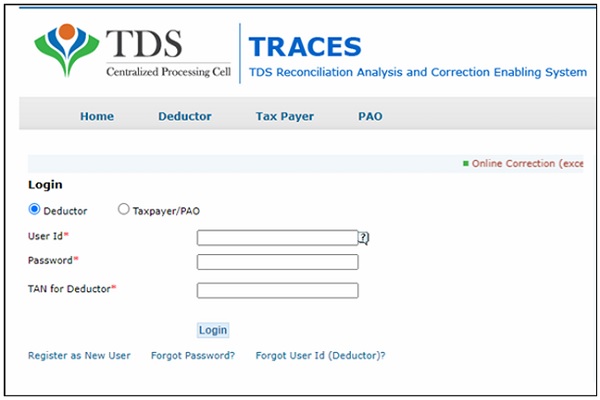
Step 3: Go to Downloads>Form 16.
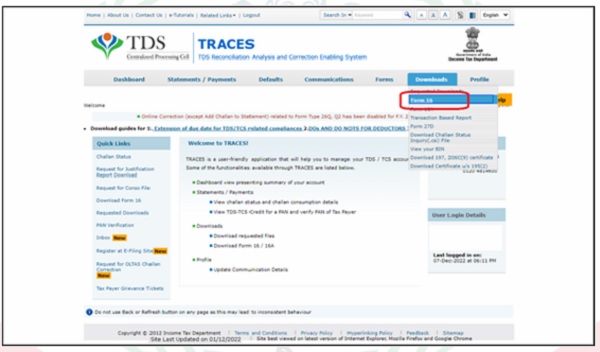
Step 4: Select the Financial Year, enter PAN and click ‘Add‘. After the PANs are reflected in the window, click ‘Go’. A maximum of 10 PANs can be added to this screen. To generate TDS Certificate in bulk, in the lower section of ‘Bulk PAN Download’, select Financial Year, and click ‘Go’.
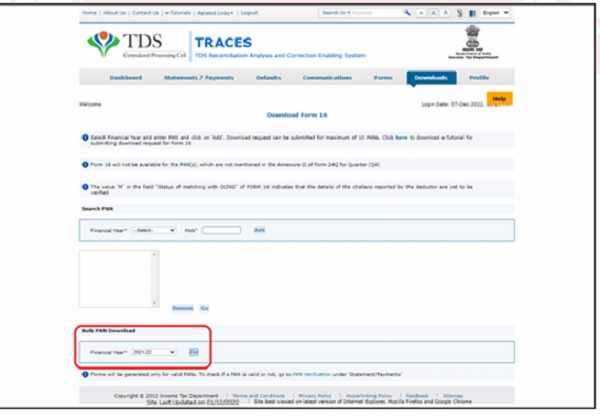
Step 5: On the next screen, the details to be printed on Form 16 will be displayed. Verify the details and click ‘Submit’.
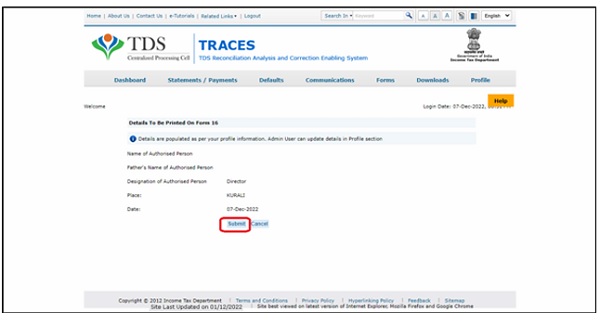
Step 6: Select the option for DSC-based validation or Normal Validation.
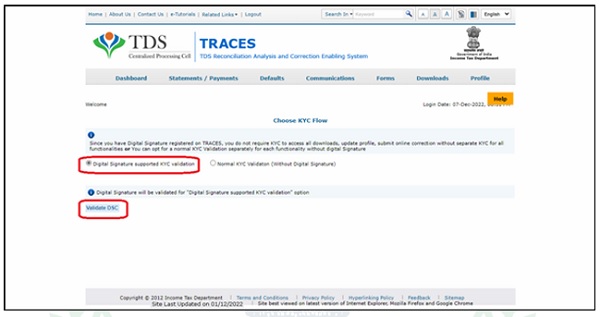
Step 7: After submission of the request, a successful message with a reference number will appear on the screen.
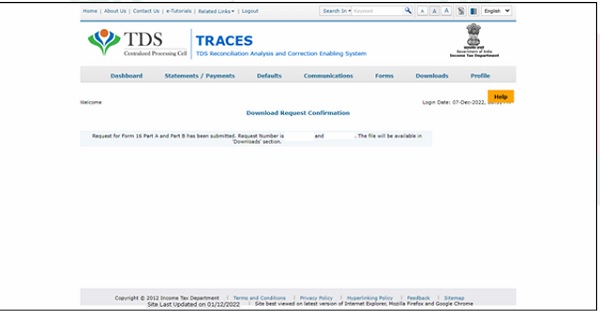
Step 8: Go to Downloads>Requested Downloads.
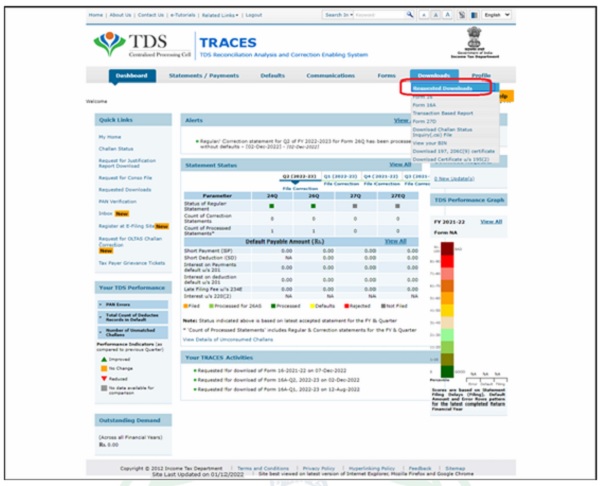
Step 9: Enter the request number generated on submission of the request (Step 7) and click ‘Go’. The filing status of Form 16 will be displayed. Select the row and click on ‘HTTP download’.
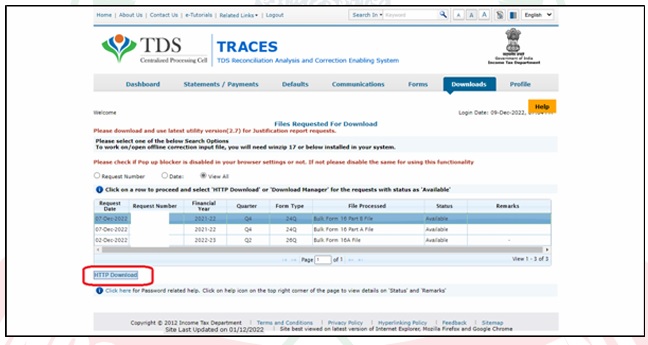
Step 10: Download the TRACES PDF Generation Utility. To view the PDF version of the downloaded Form 16, TRACES PDF Generation Utility can be used to extract the same. Different utilities must be downloaded for Form 16-PART A and Form 16-PART B.
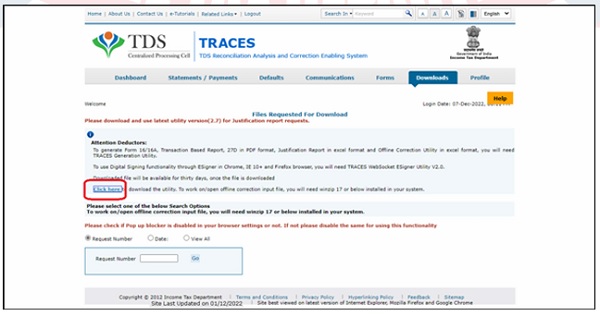
Step 11: Enter the captcha and click on ‘Submit’ to download the utility
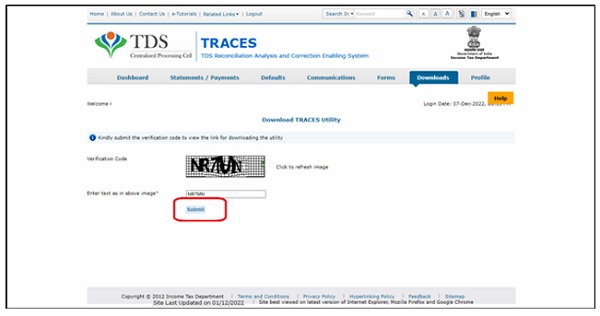
Step 12: Click on the link to start the download
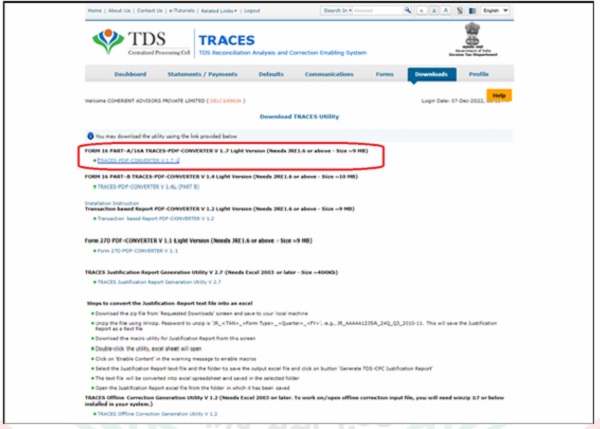
Step 13: Extract the PART-A utility, browse the form 16-PARTA Zip file and affix the DSC to sign the certificates digitally.
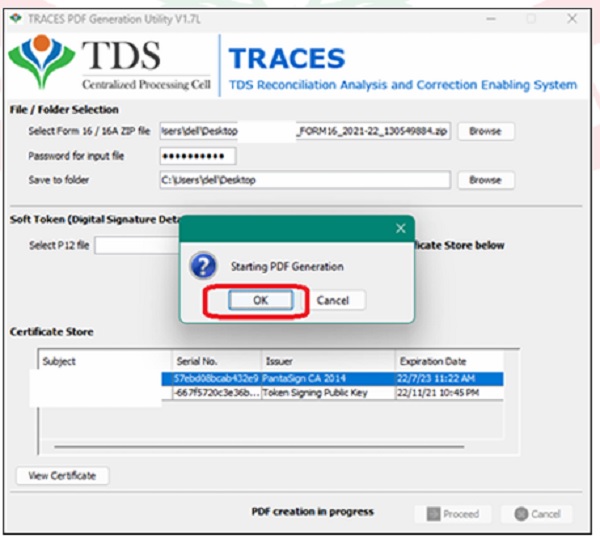
Step 14: Form 16-PART A shall be generated.
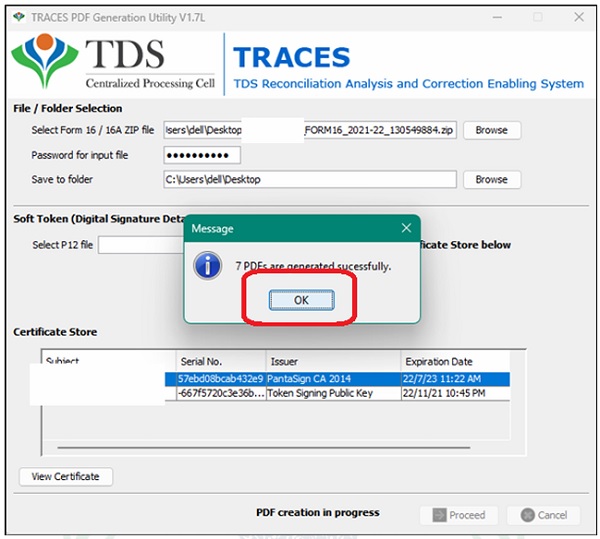
Step 15: Extract the PART-B utility, browse the Form 16-PARTB Zip file and affix the DSC to sign the certificates digitally.
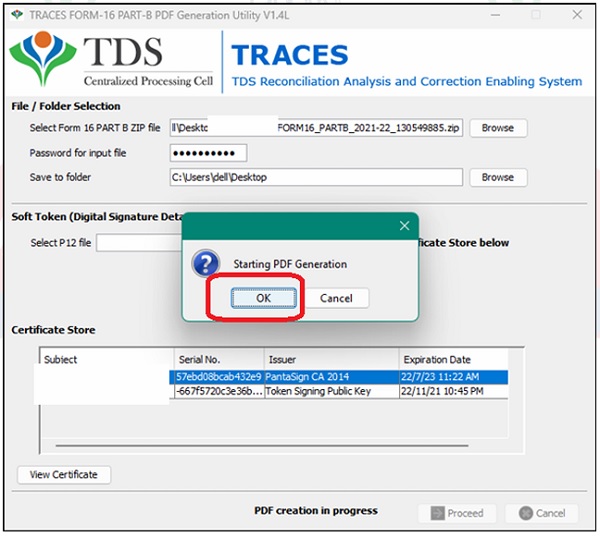
Step 16: Form 16-PART B shall be generated.
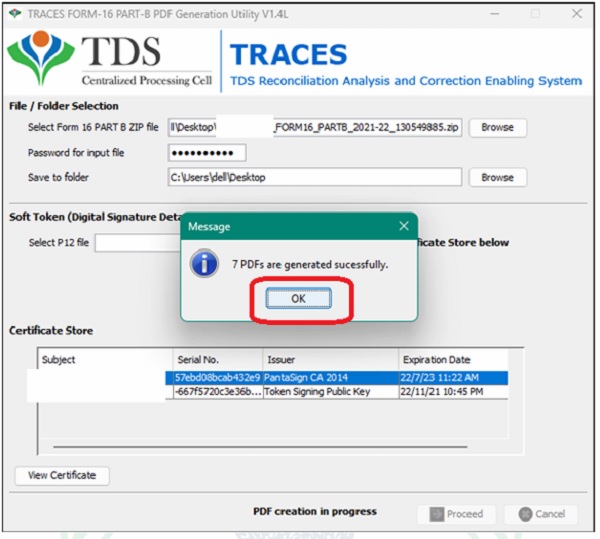
Form 16A
If tax has been deducted under any provision other than Section 192, Section 194-IA, Section 194-IB, Section 194M, Section 194P, and Section 194S (for specified persons), then the deductor is required to issue a TDS certificate in Form 16A . This TDS certificate shall be downloaded from the website of TRACES. Deductor shall authenticate these certificates using either a digital or manual signature.
Form 16A generally contains the following information:
(a) Permanent Account Number (PAN) or Aadhaar of deductee
(b) Tax Deduction and Collection Account Number (TAN) of the deductor
(c) Book Identification Number if tax is deposited by the Govt. Office without production of challan
(d) Challan Identification Number in case of payment through bank
(e) Receipt Number of the TDS Statement furnished in Form 26Q or Form 27Q or Form 26QF
Due date for issue of certificate
Form 16A is required to be issued by the deductor on a quarterly basis within 15 days from the due date of furnishing the statement of tax deducted at source in Form 26Q or Form 27Q. For Quarters 1, 2, 3, and 4 the due date for issue of the TDS certificate shall be August 15, November 15, February 15, and June 15 (of the next financial year), respectively.
Steps to download Form 16A
Step 1: Visit TRACES (www.tdscpc.gov.in)
Step 2: Login using the User ID, Password and TAN.
Step 3: Go to Downloads> Form 16A .
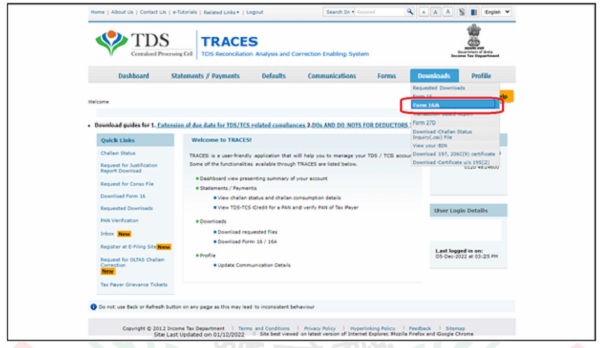
Step 4: Select the Financial Year, Quarter, Form Type, enter PAN and click ‘Add‘. After the PANs are reflected in the window, click ‘Go’. A maximum of 10 PANs can be added to this screen. To generate TDS Certificate in bulk, in the lower section of ‘Bulk PAN Download’, select Financial Year, Quarter, Form Type and click ‘Go’.
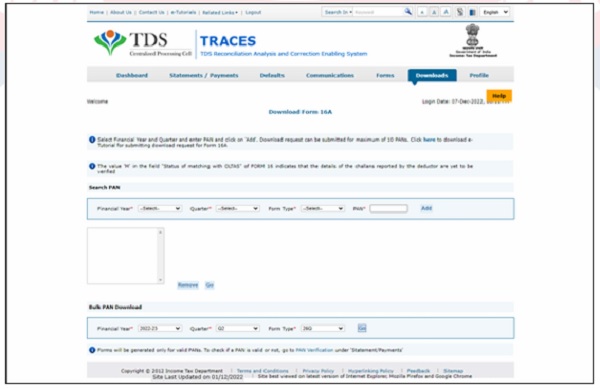
Step 5: On the next screen, the details to be printed on Form 16A will be displayed. Verify the details and click ‘Submit’.
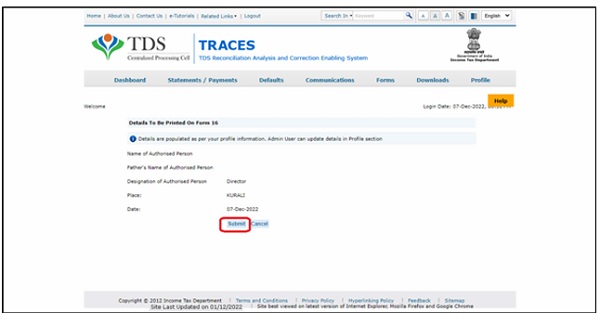
Step 6: Sign using the digital signature certificate.
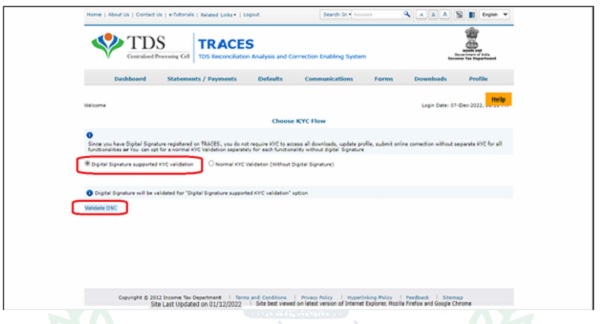
Step 7: After submission of the request, a successful message with a reference number will appear on the screen.
Step 8: Go to Downloads>Requested Downloads.
Step 9: Enter the request number generated on submission of the request (Step 7) and click ‘Go’. The filing status of Form 16A will be displayed. Select the row and click on ‘HTTP download’. The file for Form 16A will be downloaded.
Step 10: Download the TRACES PDF Generation Utility. To view the PDF version of the downloaded Form 16A , TRACES PDF Generation Utility can be used to extract the same.
Step 11: Enter the captcha and click on ‘Submit’ to download the utility
Step 12: Click on the link to start the download
Step 13: Extract the utility, browse the Form 16A Zip file and affix the DSC to sign the certificates digitally.
Step 14: Form 16A shall be generated.
Duplicate Certificate
The deductor may issue a duplicate certificate if the deductee has lost the original certificate and makes a request for the issue of a duplicate certificate. This certificate should be certified as ‘Duplicate’ by the deductor.
Penalty for non-issuance of TDS Certificate
Where a person, who has deducted tax at source, fails to issue a TDS Certificate, he shall be liable for payment of a penalty of Rs. 500 per day under Section 272A.
MCQs on Form 16 and Form 16A
Q1. Form 16 can be downloaded from the website of TRACES __________.
a) After filing TDS Statement
b) After processing of the TDS Statement
c) Before processing of TDS Statement
d) Either (b) or (c)
Correct Answer: (b)
Justification of the correct answer: The TDS certificate shall be downloaded from the website of TRACES (https://www.tdscpc.gov.in) after processing of the TDS Statement.
Q2. The employer is required to issue __________ with respect to the tax deducted from the employee’s salary.
(a) Form 16
(b) Form 16A
(c) Form 16B
(d) Form 16C
Correct Answer: (a)
Justification of the correct answer: Where the employer has deducted tax under Section 192 from the employee’s salary, then the employer shall issue a TDS certificate to the employee in Form 16.
Q3. Form 16 contains ________.
(a) Details of tax deducted from salary
(b) Details of the salary and various allowances, deductions, rebate, etc. claimed by employee
(c) Details of the salary and various allowances, deductions, rebate, etc. allowed to employee
(d) All of the above
Correct Answer: (d)
Justification of the correct answer: The TDS Certificate in Form 16 has two parts – Part A and Part B. Part A of the certificate contains the details of tax deducted from salary. Whereas Part B contains the details of the salary and various allowances, deductions, rebate, etc. claimed or allowed to the employee.
Q4. The certificate can be verified by __________.
(a) Manual Signature
(b) Digital Signature
(c) Either (a) or (b)
(d) Both (a) and (b)
Correct Answer: (c)
Justification of the correct answer: The certificate can be verified either by using a manual signature or a digital signature.
Q5. The employer shall provide information relating to the nature and value of perquisites in ________ if the salary paid or payable is above ________.
(a) Form No. 12B, Rs. 3,00,000
(b) Form No. 12BA, Rs. 1,50,000
(c) Form No. 16, Rs. 3,00,000
(d) Form No. 16, Rs. 1,50,000
Correct Answer: (b)
Justification of the correct answer: The employer shall provide information relating to the nature and value of perquisites in Form No. 12BA if the salary paid or payable is above Rs. 1,50,000. In other cases, the information would have to be provided by the employer in Form No. 16 itself.
Q6: Form 16 is required to be issued by the employer up to _________ immediately following the financial year in which the amount was paid and tax has been deducted.
(a) 15th March of the financial year
(b) 15th June of the financial year
(c) 15th July of the financial year
(d) 15th May of the financial year
Correct Answer: (b)
Justification of the correct answer: Form 16 is required to be issued by the employer up to 15th June of the financial year immediately following the financial year in which the amount was paid and tax has been deducted.
Q7. Form 16A is required to be issued by the deductor on ____________.
(a) Quarterly basis
(b) Half-yearly basis
(c) Yearly basis
(d) None of the above
Correct Answer: (a)
Justification of the correct answer: Form 16A is required to be issued by the deductor on a quarterly basis within 15 days from the due date of furnishing the statement of tax deducted at source in Form 26Q or Form 27Q. For Quarters 1, 2, 3, and 4 the due date for issue of the TDS certificate shall be August 15, November 15, February 15, and June 15 (of the next financial year), respectively.
Q8. Where a person, who has deducted tax at source, fails to issue a TDS Certificate, he shall be liable for payment of a penalty of____________.
(a) Rs. 500 per day under Section 272A
(b) Rs. 1,000 per day under Section 272A
(c) Rs. 50,000
(d) Rs. 1,00,000
Correct Answer: (a)
Justification of the correct answer: Where a person, who has deducted tax at source, fails to issue a TDS Certificate, he shall be liable for payment of a penalty of Rs. 500 per day under Section 272A.
Q9. Form 16A is issued if the tax has beed deducted under __________.
(a) Section 194-I
(b) Section 194-IA
(c) Section 194-IB
(d) All of the above
Correct Answer: (a)
Justification of the correct answer: Where tax has been deducted under any provision, not being Section 192, Section 194-IA, Section 194-IB, Section 194M, Section 194P, and Section 194S (in case of a specified person), the deductor shall issue a TDS Certificate in Form 16A .
Q10. Form 16A contains __________.
(a) Permanent Account Number (PAN) or Aadhaar of deductee
(b) Challan Identification Number in case of payment through bank
(c) Receipt Number of the TDS Statement furnished in Form 26Q or Form 27Q or Form 26QF
(d) All of the above
Correct Answer: (d)
Justification of the correct answer: Form 16A generally contains the following information:
a) Permanent Account Number (PAN) or Aadhaar of deductee
b) Tax Deduction and Collection Account Number (TAN) of the deductor
c) Book Identification Number if tax is deposited by the Govt. Office without production of challan
d) Challan Identification Number in case of payment through bank
e) Receipt Number of the TDS Statement furnished in Form 26Qor Form 27Qor Form 26QF
Prohibited transaction in cash/limit on cash transactions
| Disclaimer:
The contents of this document are for information purposes only. This aims to enable public to have a quick and an easy access to information and do not purport to be legal documents. Viewers are advised to verify the content from Government Acts/Rules/Notifications etc. |
Prohibited transaction in cash/limit on cash transactions
Income-tax Act has several provisions that restrict receipt or payment made in cash by a person subject to a certain threshold limit. These restrictions have been introduced to move towards a cashless economy and to reduce the generation and circulation of black money.
Disallowance of cash payments [Section 40A(3)]
Section 40A(3) provides that if the payment or aggregate of payments for an expenditure to a person in a day exceeds Rs. 10,000 and it is made by any mode other than account payee cheque or bank draft or electronic clearing system through a bank account or prescribed electronic modes, no deduction shall be allowed for such expenditure.
However, where payment is made for plying, hiring, or leasing goods carriages, the ceiling of Rs. 35,000 shall be considered instead of Rs. 10,000.
The provision of Section 40A(3) does not apply to payments made by commission agents for goods received by them for sale on a commission or consignment basis because such payment is not an expenditure deductible in computing the taxable income of the commission agent.
However, if the commission agent purchases goods on his own account and not on a commission basis, the requirement of payment in a specified mode applies to such purchases.
Further, where the taxpayer had claimed a deduction in respect of expenditure in any of the earlier years and subsequently makes payment thereof, otherwise than by an account payee cheque or bank draft, in excess of Rs. 10,000, in that situation, the payment so made is deemed to be the business income of the previous year in which payment is made.
Exceptions:
The disallowance does not apply if payment is made in certain circumstances as prescribed in Rule 6DD. These circumstances are prescribed below:
A. Payment to Specified Institutions –
No disallowance shall be made for the payment made in a non-specified mode (i.e., cash, crossed cheque, bearer cheque, etc.) to the following institutions:
(a) RBI or any banking company, (b) State Bank of India or any of its subsidiary banks, (c) Co-op. banks or land mortgage bank, (d) Primary Agricultural Credit Society or Primary Credit Society, (e) LIC
B. Payment in Legal Tender to the Government
No disallowance shall be made for an expenditure whose payment is required to be made to the Government in legal tender, such as payment of freight charges/booking of wagons to railways, sales tax, excise duty, etc.
C. Payment by Specified Modes
No disallowance shall be made where the payment is made by the following modes:
(a) Letter of credit arrangements through a bank, (b) Mail or telegraphic transfer through a bank, (c) Book adjustment from one bank account to another bank account, (d) Bill of exchange payable only to a bank.
Here bank includes a bank established outside India also.
D. Payment by Book Adjustment
No disallowance shall be made for the payment made by way of adjustment against the amount of any liability incurred by the payee for any goods supplied or services rendered by the assessee to him.
E. Payment for Agriculture or Animal Produce
No disallowance shall be made for payment made to the cultivator, grower, or producer in respect of the following purchases:
(a) Agriculture or forest produce, (b) Produce of animal husbandry (including, livestock, meat, hides, and skins) or dairy or poultry farming, (c) Fish or fish products, (d) Products of horticulture or apiculture (bee-keeping for sale of honey)
The immunity from disallowance under this provision shall be available to the payer if payment for animal husbandry is made to a person who is the producer of these goods. If these goods are purchased from a trader, broker, or any other middleman, this exception shall not available.
F. Payment for Produce of Cottage Industry
No disallowance shall be made where the payment is made to a producer for the purchase of the products manufactured or processed without the aid of power in a cottage industry.
G. Payment in Remote Places
No disallowance shall be made for the cash payment if payment is made in a village or town, to any person who ordinarily resides or carries any business, profession, or vocation, in such village or town which, on the date of such payment, is not served by the bank.
H. Terminal payments to low-paid employees
No disallowance shall be made for any payment made by the employer by way of gratuity, retrenchment compensation, or similar terminal benefits to an employee (or to his heirs) on or in connection with the retirement, retrenchment, resignation, discharge, or death of such employee. Such immunity is allowed if the aggregate of such sum payable to the employee or his heir does not exceed Rs. 50,000.
I. Payment of salary at remote places
If an employee is temporarily posted for 15 days or more in a place other than his normal place of duty or on a ship and he does not maintain any bank account at such place or ship, the salary paid after deducting tax at source under section 192 by the employer to such employee shall not be disallowed.
G.Payment to the agent
Payments made in a non-specified mode shall not be disallowed if it is paid by any person to his agent who is required to make payment in cash for goods or services on his behalf.
K. Payment made by an authorized dealer
Authorized dealers and money changers are normally required to pay cash for purchases of foreign currency or ter’s cheques in the normal course of their business, and no disallowance shall be made for any cash payments made by them.
Authorized dealer or money changer means a person authorised as such to deal in foreign currency or foreign exchange under any law for the time being in force.
L. Purchase of Animal
Any person who buys animals from farmers to slaughter them and to sell their raw meat or carcasses, to meat processing factories, traders, or retail outlets, may be considered a producer of livestock and meat. This exemption shall be available to the payer subject to the fulfilment of following conditions:
a) The person receiving the payment files a declaration that he is a producer of meat;
b) The producer of meat declares that the payment, otherwise than through account payee cheque or bank draft, was made on his insistence; and
c) A veterinary doctor certifies that the person specified in the certificate is a producer of meat and that slaughtering was done under his supervision.
Acceptance of loans, deposits, and specified sum [Section 269SS]
Section 269SS restricts a person (recipient) from taking or accepting any loan or deposit or any specified sum from any other person (depositor), otherwise than by an account payee cheque or account payee bank draft or use of electronic clearing system through a bank account or other prescribed electronic mode (impermissible mode). However, restriction isn’t imposed if the recipient and depositor, both are having agriculture income and neither of them has any income chargeable to tax.
The following transactions are covered under section 269SS:
- Any loan or deposit of money; or
- Any sum of money receivable by way of advance or otherwise in relation to the transfer of immovable property, whether or not the transfer takes place.
The provision shall be attracted if:-
a) The amount (or aggregate) of such loan or deposit or specified sum from a depositor is Rs. 20,000 or more; or
b) On the date of taking or accepting such loan or deposit or specified sum, the amount (or the aggregate) of any loan or deposit or specified sum taken or accepted earlier from the depositor remaining unpaid is Rs. 20,000 or more; or
c) The aggregate of the sum referred to in points (a) and (b) above is Rs. 20,000 or more.
However, if a deposit is accepted by a Primary Agricultural Credit Society (PACS) or a Primary Co-Operative Agricultural and Rural Development Bank (PCARD) from its member or a loan is taken from a PACS or a PCARD by its member, the threshold of Rs. 20,000 shall be enhanced to Rs. 2 lakhs1.
Exceptions – There is no restriction to take or accept any loan or deposit or specified sum from or by any of the following:
- Government;
- Any banking company, post office saving bank, or co-operative bank;
- Any corporation established by a Central, State, or Provincial Act;
- Any government company defined under section 2(45) of the Companies Act, 2013; or
- Any other notified institutions, associations, or body, or class of institutions, associations, or bodies.
Penalty for contravention of the provisions – Where a person takes or accepts any loan or deposit (or specified sum) in cash or in a mode which is in contravention of Section 269SS, he shall be liable for a penalty under Section 271D of a sum equal to the amount of the loan or deposit (or specified sum) so taken or accepted.
Mode of undertaking transactions [Section 269ST]
Section 269ST restricts a person (recipient) from receiving an amount of Rs. 2 lakhs or more otherwise than by an account payee cheque or account payee bank draft or use of an electronic clearing system through a bank account or other prescribed electronic modes.
This provision imposes restrictions in respect of the receipts of Rs. 2 lakhs or more:
a) In aggregate from a person in a day; or
b) In respect of a single transaction; or
For Example, Mr. A has sold goods worth Rs. 2.5 lakhs to Mr. B who has paid in cash as follows:
○ Rs. 1.5 lakhs on April 1;
○ Rs. 25,000 on May 1; and
○ Rs. 75,000 on June 1.
Mr. A would be considered to have not complied with the provisions of Section 269ST the moment he receives the last payment of Rs. 75,000 which eventually makes the total receipt in respect of a transaction exceeding Rs. 200,000.
c) In respect of a transaction relating to one event or occasion from a person – if there are multiple transactions, relating to one event or occasion from a person they would be covered under the restriction.
Where a transaction is covered within the scope of Section 269SS (accepting loan or deposit in impermissible mode) provisions of this section shall not apply.
Exceptions – This provision shall not apply to the receipt by the following persons:
- Government;
- Any banking company, post office saving bank, or co-operative bank; or
- Any other notified persons, class of persons, or receipts.
Further, the provision of this section shall not apply to receipt by any person from any banking company, post office savings bank, or co-operative bank.
Penalty for contravention of the provisions – Where a person receives the amount in contravention of this provision, he shall be liable for a penalty under Section 271DA of a sum equal to the amount of such receipts.
Acceptance of payment through prescribed electronic modes [Section 269SU]
Section 269SU provides that where a person is carrying on a business and his total sales, turnover, or gross receipts during the immediately preceding previous year exceeds Rs. 50 crores, it shall be mandatory for him to provide a facility to accept the payment through the following electronic modes:
a) Debit card powered by RuPay;
b) Unified Payments Interface (UPI) (BHIM-UPI); and
c) Unified Payments Interface Quick Response Code (UPI QR Code) (BHIM-UPI QR Code).
These facilities to accept the payment shall be in addition to the facility for other electronic modes of payment being provided by such person.
The provision of this section shall not apply to a person having only B2B transactions (i.e., no transaction with retail customer/consumer) subject to the condition that at least 95% of the aggregate of all amounts received during the previous year, including the amount received for sales, turnover or gross receipts, is by any mode other than cash.
Penalty for contravention of the provisions – Where a person fails to provide the facility for accepting payment through prescribed electronic modes as required under this provision, he shall be liable for a penalty under Section 271DB of Rs. 5,000 for every day during which such failure continues.
Mode of repayment of certain loans or deposits [Section 269T]
Section 269T restricts a person from repayment of any loan, deposit, or any specified advance received by it otherwise than by an account payee cheque or account payee bank draft (drawn in the name of the person who made the loan, deposit or specified advance) or by use of electronic clearing system through a bank account or other prescribed electronic modes.
Repayment in respect of the following transactions are covered under this provision:
- Any loan or deposit of money which is repayable after notice or repayable after a period and in case of a person other than company it includes loan or deposit of any nature; or
- Any sum of money in the nature of advance in relation to the transfer of immovable property, whether or not the transfer takes place.
Such loan, deposit, or specified sum should be taken or accepted in accordance with provisions of Section 269ST. In case of cash repayment of loan or deposit, the borrower could be penalized under Section 269T and the recipient could be penalized under Section 269ST.
This provision shall be attracted if the value of the covered transaction exceeds the following limit:
a) The amount of such loan or deposit or specified advance together with the interest payable thereon is Rs. 20,000 or more;
b) The aggregate amount of the loans or deposits held either in own name or jointly with any other person on the date of such repayment together with the interest payable on such loans or deposits is Rs. 20,000 or more; or
c) The aggregate amount of the specified advances received by such person either in his own name or jointly with any other person on the date of such repayment together with the interest payable on such specified advances is Rs. 20,000 or more.
However, if a deposit is paid by a Primary Agricultural Credit Society (PACS) or a Primary Co-Operative Agricultural and Rural Development Bank (PCARD) to its member or a loan is repaid to a PACS or a PCARD by its member, the threshold of Rs. 20,000 shall be enhanced to Rs. 2 lakhs2.
Exceptions– There is no restriction on repayment of any loan or deposit or specified advance taken or accepted from any of the following:
- Government;
- Any banking company, post office saving bank, or co-operative bank;
- Any corporation established by a Central, State, or Provincial Act;
- Any government company defined under section 2(45) of the Companies Act, 2013; or
- Any other notified institutions, associations, or body, or class of institutions, associations, or bodies.
Penalty for contravention of the provisions – Where a person repays any loan or deposit (including interest) or specified advance in cash or an impermissible mode in contravention of provisions of Section 269T, he shall be liable for a penalty under 271E of a sum equal to loan or deposit or specified advance so repaid.
Overview of Section 269SS, 269ST , 269SU and 269T :
| Section | Covered Transaction | Threshold Limit | Consequences of Default |
|---|---|---|---|
| 269SS | Taking or accepting any loan or deposit or specified sum | Rs. 20,000 or more | Penalty under Section 271D (100% of loan or deposit so taken or accepted) |
| 269ST | Receipt of any amount | Rs. 2 lakhs or more | Penalty under Section 271DA (100% of the amount so received) |
| 269SU | Facility to be provided for accepting payment through prescribed electronic modes | Total sales/turnover/gross receipts exceed Rs. 50 crore during the immediately preceding previous year | Penalty under Section 271DB (Rs. 5,000 per day during which the default continues). |
| 269T | Repayment of any loan or deposit or specified advance | Rs. 20,000 or more | Penalty under Section 271E (100% of loan or deposit so repaid) |
Here for the above sections including section 40A(3) prescribed electronic modes include-
(a) Credit Card; (b) Debit Card; (c) Net Banking; (d) IMPS (Immediate Payment Service); (e) UPI (Unified Payment Interface); (f) RTGS (Real Time Gross Settlement); (g) NEFT (National Electronic Funds Transfer), and (h) BHIM (Bharat Interface for Money) Aadhaar Pay.
MCQs on the prohibited transaction in cash/limit on cash transactions
Q1. Deduction for expenditure is not allowed under section 40A(3), where the cash payment is made to a person in a day exceeds Rs. ________.
(a) 10,000
(b) 15,000
(c) 20,000
(d) No limit
Correct answer: (a)
Justification for correct answer: If the payment (or aggregate of payments) for an expenditure to a person in a day exceeds Rs. 10,000 and it is made by any mode other than account payee cheque or bank draft or electronic clearing system through a bank account or prescribed electronic modes, no deduction shall be allowed for such expenditure under section 40A(3).
Q2. What is the ceiling limit under section 40A(3) where payment is made for plying, hiring, or leasing goods carriages?
(a) 10,000
(b) 15,000
(c) 20,000
(d) 35,000
Correct Answer: (d)
Justification for correct answer: Where payment is made for plying, hiring, or leasing goods carriages, the ceiling of Rs. 35,000 shall be considered instead of Rs. 10,000.
Q3. Section 40A(3) shall not be applied where payment is made to ________.
(a) RBI
(b) SBI
(c) LIC
(d) All of the above
Correct Answer: (d)
Justification for correct answer: No disallowance shall be made under section 40A(3) for the payment made in a non-specified mode (i.e., cash, crossed cheque, bearer cheque, etc.) to (a) RBI or any banking company, (b) State Bank of India or any of its subsidiary banks, (c) Co-op. banks or land mortgage bank, (d) Primary Agricultural Credit Society or Primary Credit Society, (e) LIC
Q4. Which transactions are covered in the ambit of section 269SS ?
(a) Any loan or deposit of money
(b) Any sum of money receivable by way of advance to the transfer of immovable property
(c) Both (a) and (b)
(d) None of the above
Correct Answer: (c)
Justification for correct answer: The following transactions are covered under the provision of section 269SS – (a) Any loan or deposit of money; or (b) Any sum of money receivable by way of advance or otherwise in relation to the transfer of immovable property, whether or not the transfer takes place.
Q5. What is the penalty for contravention of the provision of Section 269SS?
(a) Rs. 5,000 per day
(b) a sum equal to the amount of the loan or deposit (or specified sum) so taken or accepted
(c) Rs. 1,00,000
(d) None of the above
Correct Answer: (b)
Justification for correct answer: Where a person takes or accepts any loan or deposit (or specified sum) in cash or in a mode which is in contravention of Section 269SS, he shall be liable for a penalty under Section 271D of a sum equal to the amount of the loan or deposit (or specified sum) so taken or accepted.
Q6. Provision of section 269SS is not applied where loan or deposit is taken or accepted from ________.
(a) Government
(b) Any banking company
(c) Co-operative bank
(d) All of the above
Correct Answer: (d)
Justification for correct answer: There is no restriction under section 269SS to take or accept any loan or deposit or specified sum from or by – (a) Government; (b) Any banking company, post office saving bank, or co-operative bank; (c) Any corporation established by a Central, State, or Provincial Act; (d) Any government company defined under section 2(45) of the Companies Act, 2013; or (e) Any other notified institutions, associations, or body, or class of institutions, associations, or bodies.
Q7. Provision of section 269ST imposes restrictions in respect of the receipts of Rs. 2 lakhs or more ________.
(a) In aggregate from a person in a day
(b) In respect of a single transaction
(c) In respect of a transaction relating to one event or occasion from a person
(d) All of the above
Correct Answer: (d)
Justification for correct answer: Provision of section 269ST imposes restrictions in respect of the receipts of Rs. 2 lakhs or more:
- In aggregate from a person in a day; or
- In respect of a single transaction; or
- In respect of a transaction relating to one event or occasion from a person.
Q8. What is the penalty for contravention of the provision of Section 269ST?
(a) Rs. 5,000 per day
(b) a sum equal to the amount of such receipts
(c) Rs. 1,00,000
(d) None of the above
Correct Answer: (b)
Justification for correct answer: Where a person receives the amount in contravention of provision of section 269ST, he shall be liable for a penalty under Section 271DA of a sum equal to the amount of such receipts.
Q9. Which of the following facility to accept the payment is mandatorily required under Section 269SU?
(a) Debit card powered by RuPay
(b) BHIM-UPI
(c) BHIM-UPI-QR Code
(d) All of the above
Correct Answer: (d)
Justification for correct answer: Section 269SU provides that where a person is carrying on a business and his total sales, turnover, or gross receipts during the immediately preceding previous year exceeds Rs. 50 crores, it shall be mandatory for him to provide a facility to accept the payment through the following electronic modes:
- Debit card powered by RuPay;
- Unified Payments Interface (UPI) (BHIM-UPI); and
- Unified Payments Interface Quick Response Code (UPI QR Code) (BHIM-UPI QR Code).
Q10. What is the penalty for contravention of the provision of Section 269SU?
(a) Rs. 5,000 per day
(b) Rs. 50,000
(c) Rs. 1,00,000
(d) None of the above
Correct Answer: (a)
Justification for correct answer: Where a person fails to provide the facility for accepting payment through prescribed electronic modes as required under this section 269SU, he shall be liable for a penalty under Section 271DB of Rs. 5,000 for every day during which such failure continues.
Q11. What is the penalty for contravention of the provision of Section 269T?
(a) Rs. 5,000 per day
(b) a sum equal to loan or deposit so repaid
(c) Rs. 1,00,000
(d) None of the above
Correct Answer: (b)
Justification for correct answer: Where a person repays any loan or deposit (including interest) or specified advance in cash or an impermissible mode in contravention of provisions of Section 269T, he shall be liable for a penalty under 271E of a sum equal to loan or deposit or specified advance so repaid.
Q12. Which of the following is covered under the prescribed electronic modes for Section 40A(3)?
(a) UPI
(b) IMPS
(c) Net-banking
(d) All of the above
Correct Answer: (d)
Justification for correct answer: prescribed electronic modes include – (a) Credit Card; (b) Debit Card; (c) Net Banking; (d) IMPS (Immediate Payment Service); (e) UPI (Unified Payment Interface); (f) RTGS (Real Time Gross Settlement); (g) NEFT (National Electronic Funds Transfer), and (h) BHIM (Bharat Interface for Money) Aadhaar Pay.
1Inserted by the Finance Act, 2023 with effect from 01.04.2023.
2Inserted by the Finance Act, 2023 with effect from 01.04.2023.
Expenses or payments not deductible in certain circumstances
| Disclaimer:
The contents of this document are for information purposes only. This aims to enable public to have a quick and an easy access to information and do not purport to be legal documents. Viewers are advised to verify the content from Government Acts/Rules/Notifications etc. |
Expenses or payments not deductible in certain circumstances
Provision of Section 40A enumerates certain expenses which are disallowed while computing the taxable income of an assessee. If certain conditions are not satisfied, these amounts will not be allowable as a deduction while computing the business income of the assessee. [Section 40A]
The disallowance under section 40A shall be as under:
Disallowance of payment made to related parties [Section 40A(2)]
Any expenditure, in respect of which, payment has been made to the specified persons, shall be disallowed to the extent such expenditure is considered excessive or unreasonable having regard to the fair market value of goods or services or facilities or legitimate business needs of the business of the assessee or benefit derived by or accruing to the assessee as a result of the expenditure.
No expenditure in a transaction, being a specified domestic transaction incurred for an assessment year commencing on or after April 01, 2016, shall be disallowed by treating it as excessive or unreasonable having regard to its fair market value, if it is at its arm’s length price as defined under section 92F(ii).
The specified persons for various types of assessee are discussed below:
| Specified persons to whom payment has been made | ||
| An Individual | a) | Any relative of such individual |
| b) | To a person in whose business the individual or any of his relatives has a substantial interest | |
| A Company | a) | Director of the Company |
| b) | Any relative of the director | |
| c) | To a person in whose business the company or any of its directors or relative of such directors has a substantial interest. | |
| A Firm | a) | Partner of the firm |
| b) | Any relative of the partner | |
| c) | To a person in whose business the firm or any of its partners or relative of such partners has a substantial interest. | |
| AOP/BOI | a) | Members of the AOP/BOI |
| b) | Any relative of the members | |
| c) | To a person in whose business the AOP/BOI or any of its members or relative of such members has a substantial interest. | |
| A HUF | a) | To a member of the family |
| b) | Any relative of the members | |
| c) | To a person in whose business the HUF or any of its members or relative of such members has a substantial interest. | |
| Any other taxpayer | a) | To an individual who has a substantial interest in the business of a taxpayer |
| b) | Any relative of such individual | |
| Any other taxpayer | a) | To a company which has a substantial interest in the business of the taxpayer |
| b) | Any director of such company | |
| c) | Any relative of such director | |
| d) | Any other company carrying on business or profession in which the above-mentioned company has a substantial interest | |
| Any other taxpayer | a) | To a Firm or AOP or HUF who has a substantial interest in the business of the taxpayer |
| b) | Partner or member of such person | |
| c) | Any relative of such partner or member | |
| Any other taxpayer | a) | To a company, one of whose directors has a substantial interest in the business of the taxpayer |
| b) | Any director of such company | |
| c) | Any relative of such director | |
| Any other taxpayer | a) | To a Firm or AOP or HUF, one of whose partners/members has a substantial interest in the business of the taxpayer |
| b) | Any partner or member of such person | |
| c) | Any relative of such partner or member | |
Meaning of ‘Relative’
The term ‘relative’ in relation to an individual shall include husband, wife, brother or sister, or any lineal ascendant or descendant of that individual.
Meaning of ‘Substantial Interest’
A person is deemed to have a substantial interest in the business or profession if such person is the beneficial owner of at least:
a) 20% share (not being shares entitled to a fixed rate of dividend whether with or without a right to participate in profits) at any time during the relevant previous year, if business or profession is carried on by a company;
b) 20% of profits at any time during the previous year, if business or profession is carried on by any other concern.
Disallowance of payment made in cash [Section 40A(3)/(3A)]
No deduction shall be allowed for an expenditure, even if it is deductible under any other provision if payment (or aggregate of payments) for such expenditure to a person in a day exceeds Rs. 10,000 and it is made by any mode other than account payee cheque or bank draft or electronic clearing system through a bank account or through prescribed electronic modes.
In case payment is made for plying, hiring, or leasing goods carriages, the ceiling of Rs. 35,000 shall be considered instead of Rs. 10,000.
Further, Rule 6DD specifies certain circumstances where disallowance should not be made.
Disallowance of provision for gratuity [Section 40A(7)]
No deduction is admissible in respect of any provision made by the assessee for payment of gratuity to his employees on their retirement or on termination of their employment for any reason. However, the restriction does not apply in the following cases:
a) Any provision made for payment of gratuity by way of contribution towards an approved gratuity fund; or
b) Any provision for payment of gratuity that has become payable during the previous year.
If such provision for payment of gratuity has been allowed as a deduction in any of the previous years, no deduction will be allowed again when payment is actually made out of such provision, whether by way of contribution to approved gratuity fund or by way of payment to the employee.
Disallowance of contributions to non-statutory funds [Section 40A(9)]
Any sum paid by the employer by way of contribution towards a recognised provident fund, approved superannuation fund, pension scheme, or approved gratuity fund is deductible to the extent such contribution is permissible under income-tax law or any other law for the time being in force.
However, no deduction is allowable for the employer’s contribution towards a fund (for the benefit of employees) that is otherwise not required by any law. Thus, the deduction is not allowable in respect of any sum paid by the employer towards the setting up or formation of or as a contribution paid to any fund, trust, company, AOP, BOI, societies or it is paid by way of contribution to any fund that is not a recognised provident fund, approved superannuation fund, or gratuity fund.
For example, an employer’s contribution towards an unrecognised provident fund or any other staff welfare fund (without any statutory requirement) will be disallowed under this provision.
Disallowance for marked-to-market loss [Section 40A(13)]
‘Marked-to-Market’ is a methodology of revaluing a financial instrument based on its market price on the closing day of the accounting period. A financial instrument is valued at a market rate to report its actual value on the date of reporting.
As per ICDS-VIII (Securities), listed securities held as stock-in-trade shall be valued at the lower of the actual cost initially recognised or the net realisable value at the end of the previous year. If any loss arises due to such restatement, it shall be allowed as a deduction under Section 36(1)(xviii) of the Income Tax Act. However, if any gain arises due to such valuation, it shall be taxable as business income under Section 28.
The option to restate the value at the year-end shall not be available in respect of securities that are not listed or are listed but not quoted on a recognised stock exchange. Such securities shall be recognised in the books at the actual cost at which it has been recognised initially. If any notional gain or loss is recognised by the assessee in the books, it shall be disallowed under Section 40A(13).
MCQs
Q1. Who is considered a specified person under section 40A(2) with respect to an individual?
(a) Any relative of such individual
(b) A person in whose business the individual or any of his relatives has a substantial interest
(c) Both (a) and (b)
(d) None of the above
Correct answer: (c)
Justification of the correct answer: As per section 40A(2) any relative of the individual or any person in whose business the individual or any of his relatives has a substantial interest is considered a specified person.
Q2. Who is considered a specified person under section 40A(2) with respect to a company?
(a) Director of the company
(b) Employee of the company
(c) Debtor/Creditor of the company
(d) None of the above
Correct answer: (a)
Justification of the correct answer: As per section 40A(2), the director of a company or any relative of the director or any person in whose business the company or any of its directors or relative of such directors has a substantial interest is considered a specified person.
Q3. Relative under section 40A(2) includes_________.
(a) Spouse
(b) Brother/Sister
(c) Lineal ascendant/descendant
(d) All of the above
Correct answer: (d)
Justification of the correct answer: The term ‘relative’ in relation to an individual shall include husband, wife, brother or sister, or any lineal ascendant or descendant of that individual.
Q4. Any sum paid by the employer by way of contribution towards a ________ is deductible to the extent such contribution is permissible under income-tax law or any other law.
(a) recognised provident fund
(b) approved superannuation fund
(c) approved gratuity fund
(d) All of the above
Correct answer: (d)
Justification of the correct answer: As per section 40A(9), any sum paid by the employer by way of contribution towards a recognised provident fund, approved superannuation fund, pension scheme, or approved gratuity fund is deductible to the extent such contribution is permissible under income-tax law or any other law for the time being in force.
However, no deduction is allowable for the employer’s contribution towards a fund (for the benefit of employees) that is otherwise not required by any law.
Q5. As per ICDS-VIII (Securities), listed securities held as stock-in-trade shall be valued at ________.
(a) The actual cost initially recognised
(b) The net realisable value at the end of the previous year
(c) lower of (a) or (b)
(d) None of the above
Correct answer: (c)
Justification of the correct answer: As per ICDS-VIII (Securities), listed securities held as stock-in-trade shall be valued at the lower of the actual cost initially recognised or the net realisable value at the end of the previous year.
Compounding of Offences under the Income-tax Act, 1961
| Disclaimer:
The contents of this document are for information purposes only. This aims to enable public to have a quick and an easy access to information and do not purport to be legal documents. Viewers are advised to verify the content from Government Acts/Rules/Notifications etc. |
Compounding of Offences under the Income-tax Act, 1961
Compounding of offence is a process whereby the person/entity committing default files an application to the competent authority accepting that it has committed an offence and so that same should be compounded.
The Finance Minister in her Budget Speech 2024 made an announcement to simplify and rationalize the compounding procedure. Consequently, the CBDT has issued new guidelines [Letter F. No. 285/08/2014-IT(Inv. V)/163, dated 17-10-2024] for compounding of offences superseding all existing guidelines.
The new guidelines on compounding of offences, effective from 17-10-2024, will apply to all applications filed thereafter or pending disposal. For pending cases where charges were determined but not fully paid, charges will be recalculated if lower under the new guidelines. However, if higher charges under the old guidelines were already paid, no refund or adjustment will be allowed.
Re-filing of the rejected compounding application
Application for compounding can be filed again, in case application under earlier guidelines was rejected only on account of curable defects such as-
a) non-payment of outstanding tax, interest, penalty, or any other sum related to the offence,
b) filing of the application in the incorrect proforma,
c) mention of incorrect assessment year/financial year or section under which the offence has been committed,
d) non-payment or short payment of compounding charges,
e) non-submission of an undertaking regarding withdrawal of appeals, etc.
If more than one application was rejected under the previous Guidelines, one Consolidated Compounding Application may be filed for all such previous applications under the new guidelines.
Credit for the payment already made shall be given against the compounding charges to be paid under these new Guidelines. Further, it is clarified that those applications which were rejected in the past on merits by the Competent Authority shall not be reconsidered, under this provision.
Note:
- Prosecutions under IPC (or Bhartiya Nyay Sanhita 2023) cannot be compounded as per Income-tax Act guidelines but may be withdrawn under IPC provisions.
- If prosecution is launched under both Acts on the same facts and is compounded under the Income-tax Act, the authority shall initiate withdrawal under IPC or Bhartiya Nyay Sanhita 2023.
- Compounding applications are generally accepted if guideline conditions are met. However, compounding is not a right. The authority may reject it in exceptional cases with recorded reasons, such as habitual offences or serious gravity based on facts.
Eligibility Requirements for Compounding
An offence can be considered for compounding subject to the fulfilment of the following conditions:
(1) Filing of application
The compounding application must be filed to the Jurisdictional Principal Chief Commissioner/Chief Commissioner or Principal Director General/Director General in the format given in Annexure-I, as an affidavit on Rs. 100 stamp paper.
It may be filed for offences relating to a single financial year (for taxpayers), a quarter (for deductors), or multiple periods (as a Consolidated Application).
In case of offences by a Company or HUF, the application can be filed by the main accused (Company/HUF) and/or co-accused under Sections 278B/278C (e.g., director, manager, etc.), either jointly or separately. The Competent Authority may compound the offence of both main and co-accused if compounding charges are paid by any of them.
If a company’s liability ceases under Section 32A of IBC, prosecution may still continue against co-accused. In such cases, either the co-accused or the company can file the compounding application and pay the charges.
The application can be filed by the assessee at any time after the offence, regardless of whether it has come to the Department’s notice. If a prosecution complaint is already filed in court, the application must be filed within 12 months from the end of the month of such filing.
If filed after 12 months, compounding is still allowed, but charges will be 1.5 times the normal rate.
Thus, the compounding charges shall depend upon the time of filing of compounding application as under:
| Time of filing of compounding application | Compounding charges |
|---|---|
| Within 12 months | Normal compounding charges |
| Beyond 12 months | 1.5 times of normal compounding charges |
(2) Payment of compounding application fee
The applicant is required to pay a non-refundable fee of Rs. 25,000 per application, or Rs. 50,000 for a consolidated application. This fee may be adjusted against the final compounding charges.
The fee also applies to applications earlier rejected under old guidelines but now revived under the new ones. However, no fee is required for applications pending as of 17-10-2024 and filed under the previous guidelines.
(3) Payment of outstanding dues
The applicant is required to pay all outstanding tax, interest, penalty, and related dues for the offence(s) before filing the compounding application.
If any dues are found pending, the department will notify the applicant. The application will be treated as valid only if the demand is paid within 30 days of such intimation or within the extended period (not exceeding 3 months) granted by the Competent Authority.
(4) Undertaking to pay compounding charges
The person shall undertake to pay the compounding charges, determined and communicated by the Principal Chief Commissioner or Chief Commissioner or Principal Director-General or Director-General concerned, within the prescribed time limit.
- What are the compounding charges for different offences?
The person is required to pay the following compounding charges for offences under various sections of the Income-tax Act:
The person is required to pay the following compounding charges for offences under various sections of the Income-tax Act:
| Section | Offence | Compounding charge |
|---|---|---|
| 275A | Contravention of authority’s order to not deal with the goods that could not be seized | 10% of the highest of total income declared or assessed, in the last 7 financial years including year of search, subject to a minimum of Rs. 5 crore. |
| 275B | Failure to provide access to books of account and other documents to the authorized officer during the search and seizure | 10% of the highest of total income declared or assessed, in the last 7 financial years including year of search, subject to a minimum of Rs. 5 crore. |
| 276 | Removing, concealing, transferring or delivering property to thwart tax recovery | 75% of the outstanding tax or the recovery amount sought to be thwarted through the removal/concealment/transfer/delivery of property, whichever is lower. |
| 276A [1] | If a liquidator:
(a) does not intimate the tax authorities about his appointment; (b) parts with the assets of the company without prior approval or without setting aside the amount of tax demand (Prior to 01.04.2023) |
Rs. 10,000 for each such offence.
However, the Competent Authority may determine compounding charge having regard to the nature and magnitude of the offence, loss of revenue directly or indirectly attributable to such offence, subject to levy of minimum compounding charges.
|
| 276AA | Failure to comply with the provisions of section 269AB or section 269-I
(Prior to 01.10.1986) |
|
| 276AB | Failure to comply with the provisions of sections 269UC, 269UE and 269UL
(Prior to 01.04.2022) |
|
| 276B | Failure to pay tax deducted at source (TDS) or failure to pay dividend distribution tax or failure to pay or ensure payment of tax on winning in kind under Section 194B or failure to ensure payment of tax on winnings from online games in kind under Section 194BA or failure to ensure payment of tax on benefit or perquisite provided in kind under Section 194R or failure to ensure payment of tax under Section 194S where the consideration for transfer of VDA is in kind[2] | 1.5 % per month or part of a month of the amount of tax in default for the default period.
Note: (a) The period of default shall be calculated from the date of deduction to the date of deposit of TDS, as is done in respect of calculating interest under section 201(1A)(ii). (b) The compounding charge shall not exceed the TDS amount in default. |
| 276BB | Failure to pay the tax collected at source (TCS) | 1.5 % per month or part of a month of the amount of tax in default for the default period.
Note: (a) The period of default shall be calculated from the date of collection to the date of deposit of TCS, as is done in respect of calculating interest under section 206C(7). (b) The compounding charge shall not exceed the TCS amount in default. |
| 276C(1) | Wilful attempt to evade any tax, penalty or interest chargeable or imposable under this Act or under-reporting of income | 125% of tax amount sought to be evaded or tax on under-reported income, as the case may be. |
| 276C(2) | Wilful attempt to evade payment of any tax, penalty or interest chargeable or imposable under this Act | 1.5% per month or part of the month of the amount of tax, interest and penalty, the payment of which was sought to be evaded for the period of default.
Notes: (a) The period of default is calculated from the day after the due date of payment until the actual payment date. (b) Any period where a stay on demand is granted by the Income Tax Authority, Appellate Tribunal, or Court shall be excluded when calculating the default period. (c) The compounding charge shall not exceed the amount of tax, interest, and penalty that was attempted to be evaded. (d) For compounding under sections 276C(1) and 276C(2) for the same issue and year, only the charges under section 276C(1) will apply. |
| 276CC | Failure to furnish the return of income either under Section 139(1) or in pursuance to a notice issued by the Income-tax authorities | In case of default in filing of return pursuant to search or survey action:
• 30% of the amount of tax sought to be evaded or the amount of tax on under-reported income, as the case may be, subject to a minimum of Rs. 10 lakh. In other cases • 15% of the amount of tax sought to be evaded or the amount of tax on under-reported income subject to a minimum of Rs. 5 lakh. Note: For compounding under sections 276C(1) and 276CC for the same issue and year, only the charges under section 276C(1) will apply. |
| 276CCC | Failure to furnish return of total income in response to a notice issued by assessing officer in search or requisition cases as per Section 158BC | 30% of the amount of tax sought to be evaded or the amount of tax on under-reported income, as the case may be, subject to a minimum of Rs. 10 lakh.
Note: For compounding under sections 276C(1) and 276CCC for the same issue and year, only the charges under section 276C(1) will apply. |
| 276D | Failure to produce books of accounts or documents before the assessing officer or fails to get his accounts audited or inventory valued under Section 142(2A) | 10% of returned income or assessed income of the assessment year pertaining to the offence, whichever is higher, subject to a minimum of Rs. 5 lakh. |
| 276DD | Failure to comply with the provisions of section 269SS
(Prior to 01.10.1989) |
10% of the amount of any loan or deposit in contravention of the provisions of Section 269SS. |
| 276E | Failure to comply with the provisions of section 269T (Prior to 01.10.1989) | 10% of the amount of deposit repaid in contravention of the provisions of Section 269T. |
| 277 | Making a false statement in any verification or delivers an account or statement which is false | 50% of the amount of tax, which would have been evaded due to offence committed |
| 277A | Making or causing to make a false statement or entry in books of account or document | 100% of the amount of tax or interest or penalty evaded on account of such false entry or statement |
| 278 | Abets or induces another person to make and deliver an account or a statement which he believes to be false or to evade any tax or interest or penalty chargeable or imposable under the act | 50% of the amount of tax, which would have been evaded or which is willfully attempted to be evaded, due to offence committed
Notes: (a) If same set of facts and circumstances attract prosecution u/s 277 as well as section 278 , the compounding charge shall only be calculated by treating them as single offence. (b) If same set of facts and circumstances attract prosecution u/s 277 or 278 , in addition to another offence, no separate compounding charge shall be charged for offence u/s 277 or 278 . |
Notes:
- To calculate compounding charges, ‘tax’ means to the tax amount, including surcharge and cess, as applicable. However, interest is excluded from the ‘tax’ when computing the Compounding Charge.
- The Compounding charges shall be increased by 50% of sum computed if the application is made beyond 12 months from the end of the month in which the prosecution complaint is filed.
- Any application for compounding an offence under sections 276B/276BBfor a specific TAN must include all defaults related to that TAN for the relevant period. To assess the quantum of TDS/TCS defaults, the total non-payment of TDS/TCS for a quarter will be calculated by aggregating the defaults from all statements filed by the TDS deductor or TCS collector for that quarter.
- The compounding charges mentioned above apply to the ‘first’ compounding application or a consolidated application for each offence disclosed by a person. Compounding applications filed under previous guidelines, whether pending, rejected, or compounded, will be treated as the “first” compounding application under the new guidelines.
- Any subsequent applications will be considered as second, third, fourth, etc. If new offences are included in subsequent applications, charges will follow as specified above. However, for repeat offences in the subsequent application, compounding charges will be as follows:
| Offences | Compounding Charges |
|---|---|
| 1st Offence | Compounding charges as specified above |
| 2nd Offence | 1.2 times of the compounding charges |
| 3rd Offence | 1.4 times of the compounding charges |
| 4th Offence | 1.6 times of the compounding charges |
| Subsequent Offences | Continue increasing by 0.2 times per offence |
| The Compounding charges shall be increased by 50% of sum computed if the application is made beyond 12 months from the end of the month in which the prosecution complaint is filed. | |
1. What if compounding charges were determined under earlier guidelines?
For applications pending as on 17-10-2024, if charges were determined under the old guidelines but not fully paid, they will be recalculated under the new Guidelines if the revised charges are lower. However, if the earlier, higher charges have already been paid, no refund or adjustment will be allowed.
(5) Undertaking to withdraw appeal
The person shall undertake to withdraw appeals related to the offence sought to be compounded. If an appeal contains mixed grounds, the undertaking should cover only those grounds related to the compounding offence.
(6) Revival of defective application
An application that does not meet the eligibility conditions or contains curable defects will be treated as defective and not processed further. Defects include:
- Non-payment of tax, interest, penalty, or other dues related to the offence;
- Incorrect proforma;
- Wrong financial year, assessment year, or section cited.
Such an application may be revived without extra compounding charges if the defects are rectified within one month from the date of intimation. If not cured in time, the application will be returned, and any fresh filing will be treated as a new application with applicable charges.
(7) Offences compoundable with the approval of higher authority
The Competent Authority, in the following cases, may compound only with the approval of Chairman, CBDT.
(a) In case of an offence for which the applicant has been convicted with imprisonment for two years or more, with or without fine, by a court of law;
(b) In case of an offence which is related to another offence under any other law for which he has been convicted with imprisonment for two years or more with or without fine, by a court of law;
(c) If the applicant, as per information available on the basis of an investigation conducted by any Central or State Agency, has been found to be involved, in any manner, in anti-national or terrorist activity. In such cases, the Competent Authority shall consult with relevant Agency and seek inputs regarding the said activity and its implications, for the purpose of deciding it as a deserving case and incorporate them while seeking approval;
(d) In the case of an applicant, being a person other than the main accused, where it is proved that the applicant facilitated tax evasion through mechanisms such as use of entities for laundering of money, generation of bogus invoices of sale/purchase without actual business, by providing accommodation entries or in any other manner, as prescribed in section 277A of the Act;
(e) If the offence is directly related to an offence under the following Acts:
(i) the Black Money (Undisclosed Foreign Income and Assets) and Imposition of Tax Act, 2015; or
(ii) Prohibition of Benami Property Transactions Act, 1988;
(f) In case of an offence under section 275A and/or 275B of the Act.
For more, refer: Circular no. 285/08/2014-IT(INV. V)/163, Dated 17-10-2024
MCQs on Compounding of Offence
Q1. Any offence can be compounded by the competent authority ________.
(a) Before the initiation of proceedings
(b) After the initiation of proceedings
(c) Either (a) or (b)
(d) Offences cannot be compounded
Correct answer: (c)
Justification of correct answer:
Compounding of an offence is a mechanism whereby the defaulter is reprieved of major legal consequences by affording him with an opportunity to pay a sum of money to escape prosecution. Any offence can be compounded by the competent authority either before or after the initiation of proceedings.
Q2. Offences subject to compounding can be classified in _________ categories.
(a) Two
(b) Three
(c) Four
(d) Not applicable
Correct answer: (d)
Justification of correct answer:
Effective 17-10-2024, the categories have been eliminated from the compounding of offences guidelines.
Q3. What is the compounding charge under Section 276B for failure to deposit TDS?.
(a) 50% of the tax in default
(b) 1.5% per month of the tax in default
(c) 10% of the tax in default
(d) Rs. 10,000 per offence
Correct answer: (b)
Justification of correct answer:
Compounding charges shall be 1.5 % per month or part of a month of the amount of tax in default for the default period.
Note:
(a) The period of default shall be calculated from the date of deduction to the date of deposit of TDS, as is done in respect of calculating interest under section 201(1A)(ii).
(b) The compounding charge shall not exceed the TDS amount in default.
Q4. Which of the following is NOT considered a curable defect under the new compounding guidelines?
(a) Non-payment of tax dues
(b) Filing in incorrect proforma
(c) Rejection of application on merits
(d) Incorrect assessment year mentioned
Correct answer: (c)
Justification of correct answer:
Applications rejected on merits cannot be revived. Only curable defects like non-payment, wrong format, or clerical mistakes can be corrected and refiled.
Q5. What is the minimum compounding fee applicable for filing a fresh application under the new guidelines?
(a) Rs. 10,000
(b) Rs. 15,000
(c) Rs. 25,000
(d) Rs. 50,000
Correct answer: (c)
Justification of correct answer:
The non-refundable fee for a compounding application is Rs. 25,000, and Rs. 50,000 in case of a consolidated application.
Q6. What is the compounding charge for the second offence for the same default under the new compounding guidelines?
(a) Same as first offence
(b) 1.2 times of the normal charge
(c) 1.5 times of the normal charge
(d) Double the normal charge
Correct answer: (b)
Justification of correct answer:
The second offence attracts 1.2 times the compounding charges of the first offence under the new guidelines.
Annual Information Statement (AIS)
| Disclaimer:
The contents of this document are for information purposes only. This aims to enable public to have a quick and an easy access to information and do not purport to be legal documents. Viewers are advised to verify the content from Government Acts/Rules/Notifications etc. |
Annual Information Statement (AIS)
Annual Information Statement (AIS) is a statement that provides complete information about the prepaid taxes and prescribed financial transactions entered into by taxpayer for a particular financial year. A taxpayer can access AIS information by logging into his income-tax e-filing account.
What is Annual Information Statement (AIS)?
Section 285BB of the Income-tax Act provides that the Income-tax authority or any other person authorized on this behalf shall make available an Annual Information Statement to the assessee containing information on various financial transactions made by him during the year.
AIS has been introduced in the Income-tax Act to enlarge the scope of information to be made available to the assessee for filing of return of income. This information, on one hand, will be useful for the Assessing Officers to cross-check the details furnished in return for income by taxpayers. On the other hand, taxpayers would be able to easily compute their tax liability and file returns as all information would be pre-filled on basis of AIS.
Which types of information are covered in AIS?
Section 285BB read with rule 114-I of the Income-tax Rules, 1962 provides that the Principal Director General of Income-tax (Systems) or the Director General of Income-tax (Systems) or any person authorised by him shall, upload such annual information statement in Form No. 26AS in the registered account of the assessee within 3 months from the end of the month in which the information is received. Such form shall consist of the following information:
a) Information relating to TDS and TCS;
b) Information relating to Specified Financial Transactions (SFT);
c) Information relating to the payment of taxes;
d) Information relating to demand and refund;
e) Information relating to pending proceedings;
f) Information relating to completed proceedings;
g) Information received from any officer, authority, or body performing any functions under any law or information received under an agreement referred under section 90or 90A;
h) Information relating to GST return;
i) Foreign remittance information reported in Form 15CC ;
j) Information in Annexure-II of the Form 24Q TDS Statement of the last quarter;
k) Information in the ITR of other taxpayers;
l) Interest on Income Tax Refund;
m) Information in Form 61/61A where PAN could be populated;
n) Off Market Transactions Reported by Depository/Registrar and Transfer Agent (RTA);
o) Information about dividends reported by Registrar and Transfer Agent (RTA);
p) Information about the purchase of mutual funds reported by Registrar and Transfer Agent (RTA); and
q) Information received from any other person to the extent it may be deemed fit in the interest of the revenue.
How to access AIS?
An assessee can access AIS information by logging into his income-tax e-filing account. If he feels that the information furnished in AIS is incorrect, duplicated, or relates to any other person, etc., he can submit his feedback thereon.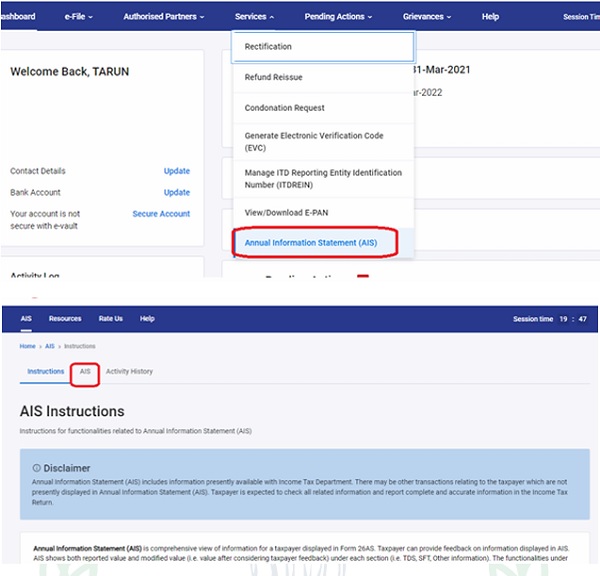
An assessee can access and respond to AIS information either directly from the income-tax e-filing portal or he can also use an offline utility.
MCQ on Annual Information System
Q1: Annual Information Statement (AIS) provides complete information about a taxpayer for ___________.
(a) a quarter
(b) a financial year
(c) a calendar year
(d) six months
Correct Answer: (b)
Justification of correct answer:
Annual Information Statement (AIS) is a statement that provides complete information about a taxpayer for a particular financial year. It contains information about taxpayers’ incomes, financial transactions, tax details, income-tax proceedings, etc.
Q2: Who is the prescribed authority for uploading the information in AIS?
(a) Principal Director General of Income-tax (Systems)
(b) Director General of Income-tax (Systems)
(c) Any person authorised by (a) and (b)
(d) All of the above
Correct Answer: (d)
Justification of correct answer:
Section 285BB read with rule 114-I of the Income-tax Rules, 1962 provides that the Principal Director General of Income-tax (Systems) or the Director General of Income-tax (Systems) or any person authorised by him shall upload certain specified information as available with them in the annual information statement.
Q3: AIS contains information relating to ___________.
(a) TDS and TCS
(b) Dividends reported by Registrar and Transfer Agent (RTA)
(c) Specified Financial Transactions (SFT)
(d) All of the above
Correct Answer: (d)
Justification of correct answer:
Annual Information statement contains the following information in respect of an assessee about all the above-mentioned options i.e., TDS and TCS, Dividends reported by Registrar and Transfer Agent (RTA), and Specified Financial Transactions (SFT) for a particular financial year.
Q4: Which of the following information is required to be uploaded in AIS by DGIT (System) within 3 months from the end of the month in which the information is received?
(a) Information relating to TDS and TCS
(b) Information relating to foreign remittance details reported in Form 15CC
(c) Both (a) and (b)
(d) None of the above
Correct Answer: (b)
Justification of correct answer:
The CBDT has authorised the Director General of Income-tax (Systems) to upload information relating to points (h) to (p) given above in the AIS within 3 months from the end of the month in which the information is received by him. Such points include information relating to foreign remittance information reported in Form 15CC .
Q5: In case of any deficiency in AIS, a taxpayer can submit feedback through which portal?
(a) Income Tax Department (https://www.incometaxindia.gov.in.)
(b) e-Filing website (https://www.incometax.gov.in/iec/foportal/)
(c) TRACES Website (https://contents.tdscpc.gov.in/ )
(d) Reporting Portal (https://report.insight.gov.in/reportingwebapp/portal/homePage)
Correct Answer: (b)
Justification of correct answer:
An assessee can access AIS information by logging into his income-tax e-filing account. If he feels that the information furnished in AIS is incorrect, duplicated, or relates to any other person, etc., he can submit his feedback thereon.
Q6: An assessee can access and respond to AIS information _________.
(a) Online through income-tax e-filing portal
(b) Through offline utility
(c) Both (a) and (b)
(d) None of the above
Correct Answer: (c)
Justification of correct answer:
An assessee can access and respond to AIS information either directly from the income-tax e-filing portal or he can also use an offline utility.
Permanent Account Number
| Disclaimer:
The contents of this document are for information purposes only. This aims to enable public to have a quick and an easy access to information and do not purport to be legal documents. Viewers are advised to verify the content from Government Acts/Rules/Notifications etc. |
Permanent Account Number (PAN)
Various aspects of PAN to be covered
- What is PAN?
- Utility of PAN
- Who has to obtain PAN?
- Transactions in which PAN is mandatory
- How to apply for PAN?
- How to correct any mistake in PAN card or intimate any change in data pertaining to PAN?
- Holding of more than one PAN not allowed
- How to know PAN if the PAN card is lost and PAN is forgotten?
- Penalty for not complying with provisions of PAN
What is PAN?
PAN is a ten-digit unique alphanumeric number issued by the Income Tax Department. PAN is issued in the form of a laminated plastic card as given below (commonly known as PAN card):
Now we shall discuss on the structure of the ten characters of PAN. For this purpose we shall take an illustrative PAN as given below :
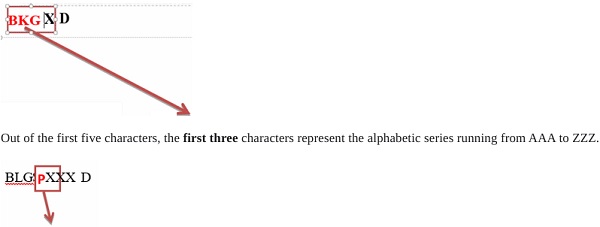 The fourth character of PAN represents the status of the PAN holder.
“P” stands for Individual
“C” stands for Company
“H” stands for Hindu Undivided Family (HUF)
“A” stands for Association of Persons (AOP)
“B” stands for Body of Individuals (BOI)
“G” stands for Government Agency
“J” stands for Artificial Juridical Person
“L” stands for Local Authority
“F” stands for Firm/ Limited Liability Partnership
“T” stands for Trust
Fifth character of PAN represents the first character of the PAN holder’s last name/surname in case of an individual. In case of non-individual PAN holders fifth character represents the first character of PAN holder’s name.
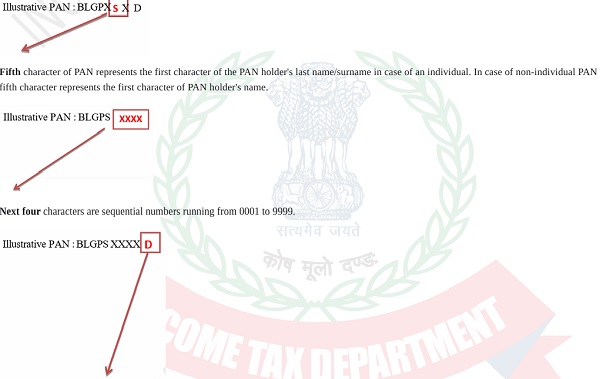
Last character, i.e., the tenth character is an alphabetic check digit.
Utility of PAN
PAN enables the department to identify/ link all transactions of the PAN holder with the department. These transactions include tax payments, TDS/TCS credits, returns of income, specified transactions, correspondence etc, and so on. It facilitates easy retrieval of information of PAN holder and matching of various investments, borrowings and other business activities of PAN holder.
Who has to obtain PAN?
PAN is to be obtained by :
- Every person if his total income or the total income of any other person in respect of which he is assessable during the year exceeds the maximum amount which is not chargeable to tax.
- A charitable trust who is required to furnish return under Section 139(4A)
- Every person who is carrying on any business or profession whose total sales, turnover, or gross receipts are or is likely to exceed five lakh rupees in any year
- Every person who intends to enter into specified financial transactions in which quoting of PAN is mandatory.
- Every non-individual resident persons and persons associated with them shall apply for PAN if the financial transaction entered into by them during the financial year exceeds Rs. 2,50,000.
Transactions in which quoting of PAN is mandatory
Following are the transactions in which quoting of PAN is mandatory by every person except the Central Government, the State Governments and the Consular Offices:
1) Sale or purchase of a motor vehicle or vehicle other than two wheeled vehicles.
2) Opening an account [other than a time-deposit referred at point No. 12 and a Basic Savings Bank Deposit Account] with a banking company or a co-operative bank
3) Making an application for issue of a credit or debit card.
4) Opening of a demat account with a depository, participant, custodian of securities or any other person with SEBI
5) Payment in cash of an amount exceeding Rs. 50,000 to a hotel or restaurant against bill at any one time.
6) Payment in cash of an amount exceeding Rs. 50,000 in connection with travel to any foreign country or payment for purchase of any foreign currency at any one time.
7) Payment of an amount exceeding Rs. 50,000 to a Mutual Fund for purchase of its units
8) Payment of an amount exceeding Rs. 50,000 to a company or an institution for acquiring debentures or bonds issued by it.
9) Payment of an amount exceeding Rs. 50,000 to the Reserve Bank of India for acquiring bonds issued by it.
10) Deposits of cash exceeding Rs. 50,000 during any one day with a banking company or a co- operative bank.
10A) Deposits of cash aggregating to more than Rs. 2,50,000 during the period of 09th November 2016 to 30th December 2016 with a banking company, cooperative bank or post office.
11) Payment in cash for an amount exceeding Rs. 50,000 during any one day for purchase of bank drafts or pay orders or banker’s cheques from a banking company or a co-operative bank.
12) A time deposit of amount exceeding Rs. 50,000 or aggregating to more than Rs. 5 lakh during a financial year with –
(i) a banking company or a co-operative bank
(ii) a Post Office;
(iii) a Nidhi referred to in >section 406< of the Companies Act, 2013 or
(iv) a non-banking financial company
13) Payment in cash or by way of a bank draft or pay order or banker’s cheque of an amount aggregating to more than Rs. 50,000 in a financial year for one or more pre-paid payment instruments, as defined in the policy guidelines for issuance and operation of pre-paid payment instruments issued by Reserve Bank of India under section 18 of the Payment and Settlement Systems Act, 2007 to a banking company or a co-operative bank or to any other company or institution.
14) Payment of an amount aggregating to more than Rs. 50,000 in a financial year as life insurance premium to an insurer
15) A contract for sale or purchase of securities (other than shares) for amount exceeding Rs. 1 lakh per transaction
16) Sale or purchase, by any person, of shares of a company not listed in a recognised stock exchange for amount exceeding Rs. 1 lakh per transaction.
17) Sale or purchase of any immovable property for an amount exceeding Rs. 10 lakh or valued by stamp valuation authority referred to in section 50C of the Act at an amount exceeding ten lakh rupees.
18) Sale or purchase of goods or services of any nature other than those specified above for an amount exceeding Rs. 2 lakh per transaction.
NOTE:
1) Minor person can quote PAN of his father or mother or guardian provided he does not have any income chargeable to income-tax.
2) Any person, who does not have PAN and enters into any of above transaction, can make a declaration in Form No.60.
3) Quoting of PAN is not required by a non-resident in a transaction referred at point No. 3 or 5 or 6 or 9 or 11 or 13 or 18.
4) Any person who has an account (other than a time deposit referred at point no. 12 and a Basic Saving Bank Deposit Account) maintained with a banking company or a co-operative bank. He will be required to furnish his PAN or Form No.60 on or before 30-06-2017 if he has not quoted his PAN or furnished Form No. 60 at the time of opening of such account or subsequently.
How to apply for PAN?
Income Tax Department has authorised UTI Infrastructure Technology and Services Limited (UTIITSL) and National Securities Depository Limited (NSDL) [now protean] to set-up and manage PAN Service Centers. UTIITSL and NSDL [now protean] have established PAN Service Centers and TIN Facilitation Centers at various places in major cities of India (hereinafter referred to as PAN application centers of UTIITSL/Protean).
Thus, a person wishing to obtain PAN can apply for PAN by submitting the PAN application form (Form 49A/49AA ) along with the related documents and prescribed fees at the PAN application center of UTIITSL or Protean. An online application can also be made from the website of UTIITSL or Protean.
As per Section 139AA, every person who is eligible to obtain Aadhaar is required to quote his Aadhaar number in the PAN application form with effect from 1st day of July, 2017. If any person does not possess the Aadhaar Number but he had applied for the Aadhaar card then he can quote Enrolment ID of Aadhaar application Form.
Note: W.e.f. 01-10-2024, the benefit of quoting enrolment ID of Aadhaar form has been withdrawn. The taxpayer is required to quote his Aadhaar number in PAN application Form.
Further, every person who has been allotted PAN based on the enrolment ID of the Aadhaar application form shall intimate his Aadhaar number to the prescribed authority. The form and manner of intimating the Aadhaar number shall be notified by the Central Government.
However, the provisions of section 139AA shall not apply to an individual who does not possess the Aadhaar number or the Enrolment ID and is:-
i) residing in any of these States-Assam, Jammu and Kashmir and Meghalaya;
ii) a non-resident as per the Income-tax Act, 1961;
iii) of the age of 80 years or more at any time during the previous year, i.e., super-senior citizen;
iv) not a citizen of India.
Hence, it will not be mandatory for an individual (as notified above) to quote his/her Aadhaar Number in the PAN application form.
In case of an applicant, being a company which has not been registered under the Companies Act, 2013, the application for allotment of a Permanent Account Number may be made in Spice- INC-32 specified under sub-section (1) of section 7 of the said Act for incorporation of the company.
A resident person shall apply for PAN in form 49A and a non-resident person including a foreign company shall apply for allotment of PAN in form 49AA.
Individual applicants will have to affix two recent, coloured photograph (Stamp size 3.5 cms x 2.5. cms) on PAN application form.
Prescribed document must be furnished as a proof of ‘Identity’ ‘Address’ and ‘Date of Birth’.
Designation and Code of concerned Assessing Office of Income Tax Department will have to be mentioned in PAN application form.
The address, phone numbers, etc., of PAN application centers of UTIITSL or Protean at which PAN application can be submitted can be obtained from :
- Website of Income Tax Department :www.incometaxindia.gov.in
- Website of UTIITSL :www.utiitsl.com Website of Protean : https://tinpan.proteantech.in
Instant PAN
Income-tax Dept. has launched a new functionality on the e-filing portal which allots a PAN to the assessee on basis of his Aadhaar Number.
This facility can be used by an assessee only if the following conditions are fulfilled:
a) He has never been allotted a PAN;
b) His mobile number is linked with his Aadhaar number;
c) His complete date of birth is available on the Aadhaar card; and
d) He should not be a minor on the date of application for PAN
How to get instant PAN using this functionality?
1) Go to https://eportal.incometax.gov.in/iec/foservices/#/pre-login/instant-e-pan and click on “Get New e-PAN”
2) Enter your 12 digit Aadhaar number for PAN allotment and click on continue
3) Enter the OTP received on the mobile number linked with the Aadhaar No. to validate the Aadhaar details
4) Enter other details and submit to get the e-PAN.
How to correct any mistake in PAN card or intimate any change in data pertaining to PAN?
Request for reissue of lost PAN card or for change/correction in PAN data is to be filed in “Request for New PAN Card Or/ And Changes Or Correction in PAN Data”.
- For Changes or Correction in PAN data, fill all mandatory fields of the Form and select the corresponding box on left margin of appropriate field where correction is required.
- If the application is for re-issuance of a PAN card without any changes in PAN related data of the applicant, fill all fields in the Form but do not select any box on left margin.
- In case of either a request for Change or Correction in PAN or request for re-issuance of a PAN Card without any changes in PAN data, the address for communication will be updated in the ITD database using address for communication provided in the application.
- For Cancellation of PAN, fill all mandatory fields in the Form, enter PAN to be cancelled in appropriate column of the Form and select the check box on left margin. PAN to be cancelled should not be same as PAN (the one currently used) mentioned at the top of the Form.
Holding of more than one PAN not allowed
A person cannot hold more than one PAN. A penalty of Rs. 10,000/- is liable to be imposed under section 272B of the Income-tax Act, 1961 for having more than one PAN.
If a person has been allotted more than one PAN then he should immediately surrender the additional PAN card(s).
Linking of PAN with Aadhaar Number
The Finance Act, 2017 had inserted a new section 139AA in the Income-tax Act, 1961, requiring every person who is eligible to obtain Aadhaar to quote his Aadhaar number while applying for PAN or furnishing return of income with effect from July 1, 2017. If any person does not possess the Aadhaar Number but he had applied for the Aadhaar card then he can quote Enrolment ID of Aadhaar application Form in the ITR.
However, w.e.f. 01-10-2024, the benefit of quoting enrolment ID of Aadhaar form has been withdrawn. The taxpayer is required to quote his Aadhaar number in PAN application Form.
Further, every person who has been allotted PAN based on the enrolment ID of the Aadhaar application form shall intimate his Aadhaar number to the prescribed authority. The form and manner of intimating the Aadhaar number shall be notified by the Central Government.
Section 139AA further provides that every person who has been allotted PAN as on the 1st day of July, 2017, and who is eligible to obtain Aadhaar number shall intimate his Aadhaar number on or before 31-03-20221 to the Income-tax Department. In case of failure to intimate the Aadhaar number, PAN allotted to the person shall be made inoperative after the date so notified.
The CBDT has notified2 that all the consequences provided under the Income-tax Act for not furnishing, intimating or quoting PAN shall come into effect from 01-07-2023 if PAN becomes inoperative due to non-linking of it with Aadhaar. However, the taxpayer is liable to pay fee if PAN is linked with Aadhaar from 01-04-2022 to 30-06-2023.
Consequences for not linking PAN with Aadhaar Number
The Central Board of Direct Taxes has notified Rule 114AAA prescribing the manner and consequences if PAN becomes inoperative. The Rule 114AAA(3) provides that if PAN of a person become inoperative, then he shall be liable for the following consequences:
I. Refund of any amount of tax or part thereof, due under the provisions of the Act shall not be made;
II. Interest shall not be payable on such refund for the period, beginning with the date when PAN become inoperative and ending with the date on which it becomes operative;
III. Where tax is deductible under Chapter XVIIB in case of such person, such tax shall be deducted at higher rate, in accordance with provisions of section 206AA;
IV. Where tax is collectible at source under Chapter XVII-BB in case of such person, such tax shall be collected at higher rate, in accordance with provisions of section 206CC.
However, the person can reactivate his PAN by subsequently intimating his Aadhaar to the Department.
Fee for default relating to intimation of Aadhaar number
The Finance Act, 2021 has inserted a new Section 234H to levy a fee for default in intimating the Aadhaar Number. If a person is required to intimate his Aadhaar under Section 139AA and such person fails to do so, he shall be liable to pay a fee, as may be prescribed, not exceeding Rs. 1,000 at the time of making such intimation.
The CBDT vide notification No. 17/2022, dated 29-03-2022 has amended Rule 114 to prescribe the fees to be levied if Aadhaar is not linked with PAN. As per Rule 114(5A), if a person intimates his Aadhaar number after the due date, then he shall be liable to pay a fee of:
a) Rs. 500, if such intimation is made between 01-04-2022 and 30-06-2022; and
b) Rs. 1,000, in all other cases.
How to link Aadhaar number with PAN?
The following modes have been prescribed to link Aadhaar number with PAN:
(a) SMS:
Send SMS to 567678 or 56161 from your registered mobile number in the following format:
UIDPAN<12 Digit Aadhaar Number><10 Digit PAN>
For E.g., UIDPAN 123456789000 EPOPE1234E
(b) Online:
- By visiting the website of the PAN Service providers (i.e., https://tinpan.proteantech.in or www.utiitsl.com). Click on the button ‘Link Aadhaar to PAN’ which will direct you to the income-tax website.
- By visiting directly the e-filing website (i.e., www.incometaxindiaefiling.gov.in).
(c) Paper mode:
File one page Form along with minimal fee with the designated PAN center. Copies of PAN card, Aadhaar card are to be furnished.
PAN and AADHAAR are interchangeable for Income -tax purpose
Section 139A of the Income-tax Act, 1961, prescribes various conditions under which an assessee is required to obtain PAN. He needs to mention his PAN in all communications with the Income-tax Dept. and while entering into specified financial transactions.
However, there can be situations where a person entering into high-value transactions, such as purchase of foreign currency or huge withdrawal from the banks, does not possess a PAN. Thus, the Finance (No. 2) Act, 2019, has provide for interchangeability of PAN with Aadhaar. It has been provided that every person who is required to furnish or intimate or quote his PAN under the Income-tax Act, and who,-
a) has not been allotted a PAN but possesses the Aadhaar number, may furnish or intimate or quote his Aadhaar in lieu of PAN. Further, Income-tax department shall allot PAN to such person in prescribed manner.
b) has been allotted a PAN, and who has linked his Aadhaar number with PAN as per section 139AA, may furnish his Aadhaar number in lieu of a PAN for all the transactions where quoting of PAN is mandatory as per Income-tax Act.
Penalty for not complying with provisions relating to PAN or Aadhaar
Section 272B provides for penalty in case of default in complying with the provisions relating to PAN, i.e., failure to obtain, quote, or authenticate PAN. The amount of penalty shall be Rs. 10,000 for each default.
As the Finance (No. 2) Act, 2019 as provided for interchangeability of Aadhaar with PAN, Consequential amendments have been made in the penal provisions of Section 272B so as to levy a penalty of Rs. 10,000 for each default in the following cases:
a) If assessee fails to quote or intimate his PAN or Aadhaar or quotes or intimates invalid PAN or Aadhaar.
b) If assessee fails to quote or authenticate his PAN or Aadhaar in specified transactions.
c) If receiver (i.e., banks, financial institution, etc.) of documents in respect of specified transactions fails to ensure that the PAN or Aadhaar are duly quoted and authenticated.
MCQ on Permanent Account Number
Q1. Permanent Account Number (PAN) is a digit unique alphanumeric number issued by the Income Tax Department.
(a) Twenty (b) Fifteen
(c) Ten (d) Five
Correct answer : (c)
Justification of correct answer :
PAN is a ten-digit unique alphanumeric number issued by the Income Tax Department. PAN is issued in the form of a laminated plastic card (commonly known as PAN card).
Thus, option (c) is the correct option.
Comment on incorrect answer : Option (c) is the correct option since it gives the correct digit formation of PAN, all the other options viz. option (a), (b) and (d) giving incorrect digit formation of PAN are not correct.
Q2. Out of the first characters, the first three characters represent the alphabetic series running from AAA to ZZZ.
(a) Ten (b) Seven
(c) Five (d) Four
Correct answer : (c)
Justification of correct answer :
PAN is a ten-digit unique alphanumeric number issued by the Income Tax Department. PAN is issued in the form of a laminated plastic card (commonly known as PAN card). Out of the first five characters, the first three characters represent the alphabetic series running from AAA to ZZZ
Thus, option (c) is the correct option.
Comment on incorrect answer : Option (c) is the correct option since it gives the correct digit formation of PAN, all the other options viz. option (a), (b) and (d) giving incorrect digit formation of PAN are not correct.
Q3. The fifth character of PAN represents the status of the PAN holder.
(a) True (b) False
Correct answer : (b)
Justification of correct answer :
PAN is a ten-digit unique alphanumeric number issued by the Income Tax Department. PAN is issued in the form of a laminated plastic card (commonly known as PAN card). Out of the first five characters, the first three characters represent the alphabetic series running from AAA to ZZZ. The fourth character of PAN represents the status of the PAN holder.
Thus, the statement given in the question is false and hence, option (b) is the correct option.
Comment on incorrect answer :The statement given in the question is false, hence, option (a) is not correct.
Q4. Last character, i.e., the tenth character is an _.
(a) Identification (b) Symbol
(c) Alphabetic check digit (d) Numeric check digit
Correct answer : (c)
Justification of correct answer :
PAN is a ten-digit unique alphanumeric number issued by the Income Tax Department. PAN is issued in the form of a laminated plastic card (commonly known as PAN card). Last character, i.e., the tenth character is an alphabetic check digit.
Thus, option (c) is the correct option.
Comment on incorrect answer : Option (c) is the correct option since it gives the correct digit formation of PAN, all the other options viz. option (a), (b) and (d) giving incorrect digit formation of PAN are not correct.
Q5. Every person who is required to file the return of income or is required to file the return of income on behalf of any other person has to obtain PAN. Apart from such person, no other person has to obtain PAN.
(a) True (b) False
Correct answer : (b)
Justification of correct answer :
PAN is to be obtained by following persons :
- Every person who is required to file the return of income or is required to file the return of income on behalf of any other person.
- Every person who is carrying on any business or profession whose total sale, turnover or gross receipts are likely to exceed five lakh rupees in any previous year.
- Every person who intends to enter into specified financial transactions in which quoting of PAN is mandatory.
- Every non-individual resident persons and persons associated with them shall apply for PAN if the financial transaction entered into by them during the financial year exceeds Rs. 2,50,000.
Thus, the statement given in the question is false and hence, option (b) is the correct option.
Comment on incorrect answer : The statement given in the question is false, hence, option (a) is not correct.
Q6. There is no bar on obtaining more than one PAN i.e. a person can hold more than one PAN.
(a) True (b) False
Correct answer : (b)
Justification of correct answer :
A person cannot hold more than one PAN. A penalty of Rs. 10,000/- is liable to be imposed under section 272B of the Income-tax Act, 1961 for having more than one PAN.
If a person has been allotted more than one PAN then he should immediately surrender the additional PAN card(s).
Thus, the statement given in the question is false and hence, option (b) is the correct option.
Comment on incorrect answer :The statement given in the question is false, hence, option (a) is not correct.
Q7. If a person fails to comply with the provisions relating to PAN (i.e. obtaining PAN, quoting PAN, etc.), then penalty can be levied under section—
(a) 272 (b) 272A
(c) 272B (d) 271
Correct answer : (c)
Justification of correct answer :
Section 272B provides for penalty in case of default in complying with the provisions relating to PAN, i.e., failure to obtain, quote, or authenticate PAN. The amount of penalty shall be Rs. 10000 for each default.
As the Finance (No. 2) Act, 2019 as provided for interchangeability of Aadhaar with PAN, Consequential amendments have been made in the penal provisions of Section 272B so as to levy a penalty of Rs. 10,000 for each default in the following cases:
a) If assessee fails to quote or intimate his PAN or Aadhaar or quotes or intimates invalid PAN or Aadhaar.
b) If assessee fails to quote or authenticate his PAN or Aadhaar in specified transactions.
c) If receiver (i.e., banks, financial institution, etc.) of documents in respect of specified transactions fails to ensure that the PAN or Aadhaar are duly quoted and authenticated.
Thus, option (c) is the correct option.
Comment on incorrect answer : Option (c) is the correct option since it gives the correct section reference, all the other options viz. option (a), (b) and (d) giving incorrect section reference are not correct.
Q8. Application for obtaining PAN is to be made in Form (in case of a resident).
(a) 49 (b) 49A
(c) 49B (d) ITR – 1
Correct answer : (b)
Justification of correct answer :
A person wishing to obtain PAN can apply for PAN by submitting the PAN application form (Form 49A) along with the related documents and prescribed fees at the PAN application center of UTIITSL or Protean .
Thus, option (b) is the correct option.
Comment on incorrect answer : Option (b) is the correct option since it gives the correct form reference, all the other options viz. option (a), (b) and (d) giving incorrect form reference are not correct.
Q9. One can apply for PAN by submitting the PAN application form (Form 49A/49AA ) along with the related documents and prescribed fees at the PAN application center of UTIITSL or Protean . Online application for PAN is not allowed.
(a) True (b) False
Correct answer : (b)
Justification of correct answer :
A person wishing to obtain PAN can apply for PAN by submitting the PAN application form (Form 49A/49AA ) along with the related documents and prescribed fees at the PAN application center of UTIITSL or Protean . An online application can also be made from the website of UTIITSL or Protean .
Thus, the statement given in the question is false and hence, option (b) is the correct option.
Comment on incorrect answer :The statement given in the question is false, hence, option (a) is not correct.
Q10. There are certain specified financial transactions in which quoting of PAN is mandatory, if a person intending to enter into the transaction does not hold PAN then he may furnish Aadhaar in link of PAN.
(a) True (b) False
Correct answer : (a)
Justification of correct answer :
Section 139A of the Income-tax Act, 1961, prescribes various conditions under which an assessee is required to obtain PAN. He needs to mention his PAN in all communications with the Income-tax Dept. and while entering into specified financial transactions.
However, there can be situations where a person entering into high-value transactions, such as purchase of foreign currency or huge withdrawal from the banks, does not possess a PAN. Thus, the Finance (No. 2) Act, 2019, has provide for interchangeability of PAN with Aadhaar. It has been provided that every person who is required to furnish or intimate or quote his PAN under the Income-tax Act, and who,-
c) has not been allotted a PAN but possesses the Aadhaar number, may furnish or intimate or quote his Aadhaar in lieu of PAN. Further, Income-tax department shall allot PAN to such person in prescribed manner.
d) has been allotted a PAN, and who has linked his Aadhaar number with PAN as per section 139AA, may furnish his Aadhaar number in lieu of a PAN for all the transactions where quoting of PAN is mandatory as per Income-tax Act.
Thus, the statement given in the question is true and hence, option (a) is the correct option.
Comment on incorrect answer :
The statement given in the question is false, hence, option (a) is not correct.
Q11. An individual residing in the State of Jammu and Kashmir is required to quote his Aadhaar Number in PAN application form.
(a) True (b) False
Correct answer: (b)
Justification of correct answer:
As per Section 139AA, every person who is eligible to obtain Aadhaar is required to quote his Aadhaar number in the PAN application form with effect from 1st day of July, 2017. If any person does not possess the Aadhaar Number but he had applied for the Aadhaar card then he can quote Enrolment ID of Aadhaar application Form. However, w.e.f. 01-10-2024, the benefit of quoting enrolment ID of Aadhaar form has been withdrawn. The taxpayer is required to quote his Aadhaar number in PAN application Form.
However, the provisions of section 139AA shall not apply to an individual who does not possess the Aadhaar number or the Enrolment ID and is:-
i. residing in any of these States-Assam, Jammu and Kashmir and Meghalaya;
ii. a non-resident as per the Income-tax Act, 1961;
iii. of the age of 80 years or more at any time during the previous year, i.e., super-senior citizen;
iv. not a citizen of India.
Hence, it will not be mandatory for an individual residing in the State of Jammu and Kashmir to quote his/her Aadhaar Number in the PAN application form.
Thus, option (b) is the correct option.
Notes:
1 Notification No. 113/2021, dated 17-09-2021.
2 Order F. no. 370142/14/2022-TPL, dated 01-04-2023
E-payment of direct taxes
There are two modes of payment of direct taxes (i) physical mode i.e. payment by furnishing the hard copy of the challan at the designated bank; and (ii) e-payment mode i.e. making payment by using the electronic mode. In this part, you can gain knowledge about various provisions relating to e-payment of various direct taxes.
Introduction
Earlier, we used to stand in queue for hours to book movie tickets, railway tickets, etc. but now we can relax at our place and perform these tasks using the internet. With the development of technology, the Government has also upgraded itself. Previously, the taxpayers have to wait in long queues at the banks for making the payment of tax, but after the introduction of e-payment facility one can pay tax quite comfortably from any place by using various online payment mode
Mandatory or compulsory e-payment
It is compulsory for the following taxpayers to pay tax using the e-payment mode only. In other words, following persons cannot use the physical mode of payment of tax and have to pay the tax electronically using the e- payment facility:
- All companies
- All taxpayers other than company who are liable to get their accounts audited as per section 44AB.
Illustration
The income-tax liability for the financial year 2025-26 of Essem Ltd. amounted to Rs. 8,40,000. It wants to discharge its tax liability. Advice the company as to the mode of payment of tax.
**
It is compulsory for a company to pay the income-tax using the e-payment mode only. Hence, Essem Ltd. has to pay its tax electronically by using various prescribed online mode of payment.
Illustration
Mr. Raja is engaged in the business of trading in food grains. The annual turnover of the business was Rs. 2,84,00,000. He wants to pay advance tax of Rs. 1,84,000. Advice him as to the mode of payment of tax.
**
The turnover of the business of Mr. Raja exceeds Rs. 1,00,00,000 and, hence, as per section 44AB Mr. Raja will be liable to get the accounts audited.
It is compulsory for the following taxpayers to pay tax using the e-payment mode only. In other words, following persons cannot use the physical mode of payment of tax and have to pay the tax electronically using the e- payment facility:
1) All companies
2) All taxpayers other than company who are liable to get their accounts audited as per section 44AB.
Mr. Raja is liable to get his accounts audited and, hence, he will be covered by (2) above, and hence he has to pay the advance tax electronically.
Illustration
Mr. Vipul is engaged in the business of trading in fabrics. The annual turnover of the business amounted to Rs. 84,00,000. Profit for the year amounted to Rs. 8,40,000. He wants to pay his advance tax. Advice him as to the mode of payment of tax.
**
The turnover of the business does not exceed Rs. 1,00,00,000 and, hence, as per section 44AB Mr. Vipul is not liable to get the accounts audited.
It is compulsory for the following taxpayers to pay tax using the e-payment mode only. In other words, following persons cannot use the physical mode of payment of tax and have to pay the tax electronically using the e- payment facility:
(1) All companies
(2) All taxpayers other than company who are liable to get their accounts audited as per section 44AB.
Mr. Vipul is not covered in any of the above discussed categories and, hence, it is not mandatory for him to pay tax electronically. Thus, he can pay tax by physical mode or electronic mode as per his choice. However, e-payment will be easy and will save time and efforts.
Illustration
Essem Ltd. paid brokerage of Rs. 84,000 to Mr. Kapoor. The company deducted tax of Rs. 4,200 on the brokerage paid to Mr. Kapoor. It wants to pay the TDS of Rs. 4,200 to the credit of Government. Advice the company as to the mode of payment of TDS to the credit of the Government.
**
It is compulsory for the following taxpayers to pay tax using the e-payment mode only. In other words, following persons cannot use the physical mode of payment of tax and have to pay the tax electronically using the e- payment facility:
(1) All companies
(2) All taxpayers other than company who are liable to get their accounts audited as per section 44AB.
The above provisions will apply to all forms of tax like advance tax, self assessment tax, tax deducted at source, etc. Hence, Essem Ltd. has to pay electronically the TDS to the credit of Government.
Illustration
Mr. Krunal is engaged in the business of trading in food grains. The annual turnover of the business was Rs. 2,84,00,000. He purchased 1,000 quintals of wheat through a broker and paid him brokerage of Rs. 84,000. Mr. Krunal deducted tax of Rs. 8,400 on the brokerage paid by him. He wants to pay the TDS of Rs. 8,400 to the credit of Government. Advice him as to the mode of payment of TDS to the credit of the Government.
**
The turnover of the business exceeds Rs. 1,00,00,000 and, hence, as per section 44AB Mr. Krunal will be liable to get the accounts audited.
It is compulsory for the following taxpayers to pay tax using the e-payment mode only. In other words, following persons cannot use the physical mode of payment of tax and have to pay the tax electronically using the e- payment facility:
(1) All companies
(2) All taxpayers other than company who are liable to get their accounts audited as per section 44AB.
The above provisions will apply to all forms of taxes like advance tax, self assessment tax, tax deducted at source, etc. Hence, Mr. Krunal has to pay electronically the TDS to the credit of the Government.
Optional e-payment
As discussed earlier, e-payment is mandatory for all companies and all non-corporate taxpayers covered by audit under section 44AB. A person not covered in the mandatory category can voluntarily pay his tax by using the e-payment mode. E-payment saves time and efforts.
Benefits of e-payment
E-payment is time saving, simple, safe and this facility can be used at any time from anywhere.
Requirements for making e-payment
Tax can be paid online using any of the following payment mode:
a) Net Banking
b) Debit Card
c) Credit Card
d) RTGS/NEFT
e) UPI
If the taxpayer does not have any of the above mentioned facility, he can make e-payment using account of any other person but the tax should be paid in his name.
If the payment is to be made through a credit card, you need to select the ‘Payment Gateway’ mode option. In such a case, the transaction charges of 0.85% + GST @ 18% shall apply. These transaction charges will be applicable over and above the tax amount in this mode.
Taxes which can be paid electronically
Following direct taxes can be paid using the e-payment mode:
(1) Income-tax
(2) Equalization Levy
(3) Corporate tax (i.e., income-tax paid by a company)
(4) Tax deducted at source (TDS)
(5) Tax collected at source (TCS)
(6) Securities Transaction Tax (STT)
(7) Commodities Transaction Tax (CTT)
(8) Wealth-tax and other direct taxes like gift tax, expenditure tax, etc.
Nature of challan to be used
Following are the Challans to be used for making payment of different direct taxes:
| Challan No. | Nature of tax payment |
|---|---|
| ITNS 280 | For making payment of income-tax and Corporate tax (i.e. income-tax by companies) |
| ITNS 281 | For making payment of TDS/TCS by corporate and non-corporate deductors/collectors |
| ITNS 282 | For making payment of Securities Transaction Tax, Wealth Tax and other direct taxes. |
| ITNS 284 | For making payment of income-tax and corporate tax (i.e. income-tax by companies) in case of undisclosed foreign Income and Assets. |
| ITNS 285 | For making payment of Equalization levy |
| Form No. 26QB | For making payment of tax deducted at source in case of immovable property. |
| Form No. 26QC | For making payment of tax deducted at source in case of rent of property |
| Form No. 26QD | For making payment of tax deducted at source in case of resident contractors and professionals |
General details to be provided in the Challans to be used for making payment of tax.
Following are few significant details which are common to all the above discussed challans:
Correct Permanent Account Number of the taxpayer should be entered in case of payment of income-tax and correct Tax Deduction Account Number of the deductor should be entered in case of payment of TDS/TCS.
Correct financial year/assessment year should be selected.
Correct address of the taxpayer is to be provided along with correct Pin Code. Correct e-mail ID and correct phone number of the taxpayer should be provided.
How to e-pay tax?
Given below is the step to make e-payment of taxes:
(a) Go to https://www.incometax.gov.in/iec/foportal/
(b) Select ‘e-Pay Tax’ from the quick links
(c) Enter PAN/TAN and mobile number for OTP verification
(d) Enter the OTP received on mobile number and click on continue
(e) Confirm the details of ‘PAN/TAN’ and ‘Name’ and click on continue
(f) Select the appropriate payment, i.e., ‘Income Tax’, ‘Equalisation Levy/ STT/ CTT’ or ‘Fee/ Other Payments’ and click on proceed
(g) Select ‘Assessment Year’ and ‘Type of Payment’ and click on continue
(h) Enter amount of tax, surcharge, cess, etc. (if any)
(i) On click on continue, taxpayer will have a new screen with various option to make payment, like net banking, debit card, Pay at bank counter, RTGS/NEF and payment gateway.
(j) Select appropriate mode of payment and click on continue. If taxpayer wishes to make payment using credit card or UPI, he needs to select ‘Payment Gateway’.
(k) Verify all the details appearing on challan and pay tax.
(l) On successful completion of the transaction, the challan of payment (i.e., receipt of payment) will be generated and will be displayed on the screen.
Contact details in case of any assistance
While making e-payment, if the taxpayer faces any problem, he should contact the call center.
While making e-payment, if the taxpayer faces any problem at the payment gateway of 3his bank, he should contact his bank
MCQ ON E-PAYMENT OF DIRECT TAXES
Q1. Can a person pay direct taxes using the e-payment facility?
(a) Yes (b) No
Correct answer : (a)
Justification of correct answer :
With the development of technology, the Government has also upgraded itself, thus, as on today, there are two modes of payment of direct taxes (i) physical mode i.e. payment by furnishing the hard copy of the challan at the designated bank; and (ii) e-payment mode. Thus, option (a) is the correct option.
Q2. It is compulsory for every company to pay income-tax tax electronically.
(a) True (b) False
Correct answer : (a)
Justification of correct answer :
It is compulsory for the following taxpayers to pay tax using the e-payment mode only:
- All companies
- All taxpayers other than company who are liable to get their accounts audited as per section 44AB.
Thus, the statement given in the question is true and hence, option (a) is the correct option.
Q3. A person not compulsorily required to pay tax electronically cannot voluntarily pay his tax by using the e-payment facility.
(a) True (b) False
Correct answer : (b)
Justification of correct answer :
A person not covered in the mandatory category can voluntarily pay his tax using the e- payment mode.
Thus, the statement given in the question is false and hence, option (b) is the correct option.
Q4. Taxpayer can make tax payment using credit card.
(a) True (b) False
Correct answer : (a)
Justification of correct answer :
Credit card can be used for making tax payments. If the payment is to be made through a credit card, you need to select the ‘Payment Gateway’ mode option. In such a case, the transaction charges of 0.85% + GST @ 18% shall apply.
Q5. If the taxpayer does not have a net banking enabled account, then he can make e- payment using a net banking enabled account of any other person.
(a) True (b) False
Correct answer : (a)
Q6. The facility of e-payment of tax is available in case of income-tax and not in case of other direct taxes like wealth tax, securities transaction tax, etc.
(a) True (b) False
Correct answer : (b)
Justification of correct answer :
Following direct taxes can be paid using the e-payment mode :
(1) Income-tax
(2) Corporate tax (i.e., income-tax paid by a company)
(3) Tax deducted at source (TDS)
(4) Tax collected at source (TCS)
(5) Securities Transaction Tax (STT)
(6) Commodities Transaction Tax (CTT)
(7) Wealth-tax and other direct taxes like gift tax, expenditure tax, etc
Thus, the statement given in the question is false and hence, option (b) is the correct option.
Q7. Which of the following challan is to be used for making payment of income-tax and Corporate tax (i.e. income-tax by companies)?
(a) ITNS 280 (b) ITNS 281
(c) ITNS 282 (d) Form No. 26QB
Correct answer : (a)
Q8. Which of the following challan is to be used for making payment of TDS/TCS by corporate and non-corporate deductors/collectors?
(a) ITNS 280 (b) ITNS 281
(c) ITNS 282 (d) Form No. 26QB
Correct answer : (b)
Q9. Which of the following challan is to be used for making payment of Securities Transaction Tax, Wealth Tax and other direct taxes?
(a) ITNS 280 (b) ITNS 281
(c) ITNS 282 (d) Form No. 26QB
Correct answer : (c)
Q10. Which of the following challan is to be used for making payment of tax deducted at source in case of immovable property?
(a) ITNS 280 (b) ITNS 281
(c) ITNS 282 (d) Form No. 26QB
Correct answer : (d)
Q11. Which of the following challan is to be used for making payment of income-tax in case of undisclosed foreign income?
(a) ITNS 281 (b) ITNS 282
(c) ITNS 284 (d) ITNS 280
Correct answer : (c)
Interest Payable by the taxpayer under the Income-tax Act
Introduction
Under the Income-tax Act, different types of interests are levied for various kinds of delays/defaults. In this part, you can gain knowledge about the provisions of section 234A, 234B and 234C dealing with interest levied for (i) delay in filing the return of income; (ii) non-payment or short payment of advance tax; and (iii) non-payment or short payment of individual instalment or instalments of advance tax (i.e., deferment of advance tax).
Manner of computation of interest under the Income -tax Act
Before understanding the provisions of section 234A, 234B and 234C it is important to understand the provisions of Rule 119A which gives the manner of computation of interest under the Income-tax Act.
As per Rule 119A, while calculating the interest payable by the taxpayer or the interest payable by the Central Government to the taxpayer under any provision of the Act, the following rule shall be followed :
a) where interest is to be calculated on annual basis, the period for which such interest is to be calculated shall be rounded off to a whole month or months. For this purpose any fraction of a month shall be ignored and the period so rounded off shall be deemed to be the period in respect of which the interest is to be calculated;
b) where the interest is to be calculated for every month or part of a month comprised in a period, any fraction of a month shall be deemed to be a full month and the interest shall be so calculated;
c) the amount of tax, penalty or other sum in respect of which such interest is to be calculated shall be rounded off to the nearest multiple of one hundred rupees. For this purpose, any fraction of one hundred rupees shall be ignored and the amount so rounded off shall be deemed to be the amount in respect of which the interest is to be calculated.
E.g. If we want to compute interest under section 234A on Rs. 8,489 for 3 months and 10 days, then as per Rule 119A discussed above, while computing the amount liable to interest, any fraction of Rs. 100 is to be ignored and, hence, we will ignore Rs. 89 and the balance amount will come to Rs. 8,400. Interest will be computed on Rs. 8,400. Further, the period of 10 days will be considered as full month and, hence, interest will be computed for 4 months.
Interest for delay in filing the return of income [Section 234A]
Under section 234A, interest is levied for delay in filing the return of income, filing of an updated return or filing of a return in response to notice issued under section 142(1).
Basic provisions
➢ Interest under section 234A is levied for delay in filing the return of income. In other words, if the taxpayer files the return of income after the due date specified in this regard or files an updated return, interest under section 234A will be levied.
Illustration
Mr. Kapoor is a doctor. His tax liability for the financial year 2024-25 amounted to Rs. 8,400. The due date of filing the return of income in his case is 31st July, 2025. On 5th August, 2025 he paid tax of Rs. 8,400 and filed his return of income. Will he be liable to pay interest under section 234A?
**
Interest under section 234A is levied for delay in filing the return of income. The due date for filing the return of income in the case of Mr. Kapoor is 31st July, 2025 and he has paid the tax and filed the return on 5th August 2025. Hence, he will be liable to pay interest under section 234A on the outstanding tax liability (provisions relating to rate of interest, period of levy of interest and amount liable to interest are discussed later).
Rate of interest
Interest under section 234A is levied for delay in filing the return of income. Interest is levied at 1% per month or part of a month. The nature of interest is simple interest. In other words, the taxpayer is liable to pay simple interest at 1% per month or part of a month for delay in filing the return of income.
Period of levy of interest under section 234A
Interest under section 234A is levied from the period commencing on the date immediately following the due date of filing the return of income and ending on the date of furnishing the return of income, or in case where no return has been furnished, on the date of completion of the assessment under section 144.
It should be noted that while computing the period of levy of interest, part i.e. fraction of a month is considered as full month.
Illustration
Mr. Sunil is an engineer. The due date of filing the return of income in his case is 31st July, 2025. He filed his return of income on 9th December, 2025. His tax liability for the financial year 2024-25 is Rs. 8,400 (which is paid on 9th December, 2025). Will he be liable to pay interest under section 234A, if yes then what will be the period of levy of interest?
**
The due date of filing the return of income is 31st July, 2025, and return of income is filed on 9th December, 2025 i.e. after the due date and hence, Mr. Sunil will be liable to pay interest under section 234A.
While computing interest, part of the month will be taken as full month. In this case, there is a delay of 4 months and 9 days. Part of the month i.e. 9 days will be considered as full month and hence, interest will be levied for 5 months.
Amount liable to interest under section 234A
Interest under section 234A is levied on the amount of tax as determined under section 143(1) and where regular assessment is made, the tax on total income as determined under such regular assessment as reduced by advance tax, tax deducted/collected at source, relief claimed under various sections like sections 89/90/90A/91 and tax credit claimed under section 115JAA/115JD.
Note:
1.Tax on total income determined under section 143(1) shall not include the additional income-tax, if any, payable under section 140B or section 143.
2.Tax on total income determined under regular assessment shall not include the additional income-tax payable under section 140B.
Illustration
Mr. Kumar is running a medical store. The due date for filing the return of income in his case is 31st July. He filed his return of income on 3rd December. Tax liability of Mr. Kumar for the year is Rs. 28,400 (which is paid on 3rd December). Advance tax paid by him is Rs. 15,000 and he has TDS credit of Rs. 5,000. Will he be liable to pay interest under section 234A, if yes then how much?
**
**
Mr. Kumar has filed his return of income after the due date i.e. after 31st July and hence, he will be liable to pay interest under section 234A. Interest will be levied at 1% per month or part of the month.
The due date of filing the return of income is 31st July and the return of income is filed on 3rd December and hence, there is a delay of 4 months and 3 days. Part of the month i.e. 3 days will be considered as full month and hence, interest will be charged for a period of 5 months. Interest will be levied at 1% per month on Rs. 8,400 (*) for 5 months. Thus, interest under section 234A will come to Rs. 420.
(*) Advance tax of Rs. 15,000 and TDS of Rs. 5,000 are to be deducted from the tax liability of Rs. 28,400, hence, net liability after deducting advance tax and TDS will come to Rs. 8,400. Thus, interest will be levied on Rs. 8,400.
Interest for default in payment of advance tax [Section 234B]
Section 234B provides for levy of interest for default in payment of advance tax.
Basic provisions
Interest under section 234B is levied in following two cases:
a) When the taxpayer has failed to pay advance tax though he is liable to pay advance tax; or
b) Where the advance tax paid by the taxpayer is less than 90% of the assessed tax (meaning of assessed tax is discussed later).
As per Section 208 of the Act, advance tax shall be payable by the taxpayer during the financial year if estimated tax liability of assessee during that year is ten thousand rupees or more.
Illustration
Mr. Khushal is running a provision shop. Tax liability of Mr. Khushal for the year is Rs. 38,400. He has not paid any advance tax till 31st March. Entire tax was paid by him at the time of filing the return of income. Will he be liable to pay interest under section 234B?
**
Interest under section 234B is levied in following two cases:
a) When the taxpayer has failed to pay advance tax; or
b) Where the advance tax paid by the taxpayer is less than 90% of the assessed tax.
As per section 208 every person whose estimated tax liability for the year is Rs. 10,000 or more, shall pay his tax in advance in the form of “advance tax”.
The tax liability of Mr. Khushal is Rs. 38,400 (i.e., not less than Rs. 10,000), thus, he is liable to pay advance tax. However, he has not paid any advance tax and, hence, he will be liable to pay interest under section 234B (provisions relating to period of interest, rate of interest and amount on which interest is levied are discussed in later part).
Illustration
Mr. Mangal is running a provision shop. Tax liability of Mr. Mangal for the year is Rs. 48,400. He has paid advance tax of Rs. 46,000 till 31st March. Balance tax of Rs. 2,400 is paid by him at the time of filing the return of income. Will he be liable to pay interest under section 234B?
**
Interest under section 234B is levied in following cases:
(a) When the taxpayer has failed to pay advance tax; or
(b) Where the advance tax paid by the taxpayer is less than 90% of the assessed tax.
In this case, Mr. Mangal has paid 95% of the advance tax (*) i.e. more than 90% and thus, no interest will be levied under section 234B.
(*) The tax liability of Mr. Mangal is Rs. 48,400 and he has paid advance tax of Rs. 46,000. The quantum of advance tax paid by him will come to 95% (i.e., Rs. 46,000/Rs. 48,400) of the total tax liability.
Illustration
Mr. Raja is engaged in furniture business. Tax liability of Mr. Raja for the year is Rs. 58,400. He has paid advance tax of Rs. 35,000 till 31st March. Balance tax of Rs. 23,400 is paid by him at the time of filing the return of income. Will he be liable to pay interest under section 234B?
**
Interest under section 234B is levied in following cases:
(a) When the taxpayer has failed to pay advance tax; or
(b) Where the advance tax paid by the taxpayer is less than 90% of the assessed tax.
In this case, Mr. Raja has paid advance tax of Rs. 35,000. The quantum of advance tax paid by him is 60% of the total tax liability (*) i.e. less than 90% and hence, he will be liable to pay interest under section 234B.
(*) The tax liability of Mr. Raja is Rs. 58,400 and he has paid advance tax of Rs. 35,000. The quantum of advance tax paid by him will come to 60% (i.e., Rs. 35,000/Rs. 58,400) of the total tax liability.
Rate of interest
Under section 234B, interest for default in payment of advance tax is levied at 1% per month or part of a month. The nature of interest is simple interest. In other words, the taxpayer is liable to pay simple interest at 1% per month or part of a month for default in payment of advance tax.
Amount liable for interest
Interest under section 234B is levied on the amount of unpaid advance tax. If there is a shortfall in payment of advance tax, then interest is levied on the amount by which advance tax is short paid. The amount of unpaid/short paid advance tax is computed as follows :
| Particulars | Amount |
|---|---|
| Assessed tax (*) | XXXXX |
| Less : Advance tax paid (if any) | (XXXXX) |
| Amount of unpaid/short paid advance tax | XXXXX |
(*) Assessed tax means the amount of tax as determined under section 143(1) and where regular assessment is made, the tax on total income as determined under such regular assessment as reduced by tax deducted/collected at source, relief/deduction of tax claimed under various sections like sections 89/90/90A/91 and tax credit claimed under section 115JAA/115JD.
Tax on total income determined under section 143(1) shall not include the additional income-tax, if any, payable under section 140B or section 143 and tax on total income determined under regular assessment shall not include the additional income-tax payable under section 140B.
Period of levy of interest
Interest under section 234B is levied from the first day of the assessment year, i.e., from 1st April till the date of determination of income under section 143(1) or when a regular assessment is made, then till the date of such a regular assessment.
In a case where the income is increased on account of assessment/re-computation, interest under section 234B will be levied on the differential amount from the first day of the assessment year till the date of assessment/re-computation. In a case where an application is made to Settlement Commission, interest under section 234B will be levied on the differential amount from the first day of the assessment year till the date of making the application. Further, if the income as declared in the application is increased by the Settlement Commission, interest under section 234B will be levied on the differential amount from the first day of the assessment year till the date of such order. If as a result of rectification order of the Settlement Commission, income is increased/decreased, interest will also be increased/decreased accordingly.
If the taxpayer has paid any tax before completion of assessment, then interest will be levied as follows:
(a) Upto the date of payment of self assessment tax, interest will be computed on the amount of unpaid advance tax.
(b) From the date of payment of self assessment tax, interest will be levied on the unpaid amount of advance tax after deducting the self assessment tax paid by the taxpayer.
Illustration
Mr. Suraj is a businessman. His tax liability as determined under section 143(1) is Rs. 28,400. He has not paid any advance tax but there is a TDS credit of Rs. 10,000 in his account. He has paid the balance tax on 31st July i.e. at the time of filing the return of income. Will he be liable to pay interest under section 234B, if yes, then how much?
**
In this case, the tax liability (after allowing credit of TDS) of Mr. Suraj comes to Rs. 18,400 (i.e. Rs. 28,400 – Rs. 10,000) which exceeds Rs. 10,000 and hence, he will be liable to pay advance tax.
He has not paid any advance tax and hence, he will be liable to pay interest under section 234B. Interest under section 234B will be levied at 1% per month or part of the month. In this case, Mr. Suraj has paid the outstanding tax on 31st July and hence, interest under section 234B will be levied for the period from 1st April to 31st July i.e. for 4 months.
Interest will be levied on unpaid tax liability of Rs. 18,400. Interest at 1% per month on Rs. 18,400 for 4 months will come to Rs. 736.
Interest for default in payment of instalment(s) of advance tax [Section 234C]
Section 234C provides for levy of interest for default in payment of instalment(s) of advance tax. Before getting into the detailed provisions of section 234C, lets recall the provisions relating to payment of advance tax by a taxpayer.
As per section 208, every person whose estimated tax liability for the year exceeds Rs. 10,000, shall pay his tax in advance in the form of “advance tax” by following dates :
| Status | By 15th June | By 15th September | By 15th December | By 15th March |
|---|---|---|---|---|
| Taxpayers (other than those who opted for presumptive taxation scheme of section 44AD or section 44ADA) | Upto 15% of advance tax | Upto 45% of advance tax | Upto 75% of advance tax | Upto 100% of advance tax |
| Taxpayers who opted for presumptive taxation scheme of section 44AD or section 44ADA | Nil | Nil | Nil | Upto 100% of advance tax |
Any tax paid till 31st March will be treated as advance tax.
Basic provisions
Interest under section 234C is levied, if advance tax paid in any instalment(s) is less than the required amount. In other words, interest under section 234C in case of deferment of different instalments of advance tax is levied in following cases:
(A) In case of taxpayers (other than those who opted for presumptive taxation scheme under section 44AD or section 44ADA), interest shall be levied-
-
- If advance tax paid on or before 15thJune is less than 12% of advance tax payable
- If advance tax paid on or before 15th September is less than 36% of advance tax payable
- If advance tax paid on or before 15th December is less than 75% of advance tax payable
- If advance tax paid on or before 15th March is less than 100% of advance tax payable
(B) In case of taxpayers who opted for presumptive taxation scheme of section 44AD or section 44ADA interest shall be levied if advance tax paid on or before 15th March is less than 100% of advance tax payable.
No levy of interest if shortfall in payment of advance tax is due to capital gains or winning from lottery, etc.
Interest under section 234C is not levied, if, the shortfall in payment of advance tax is due to failure to estimate the amount of capital gains or income referred to in section 2(24)(ix) (i.e. winning from lotteries, crossword puzzle, etc.) or income from a new business or income referred to in section 115BBDA (i.e., dividend received from a domestic company exceeds Rs. 10,00,000) and the taxpayer pays the required advance tax on such income as a part of immediate following instalments or till 31st March, if no instalment is pending.
Rate of interest
Interest under section 234C for default in payment of instalment(s) of advance tax is charged at 1% per month or part of a month. The nature of interest is simple interest. In other words, the taxpayer is liable to pay simple interest @ 1% per month or part of a month for short payment/ non-payment of individual instalment(s) of advance tax.
Period of levy of interest
Interest under section 234C is levied for a period of 3 months, in case of short fall in payment of 1st, 2nd and 3rd instalment and for 1 month, in case of short fall in payment of last instalment.
Amount liable for interest
Interest under section 234C is levied on the short paid amount of instalment(s) of advance tax.
Illustration
Mr. Khushal is running a garments shop. Tax Liability of Mr. Khushal is Rs 45,500. He has paid advance tax as given below:
➢ Rs. 8,000 on 15th June,
➢ Rs. 11,000 on 15th September,
➢ Rs. 12,000 on 15th December,
➢ Rs. 14,500 on 15th March.
Mr. Khushal has not opted for presumptive taxation scheme of section 44AD. Will he be liable to pay interest under section 234C, if yes, then how much?
**
Every person whose estimated tax liability for the year exceeds Rs. 10,000, shall pay his tax in advance in the form of “advance tax” by the following dates:
| Status | By 15th June | By 15th September | By 15th December | By 15th March |
|---|---|---|---|---|
| Taxpayers (other than those who opted for presumptive taxation scheme of section 44AD or section 44ADA) | Upto 15% of advance tax | Upto 45% of advance tax | Upto 75% of advance tax | Upto 100% of advance tax |
| Taxpayers who opted for presumptive taxation scheme of section 44AD or section 44ADA | Nil | Nil | Nil | Upto 100% of advance tax |
Any tax paid till 31st March will be treated as advance tax.
Considering the above dates, the advance tax liability of Mr. Khushal at different installments will be as follows:
1) In first installment: Not less than 15% of tax payable should be paid by 15th June. The tax liability is Rs. 45,500 and 15% of 45,500 amounts to Rs. 6,825. Hence, he should pay Rs. 6,825 by 15thJune. He has paid Rs. 8,000, hence, there is no short payment in case of first installment.
2) In second installment: Not less than 45% of tax payable should be paid by 15th September. Tax liability is Rs. 45,500 and 45% of 45,500 amounts to Rs. 20,475. Hence, he should pay Rs. 20,475 by 15th September. He has paid Rs. 8,000 on 15th June and Rs. 11,000 on 15th September (i.e. total of Rs. 19,000 is paid till 15th September). There is short payment of Rs. 1,475 (i.e. Rs. 20,475 – Rs 19,000).
Though there is short payment of Rs. 1,475 but Mr. Khushal will not be liable to pay interest under section 234C because he has paid minimum of 36% of advance tax payable by 15th September. He has paid Rs. 19,000 till 15th September and 36% of 45,500 amounts to Rs. 16,380. Hence, no interest shall be levied in case of deferment of second installment.
3) In third installment: Not less than 75% of tax payable should be paid by 15th December. Tax liability is Rs. 45,500 and 75% of 45,500 amounts to Rs. 34,125. Hence, he should pay Rs. 34,125 by 15th December. He has paid Rs. 8,000 on 15th June, Rs. 11,000 on 15th September and Rs. 12,000 on 15th December (i.e. total of Rs. 31,000 is paid till 15th December). There is a short payment of Rs. 3,125 (i.e. Rs. 34,125 – Rs 31,000). Hence, he will be liable to pay interest under section 234C on account of short fall of Rs. 3,125 (*).
4) In last installment: 100% of tax payable should be paid by 15th March. The total tax liability of Rs. 45,500 is paid by Mr. Khushal by 15th March (i.e. 8,000 on 15th June, Rs. 11,000 on 15th September, Rs. 12,000 on 15th December and Rs 14,500 on 15th March). Hence, there is no short payment in case of last installment. Thus, Mr. Khushal will not be liable to pay interest under section 234C in case of last instalment.
(*) There is a short fall of Rs. 3,125 in case of third installment (computation already discussed). Due to short fall in case of third installment, interest under section 234C will be levied. Interest will be levied at 1% per month or part of the month on the short paid amount of Rs. 3,100 (i.e. Rs. 3,125 rounded off to Rs. 3,100 as per Rule 119A). Interest will be levied for a period of 3 months. In other words, interest will be levied on Rs. 3,100 at 1% per month for 3 months. Interest under section 234C will come to Rs. 93.
MCQ ON INTEREST PAYABLE BY THE TAXPAYER UNDER THE INCOME- TAX ACT
Q1. Under section 234A, interest is levied for ______.
(a) Delay in filing the return of income (b) Non-payment of tax
(c) For non-payment of advance tax (d) For short payment of advance tax
Correct answer : (a)
Justification of correct answer :
Interest under section 234A is levied for delay in filing the return of income. In other words, if the taxpayer files the return of income after the due date specified in this regard, interest under section 234A will be levied.
Thus, option (a) is the correct option.
Q2. Interest under section 234A for delay in filing the return of income is levied at _____ % per month or part of a month.
(a) 1.5 (b) 2
(c) 0.5 (d) 1
Correct answer : (d)
Justification of correct answer :
Interest under section 234A is levied for delay in filing the return of income. Interest is levied at 1% per month or part of a month. The nature of interest is simple interest. In other words, the taxpayer is liable to pay simple interest @ 1% per month or part of a month for delay in filing the return of income.
Thus, option (d) is the correct option.
Q3. Section 234B provides for levy of interest for default in complying with the notice for payment of tax
(a) True (b) False
Correct answer : (b)
Justification of correct answer :
Section 234B provides for levy of interest for default in payment of advance tax.
Thus, the statement given in the question is false and hence, option (b) is the correct option.
Q4. Interest under section 234B is levied in following two cases:
(i) When the taxpayer has failed to pay advance tax though he is liable to pay advance tax; or
(ii) Where the advance tax paid by the taxpayer is less than 75% of the assessed tax
(a) True (b) False
Correct answer : (b)
Justification of correct answer :
Interest under section 234B is levied in following two cases:
(i) When the taxpayer has failed to pay advance tax though he is liable to pay advance tax; or
(ii) Where the advance tax paid by the taxpayer is less than 90% of the assessed tax.
Thus, the statement given in the question is false and hence, option (b) is the correct option.
Q5. Interest under section 234B for default in payment of advance tax is levied @____% per month or part of a month.
(a) 1.5 (b) 2
(c) 0.5 (d) 1
Correct answer : (d)
Justification of correct answer :
Under section 234B, interest for default in payment of advance tax is levied at 1% per month or part of a month. The nature of interest is simple interest. In other words, the taxpayer is liable to pay simple interest at 1% per month or part of a month for default in payment of advance tax.
Thus, option (d) is the correct option.
Q6. Interest under section 234B is levied on the amount of unpaid advance tax. If there is a shortfall in payment of advance tax, then also interest is levied on the entire amount of advance tax.
(a) True (b) False
Correct answer : (b)
Justification of correct answer :
Interest under section 234B is levied on the amount of unpaid advance tax. If there is a
shortfall in payment of advance tax, then interest is levied on the amount by which advance tax is short paid. The amount of unpaid/short paid advance tax is computed as follows :
| Particulars | Amount |
|---|---|
| Assessed tax (*) | XXXXX |
| Less : Advance tax paid (if any) | (XXXXX) |
| Amount of unpaid/short paid advance tax | XXXXX |
Assessed tax means the amount of tax as determined under section 143(1) and where regular assessment is made the tax on total income as determined under such regular assessment as reduced by tax deducted/collected at source, relief of tax claimed under various sections like sections 89/90/90A/91 and tax credit claimed under section 115JAA/115JD.
Thus, the statement given in the question is false and hence, option (b) is the correct option.
Q7. Interest under section _____ is levied from the first day of the assessment year, i.e., from 1st April till the date of determination of income under section 143(1) or when a regular assessment is made, then till the date of such a regular assessment.
(a) 234A (b) 234B
(c) 234C (d) 234D>
Correct answer : (b)
Justification of correct answer :
Interest under section 234B is levied from the first day of the assessment year, i.e., from 1st April till the date of determination of income under section 143(1) or when a regular assessment is made than till the date of such a regular assessment.
Thus, option (b) is the correct option.
Q8. Section provides for levy of interest for default in payment of instalment(s) of advance tax.
(a) 234A (b) 234B
(c) 234C (d) 234D
Correct answer : (c)
Justification of correct answer :
Section 234C provides for levy of interest for default in payment of instalment(s) of advance tax.
Thus, option (c) is the correct option.
Q9. Interest under section 234C is not levied, if, the shortfall in payment of advance tax is due to failure to estimate the amount of capital gains or income referred to in section 2(24)(ix) (i.e. winning from lotteries, crossword puzzle, etc.).
(a) True (b) False
Correct answer : (a)
Justification of correct answer :
Interest under section 234C is not levied, if, the shortfall in payment of advance tax is due to failure to estimate the amount of capital gains or income referred to in section 2 (24)(ix) (i.e. winning from lotteries, crossword puzzle, etc.) or income from a new business or income referred to in section 115BBDA (i.e., dividend received from a domestic company exceeds Rs. 10,00,000) and the taxpayer pays the required advance tax on such income as a part of immediate following instalments or till 31st March if no instalment is pending.
Thus, the statement given in the question is true, and hence, option (a) is the correct option.
Interest on excess refund granted to the taxpayer
INTEREST ON EXCESS REFUND
At times it may so happen that the taxpayer is granted excess refund. Section 234D provides for levy of interest on excess refund granted to the taxpayer. In this part you can gain knowledge about various provisions relating to interest on excess refund granted to the taxpayer.
Manner of computation of interest under the Income -tax Act
Before understanding the provisions of section 234D, it is important to understand the provisions of Rule 119A which gives the manner of computation of interest under the Income-tax Act.
As per Rule 119A, while calculating the interest payable by the taxpayer or the interest payable by the Central Government to the taxpayer under any provision of the Act:
a) where interest is to be calculated on annual basis, the period for which such interest is to be calculated shall be rounded off to a whole month or months. For this purpose, any fraction of a month shall be ignored and the period so rounded off shall be deemed to be the period in respect of which the interest is to be calculated;
b) where the interest is to be calculated for every month or part of a month comprised in a period, any fraction of a month shall be deemed to be a full month and the interest shall be so calculated;
c) the amount of tax, penalty or other sum in respect of which such interest is to be calculated shall be rounded off to the nearest multiple of one hundred rupees. For this purpose any fraction of one hundred rupees shall be ignored and the amount so rounded off shall be deemed to be the amount in respect of which the interest is to be calculated.
E.g., If we want to compute interest under section 234D on Rs. 8,489 for 3 months and 10 days, then as per Rule 119A discussed above, while computing the amount liable to interest, any fraction of Rs. 100 is to be ignored and, hence, we will ignore Rs. 89 from Rs. 8,489 and the balance amount will come to Rs. 8,400, thus interest under section 234D will be computed on Rs. 8,400. Further, the period of 10 days will be considered as full month and, hence, interest will be computed for 4 months. The same rule will apply for computation of interest under other sections too.
Basic provisions
If the taxpayer has paid excess tax, then he will claim the refund of the same in his return of income and it will be refunded to him. Many times it may happen that the taxpayer is granted a refund at initial stage, i.e., at the time of intimation under section 143(1) and at a later stage (i.e., on regular assessment) the refund gets reduced. In such a case the excess refund is recovered from the taxpayer along with interest under section 234D.
Under section 234D interest is levied if any refund is granted to the taxpayer under section 143(1) and:
a) no refund is due on regular assessment; or
b) the amount refunded under section 143(1)exceeds the amount refundable on regular assessment.
Regular assessment generally means an assessment under section 143(3), i.e., scrutiny assessment or an assessment under section 144, i.e., best judgment assessment. Assessment made for first time under section 147 or section 153A shall also be treated as regular assessment.
Illustration
Mr. Raja has filed his return of income declaring a refund of Rs. 84,000. His return was processed under section 143(1) and refund was granted to him. Subsequently, his case was selected for scrutiny under section 143(3) and a regular assessment was made under section 143(3). In the regular assessment, his refund was reduced to Rs. 50,000. Will he be liable to pay any interest under section 234D?
**
Under section 234D interest is levied if any refund is granted to the taxpayer under section 143(1) and:
(a) no refund is due on regular assessment; or
(b) the amount refunded under section 143(1) exceeds the amount refundable on regular assessment.
Regular assessment generally means an assessment under section 143(3), i.e., scrutiny assessment or an assessment under section 144, i.e., best judgment assessment. Assessment made for first time under section 147 or section 153A shall also be treated as regular assessment.
In this case initial refund of Rs. 84,000 was granted after processing the return under section 143(1) and, subsequently, on regular assessment the refund was reduced to Rs. 50,000. Hence, in this case Mr. Raja was granted excess refund of Rs. 34,000. He will be liable to repay the excess refund amount received earlier (i.e. Rs. 34,000) along with interest under section 234D. In other words, Mr. Raja will be liable to pay interest under section 234D on the excess refund of Rs. 34,000 (provisions relating to rate of interest and period of interest are discussed later).
Rate of interest
Interest under section 234D is levied @ 1/2 % per month or part of the month.
Period of levy of interest
Interest is levied from the date of grant of refund under section 143(1) till the date of regular assessment.
Regular assessment means an assessment under section 143(3) or section 144. Assessment made for first time under section 147 or section 153A shall also be treated as a regular assessment.
The tax liability of Mr. Soham for the financial year 2025-26 came to Rs. 84,000. He has paid advance tax of Rs. 1,00,000 and there was a TDS credit of Rs. 4,000 in his account. He filed the return of income on 15th July, 2026 claiming a refund of Rs. 20,000. His assessment was completed under section 143(1) and he was granted refund of Rs. 20,000 on 15th January, 2027. Subsequently, his case was selected for scrutiny and his income was assessed under section 143(3). As per the assessment order dated 29th August, 2027, his income was recomputed after making certain additions and his revised tax liability was computed at Rs. 1,00,000. Will he be liable to pay interest under section 234D, if yes, then for what period?
**
Under section 234D interest is levied if any refund is granted to the taxpayer under section 143(1) and:
(a) no refund is due on regular assessment; or
(b) the amount refunded under section 143(1) exceeds the amount refundable on regular assessment.
Regular assessment generally means an assessment under section 143(3), i.e., scrutiny assessment or an assessment under section 144, i.e., best judgment assessment. Assessment made for first time under section 147 or section 153A shall also be treated as regular assessment.
In this case, the tax liability of Mr. Soham as per return of income was Rs. 84,000 and he has paid tax of Rs. 1,04,000 (Rs. 1,00,000 advance tax + Rs. 4,000 TDS). Initially, he was granted refund of Rs. 20,000 after processing the return under section 143(1). Subsequently, on regular assessment his tax liability was determined at Rs. 1,00,000 and, hence, his refund was reduced to Rs. 4,000 (i.e., tax liability determined on regular assessment Rs. 1,00,000 and tax paid by him Rs. 1,04,000, hence, revised refund will come to Rs. 4,000).
It can be observed that originally he was granted refund of Rs. 20,000 but on regular assessment his refund was reduced to Rs. 4,000. Thus, in this case Mr. Soham was granted excess refund of Rs. 16,000 (i.e., Rs. 20,000 – Rs. 4,000). He will be liable to repay the excess refund received earlier along with interest under section 234D.
Refund of Rs. 20,000 was granted on 15th January, 2027 and regular assessment was completed on 29th August, 2027, hence, interest under section 234D will be levied @ 1/2 % per month from 15th January, 2027 to 29th August, 2027, i.e., 8 months (part of the month will be taken as full month).
Amount liable for interest
Interest under section 234D is levied on the whole or the excess amount of refund (as the case may be).
Illustration
Mr. Kapoor filed his return of income declaring a refund of Rs. 1,84,000. His return was processed under section 143(1) and refund was granted to him. Subsequently, his case was selected for scrutiny under section 143(3) and a regular assessment was made under section 143(3). In the regular assessment his refund was reduced to Rs. 1,00,000. Will he be liable to pay interest under section 234D, if yes, then on what amount?
**
Under section 234D interest is levied if any refund is granted to the taxpayer under section 143(1) and:
(a) no refund is due on regular assessment; or
(b) the amount refunded under section 143(1) exceeds the amount refundable on regular assessment.
Regular assessment generally means an assessment under section 143(3), i.e., scrutiny assessment or an assessment under section 144, i.e., best judgment assessment. Assessment made for first time under section 147 or section 153A shall also be treated as regular assessment.
In this case initial refund of Rs. 1,84,000 was granted after processing the return under section 143(1) and, subsequently, the refund was reduced to Rs. 1,00,000. Hence, in this case Mr. Kapoor has got excess refund of Rs. 84,000. He will be liable to pay interest under section 234D on the excess refund of Rs. 84,000. In other words, he was originally granted refund of Rs. 1,84,000 and, subsequently, the refund was reduced to Rs. 1,00,000, hence, excess refund will come to Rs. 84,000 and interest will be levied on excess refund of Rs. 84,000.
Illustration
Mr. Vipul has filed his return of income declaring a refund of Rs. 18,400. His return was processed under section 143(1) and refund was granted to him. Subsequently, his case was selected for scrutiny under section 143(3) and a regular assessment was made under section 143(3). In the regular assessment instead of refund a demand was raised of Rs. 20,000. Will he be liable to pay interest under section 234D, if yes, then on what amount?
**
Under section 234D interest is levied if any refund is granted to the taxpayer under section 143(1) and:
(a) no refund is due on regular assessment; or
(b) the amount refunded under section 143(1) exceeds the amount refundable on regular assessment.
Regular assessment generally means an assessment under section 143(3), i.e., scrutiny assessment or an assessment under section 144, i.e., best judgment assessment. Assessment made for first time under section 147 or section 153A shall also be treated as regular assessment.
In this case initial refund of Rs. 18,400 was granted after processing the return under section 143(1) and, subsequently, the refund was reduced to nil and demand was raised of Rs. 20,000.
In other words, in this case there was no refund, however, at initial stage he was granted refund of Rs. 18,400 and the same was subsequently reduced to nil and demand was raised. Hence, in this case Mr. Vipul has got excess refund of Rs. 18,400. He will be liable to pay interest under section 234D on the excess refund of Rs. 18,400.
Adjustment under Section 234D(2)
Where, as a result of an order under section 154 or section 155 or section 250 or section 254 or section 260 or section 262 or section 263 or section 264 or an order of the Settlement Commission under sub-section (4) of section 245D, the amount of refund granted under sub-section (1) of section 143 is held to be correctly allowed, either in whole or in part, as the case may be, then, the interest chargeable, if any, under subsection (1) of Section 234D shall be reduced accordingly.
MCQ on interest on excess refund
Q1. Section _____ provides for levy of interest on excess refund granted to the taxpayer.
(a) 234A (b) 234B
(c) 234C (d) 234D
Correct answer : (d)
Justification of correct answer :
Under section 234D interest is levied if any refund is granted to the taxpayer under section 143(1) and:
(a) no refund is due on regular assessment; or
(b) the amount refunded under section 143(1) exceeds the amount refundable on regular assessment.
Regular assessment generally means an assessment under section 143(3), i.e., scrutiny assessment or an assessment under section 144, i.e., best judgment assessment. Assessment made for first time under section 147 or section 153A shall also be treated as regular assessment.
Thus, option (d) is the correct option.
Q2. Rule ______ gives the manner of computation of interest under the Income-tax Act
(a) 234D (b) 119A
(c) 191A (d) 119
Correct answer : (b)
Justification of correct answer :
Rule 119A gives the manner of computation of interest under the Income-tax Act
Thus, option (b) is the correct option.
Q3. As per rule 119A, when interest is to be calculated on annual basis, the period for which such interest is to be calculated shall be rounded off to a whole month or months. For this purpose, any fraction of a month shall be ignored.
(a) True (b) False
Correct answer : (a)
Justification of correct answer :
As per rule 119A, where interest is to be calculated on annual basis, the period for which
such interest is to be calculated shall be rounded off to a whole month or months. For this purpose, any fraction of a month shall be ignored and the period so rounded off shall be deemed to be the period in respect of which the interest is to be calculated.
Thus, the statement given in the question is true and hence, option (a) is the correct option.
Q4.As per rule 119A, when interest is to be calculated for every month or part of a month comprised in a period, any fraction of a month shall be deemed to be a full month and the interest shall be so calculated.
(a) True (b) False
Correct answer : (a)
Justification of correct answer :
As per rule 119A, where the interest is to be calculated for every month or part of a month comprised in a period, any fraction of a month shall be deemed to be a full month and the interest shall be so calculated.
Thus, the statement given in the question is true and hence, option (a) is the correct option.
Q5. As per rule 119A, the amount of tax, penalty or other sum in respect of which interest is to be calculated shall be rounded off to the nearest multiple of one hundred rupees. For this purpose any fraction of one hundred rupees shall be ignored
(a) True (b) False
Correct answer : (a)
Justification of correct answer :
As per rule 119A, the amount of tax, penalty or other sum in respect of which such interest is to be calculated shall be rounded off to the nearest multiple of one hundred rupees. For this purpose any fraction of one hundred rupees shall be ignored and the amount so rounded off shall be deemed to be the amount in respect of which the interest is to be calculated.
Thus, the statement given in the question is true and hence, option (a) is the correct option.
Q6. Interest under section 234D is levied @ % per month or part of the month.
(a) 1/2 (b) 1
(c) 1.5 (d) 2
Correct answer : (a)
Justification of correct answer :
Interest under section 234D is levied @ 1/2 % per month or part of the month.
Thus, option (a) is the correct option.
Q7. Interest is levied from the date of grant of refund under section 143(1) till the date of_____.
(a) Recovery of tax (b) Regular assessment
(c) Receipt of notice (d) Payment of tax
Correct answer : (b)
Justification of correct answer :
Interest is levied from the date of grant of refund under section 143(1) till the date of regular assessment.
Thus, option (b) is the correct option.
Q8. For the purpose of levy of interest under section 234D regular assessment means an assessment under section 143(3) or section 144. Assessment made for first time under section 147 or section 153A shall also be treated as a regular assessment.
(a) True (b) False
Correct answer : (a)
Justification of correct answer :
Interest is levied from the date of grant of refund under section 143(1) till the date of regular assessment.
Regular assessment means an assessment under section 143(3) or section 144. Assessment made for first time under section 147 or section 153A shall also be treated as a regular assessment.
Thus, the statement given in the question is true and hence, option (a) is the correct option.
Q9. Interest under section 234D for excess refund is levied on the whole or the excess amount of refund (as the case may be).
(a) True (b) False
Correct answer : (a)
Justification of correct answer :
Interest under section 234D is levied on the whole or the excess amount of refund (as the case may be).In other words, if the entire refund is excess, then interest is levied on entire amount of refund and if the refund is reduced then interest is levied on the excess amount of refund.
Thus, the statement given in the question is true and hence, option (a) is the correct option.
Q10. Interest under section 234D is levied @ 1/2% per month, while calculating interest part of the month is to be ignored.
(a) True (b) False
Correct answer : (b)
Justification of correct answer :
Interest is levied from the date of grant of refund under section 143(1) till the date of regular assessment. Interest under section 234D is levied @ 1/2 % per month or part of the month. In other words, part of the month is considered as full month.
Thus, the statement given in the question is false and hence, option (b) is the correct option.
Minimum Alternate Tax and Alternate Minimum Tax
MAT AND AMT
MAT stands for Minimum Alternate Tax and AMT stands for Alternate Minimum Tax. Initially the concept of MAT was introduced for companies and progressively it has been made applicable to all other taxpayers in the form of AMT. In this part you can gain knowledge about various provisions relating to MAT and AMT. First of all we will understand the provisions of MAT and thereafter the provisions of AMT.
Objective of levying MAT
At times it may happen that a taxpayer, being a company, may have generated income during the year, but by taking the advantage of various provisions of Income-tax Law (like exemptions, deductions, depreciation, etc.), it may have reduced its tax liability or may not have paid any tax at all. Due to increase in the number of zero tax paying companies, MAT was introduced by the Finance Act, 1987 with effect from assessment year 1988-89. Later on, it was withdrawn by the Finance Act, 1990 and then reintroduced by Finance (No. 2) Act, 1996, wef 1-4-1997.
The objective of introduction of MAT is to bring into the tax net “zero tax companies” which in spite of having earned substantial book profits and having paid handsome dividends, do not pay any tax due to various tax concessions and incentives provided under the Income-tax Law.
Since the introduction of MAT, several changes have been introduced in the provisions of MAT and today it is levied on companies as per the provisions of section 115JB.
Basic provisions of MAT
As per the concept of MAT, the tax liability of a company will be higher of the following:
Tax liability of the company computed as per the normal provisions of the Income-tax Law, i.e., tax computed on the taxable income of the company by applying the tax rate applicable to the company. Tax computed in above manner can be termed as normal tax liability.
Tax computed @ 15% (plus surcharge and cess as applicable) on book profit (manner of computation of book profit is discussed in later part). The tax computed by applying 15% (plus surcharge and cess as applicable) on book profit is called MAT.
Note:
MAT is levied at the rate of 9% (plus surcharge and cess as applicable) in case of a company, being a unit of an International Financial Services Centre and deriving its income solely in convertible foreign exchange.
Illustration
The taxable income of Essem Minerals Pvt. Ltd. computed as per the provisions of Income-tax Act is Rs. 8,40,000. Book profit of the company computed as per the provisions of section 115JB is Rs. 18,40,000. What will be the tax liability of Essem Minerals Pvt. Ltd. (ignore cess and surcharge)?
**
The tax liability of a company will be higher of: (i) Normal tax liability, or (ii) MAT. Normal tax rate applicable to an Indian company is 30%* (plus cess and surcharge as applicable). Tax @ 30% on Rs. 8,40,000 will amount to Rs. 2,52,000 (plus cess). Book profit of the company is Rs. 18,40,000. MAT liability (excluding cess and surcharge) @ 15% on Rs.18,40,000 will come to Rs. 2,76,000.
Thus, the tax liability of Essem Minerals Pvt. Ltd. will be Rs. 2,76,000 (plus cess as applicable) being higher than the normal tax liability.
Note : *A domestic Company is taxable at the rate of 25% if, its turnover or gross receipt does not exceed Rs. 400 crores in the previous year 2023-24. In this case, it has been assumed that the turnover of Company exceeds Rs. 400 in previous year 2023-24.
Illustration
The taxable income of SM Energy Pvt. Ltd. computed as per the provisions of Income-tax Act is Rs. 28,40,000. Book profit of the company computed as per the provisions of section 115JB is Rs. 18,40,000. What will be the tax liability of SM Energy Pvt. Ltd. (ignore cess and surcharge)?
**
The tax liability of a company will be higher of: (i) Normal tax liability, or (ii) MAT. Normal tax rate applicable to an Indian company is 30%* (plus cess and surcharge as applicable). Tax @ 30% on Rs. 28,40,000 will amount to Rs. 8,52,000 (plus cess). Book profit of the company is Rs. 18,40,000. MAT liability (excluding cess and surcharge) @ 15% on Rs.18,40,000 will come to Rs. 2,76,000.
Thus, the tax liability of SM Energy Pvt. Ltd. will be Rs. 8,52,000 (plus cess as applicable), being higher than the MAT liability.
Note : * A domestic Company is taxable at the rate of 25% if, its turnover or gross receipt does not exceed Rs. 400 crores in the previous year 2023-24. In this case, it has been assumed that the turnover of Company exceeds Rs. 400 in previous year 2023-24.
Applicability and non-applicability of MAT
As per section 115JB, every taxpayer being a company is liable to pay MAT, if the Income- tax(including surcharge and cess) payable on the total income, computed as per the provisions of the Income-tax Act in respect of any year is less than 15% of its book-profit + surcharge (SC) + health & education cess.
However, the provisions of MAT are not applicable on:
a) The domestic companies which have opted for tax regimes under Section 115BAAor Section 115BAB;
b) Any income accruing or arising to a company from the life insurance business referred to in Section 115B;
c) Shipping company, the income of which is subject to tonnage taxation.
Further, as per Explanation 4 to section 115JB as amended by Finance Act, 2016 with retrospective effect from 1/4/2001, it is clarified that the MAT provisions shall not be applicable and shall be deemed never to have been applicable to an assessee, being a foreign company, if—
(i) the assessee is a resident of a country or a specified territory with which India has an agreement referred to in sub-section (1) of section 90 or the Central Government has adopted any agreement under sub-section (1) of section 90A and the assessee does not have a permanent establishment in India in accordance with the provisions of such agreement; or
(ii) the assessee is a resident of a country with which India does not have an agreement of the nature referred to in clause (i) and the assessee is not required to seek registration under any law for the time being in force relating to companies.
Further, as per Explanation 4A to section 115JB as inserted by Finance Act, 2018, MAT provisions shall not be applicable to a foreign company, whose total income comprises of profits and gains arising from business referred to in section 44B, 44BB, 44BBA, or 44BBB and such income has been offered to tax at the rates specified in those sections.
Meaning of book profit*
As per Explanation 1 to section 115JB(2) “book profit” for the purposes of section 115JB means net profit as shown in the statement of profit and loss prepared in accordance with Schedule III to the Companies Act, 2013 as increased and decreased by certain items prescribed in this regard. The items to be increased and decreased are as follows :
Computation of book profit (Table A)
| Particulars | Amount |
|---|---|
| Net profit as per statement of profit and loss prepared in accordance with Schedule III to the Companies Act, 2013 | XXXXX |
| Add : Following items (if they are debited to the statement of profit and loss) | |
| Income-tax paid/payable and the provision thereof (*) | XXXXX |
| Amounts carried to any reserves by whatever name called (Other than reserve specified under Section 33AC) | XXXXX |
| Provisions for unascertained liabilities | XXXXX |
| Provisions for losses of subsidiary companies | XXXXX |
| Dividends paid/proposed | XXXXX |
| Expenditure related to incomes which are exempt under 10 [other than 10(38)] section 11 and section 12 | XXXXX |
| The amount or amounts of expenditure relatable to, income, being share of the taxpayer in the income of an association of persons or body of individuals, on which no income-tax is payable in accordance with the provisions of section 86. | XXXXX |
| The amount or amounts of expenditure relatable to income accruing or arising to a taxpayer being a foreign company, from :
(a) the capital gains arising on transactions in securities; or (b) the interest, dividend royalty or fees for technical services chargeable to tax at the rate or rates specified in Chapter XII if the income-tax payable on above income is less than the rate of MAT |
XXXXX |
| The amount representing notional loss on transfer of a capital asset, being share or a special purpose vehicle to a business trust in exchange of units allotted by that trust referred to in clause (xvii) of section 47 or the amount representing notional loss resulting from any change in carrying amount of said units or the amount of loss on transfer of units referred to in clause (xvii) of section 47 | XXXXX |
| Expenditure relatable to income by way of royalty in respect of patent chargeable to tax under section 115BBF | XXXXX |
| Amount of depreciation debited to P & L A/c | XXXXX |
| Deferred tax and the provision thereof | XXXXX |
| Provision for diminution in the value of any asset | XXXXX |
| The amount standing in revaluation reserve relating to revalued asset on the retirement or disposal of such an asset if not credited to statement of profit and loss | XXXXX |
| The amount of gain on transfer of units referred to in clause (xvii) of section 47 computed by taking into account the cost of the shares exchanged with units referred to in the said clause or the carrying amount of the shares at the time of exchange where such shares are carried at a value other than the cost through statement of profit and loss as the case may be; | XXXXX |
| Less : Following items (if they are credited to the statement of profit and loss) | |
| Amount withdrawn from any reserve or provision if credited to P&L account (**) | (XXXXX) |
| Incomes which are exempt under 10 [other than 10(38)] section 11 and section 12 | (XXXXX) |
| Amount of depreciation debited to statement of profit and loss (excluding the depreciation on revaluation of assets) | (XXXXX) |
| Amount withdrawn from revaluation reserve and credited to statement of profit and loss to the extent it does not exceed the amount of depreciation on revaluation of assets | (XXXXX) |
| The amount of income, being the share of the taxpayer in the income of an association of persons or body of individuals, on which no income-tax is payable in accordance with the provisions of section 86, if any such amount is credited to the statement of profit and loss | XXXXX |
| The amount of income accruing or arising to a taxpayer being a foreign company, from :
(a) the capital gains arising on transactions in securities; or (b) the interest, dividend royalty or fees for technical services chargeable to tax at the rate or rates specified in Chapter XII if such income is credited to the statement of profit and loss and the income-tax payable on above income is less than the rate of MAT. |
XXXXX |
| The amount (if any, credited to the statement of profit and loss) representing
(a) notional gain on transfer of a capital asset, being share of a special purpose vehicle to a business trust in exchange of units allotted by that trust referred to in clause (xvii) of section 47; or (b) notional gain resulting from any change in carrying amount of said units; or (c) gain on transfer of units referred to in clause (xvii) of section 47, The amount representing notional gain on transfer of units referred to in clause (xvii) of section 47 computed by taking into account the cost of the shares exchanged with units referred to in the said clause or the carrying amount of the shares at the time of exchange where such shares are carried at a value other than the cost through statement of profit and loss, as the case may be; |
XXXXX |
| Income by way of royalty in respect of patent chargeable to tax under section 115BBF | XXXXX |
| Aggregate amount of unabsorbed depreciation and loss brought forward in case of:
a) A company and its subsidiary and the subsidiary of such subsidiary, where, the Tribunal, on an application moved by the Central Government under Section 241 of the Companies Act, 2013 has suspended the Board of Directors of such company and has appointed new directors who are nominated by the Central Government under Section 242 of the said Act; A company against whom an application for corporate insolvency resolution process has been admitted by the Adjudicating Authority under Section 7 or Section 9 or 10 of the Insolvency and Bankruptcy Code, 2016 |
|
| Amount of brought forward loss or unabsorbed depreciation, whichever is less as per books of account (in case of a company other than the company undergoing insolvency proceedings) | (XXXXX) |
| Profits of a sick industrial company till its net worth becomes zero/positive | (XXXXX) |
| Deferred tax, if credited to statement of profit and loss | (XXXXX) |
| Book profit to be used to compute MAT | XXXXX |
(*) The amount of Income-tax shall include:
i. Any tax on distributed profits under section 115-O(dividend distribution tax – i.e., DDT) or tax on distributed income under section 115R;
ii. Any interest charged under this Act;
iii. Surcharge, if any, as levied by the Central Acts from time-to-time;
iv. Education Cess on Income-tax, if any, as levied by the Central Acts from time-to-time; and
v. Secondary and Higher Education Cess on Income-tax, if any, as levied by the Central Acts from time-to-time.
(**) Withdrawals made from reserves created or provisions made on or after the 1-4-1997, shall be deducted only if the book profit of the year of creation of such reserve has been increased by the amount transferred to such reserve or provisions (out of which the said amount was withdrawn).
For example, Governmental grants relating to depreciable assets are credited to special reserve (i.e., not to statement of profit and loss) in the year of receipt and a portion of such grant is transferred from that reserve to statement of profit and loss over the life of the asset in proportion to depreciation charged. In the year in which these grants were credited to special reserve, they had not been added to net profit for calculation of book profit subjected to MAT. Therefore, in the year of transfer to P&L the amounts so transferred shall not be reduced from net profit while calculating book profit for the purpose of MAT.
Meaning of book profit for Indian Accounting Standards (Ind AS) compliant companies
1. As per newly inserted section 115JB(2A) by the Finance Act, 2017, “book profit” for Ind AS compliant company for the purpose of section 115JBmeans the book profit as computed in accordance with Explanation 1 to section 115JB(2)as:-
(a) increased by all amounts credited to other comprehensive income (OCI) in the statement of profit and loss that will not be re-classified to profit or loss;
(b) decreased by all amounts debited to other comprehensive income (OCI) in the statement of profit and loss that will not be re-classified to profit or loss;
(c) increased by all amounts or aggregate of amounts debited to the statement of profit and loss on distribution of non-cash assets to shareholders in a demerger of companies in accordance with Appendix A of Ind AS 10; and
(d) decreased by all amounts or aggregate of amounts credited to the statement of profit and loss on distribution of non-cash assets to shareholders in a demerger of companies in accordance with Appendix A of Ind AS 10.
2. Any item credited/debited to OCI that will not re-classified to profit or loss should be ignored for the purpose of computing book profit if that item is:
(i) Revaluation surplus for fixed assets and intangible assets under Ind AS 16 and Ind AS 38; or
(ii) Gains or losses from investments in equity instruments measured at fair value through other comprehensive income (FVTOCI) as per Ind AS 109.
But, the book profit of the previous year in which the asset or investment as referred to in above points (i) and (ii) is retired, disposed, realised or otherwise transferred shall be increased or decreased by the amounts of above points (i) and (ii) to the extent relatable to the disposed asset or investment.
3. In the case of a resulting company, where the assets and liabilities of the undertaking or undertakings being received by it are recorded at values different from values appearing in the books of account of the demerged company immediately before demerger, any change in such value shall be ignored for the purpose of computation of book profit of the resulting company.
4. So, for the computation of book profit of an Ind AS compliant company, you may proceed as follows:
| Particulars | Amount |
|---|---|
| Book profit as computed in Table A | XXXXX |
| Adjustments as mentioned in point (3) above | XXXXX |
| Adjustments for revaluation gain/loss for fixed assets & intangible assets in the year of their disposal or transfer | XXXXX |
| Adjustments for gains or losses from investments in equity instruments measured at FVTOCI in the year if their disposal or transfer | XXXXX |
| Adjustments for any other OCI items that will not be re-classified to profit or Loss | XXXXX |
| Book profit to be used to compute MAT | XXXXX |
5. The adjustments arising on account of transition to Ind AS from existing Indian GAAP are required to be recorded under Other Equity in the balance sheet. The amount of these adjustments are defined as transition amount. The amount of such adjustments that will not be re- classified should be included in computation of book profit equally over a period of 5 years starting from the year of first-time adoption of Ind AS, subject to certain exclusions.
MAT credit
As discussed in earlier part, a company has to pay higher of normal tax liability or liability as per MAT provisions. If in any year the company pays liability as per MAT, then it is entitled to claim credit of MAT paid over and above the normal tax liability in the subsequent year(s).The provisions relating to carry forward and adjustment of MAT credit are given in section 115JAA.
Provided that where the amount of Foreign Tax Credit (‘FTC’) allowed against the MAT exceeds the amount of such FTC admissible against the tax payable by the assessee under normal provisions of the Income-Tax Act, then, while computing the amount of FTC under this sub- section, such excess amount shall be ignored.
Illustration
The tax liability of Essem Minerals Ltd. for the financial year 2025-26 under the normal provisions of the Income-tax Act is Rs. 8,40,000 and the liability as per the provisions of MAT is Rs. 10,00,000. Will the company be entitled to claim any MAT credit in the subsequent year(s) as per the provisions of section 115JAA?
**
A company paying MAT is entitled to claim the credit of MAT paid in excess of normal tax liability. In this case the liability of Essem Minerals Ltd. for the year 2024-25 under the normal provisions is Rs. 8,40,000 and as per the provisions of section 115JB it is Rs. 10,00,000 (which is higher than normal tax liability) and, hence, the company has to pay Rs. 10,00,000, i.e., liability as per MAT provisions.
As per section 115JAA, if in any year a company pays its tax liability as per MAT, then it can claim MAT credit being the excess MAT paid over the normal tax liability. In this case, as the liability of MAT is higher, and, hence, the company will be entitled to claim MAT credit of Rs. 1,60,000 (being excess of MAT over normal tax liability of Rs. 8,40,000).
Adjustment of carried forward MAT credit
As discussed earlier, a company is entitled to claim MAT credit i.e. excess of MAT paid over the normal tax liability. The credit of MAT can be utilised by the company in the subsequent year(s). The credit can be adjusted in the year in which the liability of the company as per the normal provisions is more than the MAT liability. The set off in respect of brought forward MAT credit shall be allowed in the subsequent year(s) to the extent of the difference between the tax on its total income as per the normal provisions and as per the MAT provisions.
Illustration
The tax liability of Essem Energy Ltd. for the financial year 2025-26 under the normal provisions of the Income-tax Act is Rs. 18,40,000 and the liability as per the provisions of MAT is Rs. 18,00,000. It has brought forward MAT credit of Rs. 2,00,000. Can the company adjust the MAT credit? If, yes then how much and what will be the tax liability of the company after adjustment of MAT credit?
**
MAT credit can be adjusted in the year in which the liability of the company as per the normal provisions is more than the MAT liability. In this case the liability as per the normal provisions of the Income-tax Act is Rs. 18,40,000 and the liability as per the provisions of MAT is Rs. 18,00,000. Liability as per the normal provisions is more than liability as per the provisions of MAT and, hence, the company can adjust the MAT credit.
The set off in respect of brought forward MAT credit shall be allowed in the subsequent year(s) to the extent of the difference between the tax on total income as per the normal provisions and liability as per the MAT provisions. Thus, after set off of MAT credit, the liability of the company cannot be less than liability as per the provisions of MAT. In this case, the liability as per MAT is Rs. 18,00,000, and, hence, after claiming set off of the MAT credit, the liability of company cannot be less than Rs. 18,00,000. Hence, out of the credit of Rs. 2,00,000 the company can claim credit of Rs. 40,000 only and the balance credit of Rs. 1,60,000 can be carried forward to next year(s).
Period for which MAT credit can be carried forward
As discussed earlier, the company can carry forward the MAT credit for adjustment in subsequent year(s), however, the MAT credit can be carried forward only for a period of 15 years after which it will lapse. In other words, if MAT credit cannot be utilised by the company within a period of 15 years (immediately succeeding the assessment year in which such credit was generated), then such credit will lapse. No interest is paid to the taxpayer in respect of such credit.
Report from chartered accountant
Every company to whom the provisions of section 115JB applies is required to obtain a report from a chartered accountant in Form No. 29B certifying that the book profit has been computed in accordance with the provisions of section 115JB. The report should be obtained before the specified date referred to in Section 44AB. Audit report in Form No. 29B shall be filed electronically.
Provisions relating to AMT
The provisions of MAT are applicable to a corporate taxpayer only. The provisions relating to AMT are applicable to non-corporate taxpayers in a modified pattern in the form of Alternate Minimum Tax, i.e., AMT. Thus, it can be said that MAT applies to companies and AMT applies to a person other than a company. The provisions relating to AMT are given in sections 115JC to 115JF.
Basic provisions relating to applicability of the AMT to different taxpayers
The provisions of AMT will apply to every non-corporate taxpayer who has claimed (i) deduction under section 80H to 80RRB (except 80P), (ii) deduction under section 35AD and (iii) deduction under section 10AA. Thus, the provisions of AMT are not applicable to a non- corporate taxpayer who has not claimed any deduction under above discussed sections. However, following points should be kept in mind in this regard.
The provisions of AMT shall apply to an individual or a Hindu undivided family or an association of persons or a body of individuals (whether incorporated or not) or an artificial juridical person only if the adjusted total income (discussed later) of such person exceeds Rs. 20,00,000.(Section 115JEE)
The provisions of AMT shall apply to every other person (i.e., other than an individual or a HUF or an AOP/BOI or an artificial juridical person) irrespective of its income. For definition of a person refer to section 2(31).
Further the provisions of AMT are not applicable to a person:
(a) Who has exercised the concessional tax regime available under section 115BAC, section 115BAD or section 115BAE; or
(b) Income tax payable in respect of total income of a person is computed under section 115BAC(1A).
Re-computation of Book Profits of Past Years due to APA or Secondary Adjustment
The Finance Act, 2021 has introduced a new sub-section (2D) to section 115JB. It has been provided that Assessing Officer, on an application by the assessee, shall re-compute book profit of the past years and tax payable thereon if assessee’s current year’s income has increased due to repatriation on account of an Advance Pricing Agreement entered into by the assessee under section 92CC or on account of secondary adjustment required to be made under section 92CE.
The CBDT may notify the manner for re-computation of the book profits of past years by the Assessing Officer. Further, it has been provided that for rectification of mistake under section 154, the period of 4 years as specified in the said section shall be reckoned from the end of the financial year in which such application is received by the Assessing Officer.
Two provisos to the sub-section (2D) to section 115JB have also been inserted. The first proviso provides that the benefit of re-computation of book profit shall be available only if the assessee has not utilised the MAT credit in any subsequent Assessment Year. In other words, if such assessee has utilised the MAT credit for payment of tax liability of any subsequent assessment year, he shall not be eligible to claim the benefit of Section 115(2D).
In the second proviso, it is provided that the assessee can make an application for re-computation of book profit only for the past years beginning on or before Assessment Year 2020-21. Further, the assessee shall not be eligible to claim the interest on the refund, if any, arising to him on account of reduction in tax payable due to re-computation of profit of past years.
Rate of AMT
In case of non-corporate taxpayer, AMT is levied @ 18.5%* of adjusted total income (discussed later). Surcharge and cess as applicable will also be levied. However, AMT is levied @ 9% in case of a non-corporate assessee being a unit located in International Financial Services Centre and deriving its income solely in convertible foreign exchange. Surcharge and cess as applicable will also be levied.
* With effect from Assessment Year 2023-24, the Finance Act, 2022 has reduced the rate of AMT from 18.5% to 15% in case of co-operative society.
Meaning of adjusted total income
In case of a non-corporate taxpayer, adjusted total income is computed in following manner :
| Particulars | (Rs.) |
|---|---|
| Taxable income of the taxpayer | XXXX |
| Add: Amount of deduction claimed under section 80H to 80RRB (except 80P) | XXXX |
| Add: Amount of deduction claimed under section 35AD (as reduced by the amount of depreciation allowable in accordance with the provisions of section 32) | XXXX |
| Add: Amount of deduction claimed under section 10AA | XXXX |
| Adjusted total income | XXXX |
Tax liability in case of a non-corporate taxpayers to whom the provisions of AMT apply
As per the concept of AMT, the tax liability of a non-corporate taxpayer to whom the provisions of AMT applies will be higher of the following:
- Tax liability computed as per the normal provisions of the Income-tax Law, i.e., tax computed on the taxable income of the taxpayer at the tax rate applicable to him. Tax computed in above manner can be termed as normal tax liability.
- Tax computed @ 18.5% (plus surcharge and cess as applicable) on adjusted total income. The tax computed by applying 18.5% (plus surcharge and cess as applicable) on adjusted total income is called AMT.
Note:
(1) AMT is levied @ 9% in case of a non-corporate assessee being a unit located in International Financial Services Centre and deriving its income solely in convertible foreign exchange. Surcharge and cess as applicable will also be levied.
(2) AMT is levied @ 15% in case of a co-operative society (Applicable from Assessment Year 2023-24)
Illustration
The taxable income for the year 2025-26 of Mr. Kumar (resident and age 39 years) computed as per the provisions of Income-tax Act is Rs. 28,40,000. The taxable income has been computed after deduction of Rs. 2,00,000 under section 80QQB in respect of royalty on books. Will he be liable to AMT? If yes, than what will be his tax liability for the year?
**
The provisions of AMT shall apply to a non-corporate taxpayer if he has made any claim for deduction under section 80H to 80RRB (except section 80P), under section 35AD and under section 10AA. Further, the provisions of AMT shall apply to an individual or a Hindu undivided family or an association of persons or a body of individuals (whether incorporated or not) or an artificial juridical person only if the adjusted total income of such person exceeds Rs. 20,00,000. In this case, Mr. Kumar has claimed deduction under section 80QQB and his adjusted total income exceeds Rs. 20,00,000 and, hence, the provisions of AMT will apply to him.
By applying the provisions of AMT, the tax liability of Mr. Kumar will be higher of the following:
- Tax liability computed as per the normal provisions of the Income-tax Law, i.e., tax computed on the taxable income of the taxpayer by applying the tax rate applicable to him. Tax computed in above manner can be termed as normal tax liability.
- Tax computed @ 18.5% (plus surcharge and cess as applicable) on adjusted total income. The tax computed by applying 18.5% (plus surcharge and cess as applicable) on adjusted total income is called AMT.
His taxable income is Rs. 28,40,000, tax on Rs. 28,40,000 by applying the tax rates applicable to an individual below the age of 60 years for the assessment year 2026-27 works out to Rs. 6,64,500. Tax liability after health & education cess of 4% would work out to Rs. 6,91,080.
Adjusted total income will come to Rs. 30,40,000 (Rs. 28,40,000 + Rs. 2,00,000, i.e., deduction under section 80QQB). AMT @ 18.5% on Rs. 30,40,000 will come to Rs. 5,62,400. AMT liability after health & education cess of 4% will come to Rs. 5,84,896.
From the above computation it can be observed that the liability as per the normal provisions of the Income-tax Act is more than the liability as per the provisions of AMT and, hence, the tax liability of Mr. Kumar will be Rs. 6,91,080.
Illustration
The taxable income for the financial year 2025-26 of Mr. Ajay (resident and age 34 years) computed as per the provisions of Income-tax Act is Rs. 20,84,000. The taxable income has been computed after deduction of Rs. 5,00,000 under section 80JJA. Will he be liable to AMT? What will be his tax liability for the year?
**
The provisions of AMT shall apply to a non-corporate taxpayer if he has made any claim for deduction under section 80H to 80RRB (except section 80P), under section 35AD and under section 10AA. Further, the provisions of AMT shall apply to an individual or a Hindu undivided family or an association of persons or a body of individuals (whether incorporated or not) or an artificial juridical person only if the adjusted total income of such person exceeds Rs. 20,00,000. In this case, Mr. Ajay has claimed deduction under section 80JJA and his adjusted total income exceeds Rs. 20,00,000 and, hence, the provisions of AMT would apply to him.
By applying the provisions of AMT, the tax liability of Mr. Ajay will be higher of the following:
- Tax liability computed as per the normal provisions of the Income-tax Law, i.e., tax computed on the taxable income of the taxpayer by the tax rate applicable to him. Tax computed in above manner can be termed as normal tax liability.
- Tax computed @ 18.5% (plus surcharge and cess as applicable) on adjusted total income. The tax computed by applying 18.5% (plus surcharge and cess as applicable) on adjusted total income is called AMT.
His taxable income is Rs. 20,84,000, tax on Rs. 20,84,000 by applying the tax rates applicable to an individual below the age of 60 years for the assessment year 2026-27 works out to Rs. 4,37,700. Tax liability after health & education cess of 4% would work out to Rs. 4,55,208.
Adjusted total income will come to Rs. 25,84,000 (Rs. 20,84,000 + Rs. 5,00,000, i.e., deduction under section 80JJA). AMT @ 18.5% on Rs. 25,84,000 will come to Rs. 4,78,040. AMT liability after cess of 4% will come to Rs. 4,97,162.
From the above computation it can be observed that the liability as per the provisions of AMT is more than the liability as per the normal provisions and, hence, the tax liability of Mr. Ajay would work out to Rs. 4,97,162 (i.e., as per AMT). The excess tax paid by Mr. Ajay on account of AMT can be claimed as AMT credit and can be carried forward for adjustment to next year(s) [provisions relating to AMT credit are discussed later].
AMT credit
As discussed in earlier part, a non-corporate taxpayer to whom the provisions of AMT applies has to pay higher of normal tax liability or liability as per the provisions of AMT. If in any year the taxpayer pays liability as per AMT, then he is entitled to claim credit in the subsequent year(s) of AMT paid above the normal tax liability.
Provided that where the amount of Foreign Tax Credit (‘FTC’) allowed against the AMT exceeds the amount of such FTC admissible against the tax payable by the assessee under normal provisions of the Income-Tax Act, then, while computing the amount of FTC under this sub- section, such excess amount shall be ignored.
Illustration
The tax liability of Essem Enterprises (a partnership firm) for the financial year 2025-26 under the normal provisions of the Income-tax Act is Rs. 8,40,000 and the liability as per the provisions of AMT is Rs. 10,00,000. Will it be entitled to claim any AMT credit in the subsequent year(s)?
**
A non-corporate taxpayer paying AMT is entitled to claim the credit of AMT paid in excess of normal tax liability. In this case the liability of Essem Enterprises for the financial year 2025-26 under the normal provisions is Rs. 8,40,000 and as per the provisions of AMT is Rs. 10,00,000 (which is higher than normal tax liability) and, hence, the firm has to pay Rs. 10,00,000, i.e., liability as per AMT provisions.
If in any year, the taxpayer pays liability as per AMT, then it can claim AMT credit of the excess of AMT paid over the normal tax liability. In this case, the liability of AMT is higher, hence, the firm will be entitled to claim AMT credit of Rs. 1,60,000 (being excess of AMT over normal tax liability of Rs. 8,40,000).
Adjustment of carried forward AMT credit
As discussed earlier, a non-corporate taxpayer to whom the provisions of AMT applies is entitled to claim AMT credit of excess AMT paid over the normal tax liability. The credit of AMT can be utilised by the taxpayer in the subsequent year(s). The credit can be adjusted in the year in which the liability of the taxpayer as per the normal provisions is more than the AMT liability. The set off in respect brought forward AMT credit shall be allowed in the subsequent year(s) to the extent of the difference between the tax on his total income as per the normal provisions and the liability as per the AMT provisions.
Illustration
The tax liability of Essem Enterprises (a partnership firm) for the financial year 2025-26 under the normal provisions of the Income-tax Act is Rs. 18,40,000 and the liability as per the provisions of AMT is Rs. 18,00,000. It has brought forward AMT credit of Rs. 2,00,000. Can the firm adjust the AMT credit? If yes, then how much and what will be the tax liability of the firm after adjustment of AMT credit?
**
The AMT credit can be adjusted in the year in which the liability of the non-corporate taxpayer to whom the provisions of AMT applies as per the normal provisions is more than the AMT liability. In this case, the liability as per the normal provisions of the Income-tax Act is Rs. 18,40,000 and the liability as per the provisions of AMT is Rs. 18,00,000. Liability as per the normal provisions is more than liability as per the provisions of AMT and, hence, the firm can adjust the AMT credit.
The set off in respect of brought forward AMT credit shall be allowed in the subsequent year(s) to the extent of the difference between the tax on his total income as per the normal provisions and the liability as per the AMT provisions. Thus, after set off of the AMT credit, the liability of the firm cannot be less than liability as per the provisions of AMT. In this case, the liability as per AMT is Rs. 18,00,000, and, hence, after claiming set off of the AMT credit, the liability of the firm cannot be less than Rs. 18,00,000. Hence, out of the credit of Rs. 2,00,000 the firm can claim credit of Rs. 40,000 only and the balance credit of Rs. 1,60,000 can be carried forward to next year(s).
Period for which AMT credit can be carried forward
As discussed earlier, a non-corporate taxpayer (to whom the provisions of AMT applies) can carry forward the AMT credit for adjustment in subsequent year(s), however, the AMT credit can be carried forward only for a period of 15 years after which it will lapse. In other words, if AMT credit cannot be utilised by the non-corporate taxpayer within a period of 15 years (immediately succeeding the assessment year in which such credit was generated), then such credit will lapse. No interest is paid to the taxpayer in respect of such credit.
Report from Chartered Accountant
Every non-corporate taxpayer to whom the provisions of AMT apply is required to obtain a report from a chartered accountant in Form No. 29C before the date referred to in Section 44AB.
MCQ on AMT and MAT
Q1. MAT stands for _____
(a) Minimum Alternate Tax (b) Minimum Allowed Tax
(c) Minimum Applicable Tax (d) Minimum Adjustable Tax
Correct answer : (a)
Justification of correct answer :
MAT stands for Minimum Alternate Tax and AMT stands for Alternate Minimum Tax. Initially the concept of MAT was introduced for companies and progressively it has been made applicable to all other taxpayers in the form of AMT.
Thus, option (a) is the correct option.
Q2. AMT stands for _____
(a) Applicable Minimum Tax (b) Adjustable Minimum Tax
(c) Alternate Minimum Tax (d) Allowed Minimum Tax
Correct answer : (c)
Justification of correct answer :
MAT stands for Minimum Alternate Tax and AMT stands for Alternate Minimum Tax. Initially the concept of MAT was introduced for companies and progressively it has been made applicable to all other taxpayers in the form of AMT.
Thus, option (c) is the correct option.
Q3. As per section 115JB, every taxpayer being a company is liable to pay MAT, if the Income- tax payable on the total income, computed as per the provisions of the Income-tax Act in respect of any year is less than 15.50% of its book-profit + surcharge (SC) + education cess (EC) + secondary and higher education cess (SHEC).
(a) True (b) False
Correct answer : (b)
Justification of correct answer :
As per section 115JB, every taxpayer being a company is liable to pay MAT, if the Income-tax payable on the total income, computed as per the provisions of the Income-tax Act in respect of any year is less than 15% of its book-profit + surcharge (SC) + health & education cess (HEC).
Thus, the statement given in the question is false and hence, option (b) is the correct option.
Q4. As per section 115JB(5A) MAT shall not apply to any income accruing or arising to a company from life insurance business referred to in section 115B.
(a) True (b) False
Correct answer : (a)
Justification of correct answer :
As per section 115JB(5A) MAT shall not apply to any income accruing or arising to a company from life insurance business referred to in section 115B.
Thus, the statement given in the question is true and hence, option (a) is the correct option.
Q5. The provisions of MAT will apply to shipping income liable to tonnage taxation, i.e.,
tonnage taxation scheme as provided in section 115V to 115VZC.
(a) True (b) False
Correct answer : (b)
Justification of correct answer :
The provisions of MAT will not apply to shipping income liable to tonnage taxation, i.e., tonnage taxation scheme as provided in section 115V to 115VZC.
Thus, the statement given in the question is false and hence, option (b) is the correct option.
Q6. As per Explanation 1 to section 115JB(2) “book profit” for the purposes of section 115JB means net profit as shown in the statement of profit and loss prepared in accordance with of the Companies Act as increased and decreased by certain items prescribed in this regard.
(a) Schedule V (b) Schedule III
(c) Schedule IV (d) Schedule I
Correct answer : (b)
Justification of correct answer :
As per Explanation 1 to section 115JB(2) “book profit” for the purposes of section 115JB means net profit as shown in the statement of profit and loss prepared in accordance with Schedule III to the Companies Act, 2013 as increased and decreased by certain items prescribed in this regard.
Thus, option (b) is the correct option.
Q7. If in any year the company pays liability as per MAT, then it is entitled to claim credit of MAT paid over and above the normal tax liability in the subsequent year(s).
(a) True (b) False
Correct answer : (a)
Justification of correct answer :
If in any year the company pays liability as per MAT, then it is entitled to claim credit of MAT paid over and above the normal tax liability in the subsequent year(s). The provisions relating to carry forward and adjustment of MAT credit are given in section 115JAA.
Thus, the statement given in the question is true and hence, option (a) is the correct option.
Q8. In case of non-corporate taxpayer, AMT is levied @ _______ % of adjusted total income.
(a) 20.00 (b) 18.50
(c) 15.00 (d) 10.00
Correct answer : (b)
Justification of correct answer :
In case of non-corporate taxpayer, AMT is levied @ 18.5% of adjusted total income
Thus, option (b) is the correct option.
Q9. Every non-corporate taxpayer to whom the provisions of AMT apply is required to obtain a report from a chartered accountant in Form No. on or before the due date of filing the return of income
(a) 29 (b) 29A
(c) 29B (d) 29C
Correct answer : (d)
Justification of correct answer :
Every non-corporate taxpayer to whom the provisions of AMT apply is required to obtain a report from a chartered accountant in Form No. 29C on or before the due date of filing the return of income
Thus, option (d) is the correct option.
Tax free incomes
Agricultural Income [Section 10(1)]
As per section 10(1), agricultural income earned by the taxpayer in India is exempt from tax. Agricultural income is defined under section 2(1A) of the Income-tax Act. As per section 2(1A), agricultural income generally means:
(a) Any rent or revenue derived from land which is situated in India and is used for agricultural purposes.
(b) Any income derived from such land by agriculture operations including processing of agricultural produce so as to render it fit for the market or sale of such produce.
(c) Any income attributable to a farm house subject to satisfaction of certain conditions specified in this regard in section 2(1A).
Any income derived from saplings or seedlings grown in a nursery shall be deemed to be agricultural income.
Amount received by a member of the HUF from the income of the HUF, or in case of impartible estate out of income of family estate [Section 10(2)]
As per section 10(2), amount received out of family income, or in case of impartible estate, amount received out of income of family estate by any member of such HUF is exempt from tax.
Share of profit received by a partner from the firm [Section 10(2A)]
As per section 10(2A), share of profit received by a partner from a firm is exempt from tax in the hands of the partner. Further, share of profit received by a partner of LLP from the LLP will be exempt from tax in the hands of such partner. This exemption is limited only to share of profit and does not apply to interest on capital and remuneration received by the partner from the firm/LLP.
Certain interest to non-residents [Section 10(4)]
As per section 10(4)(i), in the case of a non-resident any income by way of interest on certain notified securities or bonds (including income by way of premium on the redemption of such bonds) is exempt from tax.
As per section 10(4)(ii) in the case of an individual, any income by way of interest on money standing to his credit in a Non-Resident (External) Account in any bank in India in accordance with the Foreign Exchange Management Act, 1999, and the rules made thereunder is exempt from tax.
Exemption under section 10(4)(ii) is available only if such individual is a person resident outside India as defined in clause (w) of section 2 of the Foreign Exchange Management Act, 1999 or is a person who has been permitted by the Reserve Bank of India to maintain the aforesaid Account.
Interest on notified savings certificates [Section 10(4B)]
As per section 10(4B), in the case of an individual, being a citizen of India or a person of Indian origin, who is a non-resident, any income by way of interest on notified savings certificates (subscribed in convertible foreign exchange) issued before the 1st day of June, 2002 by the Central Government is exempt from tax.
Interest on Rupee Denominated bonds [(Section 10(4C)]
Any interest received or receivable by a non-resident or foreign company in respect of Rupee Denominated Bond (as referred to in Section 194LC) issued outside India during the period 17- 09-2018 to 31-03-2019 by an Indian company/business trust shall be exempt from tax.
Income from transfer of GDRs, Rupee Denominated Bonds or Derivatives by Category-III AIFs [(Section 10(4D)]
Specified funds shall be eligible to claim exemption with respect to income accrued or arisen or received by it which is attributable to units held by a non-resident (not being a PE in India) or to the investment division of offshore banking unit. Such exemption is allowed in respect of the following incomes:
(a) Income from transfer of a capital asset as referred to in Section 47(viiab) on a recognised stock exchange located in IFSC and consideration is paid or payable in ‘convertible foreign exchange’;
(b) Income arising from transfer of securities (other than shares in a company resident in India);
(c) Income from securities issued by a non-resident (not being a PE of a non-resident in India) and where such income otherwise does not accrue or arise in India;
(d) Income from a securitization trust which is chargeable under the head ‘Profits and gains from business or profession’; or
(e) Income attributable to the investment division of offshore banking unit1.
‘Specified Fund’ mean the following funds:-
(a) Investment Division of an Offshore Banking Unit
An investment division of an offshore banking unit, being an investment division of a banking unit of a non-resident located in International Financial Services Centre (IFSC) as referred under Section 80LA(1A), shall be treated as specified fund if it satisfies the following conditions:-
■ It should be granted a certificate of registration as a Category-I Foreign Portfolio Investor under the SEBI (Foreign Portfolio Investors) Regulations, 2019;
■ It’s operations must be commenced on or before 31-03-2030; and
■ It must fulfil prescribed conditions including maintenance of separate books of accounts for investment division.
(b) Alternative Investment Fund
An Alternative Investment Fund (AIF) shall be treated as specified fund if it satisfies the following conditions:-
■ It should be established or incorporated in India in the form of a trust, company, LLP or body corporate;
■ It should be granted a certificate of registration as Category-III AIF and is regulated under the SEBI (AIF) Regulations, 2012 or International Financial Services Centres Authority Act, 2019.
■ An entity who is granted a certificate as a retail scheme or an Exchange Traded Fund and satisfies the conditions laid down for such schemes or funds under the International Financial Services Centres Authority (Fund Management) Regulations, 2022 made under International Financial Services Centres Authority Act, 2019. (w.e.f AY 2025-26)
■ It should be located in an International Financial Services Centre (IFSC);
■ It’s all the units must be held by non-residents except units held by sponsor or manager. (subject to certain conditions)
Income of a non-resident from transfer of non-deliverable forward contracts, offshore derivative instrument, over-the-counter derivatives or income distributed on the offshore derivative instruments [Section 10(4E)]
Any income accrued or arisen to, or received by a non-resident as a result of:
(a) The transfer of non- deliverable forward contracts or offshore derivative instruments or over – the counter derivative; or
(b) Distribution of income on offshore derivative instruments or over-the-counter derivatives2,
entered into with an offshore banking unit of an IFSC referred to in Section 80LA(1A) or any Foreign Portfolio Investor being unit of an IFSC 3 shall be exempt from tax.
Note : “Foreign Portfolio Investor” means, a person registered under the Securities and Exchange Board of India (Foreign Portfolio Investors) Regulations, 2019 made under the Securities and Exchange Board of India Act, 1922.
Royalty income of non-resident on leasing of aircraft to an IFSC unit [Section 10(4F)]
Royalty income of a non-resident on account of leasing of aircraft or ship in a previous year to an IFSC unit shall be exempt from tax if such unit is eligible for deduction under section 80LA in that year and has commenced its operations on or before the 31st March 2030.
Income of non-resident from Portfolio Services and specified activities [Section 10(4G)]
Any income received by a non-resident from portfolio of securities or financial products or funds, managed or administered by any portfolio manager on behalf of such non-resident. This exemption will be available only if income arises in an account maintained with an Offshore Banking Unit in any International Financial Services Centre. The CBDT may also notify specified activity carried out by specified person that will fall under scope of section 10(4G) exemption.
However, the exemption will be limited to the extent such income accrues or arises outside India and is not deemed to accrue or arise in India.
Exemption to non-residents or IFSC units on transfer of shares of domestic company engaged in aircraft leasing business in IFSC [Section 10(4H)]
An exemption is allowed to income earned by a non-resident or Unit of an IFSC as referred to in Section 80LA(1A). The exemption shall be allowed subject to the following conditions:
(a) Non-resident or Unit of an IFSC must be engaged primarily in the business of leasing of an aircraft or ship4;
(b) Income should be in the nature of capital gains arising from the transfer of equity shares of a domestic company;
(c) Domestic company must be a Unit of an IFSC as referred to in Section 80LA(1A);
(d) Domestic company must be engaged primarily in the business of leasing of an aircraft;
(e) Domestic company must commence its operations on or before 31-03-2030;
(f) Equity shares of the domestic company must be transferred within 10 years of commencing of its operations. However, if the domestic company commenced its operations before 01-04-2024, the 10-year time limit shall be counted from 01-04-2024.
For the above purposes “aircraft” means an aircraft, helicopter, an engine or part of an aircraft or a helicopter or any part thereof and “ship” means a ship or an ocean vessel, an engine of a ship or ocean vessel, or any part thereof.
Leave travel concession [Section 10(5)]
An employee can claim exemption under section 10(5) in respect of Leave Travel Concession. Exemption under section 10(5) is available to all employees (i.e. Indian as well as foreign citizens).
Exemption is available in respect of value of any travel concession or assistance received or due to the employee from his employer (including former employer) for himself and his family members in connection with his proceeding on leave to any place in India. Other provisions to be kept in mind in this regard are as follows:
Where journey is performed by air: Amount of exemption will be lower of amount of economy class air fare of the National Carrier by the shortest route or actual amount spent.
Where journey is performed by rail: Amount of exemption will be lower of amount of air- conditioned first class rail fare by the shortest route or actual amount spent. The same rule will apply where journey is performed by any other mode and the place of origin of journey and destination are connected by rail.
Where the place of origin and destination are not connected by rail and journey is performed by any mode of transport other than by air:
The exemption will be as follows:
(a) If recognised public transport exists: Exemption will be lower of first class or deluxe class fare by the shortest route or actual amount spent.
(b) If no recognised public transport exists: Exemption will be lower of amount of air- conditioned first class rail fare by the shortest route (considering as if journey is performed by rail) or actual amount spent.
Block: Exemption is available for 2 journeys in a block of 4 years. The block applicable for current period is calendar year 2014-17. The previous block was of calendar year 2010-2013.
Carry over: If an employee has not availed of travel concession or assistance in respect of one or two permitted journeys in a particular block of 4 years, then he is entitled to carry over one journey to the next block. In this situation, exemption will be available for 3 journeys in the next block. However, to avail of this benefit, exemption in respect of journey should be utilised in the first calendar year of the next block. In other words, in case of carry over, exemption is available in respect of 3 journeys in a block, provided exemption in respect of at least 1 journey is claimed in the first year of the next block.
Exemption is in respect of actual expenditure on fare, hence, if no journey is performed, then no exemption is available.
Family: Family will include spouse and children of the individual, whether dependent or not and parents, brothers, sisters of the individual or any of them who are wholly or mainly dependent on him.
Exemption is restricted to only 2 surviving children born after October 1, 1998 (multiple births after first single child will be considered as one child only), however, such restriction is not applicable to children born before October 1, 1998.
Remuneration received by specified diplomats and their staff [Section 10(6)(ii)]
As per section 10(6)(ii), in case of an individual who is not a citizen of India, remuneration received by him as an official (by whatever name called) of an embassy, high Commission, legation, Commission, consulate or trade representative of a foreign State, or member of the staff of any of that official is exempt from tax, if corresponding Indian official in that foreign country enjoys a similar exemption.
Salary of a foreign employee and non-resident member of crew [Section 10(6)(vi)(viii), ]
As per section 10(6)(vi), the remuneration received by a foreign national as an employee of a foreign enterprise for services rendered by him during his stay in India is exempt from tax, provided the following conditions are fulfilled—
(a) the foreign enterprise is not engaged in any trade or business in India ;
(b) his stay in India does not exceed in the aggregate a period of 90 days in such year ; and
(c) such remuneration is not liable to be deducted from the income of the employer.
As per section 10(6)(viii), any salaries received by or due to a non-resident foreign national for services rendered in connection with his employment on a foreign ship where his total stay in India does not exceed in the aggregate a period of 90 days in the year is exempt from tax.
Remuneration of a foreign trainee [Section 10(6)(xi)]
As per section 10(6)(xi), the remuneration received by a foreign trainee as an employee of foreign Government during his stay in India in connection with his training in any establishment or office of, or in any undertaking owned by,—
i. the Government ; or
ii. any company owned by the Central Government, or any State Government
iii. any company which is a subsidiary of a company referred to in item (ii) ; or
iv. any corporation established by or under a Central, State or Provincial Act ; or
v. any co-operative society wholly financed by the Central Government, or any State Government
Tax paid on behalf of foreign company deriving income by way of royalty or fees for technical services [Section 10(6A)]
Tax paid by Central Government, State Government or an Indian concern on behalf of a foreign company deriving income by way of royalty or fees for technical services in pursuance of an agreement made after March 31, 1976 but before June 1, 2002 will be exempt from tax in the hands of such foreign company provided such agreement is in accordance with the industrial policy of the Indian Government or it is approved by the Central Government.
Tax paid on behalf of foreign company or non-resident in respect of other income [Section 10(6B)]
Tax paid by Central Government, State Government or an Indian concern on behalf of a foreign company or non-resident in respect of any income (not being salary, royalty or fees for technical services) will be exempt from tax in the hands of such foreign company or non-resident if such income is received in pursuance of an agreement entered into before June 1, 2002 by the Central Government with the Government of a foreign State or international organisation or any other related agreement approved by the Central Government.
Tax paid on behalf of foreign Government or foreign enterprise deriving income by way of lease of aircraft or aircraft engine [Section 10(6BB)]
Tax paid by an Indian company, engaged in the business of operation of aircraft, on behalf of foreign Government or foreign enterprise deriving income by way of lease of aircraft or aircraft engine will be exempt from tax in the hands of such foreign Government or foreign enterprise if such lease rental is received under an agreement which is approved by Central Government and entered during the period between 31-3-1997 to 1-4-1999, or after 31-3-2007.
Technical fees received by a notified foreign company [Section 10(6C)]
Section 10(6C) grants exemption from tax in respect of income arising to notified foreign company by way of royalty or fees for technical services received in pursuance of an agreement entered into with that Government for providing services in or outside India in projects connected with security of India.
Royalty/Fees received by non-resident from National Technical Research Organisation [Section 10(6D)]
As per section 10(6D), income arising to non-resident by way of royalty or fees for technical services from services rendered to National Technical Research Organization (‘NTRO’) will be exempt from tax in India.
Allowance/perquisites to Government employee outside India [Section 10(7)]
As per section 10(7), any allowances or perquisites paid or allowed as such outside India by the Government to a citizen of India for rendering service outside India is exempt from tax.
Income of foreign Government employee under co-operative technical assistance programme [Section 10(8)]
As per section 10(8), remuneration received directly or indirectly by an individual, from the foreign Government in connection with a co-operative technical assistance programme and projects in accordance with an agreement entered into by the Central Government and such foreign Government, is exempt from tax. Further, exemption is available in respect of any other income of such an individual which accrues or arises outside India and is not deemed to accrue or arise in India, provided such individual is required to pay income-tax/ social security tax to the foreign Government.
Remuneration or fees received by a non-resident consultant/its foreign employees [Section 10(8A)(8B), ]
Under section 10(8A), (a) remuneration or fees received by a consultant* directly or indirectly out of the funds made available to an international organisation, under a technical assistance agreement between such organisation and the Government of a foreign State and (b) any other income which accrues or arises to him outside India and is not deemed to accrue or arise in India, in respect of which such consultant is required to pay income-tax/social security tax to the foreign Government of the country of his origin, is exempt from tax.
*Consultant means any individual who is either not a citizen of India, or being a citizen of India, is not ordinarily resident in India or any other person who is a non-resident and is engaged by the international organization for rendering technical services in India in accordance with an agreement entered into by the Central Government and the said international organization and the agreement relating to engagement of consultant is approved by the prescribed authority.
Section 10(8B) grants similar exemption to the employee of the above discussed consultant, if such employee is either not a citizen of India or being a citizen of India, is not ordinarily resident in India and the contract of his service is approved by prescribed authority before the commencement of his service.
Note: The provisions of sections 10(8A) and (8B) shall not be applicable with effect from Assessment Year 2023-24. [Amendment by the Finance Act, 2022]
Income of a family member of an employee serving under co-operative technical assistance programme [Section 10(9)]
As per section 10(9), the income of any member of the family of any such individual as is referred to in section 10(8)/(8A)/(8B) accompanying him to India, which accrues or arises outside India and is not deemed to accrue or arise in India, in respect of which such member is required to pay any income or social security tax to the Government of that foreign State or country of origin of such member, as the case may be, is exempt from tax.
Note: The provisions of section 10(9A) shall not be applicable with effect from Assessment Year 2023-24. [Amendment by the Finance Act, 2022]
Death-cum-retirement gratuity received by Government servants [Section 10(10)(i)]
Section 10(10)(i) grants exemption to gratuity received by Government employee (i.e., Central Government or State Government or local authority).
Gratuity received by a non-Government employee covered by Payment of Gratuity Act, 1972 [Section 10(10)(ii)]
As per section 10(10)(ii), exemption in respect of gratuity in case of employees covered by the Payment of Gratuity Act, 1972 will be lower of following :
- 15 days’ salary × years of service.
- Maximum amount specified, i.e., Rs. 20,00,000*.
- Gratuity actually received.
*Limit increased from Rs. 10 lakhs to Rs. 20 lakhs vide Notification No. 1420(E), dated 29-3- 2018.
Note:
1) Instead of 15 days’ salary, only 7 days salary will be taken into consideration in case of employees of seasonal establishment.
2) 15 days’ salary = Salary last drawn × 15/26
3) Salary for this purpose will include basic salary and dearness allowance only. Items other than basic salary and dearness allowance are not to be considered.
4) In case of piece rated employee, 15 days’ salary will be computed on the basis of average of total wages (excluding overtime wages) received for a period of three months immediately preceding the termination of his service.
5) Part of the year, in excess of 6 months, shall be taken as one full year.
Gratuity received by a non-Government employee not covered by Payment of Gratuity Act, 1972 [Section 10(10)(iii)]
As per section 10(10)(iii), exemption in respect of gratuity in case of employees not covered by the Payment of Gratuity Act, 1972 will be lower of following :
Half month’s salary for each completed year of service, i.e.,
[Average monthly salary × ½] × Completed years of service. .
Rs. 10,00,000.
Gratuity actually received.
Note:
1) Average monthly salary is to be computed on the basis of average of salary for 10 months immediately preceding the month of retirement.
2) Salary for this purpose will include basic salary, dearness allowance, if the terms of service so provide and commission based on fixed percentage of turnover achieved by the employee.
3) While computing years of service, any fraction of a year is to be ignored.
Pension [Section 10(10A)]:
As per section 10(10A), any commuted pension, i.e., accumulated pension in lieu of monthly pension received by a Government employee is fully exempt from tax. Exemption is available only in respect of commuted pension and not in respect of un-commuted, i.e., monthly pension.
Exemption in respect of commuted pension in case of a non-Government employee will be as follows:
- If the employee receives gratuity, one third of full value of commuted pension will be exempt from tax under section 10(10A).
- If the employee does not receive gratuity, one half of full value of commuted pension will be exempt from tax under section 10(10A).
Leave salary [Section 10(10AA)]
As per section 10(10AA), leave encashment by a Government employee at the time of retirement (whether on superannuation or otherwise) is exempt from tax. In the hands of non-Government employee exemption will be least of the following:
1. Period of earned leave standing to the credit in the employee’s account at the time of retirement (*) × Average monthly salary ($).
2. Average monthly salary ($) × 10 (i.e., 10 months’ average salary).
3. Maximum amount as specified by the Government, i.e., Rs. 3,00,000.
4. Leave encashment actually received at the time of retirement.
(*)Leave credit to the account of the employee at the time of retirement should be restricted to 30 days per year of service if leave entitlement as per service rules exceeds 30 days per year of actual service.
($) Salary for the above purpose means average salary drawn in the past ten months immediately preceding the retirement (i.e., preceding the day of retirement) and will include basic salary, dearness allowance (if considered for computing all the retirement benefits) and commission based on fixed percentage of turnover achieved by the employee.
Apart from the above items, salary for this purpose does not include any other allowances or perquisites.
Retrenchment compensation [Section 10(10B)]
As per section 10(10B), compensation received at the time of retrenchment is exempt from tax to the extent of lower of the following:
(a) An amount calculated in accordance with the provisions of section 25F(b) of the Industrial Dispute Act, 1947; or
(b) Maximum amount specified by the Central Government (Rs. 5,00,000);
(c) Actual amount received.
Under the Industrial Dispute Act, a workman is entitled to retrenchment compensation, equal to 15 days’ average pay for each completed year of continuous service or any part in excess of six months.
Compensation in excess of aforesaid limits is taxable as salary. However, the aforesaid limit is not applicable in cases where compensation is paid under any scheme approved by the Central Government.
Compensation for Bhopal Gas Leak Disaster [Section 10(10BB)]
Compensation [in accordance with Bhopal Gas Leak Disaster (Processing of Claims) Act, 1985] received by victims of Bhopal gas leak disaster is exempt from tax. However, compensation received for any expenditure which is allowed as deduction from taxable income is not exempt.
Compensation on account of any disaster [Section 10(10BC)]
Any amount received from the Central Government or State Government or a Local Authority by an individual or his legal heirs as compensation on account of any disaster is exempt from tax. However, no deduction is available in respect of the amount received or receivable to the extent such individual or his legal heirs has been allowed a deduction under the Act on account of loss or damage caused due to such disaster. Disaster here means any disaster due to any natural or man- made causes or by accident/negligence which results in substantial loss of human life or damage to property or environment and the magnitude of such disaster is beyond coping capacity of community of the affected area.
Payment at the time of voluntary retirement [Section 10(10C)]
As per section 10(10C), any compensation received at the time of voluntary retirement or termination of service is exempt from tax, if the following conditions are satisfied:
- Compensation is received at the time of voluntary retirement or termination (or in the case of an employee of public sector Company, at the time of voluntary separation).
- Compensation is received by an employee of following undertakings-
a) public sector company; or
b) any other company; or
c) an authority established under a Central, State or Provincial Act ; or
d) a local authority; or
e) a co-operative society; or
f) a University established or incorporated by or under a Central, State or Provincial Act and an institution declared to be a University under section 3 of the University Grants Commission Act, 1956 (3 of 1956); or
g) an Indian Institute of Technology within the meaning of clause (g) of section 3 of the Institutes of Technology Act, 1961 (59 of 1961); or
h) any State Government; or
i) the Central Government; or
j) Notified institutes having importance throughout India or in any State or States,
k) Notified institute of management
- Compensation is received in accordance with the scheme of voluntary retirement/separation, which is framed in accordance with guidelines prescribed under Rule 2BAof Income-tax Rules, 1962*.
- Maximum amount of exemption is Rs. 5,00,000.
- Where exemption is allowed to an employee under section 10(10C)for any assessment year, no exemption under this section shall be allowed to him for any other assessment year.
- With effect from assessment year 2010-11, section 10(10C)has been amended to provide that where any relief has been allowed to an assessee under section 89for any assessment year in respect of any amount received or receivable on his voluntary retirement or termination of service or voluntary separation, no exemption under section 10(10C) shall be allowed to him in relation to such or any other assessment year.
*Guidelines prescribed under Rule 2BA of Income -tax Rules. 1962
Voluntary retirement scheme should be framed in accordance with the following guidelines:
i. it should apply to an employee who has completed 10 years of service or completed 40 years of age. This requirement would not be in case of amount received by an employee of a public sector company under the scheme of voluntary separation framed by such public sector company.
ii. it should apply to all employees (by whatever name called) including workers and executives of a company or of an authority or of a co-operative society, as the case may be, excepting directors of a company or of a co-operative society;]
iii. the scheme of voluntary retirement or voluntary separation should be drawn to result in overall reduction in the existing strength of the employees;
iv. the vacancy caused by the voluntary retirement or voluntary separation is not to be filled up;
v. the retiring employee of a company shall not be employed in another company or concern belonging to the same management
vi. the amount receivable on account of voluntary retirement or voluntary separation of the employee does not exceed the amount equivalent to
– 3 months salary* for each completed year of service or
– salary at the time of retirement multiplied by the balance months of service left before the date of his retirement
*Salary for this purpose will include basic salary, dearness allowance, if the terms of service so provide and commission based on fixed percentage of turnover achieved by the employee.
Tax on perquisites paid by the employer [Section 10(10CC)]
Perquisites to employees mean any facility provided by the employer to the employees. There are two types of perquisites, viz., monetary and non-monetary. Value of perquisite is charged to tax in the hands of the employees, however, the employer may at his will pay tax (on behalf of employees) on such perquisites. In such a case, the amount of tax paid on such perquisites by the employer on behalf of the employees will be treated as income of the employees and is charged to tax in his (i.e., in employee’s) hands. However, by virtue of section 10(10CC) tax paid by employer (on behalf of employee) on non-monetary perquisites will be exempt from tax in the hands of employees.
Such tax paid by the employer shall not be allowed as a deductible expenditure in the hands of employer under section 40. Section 10(10CC) provides exemption only in respect of tax on non- monetary perquisites. In other words, this section does not provide exemption in respect of perquisites or tax paid on monetary perquisites.
Amount paid on life insurance policy [Section 10(10D)]
As per section 10(10D), any amount received under a life insurance policy, including bonus is exempt from tax. Following points should be noted in this regard:
- Exemption is available only in respect of amount received from life insurance policy.
- Exemption under section 10(10D)is unconditionally available in respect of sum received for a policy which is issued on or before March 31, 2003. However, in respect of policies issued on or after April 1st, 2003, the exemption is available only if the amount of premium paid on such policy in any financial year does not exceed 20% (10% in respect of policy taken on or after 1st April, 2012) of the actual capital sum assured. With effect from 1-4- 2013, in respect of policy taken in the name of a person suffering from diseases specified under section 80DDBor in the name of a person suffering from disability specified under section 80U, the limit will be increased to 15% of capital sum assured.
- Value of premium agreed to be returned or of any benefit by way of bonus (or otherwise), over and above the sum actually assured, which is received under the policy by any person, shall not be taken into account while calculating the actual capital sum assured.
- Amount received on death of the person will continue to be exempt without any condition.
Note 1: No exemption would be available in case of any sum received under section 80DD(3) or under Keyman insurance policy.
Note 2: w.e.f. Assessment Year 2021-22, any sum received from Unit Linked Insurance Plan (ULIP) is not entitled for exemption if such ULIP is issued on or after the 01-02-2021 and the amount of premium payable for any of the previous year during the term of such policy exceeds 2,50,000. Further, if premium is payable by a person for more than one ULIP, issued on or after 01-02- 2021, the exemption under Section 10(10D) shall be available in respect to those ULIPs, where the aggregate amount of premium does not exceed Rs. 2,50,000 in any of the previous year during the term of any of those policies.
Note 3: w.e.f. Assessment Year 2024-25, no exemption shall be available in respect of life insurance policies (excluding ULIP) issued on or after 01-04-2023 if the premium payable for any year during the term of policy exceeds Rs. 5 lakhs. Further, if the premium is payable by a person for more than one life insurance policy, the exemption shall be available only for those life insurance policies (other than ULIPs), where the aggregate amount of premium does not exceed Rs. 5 lakhs in any of the previous years during the term of any of those policies.
Note 4: The above shall not apply where the sum is received on the death of a person or under a life insurance policy issued by International Financial Services Centre insurance office, including the sum allocated by way of bonus on such policy5.
For the above purpose, “International Financial Services Centre insurance office” shall have the same meaning as assigned to it in clause (k) of sub-regulation (1) of regulation 3 of International Financial Services Centres Authority (Insurance Intermediary) Regulations, 2021 made under the International Financial Services Centres Authority Act, 2019.
Exemption in respect of amount received from public provident fund/statutory provident fund/ recognised provident fund/ un-recognised provident fund [Section 10(11)/(12)]
The tax treatment of various items in case of different provident funds is as follows:
Statutory Provident Fund
| Employer’s Contribution | Employer’s contribution to such fund is not treated as income of the employee. |
| Interest | Interest credited to such fund is exempt in the hands of the employee. [see note 4] |
| Amount received at the time of termination | Lump sum amount received from such fund, at the time of termination of service is exempt in the hands of employees. |
Recognised Provident Fund
| Employer’s Contribution | Employer’s contribution to such fund, up to 12% of salary is not treated as income of the employee (see Note 1). |
| Interest | Interest credited to such fund up to 9.5% per annum is exempt in the hands of the employee, interest in excess of 9.5% is charged to tax in the hands of the employee. [see note 4] |
| Amount received at the time of termination | If certain conditions are satisfied, then lump sum amount received from such fund, at the time of termination of service, is exempt in the hands of employees. (see Note 2) |
Un-recognised Provident Fund
| Employer’s Contribution | Employer’s contribution to such fund is not treated as income of the employee. |
| Interest | Interest credited to such fund is exempt in the hands of the employees. [see note 4] |
| Amount received at the time of termination | (See note 3) |
Public Provident Fund
| Employer’s Contribution | Employers do not contribute to such fund. |
| Interest | Interest credited to such fund is exempt. |
| Amount received at the time of termination | Lump sum amount received from such fund at the time of termination of service is exempt from tax. |
Notes:
1. Salary for this purpose will include basic salary, dearness allowance, if the terms of service so provide and commission based on fixed percentage of turnover achieved by the employee.
2. Accumulated balance paid from a recognised provident fund will be exempt from tax in following cases:
(a) If the employee has rendered a continuous service of 5 years or more. If the accumulated balance includes amount transferred from other recognised provident fund maintained by previous employer, then the period for which the employee rendered service to such previous employer shall also be included in computing the aforesaid period of 5 years.
(b) If the service of employee is terminated before the period of 5 years, due to his ill health or discontinuation of business of the employer or other reason beyond his control.
(c) If on retirement, the employee takes employment with any other employer and the balance due and payable to him is transferred to his individual account in any recognised fund maintained by such other employer, then the amount so transferred will not be charged to tax.
Except above situations, payment from a recognised provident fund will be charged to tax considering such fund as un-recognised from the beginning (See note 3 given below for tax treatment of un-recognised provident fund).
3. Treatment of payment (at the time of termination) from un-recognised provident fund:
Payment on termination will include 4 things, viz., employee’s contribution and interest thereto and employer’s contribution and interest thereto, the tax treatment of such payment is as follows:
- Employee’s contribution is not chargeable to tax; interest on employee contribution is taxed under the head “Income from other sources”.
- Employer’s contribution and interest thereon are taxed as salary income, however, an employee can claim relief under section 89in respect of such payment.
4. No exemption shall be available for the interest income accrued during the previous year in the recognized and statutory provident fund to the extent it relates to the contribution made by the employees over Rs. 2,50,000 in the previous year. However, if an employee is contributing to the fund but there is no contribution to such fund by the employer, then the interest income accrued during the previous year shall be taxable to the extent it relates to the contribution made by the employee to that fund in excess of Rs. 5,00,000 in a financial year.
Payment from account opened in accordance with the Sukanya Samriddhi Account Rules, 2014 [Section 10(11A)]
As per section 10(11A), any payment from an account opened in accordance with the Sukanya Samriddhi Account Rules, 2014 made under the Government Savings Bank Act, 1873 is exempt from tax. In other words, interest and withdrawals from such account will be exempt from tax under section 10(11A).
Payment from the National Pension System Trust to an employee [Section 10(12A)]
Any payment from the National Pension System Trust to an assessee on closure of account or his opting out of the pension scheme referred to in section 80CCD, to the extent it does not exceed 40 % of the total amount payable to him at the time of closure or his opting out of the scheme, is exempt from tax.
With effect from April 01, 2020, 60 % of the amount payable shall be exempt from tax.
Partial withdrawal from NPS [Section 10(12B)]
To provide relief to an employee withdrawing partial amount from National Pension System (NPS) Trust. A new clause (12B) is inserted under section 10 with effect from assessment year 2018-19 to provide that the withdrawal from NPS will not be chargeable to tax if the following conditions are satisfied:-
1. Amount of withdrawal should not exceed 25% of total contribution made by an employee in NPS.
2. Partial withdrawal should be made in accordance with the terms and conditions specified under the Pension Fund Regulatory and Development Authority Act, 2013 and the regulations made thereunder.
Partial withdrawal from NPS Vatsalya [Section 10(12BA)]6
The Finance Act, 2025 has inserted a new clause (12BA) in Section 10 of the Act, which provides that any income received on partial withdrawal out of the minor’s account, shall not be included in the total income of the parent/guardian if the following conditions are satisfied:-
1. Amount of withdrawal should not exceed 25% of total contribution made; and
2. Withdrawal should be made in accordance with the terms and conditions specified under the Pension Fund Regulatory and Development Authority Act, 2013 and the regulations made thereunder.
Payment from approved superannuation fund in specified circumstances and subject to certain limits [Section 10(13)]
Approved superannuation fund means superannuation fund which is approved by the Commissioner of Income-tax. Tax treatment of such fund is as follows:
✓ Employer’s contribution is exempt from tax, however, from assessment year 2010-11 employer’s contribution in excess of Rs. 1,50,000 per annum is charged to tax as perquisite. Employee’s contribution qualifies for deduction under section 80C and interest on accumulated balance is not liable to tax.
✓ Payments made from the fund are exempt from tax under section 10(13) in following cases:
✓ Payment on death of beneficiary; or
✓ Payment to employee in lieu of, or in commutation of an annuity on his retirement at or after the specified age or on his becoming incapable prior to such retirement; or
✓ Payment by way of refund of contributions on the death of a beneficiary; or
✓ Payment to employee by way of refund of his contributions on leaving the service in connection with which the fund is established otherwise than by retirement at or after a specified age or on his becoming incapacitated prior to such retirement; or
✓ Payment to employee by way of transfer to his account under a pension scheme referred to in section 80CCD.
House rent allowance [Section 10(13A)]
As per section 10(13A), read with rule 2A, the exemption in respect of HRA will be lower of the following amounts:
(1) 50% of salary, when residential house is situated at Mumbai, Kolkata, Delhi or Chennai and 40% of salary where residential house is situated at any other place.
(2) HRA actually received by the employee in respect of the period during which rental accommodation is occupied by the employee during the previous year.
(3) Rent paid in excess of 10% of salary.
Salary will include basic salary, dearness allowance forming part of salary while computing all retirement benefits and commission based on fixed percentage of turnover achieved by the employee. Apart from this, salary for this purpose does not include any other allowances/perquisites.
Salary for this purpose shall be computed on due basis in respect of period during which the accommodation is occupied by the employee in the previous year. Hence, any payments not pertaining to the previous year or not pertaining to the period of occupation of the accommodation shall be excluded.
Prescribed allowances or benefits [Section 10(14)]
As per section 10(14), read with rule 2BB following allowances granted to an employee are exempt from tax subject to certain limit:
| Allowances | Exemption Limit |
|---|---|
| Children Education Allowance | Up to Rs. 100 per month per child up to a maximum of 2 children is exempt |
| Hostel Expenditure Allowance | Up to Rs. 300 per month per child up to a maximum of 2 children is exempt |
| Transport Allowance granted to an employee to (who is a blind and handicap) meet expenditure on commuting between place of residence and place of duty | Rs. 3,200 per month for blind and handicapped employees is exempt |
| Allowance granted to an employee working in any transport business to meet his personal expenditure during his duty performed in the course of running of such transport from one place to another place provided employee is not in receipt of daily allowance. | Amount of exemption shall be lower of following:
a) 70% of such allowance; or b) Rs. 10,000 per month. |
| Conveyance Allowance granted to meet the expenditure on conveyance in performance of duties of an office | Exempt to the extent of expenditure incurred for official purposes |
| Travelling Allowance to meet the cost of travel on tour or on transfer | Exempt to the extent of expenditure incurred for official purposes |
| Daily Allowance to meet the ordinary daily charges incurred by an employee on account of absence from his normal place of duty | Exempt to the extent of expenditure incurred for official purposes |
| Helper/Assistant Allowance | Exempt to the extent of expenditure incurred for official purposes |
| Research Allowance granted for encouraging the academic research and other professional pursuits | Exempt to the extent of expenditure incurred for official purposes |
| Uniform Allowance | Exempt to the extent of expenditure incurred for official purposes |
| Special compensatory Allowance (Hilly Areas) (Subject to certain conditions and locations) | Amount exempt from tax varies from Rs. 300 to Rs. 7,000 per month. |
| Border area, Remote Locality or Disturbed Area or | Amount exempt from tax varies from Rs. |
| Difficult Area Allowance (Subject to certain conditions and locations) | 200 to Rs. 1,300 per month. |
| Tribal area allowance in (a) Madhya Pradesh (b) Tamil Nadu (c) Uttar Pradesh (d) Karnataka (e) Tripura (f) Assam (g) West Bengal (h) Bihar (i) Odisha | Up to Rs. 200 per month |
| Compensatory Field Area Allowance. If this exemption is taken, employee cannot claim any exemption in respect of border area allowance (Subject to certain conditions and locations) | Up to Rs. 2,600 per month |
| Compensatory Modified Area Allowance. If this exemption is taken, employee cannot claim any exemption in respect of border area allowance (Subject to certain conditions and locations) | Up to Rs. 1,000 per month |
| Counter Insurgency Allowance granted to members of Armed Forces operating in areas away from their permanent locations. If this exemption is taken, employee cannot claim any exemption in respect of border area allowance (Subject to certain conditions and locations) | Up to Rs. 3,900 per month |
| Underground Allowance to employees working in uncongenial, unnatural climate in under ground mines | Up to Rs. 800 per month |
| High Altitude Allowance granted to armed forces operating in high altitude areas (Subject to certain conditions and locations) | a) Up to Rs. 1,060 per month (for altitude of 9,000 to 15,000 feet)
b) Up to Rs. 1,600 per month (for altitude above 15,000 feet) |
| Highly active field area allowance granted to members of armed forces (Subject to certain conditions and locations) | Up to Rs. 4,200 per month |
| Island Duty Allowance granted to members of armed forces in Andaman and Nicobar and Lakshadweep group of Island (Subject to certain conditions and locations) | Up to Rs. 3,250 per month |
Interest on securities [Section 10(15)]
Interest incomes which are exempt under section 10(15) could be explained with the help of the following table-
| Section | Income | Exemption to |
|---|---|---|
| 10(15)(i) | Interest, premium on redemption, or other payment on notified securities, bonds, certificates, and deposits, etc. (subject to notified conditions and limits) | All assessees |
| 10(15)(iib) | Interest on notified Capital Investment Bonds notified prior to 1-6-2002 | Individual/HUF |
| 10(15)(iic) | Interest on notified Relief Bonds | Individual/HUF |
| 10(15)(iid) | Interest on notified bonds (notified prior to 1-6-2002) purchased in foreign exchange (subject to certain conditions) | Individual – NRI/ nominee or survivor of NRI/individual to whom bonds have been gifted by NRI |
| 10(15)(iii) | Interest on securities | Issue Department of Central Bank of Ceylon |
| 10(15)(iiia) | Interest on deposits made with scheduled bank with approval of RBI | Bank incorporated abroad |
| 10(15)(iiib) | Interest payable to Nordic Investment Bank | Nordic Investment Bank |
| 10(15)(iiic) | 10(15)(iiic) Interest payable to the European Investment Bank on loan granted by it in pursuance of framework- agreement dated 25-11-1993 for financial corporation between Central Government and that bank | European Investment Bank |
| 10(15)(iv)(a) | Interest received from Government or from local authority on moneys lent to it before 1-6-2001 or debts owed by it before 1-6-2001, from sources outside India | All assessees who have lent money, etc., from sources outside India |
| 10(15)(iv)(b) | Interest received from industrial undertaking in India on moneys lent to it under a loan agreement entered into before 1-6-2001 | Approved foreign financial institution |
| 10(15)(iv)(c) | Interest at approved rate received from Indian industrial undertaking on moneys lent or debt incurred before 1-6- 2001 in a foreign country in respect of purchase outside India of raw materials, components or capital plant and machinery, subject to certain limits and conditions | All assessees who have lent such money, or in favour of whom such debt has been incurred |
| 10(15)(iv)(d) | Interest received at approved rate from specified financial institutions in India on moneys lent from sources outside India before 1-6-2001 | All assesses who have lent such moneys |
| 10(15)(iv)(e) | Interest received at approved rate from other Indian financial institutions or banks on moneys lent for specified purposes from sources outside India before 1- 6-2001 under approved loan agreement | All assesses who have lent such moneys |
| 10(15)(iv)(f) | Interest received at approved rate from Indian industrial undertaking on moneys lent in foreign currency from sources outside India under loan agreement approved before 1-6-2001 | All assesses who have lent such moneys |
| 10(15)(iv)(fa) | Interest payable by scheduled bank, on deposits in foreign currency when acceptance of such deposits by bank is approved by RBI | Non-resident or individual/HUF who is not ordinarily resident in India |
| 10(15)(iv)(g) | Interest received at approved rate, from Indian public companies eligible for deduction under section 36(1)(viii) and formed with main object of providing long-term housing finance, on moneys lent in foreign currency from sources outside India under loan agreement approved before 1-6-2003 | All assesses who have lent such moneys |
| 10(15)(iv)(h) | Interest received from any public sector company in respect of notified bonds or debentures and subject to certain conditions | All assessees |
| 10(15)( iv)(i) | Interest received from Government on deposits in notified scheme out of moneys due on account of retirement | Individual – Employee of Central Government/State Government/Public sector company |
| 10(15)(v) | Interest on securities held in Reserve Bank’s SGL A/c No. SL/DH-048 and Deposits made after 31-3-1994 for benefit of victims of Bhopal Gas Leak Disaster held in such account with RBI or with notified public sector bank | Welfare Commissioner, Bhopal Gas Victims, Bhopal |
| 10(15)(vi) | Interest on Gold Deposit Bonds issued under the Gold Deposit Scheme, 1999 or deposit certificates issued under the Gold Monetisation Scheme, 2015 | All assessees |
| 10(15)(vii) | 10(15)(vii) Interest on notified bonds issued by a local authority/State Pooled Finance Entity | All assessees |
| 10(15)(viii) | Interest on deposit made on or after 1-4-2005 in an Offshore Banking Unit referred to in section 2(u) of the Special Economic Zones Act, 2005 | Non-resident or person who is not ordinarily resident |
| 10(15)(ix) | Interest payable by a unit located in an International Financial Services Centre in respect of monies borrowed by it on or after the 1st day of September, 2019. | Non-resident |
Lease rent of an aircraft [Section 10(15A)]
Lease rent of an aircraft or an aircraft engine paid to a foreign Government or to a foreign enterprise by an Indian company, engaged in the business of operation of aircraft is not taxable in the hands of such foreign Government or non-resident concern, if such payment is in pursuance of an agreement (approved by the Central Government) made before April 1, 1997 or after March 31, 1999 but before April 1, 2007. If such agreement is entered into during April 1, 1997 and March 31, 1999 or after March 31, 2007, then exemption under section 10(15A) is not available. However, in such a case, if tax on such payments is borne by the payer, then tax so borne by the payer is exempt in the hands of payee under section 10(6BB), provided agreement is approved by the Central Government.
Lease rent of cruise ships [Section 10(15B)]
Any income of a foreign company from lease rentals of cruise ships, received from a specified company which operates such ship or ships in India, where such foreign company and the specified company are subsidiaries of the same holding company is not taxable in hands of such foreign Company.
However, such income is received or accrues or arises in India for any relevant assessment year beginning on or before the 1st day of April, 2030.
Specified Company means any company, other than a domestic company which operates cruise ships in India and opts to pay tax in accordance with the provisions of section 44BBC. This clause is applicable with effect from Assessment Year 2025-26
Educational scholarship [Section 10(16)]
Any amount received as educational scholarship (i.e., scholarship to meet the cost of education is exempt from tax in the hands of recipient).
Daily allowance to a Member of Parliament [Section 10(17)]
Following allowances are exempt from tax in the hands of a Member of Parliament and a Member of State Legislature—
- Daily allowance received by a Member of Parliament or by a Member of State Legislature or by member of any committee thereof.
- Any other allowance received by a Member of Parliament under the Members of Parliament (Constituency Allowance) Rules, 1986.
- Any Constituency allowance received by a Member of State Legislature.
Awards [Section 10(17A)]
Any payment received in pursuance of following (whether paid in cash or in kind) is exempt from tax:
Any award instituted in the public interest by the Central Government or State Government or by any other body approved by the Central Government in this behalf.
Any reward by the Central Government or any State Government for such purpose as may be approved by the Central Government in this behalf in the public interest.
Pension to gallantry award winner [Section 10(18)]
Pension received by an individual who was employee of the Central Government or State Government and who has been awarded Param Vir Chakra or Maha Vir Chakra or Vir Chakra or any other notified gallantry award is exempt from tax.
Family pension received by any member of such individual is also exempt.
Family pension received by the family members of armed forces [Section 10(19)]
From the assessment year 2005-06, family pension received by the widow or children or nominated heirs, of a member of armed forces (including paramilitary forces) of the Union, is exempt from tax in the hands of such family members, if the death of such member of armed forces has occurred in the course of operational duty in prescribed circumstances and subject to such conditions as may be prescribed (see rule 2BBA for prescribed circumstances and conditions).
Annual value of one palace [Section 10(19A)]
Annual value of any one palace in the occupation of a former ruler is exempt from tax under section 10(19A).
Income of local authority [Section 10(20)]
The following income of a local authority is exempt from tax:
a) Income which is chargeable under the head “Income from house property”, “Capital gains” or “Income from other sources” or
b) Income from a trade or business carried on by it which accrues or arises from the supply of a commodity or service (not being water or electricity) within its own jurisdictional area or
c) Income from business of supply of water or electricity within or outside its own jurisdictional area.
Income of research association [Section 10(21)]
Any income of a research association, approved under section 35(1)(ii)/(iii) is exempt from tax, if following conditions as specified in section 10(21) are satisfied:
1) Income should be applied or accumulated wholly and exclusively for the objects for it established.
2) Funds should not be invested or deposited for any period during the previous year otherwise than in any one or more of the forms/modes specified in section 11(5). However, this condition is not applicable in respect of the following:-
(i) any assets held by the research association where such assets form part of the corpus of the fund of the association as on the 1st day of June, 1973;
(ii) Debentures of a company acquired by the research association before the 1st day of March, 1983;
(iii) any accretion to the shares, forming part of the corpus of the fund mentioned in sub-clause (i), by way of bonus shares allotted to the research association;
(iv) voluntary contributions received and maintained in the form of jewellery, furniture or any other article as the Board may, by notification in the Official Gazette, specify,
Note:
1. Exemption shall not be denied in relation to voluntary contribution [other than voluntary contribution in cash or voluntary contribution of the nature referred to in (i), (ii), (iii) or (iv) supra]subject to the condition that such voluntary contribution is not held by the research association otherwise than in any one or more of the forms or modes specified in sub- section (5) of section 11, after the expiry of one year from the end of the previous year in which such asset is acquired.
2. Exemption is not available in relation to any income of the research association, being profits and gains of business, unless the business is incidental to the attainment of its objectives and separate books of account are maintained by it in respect of such business
Income of a news agency [Section 10(22B)]
Any income of a notified news agency, set-up in India solely for collection and distribution of news is exempt from tax provided that the news agency applies its income or accumulates it for application solely for collection and distribution of news and does not distribute its income in any manner to its members.
However, no exemption shall be available w.e.f. Assessment Year 2024-25.
Income of a professional association [Section 10(23A)]
Any income (other than income from house property and income from rendering any specific service or income by way of interest or dividend on investment) of an professional institution/association is exempt from tax, if the following conditions are satisfied:
1) Professional institution is established in India for the purpose of control, supervision, regulation or encouragement of the profession of law, medicine, accountancy, engineering or architecture or such other notified profession.
2) The institution applies its income, or accumulates it for application, solely to the objects for which it is established.
3) The institution is approved by the Central Government by general or special order.
Income received on behalf of Regimental Fund [Section 10(23AA)]
Any income received by any person on behalf of any Regimental Fund or Non-Public Fund established by the armed forces of the Union for the welfare of the past and present members of such forces or their dependents, is exempt from tax.
Income of a fund established for welfare of employees [Section 10(23AAA)]
Any income received by any person on behalf of a fund established, for such purpose as may be notified by the Board in Official Gazette, for the welfare of employees or their dependents and of which fund such employees are members, is exempt from tax, if such fund applies or accumulates its income for exclusive application towards its objects, invests its funds in the modes specified in section 11(5) and such fund is approved by the Principal Commissioner or Commissioner in accordance with rule made in this behalf (see rule 16C and Form No. 9).
Income of pension fund [Section 10(23AAB)]
Any income of a fund set-up by the Life Insurance Corporation of India on or after August 1, 1996 or any other insurer to which contribution is made by any person for receiving pension from such fund, and which is approved by the Controller of Insurance or the Insurance Regulatory and Development Authority, is exempt from tax.
Income from Khadi or village industry [Section 10(23B)]
Income of an institution constituted as a public charitable trust or society which is established for the development of khadi and village industries (not for profit purpose) is exempt from tax, if following conditions are satisfied:
1) Income is attributable to the business of production, sale, or marketing, of khadi or products of village industries.
2) Institution applies its income, or accumulates it for application, solely for the development of khadi or village industries or both
3) Institution is approved by the Khadi and Village Industries Commission.
Income of Khadi and Village Industries Boards [Section 10(23BB)]
Any income of Khadi and Village Industries Boards is exempt from tax under section 10(23BB).
Incomes of statutory bodies for the administration of public charitable trust [Section 10(23BBA)]
Any incomes of bodies or authority established or constituted or appointed under any Central, State or Provincial Act for the administration of public, religious or charitable trust or endowments (including any place of religious worship) or societies for religious or charitable purpose, is exempt from tax. However, this exemption shall not apply to income of any such trust, endowment, or society.
Income of European Economic Community [Section 10(23BBB)]
Any income of European Economic Community derived in India by way of interest, dividends or capital gains, from investments made out of its funds under a notified scheme is exempt from tax.
Income of SAARC fund [Section 10(23BBC)]
Any income of SAARC fund for Regional Projects is exempt from tax under section 10(23BBC).
Income of Secretariat of Asian Organisation of Supreme Audit Institutions [Section 10(23BBD)]
Any income of Secretariat of Asian Organisation of Supreme Audit Institutions is exempt from tax for the assessment years 2001-02 to 2010-11.
Income of Insurance Regulatory and Development Authority [Section 10(23BBE)]
Any income of the Insurance Regulatory and Development Authority established under section 3(1) of the Insurance Regulatory and Development Authority Act, 1999 is exempt from tax.
Income of Central Electricity Regulatory Commission [Section 10(23BBG)]
Income of Central Electricity Regulatory Commission is exempt from tax from the assessment year 2008-09.
Income of the Prasar Bharati [Section 10(23BBH)]
Any income of the Prasar Bharati (Broadcasting Corporation of India) established under section 3(1) of the Prasar Bharati (Broadcasting Corporation of India) Act, 1990 is exempt from tax.
Income of certain national funds [Section 10(23C)(i)/(ii)/(iii)]
Any income received by any person on behalf of the Prime Minister’s National Relief Fund or the Prime Minister’s Citizen Assistance and Relief in Emergency Situations Fund (PM CARES FUND), the Prime Minister’s Fund (Promotion of Folk Art) or the Prime Minister’s Aid to Students Fund is exempt from tax under clause (i), (ii) and (iii) of section 10(23C) respectively.
Income of National Foundation for Communal Harmony [Section 10(23C)(iiia)]
Any income of National Foundation for Communal Harmony is exempt from tax under section 10(23C)(iiia).
Income of Swachh Bharat Kosh [Section 10(23C)(iiiaa)]
Income of the Swachh Bharat Kosh, set up by the Central Government is exempt under section 10(23C)(iiiaa).
Income of Clear Ganga Fund [Section 10(23C)(iiiaaa)]
Income of the Clear Ganga Fund, set up by the Central Government is exempt under section 10(23C)(iiiaaa).
Income of Chief Minister’s Relief Fund or Lieutenant Governor’s Relief Fund [Section 10(23C)(iiiaaaa)]
As per section 10(23C)(iiiaaaa) (as inserted by the Finance Act, 2017 with retrospective effect from the assessment year 1998-99), income of the Chief Minister’s Relief Fund or the Lieutenant Governor’s Relief Fund in respect of any state or union territory is exempt from tax.
Income of Educational Institutions [Section 10(23C)(iiiab)/(iiiad)/(vi)] Section 10(23C)(iiiab)
Income of any university or other educational institution existing solely for educational purposes and not for purposes of profit, and which is wholly or substantially financed by the Government would be exempt under section 10(23C)(iiiab).
Section 10(23C)(iiiad)
Income of any university or other educational institution existing solely for educational purposes and not for purposes of profit would be exempt under section 10(23C)(iiiad) if the aggregate annual receipts of such university or educational institution do not exceed Rs. 5 Crores.
Note:
W.e.f. Assessment Year 2022-23, the Finance Act, 2021 has increased the limit of aggregate annual receipts from Rs. 1 crore to Rs. 5 crores.
Section 10(23C)(vi)
Income of any university or other educational institution existing solely for educational purposes and not for purposes of profit, other than those mentioned in sub-clause (iiiab) or sub-clause (iiiad) and which may be approved by the Principal Commissioner or Commissioner. An application in the prescribed form and manner has to be made to the Principal Commissioner or Commissioner, for grant of approval.
Income of Hospital [Section 10(23C)(iiiac)/(iiiae)/(via)]
Income arises to any hospital or other institution for the reception and treatment of persons suffering from illness or mental defectiveness or for the reception and treatment of persons during convalescence or of persons requiring medical attention or rehabilitation, existing solely for philanthropic purposes and not for purposes of profit, shall be exempt from tax under following situations:
1) If the hospital or other institution is wholly or substantially financed by the Government then exemption would be available under section 10(23C)(iiiac).
2) If the aggregate annual receipt of such hospital or institution do not exceed Rs. 5 Crores then exemption would be available under section 10(23C)(iiiae).
Note:
W.e.f. Assessment Year 2022-23, the Finance Act, 2021 has increased the limit of aggregate annual receipts from Rs. 1 crore to Rs. 5 crores.
3) If the hospital is approved by the Principal Commissioner or Commissioner. An application in the prescribed form and manner has to be made to the Principal Commissioner or Commissioner, for grant of approval.
Receipt from university/institution/hospital referred in section 10(23C)(iiiad) and section 10(23C)(iiiae)
If the person has receipts from university or universities or educational institution or institutions as referred to in section 10(23C)(iiiad), as well as from hospital or hospitals or institution or institutions as referred to in section 10(23C)(iiiae), the exemptions under these clauses shall not apply, if the aggregate of annual receipts of the person from such university or universities or educational institution or institutions or hospital or hospitals or institution or institutions, exceed Rs. 5 crores.
Income of Charitable Institution or Fund [Section 10(23C)(iv)]
Any income of a charitable institution or fund which is approved by the Principal Commissioner or Commissioner having regard to its objects and its importance throughout India or throughout any State or States is exempt from tax.
An application in the prescribed form and manner has to be made to the Principal Commissioner or Commissioner, for grant of approval.
Income of religious/charitable trust [Section 10(23C)(v)]
Income of any trust (including any other legal obligation) or institution formed wholly for public religious purposes or wholly for public religious and charitable purposes, which is approved by the Principal Commissioner or Commissioner having regard to the manner in which the affairs of the trust or institution are administered and supervised for ensuring that the income accruing thereto is properly applied or the objects thereof, is exempt from tax.
An application in the prescribed form and manner has to be made to the Principal Commissioner or Commissioner, for grant of approval.
Conditions for claiming exemption under section 10(23C)section 10(23C)(iv)/(v)/(vi)/(via), the fund or trust or institution or any university or other educational institution or any hospital or other medical institution, as the case may be, had to comply with the following conditions:
1. An application in the prescribed form and manner has to be made to the Principal Commissioner or Commissioner, for grant of approval within the prescribed time limits. Timelines to make an application for approval has been summarised in the below table. However, after the amendment by Finance (No. 2) Act 2024, the application for approval under this provision can be filed only before 01-10-2024
| Section 10(23C) | |
| Making an application for grant of approval by entities referred to in section 10(23C)section 10(23C)(iv)/(v)/(vi)/(via) | |
| If entity is approved on or before 31-03- 2021 | On or before 30-06-2024 |
| If entity is approved and the period of such approval is due to expire | At least 6 months prior to expiry of said approval |
| Where such entity has been provisionally approved | At least 6 months prior to expiry of the period of the provisional approval; or within 6 months of the commencement of its activities. |
| Any other case (applicable upto 30-09-2023) | At least 1 month prior to commencement of the previous year relevant to the assessment year from which said approval is sought |
| Any other case (applicable from 01-10-2023) where activities of such entity have not commenced | At least 1 month prior to commencement of the previous year relevant to the assessment year from which said approval is sought |
| Any other case (applicable from 01-10-2023) where activities of such entity have commenced and no income (or part) has been excluded on account of applicability of section 10(23C) or section 11 for any previous year ending on or before the date of such application | At any time after the commencement of activities |
2. On receipt of application for grant of approval, the Principal Commissioner or Commissioner is required to pass an order granting approval within the following period. However, after the amendment by the Finance (No. 2) Act 2024, approval under this provision shall be granted only if the application is filed before 01-10-2024
| Section 10(23C) | |
| Passing an order granting approval | |
| If entity is approved on or before 31-03- 2021 | Within 3 months from end of the month in which application is received |
| If entity is approved and the period of such approval is due to expire | Within 6 months from the end of the month in which application is received |
| Where such entity has been provisionally approved | Within 6 months from the end of the month in which application is received |
| Any other case (applicable upto 30-09-2023) | Within 1 month from the end of the month in which application is received |
| Any other case (applicable from 01-10-2023) where activities of such entity have not commenced | Within 1 month from the end of the month in which application is received |
| Any other case (applicable from 01-10-2023) where activities of such entity have commenced and no income (or part) has been excluded on account of applicability of section 10(23C) or section 11 for any previous year ending on or before the date of such application | Within 6 months from the end of the month in which application is received |
Where application is made by an assessee (already approved for exemption) for renewal of approval or for conversion of provisional approval to regular approval or direct regular approval after commencement of activities, the Principal Commissioner or Commissioner may call for such documents or information or make such inquiries as he thinks necessary in order to satisfy himself about:
a) The genuineness of activities of assessee; and
b) The compliance of such requirements of any other law for the time being in force by it as are material for the purpose of achieving its objects.
If he is not satisfied about the genuineness of activities and compliance required, he may pass an order rejecting the application and cancelling its approval. However, he is required to grant an opportunity of being heard to the assessee.
3. It should apply its income, or accumulates it for application, wholly and exclusively to the objects for which it is established and, in a case, where more than fifteen per cent of its income is accumulated on or after the 1st day of April, 2002, the period of the accumulation of the amount exceeding fifteen per cent of its income shall in no case exceed five year.
4. Funds should not be invested or deposited for any period during the previous year otherwise than in any one or more of the forms/modes specified in section 11(5). However, this condition is not applicable in respect of the following:-
(i) any assets which form part of the corpus of the fund, trust or institution or any university or other educational institution or any hospital or other medical institution as on the 1st day of June, 1973;
(ii) Equity shares of a public company, held by any university or other educational institution or any hospital or other medical institution where such equity shares form part of the corpus of any university or other educational institution or any hospital or other medical institution as on the 1st day of June, 1998
(iii) Debentures of a company acquired by the fund, trust or institution or any university or other educational institution or any hospital or other medical institution before the 1st day of March, 1983;
(iv) any accretion to the shares, forming part of the corpus of the fund mentioned in point no. (i) and (ii), by way of bonus shares allotted to the fund, trust or institution or any university or other educational institution or any hospital or other medical institution; voluntary contributions received and maintained in the form of jewellery, furniture or any other article as the Board may, by notification in the Official Gazette, specify;
5. Any corpus donations received by such fund or institution or any university or other educational institution or any hospital or other medical institution, shall not be included in the income of such entities. Such voluntary contributions made with a specific direction that it shall form part of the corpus shall be invested or deposited in one or more of the forms or modes specified in Section 11(5)maintained specifically for such corpus.
6. The Finance Act 2022 inserted Explanation 1A and 1B to the third proviso to section 10(23C)with retrospective effect from the assessment year 2021-22. It provides that where the property held under a trust or institution includes any temple, mosque, gurdwara, church or other place notified under section 80G(2)(b), any sum received by such trust or institution as a voluntary contribution for renovation or repair of such temple, mosque, gurdwara, church or other place, may, at its option, be treated by such trust or institution as forming part of the corpus of the trust or the institution.
The following conditions are to be satisfied by such trust or institution:
- Corpus to be applied only for the purpose for which the voluntary contribution was made;
- Corpus shall not be applied for making a contribution or donation to any person;
- Corpus to be maintained as separately identifiable;
- Corpus to be invested in Section 11(5)modes.
If any trust or institution has treated any sum received by it as forming part of the corpus, and subsequently, any of the specified conditions is violated. In that case, such sum shall be deemed to be the income of such trust or institution of the previous year during which the violation takes place.
8. Application out of corpus shall not be considered as an application for charitable or religious purposes. However, when it is invested or deposited back, into one or more of the forms or modes specified in Section 11(5)maintained specifically for such corpus from the income of the previous year, such amount shall be allowed as an application in the previous year in which it is deposited back to the corpus to the extent of such deposit or investment. [first proviso to Explanation 2(i) to Section 10(23C)]
(a) Conditions to claim the application of income for the amount reinvested or redeposited in permissible mode [Second proviso to Explanation 2(i) to third proviso to Section 10(23C)]
The second proviso provides that the first proviso (i.e., application of income out of corpus donations reinvested or re-deposited to the permissible mode) shall apply if the following conditions are satisfied:
■ Such application should not be in the form of a corpus donation to another trust [Twelfth proviso to Section 10(23C)];
■ TDS, if applicable, should be deducted on such application [Thirteenth proviso to Section 10(23C)];
■ Where payment or aggregate of payments made to a person in a day exceeds Rs 10,000 in other than specified modes (such as cash) is not allowed [Thirteenth proviso to Section 10(23C)];
■ Carry forward and set off of excess application is not allowed [Explanation 2 to Section 10(23C)];
■ Application is allowed in the year in which it is actually paid [Explanation 3 to Section 10(23C)];
■ The application should not directly or indirectly benefit any person referred to in Section 13(1) and the income of the trust or institution should not enure any benefit to such person [Twenty-first proviso to Section 10(23C)]
(b) Limitation prescribed to reinvest or redeposit the corpus donation in permissible mode [Third proviso to Explanation 2(i) to the third proviso to Section 10(23C)]
The third proviso provides that the amount invested or deposited back shall not be treated as an application for charitable or religious purposes under the firstproviso unless such investment or deposit is made within a period of 5 years from the end of the previous year in which such application was made from the corpus.
(c) No grandfathering is allowed for application made from the corpus in earlier years [Fourth proviso to Explanation 2(i) to third proviso to Section 10(23C)]
The fourth proviso provides that nothing contained in the first proviso shall apply where application from the corpus is made on or before 31-03-2021.
9. Application from loans and borrowings shall not be considered as an application for charitable or religious purposes. However, when loan or borrowing is repaid from the income of the previous year, such repayment shall be allowed as an application in the previous year in which it is repaid to the extent of such repayment. [first proviso to Explanation 2(ii)to the third provisoto Section 10(23C)]
(a) Conditions to claim the repayment of the loan as an application of income [Second proviso to Explanation 2(ii) to third proviso to Section 10(23C)]
The second proviso provides that the first proviso (i.e., repayment of the loan will be considered as an application of income) shall apply if the following conditions are satisfied:
■ Such application should not be in the form of a corpus donation to another trust [Twelfth proviso to Section 10(23C)];
■ TDS, if applicable, should be deducted on such application [Thirteenth proviso to Section 10(23C)];
■ Where payment or aggregate of payments made to a person in a day exceeds Rs 10,000 in other than specified modes (such as cash) is not allowed [Thirteenth proviso to Section 10(23C)];
■ Carry forward and set off of excess application is not allowed [Explanation 2 to Section 10(23C)];
■ Application is allowed in the year in which it is actually paid [Explanation 3 to Section 10(23C)];
■ The application should not directly or indirectly benefit any person referred to in Section 13(1) and the income of the trust or institution should not enures any benefit to such person [Twenty-first proviso to Section 10(23C)].
(b) Limitation prescribed to repay the loan or borrowings [Third proviso to Explanation 2(ii) to third proviso to Section 10(23C)]
The third proviso provides that the repayment of loan or borrowings shall not be treated as an application for charitable or religious purposes under the first proviso unless such repayment is made within a period of 5 years from the end of the previous year in which such application was made from the loan or borrowings.
(c) No grandfathering is allowed for the application made from the loans or borrowings in earlier years [Fourth proviso to Explanation 2(ii) to third proviso to Section 10(23C)]
The fourth proviso provides that nothing contained in the first proviso shall apply where application from the loan or borrowing is made on or before 31-03-2021.
10. The Finance Act 2023 inserted clause (iii) in Explanation 2to the third proviso of Section 10(23C) with effect from 01-04-2024. It provides that any amount credited or paid out of the income [other than the corpus donation] of any trust or institution approved under Section 10(23C) to any other trust or institution approved under Section 10(23C) or registered under Section 12AB, as the case may be, shall be treated as application for charitable or religious purposes only to the extent of 85% of such amount credited or paid.
11. The income is not applied towards charitable purposes in the year of receipt and is proposed to be accumulated, such accumulation will be allowed only if the following conditions are complied with:
(a) The person furnishes a statement in form 10 stating the purpose/period for accumulation.
(b) The accumulated money shall be invested in permissible modes under section 11(5).
(c) The statement in Form 10 is furnished at least two months prior to the due date specified under Section 139(1) for furnishing the return of income for the previous year
12. In the following circumstances, the accumulated income shall be taxed in the hands of a fund or institution:
(a) Any accumulated income, if it is applied for purposes other than wholly and exclusively to the objects for which the fund or institution is established or ceases to be accumulated or set apart for application thereto shall be deemed to be the income of such person of the previous year in which it is so applied or ceases to be so accumulated or set apart.
(b) If it ceases to remain invested or deposited in any of the forms or modes specified in Section 11(5), it shall be deemed to be the income of such person of the previous year in which it ceases to remain so invested or deposited.
(c) If it is not utilized for the purpose for which it is so accumulated or set apart during the period, it shall be deemed to be the income of such person of the previous year being the last previous year of the period, for which the income is accumulated or set apart, but not utilized for the purpose for which it is so accumulated or set apart.
If it is credited or paid to any trust or institution registered under section 12AA or section 12AB or to any fund or institution or trust or any university or other educational institution or any hospital or other medical institution referred to in sub-clause (iv) or sub-clause (v) or sub-clause (vi) or sub-clause (via), it shall be deemed to be the income of such person of the previous year in which it is credited or paid to any fund or institution or trust or any university or other educational institution or any hospital or other medical institution.
13. The Finance Act 2022 inserted an Explanation 5 to the third proviso to section 10(23C)with effect from the assessment year 2023-24. It provides that where due to circumstances beyond the control of the person in receipt of the income, any income invested or deposited for a specified purpose cannot be applied for the purpose for which it was accumulated or set apart, the Assessing Officer may, on an application made to him in this behalf, allow such person to apply such income for such other purpose in India as is specified in the application by that person and as is in conformity with the objects for which the fund or institution or trust or any university or other educational institution or any hospital or other medical institution.
14. For claiming exemption under section 10(23C)(iv) and (v), the fund, trust or institution, as the case may be, should disinvest by March 30, 1993, all the investment made before April 1, 1989, otherwise than in any one or more of the forms or modes specified in section 11(5).
15. For claiming exemption under section 10(23C)(vi) and (via), the university or other educational institution or any hospital or other medical institution, as the case may be, should disinvest by March 30, 2001, all the investment made before June 1, 1998, otherwise than in any one or more of the forms or modes specified in section 11(5).
16. The exemption shall not apply in relation to any income of the fund or trust or institution or any university or other educational institution or any hospital or other medical institution, being profits and gains of business, unless the business is incidental to the attainment of its objectives and separate books of account are maintained by it in respect of such business.
17. If the total income of the fund or institution or trust or any university or other educational institution or any hospital or other medical institution referred to in Section 10(23C) (iv)/ (v)/ (vi)/ (via), without giving effect to the provisions of the said sub-clauses, exceeds the maximum amount which is not chargeable to tax in any previous year, such fund or institution or trust or any university or other educational institution or any hospital or other medical institution shall keep and maintain books of account and other documents in such form and manner and at such place, as prescribed in Rule 17AA.
18. If taxable income [before giving exemption under section 10(23C)] exceeds the exemption limit, the institution should get books of account audited in Form No. 10Bor 10BB and audit report should be furnished one month prior to the due date for furnishing the return of income.
19. Any amount of donation received by the fund or institution in terms of clause (d) of section 80G(2)in respect of which accounts of income and expenditure have not been rendered to the authority prescribed under clause (v) of section 80G(5C), in the manner specified in that clause, or which has been utilised for purposes other than providing relief to the victims of earthquake in Gujarat or which remains unutilised in terms of section 80G(5C)and not transferred to the Prime Minister’s National Relief Fund on or before the 31st day of March, 2004 shall be deemed to be the income of the previous year and shall accordingly be charged to tax.
20. Any donation given by a trust/institution [registered under section 12AA/12ABor referred to in section 10(23C)(iv)/(v)/(vi)/(via)] to any other trust [which is registered under section 12AAor referred to in section 10(23C)(iv)/(v)/(vi)/(via)] as contribution with specific direction that they shall form part of the corpus of the recipient trust/institution, shall not be treated as an application of income.
21. If tax is deductible from any payment but it is not deducted and payment is made to a resident person, 30% of such payment will be disallowed. In other words, only 70% of an expense shall be deemed as application of income if tax is not deducted from such payment in accordance with Chapter XVII-B. The disallowance shall be made in accordance with Section 40(a)(ia).
22. The Finance Act, 2018 has extended the provisions of Section 40A(3)and 40A(3A)mutatis mutandis to the institutions approved under section 10(23C)(iv)/(v)/(vi)/(via)]. Consequently, if payment for an expense exceeding Rs. 10,000 is made in any mode other than account payee cheque, bank draft, net banking (i.e., payment in cash or bearer cheque) that payment or expense will not be considered while computing the application of income.
23. If the fund or trust or institution does not apply its income during the year of receipt and accumulates it, any payment or credit out of such accumulation to any trust or institution registered under section 12AAor section 12ABor to any fund or trust or institution approved under section 10(23C) shall not be treated as application of income to the objects for which such fund or trust or institution or university or educational institution or hospital or other medical institution, as the case may be, is established.
24. The normal or provisional approval can be cancelled by the Principal Commissioner (PCIT) or Commissioner (CIT). The approval can be cancelled under the following circumstances:
(a) The Principal Commissioner or Commissioner has noticed occurrence of one or more ‘Specified Violations’ during any previous year.
(b) The Principal Commissioner or Commissioner has received a reference from the Assessing Officer under the second proviso to Section 143(3) for any previous year.
(c) Such a case has been selected in accordance with the risk management strategy, formulated by the Board from time to time for any previous year
The following shall be considered as ‘Specified Violation’:
- If any income of the fund or institution or trust or any university or other educational institution or any hospital or other medical institution has been applied other than for the objects for which it is established
- If the fund or institution or trust or any university or other educational institution or any hospital or other medical institution has income from profits and gains of business, which is not incidental to the attainment of its objectives
- Separate books of account are not maintained by it in respect of the business which is incidental to the attainment of its objectives.
- Any activity being carried out by the trust or institution is not genuine or is not being carried out in accordance with the conditions subject to which it was registered.
- The trust or institution has not complied with the requirement of any other law for the time being in force as is material to achieve its objects, and the order, direction or decree, by whatever name called, holding that such non-compliance has occurred, has either not been disputed or has attained finality.
- If the application for approval/provisional approval/renewal of approval referred to in the first provisois not complete, or it contains false or incorrect information.
Procedure to be followed by PCIT/CIT
The PCIT or CIT shall call for such documents or information from the trust or institution or make such inquiry as he thinks necessary to satisfy himself about the occurrence or otherwise of any specified violation.
He shall pass an order in writing, cancelling the approval of such trust or institution after affording a reasonable opportunity of being heard, for such previous year and all subsequent previous years, if he is satisfied that one or more specified violations have taken place.
Suppose he is not satisfied about the occurrence of one or more specified violations. In that case, he shall pass an order in writing, refusing to cancel the approval of such trust or institution.
PCIT/CIT shall forward a copy of the cancellation order or order refusing to cancel the approval, as the case may be, to the Assessing Officer and such trust or institution.
Time-limit to pass cancellation order
The cancellation order or order refusing to cancel the approval, as the case may be, shall be passed before the expiry of 6 months, calculated from the end of the quarter in which the first notice is issued by the PCIT or CIT, on or after the 01-04-2022, calling for any document or information, or for making any inquiry.
23. Any anonymous donation referred to in section 115BBCon which tax is payable in accordance with the provisions of the said section shall be included in the total income.
24. The provisions of section 2(15)shall apply and the organization should not engage in commercial activities
25. No exemption under section 10other than agricultural income under section 10(1)shall operate to exclude any income received on behalf of such fund or trust or institution or university or other educational institution or hospital or other medical institution, as the case may be, from the total income of the person in receipt thereof for that previous year.
26. The Finance Act 2022 inserted an explanation to the nineteenth proviso to section 10(23C)with effect from 01-04-2022. It provides that if an institution approved under section 10(23C)(iv)/(v)/(vi)/(via)is notified under Section 10(46)/(46A), the approval or provisional approval granted to such institution shall become inoperative from the date of notification of under Section 10(46)/(46A).
27. The Finance Act 2022 inserted the twentieth proviso to Section 10(23C)to provide that for the purpose of exemption under this clause, any trust or institution is required to furnish the return of income for the previous year in accordance with the provisions of section 139(4C)of the Act, within the time allowed under Section 139(1) or Section 139(4).
28. The Finance Act 2022 inserted the twenty-first proviso to Section 10(23C)of the Act to provide that where the income or part of income or property of any trust or institution has been applied directly or indirectly for the benefit of any person referred to in Section 13(3), such income or part of income or property shall be deemed to be the income of such person of the previous year in which it is so applied. The provisions of Section 13(2), (4) and (6) of the Act shall also apply to trust or institution referred to in Section 10(23C).
29. The Finance Act 2022 inserted Twenty-second proviso to section 10(23C)has been inserted to provide that where an Institution violates the following provisions, its income will be computed in a specified manner:
- Tenth proviso to section 10(23C)(Maintenance of books of account, etc. and audit of accounts)
- Twentieth proviso to section 10(23C)(Filing of return of income)
- Eighteenth proviso to section 10(23C)(Income in violation of proviso to section 2(15))
The income chargeable to tax shall be computed after allowing the deduction for the expenditure (other than capital expenditure) incurred in India for the objects of the trust or institution, subject to fulfilment of the following conditions, namely:
(a) Such expenditure is not from the corpus standing to the credit of such trust or institution as on the last day of the financial year immediately preceding the previous year relevant to the assessment year for which the income is being computed;
(b) Such expenditure is not from any loan or borrowing;
(c) Claim of depreciation is not in respect of an asset, acquisition of which has been claimed as an application of income in the same or any other previous year; and
(d) Such expenditure is not in the form of any contribution or donation to any person.
The provisions of Section 40(a)(ia), Section 40A(3) and Section (3A) shall, mutatis mutandis, apply as they apply in computing the income chargeable under the head “Profits and gains of business or profession”.
30. The Finance (No. 2) Act 2024 inserted the twenty-fourth proviso to Section 10(23C)providing that no approval under this provision shall be granted if the application is filed on or after 01-10-2024
31. For the purpose of claiming exemption under section 10(23C), where any income is required to be applied or accumulated, then, for such purpose the income shall be determined without any deduction or allowance by way of depreciation or otherwise in respect of any asset, acquisition of which has been claimed as an application of income under this clause in the same or any other previous year.
32. No set-off or deduction or allowance of any excess application, of any of the year preceding the previous year shall be allowed during the previous year. Therefore, the charitable trusts shall not be permitted to carry forward the losses or excess application of earlier years.
33. The Finance Act 2022 inserted an Explanation 3 to section 10(23C)with effect from the assessment year 2022-23 to provide that any sum payable by an institution shall be considered as an application of income in the previous year in which such sum is actually paid by it (irrespective of the previous year in which the liability to pay such sum is incurred by the institution according to the method of accounting regularly employed by it).
However, where during any previous year any sum has been claimed to have been applied by the fund or institution or trust or any university or other educational institution or any hospital or other medical institution, such sum shall not be allowed as an application in any subsequent previous year.
Income of mutual fund [Section 10(23D)]
Any income of following mutual funds is exempt from tax:
- A mutual fund registered under the Securities and Exchange Board of India Act or regulation made thereunder.
- A mutual fund set-up by a public sector bank, or a public financial institution or authorised by RBI (subject to conditions notified by the Central Government).
Income of a securitisation trust [Section 10(23DA)]
Any income of a securitisation trust from the activity of securitisation is exempt from tax.
Income of notified investor protection fund [Section 10(23EA)]
Any income by way of contributions received from recognised stock exchanges and the members thereof, of a notified Investor Protection Fund set up by recognised stock exchanges in India is exempt from tax.
Provided that where any amount standing to the credit of the Fund and not charged to income-tax during any previous year is shared, either wholly or in part, with a recognised stock exchange, the whole of the amount so shared shall be deemed to be the income of the previous year in which such amount is so shared and shall accordingly be chargeable to income-tax.
Income of Credit Guarantee Fund Trust [Section 10(23EB)]
Any income of Credit Guarantee Fund Trust for Small Industries, being a trust created by the Government of India and the Small Industries Development Bank of India, is exempt from tax for 5 years relevant to the assessment years 2002-03 to 2006-07.
Income of the notified investor protection fund set-up by commodity exchange [Section 10(23EC)]
Any income by way of contributions received from commodity exchanges and the members thereof, of a notified Investor Protection Fund set up by commodity exchanges in India is exempt from tax.
Provided that where any amount standing to the credit of the Fund and not charged to income-tax during any previous year is shared, either wholly or in part, with a commodity exchange, the whole of the amount so shared shall be deemed to be the income of the previous year in which such amount is so shared and shall accordingly be chargeable to income-tax.
Income of Investor Protection Fund set by a depository [Section 10(23ED)]
Any income, by way of contributions received from a depository, of notified Investor Protection Fund set up by a depository in accordance with the regulations made under the SEBI Act and Depository Act is exempt from tax.
Provided that where any amount standing to the credit of the Fund and not charged to income-tax during any previous year is shared, either wholly or in part with a depository, the whole of the amount so shared shall be deemed to be the income of the previous year in which such amount is so shared and shall, accordingly, be chargeable to income-tax.
Income of Core Settlement Guarantee Fund [Section 10(23EE)]
Section 10(23ED) grants exemption to Income of any specified income of such Core Settlement Guarantee Fund, set up by a recognised clearing corporation in accordance with the regulations, as the Central Government may, by notification in the Official Gazette, specify in this behalf.
It should be checked that where any amount standing to the credit of the Fund and not charged to income-tax during any previous year is shared, either wholly or in part with the specified person, the whole of the amount so shared shall be deemed to be the income of the previous year in which such amount is so shared and shall, accordingly, be chargeable to income-tax.
“Recognised clearing corporation” shall have the same meaning as assigned to it in clause (o) of sub-regulation (1) of regulation 2 of the Securities Contracts (Regulation) (Stock Exchanges and Clearing Corporations) Regulations, 2012 made under the Securities and Exchange Board of India Act, 1992 and the Securities Contracts (Regulation) Act, 1956 or clause (n) of sub-regulation (1) of regulation 2 of the International Financial Services Centres Authority (Market Infrastructure Institutions) Regulations, 2021 made under the International Financial Services Centres Authority Act, 2019.
“Regulations” means the Securities Contracts (Regulation) (Stock Exchanges and Clearing Corporations) Regulations, 2012 made under the Securities and Exchange Board of India Act, 1992 and the Securities Contracts (Regulation) Act, 1956 or the International Financial Services Centres Authority (Market Infrastructure Institutions) Regulations, 2021 made under the International Financial Services Centres Authority Act, 2019.
“specified income” shall mean,—
(a) the income by way of contribution received from specified persons;
(b) the income by way of penalties imposed by the recognised clearing corporation and credited to the Core Settlement Guarantee Fund; or
(c) the income from investment made by the Fund;
“Specified person” shall mean :
(a) any recognised clearing corporation which establishes and maintains the Core Settlement Guarantee Fund.
(b) any recognised stock exchange being a shareholder in such recognised clearing corporation or a contributor to the Core Settlement Guarantee Fund.
(c) any clearing member contributing to the Core Settlement Guarantee Fund.
Income of a venture capital fund or a venture capital company from investment in a venture capital undertaking [Section 10(23FB)]
Income of a venture capital fund or a venture capital company from investment in a venture capital undertaking is exempt from tax from assessment year 2001-02. However, this exemption is subject to satisfaction of conditions specified in section 10(23FB).
These provisions shall not apply in respect of any income of a venture capital company or venture capital fund, being an investment fund specified in clause (a) of the Explanation 1 to section 115UB, of the previous year relevant to the assessment year beginning on or after the 1st day of April, 2016.
Income of an investment fund [Section 10(23FBA)]
Any income of an investment fund other than the income chargeable under the head “Profits and gains of business or profession” is exempt under Section 10(23FBA).
“Investment fund” shall have the same meaning assigned to it in clause (a) of the Explanation 1 to section 115UB.
Income arising to unit holder from specified fund [Section 10(23FBC)]
Any income accruing or arising to, or received by, a unit holder from a specified fund or on transfer of units in a specified fund in exempt from tax under section 10(23FBC)
Note:
a) “specified fund” shall have the same meaning as assigned to it in clause (c) of the Explanation to clause (4D);
b) “unit” means beneficial interest of an investor in the fund and shall include shares or partnership interests;
Income referred to in section 115UB of a unit holder of an investment fund [Section 10(23FBB)]
Any income referred to in section 115UB, accruing or arising to, or received by, a unit holder of an investment fund, being that proportion of income which is of the same nature as income chargeable under the head “Profits and gains of business or profession” is exempt under section 10(23FBB).
“Investment fund” shall have the same meaning assigned to it in clause (a) of the Explanation 1 to section 115UB.
Income of a of a Business Trust [Section 10(23FC)]
Any income of a business trust by way of:
a) interest received or receivable from a special purpose vehicle; or
b) dividend received or receivable from a special purpose vehicle
“special purpose vehicle” means an Indian company in which the business trust holds controlling interest and any specific percentage of shareholding or interest, as may be required by the regulations under which such trust is granted registration.
Certain income of a business trust being a real estate investment trust [Section 10(23FCA)]
Any income of a business trust, being a real estate investment trust, by way of renting or leasing or letting out any real estate asset owned directly by such business trust is exempt under section 10(23FCA).
“Real estate asset” shall have the same meaning as assigned to it in clause (zj)of sub-regulation (1) of regulation 2 of the Securities and Exchange Board of India (Real Estate Investment Trusts) Regulations, 2014 made under the Securities and Exchange Board of India Act, 1992.
Income of specified person in nature of dividend, interest or long-term capital gains arising from investment made in India [Section 10(23FE)]
Any income of a specified person in the nature of dividend, interest, any sum referred to in clause (xii) of section 56(2) or long-term capital gains (whether or not such capital gains are deemed as short term capital gains under section 50AA)7 arising from an investment made by it in India, whether in the form of debt or share capital or unit, is exempt under section 10(23FE).
However, the exemption is available if specified conditions are fulfilled by the specified entity.
Note: Kindly refer section 10(23FE) to read the details conditions and specified entities eligible for exemption.
Income in nature of capital gains earned by non-resident or specified fund [Section 10(23FF)
Any income of the nature of capital gains, arising or received by a non-resident/specified fund, on account of transfer of share of a company resident in India, by the resultant fund or a specified fund to the extent attributable to units held by non-resident (not being a permanent establishment of a non-resident in India) shall be exempt from tax under section 10(23FF). However, the exemption shall be available if:
1) such shares were transferred from the original fund to the resultant fund in relocation; and
2) capital gains on such shares were not chargeable to tax if that relocation had not taken place.
Note:
“original fund”, “relocation” and “resultant fund” shall have the meanings respectively assigned to them in the Explanation to clause (viiac) and clause (viiad) of section 47
“specified fund” shall have the meaning assigned to it in clause (c) of the Explanation to clause (4D) of section 10;’
Distributed Income of a Unit Holder from the Business Trust [Section 10(23FD)]
Any distributed income, referred to in section 115UA, received by a unit holder from the business trust, not being that proportion of the income which is of the same nature as the income referred to in sub-clause (a) of clause (23FC) or clause (23FCA) of section 10 is exempt from tax.
Income of a registered trade union [Section 10(24)]
Any income chargeable under the head “Income from house property” and “Income from other sources” of a registered union within the meaning of the Indian Trade Union Act, 1926, formed primarily for the purpose of regulating the relation between workmen and employers or between workmen and workmen is exempt from tax. Similar exemption is available to an association of registered unions.
Income of provident fund [Section 10(25)]
Following income is exempt from tax under this section:
- Interest on securities held by a statutory provident fund and any capital gains arising from such securities.
- Any income received by the trustee on behalf of a recognised provident fund or an approved superannuation fund or an approved gratuity fund; and
- Any income received by the Board of Trustees on behalf of Deposit-linked Insurance Fund.
Income of the Employees’ State Insurance Fund [Section 10(25A)]
Any income of the Employees’ State Insurance Fund of the Employees’ State Insurance Corporation set-up under the provisions of the Employees’ State Insurance Act, 1948 is exempt from tax under section 10(25A).
Income of a member of a Scheduled Tribe [Section 10(26)]
Income of a member of a Scheduled Tribe [as per article 366(25) of the Constitution] is exempt from tax, if following conditions are satisfied:
Such member resides in any area in the State of Nagaland, Manipur, Tripura, Arunachal Pradesh, Mizoram or district of North Cachar Hills, Mikir Hills, Khasi Hills, Jaintia Hills and Garo Hills or in the Ladakh region of the State of Jammu and Kashmir.
Such exemption is available in respect of income which accrues/arises from any source in such areas or income by way of dividends/interest on securities arises from any area.
Income of a “Sikkimese” individual [Section 10(26AAA)]
Following income of a Sikkimese individual [as explained in section 10(26AAA)], is exempt from tax:
- Any income from the State of Sikkim; or
- Income by way of dividend or interest on securities (generated in Sikkim or any other place).
Income of an Agricultural Produce Marketing Committee/Board [Section 10(26AAB)]
With effect from assessment year 2009-10, any income of an Agricultural Produce Marketing Committee/Board constituted under any law for the purpose of regulating the marketing of agricultural produce is exempt from tax under section 10(26AAB).
Income of corporation or other body or institution or association established for promoting the interest of members of Scheduled Caste, etc. [Section 10(26B)]
Any income of a corporation established by a Central, State or Provincial Act or of any other body, institution or association (wholly financed by the Government), formed for promoting the interests of the members of the Scheduled Castes/Tribes/backward classes or of any two or all of them [as explained in section 10(26B)], is exempt from tax under section 10(26B).
Income of corporation established for promoting interest of minority caste [Section 10(26BB)]
Any income of a corporation established by the Central Government or State Government for promoting the interests of the members of such minority community as notified by the Central Government from time-to-time, is exempt from tax under section 10(26BB).
Income of corporation established for ex-servicemen [Section 10(26BBB)]
From assessment year 2004-05, any income of a statutory corporation established by Central, State or Provincial Act for the welfare and economic upliftment of ex-servicemen (being citizen of India) is exempt from tax under section 10(26BBB).
“ex-serviceman” means a person who has served in any rank, whether as combatant or non- combatant, in the armed forces of the Union or armed forces of the Indian States before the commencement of the Constitution (but excluding the Assam Rifles, Defence Security Corps, General Reserve Engineering Force, Lok Sahayak Sena, Jammu and Kashmir Militia and Territorial Army) for a continuous period of not less than six months after attestation and has been released, otherwise than by way of dismissal or discharge on account of misconduct or inefficiency, and in the case of a deceased or incapacitated ex-serviceman includes his wife, children, father, mother, minor brother, widowed daughter and widowed sister, wholly dependent upon such ex- serviceman immediately before his death or incapacitation
Income of a co-operative society formed for promoting the interests of the members of Scheduled Castes or Scheduled Tribes [Section 10(27)]
Any income of a co-operative society formed for promoting the interests of the members of Scheduled Castes or Scheduled Tribes or both [as given in section 10(26B)] is exempt from tax. Exemption is available only if the membership of the co-operative society consists of only other co-operative societies formed for similar purposes and the finances of the society are provided by the Government and such other societies [Section 10(27)].
Income of coffee board, rubber board, etc. [Section 10(29A)]
Any income of Coffee Board, Rubber Board, Tea Board, Tobacco Board, Marine Products Export Development Authority, Agricultural and Processed Food Products Export Development Authority, Spices Board and Coir Board, is exempt from tax under section 10(29A).
Subsidy from the Tea Board [Section 10(30)]
In the case of a taxpayer, who carries on business of growing and manufacturing tea in India, the amount of any subsidy received from or through the Tea Board under the notified scheme for replantation or replacement of tea bushes or for rejuvenation or consolidation of the area used for cultivation of tea, is exempt from tax (for notified schemes see Notification No. S.O. 3616, dated September 27, 1976).
To claim exemption, a certificate from the Tea Board as to the amount of subsidy paid to the taxpayer during the year is to be obtained.
A similar exemption is available under section 10(31) in respect of subsidy received by an taxpayer engaged in the business of growing and manufacturing rubber, coffee, cardamom or such other commodities as the Central Government may by notification specify [Section 10(31)].
Income of minor [Section 10(32)]
Under section 64(1A) income of a minor child is clubbed along with the income of his/her parent, subject to certain conditions. If the income of an individual includes any income of his/her minor child, then such individual can claim exemption (in respect of each minor child) of lower of following amount:
(a) Rs. 1,500 per minor child; or
(b) Amount of income of each minor child (which is clubbed).
Capital gains on transfer of US 64 [Section 10(33)]
As per section 10(33), long-term or short-term capital gains arising on transfer of units of Unit Scheme, 1964 (US 64) are exempt from tax if the transfer of such asset takes place on or after 1/04/2002.
Income of a shareholder on account of buy back of shares by the company [Section 10(34A)]
Any income arising to an assessee, being a shareholder, on account of buy back of shares by the company (whether listed or unlisted) as referred to in section 115QA is exempt from tax under section 10(34A). This exemption is available only in those cases where additional income-tax is payable on distributed income under section 115QA by the company opting for buy back of such shares.
With effect from 05/07/2019, Section 115QA has been amended to levy additional tax on buy back of shares by listed companies as well. Consequently, Section 10(34A) has also been amended to exempt income arising in hands of shareholder on account of buy back of shares by listed companies.
However, this exemption is not available with respect to any buy back of shares by a company on or after 01-10-2024.
Tax exemption for inter-corporate dividend distribution within IFSC Units engaged in the aircraft leasing business [Section 10(34B)]
The Finance Act 2023 has introduced a new clause (34B) in Section 10, which will come into effect from the assessment year 2024-25. This clause exempts dividend income earned by an IFSC unit primarily engaged in aircraft leasing business. However, the exemption is subject to the condition that the company paying the dividend should also be an IFSC unit and engaged in the aircraft or ship 8leasing business.
Income of an investor received from a securitisation trust [Section 10(35A)]
Any distributed income referred to in section 115TA received from a securitisation trust by any person being an investor of the said trust is exempt from tax under section 10(35A).
Note: The exemption shall not be available from 1st June 2016.
Capital gains in case of compulsory acquisition of urban agricultural land [Section 10(37)]
An individual or Hindu Undivided Family (HUF) can claim exemption in respect of capital gain arising on transfer by way of compulsory acquisition of agricultural land situated in an urban area provided compensation is received on or after April 1, 2004. This exemption is available if the land was used by the taxpayer (or by his parents in the case of an individual) for agricultural purpose for a period of 2 years immediately preceding the date of its transfer.
Capital gain on transfer of specified capital assets under land pooling scheme of the Andhra Pradesh Government[section 10(37A)]
Section 10(37A) (as inserted by the Finance Act, 2017 w.r.e.f. 1-4-2015) provides exemption in respect of capital gain arising on transfer of specified capital asset by an Individual or HUF under the land pooling scheme of the Andhra Pradesh Government.
“specified capital asset” means,—
(a) the land or building or both owned by the assessee as on the 2nd day of June, 2014 and which has been transferred under the scheme; or
(b) the land pooling ownership certificate issued under the scheme to the assessee in lieu of land or building or both transferred under the scheme; or
(c) the reconstituted plot or land, as the case may be, received by the assessee in lieu of land or building or both transferred under the scheme, if such plot or land, as the case may be, so received is transferred within 2 years from the end of the financial year in which the possession of such plot or land was handed over to assessee.
Long-term capital gains on transfer of equity shares or units of an equity oriented mutual fund or a unit of a business trust covered by securities transaction tax [Section 10(38)]
Long-term capital gains arising on transfer of securities are not chargeable to tax in the hands of any person, if following conditions are satisfied:
The asset transferred should be equity shares of a company or units of an equity oriented mutual fund or a unit of a business trust.
1. The transaction should be liable to securities transaction tax, at the time of transfer.
2. Such asset should be a long-term capital asset.
3. Transfer should have taken place on or after October 1, 2004.
Equity oriented mutual fund means a mutual fund specified under section 10(23D) and 65% of its investible funds, out of total proceeds are invested in equity shares of a domestic company.
Note:
(1) With effect from 1-4-2016, exemption from capital gains under Section 10(38) shall be available even in respect of long-term capital gains arising from transfer of units of a business trust which were acquired in lieu of shares of special purpose vehicle as referred to in section 47(xvii) and on which securities transaction tax has been paid.
(2) Exemption from long term capital gains under section 10(38) shall be available w.e.f April1, 2017 even where STT is not paid, provided that –
– transaction is undertaken on a recognised stock exchange located in any International Financial Service Centre, and
– consideration is paid or payable in foreign currency
(3) With effect from the assessment year 2018-19, exemption under section 10(38) will not be available even if STT is paid at the time of transfer if the following conditions are satisfied-
a. Long-term capital gain is arise from transfer of equity shares in a company.
b. The shares were acquired on or after 1/10/2004.
c. At the time of acquisition of shares, the transaction was not chargeable to security transaction tax.
d. The transaction of acquisition shouldn’t be a notified transaction. The Central Government will notify certain transaction to protect the exemption in genuine cases.
(4) No exemption under section 10(38) is available with effect from Assessment Year 2019-20. The long-term capital gains arising from sale of listed securities in excess of Rs. 1 lakh is taxable at the rate of 10% under Section 112A (subject to certain conditions).
Income from international sporting event [Section 10(39)]
From the assessment year 2006-07, any specified income of notified person, arising from an international sporting event held in India is exempt from tax, if the event is approved by the international body and is notified by the Central Government and has participation by more than two countries.
Grants received by specified subsidiary company [Section 10(40)]
Income of any subsidiary company by way of grant or otherwise received from its Indian holding company which is engaged in the business of generation/ transmission/distribution of power is exempt, if such receipt is for settlement of dues in connection with reconstruction or revival of an existing business of power generation. The exemption is available, if the reconstruction or revival is by way of transfer of business to the Indian company notified under 80IA(4)(v)(a).
Under section 10(41), any capital gain arising in the above case is not chargeable to tax, if the transfer has taken place before April 1, 2006.
Income of certain non-profit body or authority [Section 10(42)]
Any specified income of non-profit body/authority notified by the Central Government and established, constituted or appointed under a multilateral treaty agreement or convention to which Central Government is a signatory is exempt from tax under section 10(42).
Loan in the case of reverse mortgage [Section 10(43)]
Any amount received by an individual as a loan (either in lump sum or in instalments) in a transaction of reverse mortgage referred to in section 47(xvi), is not chargeable to tax.
Income of New Pension System Trust [Section 10(44)]
With effect from assessment year 2009-10, any income received by any person for, or on behalf of the New Pension System Trust established on 27-2-2008 under the provisions of the Indian Trust Act, 1882 will be exempt from tax.
Exemption of specified income of notified body/ authority/trust/board/commission [Section 10(46)]
Under section 10(46), any specified income arising to any notified body/authority/Board/ Trust/Commission (or a class thereof) which has been established or constituted by or under a Central, State or Provincial Act, or has been constituted by the Government or a State Government with the object of regulating or administering any activity for the benefit of the general public and is not engaged in any commercial activity and is notified by the Central Government in the Official Gazette for the purposes of this clause is exempt from tax.
Exemption to income of notified board/authority/body/trust of commission [Section 10(46A]
Any income arising to a body or authority or Board or Trust or Commission not being a company, which:
a) Has been established or constituted by or under a Central Act or State Act with one or more of the following purposes:
- Dealing with and satisfying the need for housing accommodation;
- Planning development or improvement of cities, towns and villages;
- Regulating, or regulating and developing any activity for the benefit of the general public; or
- Regulating any manner for the benefit of the general public arising out of the object for which it has been creased and
- b) Is notified by the Central Government in the official gazette.
Exemption to income of credit guarantee trusts/funds [Section 10(46B]
W.e.f. Assessment Year 2024-25, any income accruing or arising to the following trusts/funds shall be exempt from tax:
- a) National Credit Guarantee Trustee Company Limited (NCGTC).
- b) Credit guarantee funds established and wholly financed by the Central Government and managed by NCGTC.
- c) Credit Guarantee Fund Trust for MSMEs (CGTMSE) created by CG and SIDBI.
Any income of a notified infrastructure debt fund set-up in accordance with prescribed guidelines [Section 10(47)]
As per section 10(47), any income of a notified infrastructure debt fund set-up in accordance with the guidelines prescribed in Rule 2F of the Income-tax Rules is exempt from tax.
Income received by certain foreign companies in Indian currency for import of crude oil etc. [Section 10(48)]
Any income received in India in Indian currency by a foreign company on account of sale of crude oil, any other notified goods or rendering of notified services to any person in India is exempt from tax provided-
(i) receipt of such income in India by the foreign company is pursuant to an agreement or an arrangement entered into by the Central Government or approved by the Central Government;
(ii) having regard to the national interest, the foreign company and the agreement or arrangement are notified by the Central Government in this behalf; and
(iii) the foreign company is not engaged in any activity, other than receipt of such income, in India.
Any income of a foreign company on account of storage and sale of crude oil [Section 10(48A)]
Any income arising to a foreign company through storage of crude oil in a facility in India and sale therefrom to any person resident in India is exempt from tax provided that-
- a) the storage and sale by the foreign company is pursuant to an agreement or an arrangement entered into by the Central Government or approved by the Central Government; and
- b) having regard to the national interest, the foreign company and the agreement or arrangement are notified by the Central Government in this behalf; ]
Any income of a foreign company on account of sale of leftover stock of crude oil [Section 10(48B)]
Section 10(48B) provides that any income accruing or arising to a foreign company on account of sale of leftover stock of crude oil, if any, from a facility in India after the expiry of an agreement or an arrangement or on termination of said agreement in accordance with the terms mentioned therein shall be exempt subject to such conditions as may be notified by the Central Government in this behalf.
Exemption to Financial Institution [Section 10(48D)]
Section 10(48D) provides exemption for any income accruing or arising to an institution established for financing the infrastructure and development. The institution shall be set up under an Act of Parliament and later would be notified by the Central Government. The exemption shall be available for a period of 10 consecutive assessment years beginning from the assessment year relevant to the previous year in which such institution is set up.
Exemption to DFI [Section 10(48E)]
Section 10(48E) provides exemption to any income accruing or arising to a DFI licensed by the Reserve Bank of India. The exemption shall be available for 5 consecutive assessment years beginning from the assessment year relevant to the previous year in which the DFI is set up.
However, the Central Government may extend the period of exemption of 5 years for a further period, not exceeding 5 more consecutive assessment years, subject to fulfilment of such conditions as may be specified.
Tax exemption to National Financial Holdings Company Limited [Section 10(49)]
As per section 10(49), any income of the National Financial Holdings Company Limited, being a company set-up by the Central Government, of any year relevant to any assessment year commencing on or before the 1st day of April, 2014 is exempt from tax.
Income subject to equalisation levy [Section 10(50)]
Any income arising from specified services or arising from an e-commerce supply or services made or provided or facilitated on or after 01-04-2020 but before 01-08-2024, which is chargeable to equalisation levy is exempt from tax.
Note: The above exemption has been withdrawn by the Finance Act, 2025 with effect from 01.04.2025
Other important exemptions
Apart from above discussed exemption of section 10 following is the list of other important exemptions:
- Section 10Aprovides for exemption in respect of income of newly established undertakings in free trade zone or electronic hardware technology park or electronic software technology park.
- Section 10AAprovides for exemption in respect of income of newly established units in Special Economic Zones.
- Section 11and 12 provide exemption in respect of income of a public charitable or religious trust.
- Section 13Aprovides exemption in respect of income of a political party.
- Section 13Bprovides exemption in respect of income of an electoral trust.
MCQ on TAX-FREE INCOMES
Q1. Section _________ grants exemption to gratuity received by Government employee (i.e., Central Government or State Government or local authority).
(a) 10(5) (b) 10(10)(i)
(c) 10(10)(ii) (d) 10(10A)
Correct answer : (b)
Justification of correct answer :
Section 10(10)(i) grants exemption to gratuity received by Government employee (i.e., Central Government or State Government or local authority).
Thus, option (b) is the correct option.
Q2. Exemption under section 10(10D) is not available in respect of policy taken in the name of a person suffering from diseases/disability specified under section 80DDB/80U.
(a) True (b) False
Correct answer : (b)
Justification of correct answer :
Exemption under section 10(10D) is unconditionally available in respect of sum received for a policy which is issued on or before March 31, 2003. However, in respect of policies issued on or after April 1st, 2003, the exemption is available only if the amount of premium paid on such policy in any financial year does not exceed 20% (10% in respect of policy taken on or after 1st April, 2012) of the actual capital sum assured. With effect from 1-4-2013, in respect of policy taken in the name of a person suffering from diseases specified under section 80DDB or in the name of a person suffering from disability specified under section 80U, the limit will be increased to 15% of capital sum assured.
Thus, the statement given in the question is false and hence, option (b) is the correct option.
Q3. While computing the exemption in respect of House Rent Allowance under section 10(13A) read with rule 2A, salary will include only basic salary and dearness allowance forming part of salary while computing all retirement benefits.
(a) True (b) False
Correct answer : (b)
Justification of correct answer :
While computing the exemption in respect of House Rent Allowance As per section 10(13A), read with rule 2A, salary will include basic salary, dearness allowance forming part of salary while computing all retirement benefits and commission based on fixed percentage of turnover achieved by the employee. Apart from this, salary for this purpose does not include any other allowances/perquisites.
Thus, the statement given in the question is false and hence, option (b) is the correct option.
Q4. As per section _________ any income of the Prasar Bharati (Broadcasting Corporation of India) is exempt from tax.
(a) 10(20) (b) 10(21)
(c) 10(23BBE) (d) 10(23BBH)
Correct answer : (d)
Justification of correct answer :
As per section 10(23BBH), any income of the Prasar Bharati (Broadcasting Corporation of India) established under section 3(1) of the Prasar Bharati (Broadcasting Corporation of India) Act, 1990 is exempt from tax.
Thus, option (d) is the correct option.
Q5. The amount of exemption available under section 10(32) is lower of Rs. _________ per minor child or amount of income of each minor child (which is clubbed). (a)
Rs. 500 (b) Rs. 1,000
(c) Rs. 1,500 (d) Rs. 2,000
Correct answer : (c)
Justification of correct answer :
Under section 64(1A) income of a minor child is clubbed along with the income of his/her parent, subject to certain condition. If the income of an individual includes any income of his/her minor child, then such individual can claim exemption (in respect of each minor child) of lower of following amount:
(a) Rs. 1,500 per minor child; or
(b) Amount of income of each minor child (which is clubbed).
Thus, option (c) is the correct option.
Q6. Any income arising to an assessee, being a shareholder, on account of buy back of shares by the company as referred to in section 115QA is exempt from tax under section _________
(a) 10(34) (b) 10(34A)
(c) 10(35) (d) 10(35A)
Correct answer: (b)
Justification of correct answer :
Any income arising to an assessee, being a shareholder, on account of buy back of shares by the company as referred to in section 115QA is exempt from tax under section 10(34A).This exemption is available only in those cases where additional income-tax is payable on distributed income under section 115QA by the company opting for buy back of such shares. Thus, option
(c) is the correct option.
Q7. Under section 10(37), a partnership firm can claim exemption in respect of capital gain arising on transfer of agricultural land situated in an urban area by way of compulsory acquisition.
(a) True (b) False
Correct answer : (b)
Justification of correct answer :
As per section 10(37), an individual or Hindu Undivided Family (HUF) can claim exemption in respect of capital gain arising on transfer by way of compulsory acquisition of agricultural land situated in an urban area provided compensation is received on or after April 1, 2004. This exemption is available if the land was used by the taxpayer (or by his parents in the case of an individual) for agricultural purpose for a period of 2 years immediately preceding the date of its transfer.
Thus, the statement given in the question is false and hence, option (b) is the correct option.
Q8. As per section 10(48), any income received in India in Indian currency by a foreign company on account of sale of crude oil, any other notified goods or rendering of notified services, to any person in India is exempt from tax.
(a) True (b) False
Correct answer : (a)
Justification of correct answer :
As per section 10(48), any income received in India in Indian currency by a foreign company on account of sale of crude oil, any other notified goods or rendering of notified services to any person in India is exempt from tax provided-
(i) receipt of such income in India by the foreign company is pursuant to an agreement or an arrangement entered into by the Central Government or approved by the Central Government;
(ii) having regard to the national interest, the foreign company and the agreement or arrangement are notified by the Central Government in this behalf; and
(iii) the foreign company is not engaged in any activity, other than receipt of such income, in India. Thus, the statement given in the question is true and hence, option (a) is the correct option.
Q9. Section _________ grants exemption to interest and withdrawals from an account opened in accordance with the Sukanya Samriddhi Account Rules, 2014 made under the Government Savings Bank Act, 1873.
(a) 10(5) (b) 10(10)(i)
(c) 10(10)(ii) (d) 10(11A)
Correct answer : (d)
Justification of correct answer :
As per section 10(11A), any payment from an account opened in accordance with the Sukanya Samriddhi Account Rules, 2014 made under the Government Savings Bank Act, 1873 is exempt from tax. In other words, interest and withdrawals from such account will be exempt from tax under section 10(11A).
Thus, option (d) is the correct option.
Q10. Section 13A provides exemption in respect of income of _________.
(a) A political party (b) An electoral trust
(c) A public charitable or religious trust (d) Units established in SEZ
Correct answer : (a)
Justification of correct answer :
Section 13A provides exemption in respect of income of a political party. Thus, option (a) is the correct option.
Notes:
1 Inserted by the Finance Act, 2021, with effect from Assessment Year 2022-23.
2 Inserted by the Finance Act, 2025, w.e.f. 01.04.2026.
3 Inserted by the Finance Act, 2025, w.e.f. 01.04.2026.
4 Inserted by the Finance Act, 2025, w.e.f. 01.04.2025.
5 Inserted by the Finance Act, 2025, w.e.f. from 01.04.2025.
6 Inserted by the Finance Act, 2025, w.e.f. 01.04.2025.
7 Inserted by the Finance Act, 2025, w.e.f. 01.04.2025.
8 Inserted by the Finance Act, 2025, w.e.f. 01.04.2025.
Income from house property
Income chargeable to tax under the head “house property”
Rental income from a property being building or land appurtenant thereto of which the taxpayer is owner is charged to tax under the head “Income from house property”.
Rental income from sub-letting
Rental income in the hands of owner is charged to tax under the head “Income from house property”. Rental income of a person other than the owner cannot be charged to tax under the head “Income from house property”. Hence, rental income received by a tenant from sub-letting cannot be charged to tax under the head “Income from house property”. Such income is taxable under the head “Income from other sources” or profits and gains from business or profession, as the case may be.
Rental income from a shop
Rental income from a property, being building or land appurtenant thereto, of which the taxpayer is the owner is charged to tax under the head “Income from house property”. To tax the rental income under the head “Income from house property”, the rented property should be building or land appurtenant thereto. Shop being a building, rental income will be charged to tax under the head “Income from house property”.
Meaning of deemed owner
Rental income from property is charged to tax under the head “Income from house property in the hands of the owner of the property”. If a person receiving the rent is not the owner of the property, then rental income is not charged to tax under the head “Income from house property” (E.g. Rent received by tenant from sub-letting).
In the following cases a person may not be the registered owner of the property, but he will be treated as the owner (i.e., deemed owner) of the property and rental income from property will be charged to tax in his hands:
(1) If an individual transfers his or her house property to his/her spouse (not being a transfer in connection with an agreement to live apart) or to his/her minor child (not being married daughter) without adequate consideration, then the transferor will be deemed as owner of the property.
(2) Holder of impartible estate is deemed as the owner of the property comprised in the estate.
(3) A member of co-operative society, company or other association of persons to whom a building (or part of it) is allotted or leased under house building scheme of the society, company or association, as the case may be, is treated as deemed owner of the property.
(4) A person acquiring property by satisfying the conditions of section 53A of the Transfer of Property Act, will be treated as deemed owner (although he may not be the registered owner). Section 53A of said Act prescribes following conditions:
a) There must be an agreement in writing.
b) The purchase consideration is paid or the purchaser is willing to pay it.
c) Purchaser has taken the possession of the property in pursuance of the agreement.
(5) In case of lease of a property for a period not less than 12 years (whether originally fixed or provision for extension exists), lessee is deemed to be the owner of the property. However, any right by way of lease from month-to-month or for a period not exceeding one year is not covered by this provision.
Meaning of composite rent
When apart from recovering rent of the building, in some cases the owner gets rent of other assets (like furniture) or he charges for different services provided in the building (for instance, charges for lifts, security, air conditioning, etc.). The amount so recovered is known as “composite rent”.
Tax treatment of composite rent of building let out along with other assets
Composite rent includes rent of building and rent towards other assets or facilities. The tax treatment of composite rent is as follows:-
a) In a case where letting out of building and letting out of other assets are inseparable (i.e., both the lettings are composite and not separable, e.g., letting of equipped theatre), entire rent (i.e. composite rent) will be charged to tax under the head “Profits and gains of business and profession” or “Income from other sources”, as the case may be. Nothing is charged to tax under the head “Income from house property”.
b) In a case where, letting out of building and letting out of other assets are separable (i.e., both the lettings are separable, e.g., letting out of refrigerator along with residential bungalow), rent of building will be charged to tax under the head “Income from house property” and rent of other assets will be charged to tax under the head “Profits and gains of business and profession” or “Income from other sources”, as the case may be. This rule is applicable, even if the owner receives composite rent for both the lettings. In other words, in such a case, the composite rent is to be allocated for letting out of building and for letting of other assets.
Tax treatment of composite rent in a case of letting of building along with provision of services
In a case letting of building along with provision of services, composite rent includes rent of building and charges for different services (like lift, watchman, water supply, etc.):In this situation, the composite rent is to be bifurcated and the sum attributable to the use of property will be charged to tax under the head “Income from house property” and charges for various services will be charged to tax under the head “Profits and gains of business and profession” or “Income from other sources” (as the case may be).
Computation of income from a let out property
Income chargeable to tax under the head “Income from house property” in the case of a let-out property is computed in the following manner:
| Particulars | Amount |
|---|---|
| Gross annual value | XXXX |
| Less:- Municipal taxes paid during the year | XXXX |
| Net Annual Value (NAV) | XXXX |
| Less:- Deduction under section 24 | |
| Deduction under section 24(a) @ 30% of NAV (Standard Deduction)
Deduction under section 24(b) on account of interest on borrowed capital |
(XXXX)
(XXXX) |
| Income from house property | XXXX |
Computation of gross annual value of a let out property
Gross annual value of a property which is let-out throughout the year is determined in the following manner:
Step 1:Compute reasonable expected rent of the property (manner of computation is discussed in later part)
Step 2:Compute actual rent of the property (manner of computation is discussed in later part).
Step 3:Compute gross annual value (manner of computation is discussed in later part).
Computation of reasonable expected rent of a let out property (i.e. step 1).
Reasonable expected rent will be higher of the following:
Municipal value of the property (*); or
Fair rent of the property (Note 1).
If a property is covered under Rent Control Act, then the reasonable expected rent cannot exceed standard rent (Note 2).
(*) Meaning of Municipal Value
For collection of municipal taxes, local authorities make periodic survey of all buildings in their jurisdiction. Such value determined by the municipal authorities in respect of a property, is called as municipal value of the property.
Note 1:Meaning of Fair Rent It is the reasonable expected rent which the property can fetch. It can be determined on the basis of rent fetched by a similar property in the same or similar locality.
Note 2:Meaning of Standard Rent It is the maximum rent which a person can legally recover from his tenant under the Rent Control Act. Standard rent is applicable only in case of properties covered under Rent Control Act.
Illustration for better understanding
From the following information compute the reasonable expected rent of each property:
| Particulars | Property A (Rs.) | Property B (Rs.) | Property C (Rs.) |
|---|---|---|---|
| Municipal Value | 8,48,484 | 8,48,484 | 8,48,484 |
| Fair Rent | 2,52,252 | 2,52,252 | 2,52,252 |
| Standard Rent | Not Applicable | 84,252 | 9,84,000 |
**
Reasonable expected rent will be higher of the following:
Municipal value of the property; or
Fair rent of the property.
In case of a property covered under the Rent Control Act, reasonable expected rent will be higher of municipal value or fair rent subject to standard rent of the property.
Based on above discussion, the computation of reasonable expected rent will be as follows :
Computation of reasonable expected rent
| Property A (Rs.) | Property B (Rs.) | Property C (Rs.) |
|---|---|---|
| Reasonable expected rent will be Rs. 8,48,484 (being higher of municipal value and fair rent). | Reasonable expected rent will be Rs. 84,252 (being higher of municipal value and fair rent, but restricted to standard rent). | Reasonable expected rent will be Rs. 8,48,484 being higher of municipal value and fair rent, but restricted to standard rent (standard rent is higher and hence restriction of standard rent will not apply in this case). |
Computation of actual rent of a let out property (i.e. step 2)
Actual rent means the rent for which the property is let out during the year. While computing actual rent, rent pertaining to vacancy period is not to be deducted. However, unrealised rent (*) is to be deducted from actual rent if conditions specified in this regard are satisfied.
(*) Unrealised rent is the rent of the property which the owner of the property could not recover from the tenant, i.e., rent not paid by the tenant. If following conditions are satisfied, then unrealised rent is to be deducted from actual rent of the year:
The tenancy is bona fide.
The defaulting tenant has vacated the property, or steps have been taken to compel him to vacate the property.
The defaulting tenant is not in occupation of any other property of the taxpayer.
The taxpayer has taken all steps to recover such amount, including legal proceedings or he satisfies the Assessing Officer that legal proceedings would be useless.
Illustration for better understanding
Mr. Raj owns a bungalow. Throughout the year 2025-26 the bungalow is rented to Mr. Kumar at a monthly rent of Rs. 84,000. Due to internal dispute, Mr. Kumar did not pay rent for the month of March, 2026. What will be the amount of actual rent to be used to compute gross annual value of the property?
**
Rent for the month of March, 2026 is not received and, hence, unrealised rent will come to Rs. 84,000.
While computing gross annual value of the property, unrealised rent of Rs. 84,000 will be deducted from actual rent. Thus, actual rent to be considered while computing gross annual value will come to Rs. 9,24,000 (Rs. 10,08,000 – Rs. 84,000 unrealised rent). Unrealised rent of Rs. 84,000 will be deducted from actual rent if all the conditions discussed in this regard are satisfied.
If any of the conditions specified in this regard is not satisfied, then while computing gross annual value, actual rent will be taken as Rs. 10,08,000 (i.e., rent for entire year without deducting unrealised rent of Rs. 84,000).
Computation of gross annual value of a let out property (i.e. step 3)
Gross annual value of a property which is let-out throughout the year will be higher of amount computed at step 1 or step 2 (as discussed earlier).
Illustration for better understanding
From the information provided by Mr. Raja in respect of 3 properties rented out by him compute the gross annual value of all the properties.
| Particulars | Property A (Rs.) | Property B (Rs.) | Property C (Rs.) |
|---|---|---|---|
| Municipal Value | 8,48,484 | 8,48,484 | 2,52,252 |
| Fair Rent | 2,52,252 | 2,52,252 | 8,48,484 |
| Standard Rent | Not Applicable | 84,252 | 9,84,000 |
| Actual rent for the entire year | 9,60,000 | 60,000 | 9,60,000 |
| Unrealised rent (*) | 1,60,000 | NIL | 80,000 |
**
Gross annual value will be computed as follows:
Step 1: Compute reasonable expected rent of the property.
Step 2: Compute actual rent of the property.
Step 3: Compute gross annual value.
Step 1 : Computation of reasonable expected rent, it will be higher of municipal value or fair rent (subject to standard rent). Computation will be as follows :
| Particulars | Property A (Rs.) | Property B (Rs.) | Property C (Rs.) |
|---|---|---|---|
| Municipal Value | 8,48,484 | 8,48,484 | 2,52,252 |
| Fair Rent | 2,52,252 | 2,52,252 | 8,48,484 |
| Standard Rent | Not Applicable | 84,252 | 9,84,000 |
| Amount at Step 1 | 8,48,484 | 84,252 | 8,48,484 |
Step 2: Computation of actual rent after deducting unrealised rent. The computation will be as follows :
| Particulars | Property A (Rs.) | Property B (Rs.) | Property C (Rs.) |
|---|---|---|---|
| Amount at Step 2 (*) | 8,00,000 | 60,000 | 8,80,000 |
(*) Actual rent after deducting unrealised rent will come to Rs. 8,00,000 (9,60,000 – Rs. 1,60,000) in case of property A, Rs. 60,000 in case of property B and Rs. 8,80,000 (Rs. 9,60,000 – Rs. 80,000) in case of property C.
Step 3 :Gross annual value will be higher of amount computed at Step 1 or Step 2. The computation will be as follows :
| Particulars | Property A (Rs.) | Property B (Rs.) | Property C (Rs.) |
|---|---|---|---|
| Amount at Step 1 | 8,48,484 | 84,252 | 8,48,484 |
| Amount at Step 2 | 8,00,000 | 60,000 | 8,80,000 |
| Amount at Step 3, i.e., Gross annual value (being higher of above) | 8,48,484 | 84,252 | 8,80,000 |
Computation of gross annual value in the case of a property which is vacant for some time during the year
Where the property or any part of the property is let and was vacant during the whole or any part of the previous year and owing to such vacancy the actual rent received or receivable by the owner in respect thereof is less than the reasonable expected rent than the actual rent so received or receivable (as reduced by the vacant allowance) shall be considered to be the Gross Annual Value of the property.
Expenses to be deducted from gross annual value of a let out property
While computing income chargeable to tax under the head “Income from house property” in the case of a let-out property, only following items can be claimed as deductions from gross annual value. In other words, deduction cannot be claimed for any expenditure incurred by the taxpayer other than following:
1) Deduction on account of municipal taxes paid by the taxpayer during the year (*).
(*) Only municipal taxes paid by the owner during the year can be deducted, hence, municipal taxes due but not paid during the year cannot be deducted or taxes borne by the tenant cannot be deducted.
2) Deduction under section 24(a) @ 30% of Net Annual Value.
3) Deduction under section 24(b) on account of interest on capital borrowed for the purpose of purchase, construction, repair, renewal or reconstruction of the property. The provisions in this regard are as follows :
While computing income chargeable to tax under the head “Income from house property” in case of a let-out property, the taxpayer can claim deduction under section 24(b) on account of interest on loan taken for the purpose of purchase, construction, repair, renewal or reconstruction of the property.
In case of a let-out property, there is no limit on the quantum of interest which can be claimed as deduction under section 24(b). However, in case of a self occupied property, limit is Rs. 2,00,000 or Rs. 30,000, as the case may be (discussed in later part).
Note: With effect from Assessment Year 2020-21, deduction for interest paid or payable on borrowed capital shall be allowed in respect of two self-occupied house properties. However, the aggregate amount of deduction under this provision shall remain same i.e., Rs. 30,000 or Rs. 2,00,000, as the case may be.
Interest is classified as pre-construction period interest and post construction period interest.
Pre or Post construction period
While computing income chargeable to tax under the head “Income from house property” in case of a let-out property, the taxpayer can claim deduction under section 24(b) on account of interest on loan taken for the purpose of purchase, construction, repair, renewal or reconstruction of the property.
Deduction on account of interest is classified in two forms, viz., interest pertaining to pre- construction period and interest pertaining to post-construction period. The detailed discussion in this regard is as follows:
Post-construction period interest is the interest pertaining to the relevant year (i.e., the year for which income is being computed).
Pre-construction period is the period commencing from the date of borrowing of loan and ends on earlier of the following:
Date of repayment of loan; or
31st March immediately prior to the date of completion of the construction/acquisition of the property.
Interest pertaining to pre-construction period is allowed as deduction in five equal annual instalments, commencing from the year in which the house property is acquired or constructed.
Thus, total deduction available to the taxpayer under section 24(b) on account of interest will be 1/5th of interest pertaining to pre-construction period (if any) + Interest pertaining to post construction period (if any).
Meaning of Self-occupied property
A self-occupied property (SOP) means a property owned by the taxpayer which is occupied throughout the year by the owner for the purposes of his own residence and is not actually let out during the whole or any part of the year. Thus, a property not occupied by the owner for his residence cannot be treated as a self occupied property. However, there is one exception to this rule. If the following conditions are satisfied, then the property can be treated as self-occupied and the annual value of a property will be “Nil”, even though the property is not occupied by the owner throughout the year for his residence:
a) The taxpayer owns a property;
b) Taxpayer occupies it for his own residence or is unable to occupy it due to any reason.
c) The property is not actually let out at any time during the year;`
d) No other benefit is derived from such property.
Computation of income from self occupied property
A self-occupied property means a property which is occupied throughout the year by the taxpayer for his residence. Income chargeable to tax under the head “Income from house property” in case of a self-occupied property is computed in following manner :
| Particulars | Amount |
|---|---|
| Gross annual value | Nil |
| Less:- Municipal taxes paid during the year | Nil |
| Net Annual Value (NAV) | Nil |
| Less:– Deduction under section 24 | |
| Deduction under section 24(a) @ 30% of NAV | Nil |
| Deduction under section 24(b) on account of interest on borrowed capital | (XXXX) |
| Income from house property | XXXX |
From the above computation it can be observed that “Income from house property” in the case of a self occupied property will be either Nil (if there is no interest on housing loan) or negative (i.e., loss) to the extent of interest on housing loan. Deduction in respect of interest on housing loan in case of a self-occupied property cannot exceed Rs. 2,00,000 or Rs. 30,000, as the case may be (discussed later).
Tax implication of more than one house property occupied for residence purpose
The SOP benefit (i.e., treating property as SOP and claiming GAV as Nil) is available only when property occupied by the owner for his residence or it is not occupied by the owner due to any reason.
If a person has more than one such property, then the SOP benefit will be granted only in respect of any one property as selected by him and other property/properties will be treated as “Deemed to be let-out”. Income from deemed to be let-out property is computed in the same manner as discussed in the case of “Let-out” Property.
However, with effect from Assessment Year 2020-21, a person can claim two properties as self- occupied house properties.
Deduction in respect of interest on housing loan in case of self-occupied property
The provisions relating to deduction under section 24(b) on account of interest on housing loan in case of self-occupied property are same as applicable in case of let-out property. In other words, deduction available to taxpayer under section 24(b) in respect of self-occupied property will be 1/5th of interest pertaining to pre-construction period (if any) + Interest pertaining to post-construction period (if any) [provisions of section 24(b) are already discussed earlier].
However, in the case of self-occupied properties, aggregate deduction under section 24(b) cannot exceed Rs.2,00,000 or Rs. 30,000 (as the case may be). If all the following conditions are satisfied, then the limit in respect of interest on borrowed capital will be Rs.2,00,000:
1. Capital is borrowed on or after 1-4-1999.
2. Capital is borrowed for the purpose of acquisition or construction (i.e., not for repair, renewal, reconstruction).
3. Acquisition or construction is completed within 5 years from the end of the financial year in which the capital was borrowed.
4. The person extending the loan certifies that such interest is payable in respect of the amount advanced for acquisition or construction of the house or as re-finance of the principal amount outstanding under an earlier loan taken for acquisition or construction of the property.
If any of the above condition is not satisfied, then the limit of Rs. 2,00,000 will be reduced to Rs. 30,000.
Computation of income when property is self-occupied for part of the year and let out for part of the year
At times a property may be let-out for some time during the year and is self-occupied for the remaining period (i.e., let-out as well as self occupied during the year). For the purpose of computation of income chargeable to tax under the head “Income from house property”, such a property will be treated as let-out throughout the year and income will be computed accordingly.
However, while computing the taxable income in case of such a property, actual rent will be considered only for the let-out period.
Computation of income when, part of the property is self-occupied and part is let out
A house property may consist of two or more independent units, one of which is self-occupied and the remaining is/are used for any other purpose (i.e., let-out or used for own business). Income from such property will be computed in the following manner:
A Part/unit which is occupied by the taxpayer for his residence throughout the year will be treated as an independent property and income from such a part/unit will be computed in the manner as discussed in case of a self-occupied property.
A Part/unit which is let out will be treated as an independent property and income from such a part/unit will be computed in the manner as discussed in case of let out property.
Computation of income when property is held as stock-in-trade and not let out during the whole or any part of the year
A new sub-section (5) has been inserted in Section 23 of the Income-tax Act with effect from assessment year 2018-19 to provide that the annual value of a property or part thereof which is held as stock-in-trade by the owner of the property and not let out during the whole or any part of the year shall be taken to be nil.
However, this concession will be available only for the period up to 1 year from the end of the financial year in which the certificate of completion of construction of the property is obtained from the competent authority.
The Finance Act, 2019 has further extended the benefit and raised the time limit to 2 years. Thus, with effect from Assessment Year 2020-21, annual value of a house property shall be taken to be ‘nil’ if it is held as stock-in-trade upto two years from the end of the financial year in which completion certificate is received.
Tax treatment of unrealised rent which is subsequently realised
Any subsequently recovery of unrealized rent shall be deemed to be the income of taxpayer under the head “Income from house property” in the year in which such rent is realized (whether or not the assessee is the owner of that property in that year). The amount received is charged to tax after deducting a sum equal to 30% of such unrealised rent.
Tax treatment of arrears of rent
The amount received on account of arrears of rent (not charged to tax earlier) will be charged to tax after deducting a sum equal to 30% of such arrears. It is charged to tax in the year in which it is received. Such amount is charged to tax whether or not the taxpayer owns the property in the year of receipt.
Deduction in respect of interest on loan taken for residential house property Deduction under Section 80EE from Assessment Year 2017 -18
As per Section 80EE of the Income-tax Act, deduction of up to Rs. 50,000 is allowed to an Individual towards interest on loan taken for acquisition of a residential house property. However, the deduction is allowed subject to following conditions:
a. the loan should be sanctioned by the financial institution during the period beginning on the 01-04-2016 and ending on 31-03-2017;
b. the amount of loan should not exceed Rs. 35 lakhs;
c. the value of residential house property should not exceed Rs. 50 lakh; and
d. the assessee should not own any residential house property on the date of sanction of loan.
Deduction under Section 80EEA for Individuals who are not eligible for deduction under Section 80EE
With an objective to provide an impetus to the ‘Housing for all’ initiative of the Government and to enable the home buyer to have low-cost funds at his disposal, the Finance (No. 2) Act, 2019 has inserted a new Section 80EEA under the Income-tax Act for those individuals who are not eligible to claim deduction under Section 80EE. An individual can claim deduction of up to Rs. 150,000 under section 80EEA subject to following conditions:
(a) Loan should be sanctioned by the financial institution during the period beginning on 01-04-2019 and ending on the 31-03-2022;
(b) Stamp duty value of residential house property should not exceed Rs. 45 lakhs;
(c) The assessee should not own any residential house property on the date of sanction of loan; and
(d) The assessee should not be eligible to claim deduction under Section 80EE.
Hence, an individual who does not meet the criteria of section 80EE shall be eligible to claim deduction under section 80EEA of up to Rs. 150,000 in addition to deduction under section 24(b).
MCQ ON INCOME FROM HOUSE PROPERTY
Q1. Rental income from a property being building or land appurtenant thereto of which the taxpayer is _____________ is charged to tax under the head “Income from House Property”.
(a) Owner (b) Power of attorney holder
(c) Sub-tenant (d) Holder in due course
Correct answer : (a)
Justification of correct answer :
Rental income from a property being building or land appurtenant thereto of which the taxpayer is owner is charged to tax under the head “Income from House Property”.
Thus, option (a) is the correct option.
Q2. Rental income received by a tenant from sub-letting is also charged to tax under the head “Income from House Property”.
(a) True (b) False
Correct answer : (b)
Justification of correct answer :
Rental income in the hands of owner is charged to tax under the head “Income from house property”. Rental income of a person other than the owner cannot be charged to tax under the head “Income from house property”. Hence, rental income received by a tenant from sub-letting cannot be charged to tax under the head “Income from house property”.
Thus, the statement given in the question is false and hence, option (b) is the correct option.
Q3. If an individual transfers his or her house property to his/her spouse (not being a transfer in connection with an agreement to live apart) or to his/her minor child (not being married daughter) without adequate consideration, then the _____________ will be deemed as owner of the property.
(a) Transferor (b) Transferee
(c) Transferor: 60% and transferee: 40% (d) Transferor: 40% and transferee: 60%
Correct answer : (a)
Justification of correct answer :
If an individual transfers his or her house property to his/her spouse (not being a transfer in connection with an agreement to live apart) or to his/her minor child (not being married daughter) without adequate monetary consideration, then the transferor will be deemed as owner of the property.
Thus, option (a) is the correct option.
Q4. In a case where letting out of building and letting out of other assets are inseparable, entire rent (i.e. composite rent) will be charged to tax under the head “Income from house property”.
(a) True (b) False
Correct answer : (b)
Justification of correct answer :
In a case where letting out of building and letting out of other assets are inseparable (i.e., both the lettings are composite and not separable, e.g., letting of equipped theatre), entire rent (i.e. composite rent) will be charged to tax under the head “Profits and gains of business and profession” or “Income from other sources”, as the case may be. Nothing is charged to tax under the head “Income from house property”.
Thus, the statement given in the question is false and hence, option (b) is the correct option.
Q5. In a case where, letting out of building and letting out of other assets are separable, rent of building will be charged to tax under the head _____________ and rent of other assets will be charged to tax under the head _____________.
(a) Income from House Property, Income from House Property
(b) Profits and gains of business and profession, Income from House Property
(c) Income from House Property, Profits and gains of business and profession” or “Income from other sources” (as the case may be)
(d) Profits and gains of business or profession, Income from other sources
Correct answer : (c)
Justification of correct answer :
In a case where, letting out of building and letting out of other assets are separable (i.e., both the lettings are separable, e.g., letting out of refrigerator along with residential bungalow), rent of building will be charged to tax under the head “Income from house property” and rent of other assets will be charged to tax under the head “Profits and gains of business and profession” or “Income from other sources” (as the case may be).
Thus, option (c) is the correct option.
Q6. Deduction available under section 24(a) is _____________ of NAV.
(a) @ 10% (b) @ 30%
(c) @ 50% (d) @ 70%
Correct answer : (b)
Justification of correct answer :
Deduction available under section 24(a) is @ 30% of NAV.
Thus, option (b) is the correct option.
Q7. In case of a property covered under the Rent Control Act, reasonable expected rent will be _____________ municipal value or fair rent subject to standard rent of the property.
(a) Lower of (b) Equal to
(c) Higher of (d) Average of
Correct answer : (c)
Justification of correct answer :
In case of a property covered under the Rent Control Act, reasonable expected rent will be higher of municipal value or fair rent subject to standard rent of the property.
Thus, option (c) is the correct option.
Q8. While computing income chargeable to tax under the head “Income from house property” in the case of a let-out property, taxes due as well as paid by the owner and the tenant during the year can be deducted.
(a) True (b) False
Correct answer : (b)
Justification of correct answer :
While computing income chargeable to tax under the head “Income from house property” in the case of a let-out property, only taxes paid by the owner during the year can be deducted. Hence, taxes due but not paid during the year cannot be deducted or taxes borne by the tenant cannot be deducted.
Thus, the statement given in the question is false and hence, option (b) is the correct option.
Q9. Deduction under section 24(b) is available on account of _____________
(a) Municipal taxes paid by the owner
(b) Capital expenditure incurred by the owner
(c) Revenue expenditure incurred by the owner
(d) Interest on capital borrowed for the purpose of purchase, construction, repair, renewal or reconstruction of the property
Correct answer : (d)
Justification of correct answer :
Deduction under section 24(b) is available on account of interest on capital borrowed for the purpose of purchase, construction, repair, renewal or reconstruction of the property.
Thus, option (d) is the correct option.
Q10. If a person occupies more than two property for his residence, then the SOP benefit will be granted in respect of all such properties occupied by him for his residence.
(a) True (b) False
Correct answer : (b)
Justification of correct answer :
If a person occupies more than two properties for his residence, then the SOP benefit will be granted only in respect of any two properties as selected by him and other property/properties will be treated as “Deemed to be let-out”.
Thus, the statement given in the question is false and hence, option (b) is the correct option.
Tax Treatment of Cash Credits
Any sum found credited in the books of the taxpayer, for which he offers no explanation about the nature and source thereof or the tax authorities are not satisfied by the explanation offered by the taxpayer, is termed as cash credit. In this part you can gain knowledge about various provisions relating to tax treatment of cash credit.
Basic provisions
The provisions relating to tax treatment of cash credit are given in section 68. As per section 68, any sum found credited in the books of a taxpayer, for which he offers no explanation about the nature and source thereof or the explanation offered by him is not, in the opinion of the Assessing Officer, satisfactory, may be charged to income-tax as the income of the taxpayer of that year.
In case of a taxpayer being a closely held company (i.e., not being a company in which the public are substantially interested), if the sum so credited consists of share application money, share capital, share premium or any such amount by whatever name called, any explanation offered by such company shall be deemed to be not satisfactory, unless:
(a) the person, being a resident in whose name such credit is recorded in the books of such company, also offers an explanation about the nature and source of such sum so credited; and
(b) such explanation in the opinion of the Assessing Officer has been found to be satisfactory.
Further, where any amount is found credited in the books of an assessee by way of loan or borrowing or any such amount, the explanation of the assessee cannot be deemed to be satisfactory unless:
(a) the person in whose name such credit is recorded in the books of such assessee also offers an explanation about the nature and source of such sum so credited; and
(b) such explanation in the opinion of the Assessing Officer aforesaid has been found to be satisfactory. [Applicable w.e.f. Assessment Year 2023-24]
The above discussed provisions shall not apply if the person, in whose name such sum is recorded, is a venture capital fund or a venture capital company as referred to in section 10(23FB).
Conditions to be satisfied for applicability of section 68
From the reading of section 68, following conditions can be stated to attract the applicability of section 68 :
- Assessee has maintained ‘books’
- There has to be credit of amounts in the books maintained by the taxpayer of a sum during the year.
- The taxpayer offers no explanation about the nature and source of such credit found in the books or the explanation offered by the taxpayer in the opinion of the Assessing Officer is not satisfactory.
If all the above conditions exist, sum so credited may be charged to tax as income of the taxpayer of that year.
Other provisions to be kept in mind
Apart from the provisions relating to taxing of cash credit given under section 68, similar provisions are designed under section 69, 69A , 69B , 69C and 69D in respect of certain other items. The provisions in this regard are as follows:
| Section | Brief overview |
|---|---|
| 69 | Unexplained investments
Where in a year the taxpayer has made investments which are not recorded in the books of account, if any, maintained by him for any source of income, and he offers no explanation about the nature and source of the investments or the explanation offered by him is not, in the opinion of the Assessing Officer, satisfactory, than the value of the investments may be deemed to be the income of the taxpayer of such year. |
| 69A | Unexplained money, etc.
Where in any year the taxpayer is found to be the owner of any money, bullion, jewellery or other valuable article and such money, bullion, jewellery or valuable article is not recorded in the books of account, if any, maintained by him for any source of income, and the taxpayer offers no explanation about the nature and source of acquisition of the money, bullion, jewellery or other valuable article, or the explanation offered by him is not, in the opinion of the Assessing Officer, satisfactory, than the money and the value of the bullion, jewellery or other valuable article may be deemed to be the income of the taxpayer for such year. |
| 69B | Amount of investments, etc., not fully disclosed in books of account
Where in any year the taxpayer has made investments or is found to be the owner of any bullion, jewellery or other valuable article, and the Assessing Officer finds that the amount expended on making such investments or in acquiring such bullion, jewellery or other valuable article exceeds the amount recorded in this behalf in the books of account maintained by the taxpayer for any source of income, and the taxpayer offers no explanation about such excess amount or the explanation offered by him is not, in the opinion of the Assessing Officer, satisfactory, than the excess amount may be deemed to be the income of the taxpayer for such year. |
| 69C | Unexplained expenditure, etc.
Where in any year the taxpayer has incurred any expenditure and he offers no explanation about the source of such expenditure or part thereof, or the explanation, if any, offered by him is not, in the opinion of the Assessing Officer, satisfactory, then the amount covered by such expenditure or part thereof, as the case may be, may be deemed to be the income of the taxpayer for such year. Aforesaid unexplained expenditure which is deemed to be the income of the taxpayer by virtue of section 69C shall not be allowed as a deduction under any head of income. |
| 69D | Amount borrowed or repaid on hundi
Where any amount is borrowed on a hundi from, or any amount due thereon is repaid to, any person otherwise than through an account- payee cheque drawn on a bank, the amount so borrowed or repaid shall be deemed to be the income of the person borrowing or repaying the such amount. It will be treated as income for the year in which it was borrowed or repaid, as the case may be. However it should be noted that if any amount borrowed on a hundi has been treated as income of any person by virtue of section 69D, than such person shall not be liable to be assessed again in respect of the same amount on repayment thereof. Amount repaid shall include the amount of interest paid on the amount borrowed. |
Tax rates applicable to amount charged to tax by virtue of sections 68, 69 , 69A , 69B , 69C and 69D
As per Section 115BBE, income tax shall be calculated at 60% where the total income of assessee includes following income:
a) Income referred to in Section 68, Section 69, Section 69A, Section 69B, Section 69Cor Section 69Dand reflected in the return of income furnished under Section 139; or
b) Which is determined by the Assessing Officer and includes any income referred to in Section 68, Section 69, Section 69A, Section 69B, Section 69Cor Section 69D, if such income is not covered under clause (a).
Such tax rate of 60% will be further increased by 25% surcharge, 6% penalty (under section 271AAC), i.e., the final tax rate comes out to be 84% (including cess). Provided that such 6% penalty shall not be levied when the income under Section 68, 69 , etc., has been included in return of income and tax has been paid on or before the end of relevant previous year.
No deduction in respect of any expenditure or allowance [or set off of any loss] shall be allowed to the assessee in computing his income referred to in clause (a) of sub-section (1) of Section 115BBE.
MCQ ON TAX TREATMENT OF CASH CREDITS
Q1. Any sum found credited in the books of the taxpayer, for which he offers no explanation about the nature and source thereof or the tax authorities are not satisfied by the explanation offered by the taxpayer, is generally termed as cash credit.
(a) True (b) False
Correct answer : (a)
Justification of correct answer :
Any sum found credited in the books of the taxpayer, for which he offers no explanation about the nature and source thereof or the tax authorities are not satisfied by the explanation offered by the taxpayer, is termed as cash credit.
Thus, the statement given in the question is true and hence, option (a) is the correct option.
Q2. The provisions relating to tax treatment of cash credit are given in section________________.
(a) 69B (b) 69A
(c) 69 (d) 68
Correct answer : (d)
Justification of correct answer :
The provisions relating to tax treatment of cash credit are given in section 68.
Thus, option (d) is the correct option.
Q3. In case of a taxpayer being a closely held company if the sum so credited consists of share application money, share capital, share premium or any such amount by whatever name called, any explanation offered by such company shall be deemed to be not satisfactory, unless:
- the person, being a resident in whose name such credit is recorded in the books of such company, also offers an explanation about the nature and source of such sum so credited; and
- such explanation in the opinion of the Assessing Officer has been found to be satisfactory.
(a) True (b) False
Correct answer : (a)
Justification of correct answer :
In case of a taxpayer being a closely held company if the sum so credited consists of share application money, share capital, share premium or any such amount by whatever name called, any explanation offered by such company shall be deemed to be not satisfactory, unless:
- the person, being a resident in whose name such credit is recorded in the books of such company, also offers an explanation about the nature and source of such sum so credited; and
- such explanation in the opinion of the Assessing Officer has been found to be satisfactory.
Thus, the statement given in the question is true and hence, option (a) is the correct option.
Q4. The condition of satisfactory explanation about the nature and source of credit by the person in whose name credit of share application money, share capital, etc. is recorded in the books of a closely held company, shall not apply if such person is________________.
(a) A partnership firm
(b) A venture capital fund or venture capital company as referred to in section 10(23FB)
(c) A HUF
(d) An individual
Correct answer : (b)
Justification of correct answer :
The condition of satisfactory explanation about the nature and source of credit by the person in whose name credit of share application money, share capital, etc. is recorded in the books of a closely held company, shall not apply if such person is a venture capital fund or a venture capital company as referred to in section 10(23FB).
Thus, option (b) is the correct option.
Q5. As per section 115BBE, any cash credit found in the books of the taxpayer which is charged to tax by virtue of section 68 is taxable at a flat rate of (plus surcharge and cess as applicable).
(a) 30% (b) 15%
(c) 20% (d) 60%
Correct answer : (d)
Justification of correct answer :
As per Section 115BBE, income tax shall be calculated at 60% where the total income of assessee includes following income:
a) Income referred to in Section 68, Section 69, Section 69A, Section 69B, Section 69Cor Section 69Dand reflected in the return of income furnished under Section 139; or
b) Which is determined by the Assessing Officer and includes any income referred to in Section 68, Section 69, Section 69A, Section 69B, Section 69Cor Section 69D, if such income is not covered under clause (a).
Such tax rate of 60% will be further increased by 25% surcharge, 6% penalty, i.e., the final tax rate comes out to be 84% (including cess). Provided that such 6% penalty shall not be levied when the income under Section 68, 69 , etc., has been included in return of income and tax has been paid on or before the end of relevant previous year.
No deduction in respect of any expenditure or allowance [or set off of any loss] shall be allowed to the assessee in computing his income referred to in clause (a) of sub-section (1) of Section 115BBE.
Thus, option (d) is the correct option.
Q6. As per section 115BBE, the taxpayer is not entitled to claim any deduction, set-off any loss as well as the benefit of adjustment of the basic exemption limit against the cash credits charged to tax by virtue of section 68.
(a) True (b) False
Correct answer : (a)
Justification of correct answer :
As per section 115BBE, the taxpayer is not entitled to claim any deduction, set-off any loss or to adjust the basic exemption limit against the income referred to in clause (a) of section 115BBE(1).
Thus, the statement given in the question is true and hence, option (a) is the correct option.
Q7. As per section_______________, where in a year the taxpayer has made investments which are not recorded in the books of account, if any, maintained by him for any source of income, and he offers no explanation about the nature and source of the investments or the explanation offered by him is not, in the opinion of the Assessing Officer, satisfactory, then the value of the investments may be deemed to be the income of the taxpayer of such year.
(a) 68 (b) 69
(c) 69B (d) 69D
Correct answer : (b)
Justification of correct answer :
As per section 69, where in a year the taxpayer has made investments which are not recorded in the books of account, if any, maintained by him for any source of income, and he offers no explanation about the nature and source of the investments or the explanation offered by him is not, in the opinion of the Assessing Officer, satisfactory, then the value of the investments may be deemed to be the income of the taxpayer of such year.
Thus, option (b) is the correct option.
Q8. Section 69C contains the provisions relating to________________.
(a) Unexplained money
(b) Amount borrowed or repaid on Hundi
(c) Unexplained expenditure
(d) Amount of investments, etc., not fully disclosed in books of account
Correct answer : (c)
Justification of correct answer :
Section 69C contains the provisions relating to unexplained expenditure.
Thus, option (c) is the correct option.
Q9. The taxpayer is entitled to claim any deduction, set-off any loss as well as the benefit of adjustment of the basic exemption limit against the amount charged to tax by virtue of provisions of sections 69 to 69D .
(a) True (b) False
Correct answer : (b)
Justification of correct answer :
As per section 115BBE, the taxpayer is not entitled to claim any deduction, set-off any loss as well as the benefit of adjustment of the basic exemption limit against the amount charged to tax under clause (9) of sub-section (1) of section 115BBE.
Thus, the statement given in the question is false and hence, option (b) is the correct option.
Tax on long-term capital gains
| Disclaimer:
The contents of this document are for information purposes only. This aims to enable public to have a quick and an easy access to information and do not purport to be legal documents. Viewers are advised to verify the content from Government Acts/Rules/Notifications etc. |
TAX ON LONG-TERM CAPITAL GAINS
Introduction
Gain arising on transfer of capital asset is charged to tax under the head “Capital Gains”. Income from capital gains is classified as “Short Term Capital Gains” and “Long Term Capital Gains”. In this part you can gain knowledge about the provisions relating to tax on Long Term Capital Gains.
Meaning of Capital Gains
Profits or gains arising from transfer of a capital asset are called “Capital Gains” and are charged to tax under the head “Capital Gains”.
Meaning of Capital Asset
Capital asset is defined to include:
a) Property of any kind, held by an assessee, whether or not connected with his business or profession;
b) Any securities held by a FII which has invested in such securities in accordance with the SEBI Regulations;
c) Any securities held by a Category I or Category II AIF which has invested in such securities in accordance with the SEBI or IFSC Regulations;
d) Any unit linked insurance policy to which exemption under Section 10(10D) does not apply.
However, the following items are excluded from the definition of “capital asset”:
(i) any stock-in-trade (other than securities referred to in (b) above), consumable stores or raw materials held for the purposes of his business or profession ;
(ii) personal effects, that is, movable property (including wearing apparel and furniture) held for personal use by the taxpayer or any member of his family dependent on him, but excludes—
(a) jewellery;
(b) archaeological collections;
(c) drawings;
(d) paintings;
(e) sculptures; or
(f) any work of art.
“Jewellery” includes—
a. ornaments made of gold, silver, platinum or any other precious metal or any alloy containing one or more of such precious metals, whether or not containing any precious or semi-precious stones, and whether or not worked or sewn into any wearing apparel;
b. precious or semi-precious stones, whether or not set in any furniture, utensil or other article or worked or sewn into any wearing apparel;
(iii) Agricultural Land in India, not being a land situated:
i. Within jurisdiction of municipality, notified area committee, town area committee, cantonment board and which has a population of not less than 10,000;
ii. Within range of following distance measured aerially from the local limits of any municipality or cantonment board:
iii. not being more than 2 KMs, if population of such area is more than 10,000 but not exceeding 1 lakh;
iv. not being more than 6 KMs , if population of such area is more than 1 lakh but not exceeding 10 lakhs; or
v. not being more than 8 KMs , if population of such area is more than 10 lakhs. Population is to be considered according to the figures of last preceding census of which relevant figures have been published before the first day of the year.
(iv) 61/2 per cent Gold Bonds, 1977 or 7 per cent Gold Bonds, 1980 or National Defence Gold Bonds, 1980 issued by the Central Government;
(v) Special Bearer Bonds, 1991;
(vi) Gold Deposit Bonds issued under the Gold Deposit Scheme, 1999 or deposit certificates issued under the Gold Monetisation Scheme, 2016.
Following points should be kept in mind:
The property being capital asset may or may not be connected with the business or profession of the taxpayer. E.g. Bus used to carry passenger by a person engaged in the business of passenger transport will be his capital asset.
Any securities held by a Foreign Institutional Investor which has invested in such securities in accordance with the regulations made under the Securities and Exchange Board of India Act, 1992 will always be treated as capital asset, hence, such securities cannot be treated as stock-in-trade.
Illustration
Mr. Kumar purchased a residential house in January, 2021 for Rs. 84,00,000. He sold the house in April, 2025 for Rs. 90,00,000. In this case residential house is a capital asset of Mr. Kumar and, hence, the gain of Rs. 6,00,000 arising on account of sale of residential house will be charged to tax under the head “Capital Gains”.
Illustration
Mr. Kapoor is a property dealer. He purchased a flat for resale. The flat was purchased in January, 2021 for Rs. 84,00,000 and sold in April, 2025 for Rs. 90,00,000. In this case Mr. Kapoor is dealing in properties in his normal business. Hence, flat purchased by him would form part of stock-in-trade of the business. In other words, for Mr. Kapoor flat is not a capital asset and, hence, gain of Rs. 6,00,000 arising on account of sale of flat will be charged to tax as business income and not as capital gain.
Meaning of long-term capital asset and short-term capital asset
For the purpose of taxation, capital assets are classified into two categories as given below :
| Short-Term Capital Asset | Long-Term Capital Asset |
|---|---|
| Any capital asset held by the taxpayer for a period of not more than 24 months immediately preceding the date of its transfer will be treated as short-term capital asset.
However, in respect of certain assets like shares (equity or preference) which are listed in a recognised stock exchange in India (listing of shares is not mandatory if transfer of such shares took place on or before July 10, 2014), units of equity oriented mutual funds, listed securities like debentures and Government securities, Units of UTI and Zero Coupon Bonds, the period of holding to be considered is 12 months instead of 24 months |
Any capital asset held by the taxpayer for a period of more than 24 months immediately preceding the date of its transfer will be treated as long-term capital asset.
However, in respect of certain assets like shares (equity or preference) which are listed in a recognised stock exchange in India (listing of shares is not mandatory if transfer of such shares took place on or before July 10, 2014), units of equity oriented mutual funds, listed securities like debentures and Government securities, Units of UTI and Zero Coupon Bonds, the period of holding to be considered is 12 months instead of 24 months |
| Notes:
1) The period of holding shall be considered as 36 months instead of 24 months in case transfer of capital asset takes place before 23-07-2024. 2) For capital assets being unlisted shares of a company or immovable property such as land or buildings, the holding period shall be 24 months to determine whether the asset is classified as short-term or long-term, regardless of whether the transfer occurs before or after 23-07-2024. |
|
Illustration
Mr. Kumar is a salaried employee. In the month of April, 2016 he purchased a piece of land and sold the same in December, 2025. In this case, land is a capital asset for Mr. Kumar. He purchased land in April, 2016 and sold in December, 2025 i.e. after holding it for a period of more than 24 months. Hence, land will be treated as long-term capital asset.
Illustration
Mr. Raj is a salaried employee. In the month of April, 2024, he purchased a piece of land and sold the same in December, 2025. In this case land is a capital asset for Mr. Raj. He purchased land in April, 2024 and sold it in December, 2025, i.e., after holding it for a period of less than 24 months. Hence, land will be treated as short-term capital asset.
Illustration
Mr. Vipul is a salaried employee. In the month of July, 2018, he purchased a piece of land and sold the same in January 2025. In this case land is a capital asset for Mr. Vipul and it was sold in the Assessment Year 2025-26. He purchased land in July, 2018 and sold it in January 2025, i.e. after holding it for a period of more than 24 months. Hence land will be treated as long-term capital asset.
Illustration
Mr. Raj is a salaried employee. In the month of April, 2023 he purchased equity shares of SBI Ltd. (listed in BSE) and sold the same in December, 2024. In this case shares are capital assets for Mr. Raj. He purchased shares in April, 2023 and sold them in December, 2024, i.e., after holding them for a period of more than 12 months. Hence, shares will be treated as long-term capital assets.
Illustration
Mr. Kumar is a salaried employee. In the month of April, 2024 he purchased equity shares of SBI Ltd. (listed in BSE) and sold the same in January, 2025. In this case shares are capital assets for Mr. Kumar. He purchased shares in April, 2024 and sold them in January, 2025, i.e., after holding them for a period of less than 12 months. Hence, shares will be treated as short-term capital assets.
Illustration
Mr. Kumar is a salaried employee. In the month of April, 2023 he purchased un-listed shares of XYZ Ltd. and sold the same in January, 2025. In this case shares are capital assets for Mr. Raj and to determine nature of capital gain, period of holding would be considered as 24 months as shares are unlisted. He purchased shares in April, 2023 and sold them in January, 2025, i.e., after holding them for a period of less than 24 months. Hence, shares will be treated as Short Term Capital Assets.
Illustration
Mr. Raj is a salaried employee. In the month of April, 2014 he purchased un-listed shares of XYZ Ltd. and sold the same in December, 2024. In this case shares are capital assets for Mr. Raj and to determine nature of capital gain, period of holding would be considered as 24 month as shares are unlisted. He purchased shares in April, 2014 and sold them in December 2024, i.e., after holding them for a period of more than 24 months. Hence, shares will be treated as Long Term Capital Assets.
Mr. Vikas is a salaried employee. In the month of September, 2018 he purchased unlisted shares of ABC ltd. and sold the same in May 2024. In this case, shares are sold in assessment year 2025-26. Hence, period of holding for unlisted shares to be considered as 24 months.
Mr. Vikas purchased shares in September 2018 and sold them May 2024, i.e. after holding them for a period of more than 24 months. Hence, shares will be treated as Long Term Capital Assets.
Meaning of short-term capital gain and long-term capital gain
Gain arising on transfer of short-term capital asset is termed as short-term capital gain and gain arising on transfer of long-term capital asset is termed as long-term capital gain. However, there are few exceptions to this rule like gain on depreciable asset is always taxed as short-term capital gain.
Illustration
In April, 2024 Mr. Raja sold his residential house property which was purchased in May, 2003. Capital gain on such sale amounted to Rs. 8,40,000. In this case the house property is a long-term capital asset and, hence, gain of Rs. 8,40,000 will be charged to tax as long-term capital gain.
Illustration
In April, 2024 Mr. Rahul sold his residential house property which was purchased in May, 2022. Capital gain on such sale amounted to Rs. 8,40,000. In this case the house property is a short-term capital asset and, hence, gain of Rs. 8,40,000 will be charged to tax as short-term capital gain.
Reason for bifurcation of capital gains into long-term and short-term gains :–
The taxability of capital gains depends on the nature of gain, i.e., whether short-term or long-term. Hence, to determine the taxability, capital gains are classified into short-term capital gain and long-term capital gain. In other words, the tax rates for long-term capital gain and short-term capital gain are different.
Computation of long-term capital gains
Long-term capital gain arising on account of transfer of long-term capital asset will be computed as follows :
| Particulars | Rs. |
|---|---|
| Full value of consideration (i.e., Sales consideration of asset) | XXXXX |
| Less: Expenditure incurred wholly and exclusively in connection with transfer of capital asset (E.g., brokerage, commission, advertisement expenses, etc.). | (XXXXX) |
| Net sale consideration | XXXXX |
| Less: Indexed cost of acquisition (*) | (XXXXX) |
| Less: Indexed cost of improvement if any (*) | (XXXXX) |
| Long-Term Capital Gains | XXXXX |
(*) Indexation is a process by which the cost of acquisition is adjusted against inflationary rise in the value of asset. For this purpose, Central Government has notified cost inflation index. The benefit of indexation is available only to long-term capital assets. For computation of indexed cost of acquisition following factors are to be considered:
- Year of acquisition/improvement Year of transfer
- Cost inflation index of the year of acquisition/improvement Cost inflation index of the year of transfer
Note: The Finance (No. 2) Act, 2024 removed the indexation benefit and introduced a uniform tax rate of 12.5% on long-term capital gains. As per the amendment, no indexation benefit is allowed while computing capital gain from long-term capital assets transferred on or after 23-07-2024. However, the Government has introduced a grandfathering provision. This provision allows resident individuals and resident HUFs to still apply indexation on land or building acquired before 23-07-2024 and pay tax at the old rate of 20% if the tax under the new law (i.e., tax calculated at 12.5% without indexation benefit) results in a higher amount.
Indexed cost of acquisition is computed with the help of following formula :
Cost of acquisition × Cost inflation index of the year of transfer of capital asset
Cost inflation index of the year of acquisition
Indexed cost of improvement is computed with the help of following formula :
Cost of improvement × Cost inflation index of the year of transfer of capital asset
Cost inflation index of the year of improvement
The Central Government has notified the following Cost Inflation Indexes:-
| Sl. No. | Financial Year | Cost Inflation Index |
|---|---|---|
| (1) | (2) | (3) |
| 1 | 2001-02 | 100 |
| 2 | 2002-03 | 105 |
| 3 | 2003-04 | 109 |
| 4 | 2004-05 | 113 |
| 5 | 2005-06 | 117 |
| 6 | 2006-07 | 122 |
| 7 | 2007-08 | 129 |
| 8 | 2008-09 | 137 |
| 9 | 2009-10 | 148 |
| 10 | 2010-11 | 167 |
| 11 | 2011-12 | 184 |
| 12 | 2012-13 | 200 |
| 13 | 2013-14 | 220 |
| 14 | 2014-15 | 240 |
| 15 | 2015-16 | 254 |
| 16 | 2016-17 | 264 |
| 17 | 2017-18 | 272 |
| 18 | 2018-19 | 280 |
| 19 | 2019-20 | 289 |
| 20 | 2020-21 | 301 |
| 21 | 2021-22 | 317 |
| 22 | 2022-23 | 331 |
| 23. | 2023-24 | 348 |
| 24. | 2024-25 | 363 |
| 25. | 2025-26 | 376 |
Illustration
Mr. Raja purchased a piece of land in May, 2006 for Rs. 84,000 and sold the same in April, 2024 for Rs. 10,10,000 (brokerage Rs. 10,000). What will be the taxable capital gain in the hands of Mr. Raja?
In this case, the capital asset is transferred before 23-07-2024, therefore, the long term capital gain will be computed as per the old provisions of the Act.
Computation of capital gain will be as follows :
Illustration
Mr. Raja purchased a piece of land in May, 2006 for Rs. 84,000 and sold the same in April, 2024 for Rs. 10,10,000 (brokerage Rs. 10,000). What will be the taxable capital gain in the hands of Mr. Raja?
In this case, the capital asset is transferred before 23-07-2024, therefore, the long term capital gain will be computed as per the old provisions of the Act.
| Particulars | Rs. |
|---|---|
| Full value of consideration (i.e., Sales consideration of asset) | 10,10,000 |
| Less: Expenditure incurred wholly and exclusively in connection with transfer of capital asset (brokerage) | 10,000 |
| Net sale consideration | 10,00,000 |
| Less: Indexed cost of acquisition (*) | 2,49,934 |
| Less: Indexed cost of improvement, if any | Nil |
| Long-Term Capital Gains | 7,50,066 |
(*) The cost inflation index notified for the year 2006-07 is 122 and for the year 2024-25 is 363. Hence, the indexed cost of acquisition, i.e., the inflated cost of acquisition will be computed as follows:
Cost of acquisition × Cost inflation index of the year of transfer of capital asset
Cost inflation index of the year of acquisition
Rs. 84,000 × 363 = Rs. 2,49,934
122
Illustration
Mr. Raja purchased a piece of land in May, 2006 for Rs. 84,000 and sold the same in August, 2024 for Rs. 10,10,000 (brokerage Rs. 10,000). What will be the taxable capital gain in the hands of Mr. Raja?
In the instant case, the capital asset is transferred after 23-07-2024, Mr. Raja has option to compute the capital gains as per both provisions [old and new as amended by the Finance (No. 2) Act, 2024]
Computation of Long term capital Gains as per the old provisions:
| Particulars | Rs. |
|---|---|
| Full value of consideration (i.e., Sales consideration of asset) | 10,10,000 |
| Less: Expenditure incurred wholly and exclusively in connection with transfer of capital asset (brokerage) | 10,000 |
| Net sale consideration | 10,00,000 |
| Less: Indexed cost of acquisition (*) | 2,49,934 |
| Less: Indexed cost of improvement, if any | Nil |
| Long-Term Capital Gains | 7,50,066 |
(*) The cost inflation index notified for the year 2006-07 is 122 and for the year 2024-25 is 363. Hence, the indexed cost of acquisition, i.e., the inflated cost of acquisition will be computed as follows:
Cost of acquisition × Cost inflation index of the year of transfer of capital asset
Cost inflation index of the year of acquisition
Rs. 84,000 × 363 = Rs. 2,49,934
122
Computation as per the amended provision
| Particulars | Rs. |
|---|---|
| Full value of consideration (i.e., Sales consideration of asset) | 10,10,000 |
| Less: Expenditure incurred wholly and exclusively in connection with transfer of capital asset (brokerage) | 10,000 |
| Net sale consideration | 10,00,000 |
| Less: Cost of acquisition | 84,000 |
| Less: Cost of improvement, if any | Nil |
| Long-Term Capital Gains | 9,16,000 |
Note: Mr. Raja has option to pay tax at the rate of 20% on Rs. 7,50,066 or at the rate of 12.5% on Rs. 9,16,000, whichever is less. [Tax rates on long-term capital gains are discussed in below paragraph]
Tax on long-term capital gain
General provision
The long-term capital gain is chargeable to tax at the rate of 12.5%. Further, the benefit of indexation shall not be available to the assessee while computing the amount of long-term capital gain.
Notes:
(1) The Finance (No. 2) Act, 2024 has provided a uniform tax rate of 12.5% on long-term capital gain arising from transfer of any capital asset on or after 23-07-2024. Where the long-term capital asset is transferred on or before 22-07-2024, the long-term capital gain shall be taxable at the rate of 20%.
(2) The Finance (No. 2) Act, 2024 has provided that no indexation benefit shall be available in respect of the long-term capital assets transferred on or after 23-07-2024. However, a grandfathering is allowed for land or building in case of resident individual/HUF.
(3) As per grandfathering provisions, if the amount of tax under the new law (i.e., the law as amended by the Finance (No. 2) Act, 2024) exceeds the amount of tax under the old law (i.e., the law as it stood immediately before the amendment by the Finance (No. 2) Act, 2024), the excess amount shall be ignored. However, this grandfathering provision applies only to resident individuals or Hindu Undivided Families (HUFs) and only for land or buildings acquired before July 23, 2024.
In case of Specified listed securities
If the long-term capital gain is arising from the transfer of equity shares, units of equity-oriented fund or units of business trust, it shall be chargeable to tax under Section 112A. The tax shall be levied at the rate of 12.5% (if specified securities are transferred on or before 22-07-2024, the long-term capital gain shall be taxable at the rate of 10%) on the capital gains in excess of Rs. 125,000.
This concessional tax rate applies if the Securities Transaction Tax (STT) is paid at the time of transfer of such securities. Further, in case of equity shares, STT should have been paid at the time of acquisition also, subject to certain exceptions.
Special provision related to cost of acquisition
The cost of acquisitions of a listed equity share acquired by the taxpayer before February 1, 2018, shall be deemed to be the higher of following:
a) The actual cost of acquisition of such asset; or
b) Lower of following:
(i) Fair market value of such shares as on January 31, 2018; or
(ii) Actual sales consideration accruing on its transfer.
The Fair market value of listed equity share shall mean its highest price quoted on the stock exchange as on January 31, 2018. However, if there is no trading in such shares on January 31, 2018, the highest price of such share on a date immediately preceding January 31, 2018 on which trading happens in that share shall be deemed as its fair market value.
In case of units which are not listed on recognized stock exchange, the net asset value of such units as on January 31, 2018 shall be deemed to be its FMV.
In a case where the capital asset is an equity share in a company which is not listed on a recognised stock exchange as on 31-1-2018 but listed on the date of transfer, the cost of unlisted shares as increased by cost inflation index for the financial year 2017-18 shall be deemed to be its FMV.
Further, the Finance (No. 2) Act, 2024 has also provided mechanism for computation of fair market value of unlisted shares transferred under an offer for sale to the public included in an initial public offer.
In cases where equity shares were not listed on a recognized stock exchange as of January 31, 2018, or where the shares became the property of the assessee in exchange for unlisted shares as of that date (through transactions not considered as transfers under Section 47), and are subsequently listed on such an exchange after the transfer (pertaining to the sale of unlisted equity shares through an offer for sale to the public as part of an initial public offering); the FMV shall be as follows:
| Cost of acquisition × | Cost Inflation Index of 2017-18 (i.e., 272) | |
| CII for the year in which shares were first held by the assessee or 2001-02, whichever is later |
In case of FPIs or specified category-III AIFs
Long-term capital gain arising from transfer of securities held by foreign portfolio investor (FPI) or category-III AIF specified under Section 10(4D) is chargeable to tax at the rate of 12.5% (if securities are transferred on or before 22-07-2024, the long-term capital gain shall be taxable at the rate of 10%).
However, where the long-term capital gain arises from the transfer of specified securities, being equity shares, units of equity-oriented mutual fund or units of business trust, the tax shall be levied on the capital gains in excess of Rs. 1,25,000 if STT has been paid in respect of such transaction.
Here, it is to be noted that the benefit of foreign currency fluctuation shall not be allowed to FPIs or specified fund while computing capital gain.
Illustration
Mr. Janak is a salaried employee. In the month of January, 2016 he purchased 100 shares of X Ltd. @ Rs. 1,400 per share from Bombay Stock Exchange. These shares were sold through BSE in August, 2024 @ Rs. 2,600 per share. The highest price of X Ltd. share quoted on the stock exchange on January 31, 2018 was Rs. 1,800 per share. What will be the nature of capital gain in this case?
**
Shares were purchased in January, 2016 and were sold in August, 2024, i.e., sold after holding them for a period of more than 12 months and, hence, the gain will be long-term capital gain (LTCG).
In the given case, shares are sold after holding them for a period of more than 12 months, shares are sold through recognised stock exchange and the transaction is liable to STT. Therefore, section 112A is applicable in this case.
The cost of acquisition of X Ltd. shares shall be higher of:
a) Cost of acquisition i.e., 1,40,000 (1,400 × 100);
b) Lower of:
Highest price quoted as on 31-1-2018 i.e., 1,80,000 (1,800 × 100);
Sales consideration i.e., 2,60,000 (2,600 × 100)
Thus, the cost of acquisition of shares shall be Rs. 1,80,000.Accordingly, Long-term capital gains in hands of Mr. Janak would be Rs. 80,000 (i.e., 2,60,000 – 1,80,000). Since long-term capital gains doesn’t exceed Rs. 1,25,000, nothing is taxable in hands of Mr. Janak.
Illustration
Mr. Saurabh is a salaried employee. In the month of July, 2017 he purchased 100 shares of XYZ Ltd. @ Rs. 2,000 per share from Bombay Stock Exchange. These shares were sold through NSE in June, 2024 @ Rs. 5,200 per share. The highest price of XYZ Ltd. share quoted on the stock exchange on January 31, 2018 was Rs. 3,800 per share. What will be the nature of capital gain in this case?
**
Shares were purchased in July, 2017 and were sold in June, 2024, i.e., sold after holding them for a period of more than 12 months and, hence, the gain will be long-term capital gain (LTCG).
In the given case, shares are sold after holding them for a period of more than 12 months, shares are sold through a recognised stock exchange, and the transaction is liable to STT. Therefore, section 112A is applicable in this case.
The cost of acquisition of XYZ Ltd. shares shall be higher of:
a) Cost of acquisition i.e., 2,00,000 (2,000 × 100);
b) Lower of:
(i) Highest quoted price as on 31-1-2018 i.e., 3,80,000 (3,800 × 100);
(ii) Sales consideration i.e., 5,20,000 (5,200 × 100)
Thus from above, the cost of acquisition of shares shall be Rs. 3,80,000. Accordingly, Long-term capital gains taxable in hands of Mr. Saurabh would be Rs. 1,40,000 (i.e., 5,20,000 – 3,80,000). Since the long-term capital gains exceeds Rs. 1,25,000, hence it will be chargeable to tax under section 112A. In this case, the shares are transferred before 23-07-2024, Mr, Saurabh would be liable to pay tax at the rate of 10% on Rs. 15,000 i.e., gains exceeding Rs. 1,25,000. However, if the shares were transferred on or after 23-07-2024, Mr. Saurabh would be liable to pay tax at the rate of 12.5% on the capital gains exceeding Rs. 1,25,000.
Illustration
Mr. Kumar (a non-resident) purchased equity shares (listed) of Shyamal Ltd. in December 1995 for Rs. 28,100. These shares are sold (outside recognised stock exchange) in October, 2025 for Rs. 5,00,000. He does not have any other taxable income in India. What will be his tax liability.
**
In this situation, the shares are transferred after 23-07-2024, accordingly, the resultant capital gain will be chargeable to tax at the rate of 12.5%. The capital gain will be computed as follows:
| Particulars | Rs. | |
|---|---|---|
| Full value of consideration | 5,00,000 | |
| Less: Cost of acquisition | 28,100 | |
| Taxable Gain | 4,71,900 | |
| —— | ||
| Exemption limit | 1,25,000 | |
| Capital Gains liable to tax | 3,46,900 | |
| Tax @ 12.5% on Rs. 4,71,900 | —— | 43,362.50 |
From the above computation, it is clear that Mr. Kumar is liable to pay tax of 43,362.50. (excluding cess as applicable).
Illustration
Mr. Kumar (a non-resident) purchased a piece of land in December, 2006 for Rs. 28,100 and sold the same, in April, 2024 for Rs. 5,00,000. Can he claim the option of not availing of the indexation and paying tax @ 10% on the capital gain?
What if the land was sold in December 2024?
**
In this situation, the capital asset is transferred before 23-07-2024, therefore, the resulting capital gain will be computed after giving indexation benefit and chargeable to tax @ 20% (plus surcharge and cess as applicable). The computation in this case will be as follows:
| Particulars | (Rs.) |
|---|---|
| Full value of consideration | 5,00,000 |
| Less: Indexed cost of acquisition (Rs. 28,100 × 363/122) | 83,609 |
| Less: Indexed cost of improvement | Nil |
| Long term capital gain | 4,16,391 |
| Tax @ 20% on Rs. 4,16,391 | 83,278 |
| Add: Health & education cess @ 4% | 3,331 |
| Net tax payable | 86,609 |
If Mr. Kumar sold the land in December 2024, the tax liability would be as follows:
Since the capital asset, being a land, is sold after 23-07-2024, the amended provisions by the Finance (No.2) Act, 2024 will be applicable to Mr. Kumar. Accordingly, indexation benefit will not be available to Mr. Kumar on such capital asset and tax at the rate of 12.5% will be applicable on the computed capital gains. The Computation of the long term capital gains will be as follows:
| Particulars | (Rs.) |
|---|---|
| Full value of consideration | 5,00,000 |
| Less: Cost of acquisition | 28,100 |
| Less: Cost of improvement | Nil |
| Long term capital gain | 4,71,900 |
| Tax @ 12.5% on Rs. 4,71,900 | 58,988 |
| Add: Health & education cess @ 4% | 2,360 |
| Net tax payable | 61,348 |
In this case, the capital gain will be computed only as per the amended provisions introduced by the Finance (No.2) Act, 2024. Although the capital asset being sold is a piece of land which was acquired before July 23, 2024, grandfathering provisions are not be applicable as same are applicable only to a resident individuals or HUF.
Illustration
Mr. Kumar, resident in India, purchased a piece of land in December, 2006 for Rs. 28,100 and sold the same, in December, 2024 for Rs. 5,00,000. What will be the tax liability?
Since the capital asset, being a land, is sold after 23-07-2024, the amended provisions by the Finance (No.2) Act, 2024 will be applicable to Mr. Kumar. Accordingly, indexation benefit will not be available to Mr. Kumar on such capital asset and tax at the rate of 12.5% will be applicable on the computed capital gains. The computation of the long term capital gains will be as follows:
| Particulars | (Rs.) |
|---|---|
| Full value of consideration | 5,00,000 |
| Less: Cost of acquisition | 28,100 |
| Less: Cost of improvement | Nil |
| Long term capital gain | 4,71,900 |
| Tax @ 12.5% on Rs. 4,71,900 | 58,988 |
| Add: Health & education cess @ 4% | 2,360 |
| Net tax payable | 61,348 |
In this case, the capital asset being sold is a piece of land which was acquired before July 23, 2024, and Mr. Kumar is a resident individual. Therefore, the grandfathering provisions apply.
If the tax computed under the new law (i.e., the law as amended by the Finance (No. 2) Act, 2024) exceeds the amount of tax under the old law (i.e., the law as it stood immediately before the amendment by the Finance (No. 2) Act, 2024), the excess amount shall be ignored.
The capital gains as per the old provisions will be computed as follows:
| Particulars | (Rs.) |
|---|---|
| Full value of consideration | 5,00,000 |
| Less: Indexed cost of acquisition (Rs. 28,100 × 363/122) | 83,609 |
| Less: Indexed cost of improvement | Nil |
| Long term capital gain | 4,16,391 |
| Tax @ 20% on Rs. 4,16,391 | 83,278 |
| Add: Health & education cess @ 4% | 3,331 |
| Net tax payable | 86,609 |
In this case, the tax liability is lower under the old law. Therefore, Mr. Kumar can pay the tax calculated under the old law, and the additional tax computed under the new law shall be ignored.
Adjustment of LTCG against the basic exemption limit
Basic exemption limit means the level of income up to which a person is not required to pay any tax. The basic exemption limit applicable in case of an individual for the financial year 2025-26 will be Rs. 3,00,000. However, where an individual chooses to opt out from the default tax regime under section 115BAC is as follows :
- For resident individual of the age of 80 years or above, the exemption limit is Rs. 5,00,000.
- For resident individual of the age of 60 years or above but below 80 years, the exemption limit is Rs. 3,00,000.
- For resident individual of the age of below 60 years, the exemption limit is Rs. 2,50,000.
- For non-resident individual, irrespective of the age of the individual, the exemption limit is Rs. 2,50,000.
- For HUF, the exemption limit is Rs. 2,50,000.
Illustration: Basic exemption limit
Mr. Kapoor (resident and age 25 years) is a salaried employee earning a salary of Rs. 1,84,000 per annum. Apart from salary income, he has earned interest on fixed deposit of Rs. 6,000. He does not have any other income. What will be his tax liability for the year 2025-26?
**
The basic exemption limit for an individual is Rs. 3,00,000. However, For resident individual of age of below 60 years, the basic exemption limit is Rs. 2,50,000 if he chooses to opt out of the default tax regime under section 115BAC. In this case the taxable income of Mr. Kapoor is Rs. 1,90,000 (Rs. 1,84,000 + Rs. 6,000), which is below the basic exemption limit, hence, his tax liability will be nil.
Illustration: Basic exemption limit
Mr. Viren (resident and age 62 years) is a businessman. His taxable income for the year 2025-26 is Rs. 2,25,200. He does not have any other income. What will be his tax liability for the year 2025-26?
**
The basic exemption limit for an individual is Rs. 3,00,000 (Rs. 2,50,000 if he chooses to opt out of the default tax regime under section 115BAC). In this case, the taxable income of Mr. Viren is Rs. 2,25,200, which is below the basic exemption limit, hence, his tax liability will be nil.
Illustration: Basic exemption limit
Mrs. Raj (resident and age 82 years) is a doctor. Her taxable income for the year 2025-26 is Rs. 4,84,000. She does not have any other income. What will be her tax liability for the year 2025-26?
**
The basic exemption limit for an individual is Rs. 3,00,000. However, for resident individual of the age of 80 years and above, the basic exemption limit is Rs. 5,00,000, if he chooses to opt out of the default tax regime under section 115BAC. In this case, the taxable income of Mrs. Raj is Rs. 4,84,000, which is below the basic exemption limit of Rs. 5,00,000, hence, her tax liability will be nil.
Illustration: Basic exemption limit
Mr. Raj (a non-resident and age 82 years) is a retired person. He is residing in Canada. He owns a house in Mumbai which is given on rent. The taxable rental income for the year 2025-26 amounts to Rs. 1,84,000. What will be his tax liability for the year 2025-26?
**
For non-resident individual, irrespective of the age, the basic exemption limit is Rs. 3,00,000 (Rs. 2,50,000 if he chooses to opt out of the default tax regime under section 115BAC). In this case the taxable income of Mr. Raj is Rs. 1,84,000, which is below the basic exemption limit, hence, his tax liability will be nil.
Adjustment of LTCG against the basic exemption limit
In the preceding illustrations we observed that if the income is below the basic exemption limit, then there will be no tax liability. Now a question arises that can an individual adjust the basic exemption limit against long-term capital gain? The answer will depend on the residential status of the individual (i.e., resident or non-resident). The provisions in this regard are as follows :
Only a resident individual/HUF can adjust the exemption limit against LTCG. Thus, a non-resident individual and non-resident HUF cannot adjust the exemption limit against LTCG.
A resident individual can adjust the LTCG but such adjustment is possible only after making adjustment of other income. In other words, first income other than LTCG is to be adjusted against the exemption limit and then the remaining limit (if any) can be adjusted against LTCG.
Illustration
Mr. Kapoor (age 67 years and resident) is a retired person. He purchased a piece of land in December, 2014 and sold the same in April, 2025. Taxable long-term capital gain on such sale amounted to Rs. 1,84,000. Apart from gain on sale of land, he is not having any other income. What will be his tax liability for the year 2025-26?
*
For resident individual of the age of 60 years and above but below 80 years, the basic exemption limit is Rs. 3,00,000. Further, a resident individual can adjust the basic exemption limit against LTCG. In this case, LTCG of Rs. 1,84,000 can be adjusted against the basic exemption limit. In other words, Mr. Kapoor can adjust the LTCG on sale of land against the basic exemption limit.
Considering the above discussion, the tax liability of Mr. Kapoor for the year 2025-26 will be nil.
Illustration
Mr. Kapoor (age 67 years and non-resident) is a retired person. He purchased a piece of land (at Delhi) in December, 2014 and sold the same in April, 2025. Taxable long-term capital gain on such sale amounted to Rs. 1,84,000. Apart from gain on sale of land, he is not having any other income. What will be his tax liability for the year 2025-26?
*
For non-resident individual of any age, the basic exemption limit is Rs. 3,00,000 (Rs. 2,50,000 if opts out of the default tax regime). Further, a non-resident individual cannot adjust the basic exemption limit against LTCG. Hence, in this case the exemption limit cannot be adjusted against LTCG. In other words, Mr. Kapoor cannot adjust the LTCG on sale of land against the basic exemption limit. Thus, LTCG of Rs. 1,84,000 will be charged to tax @ 20% (plus health & education cess @ 4%). Thus, the tax liability will come to Rs. 38,272.
Illustration
Mr. Kapoor (age 67 years and resident) is a retired person earning a monthly pension of Rs. 5,000. He purchased gold in December, 2013 and sold the same in April, 2025. Taxable LTCG amounted to Rs. 3,70,000. Apart from pension income and gain on sale of gold he is not having any other income. What will be his tax liability for the year 2025- 26? Assume, Mr. Kapoor has opted out from default new tax regime (section 115BAC).
*
For resident individual of the age of 60 years and above but below 80 years, the basic exemption limit is Rs. 3,00,000. Further, a resident individual can adjust the basic exemption limit against LTCG. However, such adjustment is possible only after adjusting income other than LTCG. In this case, he is having pension income of Rs. 60,000 (Rs. 5,000 × 12) and LTCG on gold of Rs. 3,70,000. Thus, first we have to adjust the pension income against the exemption limit and the balance limit will be adjusted against LTCG. The basic exemption limit in this case is Rs. 3,00,000, after adjustment of pension income of Rs. 60,000 from the exemption limit of Rs. 3,00,000 the balance limit available will come to Rs. 2,40,000. The balance of Rs. 2,40,000 will be adjusted against LTCG.
Total LTCG on gold is Rs. 3,70,000 and the available limit is Rs. 2,40,000, hence, the balance LTCG left after adjustment of Rs. 2,40,000 will come to Rs. 1,30,000. The gain of Rs. 1,30,000 will be charged to tax @ 20% (plus health & education cess @ 4%). Thus, the tax liability before cess will come to Rs. 26,000 and after deducting rebate of Rs. 12,500 as per section 87A, he would be liable to pay tax of Rs. 14,040 (including health & education cess @ 4%).
Illustration
Mr. Gagan (age 67 years and non-resident) is a retired person earning a monthly pension of Rs. 5,000 from Indian employer. He purchased a piece of land in Delhi in December, 2013 and sold the same in April, 2025. Taxable LTCG amounted to Rs. 2,20,000. Apart from pension income and gain on sale of land he is not having any other income. What will be his tax liability for the year 2025-26?
*
For non-resident individuals, irrespective of age, the basic exemption limit is Rs. 3,00,000 (Rs. 2,50,000 if opts out from the default tax regime). Further, a non-resident individual cannot adjust the basic exemption limit against LTCG covered under section 112. In other words, Mr. Gagan can adjust the pension income against the basic exemption limit but the remaining exemption limit cannot be adjusted against LTCG on sale of land.
The basic exemption limit in this case will be adjusted against pension income of Rs. 60,000. The balance limit cannot be adjusted against LTCG. Hence, in this case Mr. Gagan has to pay tax @ 20% (plus health & education cess @ 4%) on LTCG of Rs. 2,20,000. Thus, the tax liability will come to Rs. 45,760.
Deductions under sections 80C to 80U and LTCG
No deduction under sections 80C to 80U is allowed from long-term capital gains.
Illustration
Mr. Kapoor (age 57 years and resident) is a retired person. He purchased a piece of land in December, 2013 and sold the same in April, 2025. Taxable LTCG on such sale amounted to Rs. 6,00,000. Apart from gain on sale of land he is not having any income. He deposited Rs. 1,00,000 in Public Provident Fund (PPF) and Rs. 50,000 in NSC. He wants to claim deduction under section 80C on account of Rs. 1,50,000 deposited in PPF and NSC. Can he do so?
**
Deduction under sections 80C to 80U cannot be claimed from long-term capital gains. Hence, Mr. Kapoor cannot claim deduction under section 80C of Rs. 1,50,000 from LTCG of Rs. 6,00,000. The taxable income of Mr. Kapoor will be computed as follows :
| Particulars | Rs. |
|---|---|
| Long-Term Capital Gains | 6,00,000 |
| Gross Total Income | 6,00,000 |
| Less: Deduction under sections 80C to 80U | Nil |
| Total Income or Taxable Income | 6,00,000 |
He can claim basic exemption of Rs. 2,50,000 (being resident individual) and has to pay LTCG on remaining Rs. 3,50,000 @ 20% (+HEC). Thus, his tax liability before cess will come to Rs. 70,000 and he would be liable to pay tax of Rs. 72,800 (including cess @ 4%).
MCQ ON TAX ON LONG-TERM CAPITAL GAINS
Q1. Any securities held by a Foreign Institutional Investor which has invested in such securities in accordance with the regulations made under the Securities and Exchange Board of India Act, 1992 will always be treated as capital asset, hence, such securities cannot be treated as stock-in-trade.
(a) True (b) False
Correct answer : (a)
Justification of correct answer :
Any securities held by a Foreign Institutional Investor which has invested in such securities in accordance with the regulations made under the Securities and Exchange Board of India Act, 1992 will always be treated as capital asset, hence, such securities cannot be treated as stock-in-trade.
Thus, the statement given in the question is true and hence, option (a) is the correct option.
Q2. Listed equity shares will be treated as long-term capital assets if they are held by the taxpayer for a period of more than ___________ months immediately preceding the date of its transfer.
(a) 12 (b) 24
(c) 36 (d) 48
Correct answer : (a)
Justification of correct answer :
Any capital asset held by the taxpayer for a period of more than 24 months immediately preceding the date of its transfer will be treated as long-term capital asset. However, in respect of certain capital assets like shares (equity or preference) which are listed in a recognised stock exchange in India, units of equity oriented mutual funds, listed debentures, zero coupon bonds and Government securities the period of holding will be 12 months instead of 24 months.
Thus, option (a) is the correct option.
Q3. In computing indexed cost of acquisition ___________ is not required.
(a) Cost of acquisition
(b) Cost inflation index of the year of improvement of capital asset
(c) Cost inflation index of the year of acquisition of capital asset
(d) Cost inflation index of the year of transfer of capital asset
Correct answer : (b)
Justification of correct answer :
Indexed cost of acquisition is computed with the help of following formula:
Cost of acquisition × Cost inflation index of the year of transfer of capital asset
Cost inflation index of the year of acquisition
Thus, option (b) is the correct option.
Q4. Indexed cost of improvement is computed with the help of following formula:
Cost of improvement × Cost inflation index of the year of transfer of capital asset
Cost inflation index of the year of improvement
(a) True (b) False
Correct answer : (a)
Justification of correct answer :
Indexed cost of improvement is computed with the help of following formula:
Cost of improvement × Cost inflation index of the year of transfer of capital asset
Cost inflation index of the year of improvement
Thus, the statement given in the question is true and hence, option (a) is the correct option.
Q5. As per section ___________, long-term capital gain arising in excess of Rs. 1,25,000 on transfer of equity shares or units of equity oriented mutual fund or units of business trust is chargeable to tax @ 12.5% in the hands of any person, if specific conditions are satisfied in this regard.
a) 10(38) b) 112
c) 112A d) 115
Correct answer : (c)
Justification of correct answer :
As per section 112A, long-term capital gain arising in excess of Rs. 1,25,000 on transfer of equity shares or units of equity oriented mutual fund or units of business trust is chargeable to tax @ 12.5% in the hands of any person, if specific conditions are satisfied in this regard.
Q6. Generally, long-term capital gain is charged to tax under section 112 @ (plus surcharge and cess as applicable) if the asset is transferred before 23-07-2024.
(a) 10% (b) 15%
(c) 20% (d) 30%
Correct answer : (c)
Justification of correct answer :
Generally, long-term capital gain is charged to tax @ 20% (plus surcharge and cess as applicable) under section 112, if the asset is transferred before 23-07-2024. However, if the asset is transferred on or after 23-07-2024, the long-term capital gains will be chargeable to tax at the rate of 12.5%.
Thus, option (c) is the correct option.
Q7. A resident as well as a non-resident individual and HUF can adjust the exemption limit against long-term capital gains.
(a) True (b) False
Correct answer : (b)
Justification of correct answer :
Only a resident individual and resident HUF can adjust the exemption limit against LTCG. Thus, a non-resident individual/HUF cannot adjust the exemption limit against LTCG.
Thus, the statement given in the question is false and hence, option (b) is the correct option.
Q8. No deduction under sections 80C to 80U is allowed from long-term capital gains.
(a) True (b) False
Correct answer : (a)
Justification of correct answer :
No deduction under sections 80C to 80U is allowed from long-term capital gains.
Thus, the statement given in the question is true and hence, option (a) is the correct option.
Section 54 Exemption to capital gains arising on transfer of residential house property
| Disclaimer:
The contents of this document are for information purposes only. This aims to enable public to have a quick and an easy access to information and do not purport to be legal documents. Viewers are advised to verify the content from Government Acts/Rules/Notifications etc. |
SECTION 54 EXEMPTION FOR CAPITAL GAINS ARISING ON TRANSFER OF RESIDENTIAL HOUSE PROPERTY
Introduction
A person wanted to shift his residence due to certain reason, hence, he sold his old house and from the sale proceeds he purchased another house. In this case the objective of the seller was not to earn income by sale of old house but to acquire another suitable house. If in this case the seller was liable to pay income-tax on capital gains arising on sale of old house, then it would be a hardship on him. Section 54 gives relief from such a hardship. Section 54 gives relief to a taxpayer who sells his residential house and from the sale proceeds he acquires another residential house. The detailed provisions in this regard are discussed in this part.
Basic conditions
Following conditions should be satisfied to claim the benefit of section 54.
- The benefit of section 54is available only to an individual or HUF.
- The asset transferred should be a long-term capital asset, being a residential house property.
- Within a period of one year before or two years after the date of transfer of old house, the taxpayer should acquire another residential house or should construct a residential house within a period of three years from the date of transfer of the old house. In case of compulsory acquisition the period of acquisition or construction will be determined from the date of receipt of compensation (whether original or additional).
Exemption can be claimed only in respect of one residential house property purchased/constructed in India. If more than one house is purchased or constructed, then exemption under section 54 will be available in respect of one house only. No exemption can be claimed in respect of house purchased outside India.
With effect from Assessment Year 2021-22, the Finance Act, 2020 has amended Section 54 to extend the benefit of exemption in respect of investment made in two residential house properties. The exemption for investment made, by way of purchase or construction, in two residential house properties shall be available if the amount of long- term capital gains does not exceed Rs. 2 crores. If assessee exercises this option, he shall not be entitled to exercise this option again for the same or any other assessment year.
Further, with effect from Assessment Year 2024-25 the Finance Act 2023 has restricted the maximum exemption to be allowed under Section 54. In case the cost of the new asset exceeds Rs. 10 crores, the excess amount shall be ignored for computing the exemption under Section 54.
Illustration
Mr. Raja purchased a residential house in April, 2016 and sold the same in April 2025 for Rs. 8,40,000. Capital gain arising on sale of the house amounted to Rs. 1,00,000. Can he claim benefit of section 54 by purchasing/constructing another residential house from the capital gain of Rs. 1,00,000?
**
Exemption under section 54 can be claimed in respect of capital gains arising on transfer of capital asset, ‘being long-term residential house property. This benefit is available only to an individual or HUF. In this case, all the conditions as provided in section 54 are satisfied and hence, Mr. Raja can claim the benefit of section 54 by purchasing/constructing a residential house within the time-limit as provided under section 54.
Illustration
Mr. Raj purchased a residential house in April, 2024 and sold the same in April, 2025 for Rs. 8,40,000. Capital gain arising on sale of house amounted to Rs. 1,00,000. Can he claim benefit of section 54 by purchasing/constructing another residential house from the capital gain of Rs. 1,00,000?
**
Exemption under section 54 can be claimed in respect of capital gains arising on transfer of capital asset, being long-term residential house property. The period of holding in case of immovable property, being land or building or both, is 24 months, to qualify as long-term capital asset. In this case the house property is sold after holding it for a period of less than 24 months and, hence, it is a short-term capital asset. The benefit of section 54 is not available in respect of a short-term capital asset and, hence, in this case Mr. Raj cannot claim the benefit of section 54.
Illustration
Kumar HUF purchased a residential house in April, 2018 and sold the same in April, 2025 for Rs. 8,40,000. Capital gain arising on sale of house property amounted to Rs. 1,00,000. Can the HUF claim the benefit of section 54 by purchasing a new house from the capital gain of Rs. 1,00,000?
**
Exemption under section 54 can be claimed in respect of capital gains arising on transfer of capital asset, being long-term residential house property. This benefit is available only to an individual or HUF. In this case all the conditions as provided in section 54 are satisfied and, hence, Kumar HUF can claim the benefit of section 54 by purchasing/constructing a residential house within the time-limit as provided under section 54.
Illustration
Mr. Raja purchased a residential house in April, 2017 and sold the same in April, 2025 for Rs. 8,40,000. Capital gain arising on sale of house amounted to Rs. 1,00,000. Can he claim the benefit of section 54 by purchasing a plot of land and then constructing a new house from the capital gain of Rs. 1,00,000?
**
Exemption under section 54 can be claimed in respect of capital gains arising on transfer of capital asset, being long-term residential house property. This benefit is available only to an individual or HUF. The benefit can be claimed by purchasing or by constructing a residential house. In this case, all the conditions as provided in section 54 are satisfied and, hence, Mr. Raja can claim the benefit of section 54 by constructing a residential house on the plot purchased by him within the time-limit as provided under section 54.
Illustration
Mr. Kumar purchased gold in April, 2018 and sold the same in April, 2025 for Rs. 8,40,000. Capital gain arising on sale of gold amounted to Rs. 1,00,000. Can he claim the benefit of section 54 by purchasing/constructing a house from the capital gain of Rs. 1,00,000?
**
Exemption under section 54 can be claimed in respect of capital gains arising on transfer of a capital asset, being long-term residential house property. In this case, the capital asset is gold, i.e., other than residential house and, hence, the benefit of section 54 is not available. However, in this case benefit can be claimed under section 54F subject to certain conditions as defined in that provision.
Illustration
Mr. Raja purchased a residential house in April, 2018 and sold the same in April, 2025 for Rs. 8,40,000. Capital gain arising on sale of house amounted to Rs. 1,00,000. Can he claim the benefit of section 54 by purchasing a shop from the capital gain of Rs. 1,00,000?
**
Exemption under section 54 can be claimed in respect of capital gains arising on transfer of a capital asset, being long-term residential house property. This benefit is available if another residential house is purchased from the capital gains. In other words, the benefit of section 54 is available if the capital gain arising on transfer of residential house is invested in another residential house. The benefit of section 54 is not available if the capital gain arising on transfer of house is invested in capital asset other than a residential house. In this case Mr. Raja wants to purchase a shop (i.e., capital asset other than a residential house) and, hence, the benefit of section 54 is not available.
Illustration
Mr. Parekh purchased a residential house in April, 2018 and sold the same on 25th April, 2025, for Rs. 8,40,000. Capital gain arising on sale of house amounted to Rs. 1,00,000. He had purchased a residential house in December, 2024 for Rs. 5,00,000. Can he claim the benefit of section 54 in respect of the house purchased in December, 2024?
**
Exemption under section 54 can be claimed in respect of capital gains arising on transfer of capital asset, being long-term residential house property. To claim exemption under section 54, another house should be purchased within a period of one year before or two years after the date of transfer of house. In this case the old house was transferred in April, 2025, hence, any house purchased within a period of 1 year before 25th April, 2025 can qualify for exemption under section 54. Hence, house purchased in December, 2024 will qualify for exemption under section 54.
Illustration
Mr. Chopra purchased a residential house in the previous year 2008-09 for Rs. 2 crores. The house property is sold for Rs. 3 crores in the previous year 2025-26 and the capital gain is invested in two residential house properties worth Rs. 1 crores each in same previous year. Can he claim the benefit of section 54 in respect of both houses?
**
Exemption under section 54 can be claimed in respect of capital gains arising on transfer of capital asset, being long-term residential house property. With effect from Assessment Year 2020-21, a taxpayer has an option to make investment in two residential house properties in India to claim section 54 exemption. This option can be exercised by the taxpayer only once in his lifetime provided the amount of long-term capital gain does not exceed Rs. 2 crores.
Since, the gain arising in hands of Mr. Chopra is Rs. 1 crore, he can claim the benefit of section 54 by making investment in two house properties.
Illustration
Mr. Khan purchased a residential house in the previous year 2007-08 for Rs. 2 crores. The house property is sold for Rs. 10 crores in the previous year 2025-26 and the capital gain is invested in two residential house properties worth Rs. 4 crores each. Can he claim the benefit of section 54 in respect of both houses?
**
Exemption under section 54 can be claimed in respect of capital gains arising on transfer of capital asset, being long-term residential house property. With effect from Assessment Year 2020-21, a taxpayer has an option to make investment in two residential house properties in India to claim section 54 exemption. This option can be exercised by the taxpayer only once in his lifetime provided the amount of long-term capital gain does not exceed Rs. 2 crores.
Since, the gain arising in hands of Mr. Khan is more than Rs. 2 crore, he cannot claim the benefit of section 54 by making investment in two house properties.
Illustration
Mr. Anil sold his residential house on July 02, 2025 for Rs. 10 crores which was purchased by him 10 year ago for Rs. 8 crore. Mr. A bought a new residential house on October 01, 2025 and on March 01, 2027 worth Rs. 1 crore each.
**
Exemption under section 54 can be claimed in respect of capital gains arising on transfer of capital asset, being long-term residential house property. With effect from Assessment Year 2020-21, a taxpayer has an option to make investment in two residential house properties in India to claim section 54 exemption. This option can be exercised by the taxpayer only once in his lifetime provided the amount of long-term capital gain does not exceed Rs. 2 crores.
The option to claim capital gain exemption under Section 54, in respect of two houses, shall be available as the amount of capital gains does not exceed Rs. 2 crores.
As the original residential house is transferred on July 02, 2025, the new house should be purchased within one year before and two years after the date of transfer. In other words, the new asset purchased between July 3, 2025 and July 01, 2027 shall be eligible for exemption under Section 54.
As the first house is purchased on October 01, 2025, within 1 year before the date of transfer of original asset, and second house is purchased on March 01, 2027, within 2 years after the date of sale of original residential house, investment in both the new houses are eligible for section 54 exemption.
Illustration
Mr. Amir purchased a residential house in the previous year 2003-04 for Rs. 5 crores. The house property is sold for Rs. 18 crores in the previous year 2025-26 and the capital gain is invested in residential house property worth Rs. 14 crore. Can he claim the benefit of section 54 in available?
**
Exemption under section 54 can be claimed in respect of capital gains arising on transfer of capital asset, being long-term residential house property. In this case all the conditions as provided in section 54 are satisfied and, hence, Mr. Amir can claim the benefit of section 54 by purchasing/constructing a residential house within the time-limit as provided under section 54.
However, as the amendment made by the Finance Act 2023, if the cost of the new asset exceeds Rs. 10 crores, the excess amount shall be ignored for computing the exemption under Section 54.
Thus, the maximum exemption allowed shall be as follows:
| Particulars | Rs. (in crores) |
|---|---|
| Long-term capital gain arising on transfer of old house [18 – 5] | 13 |
| Less: Exemption under section 54 (*) | 10 |
| Taxable long-term capital gains | 3 |
* The cost of new asset exceeds is Rs. 14 crore, hence only Rs. 10 crore shall be taken into consideration for the purpose of exemption and Rs. 4 crore shall be ignored.
Amount of exemption
Exemption under section 54 will be lower of following:
- Amount of capital gains arising on transfer of residential house; or
- Amount invested in purchase/construction of new residential house property [including the amount deposited in Capital Gains Deposit Account Scheme (discussed later)].
Illustration
Mr. Raja purchased a residential house in April, 2017 and sold the same on 25th April, 2025 for Rs. 8,40,000. Capital gain arising on sale of house amounted to Rs. 1,00,000. Out of the sale proceeds of old house, he purchased another residential house for Rs. 80,000. This house was purchased in May, 2025. What will be the amount of exemption under section 54 which can be claimed by Mr. Raja?
**
Exemption under section 54 can be claimed in respect of capital gains arising on transfer of capital asset, being long-term residential house property. Exemption under section 54 will be lower of the following :
- Amount of capital gains arising on transfer of residential house; or
- Amount invested in purchase/construction of new residential house property
Considering the above provisions, the exemption in this case will be lower of the following amount :
- Amount of capital gain, i.e., Rs. 1,00,000.
- Amount of investment in new house, i.e., Rs. 80,000.
Thus, exemption will be Rs. 80,000. Taxable capital gain will come to Rs. 20,000 (Rs. 1,00,000 less exemption under section 54 of Rs. 80,000).
Illustration
Mr. Kapoor purchased a residential house in April, 2017 and sold the same on 25th April, 2025 for Rs. 8,40,000. Capital gain arising on sale of house amounted to Rs. 1,00,000. Out of the sale proceeds of old house, he purchased another residential house for Rs. 1,20,000. This house was purchased in May, 2025. What will be the amount of exemption under section 54 which can be claimed by Mr. Kapoor?
**
Exemption under section 54 can be claimed in respect of capital gains arising on transfer of capital asset, being long-term residential house property. Exemption under section 54 will be lower of following :
- Amount of capital gains arising on transfer of residential house; or
- Amount invested in new residential house property
Considering the above provisions, the exemption in this case will be lower of the following amount :
- Amount of capital gain, i.e., Rs. 1,00,000.
- Amount of investment in new house, i.e., Rs. 1,20,000 Thus, exemption will be Rs. 1,00,000.
Taxable capital gain will come to Nil (entire gain will be exempt).
Consequences if the new house is transferred
Exemption under section 54 is available in respect of rollover of capital gains arising on transfer of residential house into another residential house. However, to keep a check on misutilisation of this benefit, a restriction is inserted in section 54. The restriction is in the form of prohibition of sale of the new house.
If a taxpayer purchases/constructs a house and claims exemption under section 54 and then transfers the new house within a period of 3 years from the date of its acquisition/completion of construction, then the benefit granted under section 54 will be withdrawn. The ultimate impact of the restriction is as follows:
- The restriction will be attracted, if after claiming exemption under section 54, the new house is sold before a period of 3 years from the date of its purchase/completion of construction.
- If the new house is sold before a period of 3 years from the date of its purchase/completion of construction, then at the time of computation of capital gain arising on transfer of the new house, the amount of capital gain claimed as exempt under section 54will be deducted from the cost of acquisition of the new house.
Illustration
Mr. Rajat sold his old house in April, 2025 for Rs. 25,20,000. Long-term capital gain arising on transfer of old house amounted to Rs. 8,40,000. In December, 2025 he purchased another residential house worth Rs. 10,00,000. The new house was however, sold in April, 2026 for Rs. 12,00,000 (stamp duty value of the new house was Rs. 10,00,000). What will be amount of taxable capital gains in the hands of Mr. Rajat for the financial years 2025-26 and 2026-27?
**
Computation of capital gains for the financial year 2025-26
| Particulars | Rs. |
|---|---|
| Long-term capital gain arising on transfer of old house | 8,40,000 |
| Less: Exemption under section 54 (*) | 8,40,000 |
| Taxable long-term capital gains | Nil |
(*) Exemption under section 54 will be lower of following :
- Amount of capital gains arising on transfer of residential house; or
- Investment in new residential house property
Considering the above provisions, the exemption in this case will be lower of the following amount :
- Amount of capital gain, i.e., Rs. 8,40,000.
- Amount of investment in new house, i.e,. Rs. 10,00,000
Thus, exemption will be Rs. 8,40,000.
Computation of capital gains for the financial year 2026-27
If a taxpayer purchases/constructs a house and claims exemption under section 54 and then the new residential house property is transferred within a period of 3 years from the date of its acquisition/completion of construction, then the benefit granted under section 54 will be withdrawn. The computation in this case will be as follows :
| Particulars | Rs. |
|---|---|
| Full value of consideration (i.e., Sales value) | 12,00,000 |
| Less: Expenditure incurred wholly and exclusively in connection with transfer of capital asset (E.g., brokerage, etc.). | Nil |
| Net sale consideration | 12,00,000 |
| Less: Cost of acquisition of the house (*) | 1,60,000 |
| Taxable short- term capital gains on sale of new house | 10,40,000 |
(*) If the new house is sold before a period of 3 years from the date of its purchase/completion of construction, then at the time of computation of capital gain arising on transfer of the new house, the amount of capital gain claimed as exemption under section 54 will be deducted from the cost of acquisition of the new house. Applying this provision, the cost of acquisition of new house will be computed as follows:
| Particulars | Rs. |
|---|---|
| Actual cost of acquisition of new house | 10,00,000 |
| Less: Exemption claimed earlier under section 54 | 8,40,000 |
| Cost of new house to be used while computing capital gain | 1,60,000 |
Illustration
Mr. Rajat sold his old house in April, 2025 for Rs. 25,20,000. Long- term capital gain arising on transfer of old house amounted to Rs. 8,40,000. In December, 2025 he purchased another residential house worth Rs. 5,00,000. The new house was however, sold in April, 2026 for Rs. 12,00,000 (stamp duty value of the new house was Rs. 10,00,000). What will be amount of taxable capital gains in the hands of Mr. Rajat for the financial years 2025-26 and 2026-27?
**
Computation of capital gains for the financial year 2025-26
| Particulars | Rs. |
|---|---|
| Long- term capital gain arising on transfer of old house | 8,40,000 |
| Less: Exemption under section 54 (*) | 5,00,000 |
| Taxable long- term capital gains | 3,40,000 |
(*) Exemption under section 54 will be lower of following :
- Amount of capital gains arising on transfer of residential house, or Investment in new residential house property
Considering the above provisions, the exemption in this case will be lower of the following amount :
- Amount of capital gain, i.e., Rs. 8,40,000.
- Amount of investment in new house, i.e., Rs. 5,00,000 Thus, exemption will be Rs. 5,00,000.
Computation of capital gains for the financial year 2026-27
If a taxpayer purchases/constructs a house and claims exemption under section 54 and then the new residential house property is transferred within a period of 3 years from the date of its acquisition/completion of construction, then the benefit granted under section 54 will be withdrawn. The computation in this case will be as follows :
| Particulars | Rs. |
|---|---|
| Full value of consideration (i.e., Sales value) | 12,00,000 |
| Less: Expenditure incurred wholly and exclusively in connection with transfer of capital asset (E.g., brokerage, etc.). | Nil |
| Net sale consideration | 12,00,000 |
| Less: Cost of acquisition (*) | Nil |
| Taxable short- term capital gains on sale of new house | 12,00,000 |
(*) If the new house is sold before a period of 3 years from the date of its purchase/completion of construction, then at the time of computation of capital gain arising on transfer of the new house, the amount of capital gain claimed as exemption under section 54 will be deducted from the cost of acquisition of the new house. Applying this provision, the cost of acquisition of new house will be computed as follows:
| Particulars | Rs. |
|---|---|
| Actual cost of acquisition of new house * | 5,00,000 |
| Less: Exemption claimed earlier under section 54 | 5,00,000 |
| Cost of new house to be used while computing capital gain | Nil |
Capital Gain Deposit Account Scheme
To claim exemption under section 54, the taxpayer should purchase another house within a period of one year before or two years after the date of transfer of old house or should construct another house within a period of three years from the date of transfer. If till the date of filing the return of income, the capital gain arising on transfer of the house is not utilised (in whole or in part) to purchase or construct another house, then the benefit of exemption can be availed by depositing the unutilised amount in Capital Gains Deposit Account Scheme in any branch of public sector bank, in accordance with Capital Gains Deposit Accounts Scheme, 1988 (hereafter referred as Capital Gains Account Scheme). The new house can be purchased or constructed by withdrawing the amount from the said account within the specified time-limit of 2 years or 3 years, as the case may be.
However, with effect from Assessment Year 2024-25 if the capital gains deposited in the Capital Gains Scheme Account exceed Rs. 10 crores, the excess amount shall not be taken into account while computing capital gain exemption
Illustration
Mr. Raj is a salaried employee. He had purchased a residential house in April, 2017 and sold the same on 25th April, 2025 for Rs. 8,40,000. Capital gain arising on sale of house amounted to Rs. 2,00,000. He wants to claim exemption under section 54 by purchasing another residential house. By what time he should purchase or construct another residential house?
**
To claim exemption under section 54, the taxpayer should purchase another house within a period of one year before or two years after the date of transfer of old house. In this case, the old house is transferred on 25th April, 2025, hence, he has to purchase another house within a period of 2 years from 25th April, 2025; alternatively he can construct another house within a period of 3 years from 25th April, 2025.
The old house is transferred in the year 2025-26 and the due date of filing the return of income of the year 2025-26 is 31st July, 2026. If Mr. Raj cannot purchase/construct another house by 31st July, 2026, then he has to deposit Rs. 2,00,000 in Capital Gains Account Scheme. By depositing Rs. 2,00,000 in the Capital Gains Account Scheme he can claim exemption of Rs. 2,00,000 under section 54. However, merely depositing the sum in the Capital Gains Account Scheme would not be sufficient; after deposit in the scheme he has to utilise this fund to purchase/construct the house within the specified period of 2 years/3 years, as the case may be.
Illustration
Mr. Rajan is a salaried employee. He had purchased a residential house in April, 2017 and sold the same on 25th, April, 2025 for Rs. 18,40,000. Capital gain arising on sale of house amounted to Rs. 4,00,000. He could not purchase/construct another house by 31st July, 2026, however, in July, 2026 he deposited Rs. 4,00,000 in Capital Gains Account Scheme. Will he be entitled to claim any exemption under section 54?
**
To claim exemption under section 54, the taxpayer should purchase a residential house within a period of one year before or two years after the date of transfer of old house or can construct a house within a period of three years from the date of transfer. In this case, the old house was transferred on 25th April, 2025, hence, he has to purchase another house within a period of 2 years from 25th April, 2025. Alternatively, he can construct another house within a period of 3 years from 25th April, 2025.
The old house is transferred in the year 2025-26 and the due date of filing the return of income of the year 2025-26 is 31st July, 2026. If Mr. Rajan can not purchase/construct another house by 31st July, 2026, then he has to deposit Rs. 4,00,000 in Capital Gains Account Scheme. By depositing Rs. 4,00,000 in the Capital Gains Account Scheme he can claim exemption of Rs. 4,00,000 under section 54. In this case, he has deposited Rs. 4,00,000 in the Capital Gains Account Scheme and, hence, he can claim exemption of Rs. 4,00,000 under section 54. To continue the exemption he has to utilize the funds deposited in the scheme to purchased/construct the house within the specified period of 2 years/3 years, as the case may be.
Illustration
Mr. Vipul is a salaried employee. He had purchased a residential house in April, 2016 and sold the same on 25th April, 2025 for Rs. 18,40,000. Capital gain arising on sale of house amounted to Rs. 4,00,000. He could not purchase/construct another house by 31st July, 2026, however, in October, 2026 he deposited Rs. 4,00,000 in Capital Gains Account Scheme. Will he be entitled to claim any exemption under section 54?
**
To claim exemption under section 54 the taxpayer should purchase a residential house within a period of one year before or two years after the date of transfer of old house or can construct a house within a period of three years from the date of transfer. In this case, the old house was transferred on 25th April, 2025, hence, he has to purchase another house within a period of 2 years from 25th April, 2025. Alternatively he can construct another house within a period of 3 years from 25th April, 2025.
The old house was transferred in the year 2025-26 and the due date of filing the return of income of the year 2025-26 is 31st July 2026. If Mr. Vipul cannot purchase/construct another house by 31st July, 2026, then he has to deposit Rs. 4,00,000 in Capital Gains Account Scheme by 31st July, 2026 (i.e., by the due date of filing the return of income). The amount deposited in the Capital Gains Account Scheme till 31st July, 2026 will be taken into account to ascertain the exemption under section 54.
In this case, Mr. Vipul has deposited Rs. 4,00,000 in Capital Gains Account Scheme, but has deposited in October, 2026 (i.e., after 31st July) and, hence, he cannot claim exemption in respect of the amount deposited in the scheme. Thus, exemption under section 54 will be Nil.
Illustration
Mr. Rahul is a self-employed person. He had purchased a residential house in April, 2017 and sold the same on 25th April, 2025 for Rs. 15 crores. Capital gain arising on sale of house amounted to Rs. 12 crores. He could not purchase/construct another house by 31st July, 2026, however, he deposited Rs. 12 crores in Capital Gains Account Scheme. Will he be entitled to claim any exemption under section 54?
***
To claim exemption under section 54 the taxpayer should purchase a residential house within a period of one year before or two years after the date of transfer of old house or can construct a house within a period of three years from the date of transfer. In this case, the old house was transferred on 25th April, 2025, hence, he has to purchase another house within a period of 2 years from 25th April, 2025. Alternatively he can construct another house within a period of 3 years from 25th April, 2025.
The old house was transferred in the year 2025-26 and the due date of filing the return of income of the year 2025-26 is 31st July 2026. If Mr. Rahul cannot purchase/construct another house by 31st July, 2026, then he has to deposit capital gains in the Capital Gains Account Scheme by 31st July, 2026 (i.e., by the due date of filing the return of income).
Since Mr. Rahul has deposited Rs. 12 crore in the capital gain account scheme, he will be entitled to claim section 54 exemption, However, only 10 crores shall be taken into consideration while computing capital gain exemption under section 54.
Non-utilisation of amount deposited in Capital Gain Deposit Account Scheme
If the amount deposited in the Capital Gains Account Scheme in respect of which the taxpayer has claimed exemption under section 54 is not utilised within the specified period for purchase/construction of the residential house, then the unutilised amount (for which exemption is claimed) will be taxed as income by way of long- term capital gains of the year in which the specified period of 2 years/3 years gets over.
Illustration
Mr. Ramlal is a salaried employee. He had purchased a residential house in April, 2016 and sold the same on 25th April, 2025 for Rs. 25,20,000. Capital gain arising on sale of house amounted to Rs. 5,00,000. He could not purchase/construct another house by 31st July, 2026, however, in July, 2026 he deposited Rs. 5,00,000 in Capital Gains Account Scheme. He did not purchase any residential house nor constructed any house till 24th April, 2028. Will he be entitled to claim any exemption under section 54? If yes, will the exemption granted be revoked subsequently?
**
To claim exemption under section 54, the taxpayer should purchase a residential house within a period of one year before or two years after the date of transfer of old house or can construct a house within a period of three years from the date of transfer. In this case, the old house was transferred on 25th April, 2025, hence, he has to purchase another house within a period of 2 years from 25th April, 2025. Alternatively, he can construct another house within a period of 3 years from 25th April, 2025.
The old house was transferred in the year 2025-26 and the due date of filing the return of income of the year 2025-26 is 31st July, 2026. If Mr. Ranmal cannot purchase/construct another house by 31st July 2026, then he has to deposit Rs. 5,00,000 in Capital Gains Account Scheme. By depositing Rs. 5,00,000 in the Capital Gains Account Scheme he can claim exemption of Rs. 5,00,000 under section 54. In this case, he has deposited Rs. 5,00,000 in the Capital Gains Account Scheme and, hence, he can claim exemption of Rs. 5,00,000 under section 54. In other words, exemption under section 54 for the year 2025-26 will come to Rs. 5,00,000.
He has to utilise the funds deposited in the scheme to purchase/construct the house within the specified period of 2 years/3 years. If he does not purchase/construct the house within a period of 2 years/3 years, then the amount (for which exemption is claimed) will be taxed as income by way of long-term capital gains of the year in which the specified period gets over.
In this case the period of 2 years gets over on 24th April, 2027 and the period of 3 years gets over on 24th April, 2028 Mr. Ranmal has not purchased any house till 24th April, 2027 nor constructed any house till 24th April, 2028, hence, the exemption of Rs. 5,00,000 allowed in the year 2024-25 will be revoked and will be taxed as income by way of long- term capital gains for the financial year 2028-29.
Illustration
Mr. Khush is a salaried employee. He had purchased a residential house in April, 2014 and sold the same on 25th April, 2025 for Rs. 25,20,000. Capital gain arising on sale of house amounted to Rs. 5,00,000. He could not purchase/construct another house by 31st July, 2026, however, in July, 2026 he deposited Rs. 5,00,000 in Capital Gains Account Scheme. In January, 2027, he withdrew Rs. 4,00,000 from the Capital Gains Account Scheme and purchased a residential house. Thereafter, he did not purchase any residential house nor constructed any house till 24th April, 2027. Will he be entitled to claim any exemption under section 54? If yes, will the exemption granted be revoked subsequently?
**
To claim exemption under section 54, the taxpayer should purchase a residential house within a period of one year before or two years from the date of transfer of old house or can construct a house within a period of three years from the date of transfer. In this case, the old house was transferred on 25th April, 2025, hence, he has to purchase another house within a period of 2 years from 25th April, 2025. Alternatively, he can construct another house within a period of 3 years from 25th April, 2025.
The old house was transferred in the year 2025-26 and the due date of filing the return of income of the year 2025-26 is 31st July 2026. If Mr. Khush cannot purchase/construct another house by 31st July 2026, then he has to deposit Rs. 5,00,000 in Capital Gains Account Scheme. By depositing Rs. 5,00,000 in the Capital Gains Account Scheme he can claim exemption of Rs. 5,00,000 under section 54. In this case, he has deposited Rs. 5,00,000 in the Capital Gains Account Scheme and, hence, he can claim exemption of Rs. 5,00,000 under section 54. In other words, exemption under section 54 for the year 2025-26 will come to Rs. 5,00,000.
He has to utilise the amount deposited in the scheme (i.e., Rs. 5,00,000) to purchase/construct the house within the specified period of 2 years/3 years. If he does not purchase/construct the house within a period of 2 years/3 years, then the unutilised amount (for which exemption is claimed) will be taxed as income by way of long- term capital gains of the year in which the specified period gets over.
In this case the period of 2 years gets over on 24th April, 2027 and the period of 3 years gets over on 24th April, 2028. Hence, Mr. Khush has to purchase a residential house of Rs. 5,00,000 upto 24th April, 2027. Since he has utilized only Rs. 4,00,000 for purchase of a house property in January, 2027 and Section 54 allows exemptions for investment in one house only. The unutilised amount of Rs. 1,00,000 will be taxed as income by way of long- term capital gains in the year of expiry of the specified period.
In other words, the exemption of Rs. 1,00,000 (representing unutilised amount) allowed in the year 2025-26 will be revoked and will be taxed as income by way of long-term capital gains for the year 2027-28.
Illustration
Mr. Raju is a salaried employee. He had purchased a residential house in April, 2016 and sold the same on 25th April, 2025 for Rs. 18,40,000. Capital gain arising on sale of house amounted to Rs. 3,00,000. He could not purchase/construct another house by 31st July, 2026, however, in July, 2026 he deposited Rs. 5,00,000 in Capital Gains Account Scheme. He did not purchase any residential house nor constructed any house till 24th April, 2027. Will he be entitled to claim any exemption under section 54? If yes, will the exemption granted be revoked subsequently?
**
To claim exemption under section 54, the taxpayer should purchase a residential house within a period of one year before or two years after the date of transfer of old house or can construct a house within a period of three years from the date of transfer. In this case the old house was transferred on 25th April, 2025, hence, he has to purchase another house within a period of 2 years from 25th April, 2025. Alternatively, he can construct another house within a period of 3 years from 25th April, 2025.
The old house was transferred in the year 2025-26 and the due date of filing the return of income of the year 2025-26 is 31st July 2026. If Mr. Raju cannot purchase/construct another house by 31st July 2026, then he has to deposit Rs. 3,00,000 in Capital Gains Account Scheme. By depositing Rs. 3,00,000 in the Capital Gains Account Scheme he can claim exemption of Rs. 3,00,000 under section 54. In this case he has deposited more amount, i.e., Rs. 5,00,000 in the Capital Gains Account Scheme, however, he will be entitled to claim exemption only on Rs. 3,00,000. In other words, exemption under section 54 for the financial year 2025-26 will be Rs. 3,00,000.
He has to utilise the funds deposited in the scheme to purchase/construct the house within the specified period of 2 years/3 years. If he does not purchase/construct the house within a period of 2 years/3 years, then the amount (for which exemption is claimed) will be taxed as income by way of long-term capital gains of the year in which the specified period gets over.
In this case the period of 2 years gets over on 24th April, 2027 and the period of 3 years gets over on 24th April, 2028. Mr. Raju has not purchased any house till 24th April, 2027 nor constructed any house till 24th April, 2028. Hence, the exemption of Rs. 3,00,000 allowed in the year 2025-26 will be revoked and will be taxed as income by way of long – term capital gains for the financial year 2028-29.
Illustration
Mr. Vipul is a salaried employee. He had purchased a residential house in April, 2016 and sold the same on 25th April, 2025 for Rs. 28,40,000. Capital gain arising on sale of house amounted to Rs. 6,00,000. He could not purchase/construct another house by 31st July, 2026, however, in July, 2026 he deposited Rs. 6,00,000 in Capital Gains Account Scheme. In April, 2027 he withdrew Rs. 6,00,000 from the scheme and purchased a car from the said amount. Will he be entitled to claim any exemption under section 54? If yes, will the exemption granted be revoked subsequently?
**
To claim exemption under section 54, the taxpayer should purchase a residential house within a period of one year before or two years after the date of transfer of old house or can construct a house within a period of three years from the date of transfer. In this case the old house was transferred on 25th April, 2025, hence, he has to purchase another house within a period of 2 years from 25th April, 2025. Alternatively, he can construct another house within a period of 3 years from 25th April, 2025.
The old house was transferred in the year 2025-26 and the due date of filing the return of income of the year 2025-26 is 31st July 2026. If Mr. Vipul cannot purchase/construct another house by 31st July 2026, then he has to deposit Rs. 6,00,000 in Capital Gains Account Scheme. By depositing Rs. 6,00,000 in the Capital Gains Account Scheme he can claim exemption of Rs. 6,00,000 under section 54. In this case he has deposited Rs. 6,00,000 in the Capital Gains Account Scheme and, hence, will be entitled to claim exemption only of Rs. 6,00,000. In other words, exemption under section 54 for the year 2025-26 will come to Rs. 6,00,000.
He has to utilise the funds deposited in the scheme to purchase/construct the house within the specified period of 2 years/3 years. The amount withdrawn from the scheme should be used to purchase/construct residential house. If the amount withdrawn from the scheme is used for any other purpose then it will be charged to tax as income by way of long-term capital gain of the year of withdrawal.
In this case Mr. Vipul has withdrawn Rs. 6,00,000 from the scheme. Thus, he should purchase/construct a residential house worth Rs. 6,00,000 in the year of withdrawal. However, he had utilised the said amount to purchase a car and, hence, Rs. 6,00,000 will be charged to tax as income by way of long-term capital gains of the year of withdrawal, i.e., financial year 2027-28.
MCQ ON EXEMPTION TO CAPITAL GAINS ON TRANSFER OF RESIDENTIAL PROPERTY
Q1. The benefit of section 54 is available only to an individual or a HUF.
(a) True (b) False
Correct answer : (a)
Justification of correct answer :
The benefit of section 54 is available only to an individual or a HUF.
Thus, the statement given in the question is true and hence, option (a) is the correct option.
Q2. To avail the benefit of section 54, the asset transferred should be __________, being a residential house property.
(a) Short-term capital asset
(b) Long-term capital asset
(c) Short-term or long-term capital asset as per the choice of the assessee
(d) Short-term or long-term capital asset as per the choice of the Assessing Officer
Correct answer : (b)
Justification of correct answer :
To avail the benefit of section 54, the asset transferred should be a long-term capital asset, being a residential house property.
Thus, option (b) is the correct option.
Q3. To avail the benefit of section 54, the taxpayer should purchase a new residential house in India within a period of __________or __________ after the date of transfer of the old house.
(a) 1 year before, 3 years (b) 2 years before, 2 years
(c) 1 year before, 2 years (d) 3 years before, 1 year
Correct answer : (c)
Justification of correct answer :
To avail the benefit of section 54, within a period of one year before or two years after the date of transfer of old house, the taxpayer should acquire another residential house in India. Thus, option (c) is the correct option.
Q4. To avail the benefit of section 54, within a period of 3 years from the date of transfer of the old house, the taxpayer should construct a new residential house in India.
(a) True (b) False
Correct answer : (a)
Justification of correct answer :
To avail the benefit of section 54, within a period of one year before or two years after the date of transfer of old house, the taxpayer should acquire a residential house in India or should construct a residential house in India within a period of three years from the date of transfer of the old house.
Thus, the statement given in the question is true and hence, option (a) is the correct option.
Q5. In case of compulsory acquisition the period of acquisition or construction will be determined from the date of receipt of compensation (whether original or additional).
(a) True (b) False
Correct answer : (a)
Justification of correct answer :
To avail the benefit of section 54, within a period of one year before or two years after the date of transfer of old house, the taxpayer should acquire a residential house in India or should construct a residential house in India within a period of three years from the date of transfer of the old house. In case of compulsory acquisition the period of acquisition or construction will be determined from the date of receipt of compensation (whether original or additional).
Thus, the statement given in the question is true and hence, option (a) is the correct option.
Q6. Exemption under section 54 can be claimed in respect of any number of residential house properties purchased/constructed in India as well as outside India.
(a) True (b) False
Correct answer : (b)
Justification of correct answer:
Exemption under section 54 can be claimed only in respect of one residential house property purchased/constructed in India. If more than one house is purchased/constructed, then exemption under section 54 will be available in respect of one house only. No exemption can be claimed in respect of house purchased outside India.
However, with effect from Assessment Year 2021-22, a taxpayer has an option to make investment in two residential house properties in India. This option can be exercised by the taxpayer only once in his lifetime provided the amount of long-term capital gain does not exceed Rs. 2 crores.
Thus, the statement given in the question is false and hence, option (b) is the correct option.
Q7. Exemption under section 54 will be __________ the amount of capital gains arising on transfer of residential house or amount invested in purchase/construction of new residential house property [including the amount deposited in Capital Gains Deposit Account Scheme].
(a) Lower of (b) Higher of
(c) Equal to (d) Average of
Correct answer : (a)
Justification of correct answer :
Exemption under section 54 will be lower of following :
- Amount of capital gains arising on transfer of residential house; or
- Amount invested in purchase/construction of new residential house property [including the amount deposited in Capital Gains Deposit Account Scheme].
Thus, option (a) is the correct option.
Q8. After claiming benefit under section 54, if new house is transferred within a period of __________ from the date of its acquisition/completion of construction, then the benefit granted under section 54 will be withdrawn.
(a) 1 year (b) 3 years
(c) 5 years (d) 7 years
Correct answer : (b)
Justification of correct answer :
After claiming benefit under section 54, if new house is transferred within a period of 3 years from the date of its acquisition/completion of construction, then the benefit granted under section 54 will be withdrawn.
Thus, option (b) is the correct option.
Q9. If till the date of filing the return of income, the capital gain arising on transfer of the house is not utilised (in whole or in part) to purchase or construct another house, then the benefit of exemption available under section 54 cannot be availed by the taxpayer.
(a) True (b) False
Correct answer : (b)
Justification of correct answer :
If till the date of filing the return of income, the capital gain arising on transfer of the house is not utilised (in whole or in part) to purchase or construct another house, then the benefit of exemption can be availed by depositing the unutilised amount in Capital Gains Deposit Account Scheme in any branch of public sector bank, in accordance with Capital Gains Deposit Accounts Scheme, 1988.
Thus, the statement given in the question is false and hence, option (b) is the correct option.
Q10. After the expiry of specified period of 2 years/3 years, the unutilized amount remained in the Capital Gains Account Scheme will be taxed as income by way of __________ in the year in which the specified period of 2 years/3 years gets over.
(a) Short-term capital gains (b) Long-term capital gains
(c) Profits and gains of business or profession (d) Income from other sources
Correct answer : (b)
Justification of correct answer :
After the expiry of specified period of 2 years/3 years, the unutilized amount remained in the Capital Gains Account Scheme will be taxed as income by way of long-term capital gains of the year in which the specified period of 2 years/3 years gets over.
Thus, option (b) is the correct option.
Exemption to capital gains arising on transfer of agricultural land
| Disclaimer:
The contents of this document are for information purposes only. This aims to enable public to have a quick and an easy access to information and do not purport to be legal documents. Viewers are advised to verify the content from Government Acts/Rules/Notifications etc. |
EXEMPTION TO CAPITAL GAINS ON TRANSFER OF AGRICULTURAL LAND
Introduction
A farmer wants to shift his agricultural land for certain reason and hence he sold his old agricultural land and from the sale proceeds he purchased another agricultural land. In this case the objective of the seller was not to earn income by sale of old land but was to shift to another land. If in this case, the seller was liable to pay income-tax on capital gains arising on sale of old land, then it would be a hardship on him.
Section 54B gives relief from such a hardship. Section 54B gives relief to a taxpayer who sells his agricultural land and from the sale proceeds he acquires another agricultural land. The detailed provisions in this regard are discussed in this part.
Basic conditions
Following conditions should be satisfied to claim the benefit of section 54B.
- The benefit of section 54Bis available only to an individual or a HUF
- The asset transferred should be agricultural land. The land may be a long-term capital asset or short-term capital asset.
- The agricultural land should be used by the individual or his parents for agricultural purpose at least for a period of two years immediately preceding the date of transfer. In case of HUF the land should be used by any member of HUF.
- Within a period of two years from the date of transfer of old land the taxpayer should acquire another agricultural land. In case of compulsory acquisition the period of acquisition of new agricultural land will be determined from the date of receipt of compensation. However, as per section 10(37), no capital gain would be chargeable to tax in case of an individual or HUF if agricultural land is compulsorily acquired under any law and the consideration of which is approved by the Central Government or RBI and received on or after 01-04-2004.
Illustration
Mr. Raja purchased an agricultural land in April, 2018. Since the date of purchase, the land was being used for agricultural purpose. The land was sold in July, 2025 for Rs. 8,40,000. Capital gain arising on sale of land amounted to Rs. 1,00,000. Can he claim the benefit of section 54B by purchasing another agricultural land?
**
Exemption under section 54B can be claimed in respect of capital gains arising on transfer of capital asset, being agricultural land (may be long-term or short-term).
This benefit is available only to an individual or a HUF. The land should be used for agricultural purpose at least for two years. In this case, all the conditions of section 54B were satisfied and, hence, Mr. Raja can claim the benefit of section 54B by purchasing another agricultural land within the time-limit specified under section 54B.
Illustration
Mr. Kamal purchased an agricultural land in April, 2020. Since the date of purchase, the land was being used for agricultural purpose. The land was sold in May, 2025 for Rs. 18,40,000. Capital gain arising on sale of land amounted to Rs. 2,00,000. Can he claim the benefit of section 54B by purchasing another agricultural land?
**
Exemption under section 54B can be claimed in respect of capital gains arising on transfer of capital asset, being agricultural land (may be long-term or short-term). This benefit is available only to an individual or HUF.
The land should be used for agricultural purpose for at least two years. In this case, all the conditions of section 54B are satisfied and, hence, Mr. Kamal can claim the benefit of section 54B by purchasing another agricultural land within the time-limit specified under section 54B.
Illustration
Raja HUF purchased an agricultural land in June, 2020. Since the date of purchase, the land was being used for agricultural purpose. The land was sold in July, 2025 for Rs. 28,40,000. Capital gain arising on sale of land amounted to Rs. 8,00,000. Can the HUF claim the benefit of section 54B by purchasing another agricultural land?
**
Exemption under section 54B can be claimed in respect of capital gains arising on transfer of capital asset, being agricultural land (may be long-term or short-term). This benefit is available only to an individual or HUF. The land should be used for agricultural purpose for at least two years. In this case all the conditions of section 54B are satisfied and, hence, Raja HUF can claim the benefit of section 54B by purchasing another agricultural land within the time-limit specified under section 54B.
Illustration
Mr. Kumar purchased gold in April, 2018 and sold the same in July, 2025 for Rs. 8,40,000. Capital gain arising on sale of gold amounted to Rs. 1,00,000. Can he claim the benefit of section 54B by purchasing agricultural land from the capital gain of Rs. 1,00,000?
**
Exemption under section 54B can be claimed in respect of capital gains arising on transfer of a capital asset, being agricultural land (may be long-term or short-term). In this case the capital asset is gold, i.e., other than agricultural land and, hence, the benefit of section 54B is not available.
Amount of exemption
Exemption under section 54B will be lower of the following:
- Amount of capital gains arising on transfer of agricultural land; or
- Investment in new agricultural land [including the amount deposited in Capital Gains Deposit Account Scheme (discussed later)].
Illustration
Mr. Raja purchased an agricultural land in April, 2018. Since the date of purchase, the land was being used for agricultural purpose.
The land was sold in July, 2025 for Rs. 8,40,000. Capital gain arising on sale of land amounted to Rs. 1,00,000. Out of the sale proceeds of old land, he purchased another agricultural land for Rs. 3,00,000 (purchased in August, 2025). What will be the amount of exemption under section 54B which can be claimed by Mr. Raja?
**
Exemption under section 54B can be claimed in respect of capital gains arising on transfer of capital asset, being agricultural land. Exemption under section 54B will be lower of following :
- Amount of capital gains arising on transfer of agricultural land; or
- Investment in new agricultural land
Considering the above provisions, the exemption in this case will be lower of the following amount :
- Amount of capital gain arising on transfer of agricultural land, i.e., Rs. 1,00,000 or
- Amount of investment in new agricultural land, i.e., Rs. 3,00,000
Thus, exemption will be Rs. 1,00,000. Taxable capital gain will come to Nil (entire gain will be exempt).
Illustration
Mr. Kaushal purchased an agricultural land in April, 2018. Since the date of purchase, the land was being used for agricultural purpose. The land was sold in July, 2025 for Rs. 18,40,000. Capital gain arising on sale of land amounted to Rs. 4,00,000. Out of the sale proceeds of old land, he purchased another agricultural land for Rs. 3,00,000 (in August, 2025). What will be the amount of exemption under section 54B which can be claimed by Mr. Kaushal?
**
Exemption under section 54B can be claimed in respect of capital gains arising on transfer of capital asset, being agricultural land. Exemption under section 54B will be lower of following :
- Amount of capital gains arising on transfer of agricultural land, or
- Investment in new agricultural land
Considering the above provisions, the exemption in this case will be lower of the following amount :
- Amount of capital gain arising on transfer of agricultural land, i.e., Rs. 4,00,000 or
- Amount of investment in new agricultural land, i.e., Rs. 3,00,000
Thus, exemption will be Rs. 3,00,000. Taxable capital gain will come to Rs. 1,00,000 (i.e., Rs. 4,00,000 less Rs. 3,00,000).
Consequences if the new land is transferred
Exemption under section 54B is available in respect of rollover of capital gains arising on transfer of agricultural land into another agricultural land. However, to keep a check on misutilisation of this benefit a restriction is inserted in section 54B. The restriction is in the form of prohibition of sale of the new agricultural land.
If a taxpayer purchases new agricultural land to claim exemption under section 54B and subsequently he transfers the new agricultural land within a period of 3 years from the date of its acquisition, then the benefit granted under section 54B will be withdrawn. The ultimate impact of the restriction is as follows:
- The restriction will be attracted if, after claiming exemption under section 54B, the new agricultural land is sold within a period of 3 years from the date of its purchase.
- If the agricultural land is sold within a period of 3 years from the date of its purchase, then at the time of computation of capital gain arising on transfer of the new land, the amount of capital gain claimed as exemption under section 54Bwill be deducted from the cost of acquisition of the new agricultural land.
Illustration
Mr. Rajat sold his agricultural land in April, 2025 for Rs. 25,20,000. Since past 10 years the land was used for agricultural purpose. Long-term capital gain arising on transfer of the land amounted to Rs. 8,40,000. In December, 2025 he purchased another agricultural land worth Rs. 10,00,000. The new land was, however, sold in April, 2026 for Rs. 12,00,000. What will be amount of taxable capital gains in the hands of Mr. Rajat for the financial years 2025-26 and 2026-27?
**
Computation of capital gains for the financial year 2025-26
| Particulars | Rs. |
|---|---|
| Long-term capital gain arising on transfer of old land | 8,40,000 |
| Less: Exemption under section 54B (*) | 8,40,000 |
| Taxable Long-Term Capital Gains | Nil |
(*) Exemption under section 54B will be lower of following :
- Amount of capital gains arising on transfer of agricultural land, or
- Investment in new agricultural land
Considering the above provisions, the exemption in this case will be lower of the following amount :
- Amount of capital gain arising on transfer of agricultural land, i.e., Rs. 8,40,000 or
- Amount of investment in new agricultural land, i.e., Rs. 10,00,000 Thus, exemption will be Rs. 8,40,000.
Computation of capital gains for the year 2026-27
If a taxpayer purchases another agricultural land and claims exemption under section 54B and subsequently he transfers the new agricultural land within a period of 3 years from the date of its acquisition, than the benefit granted earlier under section 54B will be withdrawn. The computation in this case will be as follows :
| Particulars | Rs. |
|---|---|
| Full value of consideration (i.e., Sales value of new agricultural land) | 12,00,000 |
| Less: Expenditure incurred wholly and exclusively in connection with transfer of capital asset (e.g., brokerage, etc.). | Nil |
| Net sale consideration | 12,00,000 |
| Less: Cost of acquisition (*) | 1,60,000 |
| Short- term capital gains on sale of new agricultural land | 10,40,000 |
(*) If the agricultural land is sold before a period of 3 years from the date of its purchase, then at the time of computation of capital gain arising on transfer of the new agricultural land, the amount of capital gain claimed as exempt under section 54B will be deducted from the cost of acquisition of the new agricultural land. Applying these provisions the cost of acquisition of new land will be computed as follows:
| Particulars | Rs. |
|---|---|
| Cost of acquisition of new land | 10,00,000 |
| Less: Exemption claimed earlier under section 54B | 8,40,000 |
| Cost of new land to be used while computing capital gain | 1,60,000 |
Illustration
Mr. Aakash sold his agricultural land in April, 2025 for Rs. 25,20,000. Since past 10 years the land was used for agricultural purpose. Long-term capital gain arising on transfer of the land amounted to Rs. 8,40,000. In December, 2025 he purchased another agricultural land worth Rs. 5,00,000.
The new land was sold in April, 2026 for Rs. 12,00,000. What will be amount of taxable capital gains in the hands of Mr. Aakash for the financial years 2025-26 and 2026-27?
Computation of capital gains for the financial year 2025-26
| Particulars | Rs. |
|---|---|
| Long-term capital gain arising on transfer of old land | 8,40,000 |
| Less: Exemption under section 54B (*) | 5,00,000 |
| Taxable Long-Term Capital Gains | 3,40,000 |
(*) Exemption under section 54B will be lower of following :
- Amount of capital gains arising on transfer of agricultural land; or
- Investment in new agricultural land
Considering the above provisions, the exemption in this case will be lower of the following amount :
- Amount of capital gain arising on transfer of agricultural land, i.e., Rs. 8,40,000 or
- Amount of investment in new agricultural land, i.e., Rs. 5,00,000 Thus, exemption will be Rs. 5,00,000.
Computation of capital gains for the financial year 2026-27
If a taxpayer purchases agricultural land and claims exemption under section 54B and subsequently transfers the new agricultural land within a period of 3 years from the date of its acquisition, than the benefit granted earlier under section 54B will be withdrawn. The computation in this case will be as follows :
| Particulars | Rs. |
|---|---|
| Full value of consideration (i.e., Sales value of new land) | 12,00,000 |
| Less: Expenditure incurred wholly and exclusively in connection with transfer of capital asset (e.g., brokerage, etc.). | Nil |
| Net sale consideration | 12,00,000 |
| Less: Cost of acquisition (*) | Nil |
| Short-term capital gains on sale of new agricultural land | 12,00,000 |
(*) If the new land is sold before a period of 3 years from the date of its purchase, then at the time of computation of capital gain arising on transfer of the new land, the amount of capital gain claimed as exempt under section 54B will be deducted from the cost of acquisition of the new land. Applying this provision, the cost of acquisition of new land will be computed as follows :
| Particulars | Rs. |
|---|---|
| Cost of acquisition of new land | 5,00,000 |
| Less: Exemption claimed earlier under section 54B | 5,00,000 |
| Cost of new land to be used while computing capital gain | Nil |
Capital Gain Deposit Account Scheme
To claim exemption under section 54B, the taxpayer should purchase another agricultural land within a period of two years from the date of transfer of old land.
If till the date of filing the return of income the capital gain arising on transfer of the old land is not utilised (in whole or in part) for purchase of another agricultural land, then the benefit of exemption can be availed by depositing the unutilised amount in Capital Gains Deposit Account Scheme in any branch of public sector bank, in accordance with Capital Gains Deposit Accounts Scheme, 1988 (hereafter referred as Capital Gains Account Scheme). The new land can be purchased by withdrawing the amount from the said account within the specified time-limit of 2 years.
Illustration
Mr. Raj had purchased an agricultural land in April, 2018. Since the day of its purchase, the land was being used for agricultural purpose. This land was sold on 25th August, 2025 for Rs. 8,40,000. Capital gain arising on sale of land amounted to Rs. 2,00,000. He wants to claim exemption under section 54B. By what time he should purchase another agricultural land?
**
To claim exemption under section 54B, the taxpayer should purchase another agricultural land within a period of two years from the date of transfer of old land. In this case the old land was transferred on 25th August, 2025, hence, he has to purchase another land within a period of 2 years from 25th August, 2025 i.e. on or before 24th August, 2027.
The old land was transferred in the year 2025-26 and the due date of filing the return of income of the year 2025-26 is 31st July 2026. If Mr. Raj cannot purchase another land by 31st July, 2026, then he has to deposit Rs. 2,00,000 in Capital Gains Account Scheme. By depositing Rs. 2,00,000 in the Capital Gains Account Scheme he can claim exemption of Rs. 2,00,000 under section 54B. However, merely depositing in the Capital Gains Account Scheme would not be sufficient. After deposit in the scheme he has to utilise this fund to purchase new agricultural land within the specified period of 2 years i.e. on or before 24th August, 2027.
Illustration
Mr. Raj had purchased an agricultural land in April, 2018. Since the day of its purchase, the land was being used for agricultural purpose. This land was sold on 25th August, 2025 for Rs. 18,40,000. Capital gain arising on sale of land amounted to Rs. 4,00,000. He could not purchase another agricultural land by 31st July, 2026, however, in July, 2026 he deposited Rs. 4,00,000 in Capital Gains Account Scheme. Will he be entitled to claim any exemption under section 54B?
**
To claim exemption under section 54B, the taxpayer should purchase another agricultural land within a period of two years from the date of transfer of old land. In this case the old land was transferred on 25th August, 2025, hence, he has to purchase another land within a period of 2 years from 25th August, 2025, i.e., on or before 24th August, 2027.
The old land was transferred in the year 2025-26 and the due date of filing the return of income of the year 2025-26 is 31st July, 2026. If Mr. Raj cannot purchase another land by 31st July, 2026, then he has to deposit Rs. 4,00,000 in Capital Gains Account Scheme. By depositing Rs. 4,00,000 in the Capital Gains Account Scheme he can claim exemption of Rs. 4,00,000 under section 54B. In this case he has deposited Rs. 4,00,000 in the Capital Gains Account Scheme and, hence, he can claim exemption of Rs. 4,00,000 under section 54B.
However, merely depositing in the Capital Gains Account Scheme would not be sufficient. After deposit in the scheme he has to utilise this fund to purchased new agricultural land within the specified period of 2 years, i.e., on or before 24th August, 2027.
Illustration
Mr. Kamal had purchased an agricultural land in April, 2018. Since the day of its purchase, the land was being used for agricultural purpose. This land was sold on 25th August, 2025 for Rs. 18,40,000. Capital gain arising on sale of land amounted to Rs. 4,00,000. He could not purchase another agricultural land by 31st July, 2026, however, in July, 2026 he deposited Rs. 3,00,000 in Capital Gains Account Scheme. Will he be entitled to claim any exemption under section 54B?
**
To claim exemption under section 54B, the taxpayer should purchase another agricultural land within a period of two years from the date of transfer of old land. In this case the old land was transferred on 25th August, 2025, hence, he has to purchase another land within a period of 2 years from the date of transfer.
The old land was transferred in the year 2025-26 and the due date of filing the return of income of the year 2025-26 is 31st July 2026. If Mr. Kamal cannot purchase another land by 31st July 2026, then he has to deposit Rs. 4,00,000 in Capital Gains Account Scheme.
By depositing Rs. 4,00,000 in the Capital Gains Account Scheme he can claim exemption of Rs. 4,00,000 under section 54B. In this case, he has deposited Rs. 3,00,000 in the Capital Gains Account Scheme and, hence, he can claim exemption of Rs. 3,00,000 under section 54B.
However, merely depositing in the Capital Gains Account Scheme would not be sufficient. After deposit in the scheme he has to utilise this fund to purchased new agricultural land within the specified period of 2 years.
Non-utilisation of amount deposited in Capital Gain Deposit Account Scheme
If the amount deposited in the Capital Gains Account Scheme in respect of which the taxpayer has claimed exemption is not utilised within the specified period for purchase of another agricultural land, then the unutilised amount (for which exemption is claimed) will be taxed as income by way of long-term capital gains or short-term capital gain (depending upon the nature of original capital gain) for the previous year in which the specified period of 2 years gets over.
Illustration
Mr. Ramlal had purchased an agricultural land in April, 2018. Since the day of purchase the land was used for agricultural purpose. The land was sold on 25th August, 2025 for Rs. 25,20,000. Capital gain arising on sale of land amounted to Rs. 5,00,000.
He could not purchase another agricultural land by 31st July, 2026, however, in July, 2026 he deposited Rs. 5,00,000 in Capital Gains Account Scheme. He did not purchase any agricultural land till 24th August, 2027. Will he be entitled to claim any exemption under section 54B? If yes, can the exemption granted be revoked subsequently?
**
To claim exemption under section 54B, the taxpayer should purchase another agricultural land within a period of two years from the date of transfer of old land. In this case, the old land was transferred on 25th August, 2025, hence, he has to purchase another land within a period of 2 years from 25th August, 2025, i.e., on or before 24th August, 2027.
The old land was transferred in the year 2025-26 and the due date of filing the return of income of the year 2025-26 is 31st July 2026. If Mr. Ramlal cannot purchase another agricultural land by 31st July 2026, then he has to deposit Rs. 5,00,000 in Capital Gains Account Scheme.
By depositing Rs. 5,00,000 in the Capital Gains Account Scheme he can claim exemption of Rs. 5,00,000 under section 54B. In this case he has deposited Rs. 5,00,000 in the Capital Gains Account Scheme and, hence, he can claim exemption of Rs. 5,00,000 under section 54B. In other words, exemption under section 54B for the year 2025-26will be Rs. 5,00,000.
He has to utilise the funds deposited in the scheme to purchase another agricultural land within the specified period of 2 years. If he does not purchase the land within a period of 2 years, then the amount (for which exemption is claimed) will be taxed as income by way of long-term capital gains or short-term capital gain (depending upon the nature of the original capital gain) for the previous year in which the specified period of 2 years gets over.
In this case the period of 2 years gets over on 24th August, 2027, Mr. Ramlal has not purchased any agricultural land till 24th August, 2027, hence, the exemption of Rs. 5,00,000 allowed in the year 2025-26 will be revoked and will be taxed as income by way of long-term capital gains for the financial year 2027-28.
Illustration
Mr. Khushal had purchased an agricultural land in April, 2018. Since the day of purchase the land was used for agricultural purpose. The land was sold on 25th August, 2025 for Rs. 25,20,000. Capital gain arising on sale of land amounted to Rs. 5,00,000.
He could not purchase another agricultural land by 31st July, 2026, however, in July, 2026 he deposited Rs. 5,00,000 in Capital Gains Account Scheme. In January, 2027 he withdrew Rs. 4,00,000 from the Capital Gains Account Scheme and purchased agricultural land. Thereafter, he did not purchase any agricultural land till 24th August, 2027. Will he be entitled to claim any exemption under section 54B? If yes, will the exemption granted be revoked subsequently?
**
To claim exemption under section 54B, the taxpayer should purchase another agricultural land within a period of two years from the date of transfer of old land. In this case the old land was transferred on 25th August, 2025, hence, he has to purchase another land within a period of 2 years from the date of transfer, i.e., on or before 24th August, 2027.
The old land was transferred in the year 2025-26 and the due date of filing the return of income of the year 2025-26 is 31st July 2026. If Mr. Kuhshal cannot purchase another agricultural land by 31st July, 2026, then he has to deposit Rs. 5,00,000 in Capital Gains Account Scheme. By depositing Rs. 5,00,000 in the Capital Gains Account Scheme he can claim exemption of Rs. 5,00,000 under section 54B.
In this case he has deposited Rs. 5,00,000 in the Capital Gains Account Scheme and, hence, he can claim exemption of Rs. 5,00,000 under section 54B. In other words, exemption under section 54B for the year 2025-26 will be Rs. 5,00,000.
He has to utilise the amount deposited in the scheme (i.e., Rs. 5,00,000) to purchase agricultural land within the specified period of 2 years. If he does not purchase the agricultural land within a period of 2 years, then the unutilised amount will be taxed as income by way of long-term capital gains or short-term capital gain (depending upon the nature of original capital gain) for the previous year in which the specified period of 2 years expires.
In this case the period of 2 years expires on 24th August, 2027. Hence, Mr. Khushal has to purchase a land for Rs. 5,00,000 upto 24th August, 2027, He has purchased agricultural land worth Rs. 4,00,000 in January, 2027 and he has not utilized the remaining portion to purchase any agricultural land till 24thAugust, 2027.Thus, the unutilised amount of Rs. 1,00,000 will be taxed as income by way of long-term capital gains of the year of expiry of the specified period, i.e., 2027-28.
Illustration
Mr. Raju had purchased an agricultural land in April, 2018. Since the day of purchase the land was used for agricultural purpose. This land was sold on 25th August, 2025 for Rs. 18,40,000. Capital gain arising on sale of land amounted to Rs. 3,00,000. He could not purchase another agricultural land by 31st July, 2026, however, in July, 2026 he deposited Rs. 5,00,000 in Capital Gains Account Scheme. He did not purchase any agricultural land till 24th August, 2027. Will he be entitled to claim any exemption under section 54B? If yes, will the exemption granted be revoked?
**
To claim exemption under section 54B, the taxpayer should purchase another agricultural land within a period of two years from the date of transfer of old land. In this case the old land was transferred on 25th August, 2025, hence, he has to purchase another land within a period of 2 years from the date of transfer , i.e., on or before 24th August, 2027.
The old land was transferred in the year 2025-26 and the due date of filing the return of income of the year 2025-26 is 31st July, 2026. If Mr. Raju cannot purchase another agricultural land by 31st July, 2026, then he has to deposit Rs. 3,00,000 in Capital Gains Account Scheme. By depositing Rs. 3,00,000 in the Capital Gains Account Scheme he can claim exemption of Rs. 3,00,000 under section 54B. In this case, he has deposited more amount, i.e., Rs. 5,00,000 in the Capital Gains Account Scheme, however, he will be entitled to claim exemption only of Rs. 3,00,000. In other words, exemption under section 54B for the year 2025-26 will be Rs. 3,00,000.
He has to utilise the funds deposited in the scheme to purchase another agricultural land within the specified period of 2 years. If he does not purchase another agricultural land within a period of 2 years, then the amount (for which exemption is claimed) will be taxed as income by way of long-term capital gains or short-term capital gain (depending upon the nature of original capital gain) for the previous year in which the specified period of 2 years gets over.
In this case, the period of 2 years gets over on 24th August, 2027. Mr. Raju has not purchased any agricultural land till 24th August, 2027, hence, the exemption of Rs. 3,00,000 allowed in the year 2025-26 will be revoked and will be taxed as income by way of long-term capital gains for the year 2027-28.
Illustration
Mr. Vipul had purchased an agricultural land in April, 2018. Since the day of purchase the land was used for agricultural purpose. This land was sold on 25th August, 2025 for Rs. 28,40,000. Capital gain arising on sale of land amounted to Rs. 6,00,000. He could not purchase another agricultural land by 31st July, 2026, however, in July, 2026 he deposited Rs. 6,00,000 in Capital Gains Account Scheme. In March, 2027 he withdrew Rs. 6,00,000 from the scheme and purchased a car from the said amount. Will he be entitled to claim any exemption under section 54B? If yes, will the exemption granted be revoked subsequently?
**
To claim exemption under section 54B, the taxpayer should purchase another agricultural land within a period of two years from the date of transfer of old land. In this case the old land was transferred on 25th August, 2025, hence, he has to purchase another land within a period of 2 years from the date of transfer, i.e., on or before 24th August, 2025.
The old land was transferred in the year 2025-26 and the due date of filing the return of income of the year 2025-26 is 31st July, 2026. If Mr. Vipul cannot purchase another agricultural land by 31st July, 2026, then he has to deposit Rs. 6,00,000 in Capital Gains Account Scheme. By depositing Rs. 6,00,000 in the Capital Gains Account Scheme he can claim exemption of Rs. 6,00,000 under section 54B. In this case he has deposited Rs. 6,00,000 in the Capital Gains Account Scheme and, hence, will be entitled to claim exemption only of Rs. 6,00,000. In other words, exemption under section 54B for the year 2025-26 will be Rs. 6,00,000.
He has to utilise the funds deposited in the scheme to purchase another agricultural land within the specified period of 2 years. The amount withdrawn from the scheme should be used to purchase of agricultural land. If the amount withdrawn from the scheme is used for any other purpose then it will be charged to tax as income by way of long-term capital gain or short-term capital gain (depending upon the nature of original capital gain) of the year of withdrawal.
In this case Mr. Vipul has withdrawn Rs. 6,00,000 from the scheme. Thus, he should purchase agricultural land worth Rs. 6,00,000 in the year of withdrawal. However, he had utilised the said amount to purchase a car and, hence, Rs. 6,00,000 will be charged to tax as income by way of long-term capital gains of the year of withdrawal.
MCQ ON EXEMPTION TO CAPITAL GAINS ON TRANSFER OF AGRICULTURAL LAND
Q1. Section _____________ gives relief to a taxpayer who sells his agricultural land and from the sale proceeds he acquires another agricultural land.
(a) 54 (b) 54B
(c) 54EC (d) 54F
Correct answer : (b)
Justification of correct answer :
Section 54B gives relief to a taxpayer who sells his agricultural land and acquires another agricultural land from the sale proceeds.
Thus, option (b) is the correct option.
Q2. The benefit of section 54B is available to all the persons except to an individual and a HUF.
(a) True (b) False
Correct answer : (b)
Justification of correct answer :
The benefit of section 54B is available only to an individual or a HUF.
Thus, the statement given in the question is false and hence, option (b) is the correct option.
Q3. To avail the benefit of section 54B, the assets transferred should be _____________.
(a) A residential house property (b) A non-agricultural land
(c) An agricultural land (d) Bonds of National Highways Authority of India
Correct answer : (c)
Justification of correct answer :
To avail the benefit of section 54B, the assets transferred should be an agricultural land.
Thus, option (c) is the correct option.
Q4. The agricultural land should be used by the individual or his parents for agricultural purpose at least for a period of _____________ immediately preceding the date of transfer.
(a) 2 years (b) 5 years
(c) 7 years (d) 10 years
Correct answer : (a)
Justification of correct answer :
The agricultural land should be used by the individual or his parents for agricultural purpose at least for a period of two years immediately preceding the date of transfer.
Thus, option (a) is the correct option.
Q5. To avail the benefit of section 54B, the taxpayer should acquire another agricultural land within a period of 3 years from the date of transfer of old agricultural land.
(a) True (b) False
Correct answer : (b)
Justification of correct answer :
To avail the benefit of section 54B, the taxpayer should acquire another agricultural land within a period of two years from the date of transfer of old agricultural land.
Thus, the statement given in the question is false and hence, option (b) is the correct option.
Q6. Exemption under section 54B will be lower of the following :
- Amount of capital gains arising on transfer of agricultural land; or
- Investment in new agricultural land [including the amount deposited in Capital Gains Deposit Account Scheme]
(a) True (b) False
Correct answer : (a)
Justification of correct answer :
Exemption under section 54B will be lower of the following :
- Amount of capital gains arising on transfer of agricultural land; or
- Investment in new agricultural land [including the amount deposited in Capital Gains Deposit Account Scheme]
Thus, the statement given in the question is true and hence, option (a) is the correct option.
Q7. If a taxpayer purchases new agricultural land to claim exemption under section 54B and subsequently he transfers the new agricultural land within a period of from the date of its acquisition, than the benefit granted under section 54B will be withdrawn.
(a) 3 years (b) 5 years
(c) 10 years (d) 12 years
Correct answer : (a)
Justification of correct answer :
If a taxpayer purchases new agricultural land to claim exemption under section 54B and subsequently he transfers the new agricultural land within a period of 3 years from the date of its acquisition, then the benefit granted under section 54B will be withdrawn.
Thus, option (a) is the correct option.
Q8. If till the date of filing the return of income, the capital gain arising on transfer of the old land is not utilised (in whole or in part) for purchase of another agricultural land, then the benefit of exemption can be availed by depositing the unutilised amount in _____________ in any branch of public sector bank.
(a) Current account (b) Saving account
(c) Capital Gains Deposit Account Scheme (d) Loan account
Correct answer : (c)
Justification of correct answer :
If till the date of filing the return of income, the capital gain arising on transfer of the old
land is not utilised (in whole or in part) for purchase of another agricultural land, then the benefit of exemption can be availed by depositing the unutilised amount in Capital Gains Deposit Account Scheme in any branch of public sector bank, in accordance with Capital Gains Deposit Accounts Scheme, 1988 (hereafter referred as Capital Gains Account Scheme).
Thus, option (c) is the correct option.
Q9. After the expiry of specified period of 2 years, the unutilised amount remained in the Capital Gains Account Scheme will be taxed as income by way of long-term capital gains or short-term capital gains (depending upon the nature of original capital gain) for the previous year in which the specified period of 2 years gets over.
(a) True (b) False
Correct answer : (a)
Justification of correct answer :
After the expiry of specified period of 2 years, the unutilised amount remained in the
Capital Gains Account Scheme will be taxed as income by way of long-term capital gains or short-term capital gains (depending upon the nature of original capital gain) for the previous year in which the specified period of 2 years gets over.
Thus, the statement given in the question is true and hence, option (a) is the correct option.
Tax treatment of gifts received by an individual or HUF
| Disclaimer:
The contents of this document are for information purposes only. This aims to enable public to have a quick and an easy access to information and do not purport to be legal documents. Viewers are advised to verify the content from Government Acts/Rules/Notifications etc. |
TAX TREATMENT OF GIFTS RECEIVED BY AN INDIVIDUAL OR HUF
A very common and frequent question running in the mind of taxpayers is the taxability of gifts. In this part, you can gain knowledge about various provisions relating to taxability of gift received by an individual or a Hindu Undivided Family (HUF) i.e. sum of money or property received by an individual or a HUF without consideration or a case in which the property is acquired for inadequate consideration
From the taxation point of view, gift can be classified as follows:
1. Any sum of money received without consideration, it can be termed as ‘monetary gift’.
2. Specified movable properties received without consideration, it can be termed as ‘gift of movable property’.
3. Specified movable properties received at a reduced price (i.e. for inadequate consideration), it can be termed as ‘movable property received for less than its fair market value’.
4. Immovable properties received without consideration, it can be termed as ‘gift of immovable property’.
5. Immovable properties acquired at a reduced price (i.e. for inadequate consideration), it can be termed as ‘immovable property received for less than its stamp duty value’.
Tax treatment of monetary gifts received by an individual or Hindu Undivided Family (HUF)
If the following conditions are satisfied then any sum of money received without consideration (i.e., monetary gift may be received in cash, cheque, draft, etc.) by an individual/ HUF will be charged to tax:
- Sum of money received without consideration.
- The aggregate value of such sum of money received during the year exceeds Rs. 50,000.
Though the provisions relating to gift applies in case of every person, but it has been reported that gifts by a resident person to a non-resident are claimed to be non-taxable in India as the income does not accrue or arise in India. To ensure that such gifts made by residents to a non-resident person are subjected to tax in India, the Finance (No. 2) Act, 2019 has inserted a new clause (viii) under Section 9 of the Income-tax Act to provide that any income arising outside India, being money paid without consideration on or after 05-07-2019, by a person resident in India to a non-resident or a foreign company shall be deemed to accrue or arise in India.
Cases in which sum of money received without consideration, i.e., monetary gift received by an individual or HUF is not charged to tax
In following cases, monetary gift received by an individual or HUF will not be charged to tax:-
1) Money received from relatives. Relative for this purpose means:
a. In case of an Individual
b. Spouse of the individual;
c. Brother or sister of the individual;
d. Brother or sister of the spouse of the individual;
e. Brother or sister of either of the parents of the individual;
f. Any lineal ascendant or descendent of the individual;
g. Any lineal ascendant or descendent of the spouse of the individual;
h. Spouse of the persons referred to in (b) to (f).
i. In case of HUF, any member thereof.
2) Money received on the occasion of the marriage of the individual.
3) Money received under will/ by way of inheritance.
4) Money received in contemplation of death of the payer or donor.
5) Money received from a local authority [as defined in Explanation to section 10(20) of the Income-tax Act].
6) Money received from any fund, foundation, university, other educational institution, hospital or other medical institution, any trust or institution referred to in section 10(23C). [w.e.f. AY 2023-24, this exemption is not available if a sum of money is received by a specified person referred to in section 13(3)]
7) Money received from or by a trust or institution registered under section 12AA or section 12AB [w.e.f. AY 2023-24, this exemption is not available if a sum of money is received by a specified person referred to in section 13(3)].
8) Money received as a consequences of demerger or amalgamation of a company or business reorganization of a co-operative bank under section 47.
9) Money received by any fund /trust/university/other educational institutions/hospital/other medical institution referred to in section 10(23C)(iv)/(v)/(vi)/(via)(Applicable if Property is received on or after 1st April 2017)
10) Money received from an individual by a trust created or established solely for the benefit of relative of the individual.
Marriage of the individual is the only occasion when monetary gift received by him will not be charged to tax
Gift received on the occasion of marriage of the individual is not charged to tax. Apart from marriage there is no other occasion when monetary gift received by an individual is not charged to tax. Hence, monetary gift received on occasions like birthday, anniversary, etc. will be charged to tax.
Taxability of monetary gifts received from friends
Gifts received from relatives are not charged to tax (Meaning of ‘relative’ has been discussed earlier). Friend is not a ‘relative’ as defined in the above list and hence, gift received from friends will be charged to tax (if other criteria of taxing gift are satisfied).
Monetary gifts received from abroad
If the aggregate value of monetary gift received during the year by an individual or HUF exceeds Rs. 50,000 and the gifts are not covered under the exceptions discussed in earlier part, then gifts whether received from India or abroad will be charged to tax.
Once the aggregate value of gifts received during the year exceeds Rs. 50,000 then all gifts are charged to tax
Sum of money received without consideration by an individual or HUF is chargeable to tax if the aggregate value of such sum received during the year exceeds Rs. 50,000.
The important point to be noted in this regard is the “aggregate value of such sum received during the year”. The taxability of the gift is determined on the basis of the aggregate value of gift received during the year and not on the basis of individual gift. Hence, if the aggregate value of gifts received during the year exceeds Rs. 50,000, then total value of all such gifts received during the year will be charged to tax (i.e. the total amount of gift and not the amount in excess of Rs. 50,000).
Illustration
Mr. Kumar received following gifts during the financial year 2025-26:
♦ Rs. 1,84,000 from his friend residing in Canada.
♦ Rs. 25,200 from his elder brother residing in Delhi.
♦ Rs. 84,000 from his friend residing in Delhi (received on the occasion of birthday of Mr. Kumar).
What will be the tax treatment of above items in the hands of Mr. Kumar?
**
Sum of money received without consideration (i.e. gift) by an Individual or a HUF from any person other than relative (meaning of relative is already discussed earlier) and otherwise than on prescribed occasions (as discussed earlier) is charged to tax, if the aggregate amount of such gift received during the year exceeds Rs. 50,000. Considering these provisions, the tax treatment of gifts in the hands of Mr. Kumar will be as follows:
♦ Rs. 1,84,000 received from his friend will be fully taxed because friend is not covered in the definition of ‘relative’.
♦ Rs. 25,200 received from elder brother will not be charged to tax because elder brother is covered in the definition of ‘relative’.
♦ Birthday is not covered in the list of prescribed occasion on which gift is not charged to tax, hence Rs.84,000 received on the occasion of birthday will be fully taxed.
Illustration
During the financial year 2025-26, Mr. Raja received the following gifts from his friends:
♦ Rs. 25,000 on 1-5-2025
♦ Rs. 18,000 on 20-12-2025
What will be the tax treatment of above gifts?
**
Sum of money received without consideration (i.e. gift) by an Individual or a HUF from any person other than relative (meaning of relative has been discussed earlier) and otherwise than on prescribed occasions (as discussed earlier) is charged to tax, if the aggregate amount of such gift received during the year exceeds Rs. 50,000.
Friends are not covered in the definition of relative. Further, birthday is not covered in the list of prescribed occasion on which gift is not charged to tax and hence, gift received from friends will be charged to tax. However, nothing will be charged to tax, if the aggregate amount of gift received during the year does not exceed Rs. 50,000.
The aggregate amount of gift received by Mr. Raja during the year amounts to Rs. 43,000 (Rs. 25,000 + Rs. 18,000) which is below Rs. 50,000, hence, nothing will be charged to tax in the hands of Mr. Raja.
Suppose, if in the given case, the amount of second gift is Rs. 28,000 instead of Rs. 18,000, then the aggregate amount of gift will come to Rs. 53,000 (Rs. 25,000 + Rs. 28,000). In this case, entire amount of Rs. 53,000 will be charged to tax in the hands of Mr. Raja.
Tax treatment of immovable property received as gift by an individual or HUF
If the following conditions are satisfied than immovable property received without consideration by an individual or HUF will be charged to tax:
1) Immovable property, being land or building or both, is received by an individual/HUF.
2) The immovable property is a capital asset within the meaning of section 2(14) for such an individual or HUF.
3) The stamp duty value of such immovable property received without consideration exceeds Rs. 50,000.
When immovable property received by an individual or HUF without consideration (i.e. by way of gift) is not charged to tax
In following cases, gift of immovable property will not be charged to tax:-
1) Property received from relatives.
Relative for this purpose means:
i. In case of an Individual
ii. Spouse of the individual;
iii. Brother or sister of the individual;
iv. Brother or sister of the spouse of the individual;
v. Brother or sister of either of the parents of the individual;
vi. Any lineal ascendant or descendent of the individual;
vii. Any lineal ascendant or descendent of the spouse of the individual;
viii. Spouse of the persons referred to in (b) to (f).
ix. In case of HUF, any member thereof.
2) Property received on the occasion of the marriage of the individual.
3) Property received under will/ by way of inheritance.
4) Property received in contemplation of death of the donor.
5) Property received from a local authority [as defined in Explanation to section 10(20) of the Income-tax Act].
6) Property received from any fund, foundation, university, other educational institution, hospital or other medical institution, any trust or institution referred to in section 10(23C) [w.e.f. AY 2023-24, this exemption is not available if property is received by a specified person referred to in section 13(3)].
7) Property received from a trust or institution registered under section 12AA or section 12AB [w.e.f. AY 2023-24, this exemption is not available if property is received by a specified person referred to in section 13(3)].
8) Property received by any fund /trust/university/other educational institutions/hospital/other medical institution referred to in section 10(23C)(iv)/(v)/(vi)/(via)(Applicable if Property is received on or after 1st April 2017)
9) Property received by way of transaction not regarded as transfer under clause (viiac)/(viiad)/(viiae)/(viiaf) of section 47.
10) Property received from an individual by a trust created or established solely for the benefit of relative of the individual.
Marriage of individual is the only occasion when gift received by him will not be charged to tax
Gift (i.e. immovable property received without consideration) received only on the occasion of marriage of the individual is not charged to tax. Apart from marriage there is no other occasion when gift received by an individual is not chargeable to tax. Hence, immovable property received on occasions like birthday, anniversary, etc., without any consideration will be charged to tax.
Taxability of immovable property received without consideration i.e., gift from friends
Gifts (i.e. immovable property received without consideration) received from relatives are not charged to tax (meaning of relative has been discussed earlier). Friend is not a relative as defined in the above list and hence, gift received from friends will be charged to tax (if other criteria of taxing gift are satisfied).
Tax treatment of gift of immovable property located abroad
If the conditions discussed in earlier part (regarding the taxability of gift of immovable property) are satisfied, then gift of immovable property will be charged to tax whether the property is located in India or abroad.
Illustration
An Individual received a gift of flat from his friend. The stamp duty value of the flat is Rs. 84,000. In this case whether the total value of gifted property will be charged to tax or only the value in excess of Rs. 50,000 will be charged to tax?
**
If the conditions discussed in earlier part (regarding the taxability of gift of immovable property) are satisfied, then the entire stamp duty value of immovable property received without consideration, i.e., received as gift will be charged to tax. Once the taxability is attracted, i.e., stamp duty value of property received as gift exceeds Rs. 50,000, than the entire stamp duty value of the property is chargeable to tax. Hence, in this case entire stamp duty value of property, i.e., Rs. 84,000 will be charged to tax.
Illustration
On 1-5-2025, Mr. Kumar gifted his house to his friend Mr. Raja. The market value of the building was Rs. 8,40,000 and the value of the building adopted by the Stamp Valuation Authority for charging stamp duty was Rs. 9,00,000. Advice Mr. Raja regarding the tax treatment in this case.
**
If the following conditions are satisfied then immovable property received by an individual or HUF will be charged to tax:
1) Immovable property, being land or building or both, is received by an individual/HUF.
2) The immovable property is a ‘capital asset’ within the meaning of section 2(14) for such an individual or HUF.
3) The stamp duty value of such immovable property received without consideration exceeds Rs. 50,000.
The above provisions are not applicable in case of immovable property received from relatives and immovable property received on certain specified occasions.
In the given case, the property is a capital asset for Mr. Raja, the property is received from his friend (friend is not covered in the definition of relative), property is not received on any specified occasions and the stamp duty value of the property exceeds Rs. 50,000. In other words, all the conditions required to tax the gift are satisfied and hence the stamp duty value of the property i.e. Rs. 9,00,000 will be charged to tax in the hands of Mr. Raja. It will be charged to tax under the head “Income from other sources”.
Taxability in a case where an immovable property is received for less than its stamp duty value
Apart from taxing immovable property received without consideration, i.e., received as gift, the Income-tax Act has also designed provisions for taxing immovable property received for less than its stamp duty value. If following conditions are satisfied, then immovable property received by an individual or HUF for less than its stamp duty value will be charged to tax:
1) Any immovable property is acquired by an individual or a HUF.
2) The immovable property is a ‘capital asset’ within the meaning of section 2(14) of the Act for such individual or HUF.
3) Such property is acquired for a consideration but the consideration is less than the stamp duty value and the difference exceeds higher of Rs. 50,000 and 5% of the consideration.
Note: The Finance Act, 2020 has increase the safe harbor limit of 5% to 10% w.e.f. Assessment Year 2021-22
Faceless Prosecutions
To impart greater efficiency, transparency and accountability for the purpose of granting sanction for prosecution or compounding of offences, the Central Government may make a scheme by:
- a) Eliminating the interface between the income-tax authority and the assessee or any other person to the extent technologically feasible;
- b) Optimizing utilization of the resources through economics of scale and functional specialization;
- c) Introducing a team-based sanction to proceed against, or for compounding of, an offence, with dynamic jurisdiction.
The Central Government may, for the purpose of giving effect to the scheme, issue notification in the Official Gazette, to direct that any of the provisions of this Act shall not apply or shall apply with such exceptions, modifications and adaptations as may be specified in the notification.
Such directions are to be issued on or before 31st March, 2022. Further, every notification issued shall, as soon as may be after the notification is issued, be laid before each House of Parliament.
In above case the excess of stamp duty value over the purchase price of the property will be treated as income of the purchaser.
When immovable property received by an individual or HUF for less than its stamp duty value is not charged to tax
1) In following cases, nothing will be charged to tax in respect of immovable property received for less than its stamp duty value : Property received from relatives.
i. Relative for this purpose means:
ii. In case of an Individual
iii. Spouse of the individual;
iv. Brother or sister of the individual;
v. Brother or sister of the spouse of the individual;
vi. Brother or sister of either of the parents of the individual;
vii. Any lineal ascendant or descendent of the individual;
viii. Any lineal ascendant or descendent of the spouse of the individual;
ix. Spouse of the persons referred to in (b) to (f).
x. In case of HUF, any member thereof.
2) Property received on the occasion of the marriage of the individual.
3) Property received under will/ by way of inheritance.
4) Property received in contemplation of death of the donor.
5) Property received from a local authority [as defined \in Explanation to section 10(20) of the Income-tax Act].
6) Property received from any fund, foundation, university, other educational institution, hospital or other medical institution, any trust or institution referred to in section 10(23C) [w.e.f. AY 2023-24, this exemption is not available if property is received by a specified person referred to in section 13(3)].
7) Property received from a trust or institution registered under section 12AA or section 12AB [w.e.f. AY 2023-24, this exemption is not available if property is received by a specified person referred to in section 13(3)].
8) Property received by any fund /trust/university/other educational institutions/hospital/other medical institution referred to in section 10(23C)(iv)/(v)/(vi)/(via)(Applicable if Property is received on or after 1st April 2017)
9) Property received by way of transaction not regarded as transfer under clause (viiac)/(viiad)/(viiae)/(viiaf) of section 47.
10) Property received from an individual by a trust created or established solely for the benefit of relative of the individual.
Illustration
On 1-4-2025, Mr. Raja (a salaried employee) purchased a building from Mr. Kumar for Rs. 25,20,000. The value of the building adopted by the Stamp Valuation Authority for charging stamp duty was Rs. 28,00,000. Advice Mr. Raja regarding the tax treatment in this case.
**
If an individual purchases a capital asset, being an immovable property, and the stamp duty value of such property exceeds actual consideration by higher of Rs. 50,000 and 10% of the actual consideration, then the excess of stamp duty value over the purchase price will be charged to tax in the hands of the purchaser.
In the instant case, building is a capital asset for Mr. Kumar. The stamp duty value of the building exceeds the actual consideration by Rs. 2,80,000 which is higher than Rs. 50,000 and 10% of the actual consideration of Rs. 25,20,000, i.e., Rs. 2,52,000. Hence, the above discussed provision shall apply and the differential amount of Rs. 2,80,000 (Rs. 28,00,000 less Rs. 25,20,000) will be treated as income of Mr. Kumar.
Illustration
On 1-4-2025, Mr. Kumar (a salaried employee) purchased a building from Mr. Vipul for Rs. 25,40,000. The value of the building adopted by the Stamp Valuation Authority for charging stamp duty was Rs. 25,50,000. Advice Mr. Kumar regarding the tax treatment in this case.
**
If an individual purchases a capital asset, being an immovable property, and the stamp duty value of such property exceeds actual consideration by higher of Rs. 50,000 and 10% of the actual consideration, then the excess of stamp duty value over the purchase price will be charged to tax in the hands of the purchaser.
In the instant case, building is a capital asset for Mr. Kumar. Though the stamp duty value of the building exceeds the actual consideration by Rs. 10,000 but it does not exceed Rs. 50,000 and 10% of the actual consideration of Rs. 25,40,000, i.e., Rs. 2,54,000. Hence, the above discussed provision shall not apply and the differential amount of Rs. 10,000 (Rs. 25,50,000 less Rs. 25,40,000) will not be treated as income of Mr. Kumar.
Tax treatment of movable property received as gift by an individual or HUF
If the following conditions are satisfied then value of prescribed movable property (meaning discussed in later part) received by an individual or HUF will be charged to tax:
1) Prescribed movable property is received without consideration (i.e., received as gift).
2) The aggregate fair market value of such property received by the taxpayer during the year exceeds Rs. 50,000.
In above case, the fair market value of the prescribed movable property will be treated as income of the receiver.
Prescribed movable property means shares/securities, jewellery, archaeological collections, drawings, paintings, sculptures or any work of art and bullion, being capital asset of the taxpayer and includes Virtual Digital Asset (VDA).
Considering the above definition, nothing will be charged to tax in respect of gift of any item being a movable property other than covered in the above definition, e.g., Nothing will be charged to tax in respect of a television set received as gift, because a television set is not covered in the definition of prescribed movable property.
When prescribed movable property received without consideration, i.e., received as gift by an individual or HUF is not charged to tax
In following cases, nothing will be charged to tax in respect of prescribed movable property received without consideration:
1) Movable Property received from relatives.
Relative for this purpose means:
i. In case of an Individual
a. Spouse of the individual;
b. Brother or sister of the individual;
c. Brother or sister of the spouse of the individual;
d. Brother or sister of either of the parents of the individual;
e. Any lineal ascendant or descendent of the individual;
f. Any lineal ascendant or descendent of the spouse of the individual;
g. Spouse of the persons referred to in (b) to (f).
ii. In case of HUF, any member thereof.
2) Movable Property received on the occasion of the marriage of the individual.
3) Movable Property received under will/ by way of inheritance.
4) Movable Property received in contemplation of death of the donor.
5) Movable Property received from a local authority [as defined in Explanation to section 10(20) of the Income-tax Act].
6) Movable Property received from any fund, foundation, university, other educational institution, hospital or other medical institution, any trust or institution referred to in section 10(23C). [w.e.f. AY 2023-24, this exemption is not available if property is received by a specified person referred to in section 13(3)].
7) Movable Property received from or by a trust or institution registered under section 12AA or section 12AB. [w.e.f. AY 2023-24, this exemption is not available if property is received by a specified person referred to in section 13(3)].
8) Property received by any fund/trust/university/other educational institutions/hospital/other medical institution referred to in section 10(23C)(iv)/(v)/(vi)/(via) (applicable if property is received on or after 1st April 2017)
9) Property received by way of transaction not regarded as transfer under clause (viiac)/(viiad)/(viiae)/(viiaf) of section 47.
10) Property received from an individual by a trust created or established solely for the benefit of relative of the individual.
Illustration
During the financial year 2025-26, Mr. Raja received following gifts from his friends/relatives:
♦ Shares received from his father, the fair market value(i.e. value as per stock exchange) of the shares on the date of gift was Rs. 2,84,000.
♦ Jewellery received from his friend, the fair market value of the jewellery is Rs. 84,000.
♦ Jewellery received from his friends and relatives on the occasion of his marriage, the fair market value of jewellery is Rs. 2,52,000.
♦ Advice Mr. Raja regarding the tax treatment of above gifts.
**
If the following conditions are satisfied then value of prescribed movable property (meaning has been discussed earlier) received by an individual or HUF will be charged to tax:
a. Prescribed movable property is received without consideration (i.e., received as gift).
b. The aggregate fair market value of such property received by the taxpayer during the year exceeds Rs. 50,000.
In above case, the fair market value of the prescribed movable property will be treated as income of the receiver.
The discussed provisions are not applicable in case of prescribed movable property received from relatives and received on certain specified occasions.
Considering above provisions, the tax treatment of various items received by Mr. Raja will be as follows:
1) Nothing will be charged to tax in respect of shares received from his father, since father comes under the definition of the term ‘relative’.
2) Friend is not covered in the definition of relative and hence, in respect of jewellery received from his friend, the fair market value, i.e., Rs. 84,000 will be charged to tax in the hands of Mr. Raja.
3) Marriage is covered in the list of specified occasions, and hence, nothing will be charged to tax in respect of jewellery received from his friends and relatives on the occasion of his marriage.
Illustration
An individual received gift of jewellery from his friends. The total value of jewellery received during the year as gift from all the friends amounted to Rs. 84,000. What will be the tax treatment of gift in this case?
**
If the aggregate fair market value of prescribed movable property received by an individual or HUF without consideration during the year exceeds Rs. 50,000, then the total value of such properties received during the year without consideration will be charged to tax. In this case the total value of jewellery received during the year exceeds Rs. 50,000 and hence, Rs. 84,000 will be charged to tax.
Taxability when prescribed movable property is received by an individual or HUF for less than its fair market value
If the following conditions are satisfied then prescribed movable property (meaning has been discussed earlier) received by an individual or HUF will be charged to tax:
1) Prescribed movable property is acquired by an individual or HUF.
2) The aggregate fair market value of such properties acquired by the taxpayer during the year exceeds the consideration paid for these properties by Rs. 50,000. In other words, the aggregate fair market value of all such properties is higher than the consideration paid and the difference is more than Rs. 50,000.
Considering the definition of prescribed movable property (as discussed earlier), nothing will be charged to tax in respect of gift of any item, being a movable property other than covered in the above definition. e.g., Nothing will be charged to tax in respect of a television set received as gift because a television set is not covered in the definition of prescribed movable property.
When prescribed movable property received for less than its fair market value by an individual or HUF is not charged to tax
In following cases, nothing will be charged to tax in respect of prescribed movable property received for less than its fair market value:
1) Movable Property received from relatives.
Relative for this purpose means:
i. In case of an Individual
a. Spouse of the individual;
b. Brother or sister of the individual;
c. Brother or sister of the spouse of the individual;
d. Brother or sister of either of the parents of the individual;
e. Any lineal ascendant or descendent of the individual;
f. Any lineal ascendant or descendent of the spouse of the individual;
g. Spouse of the persons referred to in (b) to (f).
ii. In case of HUF, any member thereof.
2) Movable Property received on the occasion of the marriage of the individual.
3) Movable Property received under will/ by way of inheritance.
4) Movable Property received in contemplation of death of the donor.
5) Movable Property received from a local authority [as defined in Explanation to section 10(20) of the Income-tax Act].
6) Movable Property received from any fund, foundation, university, other educational institution, hospital or other medical institution, any trust or institution referred to in section 10(23C) [w.e.f. AY 2023-24, this exemption is not available if property is received by a specified person referred to in section 13(3)].
7) Movable Property received from or by a trust or institution registered under section 12AA or section 12AB. [w.e.f. AY 2023-24, this exemption is not available if property is received by a specified person referred to in section 13(3)].
8) Property received by any fund/trust/university/other educational institutions/hospital/other medical institution referred to in section 10(23C)(iv)/(v)/(vi)/(via) (applicable if property is received on or after 1st April 2017)
9) Property received by way of transaction not regarded as transfer under clause (viiac)/(viiad)/(viiae)/(viiaf) of section 47.
10) Property received from an individual by a trust created or established solely for the benefit of relative of the individual.
Illustration
During the financial year 2025-26, Mr. Raja purchased the following capital assets:
1) Gold jewellery purchased for Rs. 1,84,000, the fair market value of gold jewellery is Rs. 2,84,000.
2) Bullion purchased for Rs. 5,50,000, the fair market value of the bullion is Rs. 6,00,000.
3) Motor car purchased for Rs. 1,52,000, the fair market value of car is Rs. 2,52,000. Advice him regarding the tax treatment of above items acquired by him.
**
Any prescribed movable property (meaning has been discussed earlier) acquired for less than its fair market value by an individual/HUF is charged to tax if the following conditions are satisfied:
1) Prescribed movable property is acquired by an individual or HUF.
2) The aggregate fair market value of such properties acquired by the taxpayer during the year exceeds the consideration paid for these properties by Rs. 50,000. In other words, the aggregate fair market value of all such properties is higher than the consideration paid and the difference is more than Rs. 50,000.
The above discussed provisions are not applicable in case of prescribed movable property received from relatives and received on certain specified occasions.
Considering above provisions, the tax treatment of various items acquired by Mr. Raja will be as follows:
♦ Gold jewellery and bullion are covered in the definition of specified movable property. The fair market value of gold jewellery is Rs. 2,84,000 and of bullion is Rs.6,00,000. The purchase price of gold jewellery is Rs. 1,84,000 and that of bullion is Rs. 5,50,000. It can be observed that both the properties are acquired for less than its fair market value.
The excess of fair market value over the purchase price will amount to Rs. 1,50,000 (Rs. 1,00,000 for gold jewellery and Rs. 50,000 for bullion) which is more than Rs. 50,000. Hence, the entire excess of fair market value over purchase price i.e. Rs. 1,50,000 will be charged to tax in the hands of Mr. Raja. It will be charged to tax under the head “Income from other sources”.
♦ Motor car does not come under the definition of prescribed movable property, hence, nothing will be taxed in respect of purchase of motor car.
Illustration
On 1-4-2025, Mr. Kumar purchased shares from Mr. Raja for Rs. 84,000. The fair market value of the shares i.e. value as per price quoted in stock exchange is Rs. 1,00,000. Further, on 1-7-2025, he acquired gold jewellery from Mr. Rajkumar for Rs. 25,200. The fair market value of jewellery is Rs. 50,400. Mr. Kumar is confused regarding the tax consequences arising in respect of above items purchased by him. Advise him in this regard.
**
Any prescribed movable property (meaning has been discussed earlier) acquired for less than its fair market value by an individual/a HUF is charged to tax if the following conditions are satisfied:
1) Prescribed movable property is acquired by an individual or HUF.
2) The aggregate fair market value of such properties acquired by the taxpayer during the year exceeds the consideration paid for these properties by Rs. 50,000. In other words, the aggregate fair market value of all such properties is higher than the consideration paid and the difference is more than Rs. 50,000.
The above provisions are not applicable in case of prescribed movable property received from relatives and received on certain specified occasions.
Considering the above discussed provisions, the tax treatment of various items acquired by Mr. Kumar will be as follows:
♦ The fair market value of the share is Rs. 1,00,000 and shares are acquired for Rs. 84,000, thus, the excess of fair market value over purchase price will come to Rs.16,000.
♦ The fair market value of jewellery is Rs. 50,400 and it is acquired for Rs. 25,200, thus, the excess of fair market value over purchase price will come to Rs. 25,200.
The total of the excess of fair market value over purchase price amounts to Rs. 41,200 (Rs. 16,000 for shares + Rs. 25,200 for jewellery) which is below Rs. 50,000 and hence, nothing will be charged to tax in the hands of Mr. Kumar.
Suppose, if in the given case, the fair market value of shares is Rs. 1,84,000 instead of Rs. 1,00,000, then the aggregate of excess of fair market value of shares and gold jewellery will amount to Rs. 1,25,200, (Rs. 1,00,000 excess fair market value of shares + Rs. 25,200 excess fair market value of gold jewellery). The excess of fair market value over purchase price exceeds Rs. 50,000 and hence, entire excess of Rs. 1,25,200 will be charged to tax as income from other sources.
Tax relief to COVID-19 patients and their family
The Finance Act, 2022 has brought amendments to the Income-tax Act to give tax relief to taxpayers receiving financial help from their employers and well-wishers for meeting the expenses incurred on treatment of Covid-19
Sum of money or property received for Covid-19 treatment from any other person
Any sum of money or any property received by an individual, from any person, in respect of any expenditure actually incurred by him on his medical treatment or treatment of any member of his family in respect of any illness related to COVID-19, shall not be charged to tax if he furnished a Statement in Form No. 1 providing the details of amount received during the year.
The statement shall be filed within 9 months from the end of financial year in which the amount is received or 31.12.2022, whichever is later. Further, he shall be required to keep a record of following documents:
(a) The COVID-19 positive report or medical report if clinically determined to be COVID-19 positive through investigation in a hospital or an in-patient-facility by a treating physician of a person so admitted; and
(b) All necessary documents of medical diagnosis or treatment for COVID-19 or illness related to COVID-19 suffered within 6 months from the date of being determined as COVID-19 positive.
Sum of money or property received by family member of a person who died due to Covid- 19
Any sum of money or any property received by family member of a person who died due to Covid-19, the money or property so received shall not be charged to tax in hands of the family member where such money or property is received from the employer of deceased person.
Where the money or property is received from any other person or persons, the exemption amount shall be limited to Rs. 10 lakh in aggregate. Thus, where the aggregate amount of sum received from other persons during the previous year exceeds Rs. 10 lakh, then the excess amount shall be taxable in the hands of a family member of deceased.
Note: The member must receive the payment within 12 months from the date of death of such person and satisfy the following conditions:
(a) the death of the individual should be within 6 months from the date of testing positive or from the date of being clinically determined as a COVID-19 case;
(b) the family member of such individual shall keep a record of the COVID-19 positive report or medical report if clinically determined to be COVID-19 positive through investigation in a hospital or in an in-patient-facility by a treating physician of a person so admitted;
(c) the family member of such individual shall keep a record of a medical report or death certificate issued by a medical practitioner or a Government civil registration office, in which it is stated that the death of the person is related to COVID-19.
(d) the family member furnished a Statement in Form A providing the details of amount received during the year.
(e) The statement shall be filed within 9 months from the end of financial year in which the amount is received or 31.12.2022, whichever is later.
Meaning of Family
The meaning of family, in relation to an individual, means the spouse and children of the individual and the parents, brothers and sisters of the individual or any of them, wholly or mainly dependent on the individual.
MCQ ON TAX TREATMENT OF GIFTS RECEIVED BY AN INDIVIDUAL OR HUF
Q1. Sum of money received by an individual or HUF without consideration the aggregate value of which exceeds ______________ during the year will be charged to tax.
(a) Rs. 10,000 (b) Rs. 25,000
(c) Rs. 50,000 (d) Rs. 1,00,000
Correct answer : (c)
Justification of correct answer :
If the following conditions are satisfied then any sum of money received without consideration (i.e., monetary gift may be received in cash, cheque, draft, etc.) by an individual/ HUF will be charged to tax:
- Sum of money received without consideration.
- The aggregate value of such sum of money received during the year exceeds Rs. 50,000.
Thus, option (c) is the correct option.
Q2. Sum of money received from brother or sister of the spouse of the individual will not be charged to tax in the hands of the individual.
(a)True (b) False
Correct answer : (a)
Justification of correct answer :
Sum of money received from relatives will not be charged to tax in the hands of an individual or HUF. As per the definition of the relative, brother or sister of the spouse of an individual will be treated as relative of an individual. Hence, sum of money received from brother or sister of the spouse of the individual will not be charged to tax in the hands of the individual.
Thus, the statement given in the question is true and hence, option (a) is the correct option.
Q3. Money received by a HUF from its members will be charged to tax in the hands of HUF since members cannot be treated as relatives of a HUF.
(a) True (b) False
Correct answer : (b)
Justification of correct answer :
As per the definition of relatives, members of HUF will be treated as relatives of the HUF and money received from relatives will not be charged to tax. Hence, money received by a HUF from its members will not be charged to tax in the hands of HUF.
Thus, the statement given in the question is false and hence, option (b) is the correct option.
Q4. If the aggregate value of gifts received during the year exceeds Rs. 50,000, then ______________ received during the year will be charged to tax.
(a) Value of gifts in excess of Rs. 50,000
(b) Value of gifts up to Rs. 50,000
(c) Total value of all such gifts
(d) Value of gifts up to Rs. 25,000
Correct answer : (c)
Justification of correct answer :
If the aggregate value of gifts received during the year exceeds Rs. 50,000, then total value of all such gifts received during the year will be charged to tax (i.e. the total amount of gift and not the amount in excess of Rs. 50,000).
Thus, option (c) is the correct option.
Q5. The stamp duty value of immovable property received by an individual without consideration (i.e., as a gift) will be charged to tax if the same will exceed______.
(a) Rs. 5,000 (b) Rs. 25,000
(c) Rs. 50,000 (d) Rs. 51,000
Correct answer : (c)
Justification of correct answer :
If the following conditions are satisfied then immovable property received without consideration by an individual or HUF will be charged to tax:
1) Immovable property, being land or building or both, is received by an individual/HUF.
2) 3) The immovable property is a ‘capital asset’ within the meaning of section 2(14) for such an individual or HUF.
4) The stamp duty value of such immovable property received without consideration exceeds Rs. 50,000.
Thus, option (c) is the correct option.
Q6. Immovable property received without consideration by an individual on the occasion of his/her marriage will always be charged to tax in the hands of the individual.
(a) True (b) False
Correct answer : (b)
Justification of correct answer :
Gift received on the occasion of marriage of the individual is not charged to tax.
Thus, the statement given in the question is false and hence, option (b) is the correct option.
Q7. If an immovable property acquired by an individual for a consideration which is less than the stamp duty value and the difference exceeds Rs. 50,000, and 10% of the actual consideration than the excess of stamp duty value over the purchase price of the property will be treated as income of the seller.
a) True (b) False
Correct answer : (b)
Justification of correct answer :
If an immovable property acquired by an individual for a consideration which is less than the stamp duty value and the difference exceeds Rs. 50,000, and 10% of the actual consideration then the excess of stamp duty value over the purchase price of the property will be treated as income of the purchaser and not of the seller.
Thus, the statement given in the question is false and hence, option (b) is the correct option.
Q8. Gift of motor car (fair market value is Rs. 84,000) received by an individual from his friends will be charged to tax since the fair market value exceeds Rs. 50,000.
(a) True (b) False
Correct answer : (b)
Justification of correct answer :
Motor car is not covered in the definition of prescribed movable property. Hence, nothing will be charged to tax in case of gift of motor car received by an individual from his friends even though the fair market value exceeds Rs. 50,000.
Thus, the statement given in the question is false and hence, option (b) is the correct option.
Q9. If the aggregate fair market value of prescribed movable property received by the taxpayer during the year exceeds Rs. 50,000, than ______ will be charged to tax.
(a) Fair market value up to Rs. 50,000
(b) Fair market value in excess of Rs. 50,000
(c) Entire fair market value
(d) Fair market value up to Rs. 25,000
Correct answer : (c)
Justification of correct answer :
If the aggregate fair market value of prescribed movable property received by the taxpayer during the year exceeds Rs. 50,000, than entire fair market value will be charged to tax.
Thus, option (c) is the correct option.
Q10. Gift of movable property received from a local authority [as defined under section 10(20) of the Income-tax Act] will always be charged to tax.
(a) True (b) False
Correct answer : (b)
Justification of correct answer :
Gift of movable property received from a local authority [as defined in Explanation to section 10(20) of the Income-tax Act] will never be charged to tax in the hands of an individual or a HUF.
Thus, the statement given in the question is false and hence, option (b) is the correct option.
Tax Treatment of Dividend Received From Company
| Disclaimer:
The contents of this document are for information purposes only. This aims to enable public to have a quick and an easy access to information and do not purport to be legal documents. Viewers are advised to verify the content from Government Acts/Rules/Notifications etc. |
TAX TREATMENT OF DIVIDEND RECEIVED FROM COMPANY
Up to Assessment Year 2020-21, if a shareholder gets dividend from a domestic company then he shall not be liable to pay any tax on such dividend as it is exempt from tax under section 10(34) of the Act. However, in such cases, the domestic company is liable to pay a Dividend Distribution Tax (DDT) under section 115-O. The Finance Act, 2020 has abolished the DDT and move to the classical system of taxation wherein dividends are taxed in the hands of the investors.
Therefore, the provisions of Section 115-O shall not be applicable if the dividend is distributed on or after 01-04-2020. Thus, if the dividend is distributed on or after 01-04- 2020 the domestic companies shall not liable to pay DDT and, consequently, shareholders shall be liable to pay tax on such dividend income. As dividend would now be taxable in the hands of the shareholder, various provisions of the Act have been revived such as allowability of expenses from dividend income, deductibility of tax from dividend income, treatment of inter-corporate dividend, etc.
In this part you can gain knowledge about taxability of dividend distributed by domestic companies on or after 01-4-2020.
Meaning of Dividend
Dividend usually refers to the distribution of profits by a company to its shareholders. However, in view of Section 2(22) of the Income-tax Act, the dividend shall also include the following:
(a) Distribution of accumulated profits to shareholders entailing release of the company’s assets;
(b) Distribution of debentures or deposit certificates to shareholders out of the accumulated profits of the company and issue of bonus shares to preference shareholders out of accumulated profits;
(c) Distribution made to shareholders of the company on its liquidation out of accumulated profits;
(d) Distribution to shareholders out of accumulated profits on the reduction of capital by the company; and
(e) Loan or advance made by a closely held company to its shareholder out of accumulated profits.
(f) Any payment by a company on purchase of its own shares from a shareholder in accordance with the provisions of section 68 of the Companies Act, 2013. [w.e.f. 01-10-2024]
Taxability of dividend received on or after 01-04-2020
The taxability of dividends in the hands of the company as well as shareholders from Assessment Year 2021-22 would be as under:
Obligation of the domestic companies
The domestic companies shall not be liable to pay DDT on dividend distributed to shareholders on or after 01-04-2020. However, domestic companies shall be liable to deduct tax under Section 194.
As per the Section 194, which shall be applicable to dividend distributed, declared or paid on or after 01-04-2020, an Indian company shall deduct tax at the rate of 10% from dividend distributed to the resident shareholders if the aggregate amount of dividend distributed or paid during the financial year to a shareholder exceeds Rs. 5,000. However, no tax shall be required to be deducted from the dividend paid or payable to Life Insurance Corporation of India (LIC), General Insurance Corporation of India (GIC) or any other insurer in respect of any shares owned by it or in which it has full beneficial interest. However, where the dividend is payable to a non-resident or a foreign company, the tax shall be deducted under Section 195 in accordance with relevant DTAA
Taxability in hands of shareholders
Section 10(34), which provides an exemption to the shareholders in respect of dividend income, is withdrawn from Assessment Year 2021-20. Thus, dividend received during the financial year 2020-21 and onwards shall now be taxable in the hands of the shareholders. Consequently, Section 115BBDA which provides for taxability of dividend in excess of Rs. 10 lakh has no relevance as the entire amount of dividend shall be taxable in the hands of the shareholder.
The taxability of dividend and tax rate thereon shall depend upon many factors like residential status of the shareholders, relevant head of income. In case of a non-resident shareholder, the provisions of Double Taxation Avoidance Agreements (DTAAs) and Multilateral Instrument (MLI) shall also come into play.
Taxable in the hands of resident shareholder
Dividend income are taxable under the head ‘Income from other sources’ irrespective of fact that person held securities either as a trader or as an investor.
Deductions from dividend income
The assessee can claim deduction of only interest expenditure which has been incurred to earn that dividend income to the extent of 20% of total dividend income. No deduction shall be allowed for any other expenses including commission or remuneration paid to a banker or any other person for the purpose of realising such dividend.
However, no deduction shall be allowed in case of dividend income of the nature referred to in section 2(22)(f), i.e., payment made by company on purchase of its own shares from a shareholder (w.e.f. 01-10-2024).
Tax rate on dividend income
The dividend income shall be chargeable to tax at normal tax rates as applicable in case of an assessee except where a resident individual, being an employee of an Indian company or its subsidiary engaged in Information technology, entertainment, pharmaceutical or bio-technology industry, receives dividend in respect of GDRs issued by such company under an Employees’ Stock Option Scheme. In such a case, dividend shall be taxable at concessional tax rate of 10% without providing for any deduction under the Income-tax Act. However, the GDRs should be purchased by the employee in foreign currency.
Taxability in case of non-resident shareholders including FPIs
A non-resident generally invests in India either directly as private equity investors or as Foreign Portfolio Investors (FPIs). A non-resident person can also be a promoter of an Indian Company. A non-resident person generally hold shares of an Indian company as an Investment and, therefore, any income derived by way of dividend is taxable under the head other sources.
As regards FPIs, securities held by them are always treated as a capital asset and not as stock-in-trade. Thus, in case of FPIs also, the dividend income shall always be taxable under the head other sources.
Tax rate on dividend income
The dividend income, in the hands of a non-resident person (including FPIs and non- resident Indian citizens (NRIs)), is taxable at the rate of 20% without providing for deduction under any provisions of the Income-tax Act. However, dividend income of an investment division of an offshore banking unit shall be taxable at the rate of 10%.
Further, where the dividend is received in respect of GDRs of an Indian Company or Public Sector Company (PSU) purchased in foreign currency, the tax shall be charged at the rate of 10% without providing for any deductions. The relevant sections under which tax is charged are as under:
| Section | Assessee | Particulars | Tax Rate |
|---|---|---|---|
| Section 115AC | Non-resident | Dividend on GDRs of an Indian Company or Public Sector Company (PSU) purchased in foreign currency | 10% |
| Section 115AD | FPI | Dividend income from securities (other than units referred to in section 115AB) | 20% |
| Investment division of an offshore banking unit | Dividend income from securities (other than units referred to in section 115AB) | 10% | |
| Section 115E | Non-resident Indian | Dividend income from shares of an Indian company purchased in foreign currency. | 20% |
| Section 115A | Non-resident or foreign co. | Dividend income in any other case | 20% |
Withholding tax
Where the dividend is distributed to a non-resident shareholder, the tax shall be required to be deducted as per section 195 of the Income-tax Act. However, where the dividend is distributed or paid in respect of GDRs of an Indian Company or Public Sector Company (PSU) purchased in foreign currency or to Foreign Portfolio Investors (FPIs), the tax shall be required to deducted as per section 196C and section 196D, respectively.
As per section 195, the withholding tax rate on dividend shall be as specified in the Finance Act of the relevant year or under DTAA, whichever is applicable in case of an assessee. Whereas, the withholding tax rate under section 196C and 196D is 10% and 20%, respectively.
The withholding tax rate on dividend distributed or paid to a non-resident shareholder can be explained with the help of following table:
| Section (chargeability of income) | Section (withholding of tax) | Nature of Income | Rate of TDS (Payee is any other non- resident) | Rate of TDS (Payee is a foreign company) |
| Section 115AC | section 196C | Dividend on GDRs of an Indian Company or Public Sector Company (PSU) purchased in foreign currency | 10% | 10% |
| Section 115AD | section 196D | Dividend income of
■ FPIs from securities ■ Investment division of an offshore banking unit |
20% 10% |
20% 10% |
| Section 115E | section 195 | Dividend income of non-resident Indian from shares of an Indian company purchased in foreign currency. | 20%* | – |
| Section 115A | section 195 | Dividend income of a non-resident in any other case | 30%* | 40%* |
*If the withholding tax rate as per DTAA is lower than the rate prescribed under the Finance Act then tax shall be deducted at the rate prescribed under DTAA.
Taxability under DTAA
Dividend income is generally chargeable to tax in the source country as well as the country of residence of the assessee and, consequently, country of residence provides a credit of taxes paid by the assessee in the source country. Thus, the dividend income shall be taxable in India as per provisions of the Act or as per relevant DTAA, whichever is more beneficial.
As per most of the DTAAs India has entered into with foreign countries, the dividend is taxable in the source country in the hands of the beneficial owner of shares at the rate ranging from 5% to 15% of the gross amount of the dividends.
In DTAA with countries like Canada, Denmark, Singapore, the dividend tax rate is further reduced where the dividend is payable to a company which holds specific percentage (generally 25%) of shares of the company paying the dividend. However, no minimum time limit has been prescribed in these DTAAs for which such shareholding should be maintained by the recipient company. Therefore, MNCs were often found misusing the provisions by increasing their shareholding in the company declaring immediately before declaration of the dividend and offloading the same after getting the dividend. India does not face this situation as dividend income is exempt from tax in the hands of the shareholders. However, after the proposed amendment, India too will face the risk of tax avoidance by the foreign company by artificially increasing the holding in the dividend declarant domestic company.
India is a signatory to the Multilateral Convention (MLI) which shall implement the measures recommended by the OECD to prevent Base Erosion and Profit Shifting. MLI is a binding international legal instrument which is envisaged with a view to swiftly implement the measures recommended by OECD to prevent Base Erosion and Profit Shifting in existing bilateral tax treaties in force. With respect to dividend income, Article 8 (Dividend Transfer Transactions) of MLI provides for a minimum period of 365 days for which a shareholder, receiving dividend income, has to maintain its shareholding in the company paying the dividend to get the benefit of the reduced tax rate on the dividend.
Inter-corporate dividend
As the taxability of dividend is proposed to be shifted from companies to shareholders, the Government has introduced section 80M under the Act to remove the cascading effect where a domestic company receives a dividend from another domestic company. However, nothing has been prescribed where a domestic company receives dividend from a foreign company and further distribute the same to its shareholders. The taxability in such cases shall be as under:
Domestic co. receives dividend from another domestic co.
The provisions of section 80M removes the cascading effect by providing that inter- corporate dividend shall be reduced from total income of company receiving the dividend if same is further distributed to shareholders one month prior to the due date of filing of return.
Domestic co. receives dividend from a foreign co.
Dividend received by a domestic company from a foreign company, in which such domestic company has 26% or more equity shareholding, is taxable at a rate of 15% plus Surcharge and Health and Education Cess under Section 115BBD. Such tax shall be computed on a gross basis without allowing deduction for any expenditure.
Dividend received by a domestic company from a foreign company, in which equity shareholding of such domestic company is less than 26%, is taxable at normal tax rate. The domestic company can claim deduction for any expense incurred by it for the purposes of earning such dividend income.
Note: The Finance Act, 2022 has amended the Section 115BBD to provide that the provisions of this section shall not apply to any assessment year beginning on or after 01- 04-2023.
Exemption for inter-corporate dividend distribution within IFSC Units engaged in the aircraft leasing business [Section 10(34B)]
The Finance Act 2023 has introduced a new clause (34B) in Section 10, which will come into effect from the assessment year 2024-25. This clause exempts dividend income earned by an IFSC unit primarily engaged in aircraft or ship leasing business. However, the exemption is subject to the condition that the company paying the dividend should also be an IFSC unit and engaged in the aircraft or ship leasing business.
No MAT on dividend income of a foreign company
Provisions relating to MAT apply to a foreign company only when it is a resident of a country with which India has DTAA and it carries on business through a PE situated in India. However, it should not be taxable under the presumptive taxation schemes of Section 44B, Section 44BB, Section 44BBA or Section 44BBB. Once it is determined that the foreign company is liable to pay MAT, certain adjustments are made from its profits.
However, the following incomes (and expenses claimed in respect thereof) are added back to (or reduced from) the net profit if same is credited (or debited) in the profit and loss account, if such income is taxable at a rate lower than the rate of MAT:
(a) Capital gain from securities;
(b) Interest;
(c) Royalty;
(d) FTS.
Thus, a foreign company is not liable to pay MAT on the aforesaid incomes.
Considering the taxability of dividend in the hands of the foreign company, the Finance Bill, 2021 has amended section 115JB to provide that dividend income and expenses claimed in respect thereof to be added back or reduced from the net profit if such income is taxed at lower than MAT rate due to DTAA.
It should be noted that the dividend income shall be taxable in the hands of a foreign company in accordance with the provisions of the Act or relevant DTAA, whichever is more beneficial.
Advance tax liability on dividend income
If the shortfall in the advance tax instalment or the failure to pay the same on time is on account of dividend income, no interest under section 234C shall be charged provided the assessee has paid full tax in subsequent advance tax instalments. However, this benefit shall not be available in respect of the deemed dividend as referred to in Section 2(22)(e).
Borrowings by a corporate treasury centre in an IFSC from its group entities, or vice versa, shall not be regarded as a dividend
The Finance Act, 2025 has inserted a new sub-clause (iia) under clause (22) of Section 2 to exclude borrowings by a corporate treasury centre located in an IFSC from its group entities, or vice versa, from the purview of the definition of “dividend.”
The ingredients of the new sub-clause (iia) are as follows:
(a) It involves the transaction of any advance or loan.
(b) The transaction should be between two group entities.
(c) One of the group entities should be a “Finance Company” or a “Finance Unit”.
(d) “Finance Company” is defined under Regulation 2(1)(e) of the IFSC Authority (Finance Company) Regulations, 2021.
(e) “Finance Unit” is defined under Regulation 2(1)(f) of the IFSC Authority (Finance Company) Regulations, 2021.
(f) The Finance Company or Finance Unit should be set up as a global or regional corporate treasury centre for undertaking treasury activities or treasury services as per the relevant regulations made by the IFSC Authority.
(g) The group’s parent or principal entity should be listed on the stock exchange in a country or territory outside India other than those specified by CBDT.
MCQ ON TAX TREATMENT OF DIVIDEND RECEIVED FROM COMPANY
Q1. Dividend received from an Indian company which has suffered dividend distribution tax is exempt from tax.
(a) True (b) False
Correct answer :(a)
Justification of correct answer :
Up to Assessment Year 2020-21, if a shareholder gets dividend from a domestic company then he shall not be liable to pay any tax on such dividend as it is exempt from tax under section 10(34) of the Act. However, in such cases, the domestic company is liable to pay a Dividend Distribution Tax (DDT) under section 115-O. The Finance Act, 2020 has abolished the DDT and move to the classical system of taxation wherein dividends are taxed in the hands of the investors.
Q2. Which section provides for deduction of tax at source on distribution or payment of dividend by an Indian Company?
(a) Section 194A (b) 193
(c) Section 194 (d) 194-O
Correct answer : (c)
Q3. Section 194 provides _______ rate of deduction of tax on distribution or payment of dividend by an Indian Company?
(a) 5% (b) 10%
(c) 20% (d) 1%
Correct answer : (b)
Justification of correct answer :
Section 194 provides for deduction of tax at source on distribution or payment of dividend by an Indian Company. The rate for tax shall be 10% and liability to deduct TDS.
Q4. What is the threshold limit for deduction of tax at source on distribution or payment of dividend by an Indian Company?
(a) Rs. 2,500 (b) Rs. 10,000
(c) Rs. 5,000 (d) No limit
Correct answer : (c)
Justification of correct answer :
Section 194 provides for deduction of tax at source on distribution or payment of dividend by an Indian Company. The rate for tax shall be 10% and liability to deduct TDS shall arise if the amount of dividend distributed or paid to shareholder exceeds Rs. 5,000;
Q5. As per section 2(22), dividend includes __________.
(a) Any distribution if such distribution entails the release of all or any part of the assets of the company to the extent of accumulated profits of the company
(b) Any distribution made on liquidation of accompany to the extent of accumulated profits of the company
(c) Any payment made by a company on purchase of its own shares from a shareholder in accordance with the provisions of section 68 of the Companies Act, 2013
(d) All of the above
Correct answer: (d)
Justification of correct answer:
With effect from 01-10-2024, “dividend” includes—
(a) Any distribution if such distribution entails the release of all or any part of the assets of the company to the extent of accumulated profits of the company.
(b) Any distribution made on liquidation of accompany to the extent of accumulated profits of the company.
***
(f) Any payment made by a company on purchase of its own shares from a shareholder in accordance with the provisions of section 68 of the Companies Act, 2013
Thus, option (d) is the correct option.
Q6. Dividend received from a foreign company is charged to tax under the head ______.
(a) Profits and gains of business or profession (b) Capital gains
(c) Income from other sources (d) Income from salaries
Correct answer: (c)
Justification of correct answer:
Dividend received from a foreign company is charged to tax under the head “Income from other sources”.
Thus, option (c) is the correct option.
Q7. Dividend received from domestic company will be included in the total income of the tax payer and will be charged to tax at______.
(a) 15% (b) 20%
(c) 30% (d) Normal rate of tax applicable to the assessee
Correct answer: (d)
Justification of correct answer:
Dividend received from domestic company will be included in the total income of the tax payer and will be charged to tax at the rates applicable to the taxpayer.
Thus, option (d) is the correct option.
Tax benefits due to life insurance policy, health insurance policy and expenditure on medical treatment
Introduction
Payment of premium on life insurance policy and health insurance policy not only gives insurance cover to a taxpayer but also offers certain tax benefits. In this part you can gain knowledge about deductions available to a taxpayer on account of payment of life insurance premium, payment of health insurance premium and expenditure on medical treatment.
Total income from all the heads of income is called as “Gross Total Income” (GTI). To arrive at taxable income, one has to deduct from GTI, the deductions allowable under Chapter VIA (i.e., under section 80C to 80U ). In other words, we can say that Taxable Income = Gross Total Income less Deductions under section 80C to 80U .
Following general rules should be kept in mind before claiming these deductions under section 80C to 80U :
1) No deduction under Chapter VI-A (under section 80C to 80U ) shall be allowed from the following income:
i) Long-Term Capital Gains.
ii) Short-Term Capital Gains covered under section 111A.
iii) Winnings from lotteries, horse race, etc., referred to in section 115BB.
iv) Winnings from online game referred to in section 115BBJ
v) Income covered under sections 115A, 115AB, 115AC, 115AD , 115BBA and 115D .
2) The aggregate amount of deduction under section 80C to 80U cannot exceed GTI (i.e., GTI excluding incomes referred to above).
The list of deductions under section(s) 80C to 80U is quite long, however, in this part we will gain knowledge on some major deductions covering deductions available to a taxpayer on account of payment of life insurance premium, investment in PPF/NSC, payment of health insurance premium and expenditure on medical treatment.
Deduction in respect of Life Insurance Premium, PPF, NSC, etc. [Section 80C]
Section 80C provides deduction in respect of various items like life insurance premium, investment in Public Provident Fund, investment in NSC, repayment of principal component of housing loan, investment in Post Office Time Deposit Scheme, Senior Citizens Saving Scheme, etc. We will focus on the provisions of section 80C relating to deduction on account of payment of life insurance premium.
Apart from several other items provided under section 80C, a taxpayer, being an individual or a Hindu Undivided Family (HUF), can claim deduction under section 80C in respect of premium on life insurance policy paid by him/it during the year.
Policy to be taken in whose name?
In case of an individual, deduction is available in respect of policy taken in the name of taxpayer or his/her spouse or his/her children. In case of a HUF, deduction is available in respect of policy taken in the name of any of the members of the HUF.
No deduction is available in respect of premium paid in respect of policy taken in the name of any person, other than given above.
Deduction Allowed
Overall deduction u/s 80C (along with deduction u/s 80CCC & 80CCD(1) ) allowed is up to Rs. 1,50,000.
Restriction on amount of deduction with respect to capital sum assured
Deduction is restricted to 20% of capital sum assured in respect of policies issued on or before 31-3-2012 and 10% in case of policies issued on or after 1-4-2012. In case of policy taken on or after 1-4-2013 in the name of any person suffering from disability or severe disability referred to in section 80U or suffering from disease or ailment as given in section 80DDB, the limit will be 15% of capital sum assured.
Minimum holding period
Following is the minimum holding period in respect of certain investments, deposits, etc., prescribed above which should be kept in mind while claiming deduction under section 80C:
| Nature of Investments/Deposits | Minimum Holding Period |
|---|---|
| ULIP of UTI or LIC | 5 years |
| Life insurance policy | 2 years |
| Senior Citizens Saving Scheme and Post Office Time Deposit | 5 years |
If any of the aforesaid investments, subscriptions, etc., is terminated, sold, etc., before the minimum holding period specified above, then the deduction allowed in earlier years would be deemed as income of the previous year of termination, sale, etc. Further, no deduction will be allowed in respect of contribution, payment, etc., made towards such policy, units, etc. (i.e., which is terminated) during the year of termination.
In case of withdrawal during the life time of depositor from Senior Citizens Savings Scheme or Post Office Time Deposit before the aforesaid period (i.e., before 5 years), the amount received on such withdrawal (excluding interest which is already taxed in earlier years) will be charged to tax in the year of withdrawal.
Illustration
Mr. Raja made the following payments during the financial year 2025-26 to avail of the advantage of deduction under section 80C:
1. Premium paid on his life insurance policy of Rs. 8,400. Policy was taken in April 2011 and sum assured was Rs. 25,000.
2. Premium of Rs. 1,000 on his another life insurance policy. Premium was due in March 2025 but was actually paid in April 2025.
3. Premium of Rs. 30,000 on life insurance policy taken in the name of his wife. Policy was taken in April 2012 and sum assured was Rs. 2,00,000.
4. Premium of Rs. 30,000 on life insurance policies taken in the name of his three children (one is minor daughter, second is major married daughter and third is major married son, who is a practicing engineer). The policies are term plans and premium on all the policies worked out to be 5% of capital sum assured.
5. Premium on life insurance policy taken in the name of his parents who are dependent on him. Premium paid during the year amounted to Rs. 25,200.
6. Premium on life insurance policy taken in the name of parents of his spouse who are dependent on him. Premium paid during the year amounted to Rs. 2,520.
7. Premium on life insurance policy taken in the name of his younger brother and sister dependent on him. Premium paid during the year amounted to Rs. 5,000.
8. Investment in PPF Rs. 60,000.
9. Investment in NSC Rs. 10,000. Interest accrued during the year on NSC amounted to Rs. 1,000.
10. Payment of tuition fees of his minor daughter Rs. 5,000.
11. Repayment of housing loan Rs. 12,000.
12. Investment in post office time deposit Rs. 10,000.
What will be the quantum of deduction under section 80C for the year 2025-26 which Mr. Raja will be entitled to claim in respect of above payments?
**
(A) The taxpayer can claim deduction under section 80C in respect of premium on life insurance policy paid by him during the year. Deduction is available in respect of policy taken in the name of taxpayer, his spouse and his children. No deduction is available in respect of premium paid in respect of policy taken in the name of any person other than given above. Deduction is restricted to 20% of capital sum assured in respect of policies issued on or before 31-3-2012 and 10% in case of policies issued on or after 1-4-2012. Considering the above provisions, deduction in respect of life insurance premium will be as follows:
1) In respect of premium of Rs. 8,400 on his life insurance policy which is taken in April 2011, deduction will be restricted to 20% of capital sum assured. Sum assured is Rs. 25,000 and 20% of the same will work out to be Rs. 5,000. Hence, out of Rs. 8,400, he will be eligible to claim deduction of Rs. 5,000.
2) Deduction under section 80C is available on payment basis. In respect of premium of Rs. 1,000 on his another policy (which is due in March), no deduction will be available in current year, since the premium is not paid in the current year. Premium is paid in next year and hence, he can claim deduction of Rs. 1,000 in next year.
3) In respect of premium of Rs. 30,000 on life insurance policy taken in the name of his wife, deduction will be restricted to 10% of capital sum assured. Sum assured is Rs. 2,00,000 and 10% of the same will work out to be Rs. 20,000, hence, out of Rs. 30,000, he will be eligible to claim deduction of Rs. 20,000.
4) Premium in respect of policy taken in the name of his children works out to be 5% of capital sum assured. Hence, entire amount of premium of Rs. 30,000 will be eligible for deduction. Further, it should be noted that deduction is allowed for all children irrespective of the fact whether they are dependent/independent, major/minor, or married/unmarried.
5) No deduction is available on account of premium paid in respect of policy taken in the name of any person other than the taxpayer, his spouse and his children. Hence, no deduction will be available in respect of premium paid by him on policy taken in the name of his parents, parents of his spouse and his brother/sister.
6) Total premium eligible for deduction under section 80C will amount to Rs. 55,000 (Rs. 5,000 + Rs. 20,000 + Rs. 30,000).
(B) The taxpayer can claim deduction under section 80C in respect of any contribution made by him towards statutory provident fund or recognised provident fund or approved superannuation fund or public provident fund (PPF). Thus, contribution to PPF of Rs. 60,000 will be eligible for deduction under section 80C.
(C) The taxpayer can claim deduction under section 80C in respect of amount paid by him towards purchase of NSC. Hence, he will be able to claim deduction under section 80C in respect of Rs. 10,000 paid by him towards purchase of NSC.
Accrued interest on NSC is taxed in the hands of the receiver and the same will be treated as an investment during the year of accrual (except for last year) and will qualify for deduction under section 80C. Hence, accrued interest of Rs. 1,000 will be treated as taxable income and on the same hand will also qualify for deduction under section 80C.
(D) The taxpayer can claim deduction under section 80C in respect of amount paid by him during the year towards tuition fees (excluding development fees, donation or similar payments) paid at the time of admission or thereafter, to any university, school, college or other educational institution situated in India, for full time education of any two children of the taxpayer. Hence, Rs. 5,000 paid by him on account of tuition fees of his minor daughter will qualify for deduction under section 80C.
(E) The taxpayer can claim deduction under section 80C in respect of amount paid by him towards repayment of housing loan. Hence, Rs. 12,000 paid by him on account of repayment of housing loan will qualify for deduction under section 80C.
(F) The taxpayer can claim deduction under section 80C in respect of investment made by him in post office time deposit. Hence, he can claim deduction of Rs. 10,000 under section 80C.
Considering above eligible items given in (A) to (F), the eligible amount of deduction will come to Rs. 1,53,000 (*)
However, total deduction under section 80C cannot exceed Rs. 1,50,000, hence, deduction will be limited to Rs. 1,50,000. In other words, Mr. Raja can claim deduction of Rs. 1,50,000 under section 80C.
(*) Rs. 55,000 LIP + Rs. 60,000 PPF + Rs. 11,000 NSC +Rs. 5,000 tuition fees + Rs.12,000 housing loan + Rs. 10,000 time deposits.
Deduction in respect of medical insurance premium [Section 80D]
As per section 80D, an individual or a HUF can claim deduction in respect of the following payments:
1) Medical insurance premium paid by assessee, being individual/HUF by any mode other than cash.
2) Any contribution made by assessee, being individual to Central Government Health Scheme or such other Scheme as may be notified by the Central Government.
3) Sum paid by assessee, being individual on account of preventive health check-up.
4) Medical expenditure incurred by assessee, being individual/HUF on the health of a senior citizen person provided that no amount has been paid to effect or to keep in force an insurance on the health of such person
Policy to be taken or expenditure to be incurred in whose name?
In case of an individual, deduction is available in respect of medical insurance policy taken in his own name, or in the name his/her spouse, his/her parents and his/her dependent children. In case of HUF, the policy can be taken on the health of any member of such HUF.
Deduction on account of medical expenditure shall be allowed only when it is incurred on the health of the aforementioned persons who are senior citizens.
‘senior citizen’ means an individual resident in India who is of the age of sixty years or more at any time during the relevant previous year.
Amount of deduction
(1) In case of an individual, amount of deduction cannot exceed:
a. Rs. 25,000, in aggregate, in respect of medical insurance premium or any payment made for preventive health check-up (*). [This deduction is available if payment is made for benefit of assessee, himself or his/her spouse or dependent children]
b. Rs. 25,000, in aggregate, in respect of medical insurance premium or any payment made for preventive health check-up (*). [This deduction is available if payment is made for benefit of parents of assessee.]
c. Rs 50,000 in aggregate in respect of medical expenditure incurred on the health of assessee, himself, his/her spouse or dependent children or parents. [This deduction is available if amount is paid for benefit of a senior citizen and no amount has been paid to effect or to keep in force an insurance on the health of such person.]
d. Rs. 50,000 in aggregate in respect of medical expenditure incurred on the health of any parent of assessee.
(*) total amount of deduction for the expenditure incurred on preventive health check-up of assessee, his family and parents could not exceed Rs. 5,000.
Note: In aforesaid clauses of a and b, additional deduction of Rs 25,000 is available when medical insurance is taken on the life of senior citizen.
Amount of deduction in case of HUF
(2) In case of a HUF, amount of deduction cannot exceed Rs. 25,000, in aggregate, in respect of premium paid by it on health of any member of such HUF.
The aforesaid limit of Rs. 25,000 will be increased to Rs. 50,000 in following situation:
a) When the premium is paid in respect of any senior citizen (i.e., any resident individual of the age of 60 years or above).
b) When medical expenditure is incurred on the health of a senior citizen person if no amount is paid in respect of health insurance of such person
Mode of Payments
Payment should be made by any mode other than cash (however, payment on account of preventive health check-up can be made in cash).
Illustration
Mr. Raja (age 40 years) has made the following payments during the financial year 2025- 26:
1) Payment of medical insurance premium on his policy of Rs. 15,000.
2) Payment of medical insurance premium on policy of his spouse Rs. 4,000.
3) Payment of medical insurance premium on policy of his younger daughter who is dependent on him Rs. 3,000.
4) Payment of medical insurance premium on policy of his elder daughter who is self employed and not dependent on him Rs. 5,000.
5) Payment of medical insurance premium on policy of his parents (resident and aged 68 years), Rs. 18,000 on policy of his father and Rs. 18,000 on policy of his mother. Both are dependent on brother of Mr. Raja.
6) Payment of Rs. 3,000 towards expenditure on preventive health check-up (for his own check-up and check-up of his wife).
Advice Mr. Raja regarding the admissible deduction under section 80D for the year 2025- 26
**
Considering the above provisions, the deduction in case of Mr. Raja will be as follows:
1) Medical insurance premium on his policy of Rs. 15,000 will qualify for deduction.
2) Medical insurance premium on policy of his spouse of Rs. 4,000 will qualify for deduction.
3) Medical insurance premium on policy of Rs. 3,000 of his younger daughter who is dependent on him will qualify for deduction. However, premium of Rs. 5,000 on policy of elder daughter who is not dependent on him will not qualify for deduction.
4) Medical insurance premium on policy of his parents of Rs. 36,000 will qualify for deduction (being Senior Citizens).
5) Expenditure on preventive health check-up will also qualify for deduction, but, it will be restricted to Rs. 3,000 only (as the overall limit of deduction under section 80D in respect of assessee and his family cannot exceed Rs. 25,000).
Thus, total deduction under section 80D will amount to Rs. 22,000 on account of expenditure on premium paid in respect of his own health, health of his spouse and dependent daughter and Rs. 36,000 in respect of premium paid on policy of his parents. Deduction on account of expenditure on preventive health check-up will be Rs. 3,000 Total deduction under section 80D will amount to Rs. 61,000 (Rs. 22,000 + Rs. 36,000 + Rs. 3,000).
Deduction in respect of expenditure on training/medical treatment of a dependent, being a person with disability [Section 80DD]
A resident individual/HUF, incurring expenditure on maintenance of relative dependent, being a person with a disability, can claim deduction under section 80DD. Deduction is available in respect of any of the following:
(a) Expenditure incurred on medical treatment (including nursing), training, rehabilitation of a dependent person with a disability.
(b) Amount paid or deposited under a scheme of LIC or any other insurer or UTI or specified company duly approved by the Board, for maintenance of dependent person with disability.
Dependent person with disability means:
1) In case of an individual, it will include spouse, children, parents, brothers and sisters of the individual, or any of them who is mainly or wholly dependent on such individual; and
2) In case of a HUF, it will include any member of the HUF, who is mainly or wholly dependent on such HUF.
Provided that such dependent person has not claim any deduction under section 80U.
Disability Means:-
Such person is suffering from a specified disability which generally includes blindness, low vision, leprosy-cured, hearing impairment, locomotor’s disability, mental retardation and mental illness [see section 2(i) of the Person with Disabilities (Equal Opportunities, Protection of Rights and Full Participation) Act, 1995 ], it will also include “autism”, “cerebral palsy”, and “multiple disability”, referred to in clauses (a), (c) and (h) of section 2 of National Trust for welfare of Person with Autism, Cerebral Palsy, Mental Retardation and Multiple Disabilities Act, 1999.
Person with severe disability means:-
1. A person with 80% or more of one or more disabilities, as referred to in section 56(4) of the Persons with Disabilities (Equal Opportunities, Protection of Rights and Full Participation) Act, 1995 (1 of 1996); or
2. A person with severe disability referred to in clause (o) of section 2 of the National Trust for Welfare of Persons with Autism, Cerebral Palsy, Mental Retardation and Multiple Disabilities Act, 1999 (44 of 1999).
Amount of deduction
If the taxpayer incurs any expenditure as mentioned in (a) or (b) above, then a flat deduction of Rs. 75,000 is available, irrespective of the amount of such expenditure. However, if the dependent person is suffering from severe disability (i.e., disability of 80% or above), then the amount of deduction will be Rs. 1,25,000.
Other points to be kept in mind
Following important points should be kept in mind while claiming deduction under section 80DD:
1. Deduction wherein a sum paid/deposited in insurance scheme is available only if:
(a) Such scheme provides for payment of an annuity or lump sum for the benefit of a dependent person, who is suffering from a disability:
-
-
- In the event of the death of the assessee; or
- When the assessee attains the age of 60 years or more and payment or deposit to such scheme has been discontinued; and
-
(b) Assessee nominates either such dependent or any other person or trust to receive payment for the benefit of such dependent.
2. The taxpayer should obtain a copy of certificate (Form No. 10-IA) issued by the medical authority (fresh certificate is required in case of reassessment of disability after the expiry of the period mentioned in original certificate).
3. If the dependent predeceases the taxpayer or the member of HUF referred to above, then amount paid or deposited in insurance scheme, shall be charged to tax in the hands of the taxpayer for the previous year in which such sum is received.
Note:
However, the condition mentioned in point (3) shall not be applicable in case an amount has been received by the dependent, before his death, when the assessee attains the age of 60 years or more and payment or deposit to such scheme has been discontinued.
Illustration
Brother of Mr. Raja (a resident) is totally blind and is dependent on Mr. Raja. During the year 2025-26, Mr. Raja has incurred expenditure of Rs. 10,000 on training and rehabilitation of his brother. Can Mr. Raja claim any deduction in respect of expenditure incurred by him on maintenance of his physically handicapped brother?
**
In this case, all the criteria of section 80DD are satisfied and hence, Mr. Raja can claim a flat deduction of Rs. 1,25,000 under section 80DD (since his brother is suffering from 100% disability).
Suppose in the above case, instead of 100% disability, his brother is suffering from disability of less than 80%, then the amount of deduction will be limited to Rs. 75,000.
Deduction in respect of expenditure on medical treatment of specified diseases [Section 80DDB]
As per section 80DDB, a taxpayer can claim deduction in respect of expenditure incurred by him on medical treatment of specified diseases. The provisions in this regard are as follows:
1) Deduction under section 80DDB can be claimed by an individual or a HUF, who is resident in India.
2) Deduction is available in respect of amount actually paid by the taxpayer on medical treatment of specified disease or ailment (prescribed by the Board, see rule 11DD for prescribed disease or ailment).
3) In case of an individual, the aforesaid expenditure should be incurred on medical treatment of an individual or wholly/mainly dependent spouse, children, parents, brothers and sisters of the individual; and
4) In case of a HUF, expenditure should be incurred on the medical treatment of any member of the family, who is wholly/mainly dependent on such HUF.
The tax payer has to obtain the prescription for the medical treatment from a neurologist, an oncologist, a urologist, a haematologist, an immunologist or such other specialist, as may be prescribed.
Amount of deduction
Amount of deduction will be lower of the following:
(a) amount actually paid on medical treatment specified above; or
(b) Rs. 40,000.
However, the limit of Rs. 40,000 will be increased to Rs. 1,00,000, if the expenditure is incurred on medical treatment of a senior citizen (i.e., any resident individual of age of 60 years or above).
Other points to be kept in mind
Following important points should be kept in mind while claiming deduction under section 80DDB:
1. The taxpayer should obtain a copy of certificate (Form No. 10-I) issued by a neurologist, an oncologist, a urologist, a haematologist, an immunologist or such other specialist, as may be prescribed, working in a Government hospital.
2. From the amount of deduction computed in aforesaid manner, amount, if any, received by the taxpayer from any insurer or from his employer, by way of reimbursement for such expenditure shall be deducted.
Illustration
During the financial year 2025-26, Mr. Raja spent Rs. 1,00,000 on medical treatment of specified diseases of his brother (age 48 years) who is wholly dependent on him. He received Rs. 25,000 by way of reimbursement of such expenditure from a medical insurance policy. Can he claim any deduction in respect of expenditure incurred by him on medical treatment of specified diseases?
**
In this case, all the conditions of section 80DDB are satisfied and hence, Mr. Raja can claim deduction under section 80DDB. Deduction under section 80DDB will come to Rs. 15,000 (i.e., Rs. 40,000 maximum limit of deduction – Rs. 25,000 reimbursement from a medical insurance policy). If his brother is a senior citizen (i.e. resident and of the age of 60 years of above), then the amount of deduction will be Rs. 75,000 (i.e., Rs. 1,00,000 maximum limit of deduction – Rs. 25,000 reimbursement).
Suppose, in above cases, the amount received from insurance policy is Rs. 65,000 instead of Rs.25, 000, then:
In First situation, the amount of deduction will be nil, since the amount of reimbursement exceeds the maximum amount of deduction i.e., Rs. 40,000.
In Second situation, the amount of deduction will be Rs. 35,000 (i.e., Rs. 1,00,000 maximum amount of deduction minus Rs. 65,000 reimbursement)
MCQ ON TAX BENEFITS DUE TO LIFE INSURANCE POLICY, HEALTH INSURANCE POLICY AND EXPENDITURE ON MEDICAL TREATMENT
Q1. Taxable Income = Gross Total Income less Exempt income.
(a) True (b) False
Correct answer : (b)
Justification of correct answer :
Taxable Income = Gross Total Income less Deductions under section 80C to 80U. Taxable income is also called total income.
Thus, the statement given in the question is false and hence, option (b) is the correct option.
Q2. Premium on life insurance policy can be claimed as deduction under section 80C.In case of an individual, deduction is available in respect of policy taken in the name of taxpayer or his/her spouse or his/her children. In case of a HUF, deduction is available in respect of policy taken in the name of karta.
(a) True (b) False
Correct answer : (b)
Justification of correct answer :
Premium on life insurance policy can be claimed as deduction under section 80C. In case of an individual, deduction is available in respect of policy taken in the name of taxpayer or his/her spouse or his/her children. In case of a HUF, deduction is available in respect of policy taken in the name of any of the members of the HUF.
Thus, the statement given in the question is false and hence, option (b) is the correct option.
Q3. Overall deduction u/s section 80C (along with deduction u/s 80CCC & 80CCD(1) ) allowed is up to Rs._______.
(a) 1,00,000 (b) 1,50,000
(c) 2,00,000 (d) 2,50,000
Correct answer : (b)
Justification of correct answer :
Overall deduction u/s section 80C (along with deduction u/s 80CCC & 80CCD(1) ) is up to Rs. 1,50,000.
Thus, option (b) is the correct option.
Q4. Deduction under section 80C in respect of life insurance premium is restricted to 20% of capital sum assured in respect of policies issued on or before 31-3-2012 and ______________% of capital sum assured in case of policies taken on or after 1-4-2012.
(a) 5 (b) 10
(c) 20 (d) 25
Correct answer : (b)
Justification of correct answer :
Deduction under section 80C in respect of life insurance premium is restricted to 20% of capital sum assured in respect of policies issued on or before 31-3-2012 and 10% in case of policies issued on or after 1-4-2012. In case of policy taken on or after 1-4-2013 in the name of any person suffering from disability or severe disability referred to in section 80U or suffering from disease or ailment as given in section 80DDB, the limit will be 15% of capital sum assured.
Thus, option (b) is the correct option.
Q5. What is the minimum holding period in respect of life insurance policy whose premium is claimed as deduction under section 80C?
(a) 2 years (b) 3 years
(c) 4 years (d) 5 years
Correct answer : (a)
Justification of correct answer :
Following is the minimum holding period in respect of certain investments, deposits, etc., prescribed under section 80C which should be kept in mind while claiming deduction under section 80C:
| Nature of Investments/Deposits | Minimum Holding Period |
| ULIP of UTI or LIC | 5 years |
| Life insurance policy | 2 years |
| Senior Citizens Saving Scheme and Post Office Time Deposit | 5 years |
Thus, option (a) is the correct option.
Q6. Accrued interest on NSC is taxed in the hands of the receiver but will not qualify for deduction under section 80C.
(a) True (b) False
Correct answer : (b)
Justification of correct answer :
Accrued interest on NSC is taxed in the hands of the receiver and the same will be treated as an investment during the year of accrual (except for last year) and will qualify for deduction under section 80C.
Thus, the statement given in the question is false and hence, option (b) is the correct option.
Q7. The taxpayer can claim deduction under section 80C in respect of amount paid by him during the year towards tuition fees (excluding development fees, donation or similar payments) paid at the time of admission or thereafter, to any university, school, college or other educational institution situated in India, for full time education of ______________ children of the taxpayer.
(a) one (b) two
(c) three (d) all
Correct answer : (b)
Justification of correct answer :
The taxpayer can claim deduction under section 80C in respect of amount paid by him during the year towards tuition fees (excluding development fees, donation or similar payments) paid at the time of admission or thereafter, to any university, school, college or other educational institution situated in India, for full time education of any two children of the taxpayer.
Thus, option (b) is the correct option.
Q8. The taxpayer can claim deduction under section 80C in respect of amount paid by him towards interest of housing loan.
(a) True (b) False
Correct answer : (b)
Justification of correct answer :
The taxpayer can claim deduction under section 80C in respect of amount paid by him towards repayment (i.e. principal and not interest) of housing loan.
Thus, the statement given in the question is false and hence, option (b) is the correct option.
Q9. The taxpayer (being individual/HUF) can claim deduction under section 80D in respect of medical insurance premium paid by him in any mode (including cash).
(a) True (b) False
Correct answer : (b)
Justification of correct answer :
The taxpayer (being individual/HUF) can claim deduction under section 80D in respect of medical insurance premium paid by him in any mode other than cash. However, payment on account of preventive health check-up can be made in cash.
Thus, the statement given in the question is false and hence, option (b) is the correct option.
Q10. With effect from the assessment year 2013-14, deduction under section 80D is available in respect of expenditure up to Rs.incurred by the individual on preventive health check-up of self, his family and parents.
(a) 5,000 (b) 10,000
(c) 15,000 (d) 20,000
Correct answer : (a)
Justification of correct answer :
With effect from the assessment year 2013-14, deduction is available in respect of expenditure (up to Rs. 5,000) incurred by the individual on preventive health check-up of self, his family and parents.
Thus, option (a) is the correct option.
Tax deducted at source from interest and from fees for professional services/technical services/royalty
Tax deducted at source from interest other than interest on securities (Section-194A), from fees for professional services/technical services/royalty (Section-194J) and from interest on securities (section 193)
For quick and efficient collection of taxes, the Income-tax Law has incorporated a system of deduction of tax at the point of generation of income. This system is called “Tax Deducted at Source” commonly known as TDS. Under this system, tax is deducted at the point of origination of income. Tax is deducted by the payer and the same is directly remitted to the Government by the payer on behalf of the payee.
Introduction
The provisions of tax deducted at source presently apply to several payments like salary, interest, commission, brokerage, professional fees, royalty, etc. In this part, you can gain knowledge on three major payments covered under the TDS mechanism viz. (1) TDS on interest other than interest on securities; (2) TDS on interest on securities and (3) TDS on fees for professional/technical services/royalty.
Tax deducted at source from interest other than interest on securities (Section-194A)
Section 194A deals with the provisions relating to TDS on interest other than on securities. Tax is to be deducted under section 194A, if interest (other than interest on securities) is paid to a resident. Thus, the provisions of section 194A are not applicable in case of payment of interest to a non-resident. Payments made to non-residents are also covered under TDS mechanism, however, tax in such a case is to be deducted as per section 195.
Illustration – 1
Essem Enterprises, a partnership firm took a loan of Rs. 8,40,000 from a person resident in India. Interest on loan for the financial year 2025-26 amounted to Rs. 84,000. Should the firm deduct tax at source from the interest?
**
Tax is to be deducted under section 194A on interest (other than interest on securities). Tax is to be deducted if the interest is paid to a resident. In this case, the firm has paid interest (other than interest on securities) to a resident and hence, the firm has to deduct tax under section 194A from interest of Rs. 84,000 paid by it.
Illustration – 2
Essem Enterprises, a partnership firm took a loan of Rs. 8,40,000 from a non-resident. Interest on loan for the financial year 2025-26 amounted to Rs. 84,000. Should the firm deduct tax at source from the interest?
**
Tax is to be deducted under section 194A on interest (other than interest on securities). Tax is to be deducted if the interest is paid to a resident. In this case, the firm has paid interest (other than interest on securities) to a non-resident and hence, the firm is not liable to deduct tax at source under section 194A. However, section 195 requires deduction of tax at source from payment made to a non-resident. Hence, the firm is not required to deduct tax at source under section 194A but it is required to deduct tax at source under section 195.
Who must deduct tax at source?
Every person (i.e. the payer) other than an individual or a Hindu undivided family (HUF), who is responsible to pay interest (interest other than on securities) to a resident, is liable to deduct tax at source under section 194A.
However, an individual or a HUF, whose total sales, gross receipts or turnover from the business or profession carried on by him/it exceeds Rs. 1 crore in case of business and Rs. 50 lakhs in case of a profession1 during the financial year immediately preceding the financial year in which the aforesaid amount is credited or paid, shall be liable to deduct tax under section 194A.
Illustration – 1
Mr. Kumar is running a plastic factory under proprietorship. The total turnover of the factory during the financial year 2024-25 amounted to Rs. 84,00,000. On 1-4-2025, he took a loan from his friend who is residing in Mumbai (the funds were used in business). Interest on loan for the financial year 2025-26 amounted to Rs. 50,000. Should Mr. Kumar deduct tax from interest of Rs. 50,000?
**
As per section 194A, an individual or a HUF has to deduct tax from interest (other than interest on securities) if his turnover or gross receipts, during the preceding financial year exceeds Rs. 1 crore in case of business and Rs. 50 lakhs in case of a profession. Thus, if in the financial year 2024-25, turnover or gross receipts of Mr. Kumar exceeds this limit, then he will be liable to deduct tax at source on interest of Rs. 50,000 to be paid by him in the financial year 2025-26. In this case, the turnover of Mr. Kumar for the financial year 2024-25 was Rs. 84,00,000 which was below Rs. 1,00,00,000.
As the turnover or gross receipts of Mr. Kumar doesn’t exceed the prescribed limit of Rs. 1 crore, he is not liable to deduct tax at source in respect of interest paid by him during the financial year 2025-26.
Illustration – 2
Mr. Rajat is running a garment factory. The total turnover of the factory during the financial year 2024-25 amounted to Rs. 1,84,00,000. On 1-4-2025, he took a loan from his relative residing in Delhi (the funds were used in business). Interest on loan for the financial year 2025-26 amounted to Rs. 84,000. Should Mr. Rajat deduct tax from the interest of Rs. 84,000?
**
As per section 194A, an individual or a HUF has to deduct tax from interest (other than interest on securities) if his turnover or gross receipts, during the preceding financial year exceeds Rs. 1 crore in case of business and Rs. 50 lakhs in case of a profession. In this case, interest pertains to the financial year 2024-25. Thus, if in the financial year 2024-25, turnover or gross receipts of Mr. Rajat exceeds this limit, then he will be liable to deduct tax on interest of Rs. 84,000 to be paid by him in the financial year 2025-26. In this case, the turnover of Mr. Rajat for the financial year 2024-25 is Rs. 1,84,00,000 which is above Rs. 1,00,00,000.
As the turnover or gross receipts of Mr. Rajat during the financial year 2024-25 exceeds the prescribed limit of Rs. 1 crore, he is liable to deduct tax in respect of interest paid by him during the financial year 2025-26.
Illustration – 3
Kumar & Co. a partnership firm is engaged in the business of trading of food grains. The total turnover of the firm during the financial year 2024-25 amounted to Rs. 84,00,000. On 1-4-2025, it took a loan from a friend of one of its partners (resident of Agra). Interest on loan for the financial year 2025-26 amounted to Rs. 75,000. Should the firm deduct tax from interest of Rs. 75,000?
**
As per section 194A, any person other than an individual or a HUF has to deduct tax from interest (other than interest on securities) irrespective of turnover or gross receipts during the preceding financial year. Hence, the firm has to deduct tax from interest paid by it.
When tax is to be deducted?
As per section 194A, tax is to be deducted at the time of payment or credit of interest (to any account by whatever name called), whichever is earlier.
In case of interest on compensation awarded by Motor Accident Claims Tribunal, tax is to be deducted at the time of payment (TDS applies only if interest exceeds Rs. 50,000).
Illustration
Essem Industries, a partnership firm has taken a loan of Rs. 8,40,000 from Mr. Kumar residing in Mumbai (friend of one of its partners). Interest on loan for the financial year 2025-26 amounted to Rs. 84,000. The interest is credited to the account of Mr. Kumar in the month of March 2026, but the same is actually paid in the month of May 2026. When is the firm liable to deduct tax, in March 2026 or in May 2026?
**
As per section 194A, tax is to be deducted at the time of payment or credit of interest (to any account by whatever name called), whichever is earlier. In this case, interest is credited to the account of the payee in March 2026 and the same is actually paid in the month of May 2026. In other words, the time of credit is March 2026 and the time of payment is May 2026, hence, the liability to deduct tax will arise in the month of March 2026.
When no tax is to be deducted?
No tax is required to be deducted if aggregate amount of interest credited or paid to the payee in respect of time deposit during the financial year doesn’t exceed the following limit:
- Upto 31.03.2025
| Payer | Threshold limit if Payee is | |
|---|---|---|
| Senior Citizen | Others | |
| Banking Co. | 50,000 | 40,000 |
| Co-operative Society engaged in banking business | 50,000 | 40,000 |
| Post Office | 50,000 | 40,000 |
| In any other case | 5,000 | 5,000 |
- On or after 01.04.2025
| Payer | Threshold limit if Payee is | |
|---|---|---|
| Senior Citizen | Others | |
| Banking Co. | 1,00,000 | 50,000 |
| Co-operative Society engaged in banking business | 1,00,000 | 50,000 |
| Post Office | 1,00,000 | 50,000 |
| In any other case | 10,000 | 10,000 |
The ceiling limit as specified above shall not be computed branch-wise if such banking company or co-operative society or public company has adopted Core Banking Solutions (CBS). For the above purposes “time deposits” means deposits including recurring deposits repayable on the expiry of fixed periods.
Illustration – 1
Essem Enterprise., a partnership firm took a loan of Rs. 8,400 from Mr. Kumar residing in Mumbai (friend of one of its partners). Interest on this loan for the year 2025-26 amounted to Rs. 840. Is the firm required to deduct tax at source from interest paid by it?
**
As per section 194A, no tax is to be deducted if the aggregate amount of interest during the financial year does not exceed Rs. 10,000. In this case, the amount of annual interest is Rs. 840 i.e. below Rs. 10,000 and hence, the firm is not liable to deduct tax from the amount of interest of Rs. 840.
Illustration – 2
SM & Co.., a partnership firm took a loan of Rs. 104,000 from Mr. Kamal residing at Delhi (friend of one of its partners). Interest on this loan for the year 2025-26 amounted to Rs. 10,400. Is the firm required to deduct tax at source from interest paid by it? If yes, then should it deduct tax on Rs. 10,400 or on Rs. 400 (i.e. excess over Rs. 10,000)?
**
As per section 194A, no tax is to be deducted if the aggregate amount of interest during the financial year does not exceed Rs. 10,000. Once the amount of interest exceeds Rs. 10,000, then tax is to be deducted on the entire amount. In this case, the amount of annual interest is Rs. 10,400 i.e. above Rs. 10,000 and hence, the firm is liable to deduct tax from entire amount of Rs. 10,400.
Illustration – 3
Mr. Kumar has made a fixed deposit with XYZ Bank. The annual interest on deposit will amount to Rs. 34,000.Should the bank deduct tax at source from the interest to be paid to Mr. Kumar?
**
As per section 194A, no tax is to be deducted if the aggregate amount of interest during the financial year does not exceed Rs. 10,000. However, the limit of Rs. 10,000 is increased to Rs. 50,000 in case of interest paid/payable by banking company or co-operative society carrying on banking business and post office. Hence, in this case, the applicable limit will be Rs. 50,000.
The annual interest is below Rs. 50,000 and hence, the bank will not deduct tax from the interest of Rs. 34,000.
Illustration – 4
Mr. Kapoor (Age 54 Years) has made a fixed deposit with ABC Bank. The annual interest on deposit will amount to Rs. 55,000.Should the bank deduct tax at source from the interest to be paid to Mr. Kapoor? If yes, then should it deduct tax on Rs. 55,000 or on Rs. 5,000 (i.e. on excess over Rs. 50,000)?
**
As per section 194A, no tax is to be deducted if the aggregate amount of interest during the financial year does not exceed Rs. 5,000. However, the limit of Rs. 10,000 is increased to Rs. 50,000 in case of interest paid/payable by banking company or co-operative society carrying on banking business and post office. Once the interest exceeds the above limit, tax is to be deducted on the entire amount of interest. The annual interest in this case exceeds Rs. 50,000 and hence, bank has to deduct tax on the total interest of Rs. 55,000.
Illustration – 5
Mr. Kapoor (Age 64 Years) has made a fixed deposit with ABC Bank. The annual interest on deposit will amount to Rs. 54,000.Should the bank deduct tax at source from the interest to be paid to Mr. Kapoor?
**
As per section 194A, no tax is to be deducted if the aggregate amount of interest during the financial year does not exceed Rs. 10,000. However, the limit of Rs. 10,000 is increased to Rs. 1,00,000 in case of interest paid/payable to a resident senior citizen by banking company or co-operative society carrying on banking business and post office. Once the interest exceeds the above limit, tax is to be deducted on the entire amount of interest. The annual interest in this case does not exceed Rs. 1,00,000 and hence, bank shall not deduct tax on the total interest of Rs. 54,000.
2. No deduction of tax shall be made under this section in the case of an individual, who is resident in India, if such individual furnishes to the payer, a declaration in writing in Form 15G/15H, as the case may be, to the effect that his income is below exemption limit. The provisions in this regard are as follows:
♦ Declaration (in duplicate) is to be made in Form No. 15H when the recipient is a senior citizen and in Form No. 15G when the recipient is other than senior citizen.
♦ Declaration in Form No. 15G /15H can be made only by an individual resident in India.
♦ Declaration in Form No. 15G /15H can be made, if the annual interest does not exceed the exemption limit (i.e. Rs.2,50,000 or Rs. 3,00,000 or Rs. 5,00,000, as the case may be). However, this condition is not applicable in case of a senior citizen (i.e. resident individual of at least 60 years of age) i.e. a resident senior citizen can furnish declaration in form 15H even if annual interest likely to be paid to him exceeds the exemption limit of Rs. 2,50,000 or Rs. 5,00,000, as the case may be, provided the tax payable on his total income after considering the rebate under section 87A is nil.
♦ The tax payable on total income of the year should be “Nil“.
The payer who receives declaration in Form No. 15G /15H shall be required to upload details of such declarations on quarterly basis on the e-filing site (www.incometax.gov.in) under his digital signature within:
1. 15 days from the end of first, second and third quarter
2. 30 days from the end of fourth quarter.
Illustration – 6
Mr. Kumar, the proprietor of Kumar & Co., has taken a loan from Mr. Raman (a resident and aged 35). Interest for the year amounted to Rs. 1,04,000. Mr. Raman did not have any other income apart from interest income received from Kumar & Co. Mr. Raman furnished Form 15G. Should Mr. Kumar deduct tax from the interest to be paid to Mr. Raman?
**
As per section 197A, the person paying interest is not required to deduct tax from the interest, if the payee has furnished a declaration in Form No. 15G /15H to the effect that his income is below the exemption limit. In this case, Mr. Raman has furnished Form No.15G and hence, no tax is to be deducted by Mr. Kumar. The payer who receives declaration in Form No. 15G /15H shall be required to upload details of such declarations on quarterly basis on the e-filing site (www.incometax.gov.in) under his digital signature within:
1. 15 days from the end of first, second and third quarter
2. 30 days from the end of fourth quarter.
Illustration – 7
Mr. Kumar proprietor of Kumar & Co, has taken a loan from Mr. Raja (resident and aged 70). Total amount of interest for the year amounts to Rs. 3,65,000. Mr. Raja intimated to Mr. Kumar that apart from interest income he had no other income and he has invested Rs. 70,000 in PPF entitled for deduction under section 80C. As his total income is below exemption limit, he furnishes Form No. 15H to Mr. Kumar for non-deduction of tax at source. Mr. Kumar argued that he could not accept Form No. 15H , since the amount of interest to be paid during the year would exceed the basic exemption limit. Is the contention of Mr. Kumar correct?
**
As per section 197A, the person paying the interest other than interest on securities to an individual is not required to deduct tax from the interest, if such individual issues a declaration in Form No. 15G . Form No. 15G can be accepted only if the amount of interest for the year does not exceed the exemption limit.
It should be noted that if the person receiving the interest is a resident senior citizen, then the declaration is to be given in Form No. 15H and not in Form no. 15G . Form No. 15H can be given by the resident senior citizen even if the amount of interest exceeds the exemption limit provided tax on his total income after considering rebate under section 87A is nil. Mr. Raja is a senior citizen and his total income is below exemption limit, therefore, he can furnish a declaration in Form No. 15H even though interest exceeds the basic exemption limit and Mr. Kumar has to accept the declaration. Hence, the argument of Mr. Kumar is not correct.
Suppose in the given case, if the age of Mr. Raja is 56 years (i.e. below 60 years) then he is not a senior citizen and in that case the discussed benefit will not apply. In other words, if the age of Mr. Raja is 56 years then he cannot issue Form 15G because the amount of annual interest exceeds the basic exemption limit.
When the payee has obtained a certificate from the Assessing Officer for no deduction or lower deduction of tax.
The payee may file online application in Form 13 for issuance of certificate for no deduction of tax or lower deduction of tax at source.
On receiving such an application, the AO may issue appropriate certificate in this regard if he is satisfied that the total income of the payee justifies the deduction of income-tax at any lower rate or nil deduction of income tax.
As per Income-tax (eleventh amendment) Rules, 2017, Certificate for lower or nil deduction of tax shall be issued directly to the person responsible for deducting the tax under advice to the person who made an application for issue of such certificate. However, if number of persons responsible for deducting the tax is likely to exceed 100 and the details of such persons are not available with the person making such application, the certificate may be issued to the applicant authorizing him to receive income after deduction of tax at lower rate.
If AO has issued certificate for no deduction of tax or lower deduction of tax, as the case may be, then payer should deduct tax accordingly.
3. No tax is to be deducted under section 194Ain respect of interest credited or paid by the firm to its partners.
Illustration – 8
Mr. Khushal and Mr. Mangal are partners of Essem Trading Co. (a partnership firm). The firm has paid interest on capital of Rs. 84,000 to Mr. Khushal and Rs. 90,000 to Mr. Mangal. Should the firm deduct tax at source under section 194A from interest paid to its partners?
**
The provisions of section 194A do not apply to interest credited or paid by a partnership firm to its partners. Thus, in this case, the firm is not liable to deduct tax from interest paid to partners.
Apart from above discussed instances, few other instances where no tax is to be deducted are as follows:
♦ Interest paid to any banking company to which the Banking Regulation Act, 1949, applies, or any co-operative society engaged in carrying on the business of banking (including a co-operative land mortgage bank).
♦ Interest paid to any financial corporation established by or under a Central, State or Provincial Act.
♦ Interest paid to the Life Insurance Corporation of India established under the Life Insurance Corporation Act, 1956.
♦ Interest paid to the Unit Trust of India established under the Unit Trust of India Act, 1963.
♦ Interest paid to any company or co-operative society carrying on the business of insurance.
♦ Interest paid to any other institution, association or body or class of institutions, associations or bodies which the Central Government may notify on or before 31- 03-2021.
♦ Interest paid by a co-operative society (other than a co-operative bank) to a member thereof or to such income credited or paid by a co-operative society to any other co-operative society.
♦ Interest credited or paid in respect of deposits notified by the Central Government. Interest credited or paid in respect of deposits with a primary agricultural credit society or a primary credit society or a co-operative land mortgage bank or a co-operative land development bank.
♦ Interest credited or paid by the Central Government under any provision of Income-tax Act, 1961 or Wealth-tax Act, 1957.
♦ Interest which is paid or payable by an infrastructure capital company or infrastructure capital fund or infrastructure debt fund or a public sector company or scheduled bank in relation to a zero coupon bond issued on or after the 1st day of June, 2005
♦ Interest paid by special purpose vehicle to business trust as given in section 10(23FC) [from 1-10-2015].
However, where interest is paid or payable by a co-op. bank or society specified above, the tax shall be deducted under this provision if the following conditions are satisfied:
a) total sales, gross receipts or turnover of the payer exceeds Rs. 50 crores during the financial year immediately preceding the financial year in which the interest is credited or paid;
b) the amount of interest credited or paid during the financial year exceeds Rs. 1,00,000 (if payee is a senior citizen) or Rs. 50,000 (in any other case).
The provision has been summarized in the below table:
| Interest paid or payable by | Nature of interest | Threshold limit | When to be deducted? | |
| Payee is a senior citizen | Payee is any other person | |||
| Co-operative engaged in business the society banking | Interest on time deposits | 1,00,000 | 50,000 | Always |
| Co-operative engaged in business the Society banking | Any other interest | 1,00,000 | 50,000 | Refer Note |
| Primary Agricultural Credit Society | Any Interest | 1,00,000 | 50,000 | Refer Note |
| Co-op. Land Mortgage Bank | Any Interest | 1,00,000 | 50,000 | Refer Note |
| Co-op. Land Development Bank | Any Interest | 1,00,000 | 50,000 | Refer Note |
| Note: The tax shall be deducted only if total sales, gross receipts or turnover of the payer exceeds Rs. 50 crores during the financial year immediately preceding the financial year in which the interest is credited or paid. | ||||
Further, the Central Government is empowered2 to issue notification to provide for no deduction of tax or deduction of at lower rate in respect of certain payments or certain persons. Thus, tax is respect of such persons or payment shall not be deducted or deducted at such rate as may be notified by the Central Government.
Illustration – 9
Kamal Enterprises, a partnership firm has taken a business loan from XYZ bank. Interest for the year amounted to Rs. 84,000. Should the firm deduct tax under section 194A from the interest to be paid to the bank?
**
No tax is to be deducted under section 194A from interest paid to any banking company to which the Banking Regulation Act, 1949, applies. Thus, no tax is to be deducted by Kamal Enterprises from interest paid to bank.
Rate of TDS
As per section 194A read with Part II of First Schedule to Finance Act, tax is to be deducted @ 10% from the amount of interest. However, if the payee does not furnish his Permanent Account Number (PAN), then the payer has to deduct tax at the higher of following:
♦ At the rate specified in the relevant provision of the Income-tax Act.
♦ At the rate or rates in force, i.e., the rate prescribed in the Finance Act.
♦ At the rate of 20%.
Illustration – 1
SM Traders, a partnership firm has taken a loan from Mr. Kumar residing in Delhi (friend of one of its partners). The annual interest on the loan amounted to Rs. 84,000. Mr. Kumar has furnished the copy of his PAN card. At what rate the firm has to deduct tax from the interest?
**
In respect of interest other than interest on securities, tax is to be deducted @ 10%. Tax is to be deducted at a higher rate if the payee does not furnish his PAN. In this case, Mr. Kumar has furnished his PAN and hence, tax is to be deducted @ 10%. The firm has to deduct tax of Rs. 8,400 (10% of Rs. 84,000) from interest to be paid to Mr. Kumar.
Illustration – 2
Essem Builders, a partnership firm has taken a loan from Mr. Mangal residing in Mumbai (friend of one of its partners). The annual interest on the loan amounted to Rs. 55,200. The firm requested Mr. Mangal to provide his Permanent Account Number, however he informed that he does not hold Permanent Account Number and hence, he cannot provide the same. At what rate the firm has to deduct tax from the interest?
**
In respect of interest other than interest on securities, tax is to be deducted @ 10%. However, if the payee does not furnish his Permanent Account Number, then the payer has to deduct tax at the higher of following:
- At the rate specified in the relevant provision of the Income-tax Act.
- At the rate or rates in force, i.e., the rate prescribed in the Finance Act.
- At the rate of 20%.
In this case, Mr. Mangal does not hold Permanent Account Number and, hence, the firm has to deduct tax @ 20%. The firm has to deduct tax of Rs. 11,040 (20% of Rs. 55,200) from interest to be paid to Mr. Mangal.
Payment of tax to the credit of the Central Government
Tax deducted from interest by the non-Government deductor is to be paid to the credit of the Central Government by the following due dates:
♦ Tax deducted during the month of April to February should be paid to the credit of the Government on within 7 days from the end of the month in which the tax is deducted.
♦ Tax deducted during the month of March should be paid to the credit of the Government on or before 30th day of April.
Illustration – 1
Essem Traders, a partnership firm has taken a loan from Mr. Kaushal residing in Agra (friend of one of its partner). It is paying interest on monthly basis. Monthly interest amounted to Rs. 5,000 and is paid on the last day of each month. The firm deducts tax @ 10% from the monthly interest and pays the net interest to Mr. Kaushal. The tax deducted by the firm is deposited to the credit of Government by the following dates :
| Month | Date of deposit with the Government |
|---|---|
| Tax deducted during the month of April 2025 | 03/05/2025 |
| Tax deducted during the month of May 2025 | 07/06/2025 |
| Tax deducted during the month of June 2025 | 18/07/2025 |
| Tax deducted during the month of July 2025 | 02/08/2025 |
| Tax deducted during the month of August 2025 | 04/09/2025 |
| Tax deducted during the month of September 2025 | 09/10/2025 |
| Tax deducted during the month of October 2025 | 06/11/2025 |
| Tax deducted during the month of November 2025 | 11/12/2025 |
| Tax deducted during the month of December 2025 | 02/01/2026 |
| Tax deducted during the month of January 2026 | 05/02/2026 |
| Tax deducted during the month of February 2026 | 05/03/2026 |
| Tax deducted during the month of March 2026 | 25/04/2026 |
Had the firm paid the tax to the credit of the Government within the prescribed time?
**
In respect of non-Government deductor, tax deducted during the month of April to February should be paid to the credit of the Government within 7 days from the end of the month in which the deduction is made and tax deducted during the month of March should be paid to the credit of the Government on or before 30th day of April. Thus, the due dates for payment of tax to the credit of the Government and the comparison of the due date with actual date of payment will be as per table given below:
| TDS for the Month of | Due date of deposit with Government | Date of deposit with Government | Whether deposited within the due date? |
|---|---|---|---|
| April, 2025 | 07/05/2025 | 03/05/2025 | Yes |
| May, 2025 | 07/06/2025 | 07/06/2025 | Yes |
| June, 2025 | 07/07/2025 | 18/07/2025 | No |
| July, 2025 | 07/08/2025 | 02/08/2025 | Yes |
| August, 2025 | 07/09/2025 | 04/09/2025 | Yes |
| September, 2025 | 07/10/2025 | 09/10/2025 | No |
| October, 2025 | 07/11/2025 | 06/11/2025 | Yes |
| November, 2025 | 07/12/2025 | 11/12/2025 | No |
| December, 2025 | 07/01/2026 | 02/01/2026 | Yes |
| January, 2026 | 07/02/2026 | 05/02/2026 | Yes |
| February, 2026 | 07/03/2026 | 05/03/2026 | Yes |
| March, 2026 | 30/04/2026 | 25/04/2026 | Yes |
Interest for delay in payment of TDS
As per section 201, if any person who is liable to deduct tax at source does not deduct tax at source, or after so deducting fails to pay the whole or any part of the tax to the credit of the Government, then such person shall be liable to pay simple interest at following rates:
♦ Interest shall be levied @ 1% for every month or part of a month on the amount of such tax from the date on which such tax was deductible to the date on which such tax is deducted. Interest shall be levied @ 1.5% for every month or part of a month on the amount of such tax from the date on which such tax was deducted to the date on which such tax is actually paid to the credit of the Government.
In other words, interest will be levied @ 1% for delay in deduction and @ 1.5% for delay in payment after deduction.
Note: The Finance Act, 2022 has amended section 201 to provide that if the Assessing Officer has passed an order treating assessee in-default, then the interest shall be paid by the assessee in accordance with the said order. [Effective from Assessment Year 2023-24]
Issuance of TDS certificate
Every deductor has to furnish a TDS certificate to the deductee in Form No. 16A (for tax deducted on payments other than salary). The certificate should be issued on quarterly basis by following dates:
| Quarter | Due date for Non-Government deductor |
|---|---|
| April to June | 15th August |
| July to September | 15th November |
| October to December | 15th February |
| January to March | 15th June |
The certificate should be downloaded from http://contents.tdscpc.gov.in
Furnishing the TDS return
Every deductor who has deducted tax at source has to furnish the details of tax deducted by him to the Government. These details are to be furnished to the Government in the prescribed form. These details are to be furnished on quarterly basis. In other words, every deductor has to furnish the details of tax deducted by him by filing quarterly TDS return in the prescribed form. The due dates for filing the quarterly TDS return by a non- Government deductor are as per table given below :
| Quarter | Due date of filing of TDS return |
|---|---|
| April to June | 31st July |
| July to September | 31st October |
| October to December | 31st January |
| January to March | 31st May |
Default in any prescribed procedure
The deductor will be liable to fee/penalty/persecution in respect of following defaults:
1. Default in obtaining Tax Deduction Account Number (*)
2. Default in deduction of tax
3. Default in payment of tax to the credit of the Government
4. Default in furnishing the TDS return
5. Default in furnishing the TDS certificate to the payee
(*) As per section 203A(1), every person liable to deduct tax at source has to obtain Tax Deduction Account Number (TAN), except person liable to deduct tax under section 194-IA (TDS on purchase of land/building), 194-IB (TDS on payment of rent by certain Individual or HUF), 194M (TDS on payment of commission, contractual free or professional fee by certain Individual or HUF) and such person, as may be notified by the Central Government in this behalf.
Disallowance of expenses while computing business income due to non-deduction of tax at source under section 194A
As per section 40(a)(ia), any sum payable to a resident, which is subject to deduction of tax at source, would attract 30% disallowance while computing income chargeable to tax under the head “Profits and gains of business or profession”:
♦ If tax is deductible at source but is not deducted.
♦ If tax is deducted during the year, and the same is not paid on or before the due date of filing of return of income specified under section 139(1).
In other words, if tax is deducted during the year and the same is paid on or before the due date of filing the return as specified in section 139(1), then the concerned expenditure will be deductible in the year in which such expenditure is incurred.
However, any payment disallowed by aforesaid provision, shall be allowed as a deduction in computing the income of the year in which such tax deducted has been paid to the Government.
However, no disallowance shall be made even if assessee has not deducted the tax at source from any sum paid to a payee, if following conditions are satisfied:
a) The recipient has furnished his return of income.
b) He has taken into account the above income in such return of income
c) He has paid the tax due on the income declared in such return of income; and
d) Payer obtains a certificate from Chartered Accountant in Form No. 26Aand electronically furnishes it to the Income-tax Dept.
Illustration
Essem Traders a partnership firm has taken a loan from Mr. Varun residing at Agra. The annual interest for the financial year 2025-26 amounted to Rs. 84,000. In March 2026, the firm deducted tax of Rs. 8,400 from the interest and paid the same to the credit of the Government on 30th July, 2026. The due date of filing the return of income is 30th September, 2026. Can the firm claim deduction of interest of Rs. 84,000 while computing its taxable business income?
**
In this case, the tax deduction pertains to the month of March 2026, hence, it should be deposited to the credit of Government by 30th April 2026. The firm has deposited the tax to the credit of Government by 30th July, 2026, hence, there is a delay by the firm in payment of TDS amount to the credit of Government. For this delay, the firm will be liable to pay interest @ 1.5% per month or part of the month. However, this delay will not impact the deductibility of the interest while computing taxable business income.
As per section 40(a)(ia), any sum payable to a resident, which is subject to deduction of tax at source, would attract 30% disallowance while computing income chargeable to tax under the head “Profits and gains of business or profession”:
♦ If tax is deductible at source but is not deducted.
♦ If tax is deducted during the year, and the same is not paid on or before the due date of filing of return of income specified under section 139(1).
In other words, if tax is deducted during the year and the same is paid on or before the due date of filing the return as specified in section 139(1), then the concerned expenditure will be deductible in the year in which such expenditure is incurred.
In this case, the due date of filing the return of income is 30th September and the firm has deposited the tax deducted by it to the credit of Government by 30th July, 2026 (i.e. before the due date of filing the return), hence, the firm can claim deduction of interest of Rs. 84,000 while computing its taxable business income.
Suppose in the given case, if instead of 30th July, the tax is deposited to the credit of the Government on 1st November, 2026, then the firm cannot claim deduction of interest to the tune of 30% i.e. of Rs. 25,200 while computing its taxable business income of the financial year 2025-26. In this case, it can claim deduction of Rs. 25,200 while computing its taxable business income of the financial year 2026-27.
Tax deducted at source from fees for professional services/technical services/Royalty (Section-194J)
As per section 194J, tax is to be deducted in respect of the following payments to a resident:
a) \referred to in clause (va) of section 28[i.e. non-compete fee].
The provisions of section 194J are not applicable in case of payment of fees, royalty, etc. to a non-resident. Payments made to non-residents are also covered under TDS mechanism, however, tax in such a case is to be deducted as per section 195.
Illustration – 1
Essem Enterprises, a partnership firm took consultancy from a Chartered Accountant located at Delhi. The firm has paid fees of Rs. 84,000 to a Chartered Accountant. Should the firm deduct tax at source from the professional fees?
**
Tax is to be deducted under section 194J on the following payments to a resident:
(a) Fees for professional services, or
(b) Fees for technical services, or
(c) Director’s fees (not in the nature of salary), or
(d) Royalty, or
(e) any sum referred to in clause (va) of section 28.
In this case, the professional fees are paid to a resident and hence, the firm has to deduct tax under section 194J from the fees of Rs. 84,000.
Illustration – 2
SM Trading Co., a partnership firm took consultancy from an engineer located at New York. The firm has paid fees of Rs. 84,000 to the engineer. Should the firm deduct tax at source under section 194J from the fees paid to the engineer?
**
Tax is to be deducted under section 194J on following payments to a resident:
(a) Fees for professional services, or
(b) Fees for technical services, or
(c) Director’s fees (not in the nature of salary), or
(d) Royalty, or
(e) any sum referred to in clause (va) of section 28.
In this case, the professional fees are paid to a non-resident and hence, tax is not to be deducted under section 194J. However, section 195 requires deduction of tax at source from payment made to a non-resident if such payment is chargeable to tax. Hence, the firm may require to deduct tax at source under section 195. For such purpose provisions of tax treaty was to be considered.
Tax to be deducted by whom?
Every person (i.e. payer) other than an individual or a Hindu undivided family (HUF), who is responsible to make payments covered under section 194J to a resident, is liable to deduct tax at source under section 194J.
An individual or HUF shall be liable to deduct tax under this provision if his turnover or gross receipts, during the financial year immediately preceding the financial year in which sum is paid or credited, exceeds Rs. 1 crore in case of business and Rs. 50 lakhs in case of a profession3. An individual or HUF, not liable for deduction of tax under this provision, shall deduct tax in accordance with provisions of Section 194M.
Illustration – 1
Mr. Kumar is running a plastic factory. The total turnover of the factory during the financial year 2024-25 amounted to Rs. 34,00,000. On 8-4-2025, he took consultancy of a Delhi based Company Secretary. The consultancy fees amounted to Rs. 84,000. Should Mr. Kumar deduct tax from consultancy fees of Rs. 84,000?
**
As per Section 194J, an individual or a HUF has to deduct tax while making payments covered under Section 194J if his turnover or gross receipts, during the preceding financial year exceeds Rs. 1 crore in case of business and Rs. 50 lakhs in case of a profession. In this case, professional fees pertain to the financial year 2025-26 and the immediately preceding financial year is 2024-25. Thus, if in the financial year 2024-25, turnover or gross receipts of Mr, Kumar exceeds Rs. 1 crore in case of business and Rs. 50 lakhs in case of a profession, then he will be liable to deduct tax on professional fees of Rs. 84,000 to be paid by him in the financial year 2025-26. In this case, the turnover of Mr. Kumar for the financial year 2024-24 is Rs. 34,00,000 which is below Rs. 1,00,00,000.
As the turnover or gross receipts of Mr. Kumar doesn’t exceed the prescribed limit of Rs. 1 crore, he will not be liable to deduct tax in respect of professional fees paid by him during the financial year 2025-26.
Illustration – 2
Mr. Rajat is running a garments factory and he opts for presumptive tax scheme under section 44AD. The total turnover of the factory during the financial year 2024-25 amounted to Rs. 1,84,00,000. On 8-4-2025, he took consultancy of a Delhi based Chartered Accountant . The consultancy fees amounted to Rs. 1,84,000. Should Mr. Rajat deduct tax from consultancy fees of Rs. 1,84,000?
**
As per Section 194J, an individual or HUF has to deduct tax while making payments covered under Section 194J if his turnover or gross receipts, during the preceding financial year exceeds Rs. 1 crore in case of business and Rs. 50 lakhs in case of a profession. In this case, professional fees pertain to the financial year 2025-26 and immediately preceding financial year will be 2024-25. Thus, if in the financial year 2024-25, turnover or gross receipts of Mr. Rajat exceeds Rs. 1 crore in case of business and Rs. 50 lakhs in case of a profession then he will be liable to deduct tax on professional fees of Rs. 1,84,000 to be paid by him in the financial year 2025-26. As the turnover or gross receipts of Mr. Rajat exceeds the prescribed limit of Rs. 1 crore, he shall be liable to deduct tax in respect of professional fees paid by him during the financial year 2025-25.
Illustration – 3
Kumar & Co., a partnership firm is engaged in the business of trading of food grains. The total turnover of the firm during the financial year 2024-25 amounted to Rs. 84,00,000. On 8-4-2025, it took consultancy of a Delhi based Chartered Accountant firm. The consultancy fees amounted to Rs. 84,000. Should the firm deduct tax from interest of Rs. 84,000?
**
As per Section 194J, any person other than an individual or HUF has to deduct tax from payment covered under Section 194J irrespective of its turnover or gross receipts during the preceding year. Hence, the firm has to deduct tax from interest paid by it.
When tax shall be deducted?
As per Section 194J, tax is to be deducted at the time of payment or credit (to any account by whatever name called), whichever is earlier.
Illustration
Essem Publications, a partnership firm has to pay royalty of Rs. 1,84,000 to Mr. Kumar residing in Delhi. The royalty is credited to the account of Mr. Kumar in the month of March 2026, but the same is actually paid in the month of May 2026. When is the firm liable to deduct tax, in March 2026 or in May 2026?
**
As per Section 194J, tax is to be deducted at the time of payment or credit (to any account by whatever name called), whichever is earlier. In this case, royalty is credited to the account of the payee in March 2026 and the same is actually paid in the month of May 2026. In other words, the time of credit is March 2026 and the time of payment is May 2026, hence, the liability to deduct tax will arise in the month of March 2026.
When no tax shall be deducted?
Following are few important instances in which there is no requirement of deduction of tax at source under Section 194J.
1. No tax is to be deducted if the amount of professional fees or technical fees or royalty or non-compete fee during the financial year does not exceed Rs. 50,000. However, there is no such limit in case of director’s fees.
Note: The Finance Act 2025 has raised the threshold limit for the deduction of tax at source under Section 194J from Rs. 30,000 to Rs. 50,000, with effect from April 1, 2025.
Illustration – 1
Kumar & Co., a partnership firm is engaged in the business of trading of food grains. During the financial year 2025-26, it took consultancy of a Delhi based Chartered Accountant firm. The consultancy fees for the year amounted to Rs. 24,000. Should the firm deduct tax from fees of Rs. 24,000?
**
As per Section 194J, no tax is to be deducted from professional fees if the aggregate fees for the year do not exceed Rs. 50,000. In this case, the aggregate fees for the year amounted to Rs. 24,000 which is below Rs. 50,000 and hence, the firm is not liable to deduct tax from the professional fees of Rs. 24,000.
Illustration – 2
Ratan & Co., a partnership firm is engaged in the business of trading of clothes. During the financial year 2025-26, it took consultancy of a Delhi based software engineer. The consultancy fees for the year amounted to Rs. 51,000. Should the firm deduct tax from fees of Rs. 51,000?
**
As per Section 194J, no tax is to be deducted from professional fees if the aggregate fees for the year do not exceed Rs. 50,000. In this case, the aggregate fees for the year amounted to Rs. 51,000. Once the fees for the year exceeds Rs. 50,000, tax is to be deducted from the entire fees and not from fees in excess of Rs. 50,000. Hence, the firm will be liable to deduct tax on total fees of Rs. 51,000.
2. No tax is to be deducted by a payer being an individual or a HUF in respect of fees for professional service, if such fees are paid for any personal service of such individual or any member of the HUF.
3. When the payee has obtained a certificate from the Assessing Officer for non – deduction or lower deduction of tax.
The payee may approach the Assessing Officer by making an application in Form 13 for issuance of certificate for non-deduction of tax at source or lower deduction of tax.
On receiving such an application, the AO may issue appropriate certificate in this regard if he is satisfied that the total income of the payee justifies the deduction of income-tax at any lower rate or nil deduction of income tax.
As per Income-tax (eleventh amendment) Rules, 2018, Certificate for lower or nil deduction of tax shall be issued directly to the person responsible for deducting the tax under advice to the person who made an application for issue of such certificate. However, if number of persons responsible for deducting the tax is likely to exceed 100 and the details of such persons are not available with the person making such application, the certificate may be issued to the applicant authorizing him to receive income after deduction of tax at lower rate.
If AO has issued certificate for no deduction of tax or lower deduction of tax, as the case may be, then payer should deduct tax accordingly.
Rate of TDS
As per Section 194J, tax shall be deducted at the following rate:
a) 2%4from the sum paid or payable towards fees for technical services;
b) 2%4 from the sum paid or payable towards royalty in the nature of consideration for sale, distribution or exhibition of cinematographic films;
c) 10% from the sum paid or payable towards royalty, fees for professional services, non-compete fees or director’s fees.
However, if payee is engaged only in the business of operation of call center tax shall be deducted at the rate of 2%.
Further, if the payee does not furnish his Permanent Account Number (PAN) then the payer has to deduct tax at the higher of following:
♦ At the rate specified in the relevant provision of the Income-tax Act.
♦ At the rate or rates in force, i.e., the rate prescribed in the Finance Act.
♦ At the rate of 20%.
Payment of tax to the credit of the Government
The time limit for payment of tax to the credit of Government in respect of tax deducted at source under section 194J is same as discussed in case of section 194A.
Interest for delay in payment of TDS
Provisions relating to interest for delay in payment of TDS in respect of tax deducted at source under section 194J are same as discussed in case of section 194A.
Issuance of TDS certificate
The provisions relating to issuance of TDS certificate in respect of tax deducted at source under section 194J are same as discussed in case of section 194A.
Furnishing the TDS return
The provisions relating to furnishing of TDS return in case of tax deducted at source under section 194J are same as discussed in case of section 194A.
Default in any prescribed procedure
The provisions relating to various defaults are same as discussed in case of section 194A.
Disallowance of expenses while computing business income due to non-deduction of tax at source under section 194J
The provisions relating to disallowance are same as discussed in case of section 194A.
Tax deducted at source from interest on securities(section 193)
Section 193 deals with the provisions relating to TDS on interest on securities. Tax is to be deducted under section 193 if any person pays any income by way of interest on securities to a resident. Thus, the provisions of section 193 are not applicable in case of payment of interest on securities to a non-resident. Payments made to non-residents are also covered under TDS mechanism, however, tax in such a case is to be deducted as per section 195.
Who shall deduct tax at source?
Every person who is responsible to pay interest on securities to a resident, is liable to deduct tax at source under section 193 if the aggregate of amount exceeds Rs. 10,000 during the Financial Year.
When tax shall be deducted?
As per section 193, tax is to be deducted at the time of payment or credit of interest (to any account by whatever name called), whichever is earlier.
When no tax shall be deducted?
In the following cases tax is not to be deducted under section 193 :
1. Any interest payable on 4.25 per cent National Defence Bonds, 1972, where the bonds are held by a resident individual.
2. Any interest payable to an individual on 4.25 per cent National Defence Loan, 1968, or 4.75 per cent National Defence Loan, 1972.
3. Any interest payable on National Development Bonds.
4. Any interest payable on 7-year National Savings Certificate (IV Issue).
5. With effect from 1-7-2012, any interest payable to a resident individual or resident HUF on any debenture issued by a company in which the public are substantially interested, if the following conditions are satisfied :
-
- the amount of interest or, as the case may be, the aggregate amount of such interest paid or likely to be paid on such debenture by the company to such individual or HUF does not exceed Rs. 10,000; and
- such interest is paid by the company by an account payee cheque.
6. Any interest payable on any security of the Central Government or State Government, other than 8 per cent Savings (Taxable) Bonds, 2003 and 7.75% Saving (Taxable) Bonds, 2020. However, no tax to be deducted from interest on 8 per cent Savings (Taxable) Bonds, 2003 and 7.75% Saving (Taxable) Bonds, 2020, if interest payable on such bonds does not exceed Rs. 10,000 for the financial year. With effect from 01-10-2024, no tax shall be deducted on Floating Rate Savings Bonds, 2020 (Taxable) or any other security notified by the Government if interest payable on such bonds does not exceed Rs. 10,000 for the financial year.
7. Interest payable on certain notified debentures issued by any institution or authority, or any public sector company, or any co-operative society (including co-operative land mortgage bank or a co-operative land development bank).
8. Any interest payable to LIC/GIC/4 companies formed under General Insurance Business Act/any other insurer in respect of any securities owned by it or in which it has beneficial interest.
9. Any interest payable to a business trust, in respect of any securities, by a special purpose vehicle referred to in the Explanation to Section 10(23FC).
10. Any interest payable to any other insurer in respect of any securities owned by it or in which it has full beneficial interest.
11. Interest payable on 6.5 percent Gold Bonds, 1977 or 7 per cent Gold Bonds, 1980 held by a resident individual provided total nominal value of such bonds do not exceed Rs. 10000 at any time during the period to which the interest relates.
12. No tax is to be deducted if the payee (not being a company or a firm) furnishes Form No. 15G /15H (provisions relating to Form 15G /15H have already been discussed in section 194A).
13. When the payee has obtained a certificate from the Assessing Officer for no deduction or lower deduction of tax.
The payee may approach the Assessing Officer by making an application in Form 13 for issuance of certificate for no deduction of tax or lower deduction of tax at source.
If the payee has obtained such a certificate from the Assessing Officer, then on production of such certificate to the payer will not deduct tax or will deduct tax at lower rate (as provided in the certificate issued by the Assessing Officer).
Rate of TDS
As per section 193 read with Part II of First Schedule of Finance Act, tax is to be deducted @ 10% from the amount of interest. However, if the payee does not furnish his Permanent Account Number (PAN), then the payer has to deduct tax at the higher of following:
♦ At the rate specified in the relevant provision of the Income-tax Act.
♦ At the rate or rates in force, i.e., the rate prescribed in the Finance Act.
♦ At the rate of 20%.
Payment of tax to the credit of the Government
The time limit for payment of tax to the credit of Government in respect of tax deducted at source under section 193 is same as discussed in case of section 194A.
Interest for delay in payment of TDS
Provisions relating to interest for delay in payment of TDS in respect of tax deducted at source under section 193 are same as discussed in case of section 194A.
Issuance of TDS certificate
The provisions relating to issuance of TDS certificate in respect of tax deducted at source under section 193 are same as discussed in case of section 194A.
Furnishing the TDS return
The provisions relating to furnishing of TDS return in case of tax deducted at source under section 193 are same as discussed in case of section 194A.
Default in any prescribed procedure
The provisions relating to various defaults are same as discussed in case of section 194A.
Disallowance of expenses while computing business income due to non-deduction of tax at source under section 193
The provisions relating to disallowance are same as discussed in case of section 194A.
MCQs on Tax deducted at source from interest other than interest on securities (section-194A), from fees for professional services/technical services/royalty (Section-194J) and from interest on securities (section 193)
Q1. Section ___________ deals with the provisions relating to deduction of tax at source on interest other than interest on securities paid to a resident.
(a) 192 (b) 193
(c) 195 (d) 194
Correct answer : (d)
Justification of correct answer :
Section 194 deals with the provisions relating to TDS on interest other than interest on securities. Tax is to be deducted under section 194, if interest (other than interest on securities) is paid to a resident.
Thus, option (d) is the correct option.
Q2. An individual or a HUF is liable to deduct TDS under section 194, if turnover or gross receipt from business or professional exceeds Rs. 1 crore in case of business and Rs. 50 lakhs in case of a profession in the preceding financial year.
(a) True (b) False
Correct answer : (a)
Justification of correct answer :
An individual or a HUF is liable to deduct TDS under section 194, turnover or gross receipt from business or professional exceeds Rs. 1 crore in case of business and Rs. 50 lakhs in case of a profession in the preceding financial year.
Thus, the statement given in the question is true and hence, option (a) is the correct option.
Q3. As per section 194, tax is to be deducted at the time of payment or credit of interest (to any account by whatever name called), whichever is later.
(a) True (b) False
Correct answer : (b)
Justification of correct answer :
As per section 194, tax is to be deducted at the time of payment or credit of interest (to any account by whatever name called), whichever is earlier.
In case of interest on compensation awarded by Motor Accident Claims Tribunal, tax is to be deducted at the time of payment.
Thus, the statement given in the question is false and hence, option (b) is the correct option.
Q4. As per section 40(a)(ia),any sum payable to a resident, which is subject to deduction of tax at source, would attract 70% disallowance while computing income chargeable to tax under the head “Profits and gains of business or profession if no tax was deducted at source while making such payment or after deducting the same it was not credited into the account of Central Government before due date of filing of return.
(a) True (b) False
Correct answer : (b)
Justification of correct answer :
As per section 40(a)(ia), any sum payable to a resident, which is subject to deduction of tax at source, would attract 30% disallowance while computing income chargeable to tax under the head “Profits and gains of business or profession”:
♦ If tax is deductible at source but is not deducted.
♦ If tax is deducted during the year, and the same is not paid on or before the due date of filing of return of income specified under section 139(1).
Thus, the statement given in the question is false and hence, option (b) is the correct option.
Q5. As per section 194J, tax is to be deducted in respect of ___________.
(a) Interest other than interest on securities paid to resident
(b) Insurance commission paid to resident
(c) Fees for professional/technical services paid to resident
(d) Payment made to resident contractors
Correct answer : (c)
Justification of correct answer :
As per section 194J, tax is to be deducted in respect of the following payments to a resident:
a) Fees for professional services, or
b) Fees for technical services, or
c) Director’s fees (not in the nature of salary), or
d) Royalty, or
e) Any sum referred to in clause (va) of 28[i.e. non-compete fee].
Thus, option (c) is the correct option.
Q6. No tax is to be deducted if the amount of professional fees or technical fees or royalty or non-compete fees (excluding director’s fees) paid during the financial year does not exceed ___________.
(a) Rs. 5,000 (b) Rs. 20,000
(c) Rs. 30,000 (d) Rs. 50,000
Correct answer : (d)
Justification of correct answer :
No tax is to be deducted if the amount of professional fees or technical fees or royalty or non-compete fees paid during the financial year does not exceed Rs. 50,000. However, there is no such limit in case of director’s fees.
Thus, option (c) is the correct option.
Q7. As per section 194J, tax is to be deducted @ 10% from the payments made to any person who is engaged only in the business of call centre.
(a) True (b) False
Correct answer : (b)
Justification of correct answer :
Tax is to be deducted @ 2%, if the payee is engaged only in the business of operation of call centre.
Thus, the statement given in the question is false and hence, option (b) is the correct option.
Q8. Tax is to be deducted under section 193 if any person pays any income by way of interest on securities to a resident as well as to a non-resident.
(a) True (b) False
Correct answer : (b)
Justification of correct answer :
Tax is to be deducted under section 193 if any person pays any income by way of interest on securities to a resident. Thus, the provisions of section 193 are not applicable in case of payment of interest on securities to a non-resident. Payments made to non-residents are also covered under TDS mechanism, however, tax in such a case is to be deducted as per section 195.
Thus, the statement given in the question is false and hence, option (b) is the correct option.
Notes:
1 Amended by the Finance Act, 2021 with effect from 01-04-2021. The threshold limit has now been specified in the provision itself, previously the threshold limit was specified in reference to clause (a) and clause (b) of Section 44AB.
2 Inserted by the Finance Act, 2021, with effect from 01-04-2021
3 Amended by the Finance Act, 2020 with effect from 01-04-2020. The threshold limit has now been specified in the provision itself, previously the threshold limit was specified in reference to clause (a) and clause (b) of Section 44AB.
4 Inserted by the Finance Act, 2020, with effect from 01-04-2020
Tax deduction account number
Meaning of TAN
Tax Deduction Account Number or Tax Collection Account Number is a 10-digit alpha- numeric number issued by the Income-tax Department (we will refer to it as TAN). TAN is to be obtained by all persons who are responsible for deducting tax at source (TDS) or who are required to collect tax at source (TCS).
Structure of TAN
First 4 digits of TAN are alphabets, the next 5 digits of TAN are numeric and last digit is an alphabet.
First 3 alphabets of TAN represent the jurisdiction code, 4th alphabet is the initial of the name of the TAN holder who can be a company, firm, individual, etc. For example, TAN allotted to Mr. Mahesh of Delhi may appear as under:
| DEL | M | 12345 | L |
Jurisdiction Code Name of deductee
Persons liable to apply for TAN
As discussed above, every person liable to deduct tax at source or collect tax at source is required to obtain TAN. However, a person required to deduct tax under section 194-IA can use PAN in place of TAN as such person is not required to obtain TAN.
Further, a person required to deduct tax under section 194-IB, section 194M or section 194S (specified person) shall not be required to obtain tax deduction account number (TAN).
As per section 194-IB any individual or HUF [whose books of account are not required to be audited under section 44AB] is liable to deduct tax at the rate of 2% while making payment of rent of any land or building or both to a resident person if amount of rent exceeds Rs. 50,000 for a month or part of a month.
Section 194M provides for deduction of tax, at the rate of 2%, from the sum paid or credited to a resident, in a year on account of contractual work, commission (not being insurance commission as referred to in Section 194D), brokerage or professional fees, by an individual or a HUF [whose books of account are not required to be audited under Section 44AB], if aggregate of such sum exceeds Rs. 50 lakhs in a year.
Relevance of TAN
As per section 203A of the Income-tax Act, 1961, every person who deducts or collects tax at source has to apply for the allotment of TAN. Section 203A also makes it mandatory to quote TAN in following documents:
(a) TDS statements i.e. return
(b) TCS statements i.e. return
(c) Statement of financial transactions or reportable accounts
(d) Challans for payment of TDS/TCS
(e) TDS/TCS certificates
(f) Other documents as may be prescribed
Consequences of not quoting TAN
Section 272BB(1) provides for penalty for failure to obtain TAN and section 272BB(1A) provides for penalty for quoting incorrect TAN. Penalty imposable under section 272BB is Rs. 10,000.
Procedure to obtain TAN
There are two modes for applying for TAN: (1) Online mode and (ii) Offline mode. They are as follows:
OFFLINE—An application for allotment of TAN is to be filed in Form 49B in duplicate and submitted to any TIN-FC. Addresses of TIN-FCs are available at protean-tinpan website (https://www.protean-tinpan.com).
In case of an applicant, being a company which has not been registered under the Companies Act, 2013, the application for allotment of Tax Deduction Account Number may be made in Form No. INC-32 (SPICe) specified under sub-section (1) of section 7 of the said Act for incorporation of the company.
ONLINE—Online application for TAN can be made from the Protean-tinpan website.
Places from where to obtain Form 49B
(1) Form 49B is freely downloadable from the website of Income-tax Department (http://www.incometaxindia.gov.in)
(2) It is also available at TIN-FCs.
(3) Legible photocopies of Form 49B or forms legibly printed exactly as per the format prescribed by Income-tax Department are also allowed to be used.
Authority empowered to allot TAN
TAN is allotted by the Income-tax Department on the basis of the application submitted online at Protean-tinpan website or offline to TIN-FC managed by Protean-tinpan. Protean-tinpan will intimate TAN to the applicant at the address specified in the application.
Documents to be submitted along with TAN application
No documents are required to be submitted along with application for allotment of TAN. However, for online application, the signed acknowledgment which is generated after filling up the form is to be forwarded to Protean-tinpan .
Procedure for online TAN application
The deductor can apply for TAN online at Protean-tinpan website (https://www.protean- tinpan.com/)
(1) On confirmation of correct uploading of online application, an acknowledgement will be displayed on screen. The acknowledgement consists of:
- Unique 14-digit acknowledgement number
- Status of the applicant
- Name of the applicant
- Contact details
- Payment details
- Space for signature
(2) Applicant has to save the acknowledgment and should obtain a print of the same.
(3) The applicant should sign the acknowledgment. Signature should only be within the box provided in the acknowledgement.
(4) In case of applicants other than individual, the authorised signatory shall sign the acknowledgement and affix the appropriate seal or stamp.
(5) Thumb impression, if used, should be attested by Magistrate/Notary Public/Gazetted Officer under his official seal and stamp.
Payment:
(1) The applicant has to make the payment of processing fee which is Rs 65 + GST (as applicable)
(2) Payment can be made by
- Demand draft
- Cheque
- E-payment (for mode and other procedure applicable in case of e-payment visit https://tin.tin.nsdl.com/tan/form49B.html
(3) Demand draft/Cheque shall be in favour of Protean-tinpan .
(4) Name of applicant and acknowledgement number should be mentioned on reverse of DD/Cheque.
(5) DD shall be payable at Mumbai.
(6) Applicant making payment by cheque shall deposit a local cheque (drawn on any bank) with any HDFC Bank across the country (except Dahej). The applicant shall mention TANNSDL on deposit slip.
On successful payment by e-payment mode an acknowledgement will be displayed. Applicant shall save and print the acknowledgement and send it to NSDL as mentioned in “submission of document”.
Submission of documents:
(a) The duly signed acknowledgement along with DD, if any, shall be sent to NSDL at
NSDL – e – Governance Infrastructure Limited,
5th floor, Mantri Sterling,
Plot No. 341, Survey No. 997/8,
Model colony, Near Deep Bungalow chowk, Pune – 411016.
(b) Superscribe the envelope with. APPLICATION FOR TAN – Acknowledgement number..
(c) It should reach NSDL within 15 days from the date of online application
(d) Application will be processed only on receipt of duly signed acknowledgement and realisation of payment.
No separate TAN is required to obtain for the purpose of TCS
TAN allotted for TDS can be used for the purpose of TCS also. In other words, no separate TAN is required to obtain for the purpose of TCS, if the person already holds TAN for the purpose of TDS.
How to find the address of nearest TIN-FC?
Addresses of all TIN-FC are available on Protean-tinpan website (https://www.protean- tinpan.com/).
Single TAN is to be used in case of deductor who has to deduct tax from different types of payment such as salary, interest payment, etc.
TAN once allotted can be used for all types of deduction and collection. In other words, it is not necessary to apply for different TAN if the deductor has to deduct tax from different types of payment such as salary, interest payment, etc.
Enquire about the status of TAN application
After making the application for allotment of TAN, the deductor can enquire about the status of his application by accessing Protean-tinpan website at status track option and by quoting the unique 14-digit acknowledgement number after three days of his application. This facility can be accessed from the website of Income-tax Department too (www.incometaxindia.gov.in).
Government deductors are also liable to obtain TAN
Like Non-Government deductors, the Government deductors are also required to apply for TAN.
PAN cannot be quoted in place of TAN
PAN should never be quoted in the field where TAN is required to be quoted. In other words, the deductor/collector cannot quote his PAN in place of TAN. If he does not possess TAN, then he has to apply for the same. However, a person required to deduct tax under section 194-IA can use PAN in place of TAN as such person is not required to obtain TAN.
Taxpayer cannot hold more than one TAN
It is illegal to possess or use more than one TAN. Different branches/ divisions of an entity may, however, have separate TAN.
In case more than one TAN have been allotted, then the TAN which is being used regularly should be continued and the other TAN(s) should immediately be surrendered for cancellation using “Form for changes or correction in TAN” which can be downloaded from Protean-tinpan website or may be procured from TIN-FC.
Changes in the basic data communicated at the time of making the application for allotment of TAN
Any change or correction in the data associated with TAN should be communicated to the Income-tax Department by filing up “Form for changes or correction in TAN data for TAN allotted” along with necessary fees at any of the TIN-FCs or Protean-tinpan website.
MCQ ON TAX DEDUCTION/COLLECTION ACCOUNT NUMBER
Q1. Tax Deduction Account Number or Tax Collection Account Number (TAN) is a ____________ alpha-numeric number issued by the Income-tax Department.
(a) 5 digit (b) 10 digit
(c) 15 digit (d) 20 digit
Correct answer : (b)
Justification of correct answer :
Tax Deduction Account Number or Tax Collection Account Number (TAN) is a 10-digit alpha-numeric number issued by the Income-tax Department.
Thus, option (b) is the correct option.
Q2. As per section ____________ of the Income-tax Act, 1961, every person who deducts or collects tax at source has to apply for the allotment of TAN.
(a) section 203A (b) 139A
(c) 203AA (d) 210
Correct answer : (a)
Justification of correct answer :
As per section 203A of the Income-tax Act, 1961, every person who deducts or collects tax at source has to apply for the allotment of TAN. However, the provisions relating to obtaining of TAN will not apply to a person deducting tax under section 194-IA (i.e. from sale consideration of land/building) and to such person, as may be notified by the Central Government in this behalf.
Further, a person required to deduct tax under section 194-IB shall not be required to obtain tax deduction account number (TAN).
As per section 194-IB (as inserted by Finance Act, 2017), any individual or HUF [whose books of account are not required to be audited under section 44AB] is liable to deduct tax at the rate of 2% while making payment of rent of any land or building or both to a resident person if amount of rent exceeds Rs. 50,000 for a month or part of a month.
Section 194M [inserted by Finance (No. 2) Act, 2019] provides for deduction of tax, at the rate of 2%, from the sum paid or credited to a resident, in a year on account of contractual work, commission (not being insurance commission as referred to in Section 194D), brokerage or professional fees, by an individual or a HUF [whose books of account are not required to be audited under Section 44AB], if aggregate of such sum exceeds Rs. 50 lakhs in a year.
Thus, option (a) is the correct option.
Q3. First 3 alphabets of TAN represent the _______.
(a) Name of the TAN holder
(b) Surname of the TAN holder
(c) Jurisdiction code
(d) Residential status of the TAN holder
Correct answer : (c)
Justification of correct answer :
First 3 alphabets of TAN represent the jurisdiction code.
Thus, option (c) is the correct option.
Q4. 4th alphabet of TAN represents the initial of the name of the TAN holder who can be a company, firm, individual, etc.
(a) True (b) False
Correct answer : (a)
Justification of correct answer :
4th alphabet of TAN represents the initial of the name of the TAN holder who can be a company, firm, individual, etc.
Thus, option (a) is the correct option.
Q5. Section ____________ provides for penalty for failure to obtain Tax Deduction Account Number or Tax Collection Account Number (as the case may be).
(a) 272BB(1A) (b) 272BB(1)
(c) 271B (d) 271C
Correct answer : (b)
Justification of correct answer :
Section 272BB(1) provides for penalty for failure to obtain Tax Deduction Account Number or Tax Collection Account Number (as the case may be).
Thus, option (b) is the correct option.
Q6. No penalty has been prescribed under the Income-tax Law for quoting incorrect Tax Deduction Account Number or Tax Collection Account Number (as the case may be).
(a) True (b) False
Correct answer : (b)
Justification of correct answer :
Section 272BB(1A) provides for penalty for quoting incorrect Tax Deduction Account Number or Tax Collection Account Number (as the case may be).
Thus, option (b) is the correct option.
Q7.Penalty imposable under section 272BB is _____
(a) Rs. 50,000 (b) Rs. 25,000
(c) Rs. 10,000 (d) Rs. 5,000
Correct answer : (c)
Justification of correct answer :
Section 272BB(1) provides for penalty for failure to obtain Tax Deduction Account Number or Tax Collection Account Number (as the case may be) and section 272BB(1A) provides for penalty for quoting incorrect Tax Deduction Account Number or Tax Collection Account Number (as the case may be). Penalty imposable under section 272BB is Rs. 10,000.
Thus, option (c) is the correct option.
Q8. Which form is required to be filed in for applying for TAN?
(a) Form 49B (b) Form 49C
Correct answer : (a)
Justification of correct answer :
Form 49B is required to be filed for applying for TAN. In case of an applicant, being a company which has not been registered under the Companies Act, 2013, the application for allotment of Tax Deduction Account Number may be made in Form No. INC-32 (SPICe) specified under sub-section (1) of section 7 of the said Act for incorporation of the company.
Thus, option (a) is the correct option.
Q9. A person required to deduct tax under section _________ can use PAN in place of TAN as such person is not required to obtain TAN.
(a) 192 (b) 193
(c) 194A (d)194-IA
Correct answer : (d)
Justification of correct answer :
A person required to deduct tax under section 194-IA can use PAN in place of TAN as such person is not required to obtain TAN.
Thus, option (d) is the correct option.
Q10. Any change or correction in the data associated with TAN should be communicated to the Income-tax Department by filing up “Form for changes or correction in TAN data for TAN allotted”.
(a) True (b) False
Correct answer : (a)
Justification of correct answer :
Any change or correction in the data associated with TAN should be communicated to the Income-tax Department by filing up “Form for changes or correction in TAN data for TAN allotted” along with necessary fees at any of the TIN-FCs or Protean-tinpan website.
Thus, option (a) is the correct option.
Interest for delay in payment of TDS/TCS and for non-payment of tax demanded
Introduction
A person is liable to pay interest for various delays/defaults like interest under section 234A for delay in filing the return of income, interest under section 234B for default in payment of advance tax, interest under section 234C for deferment of payment of individual instalment or instalments of advance tax, interest under section 234D for excess refund granted to the taxpayer, interest under section 201(1A) for failure to deduct tax at source/delay in payment of tax deducted at source and interest under section 206C(7) is levied for failure to collect tax at source/delay in payment of tax collected at source.
The provisions relating to interest under section 234A, section 234B, section 234C and section 234D have been discussed separately. In this part, you can gain knowledge of various provisions relating to interest under section 201(1A) for failure to deduct tax at source/delay in payment of tax deducted at source and interest under section 206C(7) for failure to collect tax at source/delay in payment of tax collected at source.
Basic provisions relating to due date of payment of TDS to the credit of Government
Before understanding the provisions relating to levy of interest for failure to deduct tax at source/delay in payment of TDS, it is important to first understand the provisions relating to the due date for payment of TDS to the credit of the Government account. Section 192 to 195 gives various items of payments on which tax is to be deducted by the payer. The tax deducted by the payer (i.e., a non-Government payer) is to be paid to the credit of the Government as follows:
♦ Tax deducted during the month of April to February should be paid to the credit of the Government on or before 7 days from the end of the month in which the deduction is made.
♦ Tax deducted during the month of March should be paid to the credit of the Government on or before 30th day of April.
Note :
Tax deducted under section 194-IA (i.e., on immovable property), Section 194-IB (i.e. on rent), Section 194M (i.e., on certain sum paid by an Individual/HUF) & section 194S (i.e., on transfer of virtual digital asset) should be paid to the credit of the Government on or before 30 days from the end of the month in which deduction is made.
Illustration
Essem Traders, a partnership firm has taken a loan from Mr. Kaushal (friend of one of its partners). It is paying interest on monthly basis. Monthly interest amounted to Rs. 2,000 and is paid on the last day of each month. The firm has deducted tax @ 10% from the monthly interest and paid the net interest to Mr. Kaushal. The tax deducted by the firm is deposited to the credit of Government by following dates:
| Month | Date of deposit with the Government |
|---|---|
| Tax deducted during the month of April 2025 | 03/05/2025 |
| Tax deducted during the month of May 2025 | 07/06/2025 |
| Tax deducted during the month of June 2025 | 18/07/2025 |
| Tax deducted during the month of July 2025 | 02/08/2025 |
| Tax deducted during the month of August 2025 | 04/09/2025 |
| Tax deducted during the month of September 2025 | 09/10/2025 |
| Tax deducted during the month of October 2025 | 06/11/2025 |
| Tax deducted during the month of November 2025 | 11/12/2025 |
| Tax deducted during the month of December 2025 | 02/01/2026 |
| Tax deducted during the month of January 2026 | 05/02/2026 |
| Tax deducted during the month of February 2026 | 05/03/2026 |
| Tax deducted during the month of March 2026 | 25/04/2026 |
Has the firm paid taxes to the credit of the Government within the prescribed time?
**
Tax deducted during the month of April to February should be paid to the credit of the Government on or before 7 days from the end of the month in which the deduction is made and tax deducted during the month of March should be paid to the credit of the Government on or before 30th day of April. Thus, the due dates for payment of tax to the credit of the Government and the comparison of the due dates with actual dates of payment will be as per the following table :
| TDS for the Month of | Due date of deposit of TDS with Government | Actual Date of deposit of TDS with Government | Whether deposited within the due date? |
|---|---|---|---|
| April, 2025 | 07/05/2025 | 03/05/2025 | Yes |
| May, 2025 | 07/06/2025 | 07/06/2025 | Yes |
| June, 2025 | 07/07/2025 | 18/07/2025 | No |
| July, 2025 | 07/08/2025 | 02/08/2025 | Yes |
| August, 2025 | 07/09/2025 | 04/09/2025 | Yes |
| September, 2025 | 07/10/2025 | 09/10/2025 | No |
| October, 2025 | 07/11/2025 | 06/11/2025 | Yes |
| November, 2025 | 07/12/2025 | 11/12/2025 | No |
| December, 2025 | 07/01/2026 | 02/01/2026 | Yes |
| January, 2026 | 07/02/2026 | 05/02/2026 | Yes |
| February, 2026 | 07/03/2026 | 05/03/2026 | Yes |
| March, 2026 | 30/04/2026 | 25/04/2026 | Yes |
Interest for failure to deduct tax at source/delay in payment of TDS
As per section 201, if any person who is liable to deduct tax at source does not deduct it or after so deducting fails to pay, the whole or any part of the tax to the credit of the Government, then, such person, shall be liable to pay simple interest as given below:
♦ Interest shall be levied at 1% for every month or part of a month on the amount of such tax from the date on which such tax was deductible to the date on which such tax was deducted.
♦ Interest shall be levied at 1.5% for every month or part of a month on the amount of such tax from the date on which such tax was deducted to the date on which such tax was actually remitted to the credit of the Government.
In other words, interest will be levied at 1% for every month or part of a month for delay in deduction and at 1.5% for every month or part of a month for delay in remittance after deduction.
Interest in case deductee pays the tax
As per section 201, a payer who fails to deduct whole or any part of the tax at source is treated as an assessee-in-default. However, the payer who fails to deduct the whole or any part of the tax on the payment made to a payee (whether resident or non-resident) shall not be deemed to be an assessee-in-default in respect of tax not deducted by him, if the following conditions are satisfied:
♦ The recipient has furnished his return of income under section 139.
♦ The recipient has taken into account the above income in its return of income.
♦ The recipient has paid the taxes due on the income declared in such return of income.
♦ The recipient furnishes a certificate to this effect from an accountant in Form No. 26A.
In other words, in case of non-deduction of tax at source or short deduction of tax, in case of a payee, if all the discussed conditions are satisfied, then the payer will not be treated as an assessee-in-default. However, in such a case, even if the payer is not treated as an assessee-in-default, he will be liable to pay interest under section 201(1A). In this case, interest shall be payable from the date on which such tax was deductible to the date of furnishing of return of income by such payee. Interest in such a case will be levied at 1% for every month or part of the month.
Note: The order deeming a person to be an assessee in default shall be passed within 7 years (within 6 years from 01-04-2025) from the end of the financial year in which payment is made or credit is given or 2 years from the end of the financial year in which the correction statement is delivered, whichever is later.
Interest shall be paid as per order of the Assessing Officer
If the Assessing Officer has passed an order treating assessee in-default, then the interest shall be paid by the assessee in accordance with the said order.
Filing of TDS statement with payment of interest
Every deductor has to furnish quarterly statement in respect of tax deducted by him i.e., TDS return. As per section 201(1A), interest for delay in payment of TDS should be paid before filing the TDS return.
Basic provisions relating to due date of payment of TCS to the credit of Government
Section 206C gives various items on which tax is to be collected at source. The tax so collected is to be paid to the credit of the Government within a period of 7 days from the last day of the month in which the tax is collected at source. Where it is collected by an office of the Government then it shall be paid to the credit of the Central Government on the same day. If such payment is made without Income-tax challan.
Interest for failure to collect tax at source/delay in payment of TCS
As per section 206C(7), if the person responsible for collecting tax does not collect the tax or after collecting the tax fails to pay it to the credit of Government within the due date prescribed in this regard, then he shall be liable to pay simple interest at the rate of 1% per month or part thereof on the amount of such tax. Interest shall be levied for a period from the date on which such tax was collectible to the date on which the tax was actually paid.
However, with effect from 01-04-2025, the interest rate shall be at the rate of:
a) 1% for every month or part thereof on the amount of such tax from the date on which such tax was collectible to the date on which such tax is collected; and
b) 1.5% for every month or part thereof on the amount of such tax from the date on which such tax was collected to the date on which such tax is actually paid.
Interest in case if the buyer or licensee or lessee has paid the tax
As per section 206C(6A), a payer who fails to collect whole or any part of the tax at source is treated as an assessee-in-default. However a collector who fails to collect the whole or any part of the tax at source (other than TCS referred under sub-section 1F, 1G and 1H) shall not be deemed to be an assessee-in-default in respect of tax not collected by him, if the buyer or licensee or lessee from whom tax is to be collected satisfies the following conditions:
♦ Has furnished his return of income under section 139.
♦ Has taken into account such amount for computing income in such return of income.
♦ Has paid the tax due on the income declared by him in such return of income.
♦ Has furnished a certificate to this effect from an accountant in such Form No.27BA.
In other words, in case of non collection of tax at source or short collection of tax, if above conditions are satisfied, than the person responsible to collect tax at source will not be treated as an assessee-in-default in respect of tax not collected or short collected by him.
However, in such a case, even if the person responsible to collect tax at source is not treated as an assessee-in-default, he will be liable to pay interest under section 206C(7). Interest shall be payable from the date on which such tax was collectible to the date of furnishing of return of income by such buyer or licensee or lessee. Interest in such a case, will be levied at 1% or 1.5%, as the case may be, for every month or part of a month.
Note: The order deeming a person to be an assessee in default shall be passed within 6 years from the end of the financial year in which payment is made or credit is given or 2 years from the end of the financial year in which the correction statement is delivered, whichever is later. (applicable from 01-04-2025)
Interest shall be paid as per order of the Assessing Officer
If the Assessing Officer has passed an order treating assessee in-default, then the interest shall be paid by the assessee in accordance with the said order.
Filing of TCS statement with payment of interest
Every collector has to furnish quarterly statement in respect of tax collected by him i.e., TCS return. As per section 206C(7), interest for delay in payment of TCS should be paid before filing the TCS return.
Interest for non-payment of tax as per demand notice
Before understanding the provisions for levy of interest in case of non-payment of tax demanded as per demand notice issued under section 156(1), it is important to first understand the provisions of section 220(1) relating to payment of tax as per demand notice.
As per section 220(1), when a demand notice under section 156(1) has been issued to the taxpayer for payment of tax (other than notice for payment of advance tax), then such amount shall be paid within a period of 30 days of the service of the notice at the place and to the person mentioned in the notice. In certain cases, the above period of 30 days can be reduced by the tax authorities with the approval of designated authorities.
Section 220(2) deals with payment of interest in case of failure to pay tax within the time specified in the demand notice. As per section 220(2), if the taxpayer fails to pay the amount specified in any notice of demand issued under section 156(1) (as discussed) within the period as allowed in this regard, then he shall be liable to pay simple interest at 1% for every month or part of a month. Interest shall be levied for the period commencing from the day immediately following the end of the period mentioned in the notice and ending with the day on which the amount is paid.
After processing of TDS/TCS statements an intimation is generated specifying the amount payable or refundable. Such intimation shall be deemed as notice of demand under Section 156. Failure to pay such tax specified in intimation shall attract interest under Section 220(2).
It is provided that where interest is charged under sub-section (1A) of section 201 on the amount of tax specified in the intimation issued under sub-section (1) of section 200A for any period, then, no interest shall be charged under Section 220(2) on the same amount for the same period.
It is also provided that where interest is charged under sub-section (7) of section 206C on the amount of tax specified in the intimation issued under sub-section (1) of section 206CB for any period, then, no interest shall be charged under sub-section (2) on the same amount for the same period
Appeal filed to challenge the demand notice
Where any notice of demand has been served upon an assessee and any appeal or other proceeding, as the case may be, is filed or initiated in respect of the amount specified in the said notice of demand, then, such demand shall be deemed to be valid till the disposal of the appeal by the last appellate authority or disposal of the proceedings, as the case may be, and any such notice of demand shall have the effect as specified in section 3 of the Taxation Laws (Continuation and Validation of Recovery Proceedings) Act, 1964 (11 of 1964).]
Variation in amount of interest in certain cases
Where as a result of an order under section 154, or section 155, or section 250, or section 254, or section 260, or section 262, or section 264 or an order of the Settlement Commission under section 245D(4), the amount on which interest was payable under section 220(2) had been reduced, the interest shall be reduced accordingly and the excess interest paid, if any, shall be refunded.
However, if subsequently as a result of an order passed under the said sections or under section 263, the amount on which interest is payable is increased, the assessee shall pay interest from the day immediately following the end of the period mentioned in the first notice of demand and ending with the day on which the amount is paid.
Waiver of interest under section 220(2A) by Commissioner
The Principal Chief Commissioner or Chief Commissioner or Principal Commissioner or Commissioner may reduce or waive the amount of interest paid or payable by the taxpayer under section 220(2), if he is satisfied that:
♦ Payment of such interest has caused or would cause genuine hardship to the taxpayer.
♦ Default in the payment of the amount on which interest has been paid or was payable, was due to circumstances beyond the control of the taxpayer.
♦ The taxpayer has co-operated in any inquiry relating to the assessment or any proceeding for the recovery of any amount due from him.
Time-limit for passing order under section 220(2A)
The Principal Chief Commissioner or Chief Commissioner or Principal Commissioner or Commissioner, as the case may be, shall pass order, either accepting or rejecting assessee’s application to reduce or waive interest, within a period of 12 months from the end of the month in which application is received. However, order shall be passed on or before May 31, 2017 in case of application pending as on June 1, 2016.
Further, no order rejecting the application shall be passed unless the assessee has been given an opportunity of being heard.
MCQ ON INTEREST FOR DELAY IN PAYMENT OF TDS/TCS AND FOR NON-PAYMENT OF TAX DEMANDED
Q1. Tax deducted during the month of April to February should be paid to the credit of the Government on or before ___________ from the end of the month in which the deduction is made.
(a) 5 days (b) 7 days
(c) 15 days (d) 30 days
Correct answer : (b)
Justification of correct answer :
Tax deducted during the month of April to February should be paid to the credit of the Government on or before 7 days from the end of the month in which the deduction is made.
Thus, option (b) is the correct option.
Q2. Tax deducted during the month of March should be paid to the credit of the Government on or before 30th day of April.
(a)True (b) False
Correct answer : (a)
Justification of correct answer :
Tax deducted during the month of March should be paid to the credit of the Government on or before 30th day of April.
Thus, the statement given in the question is true and hence, option (a) is the correct option.
Q3. Tax deducted under section 194-IA (i.e., on immovable property) in the month of March should be paid to the credit of the Government on or before 30th day of April.
(a) True (b) False
Correct answer : (a)
Justification of correct answer :
Tax deducted under section 194-IA (i.e., on immovable property) should be paid to the credit of the Government on or before 30 days from the end of the month in which the deduction is made. Hence, tax deducted under section 194-IA in the month of March should be paid to the credit of the Government on or before 30th day of April.
Thus, the statement given in the question is true and hence, option (a) is the correct option.
Q4. Interest will be levied ___________ for every month or part of a month for delay in deduction and ___________ for every month or part of a month for delay in remittance after deduction.
(a) @ 1.5%, @ 1% (b) @ 1%, @ 2%
(c) @ 1%, @ 1.5% (d) @ 2%, @ 1%
Correct answer : (c)
Justification of correct answer :
Interest will be levied at 1% for every month or part of a month for delay in deduction of tax and at 1.5% for every month or part of a month for delay in remittance of tax after deduction.
Thus, option (c) is the correct option.
Q5. As per section 201(1A), interest for delay in payment of TDS should be paid before filing the TDS return.
(a) True (b) False
Correct answer : (a)
Justification of correct answer :
As per section 201(1A), interest for delay in payment of TDS should be paid before filing the TDS return.
Thus, the statement given in the question is true and hence, option (a) is the correct option.
Q6. Section ___________ gives various items on which tax is to be collected at source.
(a) 201 (b) 203A
(c) 203AA (d) 206C
Correct answer : (d)
Justification of correct answer :
Section 206C gives various items on which tax is to be collected at source.
Thus, option (d) is the correct option.
Q7. Where the tax is collected by an office of the Government and payment is to be made without Income-tax challan it shall be paid to the credit of the Central Government______.
(a) On or before 7 days of the month following the month in which the tax is collected
(b) On or before 15 days of the month following the month in which the tax is collected
(c) On the same day
(d) On or before 30 days of the month following the month in which the tax is collected
Correct answer : (c)
Justification of correct answer :
Where the tax is collected by an office of the Government and payment is to be made without income-tax challan, it shall be paid to the credit of the Central Government on the same day.
Thus, option (c) is the correct option.
Q8. Under section 206C(7), simple interest will be levied at the rate of 1% per month or part thereof for a period from the date on which such tax was collectible to the date on which the tax was actually paid.
(a) True (b) False
Correct answer : (a)
Justification of correct answer :
As per section 206C(7), if the person responsible for collecting tax does not collect the tax or after collecting the tax fails to pay it to the credit of Government within the due date prescribed in this regard, then he shall be liable to pay simple interest at the rate of 1% per month or part thereof on the amount of such tax. Interest shall be levied for a period from the date on which such tax was collectible to the date on which the tax was actually paid.
However, with effect from 01-04-2025, the interest rate shall be at the rate of:
c) 1% for every month or part thereof on the amount of such tax from the date on which such tax was collectible to the date on which such tax is collected; and
d) 1.5% for every month or part thereof on the amount of such tax from the date on which such tax was collected to the date on which such tax is actually paid.
Thus, the statement given in the question is true and hence, option (a) is the correct option.
Q9. As per section 220(2), if the taxpayer fails to pay the amount specified in any notice of demand issued under section 156 within the period as allowed in this regard, then he shall be liable to pay simple interest ______ for every month or part of a month.
(a) @ 0.5% (b) @ 1%
(c) @ 1.5% (d) @ 2%
Correct answer : (b)
Justification of correct answer :
As per section 220(2), if the taxpayer fails to pay the amount specified in any notice of demand issued under section 156 within the period as allowed in this regard, then he shall be liable to pay simple interest at 1% for every month or part of a month.
Thus, option (b) is the correct option.
Q10. As per section 220(2A), ___________ may reduce or waive the amount of interest paid or payable by the taxpayer under section 220(2).
(a) The Chief Commissioner (b) The Joint Commissioner
(c) The Assistant Commissioner (d) The Deputy Commissioner
Correct answer : (a)
Justification of correct answer :
As per section 220(2A), the Principal Chief Commissioner or Chief Commissioner or Principal Commissioner or Commissioner may reduce or waive the amount of interest paid or payable by the taxpayer under section 220(2), if he is satisfied that:
1) Payment of such interest has caused or would cause genuine hardship to the taxpayer.
2) Default in the payment of the amount on which interest has been paid or was payable, was due to circumstances beyond the control of the taxpayer.
3) The taxpayer has co-operated in any inquiry relating to the assessment or any proceeding for the recovery of any amount due from him.
Thus, option (a) is the correct option.
Penalty for concealment of income in respect of specified domestic transaction
Introduction
The provisions of transfer pricing are designed to keep a check on the practice of reducing the tax liability by entering into transactions at prices higher/lower than market prices with one or more associated entity.
As per section 92 when any specified domestic transaction is carried out between associated enterprises, the said transaction should be carried out at arm’s length price. In other words, income arising or allowance of any expenses to an entity resulting from specified domestic transactions with associated enterprise should be computed by having regard to arm’s length price of such transaction.
The provisions of section 92 will apply only if the aggregate value of specified domestic transactions entered into by the taxpayer during the year exceeds Rs. 20Cr.
E.g., Essem Ltd. took services of one of its group company, an associated enterprise enjoying tax holiday. The transaction is a specified domestic transaction). Essem Ltd. paid Rs. 28,40,00,000 for the said service to the group company. The arm’s length price of such service is Rs. 17,00,00,000.
**
In this case it can be observed that while computing its taxable income Essem Ltd. will claim deduction of Rs. 28,40,00,000 in respect of service charges paid to its associated entity.
The arm’s length price, i.e., the fair value of the service is Rs. 17,00,00,000 but by paying higher charges, Essem Ltd. claimed a higher deduction and reduced its profit by Rs. 11,40,00,000. In this case the provisions of section 92 will be applicable and the income of Essem Ltd. will be recomputed by taking into account the arm’s length price of the specified domestic transaction. In other words, the taxable income of Essem Ltd. will have to be computed by allowing deduction of only Rs. 17,00,00,000 on account of service charges instead of the actually paid amount of Rs. 28,40,00,000.
Suppose in the above example, the transaction is not a specified domestic transaction, then the provisions of section 92 will not apply.
Meaning of specified domestic transaction
For the above purpose, specified domestic transaction means any of the following transactions which is not an international transaction:
| Nature of Transaction | Brief description of the transaction |
|---|---|
| (i) Any transaction referred to in section 80A. | As per section 80A(6) when a taxpayer claiming deduction under various sections, inter-alia, sections 80-IA, 80-IAB , 80-IB , 80-IC , 80-ID , 80-IE etc., carries certain transactions with its associated entities, these transactions should be carried out at fair market value. So, if a transaction is covered under section 80A, then it will be treated as a specified domestic transaction. |
| (ii) Any transfer of goods or services referred to in sub-section (8) of Section 80-IA. | Section 80-IA provides for deductions in respect of profits and gains from industrial undertakings or enterprises engaged in infrastructure development, telecommunication services, power generation, etc. Section 80-IA(8) covers inter-unit transfer of goods and services by an entity claiming deduction under section 80-IA. |
| (iii) Any business transacted between the taxpayer and other person as referred to in sub-section (10) of section 80-IA. | Section 80-IA provides for deductions in respect of profits and gains from industrial undertakings or enterprises engaged in infrastructure development, telecommunication services, power generation, etc. A taxpayer claiming deduction under section 80-IA may enter into business transaction with other person with whom he has close connection. The transaction may be arranged in such a manner that the profit earned by the taxpayer from such transaction is more than the normal profit. By doing so the profit of other entity is diverted to the taxpayer and in tune the taxpayer will not pay tax on the profit so diverted (because he will claim deduction under section 80IA of higher profit). Such type of transactions are covered under section 80-IA(10). |
| (iv) any transaction, referred to in any other section under Chapter VI-A or section 10AA, to which provisions of sub-section (8) or sub- section (10) of section 80-IA are applicable. | Section 10AA provides for exemption in respect of income generated by a unit located in Special Economic Zone.
Under Chapter VI-A there are various sections under which the taxpayer can claim deduction. Only those sections of Chapter VI-A are relevant to which the provisions of section 80-IA(8) and (10) are applicable. Section 80-IA(8) and (10) have already has been discussed above. |
| (v) Any business transacted between the persons referred to in sub-section (4) of section 115BAB | Section 115BAB provides for a reduced tax rate of 15% in case of those domestic manufacturing companies (including electricity generation Co.) which have been incorporated on or after October 1, 2019 and whose total income is computed without claiming specified exemption, deduction or incentive available under the Act. Sub-section (4) of section 115BAB provides that where course of business between company and any other person are so arranged that it produces to the company more than the ordinary profits, the Assessing Officer can re-compute the profit which may be reasonably deemed to have been derived therefrom. The profit from such transaction shall be determined having regard to arm’s length price if such transaction is covered under the ambit of ‘Specified Domestic Transaction’ as defined under section 92BA. |
| (vi) Any business transacted between the assessee and other person as referred to in sub-section (4) of section 115BAE | Section 115BAE provides that a new manufacturing co-operative societies set up on or after 01-04-2023, which commence manufacturing or production by 31-03-2024 and do not avail of any specified incentive or deduction, may opt to pay tax at a concessional rate of 15%.
Further, Section 115BAE(4) provides that where it appears to the Assessing Officer that owing to the close connection between the assessee to which this section applies and any other person, or for any other reason, the course of business between them is so arranged that the business transacted between them produces to the assessee more than the ordinary profits which might be expected to arise in such business, the Assessing Officer shall, in computing the profits and gains of such business for the purposes of this section, take the amount of profits as may be reasonably deemed to have been derived therefrom. In case the aforesaid arrangement involves a specified domestic transaction referred to in Section 92BA, the amount of profits from such transaction shall be determined having regard to arm’s length price as defined in clause (ii) of Section 92F. [Inserted by the Finance Act 2023 w.e.f. Assessment Year 2024-25] |
| (vi) Any other transaction as may be prescribed | No other transaction prescribed as yet by CBDT under this clause. |
The above transactions will be treated as the specified domestic transaction only if the aggregate value of these transactions entered into by the taxpayer during the year exceeds Rs. 20 Cr.
Methods of computation of arm’s length price
As discussed earlier, a taxpayer should carry out specified domestic transactions at arm’s length price. Arm’s length price is to be determined by applying any of the following methods:
- Comparable Uncontrolled Price Method Resale Price Method
- Cost Plus Method Profit Split Method
- Transactional Net Margin Method
- Such other method as may be prescribed by the CBDT.
Penalty under section 270A
Many times a taxpayer may try to reduce his tax liability by furnishing inaccurate particulars of his income. In such a case, by virtue of section 270A, the taxpayer shall be liable to pay penalty for under reporting or misreporting his income.
Section 270A provides that penalty to be levied shall be 50% of amount of tax payable on under- reported income. In case under-reported income is in consequence of any misreporting, the penalty shall be 200% of tax payable on under-reported income.
A person shall be deemed to have under-reported his income if:
a) the income assessed is greater than the income determined in the return processed under section 143(1)(a)
b) the income assessed is greater than the maximum amount not chargeable to tax, where no return of income has been furnished
c) the income reassessed is greater than the income assessed or reassessed immediately before such reassessment
d) the income assessed or reassessed has the effect of reducing the loss or converting such loss into income,
e) the amount of deemed total income assessed or reassessed under section 115JB/115JCis greater than the deemed total income determined in the return processed under section 143(1)(a)
f) the amount of deemed total income assessed as per the provisions of section 115JB/115JCis greater than the maximum amount not chargeable to tax, where no return of income has been furnished
g) the amount of deemed total income reassessed as per the provisions of section 115JB/115JCis greater than the deemed total income assessed or reassessed immediately before such reassessment.
h) the income assessed or reassessed has the effect of reducing the loss or converting such loss into income.
Income shall be deemed to under-reported because of misrepresentation of acts in the following cases:
a) misrepresentation or suppression of facts,
b) failure to record investment in the books of account,
c) claim of expenditure not substantiated by any evidence,
d) recording of any false entry in the books of account,
e) failure to record any receipt in the books of account having a bearing on total income,
f) failure to record any international transaction or any transaction deemed to be an international transaction or any specified domestic transaction, to which the provision of Chapter X apply.
However, no penalty will be levied in the following cases:
a) the amount of income in respect of which the assessee offers an explanation and the Assessing Officer or the Commissioner (Appeals) is satisfied that the explanation is bona fide and the assessee has disclosed all the material facts to substantiate the explanation offered
b) the amount of under-reported income determined on the basis of an estimate, if the accounts are correct and complete to the satisfaction of the Assessing Officer or the Commissioner (Appeals) but the method employed is such that the income cannot properly be deduced therefrom
c) the amount of under-reported income determined on the basis of an estimate, if the assessee has, on his own, estimated a lower amount of addition or disallowance on the same issue, has included such amount in the computation of his income and has disclosed all the facts material to the addition or disallowance
d) the amount of under-reported income represented by any addition made in conformity with the arm’s length price determined by the Transfer Pricing Officer, where the assessee had maintained information and documents as prescribed under section 92D, declared the international transaction under Chapter X, and, disclosed all the material facts relating to the transaction
e) the amount of undisclosed income referred to in section 271AAB.
Illustration
Essem Ltd., an Indian company, is the subsidiary company of Shyamal Ltd. an Indian company. Essem Ltd. has purchased goods from Shyamal Ltd. @ Rs. 84 per unit. The same goods are purchased from unrelated entities @ Rs. 80 per unit.
Check the applicability of the transfer pricing provisions in the above case and advise the company on penalty provisions, if any, which could be initiated against it by the tax authorities (you may assume that the quantum of transactions exceeds Rs. 20 Cr. in aggregate).
**
The relationship of holding and subsidiary company is covered under section 40A(2)(b) and the quantum of transaction exceeds Rs. 20 Cr., hence, the transaction of purchase/sale of goods carried between these companies will constitute a specified domestic transaction.
In case of specified domestic transactions, if following conditions are satisfied, then penalty under section 270A can be levied :
- Taxpayer enters into any specified domestic transaction exceeding the monetary limit of Rs.20 Cr. (in aggregate).
- The said transaction is not carried out at arm’s length price.
- Tax authorities recomputed the income of the taxpayer by applying the arm’s length price.
In this case, Essem Ltd. has purchased goods from unrelated parties @ Rs. 80 per unit but the same are purchased from Shyamal Ltd. (related entity) @ Rs. 84 per unit. Hence, it can be observed that Essem Ltd. has purchased goods at a higher price. The higher price of Rs. 4 per unit will be disallowed and the tax authority will re-compute the profit of the company by allowing purchase price at Rs. 80 per unit.
As per section 270A the amount so added or disallowed, shall be deemed as under reporting of income and penalty shall be levied, which shall be 50% or 200% of tax payable on under reported income of the tax sought to be evaded can be levied.
In the above case no penalty will be levied if Essem Ltd. justifies the higher price being charged by its holding company and also satisfies the other conditions specified in this regard. Suppose goods were purchased from Shyamal Ltd. on credit basis whereas goods purchased from other party were on advance payment and, hence, Shyamal Ltd. charged a higher price of Rs. 4 to incorporate the effect of credit period.
In this case, if Essem Ltd. demonstrates that it had maintained information and documents as prescribed under section 92D, declared the international transaction under Chapter X, and, disclosed all the material facts relating to the transaction.
MCQ ON PENALTY FOR CONCEALMENT OF INCOME IN RESPECT OF SPECIFIED DOMESTIC TRANSACTION
Q1. As per section when any specified domestic transaction is carried out between associated enterprises, the said transaction should be carried out at arm’s length price.
(a) 90 (b) 90A
(c) 91 (d) 92
Correct answer : (d)
Justification of correct answer :
As per section 92, when any specified domestic transaction is carried out between associated enterprises, the said transaction should be carried out at arm’s length price. In other words, income arising or allowance of any expenses to an entity resulting from specified domestic transactions with associated enterprise should be computed by having regard to arm’s length price of such transaction.
Thus, option (d) is the correct option.
Q2. The provisions of section 92 will apply only if the aggregate value of specified domestic transactions entered into by the taxpayer during the year exceeds a sum of rupees.
(a) Five thousand (b) Five lakhs
(c) Twenty crore (d) Ten crore
Correct answer : (c)
Justification of correct answer :
The provisions of section 92 will apply only if the aggregate value of specified domestic transactions entered into by the taxpayer during the year exceeds a sum of Twenty crore rupees.
Thus, option (c) is the correct option.
Q3. As per section 92BA, apart from certain other transactions, specified domestic transaction includes any expenditure in respect of which payment has been made or is to be made to a person referred to in of section 40A(2)(b)
(a) True (b) False
Correct answer : (b)
Justification of correct answer :
As per section 92BA specified domestic transaction means the following transactions:
(1) Any transaction referred to in section 80A
(2) Any transfer of goods or services referred to in sub-section (8) of section 80-IA
(3) Any business transacted between the taxpayer and other person as referred to in sub-section (10) of section 80-IA
(4) Any transaction, referred to in any other section under Chapter VI-A or section 10AA, to which provisions of sub-section (8) or sub-section (10) of section 80-IA are applicable
(5) Any business transacted between the persons referred to in sub-section (6) of section 115BAB
(6) Any business transacted between the assessee and other person as referred to in sub-section (4) of section 115BAE
(7) Any other transaction as may be prescribed
Thus, the statement is false. Hence, option (b) is the correct option.
Q4. Section ____________ provides for deductions in respect of profits and gains from industrial undertakings or enterprises engaged in infrastructure development, telecommunication services, power generation, etc.
(a) 80-IA (b) 80-IB
(c) 80-IC (d) 80-ID
Correct answer : (a)
Justification of correct answer:
Section 80-IA provides for deductions in respect of profits and gains from industrial undertakings or enterprises engaged in infrastructure development, telecommunication services, power generation, etc.
Thus, option (a) is the correct option.
Q5. Section 10AA provides for exemption in respect of income generated by a unit located in Special Economic Zone.
(a) True (b) False
Correct answer : (a)
Justification of correct answer :
Section 10AA provides for exemption in respect of income generated by a unit located in Special Economic Zone.
Thus, the statement given in the question is true and hence, option (a) is the correct option.
Q6. Section _________ deals with methods of computation of arm’s length price.
(a) 80C (b) 90
(c) 91 (d) 92C
Correct answer : (d)
Justification of correct answer :
Section 92C deals with methods of computation of arm’s length price.
Thus, option (d) is the correct option.
Q7. Arm’s length price is to be determined by applying _____.
(a) Resale Price Method (b) Fair Market Value Method
(c) Stamp Duty Value Method (d) Indexed Cost of Acquisition Method
Correct answer : (a)
Justification of correct answer :
Arm’s length price is to be determined by applying any of the following methods:
- Comparable Uncontrolled Price Method
- Resale Price Method
- Cost Plus Method
- Profit Split Method
- Transactional Net Margin Method
- Such other method as may be prescribed by the CBDT
Thus, option (a) is the correct option.
Q8. By virtue of section 270A, the taxpayer shall be liable to pay penalty for under-reporting or misreporting of income.
(a) True (b) False
Correct answer : (a)
Justification of correct answer :
Many times a taxpayer may try to reduce the tax liability by under reporting his income. In such a case, by virtue of Section 270A, the taxpayer shall be liable to pay penalty for under-reporting or misreporting of income.
Thus, the statement given in the question is true and hence, option (a) is the correct option.
Q9. Penalty under section 270A shall be levied @ ______ of the taxes evaded.
(a) 100% to 200% (b) 100% to 300%
(c) 200% to 500% (d) 50% or 200%
Correct answer : (d)
Justification of correct answer :
Section 270A provides that penalty to be levied shall be 50% of amount of tax payable on under- reported income. In case under-reported income is in consequence of any misreporting, the penalty shall be 200% of tax payable on under-reported income.
Thus, option (d) is the correct option.
Penalty for failure to keep and maintain documents in respect of specified domestic transactions
Introduction
The provisions of transfer pricing are designed to keep a check on the practice of reducing the tax liability by an entity by entering into transactions at prices higher/lower than market prices with associated entity. In this part you can gain knowledge about the provisions relating to penalty for failure to keep and maintain documents in respect of specified domestic transactions. However, before understanding the penalty provisions, one should have an overview of the basic provisions of transfer pricing in relation to specified domestic transactions.
Meaning of specified domestic transaction
Specified domestic transaction means any of the following transaction which is not an international transaction:
i. Any transaction referred to in section 80A.
As per section 80A(6) when a taxpayer claims deduction under various sections, inter- alia, sections 80-IA, 80-IAB , 80-IB , 80-IC , 80-ID , 80-IE , etc., and enters into a transaction with its associated entities, these transactions should be carried out at fair market value. So, if a transaction is covered under section 80A, then it will be treated as a specified domestic transaction.
ii. Any transfer of goods or services referred to in section 80-IA(8).
Section 80-IA provides for deductions in respect of profits and gains from industrial undertakings or enterprises engaged in infrastructure development, telecommunication services, power generation, etc.
Section 80-IA(8) covers inter unit transfer of goods and services by an entity claiming deduction under section 80-IA.
iii. Any business transacted between the taxpayer and other person as referred to in section 80-IA(10).
Section 80-IA provides for deductions in respect of profits and gains from industrial undertakings or enterprises engaged in infrastructure development, telecommunication services, power generation, etc.
A taxpayer claiming deduction under section 80-IA may enter into business transaction with its related person. The transaction may be arranged in such a manner that the profit earned by the taxpayer is more than the normal profit. By doing so the profit of such related person may be diverted to the taxpayer and in tune the taxpayer will not pay tax or pay less taxes on the profit so diverted due to deductions available to him under section 80IA. Such type of transactions are covered under section 80-IA(10).
iv. any transaction referred to in any other section under Chapter VI-A or section 10AAto which provisions of sub-section (8) or sub-section (10) of section 80-IAare applicable.
Section 10AA provides for exemption in respect of income generated by a unit located in the Special Economic Zone.
Under Chapter VI-A there are various sections under which the taxpayer can claim deduction. However, only those sections of Chapter VI-A are relevant here to which the provisions of section 80-IA(8) and (10) are applicable which includes section 80-IA, 80-IB , 80-IC , 80-ID etc.
v. Any business transacted between the persons referred to in sub-section (4) of section 115BAB
Section 115BAB provides for a reduced tax rate of 15% in case of those domestic manufacturing companies which have been incorporated on or after October 1, 2019 and whose total income is computed without claiming specified exemption, deduction or incentive available under the Act.
Sub-section (4) of section 115BAB provides that where course of business between company and any other person are so arranged that it produces to the company more than the ordinary profits, the Assessing Officer can re-compute the profit which may be reasonably deemed to have been derived therefrom. The profit from such transaction shall be determined having regard to arm’s length price if such transaction is covered under the ambit of ‘Specified Domestic Transaction’ as defined under section 92BA.
vi. Any other transaction as may be prescribed.
The above transactions will be treated as specified domestic transactions only if the aggregate value of these transactions entered into by the taxpayer during the year exceeds a sum of twenty crore rupees. [The revised threshold limit of Rs. 20 crores shall be effective from 01-04-2016 i.e. Assessment year 2016-17]
Transaction should be at Arm’s length price
As per section 92 when any specified domestic transaction is carried out between associated enterprises, the said transaction should be carried out at arm’s length price. In other words, income arising or allowance of any expenses to an entity resulting from specified domestic transactions with associated enterprise should be computed having regard to arm’s length price of such transaction.
The provisions of section 92 will apply only if the aggregate value of specified domestic transactions entered into by the taxpayer during the year exceeds a sum of twenty crore rupees.
E.g., Essem Ltd. took service of one of its group company, an associated enterprise enjoying tax holiday. The transaction is a specified domestic transaction. Essem Ltd. paid Rs. 29,80,00,000 for the said service to the group company. The arm’s length price of such service is Rs. 18,40,00,000. No other specified domestic transaction is entered into by Essem Ltd. during the year. Will the provisions of section 92 apply in this case?
**
As per section 92, any specified domestic transaction carried on with associated enterprise should be at arm’s length price. The transaction entered into by Essem Ltd. with its associated enterprise is a specified domestic transaction and, hence, the provisions of section 92 will apply.
In the present case, it can be observed that while computing its taxable business income, Essem Ltd. will claim deduction of Rs. 29,80,00,000 in respect of service charges paid to its associated entity.
The arm’s length price, i.e., the fair value of the service is Rs. 18,40,00,000 but by paying a higher amount of Rs. 29,80,00,000 Essem Ltd. claimed a higher deduction and reduced its profit by Rs. 11,40,00,000. In this case the provisions of section 92 will be applicable and the income of Essem Ltd. will be recomputed by taking into account the arm’s length price of the specified domestic transaction. In other words, the taxable income of Essem Ltd. will have to be computed by allowing deduction of Rs. 18,40,00,000 on account of service charges.
In the above example, if the transaction is not a specified domestic transaction, then the provisions of section 92 will not apply.
Methods of computation of arm’s length price
As discussed earlier, a taxpayer should carry specified domestic transactions at arm’s length price. Arm’s length price is to be determined by applying any of the following method :
- Comparable Uncontrolled
- Price Method Resale Price Method
- Cost Plus Method
- Profit Split Method
- Transactional Net Margin Method
- Such other method as may be prescribed by the CBDT.
Documents to be maintained in respect of specified domestic transactions
Section 92D provides that every person entering into a specified domestic transaction shall keep and maintain such information and documents as may be prescribed in this regard under rule 10D. The Income-tax Authority may require the taxpayer to produce these documents. On such demand by the Income-tax Authority the taxpayer has to provide these documents within a period of 10 days from the date of receipt of notice in this regard. The income-tax authority may on application made by the taxpayer extend the period of 10 days by a further period of not exceeding 30 days. In view of Rule 10D these documents shall be maintained for a period of 8 years from the end of the relevant assessment year.
The information and documents to be maintained as provided in rule 10D by every person who has entered into a specified domestic transaction are as follows : –
- A detailed description of the ownership of the entity with details of shares or other ownership interests held therein by other enterprises.
- A profile of the multinational group of which the entity is a part along with the name, address, legal status and tax residence of each of the enterprises comprised in the group with whom specified domestic transactions have been entered into by the entity and ownership linkages among them.
- A broad description of the business of the entity and the industry in which the entity operates, and of the business of the associated enterprises with whom the entity has transacted.
- The nature and terms (including prices) of specified domestic transactions entered into with each associated enterprise, details of property transferred or services provided and the quantum and the value of each of such transaction or class of such transaction.
- A description of the functions performed, risks assumed and assets employed or to be employed by the entity and by the associated enterprises involved in the specified domestic transaction.
- A record of the economic and market analyses, forecasts, budgets or any other financial estimates prepared by the entity for the business as a whole and for each division or product separately, which may have a bearing on the specified domestic transactions entered into by the entity.
- A record of uncontrolled transactions taken into account for analysing their comparability with the specified domestic transactions entered into, including a record of the nature, terms and conditions relating to any uncontrolled transaction with third parties which may be of relevance to the pricing of the specified domestic transactions.
- A record of the analysis performed to evaluate comparability of uncontrolled transactions with the relevant specified domestic transaction.
- A description of the methods considered for determining the arm’s length price in relation to each specified domestic transaction or class of transaction, the method selected as the most appropriate method along with explanations as to why such method was so selected, and how such method was applied in each case.
- A record of the actual working carried out for determining the arm’s length price, including details of the comparable data and financial information used in applying the most appropriate method, and adjustments, if any, which were made to account for differences between the specified domestic transaction, and the comparable uncontrolled transactions, or between the enterprises entering into such transactions.
- The assumptions, policies and price negotiations, if any, which have critically affected the determination of the arm’s length price.
- Details of the adjustments, if any, made to transfer prices to align them with arm’s length prices determined under the Income-tax Rules and consequent adjustment made to the total income for tax purposes.
- Any other information, data or document, including information or data relating to the associated enterprise, which may be relevant for determination of the arm’s length price.
The CBDT has notified ‘Safe Harbour Rules’ vide Income-tax (Second Amendment) Rules, 2015, w.e.f. 04-2-2015 for specified domestic transactions undertaken by Government companies engaged in business of generation, transmission or distribution of electricity (‘eligible assessee’).
In this regard, Rule 10TH to Rule 10THD were inserted in the Income-tax Rules, 1962 to provide that Government Companies engaged in the business of generation, transmission or distribution of electricity (i.e., eligible assessee) can opt for ‘Safe Harbour Rules’ in respect of transactions of supply, transmission or wheeling of electricity (i.e., eligible specified domestic transaction).
Where an eligible assessee opts for ‘Safe Harbour Rules’, the transfer price declared by the assessee in respect of such transaction for that assessment year shall be accepted by the authorities and no comparability adjustment shall be made to it if:
a) eligible transaction is supply of electricity, transmission of electricity, wheeling of electricity, etc.; and
b) tariff in respect thereof, as the case may be, is determined by the Appropriate Commission in accordance with the provisions of the Electricity Act, 2003 (36 of 2003).
Accordingly, Rule 10D is also amended to provide some relaxation to eligible assessee from maintenance of documents. It provides that eligible assessee who has entered into an eligible specified domestic transaction shall have to keep and maintain only following information and documents for period of 8 years from end of relevant assessment year:
- Description of ownership structure of assessee’s enterprise with details of shares and other ownership interests held therein by other enterprises.
- Broad description of business of assessee and the industry in which he operates and of the business of associate enterprises with whom the assessee has transacted.
- Nature, terms (including prices), quantum and value of specified domestic transactions entered into with each associate enterprise.
- Record of proceeding, if any, before regulatory commission and orders of such commission relating to specified domestic transactions.
- Record of actual working carried out for determining transfer pricing of specified domestic transactions.
- Assumptions, policies and price negotiation, if any, which have critically affected the determination of transfer price.
- Any other information or data which may be relevant for determination of transfer price.
The information specified above shall be supported by authentic documents, which may include the following:
- Official publications, reports, studies and data bases from the Government.
- Reports of market research studies carried out and technical publications brought out by recognised institutions.
- Price publications including stock exchange and commodity market quotations.
- Published accounts and financial statements relating to the business affairs of the associated enterprises.
- Agreements and contracts entered into with associated enterprises or with unrelated enterprises in respect of transactions similar to the specified domestic transactions.
- Letters and other correspondences documenting any terms negotiated between the entity and the associated enterprise.
- Documents normally issued in connection with various transactions under the accounting practices followed.
Penalty for failure to keep and maintain information and documents in respect of specified domestic transactions
As discussed above, section 92D requires the maintenance of certain information or documents. Failure to maintain such information or documents will attract penalty. The provisions relating to penalty for failure to keep and maintain information and documents in respect of specified domestic transactions are given in section 271AA. Penalty under section 271AA is attracted in the case of any of the following failures:
(1) If a person fails to keep and maintain information and documents in respect of specified domestic transactions as provided in rule 10D read with section 92D.
(2) If a person fails to keep and maintain information and documents in respect of specified domestic transactions as provided in rule 10D read with section 92D for the period prescribed in this behalf (i.e., 8 years from the end of the relevant assessment year).
(3) If a person fails to report the specified domestic transaction which he is required to do.
(4) If a person maintains or furnishes an incorrect information or document in respect of specified domestic transaction.
Penalty will be a sum equal to 2% of the value of each specified domestic transaction entered into by the taxpayer.
By virtue of section 273B penalty under section 271AA will not be imposed if the taxpayer proves a reasonable cause for failure.
Penalty for failure to furnish a report from an accountant as is required by Section 92E
Section 92E provides that every person entering into an international transaction or specified domestic transaction shall obtain a report from a chartered accountant in the prescribed form and shall furnish the same on or before the date prescribed in this regard. If a taxpayer fails to do so, then he can be held liable to pay penalty under section 271BA. Penalty under section 271BA for failure to furnish a report from an accountant as is required by section 92E is Rs. 1,00,000.
By virtue of section 273B penalty under section 271BA will not be imposed if the taxpayer proves a reasonable cause for failure.
Penalty for failure to produce information and document in respect of specified domestic transaction
As per section 92D(3) the tax authorities may, in the course of any proceeding under the Act, require any person who has entered into a specified domestic transaction to furnish any information or document (as discussed in rule 10D). Such information or document is to be produced within a period of 10 days from the date of receipt of a notice issued in this regard (the period can be extended for further 30 days by the tax authorities).
As per section 271G, if any person who has entered into a specified domestic transaction fails to furnish any such information or document as discussed above, then the tax authorities may direct that such person shall pay, by way of penalty, a sum equal to 2% of the value of the specified domestic transaction for each such failure.
By virtue of section 273B penalty under section 271G will not be imposed if the taxpayer proves a reasonable cause for failure.
MCQ ON PENALTY FOR FAILURE TO KEEP AND MAINTAIN DOCUMENTS IN RESPECT OF SPECIFIED DOMESTIC TRANSACTIONS
Q1. Specified domestic transaction also covers an international transaction.
(a) True (b) False
Correct answer : (b)
Justification of correct answer :
Specified domestic transactions means few specific transactions described under section 92BA which are not international transactions.
Thus, the statement given in the question is false and hence, option (b) is the correct option.
Q2. Section _______ provides that every person entering into a specified domestic transaction shall keep and maintain such information and documents as may be prescribed in this regard under rule 10D.
(a) 92 (b) 92A
(c) 92C (d) 92D
Correct answer : (d)
Justification of correct answer :
Section 92D provides that every person entering into a specified domestic transaction shall keep and maintain such information and documents as may be prescribed in this regard under rule 10D.
Thus, option (d) is the correct option.
Q3. Every person entering into specified domestic transactions shall keep and maintain documents relating to such transactions for a period of _____ from the end of the relevant assessment year.
(a) 2 years (b) 5 years
(c) 8 years (d) 10 years
Correct answer : (c)
Justification of correct answer :
In view of Rule 10D every person entering into specified domestic transactions shall keep and maintain documents relating to such transactions for a period of 8 years from the end of the relevant assessment year.
Thus, option (c) is the correct option.
Q4. The provisions relating to penalty for failure to keep and maintain information and documents in respect of specified domestic transactions are given in section_____.
(a) 271 (b) 271A
(b) 271B (d) 271AA
Correct answer : (d)
Justification of correct answer :
The provisions relating to penalty for failure to keep and maintain information and documents in respect of specified domestic transactions are given in section 271AA.
Thus, option (d) is the correct option.
Q5. Penalty under section 271AA will be a sum equal to_____.
(a) 2% of the value of each specified domestic transaction entered into by the taxpayer
(b) 1% of the value of each specified domestic transaction entered into by the taxpayer
(c) 3% of the value of each specified domestic transaction entered into by the taxpayer
(d) 4% of the value of each specified domestic transaction entered into by the taxpayer
Correct answer : (a)
Justification of correct answer :
Penalty under section 271AA will be a sum equal to 2% of the value of each specified domestic transaction entered into by the taxpayer.
Thus, option (a) is the correct option.
Q6. By virtue of section 273B penalty under section 271AA will not be imposed if the taxpayer proves a reasonable cause for failure.
(a) True (b) False
Correct answer : (a)
Justification of correct answer :
By virtue of section 273B penalty under section 271AA will not be imposed if the taxpayer proves a reasonable cause for failure.
Thus, the statement given in the question is true and hence, option (a) is the correct option.
Q7. Penalty under section 271BA for failure to furnish a report from an accountant as is required by section 92E is_____.
(a) Rs. 10,000
(b) 2% of the value of each specified domestic transaction entered into by the taxpayer
(c) Rs. 1,00,000
(d) 1% of the value of each specified domestic transaction entered into by the taxpayer
Correct answer : (c)
Justification of correct answer :
Penalty under section 271BA for failure to furnish a report from an accountant as is required by section 92E is Rs. 1,00,000.
Thus, option (c) is the correct option.
Q8. Penalty under section 271G shall be levied @ 2% of the value of the specified domestic transaction for each such failure if the assessee fails to furnish any such information or document as is required to be furnished under section 92D(3).
(a) True (b) False
Correct answer : (a)
Justification of correct answer :
As per section 271G, if any person who has entered into a specified domestic transaction fails to furnish any such information or document as is required to be furnished under section 92D(3), then the tax authorities may direct that such person shall pay, by way of penalty, a sum equal to 2% of the value of the specified domestic transaction for each such failure.
Thus, the statement given in the question is true and hence, option (a) is the correct option.
Q9. Penalty levied under section 271G cannot be waived by virtue of section 273B even though the taxpayer proves a reasonable cause for failure.
(a) True (b) False
Correct answer : (b)
Justification of correct answer :
By virtue of section 273B penalty under section 271G will not be imposed if the taxpayer proves a reasonable cause for failure.
Thus, the statement given in the question is false and hence, option (b) is the correct option.
Penalties under the Income-tax Law
| Disclaimer:
The contents of this document are for information purposes only. This aims to enable public to have a quick and an easy access to information and do not purport to be legal documents. Viewers are advised to verify the content from Government Acts/Rules/Notifications etc. |
PENALTIES UNDER THE INCOME-TAX ACT
Introduction
Under the Income-tax Act, penalties are levied for various defaults committed by the taxpayer. Some of the penalties are mandatory and a few are at the discretion of the tax authorities. In this part, you can gain knowledge about the provisions relating to various penalties leviable under the Income-tax Act.
Penalty for default in making payment of Self Assessment Tax
As per section 140A(1) any tax due (after allowing credit for TDS, advance tax, etc.) along with interest and fee* should be paid before filing the return of income. Tax paid as per section 140A(1) is called ‘self-assessment tax’.
As per section 140A(3), if a person fails to pay either wholly or partly self-assessment tax or, interest, or fee* then he will be treated as assessee in default in respect of unpaid amount. As per section 221(1), if a taxpayer is treated as an assessee in default, then he shall be held liable to pay penalty of such amount as the Assessing Officer may impose and in the case of a continuing default, such further amount or amounts as the assessing officer may, from time to time, direct. However, the total amount of penalty cannot exceed the amount of tax in arrears.
Before charging penalty under section 221(1), the tax authority shall give the taxpayer a reasonable opportunity of being heard. No penalty is levied if the taxpayer proves to the satisfaction of the tax authorities that the default was for good and sufficient reason.
Note: An assessee shall not cease to be liable to any penalty under section 221(1) merely by reason of the fact that he paid the tax before the levy of such penalty.
* Fee for default in furnishing return of income shall be Rs. 5,000 if return has been furnished after the due date prescribed under section 139(1). However, it shall be Rs. 1,000 if the total income of an assessee does not exceed Rs. 5 lakh.
Penalty for default in making payment of Tax
As per section 220(1), when a demand notice under section 156 has been issued to the taxpayer for payment of tax (other than notice for payment of advance tax), then such amount shall be paid within a period of 30 days of the service of the notice at the place and to the person mentioned in the notice. In certain cases, the above period of 30 days can be reduced by the tax authorities with the previous approval of designated authorities. If the taxpayer makes default in payment of any tax due from him, then apart from other penal provisions, he is treated as an assessee in default.
As per section 221(1), if a taxpayer is treated as an assessee in default, then he shall be liable to pay penalty of such an amount as the Assessing Officer may impose. However, penalty cannot exceed the amount of tax in arrears. Thus, penalty under section 221(1) is a general penalty and can be levied in all the cases in which the taxpayer is treated as an assessee in default.
Before charging penalty as discussed above, the tax authorities shall give the taxpayer a reasonable opportunity of being heard. No penalty is levied if the taxpayer proves to the satisfaction of the tax authorities that the default was for good and sufficient reason.
Note: An assessee shall not cease to be liable to any penalty under section 221(1) merely by reason of the fact that he paid the tax before the levy of such penalty.
Late filing fees for delay in filing the TDS/TCS statement
As per section 200(3) every person liable to deduct tax at source is liable to file the statement in respect of tax deducted by him i.e. TDS return. Further, as per proviso to section 206C(3) every person liable to collect tax at source has to furnish statement in respect of tax collected by him i.e. TCS return. Section 234E provides for levy of late filing fees for the delay in filing TDS/TCS return.
As per section 234E, where a person fails to file the TDS/TCS return on or before the due date prescribed in this regard, then he shall be liable to pay, by way of fee, a sum of Rs. 200 for every day during which the failure continues. The amount of late fees however shall not exceed the amount of TDS/TCS. TDS/TCS return cannot be filed (after prescribed due date) without payment of late filing fees as discussed above.
Fee for default in furnishing return of income
If assessee who is required to furnish return of income under section 139 failed to furnish return of income within due date as prescribed under section 139(1) then as per section 234F, he will be required to pay fee of Rs. 5,000 if return has been furnished after the due date prescribed under section 139(1). However, it shall be Rs. 1,000 if the total income of an assessee does not exceed Rs. 5 lakh.
Penalty for failure to comply with notice issued under section 142(1) or 143(2) or direction for audit under section 142(2A)
Penalty under section 272A is levied if a taxpayer fails to comply with notice issued to him under section 142(1) or section 143(2) or fails to comply with a direction issued under section 142(2A). Before understanding the penalty provisions of section 272A we shall take a brief overview of provisions of section 142(1), section 142(2A) and section 143(2).
Under section 142(1), the Assessing Officer can issue notice asking the taxpayer
- to file the return of income if he has not filed the return of income or to produce or cause to be produced such accounts or documents as he may require or
- to furnish in writing and verified in the prescribed manner, information in such form and on such points or matters (including a statement of all assets and liabilities of the taxpayer, whether included in the accounts or not) as he may require.
Section 142(2A) deals with special audit. As per section 142(2A), if the conditions justifying special audit as given in section 142(2A) are satisfied, then the Assessing Officer can direct the taxpayer to get his accounts audited or re-audited from a chartered accountant nominated by the Principal Chief Commissioner or Chief Commissioner or Principal Commissioner or Commissioner.
Section 143(2) deals with the provisions relating to the issuance of notice before conducting a scrutiny assessment under section 143(3).
If the taxpayer fails to comply with notice issued to him under section 142(1) or section 143(2) or fails to comply with a direction issued under section 142(2A), then as per section 272A he shall be liable for a penalty of Rs. 10,000 for each failure.
Penalty for underreporting and misreporting of income
Many times a taxpayer may try to reduce his tax liability by underreporting or misreporting of income. In such a case, by virtue of Section 270A, the taxpayer will be held liable for penalty. The rate of penalty shall be fifty per cent of the tax payable on under-reported income. However, in a case where under-reporting of income results from misreporting of income, the taxpayer shall be liable for penalty at the rate of two hundred per cent of the tax payable on such misreported income.
Underreporting of income
A person shall be considered to have under-reported his income in the following cases:
| Cases | Income assessed under normal Provisions | Income assessed under MAT/AMT Provisions |
|---|---|---|
| Return of Income is filed | Income assessed is greater than the income determined in the return processed u/s. 143(1)(a) | The deemed total income assessed or reassessed as per the provisions of sec. 115JB /115JC , is greater than the deemed total income determined in the return processed under sec 143(1)(a) |
| No Return of Income is filed or return is filed for the first time under section 148. | The income assessed is greater than the maximum exemption limit | The deemed total income assessed as per the provisions of sec. 115JB /115JC , is greater than the maximum exemption limit. |
| Case of Reassessment | The income reassessed is greater than the income assessed or reassessed immediately before such reassessment | The deemed total income reassessed as per the provisions of sec. 115JB /115JC , is greater than the deemed total income assessed or reassessed immediately before such reassessment. |
| Loss Assessed | The income assessed or reassessed has the effect of reducing the loss or converting such loss into income. | The income assessed or reassessed has the effect of reducing the loss or converting such loss into income. |
Misreporting of Income
The following cases will be considered as misreporting of income:
1. Misrepresentation or suppression of facts;
2. Failure to record investments in the books of account;
3. Claim of expenditure not substantiated by any evidence;
4. Recording of any false entry in the books of account;
5. Failure to record any receipt in books of account having a bearing on total income; and
Failure to report any international transaction or any transaction deemed to be an international transaction or any specified domestic transaction, to which the provisions of Chapter X apply.
If a closely held company issues its shares at a price higher than its fair market value (FMV) then it shall be liable to pay tax on difference between the FMV and issue price of the shares as per section 56(2)(viib)* of the Income-tax Act. Such tax is called as ‘Angel Tax’ in common parlance. However, the Department for Promotion of Industry and Internal Trade (DPIIT) has issued a Notification No. 127(E), dated 19-02-2019 whereby an eligible start-up shall be exempted from levy of Angel tax if it satisfies the conditions mentioned in such notification.
With a view to ensure compliance to the conditions specified in the notification, the Finance (No. 2) Act, 2019 reiterates that in case of failure to comply with the conditions specified in the notification, the consideration received from issue of shares as exceeding the fair market value of such shares, shall be deemed to be income of the company chargeable to tax for the previous year in which such failure takes place. Further, it shall be deemed that the company has misreported the said income and, consequently, a penalty of an amount equal to 200% of tax payable on the underreported income (i.e., difference between issue price and fair market value of shares) shall be levied as per section 270A.
* Provisions of Section 56(2)(viib) are not applicable from Assessment Year 2025-26.
Computation of under-reported Income
The amount of under-reported income shall be computed as under:
1. Where income is assessed for the first time and return of income was furnished by the assessee, the difference between the amount of income assessed and the amount of income determined after processing of return under Section 143(1) shall be considered as underreported income.
2. Where income is assessed for the first time and no return of income was furnished by the assessee or return was furnished by the assessee for the first time under section 148, the difference between the amount of income assessed and the basic exemption limit applicable in case of the assessee shall be considered as underreported income.
3. Where income is not assessed for the first time, the difference between the amount of income reassessed or recomputed and the amount of income assessed, reassessed or recomputed in a preceding order shall be considered as underreported income.
4. If an assessment or reassessment has the effect of reducing the loss declared in the return or converting that loss into income, the amount of under-reported income shall be the difference between the loss claimed and the income or loss, as the case may be, assessed or reassessed.
5. Where income assessed as per the provisions of Minimum Alternate Tax (MAT) or Alternate Minimum Tax (AMT), underreported income shall be computed as per the following formulae:
(A — B) + (C — D) where,
A = the total income assessed as per the provisions other than the provisions contained in section 115JB or section 115JC (herein called general provisions);
B = the total income that would have been chargeable had the total income assessed as per the general provisions been reduced by the amount of under-reported income;
C = the total income assessed as per the provisions contained in section 115JB or section 115JC;
D = the total income that would have been chargeable had the total income assessed as per the provisions contained in section 115JB or section 115JC been reduced by the amount of under-reported income.
If the amount of under-reported income on any issue is considered both under the provisions contained in section 115JB or section 115JC and under general provisions, such amount shall not be reduced from total income assessed while determining the amount under item D.
Penalty for failure to keep, maintain, or retain books of account, documents, etc., as required under section 44AA
For the purpose of Income-tax Act, a taxpayer is required to maintain the books of account as provided in section 44AA. If the taxpayer fails to maintain books of account as per the provisions of section 44AA, then he shall be liable to pay penalty under section 271A. Penalty under section 271A is Rs. 25,000.
Penalty for failure to keep and maintain information and document etc. in respect of international transaction or specified domestic transaction
Section 92D provides that every person entering into an international transaction or specified domestic transaction shall keep and maintain such information and documents as may be prescribed in this regard under rule 10D. Further a person, being a constituent entity of an international group, shall also keep and maintain such information and documents in respect of an international group as may be prescribed. The Income-tax Authority may require the taxpayer to produce these documents. On such demand by the Income-tax Authority, the taxpayer has to provide these documents within a period of 30 days or such extended period as may be allowed by the tax authorities. These documents should be maintained for a period of 8 years from the end of the relevant assessment year.
The provisions relating to penalty for failure to keep and maintain information and documents in respect of international transaction or specified domestic transaction are given in section 271AA. Penalty under section 271AA is attracted in the case of any of the following failures:
1) If a person fails to keep and maintain information and documents in respect of international transaction or specified domestic transaction as provided in section 92D read with rule 10D.
2) If a person fails to report the international transaction or specified domestic transaction which he is required to do so.
3) If a person maintains or furnishes an incorrect information or document in respect of international transaction or specified domestic transaction.
Penalty will be a sum equal to 2% of the value of each international transaction or specified domestic transaction entered into by the taxpayer.
If any person, being a constituent entity of international group fails to furnish information and documents in respect of international group [as referred to in Section 92D], it may be liable to pay penalty of Rs 5,00,000.
Penalty in case of search
To unearth the undisclosed income, tax authorities generally conduct search at the premises of the taxpayer. Section 132 provides the circumstances in which the tax authorities can initiate a search. If a search has been initiated and any undisclosed income is unearthed in the search, then penalty can be levied under section 271AAB.
The quantum of penalty under section 271AAB shall be as follows:
1) Where search has been initiated on or after 1-7-2012 but before the date on which the Taxation Laws (Second Amendment) Bill, 2016 receives the assent of the president (i.e., 16-12-2016) –
a) 10% of undisclosed income of the specified previous year if assessee admits the undisclosed income; substantiates the manner in which it was derived; and on or before the specified date pays the tax, together with interest thereon and furnishes the return of income for the specified previous year declaring such undisclosed income
b) 20% of undisclosed income of the specified previous year if assessee does not admit the undisclosed income, and on or before the specified date declare such income in the return of income furnished for the specified previous year and pays the tax, together with interest thereon;
c) 60% of undisclosed income of the specified previous year if it is not covered by (a) or (b) above
2) Where search has been initiated on or after the date on which the Taxation Laws (Second Amendment) Bill, 2016 receives the assent of the president (i.e., before 01-09-2024)-
a) 30% of undisclosed income of the specified previous year if assessee admits the undisclosed income; substantiates the manner in which it was derived; and on or before the specified date pays the tax, together with interest thereon and furnishes the return of income for the specified previous year declaring such undisclosed income
b) 60% of undisclosed income of the specified previous year if it is not covered by above provisions
Penalty for ‘false entry’ in the books of account
The Finance Act 2020 has introduced a new section 271AAD under the Act to provide for a levy of penalty on a person, if during any proceedings under the Act, it is found that in the books of accounts maintained by him there is:
a) A false entry; or
b) Any entry relevant for computation of total income of such person has been omitted to evade tax liability.
The penalty payable by such person shall be equal to the aggregate amount of false entries or omitted entry.
It is also provided that any other person, who causes in any manner a person to make or cause to make a false entry or omits or causes to omit any entry, shall also pay by way of penalty a sum which is equal to the aggregate amount of such false entries or omitted entry.
For the purpose of section 271AAD, the false entries to include use or intention to use:
a) Forged or falsified documents such as a false invoice or, in general, a false piece of documentary evidence;
b) Invoice in respect of supply or receipt of goods or services or both issued by the person or any other person without actual supply or receipt of such goods or services or both; or
c) Invoice in respect of supply or receipt of goods or services or both to or from a person who do not exist.
Consequences of default in submission of statement/certificate prescribed under section 35/ Section 80G
The Finance Act, 2020 has amended section 35 of the Income-tax Act to provide that deduction available under this section shall be available to the research association, university, college or other institution or the company only if the assessee delivers a statement of donations, as prescribed by the board, and also furnishes certificate of the amount of donation to the donors.
Similar amendment has also been made in Section 80G to provide that entities receiving donation shall be required to file a statement of the donation received and shall issue a certificate to donor.
In order to ensure compliance with the provision, the Finance Act, 2020 has inserted a new section 234G which provides for levy of fee of Rs. 200 per day if taxpayer fails to submit such statement or certificate within prescribed time. However, the fee shall not exceed the amount in respect of which the failure has occurred. Such fees shall be paid before submitting such statement or before furnishing of certificate, as the case may be.
Consequently, a new section 271K has been inserted in the Act which empowers the Assessing Officer to levy a penalty of Rs. 10,000 to Rs. 1 lakh, if assessee fails to furnish the statement or fails to furnish a certificate.
Faceless Penalty
With an objective to eliminate the human interface in such cases also, an e-penalty scheme is to be launched on the lines of e-assessment scheme.
Section 274 of the Income-tax Act prescribes procedure for imposing penalty on the assessee. The Finance Act, 2020 has inserted a new sub-section 2(A) to section 274 to authorize the Central Government to notify an e-scheme for the purposes of imposing penalty so as to impart greater efficiency, transparency and accountability by:
a) eliminating the interface between the Assessing Officer and the assessee in the course of proceedings to the extent it is feasible technologically;
b) optimising utilisation of the resources through economies of scale and functional specialisation;
c) introducing a mechanism for imposing of penalty with dynamic jurisdiction in which penalty shall be imposed by one or more tax authorities.
The Central Government vide notification S.O. 117(E), dated 12-1-2021, has notified the Faceless Penalty Scheme, 2021 effective from 12-01-2021.
Penalty in case of income from undisclosed sources
The Assessing Officer may make addition to the income of an assessee under section 68, section 69, section 69A, section 69B, section 69C or section 69D if assessee fails to explain the nature and source of his income.
Section 271AAC of the Income-tax Act empowers AO or Commissioner (Appeals) to levy penalty at the rate of 10% of the tax payable under section 115BBE if any addition is made under section 68, section 69, section 69A, section 69B, section 69C, section 69D. However, no penalty shall be levied if such income is disclosed in the return of income and tax on such income is paid under Section 115BBE on or before the end of the relevant previous year.
Failure to get accounts audited or furnish a report of audit as required under section 44AB
section 44AB prescribes when the accounts of the taxpayer are to be audited. If a taxpayer, in spite of the requirement of section 44AB, fails to get his accounts audited, then he can be held liable for penalty under section 271B. Penalty under section 271B will be levied for failure to get the accounts audited or failure to furnish a report of audit as required under section 44AB. Penalty shall be one-half per cent of total sales, turnover or gross receipts, etc., or Rs. 1,50,000, whichever is less.
Penalty for failure to furnish a report from an accountant as required by section 92E
section 92E provides that every person entering into an international transaction or specified domestic transaction shall obtain a report from a chartered accountant in the prescribed form and shall furnish the same on or before the date prescribed in this regard. If a taxpayer fails to do so, then he shall be liable to pay penalty under section 271BA. Penalty under section 271BA for failure to furnish a report from a chartered accountant as required by section 92E is Rs. 1,00,000.
Penalty for failure to deduct tax at source
If a person fails to deduct tax at source as required by or under the provisions of chapter XVII-B fails to deduct the tax, then he can be held liable to pay penalty under section 271C.
Further, penalty shall also be levied if a person fails to pay or ensure payment of tax as required by section 115O(2), first proviso to section 194R(1), proviso to section 194S(1) or section 194BA(2).
Penalty under section 271C shall be levied of an amount equal to tax not deducted (in case of TDS), tax not paid (in case of dividend distribution tax) or ensure payment of (in case of sections 194R, 194S , 194BA ).
Penalty for failure to pay tax in respect of winning from lottery or crossword puzzle
The section 194B provides that the person responsible for paying to any person any income by way of winnings from any lottery or crossword puzzle or card game and other game of any sort in an amount exceeding [ten thousand rupees], shall, at the time of payment thereof, deduct income-tax thereon at the rates in force.
Proviso to section 194B provides that in a case where the winnings are wholly in kind or partly in cash and partly in kind but the part in cash is not sufficient to meet the liability of deduction of tax in respect of whole of the winnings, the person responsible for paying shall, before releasing the winnings, ensure that tax has been paid in respect of the winnings.
If any person fails to pay whole or part of the tax as required under proviso to section 194B than, such person shall be liable to pay penalty under section 271C of an amount equal to tax not paid.
Penalty for failure to collect tax at source
Similar to the provisions of tax deducted at source, section 206C provides certain items in respect of which tax is to be collected at source by the person receiving payment in respect of certain specified items. If the person required to collect tax at source fails to collect the tax, then he shall be liable to pay penalty under section 271CA. Penalty shall be levied of an amount equal to tax not collected.
Taking or accepting certain loans or deposits or specified sum in contravention of provisions of section 269SS
Section 269SS provides that no person shall take or accept loan or deposit or specified sum exceeding Rs. 20,000 by any mode other than account payee cheque or account payee demand draft or use of electricity clearing system through a bank account or through such other electronic modes as may be prescribed.
Specified sum” means any sum of money receivable, whether as advance or otherwise, in relation to transfer of an immovable property, whether or not the transfer takes place.
Contravention of the provisions of section 269SS will attract penalty under section 271D. Penalty under section 271D shall be levied of an amount equal to loan or deposit taken or accepted.
Penalty on receipt of an amount of Rs. 2 lakh or more in cash
Section 269ST provides that no person shall receive an amount of Rs. 2,00,000 or more,—
(a) in aggregate from a person in a day;
(b) in respect of a single transaction; or
(c) in respect of transactions relating to one event or occasion from a person,
otherwise than by an account payee cheque or account payee bank draft or use of electronic clearing system through a bank account, or through such other electronic mode as may be prescribed.
However, the said restriction shall not apply to Government, any banking company, post office savings bank, co-operative bank or a person notified by the Central Government.
Section 271DA provides for levy of penalty on a person who receives a sum in contravention of the provisions of section 269ST. The penalty shall be equal to the amount of such receipt. However, the penalty shall not be levied if the person proves that there were good and sufficient reasons for such contravention.
Penalty for not providing facility for accepting payment through prescribed electronic modes of payment
The Finance (No. 2) Act, 2019 has inserted a new Section 269SU in Income-tax Act with effect from November 1, 2019. The section provides that every person engaged in business should mandatorily provide the facility for accepting payment through prescribed electronic mode, if the gross receipts from such business exceeds Rs. 50 crore during the immediately preceding previous year.
Consequential penal provisions have been inserted in Section 271DB, which provides for penalty of Rs. 5,000 rupees for every day of default in case the person does not accept payment through notified digital modes. The section also provides for immunity from penalty in case person proves that there is a good and sufficient reasons for such default.
Repaying loans or deposits or specified advance in contravention of provisions of section 269T
section 269T provides that no person shall repay any loan or deposit or specified advance exceeding Rs. 20,000 by any mode other than account payee cheque or account payee demand draft in the name of the person who has made the loan or deposit or paid the specified advance or by use of electricity clearing system through a bank account or through such other electronic mode as may be.
“Specified advance” means any sum of money in the nature of advance, by whatever name called, in relation to transfer of an immovable property, whether or not transfer takes place.
Contravention of the provisions of section 269T will attract penalty under section 271E. Penalty under section 271E shall be a sum equal to loan or deposit or specified advance so repaid.
Failure to furnish statement of financial transaction or reportable account (previously called as ‘Annual Information Return (AIR)’) as required under section 285BA(1)
Non-furnishing of statement of financial transaction or reportable account will attract penalty under section 271FA. Penalty shall be levied of Rs. 500 per day of default.
However, section 285BA(5) empower the tax authorities to issue a notice to the person directing him to file the statement within a period not exceeding 30 days from the date of service of such notice and in such a case person shall furnish the statement within the time specified in the notice. If person fails to file the statement within the specified time, then a penalty of Rs. 1,000 per day shall be levied from the day immediately following the day on which the time specified in such notice for furnishing the statement expires.
Penalty for furnishing inaccurate statement of financial transaction or reportable account
Section 271FAA levies penalty penalty for furnishing inaccurate statement of financial transaction or reportable account.
If a prescribed reporting financial institution referred to in Section 285BA(1) who is required to furnish statement of financial transaction or reportable account:
a) provides inaccurate information in the statement or fails to furnish correct information within the specified period; or
b) fails to comply with the prescribed due diligence requirement
then, the prescribed income-tax authority may direct that such person shall pay, by way of penalty, a sum of fifty thousand rupees.
Further, a penalty of Rs. 5,000 would be levied on reporting financial institution if there is any inaccuracy in SFT and such inaccuracy is due to false or inaccurate information submitted by the holder of reportable accounts. The reporting financial institution may also recover such penalty amount from the holder of the reportable account.
Penalty for failure to furnish statement or information or document by an eligible investment fund.
A new section 9A has been inserted by Finance Act, 2015 to provide that fund management activity carried out by an eligible offshore investment fund through an eligible fund manager acting on behalf of such fund shall not constitute business connection in India (subject to certain conditions)
One of the condition is that every eligible investment fund shall, in respect of its activities in a financial year, furnish within 90 days from the end of the financial year, a statement in the prescribed form to the prescribed income-tax authority containing information relating to the fulfilment of the specified conditions or any information or document which may be prescribed. Failure to comply with this condition shall result in penalty of Rs. 5,00,000
Failure to furnish any information or document as required by section 92D(3)
As per section 92D(3) the tax authorities may, in the course of any proceeding under the Act, require any person who has entered into an international transaction or specified domestic transaction to furnish any information or document (as provided in section 92D read with rule 10D). Such information or document is to be produced within a period of 10 days from the date of receipt of a notice issued in this regard (the period can be extended for further 30 days by the tax authorities).Failure to comply with these provisions shall attract penalty under section 271G.
As per section 271G, if any person who has entered into an international transaction or specified domestic transaction fails to furnish any such information or document as discussed above, then the tax authorities may direct that such person shall pay, by way of penalty, a sum equal to 2% of the value of the international transaction or specified domestic transaction for each such failure.
Penalty Section 271GB for failure to furnish report or for furnishing inaccurate report under Section 286
If any reporting entity fails to furnish report [as referred to in Section 286(2)] in respect of international group, then it would be liable to penalty of –
- a) Rs 5,000 for every day for which failure continues, if the period of failure does not exceed one month; or
- b) Rs 15,000 for every day for which the failure continues beyond the period of one month.
Where a reporting entity provides inaccurate information in the report [as referred to in Section 286(2)], then it is liable to pay penalty of Rs 5,00,000, subject to satisfaction of conditions.
Penalty Section 271GC for failure to furnish report under Section 285 (applicable from AY 2025-26)
If a person fail to furnish statement under section 285 within the prescribed period, the AO may levy the following penalty on him:
a) Rs. 1,000 for each day the failure continues, if the period of failure does not exceed three months; or
b) Rs. 1,00,000 in any other case.
Penalty for failure to furnish information or document under section 285A
A new section 285A has been inserted by Finance Act, 2015 to provide for a reporting obligation on Indian concern through or in which the Indian assets are held by the foreign company or the entity.
The Indian entity shall be obligated to furnish information relating to the off-shore transaction having the effect of directly or indirectly modifying the ownership structure or control of the Indian company or entity.
In case of any failure on the part of Indian concern, it shall pay by way of penalty-
(a) a sum equal to 2% of the value of the transaction in respect of which such failure has taken place in case where such transaction had the effect of directly or indirectly transferring the right of management or control in relation to the Indian concern; and
(b) a sum of Rs. 5,000 in any other case.
Penalty for failure to file the TDS/TCS return
As per section 271H, where a person fails to file the statement of tax deducted/collected at source i.e. TDS/TCS return on or before the due dates prescribed in this regard, then he shall be liable to pay penalty under section 271H. Minimum penalty shall be levied of Rs. 10,000 which can go upto Rs. 1,00,000. Penalty under section 271H will be in addition to late filing fee prescribed under section 234E.
Apart from delay in filing of TDS/TCS return, section 271H also covers cases of filing incorrect TDS/TCS return. Penalty under section 271H can also be levied if the deductor/collector files an incorrect TDS/TCS return.
No penalty will be levied under section 271H for the failure to file the TDS/TCS return, if the person proves that after paying tax deducted/collected by him, along with the fee andinterest (if any), to the credit of the Central Government, he has filed the TDS/TCS return before the expiry of a period of one year (see note) from the due date of filing the TDS/TCS return.
Note: The limitation period of one year has been reduced to one month with effect from Assessment Year 2025-26.
In other words, with effect from Assessment Year 2025-26, no penalty under section 271H will be levied in case of delay in filing the TDS/TCS return if following conditions are satisfied :
1) The tax deducted/collected at source is paid to the credit of the Government.
2) Late filing fees and interest (if any) is paid to the credit of the Government.
3) The TDS/TCS return is filed before the expiry of a period of one month from the due date specified in this behalf.
It should be noted that the above relaxation is applicable only in case of penalty levied under section 271H for the delay in filing of TDS/TCS return and not for filing incorrect TDS/TCS return.
Penalty on professionals for furnishing incorrect information in statutory report or certificate
The thrust of the Government in recent past is on voluntary compliance. Certification of various reports and certificates by a qualified professional has been provided in the Act to ensure that the information furnished by an assessee under the provisions of the Act is correct. Various provisions exist under the Act to penalise the defaulting assessee in case of furnishing incorrect information. However, there exist no penal provision for levy of penalty for furnishing incorrect information by the person who is responsible for certifying the same.
In order to ensure that the person furnishing report or certificate undertakes due diligence before making such certification, a new section 271J is inserted under Income-tax Act w.e.f 1/4/2017 so as to provide that if an accountant or a merchant banker or a registered valuer, furnishes incorrect information in a report or certificate under any provisions of the Act or the rules made thereunder, the Assessing Officer or the Commissioner (Appeals) may direct him to pay a sum of Rs. 10,000 for each such report or certificate by way of penalty.
Penalty for failure to furnish information or furnishing inaccurate information under section 195
As per section 195(6) of the Act, any person responsible for paying to a non-resident (not being a company) or to a foreign company, any sum (whether or not chargeable to tax), shall furnish the information relating to payment of such sum in Form 15CA and 15CB .
In case of any failure in this regard a penalty of Rs. 1,00,000 shall be leviable.
Failure to co-operate with the tax authorities
Many times the tax authorities requires any information from a person, in such a case, the tax authorities may request such person to answer questions raised by them or may require the person to sign the statements or may issue him a summon for his attendance. Failure to comply with these directions or notices can attract penalty under section 272A(1) Tax authorities also issues notice under Section 142(1)/Section 143(2) or issues direction for special audit under Section 142(2A). In other words, penalty under section 272A(1) shall be levied if a person refused or fails to:
➢ Answer questions
➢ Sign statement
➢ Attend office to give evidence or produce books of account, etc., in compliance with summons under section 131(1)
➢ Comply with notice under Section 142(1)/Section 143(2) or fails to comply with direction issued under Section 142(2A)
Penalty leviable under section 272A(1) is Rs. 10,000 for each failure/default.
Penalty under section 272A(2)
Penalty under section 272A(2) is levied in respect of following defaults :
1. Failure to furnish requisite information in respect of securities as required under section 94(6). As per section 94(6) the tax authorities can issue notice asking the taxpayer to furnish the particulars of securities owned by him during the year.
2. Failure to give notice of discontinuance of business or profession as required under section 176(3) (within 15 days of discontinuance of business or profession).
3. Failure to furnish in due time returns, statements or certificates, deliver declaration, allow inspection, etc., under sections 133, 134, 139(4A), 139(4C), 192(2C), 197A, 203, 206, 206C, 206C(1A)and 285B.
4. Failure to deduct and pay tax under section 226(2).
5. Failure to file a copy of the prescribed statement within the time specified in section 200(3) or the proviso to section 206C(3) (up to 1-7-2012).
6. Failure to file the prescribed statement within the time specified in section 206A(1). Section 206A(1) deals with filing of quarterly return by banks, co- operative society, etc. in respect of payment of interest to residents without deduction of tax.
7. Failure to deliver or cause to be delivered a statement under Section 200(2A) or Section 206C(3A)within prescribed time. With effect from 01/06/2015, it has been mandatory for an office of the Government paying TDS or TCS, as the case may be, without production of a challan to deliver to the prescribed authority, a statement in such form and manner as may be prescribed.
Penalty in above cases shall be levied at Rs. 500 per day for every day during which the default continues. In respect of penalty for failure, in relation to a declaration mentioned in section 197A, a certificate as required by section 203 and for default under section 200(2A), 200(3), 206, 206C, 206C(3) and 206C(3A), the quantum of penalty shall not exceed the amount of tax deductible or collectible.
Penalty for failure to comply with provisions of 133B
133B empowers the tax authorities to enter the place of business of the taxpayer to collect information required by the authorities which will be useful under the Act. If the taxpayer fails to comply with the provisions of 133B, then penalty shall be levied under section 272AA(1) upto Rs. 1,000.
Penalty for not providing facility for accepting payment through prescribed electronic modes of payment
The Finance (No. 2) Act, 2019 has inserted a new Section 269SU in Income-tax Act with effect from November 1, 2019. The section provides that every person engaged in business should mandatorily provide the facility for accepting payment through prescribed electronic mode, if the gross receipts from such business exceeds Rs. 50 crore during the immediately preceding previous year.
Consequential penal provisions have been inserted in Section 271DB, which provides for penalty of Rs. 5,000 rupees for every day of default in case the person does not accept payment through notified digital modes. The section also provides for immunity from penalty in case person proves that there is a good and sufficient reasons for such default.
Failure to comply with provisions relating to Tax Deduction Account Number or Tax Collection Account Number
As per section 203A, every person deducting tax at source or collecting tax at source has to obtain the Tax Deduction Account Number or Tax Collection Account Number (as the case may be).
Section 203A(2) provides that the deductor or collector of tax at source should quote his Tax Deduction Account Number or Tax Collection Account Number (as the case may be) in the challans, certificates, statement and other documents relating to TDS/TCS. Section 272BB(1) provides for penalty for failure to obtain Tax Deduction Account Number or Tax Collection Account Number (as the case may be) and section 272BB(1A) provides for penalty for quoting incorrect Tax Deduction Account Number or Tax Collection Account Number (as the case may be). Penalty under section 272BB is Rs. 10,000.
Relaxation from penalty
Apart from designing penalty provisions, the Income-tax Act also contains provisions for granting relief from penalty in genuine / deserving cases. Relief can be granted in the following manner:
1. Under section 273A(4) the Principal Commissioner or Commissioner of Income- tax has power to waive or reduce any penalty levied under the Income-tax Act. Penalty can be waived or reduced by the Commissioner of Income-tax if the conditions specified in section 273A(4) in this regard are satisfied.
2. Apart from shelter of section 273A(4) as discussed earlier, section 273B also provides relief from penalty in genuine cases. As per section 273B, no penalty shall be levied under section 271A, 271AA, 271B, 271BA, 271BB, 271C, 271CA, 271D, 271E, 271F, 271FA, 271FAB,271FB, 271G, 271GA, 271GB , 271GC , 271H, 271-I, 271J, 272A(1)(c) or (d) , 272A(2), 272AA(1), 272B, 272BB(1), 272BB(1A), 272BBB(1) or 273(2)(b) or (c), if the taxpayer proves that there was reasonable cause for such failure.
Penalty for passing unreasonable benefits to trustee or specified person
The Finance Act, 2022 has inserted a new section 271AAE to the Income-tax Act to levy a penalty on trusts or institutions. Section 271AAE has been inserted to provide as follows:
(a) An institution covered by section 11 to 13 shall be liable to penalty in respect of violation of section 13(1)(c).
(b) An institution covered by section 10(23C)(iv)/(v)/(vi)/(via) shall be liable to penalty in respect of violation of twenty first proviso to section 10(23C) [which is corresponding to section 13(1)(c)].
The penalty is to be computed as follows:
(a) For the first violation: to the extent of income applied by the institution for the benefit of any interested party referred to in section 13(3);
(b) For any violation in subsequent years: twice the amount of such income so applied (“double penalty”).
This section is applicable with effect from Assessment Year 2023-24.
MCQ ON PENALTIES UNDER THE INCOME-TAX ACT
Q1. As per section 140A(1) any tax due (after allowing credit for TDS, advance tax, etc.) along with interest under section 234A, 234B and 234C (if any) and fee should be paid before filing the return of income. Tax paid as per section 140A(1) is called _______.
(a) Advance tax (b) Self assessment tax
(c) Tax paid at source (d) Corporate tax
Correct answer : (b)
Justification of correct answer :
As per section 140A(1) any tax due (after allowing credit for TDS, advance tax, etc.) along with interest under section 234A, 234B and 234C (if any) and fee should be paid before filing the return of income. Tax paid as per section 140A(1) is called ‘self assessment tax’.
Thus, option (b) is the correct option.
Q2. Section 234E provides for levy of late filing fees for the delay in filing of _____
(a) Return of income (b) TDS return
(c) TCS return (d) TDS/TCS return
Correct answer : (d)
Justification of correct answer :
Section 234E provides for levy of late filing fees for the delay in filing TDS/TCS return.
Thus, option (d) is the correct option.
Q3. If the taxpayer fails to maintain books of account as per the provisions of section 44AA, then he shall be liable to pay penalty under section ______ of Rs. 25,000.
(a) 271B (b) 271A
(c)271AA (d) 271AB
Correct answer : (b)
Justification of correct answer :
If the taxpayer fails to maintain books of account as per the provisions of section 44AA, then he shall be liable to pay penalty under section 271A. Penalty under section 271A is Rs. 25,000.
Thus, option (b) is the correct option.
Q4. If a taxpayer, in spite of the requirement of section 44AB, fails to get his accounts audited, then he shall be liable for penalty under section 271B of one-half per cent of total sales, turnover or gross receipts, etc., or _________, whichever is less.
(a) Rs. 2,00,000 (b) Rs. 1,50,000
(c) Rs. 1,00,000 (d) Rs. 50,000
Correct answer : (b)
Justification of correct answer :
section 44AB prescribes when the accounts of the taxpayer are to be audited. If a taxpayer, in spite of the requirement of section 44AB, fails to get his accounts audited, then he shall pay penalty under section 271B. Penalty under section 271B will be levied for failure to get the accounts audited or failure to furnish a report of audit as required under section 44AB. Penalty will be one-half per cent of total sales, turnover or gross receipts, etc., or Rs. 1,50,000, whichever is less.
Thus, option (b) is the correct option.
Q5. Section 269SS provides that no person shall take or accept loan or deposit or specified sum exceeding Rs. 50,000 by any mode other than account payee cheque or account payee demand draft or by use of electricity clearing system through a bank account or through such other electronic mode as may be prescribed Contravention of the provisions of section 269SS will attract penalty under section 271D of an amount equal to loan or deposit taken or accepted or specified sum.
(a) True (b) False
Correct answer : (b)
Justification of correct answer :
Section 269SS provides that no person shall take or accept loan or deposit or specified sum exceeding Rs. 20,000 by any mode other than account payee cheque or account payee demand draft or by use of electricity clearing system through a bank account or through such other electronic mode as may be prescribed. Contravention of the provisions of section 269SS will attract penalty under section 271D. Penalty under section 271D shall be levied of an amount equal to loan or deposit taken or accepted or specified sum.
Thus, the statement given in the question is false and hence, option (b) is the correct option.
Q6. Penalty under section 271FA shall be levied for failure to file statement of financial transaction or reportable account (previously called as Annual Information Return). Penalty under section 271FA is Rs. for every day during which the failure continues.
(a) 500 (b) 250
(c) 100 (d) 50
Correct answer : (a)
Justification of correct answer :
Penalty under section 271FA shall believed for failure to file statement of financial transaction or reportable account. Penalty under section 271FA is Rs. 500 for every day during which the failure continues.
Thus, option (a) is the correct option.
Q 7. What is the rate of penalty for underreporting of income under Section 270A?
(a) 100% (b) 200%
(c) 300% (d) 50%
Correct answer : (d)
Justification of correct answer :
The rate of penalty shall be fifty per cent of the tax payable on under-reported income. However, in a case where under-reporting of income results from misreporting of income, the taxpayer shall be liable for penalty at the rate of two hundred per cent of the tax payable on such misreported income.
Q8. As per section 271H, where a person fails to file the statement of tax deducted/collected at source i.e. TDS/TCS return on or before the due dates prescribed in this regard, then he shall be liable to pay penalty under section 271H. Minimum penalty can be levied of Rs. 10,000 which can go upto Rs _____.
(a) 1,00,000 (b) 2,00,000
(c) 3,00,000 (d) 3,00,000
Correct answer : (a)
Justification of correct answer :
As per section 271H, where a person fails to file the statement of tax deducted/collected at source i.e. TDS/TCS return on or before the due dates prescribed in this regard, then he shall beliable to pay penalty under section 271H. Minimum penalty can be levied of Rs. 10,000 which can go upto Rs. 1,00,000. Penalty under section 271H will be in addition to late filing fee prescribed under section 234E.
Thus, option (a) is the correct option.
Q9.272B provides penalty in case of default by the taxpayer in complying with the provisions of section 139A or knowingly quoting incorrect PAN or Aadhaar Number in any document referred to in section 139A(5)(c) or intimates incorrect PAN or Aadhaar Number for the purpose of section 139A(5A)/(5C). Penalty under section 272B is Rs. ______ for each default.
(a) 1,00,000 (b)50,000
(c) 50,000 (d) 10,000
Correct answer : (d)
Justification of correct answer :
Section 272B provides for penalty in case of default in complying with the provisions relating to PAN, i.e., failure to obtain, quote, or authenticate PAN. The amount of penalty shall be Rs. 10000 for each default.
As the Finance (No. 2) Act, 2019 as provided for interchangeability of Aadhaar with PAN, Consequential amendments have been made in the penal provisions of Section 272B so as to levy a penalty of Rs. 10,000 for each default in the following cases:
a) If assessee fails to quote or intimate his PAN or Aadhaar or quotes or intimates invalid PAN or Aadhaar.
b) If assessee fails to quote or authenticate his PAN or Aadhaar in specified transactions.
c) If receiver (i.e., banks, financial institution, etc.) of documents in respect of specified transactions fails to ensure that the PAN or Aadhaar are duly quoted and authenticated.
Thus, option (d) is the correct option.
Q10. Section 272BB(1A) provides for penalty for quoting incorrect Tax Deduction Account Number or Tax Collection Account Number (as the case may be). Penalty under section 272BB is Rs ____________.
(a) 75,000 (b) 50,000
(c) 10,000 (d) 5,000
Correct answer : (c)
Justification of correct answer :
Section 203A(2) provides that the deductor or collector of tax at source should quote his Tax Deduction Account Number or Tax Collection Account Number (as the case may be) in the challans, certificates, statement and other documents relating to TDS/TCS. Section 272BB(1) provides for penalty for failure to obtain Tax Deduction Account Number or Tax Collection Account Number (as the case may be) and section 272BB(1A) provides for penalty for quoting incorrect Tax Deduction Account Number or Tax Collection Account Number (as the case may be). Penalty under section 272BB is Rs. 10,000.
Thus, option (c) is the correct option.
Power of Commissioner to reduce or waive penalty
| Disclaimer:
The contents of this document are for information purposes only. This aims to enable public to have a quick and an easy access to information and do not purport to be legal documents. Viewers are advised to verify the content from Government Acts/Rules/Notifications etc. |
POWER OF PRINCIPAL COMMISSIONER OR COMMISSIONER TO REDUCE OR WAIVE PENALTY
In the tutorial on “Penalties Under the Income-tax Act”, we discussed various penalties imposable under the Income-tax Act in respect of various defaults. Apart from enacting penalty provisions, the Income-tax Act also designed provisions empowering the Principal Commissioner of Income-tax or Commissioner of Income-tax to grant relief from penalty to taxpayers in genuine cases. Such power is granted under section 273A and section 273AA. In this part you can gain knowledge about the provisions of section 273A and section 273AA.
Overview of major penalties under the Income-tax Act
Before understanding the provisions of section 273A and 273AA it is better to take an overview of the penal provisions under the Income-tax Act. The following table highlights major penalties imposable under the Income-tax Act.
| Nature of default/failure | Sections | Penalty |
|---|---|---|
| Default in payment of any tax due | Section 221(1) | Such an amount as the Assessing Officer may impose but not exceeding the amount of tax. |
| Determination of undisclosed income of block period | Section 158BFA(2) | 50 per cent of tax leviable in respect of undisclosed income |
| Under-reporting and misreporting of income | Section 270A(1) | A sum equal to 50% of the amount of tax payable on under-reported income. However, if under-reported income is in consequence of any misreporting thereof by any person, the penalty shall be equal to 200% of the amount of tax payable on under-reported income |
| Failure to keep, maintain or retain books of account, documents, etc., as are required under section 44AA | Section 271A | Rs. 25,000 |
| Failure to keep and maintain information and documents required in respect of international transaction or specified domestic transaction, failure to report such transaction, etc. | Section 271AA | 2% of the value of each international transaction or specified domestic transaction entered into by the taxpayer. |
| Failure to furnish information and document as required under Section 92D(4) | Section 271AA(2) | Rs. 5,00,000/- |
| Penalty in case of search (Search is initiated on or after July 1, 2012 but before December 15, 2016) | Section 271AAB | 10%, 20% and 60% of the undisclosed income, as the case may be. |
| Penalty in case of search (if search is initiated on or after December 15, 2016 but before September 01, 2024) | Section 271AAB | 30% or 60% of undisclosed income, as the case may be |
| Penalty where income includes any income referred to in Section 68, Section 69, Section 69A, Section 69B, Section 69C or Section 69D.(if such income is not included by the assesse in his return of income or tax in accordance with section 115BBE has not been paid) | Section 271AAC | 10% of tax payable on undisclosed income |
| ‘False Entry’ in the books of account or an entry omitted to evade tax liability | Section 271AAD | An amount equal to the aggregate amount of false entries or omitted entry |
| Passing unreasonable benefits to trustee or specified person | 271AAE | • For the first violation: to the extent of income applied by the institution for such benefit.
• For any violation in subsequent years: twice the amount of such income so applied. |
| Failure to get accounts audited or furnish a report of audit as required under section 44AB | Section 271B | One-half per cent of total sales, turnover or gross receipts, etc., or Rs. 1,50,000, whichever is less |
| Failure to furnish a report from an accountant as required by section 92E | Section 271BA | Rs. 1,00,000 |
| Failure to deduct tax at source, wholly or partly or failure to pay wholly or partly tax under section 115-O(2) | Section 271C | An amount equal to tax not deducted (in case of TDS) or tax not paid (in case of dividend distribution tax) |
| Failure source to collect tax at | Section 271CA | An amount equal to tax not collected. |
| Taking or accepting certain loans or deposits or specified sum* in contravention of provisions of section 269SS
*“Specified sum” means any sum of money receivable, whether as advance or otherwise, in relation to transfer of an immovable property, whether or not the transfer takes place. |
Section 271D | An amount equal to loan or deposit or specified sum so taken or accepted |
| Accepting cash of Rs. 2,00,000 or more in contravention to Section 269ST | Section 271DA | An amount equivalent to cash receipt |
| Failure to provide facility for accepting payment through prescribed electronic modes of payment | Section 271DB | Rs. 5,000 rupees every day for which the default continues. |
| Repaying loans or deposits or specified advance* in contravention of provisions of section 269T
*“Specified advance” means any sum of money in the nature of advance, by whatever name called, in relation to transfer of an immovable property, whether or not transfer takes place |
Section 271E | An amount equal to loan or deposit or specified advance so repaid |
| Failure to furnish statement of financial transaction or reportable account (previously called as Annual Information Return) as required under section 285BA(1) | Section 271FA | Rs. 500 or Rs. 1,000, as the case may be, per day of default |
| Failure to furnish an accurate statement of financial transaction or reportable account or due diligence requirement | Section 271FAA(1) | Rs. 50,000 |
| Reporting any inaccuracy in SFT and such inaccuracy is due to false or inaccurate information submitted by the holder of reportable accounts. | Section 271FAA(2) | Rs. 5,000 for every inaccurate reportable account
Note: The reporting financial institution may also recover such penalty amount from the holder of the reportable account. |
| Failure to furnish statement or information or document [as required under Section 9A(5)] by an eligible investment fund within the prescribed time-limit. | Section 271FAB | An amount equal to Rs.5,00,000 |
| Failure to furnish any information or document as required by section 92D(3) | Section 271G | 2% of the value of the international transaction or specified domestic transaction for each such failure |
| Failure to furnish information or document under section 285A* by an Indian concern. | Section 271GA | A sum equal to 2% of the value of the transaction in respect of which such failure has taken place, if such transaction had the effect of directly or indirectly transferring the right of management or control in relation to the Indian concern; An amount equal to Rs. 5,00,000 in any other case |
| *Section 285A provides that where any share or interest of foreign company derives its value substantially from assets located in India, and such company holds such assets in India through Indian Concern then such Indian concern shall furnish the prescribed information to the income-tax authority. | ||
| Failure to report furnish under section 286(2) | Section 271GB(1) | Rs. 5,000 per day if the period of failure does not exceed one month and Rs. 15,000 per day beyond the period of 1 month |
| Failure to produce the information and documents within the period allowed under section 271GB(6) | Section 271GB(2) | Rs. 5,000 for every day during which the failure continues. |
| Failure to furnish report or failure to produce information/documents under section 286 even after serving order under section 271GB(1) or 271GB(2) | Section 271GB(3) | Rs. 50,000 for every day for which such failure continues beginning from the date of serving such order. |
| Failure to inform about inaccuracy in report furnish under section 286(2) Or furnishing of inaccurate information or document in response to notice issued under section 286(6). | Section 271GB(4) | Rs. 5,00,000 |
| Failure to submit statement under section 285 | Section 271GC | Rs. 1,000 for each day the failure continues, if the period of failure does not exceed three months; or Rs. 1,00,000 in any other case. |
| Failure to file the TDS/TCS return | Section 271H | Not less than Rs.10,000 and upto Rs. 1,00,000 |
| Failure to furnish information or furnishing of inaccurate information under Section 195(6) in respect of payment made to non-residents. | Section 271-I | An amount equal to Rs. 1,00,000 |
| Penalty for failure to furnish statements, etc. | Section 271K | Rs. 10,000 to Rs. 1 lakh if assessee fails to furnish the statement or fails to furnish a certificate under section 35 or section 80G |
| Furnishing of Incorrect information by an Chartered Accountant or a merchant banker or a registered valuer in a report or certificate | Section 271J | Rs. 10,000 for each such report or certificate |
| Failure to co-operate with the tax authorities, (i.e., not answering any question, not signing statements, etc.) or failure to comply with notice issued under section 142(1)/143(2) or failure to comply with direction issued under section 142(2A). | Section 272A(1) | Rs. 10,000 for each failure/default |
| Penalty under section 272A(2) | Section 272A(2) | Rs. 500 per day for every day during which the default continues. |
| Failure to comply with section 133B | Section 272AA(1) | An amount not exceeding Rs. 1,000 |
| Failure to comply with provisions relating to Permanent Account Number (PAN) or Aadhar | Section 272B | Rs. 10,000 for each default |
| Failure to comply with provisions relating to Tax Deduction Account Number or Tax Collection Account Number | Section 272BB(1) | Rs. 10,000 |
| Failure to comply with the provisions relating to Tax Collection Account Number | Section 272BBB | Rs. 10,000 |
Power of Principal Commissioner or Commissioner to reduce or waive penalty under sections 273A(1), 273A(4) and 273AA
➢ Waiver or reduction of penalty under section 273A(1)
Section 273A(1) empowers the Principal Commissioner or Commissioner to grant waiver or reduction from penalty imposed or imposable under section 270A (i.e., penalty for under-reporting and misreporting of income) or under section 271(1)(iii) (i.e., penalty for concealment of particulars of income or furnishing inaccurate particulars of income).
Initiation to be taken by Principal Commissioner or Commissioner or the taxpayer
The waiver or reduction under section 273A(1) can be granted by the Principal Commissioner or Commissioner either on his own motion or otherwise, i.e., on an application made by the taxpayer.
Conditions for granting relief
Relief under section 273A(1) is granted if following conditions are satisfied :
(1) Prior to the detection by the Assessing Officer of the concealment of particulars of income or of the inaccuracy of particulars furnished in respect of such income, the taxpayer voluntarily and in good faith, makes a full and true disclosure of such particulars.
For the purpose of section 273A(1), a person shall be deemed to have made full and true disclosure of his income or of the particulars relating thereto in any case where the excess of income assessed over the income returned is of such a nature as not to attract penalty under section 270A or under section 271(1)(iii).
(2) The tapayer should have co-operated in any enquiry relating to the assessment.
(3) The taxpayer either should have paid or made satisfactory arrangements for paying any tax or interest payable in consequence of an order passed under the Act in respect of the relevant year.
Previous approval of Principal Chief Commissioner or Chief Commissioner or Principal Director General or Director General
If the amount of income in respect of which the penalty is imposed or imposable for the relevant year or, where such disclosure relates to more than one year, the aggregate amount of such income for those years exceeds a sum of Rs. 5,00,000, no order reducing or waiving the penalty under section 273A(1) shall be made by the Principal Commissioner or Commissioner, except with the previous approval of the Principal Chief Commissioner or Chief Commissioner or Principal Director General or Director General, as the case may be.
Finality of the order
Every order made under section 273A shall be final and shall not be called into question by any Court or any other authority.
No relief if waiver claimed earlier
As per section 273A(3), where an order has been made under section 273A(1) in favour of any person, whether such order relates to one or more years, he shall not be entitled to any relief under section 273A in relation to any other year at any time after the making of such order.
Thus, if a person has claimed relief under section 273A(1) at any time, then he cannot claim relief under section 273A [i.e., 273A(1) as well as section 273A(4)] thereafter.
➢ Waiver or reduction of penalty under section 273A(4)
Section 273A(4) empowers the Principal Commissioner or Commissioner to waive or reduce any penalty imposable under the Income-tax Act as well as to stay or compound any proceeding for the recovery of penalty.
Initiation to be taken by the taxpayer
For obtaining waiver or reduction or stay or compound any proceeding for the recovery of penalty, the taxpayer has to make an application to the Principal Commissioner or Commissioner.
Conditions for granting relief
Relief under section 273A(4) is granted if following conditions are satisfied :
(1) Levy of penalty will cause genuine hardship on the taxpayer.
(2) The taxpayer has co-operated in any inquiry relating to the assessment or any proceeding for the recovery of any amount due from him.
Previous approval of Chief Commissioner or Director General
If the amount of any penalty or, where such application relates to more than one penalty, the aggregate amount of such penalties exceeds Rs. 1,00,000, no order of reducing or waiving the amount or compounding any proceeding for its recovery under section 273A(4) shall be made by the Principal Commissioner of Commissioner, except with the previous approval of the Principal Chief Commissioner or Chief Commissioner or Principal Director General or Director General, as the case may be.
Time-limit for passing order under section 273A(4)
The Principal Commissioner or Commissioner, as the case may be, shall pass order, either accepting or rejecting assessee’s application to reduce or waive penalty, within a period of 12 months from the end of the month in which application is received.
However, order shall be passed on or before May 31, 2017 in case of application pending as on June 1, 2016.
Further, no order rejecting the application shall be passed unless the assessee has been given an opportunity of being heard.
Finality of the order
Every order made under section 273A shall be final and shall not be called into question by any Court or any other authority.
No relief if waiver claimed earlier
Section 273A(1) empowers the Principal Commissioner or Commissioner to grant waiver or reduction from penalty levied under section 270A (i.e., penalty for under-reporting and misreporting of income) or under section 271(1)(iii) (i.e., penalty for concealment of particulars of income or furnishing inaccurate particulars of income).
As per section 273A(3), where an order has been made under section 273A(1) in favour of any person, whether such order relates to one or more years, he shall not be entitled to any relief under section 273A in relation to any other year at any time after the making of such order.
Thus, if a person has claimed relief under section 273A(1) at any time, then he cannot claim relief under section 273A [i.e., section 273A(1) as well as section 273A(4)] thereafter.
Waiver of penalty under Section 273AA
Section 273AA empowers the Principal Commissioner or Commissioner to grant immunity from imposition of any penalty under the Income-tax Act in a case where the taxpayer has made an application for settlement under section 245C and the proceedings for settlement have been abated under section 245HA and penalty proceedings are initiated under the Income-tax Act.
Initiation to be taken by the taxpayer
For obtaining waiver, the taxpayer has to make an application to the Commissioner.
Time-limit for passing order under section 273AA
The Principal Commissioner or Commissioner, as the case may be, shall pass order, either accepting or rejecting assessee’s application to reduce or waive penalty, within a period of 12 months from the end of the month in which application is received.
However, order shall be passed on or before May 31, 2017 in case of application pending as on June 1, 2016.
Further, no order rejecting the application shall be passed unless the assessee has been given an opportunity of being heard.
Other provisions applicable to the case of waiver under section 273AA
The application to the Commissioner for waiver shall not be made after the imposition of penalty after abatement.
- The Commissioner may, subject to such conditions as he may think fit to impose, grant to the person immunity from the imposition of any penalty under the Income-tax Act.
Before granting the waiver, the Commissioner should be satisfied that the taxpayer has, after the abatement, co-operated with the Income-tax authority in the proceedings before him and made a full and true disclosure of his income and the manner in which such income has been derived.
- The immunity granted under section 273AA shall stand withdrawn, if such person fails to comply with any condition subject to which the immunity was granted and after the withdrawal of the immunity, the provisions of the Act shall apply as if such immunity had not been granted.
The immunity granted under section 273AA may, at any time, be withdrawn by the Principal Commissioner or Commissioner, if he is satisfied that such person had, in the course of any proceedings, after abatement, concealed any particulars material to the assessment from the income-tax authority or had given false evidence, and thereupon such person shall become liable to the imposition of any penalty under the Act to which such person would have been liable, had not such immunity been granted.
MCQ ON POWER OF COMMISSIONER TO REDUCE OR WAIVE PENALTY
Q1. Principal Commissioner or Commissioner of Income-tax is empowered to grant relief from penalty to taxpayers in genuine cases. Such power is granted under section 273A and section ______.
(a) 274 (b) 273AA
(c) 273B (d) 273AB
Correct answer : (b)
Justification of correct answer :
Apart from enacting penalty provisions, the Income-tax Act also designed provisions empowering the Principal Commissioner or Commissioner of Income-tax to grant relief from penalty to taxpayers in genuine cases. Such power is granted under section 273A and section 273AA.
Thus, option (b) is the correct option.
Q2. Section 273A(1) empowers the Principal Commissioner or Commissioner to grant waiver or reduction from penalty imposed or imposable under section 271F i.e. penalty for failure to file the return of income.
(a) True (b) False
Correct answer : (b)
Justification of correct answer :
Section 273A(1) empowers the Principal Commissioner or Commissioner to grant waiver or reduction from penalty imposed or imposable under section 270A (i.e., penalty for under-reporting and misreporting of income) or under section 271(1)(c) (i.e., penalty for concealment of particulars of income or furnishing inaccurate particulars of income). The relief is subject to conditions specified in this regard.
Thus, the statement given in the question is false and hence, option (b) is the correct option.
Q3. Section 273A(4) empowers the Principal Commissioner or Commissioner to waive or reduce any penalty levied under the Income-tax Act as well as to stay or compound any proceeding for the recovery of penalty.
(a) True (b) False
Correct answer : (a)
Justification of correct answer :
Section 273A(4) empowers the Principal Commissioner or Commissioner to waive or reduce any penalty levied under the Income-tax Act as well as to stay or compound any proceeding for the recovery of penalty. The relief is subject to conditions specified in this regard.
Thus, the statement given in the question is true and hence, option (a) is the correct option.
Q4. Section 273AA empowers the Principal Commissioner or Commissioner to waive off penalty in a case where the taxpayer has made an application for settlement under section 245C and the proceedings for settlement have been completed and penalty proceedings are initiated under the Income-tax Act.
(a) True (b) False
Correct answer : (b)
Justification of correct answer :
Section 273AA empowers the Principal Commissioner or Commissioner to waive off penalty in a case where the taxpayer has made an application for settlement under section 245C and the proceedings for settlement have been abated under section 245HA and penalty proceedings are initiated under the Income-tax Act.
Thus, the statement given in the question is false and hence, option (b) is the correct option.
Q5. The waiver or reduction under section 273A(1) can be granted by the Principal Commissioner or Commissioner on his own motion but not on an application made by the taxpayer.
(a) True (b) False
Correct answer : (b)
Justification of correct answer :
The waiver or reduction under section 273A(1) can be granted by the Principal Commissioner or Commissioner either on his own motion or otherwise, i.e., on an application made by the taxpayer.
Thus, the statement given in the question is false and hence, option (b) is the correct option.
Q6. If the amount of income in respect of which the penalty is imposed or imposable for the relevant year(s) exceeds Rs. , then no order reducing or waiving the penalty under section 273A(1) shall be made by the Principal Commissioner or Commissioner, except with the previous approval of the Principal Chief Commissioner or Chief Commissioner or Principal Director General or Director General, as the case may be.
(a) 1,00,000 (b) 5,00,000
(c) 10,00,000 (d) 20,00,000
Correct answer : (b)
Justification of correct answer :
If the amount of income in respect of which the penalty is imposed or imposable for the relevant year or, where such disclosure relates to more than one year, the aggregate amount of such income for those years exceeds a sum of Rs. 5,00,000, no order reducing or waiving the penalty under section 273A(1) shall be made by the Principal Commissioner or Commissioner, except with the previous approval of the Principal Chief Commissioner or Chief Commissioner or Principal Director General or Director General, as the case may be.
Thus, option (b) is the correct option.
Q7. Every order made under section 273A shall be final and shall not be called into question by any Court or any other authority.
(a) True (b) False
Correct answer : (a)
Justification of correct answer :
Every order made under section 273A shall be final and shall not be called into question by any Court or any other authority.
Thus, the statement given in the question is true and hence, option (a) is the correct option.
Q8. As per section 273A(3), where an order has been made under section 273A(1) in favour of any person, whether such order relates to one or more years, he shall not be entitled to any relief under section 273A in relation to any other year at any time after the making of such order.
(a) True (b) False
Correct answer : (a)
Justification of correct answer :
As per section 273A(3), where an order has been made under section 273A(1) in favour of any person, whether such order relates to one or more years, he shall not be entitled to any relief under section 273A in relation to any other year at any time after the making of such order.
Thus, if a person has claimed relief under section 237A(1) at any time, then he cannot claim relief under section 273A [i.e., section 273A(1) as well as section 273A(4)] thereafter.
Thus, the statement given in the question is true and hence, option (a) is the correct option.
Q9. Relief under section 273A(4) is granted if levy of penalty will cause genuine hardship on the taxpayer.
(a) True (b) False
Correct answer : (b)
Justification of correct answer:
Relief under section 273A(4) is granted if following conditions are satisfied :
(1) Levy of penalty will cause genuine hardship on the taxpayer.
(2) The taxpayer has co-operated in any inquiry relating to the assessment or any proceeding for the recovery of any amount due from him.
Thus, the statement given in the question is false and hence, option (b) is the correct option.
Q10. The immunity granted under section 273AA may, at any time, be withdrawn by the Principal Commissioner or Commissioner, if he is satisfied that such person had, in the course of any proceedings, after abatement, concealed any particulars material to the assessment from the income-tax authority or had given false evidence
(a) True (b) False
Correct answer : (a)
Justification of correct answer :
The immunity granted under section 273AA may, at any time, be withdrawn by the Principal Commissioner or Commissioner, if he is satisfied that such person had, in the course of any proceedings, after abatement, concealed any particulars material to the assessment from the income-tax authority or had given false evidence, and thereupon such person shall become liable to the imposition of any penalty under the Act to which such person would have been liable, had not such immunity been granted.
Thus, the statement given in the question is true and hence, option (a) is the correct option.
Offences liable to prosecution
| Disclaimer:
The contents of this document are for information purposes only. This aims to enable public to have a quick and an easy access to information and do not purport to be legal documents. Viewers are advised to verify the content from Government Acts/Rules/Notifications etc. |
Offences liable to prosecution
Apart from levy of penalty for various defaults by the taxpayer, the Income-tax Law also contains provisions for launching prosecution for offences committed by the taxpayer. In this part you can gain knowledge about offences in respect of which prosecutions can be launched under the Income-tax Law. For provisions relating to punishment corresponding to the offences, refer tutorial on “Prosecutions and punishment under the Income-tax Law”.
1. Removing, parting or otherwise dealing with seized assets
Section 132 empowers the tax authorities to initiate search proceedings at the premises of the taxpayer. During the course of search the tax authorities are also empowered to seize money, bullion, jewellery or other valuable article or thing found from the taxpayer. Generally, the seized money, bullion etc. is taken by the tax authorities in their custody (i.e., in the custody of the Government) but if it is not possible or practicable for the tax authorities to take physical possession of the same or to remove it to a safe place due to its volume, weight or other physical characteristics or due to its being of a dangerous nature.
In such a case, second proviso to section 132(1) empowers the tax authorities to seize the asset by keeping the asset at the place of the taxpayer only. In such case, the asset will be seized by the tax authorities without physically taking the assets with them. For this purpose, the authorised officer would serve an order on the owner or the person who is in immediate possession or control of the asset that he shall not remove, part with or otherwise deal with the asset, except with the previous permission of such authorised officer. This action of the authorised officer shall be deemed to be a seizure of such valuable article or thing under the Income-tax Act.
Many times, during the course of search it may not be practicable to seize any books of account, other documents, money, bullion, jewellery or other valuable article or thing, for reasons other than those mentioned in the second proviso to section 132(1) (as discussed above). In such cases, as per section 132(3), the tax authorities may serve an order on the owner or the person who is in immediate possession or control thereof that he shall not remove, part with or otherwise deal with it, except with the previous permission of such officer. Such officer may take such steps as may be necessary for ensuring compliance with the provisions of section 132(3).
Contravening above discussed provision shall attract prosecution under section 275A.
2. Failure to provide necessary facility to inspect books of account or other documents tax authorities conducting search
In a case where a search is conducted by the tax authorities, the tax authorities as per Section 132(1)(iib) may require any person who is found to be in possession or control of any books of account or other documents maintained in the form of electronic record as defined in clause (t) of sub-section (1) of section 2 of the Information Technology Act, 2000 (21 of 2000), to afford the authorised officer the necessary facility to inspect such books of account or other documents. Person who fails to provide such facility shall be punishable with rigorous imprisonment and fine under section 275B.
3. Removal, concealment, transfer or delivery of property to prevent tax recovery
If a taxpayer fails to discharge his tax liability, then the tax authority can recover the tax dues from him by attaching his movable and immovable property. If the taxpayer fraudulently removes, conceals, transfers or delivers to any person, any property or any interest therein, intending thereby to prevent that property or interest therein from being attached for recovery of tax, then prosecution proceedings shall be initiated under section 276.
4. Failure by the liquidator of a company
As per section 178(1) every person:
(a) who is the liquidator of any company which is being wound up, whether under the orders of a Court or otherwise; or
(b) who has been appointed the receiver of any assets of a company, shall, within 30 days after he has become such liquidator give notice of his appointment to the tax authority who is entitled to assess the income of the company.
As per section 178(3) the liquidator:-
(a) shall not, without the leave of the Principal Chief Commissioner or Chief Commissioner or Principal Commissioner or Commissioner, part with any of the assets of the company or the properties in his hands until he has been notified by the Assessing Officer in this regard; and
(b) on being so notified, shall set aside an amount, equal to the amount notified and, until he so sets aside such amount, shall not part with any of the assets of the company or the properties in his hands :
Nothing contained above shall debar the liquidator from parting with such assets or properties for the purpose of the payment of the tax payable by the company or for making any payment to secured creditors whose debts are entitled under law for priority payment over debts due to Government on the date of liquidation or for meeting such costs and expenses of the winding up of the company as are in the opinion of the Principal Chief Commissioner or Chief Commissioner or Principal Commissioner or Commissioner reasonable.
Section 276A provides for prosecution in the case of failure to give notice or setting aside the sum in compliance with the above provisions of sections 178(1)/178(3) as well as prosecution in case the liquidator parts with any of the assets of the company or the properties in his hands in contravention of the provision of section 178(3). However no fresh prosecution proceedings shall be initiated under section 276A on or after 01-04-2023.
5. Failure to pay/ensure payment of TDS or DDT to the credit of the Government
If a person fails to:
(i) Pay to the credit of the Central Government, the tax deducted by him (i.e., TDS); or
(ii) Pay tax or ensure payment of tax to the credit of the Central Government, as required by or under:
a. Section 115-O(2)- dividend distribution tax (DDT);
b. Section 194B– Tax on winnings from lottery or crossword puzzle;
c. Section 194R– Tax on benefit or perquisite in respect of business or profession;
d. Section 194S– Tax on payment on transfer of virtual digital asset;
e. Section 194BA– Tax on winning from online games.
Then, such person shall be punishable with rigorous imprisonment and a fine under section 276B.
Note: The provision of this section shall not apply if payment in respect to TDS has been made to the credit of the Central Government at any time on or before the time prescribed for filing the TDS statement in respect to such payment. (applicable w.e.f 01-10-2024)
6. Failure to pay the tax collected under the provisions of section 206C
Section 206C governs the provisions relating to the collection of tax at source. If a person fails to pay the tax collected by him to the credit of the Government, then he shall be prosecuted as per section 276BB.
Note: The provision of this section shall not apply if payment in respect to TCS has been made to the credit of the Central Government at any time on or before the time prescribed for filing the TCS statement in respect to such payment. (applicable w.e.f 01-04-2025)
7. Wilful attempt to evade tax, penalty or interest
If a person makes wilful attempt to evade tax, penalty or interest or under-reports his income, then prosecution proceedings shall be launched against such person under section 276C.
8. Wilful failure to furnish return of income
If a person makes wilful default in furnishing of return of income under section 139(1) or in response to notice under section 142(1)(i) or section 148 or section 153A then he shall be prosecuted under section 276CC.
However, the taxpayer shall not be prosecuted under this section for failure to furnish in due time the return of income under section 139(1), if:
(a) the return is furnished by such person before the expiry of the assessment year; or a return is furnished by him under section 139(8A) within due date specified in that sub-section; or
(b) the tax payable by such person (not being a company) on the total income determined on regular assessment, as reduced by advance tax self assessment tax, if any paid before expiry of the assessment year and TDS or TCS, if any, does not exceed Rs. 10,000.
9. Wilful failure to produce accounts and documents under section 142(1)or to comply with a direction issued under section 142(2A)
Section 142(1) deals with the general provisions relating to an inquiry before assessment. Under section 142(1), the Assessing Officer can issue notice asking the taxpayer to file the return of income, if he has not filed the return of income or to produce or cause to be produced such accounts or documents as he may require and to furnish in writing and verified in the prescribed manner information in such form and on such points or matters (including a statement of all assets and liabilities of the taxpayer, whether included in the accounts or not) as he may require.
Section 142(2A) deals with special audit. As per section 142(2A) if the conditions justifying special audit given in section 142(2A) are satisfied, the Assessing Officer may direct the taxpayer to get his accounts audited or re-audited from a chartered accountant as nominated by the Principal Chief Commissioner or Chief Commissioner or Principal Commissioner or Commissioner and to furnish a report of such audit in the prescribed form.
Section 276D provides for prosecution in the case of wilful failure by the taxpayer to produce accounts and documents under section 142(1) or to comply with a direction issued under section 142(2A).
10. Delivery of false statement
If a taxpayer makes statement in any verification under the Act or under any rules made thereunder, or delivers an account or statement which is false, and which he either knows or believes to be false, or does not believe it to be true, he shall be prosecuted under section 277.
11. Enable any other person to evade any tax, penalty or interest
If any person (hereafter referred to as the first person) wilfully and with an intent to enable any other person (hereafter referred to as the second person) to evade any tax or interest or penalty chargeable and imposable under the Act, makes or causes to be made any entry or statement which is false and which the first person either knows to be false or does not believe it to be true, in any books of account or other document relevant to or useful in any proceedings against the first person or the second person under the Act, then the first person shall be prosecuted under section 277A.
12. Abetment of false return, account, etc.
if a person abets or induces in any manner another person to make and deliver an account or a statement or declaration relating to any income chargeable to tax which is false and which he either knows to be false or does not believe it to be true or to commit an offence under section 276C(1), he shall be prosecuted under section 278.
13. Disclosure of particulars by public servants
Section 138(1) deals with disclosure of information by the tax authorities to other officer, authority, etc. Section 138(2) relates to restriction on declaring of information by the public servant. Section 280 provides for prosecution in the case of disclosure of information by the public servant in contravention of section 138(2).
However, no prosecution shall be instituted against a public servant as discussed above except with the previous sanction of the Central Government.
14. Second and subsequent offences under sections 276B, 276C(1), 276CC, 277 or 278
The provisions of sections 276B, 276BB, 276C(1), 276CC, 277 or 278 have already been discussed. Section 278A provides for prosecution in the case of second or subsequent offence under those sections.
15. Punishment in case of offence by a company
As per section 278B, where an offence under the Income-tax Act has been committed by a company (*), then every person who, at the time the offence was committed was in charge of and was responsible to the company for the conduct of the business of the company as well as the company shall be deemed to be guilty of the offence and shall be liable to be proceeded against and punished accordingly.
However if such person proves that the offence was committed without his knowledge or that he had exercised all due diligence to prevent the commission of such offence then he shall not be deemed to be guilty of the offence.
Where an offence under the Income-tax Act has been committed by a company and it is proved that the offence has been committed with the consent or connivance of, or is attributable to any neglect on the part of, any director, manager, secretary or other officer of the company, such director, manager, secretary or other officer shall also be deemed to be guilty of that offence and shall be liable to be proceeded against and punished accordingly.
Where an offence under the Income-tax Act has been committed by a person, being a company, such company shall be punished with fine and every person referred to above or the director, manager, secretary or other officer of the company referred to above, shall be liable to be proceeded against and punished in accordance with the provisions of the Act.
(*) For the purposes of this section:
(a) “company” means a body corporate, and includes :-
(i) a firm; and
(ii) an association of persons or a body of individuals whether incorporated or not; and
(b) “director” in relation to :-
(i) a firm, means a partner in the firm;
(ii) any association of persons or a body of individuals, means any member controlling the affairs thereof
16. Punishment in case of offence by Hindu Undivided Family
As per section 278C, where an offence under the Income-tax Act has been committed by a Hindu Undivided Family, the karta shall be deemed to be guilty of the offence and shall be liable to be proceeded against and punished accordingly.
However, the karta shall not be liable to any punishment if he proves that the offence was committed without his knowledge or that he had exercised all due diligence to prevent the commission of such offence.
Where an offence has been committed by a Hindu Undivided Family and it is proved that the offence has been committed with the consent or connivance of, or is attributable to any neglect on the part of any member of the Hindu Undivided Family, such member shall also be deemed to be guilty of that offence and shall be liable to be proceeded against and punished accordingly.
Faceless Prosecutions
To impart greater efficiency, transparency and accountability for the purpose of granting sanction for prosecution or compounding of offences, the Central Government may make a scheme by:
a) Eliminating the interface between the income-tax authority and the assessee or any other person to the extent technologically feasible;
b) Optimizing utilization of the resources through economics of scale and functional specialization;
c) Introducing a team-based sanction to proceed against, or for compounding of, an offence, with dynamic jurisdiction.
The Central Government may, for the purpose of giving effect to the scheme, issue notification in the Official Gazette, to direct that any of the provisions of this Act shall not apply or shall apply with such exceptions, modifications and adaptations as may be specified in the notification.
Such directions are to be issued on or before 31st March, 2022. Further, every notification issued shall, as soon as may be after the notification is issued, be laid before each House of Parliament.
MCQ on Offences liable to prosecution
Q1. Contravening an order passed by the tax authorities in respect of dealing with seized assets may attract prosecution and can result in imprisonment and fine.
(a) True (b) False
Correct answer : (a)
Justification of correct answer :
Section 132 empowers the tax authorities to initiate search proceedings at the premises of the taxpayer. During the course of search the tax authorities are also empowered to seize money, bullion, jewellery or other valuable article or thing found from the taxpayer. Generally, the seized money, bullion etc. is taken by the tax authorities in their custody (i.e., in the custody of the Government) but if it is not possible or practicable for the tax authorities to take physical possession of the same or to remove it to a safe place due to its volume, weight or other physical characteristics or due to its being of a dangerous nature.
In such a case, second proviso to section 132(1) empowers the tax authorities to seize the asset by keeping the asset at the place of the taxpayer only. In such case, the asset will be seized by the tax authorities without physically taking the assets with them. For this purpose, the authorised officer would serve an order on the owner or the person who is in immediate possession or control of the asset that he shall not remove, part with or otherwise deal with the asset, except with the previous permission of such authorised officer. This action of the authorised officer shall be deemed to be a seizure of such valuable article or thing under the Income-tax Act.
Many times, during the course of search it may not be practicable to seize any books of account, other documents, money, bullion, jewellery or other valuable article or thing, for reasons other than those mentioned in the second proviso to section 132(1) (as discussed above). In such cases, as per section 132(3), the tax authorities may serve an order on the owner or the person who is in immediate possession or control thereof that he shall not remove, part with or otherwise deal with it, except with the previous permission of such officer. Such officer may take such steps as may be necessary for ensuring compliance with the provisions of section 132(3).
Contravening above discussed provision shall attract prosecution under section 275A. Thus, the statement given in the question is true and hence, option (a) is the correct option.
Q2. No prosecution proceeding will be launched against taxpayer if he has not provided necessary facility to inspect books of account or other documents to tax authorities conducting search..
(a) True (b) False
Correct answer : (b)
Justification of correct answer :
In a case where a search is conducted by the tax authorities, the tax authorities as per Section 132(1)(iib) may require any person who is found to be in possession or control of any books of account or other documents maintained in the form of electronic record as defined in clause (t) of sub-section (1) of section 2 of the Information Technology Act, 2000 (21 of 2000), to afford the authorised officer the necessary facility to inspect such books of account or other documents.. Person who fails to provide such facility shall be punishable with rigorous imprisonment and fine under section 275B.
Thus, the statement given in the question is false and hence, option (b) is the correct option.
Q3. If the taxpayer, fraudulently removes, conceals, transfers or delivers to any person, any property or any interest therein (which can be attached, to recover his tax dues), intending thereby to prevent that property or interest therein from being attached for recovery of tax, then prosecution proceedings shall be initiated against such person under section__________.
(a) Section 275A
(b) Section 276B
(c) Section 276
(d) Section 277
Correct answer : (c)
Justification of correct answer :
If a taxpayer fails to discharge his tax liability, then the tax authority can recover the tax dues from him by attaching his movable and immovable property. If the taxpayer fraudulently removes, conceals, transfers or delivers to any person, any property or any interest therein , intending thereby to prevent that property or interest therein from being attached for recovery of tax, then prosecution proceedings shall be initiated under section 276.
Thus, option (c) is the correct option.
Q4. As per section 178(3), the _____________of a company has to intimate the tax authority before he parts with any of the assets of the company or the properties in his hands and has to set aside the amount if any intimated to him by the tax authorities.
(a) Managing Director (b) Manager
(c) Chartered Accountant (d) Liquidator
Correct answer : (d)
Justification of correct answer :
As per section 178(3), the liquidator of a company has to intimate the tax authority before he parts with any of the assets of the company or the properties in his hands and has to set aside the amount if any intimated to him by the tax authorities.
Thus, option (d) is the correct option.
Q5. There are no prosecution proceedings under the Income-tax Act for failure to pay to the credit of Central Government a dividend distribution tax (DDT) as per section 115-O(2).
(a) True (b) False
Correct answer : (b)
Justification of correct answer :
If a person fails to pay to the credit of the Central Government: (i) the tax deducted by him (i.e., TDS) or (ii) the dividend distribution tax (DDT) as per section 115-O(2) or (iii) tax in respect of winning from lottery or crossword puzzle as per section 194B , then such person shall be prosecuted under section 276B.
Thus, the statement given in the question is false and hence, option (b) is the correct option.
Q6. Prosecution can be launched and the taxpayer can be punished for wilful failure to furnish return of income under section 139(1).
(a) True (b) False
Correct answer : (a)
Justification of correct answer :
If a person makes wilful default in furnishing of return of income under section 139(1) or in response to notice under section 142(1)(i) or section 148 or section 153A then he shall be prosecuted under section 276CC.
However, the taxpayer shall not be prosecuted under this section for failure to furnish in due time the return of income under section 139(1), if:
(c) the return is furnished by such person before the expiry of the assessment year; or a return is furnished by him under section 139(8A) within due date specified in that sub-section; or
(a) the tax payable by such person (not being a company) on the total income determined on regular assessment, as reduced by advance tax or self-assessment tax, if any, paid before the expiry of the assessment year and TDS or TCS, if any, does not exceed Rs. 10,000.
Thus, the statement given in the question is true and hence, option (a) is the correct option.
Q7. Prosecution can be launched and the taxpayer can be punished if he commits wilful failure to produce before the tax authorities the accounts and documents as demanded under section _____________.
(a) 154 (b) 147
(c) 143(1) (d) 142(1)
Correct answer : (d)
Justification of correct answer :
Section 142(1) deals with the general provisions relating to an inquiry before assessment. Under section 142(1), the Assessing Officer can issue notice asking the taxpayer to file the return of income, if he has not filed the return of income or to produce or cause to be produced such accounts or documents as he may require and to furnish in writing and verified in the prescribed manner information in such form and on such points or matters (including a statement of all assets and liabilities of the taxpayer, whether included in the accounts or not) as he may require.
Section 276D provides for prosecution in the case of wilful failure by the taxpayer to produce accounts and documents under section 142(1)
Thus, option (d) is the correct option.
Q8. As per section_____________, the tax authorities can direct the taxpayer to get his accounts audited from a Chartered Accountant nominated by the Principal Chief Commissioner or Chief Commissioner or Principal Commissioner or Commissioner.
(a) 153A (b) 148
(c) 142(2A) (d) 139
Correct answer : (c)
Justification of correct answer :
As per section 142(2A), the Assessing Officer may direct the taxpayer to get his accounts audited or re-audited from a chartered accountant as nominated by the Principal Chief Commissioner or Chief Commissioner or Principal Commissioner or Commissioner and to furnish a report of such audit in the prescribed form.
Thus, option (c) is the correct option.
Q9. No prosecution proceedings can be launched against a person who abates or induces in any manner another person to make and deliver an account or a statement or declaration relating to any income which is false and which he either knows to be false or does not believe to be true or to commit an offence under section 276C(1).
(a) True (b) False
Correct answer : (b)
Justification of correct answer :
If a person abets or induces in any manner another person to make and deliver an account or a statement or declaration relating to any income chargeable to tax which is false and which he either knows to be false or does not believe it to be true or to commit an offence under section 276C(1), he shall be prosecuted under section 278. Thus, the statement given in the question is false and hence, option (b) is the correct option.
Q10. Prosecution against a public servant is to be instituted with previous sanction of _____________under section 280(2).
(a) Central Government (b) State Government
(c) Chief Commissioner (d) Assistant Commissioner
Correct answer : (a)
Justification of correct answer :
Prosecution can be launched against a public servant for disclosure of particulars by him in contravention of section 138(2) which can result in imprisonment and fine [prosecution to be instituted with previous sanction of Central Government under section 280(2)].
Thus, option (a) is the correct option.
Provisions relating to payment of advance tax
| Disclaimer:
The contents of this document are for information purposes only. This aims to enable public to have a quick and an easy access to information and do not purport to be legal documents. Viewers are advised to verify the content from Government Acts/Rules/Notifications etc. |
PROVISIONS RELATING TO PAYMENT OF ADVANCE TAX
Liability to pay advance tax
As per section 208, every person whose estimated tax liability for the year is Rs. 10,000 or more, shall pay his tax in advance, in the form of “advance tax”. In this part you can gain knowledge on various provisions relating to payment of advance tax by a taxpayer.
Person not liable to pay advance tax
As discussed above, every person whose estimated tax liability for the year is Rs. 10,000 or more is liable to pay advance tax.
- However, a resident senior citizen (i.e., an individual of the age of 60 years or above during the relevant financial year) not having any income from business or profession is not liable to pay advance tax.
Illustration
Mr. Kumar is running a provision store. The turnover of the store for the financial year 2025-26 amounted to Rs. 1,84,00,000. He wants to declare income under section 44AD at 8% of the turnover. He does not have any other source of income. Will he be liable to pay advance tax?
**
Mr. Kumar satisfies the criteria of section 44AD in respect of provision store business and, hence, he can adopt the provisions of section 44AD and declare income at 8% of the turnover.
A taxpayer opting for the presumptive taxation scheme of section 44AD is also liable to pay advance tax in respect of business covered under section 44AD. Thus, if Mr. Kumar adopts the provisions of section 44AD, he is also liable to pay advance tax in respect of income generated from provision store business.
Illustration
Mr. Vipul (age 39 years) is running a medical store. The turnover of the store for the financial year 2025-26 amounted to Rs. 40,00,000. His accounts revealed a net profit of Rs. 2,60,000. Will he be liable to pay advance tax?
**
In this case, Mr. Vipul will be liable to pay advance tax in respect of income generated from medical store business if his estimated tax liability for the financial year comes out Rs. 10,000 or more. The taxable income of Mr. Vipul is Rs. 2,60,000. Tax on Rs. 2,60,000 will be Rs. NIL, hence, Mr. Vipul is not liable to pay advance tax.
(*) The normal tax rates for the financial year 2025-26 applicable to an individual below the age of 60 years are as follows:
Nil upto income of Rs. 2,50,000
- 5% for income above Rs. 2,50,000 but upto Rs. 5,00,000
- 20% for income above Rs. 5,00,000 but upto Rs. 10,00,000
- 30% for income above Rs. 10,00,000.
However in case of taxpayer, being an Individual resident in India, rebate under section 87A of Rs. 12,500 or 100% of tax, whichever is lower, would be provided if his total income does not exceed Rs. 5,00,000.
A maximum rebate of Rs. 60,000 is allowed under section 87A from the amount of income tax on total income, which is chargeable to tax under section 115BAC(1A). However, this rebate is allowed if the total income of assessee chargeable to tax under section 115BAC(1A) is up to Rs. 12,00,000.
Further, if the total income chargeable to tax under section 115BAC(1A) exceeds Rs. 12,00,000 and the tax payable on such income exceeds the difference between the total income and Rs. 12,00,000, he can claim a rebate with marginal relief to the extent of the difference between the tax payable on such total income and the amount by which it exceeds Rs. 12,00,000
Apart from above, health and education cess @ 4% will be levied on the amount of tax.
Due dates for payment of advance tax
Advance tax is to be paid in different instalments. The due dates for payment of different instalments of advance tax are as follows:
| Status | By 15th June | By 15th Sept. | By 15th Dec. | By 15th March |
|---|---|---|---|---|
| All assessees (other than the eligible assessee as referred to in Section 44AD or 44ADA) | Minimum 15% of advance tax | Minimum 45% of advance tax | Minimum 75% of advance tax | Minimum 100% of advance tax |
| Taxpayers who opted for presumptive taxation scheme of section 44AD or 44ADA | Nil | Nil | Nil | Minimum 100% of Advance tax |
Note 1: Any tax paid till 31st March will be treated as advance tax.
Note 2: If the last day for payment of any instalment of advance tax is a day on which the banks are closed, then the taxpayer should pay the advance tax on the immediately following working day [Circular No. 676, dated 14-1-1994].
Illustration
Mr. Kumar is a doctor. Although MR. Kumar is in profession specified under Section 44AA(1) but he doesn’t opt for the presumptive taxation scheme of Section 44ADA. His estimated tax liability for the financial year 2025-26 amounted to Rs. 1,00,000. By which dates he should pay advance tax and how much?
**
If the estimated tax liability of the taxpayer is Rs. 10,000 or more, then he has to discharge his tax liability in the form of advance tax. Advance tax is to be paid in different instalments. The due dates for payment of different instalments of advance tax are as follows:
| Status | By 15th June | By 15th Sept. | By 15th Dec. | By 15th March |
|---|---|---|---|---|
| All assessees (other than the eligible assessee as referred to in Section 44AD or 44ADA) | Minimum 15% of advance tax | Minimum 45% of advance tax | Minimum 75% of advance tax | Minimum 100% of advance tax |
| Taxpayers who opted for presumptive taxation scheme of section 44AD or 44ADA | Nil | Nil | Nil | Minimum 100% of Advance tax |
Mr. Kumar being a doctor is in profession specified under section 44AA(1) but he doesn’t opt for the presumptive taxation scheme of section 44ADA. Hence, he has to pay advance tax in four installments as given hereunder:
- His first installment of advance tax will fall due on 15th June, 2025. He should pay 15% of his tax liability in advance, hence, he should pay Rs. 15,000 on account of advance tax by 15th June, 2024.
- His second installment of advance tax will fall due on 15th September, 2025. By 15th September, he should pay 45% of his liability in advance, i.e., Rs. 45,000. Assuming that he has already paid Rs. 15,000 as advance tax by 15th June, he should pay balance of Rs. 30,000 on account of advance tax by 15th September, 2024. Thus, total payment of advance tax till 15th September will amount to Rs. 45,000.
- His third installment of advance tax will fall due on 15th December, 2025. By 15th December, he should pay 75% of his liability in advance, i.e., Rs. 75,000. Assuming that he has already paid Rs. 45,000 as advance tax till 15th September, he should pay balance of Rs. 30,000 on account of advance tax by 15th December, 2025. Thus, total payment of advance tax till 15th December, 2025 will amount to Rs. 75,000.
- His fourth and final installment of advance tax will fall due on 15th March, 2026. By 15th March, he should pay 100% of his liability in advance, i.e., Rs. 1,00,000. Assuming that he has already paid Rs. 75,000 as advance tax till 15th December, he should pay balance of Rs. 25,000 on account of advance tax by 15th March, 2025 Thus, total payment of advance tax till 15th March, 2026 will amount to Rs. 1,00,000.
Mode of payment of advance tax
As per Rule 125 of the Income-tax Rules, 1962 a corporate taxpayer (i.e., a company) shall pay taxes through the electronic payment mode using the internet banking facility of the authorised banks.
Taxpayers other than a company, who are required to get their accounts audited, shall pay taxes through the electronic payment mode using the internet banking facility of the authorised banks.
Any other taxpayer can pay tax either by electronic mode or by physical mode i.e. by depositing the challan at the receiving bank.
Payment of advance tax
Advance tax can be paid by the taxpayer either on his own account or in pursuance of an order of the Assessing Officer.
The taxpayer who is liable to pay advance tax is required to estimate his current income and pay advance tax on his own account. In such a case, he is not required to submit any estimate or statement of income to the tax authorities.
After making payment of first or second or third instalment of advance tax (as the case may be), if there is a change in the tax liability, then the taxpayer can revise the quantum of advance tax in the remaining instalment(s) and pay the tax as per revised estimates.
Tax can be computed on the current income (estimated by the taxpayer) at the rates in force during the financial year. From the tax so computed, tax deducted or collected at source will be deducted and the balance tax payable will be used to compute the advance tax liability. Also, relief of tax allowed under section 90 or section 90A or any deduction under section 91 or any tax credit allowed to be set off as per section 115JAA or section 115JD shall also be deducted while computing the advance tax liability.
Illustration
Mr. Raja is an architect. Although MR. Rana is in profession specified under Section 44AA(1) but he doesn’t opt for the presumptive taxation scheme of Section 44ADA. His estimated tax liability for the year amounts to Rs. 1,00,000. He has paid advance tax of Rs. 15,000 by 15th June. In the month of August one of his clients paid fee of Rs. 1,80,000 after deducting tax at source of Rs. 20,000 (Such fees of Rs. 1,80,000 was considered at earlier occasion for estimating the tax liability of taxpayer). In this case how much of advance tax he is required to pay in the remaining installments?
**
If the estimated tax liability of the taxpayer is Rs. 10,000 or more, then he has to discharge his tax liability in the form of advance tax. Advance tax is to be paid in different installments. The due dates for payment of different installments of advance tax in case of all assessees (other than the eligible assessees as referred to in section 44AD or section 44ADA) are as follows:
| By 15th June | By 15th Sept. | By 15 Dec. | By 15th March |
| 15% | 45% | 75% | 100% |
Considering the above dates, Mr. Raja has to pay 15% of his estimated tax liability by 15th June. Hence, he has to pay Rs. 15,000 on account of advance tax by 15th June.
While computing the advance tax liability, the taxpayer can deduct the tax at source from his income. In this case, at the time of estimation of first installment there was no TDS credit with Mr. Raja. His estimated tax liability without TDS amounted to Rs. 1,00,000. In the month of August he received Rs. 1,80,000 after deduction of tax of Rs. 20,000, hence, he got a TDS credit of Rs. 20,000. His tax liability after granting of credit of TDS will come to Rs. 80,000. In second installment, i.e., by 15th September he should pay up to 45% of his revised tax liability. Thus, he should pay up to Rs. 36,000 (i.e., 45% of Rs. 80,000) by 15th September. He has already paid Rs. 15,000 by 15th June and, hence, he should pay balance of Rs. 21,000 by 15th September. In third installment, i.e., by 15th December he should pay 75% of his estimated tax liability. Thus, he should pay Rs. 60,000 (i.e., 75% of 80,000) by 15th December. He has already paid Rs. 36,000 till 15th September and, hence, he should pay balance of Rs. 24,000 by 15th December (i.e., Rs. 60,000 – Rs. 36,000).Finally in fourth and final installment, i.e., by 15th March he should pay 100% of his estimated tax liability. Thus he should pay Rs. 80000 by 15th March. He has already paid Rs. 60000 till 15th December and hence, he should pay Rs. 20000 by 15th March (i.e., Rs.80000-Rs.60000).
Illustration
Mr. Rana is an engineer. Although MR. Rana is in profession specified under Section 44AA(1) but he doesn’t opt for the presumptive taxation scheme of Section 44ADA. His estimated tax liability for the year amounts to Rs. 2,00,000. He has paid advance tax of Rs. 30,000 by 15th June. In the month of August he got a contract from a multinational company. After incorporating the receipts of the new contract, his revised tax liability for the year amounts to Rs. 3,00,000. In this case, how much advance tax he is required to pay in each installment?
**
If the estimated tax liability of the taxpayer is Rs. 10,000 or more, then he has to discharge his tax liability in the form of advance tax. Advance tax is to be paid in different installments. The due dates for payment of different installments of advance tax in case of all assessees (other than the eligible assessees as referred to in section 44AD or section 44ADA) are as follows:
| By 15th June | By 15th Sept. | By 15 Dec. | By 15th March |
| 15% | 45% | 75% | 100% |
Considering the above dates, Mr. Rana has to pay 15% of his estimated tax liability by 15th June. Hence, he has to pay Rs. 30,000 on account of advance tax by 15th June (in June he was not aware of the contract and, hence, Rs. 30,000 will be payable in first installment of advance tax liability).
After making payment of first/second installment of advance tax, if there is a change in the tax liability, the taxpayer can revise the quantum of advance tax in the remaining installment(s) and pay the tax as per revised estimate.
In this case, after payment of first installment, he got the contract from the multinational company and his revised estimated tax liability came to Rs. 3,00,000, hence, he has to pay advance tax considering the revised liability of Rs. 3,00,000.
In second installment, i.e., by 15th September, he should pay up to 45% of his revised liability. Thus, he should pay up to Rs. 1,35,000 (i.e., 45% of Rs. 3,00,000) by 15th September. He has already paid Rs. 30,000 by 15th June and, hence, he should pay balance of Rs. 1,05,000 by 15th September.
In third installment, i.e., by 15th December he should pay 75% of his estimated tax liability. Thus, he should pay up to Rs. 2,25,000(i.e., 75% of 3,00,000) by 15th December. He has already paid Rs. 1,35,000 till 15th September and, hence, he should pay balance of Rs. 90,000 by 15th December (i.e., Rs. 2,25,000 – Rs. 1,35,000).
In Fourth and final installment, i.e., by 15th March he should pay 100% of his estimated tax liability. Thus, he should pay up to Rs. 3,00,000 by 15th March. He has already paid Rs. 2,25,000 till 15th December and, hence, he should pay balance of Rs. 75,000 by 15th March (i.e., Rs. 3,00,000 – Rs. 2,25,000).
Payment of advance tax in pursuance of an order of the Assessing Officer
If taxpayer fails to pay advance tax (or advance tax paid is lower than the required amount) and he has already been assessed by way of regular assessment in respect of the total income of any previous year, then the Assessing Officer may pass an order under section 210(3) requiring him to pay advance tax on his current year’s income (specifying the amount of instalments in which tax should be paid). Such an order may be passed during the financial year, but not later than the last day of February.
On receipt of the notice from the Assessing Officer to pay advance tax, if the taxpayer’s estimate is lower than the estimate of the Assessing Officer, then the taxpayer can submit his own estimate of current income/advance tax and pay tax accordingly. In such a case, he has to send intimation in Form No. 28A to the Assessing Officer.
Alternatively, if the advance tax on current income as per own estimate of the taxpayer is likely to be higher than the amount estimated by the Assessing Officer, the taxpayer shall pay such higher amount as advance tax in accordance with his own calculation. In such a case, no intimation to the Assessing Officer is required.
The Assessing Officer can revise his order issued to the taxpayer to pay advance tax (as discussed above) under section 210(4). Such revision can be done, if subsequent to the passing of an order to pay advance tax but before 1st March of the relevant financial year a return of income in respect of any later year has been furnished by the taxpayer or any assessment for any later year has been completed at a higher figure. On receipt of such order, the procedure to be followed by the taxpayer will be same as discussed earlier.
Illustration
Compute the amount of advance tax to be paid by Mr. Kapoor (age 35 years) from the following details provided by him (for the year 2025-26):
- Taxable business income Rs. 10,84,000.
- Interest on debenture Rs. 9,000 (after deduction of tax at source of Rs. 1,000).
- Investment in NSC during the year Rs. 80,000.
- He has paid tuition fees of his son of Rs. 1333.
Assume Mr Kapoor has opted out from the default tax regime (new tax regime under section 115BAC) for the year 2025-26.
**
Computation of taxable income and tax liability of Mr. Kapoor for the year 2025-26 :
| Particulars | Rs. |
|---|---|
| Profits and gains of business or profession
Taxable business income |
10,84,000 |
| Income from other source
Debenture interest (Rs. 9,000 net interest + TDS of Rs. 1,000) |
10,000 |
| Gross total income | 10,94,000 |
| Less: Deduction under section 80C (NSC and tuition fees) | 81,333 |
| Total Income (i.e. Taxable Income) | 10,12,667 |
| Tax on Rs. 10,12,667 (*) | 1,16,300 |
| Less: Rebate under section 87A (lower of 100% of tax or Rs.12,500) | Nil |
| Tax liability after rebate under section 87A | 1,16,300 |
| Add: Health and Education cess @ 4% | 4,652 |
| Tax liability before TDS | 1,20, 952 |
| Less: Tax deducted at source | 1,000 |
| Tax liability after TDS | 1,19,952 |
(*) The normal tax rates for the financial year 2025-26 applicable to an individual below the age of 60 years are as follows:
- Nil up to income of Rs. 2,50,000
- % for income above Rs. 2,50,000 but up to Rs. 5,00,000
- 20% for income above Rs. 5,00,000 but up to Rs. 10,00,000
- 30% for income above Rs. 10,00,000.
Apart from above, health and education cess at 4% will be levied on the amount of tax.
As per section 208, every person whose estimated tax liability for the year is Rs. 10,000 or more, shall pay his tax in advance, in the form of “advance tax”. In this case, the tax liability amounts to Rs. 1,19,952 and, hence, Mr. Kapoor is liable to pay advance tax.
The due dates for payment of different installments of advance tax in case of all assessees (other than the eligible assessees as referred to in Section 44AD) are as follows:
| By 15th June | By 15th Sept. | By 15 Dec. | By 15th March |
| 15% | 45% | 75% | 100% |
Considering the above due dates, the advance tax to be paid by Mr. Kapoor on different dates will be as follows:
His first installment of advance tax will fall due on 15th June, 2025. His estimated tax liability for the year is Rs. 1,19,952 (for easy computation, liability is rounded off to Rs. 1,19,950). By 15th June, he should pay 15% of his liability in advance, hence, he should pay Rs. 17,993 on account of advance tax by 15th June, 2025.
His second installment of advance tax will fall due on 15th September, 2025. His estimated tax liability for the year is Rs. 1,19,952 which is rounded off to Rs. 1,19,950. By 15th September he should pay 45% of his tax liability in advance, i.e., Rs. 53,978. Assuming that he has already paid Rs. 17,993 as advance tax by 15th June, he should pay balance of Rs. 35,985 on account of advance tax by 15th September, 2025. Thus, total payment of advance tax till 15th September will amount to Rs. 53,978.
His third installment of advance tax will fall due on 15th December, 2025. His estimated tax liability for the year is Rs. 1,19,952 which is rounded off to Rs. 1,19,950. By 15th December, he should pay 75% of his liability in advance, i.e., Rs. 89,963. Assuming that he has already paid Rs. 53,978 as advance tax by 15th September, he should pay balance of Rs. 35,985 on account of advance tax by 15th December, 2025. Thus, total payment of advance tax till 15th December will amount to Rs. 89,963.
His fourth and final installment of advance tax will fall due on 15th March, 2026. His estimated tax liability for the year is Rs. 1,19,952 which is rounded off to Rs. 1,19,950. By 15th March, he should pay 100% of his liability in advance, i.e., Rs. 1,19,950. Assuming that he has already paid Rs. 89,963 as advance tax by 15th December, he should pay balance of Rs. 29,988 on account of advance tax by 15th March, 2026. Thus, total payment of advance tax till 15th March will amount to Rs. 1,19,950.
MCQ ON PROVISIONS RELATING TO PAYMENT OF ADVANCE TAX
Q1. As per section , every person whose estimated tax liability for the year is Rs. 10,000 or more, shall pay his tax in advance, in the form of “advance tax”.
(a) 205 (b) 208
(c) 215 (d) 218
Correct answer : (b)
Justification of correct answer :
As per section 208, every person whose estimated tax liability for the year is Rs. 10,000 or more, shall pay his tax in advance, in the form of “advance tax”.
Thus, option (b) is the correct option.
Q2. A resident senior citizen (i.e., an individual of the age of 60 years or above) not having any income from business or profession is not liable to pay advance tax.
(a) True (b) False
Correct answer : (a)
Justification of correct answer :
A resident senior citizen (i.e., an individual of the age of 60 years or above) not having any income from business or profession is not liable to pay advance tax.
Thus, the statement given in the question is true and hence, option (a) is the correct option.
Q3. All taxpayers (other than the eligible assessee as referred to in section 44AD or section 44ADA) are required to pay up to 45% of advance tax by _.
(a) 15th June (b) 30th June
(c) 15th September (d) 30th September
Correct answer : (c)
Justification of correct answer :
Such taxpayers are required to pay up to 45% of advance tax by 15th September.
Thus, option (c) is the correct option.
Q4. Taxpayers opting for presumptive taxation scheme of Section 44AD are required to pay up to of advance tax by 15th June?
(a) 15% (b) 45%
(b) 75% (d) Nil
Correct answer: (d)
Justification of correct answer:
Taxpayers who are opting for presumptive taxation Scheme of Section 44AD are required to pay 100% of advance tax by 15th March.
Q5. Taxpayers other than a company, who are required to get their accounts audited, have to pay tax by physical mode i.e. by depositing the challan at the receiving bank.
(a) True (b) False
Correct answer : (b)
Justification of correct answer :
Taxpayers other than a company, who are required to get their accounts audited, have to
pay tax through the electronic payment mode using the internet banking facility of the authorised banks. Any other taxpayer can pay tax either by electronic mode or by physical mode i.e. by depositing the challan at the receiving bank.
Thus, the statement given in the question is false and hence, option (b) is the correct option.
Q6. While computing the advance tax liability, only TDS/TCS will be deducted, however, any relief of tax allowed under section 90 or 90A or 91 or any tax credit allowed to be set off as per section 115JAA or section 115JD will not be deducted.
(a) True (b) False
Correct answer : (b)
Justification of correct answer :
Tax can be computed on the current income (estimated by the taxpayer) at the rates in force during the financial year. From the tax so computed, tax deducted or collected at source will be deducted and the balance tax payable will be used to compute the advance tax liability. Also, relief of tax allowed under section 90 or section 90A or any deduction under section 91 or any tax credit allowed to be set off as per section 115JAA or section 115JD shall also be deducted while computing the advance tax liability.
Thus, the statement given in the question is false and hence, option (b) is the correct option.
Q7. The order of the Assessing Officer under section 210(3) requiring the taxpayer to pay advance tax on his current year’s income may be passed during the financial year, but not later than _.
(a) 15th March (b) Last day of January
(c) Last day of February (d) 15th September
Correct answer : (c)
Justification of correct answer :
If taxpayer fails to pay advance tax (or advance tax paid is lower than the required amount) and he has already been assessed by way of regular assessment in respect of the total income of any previous year then the Assessing Officer may pass an order under section 210(3) requiring him to pay advance tax on his current year’s income (specifying the amount of instalments in which tax should be paid). Such an order may be passed during the financial year, but not later than the last day of February.
Thus, option (c) is the correct option.
Q8. After making payment of first/second/third instalment of advance tax, if there is a change in the tax liability, then the taxpayer can revise the quantum of advance tax in the remaining instalment(s) and pay the tax as per revised estimates.
(a) True (b) False
Correct answer : (a)
Justification of correct answer :
After making payment of first/second/third instalment of advance tax, if there is a change in the tax liability, then the taxpayer can revise the quantum of advance tax in the remaining instalment(s) and pay the tax as per revised estimates.
Thus, the statement given in the question is true and hence, option (a) is the correct option.
Q9. On receipt of the notice from the Assessing Officer to pay advance tax, if the taxpayer’s estimate is lower than the estimate of the Assessing Officer, then he has to send intimation in Form No. ______ to the Assessing Officer.
(a) 35 (b) 34C
(c) 34D (d) 28A
Correct answer : (d)
Justification of correct answer :
On receipt of the notice from the Assessing Officer to pay advance tax, if the taxpayer’s estimate is lower than the estimate of the Assessing Officer, then the taxpayer can submit his own estimate of current income/advance tax and pay tax accordingly. In such a case, he has to send intimation in Form No. 28A to the Assessing Officer.
Thus, option (d) is the correct option.
Q10. The order passed by the Assessing Officer to pay advance tax cannot be revised by him.
(a) True (b) False
Correct answer : (b)
Justification of correct answer :
The order passed by the Assessing Officer to pay advance tax can be revised by him under section 210(4). Such revision can be done, if subsequent to the passing of an order to pay advance tax but before 1st March of the relevant financial year a return of income in respect of any later year has been furnished by the taxpayer or any assessment for any later year has been completed at a higher figure.
Thus, the statement given in the question is false and hence, option (b) is the correct option.
Exemption from payment of advance tax to resident senior citizen
| Disclaimer:
The contents of this document are for information purposes only. This aims to enable public to have a quick and an easy access to information and do not purport to be legal documents. Viewers are advised to verify the content from Government Acts/Rules/Notifications etc. |
EXEMPTION FROM PAYMENT OF ADVANCE TAX TO RESIDENT SENIOR CITIZEN
As per section 208 every person whose estimated tax liability for the year is Rs. 10,000 or more, shall pay his tax in advance in the form of “advance tax”. Thus, any taxpayer whose estimated tax liability for the year is Rs. 10,000 or more has to pay his tax in advance by the due dates prescribed in this regard. However, as per section 207, a resident senior citizen (i.e., an individual of the age of 60 years or above) not having any income from business or profession is not liable to pay advance tax.
In other words, if a person satisfies the following conditions, he will not be liable to pay advance tax:
1) He is an individual
2) He is resident in India as per the Income-tax Act
3) He is of the age of 60 years or above at any time during the year
4) He is not having any income chargeable to tax under the head “Profits and gains of business or profession”
Illustration
Mr. Kapoor (resident and age 65 years) is a retired person, earning rental income of Rs. 40,000 per month. Apart from rental income, he does not have any other source of income. Will he be liable to pay advance tax?
**
Any taxpayer whose estimated tax liability for the year is Rs. 10,000 or more has to pay his tax in advance by the due dates prescribed in this regard. However, if a person satisfies the following conditions, he will not be liable to pay advance tax:
1) He is an individual
2) He is resident in India as per the Income-tax Act
3) He is of the age of 60 years or above
4) He is not having any income chargeable to tax under the head “Profits and gains of business or profession”
In this case Mr. Kapoor is a resident as per Income-tax Law. His age is 65 years and he is not having any income chargeable to tax under the head “Profits and gains of business or profession”. Thus, he satisfies all the above conditions and, hence, he will not be liable to pay advance tax.
Illustration
Mr. Sunil (resident and age 56 years) is a retired person, earning rental income of Rs. 40,000 per month. Apart from rental income he does not have any other source of income. Will he be liable to pay advance tax?
**
Any taxpayer whose estimated tax liability for the year is Rs. 10,000 or more has to pay tax in advance by the due dates prescribed in this regard. However, if a person satisfies the following conditions, then he will not be liable to pay advance tax:
1) He is an individual
2) He is resident in India as per the Income-tax Act
3) He is of the age of 60 years or above
4) He is not having any income chargeable to tax under the head “Profits and gains of business or profession”
In this case Mr. Sunil is a resident as per Income-tax Law. His age is 56 years and he is not having income chargeable to tax under the head “Profits and gains of business or profession”. He satisfies all the conditions except the age criteria of 60 years and, hence, he will be liable to pay advance tax. In other words, Mr. Sunil is not a senior citizen as per the Income-tax Law and, hence, he is not exempted from payment of advance tax.
Illustration
Mr. Mohan (resident and age 61 years) is a retired person earning rental income of Rs. 40,000 per month. After retirement from his job, he started his own business of provision shop. Will he be liable to pay advance tax?
**
Any taxpayer whose estimated tax liability for the year is Rs. 10,000 or more has to pay his tax in advance by the due dates prescribed in this regard. However, if a person satisfies the following conditions, then he will not be liable to pay advance tax:
1) He is an individual,
2) He is resident in India as per the Income-tax Act
3) He is of the age of 60 years or above
4) He is not having any income chargeable to tax under the head “Profits and gains of business or profession”
In this case Mr. Mohan is a resident as per Income-tax Law. His age is 61 years and he is having income chargeable to tax under the head “Profits and gains of business or profession”. He satisfies all the conditions except the business/profession income criteria. Hence, he will be liable to pay advance tax. In other words, Mr. Mohan will be liable to pay advance tax because he is having income chargeable to tax under the head “Profits and gains of business or profession”.
Illustration
Mr. Raja (a non-resident and age 63 years) is a retired person, earning rental income of Rs. 40,000 per month from a property located in Delhi. He is residing in Canada. Apart from rental income, he does not have any other source of income. Will he be liable to pay advance tax in India?
**
Any taxpayer whose estimated tax liability for the year is Rs. 10,000 or more has to pay his tax in advance by the due dates prescribed in this regard. However, if a person satisfies the following conditions, he will not be liable to pay advance tax:
1) He is an individual
2) He is resident in India as per the Income-tax Act
3) He is of the age of 60 years or above
4) He is not having any income chargeable to tax under the head “Profits and gains of business or profession”
The exemption from payment of advance tax is available to a resident individual who is of the age of 60 years or above and who does not have income chargeable to tax under the head “Profits and gains of business or profession”. In this case, Mr. Raja is a non- resident as per Income-tax Law, and, hence, he cannot claim the benefit of exemption from payment of advance tax. In other words, Mr. Raja will be liable to pay advance tax.
Illustration
Essem Enterprises, a partnership firm, owns a property in Delhi. The property is given on rent of Rs. 40,000 per month. Apart from rental income, the firm is not having any source of income. Will the firm be liable to pay advance tax?
**
The exemption from payment of advance tax is available to a resident individual who is of the age of 60 years or above and who does not have income chargeable to tax under the head “Profits and gains of business or profession”. In this case, the taxpayer is a partnership firm and, hence, the exemption will not apply to it, thus, the firm will be liable to pay advance tax.
MCQ ON EXEMPTION FROM PAYMENT OF ADVANCE TAX TO RESIDENT SENIOR CITIZEN
Q1. As per section 207, not having any income from business or profession is not liable to pay advance tax.
(a) A resident individual who is of the age of below 60 years
(b) A resident HUF
(c) A non-resident individual
(d) A resident senior citizen (i.e., an individual of the age of 60 years or above)
Correct answer : (d)
Justification of correct answer :
As per section 207, a resident senior citizen (i.e., an individual of the age of 60 years or above) not having any income from business or profession is not liable to pay advance tax.
Thus, option (d) is the correct option.
Q2. As per section 207, a resident individual who is of the age of below 60 years not having any income from business or profession is not liable to pay advance tax.
(a) True (b) False
Correct answer : (b)
Justification of correct answer :
As per section 207, a resident senior citizen (i.e., an individual of the age of 60 years or above) not having any income from business or profession is not liable to pay advance tax.
Thus, the statement given in the question is false and hence, option (b) is the correct option.
Q3. As per section 208, every person whose estimated tax liability for the year is or more, shall pay his tax in advance in the form of “advance tax”.
(a) Rs. 5,000 (b) Rs. 10,000
(c) Rs. 25,000 (d) Rs. 50,000
Correct answer : (b)
Justification of correct answer :
As per section 208, every person whose estimated tax liability for the year is Rs. 10,000 or more, shall pay his tax in advance in the form of “advance tax”.
Thus, option (b) is the correct option.
Q4. Exemption from payment of advance tax under section 207 is also available to anon- resident senior citizen (i.e., an individual of the age of 60 years or above) not having any income from business or profession.
(a) True (b) False
Correct answer : (b)
Justification of correct answer :
As per section 207, a resident senior citizen (i.e., an individual of the age of 60 years or above) not having any income from business or profession is not liable to pay advance tax. In other words, exemption under section 207 is not available to any taxpayer who is a non-resident or to a resident who is not a resident senior citizen not having income from business or profession.
Thus, the statement given in the question is false and hence option (b) is the correct option.
Q5. A resident partnership firm not having income from business or profession can claim exemption from payment of advance tax under section 207.
(a) True (b) False
Correct answer : (b)
Justification of correct answer :
As per section 207, a resident senior citizen (i.e., an individual of the age of 60 years or above) not having any income from business or profession is not liable to pay advance tax. In other words, a resident partnership firm not having income from business or profession cannot claim exemption from payment of advance tax under section 207.
Thus, the statement given in the question is false and hence, option (b) is the correct option.
Q6. A resident corporate taxpayer cannot claim exemption from payment of advance tax under section 207. However, a resident HUF can claim such exemption.
(a) True (b) False
Correct answer : (b)
Justification of correct answer :
As per section 207, a resident senior citizen (i.e., an individual of the age of 60 years or above) not having any income from business or profession is not liable to pay advance tax. In other words, a taxpayer who is not a resident senior citizen (i.e., an individual of the age of 60 years or above) not having any income from business or profession cannot claim exemption under section 207.
Thus, the statement given in the question is false and hence, option (b) is the correct option.
Q7. A resident individual who is of the age of 60 years not having any income chargeable to tax under the head “Profits and gains of business or profession” can claim exemption under section 207.
(a) True (b) False
Correct answer : (a)
Justification of correct answer :
A resident individual who is of the age of 60 years or above at any time during the year and is not having any income chargeable to tax under the head “Profits and gains of business or profession” is not liable to pay advance tax.
Thus, the statement given in the question is true and hence, option (a) is the correct option.
Q8. A resident individual who is of the age of 60 years or above as/at_________ not having any income chargeable to tax under the head “Profits and gains of business or profession” can claim exemption under section 207.
(a) On the first day of the financial year (b) On the last day of the financial year
(c) At any time during the year (d) On 30th September of the financial year
Correct answer : (c)
Justification of correct answer :
A resident individual who is of the age of 60 years or above at any time during the year not having any income chargeable to tax under the head “Profits and gains of business or profession” can claim exemption under section 207.
Thus, option (c) is the correct option.
Q9. As per section 207, only a resident senior citizen being a female of the age of 60 years or above not having any income from business or profession is not liable to pay advance tax.
(a) True (b) False
Correct answer : (b)
Justification of correct answer :
As per section 207, a resident senior citizen (whether male or female of the age of 60 years or above) not having any income from business or profession is not liable to pay advance tax.
Thus, the statement given in the question is false and hence, option (b) is the correct option.
Q10. A resident senior citizen (i.e., an individual of the age of 60 years or above) engaged in the business of plying, hiring or leasing of goods carriages and adopting the provisions of section 44AE can claim the benefit of exemption available under section 207.
(a) True (b) False
Correct answer : (b)
Justification of correct answer :
As per section 207, a resident senior citizen (i.e., an individual of the age of 60 years or above) not having any income from business or profession is not liable to pay advance tax. In other words, a resident senior citizen having income from business or profession cannot claim the benefit of exemption available under section 207.
Thus, the statement given in the question is false and hence, option (b) is the correct option
Various assessments under the Income-tax Law
| Disclaimer:
The contents of this document are for information purposes only. This aims to enable public to have a quick and an easy access to information and do not purport to be legal documents. Viewers are advised to verify the content from Government Acts/Rules/Notifications etc. |
VARIOUS ASSESSMENTS UNDER THE INCOME TAX LAW
Every taxpayer has to furnish the details of his income to the Income-tax Department. These details are to be furnished by filing up his return of income. Once the return of income is filed up by the taxpayer, the next step is the processing of the return of income by the Income Tax Department. The Income Tax Department examines the return of income for its correctness. The process of examining the return of income by the Income- Tax department is called as “Assessment”. Assessment also includes re-assessment and best judgment assessment under section 144.
Under the Income-tax Law, there are four major assessments given below:
- Assessment under section 143(1), i.e., Summary assessment without calling the assessee.
- Assessment under section 143(3), i.e., Scrutiny assessment.
- Assessment under section 144, i.e., Best judgment assessment.
- Assessment under section 147, i.e., Income escaping assessment.
Assessment under section 143(1)
This is a preliminary assessment and is referred to as summary assessment without calling the assessee (i.e., taxpayer).
Scope of assessment under section 143(1)
Assessment under section 143(1) is like preliminary checking of the return of income. At this stage no detailed scrutiny of the return of income is carried out. At this stage, the total income or loss is computed after making the following adjustments (if any), namely:-
(i) any arithmetical error in the return; or
(ii) an incorrect claim (*), if such incorrect claim is apparent from any information in the return;
(iii) Any such inconsistency in the return with respect to the information in the return of any preceding previous year, as may be prescribed.
(iv) disallowance of loss claimed, if return of the previous year for which set-off of loss is claimed was furnished beyond the due date specified under section 139(1); or
(v) disallowance of expenditure indicated in the audit report but not taken into account in computing the total income in the return; or
(vi) disallowance of deduction claimed u/s 10AA, 80IA to 80-IE, if the return is furnished beyond the due date specified under section 139(1); or
However, no such adjustment shall be made unless an intimation is given to the assessee of such adjustment either in writing or in electronic mode. Further, the response received from the assessee, if any, shall be considered before making any adjustment, and in case where no response is received within 30 days of the issue of such intimation, such adjustments shall be made.
For the above purpose “an incorrect claim apparent from any information in the return” means a claim on the basis of an entry in the return :-
(i) of an item which is inconsistent with another entry of the same or some other item in such return;
(ii) in respect of which the information is required to be furnished under the Act to substantiate such entry and has not been so furnished; or
(iii) in respect of a deduction, where such deduction exceeds specified statutory limit which may have been expressed as monetary amount or percentage or ratio or fraction;
Procedure of assessment under section 143(1)
- After correcting arithmetical error or incorrect claim (if any) as discussed above, the tax and interest and fee*, if any, shall be computed on the basis of the adjusted income.
- Any sum payable by or refund due to the taxpayer shall be intimated to him.
- An intimation shall be prepared or generated and sent to the taxpayer specifying the sum determined to be payable by, or the amount of refund due to the taxpayer.
- An intimation shall also be sent to the taxpayer in a case where the loss declared in the return of income by the taxpayer is adjusted but no tax or interest is payable by or no refund is due to him.
- The acknowledgement of the return of income shall be deemed to be the intimation in a case where no sum is payable by or refundable to the assessee or where no adjustment is made to the returned income.
*As per section 234F, a fee shall be levied where the return of income is not filed within the due dates prescribed under section 139(1). Fee for default in furnishing return of income shall be Rs. 5,000 if return has been furnished after the due date prescribed under section 139(1). However, it shall be Rs. 1,000 if the total income of an assessee does not exceed Rs. 5 lakh.
Time-limit
Assessment under section 143(1) can be made within a period of 9 months from the end of the financial year in which the return of income is filed.
Assessment under section 143(3)
This is a detailed assessment and is referred to as scrutiny assessment. At this stage a detailed scrutiny of the return of income will be carried out is to confirm the correctness and genuineness of various claims, deductions, etc., made by the taxpayer in the return of income.
Scope of assessment under section 143(3)
The objective of scrutiny assessment is to confirm that the taxpayer has not understated the income or has not computed excessive loss or has not underpaid the tax in any manner.
To confirm the above, the Assessing Officer carries out a detailed scrutiny of the return of income and will satisfy himself regarding various claims, deductions, etc., made by the taxpayer in the return of income.
Procedure of assessment under section 143(3)
- If the Assessing Officer considers it necessary or expedient to ensure that the taxpayer has not understated the income or has not computed excessive loss or has not underpaid the tax in any manner, then he will serve on the taxpayer a notice requiring him to attend his office or to produce or cause to be produced any evidence on which the taxpayer may rely, in support of the return.
- To carry out assessment under section 143(3), the Assessing Officer shall serve such notice in accordance with provisions of section 143(2).
- Notice under section 143(2)should be served within a period of three months from the end of the financial year in which the return is filed.
- The taxpayer or his representative (as the case may be) will appear before the Assessing Officer and will place his arguments, supporting evidences, etc., on various matters/issues as required by the Assessing Officer.
- After hearing/verifying such evidence and taking into account such particulars as the taxpayer may produce and such other evidence as the Assessing Officer may require on specified points and after taking into account all relevant materials which he has gathered, the Assessing Officer shall, by an order in writing, make an assessment of the total income or loss of the taxpayer and determine the sum payable by him or refund of any amount due to him on the basis of such assessment.
Faceless Assessment [Section 144B]
Faceless assessment means the assessment proceedings conducted electronically in “e- proceeding” facility through assessee’s registered account in the designated portal. Designated portal means the web portal designated as such by the Principal Chief Commissioner or Principal Director General, in charge of the National Faceless Assessment Centre.
The CBDT had issued the instructions, guidelines and notice formats for conducting scrutiny assessments electronically.
Scope of faceless assessment
The provision provides that the assessment, re-assessment or recomputation under Section 143(3), Section 144, or Section 147 shall be made in a faceless manner in respect of the specified territorial areas, persons, income or class of cases.
Authorities to conduct the faceless assessment
For the purpose of faceless assessment, the CBDT is empowered to set up the following centres and units by specifying their respective jurisdiction:
(a) National Faceless Assessment Centre (NFAC);
(b) Assessment Units (AU);
(c) Verification Units (VU);
(d) Technical Units (TU); and
(e) Review Units (RU).
National Faceless Assessment Centre
The purpose of this center is to facilitate the conduct of faceless assessment proceedings in a centralized manner.
Assessment Units
It shall perform the function of making the assessment, which includes identification of points or issuing material for the determination of any liability (including refund) under the Act, seeking information or clarification on points or issues so identified, analysis of the material furnished by the assessee or any other person, and such other functions as may be required for making the faceless assessment.
The term “assessment unit”, wherever used in this provision, shall refer to an Assessing Officer having powers so assigned by the Board
Verification Units
It shall perform the function of verification, which includes enquiry, cross verification, examination of books of accounts, examination of witnesses and recording of statements, and such other functions as may be required for the purposes of verification.
The function of the verification unit under this section may also be performed by a verification unit located in any other faceless centre set up under the provisions of this Act or under any scheme notified under the provisions of this Act. The request for verification may also be assigned by the NFAC to such a verification unit.
Technical Units
It shall perform the function of providing technical assistance, which includes any assistance or advice on legal, accounting, forensic, information technology, valuation, transfer pricing, data analytics, management, any other technical matter or an agreement entered into under Section 90 or Section 90A which may be required in a particular case or a class of cases, under this section.
Review units
It shall perform the function of the review of the Income Determination Proposal, which includes checking the following:
(a) Whether the relevant and material evidence has been brought on record;
(b) Whether the relevant points of fact and law have been duly incorporated in the proposal;
(c) Whether the issues requiring addition or disallowance have been incorporated in the proposal;
(d) Arithmetical correctness of modifications proposed, if any; and
(e) Any other functions required for the purposes of review.
The term ‘review unit’, wherever used in this provision, shall refer to an Assessing Officer having powers so assigned by the Board
Time-limit
As per Section 153, the time limit for making assessment under section 143(3) is:-
1) Within 21 months from the end of the assessment year in which the income was first assessable. [For assessment year 2017-18 or before]
2) Within 18 months from the end of the assessment year in which the income was first assessable. [for assessment year 2018-19]
3) Within 12 months from the end of the assessment year in which the income was first assessable [Applicable for assessment year 2019-20]
4) Within 18 months from the end of the assessment year in which the income was first assessable [Applicable for assessment year 2020-21]
5) Within 9 months from end of the assessment year in which income was first assessable. [Applicable for assessment year 2021-22]
6) Within 12 months from end of the assessment year in which income was first assessable. [Applicable for assessment year 2022-23 and onwards]
Note:
- If reference is made to TPO, the period available for assessment shall be extended by 12 months.
- If return has been furnished under section 139(8A), the order of assessment shall be passed within 9 months from the end of financial year in which such return was furnished.
- If return of income is furnished in consequence of an order under section 119(2)(b), the order shall be passed within 12 months from the end of the Financial Year in which return is furnished. [effective from 01-10-2024]
Assessment under section 144
This is an assessment carried out as per the best judgment of the Assessing Officer on the basis of all relevant material he has gathered. This assessment is carried out in cases where the taxpayer fails to comply with the requirements specified in section 144.
Scope of assessment under section 144
As per section 144, the Assessing Officer is under an obligation to make an assessment to the best of his judgment in the following cases:-
- If the taxpayer fails to file the return required within the due date prescribed under section 139(1)or a belated return under section 139(4)or a revised return under section 139(5), or an updated return under section 139(8A).
- If the taxpayer fails to comply with all the terms of a notice issued under section 142(1).
Note: The Assessing Officer can issue notice under section 142(1) asking the taxpayer to file the return of income if he has not filed the return of income or to produce or cause to be produced such accounts or documents as he may require and to furnish in writing and verified in the prescribed manner information in such form and on such points or matters (including a statement of all assets and liabilities of the taxpayer, whether included in the accounts or not) as he may require.
- If the taxpayer fails to comply with the directions issued under section 142(2A).
Note : Section 142(2A) deals with special audit. As per section 142(2A), if the conditions justifying special audit as given in section 142(2A) are satisfied, then the Assessing Officer will direct the taxpayer to get his:
a) Accounts audited from a chartered accountant;
b) Inventory valued by a cost accountant. [inserted by Finance Act 2023]
nominated by the principal chief commissioner or Chief Commissioner or Principal Commissioner or Commissioner and to furnish a report of such audit in the prescribed form.
- If after filing the return of income the taxpayer fails to comply with all the terms of a notice issued under section 143(2), i.e., notice of scrutiny assessment.
- If the assessing officer is not satisfied about the correctness or the completeness of the accounts of the taxpayer or if no method of accounting has been regularly employed by the taxpayer.
From the above criteria, it can be observed that best judgment assessment is resorted to in cases where the return of income is not filed by the taxpayer or if there is no cooperation by the taxpayer in terms of furnishing information/explanation related to his tax assessment or if books of accounts of taxpayer are not reliable or are incomplete.
Procedure of assessment under section 144
- If the conditions given above calling for best judgment are satisfied, then the Assessing Officer will serve a notice on the taxpayer to show cause why the assessment should not be completed to the best of his judgment.
- No notice as given above is required in a case where a notice under section 142(1)has been issued prior to the making of an assessment under section 144.
- If the Assessing Officer is not satisfied by the arguments of the taxpayer and he has reason to believe that the case demands a best judgment, then he will proceed to carry out the assessment to the best of his knowledge.
- If the criteria of the best judgment assessment are satisfied, then after taking into account all relevant materials which the Assessing Officer has gathered, and after giving the taxpayer an opportunity of being heard, the Assessing Officer shall make the assessment of the total income or loss to the best of his knowledge/judgment and determine the sum payable by the taxpayer on the basis of such assessment.
Time-Limit
As per Section 153, the time limit for making assessment under section 144 is:-
1) Within 21 months from the end of the assessment year in which the income was first assessable. [For assessment year 2017-18 or before]
2) 18 months from the end of the assessment year in which the income was first assessable. [for assessment year 2018-19]
3) Within 12 months from end of the assessment year in which income was first assessable. [Applicable for assessment year 2019-20]
4) Within 18 months from end of the assessment year in which income was first assessable [Applicable for assessment year 2020-21]
5) Within 9 months from end of the assessment year in which income was first assessable. [Applicable for assessment year 2021-22]
6) Within 12 months from end of the assessment year in which income was first assessable. [Applicable for assessment year 2022-23 and onwards]
Notes:
- If reference is made to TPO, the period available for assessment shall be extended by 12 months.
- If return has been furnished under section 139(8A), the order of assessment shall be passed within 9 months from the end of financial year in which such return was furnished.
- If return of income is furnished in consequence of an order under section 119(2)(b), the order shall be passed within 12 months from the end of the Financial Year in which return is furnished. [effective from 01-10-2024]
Assessment under section 147
The Finance Act, 2021 has substituted the existing sections 147, 148, 149 and 151 and also inserted a new section 148A making a complete change in the assessment proceedings related to Income escaping assessment and search-related cases. The new provisions related to re-assessment are as follow:
If any income of an assessee has escaped assessment for any assessment year, the Assessing Officer may, subject to the new provisions of sections 148 to 153, assess or reassess such income and also any other income which has escaped assessment and which comes to his notice subsequently in the course of the proceedings, or recompute the loss or the depreciation allowance or any other allowance, as the case may be, for such assessment year
It is imperative to note that once assessment or reassessment or re-computation has started, the Assessing Officer is empowered to assess or reassess the income which has escaped assessment and which comes to his notice subsequently in the course of the proceeding under this procedure notwithstanding that the procedure prescribed in new section 148A was not followed before issuing such notice for such income
The Assessing Officer is required to make an assessment or re-assessment as per the following procedures:
Issue of Notice
The Assessing Officer shall serve on the assessee a notice under Section 148 along with a copy of the order passed under clause (d) of section 148A, requiring him to furnish return of his income or the income of any other person in respect of which he is assessable under this Act during the previous year corresponding to the relevant assessment year. The return shall be furnished within the period specified in the notice (not exceeding 3 months) from the end of the month in which such notice is issued.
Circumstances in which notice can be issued
Notice is required to be issued only when information with the Assessing officer suggests that the income chargeable to tax has escaped assessment. Prior approval of specified authority is also required to be obtained before issuing such notice by the Assessing Officer.
When it shall be deemed that Income has escaped Assessment?
In cases other than Search, Survey or Requisition
(a) The information suggesting that the income chargeable to tax has escaped assessment means any information flagged in the case of the assessee for the relevant assessment year as per the ‘Risk Management Strategy’ formulated by the CBDT from time to time;
(b) Any audit objection to the effect that the assessment in the case of the assessee for the relevant assessment year has not been made in accordance with the provisions of the Income-tax Act;
(c) Any information received under an agreement referred to in section 90 or 90A;
(d) Any information made available to the Assessing Officer under the Scheme notified under section 135A; or
(e) Any information which requires action in consequence of the order of a Tribunal or a Court.
(f) Any information in the case of the assessee emanating from survey conducted under section 133A, other than under sub-section (2A) of section 133A, on or after 01-09-2024.
(g) Procedure before Issuance of Notice
The Assessing Officer shall be required to follow the below procedure as laid down in Section 148A before issuing a notice under new Section 148 in cases other than search, survey or requisition.
Assessing Officer shall provide an opportunity of being heard to assessee by serving upon him a notice to show cause as to why a notice under section 148 should not be issued in his case. The notice to show cause shall be accompanied by the information that suggests that income chargeable to tax has escaped assessment in his case for the relevant assessment year.
On receipt of the notice, the assessee may furnish his reply within such period, as may be specified in the notice. Then AO, based on material available on record and taking into account the reply of the assessee, pass an order with the prior approval of the specified authority determining whether or not it is a fit case to issue notice under section 148.
However, this procedure shall not apply to income chargeable to tax escaping assessment for any assessment year in the case of an assessee where the Assessing Officer has received information under the scheme notified under section 135A.
Approval of higher authorities to be obtained in Search, Survey and Requisition Cases
The Finance Act, 2022 has inserted a new Section 148B, w.e.f., Assessment Year 2022-23, to provide that no order of assessment or reassessment or recomputation under the Act shall be passed by an Assessing Officer below the rank of Joint Commissioner, in respect of an assessment year to which clause (i) or clause (ii) or clause (iii) or clause (iv) of Explanation 2 to section 148 apply except with the prior approval of the Additional Commissioner or Additional Director or Joint Commissioner or Joint Director.
The above mentioned four clauses of Explanation 2 to section 148 provide cases of deemed information. If situations, circumstances, or actions as described in these 4 clauses exist, then it will be a case of deemed information, and the AO can acquire jurisdiction to issue a notice under Section 148.
Time limit for Issuance of Notice
Time limit for issuance of notice under section 148 of the Income-tax Act:
| Particulars | Time Limit |
|---|---|
| Issuing notice under section 148:
(applicable from 01-04-2024 till 31-08-2024) If the escaped assessment amounts to or likely to amounts to — (i) less than Rs. 50,00,000 |
Within 3 years from end of relevant assessment year |
| (ii) Rs. 50,00,000 or more | Within 10 years from end of relevant assessment year |
| Issuing notice under section 148:
(applicable from 01-09-2024) If the escaped assessment amounts to or likely to amounts to — (i) less than Rs. 50,00,000 |
Within 3 years and 3 months from end of relevant assessment year |
| (ii) Rs. 50,00,000 or more | Within 5 years and 3 months from end of relevant assessment year |
| Issuing notice under section 148A:
(applicable from 01-09-2024) If the escaped assessment amounts to or likely to amounts to — (i) less than Rs. 50,00,000 |
Within 3 years from end of relevant assessment year |
| (ii) Rs. 50,00,000 or more | Within 5 years from end of relevant assessment year |
Faceless assessment of income escaping assessment [Section 151A]
With effect from 01-11-2020, the Taxation and Other Laws (Relaxation and Amendment of Certain Provisions) Act, 2020 has inserted a Section 151A to empower the Central government to make a scheme to carry out the following functions in a faceless manner:
(a) Assessment, reassessment or recomputation under Section 147 (‘re-assessment’);
(b) Issuance of notice under section 148 for conducting re-assessment; or
(c) Sanction under section 151 for the issue of notice under section 148 for conducting re-assessment.
Such a scheme is to be formed to impart greater efficiency, transparency and accountability by:
(a) Eliminating the interface between the Income-tax authority and the assessee or any other person to the extent technologically feasible;
(b) Optimising utilisation of the resources through economies of scale and functional specialisation; and
(c) Introducing a team-based assessment, reassessment, re-computation or issuance or sanction of notice with dynamic jurisdiction.
W.e.f., Assessment Year 2021-22, the Finance Act 2021 amended the Section 151 to provide that conducting of enquiries or issuing show-cause notice or passing an order under new Section 148A (before issuance of notice under new Section 148) in a faceless manner shall be notified subsequently.
MCQ ON VARIOUS ASSESSMENTS UNDER THE INCOME TAX LAW
Q1. The checking of the return of income by the taxpayer before filing the return of income is called assessment.
(a) True (b) False
Correct answer : (b)
Justification of correct answer :
Once the return of income is filed up by the taxpayer, the next step is the processing of the return of income by the Income Tax Department. The Income Tax Department examines the return of income for its correctness. The process of examining the return of income by the Income-Tax department is called as “Assessment”.
Thus, the statement given in the question is false and hence, option (b) is the correct option.
Q2. Assessment under section 143(1), is known as scrutiny assessment.
(a) True (b) False
Correct answer : (b)
Justification of correct answer :
Assessment under section 143(1) is like preliminary checking of the return of income. At this stage no detailed scrutiny of the return of income is carried out. This assessment is known as Summary assessment without calling the assessee
Thus, the statement given in the question is false and hence, option (b) is the correct option.
Q3. Assessment under section 144 is known as best judgment assessment
(a) True (b) False
Correct answer : (a)
Justification of correct answer :
Assessment under section 144 is known as best judgment assessment. This is an assessment carried out as per the best judgment of the Assessing Officer. This assessment is carried out in a case where the taxpayer fails to comply with the requirements specified in section 144.
Thus, the statement given in the question is true and hence, option (a) is the correct option.
Q4. Which of the following can be corrected while processing the return of income under section 143(1)?
(a) any arithmetical error in the return (b) any mistake in the return of income
(c) any error in the return of income (d) any claim by the taxpayer which is against law
Correct answer : (a)
Justification of correct answer :
Assessment under section 143(1) is like preliminary checking of the return of income. At this stage no detailed scrutiny of the return of income is carried out. At this stage, the total income or loss is computed after making the following adjustments (if any), namely:-
(i) any arithmetical error in the return; or
(ii) an incorrect claim, if such incorrect claim is apparent from any information in the return.
Thus, option (a) is the correct option.
Q5. Assessment under section 143(1) can be made within a period of from the end of the financial year in which the return of income is filed.
(a) one year (b) six months
(c) nine months (d) 18 months
Correct answer : (c)
Justification of correct answer :
Assessment under section 143(1) can be made within a period of nine months from the end of the financial year in which the return of income is filed.
Thus, option (c) is the correct option.
Q6. Notice under section 143(2) (i.e. notice of scrutiny assessment) should be served within a period of from the end of the financial year in which the return is filed.
(a) three months (b) one years
(c) two years (d) eighteen months
Correct answer : (a)
Justification of correct answer :
To carry out assessment under section 143(3), the Assessing Officer should serve a notice under section 143(2). Notice under section 143(2) should be served within a period of three months from the end of the financial year in which the return is filed.
Thus, option (a) is the correct option.
Q7. Assessment under section 143(3) for assessment year 2022-23 shall be made within a period of months from the end of the relevant assessment year.
(a) 24 months (b) 36 months
(c) 12 months (d) 18 months
Correct answer : (c)
Justification of correct answer :
As per section 153, assessment under section 143(3) for assessment year 2022-23 shall be made within a period of 12 months from the end of the relevant assessment year.
Thus, option (c) is the correct option.
Q8. Assessment under section 144 for assessment year 2022-23 shall be made within a period of months from the end of the relevant assessment year.
(a) 24 months (b) 36 months
(c) 12 months (d) 18 months
Correct answer : (c)
Justification of correct answer :
As per section 153, assessment under section 144 for assessment year 2022-23 shall be made within a period of 12 months from the end of the relevant assessment year.
Thus, option (c) is the correct option.
Q9. The objective of carrying out assessment under section 147 is to bring under the tax net any money, bullion, jewellery, valuable article, etc. which are undisclosed.
(a) True (b) False
Correct answer : (b)
Justification of correct answer :
The objective of carrying out assessment under section 147 is to bring under the tax net any income which has escaped assessment in original assessment
Thus, the statement given in the question is false and hence, option (b) is the correct option.
Q10. Assessment under section 147 shall be made within a period of two year from the end of the financial year in which notice under section 148 is served on the taxpayer.
(a) True (b) False
Correct answer : (b)
Justification of correct answer :
As per Section 153, the time limit for making assessment under section 147 is:-
1) Within 9 months from the end of the financial year in which the notice under section 148 was served (if notice is served before 01-04-2019).
2) 12 months from the end of the financial year in which notice under section 148 is served (if notice is served on or after 01-04-2019).
Note:- If reference is made to TPO, the period available for assessment shall be extended by 12 months.
Thus, the statement given in the question is false and hence, option (b) is the correct option.
Appeal to Commissioner of Income-tax (Appeals)
| Disclaimer:
The contents of this document are for information purposes only. This aims to enable public to have a quick and an easy access to information and do not purport to be legal documents. Viewers are advised to verify the content from Government Acts/Rules/Notifications etc. |
APPEAL TO COMMISSIONER OF INCOME-TAX (APPEALS)
Introduction
At times it may happen that the taxpayer is aggrieved by an order of the Assessing Officer. In such a case he can file an appeal against the order of the Assessing Officer before the Joint Commissioner (Appeals) or before the Commissioner of Income-tax (Appeals).
In this part you can gain knowledge about various provisions relating to such appeals.
JOINT COMMISSIONER (APPEALS)
The Finance Act 2023 has inserted a new section 246 in Chapter XX with effect from 01-04-2023 for filing of appeal before the Joint Commissioner of Income-tax (Appeals) [JCIT (Appeals)].
Appealable orders for appeal before JCIT (Appeals)
Any assessee aggrieved by the orders passed by an Assessing Officer (below the rank of Joint Commissioner) can prefer an appeal against such order before JCIT (Appeals). However, not all orders passed by an AO can be challenged by the assessee before JCIT (Appeals). Only specified orders (appealable orders) can be challenged before JCIT (Appeals). Further, the proviso to Section 246(1) provides that no appeal shall be filed before the JCIT (Appeals) if an appealable order is passed by or with the prior approval of an income-tax authority above the rank of Deputy Commissioner.
As per Section 246(1), not all orders passed by an Assessing Officer (below the rank of Joint Commissioner) have been made appealable. Only specified orders have been made appealable.
Appeal against assessment orders
An assessee can prefer an appeal with the JCIT (Appeals) against the following orders relating to the assessment:
(a) An intimation issued under Section 143(1) where the assessee objects to the making of adjustment;
(b) any order of assessment passed under Section 143(3) or best judgment assessment order passed under Section 144 where-
-
-
- the assessee objects to amount of income assessed or
- the amount of tax determined or
- amount of loss computed or
- status under which he is assessed;
-
(c) An order of assessment, reassessment or recomputation under Section 147 ;
(a) An order being an intimation under sub-section (1) of 200A, i.e., processing of TDS statement;
(b) An order being an intimation u/s 206CB(1), i.e., processing of TCS statement);
(c) An order being an intimation under section 206C(6A) treating a collector of TCS as assessee-in-default;
(d) An order under Section 201 treating a deductor as an assessee in-default;
(e) An order imposing a penalty under Chapter XXI (Section 270A to 275); and
(f) A rectification under Section 154 or Section 155 amending any of the orders mentioned above.
Fees
The fees for filing the appeal before the Joint Commissioner of Income-tax (Appeals) are as follows :
Where assessed income (i.e. total income as determined by the Assessing Officer) is :
- Less than or equal to Rs. 1,00,000 :- Rs. 250
- More than Rs. 1,00,000 but less than Rs. 2,00,000:- Rs. 500
- More than Rs. 2,00,000:- Rs. 1,000
- Where subject-matter of appeal relates to any other matter, i.e., other than above:- Rs. 250.
Orders against which appeal cannot be filed before JCIT (Appeals)
Proviso to Section 246(1) provides that no appeal shall be filed before the JCIT (Appeals) if an order referred to in Section 246(1) is passed by or with the prior approval of an income-tax authority above the rank of Deputy Commissioner. Thus, all orders passed by AO above the rank of JCIT and all orders passed with the prior approval of income-tax authority above the rank of Deputy Commissioner, shall be appealable before the CIT (Appeals) and not JCIT (Appeals).
Transfer of pending appeal from CIT (Appeals) to JCIT (Appeals)
The JCIT (Appeals) has been authorised to entertain the new and pending appeals. The pending appeals can be transferred from CIT (Appeals) to JCIT (Appeals) as per provisions of sub-sections (2) and (4) of Section 246. A pending appeal can be transferred from CIT (Appeals) to JCIT (Appeals), if:
(a) The appeal has been filed against an appealable order as referred to in Section 246(1);
(b) The Board (or an income-tax authority so authorised) transfers such appeal to JCIT (Appeals). The Board (or an income-tax authority so authorised) can also transfer any other matter arising out of or connected with such pending appeal.
(c) Before transferring the pending appeals from CIT (Appeals) to JCIT (Appeals), the appellant shall be given an opportunity of being reheard.
(d) On transfer of appeal, the JCIT (Appeals) may proceed with such an appeal or matter from the stage it was before such transfer
Disposal of appeals in a faceless manner
Section 246(5) authorises the Central Government to make a scheme for proceedings before the Joint Commissioner (Appeals) to be conducted in a faceless manner which shall be notified in the Official Gazette.
Further, the Board has been empowered to specify any case or class of cases to which the provision of Section 246(1) shall not apply.
Tentative time-limit of one year to dispose of the appeal by JCIT (Appeals)
The provision of section 250(6A) has been substituted by the Finance Act 2023, and it provides that the JCIT (Appeals) and Commissioner (Appeals) may, if possible, hear and decide the appeal within 1 year from the end of the financial year in which the appeal was filed. The limitation period shall apply to the following appeals:
(a) Appeal filed before the JCIT (Appeals) under Section 246(1);
(b) Appeal transferred from CIT (Appeals) to the JCIT (Appeals) under Section 246(2);
(c) Appeal transferred from JCIT (Appeals) to the CIT (Appeals) under Section 246(3);
(d) Appeal filed before the CIT (Appeals) under Section 246A(1).
Powers of the Joint Commissioner (Appeals)
The Finance Act 2023 has inserted a new sub-section (1A) to Section 251 that provides the following powers to the JCIT (Appeals) to dispose of an appeal:
(a) In an appeal against an order of assessment, he may confirm, reduce, enhance, or annul the assessment.
(b) In an appeal against an order imposing a penalty, he may confirm or cancel such order or vary it so as either to enhance or to reduce the penalty;
(c) In any other case, he may pass such orders in the appeal as he thinks fit.
The other powers of JCIT (Appeals) are at par with CIT (Appeals) with regard to the admission of additional matters or evidence, the rectification of order, etc.
Powers of the Joint Commissioner (Appeals) to levy penalty
The Finance Act 2023 gives the power to the JCIT (Appeals) to levy a penalty under the following provisions:
(a) Penalty under Section 270A for under-reporting and misreporting of income;
(b) Penalty under Section 271A on failure to keep, maintain or retain books of account;
(c) Penalty under Section 271AAC in case of undisclosed income;
(d) Penalty under Section 271AAD for False or Omission of Entry; and
(e) Penalty under Section 271J for furnishing incorrect information in reports or certificates.
These powers to levy a penalty are at par with the CIT (Appeals).
COMMISSIONER (APPEALS)
Appealable order
The Commissioner of Income-tax (Appeals) is the first appellate authority. Section 246A specifies the orders against which an appeal can be filed before the Commissioner of Income-tax (Appeals). The list of major orders against which an appeal can be preferred before the Commissioner of Income-tax (Appeals) is given below:
- Order passed against the taxpayer in a case where the taxpayer denies the liability to be assessed under Income Tax Act.
- Intimation issued under section 143(1)/(1B) where adjustments have been made in income offered to tax in the return of income.
- Intimation issued under section 200A(1) where adjustments are made in the filed statement.
- Assessment order passed under section 143(3) except in case of an order passed in pursuance of directions of the Dispute Resolution Panel
- An assessment order passed under section 144.
- Order of Assessment, Re-assessment or Re-computation passed after reopening the assessment under section 147 except an order passed in pursuance of directions of the Dispute Resolution Panel
- An order referred to in section 150.
- An order of assessment or reassessment passed under section 153A or under section 158BC in case of search/seizure.
- Order made under section 92CD(3).
- Rectification order passed under section 154 or under section 155.
- Order passed under section 163 treating the taxpayer as agent of non-resident. Order passed under section 170(2)/(3) assessing the successor of the business in respect of income earned by the predecessor.
- Order passed under section 171 recording the finding about partition of a Hindu Undivided Family.
- Order passed by Joint Commissioner under section 115VP(3)refusing approval to opt for tonnage-tax scheme to qualifying shipping companies.
- Order passed under section 201(1)/206C(6A)deeming person responsible for deduction of tax at source as assessee-in-default due to failure to deduct tax at source or to collect tax at source or to pay the same to the credit of the Government.
- Order determining refund passed under section 237.
- Order imposing penalty under section(s) 221/271/271A/271AAA/271F/271FB/272A/272AA/272B/272BB/275(1A)/158B FA(2)/271B/271BB/271C/271CA/271D/271E/271AAB.
- Order imposing a penalty under Chapter XXI.
- Order passed by the AO under section 239A
- Order passed by AO under section 158BC(1)(c) on or after 01-09-2024
Time-limit for presenting an appeal
As per Section 249(2), appeal should be presented within 30 days of the following date:
(a) Where the appeal relates to any assessment or penalty, the date of service of notice of demand relating to the assessment or penalty.
(b) In any other case, the date on which intimation of the order sought to be appealed against is served.
The Commissioner of Income-tax (Appeals) may admit belated application on sufficient cause being shown. Application for condonation of delay in filing the appeal, giving the reasons for the delay, along with necessary evidences should be filed with Form No. 35 (i.e., form of appeal). The Commissioner of Income-tax (Appeals) can condone the delay in filing the appeal if genuine reason exists for delay.
Form of appeal
The CBDT had substituted the Rule 45 of Income-tax Rules, 1962 relating to filing of Form of appeal to CIT(A) vide Income-tax (3rd Amendment) Rules, 2016.
By virtue of such amendment, the CBDT had issued a new Form No. 35 for filing an appeal before CIT(A). Further, e-filing of Form has been made mandatory for persons for whom e-filing of return of income is mandatory.
Signature to the appeal
The form of appeal, the grounds of appeal and the form of verification are to be signed and verified by the person authorised to sign the return of income under section 140 as applicable to the taxpayer. In other words, form of appeal is to be signed and verified by following:
(1) In case of appeal by an individual taxpayer, by the individual taxpayer himself or by a person duly authorised by him who is holding a valid power of attorney
(2) In case of a Hindu Undivided Family, by the Karta of the family or if Karta is absent from India or is not capable for signing, by any other adult member of such family.
(3) In case of a company, by the Managing Director or if Managing Director is not available or where there is no Managing Director by any director of the company.
(4) In case of foreign company, by a person who holds a valid power of attorney from such company
(5) In case of a firm, by the Managing Partner or if Managing Partner is not available or where there is no Managing Partner by any partner (not being a minor)
(6) In case of a LLP, by the Designated Partner or if Designated Partner is not available or where there is no Designated Partner by any partner.
(7) In case of a Local Authority, by the Principal Officer thereof
(8) In case of a Political Party, by the Chief Executive Officer of such party
(9) In case of any other Association, by the Principal Officer thereof or by any member of the Association.
(10) In case of any other Person, by that Person or by some person competent to act on his behalf.
Pre-deposit of tax
Before filing the appeal, the taxpayer should pay the tax determined as per the return of income filed by him.
If no return of income is filed, the taxpayer should pay tax equal to the amount of advance tax payable by him. However, on application made by the taxpayer, the Commissioner of Income-tax (Appeal) may exempt the taxpayer from payment of tax before filing the appeal. Such benefit is granted if good and sufficient reason is proved by the taxpayer for non-payment of tax before filing the appeal.
Documents to be submitted for appeal
- Form No. 35 (including statement of facts and grounds of Appeal) – in duplicate. However, e-filing has been made mandatory for persons for whom e-filing of return of income is mandatory w.e.f 1/3/2016.
- One certified copy of order, appealed against. Notice of demand in original.
- Copy of challans of fees the details of the challan (i.e., BSR code, date of payment of fee, serial number and amount of fee) are required to be furnished in case of e- filing of form of appeal.
Fees
The fees for filing the appeal before the Commissioner of Income-tax (Appeals) are as follows :
- Where assessed income (i.e. total income as determined by the Assessing Officer) is :
- Less than or equal to Rs. 1,00,000 :- Rs. 250
- More than Rs. 1,00,000 but less than Rs. 2,00,000:- Rs. 500
- More than Rs. 2,00,000:- Rs. 1,000
- Where subject-matter of appeal relates to any other matter, i.e., other than above:- Rs. 250.
Procedure of the appeal
- After the receipt of Form No. 35 , the Commissioner of Income-tax (Appeals) will fix the date and place for hearing the appeal.
- The date and place will be communicated to the taxpayer and to the Assessing Officer against whose order appeal is preferred. The communication will be made by issuing a notice to both the parties.
- In the appeal proceedings the taxpayer or the Assessing Officer can either appear personally or can appear through an authorized representative.
- The Commissioner of Income-tax (Appeals) would hear the appeal and may adjourn the appeal from time-to-time.
- Before passing the order, the Commissioner of Income-tax (Appeal) may make such further inquiries as he thinks fit, or may direct the Assessing Officer to make further inquiry and report the result to him.
- During the course of appeal, the Commissioner of Income-tax (Appeals) may allow the taxpayer to go into additional grounds of appeal (*). However, additional grounds will be accepted only if the Commissioner of Income-tax (Appeals) is satisfied that omission of these grounds from the form of appeal was not willful or unreasonable.
(*) Additional grounds means grounds which are not specified in Form No. 35
Filing of additional evidences
During the appeal proceedings before the Commissioner of Income-tax (Appeals), the taxpayer is permitted to produce only those evidences (whether oral or documentary) which were produced by him before the Assessing Officer. In other words, the Commissioner of Income-tax (Appeals) will not permit the taxpayer to produce any additional evidences which were not produced by him before the Assessing Officer. However, in following circumstances additional evidence will be accepted by the Commissioner of Income-tax (Appeals)
(a) Where the Assessing Officer has refused to admit evidence which ought to have been admitted; or
(b) Where the appellant was prevented by sufficient cause from producing the evidence which he was called upon to be produced by the Assessing Officer; or
(c) Where the appellant was prevented by sufficient cause from producing any evidence before the Assessing Officer which is relevant to any ground of appeal; or
(d) Where the Assessing Officer has made the order appealed against without giving sufficient opportunity to the appellant to adduce evidence relevant to any ground of appeal.
-
-
- Normally, the taxpayer has to make an application for acceptance of additional evidences. In other words, the additional evidences are to be accompanied with an application stating the reasons for their admission.
- On receipt of such an application, the Commissioner of Income-tax (Appeals) may admit the same after recording reasons in writing for the admission of these evidences.
- Before taking into account the additional evidence filed by the taxpayer, the Commissioner of Income-tax (Appeals) has to provide a reasonable opportunity to the Assessing Officer for examining the additional evidence or the witness, as well as to produce evidences to rebut additional evidences produced by the taxpayer.
-
Decision of the Commissioner of Income-tax (Appeals)
After hearing the case/arguments, the Commissioner of Income-tax (Appeals) will pass his order. The order will be in writing. The order will be passed for disposal of the appeal and will state the decision on each ground of appeal along with reasons.
In case of an appeal against the assessment order the Commissioner of Income-tax (Appeals) may confirm, reduce, enhance or annul the assessment (including assessment in respect of which proceedings before the Settlement Commission abates).
However, if such an appeal is against an order of assessment made under section 144, JCIT (Appeals) may set aside the assessment and refer the case back to the Assessing Officer for making a fresh assessment. (effective from 01-10-2024)
In case of an appeal against the penalty order the Commissioner of Income-tax (Appeals) may confirm, reduce or enhance the penalty.
Before enhancing any assessment or penalty, the Commissioner of Income-tax (Appeals) has to provide a reasonable opportunity to the taxpayer to present his case against such enhancement.
While disposing of an appeal, the Commissioner of Income-tax (Appeals) may consider and decide any matter arising out of the proceedings in which order appealed against was passed, even if such matter was not raised by the taxpayer before the Commissioner of Income-tax (Appeals).
Disposal of appeal
Where it is possible, the Commissioner of Income-tax (Appeal) shall dispose off the appeal within a period of one year from the end of the financial year in which appeal is filed. The order should be issued within 15 days of last hearing. (Instruction No. 20/2003 [file no. 279/Misc 53/ 2003- ITJ], Dated 23.12.2003).
Faceless Appeal
The Finance Act, 2020 has authorized the Central Government to notify an e- appeal scheme for disposal of appeal so as to impart greater efficiency, transparency and accountability by:
a) eliminating the interface between the CIT(A) and the appellant in the course of appellate proceedings to the extent feasible technologically;
b) optimising the utilisation of the resources through economies of scale and functional specialisation;
c) introducing an appellate system with dynamic jurisdiction in which appeal shall be disposed of by one or more CIT (Appeals).
The Central Board of Direct Taxes (CBDT) vide Notification No. 76/2020, dated 25-09-2020 has notified the Faceless Appeal Scheme, 2020 effective from 25 -09-2020.
MCQ ON APPEAL TO COMMISSIONER OF INCOME-TAX (APPEALS)
Q1. The Commissioner of Income-tax (Appeals) is the appellate authority.
(a) First (b) Second
(c) Third (d) Fourth
Correct answer : (a)
Justification of correct answer :
The Commissioner of Income-tax (Appeals) is the first appellate authority. Thus, option (a) is the correct option.
Q2. Section specifies the orders against which an appeal can be filed before the Commissioner of Income-tax (Appeals).
(a) 261 (b) 260A
(c) 253 (d) 246A
Correct answer : (d)
Justification of correct answer :
Section 246A specifies the orders against which an appeal can be filed before the Commissioner of Income-tax (Appeals). Thus, option (d) is the correct option.
Q3. Where the appeal relates to any assessment or penalty, the same should be presented within 30 days from the date of service of notice of demand relating to the assessment or penalty.
(a) True (b) False
Correct answer : (a)
Justification of correct answer :
Appeal should be presented within 30 days of the following date:
(a) Where the appeal relates to any assessment or penalty, the date of service of notice of demand relating to the assessment or penalty.
(b) In any other case, the date on which intimation of the order sought to be appealed against is served.
Thus, the statement given in the question is true and hence, option (a) is the correct option.
Q4. Application for condonation of delay in filing the appeal, giving the reasons for the delay along with necessary evidences should be filed in Form No. 34C.
(a) True (b) False
Correct answer : (b)
Justification of correct answer :
Application for condonation of delay in filing the appeal, giving the reasons for the delay along with necessary evidences should be filed in Form No. 35 (i.e., form of appeal).
Thus, the statement given in the question is false and hence option (b) is the correct option.
Q5. An appeal to the Commissioner of Income-tax (Appeals)shall be filed in Form No.
(a) 34B (b) 35
(c) 34C (d) 28
Correct answer : (b)
Justification of correct answer :
An appeal to the Commissioner of Income-tax (Appeals)shall be filed in Form No. 35 .
Thus, option (b) is the correct option.
Q6. In case of a Hindu Undivided Family, the form of appeal, the grounds of appeal and the form of verification are to be signed and verified by the Karta of the family.
(a) True (b) False
Correct answer : (a)
Justification of correct answer :
In case of a Hindu Undivided Family, the form of appeal, the grounds of appeal and the form of verification are to be signed and verified by the Karta of the family. Thus, the statement given in the question is true and hence, option (a) is the correct option.
Q7. Copy of challans of fees paid is not required to be submitted along with the Form No. 35 (i.e., a Form of appeal).
(a) True (b) False
Correct answer : (b)
Justification of correct answer :
Documents to be submitted for appeal are as follows:
- Form No. 35 (including Statement of Facts and Grounds of Appeal) – in duplicate.
- One certified copy of order, appealed against.
- Notice of demand in original.
- Copy of challans of fees.
Thus, the statement given in the question is false and hence, option (b) is the correct option.
Q8. Where assessed income (i.e. total income as determined in the assessment) is more than Rs. 1,00,000 but less than Rs. 2,00,000, the fees for filing the appeal before the Commissioner of Income-tax (Appeals) are _.
(a) Rs. 250 (b) Rs. 500
(c) Rs. 1,000 (d) Rs. 10,000
Correct answer : (b)
Justification of correct answer :
The fees for filing the appeal before the Commissioner of Income-tax (Appeals) are as follows :
Where assessed income (i.e. total income as determined in the assessment) is :-
- Less than or equal to Rs. 1,00,000 :- Rs. 250
- More than Rs. 1,00,000 but less than Rs. 2,00,000 :- Rs. 500
- More than Rs. 2,00,000 :- Rs. 1,000
- Where subject-matter of appeal relates to any other matter, i.e., other than above: Rs. 250.
Thus, option (b) is the correct option.
Q9. During the course of appeal, the Commissioner of Income-tax (Appeals) cannot allow the taxpayer to go into additional grounds of appeal.
(a) True (b) False
Correct answer : (b)
Justification of correct answer :
During the course of appeal, the Commissioner of Income-tax (Appeals) may allow the taxpayer to go into additional grounds of appeal. However, additional grounds will be accepted only if the Commissioner of Income-tax (Appeals) is satisfied that omission of these grounds from the form of appeal was not wilful or unreasonable.
Thus, the statement given in the question is false and hence, option (b) is the correct option.
Q10. The Commissioner of Income-tax (Appeal) shall dispose off the appeal within a period of from the end of the financial year in which appeal is filed.
(a) 3 months (b) 6 months
(c) 1 year (d) 2 years
Correct answer : (c)
Justification of correct answer :
Where it is possible, the Commissioner of Income-tax (Appeal) shall dispose off the appeal within a period of one year from the end of the financial year in which appeal is filed.
Thus, option (c) is the correct option.
Q11. Section specifies the orders against which an appeal can be filed before the Joint Commissioner of Income-tax (Appeals).
(a) 261 (b) 260A
(c) 246 (d) 246A
Correct answer : (c)
Justification of correct answer :
Section 246 specifies the orders against which an appeal can be filed before the Joint Commissioner of Income-tax (Appeals). Thus, option (c) is the correct option.
Reference to valuation officer
| Disclaimer:
The contents of this document are for information purposes only. This aims to enable public to have a quick and an easy access to information and do not purport to be legal documents. Viewers are advised to verify the content from Government Acts/Rules/Notifications etc. |
Reference to Valuation officer
Introduction
At times in the process of completion of the assessment of a taxpayer or for any other purpose, the tax authorities need to ascertain the value of any capital asset. In such a case, the tax authorities can make a reference to the valuation officer (*) for ascertaining the value of the capital asset. Section 55A contains the provision relating to the power of the tax authorities for making a reference to the valuation officer for ascertaining the value of a capital asset. In this part you can gain knowledge about various provisions of section 55A.
(*) Valuation Officer has the same meaning, as in clause (r) of section 2 of the Wealth-tax Act, 1957. As per section 2(r) of Wealth-tax Act, valuation officer means a person appointed as a Valuation Officer under section 12A of the Wealth-tax Act, 1957, and includes a Regional Valuation Officer, a District Valuation Officer, and an Assistant Valuation Officer. Section 12A of the Wealth-tax Act, 1957 provides for appointment of valuation officers by Central Government.
Basic provisions
Section 55A has provided the circumstances in which and the purposes for which a reference could be made by the tax authorities to a Valuation Officer for valuation of capital asset.
Before getting into detailed provisions in this regard, it is important to understand basic provisions relating to nature of Valuer. There are two types of Valuer (1) Registered Valuer and (2)Valuation Officer. Registered Valuer and valuation officer both perform the same task but registered Valuer work in private capacity and can be termed as Private Valuer.
Registered Valuer i.e. Private Valuer work in private capacity under a license issued by the Board. Valuation done by the Private Valuer is not binding on the tax authorities.
Valuation officer can be termed as Departmental Valuer. They are recognised by the Income-tax Department and are authorized valuer of Income-tax Department. Departmental valuer i.e. valuation officers are the valuation officer approved/ authorised by the Income-tax Department. The tax authorities will take the recourse of the value estimated by these valuers. In other words, if the tax authorities need to ascertain the value of an asset, then they will request the valuation officer to ascertain the value of the capital asset and the value determined by them will be taken into consideration by the tax authorities.
Circumstances in which reference can be made to valuation officer
After understanding the difference between private valuer and valuation officer i.e. departmental valuer, now we shall understand the circumstances in which the Assessing Officer can make a reference to the valuation officer.
As per section 55A, with a view to ascertaining the fair market value of a capital asset, the Assessing Officer may refer the valuation of capital asset to a Valuation Officer. The circumstances in which reference can be made by the Assessing Officer to the valuation officer will be broadly classified as follows:
(1) A case in which the value of the asset as claimed by the taxpayer is in accordance with the estimate made by a registered valuer. In other words, this will be a case in which, the taxpayer has obtained a valuation report of a registered valuer i.e. a private valuer. Such a report is generally obtained by the taxpayer to support the value of the capital asset claimed by him.
If the case is covered under (1) above i.e. a case where the value of the asset as claimed by the taxpayer is in accordance with the estimate made by a registered valuer (i.e. private valuer), then the Assessing Officer can make a reference to the valuation officer (i.e. departmental valuer) if the Assessing Officer is of the opinion that the value of the asset as claimed by the taxpayer is at variance with its fair market value. In other words, in such a case there is no quantum of variation to be established to make a reference to the valuation officer. The only requirement is that the Assessing Office should be of the opinion that the value of the asset claimed by the taxpayer and the fair market value of the asset are in variation i.e. both the values differ. The variation i.e. the difference could be of any amount.
(2) A case other than above
If the case is not covered under (1) above, then the Assessing Officer can make a reference to the valuation officer if he is of the opinion:
(i) that the fair market value of the asset exceeds the value of the asset as claimed by the taxpayer by more than such percentage of the value of the asset as so claimed or by more than such amount as may be prescribed (*) in this behalf ; or
(ii) that having regard to the nature of the asset and other relevant circumstances, it is necessary so to do.
(*) Currently the prescribed rate is 15% and prescribed value is Rs. 25,000.
In other words, in a case other than covered by (1) above, the Assessing Officer can make a reference to the valuation officer in any of the following cases:
(i) if the value of the asset as claimed by the taxpayer and the fair market value as per the Assessing Officer’s opinion differ and the difference is either more than 15% of the value of asset or more than Rs. 25,000, as the case may be; or
(ii) if having regard to the nature of the asset and other relevant circumstances, it is necessary to do so.
When any reference is made by the Assessing Officer to the valuation officer under section 55A, then the provisions of following sections of Wealth-tax Act, 1957, shall apply with the necessary modifications:
- Provisions of sub-sections (2), (3), (4), (5) and (6) of of the Wealth-tax Act, 1957. Section 16A of Wealth-tax Act, 1957, is similar to section 55Aof Income-tax Act. Section 16A of Wealth-tax Act, 1957, contains the provisions relating to making a reference to the valuation officer for making assessment under the Wealth-tax Act.
- Provisions of clauses (ha)sub-section (1) and sub-sections (3A) and (4) of section 23 of Wealth-tax Act, 1957. Section 23 of Wealth-tax Act, 1957 deals with appeal to Deputy Commissioner (Appeals).
- Provisions of sub-section (5) of section 24 of Wealth-tax Act, 1957. Section 24 of Wealth-tax Act, 1957 deals with appeal to Appellate Tribunal.
- Provisions of section 34AA of Wealth-tax Act, 1957. Section 34AA of Wealth-tax Act, 1957 provides for appearance by registered valuers before the tax authorities on behalf of the taxpayer.
- Provisions of section 35 of Wealth-tax Act, 1957. Section 35 of Wealth-tax Act, 1957 contains provisions relating to rectification of mistake apparent from records in any order of the tax authorities.
- Provisions of section 37 of Wealth-tax Act, 1957. Section 37
- Apart from the provisions of section 55A, section 142Aalso empowers the Tax Authorities to make a reference to a Valuation Officer. The provisions of section 142Aare as follows:
Under section 142A, the Assessing Officer for the purposes of assessment or reassessment, make a reference to a Valuation Officer to estimate the value, including fair market value, of any asset, property or investment. “Valuation Officer” has the same meaning as in clause (r) of section 2 of the Wealth-tax Act, 1957.
The Assessing Officer may make a reference to the Valuation Officer as above whether or not he is satisfied about the correctness or completeness of the accounts of the taxpayer.
The Valuation Officer, on a reference made by the Assessing Officer, shall, for the purpose of estimating the value of the asset, property or investment, have all the powers that he has under section 38A of the Wealth-tax Act, 1957.
The Valuation Officer shall, estimate the value of the asset, property or investment after taking into account such evidence as the taxpayer may produce and any other evidence in his possession gathered, after giving an opportunity of being heard to the taxpayer.
The Valuation Officer may estimate the value of the asset, property or investment to the best of his judgment, if the taxpayer does not co-operate or comply with his directions.
The Valuation Officer shall send a copy of the valuation report, to the Assessing Officer and the taxpayer, within a period of six months from the end of the month in which a valuation reference is made.
The Assessing Officer may, on receipt of the report from the Valuation Officer, and after giving the taxpayer an opportunity of being heard, take into account such report in making the assessment or re-assessment.
MCQ on Reference to Valuation officer
Q1. As per section 2(r) of Wealth-tax Act, 1957 valuation officer means a person appointed as a Valuation Officer under section 12A of the Wealth-tax Act, 1957, but does not include a Regional Valuation Officer, a District Valuation Officer, and an Assistant Valuation Officer.
(a) True (b) False
Correct answer : (b)
Justification of correct answer :
As per section 2(r) of Wealth-tax Act, valuation officer means a person appointed as a Valuation Officer under section 12A of the Wealth-tax Act, 1957, and includes a Regional Valuation Officer, a District Valuation Officer, and an Assistant Valuation Officer. Section 12A of the Wealth-tax Act, 1957 provides for appointment of valuation officer by Central Government.
Thus, the statement given in the question is false and hence, option (b) is the correct option.
Q2. Section ____________ has provided the circumstances in which and the purposes for which a reference could be made by the tax authorities to a Valuation Officer for valuation of capital asset.
(a) 54 (b) 54B
(c) 55 (d) 55A
Correct answer : (d)
Justification of correct answer :
Section 55A has provided the circumstances in which and the purposes for which a reference could be made by the tax authorities to a Valuation Officer for valuation of capital asset.
Thus, option (d) is the correct option.
Q3. Out of the two types of valuers, registered valuer works in private capacity under a license issued by the Board.
(a) True (b) False
Correct answer : (a)
Justification of correct answer :
Out of the two types of valuers, registered valuer i.e. Private Valuer works in private capacity under a license issued by the Board. Valuation done by the Private Valuer is not binding on the tax authorities.
Thus, the statement given in the question is true and hence, option (a) is the correct option.
Q4. If the tax authorities need to ascertain the value of an asset, then they will request the
____________to ascertain the value of the capital asset and the value determined by them will be taken into consideration by the tax authorities.
(a) Registered valuers (b) Commissioner of Income-tax
(c) Valuation officers (d) Assistant commissioner of Income-tax
Correct answer : (c)
Justification of correct answer :
Valuation officer can be termed as departmental valuer. They are recognised by the Income-tax Department and are authorized valuer of Income-tax Department. Departmental valuers i.e. valuation officers are the valuation officer approved/ authorised by the Income-tax Department. The tax authorities will take the recourse of the value estimated by these valuers. In other words, if the tax authorities need to ascertain the value of an asset, then they will request the valuation officer to ascertain the value of the capital asset and the value determined by them will be taken into consideration by the tax authorities.
Thus, option (c) is the correct option.
Q5. If the value of the asset as claimed by the taxpayer is in accordance with the estimate made by a registered valuer (i.e. Private Valuer), then in such a case the Assessing Officer cannot make a reference to the Valuation Officer (i.e. Departmental Valuer).
(a) True (b) False
Correct answer : (b)
Justification of correct answer :
If value of the asset as claimed by the taxpayer is in accordance with the estimate made by a registered valuer (i.e. Private Valuer), then the Assessing Officer can make a reference to the Valuation Officer (i.e. Departmental Valuer) if the Assessing Officer is of the opinion that the value of the asset as claimed by the taxpayer is at variance with its fair market value. In other words, in such a case there is no quantum of variation to be established to make a reference to the Valuation Officer. The only requirement is that the Assessing Office should be of the opinion that the value of the asset claimed by the taxpayer and the fair market value of the asset are in variation i.e. both the values differ. The variation i.e. the difference could be of any amount.
Thus, the statement given in the question is false and hence, option (b) is the correct option.
Q6. If the value of the asset as claimed by the taxpayer (without obtaining a report from a registered valuer) and the fair market value as per the Assessing Officer’s opinion differ and the difference is either of more than ____________or of more than Rs____________, as the case may be, then the Assessing Officer can make reference to the valuation officer.
(a) 10%, 25,000 (b) 15%, 15,000
(c) 15%, 25,000 (d) 10%, 15,000
Correct answer : (c)
Justification of correct answer :
If the value of the asset as claimed by the taxpayer (without obtaining a report from a registered valuer) and the fair market value as per the Assessing Officer’s opinion differ and the difference is either more than 15% or more than Rs. 25,000, as the case may be, then the Assessing Officer can make reference to the valuation officer.
Thus, option (c) is the correct option.
Q7. Apart from few specific circumstances, if having regard to the nature of the asset and other relevant circumstances, it is necessary to doso, the Assessing Officer can make reference to the Valuation Officer.
(a) True (b) False
Correct answer : (a)
Justification of correct answer :
In a case other than a case where the taxpayer has obtained a valuation report of a registered valuer, the Assessing Officer can make a reference to the valuation officer in any of the following cases:
1. if the value of the asset as claimed by the taxpayer and the fair market value as per the Assessing Officer’s opinion differ and the difference is either more than 15% of value of asset or more than Rs. 25,000, as the case may be; or
2. if having regard to the nature of the asset and other relevant circumstances, it is necessary so to do.
Thus, the statement given in the question is true and hence, option (a) is the correct option.
Q8. Apart from the provisions of section 55A, section ____________ also empowers the Tax Authorities to make a reference to valuation officer to estimate the value, including fair market value, of any asset, property or investment.
(a) 56 (b) 66
(c) 124 (d) 142A
Correct answer : (d)
Justification of correct answer :
Apart from the provisions of section 55A, section 142A also empowers the Tax Authorities to make a reference to a Valuation Officer. Under section 142A, the Assessing Officer for the purposes of assessment or reassessment, make a reference to a Valuation Officer to estimate the value, including fair market value, of any asset, property or investment.
Thus, option (d) is the correct option.
Q9. When the Assessing Officer makes reference under section 142A to the valuation officer, a valuation officer shall send a copy of the valuation report, to the Assessing Officer and the taxpayer, within a period of ____________from the end of the month in which a valuation reference is made.
(a) 2 months (b) 4 months
(c) 6 months (d) 8 months
Correct answer : (c)
Justification of correct answer :
When the Assessing Officer makes reference under section 142A to the valuation officer, a Valuation Officer shall send a copy of the valuation report, to the Assessing Officer and the taxpayer within a period of 6 months from the end of the month in which a valuation reference is made.
Thus, option (c) is the correct option.
Q10. Section 35 of Wealth-tax Act, 1957 provides provisions relating to the power of tax authorities to take evidence on oath, etc.
(a) True (b) False
Correct answer : (b)
Justification of correct answer :
Section 35 of Wealth-tax Act, 1957 provides provisions relating to rectification of mistake apparent from records in any order of the tax authorities. Moreover, section 37 of Wealth-tax Act, 1957 provides provisions relating to the power of tax authorities to take evidence on oath, etc.
Thus, the statement given in the question is false and hence option (b) is the correct option.
Tax rates
| Disclaimer:
The contents of this document are for information purposes only. This aims to enable public to have a quick and an easy access to information and do not purport to be legal documents. Viewers are advised to verify the content from Government Acts/Rules/Notifications etc. |
TAX RATES
In this part you can gain knowledge about the normal tax rates applicable to different taxpayers. For special tax rates applicable to special incomes like long term capital gains, winnings from lottery, etc. refer “Tax Rates” under “Tax Charts & Tables”.
Old Tax Regime for Individual & HUF:
The taxpayer has to exercise the option under section 115BAC(6) to avail the benefit of old tax regime.
The normal tax rates applicable to a resident individual will depend on the age of the individual. However, in case of a non-resident individual the tax rates will be same irrespective of his age.
For the purpose of ascertainment of the applicable tax slab, an individual can be classified as follows:
- Resident individual below the age of 60 years.
- Resident individual of the age of 60 years or above at any time during the year but below the age of 80 years.
- Resident individual of the age of 80 years or above at any time during the year.
- Non-resident individual irrespective of the age.
| Individuals | ||
| (Other than senior and super senior citizen) | ||
| Net Income Range | Rate of Income-tax | |
| Assessment Year 2026-27 | Assessment Year 2025-26 | |
| Up to Rs. 2,50,000 | – | – |
| Rs. 2,50,000 to Rs. 5,00,000 | 5% | 5% |
| Rs. 5,00,000 to Rs. 10,00,000 | 20% | 20% |
| Above Rs. 10,00,000 | 30% | 30% |
| Senior Citizen | ||
| (who is 60 years or more at any time during the previous year) | ||
| Net Income Range | Rate of Income-tax | |
| Assessment Year 2026-27 | Assessment Year 2025-26 | |
| Up to Rs. 3,00,000 | – | – |
| Rs. 3,00,000 to Rs. 5,00,000 | 5% | 5% |
| Rs. 5,00,000 to Rs. 10,00,000 | 20% | 20% |
| Above Rs. 10,00,000 | 30% | 30% |
| Super Senior Citizen | ||
| (who is 80 years or more at any time during the previous year) | ||
| Net Income Range | Rate of Income-tax | |
| Assessment Year 2026-27 | Assessment Year 2025-26 | |
| Up to Rs. 5,00,000 | – | – |
| Rs. 5,00,000 to Rs. 10,00,000 | 20% | 20% |
| Above Rs. 10,00,000 | 30% | 30% |
| Hindu Undivided Family (Including AOP, BOI and Artificial Juridical Person) | ||
| Net Income Range | Rate of Income-tax | |
| Assessment Year 2026-27 | Assessment Year 2025-26 | |
| Up to Rs. 2,50,000 | – | – |
| Rs. 2,50,000 to Rs. 5,00,000 | 5% | 5% |
| Rs. 5,00,000 to Rs. 10,00,000 | 20% | 20% |
| Above Rs. 10,00,000 | 30% | 30% |
Surcharge: Surcharge is levied on the amount of income-tax at following rates if total income of an assessee exceeds specified limits:-
| Rate of Surcharge | |||||||
| Assessment Year 2026-27 | Assessment Year 2025-26 | ||||||
| Range of Income | Range of Income | ||||||
| Rs. 50 Lakhs to Rs. 1 Crore | Rs. 1 Crore to Rs. 2 Crores | Rs. 2 Crores to Rs. 5 Crores | Exceeding Rs. 5 crore s | Rs. 50 Lakhs to Rs. 1 Crore | Rs. 1 Crore to Rs. 2 Crores | Rs. 2 Crores to Rs. 5 Crores | Exceeding Rs. 5 crores |
| 10% | 15% | 25% | 37% | 10% | 15% | 25% | 37% |
Note:
1) The enhanced surcharge of 25% & 37%, as the case may be, is not levied, from income chargeable to tax under sections 111A, 112 , 112A and 115AD . Hence, the maximum rate of surcharge on tax payable on such incomes shall be 15%.
2) The maximum rate of surcharge on tax payable on dividend income shall be 15%.
3) The surcharge rate for AOP with all members as a company, shall be capped at 15%.
4) The surcharge rate is nil if the total income of a ‘specified fund’ as referred to section 10(4D) includes any income in respect of securities as given under section 115AD(1)(a).
However, marginal relief is available from surcharge in following manner-
a) in case where net income exceeds Rs. 50 lakh but doesn’t exceed Rs. 1 Crore, the amount payable as income tax and surcharge shall not exceed the total amount payable as income tax on total income of Rs 50 Lakh by more than the amount of income that exceeds Rs 50 Lakhs.
b) in case where net income exceeds Rs. 1 crore but doesn’t exceed Rs. 2 crore, marginal relief shall be available from surcharge in such a manner that the amount payable as income tax and surcharge shall not exceed the total amount payable as income-tax on total income of Rs. 1 crore by more than the amount of income that exceeds Rs. 1 crore.
c) in case where net income exceeds Rs. 2 crore but doesn’t exceed Rs. 5 crore, marginal relief shall be available from surcharge in such a manner that the amount payable as income tax and surcharge shall not exceed the total amount payable as income-tax on total income of Rs. 2 crore by more than the amount of income that exceeds Rs. 2 crore.
d) in case where net income exceeds Rs. 5 crore, marginal relief shall be available from surcharge in such a manner that the amount payable as income tax and surcharge shall not exceed the total amount payable as income-tax on total income of Rs. 5 crore by more than the amount of income that exceeds Rs. 5 crore.
Health and Education Cess : Health and Education Cess is levied at the rate of 4% on the amount of income-tax plus surcharge.
Note: The Health and Education Cess is nil if the total income of a ‘specified fund’ as referred to section 10(4D) includes any income in respect of securities as given under section 115AD(1)(a).
AMT :In the case of a non-corporate taxpayer to whom the provisions of Alternate Minimum Tax (AMT) applies, tax payable cannot be less than 18.5% (+HEC) of “adjusted total income” computed as per section 115JC. For provisions relating to AMT refer tutorial on “MAT/AMT” in tutorial section.
Notes:
- In case of a unit located in an IFSC which derives its income solely in convertible foreign exchange, the rate of AMT shall be at the rate of 9% instead of existing rate of 18.50%.
- The rate of AMT shall be 15% instead of existing rate of 18.5% in case of a co-operative society.
Note: A resident individual (whose net income does not exceed Rs. 5,00,000) can avail rebate under section 87A. It is deductible from income-tax before calculating education cess. The amount of rebate is 100 per cent of income-tax or Rs. 12,500, whichever is less.
Non-resident individual/HUF
| Net income range | Income-tax rates | Health and Education Cess |
|---|---|---|
| Up to Rs. 2,50,000 | Nil | Nil |
| Rs. 2,50,000 – Rs. 5,00,000 | 5% of (total income minus Rs. 2,50,000) | 4% of income-tax |
| Rs. 5,00,000 – Rs. 10,00,000 | Rs. 12,500 + 20% of (total income minus Rs. 5,00,000) | 4% of income-tax |
| Above Rs. 10,00,000 | Rs. 1,12,500 + 30% of (total income minus Rs. 10,00,000) | 4% of income-tax |
Surcharge: Surcharge is levied on the amount of income-tax at following rates if total income of an assessee exceeds specified limits:-
| Rate of Surcharge | |||||||
| Assessment Year 2026-27 | Assessment Year 2025-26 | ||||||
| Range of Income | Range of Income | ||||||
| Rs. 50 Lakhs to Rs. 1 Crore | Rs. 1 Crore to Rs. 2 Crores | Rs. 2 Crores to Rs. 5 Crores | Exceeding Rs. 5 crores | Rs. 50 Lakhs to Rs. 1 Crore | Rs. 1 Crore to Rs. 2 Crores | Rs. 2 Crores to Rs. 5 Crores | Exceeding Rs. 5 crores |
| 10% | 15% | 25% | 37% | 10% | 15% | 25% | 37% |
However, marginal relief is available from surcharge in following manner-
a) in case where net income exceeds Rs. 50 lakh but doesn’t exceed Rs. 1 Crore, the amount payable as income tax and surcharge shall not exceed the total amount payable as income tax on total income of Rs 50 Lakh by more than the amount of income that exceeds Rs 50 Lakhs.
b) in case where net income exceeds Rs. 1 crore but doesn’t exceed Rs. 2 crore, marginal relief shall be available from surcharge in such a manner that the amount payable as income tax and surcharge shall not exceed the total amount payable as income-tax on total income of Rs. 1 crore by more than the amount of income that exceeds Rs. 1 crore.
c) in case where net income exceeds Rs. 2 crore but doesn’t exceed Rs. 5 crore, marginal relief shall be available from surcharge in such a manner that the amount payable as income tax and surcharge shall not exceed the total amount payable as income-tax on total income of Rs. 2 crore by more than the amount of income that exceeds Rs. 2 crore.
d) in case where net income exceeds Rs. 5 crore, marginal relief shall be available from surcharge in such a manner that the amount payable as income tax and surcharge shall not exceed the total amount payable as income-tax on total income of Rs. 5 crore by more than the amount of income that exceeds Rs. 5 crore.
Health and Education Cess: Health and Education Cess is levied at the rate of 4% on the amount of income-tax plus surcharge.
AMT :In the case of a non-corporate taxpayer to whom the provisions of Alternate Minimum Tax (AMT) applies, tax payable cannot be less than 18.5% (+HEC) of “adjusted total income” computed as per section 115JC. For provisions relating to AMT refer tutorial on “MAT/AMT” in tutorial section.
Notes:
- In case of a unit located in an IFSC which derives its income solely in convertible foreign exchange, the rate of AMT shall be at the rate of 9% instead of existing rate of 18.50%.
- The rate of AMT shall be 15% instead of existing rate of 18.5% in case of a co-operative society.
New tax regime Rate for Individual, HUFs, AOP, BOI and AJP
The new tax regime is the default tax regime for the Individual, HUF, Association of Persons (AOP)/Body of Individuals (BOI) and Artificial Juridical Person (AJP). If one to opt-out from default new tax regime, he has to exercise the option under section 115BAC(6).
The tax rates under the new tax regime are as under:
| Assessment Year 2025-26 | Assessment Year 2026-27 | ||
|---|---|---|---|
| Net Income Range | Tax rate | Net Income Range | Tax rate |
| Upto Rs. 3,00,000 | Nil | Upto Rs. 4,00,000 | Nil |
| From Rs. 3,00,001 to Rs. 7,00,000 | 5% | From Rs. 4,00,001 to Rs. 8,00,000 | 5% |
| From Rs. 7,00,001 to Rs. 10,00,000 | 10% | From Rs. 8,00,001 to Rs. 12,00,000 | 10% |
| From Rs. 10,00,001 to Rs. 12,00,000 | 15% | From Rs. 12,00,001 to Rs. 16,00,000 | 15% |
| From Rs. 12,00,001 to Rs. 15,00,000 | 20% | From Rs. 16,00,001 to Rs. 20,00,000 | 20% |
| Above Rs. 15,00,000 | 30% | From Rs. 20,00,001 to Rs. 24,00,000 | 25% |
| Above Rs. 24,00,000 | 30% | ||
Surcharge: Surcharge is levied on the amount of income-tax at following rates if total income of an assessee exceeds specified limits:-
| Range of Income | ||
| Rs. 50 Lakhs to Rs. 1 Crore | Rs. 1 Crore to Rs. 2 Crores | Exceeding Rs. 2 crores |
| 10% | 15% | 25% |
Notes: The maximum rate of surcharge on tax payable on dividend income or capital gain referred to in Section 111A, Section 112, Section 112A or Section 115AD shall be 15%.
However, marginal relief is available from surcharge in the following manner-
(a) in case where net income exceeds Rs. 50 lakh but doesn’t exceed Rs. 1 Crore, the amount payable as income tax and surcharge shall not exceed the total amount payable as income tax on total income of Rs 50 Lakh by more than the amount of income that exceeds Rs 50 Lakhs.
(b) in case where net income exceeds Rs. 1 crore but doesn’t exceed Rs. 2 crore, marginal relief shall be available from surcharge in such a manner that the amount payable as income tax and surcharge shall not exceed the total amount payable as income-tax on total income of Rs. 1 crore by more than the amount of income that exceeds Rs. 1 crore.
(c) in case where net income exceeds Rs. 2 crore, marginal relief shall be available from surcharge in such a manner that the amount payable as income tax and surcharge shall not exceed the total amount payable as income-tax on total income of Rs.2 crore by more than the amount of income that exceeds Rs. 2 crore.
Health and Education Cess : Health and Education Cess is levied at the rate of 4% on the amount of income-tax plus surcharge.
AMT :
The assessee opting for this scheme have been kept out of the purview of Alternate Minimum Tax (AMT). Further the provision relating to the computation, carry forward and set off of AMT credit shall not apply to these assessees.
Note:
(a) For AY 2025-26, a maximum rebate of Rs. 25,000 is allowed under section 87A, if the total income of an individual is chargeable to tax under section 115BAC(1A) and total income does not exceed Rs. 7,00,000. Further, if the total income of the resident individual exceeds Rs. 7,00,000 and the tax payable on such income exceeds the difference between the total income and Rs. 7,00,000, he can claim a rebate with marginal relief to the extent of the difference between the tax payable on such total income and the amount by which it exceeds Rs. 7,00,000.
(b) For AY 2026-27, a maximum rebate of Rs. 60,000 is allowed under section 87A, if the total income of an individual is chargeable to tax under section 115BAC(1A) and total income does not exceed Rs. 7,00,000. Further, if the total income of the resident individual exceeds Rs. 7,00,000 and the tax payable on such income exceeds the difference between the total income and Rs. 7,00,000, he can claim a rebate with marginal relief to the extent of the difference between the tax payable on such total income and the amount by which it exceeds Rs. 7,00,000.
(c) If an assessee has opted for new tax regime, the provisions of AMT shall not be applicable.
Note: The total rebate under section 87A shall not exceed the amount of income tax payable as per the rates provided in section 115BAC(1A) [effective from AY 2026-27]
Conditions to be satisfied:
The option to pay tax at lower rates shall be available only if the total income of assessee is computed without claiming following exemptions or deductions:
a) Leave Travel concession [Section 10(5)]
b) House Rent Allowance [Section 10(13A)]
c) Official and personal allowances (other than those as may be prescribed) [Section 10(14)]
d) Allowances to MPs/MLAs [Section 10(17)]
e) Allowances for income of minor [Section 10(32)]
f) Deduction for units established in Special Economic Zones (SEZ) [Section 10AA];
g) Entertainment Allowance [Section 16((ii)]
h) Professional Tax [Section 16(iii)]
i) Interest on housing loan [Section 24(b)]
j) Additional depreciation in respect of new plant and machinery [Section 32(1)(iia)];
k) Deduction for investment in new plant and machinery in notified backward areas [Section 32AD];
l) Deduction in respect of tea, coffee or rubber business [Section 33AB];
m) Deduction in respect of business consisting of prospecting or extraction or production of petroleum or natural gas in India [Section 33ABA];
n) Deduction for donation made to approved scientific research association, university college or other institutes for doing scientific research which may or may not be related to business [Section 35(1)(ii)];
o) Deduction for payment made to an Indian company for doing scientific research which may or may not be related to business [Section 35(1)(iia)];
p) Deduction for donation made to university, college, or other institution for doing research in social science or statistical research [Section 35(1)(iii)];
q) Deduction for donation made for or expenditure on scientific research [Section 35(2AA)];
r) Deduction in respect of capital expenditure incurred in respect of certain specified businesses, i.e., cold chain facility, warehousing facility, etc. [Section 35AD];
s) Deduction for expenditure on agriculture extension project [Section 35CCC];
t) Deduction in respect of certain incomes other than specified under Section 80JJAA, 80CCD, 80CCH(2) and deduction under section 80LA for Unit located in IFSC [Part C of Chapter VI-A].
Total income of the assessee is calculated after claiming depreciation under section 32, other than additional depreciation, and without adjusting brought forward losses and depreciation from any earlier year (if such loss or depreciation pertains to any deduction under the aforesaid sections). Further, loss under the head house property can’t be set off against other heads of Income. Moreover, such loss and depreciation will not be carried forward.
If the assessee has any unabsorbed depreciation, relating to additional depreciation, which has not been given full effect, the corresponding adjustment shall be made to WDV of the block of assets in the prescribed manner
An assessee having income other than income from a business or profession can opt for the old tax scheme every year. In other words, he has the option to opt out of the old tax scheme every year if he has opted for it in the preceding year.
Where an assessee earning income from a business or profession has opted for the old tax scheme, he can withdraw from the old tax scheme only once for a previous year other than the year in which it was exercised. Once such an option has been exercised, the assessee shall never be eligible to exercise such an option again, except where such person ceases to have any income from business or profession.
Where a person has income from business or profession, he has to exercise the option for the old tax scheme, in a prescribed manner, on or before the due date for furnishing the return of income under Section 139(1). Whereas a person having income (other than income from business or profession) has to exercise the option along with the return of income to be furnished under Section 139(1).
Normal tax rates applicable to a firm
A firm is taxed at a flat rate of 30%. Apart from tax @ 30%, Health and Education Cess is levied @ 4% of income-tax.
Surcharge : Surcharge is levied @ 12% on the amount of income-tax where net income exceeds Rs. 1 crore. In a case where surcharge is levied, health and education cess of 4% will be levied on the amount of income-tax plus surcharge.
The Health and Education Cess is nil if the total income of a ‘specified fund’ as referred to section 10(4D) includes any income in respect of securities as given under section 115AD(1)(a).
However, marginal relief is available from surcharge in such a manner that in the case of a person having a net income of exceeding Rs. 1 crore, the amount payable as income tax and surcharge shall not exceed the total amount payable as income-tax on total income of Rs. 1 crore by more than the amount of income that exceeds Rs. 1 crore.
AMT :In the case of a non-corporate taxpayers to whom the provisions of Alternate Minimum Tax (AMT) applies, tax payable cannot be less than 18.5% (+SC+HEC) of “adjusted total income” computed as per section 115JC. For provisions relating to AMT refer tutorial on “MAT/AMT” in tutorial section.
Normal Tax rates applicable to a domestic company
Income-tax rates applicable in case of domestic companies for assessment year 2024-25 and 2025-26 are as follows:
| Domestic Company | Assessment Year 2025-26 | Assessment Year 2026-27 |
|---|---|---|
| – Where its total turnover or gross receipt during the previous year 2022-23 does not exceed Rs. 400 crore | 25% | NA |
| – Where its total turnover or gross receipt during the previous year 2023-24 does not exceed Rs. 400 crore | NA | 25% |
| – Any other domestic company | 30% | 30% |
Surcharge :In addition to tax at above rate, surcharge is levied @ 7% on the amount of income- tax if net income exceeds Rs. 1 crore but does not exceed Rs. 10 crore and @ 12% on the amount of income-tax if net income exceeds Rs. 10 crore. In a case where surcharge is levied, health and education cess of 4% will be levied on the amount of income-tax plus surcharge.
However, marginal relief is available from surcharge in such a manner that in the case of a company whose net income exceeds Rs. 1 crore but does not exceed Rs. 10 crore, the amount payable as income-tax and surcharge shall not exceed the total amount payable as income-tax on total income of Rs.1 crore by more than the amount of income that exceeds Rs.1 crore.
In case of a domestic company whose net income exceeds Rs. 10 crore, marginal relief is available from surcharge in such a manner that the amount payable as income-tax and surcharge shall not exceed the total amount payable as income-tax and surcharge on total income of Rs. 10 crore by more than the amount of income that exceeds Rs.10 crore.
Health and Education Cess: The amount of income-tax and the applicable surcharge, shall be further increased by health and education cess calculated at the rate of four percent of such income-tax and surcharge.
Note: The Health and Education Cess is nil if the total income of a ‘specified fund’ as referred to section 10(4D) includes any income in respect of securities as given under section 115AD(1)(a).
MAT : In the case of a corporate taxpayer to whom the provisions of Minimum Alternate Tax (MAT) applies, tax payable cannot be less than 15% (plus surcharge, if applicable and cess) of “Book profit” computed as per section 115JB. However, MAT is levied at the rate of 9% (plus surcharge, if applicable and cess) in case of a company, being a unit of an International Financial Services Centre and deriving its income solely in convertible foreign exchange. For provisions relating to MAT refer tutorial on “MAT/AMT” in tutorial section.
Special Tax rates applicable to a domestic company
The special Income-tax rates applicable in case of domestic companies for assessment year 2025-26 and 2026-27 are as follows:
| Domestic Company | Assessment Year 2025-26 | Assessment Year 2026-27 |
|---|---|---|
| – Where it opted for Section 115BA | 25% | 25% |
| – Where it opted for Section 115BAA | 22% | 22% |
| – Where it opted for Section 115BAB | 15% | 15% |
Surcharge : The rate of surcharge in case of a company opting for taxability under Section 115BAA or Section 115BAB shall be flat 10% irrespective of amount of total income.
Health and Education Cess: The amount of income-tax and the applicable surcharge, shall be further increased by health and education cess calculated at the rate of four percent of such income-tax and surcharge.
The Health and Education Cess is nil if the total income of a ‘specified fund’ as referred to section 10(4D) includes any income in respect of securities as given under section 115AD(1)(a).
MAT : The domestic company who has opted for special taxation regime under section 115BAA & Section 115BAB is exempted from provision of MAT. However, no exemption is available in case where section 115BA has been opted.
Normal tax rates applicable to a foreign company
A foreign company is taxed at a flat rate of 35%. Apart from tax @ 35%, Health and Education Cess is levied @ 4% of income-tax.
Surcharge :In addition to tax at above rate, surcharge is levied @ 2% on the amount of income-tax if net income exceeds Rs. 1 crore but does not exceed Rs. 10 crore and @ 5% on the amount of income-tax if net income exceeds Rs. 10 crore. In a case where surcharge is levied, health and education cess of 4% will be levied on the amount of income-tax plus surcharge.
However, marginal relief is available from surcharge in such a manner that in the case of a foreign company whose net income exceeds Rs. 1 crore but does not exceed Rs. 10 crore the amount payable as income-tax and surcharge shall not exceed the total amount payable as income-tax on total income of Rs. 1 crore by more than the amount of income that exceeds Rs. 1 crore.
In case of a foreign company whose net income exceeds Rs. 10 crore, marginal relief is available from surcharge in such a manner that the amount payable as income-tax and surcharge shall not exceed the total amount payable as income-tax and surcharge on total income of Rs. 10 crore by more than the amount of income that exceeds Rs. 10 crore.
MAT : In the case of a corporate taxpayer to whom the provisions of Minimum Alternate Tax (MAT) applies, tax payable cannot be less than 15% (plus surcharge, if applicable and cess) of “Book profit” as per section 115JB. However, as per Explanation 4 to section 115JB as amended by Finance Act, 2016 with retrospective effect from 1/4/2001, it is clarified that the MAT provisions shall not be applicable and shall be deemed never to have been applicable to an assessee, being a foreign company, if—
(i) the assessee is a resident of a country or a specified territory with which India has an agreement referred to in sub-section (1) of section 90 or the Central Government has adopted any agreement under sub-section (1) of section 90A and the assessee does not have a permanent establishment in India in accordance with the provisions of such agreement; or [As amended by Finance Act, 2016]
(ii) the assessee is a resident of a country with which India does not have an agreement of the nature referred to in clause (i) and the assessee is not required to seek
registration under any law for the time being in force relating to companies. For provisions relating to MAT refer tutorial on “MAT/AMT” in tutorial section.
Note: In case of a unit located in an IFSC which derives its income solely in convertible foreign exchange, the rate of MAT shall be at the rate of 9% instead of existing rate of 15%.
Normal tax rates applicable to a Co-operative societies
| Net income range | Rate of income-tax |
|---|---|
| Up to Rs. 10,000
Rs. 10,000 – Rs. 20,000 Above Rs. 20,000 |
10%
20% 30% |
Apart from tax at above rate, Health and Education Cess is levied @ 4% of income-tax.
Note: The Health and Education Cess is nil if the total income of a ‘specified fund’ as referred to section 10(4D) includes any income in respect of securities as given under section 115AD(1)(a). [For assessment year 2024-25]
Surcharge :Surcharge is levied @ 7% on the amount of income-tax if net income exceeds Rs. 1 crore but does not exceed Rs. 10 crore and @ 12% on the amount of income-tax if net income exceeds Rs. 10 crore. In a case where surcharge is levied, health and education cess of 4% will be levied on the amount of income-tax plus surcharge.
However, marginal relief is available from surcharge in such a manner that in the case of a person having a net income exceeding Rs. 1 crore, the amount payable as income tax and surcharge shall not exceed the total amount payable as income-tax on total income of Rs. 1 crore by more than the amount of income that exceeds Rs. 1 crore.
Similarly, if the net income exceeds Rs. 10 crore, the amount payable as income-tax and surcharge shall not exceed the total income payable as income-tax and surcharge on total income of Rs. 10 crore by more than the amount of income that exceeds Rs. 10 crore.
AMT :In the case of a non-corporate taxpayer to whom the provisions of Alternate Minimum Tax (AMT) applies, tax payable cannot be less than 15% (+SC+HEC) of “adjusted total income” computed as per section 115JC. For provisions relating to AMT refer tutorial on “MAT/AMT” in tutorial section.
In case of a unit located in an IFSC which derives its income solely in convertible foreign exchange, the rate of AMT under section 115JC shall be at the rate of 9% instead of existing rate of 15%.
Special tax rates applicable to a Co-operative societies
For Resident co-operative societies
The Finance Act, 2020 has inserted a new section 115BAD in Income-tax Act to provide an option to the co-operative societies to get taxed at the rate of 22% plus 10% surcharge and 4% cess. The resident co-operative societies have an option to opt for taxation under newly section 115BAD of the Act w.e.f. Assessment Year 2021-22. The option once exercised under this section cannot be subsequently withdrawn for the same or any other previous year.
If the new regime of Section 115BAD is opted by a resident co-operative society, its income shall be computed without providing for specified exemption, deduction or incentive available under the Act. The societies opting for this section have been kept out of the purview of Alternate Minimum Tax (AMT). Further, the provision relating to computation, carry forward and set- off of AMT credit shall not apply to these assessees.
The option to pay tax at lower rates shall be available only if the total income of co- operative society is computed without claiming following exemptions or deductions:
a) Deduction for units established in Special Economic Zones (SEZ) [Section 10AA];
b) Additional depreciation in respect of new plant and machinery [Section 32(1)(iia)];
c) Deduction for investment in new plant and machinery in notified backward areas [Section 32AD];
d) Deduction in respect of tea, coffee or rubber business [Section 33AB];
e) Deduction in respect of business consisting of prospecting or extraction or production of petroleum or natural gas in India [Section 33ABA];
f) Deduction for donation made to approved scientific research association, university college or other institutes for doing scientific research which may or may not be related to business [Section 35(1)(ii)];
g) Deduction for payment made to an Indian company for doing scientific research which may or may not be related to business [Section 35(1)(iia)];
h) Deduction for donation made to university, college, or other institution for doing research in social science or statistical research [Section 35(1)(iii)];
i) Deduction for donation made to National Laboratory or IITs, etc. for doing scientific research which may or may not be related to business [Section 35(2AA)];
j) Deduction in respect of capital expenditure incurred in respect of certain specified businesses, i.e., cold chain facility, warehousing facility, etc. [Section 35AD];
k) Deduction for expenditure on agriculture extension project [Section 35CCC];
l) Deduction in respect of certain incomes other than specified under Section 80JJAA[Part C of Chapter VI-A].
Where a co-operative society exercises option for availing benefit of lower tax rate under section 115BAD, it shall not be allowed to claim set-off of any brought forward losses or depreciation attributable to any restricted exemption or deduction in the Assessment Year for which the option has been exercised and for any subsequent Assessment Year.
For new manufacturing resident co-operative Societies
The Finance Act, 2023 introduced a new tax scheme under section 115BAE for the resident co-operative societies engaged in the manufacturing or production of an article or thing. This new scheme will be applicable from the assessment year 2024-25. If a co-operative society opts for this scheme, then income will be taxable at a concessional rate of 15%.
However, any income derived from non-manufacturing or production activities will be taxed at the rate of 22%.
The option to pay tax at lower rates shall be available only if the total income of co- operative society is computed without claiming following exemptions or deductions:
(a) Deduction for units established in Special Economic Zones (SEZ) [Section 10AA];
(b) Additional depreciation in respect of new plant and machinery [Section 32(1)(iia)];
(c) Deduction in respect of tea, coffee, or rubber business [Section 33AB];
(d) Deduction in respect of business consisting of prospecting or extraction or production of petroleum or natural gas in India [Section 33ABA];
(e) Deduction for the donation made to an approved scientific research association, university, college, or other institute for doing scientific research which may or may not be related to business [Section 35(1)(ii)];
(f) Deduction for payment made to an Indian company for doing scientific research which may or may not be related to business [Section 35(1)(iia)];
(g) Deduction for donation made to a university, college, or other institution for doing research in social science or statistical research [Section 35(1)(iii)];
(h) Deduction for donations made to National Laboratory or IITs, etc., for doing scientific research which may or may not be related to business [Section 35(2AA)];
(i) Deduction in respect of capital expenditure incurred in respect of certain specified businesses, i.e., cold chain facility, warehousing facility, etc. [Section 35AD];
(j) Deduction for expenditure on agriculture extension project [Section 35CCC];
(k) Deduction under Chapter VI-A other than specified under Section 80JJAA.
Where a co-operative society exercises option for availing benefit of lower tax rate under section 115BAE, it shall not be allowed to claim set-off of any brought forward losses or depreciation attributable to any restricted exemption or deduction in the Assessment Year for which the option has been exercised and for any subsequent Assessment Year.
The tax calculated on the total income shall be further increased by the surcharge. The surcharge shall be levied at the rate of 10% of tax on total income. Further, the amount of income tax and the surcharge shall be increased by health and education cess calculated at the rate of 4% of such income tax and surcharge.
From the assessment year 2024-25, the co-operative societies opting for the new tax scheme under Section 115BAE have also been given an exemption from the payment of AMT.
The eligible co-operative society has to exercise the option in the prescribed manner on or before the due date for furnishing the first return of income under Section 139(1) for any previous year relevant to the assessment year commencing on or after 01-04-2024. Once such an option is exercised, it shall apply to subsequent assessment years. The manner of exercising the option shall be prescribed by the CBDT.
Further, Where it appears to the Assessing Officer that, owing to the close connection between the co-operative society and any other person, or for any other reason, the course of business between them is so arranged that the business transacted between them produces to the society more than the ordinary profits, the Assessing Officer shall, in computing the profits and gains of such society for the purposes of this section, take the amount of profits as may be reasonably deemed to have been derived therefrom.
In case the aforesaid arrangement involves a specified domestic transaction, the amount of profits from such transaction shall be determined having regard to arm’s length price as defined in Section 92F.
The profits in excess of the amount of the profits determined by the Assessing Officer shall be deemed to be the income of the co-operative society and charged to tax at the rate of 30%.
Normal tax rates applicable to local authorities
A local authority is taxed at a flat rate of 30%. Apart from tax @ 30%, Health and Education Cess is levied @ 4% of income-tax and surcharge.
Surcharge : Surcharge is levied @ 12% on the amount of income-tax where net income exceeds Rs. 1 crore. In a case where surcharge is levied, HEC of 4% will be levied on the amount of income-tax plus surcharge.
However, marginal relief is available from surcharge in such a manner that in the case of a person having net income exceeding Rs. 1 crore, the amount payable as income tax and surcharge shall not exceed the total amount payable as income-tax on total income of Rs. 1 crore by more than the amount of income that exceeds Rs. 1 crore.
AMT :In the case of a non-corporate taxpayer to whom the provisions of Alternate Minimum Tax (AMT) applies, tax payable cannot be less than 18.5% (+SC+HEC) of “adjusted total income” computed as per section 115JC. For provisions relating to AMT refer tutorial on “MAT/AMT” in tutorial section.
In case of a unit located in an IFSC which derives its income solely in convertible foreign exchange, the rate of AMT under section 115JC shall be at the rate of 9% instead of existing rate of 18.50%.
MCQ on tax rates
Q1. The normal tax rates applicable to a resident individual will depend on the _____.
(a) Age of the individual (b) Gender of the individual
Correct answer : (a)
Q2. The basic exemption limit in case of a resident individual of the age of below 60 years is Rs.___
(a) Rs. 2,00,000 (b) Rs. 2,50,000
(c) Rs. 3,00,000 (d) Rs. 5,00,000
Correct answer : (b)
Q3. The basic exemption limit in case of a resident individual of the age of 60 years or above but below 80 years is Rs ______.
(a) Rs. 2,00,000 (b) Rs. 2,50,000
(c) Rs. 3,00,000 (d) Rs. 5,00,000
Correct answer : (c)
Q4. The basic exemption limit in case of a resident individual of the age of 80 years or above is Rs ____.
(a) Rs. 2,00,000 (b) Rs. 2,50,000
(c) Rs. 3,00,000 (d) Rs. 5,00,000
Correct answer : (d)
Q5. The basic exemption limit in case of a non-resident individual irrespective of his age is Rs.___.
(a) Rs. 2,00,000 (b) Rs. 2,50,000
(c) Rs. 3,00,000 (d) Rs. 5,00,000
Correct answer : (b)
Q6. The basic exemption limit in case of a Hindu Undivided Family is Rs _____.
(a) Rs. 2,00,000 (b) Rs. 2,50,000
(c) Rs. 3,00,000 (d) Rs. 5,00,000
Correct answer : (b)
Q7. In the case of an individual surcharge @ 37% is levied on the amount of income-tax if the net income exceeds Rs._____
(a) 10 lakhs (b) 1 crore
(c) 5 crore (d) 10 crore
Correct answer : (c)
Q8. A resident individual, opted for old tax regime, (whose net income does not exceed Rs. 5,00,000) can avail rebate under section 87A. It is deductible from income-tax before calculating education cess. The amount of rebate is 100 per cent of income-tax or Rs____, whichever is less.
(a) 10,000 (b) 12,500
(c) 2,000 (d) 1,000
Correct answer : (b)
Q9. In the case of a non-corporate taxpayer who is subject to provisions of Alternate Minimum Tax (AMT), tax payable by it cannot be less than% (+SC+Cess) of “adjusted total income” computed as per section 115JC.
(a) 15 (b) 18
(c) 18.5 (d) 20
Correct answer : (c)
Q10. A resident individual, opted for new tax regime, (whose net income does not exceed Rs. 12,00,000) can avail rebate under section 87A. It is deductible from income-tax before calculating education cess. The amount of rebate is 100 per cent of income-tax or Rs ______ , whichever is less.
(a) 10,000 (b) 12,500
(c) 60,000 (d) 25,000
Correct answer : (d)
Periods of limitation under the Income-tax Law
| Disclaimer:
The contents of this document are for information purposes only. This aims to enable public to have a quick and an easy access to information and do not purport to be legal documents. Viewers are advised to verify the content from Government Acts/Rules/Notifications etc. |
Period of limitation prescribed under the Income-tax Act
The Income-tax Act has prescribed time limit in respect of various procedures, applications, etc. (like time limit for filing an appeal to the Commissioner of Income-tax (Appeals), deposit of tax on distributed profits of domestic companies, filing return of income, filing belated return of income, etc.). In this part you can gain knowledge about the period of limitation prescribed under the Income-tax Act for various procedures, applications, etc.
| Section 2(48) | |
| Application by an infrastructure capital company or infrastructure capital fund or a public sector company for notification under clause (48) of 2 of any zero coupon bond proposed to be issued by it . | At least three months before the date of issue of such bond.
However it should be noted that an application shall not be made for notification of a bond to be issued after two financial years following the financial year in which the application is made. |
| Submitting certificate of a chartered specifying the amount invested in each year accountant in case of zero coupon bond. | Within a period of two months from the end of each financial year |
| Section 9(1) | |
| Electronically submission of information in Form No. 49D pertaining to any transfer of the Share of, or interest in, a foreign company/entity. | Within 90 days from the end of the financial year in which any such transfer takes place (within 90 days of the transaction where the transaction has the effect of directly or indirectly transferring the rights of management in relation to Indian concern) |
| Section 9A | |
| Uploading Form no. 3CEK with digital signature pertaining to eligible investment trust` | Within a period of 90 days from the end of financial year |
| Submitting report from a Chartered Accountant in Form no. 3CEJ relating to ALP in respect to the remuneration paid by an eligible investment fund to the Fund Manager | On or before the due date of submission of return of income under section 139(1) |
| Section 10(21) | |
| Furnishing (by a research association) a statement to accumulate/set apart income for future application by uploading Form No. 10 | Before the expiry of time allowed for submission of return of income under section 139(1) |
| Section 10(23C) | |
| Making an application for grant of approval by entities referred to in section 10(23C)(iv)/(v)/(vi)/(via) | |
| If entity is approved on or before 31-03- 2021 | On or before 30-06-2024 |
| If entity is approved and the period of such approval is due to expire | At least 6 months prior to expiry of said approval but before 01-10-2024 |
| Where such entity has been provisionally approved | At least 6 months prior to expiry of the period of the provisional approval; or within 6 months of the commencement of its activities, whichever is earlier but before 01-10-2024 |
| Any other case (applicable from 01-10-2023) where activities of such entity have not commenced | At least 1 month prior to commencement of the previous year relevant to the assessment year from which said approval is sought, but before 01-10-2024 |
| Any other case (applicable from 01-10-2023) where activities of such entity have commenced and no income (or part) has been excluded on account of applicability of section 10(23C) or section 11 for any previous year ending on or before the date of such application | At any time after the commencement of activities but before 01-10-2024 |
| section 10(23C) | |
| Passing an order granting approval | |
| If entity is approved on or before 31-03- 2021 | Within 3 months from end of the month in which application is received |
| If entity is approved and the period of such approval is due to expire | Within 6 months from the end of the month in which application is received |
| Where such entity has been provisionally approved | Within 6 months from the end of the month in which application is received |
| Any other case (applicable from 01-10-2023) where activities of such entity have not commenced | Within 1 month from the end of the month in which application is received |
| Any other case (applicable from 01-10-2023) where activities of such entity have commenced and no income (or part) has been excluded on account of applicability of section 10(23C) or section 11 for any previous year ending on or before the date of such application | Within 6 months from the end of the month in which application is received |
| section 10(23C) | |
| Getting accounts audited and uploading audit report in Form no. 10BB | One month prior to the due date of furnishing return of income under section 139(1). |
| Uploading Form 10 – Exercising option available under Explanation 3(a) to third proviso to section 10(23C) | 2 months prior to the due date specified under section 139(1). Circular No. 6/2023, dated 24-5-2023, provides that it can be filed upto due date of ITR. |
| Section 10A | |
| Audit report certifying the deduction claimed under section 10A | Before the specified date referred to in section 44AB |
| Furnishing declaration by taxpayer in respect of industrial undertaking in any free trade zone for not availing tax holiday under section 10A | Before due date for furnishing return of income under section 139(1) |
–
| Section 10B(8) | |
| Furnishing declaration by taxpayer in respect of 100 per cent export-oriented undertaking for not availing tax holiday under section 10B | Before due date for furnishing return of income under section 139(1) |
–
| section 11(1), Explanation | |
| Exercising option available under Explanation to section 11(1) by uploading Form No. 9A | 2 months prior to the due date specified under section 139(1). Circular No. 6/2023, dated 24-5-2023, provides that it can be filed upto due date of ITR. |
| <bsection 11(2)</b) | |
| Furnishing a statement to accumulate/set apart income for future application by uploading Form No. 10 | 2 months prior to the due date specified under section 139(1). Circular No. 6/2023, dated 24-5-2023, provides that it can be filed upto due date of ITR. |
| Section 12A | |
| Making an application for registration to claim exemption under section 11/12 | |
| Trust or institution is registered under section 12A/12AA on or before 31-03- 2021 | On or before 30-06-2024 |
| Trust or institution is registered under section 12AB and period of said registration is due to expire | At least 6 months prior to expiry of said period |
| Trust or institution has been provisionally registered under section 12AB | Earlier of the following:
• At least 6 months prior to expiry of the period of the provisional registration; or • Within 6 months of commencement of its activities. |
| Trust or institution has become inoperative due to first proviso to section 11(7) | At least 6 months prior to commencement of the assessment from which said registration is sought to be made operative |
| Trust or institution has adopted or undertaken modifications of the objects which do not conform to conditions of registration | Within a period of 30 days from date of said adoption or modification |
| In any other case (applicable from 01-10-2023) where activities of the trust/institution have not commenced | At least 1 month prior to commencement of the previous year relevant to assessment year from which the said registration is sought |
| In any other case (applicable from 01-10-2023) where activities of the trust/institution have commenced and no income (or part) has been excluded on account of applicability of section 10(23C) or section 11/12 for any previous year ending on or before the date of such application | At any time after the commencement of its activities |
| Getting accounts audited and uploading audit report in Form no. 10B / 10BB | One month prior to the due date of furnishing return of income under section 139(1). |
| section 12AB – Passing of order by CIT or PCIT | |
| Trust or institution is registered under section 12A/12AA on or before 31-03- 2021 | Within 3 months calculated from end of month in which application is received |
| Trust or institution is registered under section 12AB and period of said registration is due to expire | Within 6 months calculated from the end of quarter in which application is received |
| Trust or institution has been provisionally registered under section 12AB | Within 6 months calculated from the end of quarter in which application is received |
| Trust or institution has become inoperative due to first proviso to section 11(7) | Within 6 months calculated from the end of quarter in which application is received |
| Trust or institution has adopted or undertaken modifications of the objects which do not conform to conditions of Registration | Within 6 months calculated from the end of quarter in which application is received |
| In any other case (applicable from 01-10-2023) where activities of the trust/institution have not commenced | Within 1 month calculated from end of month in which application is received |
| In any other case (applicable from 01-10-2023) where activities of the trust/institution have commenced and no income (or part) has been excluded on account of applicability of section 10(23C) or section 11/12 for any previous year ending on or before the date of such application | Within 6 months calculated from end of month in which application is received |
| Section 33AB | |
| Getting accounts audited and furnishing of audit report | One month prior to the due date of furnishing return of income under section 139(1). |
| Section 33ABA | |
| Getting accounts audited and furnishing of audit report | One month prior to the due date of furnishing return of income under section 139(1). |
| Section 35 | |
| Order accepting/rejecting application made under first proviso to section 35(1) for grant of approval under section 35(1) | Within 12 months from end of month in which such application was received |
| Section 35(2AA) | |
| Filing annual audited accounts for each approved programme by the National Laboratory, etc. | October 31 each year |
| Submitting copy of audited statement of accounts for approved programmes | Within 6 months of completion |
| Passing order by the prescribed authority in Form 3CH | Within 2 months from receipt of application |
| Section 35(2AB) | |
| Electronically furnishing report by prescribed authority in relation to in-house research facility in Part A of Form No. 3CL | Within 120 days of grant of approval |
| Submitting copy of audited accounts in Form No. 3CLA to the Secretary, Department of Scientific and Industrial Research | On or before due date of submission of return of income |
| Electronically furnishing report by prescribed authority quantifying the expenditure incurred on in-house research and eligible for weighted deduction in Part B of Form No. 3CL | Within 120 days of submission of audit report |
| Section 35ABA(3) | |
| Withdrawing deduction claimed and granted to the assessee under section 35ABA, if subsequently there is a failure to comply with the provisions specified in said section | Within 4 years from the end of the previous year in which the failure to comply with the conditions referred to in section 35ABA takes place |
| Section 35D/35E | |
| Getting accounts audited and uploading of audit report in Form no. 3AE | One month prior to the due date of furnishing return of income under section 139(1) |
| Section 43(5) | |
| Submitting monthly statement in Form no. 3BB by Stock Exchange in respect of transactions in which client codes have been modified after registering in the system` | Within 15 days from the last day of each month |
| section 44AB | |
| Getting accounts audited by accountant and furnishing report | One month prior to due date of furnishing the return of income under section 139(1) |
| Section 44DA | |
| Audit report to certify the income computed by way of royalties provisions of section 44DA | One month prior to due date of furnishing the return of income under section 139(1) |
| Section 45(4) | |
| Furnishing the details of amount attributed to capital asset remaining with the specified entity by uploading Form no. 5C | On or before the due date of submission of return of income |
| Section 50B | |
| Audit report to certify the income computed by way of royalties provisions of section 44DA | One month prior to due date of furnishing the return of income under section 139(1) |
| Section 80G(5) | |
| Making an application for approval under Section 80G(5) | |
| Re-approval of entity approved on or before 31-03-2021 | On or before 30-06-2024 |
| Renewal of approval if the entity is approved under the new approval scheme and the period of such approval is due to expire | At least 6 months prior to expiry of such Approval |
| Conversion of provisional approval to regular approval | Earlier of the following:
At least 6 months prior to expiry of the period of the provisional approval; or Within 6 months of commencement of its activities. |
| Provisional approval where activities of such entity have not commenced | At least 1 month prior to commencement of the previous year relevant to the assessment year from which said approval is sought |
| Direct regular approval where activities of such entity have commenced | At any time after the commencement of its activities |
| Passing of order by CIT or PCIT | |
| Re-approval of entity approved on or before 31-03-2021 | Within 3 months calculated from end of month in which application is received |
| Renewal of approval if the entity is approved under the new approval scheme and the period of such approval is due to expire | Within 6 months calculated from end of month in which application is received |
| Conversion of provisional approval to regular approval | Within 6 months calculated from end of month in which application is received |
| Provisional approval(applicable from 01-10-2023) where activities of such entity have not commenced | Within 1 month calculated from end of month in which application is received |
| Direct regular approval (applicable from 01-10-2023) where activities of such entity have commenced | Within 6 months calculated from the end of quarter in which application is received |
| Section 80G(5) | |
| Furnishing statement of donations in Form no. 10BD or certificate of donation in Form no. 10BE | On or before May 31 immediately following the financial year in which donation is received by the entity. |
| Section 80JJAA | |
| Furnishing of report in Form no. 10DA to claim deduction | One month prior to due date of furnishing the return of income under section 139(1) |
| Section 80QQB | |
| Receiving or bringing into India in convertible foreign exchange, income by way of royalty or copyright fees, earned outside India | Within 6 months from end of the year or such extended period as the Competent Authority may allow in this behalf |
| Section 80RRB | |
| Receiving or bringing into India in convertible foreign exchange, income by way of royalty on patents, earned outside India | Within 6 months from end of the year or such extended period as the Competent Authority may allow in this behalf |
| Section 90/90A/91 | |
| Furnishing Form no. 67 and certificate or statement referred to in Rule 128 with respect to Foreign Tax Credit | Return filed under section 139(1) or section 139(4):
• On or before the end of the relevant Assessment Year Return filed under section 139(1) or section 139(8A): • On or before the date of filing updated return of income |
| Section 92CA(3A) | |
| Passing of order u/s 92CA(3) by Transfer Pricing Officer | At least sixty days before the period of limitation referred to in section 153 or section 153B, as the case may be, for making the order of assessment or reassessment or recomputation, or fresh assessment, expires.
Note: If time available with TPO for making an order is less than sixty days, after excluding the time – for which assessment proceedings are stayed or -taken for receipt of information from foreign jurisdiction then such remaining period shall be extended to 60 days. [Inserted by the Finance Act, 2016 w.e.f 1-6-2016] |
–
| Section 92CD(1) | |
| Submission of modified return in accordance with and limited to advance pricing agreement (applicable from 1-7-2012) | Within 3 months from the end of the month in which advance price agreement was entered |
–
| Section 92CD(5)(a) | |
| Passing order under 92CD(3) in respect of modified return (applicable from 1-7-2012) | Within 1 year from the end of the financial year in which modified return is furnished |
–
| Section 92D | |
| Furnishing information/documents required by revenue authorities | Within a period of 10 days from the date of receipt of a notice issued in this regard, and such period may be extended by a further period not exceeding 30 days |
–
| Section 92E | |
| Furnishing report of accountant | 31st October of relevant assessment year |
–
| Section 115BA | |
| Option to opt for concessional tax rate of 25% by certain domestic companies | On or before due date of furnishing first return of income under section 139(1) |
| Section 115BAA | |
| Option to opt for concessional tax rate of 22% by certain domestic companies | On or before due date of furnishing return of income under section 139(1) |
–
| Section 115BAB | |
| Option to opt for concessional tax rate of 15% by new manufacturing domestic companies | On or before due date of furnishing first return of income under section 139(1) |
–
| Section 115BAC(6) | |
| Option to opt for old tax regime by an individual, HUF, AOP, BOI, Artificial Judicial Person | On or before due date of furnishing return of income under section 139(1) |
| Section 115BAD | |
| Option to opt for concessional tax rate of 22% by resident co-operative societies | On or before due date of furnishing return of income under section 139(1) |
| Section 115BAE | |
| Option to opt for concessional tax rate of 15% by new manufacturing resident co-operative society | On or before due date of furnishing first return of income under section 139(1) |
| Section 115BBF(3) | |
| Exercising option for taxation of royalty income in respect of patent developed and registered in India for any previous year in accordance with the provisions of section 115BBF(1) | On or before the due date of submission of return of income under section 139(1) |
| Section 115JB(4) | |
| Obtaining a certificate from a chartered accountant in Form No. 29B pertaining to computation of book profit in the case of a company | Before the specified date referred to in section 44AB |
| Section 115JC(3) | |
| Obtaining a certificate from a chartered accountant in a prescribed form pertaining to computation of alternate minimum tax and adjusted total income in the case of a limited liability partnership | Before the specified date referred to in section 44AB |
| Section 115JG(3) | |
| Recomputing income to withdraw the benefit, exemption or relief claimed under section 115JG(1) in case of failure to comply with the conditions of RBI scheme or notification of the Government (applicable from the assessment year 2013-14) | Within 4 years from the end of the previous year in which failure to comply with condition takes place |
| Section 115R(3) | |
| Deposit of tax on distributed income of UTI/Mutual Fund | Within 14 days from the date of distribution or payment of income, whichever is earlier |
| Section 115TCA(4) | |
| Furnishing statement to PCIT/CIT of income paid or credited by a securitisation trust in Form No. 64E | November 30 immediately after the end of the financial year |
| Furnishing statement to investors of income distributed by a securitisation trust in Form No. 64F | June 30 immediately after the end of the financial year |
| Section 115TD(1) | |
| Transfer of all assets in case of dissolution of a charitable trust to another charitable trust to avoid tax on accreted income | Within 12 months from the end of the month in which dissolution takes place (applicable from June 1, 2016) |
| Section 115TD(5) | |
| Payment of tax on accreted income | Within 14 days from the date of merger or the date on which the order cancelling the registration is received or the date on which the order rejecting application for fresh registration is received, etc. (applicable from June 1, 2016) |
| Section 115U(2) | |
| Person responsible for making payment of income on behalf of venture capital company/fund and venture capital company/fund to furnish to person receiving such income and to prescribed income-tax authority, statement in prescribed form and verified in prescribed manner, giving details of nature of income paid during the year and such other relevant details as may be prescribed | 30th November of financial year following the year during which such income is distributed |
| Section 115UA | |
| Any person responsible for making payment of income distributed on behalf of a business trust to a unit holder shall furnish a statement to the Principal Commissioner of Income-tax or Commissioner of Income-tax in Form No. 64A , giving details of income distributed during the year. | On or before 30th November of financial year following the year during which such income is distributed |
| Any person responsible for making payment of income distributed on behalf of a business trust to a unit holder shall furnish a statement to this effect to the unit holder in Form No. 64B, | On or before 30th June of financial year following the year during which such income is distributed |
| Section 115UB(7) | |
| Furnishing of statement in Form no. 64C of income distributed by an investment fund to its unit holders | 30th day of June of the financial year following the previous year during which the income is paid or credited |
| Furnishing of statement of income by an investment fund in Form no. 64D to the Principal Commissioner or the Commissioner of Income- tax | 15th day of June of the financial year following the previous year during which the income is paid or credited |
| Section 115VP | |
| Opting for Tonnage Tax System (TTS) | |
| – Existing qualifying company | Between 1-10-2004 and 31-12-2004 |
| – Company incorporated after 1-1-2005 and being a qualifying company | Within 3 months of incorporation |
| – Existing company which becomes a qualifying company after 1-1-2005 | Within 3 months of it becoming a qualifying company |
| – a unit of an IFSC, who has availed of deduction under Section 80LA | Within three months from the date deduction under Section 80LA ceases. |
| Section 115VP(4) | |
| Joint Commissioner passing order under sub- section (4) of section 115VP | Within one month from end of month in which application under section 115VP(1) was Received Note: If an application under section 115VP(1) is received on or after April 1, 2025, the order must be issued within three months from the end of the quarter in which the application was received. |
| Section 115VR | |
| Renewal of tonnage tax scheme | Within one year from the end of the previous year in which the option ceases to have effect |
| Section 115VW | |
| Furnishing of report in Form no. 66 pertaining to tonnage tax | One month prior to due date of furnishing the return of income under section 139(1) |
| Section 115VY | |
| Opting for tonnage tax scheme by amalgamated company | Within 3 months from the date of the approval of amalgamation |
| Section 124(3) | |
| Challenging jurisdiction Assessing Officer’s | a) Where a return is made under section 139(1), before expiry of 1 month from the date on which a notice under section 142(1) or 143(2) is served or before the completion of assessment, whichever is earlier |
| b) Where no return is made before the expiry of time allowed by notice under section 142(1) or under section 148 for making the return or under section 144 for showing cause why best judgment assessment should not be made, whichever is earlier | |
| Section 131(3) | |
| Retention of impounded books or documents by Assessing Officer/Assistant Director without obtaining approval of Principal Chief Commissioner or Chief Commissioner or Principal Director General or Director General or Principal Commissioner or Commissioner or Principal Director or Director | Not more than 15 days (exclusive of holidays) |
| Section 132(8) | |
| Retaining books of account or other documents seized under section 132(1) or 132(1A) by authorised officer without approval of Chief Commissioner/Commissioner/Director General or Director/Principal Chief Commissioner/Principal Director General/Principal Commissioner/Principal Director` | 1 months from the end of the quarter in which the order of assessment or reassessment or recomputation is made under section 143(3) or section 144 section 147 or section 153A or 158BC(c) |
| section 132(8A) | |
| Period for which order passed under section 132(3) to remain in force | 60 days from date of order |
| section 132(9A) | |
| Handing over of books, etc., to ITO having jurisdiction | 60 days from date on which last of authorisations for search was executed |
| section 132(9B) | |
| Provisional attachment of property for protecting interest of revenue | Within 60 days from the date on which the last of the authorisations for search was executed |
| section 132(9C) | |
| Expiry of provisional attachment order made under section 132(9B) | After the expiry of 6 months from the date of such order |
| section 132(9D) | |
| Making a reference to valuation officer to estimate fair market value of property | Within 60 days from the date on which the last of the authorisations for search was executed |
| Section 132B(1) second proviso |
|
| Release of assets seized after recovery of existing liability | Within 120 days from date on which last of the authorisations/requisitions under section 132/132A was executed |
| Section 132B(1) first proviso | |
| Making application to Assessing Officer for release of asset explaining nature and source of acquisition of asset | Within 30 days from end of the month in which asset was seized |
| Section 133A(3) | |
| Retention by income-tax authority of impounded books of account, documents without approval of the Principal Chief Commissioner/Principal Director General/Chief Commissioner/ Director General/Principal Commissioner/ Principal Director/ Commissioner/ Director | Not more than 15 days (exclusive of holidays) |
| section 139(1) | |
| (a) Filing of return by any company other than covered in (c) below | October 31st of the assessment year |
| (b) Filing return of income by any non- corporate taxpayer other than covered in (c) below : | |
| (i) in the case where accounts are to be audited or where accounts of the firm in which taxpayer is a working partner are required to be audited or the spouse of such partner if the provisions of section 5A apply | October 31st of relevant assessment year |
| (ii) in other cases | July 31 of relevant assessment year |
| (c) Filing of return where a taxpayer (corporate/non-corporate including partners of the Firm) is required to furnish a report in Form No. 3CEB under section 92E | November 30 of the assessment year |
| section 139(3) | |
| Filing of return of loss | Within the time allowed under section 139(1) |
| section 139(4) | |
| Filing belated return of income | Any time before 3 months prior to end of the relevant assessment year or before completion of assessment, whichever is earlier. |
| section 139(4A) | |
| Filing return by every person receiving income in respect of which he is assessable as a representative assessee from property held under trust/legal obligation wholly or partly for charitable or religious purposes, etc., if total income exceeds maximum amount not chargeable to tax | Within time allowed under section 139(1) |
| section 139(4B) | |
| Filing of return by every political party by its chief executive officer | Within time allowed under section 139(1) |
| section 139(4C) | |
| Filing return by every (a) research association referred to in section 10(21), (b) news agency referred to in section 10(22B), (c) association or institution referred to in section 10(23A), (d) institution referred to in section 10(23B), (e) fund/institution/trust/university/other educational institution/ medical institution referred to in sub- clause (iiiad), (iiiae), (iv), (v), (vi) or (via) of section 10(23C), (ea) Mutual Fund referred to in section 10(23D), (eb) Securitisation Trust referred to section 10(23DA), (ec) venture capital company or venture capital fund referred to in section 10(23FB), (f) trade union/association referred to in sub-clause (a) or (b) of section 10(24), (g) anybody/trust/authority referred to in section 10(46) and (h) infrastructure debt fund referred to in section 10(47), if the total income without giving effect to the provisions of section 10 exceeds the maximum amount not chargeable to tax. | Within time allowed under section 139(1) |
| section 139(4D) | |
| Filing return by every university, college or other institution referred to in section 35(1)(ii) and 35(1)(iii) which is not required to furnish return of income or loss under any other provisions | Within time allowed under section 139(1) |
| section 139(4E) | |
| Filing return of income by every business trust which is not required to file return of income or loss under any other provisions | Within time allowed under section 139(1) |
| section 139(5) | |
| Filing revised return | Any time before 3 months prior to end of the relevant assessment year or before the completion of assessment, whichever is earlier. |
| section 139(8A) | |
| Furnishing updated return | Within 24 months from the end of the relevant assessment year. Note: With effect from 01.04.2025, the time limit for furnishing an updated return will be 48 months from the end of the relevant assessment year. |
| section 139(9) | |
| Rectifying defect in return of income | Within 15 days from date of intimation by Assessing Officer or extended time |
| Section 139A | |
| Filing application for allotment of permanent account number | See rule 114(3) |
| Section 139A read with Rule 114AAB | |
| Furnishing quarterly statement of information received by specified fund under Rule 114AAB` | Within 15 days from the end of each quarter |
| Section 139A read with Rule 114D | |
| Uploading half yearly statement in Form No. 61 containing particulars of declarations received in Form No. 60 during half year ending on September 30 and March 31` | Within 1 month from the half year ending on September 30 and March 31` |
| Section 139A read with Rule 114AAB | |
| Furnishing quarterly statement by specified fund/ stock broker pertaining to non-residents exempted by Rule 114AAB from operation of section 139A (i.e. having a PAN) in Form No. 49BA | Within 15 days from the end of each quarter |
| Section 140A(1) | |
| (i) Payment of income-tax on self-assessment | Before furnishing return of income |
| (ii) Payment of interest and fee on tax due for filing belated return or default or delay in payment of advance tax | Before furnishing return of income |
| section 153(1) | |
| Passing assessment order under section 143 or 144 | a) Within 21 months from end of the assessment year in which income was first assessable. [Applicable for assessment year 2017-18 or before] |
| b) Within 18 months from end of the assessment year in which income was first assessable. [Applicable for assessment year 2018-19] | |
| c) Within 12 months from end of the assessment year in which income was first assessable. [Applicable for assessment year 2019-20] | |
| d) Within 18 months from end of the assessment year in which income was first assessable [Applicable for assessment year 2020-21] | |
| e) Within 9 months from end of the assessment year in which income was first assessable. [Applicable for assessment year 2021-22] | |
| f) Within 12 months from end of the assessment year in which income was first assessable. [Applicable for assessment year 2022-23 and onwards] | |
| Note:
• If reference is made to TPO, the period available for assessment shall be extended by 12 months. • Where an assessment or reassessment is pending on the date of initiation of search under section 132 or making of requisition under section 132A, the period available for completion of assessment or reassessment shall be ex-tended by 12 months.( applicable from 01.04.2023) • If return has been furnished under section 139(8A), the order of assessment shall be passed within 12 months from the end of financial year in which such return was furnished. |
|
| section 153(1B) | |
| Passing order under section 143/144 if return of income is furnished in consequence of an order under section 119(2)(b) | Within 12 months from the end of the Financial Year in which return is furnished. |
| section 153(2) | |
| Making assessment/reassessment, etc., under section 147 | a) Within 9 months from end of the financial year in which notice under section 148 was served. [if notice is served before 01-04-2019] |
| b) Within 12 months from end of the financial year in which notice under section 148 was served. [if notice is served on or after 01-04-2019] | |
| Note: | |
| • If reference is made to TPO, the period available for reassessment shall be extended by 12 months. | |
| • Where an assessment or reassessment is pending on the date of initiation of search under section 132 or making of requisition under section 132A, the period available for completion of assessment or reassessment shall be ex-tended by 12 months.( applicable from 01.04.2023) | |
| section 153(3) | |
| An order of fresh assessment ( or fresh order under Section 92CA )in pursuance of order under section 254, 263 or 264 setting aside or cancelling assessment (or an order under Section 92CA) | a) Within 9 months from end of the financial year in which order under section 254 is received by |
| – Principal Chief Commissioner or | |
| – Chief Commissioner or | |
| – Principal Commissioner or | |
| – Commissioner or, | |
| – as the case may be an order under section 263/264 is passed by Principal Commissioner or Commissioner | |
| b) Within 12 months from the end of the financial year in which order under section 254 is received or order under section 263 or 264 is passed by the authority. [if order is passed on or after financial year 2019-20] | |
| Note: | |
| • If reference is made to TPO, the period available for assessment shall be extended by 12 months. | |
| • Where an assessment or reassessment is pending on the date of initiation of search under section 132 or making of requisition under section 132A, the period available for completion of assessment or reassessment shall be ex-tended by 12 months.( applicable from 01.04.2023) | |
| section 153(5) | |
| Giving effect to an order [under Section 250/254/260/262/263/264] by AO (or TPO) wholly or partly, otherwise than by making a fresh assessment or reassessment (or order under Section 92CA) | Within a period of 3 months from the end of the month in which order is received by |
| – Principal Chief Commissioner or | |
| – Chief Commissioner or | |
| – Principal Commissioner or | |
| – Commissioner, | |
| – As the case may be the order under Section 263/264 is passed by the Principal Commissioner or Commissioner | |
| Note: | |
| 1) If it is not possible to give effect to such order within the aforesaid period, the Principal Commissioner or Commissioner may allow an additional period of 6 months to AO. | |
| 2) If verification on any issue was required by way of submission of any document or where an opportunity of being heard is to be provided to assessee. Then order shall be made within the time specified in 153(3) [Inserted by Finance Act 2017, w.e.f. 1.6.2017] | |
| section 153B | |
| Passing assessment order under section 153A (not applicable if search is initiated under section 132 or requisition is made under section 132A on or after 1st April, 2021) | a) Within a period of 21 months from end of the financial year in which the last of the authorizations for search/requisition under section 132/132A was executed. |
| This period cannot be less than 9 months from the end of the financial year in which books of account, etc., are handed over under section 153C to the concerned Assessing Officer.(if search conducted in the financial year 2017-18 or before) | |
| b) Within a period of 18 months from end of the financial year in which the last of the authorizations for search/requisition under section 132/132A was executed. | |
| This period cannot be less than 12 months from the end of the financial year in which books of account, etc., are handed over under section 153C to the concerned Assessing Officer. (if search conducted in the financial year 2018-19) | |
| c) Within a period of 12 months from end of the financial year in which the last of the authorizations for search/requisition under section 132/132A was executed. | |
| This period cannot be less than 12 months from the end of the financial year in which books of account, etc., are handed over under section 153C to the concerned Assessing Officer. | |
| (if search conducted in the financial year 2019-20 and 2020-21) | |
| Note: For the assessment year 2021-22, assessment can be made on or before September 30, 2022. | |
| Passing of assessment order where a proceeding before the Settlement Commission abates under section 245HA | One year after the exclusion of the period under 245HA(4) and where such period of limitation is less than one year, it shall be deemed to have been extended to one year |
| Passing of assessment, reassessment or recomputation order where assessee exercise option to withdraw pending application before Settlement Commission under section 245M | One year after the exclusion of the period under section 245M(5) and where such period of limitation is less than one year, it shall be deemed to have been extended to one year |
| Section 154 | |
| Rectifying any mistake apparent from record by income-tax authority referred to in section 116 to— | Within 4 years from end of financial year in which order sought to be amended is passed, or within 6 months from the end of the month in which the application is received by the income-tax authority, whichever is earlier |
| (i) amend any order passed by it | |
| (ii) amend any intimation under section 143(1) or deemed intimation | |
| (iii) amend any intimation under section 200A(1) | |
| Section 155(5) | |
| With drawing development rebate under section 33 if asset is sold within 8 years or reserve is misutilised. | Within 4 years from end of previous year in which sale took place or reserve is so misutilised |
| Section 155(5A) | |
| Withdrawing development allowance under section 33A if within 8 years land is sold or reserve is misutilised | Within 4 years from end of the year in which sale took place or reserve is so misutilised |
| Section 155(5B) | |
| Recomputing total income where weighted deduction in respect of expenditure on scientific research under section 35(2B) is deemed to have been wrongly allowed | Within 4 years from end of the year in which period allowed for completion of scientific research programme has expired |
| Section 155(13) | |
| Amending order of assessment so as to allow deduction u/s 80HHB, 80HHC, 80HHD, 80HHE, 80-O, 80R, 80RR or 80RRA in respect of convertible foreign exchange earnings not brought into India initially but received or brought into India subsequently | Within 4 years from the end of the year in which such income is so received in, or brought into India |
| Section 155(19) | |
| Re-computing the total income of a co-operative society (engaged in the business of manufacture of sugar) for the previous year 2014-15 (or any earlier year) to allow deduction of expenditure (which was initially disallowed) incurred at a price which is equal to or less than the price fixed/approved by the Govt. for that year | On or before March 31, 2027 |
| 158AA(1) | |
| Filing an application by the Assessing Officer to the Appellate Tribunal for the matter prescribed under 158AA(1) | Within a period of 60 days from date of receipt of order of Commissioner of Income-tax (Appeals) |
| Section 158BE(3) | |
| Period of limitation for passing order of block assessment in the cases of other person | Within 12 months from the end of the month in which the notice under section 115BC in pursuance of section 158BD was issued to such other person.
Note 1: with effect from 01.02.2025, the time limit will be 12 months from the end of the quarter in which the notice under section 115BC in pursuance of section 158BD was issued to such other person. Note 2: The limitation period shall be 24 months if reference is made to Transfer Pricing Officer. |
| Section 158B FA(3)(c) | |
| Passing order for imposing penalty under section 158BFA(2) | Before the expiry of the Financial Year in which the proceedings, in the course of which action for the imposition of penalty has been initiated are completed or before the end of 6 months from the end of the Financial Year in which the order of the CIT(A)/ITAT is received by the PCIT/CIT, whichever expires later. |
| Section 250(6A) | |
| Disposal of appeal by Commissioner (Appeals) | One year from end of financial year in which appeal is filed (where it is possible) |
| Section 253(3)(5)/ | |
| Filing appeal to Tribunal | Upto 30-09-2024
Within 60 days from date on which order sought to be appealed against is communicated or within extended time With effect from 01-10-2024 Within 2 months from the end of the month in which order sought to be appealed against is communicated or within extended time |
| Section 253(3A) | |
| Filing appeal by Principal Commissioner or Commissioner to Tribunal if he objects to any direction issued by Dispute Resolution Panel | Within 60 days of the date on which the order sought to be appealed against is passed by the Assessing Officer in pursuance of directions of the Dispute Resolution Panel |
| Section 253(4)(5)/ | |
| Fling memo of cross-objections to Tribunal | Within 30 days of receipt of notice of filing appeal or within extended time |
| Section 256(1) | |
| (i) Filing application to Tribunal requiring it to refer to High Court any question of Law | Within 60 days of service of Tribunal’s order under section 254 or within extended period not exceeding 30 days. |
| (ii) Drawing up statement of case and referring it to High Court by Tribunal | Within 120 days of receipt of application |
| Section 256(2) | |
| Filing application to High Court If Tribunal refuses to state case | Within 6 months from date of service of notice of refusal to state case |
| Section 256(3) | |
| Application by assessee for claiming refund of fee after Tribunal’s refusal to state case | Within 30 days from date of receipt of refusal notice |
| Section 260A | |
| Filing appeal to High Court against order of Tribunal | Within 120 days of date of communication of order |
| Note: High Court can admit an appeal after the expiry of the said period of 120 days if it is satisfied that there was sufficient cause for not filing the appeal within the said period. | |
| Section 275(1A) (upto 31.03.2025) | |
| Imposing/enhancing/reducing/cancelling penalty or dropping penalty proceedings on the basis of revised assessment after giving effect to appellate/court/revision order in a case where relevant order is subject matter of appeal to Commissioner (Appeals)/Tribunal/High Court/Supreme Court or revision and an order imposing or enhancing or reducing or cancelling penalty or dropping proceedings for imposition of penalty is passed or before the order of the Joint Commissioner (Appeals)/Commissioner (Appeals)/Tribunal/High Court/Supreme Court is received by the Principal Commissioner or Commissioner or order of revision is passed. | Within 6 months from end of the month in which order of Joint Commissioner (Appeals)/Commissioner(Appeals)/Tribunal/ High Court/Supreme Court is received by the Principal Commissioner or Commissioner or order of revision is passed. |
| Section 275(2) (on or after 01.04.2025) | |
| Imposing/enhancing/reducing/cancelling penalty or dropping penalty proceedings for penalty imposition under Section 275(2) | Within 6 months from end of the quarter in which order of Joint Commissioner Appeals)/Commissioner(Appeals)/ Tribunal/ High Court/Supreme Court is received by the jurisdictional Principal Commissioner or Commissioner or order of revision is passed. |
| Section 281B(2) | |
| Provisional attachment of assets of taxpayer | Attachment shall cease to have effect after expiry of six months (extendable upto 2 years or up to 60 days after the date of assessment or reassessment, whichever is later) from date of order |
| Section 281B(4) | |
| Submitting report by Valuation Officer to determine fair value of property provisionally attached by AO. | Within a period of 30 days from the date of receipt of such reference |
| Section 281B(5) | |
| An order revoking the provisional attachment of property on furnishing of Bank Guarantee. (subject to conditions) | – Within 45 days from the date of receipt of the bank guarantee, where a reference to the Valuation Officer has been made or
– Within 15 days from the date of receipt of bank guarantee in any other case. |
| Section 281B(7) | |
| Invoking Bank Guarantee by AO if the assessee fails to renew the guarantee or fails to furnish a new Guarantee | 15 days before the expiry of the Guarantee. |
| Section 285 | |
| Preparation and delivery of statement in prescribed form containing prescribed particulars by non-resident having liaison office in India set up in accordance with guidelines issued by RBI under FEMA, 1999 | May 30 after the end of the financial year. |
| Section 285B | |
| Furnishing of statement by film producers | Within 60 days from the end of the previous year |
| Section 285BA | |
| Filing of statement of financial transaction or reportable account (Previously called as ‘Annual Information Return’) | On or before the 31st May immediately following the financial year in which the transaction is registered or recorded. |
| Section 285BA(4) | |
| Rectifying defect in statement of financial transaction or reportable account filed under section 285BA as required by prescribed income-tax authority | Within 60 days(or such extended time as may be allowed on application) from date of intimation of defect |
| Section 285BA(5) | |
| Furnishing of statement under section 285BA in response to notice from prescribed income-tax authority by person who has failed to furnish statement within time | Within period not exceeding 30 days from date of service of notice. |
| Section 285BAA1 | |
| Furnishing of statement in respect of a transaction of crypto-asset by reporting entity. | Within such time as prescribed. |
| section 286(2) | |
| Furnish a report for every reporting accounting year by a parent entity or the alternate reporting entity, resident in India, to the prescribed authority in respect of the international group of which it is a constituent. | Within a period of 12 months from the end of said reporting accounting year. |
| section 286(4) | |
| Furnishing a report for a constituent entity of an international group (resident in India) [other than an entity covered under section 286(2)] for a reporting accounting year, if the parent entity is not obliged to file a report under section 286(2) or the parent entity is resident of a country with which India does not have an agreement providing for exchange of the report, etc. | On or before due date of furnishing return of income as specified under section 139(1) |
| section 286(6) | |
| Producing information/document to the prescribed authority for the purpose of determining accuracy of report furnished by any reporting entity | Within thirty days of the date of receipt of the notice (Prescribed authority on an application made by reporting entity may extend the period of thirty days by a further period not exceeding thirty days) |
Securities Transaction Tax [Finance (No. 2) Act, 2004]
| Section 101 | |
| Filing of return by recognised stock exchange or mutual fund | On or before June 30 after the end of financial year |
| Section 102 | |
| Making assessment | Within 2 years from the end of relevant financial year |
| >Section 103< | |
| Rectification of mistake | Within one year from the end of the financial year in which the order sought to be amended was passed |
| Section 110 | |
| Filing appeal to Commissioner (Appeals) | Within 30 days from the date of receipt of order of the AO |
| Section 111 | |
| Filing appeal to Tribunal | Within 60 days from the date on which the order sought to be appealed is communicated. |
MCQ on Period of limitation prescribed under the Income -tax Act
Q1. A report from an accountant which is required to be furnished under section 92E by every person who has entered into an international transaction during the previous year shall be furnished on or before 30th November of relevant assessment year.
(a) True (b) False
Correct answer : (a)
Justification of correct answer :
A report from an accountant which is required to be furnished under section 92E by every person who has entered into an international transaction during the previous year shall be furnished on or before 30th November of relevant assessment year.
Thus, the statement given in the question is true and hence, option (a) is the correct option.
Q2. As per section 285B, film producers should furnish a statement within 30 days from end of financial year or within 30 days from date of completion of film, whichever is later.
(a) True (b) False
Correct answer : (b)
Justification of correct answer :
As per section 285B, film producers should furnish a statement within 30 days from end of financial year or within 30 days from date of completion of film, whichever is earlier.
Thus, the statement given in the question is false and hence, option (b) is the correct option.
Q3. As per section 133A(3), the income-tax authority can retain impounded books of account, documents without approval of the Principal Chief Commissioner/Principal Director General/Chief Commissioner/Director General/Principal Commissioner/ Principal Director/Commissioner/Director for a period not more than 15 days (exclusive of holidays).
(a) True (b) False
Correct answer : (a)
Justification of correct answer :
As per section 133A(3), the income-tax authority can retain impounded books of account, documents without approval of the Principal Chief Commissioner/Principal Director General/Chief Commissioner/Director General/Principal Commissioner/ Principal Director/Commissioner/Director for a period not more than 15 days (exclusive of holidays).
Thus, the statement given in the question is true and hence, option (a) is the correct option.
Q4. As per section 142A(6), a Valuation Officer should send a report to the Assessing Officer within ___________ from the end of the month in which a reference is made by the Assessing Officer under section 142A(1).
(a) 12 months (b) 8 months
(c) 6 months (d) 2 months
Correct answer : (c)
Justification of correct answer :
As per section 142A(6), a Valuation Officer should send a report to the Assessing Officer within 6 months from the end of the month in which a reference is made by the Assessing Officer under section 142A(1).
Thus, option (c) is the correct option.
Q5. As per section 201(3), an order deeming a person to be an assessee in default for failure to deduct whole or any part of tax from a person resident in India whether the statement is filed or not shall be passed within 2 years from the end of the financial year in which payment is made or credit is given or 2 years from the end of the financial year is which the correction statement is delivered, whichever is later.
(a) True (b) False
Correct answer : (b)
Justification of correct answer :
As per section 201(3), an order deeming a person to be an assessee in default for failure to deduct whole or any part of tax from a person resident in India shall be passed
Within 7 years from the end of the financial year in which payment is made or credit is given, or 2 years from the end of the financial year is which the correction statement is delivered, whichever is later.
Thus, the statement given in the question is false and hence, option (b) is the correct option.
Q6. As per section 211(1), payment of advance tax made on or before ___________ shall be treated as advance tax paid during the financial year.
(a) 30th June (b) 30th September
(c) 31st December (d) 31st March
Correct answer : (d)
Justification of correct answer :
As per section 211(1), payment of advance tax made on or before 31st March shall be treated as advance tax paid during financial year.
Thus, option (d) is the correct option.
Q7. Under section 281B, a provisional attachment of assets of taxpayer shall cease to have effect after expiry of six months which is extendable up to 2 years from date of order.
(a) True (b) False
Correct answer : (b)
Justification of correct answer :
Under section 281B, a provisional attachment of assets of taxpayer shall cease to have effect after expiry of six months (extendable up to 2 years or up to 60 days after the date of assessment or reassessment, whichever is later) from date of order.
Thus, the statement given in the question is false, and hence, option (b) is the correct option.
Note:
1.Inserted by the Finance Act, 2025, w.e.f. from 01.04.2025
Return of income
| Disclaimer:
The contents of this document are for information purposes only. This aims to enable public to have a quick and an easy access to information and do not purport to be legal documents. Viewers are advised to verify the content from Government Acts/Rules/Notifications etc. |
RETURN OF INCOME
It is mandatory for every taxpayer to communicate the details of his income to the Income- tax Department. These details are to be furnished in the prescribed form known as return of income. In this part, you can gain knowledge about the various provisions relating to return of income.
Person required to file the return of income
The provisions relating to filing of return of income depend upon the status of the taxpayer. The position in this regard is given below:
In the case of companies:
Every person, being a company, has to file its return of income compulsorily, irrespective of its income being profit or loss. In other words, it is mandatory for every company to file the return of income irrespective of its income or loss.
In the case of partnership firms:
Every person, being a partnership firm (including Limited Liability Partnership), has to file its return of income compulsorily, irrespective of its income being profit or loss. In other words, it is mandatory for every partnership firm to file the return of income irrespective of its income or loss.
In the case of an Individual/HUF/AOP/BOI/Artificial Juridical Person:
Every individual/HUF/AOP/BOI/artificial juridical person has to file the return of income if his total income (including income of any other person in respect of which he is assessable) without giving effect to the provisions of section 10(38), 10A , 10B , 10BA 54 , 54B , 54D , 54EC , 54F , 54G , 54GA , or 54GB or Chapter VIA (i.e., deduction under section 80C to 80U ), exceeds the maximum amount which is not chargeable to tax i.e. exceeds the exemption limit.
In the case of charitable or religious trusts:
Every person in receipt of income derived from property held under charitable or religious trusts/legal obligations or in receipt of income being voluntary contributions referred to in section 2(24)(iia), has to file the return of income if its total income without giving effect to the provisions of sections 11 and 12 exceeds the maximum amount not chargeable to income-tax.
In the case of political parties:
The Chief Executive Officer of every political party has to file the return of income of the party if the total income of the party without giving effect to the provisions of section 13A exceeds the maximum amount not chargeable to income-tax.
In the case of certain associations:
Following entities are liable to file the return of income if their total income without giving effect to the provisions of section 10 exceeds the maximum amount not chargeable to tax:
- Research association referred to in section 10(21)
- News agency referred to in section 10(22B)
- Association or institution referred to in section 10(23A)
- Person referred to in clause (23AAA) of section 10.
- Institution referred to in section 10(23B)
- Fund/institution/trust/university/other educational institution/any hospital/medical institution referred to in sub-clause (iiiac), (iiiab), (iiiad), (iiiae), (iv), (v), (vi) or (via) of section 10(23C)
- Mutual Fund referred to in clause (23D) of section 10
- Securitisation trust referred to in clause (23DA) of section 10
- Investor Protection Fund referred to in clause (23EC) or clause (23ED) of section 10.
- Core Settlement Guarantee Fund referred to in clause (23EE) of section 10
- Venture capital company or venture capital fund referred to in clause (23FB) of section 10;
- Trade union/association referred to in sub-clause (a) or (b) of section 10(24)
- Board or Authority referred to in clause (29A) of section 10.
- Body/authority/Board/Trust/Commission referred to in section 10(46)
- Infrastructure debt fund referred to in section 10(47)
In the case of certain university, college or other institution:
Every university, college or other institution referred to in clause (ii) and clause (iii) of section 35(1), which is not required to furnish return of income or loss under any other provision of the Act, shall furnish the return of income every year, irrespective of income (or) loss.
In the case of Business Trust
Every business trust, which is not required to furnish return of income or loss under any other provision of the Act, shall furnish the return of income every year, irrespective of income (or) loss.
In case of investment fund referred to in section 115UB
Every investment fund referred to in section 115UB, which is not required to furnish return of income or loss under any other provisions, shall furnish the return of income in respect of its income or loss every year irrespective of income (or) loss
In the case of persons holding assets located outside India:
A person, being a resident in India (other than not ordinarily resident), who is not required to furnish a return under any of the above and who at any time during the previous year :
a) holds, as a beneficial owner (*) or otherwise, any asset (including any financial interest in any entity) located outside India or has signing authority in any account located outside India; or
b) is a beneficiary (*) of any asset (including any financial interest in any entity) located outside India,
shall furnish, on or before the due date, a return in respect of his income or loss for the previous year in such form and verified in such manner and setting forth such other particulars as may be prescribed. However, above discussed provision will not apply to an individual, being a beneficiary of any asset (including any financial interest in any entity) located outside India where, income, if any, arising from such asset is includible in the income of the person referred to in (a) above.
(*) “Beneficial owner” in respect of an asset means an individual who has provided, directly or indirectly, consideration for the asset for the immediate or future benefit, direct or indirect, of himself or any other person.
(*) “Beneficiary” in respect of an asset means an individual who derives benefit from the asset during the previous year and the consideration for such asset has been provided by any person other than such beneficiary.
Mandatory filing of return in certain cases
With effect from Assessment Year 2020-21, it is mandatory for every person (other than a company or a firm), who is not required to furnish return of income under any other provision of section 139(1), to file return of income if during the previous year he:
1. Has deposited an amount (or aggregate of amount) in excess of Rs. 1 crore in one or more current account maintained with a bank or a co-operative bank.
2. Has incurred aggregate expenditure in excess of Rs. 2 lakh for himself or any other person for travel to a foreign country.
3. Has incurred aggregate expenditure in excess of Rs. 1 lakh towards payment of electricity bill.
Fulfils such other conditions as may be prescribed.
The CBDT vide notification No. 37/2022, dated 21-04-2022, has notified additional conditions under the seventh proviso to section 139(1) whereby return filing is made mandatory. These additional conditions are as follows:
1) If total sales, turnover or gross receipt of the business exceeds Rs. 60 lakh during the previous year; or
2) If total gross receipt of profession exceeds Rs. 10 lakh during the previous year; or
3) If the total of tax deducted and collected in case of a person during the previous year is Rs. 25,000 or more. The threshold limit shall be Rs. 50,000 in case of a resident individual of the age of 60 years or more; or
4) If the aggregate deposit in one or more savings bank accounts of the person is Rs. 50 lakhs or more during the previous year.
Due date of filing of return of income
| Sr.No. | Status of the taxpayer | Due date |
|---|---|---|
| 1 | Any company other than a company who is required to furnish a report in Form No. 3CEB under section 92E (i.e. other than covered in 2 below) | October 31 of the assessment year |
| 2 | Any person (may be corporate/non-corporate) who is required to furnish a report in Form No. 3CEB under section 92E | November 30 of the assessment year |
| 3 | Any person (other than a company) whose accounts are to be audited under the Income-tax Law or under any other law | October 31 of the assessment year |
| 4 | A working partner of a firm whose accounts are required to be audited under this Act or under any other law. | October 31 of the assessment year |
| 5 | Any other assesse | July 31 of the assessment year |
Illustration
Miss Saroj is a salaried employee. Her taxable salary income for the year 2024-25 is Rs. 8,40,000 (she does not have any other income). What will be the due date of filing the return of income for the financial year 2024-25?
**
In this case, Miss Saroj will be covered in Sr. No. 5 of the table discussed earlier and hence the due date for filing the return of income of the year 2024-25 will be 31st July, 2025.
Illustration
Mr. Rupen is a doctor. Gross receipts for the year 2024-25 came to Rs. 18,40,000. He opts for the presumptive taxation scheme of section 44ADA. What will be the due date for filing of return of income by Mr. Rupen for the financial year 2024-25?
**
The gross receipts for the year are less than Rs. 50,00,000 and Mr. Rupen has opted for the presumptive taxation scheme of section 44ADA. Hence Mr. Rupen will not be liable to get his accounts audited i.e. he is not covered by audit. He will be covered in Sr. No. 5 of the table discussed earlier and, hence, the due date for filing the return of income of the year 2024-25 will be 31st July, 2025.
Illustration
Mr. Rahul is running a garments factory. Turnover of his business for the year 2024-25 amounted to Rs. 1,84,00,000. He opts for the presumptive taxation scheme of section 44AD. What will be the due date for filing of return of income by Mr. Rahul for the financial year 2024-25?
**
The turnover for the year is less than Rs. 2,00,00,000 and hence Mr. Rahul will not be liable to get his accounts audited i.e. he is not covered by audit as he opts for the presumptive taxation scheme of section 44AD. Mr. Rahul will be covered in Sr. No. 5 of the table discussed earlier and, hence, the due date of filing the return of income of the year 2024-25 will be 31st July, 2025.
Illustration
Mr. Kaushal is a partner in Essem Trading Company. The turnover of the firm for the financial year 2024-25 amounted to Rs. 2,84,00,000. Apart from remuneration, interest and share of profit from the firm, Mr. Kaushal is not having any other source of income. What will be the due date for filing the return of income by the partnership firm and by Mr. Kaushal for the financial year 2024-25?
**
The turnover of the firm exceeds Rs. 2,00,00,000 and, hence, the firm will not be eligible for presumptive taxation scheme under section 44AD. Further, the firm shall be liable to get its accounts audited under section 44AB. Thus, the firm as well as Mr. Kaushal will be covered in Sr. No. 4 of the table discussed earlier and, hence, the due date for filing the return of income of the year 2024-25 (in case of the firm as well as Mr. Kaushal) will be 31st October, 2025.
Illustration
Mr. Kiran is a partner in SM Enterprises. The turnover of the firm for the financial year 2024-25 amounted to Rs. 1,84,00,000. The firm has declared income @ 8% on presumptive basis under section 44AD of the Act. Apart from remuneration, interest and share of profit from the firm, Mr. Kiran is not having any other source of income. What will be the due date of filing of return of income by the partnership firm and by Mr. Kiran for the financial year 2024-25?
**
The turnover of the firm is below Rs. 2,00,00,000 and, hence, it will not be liable to get its accounts audited. Thus, the firm as well as Mr. Kiran will be covered in Sr. No. 5 of the table discussed earlier and, hence, the due date for filing the return of income of the year 2024-25 (in case of firm as well as Mr. Kiran) will be 31st July, 2025.
Illustration
Essem Minerals Pvt. Ltd. is a company engaged in trading of minerals. What will be the due date for filing the return of income for the financial year 2024-25?
**
In this case Essem Ltd. will be covered in Sr. No. 1 of the table discussed earlier and, hence, the due date for filing the return of income of the year 2024-25 will be 31st October, 2025.
Illustration
Essem Minerals Pvt. Ltd. is a company engaged in trading of minerals and liable to furnish a report in Form No. 3CEB under section 92E.What will be the due date for filing the return of income for the financial year 2024-25?
**
In this case Essem Ltd. will be covered in Sr. No. 2 of the table discussed earlier and, hence, the due date for filing the return of income of the year 2024-25 will be 30th November, 2025.
Belated return
If the person fails to file the return of income within the time-limit prescribed in this regard, then as per section 139(4) he can file a belated return. A belated return can be filed at any time 3 months before the end of the relevant assessment year or before completion of assessment, whichever is earlier.
Illustration
Mr. Raja is a trader of agricultural products. Turnover of his business for the previous year 2024-25 amounted to Rs. 84,00,000. He has not opted for the presumptive taxation scheme of section 44AD i.e. not declaring income at 8% of sales. He declared income at less than 8% of sales. What will be the ‘due date’ for filing his return of income for the financial year 2024-25? If he fails to file the return of income by the due date then by what date he can file a belated return?
**
In this case, as Mr. Raja had not opted for presumptive taxation scheme of section 44AD, and declared income at less than 8% of sales, he will be required to get his accounts audited under section 44AB and, hence, he is covered in Sr. No. 5 of the table discussed earlier. Hence, the due date for filing the return of income of the year 2024-25 will be 31st July, 2025.
If he cannot file the return of income by the due date, i.e., by 31st July, 2025, then he can file a belated return 3 months before end of the relevant assessment year or before completion of assessment, whichever is earlier.
In other words, he can file a belated return upto 31-12-2025. If the assessment is completed before 31-12-2025, then he can file a belated return at any time before the completion of assessment.
Illustration
Mrs. Gupta is house wife and has no source of income. During the financial year 2024-25, she made payment towards electricity bills of her house. Total payment of Rs. 1,50,000 lakhs were made through bank account. Whether Mrs. Gupta will be liable to file return of income?
A person shall be liable to file return of income if he has incurred aggregate expenditure in excess of Rs. 1 lakh towards payment of electricity bill. In this case, Mrs. Gupta has made payment of Rs. 1,50,000 towards electricity bills. Thus, she will be liable to file return of income for the financial year 2024-25 by 31st July, 2025.
Illustration
Mr. Raghav is a salaried employee. He gifted a holiday package of Dubai to his brother. Mr. Raghav paid total amount of Rs. 2.5 lakhs to tour operator for the holiday package. His salary income for the financial year 2024-25 is Rs. 2,00,000 and has no other income. Whether Mr. Raghav is liable to file return of income?
A person shall be liable to file return of income if he has incurred aggregate expenditure in excess of Rs. 2 lakh for himself or any other person for travel to a foreign country. So whether a person incurred expense for self or for any other person, filing of return is mandatory if expenses on foreign travel is in excess of Rs. 2 Lakh.
In this case, Mr. Raghav has purchased holiday package worth Rs. 2.5 lakhs. Thus, he will be liable to file return of income for the financial year 2024-25 by 31st July, 2025 even though his total income doesn’t exceed the maximum amount not chargeable to tax.
Consequences of delay in filing the return of income
Delay in filing the return of income may attract certain adverse consequences. Following are the consequences of delay in filing the return of income:
- Loss (other than loss under the head “Income from house property”) cannot be carried forward.
- Levy of interest under section 234A.
- Levy of fee under section 234F*
- Exemptions under sections 10A, 10B, are not available.
- Deduction under Part-C of Chapter VI-A shall not be available.
* Fee for default in furnishing return of income shall be Rs. 5,000. However, where the total income of the person does not exceed Rs. 5,00,000, the fee payable shall not exceed Rs. 1,000.
Revision of return
Sometimes the taxpayer may omit to include certain information in the return or may commit any mistake at the time of filing the return of income. In such case any unintentional mistake or error or omission in the return of income filed by the taxpayer can be corrected by filing a revised return.
A return can be revised at any time 3 months before the end of the relevant assessment year or before the completion of the assessment, whichever is earlier. It should be noted that only a return filed under section 139(1) or belated return filed under section 139(4) can be revised.
A return of income filed pursuant to notice under section 142(1) of Act cannot be revised under section 139(5).
Defective return
Section 139(9) provides the list of situations in which the return of income filed by the taxpayer can be treated as defective return. If the Assessing Officer finds the return of income to be defective under section 139(9), then he may intimate such defect to the taxpayer and may give an opportunity to him to rectify such defect.
The taxpayer shall rectify such defect in the return of income within a period of 15 days of such intimation or within such further period as the Assessing Officer may allow.
If the defect is not rectified within the period of 15 days or the further period so allowed (as the case may be), then, notwithstanding anything contained in any other provision of the Act, the return shall be treated as an invalid return and the provisions of the Act shall apply as if the taxpayer had failed to furnish the return.
A return of income shall be regarded as defective, unless all the following conditions are fulfilled:
- The annexures, statements and columns in the return of income relating to computation of income chargeable under each head of income, computation of gross total income and total income have been duly filled in.
- The return is accompanied by a statement showing the computation of the tax payable on the basis of the return.
- The return is accompanied by the report of the audit referred to in section 44AB, or, where the report has been furnished prior to the furnishing of the return, by a copy of such report together with proof of furnishing the report.
- The return is accompanied by proof of the tax, if any, claimed to have been deducted or collected at source and the advance tax and tax on self-assessment, if any, claimed to have been paid. Where the return is not accompanied by proof of the tax, if any, claimed to have been deducted or collected at source, the return of income shall not be regarded as defective if :
1. A certificate for tax deducted or collected was not furnished under section 203 or section 206Cto the person furnishing his return of income.
2. Such certificate is produced within a period of two years specified under sub- section (14) of section 155.
- Where regular books of account are maintained by the taxpayer, the return is accompanied by copies of :
1. Manufacturing account, trading account, profit and loss account or, as the case may be, income and expenditure account or any other similar account and balance sheet.
2. In the case of a proprietary business or profession, the personal account of the proprietor; in the case of a firm, association of persons or body of individuals, personal accounts of the partners or members and in the case of a partner or member of a firm, association of persons or body of individuals, also his personal account in the firm, association of persons or body of individuals.
- Where the accounts of the taxpayer have been audited, the return is accompanied by copies of the audited profit and loss account and balance sheet and the auditor’s report and, where an audit of cost accounts of the taxpayer has been conducted under section 233B of the Companies Act, 1956 [now Section 148 of Companies Act, 2013], also the report under that section.
- Where regular books of account are not maintained by the taxpayer, the return is accompanied by a statement indicating the amounts of turnover or, as the case may be, gross receipts, gross profit, expenses and net profit of the business or profession and the basis on which such amounts have been computed, and also disclosing the amounts of total sundry debtors, sundry creditors, stock-in-trade and cash balance as at the end of the previous year.
Note: As per the current norms prescribed by CBDT vide Income-tax Rules, 1962 for filing return of income, no documents shall be attached along with the Return of Income. Hence, documents like computation of income, balance sheet and accounts, audit report, TDS certificate, tax payment challan, proof of investment, etc., are not to be attached along with the return of income. No penalty will be levied for non-submission of these documents along with the return of income and the return will not be treated as defective due to non-attachment of aforesaid documents, statements, etc.
Return to be verified by whom
As per section 140, the return of income is to be verified by:
In the case of an individual :
i. by the individual himself;
ii. where he is absent from India, by the individual himself or by some person duly authorised by him in this behalf;
iii. where he is mentally incapacitated from attending to his affairs, by his guardian or any other person competent to act on his behalf; and
iv. where, for any other reason, it is not possible for the individual to verify the return, by any person duly authorised by him in this behalf:
It should be noted that in a case referred to in (ii) or (iv) above, the person verifying the return holds a valid power of attorney from the individual to do so, which shall be attached to the return.
b) in the case of a Hindu undivided family, by the karta, and, where the karta is absent from India or is mentally incapacitated from attending to his affairs, by any other adult member of such family;
c) in the case of a company, by the managing director thereof, or where for any unavoidable reason such managing director is not able to verify the return, or where there is no managing director, by any director thereof.
It should be noted that where the company is not resident in India, the return may be verified by a person who holds a valid power of attorney from such company to do so, which shall be attached to the return. Following points should be noted in this regard :
■ where the company is being wound up, whether under the orders of a court or otherwise, or where any person has been appointed as the receiver of any assets of the company, the return shall be verified by the liquidator referred to in section 178(1) ;
■ where the management of the company has been taken over by the Central Government or any State Government under any law, the return of the company shall be verified by the principal officer thereof;
■ With effect from Assessment Year 2018-19, where an application for corporate insolvency resolution process has been admitted by the Adjudicating Authority under Section 7 or 9 or 10 of the Insolvency and Bankruptcy Code, 2016, the return shall be verified by the insolvency professional appointed by such adjudicating authority.
(cc) in the case of a firm, by the managing partner thereof, or where for any unavoidable reason such managing partner is not able to verify the return, or where there is no managing partner as such, by any partner thereof, not being a minor;
(cd) in the case of a limited liability partnership, by the designated partner thereof, or where for any unavoidable reason such designated partner is not able to verify the return, or where there is no designated partner as such, by any partner thereof;
(d) in the case of a local authority, by the principal officer thereof;
(dd) in the case of a political party referred to in section 139(4B), by the chief executive officer of such party (whether such chief executive officer is known as secretary or by any other designation);
(e) in the case of any other association, by any member of the association or the principal officer thereof; and
(f) in the case of any other person, by that person or by some person competent to act on his behalf.
Note:
W.e.f., Assessment Year 2020-21, the Finance Act, 2020 has empowered the Central Board of Direct Taxes (CBDT) to enable any other person, as may be prescribed, to verify the return of income in the cases of a company and an LLP.
In exercise of such power, the CBDT has inserted a new Rule 12AA to prescribe the other person who can verify a company’s return and an LLP. This rule provides that any other person shall be the person, appointed by the National Company Law Tribunal (NCLT), for discharging the duties and functions of an interim resolution professional, a resolution professional, or a liquidator, as the case may be, under the Insolvency and Bankruptcy Code, 2016 and the rules and regulations made thereunder.
Updated Return
The Finance Act 2022, has inserted sub-section (8A) in section 139 to enable the filing of an updated return. The section provides that an updated return can be filed by any person irrespective of the fact whether such person has already filed the original, belated or revised return for the relevant assessment year or not.
An updated return can be filed at any time within 24 months from the end of the relevant assessment year.
Note: The Finance Act 2025 extends the deadline for filing an updated return to 48 months from the end of the relevant assessment year. This amendment will take effect from the Assessment Year 2026-27.
However, an updated return cannot be filed in the following three situations:
Situation 1: An updated return cannot be filed if such updated return:
a) is a return of a loss; or
b) results in lower tax liability determined on the basis of original, revised or belated return filed by assessee; or
c) results in or increasing the refund due on the basis of original, revised or belated return filed by assessee.
Situation 2: A person cannot file updated return wherein:
a) A search has been initiated under section 132or books of account or other documents or any assets are requisitioned under section 132Ain the case of such person; or
b) A survey has been conducted under section 133A, other than section 133A(2A), in the case such person; or
c) A notice has been issued to the effect that any money, bullion, jewellery or valuable article or thing, seized or requisitioned under section 132or section 132Ain the case of any other person belongs to such person; or
d) A notice has been issued to the effect that any books of account or documents, seized or requisitioned under section 132or section 132Ain the case of any other person, pertain or pertains to, or any other information contained therein, relate to, such person.
In this situation, an updated return cannot be filed for the assessment year relevant to the previous year in which such search is initiated or survey is conducted or requisition is made and any assessment year preceding such assessment year.
Situation 3: An updated return cannot be filed for the relevant assessment year wherein:
a) An updated return has been furnished by him for the relevant assessment year;
b) Any proceeding for assessment or reassessment or recomputation or revision of income is pending or has been completed;
c) The Assessing Officer has information in respect of such person under:
-
-
- The Smugglers and Foreign Exchange Manipulators (Forfeiture of Property) Act, 1976;
- The Prohibition of Benami Property Transactions Act, 1988;
- The Prevention of Money-laundering Act, 2002; or
- The Black Money (Undisclosed Foreign Income and Assets) and Imposition of Tax Act, 2015.
-
And the same has been communicated to him, prior to the date of furnishing of updated return
d) Information has been received under an agreement referred to in section 90or section 90Ain respect of such person and the same has been communicated to him, prior to the date of furnishing of return of updated return;
e) Any prosecution proceedings have been initiated in respect of such person, prior to the date of furnishing of updated return.
f) Assessee is such person or belongs to such class of persons, as may be notified by the Board.
Situation 4: An updated return cannot be filed for the relevant assessment year where:
a) Any notice to show cause under section 148Ahas been issued to a person after 36 months from the end of the relevant Assessment Year. However, the updated return can be filed if an order has been passed under section 148A(3)determining that it is not a fit case to issue Section 148
Note:
1. Where a person has furnished a return of loss under section 139(3), he can furnish an updated return. However, such an updated return should be a return of income. In other words, the updated return should not be a return of loss.
2. If as a result of furnishing of an updated return for a previous year, the following is reduced for any subsequent year, then the person shall be required to file the updated return for each such subsequent year:
- loss or any part thereof carried forward under Chapter VI; or
- unabsorbed depreciation carried forward under Section 32(2);or
- tax credit carried forward under Section 115JAA;or
- tax credit carried forward under Section 115JD.
Section 140B provides for payment and computation of tax, interest, fee, and additional income-tax on updated return. It contains the following six provisions:
(a) Computation of tax on the updated return where no original or belated return was filed.
(b) Computation of tax on the updated return where original, revised or belated earlier (‘earlier return’) was filed.
(c) Computation of additional tax payable at the time of furnishing of updated return.
This provision also contains an explanation that provides for computation of interest under section 234A, section 234C and interest on additional tax payable at the time of furnishing of updated return.
1.Computation of tax, interest, and fee on the updated return where no return was filed earlier
Where a person has not filed the original or belated return for the relevant assessment year, the tax payable on the updated return (self-assessment tax) shall be paid along with interest and fee for delay in furnishing the return of income and interest for any default or delay in payment of advance tax.
Further, an additional income tax shall be paid before filing of an updated return. Such tax, interest, fee, and additional income tax shall be computed in the following manner:
(a)Self-assessment tax
Self-assessment tax on income reported in updated return shall be computed after taking into account the following:
-
-
- Advance tax;
- Tax deducted at source (TDS);
- Tax collected at source (TCS);
- Relief under section 89;
- Foreign tax credit; and
- MAT or AMT credit.
-
(b)Interest under Section 234A for late filing of return
At the time of furnishing of updated return, the interest under section 234A shall be computed on the self-assessment tax payable on updated return.
The interest shall be charged for the period commencing from the date immediately following the due date for filing the original return of income and ending with the date on which the updated return is furnished.
However, this interest shall not be charged on the amount of additional income-tax payable on updated return.
(c)Interest under section 234C for default in payment of advance tax instalments
Section 234C interest is computed with reference to ‘tax due on the returned income’. Thus, in the case of an updated return, the total income reported in updated return is to be considered as returned income. Total income reported in updated return shall be treated as returned income even in cases where the assessee has already filed an original, belated or revised return for the relevant assessment year before filing the updated return.
(d)Fee under section 234F for default in furnishing return
The fee for default in furnishing of return shall be levied as per the extant provisions on furnishing of belated return.
2.Computation of tax, interest and fee on updated return where a return was filed earlier
Where a person has already filed the original, belated or revised return for the relevant assessment year, then the tax payable on the updated return (self-assessment tax) shall be paid along with interest for any default or delay in payment of advance tax as reduced by the amount of interest paid in an earlier return.
Further, an additional income tax shall also be required to be paid before filing of updated return. The tax, interest and additional income tax that is required to be paid before filing of updated return shall be computed in the following manner:
(a)Self-assessment tax
The self-assessment tax shall be computed after taking into account the following:
-
- Tax or relief, the credit of which has already been taken in earlier return; and
- Tax or relief, the credit of which has not been claimed in earlier return.
Further, the amount of tax so computed shall be increased by the amount of refund, if any, issued in respect of such an earlier return.
(b)Interest under section 234B for delay in payment of advance tax
Where a person has already filed return of income, interest payable under section 234B at the time of furnishing of updated return shall be computed on the amount of assessed tax or on the amount by which the advance tax paid falls short of the assessed tax, as the case may be. The amount of interest computed shall be reduced by the amount of interest paid in an earlier return.
(c)Interest under section 234C for default in payment of advance tax instalments
Interest under section 234C shall be computed after taking into account the income furnished in the updated return as the returned income. The amount of interest computed shall be reduced by the amount of interest paid in an earlier return.
(d)Fee under section 234F for default in furnishing return
A person shall not be required to pay the fee at the time of furnishing of updated return if he has already filed the original, revised, or belated return for the relevant assessment year.
3.Payment of additional tax on updated return
Tax on the updated return shall be paid along with interest, fee, and additional income tax.
The additional tax shall be equal to 25% of the aggregate of tax and interest payable by a person on the filing of the updated return where such return is furnished after the expiry of the due date of filing of belated or revised return but before completion of a period of 12 months from the end of the relevant assessment year.
Where the updated return is furnished after the expiry of 12 months from the end of the relevant assessment year but before completion of the period of 24 months from the end of the relevant assessment year, the additional tax payable shall be 50% of the aggregate of tax and interest payable.
Where the updated return is furnished after the expiry of 24 months from the end of the relevant assessment year but before completion of the period of 36 months from the end of the relevant assessment year, the additional tax payable shall be 60% of the aggregate of tax and interest payable.
Where the updated return is furnished after the expiry of 36 months from the end of the relevant assessment year but before completion of the period of 48 months from the end of the relevant assessment year, the additional tax payable shall be 70% of the aggregate of tax and interest payable.
4.Proof of payment
The updated return shall be accompanied by the proof of tax payment, i.e., normal tax (if any), additional tax, interest and fee as required under section 140B; otherwise, it shall be treated as a defective return.
Filing the return through Tax Return Preparers
For the purpose of enabling any specified class or classes of persons (*) in preparing and furnishing returns of income, the Board has notified the Tax Return Preparers Scheme providing that such persons may furnish their returns of income through a Tax Return Preparer (TRP)* authorised to act as such under the Scheme
In other words, a specified person**can file his return of income through Government authorised return prepares i.e. TRPs.
*”Tax Return Preparer” means any individual, [not being a person referred to in section 288(2)(ii)/(iii)/(iv) or an employee of the “specified class or classes of persons”], who has been authorised to act as a Tax Return Preparer under the Scheme framed in this behalf.
**”Specified class or classes of persons” means any person, other than a company or a person, whose accounts are required to be audited under section 44AB or under any other law for the time being in force, who is required to furnish a return of income under the Act.
Form of return and mode of filing the return
The provisions relating to form of return and mode of filing the return are discussed in separate topic under heading “Filing the return of Income”.
MCQ ON RETURN OF INCOME
Q1. Every person, being a company, has to file its return of income only if it has any positive income or if it wants to carry forward the loss (if any).
(a) True (b) False
Correct answer : (b)
Justification of correct answer :
Every person, being a company, has to file its return of income compulsorily, irrespective of its income being profit or loss. In other words, it is mandatory for every company to file the return of income irrespective of its income or loss.
Thus, the statement given in the question is false and hence, option (b) is the correct option.
Q2. Every person, being a partnership firm (including Limited Liability Partnership), has to file its return of income compulsorily, irrespective of its income being profit or loss.
(a) True (b) False
Correct answer : (a)
Justification of correct answer :
Every person, being a partnership firm (including Limited Liability Partnership), has to file its return of income compulsorily, irrespective of its income being profit or loss. In other words, it is mandatory for every firm to file the return of income irrespective of its income or loss.
Thus, the statement given in the question is true and hence, option (a) is the correct option.
Q3. Every individual/HUF/AOP/BOI/artificial juridical person has to file the return of income if his total income (including income of any other person in respect of which he is assessable) without giving effect to the provisions of section 10(38), 10A , 10B , 10BA 54 , 54B , 54D , 54EC , 54F , 54G , 54GA , or 54GB or Chapter VIA (i.e., deduction under section 80C to 80U ), exceeds —
(a) Rs. 2,00,000 (b) Rs. 2,50,000
(c)Rs. 5,00,000 (d) The maximum amount not chargeable to tax
Correct answer : (d)
Justification of correct answer :
Every individual/HUF/AOP/BOI/artificial juridical person has to file the return of income if his total income (including income of any other person in respect of which he is assessable) without giving effect to the provisions of section 10(38), 10A , 10B , 10BA 54 , 54B , 54D , 54EC , 54F , 54G , 54GA , or 54GB or Chapter VIA (i.e., deduction under section 80C to 80U ), exceeds the maximum amount not chargeable to tax i.e. exceeds the exemption limit.
Thus, option (d) is the correct option.
Q4. Every person in receipt of income derived from property held under charitable or religious trusts/legal obligations or in receipt of income being voluntary contributions referred to in section 2(24)(iia), has to file the return of income if its total income after giving effect to the provisions of sections 11 and 12 exceeds the maximum amount not chargeable to income-tax.
(a) True (b) False
Correct answer : (b)
Justification of correct answer :
Every person in receipt of income derived from property held under charitable or religious trusts/legal obligations or in receipt of income being voluntary contributions referred to in section 2(24)(iia), has to file the return of income if its total income without giving effect to the provisions of sections 11 and 12 exceeds the maximum amount not chargeable to income-tax.
Thus, the statement given in the question is false and hence, option (b) is the correct option.
Q5. The Chief Executive Officer of every political party has to file the return of income of the party if the total income of the party without giving effect to the provisions of section exceeds the maximum amount not chargeable to income-tax.
(a) 11 (b) 12
(c) 13 (d) 13A
Correct answer : (d)
Justification of correct answer :
The Chief Executive Officer of every political party has to file the return of income of the party if the total income of the party without giving effect to the provisions of section 13A exceeds the maximum amount not chargeable to income-tax.
Thus, option (d) is the correct option.
Q6. What is the due date of filing the return of income in case of a company other than a company who is required to furnish a report in Form No. 3CEB under section 92E?
(a) October 31 of the assessment year (b) November 30 of the assessment the year
(c) July 31 of the assessment year (d) June 30 of relevant assessment the year
Correct answer : (a)
Justification of correct answer :
The due date of filing the return of income in case of a company other than a company who is required to furnish a report in Form No. 3CEB under section 92E is October 31 of the assessment year.
Thus, option (a) is the correct option.
Q7. What is the due date of filing the return of income in case of a person who is required to furnish a report in Form No. 3CEB under section 92E?
(a) October 31 of the assessment year (b) November 30 of the assessment the year
(c) July 31 of the assessment year (d) June 30 of relevant assessment the year
Correct answer : (b)
Justification of correct answer :
The due date of filing the return of income in case of a person who is required to furnish a report in Form No. 3CEB under section 92E is November 30 of the assessment year Thus, option (b) is the correct option.
Q8. What is the due date of filing the return of income in case of a person other than a company whose accounts are not required to be audited under the Income-tax Law or under any other law?
(a) October 31 of the assessment year (b) November 30 of the assessment the year
(c) July 31 of the assessment year (d) June 30 of relevant assessment the year
Correct answer : (c)
Justification of correct answer :
The due date of filing the return of income in case of a person other than a company whose accounts are not required to be audited under the Income-tax Law or under any other law is July 31 of the assessment year.
Thus, option (c) is the correct option.
Q9. What is the due date of filing the return of income in case of a person whose accounts are to be audited under the Income-tax Law or under any other law (other than a person who is required to furnish a report in Form No. 3CEB under section 92E)?
(a) October 31 of the assessment year (b) November 30 of the assessment the year
(c) July 31 of the assessment year (d) June 30 of relevant assessment the year
Correct answer : (a)
Justification of correct answer :
The due date of filing the return of income in case of a person whose accounts are to be audited under the Income-tax Law or under any other law (other than a person who is required to furnish a report in Form No. 3CEB under section 92E) is October 31 of the assessment year.
Thus, option (a) is the correct option.
Q10. If a person fails to file the return of income within the time-limit prescribed in this regard, then as per section 139(4) he can file a belated return. A belated return can be filed before the end of the relevant assessment year or before completion of assessment, whichever is earlier.
(a) True (b) False
Correct answer : (b)
Justification of correct answer :
If the person fails to file the return of income within the time-limit prescribed in this regard, then as per section 139(4) he can file a belated return. A belated return can be filed at any time 3 months before the end of the relevant assessment year or before the completion of the assessment, whichever is earlier.
Thus, the statement given in the question is false and hence, option (b) is the correct option.
Q11. Mr. A is an employee earning salary of Rs. 30,000 per month. He filed return of income and his tax liability was nil after claiming rebate under section 87A. Later he found that he didn’t disclose interest income of Rs. 60,000 on which tax was deducted by bank. The time limit to file belated return has expired. Can assessee file updated return and claim refund of tax deducted on interest?
(a) Yes (b) No
Correct answer : (b)
Justification of correct answer :
An updated return can be filed at any time within 48 months from the end of the relevant assessment year. However, an updated return cannot be filed if such return results in refund. Thus, Mr. A shall not be eligible to file updated return of income.
Filing the return of income
| Disclaimer:
The contents of this document are for information purposes only. This aims to enable public to have a quick and an easy access to information and do not purport to be legal documents. Viewers are advised to verify the content from Government Acts/Rules/Notifications etc. |
FILING THE RETURN OF INCOME
The taxpayer has to communicate the details of his taxable income/loss to the Income-tax Department. These details are communicated to the Income-tax Department in the form of return of income. In this part you can gain knowledge about various provisions and procedure relating to furnishing (i.e. filing) the return of income. The provisions discussed in this part are applicable for furnishing the return of income for the assessment year 2025-26, i.e., financial year 2024-25.
Forms of return prescribed under the Income -tax Law
Under the Income-tax Law, different forms of return of income are prescribed for different classes of taxpayers. The return forms are known as ITR forms (Income-tax Return Forms).
The following table gives a brief overview of the return forms and is not an exhaustive discussion on the return forms. For more provisions of applicability/non-applicability of the ITR Forms, the readers should go through the discussion on each ITR Form covered in this topic in later part.
Forms of return prescribed under the Income -tax Law for the assessment year 2025-26
| Return Form | Brief Description |
|---|---|
| ITR – 1 | Also known as SAHAJ is applicable to a ordinarily Resident individual having salary or pension income or income from one house property (not a case of brought forward loss or loss to be carried forward) or income from other sources (not being lottery winnings and income from race horses and income chargeable to tax at special rates). However, an individual who is a director in a company or has held equity shares of an unlisted company shall not be eligible to use ITR -1.
Further, the ITR-1 shall not be available to a taxpayer in whose case the tax has been deducted on cash withdrawal under Section 194N or tax has been deferred in respect of ESOPs allotted by an eligible start- up. |
| ITR – 2 | It is applicable to an individual or a Hindu Undivided Family not having income chargeable to income-tax under the head “Profits or gains of business or profession”. |
| ITR – 3 | It is applicable to an individual or a Hindu Undivided Family who has any income chargeable to tax under the head business or Profession |
| ITR – 4 | Also known as SUGAM is applicable to individuals or Hindu Undivided Family or partnership firm who have opted for the presumptive taxation scheme of section 44AD/44ADA/44AE. |
| ITR – 5 | This Form can be used by a person being a firm, LLP, AOP, BOI, artificial juridical person referred to in section 2(31)(vii), co- operative society, local authority Private Discretionary Trust, Society registered under Society Registration Act, 1860, trust other than trusts eligible to file ITR 7, estate of deceased person, estate of an insolvent, business trust and investment fund. However, a person who is required to file the return of income under section 139(4A) or 139(4B) or 139(4C) or 139(4D) shall not use this form (i.e., trusts, political parties, institutions, colleges.) |
| ITR – 6 | It is applicable to a company, other than a company claiming exemption under section 11 (exemption under section 11 can be claimed by charitable/religious trust). |
| ITR – 7 | It is applicable to a persons including companies who are required to furnish return under section 139(4A) or section 139(4B) or section 139(4C) or section 139(4D) (i.e., trusts, political parties, institutions, colleges.). |
| ITR-U | It is applicable to a person to update income within twenty-four months from the end of the relevant assessment year
|
| ITR – V | It is the acknowledgement of filing the return of income. |
Modes of filing the return of income
Return Forms can be filed with the Income-tax Department in any of the following ways, –
Note
(i) by furnishing the return in a paper form;
(ii) by furnishing the return electronically under digital signature;
(iii) by transmitting the data in the return electronically under electronic verification code;
(iv) by transmitting the data in the return electronically and thereafter submitting the verification of the return in Return Form ITR-V;
Where the return of income is filed in the manner given at (iv) without digital signature, then the taxpayer should take two printed copies of Form ITR-V. One copy of ITR-V, duly signed by the taxpayer, is to be sent (within the period specified in this regard, i.e., 30 days) by ordinary post or speed post to “Income-tax Department – CPC, Post Bag No. 1, Electronic City Post Office, Bangalore-560100 (Karnataka). The other copy may be retained by the taxpayer for his record.
Mode of filing of return
The applicable return of income shall be furnished by a person mentioned in column ( ii) of the Table below to whom the conditions specified in column (iii) apply, in the manner specified in column (iv) thereof:—
TABLE
| Sl. | Person | Condition | Manner of furnishing return of income |
|---|---|---|---|
| (i) | (ii) | (iii) | (iv) |
| 1 | Individual or Hindu undivided family | (a) Accounts are required to be audited under section 44AB of the Act | (A) Electronically under digital signature; or
(B) Transmitting the data electronically in the return under electronic verification code
|
| (b) A super senior citizen (whose age is 80 years or above at any time during the previous year) who furnishes return either in ITR-1 or ITR-4 | (A)Electronically under digital signature; or
(B)Transmitting the data electronically in the return under electronic verification code; or (C)Transmitting the data in the return electronically and thereafter submitting the verification of the return in Form ITR-V; or (D)Paper form; |
||
| (c) In any other case | (A) Electronically under digital signature; or
(B) Transmitting the data electronically in the return under electronic verification code; or (C) Transmitting the data in the return electronically and thereafter submitting the verification of the return in Form ITR-V; ] |
||
| 2 | Company | In all cases. | Electronically under digital signature. |
| 3 | A person required to furnish the return in Form ITR-7 | (a) In case of a political party; | Electronically under digital signature; |
| (b) In any other case | (A) Electronically under digital signature; or
(B) Transmitting the data in the return electronically under electronic verification code; or (C) Transmitting the data in the return electronically and thereafter submitting the verification of the return in Form ITR-V. |
||
| 4 | Firm or limited liability partnership or any person (other than a person mentioned in Sl. 1 to 3 above) who is required to file return in Form ITR-5 | (a) Accounts are requirement to be audited under section 44AB of the Act; | Electronically under digital signature; |
| (b) In any other case. | (A) Electronically under digital signature; or
(B) Transmitting the data in the return electronically under electronic verification code; or (C) Transmitting the data in the return electronically and thereafter submitting the verification of the return in Form ITR-V |
No documents to be attached along with the return of income
ITR return forms are attachment less forms and, hence, the taxpayer is not required to attach any document (like proof of investment, TDS certificates, etc.) along with the return of income (whether filed manually or filed electronically). However, these documents should be retained by the taxpayer and should be produced before the tax authorities when demanded in situations like assessment, inquiry, etc.
As discussed above, no documents are to be attached along with the return of income, however, in case of a taxpayer who is required to furnish a report of audit under section 10(23C)(iv), 10(23C)(v) , 10(23C)(vi) , 10(23C)(via) , 10A , 10AA , 12A(1)(b) , 44AB , 44DA , 50B , 80-IA , 80-IB , 80-IC , 80-ID , 80JJAA , 80LA , 92E , 115JB or 115VW or to give a notice under section 11(2)(a) shall furnish it electronically on or before the date of filing the return of income.
Applicability of ITR – 1 (SAHAJ)
Return Form ITR – 1 (SAHAJ) can be used by an ordinarily resident individual whose total income includes:
(1) Income from salary/pension; or
(2) Income from one house property (excluding cases where loss is brought forward from previous years or loss to be carried forward; or)
(3) Income from other sources (excluding winnings from lottery, income from race horses and income chargeable to tax at special rates).
(4) Long-term capital gains taxable under Section 112A and not exceeding Rs. 1.25 lakhs (There should be no brought forward or carry forward capital loss)
Further, in a case where the income of another person like spouse, minor child, etc., is to be clubbed with the income of the taxpayer, this return form can be used only when such income falls in any of the above categories.
Non-applicability of ITR – 1 (SAHAJ)
1. Return Form ITR – 1 (SAHAJ) cannot be used by an individual:
2. Who is a Non-resident or Not Ordinarily Resident
3. Who is a Director of a company
4. Whose total income exceeds Rs. 50 lakhs
5. Who has income from more than 1 house property
6. Who has held unlisted equity shares at any time during the previous year
7. Who claims deduction under Section 80QQBor Section 80RRBin respect of royalty from patents or books
8. Who claims deduction under Section 10AAor Part-C of Chapter VI-A
9. Who has brought forward loss or losses to be carried forward under any head
10. Person claiming deduction under Section 57from income taxable under the head ‘Other Sources'(other than deduction allowed from family pension)
11. Who wants to claim relief under Section 90or 91
12. Who wants to claim credit of tax deducted at source in the hands of any other person.
13. Who has any assets (including Financial Interest in an entity) located outside India.
14. Who has signing authority in any account outside India
15. Who has any income to be apportioned in accordance with provisions of Section 5A Who has any of the following income:
a) Income from Business or Profession
b) Capital Gains
c) Income taxable under the head ‘Other sources’ which is taxable at special rate
d) Dividend income exceeding Rs. 10 lakhs taxable under Section 115BBDA
e) Unexplained income (i.e., cash credit, unexplained investment, etc.) taxable at 60% under Section 115BBE
f) Agricultural Income exceeding Rs. 5,000
g) Income from any source outside India
16. In whose case:
- The tax has been deducted on cash withdrawal under Section 194N.
- The tax has been deferred in respect of ESOPs allotted by an eligible start-up.
Applicability of ITR – 2
This Return Form is to be used by an individual or a Hindu Undivided Family who is not having income chargeable to income-tax under the head “Profits or gains of business or profession”.
Further, in a case where the income of another person like spouse, minor child, etc., is to be clubbed with the income of the taxpayer, this Return Form can be used if income to be clubbed falls in any of the above categories.
Non-applicability of ITR – 2
Return Form ITR – 2 cannot be used by an individual or an Hindu Undivided Family whose total income for the year includes income from Business or Profession or he wants to claim deduction under section 10AA or part-C of chapter VI-A
Applicability of ITR – 3
Form ITR – 3 can be used by an individual or a Hindu Undivided Family who is having income under the head business or profession.
Non-applicability of ITR – 3
Form ITR – 3 cannot be used by any person other than an individual or a HUF. Further, an individual or a HUF not having income from business or profession cannot use ITR – 3.
Applicability of ITR – 4 (SUGAM)
Form ITR – 4 (SUGAM) can be used by an individual/HUF/Firm whose total income for the year includes :
a) Business income computed as per the provisions of section 44ADor 44AE; or
b) Income from profession computed as per the provisions of section 44ADA;or
c) Income from salary/pension; or
d) Income from one house property (excluding cases where loss is brought forward from previous years or losses to be carried forward); or
e) Income from other sources (excluding winnings from lottery and income from race horses).
f) Long-term capital gains taxable under Section 112Aand not exceeding Rs. 1.25 lakhs (There should be no brought forward or carry forward capital loss)
Further, in a case where the income of another person like spouse, minor child, etc., is to be clubbed with the income of the taxpayer, this return form can be used where income to be clubbed falls in any of the above categories.
Non-applicability of ITR – 4 (SUGAM)
Form ITR – 4 (SUGAM) cannot be used by a person:
1. Who is a Non-resident or Not Ordinarily Resident
2. Who is a Director of a company
3. Whose total income exceeds Rs. 50 lakhs
4. Who has income from more than one House Property
5. Who has held unlisted equity shares at any time during the previous year
6. Who claims deduction under section 80QQBor 80RRB in respect of royalty from patent or books
7. Who claims deduction under section 10AAor Part-C of Chapter VI-A
8. Who has brought forward loss or losses to be carried forward under any head
9. Person claiming deduction under Section 57from income taxable under the head ‘Other Sources’ (other than deduction allowed from family pension)
10. Who wants to claim relief under Sections 90or 91
11. Who wants to claim credit of tax deducted at source in the hands of any other person.
12. Who has any assets (including Financial Interest in an entity) located outside India.
13. Who has signing authority in any account outside India
14. Who has any income to be apportioned in accordance with provisions of Section 5A
15. Who has any of the following income:
a) Income from Business or Profession
b) Capital Gains or Loss
c) Income taxable under the head ‘Other sources’ which is taxable at special rate
d) Dividend income exceeding Rs. 10 lakhs taxable under Section 115BBDA
e) Unexplained income (i.e., cash credit, unexplained investment, etc.) taxable at 60% under Section 15BBE
f) Agricultural Income exceeding Rs. 5,000
g) Income from any source outside India
h) Income from speculative business and other special incomes.
i) Income from agency business or commission or brokerage
16. Who has income of the nature specified in section 17(2)(vi)on which tax is payable/deductible under section 192(2)or section 192(1C).
In case the assessee keeps and maintains all books of accounts and other documents referred to in section 44AA, and also gets his accounts audited and obtains an audit report as per section 44AB, filling up the Form ITR-4 (Sugam) is not mandatory. In such a case, other regular return forms viz. ITR-3 or ITR-5, as applicable, should be used.
Applicability of ITR – 5
Form ITR-5 can be used by a person being a firm, LLP, AOP, BOI, Artificial Juridical Person (AJP) referred to in section 2(31)(vii), local authority referred to in section 2(31)(vi), representative assessee referred to in section 160(1)(iii) or (iv) , cooperative society, society registered under Societies Registration Act, 1860 or under any other law of any State, trust other than trusts eligible to file Form ITR-7, estate of deceased person, estate of an insolvent, business trust referred to in section 139(4E) and investments fund referred to in section 139(4F).
Non-applicability of ITR – 5
Form ITR – 5 cannot be used by a person who is required to file the return of income under section 139(4A) or 139(4B) or 139(4C) or 139(4D) (i.e., trusts, political parties, institutions, colleges, etc.).
Applicability of ITR – 6
Form ITR – 6 can be used by a company, other than a company claiming exemption under section 11 (exemption under section 11 can be claimed by a charitable/religious trust).
Non-applicability of ITR – 6
Form ITR – 6 cannot be used by a company claiming exemption under section 11 (exemption under section 11 can be claimed by a charitable/religious trust).
Applicability of ITR – 7
Form ITR – 7 can be used by persons including companies who are required to furnish return under section 139(4A) or section 139(4B) or section 139(4C) or section 139(4D) (i.e., trusts, political parties, institutions, colleges, etc.).
Non-applicability of ITR – 7
Form ITR – 7 cannot be used by a person who is not required to furnish return under section 139(4A) or section 139(4B) or section 139(4C) or section 139(4D) (i.e., trusts, political parties, institutions, colleges, etc.).
Source for obtaining the return forms
The return forms (ITR forms) can be downloaded from www.incometaxindia.gov.in
Procedure for e-filing the return of income
Income-tax Department has established an independent portal for e-filing the return of income. The taxpayers can log on to www.incometaxindiaefiling.gov.in for e-filing the return of income.
E-filing utility provided by the Income-tax Department
The Income-tax Department has provided free e-filing utility (i.e., software) to generate e-return and furnishing the return electronically. The e-filing utility provided by the Department is simple, easy to use and also contains instructions on how to use it. By using the e-filing utility, the taxpayers can easily file their return of income. Utility can be downloaded from www.incometaxindiaefiling.gov.in
Benefits of e-filing the return of income
E-filing can be done from any place at any time and it saves time and efforts. It is simple, easy and faster. The e-filed returns are generally processed faster as compared to returns filed manually.
E-filing help desk of Income-tax Department
In case of queries on e-filing the return, the taxpayer can contact 1800 1030025.
Difference between e-filing and e-payment
E-payment is the process of electronic payment of tax (i.e., by net banking) and e-filing is the process of electronically furnishing the return of income. Using the e-payment and e- filing facility, the taxpayer can discharge his obligations of payment of tax and furnishing the return of income easily and quickly.
Form 26AS
A taxpayer may pay tax in any of the following forms:
(1) Tax Deducted at Source (TDS)
(2) Tax Collected at Source (TCS)
(3) Advance tax or Self-assessment Tax or Payment of tax on regular assessment.
The Income-tax Department maintains the database of the total tax paid by the taxpayer (i.e., tax credit in the account of a taxpayer). Form 26AS is an annual statement maintained under Rule 31AB of the Income-tax Rules disclosing the details of tax credit in the account of the taxpayer as per the database of Income-tax Department. In other words, Form 26AS will reflect the details of tax credit appearing in the Permanent Account Number of the taxpayer as per the database of the Income-tax Department. The tax credit will cover TDS, TCS and tax paid by the taxpayer in other forms like advance tax, Self- assessment tax, etc. The provisions of Form 26AS is governed by section 203AA of the Income-tax Act, 1961 which provides that the Director-General of Income-tax systems shall deliver a statement in Form 26AS to every person from whose income the tax has been deducted or collected and in whose respect tax has been paid. Income- tax Department will generally allow a taxpayer to claim the credit of taxes as reflected in his Form 26AS.
In order to enlarge the scope of Form 26AS, the Finance Act, 2020, has omitted section 203AA with effect from 01-06-2020 and new section 285BB has been introduced from the same date. Further, the Central Board of Direct Taxes (CBDT) vide Notification No. G.S.R. 329(E), dated 28-5-2020, has omitted Rule 31AB and inserted a new Rule 114-I to the Income-tax Rules, 1962.
Rule 114-I provides that an annual information statement in Form No. 26AS shall be uploaded, by the Principal Director General of Income-tax (Systems) or the Director General of Income-tax (Systems) or any person authorised by him, in the e-filing account of the assessee. Such statement shall be uploaded within 3 months from the end of the month in which the information is received by him.
The scope of newly introduced Form 26AS has been expanded to cover certain additional information such as information received under Double Taxation Avoidance Agreement or Tax Information Exchange Agreement.
New Form 26AS is divided into 2 parts. Part A contains certain basic information of the assessee, i.e., Permanent Account Number, Aadhaar number, Name, date of birth/Incorporation, Mobile number, Email address and address. Part B contains the information in respect of the following transaction:
a) Information relating to tax deducted or collected at source;
b) Information relating to Specified Financial Transactions (SFT);
c) Information relating to payment of taxes;
d) Information relating to demand and refund;
e) Information relating to pending proceedings;
f) Information relating to completed proceedings; and
g) Information received from any officer, authority or body performing any functions under any law or information received under an agreement referred under section 90or section 90Aor information received from any other person to the extent it may be deemed fit in the interest of the revenue.
Information in respect of Specified Financial Transactions will be reflected in Form 26AS only if:
1) Such transaction has been entered into for an amount in excess of the threshold prescribed section 285BA read with Rule 114E. Example, Cash deposited or withdrawn from one or more current account for an amount of Rs. 50 lakh or more; and
2) Person with whom such transaction has been entered, has furnished a statement of financial transaction.
Procedure to be followed in case of discrepancies in actual TDS and TDS credit as per Form 26AS
Every person deducting tax at source has to furnish the details of tax deducted by him to the Income-tax Department. The details will cover the name of the deductee, Permanent Account Number of the deductee, amount of tax deducted, amount paid to the deductee, date of payment of TDS to the credit of Government, etc. On the basis of the details of TDS provided by the deductor, the Income-tax Department will update Form 26AS of the deductee.
Many times the actual amount of TDS and TDS credit as appearing in Form 26AS may differ and it may happen that the TDS credit appearing in Form 26AS may be less as compared to actual TDS, this may happen due to reasons like non-furnishing of TDS details to the Income-tax Department by the deductor, deducting the tax in incorrect Permanent Account Number, etc. In such a case the deductee should approach the deductor and request him to take the necessary steps to rectify the discrepancy due to above reasons.
The Income-tax Department updates the TDS details in Form 26AS on basis of details provided by the person deducting the tax (i.e., the deductor), hence, if there is any default on the part of deductor like non -furnishing of TDS details (i.e., TDS return) to the Income-tax Department, deducting the tax in incorrect Permanent Account Number, etc. then Form 26AS will not reflect the actual TDS. In such a case, the taxpayer may not be able to claim the credit of correct TDS. Hence, the taxpayers are advised to confirm the tax credit appearing in Form 26AS and should reconcile the difference, if any.
Precautions to be taken while filing the return of income
Following is the list of few important steps/points/precautions to be kept in mind while filing the return of income:
- The first and foremost precaution is to file the return of income on or before the due date. Taxpayers should avoid the practice of filing belated return. Following are the consequences of delay in filing the return of income :
-
- ○Loss (other than house property loss) cannot be carried forward.
- ○ Levy of interest under section 234A.
- ○ Levy of fee under section 234F *
- ○ Exemptions under sections 10A, 10B , are not available.
- ○ Deduction under Part-C of Chapter VI-A shall not be available.
- * Fee for default in furnishing return of income shall be Rs. 5,000 if return has been furnished after the due date prescribed under section 139(1). However, it shall be Rs. 1,000 if the total income of an assessee does not exceed Rs. 5 lakh.
-
- Taxpayer should download Form 26AS and should confirm actual TDS/TCS/Tax paid. If any discrepancy is observed then suitable action should be taken to reconcile it.
- Compile and carefully study the documents to be used while filing the return of income like bank statement/passbook, interest certificate, investment proofs for which deductions is to be claimed, books of account and balance sheet and P/L A/c (if applicable), etc. No documents are to be attached along with the return of income.
- The taxpayer should identify the correct return form applicable in his case. Carefully provide all the information in the return form.
- Confirm the calculation of total income, deductions (if any), interest (if any), tax liability/refund, etc.
- If any tax is payable as per the return of income, then the same should be paid before filing the return of income.
- Ensure that other details like PAN, address, e-mail address, bank account details, etc., are correct.
- After filling all the details in the return of income and after confirmation of all the details, one can proceed with filing the return of income.
- In case return is filed electronically without digital signature do not forget to post the acknowledgement of filing the return of income at CPC Bengaluru (as discussed earlier).
For details on e-filing please logon to:
https://www.incometax.gov.in/iec/foportal
MCQ ON FILING THE RETURN OF INCOME
Q1. The return of income is to be furnished in
(a) ITNS 281 (b) Form 26AS
(c) Form 26Q (d) ITR 1 – to 7 (as the case may be)
Correct answer : (d)
Justification of correct answer :
Under the Income-tax Law, different forms of return of income are prescribed for different classes of taxpayers. The return forms are known as ITR forms (Income-tax Return Forms). Thus, the return of income is to be furnished in ITR 1 – to 7 (as the case may be).
Thus, option (d) is the correct option.
Q2. is the acknowledgement of filing the return of income.
(a) ITR – 4 (b) ITR – V
(c) Form 26AS (d) Form 26QB
Correct answer : (b)
Justification of correct answer :
ITR – V is the acknowledgement of filing the return of income.
Thus, option (b) is the correct option.
Q3. The return of income can be filed with the Income-tax Department in electronic mode only.
(a) True (b) False
Correct answer : (b)
Justification of correct answer :
Return Forms can be filed with the Income-tax Department in any of the following ways, –
(i) by furnishing the return in a paper form;
(ii) by furnishing the return electronically under digital signature;
(iii) by transmitting the data in the return electronically under electronic verification code;
(iv) by transmitting the data in the return electronically and thereafter submitting the verification of the return in Return Form ITR-V;
Thus, the statement given in the question is false and hence, option (b) is the correct option.
Q4. A company can file its return electronically without digital signature.
(a) True (b) False
Correct answer : (b)
Justification of correct answer :
Every company shall furnish the return of income electronically under digital signature. In other words, for corporate taxpayer e-filing with digital signature is mandatory.
Thus, the statement given in the question is false and hence, option (b) is the correct option.
Q5. A firm or an individual or a Hindu Undivided Family (HUF) whose books of account are required to be audited under section 44AB shall furnish the return of income electronically under digital signature.
(a) True (b) False
Correct answer : (a)
Justification of correct answer :
A firm or an individual or a Hindu Undivided Family (HUF) whose books of account are required to be audited under section 44AB shall furnish the return of income electronically under digital signature. In other words, in such a case, e-filing with digital signature is mandatory.
Thus, the statement given in the question is true and hence, option (a) is the correct option.
Q6. A resident and ordinarily resident individual/HUF having any assets (including financial interest in any entity) located outside India or signing authority in any account located outside India shall furnish the return of income electronically with digital signature.
(a) True (b) False
Correct answer : (b)
Justification of correct answer :
A resident and ordinarily resident individual/HUF having any assets (including financial interest in any entity) located outside India or signing authority in any account located outside India shall furnish the return of income electronically with or without digital signature or by using electronic verification code.
Thus, the statement given in the question is false and hence, option (b) is the correct option.
Q7. A super senior citizen (i.e., an individual whose age is 80 years or more at any time during the previous year) can file return in paper form if he is filing _.
(a) ITR- 1 (b) ITR- 2
(c) ITR- 4 (d) ITR 1 or
ITR- 4 Correct answer: (d)
Justification of correct answer:
A super senior citizen (whose age is 80 years or above at any time during the previous year) who furnishes the return either in ITR-1 or ITR-4 can file return in any of the following modes:-
a) Electronically under digital signature
b) Transmitting the data electronically in the return under electronic verification code
c) Transmitting the data electronically in the return and thereafter submitting the verification of the return in Form ITR-V
d) Paper form
Thus, option (d) is the correct option.
Q8. ITR return forms are attachment less forms and, hence, the taxpayer is not required to attach any document (like proof of investment, TDS certificates, etc.) along with the return of income (whether filed manually or filed electronically).
(a) True (b) False
Correct answer : (a)
Justification of correct answer :
ITR return forms are attachment less forms and, hence, the taxpayer is not required to attach any document (like proof of investment, TDS certificates, etc.) along with the return of income (whether filed manually or filed electronically). However, these documents should be retained by the taxpayer and should be produced before the tax authorities when demanded in situations like assessment, inquiry, etc.
Thus, the statement given in the question is true and hence, option (a) is the correct option.
Q9. A partnership firm required to get its books of account audited shall file the return of income electronically with or without digital signature
(a) True (b) False
Correct answer : (b)
Justification of correct answer :
A person who is required to file ITR – 5 shall file the same electronically with or without digital signature. However, a firm liable to get its accounts audited under section 44AB shall furnish the return electronically under digital signature.
Thus, the statement given in the question is true and hence, option (b) is the correct option.
Q10. Where the return of income is electronically filed without digital signature and without using electronic verification code, then a copy of ITR-V, duly signed by the taxpayer, is to be sent (within the period specified in this regard, i.e., 30 days) by ordinary post or speed post or courier to “Income-tax Department – CPC, Post Bag No. 1, Electronic City Post Office, Bengaluru-560100 (Karnataka).
(a) True (b) False
Correct answer : (b)
Justification of correct answer :
Where the return of income is electronically filed without digital signature and without using electronic verification code, then the taxpayer should take two printed copies of Form ITR-V. One copy of ITR-V, duly signed by the taxpayer, is to be sent (within the period specified in this regard, i.e., 30 days) by ordinary post or speed post to “Income- tax Department – CPC, Post Bag No. 1, Electronic City Post Office, Bangalore-560100 (Karnataka). The other copy may be retained by the taxpayer for his record.
It should be noted that aforesaid copy is to be mailed only through ordinary post or speed post and not by courier.
Thus, the statement given in the question is false and hence, option (b) is the correct option.
Refund of excess tax paid by the taxpayer
| Disclaimer:
The contents of this document are for information purposes only. This aims to enable public to have a quick and an easy access to information and do not purport to be legal documents. Viewers are advised to verify the content from Government Acts/Rules/Notifications etc. |
REFUND OF EXCESS TAX PAID BY THE TAXPAYER
Many times it may happen that the taxpayer has paid excess tax as against the tax required to be paid by him. In such a case he is granted refund of the excess tax paid by him. In this part you can gain knowledge about various provisions relating to claim of refund of excess tax paid by the taxpayer.
Basic provisions
When the tax paid by the taxpayer (could be in the form of advance tax or tax deducted/collected at source or self-assessment tax or payment of tax on regular assessment) is more than the required amount, he will be eligible to claim refund of the excess tax paid by him. Sections 237 to 245 deal with the provisions relating to refund of tax.
When does the refund arise?
As per section 237, if any person satisfies the Assessing Officer that the amount of tax paid by him or on his behalf or treated as paid by him or on his behalf for any year exceeds the amount of tax payable by him, he shall be entitled to a refund of the excess tax paid by him.
Person entitled to claim refund
In the normal course, the person who has paid the tax is entitled to claim the refund of excess tax paid by him. There are certain special cases in which the refund is to be claimed by a person other than the payer. The provisions relating to person entitled to claim refund in certain special cases are given in section 238. As per section 238, following persons are entitled to claim refund of tax:
- Where the income of one person is included in the total income of another person under any provision of the Act (i.e., as per the clubbing provisions, e.g., income of minor child clubbed with the income of parent), the latter shall be entitled to a refund in respect of the clubbed income.
- Where through death, incapacity, insolvency, liquidation or other cause, a person is unable to claim or receive any refund due to him, his legal representative or the trustee or guardian or receiver (as the case may be), shall be entitled to claim or receive such refund for the benefit of such person or his estate.
How to claim refund?
If the taxpayer has to make a claim of refund, then the claim should be made in Form No. 30. However, w.e.f., 01-09-2019, the Finance (No. 2) Act, 2019 has amended this provision to provide that the refund can be claimed only through filing of return of income within the time limit prescribed under Section 139.
CIRCULAR NO. 11/2024 [F. NO. 312/63/2023-OT], dated 1-10-2024 is issued by the Central Board of Direct Taxes (CBDT) for dealing the matters relating to applications for condonation of delay in filing returns claiming refund and returns claiming carry forward of loss and set-off thereof. This Circular is issued in supersession of all earlier Instructions/Circulars/Guidelines issued by the CBDT relating to above discussed matter of condonation. The Circular containing comprehensive guidelines on the conditions for condonation and the procedure to be followed for deciding such matters. The details in this regard (as given in said Circular) are as follows:
1. The Principal Commissioners of Income-tax/Commissioners of Income-tax (Pr.CsIT/CsIT) shall be vested with the powers of acceptance/rejection of such applications/claims if the amount of such claims is not more than Rs.1 crore for any one assessment year. The Chief Commissioners of Income-tax (CCsIT) shall be vested with the powers of acceptance/rejection of such applications/claims if the amount of such claims exceeds Rs.1 crore but is not more than Rs.3 crores for any one assessment year. The applications/claims for amount exceeding Rs.3 crores shall be considered by the Principal Chief Commissioners of Income-tax (Pr.CCsIT) .
2. No condonation application for claim of refund/loss shall be entertained beyond five years from the end of the assessment year for which such application/claim is made. This limit of five years shall be applicable to all authorities having powers to condone the delay as per the above prescribed monetary limits, including the CBDT. A condonation application should be disposed of within six months from the end of the month in which the application is received by the competent authority, as far as possible.
3. In a case where refund claim has arisen consequent to a Court order, the period for which any such proceedings were pending before any Court of Law shall be ignored while calculating the said period of five years, provided such condonation application is filed within six months from the end of the month in which the Court order was issued or the end of financial year whichever is later.
4. The powers of acceptance/rejection of the application within the monetary limits delegated to the authorities in case of such claims will be subject to following conditions:
a) At the time of considering the case, it shall be ensured that assessee was prevented by reasonable cause from filing the return of income within the due date and that the case is of genuine hardship on merits.
b) The authorities dealing with the case shall be empowered to direct the jurisdictional Assessing Officer to make necessary inquiries in accordance with the provisions of the Act to ensure that the application is dealt on merits in accordance with law.
5. A belated application for a supplementary refund (i.e., additional refund after assessment for the same year) may be condoned if other prescribed conditions are met. The authority to accept or reject such claims, within specified monetary limits, lies with the Pr.CCsIT/CCsIT/Pr.CsIT/CsIT, subject to the following conditions:
a) The income is not assessable in another person’s hands under the Act.
b) No interest shall be paid on the delayed refund claim.
c) The refund arises from excess TDS/TCS, advance tax, or self-assessment tax paid under the Act.
Refund on appeal
As per section 240, in a case where the refund becomes due as a result of any order passed in appeal or other proceeding under the Act, the Assessing Officer shall, except as otherwise provided in the Act, refund the amount to the taxpayer without his having to make any claim in that behalf.
However, where –
- an assessment is set aside or cancelled and an order of fresh assessment is directed to be made, the refund, if any, shall become due only on the making of such fresh assessment.
- an assessment is annulled, the refund shall become due only of the amount of the tax paid in excess of the tax chargeable on the total income returned by the taxpayer.
Interest on delayed refund
Many times the taxpayer does not get the refund in due time, in such a case he is granted interest on delayed refund. The provisions in this regard are given in section 244A. The provisions in this regard are as follows:
- Where the refund arising to the taxpayer is out of any tax deducted/collected at source or tax paid by way of advance tax, then the taxpayer shall be entitled to interest calculated at the rate of one-half percent for every month or part of a month. Interest in such a case shall be allowed for a period commencing from the 1st day of April of the assessment year to the date on which the refund is granted if the return of income is furnished on or before the due date of filing of return specified under section 139(1)otherwise interest shall be allowed from the date of furnishing of return of income to the date on which the refund is granted
- Where the refund arising to the taxpayer is out of tax paid by way of self-assessment tax then the taxpayer shall be entitled to interest calculated at the rate of one-half percent for every month or part of a month. Interest in such a case shall be allowed for a period commencing from the date of furnishing of return of income or payment of tax, whichever is later, to the date on which the refund is granted. However, no interest shall be payable if the amount of refund is less than 10% of the tax as determined under section 143(1)or tax determined under regular assessment.
- Where the refund is arising as a result of an order passed by the AO in consequence of an application made by the assessee under Section 155(20). Such interest shall be calculated at the rate of 0.5% for every month or part of a month comprised in the period from the date of such application to the date on which the refund is granted. [Inserted by Finance Act 2023 w.e.f. Assessment Year 2023-24]
- In any other case (i.e., a case in which refund is due to reasons other than those stated above), interest shall be calculated at the rate of one-half percent for every month or part of a month. Interest in such a case shall be allowed for a period commencing from the date/dates (as the case may be) of payment of the tax or penalty to the date on which the refund is granted. The expression “date of payment of tax or penalty” means the date on and from which the amount of tax or penalty specified in the notice of demand issued under section 156is paid in excess of such demand.
Interest on refund which arises out of appeal effect
Where a refund, arises as a result of giving effect to an order under section 250 or section 254 or section 260 or section 262 or section 263 or section 264, is delayed beyond the time prescribed under section 153(5)(i.e., 3 months from the end of the month in which such order is received by CIT), the assessee shall be entitled to receive an additional interest the rate of 3% per annum, for the period beginning from the date following the date of expiry of the time allowed under sub- section (5) of section 153 to the date on which the refund is granted.
Further, the period for which the refund is withheld by the AO under section 245(2) shall be excluded while computing interest on the refund.
In computing the period for determining the additional interest, the period beginning from the date on which the refund is withheld by the AO under Section 245(2) and ending with the date on which the assessment or reassessment is made shall be excluded. However, w.e.f. 01-10-2024, AO can withhold refund till 60 days from the date of assessment or reassessment is made.
Interest on refund of TDS to deductor
Where refund of any amount becomes due to the deductor in respect of TDS/TCS paid to the credit of the Central Government, such deductor shall be entitled to receive, in addition to the said amount, simple interest thereon calculated at the rate of one-half per cent for every month or part of a month comprised in the period, from the date on which—
(a) claim for refund is made in the prescribed form; or
(b) tax is paid, where refund arises on account of giving effect to an order under section 250 or section 254 or section 260 or section 262, to the date on which the refund is granted.
Withholding of refund in certain cases
Where, notice under section 143(2) has been issued to assessee and Assessing Officer is of opinion that grant of refund is likely to adversely affect the revenue, he may after taking prior approval of Principal Commissioner or Commissioner withhold the refund up to the date on which the assessment is made.
Further, in computing the period for determining the additional interest, the period beginning from the date on which the refund is withheld by the AO under Section 245(2) and ending with the date on which the assessment or reassessment is made shall be excluded. However, w.e.f. 01-10-2024, AO can withhold refund till 60 days from the date of assessment or reassessment is made.
No interest in certain cases
The taxpayer will not be entitled to any interest on refund, if the proceedings resulting in the refund are delayed for the reasons attributable to the taxpayer or the deductor (whether wholly or in part). In such a case, the period of the delay so attributable to him shall be excluded from the period for which interest is payable.
Where any question arises as to the period to be excluded, it shall be decided by the Principal Chief Commissioner or Chief Commissioner or Principal Commissioner or Commissioner whose decision thereon shall be final.
Variation in the amount of refund
Where, as a result of an order under section 143(3) or section 144 or section 147 or section 154 or section 155 or section 250 or section 254 or section 260 or section 262 or section 263 or section 264 or an order of the Settlement Commission under section 245D(4), the amount on which interest was payable has been increased or reduced (as the case may be), then the interest shall be increased or reduced accordingly.
In a case where the interest is reduced, the Assessing Officer shall serve on the taxpayer a notice of demand in the prescribed form specifying the amount of the excess interest paid and requiring him to repay such amount.
Power of tax authorities to set-off the refund
At times, it may happen that, refund may be due to the taxpayer for some assessment year(s) and there may be some tax demand remaining payable by the taxpayer. In such a case, section 245 empowers the tax authorities to set-off the refund due to the taxpayer against the amount due from him.
As per section 245, where a refund is found to be due to any person, the tax authorities authorised in this regard, may, in lieu of payment of the refund to the taxpayer, set off the amount to be refunded or any part of that amount against the sum, if any, remaining payable by the person to whom the refund is due. However, such an action can be done only after giving an intimation in writing to such person of the action proposed to be taken.
Also, in computing the period for determining the additional interest, the period beginning from the date on which the refund is withheld by the AO under Section 245(2) and ending with the date on which the assessment or reassessment is made shall be excluded. However, w.e.f. 01-10-2024, AO can withhold refund till 60 days from the date of assessment or reassessment is made.
MCQ on refund of excess tax paid by the taxpayer
Q1. As per section 240, in a case where the refund becomes due as a result of any order passed in appeal or other proceeding under the Act, the Assessing Officer shall, except as otherwise provided in the Act, refund the amount to the taxpayer, if the taxpayer makes the claim for the said amount.
(a) True (b) False
Correct answer: (b)
Q2.
Justification of correct answer :
As per section 240, in a case where the refund becomes due as a result of any order passed in appeal or other proceeding under the Act, the tax authorities shall, except as otherwise provided in the Act, refund the amount to the taxpayer without his having to make any claim in that behalf (as given in Circular 9/2015 [F.NO.312/22/2015-OT], dated 9-6-2015). Thus, the statement given in the question is false and hence, option (b) is the correct option.
Q2. The provisions relating to interest on delay in payment of refund are given in section
(a) 234A (b) 234B
(c) 244A (d) 244B
Correct answer : (c)
Justification of correct answer :
Many times the taxpayer does not get the refund in due time, in such a case he is granted interest on delayed refund. The provisions in this regard are given in section 244A.
Thus, option (c) is the correct option.
Q3. Interest for delay in payment of refund arising due to any tax deducted/collected at source or tax paid by way of advance tax is granted @ ______ % for every month or part of a month.
(a) 1.5 (b) 1
(b) .75 (d) 1/2
Correct answer: (d)
Justification of correct answer:
Where the refund arising to the taxpayer is out of any tax deducted/collected at source or tax paid by way of advance tax, then the taxpayer shall be entitled to interest calculated at the rate of one-half percent for every month or part of a month. Interest in such a case shall be allowed for a period commencing from the 1st day of April of the assessment year to the date on which the refund is granted if the return of income is furnished on or before the due date of filing of return specified under section 139(1) otherwise interest shall be allowed from the date of furnishing of return of income to the date on which the refund is granted.
However, no interest shall be payable if the amount of refund is less than 10% of the tax as determined under section 143(1) or tax determined under regular assessment.
Thus, option (d) is the correct option.
Q4. Interest for delay in payment of refund arising due to tax paid by way of self-assessment tax is granted @ % for every month or part of a month.
(a) 1.5 (b) 1
(c) 1/2 (d) .75
Correct answer: (c)
Justification of correct answer:
Where the refund arising to the taxpayer is out of tax paid by way of self-assessment tax then the taxpayer shall be entitled to interest calculated at the rate of one-half percent for every month or part of a month. Interest in such a case shall be allowed for a period commencing from the date of furnishing of return of income or payment of tax, whichever is later, to the date on which the refund is granted.
However, no interest shall be payable if the amount of refund is less than 10% of the tax as determined under section 143(1) or tax determined under regular assessment.
Thus, option (c) is the correct option.
Q5. Interest for delay in payment of refund of any amount becomes due to the deductor in respect of TDS/TCS paid to the credit of the Central Government is granted @ % for every month or part of a month.
(a) 2 (b) 1/2
(c) 1 (d) 3
Correct answer: (b)
Justification of correct answer: (b)
Where refund of any amount becomes due to the deductor in respect of TDS/TCS paid to the credit of the Central Government, such deductor shall be entitled to receive, in addition to the said amount, simple interest thereon calculated at the rate of one-half per cent for every month or part of a month comprised in the period, from the date on which—
a) claim for refund is made in the prescribed form; or
b) tax is paid, where refund arises on account of giving effect to an order under section 250or section 254or section 260 or section 262, to the date on which the refund is granted. Thus, option (b) is the correct option.
Q6. In case of delay in payment of refund arising due to result of giving effect to an order under section 250 or section 254 or section 260 or section 262 or section 263 or section 264, additional interest is allowed for a period commencing from the date of such order to the date on which the refund is granted.
(a) True (b) False
Correct answer: (b)
Justification of correct answer:
Where a refund, arises as a result of giving effect to an order under section 250 or section 254 or section 260 or section 262 or section 263 or section 264, is delayed beyond the time prescribed under section 153(5) (i.e., 3 months from the end of the month in which such order is received by CIT), the assessee shall be entitled to receive an additional interest the rate of 3% per annum, for the period beginning from the date following the date of expiry of the time allowed under sub- section (5) of section 153 to the date on which the refund is granted.
Thus, the statement given in the question is false and hence, option (b) is the correct option.
Provisions of Income-tax Law and FEMA useful for non-residents
| Disclaimer:
The contents of this document are for information purposes only. This aims to enable public to have a quick and an easy access to information and do not purport to be legal documents. Viewers are advised to verify the content from Government Acts/Rules/Notifications etc. |
PROVISIONS OF INCOME-TAX LAW AND FEMA USEFUL FOR NON-RESIDENTS
In this part you can gain knowledge about various provisions of Income-tax Law and Foreign Exchange Management Act, 1999 (FEMA) which are useful to a non-resident.
The first part deals with provisions of Income-tax Law and the second part deals with the provisions of FEMA.
Different classes of residential status prescribed under the Income -tax Law for an individual
For the purpose of Income-tax Law, an individual may have any one of the following residential status:
(1) Resident and ordinarily resident in India
(2) Resident but not ordinarily resident in India
(3) Non-resident
Every year the residential status of the taxpayer is to be determined by applying the provisions of the Income-tax Law designed in this regard (discussed later) and, hence, it may so happen that in one year the individual would be a resident and ordinarily resident and in the next year he may become non-resident or resident but not ordinarily resident and again in the next year his status may change or may remain same.
Different classes of residential status prescribed under the Income -tax Law for a Hindu Undivided Family (HUF)
For the purpose of Income-tax Law, an HUF may have any one of the following residential status:
(1) Resident and ordinarily resident in India
(2) Resident but not ordinarily resident in India
(3) Non-resident
Every year the residential status of the taxpayer is to be determined by applying the provisions of the Income-tax Law designed in this regard (discussed later) and, hence, it may so happen that in one year the HUF would be a resident and ordinarily resident and in the next year it may become non-resident or resident but not ordinarily resident and again in the next year its status may change or may remain same.
Different classes of residential status prescribed under the Income -tax Law for a person other than an individual or a HUF
For the purpose of Income-tax Law, a person other than an individual or a HUF, i.e., company, partnership firm, etc., may have any one of the following residential status:
(1) Resident
(2) Non-resident
Every year the residential status of the taxpayer is to be determined by applying the provisions of the Income-tax Law designed in this regard (discussed later) and, hence, it may so happen that in one year the taxpayer would be a resident and in the next year the taxpayer may become non-resident and again in the next year the status may change or may remain same.
Determination of the residential status of an Individual
To determine the residential status of an individual, the first step is to ascertain whether he is resident or non-resident. If he turns to be a resident, then the next step is to ascertain whether he is resident and ordinarily resident or is a resident but not ordinarily resident.
Step 1 given below will ascertain whether the individual is resident or non-resident; and Step 2 will ascertain whether he is ordinarily resident or not ordinarily resident. Step 2 is to be performed only if the individual turns to be a resident in India.
Step 1: Determining whether resident or non-resident
Under the Income-tax Law, an individual will be treated as a resident in India for a year if he satisfies any of the following conditions (i.e. may satisfy any one or may satisfy both the conditions):
1) He is in India for a period of 182 days or more in that year; or
2) He is in India for a period of 60 days or more in the year and for a period of 365 days or more in immediately preceding 4 years.
However, in respect of an Indian citizen or a person of Indian origin who visits India during the year, the period of 60 days as mentioned in (2) above shall be substituted with 182 days. The similar concession is provided to the Indian citizen who leaves India in any previous year as a crew member of an Indian ship or for the purpose of employment outside India.
The Finance Act, 2020, w.e.f., Assessment Year 2021-22 has amended the above exception to provide that the period of 60 days as mentioned in (2) above shall be substituted with 120 days, if an Indian citizen or a person of Indian origin who visit India and whose total income, other than income from foreign sources, exceeds Rs. 15 lakhs during the previous year. Income from foreign sources means income which accrues or arises outside India (except income derived from a business controlled in or a profession set up in India).
Note: The Finance Act, 2020 has introduced new section 6(1A) to the Income-tax Act, 1961. The new provision provides that an Indian citizen shall be deemed to be resident in India only if his total income, other than income from foreign sources, exceeds Rs. 15 lakhs during the previous year. For this provision, income from foreign sources means income which accrues or arises outside India (except income derived from a business controlled in or a profession set up in India).
However, such individual shall be deemed to be Indian resident only when he is not liable to tax in any country or jurisdiction by reason of his domicile or residence or any other criteria of similar nature.
Thus, from Assessment Year 2021-22, an Indian Citizen earning total income in excess of Rs. 15 lakhs (other than from foreign sources) shall be deemed to be resident in India if he is not liable to pay tax in any country.
“Liable to tax” in relation to a person and with reference to a country means that there is an income-tax liability on such person under the law of that country for the time being in force. It shall include a person who has subsequently been exempted from such liability under the law of that country.
If an individual does not satisfy any of the above conditions then he will be treated as non-resident in India.
Step 2: Determining whether resident and ordinarily resident or resident but not ordinarily resident
A resident individual will be treated as resident but not ordinarily resident in India during the year if he satisfies the following conditions:
1) He is non-resident in India in 9 out of last 10 years immediately preceding the relevant year; or
2) His stay in India is for 729 days or less in last 7 years immediately preceding the relevant year.
However, w.e.f., Assessment Year 2021-22, the Finance Act, 2020 has inserted the following two more situations wherein a resident person is deemed to be ‘Not Ordinarily Resident’ in India:
a) An Indian Citizen or a person of Indian origin whose total income (other than income from foreign sources) exceeds Rs. 15 lakhs during the previous year and who has been in India for a period of 120 days or more but less than 182 days;
b) An Indian Citizen who is deemed to be resident in India as per new Section 6(1A).
A resident individual who does not satisfy any of the aforesaid conditions in step 2 will be treated as resident and ordinarily resident.
In short, following test will determine the residential status of an individual:
1. If the individual satisfies any one or both the conditions specified at step 1 and satisfies any of the conditions specified at step 2, then he will become resident but not ordinarily resident in India.
2. If the individual satisfies any one or both the conditions specified at step 1 and does not satisfies any of the condition specified at step 2, then he will become resident and ordinarily resident in India.
3. If the individual satisfies none of the conditions specified at step one, then he will become non-resident.
Determination of the residential status of a HUF
To determine the residential status of a HUF, the first step is to ascertain whether the HUF is resident or a non-resident. If the HUF turns to be a resident, then the next step is to ascertain whether it is resident and ordinarily resident or is resident but not ordinarily resident. Step 1 given below will ascertain whether the HUF is resident or non-resident and Step 2 will ascertain whether the HUF is ordinarily resident or not ordinarily resident. Step 2 is to be performed only if the HUF turns to be a resident in India.
Step 1: Determining whether resident or non-resident
For the purpose of Income-tax Law, an HUF will be treated as resident in India, if the control and management of the affairs of the HUF is located (partly or wholly) in India.
Step 2: Determining whether resident and ordinarily resident or resident but not ordinarily resident
A resident HUF will be treated as resident and ordinarily resident in India during the year if its manager (i.e. karta or manager) satisfies both the following conditions:
(1) He is resident in India for at least 2 years out of 10 years immediately preceding the relevant year.
(2) His stay in India is for 730 days or more during 7 years immediately preceding the relevant year.
A resident HUF whose manager (i.e. karta or manager) does not satisfy any of the aforesaid conditions or satisfies only one of the aforesaid conditions will be treated as resident but not ordinarily resident.
In short, following test will determine the residential status of a HUF :
1. If the control and management of the affairs of the HUF is located (partly or wholly) in India and the manager (i.e. karta or manager) satisfies both the conditions specified at step 2, then the HUF will become resident and ordinarily resident in India.
2. If the control and management of the affairs of the HUF is located (partly or wholly) in India and the manager (i.e. karta or manager) satisfies none or only one condition specified at step 2, then the HUF will become resident but not ordinarily resident in India.
3. If the control and management of the affairs of the HUF is located wholly outside India, then the HUF will become non-resident.
Determination of the residential status of a company
A company incorporated in India will always be considered as resident of India.
A company other than an Indian company (i.e., a foreign company) is said to be resident in India during a year, if its place of effective management, in that year, is in India.
Place of effective management (POEM) means a place where key management and commercial decision that are necessary for conduct of the business of an entity as a whole are in substance made.
The concept of POEM is effective from Assessment Year 2017-18. Therefore, the CBDT has recently issued the final guidelines for determination of POEM of a foreign company.
The final guidelines on POEM contain some unique features. One of the unique features is test of Active Business Outside India (ABOI). The guidelines prescribe that a company shall be said to engaged in ‘active business outside India’ if passive income is not more than 50% of its total income. Further, there are certain additional cumulative conditions to be satisfied regarding location of total assets, employees and payroll expenses.
The place of effective management in case of a company engaged in active business outside India shall be presumed to be outside India if the majority meetings of the board of directors of the company are held outside India.
In cases of companies other than those that are engaged in active business outside India, the determination of POEM would be a two stage process, namely:—
(i) First stage would be identification or ascertaining the person or persons who actually make the key management and commercial decision for conduct of the company’s business as a whole.
(ii) Second stage would be determination of place where these decisions are in fact being made.
However, it has been provided that the POEM guidelines shall not apply to a company having turnover or gross receipts of INR 50 crores or less in a financial year vide CIRCULAR NO.8, DATED 23-2-2017.
(To know more about POEM guidelines, read CIRCULAR NO.6, DATED 24-1-2017.)
Determination of the residential status of person other than an individual, HUF and company
Every person other than an individual, HUF and company is said to be resident in India during the year, if the control and management of its affairs for that year is located wholly or partly in India.
Incomes which are charged to tax in India
The following chart highlights the tax incidence in case of different persons:
| Nature of income | Residential status | ||
|---|---|---|---|
| ROR (*) | RNOR (*) | NR (*) | |
| Income which accrues or arises in India | Taxed | Taxed | Taxed |
| Income which is deemed to accrue or arise in India | Taxed | Taxed | Taxed |
| Income which is received in India | Taxed | Taxed | Taxed |
| Income which is deemed to be received in India | Taxed | Taxed | Taxed |
| Income accruing outside India from a business controlled from India or from a profession set up in India | Taxed | Taxed | Not taxed |
| Income other than above (i.e., income which has no relation with India) | Taxed | Not taxed | Not taxed |
(*) ROR means resident and ordinarily resident.
RNOR means resident but not ordinarily resident.
NR means non-resident.
Incomes which are deemed to be received in India
Following incomes are treated as incomes deemed to be received in India:
1. Interest credited to recognised provident fund account of an employee in excess of 9.5% per annum.
2. Employer’s contribution to recognised provident fund in excess of 12%.
3. Transferred balance in case of reorganisation of unrecognised provident fund.
4. Contribution by the Central Government or other employer to the account of the employee in case of notified pension scheme referred to in section 80CCD.
Incomes which are deemed to accrue or arise in India
Following incomes are treated as incomes deemed to accrue or arise in India:
1. Capital gain arising on transfer of property situated in India.
2. Income from business connection (to be discussed in later part) in India (*).
3. Income from salary in respect of services rendered in India.
4. Salary received by an Indian national from Government of India in respect of service rendered outside India. However, allowances and perquisites are exempt in this case.
5. Income from any property, asset or other source of income located in India.
6. Dividend paid by an Indian company.
7. Interest received from Government of India.
8. Interest received from a resident is treated as income deemed to accrue or arise in India in all cases, except where such interest is earned in respect of funds borrowed by the resident and is used for carrying on business/profession outside India or is in respect of funds borrowed by the resident and is used for earning income from any source outside India.
9. Interest received from a non-resident is treated as income deemed to accrue or arise in India if such interest is earned in respect of funds borrowed by the non- resident for carrying on any business/profession in India.
10. Royalty/fees for technical services received from Government of India.
11. Royalty/fees for technical services received from resident is treated as income deemed to accrue or arise in India in all cases, except where such royalty/fees relates to business/profession/other source of income carried on by the payer outside India.
12. Royalty/fees for technical services received from non-resident is treated as income deemed to accrue or arise in India if such royalty/fees is received for business/profession/other source of income carried on by the payer in India.
13. With effect from September 1, 2019, Section 201has been amended to extend the benefit to a deductor even in respect of failure to deduct tax from sum paid to non- resident.
In case of non-resident, being a person engaged in business of banking any interest payable by the permanent establishment in India of such non-resident to the head- office or any permanent establishment or any other part of such non-resident outside India shall be deemed to accrue or arise in India.
Meaning of business connection
Business connection shall include following business activities carried out by a person acting on behalf of a non-resident:
1. If a person has and habitually exercises in India, an authority to conclude contracts on behalf of non-resident or habitually concludes contracts or habitually plays the principal role leading to conclusion of contracts by that non-resident and the contracts are:
a) in the name of the non-resident; or
b) for the transfer of the ownership of, or for the granting of the right to use, property owned by that non-resident or that non-resident has the right to use; or
c) for the provision of services by the non-resident
2. If such person has no authority to conclude contracts but he habitually maintains in India a stock of goods or merchandise from which he regularly delivers goods or merchandise on behalf of the non-resident; or
3. If such person habitually secures orders in India mainly or wholly for the non- resident or for other non-residents under the same management.
No business connection shall be deemed to have been established, if the business is carried on through an independent broker, general commission agent or other agent (i.e., a broker or commission agent who is not working mainly or wholly for such non-resident or other non-residents under same management), provided such person is working in his ordinary course of business.
Only so much of income which accrues or arises due to such business connection is deemed to be income accruing or arising from India and not the entire income of the non- resident.
Further, the significant economic presence of a non-resident in India shall constitute “business connection” in India. The “significant economic presence” shall mean:
a) transaction in respect of any goods, services or property carried out by a non- resident in India including provision of download of data or software in India, if the aggregate of payments arising from such transaction or transactions during the previous year exceeds such amount as may be prescribed; or
b) Systematic and continuous soliciting of business activities or engaging in interaction with such number of users as may be prescribed, in India through digital means:
Only so much of income as is attributable to the transactions or activities referred to in clause (a) or clause (b) shall be deemed to accrue or arise in India.
The transactions or activities shall constitute significant economic presence in India, whether or not the agreement is entered in India or non-resident has a residence or place of business in India or renders services in India.
Note: The transaction or activities which are confined to the purchase of goods in India for the purpose of export shall not constitute significant economic presence in India [Effective from AY 2026-27]
Other provisions of Income-Tax Act applicable to a Non-resident
Refer chart and Table on ‘Non-Resident Benefits Allowable’.
Provisions of FEMA useful for non-residents Objectives of FEMA
FEMA stands for Foreign Exchange Management Act, 1999. In this part you can gain knowledge about important provisions of FEMA 1999.
The main objective of FEMA is to facilitate external trade and payments and for promoting the orderly development and maintenance of foreign exchange market in India. FEMA deals with provisions relating to procedures, formalities, dealings, etc. of foreign exchange transactions in India. The transactions relating to foreign exchange have been classified under FEMA into two main categories, viz., (1) Capital Account Transaction, (2) Current Account Transaction.
Meaning of capital account transaction
As defined in Section 2(e) of the FEMA, 1999 “Capital Account Transaction” means a transaction which alters the assets or liabilities, including contingent liabilities, outside India of persons resident in India or assets or liabilities in India of persons resident outside India, and includes transactions referred to in sub-section (3) of section 61.
Capital account transactions are governed by Section 6 of the FEMA, 1999 read with Foreign Exchange Management (Permissible Capital Account Transactions) Regulations, 2000
Meaning of current account transaction
As defined in Section 2(j) of the FEMA, 1999 “Current Account Transactions” means a transaction other than a capital account transaction and without prejudice to the generality of the foregoing such transaction includes,—
(i) payments due in connection with foreign trade, other current business, services, and short-term banking and credit facilities in the ordinary course of business,
(ii) payments due as interest on loans and as net income from investments,
(iii) remittances for living expenses of parents, spouse and children residing abroad, and
(iv) expenses in connection with foreign travel, education and medical care of parents, spouse and children
Current account transactions are governed by section 5 of the Foreign Exchange Management Act, 1999 read with Foreign Exchange Management (Current Account Transaction) Rules, 2000
Major provisions covered in FEMA, 1999
The major provisions of FEMA, 1999 relate to following matters :
1. Dealing in foreign exchange, etc.
2. Holding of foreign exchange, etc.
3. Current account transactions
4. Capital account transactions
5. Acquisition and transfer of Immovable property in India
6. Acquisition and transfer of Immovable property outside India
7. Export of goods and services
8. Realization and repatriation of foreign exchange
9. Exemption from realization and repatriation in certain cases.
10. Provisions relating to authorised persons. i.e. authorised by RBI to deal with foreign exchange or in foreign securities
11. Power of RBI to inspect authorized person
12. Contravention and penalties
13. Adjudication and appeal
14. Directorate of enforcement
15. Miscellaneous provisions
For more details on FEMA refer the FAQ section at www.rbi.org.in
MCQ on provisions of Income-tax Law and FEMA useful for non- residents
Q1. For the purpose of Income-tax Law, an individual can have any one of the following residential status:
(1) Resident and ordinarily resident in India
(2) Resident but not ordinarily resident in India
(a) True (b) False
Correct answer : (b)
ustification of correct answer :
For the purpose of Income-tax Law, an individual can have any one of the following residential status:
(1) Resident and ordinarily resident in India
(2) Resident but not ordinarily resident in India
(3) Non-resident
Thus, the statement given in the question is false and hence, option (b) is the correct option.
Q2. Under the Income-tax Law, the residential status of a person is to be determined only once in his life time.
(a) True (b) False
Correct answer : (b)
Justification of correct answer :
For the purpose of Income-tax Law, an individual can have any one of the following residential status:
(1) Resident and ordinarily resident in India
(2) Resident but not ordinarily resident in India
(3) Non-resident
Every year the residential status of the taxpayer is to be determined by applying the provisions of the Income-tax Law designed in this regard and, hence, it may so happen that in one year the individual would be a resident and ordinarily resident and in the next year he may become non-resident or resident but not ordinarily resident and again in the next year his status may change or may remain same.
Thus, the statement given in the question is false and hence, option (b) is the correct option.
Q3. An individual will be said to be resident in India during a year if, if he satisfies both of the following conditions.
(1) He is in India for a period of 182 days or more in that year; and
(2) He is in India for a period of 60 days or more in the year and for a period of 365 days or more in immediately preceding 4 years .
(a) True (b) False
Correct answer : (b)
Justification of correct answer :
Under the Income-tax Law, an individual will be treated as a resident in India for a year if he satisfies any of the following conditions (i.e. may satisfy any one or may satisfy both the conditions):
(1) He is in India for a period of 182 days or more in that year; or
(2) He is in India for a period of 60 days or more in the year and for a period of 365 days or more in immediately preceding 4 years .
Thus, the statement given in the question is false and hence, option (b) is the correct option.
Q4. A resident individual will be treated as resident and ordinarily resident in India during the year if he satisfies any one of the following conditions:
(1) He is resident in India for at least 2 years out of 10 years immediately preceding the relevant year.
(2) His stay in India is for 730 days or more during 7 years immediately preceding the relevant year.
(a) True (b) False
Correct answer : (b)
Justification of correct answer :
A resident individual will be treated as resident and ordinarily resident in India during the year if he satisfies both the following conditions:
(1) He is resident in India for at least 2 years out of 10 years immediately preceding the relevant year.
(2) His stay in India is for 730 days or more during 7 years immediately preceding the relevant year.
Thus, the statement given in the question is false and hence, option (b) is the correct option.
Q5. For the purpose of Income-tax Law, a HUF will be treated as resident in India, if the control and management of the affairs of the HUF is located _______ in India.
(a) Partly (b) Wholly
(c) Exclusively (d) Partly or wholly
Correct answer : (d)
Justification of correct answer :
For the purpose of Income-tax Law, a HUF will be treated as resident in India, if the control and management of the affairs of the HUF is located (partly or wholly) in India.
Thus, option (d) is the correct option.
Q6. A resident HUF will be treated as resident and ordinarily resident in India during the year if its manager (i.e. karta or manager) satisfies both the following conditions :
(1) He is resident in India for at least 2 years out of 10 years immediately preceding the relevant year.
(2) His stay in India is for 730 days or more during 7 years immediately preceding the relevant year.
(a) True (b) False
Correct answer : (a)
Justification of correct answer :
For the purpose of Income-tax Law, a HUF will be treated as resident in India, if the control and management of the affairs of the HUF is located (partly or wholly) in India.
A resident HUF will be treated as resident and ordinarily resident in India during the year if its manager (i.e., karta or manager) satisfies both the following conditions:
(1) He is resident in India for at least 2 years out of 10 years immediately preceding the relevant year.
(2) His stay in India is for 730 days or more during 7 years immediately preceding the relevant year.
Thus, the statement given in the question is true and hence, option (a) is the correct option.
Q7. An Indian company is always resident in India.
(a) True (b) False
Correct answer : (a)
Justification of correct answer :
A company is said to be resident in India if it is an Indian company or its place of effective management, in that year, is in India.
Thus, the statement given in the question is true and hence, option (a) is the correct option.
Q8. The transactions relating to foreign exchange have been classified under FEMA into two main categories, viz., (1) Receipt Transaction, (2) Payment Transaction.
(a) True (b) False
Correct answer : (b)
Justification of correct answer :
The transactions relating to foreign exchange have been classified under FEMA into two main categories, viz., (1) Current Account Transaction, (2) Capital Account Transaction.
Thus, the statement given in the question is false and hence, option (b) is the correct option.
Note:
1.Earlier, section 6(3) of the Foreign Exchange Management Act, 1999, contained a list of capital account transactions which the RBI could have prohibited, restricted or regulated. However, the section 6(3) got deleted with effect from October 15, 2019.
Tax on presumptive basis in case of certain businesses
| Disclaimer:
The contents of this document are for information purposes only. This aims to enable public to have a quick and an easy access to information and do not purport to be legal documents. Viewers are advised to verify the content from Government Acts/Rules/Notifications etc. |
TAX ON PRESUMPTIVE BASIS IN CASE OF CERTAIN ELIGIBLE BUSINESSES OR PROFESSIONS
To give relief to small taxpayers from the tedious job of maintenance of books of account and from getting the accounts audited, the Income-tax Act has framed the presumptive taxation scheme under sections 44AD, section 44ADA and section 44AE. In this part you can gain knowledge about various provisions of the presumptive taxation scheme of section 44AD, section 44ADA and section 44AE.
Meaning of presumptive taxation scheme
As per the Income-tax Act, a person engaged in business or profession is required to maintain regular books of account and further, he has to get his accounts audited. To give relief to small taxpayers from this tedious work, the Income-tax Act has framed the presumptive taxation scheme under sections 44AD, section 44ADA and section 44AE.
A person adopting the presumptive taxation scheme can declare income at a prescribed rate and, in turn, is relieved from tedious job of maintenance of books of account and also from getting the accounts audited.
Meaning of presumptive taxation scheme
For small taxpayers the Income-tax Act has framed three presumptive taxation schemes as given below:
1) The presumptive taxation scheme of section 44AD.
2) The presumptive taxation scheme of section 44ADA.
3) The presumptive taxation scheme of section 44AE.
Presumptive Taxation Scheme of Section 44AD
For whom the presumptive taxation scheme of section 44AD is designed?
The presumptive taxation scheme of section 44AD is designed to give relief to small taxpayers engaged in any business (except the business of plying, hiring or leasing of goods carriages referred to in section 44AE).
The presumptive taxation scheme of section 44AD can be adopted by following persons :
1) Resident Individual
2) Resident Hindu Undivided Family
3) Resident Partnership Firm (not Limited Liability Partnership Firm)
In other words, the scheme cannot be adopted by a non-resident and by any person other than an individual, a HUF or a partnership firm (not Limited Liability Partnership Firm).
This scheme cannot be adopted by a person who has made any claim towards deductions under section 10A/10AA/10B/10BA or under sections 80HH to 80RRB in the relevant year.
Businesses not covered under the presumptive taxation scheme of section 44AD
The scheme of section 44AD is designed to give relief to small taxpayers engaged in any business, except the following businesses:
♦ Business of plying, hiring or leasing of goods carriages referred to in section 44AE.
♦ A person who is carrying on any agency business.
♦ A person who is earning income in the nature of commission or brokerage
Apart from above discussed businesses, a person carrying on profession as referred to in section 44AA(1) is not eligible for presumptive taxation scheme.
An insurance agent cannot adopt the presumptive taxation scheme of section 44AD
A person who is earning income in the nature of commission or brokerage cannot adopt the presumptive taxation scheme of section 44AD. Insurance agents earn income by way of commission and, hence, they cannot adopt the presumptive taxation scheme of section 44AD.
A person engaged in a profession as prescribed under section 44AA(1) cannot adopt the presumptive taxation scheme of section 44AD
A person who is engaged in any profession as prescribed under section 44AA(1) cannot adopt the presumptive taxation scheme of section 44AD.
A person whose total turnover or gross receipts for the year exceed Rs. 2,00,00,000 cannot adopt the presumptive taxation scheme of section 44AD
The presumptive taxation scheme of section 44AD can be opted by the eligible persons, if the total turnover or gross receipts from the business do not exceed Rs. 2,00,00,000. In other words, if the total turnover or gross receipt of the business exceeds Rs. 2,00,00,000 then the scheme of section 44AD cannot be adopted.
However, if the amount of cash received during the previous year does not exceed 5% of the total turnover or gross receipt of such year then the threshold limit for total turnover or gross receipt shall be taken as Rs. 3,00,00,000 instead of Rs. 2,00,00,000. The receipts through the mode of cheque or a bank draft which is not an account payee, shall be considered a receipt in cash for this purpose. [Applicable w.e.f. Assessment Year 2024-25]
Manner of computation of taxable business income under the normal provisions of the Income-tax Act, i.e., in case of a person not adopting the presumptive taxation scheme of section 44AD
Generally, as per the Income-tax Act, the taxable business income of every person is computed as follows:
| Particulars | Amount |
|---|---|
| Turnover or gross receipts from the business | XXXXX |
| Less : Expenses incurred in relation to earning of the income | (XXXXX) |
| Taxable Business Income | XXXXX |
Manner of computation of taxable business income under the normal provisions of the Income-tax Act, i.e., in case of a person not adopting the presumptive taxation scheme of section 44AD
For the purpose of computing taxable business income in the above manner, the taxpayers have to maintain books of account of the business. Income will be computed on the basis of the information revealed in the books of account.
The manner of computation of taxable business income in case of a person adopting the presumptive taxation scheme of section 44AD
In case of a person adopting the provisions of section 44AD, income is computed on presumptive basis at the rate of 8% of the turnover or gross receipts of the eligible business for the year.
In order to promote digital transactions and to encourage small unorganized business to accept digital payments, section 44AD is amended with effect from the assessment year 2017-18 to provide that income shall be computed at the rate of 6% instead of 8% if turnover/gross receipt is received by an account payee cheque or an account payee bank draft or use of electronic clearing system through a bank account or through such other electronic mode as may be prescribed during the previous year or before the due date of filing of return under section 139(1).
Hence, in case of a person adopting the provisions of section 44AD, income will not be computed in normal manner as discussed earlier (i.e., Turnover less Expenses) but will be computed @ 6% or 8%, as the case may be, of the turnover or gross receipt.
However, a person may voluntarily disclose his business income at more than 8% or 6%, as the case may be, of turnover or gross receipt.
The presumptive income computed as per the prescribed rate is the final income and no further expenses will be allowed or disallowed
Under the normal provisions of the Income-tax Act, taxable business income will be computed after allowing deduction in respect of expenses which are deductible as per the Income-tax Act and after disallowing expenses which are not deductible as per the Income-tax Act.
In case of a person who is opting for the presumptive taxation scheme of section 44AD, the provisions of allowance/disallowances as provided for under the Income-tax Act will not apply and income computed at the presumptive rate of 6% or 8% will be the final taxable income of the business covered under the presumptive taxation scheme. In other words, the income computed as per the prescribed rate will be the final taxable income of the business covered under the presumptive taxation scheme and no further expenses will be allowed or disallowed.
While computing income as per the provisions of section 44AD, separate deduction on account of depreciation is not available. However, the written down value of any asset used in such business shall be calculated as if depreciation as per section 32 is claimed and has been actually allowed.
No need to maintain books of account as prescribed under section 44AA
Section 44AA deals with provisions relating to maintenance of books of account by a person engaged in business/profession. Thus, a person engaged in business/profession has to maintain books of account of his business/profession according to the provisions of section 44AA.
In case of a person engaged in a business and opting for the presumptive taxation scheme of section 44AD, the provisions of section 44AA relating to maintenance of books of account will not apply. In other words, if a person adopts the provisions of section 44AD and declares income @ 6% or 8% (as the case may be) of the turnover, then he is not required to maintain the books of account as provided for under section 44AA in respect of business covered under the presumptive taxation scheme of section 44AD.
Payment of advance tax in respect of income from business covered under section 44AD
Any person opting for the presumptive taxation scheme under section 44AD is liable to pay whole amount of advance tax on or before 15thMarch of the previous year. If he fails to pay the advance tax by 15th March of previous year, he shall be liable to pay interest as per section 234C.
Note: Any amount paid by way of advance tax on or before 31st day of March shall also be treated as advance tax paid during the financial year ending on that day.
Tax audit under section 44AB not applicable if a person opts the presumptive taxation scheme of section 44AD
If an assessee is opting for the presumptive tax scheme of Section 44AD, the tax audit under section 44AB shall not be required in the case of such assessees.
Consequences if a person opts out from the presumptive taxation scheme of section 44AD
If a person opts for presumptive taxation scheme then he is also require to follow the same scheme for next 5 years. If he failed to do so, then presumptive taxation scheme will not be available for him for next 5 years. [For example, an assessee claims to be taxed on presumptive basis under Section 44AD for 2023-24. However, for AY 2024-25, if he did not opt for presumptive taxation Scheme. In this case, he will not be eligible to claim benefit of presumptive taxation scheme for next five AYs, i.e. from AY 2025-26 to 2029-30.]
Further, he is required to keep and maintain books of account and he is also liable for tax audit as per section 44AB from the AY in which he opts out from the presumptive taxation scheme. [If his total income exceeds maximum amount not chargeable to tax]
Presumptive Taxation Scheme of Section 44ADA For whom the presumptive taxation scheme of section 44ADA is designed?
The presumptive taxation scheme of section 44ADA is designed to give relief to small taxpayers engaged in specified profession.
Eligible persons who can take advantage of the presumptive taxation scheme of section 44ADA
A person resident in India engaged in following professions can take advantage of presumptive taxation scheme of section 44ADA:-
1) Legal
2) Medical
3) Engineering or architectural
4) Accountancy
5) Technical consultancy
6) Interior decoration
7) Any other profession as notified by CBDT
The Finance Act, 2021 has amended provisions of section 44ADA to define eligible assessee.
W.e.f. Assessment Year 2021-22, the benefit of section 44ADA is eligible only in case of assessee who is an:
a) Individual; and
b) Partnership firm other than a Limited Liability Partnership as defined under clause (n) of sub-section (1) of section 2 of Limited Liability Partnership Act, 2008.
A eligible person whose total gross receipts for the year exceed Rs. 50,00,000 cannot adopt the presumptive taxation scheme of section 44ADA
The presumptive taxation scheme of section 44ADA can be opted by the eligible persons, if the total gross receipts from the profession do not exceed Rs. 50,00,000. In other words, if the total gross receipt of the profession exceeds Rs. 50,00,000 then the scheme of section 44ADA cannot be adopted.
However, if the amount of cash received during the previous year does not exceed 5% of the total gross receipt of such year then the threshold limit for total gross receipt shall be taken as Rs. 75,00,000 instead of Rs. 50,00,000. The receipts through the mode of cheque or a bank draft which is not an account payee, shall be considered a receipt in cash for this purpose. [Applicable w.e.f. Assessment Year 2024-25]
Manner of computation of taxable income in case of a person adopting the presumptive taxation scheme of section 44ADA
In case of a person adopting the provisions of section 44ADA, income will be computed on presumptive basis, i.e. @ 50% of the total gross receipts of the profession. However such person can declare income higher than 50%.
In other words, in case of a person adopting the provisions of section 44ADA, income will not be computed in normal manner but will be computed @50% of the gross receipts.
The presumptive income computed @ 50% is the final income and no further expenses will be allowed
A person who adopts the presumptive taxation scheme is deemed to have claimed all deduction of expenses. Any further claim of deduction is not allowed after declaring profit @ 50%.
While computing income as per the provisions of section 44ADA, separate deduction on account of depreciation is not available. However, the written down value of any asset used in such business shall be calculated as if depreciation as per section 32 is claimed and has been actually allowed.
Payment of advance tax in respect of income from professions covered under section 44ADA
Any person opting for the presumptive taxation scheme under section 44ADA is liable to pay whole amount of advance tax on or before 15th March of the previous year. If he fails to pay the advance tax by 15th March of previous year, he shall be liable to pay interest as per section 234C.
Maintenance of books of account if a person opts for presumptive taxation scheme of section 44ADA
In case of a person engaged in a specified profession as referred in section 44AA(1) and opts for presumptive taxation scheme of section 44ADA, the provision of section 44AA relating to maintenance of books of account will not apply. In other words, if a person opt for the provisions of section 44ADA and declares income @50% of the gross receipts, then he is not required to maintain the books of account in respect of specified profession.
Tax audit under section 44AB not applicable if a person opts the presumptive taxation scheme of section 44ADA
If an assessee is opting for the presumptive tax scheme of Section 44ADA, the tax audit under section 44AB shall not be required in the case of such assessees.
Provisions to be applied if a person does not opt for the presumptive taxation scheme of section 44ADA and declares his income from profession at lower rate (i.e. less than 50%)
A person can declare income at lower rate (i.e. less than 50%), however, if he does so, and his income exceeds the maximum amount which is not chargeable to tax, then he is required to maintain the books of account as per the provisions of section 44AA and has to get his accounts audited as per section 44AB.
Presumptive Taxation Scheme of Section 44AE Applicability of the presumptive taxation scheme of section 44AE
The scheme of section 44AE is designed to give relief to small taxpayers engaged in the business of plying, hiring or leasing of goods carriages.
Eligible taxpayer and eligible business for the purpose of the presumptive taxation scheme of section 44AE
The provisions of section 44AE are applicable to every person (i.e., an individual, HUF, firm, company, etc.).
The presumptive taxation scheme of section 44AE can be adopted by a person who is engaged in the business of plying, hiring or leasing of goods carriages and who does not own more than 10 goods vehicles at any time during the year.
A person who owns more than 10 goods vehicles cannot adopt the presumptive taxation scheme of section 44AE
The presumptive taxation scheme of section 44AE can be adopted by a person who is engaged in the business of plying, hiring or leasing of goods carriages and who does not own more than 10 goods vehicles at any time during the year.
The important criterion of the scheme is the restriction on owning of not more than 10 goods vehicles at any time during the year. Thus, if a person owns more than 10 goods vehicles at any time during the year, then he cannot take advantage of this scheme.
The manner of computation of taxable business income in case of a person adopting the presumptive taxation scheme of section 44AE
In case of a person who is willing to opt for the presumptive taxation scheme of section 44AE, income will be computed on an estimated basis.
For Heavy Goods Vehicle, income will be computed at the rate of Rs. 1,000 per ton of gross vehicle weight for every month or part of a month during which the heavy goods vehicle is owned by taxpayer. In case of vehicles other than heavy goods vehicle, income will be computed at the rate of 7,500 for every month or part of a month during which the goods carriage is owned by taxpayer. Part of the month would be considered as full month.
Note 1 : If the actual income is higher than the presumptive rate, i.e., higher than Rs. 1,000/Rs. 7,500, then such higher income can be declared.
Note 2 : “Heavy Goods Vehicle” means any goods carriage having gross vehicle weight exceeding 12,000 kilograms.
Illustration
Mr. Khush is engaged in the business of plying, hiring or leasing of goods carriage. Throughout the year 2025-26 he owned 9 goods vehicles (other than heavy goods vehicles). What will be the taxable income from the business of plying, hiring or leasing of goods carriages if he adopts the provisions of section 44AE?
**
As per the provisions of section 44AE, for Heavy Goods Vehicle, income will be computed at the rate of Rs. 1,000 per ton of gross vehicle weight for every month or part of a month during which the heavy goods vehicle is owned by taxpayer. In case of vehicles other than heavy goods vehicle, income will be computed at the rate of 7,500 for every month or part of a month during which the goods carriage is owned by taxpayer.
In the present case, Mr. Khush owned 9 goods vehicles (other than heavy goods vehicles) throughout the year and, hence, income will be computed as follows:
| Particulars | Amount (Rs.) |
|---|---|
| Income per month per goods vehicle | 7,500 |
| (×) No. of goods vehicles | 9 |
| Monthly income as per the provisions of section 44AE from 9 goods vehicles | 67,500 |
| (×) No. of months in the year during which the vehicles were owned | 12 |
| Total income from business of plying, hiring or leasing goods carriages as per the provisions of section 44AE | 8,10,000 |
Illustration
Mr. Sunil engaged in the business of plying, hiring or leasing goods carriages. He owned 5 heavy goods vehicle having gross weight of 13,000 kilograms and 4 other goods vehicle during the previous year 2025-26. What will be his taxable income as per the provisions of section 44AE?
**
As per the provisions of section 44AE, for Heavy Goods Vehicle, income will be computed at the rate of Rs. 1,000 per ton of gross vehicle weight for every month or part of a month during which the heavy goods vehicle is owned by taxpayer. In case of vehicles other than heavy goods vehicle, income will be computed at the rate of 7,500 for every month or part of a month during which the goods carriage is owned by taxpayer.
In the present case, Mr. Sunil owned total 9 goods vehicles in which 5 are heavy goods vehicles having gross weight of 13,000 Kilograms. Hence, income will be computed as follows:
| Particulars | Rs. |
|---|---|
| Income per month per heavy goods vehicle ( 13,000 kilograms i.e., 13 ton) | 1,000 × 13 |
| (x) No. of heavy goods vehicle | 5 |
| Monthly income in case of heavy goods vehicle as per the provisions of section 44AE | 65,000 |
| (x) No. of months in a year | 12 |
| Total income as per the provisions of section 44AE from heavy goods vehicle (A) | 7,80,000 |
| Income per month per goods vehicle (other than heavy vehicle) | 7,500 |
| (x) No. of vehicles other than heavy goods vehicle | 4 |
| Monthly income as in case of vehicles other than heavy goods vehicle as per the provisions of section 44AE | 30,000 |
| (*) No. of months in a year | 12 |
| Total income as per the provisions of section 44AE from vehicles other than heavy goods vehicle (B) | 3,60,000 |
| Total income from business of plying, hiring or leasing goods carriages as per the provisions of section 44AE (A+B) | 11,40,000 |
The presumptive income computed at the rate of Rs. 1,000 per ton or Rs. 7,500 per goods vehicle per month is the final income and no further expenses will be allowed or disallowed
Under the normal provisions of the Income-tax Act, taxable business income will be computed after allowing deduction in respect of expenses which are deductible as per the Income-tax Act and after disallowing expenses which are not deductible as per the Income-tax Act.
In case of a person who is opting for the presumptive taxation scheme of section 44AE, the provisions of allowance/disallowances as provided for under the Income-tax Act, will not apply and income computed at the presumptive rate of Rs. 1,000/Rs. 7,500 will be the final income. In other words, the income computed at the rate of Rs. 1,000/Rs. 7,500 per goods vehicle per month will be the final taxable income of the business and no further expenses will be allowed or disallowed.
However, in case of a taxpayer, being a partnership firm, opting for the presumptive taxation scheme, from the income computed at the presumptive rate of Rs. 7,500 per goods vehicle per month, further deduction can be claimed on account of remuneration and interest paid to partners (computed as per the Income-tax Act).
While computing income as per the provisions of section 44AE, separate deduction on account of depreciation is not available, however, the written down value of any asset used in such business shall be calculated as if depreciation as per section 32 is claimed and has been actually allowed.
No need to maintain books of account as prescribed under section 44AA
Section 44AA of the Income-tax Act, 1961 has provisions relating to maintenance of books of account by a person engaged in business/profession. Thus, a person engaged in business/profession has to maintain books of account of his business/profession according to the provisions of section 44AA.
However, a person opting for the presumptive taxation scheme of section 44AE, the provisions of section 44AA relating to maintenance of books of account will not apply. In other words, if a person adopts the provisions of section 44AE and declares his income at the rate of Rs. 7,500 per goods vehicle per month, then he is not required to maintain the books of account as provided for under section 44AA in respect of business covered under the presumptive taxation scheme of section 44AE.
Applicability of the provisions relating to payment of advance tax
There is no concession as regards payment of advance tax in case of a person who adopts the presumptive taxation scheme of section 44AE and, hence, he will be liable to pay advance tax even if he adopts the presumptive taxation scheme of section 44AE.
Provisions to be applied if a person does not opt for the presumptive taxation scheme of section 44AE and declares income at a lower rate, i.e., at less than Rs. 1,000 per ton or Rs. 7,500 per goods vehicle per month
A person can declare his income at lower rate (i.e., at less than Rs. 1,000 per ton or Rs. 7,500 per goods vehicle per month). However, if he does so, then he is required to maintain the books of account as per the provisions of section 44AA and has to get his accounts audited under section 44AB.
MCQ ON TAX ON PRESUMPTIVE BASIS IN CASE OF CERTAIN ELIGIBLE BUSINESSES
Q1. The presumptive taxation scheme of section 44AD is designed to give relief to small taxpayers engaged in any business including the business of plying, hiring or leasing of goods carriages.
(a) True (b) False
Correct answer : (b)
Justification of correct answer :
The presumptive taxation scheme of section 44AD is designed to give relief to small taxpayers engaged in any business except the business of plying, hiring or leasing of goods carriages referred to in section 44AE.
Thus, the statement given in the question is false and hence, option (b) is the correct option.
Q2. The presumptive taxation scheme of section 44AD cannot be adopted by ____________.
(a) Resident Individual (b) Resident HUF
(c) Resident Partnership Firm (d) Limited Liability Partnership Firm
Correct answer : (d)
Justification of correct answer :
The presumptive taxation scheme of section 44AD can be adopted by following persons:
1) Resident Individual
2) Resident Hindu Undivided Family
3) Resident Partnership Firm (not Limited Liability Partnership Firm)
Thus, option (d) is the correct option.
Q3. A person who is carrying on any agency business and a person who is earning income in the nature of commission or brokerage cannot adopt the provisions of section 44AD.
(a) True (b) False
Correct answer : (a)
Justification of correct answer :
The scheme of section 44AD is designed to give relief to small taxpayers engaged in any business, except the following businesses:
♦ Business of plying, hiring or leasing of goods carriages referred to in section 44AE.
♦ A person who is carrying on any agency business.
♦ A person who is earning income in the nature of commission or brokerage
Thus, the statement given in the question is true and hence, option (a) is the correct option.
Q4. In case of a person adopting the provisions of section 44AD, income will be computed on presumptive basis, i.e., @____________ of the turnover or gross receipts of the eligible business for the year if turnover/gross receipt is received by an account payee cheque or an account payee bank draft or use of electronic clearing system through a bank account or through such other electronic mode as may be prescribed during the previous year or before the due date of filing of return under section 139(1).
(a) 2% (b) 6%
(c) 8% (d) 10%
Correct Answer: (b)
Justification of correct answer:
In case of a person adopting the provisions of section 44AD, income is computed on presumptive basis at the rate of 8% of the turnover or gross receipts of the eligible business for the year.
However, in order to promote digital transactions and to encourage small unorganized business to accept digital payments, section 44AD is amended with effect from the assessment year 2017- 18 to provide that income shall be computed at the rate of 6% instead of 8% if turnover/gross receipt is received by an account payee cheque or an account payee bank draft or use of electronic clearing system through a bank account or through such other electronic mode as may be prescribed during the previous year or before the due date of filing of return under section 139(1).
Thus, option (b) is the correct option.
Q5. While computing income as per the provisions of section 44AD, separate deduction on account of depreciation is available.
(a) True (b) False
Correct answer : (b)
Justification of correct answer :
While computing income as per the provisions of section 44AD, separate deduction on account of depreciation is not available. However, the written down value of any asset used in such business shall be calculated as if depreciation as per section 32 is claimed and has been actually allowed.
Thus, the statement given in the question is false and hence, option (b) is the correct option.
Q6. A person opting for the presumptive taxation scheme of section 44AD will ____________ to pay advance tax in respect of income from business covered under section 44AD.
(a) Be liable (b) Not be liable
Correct answer : (a)
Justification of correct answer :
Any person opting for the presumptive taxation scheme under section 44AD is liable to pay whole amount of advance tax on or before 15thMarch of the previous year. If he fails to pay the advance tax by 15th march of previous year, he shall be liable to pay interest as per section 234C.
Note: Any amount paid by way of advance tax on or before 31st day of March shall also be treated as advance tax paid during the financial year ending on that day.
Q7. The presumptive taxation scheme of section 44ADA is designed to give relief to small taxpayers engaged in any profession.
(a) True (b) False
Correct answer: (b)
Justification of correct answer:
The presumptive taxation scheme of section 44ADA is designed to give relief to small taxpayers engaged in specified profession (i.e., legal, medical, engineering or architectural, accountancy, technical consultancy, interior decoration or any other profession as notified by CBDT).
Thus, the statement given in the question is false and hence, option (b) is the correct option.
Q8. The presumptive taxation scheme of section 44ADA can be adopted by ____________.
(a) Resident Individual (b) Resident HUF
(c) Resident Partnership Firm (d) Resident LLP
Correct answer: (a) & (c)
Justification of correct answer:
w.e.f. Assessment Year 2021-22, the Finance Act, 2021 has restricted the benefit of section 44ADA only to a resident person being individual and partnership firm (other than LLP). Thus option (a) & (c)
Q9. In case of a person adopting the provisions of section 44ADA, income will be computed on presumptive basis, i.e., @ ____________ of gross receipts of the specified profession for the year.
(a) 2% (b) 5%
(c) 50% (d) 10%
Correct answer : (c)
In case of a person adopting the provisions of section 44ADA, income will be computed on presumptive basis, i.e. @ 50% of the total gross receipts of the profession. However such person can declare income higher than 50%.
In other words, in case of a person adopting the provisions of section 44ADA, income will not be computed in normal manner but will be computed @50% of the gross receipts.
Thus, option (c) is the correct option.
Q10. While computing income as per the provisions of section 44ADA, separate deduction on account of depreciation is available.
(a) True (b) False
Correct answer : (b)
Justification of correct answer :
A person who adopts the presumptive taxation scheme is deemed to have claimed all deduction of expenses. Any further claim of deduction is not allowed after declaring profit @ 50%. While computing income as per the provisions of section 44ADA, separate deduction on account of depreciation is not available. However, the written down value of any asset used in such business shall be calculated as if depreciation as per section 32 is claimed and has been actually allowed.
Thus, the statement given in the question is false and hence, option (b) is the correct option.
Q11. A person opting for the presumptive taxation scheme of section 44ADA will____________ to pay advance tax in respect of income from business covered under section 44ADA.
(a) Be liable (b) Not be liable
Correct answer : (a)
Justification of correct answer :
Any person opting for the presumptive taxation scheme under section 44ADA is liable to pay whole amount of advance tax on or before 15th March of the previous year. If he fails to pay the advance tax by 15th March of previous year, he shall be liable to pay interest as per section 234C.
Thus, option (a) is the correct option.
Q12. The scheme of section 44AE is designed to give relief to small taxpayers engaged in the business of ____________.
(a) Plying, hiring or leasing of goods carriages (b) Provision store
(c) Medical store (d) Departmental store
Correct answer : (a)
Justification of correct answer :
The scheme of section 44AE is designed to give relief to small taxpayers engaged in the business of plying, hiring or leasing of goods carriages.
Thus, option (a) is the correct option.
Q13. The presumptive taxation scheme of section 44AE can be adopted by a person who is engaged in the business of plying, hiring or leasing of goods carriages and who does not own more than ____________ goods vehicles at any time during the year.
(a) 50 (b) 30
(c) 10 (d) 5
Correct answer : (c)
Justification of correct answer :
The presumptive taxation scheme of section 44AE can be adopted by a person who is engaged in the business of plying, hiring or leasing of goods carriages and who does not own more than 10 goods vehicles at any time during the year.
Thus, option (c) is the correct option.
Q14. In case of a person who is willing to opt for the presumptive taxation scheme of section 44AE, income will be computed @ Rs. 5,000 per month during which the goods vehicle is owned by him during the year and part of the month would be ignored.
(a) True (b) False
Correct answer : (b)
Justification of correct answer :
In case of a person who is willing to opt for the presumptive taxation scheme of section 44AE, for Heavy Goods Vehicle, income will be computed at the rate of Rs. 1,000 per ton of gross vehicle weight for every month or part of a month during which the heavy goods vehicle is owned by taxpayer. In case of vehicles other than heavy goods vehicle, income will be computed at the rate of 7,500 for every month or part of a month during which the goods carriage is owned by taxpayer. Part of the month would be considered as full month.
Thus, the statement given in the question is false and hence, option (b) is the correct option.
Q15. A partnership firm adopting the provisions of section 44AE can claim further deduction on account of remuneration and interest paid to partners (computed as per the Income-tax Act) from the income computed at the presumptive rate.
(a) True (b) False
Correct answer : (a)
Justification of correct answer :
In case of a taxpayer, being a partnership firm, opting for the presumptive taxation scheme, can claim further deduction on account of remuneration and interest paid to partners (computed as per the Income-tax Act) from the income computed at the presumptive rate.
Thus, the statement given in the question is true and hence, option (a) is the correct option.
Tax on short-term capital gains
| Disclaimer:
The contents of this document are for information purposes only. This aims to enable public to have a quick and an easy access to information and do not purport to be legal documents. Viewers are advised to verify the content from Government Acts/Rules/Notifications etc. |
TAX ON SHORT-TERM CAPITAL GAINS
Introduction
Gain arising on transfer of capital asset is charged to tax under the head “Capital Gains”. Income from capital gains is classified as “Short Term Capital Gains” and “Long Term Capital Gains”. In this part you can gain knowledge about the provisions relating to tax on Short Term Capital Gains.
Meaning of Capital Gains
Profits or gains arising from transfer of a capital asset are called “Capital Gains” and are charged to tax under the head “Capital Gains”.
Meaning of Capital Asset
Capital asset is defined to include:
a) Property of any kind, held by an assessee, whether or not connected with his business or profession;
b) Any securities held by a FII which has invested in such securities in accordance with the SEBI Regulations;
c) Any securities held by a Category I or Category II AIF which has invested in such securities in accordance with the SEBI or IFSC Regulations;
d) Any unit linked insurance policy to which exemption under Section 10(10D)does not apply.
However, the following items are excluded from the definition of “capital asset”:
i. any stock-in-trade (other than securities referred to in (b) above), consumable stores or raw materials held for the purposes of his business or profession ;
ii. personal effects, that is, movable property (including wearing apparel and furniture) held for personal use by the taxpayer or any member of his family dependent on him, but excludes—
(a) jewellery;
(b) archaeological collections;
(c) drawings;
(d) paintings;
(e) sculptures; or
(f) any work of art.
“Jewellery” includes—
(a) ornaments made of gold, silver, platinum or any other precious metal or any alloy containing one or more of such precious metals, whether or not containing any precious or semi-precious stones, and whether or not worked or sewn into any wearing apparel;
(b) precious or semi-precious stones, whether or not set in any furniture, utensil or other article or worked or sewn into any wearing apparel;
iii. Agricultural Land in India, not being a land situated:
1. Within jurisdiction of municipality, notified area committee, town area committee, cantonment board and which has a population of not less than 10,000;
2. Within range of following distance measured aerially from the local limits of any municipality or cantonment board:
3. not being more than 2 KMs, if population of such area is more than 10,000 but not exceeding 1 lakh;
4. not being more than 6 KMs , if population of such area is more than 1 lakh but not exceeding 10 lakhs; or
not being more than 8 KMs , if population of such area is more than 10 lakhs.
5. Population is to be considered according to the figures of last preceding census of which relevant figures have been published before the first day of the year.
6.5 per cent Gold Bonds, 1977 or 7 per cent Gold Bonds, 1980 or National Defence Gold Bonds, 1980 issued by the Central Government;
6. Special Bearer Bonds, 1991;
7. Gold Deposit Bonds issued under the Gold Deposit Scheme, 1999 or deposit certificates issued under the Gold Monetisation Scheme, 2015.
Following points should be kept in mind:
- The property being capital asset may or may not be connected with the business or profession of the taxpayer. E.g. Bus used to carry passenger by a person engaged in the business of passenger transport will be his capital asset.
- Any securities held by a Foreign Institutional Investor which has invested in such securities in accordance with the regulations made under the Securities and Exchange Board of India Act, 1992 will always be treated as capital asset, hence, such securities cannot be treated as stock-in-trade.
Illustration
Mr. Kumar purchased a residential house in January, 2024 for Rs. 84,00,000. He sold the house in April, 2025 for Rs. 90,00,000. In this case residential house is a capital asset for Mr. Kumar and, hence, the gain of Rs. 6,00,000 arising on account of sale of residential house will be treated as capital gains and will be charged to tax under the head “Capital Gains”.
Illustration
Mr. Kapoor is a property dealer. He purchased a flat for resale. The flat was purchased in January, 2024 for Rs. 84,00,000 and sold in August, 2025 for Rs. 90,00,000. In this case, Mr. Kapoor is dealing in properties is his ordinary business. Hence, flat so purchased by him would form part of stock-in-trade of the business. In other words, for Mr. Kapoor flat is not a capital asset and, hence, gain of Rs. 6,00,000 arising on account of sale of flat will be charged to tax as business income and not as capital gains.
Meaning of short-term capital asset and long-term capital asset
For the purpose of taxation, capital assets are classified into two categories as given below:
| Short-Term Capital Asset | Long-Term Capital Asset |
|---|---|
| Any capital asset held by the taxpayer for a period of not more than 24 months immediately preceding the date of its transfer will be treated as short-term capital asset.
However, in respect of certain assets like shares (equity or preference) which are listed in a recognised stock exchange in India (listing of shares is not mandatory if transfer of such shares took place on or before July 10, 2014), units of equity oriented mutual funds, listed securities like debentures and Government securities, Units of UTI and Zero Coupon Bonds, the period of holding to be considered is 12 months instead of 24 months |
Any capital asset held by the taxpayer for a period of more than 24 months immediately preceding the date of its transfer will be treated as long-term capital asset.
However, in respect of certain assets like shares (equity or preference) which are listed in a recognised stock exchange in India (listing of shares is not mandatory if transfer of such shares took place on or before July 10, 2014), units of equity oriented mutual funds, listed securities like debentures and Government securities, Units of UTI and Zero Coupon Bonds, the period of holding to be considered is 12 months instead of 24 months |
| Notes:
1) The period of holding shall be considered as 36 months instead of 24 months in case transfer of capital asset takes place before 23-07-2024. 2) For capital assets being unlisted shares of a company or immovable property such as land or buildings, the holding period shall be 24 months to determine whether the asset is classified as short-term or long-term, regardless of whether the transfer occurs before or after 23-07-2024. |
|
Illustration
(1) Mr. Kumar is a salaried employee. In the month of April, 2024 he purchased gold and sold the same in December, 2025. In this case gold is capital asset for Mr. Kumar. He purchased gold in April, 2024 and sold it in December, 2025, i.e., after holding it for a period of less than 24 months. Hence, gold will be treated as Short Term Capital Asset.
Illustration
(2) Mr. Raj is a salaried employee. In the month of April, 2021 he purchased gold and sold the same in August, 2025. In this case gold is capital asset for Mr. Raj. He purchased gold in April, 2021 and sold it in August, 2025, i.e., after holding it for a period of more than 24 months. Hence, gold will be treated as Long Term Capital Asset.
Illustration
(3) Mr. Kumar is a salaried employee. In the month of April, 2025 he purchased equity shares of SBI Ltd. (listed in BSE) and sold the same in January, 2026. In this case share are capital assets for Mr. Kumar. He purchased shares in April, 2025 and sold them in January, 2026, i.e., after holding them for a period of less than 12 months. Hence, shares will be treated as Short Term Capital Assets.
Illustration
(4) Mr. Raj is a salaried employee. In the month of April, 2025 he purchased equity shares of SBI Ltd. (listed in BSE) and sold the same in December, 2026. In this case shares are capital assets for Mr. Raj. He purchased shares in April, 2025 and sold them in December 2026, i.e., after holding them for a period of more than 12 months. Hence, shares will be treated as Long Term Capital Assets.
Illustration
(5) Mr. Vikas is a salaried employee. In the month September, 2022 he purchased unlisted shares of ABC ltd. and sold the same in May 2025.
In this case, Mr. Vikas purchased shares in September 2022 and sold them in May 2025, i.e. after holding them for a period of less than 24 months. Hence, shares will be treated as Short Term Capital Assets.
Illustration
(6) Mr. Kumar is a salaried employee. In the month September, 2022 he purchased a house and sold the same in May 2025.
Mr. Vikas sold house after holding them for a period of less than 24 months. Hence, house will be treated as Short Term Capital Assets.
Meaning of short-term capital gain and long-term capital gain
Capital gain arising on sale of short-term capital asset is termed as short-term capital gain and capital gain arising on transfer of long-term capital asset is termed as long-term capital gain. However, there are a few exceptions to this rule, like gain on depreciable asset is always taxed as short-term capital gain.
Illustration
In January, 2025 Mr. Raja sold his residential house property which was purchased in May, 2005. Capital gain on such sale amounted to Rs. 8,40,000. In this case the house is sold after holding it for a period of more than 24 months and, hence, capital gain of Rs. 8,40,000 will be charged to tax as Long Term Capital Gain.
Illustration
In April, 2025 Mr. Rahul sold his residential house property which was purchased in May, 2023. Capital gain on such sale amounted to Rs. 8,40,000. In this case the house property is sold after holding for a period of less than 24 months and, hence, gain of Rs. 8,40,000 will be charged to tax as Short Term Capital Gain.
Reason for bifurcation of capital gains into long-term and short-term
The taxability of capital gains depends on the nature of gain, i.e., whether short-term or long-term. Hence, to determine the taxability, capital gains are to be classified into short- term and long-term. In other words, the tax rates for long-term capital gain and short-term capital gain are different.
Computation of Short-Term Capital Gains
Short-term capital gain arising on account of transfer of short-term capital asset is computed as follows :
| Particulars | Rs. |
|---|---|
| Full value of consideration (i.e., Sales value of the asset) | XXXXX |
| Less: Expenditure incurred wholly and exclusively in connection with transfer of capital asset (E.g., brokerage, commission, etc.). | (XXXXX) |
| Net Sale Consideration | XXXXX |
| Less: Cost of acquisition (i.e., the purchase price of the capital asset) | (XXXXX) |
| Less: Cost of improvement (i.e., post purchases capital expenses on improvement of capital asset ) | (XXXXX) |
| Short-Term Capital Gains | XXXXX |
Illustration
Mr. Kaushal is a salaried employee. In the month of December, 2024 he purchased gold worth Rs. 8,40,000 and sold the same in August, 2025 for Rs. 9,00,000. At the time of sale of gold, he paid brokerage of Rs. 10,000. What is the amount of taxable capital gain?
**
Gold was purchased in December, 2024 and sold in August, 2025, i.e., sold after holding it for a period of less than 24 months and, hence, the gain will be short-term capital gain. The gain will be computed as follows :
| Particulars | Rs. |
|---|---|
| Full value of consideration (i.e., Sales consideration) | 9,00,000 |
| Less: Expenditure incurred wholly and exclusively in connection with transfer of capital asset (i.e., brokerage) | (10,000) |
| Net sale consideration | 8,90,000 |
| Less: Cost of acquisition (i.e., the purchase price of the capital asset) | (8,40,000) |
| Less: Cost of improvement (i.e., post purchases capital expenses on improvement of capital asset ) | Nil |
| Short-Term Capital Gains | 50,000 |
Short-Term Capital Gains (STCG) arising on account of sale of equity shares listed in a recognised stock exchange, units of equity oriented mutual fund and units of business trust i.e., STCG covered under section 111A
Section 111A is applicable in case of STCG arising on transfer of equity shares or units of equity oriented mutual-funds (*) or units of business trust, which are transferred on or after 1-10-2004 through a recognised stock exchange and such transaction is liable to securities transaction tax (STT).
(*) Equity oriented mutual fund means a mutual fund specified under section 10(23D) and 65% of its investible funds, out of total proceeds are invested in equity shares of domestic companies.
If the conditions of section 111A as given above are satisfied, then the STCG is termed as STCG covered under section 111A. Such gain is charged to tax at 20%.
Note 1: STCG covered under section 111A is charged to tax at 15% for any transfer which takes place before 23-07-2024.
Note 2: The benefit of concessional tax rate of 20 % shall be available even where STT is not paid, provided that
– transaction is undertaken on a recognised stock exchange located in any International Financial Service Centre, and
– consideration is paid or payable in foreign currency
Illustration
Mr. Janak is a salaried employee. In the month of December, 2024 he purchased 100 equity shares of X Ltd. @ Rs. 1,400 per share from Bombay Stock Exchange. These shares were sold in BSE in August, 2025 @ Rs. 2,000 per share (securities transaction tax was paid at the time of sale). What will be the nature of capital gain in this case?
**
Shares were purchased in December, 2024 and were sold in August, 2025, i.e., sold after holding them for a period of less than 12 months and, hence, the gain will be short term capital gain. Section 111A is applicable in case of STCG arising on transfer of equity shares or units of equity oriented mutual-funds or units of business trust which are transferred on or after 1-10-2004 through a recognised stock exchange and such transaction is liable to securities transaction tax.
If the conditions of section 111A are satisfied then the STCG is termed as STCG covered under section 111A. Such gain is charged to tax at 20% (plus surcharge and cess as applicable).
In the given case shares were sold after holding them for less than 12 months, shares were sold through a recognised stock exchange and the transaction was liable to STT, hence, the STCG can be termed as STCG covered under section 111A. Further, the transfer is made in August 2025, thus, STCG will be charged to tax at 20% (plus surcharge and cess as applicable).
Illustration
Mr. Saurabh is a salaried employee. In the month of December, 2024 he purchased 100 units of ABC Mutual fund @ Rs. 100 per unit. The mutual fund is an equity oriented mutual fund. These units were sold in BSE in August, 2025 @ Rs. 125 per unit (securities transaction tax was paid at the time of sale). What will be the nature of capital gain in this case?
**
Units were purchased in December, 2024 and were sold in August, 2025, i.e., sold after holding them for a period of less than 12 months and, hence, the gain will be short-term capital gain. Section 111A is applicable in case of STCG arising on transfer of equity shares or units of equity oriented mutual-fund or units of business trust which were transferred on or after 1-10-2004 through a recognised stock exchange and such transaction was liable to securities transaction tax.
If the conditions of section 111A are satisfied then the STCG is termed as STCG covered under section 111A. Such a gain is charged to tax @ 20% (plus surcharge and cess as applicable).
In the given case, mutual fund is an equity oriented mutual fund, the units are sold after holding them for less than 12 months, units are sold through recognised stock exchange and the transaction is liable to STT, hence, the STCG can be termed as STCG covered under section 111A. Further, the transfer is made in August 2025, such STCG will be charged to tax at 20% (plus surcharge and cess as applicable).
Illustration
Mr. Poddar is a salaried employee. In the month of December 2024 he purchased 100 equity share of ABC ltd. @ 70 USD per share. These shares were sold in August 2025 @ 85 USD per share. No security transaction tax (STT) was payable on transfer of shares as same were listed in recognised stock exchange located in an International Financial Services Centre.
**
Section 111A is applicable in case of STCG arising on transfer of equity shares through recognised stock exchange and such transaction is liable to securities transaction tax. STCG covered under section 111A is charged to tax @ 20% (plus surcharge and cess as applicable).
The benefit of concessional tax rate of 20% shall be available even where STT is not paid, provided that
– transaction is undertaken on a recognised stock exchange located in any International Financial Service Centre, and
– consideration is paid or payable in foreign currency
In the given case, Mr. Poddar sold shares of ABC Ltd. which were listed in recognised stock exchange located in an International Financial Services Centre (IFSC). Further, consideration is paid in foreign currency.
Shares were purchased in December 2024 and sold in August 2025, i.e. sold after holding them for a period of less than 12 months. Hence, the gain will be short-term capital gain.
Since the shares were sold through recognised stock exchange located in an IFSC and consideration was paid in foreign currency (i.e., USD). Hence, the STCG can be termed as STCG covered under section 111A even if transaction of sale wasn’t chargeable to STT. Such STCG will be charged to tax @ 20% (plus surcharge and cess as applicable).
Illustration
Mr. Raja is a salaried employee. In the month of December, 2024 he purchased 100 preference shares of ABC Ltd. @ Rs. 100 per share. These shares were sold in August, 2025 @ Rs. 125 per share. Can the capital gain be termed as STCG covered under section 111A?
**
Section 111A is applicable in case of STCG arising on transfer of equity shares or units of equity oriented mutual-funds or units of business trust, which were transferred on or after 1-10-2004 through a recognised stock exchange and such transaction is liable to securities transaction tax.
In the given case the shares are preference shares and, hence, the provisions of section 111A are not applicable and such gain will be treated as normal STCG. In other words, STCG on sale of preference shares cannot be termed as STCG covered under section 111A.
In this case, the STCG is normal and, hence, will be charged to normal tax rate depending on the total income of Mr. Raja.
Illustration
Mr. Rahul is a salaried employee. In the month of December, 2024 he purchased 100 units of debt oriented mutual fund @ Rs. 100 per unit. These units were sold in August, 2025 @ Rs. 125 per unit. Can the capital gain be termed as STCG covered under section 111A?
**
Section 111A is applicable in case of STCG arising on transfer of equity shares or units of equity oriented mutual-funds or units of business trust, which were transferred on or after 1-10-2004 through a recognised stock exchange and such transaction is liable to securities transaction tax.
In the given case the mutual fund is a debt oriented mutual fund (i.e., not equity oriented mutual fund) and, hence, the provisions of section 111A are not applicable and such gain will be treated as normal STCG. In other words, STCG on sale of units of non-equity oriented mutual funds cannot be termed as STCG covered under section 111A.
In this case, the STCG is normal and, hence, will be charged to normal tax rate depending on the total income of Mr. Rahul.
Illustration
Mr. Jay is a salaried employee. In the month of August, 2024 he purchased 100 shares of ABC Ltd. @ Rs. 100 per share. These shares were sold in August, 2025 @ Rs. 125 per share to his friend. The shares are not listed in any recognised stock exchange. Can the capital gain be termed as STCG covered under section 111A?
**
Section 111A is applicable in case of STCG arising on transfer of equity shares or units of equity oriented mutual-funds or units of business trust, which were transferred on or after 1-10-2004 through a recognised stock exchange and such transaction is liable to securities transaction tax.
In the given case the shares are not listed in a recognised stock exchange and, hence, the provisions of section 111A are not applicable and such gain will be treated as normal STCG. In other words, STCG on sale of unlisted shares cannot be termed as STCG covered under section 111A.
In this case, the STCG is normal and, hence, will be charged to normal tax rate depending on the total income of Mr. Jay.
Tax on short-term capital gain
For the purpose of determination of tax rate, short-term capital gains are classified as follows :
- Short-term capital gains covered under section 111A.
- Short-term capital gains other than covered under section 111A.
Illustration : STCG covered under section 111A
Examples of STCG covered under section 111A :
- STCG arising on sale of equity shares listed in a recognised stock exchange, which is chargeable to STT.
- STCG arising on sale of units of equity oriented mutual fund sold through a recognised stock exchange which is chargeable to STT.
- STCG arising on sale of units of a business trust.
- STCG arising on sale of equity shares, units of equity oriented mutual fund or units of a business trust through a recognised stock exchange located in any International Financial Services Centre and consideration is paid or payable in foreign currency even if transaction of sale is not chargeable to securities transaction tax (STT).
Illustration : STCG other than covered under section 111A
Examples of STCG not covered under section 111A :
- STCG arising on sale of equity shares other than through a recognised stock exchange.
- STCG arising on sale of shares other than equity shares.
- STCG arising on sale of units of non-equity oriented mutual fund (debt oriented mutual funds).
- STCG on debentures, bonds and Government securities.
- STCG on sale of assets other than shares/units like STCG on sale of immovable property, gold, silver, etc.
Tax rates of STCG
STCG covered under section 111A is charged to tax at the rate of 20%.
Note : It was charged to tax at 15% for any transfer which takes place before 23-07-2024.
Normal STCG, i.e., STCG other than covered under section 111A is charged to tax at normal rate of tax which is determined on the basis of the total taxable income of the taxpayer.
Illustration : Tax rate of STCG covered under section 111A
Mr. Kumar sold equity shares of SBI Ltd. Through Bombay Stock Exchange after holding them for a period of 8 months. What will be the tax rate applicable on the STCG?
**
The STCG in this case is covered under section 111A and, hence, will be charged to tax at the rate of 15% (if capital asset is transferred before 23-07-2024) or 20% (if capital asset is transferred on or after 23-07-2024).
Illustration : Tax rate of STCG covered under section 111A
Mr. Kumar sold units of an equity oriented mutual fund in Bombay Stock Exchange after holding them for a period of 8 months. What will be the tax rate applicable on the STCG?
**
The STCG in this case is covered under section 111A and, hence, will be charged to tax at the rate of 15% (if capital asset is transferred before 23-07-2024) or 20% (if capital asset is transferred on or after 23-07-2024).
Illustration : Tax rate of STCG other than STCG covered under section 111A
Mr. Kumar sold units of debt fund after holding them for a period of 8 months. What will be the tax rate applicable on the STCG?
**
The gain in this case is not covered under section 111A and is normal STCG and, hence, will be charged to tax at normal rate applicable to Mr. Kumar. The normal rate applicable to Mr. Kumar will be determined on the basis of his total income.
Illustration : Tax rate of STCG other than STCG covered under section 111A
Mr. Kamal sold his residential house after holding it for a period of 18 months. What will be the tax rate applicable on the STCG?
**
The gain in this case is not covered under section 111A and, hence, will be charged to tax at normal rate applicable to Mr. Kamal. The normal rate applicable to Mr. Kamal will be determined on the basis of his total income.
Illustration : Tax on STCG
Mr. Ramesh (resident and age 56 years) is a salaried employee working in SM Ltd. at an annual salary of Rs. 8,40,000 (after standard deduction). In December 2024, he purchased 10,000 equity shares of A Ltd. at Rs. 100 per share and sold the same in October 2025 at Rs. 125 per share (brokerage Re. 1 per share). The shares were sold through Bombay Stock Exchange and securities transaction tax was paid.
What will be the tax liability of Mr. Ramesh (assuming he chooses to opt out from the default tax regime under section 115BAC)?
**
First we have to compute the taxable income of Mr. Ramesh and then we will compute the tax liability. The computation of taxable income will be as follows :
| Particulars | Rs. |
|---|---|
| Salary income | 8,40,000 |
| Short-Term Capital Gains (*) | 2,40,000 |
| Gross Total Income | 10,80,000 |
| Less: Deduction under section 80C to 80U | Nil |
| Total Income or Taxable Income | 10,80,000 |
| Tax on total income ** | 1,28,500 |
| Add: Health & education cess @ 4% | 5,140 |
| Total tax liability for the year | 1,33,640 |
(*) Computation of STCG :
| Particulars | Rs. |
|---|---|
| Full value of consideration (i.e., Sales consideration ,i.e., Rs. 125 × 10,000 shares) | 12,50,000 |
| Less: Expenditure incurred wholly and exclusively in connection with transfer of capital asset (i.e., brokerage) | (10,000) |
| Net sale consideration | 12,40,000 |
| Less: Cost of acquisition (i.e., purchase price, i.e., Rs. 100 × 10,000 shares) | (10,00,000) |
| Less: Cost of improvement (i.e., post purchases capital expenses on improvement of capital asset ) | Nil |
| Short-Term Capital Gains | 2,40,000 |
** STCG is covered under section 111A, thus the resultant capital gain will be charged to tax at the rate of 20%. Salary income being normal income will be charged to tax at normal rate. The normal tax rates for the financial year 2025-26 applicable to a resident individual below the age of 60 years are as follows :
- Nil up to income of Rs. 2,50,000
- 5% for income above Rs. 2,50,000 but up to Rs. 5,00,000
- 20% for income above Rs. 5,00,000 but up to Rs. 10,00,000
- 30% for income above Rs. 10,00,000.
Apart from above, health & education cess @ 4% will be levied on the amount of tax.
Applying the above normal tax rates, tax on salary income will come to Rs. 80,500 and tax on STCG @ 20% will come to Rs. 48,000 (i.e. 20% of Rs. 2,40,000). Total tax will be Rs. 1,28,500. Health and education cess will apply @ 4% on the total amount of tax.
Illustration : Tax on STCG
Mr. Kumar (resident and age 40 years) is a salaried employee working in SM Ltd. at an annual salary of Rs. 8,40,000 (after standard deduction). In December, 2024 he purchased a plot of land for Rs. 10,00,000 and sold the same in August, 2025 for Rs. 12,10,000 (brokerage Rs. 10,000). What will be the tax liability of Mr. Kumar (assuming Mr. Kumar chooses to opt out of the default tax regime under section 115BAC)?
**
First we have to compute the taxable income of Mr. Kumar and then we will compute the tax liability. The computation of taxable income will be as follows :
| Particulars | Rs. |
|---|---|
| Salary income | 8,40,000 |
| Short-Term Capital Gains (*) | 2,00,000 |
| Gross Total Income | 10,40,000 |
| Less: Deduction under section 80C to 80U | Nil |
| Total Income or Taxable Income | 10,40,000 |
| Tax on total income ** | 1,24,500 |
| Add: Health and Education cess @ 4% | 4,980 |
| Total tax liability for the year | 1,29,480 |
(*) Computation of STCG :
| Particulars | Rs. |
|---|---|
| Full value of consideration (i.e., Sales consideration) | 12,10,000 |
| Less: Expenditure incurred wholly and exclusively in connection with transfer of capital asset (i.e., brokerage) | (10,000) |
| Net sale consideration | 12,00,000 |
| Less: Cost of acquisition (i.e., purchase price) | (10,00,000) |
| Less: Cost of improvement (i.e., post purchases capital expenses on improvement of capital asset ) | Nil |
| Short-Term Capital Gains | 2,00,000 |
** The STCG is normal, i.e., not covered under section 111A, hence, STCG of Rs. 2,00,000 will be added to the salary income and will be charged to tax at normal rates. The normal tax rates for the financial year 2025-26 applicable to a resident individual below the age of 60 years are as follows :
- Nil up to income of Rs. 2,50,000
- 5% for income above Rs. 2,50,000 but up to Rs. 5,00,000 20% for income above Rs. 5,00,000 but up to Rs. 10,00,000
- 30% for income above Rs. 10,00,000. Apart from above, health & education cess @ 4% will be levied on the amount of tax.
Applying the above normal rates, tax on total income of Rs. 10,40,000 will come to Rs. 1,24,500 plus health & education cess @ 4% on the amount of tax will be levied and the total tax liability will come to Rs. 1,29,480.
Adjustment of STCG against the basic exemption limit
Basic exemption limit means the level of income up to which a person is not required to pay any tax. The basic exemption limit applicable in case of an individual is Rs. 4,00,000. However, in case where such individual chooses to opt out from the default tax regime, the basic exemption limit for the financial year 2025-26 is as follows :
- For resident individual of the age of 80 years or above, the exemption limit is Rs. 5,00,000.
- For resident individual of the age of 60 years or above but below 80 years, the exemption limit is Rs. 3,00,000.
- For resident individual of the age below 60 years, the exemption limit is Rs. 2,50,000.
- For non-resident individual irrespective of the age of the individual, the exemption limit is Rs. 2,50,000.
- For HUF, the exemption limit is Rs. 2,50,000.
Illustration:
Mr. Kapoor (resident, age 25 years) is a salaried employee earning taxable salary of Rs. 1,84,000 per annum. Apart from salary income he has earned interest on fixed deposit of Rs. 6,000. He does not have any other income. What will be his tax liability for the year 2025-26?
**
For resident individual of the age below 60 years, the basic exemption limit is Rs. 2,50,000. In this case, the taxable income of Mr. Kapoor is Rs. 1,90,000 (Rs. 1,84,000 + Rs. 6,000), which is below the basic exemption limit of Rs. 2,50,000, hence, his tax liability will be NIL. However, if Mr. Kapoor chooses for default tax regime under section 115BAC, the basic exemption limit will be Rs. 4,00,000.
Illustration:
Mr. Viren (resident and age 62 years) is a businessman. His taxable income for the financial year 2025-26 is Rs. 2,75,200. He does not have any other income. What will be his tax liability for the financial year 2025-26?
**
For resident individual of the age of 60 years and above but below 80 years, the basic exemption limit is Rs. 3,00,000. In this case, the taxable income of Mr. Viren is Rs. 2,75,200, which is below the basic exemption limit of Rs. 3,00,000, hence, his tax liability will be NIL.
Illustration:
Mrs. Raj (resident and age 82 years) is a doctor. Her taxable income for the financial year 2025- 26 is Rs. 4,84,000. She does not have any other income. What will be her tax liability for the year 2025-26?
**
For resident individual of the age of 80 years and above, the basic exemption limit is Rs. 5,00,000. In this case, the taxable income of Mrs. Raj is Rs. 4,84,000, which is below the basic exemption limit of Rs. 5,00,000, hence, her tax liability will be NIL. However, if Mrs. Raj chooses for default tax regime under section 115BAC, the basic exemption limit will be Rs. 4,00,000.
Illustration:
Mr. Raj (a non-resident and age 82 years) is a retired person. He is residing in Canada. He owns a house in Mumbai which is given on rent and the taxable rental income for the year amounts to Rs. 1,84,000. What will be his tax liability for the financial year 2025-26?
**
For non-resident individual, irrespective of the age, the basic exemption limit is Rs. 2,50,000. In this case, the taxable income of Mr. Raj is Rs. 1,84,000, which is below the basic exemption limit of Rs. 2,50,000, hence, his tax liability will be NIL. However, if Mr. Raj chooses for default tax regime under section 115BAC, the basic exemption limit will be Rs. 4,00,000.
Adjustment of STCG against the basic exemption limit
In the preceding illustrations we observed that if the income of the taxpayer is below the basic exemption limit then there will be no tax liability. Now a question arises, can taxpayer adjust the basic exemption limit against short-term capital gain? The provisions in this regard are as follows :
| STCG covered under section 111A |
| Only a resident individual and resident HUF can adjust the exemption limit against STCG covered under section 111A. Thus, a non-resident individual/HUF cannot adjust the exemption limit against STCG covered under section 111A.
A resident individual/HUF can adjust the STCG covered under section 111A against the basic exemption limit but such adjustment is possible only after making adjustment of other income. In other words, first income other than STCG covered under section 111A is to be adjusted against the exemption limit and then the remaining limit (if any) can be adjusted against STCG covered under section 111A. |
Illustration
Mr. Kapoor (age 67 years and resident) is a retired person. He purchased equity shares of SBI Ltd. in March, 2025 and sold the same in May, 2025 (sold in Bombay Stock Exchange and STT is levied). Taxable STCG amounted to Rs. 1,20,000. Apart from gain on sale of shares he is not having any income. What will be his tax liability for the financial year 2025-26?
*
For resident individual of the age of 60 years and above but below 80 years, the basic exemption limit is Rs. 3,00,000. Further, a resident individual can adjust the basic exemption limit against STCG covered under section 111A. In this case, STCG of Rs. 1,20,000 is covered under section 111A, hence, the adjustment of such gain against the exemption limit is allowed only to a resident. In this case, Mr. Kapoor is a resident and, hence, he can adjust the STCG of Rs. 1,20,000 against the exemption limit.
Considering the above discussion, the tax liability of Mr. Kapoor for the financial year 2025-26 will be NIL.
Illustration
Mr. Krunal (age 59 years and resident) is a retired person earning a monthly pension of Rs. 5,000. He purchased shares of SBI Ltd. in December, 2024 and sold the same in April, 2025 (sold in Bombay Stock Exchange and STT is levied). Taxable STCG amounted to Rs. 2,20,000. Apart from pension income and gain on sale of shares he is not having any other income. What will be his tax liability for the financial year 2025-26 assuming Mr. Krunal chooses to opt out from the default tax regime under section 115BAC?
*
The basic exemption limit in this case is Rs. 2,50,000, after adjustment of pension income of Rs. 60,000 from the exemption limit of Rs. 2,50,000 the balance will come to Rs. 1,90,000. The balance of Rs. 1,90,000 will be adjusted against STCG.
Total STCG on sale of shares is Rs. 2,20,000 and the available exemption limit (after adjustment of pension income) is Rs. 1,90,000, hence, the balance STCG left after adjustment of Rs. 1,90,000 will come to Rs. 30,000. The gain of Rs. 30,000 will be charged to tax @ 20% (plus cess @ 4%). Thus, the tax liability before cess will come to Rs. 6,000. Since the total income of Mr Krunal is up to Rs. 5,00,000, he shall be eligible for rebate available under section 87A. Rebate shall be limited to tax payable or Rs. 12,500, whichever is less.
Illustration
Mr. Gagan (age 59 years and non-resident) is a retired person earning a monthly pension of Rs. 5,000 from Indian employer. He purchased shares of SBI Ltd. in December, 2024 and sold the same in April, 2025 (sold in Bombay Stock Exchange and STT was levied). Taxable STCG amounted to Rs. 2,20,000. Apart from pension income and gain on sale of shares he is not having any other income. What will be his tax liability for the financial year 2025- 26?
*
For non-resident individual irrespective of the age, the basic exemption limit is Rs. 2,50,000. Further, a non-resident individual cannot adjust the basic exemption limit against STCG covered under section 111A. In other words, Mr. Gagan can adjust the pension income against the basic exemption limit but the remaining exemption limit cannot be adjusted against STCG on sale of shares.
The basic exemption limit in this case is Rs. 2,50,000, and the same will be adjusted against pension income of Rs. 60,000. The balance limit of Rs. 1,90,000 (i.e., Rs. 2,50,000 less Rs. 60,000) cannot be adjusted against STCG covered under section 111A. In the instant case, the shares are transferred in April 2025, therefore, Mr. Gagan has to pay tax @ 20% (plus cess 4%) on STCG of Rs. 2,20,000. Thus, the tax liability will come to Rs. 45,760.
Deductions under section 80C to 80U and STCG
No deduction under sections 80C to 80U is allowed on short-term capital gains referred to in section 111A. However, such deductions can be claimed from STCG other than covered under section 111A.
Illustration
Mr. Kapoor (age 57 years and resident) is a retired person. He purchased a piece of land worth Rs. 8,84,000 in March, 2024 and sold the same in April, 2025 for Rs. 12,84,000. Apart from gain on sale of land he is not having any other income. He deposited Rs. 1,00,000 in Public Provident Fund (PPF) and Rs. 50,000 in NSC . He wants to claim deduction under section 80C on account of Rs. 1,50,000 deposited in PPF and NSC. Can he do so?
**
Deduction under section 80C to 80U can be claimed on short-term capital gains other than STCG covered under section 111A. In this case, the gain is on sale of land and, hence, is not covered under section 111A. Hence, Mr. Kapoor can claim deduction of Rs. 1,50,000 under section 80C from STCG of Rs. 4,00,000. The taxable income of Mr. Kapoor will be computed as follows :
| Particulars | Rs. |
|---|---|
| Short-Term Capital Gains (Rs. 12,84,000 less Rs. 8,84,000) | 4,00,000 |
| Gross Total Income | 4,00,000 |
| Less: Deduction under sections 80C to 80U | (1,50,000) |
| Total Income or Taxable Income | 2,50,000 |
Illustration
Mr. Kapoor (age 57 years and resident) is a retired person. He purchased equity shares of SBI Ltd. in March, 2025 and sold the same in April, 2025 (sold in Bombay Stock Exchange and STT is levied). Taxable STCG amounted to Rs. 2,20,000. Apart from gain on sale of shares he is not having any other income. He deposited Rs. 1,50,000 in Public Provident Fund (PPF). He wants to claim deduction under section 80C on account of Rs. 1,50,000 deposited in PPF. Can he do so?
**
No deduction under sections 80C to 80U is allowed on short-term capital gains referred to in section 111A. In this case, the STCG of Rs. 2,20,000 arising on account of sale of shares is STCG covered under section 111A and, hence, Mr. Kapoor cannot claim any deduction under section 80C to 80U from such gain.
Considering the above provisions, Mr. Kapoor cannot claim deduction of Rs. 1,50,000 under section 80C from the STCG of Rs. 2,20,000. The taxable income of Mr. Kapoor will be computed as follows :
| Particulars | Rs. |
|---|---|
| Short-Term Capital Gains | 2,20,000 |
| Gross Total Income | 2,20,000 |
| Less: Deduction under sections 80C to 80U | Nil |
| Total Income or Taxable Income | 2,20,000 |
MCQ ON TAX ON SHORT-TERM CAPITAL GAINS
Q1. “Capital asset” includes stock-in-trade held for the purposes of business or profession.
(a) True (b) False
Correct answer:(b)
Justification of correct answer:
Capital asset is defined to include:
(a) Any kind of property held by an assesse, whether or not connected with business or profession of the assesse.
(b) Any securities held by a FII which has invested in such securities in accordance with the regulations made under the SEBI Act, 1992.
However, the following items are excluded from the definition of “capital asset”:
(i) anystock-in-trade, consumable stores or raw materials held for the purposes of his business or profession;
(ii) personal effects, that is, (including wearing apparel and furniture) held for personal use by the tax payer or any member of his family dependent on him, but excludes—
a) jewellery;
b) archaeological collections;
c) drawings;
d) paintings;
e) sculptures; or
f) any work of art
(ii) agricultural land in India situated in rural area;
(iv) 6.5 percent Gold Bonds, 1977 or 7 percent Gold Bonds, 1980 or National Defence Gold Bonds, 1980 issued by the Central Government;
(v) Special Bearer Bonds, 1991;
(vi) Gold Deposit Bonds issued under the Gold Deposit Scheme, 1999 or deposit certificates issued under the Gold Monetisation Scheme, 2015.
Thus, the statement given in the question is false and hence, option (b) is the correct option.
Q2. Capital assets like equity shares which are listed in a recognised stock exchange in India will be treated as short-term capital assets if they are held by the taxpayer for a period of not more than ____________ months immediately preceding the date of its transfer.
(a) 12 (b) 24
(c) 36 (d) 48
Correct answer:(a)
Justification of correct answer:
Any capital asset held by the taxpayer for a period of not more than 24 months immediately preceding the date of its transfer will be treated as short-term capital asset. However, in respect of certain assets like shares (equity or preference) which are listed in a recognised stock exchange in India (listing of shares is not mandatory if transfer of such shares took place on or before July 10, 2014), units of equity oriented mutual funds, listed securities like debentures and Government securities, Units of UTI and Zero Coupon Bonds, the period of holding to be considered is 12 months instead of 24 months. Thus, option (a) is the correct option.
Q3. Section 111A is applicable in case of STCG arising on transfer of which security that are transferred on or after 1-10-2004 in a recognised stock exchange and such transaction is liable to securities transaction tax(STT).
(a) Preference shares (b) Units of debt oriented mutual fund
(c) Units of business trust (d) Zero coupon bonds
Correct answer:(c)
Justification of correct answer:
Section 111A is applicable in case of STCG arising on transfer of equity shares or units of equity oriented mutual-funds or units of business trust which are transferred on or after 1- 10-2004 in a recognised stock exchange and such transaction is liable to securities transaction tax(STT).
With effect from Assessment Year 2018-18, benefit of concessional tax rate of 15% or 20%, as the case may be, shall be available even where STT is not paid, provided that
– transaction is undertaken on a recognised stock exchange located in any International Financial Service Centre, and
– consideration is paid or payable in foreign currency
Thus, option(c) is the correct option.
Q4. Short-term capital gain covered under section 111A is charged to tax at ____________.
(a) 10%
(b) 15%
(c) 15% or 20%
(d) Normal rate of tax which is determined on the basis of the total taxable income of the taxpayer
Correct answer:(c)
Justification of correct answer:
Short-term capital gains covered under section 111A is charged to tax @15% (plus surcharge and cess as applicable) if the capital asset is transferred before 23-07-2024. In case capital asset is transferred on or after 23-07-2024, the capital gains shall be chargeable to tax at the rate of 20%.
Thus, the statement given in the question is true and hence, option (c) is the correct option.
Q5. Short-term capital gain arising on sale of equity shares outside recognised stock exchange is covered under section111A.
(a) True (b) False
Correct answer:(b)
Justification of correct answer:
Section 111A is applicable in case of STCG arising on transfer of equity shares or units of equity oriented mutual-funds or units of business trust which are transferred on or after 1-10-2004 in a recognized stock exchange and such transaction is liable to securities transaction tax (STT). In other words, short-term capital gain arising on sale of equity shares outside recognised stock exchange is treated as STCG other than STCG covered under section 111A.
With effect from Assessment Year 2018-19, benefit of concessional tax rate shall be available even where STT is not paid, provided that
– transaction is undertaken on a recognised stock exchange located in any International Financial Service Centre, and
– consideration is paid or payable in foreign currency
Thus, the statement given in the question is false and hence, option (b) is the correct option.
Q6. Short-term capital gain other than covered under section 111A is charged to tax at _.
(a) 10%
(b) 15%
(c) 20%
(e) Normal rate of tax which is determined on the basis of the total taxable income of the taxpayer
Correct answer:(d)
Justification of correct answer:
Normal short-term capital gain, i.e., short-term capital gain other than covered under section 111A is charged to tax at normal rate of tax which is determined on the basis of the total taxable income of the taxpayer.
Thus, option(d) is the correct option.
Q7. A resident as well as a non-resident individual and HUF can adjust the exemption limit against short-term capital gain other than covered under section 111A.
(a) True (b) False
Correct answer:(a)
Justification of correct answer:
A resident as well as non-resident individual and HUF can adjust the exemption limit against STCG other than covered under section 111A.
Thus, the statement given in the question is true and hence, option(a) is the correct option.
Q8. A resident as well as a non-resident individual and HUF can adjust the exemption limit against short-term capital gain covered under section 111A.
(a) True (b) False
Correct answer:(b)
Justification of correct answer:
Only a resident individual and resident HUF can adjust the exemption limit against STCG covered under section 111A. Thus, a non-resident individual/HUF cannot adjust the exemption limit against STCG covered under section 111A.
Thus, the statement given in the question is false and hence, option(b) is the correct option.
Q9. Deduction under sections 80C to 80U is allowed from short-term capital gains referred to in section 111A.
(a) True (b) False
Correct answer:(b)
Justification of correct answer:
No deduction under sections 80C to 80U is allowed from short-term capital gains referred to in section 111A.
Thus, the statement given in the question is false and hence, option (b) is the correct option.
Q10. Deduction under sections 80C to 80U is allowed from short-term capital gains other than short-term capital gains covered under section 111A.
(a) True (b) False
Correct answer:(a)
Justification of correct answer:
No deduction under sections 80C to 80U is allowed from short-term capital gains referred to in section 111A. However, such deductions can be claimed from STCG other than covered under section 111A.
Thus, the statement given in the question is true and hence, option (a) is the correct option.
Set off and carry forward of losses under the Income-tax Law
| Disclaimer:
The contents of this document are for information purposes only. This aims to enable public to have a quick and an easy access to information and do not purport to be legal documents. Viewers are advised to verify the content from Government Acts/Rules/Notifications etc. |
SET OFF AND CARRY FORWARD OF LOSS UNDER THE INCOME-TAX ACT
Loss from exempted source of income cannot be adjusted against taxable income
If income from a particular source is exempt from tax, then loss from such source cannot be set off against any other income which is chargeable to tax.
E.g., Agricultural income is exempt from tax, hence, if the taxpayer incurs loss from agricultural activity, then such loss cannot be adjusted against any other taxable income.
Meaning of intra-head adjustment
If in any year the taxpayer has incurred loss from any source under a particular head of income, then he is allowed to adjust such loss against income from any other source falling under the same head.
The process of adjustment of loss from a source under a particular head of income against income from other source under the same head of income is called intra-head adjustment, e.g. Adjustment of loss from business A against profit from business B.
Restrictions to be kept in mind while making intra-head adjustment of loss
Following restrictions should be kept in mind before making intra-head adjustment of loss:
1) Loss from speculative business cannot be set off against any income other than income from speculative business. However, non-speculative business loss can be set off against income from speculative business.
2) Long-term capital loss cannot be set off against any income other than income from long-term capital gain. However, short-term capital loss can be set off against long-term or short-term capital gain.
3) No loss can be set off against income from winnings from lotteries, crossword puzzles, race including horse race, card game, and any other game of any sort or from gambling or betting of any form or nature.
4) Loss from the business of owning and maintaining race horses cannot be set off against any income other than income from the business of owning and maintaining race horses.
5) Loss from business specified under section 35AD cannot be set off against any other income except income from specified business (section 35AD is applicable in respect of certain specified businesses like setting up a cold chain facility, setting up and operating warehousing facility for storage of agricultural produce, developing and building a housing projects, etc.).
Meaning of inter-head adjustment
After making intra-head adjustment (if any) the next step is to make inter-head adjustment. If in any year, the taxpayer has incurred loss under one head of income and is having income under other head of income, then he can adjust the loss from one head against income from other head, E.g., Loss under the head of house property to be adjusted against salary income.
Restrictions to be kept in mind while making inter-head adjustment of loss
Following restrictions should be kept in mind before making inter-head adjustment:
1) Before making inter-head adjustment, the taxpayer has to first make intra-head adjustment.
2) Loss from speculative business cannot be set off against any other income. However, non-speculative business loss can be set off against income from speculative business.
3) Loss under head “Capital gains” cannot be set off against income under other heads of income.
4) No loss can be set off against income from winnings from lotteries, crossword puzzles, race including horse race, card game, and any other game of any sort or from gambling or betting of any form or nature.
5) Loss from the business of owning and maintaining race horses cannot be set off against any other income.
6) Loss from business specified under section 35AD cannot be set off against any other income (section 35AD is applicable in respect of certain specified businesses like setting up a cold chain facility, setting up and operating warehousing facility for storage of agricultural produce, developing and building housing projects, etc.)
7) Loss from business and profession cannot be set off against income chargeable to tax under the head “Salaries”.
8) Loss under the head “house property” shall be allowed to be set-off against any other head of income only to the extent of Rs. 2,00,000 for any assessment year.
9) However, unabsorbed loss shall be allowed to be carried forward for set-off in subsequent years as per the existing provisions of section 71B. (Provisions relating to carry forward of loss from house property is discussed later.)
Carry forward of unadjusted loss for adjustment in next year
Many times it may happen that after making intra-head and inter-head adjustments, still the loss remains unadjusted. Such unadjusted loss can be carried forward to next year for adjustment against the income of subsequent years. Separate provisions have been framed under the Income-tax Law for carry forward of loss under different heads of income.
Provisions under the Income-tax law in relation to carry forward and set off of business loss other than loss from speculative business
If loss of any business/profession (other than speculative business) cannot be fully adjusted in the year in which it is incurred, then the unadjusted loss can be carried forward for making adjustment in the next year. In the subsequent year(s) such loss can be adjusted only against income charged to tax under the head “Profits and gains of business or profession”
Loss under the head “Profits and gains of business or profession” can be carried forward only if the return of income/loss of the year in which loss is incurred is furnished on or before the due date of furnishing the return, as prescribed under section 139(1).
Such loss can be carried forward for eight years immediately succeeding the year in which the loss is incurred.
Above provisions are not applicable in case of unabsorbed depreciation (provisions relating to unabsorbed depreciation are discussed later)
Loss from business specified under section 35AD cannot be set off against any other income except income from specified business (section 35AD is applicable in respect of certain specified businesses like setting up a cold chain facility, setting up and operating warehousing facility for storage of agricultural produce, developing and building a housing projects, etc.). Such loss can be carried forward for adjustment against income from specified business for any number of years.
Loss from business specified under section 35AD can be carried forward only if the return of income/loss of the year in which loss is incurred is furnished on or before the due date of furnishing the return as prescribed under section 139(1).
Loss from the business of owning and maintaining race horses cannot be set off against any income other than income from the business of owning and maintaining race horses. Such loss can be carried forward only for a period of 4 years.
If loss of any speculative business cannot be fully adjusted in the year in which it is incurred, then the unadjusted loss can be carried forward for making adjustment in the next year. In the subsequent year(s) such loss can be adjusted only against income from speculative business (may be same or any other speculative business).
Loss from speculative business can be carried forward only if the return of income/loss of the year in which loss is incurred is furnished on or before the due date of furnishing the return, as prescribed under section 139(1).
Such loss can be carried forward for four years immediately succeeding the year in which the loss is incurred.
Above provisions are not applicable in case of unabsorbed depreciation of speculative business (provisions relating to unabsorbed depreciation are discussed later).
Provisions under the Income-tax Law in relation to carry forward and set off of house property loss
If loss under the head “Income from house property” cannot be fully adjusted in the year in which such loss is incurred, then unadjusted loss can be carried forward to next year.
In the subsequent years(s) such loss can be adjusted only against income chargeable to tax under the head “Income from house property”.
Such loss can be carried forward for eight years immediately succeeding the year in which the loss is incurred.
Loss under the head “Income from house property” can be carried forward even if the return of income/loss of the year in which loss is incurred is not furnished on or before the due date of furnishing the return, as prescribed under section 139(1).
Provisions under the Income-tax law in relation to carry forward and set off of capital loss
If loss under the head “Capital gains” incurred during a year cannot be adjusted in the same year, then unadjusted capital loss can be carried forward to next year.
In the subsequent year(s), such loss can be adjusted only against income chargeable to tax under the head “Capital gains”, however, long-term capital loss can be adjusted only against long-term capital gains. Short-term capital loss can be adjusted against long-term capital gains as well as short-term capital gains.
Such loss can be carried forward for eight years immediately succeeding the year in which the loss is incurred.
Such loss can be can carried forward only if the return of income/loss of the year in which loss is incurred is furnished on or before the due date of furnishing the return, as prescribed under section 139(1).
Meaning of unabsorbed depreciation, unabsorbed capital expenditure on scientific research and unabsorbed capital expenditure on promoting family planning amongst the employees
Apart from several other deductions, while computing income chargeable to tax under the head “Profits and gains of business or profession” a person is allowed to claim deduction on account for depreciation, capital expenditure incurred by him on scientific research and capital expenditure incurred by a company for promoting family planning amongst its employees.
If the income of the year in which these expenses are incurred falls short of these expenses, then the unabsorbed expenses can be carried forward to next year in the form of unabsorbed depreciation or unabsorbed capital expenditure on scientific research or unabsorbed capital expenditure on promoting family planning amongst the employees.
Illustration for better understanding
Business income (computed as per the provisions of Income-tax Law) of Mr. Kiran before allowing deduction on account of depreciation amounted to Rs. 84,000. Depreciation as per the provisions of section 32 amounted to Rs. 1,00,000. What will be the amount of unabsorbed depreciation in this case?
**
It can be observed that business income before claiming deduction under section 32 on account of depreciation is Rs. 84,000 and depreciation allowable as per section 32 is Rs. 1,00,000, hence, after claiming deduction on account of depreciation of Rs. 1,00,000, there will be a loss of Rs. 16,000.
This loss is on account of depreciation and, hence, loss of Rs 16,000 will be termed as unabsorbed depreciation.
Provisions under the Income-tax Law relating to set off of unabsorbed depreciation, unabsorbed capital expenditure on scientific research and unabsorbed capital expenditure on promoting family planning amongst the employees
Depreciation is first deducted from the income chargeable to tax under the head “Profits and gains of business or profession”. If such depreciation could not be fully adjusted against such income chargeable to tax in that previous year, the unabsorbed portion shall be added to the amount of depreciation for the following year and shall be deemed to be the part of depreciation for that year(similar treatment would be given to other allowances as mentioned above). However, in the case of set off, following order of priority is to be followed:
1) First adjustments are to be made for current scientific research expenditure, family planning expenditure and current depreciation.
2) Second adjustment is to be made for brought forward business loss.
3) Third adjustments are to be made for unabsorbed depreciation, unabsorbed capital expenditure on scientific research or on family planning.
Carry forward of loss in case of change in the constitution of business
Generally, the person incurring the loss is only entitled to carry forward the loss to be adjusted in subsequent year(s). However, in certain cases of reconstitution of the business like amalgamation, demerger, conversion of proprietary firm into company or conversion of partnership firm into company, etc., the reconstituted entity is entitled to carry forward the unadjusted loss of predecessor entity (provided that conditions specified in this regard are satisfied).
Provisions relating to carry forward of loss in case of retirement of a partner from a partnership firm
Section 78 contains provisions relating to carry forward and set off of loss in case of change in constitution of a partnership firm due to death or retirement of a partner (i.e. when a partner goes out of firm by retirement or death). In such a case, the share of loss attributable to the outgoing partner cannot be carried forward by the firm.
Restriction of section 78 is applicable only in case of loss and is not applicable in case of adjustment of unabsorbed depreciation, unabsorbed capital expenditure on scientific research or family planning expenditure.
Special provisions relating to carry forward and set-off of losses in case of change in shareholding of certain companies
Section 79 of the Income-tax Act, 1961 provides for carry forward and set-off of losses where a change in shareholding has taken place in a previous year in case of following companies:-
1) In case of a company, being a company in which the public are not substantially interested but not being an eligible start-up as referred to in section 80-IAC, no loss incurred in any year prior to the previous year in which change in shareholding has taken place shall be carried forward and set off against the income of the previous year, unless on the last day of the previous year, the shares of the company carrying not less than 51% of the voting power were beneficially held by persons who beneficially held shares of the company carrying not less than 51% of the voting power on the last day of the year or years in which the loss was incurred
2) In case of a company, being a company in which the public are not substantially interested and an eligible start-up as referred to in section 80-IAC, the loss incurred in any year prior to the previous year in which change in shareholding has taken place, shall be allowed to be carried forward and set off only if all the shareholders of the company who held shares carrying voting power on the last day of the previous year in which the loss was incurred, continue to hold shares on the last of the current year. Further, the loss should have been incurred during the period of 10 years beginning from the year in which the company is incorporated.
However, to facilitate ease of doing business in case of an eligible start-up, the Finance (no.2) Act, 2019 has amended section 79 to provide that loss incurred, by the closely held eligible start-up, shall be allowed to be carried forward and set off against the income of the previous year on satisfaction of either of the two conditions specified above, i.e., continuity of 51% shareholding or continuity of 100% of original shareholders. [w.e.f. Assessment Year 2020-21]
However, the provisions of section 79 shall not apply in following cases. In other words, there shall be no restriction on carry forward and set-off of losses if-
a) the change in shareholding takes place consequent upon the death of a shareholder or on account of transfer of shares by way of gift to any relative of the shareholder making such gift; or
b) the assessee is a subsidiary of a foreign company and the foreign holding company is amalgamated or merged with another foreign company subject to condition that 51% shareholders of the amalgamating or demerged foreign company continue to be the shareholders of the amalgamated or the resulting foreign company.
c) the change in shareholding take place in the previous year pursuant to approved resolution plan under the Insolvency and Bankruptcy Code, 2016 after affording a reasonable opportunity of being heard to the jurisdictional Principal CIT or CIT.
d) A company, and its subsidiary and the subsidiary of such subsidiary, where:
National Company Law Tribunal (NCLT), on a petition moved by the Central Govt., has suspended the board of directors of such company and has appointed new directors.
Change in shareholding has taken place in a previous year pursuant to a resolution plan approved by the NCLT.
e) Change in the shareholding has taken place during the previous year on account of relocation referred to in the Explanation to clauses (viiac) and (viiad) of section 47.
Change in shareholding due to strategic disinvestment
With effect from Assessment Year 2022-23, The Finance Act, 2022 has introduced one more situation wherein the provisions of section 79 shall not apply. It has been provided that the section 79 shall not apply to an erstwhile Public Sector Company (PSU), subject to condition that the ultimate holding company of such erstwhile PSU, immediately after completion of the strategic disinvestment, continues to hold, directly or through its subsidiary or subsidiaries, at least 51% of the voting power of such PSU in aggregate.
However, this relaxation shall cease to apply from the previous year in which the ultimate holding company ceases to hold, directly or through its subsidiary or subsidiaries, 51% of the voting power of the erstwhile public sector company. If the relaxation ceases to apply in any previous year, the provisions of section 79 shall apply for such previous year and subsequent previous years.
The erstwhile public sector company shall have the same meaning as assigned to it in clause (ii) of the Explanation to clause (d) of section 72A(1).
No set-off of loss against undisclosed income discovered during search
The Finance Act, 2022 has inserted a new section 79A to the Income-tax Act to restrict set off of losses consequent to search, requisition and survey. It has been provided that in case the total income of any previous year of an assessee includes any undisclosed income detected as a result of:
(a) Search initiated under section 132; or
(b) A requisition made under section 132A; or
(c) A survey conducted under section 133A other than under section 133A(2A).
Then, no set-off of any loss, whether brought forward or otherwise, or unabsorbed depreciation, shall be allowed against such undisclosed income while computing the total income of the assessee for such previous year.
Meaning of undisclosed income
For this provision, the ‘undisclosed income’ means:
(a) Any income of the previous year represented, either wholly or partly, by any money, bullion, jewellery or other valuable article or thing or any entry in the books of account or other documents or transactions found in the course of a search under section 132 or a requisition under section 132A or a survey under section 133A other than under section 133A(2A), which has:
-
- not been recorded on or before the date of search or requisition or survey in the books of account or other documents maintained in the normal course relating to such previous year; or
- not been disclosed to the Commissioner before the date of search or requisition or survey, as the case may be.
Any income of the previous year represented, either wholly or partly, by any entry in respect of an expense recorded in the books of account or other documents maintained in the ordinary course relating to the previous year which is found to be false and which would not have been found to be so, had the search not been initiated or the survey not been conducted or the requisition not been made.
The provisions of section 79A is effective from Assessment Year 2022-23.
MCQ ON SET OFF AND CARRY FORWARD OF LOSS UNDER THE INCOME-TAX LAW
Q1. If income from a particular source is exempt from tax, then loss from such source cannot be set off against any other income which is chargeable to tax.
(a) True (b) False
Correct answer : (a)
Justification of correct answer :
If income from a particular source is exempt from tax, then loss from such source cannot be set off against any other income which is chargeable to tax.
Thus, the statement given in the question is true and hence, option (a) is the correct option.
Q2. The process of adjustment of loss from a source under a particular head of income against income from other source under the same head of income is called _________.
(a) Inter-head adjustment (b) Intra-head adjustment
(c) Carry forward of loss (d) Clubbing of income
Correct answer : (b)
Justification of correct answer:
The process of adjustment of loss from a source under a particular head of income against income from other source under the same head of income is called intra-head adjustment. Thus, option (b) is the correct option.
Q3. While making intra-head adjustment of loss, short-term capital loss cannot be set off against long-term capital gain.
(a) True (b) False
Correct answer : (b)
Justification of correct answer :
While making intra-head adjustment of loss, short-term capital loss can be set off against short-term capital gain as well as against long-term capital gain.
Thus, the statement given in the question is false and hence, option (b) is the correct option.
Q4. While making intra-head adjustment, loss from the business of owning and maintaining race horses can be set off against _________ only.
(a) Income from winnings from lotteries
(b) Income from crossword puzzles
(c) Income from business of owning and maintaining race horses
(d) Income from card game
Correct answer : (c)
Justification of correct answer :
Loss from the business of owning and maintaining race horses cannot be set off against any income other than income from the business of owning and maintaining race horses.
Thus, option (c) is the correct option.
Q5. While making inter-head adjustment of loss, loss from business and profession cannot be set off against income chargeable to tax under the head “Salaries”.
(a) True (b) False
Correct answer : (a)
Justification of correct answer :
While making inter-head adjustment of loss, loss from business and profession (including unabsorbed depreciation) cannot be set off against income chargeable to tax under the head “Salaries”.
Thus, the statement given in the question is true and hence, option (a) is the correct option.
Q6. Loss under the head “Profits and gains of business or profession” can be carried forward even if the return of income/loss of the year in which loss is incurred is not furnished on or before the due date of furnishing the return, as prescribed under section 139(1).
(a) True (b) False
Correct answer : (b)
Justification of correct answer :
Loss under the head “Profits and gains of business or profession” can be carried forward only if the return of income/loss of the year in which loss is incurred is furnished on or before the due date of furnishing the return, as prescribed under section 139(1).
Thus, the statement given in the question is false and hence, option (b) is the correct option.
Q7. However, if loss under the head “Income from house property” cannot be fully adjusted in the year in which such loss is incurred, then unadjusted loss can be carried forward for _________ years immediately succeeding the year in which the loss is incurred.
(a) 2 (b) 5
(c) 8 (d) 10
Correct answer : (c)
Justification of correct answer :
With effect from the assessment year 2018-19, loss under the head “house property” shall be allowed to be set-off against any other head of income only to the extent of Rs. 2,00,000 for any assessment year.
If loss under the head “Income from house property” cannot be fully adjusted in the year in which such loss is incurred, then unadjusted loss can be carried forward for 8 years immediately succeeding the year in which the loss is incurred.
Thus, option (c) is the correct option.
Comment on incorrect answer : Option (c) is the correct option since it gives the correct number of years, all the other options, viz., option (a), (b) and (d) giving incorrect number of years are not correct.
Q8. Restriction of section 78 is applicable only in case of loss and is not applicable in case of adjustment of unabsorbed depreciation, unabsorbed capital expenditure on scientific research or family planning expenditure.
(a) True (b) False
Correct answer : (a)
Justification of correct answer :
Section 78 contains provisions relating to carry forward and set off of loss in case of change in constitution of a partnership firm due to death or retirement of a partner (i.e. when a partner goes out of firm by retirement or death). In such a case, the share of loss attributable to the outgoing partner cannot be carried forward by the firm. Restriction of section 78 is applicable only in case of loss and is not applicable in case of adjustment of unabsorbed depreciation, unabsorbed capital expenditure on scientific research or family planning expenditure.
Thus, the statement given in the question is true and hence, option (a) is the correct option.
Q9. In case of a Company, being a company in which public are not substantially interested but not being an eligible start-up as referred to in section 80-IAC, if the person beneficially holding _________ of the voting power as on the last day (i.e. 31st March) of the year in which the loss was incurred and on the last day (i.e. 31st March) of the year in which the company wants to set off the brought forward loss are different, then the company cannot set off such brought forward loss.
(a) 20% (b) 25%
(c) 50% (d) 51%
Correct answer : (d)
Justification of correct answer :
In case of a company in which public are not substantially interested (i.e., closely held company), if the person beneficially holding 51% of the voting power as on the last day (i.e. 31st March) of the year in which the loss was incurred and on the last day (i.e. 31st March) of the year in which the company wants to set off the brought forward loss are different, then the company cannot set off such brought forward loss.
Thus, option (d) is the correct option.
Late filing fees and penalty for failure to furnish/delay in furnishing the TDS/TCS statements
| Disclaimer:
The contents of this document are for information purposes only. This aims to enable public to have a quick and an easy access to information and do not purport to be legal documents. Viewers are advised to verify the content from Government Acts/Rules/Notifications etc. |
LATE FILING FEES AND PENALTY FOR FAILURE TO FURNISH/DELAY IN FURNISHING THE TDS/TCS STATEMENTS
Before understanding the penalty provisions for failure to furnish the statement of Tax Deducted at Source or statement of Tax Collected as Source (i.e. commonly known as TDS/TCS return) we shall first have a look at the few basic duties of a person liable to deduct/collect tax at source and due dates for filing of TDS/TCS return.
Duties of the person liable to deduct/collect tax at source
- He shall obtain Tax Deduction Account Number or Tax Collection Account Number (as the case may be) and quote the same in all the documents pertaining to TDS/TCS.
- He shall deduct/collect the tax at source at the applicable rate.
- He shall pay the tax deducted/collected by him to the credit of the Government.
- He shall file the periodic TDS/TCS statements, i.e., TDS/TCS return.
- He shall issue the TDS/TCS certificate in respect of tax deducted/collected by him.
Due Dates for filing of TDS/TCS return
The due dates for filing of TDS/TCS return for different quarters of Financial Year 2025- 26 are as follows:
| Quarter ending | Due date for filing of TDS return (Both for Government and other Deductor) | Due date for filing of TCS return |
|---|---|---|
| 30th June 2025 | 31st July 2025 | 15th July 2025 |
| 30th September 2025 | 31st October 2025 | 15th October 2025 |
| 31st December 2025 | 31st January 2026 | 15th January 2026 |
| 31st March 2026 | 31th May 2026 | 15th May 2026 |
Basic provisions
A person who fails to file the TDS/TCS return or does not file the TDS/TCS return by the due dates prescribed in this regard has to pay late filing fees as provided under section 234E and apart from late filing fees he shall be liable to pay penalty under section 271H. In this part you can gain knowledge about the provisions of section 234E and section 271H.
Late filing fees under section 234E
As per section 234E, where a person fails to file the TDS/TCS return on or before the due date prescribed in this regard, then he shall be liable to pay, by way of fee, a sum of Rs. 200 for every day during which the failure continues. The amount of late fees shall not exceed the amount of TDS.
TDS/TCS return cannot be filed without payment of late filing fees as discussed above. In other words, the late filing fees shall be deposited before filing the TDS return. It should be noted that Rs. 200 per day is not penalty but it is a late filing fee.
Illustration
The quarterly statement of TDS i.e. TDS return for the first quarter of the year 2025-26 is filed by Mr. Kapoor on 4-4-2026. Tax deducted at source during the quarter amounted to Rs. 8,40,000. What will be the amount of late filing fees to be paid by him for delay in filing the TDS return?
**
The due date for filing of TDS return for the first quarter of the year 2025-26 i.e. April 2025 to June 2025 is 31st July, 2025. The return is filed on 4th April, 2026, thus there is a delay of 247 days as computed below:
| Particulars | Days |
|---|---|
| August 2025 | 31 |
| September 2025 | 30 |
| October 2025 | 31 |
| November 2025 | 30 |
| December 2025 | 31 |
| January 2026 | 31 |
| February 2026 | 28 |
| March 2026 | 31 |
| April 2026 | 4 |
| Total | 247 |
From the above computation it can be observed that there is a delay of 247 days. Late filing fees under section 234E will be charged at Rs. 200 per day, thus for 247 days the late filing fees will come to Rs. 49,400.
Illustration
The quarterly statement of TDS i.e. TDS return for the second quarter of the year 2025-26 is filed by Essem Ltd. on 4-4-2026. Tax deducted at source during the quarter amounted to Rs. 8,400. What will be the amount of late filing fees to be paid by the company for delay in filing the TDS return?
**
The due date of filing the TDS return for the second quarter of the year 2025-26 i.e. July 2025 to September 2025 is 31st October, 2025. The return is filed on 4th April, 2026, thus there is a delay of 155 days as computed below:
| Particulars | Days |
|---|---|
| November 2025 | 30 |
| December 2025 | 31 |
| January 2026 | 31 |
| February 2026 | 28 |
| March 2026 | 31 |
| April 2026 | 4 |
| Total | 155 |
From the above computation it can be observed that there is a delay of 155 days. Late filing fees under section 234E will be charged at Rs. 200 per day, thus for 155 days the late filing fees will come to Rs. 31,000. However, the late filing fees cannot exceed the amount of tax deducted at source. TDS for the quarter is Rs. 8,400 and hence late filing fees shall be Rs. 8,400.
Illustration
The quarterly statement of tax collected at source i.e. TCS return for the first quarter of the year 2025-26 is filed by Mr. Krunal on 4-8-2025. Tax collected at source during the quarter amounted to Rs. 84,000. What will be the amount of late filing fees to be paid by him for delay in filing the TCS return?
**
In case of Non-Government deductor, the due date of filing the TCS return for the first quarter of the year 2025-26 i.e. April 2025 to June 2025 is 15th July, 2025. The return is filed on 4th August, 2025, thus there is a delay of 20 days as computed below:
| Particulars | Days |
|---|---|
| July 2025 | 16 |
| August 2025 | 4 |
| Total | 20 |
From the above computation it can be observed that there is a delay of 20 days. Late filing fees under section 234E will be charged at Rs. 200 per day, thus for 20 days the late filing fees will come to Rs. 4,000.
Illustration
The quarterly statement of tax collected at source i.e. TCS return for the second quarter of the year 2025-26 is filed by Mr. Raja on 4-12-2025. Tax collected at source during the quarter amounted to Rs. 2,520. What will be the amount of late filing fees to be paid by him for delay in filing the TCS return?
**
The due date of filing the TCS return for the second quarter of the year 2025-26 i.e. July 2025 to September 2025 is 15th October, 2025. The return is filed on 4th December, 2025, thus there is a delay of 50 days as computed below:
| Particulars | Days |
|---|---|
| October 2025 | 16 |
| November 2025 | 30 |
| December 2025 | 4 |
| Total | 50 |
From the above computation it can be observed that there is a delay of 50 days. Late filing fees under section 234E will be charged at Rs. 200 per day, thus for 50 days the late filing fees will come to Rs. 10,000. However, the late filing fees cannot exceed the amount of tax collected at source. TCS during the quarter amounts to Rs. 2,520 and hence, late filing fees shall be Rs. 2,520.
Illustration
The quarterly statement of Tax deducted at source i.e. TDS return for the last quarter of the year 2025-26 is not filed by Mr. Raj till 31st May, 2026. Can he file the TDS return of last quarter of the year 2025-26 after 31st May, 2026 without payment of any late filing fees?
**
The due date of filing the TDS return for the last quarter of the year 2025-26 i.e. January 2026 to March 2026 is 31st May, 2026. The return is not filed till 31st May, 2026 and hence late filing fees under section 234E of Rs. 200 per day of default will be levied. TDS return cannot be filed without payment of late filing fees as discussed above. In other words, the late filing fees shall be deposited before filing the TDS return. Hence, in this case, Mr. Raj cannot file the TDS return without payment of late filing fees of Rs. 200 per day.
Computation of fee under Section 234E at the time of processing of TDS/TCS statement
Section 200A of the Income-tax Act provides for processing of TDS statements for determining the amount payable or refundable to the deductor. Provisions of Section 200A has been amended by the Finance Act, 2015 so as to enable computation of fee payable under section 234E at the time of processing of TDS statements.
As the mechanism of TCS statement is similar to TDS statement, a new section 206CB has been inserted by Finance Act, 2015 to provide for processing of TCS statements on the lines of existing provisions for processing of TDS statement contained in section 200A of the Income-Tax Act. The new section 206CB also provides for mechanism for computation of fee payable under section 234E at the time of processing of TCS statement.
Penalty under section 271H
As per section 271H, where a person fails to file the statement of tax deducted/collect at source i.e. TDS/TCS return on or before the due dates prescribed in this regard, then assessing officer may direct such person to pay penalty under section 271H. Minimum penalty can be levied of Rs. 10,000 which can go upto Rs. 1,00,000. Penalty under section 271H will be in addition to late filing fees prescribed under section 234E.
Apart from delay in filing of TDS/TCS return, section 271H also covers cases of filing incorrect TDS/TCS return. Penalty under section 271H can also be levied if the deductor/collector files an incorrect TDS/TCS return. In other words, minimum penalty of Rs. 10,000 and maximum penalty of upto Rs. 1,00,000 can be levied if the deductor/collector files an incorrect TDS/TCS return.
No penalty will be levied under section 271H for the failure to file the TDS/TCS return, if the person proves that after paying tax deducted/collected by him, along with the late- filing fee and interest (if any), to the credit of the Central Government, he had filed the TDS/TCS return before the expiry of a period of one year (see note) from the due date of filing the TDS/TCS return.
Note: The limitation period of one year has been reduced to one month with effect from Assessment Year 2025-26.
In other words, with effect from Assessment Year 2025-26, no penalty under section 271H will be levied in case of delay in filing the TDS/TCS return if following conditions are satisfied:
- The tax deducted/collected at source is paid to the credit of the Government.
- Late filing fees and interest (if any) is paid to the credit of the Government.
- The TDS/TCD return is filed before the expiry of a period of one month from the due date specified in this behalf.
It should be noted that the above relaxation is applicable only in case of penalty levied under section 271H for delay in filing the TDS/TCS return and not in case of filing incorrect TDS/TCS statement.
Apart from above relaxation, in following two cases the taxpayer can get relief from penalty under section 271H:
- Under section 273A(4)the Principal Commissioner of Income-tax or Commissioner of Income-tax has power to waive or reduce the penalty levied under the Income-tax Act. Penalty can be waived or reduced by the Commissioner of Income-tax if the conditions specified in section 273A(4)in this regard are satisfied.
- Apart from shelter of section 273A(4), section 273Balso provides immunity from penalty in genuine cases. As per section 273B, penalty under section 271Hwill not be levied if the taxpayer proves that there was a reasonable cause for failure.
Illustration
The quarterly statement of tax deducted at source i.e. TDS return for the first quarter of the year 2025-26 is filed by Mr. Krunal on 10-8-2025. Tax deducted at source during the quarter amounted to Rs. 84,000. Before filing the TDS return he has paid the TDS, interest and late filing fees to the credit of the Government. Will he be liable to penalty under section 271H for delay in filing the TDS return?
**
Penalty under section 271H can be levied for delay in filing the TDS return. In this case, the due date of filing the TDS return for the first quarter of the year 2025-26 i.e. April 2025 to June 2025 is 31st July, 2025. The return is filed on 10th August, 2025, thus there is a delay of 10 days (i.e. less than a month). As per section 271H(3) no penalty under section 271H will be levied in case of delay in filing the TDS/TCS return if following conditions are satisfied :
- The tax deducted/collected at source is paid to the credit of the Government.
- Late filing fees and interest (if any) is paid to the credit of the Government.
- The TDS/TCD return is filed before the expiry of a period of one month from the due date specified in this behalf.
In the present case, all the aforesaid conditions are satisfied because the delay in filing the TDS return is of less than 1 month and interest and late filing fees are paid before filing the TDS return, thus penalty under section 271H will not be levied.
The same provision as discussed above will apply in case of delay in filing the statement of tax collected at source i.e. TCS return.
Illustration
The quarterly statement of tax deducted at source i.e. TDS return for the first quarter of the year 2025-26 is filed by Mr. Rahul on 20-9-2025. Tax deducted at source during the quarter amounted to Rs. 1,84,000. Before filing the TDS return he has paid the TDS, interest and late filing fees to the credit of the Government. Will he be liable to penalty under section 271H for delay in filing the TDS return?
**
Penalty under section 271H can be levied for delay in filing the TDS return. The due date of filing the TDS return for the first quarter of the year 2025-26 i.e. April 2025 to June 2025 is 31st July, 2025. The return is filed on 20th September, 2024, thus there is a delay of 51 days (i.e. more than a month). As per section 271H(3) no penalty under section 271H will be levied in case of delay in filing the TDS/TCS return if following conditions are satisfied :
- The tax deducted/collected at source is paid to the credit of the Government.
- Late filing fees and interest (if any) is paid to the credit of the Government.
- The TDS/TCD return is filed before the expiry of a period of one month from the due date specified in this behalf.
In the above case, the delay is of more than 1 month and hence the above immunity will not be available. Thus, the Assessing Officer can levy penalty under section 271H. Minimum penalty of Rs. 10,000 and maximum penalty of Rs. 1,00,000 can be levied by the Assessing Officer. However, Mr. Rahul has following two remedies to get relief from penalty:
- He can apply to Principal Commissioner of Income-tax or Commissioner of Income-tax under section 273A(4)to seek relief from penalty.
- He can seek relief under section 273Bby proving that there was a reasonable cause for failure.
The same provision as discussed above will apply in case of delay in filing the statement of tax collected at source i.e. TCS return.
Illustration
The quarterly statement of tax deducted at source i.e. TDS return for the first quarter of the year 2025-26 is filed by Mr. Sharma on 10-7-2025. The particulars of the tax deducted at source as mentioned in TDS return are incorrect. Will he be liable to pay penalty under section 271H for delay in filing the TDS return and for furnishing the inaccurate particulars in the return?
**
Penalty under section 271H can be levied for following defaults:
(1) Delay in filing the TDS/TCS quarterly statement i.e. TDS/TCS quarterly return.
(2) Furnishing incorrect TDS/TCS quarterly statement i.e. TDS/TCS quarterly return.
In the present case Mr. Sharma has filed an incorrect TDS return and hence he shall be held liable to pay penalty under section 271H. Minimum penalty of Rs. 10,000 and maximum penalty of up to Rs. 1,00,000 can be levied. Mr. Sharma will have no remedy under Section 271H(3) to claim relief from penalty for furnishing of inaccurate particulars in the return. However, the taxpayer can seek relief in the following way:
- He can apply to Principal Commissioner of Income-tax or Commissioner of Income-tax under section 273A(4)to grant relief from penalty.
- He can seek relief under section 273Bby proving that there was a reasonable cause for failure.
The same provision as discussed above will apply in case of delay in filing the statement of tax collected at source i.e. TCS return.
MCQ ON LATE FILING FEES AND PENALTY FOR FAILURE TO FURNISH/DELAY IN FURNISHING THE TDS/TCS STATEMENTS
Q1. As per section __________, a person who fails to file the TDS/TCS return on or before the due date prescribed in this regard is liable to pay a specific amount as late filing fees.
(a) 234E (b) 271C
(c) 271H (d) 234A
Correct answer : (a)
Justification of correct answer :
As per section 234E, a person who fails to file the TDS/TCS return on or before the due date prescribed in this regard is liable to pay a specific amount as late filing fees.
Thus, option (a) is the correct option.
Q2. As per section 234E, late filing fees will be levied at Rs. 200 for every day during which the failure continues. However, the amount of late filing fees shall not exceed the amount of TDS/TCS.
(a) True (b) False
Correct answer : (a)
Justification of correct answer :
As per section 234E, where a person fails to file the TDS/TCS return on or before the due date prescribed in this regard, then he shall be liable to pay, by way of fee, a sum of Rs. 200 for every day during which the failure continues. The amount of late fees shall not exceed the amount of TDS/TCS.
Thus, the statement given in the question is true and hence, option (a) is the correct option.
Q3. TDS/TCS return can be filed without payment of late filing fees.
(a) True (b) False
Correct answer : (b)
Justification of correct answer :
TDS/TCS return cannot be filed without payment of late filing fees. In other words, the late filing fees shall be deposited before filing the TDS/TCS return.
Thus, the statement given in the question is false and hence, option (b) is the correct option.
Q4. If a person fails to file the statement of tax deducted/collect at source i.e. TDS/TCS return on or before the due dates prescribed in this regard, then he can be held liable to pay penalty under section _______.
(a) 234A (b) 271C
(c) 271H (d) 234E
Correct answer : (c)
Justification of correct answer :
As per section 271H, where a person fails to file the statement of tax deducted/collect at source i.e. TDS/TCS return on or before the due dates prescribed in this regard, then he can be held liable to pay penalty under section 271H.
Thus, option (c) is the correct option.
Q5. As per section 271H, minimum penalty can be levied of __________ which can go upto __________.
(a) Rs. 5,000, Rs. 10,000 (b) Rs. 10,000, Rs. 20,000
(c) Rs. 10,000, Rs. 50,000 (d) Rs. 10,000, Rs. 1,00,000
Correct answer : (d)
Justification of correct answer :
As per section 271H, minimum penalty can be levied of Rs. 10,000 which can go upto Rs. 1,00,000.
Thus, option (d) is the correct option.
Q6. If a person pays late filing fees as per section 234E, then he cannot be held liable to pay penalty under section 271H.
(a) True (b) False
Correct answer : (b)
Justification of correct answer :
Penalty under section 271H will be in addition to late filing fees prescribed under section 234E. In other words, where a person fails to file the statement of tax deducted/collect at source i.e. TDS/TCS return on or before the due dates prescribed in this regard, then he can be held liable to pay late fees as per section 234E as well as to pay penalty under section 271H.
Thus, the statement given in the question is false and hence, option (b) is the correct option.
Q7. Apart from delay in filing of TDS/TCS return, section 271H also covers cases of ______.
(a) Failure to deduct tax at source
(b) Failure to collect tax at source
(c) Filing incorrect TDS/TCS return
(d) Failure to comply with the provisions of section 269T
Correct answer : (c)
Justification of correct answer :
Apart from delay in filing of TDS/TCS return, section 271H also covers cases of filing incorrect TDS/TCS return. In other words, minimum penalty of Rs. 10,000 and maximum penalty of upto Rs. 1,00,000 can be levied if the deductor/collector does not file a TDS/TCS return or files an incorrect TDS/TCS return.
Thus, option (c) is the correct option.
Q8. No penalty will be levied under section 271H for the failure to file the TDS/TCS return, if the person proves that after paying tax deducted/collected by him, along with the fee and interest (if any), to the credit of the Central Government, he had filed the TDS/TCS return before the expiry of a period of __________ from the due date of filing the TDS/TCS return __________.
(a) 6 months (b) 1 month
(c) 3 months (d) 9 month
Correct answer : (b)
Justification of correct answer :
No penalty will be levied under section 271H for the failure to file the TDS/TCS return, if the person proves that after paying tax deducted/collected by him, along with the fee and interest (if any), to the credit of the Central Government, he had filed the TDS/TCS return before the expiry of a period of one month from the due date of filing the TDS/TCS return.
Thus, option (b) is the correct option.
Q9. Under section __________ the Principal Commissioner of Income-tax or Commissioner of Income-tax has power to waive or reduce the penalty levied under the Income-tax Act.
(a) 273A(4)(b) 273B
(c) 271C (d) 271H
Correct answer : (a)
Justification of correct answer :
Under section 273A(4) the Principal Commissioner of Income-tax or Commissioner of Income-tax has power to waive or reduce the penalty levied under the Income-tax Act. Penalty can be waived or reduced by the Commissioner of Income-tax if the conditions specified in section 273A(4) in this regard are satisfied.
Thus, option (a) is the correct option.
Q10. As per section 273B, penalty under section 271H will not be levied if the taxpayer proves that there was a reasonable cause for failure.
(a) True (b) False
Correct answer : (a)
Justification of correct answer :
Apart from shelter of section 273A(4), section 273B also provides relief from penalty in genuine cases. As per section 273B, penalty under section 271H will not be levied if the taxpayer proves that there was a reasonable cause for failure.
Thus, the statement given in the question is true and hence, option (a) is the correct option.
Prosecutions and punishment under the Income-tax Law
| Disclaimer:
The contents of this document are for information purposes only. This aims to enable public to have a quick and an easy access to information and do not purport to be legal documents. Viewers are advised to verify the content from Government Acts/Rules/Notifications etc. |
PROSECUTIONS AND PUNISHMENT UNDER THE INCOME-TAX LAW
Apart from penalty for various defaults, the Income-tax Act also contains provisions for launching prosecution proceedings against the taxpayers for various offences. In this part you can gain knowledge about the various provisions relating to prosecution which can be launched under the Income-tax Act.
Contravention of order made under section 132(1) (Second Proviso) or under section 132(3) in case of search and seizure
Section 132 empowers the tax authorities to initiate search proceedings at the premises of the taxpayer. During the course of search the tax authorities are also empowered to seize money, bullion, jewellery or other valuable article or thing found from the taxpayer. Generally, the seized money, bullion etc. is taken by the tax authorities in their custody (i.e., in the custody of the Government) but in certain cases it may not be possible or practicable for the tax authorities to take physical possession of the same or to remove it to a safe place due to its volume, weight or other physical characteristics or due to its being of a dangerous nature.
In such a case, second proviso to section 132(1) empowers the tax authorities to seize the asset by keeping the asset at the place of the taxpayer only. In such case, the asset will be seized by the tax authorities without physically taking the assets with them. For this purpose, the authorised officer would serve an order on the owner or the person who is in immediate possession or control of the asset that he shall not remove, part with or otherwise deal with the asset, except with the previous permission of such authorised officer. This action of the authorised officer shall be deemed to be a seizure of such valuable article or thing under the Income-tax Act.
Many times, during the course of search it may not be practicable to seize any books of account, other documents, money, bullion, jewellery or other valuable article or thing, for reasons other than those mentioned in the second proviso to section 132(1) (as discussed above). In such cases, as per section 132(3), the tax authorities may serve an order on the owner or the person who is in immediate possession or control thereof that he shall not remove, part with or otherwise deal with it, except with the previous permission of such officer. Such officer may take such steps as may be necessary for ensuring compliance with the provisions of section 132(3).
Section 275A provides for prosecution in the case of contravention of any of the above discussed provisions by the taxpayers. As per section 275A, whoever contravenes of any of the above provisions shall be punishable with rigorous imprisonment of upto a period of 2 years and shall also be liable for fine.
Failure to afford necessary facility to authorised officer to inspect books of account or other documents as is required under section 132(1)(iib)
In a case where a search is conducted by the tax authorities, the tax authorities as per Section 132(1)(iib)may require any person who is found to be in possession or control of any books of account or other documents maintained in the form of electronic record as defined in clause (t) of sub-section (1) of section 2 of the Information Technology Act, 2000 (21 of 2000), to afford the authorised officer the necessary facility to inspect such books of account or other documents.. Person who fails to provide such facility shall be punishable with rigorous imprisonment of up to a period of 2 years and shall also be liable to fine.
Removal, concealment, transfer or delivery of property to thwart tax recovery
If a taxpayer fails to discharge his tax liability, then the tax authority can recover the tax dues from him by attaching his movable and immovable property. If the taxpayer fraudulently removes, conceals, transfers or delivers to any person, any property or any interest therein , intending thereby to prevent that property or interest therein from being attached for recovery of tax, then prosecution proceedings can be initiated under section 276. As per section 276 a taxpayer shall be punished with rigorous imprisonment for a term which may extend to two years and shall also be liable for fine.
Failure to comply with provisions of section 178(1) and (3) dealing with company-in-liquidation
As per section 178(1) every person:
(a) who is the liquidator of any company which is being wound up, whether under the orders of a Court or otherwise; or
(b) who has been appointed the receiver of any assets of a company,
shall, within 30 days after he has become such liquidator give notice of his appointment to the tax authority who is entitled to assess the income of the company.
As per section 178(3) the liquidator:-
(a) shall not, without the leave of the Principal Chief Commissioner or Chief Commissioner or Principal Commissioner or Commissioner, part with any of the assets of the company or the properties in his hands until he has been notified by the Assessing Officer in this regard; and
(b) on being so notified, shall set aside an amount, equal to the amount notified and, until he so sets aside such amount, shall not part with any of the assets of the company or the properties in his hands :
Nothing contained above shall debar the liquidator from parting with such assets or properties for the purpose of the payment of the tax payable by the company or for making any payment to secured creditors whose debts are entitled under law for priority payment over debts due to Government on the date of liquidation or for meeting such costs and expenses of the winding up of the company as are in the opinion of the Principal Chief Commissioner or Chief Commissioner or Principal Commissioner or Commissioner reasonable.
Section 276A provides for prosecution in the case of failure to give notice or setting aside the sum in compliance with the above provisions of sections 178(1)/178(3) as well as prosecution in case the liquidator parts with any of the assets of the company or the properties in his hands in contravention of the provision of section 178(3). A person who fails to comply with these provisions shall be punishable with rigorous imprisonment for a minimum period of 6 months which may extend to 2 years.
The Finance Act 2023 has amended section 276A by providing a sunset date that no fresh prosecution proceedings shall be initiated under this provision on or after 01-04-2023.
Failure to pay/ensure payment of TDS or DDT to the credit of the Government
If a person fails to:
(i) Pay to the credit of the Central Government, the tax deducted by him (i.e., TDS); or
(ii) Pay tax or ensure payment of tax to the credit of the Central Government, as required by or under:
1. Section 115-O(2)- dividend distribution tax (DDT);
2. Section 194B- Tax on winnings from lottery or crossword puzzle;
3. Section 194R- Tax on benefit or perquisite in respect of business or profession;
4. Section 194S- Tax on payment on transfer of virtual digital asset;
5. Section 194BA- Tax on winning from online games.
Then such person shall be punishable with rigorous imprisonment which shall not be less than 3 months but which may extend to 7 years and with fine.
Note: The provision of this section shall not apply if payment in respect to TDS has been made to the credit of the Central Government at any time on or before the time prescribed for filing the TDS statement in respect to such payment. (applicable w.e.f. 01-10-2024)
Failure to pay the tax collected under the provisions of section 206C
section 206C governs the provisions relating to collection of tax at source. If a person fails to pay the tax collected by him to the credit of the Government, then as per section 276BB he shall be punishable with rigorous imprisonment for a period of which shall not be less than 3 months but which may extend to 7 years and with fine.
Note: The provision of this section shall not apply if payment in respect of TCS has been made to the credit of the Central Government at any time on or before the time prescribed for filing the TCS statement in respect of such payment. (applicable w.e.f 01-04-2025)
Wilful attempt to evade tax, penalty or interest
Section 276C provides for punishment in the case of wilful attempt to evade tax, penalty or interest or under-reporting of income. As per section 276C if a person wilfully attempts to evade tax, penalty or interest or under-reports his income, then he shall be punished as follows:
- With rigorous imprisonment which shall not be less than 6 months but which may extend to seven years and with fine where tax sought to be evaded exceeds Rs. 25 lakh (Rs. 1 lakh upto 30-6-2012).
- With rigorous imprisonment which shall not be less than 3 months but which may extend to two years (3 years upto 30-6-2012) and with fine in other cases.
- Where tax sought to be evaded exceeds Rs. 25 lakh (Rs. 1 lakh till 30-6-2012), imprisonment could be for a period of not less than 6 months which may extend to 7 years and with fine.
- In other cases imprisonment cannot be of less than 3 months, which may extend to 2 years (3 years upto 30-6-2012) and with fine.
Wilful failure to furnish return of income
Section 276CC provides for imprisonment in case of failure to file the return of income. Section 276CC is attracted for any of the following defaults by the taxpayer :
- Failure to file the return of income as per section 139(1).
- Failure to file the return of income in response to a notice issued under section 142(1)(i)or section 148or section 153A.
Punishment for the above failures shall be as under:
- Rigorous imprisonment which shall not be less than 6 months but which may extend to seven years and with fine where tax sought to be evaded exceeds Rs. 25 lakh (Rs. 1 lakh upto 30-6-2012).
- Rigorous imprisonment which shall not be less than 3 months but which may extend to two years (3 years upto 30-6-2012) and with fine in other cases .
- The taxpayer shall not be proceeded against under this section for failure to furnish in due time the return of income under section 139(1), if:
(a) the return is furnished by him before the expiry of the assessment year; or
(b) the tax payable by him (not being a company) on the total income determined on regular assessment, as reduced by advance tax and TDS, if any, does not exceed Rs. 10,000.
Note: With effect from Assessment Year 2022-23, no prosecution under this provision shall be launched for failure to furnish a return of income under section 139(1), if an updated return is furnished by the assessee within the time provided in Section 139(8A). [Amendment by the Finance Act, 2022]
Wilful failure to produce accounts and documents under section 142(1) or to comply with a direction issued under section 142(2A)
Section 142(1) deals with the general provisions relating to an inquiry before assessment. Under section 142(1), the Assessing Officer can issue notice asking the taxpayer to file the return of income, if he has not filed the return of income or to produce or cause to be produced such accounts or documents as he may require and to furnish in writing and verified in the prescribed manner information in such form and on such points or matters (including a statement of all assets and liabilities of the taxpayer, whether included in the accounts or not) as he may require.
Section 142(2A) deals with special audit. As per section 142(2A) if the conditions justifying special audit given in section 142(2A) are satisfied, the Assessing Officer may direct the taxpayer to get his accounts audited or re-audited from a chartered accountant as nominated by the Principal Chief Commissioner or Chief Commissioner or Principal Commissioner or Commissioner and to furnish a report of such audit in the prescribed form.
Section 276D provides for prosecution in the case of wilful failure by the taxpayer to produce accounts and documents under section 142(1) or to comply with a direction issued under section 142(2A). As per section 276D, if a person wilfully fails to produce accounts and documents as required in any notice issued under section 142(1) or wilfully fails to comply with a direction issued to him under section 142(2A), he shall be punishable with rigorous imprisonment for a term which may extend to one year and with fine.
False statement in verification or delivery of false account, etc.
Section 277 provides for prosecution for making false statement or producing false accounts / documents. If a taxpayer makes statement in any verification under the Act or under any rules made there under, or delivers an account or statement which is false, and which he either knows or believes to be false, or does not believe it to be true, he shall be punishable as follows:
- With rigorous imprisonment which shall not be less than 6 months but which may extend to seven years and with fine where tax sought to be evaded exceeds Rs. 25 lakh (Rs. 1 lakh upto 30-6-2012).
- With rigorous imprisonment which shall not be less than 3 months but which may extend to two years (3 years upto 30-6-2012) and with fine in other cases.
Falsification of books of account or document, etc., to enable any other person to evade any tax, penalty or interest chargeable/leviable under the Act
Section 277A provides for prosecution in the case of falsification of books of account or document etc. As per section 277A, if any person (hereafter referred to as the first person) wilfully and with an intent to enable any other person (hereafter referred to as the second person) to evade any tax or interest or penalty chargeable and imposable under the Act, makes or causes to be made any entry or statement which is false and which the first person either knows to be false or does not believe it to be true, in any books of account or other document relevant to or useful in any proceedings against the first person or the second person under the Act, then the first person shall be punishable with rigorous imprisonment for a term which shall not be less than 3 months but which may extend to 2 years (3 years upto 30-6-2012) and with fine.
Abetment to make a false return, etc.
As per section 278 if a person abets or induces in any manner another person to make and deliver an account or a statement or declaration relating to any income chargeable to tax which is false and which he either knows to be false or does not believe it to be true or to commit an offence under section 276C(1), he shall be punished as under:
- With rigorous imprisonment which shall not be less than 6 months but which may extend to seven years and with fine where tax sought to be evaded exceeds Rs. 25 lakh (Rs. 1 lakh upto 30-6-2012).
- With rigorous imprisonment which shall not be less than 3 months but which may extend to two years (3 years upto 30-6-2012) and with fine in other cases.
Second and subsequent offences under sections 276B, 276C(1), 276CC, 277 or 278
The provisions of sections 276B, 276BB 276C(1), 276CC, 277 or 278 have already been discussed. Section 278A provides for prosecution in the case of second or subsequent offence under those sections. As per section 278A, a person shall be punishable with imprisonment for a period which shall not be less than 6 months but which may extend to 7 years and with fine.
Punishment in case of offence by a company
As per section 278B, where an offence under the Income-tax Act has been committed by a company (*), then every person who, at the time the offence was committed was in charge of and was responsible to the company for the conduct of the business of the company as well as the company shall be deemed to be guilty of the offence and shall be liable to be proceeded against and punished accordingly.
However if such person proves that the offence was committed without his knowledge or that he had exercised all due diligence to prevent the commission of such offence then he shall not be deemed to be guilty of the offence.
Where an offence under the Income-tax Act has been committed by a company and it is proved that the offence has been committed with the consent or connivance of, or is attributable to any neglect on the part of, any director, manager, secretary or other officer of the company, such director, manager, secretary or other officer shall also be deemed to be guilty of that offence and shall be liable to be proceeded against and punished accordingly.
Where an offence uLnder the Income-tax Act has been committed by a person, being a company, such company shall be punished with fine and every person referred to above or the director, manager, secretary or other officer of the company referred to above, shall be liable to be proceeded against and punished in accordance with the provisions of the Act.
(*) For the purposes of this section:
(a) “company” means a body corporate, and includes :-
(i) a firm; and
(ii) an association of persons or a body of individuals whether incorporated or not; and
(b) “director” in relation to :-
(i) a firm, means a partner in the firm;
(ii) any association of persons or a body of individuals, means any member controlling the affairs thereof
Punishment in case of offence by Hindu Undivided Family
As per section 278C, where an offence under the Income-tax Act has been committed by a Hindu Undivided Family, the karta shall be deemed to be guilty of the offence and shall be liable to be proceeded against and punished accordingly.
However, the karta shall not be liable to any punishment if he proves that the offence was committed without his knowledge or that he had exercised all due diligence to prevent the commission of such offence.
Where an offence has been committed by a Hindu Undivided Family and it is proved that the offence has been committed with the consent or connivance of, or is attributable to any neglect on the part of any member of the Hindu Undivided Family, such member shall also be deemed to be guilty of that offence and shall be liable to be proceeded against and punished accordingly.
Disclosure of particulars by public servant
Section 138(1) deals with disclosure of information by the tax authorities to other officer, authority, etc. Section 138(2) relates to restriction on declaring of information by the public servant. Section 280 provides for prosecution in the case of disclosure of information by the public servant in contravention of section 138(2). In such a case the public servant shall be punished with imprisonment for a term which may extend to 6 months and with fine.
However, no prosecution shall be instituted against a public servant as discussed above except with the previous sanction of the Central Government.
No imprisonment in case of reasonable cause for failure
As per section 278AA no person is punishable for any failure under section 276A, section 276B and section 276BB if he proves that there was reasonable cause for such failure.
Initiating prosecution with the previous sanction of tax authorities
As per section 279, prosecution for offences under section 275A, section 275B, section 276, section 276A, section 276B, section 276BB, section 276C, section 276CC, section 276D, section 277, section 277A and section 278 are to be instituted with the previous sanction of Principal Commissioner or Commissioner or Commissioner (Appeals), The Principal Chief Commissioner or Chief Commissioner or, as the case may be, Principal Director General or Director General may issue such instructions or directions to the aforesaid income-tax authorities as he may deem fit for institution of proceedings under this sub-section.
Immunity from prosecution
As per section 278AB, a person may apply to the Principal Commissioner or Commissioner for granting immunity from prosecution, if he has applied for settlement under section 245C and the proceedings have abated under section 245HA. However, the application for immunity shall not be made after institution of prosecution proceedings.
Other provisions relating to offences and prosecution
Provisions like compounding of offence, cognizable and non-cognizable offence, technical and non-technical offence, etc., are discussed separately under the topic “Offences and Prosecution”.
MCQ ON PROSECUTION AND PUNISHMENT UNDER THE INCOME-TAX LAW
Q1. If a person fails to pay to the credit of the Central Government the tax deducted by him (i.e., TDS) or (ii) the dividend distribution tax (DDT) as per section 115-O(2) then such person shall be punishable with rigorous imprisonment for a period of not less than 3 months which may extend to 1 year and with fine
(a) True (b) False
Correct answer : (b)
Justification of correct answer :
If a person fails to:
(i) Pay to the credit of the Central Government, the tax deducted by him (i.e., TDS); or
(ii) Pay tax or ensure payment of tax to the credit of the Central Government, as required by or under:
1. Section 115-O(2)- dividend distribution tax (DDT);
2. Section 194B- Tax on winnings from lottery or crossword puzzle;
3. Section 194R- Tax on benefit or perquisite in respect of business or profession;
4. Section 194S- Tax on payment on transfer of virtual digital asset;
5. Section 194BA- Tax on winning from online games.
Then such person shall be punishable with rigorous imprisonment which shall not be less than 3 months but which may extend to 7 years and with fine. However, the provision of this section shall not apply if payment in respect to TDS has been made to the credit of the Central Government at any time on or before the time prescribed for filing the TDS statement in respect to such payment. (applicable w.e.f 01-10-2024)
Thus, the statement given in the question is false and hence, option (b) is the correct option.
Q2. As per section 206C, if a person fails to pay the tax collected by him to the credit of the Government, then as per section 276BB he shall be punished with rigorous imprisonment for a period of which shall not be less than 3 months but which may extend to 7 years and with fine.
(a) True (b) False
Correct answer : (a)
Justification of correct answer :
section 206C governs the provisions relating to collection of tax at source. If a person fails to pay the tax collected by him to the credit of the Government, then as per section 276BB he shall be punished with rigorous imprisonment for a period which shall not be less than 3 months but which may extend to 7 years and with fine. Further, the provision of this section shall not apply if payment in respect of TCS has been made to the credit of the Central Government at any time on or before the time prescribed for filing the TCS statement in respect of such payment. (applicable w.e.f 01-04-2025)
Thus, the statement given in the question is true and hence, option (a) is the correct option.
Q3. Section provides for punishment in the case of wilful attempt to evade tax, penalty or interest or under-reporting of income.
(a) 276B (b) 276C
(c) 276D (d) 276E
Correct answer : (b)
Justification of correct answer :
Section 276C provides for punishment in the case of wilful attempt to evade tax, penalty or interest. As per section 276C if a person wilfully attempts to evade tax, penalty or interest, then he shall be punished as follows:
- With rigorous imprisonment which shall not be less than 6 months but which may extend to seven years and with fine where tax sought to be evaded exceeds Rs. 25 lakh (Rs. 1 lakh upto 30-6-2012).
- With rigorous imprisonment which shall not be less than 3 months but which may extend to two years (3 years upto 30-6-2012) and with fine in other cases .
Thus, option (b) is the correct option.
Q4. Section _____ provides for imprisonment in case of failure to file the return of income.
(a) 276AA (b) 276BB
(c) 276CC (d) 276DD
Correct answer : (c)
Justification of correct answer :
Section 276CC provides for imprisonment in case of failure to file the return of income. Section 276CC is attracted for any of the following defaults by the taxpayer:
- Failure to file the return of income as per section 139(1).
- Failure to file the return of income in response to a notice issued under section 142(1)(i)or section 148or section 153A.
Punishment for the above failures shall be as under:
- With rigorous imprisonment which shall not be less than 6 months but which may extend to seven years and with fine where tax sought to be evaded exceeds Rs. 25 lakh (Rs. 1 lakh upto 30-6-2012).
- With rigorous imprisonment which shall not be less than 3 months but which may extend to two years (3 years upto 30-6-2012) and with fine in other cases .
Thus, option (c) is the correct option.
Q5. Section 276D provides for prosecution in the case of wilful failure by the taxpayer to produce accounts and documents under section 142(1).
(a) True (b) False
Correct answer : (b)
Justification of correct answer :
Section 276D provides for prosecution in the case of wilful failure by the taxpayer to produce accounts and documents under section 142(1) or to comply with a direction issued under section 142(2A). As per section 276D, if a person wilfully fails to produce accounts and documents as required in any notice issued under section 142(1) or wilfully fails to comply with a direction issued to him under section 142(2A), he shall be punishable with rigorous imprisonment for a term which may extend to one year and with fine.
Thus, the statement given in the question is false and hence, option (b) is the correct option.
Q6. Section 277 provides for prosecution in the case of falsification of books of account or document etc.
(a) True (b) False
Correct answer : (b)
Justification of correct answer :
Section 277A provides for prosecution in the case of falsification of books of account or document etc. As per section 277A, if any person (hereafter referred to as the first person) wilfully and with an intent to enable any other person (hereafter in this referred to as the second person) to evade any tax or interest or penalty chargeable and imposable under the Act, makes or causes to be made any entry or statement which is false and which the first person either knows to be false or does not believe it to be true, in any books of account or other document relevant to or useful in any proceedings against the first person or the second person under the Act, then he (the first person) shall be punished with rigorous imprisonment for a term which shall not be less than 3 months but which may extend to 2 years (3 years upto 30-6-2012) and with fine.
Thus, the statement given in the question is false and hence, option (b) is the correct option.
Q7. If a person abets or induces in any manner another person to make and deliver an account or a statement or declaration relating to any income chargeable to tax which is false and which he either knows to be false or does not believe it to be true or to commit an offence under section 276C(1), then he shall be punished under section 278
(a) True (b) False
Correct answer : (a)
Justification of correct answer :
As per section 278 if a person abets or induces in any manner another person to make and deliver an account or a statement or declaration relating to any income chargeable to tax which is false and which he either knows to be false or does not believe it to be true or to commit an offence under section 276C(1), he shall be punished as under:
- With rigorous imprisonment which shall not be less than 6 months but which may extend to seven years and with fine where tax sought to be evaded exceeds Rs. 25 lakh (Rs. 1 lakh upto 30-6-2012).
- With rigorous imprisonment which shall not be less than 3 months but which may extend to two years (3 years upto 30-6-2012) and with fine in other cases .
Thus, the statement given in the question is true and hence, option (a) is the correct option.
Q8. Section 278A provides for prosecution in the case of second or subsequent offence under sections 276B, 276C(1), 276CC, 277 or 278.
(a) True (b) False
Correct answer : (a)
Justification of correct answer :
Section 278A provides for prosecution in the case of second or subsequent offence under sections 276B, 276C(1), 276CC, 277 or 278. As per section 278A, a person shall be punished with rigorous imprisonment for a period of which shall not be less than 6 months but which may extend to 7 years and with fine.
Thus, the statement given in the question is true and hence, option (a) is the correct option.
Q9. As per section 278B, where an offence under the Income-tax Act has been committed by a company, then the directors shall be deemed to be guilty of the offence and shall be liable to be proceeded against and punished accordingly.
(a) True (b) False
Correct answer : (b)
Justification of correct answer :
As per section 278B, where an offence under the Income-tax Act has been committed by a company, then every person who, at the time the offence was committed was in charge of and was responsible to the company for the conduct of the business of the company as well as the company shall be deemed to be guilty of the offence and shall be liable to be proceeded against and punished accordingly.
Thus, the statement given in the question is false and hence, option (b) is the correct option.
Q10. No prosecution can be initiated against public servant for improper discloser of the information.
(a) True (b) False
Correct answer : (b)
Justification of correct answer :
Section 138(1) deals with disclosure of information by the tax authorities to other officer, authority, etc. Section 138(2) relates to restriction on declaring of information by the public servant. Section 280 provides for prosecution in the case of disclosure of information by the public servant in contravention of section 138(2). In such a case the public servant shall be punished with imprisonment for a term which may extend to 6 months and with fine.
However, no prosecution shall be instituted against a public servant as discussed above except with the previous sanction of the Central Government.
Thus, the statement given in the question is false and hence, option (b) is the correct option.
Wealth Tax
| Disclaimer:
The contents of this document are for information purposes only. This aims to enable public to have a quick and an easy access to information and do not purport to be legal documents. Viewers are advised to verify the content from Government Acts/Rules/Notifications etc. |
WEALTH TAX
Income-tax is levied on the income of the taxpayer, whereas wealth tax is levied on the wealth of the taxpayer. Wealth tax is governed by Wealth Tax Act, 1957. In this part you can gain knowledge on various provisions of Wealth Tax Act, 1957. Here, it is to be noted that Wealth-tax Act, 1957 is abolished w.e.f. 1-4-2016.
Basic provisions
Following are the basic provisions of Wealth-tax Law which are to be kept in mind:
Wealth-tax is levied on following persons only:
- an individual;
- a Hindu undivided family (HUF); and
- a company.
Persons other than individuals, Hindu Undivided Families (HUFs) and companies are not liable to pay wealth tax.
A partnership firm is not liable to wealth tax, but the assets of the partnership firm are charged to tax in the hands of the partners of the firm in the form of “Interest in partnership firm”. In other words, a partnership firm is not liable to wealth tax, but the value of the assets held by the firm is to be ascertained and this value will be distributed amongst the partners of the firm and will be charged to tax in the hands of the partners. However, where a minor is admitted to the benefits of partnership in a firm, the value of the interest of such minor in the firm shall be included in the net wealth of the parent of the minor.
Similarly, an association of persons (not being a co-operative housing society) is not liable to wealth tax, but the assets of the association of person are charged to tax in the hands of its members in the form of “Interest in partnership firm”.
Wealth tax is levied on the net wealth owned by a person on the valuation date, i.e., 31st March of every year.
Wealth-tax is levied at 1% on the net wealth in excess of Rs. 30,00,000.
Entities which are not liable to wealth-tax
Following entities are not liable to pay wealth-tax:
(a) any company registered under section 25 of the Companies Act;
(b) any co-operative society;
(c) any social club;
(d) any political party;
(e) a Mutual Fund specified under section 10(23D) of the Income-tax Act; and
(f) Reserve Bank of India
Manner of computation of net wealth
Wealth tax is levied on net wealth owned by the taxpayer on the valuation date. Net wealth (i.e., taxable wealth) of every person is computed in following manner:
| Particulars | Amount |
|---|---|
| Ascertain value of taxable assets as per valuation rules prescribed in this regard (i) | XXXXX |
| Add: Assets clubbed with the assets of taxpayer (i.e., deemed assets) (ii) | XXXXX |
| Less: Exempt asset (iii) | (XXXXX) |
| Gross value of asset | XXXXX |
| Less: Debt i.e., loan taken to acquire the asset at (i) and (ii) | (XXXXX) |
| Taxable wealth | XXXXX |
| Wealth tax is to be paid at 1% on the net wealth in excess of Rs. 30,00,000. No cess or surcharge is levied on Wealth tax. | |
Wealth-tax and residential status
A person may own assets in India as well as abroad. The taxability of an asset will be determined on the basis of the residential status and the location of the asset. Residential status will be ascertained in the same manner as is determined under Income-tax Law. Following persons are liable to pay wealth-tax in respect of their world assets (i.e., on the assets located in India as well as on the assets located outside India):
(a) A resident and ordinarily resident individual, who is an Indian citizen.
(b) A resident and ordinarily resident HUF.
(c) A resident company.
Following persons are liable to pay wealth-tax only in respect of assets located in India. In other words, following persons are not liable to pay wealth tax in respect of assets owned by them and which are located outside India:
(a) An individual who is not a citizen of India (whether resident and ordinarily resident or not).
(b) A resident but not ordinarily resident individual and a resident but not ordinarily resident Hindu Undivided Family.
(c) A non-resident (may be individual or HUF or company).
Assets covered under wealth-tax
Wealth tax is levied on the value of assets. The term “assets” is defined under Section 2(ea) of the Wealth-tax Act. Hence, wealth tax is levied only on those properties which are covered in the definition of the term “assets” as defined in the Wealth-tax Act. Following items are covered in the definition of the term “assets”.
- Any building or land appurtenant thereto, whether used for residential or commercial purposes or for the purpose of maintaining a guest house or otherwise. It will also include a farm house situated within 25 kilometers from local limits of any municipality or a Cantonment Board. However, following buildings or land appurtenant thereto are not included in this category :
- A house meant exclusively for residential purposes and which is allotted by a company to an employee or an officer or a director who is in whole- time employment, having a gross annual salary of less than Rs. 10,00,000.
- Any house (may be residential house or used for commercial purposes) which forms part of stock-in-trade of the taxpayer.
- Any house occupied by the taxpayer for the purposes of any business or profession carried on by him.
- Any residential property which has been let-out for a minimum period of 300 days in the previous year.
- Any property in the nature of commercial establishments or complexes. Motor cars (other than those used by the taxpayer in the business of running them on hire or held as stock-in-trade).
- Jewellery, bullion, furniture, utensils or any other article made wholly or partly of gold, silver, platinum or any other precious metal or any alloy containing one or more of such precious metals. However, this category does not include any of the above items held as stock-in-trade by the taxpayer.
- Yachts, boats and aircrafts (other than those used by the taxpayer for commercial purposes).
- Urban land (*), other than following :
- Land on which construction of a building is not permissible under any law for the time being in force; or
- Any land on which construction is done with the approval of the appropriate authority; or
- Any unused land held by the taxpayer for industrial purposes for a period of two years from the date of its acquisition by him; or
- Any land held by the taxpayer as stock-in-trade for a period of ten years from the date of its acquisition by him.
- Land classified as agricultural land in the records of the Government and which is used for agricultural purpose.
(*) Urban land means a land situated:
1. Within jurisdiction of municipality, notified area committee, town area committee, cantonment board and which has a population of not less than 10,000;
2. Within range of following distance measured aerially from the local limits of any municipality or cantonment board:
i. not being more than 2 KMs, if population of such area is more than 10,000 but not exceeding 1 lakh;
ii. not being more than 6 KMs , if population of such area is more than 1 lakh but not exceeding 10 lakhs; or
iii. not being more than 8 KMs , if population of such area is more than 10 lakhs.
-
-
- “Population” means the population according to the last preceding census of which the relevant figures have been published before the date of valuation. Cash in hand, in excess of Rs. 50,000 in case of an individual and HUF. In case of any other person, any amount not recorded in the books of account.
-
Net wealth to include certain assets
Generally, wealth tax is to be paid on assets owned by the taxpayer on the valuation date. However, in the following cases, though assets are held by other persons, yet they are to be included in the net wealth of the taxpayer, i.e., assets of other persons are clubbed with the wealth of the taxpayer.
- Asset transferred by an individual without adequate consideration to any of the following persons shall be included in the net wealth of such individual:
○ Assets transferred to the spouse, not being a transfer in connection with an agreement to live apart.
○ Assets transferred by an individual to his/her son’s wife.
○ Assets transferred to a person or an association of persons for the immediate or deferred benefit of the individual, his/her spouse or his/her son’s wife.
- Assets belonging to minor child of an Individual will be included in the net wealth of such individual. However, no clubbing will be done in respect of assets belonging to a minor child suffering from any disability specified in section 80Uof the Income-tax Act or a minor married daughter of the individual. Further, clubbing provisions will not apply in respect of any asset acquired by the minor out of his income arising to him by: (a) manual work done by him; or (b) activity involving application of his skill, talent or specialized knowledge and experience.
Note: where the assets held by a minor child are to be included in computing the net wealth of an individual, such assets shall be included,—
a) where the marriage of his parents subsists, in the net wealth of that parent whose net wealth (excluding the assets of the minor child so includible under this sub-section) is greater ; or
b) where the marriage of his parents does not subsist, in the net wealth of that parent who maintains the minor child in the previous year as defined in section 3of the Income-tax Act,
and where any such assets are once included in the net wealth of either parent, any such assets shall not be included in the net wealth of the other parent in any succeeding year unless the Assessing Officer is satisfied, after giving that parent an opportunity of being heard, that it is necessary so to do.
- Assets transferred under revocable transfer will be clubbed in the net wealth of the transferor.
- Interest (i.e., assets) in a partnership firm or an association of persons. A partnership firm or an AOP is not liable to wealth-tax; however, value of taxable assets of the firm or AOP is to be computed in the prescribed manner and then the value of interest of each partner/member in such asset is included in the net wealth of the partner/member.
However, where a minor is admitted to the benefits of partnership in a firm, the value of the interest of such minor in the firm shall be included in the net wealth of the parent of the minor.
- If an individual transfers his property to his HUF without adequate consideration or treats his property as the property of his HUF, then such asset will be included in the net wealth of the transferor.
Further, if the converted property becomes the subject-matter of a total or a partial partition among members of the family, the converted or transferred property or any part thereof, which is received by the spouse of the transferor, is deemed to be the asset of the transferor and is includible in his wealth.
- In the case of gift of money made by means of book entries, if the Assessing Officer is not satisfied that the money was actually gifted (i.e., transaction is merely a book entry and not a genuine gift), the value of such gift will be included in the net wealth of the donor.
Holder of an impartible estate will be deemed to be the individual owner of all the properties comprised in the estate.
- In case of property allotted or leased by a co-operative society to the member of the society, the member will be treated as the owner of the property, and the value of such property (i.e., building or part), shall be included in his net wealth. This rule is also applicable in case of a member of a company or association of person.
- In case of property acquired in part performance of a contract, i.e., in accordance with section 53A of the Transfer of Property Act, the person allowed to take or retain possession of any building or part thereof shall be deemed to be the owner. Accordingly, the value of such building or part shall be included while computing the net wealth of such person.
- In the case of property acquired as per section 269UA(f)of the Income-tax Act, 1961, it shall be included in the net wealth of a person who acquires any rights in or with respect to such building excluding any rights by way of a lease from month to month or for a period not exceeding one year.
Assets exempt from wealth-tax
Following assets are exempt from wealth-tax, i.e., they are exempt assets:
- One house or part of a house or a plot of land (not exceeding 500 Sq. Mtrs.) in case of Individual or HUF
- The interest of a person in the coparcenary property of any HUF of which he is a member.
- Any property held by the taxpayer under trust or other legal obligation for any public purpose of a charitable or religious nature in India. This exemption is not applicable to business assets of charitable/religious trust except when business is incidental to the attainment of the objectives of the trust or, as the case may be, institution, and separate books of account are maintained by such trust or institution in respect of such business or the business is carried on by an institution, fund or trust referred to in clause (23B) or (23C) of section 10of the Income-tax Act. Any one building in the occupation of former Ruler, i.e., used for the residence by a former ruler.
- Jewellery in possession of a former ruler of a princely State, not being his personal property which has been recognised by the Central Government as a heirloom before 1-4-1957 or by the CBDT after 1-4-1957.
- Certain assets belonging to a person of Indian origin or an Indian citizen who was residing abroad and now returning with an intention of permanently residing in India is exempt subject to following conditions:
○ This exemption is available only to a person of Indian origin or a citizen of India. A person will be said to be of Indian origin if he or any of his parents or grandparents were born in un-divided India.
○ Such person was residing in foreign country.
○ Exemption is available at the time he returns to India, i.e., he is an Indian repatriate.
○ Exemption is available for a period 7 years (starting from the year in which he returns to India).
The above discussed exemption is available in respect of following assets:
(1) Money brought into India at the time of his return to India.
(2) Value of assets brought into India at the time of his return to India.
(3) Money standing to the credit of such person in a Non-resident (External) Account in any bank in India on the date of his return to India.
(4) Assets acquired by him out of money referred to in (1) and (3) above within a period of one year prior to the date of his return and any time thereafter.
Valuation of asset
Wealth tax is levied on the value of assets owned by the taxpayer on the valuation date, i.e., 31st March of the relevant year. Value of any asset liable to wealth-tax (other than cash) is to be determined in the manner prescribed in the Valuation Rules (i.e., rules given in Schedule III of Wealth-tax Act).
Some of the significant provisions of Wealth-tax Law
- Every person whose net wealth on the valuation date exceeds Rs. 30,00,000 shall file his/her return of net wealth.
- The due dates for filing the return of net wealth are the same as the due dates prescribed for filing the return of income under section 139of Income-tax Act, inter-alia, if the taxpayer is liable to audit under Income-tax Act, the due date will be 30th September and in other cases, the due date will be 31st July.
- A belated return or revised return can be filed within a period of one year from the end of the assessment year or before completion of assessment, whichever is earlier.
- Interest @ 1% per month or part of the month is levied for delay in filing the return of net wealth.
- Where the taxpayer fails to pay the whole or any part of tax or interest or both, he shall be deemed to be an assessee-in-default in respect of the tax or interest or both. If the amount is not paid within 30 days or within such lesser time specified in the notice of demand, then the taxpayer is liable to pay interest @ 1% per month or part of a month comprised in the period commencing from the expiry of the day specified in the demand notice for payment and upto the date on which the amount is paid.
- Penalty in case of concealment of wealth can be between 100% to 500% of tax sought to be avoided.
- Apart from levy of penalty for various defaults, the law also provides for prosecution for defaults like willful attempt to evade tax, not filing return of wealth, failure to produce accounts, records; and false statement in verification, etc.
MCQ ON WEALTH TAX
Q1. Wealth tax is levied on all the persons except on an individual, a HUF and a company.
(a) True (b) False
Correct answer : (b)
Justification of correct answer :
Wealth-tax is levied on following persons only:
○ an individual;
○ a Hindu undivided family (HUF); and
○ a company.
Thus, the statement given in the question is false and hence, option (b) is the correct option.
Q2. A partnership firm is not liable to wealth tax, and hence, the assets of the partnership firm are not charged to wealth tax.
(a) True (b) False
Correct answer : (b)
Justification of correct answer :
A partnership firm is not liable to wealth tax, but the assets of the partnership firm are charged to tax in the hands of the partners of the firm in the form of “Interest in partnership firm”.
Thus, the statement given in the question is false and hence, option (b) is the correct option.
Q3. Wealth tax is levied on the net wealth owned by a person on____________.
(a) 1st April of every year (b) 30th September of every year
(c) 31st December of every year (d) 31st March of every year
Correct answer : (d)
Justification of correct answer :
Wealth tax is levied on the net wealth owned by a person on the valuation date, i.e., 31st
March of every year.
Thus, option (d) is the correct option.
Q4. Any Company registered under section 25 of the Companies Act is not liable to wealth-tax.
(a) True (b) False
Correct answer : (a)
Justification of correct answer :
Following entities are not liable to wealth-tax:
(a) Any company registered under section 25 of the Companies Act;
(b) Any co-operative society;
(c) Any social club;
(d) Any political party;
(e) A Mutual Fund specified under section 10(23D) of the Income-tax Act; and
(f) Reserve Bank of India
Thus, the statement given in the question is true and hence option (a) is the correct option.
Q5. Wealth-tax is levied @__________________ on the net wealth in excess of Rs. 30,00,000.
(a) 10% (b) 5%
(c) 2% (d) 1%
Correct answer : (d)
Justification of correct answer :
Wealth-tax is levied @ 1% on the net wealth in excess of Rs. 30,00,000.
Thus, option (d) is the correct option.
Q6.___________________ is liable to pay wealth-tax in respect of his/its world assets (i.e., on the assets located in India as well as on the assets located outside India).
(a) An individual who is not a citizen of India (may be resident and ordinarily resident or not)
(b) A resident but not ordinarily resident Hindu Undivided Family
(c) A resident and ordinarily resident HUF
(d) A non-resident company
Correct answer : (c)
Justification of correct answer :
Following persons are liable to pay wealth-tax in respect of their world assets (i.e., on the
assets located in India as well as on the assets located outside India):
(a) A resident and ordinarily resident individual, who is an Indian citizen.
(b) A resident and ordinarily resident HUF.
(c) A resident company.
Thus, option (c) is the correct option.
Q7. Motor cars which are used by the taxpayer in the business of running them on hire or held as stock-in-trade are liable to wealth-tax since they are covered in the definition of assets as given in section 2(ea) of the Wealth-tax Act, 1957.
(a) True (b) False
Correct answer : (b)
Justification of correct answer :
As per the definition of assets as given in section 2(ea) of the Wealth-tax Act, 1957, motor cars (other than those used by the taxpayer in the business of running them on hire or held as stock-in-trade) will be treated as assets of the person liable to pay wealth-tax.
Thus, the statement given in the question is false and hence, option (b) is the correct option.
Q8. As per section 5(vi),one house or part of a house or a plot of land not exceeding in area in case of Individual or HUF is exempt from wealth-tax.
(a) 100 sq. metres (b) 300 sq. metres
(c) 500 sq. metres (d) 1,000 sq. metres
Correct answer : (c)
Justification of correct answer:
As per section 5(vi), one house or part of a house or a plot of land not exceeding 500 sq. meters in area in case of Individual or HUF is exempt from wealth-tax.
Thus, option (c) is the correct option.
Q9. Interest @_ is levied for delay in filing the return of net wealth.
(a) 1% per month or part of the month (b) 2% per annum
(c) 1% per annum (d) 2% per month or part of the month
Correct answer : (a)
Justification of correct answer :
Interest @ 1% per month or part of the month is levied for delay in filing the return of net wealth.
Thus, option (a) is the correct option.
Q10. Penalty in case of concealment of wealth can be levied between _____________ of tax sought to be avoided.
(a) 100% to 300% (b) 200% to 500%
(c) 200% to 400% (d) 100% to 500%
Correct answer : (d)
Justification of correct answer :
Penalty in case of concealment of wealth can be levied between 100% to 500% of tax sought to be avoided.
Thus, option (d) is the correct option.
Appeal to the Income Tax Appellate Tribunal
| Disclaimer:
The contents of this document are for information purposes only. This aims to enable public to have a quick and an easy access to information and do not purport to be legal documents. Viewers are advised to verify the content from Government Acts/Rules/Notifications etc. |
APPEAL TO THE INCOME TAX APPELLATE TRIBUNAL
Introduction
The Commissioner of Income-Tax (Appeals) is the first appellate authority and the Income Tax Appellate Tribunal (ITAT) is the second appellate authority. Appeal to the ITAT can be filed by any of the aggrieved party either by the taxpayer or by the Assessing Officer.
The ITAT is constituted by the Central Government and functions under the Ministry of Law. ITAT consists of two classes of members – Judicial and Accountant. In this part you can gain knowledge about various provisions relating to appeals to the ITAT.
Appealable orders in case of appeal by the taxpayer
A taxpayer can file an appeal to the ITAT in respect of following orders:
- Rectification order passed by the Commissioner of Income-Tax (Appeals) under section 154;or
- Order passed by the Commissioner of Income-Tax (Appeals) under section 250, section 270A, section 271, section 271A, section 271AAB, section 271AAC, section 271AAD, section 271Jor section 272A;or
- Order passed by a Joint Commissioner (Appeals) under section 154, section 250, section 270A, section 271, section 271A, section 271AAC, section 271AADor section 271J;or
- An order passed by a Principal Commissioner of Income-Tax or Commissioner of Income-Tax under section 12AAor Section 12AB(it relates to registration application made by a charitable or religious trust).
- An order passed by a Principal Commissioner of Income-Tax or Commissioner of Income-Tax under section 80G(5)(vi)(it relates to approval of a charitable trust for donations made to it which would be eligible for deductions in the hands of the donor).
- An order passed by a Principal Commissioner of Income-Tax or Commissioner of Income-Tax under section 263(it relates to revision of the order of Assessing Officer which is considered as prejudicial to the interest of revenue).
- An order passed by a Principal Commissioner of Income-Tax or Commissioner of Income-Tax under section 154for rectification of order.
- An order of penalty passed by a Principal Commissioner of Income-Tax or Commissioner of Income-Tax under section 270A, under section 271or under section 272A
- An order passed by a Principal Chief Commissioner or Chief Commissioner or Principal Director General or Director General or Principal Director or Director of Income-tax under section 263(it relates to revision of the order of Assessing Officer which is considered as prejudicial to the interest of revenue).
- An order passed by a Principal Chief Commissioner or Chief Commissioner or Principal Director General or Director General or Principal Director or Director of Income-tax under section 154for rectification of order.
- An order of penalty passed by a Principal Chief Commissioner or Chief Commissioner or Principal Director General or Director General or Principal Director or Director of Income-tax under section 272A.
- An order passed by the Assessing Officer under section 115VZC(1)(i.e., order of excluding the taxpayer from tonnage tax scheme).
- An order passed by the Assessing Officer under section 143(3)or under section 147or under section 153A or under section 153C in pursuance of the direction of Dispute Resolution Panel or a rectification order passed under section 154 in respect of such order.
- An order passed by the Assessing Officer under section 143(3)or under section 147or under section 153A or under section 153C with the approval of the Principal Commissioner of Income-Tax or Commissioner of Income-Tax as referred to in section 144BA(12) (i.e., assessment after invocation of General Anti-avoidance Rules) or an order passed under section 154 or under section 155 in respect of such order (applicable from 01-04-2016).
- An order passed by the Commissioner of Income-tax (Exemption) under section 10(23C)(vi)or Section 10(23C)(via)[it relates to filing of application by educational institute or hospital (other than those which are wholly or substantially financed by the Government or whose aggregate annual receipt do not exceed Rs. 1 Cr.) for the purpose of grant of exemption under section 10(23C)(vi) or section 10(23C)(via), respectively.]
- An order passed by the Commissioner of Income-tax (Exemption) under section 10(23C)(iv). It relates to approval of a charitable institution or fund for exemption under section 10(23C)(iv)having regard to its objects and its importance throughout India or throughout any State or States.
- An order passed by the Commissioner of Income-tax (Exemption) under section 10(23C)(v). It relates to granting exemption under section 10(23C)(v)to any trust (including any other legal obligation) or institution formed wholly for public religious purposes or wholly for public religious and charitable purposes.
Appealable orders in case of appeal by the Commissioner
If the Principal Commissioner of Income-Tax or Commissioner of Income-Tax objects to the order passed by the Joint Commissioner of the Income-tax (Appeals) or the Commissioner of Income-Tax (Appeals) under section 154 or section 250, then he may direct the Assessing Officer to make an appeal to the ITAT against the orders of the Commissioner of Income-Tax (Appeals). This is called as departmental appeal, i.e., the Income-Tax department moving to ITAT against the order of the Joint Commissioner of Income-tax (Appeals) or the Commissioner of Income-Tax (Appeals).
The departmental appeal shall be allowed only in cases where the tax effect involved in the appeal exceeds Rs. 50,00,000. In other words, the Commissioner of Income-Tax can direct the Assessing Officer to file an appeal to the ITAT against the order of the Commissioner of Income-Tax (Appeals) only in those cases in which the tax effect exceeds Rs. 50,00,000 [refer Circular No. 17/2019, Dated 08-08-2019].
Appeal not to be filed by the department in certain cases
The Commissioner of Income-Tax cannot direct the Assessing Officer to file an appeal to the ITAT against the order of the Commissioner of Income-Tax (Appeals) in those cases in which the tax effect does not exceeds Rs. 60,00,000 [Circular No. 9/2024, dated 17-9-2024]
“Tax effect” means the difference between the tax on the total income assessed and the tax that would have been chargeable had such total income been reduced by the amount of income in respect of the issues against which appeal is intended to be filed (hereinafter referred to as “disputed Issues”). However, the tax will not include any interest thereon, except where chargeability of interest itself is in dispute. In case the chargeability of interest is the issue under dispute, the amount of interest shall be the tax effect. In cases where returned loss is reduced or assessed as income, the tax effect would include notional tax on disputed additions. In case of penalty orders, the tax effect will mean quantum of penalty deleted or reduced in the order to be appealed against.
The Assessing Officer shall calculate the tax effect separately for every assessment year in respect of the disputed issues in the case of every taxpayer. If in the case of a taxpayer the disputed issues arise in more than one assessment year, appeal can be filed in respect of such assessment year or years in which the tax effect in respect of the disputed issues exceeds the monetary limit specified above. No appeal shall be filed by department in respect of an assessment year or years in which the tax effect is less than the monetary limit specified above.
In other words, henceforth, appeals can be filed by Commissioner of Income-tax only with reference to the tax effect in the relevant assessment year. However, in case of a composite order of any High Court or appellate authority, which involves more than one assessment year and common issues in more than one assessment year, appeal shall be filed in respect of all such assessment years even if the tax effect is less than the prescribed monetary limits in any of the year(s), if it is decided to file appeal in respect of the year(s) in which tax effect exceeds the monetary limit prescribed.
In case where a composite order/judgment involves more than one taxpayer, each taxpayer shall be dealt with separately.
Adverse judgments relating to the following issues should be contested on merits notwithstanding that the tax effect entailed is less than the monetary limits specified above or there is no tax effect.
a) Where the Constitutional validity of the provisions of an Act or Rule is under challenge, or
b) Where Board’s order, Notification, Instruction or Circular has been held to be illegal or ultravires, or
c) Where Revenue Audit’s objection in the case has been accepted by the Department.
d) Writ matters
e) Matters pertaining to other direct taxes, i.e., other than Income-Tax
f) Where the tax effect is not quantifiable or not involved, such as case of registration of trust or institution under section 12A.
g) Where the addition relates to undisclosed foreign assets/bank accounts.
Time- limit for presenting appeal
Appeal to ITAT is to be filed within a period of 60 days from the date on which order sought to be appealed against is communicated to the taxpayer or to the Principal Commissioner of Income-Tax or Commissioner of Income-Tax (as the case may be).
The ITAT may admit an appeal even after the period of 60 days if it is satisfied that there was sufficient cause for not presenting the appeal within the prescribed time.
With effect from 01-10-2024, appeal before ITAT shall be filed within 2 months from the end of the month in which the order sought to be appealed against is communicated to the taxpayer or to the Principal Commissioner of Income-Tax or Commissioner of Income-Tax (as the case may be).
Form and signature
The appeal to ITAT shall be filed in Form No. 36. In case of appeal by the taxpayer, the form of appeal, the grounds of appeal and the form of verification are to be signed and verified by the person authorised to sign the return of income under section 140. In other words, the Form of appeal is to be signed by the following persons:
1. In case of appeal by the individual taxpayer, by the individual taxpayer himself or by a person duly authorised by him who is holding a valid power of attorney
2. In case of a Hindu Undivided Family by the Karta of the family or if Karta is absent from India or is not capable for signing, by any other adult member of such family.
3. In case of a company by the Managing Director or if Managing Director is not available or where there is no Managing Director by any director of the company.
4. In case of a firm by the Managing Partner or if Managing Partner is not available or where there is no Managing Partner by any partner (not being a minor)
5. In case of a LLP by the Designated Partner or if Designated Partner is not available or where there is no Designated Partner by any partner.
6. In case of a Local Authority by the Principal Officer thereof
7. In case of a Political Party by the Chief Executive Officer of such party
8. In case of any other Association by the Principal Officer thereof or by any member of the Association.
9. In case of any other Person by that Person or by some person competent to act on his behalf.
Memorandum of cross objection
On filing of the appeal to the ITAT by the taxpayer or by the Assessing Officer (as the case may be) the opposite party will be intimated about the appeal and the opposite party has to file a memorandum of cross objection with the ITAT.
The memorandum of cross objection is to be filed within a period of 30 days of receipt of notice. The memorandum of cross objection is to be filed in Form No. 36A. There is no fee for filing the memorandum of cross objection. The ITAT may accept a memorandum of cross objection even after the period of 30 days if it is satisfied that there was sufficient cause for not submitting the same within the prescribed time.
Person who is competent to sign Form 36 (i.e., form of appeal) has to sign and verify the memorandum of cross objections. The ITAT will dispose of the memorandum of cross objections like an appeal in Form 36.
Documents to be submitted with appeal
- Form No. 36- in triplicate.
- Order appealed against – 2 copies (including one certified copy).
- Order of Assessing Officer – 2 copies
- Grounds of appeal before first appellate authority [i.e., Commissioner of Income- Tax (Appeals)] – 2 copies.
- Statement of facts filed before first appellate authority [i.e., Commissioner of Income-Tax (Appeals)] – 2 copies.
- In case of appeal against penalty order – 2 copies of relevant assessment order.
- In case of appeal against order under section 143(3), read with section 144A- 2 copies of the directions of the Joint Commissioner under section 144A.
- In case of appeal against order under section 143, read with section 147- 2 copies of original assessment order, if any.
- Copy of challan for payment of fee.
- In case of appeals to the ITAT on or after 1-10-1998 (irrespective of the date of initiation of assessment proceedings), the following fees are payable:
Fees for filing the appeal
| Where assessed income (*) is : | |
| up to Rs. 1,00,000 | Rs. 500 |
| more than Rs. 1,00,000, but up to Rs. 2,00,000 | Rs. 1,500 |
| more than Rs. 2,00,000 | 1% of assessed income ($) |
(*) Assessed income means total income as computed by the Assessing Officer.
($) Subject to a maximum of Rs. 10,000
Fees for filing the appeal in other cases
| Where application is under section 254(2) | Rs. 50 |
| Where subject-matter of appeal relates to any other matter | Rs. 500 |
| Where application is for stay of demand | Rs. 500 |
| Where Appeal is filed u/s 253(2)or a memorandum of a Cross objection referred u/s 253(4) | NIL |
Submission of paper book
The appellant or the respondent, i.e., the opposite may submit a paper book. A paper book is to be submitted in duplicate and should contain documents or statements or other papers referred to in the assessment order or the appellate order on which appellant/respondent wants to rely.
The paper book should be duly indexed and page numbered. It should be filed at least a day before the hearing of the appeal. It should be filed along-with the proof of service of copy of the paper book to the opposite party at least a week before. Each paper in the paper book is to be certified as true copy by the party filing the same.
The delay in filing the paper book may be condoned in genuine cases of delay.
The ITAT can also on its own direct the preparation of paper book in triplicate by and at the cost of appellant or the respondent as it may consider necessary for disposal of appeal.
Additional evidence, if any, should be filed separately and should not form part of the paper book.
Hearing of the appeal by the ITAT
The ITAT will fix the date of hearing along with the place of hearing the appeal and will also notify the parties.
A copy of memorandum of appeal is to be sent to the respondent either before or along with such notice. The ITAT will hear the appeal on the date fixed. The appeal may be adjourned on other dates and in such a case the appeal will be heard on the respective dates.
If the appellant is called by the ITAT but fails to appear before the ITAT either in person or through an authorized representative, the appeal may be disposed of by the ITAT on merits after hearing the respondent.
Subsequent to ex parte hearing, if the appellant appears before the ITAT and satisfies the ITAT that there was sufficient cause in his case for non-appearance before the ITAT, then set aside the ex parte order and restore the appeal. Similar procedure is applicable where appeal is disposed of in the absence of respondent.
Filing of additional evidence
Filing of additional evidence before the ITAT by parties to the appeal is not permitted. In other words, additional evidence of any kind, either oral or documentary cannot be filed before the ITAT. However, if the Tribunal requires production of any document, examination of any witness or filing of any affidavit to enable it to pass orders, it may allow such document to be produced, witness to be examined, affidavit to be filed and such evidence to be adduced.
Order of the ITAT
The member of bench of the ITAT hears the appeal. After hearing the appeal the ITAT will pronounce its order and will communicate the order to the taxpayer as well as the Assessing Officer.
Appeals are heard by a Bench comprising one judicial member and one accountant member. Appeals where total income computed by the Assessing Officer does not exceed Rs. 50 lakh may be disposed of by single member Bench.
If the members of the Bench differ in opinion on any point, the decision is taken on the basis of majority. If members are equally divided in their opinion, the points of difference are stated by each member and the case is referred by the President of the ITAT for hearing such points by one or more of other members of the ITAT. Such point or points is decided according to opinion of majority of the members of ITAT who have heard the case, including those who first heard it.
Normally, the Bench pronounces its orders in Court. However, where the orders are not pronounced in the Court, list of such orders showing results of appeal and signed by members is put up on the notice board of the Bench.
Disposal of appeal
Where it is possible, the ITAT shall dispose off the appeal within a period of four years from the end of the financial year in which appeal is filed.
Stay application
The ITAT may, on an application made by the taxpayer and after considering the merits of the application, pass an order of stay in any proceedings relating to an appeal filed under section 253(1). The stay order will be in operation for a period not exceeding 180 days from the date of such order. The ITAT shall dispose of the appeal within the said period of stay specified in that order.
However, the stay shall be granted by the ITAT only when the assessee has ‘deposited’ or ‘furnished security’ to the extent of 20% of his tax liabilities (i.e. tax, interest, fee, penalty or any other sum payable under the provisions of this Act). [Inserted by the Finance Act, 2020, Applicable w.e.f. Assessment Year 2020 -21]
If such appeal is not so disposed of within the period of stay specified in the order of stay, the ITAT may extend the stay period, on an application made in this behalf by the taxpayer on being satisfied that the delay in disposing of the said appeal is not attributable to the taxpayer. The extension of stay period can be for a further period or periods, as the ITAT thinks fit, but the aggregate of the period originally allowed and the period or periods so extended or allowed shall not, in any case, exceed 365 days and the Appellate Tribunal shall dispose of the said appeal within the period of stay so extended or allowed.
If the appeal is not disposed off within the period allowed or within the period or periods extended, which shall not in any case exceed 365 days, the order of stay shall stand vacated after the expiry of such period or periods, even if the delay in disposing of the appeal is not attributable to the taxpayer.
Rectification of Appellate Order
The ITAT may, at any time within 6 months from the end of the month in which the order was passed, rectify any mistake apparent from record, amend any order passed by it if the mistake is brought to its notice by the taxpayer or Assessing Officer. However, where such amendment has the effect of enhancing an assessment or reducing a refund or otherwise increasing a liability of the taxpayer, it shall not be made unless the Appellate Tribunal has given a notice to the taxpayer of its intention to do so and has allowed the taxpayer a reasonable opportunity.
Faceless Proceedings before ITAT
To impart greater efficiency, transparency and accountability for the purpose of disposal of appeals by the Appellate Tribunal, the Central Government may make a scheme by:
a) Eliminating the interface between the Appellate Tribunal and parties to the appeal in the course of appellate proceedings to the extent technologically feasible;
b) Optimizing utilization of the resources through economics of scale and functional specialization;
c) Introducing an appellate system with dynamic jurisdiction.
The Central Government may, for the purpose of giving effect to the scheme, issue notification in the Official Gazette, to direct that any of the provisions of this Act shall not apply or shall apply with such exceptions, modifications and adaptations as may be specified in the notification.
Every notification issued shall, as soon as may be after the notification is issued, be laid before each House of Parliament.
MCQ ON APPEAL TO THE INCOME TAX APPELLATE TRIBUNAL
Q1. The Income Tax Appellate Tribunal (ITAT) is the second appellate authority.
(a) True (b) False
Correct answer : (a)
Justification of correct answer :
The Income Tax Appellate Tribunal (ITAT) is the second appellate authority.
Thus, the statement given in the question is true and hence, option (a) is the correct option.
Q2. Appeal to the ITAT cannot be filed by an Assessing Officer.
(a) True (b) False
Correct answer : (b)
Justification of correct answer :
Appeal to the ITAT can be filed by any of the aggrieved party either by the taxpayer or by the Assessing Officer.
Thus, the statement given in the question is false and hence, option (b) is the correct option.
Q3. Rectification order passed by the Commissioner of Income-Tax (Appeals) under section 154 is the final order and the taxpayer cannot file an appeal to the ITAT against such order of the Commissioner of Income-Tax (Appeals).
(a) True (b) False
Correct answer : (b)
Justification of correct answer :
A taxpayer can file an appeal to the ITAT in respect of few specific orders. One of them is the rectification order passed by the Commissioner of Income-Tax (Appeals) or the Joint Commissioner (Appeals) under section 154. In other words, a taxpayer can file appeal to the ITAT against Rectification order passed by the Commissioner of Income-Tax (Appeals) under section 154.
Thus, the statement given in the question is false and hence, option (b) is the correct option.
Q4. Departmental appeal means _.
(a) Appeal filed by the taxpayer against the order of CIT (Appeals) to the ITAT
(b) Appeal filed by the Income-tax department against the order of CIT (Appeals) or JCIT (Appeals) passed under section 154 or 250 to the ITAT
(c) Appeal filed by the taxpayer against the order of ITAT to the High Court
(d) Appeal filed by the taxpayer against the order of ITAT to the Supreme Court
Correct answer : (b)
Justification of correct answer :
If the Commissioner of Income-tax objects to the order passed by the Commissioner of Income-Tax (Appeals) or by the Joint Commissioner (Appeals) under section 154 or section 250, then he may direct the Assessing Officer to make an appeal to the ITAT against the orders of the Commissioner of Income- Tax (Appeals) or the Joint Commissioner (Appeals). This is called departmental appeal, i.e., the Income-Tax department moving to ITAT against the order of the Commissioner of Income-Tax (Appeals)/Joint Commissioner (Appeals)
Thus, option (b) is the correct option.
Q5. The departmental appeal is allowed to be proceeded only in cases where the tax effect involved in the appeal exceeds _.
(a) Rs. 1,00,000 (b) Rs. 2,00,000
(c) Rs. 10,00,000 (d) Rs. 60,00,000
Correct answer : (d)
Justification of correct answer :
The departmental appeal is allowed to be proceeded only in cases where the tax effect invoiced in the appeal exceeds Rs. 60,00,000. In other words, the Commissioner of Income-tax can direct the Assessing Officer to file an appeal to the ITAT against the order of the Commissioner of Income-Tax (Appeals) only in those cases in which the tax effect exceeds Rs. 60,00,000.
Thus, option (c) is the correct option.
Q6. Appeal to ITAT is to be filed within a period of 60 days from the date on which order sought to be appealed against is communicated to the taxpayer or the Commissioner of Income-Tax (as the case may be).
(a) True (b) False
Correct answer : (a)
Justification of correct answer :
Appeal to ITAT is to be filed within a period of 60 days from the date on which order sought to be appealed against is communicated to the taxpayer or to the Principal Commission of Income-tax or to the Commissioner of Income-Tax (as the case may be).
Thus, the statement given in the question is true and hence, option (a) is the correct option.
Q7. The appeal to ITAT shall be filed in Form No._____
(a) 28 (b) 35
(c) 36 (d) 34E
Correct answer : (c)
Justification of correct answer :
The appeal to ITAT shall be filed in Form No. 36.
Thus, option (c) is the correct option.
Q8. On filing of the appeal to the ITAT by the taxpayer or by the Assessing Officer (as the case may be) the opposite party will be intimated about the appeal and the opposite party has to file a memorandum of cross objection with the ITAT.
(a) True (b) False
Correct answer : (a)
Justification of correct answer :
On filing of the appeal to the ITAT by the taxpayer or by the Assessing Officer (as the case may be) the opposite party will be intimated about the appeal and the opposite party has to file a memorandum of cross objection with the ITAT.
Thus, the statement given in the question is true and hence, option (a) is the correct option.
Q9. Where assessed income is more than Rs. 2,00,000 then fess for filing an appeal with the ITAT is _.
(a) Rs. 500 (b) Rs. 1,000
(c) Rs. 1,500 (d) 1% of assessed income subject to a maximum of Rs. 10,000
Correct answer : (d)
Justification of correct answer :
Where assessed income is more than Rs. 2,00,000 then fess for filing an appeal with the ITAT is 1% of assessed income subject to a maximum of Rs. 10,000. Thus, option (d) is the correct option.
Q10. The ITAT shall dispose off the appeal within a period of four years from the end of the financial year in which appeal is filed.
(a) True (b) False
Correct answer : (a)
Justification of correct answer :
The ITAT shall dispose off the appeal within a period of four years from the end of the financial year in which appeal is filed.
Thus, the statement given in the question is true and hence, option (a) is the correct option.
Rectification of mistake under section 154
Introduction
Sometimes there may be a mistake in any order passed by the Assessing Officer. In such a situation, mistake which is apparent from the record can be rectified under section 154. The provisions relating to rectification of mistake under section 154 are discussed in this part.
Order which can be rectified under section 154
With a view to rectifying any mistake apparent from the record, an income-tax authority may, –
a) Amend any order passed under any provisions of the Income-tax Act.
b) Amend any intimation or deemed intimation sent under section 143(1).
c) Amend any intimation sent under section 200A(1) [section 200A deals with processing of statements of tax deducted at source i.e. TDS return].
d) amend any intimation under section 206CB.
(*) Under section 200A, a TDS statement is processed after making correction of any arithmetical error in the statement or after correcting an incorrect claim, apparent from any information in the statement
Similarly a new section 206CB is inserted by Finance Act, 2015 to provide for the processing of TCS statement.
If due to rectification of mistake, the tax liability of the taxpayer is enhanced or refund is reduced, the taxpayer shall be given an opportunity of being heard.
Rectification of order which is subject to appeal or revision
If an order is the subject-matter of any appeal or revision, any matter which is decided in such an appeal or revision cannot be rectified by the Assessing Officer. In other words, if an order is subject matter of any appeal, then the Assessing Officer can rectify only those matters which are not decided in such appeal.
Initiation of rectification by whom
The income-tax authority can rectify the mistake on its own motion.
The taxpayer can intimate the mistake to the income-tax authority by making an application to rectify the mistake.
If the order is passed by the Commissioner (Appeals) or the Joint Commissioner (Appeals), then such the Commissioner (Appeals) or the Joint Commissioner (Appeals) can rectify mistake which has been brought to notice by the Assessing Officer or by the taxpayer.
Time-limit for rectification
No order of rectification can be passed after the expiry of 4 years from the end of the financial year in which order sought to be rectified was passed. The period of 4 years is from the date of order sought to be rectified and not 4 years from original order. Hence, if an order is revised, set aside, etc., then the period of 4 years will be counted from the date of such fresh order and not from the date of original order.
In case an application for rectification is made by the taxpayer, the authority shall amend the order or refuse to allow the claim within 6 months from the end of the month in which the application is received by the authority.
The procedure to be followed for making an application of rectification
Before making any rectification application the taxpayer should keep following points in mind.
• The taxpayer should carefully study the order against which he wants to file the application for rectification.
• Many times the taxpayer may feel that there is any mistake in the order passed by the Income-tax Department but actually the taxpayer’s calculations could be incorrect and the CPC might have corrected these mistakes, e.g., the taxpayer may have computed incorrect interest in return of income and in the intimation the interest might have been computed correctly.
• Hence, to avoid application of rectification in above discussed cases the taxpayer should study the order and should confirm the existence of mistake in the intimation, if any.
• If he observes any mistake in the order then only he should proceed for making an application for rectification under section 154.
• Further, he should confirm that the mistake is one which is apparent from the records and it is not a mistake which requires debate, elaboration, investigation, etc. The taxpayer can file an online application for rectification of mistake. Before making an online application for rectification the taxpayer should refer to the rectification procedure prescribed at https://incometaxindiaefiling.gov.in/
• For rectification of intimation under Section 200A(1)/206CB online correction statement is to be filed; the procedure thereof is given at http://contents.tdscpc.gov.in/en/filing-correction-etutorial.html
• An amendment or rectification which has the effect of enhancing the assessment or reducing a refund or otherwise increasing the liability of the taxpayer (or deductor) shall not be made unless the authority concerned has given notice to the taxpayer or the deductor of its intention to do so and allowed the taxpayer (or the deductor) a reasonable opportunity of being heard.
MCQ ON RECTIFICATION OF MISTAKE UNDER SECTION 154
Q1. Any mistake which is apparent from the record in any order passed by the Assessing Officer can be rectified under section _.
(a) 143 (b) 147
(c) 154 (d) 156
Correct answer : (c)
Justification of correct answer :
Any mistake which is apparent from the record in an order passed by the Assessing Officer can be rectified under section 154.
Thus, option (c) is the correct option.
Q2. Any mistake apparent from the record in any intimation passed under section 200A(1) can be rectified by the Income Tax Authorities under section 154.
(a) True (b) False
Correct answer : (a)
Justification of correct answer :
As per section 154, any mistake apparent from the record can be rectified by the Income Tax Authorities in following cases:
a) Any order passed under any provisions of the Income-tax Act.
b) Any intimation or deemed intimation sent under section 143(1).
c) Any intimation passed under section 200A(1) [section 200A deals with processing of statements of tax deducted at source i.e. TDS return].
d) amend any intimation under section 206CB.
Thus, the statement given in the question is true and hence, option (a) is the correct option.
Q3. If an order is the subject-matter of any appeal or revision, then any matter which is decided in such an appeal or revision cannot be rectified.
(a) True (b) False
Correct answer : (a)
Justification of correct answer :
If an order is the subject-matter of any appeal or revision, then any matter which is decided in such an appeal or revision cannot be rectified. In other words, if an order is subject matter of any appeal, then the Assessing Officer can rectify the matter which is not decided in by the appellate authority.
Thus, the statement given in the question is true and hence, option (a) is the correct option.
Q4. The income-tax authority cannot rectify the mistake on his own.
(a) True (b) False
Correct answer : (b)
Justification of correct answer :
The income-tax authority can rectify the mistake on his own. The taxpayer can also intimate the mistake to the income-tax authority by making an application to rectify the mistake. If the order is passed by the Commissioner (Appeals) or the Joint Commissioner (Appeals), then such the Commissioner (Appeals) or the Joint Commissioner (Appeals) can rectify mistake which has been brought to notice by the Assessing Officer or by the taxpayer.
Thus, the statement given in the question is false and hence, option (b) is the correct option.
Q5. No order of rectification can be passed after the expiry of from the end of the financial year in which order sought to be rectified was passed.
(a) 2 (b) 3
(c) 4 (d) 5
Correct answer : (c)
Justification of correct answer :
No order of rectification can be passed after the expiry of 4 years from the end of the financial year in which order sought to be rectified was passed. The period of 4 years is from the date of order sought to be rectified and not 4 years from the date of original order. Hence, if an order is revised, set aside, etc., then the period of 4 years will be counted from the date of such fresh order and not from the original order.
Thus, option (c) is the correct option.
Q6. In case of an application made by the taxpayer, the authority shall amend the order/refuse the amendment within _____ from the end of the month in which the application is received by the authority.
(a) 4 years (b) 2 years
(c) 1 year (d) 6 months
Correct answer : (d)
Justification of correct answer :
In case of an application made by the taxpayer, the authority shall amend the order/refuse to do so within 6 months from the end of the month in which the application is received by the authority.
Thus, option (d) is the correct option.
Q7. The taxpayer cannot file an online application for rectification of mistake under section 154.
(a) True (b) False
Correct answer : (b)
Justification of correct answer :
The taxpayer can file an online application for rectification of mistake. Before making an online application for rectification the taxpayer should refer to the rectification procedure prescribed at. Thus, the statement given in the question is false and hence, option (b) is the correct option.
Q8. An amendment or rectification which has the effect of enhancing the assessment or reducing a refund or otherwise increasing the liability of the taxpayer (or deductor) shall be made after giving the taxpayer (or the deductor) a reasonable opportunity of being heard.
(a) True (b) False
Correct answer : (a)
Justification of correct answer :
An amendment or rectification which has the effect of enhancing the assessment or reducing a refund or otherwise increasing the liability of the taxpayer (or deductor) shall not be made unless the authority concerned has given notice to the taxpayer or the deductor of its intention to do so and allowed the taxpayer (or the deductor) a reasonable opportunity of being heard.
Thus, the statement given in the question is true and hence, option (a) is the correct option.
Application for advance ruling
| Disclaimer:
The contents of this document are for information purposes only. This aims to enable public to have a quick and an easy access to information and do not purport to be legal documents. Viewers are advised to verify the content from Government Acts/Rules/Notifications etc. |
APPLICATION FOR ADVANCE RULINGS
A resident taxpayer may have some taxation issues in respect of a transaction which has been undertaken or proposed to be undertaken with a non-resident. Similarly, a non- resident may have some taxation issues in respect of transaction which has been undertaken or proposed to be undertaken by him in India. In order to get clarification on taxation of those transactions, a person can make an application to the Authority for Advance Rulings (‘AAR’). Provisions relating to advance ruling are provided in sections 245N to 245V.
In this part, you can gain knowledge about various provisions relating to advance ruling.
Meaning of advance ruling
Section 245N(a) gives the definition of ‘advance ruling’. As per section 245N(a) “Advance Ruling” means :
- A determination by the AAR in relation to a transaction which has been undertaken or is proposed to be undertaken by a non-resident applicant.
- A determination by the AAR in relation to the tax liability of a non-resident arising out of a transaction which has been undertaken or is proposed to be undertaken by a resident applicant with such non-resident.
- A determination by the AAR in relation to the tax liability of a resident applicant, arising out of one or more transaction valuing Rs. 100 crore or more [vide Notification No. 73/2014, dated 28-11-2014] in total which has been undertaken or is proposed to be undertaken by such applicant and such determination shall include the determination of any question of law or of fact specified in the application.
- A determination or decision by the AAR in respect of an issue relating to computation of total income which is pending before any income-tax authority or the Appellate Tribunal. It shall include the determination or decision of any question of law or of fact relating to such computation of total income specified in the application.
- A determination or decision by the AAR whether an arrangement, which is proposed to be undertaken by any person being a resident or a non-resident, is an impermissible avoidance arrangement as referred to in Chapter X-A. [Chapter X- A contains provisions relating to General Anti-Avoidance Rule (GAAR)].
Meaning of Applicant
The application for advance ruling can be made by an applicant as defined in section 245N(b). As per section 245N an ‘applicant’ would mean the following:
- A non-resident who has undertaken or proposes to undertake a transaction in India.
- A resident who has undertaken or proposes to undertake a transaction with a non- resident.
- A resident who has undertaken or propose to undertake one or more transactions of value of Rs. 100 crore or more in total[vide Notification No. 73, dated 28-11- 2014]
- A resident falling within notified class or category of persons (presently includes public sector companies).
- Any person (resident or non-resident) making an application for determining whether an arrangement, is an impermissible avoidance agreement as referred to in Chapter X-A (applicable from 1-4-2015).
In Union Budget 2017, the Government had decided to merge the Authority for Advance Ruling (AAR)# for income-tax, central excise, custom duty and service tax. Hence, the meaning of ‘applicant’ is expanded with effect from 1/4/2017 to include-
1. An applicant as defined in section 28E(c) of the Customs Act, 1962;
2. An applicant as defined in section 23A(c) of the Central Excise Act, 1944;
3. An applicant as defined in section 96A(b) of the Finance Act, 1994
The Finance Act, 2021 has amended provisions of section 245N(b) to provide that above three points shall be omitted with effect from such date as appointed by the Central Government by notification in the Official Gazette.
# Authority shall cease to act as an Authority for Advance Rulings for the purposes of Chapter V of the Customs Act, 1962 on and from the date of appointment of the Customs Authority for Advance Rulings under section 28EA of the Customs Act, 1962.
Applicant vis-a-vis the application
After understanding the meaning of “Advance Ruling” and “Applicant”, it is important to understand the nature of application which can be made by an applicant. Following Chart highlights the nature of application which can be made by various applicants:
| Nature of applicant | Nature of application |
|---|---|
| A non-resident applicant | A determination by the AAR in relation to a transaction which has been undertaken or is proposed to be undertaken by a non-resident applicant. Such determination shall include the determination of any question of law or of fact specified in the application. |
| A resident applicant who has undertaken a transaction with non-resident or proposes to undertake a transaction with non-resident. | A determination by the AAR in relation to the tax liability of a non-resident arising out of a transaction which has been undertaken or is proposed to be undertaken by a resident applicant with such non-resident. Such determination shall include the determination of any question of law or of fact specified in the application. |
| A resident who has undertaken or propose to undertake one or more transactions of value of Rs. 100 crore or more in total; or | A determination by the AAR in relation to the tax liability of a resident applicant arising out of such transactions and such determination shall include the determination of any question of law or of fact specified in the application. |
| A resident falling within notified class or category of persons (i.e., a public sector company). | A determination or decision by the Authority in respect of an issue relating to computation of total income which is pending before any income-tax authority or the Appellate Tribunal and such determination or decision shall include the determination or decision of any question of law or of fact relating to such computation of total income specified in the application. |
| Any person (resident or non-resident) making an application for determination of whether an arrangement is an impermissible avoidance agreement as referred to in Chapter X-A. (applicable from 1-4-2015) | A determination or decision by the Authority whether an arrangement, which is proposed to be undertaken by any person being a resident or a non-resident, is an impermissible avoidance arrangement as referred to in Chapter X-A. (applicable from. 1-4-2015) |
Certain circumstances in which the application cannot be allowed
In following circumstances the application is not allowed by the AAR:
- when the question raised is already pending before any income-tax authority or appellate tribunal or any Court. However, exception will apply in the case of a resident applicant falling within the notified class or category of persons i.e.a public sector company.
- when the question involves determination of fair market value of any property.
- when the question relates to a transaction which is designed prima facie for the avoidance of income-tax. Exception to this provision: (i) resident taxpayer falling within notified class or category of persons i.e.a public sector company and (ii) Any person (i.e., resident or non-resident) making an application to determine whether an arrangement proposed to be undertaken is an impermissible avoidance arrangement under Chapter X-A.
Form of application
The application of advance ruling is to be made in the form prescribed in this regard. Different forms are prescribed for different applicants. Following Chart highlights the form of application applicable to different applicants.
| Applicant | Form of application |
|---|---|
| A non-resident applicant. | Form No. 34C (application should be in quadruplicate) |
| A resident seeking advance ruling in relation to a transaction undertaken or proposed to be undertaken by him with a non-resident. | Form No. 34D (application should be in quadruplicate) |
| A resident seeking advance ruling in relation to his tax liability arising out of one or more transactions valuing Rs. 100 crore or more in total which has been undertaken or proposed to be undertaken by him | Form No. 34DA (application should be in quadruplicate) |
| A resident falling within any such class or category of person as is notified by Central Government (i.e., a public sector company) | Form No. 34E (application should be in quadruplicate) |
| Any person (resident or non-resident) making an application for determination of whether an arrangement, is an impermissible avoidance agreement as referred to in Chapter X-A. (applicable from 1-4-2015) | Form No. 34EA (application should be in quadruplicate) |
Fees for filing the application
The fees payable along with application for advance ruling shall be in accordance with the following table:
| Category of applicant | Category of case | Fee |
|---|---|---|
| A non-resident applicant. A resident seeking advance ruling in relation to the tax liability of a non-resident arising out of transaction undertaken or proposed to be undertaken by him with a non-resident. | Amount of one or more transaction, entered into or proposed to be undertaken, in respect of which ruling is sought does not exceed Rs. 100 crore. | Rs.2,00,000 |
| A resident seeking advance ruling in relation to his tax liability arising out of one or more Transactions valuing Rs.100 crore or more in Total which has been undertaken or is proposed to be undertaken by him | Amount of one or more transaction, entered into or proposed to be undertaken, in respect of which ruling is sought exceeds Rs. 100 core but does not exceed Rs. 300 crore. | Rs.5,00,000 |
| Amount of one or more transaction, entered into or proposed to be undertaken, in respect of which ruling is sought exceeds Rs. 300 crore | Rs.10,00,000 | |
| Any other applicant | In all cases | Rs.10,000 |
Documents to be submitted along with the application
- 4 copies of application in the prescribed form.
- Account-payee demand draft for the prescribed fees in favour of ‘Authority for Advance Ruling’s payable at New Delhi.
Person entitled to sign the application
The application shall be signed by –
a) In the case of an individual –
i) By the individual himself;
ii) Where, for any unavoidable reason, it is not possible for the individual to sign the application, the application can be signed by any person duly authorised by the individual in this behalf. However, in such a case, the person signing the application shall hold a valid power of attorney from the individual to do so, which shall be attached to the application.
b) In the case of a Hindu Undivided Family–
i) By the karta thereof, and
ii) Where, for any unavoidable reason, it is not possible for the Karta to sign the application, by any other adult member of such family.
c) In the case of a company –
i) by the Managing Director thereof, or where for any unavoidable reason such Managing Director is not able to sign and verify the application, or where there is no Managing Director, by any Director thereof;
ii) Where, for any unavoidable reason, it is not possible for the Managing Director or the Director to sign the application, by any person duly authorised by the company in this behalf. However, in such a case, the person signing the application shall hold a valid power of attorney from the company to do so, which shall be attached to the application.
d) In the case of a firm –
i) by the managing partner of the firm.
ii) Where for any unavoidable reason such managing partner is not able to sign and verify the application or where there is no managing partner as such, by any partner of the firm other than a minor.
e) In case of an association of persons, the application should be signed by any member of the association or the principal officer thereof.
f) In case of any other person, the application should be signed by that person or by some person competent to act on his behalf.
Add every application in the form as applicable shall be accompanied by the proof of payment of fees as specified in above table.
Can the application be withdrawn?
Application once made by the applicant can be withdrawn within a period of 30 days from the date of application.
Procedure on receipt of application for advance ruling
On receipt of an application, the AAR shall send a copy thereof to the Principal Commissioner or Commissioner and, if necessary, will call upon him to furnish the relevant records. Where any records have been called for by the Authority in any case, such records shall, as soon as possible, be returned to the Principal Commissioner or Commissioner.
The Authority may, after examining the application and the records called for from the Commissioner, either allow or reject the application. The AAR shall not allow the application in certain circumstances (already discussed earlier). However, no application shall be rejected unless an opportunity has been given to the applicant of being heard. Where the application is rejected, reasons for such rejection shall be given in the order. A copy of every such order shall be sent, both to the applicant and to the Principal Commissioner or Commissioner.
Where an application is allowed, the AAR shall, after examining such further material as may be placed before it by the applicant or obtained by the AAR, pronounce its advance ruling on the question specified in the application.
On a request received from the applicant, the AAR shall, before pronouncing its advance ruling, provide an opportunity to the applicant of being heard, either in person or through a duly authorized representative (The term “Authorised representative” shall have the meaning assigned to it in section 288(2)).
The AAR shall pronounce its advance ruling in writing within six months of the receipt of application.
A copy of the advance ruling pronounced by the AAR, duly signed by the Members and certified in the prescribed manner shall be sent to the applicant and to the Principal Commissioner or Commissioner, as soon as possible, after such pronouncement.
Restriction on further procedure
No income-tax authority or the Appellate Tribunal shall proceed to decide any issue in respect to which an application has been made to the AAR by an applicant, being a resident.
Applicability of advance ruling
The advance ruling pronounced by the AAR shall be binding only on the applicant who had sought it and that too in respect of the transaction in relation to which the ruling had been sought. Further, it shall be binding on the Principal Commissioner or Commissioner and the Income-tax authorities subordinate to him, in respect of the applicant and the said transaction.
The advance ruling pronouncement as stated above shall be binding as aforesaid, unless there is a change, in law, or facts on the basis of which the advance ruling was pronounced.
Advance ruling to be void in certain circumstances.
Where the AAR finds, on a representation made to it by the Principal Commissioner or Commissioner or otherwise, that an advance ruling pronounced by it has been obtained by the applicant by fraud or misrepresentation of facts, then the Authority may, by an order, declare such ruling to be void ab initio and thereupon all the provisions of the Act shall apply to the applicant as if such advance ruling had never been made.
A copy of the order made as above shall be sent to the applicant and to the Principal Commissioner or Commissioner.
Powers of the AAR
The AAR shall, for the purpose of exercising its powers, have all the powers of a civil court under the Code of Civil Procedure, 1908 as are referred to in section 131 of this Act. Powers vested under section 131 are discovery and inspection, enforcing the attendance of any person, including any officer of a banking company and examining him on oath, compelling the production of books of account and other documents, and issuing commissions. It will also have the power to regulate its own proceeding in all the matters arising out of the exercise of its powers under the Income-tax Act.
The AAR shall be deemed to be a civil court for the purposes of section 195 but not for the purposes of Chapter XXVI of the Code of Criminal Procedure, 1973 and every proceeding before the Authority shall be deemed to be a judicial proceeding under certain provisions of the Indian Penal Code.
Discontinuation of Authority for Advance Ruling
The Finance Act, 2021 has provided that the Authority for Advance Rulings shall cease to operate with effect from such date, as may be notified by the Central Government in the Official Gazette.
Boards for Advance Rulings
To provide an alternative method of providing prompt advance ruling to the taxpayers, the Finance Act, 2021 has inserted a new Section 245-OB to empower the Central Government to constitute one or more Board for Advance Rulings for giving advance rulings on and after the notified date. Every such Board shall consist of two members, each being an officer not below the rank of Chief Commissioner.
Consequential amendments have been made under relevant sections of Authority for Advance Rulings to provide a reference of Board for Advance Rulings.
The Central Board of Direct Taxes (CBDT), vide notification no. 96/2021, dated 01-09- 2021, has notified Board for Advance Rulings effective from 01-09-2021. The Board has specified Boards having its headquarters in Delhi and Mumbai.
Appeal against Ruling
A new section 245W is inserted by the Finance Act, 2021 to provide for appeal to High Court against the order passed or ruling pronounced by the Board for Advance Ruling or the AO on directions of PCIT or CIT.
This appeal can be filed by the applicant as well as by the Department. Such appeal shall be filed within 60 days from the date of the communication of such ruling or order, in such form and manner as may be prescribed. However, where the High Court is satisfied, on an application made in this behalf, that the appellant was prevented by sufficient cause from presenting the appeal within the period specified in this section, it may allow a further period of 30 days for filing such appeal.
Allowing application to withdraw cases transferred to Board for Advance Rulings
The Finance (No. 2) Act, 2024 has amended sections 245Q & 245R to allow application for withdrawal by 31-10-2024 for the transferred applications before Board for Advance Ruling (from Authority for Advance Rulings) in cases where order under section 245R has not been passed.
It is also provided that on receipt of an application under the proviso to section 245Q(4), the Board for Advance Rulings may, by an order, reject the application as withdrawn on or before 31-12-2024.
Procedure on receipt of Application
The Central Board of Direct Taxes (CBDT), vide notification 07/2022, dated 18-01-2022 has notified e-advance rulings Scheme, 2022 applicable with effect from 18-01-2022. The Scheme shall be applicable to the applications of advance rulings made to the Board for Advance Ruling or applications of advance rulings transferred to such Board.
Modification of e-scheme
The Finance Act 2023 has also empowered the Central Government to amend any direction issued on or before 31-03-2023.
MCQ ON APPLICATION FOR ADVANCE RULINGS
Q1. Provisions relating to advance ruling are provided in sections______________.
(a) 80C to 80U (b) 245A to 245L
(c) 237 to 245 (d) 245N to 245V
Correct answer : (d)
Justification of correct answer :
Provisions relating to advance ruling are provided in sections 245N to 245V.
Thus, option (d) is the correct option.
Q2. As per section 245N(a), advance ruling in case of a non-resident means a determination by the Authority in relation to a transaction which has been undertaken or is proposed to be undertaken by a non-resident applicant. Such determination shall include the determination of any question of law or of fact specified in the application.
(a) True (b) False
Correct answer : (a)
Justification of correct answer :
As the statement given in the question is true and hence, option (a) is the correct option.
Q3. As per section 245N, an ‘applicant’ would not include resident making an application for determining whether an arrangement, is an impermissible avoidance agreement as referred to in Chapter X-A.
(a) True (b) False
Correct answer : (b)
Justification of correct answer :
The application for advance ruling can be made by an ‘applicant’ as defined in section 245N(b). As per section 245N an ‘applicant’ would mean any person (resident or non- resident) making an application for determination whether an arrangement, is an impermissible avoidance agreement as referred to in Chapter X-A.
Thus, the statement given in the question is false and hence, option (b) is the correct option.
Q4. An application for advance ruling cannot be made by the applicant who is non- resident.
(a) True (b) False
Correct answer : (b)
Justification of correct answer :
The definition of applicant as given in section 245N(b) includes both resident as well as non-resident applicant. In other words, application for advance ruling can be made by resident as well as non-resident applicant.
Thus, the statement given in the question is false and hence, option (b) is the correct option.
Q5. A resident can seek advance ruling in relation to his tax liability arising out of one or more transactions valuing Rs.100 crore or more in total which has been undertaken or is proposed to be undertaken by him and such determination shall include the determination of any question of law or of fact specified in the application.
(a) True (b) False
Correct answer : (a)
Justification of correct answer :
As the statement given in the question is true and hence, option (a) is the correct option.
Q6. The authority will not allow the application when the question involves determination of fair market value of any property.
(a) True (b) False
Correct answer : (a)
Justification of correct answer :
In following circumstances the application is not allowed by the Authority:
- The authority will not allow the application when the question raised is already pending before any income-tax authority or appellate tribunal or any Court. However, exception will apply in the case of a resident applicant falling within the notified class or category of persons.
- The authority will not allow the application when the question involves determination of fair market value of any property.
- The authority will not allow the application when the question relates to a transaction which is designed prima faciefor the avoidance of income-tax. Exception to this rule is for : (i) resident taxpayer falling within notified class or category of persons notified in the official gazette by the Central Government; and (ii) whether or not an arrangement proposed to be undertaken by resident or non-resident is an impermissible avoidance arrangement under Chapter X-A.
Thus, the statement given in the question is true and hence, option (a) is the correct option.
Q7. An application (in quadruplicate) for advance ruling by any person (resident or non- resident) for determination whether an arrangement, is an impermissible avoidance agreement as referred to in Chapter X-A is to be made in Form No _.
(a) 34C (b) 34D
(c) 34E (d) 34EA
Correct answer : (d)
Justification of correct answer :
An application (in quadruplicate) for advance ruling by any person (resident or non- resident) for determining whether an arrangement, is an impermissible avoidance agreement as referred to in Chapter X-A is to be made in Form No. 34EA.
Thus, option (d) is the correct option.
Q8. An application (in quadruplicate) for advance ruling by a resident applicant for determination of his tax liability arising out of one or more transactions valuing Rs.100 crore or more in total which has been undertaken or is proposed to be undertaken by him is to be made in Form No _.
(a) 34D (b) 34DA
(c) 34E (d) 34EA
Correct answer: (b)
Justification of correct answer:
An application (in quadruplicate) for advance ruling shall be made by a resident applicant, for determination of his tax liability arising out of one or more transactions valuing Rs.100 crore or more in total which has been undertaken or is proposed to be undertaken by him, in Form No. 34DA.
Thus, option (b) is the correct option.
Q9. The fee for application for advance ruling is Rs. 10,000 in all cases.
(a) True (b) False
Correct answer : (b)
Justification of correct answer :
The fees payable along with application for advance ruling shall be in accordance with the following table:
| Category of applicant | Category of case | Fee |
|---|---|---|
| A non-resident applicant. | Amount of one or more transaction, entered into or proposed to be undertaken, in respect of which ruling is sought does not exceed Rs. 100 crore. | Rs. 2,00,000 |
| A resident seeking advance ruling in relation to the tax liability of a non-resident arising out of transaction undertaken or proposed to be undertaken by him with a non-resident. | Amount of one or more transaction, entered into or proposed to be undertaken, in respect of which ruling is sought exceeds Rs. 100 core but does not exceed Rs. 300 crore. | Rs. 5,00,000 |
| A resident seeking advance ruling in relation to his tax liability arising out of one or more transactions valuing Rs. 100 crore or more in total which has been undertaken or is proposed to be undertaken by him | Amount of one or more transaction, entered into or proposed to be undertaken, in respect of which ruling is sought exceeds Rs. 300 crore | Rs. 10,00,000 |
| Any other applicant | In all cases | Rs. 10,000 |
Thus, the statement given in the question is false and hence, option (b) is the correct option.
Q10. An application for advance ruling once made, it cannot be withdrawn by the applicant.
(a) True (b) False
Correct answer : (b)
Justification of correct answer :
An application for advance ruling once made by the applicant can be withdrawn within a period of 30 days from the date of application.
Thus, the statement given in the question is false and hence, option (b) is the correct option.
Understanding Statement of Financial Transaction (SFT)
| Disclaimer:
The contents of this document are for information purposes only. This aims to enable public to have a quick and an easy access to information and do not purport to be legal documents. Viewers are advised to verify the content from Government Acts/Rules/Notifications etc. |
UNDERSTANDING STATEMENT OF FINANCIAL TRANSACTION (SFT)
To keep a watch on high value transactions undertaken by the taxpayer, the Income-tax Law has framed the concept of statement of financial transaction or reportable account. With the help of the statement the tax authorities will collect information on certain prescribed high value transactions undertaken by a person during the year. Statement of financial transaction or reportable account is to be filed by certain prescribed entities (discussed later), and in such statement they are required to furnish the details of specified financial transactions or any reportable account registered/recorded/maintained (discussed later) by them during the year. Thus, on the basis of the information provided by certain prescribed entities in statement of financial transaction or reportable account, the Income-tax Department keeps a track of specified financial transactions carried on by a person during the year. In this part you can gain knowledge on various provisions relating to statement of financial transaction or reportable account.
Basic provisions
As per Section 285BA of the Income Tax Act, 1961, specified entities (Filers) are required to furnish a statement of financial transaction or reportable account (hereinafter referred to as ‘statement’) in respect of specified financial transactions or any reportable account registered/recorded/maintained by them during the financial year to the income-tax authority or such other prescribed authority.
Persons required to file statement of financial transaction or reportable account
Following persons shall be required to furnish statement of financial transactions or reportable accounts registered or recorded or maintained by them during a financial year to the prescribed authority:
(a) an assessee;
(b) the prescribed person in the case of an office of Government;
(c) a local authority or other public body or association;
(d) the Registrar or Sub-Registrar appointed under section 6 of the Registration Act, 1908 (16 of 1908);
(e) the registering authority empowered to register motor vehicles under Chapter IV of the Motor Vehicles Act, 1988 (59 of 1988);
(f) the Post Master General as referred to in clause (j) of section 2 of the Indian Post Office Act, 1898 (6 of 1898);
(g) the Collector referred to in clause (g) of section 3 of the Right to Fair Compensation and Transparency in Land Acquisition, Rehabilitation and Resettlement Act, 2013 (30 of 2013);
(h) the recognised stock exchange referred to in clause (f) of section 2 of the Securities Contracts (Regulation) Act, 1956 (42 of 1956);
(i) an officer of the Reserve Bank of India, constituted under section 3 of the Reserve Bank of India Act, 1934 (2 of 1934);
(j) a depository referred to in clause (e) of sub-section (1) of section 2 of the Depositories Act, 1996 (22 of 1996); or
(k) a prescribed reporting financial institutions
(l) a person, other than those referred to in clause (a) to (k), as may be prescribed.
Transactions that are required to be reported
The statement of financial transaction shall be furnished by every person mentioned in column (3) of the Table below in respect of all the transactions of the nature and value specified in the corresponding entry in column (2) of the said table, which are registered or recorded by him on or after the 1st day of April, 2016, namely:-
| Sl. No. | Nature and value of transaction | Class of person (reporting person) |
|---|---|---|
| 1. | (a) Payment made in cash for purchase of bank drafts or pay orders or banker’s cheque of an amount aggregating to Rs. 10 lakh or more in a financial year.
(b) Payments made in cash aggregating to Rs. 10 lakh or more during the financial year for purchase of pre-paid instruments issued by Reserve Bank of India. (c) Cash deposits or cash withdrawals (including through bearer’s cheque) aggregating to Rs. 50 lakh or more in a financial year, in or from one or more current account of a person. |
A banking company or a co-operative bank |
| 2. | Cash deposits aggregating to Rs. 10 lakh or more in a financial year, in one or more accounts (other than a current account and time deposit) of a person. | (i) A banking company or a co-operative bank
(ii) Post Master General |
| 3. | One or more time deposits (other than a time deposit made through renewal of another time deposit) of a person aggregating to Rs. 10 lakh or more in a financial year of a person. | (i) A banking company or a co-operative bank
(ii) Post Master General (iii) Nidhi Company (iv) Non-banking financial company |
| 4. | Payments made by any person of an amount aggregating to—
(i) Rs. 1 lakh or more in cash; or (ii) Rs. 10 lakh or more by any other mode, against bills raised in respect of one or more credit cards issued to that person, in a financial year. |
A banking company or a co-operative bank or any other company or institution issuing credit card. |
| 5. | Receipt from any person of an amount aggregating to Rs. 10 lakh or more in a financial year for acquiring bonds or debentures issued by the company or institution (other than the amount received on account of renewal of the bond or debenture issued by that company). | A company or institution issuing bonds or debentures. |
| 6. | Receipt from any person of an amount aggregating to Rs. 10 lakh or more in a financial year for acquiring shares (including share application money) issued by the company. | A company issuing shares. |
| 7. | Buy back of shares from any person (other than the shares bought in the open market) for an amount or value aggregating to Rs. 10 lakh or more in a financial year. | A company listed on a recognised stock exchange purchasing its own securities under section 68 of the Companies Act, 2013 |
| 8. | Receipt from any person of an amount aggregating to Rs. 10 lakh or more in a financial year for acquiring units of one or more schemes of a Mutual Fund (other than the amount received on account of transfer from one scheme to another scheme of that Mutual Fund). | A trustee of a Mutual Fund or such other person managing the affairs of the Mutual Fund |
| 9. | Receipt from any person for sale of foreign currency including any credit of such currency to foreign exchange card or expense in such currency through a debit or credit card or through issue of travelers cheque or draft or any other instrument of an amount aggregating to Rs. 10 lakh or more during a financial year. | Authorised person under Foreign Exchange Management Act, 1999 |
| 10. | Purchase or sale by any person of immovable property for an amount of Rs. 30 lakh or more or valued by the stamp valuation authority referred to in section 50C of the Act at Rs. 30 lakh or more. | Inspector-General or Registrar or Sub-Registrar appointed under the Registration Act, 1908 |
| 11. | Receipt of cash payment exceeding Rs. 2 lakh for sale, by any person, of goods or services of any nature (other than those specified at Sl. Nos. 1 to 10 of this rule, if any.) | Any person who is liable for audit under section 44AB of the Act. |
| 12. | Cash deposits during the period 9th November, 2016 to 30th December, 2016 aggregating to—
(i) Rs. 12,50,000 or more, in one or more current account of a person; or |
(i) A banking company or a co-operative bank to which the Banking Regulation Act, 1949 applies |
| (ii) Rs. 2,50,000 or more, in one or more accounts (other than a current account) of a person. | (ii) Post Master General as referred to in clause (j) of section 2 of the Indian Post Office Act, 1898 | |
| 13. | Cash deposits during the period 1st of April, 2016 to 9th November, 2016 in respect of accounts that are reportable under SI. No. 12 because cash deposited in this account between 9th November, 2016 to 30th December, 2016 aggregating to—
(i) Rs. 12,50,000 or more, in one or more current account of a person; or (ii) Rs. 2,50,000 or more, in one or more accounts (other than a current account) of a person. |
(i) A banking company or a co-operative bank to which the Banking Regulation Act, 1949 applies
(ii) Post Master General as referred to in clause (j) of section 2 of the Indian Post Office Act, 1898 |
The periodicity and due date of furnishing statement of financial transaction or reportable account
The statement of financial transaction shall be furnished electronically (under digital signature) in Form No. 61A to the Director of Income-tax (Intelligence and Criminal Investigation) or the Joint Director of Income-tax (Intelligence and Criminal Investigation). However a Post Master General or a Registrar or an Inspector General may furnish Form No. 61A in a computer readable media being a Compact Disc or Digital Video Disc (DVD), along with the verification in Form-V on paper.
Further, the statement shall be furnished on or before 31st May immediately following the financial year in which the transaction is registered or recorded.
However, the statement of financial transaction in respect of the transactions listed at serial number (12) and serial number (13) in the Table given above, shall be furnished on or before the 31st day of January, 2017. Section 285BA(5) empower the tax authorities to issue a notice to the person who had not filed the statement within due date. In such a case, the tax authorities may serve upon such person a notice requiring him to furnish the statement within a period not exceeding 30 days from the date of service of such notice and in such a case the person shall furnish the statement within the time as specified in the notice.
Reportable transactions for purpose of pre -filing return of income
The CBDT, vide Income-tax (4th Amendment) Rules, 2021, has enhanced the scope of nature of transactions to be reported under Statement of Financial Transaction (SFT) as per Rule 114E. Now, following ‘Specified Financial Transactions’ are also required to be reported for the purpose of pre-filling the return of income:
| S. No. | Nature of transaction | Reporting person |
|---|---|---|
| 1. | Capital gains on transfer of listed securities or units of Mutual Funds | • Recognised Stock Exchange;
• Depository as defined in section 2(1)(e) of Depositories Act, 1996; • Recognised Clearing Corporation; • Registrar to an issue and share transfer agent registered under section 12(1) of the SEBI Act, 1992. |
| 2. | Dividend income | A Company |
| 3. | Interest income | • A Banking company or a Co-op. Bank to which the Banking Regulation Act, 1949 (10 of 1949) applies (including any bank or banking institution referred to in section 51 of that Act);
• Post Master General as referred to in section 2(j) of the Indian Post Office Act, 1898; • Non-banking financial company which holds a certificate of registration under section 45-IA of the Reserve Bank of India Act, 1934 (2 of 1934), to hold or accept deposit from public. |
The Statement in respect to above transactions shall be furnished in the manner specified by the Principal Director General of Income Tax (Systems) or the Director General of Income Tax (Systems), as the case may be, with the approval of the CBDT.
The Statement shall be furnished at such frequency as may be specified by the Principal Director General of Income Tax (Systems) or the Director General of Income Tax (Systems), as the case may be, with the approval of the CBDT.
Consequences of not furnishing statement of financial transaction or reportable account
Non-furnishing of statement of financial transaction or reportable account will attract penalty under section 271FA. Penalty can be levied of Rs. 500 per day of default.
However, section 285BA(5) (as discussed earlier) empower the tax authorities to issue a notice to the person directing him to file the statement within a period not exceeding 30 days from the date of service of such notice and in such a case person shall furnish the statement within the time specified in the notice. If person fails to file the statement within the specified time, then a penalty of Rs. 1,000 per day will be levied from the day immediately following the day on which the time specified in such notice for furnishing the statement expires.
Inaccurate or defective statement of financial transaction or reportable account
If any person, after filing the statement, comes to know or discovers any inaccuracy in the information provided in the statement, he shall inform such inaccuracy to the prescribed income- tax authority within a period of ten days and furnish the correct information.
On the other hand, the prescribed income-tax authority may also intimate the defect to the person and give him an opportunity of rectifying the defect within a period of thirty days from the date of such intimation or within such extended period as may be allowed by prescribed income-tax authority.
If a person fails to rectify the defect within the said period than such statement shall be treated as an invalid statement and the provisions of this Act shall apply as if such person had failed to furnish the statement.
However, w.e.f., September 1, 2019, if a person fails to rectify the defect in the statement, it shall be deemed as such person had furnished inaccurate information in the statement.
Consequences of filing inaccurate or defective statement of financial transaction or reportable account
Section 271FAA levies penalty penalty for furnishing inaccurate statement of financial transaction or reportable account.
Upto 30-09-2024:
If a prescribed reporting financial institution referred to in Section 285BA(1) who is required to furnish statement of financial transaction or reportable account, provides inaccurate information in the statement, and where:
(a) the inaccuracy is due to a failure to comply with the due diligence requirement as prescribed under rule 114H of the Income-tax Rules, 1962 or is deliberate on the part of that person;
(b) the person knows of the inaccuracy at the time of furnishing the statement but does not inform the prescribed income-tax authority or such other authority or agency;
(c) the person discovers the inaccuracy after the statement is furnished and fails to inform and furnish correct information within a period of 10 days as specified under section 285BA(6),
then, the prescribed income-tax authority may direct that such person shall pay, by way of penalty, a sum of fifty thousand rupees.
Further, a penalty of Rs. 5,000 would be levied on reporting financial institution if there is any inaccuracy in SFT and such inaccuracy is due to false or inaccurate information submitted by the holder of reportable accounts. The reporting financial institution may also recover such penalty amount from the holder of the reportable account.
With effect from 01-10-2024
If a prescribed reporting financial institution referred to in Section 285BA(1) who is required to furnish statement of financial transaction or reportable account:
a) provides inaccurate information in the statement or fails to furnish correct information within the specified period; or
b) fails to comply with the prescribed due diligence requirement
then, the prescribed income-tax authority may direct that such person shall pay, by way of penalty, a sum of fifty thousand rupees.
Further, a penalty of Rs. 5,000 would be levied on reporting financial institution if there is any inaccuracy in SFT and such inaccuracy is due to false or inaccurate information submitted by the holder of reportable accounts. The reporting financial institution may also recover such penalty amount from the holder of the reportable account.
Registration
Every reporting person mentioned in column 3 of the Table (supra) shall communicate to the Principal Director General of Income-tax (Systems) the name, designation, address and telephone number of the Designated Director and the Principal Officer and obtain a registration number.
“Designated Director” means a person designated by the reporting person to ensure overall compliance with the obligations imposed under section 285BA and rules 114B to Rule 114E and includes:
(i) the Managing Director or a whole-time Director duly authorised by the Board of Directors if the reporting person is a company;
(ii) the managing partner if the reporting person is a partnership firm;
(iii) the proprietor if the reporting person is a proprietorship concern;
(iv) the managing trustee if the reporting person is a trust;
(v) a person or individual, who controls and manages the affairs of the reporting entity if the reporting person is, an unincorporated association or, a body of individuals or, any other person.
Furnishing of statement of financial transaction and reportable account by prescribed reporting financial institution
In order to facilitate effective exchange of information in respect of resident and non-resident, Section 285BA also provides for furnishing of statement by a prescribed reporting financial institution in respect of specified financial transaction or reportable account. The statement shall be furnished for each calendar year in Form No. 61B on or before 31st May of the next year. [For more details, see rules 114F, Rule 114G and Rule 114H of the Income-tax Rules, 1962]
MCQ ON UNDERSTANDING ANNUAL INFORMATION RETURN (AIR)
Q1. With the help of _______________ the tax authorities collect information on certain prescribed high value transactions undertaken by a person during the year.
(a) Return of Income (b) TDS/TCS Statement
(c) Statement of financial transaction or reportable account (d) Tax Audit Report
Correct answer : (c)
Justification of correct answer :
With the help of statement of financial transaction or reportable account the tax authorities collect information on certain prescribed high value transactions undertaken by a person during the year.
Thus, option (c) is the correct option.
Q2. As per Section _______________ of the Income Tax Act, 1961, read with Rule 114E to Rule 114H of the Income Tax Rules, 1962, certain specified entities are required to furnish the details of specified financial transactions or any reportable account registered/recorded/maintained by them during the financial year to the Income-tax Authority or such other prescribed authority.
(a) 285B (b) 285BA
(c) 288A (d) 288B
Correct answer : (b)
Justification of correct answer :
As per Section 285BA of the Income Tax Act, 1961, read with Rule 114E to Rule 114H of the Income Tax Rules, 1962, certain specified entities (i.e., Filers) are required to furnish the details of specified financial transactions or any reportable account registered/recorded/ maintained by them during the financial year to the Income-tax Authority or such other prescribed authority.
Thus, option (b) is the correct option.
Q3. Non-furnishing of statement of financial transaction or reportable account will attract penalty under section 271FA.
(a) True (b) False
Correct answer : (a)
Justification of correct answer :
Non-furnishing of statement of financial transaction or reportable account will attract penalty under section 271FA. Penalty can be levied of Rs. 500 per day of default.
However, section 285BA(5) empower the tax authorities to issue a notice to the person directing him to file the statement within a period not exceeding 30 days from the date of service of such notice and in such a case person shall furnish the statement within the time specified in the notice. If person fails to file the statement within the specified time, then a penalty of Rs. 1,000 per day will be levied from the day immediately following the day on which the time specified in such notice for furnishing the statement expires.
Thus, the statement given in the question is true and hence, option (a) is the correct option.
Q4. Furnishing of inaccurate particulars in statement of financial transaction or reportable account will attract penalty under section 271FAA.
(a) True (b) False
Correct answer: (a)
Justification of correct answer :
Section 271FAA levies penalty penalty for furnishing inaccurate statement of financial transaction or reportable account.
Upto 30-09-2024:
If a prescribed reporting financial institution referred to in Section 285BA(1) who is required to furnish statement of financial transaction or reportable account, provides inaccurate information in the statement, and where:
(d) the inaccuracy is due to a failure to comply with the due diligence requirement as prescribed under rule 114H of the Income-tax Rules, 1962 or is deliberate on the part of that person;
(e) the person knows of the inaccuracy at the time of furnishing the statement but does not inform the prescribed income-tax authority or such other authority or agency;
(f) the person discovers the inaccuracy after the statement is furnished and fails to inform and furnish correct information within a period of 10 days as specified under section 285BA(6),
then, the prescribed income-tax authority may direct that such person shall pay, by way of penalty, a sum of fifty thousand rupees.
Further, a penalty of Rs. 5,000 would be levied on reporting financial institution if there is any inaccuracy in SFT and such inaccuracy is due to false or inaccurate information submitted by the holder of reportable accounts. The reporting financial institution may also recover such penalty amount from the holder of the reportable account.
With effect from 01-10-2024
If a prescribed reporting financial institution referred to in Section 285BA(1) who is required to furnish statement of financial transaction or reportable account:
c) provides inaccurate information in the statement or fails to furnish correct information within the specified period; or
d) fails to comply with the prescribed due diligence requirement
then, the prescribed income-tax authority may direct that such person shall pay, by way of penalty, a sum of fifty thousand rupees.
Further, a penalty of Rs. 5,000 would be levied on reporting financial institution if there is any inaccuracy in SFT and such inaccuracy is due to false or inaccurate information submitted by the holder of reportable accounts. The reporting financial institution may also recover such penalty amount from the holder of the reportable account.
Various Deductions under the Income-tax Act
| Disclaimer:
The contents of this document are for information purposes only. This aims to enable public to have a quick and an easy access to information and do not purport to be legal documents. Viewers are advised to verify the content from Government Acts/Rules/Notifications etc. |
Various Deductions under the Income-tax Act
The Income Tax Act, 1961 (the Act) offers several deductions that help taxpayers reduce their total taxable income. Broadly contained within Chapter VI-A (Sections 80C to 80U) and supplemented by other provisions across the Act, these deductions recognise legitimate outflows such as life insurance premiums, home loan interest, charitable donations, or medical expenses, and allow taxpayers to reduce them from their gross total income.
This document will give us a broad understanding of various deductions available under the Income Tax Act.
Deductions Against ‘Salaries’
- For individual salaried employees and pensioners, a Standard Deduction under Section 16(ia)is available. In the normal tax regime, this deduction is Rs. 50,000 or the amount of salary, whichever is lower. Under the new tax regime [Section 115BAC(1A)(ii)], the deduction is up to Rs. 75,000 or the amount of salary, whichever is lower.
- Government employees can claim a deduction for entertainment allowance under Section 16(ii).This is limited to the actual allowance received or 1/5th of salary, whichever is less, with a maximum cap of Rs. 5,000.
- Salaried employees are also eligible for a deduction on employment tax under Section 16(iii).
Deductions Against ‘Income from House Properties’
All assessees can claim a deduction for taxes levied by a local authority and borne by the owner if paid in the relevant previous year, as per Section 23(1), first proviso.
A standard deduction of 30% of the annual value (gross annual value less municipal taxes) is available to all assessees under Section 24(a).
Interest on borrowed capital can be claimed as a deduction by all assessees under Section 24(b), subject to specified conditions, with limits of Rs. 30,000 or Rs. 2,00,000. If interest is borrowed for acquiring a capital asset, interest pertaining to the period before the asset is first put to use shall not be allowed as a deduction.
All assessees can also claim a standard deduction of 30% of arrears of rent or unrealised rent received, under Section 25A(2).
Deductions Against ‘Profits and Gains of Business or Profession’
1. Deductible Items
All assessees can claim deductions for rent, rates, taxes, repairs (excluding capital expenditure), and insurance for premises under Section 30. Similarly, repairs (excluding capital expenditure) and insurance of machinery, plant, and furniture are deductible under Section 31 for all assessees.
Under Section 32(1)(i), taxpayers engaged in the business of generation or generation and distribution of power can claim depreciation at the prescribed percentage on the actual cost (Straight Line Method) for tangible assets like buildings, machinery, plant, or furniture, and intangible assets such as know-how, patents, copyrights, trademarks, licenses, franchises, or any other business or commercial rights of a similar nature,1excluding goodwill. If an asset is acquired and put to use for less than 180 days during the previous year, the depreciation deduction is restricted to 50%. These taxpayers also have the option to claim depreciation on a written-down value basis. It’s noteworthy that the provisions of Section 32 apply whether or not the assessee has claimed depreciation.
All assessees engaged in business or profession can claim depreciation under Section 32(1)(ii) at the prescribed percentage on the written-down value of each block of assets (WDV method) for tangible assets (buildings, machinery, plant, or furniture) and intangible assets (know-how, patents, copyrights, trademarks, licenses, franchises, or any other business or commercial rights of similar nature, not being goodwill). If an asset is acquired and put to use for less than 180 days during the previous year, the deduction is restricted to 50% of the computed depreciation.
Additional depreciation at 20% of the actual cost of new plant and machinery (excluding ships, aircraft, office appliances, second-hand plant or machinery, etc.) is allowed under Section 32(1)(iia), subject to certain conditions. This is available to all taxpayers engaged in the manufacture or production of any article or thing, or the generation, transmission, or distribution of power (unless the taxpayer is claiming depreciation on a straight-line basis). If an asset is acquired and put to use for less than 180 days, 50% of additional depreciation is allowed in the year of acquisition, and the balance 50% in the next year.
Investment allowance at 15% of the actual cost of a new asset acquired and installed by a company engaged in the business of manufacturing or production of any article or thing is allowed under Section 32AC, subject to certain conditions. This deduction is available if the actual cost of new plant and machinery acquired and installed by the company during the previous year exceeds Rs. 25/100 Crores, as applicable.
Assessees engaged in the business of growing and manufacturing tea, coffee, or rubber in India can claim a deduction under Section 33AB. This involves the amount deposited in an account with the National Bank (Special Account) or in a Deposit Account of the Tea Board, Coffee Board, or Rubber Board in accordance with an approved scheme, or 40% of the profits of the business, whichever is less, subject to certain conditions.
Under Section 33ABA, an assessee carrying on the business of prospecting for, or extraction or production of, petroleum or natural gas or both in2 India can claim a deduction. This is for the amount deposited in a Special Account with SBI/Site Restoration Account or 20% of profits, whichever is less, subject to certain conditions.
Revenue expenditure on scientific research pertaining to the business of an assessee is allowed as a deduction under Section 35(1)(i) for all assessees, subject to certain conditions. Expenditure on scientific research incurred within 3 years before the commencement of business (for materials and employee salaries, excluding perquisites) is allowed as a deduction in the year of business commencement, to the extent certified by the prescribed authority.
All assessees can claim 100% of contributions made to an approved research association, university, college, or other institution to be used for scientific research as a deduction under Section 35(1)(ii), subject to certain conditions. From the Assessment Year beginning on or after April 1, 2021, a 100% deduction is allowed.
Similarly, 100% of contributions made to an approved company registered in India to be used for scientific research is allowed as a deduction for all assessees under Section 35(1)(iia), subject to certain conditions.
Under Section 35(1)(iii), all assessees can claim 100% of contributions made to an approved research association, university, college, or other institution with objects of undertaking statistical research or research in social sciences, subject to certain conditions.
Capital expenditure incurred during the year on scientific research relating to the business carried on by the assessee is allowed as a deduction for all assessees under Section 35(1)(iv) read with Section 35(2), subject to certain conditions. Capital expenditure incurred within 3 years before the commencement of business is allowed as a deduction in the year of commencement. However, this excludes the acquisition of land or any interest in land, and no depreciation is allowed on assets for which this deduction is claimed.
A 100% deduction of payment made to a National Laboratory, University, an Indian Institute of Technology, or a specified person is allowed to all assessees under Section 35(2AA), subject to certain conditions. The payment should be made with the specified direction that the sum shall be used in scientific research undertaken under an approved programme. From the Assessment Year beginning on or after April 1, 2021, a 100% deduction is allowed.
Companies engaged in the business of bio-technology or in any business of manufacturing or production of eligible articles or things can claim 100% of any expenditure incurred on in-house scientific research and development facilities (including capital expenditure other than on land and building) as approved by the prescribed authorities, under Section 35(2AB), subject to certain conditions. The company must enter into an agreement with the prescribed authority for co-operation in such research and development and fulfill conditions regarding maintenance of accounts, audit, and furnishing of reports. From the Assessment Year beginning on or after April 1, 2021, a 100% deduction is allowed.
Capital expenditure incurred and actually paid for acquiring any right to use spectrum for telecommunication services shall be allowed as a deduction over the useful life of the spectrum in equal installments for all assessees engaged in telecommunication services under Section 35ABA.
All assessees can claim a deduction for expenditure incurred for obtaining a license to operate telecommunication services, either before the commencement of such business or thereafter at any time during any previous3 year, under Section 35ABB.
Under Section 35AD, all assessees can claim a deduction for capital expenditure incurred, wholly and exclusively, for the purpose of any specified business, subject to certain conditions. These specified businesses include setting up and operating a cold chain facility; warehousing for agricultural produce; laying and operating a cross-country natural gas or crude or petroleum oil pipeline network (including integral storage facilities); building and operating a hotel (two-star or above); building and operating a hospital (at least 100 beds); developing and building a notified housing project under a slum redevelopment or affordable housing scheme; production of fertilizer in India; setting up and operating an inland container depot or container freight station; bee-keeping and production of honey and beeswax;4 warehousing for sugar; laying and operating a slurry pipeline for iron ore transportation; setting-up and operating a notified semi-conductor wafer fabrication manufacturing unit; and developing or maintaining and operating a new infrastructure facility. With effect from assessment year 2018-19, the business of developing or maintaining and operating or developing, maintaining, and operating a new infrastructure facility has been included. For Indian companies, this deduction is available for the business of laying and operating a cross-country natural gas or crude or petroleum oil pipeline network, and for developing or maintaining and operating a new infrastructure facility. No deduction for capital expenditure above Rs. 10,000 is allowed if incurred otherwise than by specified payment modes. Section 35AD was amended by Finance (No. 2) Act, 2014, effective from assessment year 2015-16, to ensure that any asset for which a deduction is claimed is used only for the specified business for 8 years from acquisition or construction. If used for other purposes, the deduction (less allowable depreciation under Section 32) is deemed income. This does not apply to a company that becomes a sick industrial company under Section 17(1) of the Sick Industrial Companies (Special Provisions) Act within the 8-year period. If a deduction under Section 35AD is availed, no deduction under Section 10AA is available for the same specified business.
All assessees can claim a deduction for payments to associations/institutions for carrying out rural development programmes under Section 35CCA, subject to certain conditions.
Under Section 35CCC, all assessees can claim 100% of expenditure on a notified agricultural extension project, subject to certain conditions.
A company can claim 100% of expenditure on a notified skill development project under Section 35CCD, subject to certain conditions.
Indian companies and resident non-corporate assessees can claim amortization of certain preliminary expenses under Section 35D, deductible in 5 equal annual installments, subject to certain conditions.
An Indian company can claim amortization of expenditure incurred after 31-3-1999 in case of amalgamation or demerger, with one-fifth of such expenditure allowed for 5 successive previous years, under Section 35DD, subject to certain conditions.
All assessees can claim amortization of expenditure incurred under a voluntary retirement scheme in 5 equal annual installments, starting with the year the expenditure is incurred, under Section 35DDA.
Indian companies and resident non-corporate assessees engaged in prospecting, etc., for minerals can claim a deduction for expenditure on such activities in ten equal annual installments under Section 35E, subject to certain conditions.
Insurance premium covering the risk of damage or destruction of stocks/stores is deductible for all assessees under Section 36(1)(i).
Federal milk co-operative societies can claim a deduction for insurance premium covering the life of cattle owned by a member of a co-operative society engaged in supplying milk to them, under Section 36(1)(ia).
All assessees as employers can claim a deduction for medical insurance premium paid by any mode other than cash to insure an employee’s health under a scheme framed by GIC of India and approved by the Central Government, or a scheme by any other insurer approved by IRDA, under Section 36(1)(ib).
Bonus or commission paid to employees is deductible for all assessees under Section 36(1)(ii).
Interest on borrowed capital is deductible for all assessees under Section 36(1)(iii).
The pro rata amount of discount on a zero coupon bond, based on its tenure and calculated in the prescribed manner, is deductible for all assessees under Section 36(1)(iiia).
Contributions to a recognized provident fund and approved superannuation fund are deductible for all assessees as employers, subject to certain limits and conditions, under Section 36(1)(iv).
Any sum paid by an assessee-employer as a contribution towards a pension scheme, as referred to in Section 80CCD, on account of an employee, is deductible to the extent it does not exceed 14% of the employee’s salary in the previous year, under Section 36(1)(iva).
Contributions to an approved gratuity fund are deductible for all assessees as employers, subject to certain limits and conditions, under Section 36(1)(v).
Contributions received from employees to any provident fund, superannuation fund, any fund set up under the Employees’ State Insurance Act, 1948, or any other fund for employee welfare are deductible for all assessees as employers if credited to the employee’s account in the relevant fund before the due date, under Section 36(1)(va).
An allowance in respect of animals which have died or become permanently useless is deductible for all assessees under Section 36(1)(vi), subject to certain conditions.
Bad debts written off as irrecoverable are deductible for all assessees under Section 36(1)(vii), subject to limitations for banks and financial institutions. Effective from assessment year 2016-17, bad debts are allowed as a deduction even if not written off from books of accounts, provided the debt has been taken into account in computing income based on Income Computation and Disclosure Standards under Section 145(2) without recording it in the accounts.
Under Section 36(1)(viia), certain banks (scheduled, non-scheduled other than foreign) and co-operative banks (other than primary agricultural credit society or primary co-operative agricultural and rural development bank) can claim a deduction for provision for bad and doubtful debts up to 8.5% of total income (before this deduction and Chapter VI-A deductions) and up to 10% of aggregate average advances made by its rural branches. Foreign banks, Public Financial Institutions, State Financial Corporations, and State Industrial Investment Corporations can claim up to 5% (10% for Public Financial Institutions, State Financial Corporations, and State Industrial Investment Corporations in any two consecutive assessment years 2003-04 and 2004-05 subject to conditions) of total income (before this deduction and Chapter VI-A deductions). Non-Banking Financial Companies can also claim this deduction.
Specified entities like financial corporations, public sector banking companies, co-operative banks (other than primary agricultural credit society or primary co-operative agricultural and rural development bank), housing finance companies, or any other financial corporation including a public company, can claim a deduction for amounts transferred to a special reserve under Section 36(1)(viii), subject to certain conditions and a maximum of 20% of profits from eligible business.
Companies can claim a deduction for expenditure promoting family planning amongst employees under Section 36(1)(ix); capital expenditure is deductible in 5 equal annual installments.
Any expenditure (not capital in nature) incurred by a notified corporation or body corporate constituted by a Central, State, or Provincial Act, for objects authorized by that Act, is deductible under Section 36(1)(xii).
Public financial institutions can claim a deduction for contributions to a notified credit guarantee trust fund for small industries under Section 36(1)(xiv).
Securities Transaction Tax paid is deductible for all assessees under Section 36(1)(xv) if the corresponding income is included under ‘Profits and gains of business or profession’.
Commodities transaction tax paid by an assessee on taxable commodities transactions entered into during business is deductible under Section 36(1)(xvi), if income from such transactions is included under ‘Profits and gains of business or profession’.
A co-operative society engaged in manufacturing sugar can claim a deduction under Section 36(1)(xvii) for expenditure on sugarcane purchase, limited to the actual purchase price or the price fixed/approved by the Government, whichever is lower.
Marked to market loss or other expected loss computed according to ICDS notified under Section 145(2) is deductible for all assessees under Section 36(1)(xviii).
Any other expenditure (not personal or capital, and not mentioned in Sections 30 to 36) laid out wholly and exclusively for business or profession is deductible for all assessees under Section 37(1). Effective from assessment year 2015-16, an Explanation 2 to Section 37(1) clarifies that CSR expenditure under Section 135 of the Companies Act, 2013 is not considered business expenditure. From assessment year 2022-23, Explanation 3 clarifies that expenditure for perquisites violating any rule, law, or regulation governing the recipient is not deductible. Furthermore, expenditure constituting an offense or prohibited by law in India or outside India is not eligible for deduction under Section 37(1).
2. Non-deductible items
Advertisement in a souvenir, brochure, tract, pamphlet, etc., of a political party is not deductible for all assessees under Section 37(2B).
Under Sections 40(a)(i), 40(a)(ia), and 40(a)(ib), for all assessees, interest, royalty, fees for technical services or other chargeable sums payable outside India, or in India to a non-resident or foreign company, on which tax has not been deducted or, after deduction, has not been paid on or before the due date of filing the return under Section 139(1)5 are not deductible. However, if tax is deducted in a subsequent year or paid after the due date, the sum is allowed as a deduction in the year the tax is paid. If the deductor failed to deduct tax but is not deemed an assessee in default under the first proviso to Section 201(1), it’s deemed the deductor has deducted and paid tax on the date the payee furnished their return of income. Similarly, 30% of any interest, commission or brokerage, rent, royalty, fees for professional services, or fees for technical services payable to a resident, or amounts payable to a resident contractor/sub-contractor for work, on which tax is deductible under Chapter XVII-B but not deducted or paid by the due date, is disallowed. The allowance upon subsequent payment or if the deductor is not in default follows the same principle. Any sum paid or payable to a non-resident subject to Equalisation levy will be disallowed if the levy was not deducted or, if deducted, not deposited by the return filing due date; allowance is made in the year of subsequent deduction/deposit.
Rates or taxes (including surcharge or cess) levied on the profits or gains of any business or profession are not deductible for all assessees under Section 40(a)(ii).
For State Government undertakings, amounts paid as royalty, license fee, service fee, privilege fee, service charge, or any other fee or charge levied exclusively on, or appropriated from, a State Government undertaking by the State Government are not deductible under Section 40(a)(iib).
Salaries payable outside India, or in India to a non-resident, on which tax has not been paid/deducted at source are not deductible for all assessees as employers under Section 40(a)(iii).
Payments to provident fund/other funds for employees’ benefit for which no effective arrangements are made to secure that tax is deducted at source on payments from such funds chargeable as ‘salaries’ are not deductible for all assessees as employers under Section 40(a)(iv).
Tax actually paid by an employer referred to in Section 10(10CC) is not deductible for all assessees as employers under Section 40(a)(v).
For firms, interest, salary, bonus, commission, or remuneration paid to partners is not deductible under Section 40(b), subject to certain conditions and limits.
For Associations of Persons (AOP) or Bodies of Individuals (BOI) (except companies, co-operative societies, societies registered under the Societies Registration Act, etc.), interest, salary, bonus, commission, or remuneration paid to members is not deductible under Section 40(ba), subject to certain conditions and limits.
Expenditure involving payment to a relative/director/partner/substantially interested person, etc., which the Assessing Officer deems excessive or unreasonable, is not deductible for all assessees under Section 40A(2).
Under Section 40A(3), 100% of payments exceeding Rs. 10,000 (Rs. 35,000 for plying, hiring, or leasing goods carriages) made to a person in a day otherwise than by account payee cheque/bank draft or use of electronic clearing system through a bank account or other prescribed electronic mode is not deductible, subject to certain conditions.
Any provision for payment of gratuity to employees, other than for contribution to an approved gratuity fund or for gratuity that has become payable during the year, is not deductible for all assessees as employers under Section 40A(7), subject to specified conditions.
Any sum paid for setting up or formation of, or as contribution to, any fund, trust, company, AOP, BOI, Society, or other institution, other than a recognized provident fund/approved superannuation fund/pension scheme (Section 80CCD)/approved gratuity fund, is not deductible for all assessees as employers under Section 40A(9).
No deduction is allowed for marked to market loss or other unexpected loss except as allowable under Section 36(1)(xviii), as per Section 40(A)(13) for all assessees.
3. Other deductible items
Allowances specified in an agreement entered into by the Central Government with any person are deductible under Section 42(1) for assessees engaged in prospecting for or extraction or production of mineral oils, subject to certain conditions and terms of the agreement.
For an assessee whose business consists of prospecting for or extraction or production of petroleum and natural gas and who transfers any interest in such business, expenditure remaining unclaimed as reduced by proceeds of transfer is deductible under Section 42(2).
Under Section 43B, for all assessees, any sum actually paid relating to (i) tax/duty/cess/fee under any law, (ii) contribution to provident/superannuation/gratuity/employee welfare funds, (iii) bonus/commission to employees, (iv) interest on loan/borrowing from public financial institutions, State Financial Corporations, or State Industrial Investment Corporations, (v) interest payments to scheduled/Co-operative banks (excluding primary agricultural and development banks/primary co-operative agricultural and rural development banks) on loans or advances, (vi) interest on loan or borrowings from NBFCs, (vii) leave encashment payable by employers, (viii) sums payable to Indian Railways for railway asset use, and (ix) sums payable to a micro or small enterprise beyond the time limit in Section 15 of the MSME Act, will not be deducted in the year of liability incurrence unless actually paid in that year or before the income tax return filing due date for that year. However, payment made to a micro or small enterprise beyond the time limit is deductible only on actual payment.
Trade, professional, or similar associations can claim a deduction for expenditure in excess of subscription, etc., received from members under Section 44A, subject to certain conditions and limits.
Non-residents can claim a deduction for head office expenditure under Section 44C, subject to certain conditions and limits.
Deductions Against ‘Capital Gains’
All assessees can deduct expenditure incurred wholly and exclusively in connection with the transfer of a capital asset under Section 48(i).
The cost of acquisition of a capital asset and any improvement thereto (indexed cost for long-term capital assets) is deductible for all assessees under Section 48(ii). The cost of acquisition/improvement shall not include deductions claimed for interest under Section 24(b) or Chapter VIA, subject to exceptions in Explanation 1 and 2 to Section 48(iii). The benefit of indexed cost is available if the long-term capital gain arises from a transfer before July 23, 2024.
Firms, AOPs, or BOIs can claim a deduction in respect of capital gains charged under Section 45(4), attributable to a capital asset remaining with the firm, under Section 48(iii).
An Individual/HUF can claim a deduction under Section 54 for long-term capital gains on the sale of a residential house and appurtenant land if invested in the purchase/construction of another residential house, subject to conditions and limits. Effective from Assessment Year 2020-21, a taxpayer can opt to invest in two residential houses in India, exercisable once in a lifetime if the long-term capital gain doesn’t exceed Rs. 2 crores. From Assessment Year 2023-24, this exemption is limited to Rs. 10 crores. (Note refers to one residential house in India w.e.f AY 2015-16 ).
Under Section 54B, an Individual/HUF can claim deduction for capital gains on the transfer of land used for agricultural purposes (by an individual, their parents, or a HUF) if invested in other land for agricultural purposes, subject to conditions and limits.
Any assessee can claim a deduction under Section 54D for capital gains on compulsory acquisition of land or building part of an industrial undertaking, if invested in purchasing/constructing other land/building for shifting/re-establishing the undertaking or setting up a new one, subject to conditions and limits.
Any assessee can claim deduction under Section 54EC for long-term capital gains from the transfer of land or building if the capital gains amount is invested in bonds of NHAI, REC, or other notified bonds.
All assessees can claim a deduction under Section 54EE for long-term capital gain invested in long-term specified assets, being units of a fund notified by the Central Government to finance start-ups.
An Individual/HUF can claim a deduction under Section 54F for the net consideration on transfer of a long-term capital asset (other than a residential house) if invested in a residential house, subject to conditions and limits. (Note refers to one residential house in India w.e.f AY 2015-16 ). From Assessment Year 2023-24, the aggregate amount invested in a new house property and deposited in the capital gain account scheme is eligible up to Rs. 10 crores.
Any assessee can claim a deduction under Section 54G for capital gain on transfer of machinery, plant, land, or building used for an industrial undertaking in an urban area (for shifting to a non-urban area), if invested in new machinery, plant, building, or land in the non-urban area, expenses on shifting, etc., subject to conditions and limits.
All assessees can claim an exemption under Section 54GA for capital gains on the transfer of assets in cases of shifting an industrial undertaking from an urban area to any Special Economic Zone, subject to conditions and limits.
An Individual/HUF (eligible assessee) can claim an exemption under Section 54GB for capital gain from the transfer of a long-term capital asset (residential property – house or plot), if the net consideration is utilized before the return filing due date for subscription in equity shares of an eligible company. This company must, within one year from the subscription date, utilize this amount to purchase specified new assets, subject to conditions and limits. W.e.f. April 1, 2017, an eligible start-up is also included in the definition of an eligible company.
Deductions Against ‘Income from Other Sources’
A. Deductible items
All assessees can claim a deduction from dividend income for interest expense, not exceeding 20% of the dividend income, under Section 57(i).
Under the same Section 57(i), all assessees can deduct any reasonable sum paid as commission or remuneration for realizing interest on securities.
Contributions to any provident fund, superannuation fund, any fund under the Employees’ State Insurance Act, 1948, or any other fund for employee welfare are deductible for all assessees under Section 57(ia) if credited to employees’ accounts before the due date.
Assessees engaged in the business of letting out machinery, plant, furniture, and buildings on hire can deduct repairs, insurance, and depreciation for these assets under Section 57(ii).
For assessees receiving family pension on the death of an employee who was a member of the assessee’s family, a deduction of 3331% of such pension or Rs. 15,000, whichever is less, is allowed under Section 57(iia). An enhanced threshold of Rs. 25,000 applies if income tax is computed under Section 115BAC(1A)(ii).
Any other expenditure (not capital) expended wholly and exclusively for earning such income is deductible for all assessees under Section 57(iii).
In the case of interest received on compensation or enhanced compensation (Section 145A(2)), a deduction of 50% of such income is allowed for all assessees under Section 57(iv), subject to certain conditions.
B. Non-deductible items
Personal expenses are not deductible for all assessees under Section 58(1)(a)(i).
Interest chargeable to tax which is payable outside India on which tax has not been paid or deducted at source is not deductible for all assessees under Section 58(1)(a)(ii).
‘Salaries’ payable outside India on which no tax is paid or deducted at source are not deductible for all assessees under Section 58(1)(a)(iii).
Disallowance due to TDS default, as covered by Section 40(a)(ia) and 40(a)(iia), applies to all assessees under Section 58(1A).
Expenditure of the nature specified in Section 40A is not deductible for all assessees under Section 58(2).
Expenditure in connection with winnings from lotteries, crossword puzzles, races, games, gambling, or betting is not deductible for all assessees under Section 58(4).
C. Deductions for Certain Payments (Chapter VI-A Deductions)
Section 80C allows individuals and HUFs a deduction for various payments and investments. These include life insurance premiums (for self, spouse, children in case of an individual; any member for HUF); sums paid under a contract for a deferred annuity (for self, spouse, children for an individual, ensuring no cash payment option in lieu of annuity; any member for HUF); sums deducted from salary payable to a Government servant for securing a deferred annuity or for their wife/children (qualifying amount limited to 20% of salary); contributions by an individual under the Employees’ Provident Fund Scheme; contribution to Public Provident Fund Account (in the name of self, spouse, or child for an individual; any member for HUF); contribution by an employee to a recognized provident fund or an approved superannuation fund; subscription to notified securities or deposit schemes of the Central Government, including the Sukanya Samriddhi Account Scheme (deposited by an individual, or in the name of their girl child or a girl child for whom they are legal guardian); subscription to National Savings Certificates (VIII Issue); contribution for participation in unit-linked Insurance Plan of UTI (in the name of self, spouse, or child for an individual; any member for HUF); contribution to notified unit-linked insurance plan of LIC Mutual Fund (Dhanaraksha 1989) (similarly for individual/HUF); subscription to notified deposit schemes or pension funds by National Housing Bank (Home Loan Account Scheme/National Housing Banks (Tax Saving) Term Deposit Scheme, 2008); tuition fees (excluding development fees, donations, etc.) paid by an individual to any educational institution in India for full-time education of any two children; certain payments for purchase/construction of residential house property; subscription to notified schemes of public sector companies providing long-term finance for housing or authorities for housing needs/urban development; sum paid towards notified annuity plans of LIC (New Jeevan Dhara/New Jeevan Dhara-I/New Jeevan Akshay/New Jeevan Akshay-I/New Jeevan Akshay-II/Jeewan Akshay-III) or other insurers; subscription to units of notified Mutual Funds [u/s 10(23D)] or UTI (Equity Linked Saving Scheme, 2005); contribution by an individual to any pension fund by a mutual fund [Section 10(23D)] or UTI (UTI Retirement Benefit Pension Fund); subscription to equity shares or debentures of an approved eligible issue by a public company or public financial institutions; subscription to units of an approved mutual fund [Section 10(23D)] if subscribed only in ‘eligible issue of capital’; term deposits for at least 5 years with a scheduled bank under a notified scheme (e.g., Bank Term Deposits Scheme, 2006 ); subscription to notified bonds by NABARD; deposit in an account under the Senior Citizen Savings Scheme Rules, 2004 (subject to conditions); 5-year term deposit under Post Office Time Deposit Rules, 1981 (subject to conditions); and contribution by a central government employee to a specified account of the pension scheme under Section 80CCD.
The deduction under Section 80C is limited to the whole amount paid or deposited, subject to a maximum of Rs. 1,50,000 (effective from AY 2015-16). This limit is an aggregate for deductions under Sections 80C, 80CCC, and 80CCD(1). The sums paid or deposited need not be from the income chargeable to tax of the previous year and can be paid anytime during the year, but the deduction is capped at the total income chargeable to tax for that year. Life insurance premium is part of the gross qualifying amount. Premium in excess of 10% of the actual capital sum assured (15% for policies issued on or after 1-4-2013 for persons with disability under 80U or specified diseases under 80DDB/rule 11DD) is not included. Benefits like returned premiums or bonuses are not counted in the actual capital sum assured. For policies issued before 1-4-2012, the limit is 20%. From 1-4-2013, ‘actual capital sum assured’ means the minimum amount assured on the insured event, excluding returned premiums or bonuses.
If an assessee terminates a single premium policy within two years of commencement, or any other policy before two years of premiums are paid, or terminates participation in a ULIP before five years of contributions are paid, or transfers a house property (for which deduction was claimed) within five years from the end of the financial year of possession, then no deduction is allowed for such sums in that previous year, and the aggregate deductions allowed in preceding years are deemed income of the assessee for that previous year. If equity shares or debentures (for which deduction was claimed) are sold/transferred within three years of acquisition, the aggregate deductions allowed are deemed income of the year of sale/transfer. Acquisition date is when the name is entered in the register. If amounts (including interest) are withdrawn from Senior Citizen Saving Scheme or Post Office Time Deposit Rules accounts before five years, the withdrawn amount is deemed income of the withdrawal year, excluding interest already taxed and amounts received by nominee/legal heir on assessee’s death (other than untaxed accrued interest).
Under Section 80CCC, an individual can claim a deduction for contributions to certain pension funds of LIC or any other insurer, up to Rs. 1,50,000, subject to certain conditions[cite:6 63]. If a deduction is claimed here, it cannot be claimed for the same amount under Section 80C. The aggregate deduction under Sections 80C, 80CCC, and 80CCD(1) shall not exceed Rs. 1,50,000.
Section 80CCD provides a deduction to individuals for contributions to a pension scheme notified by the Central Government, up to 10% of salary (subject to conditions and limits). Employer contributions are also allowed as a deduction under Section 80CCD(2) in computing the employee’s total income, limited to 14% of salary for central/state government contributions and 10%* of salary for other employers (*14% if income is under Section 115BAC(1A) new tax regime). From AY 2015-16, non-government employees can claim this deduction even if their joining date is before January 1, 2004. From AY 2012-13, employer contributions under Section 80CCD(2) are not included in the Rs. 1,50,000 limit under Section 80CCE. From AY 2016-17, Section 80CCD(1A) (which had a Rs. 1,00,000 limit under sub-section (1)) was deleted. A new sub-section (1B) allows an additional deduction up to Rs. 50,000, not subject to the Rs. 1,50,000 limit of Section 80CCE. This additional Rs. 50,000 is not for contributions already considered under Section 80CCD(1) (i.e., within the 10% of salary/gross total income limit). Any payment from NPS to an employee due to closure or opting out is taxable. However, from AY 2017-18, the whole amount received by a nominee from NPS on the assessee’s death is exempt.
Under Section 80CCH, an individual assessee can claim a deduction for amounts paid/deposited in the Agniveer Corpus Fund, and also for contributions made by the Central Government to such a fund.
Section 80D allows an individual or HUF to claim a deduction for amounts paid (other than cash) to LIC or other insurers for health insurance of specified persons, or to the Central Government health scheme, and/or for preventive health check-ups (subject to limits). Specified persons for an individual are self, spouse, dependent children, or parents; for HUF, any member. Preventive health check-up deduction cannot exceed Rs. 5,000 in aggregate and can be paid in cash.
The limits for Section 80D are: For an individual (self, spouse, dependent children), Rs. 25,000 (Rs. 50,000 if the insured is a senior citizen). For parents of the assessee (additional), Rs. 25,000 (Rs. 50,000 if the insured parent is a senior citizen). Medical expenditure up to Rs. 50,000 is allowed if no health insurance is paid (only for senior citizens). The aggregate deduction for an individual cannot exceed Rs. 1,00,000. For an HUF, premium up to Rs. 25,000 (Rs. 50,000 if the member is a senior citizen) to insure any member is allowed. Medical expenditure up to Rs. 50,000 for a senior citizen member is allowed if no health insurance is paid. The aggregate deduction for an HUF cannot exceed Rs. 50,000. A senior citizen is a resident individual aged 60 years or more during the relevant previous year.
Section 80DD allows a resident individual/HUF a deduction of Rs. 75,000 (Rs. 1,25,000 for severe disability) if expenditure is incurred for medical treatment (including nursing), training, and rehabilitation of a dependent with disability (as defined under relevant Acts, including autism, cerebral palsy, and multiple disabilities), or if an amount is paid/deposited under an approved scheme by LIC or other insurer, Administrator, or specified company for the maintenance of such a dependent, subject to conditions.
Section 80DDB permits a resident individual/HUF to deduct expenses actually paid for medical treatment of specified diseases and ailments, subject to certain conditions. The maximum deduction is Rs. 40,000 (Rs. 1,00,000 if expenditure is for a senior citizen, w.e.f. AY 2019-20). From AY 2016-17, a prescription from a specialist doctor is required.
Under Section 80E, an individual can claim a deduction for the amount paid out of income chargeable to tax as interest on a loan taken from a financial institution/approved charitable institution for pursuing higher education, for a maximum period of 8 years, subject to certain conditions. ‘Higher education’ (w.e.f. AY 2010-11) covers any course after Senior Secondary Examination or equivalent from a recognized school, Board, or university. From 1-4-2010, ‘relative’ includes a student for whom the taxpayer is the legal guardian.
Section 80EE allows an individual a deduction for interest payable on a loan from any financial institution for acquiring a residential house property, with a maximum deduction of Rs. 50,000, subject to certain conditions.
Section 80EEA provides a deduction to an individual not eligible under 80EE for interest payable on a loan from any financial institution for acquiring a residential house property, with a maximum deduction of Rs. 1,50,000, subject to certain conditions.
Under Section 80EEB, an individual can claim a deduction for interest payable on a loan from any financial institution for purchasing an electric vehicle, with a maximum deduction of Rs. 1,50,000, subject to certain conditions.
Section 80G allows all assessees a deduction for donations to certain approved funds, trusts, charitable institutions, or for renovation/repairs of notified temples, etc. (deduction is 50% of net qualifying amount). 100% deduction is available for donations to National Defence Fund, PM’s National Relief Fund, PM CARES FUND, PM’s Armenia Earthquake Relief Fund, Africa (Public Contributions – India) Fund, National Children’s Fund (from 1-4-2014), Government or approved association for promoting family planning, universities and approved educational institutions of national eminence, National Foundation for Communal Harmony, Chief Minister’s Earthquake Relief Fund (Maharashtra), Zila Saksharta Samitis, National or State Blood Transfusion Council, Fund by State Government for medical relief to the poor, Army Central Welfare Fund, Indian Naval Benevolent Fund, Air Force Central Welfare Fund, Andhra Pradesh Chief Minister’s Cyclone Relief Fund, National Illness Assistance Fund, Chief Minister’s Relief Fund or Lt. Governor’s Relief Fund for any State/UT, National Sports Fund, National Cultural Fund, Fund for Technology Development and Application, Indian Olympic Association, etc., fund by Gujarat State Government for earthquake victims relief, National Trust for Welfare of Persons with Autism, Cerebral Palsy, Mental Retardation and Multiple Disabilities, sums paid between 26-1-2001 and 30-9-2001 to eligible entities for Gujarat earthquake relief, Swachh Bharat Kosh and Clean Ganga Fund (from AY 2015-16), and National Fund for Control of Drug Abuse (from AY 2016-17), subject to conditions and limits. Company donations to the Indian Olympic Association or other notified institutions for sports infrastructure development or sponsorship in India are eligible (due to omission of Section 10(23)). Donations to an authority for housing needs or urban/rural planning (from AY 2003-04, due to omission of Section 10(20A)) are also eligible. From 1-4-2013, no deduction for donations over Rs. 2,000 is allowed unless paid by a mode other than cash.
Section 80GG allows individuals not receiving any house rent allowance to deduct rent paid in excess of 10% of total income for furnished/unfurnished residential accommodation, limited to Rs. 5,000 p.m. or 25% of total income, whichever is less, subject to certain conditions.
Under Section 80GGA, all assessees not having income under ‘Profits and gains of business or profession’ can deduct certain donations for scientific, social, or statistical research, rural development programmes, eligible projects/schemes, or National Urban Poverty Eradication Fund, subject to conditions. From 1-4-2013, no deduction for sums over Rs. 10,000 is allowed unless paid by a mode other than cash.
Section 80GGB allows an Indian company to deduct sums contributed to any political party/electoral trust. From 1-4-2014, deduction is not allowed if contributed in cash.
Section 80GGC allows all assessees (other than local authority and artificial juridical person wholly or partly government-funded) to deduct sums contributed to any political party/electoral trust. From 1-4-2014, deduction is not allowed if contributed in cash.
For certain incomes:
Section 80-IA allows all assessees a deduction for profits and gains from industrial undertakings in telecommunication services, infrastructure facility, industrial park, SEZ development, power undertakings, etc., subject to conditions and limits. No deduction is available to an enterprise starting development or operation/maintenance of infrastructure facility on or after April 1, 2017. Time limits under Section 80-IA(4)(iv) were extended from 31-3-2014 to 31-3-2017.
Section 80-IAB provides a deduction to an assessee being a Developer of SEZ for profits and gains from the business of developing a Special Economic Zone notified on or after 1-4-2005, subject to conditions and limits. No deduction is available if SEZ development begins on or after April 1, 2017.
Section 80-IAC allows a Company and LLP a deduction for profit and gains from an eligible start-up’s specified business, subject to certain conditions. ‘Eligible business’ (w.e.f. AY 2018-19) is by an eligible start-up engaged in innovation, development, or improvement of products/processes/services or a scalable business model with high employment/wealth creation potential. An ‘eligible start-up’ (w.e.f. AY 2018-19) is a company or LLP incorporated on or after April 1, 2016, but before April 1, 2030 (as amended by Finance Act, 2025), with turnover not exceeding Rs. 100 crore in the deduction year, and holding an Inter-Ministerial Board of Certification certificate.
Section 80-IB allows all assessees deductions for profits and gains from industrial undertakings, cold storage plants, hotels, scientific research & development, mineral oil concerns, housing projects, cold chain facilities, multiplex theatres, convention centres, ships, etc., subject to conditions and limits. No deduction is available to an enterprise commencing business activity on or after 1-4-2017.
Section 80-IBA provides a deduction to all assessees for profits and gains from the business of developing and building affordable housing projects, subject to certain conditions.
Section 80-IC allows all assessees deductions for profits and gains by an undertaking or enterprise in special category States (Himachal Pradesh, Uttaranchal, Arunachal Pradesh, Assam, Manipur, Meghalaya, Mizoram, Nagaland, Tripura), subject to limits, time limits, and conditions, for manufacturing/producing articles not in Thirteenth Schedule (or undertaking substantial expansion), or manufacturing/producing articles in Fourteenth Schedule or commencing operations in that Schedule (or undertaking substantial expansion).
Section 80-ID provides a deduction to all assessees for profits and gains from the business of hotels and convention centres in specified areas, subject to certain conditions.
Section 80-IE allows all assessees deductions in respect of certain undertakings in North Eastern States.
Section 80JJA provides all assessees a deduction for the entire income from the business of collecting and processing or treating bio-degradable waste for generating power, or producing bio-fertilizers, bio-pesticides,7other biological agents, or for producing bio-gas, pellets or briquettes for fuel, or organic manure (for 5 consecutive assessment years).
Section 80JJAA allows an assessee to whom Section 44AB applies a deduction of 30% of additional employee cost for new employees. Additional employee cost is total emoluments paid/payable to additional employees employed during the previous year. This deduction is for the first three Assessment Years, including the AY relevant to the previous year of such employment, subject to other conditions.
Section 80LA provides a deduction for certain incomes of Scheduled banks/banks incorporated outside India having Offshore Banking Units in an SEZ/Units of International Financial Services Centre, subject to conditions and limits.
Section 80M allows a Domestic Company to reduce inter-corporate dividends from its total income if the same is further distributed to shareholders within the prescribed period.
Section 80P provides specified incomes of Co-operative societies varying deductions subject to sub-section (2) limits.
Section 80PA allows a Producer Company a deduction for profit derived from processing or marketing of agricultural produce.
Section 80QQB grants a resident individual author a deduction for royalty income from certain specified categories of books (up to Rs. 3,00,000), subject to certain conditions.
Section 80RRB provides a deduction for royalty on patents up to Rs. 3,00,000 to a resident individual patentee receiving income from a patent registered on or after 1-4-2003, subject to certain conditions.
Section 80TTA allows Individuals/HUFs (except Senior Citizens) a deduction for interest on deposits in savings bank accounts (up to Rs. 10,000 per year).
Section 80TTB grants a Senior citizen a deduction for interest on deposits in savings accounts or fixed deposits (up to Rs. 50,000 per year).
Section 80U allows a deduction of Rs. 75,000 to a resident individual certified by a medical authority as a person with disability (as defined under relevant Acts, including autism, cerebral palsy, and multiple disabilities w.e.f. AY 2005-06). For severe disability, the deduction is Rs. 1,25,000, subject to certain conditions.
Rebates
- Section 87A provides a tax rebate to a resident individual in India whose total income does not exceed Rs. 5,00,000. The rebate is 100% of such income tax or Rs. 12,500, whichever is less.
- A maximum rebate of Rs. 25,000 is allowed under 87A from income tax on total income chargeable under Section 115BAC(1A) if the total income under this section is up to Rs. 7,00,000. [Applicable for AY 2024-25 & AY 2025-26]
- A maximum rebate of Rs. 60,000 is allowed under 87A from income tax on total income chargeable under Section 115BAC(1A) if the total income under this section is up to Rs. 12,00,000. [Applicable from AY 2026-27]
Depreciation under the Income-tax Act
| Disclaimer:
The contents of this document are for information purposes only. This aims to enable public to have a quick and an easy access to information and do not purport to be legal documents. Viewers are advised to verify the content from Government Acts/Rules/Notifications etc. |
Deductions/Allowances allowed to a salaried employee
‘Salary’ is the first head of income. The income taxable under this head shall be calculated on the due basis or the receipt basis, whichever occurs earlier. Taxable salary shall include taxable allowances, perquisites, retirement benefits, and profit in lieu of salary. Certain deductions are also allowed from salary income.
Taxability of Allowances
Allowances are additional components of salary that are regularly given to the employees to meet the expenditure for particular purposes. Allowances are generally fixed irrespective of actual expenditure and are taxable. Under the Act, it is taxable under Section 15 on a due or accrual basis, irrespective of whether it is paid in addition to or in lieu of salary. However, some exemptions are allowed by the Income-tax Act.
Types of Allowances
In accordance with the term of employment or condition of the workplace or statutory requirement, an employer may provide various allowances to the employees. An allowance is assumed to be taxable under the head ‘Salary’ unless it is specifically exempted from tax, fully or partly. The treatment of popular allowances shall be in accordance with the following provision.
Fully Taxable Allowances
| Allowance | Description |
|---|---|
| Dearness Allowance | Dearness Allowance is provided to an employee to compensate for the effect of rising prices and inflation. |
| Overtime Allowance | Allowance given to employees for working overtime. |
| City Compensatory Allowance | City Compensatory Allowance is paid by employers to their employees to compensate them for the high cost of living in metro cities. |
| Transport Allowance to employee other than blind/ deaf and dumb/ orthopedically handicapped employee | Transport allowance granted to an employee to meet his expenditure for the purpose of commuting between the place of his residence and the place of his duty is fully taxable. However, in the case of blind/deaf and dumb/ orthopedically handicapped employees, an exemption of up to Rs. 3,200 per month is provided. |
| Medical Allowance, Tiffin Allowance, and Servant Allowance are also taxable under Section 15. |
Partially Taxable Allowances
| Description | Exemption |
|---|---|
| House Rent Allowance is paid by the employers to the employees to meet the cost of rented house taken by them. [Section 10(13A)] (See Note) | Minimum of the following three amounts:
🞄 HRA Actually Received 🞄 Actual house rent paid minus 10% of salary 🞄 50% of salary (if the residence is in Delhi, Mumbai, Kolkata, or Chennai), otherwise 40% of salary. |
| Transport Allowance granted to an employee working in any transport system to meet his personal expenditure during the performance of his duties for going from one place to another, provided he does not receive the daily allowance, | Lower of 70% of such transport allowance or Rs. 10,000 per month. |
| Children Education Allowance – Granted to meet the tuition fees of a maximum of two children. | Up to Rs. 100 per month per child for a maximum of 2 children |
| Hostel Allowance – Granted to meet the Hostel expenditure of a maximum of two children | Up to Rs. 300 per month per child for a maximum of 2 Children. |
| Office Duty Allowances
🞄 Travelling allowance 🞄 Conveyance allowance 🞄 Daily allowance 🞄 Helper allowance 🞄 Research allowance 🞄 Uniform allowance |
These allowances are exempt to the extent of a minimum of actual allowance received or actual amount spent for the purpose of duties of employment. |
| Special Compensatory Allowance (Hilly Areas) (Subject to certain conditions and locations) | Varies from Rs. 300 per month to Rs. 7,000 per month. |
| Border Area Allowance, or Remote Locality Allowance, or Disturbed Area Allowance, or Difficult Area Allowance (Subject to certain conditions and locations) | Varies from Rs. 200 per month to Rs. 1,300 per month. |
| Tribal Area or Special Compensatory or Scheduled Area or Agency Area Allowance (Subject to certain locations) | Up to Rs. 200 per month |
| Compensatory Field Area Allowance. (Subject to certain conditions and locations) | Up to Rs. 2,600 per month |
| Compensatory Modified Field Area Allowance. (Subject to certain conditions and locations) | Up to Rs. 1,000 per month |
| Counter Insurgency Allowance granted to the members of armed forces operating in areas away from their permanent locations. | Up to Rs. 3,900 per month |
| Underground Allowance granted to employees working in uncongenial, unnatural climates in underground mines | Up to Rs. 800 per month |
| High Altitude Allowance granted to the armed forces operating in high-altitude areas |
a) Up to Rs. 1,060 per month (for an altitude of 9,000 to 15,000 feet) b) Up to Rs. 1,600 per month (for an altitude above 15,000 feet) |
| Special Compensatory Highly Active Field Area Allowance granted to members of the armed forces | Up to Rs. 4,200 per month |
| Island Duty Allowance granted to members of the armed forces in Andaman and Nicobar and Lakshadweep group of Island | Up to Rs. 3,250 per month |
Note: House Rent Allowance
The exemption for House Rent Allowance (‘HRA’) shall be allowed if the residential accommodation occupied by the employee is not owned by him and he actually pays rent in respect of such residential accommodation. Thus, no exemption is allowed if the employee stays in an accommodation owned by him or where he does not pay any rent in respect of the accommodation.
‘Salary’ for this purpose shall be the aggregate of basic salary, dearness allowance (if it forms part of salary for retirement benefits), and commission paid to the employee.
The exemption is allowed only for the period during which the rented house is occupied by the employee and not for any period after or before that. If rental expenditure is less than 10% of salary, no exemption shall be allowed to the employee for the HRA.
Deductions from Salary [Section 16]
Income-tax Act allows three deductions from the salary income, i.e., Standard Deduction, Deduction for Entertainment Allowance, and Deduction for Professional Tax. Standard Deduction is allowed to every employee whose income is taxable under the head salary. In contrast, the other two deductions are allowed subject to certain conditions.
Standard Deduction
This deduction is available to all employees drawing salary income, including retired employees drawing pension income. The Standard Deduction is absolute and unconditional, and the employee does not require to furnish any supporting evidence to claim this deduction. The deduction is the same for all employees with a ceiling of Rs. 50,000, irrespective of the salary drawn. However, with effect from 01-04-2025, the Finance (No. 2) Act, 2024 increased the amount of standard deduction from the existing Rs. 50,000 to Rs. 75,000 in a case where the assessee-employee computes the income tax under the new (default) tax regime prescribed under Section 115BAC(1A)(ii). Accordingly, this will apply to assessment year 2025-26.
Entertainment Allowance
The entertainment allowance received by an employee is a taxable allowance. If such entertainment allowance is received by a Government employee, a deduction is allowed to him while computing the taxable income under the head salary. However, no deduction is allowed under this provision to a taxpayer who is not an employee of any Central or State Government.
The amount of deduction allowable to the Govt. employee for the Entertainment Allowance shall be lower of the following:
🞄 Actual amount of entertainment allowance received during the previous year
🞄 20% of salary exclusive of any allowance, benefit, or other perquisites
🞄 Rs. 5,000
Professional tax
Professional tax paid by the employee, by way of deduction from his salary, is allowed as a deduction from the taxable salary income. Even if paid in advance, the professional tax paid during the year is deductible from the salary income.
If the employer pays the professional tax out of his pocket, without deducting it from the employee’s salary, then it shall be first included in the employee’s income as a perquisite. After that, a deduction on such professional tax is allowed from gross salary.
Deduction allowed to salaried employee [Chapter VI-A]
| Section 80C
Common investments or expenditures for which the deduction under Section 80C is allowed are as under: 1. Payment for life insurance premium 2. Sum paid under a contract for a deferred annuity 3. Contributions to the Employees’ or Recognised Provident Fund 4. Contribution to Public Provident Fund Account 5. Contribution to an approved superannuation fund 6. Subscription to any notified security or notified deposit scheme (Sukanya Samrudhi Account Scheme) 7. Subscription to notified savings certificates 8. Contribution to notified unit-linked insurance plan 9. Tuition fees for the full-time education of any 2 children 10. Certain payments for the purchase/construction of residential house property 11. Notified annuity plan of LIC or other insurers 12. Investment in Equity Linked Saving Scheme 13. Term deposits for a fixed period of not less than 5 years with a scheduled bank 14. Deposit in Senior Citizen Savings Scheme 15. Contribution to Tier-II NPS account by central government’s employees. |
Up to 1,50,000 (Subject to overall limit of Rs. 1,50,000 under Section 80C, 80CCC and 80CCD(1)) |
| Section 80CCC
Contribution to certain specified Pension Funds of LIC/other insurers (Subject to certain conditions). |
Up to 1,50,000 (Subject to overall limit of Rs. 1,50,000 under Section 80C, 80CCC and 80CCD ) |
| Section 80CCD
Contribution to New Pension Scheme (NPS) notified by the Central Government (Subject to certain conditions). |
🞄 Amount contributed to a pension scheme or 10% or 14%, as the case may be, of salary/gross total income*, whichever is less (subject to ceiling limit of Rs. 1,50,000 as provided under Section 80CCE) shall be allowed as deduction under section 80CCD(1).
🞄 Additional deduction to the extent of Rs. 50,000 shall also be available to the assessee under section 80CCD(1B). The additional deduction is not subject to a ceiling limit of Rs. 1,50,000 as provided under Section 80CCE. 🞄 Contribution made by the employer shall also be allowed as a deduction under section 80CCD(2) while computing the total income of the employee. However, the amount of deduction could not exceed 14% of the salary in case of central/state Govt. employees and 10% or 14%, as the case may be, in any other employees. *10% of salary in case of employees otherwise 20% of gross total income. Note: The benefit of additional deduction of upto Rs. 50,000 under section 80CCD(1B) is also available to sum deposited to the account of minor by parent or guardian (effective from AY 2026-27) |
| Section 80CCH
Amount paid/deposited in Agniveer Corpus Fund by the assessee and contribution made by Central Government to such fund |
Whole of the amount paid/deposited |
| Section 80D
Amount paid (in any mode other than cash) to LIC or other insurers to effect or keep in force an insurance on the health of a specified person (self, spouse, dependent children or parents). An individual can also make payment to the Central Government health scheme and/or on account of preventive health check-up. Note: 🞄 Deduction for preventive health check-up shall not exceed in aggregate Rs. 5,000. 🞄 Payment on account of preventive health check-up may be made in cash. 🞄 Within the overall limit, deduction shall also be allowed up to Rs. 50,000 towards medical expenditure incurred on the health of a specified person provided such person is a resident senior citizen and no amount has been paid to effect or to keep in force an insurance on the health of such person. |
🞄 For self, spouse, and dependent children: Up to Rs. 25,000 (Rs. 50,000 if specified person is a senior citizen)
🞄 For parents: additional deduction of Rs. 25,000 shall be allowed (Rs. 50,000 if the parent is a senior citizen) |
| Section 80DD
(a) Any expenditure incurred for the medical treatment (including nursing), training, and rehabilitation of a dependent, being a person with disability (b) Any amount paid or deposited under an approved scheme framed in this behalf by the LIC or any other insurer or the Administrator or the specified company for the maintenance of a dependent, being a person with disability (Subject to certain conditions). |
Rs. 75,000 (Rs. 1,25,000 in case of severe disability)
Note: Dependant of individual means the spouse, children, parents, brothers and sisters of the individual or any of them. |
| Section 80DDB
Expenses actually paid for medical treatment of specified diseases and ailments for the assessee himself or wholly dependent spouse, children, parents, brothers and sisters(Subject to certain conditions). |
Up to Rs. 40,000 (Rs. 100,000 in case of senior citizen) |
| Section 80E
Amount paid out of income chargeable to tax by way of payment of interest on loan taken from financial institution/approved charitable institution for pursuing higher education (Subject to certain conditions). |
The amount of interest paid during the initial year and 7 immediately succeeding assessment years (or until the above interest is paid in full). |
| Section 80EE
Interest payable on a loan taken up to Rs. 35 lakhs by the taxpayer from any financial institution, sanctioned during the FY 2016-17, for the purpose of acquisition of a residential house property whose value does not exceed Rs. 50 lakhs. Note: On the date of sanction of loan, the taxpayer should not own any other residential house property. |
Deduction of up to Rs. 50,000 towards interest on loan. |
| Section 80EEA
Interest payable on a loan taken by an individual, who is not eligible to claim deduction under section 80EE, from any financial institution during the period beginning from 01-04-2019 ending on 31-03-2022 for the purpose of acquisition of a residential house property whose stamp duty value does not exceed Rs. 45 lakhs. |
Deduction of up to Rs. 1,50,000 towards interest on loan |
| Section 80EEB
Interest payable on a loan taken by an individual from any financial institution during the period beginning from 01-04-2019 and ending on 31/03/2023 to purchase an electric vehicle. |
Deduction of up to Rs. 1,50,000 towards interest on loan |
| Section 80G
Donation to specified institutions or funds Note: No deduction shall be allowed in respect of donation in cash over Rs. 2,000. |
50% to 100% of donation made |
| Section 80GG
Rent paid for furnished/unfurnished residential accommodation (Subject to certain conditions) |
Minimum of the following shall be allowed as deduction:
(a) Rent paid in excess of 10% of total income; (b) 25% of the Total Income; or (c) Rs. 5,000 per month. Total Income = Gross total income minus long-term capital gains, short-term capital gains under section 111A, ductions under sections 80C to 80U (other than 80GG ) and income under Section 115A |
| Section 80GGA
Donation for scientific research or rural development Note: No deduction shall be allowed in respect of cash contribution over Rs. 2,000. |
100% of the donation made |
| Section 80GGC
Donation to a political party or an electoral trust Note: The amount contributed in cash shall not be eligible for deduction. |
100% of the donation made |
| Section 80TTA
Interest on deposits in saving account with a banking company, a post office, a co-operative society engaged in banking business, etc. (Subject to certain conditions) |
100% of the amount of such income subject to maximum of Rs. 10,000 |
| Section 80TTB
Interest on deposits with a banking company, a post office, a co-operative society engaged in banking business, etc. (Subject to certain conditions) |
100% of the amount of such income subject to the maximum amount of Rs. 50,000 |
| Section 80U
A resident individual who, at any time during the previous year, is certified by the medical authority to be a person with disability |
Rs. 75,000 (Rs. 1,25,000 in case of severe disability) |
MCQs on Deductions/Allowances allowed to salaried employees
Q1. Transport allowance granted to an employee (except who is blind or deaf and dumb or orthopedically handicapped with disability of lower extremities) to meet his expenditure for the purpose of commuting between the place of his residence and the place of his duty is _________.
(a) Fully Taxable
(b) Exempt up to Rs. 3,200 per month
(c) Exempt up to Rs. 1,600 per month
(d) None of the above
Correct answer: (a)
Explanation: Transport allowance granted to an employee to meet his expenditure for the purpose of commuting between the place of his residence and the place of his duty is fully taxable. However, in the case of blind/deaf and dumb/ orthopedically handicapped employees, an exemption of up to Rs. 3,200 per month is provided.
Q2. Medical allowance granted by an employer to the employee is fully taxable.
(a) True
(b) False
Correct answer: (a)
Explanation: Medical Allowance, Tiffin Allowance, and Servant Allowance granted by an employer to the employee is fully taxable.
Q3. House Rent Allowance paid by the employers to the employees is exempt up to _________.
(a) HRA Actually Received
(b) Actual house rent paid minus 10% of salary
(c) 50% of the salary (if the residence is in Delhi, Mumbai, Kolkata, or Chennai), otherwise 40% of the salary
(d) Lower of (a), (b) and (c)
Correct answer: (d)
Explanation: House Rent Allowance paid by the employers to the employees is exempt up to the minimum of the following amounts:
🞄 HRA Actually Received
🞄 Actual house rent paid minus 10% of salary
🞄 50% of salary (if the residence is in Delhi, Mumbai, Kolkata, or Chennai), otherwise 40% of salary.
Q4. Transport Allowance granted to an employee working in any transport system to meet his personal expenditure during the performance of his duties for going from one place to another is exempt up to _________.
(a) 70% of such transport allowance
(b) Rs. 10,000 per month
(c) Lower of (a) or (b)
(d) Higher of (a) or (b)
Correct answer: (c)
Explanation: Transport Allowance granted to an employee working in any transport system to meet his personal expenditure during the performance of his duties for going from one place to another, provided he does not receive the daily allowance and is exempt up to Lower of 70% of such transport allowance or Rs. 10,000 per month.
Q5. Which of the following allowances are exempt to the extent of a minimum of actual allowance received or actual amount spent for the purpose of duties of employment?
(a) Travelling allowance
(b) Research allowance
(c) Uniform allowance
(d) All of the above
Correct answer: (d)
Explanation: Office Duty Allowances are exempt to the extent of a minimum of actual allowance received or actual amount spent for the purpose of duties of employment. This includes Travelling allowance, Conveyance allowance, Daily allowance, Helper allowance, Research allowance and Uniform allowance.
Q6. The entertainment allowance received by an employee (other than a government employee) is exempt up to ______.
(a) Actual amount of entertainment allowance received
(b) 20% of salary exclusive of any allowance, benefit, or other perquisite
(c) Rs. 5,000
(d) None of the above
Correct answer: (d)
Explanation: The entertainment allowance received by an employee is a taxable allowance. If such entertainment allowance is received by a Government employee, a deduction is allowed to him while computing the taxable income under the head salary. The amount of deduction allowable to the Govt. employee for the Entertainment Allowance shall be lower of the following:
🞄 Actual amount of entertainment allowance received during the previous year
🞄 20% of salary exclusive of any allowance, benefit, or other perquisite
🞄 Rs. 5,000
Q7. Which of the following payments are covered for the deduction under Section 80C?
(a) Life insurance premium
(b) Contribution to Public Provident Fund Account
(c) Tuition fees
(d) All of the above
Correct answer: (d)
Explanation: Deduction under Section 80C can be claimed for all of the above-mentioned payments including Life insurance premium, Contribution to Public Provident Fund Account, and Tuition fees (excluding development fees, donations, etc.) paid by an individual to any university, college, school, or other educational institution situated in India, for the full-time education of any 2 of his/her children.
Q8. What is the maximum amount allowed under Section 80D for the payment made by an individual for the health insurance premium of the parents (senior citizen)?
(a) Rs. 25,000
(b) Rs. 50,000
(c) Rs. 1,00,000
(d) Rs. 5,000
Correct answer: (b)
Explanatin: An individual can claim a maximum deduction of Rs. 50,000 under section 80D where payment is made in respect of medical insurance premium on the health of his parents (if the parent is a senior citizen) otherwise Rs. 25,000 shall be allowed as deductio