
#section 271(1)(c)
Log in to FollowLatest section 271(1)(c) updates, provisions, case laws, compliance requirements, tax implications and expert analysis under Income-tax law on TaxGuru.
Income Tax
Income Tax
Penalty Not Automatic When High Court Admits Quantum Appeal: ITAT Delhi
Income Tax
Income Tax
Section 263 Revision for Non-Initiation of Section 270A Penalty Quashed: ITAT Delhi
Income Tax
Income Tax
Penalty U/s 271(1)(c) Not Leviable on Section 50C Deemed Addition: ITAT Mumbai
Income Tax
Income Tax
12.5% Bogus Purchase Addition Deleted as Disputed GP Was Higher: ITAT Mumbai
Income Tax
Income Tax
Ex-Parte CIT(A) Order Set Aside as Notices Went to Deactivated Email: ITAT Mumbai
Income Tax
Income Tax
₹58 Lakh Property Sale Reassessment Remanded to Verify Joint Venture Share: ITAT Bangalore
Income Tax
Income Tax
Post-Assessment Satisfaction Cannot Sustain Section 271D/271E Penalty: SC
Income Tax
Income Tax
Section 271E Penalty Requires AO Satisfaction in Reassessment Order: Rajasthan HC
Income Tax
Income Tax
Non-Land Forestry Expenses Not Agricultural Expenditure: Gujarat High Court
Income Tax
Income Tax
₹4.30 Crore Section 69A Addition Restored as CIT(A) Did Not Decide Merits: ITAT Rajkot
Income Tax
Income Tax
100% Bogus Purchase Addition Set Aside for Fresh GP Estimation: ITAT Mumbai
Income Tax
Income Tax
Penalty Cannot Shift From Section 271AAC to Section 271(1)(c): ITAT Mumbai
Income Tax
Income Tax
Two Property Documents Cannot Be Treated as Two Purchases of Same Flat: ITAT Mumbai
Income Tax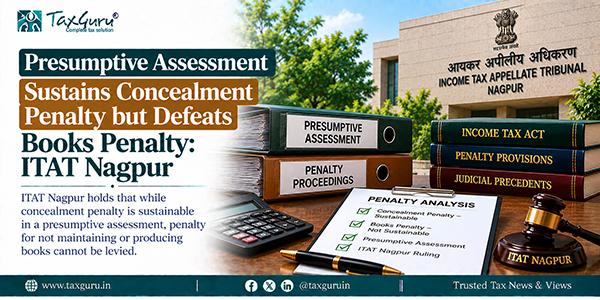
Income Tax
Presumptive Assessment Sustains Concealment Penalty but Defeats Books Penalty: ITAT Nagpur
Explore the latest section 271(1)(c) updates on TaxGuru, including relevant Income-tax Act provisions, rules, notifications, circulars, judicial decisions and compliance guidance. The coverage highlights important tax positions, procedural requirements, assessments, deductions, penalties and litigation developments to help taxpayers and professionals understand the practical implications of changes in income-tax law.

