Income Tax : The issue concerns tax relief for foreign investors in infrastructure. The key takeaway is that specified funds can claim exemptio...
Income Tax : Residential status under the Income-tax Act determines taxability based on stay, control, or management. The key takeaway is that ...
Income Tax : Even if seafarers fail the 182-day NRI test due to crises or travel delays, foreign salary may still remain tax-free. RNOR status ...
Income Tax : Residential status under Section 6 determines whether a taxpayer is liable for global income or only Indian-source income. The rul...
Income Tax : Residential status under the Income Tax Act, 1961 defines who is taxed and on what income. The article explains how residence, not...
Income Tax : Section 5- Scope of income – Income Tax Act, 1961 5. [1] the total income of any previous year of a person who is a resident...
Income Tax : Following is the summary of Suggestion /representation on behalf of the taxpayers/professionals in connection with the Direct tax ...
Income Tax : Mumbai ITAT rules in favor of assessee in residential status dispute. Case details of ACIT vs. Nishant Kanodia for AY 2013-14. Com...
Income Tax : ITAT Delhi held that Tax Residency Certificate (TRC) is statutorily the only evidence required to be eligible for the benefit unde...
Income Tax : Narayanan Subramaniam Vs ACIT (ITAT Delhi) Controversy involved is primarily with regard to question if the assessee had non-res...
Income Tax : Explore the residency dispute in Smt. Kamla vs Hindustan Petroleum Corp. Detailed analysis of the court view on residency criteria...
Income Tax : OECD as well as most of the countries have clarified that in view of the provisions of the domestic income tax law read with the D...
Foreign Exchange Management (Deposit) Regulations, 2016 do not allow NRI’s to hold the savings bank account in India which means banks are not allowed to accept deposits from the NRI’s in the form of a general savings account. However, Post Offices in India may maintain savings bank accounts in the names of persons resident outside India […]
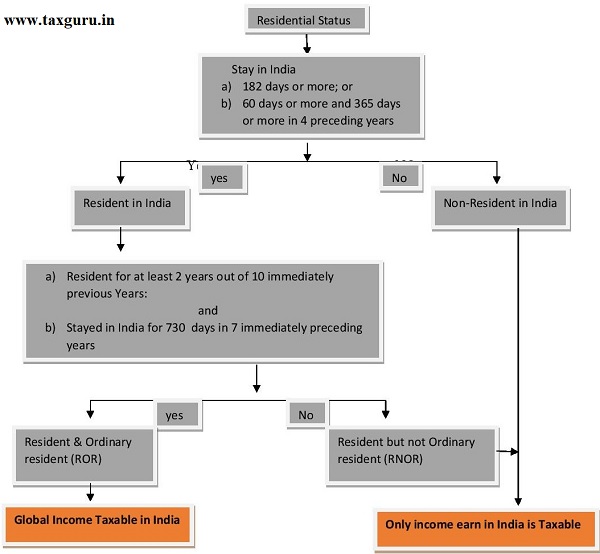
The tax structure of India is very complex in nature. It depends upon the nature of persons, age, residential status, nature of income etc. The taxability of an assessee in India depends upon his residential status in India for any particular financial year. An individual may be a citizen of India but may end up […]
Understand how to determine your residential status for income tax purposes in India. Learn about the criteria and classification of residents and non-residents.
Introduction The Income Tax Department must determine the residential status of tax payers, regardless of whether they are individuals or companies. This information becomes pertinent during tax filing season. This is actually one of the main factors that determine a person’s taxability. Meaning and importance of residential status Taxability of an individual is dependent on his Indian […]
In India the Income of a person is taxed through the provisions made in Income tax act 1961 read with Income tax rules 1962.The charge of the tax in India is primarily based on the residential Status of the person. A person can be a “Resident and ordinarily resident” or “Resident but not ordinarily resident” […]
The determination of residency under the provisions of Income Tax Act, 1961 (‘Act’) is critical in determining the taxable income to be offered to tax in India. One issue that has been noted is with respect to taxation of crew members of ship or individuals leaving for employment outside India during the year and another being the impact of the changes made in residency provision for individuals.
Residential Status for Indian Tax Purposes – Individual The residential status of an individual for tax purposes is crucial for determination of the taxable income. In India, an individual is treated as either “Resident” or “Non-resident” (‘NRs’) for tax purposes. Residents are further classified into “Resident and Ordinary Resident” (‘ROR’)” or “Resident but Not Ordinarily […]
Are u Resident Indian ? Do you have a Citizen of India ? or your Parents are born in Undivided India ? You thought what is this silly questions you have asked? But after reading of this article you will definitely reversed your previous question and in a definite mood to either think or preserve […]
Prior to the amendment, an individual, being a person of Indian origin and who came on a visit to India during the previous year was considered as a resident in India only if his period of stay during the relevant previous year was 182 days or more (second basic condition was not required to be […]
An assessee is subject to taxation on the basis of his/her residential status. Residential Status is not subject to citizenship. For example, a person who has received his income outside India can be subject to taxation in India on the basis of his residential status. Even the taxability of income earned by a foreigner in India depends on his residential Status in India.