Income Tax : CS 04 scrutiny examines whether trusts and NGOs validly claimed exemption in ITR-7 despite registration, approval, renewal, cancel...
Income Tax : CBDT has identified six categories of returns for compulsory scrutiny during FY 2026-27. Selection triggers detailed examination b...
Income Tax : The article clarifies that the CBDT's 4 June 2026 instruction governs six categories of compulsory manual scrutiny and is distinct...
Income Tax : CBDT has identified search, survey, and reassessment cases for compulsory scrutiny in FY 2026-27. The guidelines highlight the Dep...
Income Tax : CBDT has provided Guidelines for compulsory selection of returns for Complete Scrutiny for FY 2022-23 also procedure for compulsor...
Income Tax : Revised Instruction for constitution and functioning of Local Committees to deal with taxpayers’ grievances due to high-pitched ...
Income Tax : Though less that 1% of returns filed are selected for scrutiny, this area of work has often drawn adversarial comments. Superviso...
Income Tax : 1. Where value of international transaction as defined u/s. 92B exceeds Rs.15 Crore. 2. Cases where there was addition of Rs.10 La...
Income Tax : Selection of cases for scrutiny during the financial year 2010-11 will be done primarily through CASS this year. Manual Selection ...
Income Tax : The regular assessment tax (RAT) is one of best tools available to the Department to collect taxes. The collection from RAT not on...
Income Tax : Patna HC upholds income tax scrutiny against Patna Smart City Limited, rejecting claims of violation of guidelines and natural jus...
Income Tax : Explore the Madras High Court judgment in Angusamy Gounder Subbu Rathinamun vs. Assistant Commissioner. Insights on Section 143(2)...
Income Tax : The issue under consideration is whether the conversion of case from limited scrutiny to complete scrutiny prior to receipt of app...
Income Tax : The CBDT has identified specific categories of taxpayers whose returns will be compulsorily selected for complete scrutiny during ...
Income Tax : CBDT outlines parameters for compulsory income tax scrutiny for FY 2025-26, including survey, search & seizure cases, registration...
Income Tax : Understand the guidelines set by the Indian Ministry of Finance for the compulsory selection of returns for complete scrutiny duri...
Income Tax : Government of India issues guidelines for compulsory selection of returns for Complete Scrutiny during FY 2023-24. Find the proced...
Income Tax : Central Board of Direct Taxes (CBDT) released guidelines outlining the parameters and procedures for the compulsory selection of i...
Keeping in view of the Faceless Assessment Scheme,2020 implemented by the Department and the difficulties being faced amid COVID-19 pandemic, the parameters for compulsory selection of returns for Complete Scrutiny during Financial Year 2020-21 and conduct of assessment proceedings in such cases are prescribed as under:
Gain insights into Limited Scrutiny under CASS and its retrospective nature. Understand the reasons behind case selection and the guidelines issued by CBDT.
1. What is Scrutiny? Once the assessee files his return of income, irrespective of whether it is filed within the due date or in pursuance to a notice requiring the assessee to file his return, the department can initiate scrutiny proceedings if it has reason to believe that income is escaping assessment, i.e. income is under stated of expenditure is over stated.
CBDT has issued an Instruction by which it has laid down the procedure and criteria for compulsory manual selection of returns/cases requiring scrutiny during the financial-year 2019-20.
In order to encourage more people to file income tax returns, necessary provisions may be introduced, such as: Individuals having taxable income upto Rs. 10 lakhs may not be subjected to scrutiny for 3 Assessment Years unless there is specific information available with the Department regarding his high value transaction.
n the era of technology and data analytics, Income Tax Department too empowered itself with one of the most enabling report which allowed itself to peep itself into the assessee’s deeper secrets by laying down the responsibility on Financial Institution like Banks, Mutual Funds, to submit AIR (Annual Information Report). In this article, what we will try to analyse in the forthcoming discussion that how this crucial guard of information available with the department against evasion slowly becoming an indiscriminate weapon in the hands of the officials for harassing the assesses and how the proceedings emanating from AIR should be dealt with.
The issue under consideration is whether the conversion of case from limited scrutiny to complete scrutiny prior to receipt of approval from Pr. CIT is justified in law?
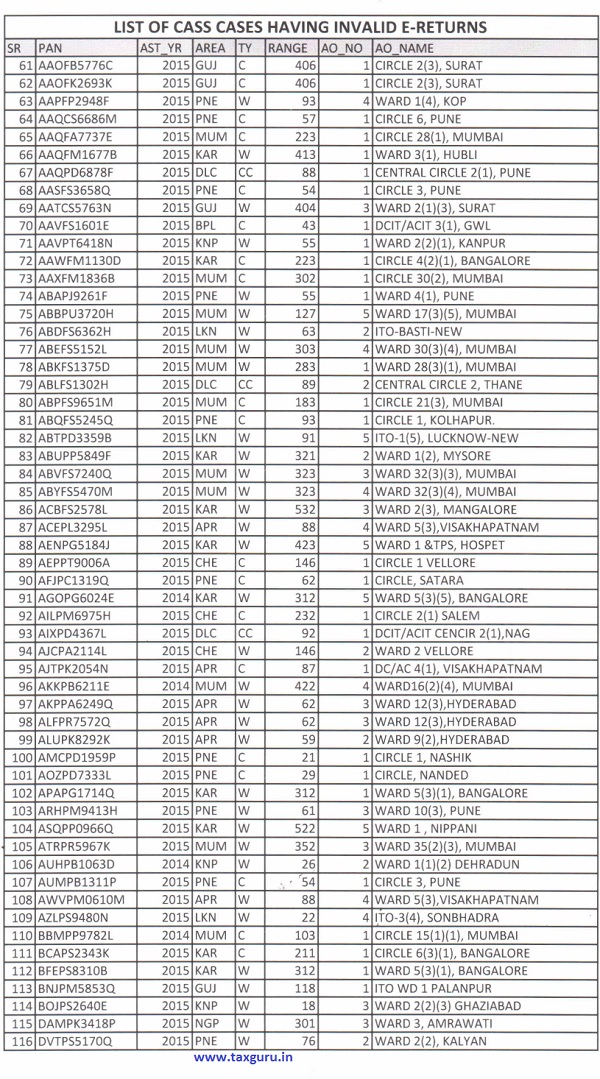
It has been brought to the notice of Board that notices under section 143(2) of the Income-tax Act, 1961 (‘Act’) were generated in respect of certain invalid returns of the assessees filed for the Assessment Year 2017-18 through CASS Cycle 2018. As the scrutiny of such returns will pose a challenge for the AO and is bad in law, I am directed to state that Assessing Officers shall drop the proceedings u/s 143(2) of the Act in such cases and reopen the same by issue of notice under section 148 of the Act.
The parameters for manual selection of returns for Complete Scrutiny during financial year 2019- 20 are as under.- (i) Cases involving addition in an earlier assessment year(s) on a recurring issue of law or fact:- (a) exceeding Rs. 25 lakhs in eight metro charges at Ahmedabad, Bengaluru, Chennai, Delhi, Hyderabad, Kolkata, Mumbai and Pune while at other charges, quantum of addition should exceed Rs. 10 lakhs; (b) exceeding Rs. 10 crore in transfer pricing cases.
Navigate the complexities of Income Tax scrutiny selection based on AIR (SFT) information. Explore how the department leverages data from financial institutions, scrutinizing transactions to ensure compliance. Understand the implications for taxpayers and stay informed to address potential inquiries.