Corporate Law : The CCI held that dominance alone is insufficient to establish a violation under Section 4. The key takeaway is that actual or pot...
Corporate Law : This case examines whether borrowing costs should be capitalised using full-year borrowings or only those during the eligible peri...
Corporate Law : The Court’s 2025 ruling upheld CCI’s power to impose structural and personal penalties without a second notice, marking a majo...
Corporate Law : India is moving to regulate Big Tech's anti-competitive practices like predatory pricing, self-preferencing, and data misuse. A ne...
Corporate Law : This analysis reveals how exclusive airport retail concession agreements create monopolies, leading to unchecked high prices for p...
Corporate Law : The Competition Commission of India has proposed amendments to address administrative and procedural issues identified during impl...
Corporate Law : The proposed rules establish a comprehensive conduct framework for CCI employees, including integrity, conflict-of-interest contro...
Corporate Law : Parliament was informed that no antitrust or merger cases originated from Jammu and Kashmir during the year. The key takeaway is t...
Corporate Law : Enforcement activity rose with steady antitrust actions and quicker merger disposals, aided by reduced timelines and streamlined p...
Corporate Law : The competition watchdog has initiated further proceedings over widespread flight disruptions, signaling that the matter merits ex...
Corporate Law : CCI held no prima facie violation of Sections 3 or 4 as dominance, collusion, and anti-competitive agreements were not established...
Corporate Law : CCI held evidence did not prove mandatory NOC, PIS approvals or systematic boycott after compliance measures and closed the procee...
Corporate Law : The Commission examined allegations relating to one-sided agreements, rental suppression, and delayed payments in commercial real ...
Corporate Law : The Competition Commission found that truck associations collectively fixed freight charges beyond government-prescribed limits an...
Corporate Law : The dispute centred on whether the airport taxi operator had exclusive control over transportation services. The Commission relied...
Corporate Law : The CCI held that restricting warranty services in India to products bought from authorised distributors was unfair and discrimina...
Corporate Law : Summary of the Competition Commission of India (Determination of Cost of Production) Regulations, 2025. Details key changes, defin...
Corporate Law : The Competition Commission of India (CCI) notifies new regulations for recovering monetary penalties, detailing procedures for dem...
Corporate Law : CCI penalizes Meta ₹213.14 crore for abusing dominance through WhatsApp's 2021 Privacy Policy update. Cease-and-desist orders an...
Corporate Law : Clause (f) of Section 19 of the Competition Amendment Act 2023 comes into effect on 19th September 2024, as per the Ministry of Co...
Observing that the tender had been cancelled and no proof of bid-rigging was provided, the Commission concluded that no competition concern arose and dismissed the information under Section 26(2).
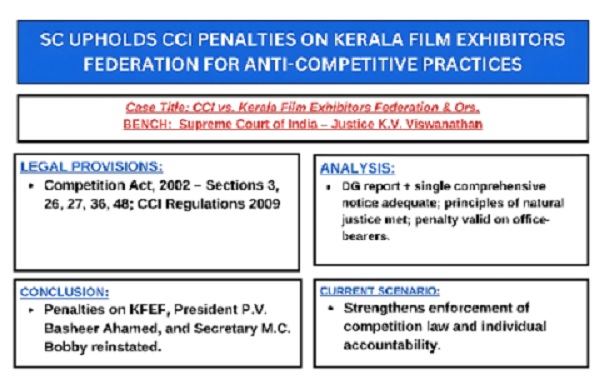
The Court reinstated penalties and behavioural directions after holding that the federation’s leaders played an active role in anti-competitive practices. It restored the Commission’s order in full.
Competition Commission imposed up to 10% of global turnover as penalty on multiple entities for rigging Pune Municipal Corporation tenders, citing deliberate collusion and repeated violations.
The Court’s 2025 ruling upheld CCI’s power to impose structural and personal penalties without a second notice, marking a major milestone in India’s competition law enforcement framework.
NCLAT Delhi held that patent-related issues fall under the Patents Act, not the Competition Act, dismissing an appeal alleging anti-competitive conduct by Vifor International AG.
India is moving to regulate Big Tech’s anti-competitive practices like predatory pricing, self-preferencing, and data misuse. A new Digital Competition Act is proposed to introduce ex-ante (preventive) measures for Systematically Important Digital Intermediaries (SIDIs), enhancing the CCI’s role against monopolistic behavior.
This analysis reveals how exclusive airport retail concession agreements create monopolies, leading to unchecked high prices for passengers. The issue remains unaddressed due to inaction by the MoCA, AERA, and CCI, highlighting a critical gap in India’s competition and economic regulation framework that requires immediate legislative reform.
The CCI released a market study on AI and competition, identifying emerging risks and advocating for government policies to lower entry barriers, enhance AI access, and require mandatory enterprise self-audits.
Competition Commission of India closed a complaint alleging use of dirty water and false labeling in Maggi Sauce production, holding that such food safety concerns do not amount to abuse of dominance under Section 4 of the Competition Act.
The Competition Commission of India (CCI) dismissed abuse of dominance allegations against BSNL regarding a tender for Splice Closures, finding BSNL lacks a dominant position in the Market for Telecommunication Services in India.