The circular issued by the Employees Provident Fund Organisation outlines the transition from Forms 15G and 15H to a unified Form 121 under the Income-tax Act, 2025, effective from April 1, 2026. Form 121 serves as a self-declaration for eligible resident taxpayers whose estimated total income results in nil tax liability, enabling them to avoid TDS on specified incomes such as interest, dividends, and PF withdrawals. While filing the form is optional, it must be submitted separately to each payer with mandatory PAN details. Payers are required to allot a Unique Identification Number (UIN) to each declaration, maintain records, and upload consolidated monthly statements, with reporting in quarterly TDS returns. Non-compliance may attract penalties. The new form simplifies compliance by merging earlier forms, introducing digital filing features, and standardizing reporting, thereby improving efficiency, transparency, and ease of tax administration for both taxpayers and deductor.
Employees Provident Fund Organisation
(MINISTRY OF LABOUR & EMPLOYMENT GOVERNMENT OF INDIA)
Head Office
Plate A, Ground Floor, Block II, East Kidwai Nagar New Delhi- 110023
Website: www.epfindia.gov.in, www.epfindia.nic.in
No: WSU/TDS Issues/E-772040/2026-27/11 | Date: 13/04/2026
To,
All Addl. CPFC (Zones),
All Regional P.F. Commissioners
In-charge of Regional Offices.
Subject: Implementation of the New IT Act, 2025 — Transition from Form 15G/15H to Consolidated Form 121 for TDS-exempted Incomes-reg.
Madam/Sir,
With the phasing out of the old Income-tax Act, 1961, and the commencement of the Income-tax Act, 2025 effective from April 1, 2026, significant changes have been introduced regarding the declaration of income without deduction of tax. Under the new regulatory framework, the erstwhile Form 15G and Form 15H have been replaced by a single, consolidated written declaration in Form 121. The declarant, who is a resident, must ensure that their expected final tax liability for the year is NIL and duly fill all the rows in Part A of the Form No.121 and sign it. The details as required in Part B of the Form No.121 has to be filled by the office ie. Payer. However, filing of Form No.121 is not mandatory and is meant to be used only by those taxpayers who do not want tax to be deducted at source.
The RO (as the payer) must allot a Unique Identification Number (UIN) to every Form 121 received. This UIN must include components such as a sequence number, the tax year, and the TAN of the payer. The consolidated statement of all Forms 121 received in a month is required to be uploaded on or before 7th of the following month through the e-filing Portal of the IT Department and quote the UINs in the Quarterly TDS Return in Form No.140.
ISD has been requested to provide a facility for the declarant members to digitally e-sign and file the Form No.121 online. Till such time, the physical signed forms of Form No.121 which were uploaded by the declarant members in lieu of Form 15G/Form 15H can be used for preparing the consolidated statement for uploading in the e-filing portal of IT Department monthly as well as in the Quarterly TDS Return.
Similarly, the UIN for each Form No.121 is required generated running-number-wise with effect from 01/04/2026 and later the running number could be continued through the online functionality provided by the ISD.
Non-compliance with the provisions of the new IT Act, including missing UINs or incorrect reporting, may attract penalties under the relevant provisions of the said Act. All Regional Offices are therefore requested to ensure these guidelines are implemented without fail to avoid any regulatory discrepancies as stipulated in the new IT Act.
In this regard, the comprehensive note on Form No.121 (5 pages) as available in the website of Income Tax Department (httbs://www.incometaxindia .gov in/documents/d/g question -171), FAQs (2 pages) along with the proforma of Form No.121(3 pages) are enclosed herewith for ready reference and compliance.
Accordingly, all Zonal Offices/Regional Offices are advised to sensitize all eligible members to upload the duly filled-in and signed Form 121 in lieu of Form 15G/15H. Further, the claims already filed along with Form 15G/H from 01/04/2026 should not be returned for this purpose, but Form 121 should be collected by taking up with the said member.
Encl. As above
(This issues with the approval of CPFC)
Roli Shukla Malge
FA&CAO
FORM NO. 121
[See rule 211]
Declaration under section 393(6) for receipt of certain incomes without deduction of tax
PART A
[To be Filled by the person for receipt of certain incomes without deduction of tax]
| Details of the declarant | ||||||
| 1. | Name | (refer Note 1) | ||||
| 2. | Address | (refer Note 2) | ||||
| 3. | Permanent Account Number | |||||
| 4. | Status | (refer Note 3) | ||||
| 5. | Residential status | (refer Note 4) | ||||
| 5(a). | If resident individual, whether age is 60 years or more at any time during the tax year | Yes/no | ||||
| 6. | Email id | |||||
| 7. | Contact number | Country Code | Number | |||
| 8. | Tax Year (for which declaration is made) | |||||
| Details of income | ||||||
| 9. | Nature of income | (refer Note 5) | ||||
| 10. | Estimated income for which declaration is made | |||||
| 11. | Details of Form No. 121 other than this form filed during the tax year, if any | (refer Note 6) | ||||
| 11(a). | Total number of Form No. 121 filed earlier | |||||
| 11(b). | Aggregate amount of income for which Form No. 121 were filed | |||||
| 12. | Aggregate amount of income for which declaration is made during the tax year [sum of column 10 and 11(b)] | |||||
| 13. | Estimated total income of the tax year including the income mentioned in column 12 | (refer Note 7) | ||||
| 14. | Details of the ITR filed for previous two tax years | |||||
| SI. No. | Tax Year | Acknowledgment Number |
Return Income |
|||
| 1. | ||||||
| 2. | ||||||
DECLARATION
I…………………………………………….. having Permanent Account Number……………………………………………… do hereby declare that
(i) to the best of my knowledge and belief what is stated above is correct, complete and is truly stated.
(ii) the incomes referred to in this form are not includible in the total income of any other person under sections 96 to 99.
(iii) tax on my estimated total income as referred to in column 13 of Part A (including the income referred to in column 12 of Part A) for tax year… will be nil.
(iv) my income as referred to in column 12 of Part A does not exceed the maximum amount not chargeable to tax for tax year…………. (not to be applicable in case of resident individual of age of sixty years or more at any time during the tax year)
(v) in case this declaration is found to be false, I shall be liable to prosecution/penalty under the Act.
 –
–
Form No. 121 (Earlier Form Nos. 15G & 15H)
Form No. 121 – Frequently Asked Questions
Form of Declaration under section 393(6) of the Income-tax Act, 2025 for receipt of certain incomes without deduction of tax
| Name of form as per I.T. Rules, 1962 | 15G & 15H | Name of form as per I.T. Rules, 2026 | 121 |
| Corresponding section of I.T. Act, 1961 | 197A(1), 197A(1A) & 197A(1C) | Corresponding section of I.T. Act, 2025 | 393(6) |
| Corresponding Rule of I.T. Rules, 1962 | 29C | Corresponding Rule of I.T. Rules, 2026 | 211 |
1. What is Form No. 121 and its purpose?
Ans: It is a declaration by a taxpayer to the effect that tax on his estimated total income for Tax year will be NIL, with a view to avoid deduction of tax at source. It is required to be submitted to the concerned payer. Based on such declaration, the payer will not deduct tax on income or credit due to the taxpayer.
2. Has the Form No. 121 replaced the existing Forms 15G & 15H?
Ans: Yes, the new Form No. 121 has replaced the earlier Forms 15G & 15H. Now, both type of taxpayers i.e. tax payers below the age of 60 as well as taxpayers of the age of 60 and above, will use Form No. 121 for submitting declaration in order to avoid relevant income from being subjected to TDS.
3. What types of income are covered in the declaration made in Form No. 121?
Ans: The following types of income are covered for the purpose of Form No. 121: PF
withdrawals and Pension, Insurance Commission, Rent, Interest on deposits, Income from Mutual Funds, Payments in respect of Life Insurance Policy, Dividend etc.
4. Is filing of Form No. 121 mandatory?
Ans: No. It is meant to be used only by those taxpayers who do not want tax to be deducted at source, subject to meeting certain conditions as their tax on estimated total income for Tax Year is likely to be NIL. Declaration in Form No. 121 needs to be filed for every Tax Year separately, as required.
5. Who is eligible to use Form No. 121?
Ans: Resident Individuals both below 60 years and 60 years or above, HUFs, and other specified entities meeting stipulated criteria. Companies and Firms are not eligible to file Form No. 121. Non-residents are not eligible to file this form.
6. Is the declaration in Form No. 121 required to be submitted to each payer?
And: Yes, declaration needs to be submitted by the declarant in Part A of Form No. 121 to each payer responsible for paying income or sum.
7. Is PAN mandatory?
Ans: Yes, quoting of PAN is a mandatory requirement for submission of declaration in Part A of Form No. 121 by the declarant. In the absence of PAN, the declaration is invalid and the payor is required to deduct TDS at the applicable rate as per Income-tax Act, 2025.
8. What is the time limit for furnishing Form No. 121 to the payer?
Ans: The declarant must furnish the declaration in Form No. 121 to the payer before the scheduled transaction date.
9. What are the modes of submission of the Declaration in Part A of Form No. 121 by the declarant?
Ans: Submission of declaration by the declarant to the payer can be made in paper form, or online if any such facility is provided by the payer.
10. What is the mode of submission of the copy of declaration(s) in Part B of Form No. 121 by the payer?
Ans: The copy of declaration(s) by the payer shall be furnished electronically on the e-filing portal of the Income-tax Department.
11. Are the payers required to report the transactions on which tax is not deducted as a result of receipt of a declaration?
Ans: Yes. The payer is required to report the details of such transactions in the quarterly TDS statement in Form No. 140.
12. If a person has income accruing from multiple payers, is he required to submit the declaration with each payer?
Ans: Yes. The declarant is required to submit the declaration with each payer.
Form No. 121 – Declarations under section 393(6) for receipt of certain incomes without deduction of tax
| Name of form as per I.T. Rules, 1962 | 15G & 15H | Name of form as per I.T. Rules, 2026 | 121 |
| Corresponding section of I.T. Act, 1961 | 197A(1), 197A(1A) & 197A(1C) |
Corresponding section of I.T. Act, 2025 | 393(6) |
| Corresponding Rule of I.T. Rules, 1962 | 29C | Corresponding Rule of I.T. Rules, 2026 | 211 |
Purpose:
Form No. 121 are self-declaration Forms furnished by individuals to ensure no deduction of tax at source (TDS) on specified incomes such as interest on bank deposits, post office deposits, or other specified incomes, when their total income is below the taxable limit. These declarations are made under Section 393(6) of the Income-tax Act, 2025 read with Rule 211 of the Income-tax Rules, 2026.
Who Should File:
Resident Individuals (whether below 60 years or 60 years and above), Hindu Undivided Families (HUFs), and other specified eligible entities that meet the stipulated criteria. Companies and Firms are not eligible to file Form 121. Non-residents are not eligible to file this form.
1. Earlier Form 15G – Resident individuals (below 60 years) and HUFs with:
-
- No tax liability for the year, and
- Total interest income below the basic exemption limit.
2. Earlier Form 15H – Resident individuals aged 60 years or more with:
-
- Estimated total income below the taxable limit after considering deductions. Frequency & Due Dates:
| Event | Action | Due Date |
|---|---|---|
| Submission of Declaration | Furnished to payer before income is credited or paid (e.g., at the beginning of the Tax Year or before first payment). | As and when income arises |
| Monthly Statement by Payer | To be filed with the Income-tax Department containing details of declarations received. | On or before 7th of the following month |
| Quoting in Quarterly TDS Statement |
Payer must quote the Unique Identification Number (UIN) allotted by the payer while filing Statement in Form No. 140. | Along with Form No.
140 (Quarterly TDS Return) |
Structure of Form No. 121:
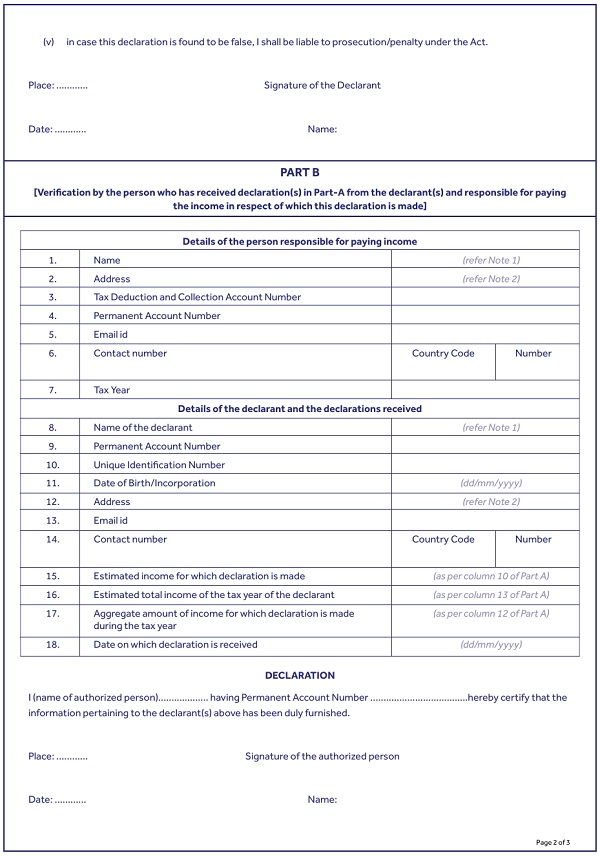
1. Part A:
-
- Details of the declarant – Name, Address, PAN, Status, Residential Status, Date of Birth, Contact details and Tax Year.
- Details of Income – Nature of Income, Estimated income, Aggregate amount of Income, Estimated total income of the Tax Year and Details of last two Tax Year’s ITR filed.
- Declaration by the Declarant
2. Part B:
-
- Details of the person responsible for paying income – Name, Address, TAN, PAN, Contact details and Tax Year.
- Details of declarant and declarations received – Name of the declarant, PAN, UIN, Date of Birth/Incorporation, Address, Contact details, Estimated income, Estimated total income of the Tax Year, Aggregate amount of Income and Date on which declaration is received.
- Declaration by the person responsible for paying income
Documents/details required to file Form No. 121:
1. PAN of the declarant (mandatory), TAN of Payer.
2. Proof of age
3. Details of income/investment for which no TDS is to be deducted.
4. Bank account details (for interest-bearing instruments).
Filing Count:
On an average, around 90 lakh declarations for earlier Form 15G & around 1 crore declarations for earlier Form 15H have been submitted annually across financial institutions, banks, and companies in the last five years.
Process flow of filing Form No. 121:
A. For Declarant (Individual/HUF):
1. Check eligibility:
-
- Resident individual or HUF/trust (not a company/firm) whose final tax liability is nil for the year.
- Total income (including interest and whatever income subject to TDS) should be such that expected tax liability is NIL.
- Valid PAN is mandatory.
Note: Submission of these forms does not make the income free from income-tax; it only prevents TDS being deducted, if conditions are met.
2. Obtain the form:
-
- Download Form No. 121 from the official site of Income-tax Department or bank/financial institution’s website.
- Many banks support online submission of the form via internet/mobile banking.
3. Fill in the declaration:
The form typically asks for: Name, PAN, Status (Individual/HUF/trust), Tax Year, Residential status, estimated total income, details of the income for which the declaration is being filed, etc.
4. Submit the form to the payer/deductor:
-
- Submit to the bank/financial institution/employer that will make the payment (e.g., interest, dividend).
- Submission can be manual or online, depending on payer. The bank/finance company may provide online facility.
- The form is valid for the Tax Year concerned; if eligible, one should submit at the beginning of the year or before the payment/credit to avoid TDS.
B. For Bank / Institution / Payer:
1. Receive Form No. 121 from declarants:
-
- When a person (i.e. declarant) submits the declaration, payer needs to verify eligibility (PAN, Status, etc.) and record the form.
2. Assign Unique Identification Number (UIN):
-
- The payer assigns a UIN for each Form 121 received. This UIN has multiple components (Sequence Number, Tax Year, TAN of payer).
- The sequence number should align with the paper declaration (if paper) and the online record.
3. Submit statement to Income-tax Department:
-
- The payer is required to upload a consolidated statement of all Forms 121 received on a monthly basis through the e-filing portal of the Income-tax Department (via TAN login) even though no TDS is deducted.
- Steps:
- Ensure payer has a valid TAN and is registered on e-filing portal.
- Download the CSV utility.
- Login via TAN on Income Tax e-Filing portal -* e-File -* Fill Form No. 121 (select applicable Form, Year, Month, Filing Type) -* Attach CSV + Signature -* Upload.
- After upload, status will show “Uploaded”, then after processing “Accepted” or “Rejected”.
4. Quote the UIN in quarterly TDS returns:
-
- Even though no tax is deducted at source because of Form No. 121, the payer must quote the UIN of the declarant in the quarterly TDS statement in Form No. 140 so that records align.
Outcome of Processed Declarations:
For Payers (Deductor):
- Enables validation of declarations and ensures no TDS is deducted where eligible.
- UIN facilitates reconciliation with Form No. 140 and the Income-tax Department’s records.
- Non-compliance (missing UIN or incorrect reporting) may attract penalties under relevant provisions.
For Declarants (Deductees):
- Ensures no deduction of tax where income is below taxable limits.
- Reduces the need for refunds and simplifies tax filing.
- Declaration data is reflected in Form No. 168/AIS, confirming submission and linkage with PAN.
Brief Note on Qualitative Changes Made:
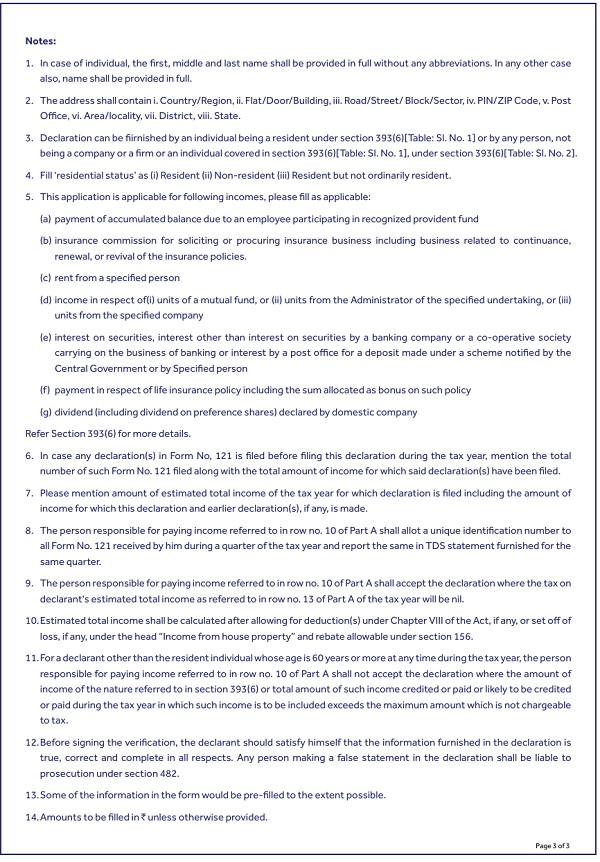
1. Merger of Forms 15G and 15H: Forms 15G and 15H have been combined into a single consolidated Form No. 121 to streamline reporting and reduce administrative complexity.
2. Structural Changes: Redundant columns have been deleted. Explanatory notes have been provided to guide users in filing the form accurately.
3. The revised Form No. 121 will be a smart one to enhance user experience and providing ease of filing through
a. auto-population/pre-filling of relevant details using information available from the profile.
b. real time validations & error handling
c. drop downs & date pickers
d. integration with APIs & Databases
e. Check box based smart verification
f. Standardization of name & address fields etc.
Common Changes Made Across Forms:
1. To make Forms system-friendly and enable e-filing and uploading, certain anomalies found due to grouping of Name, Designation, Address and PAN have been separated into different boxes.
2. Assessment / Financial / Previous year or years have been replaced with Tax year or years, wherever appearing in the Form/Annexure.
3. Changes in Sections, Clauses and Schedules have been aligned as per the Income-tax Act, 2025.
4. Currency symbol “Rs.” has been replaced with “₹”.