Background
Ever since the introduction of Goods and Services Tax (GST) in India, there has been a constant demand for simplification of procedures and rationalization of tax rates. When GST was rolled out in 2017, it was projected as a “Good and Simple Tax.” However, multiple tax slabs and complex compliance requirements soon made it appear more complicated than simple.
For the past eight years, businesses, professionals, and taxpayers have been urging the Government and the GST Council to simplify the structure and reduce the burden of compliance. In its 56th meeting, the GST Council has finally taken a significant step—primarily in the direction of rate rationalization. Though procedural reforms are still limited, this meeting can be regarded as historic because relief has been extended to common taxpayers, farmers, and several industry sectors.
GST Collections as the Basis for Reforms
Over time, GST collections have grown steadily. From around ₹1 lakh crore per month in the initial years, collections have now reached about ₹2 lakh crore per month, reflecting stability in the system and higher compliance. This increase in revenue has created fiscal space for the Government to reduce tax rates, and this intent was clearly visible in the Council’s recent decisions.
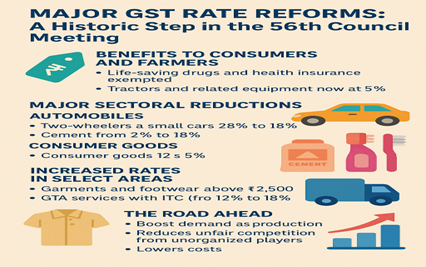
Key Relief Measures Announced (Effective from 22nd September 2025)
Benefits to Consumers and Farmers
- Healthcare & Insurance: Life-saving drugs and health services have been made more affordable. Both health and life insurance have been exempted from GST.
- Agriculture: Tractors, tyres, tubes, and agricultural equipment will now attract only 5% GST, significantly reducing the cost burden on farmers.
Major Sectoral Reductions
- Tyres: All categories (other than tractor tyres) reduced from 28% to 18%.
- Cement: Brought down from 28% to 18%, a long-standing industry demand that will reduce housing and infrastructure costs.
- Automobiles:
- Two-wheelers, scooters, and small cars shifted from 28% to 18%.
- Mid-size cars, big cars, and luxury motorcycles will now attract a simplified flat 40% rate (without cess).
- Consumer Goods: Items such as toothpaste, toothbrushes, shampoos, soaps, talcum powder, shaving creams, etc., reduced from 12% to 5%.
- Electronics & Appliances: ACs, dishwashers, and televisions brought down from 28% to 18%.
- Daily Essentials: Exemptions granted on items like pizza bread, rotis, parathas, pencils, notebooks, sharpeners, etc.
These are just examples of the reduced rate . One can found all the rate reforms in the press release which is drafted very intelligently to cover the whole reforms.
Increased Rates in Select Areas- Examples
- Readymade Garments & Footwear: Items priced above ₹2,500 will now attract 18% GST, while those below ₹2,500 will be taxed at only 5% to provide relief to the common man.
- Transport Sector: GTA services opting for ITC will now pay 18% instead of 12%, but the benefit is quicker credit recovery.
Importance of Press Releases & FAQs
A unique aspect of this meeting was the clarity in the Press Release and FAQs issued by the Government. Detailed explanations were provided for each sector—automobiles, cement, textiles, healthcare, handicrafts, etc.—making it easier for taxpayers to understand the new rates and reducing confusion. These documents are available on the CBIC website (www.cbic.gov.in).
Should Consumers Delay Purchases Until 22nd September?
Since the reduced rates come into effect on 22nd September 2025, consumers are likely to postpone big-ticket purchases like cars, scooters, and air-conditioners until after this date. Demand is expected to rise sharply during the upcoming festive season of Navratri and Diwali.
Will the Benefits Reach the End Consumer?
While the Government has reduced tax rates, ensuring that benefits reach the end consumer remains a challenge. Strict monitoring will be required in sectors like cement, medicines, garments, automobiles, electronics, and cosmetics. When whole the tax cut benefits are to be transferred to the consumers then how Trade and Industry will be benefited from these reforms. Let us see how trade and industry will get the benefit from these reforms.
Lower tax rates are expected to:
- Boost demand and production.
- Reduce unfair competition from unorganized players.
- Lower costs and make Indian exports more competitive.
- Free up working capital due to reduced tax outflow, lowering interest costs.
Procedural Reforms – Still Incomplete
Although the Council announced that automatic GST registration will now be granted within 3 days, concerns remain regarding the handling of registrations exceeding the ₹2.5 lakh monthly threshold.
Refund processes have seen minor improvements, but significant issues—such as denial of ITC refund on capital goods and services under inverted duty structure—remain unresolved, causing heavy working capital strain in certain industries.
The Road Ahead
This meeting marks a significant step in rate simplification, but substantial procedural reforms are still awaited. Unless registration, return filing, notices, appeals, and refunds are streamlined, GST cannot truly be called a “Good and Simple Tax.”
Conclusion
The 56th GST Council meeting is undoubtedly a landmark in terms of rate rationalization. However, taxpayers and professionals continue to expect genuine simplification of procedures. If these reforms follow, GST may finally evolve into the system it was envisioned to be in 2017.
Also Read:
1. FAQs on decisions of 56th GST Council Meeting