
Businesses incur various kinds of expenditures. One of the kinds is insurance services, which is taken to protect against financial losses arising from unforeseen events. Some of the main insurance expenses are pertaining to general insurance such as fire, burglary, marine, stock, transit insurance to name a few. Then there is life insurance and health insurance expenses incurred by businesses.
The treatment of insurance services under GST has been a subject of considerable debate and litigation, particularly concerning input tax credit eligibility. While GST law provides a comprehensive ITC mechanism to eliminate cascading taxes, ITC is restricted on certain insurance products.
This restriction has created interpretational challenges for businesses procuring various insurance coverages for their employees. The fundamental question is whether all insurance products fall within the restricted categories or if certain insurance services remain eligible for ITC.
It has become an industry practice among employers, mostly in manufacturing industries, to take Group Personal Accident (GPA) policies for their workers and employees. This coverage provides essential financial protection during accidents, covering medical expenses and income support for employees. GPA insurance enhances employee satisfaction and retention while helping attract top talent. For employers, it reduces financial liability, ensures business continuity, and strengthens the organization’s image as a responsible, employee-focused employer while providing quick medical support during emergencies.
GPA insurance occupies a distinct position in this landscape. While the law restricts ITC on certain insurance products, GPA’s unique characteristics necessitate a careful analysis to determine its eligibility under the GST framework.
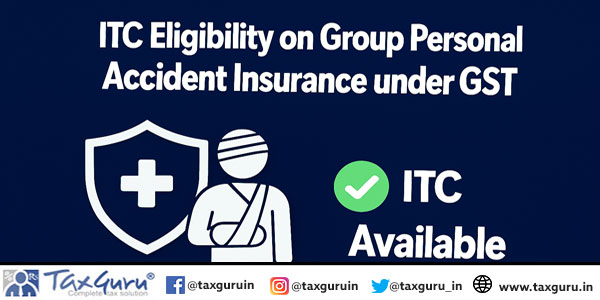
Understanding Group Personal Accident Insurance
Group Personal Accident (GPA) Insurance serves as a critical financial safeguard for policyholders and their families against income loss arising from accidental disablement or death. Commercial and industrial establishments typically procure this coverage to protect their employees, workers, and members from accident-related risks.
The policy framework is designed to mitigate substantial expenses associated with accidental disablement while simultaneously providing financial security to nominated dependents in the event of the policyholder’s demise. This comprehensive protection alleviates financial anxieties and addresses life’s uncertainties for insured employees.
Scope of Coverage
GPA policies offer extensive protection against various accident-related contingencies, including:
- Financial compensation for accidental death, permanent total or partial disability, and temporary total disability
- Medical reimbursements for hospitalization and day-care treatment
- Coverage for physiotherapy, outpatient department (OPD) treatment, and funeral expenses
- Ambulance costs and compassionate visits by immediate family members
- Educational support for up to two dependent children
- Compensation for disappearance due to accidents
- Reimbursement for home or vehicle modifications necessitated by accident-related injuries
This comprehensive framework ensures substantial financial assistance to the insured and their families during accidental mishaps.
Legal Framework:
To assess ITC eligibility on GPA insurance, we must examine the relevant GST provisions.
As per Section 17(5)(b), input tax credit shall not be available in respect of the following supply of goods or services or both:
(i) food and beverages, outdoor catering, beauty treatment, health services, cosmetic and plastic surgery, leasing, renting or hiring of motor vehicles, vessels or aircraft referred to in clause (a) or clause (aa) except when used for the purposes specified therein, life insurance and health insurance.
Provided that the input tax credit in respect of such goods or services or both shall be available, where it is obligatory for an employer to provide the same to its employees under any law for the time being in force.
The critical question is whether input tax credit on GPA insurance must be reversed under Section 17(5)(b). This provision specifically restricts ITC on life insurance and health insurance. Therefore, we must determine whether GPA falls within either category.
Is GPA a Life Insurance Product?
Life insurance represents a contractual arrangement wherein the insurer provides a lump-sum payment (death benefit) to designated beneficiaries upon the insured’s death. It functions primarily as income replacement for financially dependent family members, addressing long-term financial security needs.
In contrast, personal accident insurance provides protection exclusively for death and injuries resulting from accidents. It covers specific contingencies- accidental death, accidental disability, or accidental dismemberment arising solely from accident-related incidents, whether causing temporary impairment, permanent disability, or death.
Based on this fundamental distinction in coverage scope and purpose, GPAs do not fall within the ambit of life insurance.
Is GPA a Health Insurance Product?
Health insurance policies cover hospitalization expenses incurred due to planned medical procedures or medical emergencies. These indemnity-based policies typically encompass pre-hospitalization and post-hospitalization expenses, along with day-care treatment costs. Claims are settled based on actual expenses incurred within the sum insured limit.
GPA insurance, conversely, is designed to protect employees and their families from the financial implications of income loss or diminished earning capacity due to accident-related death or disablement. Under GPA policies, employees receive a predetermined lump-sum amount based on the injury’s nature and severity. The compensation percentage varies according to the degree of disability suffered or, in case of death, as defined in the policy’s terms and conditions.
Given this structural and operational distinction, GPAs do not constitute health insurance products.
Conclusion:
Input tax credit on Group Personal Accident insurance policies is eligible for claiming under GST. GPA insurance falls under the general insurance category and is neither life insurance nor health insurance. Consequently, it is not subject to the ITC restrictions enumerated in Section 17(5)(b) of the CGST Act. Businesses may legitimately claim ITC on GPA premiums paid, provided they meet general ITC eligibility conditions under the GST framework.
I am grateful and acknowledge our partner/Principal CA. Rajesh Maddi Sir for his valuable inputs.
[For feedback or queries, please mail me at [email protected]]
Disclaimer: These are not the view of the government or any regulatory authorities. The views and opinions expressed in this article are solely those of the author and do not necessarily represent the views of the firm. The author has shared these insights in their personal capacity, and neither the author nor the firm shall be held responsible for any decisions taken based on the contents of this article.







Sir,
Per recent amendments, group health Insurance are not covered under exemption granted, thereby the senior citizens incurring heavy group health Insurance premium are liable to pay GST @18% after their retirement too. No relief has been given by the BJP Govt. in this regard.
CA Om Prakash Jain, Jaipur-302004
Tel: 9414300730/0141-3584043