U.S. Cuts Tariffs on Indian Goods to 18%: Trade Breakthrough, Strategic Signals & Global Impact
A major development in India–United States trade relations emerged on February 2, 2026, when the U.S. President announced a reduction in tariffs on Indian goods to 18% following a conversation with Prime Minister Narendra Modi. The announcement, first made through social media and later covered by global news agencies, signals a potential shift in bilateral trade dynamics, strategic alignment, and global supply chains.
The decision links trade concessions with broader geopolitical objectives, including energy sourcing and international diplomacy. Here’s a full breakdown of what happened, what the leaders said, and what it means for businesses, markets, and global politics.
> Official Statements from Both Leaders
🇺🇸 Statement by U.S. President
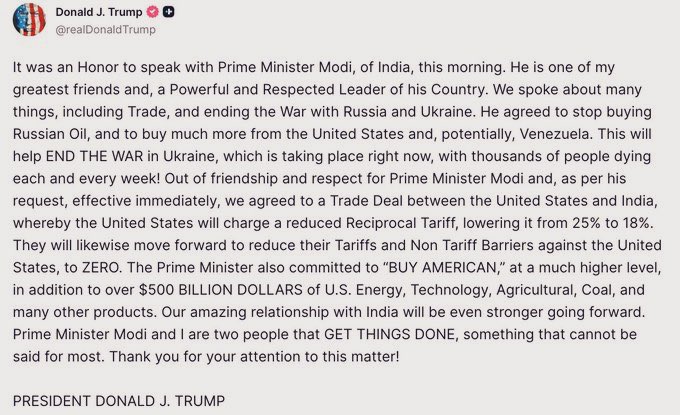
“It was an Honor to speak with Prime Minister Modi, of India, this morning. He is one of my greatest friends and, a Powerful and Respected Leader of his Country. We spoke about many things, including Trade, and ending the War with Russia and Ukraine. He agreed to stop buying Russian Oil, and to buy much more from the United States and, potentially, Venezuela. This will help END THE WAR in Ukraine, which is taking place right now, with thousands of people dying each and every week! Out of friendship and respect for Prime Minister Modi and, as per his request, effective immediately, we agreed to a Trade Deal between the United States and India, whereby the United States will charge a reduced Reciprocal Tariff, lowering it from 25% to 18%. They will likewise move forward to reduce their Tariffs and Non Tariff Barriers against the United States, to ZERO. The Prime Minister also committed to “BUY AMERICAN,” at a much higher level, in addition to over $500 BILLION DOLLARS of U.S. Energy, Technology, Agricultural, Coal, and many other products. Our amazing relationship with India will be even stronger going forward. Prime Minister Modi and I are two people that GET THINGS DONE, something that cannot be said for most. Thank you for your attention to this matter!
PRESIDENT DONALD J. TRUMP”
🇮🇳 Statement by Prime Minister Narendra Modi
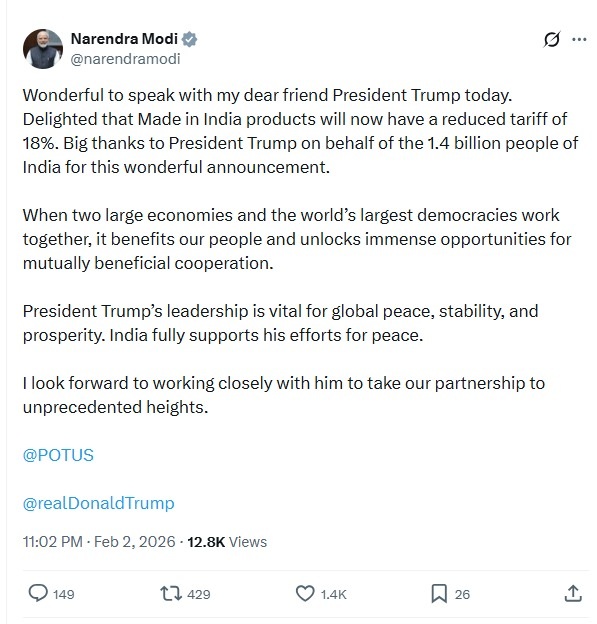
“Wonderful to speak with my dear friend President Trump today. Delighted that Made in India products will now have a reduced tariff of 18%. Big thanks to President Trump on behalf of the 1.4 billion people of India for this wonderful announcement.
When two large economies and the world’s largest democracies work together, it benefits our people and unlocks immense opportunities for mutually beneficial cooperation.
President Trump’s leadership is vital for global peace, stability, and prosperity. India fully supports his efforts for peace.
I look forward to working closely with him to take our partnership to unprecedented heights.
@POTUS @realDonaldTrump”
> What Exactly Was Announced?
According to international media coverage, the United States will reduce a country-specific tariff applied to Indian-origin goods to 18%. Reports indicate this change followed negotiations involving trade access, energy procurement shifts, and broader geopolitical considerations.
While headlines emphasize the 18% figure, the detailed customs notification and product-wise tariff schedule were not immediately released at the time of reporting. This means the operational scope — which product categories benefit and from what date — will depend on formal trade notices.
> Why This Matters Globally
1. Trade Competitiveness
Lower tariffs immediately improve price competitiveness for Indian exporters in the U.S. market. Sectors likely to gain include:
- Textiles & apparel
- Gems & jewellery
- Auto components
- Engineering goods
- Specialty chemicals
Indian firms competing against exporters from countries facing higher duties could see an advantage. Markets reacted positively to the news.
2. Strategic Energy Shift
The U.S. President’s statement links tariff relief with India reducing Russian oil purchases and increasing imports from the U.S. This transforms a trade negotiation into a strategic energy alignment move, reflecting how trade tools are increasingly used for geopolitical leverage.
3. Diplomatic Signaling
Both leaders framed the move as a symbol of strong bilateral trust. India positioned it as a win for “Made in India,” while the U.S. highlighted reciprocal trade concessions and energy cooperation.
> Sectoral Impact in Detail
| Sector | Expected Impact | Reason |
|---|---|---|
| Textiles | Positive | Price-sensitive exports gain edge |
| Engineering Goods | Positive | Tariff drop improves margins |
| Pharmaceuticals | Limited | Regulatory barriers matter more |
| Agriculture | Uncertain | Non-tariff barriers remain |
| Electronics | Moderate | Depends on component rules |
> Market Reaction
Indian stock indices and export-oriented firms reportedly rose following the announcement. Currency markets also saw mild strengthening of the rupee amid expectations of higher export earnings. Analysts caution, however, that formal notifications are needed before long-term projections can be made.
> What Is Still Unclear
1. Exact product lines covered
2. Implementation date
3. Legal notification under U.S. customs law
4. Details of India’s reciprocal tariff cuts
5. Enforcement of energy procurement commitments
Until official gazette notifications or customs circulars are issued, businesses should treat the move as policy intent rather than operational fact.
> What Happens Next?
- Formal trade notifications expected
- Possible follow-up bilateral meetings
- Customs advisories for exporters/importers
- Energy trade adjustments
>Expert Takeaway
This development highlights how trade policy, energy security, and geopolitics are increasingly interconnected. If implemented broadly, the 18% tariff level could significantly boost Indian exports while reinforcing strategic ties. However, markets and businesses should wait for formal legal instruments before making binding commercial decisions.
> Sources
- Reuters – Coverage of tariff announcement and White House briefing
- Reuters – Strategic and energy linkage reporting
- Economic Times – Market and export impact analysis
- Official social media statements from both leaders