In re FMC India Private Limited (CAAR Mumbai)
The Customs Authority for Advance Rulings (CAAR), Mumbai, examined an application filed by FMC India Private Limited seeking classification of two chemicals—Carbosulfan Technical and Clomazone Technical—under the Customs Tariff Act, 1975, following amendments introduced by the Finance Act, 2025. The applicant contended that these chemicals, being separate chemically defined compounds, should be classified under Chapter 29 (CTH 29242140 and 29349940 respectively) rather than Chapter 38 (CTH 3808).
The applicant submitted that both products are technical-grade chemicals imported in bulk and not in retail packaging. Carbosulfan is a pesticide and Clomazone is a herbicide, each with specified purity levels (92% and 93% respectively). The applicant argued that under the General Rules for Interpretation (GRI), particularly Rules 1, 3, and 6, classification should be based on the most specific description. Since both chemicals are chemically defined compounds, they should fall under Chapter 29. The applicant also emphasized that Chapter 38 applies only when goods are “put up” for retail sale, as preparations, or as articles, which was not the case here.
Further, the applicant argued that impurities in technical-grade chemicals do not convert them into “preparations,” and that classification must be based on the condition of goods at the time of importation, not their intended use. Reliance was placed on judicial precedents and HSN Explanatory Notes to support the distinction between chemically defined compounds and formulated preparations.
However, the Authority observed that both Carbosulfan and Clomazone are not only chemically defined compounds but also possess inherent insecticidal and herbicidal properties and are recognized, marketed, and regulated as such. The Central Insecticides Board (CIB) certificates classify them as technical-grade insecticides/herbicides. Under the Insecticides Act, 1968, the term “insecticide” includes herbicides and related pesticidal substances.
The Authority noted that although Chapter 29 generally covers separate chemically defined compounds, Chapter 38 specifically covers insecticides, herbicides, and similar products when they are preparations or intermediate preparations possessing pesticidal properties. HSN Explanatory Notes clarify that even intermediate preparations requiring further processing, but already having insecticidal properties, fall under Heading 3808.
The Authority rejected the applicant’s argument that the goods are not “preparations.” It held that the multi-step chemical synthesis involved in producing these chemicals results in formulated compounds, thereby qualifying them as preparations. Even if considered intermediate products, they fall within the scope of Heading 3808 as intermediate preparations with pesticidal properties.
Reliance was placed on the Supreme Court judgment in Union of India v. Pesticides Manufacturers & Formulators Association of India, which held that technical-grade pesticides are classifiable under Heading 3808 as preparations, even if not in retail form. The Authority found this principle directly applicable, emphasizing that the functional identity and commercial character of the goods as insecticides is decisive.
The Authority further observed that Chapter 38 provides a more specific description compared to Chapter 29. Applying Rule 3(a) of GRI, the more specific heading (insecticides under 3808) prevails over the general classification of organic chemicals under Chapter 29.
Regarding the Finance Act, 2025 amendments, the Authority held that simultaneous changes in Chapters 29 and 38 were complementary. Chapter 29 amendments were intended for dual-use chemicals in non-pesticidal contexts, while Chapter 38 specifically identified technical-grade pesticides. Supplementary Notes in Chapter 38 explicitly include Carbosulfan and Clomazone conforming to prescribed Indian Standards (IS 14940 and IS 15409), which the subject goods satisfy.
The Authority also noted that import policy requires mandatory registration under the Insecticides Act for such goods, reinforcing their identity as insecticides.
In conclusion, the Authority held that both chemicals, despite being chemically defined compounds, are more appropriately classified based on their pesticidal nature, preparation characteristics, and commercial identity. Accordingly, Carbosulfan Technical was classified under Tariff Item 3808 91 41 (insecticides) and Clomazone Technical under Tariff Item 3808 93 61 (herbicides).
FULL TEXT OF THE ORDER OF CUSTOMS AUTHORITY OF ADVANCE RULING, MUMBAI
FMC India Private Limited (having IEC No. AAACF4579N) and hereinafter referred to as ‘the applicant’, in short) filed application (CAAR-1) for advance ruling before the Customs Authority for Advance Rulings, Mumbai (CAAR in short). The said application was received in the secretariat of the CAAR, Mumbai on 29.09.2025 along with enclosures in terms of Section 28H (1) of the Customs Act, 1962 (hereinafter referred to as the ‘Act’ also).
2. The applicant is seeking advance ruling in respect of whether the chemicals “Carbosulfan” and “Clomazone” would be appropriately classified under CTH 29242140 and 29349940 respectively, under Chapter 29 considering the amendments to the Customs Tariff Act,1975 vide Finance Act, 2025.
3. Submission by Applicant-
3.1 FMC India Private Limited (the “Applicant”) is a company incorporated in India and is a subsidiary of FMC Agricultural Products International GmbH, Switzerland, which is ultimately held by FMC Corporation, USA. The Applicant is engaged in the business of manufacturing agrochemicals and formulations. For this, the Applicant imports certain chemicals from various entities in the FMC Group for use as raw materials in the manufacturing activity.
3.2. The Applicant has been classifying imports of certain of these chemicals namely “Carbosulfan” and “Clomazone” under Chapter 38 of the Customs Tariff. However, alter the amendments to the Customs Tariff in 2025, it appears that these chemicals would be more appropriately classified under some of the new entries inserted in Chapter 29 of the Customs Tariff
3.3 As per the applicant the subject goods Carbofuran and Clamazone are classifiable under 29242140 and 29349940 respectively.
3.4 As per the Technical writeup submitted by applicant:
3.4.1 Carbosulfan OMS 3022 is a pesticide (Also known as: FMC 35001): Carbosulfan is a widely used agricultural pesticide. It has a low aqueous solubility, is not volatile and, based on its chemical properties, it would not normally be expected to leach to groundwater. It would not normally persist in soil or water systems. It is moderately toxic to mammals, a skin sensitiser and a cholinesterase inhibitor. It shows a moderate to high ecotoxicity to most species.
Also, as per the submission by the applicant as well as MSDS the Carbosulfan is of technical grade having Carbosulfan content 92%, chemical formula C2oH32N2O3S and CAS RN 55285-14-8.
3.4.2 Clomazone (Ref: CGA 322704) is a herbicide(Also known as: dimethazone; fenoxanil): Clomazone is a herbicide used to control broadleaved weeds and grasses in a variety of crops. It is highly soluble in water and quite volatile so may be prone to drift. It is not persistent in soil system but may be persistent under certain conditions in waterbodies. It tends to be moderately toxic to most
fauna and flora. It is moderately toxic to mammals wid is considered to be a reproduction/developmental toxin.
Also, as per the submission by the applicant as well as MSDS the Cyantraniliprole is of technical grade having Clomazone content 93%. chemical formula C12H14C1NO2 and CAS RN 81777-
Commercial production details as per technical writeup:
3.4.3 Carbosulfan OMS 3022- Carbosulfan is produced through a multi-step chemical synthesis starting from carbofuran, a related carbamate pesticide. The process begins by dissolving carbofuran in an organic solvent and adding triethylamine as an acid-binding agent. Then, Sulphur dichloride is added dropwise to initiate a reaction that forms a sulphate intermediate. This intermediate is subsequently reacted with di-n-butylamine. 4-dimethylaminopyridine, and additional triethylamine to produce the final Carbosulfan compound. After the reaction is complete, the mixture is washed until neutral, and the organic phase is separated and purified through decompression and desolventisation
3.4.4 Clomazone (Ref: CGA 322704)- Clomazone is produced commercially through a multi-step chemical synthesis that centers on the formation of its is oxazolidinone ring structure. The process typically begins with the reaction of 2-chlorobenzyl chloride with a suitable precursor to introduce the chlorobenzyl moiety. This intermediate is then cyclized with dimethyl ketene or a related compound to form the 2-[(2-chlorophenyl)methyl]-4,4-dimethyl-1,2-oxazolidin-3-one core of clomazone. The synthesis is carried out under controlled temperature and pressure conditions to ensure high yield and purity.
Applicants’ interpretation of Law/Facts:-
As per the applicant the products “Carbosulfan” and –Clomazone– merit classification under chapter 29
4.2 ‘The issue in the present case is regarding the classification of certain chemicals “Carbosulfan” and “Clomazone” and whether the appropriate entries for classification should be Entry 29242140 (CTH 2924) and Entry 29349940 (CTH 2934), respectively, or under CTH 3808 of the Customs Tariff, considering the amendments to the Customs Tariffs in 2025.
4.3 Prior to adverting to the specifics of these chemicals, it is relevant to set out the framework and principles governing the classification of goods.
International and legal framework for classification of goods
It is submitted that India, being a member of the World Customs Organisation (WCO), has adopted the Harmonized System of Nomenclature for systematic classification of goods and has, on this basis, framed the schedules to the Customs Tariff Act, 1975 (“Customs Tariff Act”). Goods imported into India are to be classified under the appropriate Tariff Headings, and Schedule I of the Customs Tariff Act provides the customs duty rates applicable (“Import Tariff”). The WCO has also issued the HSN Explanatory Notes which elaborate the scope of each Tariff Heading, and has held in several judgements of various High Courts and the Supreme Court. the Explanatory Notes are to be referred to and applied as an ancillary tool to understand and determine appropriate classification of goods for the purposes of the Customs Tariff Act.
General Rules of Interpretation -The General Rules of Interpretation (“GRI”) of Schedule I to the Customs Tariff Act govern product classification. It is submitted that in the present case, Rule 1 and possibly Rule 3(a) and Rule 6 of the GRI are relevant, which are reproduced as under:
Rule 1 – The titles. of Sections, Chapters and Sub-Chapters are provided for ease of reference only; for legal purposes, classification shall be determined according to the terms of the headings and any relative Section or Chapter Notes and, provided such headings or Notes do not otherwise require, according to the following provisions.
Rule 3 – When by application of rule 2(b) or for any other reason, goods are, prima facie, classifiable under two or more headings, classification shall be effected as follows: the heading which provides the most specific description shall be preferred to headings providing a more general description. However, when two or more headings each refer to part only of the materials or substances contained in mixed or composite goods or to part only of the items in a set put up for retail sale, those headings are to be regarded as equally specific in relation to those goods, even if one of them gives a more complete or precise description of the goods.
Rule 6 – For legal purposes, the classification of goods in the sub-headings of a heading shall be determined according to the terms of those sub-headings and any related sub-heading Notes and, mutatis mutandis, to the above rules, on the understanding that only sub-headings at the same level are comparable. For the purposes of this rule the relative Section and Chapter Notes also apply, unless the context otherwise requires. [Emphasis supplied]
The additional notes to GRI provide that — “heading”, in respect of goods, means a description in list of tariff provisions accompanied by a four-digit number and includes all sub-headings of tariff items the first four-digits of which correspond to that number. “
“sub-heading”, in respect of goods, means a description in the list of tariff provisions accompanied by a six-digit number and includes all tariff items the first six-digits of which correspond to that number.
“tariff item” means a description of goods in the list of tariff provisions accompanying eight-digit number and the rate of customs duty;
On a plain reading of Rule 1, it is clear that for classification purposes, goods must first be classified as falling under a specific heading at the four-digit level of the relevant chapter, on the basis of the terms of the headings, and the relevant section or chapter notes. Only thereafter can they be further classified under a corresponding sub-heading or tariff item. The corollary of this manner of classification is that where goods do not fall within the scope of a particular heading, they cannot be classified under any of its sub-headings, regardless of how seemingly appropriate the sub-heading may appear.
Similarly, on a plain reading of Rule 3 (if applicable), it is clear that in cases where goods are prima facie classifiable under two or more headings, the heading that offers the more specific description must be preferred over one that is more general in nature. Also, each heading being considered must be read in its entirety and not in fragments. Practically, in an application of Rule 3,
it is necessary to identify and analyse the competing headings and then determine the correct classification on the basis of which out of these provides a more specific description of the product.
5. Relevant entries for consideration for “Carbosulfan” and “C clomazone–
In the present case, vis-a-vis “Carbosulfan” and “Clomazone”. it is submitted that the follow headings are relevant:
For Carbosulfan:
Heading 2924 — Carboxamide Function Compounds; Amide Function Compounds of Carbonic Acid and
Heading 3808 — Insecticides, rodenticides. fungicides, herbicides, anti-sprouting products and plant growth regulators, disinfectants and similar products, put up in forms or packings for retail sale or as preparations or articles (for example. Sulphur treated bands wicks and candles, and fly papers [Emphasis supplied]
For Clomazone:
Heading 2934 – Nucleic acids and their salts; whether or not chemically defined; other heterocyclic compounds and
Heading 3808 — Insecticides, rodenticides, fungicides, herbicides, anti-sprouting products and plant growth regulators, disinfectants and similar products, put up in forms or packings for retail sale or as preparations or articles (for example. Sulphur treated bands wicks and candles, and fly papers [Emphasis supplied]
6. In this connection. reference is made to Section VI of the Custom Tariff, and specifically Chapter 29 and Chapter 38 thereunder, for the headings identified above. The Section Notes to Section VI, and Chapters 29 and 38 along with their Chapter Notes. From these the following extracts are relevant:
SECTION VI
PRODUCTS OF THE CHEMICAL OR ALLIED INDUSTRIES
Notes :
2. Subject to Note 1 above, goods classifiable in heading 3004. 3005. 3006, 3212, 3303, 3304, 3305, 3306, 3307, 3506, 3707 or 3808 by reason of being put up in measured doses or for retail sale are to be classified in those headings and in no other heading of this Schedule. [Emphasis supplied]
Relevant tariff entries of Chapter 29:
| Chapter/Heading/Sub-Heading/Tarif f Item | Description of | |
|---|---|---|
| (1) | (2) | |
| 2933 | Heterocyclic compounds with nitrogen hetero-atom(s) only – Compounds containing an unfused pyrazolo ring (whether or not hydrogenated) in the structure: | |
| 2933 39 | —
— |
Other:
Derivatives of pyridine: |
| 2933 39 23 | —- | Goods specified in Supplementary Note 14 to this Chapter |
| 2934 | Nucleic acids and their salts; whether or not chemically defined; other heterocyclic compounds | |
| 2934 10 | – | Compounds containing an unfused thiazole ring (whether or not hydrogenated) in the structure: |
| 2934 10 10 | — | Clothianidin, oxathiapiprolin, thifluzamide, thiamethoxam |
CHAPTER 29(Notes)
Organic chemicals
Notes :
1. Except where the context otherwise requires, the headings of this Chapter apple only to:
(a) separate chemically defined organic compounds, whether or not containing impurities; Supplementary Notes :
5. Tariff item 2924 21 40 covers one of the following goods of sub-heading 2924 21: Bifenazate, carbosulfan, cyflufenamide, fenoxanil, flufenoxuron, ipfencarbazone, fenuron, metaflumizone, metsulfuron methyl, novaluron, orthosulfamuron, pencycuron. teflubenzuron, trifloxysulfuron sodium
18. Tariff item 2934 99 40 covers one of the following goods of sub-heading 2934 99: Bentazone, bixlozone, clomazone, dazomet, dimethomorph, etoxazole, fluensulfonc, flufenacet, flumioxazin, hexythiazox, indoxacarb, isocycloseram, oxadiargyl, oxadiazon, phosalonc. pinoxaden, thiacloprid, thiocyclam hydrogen oxalate, valifenalate. [Emphasis supplied]
Relevant tariff entries of Chapter 38:
| Chapter/Headin g/Sub-Heading/Tariff Item | Description of goods | |
|---|---|---|
| (1) | (2) | |
| 3808 | Insecticides, rodenticides, fungicides, herbicides, anti- sprouting products and plant growth regulators, disinfectants and similar products, put up in forms or packings for retail sale or as preparations or articles (for example, sulphur treated bands wicks and candles, and fly papers)
– Goods specified in Sub-heading Note 1 to this Chapter: |
|
| 3808 91 | — | Insecticides: |
| 3808 91 42 | —- | Goods specified in Supplementary Note 2 to this Chapter |
Chapter 38(Notes)
Miscellaneous chemical products
Notes :
1. This Chapter does not cover:
(a) separate chemically defined elements or compounds with the exception of the following :
(2) insecticides, rodenticides, fungicides, herbicides, anti-sprouting products and plant-growth regulators, disinfectants and similar products, put up as described in heading 3808;
Supplementary Notes:
1. Tariff item 3808 91 41 covers one of the following goods of sub-heading 3808 91 : Acephate (ISO) conforming to IS-12915; Cartap Hydrochloride (ISO) conforming to IS-14159; Imidacloprid (ISO) conforming to IS-15443; Acetamiprid (ISO) conforming to IS-15981; Afidopyropen confirming to IS 18873; Alphacypermethrin conforming to IS 15616; Azadirachtin (Neem products) conforming to IS 14299; Beta cyfluthrin conforming to IS 14156; Carbosulfan conforming to IS 14940; Chlorpyriphos conforming to IS 8963; Chlorpyriphos methyl conforming to IS 15693; Cyfluthrin conforming to IS 14156; Cyphenothrin conforming to IS 15978; Deltamethrin (Decamethrin) conforming to IS 12005; Dicofol conforming to IS 5278; Diflubenzuron conforming to IS 14185; D-trans allethrin conforming to IS 13146; Ethion conforming to IS 10369; Ethofenprox (Etofenprox) conforming to IS 14249; Ethylene dichloride and Carbon tetrachloride mixture conforming to IS 634; Fenitrothion conforming to IS 5280; Fenpropathrin conforming to IS 15161; Fenvalerate conforming to IS 12003; Fipronil conforming to IS 18389; Fluvalinate conforming to IS 13097; Imiprothrin conforming to IS 16921; Indoxacarb conforming to IS 15984; Lambdacyhalothrin conforming to IS 14509; Malathion conforming to IS 1832; Methomyl conforming to IS 15614; Novaluron conforming to IS 17125; Oxydemeton- Methyl conforming to IS 8258; Phenthoate conforming to IS 8293; Phosalone conforming to IS 8488; Primiphos-methyl conforming to IS 13080; Profenophos conforming to IS 15238; Pyriproxyfen conforming to IS 16141; Spiromesifen conforming to IS 16674; Temephos conforming to IS 8701; Thiacloprid conforming to IS 16710; Thiodicarb conforming to IS 16956; Thiomethoxam conforming to IS 15983; Triazophos conforming to IS 14936; Zinc Phosphide conforming to IS 1251.
7. Tariff item 3808 93 61 covers one of the following goods of sub-heading 3808 93 : Pretilachlor (ISO) conforming to IS-15158; Glyphosate (ISO) conforming to IS-12502; 2,4-D amine salt conforming to IS 1827; 2,4-D- ethyl ester conforming to IS 7233; 2,4-D sodium salt conforming to IS 1488; Anilophos conforming to IS 13402; Atrazine conforming to IS 12932; Bensulfuron methyl conforming to IS 17847; Butachlor conforming to IS 9356; Chlorimuron ethyl conforming to IS 15619; Clomazone conforminz to IS 15409: Diclofop-methyl conforming to IS 14938; Diuron confirming to IS 8702; Fenoxaprop-p-ethyl conforming to IS 15232; Fluchloralin conforming to IS 8958; Glufosinate ammonium conforming to IS 15166; MCPA, amine salt conforming to IS 8494; Methabenzthiazuron conforming to IS 11007; Metolachlor conforming to IS 15229; Metribuzin conforming to IS 13332; Metsulfuron methyl conforming to IS 15615; Oxadiargyl conforming to IS 16708; Oxyfluorfen conforming to IS 14934; Pendimethalin conforming to IS 12685; Propanil conforming to IS 8071; Sulfosulfuron conforming to IS 16212; Thiobencarb (Benthiocarb) conforming to IS 12768; Triallate conforming to IS 9357.
7. The relevant portion of General Explanatory Notes to the INN for Chapters 29 and 38 is produced below:
Chapter 29(General Explanatory Notes)
As a general rule, this Chapter is restricted to separate chemically defined compounds, subject to the provisions of Note I to the Chapter.
(A) Chemically defined compounds
(Chapter Note 1)
A separate chemically defined compound is a substance which consists of one molecular species (e.g., covalent or ionic) whose composition is defined by a constant ratio of elements and can be represented by a definitive structural diagram. In a crystal lattice, the molecular species corresponds to the repeating unit cell.
(D) Exclusion from Chapter 29 of certain separate chemically defined organic compounds
(Chapter Note 2)
(2) Certain other separate chemically defined organic products, which would otherwise have been classified in Chapter 29, may be excluded when put up in certain forms, or if they have been subjected to certain treatments which leave their chemical composition unchanged. Examples are:
(h) Disinfectants, insecticides, etc., put up as described in heading 38.08.
Chapter 38(General Explanatory Notes)
This Chapter covers a large number of chemical and related products. It does not cover separate chemically defined elements or compounds (usually classified in Chapter 28 or 29), with the exception of the following:
(2) Insecticides, rodenticides, fungicides, herbicides, anti-sprouting products and plant-growth regulators, disinfectants and similar products, put up as described in heading 38.08.
These products are classified here in the following cases only:
When they are put up in packings (such as metal containers or paperboard cartons) for retail sale as disinfectants, insecticides, etc., or in such forms (e.g., in balls, strings of balls, tablets or plates) that there can be no doubt that they will normally be sold by retail.
When they have the character of preparations, whatever the presentation (e.g., as liquids, washes or powders).
When they are put up in the form of articles such as…
This heading excludes:
Products for disinfecting, insecticidal etc., uses, not answering to the description above. These products are classified according to their nature under the appropriate headings, for example:
(iv) Naphthalene, DDT (ISO) (clofenotane INN), (1,1,1-trichloro-2,2-bis-(p-chlorophenyl)ethane)
and other separate chemically defined compounds (including aqueous solutions) (Chapter 28 or 29).
8. Both sets of alternate classifications referred above arise out of amendments made by the Finance Act, 2025, with effect from 01.05.2025. Given that these are parallel amendments and referred to the chemicals in question by name, clearly classification has to be based on which is the more appropriate entry applicable to the goods in question.
8.1 As stated above, the options for classification of Carbosulfan are Heading 2924 — Carboxamide Function Compounds; Amide Function Compounds of Carbonic Acid and Heading 3808 — Insecticides, rodenticides, fungicides, herbicides, anti-sprouting products and plant growth regulators, disinfectants and similar products, put up in forms or packings for retail sale or as preparations or articles (for example, Sulphur treated bands wicks and candles, and fly papers.
8.2 Applying Rule I discussed earlier, the classification must be based on the terms of the headings, and the relevant section or chapter notes, and only thereafter can they be further classified under a corresponding sub-heading or tariff item. For this, as also discussed earlier, each heading must be read in its entirety. In the present case, for Carbosulfan, the comparison is between a heading (Heading 2924) that describes the chemical in organic chemistry terms and a heading (Heading 3808) which is predicated on the goods being put up in forms or packings for retail sale, and conforming to a particular Indian Standard (IS). Given that Carbosulfan imported by FMC is in pure form, unmixed. and not put up in forms for retail sale or in any prepared form possessing the character of a preparation or article. it is submitted that it is more appropriately classifiable under the relevant headings of Chapter 29.
8.3 In this connection, reference is made to the Explanatory Notes to Rule 1 of the Rules for Interpretation of the HSN which provides as follows:
“(III) The second part of this Rule provides that classification shall be determined
(a) according to the terms of the headings and any relative Section or Chapter Notes, and
(b) where appropriate, provided the headings or Notes do not otherwise require, according to the provisions of Rules 2, 3, 4, and 5.
(IV) Provision (III) (a) is self-evident, and many goods are classified in the Nomenclature without recourse to any further consideration of the Interpretative Rules (e.g., live horses (heading 01.01). pharmaceutical goods specified in Note 4 to Chapter 30 (heading 30.06)).”
8.4 It is further submitted that once the product is covered under a heading of Chapter 29, it must be assigned to the sub-headings within that Heading itself, and not to any other sub-heading.
8.5 Assuming without admitting that Carbosulfan is prima facie classifiable under two or more headings, Rule 3 of the GRI will have to be applied. However, before proceeding with such further analysis, it is reiterated that on an examination of the headings as required by Rule 1 of GRI, it is clear that Carbosulfan falls for classification under Heading 2924.
8.6 As per Rule 3, it is clear that in cases where goods are prima facie classifiable under two or more headings, the heading that offers the more specific description must be preferred over one that is more general in nature. In this connection, reference is made to the Explanatory Notes to Rule 3 of the Rules for Interpretation of the HSN which provides as follows:
“RULE 3(a)
(III) The first method of classification is provided in Rule 3(a), under which the heading which provides the most specific description of the goods is to be preferred to a heading which provides a more general description.
(IV) It is not practicable to lay down hard and fast rules by which to determine whether one heading more specifically describes the goods than another, but in general it may be said that :
A description by name is more specific than a description by class (e.g., shavers and hair clippers. with self-contained electric motor, are classified in heading 85.10 and not in heading 84.67 as tools for working in the hand with self-contained electric motor or in heading 85.09 as electro-mechanical domestic appliances with self-contained electric motor).
If the goods answer to a description which more clearly identifies them, that description is more specific than one where identification is less complete. Examples of the latter category of goods are :
(1) Tufted textile carpets, identifiable for use in motor cars, which are to be classified not as accessories of motor cars in heading 87.08 but in heading 57.03, where they arc more specifically described as carpets.
(2) Unframed safety glass consisting of toughened or laminated glass, identifiable for use in aircraft but not advanced beyond having been shaped, is to be classified not in heading 88.07 as parts of goods of heading 88.01, 88.02 or 88.06 but in heading 70.07, where it is more specifically described as safety glass.”
8.7 It is submitted by the application of both the tests set out above, Carbosulfan will fall for classification under the Heading 2924. From an organic chemistry standpoint, Carbosulfan is fundamentally an amide-function compound of carbonic acid and directly answers to this description — therefore on the touchstone of “description by name” being more specific than “description by class”, it must be classified under Heading 2924. Similarly, even on the test of which description more clearly identifies Carbosulfan, it falls for classification as ‘amide-function compound of carbonic acid’ rather than ‘Insecticides, rodenticides, fungicides, herbicides, anti-sprouting products and plant growth regulators, disinfectants and similar products, put up in fonnsi or packings for retail sale or as preparations or articles’.
8.8 Further, the relevant tariff entries under Heading 3808 mandate conformity with BIS standards — specifically, Carbosulfan (IS 14940) and Clomazone (IS 15409). In contrast, no such requirement for BIS conformity is prescribed under the corresponding tariff entries in Chapter 29.
8.9 Furthermore, it is to be noted that Rule 6 makes it clear that the classification of goods in sub- headings only applies after a first level of classification under an appropriate heading has been determined. In the present case, whereby an application of Rule 1, and Rule 3 (if considered applicable), Carbosulfan appropriately falls for classification under Heading 29, the fact that there is reference to Carbosulfan under 2924 21 40 under a different description has to be considered in the light of the above restriction. In this connection, reference is made to the Explanatory Notes to Rule 6 of the Rules for Interpretation of the HSN which provides as follows:
“(III) The scope of a two-dash subheading shall not extend beyond that of the one-dash subheading to which the two-dash subheading belongs; and the scope of a one-dash subheading shall not extend beyond that of the heading to which the one-dash subheading belongs.”
8.10 It is therefore submitted that, applying the General Rules of Interpretation and considering both the chemical identity and the scope of the competing tariff entries, Carbostifan is most appropriately and conclusively classifiable under Heading 2924 as an amide-function compound of carbonic acid.
8.11 Further, Section VI Note 2 makes it clear that goods are classifiable in 1-leading 3808 only when they are ‘put up in measured doses or for retail sale.’ The scope of Heading 3808 is therefore restricted to such goods and does not extend to all chemically defined substances. On the other hand, Chapter 29 Note 1 clarifies that the Chapter applies to ‘separate chemically defined organic compounds,’ whether or not containing impurities. Clomazone, by its very nature, squarely falls within this definition as a separate chemically defined organic compound.
8.12 By contrast, Chapter 38 Note 1(a) expressly excludes separate chemically defined compounds, except for insecticides, herbicides, fungicides, and similar products that are ‘put up as described in Heading 3808.’ The HSN Explanatory Notes further reinforce this distinction by stating that Chapter 29 is intended to cover separate chemically defined compounds, however, when such compounds are put up in packings for retail sale or when they have the character of preparations, for instance, liquids, washes or powders, they are excluded from Chapter 29 and shifted to Heading 3808. Products not answering this description, such as Clomazone remain properly classifiable in Chapter 29.
8.13 Accordingly, a combined reading of the Section Notes, Chapter Notes, and Explanatory Notes makes the position clear that Clomazone, being a separate chemically defined organic compound imported in bulk form and not put up in measured doses or for retail sale, is appropriately and conclusively classifiable only under Chapter 29, and not under Chapter 38.
8.14 A similar analysis may be undertaken for Clomazone for which the competing headings are: Heading 2934 – Nucleic acids and their salts; whether or not chemically defined; other heterocyclic compounds and Heading 3808 — Insecticides, rodenticides, fungicides, herbicides, anti-sprouting products and plant growth regulators, disinfectants and similar products, put up in forms or packings for retail sale or as preparations or articles (for example, Sulphur treated bands wicks and candles, and fly papers.
The submissions made above shall be applicable mutatis mutandis to Clomazone as well.
8.15 It is submitted that from an organic chemistry standpoint, Clomazone is fundamentally a heterocyclic compound and directly answers to this description — therefore on the touchstone of “description by name” being more specific than “description by class”, it must be classified under Heading 2934. Similarly, even on the test of which description more clearly identifies Clomazone, it falls for classification as ‘other heterocyclic compounds’ rather than ‘Insecticides, rodenticides. fungicides, herbicides, anti-sprouting products and plant growth regulators, disinfectants and similar products, put up in forms or packings for retail sale or as preparations or articles’.
9.1 The Applicant wishes to obtain the advance ruling on questions relating to classification of chemicals — Carbosulfan and Clomazone based on changes in the Indian Customs Tariff effective from 01.05.2025. The questions raised by the Applicant falls within the purview of the provisions of Section 28I-1(2)(a) of the Customs Act, 1962.
9.2 The question raised in the current application is neither pending nor decided by the Appellate Tribunal or, any Court in the past. Therefore, the Applicant submits that the present application should be accepted for hearing on merits by the Hon’ble CAAR.
10. Port of Import and reply from jurisdictional Commissionerate:
The applicant in their CAAR-1 indicated that they intend to import the subject goods from 0/o The Commissioner of Customs, NS-1. JNCH, Nhava Sheva. The application was forwarded to the jurisdiction of 0/o The Commissioner of Customs, NS-I, JNCH, Nhava Sheva for his comments on 16.10.2025, 07.11.2025, 27.11.2025 and 22.12.2025.
However, no response was received from the said jurisdictional authority.
11. Details of Personal Hearing:
Shri Udayan Chokshi and Mrs Ankita Vashistha authorized representatives of the applicant appeared for PH in the matter on behalf of the applicant. They reiterated the submission made in the application. They submitted that they will also file an additional submission to strengthen their claim of classification of the following subject goods i.e a) Carbosulfan 1)) Clomazone
They contended that Carbosulfan and Clomazone merit classification under CTI 29242140 and 29349940 respectively. They in support.of their claim relied upon GRI-1 and
GRI-3, Specific heading, supplementary note to the chapter 29 & 38. In addition, they also rely upon GRI-617case of classification of both of the products. They further contended that classification of the said good is not viable under CTI-13808. They also sought one week time to file further additional submission which is permitted.
No one appeared in the PH on behalf of department.
Additional Submission:
12. The applicant vide its additional submission dated 07.01.2026 submitted as follows:
the words ‘put up’ in the phrase “put up in forms or packings for retail sale or as preparations….” in Tariff Heading 3808 apply to each of the three cases
Meaning of ‘put up’
12.1 The term ‘put up’ is not defined in the Customs Tariff Act, 1975. However, in the context of classification, ‘put up’ means presented, and denotes the manner of presentation at the time of import or export.
12.1 Recently, the Hon’ble CESTAT, New Delhi, in the case of Midas Fertchem Impex Pvt. Ltd. vs. Principal Commissioner of Customs [Customs Appeal No. 52239 of 2021 decided on 13.01.2023] has observed the following regarding the manner of reading Tariff Heading 3808 — At Para 21 of its order, it recorded as follows:
“21. As may be seen, this heading covers products which are put up in forms or packings for retail sale OR as preparations OR articles.”
In view of above, the Tribunal has clearly taken the view that the words ‘put up’ apply to:
i) Forms or packings intended for retail sale
ii) Preparations
iii) Articles
12.2 Implications for the present classification: Kind attention is invited to the fact that Chapter Note 1(a)(2) to Chapter 38 uses the same expression ‘put up’ and specifically provides that this Chapter does not cover separate chemically defined elements or compounds except:
“Insecticides, rodenticides, fungicides, herbicides, anti-sprouting products and plant-growth regulators, disinfectants and similar products, put up as described in Heading 3808″
What follows from the joint reading of Chapter Note 1(a)(2) to Chapter 38 and the wording of Tariff Heading 3808 is that only when the goods (i.e., separate chemically defined elements or compounds) are put up as described in Heading 3808 can they fall for classification under Chapter 38.
This means that pure chemical compounds, as in the present case, would fall under Chapter 29 (organic chemicals).
12.3 The subject goods, which are technical grade. should be classified under Chapter 29, being `separate chemically defined compounds’ — any impurities that reduce the purity below 100% will not affect this description/classification.
The goods imported by the applicant are pure chemicals of technical grade, barring any impurities. In other words, no ingredients have been added to the imported goods — the unintended presence of impurities that reduces the purity below 100% does not render the goods as preparations.
12.4 There is a specific precedent on this point in a US case [(HQ) 11064895] where it was specifically held that as per Chapter Note 1(a)(2) to Chapter 29, separate chemically defined compounds of Chapter 29 may contain impurities, and in this context, it was analysed that “… The. term “impurities” applies exclusively to substances whose presence in the single chemical compound results solely and directly from the manufacturing process (including purification). These substances may result from any of the factors involved in the process and are principally the following: (a) Unconverted starting materials; (b) Impurities present in the starting materials; (c) Reagents used in the many Capturing process (including purification); (d) By-products…”
The US CBP noted that the constituent goods other than the active chemical were manufacturing impurities and water, rather than ingredients purposely added. and therefore concluded that the correct classification would be under Chapter 29.
12.5 Role and proportion of other ingredients
12.5.1 A key factor in determining whether a product is a formulation under Chapter 38 or a technical-grade chemical under Chapter 29 is the role and proportion of other constituents. If ingredients other than the active are deliberately added as formulation aids (carriers, stabilizers, dispersants), the goods become a ‘preparation’ (falling for classification under Chapter 38), but if the balance ingredients are merely impurities, the product would still be a technical-grade chemical (falling for classification under Chapter 29).
In Midas Fertchem (supra), the CESTAT noted at Para 36 of its order that as the imported product contained only 0.1% brassinolide with 99.9% being “inert material” including emulsifiers, preservatives, and demineralized water, and therefore held that the imported goods clearly were a “preparation” In the words of the Bench: “Its strength is only 0.1% and the rest is not made up of impurities but other inert material. It has been stated… that it should be mixed in the proportion of 1 gram in 10 liters water and sprayed which makes it clearly a preparation of Brassinolide.”
This is in direct contrast to the present case, where there is no added inert material, and the only ingredient present in the imported goods is impurities, as stated above.
12.6 Post-import manufacturing activity:
12.6.1 In relation to the point that the imported goods are not ‘preparations’, a question was raised about their post-import use. It is clarified that the subject chemicals are technical-grade chemicals, i.e., active ingredients used for the manufacture of insecticides. The minimum purity of the chemicals is as follows:
Clomazone — 93%
Carbosulfan — 92%
12.6.2 The remaining ingredients are impurities (which arc unintended and are formed in the process of manufacturing). The imported goods are not mixtures or formulations of any kind.
12.6.3 After import, they are used in the formulation of various insecticide products. For this purpose, the chemicals are diluted with suitable solvents, such as water or hydrocarbons, and mixed with other ingredients to formulate the desired insecticide. In the case of Clomazone and Carbosulfan, they are mixed with adjutants and inert (typically earth/clay/silica) to make granules, which are sprinkled into the soil. The finished products are in a solid or liquid state, and it is at this stage that the goods are packed for retail and can be said to be ‘preparations.
12.7 There is international precedent that the technical grade is classified under Chapter 29:
12.7.1 Reliance is placed upon the US ruling, i.e., (HQ) H064895, where the issue pertains to the classification of Ethephron 73.81% Technical and Ethephon 65%. The question for determination was whether Ethephon 73.81% Technical and Ethephon 65% fall within Heading 2931 or Heading 3 80 8 . It was determined that the said products would be classified under Chapter 29 and not under Chapter 38, and held as under — “[…] In the present case, ethephon is a separately defined chemical compound with the chemical name of 2-chloroethylphosphonic acid, consisting of carbon, hydrogen, chlorine, oxygen, and phosphorus in a constant ratio and with a definite structural formula. The inert ingredients are not intentionally added but rather are unintended results of the manufacturing process. These impurities were not deliberately left in to render the product particularly suitable for specific use. The separately defined chemical compounds, as defined in general EN, are then dissolved in water. Therefore, the merchandise meets the terms of Chapter 29, note 1(a) and (d) and the general EN thereto. Additionally, the chemical structure of the ethephon includes a phosphorous atom directly linked to a carbon atom. Therefore, the substance meets the terms of heading 2931, HTSUS.[…J” 12.7.2 Further, reliance is placed on (NY) N243474 dated 09.08.2013, wherein the product, V-10135 Technical Fungicide, contains 96.6 per cent of Fenpyrazamine, as the active ingredient, with the remaining ingredients as impurities under Chapter 29. Furthermore, reliance is placed on (NY) N313341 dated 05.08.2020.
12.8 Separately defined chemicals cannot be included in tariff entries labelled as “with content by mass greater than 90%” and must be classified separately as chemical compounds under Chapter 29. Plain Meaning and Tariff Construction – The phrase “with content by mass greater than 90%” is a concentration-based description, not an identity-based one. Such lanEwage necessarily presupposes the presence of other constituents, however minor.
Scheme of the Customs Tariff Act – Chapter 29 is dedicated to separate chemically defined compounds, and Chapter Note 1 to Chapter 38 explicitly excludes: “Separate chemically defined compounds, except where the context otherwise requires.” Interpreting “>90%” to include 100% purity (impurities excepted) would: (i) render Chapter 29 redundant (even though this Chapter specifically allows for impurities and clarifies that they would not affect the classification) and (ii) undermine the structural division between named chemicals and their preparations and mixtures. Such an interpretation is impermissible under settled principles of tariff construction.
The presence >90% threshold does not alter the fundamental distinction — the concentration percentage (whether 90%, 95% or 99%) does not decide/determine classification. The following are determinative factors — (i) whether the product is a “separate chemically defined compound” — i ryes. it falls under Chapter 29; (ii) Whether it has been converted into a “preparation” — if no, it does not fall under Chapter 38 (and remains in Chapter 29); and (iii) The nature of other constituents — whether they merely impurities (in which case the goods remain technical grade chemicals under Chapter 29), or whether the other constituents are deliberately added as inert carriers/formulation aids (in which case the goods would be ‘preparations’ under Chapter 38).
Considering the above submissions, the Applicant submitted that the subject chemicals arc squarely classifiable under Chapter 29 (Tariff Headings 2924 or 2934) of the Act.
Further Additional Submission:
13. The applicant vide its further additional submission dated 04.03.02026 submitted as below:
13.1 Whether the phrase “for retail sale” in Section Note 2 to Section VI would apply to the imported goods because the finished goods manufactured using these imported goods may be sold in retail, whereby Chapter 38 would become applicable
13.1.1 A point was raised regarding the meaning to be accorded to the phrase “for retail sale” occurring in Section Note 2 to Section VI of the Customs Tariff read in the light of the judgements of the Supreme Court in BPL Display Devices Ltd. v. Commissioner of Central Excise, Ghaziabad [2004 (10) TMI 92] in which it has been held that ‘for use’ can mean ‘intended for use’, as follows:
“We are of the view that no material distinction can be drawn between the loss on account of leakage and loss on account of damage. The words for use’ used in similar exemption Notifications have also been construed by this Court earlier in the State of Haryana v. Dalmia Dadri Cement Ltd., 1987 (Supple) SCC 679 to mean ‘intended for use’. According to this decision the object of grant of exemption was only to debar those importer/manufacturers from the benefit of the Notifications who had diverted the products imported for other purposes and had no intention to use the same for manufacture of the specified items at any stage.”
13.1.2 The possible extension thereof of “for retail sale” to mean “intended for retail sale” could have the implication that Chapter 38 would become applicable in the present case in view of the following wording Section Note 2 to Section VI of the Customs Tariff, which reads as follows:
“2. Subject to Note 1 above, goods classifiable in heading 3004, 3005, 3006, 3212,3303, 3304, 3305, 3306, 3307, 3506, 3707 or 3808 by reason of being put up in measured doses or for retail sale are to be classified in those headings and in no other heading of this Schedule.”
13.1.3 There is similar reference to usage in Steel Authority of India Ltd. v. Collector of Central Excise [1996 (7) TMI 1471.
i) It is submitted that the Hon’ble Supreme Court has applied a purposive interpretation in the cited case, and held therein that the words “for use” would mean “intended for use” — but that this was in the context of the interpretation of an exemption notification, and the question was whether accidental damage to the goods preventing their intended use would or would not impact eligibility for the exemption.
ii) It is submitted that the above proposition is not applicable in the present case for two reasons, as follows:
A. It is a settled proposition that imported goods are to be classified on the basis of their presentation at the time of importation, and
B. Considering the Section Note as a whole it is clear that it only applies to goods that are put up for retail sale.
These reasons are elaborate below, with reference to case law and the WCO Explanatory Notes.
13.2 Classification is on the basis of presentation at the time of importation:
13.2.1 It is well settled by a plethora of judicial pronouncements that imported goods are to be classified on the basis of their presentation at the time of importation and not on the end use. Reliance is placed on the judgement of the Supreme Court in Dunlop India Ltd. & Madras Rubber Factory Ltd. v. Union of India [1983 (13) E.L.T. 1566 (S.C.)] where, while setting aside the orders of the authorities, the Court held that when there is no reference to the use of the article in the Tariff. the end use as a basis for classification is irrelevant. The pertinent portion of the judgement is extracted below for ready reference:
“42. …..The basis of the reason with regard to the end-use of the article is absolutely irrelevant in the context of the entry where there is no reference to the use or adaptation of the article.
13.2.2 This principle has been recently reaffirmed by the Hon’ble Supreme Court in Commissioner of Customs (Import) v. Welkin Foods [(2026) 38 Centax 104 (S.C.)], wherein the Court considered the question of the consideration of end use as a factor for determining classification, and discussed whether end use can be taken into account when dealing with classification disputes of imported goods and if so, what principles govern such consideration. The Court concluded, relying upon the judgment in Dunlop India Ltd. (supra), that classification must align with the taxable event, i.e., importation. Certain relevant paragraphs are reproduced below for your ready reference:
“73. While the judgment of this Court in Dunlop India (supra) was delivered in the pre-HSN era, it laid down two principles governing classification under the customs law which remain relevant even in the HSN era. They are: (0 evaluation and classification of goods based on their condition at the time of import, generally referred to as the ‘as imported’ principle; and (ii) consideration of ‘use’ only when reference to use or adaptation is provided in the tariff heading..
……..
85. …. according to Section 12 of the Act, 1962, it is evident that the goods are taxable at the point of import. Therefore, as recognised by this Court in Dunlop India (supra), what is crucial is the condition of the goods at the time of import, which is the taxable event under the Act, 1962. By excluding consideration of actual use and subjective intentions regarding use, it is ensured that classification aligns with the taxable event. Actual use can be considered only in those rare instances where there is overwhelming statutory evidence to that effect.”
13.2.3 Further reliance is placed on Sundyota Numandis Probioceutical Private Limited v. Principal Commissioner Customs, New Delhi [2026 (2) TMI 50 – CESTAT New Delhi], wherein, referring to Welkin Foods (Supra) it was held that the use of the imported goods cannot become the principle for its classification. The relevant extract is extracted below for your ready reference: “12. In the instant case, it is an admitted fact that the Tend fit imported is converted to capsules for use as nutraceutical, for which the appellant has the FSSAI license as well. However, what was imported is not the final product, ready to use as nutraceuticals but merely its raw material. Hence, the use of the imported goods cannot become the principle for its classification. In view of the above discussions, we hold that Tend fit is rightly classified under CTH 3913 by the appellant.”
13.2.4 Further reliance in this regard is placed on Commr. of Cus., Chennai v. Thamilzh Ponni Exports Enterprises [2009 (243) E.L.T. 269 (Tri. — Chennai) wherein it was held in the context of imported goods that the classification of the goods would be based on their condition as presented at
13.3 Lastly, it is submitted that in the advance ruling In Re: Royal Canin India Pvt. Ltd. [2024 (390) E.L.T. 530 (A.A.R. Cus. — Muni.)1, issued by this very Authority, it has been categorically held that classification of a product must be determined based on the form in which it is imported and not on the basis of its end use, thereby reinforcing the principle that the condition and presentation of goods at the time of importation are determinative for classification purposes. The relevant extract of the Ruling is extracted below for ready reference:
“6. … The classification of the product should be determined based on the form in which it is imported and not based on the end use of the product., the bulk packages imported by the Company cannot be considered as being ‘put up for retail sale’… “
In light of the above settled legal position, it is clear that the determination of whether goods are “put up for retail sale” must necessarily be made with reference to the form, packaging, and. presentation of the goods at the time of importation, and not on the basis of their intended or eventual end use.
13.4 The cited Section Note only applies to goods that are put up for retail sale:
13.4.1 As extracted above, Section Note 2 to Section VI of the Customs Tariff reads as follows:
“2. Subject to Note 1 above, goods classifiable in heading 3004, 3005, 300, 3212, 3303, 3304, 3305, 3306, 3307, 3506, 3707 or 3808 by reason of being put up in measured closes or for retail sale are to be classified in those headings and in no other heading of this Schedule.”
30.4.1 On a plain reading, the aforesaid Section Note (a) applies only to the specific tariff headings expressly enumerated therein. (b) that too, its applicability is triggered only where the goods are otherwise classifiable under any of those headings by reason of being put up in measured doses or, for retail sale; (c) provides that if the aforesaid conditions are both satisfied, classification will be under those headings and not under any competing heading. The Note does not create an independent basis of classification; rather, it regulates classification only after the goods are found to answer the description of one of the listed headings and satisfy the condition relating to their manner of packing. Only where these twin conditions are met does the Section Note mandate that the goods shall be classified under the relevant specified heading and not under any competing heading.
13.4.2 In the present case, the foundational requirement itself is not satisfied. The goods are not “put up for retail sale” at the time of import. They are imported in bulk, in technical grade form, and are not packaged or presented as retail products. Therefore, clearly, their classification is not under any of those headings, all of which require that the goods are put up in measured doses or for retail sale —and only thereafter can the test of by reason of become relevant/ applicable. Therefore, the Section Note is not applicable.
13.4.3 This is further clarified with illustrations in the WCO Explanatory Notes to this Section Note, which read as follows:
“Section Note 2 provides that goods (other than those described in heading 28.43 to 28.46 or 28.52) which are covered by heading 30.04, 30.05, 30.06, 32.12, 33.03, 33.04, 33.05, 33.06, 33.07, 35.06, 37.07 or 38.08 by reason of being put up in measured doses or for retail sale, are to be classified in those headings notwithstanding that they could also fall in some Joilea.61in x- he Nomenclature. For example, Sulphur put up for retail sale for therapeutic purpose is classified in heading 30.04 and not in heading 25.03 or 28.02, and dextrin put up for retail sale as a glue is classified in heading 35.06 and not in heading 35.05.”
It is clear from the text of the Section Note and the clarification provided in the Explanatory Note as extracted above that the said Note comes into play only when goods are “put up in measured doses or for retail sale.”
13.4.4 The illustrations of dextrin and Sulphur set out in the Explanatory Notes make the intent abundantly clear and remove any ambiguity. Dextrin, as a product, is ordinarily classifiable under Heading 35.05, which covers “Dextrin’s and other modified starches (for example, pregelatinized or esterified starches); glues based on starches, or on dextrin’s or other modified starches”. 1-lowever, the Explanatory Note clarifies that when the very same goods (dextrin) is specifically put up for retail sale as a glue, it becomes classifiable under Heading 35.06 which covers “Prepared glues and other prepared adhesives, not elsewhere specified or included; products suitable for use as glues or adhesives, put up for retail sale as glues or adhesives, not exceeding a net weight of 1 kg”. The shift in classification occurs because dextrin, by reason of being put up for retail sale as a glue, answers the description of Heading 35.06 — and it then has to rest there. In other words, it is only when the manner of presentation (i.e., retail packing as an adhesive) brings the product within the scope of one of the enumerated headings that Section Note 2 operates to prefer that heading over another competing heading (such as 35.05).
13.4.5 The example of Sulphur further reinforces this principle. Sulphur, in its general form, is classifiable under Chapter 25 or Chapter 28, depending upon its nature. However, the Explanatory Note states that Sulphur put up for retail sale for therapeutic purposes is to be classified under Heading 30.04 and not under Heading 25.03 or 28.02. Here again, the determinative factor is not the inherent chemical identity of Sulphur, but the fact that it is put up for retail sale for therapeutic use, thereby satisfying the description of Heading 30.04. It. is only because the product, by virtue of such retail presentation, becomes classifiable under one of the specified headings that Section Note 2 mandates its classification thereunder.
13.4.6 Thus, both illustrations unequivocally demonstrate that the Note comes into operation only where the goods, by reason of being put up in measured doses or for retail sale, squarely fall within one of the enumerated headings. If that foundational condition is not met, the Note has no application whatsoever.
13.4.7 This conclusion is unequivocally confirmed by even a cursory reference to the headings mentioned in the aforesaid Section Note. All the 12 headings stated therein include the specific aspect of how the goods are put up, i.e. in measured doses, or for retail sale. While the description of the goods varies across these 12 headings, what is common to all of them is the aspect of how they are put up and that they are put up in measured doses, or for retail sale.
| Customs Tariff Heading | Related Chapter Notes (where applicable) | |
|---|---|---|
| 3004 | Medicaments (excluding goods of heading 3002, 3005 or 3006) consisting of mixed or unmixed products for therapeutic or prophylactic uses, put up in measured doses (including those in the form of transdermal administration systems) or in forms or packings for retail sale | – |
| 3005 | Wadding, gauze, bandages and similar articles (for example, dressings, adhesive plasters, poultices), impregnated or coated with pharmaceutical substances or put up in forms or packings for retail sale for medical, surgical, dental or veterinary purposes | – |
| 3006 | Pharmaceutical goods specified in note 4 to this chapter | – |
| 3212 | Pigments (including metallic powders and flakes) dispersed in non-aqueous media, in liquid or paste form, of a kind used in the manufacture of paints (including enamels); stamping foils; dyes and other colouring matter put up in forms or packings for retail sale | – |
| 3303 | Perfumes and toilet waters | Chapter 33 Notes:
Headings 3303 to 3307 apply, inter alia to product |
| 3304 | Beauty or make-up preparations and preparations for3. the care of the skin (other than medicaments),appl including sunscreen or suntan preparations; manicure or pedicure preparations |
|
| 3305 | Preparations for use on the hair | |
| 3306 | Preparations for oral or dental hygiene, including denture fixative pastes and powders; yarn used to clean between the teeth (dental floss), in individual headings retail packages | |
| 3307 | Pre-shave, shaving or after-shave preparations, retail
personal deodorants, bath preparations, depilatories and other perfumery, cosmetic or toilet preparations, not elsewhere specified or included; prepared room deodorizers, whether or not perfumed or having |
|
| 3506 | Prepared glues and other prepared adhesives, notelsewhere specified or included; products suitable for use as glues or adhesives, put up for retail sale as glues or adhesives, not exceeding a net weight of 1 kg | – |
| 3707 | Chemical preparations for photographic uses (other than varnishes, glues, adhesives and similar preparations); unmixed products for photographic uses, put up in measured portions or put up for retail sale in a form ready for use |
– |
| 3808 | Insecticides, rodenticides, fungicides, herbicides, anti– sprouting products and plant-growth regulators, disinfectants and similar products, put up in forms or packings for retail sale or as preparations or articles | |
| (for example, Sulphur-treated bands wicks and candles, and fly papers) | ||
13.4.8 As seen from the above listing, which correlates to the wording of the Section Note 2 to Section VI, in all cases the goods are put up in measured doses or for retail sale. On the contrary. in the present case, where the goods are explicitly not for retail sale (and therefore fall out of Chapter 38), the Section Note will have no application or relevance.
13.4.9 Accordingly, in the present case, the goods are clearly (a) technical grade. (b) imported in bulk packing. and (c) not packed or presented in a manner suitable for retail sale. As already submitted. they are also neither “preparations” nor “articles” within the meaning of the relevant headings. they cannot fall for classification under Chapter 38 — inherently, and on consideration of the aforesaid Section Note.
13.5 Also, the applicant over mail clarified and submitted that the subject goods (a) Carbosulfan Technical, and (b) Clomazone Technical conforming conforms to IS 14940 and IS 15409 that arc mentioned with the name of subject good Carbosulfan and (b) Clomazone in the supplementary Note 1 and 7 to the Chapter 38.
13.5.1 It is also relevant to consider certain WCO Classification Opinions in respect of the relevant I loadings under Chapters 29 and 38, which are in consideration here. These opinions are reproduced in the table below, with our comments/submissions thereon, in relation to the applicability thereof to the present discussion:
| Tariff Item | Classification Opinion according to the WCO Trade Tools website | Comments/Submissions |
|---|---|---|
| 292419/1 | Dimethylol urea in aqueous solution, Not whether or not containing formaldehyde resulting from dissociation of the product, used as a textile dressing: Without added perfume. See also Opinion 3809.91/1. Adoption :1964 |
relevant to present discussion as no similarity to products under consideration. |
| 293499/I | Pradefovir (INN) ((2R,4S)-2-{112-(6-amino-9H-purin-9-ypethoxylmethy1}-4-(3- chloropheny1)-1,3,2k5-dioxaphos- pinna- 2-one), being a cyclic ester of a dihydric alcohol with phosphonic acid, which contains a fused pyrimidine ring (purine) in its structure .Application of GIRs 1 (Note 7 to Chapter 29) and 6.Adoption : 2007 |
Not relevant to present discussion as no
similarity to products under consideration |
| 38891/I | Antoparasite lotion containing 1.8 % depallethrin (active ingredient), 7.2 % piperonyl butoxide (synergist for the active ingredient), is dodecane and propellant gas I-IFA134a. The product is packaged for retail sale in a 125 ml bottle of plastics, which itself is packaged in a paperboard box. Both the bottle and box indicate that the product is recommended for treating lice and nits on the scalp (head lice) and that it should be applied once only onto the scalp on dry hair in a ventilated place.
After the product is used, the head should be washed with a gentle shampoo that makes removal of the dead nits easier. Application of GIRs 1 and 6. Adoption : 2012 |
Relevant precedent as the good is put up in a packing for retail sale.
Impliedly supports classification of subject goods under Chapter 19, as only a good put up in a packing for retail sale is to be classified under Chapter 38. |
| 380891/2 | Collar for clogs, of plastics, impregnated with an insecticide and an acaricide, to protect dogs against fleas and ticks. The collar measures approximately 48 cm in length, 1.4 cm in width and 0.2 cm in thickness. The collar is pointed at one end and has a mounded slide buckle at the other end to attach the collar around the neck of a dog. The product is packed in a bag of plastics and put up in a box of paperboard for retail sale.
Application of GIRs 1 and 6. Adoption : 2013 |
Relevant precedent as the good is an article.
Impliedly supports classification of subject goods under Chapter 19, as only an article is to be classified under Chapter 38. |
| 380859/i | Intermediate preparation containing as its sole active ingredient approximately 75% by weight of carbofuran (2,3-dihydro- 2,2-dimethyl-7-benzofuranyl methyl carbamate) and possessing insecticidal properties, used to manufacture insecticides which may have subsidiary use as nematicides. Application of GIRs 1 and 6 (Subheading Note 1 to Chapter 38).Adoption .. 1986 |
Relevant precedent as the good is an preparation.
Impliedly supports classification of subject goods under Chapter 19, as only an article is to be classified under Chapter 38. |
| 380861/I | Antoparasite lotion containing 1.0 % permethrin (active ingredient), 0.5 % malathion (active ingredient), 4.0 % piperonyl butoxide (synergist for the active ingredient), is dodecane and propellant gas HFA134a. The product is packaged for retail sale in a 125-m1 bottle of plastics, which itself is packaged in a paperboard box. Both the bottle and box indicate that the product is recommended for treating lice and nits on the scalp (head lice) and that it should be applied once only onto the scalp on dry hair in a ventilated place.
After the product is used, the head should be washed with a gentle shampoo that makes removal of the dead nits easier. Application of GIRs 1 and 6 (Subheading Note 2 to Chapter 38). Adoption : 2012 |
Relevant precedent as the good is put up in a packing for retail sale.
Impliedly supports classification of subject goods under Chapter 19, as only a good put up in a packing for retail sale is to be classified under Chapter 38. |
| 1380892/1 | Preparations put up for retail sale in 300- ml aerosol containers, containing anti- fungal agents (1.2 % by weight), perfume, kerosene, ethyl alcohol and isobutane (propellant) and, in some preparations, diethyl phthalate. Used into hospitals, surgical theatres, offices, schools, sick- rooms, etc., to safeguard against the propagation of fungi. Adoption : 1999 | Relevant precedent as the good is put-up in a packing for retail sale. Impliedly supports classification of subject goods under Chapter 19, as only a good put up in a packing for retail sale is be classified under Chapter 38. |
| 380894/1 | Preparations consisting. of a mixture of formic acid and propionic acid, with or without the addition of ammonium format, diluted in water, used in the manufacture of animal feeds for their preparation antimicrobial properties to control undesirable microorganisms such as bacteria (e.g., salmonella), yeasts or moulds.Application of GIR 1. Adoption : 1999 |
Relevant precedent as the good is a preparation. Impliedly supports classification of subject goods under Chapter 19, as only a is to be classified under Chapter 38. |
| 380894/2 | Broad spectrum antimicrobial agent Relevant based on derivatives or preparation. isothiazolinone, in aqueous solution. Impliedly In contact with microorganisms, e.g., fungi, bacteria and algae, it causes an immediate inhibition of growth resulting in cell death. |
precedent as the good is supports classification of subject goods under Chapter 19, as only a preparation is to be classified under Chapter 38, |
13.5.2. Classification Opinions, the chemicals have been classified under Chapter 19, and Chapter 38 pertains either to preparations or articles put up for retail sale. The goods imported by the Company do not fall within either of these categories. Accordingly, these Opinions support the interpretation that the present imports do not fall for classification under Chapter 38.
Considering the above submissions, the Applicant submitted that the subject chemicals are squarely classi liable under Chapter 29 (Tariff Headings 2924 or 2934) of the Act.
DISCUSSION AND FINDINGS
14. At the outset, I find that the issue raised in the question in the Form CAAR-1 is squarely covered under Section 28H(2) of the Customs Act, 1962, being a matter related to classification of subject goods i.e Technical Grade chemicals a) “Carbosulfan” and b) “Clomazone” under the provisions of this Act.
15. I have considered all the materials placed before me in respect of the subject goods. I have gone through the submissions made by the applicant in CAAR application as well as the submission made by the applicant during the personal hearing. No reply has been received from the jurisdictional Commissioner. 1 have also considered the details of the subject goods given in the documents viz. technical write up, Certificate of analyses (COA), Material safety data sheet (MSDS) and registration certificate of the subject goods issued by Central insecticide board, as submitted by the applicant. Therefore, I proceed to render advance rulings on the basis of available information and records. The issue at hand is to decide the classification of the Technical Grade chemicals i.e a) ‘`Carbosulfan” and b) “Clomazone”. As per them subject goods will be used by the applicant in manufacturing of insecticides.
16. I have gone through the case presentation, written submissions and submissions made by the applicant during the personal hearing, reliance placed on the Case laws. The present case needs to be deliberated upon in light of legal framework governed by the Customs Tariff Act, 1975, specifically Chapter 29 and 38, its corresponding Chapter notes, supplementary notes and relevant 1-ISN explanatory notes.
17. I observe that there are two possible classifications of the chemicals i.e. “Carbosulfan” and “Clomazone”. One is under Chapter 29 as separate chemically defined organic compounds and other is under Chapter 3808 as insecticides. The details of the both the possible classifications viz Chapter/CTH and CTI are mentioned in table below:
| Subject goods
Description |
Classification as Chemical | In terms of | Classification as an insecticide | In terms of |
| Carbosulfan- Technical Grade | CTH 2924 CTI 29242140 | Supplementary Note 5 | CTH 3808 CTI 38089141 | Supplementary Note 1 |
| Clomazone- Technical Grade | CTH 2934 CTI 29349940 | Supplementary Note 18 | CTH 38078 CTI 38089142 | Supplementary Note.? |
I observe as per the applicant submission and interpretation of law as mentioned above in this ruling, the subject goods i.e “Carbosulfan” and “Clomazone” are claimed to be classifiable under Chapter 29 under CTH 2924 and 2934 being separate chemically defined organic compounds of the respective category/class and heading, whether or not containing impurities I now proceed to examine whether the subject goods Carbosulfan- Technical Grade and Clomazone-Technical Grade are more appropriately classifiable under Chapter 29. which covers separate chemically defined organic compounds. or under Chapter 38, which covers insecticides.
19. I observe as per the technical literature submitted b the applicant:
19.1 Carbosulfan OMS 3022 is a pesticide (Also known as: FMC 35001): Carbosulfan is a widely used agricultural pesticide. It has a low aqueous solubility, is not volatile and, based on its chemical properties, it would not normally he expected to leach to groundwater. It would not normally persist in soil or water systems. It is moderately toxic to mammals, a skin sensitises and a cholinesterase inhibitor. It shows a moderate to high ecotoxicity to most species. Also, as per the submission by the applicant as well as MSDS the Carbosulfan is of technical grade having Carbosulfan content 92%, chemical formula C20H32N203S and CAS RN 55285-14-8.
19.2 Clomazone (Ref: CGA 322704) is a herbicide(Also known as: dimethazone: furoxan): Clomazone is a herbicide used to control broadleaved weeds and grasses in a variety of crops. It. is highly soluble in water and quite volatile so may be prone to drift. It is not persistent in. soil. system but may he persistent under certain conditions in waterbodies. It tends to be moderately toxic to most fauna and flora. It is moderately toxic to mammals and is considered to be a reproduction/developmental toxin. Also, as per the submission by the applicant as well as MSDS the Clomazone is of technical grade having Clomazone content 93%, chemical formula C12H14C1NO2 and CAS RN 81777-
20. I observe that the applicant has obtained CIB registration certificate in respect of subject goods i.c Carbosulfan- Technical Grade and Clomazone-Technical Grade. As per the said CIB certificates the subject goods Carbosulfan technical and Clomazone technical are registered as insecticides and herbicides are technical/formulated material with Carbosulfan and Clammazone content 92% and 93% respectively. The detailed composition of both the subject goods is mentioned relevant supporting, documents viz. technical write up, MSDS, CIB certificate, COA etc.
20.1 Insecticides are not defined under the Customs Act, 1962 or the Customs Tariff Act, 1975. In general scientific and regulatory understanding, the term pesticide is a broad category referring to any substance or mixture intended to prevent, destroy, repel, or control pests such as insects, weeds, fungi, or rodents. Insecticides constitute a specific class of pesticides designed to kill or control insects, whereas herbicides are pesticides intended for the control or destruction of unwanted plants or weeds.
In India, pesticides including insecticides, herbicides and similar substances arc regulated and registered under the Insecticides Act, 1968. For clarity regarding the scope of the term, reference may therefore be made to the statutory definition provided under the said Act. The definition of “insecticide” as contained in the Insecticides Act, 1968 is reproduced below:
“Insecticide” means—
(i) any substance specified in the Schedule, or
(ii) such other substances (including fungicides and weedicides) as the Central Government may, after consultation with the Board, by notification in the Official Gazette include in the Schedule from time to time, or
(iii) any preparation containing any one or more of such substances.
Accordingly, it is observed that under the Insecticides Act, 1968, the term “insecticide” is used in a broad statutory sense, covering not only substances that act against insects but also other pesticidal substances such as fungicides and weedicides, as well as any preparations containing such scheduled substances. This legislative framework reflects the regulatory approach in India whereby various categories of pesticides are collectively governed under the umbrella of “insecticides” for the purposes of regulation, registration and control.
20.2 On going through the composition and details of the subject goods i.e Carbosulfan- and Clomazone as mentioned above and detailed in in CIB certificates, technical write up, MSDS and COA following facts emerges out:
i) The subject goods a) Carbosulfan- Technical Grade is an insecticides/pesticide while Clomazone-Technical Grade is a herbicide.
ii) The subject goods are technical/formulated material.
iii) The subject goods are and are of technical grade chemicals.
iv) The subject good a) Carbosulfan- Technical Grade have insecticidal properties while Clomazone-Technical Grade have herbicidal properties and the same are known and sold in the trade as insecticides and herbicide respectively.
As discussed, and mentioned above, subject goods has two possible classifications, one under chapter 29(CTH 2924 and CTH 2934) and other under chapter 38 CTH 3808. Chapter 29 as well as Chapter 38 fall under the purview of Section VI of the Customs Tariff Act, 1975. In this regard relevant Section Note Tariff entries under Chapter 29 and Chapter Note of Chapter 29 arc produced below:
SECTION VI
PRODUCTS OF THE CHEMICAL OR ALLIED INDUSTRIES
Notes:
2. Subject to Note 1 above, goods classifiable in heading 3004, 3005, 3006, 3212, 3303, 3304, 3305, 3306, 3307, 3506, 3707 or 3808 by reason of being put up in measured doses or for retail sale are to be classified in those headings and in no other heading of this Schedule.
21.1 I he relevant headings and tariff entries of both the chemicals Carbosulfan and Clomazone under Chapter 29 CTH 2924 and CTH 2934 are produced as below:
| Chapter/Head ing/Sub-Heading/Tarif f Item | Description of goods | |
| (1)
|
(2) | |
| 29
|
All organic chemicals other than gibberellic acid | |
| 2924
|
Carboxyamide-function compounds; amide-function
compounds of carbonic acid |
|
| 2924 21 | — | Ureines and their derivatives; salts thereof |
| 2924 21 40 | — | Goods specified in Supplementary Note 5 to this Chapter |
| 2934 | — | Nucleic acids and their salts; whether or not chemically defined; other heterocyclic compounds |
| 2934 99
|
Other : | |
| 2934 99 40 | Goods specified in Supplementary Note 18 to this Chapter | |
CHAPTER 29
Organic chemicals
Notes:
1. Except where the context otherwise requires, the headings of this Chapter apply only to: (a) separate chemically defined organic compounds whether or not containing impurities. Supplementary Notes:
.5. Tariff item 2924 21 40 covers one of the following goods of sub-heading 2924 21: Bifenazate, carbosulfan, eyflufenamide, fenoxanil, flufenoxuron, ipfencarbazone, lufenuron, metaflumizone, metsulfuron Methyl, novaluron, orthosulfamuron, pencycuron, teflubenzuron, trifloxysulfuron sodium. •
18..Tariff item 2934 99 40 covers one of the following goods of sub-heading 2934 99: Bentazone, bixlozone, clomazone dazomet, dimcthomorph, etoxazole, fluensulfone, flufenacet, flumioxa:zin, hexythiazox, indoxacarb, isocyclOseram, oxadiargyl, oxadiazon, phosalone, pinoxaden, thiacloprid, thiocyclam hydrogen oxalate, valifenalate.
21.2 The relevant headings and tariff entries as well as. the chapter note in respect of both the chemicals Carbosulfan and Clomazone that are insecticide and herbicide under Chapter 38 CTH 3808 is as follows:
| Chapter/Heading/Sub- Heading/ Tariff | Description of goods | |
| (1) | (2) | |
| 3808 91 | — | Insecticides: |
| 3808 91 41 | – | Goods specified in Supplementary Note 1 to this Chapter |
| 3808 93 | — | Herbicides, anti-sprouting products and plant growth regulators: |
| 3808 93 61 | – | Goods specified in Supplementary Note 7 to this Chapter |
21.3 Relevant Chapter Note of chapter 38 for classification of the subject goods under Chapter 38 and CT1-13808 as insecticide are produced below:
CHAPTER 38
Miscellaneous chemical products
Notes:
This Chapter does not cover:
(a) separate chemically defined elements or compounds with the exception of the following:
(2) insecticides, rodenticides, fungicides, herbicides, anti-sprouting products and plant-growth regulators, disinfectants and similar products, put up as described in heading 3808.
Supplementary Notes:
Supplementary Notes :
Note 1. Tariff item 3808 91 41 covers one of the following goods of sub-heading 3808 91 Acephate (ISO) conforming to IS-12915, ” ‘ ” Carbosulfan conforming to IS 14940; Chlorpyriphos conforming to IS 8963; —–
Note 7. Tariff item 3808 93 61 covers one of the 161 lowing goods of sub-heading 3808 93 :
Pretilachlor (ISO) conforming to IS-15158, *’ Clomazone conforming to IS
15409; Diclofop-methyl conforming to IS 14938,……………………..
15.4 The relevant portion of General explanatory Notes to the HSN for Chapters 29 and 38 is as below:
Chapter 29
GENERAL
As a general rule, this Chapter is restricted to separate chemically defined compounds, subject to the provisions of Note 1 to the Chapter.
(A) Chemically defined compounds
(Chapter Note 1)
A separate chemically defined compound is a substance which consists of one molecular species (e.g., covalent or ionic) whose composition is defined by a constant ratio of elements and can be represented by a definitive structural diagram. In a crystal lattice, the molecular species corresponds to the repeating unit cell.
(D) Exclusion from Chapter 29 of certain separate chemically defined organic compounds (Chapter Note 2)
(2) Certain other separate chemically defined organic products, which would otherwise have been
classified in Chapter 29, may be excluded when put up in certain forms, or if they have been subjected to certain treatments which leave their chemical composition unchanged. Examples are:
(h) Disinfectants, insecticides, etc., put up as described in heading 38.08.
Chapter 38
GENERAL
This Chapter covers a large number of chemical and related products.
It does not cover separate chemically defined elements or compounds (usually classified in Chapter 28 or 29), with the exception of the following:
(2) Insecticides, rodenticides. fungicides, herbicides, anti-sprouting products and plant-growth regulators, disinfectants and similarsroducts, put up as described in heading 38.08.
These products are classified here in the .following cases only:
When they are put up in packings (such as metal containers or paperboard cartons) for retail sale as disinfectants, insecticides, etc., or in such forms (e.g., in balls, strings of balls, tablets or plates) that there can be no doubt that they will normally be sold by retail.
When they have the character of preparations, whatever the presentation (e.g., as liquids, washes or powders).
When they are put up in the form of articles such as…
This heading excludes:
Products for disinfecting, insecticidal etc., uses, not answering the descriptions above. These
products are classified according to their nature under the appropriate headings, for example
(iv) Naphthalene, DDT (ISO) (clojenotane INN), (1,1, l -trichloro-2,2-bis-(p-chlorophenyl) ethane) and other separate chemically defined compounds (including aqueous solutions) (Chapter 28 or 29).
22. I observe that there is no doubt that Carbosulfan- Technical Grade and Clomazone-Technical Grade are separately defined chemical compounds. Separately defined compounds are normally covered under Chapter 29, the subject chemicals are covered under CTI-1 2924 and 2934 being chemicals of respective category/class. Further, Carbosulfan specifically under CTI 29242140 by virtue of supplementary Note 14 and Clomazonc has entry under CTI 29349940.
22. I However, from the above produced exclusion Note 1(a)(2) of Chapter 38 and General HSN explanatory note to Note 29 ( Note (D)(2)(h)) of Chapter 29 as well as General HSN explanatory Note (2) of Chapter 38, it is evident that insecticides, when put up as described in heading 38.08 are excluded from Chapter 29 and are classifiable chapter 38, CTH 3808 even if the same are separately defined chemical compounds .
22.2 I observe as per CTI–13808 description, insecticides and herbicides are classifiable under CTI-1 3808 when put up in forms or packings for retail sale or as preparations or articles (for example, sulphur treated bands wicks and candles, and fly papers). From the CTH 3808 description as well as above produced general explanatory note (2) to Chapter 38, it is clear that Subject chemicals are classifiable under Chapter 38 CTH 3808 and are excluded from chapter 29, only if one of the below mentioned criteria is met:
i. When they are put up in packings (such as metal containers or paperboard cartons) for retail sale as disinfectants, insecticides, etc., or in such forms (e.g., in balls, strings of balls, tablets or plates) that there can be no doubt that they will normally be sold by retail.
ii. When they have the character of preparations, whatever the presentation (e.g., as liquids. washes or powders).
iii. When they are put up in the form of articles such as…
23. I observe that as per the submission by applicant subject chemicals Technical Grade and will be imported in 200/226-liter MS drums. Therefore, the subject chemicals are not put up as retail packaging. Also, the subject goods are also not put up in form of article. Therefore, the subject goods do not meet criterion i, ii mentioned in the above para. Now, I examine whether the subject goods has the character of preparation or otherwise. In regard to preparation the relevant portion of the HSN explanatory Notes the CTH 3808 is produced below:
When they have the character of preparations, whatever the presentation (e..g., as liquids, washes or powders). These preparations consist of suspensions or dispersions of the active product in water or in other liquids (e.g., a dispersion of DDT (ISO) (clofenotane (INN), (1, 1, I-trichloro-2,2-bis(p-chlorophenyl)ethane) m water), or of other mixtures. Solutions of active products in solvents other than water are also included here (e.g., solutions of pyrethrum extract (other than standardised pyrethrum extract), or copper naphthenate in a mineral oil).
Intermediate preparations, requirin’ further compounding to produce the ready-for-use insecticides, fungicides, disinfectants, etc., are also classified here, provided they already possess insecticidal, fungicidal, etc., properties.
*********
********
23.1 From the above produced HSN explanatory Note to the Chapter 38, I observe that preparation as well as Intermediate preparations, requiring further compounding to produce the ready-for-use insecticides, fungicides, disinfectants, etc., are also classified under CTI-I 3808, provided they already possess insecticidal, fungicidal, etc., properties.
As discussed at para 20.2 above subject goods are insecticides, technical/formulated material., Chemicals of technical grade and the and the same are known and sold in the trade as insecticides. Therefore, the subject goods being technical/formulated undisputedly appear to be preparation as covered under CTH 3808, as we shall see in subsequent paras.
However, the applicant has submitted that the subject goods will undergo further manufacturing/processing, I observe even if it is used in further processing and manufacturing of insecticides then also it is covered under CTH 3808 being an intermediate preparation having insecticidal properties. As in terms of the above produced HSN explanatory notes CTH 3808 covers both preparation as well as Intermediate preparations. Now, I discuss in detail whether the subject goods which are technical grade (TG) insecticides in concentrated form are preparation or otherwise as covered by-CTH 3808.
24. The commercial production details of the subject chemicals as mentioned in the technical literature(submitted by applicant) the goods arc as mentioned below:
4.1 Carbosulfan OMS 3022- Carbosulfan is produced through a multi-step chemical synthesis starting from carbofuran, a related carbamate pesticide. The process begins by dissolving carbofuran in an organic solvent and adding triethylamine as an acid-binding agent. Then, sulphur dichloride is added dropwise to initiate a reaction that forms a sulphide intermediate. This intermediate is subsequently reacted with di-n-butylamine, 4-dimethylaminopyridine, and additional triethylamine to produce the final carbosulfan compound. After the reaction is complete, the mixture is washed until neutral, and the organic phase is separated and purified through decompression and desolventisation
24.2 Clomazone (Ref: FMC 57020)Clomazone is produced commercially through a multi-step chemical synthesis that centers on the formation of its isoxazolidinone ring structure. The process typically begins with the reaction of 2-chlorobenzyl chloride with a suitable precursor tointroduce the chlorobenzyl moiety. This intermediate is then cyclised with dimethylketene or a related compound to form the 2-[(2-chlorophenyl)methyl]-4,4-dimethyl-1,2-oxazolidin-3-one core of clomazone. The synthesis is carried out under controlled temperature and pressure conditions to ensure high yield and purity.
24.3 Also, step production process details as submitted by applicant arc as follows:
24.3.1 Step-by-step manufacturing processes of Carbosulfan: Carbosulfan production is typically based on chemicallymodifying carbofuran and attaching appropriate substituents.
Step-by-step stages:
1. Dissolve carbofuran — carbofuran is dissolved in a suitable organic solvent with an acid- binding agent (e.g., triethylamine).
2. Sulfur incorporation — add sulfur dichloride to form a carbofuran-derived sulfide intermediate under controlled temperature.
3. Amine addition — react the sulfide intermediate with di-n-butylamine (and a catalyst like DMAP) plus additional acid binder to form carbosulfan.
4. Phase separation and washing — wash until neutral, separate organic layer, and strip solvents.
5. Isolation — distill or crystallize to obtain purified carbosulfan technical.
2A.3.2 Step-by-step manufacturing processes of Clomazone: Clomazone production involves buildinu its isoxazolidinone heterocycle with a chlorobenzyl substituent.
1. React chlorobenzyl chloride precursor with hydroxylamine — generate an oxime intermediate and adjust pH for stability.
2. Cyclization — under controlled conditions add a di-methyl ketene (or equivalent) to form the isoxazolidinone ring.
3. Post-cyclization treatment — neutralize, adjust p11 and heat to complete ring closure and conversion to clomazone core.
4. Separation & drying — extract organic phase, remove solvents, and dry solid to yield the clomazone technical.
25. From the above produced commercial production process details of the subject goods it is evident that the subject goods are produced from multi-step chemical synthesis process involving chemical reaction of the different compounds. Accordingly, it is evident that the subject goods are preparation as the subject goods are formulated chemical compounds that produced from multi-step synthesis process. The said process involves mixing of chemical compounds resulting in chemical reaction as mentioned in the commercial production details of the subject goods in the technical literature.
26. From above it can be safely concluded that the subject goods are in the nature of preparations or intermediate preparations possessing insecticidal properties. Further, the applicant has claimed that the same will be used in manufacturing of insecticides. In that case also the subject goods are intermediate preparation that are also covered under CTI-1 3808 as per the HSN explanatory Note to CTH 3808.
26.1 Find that the said matter whether the technical grade insecticides that are preparation or otherwise and fall under the purview of the CTH 3808 has already been decided by Hon’ble Supreme Court of India in its judgement dated 23.10.2002 pronounced in the matter of Union of India v/s Pesticides Manufacturing & Formulators Association of India [2002 (146) ELT 19(SC)]. The same is squarely applicable in the instant case as the matter being identical (Classification oftechnical grade insecticide in concentrated bulk forms). The relevant paras of the said supreme court decision is produced below:
13. As far as Tariff Heading 38.08 was concerned, after the phrase insecticides, rodenticides etc. iii:’ phrase “put up in forms or packings for retail sale or as preparations or articles (for example, yid 1)171w-treated bands, wicks and candles, and fly-papers)”, was added by the amendment.
14. In other words, the tariff heading covers:
(1) insecticides, pesticides etc. put up in forms or packing for retail sale;
2. insecticides, pesticides etc. as preparations:.
23. hisecticides, pesticides etc. as articles (for example sulphur-treated bands, wicks and candles, and fly-papers).
15. What is manufactured by the respondent’s members is technical grade pesticides (TGP) and insecticides. No doubt, they are separate chemically defined compounds as contended by the appellants. But the word “compound” itself denotes a mixture of components. The word. Page 33 of 44
“preparation” denotes not only the action or process of nearing the components to produce the compound, but also that which is prepared in this case insecticides, pesticides etc..
16. We sec no ambiguity in the heading. Even if there were, the doubt must be resolved with reference to the chapter note which clearly covered insecticides, pesticides etc. before further formulation by way of additives or treatment. This would include the respondents product.
17. There is also substance in the submission of learned counsel for the respondent that classification of TGP, insecticides etc. in bulk form under Tariff Heading 38.08 would be in keeping with the Rules for the Interpretation of the Schedule to the 1985 Act.
18. The Rules insofar as they are relevant provide:
“.2. (h) Any reference in a heading to a material or substance shall be taken to include a reference to mixtures or combinations of that material or substance with other materials or substances. Any reference to goods of a given material or substance shall be taken to include a reference. to goods consisting wholly or partly of such material or substance….
3. When by application of sub-rule (b) of Rule 2 or for any other reason, goods are, prima .frecie, classifiable under two or more headings, classification shall be effected .as follows:
(a) The heading which provides the most spegfic description shall be preferred to headings providing a more general description. However, when two or more headings each refer to part only of the materials or substances contained in mixed or composite goods or to part only of the items in a set, those headings are to be regarded as equally specific in relation to those .goods, even if one of them gives a more complete or precise description of the goods.
(b)***
(c) When goods cannot be .classified by reference to. (a) orjb), they shall be classified under the heading which occurs last in the numerical order among those which equally merit consideration.”
19. Paraphrased and simply put, the quoted extracts of the Rules direct that the goods would include its formulations and that the more specific heading should be preferred and if there are two such specific headings to which a product can be referred the one occurring subsequently would prevail.
20. Chapter 28 and Chapter 29 are, as already noted, general provisions relating inter alia to separate chemical compounds. Chapter 38 is the specific chapter dealing with particular chemical compounds viz. insecticides, pesticides etc. In keeping with the Rules quoted, TGP manufactured by the respondent are classifiable under the particular subsequent provision and not under the residuary headings occurring earlier.
********
25. The .final position as it now stands is that Chapter Notes 1(a)(2) and 2 of Chapter 38 read:
“1. This Chapter does not cover:
(a) Separate chemically defined elements or compounds with the exception of the followin
*******
(2) Insecticides, rodenticides, fungicides, herbicides, anti-sprouting products and plant-growth regulators, disinfectants and similar products, put up as described in Heading 38.08
2. In relation to products of Heading 38.08, addition of chemicals and other ingredients like inert carriers or solvents, surface active dispersing and stabilising agents, emulsifiers, wetting and dispersing agents, deodorant, masking agent, attractants and feeding stimulants to pesticidal chemicals in concentrated form, labelling or relabelling of containers intended for consumers and repacking from bulk pack to retail packs or the adoption or any other treatment to render the product marketable to the consumer shall amount to ‘manufacture “
26. Tariff Heading 38.08 now reads as:
“38.08 Insecticides, rodenticides, fungicides, herbicides, anti-sprouting products and plant-growth regulators, disinfectants and similar products, put up in forms or packings for retail sale or as preparations or articles (for example, sulphur-treated bands, wicks and candles, and fly-papers)”
27. What is notable is that the 1997 amendment did not change Chapter Note 2 which has been construed by us earlier as including TGP etc. All it did was to extend the exception to the general classification under Chapters 28 and 29 to treated and retailable forms of the already excepted chemical compounds. It brought about a parity of language between the tariff heading as amended in 1996 and Chapter Note 1(a)(2) and we have already seen that the tariff heading as amended in 1996 continues to cover insecticides, pesticides etc.
28. The Harmonized System of Nomenclature (HSN) provides for an identical classification of insecticides etc. in Heading 38.08 Indeed, it is the appellants’ case that the 1996 and 1997 amendments to Chapter 38 were effected to bring it on a par with HSN. Sub-Headings 3808.10, 3808.20, 3808.30, 3808.40 and 3808.90 respectively of HSN refer to “insecticides”, ‘fungicides”, “herbicides”, “disinfectants” and “others”. The explanatory note clarifies that the classification covered products (1) when they are put up in packings or in such forms that there can be no doubt that they will normally be sold by retail, and (2) when they have the character of preparations. It also says:
“Intermediate preparations, requiring further compounding to produce the ready-for-use insecticides, fungicides, disinfectants etc. are also classified here, provided they already possess insecticidal, fungicidal etc. properties.”
Hence preparations with insecticidal, fungicidal properties are classifiable under Heading 38.08
26.2 As per submission of applicant subject goods are Technical Grade insecticides. The subject goods are similar/identical to the goods’ whose classification was decided in the above-mentioned Supreme Court judgement. There is no doubt that subject goods are chemically defined compounds. However, as discussed in earlier the subject chemicals are clearly preparation/formulation produced from multi-step chemical synthesis process. Thereby, applying the ratio of the above-mentioned Supreme Court judgement the subject goods being compounds itself denotes a preparation of components and fall well within the definition of preparation. Additionally, as per the commercial production process details of the subject goods, it is evident that the goods arc produced through multi-step chemical. synthesis involving various reactions and purification stages. These processes ultimately result in the final technical grade active insecticidal substance. Therefore, it can safely and conclusively be held that the subject goods constitute preparations, as they are formulated chemical compounds produced through a multi-step synthesis process. Accordingly, it can safely be concluded that the subject goods, i.e a) “Carbosulfan Technical” b) “Clomazone Technical” are preparation squarely covered under the CTH 3808.
27. From the discussion made in the forgoing paras it is clear subject chemicals are Separately defined compounds. However, the same arc excluded from the purview of Chapter 29 as subject chemicals are insecticides and the same have the character of preparations. Thereby, in terms of Chapter Note 1(a)(2) of Chapter 38, and General HSN explanatory note to Note 29 i.e. General explanatory Note (D)(2)(h)), and General I{SN explanatory Note 2 to Chapter 38 it is evident that insecticides, when put up as described in heading 38.08 are excluded from Chapter 29 and are classifiable chapter 38, CTH 3808 even if the same are separately defined chemical compounds. Therefore, the subject goods being insecticidal preparation arc squarely covered under CTH3808.
28. In addition, the classification of the subject goods under chapter 29 CTI-12924 and 2924 which cover separately, defined chemical compounds of respective class is generic in nature. As discussed aera subject goods are insecticides that are preparation/formulation and the same have specific use than a general use i.e as insecticides or preparation/formulation used in nianufacturing of insecticides for which they are intended to import by the applicant. The subject goods being insecticides and having specific use are more specifically covered under Customs tariff heading 3808. Therefore, the classification of the subject. goods under CTI-1 3808 is also re-affirmed by applicability of rule 3(a) according to which heading which provides the most specific description shall be preferred .to headings providing a more general description.
29. Budgetary Changes
29.1 Legislative Intent and Budgetary Changes Introduced by the Finance Act, 2025
29.1.1 The applicant has contended that the introduction of specific tariff entries for Carbosuan and Clarnazone under. Chapter 29 through the Finance Act, 2025 indicates a legislative intent to classify the said chemicals exclusively under Chapter 29 and that their continued classification under Chapter 38 would render the amendment redundant. The applicant has further stated that the present application has been filed consequent to the changes made in the Customs Tariff Act, 1975 through the Finance Bill, 2025.
29.1.2 However, the above contention of the applicant is not sustainable. It is observed that the Finance Act, 2025 simultaneously introduced specific tariff items and supplementary notes in both Chapter 29 and Chapter 38 of the First Schedule to the Customs Tariff Act, 1975 with specific intent and purpose with effect from 01.05.2025.
29.1.3 In this regard, the relevant portion of the Memorandum Explaining the Provisions in the Finance Bill. 2025 relating to amendments in the Customs Tariff Act, 1975 reads as under:
II. AMENDMENTS TO THE CUSTOMS TARIFF ACT, 1975
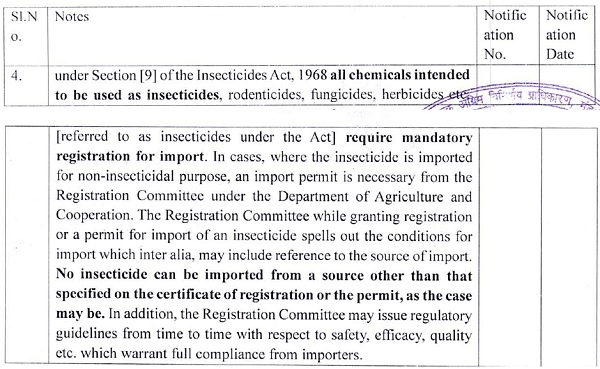
29.1.4 From the above explanation contained in the Memorandum, it is evident that the budgetary changes introduced under Chapter 29 were intended for identification of certain dual-use chemicals for non-pesticidal use and certain goods covered by international conventions. Whereas amendments introduced under Chapter 38 were specifically meant for identification of certain technical-grade pesticides and certain goods covered by international conventions. Both the changes supplement each other and are complimentary in nature.
29.1.5 It is also pertinent to mention that the applicant itself had been classifying the subject goods under Chapter 38, Heading 3808, prior to the amendments introduced through the Finance Act, 2025. The applicant has stated that the present application has been filed only consequent to the changes introduced in the Customs Tariff Act, 1975 through the Finance Bill, 2025. However, in view of the legislative intent reflected in the Memorandum explaining the provisions of the Finance Bill. the basis cited by the applicant for seeking reclassification is not tenable.
29.2 Significance of Supplementary Note 1 and Note 7 to Chapter 38
29.2.1 It is Further observed that the Finance Act, 2025 inserted Supplementary Note 1 and 7 to Chapter 38. which specifically provides for identification of certain technical-grade pesticides, including Carbosulfan and Clomazone. under Tariff Item 3808 91 42.
29.2.2 The said Supplementary Note to Chapter 38 prescribes specific Indian Standards for such chemicals, namely:
a. Carbosulfan Technical conforming to IS 14940, and
b. Clomazone Technical conforming to IS 15409,
for the purpose of classification of these chemicals under the said tariff item. As submitted by the applicant, both the chemicals conform to the respective IS standards referred to in the relevant Supplementary Notes to Chapter 38.
29.2.3 The prescription of such specific standards clearly indicates that the tariff entry under Chapter 38 is intended to cover technical-grade insecticidal substances identified through the prescribed Indian Standards, which arc commonly traded as technical-grade pesticides for further formulation or for insecticidal use.
29.2.4 In the present case, the subject goods, namely Carbosulfan Technical conforming to IS 14940 and Clomazone Technical conforming to IS 15409, conform to the respective Indian Standards referred to in the Supplementary Notes to Chapter 38 and are preparation intended for insecticidal use, possessing inherent insecticidal properties.
29.2.5 Accordingly, having, regard to the nature of the goods, their conformity with the prescribed Indian Standards, and their insecticidal character, the subject chemicals squarely fall within the scope of Tariff Item 3808 91 42.
29.3 Conclusion on Legislative Intent
As discussed supra, having regard to the scheme of the tariff, the Memorandum explaining the provisions of the Finance Bill, 2025, and the distinction drawn between dual-use chemicals classifiable under Chapter 29 and technical-grade pesticides specifically identified under Chapter 38, it is observed that the subject goods arc intended for use in the manufacture of insecticides and inherently possess insecticidal properties. Further, Supplementary Note 1 and 7 to Chapter 38 specifically identifies such technical-grade pesticides through reference to prescribed Indian Standards, namely Carbosulfan Technical conforming to IS 14940 and Clomazone Technical conforming to IS 15409.
In the present case, the subject goods, namely Carbosulfan Technical conforming to IS 14940 and Clomazone Technical conforming to IS 15409, have been stated to conform to the respective Indian Standards specified in the Supplementary Note.
Accordingly, it is evident that the legislative amendments were intended to bring such technical-grade insecticidal chemicals within the scope of Chapter 38. Therefore, the subject goods Carbosulfan Technical and Clomazone Technical are more appropriately classifiable under Chapter 38. specifically under Tariff Item 3808 91 41 and 3808 93 61 respectively.
30. Further, the import policy applicable to goods falling under Chapter 38, in respect of the subject goods, is reproduced below:
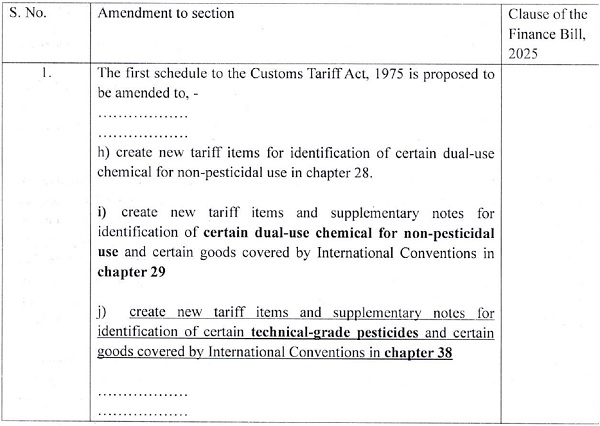
From the above import policy applicable to the subject goods, it is evident that the import of Carbosulfan — Technical Grade and Clomazone — Technical Grade requires mandatory registration under the Insecticides Act, 1968. Further, such insecticides can be imported only from the source specified in the certificate of registration or the import permit issued by the Registration Committee. Additionally, the Registration Committee may prescribe regulatory guidelines from time to time relating to safety, efficacy, and quality, which must be strictly complied with by the importers. It is to underline that the import policy approves that insecticides can also have “non-insecticidal purpose” as far as its application is concerned and that the budgetary changes made vide Finance Bill 2025 is brought it to align with import policy in as much as. dual use chemicals for non-pesticidal uses are to be classified under Chapter 29 (organic chemicals) only. These provisions bring greater clarity and consistency to the determination of the classification of these chemical compounds.
31. In view of the foregoing discussion, the subject chemicals are found to possess insecticidal properties and qualify as technical-grade pesticides. Consequently. they arc classifiable under Heading 3808, which covers insecticides. The appropriate sub-heading is CTSH 3808 91 —Insecticides and CTSH 380893- Herbicides , and further, in terms of Supplementary Note 1 and 7 to Chapter 38, the subject goods Carbosulfan Technical and Clomazone Technical are specifically covered under Tariff Item 3808 91 41 and 3808 93 61 respectively.
31.1 Accordingly, the goods namely Carbosulfan Technical and Clomazone Technical are appropriately classifiable under CTH 3808, CTSH 3808 91 and CTS11380893. and more specifically Tariff Item 3808 91 41 and 3808 93 61 respectively of the First Schedule to the Customs Tariff Act, 1975.
32. The case laws relied upon by the applicant are not applicable to the case.
32.1 In the matter of Midas Fertchem Impex Pvt. Ltd., the Tribunal held that the products in question were classifiable under CTH 3808 as preparations. Thus, rather than supporting the applicant’s contention, the said decision in fact supports classification under Heading 3808 in the present case.
32.2 In its additional submissions, the applicant has also placed reliance on various judicial pronouncements and certain WCO Classification Opinions. The reliance is primarily on decisions interpreting expressions such as “for use”, “for retail sale”, “intended use”, and principles governing classification based on presentation or end use. Whereas, the subject goods in the instant matter is preparation/intermediate preparation.
32.3 Applicant’s Analysis of the Applicant’s Attempt to Distinguish the Supreme Court Judgment
32.3.1 The applicant has contended that the judgment of the Hon’ble Supreme Court in Union of India v. Pesticides Manufacturers & Formulators Association of India is distinguishable and not binding for the present matter. The grounds put forth include that the case pertained to the Central Excise Tariff, that the dispute arose in the context of amendments made during 1996-97, and that the amendments considered therein differ from those introduced by the Finance Act, 2025.
32.3.2 I have carefully examined the above contention. The arguments advanced by the applicant are not persuasive for the reasons discussed below.
(i) Relevance of the Judgment despite arising under the Central Excise Tariff
32.3.3 The applicant has argued that the aforesaid judgment pertains to the Central Excise Tariff and therefore cannot govern classification under the Customs Tariff.
32.3.4 This contention cannot be accepted. It is a well-settled principle that the Central Excise Tariff and the Customs Tariff are both structured on the Harmonised System of Nomenclature (IISN) and share identical Section Notes, Chapter Notes, and interpretative principles.
32.3.5 Consequently, judicial pronouncements interpreting tariff entries under one statute are consistently relied upon for interpreting corresponding entries under the other statute.
32.3.6 The flon’ble Supreme Court itself has, in numerous decisions, recognised that interpretation of tariff entries must remain consistent across the two statutes where the language of the headings and notes is identical or substantially similar.
32.4 In the present case, the question before this Authority is about the classification of technical grade insecticidal compounds, which is precisely the subject matter covered in the judgment passed by Hon’ble Supreme Court in the matter of Union of India vs Pesticides Manufacturers & Formulators Association of India. The interpretative principle applied by the Supreme Court—namely that technical grade insecticides retain the essential character of insecticides even when not formulated for retail sale—remains directly relevant to the present dispute.
32.5 Hon’ble Supreme Court held in that case the technical grade pesticides as preparation/intermediate preparation
33. The applicant has further submitted that the Supreme Court in the above judgment noted that no amendments had been made to Chapter 28 or 29 affecting separate chemically defined compounds, whereas in the present case the Finance Act, 2025 has introduced new entries in Chapter 29 for Carbosulfan and Clomazone.
33.1 The Finance Act, 2025 simultaneously introduced specific tariff entries for the same chemicals under Chapter 38 by virtue of Supplementary Note 1 and 7 to Chapter 38. The reason to change/add the supplementary entries in both the Chapter 29 and 38 is well articulated in the Finance Bill, 2025.
33.2 Therefore, the amendments introduced in 2025 do not negate the principle recognised in the Supreme Court judgment. On the contrary, they reinforce the distinction between:
- chemicals identified by their chemical structure in Chapter and
- insecticidal products or preparations falling within the scope of Heading 3808.
33.3 In other words, the Supreme Court recognised that the functional identity and commercial character of the goods as insecticides is the determining factor, and not merely their chemical composition.
33.4 Further, as discussed in the preceding paragraphs dealing with the budgetary amendments introduced through the Finance Act, 2025, the Memorandum explaining the provisions of the Finance Bill clarifies that Chapter 29 entries were created for identification of certain dual-use chemicals in cases of non-pesticidal use, whereas Chapter 38 specifically provides for identification of technical-grade pesticides. The simultaneous introduction of Supplementary Note 1 and 7 to Chapter 38 prescribing a purity criterion for such technical-grade pesticides further reinforces the legislative intent to continue classification of insecticidal active ingredients under Heading 3808 where they are intended for pesticidal use.
33.5 Therefore, the fundamental principle recognised by the Hon’ble Supreme Court____ namely that
technical grade insecticides fall within the scope of Heading 3808 on account of their functional identity—remains unaffected. Thus, the attempt made by the applicant to distinguish the judgment in Union of India v. Pesticides Manufacturers & Formulators Association of India is not tenable.
34. Additionally, in matters of classification of goods under taxation statutes, all the judicial
forums, including the Apex Court, have stressed upon the importance of the identity of the goods in common parlance and there is a plethora of case law which hold that for classification of goods under statutes for taxation of commercial supplies thereof, the primary test is their identity in the market, or in other words, in common parlance. Some such judgments are as follows:
i. Deena Jee Sansthan v. CCE, Meerut [2019 (365) E.L.T. 353 (S.C.)]
ii. CCE, New Delhi v. Connaught Plaza Restaurant (P) Ltd. [2012 (286) E.L.T. 321 (S.C.)]
iii. CCE, Nagpur v. Shree Baidyanath Ayurved. Bhawan Ltd. [2009 (237) E,L.T . 225. (S.C.)]
v. M/s Pharm Aromatic Chemicals reported in 1997(95)E.L.T.203 (Born.)
iii. Dunlop India Ltd. & Madras Rubber Factory Ltd reported in 1983 (13) E.L. T. 1566 (S.C.) . M/s. Kantilal Nanchand and Co. reported in 2000-(123)E.L.T.3 II (Bom.)•
vii) M/s. Bella Premier. Happy. Hygiene Care Pvt. Ltd. reported in 2018 (17)G.S.T.L 603 (Kar.).
From, all the relevant documents submitted by the applicant technical write up, MSDS, COA and CIB certificate it is clear that the subject goods are known, sold marked in the trade as insecticides only. Therefore, by applying the ration of the above-mentioned judgement also the goods are more specifically classifiable as insecticides under CTH 3808.
35. To sum up:
i. The subject chemicals, namely Carbosulfan and Clowazone, are Technical Grade Chemicals.
ii. As per the technical write-up (Carbosulfan Technical and Clomazone Technical). both substances are specifically described and recognized as insecticides and herbicides.
iii. The subject goods possess insecticidal properties and. are known, marketed and traded in the commercial market as insecticides and herbicides.
iv. The CIB registration certificate also identifies the subject goods as technical/form ‘,hated insecticidal material.
v. Further, under the Insecticides Act, 1968, the term `insecticide” is used in a broad statutory sense and includes not only substances acting against insects but also other pesticidal substances such as fungicides and weedicides, as well as any preparation containing such scheduled substances. Accordingly, both insecticidal and herbicidal technical grade substances are regulated under the saute statutory framework, reinforcing their identification as pesticidal substances falling Within the scope of insecticides for regulatory purposes.
vi. Further, the amendments introduced through the Finance Act, 2025 simultaneously created specific tariff items and supplementary notes in both Chapter 29 and Chapter 38. As clarified in the Memorandum explaining the provisions of the Finance Bill, the amendments in Chapter 29 relate to identification of certain dual-use chemicals for non-pesticidal purposes, whereas the amendments in Chapter 38 specifically relate to identification of certain technical-grade pesticides. This clearly indicates the legislative intent to classify technical-grade insecticidal substances under Chapter 38.
vii. Additionally, as per the commercial production process details of the subject goods, it is evident that the goods are produced through multi-step chemical synthesis involving various reactions and purification stages. These processes ultimately result in the final technical grade active insecticidal substance. Therefore, it can safely and conclusively be held that the subject goods constitute preparations, as they are formulated chemical compounds produced through a multi-step synthesis process. Hon’ble Supreme Court in the matter of Union of India v. Pesticides Manufacturers & Formulators Association of India has discussed the issue comprehensively and ratio is clearly applicable to this case.
viii. In view of the manufacturing process and technical literature on record, the goods are clearly preparations within the meaning of the tariff.
ix. Being insecticidal preparations, they are appropriately covered under Heading
x. Further, Supplementary Note 1 and 7 to Chapter 38 specifically identify certain technical-grade pesticides including Carbosulfan and Clomazone under Tariff Item 3808 91 41 and 3808 93 61 respectively, conforming to IS 14940 and IS 15409. The subject goods satisfy the prescribed purity criterion and therefore squarely fall within the scope of the said tariff entry.
xi. Further, the import policy applicable to goods falling under Chapter 38 requires mandatory registration under Section 9 of the Insecticides Act, 1968 for chemicals intended to be used as insecticides. The subject goods, being technical-grade insecticides, are required to be registered with the Central Insecticides Board and Registration Committee prior to import, which further reinforces their regulatory and commercial identity as insecticides.
xii. Further, in terms of Note 1(a)(2) of Chapter 38. the General HSN Explanatory Note to Note 29 (Note (D)(2)(h)) of Chapter 29. as well as the General HSN Explanatory Note (2) of Chapter 38, insecticides put up as described in I-leading 38.08 are excluded from Chapter 29 and are classifiable under Chapter 38.
xiii. Applying Rule 3(a) of the General Rules for Interpretation, the heading providing the most specific description, namely Heading 3808 for insecticides, prevails over any more general chemical heading under Chapter 29.
xiv. Even if the goods are prima facie classifiable under more than one heading, Rule 3(h) of the General Rules for Interpretation would apply, inasmuch as the essential character of the subject goods is derived from their insecticidal properties. The dominant function, commercial identity, and intended use of the goods are as insecticides, and therefore classification under Heading 3808 is warranted.
36. On the basis of facts and circumstances of the case, foregoing discussions and observation, I reach to conclusion that:
i) Subject goods i.e. “Carbosulfan- Technical Grade and Clomazone-Technical Grade” to be used as insecticide and herbicide, are classifiable under CTH 3808, CTSH 380891- insecticides and CTSH 380893- herbicide, more specifically under CTI 3808 91 41 and 3808 93 61 respectively, of the first schedule to the Customs Tariff Act, 1975.
I rule accordingly.