The recent Delhi ITAT Ruling in CPI India I Ltd. vs. ACIT, rendered on 30-10-2025, has created a flutter in the tax fraternity, in view of the firm view depicted by the Delhi Tribunal to the effect that where three is a valid TRC, DTAA benefit cannot be denied on the ground that it is a shell company. The other High Court and Tribunal decisions pertinent to the issue have been analytically discussed in the article by the learned author. How the position has changed in 2017 has also been lucidly explained.
Introduction
India has signed many tax treaties with other countries. These treaties help avoid double taxation. They also promote foreign investment. One such treaty is the India–Mauritius DTAA. It gives tax benefits to Mauritius-based investors. But sometimes, tax authorities question these benefits. They say some companies are “shell” or “conduit” entities. This article explains a recent case where the tribunal protected treaty rights. It also looks at similar decisions, High Court rulings, CBDT circulars, and what they mean for investors and stakeholders.
I: The Delhi ITAT Ruling – CPI India I Ltd. vs. ACIT, ITA No. 1826/del/2025 Order dt 30-10-2025 Taxguru post 4 Nov 2025
Case Background
The assessee was CPI India I Ltd., a company based in Mauritius. It had invested in shares of BPTP Ltd., an Indian company. Later, it sold those shares and reported a long-term capital loss of ₹51.87 crore. The company claimed exemption under the India–Mauritius DTAA.
The tax department disagreed. It said the company was a shell entity. It argued that the company had no real business in Mauritius. It wanted to deny the DTAA benefit. The department also said the company was created only to avoid tax.
Tribunal’s Findings and Reasonings
The Income Tax Appellate Tribunal (ITAT), Delhi Bench gave relief to the assessee. It rejected the department’s arguments. Here are the main points:
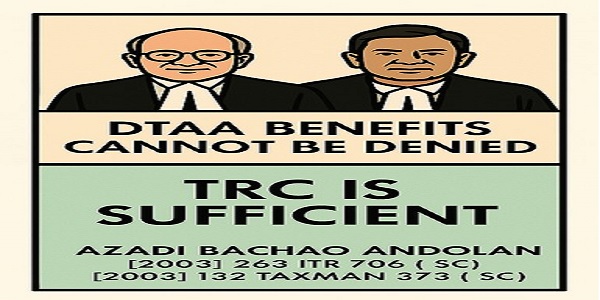
- TRC is sufficient: The company had a Tax Residency Certificate (TRC) from Mauritius. The tribunal said this was enough to claim treaty benefits. It referred to the Supreme Court’s ruling in the case of Union of India & Another vs. Azadi Bachao Andolan & Another [2003] 263 ITR 706 :[2003] 132 Taxman 373 : [2003] 184 CTR 450 (SC).
- No evidence of abuse: The department did not show any proof that the company was a shell. There was no evidence of treaty shopping or tax avoidance.
- Earlier year followed: The tribunal had given relief to the same company in an earlier year. It followed that decision for consistency.
- Capital gains exempt: The investment was made before the 2017 amendment to the treaty. So, the gains were exempt under Article 13(4) of the DTAA.
Author’s Note
Readers may see the discussion in What Changed in 2017 (infra). The assessment year involved is crucial.
II: What Is a TRC and Why It Matters?
A Tax Residency Certificate is a document issued by a country’s tax authority. It confirms that a person or company is a resident of that country. Under Indian law, a TRC is needed to claim DTAA benefits. The Supreme Court has unequivocally opined that TRC is conclusive proof of residency. It cannot be questioned unless there is fraud or misrepresentation. Once the taxpayer produces it, denying the DTAA benefits, will be very difficult for the Revenue, excepting perhaps here LOB clause applies, after 1st April, 2017. This aspect is discussed later.
III: Similar ITAT Decisions
Many other cases have supported this view. Here are a few:
Crux of the case:
- Mauritius-based entity sold shares of Indian company earning ₹904.98 crore as long-term capital gains.
- Claimed exemption under Article 13(4) of the India–Mauritius DTAA.
- AO alleged the entity was a shell company, controlled by Blackstone affiliates in Cayman Islands.
- Department argued that beneficial ownership was lacking and gains were routed through Mauritius for tax avoidance.
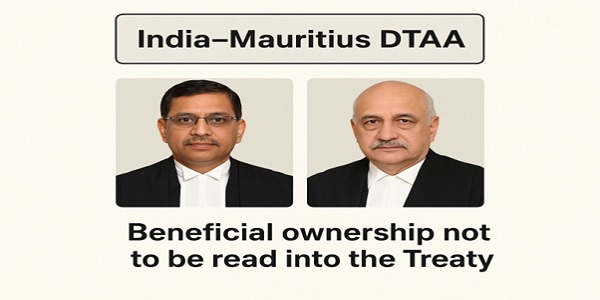
- Tribunal held that beneficial ownership is not a requirement under Article 13(4) for capital gains.
- Rejected the Revenue’s attempt to read beneficial ownership into the DTAA where it was not textually present.
- TRC was accepted as valid proof of residency; no evidence of treaty abuse was found.
- Tribunal emphasized that corporate control or affiliation does not automatically negate treaty eligibility.
- Matter was remanded for limited verification, but treaty protection was upheld.
- Reinforces Azadi Bachao Andolan and CBDT Circular No. 789 on TRC sufficiency.
Crux of the case:
- Luxembourg-based entity registered as a Foreign Portfolio Investor (FPI) with SEBI.
- Declared income of ₹10.63 crore and claimed refund of TDS ₹19.46 crore.
- AO denied treaty benefits alleging treaty shopping and lack of economic substance.
- AO assessed income at ₹50.48 crore and raised tax demand of ₹14.52 crore.
- Tribunal noted the entity had no Permanent Establishment (PE) in India.
- Held that TRC issued by Luxembourg was valid and sufficient for DTAA claim.
- Rejected Revenue’s argument that indirect control by parent entities negated treaty eligibility.
- Emphasized that FPI registration and regulatory compliance supported genuine investment.
- No evidence of conduit structure or tax evasion was presented by Revenue.
- Tribunal allowed capital gains exemption under India–Luxembourg DTAA.
Crux of the case:
- Cyprus-based investment holding company challenged denial of DTAA benefits.
- AO alleged conduit structure, claiming routing of investments solely to exploit treaty.
- Revenue questioned beneficial ownership and substance of operations.
- Tribunal found the company had a valid TRC and operational control in Cyprus.
- Rejected Revenue’s claim of treaty abuse due to lack of substantive evidence.
- Noted that RBI, SEBI, and FIPB approvals supported legitimacy of investment.
- Held that India–Cyprus DTAA did not require beneficial ownership for capital gains exemption.
- Tribunal emphasized that corporate structuring alone does not imply tax avoidance.
- Allowed exemption on capital gains and dividend income under DTAA.
- Reinforced judicial respect for TRC and treaty obligations in absence of fraud.
IV DECISIONS OF HIGH COURTS
SLP Filed: SC issued notice in ACIT v. Blackstone Capital Partners (Singapore) VI FDI Three Pte. Ltd., [2024] 158 taxmann.com 261 (SC)
About the case
- The petitioner, a Singapore-based entity, sold shares of an Indian company and claimed capital gains exemption under Article 13(4) of the India–Singapore DTAA.
- The AO issued a reassessment notice under Section 148, alleging the entity was a shell company controlled by a U.S. parent and not entitled to treaty benefits.
- The High Court quashed the reassessment, holding that TRC issued by Singapore was sufficient to establish treaty eligibility.
- It reiterated that residency under DTAA is determined by TRC, and unless there is fraud or misrepresentation, the Revenue cannot go behind it.
- The Court emphasized that corporate control or affiliation does not negate treaty protection unless there is tangible evidence of abuse.
- The judgment relied on Azadi Bachao Andolan and CBDT Circular No. 789.
- The Revenue’s argument of “substance over form” was rejected due to lack of material evidence.
- The Court held that reassessment based on mere suspicion or corporate structure is bad in law.
- The matter is now pending before the Supreme Court, where notice has been issued in the SLP.
About the case:
- The petitioner, a Mauritius-based company, had acquired shares in Mumbai International Airport Ltd. and later sold them.
- The AAR had denied capital gains exemption under the India–Mauritius DTAA, alleging the entity was a conduit for its South African parent.
- The Bombay High Court reversed the AAR ruling, holding that TRC issued by Mauritius was conclusive evidence of residency.
- The Court followed the Supreme Court’s ruling in Azadi Bachao Andolan, emphasizing that treaty benefits cannot be denied merely due to foreign control.
- It held that corporate structuring and shareholder agreements do not override treaty protection unless there is actual abuse or sham transactions.
- The Court noted that the Revenue had failed to establish that the Mauritian entity was not the legal owner of the shares.
- It reaffirmed that Article 13(4) of the DTAA grants exclusive taxing rights to Mauritius for capital gains.
- The judgment provides clarity that TRC remains a strong shield against arbitrary denial of treaty benefits.
- It also cautioned against lifting the corporate veil without substantive justification.
- The ruling strengthens investor confidence in India’s treaty commitments and judicial safeguards.
V: CBDT Circulars and Instructions
CBDT Circular No. 789, dated 13 April 2000
- States that a TRC issued by Mauritius is sufficient evidence of residence and beneficial ownership.
- This circular was upheld by the Supreme Court in Azadi Bachao Andolan.
- It remains a cornerstone for treaty interpretation.
CBDT Instruction No. 2/2014, dated 26 February 2014
- Clarifies that TRC is necessary but not always sufficient post-2013.
- However, in the absence of fraud or misrepresentation, TRC remains a strong basis for DTAA claims.
- Applies more to post-2013 investments and must be read with treaty provisions.
VI: What Is Treaty Shopping?
Treaty shopping happens when a person or company from one country sets up a business in another country—just to use that second country’s tax treaty with India and pay less tax.
They don’t do real business there. They just use that country as a shortcut to get tax benefits. For example, someone from Country A may create a company in Mauritius only to avoid paying capital gains tax in India, because Mauritius has a tax treaty with India.
This is seen as misusing the treaty, because the company isn’t a genuine resident of Mauritius—it’s just a paper company.
How India Stopped It
To stop this, India changed its tax treaties in 2017. Now, companies must show they are real businesses in Mauritius or Cyprus. They must meet certain rules called Limitation of Benefits (LOB). These rules check:
- Do they spend money on actual operations there?
- Are they really based there, or just pretending?
- Are they owned or controlled by people from other countries?
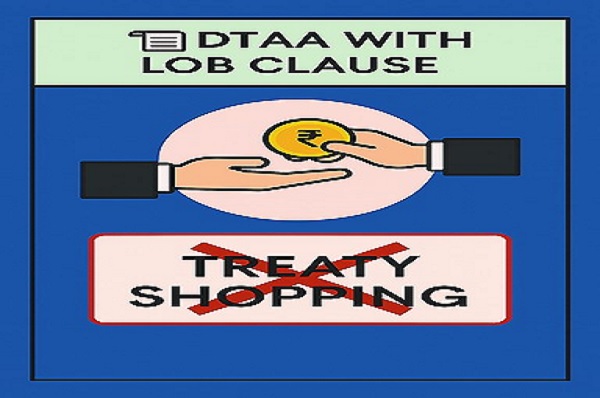
If they don’t meet these rules, they can’t get the tax benefits.
Risks Involved in Treaty Shopping
Treaty shopping may seem like a smart tax-saving move, but it comes with serious risks—both legal and financial. Here’s what can go wrong:
- Denial of Treaty Benefits: If tax authorities find that a company is just a “paper entity” set up to misuse a tax treaty, they can deny the tax exemption—even if the company has a Tax Residency Certificate (TRC).
- Tax Reassessment: The Income Tax Department may reopen past assessments and demand tax on capital gains that were earlier claimed as exempt.
- Litigation and Legal Costs: Treaty shopping often leads to long legal battles. Companies may have to fight in Tribunals and Courts, which takes time and money.
- Penalties and Interest: If the tax benefit is denied, the company may have to pay not just the tax, but also interest and penalties for underreporting income.
- Reputational Damage: Being labeled as a “treaty shopper” or “shell company” can hurt a company’s reputation with regulators, investors, and partners.
- Blacklisting or Scrutiny: Countries may blacklist jurisdictions known for treaty abuse. Companies from such places may face stricter scrutiny or even be barred from future investments.
- Regulatory Crackdown: With global initiatives like BEPS (Base Erosion and Profit Shifting) and GAAR (General Anti-Avoidance Rules), treaty shopping is now a red flag for tax authorities worldwide.
VII. What Changed in 2017 – India’s Tax Treaties with Mauritius and Cyprus
India amended its Double Taxation Avoidance Agreements (DTAAs) with Mauritius and Cyprus through protocols signed in 2016, which came into effect from April 1, 2017. These changes were aimed at preventing treaty abuse and round-tripping of funds.
Old DTAA Regime (Before April 1, 2017)
- Foreign investors from Mauritius or Cyprus could invest in Indian shares.
- If they sold those shares and made capital gains, they were exempt from Indian tax under Article 13(4) of the DTAA.
- All they needed was a valid TRC from their home country.
- Indian tax authorities could not question their residency or ownership unless there was fraud or misrepresentation.
- This was upheld by the Supreme Court in Azadi Bachao Andolan (supra) and supported by CBDT Circular No. 789.
New DTAA Regime (From April 1, 2017 Onward)
- India introduced source-based taxation for capital gains on shares.
- Now, India can tax capital gains arising from sale of Indian shares by Mauritius or Cyprus residents.
- However, there is a transition period:
- For investments made before April 1, 2017 → Old rules apply (grandfathering).
- For investments made on or after April 1, 2017 → New rules apply.
Limitation of Benefits (LOB) Clause
The LOB clause is a safety filter added to the treaty. It ensures that only genuine investors get treaty benefits. Here’s what it means:
- The foreign company must be a real business, not just a paper entity.
- It must spend a minimum amount on operations in its home country (e.g., ₹27 lakh in Mauritius).
- It should not be controlled or owned by residents of third countries.
- It must not be set up only to claim treaty benefits.
Why This Matters in CPI India Case
- CPI India I Ltd. was a Mauritius-based company.
- It made its investment before April 1, 2017.
- So, the old DTAA rules applied—no need to meet LOB conditions.
- The company had a valid TRC and was not proven to be a shell.
- The ITAT Delhi upheld its claim for capital gains exemption.
Summary Table: Treaty Changes at a Glance
| Aspect involved | Position Before April 1, 2017 | Position After April 1, 2017 |
|---|---|---|
| Capital Gains Tax | Exempt in India | Taxable in India |
| TRC Requirement | Sufficient | Still required |
| LOB Clause | Not applicable | Mandatory for new investments |
| Grandfathering | Yes | No |
| Treaty Shopping Risk | High | Reduced |
VIII: Practical Takeaways
For Investors
- Get a valid TRC from your home country.
- Keep proper records of your investments.
- Follow all laws and regulations in India and your country.
- Avoid aggressive tax planning that may look suspicious.
- Consult legal and tax experts before making big moves.
For Tax Authorities
- Respect treaty obligations signed by India.
- Avoid making assumptions without proof.
- Focus on facts and documents, not labels.
- Use investigation tools only when needed.
- Follow judicial precedents set by higher courts.
For Advisors and Stakeholders
- Educate clients about treaty rules.
- Help with documentation like TRCs and investment records.
- Stay updated on changes in treaties and laws.
- Use case law to defend clients in audits and appeals.
- Promote ethical practices in cross-border transactions.
- Take note of the changes in 2017; LOB clause to be looked into.
Summary Table: Key Points from CPI India Ruling
| Aspect involved | Tribunal’s View |
|---|---|
| TRC Validity | Sufficient for DTAA claim (because of the AY involved) |
| Shell Company Allegation | Rejected due to lack of evidence |
| Treaty Abuse | No proof of treaty shopping or fraud |
| Investment Timing | Made before 2017 protocol; old DTAA rules apply |
| Capital Gains | Exempt under Article 13(4) of India–Mauritius DTAA |
| Earlier Year Ruling | Followed for consistency |
Concluding remarks
The CPI India ruling is a strong message. It says that treaty rights must be respected. A valid TRC cannot be ignored. Allegations must be proven. This protects honest investors and promotes trust. It also helps India attract foreign capital. Courts and tribunals play a key role in keeping the balance. They must protect the law and ensure fairness.
The High Courts and CBDT have also supported this view. They have said that TRC is a strong document. It cannot be questioned without proof. This gives clarity to taxpayers and confidence to foreign investors.
Readers are cautioned to take note of the changes which took place in 2017 after the insertion of the LOB clause and the new tax treaties which India is entering into with the tax havens, to control the treaty shopping abuse.