This article tracks how Indian High Courts have shaped GST registration law. Starting with early rulings that stressed natural justice, it moves to the Madras High Court’s 2022 framework for revival through compliance. Later, the Rajasthan High Court expanded protection to bank accounts, and in 2025, Madras reaffirmed that procedural lapses shouldn’t lead to permanent cancellation. Together, these cases show a clear judicial shift toward fairness, revival, and business continuity.
Introduction
The cancellation of GST registration has been one of the most contentious issues since the advent of the Goods and Services Tax regime in India. While the law provides for cancellation in cases of non‑compliance, courts have consistently emphasized that GST is a regulatory statute, not a punitive one. The objective is to ensure compliance and collection of
legitimate tax dues, not to cripple lawful trade. This article traces the judicial evolution of this principle, beginning with the Madras High Court’s November 2025 decision in Velu Ramakrishnan Proprietor vs Commissioner of Commercial Taxes, moving back to the foundation case of Suguna Cut Piece Centre (2022), and then surveying other High Court decisions chronologically.
1. November 2025 – Madras High Court: Velu Ramakrishnan Proprietor vs Commissioner of Commercial Taxes
- Citation: W.P. No. 28928 of 2025, Judgment dated 8 November 2025 (Madras HC portal verified).
- Coverage: Taxguru post titled “GST Registration Can Be Revived If Dues Are Cleared: Madras HC Reaffirms” (11 November 2025)
Key Holding
The Court disposed of the writ petition at the admission stage, with both parties agreeing that the issue was squarely covered by the earlier precedent in Suguna Cut Piece Centre. The Court reiterated that:
- Legitimate trade should not be crippled.
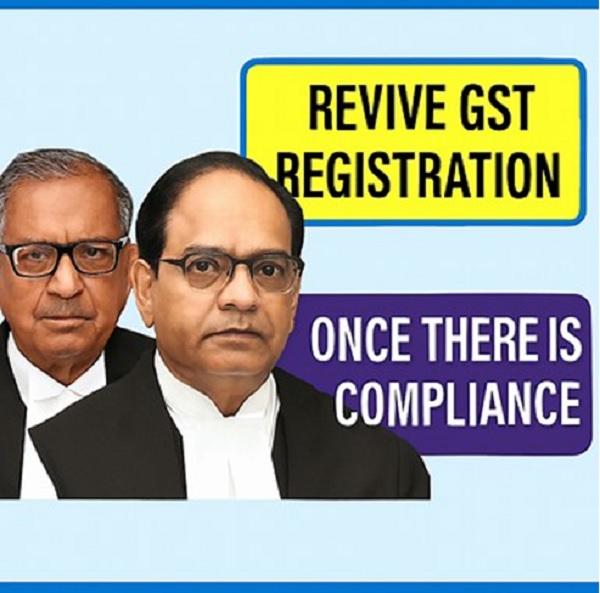
- Revival of registration must be permitted subject to compliance.
- Directions from Suguna Cut Piece Centre (Infra) applied mutatis mutandis.
Significance
This judgment reaffirmed the structured revival mechanism laid down in 2022, showing continuity in Madras HC jurisprudence. It also demonstrated judicial pragmatism: rather than rehearing the matter, the Court applied precedent directly, ensuring speedy relief.
2. January 2022 – Madras High Court: Tvl. Suguna Cut Piece Centre vs Appellate Deputy Commissioner (ST) (GST), Salem (2022) 99 GSTR 386 (Madras), Date: Judgment dated 31 January 2022.
Legal Finding
This was the foundation case. Justice C. Saravanan laid down detailed directions for revival of cancelled GST registrations:
- Pending returns to be filed within 45 days.
- Dues to be paid in cash (no ITC adjustment).
- ITC to be scrutinized before utilization.
- Automatic revival upon compliance.
- GSTN portal modifications mandated.
Significance
This case became the template judgment for subsequent writ petitions. It established that GST law is regulatory, not punitive, and that cancellation should not permanently disable businesses.
3. 2020 – Gujarat High Court: Aggarwal Dyeing and Printing Works vs State of Gujarat 2020 (34) GSTL 485 (Gujarat HC), R/Special Civil Application No. 18860 of 2021 (clubbed with SCA Nos. 1169/2022, 2263/2022, 3140/2022), Date: Judgment dated 17 February 2020.
Court’s determination
The Court held that cancellation of GST registration without affording an opportunity of hearing violates principles of natural justice.
- Cancellation orders were quashed.
- Revival directed subject to compliance.
Significance
This was one of the earliest High Court interventions on GST registration cancellation, focusing on natural justice rather than structured revival.
4. 2022 – Calcutta High Court: M/s LGW Industries Ltd. vs Union of India & Ors.2022 (61) GSTL 385 (Calcutta HC), WPA No. 23512 of 2019 Judgment dated 13 December 2021.
Key Holding
The Court quashed cancellation orders issued without proper notice.
- Restoration directed.
- Emphasized that cancellation must follow due process.
- It remanded the matter back to GST authorities to reconsider entitlement of ITC, emphasizing natural justice and proper evaluation of documents.
Significance
This case reinforced the principle of natural justice, aligning with Gujarat HC, but also highlighted procedural safeguards in GST cancellation.
5. 2023 – Rajasthan High Court: Bhilwara Trading Company vs Union of India, Civil Writ Petition No. 3354 of 2023, Judgment dated 14 March 2023.
Outcome of the case
The Court held that freezing of bank accounts merely because GST registration was cancelled is disproportionate.
- Directed revival of registration subject to compliance.
- Protected business operations from collateral consequences.
Significance
This case broadened the jurisprudence: not only revival of registration, but also protection against collateral damage (like bank account freezing).
Concluding remarks
The jurisprudence across the various High Courts in India reveals a clear trajectory:
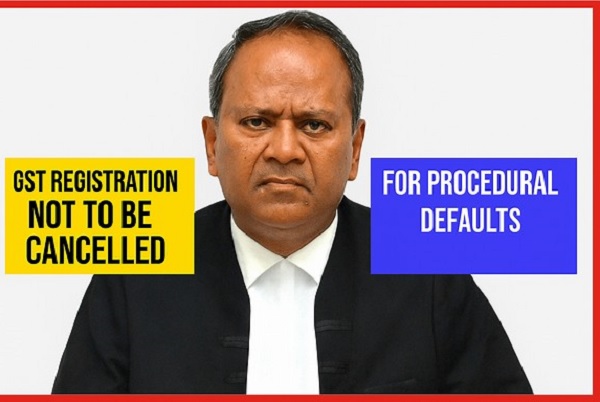
- GST registration cancellation is not meant to permanently cripple businesses.
- Courts emphasize compliance, but also continuity of trade.
- Revival is conditional, not unconditional — taxpayers must file pending returns and pay dues.
- Natural justice and proportionality are guiding principles.