GST 2.0 Reforms: How India’s 2025 Tax Overhaul Simplifies Rates, Empowers MSMEs, and Eases Compliance for Businesses and Households
The most trending GST topic in 2025 is the landmark “GST 2.0” reforms that have transformed India’s tax landscape with new rate structures, simpler compliance, and significant relief for businesses and consumers alike. This deep-dive article explores what GST 2.0 means, how it’s impacting sectors, and what business owners need to know to stay compliant.
GST 2.0: A New Era Begins
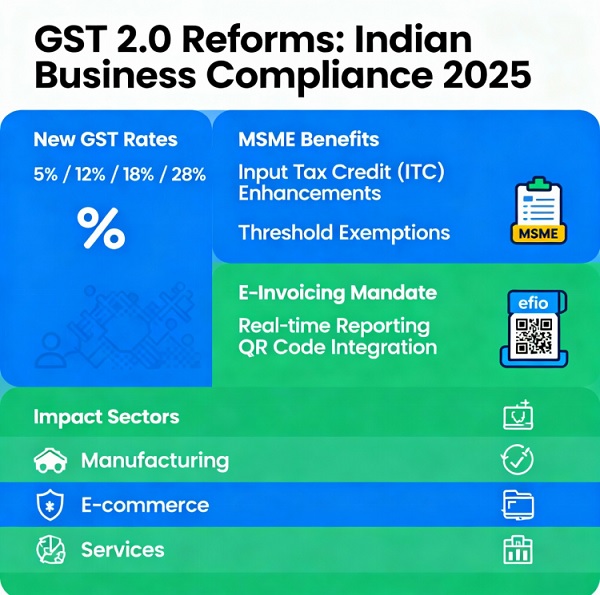
India’s GST regime has entered a new phase in September 2025, with the 56th GST Council meeting ushering in sweeping changes. Under GST 2.0, the old four-slab system (5%, 12%, 18%, 28%) is replaced with a simplified structure: 5% for essentials, 18% as the standard rate, and a new 40% rate for “sin goods” and luxury items. These changes aim to reduce complexity, ease compliance, and boost both consumption and economic growth:
- Standard Rate (18%): Applies to most goods and services.
- Merit Rate (5%): For essentials like daily-use products, agricultural items, healthcare devices.
- 40% Sin Rate: For products considered harmful or ultra-luxury such as pan masala, certain beverages, tobacco.
How Will GST 2.0 Impact Daily Life?
For the common man, GST 2.0 means cheaper household essentials—including soaps, toothpaste, and basic food items. GST on dairy products, several lifesaving medicines, and educational supplies has dropped to zero. Electronics, small cars, and motorbikes (≤350cc) now attract an 18% GST, bringing “affordable tech” and mobility within reach for more Indians.
Industries such as MSMEs (micro, small, and medium enterprises), textiles, footwear, handicrafts, and toys benefit from reduced rates, enhancing their export potential and reducing tax burdens for youth-driven businesses.
Relief for Businesses: Compliance Made Easier
GST 2.0 isn’t just about rates—it’s a direct answer to recurring compliance headaches faced by businesses since GST’s inception. The reforms bring:
- Structural Simplification: Correction of inverted duty structures to speed up refunds and alleviate cash flow challenges.
- Streamlined Classification: Clearer item categorization reduces disputes and helps businesses plan better.
- Ease of Doing Business: Pre-filled returns, smoother registrations, and automation in e-invoicing make GST filings more efficient, especially for MSMEs.

GST Compliance Challenges in 2025
Even with simplification, some compliance issues remain top-of-mind as per industry commentators:
- Input Tax Credit (ITC) Reconciliation: Businesses must closely reconcile input credits against vendor filings to prevent fraudulent claims and ensure financial health.
- Timely Filing of Returns: Late filings risk penalties, blocked ITCs, and operational disruptions.
- Expanded E-invoicing: Now mandatory for businesses with turnover above ₹5 crore, automation is no longer optional.
- Increased Scrutiny and Penalties: Regular audits and heavier penalties make accuracy crucial for all GST returns.
- Digital Tech Adoption: Tech learning curves remain steep for small traders and manufacturers, with automation and accounting upgrades vital for survival.
GST Rates: What Has Changed?
Here’s a brief rundown of the major GST rate changes effective September 22, 2025:
| Sector / Product | Previous Rate (%) | New Rate (%) | Impact |
|---|---|---|---|
| Dairy, lifesaving drugs | 5 / 12 | 0 | Major relief for health, agriculture |
| Daily essentials | 12 / 18 | 5 | Cheaper everyday goods |
| Electronics, autos | 18 / 28 | 18 | Affordable tech and transport |
| Pan masala, sin goods | 28 | 40 | Higher cost, curb harmful consumption |
| MSME products | 12 | 5 | Boost to exports and local entrepreneurship |
Government’s Pillars of Reform
Prime Minister Narendra Modi articulated three key pillars for new-gen GST reforms during his Independence Day address:
- Structural Reforms: Fixing inverted duty structures and rationalising tax slabs for fewer disputes and more clarity.
- Rate Rationalisation: Reduction in the number of slabs to lower compliance costs and boost demand.
- Ease of Doing Business: Pre-filled returns, faster refunds, and improved registration procedures to help MSMEs and new businesses flourish.
Sectoral Insights
MSMEs, Startups, and Youth Entrepreneurs
The new GST regime is specifically designed to empower MSMEs and startups by lowering tax rates on their primary goods and services (textiles, footwear, handicrafts). These changes reduce entry barriers, improve competitiveness, and increase export potential—a direct boost for India’s youth population.
E-commerce, Technology, and Automation
E-invoicing mandates and simplified tax filing have accelerated digital transformation for Indian businesses. Companies must now integrate secure ERP and accounting solutions, driving demand for tech-driven compliance platforms.
Healthcare, Agriculture, and Education
Zero-rate GST on essential medicines, dairy, and education supplies means increased affordability and wider access. Rural and urban households can expect real relief, driving improved health and literacy outcomes.
Luxury, “Sin Goods,” and Economic Policy
Steep taxes on ultra-luxury products and sin goods reflect a policy focus on equity and social health. The higher 40% GST rate aims to curb harmful consumption and raise government revenue for welfare schemes.
Technology and GST: Making Compliance Human-Centric
With rising compliance requirements, businesses have invested in user-friendly GST software, automated reconciliation, and digital dashboards. For many, this means less paperwork, fewer errors, and more time for core business activities.
The Road Ahead: Challenges and Opportunities
While GST 2.0 is a giant leap forward, transition bumps are likely for small businesses, traders, and many new entrants. Upskilling in digital GST tools, regular vendor checks, ecosystem partnerships, and risk controls have become necessities.
Future GST headlines will be shaped by continuing reforms, evolving compliance tech, and a greater push for transparency and economic inclusion.
Conclusion: A Progressive GST for India
GST 2.0’s simplification has triggered a tidal wave of positive changes for both consumers and businesses. Lower costs, easier compliance, enhanced competitiveness, and a sharper focus on social goods signal a robust future for Indian taxation. MSMEs, entrepreneurs, and industry leaders must stay agile, invest in digital compliance, and embrace the new GST ethos for enduring success.
For every household, startup, and industry—GST 2.0 is a call to adapt, innovate, and thrive in a rapidly evolving marketplace.