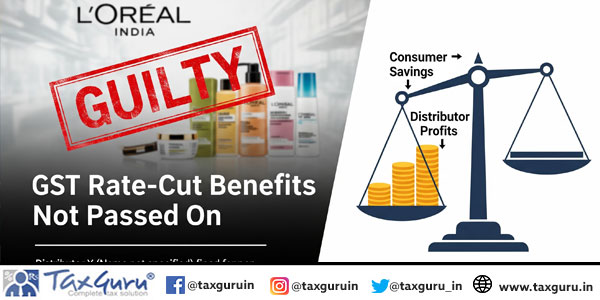
The GST Appellate Tribunal (GSTAT), Delhi, has upheld an anti-profiteering ruling against Raj & Co., a distributor of L’Oreal India products. In its order dated August 18, 2025, the GSTAT found the respondent guilty of failing to pass on the benefit of a GST rate reduction on cosmetics products to the ultimate consumers, directing the deposit of over Rs. 3.31 lakh along with 18% interest into the Consumer Welfare Fund. This decision reinforces the legal obligation under Section 171 of the Central Goods and Services Tax (CGST) Act, which mandates that any reduction in the tax rate must be passed on to the consumer through a commensurate price reduction.
Facts:
DGAP (“the Petitioner”) received a complaint against Raj & Co. (“the Respondent”), a distributor of L’Oreal India products, alleging failure to pass on the reduced GST rate benefit on cosmetics products, following Notification No. 41/2017-CT(Rates), which reduced GST from 28% to 18% w.e.f. November 15, 2017.
Investigations revealed that the Respondent did not proportionately reduce prices on 388 products but instead raised base prices, resulting in profiteering amounting to over Rs. 3.3 lakhs.
The Respondent argued that all sales were done via L’Oreal’s software “Suvidha,” limiting its control over pricing and shifting responsibility to L’Oreal. L’Oreal refuted this claim, stating that the Respondent alone bore responsibility to pass on the benefits through reduced prices and discounts.
An earlier order of the National Anti-Profiteering Authority (NAA) for the period November 15, 2017 to March 31, 2018, also rejected the Respondent’s claim of lack of control over pricing.
The GSTAT referred to the distributor agreement indicating that the Respondent had ample discretion to offer discounts or reduce base prices/ MRP, so it cannot blame the manufacturer.
Since there was no dispute on the GST rate reduction and the Respondent failed to reduce prices accordingly, GSTAT held a presumption of profiteering against the Respondent, which was not effectively rebutted.
Issue:
Whether the Respondent, as a distributor, was liable to pass on the benefit of GST rate reduction on cosmetics products to the ultimate consumer, and if failure to do so made him guilty of profiteering under Section 171 of the CGST Act?
Held:
The GSTAT, Delhi in NAPA/19/PB/2025 held as under:
-
- Observed that, the Respondent was clearly liable to pass on the benefits of GST rate reduction in pricing of 388 cosmetics products.
- Noted that, the Respondent’s argument of lack of control and shifting responsibility to L’Oreal was unfounded considering the distributor agreement and previous NAA order.
- Held that, the Respondent had discretion to reduce base prices or provide discounts, and failure to do so amounted to profiteering.
- Affirmed the previous findings of the NAA and directed the Respondent to deposit Rs. 3.31 Lakhs along with 18% interest into the Consumer Welfare Fund constituted under Section 57 of the CGST Act and concluded that the Respondent’s conduct contravened the anti-profiteering provisions.
Our Comments:
The ruling follows the principle upheld by the Delhi High Court in the case of Reckitt Benckiser India Private Limited v. Union of India [W.P.(C) 7743/2019 order dated, January 29,2024], which upheld constitutional validity of anti-profiteering laws while preventing arbitrariness in enforcement.
Relevant Provisions:
Section 171, Central Goods and Services Tax Act, 2017
“171. Antiprofiteering measure.-
(1) Any reduction in rate of tax on any supply of goods or services or the benefit of input tax credit shall be passed on to the recipient by way of commensurate reduction in prices.
(2) The Central Government may, on recommendations of the Council, by notification, constitute an Authority, or empower an existing Authority constituted under any law for the time being in force, to examine whether input tax credits availed by any registered person or the reduction in the tax rate have actually resulted in a commensurate reduction in the price of the goods or services or both supplied by him.
Provided that the Government may by notification, on the recommendations of the Council, specify the date from which the said Authority shall not accept any request for examination as to whether input tax credits availed by any registered person or the reduction in the tax rate have actually resulted in a commensurate reduction in the price of the goods or services or both supplied by him.
Explanation 1.––For the purposes of this sub-section, “request for examination” shall mean the written application filed by an applicant requesting for examination as to whether input tax credits availed by any registered person or the reduction in the tax rate have actually resulted in a commensurate reduction in the price of the goods or services or both supplied by him.
Explanation 2.––For the purposes of this section, the expression “Authority” shall include the Appellate Tribunal …”
***
(Author can be reached at [email protected])