TGS Minmet Private Limited Vs DCIT (ITAT Visakhapatnam)
ITAT Remands ₹5.51 Crore TP Adjustment Due to Doubt Over Trading and Manufacturing Comparables; ITAT Grants Fresh Opportunity in TP Case Involving COVID-19 Transportation Costs and Comparables; Manufacturing Companies Cannot Be Compared With Pure Traders Without Proper Analysis; ₹5.51 Crore ALP Adjustment Reconsideration Ordered Due to Inadequate DRP Findings.
The Income Tax Appellate Tribunal (ITAT), Visakhapatnam Bench, considered an appeal filed against the assessment order passed under Sections 143(3), 144C(13), and 144B of the Income Tax Act for Assessment Year 2021-22. The dispute related to a transfer pricing adjustment of Rs.5.51 crore made under Section 92CA(3) in relation to sale of iron ore products to associated enterprises.
The assessee challenged the transfer pricing adjustment on several grounds, including rejection of its transfer pricing study, application of inappropriate filters, incorrect comparables, treatment of transportation and handling charges as operating expenses, and non-consideration of COVID-19 related exceptional circumstances. The assessee contended that its operating profit margin complied with the arm’s length principle and argued that the comparables selected by the Transfer Pricing Officer (TPO) were functionally dissimilar.
The assessee argued that it was engaged exclusively in trading of iron ore and coal, whereas the comparables selected by the Revenue, namely Nalwa Steel and Power Ltd., Rungta Mines Ltd., and Shyam Sel and Power Ltd., were engaged in manufacturing activities such as sponge iron, billets, iron rods, and ferrous products. According to the assessee, the expenditure profile and business functions of manufacturing companies differed substantially from those of a pure trading concern and, therefore, such entities could not be compared for determining the arm’s length price (ALP).
The assessee further submitted that transportation and handling costs had increased during the COVID-19 period and that abnormal expenses should not have been treated as normal operating expenditure for computing the Profit Level Indicator (PLI). Reliance was placed on the Delhi Tribunal decision in Golden Agri Resources (India) Pvt. Ltd., wherein manufacturing companies were held not comparable with trading entities.
The Revenue supported the orders of the TPO, Assessing Officer, and Dispute Resolution Panel (DRP), contending that the selected comparables operated in the same field and that the ALP determination was correctly made.
After hearing both parties, the Tribunal observed inconsistencies between the findings of the TPO and the DRP. While the TPO’s order stated that the assessee was engaged in trading of iron ore and coal, the DRP held that both the assessee and the comparable companies were operating in the business of producing ferrous products. The Tribunal found that the DRP’s order was cryptic and lacked proper adjudication supported by statistical information regarding similarity of product profile and business activities.
The Tribunal held that ALP adjustments could be made only after comparing companies engaged in functionally similar activities. Accordingly, the matter was set aside to the file of the DRP with directions to examine the product profile and business activities of the assessee and the three comparable companies, and thereafter arrive at a fresh decision after granting effective opportunity of hearing to the assessee. The appeal was allowed for statistical purposes.
FULL TEXT OF THE ORDER OF ITAT VISAKHAPATNAM
This appeal is filed by the Assessee against the order of Ld. Assessing Officer, NFAC, Delhi vide DIN: ITBA/AST/S/143(3)/2024- 25/1069636971(1) dated 14.10.2024, passed u/s 143(3) r.w.s. 144C(13) read with section 144B of the Income Tax Act, 1961 (“the Act”) for the Assessment Year 2021-22.
2. In this case, the appellant company has taken the following grounds of appeal:
1. The Orders passed by the Learned Assessing Officer(AO)/Dispute Resolution Panel (DRP) are erroneous in law and on the facts of the case.
Calculation of PLI and Comparables
2. The Ld. TPO/Ld. DRP are not justified in law in making an adjustment under section 92CA(3) of Rs.5.51,58,655/-to the price received by the appellant from its Associated Enterprise.
3. The Ld. TPO has erred in applying “trading income filter” (greater than 50% of total revenue) “export service income filter” (greater than 25% of the total revenue) and used inappropriate keywords for search process in the benchmarking analysis.
4. The Id. TPO/Ld. DRP erred in rejecting the TP study of assessee company without satisfying the conditions laid down w/s, 92C(3) of the Income Tax Act, 1961 (“Act”).
5. The Ld. TPO/ Ld. DRP ought to have accepted the Profit margin of the assessee company (OP OC) of 5.69% as having complied with the arm’s length principle.
6. The Ld. TPO/Ld. DRP erred in considering the entire transportation and handling charges for goods as operating in nature without considering the exceptional circumstances and erred in computing the PLI by considering abnormal portion of Transportation and handling charges as operating expenditure.
7. The Ld, DRP ought to have accepted the adjustment made on account of exceptional circumstances to the final set of comparables due to Covid- 19 which pandemic impacted the whole world, for the purpose of comparing such adjusted comparables with the Assessee company.
8. The Ld. TPO/ Ld. DRP are not justified in law in considering wrong comparables and consequently arriving at a high operating profit margin of 5.87% as a ratio of OP/OC.
9. The Ld.TPO erred in not accepting the assessee’s contention for exclusion of following 3 companies on the grounds of functional dissimilarity, or other inappropriate filters etc.
a. Nalwa Steel and Power Ltd.
b. Rungta Mines Ltd.
c. Shyam Sel and Power Ltd.
10. Without prejudice to above grounds of objections computation of PLI on the basis of Associated Enterprise(AE) segmentation be considered in arriving at ALP of the International Transactions.
11. Without prejudice to the above grounds calculation of demand payable is arithmetically incorrect due to an error in the consideration of total income.
Consequential Grounds
12. Any other ground that may be urged at the time of hearing with the previous approval of the Hon’ble Members of the ITAT.
3. The appellant company is aggrieved by the adjustment made by the Transfer Pricing Officer (“TPO”), where, Arms Length Price (“ALP”) of sale of coal and iron ore products was computed while completing the assessment. While passing the order u/s 92CA(3), the Ld.DCIT came to the conclusion that there is shortfall of Rs.5.51 crores, which is treated as Transfer Pricing Adjustment u/s 92CA in respect of sale of iron ore of the taxpayer’s international transaction. Accordingly, the Ld.AO passed assessment order by making addition of Rs.5.51 crores. The appellant company is aggrieved by the above said addition and the main argument of the taxpayer company is that it is engaged in excusive trading of iron ore and coal, whereas, the comparables adopted by the AO are of manufacturing sponge iron, billets and iron ore. The contention of the appellant company is that there is functional dissimilarity between their company and the companies which are being compared, engaged in manufacturing of ferrous products from reduction of iron ore. Hence, the set of companies taken for TP study and addition thereof is incorrect. During the proceedings before the Ld.AO, Ld.DRP, the appellant company had been pleading that the comparable companies adopted by the Revenue are not comparable as their company is not into any manufacturing and hence the adjustments cannot be made on the basis of 3 companies, M/s Nalwa Steel and Power Limited, M/s Rungta Mines Limited and Shyam Sel and Power Limited. Since the appellant company is not engaged in the manufacturing, extracting iron or coal, they pleaded that the comparables of these three companies should be excluded.
4. Before the Ld.DRP also, the same arguments were taken. In their directions u/s 144C(5) of the Act, the Ld.DRP concurred with the view of Ld.AO, where it was held that the TP study made by the Ld.AO is correct and proper care was taken by the Ld.AO in taking the comparable companies while making the addition. At page No.7, the Ld.DRP has stated that the appellant company as well as the comparable companies are operating in the same business of producing ferrous products including those derived from the direct reduction of iron ore. Since the above 3 companies are in the same field, it was held that they are functionally comparable to the assessee company. Since the comparable company and the appellant company are selling iron ore, billets and they are also in the business of production and sale of TMT/rolled products, the product wise sale performance section also indicates that the appellant company is also in the same line of business and hence, the TPO/AO have taken correct comparables and adjustment of Rs.5.51 crores was made. Since there is no error in making comparable study and adopting the ALP, the Ld.DRP also came to the conclusion that the computation of ALP is correct and upheld the addition made by the Ld.AO.
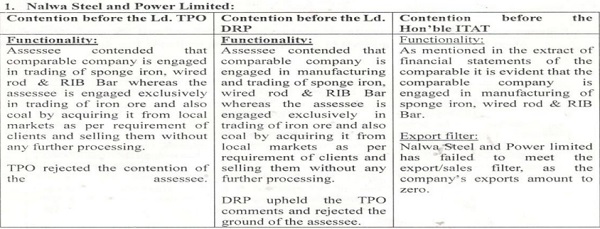
5. Aggrieved by the orders of the Ld.AO/DRP, the appellant company filed an appeal and took the grounds of appeal as mentioned in pages 2 and 3 of this order. Before the ITAT, the Ld.AR of the appellant filed certain written submissions and also relied on various cases law for the proposition that the companies which are engaged in pure trading should not be compared with manufacturing companies to arrive at the ALP, because, the expenditure incurred in both these companies cannot be compared. In the manufacturing companies, the companies purchase raw material, incur the manufacturing wages, huge electricity bills would be there for maintaining the factories, whereas in a pure trading concern, there would not be such expenditure and hence, the comparative study undertaken by the Ld.AO is incorrect. The Ld.AR of appellant has submitted a summary of the submission made before the ITAT, Visakhapatnam, where they wanted exclusion of comparables of Nalwa Steel and Power Limited, Rungta Mines Limited and Shyam Sel and Power Limited. The Ld.AR of the appellant company has filed a tabular form of functionality test of the comparable companies and their own company, which is reproduced below :
–
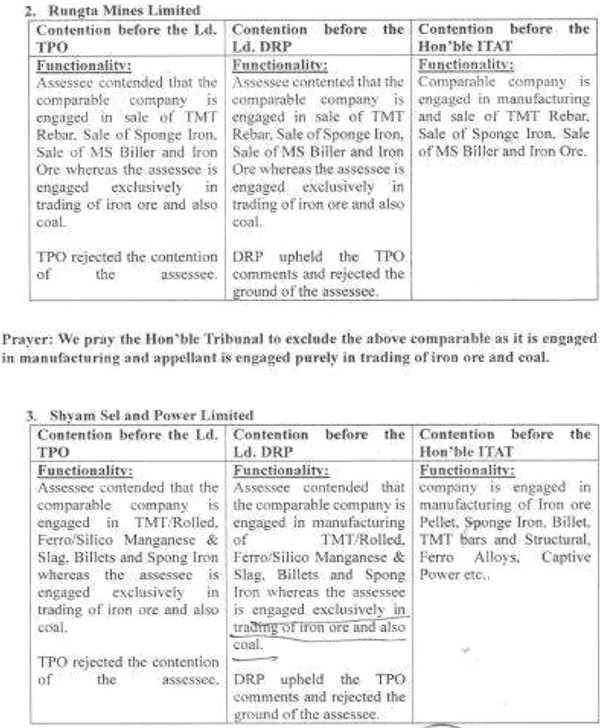
5.1. Thus, the main argument of the Ld.AR of the appellant is that the companies which were taken for comparison are all engaged in the manufacturing of sponge iron ore, wired rod & RIB Bar etc., whereas the appellant is engaged purely in trading of iron ore and coal. The Ld.AR of the appellant has vehemently argued as above by pointing out from the transfer pricing order passed u/s 92CA(3) dated 31.10.2023, para 2. The Ld.TPO/AO while passing the order u/s 92CA(3) has clearly mentioned at para 2, page 1 that the taxpayer company is engaged in the business of trading in iron ore and coal, whereas, the functional profile of all the comparable companies are totally different, because those companies were engaged in manufacturing of the products. But the appellant company is totally into only trading, i.e. purchasing and selling iron ore and coal. In this case, the appellant company claims that it is engaged in trading of iron ore and coal without any further processing and during the impugned year, the company sold goods worth Rs.181.35 cores to its AEs, GMT Global Impex Pte Ltd and TNMM method was applied, as the activities of the appellant company and the comparable companies are functionally dissimilar, the ALP cannot be computed by taking into consideration the financials of those companies into consideration. The Ld.AR of the appellant company has also emphasized that even the transportation charges were being adjusted while computing the ALP. It was argued that during COVID period, the appellant company had to incur higher charges while transporting the goods and in the absence of any finding relating to inflation of expenses, the Revenue cannot make adjustment with regard to transportation charges. Finally, the Ld.AR of the appellant placed reliance on the decision of Hon’ble ITAT Delhi in the case of M/s Golden Agri Resources (India)(P.) Ltd. [2024] 161 taxmann.com 19 (Delhi-Trib), where it was held that the companies engaged in the manufacturing business are not comparable with the companies engaged in the trading business. Relevant extract of the decision was given as follows :
“The comparables used by the TPO are not at all comparable on functional dissimilarity. The assessee is engaged in trading of edible oils whereas all the comparables mentioned here in above are in manufacturing of edible / non-edible oils [Paras 10-11]
Since the market quotes were available on corresponding dates and when corresponding dates data was not available on the date of contract entered between the assessee and its AE, the “other method” has been rightly applied by the assessee. [Para 13]
The TPO has failed to analyze the TP documentation prepared by the assessee. It is found that the assessee has appropriately compared the prices of third party brokerage houses/associations/exchanges where ever available during the time of preparation of the TP documentation. [Para 14]
It is found that the assessee has considered all the market quotations available while maintaining the transfer pricing report and considering the contemporaneous nature of documentation process as provided under the relevant provision of the Act. [Para 15]
If any third party rate is not considered for a particular date of contract due to non-availability of the data, it would not give right to the. TPO to reject the method adopted by the assessee. The assessee has considered the rates based on the average of available third party market quotations of Murgi Meghan, Sunvin Group, Malaysian Palm Oil and Solvent Extractors and not specifically to any single broker rate.
The objective of applying of any transfer pricing method is to determine the arm’s length price for a given transaction and not to justify any transfer price at which the transaction may have been undertaken. [Para 17]
If there is a difference between arm’s length price determined by a particular method and the transfer price adopted by the assessee, it may warrant the transfer pricing adjustment, in case such variation is not within the permissible tolerance range specified in the Act. However, such variations cannot be the basis of questioning appropriateness of the method. [Para 18]
A perusal of the order of the TPO show that he has mentioned a difference of Rs.97.36 lakhs and rejected the applicability of “other method”. This difference is minuscule when considered with the total value of international transaction of Rs: 729 crores. [Para 19)
Considering the facts of the case in totality there is no merit in the impugned adjustment, therefore, the Assessing Officer/TPO is directed to delete the addition of Rs. 48.63 crores. [Para 20]”
5.2. In view of the above, the Ld.AR of the appellant prayed that the Tribunal to consider these submissions and direct the Revenue to exclude the above 3 comparables from the final set of comparables to arrive at the correct ALP. If these 3 companies are excluded, there cannot be any adjustment, which can be made to the ALP. In other words, the Ld.AR of the appellant company has argued that the entire addition should be deleted.
6. The Ld.DR relied on the order of the TPO/AO and the Ld.DRP, where the officers have held that correct comparables were taken while making the ALP adjustment and for the reasons mentioned in their orders, the addition made should be confirmed.
7. After hearing both sides, the Bench decides to set aside the matter to the file of the Ld.DRP with the following directions :
(a) It is not clear whether the appellant company is exclusively in trading of goods like iron ore and coal or they are engaged in the production/manufacturing of the goods also. The Ld.AO/TPO in the order dated 31.10.2023 at para 2, page 1, says that the appellant company, which is incorporated on 04.09.2014 is engaged in the business of trading of iron ore and coal. The Ld.DRP at page 7, paras 2.8.1.1, 2.8.2.1 and 2.8.3.1 has held that both the appellant company and the comparable companies are operating in the same business of producing ferrous products and after hearing the submissions and reviewing the annual reports, it was held that the product-wise performance is the same and the business activities of appellant company are similar to the business activities of the above 3 comparable companies. In fact, the order of the Ld.DRP is very cryptic and it did not adjudicate with statistical information that both the appellant company and the comparable companies are in similar line of business. In view of the same, the issue is set aside to the file of the Ld.DRP to find out whether the product profile and business activities are similar to that of the above 3 comparable companies and then a decision may be arrived at. It is a settled law that the ALP can be computed /adjusted only after comparing the companies, which are functionally in the similar line of business. The Ld.DRP has not properly adjudicated whether the appellant company and the comparable companies are in similar line of production of iron ore, billets, iron rods etc. The plea of the Ld.AR of the appellant from the beginning is that they are purely traders, whereas, the comparison was done by the Ld. officer with manufacturing companies, where the product profile, expenditure to be incurred etc. are totally different and hence the addition cannot be made relating to ALP by comparing the incomparables. In view of the same, the Ld.DRP is directed to get the product profile of the 3 companies, which was taken by Ld.AO while arriving at ALP and arrive at a correct decision after giving effective opportunity to the appellant company. The appeal of the assessee is set aside to the file of Ld.DRP with the above directions and the appeal is allowed for statistical purpose.
8. In the result, appeal filed by the Assessee is allowed for statistical purpose
Order pronounced in the open court on 30th April 2026.