INTRODUCTION
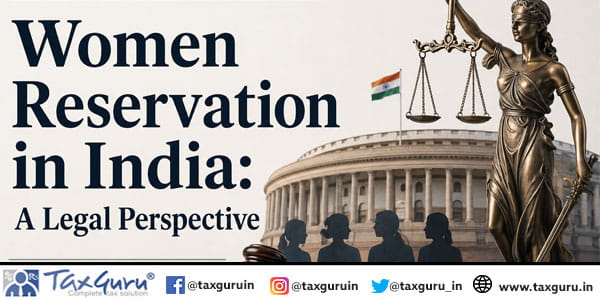
Women’s reservation in India represents one of the most significant indigenous and democratic reforms aimed at ensuring gender equivalency in political participation. Despite constitutional recognition of equivalency, women representation in legislative bodies, political institutions, and decision- making positions has been very low. The movement for women’s reservation surfaced from the broader struggle for social justice and gender equivalency. Over the time, India has introduced several legal and constitutional initiatives to increase women’s participation in politics resulting in the enactment of the Constitution(One Hundred and Sixth Amendment) Act, 2023, popularly known as the Women’s Reservation Bill or Nari Shakti Vandan Adhiniyam.
“The Indian Constitution guarantees equality before law under Article 14 and prohibits discrimination on the grounds of sex under Article 15. At the same time, Article15(3) empowers the State to make special provisions for women and children.”1 These constitutional provisions form the legal base for affirmative action programs including reservation for women. The makers of the Constitution acknowledged that formal constitutional provision alone would not exclude discrimination and social impediments faced by women since time memorial. Thus, the Constitution permits special measures to hoist underprivileged groups, including women. The demand for women’s reservation gained force after women’s participation in electoral politics remained extremely low despite decades of independence. Women constituted nearly half of India’s population but occupied only a few of seats in Parliament and State Legislative Assemblies. Political parties were reluctant to give acceptable representation to women campaigners which resulted in gender imbalance in Indian politics. This underrepresentation raised many concerns regarding political legality and inclusive governing body.
A major landmark in this regard was the enactment of the 73rd and 74th constitutional amendments in 1992 which introduced reservation for women in Panchayats and Municipalities. These amendments introduced Part IX and Part IX- A into the Constitution and introduced reservation of a minimum of one- third of seats for women in local bodies. These reforms converted democracy in India by enabling millions of women to participate in local governance. This reservation was increased to 50% by many states. The success of women’s reservation at the primary level demonstrated that indigenous proportions could significantly work for the betterment of women’s political participation and leadership. The legal foundation for reservation in original bodies is contained in Articles 243D and 243T of the Constitution. Article 243D provides reservation of seats for women in Panchayats, while Composition 243T contains same provisions for Municipalities. These enactments have played a major role in the Indian parliament by adding women’s representation in governance structures. The active participation of women in local government has contributed to many sectors like education, health, sanitation, and social weal issues. It has also challenged patriarchal analogy and promoted politics among women.
Encouraged by the success of local reservations, the demand for reservation in Parliament and State Assemblies boosted. The first Women’s Reservation Bill was introduced in Parliament in 1996. The Bill proposed reserving one- third of all seats in the Lok Sabha and State Legislative Assemblies for women. But still the Bill faced violent political opposition and constantly lapsed due to lack of agreement among political parties. Issues were raised regarding reservation for women belonging to Other Backward Classes (OBCs), rotation of reserved seats, and possible reduction in openings for male politicians. Despite repeated attempts in 1998, 1999, 2003, and 2008, the Bill was not passed after several attempts.
The issue eventually witnessed a major boost in 2023 when Parliament passed the Constitution (One Hundred and Sixth Amendment) Act, 2023. The legislation reserves one- third of seats in the Lok Sabha, State Legislative Assemblies, and the Legislative Assembly of Delhi for women “It also provides reservation within reserved seats for women belonging to the Schedule Caste and Schedule Tribe. It also led to the introduction of new provisions including Articles 330A, 332A, and 239AA to operationalize reservation for women in houses.”2 Under the new law, one- third of the total seats filled through direct elections at the both the centre and the state level shall be reserved for women. The reservation also applies to seats formerly reserved for scheduled tribes and scheduled caste, ensuring intersectional representation. Another important point of the law is the alternation of reserved seats after every delimitation exercise.
The reservation is intended to continue for 15 years, although Parliament may extend it further through legislation. But still, the implementation of the law is linked to the completion of the next census and delimitation exercise. These provisions have generated considerable debate and review. Critics argue that linking reservation with delimitation may affect its implementation. “Since this whole process is very time consuming, women may not promptly benefit from the amendment. Some scholars and political leaders have argued that reservation could have been enforced without staying for delimitation.”3 Scholars in favour of the Women’s Reservation Act argue that it is essential for achieving substantial equivalency and strengthening the republic. Political representation is not only figurative but also substantial because lawmakers impact law-making and public policy. Women lawmakers can bring to consideration matters such as gender violence, education, protection and social well- being of a woman. Reservation also helps in reducing social barriers which hinder women from entering politics, including patriarchy, fiscal constraints, and lack of political networks.
From a legal perspective, women’s reservation has been justified under the doctrine of affirmative action. Indian justice system acknowledges that equality occasionally requires special treatment to address historical shortcomings. The Supreme Court of India has constantly supported the perspective that affirmative action programs intend to promote social justice and equivalency. Reservation for women is thus, viewed not as discrimination against men but as a valid medium to ensure equal participation in governance. However, the policy has still attracted a lot of criticism. One major concern remains the alternation of reserved constituencies. People argue that frequent rotation may discourage lawmakers from developing long-term connections with constituencies. Another concern is the miracle of “ Nominal representation, ” where tagged women representatives are allegedly controlled by male family members. This issue was observed in some original government institutions after the 73rd and 74th amendments. But still numerous studies indicate that over time women representatives have started becoming independent and politically assertive.
Another important debate is related to the absence of separate reservation for OBC women in the Women’s Reservation Act. Several politicians have argued that reservation without internal proportions may disproportionately profit women from socially and economically privileged backgrounds. They demand a “ share within share ” system to ensure indifferent representation of marginalized women. This remains an undetermined issue in the current legal framework. The international perspective also supports women’s reservation as a medium to fight against gender discrimination. Countries including Rwanda, Nepal, Bangladesh and France have granted reservation to women in houses or political parties. “India is also committed to gender equality under some international conventions such as the Convention on the Elimination of All Forms of Demarcation Against Women( CEDAW) further strengthens the legal legality of women’s reservation.”4
The judiciary has been indirectly instrumental in promoting women’s political participation. Courts in India have emphasized the significance of gender justice and equal opportunity in many decisions. Judicial interpretation of Articles 14, 15, and 21 has expanded the compass of women’s rights and constitutional protection. Although the judiciary has not directly commanded reservation in houses, its progressive interpretation of equivalency principles has created a favourable constitutional platform for similar reforms. In recent times, conversations around the implementation of the Women’s Reservation Act have continued. However, the bill having being introduced in 2026 in the parliament by the ruling party could not get the special majority and has been rejected.
CONCLUSION
Women’s reservation in India is a historic effort to advance gender equality and inclusive democracy through constitutional means. The constitutional principles of equality, social justice and affirmative action are the legal basis of reservation. India has taken giant strides in the direction of strengthening women’s political representation, starting with the 73rd and 74th Amendments that brought in local self-government reforms and culminating in the Constitution (One Hundred and Sixth Amendment) Act, 2023. Despite challenges related to implementation, rotation and inclusivity, the law is an important milestone in the constitutional and democratic development of India. Women’s reservation is not only a legal reform but also a social transformation and a step to create a more representative, participatory and equitable political system.
REFERENCES:
-
- https://www.scconline.com/blog/post/2026/04/22/womens-reservation-2023-amendment-vs-2026-bill-failure/
- https://www.drishtiias.com/to-the-points/Paper2/women-reservation-act-2023-women-in-politics
- https://www.epw.in/engage/article/historicising-womens-reservation-contextualizing
- https://prsindia.org/billtrack/the-constitution-one-hundred-twenty-eighth-amendment-bill-2023
- Constitution of India, 1950.
Notes:
1 Article 14 and Article 15, Constitution of India, 1950.
2 https://www.drishtiias.com/to-the-points/Paper2/women-reservation-act-2023-women-in-politics.
3 https://www.epw.in/engage/article/historicising-womens-reservation-contextualizing.
4 https://www.scconline.com/blog/post/2026/04/22/womens-reservation-2023-amendment-vs-2026-bill-failure/.