The issue examined is whether court fees for GST Appellate Tribunal (GSTAT) appeals should be applied Act-wise and whether separate or higher fees apply for IGST and Compensation Cess demands. Rule 110(5) of the CGST Rules prescribes appeal fees, and GSTAT Rules refer to this provision along with SGST/UTGST laws, indicating that fees are payable separately for each Act involved. Although the IGST Act’s borrowing provision refers only to the CGST Act and not explicitly to its rules, legal interpretation suggests that rules are implicitly included as machinery provisions necessary for implementation. Therefore, CGST Rules on court fees apply to IGST as well, making fees applicable separately for IGST demands. In contrast, the Compensation Cess Act explicitly adopts both the CGST Act and Rules, reinforcing applicability. Importantly, there is no provision requiring double court fees for IGST, unlike penalties. However, practical implementation on the GSTAT portal currently does not reflect Act-wise fee segregation.
Quick synopsis-
– Court fee will apply Act wise?
– Separate court fee will apply to Compensation to cess Act also?
– Whether the court fee for IGST demands will be double (minimum and maximum)
– Whether the borrowing section of IGST Act also borrows the CGST rules
While trying to file the GSTAT appeal I came across a very important question, Whether the court ee will also be Actwise. Then another follow up question, whether it will double for IGST and Compensation cess demands?
I tried to find the answer to this question and will just share the whole analysis I did.
Let us first try to see where the court fees provision is given?
The provisions of GSTAT are given in both CGST Rules and GSTAT rules.
In CGST rules rule 110(5) talks about the court fee. The provision is given verbatim below-
“Rule 110 (5) The fees for filing of appeal or restoration of appeal shall be one thousand rupees for every one lakh rupees of tax or input tax credit involved or the difference in tax or input tax credit involved or the amount of fine, fee or penalty determined in the order appealed against, subject to a maximum of twenty-five thousand rupees and a minimum of five thousand rupees: Provided that the fees for filing of an appeal in respect of an order not involving any demand of tax, interest, fine, fee or penalty shall be five thousand rupees.”
In GSTAT rules-
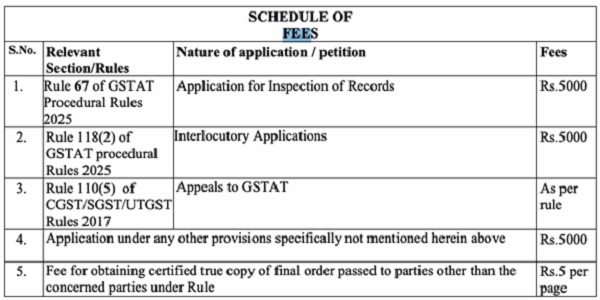
Rule no. 3 refers to Rule 110(5) and it also refers to SGST and UTGST Act. By this reading of law we can conclude that fees shall be Actwise. Let us try to understand by an example-
A demand of following items was raised in an order-
CGST Demand- Rs. 1,00,000
SGST Demand -Rs. 1,00,000
IGST Demand -Rs. 1,00,000
The amount of court fees as per Rule 110(5) will be-
Rs. 1000 for CGST- Minimum 5000
Rs. 1000 for SGST- Minimum 5000
Rs. 1000 for IGST- Minimum 5000
Issue 1– There is an important question when we see the borrowing section of IGST Act and compensation cess Act.
The borrowing section of IGST Act states-
“20. Subject to the provisions of this Act and the rules made thereunder, the provisions of Central Goods and Services Tax Act relating to,––
–
-”
It only talks about the provisions of CGST Act without any mention of CGST Rules.
Now let us have a look at section 11 of the Compensation to State Act.
“Section 11. Other provisions relating to cess .
(1) The provisions of the Central Goods and Services Tax Act, and the rules made there under, including those relating to assessment, input tax credit, non-levy, short-levy, interest, appeals, offences and penalties, shall, as far as may be, mutatis mutandis, apply, in relation to the levy and collection of the cess leviable under section 8 on the intra-State supply of goods and services, as they apply in relation to the levy and collection of central tax on such intra-State supplies under the said Act or the rules made there under.
(2) The provisions of the Integrated Goods and Services Tax Act, and the rules made there under, including those relating to assessment, input tax credit, non-levy, short-levy, interest, appeals, offences and penalties, shall, mutatis mutandis, apply in relation to the levy and collection of the cess leviable under section 8 on the inter-State supply of goods and services, as they apply in relation to the levy and collection of integrated tax on such inter-State supplies under the said Act or the rules made there under:”
Here specific mentioning of rules is also given. Does it mean that in case of IGST Act rules will not apply. IGST Act has its own power to issue the rules and the CBIC has duly prescribed the rules in IGST Act.
But in case of compensation cess Act, the CGST rules will be applicable in each regard.
Now how can we interpret the non mentioning of CGST Rules in the IGST Acts borrowing section? The provisions of CGST Act also includes the CGST rules by default? Then why are rules specifically mentioned in the compensation cess Act?
One thought may be that in IGST, CGST rules will apply to the extent there is no rule prescribed in IGST Act. But in case of compensation Act all rules will apply as there is no rule in cess Act.
But the more correct thought will be-
Section 20 IGST says certain CGST Act provisions “shall apply, so far as may be, in relation to IGST”.
In practice, many of those borrowed topics (valuation, time of supply, ITC etc.) are implemented through:
- Act provisions (the charge/conditions), and
- Rules/forms/procedures (the machinery).
Courts typically treat the Rules here as machinery provisions that travel with the Act “so far as may be”, because otherwise IGST would lack workable procedure.
So even if “rules” aren’t named, a court can say:
the borrowing intends a complete workable scheme, not a half-scheme.
Whether the court fees mentioned in CGST rules will also apply in IGST demands separately. As there is no specific mention of court fee in IGST rules, CGST rules will apply. Thus it will apply separately for IGST demands.
Issue 2– Now there is another question whether for IGST this amount of minimum fees will be Rs. 5000 or 10,000?
As we know in case of general penalty we charge double for IGST. Let us have a look at the provision of IGST which makes us pay a double penalty.
Proviso 4 of section 20 of IGST Act-
“Provided also that in cases where the penalty is leviable under the Central Goods and Services Tax Act and the State Goods and Services Tax Act or the Union Territory Goods and Services Tax Act, the penalty leviable under this Act shall be the sum total of the said penalties”
As we can see this provision is only for penalty. There is no similar provision for court fees. Thus the amount of court fee shall not double for GSTAT filing. But it will be Actwise.
Actual scenario on GSTAT portal-
So whatever I have discussed is what is interpretation of law. But on the portal there is no separate fees for separate Act charged by portal..