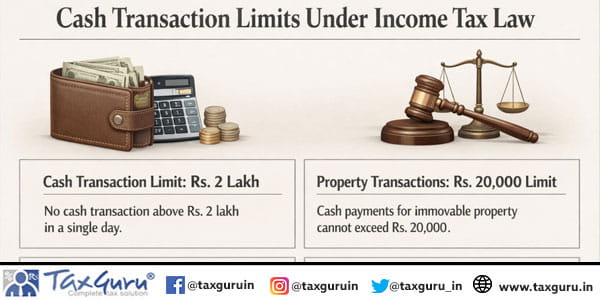
Income Tax : The provisions regulate acceptance, payment, and receipt of cash beyond specified limits. They impose strict penalties to discoura...
Income Tax : Covers the latest cash withdrawal, deposit, and loan limits. Takeaway: exceeding thresholds can trigger TDS, penalties, and blocke...
Income Tax : Explains when director cash infusions qualify as current account transactions and why genuine business support may fall outside Se...
Income Tax : The Tribunal held that penalty under Section 271DA cannot be imposed when the assessment order lacks recorded satisfaction of a 26...
Income Tax : Summary of income-tax rules on cash limits, including disallowance of cash expenditure, restrictions on loans, deposits, receipts,...
Income Tax : DON’T √ Accept cash of Rs. 2,00,000 or more in aggregate from a single person in a day or for one or more transactions r...
Income Tax : It is suggested that there should be a positive provision under the I.T. Act that any transaction involving more than Rs.3,00,000/...
Income Tax : The Tribunal held that enhancement of income without issuing notice under section 251(2) is invalid. Such action violates principl...
Income Tax : The Tribunal held that Section 50C may not apply if properties are held as stock-in-trade. It remanded the case to verify whether ...
Income Tax : The issue was whether rejection of books and GP estimation was justified due to missing records. ITAT upheld the addition, ruling ...
Income Tax : The issue was whether demonetisation cash deposits can be taxed as unexplained credits solely due to use of SBN. The ITAT held tha...
Income Tax : The Tribunal held that Section 269SS does not apply when cash is received as part of final sale consideration at the time of prope...
Income Tax : Notification No. 8/2020-Income-Tax- CBDT has notified Other electronic modes by inserting New Income TAx Rule 6ABBA. It also amend...
Income Tax : In the Income-tax Rules, 1962, in Appendix II, in Form No. 3CD, for serial number 31 and the entries relating thereto the followin...
Fema / RBI : Section 269SS and 269T of the Income Tax Act, 1961, the requirements under the Income Tax Act, 1961, as amended from time to time,...
The Court held that violation of the ₹20,000 cash-loan limit under tax law attracts only penalty and does not void the debt. Cheque-bounce prosecutions under Section 138 NI Act remain valid despite such breaches.
Since the assessment order did not refer to initiating penalty under Section 271D, the Court held the penalty void. This reinforces that penalty jurisdiction arises only from recorded satisfaction.
The Tribunal condoned a 960-day delay after finding that the assessee’s reliance on VSV settlement and pending rectification was a bona fide cause. It ruled that penalty under Section 271D is independent of quantum proceedings. The penalty appeal was wrongly dismissed as infructuous and has been remanded for fresh decision.
CIT(A) set aside penalties imposed for violations of Sections 269SS and 269T, as they were issued beyond the statutory limitation period. The ruling reaffirms that late penalty orders are invalid even if violations occurred.
The Tribunal held that penalty under Section 271DA cannot be imposed when the assessment order lacks recorded satisfaction of a 269ST violation. The ruling confirms that satisfaction by the Assessing Officer is a mandatory precondition.
Summary of income-tax rules on cash limits, including disallowance of cash expenditure, restrictions on loans, deposits, receipts, repayment rules, electronic payment requirements, and penalties for non-compliance under Sections 40A(3), 269SS, 269ST, 269SU and 269T.
ITAT Chandigarh deleted a Rs.20 lakh penalty levied under Section 271D for a cash deposit violating Section 269SS. The Tribunal ruled the deposit was a temporary parking of funds by the father for security, not a loan or deposit.
ITAT Dehradun accepted ₹15 lakh from poplar tree sales as explained income and ruled that Section 115BBE applies prospectively from 1 April 2017. Tribunal granted partial relief, deleting major additions made on demonetisation cash deposits.
The Mumbai ITAT deleted the interest disallowance, applying the principle of consistency because the Revenue had previously accepted the assessee’s classification of net interest income under Income from Other Sources in earlier scrutiny assessments. The court found no justification to deviate from this accepted treatment for the current year.
Indian tax law restricts cash transactions to promote digital payments. Limits apply to expense payments (Sec 40A(3): ₹10k/day), accepting loans/advances (Sec 269SS: ₹20k limit), and receiving funds (Sec 269ST: ₹2 lakh threshold). Non-compliance results in penalties or disallowance of expenditure.